ASK most kids if they fancy a trip to an art exhibition and you’re unlikely to get an overly-enthusiastic answer.
But what if that art exhibition included a ball pit, an enormous bouncy castle and flying balloons? You might suddenly have a mini art critic on your hands.
The Balloon Museum is back, this time at Immerse London on Excel Waterfront with its latest offering EUPHOЯIA – Art is in the Air.EUPHOЯIA invites those artists to use air and inflatable materials “as a contemporary artistic language”
Step in the Balloon Museum, which last graced the UK in 2023 with its EmotionAir: Art you can feel exhibition at Old Billingsgate in 2023.
It’s now back, this time at Immerse London on Excel Waterfront with its latest offering EUPHOЯIA – Art is in the Air.
Sign up for the Travel newsletter
Thank you!
The concept of the Balloon Museum is that it’s a new way to experience contemporary art, with large-scale installations created by international artists including Turner Prize winner Martin Creed.
EUPHOЯIA in particular, invites those artists to use air and inflatable materials “as a contemporary artistic language” that “invites visitors to explore, interact and see the familiar in unexpected ways.”
It’s fair to say all of this went entirely over my seven year old’s head on our visit, both literally and figuratively speaking.
Because while it might be about art, it’s also A LOT of fun.
Our first stop was a giant glass-walled room filled with enormous balloons that you have to push your way through to reach the end.
There was also a room filled with large inflatable cubes that we used to build an enormous fort, one with an enormous bed that could fit 20 people and a giant Covid virus-style inflatable, among others.
But our favourites were the huge ball pit bigger than a ballroom, the most enormous bouncy castle I’ve ever seen – at least 25m in length and filled with inflatables, a balloon whirlwind and a very clever mechanical tree that dropped bubbles filled with smoke.
Of course, all of this also made for some incredible photo opportunities too.
Our favourites were the huge ball pit bigger than a ballroom, the most enormous bouncy castle I’ve ever seen and a balloon whirlwind (pictured)
We’ve got about a gazillion grinning selfies from our visit – the hallmark of every great Millennial day out.
So will my son now be requesting a membership to the Tate Modern on his Santa List? Probably not.
But he will definitely be far more open to my next suggestion of a trip to a gallery… how to explain there won’t be any inflatables to play with once there is another matter altogether.
Tickets for EUPHOЯIA – Art is in the Airat ExCeL London, Royal Victoria Dock, from £20 for children and £26 for adults, with family tickets from £59.
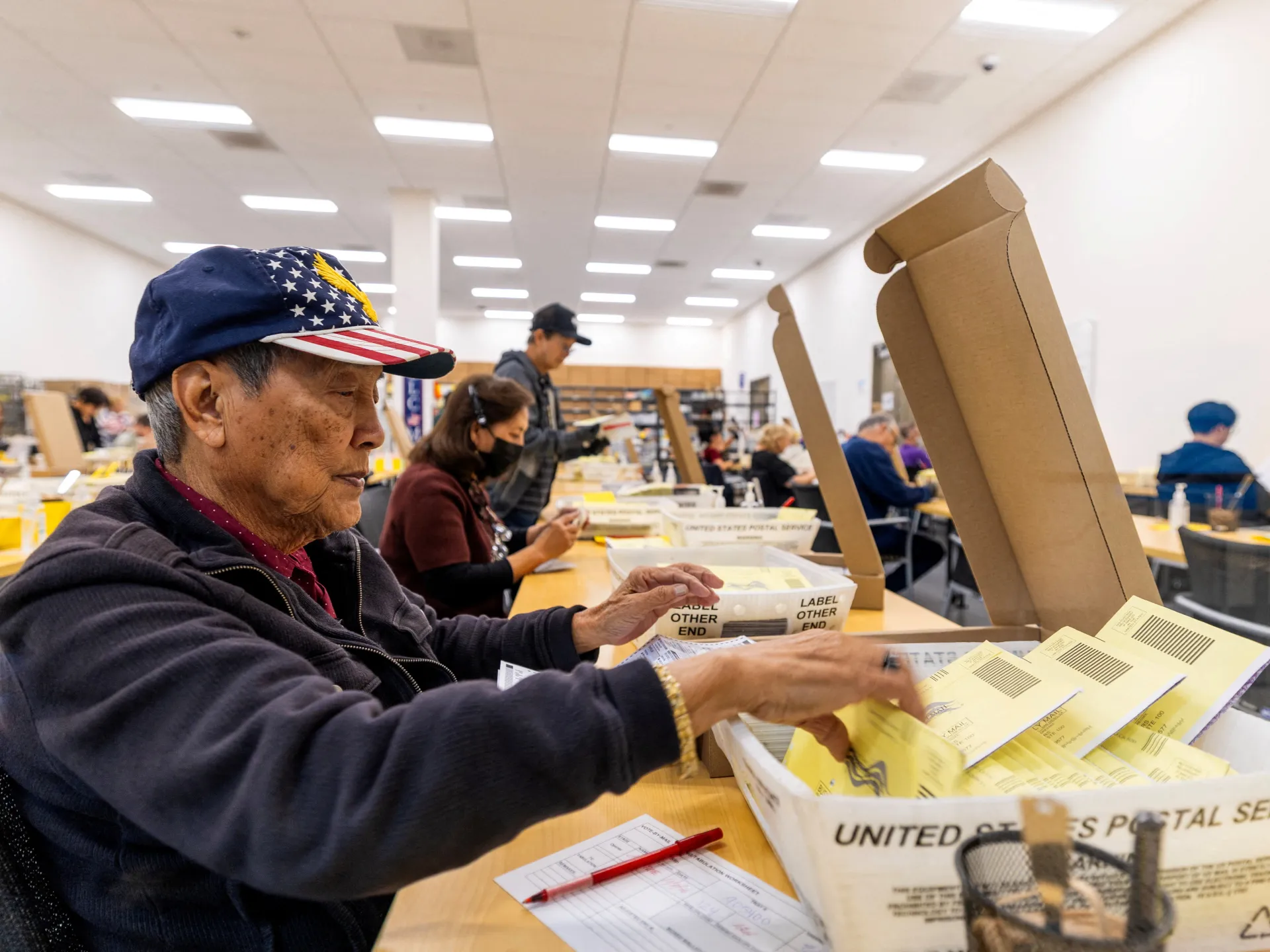
While votes are still being counted in California, a handful of important races in the midterm elections have already been called or are pointing firmly in one direction.
Despite its status as a reliably Democratic stronghold, the Western state has played a dynamic role in Tuesday’s United States elections, acting as a testing ground for questions as varied as partisan redistricting and tax measures targeting billionaires.
Recommended Stories
list of 3 itemsend of list
Let’s take a quick look at some of tonight’s results:
Democrats ahead in key races
While vote-counting was still under way, Democratic candidates have pulled decisively ahead in several contests seen as must-wins for the party’s effort to take control of the US House of Representatives.
To boost the party’s chances, voters a year ago approved a partisan redistricting measure promoted by Governor Gavin Newsom to net Democrats five additional seats in the US House.
One such race took place in the state’s 22nd Congressional District, located in the agriculture-rich Central Valley.
Progressive educator Randy Villegas celebrated the results of the race on Tuesday night as the Democrat held a commanding lead of about 30 percentage points over Republican incumbent David Valadao.
Democratic candidate Marni von Wilpert is also ahead in the 48th district, located in Southern California near San Diego, where she is leading Republican Jim Desmond by about 20 points.
While those advantages are considerable, The Associated Press news agency has not yet officially called those races.
Progressive Aisha Wahab is also firmly ahead in her race against Melissa Hernandez, a fellow Democrat, in the 14th district.
Wahab overcame substantial spending by pro-Israel groups to defeat the establishment-aligned Hernandez in a special election in September. She is now on track to win a full term in that seat.
With her previous victory, Wahab became the first person of Afghan ancestry elected to Congress.
In the San Francisco Bay Area, moderate Democrat Scott Wiener is leading progressive rival Connie Chan in a race for the seat of retiring Representative Nancy Pelosi, the powerful former Democratic House speaker. Wiener has a lead of about 10 points with 50 percent of the vote tallied thus far.
Republicans face another bruising defeat in gubernatorial race
While Republicans across the country have laboured to turn California into a symbol of liberal dysfunction, voters in the state remain unconvinced that conservatives offer a better alternative.
The gubernatorial race was called for the Democratic candidate, former state Attorney General Xavier Becerra, immediately after the polls closed.
Becerra’s Republican rival, British political commentator Steve Hilton, had argued that years of unbroken Democratic domination had resulted in sky-high prices and public disorder.
But his bid to underscore cost-of-living issues by holding campaign events where he offered discounted petrol fell flat at a time when many voters blame President Donald Trump’s war on Iran for eye-watering prices at the pump.
Becerra’s victory comes more than five years after Republicans tried to dislodge Newsom through a recall election that failed by a margin of more than 20 points.
In the past, Republicans could console themselves that if they remained in electoral purgatory in the most populous US state, their Democratic rivals were likewise locked out of power in conservative strongholds such as Texas.
Tuesday’s losses will sting a bit more after a series of shock wins by Democrats in states that can usually be counted on to deliver easy wins for Republicans, including Texas.
Uncertainty over some ballot measures
While some results have come in quickly, tight contests over some of the state’s ballot measures, or policy questions put directly before voters, have yet to be called.
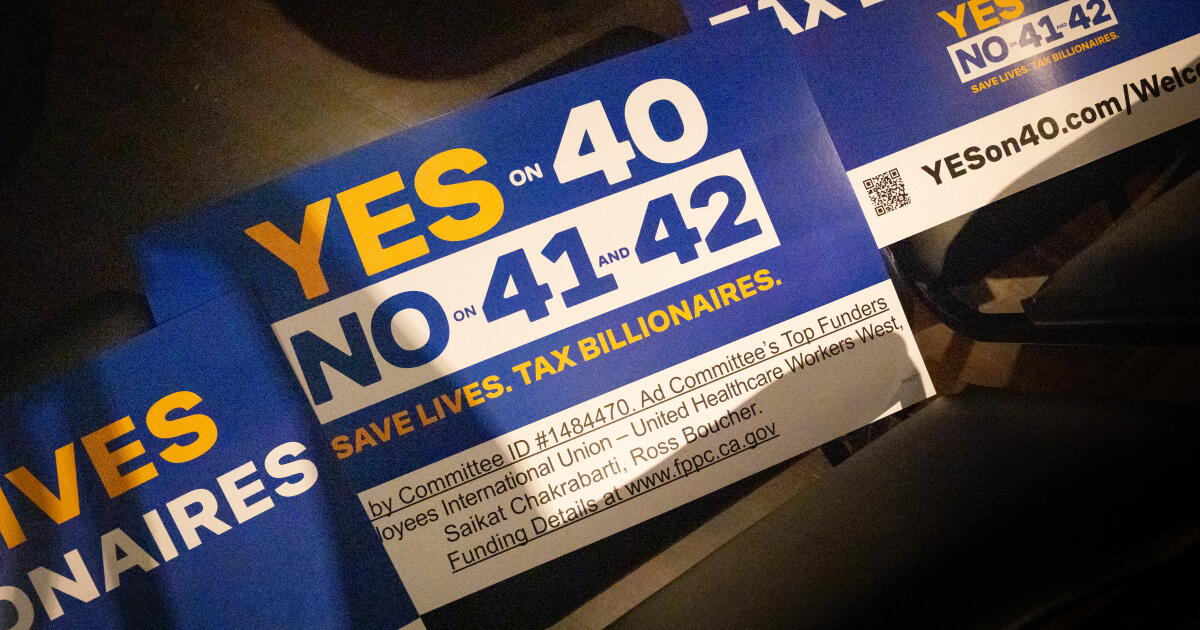
Proposition 40, which would institute a one-time tax on the net worth of billionaires in the state to help fund programmes such as healthcare and education, is trailing with about 44 percent of the counted votes in favour and 56 percent against.
The measure won support from progressive figures, such as Senator Bernie Sanders and Representative Ro Khanna, but prompted a deluge of spending from wealthy donors and companies to oppose it.
The Associated Press has announced that Proposition 39, which would have instituted voter ID laws sought by conservatives, has been rejected by voters.
Brooklyn Beckham shared a shirtless snap in a bid to distract fans from his ‘awkward’ Halloween snapsSource: Instagram/brooklynpeltzbeckhamIt comes after fans went to town on pics of Brooklyn with wife Nicola and Liz Hurley’s son DamianSource: Instagram/damianhurley1
So, in a bid to get his followers talking about something else, Brooklyn shared a sultry black and white shot of himself stood by his pool.
Showing off his muscular back, Brooklyn could be seen wearing just a towel as he looked out over the impressive grounds of the home he shares with wife Nicola.
While actor Damian wore an all-leather black outfit unzipped to the waist.
The threesome were all at the same celebrity bash in LA, and Brooklyn shared a series of snaps from the party which also included a pic of Damian with his arm around Nicola.
Brooklyn was mocked by fans over this pic of Damian and NicolaSource: Instagram/damianhurley1The couple were dressed up for a celebrity Halloween partySource: Instagram/brooklynpeltzbeckham
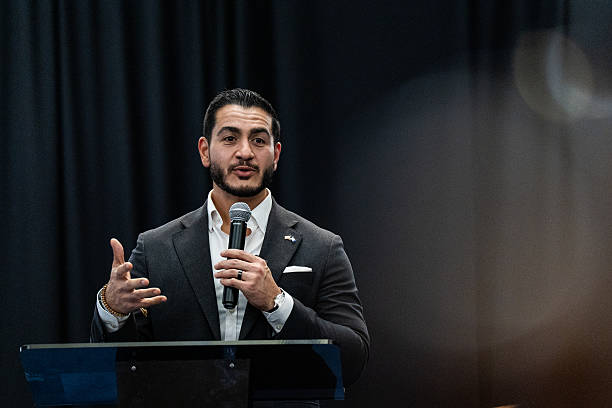
Democrat Abdul El-Sayed has won Michigan’s closely watched U.S. Senate race, defeating Republican Mike Rogers and becoming the country’s first Muslim senator.
His victory comes as Democrats secured control of the upper chamber on Tuesday, giving the party a decisive Senate majority.
The fate of a controversial ballot measure to impose a new tax on California billionaires, proposed as a lifeline for the needy and castigated as a threat to the state’s fragile economy, appeared headed for defeat in early election results Tuesday night.
California voters also rejected another hotly contested measure, Proposition 39, which would have required voters to show identification when they cast ballots and elections officials to verify that all registered voters were U.S. citizens.
The billionaire tax, Proposition 40, would impose a one-time 5% tax on the assets of billionaires to raise an estimated $100 billion to assist millions of Californians destined to lose healthcare coverage under federal funding cuts. Two separate ballot measures, Propositions 41 and 42, were crafted to nullify the wealth tax and remained too close to call Tuesday evening.
While supporters of the billionaire tax did not concede Tuesday evening, they acknowledged facing tough odds in the race because of the avalanche of spending against them and warned that people will die if the measure fails.
“In the event that we don’t succeed with Prop. 40 tonight, if Sacramento fails to deliver a real solution to the healthcare crisis instigated by the [federal government], one that actually makes billionaires pay their fair share, then California’s healthcare workers intend to be back on the ballot in 2028 to correct the damage, and to overcome all of the lies and deception, and just completely outrageous campaigning that we’ve seen,” said Dave Regan, president of SEIU-United Healthcare Workers West, which crafted the proposal.
Voters rejected the Republican-led Proposition 39 at a time of growing distrust in the integrity of the electoral process nationwide, a wariness intensified by President Trump’s baseless claims that the 2020 election was stolen from him and false assertions that droves of undocumented immigrants, notably in California, are swaying elections.
On Monday, the Supreme Court rejected an emergency appeal by Trump’s attorneys to set aside 20,000 ballots in the state that the White House argued could be cast by people who are not citizens.
The proposals were among the 14 state ballot measures that California’s 23.3 million registered voters were asked to decide Tuesday in addition to congressional, statewide and local elections.
The billionaire tax was proposed in response to legislation signed by Trump last year that could result in millions of Californians losing Medi-Cal coverage, rural hospitals shuttering and other healthcare services being slashed unless a new funding source is found. The proposal would retroactively apply to billionaires who lived in California as of Jan. 1, prompting some to preemptively move out of the state. Ninety percent of the revenue would fund healthcare programs, and the remaining funds would be spent on education programs and food assistance.
Proposition 40 divided Democratic leaders because of concerns about its impact on the state’s volatile budget that is highly dependent on the wealthy. Gov. Gavin Newsom opposed the measure, while the state Democratic party endorsed it.
The effort supporting and opposing the tax and two ballot measures designed to nullify it came close to breaking a state campaign finance record. About $425 million had been donated to the three commingled ballot measures as of Tuesday.
The vast majority of that money was provided by California billionaires, including some of the state’s most powerful tech barons, opposing the wealth tax. The campaign was centered on three interwoven ballot initiatives: Proposition 40 and Propositions 41 and 42, both of which would undercut Proposition 40 through a series of strategic changes to state tax laws and new spending restrictions.
Neither explicitly stated that it would nullify the billionaire tax if Proposition 40 passed and either of the counter measures received more votes.
Proposition 41, which trailed slightly Tuesday evening, is framed as an effort to cut wasteful government spending and require audits of new special taxes. But it also would bar new taxes that are exempt from state spending limits. Proposition 42, which was slightly ahead, is presented as protection from state lawmakers taxing everyday Californians’ retirement funds, personal savings and home equity.
In polling leading up to election day, voters appeared to differentiate between the billionaire tax proposal and Proposition 3, which was approved by voters on Tuesday. . It would make permanent a temporary tax increase on wealthy Californians that largely funds education. The tax adds 1% to 3% to the state income tax of single filers who earn more than $360,000, joint filers who make more than $721,000 and heads of household who earn more than $490,000. Voters passed the tax in 2012 and extended it in 2016, but it is set to expire in 2031.
Voters cast ballots on several other proposals about local taxes, public financing of political campaigns, a landmark environmental law, housing, the state’s recall process, state lawmakers’ ability to redirect taxpayer money to the state’s “rainy day” fund, immunology and immunotherapy funding, and restrictions on how community healthcare clinics spend money:
Several ballot measures were decided Tuesday evening:
Proposition 1, which proposed a $11.25-billion bond to boost the construction of affordable housing, was approved by voters.
Proposition 2, which would gave state lawmakers more flexibility over state spending by exempting certain tax revenue from a state spending limit, allowing them to place it into a “rainy day” fund, was approved by voters.
Proposition 37, which would create a down-payment assistance program to help middle-class Californians buy a home, was approved by voters.
Proposition 44, which would require certain health centers to spend 90% of their revenue on patient care rather than overhead and executive compensation, failed.
Among those that remained too close to call:
Proposition 4, which would allow state and local candidates to receive public campaign financing if they demonstrated broad support and agreed to expenditure limits.
Proposition 5, a constitutional amendment that would alter the state’s recall process by limiting it to the question of whether to remove an elected official from office, and no longer including the cadre of candidates hoping to replace the politician.
Proposition 38, which would create an $8.4-billion bond to support the immunology and immunotherapy fields.
Proposition 43, which would bar local governments from imposing special taxes unless two-third of voters support the effort. Current law requires a simple majority vote.
Proposition 45, which would amend the California Environmental Quality Act to speed up certain housing, water, energy, transportation and other projects deemed essential.
Democrat James Talarico wins the Texas Senate race in a historic midterm upset, ending nearly 3 decades of Republican dominance. He pledged to tackle political corruption, expand healthcare, invest in education and end what he called costly, corrupt wars.
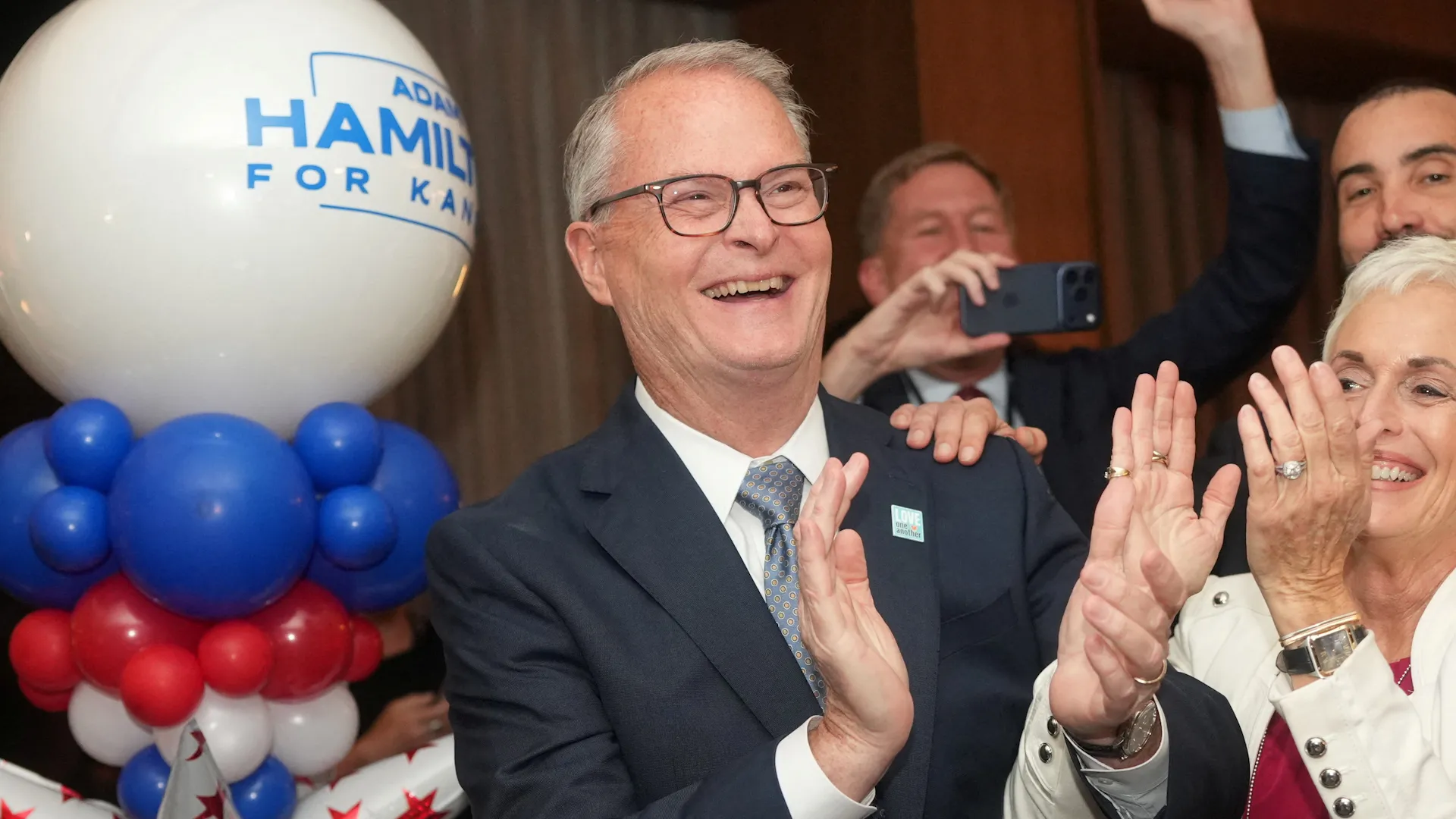
A Democrat from Kansas has been elected to the US Senate for the first time in 94 years. Christian pastor Adam Hamilton beat his Republican opponent Roger Marshall, cementing a Democratic majority in Congress.
GRAMMY-winning music producer Phil McDonald has died at the age of 80.
The celebrated music veteran manned the desk for some of The Beatles’ greatest final records, shaping both the White Album and Abbey Road.
Philip John McDonald in his younger yearsThe music producing legend has sadly died aged 80Source: Instagram
He also engineered iconic solo projects including John Lennon’s Imagine and George Harrison’s All Things Must Pass.
Phil’s stellar work on Abbey Road behind the scenes earned him a Grammy.
Sign up for the Showbiz newsletter
Thank you!
Born Philip John McDonald in Leeds on February 3 1946, he relocated to Earl’s Court in London with his family during the early 1960s.
Gifted with perfect pitch, he landed a job at EMI Studios in 1964, long before the legendary facility was renamed Abbey Road Studios in 1976.
He famously worked with The Beatles in the 60s for some of their most famous albumsHe then engineered John Lennon’s Imagine among other solo projects
Starting out in the tape library, he quickly progressed into the cutting rooms before ultimately securing his role as a tape operator and balance engineer.
His inaugural session with The Beatles took place on June 17 1965 to work on Yesterday.
Paul McCartney debuted the track to an exclusive audience of just two people: McDonald and producer George Martin.
The eventual collapse of The Beatles only caused his workload to surge.
Paul McCartney would sneak tapes from his secret debut solo album into Abbey Road’s Studio Three for McDonald to mix and edit.
At the exact same time, the tireless producer was stationed in Studio Two, assisting Ringo Starr with his album of standards, Sentimental Journey.
Phil Spector arrived on the scene a few months later with a mission to salvage the chaotic Let It Be sessions.
Working closely alongside McDonald, the pair successfully transformed the messy tapes into a releasable record.
Spector and McDonald went on to form a formidable studio partnership between the summers of 1970 and 1973.
Together, they delivered George Harrison’s sophomore solo effort, Living in the Material World, alongside the acclaimed All Things Must Pass.
During this highly productive window, McDonald also helped shape John Lennon’s initial post-Beatles output. He engineered both the John Lennon/Plastic Ono Band record and the legendary Imagine.
Away from the Fab Four, he recorded a raft of talent for EMI’s prog and folk imprint, Harvest.
His diverse roster included Roy Harper and Syd Barrett, with McDonald working on the latter’s 1970 release The Madcap Laughs.
He also proved instrumental in the studio for Linda Lewis, steering four of her albums between 1972 and 1975 and later secured credits on the landmark 1970 album Deep Purple in Rock.
That very same year, he collaborated with Eric Clapton to capture the defining Derek and the Dominos record, Layla and Other Assorted Love Songs.
By 1973, he had secured his second Grammy nomination for his work on Harry Nilsson’s A Little Touch of Schmilsson in the Night.
Leaving the music business behind, Phil and his wife Sandra – who survives him – moved to New York in 2001 and remained in the US.
Tuesday’s results weren’t just a repudiation of Trump or MAGA, but a rejection of the white nationalism that has crept from margins to mainstream over the past decade.
HIGH SCHOOL BOYS WATER POLO SOUTHERN SECTION PLAYOFFS TUESDAY’S RESULTS Second Round
DIVISION 2 Murrieta Valley 12, Palos Verdes 11 Redondo Union 7, Royal 5 Damien 13, Dana Hills 11 La Habra 13, Northwood 11 St. John Bosco 9, Pasadena Poly 5 El Segundo 18, Capistrano Valley 10 Alta Loma 13, Bonita 7 Crescenta Valley 13, Santa Monica 11
DIVISION 3 Norco 12, Camarillo 10 La Serna 9, Millikan 5 Ayala 10, Walnut 9 Troy 17, Brentwood 13 La Canada 6, Flintridge Prep 5 Elsinore 8, Redlands 7 Los Osos 14, Trabuco Hills 12 Los Altos 14, Cathedral 13
DIVISION 4 Liberty 8, San Dimas 4 Aquinas 12, Carpinteria 10 Temescal Canyon 14, Sunny Hills 11 Buena Park 8, West Covina 4 El Toro 6, Yorba Linda 5 Warren 15, Western 12 Foothill Tech 12, Pasadena 9 Laguna Hills 9, Arlington 5
DIVISION 5 Montebello 12, Keppel 5 Torrance 13, San Bernardino 5 Riverside North 10, Norte Vista 8 Anaheim 15, San Gorgonio 9 Oxnard 10, Whittier 9 Montclair 8, Lakewood 7 Hacienda Heights Wilson 10, Heritage 9 California 25, Palm Springs 9
THURSDAY’S SCHEDULE (Games at 5 p.m. unless noted) Quarterfinals
DIVISION 1 Mira Costa at Westlake Mater Dei vs. Buena, site TBA Huntington Beach at Laguna Beach Yucaipa vs. Dos Pueblos, site TBA
Note:Quarterfinals (Divisions 2-5) Friday, Nov. 6 at home sites; Semifinals (Open Division) Saturday, Nov, 7 at home sites; Semifinals (Divisions 2-5) Tuesday, Nov. 10 at home sites; Semifinals (Division 1) Wednesday, Nov. 11 at home sites; Finals (all divisions) Saturday, Nov. 14 at Mt. San Antonio College.
Polls suggest the governing party could fall below 40 percent as voters weigh failing services.
Published On 4 Nov 20264 Nov 2026
South Africans are voting in local elections widely seen as a verdict on the African National Congress (ANC), the party that led the country out of white minority rule in 1994 but has steadily lost support over the past decade.
Polls opened at 7am (05:00 GMT) on Wednesday and close at 9pm (19:00 GMT). A record 29.2 million people are registered to vote at 23,696 voting stations, according to the Electoral Commission of South Africa (IEC). More than 1.4 million special votes were cast on Monday and Tuesday.
Recommended Stories
list of 3 itemsend of list
Voters are electing councils for the country’s eight metropolitan municipalities, 44 district councils and 205 local councils. Those councils then choose mayors.
The ANC fell below 50 percent in municipal polls for the first time in 2021. In the 2024 national election, it lost its parliamentary majority and was forced into a coalition government with the Democratic Alliance (DA) and other parties. Polls suggest the ANC’s support could drop below 40 percent this time.
“Municipal failures have contributed to declining public trust and confidence in democratic governance,” President Cyril Ramaphosa said in his weekly newsletter, “From the Desk of the President”.
Ramaphosa is due to vote at Hyde Park High School in Johannesburg, the presidency said.
Johannesburg is the biggest prize in this election. The country’s financial capital has had five mayors in four years.
The DA has fielded its 75-year-old former leader, Helen Zille, for the city’s top job. Her campaign stunts included snorkelling in a mud-filled trench that was flooded by a burst municipal water pipe.
A News24 poll put Zille at 36 percent, meaning she would need coalition partners, particularly the ANC, to govern. Zille told the Associated Press news agency that the ANC was “in free fall”.
This is the first local vote for former President Jacob Zuma’s uMkhonto weSizwe (MK) party, which is mounting a strong challenge in the coastal city of Durban.
“We are going to start by taking back our country here,” Zuma told supporters in the city on Sunday, the AFP news agency reported. Durban has become a centre of anti-migrant sentiment, a prominent theme in the campaign.
Turnout may be a concern. Only 46 percent of registered voters took part in the 2021 municipal elections.
Coalition government is already widespread: 74 of the country’s 257 municipalities were run by coalitions or minority administrations as of February, according to the Mapungubwe Institute for Strategic Reflection.
Security has also been tightened. Police said 21 election-related cases have been recorded since Sunday. KwaZulu-Natal has 165 voting stations classed as high risk, the most of any province.
Final results are expected on Sunday. They are expected to shape the race to succeed Ramaphosa as ANC leader at the party’s conference in December 2027.
A drone view shows people queueing to vote outside a polling station during local government elections in the Lawley informal settlement, south of Johannesburg, South Africa, November 4, 2026 [Siphiwe Sibeko/Reuters]
Longtime Republican Senator Susan Collins had held the seat for nearly three decades, but was swept away in the blue wave.
Published On 4 Nov 20264 Nov 2026
Democrat Troy Jackson, a former Maine Senate president and labour organiser who entered the race in July, has won the Senate race in Maine, flipping a seat held by the Republicans for 30 years.
Longtime Republican Senator Susan Collins conceded the race to Jackson early on Wednesday, ending nearly three decades as Senator for Maine.
Recommended Stories
list of 3 itemsend of list
Maine’s race was one of the most closely watched in the country. Republican groups spent heavily on the race, donating $76m compared with $40m by Democrats. Jackson’s campaign raised $26.9m, slightly more than the $25.2m for Collins through mid-October.
Located in the far northeastern United States bordering Canada, Maine’s economy has been affected by Trump’s tariff wars with its northern neighbour and key trading partner.
Collins, who has served as senator since 1997, has framed herself as sharing voters’ moderate politics and serving the state’s 1.4 million residents as chair of the Senate’s powerful Appropriations Committee.
Polls released shortly before the election suggested Jackson edging out Collins in a tight race shaped by negative campaigning.
Collins distanced herself from Trump during the campaign but drew criticism for voting in favour of Trump’s legislation and judicial nominees after the Supreme Court ended abortion rights.
Jackson, who campaigned on strengthening the economy and government accountability, framed Collins as a Trump ally and accused her of corruption, which she has denied.
Collins focused on her independence – she was one of the few Republicans who voted to remove Trump from office after the January 6, 2021 attack on the Capitol – and attacked Jackson for his federal inexperience and his voting record in the state legislature.
As we walked through the orchard to our cabin at dusk, shadowy figures emerged from the mist. We stood stock-still and held our breath. Most of them saw us and fled, but one held its ground, unwilling to relinquish its stolen goods. Muntjac have clearly developed quite a taste for windfall apples.
My boyfriend and I left the little deer to dinner and walked on to the quince orchard, where our cabin waited in the far corner. This is the sixth Red Cabin to open in the UK. The first was on a sheep farm in Kent; others followed on farms and vineyards in south and east England. Ours was on Drove Orchards on the edge of the village of Thornham, on the north Norfolk coast.
On this chilly late October evening, our first priority was to start three fires: one in the wood-fired stove to heat the cabin, the others for the built-in sauna and the hot tub on the deck. It sounded arduous but was actually easy as the stoves were ready laid with starter logs – guests simply have to light the log, then add more wood when needed.
The interiors of Red Cabins are unfussy and use local materials. Photograph: Beth Squire
The cabin was soon toasty – its recycled plastic insulation keeps it pretty warm anyway – but it would take a couple of hours for the sauna and tub to heat up. We cracked open the rhubarb cider we had bought from the onsite farm shop and settled down to watch for owls. We heard one or two calling, but only geese passed overhead.
The sauna is at one end of the cabin, accessed from the deck. We started stints in it when it reached a pleasant 40C, but kept stoking it until it got to a sweaty 70C. We waited longer for the hot tub, finally easing into it when it was steaming and the sky was filled with stars. Like all the cabins, the one at Drove Orchards is completely private; we were overlooked only by trees.
After such a relaxing evening, we slept soundly in the kingsize bed with superbly squishy pillows, and woke to the view of woodland through the huge picture window. According to the design notes, the cabins are built for “calm rather than cosiness”, with Japanese and Scandinavian influences. The unfussy design allows nature to take centre stage, as it did on this bright autumn morning. Sunlight streamed into the cabin as we made coffee in the tiny kitchen and drank it out on the deck, listening to the birdsong.
The cabins are all identical, built in Britain by a small team using largely British materials (the sauna components are Finnish). They are built on a wheeled chassis, so they don’t need concrete foundations, and made from timber, plywood, cork, wool and hemp. They are off-grid – electricity is generated by solar panels on the roof and stored in batteries, and the “smart” dry toilet uses a system that bags waste (guests just press a button, like regular flushing). Each cabin has water from the mains supply.
After hot showers in the compact bathroom, we set off on foot. We had driven to Drove Orchards, but actually you don’t need a car – the nearest train station is King’s Lynn, and the Coastliner bus from there stops right outside the orchard. The other cabins are also in secluded but not wild locations, within walking distance of a pub and various attractions. On Uplees Fruit Farm in Oare, Kent, for example, there is a private swimming lake right outside. At Drove, it is a half-hour walk on footpaths and boardwalks across the marshes to Thornham Beach and Holme Dunes nature reserve.
We fancied a longer walk, so we turned right rather than left at the coast and headed to RSPB Titchwell Marsh, then walked along the vast sandy beach to Brancaster. The tide was way out but we still had to take off our boots, roll up our trousers and wade across some icy channels. We continued to Brancaster Staithe before catching the bus back, so we had time to explore the shops at Drove – as well as the farm shop, there are independent homewares, antiques, vintage clothes and a wine merchant, plus a cafe, pizzeria and chippy.
Rachel on the path heading to the beach. Photograph: Neil Clive Fowler
We decided to head into Thornham for dinner, about 15 minutes’ walk from the cabin. The cosy 16th-century Lifeboat Inn serves Norfolk drinks (Woodforde’s Wherry beer, Flint Vineyard’s sparkling rosé) by an open fire, and has a seasonal menu – I had an excellent pumpkin katsu curry (£22).
The Red Cabin’s founder, Tally Rix, aims to help farmers diversify. She works with individual landowners, and with tenant farmers through the National Trust, to select new sites for the cabins. Two more are opening this month and next: at Wyken Vineyards in Stanton, Suffolk, and Rathfinny Wine Estate in Alfriston, East Sussex.
We visited Drove a little too late for this year’s pick-your-own season, when guests can help themselves to 140 varieties of apples, pears, plums, cherries and quinces. Instead, we toasted the harvest with a glass of newly pressed sparkling apple juice. If the delicious drink was anything to go by, I could see why the local deer are so keen on the fruit.
The trip was provided by The Red Cabin. Cabins from £220 a night, sleeps up to four, theredcabin.co.uk
However, it appears that viewers will still have to wait and see just who it was that fell at the last hurdle. Fans were already warned that voting for who they wanted to win the series would be paused. The process was put on hold from Tuesday (November 3) morning at 9am.
According to the ITV voting website, it would open again after Wednesday night’s episode is aired. Afterwards, fans will be allowed to vote another five times for their favourite.
Last weekend, Philip and Rochelle were the last housemates evicted during a live show. It was the only double eviction during the current ITV series. Following their exit, it was reported that Philip would not be attending the planned reunion episode on Friday.
Ensure our latest Big Brother stories always appear at the top of your Google Search by making us a Preferred Source. Click here to activate or add us as Preferred Source in your Google search settings
The final line-up will be made up from seven of the following: Twinks, Samuel, Lynx, Rochelle, Frankie, Catrin, Omar and Yasmin. Fans think they have already worked out the order in which the remainder of the housemates will place, along with the eventual winner.
According to the results of polls shared on the Big Brother UK subreddit, Twinks is the overwhelming favourite. Across several polls for who people were apparently going to vote to win, she gained 47% of the vote.
The results claim that Lynx is most likely have been booted out in the backdoor eviction. Meanwhile, it states Samuel and Rochelle make up the rest of the top three.
Others have speculated on social media someone else will be the housemate to go. One person posted: “The fact someone is being evicted right now and we have to wait until tomorrow to find out. Feel cheated that we won’t get to hear any crowd reaction for Omar though.”
However, Frankie’s name has also been suggested a number of times. Some viewers shared their frustrations during companion show The Group Chat, awaiting confirmation of the eviction. One person said: “The fact we’re doing this group chat knowing someone (people??) been evicted right now and can’t see who really winds me up.”
One fan was confused that hosts GK Barry and Kate Lawler discussed bodily functions of housemates. They asked: “If this made the edit, can’t wait for part two.”
Big Brother continues tomorrow at 9pm on ITV2 and ITVX.
Democrat Troy Jackson defeated five-term Republican Sen. Susan Collins in Maine, flipping a Republican-held seat and adding to Democratic gains in the 2026 midterms.
Jackson, 58, a former Maine Senate president and fifth-generation logger, secured the Democratic nomination in July after Graham Platner
Hollywood Park was winning one fight and losing another, both by slim margins, as vote counting continued Tuesday night on two ballot measures in Inglewood.
According to results posted by the Los Angeles County registrar shortly after 10:30 p.m., Measure AT was losing, 51.9% to 48.1%, a margin of 583 votes; and Measure BB was losing 51% to 49%, a margin of 307.
Measure AT would mean more ticket taxes for big events in Inglewood, home to SoFi Stadium, Intuit Dome and the Forum. The City of Inglewood wants that.
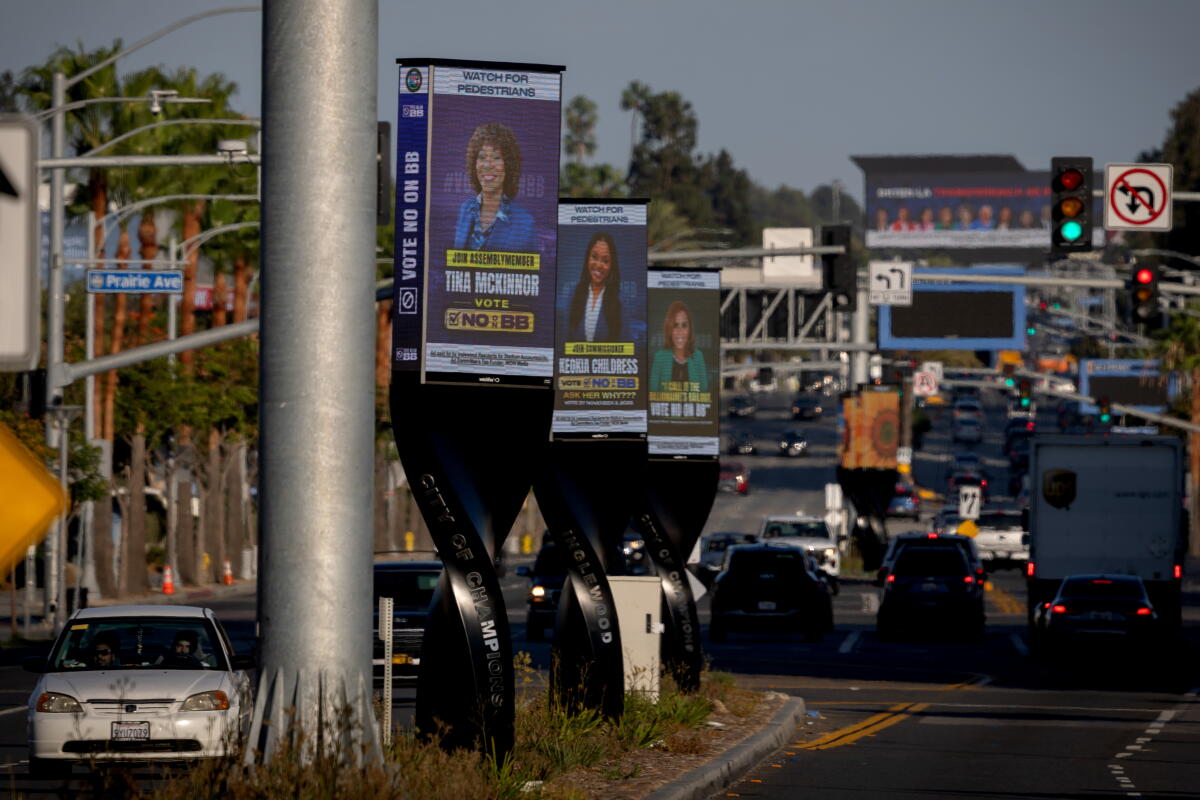
Measure BB would bar the city from allowing billboard advertising on sidewalks, medians and the like. Owners of those sports and entertainment venues, who have their own sponsorship deals, are backing that measure.
Meanwhile, City Council member Gloria D. Gray led incumbent Mayor James T. Butts Jr., 34.6% to 29.8%, putting them on an early track for a runoff election in March.
Los Angeles County does not provide a timeline for when the election results will be listed as final.
The ballot measures were spawned by a feud between Inglewood and Hollywood Park, the nearly 300-acre development anchored by SoFi Stadium and owned by Rams owner Stan Kroenke.
The fight started last year over billboards. Inglewood signed a deal with WOW Media for 60 digital signs carrying 108 screens, some of them bus-shelter-sized kiosks. Others are street displays up to 22 feet tall on sidewalks and medians.
SoFi Stadium, Intuit Dome and the Forum sued to block the deal, arguing the signs would undercut their individual sponsors who paid for exclusivity. A judge sided with the city and an appeal is underway.
Measure BB, short for “Billboard Blight,” aimed to restrict billboard advertising on public property. It qualified with nearly 13,000 signatures.
The WOW deal runs 20 years with two 10-year options, so it could be around for 40 years.
“It’s biblical in length,” said John Shallman, the political strategist managing the “Yes on BB” campaign. “You go back 40 years. We didn’t even have the Internet. We didn’t have cell phones.”
Skip Miller, lead attorney for the city, said the kiosks “blend in with the surrounding areas” and connect to a network that provides traffic and safety information.
The billboards are subject to Inglewood Ballot Measure BB, which calls for the halt of advertising on them.
(Eric Thayer/Los Angeles Times)
Measure AT, backed by the city, would lift a $15-million cap on the 10% admission tax the stadium pays. Hollywood Park sees it as punishment for challenging the billboard deal.
The billboard fight led to a bigger one. Last month, a Los Angeles County Superior Court judge ruled void the 2015 development agreement that cleared the way for SoFi Stadium, citing a 2018 Moreno Valley decision.
Under the 2015 agreement, Hollywood Park paid up front for roads, water lines, streetlights and event-day police and emergency services, with the city agreeing to eventually reimburse Kroenke for those expenses. Now that the agreement has been voided, the city argues it isn’t required to pay.
Esteban Ocon has been permanently dropped by the Haas team.
The Frenchman will be replaced at this weekend’s Sao Paulo Grand Prix by Brazilian rookie Rafael Camara, who has been signed by the team for 2027.
Haas released a statement saying Ocon would “no longer compete on its behalf in the 2026 world championship”.
The move comes after Ocon was replaced following Friday’s practice at the Mexico City Grand Prix weekend, apparently after a row with team principal Ayao Komatsu.
Haas have given no details as to what led them to drop Ocon in Mexico.
Komatsu said in a statement from Haas on Tuesday: “We have now notified Esteban Ocon that he will not return to a race seat with Haas this season.
“Such decisions are never made lightly, as was the case in Mexico City – but then, as now, we feel this is firmly in the best interest of the team moving forward.
“The conversations that ultimately unfolded between the team and Esteban remain an internal matter, and we will continue to respect the private nature of closed-door situations.”
Ocon, who has driven in 198 grands prix since making his debut in 2016 and has one victory, looks set to be out of a race seat for 2027 as the only teams with potential vacancies – Racing Bulls and Cadillac – are said not to be interested in him.
He is looking for a reserve drive as a way to stay in the conversations in the paddock.
Ocon was dropped on Saturday morning in Mexico City and replaced by Haas’ Japanese reserve driver Ryo Hirakawa.
The decision to stand him down came after he had a dispute with race engineer Laura Mueller about tyre choice during second practice on Friday.
The following day, Ocon released a statement saying he “categorically rejected any reports or allegations suggesting that any form of physical violence was used to resolve any differences of any nature”.
He admitted that “a difference in viewpoints led to a discussion with the parties involved”.
His statement followed a report in France’s L’Equipe which said that a meeting between Komatsu and Ocon “ended abruptly, perhaps even physically”.
Haas have not said who will drive in Ocon’s place in the remaining races of the season after Sao Paulo this weekend.
Fans of Spanish football club CD Tenerife gathered outside the Estadio Heliodoro Rodriguez Lopez in Santa Cruz de Tenerife as tributes poured in for forward Jesus de Miguel, who died after an on-field collision.
De Miguel died on Tuesday from injuries sustained in a clash with FC Andorra goalkeeper Jesus Owono during a Spanish second-division match, leaving Spanish and European football in mourning.
Spanish police have opened an investigation into possible involuntary manslaughter.
Santa Cruz de Tenerife chief prosecutor Jose Luis Sanchez-Jauregui told the Spanish news agency EFE that criminal charges were unlikely because the collision happened in the course of play.
Tributes were held before Champions League fixtures on Tuesday, with Barcelona, Atletico Madrid and Villarreal opting not to play the competition’s anthem before kickoff in honour of De Miguel, 30, who went into cardiac arrest after being struck in the chest.
Moments of silence were observed in those stadiums and others across Europe, including at Old Trafford, where Manchester United were playing Roma. Images of De Miguel were shown on giant screens inside the grounds.
Arsenal manager Mikel Arteta and midfielder Mikel Merino also began their news conferences on the eve of Wednesday’s match against Slavia Prague by paying tribute to De Miguel.
While Israeli Prime Minister Benjamin “Bibi” Netanyahu has openly discussed weaning his country off direct U.S. assistance in favor of more cooperation on weapons development, the Trump announcement still caught many there by surprise. It also raises a lot of questions about Congressional authorization and the impact on future sales of advanced arms from U.S. manufacturers, many of which are planned, that still have to be answered.
“As far as paying Israel, Bibi Netanyahu and I have made a deal that – we give Israel $4 billion a year – and we made a deal months ago that we’re stopping,” Trump told Fox & Friends Tuesday morning during his message to American voters going to the polls for the midterm election. “And they’re fine with it because you know they have become a very successful country. They don’t need it, and we won’t be paying anymore to Israel, so it’s just a wasted thing because we’ve already agreed that by the end of this year we won’t be paying Israel.”
“Now we’ll help Israel if they need it,” the American leader added. “You know they’ve been a great ally, and we’ve been the greatest of all allies to many many countries.”
BREAKING: President Trump says the U.S. will end roughly $4 billion in annual aid to Israel by the end of the year, revealing that Prime Minister Benjamin Netanyahu agreed to the decision.
Trump did not elaborate on what specific expenditures he was referring to, and we’ve reached out to the White House for more details. However, the president was almost certainly talking about the ongoing decade-long Memorandum of Understanding (MoU) with Israel.
The MoU calls for providing $3.8 billion in annual aid and it is drawing to a close. Set to run through 2028, the vast majority of that funding is for Foreign Military Financing (FMF) to purchase weaponry mostly from American manufacturers.
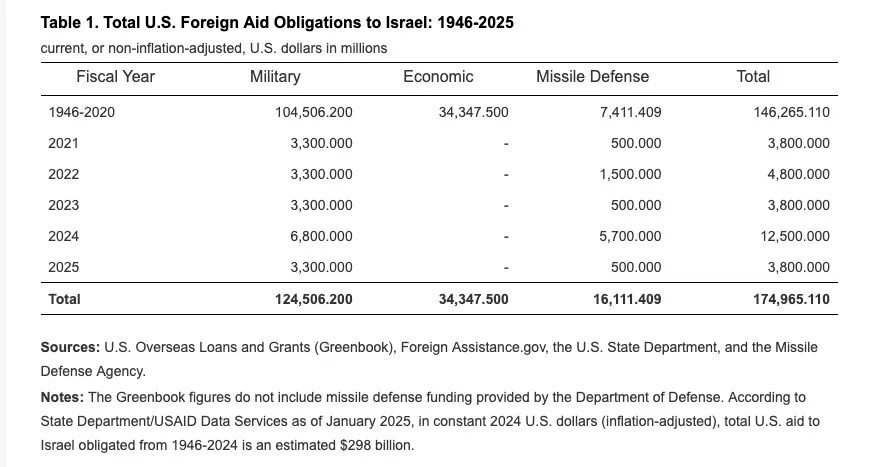
U.S. military aid to Israel by the year. (Congressional Research Service)
“In 2016, the U.S. and Israeli governments signed their third 10-year Memorandum of Understanding (MOU) on military aid, covering [Fiscal Year] 2019 to [Fiscal Year] 2028,” according to a 2025 Congressional Research Service (CRS) report. “Under the terms of the MOU, the United States pledged to provide—subject to congressional appropriation—$38 billion in military aid ($33 billion in Foreign Military Financing (FMF) grants plus $5 billion in missile defense appropriations) to Israel.”
The MoU is merely a promise and not legally binding. Congress has to approve any funding requests.
“The new framework, reflecting the strategic vision of Israel’s Prime Minister and Minister of Defense, is designed to strengthen the IDF’s qualitative military edge through expanded joint investment in research, development, and co-production, deepen the U.S.-Israel partnership demonstrated during Operation Roaring Lion, and gradually transition from aid to a completely reciprocal partnership,” MoD explained.
Netanyahu has been warning Israel for months that it would have to face reduced assistance from the U.S.
“If you think we will continue receiving what I secured twice — tens of billions of dollars in American aid for the defense budget — you’d better prepare yourselves and get used to the idea that this will not continue,” he told Israeli media last month, according to Bloomberg News. “That is because America has changed, not because Israel has changed. It will end. It is only a matter of time.”
Netanyahu added that Israel has two more years with Trump, but must prepare for a less favorable Washington after he leaves power.
Israeli Prime Minister Benjamin Netanyahu has told Israel for months it will have to rely less on U.S. military aid. (Photo by Alexi J. Rosenfeld/Getty Images) Alexi Rosenfeld
In January, the Israeli leader said he wanted to reduce Israel’s reliance on American aid. He told The Economist that he was not seeking the full renewal of the MoU, which has to be renegotiated by 2028.
“I want to taper off the military aid within the next 10 years,” Netanyahu told the publication. Asked if he meant “to taper it off to zero,” Netanyahu said “yes.”
“We want to be as independent as possible,” the Israeli leader proffered. Referring to his meeting with the the American president in Florida in late December, Netanyahu added: “In my visit to President Trump, I said we very deeply appreciate the military aid that America has given us over the years, but here too we’ve come of age, and we’ve developed incredible capacities.”
For Israel, the MoU “now matters less for the money it provides than for what it signifies: a gauge of the depth and durability of U.S. support,” the Crisis Group think tank argued in August. “To be sure, FMF has enabled Israel to build up its military power without fully bearing the cost, and phasing out this assistance would impose real burdens. Israel would have to pay for critical U.S. weapons from its own budget.”
However, with its annual GDP now exceeding $700 billion and defense spending above $40 billion, “Israel has found increasing difficulty in arguing that it requires an additional $3.3 billion each year for military purchases,” Crisis Group posited. “Netanyahu has asked the finance ministry to allocate billions of dollars in additional funding for the defense budget over the next decade, a large portion of which would be earmarked to procure U.S. fighter jets, on the assumption that Israel will no longer receive the funds necessary for these purchases from Washington.”
Israeli Air Force F-15 Baz fighters. (Amit Agronov)
Since the attack by Hamas, U.S. money from the MoU has made up a smaller percentage of the Israeli MoD’s overall budget as the country has increased its own defense spending. Those funds have also been bolstered by several large tranches of U.S. supplemental aid to procure bombs and other weapons.
“For most of the last 15 years, the $3.3 billion Israel receives annually in FMF made up roughly 20% of Israel’s defense budget, which was itself 5-6% of Israel’s GDP in the same period,” the Israel Policy Forum (IPF) explained in May. “Both Israeli defense spending and the share coming from U.S. aid slowly declined amid major economic growth throughout the 2010s, and then spiked in 2023 following the October 7 Hamas attack on Israel and ensuing wars.”
IPF stated that after the Hamas incursion, “Israel sharply increased defense spending (both within the regular budget framework and in extraordinary expenditures) to 8-9% of GDP, and the U.S. gave Israel several large supplemental security assistance packages between late 2023 and early 2026 in addition to the MOU-directed security aid.”
“The net result, taking into account both much higher Israeli spending and large amounts of American aid, is that in 2024 U.S. assistance briefly accounted for more than one third of Israel’s defense budget,” IPF noted. “In 2025 this figure dropped to close to 10%, with Israel spending an estimated NIS 168 billion ($52 billion) on defense in that year.”
Until recently, “Israel had been given a partial exemption” on the requirement that FMF funds be allocated for American products,” the Crisis Group noted. This allowed Israel to “invest a portion of the money in its own defense industry, Crisis Group explained. “This carveout, in turn, has made Israeli firms more competitive in the arms export market.”
A top Israeli MoD official told The Times of Israel (ToI) last month that his country wants to flip the switch to add value to the American defense industry by using its experience developing weapons as it fights seemingly constant wars. The continual threats from regional actors and terror groups allow Israel to serve as a testing ground for U.S. defense technologies, Aviram Hasson, director of the Defense Ministry’s mission to the US and Canada, explained.
“Hasson pointed to engineering breakthroughs and intellectual property emerging through development of Israel’s active-defense systems, saying every US government request for technology arising from the long-range anti-ballistic missile Arrow 3 program has been fulfilled,” the publication noted.
“It is clear on both sides of the ocean that this cooperation is a strategic need of both powers, not only of Israel,” Hasson told ToI.
U.S. Has Paid Far More Than $4B A Year For Israel’s Defense
Beyond direct financial aid, the U.S. has expended a great deal of resources defending Israel over the past several years. This has included defending against multiple Iranian missile barrages on Israel on top of participating directly in two wars. In addition, there were the constant drone and missile battles in the Red Sea with the Houthis, who began attacking shipping there in response to Israel’s war in Gaza. Part of the U.S. operation against the Houthis was also providing a layer of protection against long-range missile and drone launches at Israel by the rebel group.
During the course of all these events, the U.S. deployed a very large number of its available warships, aircraft, and air defenses, as well as thousands of personnel, to the Middle East at great expense, both in dollars and the toll on troops and equipment.
ISMAILIA, EGYPT – MARCH 14: An U.S. aircraft carrier transits the Suez Canal in the city of Ismailia, Egypt, which connects the Mediterranean and Red Seas, on March 14, 2026. (Photo by Stringer/Anadolu via Getty Images) Anadolu
Just this year alone, 23 U.S. troops have died and nearly 900 have been injured since the launch of Epic Fury in February. Dozens of aircraft have been destroyed and U.S. bases in the region have been partially destroyed and will take billions to repair.
All told, the U.S. has spent nearly $50 billion just on the most current conflict with Iran, far exceeding the $4 billion Israel gets per year in annual direct aid. Then there is the opportunity cost of the massive wear and tear on the force and the U.S. military’s overall capacity to fight in the near and medium term due to all these engagements.
All that being said, it can be argued that the U.S. had major interests in participating in these conflicts beyond just the defense of Israel. It is rarely just that simple. The Iran nuclear program, for instance, has impacts much farther than the Middle East and Israel. Still, the U.S. has poured unprecedented resources into Israel’s defense and these investments far eclipse the $4B being discussed today.
Surprise In Israel
Many Israeli government officials were caught completely off guard by the Trump announcement, according to Politico.
“Officials in the Finance Ministry say they were surprised by U.S. President Donald Trump’s announcement that military aid to Israel would cease by the end of the year, ” the publication reported.
“No formal document was submitted from the Prime Minister’s Office regarding the end of aid,” Politico added. “The ministry was aware of the intention to end it, but was surprised by the intention to do so immediately.”
Officials in the Defense Ministry and the military were also reportedly surprised by the announcement, according to the Post.
“We did not expect this announcement, certainly not today,” a senior defense official told Israeli media.
“There is ongoing dialogue with the Americans, and we can say that we were surprised. We will study the implications of the decision, which has yet to reach professional officials,” the official is quoted as saying.
Trump’s off-hand remark about U.S. aid to Israel ending “by the end of this year” triggers global “political and financial earthquake.”
Israel’s Finance Ministry was “entirely unaware” of the supposed plan, which Trump casually revealed earlier this morning to “Fox & Friends.” pic.twitter.com/IYh5SuifcD
As for Netanyahu, he has yet to weigh in on Trump’s statement. However, one of his main rivals in the closely fought Israeli parliamentary election that could unseat him has commented.
“The fact that Israel’s defense establishment is learning of a shift in our strategic relationship through the media, at the same time as the Israeli public, shows just how dangerous Benjamin Netanyahu’s conduct is,” Gadi Eisenkot said in a statement. “He can no longer be trusted and must be replaced.”
In his comments to Fox & Friends, Trump conceded that the midterm election played a role in his decision.
The annual assistance to Israel is a “bad talking point” for Democrats, including Michigan Democratic Senate nominee Abdul El-Sayed, the president proclaimed.
“The left uses the $4 billion payment … as a signal of unfairness. And we can’t allow that to happen,” Trump stated. “I don’t like that. … It’s almost too easy to target
There are many unknowns surrounding Trump’s statement about diminishing U.S. support for Israel.
The MoU, if that is what he is talking about, still has two years left, and almost $8 billion worth of anticipated funding, the vast majority earmarked for procurement of U.S. arms.
As we noted at the top of this piece, the MoU itself isn’t legally binding but the aid is authorized by law and appropriated by Congress each year. Ending it early would mean Congress either not appropriating the money or changing the law.
Will Congress agree to cut the deal off by December? What about the U.S. defense industry? It is unclear at the moment how, or if, this move would affect American defense contractors selling arms to Israel. These companies depend in large measure on predictability and taking this agreement off the table two years early could be problematic.
It is not exactly clear at this point which U.S. arms makers will be hit the hardest by Trump’s announcement. There are billions of dollars in contracts for the future procurement of aircraft, munitions and other equipment to companies like Boeing for F-15Is and KC-46As, Lockheed Martin for F-35Is and AM General for Joint Light Tactical Vehicles. While Israel has bumped up its defense budget, it is not really known at this point how it will cover these costs without that lost U.S. aid.
Nicole Taylor, one of Christian country band Taylor Red’s identical triplets, has died. The singer and musician succumbed to breast cancer on Sept. 28 in Nashville. She was 35.
“We are shocked and heartbroken to announce the passing of our sister Nicole Taylor. This isn’t the video we thought we’d ever be making,” Natalie said in a video posted to YouTube.
Nika continued, “We thought she would be here sharing her story of earthly healing, but instead we’re here sharing her story of heavenly healing, and she’s at peace and no longer suffering, so we’re thankful for that.”
The surviving sisters explained that Nicole was diagnosed in 2022 with Stage 3 breast cancer. Treatment put the disease into remission, but it returned as Stage 4 cancer. Eventually, doctors said Nicole had three months, Nika recalled in the video with Natalie revealing, “She lived around a year later after that prognosis.”
In between telling their sister’s story, Nika and Natalie read Bible verses they turned to in their grief.
“Nicole told us even before she passed that she had peace, and we were really thankful for that,” Natalie shared.
Nika continued, “Yes, things did not turn out as we hoped. We lived every day expecting full miraculous healing here on Earth and lived every day in hopes of that. Of course, we all had our moments of fear and doubt, but we fought it and fought it. And God gave us so much peace and hope in him along the way. We were so shocked and still shocked of her passing.”
The Mississippi natives are also known for their social media presence, with 16.7 million subscribers on YouTube and 13.5 million followers on TikTok.
The sisters created viral videos capitalizing on their red-haired identical-triplets identity. Using humor and social trends, the sisters filmed themselves wearing matching outfits, dancing in sync or playing instruments, including the guitar, banjo, fiddle and mandolin. They appeared in a national Sonic Drive-In commercial and also partnered with major commercial brands, including Crocs, Lipton, Skittles, Redken and Frito Lay.
“Country Money,” released in 2021, became one of the band’s most well-known songs with more than 810,000 streams on Spotify, while “Rent Free” has surpassed 664,000 streams. “Fresh off the Farm,” “Bringing Country Back” and “What They Seem” each have over 345,000 streams on the music site.
Nicole was also a Taste of Country morning radio show host. In a tribute on the country music-focused website, her colleague Evan Paul related the story of first meeting Nicole and her sisters and his later interactions with her at the media outlet.
“Nicole was such a warm soul. She was so smart and so talented that it was hard to even share a room with her. Her light was so bright. I am convinced that when you see a star shooting across the sky at night, it’s Nicole giving us a wink and letting us know she’s all right,” Paul said.
“Nicole, the oldest of us three sisters, will be greatly missed,” Nika and Natalie posted on their official site. “She was our leader and our best friend. We are heartbroken, but we know she is in Heaven and will see her again.”