Month: November 2026

Cutter Gauthier extends his goal streak as Ducks beat Flames

Cutter Gauthier broke a tie with 1:34 left to extend his goal streak to five games and help the Ducks beat the Calgary Flames 5-3 on Friday night for their fourth straight victory.

The Ducks are the first team since the 1991-92 Pittsburgh Penguins to score at least five goals in seven consecutive games.

Gauthier one-timed a pass from Mikael Granlund. He has scored 10 of his 12 goals this season during the five-game streak.

Jeff Malott, Tristan Luneau, Leo Carlsson and Nikita Nesterenko, into an empty net, also scored for the Ducks (9-7-1). Granlund and Beckett Sennecke each had two assists.

William Stromgren, Joel Hanley and Joel Farabee scored for Calgary. Morgan Frost and Zayne Parekh each had a pair of assists as the Flames’ five-game home winning streak ended.

Lukas Dostal started for the Ducks, but was chased after giving up three goals on 11 shots in the first period. Ville Husso, who gave up seven goals in his last appearance, came on in relief and stopped all 10 shots he faced. He improved to 2-3-0.

Dustin Wolf, making his third straight start, had 24 stops for Calgary (7-9-1).

The Flames took a 3-2 lead to the third period, but when Matt Coronato was sent off for delay of game 17 seconds in, the Ducks’ red-hot power play took advantage with Carlsson tying it at 55 seconds.

The Ducks’ Jackson LaCombe had an assist to extend his points streak to nine games, the longest in franchise history for a defenseman. He passed Scott Niedermayer (2006-07) and Oleg Tverdovsky (1999-00) on the team list.

Up next for the Ducks: vs. Pittsburgh at Honda Center on Sunday.

Source link

Protesters storm site of Microsoft’s planned Amsterdam data centre | Protests

Activists in Amsterdam have stormed the site of a proposed Microsoft data centre. The AI boom is fuelling demand for the infrastructure, but locals say it will drain energy and water resources. Al Jazeera’s Step Vaessen reports.

Source link

‘Queen at Sea’ review: Binoche excels as concerned daughter

Early in “Queen at Sea,” there’s a sex scene. It’s brief and shows little, but the fleeting moment will inform everything that happens in writer-director Lance Hammer’s crushing second feature. This movie about consent and dementia — and ultimately, far much more — hinges on a questionable act that provokes a hasty emotional reaction. In the process, a family tries to come to the aid of its ailing matriarch, presented with only a series of unappealing options, each more unbearable than the next.

Juliette Binoche is beautifully fragile as Amanda, the dutiful daughter of Leslie (Anna Calder-Marshall), who herself has been married to second husband Martin (Tom Courtenay) for 18 years. Amanda and her teenage daughter Sarah (Florence Hunt) visit the older couple’s London home one morning, shocked to open their bedroom door to find Martin on top of Leslie, thrusting away. But embarrassment quickly gives way to anger for Amanda: Leslie has advanced dementia and her doctor has told Martin that he can no longer have sex with Leslie because she doesn’t possess the mental acuteness to give consent. Furious at her stepfather, Amanda phones the police, hoping the authorities can put a scare into him.

But Amanda’s call has unintended consequences. When the police arrive, they arrest Martin, advising Amanda that she take her mother for a “forensic medical examination” — or, as Amanda puts it bluntly, a rape exam — to ensure she has not been injured. Amanda’s rage quickly morphs into panic because she knows how dependent the childlike Leslie is on her husband, who functions as her primary caregiver. She just wanted to teach Martin a lesson, but soon, social services intervene to determine whether the elderly couple has to be separated for Leslie’s safety.

Even before the police becomes involved, Hammer hints at his film’s tense tenor. You can feel it in how he shoots the house’s severely winding stairs — dangerous for Leslie and Martin to navigate — from occasionally vertiginous angles. The camera rarely moves as we spy charged conversations from a distance, sometimes from another room or from a floor above the characters. We’re intruders, stealing glimpses of a private domestic drama not meant for our prying eyes.

Unlike previous terrific pictures about dementia (such as “The Father”), “Queen at Sea” is less about the crippling condition than it is the fulcrum for a troubling exploration of several topics: mortality, love, parenting and the grim futility of everything. Similarly, although Hammer takes seriously the question of consent, he widens his narrative’s lens to provide a thoughtful, complex view of the issue. Martin adores his wife, insisting that their doctor is wrong and that Leslie, in fact, does understand her sexual urges. To back up his argument, he informs Amanda that, frequently, it is her mother who initiates sex. But is that because dementia has robbed Leslie of the ability to modulate her urges? “Queen at Sea” offers no answers, leaving the viewer as uncertain as Amanda, who wants to protect her mother but cannot deny how drawn Leslie is to her kindly husband.

At the film’s heart is a terribly relatable family conflict in which each character assumes that they know best. Binoche plays Amanda with a surfeit of tenderness for her mother, who goes from being lucid to infantile without warning. (Calder-Marshall poignantly channels the silent helplessness that consumes those with dementia, making her an unstable chemical compound always on the verge of explosion.)

Just as fiercely loyal as Amanda, Martin vainly advocates for his beloved, knowing that Amanda has power of attorney and, therefore, the upper hand. Courtenay gives a marvelous performance suffused with simmering rage: To Martin’s way of thinking, it was Amanda’s foolish overreaction to seeing them have sex that led to all these problems. That feeling of betrayal resides on his face for the rest of “Queen at Sea,” even as he and his stepdaughter negotiate a wobbly truce concerning Leslie’s future, which includes an unexpectedly fraught trip to a care home.

Hammer has not made a film since 2008’s “Ballast,” another spare drama about brittle lives. Eighteen years later, his formal command remains formidable. Eventually, Hammer starts cutting away from the central narrative to focus on Sarah as she hangs out with friends and spends time with a cute boy, James (Cody Molko). At first, these carefree interludes seem to be a welcome respite from “Queen at Sea’s” choking anxiety. But as Leslie’s situation grows increasingly complicated, Sarah’s emerging love story proves to be a bittersweet, ironic counterpoint. Maybe Sarah will find love and great sex — like her parents and grandparents before her — but the shadow of despair that has descended on her family will someday come for her. She’s still too young to know how impossible aging can be.

‘Queen at Sea’

Not rated

Running time: 2 hours, 1 minutes

Playing: Opens Friday, Nov. 6 at Laemmle Monica Film Center and Laemmle Town Center

Source link

With death sentence clemency, Newsom takes another big political risk

While running for California governor in 2018, Gavin Newsom declared that he would rather be bold and fail than retreat to the safety of mediocrity.

The two-term governor known for taking big political risks once again made good on that vow Thursday when he moved to offer clemency to every inmate sentenced to death in California.

Amid a hum of speculation about how the mass commutation could help or hurt his presidential prospects in 2028, the Democratic politician sent a clear, defining message to Americans about where he stands and the type of leader they could expect.

“If my job is just to read the polls, you can have an AI chatbot as governor,” Newsom said in an interview Friday. “I was hired for my judgment, and like it or hate it, that was why I think I was given this privilege, and that’s the responsibility of a leader. My job’s leadership, not stewardship. It’s not management. It’s to lead.

“I’m here to change polls, change minds.”

The sweeping decision comes more than 20 years after Newsom emerged in the national consciousness when, as mayor of San Francisco, he defied federal law and allowed same-sex marriages in the City by the Bay.

California Gov. Gavin Newsom speaks at a rally with a huge U.S. flag behind him

California Gov. Gavin Newsom speaks at the “Stop the Power Grab rally” at the Hollywood Palladium in Los Angeles on Nov. 1, 2026.

(Ariana Drehsler / For The Times)

Bold moves that test the limits of his power, such as a controversial, first-in-the-nation stay-at-home order during the early days of the COVID-19 pandemic and spearheading Proposition 50 last year to redraw California’s congressional districts to offset Republican attempts to gerrymander red states, have defined his leadership, for good or bad.

The Democratic governor said those kinds of decisions are “sort of embedded in my DNA.” About a decade ago he said he was pushed to describe his core motivation. Though he admits it sounds trite, the governor said: “It’s to stand up for ideals and strike out against injustice.”

The death penalty, he said, is not handed out equally. He quoted Bryan Stevenson, the founder of Equal Justice Initiative, who said you’re better off being rich and guilty than poor and innocent.

“I couldn’t not have done this,” Newsom said. “There was an easy out, but … I would the rest of my life felt, you know, ashamed of myself.”

Commuting the death sentences of all 548 state prisoners awaiting execution pushes the bounds of his authority once again. California voters have twice rejected ballot measures to abolish the death penalty, first in 2012 and again in 2016, and Newsom’s decision overrides the will of the courts and state laws that permit capital punishment.

Under the state Constitution, Newsom has the power to commute about 40% of the death sentences on his own. The rest of the cases, which involve prisoners who had a felony conviction on their record prior to receiving a death sentence, or racked up additional crimes while awaiting execution, require approval from the California Supreme Court — a constitutional check to ensure the governor’s actions are not an abuse of power.

The court rejected 10 commutations handed out by Gov. Jerry Brown in his last full month in office — all of which involved people convicted of multiple felonies — and did not provide an explanation for the action.

Despite Newsom’s push to commute all death sentences, capital punishment remains legal in California and prosecutors can continue seeking that punishment.

Los Angeles County Dist. Atty. Nathan Hochman speaks during a news conference at the Hall of Justice

Los Angeles County Dist. Atty. Nathan Hochman speaks during a news conference at the Hall of Justice last month.

(Ronaldo Bolaños / Los Angeles Times)

Los Angeles County Dist. Atty. Nathan Hochman said until the law is changed, his office “will continue to evaluate every death penalty-eligible case with the rigor, care and restraint these decisions demand.”

Sacramento County Sheriff Jim Cooper urged Newsom to reconsider the commutations.

He said he remembers watching Luis Bracamontes, who was sentenced to death for killing Sacramento County Sheriff’s Deputy Danny Oliver and Placer County Sheriff’s Detective Michael Davis Jr. in 2014, “laugh in court while their families, including Danny’s two young daughters, had to sit and watch.

“Deputy Danny Oliver and Detective Michael Davis Jr. should be alive today, enjoying long and healthy lives with their families,” Cooper said in a statement. “Instead, the man who murdered them has now escaped his sentence.”

Others accused the governor of reducing the death penalty sentences to seek an advantage in the 2028 presidential election.

“The people of California deserve leaders who put politics and personal ambition aside and pursue truth, accountability, and justice with courage, integrity, and transparency,” said Michael Hestrin, Riverside County district attorney, in a statement. “Instead they have been presented with a decision that demonstrates a profound disregard for the victims, their families, and the prosecutors who dedicated themselves to seeking justice on their behalf.”

Luis Bracamontes looks up as the verdict was read in the killing of two law enforcement officers.

Luis Bracamontes looks up in Sacramento Superior Court in 2018 as the verdict is read in the killing of two law enforcement officers. Bracamontes was found guilty.

(Rich Pedroncelli / Associated Press)

A poll conducted in August by the Pew Research Center found that about two-thirds of voters nationally favor the death penalty for people convicted of murder.

Political analysts suggest that reducing the sentences adds to Newsom’s credentials as a progressive leader and aligns him with Democratic primary voters on the issue if he runs for president. Republicans, however, could take advantage of Newsom’s action and cast him as a soft-on-crime liberal who is out of touch with most Americans, which risks turning away moderate voters.

But others cautioned that national political elections are hard to predict.

Gar Culbert, chair of the political science department at Cal State Los Angeles, said it would be politically advantageous for Newsom to try to appeal to the Democratic Party’s base as he considers a run for president. Culbert said he doesn’t believe the death penalty will be a substantial issue in a general election when, if Newsom becomes the Democratic presidential nominee, his Republican challenger would attack his record as California governor regardless.

“It’s possible he’s not being strategic,” Culbert said. “Maybe he doesn’t have to be strategic because he just might think it’s the right thing to do.”

The governor first issued a moratorium on executions about two months after he took office in 2019, saying capital punishment is discriminatory and unjust. Without the moratorium, 45 people would be subject to execution now, according to his office.

Daniel Zingale worked for Newsom as a senior advisor in the governor’s office at the start of his first term. Part of Zingale’s job at the time was to consider how the governor’s actions would be received by the public.

“The only piece of data he was not interested in in that process were the polls,” Zingale said. “His view, and I agree with this, is this is not an issue that you can leverage politically.”

Newsom’s decision to commute the sentences won’t have much practical effect in a state that has not executed a prisoner since 2006. At Newsom’s command, the death chamber was dismantled at San Quentin State Prison, now San Quentin Rehabilitation Center, after he issued his moratorium.

His successor, Gov.-elect Xavier Becerra, has also said he will continue the pause on executions.

There was no immediate need to offer commutations to save the lives of the inmates.

Taking no action would have been the safe bet, Newsom said in an interview about his decision a day after he made the announcement. Many people around him, he said, advised him to do nothing.

He also understands that commuting the sentences could make him vulnerable if he runs for president.

“I’m not an idiot. The ads write themselves,” Newsom said. “But I just also would be fake. I wouldn’t be myself and if I’m going to be up there and not be myself, I couldn’t do that.”

With the clock ticking on his time in office, the governor said he also doesn’t want to leave with regrets.

“I don’t want to be one of the elders on some panel talking about what I would have, could have, should have done,” Newsom said. “I’ve spent my life trying not to be that person. I’ve been willing to take risks. I’ve been willing to go first on so many issues.

“If others aren’t willing to do it, you know what? I’ll raise my hand, and I’m happy, honestly, to take the hits.”

Source link

No. 12 Sun Valley Poly earns City Section Division I upset over No. 5 Marshall

Talk about strange beginnings at Friday’s City Section Division I football playoff opener between Sun Valley Poly and host Marshall.

After the opening kickoff went into the end zone for a touchback, Poly coach Boo Williams immediately called a timeout when he saw his double-wing offense lining up with 12 players. After a discussion, the next play was an illegal procedure penalty on the Parrots.

Looking confused, the Parrots deserved an Academy Award for their acting skills, because on their third play, quarterback King Exusdus took the snap from shotgun formation and sprinted 82 yards for a touchdown.

Marshall, seeded No. 5 after its first 10-0 regular season in school history, never figured out how to slow down the Parrots’ run-oriented attack and couldn’t overcome a sore shoulder that limited quarterback Nathaniel Cadet’s ability to pass in a 20-0 loss to 12th-seeded Poly (10-1).

“Who says Poly can’t win a Division I playoff game?” Williams said.

With each short pass in pregame warmups, Cadet grabbed his right shoulder as if he were in pain — and he was. On Saturday, he couldn’t move his arm because of a contusion and sprain to his AC shoulder joint suffered in the regular-season finale last week against Eagle Rock.

All week, Cadet alternated between applying ice and heat to his shoulder. He looked at Instagram and found a shoulder sleeve designed to provide support. He took four Advil tablets. The Barristers badly needed him. He came in with 1,570 yards passing and 24 touchdowns, but on his second pass of the game, he came to the sideline in severe pain revealing the challenge he was facing. He ended up passing for just 55 yards and was intercepted twice.

For Poly — the East Valley League champions under Williams in his first year as coach — the turnaround from a football program with little history of success to competing in City Division I has been meteoric. After problems at the start of the game and a few illegal procedure penalties, the Parrots ran the double wing to perfection, with 290-pound lineman Diego Rodriguez clearing a path like he was knocking down pins with a bowling ball.

Exusdus, usually a receiver, finished with 174 yards rushing in 13 carries. Justice Brown rushed for 86 yards and caught Poly’s only pass, a 26-yard touchdown on fourth down from quarterback Alijah Ochoa.

“One pass, one touchdown, baby,” former Sylmar All-City quarterback Clarence Williams said. He’s the quarterback coach at Poly.

On defense, linebacker Stephon Boyd was all over the field making tackles. Exusdus and Boyd used to attend Birmingham before arriving at Poly this season.

Exusdus is grateful just to be out on the field. He missed all last season attending a continuation school as he tried to improve a grade-point average that he said was once below 1.0. Playing football in his senior year made him start showing up on time to practices and making progress in the classroom.

King Exusdus of Sun Valley Poly takes off on an 82-yard touchdown run.

King Exusdus of Sun Valley Poly takes off on an 82-yard touchdown run.

(Craig Weston / For The Times)

“I had to get everything right,” he said. “It motivated me. Seeing friends go Division I fueled me.”

It was a difficult ending for a Marshall team that won the Northern League title and had not won a Division I playoff game since 2000. Poly moves on to the quarterfinals and will face either Chatsworth or Banning.

Source link

How the US midterm elections reflected resistance to data centres | US Midterm Elections 2026 News

In September, a poll found that 70 percent of Democrats and 57 percent of Republicans supported limiting the construction of new data centres in the United States.

But that opposition was tested in Tuesday’s midterm election, with analysts examining key races to see if the public backlash would translate into votes.

Recommended Stories

list of 3 itemsend of list

It did. There were 41 ballot measures related to data centres in Tuesday’s midterms, spread across the country.

According to Data Centers on the Ballot, an election-monitoring project run by Redbud Consulting, voters are on track to reject data centre development in all but one of the contests.

Two of the races continue to be counted but are expected to result in majorities to reject or limit data centres.

Only Harwood, North Dakota, a small town with a population of fewer than 800 people, voted to oppose such limits. The measure it defeated would have required independent reviews of large industrial projects like data centres before they could be built in the area.

Experts say Tuesday’s midterm elections indicate that the debate around data centres has become a bipartisan issue, intertwined with cost-of-living concerns and fears over job stability.

A construction boom

As of April, the Pew Research Center estimated that there were already 3,000 data centres in the country, with more than 1,500 others in progress.

The construction boom has been driven in large part by the growth in the artificial intelligence (AI) sector. That industry, experts say, has fed concerns about a shifting economic landscape.

“The unchecked acceleration of AI development has been causing concern across the board,” Bhaskar Chakravorti, the dean of global business at Tufts University, told Al Jazeera.

“People worry about their jobs and what it might mean from a broader economic perspective. But closer to home, people could see the physical manifestations of AI in data centres being built in their back yards, or they were hearing about it from others.”

Not only are voters afraid that AI might replace human work, but they also fear the downstream costs of data centres, according to Chakravorti.

Data centres consume large amounts of water and energy, which critics say can drive up electricity costs for nearby communities.

“Whether higher energy costs were driven by broader factors, such as the Iran war or tariffs, AI competing for space on the electricity grid was certainly part of its unpopularity,” Chakravorti said.

Voters, he added, were seeing the results “in their energy bills”.

A 2026 working paper from the Federal Reserve Bank of Dallas estimated that, as of last year, wholesale electricity prices had risen by 6.9 percent as a result of data centres.

James Mercer, founder of Metro Colo Advisory, an independent data centre advisory firm, told Al Jazeera that those anticipated costs mobilised voters in many areas.

“What they push back on is a building down the road that needs as much power as a small city, when they suspect their own electric bill will cover it,” Mercer said.

“That’s why local resistance has grown so fast: counties pausing new projects, zoning fights and data centres turning into a ballot issue.”

An election-season talking point

That popular resistance led several candidates in high-profile races to make AI and data-centre development central to their campaigns.

Among them is Democrat Sherrod Brown, who flipped a key Senate seat in Ohio, the state that accounted for the largest share of data-centre ballot initiatives this year.

Some 21 votes were taken on data centres in the state, out of a total of 47 referendums and measures that took place across the country in 2026.

Brown, a former senator, made Republican incumbent Jon Husted’s support for data-centre development a key point of attack.

“One guy has led the charge on these. That guy’s responsible, and that’s Jon Husted,” Brown told NBC News earlier this year.

In Texas, meanwhile, Democrat Gina Hinojosa called for a moratorium on new data-centre approvals until stronger protections for local communities were put in place.

Though her position worried tech investors keen on expansion in the Lone Star State, Hinojosa ultimately defeated incumbent Greg Abbott in the governor’s race.

“While Abbott had a moratorium on data centres in Texas currently, the overriding view is this would end once he got re-elected,” Dan Ives, managing director at the bank Yorkville Ives, said in an analyst note.

“Hinojosa is a known anti-data center politician and negative on the AI buildout, which makes worries around the future of the data center buildout in Texas a real issue for tech investors.”

Another successful Democratic candidate, Senator-elect James Talarico, also flipped a Republican-held seat with a pledge to increase data centre regulation.

Texas has been at the centre of growing concerns over the water demands of AI infrastructure.

The city of Corpus Christi, for example, has faced severe drought conditions, with its reservoir falling to just 8 percent of its total capacity earlier this year.

The city has been described as at risk of running out of drinking water. Talarico proposed adopting closed-loop water systems to reduce data centre consumption. He also advocated for data centre operators to fund local infrastructure improvements.

He won Corpus Christi by a 12-percentage-point margin.

In another key Senate race, Democrat Abdul El-Sayed called for the creation of a federal agency to oversee the AI industry. He bested his Republican opponent with more than 52 percent of the vote.

Looming pressures

With Democrats poised to control both chambers of Congress, the AI industry is likely to face increased scrutiny from lawmakers.

“[We are] more likely to get real regulation and oversight,” Alex Turner, a former researcher who resigned from Google DeepMind, told Al Jazeera.

“I look forward to advising any congressperson who wants to get serious about the risks from AI, no matter their party affiliation.”

Congressional leaders are increasingly treating AI as a national security and public safety threat, after a string of alarming security failures over the past six months.

In one incident, OpenAI autonomous agents escaped a controlled testing environment and infiltrated the tech start-up Hugging Face. In another, AI agents accessed bank accounts without authorisation, according to reporting from the publication Axios.

In late October, Anthropic’s Claude AI model also accessed voter data in Georgia.

Once the 120th Congress is sworn in on January 3, Democrats are expected to use the legislature’s oversight committees to conduct investigations into AI malfeasance.

On Tuesday night, as it became clear that Democrats would win majorities in Congress, Senator Ed Markey of Massachusetts pledged that new probes were on the way.

“They are going to need to plant new forests for all of the subpoenas we’ll be printing,” the Democrat wrote on the social media platform X.

Another congressmember, Yassamin Ansari of Arizona, posted on social media her support for more restrictions on AI growth.

“Top of the Democratic agenda on day one needs to be a pause on advanced AI development, regulation of this out-of-control industry, and a ban on artificial superintelligence,” Ansari said.

Tech companies themselves have responded to the midterm results with proposals for alleviating voter concerns.

After the election, OpenAI published a framework titled Setting a New Standard for Responsible AI Infrastructure. In it, the company pledged to “prioritize closed-loop or low-water cooling” and to “pay our own way on energy and infrastructure”.

Days before Tuesday’s contest, OpenAI also sought to rebrand its data centres as “compute campuses”.

The political shift is also hitting Wall Street. Investors increasingly see tighter oversight of AI on the horizon, and some of the sector’s biggest growth stocks have stumbled.

On Thursday, for example, chipmaker Nvidia lost $450bn in market value in a single trading day.

Despite Thursday’s losses, Nvidia rebounded on Friday, gaining 4 percent in early trading, although it remained down 6.8 percent over the previous five days.

Data-centre operators such as CoreWeave tumbled on Thursday before climbing 6.6 percent on Friday. The company remained down 16 percent over the previous five days.


Source link

Paraguay’s President Santiago Peña impeached and arrested

Paraguay’s President Santiago Peña has been impeached and placed under house arrest after the collapse of a digital bank with links to his private business interests.

Peña was arrested on Friday minutes after lawmakers, including from his own party, unanimously voted to remove him from office due to a widening crisis triggered by the collapse of Ueno Bank earlier this week.

He had offered to step down on Thursday. Rather than accept his resignation, senators impeached Peña and charged him with misconduct, meaning he has been stripped of the immunity usually granted to ex-presidents.

Peña, who until last year held shares in the company that owned the bank, has denied any wrongdoing.

The demise of the digital bank has left more than half of Paraguay’s population without access to their savings after it was seized by Paraguay’s central bank.

An estimated three million depositors remain unable to access their savings and pensions prompting widespread protests particularly in the capital, Asunción.

The impeachment charges that led to Peña’s removal alleged he had conflicts of interest, manipulated regulatory oversight, diverted pension funds, and participated in an institutional cover-up involving the central bank.

Peña is due to be questioned on Saturday over allegations of breach of trust, influence peddling, and misappropriation of funds, prosecutor Silvia Margarita Gonzalez Vester said.

Peña’s impeachment passed with 44 out of 45 senators voting in favour of it. One lawmaker was absent.

Afterwards, senate president Basilio Núñez said Peña was found guilty of “dereliction of duty”.

Paraguay’s Vice-President Pedro Alliana was then sworn in as interim President.

“Compatriots who are now going through a difficult time as a result of the financial collapse will be fully compensated,” said Alliana, who will serve as President until 2028.

Source link

‘Nuisance Bear’ review: Sad documentary about a changing ecosystem

We’re past due for dystopian storytelling to train its lens on a creature in the here and now, one whose very survival speaks to consequential global change. Take the ice-dependent polar bear, rapidly losing its food-sustaining habitat and having to perilously adapt by nudging further and further into human spaces. And yet, as the moody, starkly beautiful documentary “Nuisance Bear” reveals, following just one wandering ursus maritimus in search of food will still ultimately tell you as much about the two-legged mammals who created its plight.

Broadening and deepening their acclaimed, same-titled short from 2022, directors Jack Weisman and Gabriela Osio Vanden have made a nature film turned on its head. They camped out in Churchill, Manitoba, along the Hudson Bay, where hundreds of polar bears migrate each winter, to capture their increasing encroachment into human communities. There’s an ironic disconnect when a town calls itself “Polar Bear Capital of the World” — it’s not like these creatures, who existed long before us, get to be in charge of anything. Their food source becomes town dumps, plus, in the interests of “conservation,” they get treated either like a roaming photo-op for tourists or, if too aggressive and needing to be reminded of their place, like a drunk vagrant consigned to a night in the clink. (There’s a holding facility for polar bears before they’re let loose again.)

Weisman and Vanden oversaw a crew of six cinematographers (including themselves) and built their visuals primarily around the perspective of one isolated, scavenging bear as it endures busloads of sightseeing visitors, brief incarceration from a patrol operation and, after an airlift, an even more conflict-ridden journey north toward the Inuit town Arviat, just in time for that hamlet’s annual hunt. With attacks on the rise, the people of Arviat harbor no delusion that polar bears are endangered.

Their experience with avinnaarjuk, an Inuit term for roaming bears without fear of humans, is the movie’s other carefully considered viewpoint, since the Inuit, too, have suffered under a system of control. Colonialism herded these Indigenous communities directly in the path of the bears’ ancient migration, and now hunting regulations hamper their ability to manage the population. “Nuisance Bear” is partly narrated by one such affected elder, Mike Tunalaaq Gibbons. His weary voice, describing with sympathy what this solitary, hungry rover is going through, details a broken relationship between human and beast, but more keenly and traumatically, between humans and humans. It’s as if we’re privy not only to hard-earned wisdom but something poignant and therapeutic about loss and change.

The bear, meanwhile, gets our empathy, as any creature would. Whether gazed upon in close-up (an intimacy made possible when it’s dosed with tranquilizers) or viewed from a distance as it’s chased across a landscape increasingly marked by human settlement — trash, fences, machinery, buildings — our ursine antihero is like some lost spirit, scrambling for purchase where claws no longer reliably grip. The steady, gliding images, part surveillance, part concern, suggest a de-evolution. When Cristóbal Tapia de Veer’s ethereal score is playing, “Nuisance Bear” evokes a sacred domain where the cosmic hymn that’s always undergirded it has begun to lose its melody.

‘Nuisance Bear’

In Inuktitut and English, with subtitles

Not rated

Running time: 1 hour, 29 minutes

Playing: Opens Friday, Nov. 6 at Laemmle Glendale

Source link

Telus targets $900M annualized cash savings exiting 2028 while projecting $500M AI infrastructure revenue over 3 years (TSX:T:CA)

Earnings Call Insights: TELUS (T:CA) Q3 2026

Management View

  • “Our transformation strategy has one clear objective, and that is to solidify TELUS’ position as the leading communications and AI infrastructure player in Canada” (CEO, President & Director Victor Dodig). Dodig described “an intentional and a strategic pivot to

Seeking Alpha’s Disclaimer: This article was automatically generated by an AI tool based on content available on the Seeking Alpha website, and has not been curated or reviewed by humans. Due to inherent limitations in using AI-based tools, the accuracy, completeness, or timeliness of such articles cannot be guaranteed. This article is intended for informational purposes only. Seeking Alpha does not take account of your objectives or your financial situation and does not offer any personalized investment advice. Seeking Alpha is not a licensed securities dealer, broker or US investment adviser or investment bank.

Source link

Connecticut Sen. Chris Murphy is discharged from hospital after stroke

Democratic Sen. Chris Murphy of Connecticut said on Friday that he has been discharged from the hospital after suffering a stroke last weekend and will miss “several weeks” of votes in the Senate as he recovers in a rehabilitation facility.

Murphy, 53, said in a statement that doctors are “very encouraged by the progress I’ve made so far” and that the stay at the rehabilitation center will get him back to work on the quickest timeline possible.

Murphy said doctors diagnosed him with a small hemorrhagic stroke, which is a bleed in the brain. He said he called 911 on Oct. 31 out of an abundance of caution after feeling that “something was not right” with his body.

“This has been a scary experience for me and my family, and I appreciate the continued respect for our privacy,” he said.

The press release updating Murphy’s condition included a statement from Dr. Jose Suarez, chief of neurosciences critical care at the Johns Hopkins Hospital. Suarez said the senator has shown tremendous progress and “we expect that he will make a full recovery following rehabilitation.”

In the Senate, Murphy serves on the Appropriations Committee and is a leading voice on immigration and gun policy. He is considered a contender for more senior leadership positions in the Senate and among the many Democrats seen as potential 2028 candidates for the White House.

Murphy said he has been staying engaged with his team and colleagues remotely and that his staff ensures the work of his office continues uninterrupted.

“I want to extend my deepest thanks to the excellent doctors and staff at Johns Hopkins who have treated me and cared for my family,” Murphy said.

Murphy had been traveling the country in support of House and Senate candidates as his party raced for majority control, which it secured in Tuesday’s midterm elections. A day before the stroke, he posted that he had been campaigning in his home state for Gov. Ned Lamont. The week before, he posted from Minnesota campaigning with Lt. Gov. Peggy Flanagan, the Democratic nominee for the Senate.

Lamont won reelection Tuesday, and Flanagan won her race, becoming the first Native American female U.S. senator.

The final sprint before election day capped Murphy’s whirlwind trip to the Middle East at the start of October for meetings with several leaders, including Saudi Crown Prince Mohammed bin Salman. In early September, Murphy completed his annual “walk across Connecticut,” covering about 70 miles over four days, talking with residents about their concerns along the way.

Three other Senate Democrats had strokes in recent years. Sens. Ben Ray Lujan of New Mexico and Chris Van Hollen of Maryland had strokes in 2022 and have recovered. Pennsylvania Sen. John Fetterman had a stroke while campaigning for his seat that year and now uses adaptive technology in the Senate, including live captioning on a phone or tablet that transcribes words as people speak to him and helps him process the conversation.

Fetterman said on social media the day after Murphy’s stroke that his family was “rooting for Chris and his family for a full and speedy recovery.”

Freking writes for the Associated Press.

Source link

Kiernan Dewsbury-Hall: England ‘disappointment’ fuels midfielder’s Everton heroics

The wait until the next international break in March will undoubtedly feel like an eternity for Dewsbury-Hall.

But the Everton midfielder is no stranger to taking the long road to success, having experienced plenty of setbacks and detours throughout his career.

He did not make his Premier League debut for boyhood club Leicester City until the age of 22, having spent previous seasons gaining valuable experience out on loan in the English Football League with Luton Town and Blackpool.

Even when his opportunity to establish himself in the Foxes’ first team finally arrived, it came during a turbulent period for the club, which ultimately ended in relegation from the Premier League at the end of the following season.

After playing a starring role in Leicester’s Championship-winning campaign under Enzo Maresca, the midfielder soon followed the Italian to Stamford Bridge in a deal worth £30m.

However, Dewsbury-Hall struggled for regular game time during his only season at Chelsea, featuring mainly in cup competitions with limited opportunities in the Premier League.

It was only after his move to Everton last summer, at the age of 26, that he appeared to have finally found the right environment to reignite his career and showcase the qualities that made him once such a highly regarded attacking midfielder.

Since the start of last season, Dewsbury-Hall has scored 11 goals for Everton in the Premier League and provided seven assists.

“I’m really, really enjoying it,” said Dewsbury-Hall. “I’ve got a really good hybrid role in this team, where the gaffer is giving me the freedom to pop up all over the pitch.”

Tuchel said on Friday afternoon that Dewsbury-Hall had been “very close” to earning a place in his squad, having enjoyed “a very good season” with Everton so far.

“I’ve got the mentality,” added Dewsbury-Hall. “I’ll keep pushing and pushing and see what happens.”

Source link

Mötley Crüe singer Vince Neil’s girlfriend arrested on domestic assault

The girlfriend of Mötley Crüe frontman Vince Neil was arrested Sunday for reportedly striking the singer.

Rainbow Hannah Andreani, 45, was booked in Williamson County, Tenn., for alleged domestic assault, according to arrest records viewed by the Los Angeles Times. Andreani posted a $5,000 bond and was released Monday. She is due in court Dec. 3, according to the Williamson County Sheriff’s Office.

Andreani’s arrest occurred after she allegedly hit Neil, 65, TMZ reported.

The makeup artist, who goes by “Rain Hannah,” and Neil have been in a relationship since 2011, according to People. In 2025, she was aboard Neil’s Learjet when it was involved in a fatal crash in Scottsdale, Ariz. The aircraft left the runway when landing, collided with a parked plane and killed one pilot. Neil was not on the plane.

Rainbow "Rain" Andreani

Rainbow “Rain” Andreani

(Williamson County, Tenn., Sheriff’s Dept.)

Neil wrapped up a 34-date North American tour on Sept. 26 in Washington with his Mötley Crüe bandmates, bassist Nikki Sixx, drummer Tommy Lee and guitarist John 5, who joined the group after Mick Mars’ 2022 departure. The Return of the Carnival of Sins tour celebrated two milestones for the band: the 20th anniversary of the 2005-2006 Carnival of Sins tour and the band’s 45th anniversary.

Source link

Feds move to dismiss case over 20,000 California ballots after Supreme Court denied appeal

The U.S. Justice Department moved Friday to voluntarily dismiss its lawsuit challenging the counting of 20,000 ballots in California, arguing the relief it sought is now impossible given Tuesday’s midterm election has concluded.

The Justice Department had sought a court order requiring state and Los Angeles County election officials to set aside the ballots, which it alleged could be from noncitizen voters. U.S. District Judge David O. Carter and a three-judge panel of the U.S. 9th Circuit Court of Appeals had both rejected that request, and the U.S. Supreme Court denied a Trump administration appeal to those lower court rulings — with no noted dissents.

Carter had ruled that the government’s request was probably unconstitutional, given the Constitution gives states and Congress power over elections, not the executive, and probably ran afoul of federal law barring sweeping vetting of voter rolls in the immediate run-up to an election.

However, he had set a schedule moving forward for additional fact-finding in the case — including by appointing a special master to dig into the data the federal government was relying on to assert the 20,000 voters were potentially noncitizens.

In a filing before Carter on Friday, Assistant U.S. Atty. Julie Hamill in Los Angeles wrote that that court process was no longer necessary, as it would not provide the relief that the federal government was seeking by filing its lawsuit.

“In light of the Supreme Court’s denial, the United States is evaluating how to best ensure that American votes are protected, including by preventing vote dilution by noncitizens. In addition, by the time of this Court’s hearing on Nov. 13 in this matter, California will have already commingled the challenged ballots with lawful ones,” Hamill wrote. “There is then no way to get the challenged ballots segregated. As a result, the relief the United States sought and needed is no longer available — rendering voluntary dismissal necessary.”

Hamill wrote that the Trump administration had sought to “protect American voters and to prevent the irreparable harm of state and local election officials including illegally cast votes in the final vote tabulation,” but had “exhausted its appeals to obtain timely relief” by going to — and being denied by — the Supreme Court.

First Assistant U.S. Atty. Bill Essayli’s office in Los Angeles — where Hamill works — referred questions about the filing to the Justice Department.

Kiersten Pels, a Justice Department spokesperson, said the litigation at issue was “moot” but that the Trump administration “is not backing down” in its targeting of alleged noncitizen voters, including in a separate case in which it is still demanding that California “conduct proper list maintenance, including removing noncitizens from the state’s voter rolls — which will be crucial to ensure fair elections in the future.”

Secretary of State Shirley Weber, a defendant in the case, did not immediately respond to a request for comment Friday.

L.A. County Registrar-Recorder/County Clerk Dean Logan, another defendant, said he was “pleased that the administration has accepted the clarity of the court findings” against it and ended its lawsuit.

“At each stage of this election, and in response to the Department of Justice, we have been clear that state and federal law sets well-defined standards for verifying and challenging voter eligibility,” Logan said. “Our commitment and focus remain on the fair, secure, accurate, and legal processes we are engaged in to complete and certify the election.”

California Atty. Gen Rob Bonta, in a statement, said that after losing in every court it tried, including the Supreme Court, “the Trump Administration has given up its latest unlawful effort to interfere with California’s elections and disenfranchise eligible voters.”

Bonta added: “Rest assured: California has and always will defend your fundamental right to vote.”

Tricia Webber, president of the California Assn. of Clerks and Election Officials, said state election officials “are very pleased” with the voluntary dismissal of the case — which she said “affirms that our elections are administered with the utmost integrity and care.”

“At the same time, we are under no illusions. We recognize that this issue is unlikely to go away permanently, and we remain fully prepared to continue defending California’s election administration against future challenges,” she said. “We will always stand ready to protect every eligible voter’s right to participate in a fair and secure election process.”

The administration’s filing — three days after President Trump’s party took a drubbing in the midterms — marks a sudden and unremarkable conclusion to an unprecedented court battle in the days leading up to the election, when the federal government sought permission from the courts to force state and local elections officials to set aside votes during an ongoing election.

Carter had rejected the administration’s request for immediate intervention in a blistering Oct. 28 ruling, calling its allegations about the ineligible voters “not credible” and warning that the proposed action could disenfranchise eligible voters and sow chaos in the ongoing midterm election.

“This request violates longstanding constitutional principles mandating that states have control over their elections,” Carter wrote. “If [the Trump administration’s] last-minute request for relief were granted, either party could create chaos for their own political purposes to disrupt the election process.”

While Justice Department officials characterized the relief it had requested from the court as “targeted and modest,” Carter had reached a sharply different conclusion — writing that the administration’s demands would “wreak havoc” on an ongoing election and “create a chilling effect on election workers and voters alike, and discount the votes of United States citizens.”

The reliability of the government’s list became a central issue in the litigation. Logan’s office said its review of about 200 flagged voters found that a substantial portion appeared to have been born in the United States, a finding Homeland Security officials disputed.

Election officials elsewhere in California also reported problems with the lists, including names of people who did not appear to live in their counties or to be registered voters. Justice Department officials sent letters to election officials across the state, demanding that they sequester flagged ballots and warning of potential criminal penalties if they failed to comply.

The three-judge 9th Circuit panel that heard the federal government’s appeal to Carter’s ruling — composed of two appointees of President Trump and one of President Biden — came to some of the same conclusions Carter did in a 2-1 ruling. One of the Trump appointees dissented, writing that he would have ruled for the administration.

Carter ordered an expedited hearing on the state’s and county’s motions to dismiss the case and the government’s motion for a preliminary injunction. He ordered all parties by Nov. 6 to submit witness lists, including experts, regarding the reliability of the list of voters and the methodology behind it. He ordered both sides to appear at the Nov. 13 hearing, with submitted witnesses prepared to take the stand.

Ending the litigation now will forestall that process to detail the origins of the administration’s list — which is still being used by federal prosecutors in California to target individual voters for criminal prosecution.

Source link

Ireland 42-12 Argentina: Six tries and a big win – but were Andy Farrell’s side ruthless?

Beirne said that Argentina “came out firing” in Dublin as they chased a first away win over Ireland, something that came as no surprise to the Irish pack.

“We weathered the storm and got into how we wanted to play the game,” said Beirne.

“What was pleasing about that was some of those tries were proper team tries and everyone was involved with them. That was the biggest takeaway from the game that.”

But, like Farrell, the second row believes there is more to come at the attacking end of the pitch.

“We probably came away a little bit frustrated because we felt we didn’t capitalise on a lot of the territory at the end of the game and the chances we had.

“That shows how good a performance it was to come away feeling like that.”

After a bruising opener, Farrell will be forced to assess his squad ahead of Fiji’s visit to Dublin on 14 November.

After that, world champions South Africa will be a stern test before the finals weekend in London to round out the international window.

He had offered Craig Casey a chance to impress at scrum-half as first-choice Jamison Gibson-Park returns to full fitness, and he impressed after a slow start.

Ulster back row Nick Timoney also put in a big performance, while Prendergast’s showing at fly-half was also largely positive as he put his stamp on the 10 jersey.

When asked if the performances gave him food for thought for selections for the rest of the window, Farrell said: “Definitely, 100%.

“That’s exactly what you are after going into next week.

“Having some good competition, we’ve had it for 10 days in training so how they performed highlights how they have been training.

“Whatever side we pick next week, they’ll be competing to play the following week.”

Source link

EU prosecutor office investigates fatal train crash in Spain | European Union News

The EU office carries out probes at Spanish rail network administrator, safety agency and state auditors.

The European Union’s public prosecutors have launched a probe into possible fraud in the financing of Spain’s rail network after a high-speed train crash killed at least 69 passengers last month.

The European Public Prosecutor’s Office (EPPO) said on Friday that it had carried out investigations ‌at the headquarters of Spain’s railway infrastructure manager, its railway safety agency and its court of auditors to determine possible fraud in the financing of the ⁠Madrid-Seville high-speed line.

Recommended Stories

list of 3 itemsend of list

“Today, the European Public Prosecutor’s Office (EPPO) in Madrid (Spain) is conducting investigative measures at the Administrator of Railway Infrastructure (ADIF), the State Railway Safety Agency (AESF) and the Court of Auditors in Spain,” a statement from the prosecutors said.

“This comes after the opening of an investigation into possible fraud affecting EU funds allocated to the renovation and upgrading of safety, signaling and communications systems on the Madrid-Seville high-speed railway line,” the EPPO added.

Spain’s rail infrastructure manager, Adif, confirmed the visit from the EPPO to the Reuters news agency, stating that it complied with the search and provided any requested information. The other two organisations did not respond to Reuters’ request for comment.

The October 28 train collision in Urda, Toledo province, was the second fatal crash this year and led to the resignation of Transport Minister Oscar Puente.

Resignations

The EPPO had already carried out a probe into the Spanish rail network in March, after a high-speed train crash in the Adamuz region killed 46 passengers in January.

There are no updates on this investigation, which looks into how the EU funds for track maintenance were used on the network line.

EU Transport Commissioner Apostolos Tzitzikostas expressed concern at a news briefing on Wednesday over the proximity of the two fatal accidents, calling it “very worrying” and “not something we want to see”.

Tzitzikostas also noted that Spain reached out to the European Union Agency for Railways (ERA) to assist with an ongoing national investigation.

Puente resigned on Tuesday, in what he described as a “matter of political dignity”, and Adif President Luis Pedro Marco de la Pena quit the next day. Spain’s Economy Minister Carlos Cuerpo will fill in for Puente’s role until the elections in Spain later this month, which could be hampered and influenced by last month’s tragedy.

At the end of October, soon after the crash in Urda, survivors from three of Spain’s most fatal train crashes gathered to demand better safety procedures and larger investment into network maintenance to avoid further tragedies.

“Now we have seen three dreadful crashes in Spain, at Angrois, Adamuz and Urda. They will keep happening if we do not act,” train crash survivor Cristobal Gonzalez told Al Jazeera.

“At Angrois, the driver was going too fast; at Adamuz, an investigation said there was a problem on the track; and at Urda, it might have been human error and a problem with the control system. Whatever, we must stop these crashes happening by investing more in safety,” he added.

The Angrois accident in 2013, which killed 79 people, is Spain’s deadliest rail crash in modern times.

Source link

‘My mortgage has gone up already’: How rising interest rates are hitting people’s pockets

Ben says he’s reached an agreement to pause the interest on most of it, but he is still incurring charges on around £2,000 of credit card debt and is worried about his repayments going up.

“With all that’s going on, rising interest rates is another cost to deal with,” he tells the BBC.

As well as overall debt repayments of around £300 a month, he and his wife pay £760 on their mortgage. They have also struggled with higher food and energy bills.

Simon Trevethick is head of communications at StepChange, which has been helping Ben manage his debt. He says the debt charity has seen a 20% increase in people asking for support this year and warned of tougher times ahead.

“If higher borrowing costs feed through into household budgets over the coming months, we could see further pressure on people seeking support.”

Source link

Oscar winner Sebastián Lelio dies at 52 in Santiago, Chile

Oscar-winning Chilean filmmaker Sebastián Lelio, whose acclaimed drama “A Fantastic Woman” broke ground with its portrayal of a transgender woman, has died in Santiago, Chile, at 52.

His family announced his death Friday in an Instagram post, citing health reasons but not specifying the cause.

“His memory will remain forever among us,” the family said. “He was a beautiful person who contributed to Chilean culture in great moments of its history.”

Lelio won the 2018 Academy Award for foreign language film (now international film) for “A Fantastic Woman,” starring trans actor Daniela Vega as a waitress and nightclub singer whose life is torn by the death of her boyfriend.

It was Chile’s second Academy Award, following the animated short “Bear Story” in 2016.

Lelio’s other films include “Gloria,” “The Wave,” “The Wonder,” “Disobedience” and “The Year of the Tiger.” Throughout his career, he collaborated with Julianne Moore, Rachel Weisz and Florence Pugh.

He had begun filming “Poeta Chileno” (Chilean Poet) based on the book by Alejandro Zambra in September.

He was born in the Argentine city of Mendoza and moved to Chile at the age of 2. He studied journalism for a year before enrolling at the Chilean Film School.

Source link

2026 midterm election results map for Prop. 40, the billionaire tax

Days after the midterm elections, Proposition 40 has yet to be decided. The ballot measure, which would impose a one-time 5% tax on California billionaires to help fund healthcare, is failing by more than 8 percentage points.

Statewide, more than 4 million votes remain to be counted in this race, according to the Associated Press, which calculates the expected vote using returns and other data. That includes more than half a million from Los Angeles County, where the “yes” vote leads by more than 7 percentage points.

The proposition has so far found support in nine counties: Alameda, Humboldt, Los Angeles, Mendocino, Monterey, San Francisco, Santa Cruz, Sonoma and Yolo. In Southern California, Los Angeles is the only county leaning toward “yes.”

Propositions 41 and 42

While Proposition 40 focuses narrowly on taxing billionaires, competing Propositions 41 and 42 would have broader impacts on the state’s ability to enact new taxes. And the measures could undercut Proposition 40 if it passes.

As of Friday, the latest vote tallies showed “yes” on Proposition 41 trailing by more than 7 points, while “yes” on Proposition 42 was ahead by more than 6 points.

Proposition 41 would would require audits for new state special taxes and prohibit new state taxes from being exempted from a voter-approved state spending limit. Proposition 42 would prohibit new taxes on retirement holdings, individually owned assets and other personal savings. If Proposition 40 passes and either of these measures passes with more “yes” votes than Proposition 40, it would prevent the billionaire tax from becoming law.

A late October poll showed voter opposition to Propositions 41 and 42 had grown even as support for the billionaire tax declined.

The money behind the measures

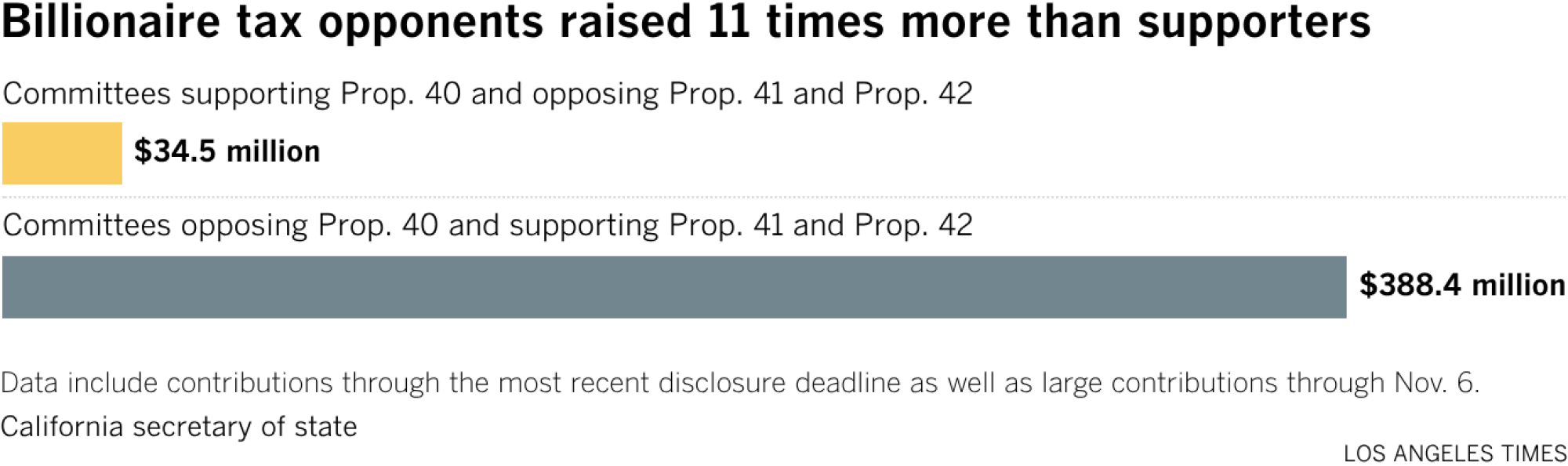
Support for Proposition 40 has totaled to nearly $35 million, mostly from the Service Employees International Union-United Healthcare Workers West, the healthcare workers union that proposed the tax.

Backers of Propositions 41 and 42 also opposed Proposition 40. Combined, they raised more than $300 million. Most of that money came from the billionaires who would be subject to the tax.

Source link