A number of Premier League clubs want Manchester City to be hit with both “retrospective punishments” and sanctions for the future for their mass financial rule-breaking, sources have told BBC Sport.
An independent commission found City guilty of all charges relating to breaches of the Premier League’s financial regulations between the 2009-10 and 2017-18 seasons.
However, there is said to be a consensus among a group of top-flight club executives that if City’s appeal is unsuccessful, the sanctions should make reparations for the period when they broke the rules, while also limiting their powers in future.
There is also a feeling from at least four Premier League boardrooms that a “one-hit” points deduction resulting in relegation to the Championship would be an insufficient punishment given the severity of City’s wrongdoing.
There is understood to be nuance in exactly what clubs consider a fitting penalty for the eight-time Premier League champions, who were found guilty of all serious financial rule breaches in a damning verdict by an independent commission.
One senior club source said City should be stripped of their titles, and added there was “no great rush” among clubs to push for the redistribution of trophies, but rather to take honours away and leave them vacant.
The source warned the credibility of the Premier League would be lost if City were allowed to keep the eight major trophies they won during the period they have been found guilty.
However, in a sign of a range of opinions across the league, BBC Sport was previously told there was little appetite among other clubs for City to be stripped of titles.
Regarding the timescale for sanctions in the future, there is a concern among club executives that a sanction applied just to one season would merely provide City with a “bump in the road” given the likelihood of them returning to the Premier League at the first time of asking.
A number of Premier League figures therefore believe any points deduction should be split over multiple seasons, while there is also a sense that transfer bans that stretch over a number of windows would also significantly hinder City’s ability to regain their top-flight status as quickly as possible.
Embattled FIFA President Gianni Infantino has been accused of a potential abuse of power and conflict of interest after the Norwegian Football Federation (NFF) filed formal complaints to two FIFA committees.
Infantino’s aborted plan to open up the World Cup to private investors, the lifting of US forward Folarin Balogun’s suspension at the 2026 World Cup following an intervention by United States President Donald Trump, and FIFA’s awarding of a so-called Peace Prize to Trump form the basis of the filings.
Recommended Stories
list of 4 itemsend of list
The first filing made on Tuesday “asks the Ethics Committee to examine the conduct of FIFA President Gianni Infantino and any other individuals identified through the investigation for potential breaches of FIFA’s Code of Ethics”.
The second filing is aimed at FIFA’s Governance, Audit and Compliance Committee (GACC) and “asks whether FIFA’s governance, financial oversight, internal controls and decision-making processes [have] worked as intended”.
Lise Klaveness, the NFF’s straight-talking president and longtime critic of Infantino, told British media that Trump was the common thread in all three issues.
The venture capital firm of Josh Kushner, the brother of Trump’s son-in-law Jared, was to be the chief investor in the ill-fated FIFA Forward Enterprise (FFE) plan.
Infantino’s plan, launched just after this year’s hugely successful World Cup cohosted by Canada, Mexico and the US in July, would have allowed private investors to acquire stakes in a company created under the FFE initiative.
“FIFA Forward Enterprise is a governance issue, but it’s connected to the two other cases because [of] conflict of interest and abuse of position, potentially,” Klaveness said in her interview with a British newspaper.
“There is a line between all these three cases, and it’s the same political regime.”
Klaveness, a former international footballer, said Infantino had some serious questions to answer over a lack of transparency.
Balogun’s red card in the last-32 win over Bosnia and Herzegovina during the World Cup resulted in an automatic suspension for the match with Belgium.
But FIFA stepped in and suspended his ban, leading to widespread condemnation, especially when it emerged that Trump had intervened by phoning Infantino.
The FIFA Peace Prize award that Infantino presented to Trump in December has also been widely criticised.
“These are three very different factual cases, but they all have something in common that we want examined,” said Klaveness.
“Is it an abuse of power, an abuse of position? Is it a breach of political neutrality?
“Is it in accordance with the rules of governance, as the FIFA Council should be the strategic body, and the president shouldn’t really have any unilateral power?”
‘Misinformation campaign’
Klaveness, 45, had, in August, called upon Infantino to resign and forgo his bid to be elected to a fourth and final term as president.
The 56-year-old Swiss has insisted he will seek re-election in Rabat next March, and as yet no other candidate has declared themself.
Infantino, who was first elected in 2016, must secure a majority of the 211 votes from the organisation’s members in order to be re-elected.
The deadline to declare a candidacy is November 18.
Klaveness has said she will not be a candidate — despite some observers, including Infantino’s predecessor Sepp Blatter, believing she would be a good fit as FIFA chief.
Aleksander Ceferin, president of European football’s governing body UEFA, has said he is not interested.
UEFA have been unsparing in their verbal assaults on Infantino and FIFA, dismissing the FFE plan as “a shady and opaque backroom deal”.
The likeliest rival is thought to be Canadian Victor Montagliani, president of CONCACAF, whose body, along with UEFA and the Asian Football Confederation (AFC), has formed an anti-Infantino alliance.
However, while a swath of UEFA’s members have publicly withdrawn their support for the 56-year-old Swiss, some of the AFC’s associations, such as 2034 World Cup hosts Saudi Arabia and 2022 hosts Qatar, have pledged their loyalty to him.
African football’s governing body CAF and South America’s CONMEBOL are also supportive.
UEFA has also gone to a court in Florida in an attempt to access documents related to Infantino’s failed plan, hoping to gather evidence for a potential criminal complaint in Switzerland, where UEFA and FIFA are based.
The latter responded by accusing UEFA of a “misinformation campaign” and saying it was attempting to “influence” the election.
After Israeli soldiers stormed Birzeit University near Ramallah to demolish a stone memorial dedicated to dead students, Rania Washaha, 47, felt the pain of bereavement again.
Her brother, Fadi, 34, was shot in the head by an Israeli soldier near the northern entrance to el-Bireh in the central West Bank in May 2021.
Recommended Stories
list of 4 itemsend of list
His name was among the 38 students from the university killed by Israel and listed on the stone pillar known as the Martyrs’ Monument.
Israeli soldiers raided the university campus at dawn on Monday, accompanied by 10 military vehicles. A bulldozer demolished the pillar, and soldiers took away the marble stone. In its place, the Israelis left a planter containing a fig sapling, bearing the inscription: “Water it twice.”
Targeting the University
This raid marks the fifth Israeli incursion into the campus since the beginning of 2026 and the 28th since 2002.
Birzeit University’s administration condemned the recent raid, describing the destruction of the Martyrs’ Monument as a violation of international law and an attack on education and national memory.
“Bulldozers won’t erase the memory of the martyrs, military vehicles won’t extinguish the light of knowledge, and these assaults won’t break the university’s resolve to pursue its academic and national mission,” a statement by the university pledged.
Birzeit University students again wrote the names of martyrs that were inscribed on the memorial [Mohamad Turkman/Al Jazeera]
It came 10 days after another incursion by Israeli forces during the daytime, a day before the start of the new fall semester.
Nardeen al-Memi, the university’s public relations and media officer, told Al Jazeera in the brief minutes of their incursion, Israeli soldiers approached the monument for the first time and photographed it.
The Martyrs’ Monument was erected between 1994 and 1996, bearing the names of students and alumni at Birzeit killed by Israeli forces. The list starts with Sharaf al-Tayyibi, who was shot dead by Israeli forces on the campus in 1984. The names of other students and alumni were added during the years that followed.
“The last name inscribed on the monument was that of student Omar al-Naasan, whom soldiers killed in al-Mughayyir east of Ramallah on September 2 while he was confronting settler incursions,” said Nardeen. “Days after his death, his father came and personally wrote his son’s name on the monument.”
University students organised a protest at the site of the destroyed memorial on Tuesday afternoon, most viewing it as an Israeli attempt to intimidate them.
Sami Adel, a Birzeit student who wanted to use a pseudonym due to his fear of being detained, told Al Jazeera the memorial holds a place in the heart of everyone who has attended the university since the 1990s.
In recent years, Israel has tried to suppress any student activity dedicated to commemorating the martyrs, he said.
“Soldiers detained me for several hours three weeks ago and threatened that if I participated in any political student activity on campus, I would face a long and harsh detention,” he added.
Erasing memory
The removal of the memorial is part of a broader Israeli policy targeting memorials dedicated to Palestinians killed by Israel in the occupied West Bank.
The Israeli far-right has made the issue part of its campaign to erase markers of Palestinian identity.
Zvi Sukkot, a member of the Knesset from the Religious Zionism Party, destroyed one such memorial in the village of Madama, south of Nablus, with a sledgehammer in August. The Israeli military later said that it routinely removes “symbols of incitement”.
The location of the demolished memorial in Birzeit University [Mohamad Turkman/Al Jazeera]
Israeli Finance Minister Bezalel Smotrich submitted a list of approximately 40 Palestinian memorials, proposing their destruction, to Prime Minister Benjamin Netanyahu.
There has been a wider targeting of civic and cultural symbols across the West Bank, particularly in Jenin, by Israeli authorities.
“Jenin Horse”, a monument constructed from the wreckage left behind by an Israeli incursion into the city, was removed. A memorial dedicated to Al Jazeera journalist Shireen Abu Akleh in Jenin was also targeted in 2023.
A cemetery containing the bodies of Iraqi soldiers killed during the 1948 war, also located in Jenin, has been raided by Israelis from illegal settlements.
Other landmarks embedded in the city’s collective memory, including the “Watermelon Roundabout”, have also been targeted.
Crushing resistance
Israel’s targeting of Palestine’s collective memory has coincided with a wider campaign of suppression in the occupied West Bank.
Palestinian universities have been a particular target in this pressure campaign, with campuses raided, students detained, and strict restrictions on activities and events within university grounds.
Israeli authorities are likely focusing on Palestinian universities because they hold a special significance for Palestinian resistance. They historically served as spaces for anti-occupation activism and have been an integral part of the Palestinian political landscape for decades.
Rania Washaha looks at her brother’s photo in her office inside Birzeit University [Mohamad Turkman/Al Jazeera]
Political analyst Mohammed al-Qeeq, who served as president of the Birzeit University Student Council between 2006 and 2007, told Al Jazeera that Israel has targeted writers, influencers, and activists, along with students, to deter any resistance to the occupation.
Universities have historically served as a “fundamental pillar” of Palestinian resilience and identity.
“Israel had also sought to weaken Palestinian political and social cohesion inside universities by deepening divisions between factions and creating chaos”, he said.
Remembering Fadi
For Rania, the memorial served to cement the names of the martyred students in the minds of the next generation of Berzeit students, including her brother’s.
“I cannot deny that I felt a pang of anguish when the memorial was demolished,” she told Al Jazeera. “I realised the goal wasn’t simply to uproot a physical object; I felt the suppressed violence Israel inflicts upon us.”
The memorial, constructed in 1996, stood on the campus when Fadi studied at Birzeit University. He had been arrested multiple times, spending a total of eight years in detention, and Israel denied Fadi the chance to wear a graduation gown.
“He didn’t even complete two years of study due to repeated arrests and injuries from soldiers’ gunfire,” Rania said. “Yet, he loved Birzeit University dearly and would stand by the memorial, contemplating the names of the student martyrs, never knowing that his own name would one day be added to theirs.”
This year, Rania’s son enrolled at Birzeit University as a first-year student. Shortly before classes started last September, an Israeli officer phoned him, threatening him if he participated in any student activities on campus. “Remember what we did to your uncle,” they warned him.
On the set of CBS’ legacy soap opera “The Bold and the Beautiful” at the Sunset Las Palmas Studios in Hollywood, two actors were caught in a fiery exchange.
“Do you want to know where Jack was last night?” actor Skyla Lynne asked with a sly grin. “He was with me.”
From behind a monitor displaying a vertically oriented feed, the director interjected: “Could you pause a bit more in between those lines? We might want to do an episode break there.”
The scene wasn’t for an episode of the famous soap opera. It was part of the 40-episode second season of “Hollywood Starlet,” a new microdrama series from “The Bold and the Beautiful” head writer Bradley Bell and his son Oliver.
“I’ve been doing soap operas my whole life, and it felt like there’s been a buzz about microdramas, and it really felt like a natural extension to the stories that we do,” Bradley Bell said. “[On soap operas] we build two cliffhangers usually on Fridays to keep the viewers over the weekend. Here, you do it every couple of minutes. It’s like speeding up the dance routine, but it’s really right in our lane of soap operas.”
Microdramas are the scrollable, cliffhanger-heavy stories built for phone screens. They are giving audiences a new way into the kind of stories that once belonged to traditional soap operas and telenovelas. The so-called vertical format originated in China a few years ago and has drawn a growing global audience thanks to its short, addictive nature. Hollywood names, including Issa Rae and Kevin Hart, are joining in.
Now, Bell is moving into the space. The 16-time Emmy winner and his son Oliver recently launched a production company called Red Flair Entertainment to capitalize on the format.
“Hollywood Starlet,” their first production, premiered Sept. 3 on aTwist, a new vertical series app founded by industry veterans Jana Winograde, former president of Showtime; Susan Rovner, former president of Warner Bros. Television; and Lloyd Braun, former chairman of WME.
Oliver Bell, founder of Red Flair Entertainment, is producing the micro series, “Hollywood Starlet,” being filmed at Sunset Las Palmas Studios in Los Angeles.
(Genaro Molina/Los Angeles Times)
Bradley Bell says it was Oliver who hatched the idea.
“I saw this unique format and was fascinated by it,” Oliver Bell said. “I noticed some areas that we could quite easily improve on.”
Microdramas first came across Oliver’s social media feed around a year and a half ago when he was still in college. The 24-year-old said he quickly “fell down a rabbit hole” and became so obsessed with the format that he wrote his dissertation at the University of St Andrews in Scotland on soap operas and microdramas.
After he graduated in December, he and his father founded Red Flair Entertainment and started to develop “Hollywood Starlet,” with Oliver serving as an executive producer and his father as a producer.
The series — which costs about $175,000 to $220,000 a season to produce — is being financed by aTwist. Red Flair has a backend deal, allowing it to share in subscription revenue the show generates for the platform.
After filming two seasons of “Hollywood Starlet,” Red Flair plans several more vertical series across many different genres, like horror and romance, the Bells said.
Oliver grew up visiting sets and eavesdropping on writing meetings from under his father’s desk. The family’s storytelling line runs back to his grandparents, William Bell and Lee Phillip Bell, who created “The Young and the Restless” and “The Bold and the Beautiful.” Oliver says he’s carrying on that legacy in a very Gen Z way.
“In a way, microdramas are just the natural evolution of the soap opera,” Oliver Bell said. “You could kind of trace the legacy through that and the modernization of serialized TV.”
His father, who was working on episode 9,911 of “The Bold and the Beautiful” while speaking with The Times, said the short-form stories can reach younger viewers who might be daunted by the soap’s decades of history.
“It’s like cracking open a book, and it’s hard for people to get into it to learn the history,” he said. “So having smaller, bite-sized pieces is appealing to us.”
“The Bold and the Beautiful” has aired continuously for 39 years, but it’s now one of American TV’s last soap operas. Until the 1980s, 10 to 12 soaps typically aired at once, said Elana Levine, a media professor at the University of Wisconsin-Milwaukee who studies the genre. Today, five remain: four on broadcast TV and one, “Days of Our Lives,” is on streaming only.
“It makes sense to take this storytelling form that has been super popular and enduring in the U.S. and find a way to translate that into the mobile devices that we carry around us all of the time,” Levine said.
While soap operas historically targeted a mostly female audience, microdramas reach a much broader audience, said Michael Berry, director of UCLA’s Center for Chinese Studies, who has studied the rise of vertical series.
“It gives us essentially the main beats that we would get from a soap opera format, but it’s happening in a much more compact and addictive way,” he added.
Cameramen prepare for a scene on the set of the micro series, “Hollywood Starlet,” being filmed at Sunset Las Palmas Studios in Los Angeles.
(Genaro Molina/Los Angeles Times)
Lou Trabbie, the soap’s production designer, had never heard of a microdrama before working on “Hollywood Starlet.”
“It’s all going in a different direction. You just adapt and move forward, and that’s what we see here,” Trabbie, who’s worked in the industry for 38 years, explained. “It’s really great to see how these are done with smaller crews. I feel like this is where the business is going.”
“Hollywood Starlet” shoots on the same Sunset Las Palmas soundstage as “The Bold and the Beautiful,” filming during the soap’s monthly dark week.
The first season, 45 short episodes, was shot in six days at the start of summer with a non-union cast and crew of 45. Less than a week after its release, much of the same crew was back to start working on season two.
Oliver Bell said the series used non-union crew due to “budgetary restrictions.”
Excluding China, vertical video is expected to generate $150 billion globally in revenue this year, according to consulting firm Owl & Co. Most of that comes from TikTok, YouTube Shorts and Instagram Reels.
Sunset Las Palmas Studios, where “La La Land” and the first two seasons of “I Love Lucy” were filmed, dedicated an entire sound stage in June to standing sets for vertical series. The sets include a courtroom, a bar/restaurant, an apartment, an office and a hospital.
Paxton Fuller, left, executive producer of “Hollywood Starlet,” walks with Sean Griffin, Vice President of Sales and Business Development, for Las Palmas Studios, through a courtroom set on the stage meant specifically for microdramas.
(Genaro Molina/Los Angeles Times)
Still, the Bells don’t think microdramas will replace soap operas. The two formats, they argue, can “coexist.”
“Coming into someone’s living room or bedroom, soap operas were almost like an extension of their family that they can count on for years and decades with the same actors. The same families that have watched since day one,” Bradley Bell said. “It’s a different type of viewer for microdramas.”
Oliver Bell added: “We’re trying to grab the scroller’s attention, not necessarily ‘The Bold and the Beautiful’ viewer … Microdramas are unavoidable through social media. [It’s] conditioning our brains and how we process media.”
NOT a lot beats the feeling of having that first pint on holiday – but it would taste even better if it was a fraction of the cost too.
Jet2 has found the cheapest holiday destinations for a beer where the average pint costs less than £3.
Jet2 has found the cheapest destinations with pints as little as £1.27Credit: Getty Tunisia comes in the cheapest – and it has incredible beaches tooCredit: Alamy Stock Photo
At the very top of the list for cheapest pints is Tunisia, which comes in at £1.27 – this is £3.74 less than that of the UK where an average pint stands at £5.01.
From the UK, Tunisia is around three hours away and it’s a great autumn and winter sun option for Brits too as in October temperatures can reach 25C.
Sign up for the Travel newsletter
Thank you!
In November, temperatures in Tunisia can be as high as 20C and even in December it can be 16C – at that time in UK, highs only reach 8C.
Return flights in December can be as cheap as £48 too.
Lisa said: “Relatively undiscovered by us Brits, Djerba is a great-value option for those looking to explore beyond the Med favourites.
“Sizzling in summer, temperatures remain high all the way through to November and rarely dip below the 20Cs, even in the depths of winter, making it ideal for out-of-season sunshine.”
Jet2Holidays has a break to the 3-star Les Orangers Beach Resort which is seven-nights all-inclusive departing from Manchester on May 25 2027 from £839pp.
The resort has an outdoor pool with lots of activities and it’s close to a sandy beach and Hammamet’s Old Town.
Both Bulgaria and the Czech Republic which both have an average beer cost of £1.74Credit: Getty
The next spot is shared by Bulgaria and the Czech Republic which both have an average beer cost of £1.74.
Bulgariahas everything you need for a great holiday from vibrant cities likeSofiato coastal resorts like Sunny Beach, Golden Sands and Albena.
One-way flights to Sofia can be as little as £14 – and returns can cost under £30.
Czech Republic is the perfect city break for Brits thanks to being two hours away and it has one-way flights from £17.
The city’s capital of Prague is filled with history with a huge Cathedral , old town squares and beer culture – which is easier to get involved with when pints cost less than £2.
3-star Comfort Hotel Prague City East, 3 nights bed and breakfast departing from Leeds Bradford on November 2, 2026 from £497pp.
Bulgaria is known for having cheap coastal resorts and affordable pintsCredit: AlamyThe Silver Coast in Portugal is a great alternative to the AlgarveCredit: Getty
The American-style hotel has a huge lobby and restaurant area – and the nearest tram shops is right outside the entrance.
Other top spots include Hungary which has an average beer price of £2.08.
The capital, Budapest, is also known for having lots of thermal baths – it has 123 natural hot springs and 50 thermal bathhouses.
Coming in fifth on the list is Portugal where beer is an average of £2.14 per pint.
Brits can easily head to the Algarve, known for its beautiful beaches, or the Silver Coast which is much less crowded but still has an incredible coastline.
David Hills, Chief Customer Officer at Jet2, said: “We know that value matters to our customers, and that doesn’t just mean getting a great deal when booking their holiday. It’s about how far their spending money goes once they arrive too.
“With destinations including Portugal, Spain, Turkey and Croatia offering beers for considerably less than the UK average, there are plenty of places where customers can enjoy some sunshine or a city break and make their holiday money stretch that little bit further.”
Here are the 10 destinations where your beer money goes further…
Who will be the next president of the largest Latin American economy? We’ll know for sure with the run-off on October 25, but after the first-round results in Brazil’s general election, it seems it won’t be Lula da Silva. The 80-year-old socialist who was close friends with Hugo Chávez and failed to pressure Nicolás Maduro after he stole the 2024 election would need a miracle to stop Flávio Bolsonaro. The ultra-conservative populism of the candidate’s father, former president Jair Bolsonaro —currently in jail for the coup attempt of 2023—, surpassed Lula in the presidential vote and grabbed the majority of states and seats in Congress.
Unless the Workers Party has a secret weapon against Bolsonaro and recruits enough voters in extremis, Lula will end his career defeated by a family closely associated with attacks to democracy, misinformation, open dismissal of environmental concerns, militarism, and sexism.
We’ll see what millions of Brazilian voters, who are fed up with inflation and crime, will decide. But from a Venezuelan point of view, the idea of having Flávio Bolsonaro ruling over our big neighbor to the south sounds like bad news for chavismo, especially if the rest of Venezuela’s land borders touch Guyana, a rising oil producer closely protected by the US, and Colombia, where Abelardo de la Espriella, a leader who resembles Bolsonaro, is already president.
Donald Trump is not Ronald Reagan. He’s not fighting socialism and trying to spread capitalist democracy.
If we add that Panama, Ecuador, the Dominican Republic, Trinidad and Tobago, Peru, Chile, and Argentina have conservative presidents who declared a new war on drugs and are even joining the Trump administration’s Shield of the Americas initiative, we’ll see a map turning dark-blue hostile to the heirs of 21st-century socialism. No more silence about chavismo’s abuse. No more anti-imperialist performance in global arenas. Finally, the pendulum swung away from chavismo’s old circle. This right-wing storm on the continent is bad for Delcy Rodríguez and good for María Corina Machado. Right?
Not necessarily.
Before and after Trump
Before Trump, things were simpler. Conservative governments in Latin America were like Álvaro Uribe’s in Colombia or Felipe Calderón’s in Mexico: they tried to get along with Chávez but ended up as enemies, cutting commercial and diplomatic ties, fighting chavista diplomats in the UN and accusing their local adversaries of trying to export chavismo. Predicting a vote involving Venezuela in the OAS was easy: you just had to count how many representatives were on the right and how many on the left or the Chávez payroll, like Petrocaribe’s members.
After Trump, on the contrary, those old categories no longer matter. Ideology is not important. Not even cultural wars, which are so good for social media and for recruiting powerful allies like evangelical churches; a government can allow abortion and same sex marriage and be considered a friend by Trump, as long as this government connects with the priorities of the president’s political and corporate circles.
Hugo Chávez would be worried about the Bolsonaros’ apparent return to Brasília. Delcy Rodríguez, not so much.
Trump’s foreign relations favor those governments who are in sync with the specific matters his administration is about, like pushing China out of the region, securing markets for American companies, and, more particularly, supporting Trump’s narratives. If you lose an election, as he did with Biden, you blame socialism and try to reverse the results; if Trump says fentanyl and cocaine are coming from your country, you help the Americans to attack boats and produce viral clips on social media; if Trump says your migrants are poisoning his country, you help him to stop them before they approach the US, and even accept that your own citizens are sent to prisons in third, remote countries.
Donald Trump is not Ronald Reagan. He’s not fighting socialism and spreading capitalist democracy. He’s not even treating China as a geopolitical adversary, but a corporate competitor with a CEO you can visit and have at home, as Trump just did with Xi Jinping. Trump is in worse terms with a fully democratic, pro-market government like Mark Carney’s in Canada, which did not bend to his demands, than with President Claudia Sheinbaum in Mexico, a hardcore leftist, who is more cooperative with the White House. And, in fact, Trump is allowing the existence of three socialist autocracies on the continent: Cuba, Nicaragua and Venezuela.
Trump can coexist with socialists, as long as they do what he wants. In practice, this means that our old premises about the impact of having left- or right-leaning governments around are not as valid as they were when Chávez was alive.
New friendz n the hood
We Venezuelans can easily see how things changed in the region’s geopolitical play, and how ideology lost relevance, in the evidently comfortable relationship between Donald Trump and Delcy Rodríguez, or in the aftermath of the earthquakes in June. Many governments sent help to La Guaira, but one of the first and most spectacular rescue missions came from El Salvador, where the government is a very public enemy of chavismo. The Salvadorans’ equipment and efforts in the rubble were highlighted on President Nayib Bukele’s social media. El Salvador’s fast response helped the dictatorship to manage the disaster, not the Venezuelan opposition, which is currently led by a pro-market politician, Machado, who courted the Republican Party for years.
We have also seen how Paraguay, Argentina and Chile, all of them with right-wing leaders very close to Trump, started to restore relationships with Miraflores Palace, even if it is still in the hands of the people who perpetrated the 2024 fraud and besieged the Argentine embassy in Caracas.
Hugo Chávez would be worried about the Bolsonaros’ apparent return to Brasília. Delcy Rodríguez, not so much. She can invite big Brazilian companies in energy, retail and agribusiness, which would get deregulation and diplomatic support in a Bolsonaro government, to join the investment frenzy in the Caracas Marriott. Yes, Machado and Bolsonaro met in Chile, during Kast’s inauguration in March, and she congratulated him on social media last Sunday, but Venezuela’s democratic renewal is not an urgent priority for Flávio Bolsonaro.
A critical difference between Abelardo and Flávio is that the new Colombian government needs to put pressure on Colombian guerrillas in Venezuela.
A good proxy to estimate how Bolsonaro Jr. would behave with chavismo and Machado is Abelardo de la Espriella. The Colombian president, who used a similar mix of conspiracy theories and a macho persona to defeat the Pacto Histórico leftist coalition, has so far been as passive about Venezuela’s suspension of democratic rights as Gustavo Petro. De la Espriella has been pushing Venezuelan migrants to go home, like Trump. As experts see it from Colombia, he is just following Trump’s lead regarding his neighbor. One critical difference between De la Espriella and Bolsonaro is that the new Colombian government needs to put pressure on Colombian guerrillas in Venezuela (with American support and, probably, even Delcy’s help), a variable absent in the Brazilian case.
I’m not saying that the Bolsonaros and the rest of the Trumpian Right will support Delcy forever. My point is that we can’t see their spread over South America as a force meant to crush socialists. We must observe what Trump and their allies do, instead of just believing what they say. Trump said a lot of things about Maduro and chavismo, but at the time of writing, Venezuelan citizens remain deprived of influence, just like when Maduro stole their votes, and Maduro’s former vice president is having the time of her life.
Fred Claire was an unorthodox choice for general manager, a former sportswriter and public relations man who didn’t play baseball beyond the junior varsity level in high school, and his 1987 promotion to head the Dodgers’ front office was met with skepticism around the game.
A year and a half later, after his shrewd moves helped turn the Dodgers into World Series champions in 1988, Claire was named Major League Baseball’s executive of the year by the Sporting News.
Claire, who spent 30 years in the Dodgers’ front office, died Monday on his 91st birthday. The news was shared on social media by former Dodger broadcaster Ross Porter.
An avid runner and golfer fit and trim enough to pass for a man a decade younger, the silver-haired Claire was diagnosed with squamous cell carcinoma in 2015 when what looked like a harmless spot on his lip turned out to be cancerous.
The growth was surgically removed, but the cancer returned in August 2016, and spread into the left side of his face. Claire underwent radiation and chemotherapy treatments to kill the malignant cells in his body, but the cancer returned again in 2017.
An immunotherapy clinical trial saved his life, according to a story in Pasadenanow.com, but then an infection forced him to undergo even more extensive facial reconstruction surgery at City of Hope in Duarte, replacing his jawbone with a bone from his leg.
Claire was so impressed with his treatment at City of Hope that he teamed with author Tim Madigan in 2021 to publish a book chronicling his career and capturing the hospital’s history as well the stories of patients and doctors. The book, “Extra Innings,” can be purchased at Amazon, with all net proceeds donated to City of Hope.
“The main thing that I liked and appreciated about the book was people buying it because of their interest in baseball,” Claire told the Desert Sun in 2021, “then to discover what a great place [City of Hope] is after reading it.”
Claire was also active in helping fund research — he and his wife, Sheryl, set up a scholarship fund with the USC Keck School of Medicine for research in head and neck cancer.
Claire was born Oct. 5, 1935, in Jamestown, Ohio. His parents moved the family — Claire had a brother and a sister — to Torrance when Claire was a teenager. After graduating from Torrance High, Claire earned a degree in journalism from San José State in 1957 before taking his first newspaper job.
“I graduated on a Sunday afternoon,” Claire told The Times in 1997, “and by Monday morning, I had a job at the Whittier Daily News.”
For 30 years, Dodger Stadium was Fred Claire’s home. “Honestly, in my heart and soul, it was a thrill and honor to have the opportunity to walk into Dodger Stadium every day and go to work,” Claire told the Times in 2017.
(Jack Harris / Los Angeles Times)
Claire spent 11 years as a sportswriter and was covering the Dodgers for the Long Beach Press-Telegram in the spring of 1969 when a position opened in the team’s public relations department.
Claire, who always longed to be involved in baseball, expressed interest in the job and was hired as a public relations assistant, remaining in the position until 1975, when he was promoted to vice president of public relations.
He was instrumental in creating the branding that came to be known as “Dodger Blue” and was directing the team’s marketing efforts when the Dodgers passed the 3-million mark in attendance for the first time. He also hired Ross Porter, a Dodgers broadcaster from 1977 to 2004.
In April 1987, then-Dodgers general manager Al Campanis was fired after making controversial and what many said were racist remarks about Black Americans on “Nightline,” during which he told the show’s host, Ted Koppel, that Black people may lack “some of the necessities” to be the field manager or GM of a major league baseball team.
Claire was then-Dodgers President Peter O’Malley’s surprise choice to replace Campanis, and his hiring raised the eyebrows of his new peers, who saw Claire as an outsider with no background as a player, coach, manager or scout.
“I knew some people might say, what does this guy know about baseball, he covered it from behind a typewriter?” O’Malley said in 2017. “But I knew Fred could do it. And he did it. He deserves a lot of credit for stepping in quickly, without advance notice, and doing a great job.”
The Dodgers suffered their second straight losing season in 1987, but Claire made several off-season moves — acquiring outfielders Kirk Gibson and Mike Davis, shortstop Alfredo Griffin and pitchers Jay Howell and Jesse Orosco — that fortified the club.
The Dodgers, led by National League Cy Young Award-winning pitcher Orel Hershiser and most valuable player Gibson, won the National League West in 1988 and upset the 100-win New York Mets in the NL championship series.
The gimpy Gibson hit his memorable pinch-hit, walk-off homer off Oakland closer Dennis Eckersley in Game 1 of the World Series to push the Dodgers toward their fifth championship since moving from Brooklyn to Los Angeles in 1958.
Kirk Gibson reacts to his game-winning two-run homer in Game 1 of the 1988 World Series.
(John Swart / Associated Press)
Claire dealt a smallish and seemingly fragile pitcher named Pedro Martínez to Montreal for second baseman Delino DeShields in what turned out to be one of the game’s most-lopsided trades. DeShields hit .241 in three years in Los Angeles, while Martinez went on to have a dominant 17-year career that earned him a 2015 Hall of Fame induction.
But during Claire’s 11-year tenure as GM, the Dodgers won a World Series, two division titles, a wild-card berth and a first-place finish in the strike-shortened 1994 season.
Claire also changed the culture in the front office, hiring an analytics expert, holding regular conference calls with coaches and scouts and canvassing the clubhouse to talk with players about everything from their families to their on-field performance.
“Fred gave us that first edge of being progressive and aggressive,” Hershiser told the Times in 2017. Added former Dodgers utility man Mickey Hatcher: “Fred Claire was amazing. For a guy who was suddenly put into the limelight, he asked all the right questions, listened to everyone and believed in all of us.”
Claire was fired along with then-Manager Bill Russell on June 21, 1998, five weeks after executives from Fox News Corp., which purchased the Dodgers earlier that year, engineered a blockbuster trade — deflating to many fans — of All-Star catcher Mike Piazza to the Florida Marlins without Claire’s involvement.
Claire, a man of “integrity and dignity,” as former Times baseball columnist Ross Newhan wrote, walked away with no harsh words or public regrets.
“Honestly, in my heart and soul, it was a thrill and honor to have the opportunity to walk into Dodger Stadium every day and go to work,” Claire told the Times in 2017. “This is truly enough for me.”
After his departure from the Dodgers, Claire worked as a columnist and analyst for MLB.com, a radio show host, an instructor at USC and a consultant to companies involved with sports. He co-authored an autobiography, released in 2004, titled “Fred Claire: My 30 Years in Dodger Blue.”
His response during an interview with Business Renaissance Quarterly in 2007 shed some light on Claire’s philosophy. The question: What do you want to be remembered for?
“I was once in the presence of the late Dodgers owner Walter O’Malley when he was asked this question by a reporter from United Press International,” Claire said. “Mr. O’Malley spun his ever-present cigar, paused for just a second and replied, ‘I want to be remembered for planting a tree.’
“Walter O’Malley’s answer, in my mind, overshadowed the great question. He wanted to be remembered for helping things grow, and in my mind, that meant his family, his friendships, the good causes he was involved in.
“I have seldom planted a tree, but I would proudly borrow Mr. O’Malley’s answer to this question.”
Claire is survived by his wife, Sheryl, and their three children, Jen, Jeff and Kim.
Tens of thousands have taken to the streets across France as unions and teachers joined high school students who, for days, have been demanding better learning conditions in protests punctuated by violent confrontations.
The French Ministry of the Interior said 86,000 people had already joined demonstrations across the country early on Tuesday, while the General Confederation of Labour (CGT) union put the figure at 260,000.
Students have blocked the entrances to hundreds of high schools since late September, complaining of missing teachers, overloaded timetables, dilapidated classrooms and buildings unable to cope with rising temperatures.
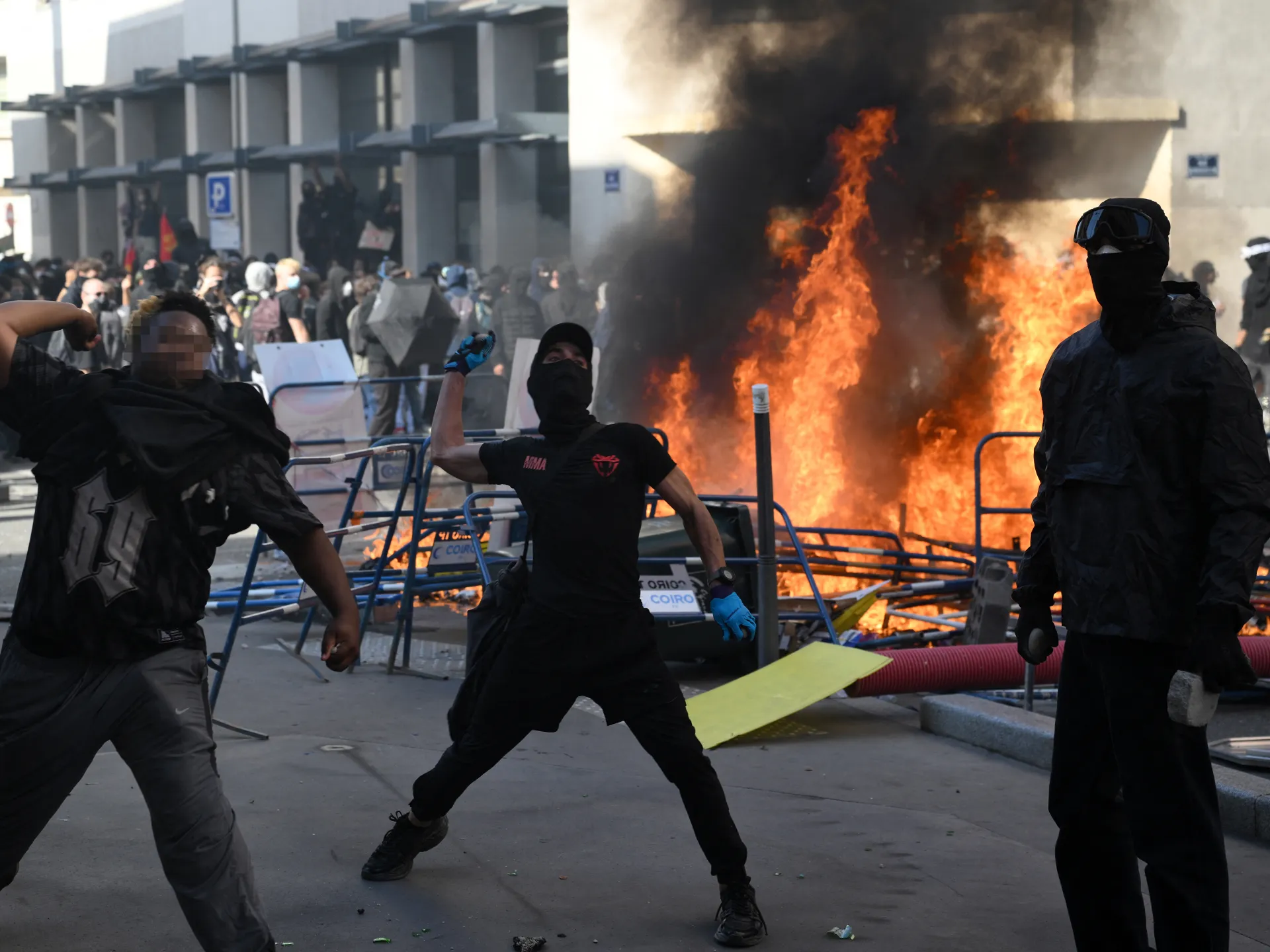
While many protests have been peaceful, some demonstrators have started fires, destroyed bus shelters or clashed with riot police.
Police have responded with batons, tear gas and riot-control rounds.
Injuries, investigations
The government says 215 students and 715 police officers have been injured since the start of the movement.
Unions, rights groups and students have accused the authorities of using disproportionate force.
A 15-year-old lost a hand to a stun grenade fired by riot officers in the northern town of Lens on Monday.
Police have launched 10 internal investigations into allegations of brutality since the protests began, Interior Minister Laurent Nunez said late on Monday.
Since the start of the movement, 24 schools have been burned or ransacked, according to the Ministry of Education.
More than 5,000 people, 87 percent of them minors, have been arrested.
Prime Minister Sebastien Lecornu’s office said 85 members of teaching staff have also been injured.
The government is also pushing legislation to make those responsible for damaging public property pay for repairs themselves, instead of using public funds.
The Navy has announced plans to buy 30 new drone boats, 10 from each of three companies, under its Medium Unmanned Surface Vessel (MUSV) program. The deals are an important step forward for the Navy’s latest attempt to field larger USVs after years of setbacks and shakeups, but it remains to be seen when these new capabilities might actually become operational.
Galliano Marine Services, Huntington Ingalls Industries (HII), and Saronic Technologies each received so-called Other Transaction Authority (OTA) agreements in relation to the MUSV program today. OTA is a contracting mechanism designed to support rapid prototyping and other research and development work without having to use more traditional and often lengthy processes.
The awards “mark a significant step forward in translating the strategic vision into a tangible fleet capability,” Chris Miller, the Navy’s Acting Direct Reporting Portfolio Manager for Robotic and Autonomous Systems (DRPM RAS), told TWZ and others at a media roundtable earlier today. “Each agreement is for the procurement of 10 MUSV at an average procurement cost of $40 million per vessel.”
A rendering of HII’s Romulus design. HII
Saronic and HII submitted their Marauder and Romulus designs, respectively, to the MUSV Phase I competition. Galliano Marine Services, which does business as Edison Chouest, does not appear to have announced its entrant publicly. At a unit cost of $40 million, the total price tag for 30 MUSVs, regardless of type, would be $1.2 billion.
“Production will begin immediately at shipyards in Loreauville, Houma, and Franklin, Louisiana, with deliveries starting as early as the fourth quarter of [Fiscal Year] 2027,” Miller added.
Saronic’s Corsair, seen here, is an example of a speedboat-sized USV already in operational Navy service. Saronic
Threshold MUSV program requirements the service put out in March included a range of at least “2500 nm [nautical miles] at 25 knots while carrying a 25 MT [metric ton] load on the payload deck in NATO STANAG 4194 Sea State 4.” Sea State 4 is characterized by wind speeds of 17 to 21 knots and wave heights between four and eight feet, per that NATO standard. The MUSVs also had to be able to carry forty-foot equivalent units (FEU) containerized payloads and refuel at sea at a rate of “2,000 gallons per minute of fuel through deck connections.” Various other operational and sustainment requirements were laid out at that time, as you can read more about here.
The OTAs announced today were awarded “following successful at sea testing” under Phase I of the MUSV program, according to a press release the Navy put out today. A total of seven companies competed in this initial phase, with the others being Birdon, Leidos, PacMar Technologies, and Sea Machines. That work was conducted under an earlier round of OTAs.
“The testing evaluated, among other things, the vessel’s ability to see and understand the surrounding maritime environment, how well the vessels navigated autonomously according to the international regulations for preventing collisions at sea, and the vessel’s ability to conduct a long-duration mission,” the Navy’s Miller said at the roundtable earlier today. “The demonstrations had to prove that the designs were mature enough to meet the Navy’s operational standards and our requirements.”
In terms of the long-duration mission requirements, “the test was that they had to be able to execute [over] roughly 26 hours and over 360 nautical miles with only a single input during that time from a C2 [command and control] station allowed,” Milleter further explained. “So, it basically demonstrated that the vessel could run for an excess of 24 hours at an extended range with very minimal input from the actual operator from a C2 station. This provided basically our input and our ability to assess how truly autonomous the functionality was of the platforms.”
Overall, the OTA awards “were based on the optimal mix of autonomy, performance, design, production schedule, and cost,” he added.
The MUSV Phase II contracting notice outlines additional parameters, including that submitted designs cannot be more than 295 feet (90 meters) long or displace more than 5,000 metric tons. The USVs also have to be able to accommodate “at least 2x Twenty-foot Equivalent Unit (TEU) [containerized payloads] weighing 24,000 kg each and consuming 25 kW each” and be “capable of executing multi-day unmanned operations of at least 10 days.” The drone boats need to be “operable in NATO STANAG 4194 Sea State 4 and survivable in Sea State 6,” as well. The full lists of threshold requirements and desired attributes are reproduced below.
USN
In addition, “to be considered for this Call for Solutions, the proposed MUSV must be ready for operational demonstration at the time of solution submission,” according to the Phase II contracting notice. “An MUSV requiring substantial modifications for the production platform compared to the as-demonstrated platform will not be considered.”
“The Phase II solicitation allows entrants to compete and existing vendors to submit updated product blocks and modular payload configurations,” Miller, the Acting DRPM RAS, said today. “Testing evaluations will begin as early as November 16th, and proposals will be assessed on a continually rolling basis over the next five years.”
Miller also drew attention to the elimination of the speed and at-sea refueling targets previously outlined in Phase I.
“What we learned from Phase I is that as you increase the speed requirements and some of these other things, it does present certain challenges for industry,” according to Miller. “So I’m trying to actually find the sweet spot in the market where there is healthy competition, and there’s opportunities, and we can have more things that potentially are dual use, both military and civilian.”
A rendering of Saronic’s Marauder with containerized payloads. Saronic
So far, the Navy has only offered limited insights into exactly what specific mission sets it wants the MUSVs to perform, even initially.
The “MUSV Phase I requirements were closely tailored to fulfill operational requirements for a specific mission set focused on demonstrated ability to carry containerized payloads while meeting specific vessel performance requirements for speed and range,” Miller said during today’s roundtable. “However, there is an ever-increasing demand signal that we must be ready to meet. To ensure scalability across the broader mission sets and to support our joint force, we issued a formal call for solutions for MUSV Phase II integration and testing.”
He also stressed that the modularity of the designs being acquired now would allow for the continued evolution of their capabilities as time goes on.
With the focus on containerized payloads, “honestly, inside you could have a sensor, you could have repair equipment for ships,” Rebecca Gassler, who was the Navy’s Portfolio Acquisition Executive for Robotic and Autonomous Systems (PAE RAS) until August, also told TWZ and other outlets back in March. “You could have any number of payloads inside those, and you basically are able to just swap them on.”
In announcing the new OTAs today, as well as discussing the Phase II MUSV plans, the Navy also highlighted continued opportunities for the other companies that had been involved in Phase I.
“Leidos, PAC MAR, and Sea Machines were determined to complete the project provided for in their prototype other transaction agreement and will receive a $15 million award as part of the previously established terms of the prototype OTs,” the Navy’s MUSV announcement today adds. “Alongside the OT awardees, will be accepted onto the Drones.mil hosted Maritime Marketplace, where they are now eligible to receive follow-on production agreements from authorized acquisition authorities across the DOW [Department of War].”
A rendering of Steamracer, a larger USV design Sea Machines has pitched to the US Navy in the past. Sea Machines
Birdon did not complete the required testing. Based on the terms of the Phase I OTAs, Galliano, HII, and Saronic will also receive $15 million awards and be included in the marketplace. The aforementioned Phase II CFS is intended “to expand its acquisition pipeline through a Maritime Marketplace to broaden offerings and satisfy future MUSV mission sets,” as well, per the Navy.
The Navy stressed the importance of this open-ended “marketplace” model as a way to accelerate the acquisition process when it first outlined the MUSV program to the public back in March, as you can read more about here. Just last week, the service also established a new Robotic and Autonomous Systems Warfighting Development Center (RASWDC) to serve as a focal point for “the development, operational integration, and employment of robotic and autonomous systems (RAS) across the maritime domain,” to include the MUSV effort.
The Drones.mil marketplace also extends to all branches of the U.S. military and beyond just USVs. Miller today did highlight the potential for possible cooperation with other services on drone boat efforts through this framework. He also said the Navy might be willing to consider additional acquisition strategies, including leasing uncrewed platforms, in the future.
Larger USVs have long been seen as key to bolstering the U.S. Navy’s overall operational capacity above the waves, and doing so in a cost-effective and rapidly producible manner. They are also viewed as central to enabling new, more distributed concepts of operations designed to help expand operational coverage and reduce the vulnerability of crewed ships, especially in any future high-end fight in the Pacific with China.
A pair of optionally-crewed vessels the Navy has been experimenting with for years now seen sailing together with a Japanese Mogami class frigate. USN
“Unmanned technology is redefining operations and providing our combatant commanders with unprecedented scale, persistence, and risk tolerance,” the Navy’s Miller said at the roundtable.
At the same time, as mentioned, the Navy has attempted to acquire operational fleets of larger drone boats in the past without success. Today, the service’s capabilities in this regard remain limited to a pocket force of still largely experimental optionally-crewed designs.
Since the Navy first unveiled it in March, MUSV has already faced certain hurdles. This includes a major leadership shakeup in August that saw PAE RAS Rebecca Gassler, the first person to ever hold that post, removed from her post after just eight months for reasons that are still not immediately clear.
In July, it also emerged that Blue Water Autonomy and Saildrone had filed suit against the Navy over being left out of Phase I of the MUSV competition. The companies alleged that the service did not follow its own selection criteria. That lawsuit is still ongoing. Blue Water Autonomy, among others, had also previously made investments in response to requirements the Navy had laid out for a previous effort called the Modular Surface Attack Craft (MASC) last year. The MUSV program has now fully supplanted MASC.
In speaking at the roundtable today, Miller acknowledged potential budget limitations and other hurdles that could still impact MUSV going forward. “I’m trying to be prepared depending on where that demand goes,” he said.
As said at the start, today’s MUSV announcement is an important new step forward for the Navy’s efforts to acquire fleets of larger USVs, but the service still has to transition these efforts into operational realities.
David Ellison emerged with his prized Hollywood juggernaut Tuesday as the merger of Paramount Skydance and Warner Bros. Discovery officially closed.
The $111-billion transaction culminated a year-long battle by the 43-year-old tech scion to add Warner Bros. Discovery to his family’s growing portfolio.
The Ellison family now controls one of the largest traditional media companies ever formed, with HBO, CNN, CBS, Comedy Central, TBS, Food Network, two traditional Hollywood studios and two major streaming services.
Shares of the new company began trading under the ticker SKYD, a switch from last week when the company went by PSKY for Paramount Skydance. Ellison has called the merged company, Skydance, the name he selected two decades ago when he began building his Hollywood studio.
NO signal, no all-you-can-eat buffet and your bed is next to hundreds of shipping containers – it’s certainly not your average cruise.
Yet this didn’t stop passenger Pieter Stroop Van Renen from shelling out £850 to travel for a week on board the shipping boat.
Pieter Stroop Van Renen took a cruise on a shipping container – he was the only passengerCredit: Pieter Stroop Van RenenThere’s no luxury additions – no buffet, infinity pool or casinoCredit: Pieter Stroop Van Renen
Pieter, 59,said he was stunned to realise you could pay to travel onboard the ships that are usually for cargo rather than leisure.
Talking to The Sun, he said he jumped at the chance to go on one and loved the idea of being the “only passenger onboard.”
Sign up for the Travel newsletter
Thank you!
Paying around €1,000 (£848) to travel aboard the Elbcarrier, the 140m-long vessel sailing was from Rotterdam to Dublin and back again.
It’s safe to say that the ship is the opposite of a luxury liner – there’s no infinity pool, no cocktail-fuelled small talk with fellow tourists and no breakfast buffet.
The first major difference from a commercial cruise was before the journey even began – as nobody could tell Pieter exactly when the ship would leave.
Even in the week before his holiday, he did not know whether he would depart on the Friday, Saturday or Sunday.
Pieter eventually boarded the Elbcarrier at 4pm on Saturday – but the ship did not set sail until 12 hours later, at four in the morning.
As he waited, confined to his cabin while loading was completed, the reality of spending several days aboard a working cargo ship began to sink in.
Peter said: “I thought, will I get bored, or will I get seasick, or what happens there? Where can I walk? Who are these guys, and do they know I’m coming?”
But that wasn’t a problem for Pieter, who instead spent hours on the bridge watching the captain and officers navigate, studying the ship’s radar screens, chatting to the crew and touring the engine room.
The rooms were very simple with a small bed – and it’s not easy to sleep either
Pieter continued: “The bridge was beautiful at night. They keep the lights off, so it’s pitch black outside and all you can see are the navigation lights and the equipment glowing in the darkness. It was magical.”
At the invitation of the captain, Pieter had one of the best seats in the house as the vessel headed out towards the North Sea.
The journey to Dublin usually takes at least 48 hours by sea, but Pieter’s crossing lasted around 52 hours.
Pieter also couldn’t wander about as he pleased on deck – passengers aren’t allowed to walk between the stacks of containers, which can tower four or five containers high.
Pieter explained: “If something happens [and one falls], then you’re crushed and you’re dead.”
Mealtimes gave him another taste of life aboard a working ship.
Included in the ticket was three meals a day – and a snack and beer from the captainCredit: UnknownPieter warned anyone who struggled with seasickness to think twice about the tripCredit: Unknown
Pieter’s ticket included three hot meals a day – there were fried eggs for breakfast and hearty dinners of meat and vegetables in the evening.
What Pieter had not prepared for was getting peckish between meals – but luckily the captain sold chocolate bars and cans of beer.
Sleeping was another challenge altogether because while daytime conditions were relatively calm, it’s a different story at night.
Pieter explained: “You’re just rolling in your bed from left to right continuously. I didn’t get seasick. But I didn’t sleep at all at night.”
He warned that anyone particularly prone to seasickness should think carefully before following his lead – especially as there’s no getting off the boat for excursions like on a usual cruise.
Anyone expecting to spend the voyage scrolling TikTok will also be disappointed as on the Irish Sea, there’s no connection whatsoever.
Pieter had to wait until he was back on dry land before posting about his experience on social media – where clips from the trip unexpectedly took off.
While the internet is impressed with his thirst for adventure, his family, however, were less enthusiastic about joining him on board a working ship.
He said: “I couldn’t get them to come. They would never do this. So, time for myself.”
To see more of Pieter’s container ship holiday, head here.
The newbies have a lot of work to do: The Lakers lost 50.8% of their points, 55.7% of their rebounds and 47% of their assists from last year. As coach JJ Redick acknowledged during his preseason press conference alongside Rob Pelinka, “There’s a lot of minutes … up for grabs.”
All things Lakers, all the time.
Get all the Lakers news you need in Thuc Nhi Nguyen’s weekly newsletter.
By continuing, you agree to our Terms of Service, which include arbitration and a class action waiver. You agree that we and our third-party vendors may collect and use your information, including through cookies, pixels and similar technologies, for the purposes set forth in our Privacy Policy such as personalizing your experience and ads.
We know three of the starters. We start with the biggest question mark in that rotation:
Position battle we’re watching most this preseason
Austin Reaves has tormented the NBA with his crafty finishes in the lane and step-back threes. In many of his new Lakers’ teammates, he has found equally frustrating counterparts, defenders that twist him into knots like he does to them.
It’s the best — and most important — problem for the Lakers to have. The Lakers’ deep group of perimeter defenders have the most to prove and could be the biggest X-factor in the season’s success.
The wing group felt so unsettled late into the offseason that the Lakers were among the final teams willing to wait out the Jonathan Kuminga sweepstakes. The 6-foot-7 forward did not make his decision until Aug. 26, spurning the Lakers for the Minnesota Timberwolves.
The Kings’ Darius Acuff Jr. dribbles under pressure from Laker Ziaire Williams during a preseason game in Sacramento on Monday.
(Thearon W. Henderson / Getty Images)
The only other offseason bandaids the Lakers could acquire were Williams and Thybulle. After signing minimum contracts, they were both in the starting lineup for the Lakers’ preseason opener Monday.
Williams, the 6-foot-9 forward from Sierra Canyon High, is relishing the chance to play for his hometown team. The former top-10 pick is on his third NBA team in six seasons, never finding solid footing with Memphis or Brooklyn. He is coming off a career-high 10.3 points per game for the tanking Nets. The expectations will be drastically different with the Lakers and the Lancaster native is ready to meet them.
“There’s not really anything I’m not comfortable with,” said Williams, who reported he currently weighs 215 pounds, up 30 from his previously listed weight with Brooklyn. “If it’s a smaller guy bringing the ball up, I pick up 94 [feet]. If it’s a bigger wing who likes to play off a live dribble and jab step, being more physical off the ball.”
Thybulle is listed at 6-foot-5, but renowned for a nearly 7-foot wingspan. Not only does he torment opponents with his length, his defensive anticipation is “top-tier,” Reaves gushed.
The Washington alumnus was a two-time second-team all-defensive honoree with the Philadelphia 76ers. The hope has always been that his three-point shot could match that defensive talent.
Thybulle is a 34.9% three-point shooter, averaging only 2.6 attempts per game during his career, although his attempts increased in Portland. Thybulle and Williams (32.2% on threes in his career, four attempts per game) are consistently shooting threes after every practice. Williams made all three of three-point attempts in Monday’s preseason game while Thybulle made two of four.
Lakers forward Sandro Mamukelashvili drives to the basket in front of Kings guard Daeqwon Plowden during a preseason game in Sacramento on Monday.
(Sara Nevis / Ap Photo/sara Nevis)
“For me personally, at this point, [it’s about] having the confidence in my shot to know that when it comes, I’m ready for it, as opposed to just hoping for the best,” Thybulle said. “I think it goes a long way as well.”
Mamukelashvili offers three-point shooting that stretches the floor. Redick described the 6-foot-9 forward as “an offensive connector” who can revive seemingly dead plays with a simple pass or a cut. After shooting 38.9% from three last season (115-of-296) with Toronto, he’s a potential starter at power forward, but the defensive matchups could be different when he and Walker Kessler share the floor compared to one of the other perimeter-oriented wings pairing with Kessler.
Young wing players including Adou Thiero and Cameron Carr have also impressed coaches and teammates with their athleticism and eagerness to learn. Reaves affectionately hailed Thiero, who was Reaves’ primary matchup during offseason pickup games, as a “freak of nature” and “one of the best athletes in the league.” That talent was obvious during his injury-plagued rookie season when Thiero scored his first NBA basket on a high-flying dunk last November.
Redick said Thiero’s development in the summer has been “unbelieveable.” The most critical part has been his health, said Thiero, who battled nagging injuries to both knees last season.
Between the veterans trying to prove themselves and the young players hoping to make an impact, the Lakers could go six or seven deep at the wing, Redick said. Depth is a critical ingredient of this era of the NBA. The Lakers are confident in theirs.
“We got some dogs on this team,” Williams said. “Everyone plays one through four. All the wings are great. There’s no slack; you see four or five wings out there playing hard, everybody else has to pick it up a notch.”
Position we should watch this preseason
Lakers center Kevon Looney drives to the basket under pressure from Kings Dylan Cardwell and Nique Clifford during a preseason game in Sacramento on Monday.
(Thearon W. Henderson / Getty Images)
There is no reason to panic about Kessler’s preseason absence. He jammed his left pinky finger on the backboard in practice last week and Redick said Kessler is “day-to-day.”
But the sight of the star center on the sideline is still an unnerving way to start preseason games, especially after the Lakers invested so much to get Kessler. The 7-foot-2 center, who cost the Lakers four first-round draft picks and a four-year, $130-million contract, is supposed to be a lynchpin of their defense. Without him, the Lakers’ entire plan could fall apart.
The only true center the Lakers have behind Kessler — who only played in five games last year because of a shoulder injury — is Kevon Looney. The former UCLA star started in Kessler’s place Monday, playing 18 minutes with nine rebounds, three assists and two points. Mamukelashvili, a power forward, can also rotate to center.
The Lakers have so much riding on the center position this year. Their backup options don’t feel strong enough to bear the weight of a possible Kessler injury. But Redick said the team’s wing players could shoulder some of that burden.
“Loon, Mamu, those guys, they’re not going to be Kessler,” Redick said. “Mamu is versatile enough that he can do different things, whether that’s a hedge or a switch or a drop, and we’ll figure out what works best for this team with that when we’re in man. Then with Loon, I think he’s smart enough and savvy enough that he can get the job done. But again, none of that matters if we’re not guarding the basketball.”
Looney, 30, is the unexpected veteran on a team of 20-somethings. Redick used the three-time champion’s experience with the Warriors for inspiration on the first day of practice, saying Looney faced plenty of adversity during those years. The Warriors fell behind in multiple series and still clawed back to win, Redick said. The Lakers expect Looney to stablize the team during the inevitable rocky periods of the season.
“What a great vet,” Kessler said. “He’s done it before. He knows what it takes to win a championship on and off the court.”
On tap
Tuesday at Warriors, 7 p.m. PDT
The Lakers open the preseason with a road back-to-back. Expect that while the Lakers have no pressing injury concerns, most of the key players will be on an early load management schedule.
Thursday vs. Kings, 7:30 p.m. PDT
The Lakers’ third game in four days – a workload that should be banned in the preseason – will be the debut of Lakers public address announcer Derrin Horton. The former KTLA broadcaster will take over for franchise legend Lawrence Tanter, who died last week at 76. Tanter retired from his game day role in June after 43 iconic years as the “Voice of the Lakers.”
Favorite thing I ate this week
From Broken Spanish Comedor, the ceviche (left) and the camote, a coal-roasted Japanese sweet potato served with pork rinds.
(Thuc Nhi Nguyen / Los Angeles Times)
I’d been reading great things about Broken Spanish Comedor, and after finally trying the new Culver City restaurant, I’m surprised to report that my favorite dish from a modern Mexican restaurant was a Japanese sweet potato. The camote was an ideal combination of textures thanks to the creamy coal roasted sweet potato and crunchy pork rinds and sweet, smokey and spicey flavors. We also ordered the ceviche, which came with a deserved heat warning, and the chicharron. The server insisted we get the hand-pressed tortillas and who’s saying no?
All things Lakers, all the time.
Get all the Lakers news you need in Thuc Nhi Nguyen’s weekly newsletter.
By continuing, you agree to our Terms of Service, which include arbitration and a class action waiver. You agree that we and our third-party vendors may collect and use your information, including through cookies, pixels and similar technologies, for the purposes set forth in our Privacy Policy such as personalizing your experience and ads.
The December closures will affect the two Sundays before Christmas, so travellers are being warned to plan ahead.
This will then follow a huge 38-day closure from Christmas Eve (December 24, 2026) to January 31, 2027.
Liam O’Shaughnessy, TRU programme delivery lead for Northern, said: “The work that has been completed over the last 16 days in the Huddersfield area is another crucial step towards delivering the benefits that the Transpennine Route Upgrade will bring for customers across the north.
“We have worked closely with our industry partners to keep customers on the move, and these works have continued, and we would like to thank customers and local communities for their patience and cooperation, whilst these improvement works have been taking place.”
Upgrades include two new track lines through Huddersfield, restoration of the station’s roof and platforms, as well as upgrades at Deighton Station, and nearby road upgrades.
The station dates back to 1850, and named one of the most beautiful by Lonely Planet.
Now, it welcomes 3.1million passengers a year with routes across Yorkshire.
Protests have continued across France for a third week as tens of thousands of school pupils and trade unionists have taken to the streets across many cities.
Students initially began boycotting classes in deprived areas of Paris on September 21 over teacher shortages and poor conditions, but protests have quickly morphed into a nationwide movement, with some of the largest demonstrations taking place on Tuesday.
Recommended Stories
list of 4 itemsend of list
School blockades have turned violent, with protesters accused of hurling items at police and officers allegedly responding forcefully using batons, tear gas and rubber bullets. In one case, a teenager lost his hand in a grenade explosion.
The mass demonstrations, which also coincided with a public sector strike over government budget plans last week, have presented another challenge for President Emmanuel Macron’s cash-strapped government ahead of next year’s elections, amid an ongoing fiscal crisis as government debt has rocketed in recent years.
Here’s what we know:
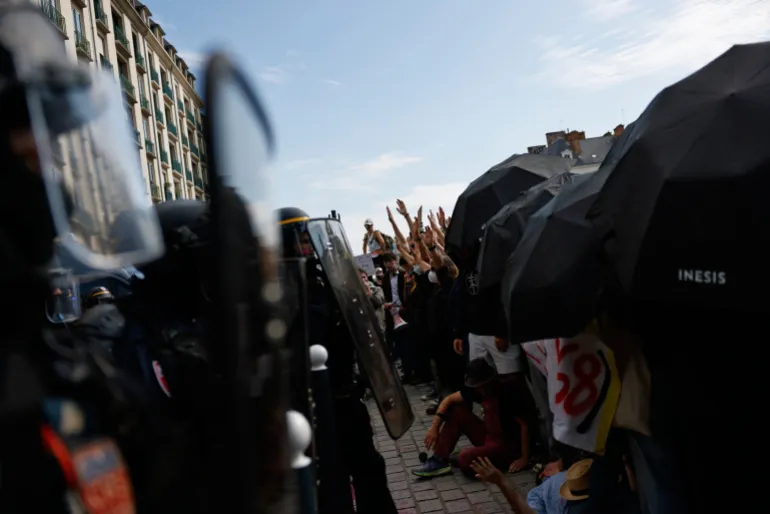
Riot police face students during a protest against under-resourced schools in Rennes, western France, on October 6, 2026 [Jeremias Gonzalez/AP]
What do protesters want?
Students have been protesting over what they say are poor conditions in France’s high schools – or lycees – especially in poorer areas. Protests have been held in Strasbourg, Bordeaux, Nantes, Marseille, Lyon and other towns and cities.
Students say absent teachers are not replaced, dilapidated school buildings are sometimes rodent-infested, there are inadequate tables and chairs, large class sizes and long classroom hours.
The intense heatwave which hit France in the summer exacerbated existing problems in neglected school buildings, which also suffer from a lack of air conditioning, school pupils say.
The protests have coincided with ongoing nationwide public sector strikes over a proposed 2027 cost-cutting budget that aims to achieve 54 billion euros ($61.3bn) in savings as Macron’s government races to bring a large public deficit under control.
Public sector staff and unions object in particular to a government plan to freeze salaries to save about two billion euros ($2.27bn).
Parents are also increasingly present at protests amid widespread anger about the police response to demonstrating minors.
But the protests are happening amid wider discontent over soaring fuel and commodity prices and reduced public spending under Macron.
Government officials have meanwhile accused political opposition groups and unionists of taking advantage of the student movement. Prime Minister Sebastien Lecornu accused political opponents last week of encouraging escalation.
What has happened so far?
At least 6,100 people had been arrested by early Tuesday, many of them under the age of 18, as police tactics come under intense scrutiny.
Serious injuries have also been reported.
A 15-year-old lost a hand in the northern city of Lens on Monday after he reportedly came into contact with a police stun grenade, which then exploded. Public prosecutors say investigations are ongoing into whether the youth actively picked up the grenade or if it landed on him.
Overall, at least 190 high school students have been injured, Education Minister Edouard Geffray said on Monday. On Sunday, he said 78 teaching staff had been injured, and 24 schools had been burned or ransacked.
Some 715 police officers have been injured, according to Interior Minister Laurent Nunez on Tuesday.
Officials said as many as 589 schools have been disrupted this week, down from 735 on Friday last week.
Rights groups, including Amnesty International, have criticised the use of force against minors amid media reports of students being hit with batons and rubber bullets, as well as sprayed with tear gas.
What happened on Tuesday?
Protesters again blockaded schools on Tuesday as thousands demonstrated over their demands.
Placard-waving crowds were reported in southern Marseille, eastern Strasbourg and other major cities.
In Paris’s 20th district, protesters outside the shut Helene Boucher lycee tipped over rubbish bins and bicycles and created a makeshift barricade, The Associated Press news agency reported. Parents, meanwhile, positioned themselves between the demonstrators and police to protect their children.
“They are our children. Teachers, parents, federations, we all share the same goal: the protection of children’s rights, and it is a legitimate right to demonstrate and to make demands,” said Emilia Sichili Suriam, one member of a parents’ association.
Interior Minister Nunez rejected criticism of the police on Tuesday, saying the response has been proportionate in “almost all cases”. He claimed that the protests were transforming into “riots”.
What does this mean for the French government?
These are only the latest in a series of high-profile protests that have marked Macron’s presidency and undermined his government’s reform efforts ahead of elections in April and May.
Macron will not run in next year’s elections, but his image and that of his government have no doubt been tainted by photos of police chasing students in the streets, France expert Jacob Ross, from the German Council on Foreign Relations (DGAP), told Al Jazeera.
“He is not taken seriously any more because many think of him as already out of government,” Ross said of Macron. “But this is still very significant for his government because it has become clear that they don’t have the capacity to calm things down. There’s clearly little fiscal room to manoeuvre.”
Macron’s terms have long been beset by political and financial instability. Successive prime ministers have faced difficulties in pushing through policies in the highly polarised National Assembly where Macron’s centrist Renaissance party and allied blocs lack a majority.
Critics have taken aim at Macron’s deeply unpopular austerity measures, which have seen drastically reduced government spending taking a toll on pensions and healthcare. Officials, however, have defended these policies amid rising debt following COVID-19-era spending.
On Sunday, Lecornu said the government had kickstarted initiatives to address the protesters’ demands and that a report was expected by the end of the month. He, however, added that Paris would not “yield an inch” to violence.
Meanwhile, frontrunner and opposition leader Marine Le Pen of the far-right National Rally party submitted a shadow budget on Tuesday promising 140 billion euros ($157.6bn) in cost savings by 2032 if elected next year.
Along with its cosy caravans and lodges, there are some very exciting additions coming its way.
The park has announced it is undergoing a huge £4million upgrade with work starting this November.
Sign up for the Travel newsletter
Thank you!
One of the largest upgrades will be to its existing indoor swimming pool which will be expanded to become 18-metres long.
It will also add a new toddler splash area, designed specifically for little children – and for adults, there will be a new jacuzzi, steam room and sauna.
The pre-existing gym facilities will also be upgraded.
Its entertainment complex is set to be revamped too with new activities and facilities both indoors and outdoors.
Outside will be a new pirate-themed 9-hole adventure golf course, giant chess and lots of things to do like table tennis, curling – and it will install a padel court.
Inside will be a new soft play area with an upgraded games arcade including interactive darts.
The Hunter’s Bar and Restaurant is being refurbished, and will have a brand-new sports bar, as well as a transformed showbar where there will be entertainment for guests.
A new outdoor terrace will be a new spot that guests can enjoy throughout the year with open-air seating through the summer and covered for when the weather doesn’t play ball.
For those wanting sweet treats, there will also be a brand-new ice cream parlour.
When it comes to accommodation, holiday homes and pitches will be added to the site too.
Currently, guests can stay in basic caravans, to luxury lodges including The Hideout and The Hideaway which have outdoor decks and lots of inside space.
Work is due to start in November of this year with a Grand Opening event planned for Easter 2027.
For those who want to book a break that coincides with the new additions, three-night breaks on April 23 start from £219 – or £18.25pppn.
With this break, a family of four can stay in an Essential Clover Caravan which has two bedrooms (one double, one twin), kitchen and living area.
Simon Lane, CEO of Verdant Parks, said: “This is an incredibly exciting time for Verdant Parks, our employees, our owners and our holidaymakers.
“We’re committing our biggest investment to date to Thurston Manor Holiday Park and completely transforming what guests can see, do and experience when they visit.
“From the extended swimming pool and new toddler splash area to the new padel court, pirate-themed adventure golf and transformed entertainment offering, there will be something for everyone to enjoy.
“We’re delighted to reveal our plans for the next chapter of Thurston Manor and we can’t wait to share more details and sneak peeks as the transformation takes shape over the next six months.”
U.S. Customs and Border Protection (CBP) has retired the last of its P-3 Airborne Early Warning (AEW) aircraft. The AEW version is instantly recognizable from the saucer-like radar dome on top, as seen on other AEW types like the E-2 Hawkeye and the E-3 Sentry. CBP was the only operator of this variant of the P-3 Orion and is said to have been the only law enforcement agency to fly any kind of dedicated AEW plane. The retirement of these aircraft comes at a time when American AEW assets, in general, are under heavy strain by demands globally.
CBP officially retired its final P-3 AEW on September 30, 2026, after a final flight from National Air Security Operations Center Jacksonville (NASOC Jacksonville), in Jacksonville, Florida. CBP has also flown Long Range Tracker (LRT) variants of the P-3, configured for more traditional maritime surveillance missions. The current plans for the LRT aircraft, and whether their sunset may also be on the horizon, are not immediately clear, and TWZ has reached out for more information. Orions of all types have been steadily disappearing from service with the U.S. military and elsewhere across the U.S. government as the aging aircraft become more difficult to operate and maintain.
End of the Road: AMO’s Iconic P-3 Dome Takes Its Final Flight!
On September 30, 2026, the distinct silhouette of a four-engine turboprop carrying its massive rotating radar dome touched down for the final time at the National Air Security Operations Center in Jacksonville.
“Our Jacksonville-based P-3 AEW fleet has served as a cornerstone of America’s outer-layer border security,” according to a brief announcement from CBP about the retirement on social media. “Its crews flew far beyond our borders, providing wide-area surveillance across the Caribbean, Gulf of America [Gulf of Mexico], and the transit zones of Central and South America, helping detect and track threats before they could reach the United States.”
By all indications, including official CBP sources, the P-3 AEW fleet consisted of eight aircraft at its peak. There is a confusingly worded 2014 CBP press release that mentions an “11th and final Lockheed Martin P-3 Airborne Early Warning (AEW) aircraft overhaul,” but that figure looks to also include three of the six LRT versions. The same release says that CBP only had 14 P-3s of all types at that time.
What was then known as the U.S. Customs Service (USCS) first began operating the P-3 AEW version in the late 1980s. The aircraft were converted from second-hand maritime patrol variants of the Orion. The first example had started life as a P-3B for the Royal Australian Air Force (RAAF). Ex-U.S. Navy P-3s were also converted.
A picture of a P-3 AEW in USCS service circa the late 1980s. CBP
The initial three P-3 AEWs were equipped with the AN/APS-138 radar. The same radar was used on early E-2C Hawkeye airborne early warning and control aircraft operated by the U.S. Navy, as well as several other armed forces internationally.
“The Customs Service had previously borrowed U.S. Navy E-2Cs to meet its antinarcotics surveillance requirements, but required an aircraft with longer range and on-station time,” according to a 2006 report from Forecast International. “In June 1989, the U.S. General Accounting Office issued a report on the drug interdiction P-3B AEW aircraft. The findings indicated that the radar performance was as specified, but the P-3B (when compared to the E-2C) was less costly to operate per square mile of area covered because of the higher cruising speed and longer endurance. The P-3B had at least twice the in-flight endurance of the E-2C.”
Starting in the 1990s, USCS began the process of acquiring additional P-3 AEWs with newer AN/APS-145 radars, as also used on later model E-2Cs. The original AEW Orions were eventually refitted with APS-145s, as well. It’s worth noting here that the U.S. Coast Guard separately moved to acquire an AEW version of the C-130H, designated the EC-130V, in the 1990s, which used the AN/APS-125 radar, also used on older E-2s. Budget cuts led to the end of that program. The EC-130V that had been built was redesignated as an NC-130H and subsequently used for test purposes.
A US Navy E-2C Hawkeye. USNThe NC-130H test aircraft with its radar dome still on top. US Military
The P-3 AEWs were also equipped with a sensor turret containing electro-optical and infrared (EO/IR) video cameras, allowing the aircraft to more closely investigate targets spotted on radar. CBP regularly conducted P-3 operations that paired AEWs with LRT variants to provide an even broader array of sensor capabilities on missions. The LRTs have EO/IR sensor turrets, as well as AN/APG-66 and SeaVue radars. The pulse-doppler AN/APG-66 is primarily designed for spotting and tracking aerial targets, and was originally used on early variants of the F-16 fighter. SeaVue is a multi-function type with surface search and synthetic aperture radar (SAR) imagery modes. Images produced via SAR are highly detailed maps of the surface below, and can be captured day or night, and regardless of any cloud cover, smoke, or dust.
Beyond radars and other sensors, the P-3 AEWs also had a robust communications suite consisting of VHF and UHF radios, as well as satellite communications links by the end of their career. CBP’s entire P-3 fleet, including the AEWs and LRTs, has received various updates over the years, including new ‘glass cockpits’ starting in the early 2000s.
CBP Air and Marine Operations: Extended Border Operations
Though primarily employed in support of counter-narcotics interdiction operations, the airborne radar and command and control capabilities were also applied to other missions, including disaster relief and humanitarian assistance efforts at home and abroad. As an example, CBP’s P-3 AEWs helped with air traffic coordination, as well as provided other support, during relief efforts in Texas in the wake of Hurricane Harvey in 2017.
At the same time, CBP’s entire P-3 fleet, including both the AEW and LRT versions, has only been getting increasingly older and difficult to sustain. The P-3B variant first entered U.S. Navy service in the 1960s. CBP did put its P-3s through a Service Life Extension Program overhaul in the 2010s, which included “new wings and tail for each aircraft and completely strips down the aircraft to its bare metal for an inspection,” according to a 2014 press release.
A P-3 AEW seen during a test flight as part of the SLEP overhaul. The aircraft notably lacks its radar dome. CBP
A key question now is how CBP will fill any gaps left by the retirement of the final AEW version. The agency does continue to operate a mix of other crewed fixed-wing aircraft with mixtures of radars and other sensors, as well as MQ-9 drones, but none of these platforms are equipped with a sensor like the AN/APS-145. CBP also has a network of tethered aerostats with radars at fixed sites around the Caribbean. As an aside, General Atomics, together with Saab, is now working on an AEW configuration for the MQ-9B drone, but there are no known U.S. orders for that capability at the time of writing. That platform will not offer the same level of flexibility and look-down capability as modern crewed AEW aircraft, either. Look-down AEW capability is only growing in importance today amid expanding and evolving drone threats, including to the U.S. homeland.
Another look at one of CBP’s now-retired P-3 AEWs. CBP
The Air Force, in particular, is also aiming to eventually push most, if not all, air moving-target indicator (AMTI) tasks currently performed by aircraft like the E-3 and E-7 into space. The service is heavily investing to accelerate the fielding of those capabilities, which could eventually offer revolutionary constant, persistent coverage globally. The first of those satellites are still not expected to reach an early operational state until 2028. It is possible that CBP could get access to a tailored data feed from this system when it does become operational. It still does not obviate the need to have crewed or uncrewed aircraft capable of more closely investigating tracks of interest using EO/IR cameras and other sensors.
Whatever the future might now hold, CBP’s unique time as the operator of the P-3 AEW aircraft has come to an end.
A new series of the Channel 4 competition recently took place in Northern Ireland, concluding with a payment day episode airing on Friday, October 2.
It saw Belfast city-centre luxury apartments owner Melissa criticise Enniskillen hotel owners Shaun and Aoife over their taste in decor. Having walked into her home for the night, she had commented: “It’s nice and bright,” before inspecting the panelling and wallpaper above the bed.
She said: “We’ve got panelling here, an LED light and this pattern here, there’s far too much going on, it’s a bit tacky.” She also rated them a low score of six for facilities, for a lack of fridge and coffee machine in her room.
“That’s disappointing,” the hosts had remarked at the time, before bringing up the issue around the payment day table. “I really hope there is some justification for these comments,” Shaun added.
During Friday’s episode, Aiofe asked Melissa about her “harsh” criticism of the decor, with Melissa replying: “It might have been your personal taste, but you need to keep it as neutral as possible.”
Shaun hit back: “I think the language, dated and tacky… there’s so many words available to us.” Melissa argued: “What I say is what I think.” Another contestant jumped in to say that Melissa didn’t need to use the word tacky, though she stood by her comment, saying she didn’t know what else to use to “describe three different patterns”.
“Busy,” Shaun quickly replied. Melissa said: “Tacky to me, I don’t think it’s that bad of a word.” “It’s too subjective,” Shaun added, saying: “It really undermined the value of the rest of the feedback.”
He went on: “An overall six is a hard score,” saying it was a “strategic” move of Melissa to underpay her competitors. He added to the cameras: “Feeding back in that way, it was low in quality, high in ego and that isn’t a set of characteristics that command respect.”
Melissa meanwhile said: “I never knew tacky was such an upsetting word.” Viewers jumped in to Shaun and Aiofe’s defence, with one writing: “Calling someone’s decor tacky is rude and untrue.”
Another called Melissa “awful” after her comments, while someone else said: “Oh shut up Mel! The decor might not be to your taste but it is not tacky, and a standard white bathroom is not dated. She really rates her own abilities.”
Another said that Mel “showed her true colours”, while someone else said Mel was “desperate to mark every B&B down just so she wins the competition”.
Lattice Semiconductor (LSCC) was in focus on Tuesday as William Blair initiated coverage on the semiconductor firm with an Overweight rating and a fair value of $160 per share.
“Lattice is benefiting from a product re- fresh cycle, replacing legacy small footprint
August Hanning’s former chief of staff was also arrested on suspicion of ‘aiding and abetting attempted treason’.
Published On 6 Oct 20266 Oct 2026
Germany’s former foreign spy chief has been arrested on suspicion of espionage and treason, prosecutors have said.
August Hanning, 80, is under investigation for attempted treason and acting as an agent for a foreign intelligence service, the Office of the Federal Public Prosecutor General confirmed on Tuesday.
Hanning was president of Germany’s Federal Intelligence Service between 1998 and 2005.
He was arrested in Bad Toelz-Wolfratshausen in southern Germany. His former chief of staff, partially identified as Manfred D, was arrested in Steinfurt in western Germany on suspicion of “aiding and abetting attempted treason and treasonous espionage”.
The prosecutor’s office said, “On one occasion, Hanning used classified intelligence provided by Manfred D to draft an analysis for an officer of a foreign intelligence service.”
Prosecutors said Manfred D also served as the chief of staff for Hanning’s successors between 2012 and 2026, and used his role to gain access to confidential information which he then passed on to Hanning “in exchange for remuneration”. Hanning then used the information in his private consulting work, prosecutors added.
“The current findings suggest that, over the years, Manfred D provided Hanning with approximately 2,000 documents, many of which contained classified information to be used exclusively by the federal intelligence service for internal purposes, particularly for executive intelligence briefings,” the statement said.
The statement did not reveal who the two men were suspected of spying for or which country the foreign agent worked for, adding that “it has yet to be determined if the material reached the intended recipient”.
German MP Marc Henrichmann told the AFP news agency that Germany “will not tolerate the betrayal of secrets”.
Henrichmann, who chairs the German parliament’s intelligence oversight committee, said, “Whoever allies themselves with the enemies of our liberal democracy will be found out.”
The premises of Manfred D and Hanning were being searched in several locations, including in the capital, Berlin.
Spain is moving ahead with plans to rebuild its airborne signals intelligence (SIGINT) capability, with the Airbus A321 — part of the highly successful A320 twin-engine airliner family — selected as the basis for three new SIGINT aircraft.
The choice is disclosed in the latest issue of Spain’s Revista de Aeronáutica y Astronáutica, the Ministry of Defense’s official publication. Airbus and Indra are currently working on the program’s conceptual design under the Santiago II initiative, which aims to deliver a crewed platform capable of collecting and processing intelligence across the electromagnetic spectrum.
The program is intended to restore a capability Spain lost when its last Boeing 707 SIGINT aircraft was retired in 2014. Equipped with Israeli SIGINT equipment, this 707 was designated TM.17-4 in Spanish service, and nicknamed Reina del Espectro (Queen of the Spectrum).
It served in the 47th Mixed Air Force Group, alongside four Dassault Falcon 20s (designated TM.11 in Spain), that were used for navigation aid calibration, remote sensing, and electronic warfare training.
A Spanish Air Force Falcon 20 EW. Roberto Yáñez/Spanish Air and Space Force COPYRIGHT ROBERTO YANEZ
The new aircraft will have to undergo extensive modification, including the installation of antennas, receivers, signal-processing equipment, operator consoles, communications systems and associated electrical and cooling infrastructure.
Indra is expected to provide much of the mission-system architecture. The company’s AirSign concept, unveiled in 2023, incorporated COMINT and ELINT sensors alongside data fusion, real-time signal analysis, communications, and command-and-control functions.
An earlier Airbus concept for a multi-mission A320neo family, including an AEW&C version with conformal radar arrays, a SIGINT platform, and a VIP jet. Airbus
While COMINT is concerned primarily with collecting intelligence from communications, ELINT focuses on non-communications electromagnetic emissions, including radar signals. Together, these capabilities provide a much fuller intelligence picture of not only what the enemy is doing in terms of their electronic emissions, but what they are planning, and their processes of operation.
Bizjets have become the platform of choice for many new intelligence aircraft, particularly where operators want a relatively low-cost, long-endurance platform with a smaller logistical footprint. Aircraft such as the Bombardier Global 6000/6500, Gulfstream G550, and Dassault Falcon 8X have been adapted for electronic intelligence and special-mission roles.
An Israeli Air Force Nachshon Oron multi-missionintelligence-gathering aircraft, based on a Gulfstream G550 airframe. Israeli Air Force
Spain’s decision to use the substantially larger A321 points instead toward the other end of the spectrum, providing significantly more room for antennas, processing hardware and crew, and allowing the aircraft to carry a much larger and more power-hungry mission system than the typical bizjet-based SIGINT platform.
At one time, the A321 was envisaged as the platform for NATO’s Alliance Ground Surveillance (AGS) system, which provides the alliance with reconnaissance capabilities, including synthetic aperture radar. However, this capability was eventually fielded on NATO’s fleet of five RQ-4D Phoenix uncrewed aerial vehicles, specialized versions of the Global Hawk.
Early concept artwork showing an A321 equipped with NATO’s Alliance Ground Surveillance (AGS) system. NATO
Elsewhere in Europe, Airbus launched a risk-assessment study for France’s future maritime patrol aircraft (MPA), also to be based on an A321 platform. Billed as a “flying frigate” by the company, the new MPA is intended to replace the French Navy’s Dassault Atlantique 2 fleet and emerges at a time when NATO nations are increasingly adopting the in-production Boeing P-8 Poseidon for their maritime patrol requirements.
A rendering of the A321 MPA, France’s future maritime patrol aircraft. Airbus
Airbus does, however, have relevant experience in the conversion of airliners for military roles. The company’s A330 Multi-Role Tanker Transport (MRTT) aircraft are modified at Airbus’s Getafe facility, providing an existing industrial base for converting commercial-derived aircraft into specialized military platforms.
The A330 Multi-Role Tanker Transport (MRTT) conversion line at Airbus’s Getafe facility in Spain. Airbus
The Santiago II program is currently in its definition phase. Spain awarded Airbus and Indra a €16-million ($17.9-million), 18-month contract to study the platform and define the overall system. A subsequent phase will cover modification and integration of the three aircraft. The Spanish Ministry of Defense estimates the complete program at approximately €436 million ($489 million).
The program also has an industrial objective. Spanish authorities want domestic industry to acquire expertise and control over the integration of the SIGINT system, rather than simply purchasing a finished foreign intelligence aircraft.
The A321-based Santiago II fleet is intended to address the shortfall left by the retirement of the specially modified Boeing 707, providing a substantially more modern platform, and with more airframes for improved availability.
The three new aircraft will also complement Spain’s emerging uncrewed SIGINT capability. The Spanish Air and Space Force is introducing the L3Harris Scalable Open Architecture Reconnaissance (SOAR) system on its Predator B drones, giving the fleet ELINT and COMINT collection capabilities. The two systems are likely to fill different niches: the Predator B offers a relatively persistent, lower-cost uncrewed collection option, while the much larger A321 will provide substantially greater payload capacity, onboard processing, and crewed mission-management capabilities. Together, they will give Spain a layered airborne SIGINT architecture.
A Spanish Air and Space Force Predator B. Luis Alfonso Hernández Carrón/Spanish Air and Space Force A.Trigo
Spain’s decision also reflects a broader drive to invest in long-range SIGINT platforms capable of collecting, processing, and fusing vast amounts of electromagnetic data, as competition over the electromagnetic spectrum becomes increasingly central to modern warfare.
If the program remains on schedule, three heavily modified A321s will eventually provide Spain with a persistent airborne capability to detect, classify, locate, and analyze electromagnetic emitters in support of a host of operations. Especially when paired with the Predator B, the capability will likely be of considerable interest to other NATO partners in Europe, too.