On Sept. 11, 2001, there were no smartphones and no social media. What the country watched that morning — a jet airliner colliding with the south tower of the World Trade Center, the ash rolling through the streets, the paper still falling in the afternoon — was through a television set and the journalists who had to deliver the unfathomable details.
The jarring images shattered the peacefulness of a sunshine-filled late summer morning in New York.
“Everything seemed so perfect,” said MS NOW’s Chris Jansing, reflecting on the moments before anchoring her network’s continuous coverage. “It was another day of doing a job I loved, living in a city I loved.”
By nightfall, nearly 3,000 people were dead in lower Manhattan, at the Pentagon and in a field outside Shanksville, Pa. The experience of covering the terrorist attacks and their grim aftermath transformed Jansing and other journalists who were there. Twenty-five years later, it’s never far from their minds.
“It’s with me in ways large and small,” said NJ Burkett, a correspondent who covered the tragedy for New York station WABC. “When I look at my phone and it says 9:11, it takes me back.”
The Times asked five of the on-air personalities who are still working today to look back on the day they were called to cover the tragedy and its lasting impact.
Bret Baier: “I just said yes to everything.”
Fox News anchor Bret Baier at the National 9/11 Pentagon Memorial in Arlington, Va., on Aug. 25, 2026.
(Jared Soares/For The Times)
On every anniversary of Sept. 11, Fox News anchor Bret Baier uses the hashtag #NeverForget. He can recall every moment of that day.
Baier, 56, was driving to the Fox News bureau in Atlanta when he first heard on his car radio that a plane had hit the World Trade Center. He was a 31-year-old correspondent for the network, covering stories throughout the southeast U.S. and Latin America. When he arrived at the office, a call came from New York headquarters telling him to book a flight to the city so he could file reports from the World Trade Center site for Fox TV affiliates around the United States.
After a second plane hit the south tower of the World Trade Center 17 minutes later, all flights in the U.S. were halted. Baier and his producer were told to get a car and start driving.
“I just remember going really fast when I was driving,” Baier said. “I remember thinking what is happening with the world, and how big this story is. How big this moment is.”
By the time the duo reached northern Georgia, their plans changed again. A jetliner struck the Pentagon while a San Francisco-bound United Airlines flight crashed in Shanksville, Pa. Fox News executives told Baier and his producer to reroute to Arlington, Va.
After the 10-hour drive, Baier started the first of 10 straight days of reporting on the recovery efforts at the site. While the World Trade Center provided the most dramatic and enduring pictures of the stunning attack, the loss of life at the Pentagon was staggering as well, as 125 people died along with the 64 passengers and crew members on American Airlines Flight 77.
Baier was eventually pulled into the larger military story that followed 9/11. Fox News, just 5 years old, did not have a full-time Pentagon correspondent. Baier was offered the job while traveling overseas with Defense Secretary Donald Rumsfeld, who was making the case for war against Afghanistan.
“I called a buddy on a satellite phone to get me an apartment in Washington,” he said. “Fox packed up my stuff in Atlanta.”
But the unplanned move changed Baier’s life. In six years on the Pentagon beat, he traveled to 74 countries. He was embedded with the military in war zones. “I just said yes to everything,” said Baier, who has anchored Fox News’ Washington newscast “Special Report” since 2009.
Baier recalled it was in the weeks after Sept. 11 that he first wore an American flag pin on his lapel. He never felt conflicted about it, even though such displays were prohibited at other network news divisions. “I thought I could report on America, ask tough questions and still be an American, pulling for us to win,” he said. “I wanted to be tough but fair, but also show that as a country we were standing together against this horrible attack.”
Byron Pitts covering the terrorist attacks in lower Manhattan for CBS News on Sept. 11, 2001.
(CBS)
Byron Pitts: “It’s the only story I think about every day.”
A newcomer to New York 25 years ago, Byron Pitts, then a CBS News correspondent, admitted it took him a few moments to understand the massive scope of what happened the morning of Sept. 11, 2001. He arrived early at the network’s headquarters on the West Side of Manhattan to screen an interview he did with entertainer and civil rights icon Harry Belafonte. Shortly after he started, a producer knocked on his door and told him there was a plane crash at the World Trade Center.
Pitts, 65, acknowledged the producer but kept working. “I thought it was a novice pilot bumping into a building,” he recalled. “I thought it would be three hours out of my day and it won’t make television.”
The producer came back shortly and said, “You need to go down there.”
An irritated Pitts hailed a cab and headed down the West Side Highway. While in the car, he learned a second plane had hit the south tower. Traffic was stopped and he had to head downtown by foot.
As Pitts got closer to the site, he tried to use his past experiences covering fires and other disasters during his career to judge the severity of the situation.
But the horrible scenes that unfolded before him were incomparable. One was a lifeless body near the lobby of the north tower. He thought it was a homeless man until he saw a uniform. He later learned it was Father Mychal Judge, the chaplain of the New York Fire Department killed by fallen debris. Judge’s body was later carried away by a group of first responders. Pitts saw a woman and a man standing at a window of one of the towers holding hands, and then jumping.
“Gravity takes over and their hands split, and he moves a little faster than she does,” Pitts said. “And we see them on the ground. That was the moment I realized something significant was going on.”
Pitts crossed paths with Mika Brzezinski, then a CBS News correspondent, now the cohost of MS NOW’s “Morning Joe.” As debris came down and smoke filled the air, they headed into an elementary school that Pitts believes was a command post for the fire and police departments. They took turns calling into CBS News on a hard-line phone, one delivering accounts of the unfolding catastrophe while the other looked outside to gather details amid the blinding smoke and dust.
Pitts said from that day forward, he never went to a story assignment without a handkerchief.
Pitts was awed not just by the enormity of the event, but also by how despite the rigid hierarchy of CBS News, he was “the new kid on the block” who had to present the story on Dan Rather’s evening newscast that night.
“My approach became almost childlike, so I would not become overwhelmed,” he said. “I tried to make it as simple as possible. I said, ‘Dan, I’ve never heard New York City this quiet.’ I was thinking — what simple thing can I say that you would understand if you’ve never been in New York.”
A few weeks later, Pitts headed off to Afghanistan to cover the U.S. military action. His evening news report on Sept. 11 won an Emmy Award and his star rose at CBS News, leading to “60 Minutes” and then ABC News in 2014, where he is currently a co-anchor of “Nightline.”
Pitts knows the good fortune he’s had in TV journalism is linked to the tragedy that started with a producer’s knock on his door 25 years ago. “I feel some measure of guilt but mostly gratitude,” he said. “It’s the only story I think about every day.”
Pitts said he uses his 9/11 experience to provide perspective. “When we’re discussing politics, a mass shooting, or the latest awful day in Iran, I know for a fact there is one guy in the room who has seen worse and who can say, ‘we’ll be OK,’ ” he said.
Chris Jansing: “You had to balance the news response with the human response.”
Chris Jansing paid her dues as a local reporter in upstate New York before she joined MSNBC (now called MS NOW) as a daytime anchor in 1998. She loved living in Manhattan, and took friends from out of town to the World Trade Center observation decks and Windows on the World, the restaurant on the 106th floor of the north tower.
“It was so iconically New York,” she said. “And I was proud to live in the city.”
Jansing, 69, had little time to process her emotions when she was told to “get in the chair” before 9 a.m. that morning at MSNBC’s Secaucus, N.J., studios after the first plane hit.
“You had to balance the news response with the human response,” she recalled.
For several hours, Jansing co-anchored the network’s coverage alongside Gregg Jarrett. The look of 24-hour cable news evolved that day, as the tsunami of information led to Fox News, MSNBC and CNN all adding running tickers at the bottom of the screen.
Jansing went to the roof of the network’s building after Brian Williams took over the anchor chair. Trauma centers in the area had been alerted, and she was told to watch for ambulances. “There was still a hope and a prayer that there would be injured folks who would overwhelm the hospitals in New York and would need to be brought to New Jersey,” Jansing recalled. She saw none.
Jansing has never watched the coverage of that day, which is now on YouTube. She had real-life reminders every day in her Manhattan neighborhood when she walked by the Rescue Company 1 firehouse that lost half its battalion at the crash site. She adopted a dog left behind by a 9/11 victim, a Dachshund named Baron. She remains friends with every producer she worked with on the story. The experience also reinforced her purpose in a career approaching its 50th year.
“I will always think that those moments are what keep you going,” said Jansing, currently chief political reporter for MS NOW. “They were an affirmation that’s kept me in the job,”
NJ Burkett, a correspondent for WABC, on the 13th floor of the Walt Disney Co. offices in Manhattan on Aug. 31, 2026.
(Roshni Khatri/For The Times)
NJ Burkett: “I put myself in increasingly dangerous situations.”
Burkett, 64, recalls how pedestrians were gathered around WABC’s windowed street level studio on the Upper West Side of Manhattan when he arrived for work on 9/11. He presumed the crowd was there for a big name guest on “Live with Regis and Kelly.” They were actually watching monitors showing news reports of the first plane that hit the north tower.
As Burkett and his cameraman Marty Glembotzky headed downtown in a truck, he already knew it was a terror attack. He recalled covering the 1993 terrorist bombing of the World Trade Center and regretted not getting footage of the firefighters’ rescue efforts. This time around he wanted to go inside the buildings and document their heroism.
A police officer stopped Burkett and Glembotzky before they could get in, likely saving their lives. A short time later, they would escape death again.
Burkett was doing a second take for a taped report that would set the scene for viewers when he heard the rumbling that “sounded like Niagara Falls.” It was the south tower of the World Trade Center coming down behind him. “A huge explosion now raining debris on us — we better get out of the way,” he said in what may be the most terrifying video clip from that morning.
Burkett and Glembotzky took cover in an adjacent building. “We open up the door and in a weird way it’s sort of providential, right?” he said. “The door is a metaphor. It’s like the door into the rest of your life. If we had to run for half a block, we’d be dead.”
Glembotzky was so shaken by the experience, he stepped away from his career as a cameraman and became a wine seller before eventually returning. But Burkett took on more dangerous assignments in the Middle East, heading to Israel to cover the Palestinian uprising known as the Second Intifada. He later headed to Iraq to cover the run-up to the U.S. invasion in 2003.
Burkett won a George Foster Peabody Award for his work on 9/11. In retrospect, he believes he took on assignments in war zones to avoid dealing with the trauma of the day.
“I would put myself into increasingly dangerous situations,” he said. “Looking back, I was running from 9/11. That was my way of coping. Sometimes I wonder did I allow myself feel it enough. Or did I just run too far and too hard and it will all come down and crash on me one day?”
Occasionally he worries about 9/11-related illnesses. “If I start to cough — the slightest little cough — I’ll think ‘is this it?’” he said.
But as a New York TV fixture since 1989, Burkett still feels the appreciation from viewers for his efforts. “To this day, almost 25 years later, people will come up to me on the street and ask to hug me and say ‘NJ Burkett I’m glad you’re alive,’ ” he said.
Carson Daly at NBC’s “Today” show studio at Rockefeller Plaza in Manhattan on Sept. 3, 2026.
(Roshni Khatri/For The Times)
Carson Daly: “I remember how motionless the room was.”
As continuous news coverage of the Sept. 11 attacks saturated television for days, the makers of entertainment shows had to decide when it would be appropriate to go back to work. Carson Daly and the MTV executives mulled over the situation as their wildly popular program “Total Request Live” remained off the air for three days since the attacks.
“We had such a massive audience that the question was raised, ‘do we have a responsibility to simply show up?’ ” Daly, 53, recalled in a recent interview.
Daly, now a feature anchor on NBC’s “Today,” was not a journalist by trade. But he understood the trust that young viewers had in him and “TRL,” a live show that counted down the most popular music videos of the moment. The show had dealt with tragedy a few years before after the high school shooting in Columbine, Colo.
But 9/11 happened on the home turf of “TRL,” which aired from New York City’s Times Square. With the bridges and tunnels closed, getting a crew to the studio was a challenge.
“Everybody wore multiple hats,” said Daly, who also served as an executive producer.
By Sept. 14 of that week, the MTV studio on Broadway was filled with young “TRL” fans, but lacked the energy viewers were used to seeing on the screen. “They were frozen,” Daly recalled. “That was in such stark contrast to what the show was every day. I remember how motionless the room was and feeling like, ‘What am I doing on television?’ ”
Carson Daly shows a tattoo he got after the 9/11 attacks in New York.
(Roshni Khatri/For The Times)
Daly leaned on the MTV News team to update the audience on the 9/11 story developments. Music stars including Jay-Z, Justin Timberlake and Kid Rock called into the program to share their thoughts with Daly. Instead of music videos, the screen showed email messages from viewers expressing their feelings about the tragedy.
MTV News personality Sway delivered a music news report that noted how two new CD releases — “Party Music” by the American hip-hop group The Coup and Dream Theater’s “Live Scenes from New York” — were delayed because both used cover artwork that depicted the destruction of the World Trade Center.
Daly has a permanent remembrance of the week. When he arrived at the MTV offices the day before “TRL” returned, the building was evacuated after it received a bomb threat.
“I remember walking around Hell’s Kitchen,” he said. “I ended up getting a tattoo. A red, white and blue NYC on my right wrist.”
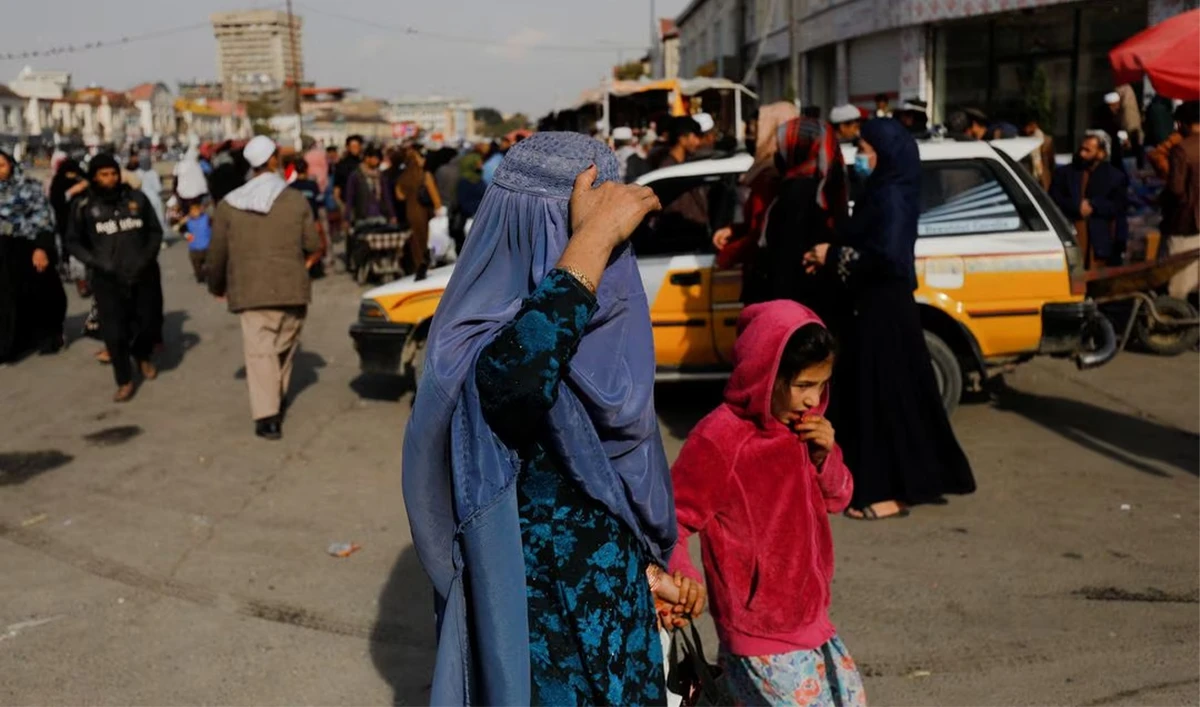
KABUL: The head of the Norwegian Refugee Council aid group, Jan Egeland, criticised on Thursday what he called the “hypocrisy” of countries demanding rights for Afghan women while cutting humanitarian assistance.
In an interview with AFP in Kabul, Egeland said that “I think it’s right of them to demand, like we do, education for Afghan girls, work rights for Afghan women… but it is hypocrisy when one does that from abroad in a seminar in some capital in Europe and cut aid for food to Afghan girls and even for primary education for Afghan girls.”
The number of migrants arriving on British shores in small boats so far this year has fallen by more than 40 percent compared to the same period last year, with the people smugglers being forced into a change of tactics due to the French and British police’s closures of many gaps. However, the last week has seen alarming incidents of “intimidating and thuggish behavior” — as described by a government spokesperson — by far-right activists.
On Sunday, roads in Portsmouth were blocked after a boat carrying 140 migrants was brought ashore there. This came the day after similar scenes of direct action had blocked roads and disrupted travel in and out of the Port of Dover. In both incidents, organized men in black, with some wearing balaclavas, blocked traffic and even smashed the windscreens of police cars.
Though largely peaceful, the protests reflect a change in tactics, raising questions about policing, intelligence gathering and the lack of robust measures taken against them. The threat posed by these groups should not be belittled. There is the potential not just for a climate of fear among immigrants but also a threat to law and order and the standing and reputation of the UK as a tolerant country.
The police, the government and officials from all parties condemned the protests. Many rightly questioned the scale of Kent police’s failure after it emerged a tipoff was received the day before the far-right agitators blocked Dover’s roads. Details were apparently passed to police after residents of a nearby village heard individuals boasting in a pub about going to Dover to “attack Muslims.” That information fell on deaf ears and Kent police even later described the protest as “spontaneous.”
Far-right groups are of the opinion that no action taken or policy adopted by the government is good enough
Mohamed Chebaro
Nick Lowles, the chief executive of Hope Not Hate, an organization that charts far-right activity, told the BBC: “To have 300, 400 people with balaclavas marching down the streets, stopping traffic. You know, it’s not just good enough. We need to call these people out for their politics and for the type of Britain that they want to see.” He added: “We’ve got different ways to register our protest. We do not go on the street. We do not burn people out of their houses. We do not cause trouble and threaten to fight the police.”
We should be careful about the repercussions of these images and videos being widely shared and the normalization of those scenes and the messages they convey. They are not viewed only by people in the UK but are also disseminated around the world.
Hope Not Hate was quicker than the police to inform the public that the Dover disturbances were organized by a far-right group called Patriot Platform. This new network was launched in June, uniting smaller, localized antimigrant groups. It claims to represent a Christian “army of patriots,” rallying around a vision of reclaiming the country’s borders and a message that Britain belongs to the British. It seems its adherents are ready to adopt vigilante methods to combat immigration in an effort to revive the country’s Christian values, as the group claims.
After winning power in July 2024, the Labour governments of first Keir Starmer and now Prime Minister Andy Burnham have fought to curb the arrival of small boats across the Channel, using a variety of laws and tactics to deter people from making the dangerous journey. But the past two years have also shown that far-right groups are of the opinion that no action taken or policy adopted by the government is good enough, as if antimigrant agitation could be a conduit to replacing Labour with Reform UK, the party led by colorful euroskeptic politician Nigel Farage.
Surely those that marched in Dover and Portsmouth are not like the Blackshirts just yet. But the resemblance is there
Mohamed Chebaro
After two nights of vigilante, militant-style action against migrants, people have begun to question whether the UK is witnessing the rise of fascism. What we saw at the weekend was a reminder of Italy’s Blackshirts, the violent private army and paramilitary wing of Benito Mussolini’s National Fascist Party, which was founded in 1919. Not long after them came the Hitler Youth of the 1930s, which transitioned from a fringe, violent paramilitary wing into a powerful, mandatory state apparatus.
Surely those that marched in Dover and Portsmouth are not like the Blackshirts of Oswald Mosley’s British Union of Fascists just yet. But the resemblance is there to be seen. This time, the “enemy” is not the Jews of the 1930s but migrants, who are seemingly considered to all be of the Muslim faith.
How the government can act against this clear and present danger is not obvious, as it could end up with more ugly scenes. Already, citizens have taken it upon themselves to “defend the realm” through encircling hotels and government facilities housing migrants or wearing black uniforms and balaclavas and blocking roads and ports. Surely the obvious thing to ask is who is behind them? Who is financing and organizing these acts, which we are told are only the beginning?
It is going to be very difficult for the British government to undo the damage caused by the men in black at Dover and Portsmouth. Launching an investigation to find any lapses of intelligence or policing should be the first step.
Governments across Europe seem to be increasingly at the mercy of far-right forces that are riding high in a changing world. This emerging threat rests on three aspects: the far-right nativist ideology; a warped digital realm that magnifies and spreads toxic, hate-filled content; and an unexplained financial lifeline.
The task ahead is daunting. The so-called patriotic drive of the far right is not aimed at migrants alone — its real enemies are democracy, liberties and the rule of law. Its methods are not peaceful protests but organized activism bordering on vigilantism and militancy.
Mohamed Chebaro is a British-Lebanese journalist with more than 25 years of experience covering war, terrorism, defense, current affairs, and diplomacy.
Mohamed Chebaro is a British-Lebanese journalist with more than 25 years’ experience covering war, terrorism, defense, current affairs and diplomacy. He is also a media consultant and trainer.
TO ESCAPE the chaos of summer and enjoy the delights of quieter hotels, lots of us like to book holidays between September and November.
Those three months have lots of names like the ‘magic period’ or ‘shoulder season‘ and taking a break then can save you some serious cash.
Two coastlines in Spain came up trumps for cheap autumn holidaysCredit: AlamyThe beautiful Albanian coastline also came in as being very affordable for BritsCredit: Alamy
Whether you want a quick trip to Spain or a holiday to African resorts for winter sun, there are some great deals out there, and lastminute.com have helped us find some of the best.
They told us: “Once the peak summer period has passed, travellers can often find significantly better value on flights and holidays, while still enjoying warm weather and everything a destination has to offer, proving that it is better to leave it until the last minute.”
Sign up for the Travel newsletter
Thank you!
The cheapest spot is Costa Dorada in Spain where on average holidays cost £79pppn.
The Costa Dorada is a region along the Mediterranean coastline and includes popular spots like Tarragona and Salou.
What’s even better is that you can definitely still spend time on the beaches too as in October there are average daytime temperatures of around 22C.
It’s also home to the enormous PortAventura World which is one of Europe’s biggest theme parks – and is home to Europe’s tallest and fastest accelerator coaster Red Force in Ferrari Land.
It’s a beach front spot with rooms that have views of the coast along with a restaurant, bar, swimmingpool, sun terrace and spa.
A four-night stay for two with return flights to London Luton in October starts from £248pp – or £62pppn.
If you want to add half-board to have breakfast and dinner included it’s an extra £26pp.
Hotel Best Negresco in Spain costs as little as £62per night with lastminute.comCredit: Unknown
The second cheapest destination for autumn is Sousse in Tunisia.
The coastal resort city is known for having bright blue waters and plenty of beach clubs.
Visitors can explore the Medina of Sousse – a historic walled quarter that is an open-air market where you can pick up ceramics, leather bags, shoes and jewellery.
With lastminute.com you can book to stay at the Hotel Royal Jinene Beach & Spa from £66pn – and it includes return flights and half board.
The hotel has an indoor pool, outdoor pool with a big slide, bar, restaurant and coffee house as well as activities like tennis and mini golf.
There’s also a spa and live music nights and a short walk away is the sandy Plage El Menchia.
A four-night stay for two people with half board and return flights to London Southend in October is £264pp – or £66pppn.
It’s back to Spain for the third cheapest destination in autumn which is the Costa Brava where on average a holiday is £87pppn – although there are cheaper deals to be found.
The coastal region in northeastern Spain has lots of beaches with cliff backdrops and coves.
Sousse in Tunisia is the second most affordable spot according to lastminute.comCredit: TripAdvisor Hotel Tahití Playa & Suites 4Sup in the Costa Brava is a few steps away from the beachCredit: lastminute
The Costa Brava has 300 days of sunshine every year and is mild throughout September and October.
Sarandë is known as the the ‘city’ of the Riviera.
It’s surrounded by the blue waters of the Ionian Sea with seafood restaurants and cheap beer, with pints as little as £1.30.
Here, you can book a stay in the four-star Bougainville Bay Hotel which is considered a gallery itself full of sculptures, paintings and mosaics.
The hotel is next to the sea and you can enjoy the views from its beautiful infinity pool.
Bougainville Bay Hotel has an infinity pool looking over the Albanian coastlineCredit: Lastminute Stay at the Yocca Hotel Residence in Tunisia – it has an outdoor pool and pretty gardenCredit: Lastminute
It also has four bars, two restaurants and four swimming pools.
In October, temperatures in the daytime sit around 21C – although they do drop in the evening.
A four-night stay for two including breakfast in October at the Bougainville Bay Hotel including return flights to London Stansted is £229pp – or £57.25pppn.
Coming in fifth position for being one of the cheapest spots for a holiday in autumn is Hammamet.
The coastal resort town in northeastern Tunisia boasts golden beaches and there’s plenty of historical sites to explore if you fancy a wander.
Hammamet is a great spot for anyone wanting a dose of sunshine and heat as in October temperatures can be as high as 26C.
For Brits it’s ideal as it’s as little as three and a half hours away from the UK.
The Yocca Hotel Residence is slightly outside of the city with spacious rooms some of which have balconies, swimming pool, garden, terrace and restaurant.
A six-night stay for two at the Yocca Hotel Residence including return flights from London Gatwick is £308pp – or £51.34pppn.
Covenant, a previously little-known defense startup, has emerged with a new long-range strike weapon, named Anthem, which it says is intended to provide a cheaper, more readily producible alternative to existing cruise missiles. Already in testing with the U.S. Army, the missile reflects the growing focus on weapons in this class that can be manufactured quickly in very large numbers, even if they sacrifice a significant degree of individual-weapon capability compared to more ‘exquisite’ and costly alternatives.
Covenant, a U.S.-Israeli company founded in 2024, unveiled its Anthem weapon system today along with plans for production in the United States, Germany, and Israel. The company says it has already conducted more than 200 test flights of the weapon and has secured roughly $150 million in orders.
Anthem is being positioned accordingly as a high-volume weapon rather than a one-for-one replacement for larger, more expensive cruise missiles. In its initial form, it is ground-launched, although it is unclear exactly how this is achieved. Imagery of the weapon during Pentagon trials show it being handled on the ground using tricycle undercarriage, pointing to the use of a runway for launch.
An Anthem cruise missile at Tan-Tan, Morocco, on August 6, 2026. U.S. Army photo by Capt. Jordan Beagle
Covenant has not publicly disclosed the weapon’s range, although unconfirmed reports put it at roughly 1,200 kilometers — over 740 miles. The company is also being somewhat deliberate about how it describes Anthem, referring to it as a “deep precision-strike munition” rather than consistently classifying it as a cruise missile.
On the other hand, Reutersreports Covenant executives saying that the missile was developed with an eye toward future conflicts in the Pacific. “We were designed for the China fight,” said Covenant President Abby Denburg. That would also seem to point toward significant range.
The Anthem missile in flight. Covenant
However, more concrete details of its performance, as well as guidance type and projected level of survivability, remain undisclosed.
The company says Anthem can carry a warhead weighing more than 200 kilograms (441 pounds). That is substantially less than the roughly 1,000-pound-class warhead associated with the Tomahawk cruise missile, which can hit targets at over 1,000 miles depending on the exact configuration. Covenant argues that lower cost and much higher production rates would make it possible to employ larger numbers of their weapons against a given target set.
Anthem uses a solid rocket motor for launch and a heavy-fuel jet engine, underslung below the missile body, for cruise flight. Covenant says the system was designed from the outset around readily available components and a supply chain that would avoid dependence on individual suppliers. The company states that it has, for example, multiple solid-rocket-motor suppliers and long-term agreements covering thousands of jet engines.
Cruise missiles are assembled for a live-fire demonstration at the Africa Multidomain Training and Experimentation Center in Morocco. U.S. Army photo by Staff Sgt. Raquel Birk
Overall, the production ambitions are significant. Covenant’s new Grand Prairie, Texas, facility covers approximately 105,000 square feet and is expected to begin serial production during the first quarter of 2027, eventually reaching a stated capacity of 5,000 Anthems per year. Its facility in Saxony, Germany, is intended to reach a similar production rate, while the smaller Israeli site is planned to produce as many as 2,000 weapons annually.
“Germany possesses an exceptionally strong industrial foundation,” Denburg toldBloomberg News. “While its automotive sector is currently undergoing a structural transformation, decades of manufacturing excellence have created precisely the expertise we require.”
That would put the company’s eventual combined production target at up to 12,000 weapons per year, assuming all three facilities reach their planned capacities.
An Anthem cruise missile engages a target at the Africa Multidomain Training and Experimentation Center in Morocco, on August 6, 2026. U.S. Army photo by Staff Sgt. Raquel Birk
Covenant’s U.S. facility is intended primarily to support American customers, while the German operation is being established around a European supply chain, responding to growing demand for long-range strike weapons across that continent. The company says an unidentified international customer is expected to begin receiving German-built weapons before the end of this year. Meanwhile, U.S. Army deliveries are expected in 2027, under an accelerated qualification contract.
The weapon has already been subjected to U.S.-linked testing. In August, an unnamed defense-industry partner conducted a live-fire demonstration at the Africa Multidomain Training and Experimentation Center in Morocco. The U.S. military’s public material about that event did not identify the weapon or company, but subsequent reporting identified the missile as Covenant’s Anthem.
Covenant now says the system has flown more than 200 times over the past year, including testing involving U.S. government organizations. The company also says Anthem participated in the Army’s Project Convergence Capstone 6 experiments and that its August test helped demonstrate a new framework for allowing industry to use the Moroccan test infrastructure.
Defense-industry partners assemble a cruise missile at the Africa Multidomain Training and Experimentation Center in Morocco. This photo was altered for security purposes by blurring out defense industry names and logos. U.S. Army photo by Staff Sgt. Raquel Birk
Beyond the ground-launched version, Covenant is working on a naval derivative. The company says it has a roughly $70-million contract with the Navy’s Rapid Capabilities Office to adapt Anthem into what it calls Maritime Anthem. The effort includes Defense Exportability Features intended to make the weapon easier to provide to U.S. allies and partners.
The United States already fields weapons such as Tomahawk and JASSM-ER, but those systems are expensive, and production capacity is limited. Covenant is betting that a weapon available in much larger quantities can provide commanders with another layer of long-range strike capacity, even if the destructive power of a single round falls well below that of a Tomahawk. Reutersreports that Covenant expects the weapon to eventually cost in the mid-six-figure range, although the company has not provided a final unit price. Compared to other competitors in the field, Covenant appears to be the crudest design we have seen so far, underscored by its apparent launch method, in which it takes off from an airstrip under power of its booster.
Unnamed defense-industry partners prepare a cruise missile for a live-fire demonstration at the Africa Multidomain Training and Experimentation Center in Tan-Tan, Morocco, on August 5, 2026. It has now been disclosed that this demonstration involved the Anthem. U.S. Army photo by Capt. Jordan Beagle
Recent combat operations have increased concerns about the rate at which more traditional precision weapons can actually be manufactured. Once stockpiles begin to reduce, long-range missiles have proven among the most difficult munitions to replace. That would only become more problematic during a major conflict.
Covenant has attracted venture-capital backing to pursue that problem. The company says it has raised more than $250 million from investors including Andreessen Horowitz, Founders Fund, Lux Capital, 8VC, Aleph, and Lightspeed. Its stated focus, however, is now shifting from development to production.
Anthem in flight. Covenant Covenant
The key question will be whether Covenant can turn the promised production numbers into sustained deliveries. Building thousands of long-range weapons per year requires not only an assembly plant, but also a resilient supply chain, reliable propulsion production, testing capacity, quality control, and the ability to integrate those elements at scale. It will also rely on securing more contracts from domestic and allied customers.
For now, however, Anthem represents an intriguing entrant into a crowded but increasingly important segment of the weapons market.
Crew Girl heartthrob Sam Braun is openly dating a fellow actress
Actor Sam Braun stars in Netflix’s new romance drama, Crew Girl (Image: Getty )
Crew Girl viewers have been left curious about Sam Braun’s off-screen love life, and it’s not as tangled as his character’s.
The Canadian actor plays popular boy Josh Regis in the brand new young adult show, now available to stream on Netflix. The drama follows Teagan (played by Miku Martineau), a skilled teenage rower who is forced to move to a small town after a family scandal.
She hopes to have a fresh start at the prestigious Easton Prep, but soon discovers she will be the only female on her new school’s rowing team. A synopsis reveals: “Thrust into a world of old money and brutal competition, Teagan must find a way to lead a team that doesn’t want her and somehow bring them together.”
As well as juggling her rowing ambitions and family complications, Teagan also finds herself at the heart of a heated love triangle with Josh and Cam (Kyle Clark). We won’t spoil who she chooses in the end, but many fans have already rallied behind Team Josh.
But what is there to know about actor Sam’s real-life romances?
Who is Sam Braun’s partner?
Content cannot be displayed without consent
Sam appears to be dating fellow actress Shanti Harris. The couple often posts loved-up pictures on Instagram, documenting everything from their romantic trips to work collaborations.
She has theatre experience as well as credits in short films, including Untethered, The First Dance, and Laundry. Sam and Shanti are also performing together on a new play called The Truth and Darers, which was written by Shanti.
It’s currently showing at the Vancouver Fringe and follows six teenagers who strike up a high-stakes game of Truth or Dare.
The first season of Crew Girl landed on Netflix on Thursday morning (September 10), and some fans are already hoping it’ll return for a second series. There’s no news yet on the future of the show, but the leading stars have ideas on where the story could go next.
“If we go to season 2, I think we should go on summer break or something, get lost in the woods,” Sam told Tudum. “It’d be really fun to do a summer bash and be on the lake boat and see what their life is [like] outside of rowing too.”
Meanwhile, Kyle added: “We really want to step it up if we have more time.” With leading lady Miku stating: “Who knows what can happen in season 2? A love square — is that even possible?”
RIYADH: After more than 20 years in the legal and investment sectors, Khadija Grabinski transitioned into executive coaching, where she helps leaders navigate change through meaningful conversations.
Having lived in Saudi Arabia for the past year, she also shares her experience of the Kingdom on social media, offering an authentic perspective on its culture, people, and transformation.
Grabinski and her husband moved to the Kingdom from the US and she felt this new period of her life was an opportunity to make some changes.
The daily routine she and her husband experienced during their time in the US during the COVID-19 pandemic inspired them to explore opportunities and make changes.
“I spent 20 years in my field (as a litigator), so I guess it was enough … it was the right moment for me to change and to be more connected to people. This is why I chose to transition,” she said.
Grabinski added that her new work life allows her to have meaningful conversations with people, providing them the space to talk about how they want to grow in professionally.
“I mean, for me, meaningful conversation gives more clarity. You think better. I mean, when you talk to people, even friends, and when you are in the deep conversation, it becomes like something more clear. You know where you are going. So this is why.”
When Saudi Arabia launched Vision 2030 in 2016, much of the world’s attention focused on its bold plans for economic diversification and landmark development projects.
Yet, nearly a decade later, the social transformation unfolding across Saudi Arabia has proven every bit as significant. Anchored in Vision 2030’s vibrant society pillar, this transformation is reshaping daily life in the Kingdom.
“As a coach, what I see is the other side of the transformation. It’s like people are excited for the future, but at the same time, they feel the pressure. So, they are wondering if their job will be the same in five or 10 years.”
Grabinski added that leaders in today’s environment leaders have to acquire more skills, reinvent themselves, or simply adapt because there is both excitement and uncertainty.
“For a country that grew that fast, which is totally normal to be honest, there is what I call growing pains. You know, like (when a) teenager (grows) too fast, it’s the same for a company. For people and for countries. So, there were some growing pains,” she said.
She added that today’s successful leaders need to possess interpersonal communication skills, which machines and artificial intelligence cannot easily replicate.
“Leaders will need to communicate better. Listen more. And help their teams to navigate uncertainty and lead by example. Always and where do you see emotional intelligence being basically a huge factor of that, like, how is that going to turn into a valuable skill set for a leader?
“I mean, by learning, the need to learn, it’s like a muscle, leadership,” she said.
Grabinski shares her experiences and opinions about living in Saudi Arabia through her accounts titled Simone Executive Coach|Common Ground on TikTok and Instagram.
JEFFERSON CITY, Mo. — The U.S. Supreme Court again rejected a push to use Missouri congressional maps backed by President Donald Trump on Thursday, a loss for Republicans trying to maintain control of the House in the fast-approaching midterm elections.
The decision appears to clear the way for use of the old maps.
It comes after a pitched court battle shortly before ballots begin going out for the pivotal November elections. The maps were drawn to help Republicans gain an additional U.S. House seat.
It’s the second time the high court has refused to intervene to keep the Trump-backed maps in place.
CASABLANCA, Morocco: Morocco and Spain are arguing over the right to host the 2030 World Cup final — with besieged FIFA boss Gianni Infantino hovering backstage.
FIFA has yet to officially announce which country will host the biggest match of the biggest event in soccer. And even though the 2026 edition just finished with Spain winning the title this summer, Moroccan and Spanish officials are staking their claim on the next final.
The tussle over the soccer match also comes with Spain still reeling from a massive border crossing by tens of thousands of migrants who pushed through the frontier from Morocco into the north African Spanish enclave in late July.
One big game for two proud countries
The head of Moroccan soccer boasted that his country had it locked up on Thursday.
“The city of Benslimane will host the World Cup final. Hate it or love it, and if anyone wants to talk on top of that, let them talk,” Moroccan federation president Fouzi Lakjaa told a political rally.
“The city is Benslimane, the Hassan II stadium is the stadium, and I hope that Morocco will be playing it,” he added.
This week, the head of the Spanish soccer federation, Rafael Louzán, insisted it was Spain that deserved the game, while acknowledging that it has not been guaranteed that honor.
“We all signed to accept the candidacy … it’s too bad that, regarding the final, it wasn’t made clear, totally clear, where it is to be played,” Louzán said. “Spain, as world champion both in men’s and women’s soccer, must host the final.”
European soccer officials believe that the sprawling, multi-nation 2030 event, which includes Portugal and even a handful of games in South America, should be considered a European event with the final on the continent.
In a request for comment by the Associated Press on Thursday, FIFA said its decision will be made “in due course.”
Infantino has found support in Morocco
The dispute over the final comes with Infantino under intense pressure after UEFA, the umbrella organization of European soccer federations, led a successful revolt to scuttle his plan to sell stakes in the World Cup.
By contrast, six Arab nation federations, including Morocco’s, have backed him since that fiasco.
The King Hassan II Stadium near Casablanca is being built in Benslimane, on the outskirts of Casablanca. It is planned to seat 115,000 spectators. Spain can offer the home stadiums of Real Madrid or Barcelona as potential sites for the final.
Infantino has recently made two trips to Morocco, meeting with King Mohammed VI during annual celebrations of his ascent to the throne in July and then holding a FIFA crisis meeting there in August.
World Cup final spat among other tensions
When confirmed three years ago, the joint candidacy between Spain, Portugal and Morocco looked like a perfect event to bridge Europe and Africa and strengthen bonds between the western Mediterranean neighbors.
But the dispute over the final comes with diplomatic tensions between Madrid and Rabat already frayed over who was responsible when tens of thousands of mostly Moroccans driven by posts on social media pushed into the small Spanish enclave of Ceuta that borders Morocco. Spain’s prime minister said 140 people died in the crossing.
Spain’s government has been under political pressure at home to get tough on Morocco, which it has said acted in good faith in the border crisis. Spanish police assessments couldn’t rule out complicity by Moroccan security forces but said that it was unlikely the Moroccan government had intentionally orchestrated it.
*Some interviewees asked that their surnames be withheld because of the political nature of the interviews.
Malmo, Sweden – A very Swedish political tradition is playing out in Malmo, the country’s third-largest city. Rows of twee campaign booths, known as “election cottages”, are packed into a corner of the central square.
Recommended Stories
list of 3 itemsend of list
National polls have Sunday’s election on a knife-edge, with the centre-left opposition bloc led by the Social Democrats just a few percentage points ahead of the right-wing group – a gap that has tightened over the past month.
In the middle of the row, representatives of the Left Party and the far-rightSweden Democrats (SD), bitter rivals from opposite ends of the political spectrum, campaign a metre apart.
Migration is a key election issue. Multicultural Malmo, with more than a third of the city’s 368,000 residents born outside Sweden, has become the centre of the debate.
For the right, the city represents failures of integration, a cautionary tale it says of what happens when immigration goes unchecked. Beyond Sweden, Malmo draws disproportionate interest.
In 2017, the populist English politician Nigel Farage branded it the “rape capital of Europe”, a claim a leading Swedish criminologist dismissed as nonsense, while Germany’s far-right AfD has used it in its narratives about the dangers of immigration.
Strength in diversity
In the city’s town hall, a grand building with a Dutch Renaissance-style facade, Anfal Mahdi, an opposition councillor in Malmo for the Left Party, sits amid the splendour of green velvet chairs, historical oil paintings and royal portraits.
Right-wing politicians ignore the socioeconomic challenges of living in the areas built under Sweden’s “Million Programme”, she said, referring to an ambitious scheme to build one million new homes between 1965 and 1974.
It began as a social housing initiative for working-class Swedish families. In later decades, as many of those families moved out, the apartments were allocated to migrant and refugee newcomers.
Observers say what began as a utopian welfare project gradually became the physical framework of today’s segregated suburbs.
Mahdi, whose family fled Iraq after the Gulf War, grew up in one of these areas during cuts to the welfare state that had defined modern Sweden, as public spending tightened after its early-1990s economic crisis.
But what they lacked in welfare, they made up for in diversity, she said.
“I had friends from Bosnia, Palestine, Somalia and when we grew up we did not have much, but we leant on each other,” she said.
The city’s most famous son, Zlatan Ibrahimovic, grew up in Rosengard, a Million Programme estate on Malmo’s eastern side that police still classify as a “particularly vulnerable area”. The famous footballer regularly credits the area for shaping the skill and confidence that defined his career.
Zlatan Ibrahimovic grew up in Rosengard and went on to become Sweden’s all-time top goalscorer [File:Linnea Rheborg/Getty]
“It’s often in these neighbourhoods that people can shine; there is a sense of community that doesn’t exist elsewhere,” said Adam*, a 20-year-old florist who also grew up in one of the areas Sweden officially labels “vulnerable”.
He rejects the stereotypes associated with Malmo, saying young people here are far more concerned with the cost of living, finding work and the everyday pressures of getting by.
Mahdi shared this sentiment, saying “wallet politics”, relating to healthcare and unemployment, are central issues for all sections of society.
Healthcare tops voters’ concerns nationally, while unemployment in Malmo, at around 11 percent, is among the highest of any Swedish municipality.
A Green Party campaigner in Malmo, behind are stands belonging to the Moderate Party and Communist Party of Sweden, September 9, 2026 [Nils Adler/Al Jazeera]
But not everyone sees it that way.
Lena, a 78-year-old campaigner for the Moderate Party, which leads the right-wing bloc, believes integration along with schooling are taking centre stage. At the last election cycle, it was care for the elderly, she said.
Jacob, a 19-year-old resident who was speaking to representatives of various parties, said a taboo has been broken with more young people turning right, including towards the SD, now polling as Sweden’s second-largest party.
The far-right party with neo-Nazi roots could enter government for the first time if the right-wing bloc wins: Prime Minister Ulf Kristersson has promised cabinet posts, including the migration portfolio.
Anfal Mahdi in Malmo town hall, January 9, 2026 [Nils Adler/Al Jazeera]
‘Divisive politics’
Sara, a woman in her twenties of Palestinian heritage, said “divisive politics” are normal now. The rhetoric around immigration and Islam in particular has left her feeling some “don’t want integration or even assimilation, they just want you to leave”.
Under the current right-wing government, many teenagers who grew up in Sweden with their families were ordered to leave on turning 18 while their parents were allowed to stay. The government paused the separation in March after a public outcry and moved to reform in June.
In February, the Swedish Migration Agency ordered an eight-month-old boy born in the country, Emanuel, to be deported alone to Iran while the rest of his family kept their permits.
Thousands of pro-Palestine protesters march through the streets of Malmo, May 11, 2024 [Nils Adler/Al Jazeera]
The system concerns Binto Drammeh, whose father is of Gambian heritage.
“Our uncle was made to leave as he didn’t meet the income threshold,” she told Al Jazeera.
The government has repeatedly raised the salary threshold for work permits, most recently in June, when it increased from 80 to 90 percent of the Swedish median wage.
Failing to meet it could ultimately lead to a deportation order.
Criminal networks
Crime is another main election issue.
With a population of 10.6 million, Sweden has one of Europe’s highest rates of deadly gun violence, even though lethal violence fell last year to its lowest level since 2012.
Among the challenges, criminal networks are recruiting children as young as 12 to transport weapons, sell drugs and carry out contract killings. In 2024, Danish gangs were found to be hiring Swedish teenagers to carry out shootings and bombings.
How to tackle the problem divides the parties.
The right prioritises punishment and deterrence, while the left and centre-left emphasise tackling root socioeconomic causes, rehabilitation and preventive social work. The lines are not always clean, however: the Social Democrats backed lowering the age of criminal responsibility, while the Left, Green and Centre parties voted against it.
TikTok politics
Young voters appear more engaged than at the last election.
Lena of the Moderate Party said: “I haven’t met one person who said they won’t vote,” while Mahdi said the Palestine issue has had a galvanising effect.
“Right now, all the posts on my TikTok page are from party accounts; they got a lot of likes and views and many videos are trending,” said Jacob, the 19-year-old resident.
Yet some are undecided about whom to vote for, partly because of Sweden’s unusual bloc system. Built on the idea of consensus, it means a vote for one party’s policies may be diluted in coalition, or are hard to push through.
“I will be honest, I have not voted yet,” Adam said, as he looked out at the array of campaign booths next to his flower stand. “Young people are interested in politics, but many of us think that no matter who comes, nothing will really change.”
A Social Democrat Party poster (left) reads ‘Now it is the ordinary folks’ turn’ and Left Party posters read ‘Yalla, Yalla housing for all’ and ‘Good schools for every young person’.
FFF aligns position with of other European federations, such as Belgium, England, Italy, Scotland, and Sweden.
Published On 10 Sep 202610 Sep 2026
The French Football Federation is withdrawing its support for Gianni Infantino’s re-election bid as FIFA chief next year, FFF President Philippe Diallo has said, saying trust in the head of world football’s governing body had been broken.
The decision was taken unanimously by the FFF’s executive committee, Diallo said on Thursday.
“The trust placed in the FIFA president has been broken,” Diallo told reporters. “The way in which we envisage the running of world football no longer corresponds with the way it is being conducted.”
Infantino, who is seeking another term as FIFA president, has faced mounting criticism since his failed proposal to sell a 20 percent stake in FIFA competitions, including the World Cup, to private investors was abandoned in July following widespread opposition from football’s regional confederations.
Diallo said France had initially backed Infantino’s candidacy at the end of June, when he was the only declared candidate, but that subsequent events had fundamentally changed the circumstances.
“The conditions for our support for his candidacy were no longer there,” he said.
Diallo added that the proposed stake sale, which emerged without what he described as proper consultation or information being provided to federations, had raised serious questions over FIFA’s governance and decision-making.
Several European federations, including England’s and Italy’s, have withdrawn their backing for Infantino since the collapse of his proposal.
UEFA, the Asian Football Confederation and North America’s CONCACAF have called for change at the top of FIFA and are seeking a credible alternative before the March election.
Diallo said France’s decision formed part of a broader movement within UEFA and beyond and that discussions would now focus on governance reform and finding a candidate capable of defeating Infantino.
“It is not enough simply to criticise if you want things to move forward. You also have to make proposals,” Diallo said.
He added that UEFA would need to define a platform for the next FIFA leadership cycle and, when the time came, choose a candidate for the election.
“We will need to be ready by then to put forward a candidacy capable of winning the FIFA presidency,” Diallo said.
Infantino still has the support of South America’s CONMEBOL and Africa’s CAF.
The FIFA presidential election will take place in Rabat on March 18, 2027, with the deadline for candidacies on November 18.
She debuted a dramatic new look on the red carpet as she wore a white shirt tucked into sheer black shorts with a flower-print.
Katie brought her look together with black tights and a pair of heels.
The mum-of-five went for a very bold make-up look with heavy eyeshadow and overlined lips.
Katie posed on the red carpet with her daughter PrincessCredit: GettyShe revealed earlier in the day that she’d been ditched by her glam squadCredit: Instagram/@katieprice/BackGrid
She slicked her hair back in a wet-look style and wore some huge gold earrings.
The reality star explained that her glam squad decided “to pass” on getting her red carpet ready after they had a disagreement.
She said she wanted to do something “different” with her look and her glam squad were just not on the same page.
Katie expressed: “So originally I did have a glam squad by they’ve passed on doing my glam for the NTAs, because I wouldn’t wear the outfits they wanted me to.
“They wanted to do something different. But the outfit I’ve chosen myself is still different, because I don’t like to follow what everyone else follows.
“So in a way they did me a favour by saying they’re going to pass on my glam because I wouldn’t use the whole team.
“So someone I could never even dream of working, this is beyond art, iconic.”
The European Central Bank’s governing council lifted the deposit facility rate from 2.25% to 2.5% on Thursday. It is the second hike since 11 June, when the ECB moved for the first time in three years.
The ECB sets monetary policy for the eurozone through three key interest rates, with the deposit facility rate serving as its main policy benchmark.
The main refinancing rate was lifted to 2.65% and the marginal lending facility to 2.9%.
In its statement, the central bank noted that “the conflict in the Middle East continues to generate inflation pressures, and inflation is set to remain well above target for an extended period,” while ensuring that “with today’s decision, the Governing Council remains well positioned to navigate the uncertainty caused by the conflict.”
The ECB staff projections continue to estimate that headline inflation will average 3% this year. However, it has revised up the expectations for 2027 and 2028 to 2.5% and 2.1% respectively, compared with June.
An energy problem, not a demand problem
The decision follows an August inflation reading of 3.3%, up from 2.9% in July and the highest since September 2023.
Energy costs did nearly all the work, with energy inflation jumping to 14.3% from 10.3%, as fighting around the Strait of Hormuz kept crude supply constrained. The problem persists as Brent crude crossed $100 a barrel again on Wednesday due to renewed exchanges of fire between the US and Iran.
Underneath, the picture is calmer.
Core inflation, which strips out energy, food, alcohol and tobacco, actually fell to 2.4% from 2.5% in August, while services inflation, the component most sensitive to wages, dropped to 3% from 3.3%. There is still little sign that expensive energy is spreading into the rest of the economy.
That distinction has been central to the ECB’s own thinking.
In a paper published earlier this month, its economists found that adverse energy supply factors accounted for around 90% of the rise in energy inflation between January and May of this year.
“This time the energy supply shock dominates, while demand and public policy stimulus have minor roles,” the economists wrote, contrasting it with the 2021-22 surge that prompted a far more aggressive response.
A single rate for very different economies
The eurozone inflation average conceals a wide spread.
August inflation ran at 4.5% in Spain, 2.9% in Germany and 2.7% in France, three economies facing the same energy shock with markedly different outcomes.
Growth complicates matters further.
The bloc has held up better than expected, but resilience is not overheating, and even at 2.5% the deposit rate remains within the range the ECB considers neutral. Going further would mean deciding that policy must actively restrain the economy.
Christine Lagarde had signalled this move in July, when the council held rates but instructed staff to model oil and gas scenarios ahead of September.
“The burden of proof is on data,” Lagarde said then, adding that “the full inflationary impact of the energy shock has yet to play out.”
Thursday’s decision comes alongside fresh staff projections, though their cut-off date falls roughly two weeks before the meeting, meaning neither the latest leg higher in oil nor the surge in European government bond yields to 15-year highs will be reflected.
Attention now turns to Frankfurt’s peers.
The Federal Reserve will announce on 16 September and the Bank of Japan on the 18, with both expected to consider hikes of their own.
Meanwhile, the Bank of England will decide on 17 September and is expected to hold rates as it currently maintains a much higher benchmark than the rest at 3.75%.
Instead I mean vibrant sets and costumes that bring the audience to the African savannah, but with an artistic touch.
Director Julie Taymor fuses the actors directly into the beautiful animal puppets, rather than hiding them in clunky mascot-like costumes.
Each is like a piece of art bringing the safari animals that feature in The Lion King to life.
Some critics have labelled the puppets as “dated” compared to newer productions such as War Horse or My Neighbour Totoro.
I disagree – everything in the show’s design remains timeless, from the costumes to the sets.
You can expect tear jerker moments tooCredit: PA:Press AssociationThere is even a life-sized elephant puppet that ambles across the showCredit: Getty
As living artwork parades down the aisles on either side of the theatre, I felt transported to the Pride Lands.
The most mesmerising part had to be when – spoiler alert – the life-sized elephant puppet ambled across the stage, with the same methodic but gentle stomps you’d expect of the magnificent beast in the wild.
It isn’t just the animals that are impressive – across the show much flora and fauna sets scenes and creates a depth to the stage.
Even one of the smallest characters (by size, not personality) – Zazu – was brilliant, where the puppeteer and actor was able to create comedy with a single head tilt, squawk or wing flap.
A memorable moment in the film is the stampede that takes Mufasa’s life.
And it is just as poignant on stage – my heart raced as the staging created a terrifying scene of hundreds of wildebeest stamping towards the audience.
Scenes at Pride Rock are equally as impressive, with the giant rock emerging magically from the floorboards.
Singing, dancing and acting – all simply phenomenal.
And just like the film, there are multiple tear- jerker moments which will leave you wishing you didn’t wear mascara to theperformancee.
George Asprey who plays Scar is one of the West End’s longest running actors having played the role for 17 years, as is his co-star, Shaun Escoffery who plays Mufasa.
There’s lots to do in the surrounding areaCredit: AlamyFor example, you could take the short walk to Covent Garden just around the cornerCredit: Getty
In a previous interview, George told Sun Travel: “Allow yourself to just open up to the set and the costumes.
“It is difficult to take everything in, in one sitting, and when you come again, you’ll pick up the different nuances. Maybe in the scenery, for example.”
And in terms of where to sit, the age-old question – do you need to fork out for the posh seats? Not at this show, apparently.
George said: “I’ve had friends right at the front of the stalls and I have had friends right at the bottom end of the upper circle, and I think the one thing about the Lyceum is that all of the viewing is extraordinary.
“I really don’t think there’s a vantage point in the upper circle where you won’t see everything still.
“I think it’s a decent price for a reason and I don’t think it’s not worth it – I wouldn’t avoid coming if you can only afford a certain seat, because you still get a wonderful experience.”
The Lion King is performed eight times a week, with evening performances on Tuesdays through to Saturday at 7:30pm and then the matinee performances take place on Wednesdays, Saturdays and Sundays at 2:30pm.
No performances take place on Mondays.
The show lasts two-and-a-half hours with an interval included.
Click below to sign up to Sun Club and bag your discounted tickets.
Q&A What you need to know
Is there a minimum age requirement for attending the show?
The Lion King is recommended for ages six-ears-old and above, with children under the age of three-years-old not permitted.
All those under the age of 16 must be accompanied by an adult.
Do you agree with the age rating?
To get the most of the experience, I would recommend taking children aged eight and above. However, it’s gripping enough for kids aged 6 up to handle the full-length show, although some may find Mufasa’s death upsetting.
How much is the programme and is any merch available?
The souvenir programme costs £10 and merch is available including hoodies and plush toys.
Any extras?
There are four bars in the theatre including The Ballroom Bar which opens 90 minutes before the show starts. There is also a cloakroom charging £1/£2 depending on the item. And if you want to elevate your experience, you can get VIP lounge access before the show for £75pp.
Is there a best seat in the house?
Anywhere – due to the design of the theatre, every seat has a great view.
Where’s the closest affordable hotel?
The Z Hotel Strand is less than a five-minute walk away and costs from £65 per night.
Where is the closest place to get a pint?
Head to The Lyceum Tavern just around the corner, where a pint will set you back around £5.60.
Where is the closest place to have a meal?
Being on the Strand, there are plenty of places to grab a bite to eat including Frankie & Benny’s and Vasiniko for pizza, Ole & Steen for cafe bites and numerous watering holes for pub grub.
I want to make a day of it. What else is nearby?
Thanks to being in central London, there is a load on your doorstep. Just across the road is a Charlie and The Chocolate Factory-themed afternoon tea and around the corner is Covent Garden where you can stop by The London Transport Museum or watch street performers.
18+ Subscription to Sun Club required. Online access required. Save an additional 10 per cent off tickets. Offer ends at 23:59pm on Thursday, December 31, 2026. Sun Club new customer offer: £1.99 per month or £12 for the first year, then £19.99 thereafter unless you cancel at least seven days before your next billing date. Full T&Cs apply, see thesun.co.uk/club.
A sweeping bipartisan bill that seeks to prevent catastrophic wildfires and restore fire-ravaged forests has revealed a schism in the nation’s environmental movement as some conservation advocates find themselves allied with a longtime foe: loggers.
The Fix Our Forests Act, which Congress is close to passing, aims to speed up forest management projects on public and tribal lands by reducing regulatory and legal hurdles.
The proposed legislation comes at a time of increasingly devastating wildfires and has garnered wide support among Republicans and the timber industry.
However, the traditional Democratic coalition of environmental groups is split over the role humanity has to play in forest management. Some argue ecosystems are best protected when humans leave them alone — a view that dominated during the timber wars of the ’80s and ’90s. Others argue that humans have a responsibility to intervene — an increasingly popular idea as climate change threatens ecosystems around the world.
Among the major environmental groups that oppose the legislation are the Sierra Club and Center for Biological Diversity. They worry that limiting environmental review and litigation will allow timber companies to heavily log these areas instead of gently thinning them. Meanwhile, some Southern California groups worry the bill would allow well-meaning land managers to approve misguided projects that ultimately harm local shrublands, which have a very different relationship with fire than the bill’s namesake, forests.
“It’s really handing the keys to the Trump administration to be able to push forward a lot of their timber agenda,” said Anna Medema, deputy legislative director for forests and public lands at the Sierra Club.
But the Nature Conservancy and other groups have voiced support for the bill, citing the constant and imminent threat that increasingly severe wildfires pose to communities and ecosystems.
“We do advocacy at a twofold level. We are doing defensive work to fight back against bad things, and we’re also trying to promote the good things that are happening on the ground,” said Morgan Cashwell, North America director of legislative affairs for the Nature Conservancy. Right now, that good work needs to “meet the moment in the current wildfire crisis.”
That sentiment appears to have motivated Western lawmakers in particular.
In the House of Representatives, roughly half of the Democrats from Western states voted for the bill, compared to about a quarter of Democrats from elsewhere in the country. Republicans voted overwhelmingly in favor. The legislation is now awaiting a final vote in the Senate. Congress has until Jan. 3, 2027, to pass it.
“Wildfires today are very different than wildfires from a generation ago,” said Sen. Alex Padilla (D-Calif.), who co-introduced the Senate version of the bill. “Oftentimes, they’re irreversibly devastating ecosystems and watersheds.”
“So,” he said, “ the status quo is clearly not working.”
Rep. Bruce Westerman (R-Ark.), center, chairman of the House Committee on Natural Resources, delivers remarks at the Capitol in March 2023.
(J. Scott Applewhite / Associated Press)
The act was born when Rep. Bruce Westerman (R-Ark.), a former forester, stole a seat on a plane next to Rep. Scott Peters (D-San Diego). He used the opportunity to talk Peters’ ear off about a beloved species of tree that is under threat from worsening wildfires: the giant sequoia.
The two introduced a bill to protect them, called the Save Our Sequoias Act, and quickly saw an opportunity for something bigger.
“I knew right away that this could be a gateway to talking about permit reform,” Peters said. So, “we started working on a bigger, nationwide reform of forestry practices which have been really, really clogged up.”
While California grasslands, shrublands and woodlands are adapted to different frequencies and intensities of wildfire, research has found that high-severity fires — which kill the vast majority of trees in their path — are scorching 30 times more land area than in the 1980s.
The result: California is losing, on average, more than 200,000 acres of forest every year — or roughly 2.5% of all woodlands in the state every decade. U.S. Forest Service efforts to resuscitate these ecosystems have failed to keep pace. In recent years, the agency has reforested only about 1% of woodlands that are unlikely to recover on their own.
Californian supporters of the Fix Our Forests Act argue the problem has more to do with permitting delays than finances.
Marin County firefighters train during a prescribed burn in June in San Rafael.
(Heather Diehl / Getty Images)
Rep. George Whitesides (D-Santa Clarita), who co-sponsored the Fix Our Forests Act, pointed to nonpartisan research that found it takes the Forest Service more than five years on average to complete a full environmental review and begin work on forest thinning projects that use mechanical equipment like bulldozers and wood chippers. For prescribed burns, it takes more than seven years on average.
“That’s insane,” he said, that it “takes as long as a kid growing up to be a first grader to be able to move on this.”
The Fix Our Forests Act would exempt projects from the full permitting process if they were in areas with the most extreme fire risk and would expand existing exemptions for projects under 3,000 acres to cover projects up to 10,000 acres. It also would limit the window during which environmental groups can sue over project approvals.
These projects tend to employ a combination of harvesting timber and thinning smaller trees and plants with heavy machinery (often the favored tools of Republicans and the timber industry) and using prescribed fire to clear out the forest floor (often favored by environmental groups).
The “environmental left” has “made it endlessly time-consuming and ultimately cost prohibitive to maintain our forests, all with the promise that this would improve the forest environment,” said Rep. Tom McClintock (R-Elk Grove), a co-sponsor who authored some of the permitting exclusions. “Well, after 50 years, I think we’re entitled to ask, how’s the forest environment doing?”
In March 2025, President Trump issued an executive order that blamed “our inability to fully exploit our domestic timber supply” as a contributor to disastrous wildfires. In response, the U.S. Forest Service set a goal to increase the amount of timber open to logging by 25% nationwide over five years.
Scott Dane, executive director of the American Loggers Council, argued the nightmare scenarios of expansive clear-cutting from the timber wars are not on the table for America’s public lands.
“It’s a boogeyman position that they love to take from 100 years ago,” he said. “It’s not, in reality, in modern forest management at all.”
Watchdogs in Southern California have a different concern: While research shows forest thinning is an effective tool in overgrown Sierra Nevada woodlands, the state’s coastal shrublands are not denser than they historically have been. Consequently, the type of projects the Fix Our Forests Act would expedite are far more controversial and contested in shrublands. Local advocates fear the act would undermine their ability to push back on proposals with questionable scientific backing.
Goats and sheep graze on top of Kite Hill in May 2025 in Los Angeles for wildfire prevention.
(Juliana Yamada / Los Angeles Times)
In contrast to projects in conifer forests that aim to decrease the density of trees and vegetation across the landscape, shrubland projects are typically centered on creating a network of corridors hundreds of feet wide with no vegetation throughout the wildlands and clearing plants away from existing buildings.
While firefighters rely on these networks of fuel breaks to access the wildlands during fires and build containment lines, research has found that when firefighters cannot reach the fuel breaks — which is often the case during extreme winds — the lines only stop fires about 13% of the time. If they are not routinely maintained, they also risk supporting the growth of flammable invasive grasses.
In Los Padres National Forest, near Santa Barbara, officials proposed in 2022 creating roughly 187,000 acres of fuel breaks and structure defense zones. After organizations like Los Padres ForestWatch pushed back on the plan through the environmental review process, the national forest ultimately scaled the proposal down to about 22,000 acres this July.
“You had community input, and you had the federal government incorporating that input into a plan that is grossly improved,” said Benjamin Pitterle, director of advocacy and field operations at Los Padres ForestWatch. “It’s arguably a perfect example of how the process should work.”
Jamie Smith reaches his half-century, becoming England’s fourth batter to score a 50 in the innings against Pakistan, helping them build a strong lead in day two of the third Test at Edgbaston.
US President Trump is headlining both nights of the Republicans’ first ever midterm convention. Even though delegates aren’t voting on anything, the RNC midterm convention serves as a rallying cry for Republicans attempting to keep the majority in Congress. Al Jazeera’s Emma Withrow has the highlights from the first day.
Holidaymakers will face a nightly levy on hotel and Airbnb-style stays across large parts of England in a move welcomed by many mayors but described as risking “irreparable harm” to the tourism industry.
Regions across England will be able to charge an uncapped “tourist tax” on overnight stays to potentially generate tens of millions of pounds that would then be spent in those areas.
The move will bring England into line with many European nations and the US, where holidaymakers have for years been paying overnight visitor levies.
However, tourism and hospitality bosses warned it would have a “hugely damaging” impact on an industry already under pressure from a rise in tax and employment costs.
UKHospitality, the industry’s trade body, said a 5% overnight levy across England could result in 33,000 job losses and a £2bn hit to the economy, with regions more reliant on tourism, such as the Lake District, being worst affected.
The owner of Premier Inn, Britain’s biggest hotel chain, said it would be “hugely damaging” and urged ministers to “avoid inflicting what could be irreparable harm on this large and vital sector of the economy”.
The proposal for an overnight levy was backed by Keir Starmer’s government in November and is similar to a scheme running in Scotland.
Angela Rayner, the housing secretary, outlined the details behind the levy to England’s regional mayors in a meeting at No 10 North in Manchester on Thursday.
Under the proposal, which is expected to be introduced as a bill in parliament within months, mayors will be given the power to decide what is best for their area, but ministers do not expect the levy to become overly expensive.
Allen Simpson, the chief executive of UKHospitality, said the plans would put jobs at risk in some communities, and that the new tourism tax in Edinburgh was “already having damaging effects”. He told BBC Radio 4’s Today programme holidays in the UK were “already more expensive” than they appeared because of higher VAT.
“What we’re talking about here is an open-ended power for mayors to set tourism taxes at any level they want,” said Simpson. “And remember that if you go to Paris, if you go to Rome, if you go to Berlin, you’re paying a small tourism tax, but it’s capped.”
He added: “It will be the case that you’ll have holiday parks which can’t open in the shoulder seasons, and of course people who go on holiday will just have that little bit less money in their pocket.”
The overnight visitor levy was outlined in the king’s speech in May, but legislation was not brought forward before Starmer stood down as prime minister. Andy Burnham is likely to pitch the policy as part of his wider devolution agenda. No 10 has previously said local leaders would be “able to set out plans for how revenues will be invested by March 2028”.
As mayor of Greater Manchester, Burnham introduced the city visitor charge in April 2023 – a £1 per room per night fee – to pay for measures aimed at attracting more tourists. Last year other mayors, including Sadiq Khan in London, wrote a letter to the culture secretary, Lisa Nandy, and the then chancellor, Rachel Reeves, urging the government to introduce a visitor levy.
Sources from the London mayor’s office said a plan to make the payment a percentage rather than a flat fee was welcome. No decisions had been made on the design of the scheme or how revenues would be allocated, they said, but any levy would not be more than 5% of accommodation costs. “This will really help us support London’s growth and our offer to visitors,” they said.
Edinburgh became the first city in Scotland to introduce a tourist tax, at 5% in July, after the Scottish parliament passed a law last year granting councils the power to implement their own visitor levies. In Wales, councils will have the power to charge £1.30 a person a night in tax for most accommodation from April 2027.
But UKHospitality, which represents thousands of restaurants, hotels and pubs, has said a levy of 5% would be one of the highest tourist tax rates in Europe and hit households continuing to struggle with the cost of living. It has written to Burnham urging him instead to consider plans for a “holiday bonus”, under which central government revenues would be devolved to local authorities based on the number of visitors they attract.
Tourist taxes are common in Europe and the rest of the world, and are used in cities such as New York, Barcelona and Venice to fund local services.
A rendering of Wildfire was included in a video montage, seen below, which General Atomics Aeronautical Systems, Inc. division (GA-ASI) released earlier today. GA-ASI first announced work on this new drone last month. The Air Force, in partnership with the Pentagon’s Defense Innovation Unit (DIU), formally kicked off its new search for a Reaper successor, currently called the Massed Modular Aircraft (MMA), in July. GA-ASI also developed the MQ-9A, which is now out of production.
Wildfire’s pusher-prop design shown is clearly an extension of the existing MQ-9 family, with an overall planform that is extremely similar to that of the Reaper. Like the latest versions of the MQ-9A, the new drone has a sensor turret under the nose and a large blade antenna under the rear fuselage.
The rendering of Wildfire, at top, seen together with a stock picture of a US Air Force MQ-9 Reaper, at bottom. General Atomics capture/USAF
Wildfire does notably lack the Reaper’s distinctive hump on top of the forward fuselage. On the MQ-9A, this feature contains the drone’s satellite communications (SATCOM) antenna. What this might mean about how Wildfire is controlled and otherwise communicates is not immediately clear, but it points to the use of a smaller, lower-cost SATCOM terminal. That, in turn, would most likely be tied to a network like Starshield, the government-focused cousin of SpaceX’s Starlink. We could also see greater semi-autonomous control here, or at least a greater reliance on it.
A close-up look at the nose end of Wildfire as seen in the newly released rendering. General Atomics captureA General Atomics Improved Gnat (I-Gnat) drone. General Atomics
The rendering of Wildfire also depicts the drone armed with four Joint Strike Missile (JSM) cruise missiles, with two loaded on what appears to be a single pylon under each wing. The stealthy JSM can be employed as an anti-ship or land-attack weapon. GA-ASI has released renderings of MQ-9s in the past with similar loadouts. The Air Force is already acquiring stocks of JSMs, primarily to arm its F-35A Joint Strike Fighters. Stand-off munitions like the JSM have long been seen as an increasingly important, if not critical, addition to the non-stealth Reaper’s arsenal, helping to keep the drones further away from potential threats.
A close look at two JSMs in the Wildfire rendering. General Atomics capture
TWZ has reached out to General Atomics for more details.
“General Atomics is looking at it and asking ourselves, ‘What can we really do? No kidding, no BS, actually do,’” GA-ASI spokesperson C. Mark Brinkley did tell us back in August when asked about Wildfire. “Let’s be honest with ourselves first. How do we come out of the box, day one, with a 10,000-nautical-mile ferry range? Can we carry four LRASMs [AGM-158C Long Range Anti-Ship Missiles]? Can we swarm 100 aircraft under semi-autonomous control? Can we fuse all of that data into a highly effective common operating picture? Can we do that at scalable, affordable mass?”
“So that was the assignment, and our engineers sharpened their pencils and got to work,” he added. “What came out the other side was our new Wildfire UAS. That thing is a beast, and no one who actually does this for a living, and is honestly concerned about America’s warfighting edge, can look at it and not want 100 of them as fast as we can make them.”
Wildfire “addresses all of the concerns posed by the MMA solicitation. We can deliver years earlier and maintain the same high quality. You can have everything that makes Reaper special, plus more, at a price that doesn’t break the bank,” Brinkley also told Breaking Defense for a story published last week.
“[The service] …wants the MMA drone to perform the same general intelligence, surveillance, and reconnaissance (ISR) and strike missions as the MQ-9A. To that end, stated program requirements to date include a speed of at least 200 knots true airspeed, a munition and sensor payload capacity of at least 2,800 pounds, an unrefueled combat radius of at least 2,300 nautical miles with payload, the ability to self-deploy one-way at least 8,000 nautical miles, and the ability to operate from runways no longer than 6,000 feet. The MMAs also need to be highly modular and use open architecture mission systems to make it easier to integrate new capabilities and functionality down the line.”
Another look at an example of a typical MQ-9A Reaper in US Air Force service now. USAF
The Air Force also shared last week that it is targeting a roughly $10 million unit cost for the MMA drones, not including sensors and certain other systems. As mentioned, the Reaper is out of production, but the price tag on a fully-equipped Reaper today is widely reported to be between $30 million and $50 million. The Air Force has itself used the $50 million figure as a reference point in discussing its latest plans for what comes after the MQ-9.
It is unclear how Wildfire might achieve this cost goal while retaining so much obvious Reaper DNA, but even a major 30 to 50 percent reduction in the price tag compared to its predecessor would be a huge deal. In the past, General Atomics’ Brinkley has openly questioned just how cheap an MMA drone could realistically be while still offering comparable capabilities to MQ-9.
The original timeline for the MMA program envisioned the Air Force reaching initial operational capability in 2031 after receiving 20 of the drones. The service is now looking to accelerate that schedule by around two years. The Air Force expects to eventually acquire around 180 MMAs.
“Although we have plenty of MQ-9As today, we are going through them at a rate that is concerning to us,” Air Force Lt. Gen. Christopher Niemi, the service’s Chief Modernization Officer, told reporters at a roundtable at the Pentagon last week, according to Air & Space Forces Magazine. “There’s not a lot of good options to immediately replace those aircraft.”
GA-ASI has long had a monopoly on MALE combat drone sales in the United States, and is clearly looking to extend that now with Wildfire. However, this market space has been expanding, and other companies are already competing for what could be a very lucrative new deal with the Air Force. Winning the MMA contract could open doors to opportunities elsewhere within the U.S. government and with foreign countries. Variants and derivatives of the MQ-9 are also in service today with the U.S. Marine Corps, the Central Intelligence Agency (CIA), U.S. Customs and Border Protection (CBP), and several additional air arms globally.
A US Marine Corps MQ-9A Reaper. USMC
More information about Wildfire, as well as its competitors, is only likely to continue emerging as the Air Force pushes ahead with new and aggressive plans to finally acquire a follow-on drone to the venerable Reaper.
Update: 2:15 PM ET –
General Atomics spokesperson C. Mark Brinkley has now shared additional details about Wildfire with TWZ.
“You’re not imagining it. These new Wildfire renders do lack the dorsal hump you see on Reaper, MQ-9B, Gray Eagle, Mojave STOL and many copycat aircraft,” Brinkley explained. “General Atomics has pushed proliferated low-earth orbit controls onto many of our existing aircraft and pioneered that integration across unmanned aerospace. That is a relatively new technology that we already have great experience integrating, and it makes sense to bring that into Wildfire.”
“Proliferated low-earth orbit” (abbreviated variously as pLEO and P-LEO) refers to distributed constellations of hundreds or potentially thousands of satellites in that orbital region. SpaceX’s constellations supporting the aforementioned Starlink/Starshield networks fall into this general category.
“Wildfire is going to leverage ongoing advancements in autonomy on Day One. We envision networking dozens of Wildfires for true combat mass,” according to Brinkley. “Again, not a hypothetical. We’ve been pioneering many advancements in autonomy, AI, and machine learning across the FQ-42A program and using our own MQ-20 Avenger as a CCA [Collaborative Combat Aircraft] surrogate connected to F-22 and F-35. That’s proven, not concept.”
The FQ-42A, also known as the Dark Merlin, is one of two designs now in development under the first phase, or Increment 1, of the Air Force’s CCA program, the other being Anduril’s FQ-44A Fury. The service announced in June that its initial CCA force would be a mixed fleet of FQ-42As and FQ-44As.
A row of prototype YFQ-42A Dark Merlin drones. GA-ASI
“Four JSMs tells you something about Wildfire overall. We can’t just look at overall external weight limits. You have to consider individual hardpoint capacity,” Brinkley continued. “We’ve concepted four JSMs on MQ-9B before, as a concept, but we’ve never done that on Reaper. Wildfire can absolutely do that, from a hardpoint capacity and also an overall MGTOW [maximum gross takeoff weight] perspective.”
“We’re showing two LRASMs on Wildfire, which is twice as much as the DIU solicitation asked for. If you’re going to build a flying weapons truck, give it some teeth,” he added. “These longer-range missiles also give you increased standoff compared to other weapons you associate with the MQ-9, so that also gives you some flexibility. Wildfire can carry two LRASMs for meaningful combat distances.”
A rendering depicting a Wildfire drone firing an AGM-158C LRASM. General Atomics capture
Brinkley also said that Wildfire’s ferry range will exceed the MMA’s target of 8,000 nautical miles.
“We can deliver way ahead of the original FY 2031 schedule [for MMA]. We can deliver more than twice as many aircraft as requested in the same amount of time, because our manufacturing is real. Our network of suppliers, subcontractors and partners is real,” he added. “The obvious question is always cost, and I struggle to discuss costs because no one ever wants to compare apples to apples. There are stated price targets out there, and we’ll hit those. We’ll do it with an aircraft you can trust. We have nearly 10 million flight hours and more than 1,600 aircraft delivered. This is what we do.”
Speaking more generally, Brinkley also highlighted General Atomics’ extensive experience in developing and producing armed MALE drones, including the MQ-9.
Another stock shot of a US Air Force MQ-9A Reaper. USAF
“It’s important to remember that Reaper made its first flight 25 years ago and was so far ahead of everything else that it still defines the entire category of medium-altitude, long-endurance strike aircraft worldwide. When you build something new to do this kind of work, it rolls out into the Reaper’s shadow,” he said. “I don’t have to defend MQ-9 because the track record speaks for itself. It’s been called the MVP of Epic Fury [the U.S. military’s nickname for the initial phase of operations against Iran this year] for good reason, and I think it has squashed all questions about the relevance of MALE ISR and strike.”
“So that brings us to questions of affordability versus attrition, cost-per-effect, and the true price of combat operations. It also brings up questions of reliability and mission availability, and Reaper excels at both of these, so you can’t replace it with junk and expect to get the same effects,” he continued. “That’s where Wildfire comes in. Our team went to the graph paper and started sketching out what they would do differently and what they would keep the same. Where are the tradeoffs, and what do you change? No one knows this category of aircraft and missions like we do. We’re not guessing and hoping.”
“I can’t get into deep specifics on Wildfire yet, because it’s too early for that and the goalposts seem to move every time I say something publicly. What I can say is that Wildfire takes all of the known quantities of Reaper, blends them with some cutting-edge technologies and manufacturing advancements, and incorporates our more than three decades of lessons learned about large, unmanned combat aircraft to drive cost-per-effect math down.”
London Gatwick Airport is set to be hit with further travel disruption this month as two sets of strikes are planned for a total of nine days that ‘will inevitably disrupt services’
More travel chaos is set to unfold at London Gatwick Airport this month(Image: Getty Images)
Travellers passing through Gatwick Airport could face further travel chaos as more than 200 workers are set to strike this month, threatening flight delays.
The UK’s second-largest airport, which handles more than 40 million passengers every year, was hit with air traffic control mayhem this week, with hundreds of flights cancelled and grounded. Yet there could be significantly more disruption at London Gatwick Airport later this month, as 220 workers are set to walk out in a dispute over pay.
The strikes are set to take place by Unite union members, who provide assisted travel at Gatwick, and are employed by the specialist firm Wilson James. There have been pay negotiations between the airport workers and Wilson James since May, but with rejected deals, the “industrial action will inevitably disrupt services throughout Gatwick”, Unite regional officer Ben Davis said.
Unite members involved in the dispute are set to walk out between Thursday, 17 September and Monday, 21 September, and from Wednesday, 23 September to Saturday, 26 September. As they provide special assistance for disabled and elderly passengers, delays are expected in boarding and disembarking for passengers who depend on their services, which could result in delays across short and long-haul flights to and from Gatwick, the union warned.
Unite previously rejected a 3.4 per cent two-year pay rise, in addition to a 0.6 per cent bonus and 0.5 per cent uplift in pensions. The union said it was “not enough to address years of low pay at the firm”, where some of the lowest-paid members earn £14.71 per hour, while struggling with the high cost of living within reach of Gatwick.
The union also noted that workloads have increased at Gatwick, with this year’s busiest summer since 2019. Unite regional officer Ben Davis said: “Unite has been trying to negotiate a better pay deal for our members for months, however Wilson James has failed to put forward an offer that is acceptable to workers.
“Industrial action will inevitably disrupt services throughout Gatwick but this is a direct result of Wilson James refusal to make a fair offer to our members. Strikes can be avoided but that requires the company making a significantly improved offer.”
Unite general secretary Sharon Graham further commented: “Wilson James is a highly profitable company which can more than afford to put forward a pay deal that reflects the hard work our members do.
“These workers are vital in the smooth running of the airport, doing a key role in assisting passengers on and off flights. Their jobs have become even more difficult as Gatwick has become busier.”
A London Gatwick spokesperson said: “We are working with our assisted travel provider, Wilson James, to avoid any impacts and we expect to operate a normal flight schedule for our airlines and passengers on these dates. Of course, we hope Wilson James and their union can reach a resolution before then.”
The impending strikes come as Gatwick Airport faced severe disruption following air traffic control issues on Tuesday, 8 September, with hundreds of flights delayed or cancelled. The control provider, NATS, said there had been a technical glitch, and bosses admitted it had taken “longer than hoped” to resolve.
As a result of the air traffic control chaos, more than 1,700 flights were impacted on Tuesday, with 30.10 per cent of those cancelled or unable to fly, according to Cirium, the aviation analytics company. Meanwhile, 417 flights were cancelled or did not fly on Wednesday, 9 September, with cancellations continuing today (Thursday, 10 September).
Do you have a travel story to share? Email webtravel@reachplc.com
THEY’RE known for their sexy outfits and saucy scenes, but Bond Girls are just as iconic as 007 himself.
And we may not have long before a new bevvy of beauties turn heads, as the hunt for the next James Bond may now be over.
The identity of the next James Bond remains a closely guarded secret – but we may not have long to waitCredit: RexWhile the new 007 may have been cast – but there has been no news yet about any confirmed Bond Girls. Pictured is Halle Berry in Die Another DayCredit: Alamy
Speaking on BBCRadio 4’s Today show, 007 writer Steven Knight was asked whether he had written the film with the chosen actor in mind or based on what he already knew about the character.
He replied that it was “a bit of both”, seemingly confirming that an actor had been picked.
Sign up for the Showbiz newsletter
Thank you!
The next Bond will fill the shoes of Daniel Craig, who last played the secret agent in 2021’s No Time to Die.
Slow Horses actor Jack Lowden remains one of the frontrunners for the coveted role, while a host of other stars have been linked to the part since Craig’s departure.
As fans know, the world’s slickest spy is rarely seen without a glamorous Bond Girl – or three – in tow, but no news has yet been released on who could be in the running.
Many of the show’s most iconic moments centre around 007’s striking counterparts – and here, we look back at some of the original Bond Girls, and where they are now…
Ursula Andress – Dr. No – 1962
Ursula Andress’ white bikini moment in the first Bond film, Dr. No, was an iconic momentCredit: Shutterstock Editorial
Ursula Andress launched the archetype of the Bond Girl as Honey Ryder in 1962’s Dr. No, alongside Sean Connery.
The image of her emerging from the ocean in a white bikini with a knife remains one of the franchise’s most defining moments.
Ursula went on to pose nude for Playboy before starring with Elvis Presley in 1963’s Fun in Acapulco, with Frank Sinatra and Dean Martin in 4 for Texas, and with Laurence Olivier and Harry Hamlin – the father of her son Dimitri – in 1981’s Clash of the Titans.
After starring in films throughout the 1960s and 1970s, she gradually retired from acting to focus on her art collection and private life.
Starring alongside Sean Connery, Ursula cemented her legacy as the first Bond girl, Honey RyderCredit: GettyRecently, Ursula found herself in the middle of a £16million financial betrayalCredit: Getty
Ursula, 90, said she felt “such pain” on hearing the news of Connery’s death in 2020 – saying they had “perfect chemistry” on screen.
The actress, who only married once – to American actor John Derek from 1957 until their divorce in 1966 – said: “He was a great man, today men like that just don’t exist, they are all too narcissistic, too taken with themselves.
”Today finding someone like Sean is very difficult. He was a great friend and a fabulous actor.”
Earlier this year, Italian authorities seized £17.3million worth of assets in Tuscany, including property, vineyards and olive groves, which had allegedly been bought with money embezzled from Ursula.
The former Bond Girl had filed a complaint in her native Switzerland alleging a “progressive and significant depletion of her assets” by individuals charged with managing her finances, Italy’s financial crimes police said in a statement.
Shirley Eaton – Goldfinger – 1964
Shirley’s memorable paint job caused a sensation in GoldfingerCredit: Kobal Collection – ShutterstockShirley opposite Sean Connery in the hit 1964 movieCredit: AlamyShirley retired from the public eye to focus on family lifeCredit: Getty
Brit actress Shirley was hailed as the ultimate sex symbol after suffering the most famous Bond girl fate in the franchise, in 1964’s Goldfinger.
Her character, Jill Masterson, was murdered by being covered in gold paint from head to toe – causing “skin suffocation.”
The iconic scene sparked a rumour she had died in filming, and she even appeared on a 2003 TV show to dispel the myth.
In fact the golden girl, now 89, gave up her career to bring up two children, Grant and Jason, with husband Colin Rowe.
Jane Seymour – Live and Let Die – 1973
The British actress played Solitaire, who is seduced by Roger Moore’s BondCredit: Alamy
For a character named Solitaire, Jane Seymour’s Bond Girl spends little time alone after meeting 007 and ending up in his bed in Live and Let Die.
A voodoo medium whose psychic powers depend on her virginity, she is seduced by Roger Moore’s Bond and loses her unique gift in the process.
The British star, who recently turned 75, went on to star in East of Eden, the TV series Dr Quinn Medicine Woman and The War with Grandpa, with Robert de Niro.
Outside of acting, she has built a massive lifestyle brand, written self-help books, and launched significant charitable foundations.
In the movie, Solitaire loses her virginity to Bond, and thus her voodoo powersCredit: AlamyThe beautiful actress, pictured in June, has been married four timesCredit: Alamy
Jane has been married four times, and was left “beyond bankrupt” by property deals involving second husband David Flynn.
In 2018, the mum-of-four became the oldest woman to pose for Playboy, at the age of 67.
The spread came 45 years after appearing in the magazine the year she did Bond, and she said she now feels sexier than ever.
Britt Ekland – The Man with the Golden Gun – 1974
Britt Ekland was Bond’s PA and bed companion Mary GoodnightCredit: Handout
Swedish Britt Ekland brought charisma and comedic timing to her role as MI6 operative Mary Goodnight in 1974’s The Man with the Golden Gun opposite Roger Moore.
Needless to say her duties as Bond’s PA went beyond taking notes and keeping his diary – and a ‘good night’ was had by all.
Beyond 007, she was a regular fixture of 1970s pop culture, famous for her high-profile romances and busy film career.
She divorced comedian Peter Sellers, father to daughter Victoria in 1968, after a four-year marriage.
Britt has been as famous for her characters on screen as her romancesCredit: AlamyBritt has been vocal about her regret over getting lip fillersCredit: Getty
She went on to have a son with record producer Lou Adler and a high profile romance with Rod Stewart, which ended in 1977 after two years.
At 42, she married Stray Cats drummer Slim Jim Phantom, who was 23 at the time. They divorced in 1992.
Following Bond, she went on to star in the comedy Royal Flash and the 1989 movie Scandal, as well as a host of TV Miniseries, including Valley of the Dolls.
Britt, now 83, has also spoken candidly in recent years about “destroying her looks” with lip fillers in her 50s.
Barbara Bach – The Spy Who Loved Me – 1977
American actress Barbara played Anya Amasova, a KGB spy who attempts to murder BondCredit: Refer to sourceBarbara is married to Ringo Starr and has founded a rehab charityCredit: Getty
Barbara Bach broke the mold of the traditional damsel in distress by playing the formidable Soviet agent Anya Amasova in 1977’s The Spy Who Loved Me.
Despite attempting to murder Bond on their first meeting, inevitably, the pair end up as lovers, and the film ends with them floating off to sea in an escape pod after defeating evil Russian Karl Stromberg at his secret sea base.
In real life, she did float off into the sunset with another British icon – The Beatles’ drummer Ringo Starr – after divorcing her first husband, who was an Italian count.
As well as starring in a handful of films, Barbara co-founded charity, the Lotus Foundation, alongside her husband, who she wed in 1981.
Since stepping out of the spotlight, Barbara, who is now 80, earned a degree in psychology and devoted her life to humanitarian work.
Grace Jones – A View to a Kill – 1985
One of the deadliest Bond girls, May Day, was played by singer Grace JonesCredit: Alamy
Singer Grace Jones turned the Bond universe on its head as the fierce, muscular, fashion-forward villain May Day in 1985’s A View to a Kill.
In the Roger Moore film, she played the memorable henchwoman to villain Zorin.
Jamaica-born Grace was already a household name when she took the role in 1985.
She went on to release her iconic album Slave To The Rhythm the year after.
Grace played the lover and henchwoman to Christopher Walken’s ZirronCredit: AlamyGrace, pictured at Wimbledon this year, is still a huge performer and fashion iconCredit: Getty
Grace, now 78, dated former bodyguard Dolph Lundgren and launched his acting career by getting him a role in the Bond film.
She has had one brief marriage – to Atila Altaunbay – and has a son by graphic designer Jean Paul Goude.
Not one to settle into retirement, she has maintained a legendary career as a music star and continues to tour and perform at music festivals.
Michelle Yeoh – Tomorrow Never Dies – 1997
Bond girl Michelle Yeoh was as kickass as they comeCredit: Rex FeaturesMichelle was the first Asian woman to win an Oscar, for her role in Everything Everywhere All at OnceCredit: Getty
With her martial arts skills and speed in a motorbike chase, Michelle Yeoh’s character Wai Lin certainly kept Pierce Brosnan on his toes in Tomorrow Never Dies.
Performing her own dangerous stunts, she redefined what an action heroine could be in a modern blockbuster.
Her Bond turn opened doors to global stardom, leading to acclaimed roles in Crouching Tiger, Hidden Dragon, Crazy Rich Asians, Avatar, and recently, Wicked.
In 2023, she made history by winning the Academy Award for Best Actress for her performance in Everything Everywhere All at Once.
Michelle, 64, lives with former rally driver Jean Todt.
Halle Berry – Die Another Day – 2002
Halle Berry turned heads in Die Another Day as Jinx JohnsonCredit: Rex
Starring as Jinx Johnson, opposite Pierce Brosnan’s suave spy, Halle spent a good deal of her time in a bikini and upped her fan base in the process.
But she wasn’t just a pretty face in 2002’s Die Another Day.
Jinx was a trained assassin sent to kill a North Korean agent, and bedded Bond to get the information she needed to carry out her deadly task.
Before starring in Bond, she already had a Best Actress Oscar win under her belt, for Monster’s Ball in 2001.
She went on to play Storm in the X-Men movies, and appear in Moonfall and The Mothership.
Over the two decades since, she has built an expansive career as a Hollywood A-lister, action star, film producer, and director.
Oscar winner Halle played a train assassin in her Bond filmCredit: AlamyHalle was in a hit-and-run scandal in 2000Credit: Getty
In her personal life, Halle, 60, has been married three times and is now engaged to singer Van Hunt.
In 2012, Halle went through a bitter custody battle with former partner Gabriel Aubry over their daughter, Nala, born in 2008.
She also has a son with third husband Olivier Martinez, although they separated in 2015, after two years of marriage.
In 2000, Halle pleaded no contest to charges of leaving the scene of a car accident in Hollywood, and was sentenced to three years’ probation, fined $13,500 and ordered to perform 200 hours of community service.
DUBAI: Renewed fighting along Yemen’s Red Sea coast has put the strategic Bab Al-Mandab Strait back in focus, raising concerns over a key maritime route linking Europe and Asia.
The strait is a narrow passage between Yemen and the Horn of Africa that connects the Red Sea with the Gulf of Aden and the wider Indian Ocean.
For ships travelling between Asia and Europe, it forms part of the route linking the Indian Ocean to the Red Sea and the Suez Canal, making it one of the world’s most important maritime chokepoints.
Why is it so important?
Bab Al-Mandab is the southern gateway to the Red Sea. Ships travelling through the Suez Canal between Europe and Asia generally pass through the Red Sea and then Bab Al-Mandab before entering the Gulf of Aden.
The route has ships carrying oil, fuel and other commercial goods.
Oil flows through the strait fell sharply after Houthi attacks on shipping began disrupting Red Sea traffic.
The US Energy Information Administration said oil trade through Bab Al-Mandab averaged about 4 million barrels per day in the first eight months of 2024, compared with 8.7 million barrels per day in 2023.
Why does the latest fighting matter?
Yemen’s western coastline runs alongside the strait, making control of nearby territory strategically important.
The port city of Mokha lies north of Bab Al-Mandab, while Dhubab is close to its entrance. Any expansion of Houthi control along this stretch of coast could increase the group’s ability to threaten or monitor shipping through the waterway.
Reuters reported on Thursday that Houthi forces were moving toward Mokha and Dhubab as they sought greater control of Yemen’s Red Sea coast. Yemeni government military sources said this could give the Houthis significant leverage over Bab Al-Mandab.
The reports have not been independently verified, and they do not mean the Houthis control the strait. But any further Houthi advance toward the coast could increase the risk to commercial shipping.
The Houthis have previously targeted commercial vessels in and around the Red Sea, forcing many ships to avoid the route.
What happens if shipping is disrupted?
Ships can avoid Bab Al-Mandab and the Red Sea by sailing around the Cape of Good Hope in South Africa.
But that can add thousands of kilometers to some journeys, increasing sailing times, fuel consumption, insurance costs and freight rates.
The consequences can therefore extend well beyond Yemen, affecting the movement and cost of energy, manufactured goods and other products travelling between Asia, the Middle East and Europe.