ONE airline has announced it is axing all flights from three UK airports next year.
It cited “high fuel costs” and “changing consumer demand” for the cancellations.
Corendon Airlines has cancelled flights from three UK airports next yearCredit: NurPhoto via Getty ImagesAntalya is a popular spot in Turkey where Brits head to during the summerCredit: KenanOlgun
Turkish carrier Corendon Airlines will reduce its schedule for next summer which includes cutting the UK airports it serves from six to three.
It will stop flying to Antalya from Gatwick, Birmingham and Newcastle in 2027.
Sign up for the Travel newsletter
Thank you!
The airline increased its offerings with additional flights from the UK just last year.
Despite the reduction, Corendon Airlines will still fly to Antalya twice-weekly from Glasgow with three flights a week from both Manchester and London Stansted.
The airline confirmed it will take a “disciplined approach to capacity for 2027 following a year shaped by geopolitical uncertainty, high fuel costs and changing consumer demand”.
UK country manager Matthew Carpenter said: “In response to a difficult trading year owing to the impact of the Iran conflict, we’ve therefore decided to reduce the number of UK airports we serve.
“We have also decided to end some aircraft agreements, with a consequent reduction in the overall fleet, which has a natural impact on our UK schedule and capacity.
“This is a short-term reaction and we plan to review the trading conditions again in January and hope to re-introduce flights to Birmingham, Newcastle and Gatwick as soon as oil prices stabilise and trading conditions improve.”
Corendon Airlines will stop flying from three UK airports next yearCredit: Alamy
Corendon Airlines will continue flying to Crete from both London Gatwick and Manchester Airport.
The airline was first formed in 2004, and launched its first flight one year later.
In 2025, Corendon Airlines reportedly carried 10 million passengers a year across Europe.
Simon Reeve’s popular BBC series Wilderness makes an epic return to screens as the star recounts his deadly encounters
Simon Reeve shares insights into the dangers he encountered(Image: ITV)
Presenter Simon Reeve has shared some of his near-death experiences while filming his new BBC series.
For his brand new series, Wilderness with Simon Reeve, the host returns to screens with four new expeditions to some of the world’s wildest and most remote places.
From trekking deep into Papua New Guinea’s jungle-clad mountains and diving with sharks in Mexico’s Sea of Cortez, to exploring Canada’s Yukon and crossing almost 3,000 miles of Mongolia by 4WD, horse and on foot, these journeys promise to be bigger, wilder and more ambitious than ever.
With such major expeditions throughout the series, Simon has shared insight into disasters that almost cost him his life. Sharing his thoughts with the BBC, the 54-year-old was asked to elaborate on his near-disasters, which he revealed he had “several”.
Explaining the hair-raising moments, he said: “In Papua New Guinea, I had a makeshift bamboo chair in our camp. It looked pretty sturdy, right up until the moment it collapsed beneath me and a sharpened length of bamboo speared straight through the side of my t-shirt. It missed me. But it was close. Definitely a near-disaster.”
He also shared insight into a terrifying moment in Canada. He continued: “Even supposedly safe Canada was tricky.
“After getting up in the night to film the Northern Lights, I was half-asleep, freezing cold and fumbling with the stove in my tent.
“A burning log tipped onto the bone-dry mossy floor and suddenly there was a trail of fire heading towards my bed. In a bit of a panic, I kicked the log out through the tent flap and then extinguished the remaining flames with the nearest available liquid: a bottle of what I’ll call ‘Trucker’s Tango’ beside my camp bed. Thankfully I have a very poor sense of smell.”
The star also said: Then there was Bear Cave Mountain in the Yukon. Every night-time trip to the outside loo involved thoughts about what if I slip on the ice in my long johns, knock myself out and become breakfast for a wolf or a grizzly? It was one of the most remote places I’ve ever been.
“We were about 100 miles, as the crow flies, from the nearest other humans. It was like being in the middle of an ocean – except the ocean had bears.”
Wilderness with Simon Reeve will consist of four episodes which are 60 minutes each. The series is produced for BBC Two and iPlayer by The Garden, part of ITV Studios and co-produced by The Open University. The series has been written and presented by Simon Reeve.
Wilderness with Simon Reeve airs Saturday at 7:45pm on BBC Two.
Volkswagen, Europe’s largest automaker, is no longer among the eurozone’s blue chips.
ADVERTISEMENT
ADVERTISEMENT
Index provider Stoxx confirmed the change in its annual review at the start of September, and it came into force before trading began on Monday, with Finnish telecoms group Nokia returning to the index and French utility Engie joining.
Dutch information-services group Wolters Kluwer was also dropped.
The removal is mechanical rather than a judgement, as the index is weighted by free-float market value, and Volkswagen’s shrinking valuation no longer cleared the threshold.
However, the consequences are real, as funds that track the benchmark must now sell their Volkswagen holdings, adding to pressure on a stock already under strain. Stellantis suffered the same fate last year.
Volkswagen shares have fallen almost 30% since the start of the year and are down over 6% since last Monday’s open, trading at roughly €76 at the time of writing.
A profit warning to match
The timing could hardly have been worse.
On Friday, Volkswagen flagged around €10 billion in one-off charges and cut its operating margin forecast for 2026 to no more than 1%, down from a previous range of 4% to 5.5%. Analysts had expected 4.1%.
More than €6 billion of the charges stem from a writedown at Porsche, in which Volkswagen holds a 75.4% stake, after the sports car maker lowered its medium-term expectations.
Porsche has been hit hard by American tariffs and weak Chinese demand for foreign luxury brands, and managed a margin of just 1.1% last year.
A further €2 billion or more covers expanded early retirement schemes, impairments in China and the planned sale of Volkswagen Osnabrück GmbH, a wholly owned subsidiary and automotive manufacturing plant located in the northwest German city of Osnabrück.
The company warned of “further deterioration in the market environment, especially in China, as well as an accelerated shift in demand in favour of battery-electric vehicles.”
The warning came two weeks after it agreed its largest-ever restructuring, doubling planned job cuts to 100,000 and halving its model line-up.
However, not everyone reads the numbers as a collapse.
Stripping out the one-off items, Volkswagen puts its underlying margin at around 4%, and it kept its cash flow and liquidity forecasts unchanged.
Deutsche Bank, which rates the shares a buy with a €115 price target, said it believes “the headline significantly overstates the deterioration in the underlying business.”
The bank does not expect the pain to end there as it wrote that “additional restructuring charges simply confirm that the transformation process is very expensive and complex […] we expect more to follow over the coming months.”
Volkswagen’s third-quarter results are due on 29 October.
CNN, MS NOW and Politico are headed to court to challenge the constitutionality of President Trump’s order to ban the three news organizations from the White House.
The three outlets announced Monday they are jointly filing a lawsuit in U.S. Federal Court in Washington, D.C. asking for a temporary restraining order that restores their access immediately while the case is heard.
“This morning we notified the government that we are filing a lawsuit today to protect our First Amendment rights and defend the principle that the government does not decide what the press reports and publishes,” CNN, MS NOW and Politico said in a statement. “Without notice or due process, the White House revoked our journalists’ credentials because it objected to our reporting. Left unchallenged this threatens press freedom and the public’s right to indpendent journalism free from government interference.”
The lawsuit against the Trump Administration will allege that the ban violates the 1st Amendment by retaliating against protected newsgathering as punishment for unfavorable coverage, as well as blocking reporters from a “nonpublic forum” for unlawful reasons.
The suit notes precedent is a case from 1977 that ruled the White House cannot arbitrarily restrict press credentials for reporters on grounds that there’s retaliation for viewpoint discrimination.
Trump announced the ban Friday in a Truth Social post, describing CNN, MS NOW and Politico as “fake news.” He did not cite any specific story that prompted the action, claiming the outlets have long been unfair to him and never provide any positive coverage.
Trump was asked Friday how his ban will hold up in court.
“I don’t think a court should allow fake news to be written day after day after day,” he said. “I think that somebody has a right to keep them away if they’re going to write false stories all the time.”
Trump’s asserts that the ban is the result of unhappiness with the coverage he receives from the three outlets. Trump’s statements are likely to be used against him in court.
The ban has already raised questions on how the public will be able to monitor the president’s activities. CNN was scheduled to provide the video feed of Trump’s Monday trip to New York for the United Nations General Assembly. The pool feed, as it’s called, provides video to all other press outlets.
CNN’s assignment does not appear on the press schedule issued Sunday by the White House.
On Saturday, journalists from CNN, MS NOW and Politico were barred from entering White House grounds as they learned their press credentials were no longer valid. Some were asked to hand them over to Secret Service.
Trump has tried twice to deny news organizations White House access. In 2018 during his first term, the White House tried to ban journalist Jim Acosta, then working for CNN, but a court ordered that his press credential be resinstated.
Last year, the Trump White House issued a ban on the Associated Press when the news organization refused to recognize the president’s renaming of the Gulf of Mexico by executive order. A federal judge ordered that the AP’s access to the White House be restored on the grounds that the government cannot punish a journalistic outlet over the content of its speech.
A divided appeals court panel later paused that ruling for the Oval Office, Air Force One and other restricted spaces, allowing the White House to keep the AP out of them while the case proceeds.
Trump has railed against outlets that he considers unfriendly to his administration, calling for the Federal Communications Commission to pull the TV station licenses of the broadcast networks. He has also asked the FCC to take action against individual journalists who irk him, the last being “Meet the Press” moderator Kristen Welker.
FCC Chairman Brendan Carr has tried to act on Trump’s behalf by calling for a review of ABC’s TV licenses, which the Walt Disney Co.-owned network is challenging in court.
“This is about more than the rights of journalists. It is about the right of the American people to receive a full and independent account of the activities, policies and decisions of whoever occupies the nation’s highest office,” Heinrich said in a statement.
Trump has also lashed out at individual reporters in person or over social media, sometimes in strikingly personal terms — insulting them in briefings, or in his recent speech at the White House Correspondents’ Assn. dinner.
Trump’s press attacks have spread to other parts of his administration. The Department of Defense tried to restrict journalist access to the Pentagon.
The department also recently fired three journalists at the military’s newspaper Stars and Stripes for insubordination after they appeared in a CBS News report on how the Trump administration has tried to restrict their reporting.
The fight had initially been discussed for November but, with negotiations over the venue dragging on, it now looks set for December.
Staging an open-air stadium fight in the UK at that time carries immense risk.
While Wembley offers unmatched prestige, exposing tens of thousands of fans and a massive international broadcast operation to potentially freezing temperatures, wind and rain was deemed unacceptable.
Moving the event indoors to an arena like London’s O2 would eliminate weather risks, but at the cost of sacrificing tens of thousands of ticket sales.
The Principality Stadium’s retractable roof allows organisers to capture the immense scale, atmosphere and gate revenue of a stadium show while offering full protection from the elements.
The venue’s official seated capacity is just under 74,000, but boxing configurations allow for even larger crowds.
Joshua has already proven he can sell out the venue, having defended his WBA and IBF titles there against Carlos Takam in front of nearly 80,000 fans in 2017 before adding the WBO belt against Joseph Parker five months later.
Amid the US-Israel war on Iran, the country’s economy has suffered a sharp contraction, with its crucial oil and gas sector taking the biggest hit as the United States tightens its economic and military pressure on Tehran.
Data released by the government-administered Statistical Center of Iran showed gross domestic product (GDP) shrank by 10.1 percent year-on-year between March 21 and June 20, the first quarter of the Persian calendar.
Recommended Stories
list of 3 itemsend of list
The period covers the opening months of the US-Israel war on Iran, which began on February 28.
The economic downturn has come as Iran struggles to export its oil, one of its most important sources of foreign currency, while also contending with high inflation, a weakening rial, and disruptions to trade and industry.
Here is what you need to know:
What does the economic data say?
The headline GDP number masks an even steeper decline in Iran’s energy industry. Crude oil and natural gas activity contracted by 26.4 percent compared with the same period a year earlier. GDP excluding oil, by comparison, fell by 4.6 percent.
The damage has spread beyond the energy sector. Industry and mining contracted by 14.7 percent, services declined by 4.8 percent, and manufacturing contracted by 2.5 percent. Agriculture was the exception, growing at 2.3 percent.
Those figures come amid an already difficult economic situation in the country. Earlier this month, Iran’s 12-month average inflation reached 69.9 percent, while food, beverage, and tobacco prices rose at nearly twice that rate. Official unemployment climbed to 9.1 percent in the spring.
The rial, meanwhile, fell from about one million to the US dollar a year earlier to more than 2.2 million in early September.
What is the latest with Iran’s oil exports?
Iran’s ability to sell crude has been dramatically curtailed by the US naval blockade, imposed for most of the war.
Iranian crude and condensate loadings collapsed from about two million barrels per day in March to roughly 740,000bpd in July and just 220,000-255,000bpd in August, according to estimates from Kpler and Vortexa.
TankerTrackers.com told the Reuters news agency that 29 tankers, carrying 36.11 million barrels of crude, were trapped in the Strait of Hormuz. Meanwhile, Vortexa estimated total Iranian crude afloat had fallen from 135 million barrels at the end of July to 107 million barrels by late August.
Is Trump winning the economic war on Iran?
By several economic measures, Washington’s pressure campaign is inflicting damage on Iran’s economy.
On September 6, total trade had fallen by 25 to 35 percent, President Masoud Pezeshkian said, with imports hit harder than exports. The US blockade of the Strait of Hormuz has made it hard for ships carrying imports to reach Iranian ports.
Tehran has also explicitly linked the end of the war to economic relief. Iran’s security chief Mohsen Rezaei told Al Jazeera on Saturday that its conditions include “the release of our frozen funds and an end to the naval blockade”.
In addition to the naval blockade, US Treasury Secretary Scott Bessent last month announced an economic pressure campaign against Iran, pledging to target its financial interests across the world. He said the US would target all of Iran’s sources of revenue, including oil, to prevent other countries and companies from doing business with Tehran.
The US-Israeli attacks and Iran’s retaliations have disrupted Tehran’s trade with one of its main economic partners, the United Arab Emirates.
The UAE last month announced an indefinite trade embargo on Iran after accusing its forces of carrying out several ballistic missile attacks, which Tehran denied, calling it a “false flag operation” by Israel and the US.
Chris Beauchamp, market analyst at IG Group, said, “Most wars are contests of stamina more than anything else.”
“The 10 percent drop in Iranian GDP is a sign that the US is succeeding in putting pressure on its foe. But the question rests, as it has done since March, on whether Iran can weather the fall in economic activity better than the US can stand the surge in energy costs,” he told Al Jazeera.
“For a regime prepared to do anything to stay in power, this news will make little difference, so long as the security forces remain loyal,” he added.
What is the latest with diplomatic efforts to end the war?
While Iran has taken a defiant stance against US economic and military pressure, it has indicated repeatedly that it remains open to diplomatic means to end the nearly seven-month-old war.
On Saturday, Rezaei told Al Jazeera that Iran conveyed a formal set of conditions to Washington through Qatari mediators for ending the war.
Iranian state media outlet IRNA reported on Monday that Pakistani Interior Minister Mohsin Naqvi was set to visit Tehran, without specifying the agenda or other details.
Mediators Qatar and Pakistan have been working to re-establish negotiations between the two sides since their memorandum of understanding (MoU) expired last month.
Meanwhile, Iranian Foreign Minister Abbas Araghchi will stop briefly in Qatar before going to New York for the UN General Assembly, IRNA reported.
Iran has repeatedly said it remains ready for any new strikes by Washington.
Rezaei said on Saturday Tehran did not rule out a new US strike against Iran, calling the possibility “very much on the cards” based on his country’s military assessments.
Mark Pfeifle, a Republican strategist and former White House and national security official, said Iran and the US are still willing to strike a deal.
“Sometimes in diplomacy it’s what’s taken off the table,” he told Al Jazeera.
Pfeifle said when Rezaei reiterated his demands for talks with the US, he spoke of “ending the blockade, releasing the frozen funds [and] stopping the attacks”.
“But he left off reparations and reconstruction money, which tells me that there’s a concrete sign that amongst all the rhetoric, which is still very strident, that the pressure campaign that the US is putting on Iran is having some effect,” he said.
“And it tells me that both sides are still looking for room to negotiate in the coming weeks.”
A mysterious object filmed hovering over Tehran has sparked online speculation, with theories ranging from a children’s kite to advanced military surveillance equipment, while Iranian authorities have not identified it.
BBC Breakfast host Sally Nugent was left baffled as her co-star disappeared live on air while presenting
BBC Breakfast host Sally Nugent was left baffled as her co-star disappeared live on air while presenting (Image: BBC)
BBC Breakfast suffered a live on-air blunder during Monday’s show.
The latest installment saw hosts Sally Nugent and Jon Kay on the red sofa, where they delivered the latest news, including the death of show regular and Normandy veteran Ken Hay, who survived capture just weeks after D-Day and spent years educating children about the war. He died aged 101.
As usual with BBC Breakfast, the hosts heard from weather presenter, Matt Taylor, who gave a forecast update to viewers at home.
However, on Monday’s broadcast, Matt’s feed suddenly cut out, as he disappeared live on air and it left a blank screen on air, reading: “Weather presenter editing playlist…”
Host, Sally, 55, said: “Oh, where’s he gone? Just in time. We kept a hold of him there” to which Jon, 56, added: “He’s gone, finished for shift!”
Poking fun at the technical blunder, Sally quipped: “Need another 50p in the metre!” while Jon added: “Let’s get the news, travel and weather where you are. Hopefully they’re there!”
It comes as veteran weather presenter, Carol Kirkwood, left the BBC show earlier this year after more than 25 years presenting. The BBC favourite announced her decision to step down earlier this year on the programme, revealing she wishes to dedicate more time to her husband Steve.
When Carol announced her departure at the time, she became emotional whilst discussing the difficult choice with Jon and Sally. At the time, she expressed: “It’s really hard for me to say this because I love my job.
“I love all of you guys, my weather colleagues, every department I’ve worked with, and of course, all the viewers I’ve been so engaged with for many years.
“But it’s great! I don’t want to be coming in on my zimmer frame, going, ‘I can’t reach the Northern Isles anymore!'”.
Discussing her future plans post-departure, Carol disclosed she’ll be dedicating more time to her husband Steve.
She continued: “We only got married a couple of years ago and we’re like ships that pass in the night, so I’m so looking forward to doing that.
“I’ve still got my books, I’ve got a few other bits and pieces. I want to travel as well.”
BBC Breakfast continues at 6am on BBC One and BBC iPlayer.
The transition to a low-carbon economy relies on more than policy commitment. It requires finance that can move at scale, support new technologies and fund projects whose environmental benefits may take years to emerge.
BOC is playing an increasingly significant role in this process, leveraging its leadership in green finance. To meet the needs of green development, BOC continues to enhance its product suite across lending, bonds, consumer finance and integrated services, while further strengthening its global “BOC Green+” brand.
The aim is clear and practical: direct more capital towards energy conservation, carbon reduction, resource efficiency and greener infrastructure – while also helping clients manage environmental and climate risks.
BOC embeds those priorities across credit assessment and approval processes. It also incorporates clients’ ESG risks into end-to-end management, conducts climate-risk stress tests and is advancing carbon accounting. Such attention to governance matters, since green finance can only scale credibly when its objectives are backed by disciplined risk management.
Using the Capital Markets to Widen Participation
Bonds are a key part of BOC’s approach. In 2025, the bank issued RMB30 billion in onshore green bonds and a US$550 million offshore sustainability bond. In the first six months of 2026, BOC had underwritten nearly RMB80 billion of onshore green bonds and just over US$12 billion offshore, ranking second among Chinese banks. Its green bond investment balance reached RMB183 billion.
Recent transactions also highlight how the bank is connecting domestic priorities with global pools of capital.
For example, BOC supported China’s Ministry of Finance with its inaugural RMB6 billion green sovereign bond in London, plus issued the world’s first dual-currency sustainability bond denominated in RMB and sterling.
The bank also arranged the largest offshore RMB syndicated loan for a non-Chinese company, supporting clean-energy procurement and greener supply chains.
From Fundraising to Measurable Outcomes
BOC’s project portfolio illustrates the range of needs green finance can address.
In Fuliang County, an RMB80 million, 10-year BOC loan supports ancient tea-tree conservation and rural development. It has funded a germplasm bank covering 57 local tea varieties, protected 18 ancient tea-tree clusters and is expected to create almost 200 jobs.
In Inner Mongolia, meanwhile, BOC completed China’s first nature-positive commercial ESG-linked loan, with pricing tied to desert forage cultivation and organic milk production. By the end of 2025, the borrower had converted 350,000 mu (a traditional Chinese unit of land area, equal to about 667 square metres) of desert into pasture and planted more than 98 million sand-fixing trees.
Further south, in Suzhou, BOC led a RMB420 million green bond for the operator of Taihu National Wetland Park. The park protects more than 163 hectares, supports carbon sequestration and provided habitat for 182 bird species by the end of 2025.
Together, these cases show how a state-owned bank can translate sustainability policy into investable structures with measurable environmental and economic outcomes. They also demonstrate how green finance is becoming more deeply embedded in the way BOC allocates capital, manages risk and supports development at home and overseas.
Read more about how BOC is advancing green finance to support the global green and low-carbon transition. Click on the logo below.
Within hours of a Feb. 28 missile attack that hit an Iranian school, some Pentagon personnel knew the U.S. was responsible, according to officials involved in an internal investigation of the incident. That probe found what the officials now describe as a cascade of preventable failures.
Two Tomahawk missiles struck the building and its grounds that Saturday, killing more than 150 people, including at least 123 children. The strikes devastated the two-story school, which was built on land that was part of a military compound in the southern Iranian town of Minab. In terms of child casualties, it’s the deadliest American military targeting error of the 21st century.
United Nations investigators said Thursday that there were reasonable grounds to conclude that the strike on Minab and another U.S. attack that took place on the same day amounted to war crimes. The U.S. has yet to publicly accept responsibility for the school strike, and President Trump has previously suggested it was Tehran’s fault. As recently as July 14, he told Fox News, “I don’t think anybody’s going to ever be able to say what happened there.”
But in interviews, officials with direct involvement in the Pentagon’s internal investigation have offered some of the first accounts of the probe. The strike didn’t result from a single catastrophic decision but an accumulation of smaller ones, they said, and their review has identified a series of missed opportunities to prevent the disaster. The officials, like more than two dozen others who provided descriptions of targeting procedures or background information for this story, asked not to be named to discuss sensitive matters.
In the final days of February, the Trump administration demanded an overwhelming aerial assault. More than 1,000 Iranian targets were hit within the first 24 hours alone. That order compressed the time frame for finalizing targets, the officials said, instilling an urgency that — combined with gaps in underlying information about the site, cuts in civilian protection personnel and an overreliance on artificial intelligence technology — set the stage for the deadly error.
Full details from the investigation remain tightly held. Officials who described it said they faced constraints on the amount of information they could share. Previous news reports have indicated that by early March, a preliminary internal review determined the U.S. was likely responsible for the Minab strike.
A report on the full Pentagon investigation, which commenced in March, hasn’t been released — though the officials said it has been all but complete for several months.
Adm. Brad Cooper, who heads U.S. Central Command and ordered the investigation, told members of Congress in May that he’s committed to providing transparency. Yet it’s not clear how much detail will be included, nor how much of the report ultimately will be released to the general public.
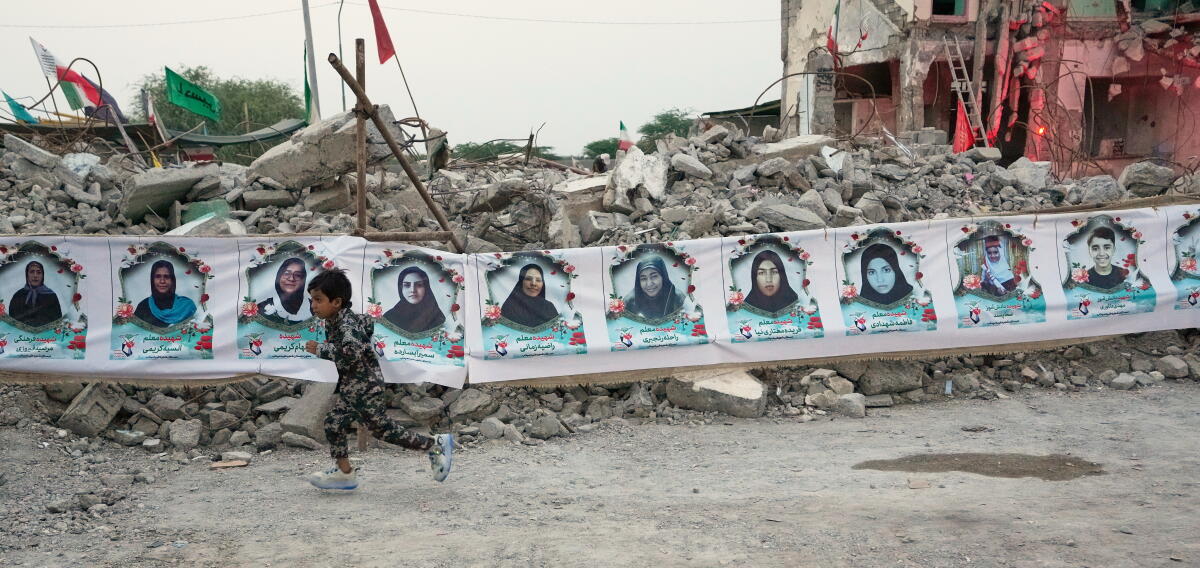
A child runs past a banner strung across the rubble of Shajarah Tayyebeh Elementary School showing portraits of the children and teachers killed there by a U.S. missile strike.
(Vahid Salemi / Associated Press)
A Pentagon spokesperson said the incident remains under investigation and declined to comment further.
In response to questions, including about when the White House was informed that the strike was a mistake, a senior administration official also cited the ongoing probe and added: “The United States does not target civilians.”
Last week, a report from the United Nations’ Independent International Fact-Finding Mission on Iran said that the U.S. had “failed in its obligation to do everything feasible to verify” that the school was a military target and that the failure “went beyond negligence.” The U.S. Department of Defense has declined to comment on the report.
U.S. officials have said that outdated intelligence was a problem. Although the site in Minab had been identified years earlier as a military compound, there was clear evidence that it had been modified and undergone a change of purpose, the officials said. Physical changes reflecting new construction — visible on satellite imagery — dated back almost a decade, they said, and the site operated openly as a school.
Analysis of commercially available satellite images shows construction of walls and entrances that separate the school site from the military base, work that appears to have been completed by 2017. An image from 2018 shows brightly painted walls alongside a soccer pitch, assembly rows and play markings on the ground.
Some U.S. intelligence analysts took notice, the officials said. Bloomberg reported in June that one analyst detected changes to the site as early as 2019, and logged remarks about the modifications in a system that wasn’t connected to the primary military intelligence database, which informs targeting.
Inside Centcom, which conducted the U.S. attack, some personnel relied too much on the artificial intelligence embedded in Maven Smart System, the officials said. Maven, which is made by Palantir Technologies Inc., allows users to view and coordinate complex military operations — from targeting to command and control — using AI-enabled software that fuses more than 150 different data inputs into a coherent set of information to inform commanders’ decisions.
In the past year, the Defense Department has rapidly made Maven a cornerstone of the U.S. military apparatus. Several former senior U.S. military officials now work for Palantir, including some with high-level security clearances in Centcom’s Tampa headquarters. Their role is to keep the software functioning inside secure military environments.
Some Centcom personnel expected Maven to flag stale information or inconsistencies in the underlying intelligence assembled for potential targets, the officials said. It’s not clear why they had such expectations.
A Palantir spokesperson said that the company “is not responsible for the underlying data nor identifying intelligence deficiencies” and that there’s no evidence that its software was at fault in the Minab strike.
Two people familiar with the firm’s Pentagon contracts said the government retains primary responsibility for the quality of the information that’s fed into Maven. But they said it’s not uncommon for personnel who use tools such as Maven to develop operational understandings that differ from contractual terms.
After the Minab strike, Palantir built new capabilities into Maven that “re-review underlying intelligence to identify factors that would disqualify a target and flag inconsistencies and inaccuracies that human review may have missed,” according to a person familiar with the matter. That work has already caught some anomalies, the person said.
The ‘kill chain’
As Feb. 28 approached, Pentagon officials were tasked with identifying strikes they thought would paralyze Iran’s military before Tehran had a chance to respond, the officials said.
High on Centcom’s list: the naval division of the Islamic Revolutionary Guard Corps, the most powerful force across the country’s military, economy and politics. It’s tasked with defending — and at times, disrupting — the Persian Gulf and the Strait of Hormuz. The Minab school site — with its uncorrected classification as a Revolutionary Guard facility — was fed into Maven along with other potential targets. It ultimately emerged as one of the recommended Day 1 targets, people involved in the investigation said.
As all targets do, the Minab site moved through a multi-stage assessment process known by the military as the “kill chain.” Steps in that process have traditionally involved intelligence analysts, imagery specialists, targeteers, lawyers, operational commanders and launch crews, according to U.S. military doctrine and interviews with current and former Defense officials. Today, Maven sits at the heart of those operations — between the initial intelligence inputs and the latter review stages, officials said.
In past conflicts, preparing lists of proposed targets — work that includes assessing how they align with an operation’s objectives — had taken hours for staffers to complete. Ahead of the U.S. attack on Iran, much of that work was condensed into several minutes via Maven, people involved in the Pentagon’s internal review said.
Officials involved in the investigation pointed to gaps that they said were left after Defense Secretary Pete Hegseth dismantled most of the Pentagon’s civilian harm mitigation, or CHM, units — cutting headcount across a number of teams by roughly 90% to fewer than 20 staff members, people with direct knowledge of the matter said. Centcom’s team was reduced from 10 to 1.
No CHM team member reviewed the Minab site before the strike, according to officials involved in the internal investigation. That was a consequence of the cuts in staffing but also a decision not to involve the group in planning and operations, the officials said. While not mandatory, that sort of review had become routine in recent years, they added. It’s unclear whether such checks, which include mapping the civilian environment, assessing noncombatant presence and developing lower-risk strike options, would have been enough to raise questions about the Minab site.
The Biden administration had built up civilian-harm-prevention capabilities within the Pentagon after an August 2021 drone strike in Kabul killed 10 civilians — based on the misidentification of an aid worker as a threat. Hegseth has characterized his subsequent cuts to those efforts as a shift away from “Biden-era, non-lethal programs.”
“America, regardless of what so-called international institutions say, is unleashing the most lethal and precise air power campaign in history,” Hegseth said at a news conference March 2, days after the Minab attack. “All on our terms with maximum authorities. No stupid rules of engagement, no nation-building quagmire, no democracy-building exercise, no politically correct wars.”
Under Hegseth’s leadership, the U.S. military has prioritized speed of delivery. People involved in the Pentagon probe said a rush to finalize targets shortly ahead of Feb. 28 contributed to the tragedy.
“Haste can lead to errors,” said Laurie Blank, who was appointed a special counsel at the Pentagon’s general counsel during the Biden administration from 2022 to 2024. She drew a distinction between planned targets and those that arise in the heat of battle. “A rush to hit pre-planned targets just isn’t the same thing,” she said, “especially when the operations are launched by choice and not in response to an attack where you are responding without time to plan.”
Why Minab?
A little more than 800 miles south of Tehran, the city of Minab sits on the critical Strait of Hormuz, at the crossroads of centuries-old trade routes and the nation’s modern military might. As the U.S. attack on Iran began, it was deemed a high-value target, according to people involved in the investigation.
As the strait’s significance grew in the 1980s, so did the number of military assets devoted to protecting it and projecting power into the Persian Gulf. The Revolutionary Guard’s missile units, naval facilities and logistics compounds operate alongside neighborhoods where fishermen, teachers and civil servants have lived for generations in the city of 76,000.
Shajarah Tayyebeh Elementary School was built almost a decade ago on land originally occupied by a Revolutionary Guard naval unit. The Pentagon had cataloged the site as a military base several years earlier — a determination that wasn’t updated before the February attack. The New York Times reported in June that targeting officials used satellite imagery that hadn’t been updated in seven years and that did not show a school at the site. Investigators have focused on the Defense Intelligence Agency’s failure to reclassify the location, officials involved in the inquiry said.
On Feb. 28, Minab awoke to clear skies. Shopkeepers unlocked their storefronts. Fishing crews unloaded ice chests along the docks. Children in green-plaid uniforms walked through the gates of the 260-student school, before heading into classrooms.
Firsthand descriptions of the events that took place in and around the school that day have been gathered by a group of human rights advocates, lawyers and digital forensics experts who’ve spent months reconstructing the attack. Members of the informal consortium — including some based in the U.S. and Europe — asked not to be named given the sensitivity of their outreach efforts with victims’ families. Their work and an assessment by the U.K.-based watchdog group Airwars — viewed as a highly reliable source by some Pentagon officials — provides the following account:
After the first reports of attacks on Iran emerged that Saturday morning, teachers called parents and asked them to collect their children, saying the school planned to close early. Shortly after 11 a.m., a first missile hit part of the school, triggering an explosion that reverberated across the neighborhood. Panicked shrieks filled the air. Teachers ushered children from the playground back inside to take cover in a prayer room.
Within minutes, a second missile struck, sending metal fragments across the school. Part of the roof collapsed. Only a few children inside the prayer room survived, buried beneath the rubble.
Rescue vehicles rushed to the scene while passersby helped the wounded. Some injured children were pulled from the rubble while dozens more, deceased, were slowly identified. One rescue crew member stumbled upon a child’s hand, detached and laying on the ground. He wept as colleagues continued to hunt through the debris alongside him.
Some parents were left to identify their dead children by fragments of clothing or belongings — a pencil case, bracelet or shoe — as many faces were no longer distinguishable. The father of Arash Gol-Azin didn’t learn the fate of his 7-year-old son until reaching the morgue. Only then did he spot him by identifying his sock.
Payam Akhavan, a Toronto-based lawyer who has practiced before the International Criminal Court and is an expert on civilian protection, said it’s important for investigators to determine what efforts U.S. officials made to try to ensure they were targeting a military installation.
“The Geneva Convention says you must take all feasible measures to determine that this is, in fact, a military objective,” said Akhavan, who spoke before Thursday’s U.N. report was published. “This does not mean that every mistake is a war crime, because mistakes will be made, even if you take all feasible measures.
“But if all feasible measures were not taken,” he added, “then that raises a question of criminal responsibility.”
At least 1,701 civilians were killed in the opening 39 days of the war, according to data compiled by the U.S.-based group Human Rights Activists in Iran. That’s an average of 43 people a day, and the group — viewed by some in the Pentagon as an authoritative source for Iranian casualty figures — said it’s a low estimate.
“We should be asking how so many civilians were killed amid an unprecedented tempo of strikes over just a matter of weeks,” said Skylar Thompson, the group’s deputy director.
More recently, Iranian officials and a United Nations body said the U.S. was responsible for a Sept. 1 strike on Kuhestak — some 20 miles south of Minab — that hit a residential area where a wedding party was underway and killed at least five people with dozens more injured. The U.S. is investigating the incident, Vice President JD Vance said earlier this month.
Target libraries
For decades, American military planners had maintained extensive target libraries in anticipation of potential conflict with Iran, encompassing everything from limited strikes to maritime war and major air campaigns. The list stretched into the thousands and included air bases, missile factories, nuclear facilities and ports, according to current and former U.S. officials familiar with the plans.
Some potential targets had remained on the books for years, accumulating layers of satellite imagery, intelligence reports and legal reviews.
But these catalogs can age quickly, according to people who’ve dealt with them. Buildings appear and disappear. Headquarters switch locations. Where a military barracks once stood, schools, hospitals and mosques may now exist. So the libraries’ contents require close and continual review well before any particular building or site winds up on a target list.
Maintaining the lists is critical but labor-intensive. Officials involved in the internal investigation of the Minab incident described gaps in vetting — or checking whether the underlying information is accurate, reliable and timely — that came well before the school site was selected.
Some of the most sensitive sites, such as Iran’s nuclear facilities — attacked by Israel in its 12-day war with Tehran in June 2025 — faced relentless attention from U.S. intelligence analysts ahead of the 2026 war, according to officials with direct knowledge of the matter. Less prominent locations, such as Minab, went months without receiving another close look, the officials added.
War planners start to think they’ll have time to revisit the less urgent sites, current and former Pentagon officials said.
That assumption evaporated during the final days of February as diplomatic talks between U.S. and Iranian officials in Geneva faltered and then collapsed on Feb. 26.
Work that had unfolded in previous conflicts over weeks or months — matching sites from the library, such as buildings, airfields or bases — was completed in a matter of days, according to officials involved in the inquiry. More than a thousand potential targets had to be reassessed and approved.
By the time the first Tomahawk missile bound for the Minab site left its launcher on a ship operating in the Arabian Sea, roughly three dozen people were involved along the kill chain, the officials said.
Most sat in secure facilities more than 7,000 miles away in Tampa, Fla., studying maps, imagery and databases in preparation for a war that, until 48 hours before the Minab attack, many officials had believed for decades wouldn’t occur.
Typically, part of their work entails refining a list based on satellite imagery and on-the-ground intelligence that’s used to create a pattern-of-life analysis reflecting human movements on the site and changes over time. In Iran, a bitter U.S. adversary for almost half a century, such intelligence was limited, especially in the south of the country, people involved in the probe said.
Additional steps in the kill chain address other types of issues. Lawyers assess whether each proposed target is a lawful military objective. Specialists estimate potential collateral damage. Weapons experts debate not only which missiles to fire but when.
Every stage leaves a record. Analysts sign off on each piece of the chain. They’re told to report any inconsistencies to superiors.
Then a series of questions is asked by the senior commander: Is the target lawful? Is there sufficient intelligence? And have reasonable precautions been taken to minimize civilian harm? In the early hours of Feb. 28, the answer to each question about the Minab site was yes, according to the officials involved in the probe.
The Pentagon’s internal investigators, who examined the satellite imagery, intelligence databases, targeting materials, operational chat logs and computer records that analysts used, concluded that there was high confidence throughout the kill chain that the Minab site was a Revolutionary Guard facility, according to people involved in the probe.
“Insufficient intel wasn’t really viewed as a concern before the war,” said one Pentagon official involved in the internal probe. “We were confident in our intel. Minab proved you should never be too confident.”
Political pawns
Government researchers and auditors have noted deficiencies in the primary intelligence database that’s used to develop strike targets, and the Pentagon is working to replace it with one that will introduce more automation. And Minab isn’t the first time that flawed intelligence has directed U.S. precision weapons toward the wrong target.
The accidental bombing of the Chinese Embassy in the Serbian capital Belgrade in 1999 killed three people and injured 27 others. A mistaken 2015 airstrike on a Doctors Without Borders hospital in Kunduz in Afghanistan killed 42 people. More recently, soon after the Pentagon’s civilian-harm-mitigation teams were disbanded, a strike on the Ras Ina port in Yemen in April 2025 resulted in at least 80 civilian deaths.
In the months since the attack, the children of Shajarah Tayyebeh Elementary have become symbols. Their faces were plastered on the backs of the seats of Iranian planes ferrying diplomats to Islamabad for talks with the U.S. in April. They adorn memorials on the streets of Minab. Some families have complained that their injured children haven’t received the treatment they need. Critics accuse Iranian officials of leveraging the school attack to their political advantage.
In the U.S., the disaster has become a different sort of political touchstone. Democratic lawmakers, who are seeking to take control of the Congress in the November election, are asking how the attack could have happened.
Sen. Jack Reed of Rhode Island, the ranking member on the Senate Armed Services Committee, accused the Pentagon of deliberately withholding the results of the investigation, and his Republican counterpart, Thom Tillis of North Carolina, called for congressional briefings on what went wrong.
That call is echoed by Sen. Richard Blumenthal, who also sits on the committee, which helps set spending caps for the Pentagon’s roughly $1-trillion annual budget.
“The administration should have been forthcoming within hours or days, and here we are months later and nothing has been provided,” Blumenthal said.
A GROWING number of UK airports are facing delays and cancellations following another air traffic control failure.
This comes just a fortnight after a major outage left thousands of passengers stranded at airports across the UK.
Brits are facing delays at a number of UK airports following air traffic control issuesCredit: Zenpix
London Gatwick, Glasgow Airport and Belfast International Airport are amongst airports currently seeing disruptions.
Earlier this morning, it was reported that an issue with National Air Traffic Services (NATS) was affecting airspace in the north of England and Scotland.
Sign up for the Travel newsletter
Thank you!
NATS has stressed that the issue is unrelated to the major air traffic control outage that saw over 500,000 passengers stranded.
Belfast International Airport has confirmed on its website that it is experiencing NATS-related delays, saying: “We are currently experiencing some delays to flights due to a NATS air traffic control issue.”
Passengers who do not have a confirmed flight have been instructed to not travel to the airport.
Glasgow Airport has also issued a statement on its website about the delays, saying: “A technical issue affecting NATS air traffic control services at the Prestwick Centre is causing disruption to some flight departures and arrivals.
Passengers have been seen waiting for their flights at Manchester Airport this morningCredit: ZenpixNats have now fixed the issues, but delays are expected to continueCredit: Zenpix
“As a result, some services operating to and from our airports are experiencing delays, primarily at Glasgow Airport, and further disruption is expected due to the knock-on impact across the network.”
London City Airport said on X: “We are experiencing some disruption due to an issue at @NATS Prestwick.
“We are monitoring the situation closely and working with NATS as they resolve the issue.“
It also told passengers to check with their airline to find out the latest flight information.
Both London Gatwick and Stansted are “operating as normal”, the airports have confirmed, but a handful of departing flights may be delayed.
After over an hour of fixing delays, NATS has now confirmed the issue at its Prestwick centre in Scotland is now fixed.
Full list of airports facing delays following NATS outage
Aberdeen Airport
Belfast City Airport
Belfast International Airport
Bristol Airport
Glasgow Airport
Highlands and Islands Airport
Leeds Bradford Airport
Liverpool John Lennon Airport
London City Airport
London Gatwick Airport
London Stansted
Manchester Airport
Newcastle Airport
The air traffic control firm has apologised for today’s flight disruption and said it is working with airports and airlines to “minimise any further disruption”.
Transport Secretary also commented on the incident, calling the disruptions “deeply frustrating” and warning passengers of “some delays”.
On the appointment of Edwards, England head coach John Mitchell said: “Since his time with France ended, we have had a conversation about our game, and he expressed an interest in working in an international women’s set-up for the first time.
“He has a huge amount of respect for the Red Roses and what we stand for; he sees it as a privilege to join our environment.
“His coaching credentials are exceptional and his experience at the highest level of the game speaks for itself.
“Defensively, Sarah Hunter is relishing the opportunity to learn from him, alongside the rest of our coaching group, as we head into another exciting Test match against New Zealand.”
Last week, Edwards expressed his desire to return to coaching and be a part of next year’s men’s Six Nations.
Michael Carrick has struck a defiant tone after Manchester United equalled their worst start to a Premier League season, but a woeful 1-1 draw at Fulham left the beleaguered boss under mounting pressure.
Trailing to Lisandro Martinez’s farcical own goal, United were just moments away from a third successive defeat on another dispiriting afternoon for Carrick on Sunday.
Recommended Stories
list of 4 itemsend of list
Matheus Cunha’s deflected 89th-minute equaliser spared United from new humiliation.
But escaping with a barely deserved point against a winless side placed second-from-bottom of the Premier League was hardly cause for celebration.
With only one win so far this season, United have matched their lowest points total after five matches in the Premier League era.
Sitting in 12th place with five points, Carrick’s men equalled the mark set by Louis van Gaal’s United in 2014-15, when they went on to finish fourth.
The statistics are damning enough in their own right, but the eye test during their moribund performance at Craven Cottage provided an even more insightful look at what ails United.
Lacking a cutting edge in attack, bereft of defensive organisation and, in the words of Cunha, short of energy and drive until they fell behind, this was the kind of flawed display that has scarred so many United seasons since their last title in 2013.
Carrick was expected to build on last season’s climb to a third-place finish during his spell as interim boss.
But having hauled United from the wreckage of Ruben Amorim’s self-destructive reign, Carrick is in danger of losing his way in his first season as permanent boss.
A wretched 2-0 defeat at promoted Hull on the opening weekend set alarm bells ringing among the United faithful.
Beaten in the Manchester derby by an Erling Haaland goal that should have been disallowed last weekend, United then blew a two-goal lead at home for the first time in 50 years in a League Cup meltdown against Brighton.
‘Fine margins’
Already 10 points behind leaders City, Carrick’s team were so underwhelming against Fulham that even one of the manager’s former teammates took a swipe at United.
Commenting on the match for Sky Sports, ex-United defender Gary Neville was scathing in his assessment of their performance at the start of the second half.
“I’ve watched Man United since the age of five and that’s the worst 15 minutes I’ve ever seen. Absolutely pathetic,” Neville said.
The 51-year-old added: “I’ve never seen such a lack of effort. What must Carrick be thinking?”
Carrick does not have the confrontational personality of some of his United predecessors, but he tried his best to quiet the noise as he searched for reasons for optimism.
“It’s not been ideal. It was always going to come at some point, and it’s come at the start of the season,” he said.
“On the other side of it, at Everton, a 25-yard shot, top corner for their equaliser. The City goal that’s not a goal. Today, own goal, that’s one of them things.
“It’s pretty fine margins that have flipped it. I know we can do better; we need to do better at certain things.
“But I’m not despondent because I think we’ve shown some good signs as well.”
Carrick has three weeks to stew on United’s miserable start during an extended international break.
Questions about United’s transfer policy and fitness regime are growing louder.
Calvin Bassey celebrates Fulham’s first goal, an own goal scored by Manchester United’s Lisandro Martinez [Peter Cziborra/Action Images via Reuters]
‘We’ll get back to winning’
The 45-year-old must come up with answers before they return to action with a crucial clash against bottom-of-the-table Tottenham on October 10.
Losing to Roberto De Zerbi’s side would be a huge blow to Carrick’s hopes of turning the tide, especially with tricky trips to Atletico Madrid and Leeds looming after Tottenham visit Old Trafford.
But Carrick is putting his faith in United’s players absorbing the lessons from their painful start.
“You learn about each other, they learn about me, I learn about the individual and as a team, how we respond, what our reaction is,” he said.
“That’s part of growing as a group. You have to go through certain things to get to the end of it.”
Carrick said he had “mixed” reactions to the match but was focusing on the positives and bouncing back after this “first chapter”.
“There are parts we can do better. The way we responded to going down was really pleasing, the boys were really positive and played with good purpose,” Carrick said in a post-match interview.
“I’m convinced we’ll have a good season. We’re having a spell that feels bigger than it actually is to the outside. We’ll get back to winning football matches and we’ll be all right.”
A WOMAN from the UK was stopped at the border abroad after she was told she had overstayed in Europe – despite her not.
Paula Pugh was going on holiday to Italy but was taken back to the UK after systems showed she had overstayed her limit of 90 days in a 180-day period in the Schengen Area.
One British woman was deported from Italy after an EES errorCredit: AlamyHer exit from a previous European country had not been correctly recordedCredit: Alamy
EES has been causing chaos for lots of Brits since it was first introduced earlier this year including airport delays and missed flights,
But now, it is also causing problems for passengers by incorrectly claiming they are staying too long in Europe.
Sign up for the Travel newsletter
Thank you!
Talking to The Telegraph, Paula Pugh, 60, explained how she was escorted out of Italy and taken back to the UK because of the error.
Travelling with her husband and cousin for a five-day trip to southern Italy, Paula was flagged at border control shortly after landing.
She was accused of overstaying her 90 limit in the Schengen Area despite taking just three short visits to Spain and one to France – which totted up to 22 days.
Talking to the publication Paula explained she “wasn’t allowed to go anywhere without a police presence.”
Paula was put on a flight home on the same day from another airport with Ryanair along with her family.
Her passport was given to the captain for the duration of their flight.
She added: “My husband then asked the cabin crew where I would get my passport, and we had to walk to the front of the plane.
“Somebody came onto the plane, took me off the plane, had a look, gave me my passport, and said ‘There you go.’ As though it was all over and all forgotten.
“I’m still very upset when I think about it.”
The cancelled trip and return flights home cost the family around £2,000.
EES has replaced the need for manual stampsCredit: REUTERS
Now, Paula is trying to get her record corrected.
Previously, Brits were manually stamped in and out of a country at border control. EES has replaced that with the taking of biometrics and fingerprints.
However, in some cases where EES has been turned off at airports due to faults, or delays, the exit for Brits has not been recorded and the days spent in the Schengen Area continues without them knowing.
A UK Government spokesman told The Telegraph: “While EES is anEU scheme, we recognise this is a significant change for British travellers, and advise that they read the latest Foreign, Commonwealth & Development Office (FCDO) Travel Advice about the scheme before travelling.“
In August, the UK Foreign Office altered its advice to Brits asking them to carry evidence of when they last left the EU, to avoid being wrongly refused entry.
Brits travelling from the UK to Europe can spend 90 days out of every 180 in the EU – staying over this limit will mean both refusal of entry and a fine.
In some cases a fine can be as much as £8,550.
Advice from the Foreign, Commonwealth & Development Office (FCDO) reads: “If you believe you have been incorrectly entered into EES or your record of time spent in the Schengen area is incorrect, approach border officials when you next cross the Schengen border and request a correction.
“If you are exempt, carry documentation confirming your status. If you believe your time spent in the Schengen area has been recorded incorrectly, raise this with border officials and be prepared to provide supporting evidence if requested.”
If you want to check the days left on your record before travelling, the The European Commission has anEES online tool.
AN ICONIC London tower is being carved into a £1billion “Swiss Cheese” hotel as plans are unveiled for major refurbishment.
New terraces, restaurants, office spaces and panoramic views of the city are all part of the plans.
An iconic London tower is set to undergo a major revamp as its current tenants lease expiresCredit: Kiasm/Canary Wharf Press OFficePlans for the HSBC tower include restaurants, office spaces and cutaway terraces – likening the design to Swiss cheeseCredit: KFPA large glass box called “The Cloud” will also be part of the new plans with panoramic views of the cityCredit: KPF
The HSBC Tower, located in London’s Canary Wharf, is set to undergo a major refurbishment next year, as its current occupants relocate to the city.
Plans for the refurbishment of the 45-storey tower have been submitted to Tower Hamlets Council by Qatar Investment Authority (QIA) and Canary Wharf Group (CWG).
Sign up for the Travel newsletter
Thank you!
The revamp will be led by architects Kohn Pedersen Fox (KPF) and reports indicate it is set to cost between £800,000,000 and £1,000,000,000.
Proposals for the building will see sections of the tower’s higher floors cut away to create a series of terraces, creating the appearance of holes which have landed the building with the Swiss cheese comparison.
Designs for the tower will also see it move from a single-occupant space, instead paving the way for multiple uses throughout the building.
Starting from the bottom, the lower and ground floors will be transformed into an 181-room hotel and leisure facilities.
It will also see the addition of a brand new public walkway that crosses through the ground floor to link the Elizabeth Line Station with nearby Canada Square Park.
Middle floors will be reserved for office spaces, designed to house multiple corporate tenants, with asset management company BlackRock reportedly eyeing the space, according to The Banker.
Staggered terraces will be a main feature of the top floor, as well as a huge glass box called “The Cloud”, functioning as an entertainment space with restaurants and bars and boasting panoramic views of the city.
In a statement posted to the CWG website, CEO Shobi Khan said: “We look forward to working with QIA on 8 Canada Square to deliver a building of outstanding design, engineering and sustainability standards.
“This redevelopment is another step in Canary Wharf’s evolution into a vibrant mixed-use neighbourhood offering workspace, retail, homes, leisure and amenities all in one location – a true 15-minute city.”
Elie Gamburg from Kohn Pedersen Fox said: “We are extremely excited to collaborate with QIA and CWG to reimagine the single-use office building as a blueprint for the highly sustainable, mixed-use building of the future.
“This transformation embodies the ethos behind much of our work, we see it as an integral part of the evolution of today’s single-use neighbourhoods into vibrant mixed-use neighbourhoods of tomorrow – an evolution of which CWG is already leading the way.”
A NEW train ticket rule has officially rolled out to make life much easier for travellers.
Passengers on Britain’s biggest train operators will now spend much less money when their train is cancelled.
A new train rule has come into force making life much easier for passengersCredit: PA:Press Association
For the first time, passengers left stranded at stations can use an alternative operator’s service to complete their journey free of charge.
The new rule which came into force on Sunday, September 20 hopes to end limbo at stations following cancellations and end the need for costly re-bookings.
Sign up for the Travel newsletter
Thank you!
Many regular travellers will be aware that this scheme already operates across all 13 publicly-owned operators, such as LNER, Southern, South Western Railway and Greater Anglia.
However, from now, Avanti West Coast, Chiltern Railways, CrossCountry and Great Western Railway will also be involved, offering more stability on a host of key intercity routes across the UK.
East Midlands Railway will also be joining the scheme at a later date.
The new scheme comes ahead of the establishment of Great British Railways (GBR) – a programme to transfer all rail services to public ownership and to create a “one-stop shop” for train travel.
Valid ticket holders can travel with another train operator on a direct or reasonable alternative route, but the service must depart within two hours before or after the original cancelled train.
To claim the new ticket, passengers will need to show their original ticket to customer support staff as a proof of purchase, and will not be required to download the new one.
Full list of operators taking part in the new scheme:
East Midlands Railway is expected to join the scheme at a later date:
c2c
Gatwick Express
Greater Anglia
Great Northern
LNER
London Northwestern Railway
Northern
Southeastern
Southern
Thameslink
South Western Railway
Transpennine Express
West Midlands Railway
Avanti West Coast (new)
Chiltern Railways (new)
CrossCountry (new)
Great Western Railway (new)
When the new scheme was unveiled, Rail Minister, Lord Hendy, said: “This is a simple, common-sense change that puts passengers first.
“No one should be left stranded because of a fragmented railway when their journey is disrupted.
“From this weekend, if your train is cancelled, you can get on another operator’s service and carry on your journey without paying again.
“We’re fixing the railway from the ground up, making it simpler, fairer and easier to use, as we move towards Great British Railways and put public service back at the heart of our railways.”
Denmark, Greenland and the United States are set to sign a security agreement that Copenhagen says will give NATO a larger role in protecting the Arctic, potentially shifting responsibility beyond the United States and Denmark alone.
The agreement is expected to be signed at the United Nations General Assembly in New York on Tuesday. Its full contents have not been made public, although US President Donald Trump has described it as giving Washington “permanent control” over Greenland’s security.
Denmark and Greenland have not endorsed Trump’s description. Both have said the agreement will benefit Greenland while respecting the island’s sovereignty.
The deal follows months of pressure from Trump, who has repeatedly argued that the United States should control Greenland and at times declined to rule out military or economic measures to acquire the semi autonomous Danish territory.
Stay ahead of the geopolitical week.
MD Briefing delivers expert analysis across five global fronts — the Indo-Pacific, energy, geoeconomics, European security, and the Middle East — every Monday morning. Free.
His demands triggered a diplomatic crisis within NATO and pushed Copenhagen and Nuuk into negotiations with Washington to address US security concerns while maintaining Greenland’s status within the Kingdom of Denmark.
A broader NATO role
Danish Foreign Minister Lars Lokke Rasmussen said the agreement would change the way Arctic security is handled.
“It will be in a form where responsibility for security in the Arctic is not only Danish or American,” Rasmussen told Danish broadcaster TV2 on Sunday. He added that NATO would play a major role in protecting the region.
A NATO spokesperson said the alliance welcomed the agreement, describing it as a step that could advance security, stability and cooperation in the Arctic.
Rasmussen travelled to New York for the signing but has declined to disclose the agreement’s details.
He said Denmark had been open from the beginning to addressing what he described as legitimate US security interests.
The negotiations therefore appear to have focused on finding a framework that can accommodate Washington’s strategic concerns without formally transferring Greenland’s sovereignty to the United States.
Trump’s claim raises questions
Trump has offered a different description of what the agreement means.
In a post on Truth Social on Friday, he said the deal gives the United States “permanent control over security, and all other needs” in Greenland. He also said no US adversary would be able to establish a base or military presence on the island without Washington’s written approval.
Copenhagen has not publicly responded to that characterization.
The difference between Washington’s description and Denmark and Greenland’s public statements leaves important questions about the agreement unresolved.
Among the most significant is whether it changes the 1951 US Denmark defence agreement, which provides the legal basis for the American military presence in Greenland.
The document’s provisions on US access, military infrastructure and the role of NATO have not been made public.
Greenland at the centre
The agreement comes as Denmark acknowledges that it underinvested in Greenland’s defence for decades.
Copenhagen has since pledged to increase its military presence on the island and strengthen Arctic surveillance, including through greater NATO involvement.
Greenland’s government has sought to reassure residents that the negotiations do not compromise the island’s sovereignty.
Erik Jensen, an opposition lawmaker in Greenland, said on Facebook that he had read the draft agreement and felt reassured by its contents. He also praised Greenland’s foreign minister for handling the negotiations.
For Greenland, the issue is particularly sensitive because the island has extensive autonomy within the Kingdom of Denmark and has long maintained a political debate over eventual independence.
What the agreement could mean for the Arctic
The deal could mark a significant change in the security architecture of the Arctic.
Greenland occupies a strategically important position between North America and Europe, making it valuable to the United States and NATO as competition over the Arctic increases.
A larger NATO role could provide a multilateral framework for responding to concerns about military activity and strategic infrastructure in the region. At the same time, the agreement’s precise legal and operational arrangements will determine how far that shift actually goes.
Until the text is released, it remains unclear whether the agreement represents a substantial restructuring of Greenland’s defence arrangements or primarily a political framework for closer cooperation.
What is clear is that the negotiations have moved Arctic security from a dispute centred on US ambitions for Greenland toward a broader discussion about NATO’s collective role in one of the world’s increasingly contested strategic regions.
The In Memoriam segment at the 78th Emmy Awards opened with a tribute to Catherine O’Hara from her movie and TV kids — Macaulay Culkin, Annie Murphy and Dan Levy.
“There are all kinds of words I could use to describe Catherine,” Culkin said as he took the stage with the “Schitt’s Creek” stars. “She was encouraging, she was warm, she was funny, but the word that I think of is ‘mama.’”
O’Hara, of course, played Culkin’s mother in “Home Alone” and “Home Alone 2.”
“She wasn’t just a wife and mother to [husband] Bo and [sons] Matthew and Luke. She was my mom. She was our mama,” Culkin said, looking toward Murphy and Levy. “And by extension, she’s all of our mama…. She may have forgotten me twice, but we will always remember her.”
Murphy and Levy also shared personal anecdotes about their TV mom. Murphy spoke about O’Hara’s laugh, and the many interactions she’s had with fans “that remind [her] how profoundly Catherine has impacted the world … because she brought us joy.” Levy shared what it was like to work with O’Hara and how she taught him to “always say yes.”
Singer-songwriter Noah Kahan performed a cover of Simon & Garfunkel’s “Bridge Over Troubled Water” as images of actors, writers, directors and other industry figures who died this year were projected onto the stage.
“For over 1,000 episodes of television, the great James Burrows set a standard of comedy directing that will be cherished and studied for generations to come,” Curtis said. “And sadly, last year, we lost another cherished legend. Our beloved Meathead, Rob Reiner.”
Reiner won a posthumous Emmy for guest actor in a comedy series for his work on “The Bear” earlier this month. Curtis said Reiner broke the record set by his father, Carl Reiner, for the longest gap between acting Emmys.
“He was generous and kind and funny as hell and a friend to all,” Curtis said. “We all miss Rob and Michele [Singer] and all those we lost this year.”
The ceremony also featured a tribute to Dolly Parton earlier in the evening with Sally Field and Reba McEntire.
The provided text from Occasional Digest explores the significance of St. Robert Bellarmine’s Day in Vatican City, specifically in the context of the fictional or future Pope Leo XIV. This new pontiff, formerly known as Robert Francis Prevost, shares a name day with the 16th-century Jesuit scholar and intellectual. The article details Bellarmine’s historical contributions, such as his work on the Vulgate Bible and his role in the judicial proceedings against Galileo. Beyond religious history, the source functions as a news aggregator, displaying global exchange rates and weather for London. It also highlights various contemporary news snippets ranging from international diplomacy and political ap …
Only the Pirates and Cubs have met more often than the Dodgers and Giants, who faced off for the first time in 1889. And over all that time, the Dodgers are just two games better, with 1,294 wins to the Giants’ 1,292.
The Dodgers and Giants have also won more pennants, made more World Series appearances and have more players wearing their caps in the Hall of Fame than any other National League teams, all of which fueled a rivalry that was once among the most visceral and passionate in American sports.
But that was then and this is now.
After Sunday’s 3-1 victory over the Giants, the Dodgers’ 14th win in their last 17 games, the team could finish a season with 100 wins for the fourth time in six years. The Giants have had just one winning record in that time.
The Dodgers (96-60), who have won five straight division titles, are headed to the postseason for a record-tying 14th consecutive year. The Giants will miss the playoffs for a fifth straight season.
So is the rivalry dead? That depends on who you ask.
“It’s always a rivalry,” Giants pitcher Logan Webb. “We’d like to make it a little closer when it comes to the standings. But I definitely feel it when I throw against them.”
But then Webb, who is from Northern California, grew up with the rivalry and, as the longest-tenured Giant, pitched against the Dodgers in games that mattered. Giants coach Ron Washington, who made his major league debut with the Dodgers when the rivalry was still a thing, said many players on San Francisco’s roster don’t know that background.
“It should be a rivalry. But I don’t think the young kids we got know anything about a rivalry. They’re not history buffs.”
Webb said it’s the responsibility of the veterans on both sides to keep that history alive by explaining the enmity to the young players.
“I think there are still guys that came up in the system that know what it’s like,” he said. “It’s my job to kind of hype these guys up to play a game like this.”
Dodgers manager Dave Roberts, who played for the Dodgers and Giants during his 10-year career, agrees the rivalry now exists more in the history books than the current standings, where the Giants have been overtaken by the San Diego Padres, who will finish second to the Dodgers in the N.L. West for the fourth time in five seasons.
“It’s certainly a rivalry in the sense of the history, the fan bases,” Roberts said. “But obviously it’s about relevancy. The Padres have been successful the last handful of years, and so it’s certainly built some momentum. The geography lends itself to that too.
“But Dodgers-Giants is always fun.”
It hasn’t been so much fun for the Giants lately. San Francisco hasn’t won the season series with the Dodgers since 2021 and has lost more than 90 games this year for the first time in nine seasons.
On Sunday they went in front three batters into the game with Johan Cox working Dodger opener Jack Dreyer for a leadoff walk, then making his way around the bases on Dreyer’s throwing error, a stolen base and a one-one single by Victor Bericoto.
San Francisco would get just one more hit — a single by Jung Hoo Lee with one out in the sixth.
That allowed the Dodgers to tie the score in the bottom of the sixth on Tommy Edman’s seventh home run of the season just inside the right-field foul pole. An inning later they went ahead to stay when Max Muncy singled under a sliding Cox at second, moved to third on a single by rookie Josue De Paula and scored on Kiké Hernández’s double to center.
Josue de Paula hits a double in the fifth inning Sunday.
(Ronaldo Bolaños / Los Angeles Times)
A two-out single by Muncy, his second of the game, scored Teoscar Hernández, who also had two hits, in the eighth inning with the final run.
Even the slumping Freddie Freeman contributed to the Dodgers’ 11-hit attack, ending an 0-for-11 slide with a broken-bat single in the fourth then singling again in the eighth.
Sunday’s result helped clarify the Dodgers’ once-muddy playoff picture. With six games left in the regular season, the Dodgers lead Atlanta by four games in the race for the second seed in the National League playoffs, which would give them a first-round bye and the homefield advantage in the division series.
The team’s postseason roster may be getting clearer as well. Right-hander Emmet Sheehan, who made 22 starts this season, came out of the bullpen for the first time Sunday and was brilliant in his audition for the playoffs.
“If there is a role in the postseason, it will be out of the [bull]pen,” Roberts said of Sheehan, who gave up just a hit and walk, striking out nine — one off his season high — in 5 1/3 innings.
De Paula, meanwhile, whose third multihit game extended his modest hitting streak to four games, appears to have secured a job as the team’s left-handed bat off the bench while utility player Hyeseong Kim, who has spent the last four months in the minors, will rejoin the Dodgers after the triple-A playoffs and be considered for a roster spot as a pinch-runner and late-inning defensive replacement.
“My expectation is that Hyeseong will be here during the off week and potentially be a conversation for the postseason because he has the ability to run, play defense, and steal a base,” Roberts said.
After Monday’s off day, the final break of the regular season for the Dodgers, the team is expected to activate Andy Pages, Roki Sasaki and Shohei Ohtani from the injured list during its three-game series with the Padres.
“We’ll get Andy back on Tuesday, which will be great, and then shortly thereafter we’ll get Shohei back. So yeah, things are starting to come together,” Roberts said. “We’re in a good spot.”
South Korean officers injured in DMZ explosion, possibly caused by a landmine, according to local media reports.
By Reuters and The Associated Press
Published On 21 Sep 202621 Sep 2026
Three South Korean military officers have been wounded in an explosion in the western sector of the Demilitarized Zone (DMZ) that separates North and South Korea, Seoul’s Joint Chiefs of Staff (JCS) said.
The cause of Monday’s explosion was not immediately clear, the Ministry of Defence said.
Recommended Stories
list of 3 itemsend of list
Two of the officers were evacuated from the site by helicopter, while the third was transported by land before being airlifted, according to the ministry. The officers are being treated at a military hospital near the capital Seoul, it said.
Mine explosions and other blasts are a recurring hazard in and around the DMZ, where legacy devices and suspected stray mines have periodically wounded military personnel on both sides.
The DMZ, which is 248km (154 miles) long and 4km (2.5 miles) wide, is one of the world’s most heavily armed borders. An estimated 2 million mines are peppered inside and near the border, which is also guarded by barbed wire fences, tank traps and combat troops on both sides. The zone is a legacy of the Korean War from 1950 to 1953, which ended with an armistice but not a peace treaty.
There have been growing concerns in South Korea about increased activity by North Korean soldiers near the military demarcation line as the North strengthens its border defences during prolonged tensions.