A gold mine collapse in northern Sudan has killed at least 10 people and injured 21, according to survivors, bringing renewed attention to the dangers facing workers in one of the country’s most important and least regulated industries.
The collapse took place on Sunday at the Awny mining area near Sudan’s border with Egypt. Miners told the AFP news agency they had recovered 10 bodies and pulled 21 injured workers from the site, while the search continued for people believed to be trapped beneath the rubble. It is unclear how many people are trapped in the collapsed mine.
The disaster comes just days after another deadly accident at a gold mine in West Kordofan State. A collapse at the al-Zaraa mine near en-Nahud, a town in central Sudan, left at least 82 people dead.
Sudan is one of Africa’s top gold producers, recording 70 tonnes of production last year, according to the Sudanese government.
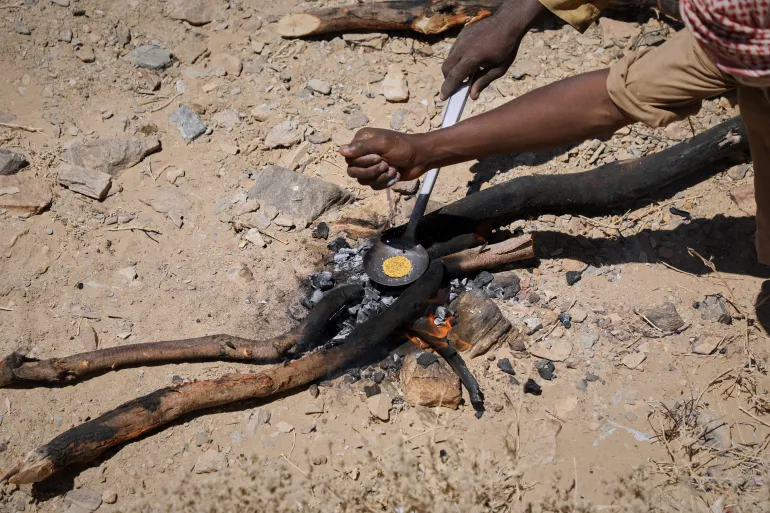
Miners heat processed gold concentrate over an open fire at an artisanal mining site in Dalago Mahas, Sudan’s Northern State, Friday, May 8, 2026 [Mohaned Bilal/AP Photo]
Since fighting broke out in April 2023 between Sudan’s army and the paramilitary Rapid Support Forces (RSF), businesses have been devastated, agriculture has been disrupted, millions of people have been displaced, and Sudan’s formal economy has weakened. In that environment, gold has remained one of the country’s most valuable sources of income.
In July 2025, it was reported by local agencies that Sudan’s gold production rose sharply despite the ongoing conflict, reaching 64 tonnes in 2024, 53 percent higher than the 41.8 tonnes recorded in 2022, and generating $1.57bn in legal export revenues.
However, the gold trade has also become a point of international scrutiny. Most of the gold exports end up in the UAE. In March 2025, Sudan went to the International Court of Justice (ICJ), accusing the UAE of supporting and funding the RSF using gold. The UAE has denied accusations that it supplies weapons to the RSF.
Sudan’s gold deposits are spread across the country, with the majority in the northeast. Port Sudan, the country’s main port, is home to most of the deposits and has been largely controlled by the Sudanese Army since the war began. However, areas controlled by the RSF are also populated by gold deposits.
At the moment, “much of Sudan’s gold is taken out of the country through smuggling or illicit networks instead of passing through government channels that could directly contribute to public revenue,” said Joseph Tucker, senior analyst on the Horn of Africa at the International Crisis Group.
But amid that diplomatic battle and the accusations surrounding gold, the mining deaths in northern Sudan have also raised larger questions over how the country manages the sector, analysts say.
“This disaster is yet another example of the deadly hazards facing those working in Sudan’s gold mines,” Tucker told Al Jazeera. “Most of these (gold mines) are informal, artisanal mines in remote areas that are unregulated and lack modern mining technology, adequate infrastructure, and specialised safety equipment.”
This year, Sudanese Prime Minister Kamil Idris met with the minister of minerals and spoke on the policies for regulating traditional mining and the management and control of various mineral markets. According to French-based Sudanese media, Sudanese authorities called for swift action to address the environmental damage and public health hazards caused by mining activities across the country.
Yet, despite the dangers, Tucker said the state of the Sudanese economy made gold mining appear lucrative to many Sudanese.
During the war, the Sudanese currency’s value has crashed. Before the outbreak of fighting in 2023, about 570 Sudanese pounds could buy a US dollar. By April 2026, the currency had slid to a sixth of that value: It cost 3,500 pounds or more to afford a dollar. That has led to sharp food inflation and a surge in the costs of transport and fuel.
According to estimates by the United Nations Development Programme, Sudan lost $6.4bn of its gross domestic product (GDP) in 2023 alone: That’s a quarter of the country’s $26bn GDP that year. In August, the UN agency reported that 90 percent of the agrarian nation’s farmers had seen yields drop over the previous year.
That economic crisis, Tucker said, “fuels the demand for gold and willingness of miners to work in poor conditions” – even if it proves deadly.
Sri Lanka were bowled out for 69 runs, 10 less than Mandhana’s belligerent match-winning innings as India retained gold.
Published On 22 Sep 202622 Sep 2026
Smriti Mandhana’s whirlwind innings of 79 runs helped India crush Sri Lanka by 147 runs and win a second consecutive women’s cricket gold at the Asian Games.
India smashed 216-3 off their 20 overs, the highest women’s total in Asian Games history, with 18 fours and 13 sixes in the final on Tuesday.
Richa Ghosh and Bharti Fulmali plundered 25 off the final over from the hapless Mithali Ayodhya, who did not help her cause by conceding eight wides.
Sri Lanka were never in the hunt, and captain Chamari Athapaththu’s 29 was their only innings of note as they were skittled for 69 in 15.4 overs and had to settle for silver.
Opening batter Mandhana hit seven sixes and five fours in a 45-ball knock that sent the ball to all parts of the Korogi Athletic Park ground in Nagoya.
Smriti Mandhana hits a six [David Gray/AFP]
After India captain Harmanpreet Kaur won the toss and opted to bat, Shafali Verma, who made an unbeaten century in the semifinal, and Mandhana put on a blistering opening partnership.
The pair had raced to 99 in the 10th over when Verma had a rush of blood, playing a needless reverse sweep which she top-edged to Kawya Kavindi at point to fall for 48 off 29 balls.
Mandhana, the greatest run-scorer in women’s T20 cricket history, had reached her fifty earlier in the over and sailed on in style, clubbing anything loose to the boundary.
Harmanpreet joined her, and the pair took the score to 141 before the captain holed out to long-off for 19.
Mandhana, looking to accelerate further in the latter overs, skied an attempted six and was out in the 17th over with the score on 163.
Ghosh clattered 49 off 22 balls with three sixes and six fours to take India past 200 in the final over.
Mandhana scored 79 off 45 balls [Mark Baker/AP]
Earlier, some late-order hitting by Pakistan captain Fatima Sana set up a 31-run win over Bangladesh in the bronze medal match.
Sana came in with her side rocking at 67-5 in the 12th over but plundered 45 off 30 balls, including three fours and three sixes, and was out off the last ball of the 20 overs after seeing Pakistan to 145-8.
Her 67-run partnership with Aliya Riaz (25) for the sixth wicket proved the turning point, and Bangladesh could only muster 114-7 in reply.
Indian players celebrate after winning [Mark Baker/AP]
What happened to the future we were promised? The vision that grew out of the 1990s techno-utopianism, when the internet was still a place of freedom and experimentation. Where are the infinite possibilities the early years of the millennium afforded, when social media meant AOL Instant Messenger and GeoCities, when our cellphones were not yet smart, and when personal tech evoked whimsy and excitement rather than anxiety and dread?
On a recent night in L.A., that digital optimism still existed. Here, at a clothing store on La Brea Avenue in the Fairfax District, something that felt lost was rediscovered. People were huddling around to play 1999’s “Crazy Taxi” on a Sega Dreamcast, or 2005’s “Tekken 5” on a PlayStation 2. They were surfing a perfectly re-created Y2K-era internet, and navigating an early version of Apple’s Photo Booth to snap selfies with a first-generation iSight webcam.
Paizley Lee created Dead Internet Theory to bring guests back to an era when tech evoked excitement rather than dread.
(Jason Armond / Los Angeles Times)
Yes, almost everyone was staring at screens, but almost no one was looking at their phone. Instead, the room felt alive and buzzing with energy. Technology was creating human connection rather than isolation.
Welcome to Dead Internet Theory, an event hosted by game designer Paizley Lee that’s both a celebration of vintage tech and a place to build community. The name is a tongue-in-cheek reference to the theory that the internet today is mostly bots, AI slop and corporate algorithms, while the human element is quickly disappearing from the web.
Lee started the event earlier this year after seeing how her friends reveled in hacking old hardware but had nowhere to show off their reimagined contraptions. She said Dead Internet Theory is a space to highlight “artists who don’t see the light of day,” a cyberpunk show-and-tell of sorts. “There’s a world of knowledge that comes from that person that can share and collaborate with another artist, and that’s really the future that we were promised, right then and there,” Lee said. “It’s the ‘Hey, look at what I made, look at what I’m interested in, and let’s share that.’ ”
Benjamin Palmer shows his project called Pan and Scan.
(Jason Armond / Los Angeles Times)
One of those artists sharing his work was Dan Ruth. Atop a low credenza, he displayed a black, leather suitcase that housed inside of it an old laptop attached to an external zip drive. On the laptop’s screen was a menu of various banned books — the Unabomber’s manifesto and “The Anarchist Cookbook” among them. Ruth had recently bought the trademark rights to the digital storage systems iOmega, Zip and Jaz. “They were what we all used in the ‘90s to transfer larger files,” he explained of the era before online storage and transfer infrastructure like Google Drive.
With his setup at the event, participants could choose whatever banned book they wanted and write it to a physical Zip disk (about the size of a saltine cracker) to keep forever. If Ruth’s installation is a bit provocative, his message is less controversial. At a time when servers are being shut down, physical media is being digitized out of existence, and the subscription model is supplanting personal ownership, Ruth believes this is a way to have data autonomy.
Guests play retro video games.
(Jason Armond / Los Angeles Times)
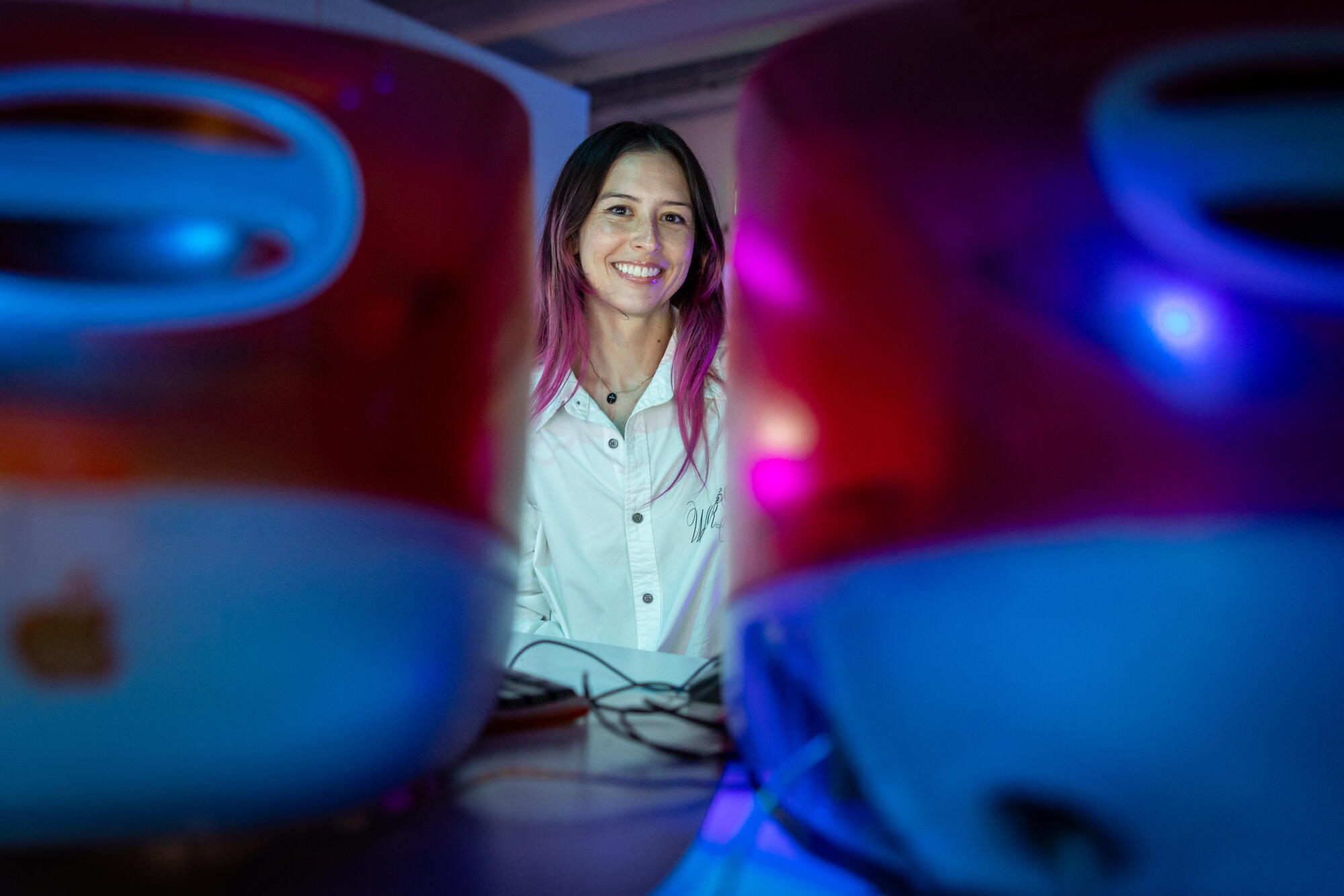
Lee’s own contribution to the evening is the full rainbow of Apple’s iMac G3 computers — those bubbly, teardrop-shaped desktops that debuted in 1998 to the famous “iCandy” ads displaying their colorful shells, and TV commercials scored to the Rolling Stones’ “She’s Like a Rainbow.” Over several months and multiple trips, Lee drove across the country collecting the G3s in their core five colors. And it wasn’t easy. She recalled sleeping in her car in the parking lot of a Cracker Barrel for a few nights because she had spent all her money on acquiring the computers.
It was the people Lee met in the months of gathering the G3s, however, that made it worth it: a single dad who collected vintage iMacs to bond with his son, an elementary school teacher who held onto the old computers because the school was going to destroy them.
“I met these really witchy, cool, queer programmers from MIT in Medford, Massachusetts, who invited me back for MIT Swap Fest, where I found Indigo,” said Lee, referring to another G3 color not part of the core five. “I met a guy who used to work in broadcast, and his wife just died of cancer. His mom moved in, and she has been trying to support him in getting rid of old things and not holding on to them too much.” Human moments made possible almost by the accident of holding onto a computer longer than most.
Lee’s pursuit of old tech hardware has always been, at its root, a means to meeting new people, hearing their stories and creating a relationship with them. “I care about people a lot,” she said. “I think every single person that touches any of my projects knows that I really care about people feeling good.”
Paizley Lee spent months collecting the full rainbow of iMac G3s.
(Jason Armond / Los Angeles Times)
With a mouse, Jaimie Wan clicks into the past.
(Jason Armond / Los Angeles Times)
When Lee finally acquired all five original colors (blueberry, strawberry, lime, tangerine and grape), plus all the additional colors (ruby, indigo, snow, graphite, sage and three limited edition colors), she began booting up the G3s computers to make sure they still worked. In the process, she discovered the forgotten digital detritus left on their hard drives: old resumes, photo albums, Word documents.
“It’s somebody’s life,” she said. “It feels weird to do anything with it, but it also feels weird to alter it.” In the end, she kept the old files and built a replica of the early ‘00s internet to live beside them on the computers. At Dead Internet Theory events, participants are given free reign to the G3s and slowly find clues Lee has left on their desktops that lead into a mystery game she created.
Back at the event, people flocked to the bank of iMac G3 computers. They clicked around, laughing, their eyes lighted up. “It’s really a trip seeing the old MacBooks,” said Shannon Stack after navigating one of the relics. “I remember having those in my elementary school classroom. Now, these are archival pieces. It’s freaky!”
Lee herself hovered around the computer bank, watching people interact with them and discovering the random documents left behind or playing one of Apple’s preset games. She asked a couple who had been tinkering around for over half-an-hour if they wanted a hint to her mystery. “No!” they respond excitedly.
While Dead Internet Theory has only been held in Los Angeles, Lee’s dream is to take it on the road. “I’ve got kids in Seattle, in Nashville, in Dallas that are emailing me and going, please bring it here,” she explained. The only thing stopping her was money, but that changed recently. A few weeks after the event on La Brea, she was approached by a sponsor. Now she’s making a tour happen, first with a pop-up event in New York City on Wednesday.
The event has become a place to gather and build community.
(Jason Armond / Los Angeles Times)
Recently, as Lee began driving across the country to set up, she stopped at a bed and breakfast near Red Lodge, Mont. When she learned the innkeeper had an old blueberry iMac G3 in her basement, she asked to take a look.
“I spent an hour getting her back on,” Lee said of rebooting the machine to give the innkeeper access. “And the face she made when it came back to life — literally priceless.”
The woman browsed through old photos of her daughters, their old school projects and other files forgotten over time. Afterward, the innkeeper gave Lee the computer, telling her it deserves a second life.
NEWBERRY SPRINGS, Calif. — Four decades ago, the cult hit “Bagdad Cafe” was filmed at a ramshackle diner in the Mojave Desert.
The tale of two women in the lonely landscape — a hardworking, rifle-wielding cafe owner and a stranded German tourist with a suitcase full of lederhosen — captivated viewers, particularly in Europe and Japan.
Busloads of international tourists rolled up to the actual Bagdad Cafe on a cracked, sunbaked stretch of Route 66.
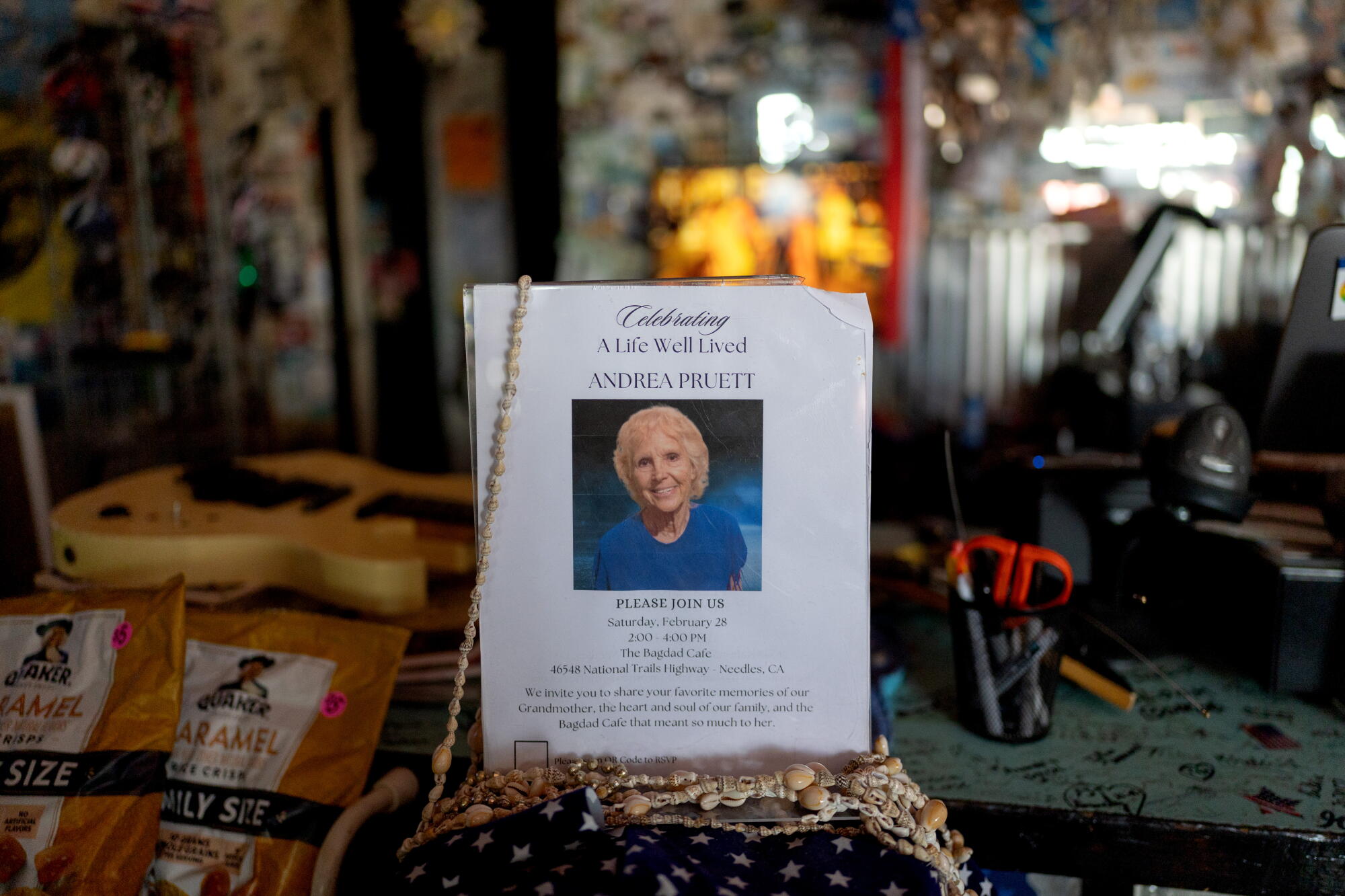
Real-life proprietor Andrea Pruett, a sweet but steely Southerner who kept her own gun behind the counter, greeted them in French and German, then fed them buffalo burgers and omelets.
A memorial announcement for owner Andrea Pruett is seen at the Bagdad Cafe on Route 66 in the Mojave Desert.
As Pruett aged, her grip on reality loosened. But she refused to leave.
Now, the Bagdad Cafe is in limbo. Though T-shirts and tchotchkes are still for sale, the kitchen is closed. And Pruett’s family is figuring out what comes next.
Buses full of Europeans still come. So, too, do the roadtrippers celebrating Route 66, which turns 100 this year.
“We don’t get any locals, and we don’t cook any food right now,” said Mark Bradley, the cafe’s gruff but genial manager. “But we’re definitely on the map to see … it’s magic that takes place here.”
The cafe is a cacophony of color in an expanse of desert brown. Flags from all over — France, Brazil, Japan, New Zealand, Canada — hang from low ceilings. The walls are covered floor to ceiling by visitors’ passport photos and dollar bills with Sharpie signatures. “We’ve been here three times!” an Italian visitor raved in a guest book.
Pruett is still there, too. An urn holding her ashes sits by the front door.
A drone image shows the remote Bagdad Cafe on Route 66 in Newberry Springs.
In 1995, eight years after the movie’s European premiere, Pruett and her husband, Harold, stopped for burgers at what was then called the Sidewinder Cafe in Newberry Springs, 20 miles east of Barstow. They had just bought 640 acres for an ostrich ranch, which ultimately didn’t work out, though they kept some of the birds as pets.
The owner told them the A-frame, wood-shingled diner was for sale. “My husband looked at me and I said, ‘Don’t even think about it,’ ” Pruett told The Times in 2003.
But their son, actor Harold P. Pruett II — who was 26 and starring that year in a campy erotic horror flick called “Embrace of the Vampire” — declared the cafe “cool,” and that was that.
The Pruetts promptly rechristened it Bagdad Cafe, following German filmmaker Percy Adlon’s lead.
The exterior of the Bagdad Cafe.
Nearby Bagdad was a railroad town named in the 1880s by Southern Pacific Railroad officials after the Middle Eastern metropolis — without the H — because of the desert terrain.
Bagdad became a stop for steam-powered trains whose engines needed more water every eight miles or so in the desert climate, said Scott Piotrowski, past president of the California Historic Route 66 Assn.
The bustling little town was also a hub for gold, silver and copper mining camps.
Mining eventually faded, but cars on Route 66 overheated easily and often limped into town for water. A restaurant named, naturally, Bagdad Cafe, owned by a woman named Alice Lawrence, was the only place for miles with a dance floor and jukebox.
When Interstate 40 opened in 1972 about 10 miles north — taking most traffic and tourists away from Route 66 — it was the death knell for Bagdad, where all that remains today is a single scruffy cedar tree.
Thierry Farion, left, from France, and Aziz Khechine, right, from Tunisia, look at memorabilia inside the Bagdad Cafe.
At Pruett’s Bagdad Cafe, she embraced the movie. The two female characters, initially wary of each other, are both on a hiatus from their husbands, and the German tourist eventually draws big crowds by performing magic tricks.
“When people came in, it was like a director saying, ‘Action!’ ” said Pruett’s grandson, Greg Landers, 47, of Glassell Park. “She would just go right into welcoming people and telling them to sit down, answering their questions.”
A petite bottle-blonde who spoke with the laid-back drawl of her native Arkansas, Pruett showed off memorabilia signed by the “Bagdad Cafe” director. She got a yellow thermos like the one in the film, which, miraculously, never seems to run out of java, even when the coffee pot is busted.
A guest book displays messages at the Bagdad Cafe.
A desert road from Vegas to nowhere Some place better than where you’ve been A coffee machine that needs some fixing In a little café just around the bend
Pruett’s place drew desert eccentrics, including a gravelly-voiced man dubbed General Bob who sniped at customers who doubted his claims that he designed the Pentagon, built the Golden Gate Bridge, was a brain surgeon and was 109. (“Actually, he’s 83 years old, and if he wants to be older, I let him,” Pruett told NPR in 2003.)
Monaco’s Prince Albert II stopped in once. So did actress Renée Zellweger, who told Jay Leno on “The Tonight Show” that there was a “little old guy, he’s been sitting there for, I think, maybe 45 years on the same barstool. We had chicken fried steak together.”
When Huell Howser popped in unannounced for a 2001 episode of his California road trip show, General Bob, perched at the bar with a fedora atop his long silver hair, proclaimed he was 98 years old and “a real general, not a f—up.”
Marian Box, left, works the counter and talks to visitor Jaelene Kleckner.
For all the joy, desert life brought plenty of hardship.
One night in the 1990s, not long after Pruett bought the place, she was closing out the cash register when a man walked in, slammed a wooden 2-by-4 on the counter and ordered her to put all the money in a bag.
“She actually had a shotgun under the counter, and she pulled it out and said, ‘Stop,’ and cocked it,” said Landers, her grandson.
The man threw his hands up and said his family was in the car. They had been traveling and ran out of money. Pruett ushered them inside, fed them and sent them away with some cash — after making them wash their own dishes.
Pruett, who gave birth to Landers’ father, Corky, at 15, had a tough and impoverished youth. But she was “kind almost to a fault,” said Landers, a contractor who lived with her for a spell in his 20s and worked in the cafe. People who just about everyone else had given up on — she’d give them a place to stay and work to do.
In February 2002, the younger of Pruett’s two sons, Harold the actor, died of an accidental drug overdose. Her husband died two months later.
Pruett’s love for her customers kept her going, said Bradley, who has been around the cafe for 26 years as a frequent visitor and employee.
“She would have them crying as they left, but happy crying,” he said. “She could do that to people by giving them a hug and in just the few minutes that they were here. She had a magic to her.”
In 2016, Sarah Jane Woodall — a former nude model who posts popular desert travelogues on YouTube under the moniker Wonderhussy — stopped for breakfast and shot a video.
The cafe was quiet and grimy. She loved it.
“It was just, like, a lovable hot mess,” said Woodall, an Army kid who lived for a time in Germany, where people were obsessed with the movie.
The COVID-19 pandemic lockdowns devastated the Bagdad Cafe — and Pruett, who turned 80 in the summer of 2020.
The Europeans disappeared. Vandals busted the windows. Pruett let go of her waiters. Her kitchen closed and never reopened.
A sign for a former motel next to the Bagdad Cafe on Route 66 in Newberry Springs.
In 2021, her house burned down. She slept in the cafe, her thin frame curled up in a red vinyl booth.
That summer, Léa De Carmo, an aspiring actress, was driving back to Los Angeles from Las Vegas with a friend and, after a night of partying, craved a cup of coffee. They pulled into the Bagdad Cafe, where — as in the movie — the coffee pot was broken.
De Carmo, a native of Paris who had never seen the film, was stunned when she opened the door and “saw French flags and soccer team stuff everywhere.”
“It seems like all the French are led there for one reason or another,” said De Carmo, 29, who talked to Pruett that day for over two hours.
“She had essentially lost everything — her business, her house — but she just had this incredible energy and warmth and humor,” De Carmo said. “There was also this very deep loneliness.”
For the next four years, De Carmo drove from L.A. to Newberry Springs dozens of times, filming Pruett for a just-finished documentary called “The Keeper of Bagdad Cafe,” about her final years in the crumbling diner.
In the film, friends help Pruett move into an RV in the parking lot. As a woman gently washes her white hair with bottled water behind the cafe counter, Pruett says she can’t remember where she’s from.
“One thing she never forgot was the cafe,” De Carmo said. “She always knew where she was and that it was the place she wanted to be.”
Landers said his father, who died in 2022, asked her to move in with him in L.A., but she didn’t want to leave the Bagdad.
“It was just hard,” said Landers, who added that she might have fared better, physically, at least, in a dementia care facility. But she repeatedly said, “No, this is my place. This is where I want to be.”
Pruett’s friends in the desert stepped up. Bradley took care of her and the cafe, opening it each day for tourists to come in and take photos.
Woodall returned at the cafe’s request, filming the stained, decaying ceiling and the water-catching buckets and coffee pots on the floor. The YouTuber’s fans raised more than $25,000 — enough for a new roof.
In the video, Pruett stood by, smiling, quiet, a little confused.
For the next three years, she stayed at the Bagdad, even as her memory continued to fade. She died this January at 85.
On a Friday morning this summer, with the outside temperature already 115 degrees, Matt Parker stood behind the worn green Formica counter, setting a smart TV to the movie and preparing to make Nescafé instant coffee — a favorite of Europeans.
On a good day, they get three tour buses, he said.
Parker, 53, moved from L.A. County to Newberry Springs — where he used to camp with his dad and ride dirt bikes as a kid — a few years ago and fell in love with the cafe.
“You can’t recreate this,” he said. “We’re just caretakers of it. It’s a museum and church, in a sense, with all this stuff. Mrs. Pruett really focused on protecting it, protecting these people’s stuff — their mark.”
Andrea Pruett’s urn near the entrance of the Bagdad Cafe, which she ran for three decades.She died in January.
Landers said that, while the family figures out what to do with the cafe, he asked Bradley to keep it open like his grandma did.
Though her urn remains in the place she loved most, Landers hopes, someday, to bury her ashes in the Hollywood Forever Cemetery next to her youngest son.
Since her death, he can’t help but think of a scene from the movie. The German woman — forced to leave after her tourist visa expires — is gone and the bustling restaurant quiet again. A customer walks in and asks where the magic shows went.
A snoozing employee sits up and says: “The magic? It’s gone.”
In the end, the German returns to the Bagdad Cafe. And so do the crowds.
ZAYN Malik has shared rare snaps of the daughter he shares with Gigi Hadid as the youngster turned six over the weekend.
Taking to social media to give fans a glimpse inside Khai’s special day, the former One Direction star posted pictures from the celebrations, although his ex Gigi couldn’t be seen.
Zayn shared some rare snaps from daughter Khai’s sixth birthday celebrationsCredit: InstagramZayn lit the candles on Khai’s towering birthday cakeCredit: Instagram
The 33-year-old wrote: “Khai’s 6th birthday this weekend!! Big thank you to everyone who made it extra special.
“@americandream – Nickelodeon Universe & Hasbro Arcade. The girls had the BEST time! And… @thelondonbaker the cake is epic, as always. Thank you!”
Sign up for the Showbiz newsletter
Thank you!
Zayn and Gigi’s only child could be seen surrounded by friends as she blew out the candles on a towering birthday cake.
Other snaps showed Khai playing arcade games and celebrating beside mountains of colourful balloons.
Khai blew out the candles on a towering birthday cake surrounded by friendsCredit: InstagramThe youngster enjoyed a fun-filled day at Nickelodeon UniverseCredit: InstagramKhai was treated to an epic birthday cake as she turned sixCredit: InstagramZayn and Gigi pictured together in 2016 before their splitCredit: Getty
A UK holiday park operator has entered administration.
The company behind Medmerry Holiday Park in West Sussex – Cove Communities Venture 2 Medmerry OpCo Limited – has been appointed administrators.
Medmerry Park in West Sussex has been closed since 2024 and now has entered administrationCredit: hoseasons
Medmerry Holiday Park, known for its nature-focused 100-acre holiday village, was forced to close back in 2024 following flooding and now will not reopen.
The park sits by the Medmerry Nature Reserve and Bracklesham Bay Beach and was home to 308 self-catering chalets, a large outdoor swimmingpool and central pub and restaurant.
Sign up for the Travel newsletter
Thank you!
The park was loved by visitors, with one guest stating: “Having just returned from a four day break and was blown away with this park, the friendly and well informed staff and quality and price of the food in the restaurant was second to none.”
According to The Herald, the company is also connected to parent company Cove Communities Holiday Park UK Holdco Limited.
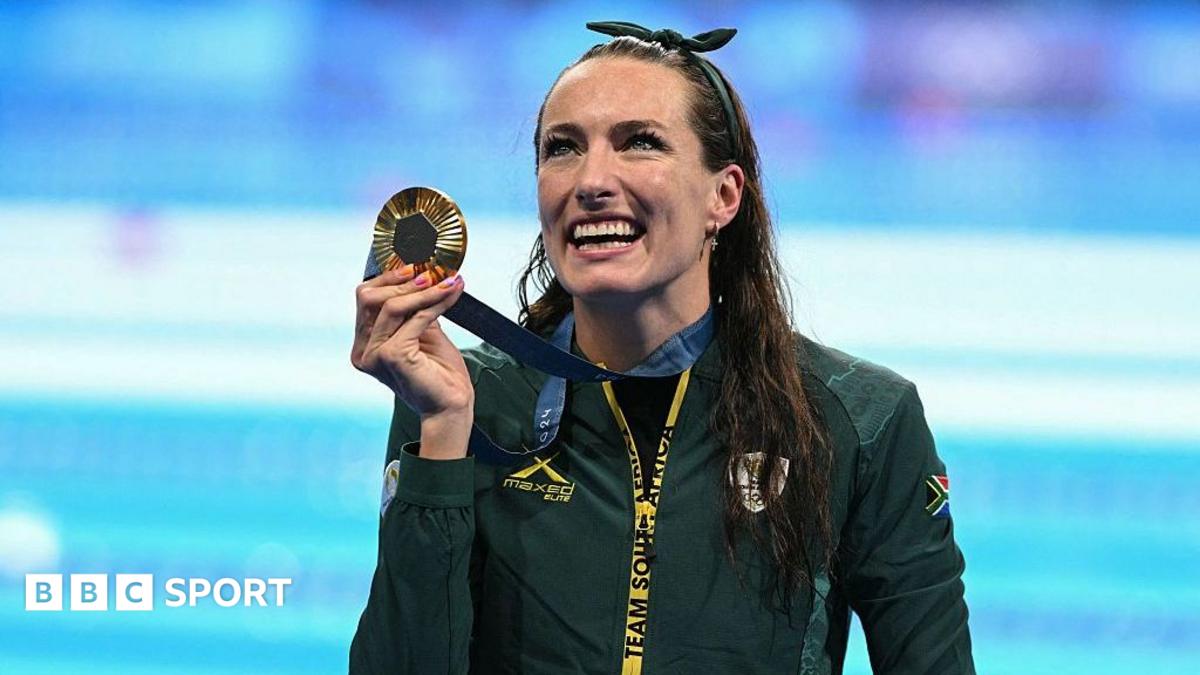
Double Olympic swimming champion Tatjana Smith is coming out of retirement with the aim of competing at the 2028 Los Angeles Games.
The 29-year-old, who is South Africa’s most decorated Olympian, said she was “missing the water”, adding her return “feels a little crazy, a little scary and very exciting all at once”.
Smith, who won 100m breaststroke gold and 200m silver at the Paris 2024 Games, to add to 200m breaststroke gold and 100m silver at Tokyo 2020, is aiming to compete over a new Olympic distance of 50m.
“It’s definitely a new challenge, a new event, a new race, but also a new me,” she said.
“For the first time, I am choosing swimming and I am choosing the event and I am choosing a new event, that has no history but to try and write some new history.
“LA 2028 is the goal. It is not a promise. I still have to build a race, qualify and earn my place back on those blocks.”
The former 200m breaststroke world record holder initially retired from swimming after the 2024 Olympics.
Police arrest suspect in shooting near high school as injured are rushed to local hospitals for treatment.
Published On 22 Sep 202622 Sep 2026
An armed man has opened fire near a high school in western Turkiye, wounding eight people, including students, authorities said.
The injured were rushed to hospitals after the shooting early on Tuesday near a vocational and technical high school in the Turgutlu district in the western Manisa province, the governor’s office said in a statement on X.
Recommended Stories
list of 3 itemsend of list
Police arrested the suspect after he attempted to flee the scene.
“A report was received regarding gunfire in the vicinity of the Inci Uzmez Vocational and Technical Anatolian High School in our Turgutlu district at 07:59,” the governor’s office said.
The motive for the attack was under investigation, it added.
“After the incident, the suspect believed to have fired the weapon was caught by security forces and taken into custody,” the statement read.
Several images of the suspect were posted online, showing him walking near the school holding a gun.
Security camera image of an armed man near a school in Turgutlu, west of the resort city of Izmir, Turkiye [Handout/DHA via AFP]
The attack comes months after two school shootings in Turkiye.
In April, 16 people, mostly students, were wounded when a former student opened fire at a high school in the Sanliurfa province. The attacker later killed himself.
The following day, a 14-year-old killed nine people, including students and teachers, and wounded 13 others in an attack at his school in the Kahramanmaras province. The assailant was killed by police.
WHEN the unpredictable British weather strikes, a tropical indoor waterpark is the ideal escape for families.
We’ve hunted down the UK’s absolute best indoor waterparks, packed with terrifying near-vertical drops for adrenaline junkies and giant interactive pirate ships to entertain the little ones.
Alton Towers has its own on-site waterpark at the Splash Landings hotelCredit: Not known clear with picture desk
Parents haven’t been forgotten either, as plenty of these indoor resorts have luxurious adults-only spas, bubbling spa pools, and peaceful lazy rivers to help you escape the chaos.
Best of all, these waterparks won’t break the bank, with tickets from £5.31 for adults and £2.50 for kids.
Sandcastle Waterpark, Blackpool
Sandcastle Waterpark in Blackpool is the UK’s largestCredit: Sandcastle Waterpark Blackpool / Facebook
As the UK’s largest waterpark, it’s safe to say there’s absolutely loads of indoor fun to be had at Sandcastle Waterpark in Blackpool.
The attraction boasts 18 slides, ranging from the toddler-friendly treetops water chutes to a climbing frame where a giant coconut dumps 600 gallons of water onto unsuspecting swimmers.
Older thrill-seekers can tackle five record-breaking white-knuckle rides, including the Sidewinder, the world-first indoor half-pipe, and the Masterblaster, the UK’s longest indoor water rollercoaster.
While the kids run wild, adults can escape to the Sea Breeze Spa for an extra £7 to unwind in the sauna, steam room, and aromatherapy lounge.
For the ultimate VIP day out, the £60 Tiki Cabana package gets you park entry, lunch and unlimited drinks, spa access, and a private retreat complete with a TV and hot tub.
Standard tickets start at £24.95 for those aged 12 and over, £15.95 for kids aged three to seven, and under-threes get to splash around for free.
Waterworld, Stoke-on-Trent
Waterworld Aqua Park in Stoke on Trent has over 30 different rides and attractionsCredit: Waterworld Leisure Resort
This waterpark with tropical temperatures packs in over 30 different rides and attractions under one roof.
Test your nerves on the lightning-themed Hurricane ride that descends at 17mph, or brave the Thunderbolt – the UK’s first trap-door flume that plummets you downwards at a terrifying 25mph.
If you want something a bit gentler, toddlers will love the gentle twists of the newly refurbished Python slide, while the whole family can enjoy the swirling rapids and wave pool.
When you need a breather, you can chill in the calming bubble pools and fuel up on pizza, bubble waffles, and milkshakes at the on-site restaurant.
Outside of the waterpark, the wider leisure resort contains the M Club Spa and fitness centre as well as a tiki-themed adventure mini-golf course.
General admission tickets start at £24pp.
Blue Lagoon Water Park, Wales
Zip down a rubber ring ride at Blue Lagoon WaterparkCredit: bluestonewales
Beneath its giant, curved glass dome, the Blue Lagoon Water Park hides a massive wave pool, four high-speed flumes, a lazy river, bubbling spa pools and more.
Here the kids can make a splash on mini slides and water cannons at Nippers Cove, or even join in on magical mermaid schools and pirate-themed events.
While the pool complex is normally reserved for holiday park guests, you can still visit without booking an overnight stay by grabbing tickets to a public open day.
The next public open day takes place on October 28 between 6.30pm and 9pm, with entry costing a budget-friendly £11.55 per person.
The complex is completely free however for guests staying on-site at Bluestone National Park Resort, making it the perfect excuse to book in a staycation.
You can bag a three-night break in a stylish wooden lodge sleeping four from £420, working out to £35pp per night.
Alton Towers Waterpark, Staffordshire
Alton Towers Waterpark at Splash Landings Hotel has tropical temperaturesCredit: Alamy
You don’t need to brave the theme park’s giant rollercoasters for an action-packed day out at Alton Towers.
The attraction boasts its own massive tropical waterpark with toasty temperatures right in the Staffordshire countryside.
Adrenaline junkies can tackle the epic Master Blaster water rollercoaster, twist down the indoor Rush ‘N’ Rampage slides, or brave the outdoor Flash Floods flume before splashing into the giant pool.
Meanwhile, little ones can run wild in the Wacky Waterworks Treehouse, a sprawling play zone packed with over 70 interactive features including water cannons and tipping buckets.
If you prefer a more relaxing pace, you can drift peacefully along the lazy river or simply kick back on a lounger with a drink while the kids wear themselves out.
When hunger strikes, you can grab burgers and chicken strips at the Calypso Cave, or treat the family to ice cream sundaes and floats from the Ice Cream Shack.
Standard tickets start at £18 when booked online, with kids under 90cm going completely free.
There are also parent-and-toddler passes available from £23.
Coral Reef Waterworld, Bracknell
Kids can play in the pirate ship at Coral Reef Bracknell
Bracknell’s Coral Reef Waterworld is one of England’s largest indoor water parks. With 30C temperatures and a giant pirate ship to play in, it makes for the ideal rainy-day family escape.
Little ones can run wild in the pirate ship and battle against each other with water cannons, or even dodge the ‘eruptions’ of the giant water volcano.
Older kids can tackle five high-tech waterslides, including the 67-metre high-speed Cannon chute and Poseidon’s Peril, a neon-lit, colour-changing raft ride built for two.
If you need to catch your breath, the main swimming pool has plenty of calmer spots to float around, featuring a swirling rapid river and relaxing bubble pools.
There’s even an adults-only Coral Spa where you can completely unwind on heated sun loungers, chill in a Japanese steam room, or sweat it out across three saunas.
Tickets from £18.60 for adults and £13.20 for kids.
Alpamare, Scarborough
Alpamare has four intense water rides themed around ski runsCredit: TripAdvisor
Scarborough‘s Alpamare is a totally unique waterpark that truly lives up to its claim of being “unlike any waterpark you’ve seen before”.
Here you’ll find four massive, ski-themed waterslides: the Cresta Run, Olympic Run, Black Run, and Snowstorm.
Each will send you flying through high-speed twists, turns, and giant spinning funnel bowls.
There’s also a huge main indoor pool, which ripples with waves every 30 minutes. You can also brave the outdoor chill and take a dip in a heated outdoor infinity pool.
Alpamare also has its own spa, which might just be the most unique of the bunch.
The spa offers a hammam, LED ice showers, foot baths and even a Sauna World complex with plenty of room for sitting down and heating up.
Plus there’s a totally bizarre Hay Bath aromatherapy experience, where you relax on a lounger surrounded by fresh local Yorkshire hay – where the natural scent is designed to soothe the senses.
Tickets start at £10 for adults, £7.50 for kids, and £2.50 for toddlers when you book ahead online.
The Wave, Coventry
There are six water rides to choose from at The Wave in CoventryCredit: TripAdvisor
The Wave is a giant indoor waterworld containing the UK’s largest wave pool, which churns over 20 million litres of water every single day.
Zip down your choice of six high-octane flumes, including the stomach-churning Riptide – a massive half-pipe slide that blasts rubber ring riders down a terrifying near-90-degree drop.
You can also take on the dizzying Cyclone ride that spins swimmers around a giant open bowl, while younger children can safely splash away from the big drops in The Reef, a vibrant play area packed with mini slides and fountains.
If the parents need some well-deserved peace and quiet, they can escape the chaos and head over to the luxurious on-site Mana Spa.
Here you can swim gentle lengths in a quieter pool, sweat it out in the sauna and steam room, or switch off in the soothing aromatherapy suite.
Adult tickets cost £15, kids aged 11 and under £13, and babies under one go for free.
Time Capsule Water Park, Scotland
Time Capsule waterpark in Scotland is one of the most affordable on our listCredit: Active NL
Time Capsule Water Park in Coatbridge, Scotland is a brilliant budget-friendly option that even comes attached to an indoor ice rink for the ultimate action-packed day out.
Inside the massive water complex, you’ll find a lazy river, twisting waterslides, and kids splash zones lined with water cannons.
Thrill-seekers will want to make a beeline for Tornado Tantrum, a tall flume packed with twisting drops alongside dramatic thunder and lightning effects.
Younger kids can safely splash around the toddler-friendly Cove Island, or dry off and run wild in the Tiny Tots indoor soft play area.
When it’s time to refuel the family, grab a cold drink and a poolside burger at the on-site Tsunami Cafe.
This waterpark is one of the cheapest on our list, with adult tickets costing £6.50 and kids £4.50, plus the bonus of completely free parking.
LC Swansea Waterpark, Wales
Learn to surf on the Boardrider simulator at LC Swansea, WalesCredit: LC Swansea
Taking the crown as Wales‘ biggest waterpark, LC Swansea goes way beyond your standard indoor pool and slide.
Here you can learn to surf on the Boardrider simulator, or hop on a rubber ring ride that blasts you uphill before gravity sends you plummeting back into the pool.
The Volcano Bay zone is the perfect place for the kids to burn off energy with interactive fountains, toys and tipping buckets.
But you can always escape the madness by floating down the peaceful lazy river or sinking into the bubbling whirlpool.
The fun doesn’t stop once you dry off, thanks to a massive underwater-themed indoor play area spanning four storeys of obstacles just next door, as well as a 30ft climbing wall.
Plus there’s a Costa Coffee for well-deserved snacks and drinks and a handy shop for forgotten swim gear.
You won’t have to empty your wallet to enjoy it all either, with tickets starting at £5.31 for adults and older kids.
Toddler tickets (ages one to three) cost £2.97, and babies go free.
This article examines the historical path of Mali from its era as a powerful medieval empire to its modern status as an independent republic. It highlights the legendary wealth of Mansa Musa, whose fourteenth-century pilgrimage was so lavish that it famously disrupted local economies with gold-induced inflation. The narrative then transitions to the period of French colonial rule that began in the late nineteenth century and the subsequent geopolitical shifts of the 1900s. After a very brief and unsuccessful federation with Senegal, the nation officially established its own sovereignty. Ultimately, the text commemorates September 22 as the definitive date that marks Mali’s secession from French Sudan …
Overnight missile and drone attacks hit several Ukrainian regions as world leaders gather in New York for the UN General Assembly.
Published On 22 Sep 202622 Sep 2026
Russian forces have launched widespread attacks targeting industrial sites and critical energy infrastructure across several regions of Ukraine, killing at least three people and knocking out power to nearly 100,000 residents, Ukrainian officials said.
The strikes overnight hit industrial facilities simultaneously in the Dnipropetrovsk region, including Dnipro, Pavlohrad and Kryvyi Rih, the hometown of President Volodymyr Zelenskyy, regional Governor Oleksandr Hanzha said on Telegram on Tuesday.
Recommended Stories
list of 3 itemsend of list
Three people were killed and six others were wounded in Dnipro, where missiles, drones and artillery heavily damaged business and warehouse premises, Hanzha said.
Ukraine’s air force said Moscow’s overnight barrage involved 212 drones, four cruise missiles, and an unspecified number of Oniks antiship and ballistic missiles.
The strikes also damaged energy infrastructure. An attack on a power facility left nearly 100,000 consumers without electricity in the northern region of Chernihiv, while in the Poltava region, Governor Vitalii Diakivnych said a “massive” Russian attack hit an industrial enterprise and a critical infrastructure facility.
The Russian Ministry of Defence confirmed its forces carried out major strikes, stating it hit industrial and military facilities, the fuel and energy sector, port infrastructure and sea vessels operating for the Ukrainian military.
Meanwhile, Ukrainian drones targeted Russia’s Samara region along the Volga River, killing one person and injuring four, according to the local governor. The region hosts critically important facilities, including oil refineries.
The Russian Defence Ministry said its air defence units intercepted and destroyed 297 Ukrainian drones across various regions overnight.
Diplomatic push in New York
The attacks come as Zelenskyy arrived in New York for the United Nations General Assembly (UNGA), where talks on ending the war are set to be high on the agenda as nearly 130 heads of state gather.
The Ukrainian president wrote on X that a “drone deal” was ready to be signed to bolster air defence and secure funding for the war effort.
“Of course, Ukraine’s number one priority is bringing peace closer and protecting the lives of our people,” Zelenskyy posted. “There are concrete security proposals and de-escalation measures that could bring the end of the war closer. We are working to strengthen air defence and ensure sufficient financing for Ukraine.”
He said, “Around 20 meetings are planned, including with the US president, European leaders, US senators and members of the House of Representatives, heads of international organisations, leading American companies and think tanks.”
Zelenskyy met French President Emmanuel Macron on Monday and is likely to meet US President Donald Trump on Tuesday.
Earlier, Macron also met Trump, after which he said the two countries agreed to work together to secure a moratorium on strikes targeting energy networks and civilian infrastructure in Ukraine. Both Zelenskyy and Russian Foreign Minister Sergey Lavrov are set to address the UNGA later this week.
French President Emmanuel Macron, left, with his Ukrainian counterpart, Volodymyr Zelenskyy, on the sidelines of the UNGA in New York, US, September 21, 2026 [Ludovic Marin/AFP]
Two housemates were then forced to say their goodbyes on Friday night (September 18), with fake contestant Tays leaving alongside bartender Millie. But viewers have also been watching romances bloom between Chelsey and Lynx, as well as Omar and Rhianna.
However, this won’t be Rhianna’s first love story to play out on screen. She previously dated Made in Chelsea star Freddy Knatchbull and appeared in several episodes of the show alongside him.
In her first scene on the Channel 4 series, the 21-year-old revealed that she doesn’t use the name she was given at birth. The Russian star actually chose her current name at just six years old, after her mother became a British citizen.
“I’m Russian but I’ve lived everywhere,” she explained to Freddy’s friends. When asked what her real name is, Rhianna shared: “I changed my name too, when I was like six. Because my mum became a British citizen.”
She went on to reveal her potential choices: “As a six-year-old, she’s asking me ‘Oh, change your name if you want.’ And I was like ‘Okay.’ Gave her three options: Zendaya, Rihanna like the singer, or Kylie Jenner.”
Try ITVX Premium free for a week
This article contains affiliate links, we will receive a commission on any sales we generate from it. Learn more
ITVX Premium offers exclusive ad-free content that can be streamed on-demand and on the go, with everything from Hollywood blockbusters to bingeable British box sets.
An annual plan costs £59.99 – equal to £4.99 per month – after a seven-day free trial.
The Big Brother star didn’t reveal her birth name on the show. But she touched on her unusual upbringing, during which her mother hired a full-time bodyguard to stop her being a “wild child”.
Reflecting on her teenage years, Rhianna said: “I would meet people for the first time and they’d be like ‘Rhianna, by the way, there’s someone following you.’ Can you imagine trying to meet guys and then a bodyguard is with you?”
The so-called stay-at-home daughter is now hoping to win over the nation and take home the Big Brother crown. Living with strangers will also be a new experience for her. “I’ve never done that before,” she admitted before starting the show.
“I’ve never stayed in a hostel, gone to summer camp or boarding. I’ve never been in a situation where I have to stay the night with complete strangers and that is really exciting for me. I get to meet people that I most likely wouldn’t have met in my day-to-day life.”
Big Brother continues on ITV2 and ITVX tonight at 9pm
The Trump administration has proposed investing $5B in a new fund that would help Middle Eastern countries rebuild energy infrastructure battered in the Iran war and reduce their reliance on the Strait of Hormuz to transport oil and gas, according to U.S. and Middle
Henry Pollock has brought an end to his contract stand-off with Northampton, saying it was ultimately “a very easy decision” to sign an extension with the defending Prem champions.
However, the boxing promoter’s valuation was never likely to be met at Northampton or elsewhere in the Prem, given Saints’ star-studded line-up, the league’s £6.4m squad salary cap and rules over players moving between clubs.
The exact level of Pollock’s pay increase is unclear. While some sources have valued his new contract at £400,000 a year, others involved in the deal say the figure is higher.
It is certainly short of Scotland playmaker Finn Russell, who, as Bath’s marquee player, is on the league’s most lucrative package, worth about £1m a year.
Pollock’s pay puts him well ahead of most of his contemporaries in the Prem however.
His new deal is comfortably ahead of the average annual salary in the league (£191,000), the average earned by someone in his 20-22 age bracket (£106,000) and with his level of international experience (£224,000), as revealed by the latest league payroll data, covering the 2024-25 campaign., external
Only 4% of Prem players that season were paid in excess of £400,000 a year.
Pollock’s previous contract, signed in December 2024, is understood to have been worth about £150,000.
Some graduates are paying thousands just to look employed. And parents are spending up to $50,000 on career coaches. Why is the entry level job market so broken? Al Jazeera’s Yasmeen ElTahan explains.
EASYJET is set to be disrupted by staff walkouts next month – with flights to and from the UK expected to be cancelled.
The airline’s cabin crew in Portugal have voted to strike on two separate occasions across October and December.
easyJet cabin crew in Portugal are set to strike next month – and again in DecemberCredit: Alamy Stock Photo
Members of the SNPVAC union have announced walkouts from October 2–6 and again in December on 19–23.
The strike will affect flights from busy airports including Lisbon, Porto and Faro.
Sign up for the Travel newsletter
Thank you!
From the UK, easyJet operates flights to Portugal from the likes of Birmingham, Bristol, Edinburgh, Glasgow, Liverpool, Gatwick, Luton, Southend, Manchester and Newcastle.
The union has estimated that the strike in October alone could ground around 500 scheduled flights overall.
This is likely to include 35 return flights to and from the UK.
A spokesperson from the airline added: “We are extremely disappointed that SNPVAC is planning strike actions despite our willingness to continue a constructive dialogue.
“We had just started a conciliation process through the mediation of DGERT with the aim to reach an agreement to meet our employees’ requests and protect the sustainability of easyJet business in Portugal.
“The current union demands are unworkable especially given that our crew are already paid significantly above the Portuguese national average.
Flight compensation rules
A look at your rights if a flight is delayed or cancelled, when your entitled to compensation and if your travel insurance can cover the costs.
What are my rights if my flight is cancelled or delayed?
Under UK law, airlines have to provide compensation if your flight arrives at its destination more than three hours late.
If you’re flying to or from the UK, your airline must let you choose a refund or an alternative flight.
You will be able to get your money back for the part of your ticket that you haven’t used yet.
So if you booked a return flight and the outbound leg is cancelled, you can get the full cost of the return ticket refunded.
But if travelling is essential, then your airline has to find you an alternative flight. This could even be with another airline.
When am I not entitled to compensation?
The airline doesn’t have to give you a refund if the flight was cancelled due to reasons beyond their control, such as extreme weather.
Disruptions caused by things like extreme weather, airport or air traffic control employee strikes or other ‘extraordinary circumstances’ are not eligible for compensation.
Some airlines may stretch the definition of “extraordinary circumstances” but you can challenge them through the aviation regulator the Civil Aviation Authority (CAA).
Will my insurance cover me if my flight is cancelled?
If you can’t claim compensation directly through the airline, your travel insurance may refund you.
Policies vary so you should check the small print, but a delay of eight to 12 hours will normally mean you qualify for some money from your insurer.
Remember to get written confirmation of your delay from the airport as your insurer will need proof.
If your flight is cancelled entirely, you’re unlikely to be covered by your insurance.
“We are doing everything we can to minimize the impact of the strike on our customers including actioning some cancellations in advance to allow our customers to rearrange their travel plans.”
The annual general debate of the United Nations General Assembly (UNGA) starts on Tuesday morning in New York amid dire circumstances. Besides traffic gridlock and overpriced hotel rates, cavalcades of motorcades and successive dignitaries delivering calibrated speeches, this session will hear Secretary-General Antonio Guterres’s last speech on the state of the UN.
Guterres headed the UN for 10 years, and during that time, he repeatedly failed to defend it when it came under attack. He passes on his post at the top of a world organisation on the verge of financial collapse and more marginalised than ever before.
Paradoxically, Guterres has the United States, the host government of the UN, and its mercurial president, Donald Trump, to thank for this dismal state of affairs.
Earlier this year, the Trump administration withdrew from dozens of UN agencies and organs and, in an extraordinary move, ceased all payments of its dues to the regular and peacekeeping budgets of the UN. But these drastic policy decisions did not spring out of nowhere. Trump’s unhappiness with the UN is multifaceted, and his decision to stop fulfilling Washington’s legally binding financial obligation may well be the logical culmination of decades-long US policy.
In the mid-1980s, the Reagan administration accused the UN of being a third-world, anti-US forum. To compel the organisation to better serve its interests and under the guise of the ubiquitous need for reform, which all secretaries-general fell for, the US started to withhold a share of its assessed contribution, which accounted for a quarter of the regular budget and a third of the peacekeeping budget back then.
By 1987, the US relaxed its payment withholding policy, but the precedent was set. Washington continued to use the threat of withholding payment to maintain its grip on an organisation it viewed and continues to view as a vehicle serving its national interests rather than a multilateral agent serving the whole of humanity.
Ever since the Reagan years, the US has kept the UN on a short financial leash, and to this day, has been deliberately accruing arrears. It currently owes an estimated $4.2bn – that is equivalent to 120 percent of the regular UN budget for 2026.
Trump has readily embraced this policy of financial blackmail. His administration has slow-walked mandatory payments, although earlier this month it paid $827m towards its outstanding dues so it could preserve its voting rights in the UNGA.
The president’s ambivalent view of the UN may be rooted in a lesser-known detail. In 2001, Trump, then a real estate developer, lobbied then Secretary-General Kofi Annan to be awarded the billion-dollar renovation project of the UN headquarters, but he did not get his way. That was probably not forgotten.
But just like during the Reagan years, there is another major factor driving Trump’s assault on the UN: US congressional politics. As Israel faced growing backlash at the UN for its genocide in Gaza, pressure from the Israeli lobby in Washington mounted. The Iron Dome diplomatic cover the US provided to Israel in the UN Security Council (UNSC) was no longer sufficient.
By 2025, two years into the genocidal campaign, Guterres’s tepid and overdue criticisms of Israeli policies, critical UNGA resolutions and scathing reports by special rapporteurs of the Human Rights Council – including Francesca Albanese, whom Washington placed under sanctions in violation of its host country obligations – became too much for Trump, Secretary of State Marco Rubio and the US Congress.
In the 1980s, Washington deemed the UN a third-world anti-US forum; today, it is deemed anti-Israel and anti-Semitic. The US’s blind and unconditional support for Israel has brought it growing isolation at the UN, as has its decision to launch a war of aggression against Iran.
Against the backdrop of these developments, the selection of the next secretary-general is dominating the behind-the-scenes agenda. Guterres’s lacklustre tenure at the helm of an organisation on the verge of financial bankruptcy and political demise will soon be forgotten. But what should be remembered is that his appeasement policy vis-a-vis Washington since the first Trump administration has evidently failed.
The new secretary-general will inherit the modus vivendi under which all secretaries-general since Javier Perez de Cuellar have had to operate — chronic cash flow problems due to US arrears.
That should motivate the new UN leadership to consider an overhaul of how the UN budget is put together and how member states’ contributions are allocated. Leaving the power of the purse in Washington’s hands is a self-inflicted perpetual wound that could prove lethal for the organisation.
Another fundamental question is whether the UN would be better off had its headquarters not been in the US. For too long, Washington has seen the UN either as a vector of its national interests or in adversarial terms. It has even used its position as a host to exclude world leaders it has viewed as hostile or undesirable, such as PLO Chairman Yasser Arafat and today Palestinian President Mahmoud Abbas.
Evidently, those are decisions only the UNGA can take. But a secretary-general with foresight and political backbone ought to provide views and leadership on those seminal questions to save the organisation from further marginalisation and possible demise.
The views expressed in this article are the author’s own and do not necessarily reflect Al Jazeera’s editorial stance.
The series is hosted by BBC Silent Witness expert Jo Millington
Forensic Scientist Jo Millington will be at the heart of a brand new series (Image: True Crime)
True crime fans do not want to miss a brand new chilling documentary series, plunging viewers into the heart of a crime, and it’s coming sooner than you think.
UK Forensic Breakthroughs is a brand new release, dropping today (September 22) on the True Crime channel. Spanning across 10 episodes, each instalment will focus on its own murder case where scientific breakthroughs and microscopic evidence secured justice for grieving families.
From the murder of a Witney local, whose investigation was the first time in the UK fibre mapping technique was used, and the conviction of a serial arsonist in Cornwall, forensic scientist Jo Millington will give exclusive access to the experts behind the investigations.
Jo Millington has been a forensic scientist for over 30 years, even working behind the scenes on BBC’s Silent Witness. An official synopsis teases: “A rare in-depth dive into the unseen world of forensic science – from ballistics and fibre analysis to forensic ecology and fire investigation. Firsthand testimony from detectives and leading forensic experts directly involved in the cases.
“Ten real UK murder cases where scientific breakthroughs and microscopic evidence secured justice for grieving family, friends and all those impacted by the crime.”
Premiering at 10pm tonight on the True Crime channel, the series will show how forensic science continues to shape major criminal investigations across the UK.
Speaking exclusively to Reach ahead of the show’s new launch, Jo Millington said UK Forensic Breakthroughs stands out from other crime shows, adding: “The first difference is that it puts forensic science at the heart of the show, which normally sits on the periphery in the shadow.
“Over a 10 part series, we’re using the programme to kind of assure a spotlight on forensic science. And more importantly, the scientists that do forensic science, every single day.”
Giving unprecedented access into the world of a forensic scientist, dubbed the “unsung heroes of investigations”, tonight’s episode will explore the story of Edwin Hiles who was found murdered in his own home, but a pioneering fibre mapping technique was used to link one suspect to the crime.
With episodes released weekly, one particular instalment viewers do not want to miss is episode 8 where teams take a deep dive into the world of forensic archaeology and forensic anthropology.
Jo added: “The teamwork that was involved in recovering Natalia Doherty’s body from a clandestine burial site is one of the most painstaking tasks that I have encountered in forensic science.
“Every layer of soil, every root system, and every fragment of evidence had the potential to reveal how her grave had been created, when it was dug and whether it had been disturbed over time.
“Caroline Sims’ archaeology team worked centimetre by centimetre – to record the grave’s construction, the position of the remains and to methodically recover every item from within it.
“Their meticulous approach ensured that the burial itself became evidence, allowing detectives to understand not only where Natalia had been hidden, but how her body had been concealed for so many years.”
TRUE CRIME is available on Sky, Virgin Media, Freeview, Freesat and Freely as well as for streaming via TRUE CRIME UK (FAST), accessible on platforms including Prime Video, Rakuten TV, Pluto TV, Plex, LG Channels, Samsung TV Plus, ITVX and 5.
UK Forensic Breakthroughs premiers tonight at 9pm on True Crime
US chipmaker AMD has become the latest company to join the $1 trillion (€850bn) valuation club, as investors pile into stocks benefiting from the massive investment boom in artificial intelligence.
ADVERTISEMENT
ADVERTISEMENT
At around 5:10 p.m. CEST on Monday, AMD shares were up 9.4% at $612 (€520), extending a surge that has added some $200 billion (€170bn) in valuation to the semiconductor company in a week.
The California-based group, which has announced ventures with both OpenAI and Anthropic, notched a 50% jump in second-quarter revenues over the year-ago level to $11.5 billion (€9.8bn), thanks to a more than doubling of data centre revenue.
In releasing results in early August, AMD said it expects data centre sales to accelerate in the second half of 2026.
Even with the latest surge, AMD’s valuation significantly trails rival chip company Nvidia, considered the pace-setter in artificial intelligence.
Nvidia’s valuation currently approaches $5.5 trillion (€4.7trn).
Publisher Fuel has spotlighted 150 of the best Soviet hotels in its latest book, Socialist Hotels, a photographic project by Elena Amabili that traces the state-sponsored holiday industry in the former Eastern Bloc
When Dodgers manager Dave Roberts said earlier this week that the best was yet to come, his expectations were centered on the offense.
In the Dodgers’ 10-4 rout of the San Francisco Giants on Saturday, that better version of the offense was on display, putting together a pair of three-run rallies in back-to-back innings to take pressure off the pitching staff.
“This is the first time, seems like all year, that we’ve had four or five hitters swing the bats well for four or five games,” Roberts said. “So it’s been really good to see.”
This month, Mookie Betts, Kyle Tucker and Teoscar Hernández have led the group, with Max Muncy and Will Smith heating up this week. The Dodgers’ 15 hits Saturday were their most in a game since July 2 against the San Diego Padres, and just two shy of their season high.
Reinforcements should be coming soon too. Shohei Ohtani (right biceps and left knee) hit off the Trajekt machine Saturday and ran the bases before the game. Roberts said there’s a “good chance” that he’ll be activated off the 15-day injured list during the Dodgers’ series against the San Diego Padres this week. He can be reinstated as early as Wednesday.
Center fielder Andy Pages (fractured left hand) went through a simulated game Saturday. He could return Tuesday.
“You’re going to go through your waves,” said Betts, who finished the day with three doubles and a single. “You’ve just got to ride them. … Right now we’re getting them across, and we’re just going to keep giving ourselves chances. That’s the main thing.”
The offense kept the Dodgers in the game, despite Tarik Skubal struggling.
Skubal pitched only five innings, tied for his shortest start with the Dodgers. And he surrendered four runs, the worst mark of his Dodgers tenure.
Entering the game, Skubal appeared to be peaking. His previous two starts, both against the Reds, were some of his most efficient.
That efficiency, however, regressed against the Giants (64-91).
“Fastball command wasn’t great,” he said. “Not driving it up and in, kind of pulling the ball down at times, pushing it up at times. I think almost [all] pitching is all fastball command, and mine wasn’t great today.”
Though he got through the first two innings without giving up a run — thanks in part to a diving catch by Tucker in the right-center field to end the first — he issued two-out walks in each.
The Dodgers’ offense used that time to mount a lead. Betts hit the first of those doubles in his first at-bat, and Muncy authored his own to drive in the first run.
The next inning, rookie Josue De Paula’s walk, and singles from Alex Freeland and Betts combined to push in another run.
Dodgers baserunner Kyle Tucker slides head first into Giants catcher Andrew Knizner while scoring a run in the fifth inning Saturday.
(Gina Ferazzi / Los Angeles Times)
Then Skubal began to struggle. With a runner on second and one out, he pitched to a full count against designated hitter Victor Bericoto. Skubal missed down the middle with a fastball, and Bericoto sent it 425 feet to center field. It landed on the netting on the other side of the wall to tie the score.
The Dodgers’ offense, coming alive in September, struck back in the third. Smith hit his second home run in as many nights, launching the second pitch of the inning into the left-field pavilion.
The Giants took a different approach to tie the score for a second time. After back-to-back singles, they used back-to-back sacrifice bunts to advance the runners and score another run.
Then the two teams traded runs again. Betts put the Dodgers (95-60) up with an RBI double in the fourth. Skubal gave up back-to-back doubles in the fifth.
That marked both the end of Skubal’s start and the beginning of the Dodgers’ offensive onslaught.
“Obviously, I wasn’t very good today,” Skubal said. “But the offense and defense and bullpen picked me up big time. And that’s what good teams do, they pick each other up and win series and win baseball games. So, hats off to them.”
The Dodgers brought seven batters to the plate in the fifth, and all but one reached base. Tommy Edman hit a two-run single. And pinch-hitting Miguel Rojas almost matched him, but Giants left fielder Turner Hill made a perfect throw to nab Edman in a close play at home to end the inning.
Betts’ and Smith’s bats stayed hot to open the sixth with a leadoff double and one-out RBI single, respectively. The Dodgers took advantage of the Giants’ sloppy infield play to load the bases for De Paula, who lined a two-run single into shallow center field.
Those were the kinds of stifling rallies that had defined the Dodgers’ offense earlier in the season, when they were scoring regularly in double digits.
“I think our potential’s winning the World Series,” Tucker said. “So until we do that, then I can say we reached it. But we feel like we’re in a good spot right now. Our pitching staff’s done a great job all year giving us an opportunity to win every single night. Our defense has played pretty well behind them, and then offensively we’ve done a solid job as well.
“Right now we’ve got a few guys that are feeling good, a few guys that are banged up. But we’re still out there grinding, trying to win as many games as possible before the season ends and just trying to carry it all the way to the playoffs.”
Tucker picked up some extra bumps and bruises Saturday, most notably fouling a pitch off his right knee in the third inning. Once the game became a blowout, Roberts pulled him.
“I feel like everyone’s grinding at this point in the season,” Tucker said. “But I’ll be good with it.”
When the shooting starts, Sara tells her children to lie flat on the ground; the bullets, she said, can go straight through her family’s tent.
Sara, who asked that her real name not be used, has been arbitrarily detained for nearly a decade in Roj camp in Syria’s far northeast, which holds more than 2,300 children and mothers, many of whom are held on the basis of alleged family or other associations with ISIL.
Recommended Stories
list of 4 itemsend of list
Her children have grown up behind guarded fences topped with barbed wire and tangled with rubbish that often blocks the view of the barren, windswept landscape beyond.
United Nations experts and human rights groups describe open-ended detention in camps such as Roj as a breach of international law.
In recent months, women in the camp told Al Jazeera that the situation has steadily escalated: gunfire at night, stones thrown by guards and a boy left with a serious head injury.
Complaints to the administration, they say, bring promises but little else. “Every cry for help results in another wave of aggression,” one mother said.
Al Jazeera cannot independently verify their accounts, but they match reports by UN investigators and NGOs.
On September 8, the UN Independent Commission of Inquiry on Syria told the body’s Human Rights Council that conditions in Roj had worsened over the past year, with regular night raids, extortion and violence by camp security.
It described the camp as the world’s largest site of mass arbitrary detention of women and children on security grounds.
A young girl looks out from a tent in a section of Roj Camp in eastern Syria [File: Baderkhan Ahmad/AP Photo]
Who really controls the camp?
The violence comes amid sweeping change in the region.
On August 25, the Kurdish-led Syrian Democratic Forces (SDF), once a key US ally in the fight against ISIL, announced it would dissolve as an independent military force under an agreement with Syria’s central government in Damascus.
After a government offensive in January, the SDF lost much of the territory under its control and agreed to merge with the national army.
Its commander, Mazloum Abdi, has since been appointed a presidential adviser.
Roj, which the SDF had controlled until last month, is now the Syrian state’s responsibility.
But inside the camp, detainees said the transition has been anything but smooth.
One woman described to Al Jazeera a divided security presence, with those who accepted integration with the government on one side and holdouts who refused or were rejected on the other, and tensions between them that play out over the heads of the women and children.
In an open letter published on Monday, 11 mothers in Roj wrote that many of the same guards remain.
“While individuals’ [affiliations] may have changed,” one woman told Al Jazeera, “the people themselves remain the same”.
A woman and a child stand in Roj camp [File: Baderkhan Ahmad/AP Photo]
No legal basis for detention
Children from more than 50 countries remain stranded in Syria.
None has been given an individual legal process to determine why they are held, or for how long.
Fionnuala Ni Aolain, who served as UN special rapporteur on counter-terrorism and human rights from 2017 to 2023 and now sits on its inquiry commission, visited the camp in 2023.
Upwards of 70,000 people were once detained in al-Hol, another larger camp in the northeast holding the families of alleged ISIL fighters. In 2023, more than 52,000 people – mostly Syrians and Iraqis – were held in al-Hol and Roj, including an estimated 12,000 foreign nationals.
She found that conditions met “the threshold for torture under international law”. The violence women and children face now, she told Al Jazeera, is worse.
“It is utterly unacceptable that women and children who have never been convicted of any crimes, who have never been subject to any legal process, are being detained in this way,” she said.
There is no legal basis for their arbitrary detention, she said, adding that the remedy is release.
In January, order at al-Hol collapsed in chaos. The fate of thousands who had been held there remains unknown.
An SDF patrol at the al-Hol camp in northeastern Syria in February 2025 [File: Nils Adler/Al Jazeera]
Beatrice Eriksson, a spokesperson for the Swedish branch of the rights organisation Repatriate the Children, which has been in contact with hundreds of mothers in the camps since 2019, told Al Jazeera that boys have been taken from their mothers as young as 12 or 13 and initially held in so-called rehabilitation centres.
Some have since been transferred to Iraq, she said, where they were detained in a makeshift prison for adult alleged ISIL fighters. The whereabouts of others remain unknown.
Eriksson argues that integrating former SDF-controlled forces and administrative structures into the Syrian government could provide an opportunity for change.
She said responsibility for the families has shifted from a non-state group to an internationally recognised government with which most of their home countries have diplomatic relations.
However, some detainees told Al Jazeera that they feel trapped. Governments tell them to reach out to an embassy, but their detention makes that impossible.
Ni Aolain said the responsibility does not just lie with the Syrian government, which is “doing its best to manage the massive post-conflict needs of the population as a whole”.
Instead, she said part of the blame clearly lies with foreign governments, “who have remained persistently stony-faced and unwilling to accept responsibility for their nationals”.
“It is not consistent with solidarity and support for a transitional state, and it’s an abdication of both their human rights and their security responsibilities to Syria”, she said.
For the women and children in Roj camp, the current situation is not sustainable.
“We want the next steps to begin where we’ll see an end to the suffering of our children,” one woman told Al Jazeera, “even if that means going to prison back home.”
At the time of publication, Syria’s Ministry of Foreign Affairs and Expatriates had not responded to Al Jazeera’s request for comment on the reports of violence at Roj as well as the government’s plans for the camp and its detainees.
The camp administration also did not respond to Al Jazeera’s request for comment.





















![France's President Emmanuel Macron meets with Ukraine's President Volodymyr Zelenskyy on the sidelines of the United Nations General Assembly in New York City on September 21, 2026 [Ludovic Marin/AFP]](https://i0.wp.com/www.aljazeera.com/wp-content/uploads/2026/09/AFP__20260922__C8XY4MU__v1__HighRes__UsFranceUkrainePoliticsDiplomacy-1790058813.jpg?w=640&ssl=1)