Who: Ivory Coast vs Ghana What: CAF Africa Cup of Nations qualifier Where: Stade de Bouake, in Bouake, Ivory Coast When: Thursday, September 24, at 7pm (19:00 GMT) How to follow: Al Jazeera Sport will have live build-up from 16:00 GMT before our text commentary stream.
The qualification process for the 2027 Africa Cup of Nations kicks off with a match befitting the final itself as Ivory Coast play Ghana.
Recommended Stories
list of 4 itemsend of list
Both nations are packed with high-profile players and are led by names that have managed at the highest levels of the game.
Al Jazeera takes a look at the mouth-watering opener on the path to the finals in Kenya, Uganda, and Tanzania.
Who else is in Ivory Coast and Ghana’s AFCON qualifying group?
The Gambia and Somalia complete Group C of the Africa Cup of Nations qualifiers.
In the next round of matches in the group, Ghana will entertain The Gambia on Tuesday, while Ivory Coast will travel to Somalia.
What are the expectations on Ivory Coast’s AFCON campaign?
Despite their round-of-32 exit in the FIFA World Cup 2026 at the hands of Norway, Ivory Coast’s task ahead is quite clear: win AFCON 2027.
The Elephants are led by Herve Renard, who is taking charge of the West African giants for the second time and replaced Emerse Fae following the World Cup.
The Frenchman previously managed Ivory Coast from 2014 to 2015, leading them to the AFCON title before joining French Ligue 1 club Lille immediately after the final.
Renard is a two-time AFCON winner, having also led Zambia to their historic win in 2012. The 57-year-old has also managed Morocco, Tunisia – in a last-minute call-up at World Cup 2026 – and Saudi Arabia, who he famously led to victory against Argentina in their group-stage match at Qatar 2022.
Who are the star names in the Ivory Coast side?
Although not blessed with the superstar-level talents like Didier Drogba from their 2015 victory, Ivory Coast are still a force to be reckoned with.
Yan Diomande is the shining light of African football following his $161m move to Spanish giants Real Madrid from RB Leipzig in Germany.
Former Barcelona midfielder, now with Atalanta in Italy’s Serie A, Franck Kessie is arguably the next biggest name in the current side.
Former Arsenal forward, Nicolas Pepe is resurrecting his career at Villarreal in Spain after a failed $92m transfer to the Gunners from French club Lille.
Ibrahim Sangare has been a standout performer in the English Premier League with Nottingham Forest, while Amad Diallo of Manchester United is the starlet of Ivory Coast football.
What is Ivory Coast’s AFCON record?
The Elephants are three-time AFCON winners and beat Ghana on penalties in the 1992 final for their first continental crown.
Renard’s 2015 victory also saw Ghana defeated, and once again it was by penalties.
Their most recent win came at the 2023 edition when they defeated Nigeria 2-1 on home soil.
What are the expectations on Ghana’s AFCON campaign?
Ghana, like Ivory Coast, were also eliminated at the round of 32 at the World Cup 2026 as they lost 1-0 to Colombia.
The Black Stars also lost their final group stage match to Croatia, but achieved a respectable 0-0 draw with eventual semifinalists England, while beating Panama to secure their progress to the knockouts.
Led by former Real Madrid manager Carlos Queiroz, Ghana will also have their sights set on the final of AFCON 2027.
Queiroz, who rose to prominence as assistant to Alex Ferguson at Manchester United, has the record of Iran’s longest-serving manager with a run between 2011 and 2019. The Portuguese also returned to manage the side at Qatar 2022.
Alongside his two-year stint as Real manager, the 73-year-old has also managed South Africa, Egypt, Colombia, Qatar and his native Portugal.
With his wealth of experience, the West Africans will hope to rise from a nation that failed to reach the last AFCON – finishing bottom of their qualifying group – to winners of the 2027 edition.
Who are the star names in the Ghana side?
Where Ivory Coast have more strength across the board, Ghana have a longer list of star attractions.
Manchester City forward Antoine Semenyo is undoubtedly Ghana’s key player, but is ably assisted in attack by Mohammed Kudus, who made his name in the English Premier League with West Ham before a big-money move to Tottenham.
Jordan Ayew is a long-established spearhead of attacks in European football, as well as for Ghana, for whom he remains the national team captain.
Former Arsenal midfielder Thomas Partey is still a pivotal player for his new club Villarreal, while Athletic Bilbao’s Inaki Williams remains one of the hottest talents in La Liga, with a host of top clubs across Europe vying for his signature.
What is Ghana’s AFCON record?
Ghana are four-time winners of AFCON, but have not lifted the trophy since 1982.
Alongside their 1992 and 2015 defeats by Ivory Coast, they lost the 2010 edition to Egypt.
What happened the last time Ivory Coast played Ghana?
The last meeting between the sides came in a friendly in 2021 and, much like the 2015 AFCON final, it ended in a 0-0 draw.
The previous competitive meeting between the sides saw Ivory Coast win 3-1 in their round-of-16 match at AFCON 2010.
Head-to-head
This will be the 38th meeting between the border-sharing nations, with Ghana winning 15 of the encounters and Ivory Coast winning 10.
Ivory Coast team news
Diallo is the prominent absentee from the match for Ivory Coast as the forward recovers from injury.
Evann Guessand and Omar Diakite are notable omissions from Renard’s 25-man squad selection.
Ivory Coast predicted starting lineup
Fofana; Doue, Koussounou, O Diomande, Konan; Kessie, Sangare, Inao; Pepe, Bonny, Y Diomande
Ghana team news
Injuries have stripped the Ghana squad of a number of their leading names, including their captain Ayew.
The losses of Semenyo and Kudus are even greater blows, the latter having missed the 2026 World Cup with a hamstring injury.
Actor D’Arcy Carden stopped by early, beating the cadre of guests crowding the main plaza beneath the now-famous oculus of the 300,000-square-foot Ma Yansong-designed building. A Stormtrooper drove by on a flatbed truck, shortly before R2-D2 greeted visitors in the courtyard, wearing an official staff badge. (The line for a selfie with the droll droid stretched as far as the eye could see.) Museum leaders have long said that “Star Wars” artifacts account for about 7% of the 100,000 square feet of gallery space, but one worker quipped 90% of opening-day attendees likely had a vested interest in the franchise.
This proved true, for the most part: Many visitors clearly knew and loved “Star Wars,” and Princess Leia buns and Yoda ears abounded. (Two Padmé Amidalas ran into each other, and according to a restaurant worker, one brave soul showed up in “Star Trek” gear.)
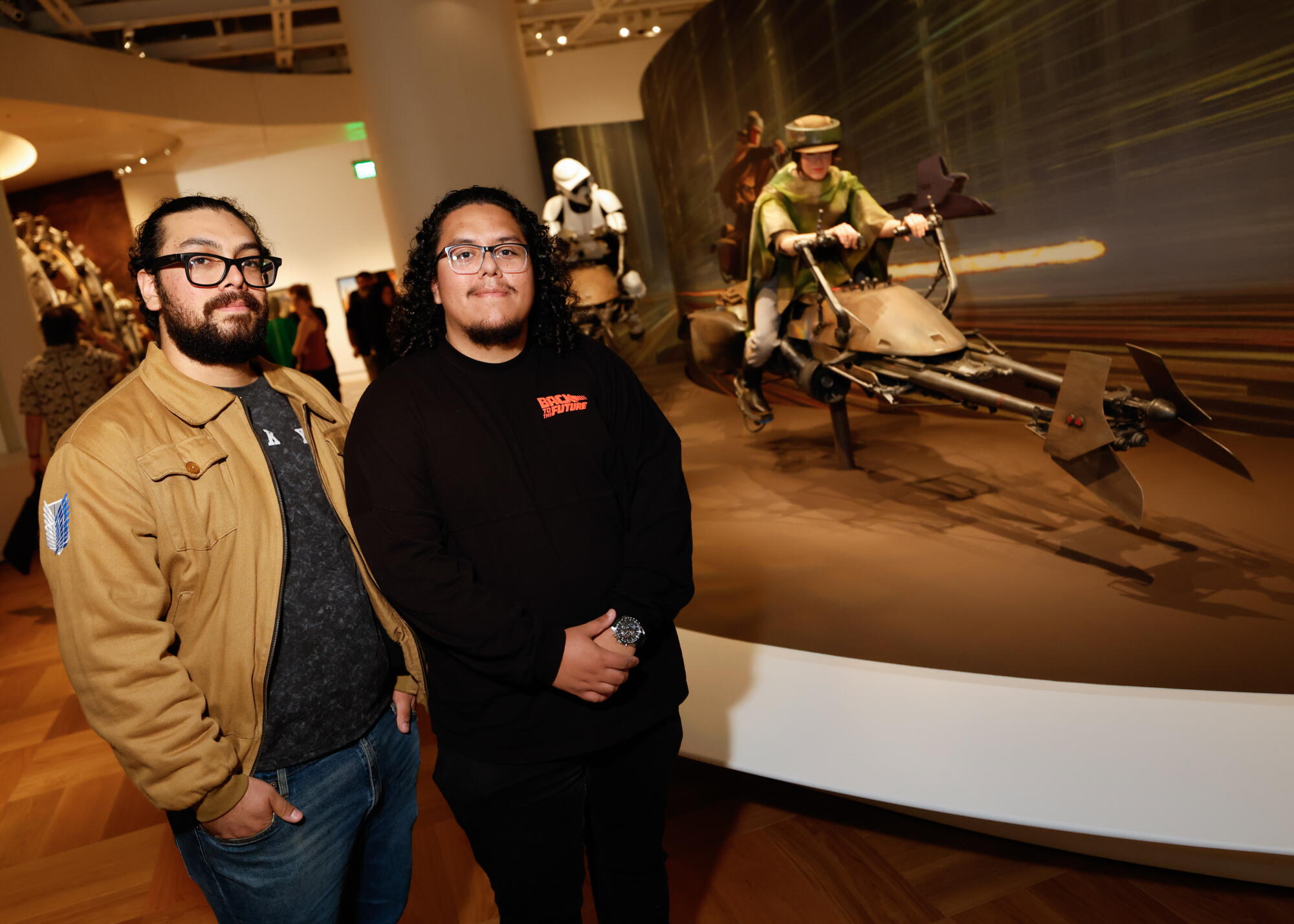
David Perez, 27, (right) donned his “Back to the Future” gear, hoping to see art from the movie. But he and his brother Carlos Perez, 28, (left) were quite pleased with the “Star Wars” artifacts in the Cinema section.
(Carlin Stiehl / For The Times)
Still, the museum, as its famous co-founder George Lucas has repeatedly said, is about more than just one story, however beloved. That sentiment cropped up repeatedly in interviews, too: Early guests seemed to believe the museum’s brochure, which notes that the galleries are about the “narrative art” of illustrating stories.
Co-founders Lucas and businesswoman Mellody Hobson (also Lucas’ wife) gave remarks early Tuesday to the first 100 visitors, consisting of students from USC, Los Angeles Technology Center, Otis College of Art and Design and Los Angeles City College, who were all handed free tickets.
A yellow Naboo N-1 Starfighter hangs above the education lobby, across from the main plaza, guarding the research library.
(Carlin Stiehl / For The Times)
“I’ve spent more than 50 years collecting the work of artists who don’t always get their due — illustrators, cartoonists, muralists, painters — because I believe their images are as vital as any other art form,” Lucas said. “They deserve to be in a museum.”
“This is a museum of the ‘people’s art’ — the images are illustrations of the beliefs we live with every day,” said Hobson, “and for that reason, this art belongs to everyone.”
Later that day, The Times asked visitors to share their impressions of a museum that, until now, has lived largely in the imaginations of fans and in abundant social media posts online. The museum has drawn loads of applause but also plenty of criticism, mostly for its lack of context via wall text, and for displaying art that not everyone agrees should be elevated.
Do the people love the “people’s art”?
Responses have been edited for length and clarity.
Alden Chang and his wife flew 6,800 miles from Taiwan to thank George Lucas for creating the “Star Wars” films and franchise. Chang told The Times that he also wrote an academic paper examining “Star Wars” fan culture in Taiwan.
(Carlin Stiehl / For The Times)
Alden Chang, 32, green product engineer from Taiwan
You flew all the way from Taiwan, just for this?
Chang: Yeah, halfway across the world to meet George Lucas and Miss [Mellody] Hobson.
Did you get to meet them?
Chang: Yeah, I just shook hands with them this morning. It’s like a dream come true.
How long ago did you and your wife get here,and how long are you staying?
Chang: For eight days. We came here on Sept. 18.
Is this the highlight of the trip?
Chang: Sure. [Laughs.] It’s my main mission and my main goal.
(Later, in an email, Chang told The Times that he also wrote an academic paper examining “Star Wars” fan culture in Taiwan.)
Friends Robert Meier, left, and Marc Downing used to work as ushers at the Music Center together. Growing up, Marc rode his bike where the Lucas Museum now stands.
(Carlin Stiehl / For The Times)
Marc Downing, 71, retired, from Exposition Park and Robert Meier, 70, educator, from Highland Park
Downing: I go to all the museums. This was the newest museum, so I had to come and see this.
How does this compare to the other L.A. museums?
Downing: This is ultra modern, ultra space-future. I’m glad the museum is here; highly recommend it. And I’m proud that it’s in my city, and I’m glad that it’s in the neighborhood that I grew up with.
What made you want to be a member of the museum, Robert?
Meier: It’s giving to the neighborhood. I’ve admired George Lucas — I used to have a relative in Marin County, and growing up, we’d go to lunch, and I’d see George Lucas and his family. We’d be at the same restaurant together.
Downing: Well, speaking of this neighborhood: This used to be a parking lot. I remember it very well. And I used to come here and ride my bike in this neighborhood as a kid.
C.S. Lee sits on a bench at the south viewpoint of the museum, gazing out onto the sculpture garden below. “This is why you live in Southern California. This is why you live in L.A.: for days like these.”
(Carlin Stiehl / For The Times)
C.S. Lee, 54, actor, from Koreatown
Lee: “Star Wars” was the very first movie I ever saw in my life as a 4-year-old when I immigrated here from Korea. We landed in Hawaii, in Waikiki Beach. Our family friends took us to a drive-in movie cinema place, and they said, “You want to come see a movie?” And it was “Star Wars” and “King Kong,” double billing. And my mom said when I saw the screen, my eyes popped out of my head because I’d never seen a movie before.
How do you think “Star Wars” impacted how you saw narrative and story?
Lee: I think I carried that all through my life: the story of “Star Wars.” I was like, “Oh, the good guys won!” And it was such an uplifting thing for me to hold on [to] all these years.
What did you think about the rest of the museum?
Lee: It’s so beautifully done: all the curves, all the light. You got the wind coming through the trees that they planted. I mean, honestly, I was just looking out, thinking to myself, “Wow, this is why you live in Southern California. This is why you live in L.A.: for days like these.”
The view of the sculpture garden and grounds beyond that C.S. Lee was contemplating from the south viewpoint.
(Carlin Stiehl / For The Times)
What about the building itself?
Lee: We rarely get to see architecture like this. But I think it’s good for people to see the artistry and the imagination of what people can build.
Janet Jacobs, 62, architect and Hanjin Jacobs, 25, audio equipment manufacturer technician, mother and son on a family trip from Portland (pictured at the top of the story)
I see you’re wearing a “Star Wars” T-shirt.
Janet: Yes, I am — actually from 1977.
Wow, really?
Janet: Yeah, I’ve had it for that long [laughs].
What was your overall takeaway from the museum?
Janet: I know George Lucas wanted to create this museum in a different way, like he didn’t have a sequence of events or a roadmap, he just wanted people to experience it the way they wanted to, so that’s all great. We do wish some of the things were explained a little more. Like, I know who Ralph McQuarrie is; [my kids] do not. So that would’ve been nice. Like in a typical museum, you do have a little blurb.
[My son] brought up a really good point: how ironic it is that it’s about storytelling, but yet there seems to be no storyline.
Andrew Liu, left, and Matthew Haak hang loose in front of a KAWS sculpture. They actually didn’t know it was opening day, but were happy to be there anyway.
(Carlin Stiehl / For The Times)
Matthew Haak, 26, architectural designer, and Andrew Liu, 26, behavioral therapy assistant, both from University Park
Haak: We are not “Star Wars” fans. I haven’t watched a single “Star Wars” movie. I’ve somehow evaded them my entire life.
So, if not for “Star Wars,” why did you come out today?
Haak: I’ve been watching this building being constructed for the past two years. I’m just geeking out over the organic curvilinear forms. Not a single hallway has been straight. And they even have real expensive details, like light coves on the base [of the wall]. All of these things really stand out to me. Also, curved walls like this are so expensive; architects never get a budget to do stuff like that.
I was just surprised: It’s not just “Star Wars” stuff. There’s so much art; it’s so cool.
Nicole Garcia — dressed as Padmé Amidala in her lakeside gown — poses in front of a statue of Princess Leia.
(Carlin Stiehl / For The Times)
Nicole Garcia, 24, cosplayer/costumer from Corona and Veronica Antonucci, 40, administrative assistant from Orange County
So, this might be an obvious question [given their fun outfits], but what brought you guys out today?
Antonucci: This little thing called “Star Wars”!
Garcia: Growing up with “Star Wars,” I always loved all the pieces, knowing that, for example, there’s miniature pieces that look just huge on-screen, and seeing them in-person is just, like, I want to shrink myself down and just be there.
Antonucci: It’s also amazing that it’s not just “Star Wars,” and it’s also so much more that everyone should come out and see.
Is there anything else you were particularly excited to see?
Antonucci: I was really excited to see the Frida [Kahlo]. I didn’t know she was gonna be here, so I think when I saw her, I gasped.
Is there anything else you’d like to add?
Garcia: I just hope the future generations of kids come back to see this, growing up with museums more often, and just learning how to make art — like, physically make art — and be inspired.
Antonucci: Actually, we talked about feeling jealous of all the kids who are going to be here on their school field trips, because we didn’t get to experience this.
Nikki Foster, left, loves a good field trip. She texted her group chat to visit the museum, and her bestie, Shalonda Dean, responded, so they both cleared their calendars for the visit.
(Carlin Stiehl/For The Times)
Shalonda Dean, 47, consulting business founder and president, and Nikki Foster, 45, live event production executive, both from Beverly Hills
Dean: Being a Black woman, I can identify with this little Black girl. Even in 2026, I think this painting depicts a lot of what Black women are going through today, whether it be in the workplace, navigating motherhood, navigating life. And I think this is an example of the barriers that we’re constantly breaking through every day, even today.
Foster: I’ve never seen it in person until now. So when we saw it, we were like, “It’s here, it’s here!” Just to be able to lay our eyes on it, and not have to go to another country, another state — here in Los Angeles. This is divine. It’s a divine day.
“I love meeting people,” Vincent Zabierowski said. “People are my main inspiration. I’m very lucky I get to be in a place where people want to be, and people want to soak up all that creative energy and just experience art.”
(Carlin Stiehl / For The Times)
Vincent Zabierowski, 23, host at the Skywalker Grill and freelance illustrator, lives near Downtown L.A.
As an artist yourself, what are your favorite pieces in the museum?
Zabierowski: I love a lot of the things that are in the graphic novel collection, like the Jack Kirby, the Garfields. My favorite is the Art Nouveau artist Alphonse Mucha. The Diego Rivera mural, that one was really amazing — and just the history here, having it be in L.A.
How does your work as an illustrator inform how you see these pieces?
Zabierowski: When I was going through it with some of my co-workers, I would [ask] “Do you know why they use a blue pencil?” And it’s because, when you take a photograph or a scan, that blue pencil disappears. So it was just really cool to see the behind-the-scenes and understand.
So seeing those blue pencil marks tells you that a piece is real?
Zabierowski: A person made it! I feel like a lot of people see artwork in textbooks, or they see artwork on their phones, or they see artworks on posters, and it takes a lot of skill and intelligence and training to be able to do those pieces of artwork.
In the first half of 2026, issuers raised $137.9B through 208 initial public offerings on U.S. markets, boosting capital raised by 398% from the year-ago period, according to data released by the U.S. Securities and Exchange Commission on Wednesday.
WASHINGTON — President Trump’s AI-fueled vision for a drone port he intends to install atop the new White House ballroom includes missile-bearing unmanned aerial vehicles and gun-toting troops, ostensibly to protect the 18-acre complex and the nation’s capital.
A few hundred feet away, a drone port, run by the U.S. Secret Service and not the military, is already quietly operational. Equipped with cameras and sensors to scope out potential threats from a bird’s-eye view, the small UAVs stand on alert in four gray weatherproof boxes until deployed at officers’ commands.
The agency is using a model known as “drone as first responder,” deploying speedy unarmed drones from outdoor stations to serve as flying cameras. That model has been adopted by hundreds of police agencies across the U.S., often powered by AI software to help dodge obstacles or track targets.
The existence of the surveillance drones on a Treasury Department building adjacent to the White House complex has not been previously reported, and could undercut Trump’s legal claims that the ballroom construction is necessary “to protect the White House and surrounding region from aerial attacks.” The need for the drone port underpinned Trump’s national security defense for the construction project — a justification he is now citing for the construction of a massive arch outside the gates of Arlington National Cemetery.
The installation is thus far markedly less imposing than the vision outlined by Trump, with its rows of futuristic attack drones, apparently modeled after those used in U.S. military strikes, that drone experts describe as outlandish.
“To be honest, if a drone was so close to the White House that it needed interdiction, it’s already gotten too far,” said Matt Sloane, co-founder of SkyfireAI, which makes software for drones used by public safety agencies.
It would be more realistic for the White House to build something akin to what the Secret Service is using next door, Sloane said: “The drone takes off and does some type of perimeter sweep or whatever, and then puts itself back in the box.”
The White House did not comment for the story. The Secret Service declined to comment on the specifics of its drone operations but said the new docks are separate from Trump’s ballroom drone port.
The details of Trump’s ballroom drone port remain murky
Security of the president and the White House complex is generally the domain of the Secret Service, which works in close concert with the White House Military Office and other military elements when needed.
Trump has said the drone port came at the request of U.S. military officials. Speaking to reporters in May, he said the building’s plans were expanded to meet the request: “They wanted more drone capacity,” he said. On social media, he boasted that the drone port might end up being the “most sophisticated” in the world.
What Trump is ultimately aiming to build, and how far it goes beyond what has already been installed, remains unclear. Beyond Trump’s AI images, some of which he filed in his appeal to the U.S. Supreme Court to lift lower courts’ blocks on the construction, the White House has not disclosed what kinds of drones will be used or for what tactical purpose.
The Secret Service is using smaller surveillance drones that are a fraction of the size of the attack drones depicted in Trump’s AI images. The U.S. Air Force bought similar drones from Skydio in April to protect bases across the Middle East. The company also supplied drones to help protect World Cup matches this year.
The Secret Service has been building out its drone- and counter-drone programs for years. But work has accelerated since the 2024 attempted assassination of Trump at a campaign rally in Butler, Pa., when the agency failed both to take action against a drone used by the shooter to scout out the attack and to fly one of its own to provide overwatch of the event.
In the weeks that followed, tethered and untethered surveillance drones became commonplace at campaign rallies and large events at the White House complex.
In an online video released by the agency highlighting their deployment, the Secret Service said the Skydio drones are used to provide “real-time situational awareness” and “aerial overwatch.”
“It allows you to see the threat before it becomes an issue, and to task assets accordingly,” Dustin Talbott, of the Secret Service’s Aviation and Airspace Security Division, said in the video. “We no longer wait for the threat to reveal itself. We find it first.”
Skydio did not provide comment for this story.
Trump’s drone port vision would face logistical hurdles
Trump has made it a priority to build a stronger drone presence around the White House, responding to an increase in political violence and the evolution of drone warfare.
Paul Eckloff, a former supervisor of the Secret Service’s presidential protection division, said the Russia-Ukraine war has highlighted the risks posed by drones, even off-the-shelf models that can cause massive damage. Drones now represent one of the largest emerging threats the White House must defend against, he said.
During Trump’s first term, conversations about drones often centered on their use in places like Iraq and Syria, said Javed Ali, who served on the National Security Council during at that time and now teaches national security at the University of Michigan. Since then, it has become a matter of domestic security, he said.
Yet there would be major logistical hurdles involved in putting a busy drone port on top of the White House, he said. “There’s a whole host of questions, like who is responsible for overseeing it, and how would there be any de-confliction with commercial airspace?” he said.
Complexities around federal oversight were laid bare this year when the U.S. military used a laser to shoot down a drone near El Paso, Texas, only to find it belonged to Customs and Border Protection. The mishap briefly led the FAA to close nearby airspace.
A drone hub at the White House would navigate crowded and complex airspace around Washington, not far from Reagan Washington National Airport and flight paths shared by other military aircraft.
Opponents say the White House is becoming a fortress
Trump started talking about the drone port in May, weeks after a federal judge halted ballroom construction but allowed work on security components to continue. Trump later went on to refer to the ballroom as a “military complex,” leaning on that security role as a legal justification.
The Supreme Court in August cleared Trump to continue construction as the legal challenge moves ahead.
Opponents say the president is going too far in his hardening of the White House, turning it into something closer to a fortress. Edward Lengel, a former chief historian for the White House Historical Assn., said Trump has militarized the White House at a scale that’s at odds with its legacy as “the people’s house.”
“It turns it into a big giant porcupine that has its spines pointing out against the people and against the world,” Lengel said.
Trump has argued that the White House was in “very bad condition” when he returned to office, saying it had become vulnerable to modern threats.
At times, he has expressed concerns about his own safety and the risks posed by drones and other air threats. Speaking at a Rose Garden dinner for law enforcement officials in May, Trump quickly glanced up from the lectern as a low bird flew overhead.
“I thought that was a drone,” Trump said, bringing laughs from the crowd. “They make them in all different sizes nowadays — they can be very destructive, as you’ve probably heard.”
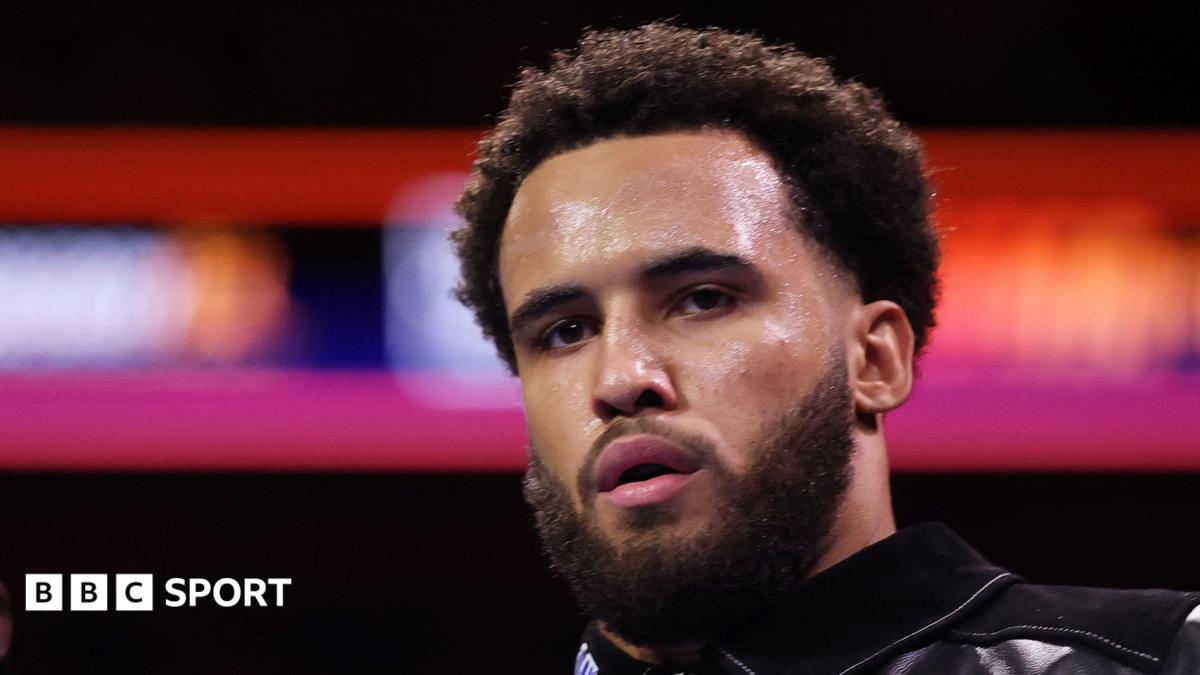
Moses Itauma may never lose again if he can get over the “humiliation” of his IBF heavyweight title defeat, says Filip Hrgovic, who stunned the Briton in August.
The Croatian, 34, stopped Itauma, who had been the strong pre-fight favourite, in the ninth round of their meeting at the O2 Arena.
The early signs suggested Itauma had the measure of his opponent, with Hrgovic touching the canvas in the second round and conceding that he was “outboxed” early on.
Hrgovic took advantage when Itauma tired but stressed the 21-year-old southpaw is so skilful that he could go on to have a hugely succesful career if he learns from his loss.
“He’s really good. He’s special. Very fast, very talented and he countered whatever I tried with his speed and timing,” said Hrgovic.
“I never was in the ring before with such a talented kid, with such a fast guy. You have some fast guys but they’re small heavyweights. You can handle them with your power but this kid is fast and big. He’s got great IQ and great talent.
“I’m still kind of angry because he outboxed me. In my whole career, in 20 years of boxing, I was never outboxed in any sparring or any fight.”
While Hrgovic, who wants to unify the division, praised Itauma’s boxing abilities, he suggested doubts remain over his mentality.
“It was big shock for him, big humiliation, so maybe it’s end of his career if he’s not mentally tough. If he recovers from this loss, mentally, it will be hard for anyone to ever beat him again,” Hrgovic added.
“A lot of people after that kind of loss, they never come back. So, it will be a hard journey for him to come back.
“You have to go through a ruthless, hard training camp. You need to go through hell to be mentally ready for this. I think he was physically ready but it’s the mental part.”
In a defiant speech at the United Nations General Assembly, Iran’s President Masoud Pezeshkian has delivered a sharp rebuke to a threat by US President Donald Trump from the same rostrum the previous day to annihilate the country, but left the door open for diplomacy to end nearly seven months of war.
“The US president called us terrorists but we are the victims of terrorists,” Pezeshkian said on Wednesday.
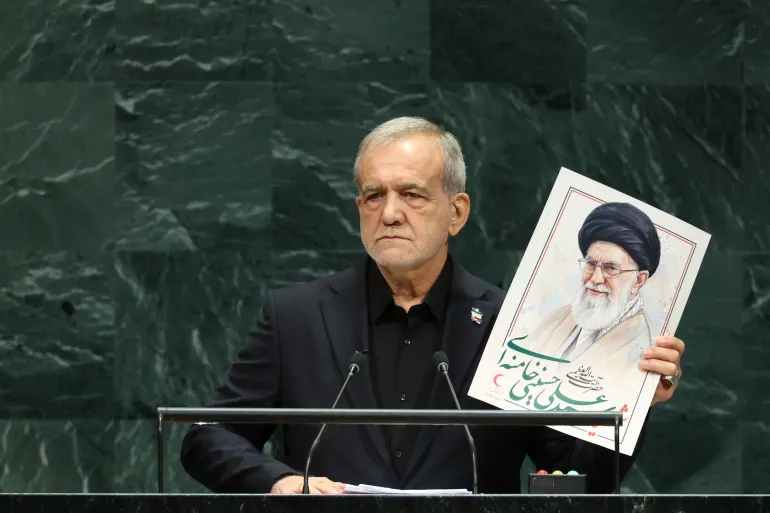
During his speech, Pezeshkian held up a picture of former Supreme Leader Ayatollah Ali Khamenei – assassinated in a joint US-Israeli strike at the start of the war in February – as well as photos of schoolgirls killed in an alleged US air attack on their school in the southern city of Minab.
“They hit us, but we did not bow our heads or bend the knee,” Pezeshkian added.
As the Iranian president began his speech, an official from the US delegation walked out of the vast hall. The Israeli delegation also boycotted the address.
“[Trump] must know that the resistance of the Iranian people will only grow in the face of sanctions and increased pressure and bullying,” Pezeshkian said.
Iran’s President Masoud Pezeshkian holds up a picture of former Supreme Leader Ayatollah Ali Khamenei, who was assassinated in a US-Israeli attack in February, as he addresses the United Nations General Assembly on Wednesday [Caitlin Ochs/Reuters]
But Pezeshkian, a relative centrist in the Iranian ruling system, also left the door open for negotiations, saying, “Iran extends its hands towards the world.”
“We invite the world and call to it, not out of weakness, but out of a deep belief in our own power and steadfastness to cooperate and collaborate out of a deep understanding that no one in this region will have security alone,” he said.
‘Very good meeting’
On Tuesday, Trump said his son-in-law Jared Kushner and Steve Witkoff, who are both leading negotiations with Tehran, had held a three-hour meeting with Iranian officials.
“They had a very good meeting, a very productive meeting,” Trump told reporters at the UN, adding that he believed there was “a lot of momentum” towards an agreement. Trump later said talks were continuing and that he believed a settlement would eventually be reached.
The remarks came after Trump used his speech before UN delegates to again threaten Iran’s destruction.
“Will a deal be made with Iran that lets them rebuild and create a far greater country than it ever was before?” Trump said. “Or do I annihilate the Islamic Republic and do it quickly, never giving them a chance to kill and destroy people and countries again?”
Strait of Hormuz
Addressing the US naval blockade of Iran and Tehran’s campaign to choke off trade in the Strait of Hormuz, Pezeshkian said Iran would resist what he called US efforts to use the critical sea lane to expand its war on the country.
“In the Strait of Hormuz, we cannot have some free access and gain their independence from that waterway while at the same time use that waterway to impose their aggressions upon us and to impose insecurity upon us; to forbid us access to our own waterways,” he said.
Negar Mortazavi, a senior fellow at the US-based Center for International Policy, said the Iranian president’s speech showed usual flashes of defiance, but notably signalled an appetite for a diplomatic off-ramp.
“Iran wants a way out of this war. They’ve kept the door to diplomacy open,” she told Al Jazeera.
“Reading between the lines of the Iranian president’s speech, it seems Iran may even show some flexibility as far as a return to some sort of agreement that may not be exactly along the lines of the June Memorandum of Understanding that US President Trump doesn’t seem interested in returning to,” she said. The memorandum, which has expired, called for a halt to fighting, lifting the US naval blockade and opening the Strait of Hormuz to maritime traffic.
Compromise still a possibility
Drawing parallels between the US and Israel bombing of Iran and Israel’s attacks in Gaza, Pezeskhian said Israel’s genocide in Gaza “revealed the double standards to which Iran is held by the international community”.
“They kill and we are sanctioned and we are punished,” Pezeshkian added.
Joey Hood, a former US diplomat and ambassador to Tunisia, said the speech leaned heavily into familiar Iranian official rhetoric and represented a lost opportunity to seek compromise.
“Instead of coming to the United Nations with something new and bold, we heard the same things that we’ve heard before,” Hood said, adding that a concrete peace offer or proposal posed to the US in the speech might have focused Washington’s attention.
“That would actually put Donald Trump on the backfoot, and he would have to respond. The Iranian president didn’t do any of that,” Hood said.
NASA Administrator Jared Isaacman has left something of a mystery hanging in the air after showing the silhouette of an aircraft that immediately drew comparisons to the famed SR-71 Blackbird during a recent speech. Isaacman pushed back on a direct link to the SR-71, but said his agency is working hard to get “back in the business of flying high and fast again.”
The silhouette, accompanied by the tagline “Rebuilding our X-plane portfolio,” was among the backdrops for Isaacman’s remarks at the annual All-In Summit in Los Angeles, California, last week.
The SR-71’s iconic shape is defined by its long, sword-like profile, pronounced chines, and deeply swept wings, and huge spiked engine nacelles with canted fins on top. Its distinctive geometry is reflected in the silhouette, which shows a broad, highly blended aircraft from an unusual head-on angle.
NASA Administrator Jared Isaacman talks at the All-In Summit about new high- and fast-flying X-planes with the eye-catching aircraft silhouette in the background. All-In Summit/YouTube screencap
“In the service of the first A [aeronautics] in NASA, we are rebuilding our X-plane fleet. The X-59 is researching quiet supersonic flight, but it’s just the beginning,” the head of NASA told attendees. “As NASA recommits to flight test and works alongside industry to push the boundaries of airframe and propulsion design, it will not be long before NASA once again is flying as high and as fast as we had in decades past, and then even more.”
Isaacman’s full speech at the All-In Summit, as well as his remarks during a live interview that followed immediately afterward, are contained in the video below. The high-speed aircraft silhouette is first seen at around the 12:40-mark in the runtime, and is then further discussed at around the 28:39-mark.
Jared Isaacman: A New Era for NASA and American Space Exploration
Chamath Palihapitiya, co-host of the All-In Podcast and one of the hosts of the summit, asked Isaacman directly about the silhouette during the fireside chat after his speech.
“You showed a picture of the [SR-71] Blackbird up there,” Palihapitiya said at one point, before Isaacman interjected.
“You sure that’s a Blackbird?” Isaacman said.
“Well, ok. What was that picture you showed up there?” Palihapitiya asked.
“Like I said, NASA is getting back in the business of flying high and fast again,” Isaacman said in response, and declined to further elaborate.
Whether or not the silhouette reflects a real design that is in development now is unclear. TWZ has reached out to NASA for more information.
Exactly where Lockheed’s SR-72 ambitions sit today is unclear. After talking constantly about the potential program for a number of years, it went silent, which could indicate the program had moved forward deep in classification.
Tom Cruise trolls Ed Harris and goes Mach 10 | Top Gun 2 | CLIP
NASA has worked with other supersonic and hypersonic X-planes in the past, as well. This includes reusable space planes, as well as aircraft designed to fly within the Earth’s atmosphere.
“I mean, that doesn’t seem like a space vehicle. It seems like an Earth-air vehicle,” All-In’s Palihapitiya noted during his chat with Isaacman about the silhouette he showed.
“Yeah. The first ‘A’ in NASA is our aeronautics portfolio,” Isaacman said in response, before highlighting a host of contributions his agency has made to advanced military and commercial developments over the years. “You know what I want to do? I want to get back to the radical airframe and engine designs like we were always supposed to do.”
As mentioned, Isaacman also highlighted the X-59 Quiet Supersonic Technology experimental test aircraft, or QueSST, at the summit, but made clear the goal is to go well beyond that design. The QueSST jet is the centerpiece of a program now to investigate technologies that could eventually enable commercial supersonic flight over land with a substantially reduced sonic boom.
The X-59 conducted its first supersonic test flight, reaching Mach 1.1, in June. NASA’s test program aims to eventually push the aircraft up to a speed of Mach 1.4. This is significantly below the record-breaking mark of approximately Mach 3.3 that the SR-71 clocked back in the mid-1970s, but it was never designed for extreme speed as testing its sonic signature was its primary goal.
NASA’s X-59 flies above the Mojave Desert in California on August 18, 2026. NASA/Jim Ross
As for bringing a Blackbird back into operation for high-speed testing, which is now at the forefront of military aeronautics (and civilian to a lesser degree) after decades of being sidelined, that would be a very challenging operation. The SR-71s are long retired and have been placed in museums and other display areas. While the Pentagon could technically claw some of them back from their ‘on loan’ status, reconstituting even one of them would be a major undertaking as the entire support ecosystem that once sustained them has been gone for decades. Still, having a Mach 3+ capable jet for testing would be a highly relevant tool in a new age of high-speed flight exploration.
On the other hand, building a new test aircraft that aims higher and faster than the SR-71, but may be based on its ‘DNA,’ is certainly possible. Such an aircraft could leverage material science, avionics, flight controls, and engines that are seven decades more modern than its progenitor. Technology demonstrators in this class could also already exist in the classified domain. NASA could possibly assume ownership of one after the Pentagon declassifies it, as well.
Regardless of how such an exotic aircraft is obtained, one of the biggest differentiating factors could be that a NASA aircraft is piloted by a human onboard, instead of it being a drone, but an uncrewed aircraft is possible too.
A NASA SR-71 taxis at Dryden Flight Research Center during its late operational phase. NASA
Isaacman has been very open about its interest in and support for new X-plane developments. On only his second day on the job, in December of last year, he called for revamping the agency’s aeronautics program and stated that “I’d love to see an expanded X-plane portfolio” during a town hall with NASA staff.
“If NASA has a healthy X-plane portfolio, we should be flying experimental aircraft so routinely that the second flight of a single X-plane is not newsworthy,” he wrote in a post on X in March of this year. “For example, the two NASA X-29 aircraft flew 422 flights between 1984 and 1991. That period also overlapped with the development of two X-31 aircraft, which together flew about 580 times.”
One of the X-29 X-planes, at left, and the X-31, at right. NASA/DARPA
NASA’s proposed FY2027 budget also spelled out rapid, cost-effective flight experimentation as an explicit priority. Budget documents specifically highlight work toward new advances in supersonic and hypersonic flight technologies “that will revolutionize air transportation, strengthen national security capabilities, and position America to lead the future of high-speed flight,” as well.
Furthermore, in April, NASA outlined a new Aeronautics Flight Accelerator (AFA) initiative. At that time, the agency put out a call for “input on technologies, concepts, and flight test campaigns suitable for cost shared maturation leading to flight within the next three years.” Stated areas of interest included “subsonic (including vertical lift), supersonic, and hypersonic flight technologies.”
It is important to reiterate that we still do not know whether the silhouette Isaacman showed at the All-In Summit represents an active development effort and, if so, how mature it might be. Government agencies and contractors routinely use concept art to illustrate an area of research or communicate a future vision. Such artwork does not necessarily correspond to a funded aircraft, an active prototype, or even a specific configuration.
At the same time, under Isaacman, NASA is clearly pushing toward new X-planes. NASA’s X-plane programs have historically served as a way to investigate technologies that conventional aircraft programs were not prepared to risk. The resulting aircraft have explored everything from supersonic and hypersonic flight to unconventional configurations and new propulsion concepts.
At the very least, evoking the visual legacy of the SR-71 Blackbird, coupled with Isaacman’s comments, provides a clear indication that NASA is interested in returning to the high-speed flight regime as part of its future plans.
Update: 2:04 PM ET –
NASA has now provided TWZ with the following statement in response to our queries for more information:
“NASA has a long history of building and flying experimental aircraft that push the boundaries of what is possible. As Administrator Isaacman has said, we want to see more X-planes flying in the years ahead, developing the technologies that will allow us to fly higher, farther, and faster than we have in decades. We look forward to sharing more as those efforts progress.“
EXCLUSIVE: Emmerdale’s Katie Hill – who plays Sarah Sugden on the ITV soap – warns there’s a ‘rocky road’ ahead as she details devastating consequences for Charity
19:10, 23 Sep 2026Updated 19:10, 23 Sep 2026
What’s next for the pair?
Sarah Sugden star Katie Hill has revealed some tragic twists on Emmerdale in the coming weeks.
Fans will know Charity Dingle is currently under investigation for the death of Dr Todd but it was Sarah who killed her. In a shocking turn of events, Charity confessed to Sarah that the baby she thought was hers and Jacob’s was actually Charity’s and Ross’.
Now, actress Katie has warned there’s more trouble ahead for Sarah and Charity in the coming weeks in an exclusive chat with The Mirror at the Inside Soap Awards.
“When the producer told me, I was so shocked. I had no idea it was going to be Sarah that was the one to kill her. It was a massive shock. She didn’t do it on purpose. It’s not in her nature to kill someone,” she said.
“She’s just now found herself in this really sticky situation. And then obviously with the baby thing on top, finding out about that, she’s just acted on impulse. She’s so angry, and she’s thought, ‘This is what I need to do to get my peace,’ type thing.”
However, Katie warned that despite her confessions, Sarah will continue to struggle.
“I think she’s still struggling with the idea that she’s killed someone. We’ll see her go through a bit of a rocky journey with like parenting, sleepless nights,” she told us.
“I think she’s just revisiting what she’s doing over and over again. And the guilt obviously did set in with Charity and reporting her but she’s gone and taken all that back. It’s a rocky road ahead for Sarah.”
Just a few weeks ago, Sarah found out that Charity had lied about the baby’s parentage.
Speaking about the impact of the storyline, Katie revealed: “In Sarah’s eyes, this is the end. I don’t think she believes she will ever be able to forgive her. The dynamic between the two characters has shifted completely. Sarah is taking charge now, and while it’s obviously devastating for Charity, Sarah just can’t see a way past this.
“From this moment on, as awful as it sounds, Charity is essentially dead to her. She doesn’t want Charity to have anything to do with her or Leyla. Sarah is setting very strict boundaries, she’s nothing to her now.”
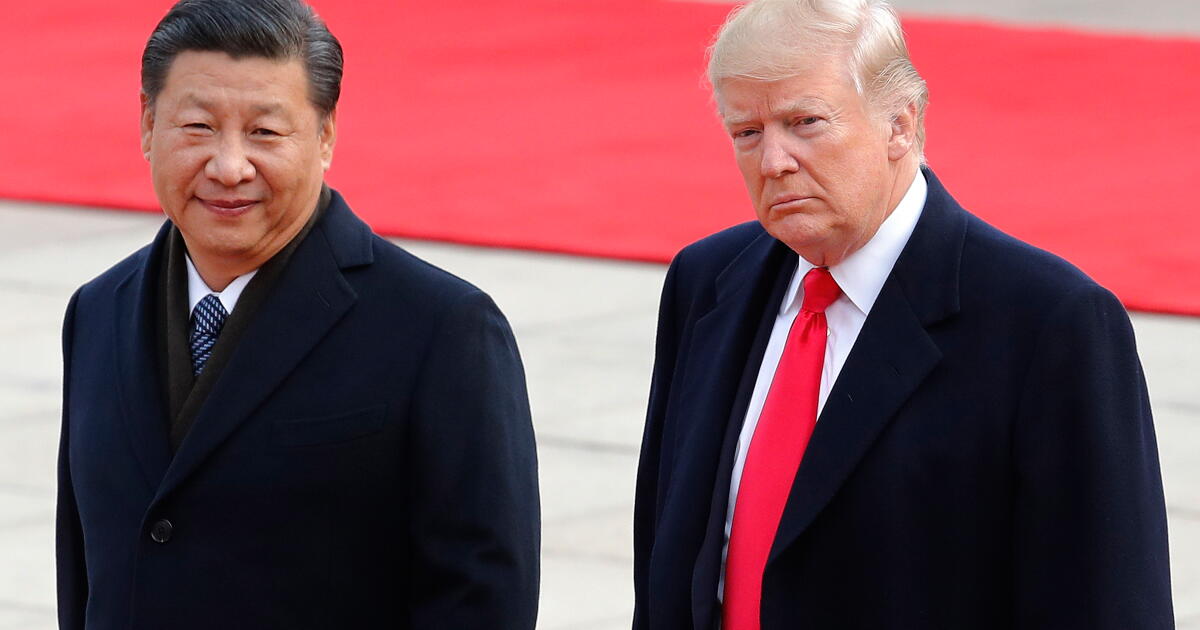
WASHINGTON — When Chinese President Xi Jinping arrives in Washington on Wednesday, he’s expected to get a rare greeting from President Trump, who will be on the tarmac to welcome his counterpart instead of waiting for him to drive up to the White House.
Trump’s decision to greet Xi at Joint Base Andrews just outside Washington rather than receiving him at the executive residence shows how far the U.S. president is going to honor China’s leader as he makes his first state visit in more than a decade.
First lady Melania Trump said her husband decided to personally greet Xi when he arrives in the Washington region because “they have a great relationship.”
“He’s coming on our soil, and we need to welcome them with the most respect,” she said of Xi and his wife, Peng Liyuan, during an interview Wednesday on Fox News Channel’s ”Fox & Friends.”
The White House has not released many details about Wednesday’s greeting, but Trump is expected to participate in an arrival ceremony at the base with Xi and his wife. The salutation will kick off a three-day visit that’s expected to be saturated with pomp, even by White House standards. The state visit, complete with a formal state dinner at the White House on Thursday, is supposed to reciprocate for the ceremonial grandeur that marked Trump’s May visit to China.
But it also is a showy patina at a time when tensions between the two geopolitical rivals are high over trade, artificial intelligence, Trump’s war with Iran and China’s designs on Taiwan.
Beyond using the visit to try to keep “strategic stability” between the two countries, Trump seems to be pulling out all the diplomatic stops to show off for Xi. Trump has lavished praise on Xi as a “great leader” and described a warm relationship with the man he has called a friend. That is all while he has given Xi a pass on many issues.
Sen. Roger Wicker, chairman of the Senate Armed Services Committee, criticized the “lavish welcome.” Wicker, R-Miss., said during a speech Tuesday in the Senate that Trump should not have invited the Chinese leader “based on all of the troubling issues we have with President Xi and the Chinese Communist Party.”
Wicker archly suggested a list of topics that Trump could discuss with Xi at the state dinner, such as “the purposes of China’s massive military buildup, or about China’s clear support for Iran,” saying that “during every minute of dialogue” Trump should keep in mind that “his guest is a brutal, unelected and oppressive dictator who seeks to dominate his neighbors and whose massive military arsenal is aimed directly at the United States of America.”
Secretary of State Marco Rubio said the U.S. and China must interact at the highest levels because the countries are “the two largest economies in the world” and “probably the two most powerful militaries in the world.”
“The idea that we would not interact with them at the highest levels is irresponsible. It’s outrageous. We have to,” Rubio told reporters Wednesday while he was in New York.
Trump has made it clear he wants to wow Xi, telling reporters in recent weeks that he was delighted his new “work of art” helicopter landing pad would be ready for the visit while bemoaning that his massive White House ballroom would not.
On Wednesday, Trump is expected to try to match the pageantry he was met with in China earlier this year. Xi was not at the airport to meet Trump — Chinese Vice President Han Zheng was there instead. But there a red carpet was rolled out to meet Air Force One in Beijing. A military honor guard, a military band and about 300 Chinese youths waving Chinese and American flags and chanting, “Welcome, welcome! Warm welcome!” also were present. The children wore white and light blue uniforms that mirrored the traditional paint colors of the presidential plane.
Trump’s airport ceremony for Xi will be followed on Thursday by more formalities, including an arrival ceremony at the White House and a review of troops. Before the black-tie dinner, which will feature tech industry leaders like Nvidia’s Jensen Huang and SpaceX’s Elon Musk, the two leaders are expected to dive into the weighty issues behind closed doors, even as expectations are low that the trip will produce any major breakthroughs in the relationship.
On Friday, Xi and Peng will be back at the White House for a private tea with the Trumps before joining them on a tour of the National Archives in Washington. The White House has said they will view historic documents underscoring the relationship between the two countries.
Price writes for the Associated Press. AP writers Mary Clare Jalonick and Didi Tang contributed to this report.
Daley Cross, manager of the England team, said of Lucy’s role: “She was just trying to do her best for him and trying to find a way to motivate him.
“His wife did drop in the conversation that he used to play at Manchester United as a schoolboy. So that got our ears twitched instantly.
“You could tell from him being on the pitch, even though he was so fresh into his journey, that he knew the football game and he would be such an incredible asset to us.
“You can be in a dark place, at the time of diagnosis, through your treatment or even post-transplant. So to have us exist to help and inspire people means that we are getting some incredible footballers.
“And that really is the power of it: to that transplant community or to the world, showing people that when you’ve had organ failure, your life isn’t over. There is a chance for you, and you can go and resume and live your life.”
As the recipient of a donor heart, Jackson has to manage his exercise workload more carefully than his team-mates, many of whom have had kidney transplants, the most common transplant in the UK.
His role in the side tends to involve 10-minute bursts, rather than playing for the duration of matches.
The move comes after the EU lifts sanctions on oligarchs following what diplomats described as pressure from Baku.
Published On 23 Sep 202623 Sep 2026
Azerbaijan’s President Ilham Aliyev has pardoned Martin Ryan, a French national who was serving a 10-year prison sentence on spying charges.
The move on Wednesday came a day after the European Union lifted sanctions on Russian billionaire Alisher Usmanov following what diplomats described as pressure exerted by Baku.
Recommended Stories
list of 3 itemsend of list
Ryan, who was arrested in 2023 and sentenced in March, was among 20 people pardoned by Aliyev’s office, alongside Azerbaijani, Turkish, Russian-Israeli and Pakistani nationals, Reuters news agency reported.
Aliyev’s website said the president took into account their “personalities, state of health, family circumstances” and other reasons in deciding to grant pardons.
France welcomed “with relief the decision to grant clemency” to Ryan, calling it “a humanitarian gesture”, according to a French Ministry of Foreign Affairs statement. “This decision is the result of patient and exacting dialogue with the Azerbaijani authorities.”
It remained unclear whether Ryan had been released.
Spying charges
Prosecutors alleged Ryan gathered information on Azerbaijan’s military ties with Turkiye, Iran and Pakistan, as well as on companies linked to Russia and China.
Ryan, who also holds British citizenship, denied the charges. France said the allegations against him were false and had called for his immediate release, arguing he had been caught in the crossfire of diplomatic tensions.
The delisting of Usmanov and fellow Russian billionaire Mikhail Fridman was the first time the EU removed sanctions on the wealthiest members of Russia’s billionaire elite who had not publicly condemned the war on Ukraine.
Usmanov, who once held a minority stake in Arsenal football club, graduated from the same prestigious diplomatic school in Moscow as the presidents of Azerbaijan and Kazakhstan and knows them personally.
Diplomatic response
European diplomats told Reuters and AFP news agencies that France had privately indicated Baku was using Usmanov’s sanctions status to pressure Paris over its detained citizens.
A second Frenchman, Anass Derraz, an employee of the French water company Saur who was sentenced to 12 years on corruption charges, was not included in the pardons.
An Azerbaijani diplomat rejected suggestions of a pressure campaign as “categorically unfounded”.
French national Martin Ryan (centre) during a January 6, 2025 court hearing in Baku, where he received a 10-year sentence for spying before being pardoned [AFP]
Ukrainian President Volodymyr Zelenskyy said the move reflected Russian efforts “to break the West’s unity”, while his Foreign Minister, Andrii Sybiha, said Moscow was “celebrating, because it got what it wanted: a sense of impunity, the humiliation of the EU, and division among Europeans”.
Latvia abstained from the vote and said it would impose its own sanctions on the two men, with Foreign Minister Baiba Braze calling the EU decision “dangerous”.
Slovakia initially called for Usmanov’s removal, with France later backing the move.
Relations between Baku and Paris have long been strained by France’s support for Armenia, even as ties between Moscow and Baku have also deteriorated since the accidental downing of an Azerbaijani passenger jet by Russian forces in December 2024.
The family of a mother and three children who died in a house fire have said they are experiencing an “unimaginable” loss.
Elisha Brabin, 36, and her children, Leo, 16, Ellis, 8, and Prudence, 7, died after a blaze “spread rapidly” inside a house on Stone Square in Bootle in the early hours of Tuesday.
Paying tribute, their relatives said they had been left “heartbroken” and the loss would be “felt forever”.
The statement added that “Elisha was a devoted and loving mother” and “our beautiful babies, Leo, Ellis and Prudence, were loved beyond measure”.
The family said: “Our whole family is devastated by the loss of Elisha, Leo, Ellis and Prudence.
“Elisha was our beloved daughter, wife, mother, sister, aunty, niece and cousin.
“She was a devoted and loving mother who lived for her children. They were her whole world, and she meant everything to us.”
Presenter Sara Pascoe has claimed she was ousted from her role on Great British Sewing Bee and said the BBC chose to replace her with a younger woman.
18:28, 23 Sep 2026Updated 18:28, 23 Sep 2026
Sara Pascoe no longer appears on Sewing Bee(Image: CREDIT LINE:BBC/Love Productions Ltd)
Sara Pascoe has claimed she did not leave her job on the BBC‘s Great British Sewing Bee role saying she was “replaced me with a younger woman”.
The comedian, 45, had presented the BBC contest in 2022 and 2023 before taking a year off after welcoming her second child. But shortly after returning, it was announced that Sophie Willan, 38, was to take over the year’s Christmas special and series that followed.
She’s now made it very clear it wasn’t a decision she was part of. She was asked on Harry Hill’s podcast: “There’s The Great British Sewing Bee, do you still do that?”
Bluntly, she responded: “No. They replaced me with a younger woman. Showbusiness is harsh.”
Harry went on to ask: You gave it up, right?” But she hit back: “No I didn’t, absolutely not. I’m, I’m very lucky for the work I’ve had, I’m very gracious, I have bought a house, I send love and light to everyone.”
When Sophie was announced, the BBC said: “Sara has been a brilliant, witty and much-loved presence in the sewing room and both the BBC and the Bee team thank her for three wonderful series.”
Commissioning editor Cal Turner added: “We are delighted to welcome Sophie Willan to The Great British Sewing Bee. With her boundless enthusiasm and energy, Sophie will bring her own unique spark to the sewing room alongside Patrick and Esme.
“We’d also like to thank Sara Pascoe for three brilliant series – her humour and charm have been a joy for viewers and stitchers alike.”
And Tom Davies, Executive Producer Love Productions said: “We are so excited to have Sophie join the Sewing Bee team and we cannot wait to see what she brings to the Sewing Room.”
Earlier this month it was confirmed the new series was already being filmed. Judge Patrick Young praised Sophie for her hosting skills and said the show is kept ‘fresh’ by bringing in new presenters.
“Sophie is amazing,” Patrick said. “I was a massive Alma’s Not Normal fan. Quite often, we get told who is going to be coming on, and I had to pinch myself. I was like, ‘Oh my god, I loved Alma’s Not Normal’. She’s brilliant, she’s so fun.
“Esme loves her. She just helps create the most amazing atmosphere on set. We’ve been making the show for a long time. A lot of the crew and everybody behind the scenes are the same, but it’s lovely having somebody come in and give it a little zhuzh.”
You could easily spend all day on South Coast Highway 101 in Encinitas, with its many restaurants and shops, but this northern stretch feels more laid-back, if that’s possible in San Diego, where flip-flops are de rigueur.
Conceived by owner Heidi Ledger as a showcase for small independent makers, including women in particular, Thread Spun is a sunny, inviting retail space offering fair trade apparel, home goods, accessories and gifts from around the world.
Inside, you’ll find plenty of great gifts for others — or yourself — including Los Angeles women-owned brands such as Amente clothing, Flowerhead Tea, hand-poured candles from Roen Candle Co. and Jessica Gonzalez’s playful asparagus-shaped candles for Happy Organics.
Grab a cold drink while you shop — visiting on a hot day, I appreciated that they offered refrigerated drinks for sale — while perusing a wide assortment of cards, books, apothecary gifts and jewelry.
The boutique also offers creative workshops for the local community on the back patio, including sewing, upcycling, journaling and, fittingly, the art of making sun catchers to brighten your home.
Around Encinitas: The boutique opened here in 2020, right next to 101 Piercing, Child of Wild jewelry and Leucadia Floral and Plant, known for its great selection of houseplants and fresh flowers. If you head farther down North Coast Highway 101, you’ll find plenty of restaurants, surf shops and coffee houses, including the longtime favorite, Pannikin Coffee and Tea.
Billy Bush, the veteran on-air host whose career was derailed by a crude off-camera conversation he had with President Trump in 2005, has signed on as a contributor to Fox News.
Bush will comment on cultural issues across Fox News Media platforms. He made his first appearance Tuesday on Fox News Channel’s “Jesse Watters Primetime.”
“I’m excited to join Fox News Media and its loyal audience to share my perspective on the people, ideas and moments shaping today’s culture as well as the ones trying to undo it!” Bush, 54, said Tuesday in a statement.
The longtime media personality is the nephew of former President George H.W. Bush and cousin to the 43rd president George W. Bush. He made his own mark on political history when audio of a 2005 conversation he had with Trump, then host of the NBC reality series “The Apprentice,” surfaced during the 2016 presidential campaign.
In the tape, made while Bush was co-host of NBC’s syndicated entertainment news show “Access Hollywood,” Trump boasted about his ability to kiss women and grope their genitals with impunity because he is a celebrity. Bush is heard chuckling and encouraging Trump’s coarse chatter as the future president crudely talked about how he tried to have sex with Nancy O’Dell, then a co-host on “Access.”
Bush is also seen on camera telling “Days of Our Lives” soap opera actress Arianne Zucker to embrace Trump just after the exchange.
Trump’s presidential campaign survived the scandal as he went on to defeat Hillary Clinton that November. Bush did not fare as well.
Bush’s career was on the ascent at the time that the tape made news, having been named co-host of the third hour of NBC’s “Today” in August 2016. He was part of the network’s coverage of the 2016 Summer Olympics coverage in Rio and Prince William’s wedding to Kate Middleton.
But the tape drew outrage from Bush’s female colleagues at NBC News. He apologized for his role in the conversation, saying he “was younger, less mature, and acted foolishly in playing along.” He was suspended from “Today” in October 2016 and did not return to the program as the network chose to pay out his contract.
Bush landed at the syndicated show “Extra” in 2019 and hosted for five seasons. He currently hosts a digital show, “Hot Mics with Billy Bush,” that covers sports, politics, entertainment, tech and pop culture.
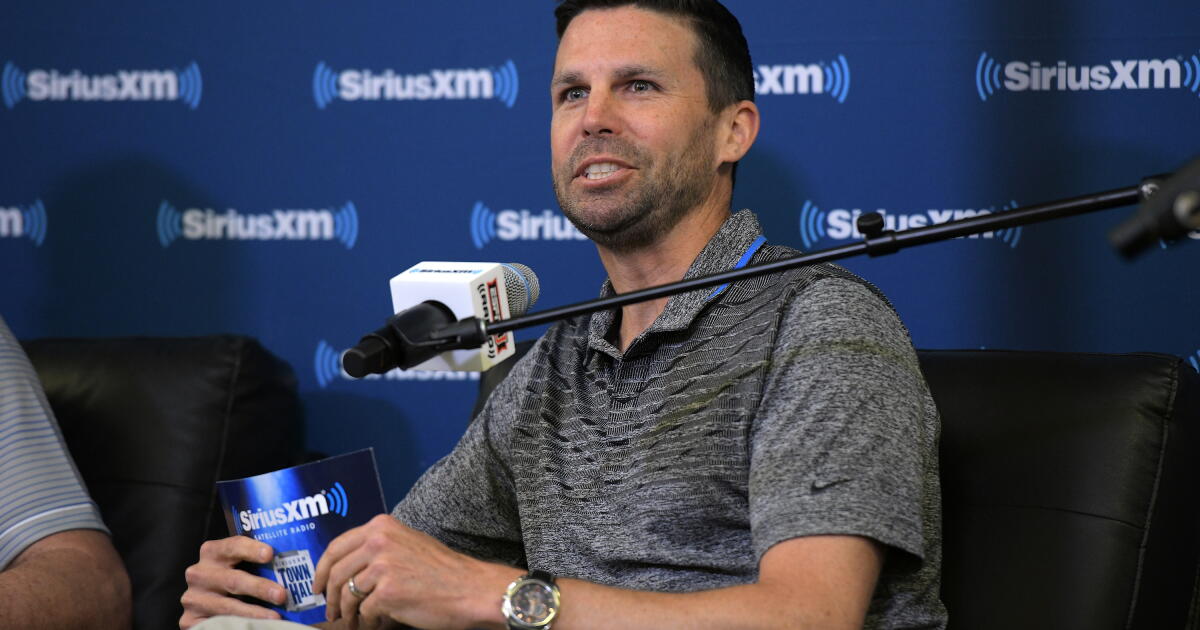
Tributes accumulated rapidly for Chris Spatola, a popular ESPN college basketball analyst who died Monday. He was 47.
Spatola is the son-in-law of legendary former Duke coach Mike Krzyzewski and was an assistant coach with the Blue Devils from 2007 to 2012. He married Krzyzewski’s daughter, Jamie, and the couple had three children together.
The cause of death has not been publicly disclosed.
“There are no words to adequately express our heartbreak over the loss of our beloved Chris Spatola,” the Krzyzewski family said in a statement through Duke. “Chris served our country, was a devoted husband and father, and was such an important part of our family. We are deeply grateful for the outpouring of love, thoughts, and prayers we have received during this incredibly difficult time. We respectfully ask for privacy as our entire family, particularly Jamie and her three beautiful children, grieve and process this unimaginable loss.”
Spatola served in the U.S. Army after playing basketball at Army and studying at the U.S. Military Academy from 1998-2002. He deployed in Operation Iraqi Freedom and was awarded the Joint Service Commendation Medal for exceptional combat performance and the Army Commendation Medal for outstanding leadership.
As a player, Spatola was a four-year starter at guard and twice was named All-Patriot League. He commented on his military service for ESPN Press Room in 2018:
“Serving in the Army has made me better in every facet of my life — a better husband, father, professional,” Spatola said. “It exposed me to adversity, how to react to and deal with tough times and situations, and showed me that teams are better when you’re more concerned about serving others, serving the teammate to your right and left, and serving the mission. It forced me to realize there is no substitute for being prepared … and showed me that character matters.”
Spatola was on the Duke coaching staff in 2010 when the Blue Devils won one of their five national championships under Coach K. Soon after leaving Duke, Spatola was hired by ESPN and SiriusXM. He called games and appeared in studio for ESPN for the last 13 years.
“Chris Spatola brought a unique perspective to ESPN’s college basketball coverage, shaped by his experiences as a student-athlete, Army veteran, coach and broadcaster,” ESPN wrote in a statement. “He was thoughtful, prepared and passionate about the sport, earning the respect of colleagues, coaches, players and fans alike. We extend our heartfelt condolences to his loved ones during this difficult time.”
Fellow analysts flooded social media with an outpouring of praise.
“I am devastated over the passing of my friend and colleague Chris Spatola,” Jay Bilas wrote on Instagram. “Chris was a wonderful human being. A point guard at West Point, Chris was … a man of great humility and unusually high character. A great family man that was devoted to his wife Jamie and their wonderful family. Chris was selfless .… a fabulous colleague and knowledgeable basketball man. With Chris, it was never about him, it was only about the game, the players, the coaches, and the fans. Heartbroken beyond words to lose such a great friend, yet grateful beyond words to have known him.”
Longtime basketball analyst and Duke graduate Seth Davis also commented on Spatola’s friendship.
“I could not possibly come up with the words to describe how shocked and devastated I am to learn of Chris Spatola’s untimely passing. It will never make sense or seem real. Chris was one of the all time great dudes. A terrific broadcaster but most of all a treasured friend who absolutely adored and doted on his family…. May his memory be a blessing.”
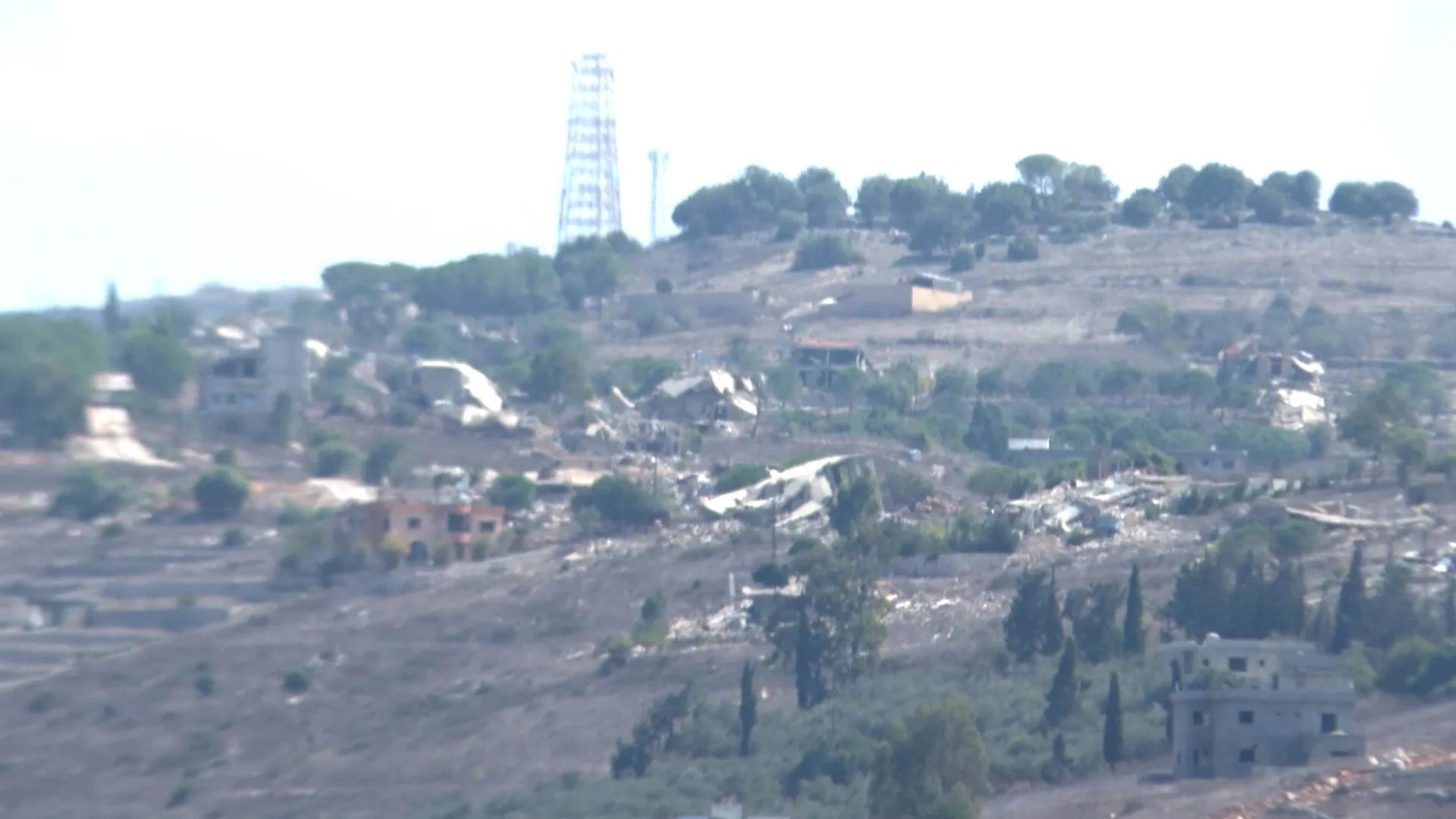
Israeli forces have destroyed homes and infrastructure across occupied villages in southern Lebanon, leaving displaced residents questioning whether there will be anything left to return to.
A U.K. Royal Air Force Hawk T2 training jet crashed in the Pencarnisiog area of Anglesey, North Wales, on Wednesday after both pilots ejected from the aircraft.
Videos captured of the incident show the aircraft porpoising at a slow speed and high angle of attack, before the pair ejected. The Hawk appears to narrowly miss homes before impacting the countryside and bursting into flames, with thick black smoke visible afterward.
Local police said the two pilots were being treated for minor injuries and that there were no reports of wider damage or additional casualties. Emergency services, including Coastguard and Wales Air Ambulance helicopters, responded to the scene.
The crash occurred near RAF Valley, where the RAF operates its Hawk T2 advanced jet trainers as part of fast-jet pilot training. The station is home to No. 4 Flying Training School. The Telegraphreports the incident happening “shortly after takeoff.”
The Royal Air Force confirmed that the incident involved one of its Hawk T2s flying out of RAF Valley.
“An investigation is under way and we will not comment further at this time,” the RAF said.
Wreckage from the aircraft has been located at the crash site. Police have asked the public to avoid the area while emergency services remain at the scene.
The circumstances surrounding the crash, including what caused the aircraft to go down and the nature of the flight, have not yet been established.
The Hawk fleet has experienced previous technical issues.
In 2022, engines were removed from service amid concerns over potential in-flight failures, while the 28-aircraft RAF Hawk T2 fleet was temporarily grounded in January 2023 following an engine-related incident at RAF Valley.
In 2024, then-Chief of the Air Staff Air Chief Marshal Sir Richard Knighton said he wanted to replace the Hawk T2, citing problems with its engines and support and concerns about the reliability of the training capacity it provided. The Hawk T2 is due to be retired by 2040.
Those previous issues are not known to be connected to Wednesday’s crash.
A three-part series following investigative reporters and police investigators who were instrumental in holding Gary Glitter accountable for his sex abuse crimes has been paused
17:17, 23 Sep 2026Updated 17:20, 23 Sep 2026
Hunting Gary Glitter was due to be released on Netflix on October 14(Image: Courtesy of Netflix)
Netflix has paused the release of an investigative docuseries into disgraced Gary Glitter’s history of sexually abusing minors.
The streaming giant has issued a statement confirming that the three-part series will no longer be released on October 14 as they originally announced.
A spokesperson for Netflix said: “We have made the decision to pause the release of Hunting Gary Glitter originally due to launch on October 14.
“This follows new legal information we recently became aware of. We’re not able to share further detail at this time, but we’ll provide an update as soon as we’re in a position to do so.”
The synopsis for the series states: “A string of dogged journalists chases fugitive pop star Gary Glitter across the globe — from Cuba to Cambodia to Vietnam — determined to expose the child sexual abuse he concealed behind decades of chart-topping fame.
“This documentary follows their pursuit alongside the survivors who speak out, charting Glitter’s 1997 conviction, through to his years on the run, and eventual incarceration.”
The rocker, real name Paul Gadd, was a popular British glam rocker in the 1970s and sang numerous hits like Do You Wanna Touch Me and I Love You Love Me Love.
In 1999, his popularity was derailed by numerous allegations of child sexual abuse and subsequent conviction for possession of child pornography.
Later, in 2006, he was jailed in Vietnam for the sexual abuse of two girls. In 2015, he was convicted of sexually abusing three additional young girls.
In 2023, Gadd was released for a short time on probation before being reincarcerated. Police did not publicly say how he violated the terms of his release.
Featured in the trailer of Hunting Gary Glitter, the docuseries uses first-person interviews to detail Gladd’s original convictions and years hopping from country to country, including Vietnam, Cuba, and Cambodia to avoid prosecution and jail time.
The advert was released alongside the initial announcement but has now been pulled as has all the other assets from Netflix’s media website.
Hunting Gary Glitter was due to be released on Netflix on October 14 but has been paused
VICTORIA, British Columbia — A Canadian provincial premier called a snap election Tuesday, saying President Trump’s attacks on Canada are threatening jobs, businesses and the country’s ability to determine its own future.
The provincial election comes after U.S.-Canada trade talks broke down, deepening a dispute that has brought steep tariffs. British Columbia Premier David Eby effectively put Trump on the ballot, arguing the election offers British Columbians a choice between his government’s efforts to resist U.S. economic pressure and opponents he accused of embracing “MAGA-style politics.”
“Join us saying hell no to Trump and to his politics,” Eby said in announcing the Oct. 24 election.
Eby said Trump’s trade war and threats against Canada have changed conditions in British Columbia enough to justify an election two years early.
“Donald Trump is attacking our workers, he’s targeting our businesses, and he is threatening our sovereignty,” Eby said. “He’s threatening our ability to make decisions for ourselves.”
The left-leaning New Democratic Party leader said British Columbia needs to build a “firebreak” against Trump’s economic policies by protecting workers and businesses, reducing its dependence on the United States and finding new markets for Canadian products.
“This isn’t just a trade dispute,” Eby said. “It’s about the life that you and your family are building.”
Eby said British Columbia’s exports to the United States have fallen 4% while exports to other markets have risen 16%.
He also vowed to keep American alcohol off provincial shelves, saying “not one drop of Jack Daniels” would return until Canada gets a fair deal with the United States.
The New Democrats won a narrow majority in the 2024 provincial election, giving Eby enough seats to govern without relying on another party, and he was not required to call another election until 2028.
The election call also comes amid turmoil among the opposition British Columbia Conservatives. Kerry-Lynne Findlay resigned as party leader Sunday following a wave of defections and expulsions from her caucus. Lorne Doerkson was named interim leader.
Great Britain’s impressive rider line-up for cycling’s Road World Championships means the team have rarely stood a better chance of glory.
For the men, there is also the helpful factor of Slovenian superstar Tadej Pogacar being absent, after he suffered crash injuries during the Vuelta a Espana in August.
But at the same time a new generation of British cycling talent is rising, and GB riders could take the coveted winner’s rainbow jersey in the men’s and women’s road races in Montreal this weekend.
There are currently 49 British riders competing across the men’s and women’s world tours – more than ever before – and some of those will compete in this World Championship weekend.
The road race itself is much like a stage of the Tour de France, but in which riders compete in national squads, looking to out-think and out-muscle each other.
A lot of the British potential is thanks to the inspiration of British cycling’s golden period, which featured great success from the likes of Team Sky, Mark Cavendish and Lizzie Deignan across the past 15 years.
Deignan won the road race in 2015, while Cavendish triumphed in 2011.
In total, British riders have won the elite road races seven times, including Tom Simpson (1965), Beryl Burton (1960 & 1967), Mandy Jones (1982) and Nicole Cooke (2008).
Amid an unpredictable performance landscape for the women, Britain’s best young female riders have a chance to infiltrate the once-dominant Dutch contingent.
Tour de France Femmes winner Demi Vollering remains the sport’s best overall, but Briton Zoe Backstedt’s brilliant second place in Sunday’s Worlds time trial was her first shot at the elite level.
She will be involved in Saturday’s women’s road race, and Olympic mountain bike gold medallist and Tour de France stage winner Tom Pidcock will race for the men on Sunday.
“You need a lot of faith in your team to be present at the front,” Backstedt told BBC Sport. “You need to talk, hear, see and feel each other to know they are there, especially as there’s no team radio.
“Obviously it’s about knowing the big names to follow. If Demi or Kasia [Niewiadoma] go off the front, you know it’s a dangerous move and you need to be there.
“But we’ve got a super strong team, and if any one of us was with them, we all could stand have a chance.”
The women’s road race is 180.4km long, which includes eight laps of Montreal, and the men’s 273.2km race incorporates 12 circuits.
The road to the UEFA Nations League 2026-27 begins on Thursday, with 54 teams in action in the league phase.
Portugal, the record two-time champions, will look to successfully retain the title they won in 2025.
Recommended Stories
list of 3 itemsend of list
But with reigning World Cup winners Spain, and former champions France and heavyweights England also in the mix, the title defence will be far from easy.
What is the UEFA Nations League?
The UEFA Nations League was founded in 2018 to reduce the number of meaningless friendlies and give nations competitive matches against equally-ranked teams.
In this competition, countries from across Europe participate in a league structure, which features promotion and relegation.
How many teams are in the Nations League?
A total of 54 teams will participate in the 2026-27 UEFA Nations League.
They are divided into the following leagues and groups, following the draw in Brussels, Belgium in February:
League A
Group A1: France, Italy, Belgium, Turkiye Group A2: Germany, Netherlands, Serbia, Greece Group A3: Spain, Croatia, England, Czechia Group A4: Portugal, Denmark, Norway, Wales
League B
Group B1: Scotland, Switzerland, Slovenia, North Macedonia Group B2: Hungary, Ukraine, Georgia, Northern Ireland Group B3: Israel, Austria, Republic of Ireland, Kosovo Group B4: Poland, Bosnia and Herzegovina, Romania, Sweden
League C
Group C1: Albania, Finland, Belarus, San Marino Group C2: Montenegro, Armenia, Cyprus, Latvia Group C3: Kazakhstan, Slovakia, Faroe Islands, Moldova Group C4: Iceland, Bulgaria, Estonia, Luxembourg
League D
Group D1: Gibraltar, Malta, Andorra Group D2: Lithuania, Azerbaijan, Liechtenstein
What is the schedule for the UEFA Nations League?
UEFA has earmarked the following dates for the Nations League 2026-27:
League phase
Matchday 1: September 24-26 Matchday 2: September 27-29 Matchday 3: October 1-3 Matchday 4: October 4-6 Matchday 5: November 12-14 Matchday 6: November 15-17
Quarterfinals, League A/B and League B/C promotion/relegation playoffs
March 25-30, 2027
League C/D playoffs
March 23-28, 2028
Final tournament
June 9-13, 2027
How does the UEFA Nations League work?
The teams compete across four different divisions, facing every other team in their group twice: once at home and once away. The league phase ends in November.
In the top-most league, League A, the top two teams from each group go through to the quarterfinals, which take place in March 2027.
The finals will again be contested between four teams. The host and the dates of the finals have not been confirmed yet.
As for each of the group winners in Leagues B, C and D, they will be promoted to the league above. The teams finishing bottom of their groups in Leagues A, B and C will be relegated one league below.
Here’s the full breakdown of the promotion and relegation scenarios:
League A
The group winners and runners-up advance to the quarterfinals.
The two highest-ranked third-placed teams remain in League A.
The two lowest-ranked third-placed teams and two highest-ranked fourth-placed teams contest the League A/B play-offs against the four runners-up from League B.
The two lowest-ranked fourth-placed teams are relegated to League B.
League B
The group winners are promoted to League A.
The runners-up contest the League A/B play-offs against the two lowest-ranked third-placed teams and two highest-ranked fourth-placed teams from League A.
The third-placed teams remain in League B.
The fourth-placed teams contest the League B/C play-offs against the four runners-up from League C.
League C
The group winners are promoted to League B.
The runners-up contest the League B/C play-offs against the fourth-placed teams from League B.
The third- and fourth-placed teams remain in League C.
League D
All teams are promoted to League C.
FIFA World Cup 2026 winners Spain will also be in action in the upcoming UEFA Nations League [File: Hannah McKay/Reuters]
Is the Nations League linked to major tournaments?
According to European football’s governing body, UEFA, the 2026-27 UEFA Nations League is expected to be linked to qualification for UEFA EURO 2028 in the United Kingdom and Ireland.
Based on their UEFA Nations League results, some teams will be given a second chance to enter the playoffs for the final tournament.
Will Ronaldo play in the Nations League?
Yes. Cristiano Ronaldo will feature in the upcoming Nations League after being called up for their upcoming four fixtures. Last weekend, he was included in new coach Jorge Jesus’s first 25-man squad.
However, in August, the 41-year-old fuelled speculation about his retirement plans after saying the coming year would probably be the last of his playing career.
The Portugal captain has won major trophies at the club level with Manchester United, Real Madrid, Juventus and current club Al-Nassr since making his senior debut for Sporting in 2002.
But he has not quite tasted similar success with his national team.
The five-time Ballon d’Or winner has yet to win a FIFA World Cup, football’s biggest prize, after Portugal were knocked out in the last 16 by eventual champions Spain.
Has Ronaldo won the UEFA Nations League?
Yes. Ronaldo led Portugal to UEFA Nations League victories in the inaugural edition in 2019 and the latest one in 2025.
In the 2019 edition, Portugal were crowned winners on home soil in Porto, defeating the Netherlands 1-0 in the final.
In the last edition, they were crowned champions for a second time, beating Spain 5-3 on penalties after the match was tied 2-2 in extra time, with Ronaldo among Portugal’s goalscorers in Munich.
Which other top players will play in the Nations League?
The UEFA Nations League 2026-27 is filled with stars across all divisions.
In Group A, world champions Spain have talent all around with Lamine Yamal, Rodri and Ferran Torres among the standout names, while England skipper Harry Kane and Jude Bellingham also add glamour to the division.
Norway’s talismanic forward Erling Haaland and captain Martin Odegaard headline their team, Brian Bobbey has the spotlight on him in the Netherlands squad, and veteran Luka Modric continues his journey with Croatia.
In Group B, fans should watch out for Sweden’s Victor Gyokeres, the top scorer in the 2024-25 Nations League, Georgia’s winger and PSG star Khvicha Kvaratskhelia.
Which players will miss the opening UEFA Nations League games?
Several players have been sidelined with injuries, including England’s Cole Palmer, Declan Rice and Marcus Rashford.
Pedro Porro has been ruled out of the Spain squad.
Is the Nations League held every two years?
Yes. The UEFA Nations League has been held every two years since 2019.