This article examines the historical significance of Revolution Day in Yemen, which commemorates the transition from a monarchy to a republic. The narrative traces the nation’s origins back to the collapse of the Ottoman Empire and the subsequent establishment of the Mutawakkilite Kingdom. The central focus is the 1962 military coup led by Abdullah as-Sallal, which successfully ousted the newly crowned King Muhammad al-Badr. This pivotal uprising, backed by Egypt, resulted in the formation of the Yemen Arab Republic and ignited a multi-year civil war. Beyond the primary historical account, the source also includes contemporary news snippets regarding international flood alerts, amnesty for regional defectors, and global political …
Diesel prices have hit an all-time high of 199.18p per litre, according to the motoring organisation RAC, as the war in the Middle East continues to push up the cost of fuel.
Petrol prices are also still rising, with a litre currently costing 174.13p.
Over the past seven months, the Iran war has severely disrupted the production and transportation of wholesale oil across the region, causing the price of fuels made from oil to surge.
RAC said diesel prices had entered “uncharted territory” and served as a reminder of “just how exposed the UK is to events occurring far away”.
It’s never been a more terrifying time to be an undocumented immigrant in America. Despite countless protests and pushback, ICE agents continue to patrol the streets. In July, Colombian immigrant Johan Sebastián Durán Guerrero was shot and killed by an ICE officer in Biddeford, Maine, during a routine traffic stop.
But what about the white-passing undocumented immigrants that seem to slip through the system? The ones who blend in so seamlessly (despite the thick accents of some)? We forget they are also legally not supposed to be here. Specifically, those from Eastern Europe, Russia and the former Soviet Union. And what about those young, desperate women who suggestively posed for the camera as the Soviet Union collapsed all around them, hoping to be chosen by an American man?
Book Review
Ungrateful Immigrant Daughter: A Memoir From the Child of a Mail-Order Bride
By Katya Suvorova Alcove Press: 352 pages, $30
If you buy books linked on our site, The Times may earn a commission from Bookshop.org, whose fees support independent bookstores.
Katya Suvorova’s searing debut memoir, “Ungrateful Immigrant Daughter: A Memoir from the Child of a Mail-Order Bride,” out Sept. 29, is a heart-wrenching tale of immigration that pulls back the velvety red curtain to reveal one story behind the over-sexualized stereotypical post-Soviet mail-order bride narrative so ingrained in post-Cold War U.S. culture.
My own family legally immigrated to the U.S. from Soviet Belarus in the early 1990s. I grew up with the Western media narrative that Eastern European women were submissive sex symbols, desperate for financial security. Some boys in school even assumed I was “easy” because I was Eastern European.
Mostly told from a child’s point-of-view, Suvorova’s “Ungrateful” traces their journey in the ’90s from Russia to the U.S. and life thereafter, as white-passing undocumented immigrants who illegally crossed the border from Mexico — with the help of a man who replied to her mother’s mail-order-bride ad in a catalog. A catalog Suvorova would find years (and many rich American stepfathers) later while cleaning out the garage, and realize her mother had lied to her. She was not, in fact, a model, posing for a Coca-Cola ad, but a young woman with a small child desperate to leave Russia behind for the West. When Suvorova confronts her mother after finding the catalog, her mother replies: “Everyone was doing it.”
Mail-order brides shaped early colonial America. Men were often the first to settle small Western frontier towns and would in turn grow lonely for companionship. Newspaper ads for brides were normalized and proliferated in 19th century America. According to historian Elliott West, “Some mining camps in Idaho in 1870 had nine men for every woman.” The truth is that love didn’t enter the picture when it came to marriage until about the 19th century with the Victorians; before then, marriage was more like a business contract, with dowries and cows alike.
Letter brides remained ubiquitous in 20th century America and were not stigmatized until the 1970s and 1980s when it became more apparent that mail-order immigrant brides from developing Southeast Asian and Eastern European countries were being abused and exploited. It wasn’t until 2005 that the U.S. passed the International Marriage Broker Regulation Act (IMBRA), which requires background checks and other precautions meant to protect foreign brides from domestic abuse, violence and exploitation. You don’t have to dig deep to see this narrative proliferated in our culture. Jeffrey Epstein mostly recruited Eastern European women into his international sex-trafficking ring.
Author Katya Suvorova
(Alcove Press)
Suvorova and her mother were not spared such indignities. Abuse, both psychological and physical, permeates the pages of “Ungrateful.” From one of her earliest childhood memories of watching her mother being abused while stuck in a closet to later tales of her mother’s forced alcohol abuse and estrangement from her own mother (Suvorova’s beloved Babushka), expertly executed by her stepfather Adam — the abuse ran rampant. Suvorova herself is a victim, neglected by her mother and forced to act as a child bride to please one of the husbands. Eventually, Suvorova realizes that it wasn’t just her mother that was sold in a catalog to an American suitor, but her young daughter (Suvorova) as well. It’s no surprise that Suvorova is estranged from her mother, a topic she covers often on her social media.
Of course, there is also the “gold digger” stigma. Suvorova writes about girls in school accusing her mother of being a gold digger, intentionally choosing rich boyfriends that would eventually become rich husbands while they lived in poverty and couch surfed. Suvorova’s mother would use creative tactics to find these men: hang out in five-star hotels or fancy athletic clubs. She would have them buy her computers, clothes and expensive jewelry she could sell later. She always ordered the priciest thing on the menu and bought gift cards when the men gave her money for groceries in case the relationship did not work out. She passed down these survival tactics to Suvorova like gospel. But, ultimately, it wasn’t money that her mother was after, it was green cards for them both, the permanence and safety of American citizenship: the American Dream.
In 2012, I dressed up as a mail-order bride for Halloween. I was 22, about the age Suvorova’s mother was when they immigrated to the U.S. I wore a tight sleeveless red American Apparel dress. Shiny fake patent leather pumps. A white veil from Claire’s at the mall. I covered myself in bits of cardboard, packing tape and foam peanuts and overdid my makeup with several coats of mascara and thick black eyeliner. I thought this costume was funny, clever, appropriating and reclaiming the narrative that haunted me all my life. I thought because of where I was born, I was allowed to do this. A notoriously blunt girl who I sensed didn’t like me approached while I was waiting for the bathroom. “What are you, a slut?” she said, scanning me like a barcode.
Suvorova’s memoir effectively shows the risks immigrants were willing to take to escape the collapse of the Soviet Union and the corruption (ruled by the KGB) that followed. Without explicitly diving in, her writing sheds light on today’s Russian corruption and Putin’s endless war with Ukraine, which is ultimately a war against the West. In fact, Suvorova and many antiwar Russian immigrants today are terrified to return to their motherland due to fear of imprisonment and retaliation, as one Los Angeles woman in 2024 learned the hard way upon landing in Russia, receiving a 12-year prison sentence for donating $51 to a Ukrainian charity.
In the building I grew up in and my parents managed, a young Russian “model” and her mother lived with a much older Persian man. Without much inquiry, I simply assumed she was a mail-order bride running from a traumatic past in the motherland, ordered from a catalog to make him dinner and vacuum his carpet. Closer to my age than not, she became my friend. Gifted me jewelry. Babysat me while my parents drank tea with her mother. I later found out she cheated on the Persian man, laid out her wedding dress on the soiled carpet while he was at work, and moved herself and her mother to Las Vegas, where she started a successful business and bought a house.
Suvorova’s story is not just about the childhood trauma inflicted by her mail-order-bride mother, but it’s a redemption story about reuniting with her beloved maternal Babushka and biological father. It’s a story of self-discovery. Not unlike the bestselling memoir “Educated” by Tara Westover, who overcomes an abusive childhood in a rural survivalist Mormon family. Like Westover, Suvorova finds shelter in books, school and an education.
Like all contemporary creative nonfiction writers and memoirists who are not celebrities, Suvorova must have been told somewhere down the line that in order to sell her memoir she must gain a following on social media, and she’s done just that. With about 95,000 followers on Instagram, Suvorova uses the platform to reveal earnest roundups, tips, tragic tales of estrangement and survival, and summaries of deleted chapters of “Ungrateful” as blocks of text over grainy film photos of her as a child. Suvorova’s very active social media presence sheds light on the current state of memoir and nonfiction publishing: You must have a platform to be read.
In a bizarre meta twist of events, Suvorova must sell herself and her story on social media, like her mother sold herself (and in turn her daughter) to those American husbands. In a stroke of marketing genius, some early copies of “Ungrateful” come with book-branded condoms.
And despite revealing in the memoir that she eventually did become an American citizen, Suvorova has since moved to Europe. When I asked Suvorova over Instagram direct message why she and her husband left the U.S. for Europe, she replied: “We left because I didn’t feel safe publishing my book about growing up as an undocumented kid under the current Trump administration. I have to take medicine that, if I were detained and could not take it, would lead to organ failure. We knew ICE was detaining U.S. citizens as well and decided not to risk it. In order to still publish the book and not be detained, we left the U.S.”
How many of us have been cruel immigrant daughters (or sons)? Ungrateful. Spoiled. Unaware or unwilling to acknowledge how much our parents have sacrificed to get us here. In the case of Suvorova’s memoir — although, she does acknowledge her white privilege — she certainly has a lot to be ungrateful for.
Ruzova is a Soviet-born writer based in Los Angeles. Her essay “The Sauna” was a notable in Best American Essays 2025.
Nvidia (NVDA) introduced the Open Agent Safety Platform, an open software platform and reference system designed to strengthen AI security from agent testing through deployment.
The platform enables full-stack governance and control across the software that runs agents, the hardware and
Named among the world’s five coolest neighbourhoods, it packs cafés, international food and welcoming pubs into a small pocket of a major city.
The neighbourhood is jam-packed full of coffee shops, pubs and restaurants(Image: Nicola Roy)
A £4.60 oat milk mocha might not be everyone’s idea of a bargain. But at Zennor in Govanhill, I’d argue it’s worth every penny – and the surrounding streets offer plenty of reasons to stay after the last sip.
The neighbourhood on Glasgow’s south side earned a place among the world’s five coolest neighbourhoods in Time Out’s annual list. Its appeal goes well beyond fashionable coffee shops, with a diverse mix of people, cultures and businesses shaping the area.
From Turkish börek to Pakistani street food, independent cafés to a pub named after a footballing legend, there’s plenty to explore. Some may say it’s all new coffee shops and no substance, but they couldn’t be more wrong.
A neighbourhood best explored on foot
Victoria Road is a natural starting point. Busy with dog walkers, friends catching up and people carrying takeaway coffees, it leads towards the green space of Queen’s Park.
Govanhill is one of Scotland’s most diverse neighbourhoods, reflected in its cafés, bakeries, takeaways and gift shops. You could easily spend hours browsing and stopping for something to eat.
Options include a flat white from a Transylvanian coffee shop or traditional Turkish börek from Pistachio. For me though, Zennor was the destination of choice.
On the corner of Langside Road and Dixon Avenue, Zennor’s second Glasgow location combines Scandi-inspired light wood and stainless steel décor with paper lanterns and the smell of freshly ground coffee.
Zennor’s seasonal specials are really where they excel, but I didn’t spot anything on there that caught my eye on this occasion, so I opted for a mocha. And you can’t pop in here without grabbing a sweet treat, such as their dark chocolate and sea salt cookie – utter bliss.
With oat milk, my coffee order totalled £4.60. It pains me to admit, but I don’t think that’s too steep these days, particularly when it’s this good. And it’s worth every penny in my opinion.
Where to head for a pint or a plate of pasta
Directly opposite Zennor is the Rose Reilly, my favourite pub in Govanhill. Named after the legendary footballer, it offers a welcoming atmosphere, a good choice of drinks and plenty of outdoor seating for sunny days.
For something more substantial, I recommend Pakistani Street Food for a samosa, Bar Vini for a generous serving of pasta and Errol’s Hot Pizza for the best pizza you’ll ever eat.
Together, these venues offer plenty of scope to turn a quick coffee visit into a longer afternoon or weekend exploring the neighbourhood.
More than a ‘coolest neighbourhood’ label
Govanhill’s fashionable reputation is only part of its story. The area faces challenges, and residents hold differing views about how it has changed, with gentrification a particularly contentious issue.
My view, however, is that its mix of people and cultures is what makes it such a lively and fascinating place to discover. The coffee may provide a reason to stop, but it is far from the only attraction.
There’s also libraries, craft spaces, workshops, community projects and events, and with great public transports links too, you’re never too far from other parts of the city. Other nearby neighbourhoods in Glasgow’s south side, like Pollokshields, Strathbungo and Mount Florida, are also full of fun things to do.
LAFC, mired in a slump having won just two of its last 13 games in all competition, fired first-year coach Marc Dos Santos on Sunday with six matches left in the MLS regular season.
The firing, announced in a three-paragraph statement, comes less than 24 hours after Saturday’s 1-0 loss to FC Dallas dropped the team to sixth in the Western Conference table.
“Marc has given a great deal to this club over the years, and we are grateful for his commitment, care and contributions to LAFC,” said John Thorrington, the team’s president of soccer operations, in the release. “We wish Marc and his family all the best moving forward.”
LAFC (11-9-8) said it will begin the search for a new manager immediately but didn’t say who would coach the team in its next game on Oct. 10, after the two-week FIFA international break.
Dos Santos, 49, was an assistant on Bob Bradley’s staff in LAFC’s inaugural season in 2018. He left after the season to take over the Vancouver Whitecaps but struggled to a 22-39-20 record in 2 ½ years that were heavily affected by the COVID-19 pandemic, which forced the team to play many of its games on the road.
Dos Santos returned to LAFC as an assistant in 2022, this time for Steve Cherundolo, helping the team to a Supporters’ Shield and MLS Cup. When Cherundolo stepped down after last season, Dos Santos was given the head coaching job just two weeks later, becoming the third manager in the team‘s history.
His two stints as an assistant at LAFC taught him that the team’s fans are among the most demanding in MLS, something he said he embraced.
“It’s a privilege when you coach a team in Los Angeles,” he said at the time. “Every sport here is pressure. Every team here is win, win.
“It’s a winning city and the culture of the city. So I understand that.”
Dos Santos, who is fluent in four languages, was born in Montreal and split his childhood between Quebec and Portugal. With the exception of Vancouver, he has won everywhere he’s managed, from the Ottawa Fury of the NASL, where he was named the league’s coach of the year in 2015, to the San Francisco Deltas, whom he guided to an NASL title.
LAFC was unbeaten in its first 11 matches in all competition under Dos Santos, outscoring opponents 27-3 and advancing to the semifinals of the CONCACAF Champions Cup, where it lost to Mexico’s Toluca, the eventual winner. But the team has gone 6-9-7 in MLS play since then, including Saturday’s loss when Dos Santos was without six key players — including leading scorer Denis Bouanga and captain Son Heung-min — who were with their national teams.
Afterward, he spoke about his plans for the two-week international break.
“It’s a hard moment right now for us. And we have to face it,” said Dos Santos, who was popular with his players. “It’s been hard for us to get wins. A lot of draws, a lot of close games.
“We need to have everybody together and start working on what this team can be. That’s the big objective during the break.”
The Houston Texans’ linebacker wore eye black with the names of slain sisters Lana, 12, and Bana, eight.
Published On 28 Sep 202628 Sep 2026
American football player Azeez Al-Shaair has once again honoured Palestinian children killed by Israeli forces in Gaza, despite previous fines and the threat of being removed from games, this time wearing the names of sisters Lana and Bana Ahmad on his eye black during his latest National Football League (NFL) game.
The Houston Texans linebacker took the field against the Indianapolis Colts on Sunday wearing the names of Lana, 12, and her sister Bana, eight, who were killed along with their family in an Israeli air attack earlier this month.
Recommended Stories
list of 4 itemsend of list
Hours before the game, Al-Shaair posted about the sisters on his Instagram account and followed it with a photo of the black tape bearing their names that he would later wear during the game. The image also showed part of Al-Shaair’s black shoes with flags of Palestine and Sudan stitched on them.
Al-Shaair, a Black American Muslim player, has repeatedly spoken about the plight of Palestinians. On September 13, he wore the name of Hind Rajab, the five-year-old girl who was killed in Gaza after Israeli soldiers opened fire on her family’s stranded car on January 29, 2024.
The NFL fined him $11,491 for breaching the league’s code of conduct on players’ clothing and equipment during a match against the Buffalo Bills.
However, basketball player Kyrie Irving stepped in and offered to pay the fine for Al-Shaair, who later confirmed that he had been in touch with the nine-time NBA All-Star.
Al-Shaair brushed off talk of the fine while speaking to reporters last week. “It’s bigger to me; what’s a life worth? Is a life worth $11,000? No, I think it’s priceless,” he said.
In his subsequent game against the Cincinnati Bengals, Al-Shaair then wore an eye black — a sticker or paint frequently used by NFL players to reduce glare — with the name of Wafa Akila, an eight-year-old who was killed along with her father in an Israeli attack in western Gaza as they were making their way home.
He was also fined in January, during the NFL’s last season, for displaying the message “Stop The Genocide” on his nose tape. While it did not specifically refer to a particular conflict, it was widely understood to be about Gaza and Sudan.
Following his NFL outing in which he wore the name of Rajab, Al-Shaair was informed he would have to remove the eye black or he would not be permitted to continue playing in the game, according to reports in US media.
US Democratic politician Isaiah Martin condemned the NFL’s reported reaction to Al-Shaair wearing eye black with the names of slain Palestinian children.
“This harms no one by letting him do this,” Martin said in a post on X. “I think it’s absurd they were fining him, but those were the ‘rules’ and he agreed to pay the fine. Removal from the game is INSANE. This shouldn’t stand!”
The Israeli genocide in Gaza has severely limited education for the Strip’s 660,000 children, with 90 percent of schools left damaged or destroyed.
The vote marks the first time the far-right party gained enough seats to form its own caucus.
Published On 28 Sep 202628 Sep 2026
France’s far-right National Rally (RN) party and its allies have secured a record 14 seats in the Senate, effectively quadrupling its number in the 348-seat chamber just months before a presidential election.
Sunday’s indirect election of senators marked the first time Marine Le Pen’s party won enough seats to form its own caucus.
Recommended Stories
list of 3 itemsend of list
“The results have exceeded our expectations,” Le Pen, the party’s leader and presidential candidate, said in a post on X.
“This is a historic victory, and a major milestone with the formation for the first time of a group in the Senate.”
RN entered the Senate for the first time with two seats in 2014, when it was known as the National Front, and won three seats in 2023.
It emerged as the single largest party in the lower-house National Assembly after President Emmanuel Macron called snap polls in 2024, though it fell well short of a majority.
Le Pen is preparing to run in next year’s presidential election when centrist Macron steps down.
RN president Jordan Bardella said the party’s senators would form an alliance with the Union of the Right for the Republic (UDR).
The right, centre and left-wing Socialists looked set to remain the three major forces in the upper house, according to initial results.
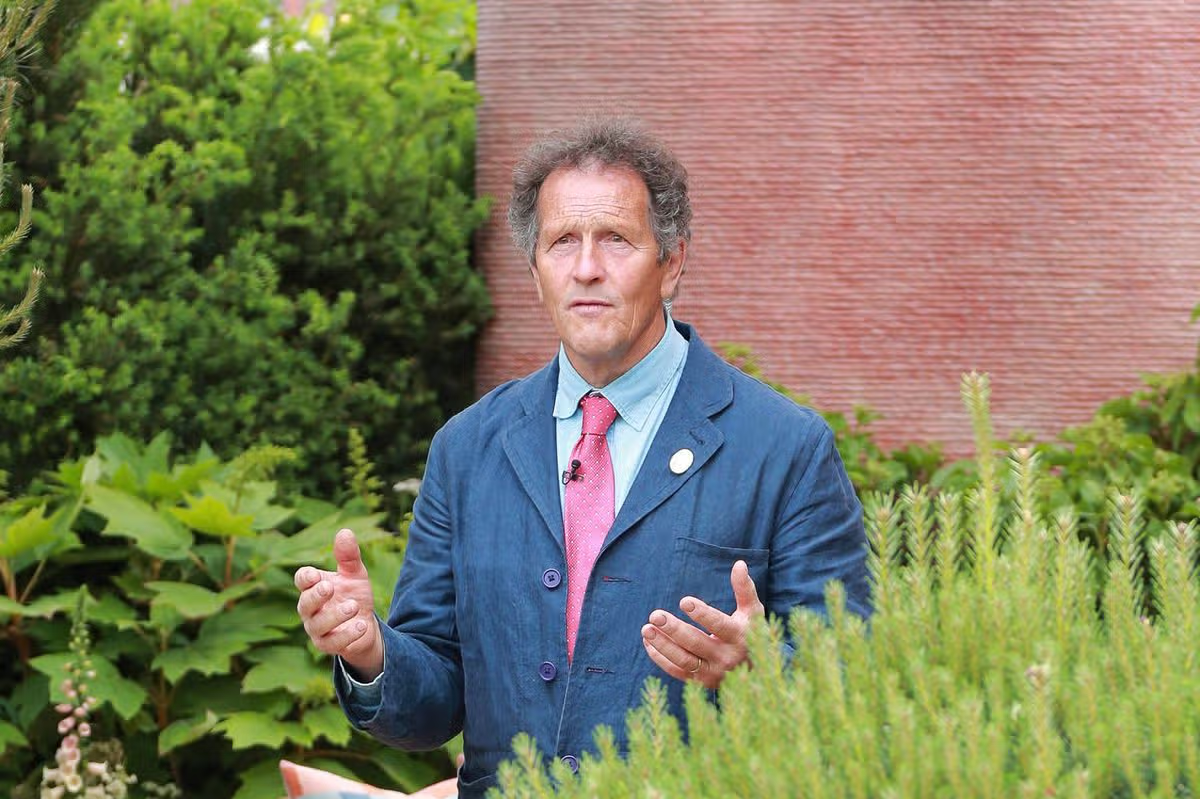
Appearing at an RHS event, Monty Don admitted he will have to find a new way to finance the maintenance of his two-acre garden at Longmeadow following his Gardeners’ World exit
Monty Don has admitted he may have to make a major change next year (Image: Dave Benett, Dave Benett/Getty Images for Killik & Co)
Television legend Monty Don has admitted he may be forced into making a major change at Longmeadow following his departure from Gardeners’ World. Monty, 71, is leaving the show after over 20 years of leading the programme.
However, during a talk at the RHS Malvern autumn show, Monty revealed his soon-to-be former employer, the BBC, had been contributing to the salaries of two gardeners who have worked at Longmeadow since 2011.
Speaking at the RHS event, Monty said the reason for having the team was so the garden could always look “camera ready” if he was away filming in another country, or working on another project.
With his Gardeners’ World exit in mind, Monty, who has lived at Longmeadow in Herefordshire with his wife Sarah since 1991, has said there will come a moment where he will need an alternative plan to keep Longmeadow in shape.
He said: “The BBC pays a contribution towards their wages. Not enough, but they do pay something, which is great. Obviously that contribution is going to go.
“I will have to think of ways – I can’t afford it unless we earn money from it – so I am going to think of ways of earning something from the garden, but I can’t do that until the middle of next year at the earliest.”
Monty, who announced his intention to leave Gardeners’ World in an Instagram video, said he had decided to step away from the renowned show as he felt it was “the right time for a change”.
As well as paying tribute to the “superlative BBC team”, he added: “I look forward to continuing to work with and for the BBC on other projects, as well as following new avenues. And of course, I will still be gardening, dog by side, here at Longmeadow.”
Monty’s exit has subsequently led to speculation about who would replace him, with plenty of candidates from the existing Gardeners’ World team.
Months prior to Monty’s announcement, as questions continued to be asked about how long he would stay on the show, Frances Tophill, 36, was asked how she would feel about potentially replacing him.
Although she has been part of the team for over a decade, Frances ruled herself out of following in Monty’s footsteps, with the latter taking over from Alan Titchmarsh in 2003.
Speaking to the Sunday Times, Frances admitted to having little interest as she saw her main job as being a gardener rather than a presenter.
She said: “I have a huge respect for Monty – it is such a generous thing to give your garden space to the nation and he does it so well. I hope he never leaves….Broadcasting is not my day job, my day job is being a gardener.”
Frances’ comments came after she got a taste of what life as the main presenter would be like when she found herself surrounded by people in a garden centre after deputising for Monty during one episode in 2023. She added: “That’s when I got a glimpse of what being Monty must be like… I don’t want that.”
Pro wrestler PAC, whose real name was Benjamin Satterley, died Sunday at 40 less than 24 hours after competing in All Elite Wrestling’s “All Out” pay-per-view event, AEW announced.
“All Elite Wrestling is saddened to announce the passing of Benjamin Satterley, aka Pac,” AEW said in a statement. “A native of Newcastle upon Tyne, England, Satterley began his wrestling career in 2004 and went on to perform for wrestling organizations all over the world, captivating fans with innovative high-flying moves and incredible in-ring ability. Pac signed with All Elite Wrestling in 2019 and held multiple AEW Championships and competed in some of the most memorable matches in AEW history. Our condolences go out to Satterley’s family, friends and fans.”
All Elite Wrestling is saddened to announce the passing of Benjamin Satterley, aka Pac. A native of Newcastle upon Tyne, England, Satterley began his wrestling career in 2004 and went on to perform for wrestling organizations all over the world, captivating fans with innovative… pic.twitter.com/uqzO371t2V
AEW owner Tony Khan posted a message on X honoring Satterley.
“Benjamin Satterley defined excellence, as a beloved husband & friend to his many loved ones, + in his wrestling knowledge, skill, unprecedented athleticism, professionalism, consistency + dedication to the sport that he loved & traveled the world to pursue,” Khan’s statement read. “May Ben rest in peace.”
Satterley broke into pro wrestling in 2004 and made a name for himself in the U.S. as part of the Pro Wrestling Guerilla promotion in Los Angeles. He signed with World Wrestling Entertainment in 2012 and was given the name Adrian Neville, later shortened to just Neville. He became part of their NXT promotion and won its heavyweight title before he was promoted to the main roster. He won the NXT Championship while in developmental and later made it to the main roster in 2015, winning the WWE cruiserweight title.
Considered one of the best wrestlers in the world, Satterley was was a relatively small 5 feet 8, 194 pounds and was not given a push relative to his ability in WWE. He left the promotion in 2018 and later joined AEW, where he changed his name to PAC and won the International title and the Trios title.
He was currently involved in a feud with Andrade El Idolo and challenged him for the national championship Saturday in Chicago, with El Idolo winning to retain the title.
When AEW launched in 2019, he was announced as one of the first signees, becoming the first All-Atlantic Champion and also won the Trios Championships. Since 2024, he had been a member of the Death Riders group.
For weeks, the streets of Serbia were teeming with young people rallying against the government. At the height of the protests in March 2025, more than 100,000 took to the streets.
With the elections originally not due until December 2027, the early vote is seen as an attempt by governing populists to cling to power despite widespread discontent.
Students and anti-government demonstrators light the flashlights of their mobile phones during a protest, which became a national movement for change following the deadly November 2024 Novi Sad railway station roof collapse, in Belgrade, Serbia, March 15, 2025 [Igor Pavicevic/Reuters]
Vucic is vying for the prime minister’s post, a role he has held before, appearing to yield to protesters’ demands not out of goodwill but in the hopes of ushering in a result that keeps him in office, analysts say.
But experts warn that elections will hardly solve the underlying political tensions gripping the country, triggered after 16 people were killed in 2024 when a concrete canopy collapsed at a railway station. Student protesters blamed the disaster on government negligence and alleged corruption.
The move “is essentially about reducing political risk”, Viktor Stamenkovic, a researcher at Belgrade’s Institute for Political Studies, told Al Jazeera.
“Given the circumstances, the ruling camp is choosing the electoral sequence it considers least dangerous,” he said, referring to Vucic’s Serbian Progressive Party (SNS).
Saving his skin: Elections a cling to power
Vucic could stall no more – both the presidential and parliamentary vote would have had to be held next year.
“Vucic has, for some time, been aware that further delay is unlikely to work in his favour,” Stamenkovic said.
Vucic’s presidential term expires before the mandate of the current parliament, said Stamenkovic. Serbia’s recent political history explains the order of the elections – the parliamentary before the presidential, the analyst added.
Presidential elections can fundamentally alter the parliamentary dynamics that follow – which is how Vucic’s party came to power, Stamenkovic explained.
Vucic cannot run for a third term under Serbia’s constitution, and no other SNS figure is as popular as him.
“In 2012, the presidential victory of the SNS candidate Tomislav Nikolic changed the political momentum so dramatically that the bloc, which had previously appeared capable of forming a parliamentary majority, was ultimately unable to do so,” said Stamenkovic. “The presidential result altered the calculations of the parliamentary parties and paved the way for a government led by SNS.”
Vucic, therefore, has good reason to fear the same scenario being repeated.
Aleksandar Vucic has resigned as president to run for the premiership [File: Pierre Suu/Getty Images]
Vucic has built a personalised political system centred on himself rather than his party or any successor, said Stamenkovic.
“He therefore has to find a way of transferring his own political strength from the presidency into the parliamentary arena … effectively staking his political future on the parliamentary election.”
For Milica Vojinovic, an investigative reporter at the Serbian outlet KRIK, the goal of the governing party is to stay in power at any cost.
“They [want to] continue their corruption projects, which usually means finding new ways and public procurements through which they can take money… [including from] public budgets,” Vojinovic told Al Jazeera.
She cited irregularities in past elections, such as vote buying by the SNS, documented by election observers and human rights organisations, and feared that the next elections will see an “escalation of these tactics, now that the student movement is actually threatening to win the election and take power from Vucic’s party”.
The vote will not resolve country’s discord
Since 2024, the governing party has lost a sense of political legitimacy, said Stamenkovic.
“Even if – and this is a big if – SNS wins another parliamentary majority, it is difficult to envisage a return to a situation in which it can govern normally and claim the kind of broad social legitimacy it once enjoyed,” he said. “Virtually all polling shows that a majority of the country believes Serbia is heading in the wrong direction and that the time has come for change.”
Mass demonstrations have not taken place in Serbia for some time, as the student movement has shifted from organising large rallies to election campaigning.
The youth movement recently submitted their election list to state election authorities after a jubilant march through the capital of Belgrade, formally entering the race.
Polls show that this vote could bring representatives of the student movement into parliament and state institutions, said the Serbia-based Center for Research, Transparency and Accountability (CRTA).
“This is important for Serbia’s democracy … [They] will definitely improve the legitimacy of the parliament as the representative body,” the group said.
Transparency and anticorruption are priorities for most citizens, with the social and political reality in the country having changed in the two years since the railway station incident, the organisation added.
Vojinovic, however, predicted that if Vucic’s party continues to hold power, “we are to expect the most repressive measures seen so far against everyone who has been criticising, or in any way opposing, the government”.
Criminal cases have already been brought against some activists in the student movement, as well as a political analyst, she said.
According to Human Rights Watch, foreign agent laws, first introduced by Russia and seen being picked up by other nations, have been used to brand independent civil society, media and other dissenting voices as illegitimate and acting on behalf of foreign interests. Such a law was proposed in Serbia in 2024.
“Recent smear campaigns against my newsroom, as well as other independent media outlets and NGOs, lead us to believe that they may be a precursor to the introduction of a ‘foreign agents law’ in the near future, should Vucic’s party remain in power,” Vojinovic added.
EU rift no matter
Meanwhile, Serbia is no closer to joining the European Union, but that is not a real priority for Vucic, the experts said.
“It is widely understood that Serbia cannot make meaningful progress towards EU membership under the current system of government,” said Stamenkovic. “What matters much more to Vucic is avoiding serious political pressure and criticism from Brussels.”
Ratko Mladic’s funeral illustrates this balancing act: Serbia hosted the semi-official honouring of the former Bosnian Serb army general – who died while serving a life sentence for genocide, war crimes and crimes against humanity committed during the 1992–1995 war in Bosnia – but Vucic did not attend, he said.
“In some ways, the relationship between Vucic’s government and the EU resembles a couple trapped in a disastrous marriage who nevertheless do not divorce because both sides continue to benefit from the relationship.
“Vucic cooperates with the EU on issues that matter to Brussels, while the EU has for years been willing to overlook a great deal about the increasingly authoritarian nature of his rule,” he added.
The two are also at odds over Russia, which Serbia has ties with.
A public opinion poll in June by the CRTA and Stanford University’s Democracy Action Lab showed that among SNS voters, 15 percent wanted closer ties with the EU while 60 percent favoured relations with Russia.
“There is every reason to expect election day itself to be highly contentious,” said Stamenkovic.
CATANIA Airport in Sicily has been forced to cancel all its flights again today after yet another eruption on Mount Etna.
Volcanic ash in the airspace has resulted in the suspension of inbound flights until at least midnight tonight.
Mount Etna has erupted again resulting in cancelled flights from CataniaCredit: GettyCancelled and delayed flights has been a nightmare for passengersCredit: EPA
The airport first stopped incoming flights on Saturday due to ash in the airspace and limitations have since been placed on departures too.
This morning, a warning on the airport’s website explained that due to “volcanic activity and weather conditions” cancellations and delays are expected until “23:59pm today, Monday, September 28.”
Sign up for the Travel newsletter
Thank you!
Flights to and from London Gatwick and London Luton remain on the schedule – but are likely to be cancelled due to the flight limitations.
Some passengers took to social media over the weekend explaining they had travelled across to Palermo to get a flight home from there instead.
Some UK flights were affected then too, either being cancelled or diverted to Palermo on the northwestern coast of the island.
In August, ongoing eruptions from Mount Etna forced the airport to shut for five days in a row resulting in hundreds of cancelled flights.
Families who had their flights cancelled were left stranded with videos on social media showing holidaymakers sleeping on the airport floor and even luggage belts.
Last time Mount Etna erupted, nearby Malta International Airport had to cancel 19 flights due to volcanic ash.
Catania is Sicily’s busiest airport handling around 12.4million every year – which works out to around 40,000 passengers each day.
Ash from the volcano has disrupted the airspace in SicilyCredit: Splash
What does the disruption due to Mount Etna mean for passengers?
Anton Radchenko, air passenger rights expert and founder and CEO of AirAdvisor, explainedwhat the disruption means for customers…
“When volcanic ash closes airspace, airlines will usually class it as an extraordinary circumstance, which means fixed cash compensation is unlikely.
“However, I would urge passengers not to confuse ‘no compensation’ with ‘no rights’.
“The airline must still offer a refund or rerouting and provide reasonable meals, accommodation and transport while passengers wait.
“If you still need to get home, do not automatically accept a refund.
“Once you accept it, the airline’s rerouting and care obligations will normally end.
“Ask for the earliest reasonable alternative and, if another airline can get you back significantly sooner, ask to be transferred to that service.
“If you have to pay for reasonable essentials because the airline fails to provide them, keep every itemised receipt so you can seek reimbursement.”
This is supported by the UK Civil Aviation Authority’s current cancellation guidance which you can findhere.
A woman has been left with no feeling in her face after shattering her jaw in an accident while on holiday..
Tia Lockey was at the start of a dream trip through Asia when she was involved in a motorbike accident. The 22-year-old waved goodbye to her friends after volunteering to go first down to a remote beach.
Tia can now only remember the first few minutes of the journey before waking up on the jungle floor, concussed and in agonising pain. “My dream trip I had been planning for years had been stripped away from me because of a lift to the beach,” said Tia from Durham.
“I opened my eyes and I was on the floor in the jungle of Koh Tao, in the middle of nowhere covered in blood. I didn’t and still don’t remember the crash at all; it’s completely wiped from my memory. I definitely mourn the life I used to have.”
The marketing worker had organised a trip down to the beach in Koh Tao, Thailand in the early hours of the morning of March 14. A fellow traveller offered to take them down one by one as the ride would only take 10 minutes – and thinking nothing of it, Tia went first.
However, shortly after they had set off, they were involved in a horrific crash. Tia said: “My friend thought something must’ve been up and she had a bad feeling since the driver was meant to go back for her next but he still hadn’t come.
“Luckily I had shared my live location with her that night so she followed it and found me with all of my injuries. An ambulance came and the hospital told me I had shattered my jaw in two places, knocked two teeth out, and had very deep wounds on my face. I needed to be emergency speed-boated to a hospital in Koh Samui which was around three hours away.”
Tia was rushed to the hospital with her face completely bandaged up due to the gaping wounds on her upper lip, forehead, left eye, chin and scalp. For the next two weeks she was bedridden in hospital with her mouth wired shut following her jaw surgery.
The 22-year-old then returned back home to the UK as another jaw surgery was required. She said: “I needed to have another jaw surgery in May. I couldn’t chew for four months and because my jaw was so severely broken, they described it as cornflake bits, when I woke up from the eight hour surgery my teeth and bite were completely different.
“They no longer touched at the front, so I was left with an open bite and they said that this will just be my teeth from now on and there’s not a lot they can do to fix them. So now I struggle to eat anything with my front teeth.”
The crash completely changed Tia’s life, leaving her with crippling insecurities that stopped her from leaving the house. On top of the scars and teeth damage, nerve damage to her bottom lip and chin left them completely numb
.
Tia said: “I struggled a lot with going out and about with friends and family because I was so insecure about my teeth and scars. If I’m eating or brushing my teeth for example and I was to get toothpaste or food on my chin I would have no idea.
“My sisters have to give me a heads up when we’re out. I’m still being seen by the hospital for regular appointments and I still have missing teeth. I am hoping to finally have them fixed by the end of the year.
“My confidence and mood plummeted massively, there didn’t seem to be an end to my recovery.” S ix months on from the crash Tia has finally started to adjust to the changes.
Documenting her recovery journey has given her a new found purpose. Tia said: “It has also made me realise just how precious life is and never to take a single day for granted.
“I thought posting about it on TikTok would give me a purpose during recovery and it turned it into something more positive. The response I’ve received is just so overwhelming in the best way and I massively appreciate all the support and love I’ve been getting from everyone.
“I just hope it reminds people to stay safe, even when you feel invincible, because you never think it will happen to you until it does, and unfortunately I’m still paying the price for it.”
Lego fans can explore the original Legoland and Lego House less than two hours from the UK – here’s my review of the underrated family holiday
This article contains affiliate links, we will receive a commission on any sales we generate from it. Learn more
(Image: Lego)
As you wander around the picture-perfect Danish town of Billund, you could almost kid yourself you’ve stepped into the real-life version of the Lego City range – it feels as if someone planned the entire town, piece by piece. And in a way, they did.
Dedicated Lego fans may have heard of Billund as the home of Lego – the toy was created here in 1958. To this day the vast majority of Lego sets, themes, and bricks are designed at the headquarters here, with Lego employing the majority of local residents, and contributing hugely to the town’s development. Visitors come in their tens of thousands to enjoy the original Legoland – but we found the true star of Billund to be the unique Lego House, which rightly bills itself as the ‘ultimate interactive Lego experience’.
My seven year old and I took advantage of a mild, if a little rainy, early September weekend for a three-night stay in the Legoland Holiday Village’s Pirate Motel, booking a cheerful pirate-themed room complete with treasure chest, and combining a day at Lego House with a two-day Legoland pass.
While my Lego fanatic son and I have a soft spot for Legoland Windsor, we found the spotlessly clean Danish Legoland way less crowded. Indeed throughout our Friday/ Saturday visit even the most popular rides never more than a 15 minutes wait – and at times we were able to stay on for a second go.
Yet despite the tried and tested joys of a day at Legoland it was Lego House that was the absolute highlight of our visit. If at Legoland your child enjoys free play in the Lego pits as much as the thrill of the rides, then Lego House is for them.
Designed like a giant stack of 21 overlapping blocks, scaled up precisely from standard Lego bricks, the sprawling building feels like a living playground. The website describes four ‘interactive experience zones’, but this undersells what is on offer. There are endless activities which are carefully designed to be just as enjoyable for adult fans of Lego (afol as they call them here), as they are for children.
In just one section of an experience zone, we built our own Minifigures, photographed them for magazine covers, then used them to create stop-motion films in dedicated recording booths. These were then sent to us to view later via our wristbands.
Elsewhere, our highlights included racing our custom-built cars down speed tracks, creating Lego fish that were then scanned and joined a huge aquarium, and exploring a huge Lego world far more detailed than any Miniland we’ve seen, featuring everything from miner-filled mountains and underground train sets to volcanoes, fairgrounds, and cities.
There are innovative building challenges throughout, sitting alongside breathtaking installations like a cascading multi-coloured Lego waterfall and the jaw-dropping, 15-metre-tall Tree of Creativity built from over 6.3 million bricks which grows right up through the centre of the building.
My son loved watching Lego bricks being created from start to finish in the mini-factory on the ground floor before picking up our own complimentary bag of six freshly molded bricks to take home. Scanning your wristband creates a personalised card showing a unique combination to build.
Down in the basement vault, a history museum displays early prototypes and sets from across the years – I really enjoyed finding the ones my brother and I used to own in the 80s and 90s, and showing them to my son.
Up on the primary-coloured terraced roofs, which cascade down like giant red green and yellow steps, my son took a breather from crafting his creations. As I soaked up the panoramic views over Billund’s forests he played in a huge submarine, climbed a skyscraper and enjoyed an impromptu game of hide and seek with children speaking four different languages.
One of the best bits was trying out the Lego Masters Academy, which costs an extra fee on top of the Lego House entrance. We also loved visiting the Mini Chef restaurant, where we built our orders using physical Lego bricks and had our meals delivered by robots in giant Lego containers.
All in all, we thought Lego House was absolutely unmissable.
Everything you should know before you visit Lego House Billund
Standard Lego House general admission starts around around £28 per person with some discounts for booking online. It is often fully booked and is not open every day, especially out of season, so check availability before booking a trip.
The Lego Masters activity is an extra fee on top of Lego House, costing from £14 to £17 per person depending on the option booked. You can do this activity without entering the experience zones inside the Lego House, or on the same day you do these. Make sure you heck opening days, book ahead as slots fill up fast, and choose English language (if applicable).
Likewise Mini Chef reservations fill up well in advance and are rarely available on the day – it’s worth planning ahead. Meals when we visited cost £15 for a child meal which included a Minifigure surprise, and £27 for adults.
The Lego Shop on the ground floor opens an hour before the Lego House and stays open an hour later. We arrived early and did our shopping first thing, which was an unhurried pleasant experience compared to the packed store at the end of the day. You can leave purchases in a free secure locker on the ground floor, using your Lego House wristband.
Along with unique Lego House Lego sets, in the shop you can buy personalised custom printed Minifigures for £11.50, which make brilliant gifts.
If you are staying at LegoLand Holiday Village, as we were, or the neighbouring Lalandia, the walk to Lego House is a pleasant 20 minute stroll through Billund Sculpture Park.
Book the holiday
Norwegian Air offers direct flights from London Gatwick to Billund with return fares from £120 on norwegian.com.
LEGO House tickets start from £29 when booked in advance on legohouse.com.
Lizzie and family enjoyed a two-day Legoland pass, starting from £57 for a 2-day pass when booked online, or £40 for a 1-day pass. You can find out more at legoland.dk/en.
The police prevented an early morning attempt by the Orange Order to make a controversial parade down a road which had previously been blocked by protesters.
A group of men tried to march from Drumcree Church down the mainly-nationalist Garvaghy Road in Portadown in the early hours of Monday but a line of police Land Rovers stood in the way.
They had been unable to make the permitted parade on Sunday morning because protesters had gathered on the Garvaghy Road. The stand-off continued throughout Sunday, with the Orangemen waiting at the church, around a mile from the road, for the go-ahead from police.
Sinn Féin First Minister Michelle O’Neill joined the protest, prompting Democratic Unionist Party leader Gavin Robinson to accuse her of acting unlawfully.
Northern Ireland Secretary Sir Chris Bryant called for “compromise”.
Breandán Mac Cionnaith, from the Garvaghy Road Residents Coalition, said he was meeting the secretary of state and chief constable on Monday, and that he would not prejudge those conversations.
Nigel Dawson, who is the Orange Order’s Portadown district master, told BBC News NI there was frustration.
He said they had a legal right to parade down the Garvaghy Road and the police should facilitate their route.
“We have been open and honest, and were seeking mediation to seek a resolution suitable to both sides that would bring this to a successful conclusion,” he added.
Democratic Unionist Party (DUP) MP Carla Lockhart, who came back to Drumcree in the early hours of Monday, said the Police Service of Northern Ireland’s chief constable needed “to take a grip of this very quickly or his position will become untenable”.
The Drumcree parade, which in the 1990s sparked some of the most serious disorder in Northern Ireland’s history, was due to go ahead for the first time in 30 years after a series of legal challenges.
Since 1998, the Orange Order had been banned from completing its Drumcree march – and until this year had been repeatedly refused permission to finish the route by the Parades Commission, which was set up to adjudicate disputes.
The Orange Order is a Protestant pro-British organisation, while the area where it wants to walk – specifically along the Garvaghy Road – is largely Catholic and predominantly inhabited by pro-Irish nationalists.
Forget about its comparison to Martha’s Vineyard. “Widow’s Bay” can now call itself the next Emmy-winning comedy series.
At Monday’s Emmys ceremony, the first-year series beat out former winners “The Bear” and “Hacks”; returning nominees “Abbott Elementary,” “Nobody Wants This,” “Only Murders in the Building” and “Shrinking”; and fellow newcomer “Margo’s Got Money Troubles.”
The show took home a record-breaking 14 Emmys, the most ever for a comedy series. The wins include lead and supporting actor, supporting actress, directing and writing. The total overcame the milestone set by “The Studio” with its 13 wins last year.
Apple TV’s horror-comedy series about a fictional cursed island off the coast of New England and its mayor, played by Matthew Rhys, who is trying to save it from economic depression, became a word-of-mouth hit that’s inspired memes and fan cosplay. Creator and showrunner Katie Dippold began writing the series more than 10 years ago, inspired by her trips as a youth to the Jersey Shore and quaint New England seaside towns.
“This was such a great collaboration of the best wonderful weirdos and artists,” Dippold said while accepting the award. “We’d also like to thank the evil entity on the island that trusted us with its story.”
“That is exciting and terrifying,” she added backstage. “One thing I meant to thank in the speech, there’s so many people that spread the word early on, all the people online talking about it with reviews, people tweeting about it … we’re so grateful for that.”
“They were predominately our parents,” Rhys joked.
“And some burner accounts,” Dippold added.
The series was a late entry into the Emmy race, premiering at the end of April. Hiro Murai, who directed five of the series’ 10 episodes and is an executive producer, told The Times he thought of it as a “spooky summer show.” Murai won for directing for a comedy.
“The show takes place during the summer, and so much of what makes it scary is that it doesn’t look like it should be scary. It’s all sunlight,” he said. “The atmosphere is very summery.”
The series stars Rhys as overcompensating mayor Tom Loftis, with a supporting cast that includes veteran actors Stephen Root, Dale Dickey and Kate O’Flynn.
“Widow’s Bay” earned 19 nominations, including lead actor for Rhys and acting nominations for Root and O’Flynn. All three won in their categories.
“Everyone’s more than ready for it and thirsty for it in a real way,” he said. “I really hope this does something in the Hollywood psyche, where they go, ‘Let’s put away the remakes and let’s just get after new challenging, original material.’ ”
The win gives Apple TV its second consecutive comedy series victory after “The Studio” won last year, and its fourth (“Ted Lasso” in 2021 and 2022) in the category in the last six years.
Lighter regulation and excess capital are setting up the biggest U.S. banking wave since the 2008 crisis.
The U.S. banking industry is bracing for its most significant wave of consolidation since the 2008 financial crisis, according to a new Bain & Co. analysis.
The firm expects the number of trillion-dollar U.S. banks to grow from the “Big Four” — JPMorgan Chase & Co., Bank of America Corp., Citigroup Inc., and Wells Fargo & Co. — to as many as seven by 2030. Key drivers include lighter regulation, burgeoning tech and 17 global banks holding over $10 billion each in excess capital. That capital cushion, Bain argues, will lead to a spike in M&A activity.
Banco Santander SA’s August acquisition of Webster Financial Corp. serves as an early example of what could be in store for U.S. banking giants. For Joe Lischwe, a partner in Bain’s financial services and customer strategy practice, the deal illustrates how capital-rich banks are leveraging eased regulatory conditions to combine geographic scale with targeted scope. In this scenario, Santander gets Webster’s health savings account franchise.
“We think there’s a window within this current [Trump] administration over the next two to three years where this will continue to be accelerating,” Lischwe told Global Finance on a call. “You will see more consolidation over the next few years.”
A Capital-Rich Setup
Seventeen U.S. banks currently hold more than $10 billion in excess capital — a figure Lischwe said Bain compiled from a mix of public quarterly filings and third-party data sources, including Refinitiv.
Bain also found that total bank M&A deal value rose 19% in 2025 and is up another 7% so far this year.
“There’s been an uptick in the actual deal value that has been occurring,” Lischwe added. “But I think, probably, the biggest tailwind is from a regulatory perspective.”
The Trump administration continues to move on multiple fronts that matter most to M&A-hungry banks, the latest being on Sept. 17 when the Federal Deposit Insurance Corporation’s (FDIC) proposed new guidelines to make bank mergers easier and faster to approve.
Scale vs. Scope
Not all acquisitions are created equal, according to Bain’s framework, which sorts bank deals into two categories. “Scale” deals expand a bank’s existing footprint — deposits, branches and geographic reach — and generate value primarily through cost synergies.
“Scope” deals, meanwhile, bring in capabilities the acquirer doesn’t already have. Bain predicts that these blended scale-and-scope deals will emerge as the standouts. Capital One Financial Corp.’s acquisition of Discover, which gave Capital One a payments network it previously lacked, produced outsized total shareholder returns on a two-year basis, Lischwe said.
Fifth Third Bancorp’s purchase of Comerica, by contrast, was a more traditional scale play — consolidating similar deposit and branch businesses — without adding new capabilities.
“In general, we were seeing that blended deals, on average, performed better,” Lischwe said. “That’s not to say that scale deals don’t do well.”
The Fintech Integration Trap
Bain’s advice to bank executives is to first conduct a rigorous self-assessment across six dimensions — financial scale, geographic density, business mix, product capability, technology and liquidity — before approaching an acquisition target.
“The answer is not to buy more fintechs,” Lischwe said. “The answer is to know your gaps, diligence those gaps, and then consider every asset that helps you close those gaps.”
Nowadays, fintechs tend to outpace incumbent banks in artificial intelligence, data, payments, blockchain and digital assets — areas that could tempt banks to leapfrog years of in-house development. But evaluating those targets is harder than buying a similar-sized bank, Lischwe said. A fintech operating in an unfamiliar capability area is more difficult to underwrite than a competitor running the same core business.
That complexity introduces significant execution risk for buyers looking to acquire growth quickly.
Winners, Losers, and the Case for Consumers
Jeff Barrington, Windsor Drake
Jeff Barrington, Managing Director at tech and payments sell-side advisory firm Windsor Drake, cautions that banks frequently misjudge these acquisitions on several fronts.
“Banks buying fintechs tend to get tripped up in four ways: they pay a growth multiple for revenue that was acquisition cost-fuelled and doesn’t survive inside the bank, they underestimate the cost of bolting a modern stack onto a legacy core, they lose the founders and engineers once the earnout vests, and they misprice the regulatory and partner bank risk that comes attached,” Barrington said. “The recurring error is buying what looks like a growth company and ending up with a bank-owned product that stops growing.”
There’s also the risk of a more concentrated banking landscape: fewer banks means higher fees and diminished access to the kind of relationship-based banking that small towns and entrepreneurs rely on.
Barrington added that while scale can fund improved pricing and technology for users, “consolidation consistently narrows choice, closes branches and thins out relationship lending.
Yes, but …
Banks that fail to acquire or build the AI, data and digital capabilities that are currently reshaping the industry risk falling behind competitively.
“Those [banks] that will be successful are those that will be really ruthless about what are our capability gaps, what can we close inorganically, doing the proper diligence and then properly integrating it,” Lischwe added.
Capital One-Discover, Fifth Third-Comerica and Santander-Webster are recent deals that, so far, have held up. Whether pricier, more speculative targets — he cited digital banking upstart Revolut as an example of an asset banks are watching, despite its rich valuation — get bought will depend on whether acquirers can underwrite a clear strategic fit and value-creation case.
As for whether a change in political control in Washington could derail the trend, Lischwe remains skeptical.
“The regulatory tailwind is going to last,” he said, “through this administration and even into the next one.”
Anthony Noto covers corporate finance and private credit. Contact him at anoto@gfmag.com
For the first time in 315 days, Northern Ireland are back in Belfast.
Michael O’Neill’s side welcome Hungary to Windsor Park for a Nations League Group B2 contest on Monday night, just 51 days shy of a year since a Jamie Donley penalty saw the side to a 1-0 win over Luxembourg in their previous home fixture.
In the interim, they have played five times on their travels, a run that began with World Cup play-off defeat by Italy in Bergamo in March and concluded with victory over Georgia on Friday night.
If that win in Tbilisi represented a something of a breakthrough in terms of away performances – they had won just two of their previous 12 competitive away games – form back at Windsor has been strong despite the sporadic fixtures.
Since losing to Slovenia in October 2023, only Germany have left Belfast with a win and that a 1-0 triumph on a night the hosts missed numerous good chances.
A run of seven wins in nine home games is in stark contrast to what went before when, in the preceding nine at Windsor Park, Northern Ireland had beaten only San Marino and Kosovo, the latter courtesy of a 94th-minute winner.
O’Neill said he does not put much stock in such runs of form given the changing squads in international football, but acknowledged his team are in “a really good phase” at Windsor Park.
“This is a new team, so they’re not saddled by the performance of previous teams,” he said.
“They love playing here at the stadium. You know there was a period where the team of 2016 [who qualified for the European Championships of that year] didn’t enjoy playing at home.
“Then suddenly they started to win games and they loved playing at home. Teams go through phases and at this moment in time this team is in a really good phase in terms of the home form.”
The United States and China have unveiled a list of goods recommended for reduced tariffs following last week’s summit between Presidents Donald Trump and Xi Jinping.
The release of the list on Sunday comes after Trump and Xi agreed to work towards lowering tariffs on $60bn worth of trade.
Recommended Stories
list of 4 itemsend of list
The agreement, which covers $30bn of each side’s imports, identifies 77 Chinese goods and more than 1,600 US products to be considered for more favourable tariff treatment.
Chinese goods on the list include microwave ovens, fish hooks, artificial flowers and weighing scales.
US exports identified for lower tariffs include poultry, dairy products, noodles, eggs, peanuts, canned tomatoes, pure-breed breeding horses, and silk.
US Trade Representative Jamieson Greer said the agreement would improve market access for about 30 percent of US exports to China and also benefit US consumers.
“The Trump Administration will continue to pursue fair, balanced, and reciprocal trade with China by ensuring compliance with commitments on agricultural and energy purchases, pursuing balanced trade in non-sensitive goods, and securing market access for American farmers, manufacturers, businesses, and workers,” Greer said in a statement.
China’s Ministry of Commerce, which confirmed the list on Monday, shortly after the White House announcement, said the sides would discuss “a reciprocal tariff reduction framework of $30 billion for $30 billion, aiming to reach a consensus”.
“This arrangement will help stabilize China-US trade, create better conditions for Chinese exports of relevant products to the US, meet domestic market demand, and strengthen trade cooperation in agricultural products, energy, manufactured goods, and consumer goods,” the ministry said in a statement.
While Trump and Xi’s summit was heavy on pomp and ceremony, their talks wrapped up on Friday with few concrete announcements on the myriad divisions between the superpower rivals, which span everything from trade to artificial intelligence and Taiwan.
Trump and Xi, who have held three face-to-face summits since last October, are expected to meet again at the Asia-Pacific Economic Cooperation (APEC) summit in Shenzhen, China, in November, and the Group of 20 gathering in Miami, Florida, in December.
Trade between the US and China, the world’s two largest economies, has declined substantially since Trump, a longtime critic of free trade policies, returned to the White House in January last year.
Two-way trade totalled $495bn in 2025, down 25 percent from the previous year, according to the US Trade Representative.
Deborah Elms, head of trade policy at the Hinrich Foundation in Singapore, said the latest announcement did not point to a major shift in US-China trade.
“Instead, both sides have largely listed goods that do not move the needle on overall trade flows,” Elms told Al Jazeera.
“They may reduce some prices in the US for consumers, but none is going to make a dramatic difference in inflation figures or result in meaningful sighs of relief by most US buyers,” Elms added.
“The same is broadly true with the Chinese list. Although there are many different agricultural products on the list, most are not actually exported to China or not exported in meaningful quantities.”
China said on Monday that a two-month extension of its trade truce with the United States would give both sides more time to assess the implementation of their existing arrangements and discuss further steps to resolve economic and trade disputes.
China’s Commerce Ministry confirmed that the truce would remain in place through January 10, saying the extension would provide a “relatively stable and predictable policy environment” for businesses and allow the two countries to continue their talks.
The extension was among the main outcomes of a summit between Chinese President Xi Jinping and US President Donald Trump in Washington last week, their second meeting this year.
Background
The United States and China have spent years imposing tariffs and other trade restrictions on each other, with tensions extending beyond tariffs to technology, investment, supply chains and market access.
Stay ahead of the geopolitical week.
MD Briefing delivers expert analysis across five global fronts — the Indo-Pacific, energy, geoeconomics, European security, and the Middle East — every Monday morning. Free.
The latest extension follows an agreement by the two sides to establish a trade council that will oversee discussions on a range of economic issues.
One of its first tasks will be to discuss reciprocal tariff reductions covering about $30 billion worth of goods, with the aim of maintaining more stable economic and trade relations between the two countries.
China’s Commerce Ministry said the arrangement would also create better conditions for Chinese exporters seeking access to the US market.
The two sides will hold regular discussions on investment opportunities and barriers, policy transparency and predictability, and concerns raised by businesses.
Why it matters
The extension gives US and Chinese companies more time to operate under a relatively predictable trade environment while negotiators work through remaining disputes.
Agriculture is one of the main areas covered by the latest arrangements. A White House list showed that China plans to reduce tariffs on a range of US agricultural products, including corn, wheat, dairy products and meat, although soybeans were not included.
The proposed cuts appear linked to a US-stated Chinese commitment to purchase $17 billion worth of agricultural products. China has already resumed large-scale purchases of US soybeans under an agreement reached last year that called for annual purchases of 25 million metric tons.
The countries will also establish an agriculture working group under the new trade council, with its first meeting expected before the end of the year.
Energy trade is another part of the agreement. China will import 10 million metric tons of US coal annually in 2027 and 2028, according to the White House. That would account for about 2% of China’s annual coal imports. US liquefied natural gas and oil were not included in the list.
The arrangements extend beyond traditional trade. The two countries have agreed to establish a communication channel for artificial intelligence related incidents and hold another dialogue by the end of November.
China will also consider approving foreign financial institutions, including US backed firms, to operate and open branches in the country. Washington and Beijing will meanwhile continue discussions on increasing direct flights between the two countries.
What’s next
The immediate focus will be on implementing the agreements reached at the presidential summit.
The agriculture working group is expected to meet before the end of the year, while the AI dialogue is due to continue by the end of November. The two countries will also use the new trade council to discuss tariffs, investment, market access and regulatory concerns.
The extension runs until January 10, giving negotiators another two months to evaluate whether the existing arrangements are being implemented and determine what further agreements can be reached.
Whether the two sides can turn the temporary truce into longer-term trade arrangements will depend on progress across the different areas covered by their negotiations, including tariffs, agricultural purchases, investment and technology.
“Heartwarming” is a cliche of theater reviewing that I have studiously tried to avoid, but I’m tempted to use the word in my review of “Begin Again,” the new musical based on the 2013 John Carney romantic comedy about two dreamers trying to rekindle the love of making music that the industry nearly destroyed.
The show, which is having its world premiere at the Old Globe’s Donald and Darlene Shiley Stage, is just so damn heartwarming that I can’t help but resort to the language of blurbs. But let the ticket buyer beware: Heartwarming is a feeling, not a complete verdict.
Featuring a book by Jenna Clark Embrey and Molly Beach Murphy and a score by Pat Monahan and his bandmates from Train (Jerry Becker and Matt Musty), “Begin Again” does a pretty good job of distilling and updating the movie. Carney’s film, notable mostly for the vibrantly gritty New York setting, the Oscar-nominated song “Lost Stars” and the lived-in performance of Mark Ruffalo, couldn’t help languishing in the shadow of the filmmaker’s breakout hit “Once,” which later became a Tony-winning musical.
“Begin Again” the musical is likely to suffer a similar fate. It lacks the quirky originality that made “Once” an unexpected Broadway juggernaut. But the new show, directed by Lorin Latarro and choreographed by David Neumann, has heart — there I go with that overused word again!
I succumbed to the show’s charms despite being aware that the comedy isn’t as freshly articulated as it should be and the music, while exuberant, doesn’t seem to emanate from the soul of Gretta, a reworked American version of the singer-songwriter character indifferently played by Keira Knightley in the movie.
Emma Busse as Gretta, center left, and Kevin William Paul as Max with the cast of “Begin Again.”
(Jeff Lorch)
Gretta relates to her songs as though she were the next Joni Mitchell, but the new material she’s composing on the fly with her new friends doesn’t seem particularly intimate or revealing. I liked the indie rock sound, but mostly for the collaborative liftoff. Lyrically, I wasn’t drawn in. But who could resist the ecstatic momentum of her ad hoc band members buying into her grassroots dream?
Gretta, played with folksy innocence by Emma Busse, has traveled to New York from Pennsylvania with her boyfriend Max (Kevin William Paul). A musician with frontman good looks, he’s about to be packaged into a rock star. Gretta’s songwriting has paved the way for this opportunity, but Max is told that he’s being signed as a singer-songwriter and sharing credit is a deal-breaker.
Selfless, naive Gretta gives Max her blessing and her rights, and almost immediately he betrays her with another woman. Perhaps even more disloyally, he allows his producers to run her song “Don’t Let Go” through a pop blender that drains it of all its personal meaning and artistic integrity.
Alone in the big city, she takes refuge at the Queens apartment of college friend Stevie (Casey Whyland), formerly Steve in the movie, the comic sidekick role played by James Corden. Stevie, conveniently, is a sound engineer with an analog heart. She’s not only how Dan (an electric Patrick Heusinger), a washed-up music executive with a broken marriage and a drinking problem, discovers Gretta. But without Stevie’s technical ingeniousness, the prospect of recording an album in outdoor New York locations would never have been possible.
The professional meet-cute between Gretta and Dan happens at an open-mic night at a dive. Stevie calls a heartbroken Gretta to the stage to perform, and she reluctantly complies before giving up in embarrassment. She thinks she’s bombed, but Dan, who has “magic ears,” hears what the song could be.
Patrick Heusinger as Dan, left, and Adrienne Walker as Miriam with the cast of “Begin Again.”
(Jeff Lorch)
Just as Dan glimpses Gretta’s raw potential, she sees his lost purpose, and the two launch a mutual rescue mission. He brings Gretta to meet Saul (Nik Walker), who co-founded Distressed Records with him and just fired him for his erratic behavior. Saul doesn’t have Dan’s ability to spot future talent, but he agrees to give the singer a listen if they cut a demo. And so off Dan and Gretta go, with no budget, to make memorable music together.
Friends are their main resource — and that proves an inexhaustible boon. “Begin Again” really comes alive as Gretta, Dan and their expanding, can-do music network starts pooling its expertise.
You can hear the songs germinating from lonely inspiration to group transformation — and the sound is exhilarating. The process of songwriting, rather than being a solitary slog, is a collective joy, rapturously captured in the number “Write a Way.” And “Twilight Summer Sky,” the number performed on the rooftop of Stevie’s apartment building in Queens, represents perhaps the fruit of all the group’s effort.
“Begin Again” is a musical fantasy, not a work of realism. Gretta and Dan are seemingly brought together by fate to heal one another. As they separately go about their business in New York before they’re introduced, they continually pass like ships in the night in a New York that scenic designer Derek McLane summons in a shifting comic-strip landscape of high-rises that gives the city an industrial quaintness.
The action rewinds from Gretta and Dan’s initial meeting at the bar, and later fast–forwards to speed up some of the more boring bits of the album-writing process. The ensemble moves backward and forward with these narrative jump-cuts.
This literalness can seem overly cute. (I prefer the idiosyncratic yet fully integrated movement direction Steven Hoggett brought to John Tiffany’s Broadway production of “Once.”) But Latarro’s staging and Neumann’s choreography keep the storytelling moving at a pleasantly brisk clip. And Skylar Fox’s illusion design adds an element of visual sorcery.
The cast of “Begin Again.”
(Jeff Lorch)
It’s the actors, however, who elevate the material, supplying a depth of feeling where the writing offers something more general. Heusinger makes it possible to leave Ruffalo’s fine portrayal behind. This is a different and more dynamic Dan, at least in terms of the musical demands placed on the character. Paul’s Max is every bit a rock star, but Dan is convincing as both a burned-out music mogul with a self-sabotaging streak and a gifted artist in his own right who just needs someone to believe in his producing instincts again.
Adrienne Walker, who plays Miriam, Dan’s estranged wife, and Charlotte MacLeod, who plays Violet, Dan’s disaffected daughter, endow their characters with more lineaments than the book provides. Walker’s Saul doesn’t do what Yasiin Bey managed in the movie — make Distressed Records seem like a real New York record company — but his singing compensates for some of the clumsier aspects of his reduced role.
Whyland’s Stevie, serving as emcee when the occasion calls for one, combines genuine camaraderie with comic relief. The gender switch makes sense, and Whyland embodies the spirit of artistic cooperation that makes “Begin Again” such an invigorating experience.
I wish that the musical didn’t amplify Gretta’s artistic insecurities and distress over the breakup with Max. The character seems less self-assured and more wounded than she did in the movie, making her fervently held idealistic beliefs about creative independence seem borrowed from another character. But Busse brings an American innocence to the role, and her ardor about music and community seems genuine.
“Begin Again” transcends its limitations through the kinetic connection of the cast. When all the elements of the music come together, a triumphant feeling — call it uplift — charges the air.