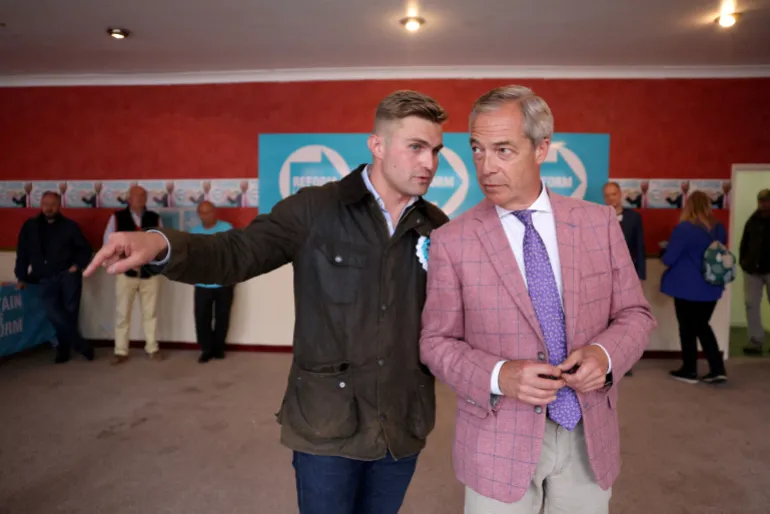
The anti-immigration Reform UK party said two of its senior officials had stepped down on Friday, following allegations that they were secretly filmed appearing to discuss ways to circumvent UK electoral laws on foreign donations.
The far-right party, whose popularity has soared in the past two years, is already embroiled in several other funding scandals involving its leader Nigel Farage. On Friday, it announced an internal probe into the latest case, which was brought to light by a Channel 4 investigation.
Recommended Stories
list of 3 itemsend of list
Reform is currently holding its annual party conference in Birmingham, central England.
Here’s what we know about the foreign funding claims and how they could affect British politics.
What did the Channel 4 investigation show?
Channel 4, an independent broadcaster, aired footage of senior Reform officials Dan Jukes and James Orr meeting with undercover reporters who were posing as prospective Reform backers from the United States.
In one instance during the programme, which was broadcast on Thursday night, footage was shown of Jukes appearing to talk about a proposal for Reform to receive a 500,000-pound ($675,000) donation from one of the men, who was presenting himself as an American financier, through his son, who he said lives in the UK.
The “son” was actually another journalist from investigative group Verbatim, which recorded the exchange.
In separate footage, Orr appeared to discuss a plan for the US donor to fund opinion polls for Reform UK rather than donating the money directly.
He told the undercover reporter that “we just don’t have British-resident donors, British entities, that would support us”.
During the investigation, Verbatim reported that Reform officials arranged for the US donor to pay more than 30,000 pounds ($40,500) to fund three opinion polls, without disclosing the source of the funds.
Channel 4 said it had verified the findings from Verbatim, an offshoot of the Centre for Climate Reporting.
What are the UK’s rules against foreign funding for political parties?
Under UK electoral law, political parties may only accept donations from British voters or UK-registered businesses. Donations from individuals or organisations based overseas are strictly forbidden.
In a statement on Friday, a UK Electoral Commission spokesperson said political parties must report all “permissible donations” they accept exceeding 11,180 pounds ($15,120) and all “impermissible donations” exceeding 500 pounds ($676).
“Parties are responsible for ensuring their internal processes and controls are fit for purpose,” the spokesperson said. “Information about any potential attempt to evade the controls on donations is for the police to consider.”
How has Reform responded to the allegations?
Following the programme’s broadcast, Reform initially issued a statement denying any wrongdoing and claiming the allegations were a hoax.
In a later statement, however, the party said it was conducting an internal probe and that Orr and Jukes had stepped down pending its outcome.
Orr, the party’s policy head, said he had agreed to step down temporarily and would “cooperate fully” with the investigation.
Jukes, Farage’s long-term aide, denied any wrongdoing but said he had “stepped back from politics in order to clear my name”.
Advisor Dan Jukes speaks to UK Reform party leader Nigel Farage [File: Hollie Adams/Reuters]
Farage accused the undercover journalists of “entrapment” and told broadcaster LBC, “they got a couple of our contractors to say things that perhaps should not have been said”.
“And as a result of that, you know, they have been removed this morning. And yeah, you know, I’m not happy about it,” Farage said.
“The party has broken no laws, the party has not taken any dodgy money or anything like that whatsoever,” Farage insisted.
Will Reform face legal consequences?
It remains to be seen. The UK’s ruling Labour Party has written to the police asking them to investigate possible criminal offences.
The Metropolitan Police said it was aware of the allegations in the broadcast and would assess any information provided to them.
This does not amount to the formal launch of an investigation.
Why does this matter?
The latest donation scandal is another blow for Reform, which has seen its place as the UK’s most popular party slip in opinion polls in recent months.
Last year, polling by YouGov suggested that Reform had become the most popular political party, and would likely win a UK general election if one had been held then. At that point, Labour was trailing far behind in the polls – projected to win just 27.3 percent of parliamentary seats, compared with Reform’s 41.7 percent. The former ruling Conservative Party stood at just 7 percent.
But a poll this week by YouGov showed Reform now tied with the UK’s left-wing Labour Party with 23 percent support each. The Conservatives have caught up with 20 percent.
This is not the first funding scandal Reform has grappled with, either. In July, Farage dramatically stepped down as Member of Parliament for Clacton amid allegations, also revealed in the UK media, that convicted fraudster George Cottrell, 32, recruited and paid three staff to work on Farage’s social media before the 2024 general election and has continued to allow Farage to use a five-storey Georgian townhouse he rented near Buckingham Palace.
Farage ultimately re-won his seat in Clacton at a by-election but still faces the prospect of a parliamentary inquiry into undeclared funding of 5 million pounds ($6.7m) from Thailand-based billionaire and crypto investor Christopher Harborne, who paid for Farage’s personal security before he announced his candidacy in the 2024 general election. So far, Farage denies all wrongdoing.
This week, Farage told the BBC that the parliamentary inquiry was unfair. He said there was a “wilful attempt, and it’s gone on now for months, to say that everything to do with Reform, that every individual involved with Reform is somehow a crook”.
This is evidence of “the establishment in a very coordinated way fighting back”, he claimed.
However, Justin Fisher, professor of political science at Brunel University of London, told Al Jazeera Reform’s latest donation scandal would further hurt Farage’s standing both within and outside his party, and could cost Reform votes in the next elections.
“If this was an isolated incident, then Reform would probably be able to brush it off,” said Fisher. “But it comes on top of serious questions about a donation to Nigel Farage, and a donation to Reform which allegedly had overseas links. This all contributes to a narrative which Reform is having great difficulty avoiding.”
Lebanese President Joseph Aoun praises the release and thanks US President Donald Trump for his efforts.
Published On 4 Sep 20264 Sep 2026
Four Lebanese citizens who were held in Israel have been released and handed over to the International Committee of the Red Cross (ICRC), the day after a first prisoner was freed.
In a statement on Friday, Lebanon’s President Joseph Aoun thanked the United States after the Red Cross facilitated the transfer. The US has been brokering talks between Beirut and Tel Aviv aimed at ending hostilities between the neighbouring countries.
Recommended Stories
list of 4 itemsend of list
Aoun expressed his gratitude “for all the efforts exerted, particularly by the US under the leadership of President Donald Trump and by international bodies, especially the ICRC”.
The ICRC confirmed that “at the request of the relevant parties, [it] facilitated the transfer to Lebanon of five individuals released from Israeli detention”.
Associated Press and Anadolu news agency reporters said they saw a convoy of ICRC vehicles heading towards the Naqoura border crossing on Friday morning and later returning. The convoy then entered a Lebanese army barracks in Tyre.
The prisoner released on Thursday was identified as Malek Ghazi.
It was the first such handover since the outbreak of the latest Israel-Hezbollah war six months ago.
Other released prisoners include Hussein Ayash from the village of Harouf and Mohammed Juheir, a fisherman from the border town of Naqoura, AP reported.
Dozens of Lebanese citizens are believed to be held in Israeli detention centres, including civilians as well as Hezbollah members captured during fighting in southern Lebanon.
The ICRC called for its teams to be granted access to the remaining prisoners unjustly held by Israel, noting that it has not had access to detainees held in Israel since October 2023.
“Many families in Lebanon are still waiting for answers about the fate of loved ones who may be detained, deceased or otherwise unaccounted for,” it said.
Clashes between the Israeli army and Hezbollah began after Israel launched its genocidal war on Gaza in October 2023. That led to over a year of hostilities that escalated into a full-blown war in 2024.
Two years later, Lebanon was fully drawn into the conflict when the US and Israel launched a war on Iran. Hezbollah, a key ally of Iran, fired rockets into Israel in retaliation for the killing of Supreme Leader Ayatollah Ali Khamenei. Israel responded with air strikes and a ground invasion that have killed at least 4,300 people in Lebanon.
The brand new series shows the ‘unfiltered’ side of a well-known social media star
Alix Earle’s new Netflix show has been hit with brutal reviews (Image: Netflix )
A beloved social media star’s new Netflix show has come under fire just hours after landing on the platform.
The streaming giant added Earle Meets World to its lengthy reality TV roster on Friday (September 4), and it has already divided viewers. The eight-part show promised to showcase influencer Alix Earle’s “unfiltered” life away from social media feeds.
A synopsis teases: “Gen-Z’s ultimate It Girl, Alix Earle, is making the next big jump in her career. Can she balance her burgeoning business empire with being that unfiltered, twenty-something, hot mess that America fell in love with? Now she’s taking her candid chaos from your FYP to TV… and nothing is off limits.”
We follow the 25-year-old as she comes to terms with her first major breakup from long-term partner Braxton Berrios, as well address her ongoing feud with podcaster Alex Cooper.
Despite her online following of over 13 million, Alix’s venture into TV has been hit with brutal reviews. One viewer took to TikTok to confess they switched off the show during its first episode, penning: “I can’t get past the first 20 minutes and I love Alix and reality shows.”
Get Netflix free with Sky
This article contains affiliate links, we will receive a commission on any sales we generate from it. Learn more
Sky is giving away a free Netflix subscription with its new Sky Stream TV bundles, including the £15 Essential TV bundle.
This lets members watch live and on-demand TV content without a satellite dish or aerial and includes hit shows like Stranger Things and The Last of Us.
Critics have also shared scathing verdicts, with Variety stating: “The same relatability that makes Earle a dependable brand ambassador also makes her everyday life almost painfully boring to watch, with the few juicy nuggets either overhyped, downplayed or both.”
Time agreed, writing: “If the show made a genuine effort to fulfil the 25-year-old social media star’s vow to reveal the rawest, most intimate aspects of her life, then the only reasonable conclusion to draw from it would be that there just isn’t much to see.”
Meanwhile, The Sunday Guardian published a more generous review stating: “Fans of Alix Earle will probably enjoy getting more access to her family, career and personal life”. And it seems they were spot on because Alix’s fanbase are completely hooked on the series.
“I love the show so far,” someone posted on TikTok. Another person added: “LOVING already so excited to watch more.”
A third viewer praised the show for its authentic approach to the genre, saying: “As someone that is a chronic reality TV watcher, the show is not over-produced and that has been my biggest qualm with the reality TV shows that I watch.”
Someone else admitted: “No guys I’m so invested,” and a final captivated viewer shared: “Oh they got me hook, line and sinker!”
All eight episodes of Earle Meets World are streaming now on Netflix
It is also the oldest of its kind in the UK, being a water-balanced cliff funicular.
A spokesperson for the attraction said: “What an incredible day as we welcomed passengers back to the Saltburn Cliff Tramway for the first time following its refurbishment.
“Seeing the tramway back in operation and filled with smiling passengers once again was a proud moment for everyone involved in the project.
“Thank you for your patience during the refurbishment works and for giving such a warm welcome to the tramway’s beautiful new handcrafted carriages.”
Tickets start from £1.50 for kidsCredit: NNP
Tickets cost £2.10 for adults or £1.50 for kids aged between 4-15 years old.
Kids under three go free while dogs and bikes cost 20p each.
Saltburn-by-the-Sea, or simply Saltburn, is more of a traditional seaside town due to its lack of arcades or rides on the promenade.
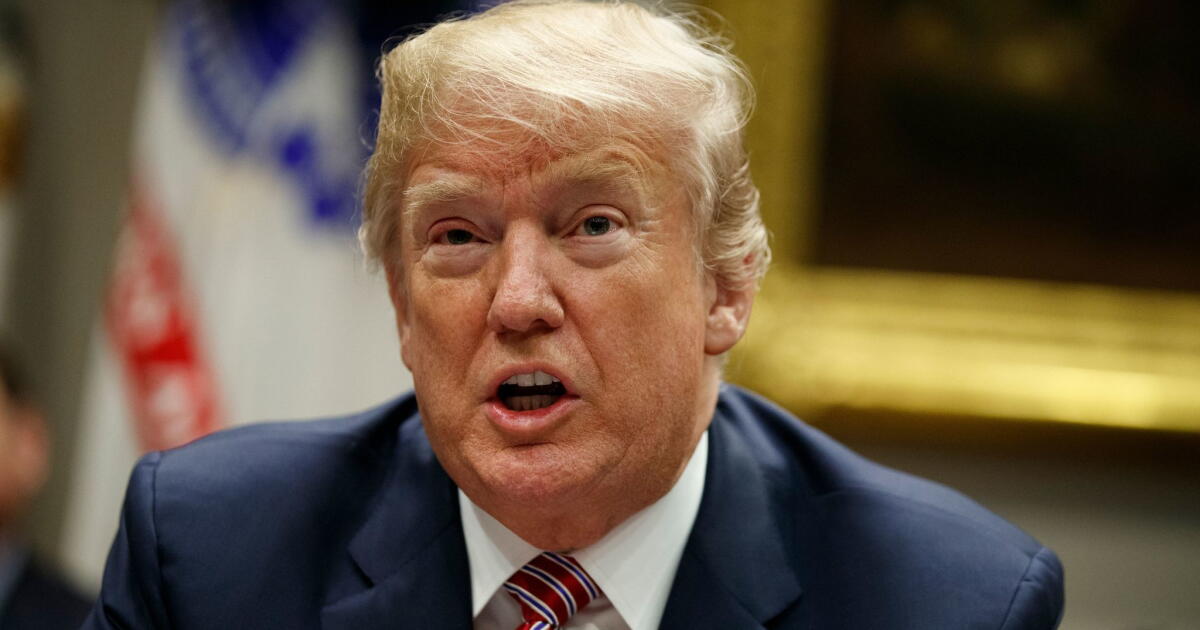
Reporting from Washington — President Trump on Thursday pressed his case for arming teachers to fight school shooters, despite widespread criticism, and for the first time suggested bonus payments for those who carry concealed firearms.
The president also called for making 21 the minimum age for buying long guns. Gun rights groups oppose raising age limits beyond 18 years, but Trump insisted he can sell the restriction to the “patriots” at the National Rifle Assn.
”I told them, we’re going to have to toughen” gun laws, Trump said, adding, “I really think the NRA wants to do what’s right.”
Trump elaborated on his ideas and other responses to last week’s Florida school massacre, starting with a series of morning tweets and continuing later at a White House roundtable on school safety with state and local officials. The televised session was much like one on Wednesday that Trump hosted with people touched by school shootings. Both offered a rare window into the president’s seemingly off-the-cuff thinking on gun policy, one of the nation’s most contentious issues.
Trump reserved most of his enthusiasm for bringing concealed-carry permits to American schools, to allow teachers, coaches and other officials to be armed against potential killers.
He repeatedly berated the practice of declaring campuses as “gun-free zones,” calling that an invitation to armed attackers.
“We have to harden our schools, not soften them,” Trump said. “A gun-free zone to a killer or somebody who wants to be a killer, that’s like going in for the ice cream. That’s like ‘Here I am, take me.’ ”
His exuberance for the idea has seemed to build since a 19-year-old gunman killed 17 students and adults at Marjory Stoneman Douglas High School in Parkland, Fla. The administration had not previously floated the proposal. Since his campaign, Trump mainly has limited his talk of gun policy simply to a staunch defense of an absolute 2nd Amendment right to bear arms, but the pressure for action since the latest shooting has been intense.
Trump raised the proposal publicly when he met at the White House on Wednesday with the group that included survivors of the Parkland shooting. When he asked what students, parents and teachers thought of the idea of arming school personnel, a few raised their hands in support and a few against. Since then, however, several have spoken out in opposition.
By Thursday, nonetheless, Trump had turned into a hearty supporter of arming teachers. In four tweets, he advocated for guns in schools, and then espoused several other ideas in other posts, including raising the minimum age for certain gun purchases, bolstering the process of checking backgrounds of potential buyers and banning the so-called bump stocks that turn legal firearms into illegal rapid-fire ones.
In his midday meeting with state and local officials, Trump grew expansive on his ideas, and occasionally heated.
He said he didn’t want “everybody standing there with a rifle” in America’s schools, but rather select, trained personnel with concealed weapons. Then he pointed to White House Chief of Staff John F. Kelly, a retired Marine general, as an example of the sort of people schools could turn to for armed protection. “If he’s a teacher … I want him to have a gun,” Trump said.
“Frankly, you have teachers that are Marines for 20 years, they retire and become a teacher,” he said. “They’re Army, Navy, Air Force, they’re Coast Guard, they’re people who have won shooting contests for whatever, this is what they do. They know guns, they understand guns.”
Trump suggested without evidence that up to 40% of teachers could be armed. He then recommended that “we give them a little bit of a bonus” for bearing arms.
Trump did not address how to pay for the bonuses, school weapons or other proposals he is considering, except to say that the debate “isn’t so much about funding, it’s about common sense.”
By his focus on such ideas, Trump in recent days has steered the national gun policy debate away from more ambitious proposals, notably one to revive a long-lapsed ban on assault rifles like the Parkland shooter used. The newly minted gun control advocates among Parkland’s teenage survivors have called for a ban. He opposes one.
Instead, the president has raised some ideas, like new regulations against bump stocks, that the NRA has expressed willingness to consider, and a few — like the age limit for buyers — that, he says, his gun rights allies at the NRA can be persuaded to support.
“They’re ready to do things,” he said. “They want to do things. They’re good people.”
Asked later if Trump had spoken to the NRA about the higher age minimum, Deputy Press Secretary Raj Shah did not have an answer.
On the NRA’s website, a spokeswoman is quoted in opposition: “Passing a law that makes it illegal for a 20-year-old to purchase a shotgun for hunting or an adult single mother from purchasing the most effective self-defense rifle on the market punishes law-abiding citizens for the evil acts of criminals.”
The NRA’s longtime leader, Executive Vice President Wayne LaPierre, in a speech to the Conservative Political Action on Thursday, did not suggest any inclination toward compromise. Instead, he complained that liberals are trying to exploit the Florida shooting to advance their agenda.
“It’s not a safety issue, it’s a political issue,” LaPierre said. “Their solution is to make you, all of you, less free…. They want to sweep right under the carpet the failure of school security, the failure of family, the failure of America’s mental health system and even the unbelievable failure of the FBI.”
For Trump, the group likely would be a powerful ally for any expansion of concealed-carry laws to school employees, though the idea has met with concern from Republicans and Democrats, as well as school and law enforcement groups.
Sen. Marco Rubio of Florida, a Republican, agreed with a Parkland teacher who expressed opposition to the idea during a televised CNN forum on Wednesday night. “I don’t support that,” he told her, citing his concerns as a father of school-age children and “practical problems.”
Rubio explained: “Imagine in the middle of this crisis, and the SWAT team comes into the building, and there’s an adult with a weapon in their hands. And the SWAT team doesn’t know who’s who and we have another tragedy that was unnecessary.”
The Senate’s Democratic minority leader, Sen. Charles E. Schumer of New York, expressed doubt that Trump would really push for the proposals that the NRA opposes.
“The president is pushing for action on things — including comprehensive background checks — that the NRA opposes,” Schumer said. When Trump has talked about gun restrictions in the past, Schumer noted, he “quickly dropped his support once the NRA opposed it. I hope this time will be different.”
As tough as Trump talked about “hardening” schools, he bristled at the idea of practicing for a gun-related crisis. He had had little reaction on Wednesday, when a Parkland student and a parent advocated for more schools holding crisis drills. But on Thursday, when Florida’s education commissioner pressed the importance of holding regular “active shooter drills” so that students know how to behave when there is a threat, Trump snapped at her.
“I think that’s a very negative thing to be talking about. I don’t like it. I’d much rather have a hardened target,” he said, adding, “I think it’s very bad for children.”
Shah later clarified that the president considers the common term for the drills — “active shooter drills” — frightening to young students, suggesting that Trump doesn’t object to the practices themselves but only to the “brand.”
Advisors say the president isn’t zeroing in on specifics just yet. “Right now we’re in a listening phase,” said Shah, “but he is going to come forward later on with something a little bit more concrete.”
A BELOVED 90-year-old lido has been forced to shut early this summer due to flash flooding.
Season ticket holders have been directed to a nearby lido, where they will be able to swim free of charge.
Letchworth Lido has cut its summer season short as a result of flooding in the areaCredit: Letchworth Lido/FacebookThe lido will now reopen to the public in the winter for its seasonal ice rinkCredit: Letchworth Lido/Facebook
Letchworth Lido in North Hertfordshire has cut its summer season short due to local flash flooding and torrential rain.
In a statement on its Facebook page, Letchworth Lido said: “We are sorry to confirm that, due to the impact of localised flooding, Letchworth Lido will remain closed and will not reopen for the remainder of this season.
Sign up for the Travel newsletter
Thank you!
Bookings were set to be taken up until Sunday, September 6 at the heated lido, however, it will now reopen in winter for its seasonal ice rink.
Letchworth Lido had initially shut on August 27 due to “unforeseen circumstances”, where closures were expected to remain in place during the following week.
This was the second time in just over a year that the pool had shut, with facilities also closed in July 2025 after flooding required a clean-up operation.
The historic heated outdoor swimming pool, located on Norton Common in Letchworth Garden City, originally opened in 1935 as a beloved destination for local residents.
Over 27,000 people attended the 50metre heated lido last summer, with facilities that also include a learner pool, sunbathing area and a cafe.
Customers with bookings before the closure announcement will be contacted directed and offered a full refund for all cancelled sessions.
Season ticket holders for Letchworth Lido will also be able to transfer their ticket to the nearby Hitchin Swimming and Fitness Centre to swim between now until Sunday.
The Doggy Splash sessions that were planned to take place at Letchworth Lido will now also be held at Hitchin Swimming and Fitness Centre on September 11, 12 and 13.
Letchworth Lido continued to say: “We’re very sorry for the disappointment and inconvenience caused by the early closure and thank customers for their understanding.
“We look forward to welcoming you back to Letchworth Lido later this year when it transforms into our festive ice rink.”
Hi, and welcome to another edition of Dodgers Dugout. My name is Houston Mitchell. A set of jumper cables walks into a bar and orders a beer. The bartender eyes it suspiciously and says “I’ll serve you as long as you don’t start anything.”
Are you a true-blue fan?
Get our Dodgers Dugout newsletter for insights, news and much more.
By continuing, you agree to our Terms of Service, which include arbitration and a class action waiver. You agree that we and our third-party vendors may collect and use your information, including through cookies, pixels and similar technologies, for the purposes set forth in our Privacy Policy such as personalizing your experience and ads.
This just in
The big news is whatever is going on with Shohei Ohtani. He went 0 for 4 with four strikeouts against St. Louis on Wednesday and seemed to be in pain. He didn’t play Thursday. He’s not talking to reporters and Dave Roberts said, “He definitely doesn’t want to take the day [off]. Speaking for him, I know he feels that he needs to post and be in the lineup, and if he’s upright, he should play. I respect that. But if he’s feeling the way that it visibly looks, then it’s really not helping anyone. So that’s the conversation I’ll have with him.”
I’m sure we’ll have more to discuss on this in the next newsletter, once we have more clarity.
Most and least valuable?
Who have been the most valuable Dodgers this season? Well, if you go by WAR, which considers pitching, hitting, fielding and base running, the most valuable have been:
Shohei Ohtani, 6.5 Andy Pages, 5.4 Yoshinobu Yamamoto, 4.8 Max Muncy, 3.9 Freddie Freeman, 3.9 Mookie Betts, 2.6 Tommy Edman, 1.8 Justin Wrobleski, 1.8 Tanner Scott, 1.7 Tyler Glasnow, 1.6 Dalton Rushing, 1.4 Jack Dreyer, 1.2
The least valuable Edwin Díaz, -1.3 Cole Irvin, -0.4 Chuckie Robinson, -0.4 Kyle Tucker, -0.3 Emmet Sheehan, -0.3 Eliezer Alfonzo, -0.2 Ben Casparius, -0.2 Jonathan Hernández, -0.2 Will Klein, -0.2 Ben Rortvedt, -0.1 Teoscar Hernández, -0.1 Kiké Hernández, -0.1 Alek Thomas, -0.1 Charlie Barnes, -0.1 Kyle Hurt, -0.1
I think we can safely call last offseason the worst free-agent signing group of the Andrew Friedman era. Two guys are getting a combined $80 million this season and have a combined -1.6 WAR. Do I have to say their names?
Then you factor in Teoscar, and the outfield is a mess, especially with Pages out.
And if your last name is Hernández, this is not a good year for you to play for the Dodgers.
Some might be surprised to see Betts so high, considering he is having a poor year offensively. But Betts gets a strong boost from his defense. He is in the top three in most defensive metrics.
Which brings us to his hitting. He has had some injuries the last two seasons, so we could blame his decline on that. We could blame it on moving to shortstop. Or it could be both those things. Or neither. Some things just don’t have a provable cause.
But let’s look at how Betts has hit in his career at different defensive positions:
DH (55 plate appearances), .319/.400/.574 Second base (446), .309/.406./.550 Right field (4,458), .293/.372/.528 Center field (968), .287/.349/.492 Shortstop (1,421), .265/.337/.436 PH (17), .267/.353/.267
To be clear, the Dodgers are not moving Betts back to right unless something unexpected happens. It’s also true that Betts has hit much better as the leadoff hitter in his career than anywhere else. These are just things to make you think.
Back to WAR for a moment. Is it a perfect stat? No. There is no perfect stat. It’s just one tool in a drawer of tools. A mechanic never uses one tool for all jobs. A chef doesn’t use one kitchen utensil. And when looking at stats, you shouldn’t make a determination based on just one stat. But it can give an indication of how things are going.
Here’s how WAR basically grades out:
Replacement player 1 or fewer WAR Role Player 1-2 Solid Starter 2-3 Good Player 3-4 All-Star 4-5 Superstar 5-6 MVP 6+
Chris Taylor returns
Chris Taylor, his wife Mary and son Theo watch a tribute video of his career as a Dodger on Wednesday.
(Ronaldo Bolaños / Los Angeles Times)
Former Dodger Chris Taylor returned to Dodger Stadium on Wednesday, where he received his 2025 World Series ring and threw out the first pitch before the game against the St. Louis Cardinals.
Taylor is one of those guys who become a fan favorite because they seem to be wringing every ounce of athletic ability out of their body. We could identify with Taylor, because we could imagine us playing the way he did. Play like Ohtani? No. But play like Taylor? We could fool ourselves into believing that if we just stuck with it, we could have been Chris Taylor. He was us on the field.
This newsletter began a couple of weeks before the 2015 season. And I believe the first group of angry emails I got about something the Dodgers did was June 19, 2016, when the Dodgers traded pitcher Zach Lee to Seattle for some guy named Chris Taylor.
Lee had been touted as one of the best Dodgers pitching prospects in years. In the minors in 2015, he went 13-6 with a 2.63 ERA. Sure, he had a terrible outing in what turned out to be his only start with the Dodgers (4.2 IP, 11 hits, one walk, three strikeouts, 13.50 ERA), but that could happen to anyone. He was the pitcher of the future. Until he wasn’t. And to trade him for this Taylor guy, who in three seasons with the Mariners hit .240/.296/.296? Surely they could have gotten more for him than that! (They couldn’t and don’t call me Shirley.)
Here’s a guy who was with the team from 2016-25, and what do we know about him? Not much. He never sought the spotlight, just did his job every day to the best of his abilities.
“He is the consummate pro, the way he did a trust fall when he got here,” Dodgers president of baseball operations Andrew Friedman said when the Dodgers released Taylor last season. “He came in hungry and wanting to get better, and dove in with our hitting guys, with our position coaches. … He was a huge part of so much success that we’ve enjoyed. Can’t say enough about the human, the worker, the teammate, the player.”
Before Wednesday’s game, Mookie Betts told Cary Osborne of Dodgers Insider, “Having CT on the team was like having a Swiss Army knife. I think he was one of the first Swiss Army knives (in the majors). He made an amazing career out of it. It’s really hard to do, to be essentially a utility player and make a full career and be an elite utility player. He did it with flying colors.”
And it was fitting that he threw out the first pitch before the game against the Cardinals. His most important homer may have been his walk-off in the 2021 wild-card game against St. Louis. You can watch that here.
He made an incredible catch in Game 7 of the 2018 NLCS against the Brewers. You can watch that here.
—Rosters expanded from 26 to 28 players on Sept. 1, and the Dodgers activated catchers Will Smith and Dalton Rushing and pitcher Justin Wrobleski from the IL. They also brought infielder Alex Freeland up from the minors and designated catcher Ben Rortvedt for assignment.
Rushing, who has a torn UCL, isn’t expected to catch but will be available as a hitter off the bench.
“From a hitting side, I think they felt comfortable with how much I’ve been hitting off [the pitching machine] and how much I’ve just really just been hitting over the last three weeks,” Rushing said. “The swing never really took a break. Usually, you hit the IL and it’s like you do nothing for a week or two, and thankfully for me, it was just no throwing, so I was able to still progress with the bat and feel as comfortable as possible. So I think making this call to allow me to obviously help us off the bench, I think, is an easier call for them.”
As for Smith, it turns out he had an annular tear in his neck. An annular tear is a small crack in the outer fibrous ring of a spinal disc. That doesn’t sound pleasant at all.
“It was frustrating early, just looking for answers why it was taking longer,” Smith said. “But we finally got those answers. And then it was kind of a pretty straightforward process from there. So last month or two hasn’t been too bad.”
Forgotten Dodger: Babe Herman
Babe Herman in 1933 with the Cubs.
(Associated Press)
Babe Herman was a great hitter and a lousy fielder who will always be remembered for doubling into a double play.
On Aug. 15, 1926, the Dodgers were playing the Boston Braves. With one out and the bases loaded, Herman launched a flyball to right that looked like it would be caught, but it hit the wall. The runner on third scored, but the runner on second, Dazzy Vance, rounded third and stopped, unsure if the ball had been caught. The runner on first, Chick Fewster, saw Vance round third and assumed he was going to score, so Fewster rounded second and continued to third, where he met the confused Vance. Meanwhile Herman, head down all the way, came sliding into third with what he thought was a triple. The base belonged to Vance, so Fewster and Herman were tagged out, inning over.
What often gets overlooked, the run Herman did knock in turned out to be the winning run in the game.
It also led to a story, possibly apocryphal, of a Brooklyn man hailing a cab. The driver has the Dodgers game on the radio and the passenger asks “What’s going on with the Dodgers?” the driver answers “they have three men on” and the passenger responds, “Oh yeah? Which base?”
Also, Herman played so well that season that the Dodgers released aging future Hall of Famer Zack Wheat, convinced Herman could replace him.
Herman’s best season came in 1930, when he hit .393 with 48 doubles, 11 triples, 35 homers and 130 RBIs. Tempering those numbers a bit is the fact the entire league hit .303 in 1930 and despite those lofty numbers, Herman amazingly didn’t lead the league in anything. Herman led the team in homers in RBIs in 1931 and hit for the cycle twice. He got into a salary dispute after the season and the Dodgers traded him to Cincinnati.
He left the majors after the 1937 season and returned to the minors, playing several seasons with the Hollywood Stars. If you have ever watched the move “The Pride of the Yankees” starring Gary Cooper as Lou Gehrig, then you’ve seen Herman. He served as the movie’s technical consultant and was a stand-in for Cooper in long shots of Gehrig hitting.
In 1945, with the Dodgers in a pennant race and players scarce because of the war, general manager Branch Rickey asked Herman, who had been playing in the Pacific Coast League, if he would like to return to the Dodgers. Herman, 42, said sure and hit .265 with a double, homer and nine RBIs in 34 at-bats. He retired for good and became a longtime scout for various teams, as well as raising turkeys and owning an avocado farm. Herman died in Glendale on Nov. 27, 1987, at age 84.
Dodgers poll
We asked, “How do you think the Dodgers will do in the postseason this year?”
After 11,146 votes:
They will win the World Series, 40.7% They will lose in the NLCS, 32.9% They will lose in the NLDS, 16.6% They will lose in the wild-card series, 5.4% They will lose in the World Series, 3.9% They won’t make the postseason, 0.5%
Up next
Friday: Washington (*Jackson Kent, 1-2, 5.59 ERA) at Dodgers (*Blake Snell, 2-1, 2.42 ERA), 7:10 p.m., SportsNet LA, AM 570, KTNQ 1020
Saturday: Washington (Cade Cavalli, 12-5, 3.12 ERA) at Dodgers (Tyler Glasnow, 4-0, 2.79 ERA), 6:10 p.m., SportsNet LA, AM 570, KTNQ 1020
Sunday: Washington (*Andrew Alvarez, 2-6, 3.47 ERA) at Dodgers (TBD), 7:10 p.m., SportsNet LA, AM 570, KTNQ 1020
Have a comment or something you’d like to see in a future Dodgers newsletter? Email me at houston.mitchell@latimes.com. To get this newsletter in your inbox, click here.
Two Muslim female journalists allege they were detained and brutally assaulted by police in India’s capital, Delhi. Police have denied the allegations, claiming the journalists were brought to the station over an illegal parking dispute.
China is buying ninety percent of Iran’s oil exports, settling transactions in renminbi, and hiding the rest beneath layers of shell companies. This is not defiance. It is a demonstration, conducted in plain sight, of exactly how far American economic reach actually extends.
Scott Bessent promised, when he launched Operation Economic Outcast last week, that no one would be above the reach of US sanctions. China’s foreign ministry responded by saying Beijing would do everything necessary to safeguard its own rights and interests. That exchange, watched by the rest of the world, is not really about Iran. It is about whether the threat of American secondary sanctions can force a country that has already fought several trade wars with Washington to a standstill into changing its economic behaviour. The answer, which China has been demonstrating methodically for months, is no.
How China Made Itself Immune to US Secondary Sanctions
The architecture of Chinese-Iranian trade has been specifically designed to sit outside dollar-system jurisdiction. Chinese banks and companies that buy Iranian oil settle transactions in renminbi or through barter arrangements, making them effectively immune to American extraterritorial authority. The handful of Chinese entities that still touch dollar-denominated transactions do so through shell companies that can be discarded and replaced faster than Washington can identify and sanction them. The result is the regulatory whack-a-mole problem that American Treasury officials privately acknowledge, eliminate one entity, and three more appear in its place, each more obscured than the last.
Washington could escalate by sanctioning major Chinese banks and companies that have no Iran ties at all, using them as leverage to pressure Beijing to rein in those that do. That option exists on paper. In practice, it would constitute a declaration of economic war against China’s financial system at a moment when the US economy is already strained by six months of conflict with Iran, oil prices are elevated, and midterm elections are eight weeks away. The Trump administration knows this, which is why Bessent’s ultimatum came with no major Chinese institution on the sanctions list. The threat was real. The enforcement mechanism was not.
Stay ahead of the geopolitical week.
MD Briefing delivers expert analysis across five global fronts — the Indo-Pacific, energy, geoeconomics, European security, and the Middle East — every Monday morning. Free.
What a US Victory in Iran Would Cost Beijing
China sources roughly forty percent of its oil imports from the Gulf, with Iran accounting for ten percent of that total. If the US wins this war convincingly, meaning Iran’s government collapses or capitulates and Washington reinstalls itself as the dominant security guarantor across the Gulf, the energy architecture that China has spent two decades building becomes dependent on American goodwill. Every barrel of Gulf oil that China buys would effectively pass through a security framework Washington controls.
The regional knock-on effects compound that problem. The Mecca pact between Saudi Arabia, Turkey and Pakistan, the SCO’s deepening trade and financial architecture, the China-brokered Saudi-Iran normalisation of 2023: all of these represent years of Chinese diplomatic investment in a Middle East that is gradually reducing its security dependence on the United States. An Iranian defeat that pushes regional states back under the American umbrella undoes that investment at a stroke. From Beijing’s perspective, the cost of buying Iranian oil at a discount and absorbing American secondary sanctions is considerably lower than the cost of losing the regional influence that Iran’s survival helps sustain.
Neither Ally Nor Bystander
The SCO summit in Bishkek last week illustrated Beijing’s position with more precision than any official statement. Xi met Putin and Modi bilaterally. Iran’s President Pezeshkian attended the summit and held consultations at foreign minister level. He was not invited to Beijing. He did not get a Xi bilateral. That calibrated distance is deliberate, and it reflects a Chinese calculation that is more sophisticated than either alliance or abandonment.
Beijing does not want Iran to lose. It also does not want Iran to win so completely that Tehran’s regional hegemony destabilises the Gulf relationships China has been cultivating. The Chinese position, buying Iranian oil, refusing to arm Iran, keeping diplomatic engagement at arm’s length, is designed to keep Iran functional without making China responsible for Iranian behaviour. It is the foreign policy equivalent of keeping a fire burning without touching it.
Xi’s scheduled visit to Washington later this month, coming directly after the Bishkek summit, reinforces this reading. Beijing is simultaneously demonstrating to Iran that it has economic backing and demonstrating to Washington that it has strategic restraint. Both demonstrations serve Chinese interests. Neither requires China to choose a side.
Five Things Worth Watching
Whether Xi’s Washington visit produces any concrete understanding on Iran-related secondary sanctions. If the two sides agree on a framework that gives China cover to quietly reduce Iranian oil purchases over time, the sanctions architecture gains traction it currently lacks. If the summit produces only standard language about constructive competition, Operation Economic Outcast’s China problem remains unresolved.
The SCO Development Bank’s progress toward implementation. If the bank moves from agreement to operational institution in the coming months, it creates dollar-independent financing infrastructure that makes secondary sanctions significantly less effective not just for China-Iran trade but for the broader Eurasian trade network the SCO is building.
Whether any Chinese entity on the August sanctions list is large enough that its designation produces real disruption rather than being absorbed and routed around. The signal from August’s first wave was that Washington sanctioned deliberately small targets. The size and visibility of the next wave’s targets will tell you how seriously Washington is willing to press China.
India’s position on renminbi settlement for its own Iranian oil purchases. If Delhi follows Beijing’s approach and expands non-dollar settlement for energy trade, the secondary sanctions architecture faces a second major exemption that Washington is even less able to address given how carefully it has been courting India.
Iran’s currency trajectory. The rial has hit record lows despite Chinese oil purchases continuing. If the currency continues to deteriorate even with Chinese demand stable, it suggests Operation Economic Outcast is landing on Iran’s non-oil economy in ways that the Chinese lifeline cannot fully offset which changes the pressure calculus regardless of whether Beijing complies.
The Bottom Line
Washington designed Operation Economic Outcast to isolate Iran. What it has demonstrated is the outer boundary of American economic jurisdiction in a world where China has spent a decade building the infrastructure to sit outside it. Renminbi settlement, dark fleet shipping, teapot refineries, shell company networks, these are not improvised workarounds. They are a parallel financial architecture, constructed precisely for this contingency, and it works well enough to keep Iranian oil flowing at volumes Washington cannot stop.
The deeper problem for the Trump administration is not that China is defying its sanctions. It is that China is proving, transaction by transaction, that the sanctions cannot be enforced against a country of sufficient size and sufficient preparation. That demonstration has an audience well beyond Beijing and Tehran. Every country currently watching whether to comply with American secondary sanctions is learning the same lesson: the reach of US economic power has a ceiling, and China has found it.
Viewers tuning in to the new series of The Grand Tour have been left curious about the title card
The Grand Tour’s new series has finally landed on Prime Video(Image: PRIME VIDEO)
The Grand Tour fans have been left intrigued by a title card featured in one episode.
The six-part series premiered on Prime Video today (September 4) with a fresh set of hosts: Francis Bourgeois, James Engelsman and Thomas Holland. The trio replace veteran stars Jeremy Clarkson, James May and Richard Hammond, who gladly handed over the baton to the newbies.
The new series of The Grand Tour even saw the former Top Gear trio make appearances throughout the episodes. Jeremy appeared in the opening episode as he gave some blunt advice to the newbies, while Richard helped to judge a competition to find the toughest car, and James hosted the line-up in his pub.
Episode five of The Grand Tour featured an exciting race between Thomas in a hypercar against Francis and James on a train as they tried to get from the UK to the Belgian Grand Prix. The instalment titled A Relaxing Spa Weekend also featured James delving into the incredible history of the BMW Isetta and its Cold War history.
The episode ended with a title card which featured two images of Klaus-Günter Jacobi, who built the smallest-ever escape car used to cross the border between East and West Berlin during the Cold War. Many are curious about the figure mentioned in the title card. Here’s what you need to know.
Who is Klaus-Gunter Jacobi?
Klaus-Günter Jacobi was a mechanic who helped his best friend escape from East Berlin into West Berlin, crossing the heavily guarded border crossing of Checkpoint Charlie. He hid his best friend Manfred Koster in a tiny and concealed compartment in the BMW Isetta.
Manfred was trying to escape East Germany as he was set to be drafted into the army. Thankfully, his friend Klaus came up with the cunning plan.
Klaus-Günter modified the Isetta, reduced the fuel tank to a bare minimum and managed to build in the hiding space. He had also removed other unnecessary components and provided heat protection.
However, they only had an hour to cross the border before it closed for the night. The men were delayed and almost didn’t make it, with sniffer dogs checking for anything suspicious.
If they had been caught, the pair might have paid with their lives for trying to leave. The guards inspected the vehicle thoroughly and let Klaus through without suspecting what he was carrying.
Get Amazon’s Prime Video free for a month
This article contains affiliate links, we will receive a commission on any sales we generate from it. Learn more
TV lovers can get 30 days’ free access to tantalising TV like The Boys, Reacher and Clarkson’s Farm by signing up to Amazon Prime. Just remember to cancel at the end and you won’t be charged.
Klaus’ story was immortalised in the mini-film The Small Escape, which was produced by the BMW Group. After word spread of the escape, the Isetta was used by other defectors to escape East Berlin.
The BMW Isetta was conceived post-WWII by Italian refridgerator company boss Renzo Rivolta and his company Iso Spa. The car essentially had the engine of a scooter, the door of a fridge and seating for two people. BMW was on the verge of bankruptcy when they licensed the design from Iso Spa and set about making it more into one of their cars, thus saving the firm from ruin.
After sharing the unbelievable true story, James then asked Thomas to try and get into a similar-sized space. Despite his best efforts to assume a foetal position, Thomas was unable to get into the space and this illustrated just how tiny this compartment was.
Later in the episode, the two men stopped at a pedestrian crossing as Klaus walked across and waved at them. He now serves as a tourist guide at the Berlin Wall Museum in Friedrichstrasse.
ALL planes leaving Gatwick Airport have been grounded causing chaos for passengers.
A Boeing 787 aircraft was reportedly stuck on the runway and the technical issue is currently being investigated, it is understood.
Flights to London Gatwick have been delayed or diverted, according to airplane tracking sitesCredit: AirNav radarGatwick said the runway was closed due to a ‘technical issue’Credit: Alamy
Staff worked to resume flights as quickly as possible after the runway closed at 1.40pm today.
A London Gatwick spokesperson said: “Due to a technical issue with a departing aircraft, our runway is currently closed.
Sign up for the Travel newsletter
Thank you!
“Our teams are working to move the aircraft and resume operations as quickly as possible. As always, safety and security is our number one priority.”
Airport officials have informed customers to still travel to the airport on time for their flights.
The Sun understands the plane was a flight to New York which was due to take off just after 1pm.
It appeared to be on the runway surrounded by several fire engines but has now been cleared.
One passenger returning from the Isle of Man said on X: “I’m stuck on a plane returning from the IOM to Gatwick after jawbone surgery yesterday.. exhausted.
“The plane has diverted to Luton…I’d rather get out and catch a train back to London!”
The grounded plane caused chaos with many EasyJet flights being reportedly sent to other airports.
Another added: “Gatwick Airport any idea what is happening? I am stuck on your runway with no information.”
Reporting from Brisbane, Calif. — Just beyond San Francisco’s city limits lies 640 acres of land that could help solve some of California’s biggest problems.
State and regional leaders have endorsed the project. But its fate rests with Brisbane, a city of 4,700 people that annexed the property 55 years ago. And no one, not even the developer, thinks Brisbane’s residents will approve all 4,400 homes.
“Unfortunately, we believe that their ceiling is going to be below that,” said Jonathan Scharfman, the general manager for the developer, Universal Paragon Corp.
The project, Brisbane Baylands, reveals how few incentives local governments have to accept large developments — even as the state is pushing to lower housing costs and funnel growth toward existing cities and nearby mass transit to combat climate change. Brisbane residents are wary of a project that could triple the city’s population. Under California’s tax system, Brisbane also earns more money if it rejects the current plan in favor of potential alternatives with more hotel rooms and space for businesses — but no homes.
The Bay Area’s dire need for housing makes the debate over the Baylands project “particularly painful,” said Ben Metcalf, director of the state Department of Housing and Community Development.
“It is frustrating that as a state and as a constellation of local jurisdictions we are constantly making decisions that aren’t the best for alleviating poverty, housing affordability, furthering our state’s economy or meeting our climate change goals,” Metcalf said.
For their part, some Brisbane residents feel besieged by pressure from housing activists, business groups, state lawmakers, San Francisco politicians, newspaper editorials and others beyond the city’s boundaries. An old rail yard and garbage dump contaminated the land, and opponents contend they want to protect anyone who might decide to live there even after regulators approve a cleanup. More than that, Brisbane residents say, outsiders don’t understand how much the Baylands project would upend their community.
“We’re a small town,” City Councilman W. Clarke Conway said at a meeting on the project last fall, “and we’re a small town by choice.”
Bill Dettmer, left, speaks with a group of men who regularly meet and discuss local politics and civic issues at Madhouse Coffee in Brisbane, Calif. Dettmer thinks a developer should be allowed to build housing on an old rail yard in the city.
(Josh Edelson / For The Times)
Brisbane’s main drag is Visitacion Avenue. It slopes upward for five blocks, starting at a city park and continuing through mom-and-pop shops, cafes and restaurants. The rest of Brisbane comprises office parks, a strip mall and mostly single-family homes built throughout the town’s hills.
“This is the land that time forgot,” said Greg Lee, 55, an electrical engineer who has lived in the city for more than two decades.
San Bruno Mountain, which rises a quarter-mile into the sky, is Brisbane’s landmark, and residents have fought to preserve it. In the 1960s, they blocked a developer from leveling the mountaintop and building enough new homes for 70,000 people. In 1980, after years of battling another massive project on the mountain, residents received a last-minute reprieve from the federal government, which declared San Bruno a critical habitat for the endangered callippe silverspot butterfly.
Anti-development fervor has continued. About a decade ago, a city councilman suggested sidestepping a state housing law that requires cities to plan for growth by zoning for homes where nothing would ever get built — the bottom of Brisbane’s lagoon.
Residents’ efforts to protect Brisbane’s small-town feel make large changes hard to accept, said Paul Bouscal, 58, a San Francisco water department employee who has lived in the area since 1982.
The Baylands, he said, plays on fears of Brisbane getting big.
“For our town to grow like that, it would be too much, too fast,” Bouscal said.
It might be easier for residents and elected officials to welcome growth if the city received more tax dollars for doing so. But the opposite is true.
Because of tax limits established in 1978 by Proposition 13, local governments generally receive more revenue from sales and hotel room taxes than property taxes. Proposition 13 limited property tax rates to 1% of a home’s taxable value and restricted how quickly that taxable value could increase after a purchase.
Last year, Brisbane hired a consultant who found that the city would net $1 million a year in tax revenue by approving the Baylands. But if the city instead approved a project with lots more commercial space, a larger hotel and no housing, Brisbane would gain $9 million annually — an amount equivalent to more than half the city’s current day-to-day operating budget.
Developers are always going to face opposition because of residents’ concerns about their communities changing, said Mark Stivers, a longtime state housing policy staffer. But the tax system is another big reason the state has a housing shortage, he said.
“I’d like to think if just the fiscal incentives were reversed, if a city could make as much money off housing as they could retail, we’d be having a very different conversation in California,” Stivers said.
Jonathan Scharfman, general manager of Universal Paragon Corp., describes the area where his company hopes to build a 4,400-unit housing development.
(Josh Edelson / For The Times)
Debate over the Baylands has divided the town and dominated Brisbane politics for at least a decade. More than half of Brisbane residents said in a 2015 city-sponsored poll that they were OK with some housing on the Baylands site. But just 3% backed a project of more than 4,000 homes such as the developer is proposing.
Bill Dettmer, 63, spent a recent morning at Madhouse Coffee, one of the city’s main gathering spots, trying to convince skeptical neighbors that the city should support the housing. Dettmer moved to Brisbane 50 years ago and does maintenance work in the city.
“I see a lot of stuff,” Dettmer said. “I see beds in garages. You have to increase the [housing] supply. If you really want to help out people, let them live in dignity. It just seems like a no-brainer.”
Many local opponents cite the land’s history — not hostility to growth — for why they’re against the project. San Francisco used to dump its garbage on the site, and a railroad company repaired its trains there. Longtime residents remember watching tires burn.
Scharfman, the developer’s general manager, said Universal Paragon Corp. will clean up the land and won’t begin building until all environmental agencies responsible say it’s safe. He likened the process to how an old rail yard at San Francisco’s Mission Bay was cleaned up and now has thousands of homes.
Still, some Brisbane residents say they don’t trust regulators will get it right, because what’s known about the toxicity of chemicals can change over time. Even though they won’t live in the Baylands, opponents believe they have a responsibility to shield those who might.
“Why do we have a seat belt law? Why do we have a helmet law? They’re anti-stupidity laws to protect the general population,” said Michele Salmon, 63, who was born and raised in Brisbane.
Salmon said she understood housing problems were real and lamented the lack of space to accommodate a growing population.
“I do feel sorry that the younger generation is not going to get to live the life that we did,” she said. “But it’s a different time.”
“This is a plan, an expectation of how we could grow,” said Leah Zippert, an Assn. of Bay Area Governments spokeswoman. “It is not a mandate to build. It’s not a mandate to do anything.”
The Brisbane City Council plans to make a key decision on the Baylands this summer, including whether it supports any housing on the site. But the council expects to put that proposal on the ballot next year. Brisbane’s residents will be the ones with the last word.
Mission Viejo High’s offensive line did not want to be on the field against St. Paul on Friday night. This was evident by their first two plays.
The Diablos’ opening drive began with a 60-yard rushing touchdown, created by a massive gap on the left side of the offensive line. Senior running back Carson Vandermade wasn’t close to being touched by a defender on his way to the end zone.
A 60-yard passing touchdown immediately ensued on the next possession. Of course, the offensive line made sure sophomore quarterback Brett Burnor had more than enough protection to launch one deep to a wide receiver
Coach Chad Johnson knows the level of skill he has on his hands. He’s never had a more talented and cohesive line in his two-plus decades of coaching high school football.
“It’s abnormal for us to have a line like this, and I’m really enjoying it,” Johnson said after Mission Viejo’s 77-12 victory.
The reason for that rarity is a simple one: every single starting lineman this season is a returning player. Nobody lost to graduation. No transfers. Johnson said he doesn’t recall that ever being the case.
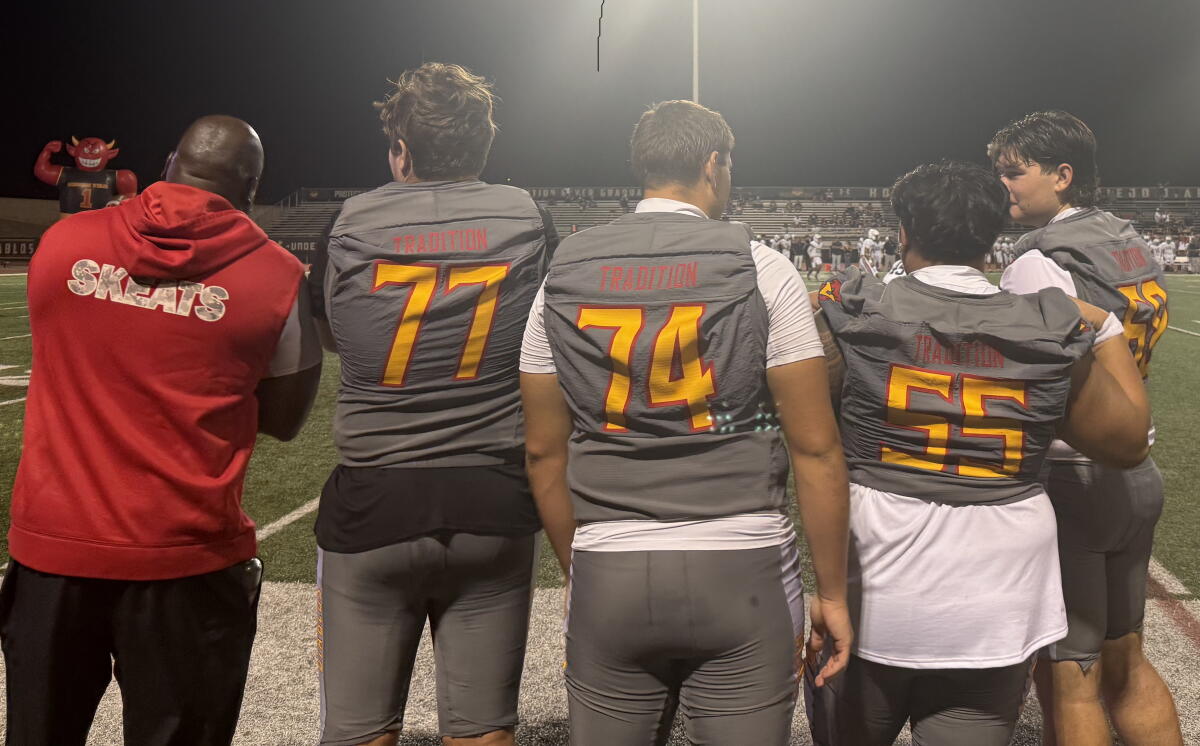
Mission Viejo High offensive linemen (starting second from left) Tyler Johnson, Dylan Felli and Noah Lee in their custom-made jerseys they put on after the Diablos built a huge lead against St. Paul and they were pulled from the game.
(Caleb Otte / For The Times)
In addition, four of the five starting lineman have NCAA Division I offers.
Senior left tackle Dylan Felli has offers from the University of San Diego and Montana. The guy who helped him create the first touchdown of the game, senior left guard Amaziah Siale, is committed to Louisiana State. Center Max Davidson, who is a junior, has an offer from Northern Arizona, and senior right tackle Tyler Johnson is committed to Cornell.
If the experience and college offers aren’t enough to prove their stature, their size should. Davidson and Felli are listed at 6 feet 4. Siale is 6-7 inches tall and weighs 345 pounds, while Johnson is 6-6 and nearly 300 pounds.
They wouldn’t look out of place lining up across from USC or UCLA. Standing near them is staggering. Trying to out muscle them is nearly impossible.
Johnson said that his team finally has a threatening run game because of the gaps the linemen create.
“Usually we have to throw the ball to get [opponents] to back off, and then we can run it,” he said. “This year, we’re gonna run the ball until they commit everybody and then we’ll throw it.”
There are two other linemen who also play key roles: senior right guard Noah Lee and senior Baxter Middagh.
Lee is the smallest guy in the group. At 5-10, he looks out of place standing next to the big boys. Once he is on the field, however, the size difference is forgotten.
At 295 pounds, with a low center of gravity, Lee can’t be moved. It’s why he has earned his starting position over the last two seasons despite competing with potential DI players. He might not have any offers, but he doesn’t drag the rest of the group down. In fact, he’s often the leading voice on the sideline.
As for Middagh, his role is adding a new wrinkle to the offensive scheme this season. Last year he was playing on the line. Against St. Paul, he was deployed at tight end. His blocking expertise and size — 6-6 and 295 pounds — allow him to still help in pass and run protection, but now his impact can be felt with the ball in his hands.
Case in point, Middagh scored a touchdown on a screen pass Friday. He was surprisingly fast, making it even harder to tackle him. Opponents will struggle if Mission Viejo can get Middagh, who is committed to Idaho, into open space.
Johnson said he might rotate who plays on the line based on what a possession needs, but that their best 11 includes Middagh on the field.
“He is super athletic and can catch the ball really well,” Johnson said. “The catches he makes are insane, some one-handed, and he runs a 5.3 [second] 40-yard dash at 300 pounds.”
Off the field, the mountainous young men turn into humble and funny teenagers. After being taken out at halftime, all six players cheered on the backups and joked with each other about everything and nothing.
At one point, Middagh’s family came down to the sideline and he went over to hug everybody and chat. There was no embarrassment by their presence near his teammates and friends, just an appreciation for those who love and support him.
Siale also sheepishly waved to his family in the stands, getting a slight grin on his face when they yelled back down to him. Late in the fourth quarter, the public-address announcer credited Siale with a block on a big run play even though the big man hadn’t touched the field all half. He just laughed and high-fived some teammates who were offering sarcastic congratulations.
Despite their talent, cohesiveness and positive personalities, Johnson said that his offensive line isn’t perfect. In Mission Viejo’s 55-17 win against Chaparral in the season opener, they made some silly penalties for unnecessary roughness after the play ended, which negated big gains. Johnson wants that cleaned up moving forward.
“You don’t play up to a good team and down to a team that is not as good. You stay consistently great,” he said.
His team obliged. Whenever the offensive line gives the quarterback time to pass and the running backs space to run, there isn’t much complaining a coach can do.
“I’m going to try to take it all in and soak every game up, because I know at some time the curtain is going to call and they’re going to graduate,” he said.
Two guys standing on Mission Viejo’s sideline were wearing custom made shirts of the offensive line. It was a picture of them all standing together, with the words “Higher Council” printed below. The message is clear.
Siale succinctly said what everybody else was dancing around.
“We’ve got the number one offensive line in the nation,” he said.
That claim will be put to the test against one of California’s best teams next week, when Mission Viejo travels to Sacramento to play Folsom High. Northern California will meet the Higher Council.
Nepalese Army officers load an injured worker onto a helicopter at Trishuli air base after he was rescued early Friday, nine days after becoming trapped in the tunnel of a hyrdropower project. Photo by Narendra Shrestha/EPA
Sept. 4 (UPI) — Rescuers pulled two workers alive from hydropower project tunnel in Nepal nine days after devastating flash foods in the central Bagmati region and across the border in Tibet killed thousands of people, with as many 4,000 still unnaccouted for.
The two men, a supervisor on the Trishuli 3A Hydropower Station who was in a critical condition and a foreman, were taken by helicopter to the hospital in Kathmandu. At least one body was also pulled from the tunnel.
Tunnelling expert Arnold Dix told the BBC the rescue was the result of a highly complex and painstaking effort using engineering processes, old maps and aerial and satellite imagery to find the entrance of the tunnel, on a mountainside before the floods but now underground, and blast their way ahead, foot by foot.
At the same time they had to clear the tunnel at the Trishuli 3A Hydropower Station of water, using pumps and excavators to dig channels to drain the water to the river on the outside.
The team eventually reached two men more than 550 feet beneath the ground after digging “a tiny” person-sized tunnel, pulling foreman Sanjaya Shah and project supervisor Kabir Maharjan early on Friday, local time, and now hope to rescue more people.
Shah who was conscious but dazed, said he had been in the control room with 40-45 others when disaster struck and that he became trapped as he ran up and down the tunnel telling workers to get out.
“It’s like layer upon layer of miracles. We got two people out. If we were playing at a casino, some might say it’s time to walk away, but we say game on, time to take on the house,” said Dix, who credited Nepalese Army engineers for their expert assistance, particularly with the explosives used.
Dix said rescuers were 200 feet into the tunnel with another 500 feet to go where he said he believed there was a “Goldilocks zone” where he anticipated they may find more people alive from among dozens of people believed to remain trapped.
The “Goldilocks zone,” a space with conditions supporting life, is located on the uppermost level of the hydropower station.
“We got two people out. If we were playing at a casino, some might say it’s time to walk away, but we say game on, time to take on the house,” said Dix.
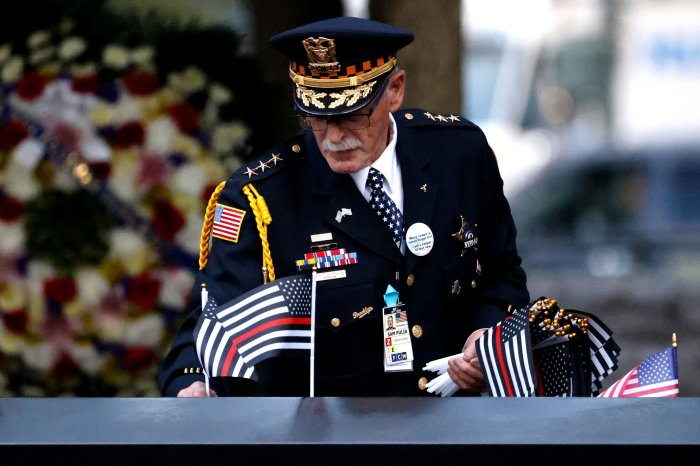
Retired Deputy Police Chief Sam Pulia places American flags at the 9/11 memorial south pool before the start of the 9/11 Commemoration Ceremony at the National September 11th Memorial and Museum in New York City on September 11, 2025. Nearly 3,000 died in the September 11 attacks. Photo by Peter Foley/UPI | License Photo
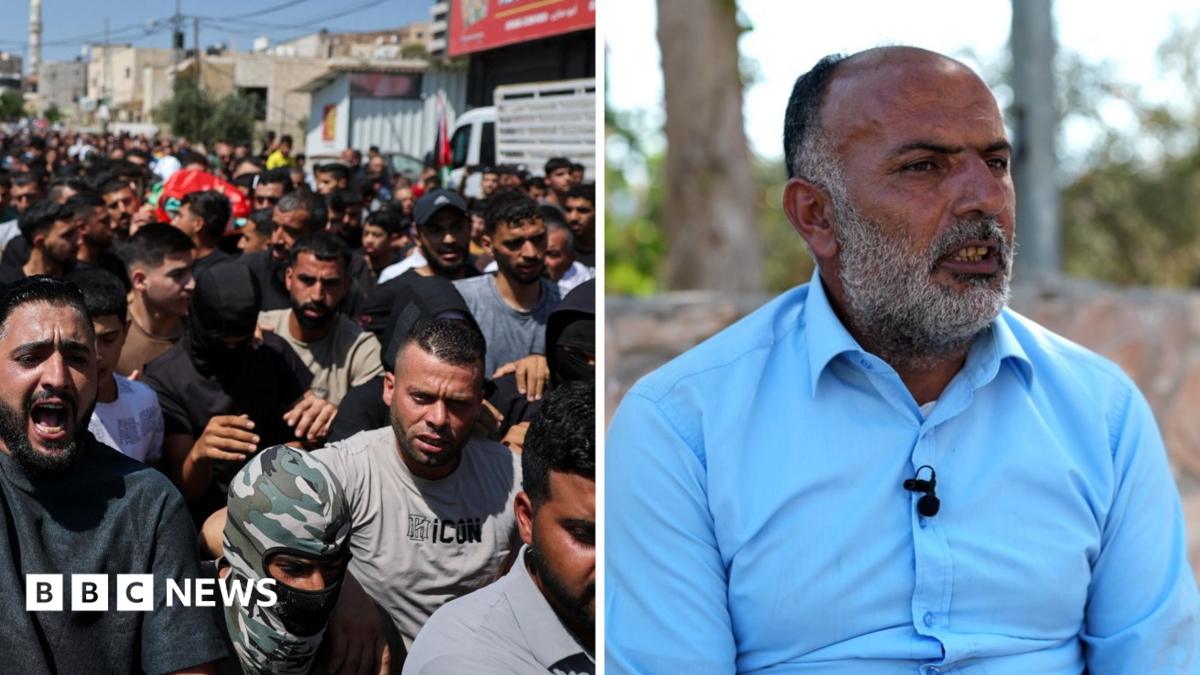
Funerals have taken place for two Palestinian teenagers who were shot dead this week when settlers and soldiers entered a Palestinian village in the occupied West Bank.
The killing of Omar al-Naasan and Khalil Abu Alia comes amid near-daily attacks by Jewish settlers in the village of al-Mughayyir, south of Nablus.
“We expect that when our sons walk in the street, they are likely to return to you injured or killed,” Mohammed Al-Naasan, Omar’s father, told the BBC.
Israel’s military says it fired on “instigators of a violent riot” and that the incident is under review.
The United Nations says more than 80 Palestinians have been killed by Israeli forces or settlers in the territory since the beginning of the year.
In the opening moments of the first episode, the trio were seen paying a visit to a familiar farm.
The new Grand Tour hosts met their predecessors at the premiere event (Image: PRIME VIDEO)
The new Grand Tour hosts witnessed Jeremy Clarkson in action behind the meat counter at Diddly Squat Farm.
The Grand Tour is back on Prime Video with three new hosts taking the wheel – train enthusiast and social media star Francis Bourgeois, and YouTube hosts James Engelsman and Thomas Holland. The streamer announced the new series would feature cameos from the original trio, but the extent of Jeremy Clarkson, James May and Richard Hammond’s involvement was kept under wraps.
Now, it has been revealed that the new hosts visited Clarkson’s Diddly Squat Farm, featured on the hit Clarkson’s Farm, to get Clarkson’s seal of approval. Speaking exclusively to The Mirror, host Holland said it was a “weird experience”. He shared: “About two years earlier, I went to the farm as a tourist, just for fun, I just happened to be here.
“I went into the tent and had a beer and did whatever you do when you are there, and the next time I was back there it was to talk to Jeremy Clarkson, so that was a bit weird.” Engelsman enlightened viewers by revealing “Jeremy does 9-5 shifts behind that [meat] counter”. While many fans already know Clarkson had warned the new trio “don’t f*** it up”, it was actually another part of his testimony that resonated most with the new hosts.
Engelsman explained: “It was strange, we have seen the footage now and after we left, he delivered that message to camera. That slightly longer, more sincere message, I think, for me at least, it resonated a lot harder than just the brief piece of advice.” What Clarkson had told viewers once the trio had walked away was: “I have got to be honest with you, I have actually been watching what they have been up to for the last year and a half, and they are very, very good, I think you are going to love it.”
Holland expressed to The Mirror: “We didn’t see that in the moment, we didn’t know that happened until much later on, so seeing that played back was like ‘Oh, that’s nice’.” Bourgeois agreed, adding: “It means a huge amount to us and also gives us quite the superpower, to have his blessing is just a phenomenal start for us.”
In the opening moments of the first episode, the trio were seen driving through the English countryside when they pulled into Diddly Squat Farm. They paid a visit to The Farmer’s Dog, which featured the original Grant Tour sign hanging from the tent ceiling.
Nervously, they approached Clarkson, who was behind the butcher’s counter. “Hey, how’s things?” he said with a smile. “So, how can I help?” Francis joked: “We have come to ask, please may we use the tent for our studio?”
Clarkson looked at the three blankly before saying: “Not really. I mean, you could, but it’s got a butcher’s in it now, and a bar, and a shop, and an off-licence. It’s usually quite busy as well, so it wouldn’t be an audience so much as customers. I want to help, but look, it’s been repurposed.”
Get Amazon’s Prime Video free for a month
This article contains affiliate links, we will receive a commission on any sales we generate from it. Learn more
TV lovers can get 30 days’ free access to tantalising TV like The Boys, Reacher and Clarkson’s Farm by signing up to Amazon Prime. Just remember to cancel at the end and you won’t be charged.
The joke referred to a Clarkson’s Farm moment when Jeremy called on the help of his old Grand Tour boss to supply a tent to house various projects like the farm shop and butcher’s counter. Following the skit, Clarkson got serious, saying: “Listen guys, seriously, have fun with this. I mean it, good luck, and don’t f*** it up.”
Speaking directly to viewers, it was then that Clarkson gave his heartfelt speech that resonated with the new hosts, who had been totally unaware of his kind words.
Brazil’s EU ambassador, Pedro Miguel da Costa e Silva, told Euronews on Friday that an inspection of Brazilian meat was unnecessary, and threatened to retaliate against the EU ban on imports.
ADVERTISEMENT
ADVERTISEMENT
The European Commission’s decision came into force this week, after Brazil was removed from a list of countries complying with EU food safety rules over its use of antibiotics to stimulate animal growth.
An EU audit of Brazilian poultry and honey is ongoing, but the Commission said that Brasília had not provided guarantees that would allow for an audit of its beef.
The EU ban prompted anger from the Brazilian government on Thursday, which threatened to adopt countermeasures.
“Sufficient guarantees”
“There wasn’t a need for an audit, not for poultry, not for honey, not bovine meat, because no audits were conducted for the other countries,” da Costa e Silva said. “We have provided sufficient guarantees.”
The ambassador added that while Brazil will continue discussing the issue with the Commission, “all options were on the table” if the imports did not resume and that Brazil could be “creative” when it comes to countermeasures.
The Commission pushed back on Friday against Brasília’s accusation of unfair treatment, with the Commission’s deputy Chief spokesperson Olof Gill saying: “Our approach is non-discriminatory, and we’ve given our partners sufficient time and all the information they need to adjust.”
The dispute comes as a free trade deal between Mercosur countries — Brazil, Argentina, Uruguay and Paraguay — and the EU provisionally came into force in May, despite strong opposition from EU farmers, who fear that Latin American products that do not comply with the bloc’s phytosanitary and food safety standards will be dumped in Europe.
“Food safety rules are a matter of the highest priority for EU citizens,” Gill added. “These rules have been well known for a long time, with third countries having been informed going back many years.”
The EU introduced new rules to combat antimicrobial resistance in 2018, which have been applied to EU producers since 2022 and to foreign importers since Thursday.
FOUND a lovely new partner? Great, but be aware she’s probably already drawing up a list of which of your friends you won’t be seeing again.
Your ex
She’s convinced you’re still carrying a torch for her, and must therefore never be in contact. Insisting the split was amicable and you’re merely friends now is just conclusive proof you’re desperate to rekindle your lost passion. Your new girlfriend is just being paranoid, apart from those 2am drunk-dialling calls begging your ex to have you back.
The womaniser
You shouldn’t be hanging around with good-looking gigolos now you’re with her, and any womanisers must be replaced with good, clean, homely lads. She’ll tell you it’s because he’s a sexist pig who treats women like objects. But won’t mention she shagged him on a filthy one-night stand just after you met, and would prefer you didn’t find out. To be honest, you’d prefer to overlook his undoubtedly better sex skills too.
The pisshead
Why would you want to go on all-day benders with Tom now you’re with her and could be spending your Saturdays shopping for clothes or going on country walks? If you want to keep having sex, drop him like hot bricks. All your mates will laugh and call you under the thumb, which you will vehemently deny. It’s more like being tagged with strict bail conditions.
The ugly one
There’s no point in you having pig-ugly friends she can’t matchmake her single pals with, so goodbye Carl. You may have been best friends since primary school but a geek with massive ears and ginger hair is now obsolete. The fact that none of her friends are in danger of landing modelling contracts and could do with a few Carls as back-ups will go completely over her head.
The Friday night football crew
Friday evenings are for taking her to expensive restaurants now, not playing five-a-side with your mates before a few beers. Take it on the chin and accept that’s the price of an occasional blowjob these days. In fairness, you were shit at it anyway, and the others only let you join in because you booked the sports hall every week.
WASHINGTON — Less than a week before eight people — including six Asian women — were killed in the Atlanta-area shootings congressional Democrats introduced legislation that would bolster the Department of Justice’s ability to address COVID-19 hate crimes.
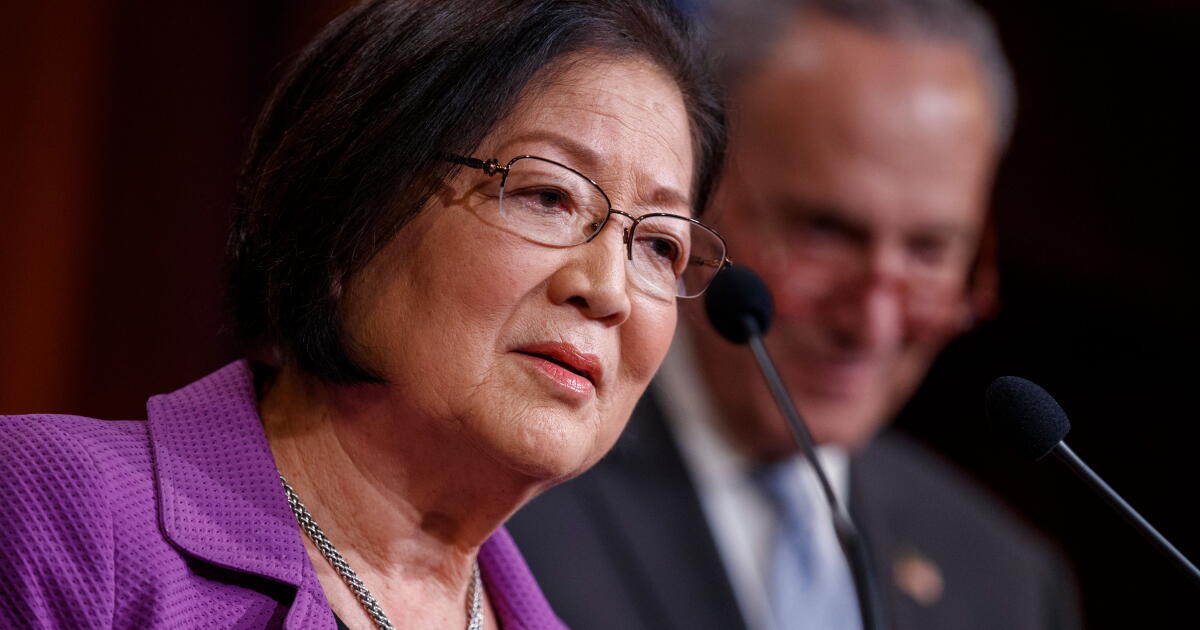
The bill, introduced by U.S. Rep. Grace Meng (D-N.Y.) and Sen. Mazie Hirono (D-Hawaii), has been co-sponsored by more than 60 lawmakers and on Friday was endorsed by President Biden, who condemned the “ongoing crisis of gender-based and anti-Asian violence” and urged Congress to “swiftly pass the COVID-19 Hate Crimes Act.”
“It’s time for Congress to codify and expand upon these actions — because every person in our nation deserves to live their lives with safety, dignity and respect,” Biden said.
The bill would require at least one Department of Justice employee to facilitate fast reviews of federal, state and local COVID-19 hate crimes for at least a year, according to a draft provided by a Hirono spokeswoman.
It would also require the department to issue guidance to state and local law enforcement agencies on how to establish an online hate crime reporting system in multiple languages.
The system would “allow more victims to come forward,” A.B. Cruz III, president of the National Asian Pacific American Bar Assn., said in a statement.
The bill would also require Atty. Gen. Merrick Garland and Health and Human Services Secretary Xavier Becerra to work with the COVID–19 Health Equity Task Force and advocates to give guidance on how to discuss the pandemic without using incendiary language.
The bill would not drastically change the legal landscape as it relates to hate crimes but would spotlight how it intersects with COVID-19, said Anthony Michael Kreis, a law professor at Georgia State University College of Law.
Since virus-fueled lockdowns went into effect last March, thousands of Asian Americans have reported having faced racist verbal and physical attacks or have been shunned by others, according to a report by Stop AAPI Hate. The group, whose acronym stands for Asian American and Pacific Islander, received reports of 3,795 incidents over the last year, with 68.1% involving verbal harassment and 11.1% involving physical assaults.
Among the incidents, Asian Americans reported being punched while riding the subway in Washington, taunted with racial slurs in New York and coughed on while being blamed for the novel coronavirus in Dallas.
Then-President Trump last year said little to discourage the attacks but often used racist language to describe the deadly virus, calling it “kung flu” and the “China virus,” even after being warned that his rhetoric was incendiary. Meng said many Republican lawmakers “trafficked racist, bigoted terms to describe COVID-19.”
“In doing so, their language stoked people’s fears and created an atmosphere of intolerance and violence, which persists even today,” Meng said.
The bill would define COVID-19 hate crimes as violent offenses motivated by the real or perceived relationship to the spread of the coronavirus and the real or perceived background of a person, including their ethnicity and national origin.
Kreis said it’s unclear how adding a COVID-19 distinction to a federal hate crime would benefit existing law. The law, in practice, draws connections between current events and discrimination. For example, the law can already be used to prosecute crimes against LGBTQ people whose attackers express anti-HIV/AIDS sentiments, he said.
Kreis said that though anti-Asian slurs are seen as an expression of hate by the American public and, by extension, juries, anti-Asian imagery is not as noticeable in American society. This often requires prosecutors to handhold juries to connect the dots to understand what hate crimes against Asian Americans look like, he said.
“We need a lot more cultural competency in the ways in which anti-Asian stereotypes can manifest,” Kreis said. “That’s a hard endeavor we as a society need to tackle.”
Times staff writer Chris Megerian contributed to this report.
Former Dragons and Bath forward Faletau has played only 30 times for Cardiff since signing in 2022, but a one-year contract extension was announced at the start of July.
“We all know that he is a quality player and you just feel and sense when he is around that something special is going to happen, either from him or the guy next to him” said Van Zyl, whose side play a friendly at Worcester on Saturday.
“Still in training, every time he steps in, you feel the difference. He brings a lot and gives everybody confidence. He’s a world-class athlete.”
Faletau racked up the games with club and country when with Dragons between 2009 and 2016 but has since been plagued by injuries.
Van Zyl hopes that a summer off and full pre-season will help him thrive at Cardiff, where his game time will be managed thanks to the presence of Alun Lawrence and Taine Basham.
“I think for his body, it’s been good,” said the head coach. “His fitness levels are up there, it’s the contact conditioning that he needs to top up now.
“In different years, he’s had different injuries but he looks in a good place.”
The White House has unveiled five arcade-style games to promote Trump’s ‘MAGA’ agenda, sparking backlash over the misuse of taxpayer money and the dehumanising portrayal of migrants and deportees.
As the United States and Iran exchanged attacks this week, one date was increasingly looming over the conflict.
The US midterm elections on November 3 could prove a pivotal moment in the war, as senior advisers to President Donald Trump seek to prevent the conflict from returning to all-out war before the polls when Republicans will be defending narrow majorities in both houses of Congress.
Recommended Stories
list of 4 itemsend of list
The push for restraint comes as Washington turns to economic pressure on Iran instead of military force. In August, the Trump administration announced its so-called “Economic D-Day”, imposing sanctions on 60 entities that it says facilitate oil revenues for trade with Iran and threatening other countries doing business with Tehran with secondary sanctions.
At the same time, the US naval blockade of Iranian ports in and around the Strait of Hormuz continues to exert pressure on Tehran’s oil exports.
Vice President JD Vance has meanwhile sought to downplay the war, which the US and Israel launched with attacks on Iran on February 28, as rising fuel prices and public opposition in the US threaten to become political liabilities for Republicans before the vote.
But there are clear limits to the restraint the Trump administration can show, with US forces continuing to strike Iran in recent days, and US leaders insist that further military action remains an option. Vance said this week that “everything that could happen is on the table,” including economic, military, diplomatic and covert pressure.
That leaves the coming two months as a particularly tricky period to navigate. Washington will want to avoid an all-out war while ratcheting up economic pressure, but Iran has its own calculations and could respond militarily anyway, potentially forcing the US into an escalation it would rather avoid before Americans go to the polls.
Here’s what we know.
Why do the midterms matter for Trump?
The midterms will determine whether the Republican Party can retain its narrow control of Congress. If the war escalates again before then, that could persuade more people to vote against the Trump administration.
Containing the fighting until November, therefore, may help prevent an already deeply unpopular war from dominating the political agenda.
A late-August Reuters/Ipsos poll suggested that just 31 percent of Americans support the war, compared with 63 percent who oppose it. Trump’s approval rating has also fallen since the outbreak of hostilities, from 40 percent to 33 percent, according to Reuters/Ipsos polling.
Observers say the Trump administration did not expect things to get to this point.
In early March, Trump insisted the war would last for “four or five weeks”. Instead, the conflict has dragged on, and unexpected consequences – including Iran’s closure of the Strait of Hormuz causing energy prices to spike – have made it even more unpopular with US households.
US diesel prices hit a record high on Thursday, surpassing the previous peak recorded in 2022, as higher crude oil prices and refining bottlenecks drove up the cost of a fuel that underpins much of the US economy.
That is particularly damaging for a president who campaigned partly on a promise to dramatically reduce energy costs – as well as not to get involved in “unnecessary” wars.
The fallout from the war has not stopped at the petrol pump. Sustained increases in fuel and transport costs feed into the price of groceries, manufactured goods and other everyday purchases – potentially worsening inflation when Democrats are making the cost of living a defining issue for the midterm campaign.
A Politico poll conducted in August suggested that 61 percent of Americans believe the Iran war had made life more expensive for their families, four percentage points higher than a month earlier.
Can Trump keep the war contained until November?
There are signs that his administration is trying to do exactly that.
In recent weeks, Washington has intensified its campaign to economically isolate Iran, threatening severe sanctions against countries that continue trading with it while maintaining military pressure around the Strait of Hormuz.
With strikes on Iran earlier this week, Trump has also indicated he is willing to engage in sporadic attacks, while trying to keep the war from escalating back to all-out conflict.
Senior administration officials have simultaneously sought to play down the scale of the military confrontation. Asked at a White House briefing whether the Iran war would be resolved before the midterm elections, Vice President JD Vance said he “wouldn’t call it a war” and claimed there was “no active shooting right now”.
Asked when Iran would stop attacking commercial shipping, Vance said: “You would have to ask the Iranians.” He also said the conflict was having “less effect day by day” on global energy markets. The US claims it is escorting about 30 ships per night through the Strait of Hormuz – and officials claimed some 18 million barrels of oil were transported through on Tuesday this week. However, shipping data does not appear to fully support this claim.
Trying to maintain a strategy of “no war, no peace” with sporadic attacks is high-risk, analysts have warned. Negar Mortazavi, senior fellow at the Washington, DC-based Center for International Policy, told Al Jazeera this week: “Tehran will not capitulate under [economic] pressure. Both sides may believe they can control the escalation, but every new exchange increases the risk of a wider regional conflict.”
One of the US attacks this week is also believed to have hit a civilian home where a wedding was taking place in Kuhestak, southern Iran, killing at least four people, including children, and wounding dozens.
Furthermore, The Washington Post reported on Sunday that senior Army, Navy and Air Force leaders have warned Pentagon chief Pete Hegseth in a written assessment that continuing the war at its current pace is unsustainable and risks undermining US military readiness in other parts of the world.
Trita Parsi, executive vice president of the US-based Quincy Institute for Responsible Statecraft, told Al Jazeera that this week’s attacks point to a US strategy that remains deeply unsettled.
“I think it’s quite likely that what we’re seeing right now is just complete military, strategic disarray on the American position in which the positions, the actions, the tactics, the strategies keep on getting changed,” Parsi said.
Washington had imposed sweeping economic sanctions on Iran in an apparent attempt to make further military intervention unnecessary, he noted. “Seven days later, the US is back into bombing Iran.”
The US appears to be “jumping from one position to the other”, he added.
What are Iran’s calculations?
While the most recent attacks between the US and Iran have been less intense than the heavy exchanges seen in the early weeks of the war and during the two flare-ups in July, the risk of escalation is high. And it may be in Iran’s interests for that to happen sooner rather than later.
Iran has excelled at the use of asymmetric warfare against an enemy with considerable military might – using cheap, mass-produced drones to exhaust US supplies of very expensive defensive systems, and launching attacks on US allies around the Gulf, sowing disharmony.
In particular, Tehran has demonstrated that it can severely disrupt maritime traffic through the Strait of Hormuz, causing global economic consequences.
Continued Iranian attacks on US or regional military assets, shipping or energy infrastructure would place pressure on Washington to retaliate more strongly than via the few attacks it has carried out this week, creating the possibility of an escalatory cycle that could return the two countries to a much wider war regardless of the White House’s electoral calculations.
Furthermore, Washington’s economic strategy to isolate Tehran – an attempt to move away from open warfare – may in fact create a greater Iranian incentive to retaliate.
Parsi told Al Jazeera that Iranian officials appear to believe Trump ultimately intends to restart the war on a larger scale but is just waiting until after the midterms.
That creates a potentially dangerous calculation for Tehran, where it is better to escalate now – while Trump is at his most politically vulnerable. “The reaction of the Iranians to that might be to actually trigger the war themselves early right before the midterm elections in order to maximise the pain that will impose on the US president,” Parsi said.
What happens after November?
Reuters reported on Wednesday that senior White House officials are already considering whether to intensify military operations against Iran after the November 3 vote, although no decision has been made on returning to full-scale conflict, it reported.
A Republican victory in the midterms could give Trump greater political room for this option, particularly if the administration interprets the result as approval – or at least lack of enough disapproval – for the war despite the economic consequences for voters.
A Republican defeat presents a more complicated picture, however. On the one hand, losing one or both chambers of Congress will constrain the administration, as Congress controls government funding. Democratic control of the House or Senate would also give Trump’s opponents greater scope to hold hearings, investigate the US conduct of the war and challenge requests for additional military spending.
Conversely, with Trump no longer facing a congressional election, he may feel less pressure to contain the war, experts fear.
Parsi warned that an electoral defeat could therefore have the opposite effect to what Tehran might expect.
“I’m not so sure that it’s going to pay off necessarily for the Iranians because a Trump that is humiliated at the elections, who is faced with a Democratic [majority] House [of Representatives] and potentially a Democratic Senate, may also become a much more desperate and reckless president,” he said.