Month: August 2026

Iraqi Kurdish regional leader meets Syrian president in Damascus | Kurds News

Barzani meets Syria’s al-Sharaa in Damascus to discuss Syrian Democratic Forces (SDF) integration and Kurdish rights in post-Assad Syria.

Nechirvan Barzani, president of Iraq’s semiautonomous Kurdish region, has held talks with Syrian President Ahmed al-Sharaa, in the first visit by a Kurdish leader to Syria since the fall of ousted Syrian President Bashar al-Assad.

On Monday, Barzani led a high-level delegation to Damascus, where he was received at the People’s Palace. According to Syria’s state news agency SANA, the two sides discussed bilateral relations between Erbil and Damascus, as well as several key regional issues of mutual concern to strengthen cooperation and coordination across various fields.

Recommended Stories

list of 3 itemsend of list

The visit to Syria’s capital comes after months of diplomatic engagement between the Kurdistan Regional Government in Iraq and Syria’s new administration. Barzani and al-Sharaa previously met twice on the sidelines of the Antalya Diplomacy Forum, first on April 11, 2025, and again on April 17, 2026. According to a statement from the Kurdistan Region Presidency, the second meeting covered the development of economic ties and the agreement between the Syrian government and the Syrian Democratic Forces (SDF).

The integration of the SDF into Syrian state institutions is a central focus of the talks. The SDF, a Kurdish-led force that controls much of northeastern Syria, has been in negotiations with Damascus over its future status. The Syrian government has sought to integrate the force into its military structures, while Kurdish representatives have pressed for guarantees of political and cultural rights.

According to news reports from Al Hadath, Barzani and al-Sharaa discussed mechanisms for entrenching the constitutional rights of Kurds in Syria, particularly language rights and administrative autonomy. Implementation of Decree No. 13, which pertains to Kurdish language rights, was also on the agenda. Syrian officials have expressed interest in benefitting from the Kurdistan Regional Government’s experience in Kurdish-language education, curriculum development and teacher training.

Barzani’s itinerary also includes meetings with Kurdish officials in Syria, including SDF commanders and Kurdish members of the Syrian parliament, according to Kurdish media reports.

The visit follows a series of diplomatic exchanges, including a trip by Syria’s education minister to Erbil and efforts to reopen the Syrian consulate in Iraq’s semiautonomous Kurdish region. Barzani has previously hosted SDF commander Mazloum Abdi and delegations from northeastern Syria in Erbil.

For the Kurdistan Regional Government in Erbil, which shares a 1,100km (684-mile) border with Syria and hosts tens of thousands of Syrian refugees, the engagement carries vital security imperatives. Ensuring a stable, inclusive Syria reduces the risk of the resurgence of ISIL (ISIS), limits future refugee flows, and enhances Erbil’s diplomatic leverage with both Baghdad and Ankara.

The talks come at a sensitive time, during ongoing clashes between Syrian forces and Kurdish fighters in the northeast.

Source link

Major airport overtakes London Heathrow to be Europe’s busiest

ONE airport in Europe has just become the most busy on the continent – beating London Heathrow’s record.

It’s about to get even busier too as it’s preparing to open a fourth runway later this year.

Istanbul Airport will open a fourth runway later this year Credit: Shutterstock Editorial
The hub that opened in 2018 is hoping to get millions of passengers by 2028 Credit: Alamy

In the hope to get up to 200million passengers by 2028, Istanbul Airport in Turkey is increasing the amount of runways it has from three to four.

Kadri Samsunlu, the CEO of İGA revealed the fourth runway was being been constructed at the cost £428million, according to local media.

At the moment, the hub has a rare triple runway – and it was the first hub in Europe to have one.

Essentially, it means the airport can have three flights take off or land at the same time.

SUNNY STEALS

Sun-drenched European holidays with £1.50 pints and stays from under £9pp


PARK UP

Epic UK holiday parks with waterparks, theme parks & Spoons pubs from £3pp a night

As a result, it increases the airport’s hourly traffic capacity from 120 to 148 aircraft movements.

The airport recently saw a record-breaking number of passengers through its doors with 289,260 people passing through the hub on August 1, 2026.

That makes it even busier than London Heathrow, which saw exactly 270,869 passengers in 24 hours.

Istanbul Airport handled a total of 39.92 million passengers in January-June.

These figures show an increase from 39.25 million in the same period of last year, according to data from the General Directorate of State Airports Authority (DHMİ).

Istanbul Airport is the second airport in the city and officially opened in late October 2018, before becoming fully operational in April 2019.

Istanbul Airport in Turkey is now the busiest airport in Europe Credit: Getty

It was even announced as being the ‘world best’ in 2024, according to Travel + Leisure.

Inside, the airport has sleep pods for anyone with a layover who wants to take a nap.

It also has business pods for those needing to take work calls.

For passengers aged between 15 and 30 years old, there is a Youth Lounge Area with lots to do, it has a PlayStation, music, snacks and four hours of free Wi-Fi.

The airport even has its own spa offering wellness treatments and massages and TV-viewing areas as well as a museum and library.

What is it like to travel through Istanbul Airport?

THE Sun’s Assitant Travel Editor Sophie Swietochowski visited the airport in 2024 – here’s what she found…

“If there’s one airport I wouldn’t mind being seriously delayed in, it’s Istanbul in Turkey.

“The place is vast and shiny with enough food (for any budget), shopping (think chic clothes and hand-painted kitchenware), and entertainment (there’s even a library home to 2,000 books) to keep you occupied for hours on end.

“Better still, if your flight gets cancelled you won’t even need to endure the faff of security again as the large Yotel sits airside.

“I visited last year and couldn’t have been more grateful for the size of the place, meaning I could whizz straight past the screaming kids in the massive Lego store and head straight to the food courts where I had no problem finding a quiet seat for a drink – Çay Saati has traditional Turkish tea.

“In fact many stores in the airport blend Turkish traditions with the modern world and you could certainly get a flavour of Turkey without ever leaving the terminal.

“The size of the place comes with a downside, though. Make sure you keep an eye out for your gate as it will take you a while to walk there – and try not to get lost on the way.”


Source link

‘I’ve lived a nightmare for four decades after my son vanished without a trace’

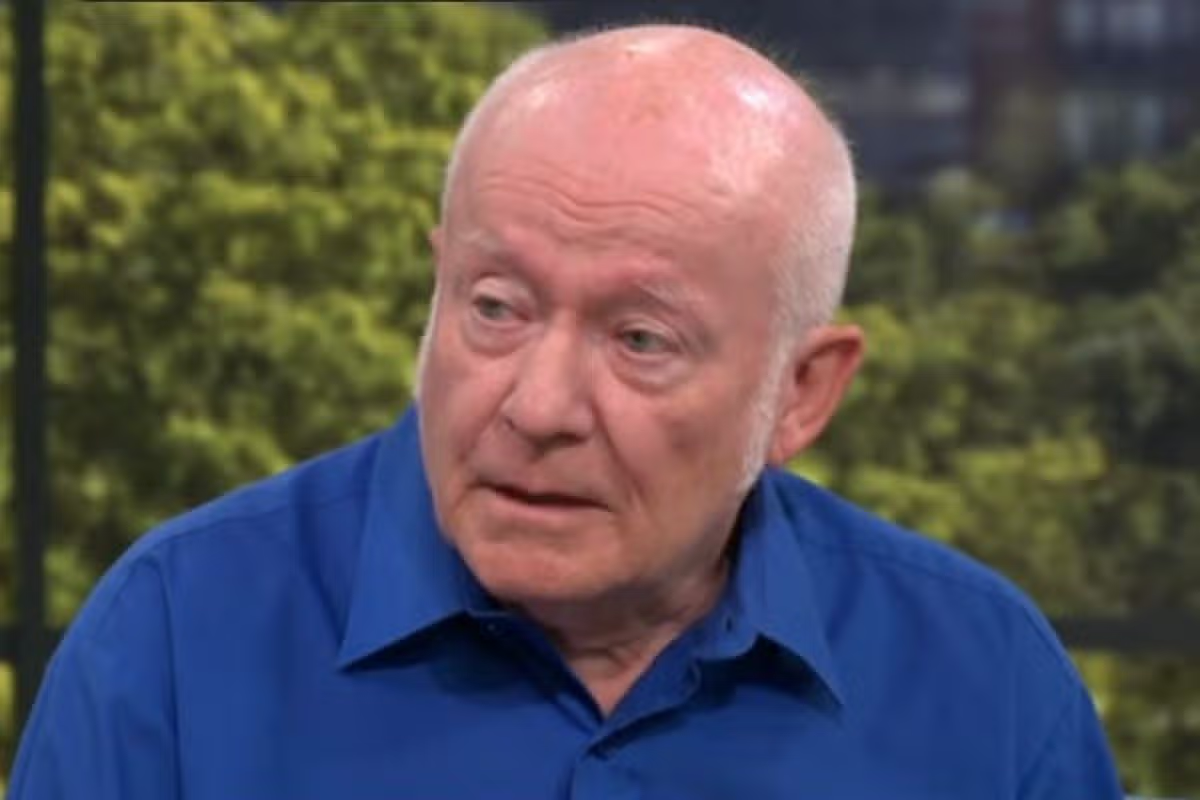
A dad whose son has been missing since 1988 told his story on ITV’s This Morning

A father has told how his life became “a living nightmare” after his 15-year-old son vanished without a trace.

Lee Boxell was last seen on September 10, 1988 after he left his home in Sutton, south west London, to meet a friend. He was seen on the High Street in the town that day, but there have been no confirmed sightings since.

Police have theorised that Lee could have been killed after stepping in to stop or threatening to report an assault in the grounds of a church where an unofficial youth club took place.

Appearing on ITV‘s This Morning, his dad Peter Boxell shared how the family were “panic-stricken” and went through their “worst nightmare” after Lee didn’t come home that day.

“It was just like a living nightmare from then on,” he said. “I think it’s every person’s, every family member, every parent’s worst nightmare. And for us, it was a living nightmare.”

He told hosts Josie Gibson and Paddy McGuinness: “We couldn’t sleep for weeks after that. We thought, we didn’t want to miss a phone call or a knock on the door if Lee could come home.”

Paddy asked how Peter had carried on through the years, and he replied: “Well, we’ve been essentially living in limbo, not knowing what’s happened to our son, Lee. And we desperately want to know what happened to him. I mean, I’m old now. I’m 80. His mother’s a few years older than me.

“Most of Lee’s relatives have passed on. And he has a sister who desperately wants to know what happened to him. And she has her own children. So Lee’s now got a niece and a nephew. They know all about Lee. And they want to know what happened to Lee.”

Asked what he thought had happened, Peter said: “I think that the police’s theory is correct, that Lee went to the unofficial youth club at the back of the church in the graveyard at St Dunstan’s in Cheam. And I think he went there, maybe only once.

“And I think he may have seen something, some criminal activity going on. Maybe he saw somebody assaulting a child there. And he would either have gone to the aid of that child or he would have gone for help.

“And I’m only guessing. I just think that the adults who were carrying out that crime may have tried to silence Lee. They may have unintentionally killed him. I don’t know, but I think they may have killed him. That’s what I think has happened.”

Josie also read out a comment from the Met, saying: “They have said, ‘We’ve never stopped our investigation into what happened to Lee. And it remains ongoing within the Met’s cold case team.

“We would urge anyone who did not feel able to speak to police in the past to come forward and tell us what they know. If you can help, whether anonymously or otherwise, please, please, please get in touch’.”

This Morning airs on ITV at 10am on weekdays.

Source link

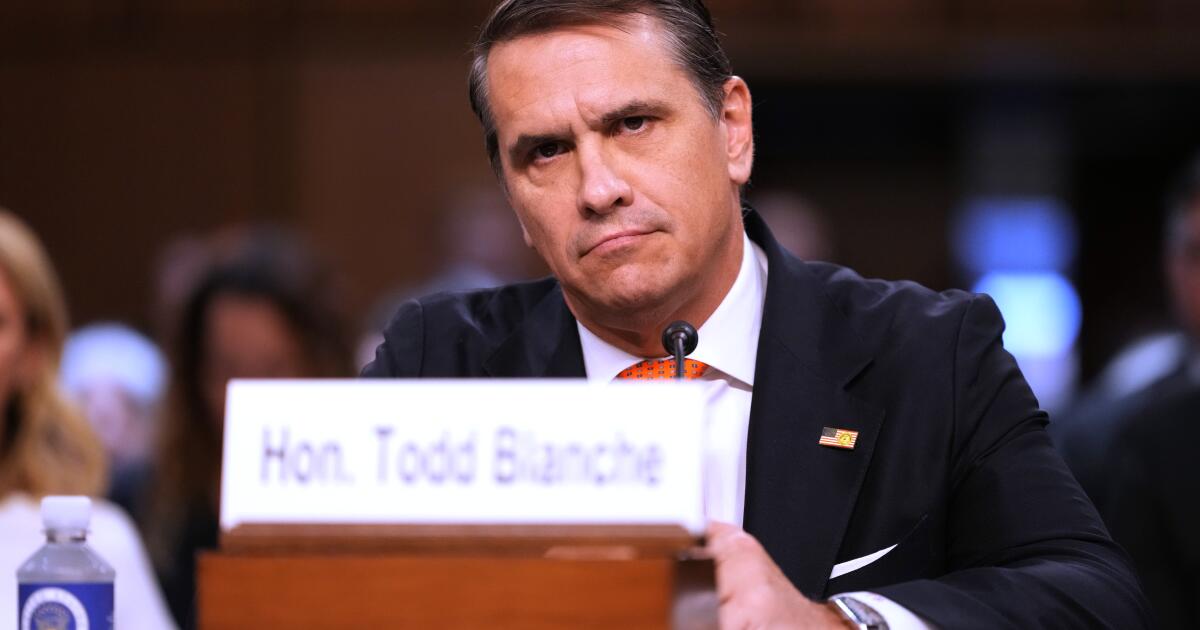
GOP holdouts say they will back Blanche’s attorney general nomination after striking deal over fund

Two Republican senators who threatened to block acting Atty. Gen. Todd Blanche’s bid to lead the Justice Department said Monday that they will vote to advance his nomination, ending an impasse over plans to create a fund to compensate allies of President Trump.

The statement from Republican Sens. John Cornyn and Thom Tillis came after Blanche issued an order late Sunday formally rescinding the $1.8 billion “Anti-Weaponization Fund” to compensate people who believe they were unfairly prosecuted by the Justice Department.

Cornyn and Tillis, whose votes Blanche needs to advance through the Senate Judiciary Committee on Tuesday, had said they would not endorse his nomination without written confirmation that the fund is dead.

“We want to express our gratitude to Mr. Blanche and his staff for working with us on this, and we look forward to voting to advance his nomination out of the Senate Judiciary Committee soon,” Cornyn and Tillis, who are not returning to the Senate next year, said in a statement.

DOJ order says ‘beyond any doubt’ that fund is dead

In a statement accompanying the order, the Justice Department said that “although the Acting Attorney General has repeatedly advised Congress through testimony, including under oath, as well as in written responses, that the Fund is not moving forward, and the Department has repeatedly represented to district courts that the Fund is not moving forward, today’s Order officially rescinds the May 18, 2026 Order.”

Since the settlement of the president’s lawsuit against the IRS was announced, “No Members were appointed; no funds were transferred; no process for receiving claims was established; no claims were paid,” the order says. “This order establishes, beyond any doubt, that there is no Fund.”

The document released by Blanche on Sunday night also limits the scope of another provision of the settlement that provided broad immunity for Trump and members of his family from tax audits.

The deal clarifies that the tax audit immunity agreement “applies by its terms only retroactively” to claims open at the time of the settlement and does not protect the president from examination of future tax filings.

Cornyn, who lost reelection this year after Trump endorsed his primary opponent, and Tillis, who is retiring when his term ends in January, have blocked Blanche’s nomination as many of their GOP colleagues have criticized the fund.

The Judiciary Committee postponed a vote on Blanche’s nomination that had been scheduled for Thursday morning after Tillis and Cornyn said they needed more from the administration before they could provide the necessary votes.

The two senators have repeatedly said the Justice Department seemed interested in reaching an agreement, but the White House wouldn’t budge even to aid the confirmation of Trump’s loyal former personal attorney, who has aggressively pursued the administration’s priorities as acting attorney general.

“I think as far as Blanche and the Department of Justice, we were pretty much on the same page,” Cornyn said Thursday. “But then when the president got wind of it, he wasn’t willing to go along with it.”

Trump continues to express support for his settlement

The two sides have been negotiating for weeks, but Trump has said repeatedly during the talks that he thinks the fund should go forward and threatened to move forward with it if Blanche was not confirmed.

After the Thursday vote was delayed, Trump said in a social media post that he might pull Blanche’s nomination and resubmit it after Cornyn and Tillis leave office next year.

On Sunday evening, Trump said that people who had faced charges from the Jan. 6, 2021, attack on the Capitol and could have benefitted from the fund had “their lives destroyed.”

“This would be a reimbursement for the pain that they suffered,” Trump said. “A lot of people like it.”

Jalonick and Richer write for the Associated Press.

Source link

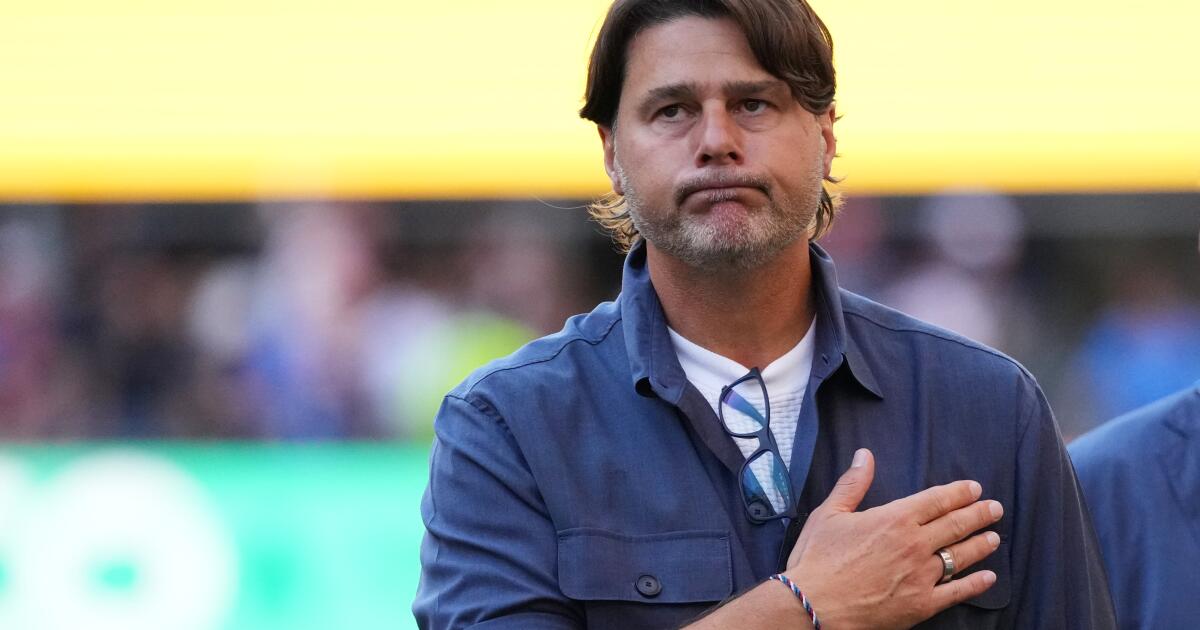
Mauricio Pochettino agrees to 4-year extension through 2030 World Cup

Mauricio Pochettino is staying with the U.S. soccer team, agreeing Monday to a four-year contract to coach the Americans through the 2030 World Cup.

A 54-year-old who took over in October 2024, Pochettino led the U.S. to the World Cup round of 16, where the tournament co-hosts were eliminated with a 4-1 loss to Belgium.

Still, he helped the seeded U.S. to a pair of firsts in the expanded 48-nation tournament, clinching advancement from the group stage with a game to spare and winning three games in a single World Cup. The team captivated American fans with excited audiences in stadiums and record television viewers.

“The magic thing that happened during the World Cup, the connection with the people, of course with the whole organization and everything was a key point,” Pochettino said during a Zoom news conference from his home in Barcelona, Spain.

Hedge fund manager Ken Griffin is again the lead philanthropic funder supporting Pochettino’s contract. Pochettino earned just over $5 million in his first seven months as coach, according to the U.S. Soccer Federation tax return.

Since reaching the quarterfinals in 2002, the U.S. has lost four straight round-of-16 games.

“What we learn(ed) is that we can compete, that we have the quality and we have the talent,” Pochettino said. “We were so close. That gap with the best teams in the world is not too big.”

Pochettino said there is potential to make soccer in the U.S. “grow and grow and grow and be one of the important sport(s) in America, like it is in the rest of the world.”

“We have players and organization that can compete with the best organization in the world in that sport,” he said. “We learned that the fans are amazing and when they were so excited to discover a sport that made our fans become crazy, no? The connection was amazing.”

Pochettino views the next cycle as a new start for a program lacking quality depth at goalkeeper and central defender.

“It is going to be important to provide the young kids that we really believe that they have the potential to arrive in 2030, in four years, to start to work and start to know,” he said.

Before taking the U.S. job, Pochettino coached Espanyol (2009-12), Southampton (2013-14), Tottenham (2014-19), Paris Saint-Germain (2021-22) and Chelsea (2023-24).

When Pochettino replaced Gregg Berhalter two years ago, he signed an initial contract through the 2026 World Cup. Pochettino said ahead of the tournament that he had discussed a possible new deal with the USSF. He also said in May that his agent had spoken with AC Milan, a club that then hired Rúben Amorim.

Pochettino, who has homes in Spain and London, said he may move to the U.S. He intends to stay with the American team until 2030 but left himself an out.

“Four years time is a really long period. You never know what can happen in soccer,” he said. “Today people really love you. In eight weeks time, maybe that change(s), that feeling.”

He has led the U.S. to 17 wins (including a penalty-kicks victory), 13 losses and one draw. Twenty-three of 62 players to appear under Pochettino have accounted for the team’s 57 goals.

“We know we have a lot of work to do to achieve our clear ambitions, including competing to win Men’s World Cups and having soccer become the most played sport in every community,” USSF CEO JT Batson said in a statement.

U.S. coaches have not been successful when they remained for a second World Cup cycle.

After leading the Americans to the 2002 quarterfinals, Bruce Arena was unable to get his team past the group stage in 2006.

Bob Bradley helped the U.S. reach the round of 16 in 2010, then was fired a year later after the team lost the CONCACAF Gold Cup final.

Jurgen Klinsmann took over and in December 2013 was given an extension through the 2018 World Cup. The Americans reached the round of 16 in 2014 but Klinsmann was fired in late 2016 after the U.S. lost its first two games in the final round of qualifying. Arena returned but the U.S. failed to reach the 2018 World Cup.

Berhalter was hired in late 2018 and led the Americans to the round of 16 in 2022. Given a new contract in 2023, he was fired a year later after the U.S. failed to advanced past the group stage of the Copa America.

“We are going to demand more from them,” he said of the players. “We are not going to be in some situation(s) not flexible like we were because before it was (for) the benefit of players, benefit of structures that were already built. But now it’s about to start the house from zero.”

Blum writes for the Associated Press.

Source link

Flash flooding warning issued for New York City

Aug. 3 (UPI) — A flash flooding alert has been issued for New York City and parts of Long Island through Monday evening.

The National Weather Service warns that heavy storms battering the area could reach as much as 2 inches per hour throughout all of the city’s boroughs and Nassau County.

“Excessive runoff may result in flooding of rivers, creeks, streams, and other low-lying and flood-prone locations,” the NWS warning said.

Heavy rain and scattered thunderstorms are expected to ease by Monday evening.

“Summer storms can arrive with little warning, bringing flash flooding, downed tree limbs and dangerous lightning,” Mayor Zohran Mamdani said in a statement.

“I urge every New Yorker to stay alert, take these storms seriously and head indoors when conditions become unsafe,” the mayor continued. “The best way to protect yourself and your loved ones is to stay informed.”

City officials recommend New Yorkers allow extra travel time and avoid driving through flooded streets, as even shallow water can stall vehicles.

Source link

Australia’s under-16 social media ban failing, study shows: What it means | Child Rights News

A new study by Australia’s internet regulator has revealed that more than eight in 10 young Australian teens and preteens are continuing to use social media platforms despite the government’s prohibition for children under 16.

The ban came into effect in December last year.

Here is what we know about how it’s going.

What did the latest report find?

Australia’s internet regulator, eSafety, said it had found that more than eight in 10 Australian under-16s are continuing to use social media despite being banned from doing so.

The report also found that most of those children aged 10 to 15 were using social media just as frequently in March as they had been before the ban came into force on December 10 last year.

“Most under-16s who had social media accounts before commencement were able to either retain them or create new ones at the three-month ⁠mark, with social media platforms’ failure to implement effective age assurance measures cited as the main reason,” eSafety said in a statement.

About half the children who retained their accounts said platforms had not checked their age, the most common reason they were able to stay on the services. Others said that their accounts listed them as aged 16 or older or ‌that age-checking ⁠systems had incorrectly determined they were older.

Prior to the ban, nearly 86 percent of children surveyed reported using at least one age-restricted platform. Three months later, that figure remained above 81 percent, the eSafety report said.

Around 58 percent of teenagers reported using social media daily, the report found. Before the ban, the number was roughly 60 percent.

The report showed minimal change in “sports and physical activity, arts and music, spending time with friends and family, and attendance at community events”.

At the time the new rule was introduced, experts warned that enforcing it would be extremely difficult.

Joanna Orlando, a researcher in digital wellbeing and the author of Generation Connected: How to Parent in a Digital World, told Al Jazeera in December last year: “Tech-savvy teens simply use VPNs, fake birth photos for face scans, or migrate to less regulated platforms like Lemon8, or to platforms not part of the ban like video games. Enforcement is proving to be difficult in the days leading up to the ban.”

In December 2025, Australia prohibited children under 16 from using social media platforms, becoming the world’s first country to do so. Video game platforms are not included in the ban.

The government said this was prompted by increasing concerns about the effects of cyberbullying, sexual exploitation and self-harm content on the mental and physical health of children and young people.

Research commissioned by the Australian government in 2023 found four out of five children aged eight to 16 use social media, often beginning between the ages of 10 and 12. That report was led by former National Australia Bank CEO Andrew Thorburn, who recommended age restrictions.

Under the law, 10 of the biggest social media platforms face $33m in fines if they fail to take “reasonable steps” to block Australian-based users younger than 16. Such steps include using age-verification tools to determine how old users are.

As of January 16, social media companies had revoked access to about 4.7 million accounts identified as belonging to children in Australia, according to officials.

“We stared down everybody who said it couldn’t be done, some of the most powerful and rich companies in the world and their supporters,” Australian Communications Minister Anika Wells told reporters in January.

However, several months later, it now appears that youngsters have been able to open new accounts with relative ease.

Days after Australia’s ban took effect, Reddit, one of the 10 platforms required to block minors, lodged a challenge to the ban in the High Court, while still complying with it. The case is still ongoing.

How has the Australian government responded to the latest findings?

On Saturday, Andrew Leigh, Australia’s assistant minister for productivity, competition, charities and treasury, defended the new law, arguing that the social media ban has already reshaped the “national debate” about the use of social media by children.

The ban has been “an important game changer in the conversation among parents”, Leigh said in televised remarks.

“We’ve had millions of accounts shut down,” he said.

“We never expected that this would have 100 percent compliance. We don’t get 100 percent compliance out of minimum drinking age laws, but it’s still appropriate that we have that law on the books.”

While social media has long provided easy access to unregulated and often harmful content, misinformation and hate speech, the recent explosion of AI‑generated material poses new risks to the wellbeing of children and young people, experts say.

The American Psychological Association published an advisory last year warning that generative artificial intelligence (AI) systems can amplify harmful content such as violent or sexual videos.

It also added that adolescents are less likely than adults to question the accuracy of AI-generated content. “They may also be unaware of the persuasive intent underlying an AI system’s advice or bias,” the advisory stated.

AI can also amplify pre-existing societal prejudices, according to Ayo Tometi, co-creator of the US-based antiracist movement Black Lives Matter.

Children worldwide are also worried about the misuse of AI for online child sexual exploitation and “deepfakes”, according to research by the United Nations Children’s Fund (UNICEF) on children’s perspectives and AI, which it published in October 2025.

Following the introduction of Australia’s landmark law, some other countries are contemplating similar bans.

In the United Kingdom, the government has announced that it also plans to introduce a ban on social media platforms such as TikTok, Snapchat and Instagram from spring 2027 onward. 

Messaging platforms such as WhatsApp and Signal, educational tools, and e-commerce and music streaming will be excluded.

The government will announce the new regulations by the end of this year.

In November 2025, Denmark’s government said it also plans to prohibit social media platforms for children under 15, saying it had secured majority support in parliament. The ban is due to come into effect later this year.

Around the same time, Malaysia said it would ban social media accounts for people under 16 from this year.

In April, Greek Prime Minister Kyriakos Mitsotakis formally announced plans to prohibit social media access for children under 15 from January 1, 2027, subject to parliamentary approval.

Source link

European theme park that inspired Disneyland to open new land that will transport you to Japan

A theme park less than two hours away from the UK is adding a brand-new land with two rides and five Japanese-inspired eateries.

Tivoli Gardens in Copenhagen will open the area in a few weeks’ time with “thrilling adventures for the whole family.”

Tivoli Gardens is opening up its new Japan-themed land later this month Credit: Alamy
The new area is called Hikari and will have two new attractions Credit: Anne-Sophie Rosenvinge/@asrosenvinge

The theme park, which opened in the 1840s and even inspired the creation of Disneyland, currently has 30 rides and will be adding a few more.

Called Hikari, the upcoming Japan-themed area is the biggest development in the park’s history and said to cost a ‘three-digit million amount’.

It has been under construction for two years and has actually been made up of elements from Japan.

It has reclaimed doors, windows, artwork and around 60 tonnes of traditional Japanese roof tiles.

SUNNY STEALS

Sun-drenched European holidays with £1.50 pints and stays from under £9pp


PARK UP

Epic UK holiday parks with waterparks, theme parks & Spoons pubs from £3pp a night

It will span across more than 2,000 square metres – the park itself is 80,000 square metres in total.

There are two new attractions, the first is Hotel Hikari where ‘nothing is quite as it seems’.

It’s essentially an immersive family funhouse with illusions, a vortex tunnel, tilted rooms and infinity mirrors.

Another new attraction is called Typhoons Eye which gives riders the feeling of weightlessness. According to Tivoli, it’s the only attraction of its kind in Scandinavia.

The zero gravity attraction is a rotating drum ride that suspends riders against the wall as the floor drops away.

The final ride in Hikari is actually one that will be familiar to previous visitors.

The Demon rollercoaster has undergone a transformation Credit: Alamy Stock Photo
Collage of travel items including a plane, sunscreen, passport, suitcase, and plane tickets, advertising The Sun's travel Instagram account.

Called The Demon, the rollercoaster has stood in Tivoli for years but has undergone a transformation to blend into its new home.

There aren’t just rides either, there are five new eateries in Hikari.

Yaki-Tak! will serve up Japanese street food from yakitori skewers to yakisoba noodles.

Katsu Kitchen is where visitors can pick up chicken sandwiches to popcorn-style karaage to crispy prawns.

The new attraction has taken two years to build Credit: Tivoli Gardens
Visitors can grab tasty street food and treats from its eateries Credit:

Hikari will have three attractions and five eateries

Comé Rice Kitchen will have onigiri, otherwise known as Japanese rice balls, served with the likes of spicy tuna, Teriyaki chicken and shiitake mushroom.

For sweet treats there’s Oishii Bubbles for creative drinks from fruit teas to slushies, or Kawaii Bites will have fish-shaped waffles and mochi ice cream.

Two new shops will open too; one selling Japanese-style ceramics and gifts, another will have a mix of snacks, drinks as it’s inspired by konbini, Japanese convenience shops.

The project has taken two years to build and will open later this month – no official date has been announced yet.

For anyone who wants to visit, Copenhagen is easy to get to as it’s under two hours away from the UK.


Source link

Kim Kardashian and Trump helped free him from prison. Now Chris Young tells his triumphant story

Book Review

The Wound is Where the Light Enters: A Memoir of Resilience

By Chris Young
Little, Brown and Company: 336 pages, $35

If you buy books linked on our site, The Times may earn a commission from Bookshop.org, whose fees support independent bookstores.

Chris Young grew up in Clarksville, Tenn., in the direst imaginable circumstances — unimaginable, in fact, to many of us.

He never knew his father. His mother was a crack addict with a habit of stabbing her romantic partners. While his mom was in prison, Young and his older brother, Robert, mostly fended for themselves, often in a home that lacked electricity and running water. Young, tormented by sickle-cell disease, saw many of those closest to him die by homicide or suicide.

The two boys weren’t totally bereft. They had a grandfather, cousins, friends and a stepfather. A neighbor provided showers, until his water bill got too high; another supplied hot meals. A woman known as Big Mama offered shelter and tough love. But it wasn’t nearly enough. Desperate for money, the teenage Young — smart, entrepreneurial, dreaming of a rap career — became a gun-toting drug dealer.

Young’s searing memoir, “The Wound Is Where the Light Enters,” chronicles this bitter childhood and its devastating consequences. The evocative title is a quotation from the 13th century Persian poet Rumi.

Unlike some prison memoirs, this isn’t an innocence story. But it is no less an indictment of the U.S. justice system — its laws, its courts and its brutal prisons. “The constant state of heightened agitation and awareness that it takes to survive a single day in a federal penitentiary is enough to drive a man insane,” Young writes. “At every turn, the system is designed to crush your humanity. You’re an animal in there and are expected to act like one.”

But not everyone does. “The Wound Is Where the Light Enters” not only reveals the system’s horrors, but also celebrates the redemptive power of hope, intellect and community.

By the time Young was swept up in a federal drug investigation, he already had two felony drug convictions. His involvement in the federal conspiracy case, as he tells it, was marginal. He was no kingpin and had never met most of the people being charged.

But he faced a zealous prosecutor, with only court-appointed attorneys at his side. Worse yet, he was up against a harsh “three-strikes” law that replaced judicial discretion with mandatory minimum sentences.

Young’s own pride and sense of justice also came into play. He could have pleaded guilty, perhaps even cooperated, and received a finite (though still hefty) prison sentence. Instead, determined to argue his case, he opted for a trial at which conviction was all but certain. Then, against advice, he presented a meticulously crafted and rehearsed speech at his sentencing hearing.

The 26-year-old Young, who’d already spent four years behind bars, had used that time productively. A former straight-A student who had dropped out of high school, he had embarked on a program of self-education, reading deeply in African American history, Greek philosophy, finance and other subjects. “Every day,” he writes, “I left the library with new language to put to my thoughts.”

Young told the court about his chaotic upbringing and his recent scholarly pursuits. “He spoke of the things he could do if he did not have to die in prison. He told me of the possibilities that would never be,” the trial judge, Kevin H. Sharp, writes in the book’s foreword. “It was impossible to listen to someone so full of compassion, intelligence, and, above all, promise, and not question the system that had not just allowed this to happen but required it.”

Sharp sentenced Young to life without the possibility of parole, as the law mandated. But two years later, he stepped down from the bench and joined Young’s defense team.

Young describes his childhood mostly from the perspective of a boy — alternately bewildered, hurting, depressed and “mad all the time.” His account of his incarceration, with its mind-numbing routines, gang hegemony and intermittent violence, is equally gripping.

At McCreary, the tense high-security federal prison in Kentucky known as Misery Mountain, Young meditated, adhered to a workout routine, read prodigiously, taught GED classes to fellow inmates and maintained ties to his few surviving loved ones. And he kept hoping. “The system’s control over my body was absolute,” Young writes. “Its control over my mind was not.”

In 2015, the sickle cell-related disintegration of his hips prompted Young’s transfer to a low-security prison, Federal Medical Center Lexington. Here the surroundings are less bleak, the library better, the prisoners friendlier. Young teaches himself to code and envisions an app that will focus on mental health and suicide prevention. Yet he still must fight to obtain the hip replacement surgery he so desperately needs.

By now, his case has attracted sympathetic press attention and more effective lawyers. Even so, his story takes a dark turn. From Lexington, he is sent to his most terrifying prison yet, known as Bloody Beaumont, where COVID-19 adds another layer of threat. A judge reduces his sentence, but, for reasons never entirely clear, he is suddenly thrown into the prison’s “hole,” its barbarous solitary confinement cells.

It is from that hell that Young, more than a decade after his arrest, emerges to freedom — earning a degree in economics and public policy from Southern Methodist University, pursuing a consulting career and writing this indelible book. For his 2021 grant of executive clemency, he has his lawyers and reality-TV star Kim Kardashian to thank — as well as President Trump.

Klein, a cultural reporter and critic in Philadelphia, has been a three-time finalist for the National Book Critics Circle’s Nona Balakian Citation for Excellence in Reviewing.

Source link

Trump overhaul could gut Head Start preschool standards, leaving states to set the rules

President Trump’s administration is planning a dramatic overhaul of Head Start that would gut its quality standards, upending the hallmarks of the early education program for impoverished children, two people familiar with the deliberations said.

Head Start, established in the 1960s to help fight poverty, has long been considered by experts to be a gold standard early learning program. Its regulations, which stretch more than 100 pages, outline requirements on everything from child-to-teacher ratios and child health screenings to family engagement.

The Republican administration would replace those regulations with around a dozen pages of rules, leaving most of the specifics up to state and local law, said the people familiar with the deliberations, who spoke on the condition of anonymity to discuss information that was not yet public and because they feared reprisal.

The draft rules would require more documentation from parents who are homeless or unemployed, the people familiar with the deliberations told the Associated Press. An early version of the proposal also would have barred parents who are in the United States illegally from enrolling their children, even if the children are U.S. citizens. It’s unclear whether those provisions will make the final draft.

Head Start’s rules target poverty, experts say

Head Start serves more than half a million low-income babies, toddlers and preschoolers nationwide. For families that qualify, it offers free preschool and screenings to identify developmental delays. It also offers supports for families.

The changes to Head Start would deliver a win for conservatives who have sought wholesale elimination of it. The Trump administration would also further its efforts to eliminate regulations it views as onerous or unnecessary.

If the changes take effect, they could make Head Start unrecognizable, said Khari Garvin, who ran the Office of Head Start under President Biden, a Democrat.

“We’d have the carcass of Head Start,” Garvin said. “You might have a program that’s called Head Start, but in substance it will not be.”

Proposal has a long way to go to take effect

The proposed rules were originally reported in The Bulwark. The White House, the Office of Management and Budget, and the Department of Health and Human Services, which oversees Head Start, did not respond to questions about the changes.

Tommy Sheridan, deputy director of the National Head Start Assn., said the organization has yet to see the proposed rules. But he said the potential for a massive overhaul has left the organization on edge.

“We’re very anxious,” Sheridan said. “When it does come out … we’ll be ready to fight back where we need to fight back.”

Still, he emphasized that Head Start centers might not be impacted for months, if the rules get on the books at all. Once the proposal is made public, federal law requires the administration to give at least a month for the public to weigh in on it. Then, once finalized, it may take more time for the rules to take effect. There’s also the potential for a lawsuit to halt implementation.

Created during War on Poverty

Head Start was created as part of President Lyndon B. Johnson’s War on Poverty and targets the myriad challenges that low-income households face. It serves children and adults alike, coaching parents on reaching their goals, connecting them with services and even employing them.

Head Start operators, which include school districts and nonprofit organizations, are required to provide medical, dental and vision screenings for children and to monitor them for developmental delays. There’s also a curriculum framework and prohibitions on physical and emotional abuse of children.

Many of the features that make Head Start distinct from mainstream preschools are spelled out in 122 pages of performance standards. The Trump administration’s proposal would toss most of that rule book and replace it with a much shorter version that eliminates or loosens many requirements, the people familiar with the proposal said. But the proposal also calls for some new regulations, such as requiring all instruction in English.

Head Start, which has enjoyed robust bipartisan support for decades, has faced several threats since Trump took office last year. Project 2025, a conservative policy blueprint authored by the official who is now Trump’s budget chief, called for the federal government to get rid of the program altogether.

Balingit writes for the Associated Press. Associated Press writer Ali Swenson contributed reporting.

Source link

Henry Pollock: Northampton star set to demand £1m-a-year to stay with Saints

Henry Pollock is set to demand a substantial increase on his current Northampton contract to stay at Franklin’s Gardens, with agent Eddie Hearn suggesting annual earnings of £1m are the going rate for the 21-year-old star.

“He’s certainly a seven-figure player,” said Hearn, who met with Pollock on his yacht off Monaco last month, to the Daily Telegraph., external

“The way rugby’s going and what Pollock is doing, his value over the next couple of years will skyrocket, and I think the value of rugby will.”

Pollock’s current deal with Saints, signed in December 2024 and set to expire in summer 2027, is thought to be worth £150,000 a year.

Since agreeing those terms, the back row has made his England debut, toured with the British and Irish Lions and was a key part of the Saints side that reached the Champions Cup final last year and won the Prem title in June.

His exuberant on-pitch persona, relishing confrontation and celebrating tries with rehearsed routines, has attracted attention and a legion of young fans.

Northampton’s ability to match Pollock’s wage demands may be hampered by a league-wide £6.4m salary cap and their own generation of young stars.

Each team can have one marquee player whose pay is exempt from counting towards the cap. Fly-half Fin Smith is thought to currently occupy that place on the Saints’ payroll, while Tommy Freeman, who has reportedly signed a lucrative new extension,, external and scrum-half Alex Mitchell could also make claims to it.

Northampton failed to reach agreement with club captain George Furbank on a new deal last season, allowing the England full-back to leave for Harlequins as they sought to make space under the salary ceiling to improve the terms of young stars like Pollock.

The latest salary cap report, external – which detailed payroll from the 2024-25 season – showed Saints did not pay up to the £6.4m limit, with salary spending higher at Bath, Leicester, Sale, Harlequins and Saracens.

It also showed Pollock’s reported earnings being below average for both his position, with the average back row earning a mean of £192,000, and Test experience, with players between 11 and 20 caps around £224,000.

While Bath fly-half Finn Russell, another of Hearn’s clients, is believed to be the league’s highest earner on a deal worth about £1m a year, few clubs have the resources or space in their salary structure to accommodate such a highly paid figurehead.

Newcastle Red Bulls, recently taken over by the Austrian energy drink giant, are one of the exceptions.

Bristol, who place a large emphasis on the marketability of their players, external and have signed Louis Rees-Zammit, Ellie Kildunne and Ilona Maher over the past couple of seasons, could be another.

Source link

Why does Spain have ‘enclaves’ in North Africa? | Migration News

Spain’s two tiny enclaves on the north coast of Africa have long been a flashpoint in its relationship with Morocco, which the territories border.

The only such European territories on African soil, they include the autonomous city enclaves of Ceuta and Melilla, as well as Plazas de Soberanía – a group of rocky islands off the Moroccan coast, which include the Chafarinas Islands, Alhucemas Islands and Penon de Velez de la Gomera.

Recommended Stories

list of 3 itemsend of list

While Spain says it owns these enclaves, Morocco does not recognise Spain’s sovereignty over them and has been demanding their return since independence from France in 1956.

The territorial dispute has resulted in long-standing political tensions between Spain and Morocco.

Last week, after more than 50,000 migrants surged over the border into the Spanish enclave of Ceuta, those tensions between Madrid and Rabat intensified. While most have since returned to Morocco, several thousand remain in Ceuta this week.

So why does Spain have these territories at all and what does their future hold?

Here’s what we know:

Why does Spain have enclaves in North Africa?

The enclaves of Ceuta and Melilla, along with a few islets off the coast of Morocco, constitute the last vestiges of the Spanish colonial empire.

Ceuta first came under Portuguese rule in 1415 before becoming part of Spain in 1580, while Melilla was conquered by a Spanish nobleman in 1497. Ceuta remained under Spanish control after Portugal regained independence in 1640 following a long war.

“Spain reached its greatest extent in Latin America, and with the loss of Cuba, Costa Rica and the Philippines in 1898, it shifted its influence to Africa, although most European colonial powers had already divided it among themselves,” explained Yolanda Aixelà Cabré, an anthropologist at IMF-CSIC in Barcelona.

After the decolonisation of Africa in the last century, Ceuta and Melilla remained the only European-held territories on the African mainland. Although geographically in Africa, the enclaves are considered Spanish territory and form part of the EU’s external border.

“For Spain, maintaining these enclaves [on the northern coast of Africa] is fundamental on a symbolic level because they reinforce Spanish grandeur, its imperial past which the State continues to consider a bearer of civilisation in contrast to barbarism, a notion perfectly encapsulated by the repetitive discourse that [Christopher] Columbus, representing the Catholic Monarchs, ‘discovered’ America,” she said.

Why didn’t the enclaves pass to Morocco on independence?

Selim Balouati Lakhloufi is a historian and researcher specialising in the history of North Africa and the Rif mountainous region in northern Morocco, which stretches along the Mediterranean coast from Tangier to the border with Algeria. He said Ceuta and Melilla continue to exist as separate territories because their origins “predate modern Morocco”.

“They are enclaves that have been occupied for centuries,” he told Al Jazeera.

But since gaining independence from France in 1956 – which Spain recognised while retaining its enclaves – Morocco has consistently maintained that the territories of Ceuta and Melilla, which it calls “Sebtah and Melilah”, and the Plazas de Soberanía, are part of its territory and has been demanding their return.

“This has always been used by the Moroccan political class as a point of criticism against Spain,” Lakhloufi said.

Samir Bennis, a Washington, DC-based senior political adviser who is also the co-founder of Morocco World News and an expert on Morocco’s foreign policy, said since independence, Morocco’s territorial claims over Ceuta and Melilla have frequently been at the centre of tricky relations between Spain and Morocco.

“Perhaps this issue would not have had the same detrimental effect on bilateral relations had Moroccan leaders shown greater determination in the early 1960s, during the height of the decolonisation period, to bring the matter before the United Nations and seek recognition of these two cities as colonial territories that should be liberated from any foreign presence,” he said.

He explained that there are, however, two important factors which led the Moroccan authorities to refrain from pursuing this course in their efforts to restore the country’s territorial integrity.

“The first was the sheer scale of the territorial disputes between Spain and Morocco. Given the difficulty Morocco faced in simultaneously contesting Spanish control over several territories, the Moroccan government decided to proceed gradually in its efforts to recover the parts of Moroccan territory that remained under Spanish rule.”

“The second factor that led the Moroccan leadership to postpone addressing the question of Ceuta and Melilla was the willingness shown by the Spanish authorities to resolve their territorial disputes with Morocco progressively. In the end, this strategy proved highly beneficial for safeguarding Spain’s interests in the two cities,” Bennis added.

How strong is Morocco’s claim to these enclaves?

Morocco’s claim to the territories is relatively weak, Bennis said. But “the country can invoke a range of historical, geographical and human arguments that cast doubt on Spain’s position”.

Jamie Trinidad, a fellow and director of studies in law at Wolfson College, Cambridge University, also said that Morocco’s claim to the territories is weak under international law. “It is a political, rather than a legal, claim, similar to Spain’s claim to Gibraltar, which lies across the strait from Ceuta,” he said. Gibraltar is a British Overseas Territory.

“In the 1970s, Morocco asked the UN to include the territories on the list of ‘Non-Self-Governing Territories’ overseen by the UN’s Special Committee on Decolonisation, but the Moroccan request was ignored by the UN,” he added.

What do people living in these enclaves want?

Around 84,000 people live in Ceuta and 86,000 in Melilla.

In Spanish possession since 1580, Ceuta is home to a mixed population of Christian and Muslim, Spanish and Moroccan residents and day workers who live and work in relative harmony.

But after more than 50,000 migrants entered Ceuta illegally last week, divisions and tensions in the enclave have risen.

Hundreds of residents rallied on Sunday – two days after the surge of migrants to Ceuta – to oppose a planned far-right anti-migrant rally, forcing organisers to cancel the event.

“I am half Christian, half Muslim, as many in Ceuta are. We live peacefully together. But the numbers this time were scary,” Ceuta resident Isabel told Al Jazeera over the weekend.

Melilla, which has been in Spanish possession since 1497, is also home to Spanish and Moroccan residents, as well as small Jewish and Sindhi communities, the latter a diaspora of Hindu merchants who arrived following the 1947 partition of India.

The Plazas de Soberania is mainly populated by Spanish military personnel.

Lakhloufi noted that polling shows an overwhelming majority of people living in Ceuta and Melilla wish to remain part of Spain.

“This has been reflected consistently in public opinion and in the absence of any significant political movement advocating a change in sovereignty,” he said. “Even the population with Moroccan origin want to stay as Spanish and European. This is because the social welfare difference between Morocco and the cities it’s really high,” he said.

“At the same time, both cities maintain strong historical, cultural and economic ties with Morocco, making cooperation across the border an important aspect of daily life,” he added.

According to the Spanish government, Ceuta and Melilla are part of the Schengen area, which guarantees freedom of movement within the EU, but are subject to a special Schengen regime. People travelling between the enclaves and mainland Spain undergo separate border checks.

“Schengen checks are carried out on exit by sea or air, the only two routes available. Therefore, no one can travel from Ceuta or Melilla to mainland Spain without being identified by the National Police at the port or the airport. In addition, ferry operators and airlines are required to verify travel documents,” a Spanish government document states.

Will Spain give up these enclaves?

Analysts are divided.

In March 2022, Spanish Prime Minister Pedro Sanchez wrote to the Moroccan king, confirming Spanish support for Moroccan sovereignty over the Western Sahara, which Spain gave up control of in 1975. Sanchez said this was “the most serious, realistic and credible” initiative for resolving the decades-long dispute over the vast African territory and declared “a new stage” in Spain’s strained relations with Morocco.

Cabre said, therefore, that after last week’s overwhelming migrant influx into Ceuta, Spain could ultimately cede sovereignty to Morocco.

“Their [the enclaves] mere presence is an unsustainable historical anomaly at a time when the decolonisation of European states is being promoted at all levels, like European countries returning of items stolen during colonialism and recognising the citizenship rights of their former colonies,” she said.

But Lakhloufi does not expect a fundamental change in Spain’s policy on the enclaves.

“What may change is the way Spain manages its relationship with Morocco, particularly regarding border management, migration and security cooperation. However, tactical adjustments should not be confused with a shift in Spain’s long-standing position on sovereignty. It’s usually Morocco that puts pressure on the borders, not Spain,” he said.
Source link

Turkey’s version of St Tropez is 43% CHEAPER but just as glam

IF you want to live like an A-lister on your next holiday without paying eye-watering French Riviera prices, you’ll want to check out this Turkish hotspot.

Dubbed the St Tropez of Turkey, Bodrum delivers boutique beach clubs, yacht-packed marinas, and turquoise bays on a budget.

Bag yourself a boujee break in Bodrum for nearly half the cost of a St Tropez holiday Credit: Getty

The best part? Holidays here can cost you hundreds of pounds less when compared to its French rival.

According to travel experts at First Choice, holidaymakers who swap St Tropez for Bodrum can save an impressive £440 per person on their trip, which is 43% cheaper.

This is based on comparing a seven-night, all inclusive stay at the four-star Bodrum Holiday Resort and Spa with a week-long stay at the four-star Hôtel Brin d’Azur in St Tropez.

While the St Tropez holiday would cost you £951pp, the Bodrum holiday would cost just £590pp.

Read more on Turkey holidays

TURK NOTE

‘Turkish Disneyland’ opens new waterland with 14 slides and stays are VERY cheap


GO ALL IN

Turkey has crazy cheap all-inclusive holidays this summer – 7 nights from £329pp

And if you’re on a tighter budget, you can even bag yourself a break from £313pp with First Choice.

The holiday savings don’t stop when you land, either.

A three-course meal for two in Bodrum sets you back roughly €46 (£39) compared to €68 (£58) in St Tropez.

Local beers are also more than 50% cheaper, making going out for food and drink around one third cheaper overall.

Everything you’d be looking for in St Tropez – a glamorous waterfront, celeb-spotting, fancy bars and beach clubs – can also be found in Bodrum.

Famous figures including Kate Moss and even Royal Family members have been spotted strolling its glamorous streets.

Book in for a holiday at Bodrum Holiday Resort and Spa with First Choice from £481pp Credit: First Choice

Beyond the glam beach clubs and sunset cocktails, Bodrum packs in world-class history.

Visitors can explore the ruins of the Mausoleum at Halicarnassus, which is one of the Seven Wonders of the Ancient World.

Or you could wander medieval Bodrum Castle, built using stones salvaged from the ancient tomb itself.

Late summer and early autumn are prime times to visit for prices, temperatures and beating the crowds.

Average temperatures sit around a warm 29°C in September, meaning you can soak up the sunshine long after the peak summer rush has passed.

For the ultimate day trip, you can even tick off two countries in one holiday.

Daily ferries zip across the Aegean to the Greek island of Kos in under an hour for just €35 (£30) return – meaning you could eat your breakfast in Turkey and dinner in Greece.

Alternatively, hop aboard a traditional wooden boat at the harbour to sail around hidden coves and quiet swimming spots, giving you a taste of the glitzy sailing life for a fraction of the cost.

The glamorous Turkish resort of Bodrum has been dubbed the St Tropez of Turkey Credit: Getty

Prices correct at the time of publication.

Source link

Iran Denies US Talks as Trump Again Pulls Back from Military Action

Iran on Monday denied that any negotiations were taking place with the United States, directly contradicting U.S. President Donald Trump’s claim that talks were scheduled later in the day and exposing fresh uncertainty over Washington’s strategy after months of military confrontation.

The conflicting statements came after Trump once again backed away from threatened military action against Iran, saying he preferred diplomacy over escalation. Tehran, however, insisted that no negotiations were planned and that no meetings with American officials had been arranged.

Iran Rejects Trump’s Claims

Speaking aboard Air Force One on Sunday, Trump said the United States would begin negotiations with Iran on Monday afternoon, describing diplomacy as preferable to launching another round of attacks.

Iran swiftly dismissed the claim.

Stay ahead of the geopolitical week.

MD Briefing delivers expert analysis across five global fronts — the Indo-Pacific, energy, geoeconomics, European security, and the Middle East — every Monday morning. Free.

Foreign Ministry spokesman Esmail Baghaei said there were no negotiations under way with Washington and no plans to host American officials or dispatch Iranian negotiators abroad. He added that, apart from Foreign Minister Abbas Araqchi, who is currently on a religious pilgrimage in Iraq, all Iranian negotiators remain inside the country.

A senior Iranian source also told Reuters that no talks had been scheduled and that Araqchi would remain unavailable until at least the end of the week.

According to Tehran, the only ongoing discussions involve Oman and focus exclusively on managing shipping through the Strait of Hormuz.

A Familiar Cycle of Escalation and Retreat

The latest episode mirrors a pattern that has defined the five month conflict between Washington and Tehran.

Since launching Operation Epic Fury alongside Israel, Trump has repeatedly threatened major military action before stepping back at the last moment, often citing diplomatic efforts as justification.

Iran has consistently rejected direct negotiations since the collapse of a U.S. backed memorandum of understanding in early July, arguing that Washington has failed to uphold previous commitments while continuing military pressure.

The repeated cycle of escalation followed by de escalation has left uncertainty hanging over regional security and global energy markets.

Hormuz Remains the Central Dispute

At the heart of the dispute remains the Strait of Hormuz, the world’s most strategically important oil shipping route.

Washington argues that the failed June agreement required Iran to reopen the waterway to unrestricted international shipping. Tehran maintains that the document explicitly preserved its authority over traffic through the strait, allowing it to retain significant leverage.

The inability of the United States to secure unrestricted access has become one of the most significant unresolved issues of the conflict.

For the Trump administration, failure to reduce Iran’s influence over Hormuz would represent a strategic setback after months of military operations aimed at weakening Tehran’s regional position.

Strategic Goals Remain Unfulfilled

Five months into the conflict, many of Washington’s stated objectives remain largely unmet.

The United States has sought to dismantle Iran’s nuclear programme, reduce its capacity to strike regional rivals, protect commercial shipping, and increase pressure on Iran’s leadership.

Instead, Iran has continued to demonstrate its ability to disrupt regional energy infrastructure and maritime trade while maintaining leverage over one of the world’s most critical energy chokepoints.

Each round of military escalation has been followed by Iranian retaliatory actions targeting shipping, Gulf energy infrastructure, or U.S. interests in the region, complicating Washington’s efforts to establish deterrence.

Despite the diplomatic confusion, financial markets welcomed Trump’s decision not to proceed with further attacks.

Brent crude prices fell more than 4 percent to around 84 dollars per barrel as traders anticipated a reduced immediate risk of supply disruptions in the Gulf.

Nevertheless, tensions remain elevated.

The British maritime security organisation UKMTO reported that a commercial vessel in the Strait of Hormuz detected an explosion in nearby waters overnight, although no injuries or damage were reported.

Diplomatic Uncertainty Persists

The contradictory messages from Washington and Tehran highlight the absence of a clear diplomatic pathway toward ending the crisis.

While Trump continues to present negotiations as an alternative to military action, Iran’s categorical denial suggests that no formal channel currently exists between the two governments.

With the Strait of Hormuz still contested and military incidents continuing across the Gulf, the conflict remains caught between diplomacy and confrontation, leaving regional stability and global energy markets vulnerable to further shocks.

With information from Reuters.

Source link

Stunning Blue Flag beach in ‘best seaside town in the UK’ closes to the public for entire summer holiday

A POPULAR beach has been partially closed for the remainder of the summer holidays.

Sea dredgers will pump thousands of tonnes of shingle onto the beach to extend part of it by 25m and protect the coastline.

Aerial view of Hove Beach and seafront in East Sussex.
Aerial view of Hove beach and seafront in East Sussex Credit: Alamy
Children on a shingle beach walk past an excavator and construction workers building a sea defense.
Hove Beach is near to a long esplanade and a cycle lane Credit: AFP via Getty Images

A groyne is also being added at Hove beach, located near Brighton, East Sussex.

Hove was described by The Times as one of the best seaside towns in the UK and “far less crowded and chaotic than Brighton with its relentless stream of boozy day-trippers”.

The partial closure, which begins today, forms part of a wider project that started earlier in the year, to add nine new groynes – known as a groyne field – to the beach, which is scheduled to reopen at the end of August.

A spokesperson for Brighton and Hove City Council (B&HCC) said: “The new shingle will extend the beach between the King Alfred Leisure Centre and Second Avenue by around 25 metres out to sea.

STAY HOME

Brits are swapping holidays abroad for staycations due to rising costs


FLY FLOP

Budget airline axes two routes from UK airport – just one year after starting

“Helping to protect the area from flooding and coastal erosion, the larger beach will also reduce the amount of shingle washing up onto the promenade, like we see during storms and windy conditions.”

The spokesperson added that the work is scheduled to take around four weeks and needs to be done around high tide. 

“During the work, this section of the beach will need to be closed to keep everyone safe,” they added.

Hove Beach is backed by a long esplanade with a cycle lane as well as a grassy area where visitors can find cafes, an amusement arcade, crazy golf and the King Alfred leisure centre.

As previously reported in The Sun, the leisure centre is set to be demolished to make way for a £65 million “entertainment zone”.

The red-brick building has dominated the seafront of one of the UK’s most popular resorts since the outbreak of the Second World War.

Campaigners vying to save the centre were hoping for a last-minute reprieve from Historic England but B&HCC has now approved the plans.

Source link

Charming Italian city you can visit in a day from the UK — not Florence

You don’t have to spend thousands on a week-long holiday – an extreme day trip offers all the sights for a fraction of the price.

You might think that a European holiday requires days of leave from work, intensive planning and hundreds spent on a hotel room – but you would be wrong. There is a rising travel trend of people taking what they call an “extreme day trip” where you leave home in the morning and arrive back in the evening – but you’ve seen an entirely new city somewhere abroad in the hours between.

You don’t have to pay for accommodation, and if you choose the right city you can be in the heart of the action within half an hour of leaving the airport.

The joy of living in the UK is that we have Europe on our doorstep – and with so many great options for day trips, the hardest part is deciding where to go.

According to travel experts Transfeero one of the best cities for a day trip from the UK, is Bologna in Italy.

Just a two and a half hour flight from England, this charming city is often overlooked for its more famous cousins of Rome and Florence.

Bologna is a foodie’s dream with half the crowds.

It’s a compact city with a walkable city centre, packed with all kinds of trattorias, cafes and bars to enjoy throughout the day.

An airport transfer to Bologna takes just 22 minutes – so you can get started right away.

You can start your day in the iconic Piazza Maggiore which was built in the 1200s and now is the perfect spot to people watch and soak up the beautiful architecture.

Then, you can wander beneath the city’s famous enclosed porches, known as porticoes.

These covered arches stretch for 40km throughout the city centre and are a UNESCO World Heritage site. You can follow these elegant converted pathways to the second iconic sight in Bologna – Le Due Torri.

These two leaning medieval towers rise up above the city and make for a stunning photo opportunity.

Of course you can’t visit Bologna without sampling the authentic tagliatelle al ragù—the rich, slow-cooked meat sauce that the rest of the world knows as bolognese.

There’s more than enough to keep you busy for the day – and the beauty of it is you can still jet home and be back home in time for bedtime.

Source link

Tell us about your favourite UK holiday | Travel

You don’t always have to travel far from home to have an adventure or a truly memorable break. We want to hear about your favourite holiday in the UK – particularly in more under-the-radar destinations, such as less-visited beach resort, a town that deserves to be noticed or in a remote area of coutryside. Or perhaps it involved a fun or unusual activity that has stayed in the memory.

The best tip of the week, chosen by Tom Hall of Lonely Planet wins a £200 voucher to stay at a Coolstays property – the company has more than 3,000 worldwide. The best tips will appear in the Guardian Travel section and website.

Keep your tip to about 100 words

If you have a relevant photo, do send it in – but it’s your words we will be judging for the competition.

We’re sorry, but for legal reasons you must be a UK resident to enter this competition.

The competition closes on Monday 10 August at 10am BST

Have a look at our past winners and other tips

Read the terms and conditions here

Share your tip

Share your travel tip using the form below.

Your responses, which can be anonymous, are secure as the form is encrypted and only the Guardian has access to your contributions. We will only use the data you provide us for the purpose of the feature and we will delete any personal data when we no longer require it for this purpose. For alternative ways to get in touch securely please see our tips guide.

If you’re having trouble using the form click here. Read terms of service here and privacy policy here.

Source link

Hollywood reacts to Emmy ceremony cuts: It feels like ‘a disinvite’

Do we still call it a “heat wave” if it never ends?

Maybe my Texas and Arizona friends can help me out here on proper nomenclature because, while everybody loves the sunshine, I’m starting to dream of the time when autumn leaves start to fall.

I’m Glenn Whipp, columnist for the Los Angeles Times and host of The Envelope newsletter. My birthday’s still a few months away. Is it OK if I have a slice of this cake, anyway? Maybe the Television Academy can send it to the Emmy nominees who are no longer invited to the ceremony this year.

Read on for more …

Sign up for The Envelope

Get exclusive awards season news, in-depth interviews and columnist Glenn Whipp’s must-read analysis straight to your inbox.

Awards show adaptation or mere party foul?

What if you were invited to a party and then nine days later that invitation is rescinded? A party in your honor, no less, or at least one where you are among the honorees. How would you feel? Would you be tempted to take that birthday cake I just mentioned and smash it into the face of your host?

Maybe I’ve watched the pie fight in “Blazing Saddles” one too many times. (Happy 100th birthday, Mel Brooks!) Still, if I were among the Emmy nominees in the five categories that the Television Academy shuttled off the Primetime Emmy Awards to the untelevised Creative Arts Emmy Awards, I might be reaching for some baked goods and taking aim.

The five categories excised from the show include four from the limited series/movie group — supporting actor and actress, writing and directing. (Variety series writing was also cut.) When I wrote a few weeks ago that the limited series boom had gone bust, it wasn’t my intention that the TV Academy remove more than half of the categories from the show. It could have just been a down year, people! Television was pretty meh across the board the last 12 months. Why pick on one division?

In doing so, the Television Academy effectively disenfranchised HBO’s “DTF St. Louis,” the best limited series of the season, from the ceremony. Steven Conrad’s dark comedy about suburban loneliness earned 13 nominations, including supporting acting nods for each member of its stellar ensemble — Jason Bateman, David Harbour, Linda Cardellini, Richard Jenkins and Joy Sunday. Conrad was nominated for three — writing, directing and producing the series.

But now only Harbour, Bateman and Conrad will receive tickets to the show as executive producers of the nominated series. The other actors can attend the Creative Arts Emmys, held the weekend before the Primetime Emmys. And of course, HBO will be happy to buy them tickets if they want to go to the televised ceremony too.

The question is: Will they and other nominees, which include the likes of Nick Offerman (“Death by Lightning”), Charles Melton (“Beef”) and Dakota Fanning (“All Her Fault”), want to get dressed up two weekends in a row? (First-world problems, I know.)

“It really did manifest as a disinvite for all these people,” says one awards consultant who, like other sources for this story, requested anonymity in order to speak candidly about the move. “Had the Television Academy done it before nominations came out, then at least people’s expectations would have been managed. But now it’s sort of like you got invited to the party and now you can’t come. It’s not a very nice feeling.”

Charles Melton in 'Beef' Season 2.

“Beef” star Charles Melton’s category, supporting actor in a limited series or TV movie, will be presented at the untelevised Creative Arts Emmys the weekend before the Primetime Emmys ceremony.

(Netflix)

Why did the TV Academy wait to shift the categories until after the nominations were announced? Why focus on limited series and not, say, spread the cuts across drama and comedy categories too? Are these changes permanent?

I asked these questions to the Television Academy and the answers were, basically: We announced as soon as possible. We’re going to sidestep that second query. And we’ll see how it goes!

What this comes down to is a desire to create a show that, in the words of a TV Academy spokesperson, is “driven by the need to innovate while delivering a three-hour broadcast, keeping audience expectations and the creative structure of the ceremony in mind.”

Translation: fewer awards, fewer speeches, more throwback segments that have a chance to go viral and get people talking.

The Oscars tried this in 2022, moving eight categories off the telecast, handing them out before the broadcast began. Members hated the idea and order was restored the following year with all 23 awards being presented during the live telecast. (In 2019, when the motion picture academy announced a similar move, saying that four categories would be handed out during commercial breaks, the blowback was so fierce that the decision was almost immediately reversed.)

Emmy ratings were up 8% last year, the highest since 2021. An average of 7.42 million viewers watched. Not NFL numbers, but a continued indication that the audience level for major awards ceremonies has stabilized after steep declines during the COVID-19 pandemic.

Still, there is a feeling among some that awards shows need to adapt and pick up the pace in a time when viewers’ attention spans have shortened. Is there an appetite for a three-hour ceremony when you can simply watch the highlights the next day on social media platforms?

“If people don’t want to see actors winning awards, then the days of televised awards shows should just be over,” gripes another Emmy consultant.

One thing that might be over — or at least greatly diminished — will be submissions for the supporting acting categories for limited series/movie next year if the academy makes this revision permanent.

“I think everyone will be going lead,” one network executive joked, “even if they have just five minutes an episode.”

Source link

Prop. 39 would turn Trump conspiracy into California law.

Today we’re talking about California’s Proposition 39, a bid to turn Trump’s election conspiracy fantasies into California law, and a proposal so disingenuous it’s caused Democratic legislators to sue the Democratic secretary of state in an attempt to stop the misinformation surrounding it.

As these lawsuits move forward and the November election rolls closer, we’re going to hear a lot about Proposition 39 — a measure that would require in-person voters to present government-issued identification, among other provisions. I fear most if not all of this debate will revolve around the false claim that large numbers of undocumented people vote illegally in our elections.

“It’s directly a product of all of the rhetoric that Trump has been putting out there regarding election fraud and voting fraud,” said Mindy Romero, founder and director of the nonpartisan Center for Inclusive Democracy.

Romero stresses that there is not and has never been any evidence of widespread voter fraud in California, and the state already has a system that effectively checks voter eligibility.

Proposition 39 is “seeking a solution for a problem that doesn’t exist, and a solution that actually could cause additional problems,” she said. “So in and of itself, it perpetuates this false and dangerous narrative that there has been voter fraud in California.”

That lie is part of the ongoing grievance-fueled Trump campaign against non-white “replacement” Americans, meant to undermine trust in elections — you may recall he’s gone so far as to say immigrants are “poisoning the blood of our country.” It’s a venal and dark vein of partisanship aimed at keeping the far-right in power even at the expense of democracy.

But also an effective lie. Because many folks don’t know exactly how their ballots are verified but do have ID, they don’t see the full impacts of Proposition 39.

The easy ID myth

I’ll tell you more about Proposition 39, but I’m starting with a story about an all-American teenager I’ll call “Sofia.” I’ve been helping Sofia,18, attempt to get her first government-issued identification. I stress attempt.

Folks, there’s been hoops, there’s been hurdles, there’s been Kafkaesque bureaucracy.

For people like Sofia that don’t have bills or jobs or even accurate student records (she’s moved a lot), scraping up enough documentation to convince the DMV you are who you say you are is tough. First, you really need a certified birth certificate.

Sofia wasn’t born in the county where she lives (it’s county recorders that keep them), which means she had to either drive hours or go through the state’s third-party online vendor to order one, at a cost of about $30. But here’s the catch — she needed proof of identity to order it.

So to get a birth certificate to get her ID, she needed ID.

Stuck in this circular nightmare, we found, after much effort, a loophole: I could appear in front of a public notary with Sofia, to testify using my ID that she was indeed Sofia. Strange, but whatever. We did it.

That wasn’t enough for the DMV. Sofia also needed two bills or other documents verifying her address. Because they will literally give a credit card to anyone, she applied to an online company, and got her first statement. One document down.

Again, scouring the DMV rules for days, we found another weird loophole: The second document can be a letter from a nonprofit with the person signing it vouching for Sofia’s identity. We got the letter, and Sofia’s Real ID was issued.

But then she had to move before it arrived. She tried to arrange mail forwarding with the postal service, but guess what? They required ID.
So the ID was lost in transit, and we are back to square one.

Who Proposition 39 really targets

That means Sofia is one of thousands of Californians, born and raised in the Golden State, who lack official identification because its not as easy to obtain it as some want you to believe.

And because she lacks it, she could be prevented from voting if Proposition 39 is passed, even though she is a legal citizen with every right to have her ballot counted, and California already has a system in place to ensure only citizens vote.

Sofia is exactly the kind of voter that Proposition 39 is actually aimed at. This is a voter suppression law, plain and simple, and it will harm women with name changes, naturalized citizens, young people, older people and virtually anyone who cares about not returning to Jim Crow-style laws that push people out of voting with subterfuge.

Proponents of the proposition would like you to believe it’s something very different from what I just described. Their fight about how we talk about this proposal has led to two lawsuits so far — one filed by the backers of Proposition 39 because they don’t like the official title the California attorney general put on it, and one filed by the leaders of the state Legislature because they argue the statements written by proponents for official voting materials aren’t truthful.

I’ll give you a taste of both of those arguments. Right now, the state is proposing to title the measure “Prohibits citizens from voting unless they present government-issued identification.”

State Assemblymember Carl DeMaio (R-San Diego), the always-Trumper behind Proposition 39, helped lead a lawsuit claiming that is inaccurate.

DeMaio issued a statement claiming Democrats are “trying to deceive voters by putting a false ballot title on it and are now even distracting voters from their tampering of the ballot title with this frivolous lawsuit.”

That frivolous lawsuit he’s complaining about is the one where the Democratic leaders of the Legislature last week sued the Democratic secretary of state and others over the language included in the state voter guide. The Democrats aren’t really angry at each other, it’s just that Secretary of State Shirley Weber is in charge of voter materials, so she’s one of the folks they’ve got to sue to make their case.

The lawsuit alleges, among other complaints, that proponents are falsely framing Proposition 39 as making it “easier to vote” when in fact it does the opposite.

“Prop. 39 requires no burdens be placed on voters,” the materials at issue read, according to the lawsuit. “No additional documents (birth certificate, marriage license, etc.) are required.”

So I take you back to Sofia. Because while Proposition 39 might not ask her to bring her birth certificate to the polls, it would ask her to bring her ID, which required her birth certificate to get.

A distinction without a difference.

“The fact that Donald Trump has endorsed it tells you everything you need to know,” wrote the lawsuits’ plaintiffs, House speaker Robert Rivas and Senate pro Tempore Monique Limón, in a statement. “As Californians and Latinos, we will not let MAGA cronies take Constitutional rights away from voters.”

That lawsuit will likely have its first hearing in court this week. But whatever a judge decides, the ballot box is where the fate of Proposition 39 rests.

Though it seems like average Californians could see through this sham, there are big bucks backing it, and money always speaks loudly.

The donors in support read like the guest list for a White House dinner. So far, they’ve raised more than $15 million. That includes $4 million from Richard Uihlein, the Illinois billionaire and Trump supporter who often funds organizations and causes that promote election conspiracies and far-right candidates.

The crypto-billionaire Winklevoss twins, Cameron and Tyler, have each donated $250,000, along with other Silicon Valley types including former RFK Jr. running mate Nicole Shanahan, who ponied up $370,000 in support of Proposition 39.

Oh, and by the way, L.A. developer and former mayoral candidate Rick Caruso has donated $25,000 to the effort.

That’s a lot of dough being poured into stopping certain Californians from voting. If they succeed, it won’t just be an inconvenience at the polls — but instead a double victory for Trump, both suppressing the vote ahead of the presidential election and legitimizing his election lies through law.

What else you should be reading

The must-read: FBI Escalates Trump’s “Voter Fraud” Crusade With Disturbing Move
The California angle: How Trump’s Endangered Species Act rollback is roiling Northern California
The L.A. Times Special: Trump running out of options to fix inflation, economic woes before election, experts say

Stay Golden,
Anita Chabria


Was this newsletter forwarded to you? Sign up here to get it in your inbox.

Source link

Emma Finucane: Experts explain what makes cycling star “unbeatable”

Preparation explained part of the conversation. Watching her ride explained the rest.

Again and again, people used the same word. Smooth.

“She’s got a beautiful style. You could put a teacup on her back and it would not spill,” said two-time Commonwealth champion Katherine Bates.

“She’s got an exceptionally strong core. She does not move at all on the bike, even when putting out maximum power.”

Paralympic gold medalist and Finucane’s former Great Britain team-mate, Jenny Holl, believes that style is difficult to teach.

“Emma looks like she’s one with the bike,” she reveres.

“She’s so smooth, so dialed. She never looks like she’s fighting with it and, for me, that’s the biggest difference. That fluidity seems to give her that extra gear.”

Finucane’s positioning has taken years of refining and discipline.

“She’s so low but that’s really hard work. She’s trained herself to be in that position,” explained Partridge.

“The work she’s put in, the focus on the position and the discipline on her line, all these things add up to making her what she is.”

Perhaps the best example came in the women’s 1km time trial.

While most of the field opted for specialist time-trial handlebars, Finucane chose conventional drop handlebars.

She still won.

Source link