The cruise line is returning to the Amazon for the first time in almost a decade, with their latest cruise also giving holidaymakers the chance to witness the dramatic landscapes of Antarctica
This article contains affiliate links, we will receive a commission on any sales we generate from it. Learn more
Fred Olsen is the only cruise line offering trips to the Amazon rainforest from the UK(Image: Getty Images/iStockphoto)
With summer holiday season in full swing, many Brits who are sick of the usual beach resort might already be planning something more unique for their next getaway. And the wow factor doesn’t get much bigger than with Fred Olsen’s newest cruise that stops off at an incredible 28 ports – but holidaymakers will need to have some hefty savings.
The Amazon and Antarctica Adventure has just been announced by the cruise line, and it’s one of the longest trips available to book. Setting sail from Southampton on January 5, 2028, this cruise aboard the Borealis ship is a whopping 87 nights long and visits dream destinations across five continents, from the Canary Islands all the way down to the Antarctic Peninsula via the likes of Jamaica, Costa Rica, Brazil and Chile.
The voyage marks the first time in nine years that Fred Olsen has offered a cruise to the Amazon – and it’s the only cruise line sailing from the UK to do so, offering British holidaymakers a unique opportunity. “Time ashore brings you closer to lush rainforest, with toucans, butterflies, monkeys and pink river dolphins among the wildlife to look out for,” the description of the Amazon and Antarctica Adventure teases.
READ MORE:
A place on this adults-only cruise understandably doesn’t come cheap, with prices starting from £11,499 per person. But with travel, accommodation, food and entertainment all included at under £140 per night, those with the cash to spare might consider it worth the investment to enjoy a once-in-a-lifetime adventure.
For those seeking something more budget-friendly, the longest cruise on offer from fellow cruise line Ambassador is the Caribbean Sunsets and South American Secrets holiday. Sailing from London Tilbury in January 2027, this cruise currently has 30% off all cabins with prices now starting from £3,233 per person, and visits 12 countries over 45 nights, including Colombia, Panama, Costa Rica and Belize.
This 87-night cruise sets sail from Southampton in January 2028 and visits 17 countries across five continents.
Meanwhile, TUI’s Marella Cruises is also offering last-minute summer cruise deals with flights included in their price. Among the cheapest options are the Highlights of the Mediterranean cruise, which is on offer for £944pp reduced from £1,623, and the Grecian Discovery holiday, now priced from £949pp down from £1,598.
Back at Fred Olsen, another highlight of the Amazon and Antarctica Adventure is the Antarctic Peninsula, described by the cruise line as a place with ‘vast glaciers and snow-topped mountains’ where there’s also a chance for passengers to spot penguins and whales. Here’s the full itinerary of stops and highlights on this 87-night cruise:
Santa Cruiz de Tenerife, Canary Islands
Santa Cruz de la Palma, Canary Islands
St John’s, Antigua
Samana, Dominican Republic
Ocho Rios, Jamaica
Puerto Limon, Costa Rica
Cartagena de Indias, Colombia
Willemstad, Curacao
Kingstown, St Vincent and Grenadines
St George’s, Grenada
Roseau, Dominica
Bridgetown, Barbados
Cruise past Barra Norte, Brazil
Santarem, Brazil
Cruising Amazon River, Brazil
Manaus, Brazil
Parintins, Brazil
Alter do Chao, Brazil
Fortaleza, Brazil
Buzios, Brazil
Rio de Janeiro, Brazil
Puerto Madryn, Argentina
Punta Arenas, Chile
Cruise by Cape Horn, Chile
Cruise Drake Passage, Antarctica
Cruise Antarctica Peninsula
Port Stanley, Falkland Islands
Montevideo, Uruguay
Buenos Aires, Argentina
Salvador, Brazil
Mindelo, Cape Verde
Las Palmas, Canary Islands
La Coruna, Spain
As well as travel and accommodation, the price of a cruise also includes full board dining, from five-course à la carte dinners to afternoon tea, and selected drinks with lunch and dinner. And there’s no shortage of things to do on the ship, with the fare also including access to the swimming pools, fitness centre and classes, expert talks and lectures and a variety of other activities, as well as evening shows with live music and dancing.
For those looking to get away sooner, this isn’t the only bumper cruise Fred Olsen is offering. The cruise line’s longest holiday currently available to book is the World Cruise with Japan and Hawaii, which stands at a staggering 98 nights and sets sail from Southampton in January 2027 with prices starting from £13,999 per person.
The third-longest is departing from Southampton this September for a last-minute autumn and winter getaway lasting 71 nights. The Exploration of the Mediterranean is priced from £9,999 per person and visits Spain, Italy, France, Malta, Croatia, Slovenia, Montenegro, Greece, Cyprus, Egypt, Turkey, Gibraltar, Morocco, the Canary Islands and Portugal.
ENGLAND’s longest zip wire has finally opened to visitors after more than 15 years in development.
The new attraction boasts sweeping views of an iconic national park.
The country’s longest zip wire will finally allow visitors to soar down the Honister CragCredit: Honister Slate MineThe attraction features views of valleys and mountains in the Lake DistrictCredit: Alamy
Honister Slate Mine, in Cumbria, has revealed a brand new zip wire attraction, said to be England’s longest.
Visitors will now be led more than 2,000 feet up to the summit, before soaring 1,200 metres across from Honister Crag to the valley below.
Sign up for the Travel newsletter
Thank you!
Set amid sweeping views of the Lake District and reaching speeds of up to 65 mph, the record-breaking ride follows the old Lancaster aerial flight that once carried Honister slate.
For more than a century, the area housed a historic slate mine, built on the foundations of more than 450million year old Westmorland Green slate.
The site briefly closed in 1989 before being reopened in 1997 by Mark Weir, who aimed to develop the area as not only England’s last working slate mine, but also an adventure site.
Weir’s sons, Prentice and Piers Wilkinson Weir, who now run the business, told the Cumbria Crack: “As we celebrate 30 years since our dad bought Honister, we’re proud to continue building on his vision while looking firmly to the future.
“This zip wire represents our commitment to investing in Honister, creating unforgettable experiences for our visitors, supporting the local economy and ensuring this incredible place continues to thrive for generations to come.”
Taking more than 15 years to develop, the zip wire will also continue to transport slate from the mountain as it was originally intended to do.
Tickets start from £110 for the 60-second experience, although only a limited number of riders will be able to go this year.
Other attractions at Honister include The Infinity Bridge, a 190m high-wire bridge strung between two mountains, and Via Ferrata, a 2,000ft semi-vertical ascent.
When Gianni Infantino was chosen to replace Sepp Blatter as president of FIFA, he was seen as a reformer, someone who would bring transparency and openness to soccer’s international governing body, which had long been mired in scandal and deceit.
A decade later the reformer has been exposed, hoisted by his own petard after a secret partnership with a member of President Trump’s family circle to sell 20% of the World Cup to private investors was exposed. It was a deal so brazen it made past FIFA transgressions seem quaint by comparison.
Less than two weeks after Infantino closed one of the most successful World Cups in history, one that brought in a record $15 billion in revenue, The Times of London revealed that Infantino had begun bribing FIFA’s 211-member associations, giving them until Sept. 19 to accept his plan to sell a stake in the commercial and tournament rights to the World Cup and other FIFA tournaments to a private equity firm headed by Joshua Kushner, the brother of Jared Kushner, Trump’s son-in-law and an inveterate White House counselor.
Sign on, the federations were told, and you’ll get $20 million. Decline, and FIFA will give you just a fraction of that.
Under pressure, Infantino announced Friday he was withdrawing the plan, known as the FIFA Forward Enterprise. But it turns out there was more to the proposal than originally thought.
Much, much more.
Which is why Infantino’s campaign for reelection to a fourth term as FIFA president next March, a campaign which had the support of more than 200 FIFA members two weeks ago, now appears doomed.
The national federations of Serbia, Sweden and Wales on Monday withdrew their support for Infantino and England’s FA is expected to do the same. UEFA, the governing body for European soccer and the largest and most powerful of FIFA’s six continental confederations, is threatening legal action while two other confederations — CONCACAF, the largest of FIFA’s two confederations in the Americans and the AFC, which manages soccer in Asia — have issued condemnations.
Those three confederations together represent nearly 140 FIFA members, meaning if they hold together there is no path for Infantino to get the 106 votes he would need to win reelection.
So how did we get here? How did Infantino go from progressive reformer, the overseer of newly transparent and accountable FIFA, to the man who literally tried to sell the World Cup? The journey may not have been as long as it seemed because Infantino may never have been the Boy Scout he was initially perceived to be.
Days after his first election as president in 2016, his name surfaced in leaked documents indicating that, while a senior legal official at UEFA, he had co-signed a broadcast deal with a company subsequently linked to a U.S. investigation into FIFA corruption. Later that same year, a FIFA committee opened an investigation into whether Infantino breached the organization’s Code of Ethics.
Infantino was eventually cleared by that probe but another pattern soon emerged, one that saw the president morph from a soccer bureaucrat into someone who believes he should be mixing with presidents and kings.
Infantino inherited World Cups that had already been awarded to Russia and Qatar, but he aggressively downplayed the human rights abuses in the two countries. Russian President Putin rewarded that by presenting the FIFA chief with the Order of Friendship medal. Qatar did better than that, giving Infantino use of a luxury Gulfstream G650 jet from its government fleet.
FIFA president Gianni Infantino, far left, takes a selfie with (from left) President Trump, Mexican President Claudia Sheinbaum and Canadian Prime Minister Mark Carney during the World Cup draw in Washington on Dec. 5.
(Andrew Harnik / Getty Images)
If Infantino, born to blue-collar Italian parents in Switzerland, had previously been driven by a desire for power and money, one former close associate told The Times of London that the FIFA president “views himself as one of the oligarchs now.”
And no government gave Infantino more access to the corridors of power than the Trump administration. Infantino rented office space in Trump Tower, attended Trump’s second inauguration, mingled with him and his guests at Mar-a-lago, accompanied him on diplomatic missions to the Middle East and was a frequent visitor to the White House.
Last October, Infantino took to Instagram to say that Trump “definitely deserves” the Nobel Peace Prize. When he didn’t get it, Infantino simply created his own award, presenting Trump with first FIFA Peace Prize last December.
But the access to the top levels of the U.S. government may have created Infantino’s Icarus moment. The beginning of Infantino’s fall may have started last year at the White House when he and Portuguese star Cristiano Ronaldo attended a black-tie dinner to honor Saudi Arabia’s crown prince Mohammed bin Salman.
Five days earlier Ronaldo had been given a red card and a three-game suspension for a serious foul, a penalty that would have forced him to miss the start of the World Cup. After the White House event, FIFA announced Ronaldo’s suspension had been lifted, allowing one of the World Cup’s star attractions to play in the tournament.
That was an incident Trump remembered last month when he personally — and successfully — petitioned Infantino to lift a red-card suspension for U.S. striker Folarin Balogun the day before a World Cup round-of-16 game with Belgium. It was just the second time in history a suspension was overturned during a World Cup.
Infantino also pushed through a number of other World Cup firsts for this summer’s tournament. He added three-minute hydration breaks each half, upsetting more than a century and a half of soccer tradition while giving six more minutes of advertising space to broadcasters; he introduced a halftime show for the final, nearly doubling the intermission break for the tournament’s most important game; and he pioneered a dynamic pricing scheme that more than doubled the cost of tickets from 2022.
Those moves were designed to boost FIFA revenues, and they did — as did Infantino’s push to expand the 2026 World Cup to 48 teams and 104 games. But his luck ran out with his plan to give outside investors a share of the tournament, a scheme known to the White House — Jared Kushner was originally involved, according to reports — but few others.
One damning part of the plan involved a potential future role for Infantino in the investment fund. As FIFA’s president, Infantino earns an annual salary of $6 million, but if reelected, he can serve just one more term, meaning he’d be out of a job in 2031. However, multiple reports, citing unnamed sources, said Infantino was positioned to be chief executive of the investment arm in his post-FIFA days, a job that pays $30 million a year.
FIFA said that idea was never discussed. It also denied reports that Infantino had been rebuffed Monday in efforts to contact Trump for help in saving his presidency. But should he be pushed aside and should his days as a private equity manager never come to pass, there is another job Trump thinks he could do.
The president is reportedly considering pushing Infantino to become the next United Nations secretary-general when António Guterres’ term expires in December.
⚽ You have read the latest installment of On Soccer with Kevin Baxter. The weekly column takes you behind the scenes and shines a spotlight on unique stories. Listen to Baxter on this week’s episode of the “Corner of the Galaxy” podcast.
Just over one month into the war on Iran, US President Donald Trump made an apocalyptic threat that raised the alarm in Washington and Middle Eastern capitals alike, attached to a tight deadline.
If Iran didn’t immediately reopen the critical Strait of Hormuz, Trump warned on April 7, “a whole civilisation will die tonight, never to be brought back again”.
Tehran didn’t blink. And with two hours to the deadline, Trump walked back the threat and instead announced a two-week ceasefire, brokered by Islamabad.
Since then, the US president has repeated this pattern multiple times. It goes like this: Trump ups the ante, shaking up the markets, and then dials it back down at the 11th hour, apparently hoping this strategy will influence negotiations.
On Monday, Trump again insisted that negotiations were close to ending the war – and, yet again, gave “duplicitous” Iran “one last chance” to make a deal or suffer catastrophic strikes.
For its part, Tehran denies any ongoing talks with the US, saying it is only talking to Oman about how to manage the Hormuz strait, the closure of which has caused oil prices to soar amid havoc in energy markets around the world.
The war is now in its 23rd week, with no end to hostilities in sight, and both Washington and Tehran are more entangled than before, with additional variables in the conflict that could determine its direction.
So, how many times has Trump given Iran “one last chance” to make a deal or suffer the consequences, before walking his threat back? And how many times have we heard from the US president that a deal is just around the corner?
US President Donald Trump gestures after stepping off Air Force One upon arrival at Morristown municipal airport in Morristown, New Jersey, on July 31, 2026 [Aaron Schwartz/AFP]
The times Trump threatened heavy attacks – before backing down
There have been several times since February 28, when the US and Israel launched their first joint attacks on Iran, that Trump has threatened an attack but did not follow through.
March
Less than a month into the war, Trump threatened Tehran over its closure of the Strait of Hormuz, saying the US would strike Iran’s power plants if the critical waterway was not reopened. Two days later, he postponed the strikes for five days, citing “progress” in talks.
As the delayed deadline neared on March 26, Trump delayed the strikes again, this time for 10 days, claiming that Tehran requested it.
April
Then came the April 7 threat that a whole “civilisation will die”, before Trump called off those strikes and announced a two-week ceasefire, to give Iran a chance to reach a peace deal.
No deal emerged. And then, after threatening to strike Iran “harder”, and in the final hours of the ceasefire, on April 21, Trump announced an indefinite ceasefire, saying Pakistani mediators had asked him to do so.
May
With those talks making no progress, Trump returned to his threats to strike Iran on May 17, saying “nothing will be left” of Iran if Tehran did not make a deal with the US.
But the next day, Trump again told reporters that he had decided to “put it off for a little while, hopefully maybe forever, but possibly for a little while, because we’ve had very big discussions with Iran”.
By May 27, US strikes were back on after negotiations faltered, once again.
June
On June 11, after two days of back-and-forth strikes, Trump threatened the US would take “total control” of Iran’s oil and gas industries. But then, a few hours later, he posted on social media, claiming there had been a breakthrough in negotiations and called off the attacks.
On June 17, the US and Iran signed a Memorandum of Understanding (MoU), announcing a ceasefire and a 60-day period to complete negotiations for a lasting peace. Within days, that had fallen apart over the glaring gaps in the two sides’ positions over the contents of the MoU, triggered mainly by who had control of the Strait of Hormuz – and both sides returned to tit-for-tat, widening strikes.
July-August
On July 27, Trump halted the strikes, claiming the “perimeters of a deal” had been agreed to, but noting that Washington “is locked and loaded and ready to go against the Islamic Republic of Iran, at levels of Military Terror, Strength, and Power not seen since World War II”.
On Monday this week, Trump told reporters again that negotiations were close to ending the war and that this was Iran’s “last chance before decapitation”. The US has not followed up on this latest threat yet.
Iran denies it is talking to the US, although it may be holding indirect talks via mediators, analysts say.
US President Donald Trump looks on during an announcement about Dulles International Airport renovations in the Oval Office of the White House in Washington, DC on July 29, 2026 [AFP]
The times Trump said Iran peace deal was imminent
Trump has insisted that Iran is “desperate” to cut a deal, or that a deal is imminent, multiple times since the start of the war.
March
Two days after launching the first attacks on Tehran on February 28, which the US initially appeared to believe would be a quick operation, Trump seemingly conceded it might take a bit longer when he said at the White House: “We projected four to five weeks [to end Iran war], but we can go far longer than that.”
The US president changed tack again on March 9, when he told CBS that “the war is very complete, pretty much”, and that the US military operation was “way ahead of schedule”.
Later the same day, he shifted his stance again, saying the war is “both complete and just beginning”. And later that day again, he said: “We’ve already won in many ways, but we haven’t won enough.”
On March 23, Trump told reporters outside Air Force One that “major points of agreement, I would say – almost all points of agreement” had been reached with Iran. Tehran was denying that it was party to negotiations at this point.
Two days after that, Trump repeated that Iran wanted to “make a deal so badly”. The next day, he also told a cabinet meeting that Iran was “begging to make a deal”.
April
On April 7, Trump said, again, that Washington was “very close to a deal” with Iran, before threatening to blow up a “whole civilisation”, but then walked back on that to announce a ceasefire the next day.
Over the following days, throughout April, Trump reiterated that the war was, in fact, pretty much over. But it continued.
Trump repeatedly claimed on separate occasions that Iran had “agreed to everything”, that “I think we will get a deal in the next day or two”, and that “I don’t think there’s too many significant differences” between the US and Iranian positions.
May
On May 23, Trump said the administration was “getting a lot closer” to a deal, which was “largely negotiated, [and] subject to finalisation”.
June
On June 8, Trump called for “total victory” in the next two weeks and claimed Iran was “willing to give us everything”. Still, no peace deal has materialised and the conflict began again in July.
August
On Monday this week, Trump again told reporters that Iran was “desperate” for a deal and warned Tehran it had “one last chance” before “decapitation” to make an agreement. Iran denies it is even holding talks with the US, saying that it is only speaking with Oman about management of the Strait of Hormuz.
German defense contractor Rheinmetall has unveiled the GMF 140, a new 140-meter guided-missile frigate aimed at NATO and allied navies seeking a next-generation surface combatant with integrated air and missile defense, anti-submarine warfare, and long-range strike capabilities. Better known for armored vehicles, artillery, air defense systems, ammunition, as well as naval munitions and electronics, the new warship marks Rheinmetall’s entry into an entirely new segment of the defense market.
The 6,000-ton-plus vessel is being positioned for export, with Rheinmetall planning to offer the design “initially as part of a procurement project in North America” before pursuing opportunities with other allied navies.
Designed for operations in contested maritime environments, the GMF 140 combines area air defense, ballistic missile defense (BMD), anti-submarine warfare (ASW), and strike capabilities in a single platform optimized for blue-water operations while retaining the flexibility to support expeditionary, littoral, and coalition missions.
“The GMF 140 has been specifically developed for the requirements of NATO and allied navies seeking a highly capable, affordable, and interoperable next-generation surface combatant,” Rheinmetall said in a statement.
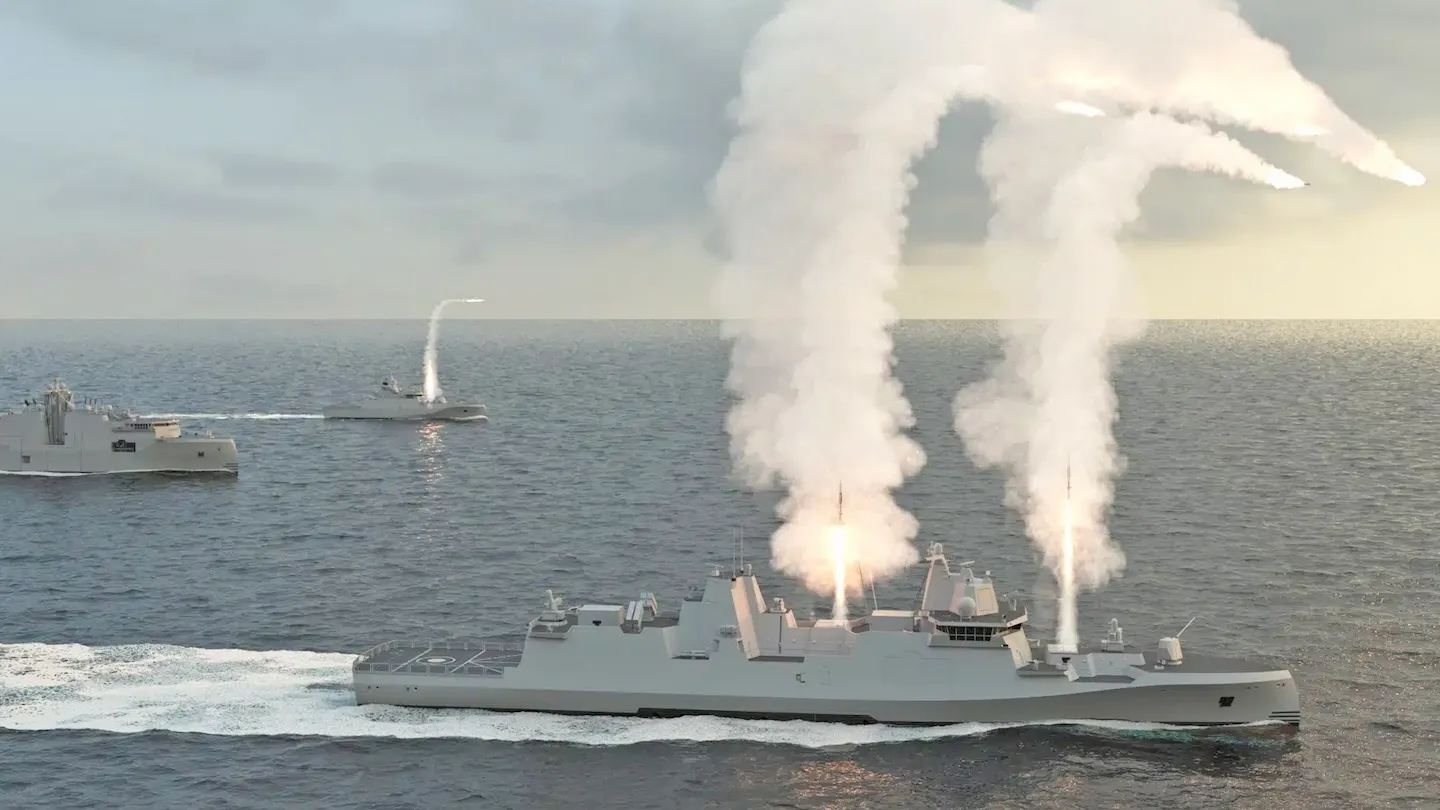
A rendering showing the GMF 140 (nearest) in action. Rheinmetall
A key feature of the design is its integration of U.S.-sourced combat systems and sensors. Rheinmetall says the frigate is designed around the AEGIS combat system and can accommodate multiple U.S.-sourced radar options capable of detecting, tracking, and engaging conventional air threats, hypersonic weapons, and ballistic missiles.
For customers seeking an alternative combat management architecture, the company says the GMF 140 can also be configured with Lockheed Martin’s CMS330 combat management system, providing an open and scalable architecture capable of integrating both U.S. and European sensors and weapons.
The ship is equipped with 64 strike-length Mk 41 vertical launch system (VLS) cells, allowing it to employ a wide range of air defense, ballistic missile defense, and land-attack missiles. For air defense, for example, 64 VLS cells would give the option of up to 256 Evolved Sea Sparrow Missiles, which come in quad packs, although a typical load-out would provide a far more balanced inventory of larger, longer-reaching anti-air missile and strike weapons, such as the Tomahawk cruise missile and Standard family of surface-to-air missiles.
Mk 41 VLS cell configurations and weapons. Lockheed Martin
Additional armament includes anti-ship missiles, torpedo launchers, a 5-inch (127mm) main gun, laser weapon systems, close-in weapon systems (CIWS), and secondary guns. In the concept artwork, the warship appears to have a U.S. Navy-standard Mk 45 main gun, as well as a SeaRAM CIWS mounted fore and aft, again in line with a pitch to the North American market.
Rheinmetall says the ship incorporates a low-signature hull, integrated acoustic management measures, hull-mounted and towed sonar systems, and facilities to support embarked helicopters and uncrewed systems from either U.S. or European suppliers.
The company says the design is intended to address growing demand from navies modernizing their fleets in response to evolving security challenges in Europe, the North Atlantic, and the Indo-Pacific. It also comes with a small crew complement for its size: each vessel will have a core crew of just 90, with the option to add another 35 if and when required.
Concept artwork of the GMF 140 underway. Rheinmetall
The new frigate’s wave-piercing bow is somewhat reminiscent of that seen on the smaller French Frégate de Défense et d’Intervention (FDI), or defense and intervention frigate. The bow of that vessel, which gives an appearance approaching that of a reverse bow, or inverted bow, is something we have discussed in the past. Both warships also have a dramatic chine that extends from the bow along the entire hull line.
The French Navy frigate, the Amiral Ronarc’h, part of the FDI class. Naval Group
The GMF 140 is approximately 460 feet long and has a displacement of more than 6,600 tons.
This puts it at the upper end of the modern frigate category, close to the boundary between a large frigate and a small destroyer. Its displacement should provide the volume and electrical power margins needed to support large radar arrays, future directed-energy weapons, additional electronic warfare systems, and growth in computing capacity. This capacity is especially important as navies adapt toward integrated air and missile defense against increasingly complex threats, including hypersonic weapons and ballistic missiles.
While the Type 26 was primarily designed around anti-submarine warfare and the FREMM family has evolved into multiple variants optimized for either ASW or general-purpose missions, the GMF 140 has been conceived from the outset as a fully integrated air and missile defense combatant capable of contributing to fleet-level ballistic missile defense while retaining robust ASW and long-range strike capabilities.
It is also notable that, rather than relying on proprietary national systems, Rheinmetall has built the GMF 140 around widely fielded U.S. and NATO technologies, including AEGIS, U.S.-sourced radar options, and the Mk 41 VLS. That approach reduces integration risk for navies already operating U.S.-made weapons and sensors while also improving interoperability during coalition operations.
The GMF 140 design reflects a broader trend among NATO navies toward heavily armed, multi-mission frigates that increasingly blur the traditional distinction between frigates and destroyers, at least in terms of missions. Rather than serving primarily as escorts, these ships are expected to provide area air defense, contribute to integrated missile defense networks, prosecute submarines, and deliver long-range precision strikes as part of distributed maritime operations.
While Rheinmetall is positioning the GMF 140 for the export market rather than domestic procurement, it should be noted that the German Navy recently canceled its planned F126 frigates, which, at 545 feet long and with a displacement of up to 11,000 tons, would have been physically the biggest surface warships to join the German Navy since World War II. You can read more about this ambitious program here.
The ill-fated F126 frigate in an artist’s concept. Damen
Instead, Germany opted for a smaller, lower-risk design optimized for anti-submarine warfare, and based on the proven A-200 frigate design from the German shipbuilder TKMS. This will be known as the F128.
Rheinmetall’s GMF 140 represents a different answer to that challenge. Rather than trading capability for affordability, it aims to deliver a heavily armed, highly interoperable frigate with robust integrated air and missile defense, long-range strike, and anti-submarine warfare capabilities in a single platform.
At the same time, the GMF 140 also marks a significant departure for Rheinmetall. While the company has long been a major supplier of naval weapons, sensors, ammunition, and mission systems, it has not previously competed as a prime contractor for a major surface combatant. As Rheinmetall’s first attempt to enter a highly competitive global market with a complete warship design, this necessarily comes with a degree of risk attached for any potential buyers.
Curious angle on this pitch. Not sure I see either Canada or the US as a serious prospect.
On top of that any Rheinmetall/NVL pitch as the most glaring weakness faces a complete absence of previously designed and built combatants (that arent OPVs).https://t.co/Irxs26fDyo
There is also the question about where these vessels would be built. Earlier this year, Rheinmetall acquired Naval Vessels Lürssen, which includes various German shipyards, of which Blohm+Voss in Hamburg would be the most likely candidate, having a long history of building surface combatants.
Rheinmetall’s reference to a procurement project in North America is interesting, pointing to either Canada or the United States.
As it stands, Canada has already selected the River class destroyer (based on the Type 26), so Rheinmetall would be relying here on a future tranche or a follow-on requirement.
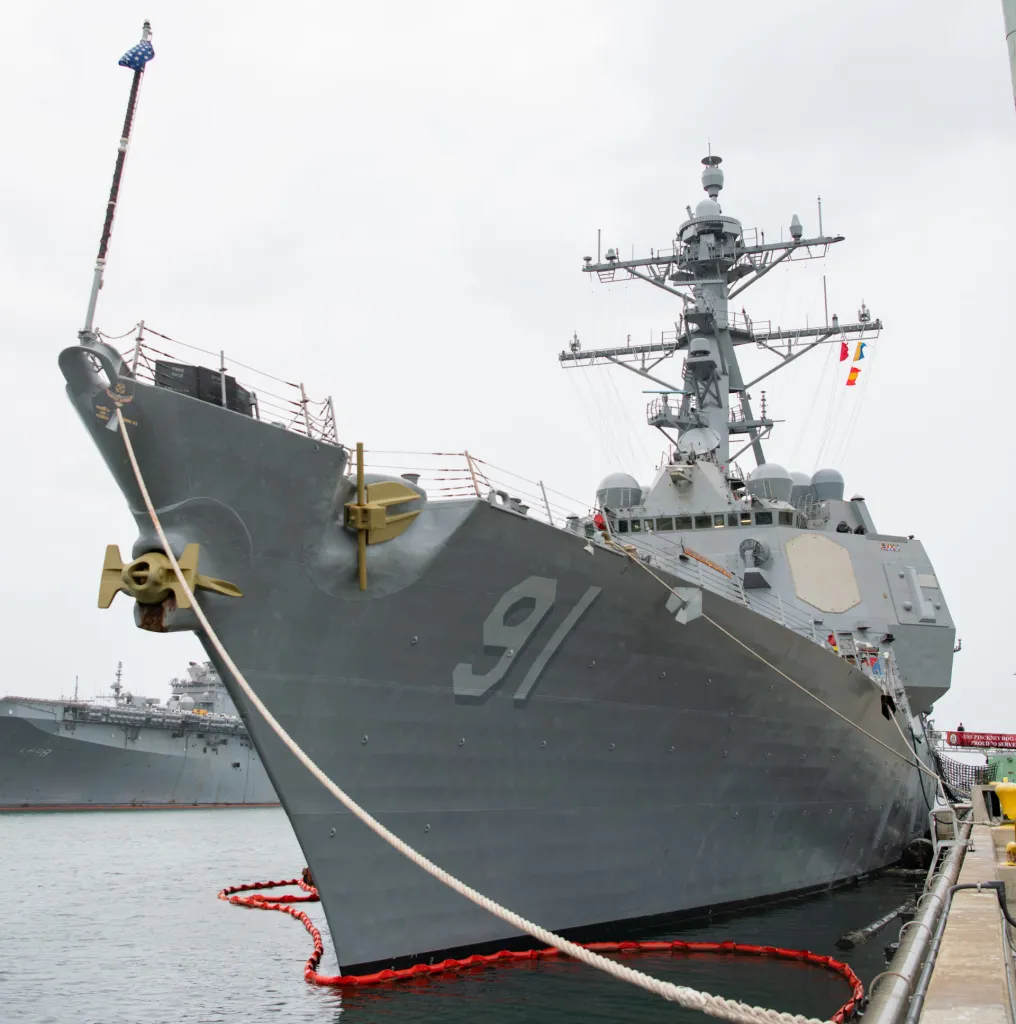
In the United States, the Constellation class frigate program was terminated last year, and it was announced that the National Security Cutter design will serve as the basis of a new U.S. Navy frigate program that is named FF(X). Introducing an entirely new design into that program would seem highly unlikely, but the appearance of the GMF 140 does suggest that Rheinmetall has identified a gap in the market between the new FF(X) and the Arleigh Burke class destroyer, with a VLS capacity and level of capability matching that.
As allied navies weigh the balance between capability, cost, and procurement risk over the coming decade, it will be interesting to see whether more navies also move toward a more affordable, lower-risk frigate, as Germany has done, or bigger designs like the GMF 140 that seek to retain destroyer-like capabilities in a frigate-sized hull.
EMERGENCY crews are battling wildfires across the popular Greek island of Kefalonia, forcing tourists and locals to evacuate homes and holiday accommodation.
A firefighter works to extinguish a wildfire in the Megara Region, west of Athens on August 3, 2026Credit: AFPWildfires initially erupted in the dense pine forests of Kefalonia before spreading towards residential settlementsCredit: Getty
Here is your guide to where the blazes are located, how they started, and what the latest official advice says for holidaymakers heading to Greece.
Where are the fires in Kefalonia?
Wildfires initially erupted in the dense pine forests and scrubland near Pastra, in the south-east of the island of Kefalonia.
Sign up for the Travel newsletter
Thank you!
The Greek Fire Service and local municipal authorities issued urgent precautionary evacuation orders via the national emergency alert system after flames threatened nearby homes and tourist lodgings.
Evacuations were triggered for several inland villages as flames moved close to residential zones.
While precautionary evacuations were ordered, local authorities and ground crews largely brought the fire near Pastra under control.
Though firefighters – supported by specialised water-dropping aircraft and helicopters – still remain on high alert for flare-ups.
Evacuations were triggered for several inland villages, including Kapandriti in the south-east of the island
While main coastal resorts remain open, drifting smoke plumes and shifting winds have affected air quality and visibility across nearby districts.
How did the fires start?
The outbreak of wildfires on Kefalonia comes amid an intense summer heatwave gripping Greece and wider southern Europe.
While official investigations into the exact ignition points remain ongoing, authorities point to a combination of extreme environmental factors.
Prolonged periods of temperatures exceeding 40C have left vegetation bone-dry, creating conditions where a single spark can instantly trigger a wall of fire.
In coastal areas, high sea winds briefly prevented water-scooping aircraft from operating safely.
Greece has suffered dozens of wildfire outbreaks in recent days, including severe blazes in Attica, Halkidiki, and Crete, putting emergency services under heavy strain.
While it has not placed a blanket travel ban on visiting Greece, officials advise all travellers to exercise caution, stay informed, and follow local emergency instructions.
Holidaymaker checklist:
Monitor Emergency Alerts: Ensure your mobile phone can receive emergency broadcast messages from @112Greece. If an evacuation alert is issued, follow instructions from local authorities immediately.
Contact Your Travel Provider: Major operators (such as TUI, Jet2 and EasyJet) are monitoring the situation closely. If your accommodation or flight is impacted, contact your provider before travelling.
Check Travel Insurance: Verify that your travel insurance policy covers natural disasters, trip interruptions, or emergency relocations.
Emergency Numbers: If you are in immediate danger in Greece, call 112 for emergency services. British nationals requiring urgent consular assistance can contact the Foreign Office on +44 (0)20 7008 5000.
Travellers heading to unaffected resorts on the island can generally proceed with their plans.
But checking live traffic and local authority updates before set-off is strongly recommended.
MEGAN McKenna was violently attacked in her own home by three machete wielding thugs who tore her jewellery off her hand as she begged them not to kill her.
The three men left the TV star fleeing the UK for Germany with her now husband, Union Berlin footballer Oliver Burke.
Megan McKenna has revealed she begged for her life when machete-wielding thugs broke into her homeCredit: Instagram/@meganmckennaThe star revealed the thieves stole her engagement ringCredit: Instagram
Megan, who is mum to 22-month-old Landon, reveals she confronted the robbers after they used a baseball bat to break into her locked bedroom and pleaded with them to leave.
Speaking on Jamie Laing’s Good Company podcast, Megan said: “I was robbed really badly in my own home.”
Sign up for the Showbiz newsletter
Thank you!
The incident happened in 2024, with the men going on trial last year.
Opening up about the robbery, Megan said to sleep alone in her home in London while Oliver was away in Germany.
Megan, 33, explained: “I must have fallen asleep within the first 15 minutes.
“I woke up to my whole house shaking. I was such a disorientated mess.
“They were inside my house, but I lock my bedroom door every night because I always worry about something happening to me when I’m on my own.
“The next thing I know, my mirror has come off my wall, and they’re hacking a hole through my wall with a baseball bat.
“They’re three masked men with machetes and baseball bats, and they managed to hack a hole in my wall because it was a fake wall going onto my dressing room, linked to my bedroom
“ And if my door wasn’t locked, actually, they probably would have woken me up and probably killed my dog.”
Megan immediately called the police who told her not to speak to the masked raiders.
But fearing for her dog, Megan said she confronted them.
She added: I went over to them. I was naked.
“I was talking to this man in a balaclava, and he grabbed my hand and he took jewelry off of me.
“Like I actually was holding hands with the robber, and they had a conversation outside the wall, and they made a phone call.
“I was shaking. I’d cut my foot. There was blood everywhere. It was like a bloody murder scene.
“And then I’m standing naked, and they just left with nothing, with nothing else.”
Megan said she believes the men had always planned to attack her.
She said: “It was obviously targeted.
“[The police] wanted me to go on trial.
“And I just said to them, like, I actually can’t physically do that. Go through it.”
Despite the men being jailed, Megan said she was horrified to learn they had been released not long after being locked up.
Megan explained: “They got caught, and then they went on trial, and then a year later, they just got let out.
“They’re just roaming the roads.”
Megan, who found fame on Towie and Celebrity Big Brother before pursuing a career as a singer, said she will now not stay in the UK alone.
She added: “It scared me so much to be in the UK and to live in the UK on my own, because obviously Ollie’s in Germany.”
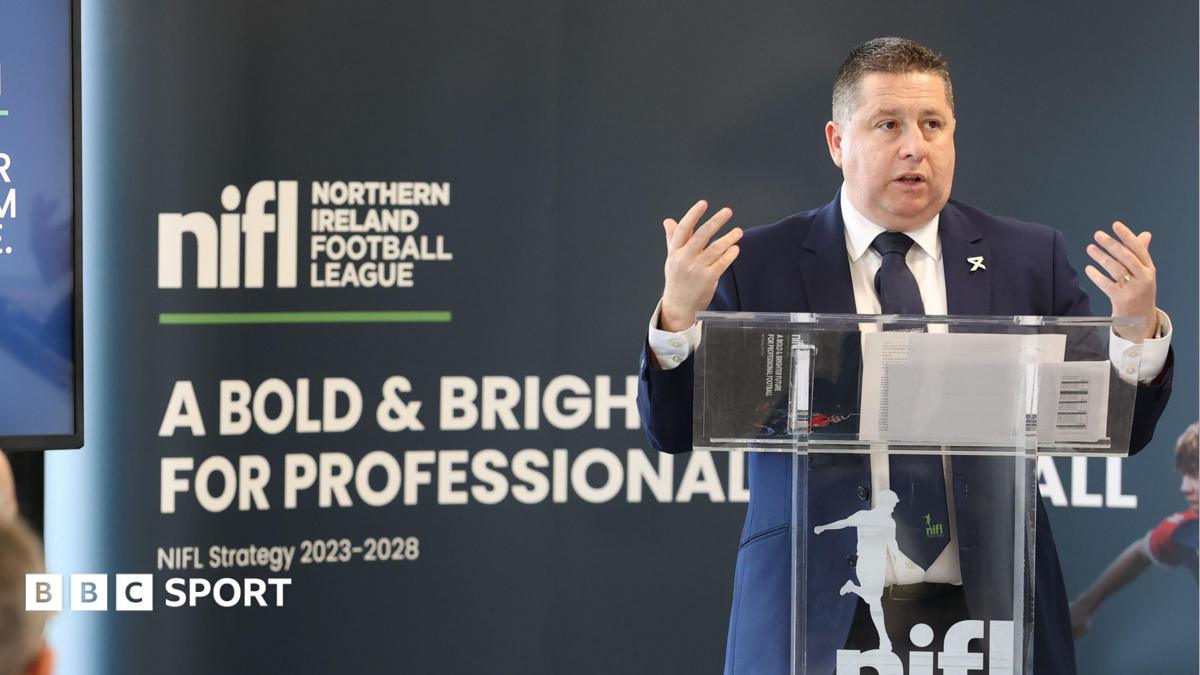
The PIL had been the third tier of NIFL since 2016 and is now set to be replaced by the Conference League, which will be run by NAFL.
As a result, NIFL will only control the top two leagues of Northern Irish football and has now expanded the Championship from 12 to 16 teams.
The top four teams from last season’s PIL – Moyola Park, Strabane Athletic, Rathfriland and Newry City – were promoted to the Championship.
But the 10 teams who finished between fifth and bottom of last year’s PIL- Dollingstown, Ballymacash Rangers, Portstewart, Oxford Sunnyside, Dergview, Ballyclare Comrades, Knockbreda, Coagh United, Lisburn Distillery and Banbridge Town – are all set to feature in the inaugural Conference league.
Ballymena & Provincial League champions St. James’ Swifts and Rosario, who came fifth in NAFL’s Premier Division last season, are also due to complete the new 12-team league.
But Banbridge, who finished bottom of the PIL, believed the decision to remove the side from the NIFL structures was “unlawful” and appealed to the Irish Football Association [IFA].
Banbridge argued that NIFL had not followed its own regulations by not previously securing approval from member clubs at an annual general meeting [AGM] or EGM to bring its annual regulations into operation, and their appeal was upheld by the IFA’s appeals committee.
Second-quarter revenue jumped 93 percent but Palantir’s ties to Israel and role in military technology are controversial.
Published On 4 Aug 20264 Aug 2026
United States artificial intelligence and data analytics giant Palantir Technologies has reported “otherworldly” quarterly results, sending its shares more than 14 percent higher in after-hours trading, as its growth shows no signs of slowing despite mounting criticism over its close ties to the US and Israeli governments and concerns about its growing role in artificial intelligence and warfare.
Palantir Technologies reported a revenue of $1.94bn for the second quarter, up 93 percent from a year earlier, and raised its forecast annual revenue to between $8.15bn and $8.158bn, up from $7.65bn to $7.662bn earlier. It said strong demand from both commercial customers and government agencies drove the surge.
Recommended Stories
list of 3 itemsend of list
“This quarter was otherworldly: our US commercial revenue grew 149 percent year-over-year, our overall revenue grew 93 percent year-over-year,” Chief Executive Alex Karp said. “Demand for AI sovereignty has now been unleashed.”
In a letter to shareholders, Karp wrote: “Our business is compounding at a rate and scale that we have never before witnessed.”
Palantir holds multibillion-dollar contracts with US government agencies, including the US Army. Revenue from its US government business rose 90 percent year on year to $809m, even as the company has faced growing opposition over its role in President Donald Trump’s immigration crackdown, which critics say has resulted in unlawful deportations and killings.
Founded in 2003 by technology entrepreneurs including Karp and multi-billionaire Peter Thiel, Palantir opened its first office in Israel in 2015 and has since expanded its work with the Israeli military.
Following what Palantir described as a “strategic partnership” with Israel in January 2024, the company significantly expanded its operations supporting Israel’s military campaign in Gaza and operations in the occupied West Bank.
According to Open Intel, a platform tracking corporate involvement in the genocidal war on Gaza, Palantir has actively recruited former members of Israel’s elite Unit 8200 cyberintelligence division. The group says Palantir’s software integrates intercepted communications, satellite imagery and other datasets to help generate military targeting lists for Israeli forces.
In a statement to Al Jazeera earlier this year, Palantir UK reiterated the company’s support for Israel.
The company has also secured major contracts with the United Kingdom’s government. In January, the UK’s Ministry of Defence awarded Palantir a $323m (240-million-pound) contract. A separate $444m (330-million-pound) NHS contract awarded in November 2023 has also attracted criticism, with campaigners raising concerns about the handling of sensitive health data and the heavy redaction of contract documents.
Palantir has also faced scrutiny over its vision for the future of artificial intelligence. In The Technological Republic, a recent book co-authored by Karp and the company’s head of corporate affairs, Nicholas W Zamiska, the authors argue that technology companies have a responsibility to build advanced military AI capabilities. Critics have described the philosophy as a form of “techno-fascism”.
A woman has sparked a heated debate after claiming a fellow passenger took over part of her plane footwell with his backpack before making her feel like she was the one being rude
A woman has opened up on her ‘manspreading’ ordeal (stock image)(Image: Getty Images/EyeEm)
While the seat comes with a few downsides, including having no entertainment screen within easy reach and slightly narrower armrests, she said the extra space usually makes it worthwhile. However, her latest journey didn’t quite go to plan. She claimed the man sitting in the row in front placed his large backpack in the empty space where a window seat would normally be.
Because there is no seat directly in front of her in the exit row, she said the bag ended up taking over part of the legroom she specifically paid for.
To make matters worse, she alleged the passenger kept looking back at her as though she was being rude whenever her legs came close to his belongings.
Alongside a photo of the seating arrangement, she pointed out her own backpack was stored correctly underneath the seat in front of her, while his had been left in the open space beside him.
She wrote: “Not a huge deal… just curious. Other than this guy is making me feel like I’m being an a***hole.
“I’m in the exit row 21 window seat where there is no window seat in the exit row in front of you. I choose this seat at times even though, in exchange for the additional leg room, I’m giving up a screen and have limited seat width due to the arm rests.
“This guy plops his large backpack down directly to the left of him, where the ’20A seat’ would be if there were one. And is constantly looking back at me like I’m being rude, for my legs being near his bag.
“Mine is under the seat directly in front of me. As it should be. I’m tired. I’m annoyed. And to be honest, I just feel like complaining, but not enough to actually say something since it’s only an hour flight. But am I wrong to be this bothered by it?”
The post quickly attracted dozens of comments, with many siding with the woman and arguing the bag should have been kept out of the shared space.
One person said: “Former flight attendant here! This is a safety hazard – the reason bags go under seats is so they don’t go flying.
“He’s directly putting you in danger in case of turbulence. If he won’t move it I’d call the flight attendant over.”
Another user added: “Regardless of etiquette, his bag shouldn’t be there at any time. That’s an emergency exit. I doubt his priority will be finding a place to move his bag in a water exit – it’ll just be the reason everyone rear of the lav drowns.”
He explained how he had specifically booked his seat in advance to ensure he was as comfortable as possible during the flight.
But after a flight attendant noticed a child sitting alone in economy while their parent was in business class, they reportedly made it their mission to reunite the pair.
GATWICK Airport is set to get a second runway by the end of the decade.
Plans for the new runway have received a huge boost today, after campaigner against the plans lost their bid to challenge it.
Gatwick Airport will be getting a second runway
The airport expansion was approved back in September and is set to cost £2.2billion.
It will involve moving the airport’s emergency runway 12 metres north and as a result, the airport will be able to host an extra 100,000 flights a year.
Sign up for the Travel newsletter
Thank you!
The new runway is set to have planes taking off by the end of the decade.
In a ruling on Tuesday, Lord Justice Holgate and Lord Justice Dove dismissed campaigners’ bids against the new runway.
Despite the big rise in profits, BP chief executive Meg O’Neill said the company was not reaching its full potential.
BP, which employs nearly 14,000 people in the UK, confirmed plans to move further away from clean energy, revealing plans to sell off its US renewable natural gas business Archaea.
O’Neill said this was part of her plan to prioritise “value, not sentiment or history”.
“We have to focus on the assets with the strongest potential to deliver competitive returns and long-term value,” she said.
Last week, BP announced it was putting its North Sea business up for sale in a move that would end 60 years of production in the region by the company.
Russ Mould, investment director at AJ Bell, said the sell-offs intended to make the business more streamlined.
“O’Neill will be aware she cannot rely on oil and gas prices remaining this high indefinitely,” he said.
“She needs to make sure it can prosper even when the backdrop is less helpful.”
The bumper profits reported by oil companies have led to an angry response from campaign groups.
Angharad Hopkinson, from environmental group Greenpeace, said BP’s results showed that “corporate gains have become entirely divorced from the public good”.
“Prolonging this parasitic relationship by trying to squeeze the last few drops of expensive oil out of the North Sea is sheer folly,” Hopkinson said.
Simon Francis, co-ordinator of the End Fuel Poverty Coalition, said oil firms “have banked more billions from a crisis that has created real hardship for millions of households”.
“The lesson is not to hand yet more tax breaks to an industry posting billions in profit every quarter, but to use Windfall Tax receipts to clear the record energy debt households built up during the crisis,” he said.
Energy firms operating in the UK are subject to a windfall tax – called the Energy Profits Levy – that was introduced in 2022.
However, the tax only applies to profits made from extracting oil and gas in the UK.
It’s a few minutes after 10 a.m. on a recent morning and the thermometer is closing in on 95 degrees, but Marc Papas isn’t fazed. “The heat doesn’t bother me much,” he said, unloading his bicycle — a blue and yellow 1989 Trek 400 — from the trunk of his car on a side street in Reseda. “I just keep going.”
Papas adjusted the heart monitor underneath his T-shirt, checked the bike computer attached to his handlebars, then set off on the day’s ride; he’s taken it upon himself to bike every public street in Los Angeles. The Phoenix native has completed over 78% (about 5,840 miles) after two years. He calls it “The Project,” and says there’s about 7,516.07 miles in total, when you include various enclaves and adjacent cities like Beverly Hills or Burbank. Today he’s headed toward the longest continuous bike lane in Southern California — a stretch of Reseda Boulevard. It’s an unexpected amenity in a part of the city that seems otherwise hostile to pedestrians and cyclists, but one Papas wants incorporated around more of Los Angeles.
“Somebody once asked me on a Reddit Ask Me Anything what is one street you think needs a bike lane,” he said. “I wrote him a whole essay in response, because I can’t just say one street.”
Marc Papas estimates he covers about 75 new, unique miles each week, putting him on track to complete the entire city after nearly three years of riding.
(Kayla Bartkowski / Los Angeles Times)
Marc Papas sets his blue and yellow 1989 Trek 400 near a graffiti post along the Los Angeles River.
(Kayla Bartkowski / Los Angeles Times)
After a few blocks on Reseda, Papas turned back into the neighborhood centered around Etiwanda and started tracing loops across the blocks. It’s his standard pattern for covering any area he rides for the Project. “I base my routes on a math theory called the Eulerian Path,” said Papas, a mechanical engineer by training. Each new segment of the city he rides is generally a rectangle bound by major streets. “Then, I start with loops around the edges and work my way in,” he continued. “It’s the most efficient way to cover an area without overlapping.”
Today’s ride would yield eight new miles for Papas. “So, I’ll be about 12 miles away from 80%,” he calculated.
Papas started his biking project almost by accident. He moved to Los Angeles in late 2020 after finishing his PhD at Georgia Tech. He had taken up biking around Atlanta as part of triathlon training and worried he wouldn’t be able to continue once arriving in L.A.
“I remember having a sort of fear around it,” said Papas. “I’d heard it’s just so car-filled and dangerous to be on the roads.” But riding along the beach and around much of the Westside quickly changed his mind. With perfect weather year-round and a mostly flat topography, why wasn’t everyone in L.A. riding bikes?
He was soon cycling to work in Monrovia from his apartment in Pasadena, and biking more than he ever had in his life. “Sometimes friends would be surprised to learn I have a car,” he said. “They thought I bike everywhere because I don’t drive.”
Then, on Dec. 31, 2023, Papas decided to get in one last bike ride for the year. He rode a section of San Marino that he and friends refer to as “The Mitochondria” for the shape the streets make when viewed in the tracking app Strava. After riding the Mitochondria, he decided to keep going — making a path up each street and block — until he was satisfied. It gave him the idea to ride every mile of street in San Marino. “It’s only 60 miles total,” said Papas. “That seemed doable.”
“There are beautiful pieces of art on the walls that you wouldn’t imagine,” says Marc Papas, who has spotted murals throughout the city.
(Kayla Bartkowski / Los Angeles Times)
Marc Papas cruises along the Los Angeles River bike path.
(Kayla Bartkowski / Los Angeles Times)
Finishing the 60 miles of San Marino led to completing the 400 miles of Pasadena. He next found himself taking detours to cover new streets in Northeast Los Angeles as he’d ride to and from Koreatown Run Club meet-ups at Los Angeles Community College. But it wasn’t clear to himself, or anyone else, what he was doing. “Friends were seeing my Strava activities and texting me like, ‘What the heck are you doing, man?,’” Papas recalled. One friend jokingly asked if he was drawing the Nazca lines across the city, but Papas wrote it off as just trying to clock extra mileage. “There’s a level of self-deception, because riding the whole city of Los Angeles seemed impossible to do,” he said. Still, his treks around Northeast L.A., East Hollywood and Los Feliz were starting to build up mileage — he had completed about 18% of the city.
When Papas drove out to North Hollywood in November 2024 specifically to track new mileage, he realized he had crossed the Rubicon. “At that point, I can’t lie to myself anymore about what I’m doing,” he said. “I’m driving out to these places to get miles more efficiently. When that happened, I was like, all right, I’m in it for the long haul.”
“Biking is like a superpower to gain familiarity with your neighborhood,” says Marc Papas.
(Kayla Bartkowski / Los Angeles Times)
As Papas covered more and more of the city, he began growing an appreciation for various architecturally-significant neighborhoods as well as the many murals across large swaths of South and East L.A. “There are beautiful pieces of art on the walls that you wouldn’t imagine,” he said. “I want to take people to these places and do a mural tour.” He was especially moved when he was riding in Pacoima and saw a Buddy Holly and Ritchie Valens mural that memorializes the tragic plane crash that killed both Holly and Valens. “So many of these murals are commemorating people and events that are culturally important to those specific areas,” he added.
The bike rides were connecting him to his city in ways he never expected. “I’m not necessarily saying that everybody needs to go out and ride their bikes,” said Papas, though he’d certainly love it if more Angelenos did. Instead, he hopes his biking project is showing people what’s possible — in the most extreme way. Yes, you can bike in Los Angeles, as many Angelenos often do out of necessity. It’s even enjoyable. And yes, you can do it across every single mile of the city, even if the cycling infrastructure isn’t perfect yet. “I think to me, success would be if people just go out and explore their own neighborhood,” he said. He views cycling as a form of civic engagement and a way to see things otherwise invisible when speeding by in a car. For beginners, Papas recommends sticking to bike paths and joining cycling groups. More experienced riders should venture out into new areas, said Papas. “Biking is like a superpower to gain familiarity with your neighborhood, but it just needs to be unleashed.”
“At this point, I can’t lie to myself anymore … I’m in it for the long haul,” says Marc Papas. He’s already clocked thousands of miles on his mission to cover every street in L.A.
(Kayla Bartkowski / Los Angeles Times)
Last September, Papas passed the 50% mark of his project and estimates he’s been covering an additional 1% (or about 75 new, unique miles) every week since. That puts him on pace to finish sometime around mid-December — should everything go smoothly — nearly three years after he first began. Does he know what his final mile will be? “Eldred Street in Mount Washington,” he said. He notes it’s one of the steepest streets in the entire country.
“It’’s a fitting end, like a final boss [in a video game], just one last all-out hard effort to completely finish things off,” Papas said. “It gives me goosebumps to think that would be the time and place that this years-long project would be done.” Of course, there’s always the rest of Los Angeles County to conquer.
AS the drought continues across Europe, low water levels in Europe are now threatening river cruise holidays.
The River Rhine and the Danube River have started to dry up with passengers being re-routed at the last minute after two ships ran aground.
River Cruise ships are being affected by the low water levels on the Rhine and DanubeCredit: AlamyBoth waterways have record low water levels due to droughtCredit: AFP
On the morning of June 29, the ship called Viking Einar ran aground on the Rhine River at Cologne in Germany.
Days later, the Viking Ullur ‘experienced a grounding incident on theDanube River‘ in Bulgaria with 186 passengers being evacuated.
Sign up for the Travel newsletter
Thank you!
It came ‘into contact with a sandbank during a period of exceptionally low water levels‘, Viking said in a statement.
With no rain on the horizon, river cruise companies are having to take action with some having to change sailings completely.
One woman who booked with Riviera Travel wrote on Facebook: “We have just received an email to tell us that our Rhine and Switzerland cruise is being re-routed and will not be travelling to Switzerland but instead north to Netherlands and Belgium.”
She added that she was given the option to change the itinerary or “cancel with full refund and have been offered compensation”.
Riviera Travel, issued a statement about potential alterations on its website.
It explained that “individual sailings may continue to develop right up until departure and, occasionally, during the cruise itself.”
“Currently, our cruises continue to operate, although itineraries are being adapted where necessary.
“This may include adjustments to sailing schedules, excursions or mooring locations, and in some cases carefully coordinated ship swaps to help you continue your holiday with as little disruption as possible.”
Passengers are being contacted about alterations to their sailingsCredit: handout
Passengers who have booked after August 5 are being contacted up to two weeks before departure with updates and between 48 hours and 24 hours before departure to “explain the latest position, any expected changes and the options available.”
Talking to The Independent, Riviera Travel said that cancelling a cruise is always a last resort.
In another case, one woman heading on a river cruise with TUI shared her new itinerary on a Facebook page.
Instead of sailing from Basel, through Germany to Amsterdam, the new suggested route starts in Zaandam through to Rotterdam, Antwerp, Middelburg, Dorecht and Amsterdam.
In the email, TUI also offered a 15 per cent refund of the holiday cost with £150 holiday vouchers per person on the new sailing.
Other options were to rebook another river cruise with a refund in cost if the new sailing is cheaper, or if it’s more expensive, an incentive of up to 10 per cent of the value of an existing holiday.
Or there was an option to cancel the booking with a full refund.
On TUI’s website, it says “Most sailings go ahead without any disruptions, but water levels on the rivers can go up or down depending on the weather.”
Low water levels means ships are unable to dock in some casesCredit: Anadolu via Getty ImagesThere are alternative itineraries being offered to passengers as well as refundsCredit: Alamy
It continued: “If your cruise is affected, we’ll make every effort to complete your itinerary. To do this there may be changes to berth locations, modifying shore experiences or completing some sections of the itinerary by coach.”
Emerald Cruises confirmed that reduced water levels are affecting sections of the upper Danube between both Vienna and Budapest, and Regensburg and Passau near Pfelling.
On its website it has said that it may make “operational adjustments” with passengers possibly being transferred to a “sister ship” as well as embarkation and disembarkation being amended.
AmaWaterways said: “Due to unusually low water levels on sections of the Rhine and Danube rivers, operational adjustments to select sailings have been deemed necessary.”
It continued to add that “modifications may include changes to ports, embarkation or disembarkation locations, motorcoach transfers, ship scheduling or other itinerary elements”.
People should brush up on this code before heading on their next holiday
The ‘red flag’ system is used around the world to prevent this loss of life on beaches(Image: Getty)
Going to the beach or cooling off in the sea when on holiday is one of the most common activities tourists do – and not think twice about. However, when people enter bodies of water, there is always a risk of injury or even death.
Holiday hotspots – like Spain, Turkey and Greece – all have warnings listed on the official GOV.UK Foreign Office pages that provide advice to travellers swimming abroad. The Foreign Office says every year, “people drown in the sea and in swimming pools”.
People who are holidaying with young children should “always supervise” them around pools and the sea – even if they can swim or a lifeguard is present. Situations can change in an instant, even for experienced swimmers.
On the country’s Foreign Office advice page, it said: “Some beaches, especially around Spanish islands, may have strong undercurrents. Hidden rocks or shallow depths can cause serious injury or death. Do not dive into unknown water and do not swim at beaches where a river runs into the sea.”
It adds that most beaches, including those in tourist spots, will use a simple colour-coded flag system to indicate whether an area is safe. These flags follow a standard set of guidelines that are universally recognised, and one should be a clear warning to anyone setting up for a day at the beach.
The Foreign Office said: “Many beaches have a flag system. Make sure you understand the system and follow any warnings (a red flag means you must not enter the water). Take extra care and get local knowledge if there are no lifeguards, flags or signs.”
Beach lifeguards will frequently fly multiple flags at the same time to signal different types of hazards. For example, one flag might be linked to the strength of the water, while another can signal if there is marine life in the area that could sting, like jellyfish.
What do the different coloured flags mean?
Red flag (high danger)
Yellow flag (medium hazard)
Green flag (low hazard)
Purple flag (marine pests)
Black and white checkered flag
Red over yellow (lifeguarded area)
Red flag warns of water conditions that are unsafe, like strong currents, rough surf, or severe undertows. If you see two red flags flying together, the water is completely closed to the public.
Yellow flag warns of moderate surf, light currents, or rougher waters. While swimming is permitted, weak swimmers or children are discouraged from entering, and everyone should take extra care generally.
Green flag signals calm ocean conditions and a low risk of dangerous currents. While it means the water is generally safe, swimmers should still remain aware of their surroundings.
Purple flag warns beachgoers that dangerous stinging marine life is present in the water. This typically means an influx of jellyfish, stingrays, or sea urchins. Crucially, a purple flag is used for smaller marine pests and does not indicate sharks.
Black and white checkered flag designates a specific area reserved exclusively for surfboards, kayaks, and other non-powered watercraft. Swimming or bodyboarding is strictly prohibited inside this zone to prevent dangerous collisions.
Red over yellow flag marks the safest area of the beach. This zone is actively monitored by lifeguards.
ANTALYA has long been the default answer for families wanting guaranteed sunshine, massive all-inclusive resorts, and enough waterslides to make returning home genuinely depressing.
But after several years of Turkey completely dominating our booking charts, I’m noticing a clear case of Antalya fatigue with Brits.
Antalya has long been popular but there are some great swaps that could save you moneyCredit: On the BeachDestinations like Sharm el Sheikh offer the same amazing waterpark hotels and and beautiful beaches but without the costCredit: Alamy
It’s still a brilliant option, but holidaymakers are starting to shop around – and discovering that plenty of other destinations have caught up.
Egypt, Tunisia, Greece, Morocco, and even Spain now boast the same mega four and five-star resorts, waterparks, and hot weather that used to make Antalya so difficult to beat.
And crucially, they can be significantly cheaper.
I’ve crunched my booking data to find where the previously most Turkey-loyal customers have swapped Antalya for in 2026, and how much cheaper they are in comparison to a Turkey holiday.
1. Playa Blanca, Lanzarote – save 19%
Lanzarote might sound like a wildcard swap, mostly because the Canaries aren’t usually associated with budget all-inclusive mega-resorts.
Playa Blanca, however, serves up a proper lineup of big family hotels alongside golden sand, a smart waterfront, and guaranteed sun.
It feels more chilled and far more walkable than many of Antalya’s sprawling hotel blocks, plus the slightly shorter flight from the UK is a godsend if you’re traveling with kids who ask if you’re nearly there before you’ve even cleared the runway.
Our data shows that the customers who made this switch in 2026 pocketed a 19% saving on average.
And the hotel that topped the swap charts here is the four-star HL Paradise Island – where I clocked five nights all-inclusive here from £295pp, flying direct from London Gatwick this September.
And it’s easy to understand why people are making the switch here when you spot their on-site Dino Waterpark, which is packed with proper drop slides, splash zones, and multi-lane racers that keep kids of all ages busy.
Lanzarote – from £295pp
If you click on a link in this box, we will earn affiliate revenue
This Rhodes hotel has nine outdoor pools – including a pirate splash parkCredit: On the Beach
Rhodes is the ultimate Greek swap for anyone who loves the scale of Antalya but wants a slightly fresh landscape.
The southeastern resort of Kiotari is tailor-made for this: it’s quieter and completely hotel-focused, featuring massive beachfront properties, reliable heat, and ancient Lindos sitting just 20 minutes down the road when you want to swap the sunlounger for a spot of culture.
Hundreds of customers shifted their booking from Antalya to Rhodes, saving an average of 20% in the process.
The absolute favourite with these switching customers was the four-star Kiotari Miraluna Beach Resort where you can grab five nights all-inclusive from £338pp, flying direct from Gatwick in late September.
It sits right on the sand and boasts nine outdoor pools – including a pirate splash park – alongside nine different bars and restaurants.
Plus, several room options here offer direct swim-up pool access straight from your terrace. And everyone loves a swim-up room, right?
Rhodes – from £338pp
If you click on a link in this box, we will earn affiliate revenue
Switching Antalya for Calas de Majorca in 2026 saved Brits around 20%Credit: On the Beach
Majorca is the ultimate low-effort swap if you want the convenience of an Antalya all-inclusive without putting your kids through a four-hour flight.
Calas de Mallorca on the east coast is a purpose-built family pocket surrounded by quiet coves and crystal-clear water.
It’s far more relaxed than Magaluf or Alcudia, with the hotels doing all the heavy lifting when it comes to entertainment.
Switching Antalya for Calas de Majorca in 2026 saved Brits around 20%, according to the stats.
And the most popular hotel to switch to here was the four-star HYB Eurocalas – and I spotted five nights all-inclusive here from £318pp, flying direct from Birmingham on 24th September.
This hotel’s a massive family favorite on our board, packing in multiple pool zones, sports courts, splash parks, and a dedicated kids’ club. No brainer.
Majorca – from £318pp
If you click on a link in this box, we will earn affiliate revenue
Marrakech offers both a proper city break AND a flop-and-drop resort holiday rolled into oneCredit: On the Beach
People usually associate Marrakech with bustling souks and rooftop tea, but step outside the city center and you’ll find some seriously massive all-inclusive resorts.
The Palmeraie area sits in a quiet palm grove outside the old city, giving you sprawling hotels, massive pools, and mountain backdrops.
You get something Antalya can rarely deliver: a proper city break AND a flop-and-drop resort holiday rolled into one.
Our figures show that customers who swapped Antalya for Marrakech for their all-inclusive resort holiday bagged an average 21% saving.
And the four-star Marrakech Ryads Parc & Spa is the value highlight and the most popular for a switch. I found five nights all-inclusive here from £240pp, flying direct from Gatwick in late September which is absolutely perfect weather-wise.
This hotel has the exact scale, massive pool footprint, and self-contained feel of a Turkish mega-resort, but adds a free daily shuttle into the medina when you want to explore.
Marrakech – from £240pp
If you click on a link in this box, we will earn affiliate revenue
The Hurghada coastline is wall-to-wall with all-inclusives, private beaches, and on-site waterparks,Credit: On the Beach
Hurghada is an absolute slam-dunk if you care purely about the resort footprint rather than the destination town.
The coastline is wall-to-wall with all-inclusives, private beaches, and on-site waterparks, while the guaranteed Egyptian heat makes it a goldmine for late-season breaks.
Hurghada was also the third most-popular destination that people traded Antalya for, bagging an average 21% saving.
And the most popular hotel people made the switch for was the four-star Rewaya Inn Resort.
Probably because this place gives you the full Turkish mega-resort experience without the hefty price tag – it’s a proper fly-and-flop complex anchored around an enormous lagoon-style pool network.
You can lock in five nights all-inclusive from £393pp, flying direct from London right at the start of September
Hurghada – from £393pp
If you click on a link in this box, we will earn affiliate revenue
Don’t discount Benidorm as a great Turkey swapCredit: On the Beach
On paper, Benidorm and Antalya look like completely different beasts, but they serve the exact same holiday brief: tons of hotel choice, guaranteed sun, world-class beaches, and enough family entertainment to fill every evening.
Benidorm just pulls it all closer together – and cuts an chunk off your flight time.
Our booking data shows an average saving of 22% for Brits who switched from Antalya to the Costa Blanca, with their new holidays averaging £92 per person, per night. Not bad.
The four-star Rosamar Hotel topped the charts when it came to switches.
I clocked five nights all-inclusive here from £285pp, flying direct from Gatwick at the end of September.
It sits right near Levante Beach and has a brilliant on-site splash park loaded with slides and water features, essentially acting as a cheat code for tiring out energetic kids before bedtime.
Benidorm – from £285pp
If you click on a link in this box, we will earn affiliate revenue
The Red Sea offers some of the best house-reef snorkeling in the worldCredit: On the Beach
Sharm El Sheikh is the single closest direct alternative to Antalya on the map.
You get scorching temperatures, all-inclusive mega-resorts, massive pool complexes, and hotels designed so you never actually have to leave the gates.
The massive bonus here though is the Red Sea itself, which offers some of the best house-reef snorkeling in the world right off the hotel jetties.
A staggering amount of customers swapped Antalya for Sharm El Sheikh – more than any other spot on this list – all while saving an average of 23%.
One of the most popular hotels in Sharm is the five-star Rehana Sharm Resort in Nabq Bay where I found five nights all-inclusive from £413pp, flying direct from London slap-bang in the middle of September.
This hotel’s a cracker too, and features a sprawling pool network, an aquapark, kids’ clubs, and several dining options – but best of all, it sits just six miles from the airport, so you can go from baggage reclaim to sunbed in record time.
Sharm el Sheikh – from £413pp
If you click on a link in this box, we will earn affiliate revenue
Sousse combines massive beachfront resorts with an authentic historic medinaCredit: On the Beach
If your absolute priority is getting the maximum amount of resort facilities per pound spent, Tunisia should be right at the top of your list.
Sousse combines massive beachfront resorts with an authentic historic medina, fine sand, and the smart marina at Port El Kantaoui just down the road.
And hundreds and hundreds of people swapped Antalya for Tunisia, averaging a rock-bottom £70 per person, per night on their Tunisian holiday.
That makes it the cheapest destination on this list and delivers the biggest average saving at 25%. A popular Tunisian destination is the four-star Royal Jinene Sousse.
This hotel’s built directly on its own private sandy beach and features indoor and outdoor pools, waterslides, and a dedicated beach bar – meaning the distance between your lounger and a cold drink is virtually zero.
And if you fancy it, you can grab five nights all-inclusive this September from just £243pp. Bargain.
Sousse – from £243pp
If you click on a link in this box, we will earn affiliate revenue
ARIANA Grande stopped her concert in Chicago last night to address her fans following the news she’ll take a step back from public life after her current tour.
The 33-year-old is halfway through her Eternal Sunshine world tour and her reps confirmed this week a “much-deserved” break when it wraps in September.
Ariana stopped her concert last night to address the news she’ll take a step back from public life after her tourCredit: XIt comes amid speculation and comments over her appearance, with one online activist claiming the singer was ‘possibly dying right in front of us’Credit: REUTERS
During her show last night, Ariana read out a statement from her phone and said: “The announcement that was made yesterday was not a reactive or impulsive thing.
“It is something that I had decided. It’s a plan that I had quietly made a long time ago, and it’s a decision that was made from a thoughtful and empowered place, and I want you to know that many, many things can be true at the same time.
Sign up for the Showbiz newsletter
Thank you!
“I want to share this because I heard that my fans were worried that negativity was ruining things for me.”
Ariana continued: “This is not what that is and I just want to make that very, very clear. Nothing can be ruined.
“Multiple things can be true at the same time. Boundaries can need to be set. Human beings can need a break sometimes.
“And also, this can be and will continue to be the greatest experience of my professional and creative life.”
Yesterday her reps said: “Ariana will be taking a step back from visibility after she completes the Eternal Sunshine Tour.
“She looks forward to finishing the tour and ending it on a high note, both healthily and happily, and then taking a much-deserved break from public-facing work and appearances, which has led to endless, ongoing public scrutiny.
“This tour has been a beautiful experience for her. She loves her fans and has loved every minute of this tour so much.”
And she will not appear on the red carpet with Robert De Niro and her other co-stars to promote their new movie Focker-in-Law.
The three-time Grammy winner’s decision to step back comes amid speculation and comments over her appearance, with one online activist claiming the singer was “possibly dying right in front of us”.
Hi, and welcome to another edition of Prep Rally. I’m Eric Sondheimer. Let’s examine some top linebackers and running backs to watch.
Get our high school sports newsletter
Prep Rally is devoted to the SoCal high school sports experience, bringing you scores, stories and a behind-the-scenes look at what makes prep sports so popular.
By continuing, you agree to our Terms of Service, which include arbitration and a class action waiver. You agree that we and our third-party vendors may collect and use your information, including through cookies, pixels and similar technologies, for the purposes set forth in our Privacy Policy such as personalizing your experience and ads.
Speed matters
Los Alamitos’ Kamden Tillis, right, celebrates a touchdown with teammate Ashton Gogue (13) against Edison on Thursday in an Alpha League football game at SoFi Stadium.
(Craig Weston)
Top teams have top linebackers, and representing the City Section is De’Andre Kirkpatrick from Crenshaw, a San Diego State commit who one day has the chance to be compared to former Crenshaw standouts Hayes Pullard and Daiyan Henley.
Kirkpatrick is 6 feet 3, 220 pounds and doesn’t like running backs. He throws them to the turf like a rag doll.
Another outstanding City Section linebacker/defensive end is Elyjah Staples of Marquez, a Cal commit who plays wherever his team needs him.
One school with multiple top linebackers is Servite with Allen Kennett and Isaiah Leilua. St. John Bosco’s Josiah Poyer has improved so much that he’s a USC commit and now covers offensive players going out for passes with expertise and confidence.
Isaiah Phelps of Oxnard Pacifica is a tackling machine. George Hastings of Agoura is only 5-11 but versatile, smart and repeatedly making an impact. Sevelino Taliauli of Long Beach Poly is a Colorado State commit. Noah Curtin of Chino Hills had 122 tackles.
Kane Casani of Loyola has worked nonstop in the weight room to become stronger and faster after averaging 13 tackles a game. Matthew Charles of Chaminade is ready for a breakout junior season, and the Eagles also have Washington State commit Josiah Rand.Wyatt Bogdan, 6-3, 220 pounds, had 81 solo tackles for Laguna Beach as a junior.
Among running backs, Stanford-bound AJ McBean has moved from Mira Costa to Gardena Serra and will have five returning starters up front to help him look good.
Noel Washington of Sherman Oaks Notre Dame showed flashes of brilliance as a sophomore. Malachi McFarland of Damien is going to get the chance to handle the ball much more to take advantage of his speed.
Jaxsen Stokes of Sierra Canyon has convinced his coach that there’s no smarter play call than giving him the ball. Kamden Tillis of Los Alamitos is coming off a 1,500 yards season. Sophomores Adrian Petero of Santa Margarita and Asir Nembhard of Mater Dei picked up valuable experience as freshmen contributors.
Malaki Davis of Corona Centennial is 215 pounds with speed. Maliq Allen of St. John Bosco came back after transferring to Inglewood and adds experience and speed to the backfield. Malaki Buchanan of Victor Valley is a sophomore with a 10.37 100 meters time. Kevika Mata’utia-Martinez of La Habra rushed for more than 1,400 yards as a junior.
Aidan Crecion (left) has grown to 6 feet 5 and passed his father, Gabe, who was a tight end at Chaminade and UCLA. Aidan will be a junior receiver at Oaks Chrisitan.
(Crecion family)
The opening game between Oaks Christian and Chaminade on Aug. 21 will have special meaning for Gabe Crecion, who was a star tight end and baseball player at Chaminade before moving on to UCLA. His son, Aidan, has grown to 6 feet 5 and is a promising junior receiver for Oaks Christian.
Orange Lutheran has recently added two highly regarded transfers in tight end Hudson Ploog from Troy and offensive lineman Austin Attalah from Cajon. But remember, first-year coach Ray Fenton talked last season at Los Alamitos how much fun it was coaching neighborhood kids instead of transfers. Unfortunately, this is what the Trinity League has become known for — transfers. Coaches get fired for losing records in the Trinity League.
Junior receiver and 100 meters standout Benjamin Harris of Servite has committed to Oregon State.
First-year St. Bernard coach Dean Herrington is getting used to his new drive from Valencia to Playa del Rey. Once school starts, he’ll be leaving at 5 a.m. trying to beat the traffic. Asked how his new team was doing, Herrington said, “It’s trying to change the culture and gets to practice all the time.” Herrington’s 13-year-old grandson, Bradley Rees, is a quarterback in waiting and two years away from high school.
Former Edison standout Hunter White has returned to take over coaching defensive backs at his alma mater. It’s the first time he’s been coaching since helping out his father, Dave, some 10 years ago.
With the arrival of quarterback Ethan Grant from Los Angeles, Crenshaw has the luxury of having two competent quarterbacks. Danniel Flowers started as a junior but also could see action as a receiver this season.
The Moore sisters, Nylah (left), a senior, and freshman Cinzia will be standouts at Eagle Rock in flag football and basketball.
(Eristheo Raif)
The arrival of freshman Cinzia Moore to join her sister, Nylah, at Eagle Rock is big news in City Section flag football. Nylah is Eagle Rock’s returning quarterback. Cinzia is 5 feet 9. Both will also be standouts for the girls basketball team.
Flag football practices officially begin for Southern Section teams Monday, with first games allowed Saturday.
Sierra Canyon, which has a team for the first time this season, keeps picking up transfers from Orange County (maybe the housing is cheaper in Chatsworth). The latest is sophomore Angelina Dubois from Orange Lutheran. She joins Orange Lutheran teammate, quarterback Makena Cook, at Sierra Canyon, along with last year’s Division 1 player of the year, Ava Irwin from JSerra.
The NFL Chargers are hosting a huge flag football tournament Aug. 14 and 15 that will provide an early look at top teams.
Notes . . .
Jaden Soong of St. Francis High added the Junior PGA Championship on Friday to his golf resume.
(Courtesy Chris Soong)
Jaden Soong, who will be a junior golfer at St. Francis this fall, won the Junior PGA Championship last week, continuing to build upon a resume that’s off the charts. He won the CIF state championship as a freshman. Here’s the report.…
Call it the passing of the high jump torch. Former Olympic high jump Dwight Stones presents JJ Harel of Sherman Oaks Notre Dame the high school player of the year award from the Southern California Jewish Sports Hall of Fame .
(Eric Sondheimer / Los Angeles Times)
Former Sherman Oaks Notre Dame high jumper JJ Harel, the two-time state champion, announced he will compete for Israel at the U20 World Championships. That means he will probably represent Israel for the 2028 Olympic Games in Los Angeles. He will be a freshman at USC this coming school year….
Harvard-Westlake is nearing completion of its $200-million River Park Sports Complex that began construction in 2024. Here’s the report and video...
Rolling Hills Prep, under basketball coach Harvey Kitani, left for China last week for a 10-day trip that will have the team playing three exhibition games….
Narbonne is appealing its three-year playoff ban in football for City Section rules violations. Last year was the first season of no playoffs. The appeal is expected to be heard in September….
Fountain Valley and Edison have played football games against each other for 57 consecutive years. Fountain Valley is pausing that game this season as it tries to build up its program. It’s not unusual. Crespi paused playing rival Sherman Oaks Notre Dame for the last two years and will resume the rivalry this season after going from 0-10 in 2022 to 10-1 last season….
Pitcher Timmy Carey from Cypress has committed to Pepperdine….
Former Sherman Oaks Notre Dame and UCLA pitcher Justin Lee signed with the Phillies after being selected in the 20th round of the amateur draft. Former Loyola and USC catcher Augie Lopez signed with the Padres….
Baseball player Grant Horsley from Newport Harbor has committed to Navy….
Camren Hughes of Palos Verdes came on strong last spring running the 200 and 400 and now he’s headed to UCLA in September. He’d be a first-round pick for intramural football.
From the archives: Jaquez brother/sister duo
Jaime Jaquez Jr. poses for a photo with his sister Gabriela Jaquez in 2021.
(UCLA Athletics/UCLA Athletics)
Time is flying by with lots of changes for Jaime and Gabriela Jaquez, the brother/sister duo from Camarillo who became stars at UCLA and are now pro basketball players.
Jaime was was sent to the Milwaukee Bucks from Miami in the Giannis Antetokounmpo trade. After helping UCLA’s women’s team win the NCAA championship, Gabriela was a first-round WNBA draft pick by the Chicago Sky and is averaging 8.3 points in her rookie season.
From the562.org, a story on Lakewood dropping boys and girls lacrosse after failing to find coaches.
From the Orange County Register, a story looking at JSerra first-year football coach Hardy Nickerson, the first Black head coach in the Trinity League.
From Athlon sports, a story on St. Francis phenom golfer Jaden Soong.
From USA Baseball, a story on Harvard-Westlake pitchers Justin Kirchner and James Venick.
Tweets you might have missed
Derwin Henderson, the head football coach at Rialto, had 112 kids out for football on Monday. Last game before he arrived 20 were suited up in 2024. That’s progress.
The father of Michigan freshman QB Brady Smigiel, Joe, reports that “Brady is officially cleared from ACL.” He had surgery after knee injury last fall in Newbury Park game. Recovery close to nine months. Now returns to playing football. Hard work with a lot of help paid off.
Let’s not forget how a good a QB Brady Smigiel was at Newbury Park. This is him and Shane Rosenthal hooking up as a freshman in 2022. pic.twitter.com/Wqj1WQ9onU
Have a question, comment or something you’d like to see in a future Prep Rally newsletter? Email me at eric.sondheimer@latimes.com, and follow me on Twitter at @latsondheimer.
Did you get this newsletter forwarded to you? To sign up and get it in your inbox, click here.
Michelle Park Steel, the new U.S. ambassador to South Korea, arrives at the foreign ministry to meet Foreign Minister Cho Hyun and submit a copy of her credentials on Tuesday. Photo by Yonhap
Michelle Park Steel, the new U.S. ambassador to South Korea, met with Foreign Minister Cho Hyun on Tuesday, as she began her official duties by submitting a copy of her credentials.
Steel visited Seoul’s foreign ministry to hand the copy to the ministry’s chief of protocol before paying a courtesy call on Minister Cho, according to officials.
Under diplomatic protocol, newly arrived ambassadors assume their posts upon submitting a copy of their letters of credence to the foreign ministry, which serves as a preliminary step before the formal presentation ceremony with the head of state.
Accompanied by her husband, Shawn Steel, she did not respond to reporters’ questions before entering the ministry building.
The foreign ministry said Cho and Steel would discuss measures to strengthen bilateral relations.
Steel landed in South Korea on Thursday, becoming the second Korean American ambassador to serve as U.S. ambassador to the country.
Her arrival ended an 18-month vacancy in the post, following the departure of former Ambassador Philip Goldberg, who served from July 2022 to January 2025.
The new U.S. ambassador took up the role at a pivotal moment for Seoul-Washington relations, with several issues pending, including tensions over South Korea’s regulatory action against U.S.-listed Coupang over a massive data breach, Seoul’s investment pledges in the U.S. and the South’s push to build nuclear-powered submarines.
“The ambassador is expected to draw on her understanding of the South Korea-U.S. alliance and bilateral relations to help strengthen ties and friendship between the two countries,” Park Doo-soon, the ministry’s spokesperson, said in a regular briefing.
Copyright (c) Yonhap News Agency prohibits its content from being redistributed or reprinted without consent, and forbids the content from being learned and used by artificial intelligence systems.
A stock picture of the USS Pinckney taken in September 2025 after the ship had received the SEWIP Block III installation. USN
“The Wallops site, a land‑based test facility situated over an open-water environment, will support extensive testing of the radar and its power and combat system interfaces ahead of installation on USS Pinckney (DDG 91), the first ship to be backfit with SPY‑6(V)4,” according to a press release from prime contractor Raytheon today. “Initial testing will begin later this year and continue through mid‑2028.”
Land-based testing is a routine step in the development of naval radars. Work to integrate the radar onto the USS Pinckney is also set to start this year and wrap up in 2028, according to Raytheon.
“By leveraging the Wallops test site, we’ll be able to integrate SPY‑6(V)4 with its dedicated power system before it reaches the ship, reducing the amount of testing needed on DDG 91,” Barbara Borgonovi, president of Naval Power at Raytheon, said in a statement. “That means less time in the shipyard, more time dedicated to the mission, and a smoother path for future backfit ships.”
The AN/SPY-6(V)4 is also known as the Air and Missile Defense Radar Backfit (AMDR Backfit) radar. It is a scaled-down version of the AN/SPY-6(V)1 AMDR radar that is being integrated onto new Flight III Arleigh Burke class destroyers. The AMDR has four fixed-face arrays, each made up of 37 Radar Modular Assemblies (RMAs). The AMDR Backfit also has a quartet of fixed arrays, but with 24 RMAs apiece.
Raytheon – AN SPY 6V Radar Build Timelapse Video
Each RMA is a two-foot-by-two-foot-by-two-foot cube that contains an independent active electronically scanned antenna. The modules are a key building block of all four radars that currently make up the AN/SPY-6 family. The AN/SPY-6(V)2 and AN/SPY-6(V)3 versions – also known as the Enterprise Air Surveillance Radar (EASR) Rotator and EASR Fixed Face, respectively – have arrays with significantly fewer RMAs than either the AMDR or AMDR Backfit types. AN/SPY-6-series radars are set to become a fixture across the Navy’s surface fleets, with versions also being added to new Ford class aircraft carriers and set to be backfitted onto some Nimitz class types. Various amphibious warfare warships are also getting radars from this family. You can read more about all of this here.
The RMAs that make up any AN/SPY-6-series radar can be utilized individually or linked together with others to focus their energies on a specific task. This offers immense operational flexibility, as well as the ability to produce higher-fidelity tracks over extended ranges. The loss of a single RMA also does not render the entire radar inoperable, and the modules can be replaced individually for repairs and upgrades. This, in turn, translates to increased reliability and upgradability, and less downtime for the radar, in general.
Missile Defense Radars at Sea
With 96 RMAs versus 148, the AMDR Backfit radar is not as capable as its larger AMDR cousin. However, it is still a major capability upgrade for Flight IIA Arleigh Burkes, which are currently equipped with the AN/SPY-1D. The SPY-1D is an aging passive electronically scanned array radar, the development of which traces back to the 1980s. The original AN/SPY-1 entered Navy service in the 1970s.
When paired with the new Baseline 10 configuration of the Aegis Combat System, “the AN/SPY-6(V)4 will provide volume search, tracking, BMD [ballistic missile defense] discrimination, and missile communications in a wide diversity of environments and conditions,” according to a past Navy contracting notice. As noted, this Aegis upgrade is another central aspect of the Destroyer Modernization 2.0 plan.
The Destroyer Modernization 2.0 effort has so far been proceeding in phases, with the SEWIP Block III, Aegis Baseline 10, and chiller upgrades being integrated first, and the AN/SPY-6(V)4 radar coming afterward. In June, the Navy had announced the completion of the SEWIP Block III upgrades on another pair of Flight IIA Arleigh Burkes, the USS Chung-Hoon (DDG-93) and USS James E. Williams (DDG-95).
USS Chung-Hoon seen departing Naval Base San Diego for sea trials on April 20, 2206 after completing its Depot Modernization Period as part of the DDG Modernization 2.0 program. Courtesy photo via USN
As mentioned, the SEWIP III installation requires substantial changes to the ship’s physical structure, inside and out. Arleigh Burke destroyers with the new electronic warfare suite have all-new geometric structures extending off the port and starboard bridge wings that contain key elements of the new electronic warfare suite. When work on Pinckney was completed, some observers dubbed it the ‘muffin top’ destroyer and the ‘USS Thickney.’
A head-on view of the USS Pinckney in San Diego, California, in 2024, offering a good look at the substantial structural changes from the SEWIP Block III installation. @SanDiegoWebCam via @WarshipCam Another head-on view of USS Pinckney before the SEWIP Block III installation. USN
At least as of last year, two more Flight IIAs, USS Halsey (DDG-97) and USS Sterett (DDG-104), were in line to receive the AN/SLQ-32(V)7 and the rest of the Destroyer Modernization 2.0 package. The Navy also previously said that Sterett would be the first ship to get all of the new capabilities in one single in-port availability.
“This destroyer modernization effort is the cornerstone of increasing service life and delivering decisive combat power to the US Navy via our Flight IIA destroyers,” Capt. Tim Moore, the Destroyer Modernization 2.0 (DDG MOD 2.0) program manager, said in a statement in June. “We focused on opportunities to shift milestones supporting acquisition, planning and execution left to provide these game-changing capabilities to the operators sooner. The DDG MOD 2.0 program remains a top priority as the Navy continues to build and sustain a lethal, resilient, and rapidly adaptable force.”
How many Flight IIA Arleigh Burke class destroyers, in total, will eventually receive the full Destroyer Modernization 2.0 upgrade package is unclear. The Navy has said in the past that 20 destroyers could be brought up to this new standard. In 2025, the service said that the USS Kidd (DDG-100) would be among several ships to receive the SEWIP Block III suite, but not the AN/SPY-6(V)4 radar, according to USNI News. The Navy’s Arleigh Burke class destroyer force, as a whole, is in the process of receiving other upgrades, including new defensive capabilities, too.
A stock picture of the USS Kidd, one of several Flight IIA Arleigh Burke class destroyers that might receive just a portion of the Destroyer Modernization 2.0 upgrades. USN
The Navy currently has 75 Arleigh Burke class destroyers in service, altogether, of which 34 are Flight IIA versions. There are another 12 Flight IIA Restart and Flight IIA Technology Insertion subtypes, which feature additional improvements. Production of new ships in this class is now transitioning fully to the Flight III subvariant.
Regardless, the arrival of the first AN/SPY-6(V)4 at Wallops Island is a significant milestone that puts the Navy on track to move ahead with the second phase of its Destroyer Modernization 2.0 plans.
Ariana Grande delivered a four-minute speech to more than 20,000 of her fans in Chicago on Monday night amid reports that she’s stepping away from the public eye due to online scrutiny.
During the first of three sold-out shows at Chicago’s United Center, the “Break Free” singer stopped the concert to address the widespread speculation surrounding her weekend announcement that she’d be stepping away from the public eye when her Eternal Sunshine tour concludes on Sept. 1.
Grande read the prepared statement from her phone, telling the audience that she didn’t want to get nervous and forget.
“Sometimes when a story comes out that’s not directly from me, things can get a little blown out of proportion,” she said. “So I just wanted to speak to my fans directly tonight because I love you so much.
“So basically, the announcement that was made yesterday was not a reactive or impulsive thing. It is something that I had decided. It’s a plan that I had quietly made a long time ago, and it’s a decision that was made from a thoughtful and empowered place, and I want you to know that many, many things can be true at the same time. I want to share this because I heard that my fans were worried that negativity was ruining things for me, but I just have to say, that could not be more the f— opposite.
“This is not what that is and I just want to make that very, very clear. Nothing can be ruined. Multiple things can be true at the same time. Boundaries can need to be set. Human beings can need a break sometimes. And also, this can be and will continue to be the greatest experience of my professional and creative life.
“I have one more thing to say,” she continued. “No matter what noises exist out there, nothing will ever be able to distort my reality or be more real to me, or louder to to me, than this love that we share, or than how it feels to make art with the people that I love and respect. Absolutely nothing will change that or distort that for me. And I want you to know that. I love you, and this is what I will always take with me and carry with me because the rest of that s— is not mine to carry, so I don’t carry it. I needed to get up here and differentiate that from my truth for you all, because I love you, and this tour has been the most healing, beautiful, corrective, magnificent, special experience and so has putting out [the album] “Petal.” It’s been extraordinary.
“I wish that words were enough to articulate just how much I love you all.”
A representative for Grande on Sunday announced her upcoming hiatus in a statement shared with multipleoutlets.
The announcement coincided with news that the Grammy-winning and Oscar-nominated star would be dropping out of Stephen Sondheim’s West End revival of “Sunday in the Park With George,” in which she was set to star next summer opposite Jonathan Bailey.
Grande “looks forward to finishing [her current] tour and ending it on a high note, both healthily and happily,” the statement said.
Grande will then take “a much-deserved break from public-facing work and appearances, which has led to endless, ongoing public scrutiny.”
The announcement followed the Friday release of Grande’s eighth studio album, “Petal,” and the accompanying music video for the title track in which the pop star takes out a panel of her critics with a chainsaw. In response to the video, fans and foes alike flooded the comments section with remarks about Grande’s appearance and apparent weight loss.
The Times’ pop music critic Mikael Wood wrote of the album, “[T]he pop superstar opens the spigot on what she’s described as an ‘unfiltered rage’ to blast any number of feckless exes, a prying public obsessed with her body and her personal life — and not least herself for allowing anyone the power to hurt her in the first place.”
In addition to earnings reports this week, investors were also still weighing the impact from last week’s joint US-Japan currency intervention, analysts said.
ADVERTISEMENT
ADVERTISEMENT
Japan’s benchmark Nikkei 225 slipped 0.3% to 63,585.58, as the US dollar inched up to 157.51 Japanese yen from 157.18 yen. The euro cost $1.1511, little changed from $1.1514. The dollar was trading at 160-yen levels before regulators stepped in to boost the yen’s value after it fell to nearly 40-year lows.
Some analysts said the effectiveness of such an intervention remains uncertain as it doesn’t address the fundamental economic reasons behind the currency fluctuations, including inflation, interest rates and the relative strengths of the economies.
“A US-backed operation carries far more signaling weight than Tokyo acting alone, and the pledge of further action will give speculators pause. But any US contribution will probably be constrained by size,” a report by BMI, a unit of Fitch Solutions, said.
Matthew Ryan, head of market strategy at global financial services firm Ebury, noted the latest effort could have some impact because it appears to signal a real change in monetary policy rather than just a one-time defensive move.
“This is an historic and meaningful development for the yen, which materially improves confidence in our mildly bullish call for the currency,” he said.
Markets unsettled
South Korea’s Kospi sank 1.3% to 6,174.72. Australia’s S&P/ASX 200 added 1.2% to 9,129.00. Hong Kong’s Hang Seng fell 0.5% to 25,881.99, while the Shanghai Composite gained 0.2% to 3,802.61.
Markets remain unsettled by swings for stocks of companies that make computer chips. They’ve been veering up and down for weeks on worries about whether their surging revenues because of the artificial-intelligence boom are sustainable.
Dow hits all-time high
On Wall Street, share prices rallied Monday after easing oil prices helped calm worries over inflation. The S&P 500 jumped 1.5% and is just 0.1% below its record set earlier this summer.
The Dow Jones Industrial Average, which measures a narrower slice of the US stock market, climbed 693 points or 1.3% to an all-time high, while the Nasdaq composite leaped 2.1%.
Oil prices rebound
In energy trading in Asia early Tuesday, benchmark US crude gained 84 cents to $81.18 a barrel. Brent crude, the international standard, jumped $1.15 to $84.92 a barrel.
A day earlier, oil prices dropped more than 5% after US President Donald Trump said over the weekend that he had decided to hold off on new strikes against Iran at the urging of allies in the region.
Brent’s price careened between $72 and $102 last month as worries rose and fell over the war in Iran and when oil tankers would be allowed to freely exit the Persian Gulf again to deliver crude to customers worldwide.
The yield on the 10-year Treasury sank to 4.68% from 4.75% late Friday. It remains well above its 3.97% level from before the war with Iran.










![US President Donald Trump looks on during an announcement about Dulles International Airport renovations in the Oval Office of the White House in Washington, DC on July 29, 2026 [AFP]](https://i0.wp.com/occasionaldigest.com/wp-content/uploads/2026/08/afp_6a6abc6f49c9-1785379951.jpg?w=640&ssl=1)