The 14-team 2027 ODI tournament in Africa will have a Super Seven stage but no quarterfinals.
Published On 15 Jul 202615 Jul 2026
The International Cricket Council (ICC) has announced a revamped format for the men’s 2027 one-day international World Cup that could lead to an additional fixture between India and Pakistan.
The restructure, revealed on Wednesday, comes after concerns were expressed about the prospect of too many dead rubbers, which in turn would lead to sparse crowds at venues, and the number of foregone conclusions at the recent T20 World Cup.
While next year’s edition in Southern Africa remains a 14-team competition, the three lowest-ranked qualifiers will now take part in a preliminary round, and just one of them will progress to a 12-team main group stage.
That will now feature just two pools of six teams with a new “Super Seven” stage replacing the previous “Super Six” round robin.
Significantly, there will be no quarterfinals with the 50-over tournament denied the further jeopardy and interest that comes with an extra round of clear-cut knockout matches.
The ICC, however, insisted in a statement that the new ODI World Cup structure “creates greater context, competitiveness and consequence during the event”.
An additional team in the round-robin phase also increases the prospects of an extra match between India and Pakistan, who share a bitter rivalry that has been soured further in recent years.
The passion for cricket on the subcontinent, which in turn generates lucrative broadcast rights and huge commercial revenues for the ICC, makes a match between India and Pakistan the most valuable in the sport.
But India and Pakistan no longer meet outside ICC events as political tensions between the border nations mean they are in effect barred by their own governments from facing each other.
The last bilateral series India played in Pakistan was in 2006 (Test and ODI series).
Another change approved last week at the ICC’s annual board meeting in Edinburgh will see the next men’s T20 World Cup in 2028 remain a 20-team competition but with 10 sides qualifying from the group stage rather than eight.
The two best-performing teams in the “Super 10” will automatically secure a semifinal spot with a new eliminator stage to decide their opponents.
ICC loans Cricket West Indies $12.82m
In a separate announcement, the ICC said it had approved a $12.82m loan to Cricket West Indies (CWI) “to support the member board”.
Unlike other leading international cricket teams, the West Indies are a regional side, and the relative economic weakness of its constituent Caribbean islands and territories along with the travel distances involved puts the CWI at a considerable financial disadvantage compared with the “Big Three” of India, England and Australia.
During the recent women’s T20 World Cup in England, West Indies captain Hayley Matthews lamented an “unfair” funding ecosystem after her cash-strapped side’s eight-wicket semifinal thrashing by Australia.
“The reason we were so successful back in 2012 to 2016 is because women’s cricket was based off pure talent at that time,” Matthews said.
“The minute that investment comes into the picture, we’ve seen the gap widen a lot. … I feel like it’s a bit unfair sometimes.”
FANCY a last-minute break? You aren’t the only one. Holiday Hypermarket has found that one in five Brits are booking trips just two weeks before jetting off.
And there are plenty of great holiday deals too – and we’ve found some holidays all under £300pp.
You could jet off to the Trabukos Beach Complex in Corfu for £260ppCredit: On the Beach
Seven Hills Camping & Village, Italy
There’s a large freshwater pool at Seven Hills Camping & Village in ItalyCredit: Love Holidays
Set in the Italian countryside is Seven Hills Camping & Village which has bungalow-style accommodation.
It has an outdoor freshwater swimmingpool and a sun terrace for soaking up the Mediterranean sunshine.
From the swimming pool to evening entertainment, there’s plenty for guests to do.
All rooms come with a private balcony with outdoor seating so the weather can be enjoyed well into the evening.
A five-night stay including flights departing from London Gatwick to Dalaman on July 20 returning on August 4 will set you back just £289pp.
Trabukos Beach Complex, Greece
Trabukos Beach Complex is an adult-only hotel near the party town of KavosCredit: Unknown
Found on the main strip of Kavos in Corfu is the adults-only Trabukos Beach Complex.
It’s close to the city centre and within walking distance from lots of bars and nightclubs.
The hotel itself has a pretty swimming pool, and some of the spacious rooms have their own balcony.
A five-night stay including flights departing from Manchester Airport to Corfu Airport on July 27 returning on August 1 will set you back just £260pp.
Hotel Cappelli, Italy
The Hotel Cappelli is a beautiful city break spot in Tuscany with deals from £245ppCredit: On the Beach
Hotel Cappelli in Tuscany is labelled the ‘go-to spot for a chilled-out city break‘.
There’s an outdoor pool, terrace, lush garden and when it’s time to eat, Ristorante Giulio serves up classic Italian dishes.
If the Italian heat gets too much, there a cosy TV lounge inside.
A five-night stay including flights departing from Stansted Airport to Pisa on July 30 returning on August 4 will set you back just £245pp – including breakfast.
While the likes of Don Gilet, Shantol Jackson and shaquille Ali-Yebuah are reprising their roles, viewers are keen to see some other familiar faces on the programme have more of a staple role.
On a Reddit thread, one person asked: “Apart from Selwyn and Catherine, have there been any other recurring characters in DiP? As in, are there Saint Marie residents who have been brought back in subsequent seasons?
“I’m not really referring to characters who are brought in for multiple episodes to fulfil a storyline (such as Sophie for Neville, or Mervin’s brother, for instance).
People were quick to share their thoughts on the matter, highlighting that the taxi driver is a frequent character alongside the ambulance staff that appear in certain episodes, reports the Express.
One fan replied: “See, that makes me wonder why they haven’t made him sort of a character instead of just an extra. He could add some local flavour to the show. Give us a better sense of island life, if you know what I mean.”
Another chimed in: “I was thinking of him too (the taxi man), but he feels more like a background extra than a proper “character” most of the time tbh. Still wild how a tiny island somehow has infinite one-episode guest stars but almost no regulars.”With someone else adding: “YES. This is what I mean. Why are there barely any locals? It would give the series some depth and breadth.”
Over the years, Death in Paradise devotees have watched a steady stream of familiar faces arrive and depart on the fictional Caribbean island of Sainte Marie.
A host of detectives have led the show, including DI Richard Poole (Ben Miller), DI Humphrey Goodman (Kris Marshall), DI Jack Mooney (Ardal O’Hanlon), DI Neville Parker (Ralf Little) and most recently DI Mervin Wilson (Don Gilet).
Yet it is only Commissioner Selwyn Patterson (played by Don Warrington) and Catherine Bordey (played by Élizabeth Bourgine) who have featured in the BBC series since its very first series back in 2011.
Sadly, fans may have to exercise some patience before finding out whether their wishes are granted, as the current series remains in production, with the cast currently out in the Caribbean shooting season 16.
Earlier this year, it was announced that the show had been recommissioned for a further two series and two Christmas specials.
Death in Paradise is available to watch on BBC iPlayer
Healthcare equipment maker Intuitive Surgical (ISRG) is due to report second-quarter earnings on July 15, with analysts expecting a quarter of solid growth.
The consensus EPS Estimate for Intuitive Surgical is $2.50, representing a 14.2% Y/Y jump. On the revenue side, ISRG is projected to
NEW YORK — Former President Biden will publish a memoir, “Promise Me, America,” which he says will touch upon everything from the economy to his decision to drop his bid for reelection.
The memoir is scheduled to come out Nov. 17, publisher Little, Brown and Company told The Associated Press. The timing of the book — two weeks after midterm elections in which Democrats seek to regain control of Congress — could raise concerns within Biden’s party by putting him back into the spotlight.
Democrats remain divided on Biden’s legacy, with many blaming his ill-fated determination to seek a second term for Republican President Trump’s return to the White House. Leaders hope to keep the fall campaign focused on Trump and his record, and any leaks or promotional efforts before votes are cast could draw frustration.
“‘Promise Me, America’ is about the challenges we faced as a nation. It’s about the decisions I made and why I made them,” Biden said in a video statement accompanying Wednesday’s announcement. “It’s about why I chose to run for reelection and why I chose to step aside.”
Reports of Biden’s book have circulated for more than a year, and the former president himself has referred to it during public remarks, appearing to suggest it would be released before November’s election.
Biden, who will turn 84 three days after the publication of “Promise Me, America,” has long presented himself as an upholder of standards and traditions; presidential memoirs are one of them. With a handful of exceptions, modern presidents since Harry Truman in the 1950s have published books about their White House years. Little, Brown declined to release financial details for ”Promise Me, America,” although presidents have usually reached deals worth at least seven figures.
The book’s title echoes a 2017 memoir by Biden, “Promise Me, Dad,” which centered on the death of his son, Beau Biden.
Vowing as a candidate to “restore the soul” of his country, Biden was sworn into office in the midst of the COVID-19 pandemic and in the aftermath of the Jan. 6, 2021, attack on the U.S. Capitol by Trump supporters seeking to stop his certification as president. Biden’s term was defined by a wide range of conflicts and achievements, from his handling of wars in Ukraine and the Middle East to the passage of ambitious infrastructure and economic aid bills. But many readers will likely want to know more about his health while president, including the disastrous debate in June 2024 against Trump that led to his giving up his reelection bid. Then-Vice President Kamala Harris, who ran instead, lost decisively to Trump.
Former first lady Jill Biden wrote in her own book that her husband seemed so weak and disoriented during the debate that she feared he was having a stroke. In “View from the East Wing,” published in June, she noted that the White House had initially said he was suffering from a cold.
“The biggest lesson for us, I think, was that if you don’t explain something well enough then the question won’t go away,” she wrote. “There was never a satisfying enough explanation offered for Joe’s debate performance, and a lot of people never got over it.”
Biden was the oldest man to serve as president and his health was a source of speculation for much of his term; Biden and his White House advisers have faced intense criticism from Democrats and Republicans for allegedly concealing the extent of his problems. A notable book release from 2025, Jake Tapper’s and Alex Thompson’s “Original Sin,” was subtitled “President Biden’s Decline, Its Cover-Up, and His Disastrous Choice to Run Again.”
That year, Biden announced he had been diagnosed with prostate cancer.
Biden’s previous books also include “Promises to Keep,” a campaign work published to boost his run for president in 2008, when Barack Obama was the eventual nominee and Biden his running mate. ”Promise Me, America” comes out during a year when nonfiction sales have declined and few political books have caught on, although recent bestsellers have included Vice President JD Vance’s “Communion” and an inside account of Trump’s second term, by New York Times reporters Maggie Haberman and Jonathan Swan, “Regime Change.”
A Little, Brown spokesperson said that Biden plans to tour on behalf of the book and give interviews. In his video announcement, Biden said that many people had been asking him how he was doing.
“I’ve been spending a lot of time with my family. I’m dealing with a cancer diagnosis, been getting treatment, and it’s going really well,” he said. “I want to thank all those who have offered their prayers and support and well-wishes. It’s meant the world to me and to Jill.”
PHILADELPHIA — For years, as stars such as Shohei Ohtani and Bryce Harper pleaded for the chance to play in the Los Angeles Olympics, and for Major League Baseball to back up its talk of growing the game internationally by participating in the world’s greatest sporting festival, the league was reluctant: Would the owners truly benefit from shutting down the season for a week and lending their best players to an event beyond their control?
Now that MLB is on board, the league wants the players to make an extraordinary commitment to back up their talk: If you’re selected to play in the Olympics, you must play. Or else.
The “or else” is not rhetorical. If a player is not on the injured list and is selected for the Olympics but declines to participate, the player would be subject to fine and/or suspension. In addition, the players would be ineligible to play for the first 14 days when the season resumes after the Olympics, according to a proposal from the commissioner’s office to the players’ union and obtained by The Times.
Under a tentative MLB plan, the first half of the 2028 season would end on July 9, with the All-Star Game on July 11. The Olympic baseball competition would start on July 13, with the second half of the season starting on July 21.
So as to discourage placement on the injured list as a way to avoid playing in the Games, a player selected for the Olympics but on the injured list as of July 9 would be excused, but he could not be reinstated to his team’s major league roster until Aug. 4, even if he had recovered from the injury before then.
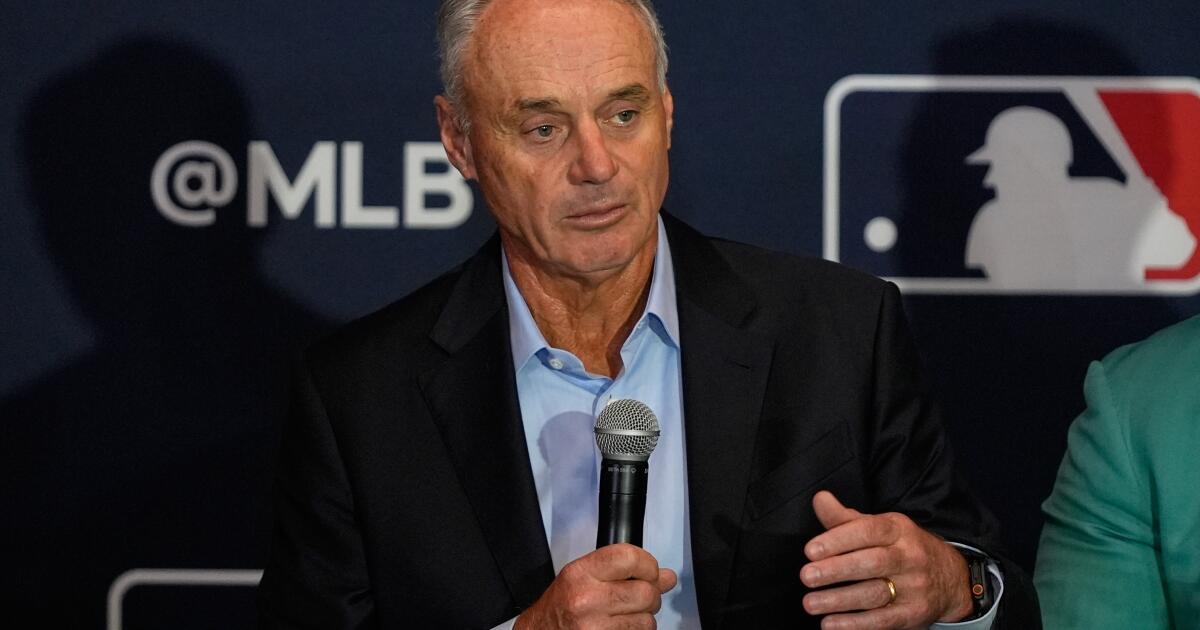
“We went down the road on LA 2028 because we saw it as a unique opportunity to market the sport with our very, very best players,” Commissioner Rob Manfred said Tuesday in a meeting with the Baseball Writers Assn. of America.
“It is a disruptive undertaking for us … If we’re disrupting an entire season and we’re going to undertake that effort, we want our very best out there, so that people see how great our game really is.”
The league also does not want to undermine its All-Star Game, and it is reasonably foreseeable that some players might wish to skip the All-Star Game for a two-day summer break if they are going to play the next week at the Olympics.
In that scenario, under its proposal, the league would have the right to declare the player ineligible for the Olympics, and the player would be subject to fine and/or suspension as well as ineligibility for the first 14 days of the second half.
Bruce Meyer, the executive director of the players’ union, said the MLBPA plans a counterproposal.
“They want to make it mandatory for players who are selected to appear at the All-Star Game and the Olympics,” Meyer said Tuesday. “The proposals that they made in terms of what the discipline would be, the ramifications if a player doesn’t want to do that, in our view, are extreme.”
To use a Dodgers example, Yoshinobu Yamamoto was selected for this year’s All-Star Game, but Dodgers manager Dave Roberts said last week that he would not pitch.
Given that situation in 2028, if Yamamoto wished to pitch for Japan, he would have to be available for the All-Star Game. If not, Japan could lose him for the Olympics, and the Dodgers could lose him for his first two starts of the second half.
Meyer said the union is in “a very early stage of discussions” with the league. It is unclear how much time might be needed to resolve the issue, as well as what Meyer called “travel and accommodation” issues, which involve LA28.
It also is uncertain how long MLB would be willing to wait before committing to an All-Star site and date, although the league moved the 2021 game from Atlanta to Denver three months before the game date. San Francisco is expected to host the 2028 game, in large part because Los Angeles is a short flight away for an Olympic competition that would start two days later.
It is clear, however, that the league is getting tired of not always securing participation from marquee players in marquee events. The “you can’t pitch in the All-Star Game if you pitched on the previous Sunday” rule was intended to protect pitchers.
“It’s clear to me that teams are managing their pitching in a way to take advantage of the Sunday pitcher rule,” Manfred said. “I do think it’s really important that we always re-evaluate our approach to the All-Star Game in order to get the very, very best players that can participate in that game.”
The World Baseball Classic was a smashing success this year, even as the United States started a rookie pitcher in the championship game. Do we really need to mandate player participation in the Olympics, especially since so many great players already have said they want to be there?
“The WBC takes place at a point in time that the players are just beginning to ramp up for the season,” Manfred said. “There’s a whole host of reasons why, at that point in the calendar, players might not be ready to play.
“In contrast, the schedule for the Olympics is going to cover days that players otherwise would be playing in major league games — if they’re not on an injured list, they’d be out there playing. That is a huge difference.”
In another column, we could argue the merits of moving the final round of the WBC — the semifinals and championship game — to July, when players “otherwise would be playing in major league games.” That would grow the game, too.
But that is for another day. It would be absurd for MLB to miss out on the global marketing platform that is the Olympics. The issues MLB raises are legitimate; the solutions need not be so draconian.
The opening ceremonies in Los Angeles take place two years from Tuesday. The Olympics have taught us this about boycotts: No matter how worthy the cause, no one pays attention once the Games start. The Soviet Union boycotted the L.A. Games in 1984, and we had a grand time without the Russians.
No one cares if you’re not there. In MLB, a star-studded core wants to be there. Seize the moment.
Nothing much stays with me from the first days of Twitter, which was publicly launched 20 years ago, on July 15, 2006.
I had discovered the internet back in 1995 and early on, I started thinking about how to get my voice heard by the world. I created a couple of websites through Angelfire and 8m, but there was no real ecosystem to nurture the idea. It’s like opening a shop to sell a certain product in a remote area – somewhere nobody really knows, at a time when there’s no interest – compared with opening that same shop in a mall, or on a street full of other vendors.
MySpace was another opening, but the idea was not yet ripe. Facebook came with a spark – and then we got Twitter.
“It’s like having your own breaking news platform, you’ll set your own agenda,” I remember one of my colleagues at the BBC, where I used to work, saying at the time.
It didn’t take me long to sign up. I cannot recall whether I tweeted immediately or not, yet what happened afterwards helped frame my future as an international journalist.
Twitter’s first defining moment for me was 2009’s Green Revolution in Iran, when I and others followed how the platform shaped the discourse in a way that differed completely from traditional media. We were not new to citizen journalism; a few years earlier, Salam Pax emerged as the first ever famous war blogger, presenting his distinctive view of the US-led invasion of Iraq through his individual blog. A few years later, tens of thousands of Salams have appeared – and I’m one of them.
Going through my early timeline, I see that I was tweeting randomly – an earthquake in Japan, an election in Lebanon, an explosion in Somalia, and so on. Then came the Arab Spring. Just as with many in the world, this was the moment that shaped my Twitter presence, and as I got involved in the coverage, I became well-positioned to post and attract followers.
My coverage of the Libyan revolution in March 2011 introduced me to many people and gave me a better understanding of what was happening. I was based in Sallum, a village on the Egyptian side of the Libyan border, without a connection of my own. I fed a colleague back in Cairo a sentence at a time over a crackling Thuraya satellite phone, and he typed my words into the account that I could not reach. Its password lived on my friend’s head until days later, when I finally got my hands on a satellite dish.
Trips to Libya, Egypt, Syria, Somalia – all of it made Twitter part and parcel of my journalistic journey, and it also helped me build a parallel path writing for international outlets including Al-Monitor and The Sunday Times.
Yet still, there was something else that changed my direction. Until 2013, I was a journalist covering stories without specialisation – I used to report from Iran, like I do today, yet it was not my career the way it currently is. But then I became a bureau chief in Tehran and my knowledge began growing – and here, Twitter gave me another layer, widening my network day after day.
Personally, that specialisation gave the platform its finest hour for me. I broke developments out of Iran’s nuclear talks with world powers before the news agencies had finished their first draft, filing in Arabic and English within minutes of each other and announcing the agreement itself while other newsrooms were still working on their bulletins.
The war against ISIL (ISIS) followed, then a January 2020 morning near Baghdad airport when my sources told me the commander of the Islamic Revolutionary Guard Corps’s Quds Force, Qassem Soleimani, and the deputy chief of Iraq’s Popular Mobilisation Forces, Abu Mahdi al-Muhandis, were in a convoy hit by a US air strike – and I was among the first to say so.
Twitter was never only a wire service for other people’s wars. I’ve “met” heads of state and celebrities on this platform – and for a moment we felt equals. I have made my scoops there, and I have made my hugest gaffes there, too. You act and you interact and you see the result immediately, backlash or praise. It’s like a daily journal, one that outlives you. I know of many, some friends, some colleagues, some people I only happened to follow, who left our world while their accounts are still there – for us, and for me – to return to for the memory or to get a piece of information.
It was also where, on the 100th anniversary of World War I, that I told the story of my great-grandfather, Ali Hashem, who went to the war and never returned; and of my grandfather Hussein, who was three when his father was summoned to the Ottoman army and never saw him again.
It was where colleagues at Al Jazeera, stationed in the north of Palestine, went looking for my family’s village on my behalf, for a cemetery nearly in ruins, for a great-grandmother’s grave that has never been found.
It became, eventually, the subject of my own academic work too, a master’s thesis on Twiplomacy, examining how a platform built for gossip and jokes quietly rewired the choreography of nations, with Iran’s nuclear diplomacy as my case study.
In the summer of 2023 – sensing where things were headed, as new owner Elon Musk decided to change Twitter’s name to X, and to tragically, if I may so, kill the famous and lovely blue bird that accompanied the journey many made with the platform, including myself – I posted five words.
“Someone buy Twitter and save the bird.” Alas, nobody did, and the bird disappeared from the icon, and the name went with it, replaced by a single letter that still sits wrong in my mouth. In Arabic or in English, the word that comes out of me, though, is still Twitter.
Weekly insights and analysis on the latest developments in military technology, strategy, and foreign policy.
A robotic boat glides through the darkness, reaches an occupied shoreline, and releases an armed ground robot that rolls inland to fight without a single soldier setting foot on the beach. While this sounds like a scene from a future war, it recently played out in southern Ukraine, reflecting Kyiv’s rapid embrace of uncrewed systems as it seeks to counter Russia’s invasion.
No soldiers. Just machines.
Ukraine has carried out the world’s first known combat mission in which a sea drone transported and deployed an armed ground robot behind Russian lines on the occupied Kinburn Spit. pic.twitter.com/zyJdFXWxVb
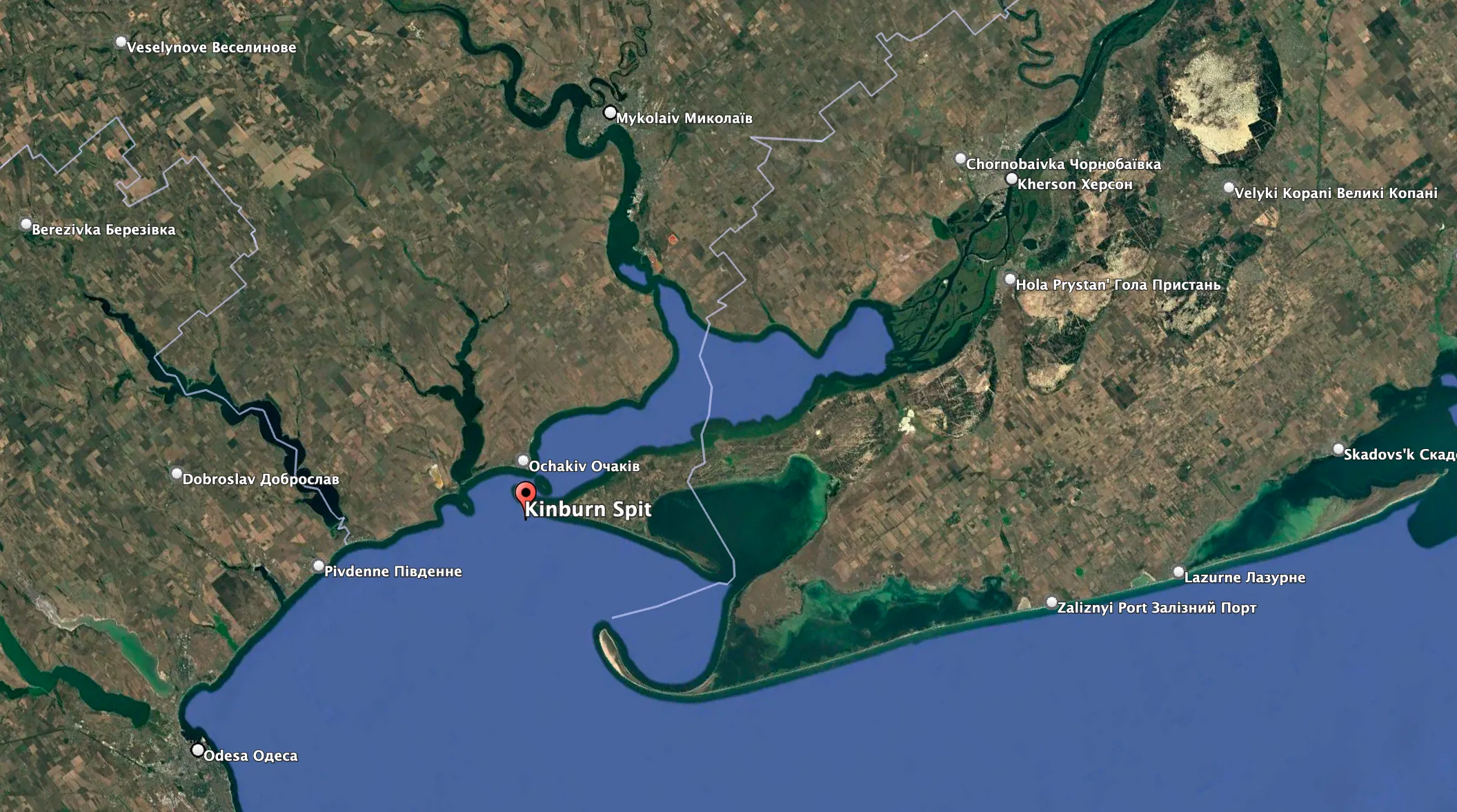
Described as the first of its kind anywhere in the world, the operation took place on the Russian-occupied Kinburn Spit in Ukraine’s southern Mykolaiv region, according to Ukraine’s 123rd Separate Territorial Defense Brigade, which carried it out on an unspecified recent date.
A map showing the approximate location of Kinburn Spit in Ukraine’s southern Mykolaiv region. Google Earth
“A new era of war begins with the decisions of courageous commanders,” the brigade stated today on its Telegram page, adding that the operation was led by the 123rd’s commander, Col. Oleg Makukha. The mission involved the brigade’s 1st Unmanned Systems Battalion, under Maj. Denys Gipik.
The UGV goes onto the spit as seen from the USV. 123rd Separate Territorial Defense Brigade screencap
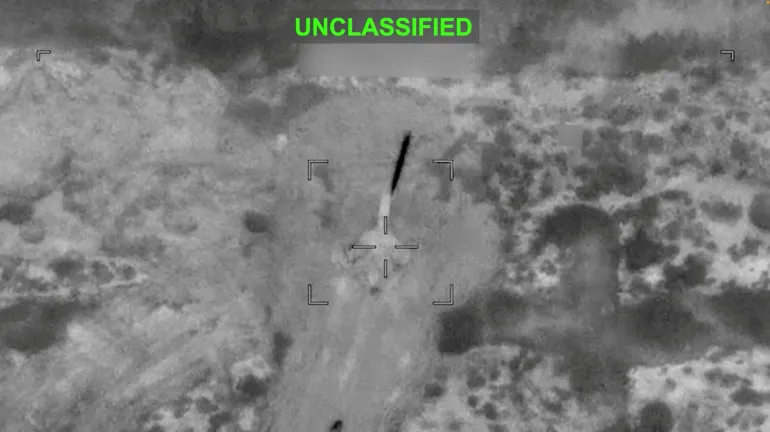
A video published by the brigade shows parts of the operation from an overhead aerial drone as well as from the uncrewed ground vehicle (UGV), and from the vessel that transported it to the shore. The uncrewed surface vessel (USV), powered by an outboard motor, beaches itself before lowering a bow ramp that allows the wheeled UGV to drive ashore. Armed with a machine gun, the UGV is then seen engaging a target beyond the beach. The USV subsequently departs, although it is unclear whether any attempt was made to recover the UGV.
A wider view of the beach as the USV heads toward the shore. 123rd Separate Territorial Defense Brigade screencap
The UGV appears to be a member of the Rys family, produced by Roboneers and armed with a 7.62mm machine gun. These platforms typically incorporate a ballistic computer for accurate fire and artificial intelligence that assists with autonomous target detection, tracking, and engagement.
The UGV’s view of the machine gun mount. 123rd Separate Territorial Defense Brigade screencap
The Rys family of vehicles is already widely used for logistics, casualty evacuation, combat engineering, and combat support missions. Variants have also been configured for minelaying and demining operations.
A Ukrainian UGV being used for the evacuation of wounded soldiers:
A Ukrainian robotic evacuation vehicle equipped with an armored capsule successfully rescued a wounded soldier from a frontline position.
— Special Kherson Cat 🐈🇺🇦 (@bayraktar_1love) May 22, 2026
Ukraine has stepped up its use of similar UGVs, which it claims have been crucial in certain engagements. Earlier this year, a Droid TW-7.62, also fitted with a 7.62mm machine gun, is said to have destroyed two Russian drones before opening fire on Russian infantry, killing one and injuring another. The Droid remained in the fight, despite artillery fire, and pushed back another Russian infantry attack.
Interesting use of Ukrainian UGV Droid TW-7.62 equipped with an FN MAG machine gun to shoot down FPV drones over Kramatorsk, Ukraine.
You can read our in-depth account from inside Ukraine’s effort to build its UGV arsenal here.
Meanwhile, the Kinburn Spit is among southern Ukraine’s most fiercely contested coastal areas.
Russian forces occupied the roughly six-mile-long, narrow spit in the summer of 2022. Overlooking the mouth of the Dnipro River, it became a base for electronic warfare systems as well as missile and artillery strikes against southern Ukraine. Russia also constructed concrete bunkers and reportedly established a drone control station there.
A close-up view of Kinburn Spit. Google Earth
Ukraine has repeatedly targeted the spit since late 2022 with reconnaissance missions, raids, and precision strikes in an effort to erode Russia’s hold on the area. Although Moscow retained control for much of the war, Ukrainian attacks steadily increased the cost of defending the position.
As of June, the Institute for the Study of War, a U.S. think tank, reported that Russian troops had withdrawn from the spit under sustained Ukrainian pressure, while Ukrainian marines later flew a national flag there using a drone. Russian forces retreated under heavy fire, with the evacuation of surviving personnel continuing, a statement from Ukraine’s Southern Defense Forces said on June 25.
Whether Russian forces have since returned in some capacity remains unclear, meaning the latest operation may have been intended as reconnaissance, a technology demonstration, or both.
Regardless of the current disposition of Russian troops, the Kinburn Spit is an ideal proving ground for uncrewed operations. Heavy surveillance, artillery, and drone coverage make conventional amphibious landings exceptionally dangerous, while robotic systems can conduct reconnaissance and combat missions without exposing troops to direct fire.
I held a Staff meeting. Three key issues.
First – UGVs. It is unmanned ground vehicles that are currently one of the most urgent needs of our Defense Forces, and production and supply must keep pace with demand. The volume of contracting for UGVs must be significantly higher…
— Volodymyr Zelenskyy / Володимир Зеленський (@ZelenskyyUa) April 27, 2026
The operation reflects Ukraine’s growing reliance on uncrewed systems, with ground robots increasingly taking on high-risk tasks such as logistics, engineering, fire support, and battlefield scouting to reduce the exposure of frontline troops. At the same time, Ukraine has become the world’s leading innovator in uncrewed surface vessels, fielding versatile platforms for strike missions, intelligence gathering, logistics, and, increasingly, the deployment of other robotic systems.
While the mission was likely something of a battlefield proof-of-concept, it provides more evidence of Ukraine’s rapid pace of innovation in the field of uncrewed systems. It could also provide a glimpse of a future where amphibious landings are led by uncrewed systems.
Reflecting on the Kinburn Spit operation, the 123rd Brigade offered a simple prediction: “It’s going to get even more interesting.”
HAVE you ever wanted to be in a real-life storybook? Well, these destinations might be the answer.
From castles fit for a princess to enchanting forests and Disney-like villages – these are the top fairytale destinations in Europe.
Eltz Castle in Germany has been named one of the best ‘fairytale’ destinationsCredit: Alamy
Eltz Castle, Germany
At the very top of the list created by European Best Destinations is the magical Eltz Castle which is nestled in the hills and forest above the Moselle River.
With its eight soaring towers, and dramatic valley setting, it very much looks like a storybook castle.
Sign up for the Travel newsletter
Thank you!
Eltz Castle is one of the few castles in Europe that has never been destroyed and has belonged to the same family for over 800 years.
One-way flights to Frankfurt from the UK are as little as £17 in August.
The abbey at Mont Saint-Michel inspired Disney’s TangledCredit: Alamy
Mont-Saint-Michel has been called a ‘real fairytale destination’ and was said to have inspired a Disney movie.
It’s a small tidal island off the coast of Normandy with museums, shops, restaurants and hotels.
The stand-out spot though is the abbey which is said to have been the inspiration for the castle from Tangled.
The quickest way to get there from the UK is on the ferry from Portsmouth to St Malo – from there it’s an hour’s drive.
Tossa de Mar, Spain
Tossa de Mar is a Spanish town on the Costa BravaCredit: Alamy
Tossa de Mar along Spain‘s Costa Brava coastline is famous for its beautiful picturesque Old Town.
Inside is a huge 12th-century fortress which is surrounded by stone walls and sits right on the sparkling Mediterranean Sea.
European Best Destinations described it has having a “forest very near the sea and its medieval walls are a magical setting for a perfect fairytale holiday in Europe.”
From the UK, fly into Barcelona Airport and then head an hour north along the coast to reach the town.
Dark Hedges, Northern Ireland
The Dark Hedges has featured in the hit TV series ‘Game of Thrones’Credit: Alamy
Dark Hedges is more of a natural fairytale destination created by an avenue of beech trees planted in the 18th century.
Dark Hedges became very popular after the series “Game of Thrones” was filmed there – for fans of the show it depicted the Kingsroad.
It’s also one of the most photographed natural phenomena in Northern Ireland.
The closest airport to Dark Hedges is Derry – but it’s also possible to get there from Dublin and Belfast.
Riga, Latvia
Riga Old Town has colourful buildings and cobbled streets in the Old TownCredit: Alamy
European Best Destinations described Riga as having a “beautifully preserved Old Town, a UNESCO World Heritage Site filled with colourful facades, cobbled streets, hidden courtyards.
“With centuries-old churches it seems to emerge directly from the pages of a storybook.”
It sits on the banks of the Daugava River which only adds to its fairytale-look.
From the UK, you can fly to Riga in just two and a half hours – and it’s just a 20-minute drive into the Old Town.
Neuschwanstein Castle, Germany
Neuschwanstein Castle gets one million visitors every yearCredit: Alamy
Another beautiful castle in Germany is Neuschwanstein which is described as a jewel of Bavaria.
King Ludwig II of Bavaria built Neuschwanstein Castle as a private residence to get away from political life.
It’s been open to the public since 1886 and over one million visitors visit the beautiful site every year.
Brits can fly into Munich Airport in under two hours and then drive south for two hours to see the incredible castle.
Rothenburg-ob-der-Tauber, Germany
Rothenburg ob der Tauber in Bavaria is considered one of the prettiest villages in GermanyCredit: Alamy
This small village in Bavaria is considered one of the most beautiful in the country.
From the 14th century, the village has half-timbered houses, cobbled streets and looks postcard-perfect.
The village is part of Bavaria’s Romantic Road which links beautiful medieval towns, villages and castles.
The nearest airport is Nuremburg which can be as little as £20 with Ryanair – from there it’s an hour’s drive to Rothenburg-ob-der-Tauber.
Bled, Slovenia
Bled is a small town in Slovenia that sits on a glacial lakeCredit: Alamy
Bled is a small town that sits in the Julian Alps, on a glacial lake and has a medieval clifftop castle – so it’s no surprise it has made the list.
Visitors like to explore the area on a wooden boat called ‘pletna’, or a rowboat, which only adds to its magical feel.
Another activity is to climb the 99 steps to ring the famous wishing bell in the church.
The quickest way to get there is to fly into Ljubljana Airport, then drive 40-minutes north to Bled.
Riquewihr, France
Riquewihr is an Alsatian village with small pottery shops and cafesCredit: Alamy
Riquewihr is an Alsatian village with colourful timber houses and a huge clock tower that looks like something from Beauty and the Beast.
Scattered around the village are quaint restaurants, cafes, and shops selling traditional Alsatian pottery, linens, and souvenirs.
One visitor wrote on Tripadvisor: “Picturesque would be an understatement. It’s a fairy tale village that doesn’t seem real.”
Brits can travel to either Strasbourg or Basel Airports which are the closest to Riquewihr.
Craiova, Romania
Craiova in Romania lights up every year for ChristmasCredit: Alamy
Craiova in Romania is found in the southwest and is known for having towering Neoclassical buildings
It also has one of the largest urban natural parks in Europe.
The Romanian city transforms multiple times through the year to celebrate Easter and Christmas which the publication said “creates a joyful storybook atmosphere.”
From the UK, Brits can fly directly to Craiova in around three hours.
Here’s the full list of the ‘best fairytale destinations in Europe’…
Vernon Kay said he’s “loved working” on BBC Radio 2 as he jokingly started thinking about his exit from the broadcaster, after an on-air blunder led to him uttering a rude word by mistake
Vernon Kay has joked he’ll “be in trouble” after making a hilarious on-air slip-up (Image: BBC Radio 2)
Vernon Kay said he’s “loved working” on BBC Radio 2 after an awkward mishap led to a warning from his colleague. His gaffe could be heard on yesterday’s broadcast of his mid-morning BBC Radio 2 show (July 14), as he revealed the contents of a message regarding a particular brand of footwear.
As he read it out, “Crocs” came out sounding uncomfortably close to a very different word, which would be inappropriate to utter on the airwaves, and the result was an immediate on-air .
Reading the message aloud, Vernon said: “Hey, Vern. I wear Crocs with socks. And they’re proper, not proper c***s…Crocs”, in a gaffe that sent the studio into fits of laughter.
He continued: “Oh, clip that. Clip that. I want that on my…not my highlights, my lowlights”. Barely able to contain his laughter, Vernon pressed on: “I hope you have got proper…Crocs, cos if you’ve not got proper Crocs, then you’re gonna be in trouble.”
His co-star, BBC Radio 2’s travel news presenter Ellie Brennan, mischievously cautioned: “You are gonna be in trouble.” Vernon then quipped: “I hope my Crocs work cos at our age, you never know.” As the hilarity ensued, his colleague chimed in with “especially with socks on”.
Vernon cheekily fired back: “No, keep your socks on; it’s safer.” As the pair struggled to get the show back on track, he jested: “I’ve loved working here. Thanks very much. Had a great time.”
The radio mishap also follows fresh attention on Vernon’s personal life after Tess Daly was photographed at the Wimbledon final wearing her wedding rings, despite the pair recently confirming their separation.
Their split was made public in May, with the TV stars clarifying that there’s no bad blood between them.
Back in September 2003, Vernon and Tess married at St Mary’s Catholic Church in Horwich. They’ve since had two daughters — Phoebe and Amber — and confirmed via Instagram that they’ve decided to split, saying the separation is amicable.
The statement read: “After much consideration, and with a deep sense of care and respect for one another, we have made the decision to separate amicably.”
It continued: “This has not been an easy choice, but it comes from a place of mutual understanding and a shared desire for what is best for both of us.
“We remain great friends and most importantly, fully committed to our roles as loving and supportive parents, which will always be our priority.
“There are no other parties involved in this decision. We kindly ask for privacy during this time as we navigate this transition together.” The pair signed off by saying they wouldn’t be saying anything else publicly.
But on Sunday (July 12), Tess was spotted arriving at the All England Lawn Tennis Club for Wimbledon, where she was her still wearing her rings despite the sad news.
Ljubiša Karovi was almost sucked out of the aircraft after a window smashed
15:47, 15 Jul 2026Updated 16:24, 15 Jul 2026
The damage to the ‘dislodged window’ (Image: -)
Ryanair’s chief executive has said an official investigation will determine what went wrong on a flight that saw a passenger almost sucked out of a shattered window.
The shocking incident happened on a service from Thessaloniki in Greece to Memmingen, Germany, on a plane operated by Malta Air, a Ryanair subsidiary. Ljubiša Karovi, 61, was reportedly pulled from his seat and had to be held in by his legs and seatbelt when the cabin suddenly depressurised.
His wife, Svetlana Grković Maksimović, held onto his legs during the chaos as the plane made an emergency return to Greece. Passengers described hearing a loud bang while the aircraft was over North Macedonia, after which the pilot turned the Boeing 737-800 back towards Thessaloniki.
Maksimović has claimed debris struck the aircraft and damaged the window after what she thinks was an engine failure. In an interview with RTÉ News, Ryanair CEO Eddie Wilson said photographs showed visible damage to one of the engines but insisted it would be wrong to draw conclusions before investigators complete their work.
Content cannot be displayed without consent
“Anyone who’s looked at the photographs can see… clearly there’s damage to the engine,” he said. “But I’m not going to speculate on that. That aircraft will be investigated through the Greek authorities. We understand then we will put that out to the NTSB, which are the American investigators.”
The US National Transportation Safety Board is expected to be involved because the aircraft is American-built. Wilson said the incident was serious and that Ryanair would act on any findings or safety recommendations that follow.
Maksimović said her 61-year-old husband was “seriously injured and in shock”, and they did not know if they would ever fly again following the ordeal.
Another passenger, Sofia, told Radio Thessaloniki: “We thought the plane was going down. The decompression was extreme. It felt like we couldn’t breathe. The man who was injured was bleeding and then lost consciousness several times, most likely because of the lack of oxygen and the shock.”
Content cannot be displayed without consent
Pressed on whether passengers could feel confident flying with the airline over the summer, Wilson pointed to the carrier’s flight volume and maintenance regime, saying aircraft are checked regularly and that “the best-trained crews” were on display during the Thessaloniki diversion. “Aircraft are maintained every night,” he said, adding that Ryanair follows schedules set by regulators.
Ryanair, in a statement, said the flight returned “shortly after take-off when a passenger window dislodged in flight”. The airline said the aircraft landed normally, passengers were taken back to the terminal, and one person requested and received medical assistance on the ground.
Although the cause has not been confirmed by authorities, the BBC reported that a technical advisor appointed by the family believes the sequence began with a problem affecting the aircraft’s right engine, with debris then striking and shattering a cabin window, triggering the rapid loss of pressure.
TOURS are now available of a secret network of rivers located under a major UK city.
However, adventure-seekers will want to be quick as tickets are selling out fast.
The Sheaf & Porter Rivers Trust are currently running tours of the underground river systemCredit: The Sheaf and Porter Rivers TrustThe Trust has been working to restore the underground system, with ticket sales going towards fundingCredit: The Sheaf and Porter Rivers Trust
These tours will be run by volunteers, who will take explorers on twice-daily trips around Sheffield’s underground.
Sign up for the Travel newsletter
Thank you!
Dating back to the mid-1800s, the Megatron is a large maze of tunnels located under various parts of the city, including the railway station, BBC Sheffield, the Sheffield Archives, and Red Tape Studios.
The extravagent system was originally constructed to contain the overflow from the rivers Sheaf, Porter, and the Don.
Trust volunteers run the tours, which will take place twice daily throughout July, August, and SeptemberCredit: The Sheaf and Porter Rivers TrustTour tickets have already sold out for JulyCredit: The Sheaf and Porter Rivers Trust
However, the system of rivers eventually became polluted and even covered over the years.
Now, the Trust is working to uncover and restore these historic features, even taking those who dare venture into the depths of the Megatron on tours in order to fund the project.
On these tours, volunteers share their passion for the ecology of the city’s waterways and other interesting facts as they guide you on the two-mile water walk.
Ticket prices help to fund everything from river clean-ups to the installation of “light wells”, which cast some light onto the hidden rivers for the first time in 150 years.
If you’re looking to participate, make sure you have the proper attire before you embark on this underground adventure.
Varying water depths throughout the tour mean waders and sturdy footwear are recommend.
You will also want to be fairly agile for this experience, with lots to navigate, from slippery algae-covered rocks to tight gaps that require crouching.
This tour also provides glimpses into the city’s industrial past, with aged grindstones, crucible caps, even some tools found along the way.
You may also spot some stalactiteshanging from the tunnels, but make sure you don’t touch these.
And Broad Street West, the culvert transforms into a large single looming arch, named “Megatron” by urban explorers.
The name was chosen in response to Manchester’s “Optimus Prime” culvert, both of which took inspiration from after the comic and movie series “Transformers”.
While the first section of the culvert is built from huge stone blocks from theold Castlefolds Wholesale Market, a shorter stretch of blue brick under Exchange Street was built around 1890 to serve as a ramp for electric trams travelling from Rotherham to central Sheffield.
You may also spot some wildlife on your tour, with a variety of birds, invertebrates, and even the Daubenton’s bat taking up residence.
The public is advised that points of the water can reach chest height on this tour, with rainfall impacting both the current and depth.
While the Sheaf and Porter River Trust Megatron Tour has sold out for July, more information on ticket releases for August and September can be found here.
WASHINGTON — The Immigration and Customs Enforcement agency should continue vehicle stops after recent fatal shootings, President Trump said on Wednesday, seeming to oppose a new suspension of the practice used as part of his immigration crackdown.
ICE is “doing a GREAT job, one that has to be done,” Trump wrote on his social media site.
The Republican president said that to remove criminals he claims were let into the country under the previous Democratic administration “we must be strong, tough, and smart, and we CANNOT give up one of ICE’s most important and effective Crime Fighting tools, THE TRAFFIC STOP!” Trump said, “Once we do, we are playing right into the criminal’s hands.”
Trump administration officials have told Immigration and Customs Enforcement officers to suspend most vehicle stops after two deadly shootings within a week, people familiar with the decision said Tuesday.
The suspension was ordered after an ICE officer shot and killed a Colombian driver Monday in Maine and a week after another officer shot and killed a motorist in Houston, renewing criticism of the agency’s enforcement tactics that were widely condemned last winter after the killings of Alex Pretti and Renee Good in Minnesota.
In Florida on Tuesday, a third man in roughly a week died during an encounter with immigration officers. This time, a 28-year-old man was killed after he was hit by a tractor trailer while running from immigration and other federal officers, authorities said.
It’s a narrative that has been repeated again and again since the Trump administration’s immigration crackdown began, with federal officers confronting drivers and then saying they opened fire when the drivers’ vehicles became a danger. That’s despite decades of warnings from policing experts that shooting into moving cars presents a danger of its own and should almost always be avoided.
At least 10 people have been killed during immigration operations since the start of the Trump administration’s mass deportation campaign. At least four of those deaths involved people in vehicles, including the one last week in Houston, a trend so troubling that U.S. Sen. Susan Collins, R-Maine, said Tuesday that she had urged Department of Homeland Security Secretary Markwayne Mullin “to cease all non-urgent vehicle stops.”
John Sandweg, who was acting director at ICE, which is part of DHS, during President Obama’s Democratic administration, estimated recently that there have been roughly 18 traffic stop shootings during the Trump immigration crackdown.
The office of Maine Sen. Angus King, an independent who caucuses with Democrats, was told by DHS that ICE was suspending traffic stops, office spokesperson Matthew Felling said.
ICE, which has been under pressure to beef up arrest and deportation numbers, often says people it’s trying to arrest are increasingly resistant to leaving their homes. ICE officers blame immigration advocates who advise immigrants to stay in their homes unless ICE produces a warrant signed by an independent judge instead of the administrative warrants the agency generally uses that are signed by another ICE officer. So, ICE officers say, they’re forced to find other areas in which to make arrests.
Shooting angers Maine
Hundreds of people in Maine protested Tuesday over the fatal shooting of Johan Sebastián Durán Guerrero, a 25-year-old Colombian national. Advocacy groups said Guerrero, who had a wife and a young daughter, was authorized to work in the United States.
DHS said Monday that an officer, “fearing for public safety,” shot and killed Durán Guerrero while officers were watching the home of someone they believed was in the U.S. illegally and facing a final order of removal from the country. It said in a post on X that when ICE tried to stop a car driven by someone who came from the home, the person attempted to flee in the vehicle and the officer fired.
That was a shift from how King earlier described the encounter, when he said Mullin told him the officer opened fire after the man tried to use his vehicle as a weapon. King said Mullin told him the officers were trying to serve an arrest warrant but not for the man who was shot.
In a scathing post on X, outgoing Colombian President Gustavo Petro called the shooting a targeted killing “at the hands of the U.S. government.”
Petro, who has openly quarreled with Trump, urged Trump to provide an explanation and accused ICE officers of treating Durán Guerrero as “an inferior being without rights.”
In Wednesday’s social media post, Trump told ICE to be “judicious, fair and smart, and go back and do your very important job.”
Maine’s congressional delegation on Tuesday demanded a “comprehensive, transparent, and expedited investigation.”
Questions surround the shooting
Photos showed bullet holes in Durán Guerrero’s car windshield, but the officers involved in the shooting didn’t have body cameras, leaving many questions. Among them are how close the officer was to the vehicle when shooting, whether officers told Durán Guerrero to stop and why ICE believes he had put the public in danger.
Border czar Tom Homan told reporters Tuesday that the investigation needs to play out and that officers will be held accountable if they are found to have acted inappropriately or illegally.
Maine’s attorney general’s office, which said it is working with federal agencies to investigate, said initial statements suggest the driver was trying to flee in the direction of the officer, whose name hasn’t been released and who was placed on leave.
Collins said Mullin told her the DHS inspector general is investigating in cooperation with the FBI.
Democrats seeking to unseat Collins in November have sought to connect her with ICE’s methods, which have drawn public scrutiny and derision. Collins later said in a statement that although ICE needs to improve, eliminating the agency would make the nation less safe.
Maine Secretary of State Shenna Bellows, a Democrat who is vying for Collins’ seat, called the ICE officers at the shooting “thugs” during a vigil Tuesday in Lewiston.
Superville, Whittle, Brook, Santana and Sisak write for the Associated Press.
Prosecutors in Milan have requested that a sports fraud case against Gianluca Rocchi, the man in charge of assigning referees in Italy’s top flight, be dismissed.
The former international referee suspended himself in April after being placed under investigation for “complicity in sporting fraud” during the 2024-25 season.
Rocchi, the National Referees Commission’s referee designator for Serie A and Serie B, has always protested his innocence.
According to Italian news agency Ansa,, external prosecutors concluded after a two-year inquiry that there was no evidence of match-fixing, saying they did not “identify a structured system aimed at interfering with appointments”.
It was claimed that Rocchi was behind the selection of a referee for an Inter Milan game as he was “liked by Inter”.
A video assistant referee decision not to intervene when an Inter player elbowed an opponent in another game was also under scrutiny.
The simultaneous case against Inter has been dropped as well.
Rocchi was also accused of pressuring a VAR official to encourage a referee to check on the pitchside monitor for a handball offence during Udinese’s 1-0 win over Parma in March last year.
The referee and VAR official had already decided not to award a penalty but changed their minds, it is claimed, leading to Florian Thauvin scoring the only goal of the game.
Prosecutors have now forwarded the case documents to the sports justice authorities and the Italian Olympic Committee’s General Prosecutor’s Office to assess whether any disciplinary breaches within a sporting context may have occurred.
Sporting fraud is a criminal offence in Italy and carries a maximum sentence of six years in prison.
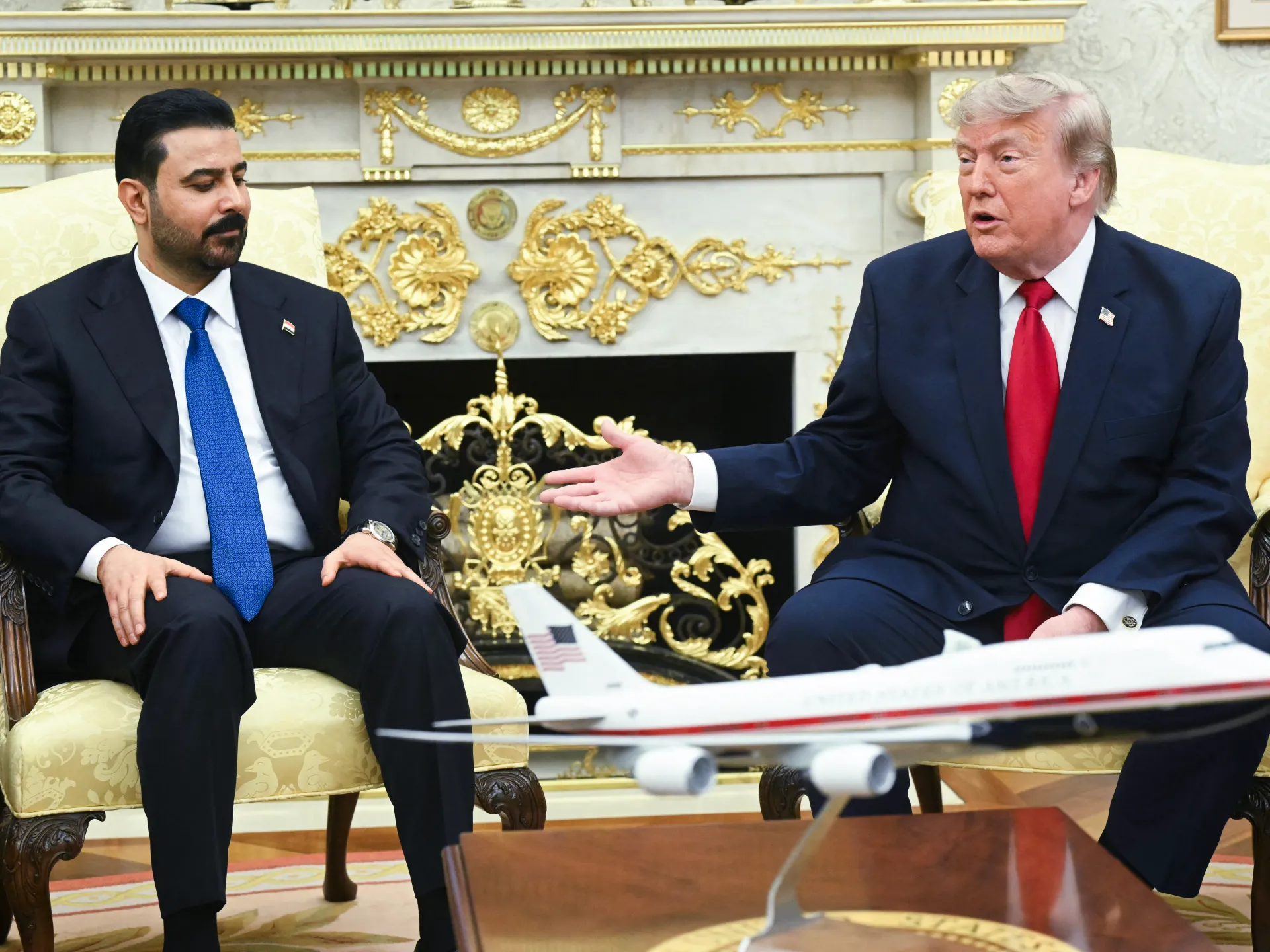
Ali al-Zaidi met US President Donald Trump in the Oval Office on Tuesday as Iraq’s prime minister. He carried the title. The power was another matter.
Eleven weeks earlier, after months of paralysis, the Shia alliance which is known as the Coordination Framework had taken just 25 minutes to choose him. That sudden consensus was forged under intense pressure from Washington DC.
The United States Treasury had frozen Iraq’s dollar lifeline, the cash shipments that fly from New Jersey to the Central Bank of Iraq. Nouri al-Maliki, a former prime minister, and the top contender to return to the premiership had to abandon his plans because of Washington’s veto.
Al-Zaidi, a 40-year-old banker with no political base, was the man left standing.His lack of an established political base is part of his usefulness. He owes his position less to Baghdad’s ballot box than to the pressure exerted by Trump’s Treasury.The banker’s own ledger is not clear.
In 2024, Iraq’s Central Bank barred al-Zaidi’s own institution, Al-Janoob Islamic Bank, from US-dollar transactions as part of a wider crackdown intended to curb illicit dollar flows to Iran. He was never charged. Neither the bank nor the man is currently sanctioned. But the file exists. Its existence could give Washington another source of leverage should al-Zaidi drag his feet.
The real power in Baghdad now sits in one man’s portfolio. Tom Barrack holds three titles at once: ambassador to Turkiye, envoy to Syria, and now envoy to Iraq. His influence rests less on diplomacy than on Washington’s financial leverage over Baghdad. Iraq’s oil revenue sits in an account at the Federal Reserve Bank of New York. In April, Washington blocked a cash shipment of nearly $500m drawn from those revenues and suspended parts of its security cooperation. Oil funds roughly 90 percent of Iraq’s budget. Barrack does not need to threaten military force when the administration he represents can reach directly into the financial system on which the Iraqi state depends.
Washington’s demand that Iraq bring all armed factions under state control remains far from resolved. Shia Cleric Muqtada al-Sadr dissolved his Saraya al-Salam militia in late May. Other militias such as Asa’ib Ahl al-Haq and Kataib Imam Ali have announced steps towards handing over their weapons or placing them under fuller state control. That is real movement. But Kataib Hezbollah and Harakat al-Nujaba, the two factions most tightly bound to Tehran, have rejected full disarmament. In their own words, their weapons are not for bargaining. Washington has answered in kind. US strikes killed dozens of Iranian-backed Popular Mobilization Forces (PMF) fighters this spring; the Treasury has sanctioned seven militia commanders by name. Baghdad has set September 30 as its disarmament deadline, the same date on which the remaining US forces are expected to leave Iraq. Whether the hardest factions bend by then remains the open question that Washington has yet to answer honestly.
Even Grand Ayatollah Ali al-Sistani’s authority has limits here, as it always has. Al-Sistani’s 2014 fatwa built the PMF’s founding myth. But his call was for men to defend Iraq under the state’s command, not to form independent militias. The hardline factions never answered to Najaf. They answer to Tehran. al-Sistani’s own representative in Karbala has also pressed publicly for exclusive state control of weapons. His influence remains significant, but it has never extended to full control over these factions, and the current standoff is making that reality harder to ignore.
The prize Washington actually wants, however, lies underground. Chevron is negotiating an expanded role in Iraq’s oil sector, while other US companies are pursuing contracts in gas, electricity and export infrastructure. Baghdad wants production up from 4.5 million barrels a day to 7 million within three years, though doing so would require a substantially larger OPEC quota. Western Iraq’s gas reserves, largely untapped, could one day elevate the country into a dominant regional energy player and exporter. This is the potential bonanza al-Zaidi is being asked to unlock in exchange for the loyalty Washington is seeking.
Kurdistan’s place in this emerging arrangement is still unclear. Barrack has called the old Baghdad-Erbil federal model outright “Balkanization”, a structure he blames for letting Iran fill the vacuum. Yet the same envoy spent much of June pressing the prime minister of the Kurdish region, Masrour Barzani, to reactivate the Kurdistan parliament and form a new cabinet, not dissolve it. Read together, these positions suggest a clear message: Washington wants a functioning, cooperative Kurdistan region, firmly inside Washington’s orbit, not an autonomous wildcard and not a vassal of Baghdad’s sectarian blocs either.
Stripped of diplomatic varnish, Washington’s vision for Iraq is this: no militias operating outside the state; no Iranian veto over Iraqi policy; no single sect running the table from Baghdad; a Western economic orientation locked in by contracts, not sentiment; American energy firms as the primary beneficiaries; and a prime minister who answers, in practice, to Tom Barrack before he answers to his own parliament. Whether Iraq is pressured towards the Abraham Accords, whether the old nationalist and Ba’athist-adjacent currents find any oxygen again, whether sectarian parties actually lose their seats at the ballot box, these remain predictions, not settled facts.
What is clear is simpler and starker. Iraq spent two decades as the ground on which Iran and America fought indirectly, through proxies and sanctions. It is now becoming something else: a state whose oil, banking system and militias are all being renegotiated at once under intense US pressure. At the centre of this transformation is a banker-premier chosen in twenty-five minutes and now expected to deliver by September 30.
The Gulf model, from Riyadh and Abu Dhabi to Manama, Kuwait, Doha and Muscat, took decades to lock in. Trump’s Washington wants to compress Iraq’s version into a single presidential term. Whether Baghdad survives that compression intact, or merely changes which capital it answers to, is the question al-Zaidi’s visit left unresolved.
The views expressed in this article are the author’s own and do not necessarily reflect Al Jazeera’s editorial policy.
A HUGE new multi-million-pound attraction is set to transform one of London’s trending destinations.
Stratford Junction will become a major events hub when the development is complete.
Stratford is getting a flashy new cultural quarter with live entertainment and galleriesCredit: Hallmark Property Group / Stratford Junction | Stratford Junction
Over a decade on from the transformation of Stratford for the 2012 Olympics, another transformation is on the cards.
The proposed development will be called Stratford Junction, and will be on the site of a former coach park, which was used during the Olympics.
Sign up for the Travel newsletter
Thank you!
It is enclosed, surrounded by railway tracks and now, new designs have been revealed by Hallmark Property Group.
The development has taken inspiration from areas like The Barbican and Spitalfields Market in London.
With so much going on and so many visitors, there will also be a hotel with as many as 1,600 rooms.
There will be 1,700sqm of new public space with green areas and a bustling piazzaCredit: Hallmark Property Group / Stratford Junction | Stratford JunctionNew skyscrapers are part of the plan tooCredit: Hallmark Property Group / Stratford Junction | Stratford Junction
Like most places in London, the site will also be getting taller with three towering skyscrapers set to be built.
Artist Vija Celmins and filmmaker Denis Villeneuve will be honored at Los Angeles County Museum of Art’s upcoming Art + Film Gala, the first to be hosted after the spring opening of LACMA’s new David Geffen Galleries.
Now in its 15th year, the glitzy annual event co-hosted by Eva Chow and Leonardo DiCaprio is set to take place Nov. 7. If the museum follows the blueprint it implemented with its Geffen Galleries opening party, the evening’s festivities will unfold in a posh tent beside the new building with a cocktail hour at the base of Peter Zumthor’s concrete creation.
With LACMA still in the international limelight, this year’s Art + Film gala is poised to be its most high-profile yet, enabling it to further its mission of creating connections between the city’s thriving arts and cinema ecosystems. Celmins and Villeneuve certainly live up to the hype. The former, 87, is a pioneer in photo-realistic paintings of natural settings and objects; the latter is an Oscar-nominated director and filmmaker whose projects include the “Dune” movies as well as the upcoming James Bond film for Amazon MGM Studios.
“This year, we are honoring two icons of visual creativity. Whether in painting, drawing, printmaking or other media, Vija Celmins’ exacting renderings of the natural world blend realism and imagination, resulting in sublimely beautiful works,” Michael Govan, LACMA’s director and chief executive, said in a news release. “Likewise, Denis Villeneuve’s meticulously crafted worlds give his films an unforgettable visual impact, from contemplative and cerebral stories to global blockbusters. It will be a privilege for LACMA to honor both of these artists and their extraordinary careers in November.”
Over the years LACMA’s Art + Film Gala has featured a high-profile list of respected artists and filmmakers, including Simone Leigh, Baz Luhrmann, Judy Baca, David Fincher, Helen Pashgian, Park Chan-wook, Amy Sherald, Kehinde Wiley, Steven Spielberg, Betye Saar, Alfonso Cuarón, Catherine Opie and Guillermo del Toro.
Last year’s event, held in honor of Mary Corse and Ryan Coogler, netted a record $6.5 million in support of the museum and its programs.
People have been told that the more intense checks have ‘an upside’ after arriving
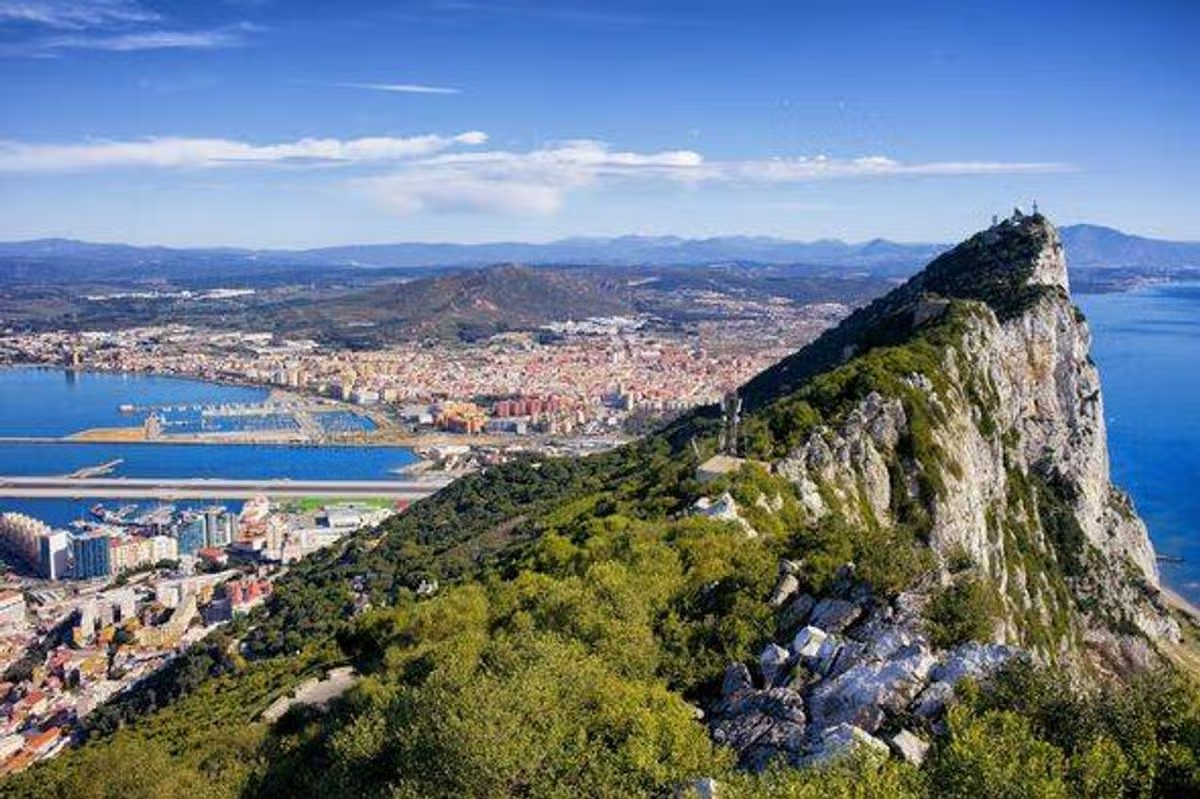
Brits told ‘one upside’ to tighter new Gibraltar border checks(Image: Getty)
Brits visiting Gibraltar now face new rules, including security screening and passport scrutiny, when landing in the British Overseas Territory. Travel journalist Simon Calder reported for The Telegraph that new rules came into force from today, July 15, as part of a post-Brexit deal.
The UK-EU agreement to create an open land border between Gibraltar and Spain has been signed in Brussels – and was brought into effect from Wednesday. It will make Gibraltar effectively part of Europe’s passport-free Schengen Zone, with the removal of checkpoints and border fences.
But the changes introduce tighter border controls at Gibraltar’s airport. On arrival at Joshua Hassan Gibraltar International Airport, Brits should expect two new sets of checks, which will satisfy entry into Gibraltar and the Schengen Area:
Gibraltar entry immigration controls – performed by the Gibraltar authorities
Schengen entry immigration controls – performed by the Spanish authorities
This includes registration under the Entry/Exit System (EES) where it applies. All of the updated entry requirements for tourists can be found on the GOV.UK website here.
The main page reads: “To enter Gibraltar, your [full UK] passport must have been issued within the previous 10 years and its validity must extend for at least three months after the day you intend to leave Gibraltar or the Schengen Area.”
If you are a British–Irish dual national and travel on your Irish passport, you will be treated as an EU citizen on entry to Gibraltar and the Schengen Area. You will not be subject to the 90-day limits, EES or ETIAS. If you travel on your British passport, the conditions above apply.
Content cannot be displayed without consent
What were the rules before July 15?
Before July 15, 2026, UK citizens visiting Gibraltar did not have their stay count toward the Schengen Area’s 90-day limit, and they only faced a single immigration check handled solely by Gibraltarian authorities upon arrival. Because the provisional UK-EU Gibraltar Agreement had not yet taken effect, Gibraltar operated entirely outside of the Schengen rules
UK nationals could visit Gibraltar for up to 90 days without a visa. Passports simply needed to be valid for the duration of the intended stay. But from today, tourists visiting the territory bordering Spain will face new rules.
What are the new ‘rules’?
As explained by Simon, he said: “From this summer, it gets a bit trickier to reach [Gibraltar] for British passport holders. The British Overseas Territory is not joining the Schengen area, but the effect for UK passport holders is the same.
On arrival in the Rock, you will be checked by Spanish passport officials to make sure that your passport meets those tricky rules on expiry and issue dates. They’ll also want to know if you’ve spent more than 90 days in the last 180 days in the Schengen area, and any time you spend in Gibraltar will count towards that total.”
With these new checks, Simon adds that there will be “an upside”. He claims that, with these stronger checks carried out in the airport upon arrival, visitors are considered inside the ‘frontier free zone’ and could travel straight into Spain without stopping again.
Less than 48 hours after the earthquakes of June 24, X (formerly Twitter) users mentioned that a Japanese team did a study on seismic risk in Caracas in the early 21st century. That’s true. In March 2005, the Japan International Cooperation Agency (JICA), the primary government agency responsible for managing Japan’s Official Development Assistance (ODA), released the report Basic Plan for Disaster Prevention in the Metropolitan District of Caracasin the Bolivarian Republic of Venezuela.
The technical report presented a Disaster Prevention Plan as requested by the Venezuelan government. The plan’s goal was to save lives during an earthquake by minimizing asset damage and improving the State’s response capacity.
The study covered only three of the five municipalities that form Metropolitan Caracas: Libertador, Chacao, and Sucre, because the government committed to apply its conclusions to Baruta and El Hatillo. It did not consider what is currently called La Guaira state (Vargas back then).
The Japanese team was headed by Mitsuo Miura (Pacific Consultants International, PCI) and composed of staff members of PCI and OYO International Corporation. They visited Venezuela seven times, from December 2002 to March 2005, when they discussed the results with the Venezuelan officials and conducted field surveys. Upon returning to Japan, the team finished additional studies and prepared this final report.
The diagnosis
The study defined several scenarios to estimate risks, soil displacement, and potential damage. It projected that, in the worst case, a considerable number of buildings in Caracas, depending on their age and type, would collapse, with a high human cost. Only the ones built after 2002 showed high seismic capacity. Twenty years ago, those buildings made up no more than 0.1% of the studied area.
On the other side, 98,237 buildings were vulnerable. Those built before 1967 (the year of the previous great earthquake in Venezuela) had low seismic capacity, while those built from 1968 to 2001 had a moderate capacity. Of the 1968-1982 buildings, 82% were made of brick and mortar.
“The project will reduce the number of heavily damaged buildings from around 10,000 to around 1,300, and the number of casualties from around 4,900 to around 400 in the case of a 1967 earthquake.”
The Japanese team evaluated, using Japanese standards, office buildings, homes, bridges and viaducts, and established a range of risks in several seismic scenarios. After surveying the Metro tunnels and stations, they suggested reinforcing columns and structures, as well as adding resistant materials in the gas and water networks, and improving the structure of gas stations to avoid dangerous combustible spills.
By 2005, shantytowns covered approximately 20% of Caracas’ urban area, and hosted 51.2% of the capital’s population. This study conducted, for the first time, seismic reinforcement tests on four full-scale models of the typical rancho. It demonstrated that the unengineered constructions have low seismic resistance and require reinforcement, as they could not withstand minor loads and showed failures in columns and connections. The bricks did not contribute significant resistance. If those homes were reinforced with beams, their resistance increased by 40% at an additional cost of 5% to 7%.
The solution
Their plan recommended seven big tasks. To improve safety, reinforce buildings and bridges, control the flux of sediments, and relocate the population living in high-risk areas. To improve response, implement early alert systems and emergency command centers. And to improve coordination, educate the population and stimulate citizen participation. By that time, local technologies made all these projects possible.
“The project”, they assured in the report, “will reduce the number of heavily damaged buildings from around 10,000 to around 1,300, and the number of casualties from around 4,900 to around 400 in the case of a 1967 earthquake.”
There was no plan, no authorities, no clear responsibilities to allow Venezuela’s capital and most populated city to coordinate the response in case of a disaster, the Japanese warned.
When they did the calculations back in 2005, they estimated the plan would cost around 2,800 million dollars (most of them to reinforce all the buildings that could be damaged in an earthquake) and would take 16 years to fully implement. So, if the Chávez and Maduro governments had done their part of the deal, Venezuela would have finished five years ago a seismic prevention and safety strategy in Caracas designed by the experts from a country that knows earthquakes as much as Japan, paying a quarter of the costs estimated for the 2026 earthquakes.
The Japanese team also recommended an early alert system for landslides, to be developed from 2005 to 2007, with a cost of one million dollars. This was meant to protect 19,000 Venezuelans.
The responsibilities
The Venezuelan entities involved in the plan would be the ministries of Public Works and Housing, Transportation, and Planning and Development; the Caracas Metropolitan Mayor’s office; the capital’s five municipalities; and the National Civil Protection and Disaster Management Organization (Protección Civil).
But by 2005, only a civil protection law from 2001 defined some of the corresponding responsibilities. The capital’s Disaster Prevention Administration was being developed. As the Japanese experts warned in their report, there was no plan, no authorities, no clear responsibilities to allow Venezuela’s capital and most populated city to coordinate the response in case of a disaster.
When Japan’s JICA delivered the report to Hugo Chávez, the area under assessment had 17 firefighter stations, 15 municipal police stations, 17 civil protection stations and two emergency control centers. Since then, the only visible change for the inhabitants is the increase of National Police (PMB) command centers.
On June 24, 2026, three buildings went down in Chacao municipality, and inspections are being made to assess the structural damage of several more. In Libertador municipality, at least two residential towers collapsed in San Bernardino, and there’s important damage across the city. In parts of Petare, in Sucre municipality, where many buildings are ranchos, an undetermined number of lodgings collapsed totally or partially, and basic services are not available in some places.
Many foreign crews came to help, especially in La Guaira. One of them is a new research team with seven JICA specialists that arrived in Caracas four days after the earthquakes to design the support measures Japan would contribute to. On June 30, after a request from the interim government, Japan sent tents, water tanks and purification equipment, and erected two campaign hospitales, one in Caraballeda, in the middle of the disaster zone in La Guaira, and another by the Dr. Domingo Luciani Hospital in Caracas.
Besides this, Miyamoto International, a Japanese organization of disaster prevention engineering, came to assess earthquakes’ impact. The team is headed by the famous engineer Hideki “Kit” Miyamoto, the organization’s founder and director. He said they are talking with the Japanese government and reviewing the previous reports. Maybe they will issue a new body of knowledge like the 2005 investigation by JICA. Let’s hope that, this time, the Japanese expertise will be used.
While every World Cup introduces viewers to new young stars, this tournament featured eight players who were older than 40 — one more than the number of over-40 players in the previous 22 World Cups combined.
Among them were Portugal’s Cristiano Ronaldo, 41, and Mexico’s Memo Ochoa, 40, who were playing in their sixth World Cups alongside Argentina’s Lionel Messi, a relative youngster at 39. No one has played in more men’s World Cups.
But while Ronaldo and Ochoa have gone home, Messi will be playing in his third semifinal in four tournaments Wednesday when Argentina, the reigning champion, faces England at Mercedes-Benz Stadium in Atlanta.
The newfound longevity of elite soccer players has been made possible by advances in sports medicine, diet and analytics that measure everything from biomechanics and heart rate to muscular output and sleep cycles, all in real time. And injuries that once ended careers can now be repaired through outpatient procedures.
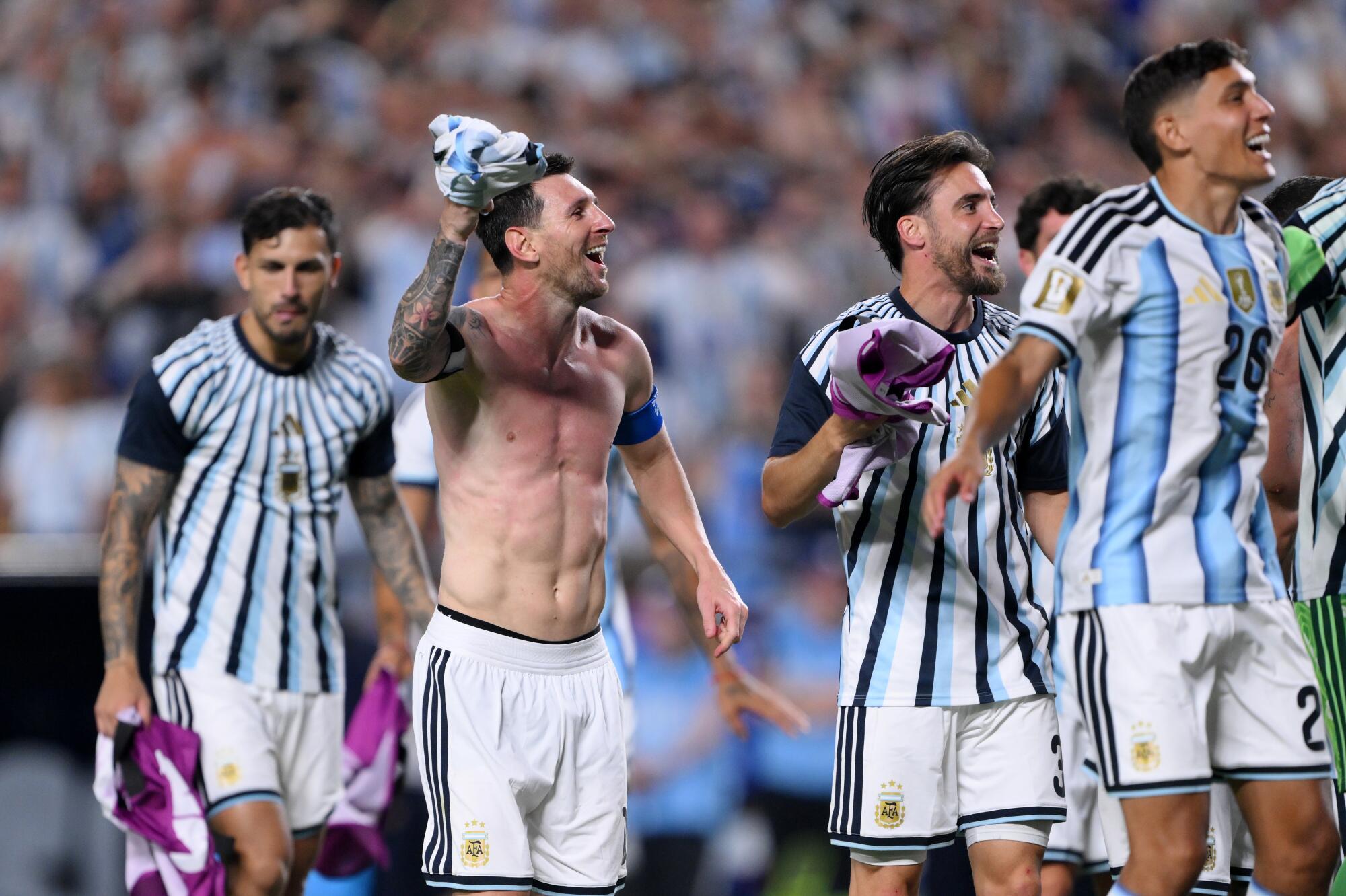
Argentina star Lionel Messi holds his jersey up and celebrates with teammates after a World Cup quarterfinal win over Switzerland on Saturday in Kansas City, Mo.
(David Ramos / Getty Images)
“Over the past 10, 20 years, the sports science within the game has changed a lot,” said Liam Anderson, an exercise physiologist at the University of Birmingham in England, who has worked as an applied practitioner in top-flight professional soccer for more than a decade.
“Players are now definitely more aware of their bodies and I think the professionalism has changed quite a lot as well. But they’re also in tune with the things which are helping them recover, manage their training load and ultimately stay fitter and healthier for longer.”
Gone are the days when chain-smoking Dutch legend Johan Cruyff would light up a cigarette on the bench, French world champion Zinedine Zidane would smoke in the locker room and George Best would party and drink so hard he would disappear for days at a time.
“There’s a couple of reasons,” Dr. Michael Joyner, a specialist in the physiology of elite athletes at the Mayo Clinic, said of the growing lifespan of soccer players. “The first is that people just make a lot more money and as a result, there’s tremendous incentive to keep playing. The second is people are taking much better care of themselves.”
“You just don’t hear about people like George Best anymore,” said Joyner, speaking for himself and not the clinic where he works.
“Diet is huge,” Anderson added. “High-protein diets and fueling with carbohydrates for matches. Nutritional strategies have changed considerably in the last 10-15 years.”
And those diets are tailored by position since a midfielder, who may run more than seven miles in a match, burns more calories than a goalkeeper.
As the eldest player in Major League Soccer, Diego Chara has had to make some concessions to age.
“It’s a little detailed,” said Chara, a midfielder with the Portland Timbers. “Talking about recovery time, it maybe takes a little bit longer than before. Nutrition. Working in the gym, it’ll be longer than other players.”
But if Chara, 40, is an old man in a league where the average age is younger than 26, he would have been something of whippersnapper in this summer’s World Cup.
The Portland Timbers’ Diego Chará passes the ball under pressure from the Columbus Crew’s Wessam Abou Ali on Feb. 21in Portland, Ore.
(Amanda Loman / Associated Press)
Soccer isn’t the only sport in which 40 is the new 30.
Serena Williams returned to Wimbledon this summer at age 44 and at least half a dozen athletes 40 and older showed up at the Milan-Cortina Olympics last February hoping to medal. Four of them succeeded, including American Elana Meyers Taylor, 41, who became the oldest athlete to win an individual gold in Winter Olympics history in the women’s monobob.
It isn’t unheard of for athletes to be golden in their golden years. Ted Williams hit .316 at 41 and Gordie Howe played 80 games and had 41 points in his final NHL season at 52. Nolan Ryan threw a no-hitter and pitched 173 innings at 44 while Tom Brady quarterbacked the Tampa Bay Bucs to a Super Bowl title at 43.
But if those age-defying performances were outliers, playing into your mid-40s and even early 50s may soon become, if not common, at least less unusual.
“People are just staying in better shape, taking care of themselves,” Joyner said. “Career-changing or career-ending injuries are no longer career-ending injuries. It just goes on and on, all of this stuff combined.”
American Serena Williams, 44, serves against Australian Maya Joint during a match at Wimbledon on June 30.
(Cameron Spencer / Getty Images)
State-of-the-art training centers and access to top-line sports medicine have also become more accessible, even in poor countries.
“The elite level has spread and really become global, as opposed to where there used to be pockets,” Joyner said. “The opportunities to compete are so great.”
Few team sports are as physically demanding as soccer, though, which makes both the growing number of seasoned citizens and their performances noteworthy. Messi has averaged nearly a game a week for club and country during the past 23 years, yet he entered the semifinals of this tournament tied for the scoring lead with France’s Kylian Mbappé, who is 12 years younger.
Ronaldo has played even more games yet he became the oldest player to score in a World Cup knockout game when his penalty kick helped eliminate Croatia and midfielder Luka Modric, who will be 41 in less than two months.
“They’ve probably lost a little bit off the top, but their experience and their mind make up for that,” said Scott Trappe, a professor of human bioenergetics at Ball State. “So the overall package of them as a sports person is really they’re contributing at a high level. I think we’re going to continue to see this movement.
Portugal’s Cristiano Ronaldo celebrates scoring a World Cup group stage goal against Uzbekistan on June 23 in Houston.
(Charlotte Wilson / Getty Images)
“They like playing the sport and as long as they can and contribute and they make these teams, they’re going to do it. I don’t see the trend going away.”
And that will not only change the way we think of sports and athletes, it will completely rewrite the record book. Messi, for instance, entered the semifinals of this World Cup as the tournament’s all-time leading scorer with 21 goals. But that was just one ahead of Mbappé, who could appear in another three or four World Cups.
“No question,” Trappe said. “You look what’s going on in pro cycling. We’ve got some guys in their upper 30s competing in the Tour de France, but we also have a teenager competing. So this lifespan, what used to be a five- to eight-year period for cycling at the at the highest levels is turning out to be, you know, double or triple that.”
Both Messi and Ronaldo have benefited from how they play as well, walking rather running for long stretches of the game to conserve energy for the burst they need to lose a defender. It’s a strategy Mbappé, Norway’s Erling Haaland and other young players have adopted and if they do that over enough games, the wear and tear it saves could add years to the end of their careers.
“We are expanding. The age will start moving up a little bit further up and players’ careers will definitely be longer,” Anderson said. “The sort of normal distribution of playing age will begin to move forward and that experience within the squad will be key.’
Argentina’s Lionel Messi dribbles the ball during the World Cup quarterfinal match against Switzerland on Saturday in Kansas City, Mo.
(Charlie Riedel / Ap Photo/charlie Riedel)
Consider Wednesday’s semifinalists. In its quarterfinal win, Argentina used six players older than 32 and two — Messi and defender Nicolas Otamendi — who are over 38. The spine of England’s team runs from goalkeeper Jordan Pickford through defender John Stones to striker Harry Kane, who are all 32.
“We’re coming up with new ways on how to improve and maximizing potential,” Anderson said. “God gave us what we are and it’s maximizing that, not necessarily changing that.”
That knowledge won’t stay in the stadiums and locker rooms for long, expanding to others who choose to adopt the same wellness discipline as professional athletes.
“It cycles down,” Trappe said. “We’re studying that in the lab at a pretty high level. This sort of healthy lifestyle in terms of functionality and extending into our later years and having a higher quality life, there’s data starting to emerge there.
“These types of things are going to trickle into that for sure.”
United States President Donald Trump is scheduled to address a defence summit at the US Army War College on Wednesday, where he is expected to laud US investments in its armed forces that he has argued have helped add a new edge to history’s most powerful military.
But his speech comes at a time when the US’s war on Iran has significantly depleted the US military’s weapons stockpile.
Recommended Stories
list of 4 itemsend of list
The summit, which will be held in Carlisle, Pennsylvania, comes as the US has re-ignited attacks on Iran in the past week, and as Trump has threatened to continue a war that, according to recent US polls, is highly unpopular among Americans facing high costs of living.
The US has expended half of at least four of its most critical munitions since its war on Iran began on February 28, and has racked up billions of dollars in weapons expenses, analysis shows.
Replenishing low stockpiles could take anywhere between several months and several years. Analysts warn that a shrinking arsenal could put the US in a less formidable position in a potential future conflict – particularly against China.
Here’s what we know about the US weapons inventory:
A projectile approaches a target at an unknown location, during what US Central Command (CENTCOM) says are strikes on Iran, in this screengrab taken from a handout video released on July 12, 2026 [US Central Command/Handout via Reuters]
What’s happening with the US-Iran war?
Following an April ceasefire between the US and Iran, and the subsequent signing of a memorandum of understanding in June, the conflict kicked off again after the US Central Command launched heavy waves of attacks on Iran’s military sites last Wednesday, saying it was aiming to degrade Tehran’s military capabilities. Huge, hourlong attacks have continued for four nights since Sunday, including on railway tracks and bridges.
Both sides traded low-intensity attacks throughout the ceasefire period. However, the US escalated air attacks last week after Iran fired on three commercial ships passing through the Strait of Hormuz – because those vessels had used a shipping route not approved by Tehran.
Each blames the other for violating the ceasefire, and at last week’s NATO leaders’ summit, Trump declared the pact with Iran over, although he said American negotiators could continue talks. Washington has also reinstated a naval blockade on Iran-linked ships trying to transit the waterway and has re-imposed sanctions on Iran.
Iran’s Islamic Revolutionary Guard Corps has responded with retaliatory attacks on US military assets in Bahrain, Oman, Qatar and Kuwait.
More than a dozen people have been killed in Iran since the new wave of US attacks, including civilians.
“We’re going to knock out all their power plants. We’re going to knock out all their bridges unless they get to the table and negotiate,” Trump threatened in a Fox News interview that aired on Tuesday.
Attacking civilian infrastructure is a violation of international law.
Smoke rises from an explosion following a drone attack on a warehouse in al-Shuaiba, Kuwait, in this still image obtained from social media video released on July 14, 2026 [Social media via Reuters]
Does the US have enough weapons to keep attacking Iran?
Washington’s supplies are running low but have not reached a critical level, according to analysis of the US weapons inventory by the Center for Strategic and International Studies (CSIS), a Washington-based think tank.
In the 39 days of conflict between the start of the US-Iran war in February and the ceasefire in April, the US hit more than 13,000 targets, focusing mainly on using seven of its most powerful missiles and air defence systems: Tomahawk missiles, Joint Air-to-Surface Standoff Missiles (JASSM), Precision Strike Missiles (PrSM), Standard Missile-3 (SM-3), Standard Missile-6 (SM-6), Terminal High Altitude Area Defenses (THAAD) and Patriots.
For at least four of the munitions, Washington likely expended more than half of its available stockpiles, although many lower-grade alternatives are still in stock, according to CSIS. Government data on weapons inventory is classified.
Here’s how the munitions were used:
Tomahawks – The US had about 3,000 of the long-range missiles that are fired from sea at ground targets. It likely used up more than 1,000 in the war on Iran.
JASSM – About 4,000 of these stealthy, air-launched long-range missiles were in the US inventory before the war. About 1,100 were used in the war on Iran.
PrSM – Supplies of the newly delivered, ground-launched long-range missiles were already low to start with, with deliveries since 2023 amounting to a total of 90. An estimated 40-70 were used in the war. One US military official claimed that the “entire” inventory had been expended.
SM- 3 – The most expensive weapon per unit at $28m, these ship-launched ballistic missile interceptors numbered about 410 before the war. The US has used between 130 and 250 of these in the war on Iran.
SM-6 – Also ship-launched, this missile is mainly used to intercept aircraft and cruise missiles. The US had about 1,160 stockpiled. An estimated 190- 370 have been expended in the Iran war.
THAAD – The US had about 360 of the costly anti-ballistic missile systems by April, and between 190 and 290 were used in the war. The US has a total of 8 THAAD units or “batteries” consisting of launchers, interceptors, and radar systems.
Patriot – An estimated 2,330 Patriots were in stock before the war, but between 1,060 and 1,430 have been expended. Some older versions may also likely be available – about 400 of them.
What does this mean?
Analysts from CSIS say that while the US may have enough to continue hitting Iran in the near-term war, it has reduced its stockpiles so significantly that it may not have enough for potential future wars, especially against a formidable rival like China.
Replenishing high-capability and costly weapons like the ones the US has used in Iran will likely take several years.
Trump and senior administration officials have publicly maintained that the US has an “unlimited” supply of weapons as the US-Iran war has raged on.
However, in March, Trump said administration officials met with the heads of US manufacturers, including Lockheed Martin, Boeing, Raytheon, BAE Systems, Honeywell Aerospace, L3Harris Missile Solutions, and Northrop Grumman. He said all promised to “quadruple” production and that increased manufacturing was already under way.
Subsequently, in June, Trump signed the Defense Production Act, an executive order compelling US weapons manufacturers to speed up production, citing existing conditions “which may pose a direct threat to the national defense or its preparedness programs”.
An order compelling private actors to ramp up production likely reflects timeline concerns within the Pentagon, analysts note.
In the short term, Washington is also unlikely to meet demands from its allies, and may not have the capacity to supply the THAADs and Patriots that Ukraine says are crucial in its war against Russia.
Already, supply orders have hit road bumps. Japan’s order of 400 Tomahawks from Raytheon was meant to be delivered between 2025 and 2027, but US Defense Secretary Pete Hegseth said in May that two more years could be added to the schedule.
Meanwhile, Switzerland began negotiations with France, Israel and South Korea in June to buy another missile defence system after its 2022 order from Lockheed Martin and Raytheon continued to face delays.
How long will replenishing weapons take?
Hegseth said in May that it could take “months and years” to replenish the supplies, based on the weapons system.
Analysts reckon it could take the US between one and four years to get its most exquisite munitions stockpiles back to pre-Iran war levels, even as Trump has boasted that new weapons plants are being built around the US and production is being ramped up.
Trump’s administration is set to buy large amounts of advanced munitions in its proposed $1.5 trillion 2027 defence budget – a 44 percent increase from 2026’s defence budget.
According to CSIS, estimated timelines to replenish the seven critical munitions, based on existing production facilities, are:
Tomahawk: Between 4- 5 years (207 will be delivered in 2026, while 785 have been requested for 2027).
JASSM: 1 year (821 to be delivered in 2026 and 821 requested for 2027).
PrSM: 8 months (70 to be delivered in 2026 and 1,134 requested for 2027).
SM- 3: 3 years ( 52 to be delivered in 2026 and 214 requested for 2027).
SM-6: 3 years (125 to be delivered in 2026, and 540 requested for 2027).
THAAD: 3 to 3.5 years (92 to be delivered in 2026, and 857 requested for 2027).
Patriot: 3 years (172 to be delivered in 2026, and 3202 requested for 2027).