JADE Thirlwall has split from Jordan Stephens after six years as a couple.
The Little Mix star began dating the Rizzle Kicks singer in 2020 and had since moved in together – dividing their time between homes in London and Margate.
Jade Thirlwall has split from Jordan Stephens after six years togetherCredit: GettyThe Rizzle Kicks singer and former Little Mix star failed to celebrate their sixth anniversaryCredit: GettyThe celebrity couple secretly split earlier this year, although remain closeCredit: GettyJade has been throwing herself into work to help move on from the splitCredit: Getty
But The Sun has learned they separated earlier this year, although are still close.
A source said: “Jade and Jordan had a very serious and loving relationship but recently they have had some frank discussions about their future and have decided to separate.
Sign up for the Showbiz newsletter
Thank you!
“It’s not been an easy time but they’ve both been throwing themselves into work.
“Their friends adore them as a couple and are really hoping they get back together but it’s still very raw at the moment.”
They have also not been photographed together for several months – with their last red carpet appearance as a couple being at February’s Brit Awards where they partied until the early hours.
Neither have posted about each other on Instagram since mid-March, and Jordan recently wiped all of the TikTok videos they made together from his profile.
When asked in June about progress on her second album, she hinted at her heartache.
She told The Fader: “I’m just writing stuff. Whatever I’m going through at the minute, like privately, I’m sort of putting pen to paper.
“I think this is the exciting phase or the experimental phase, where you don’t know what it’s going to be yet.”
Jade hinted about heartbreak when she was quizzed about her second albumCredit: GettyThe Sun first revealed the musical couple were dating in 2020Credit: Getty
The Sun first revealed they were dating in 2020 after they went on a series of socially distanced walks during the Covid lockdowns.
The Shout Out To My Ex singer said she “slid into his DMs” after a friend suggested they would be a good match, and they had dates on video call.
She explained: “It was through a friend. I slid in the DMs. I’d been doing this for quite a while. I kept getting pied left, right and centre.
“Jordan and I did a few Zoom dates in lockdown. We made a joke and said it was business and put suits and ties on and asked each other questions. I did the full shebang, a full suit.
“Then we had a socially distanced date in Greenwich park, apart from each other just chatting.”
Jordan recently took over as co-host of the popular Miss Me? podcast with Miquita Oliver, replacingLily Allen.
Fans had noticed he hasn’t spoken about Jade on the podcast for several weeks.
He had a successful career as one half of pop duo Rizzle Kicks from 2008 to 2016 before relaunching the group in 2024.
As a musician, Jordan also worked on her debut album That’s Showbiz Baby! which was released last year.
Jade said at the time: “I actually really didn’t want to date a musician. I’d done it previously; it never works out well. But it’s amazing now. We write together.
“He’s on my album; I’m on his. Jordan’s on the backing vocals for Headache.”
She is currently on a festival tour which will see her spend August travelling across America, Japan, Ireland and the UK.
With $1.7 trillion tied up in inefficient supply chains, CFOs are making liquidity a core strategy.
Gustavo Muller, Monkey
There’s $1.7 trillion of working capital sitting on the balance sheets of the largest U.S. companies: not locked in failed investments or delayed acquisitions, but trapped in slow receivables, excess inventory, and payment structures designed for a different economic environment.
That money hasn’t disappeared. It remains tied up in processes that no longer reflect how companies manage risk, liquidity, or supply chains.
For many CFOs, the largest untapped source of liquidity is the cash already embedded in operations. Yet organizations often struggle to unlock it because treasury, procurement, operations, and suppliers continue to pursue different objectives using disconnected systems and metrics.
The culprits include receivables that take too long to convert to cash, inventory accumulated as protection against uncertainty, supplier payment structures that fail to balance liquidity across the value chain, and cash reserves that remain underutilized because companies lack the visibility to deploy them effectively.
For years, these inefficiencies were manageable. Low interest rates, predictable supply chains, and abundant liquidity reduced the urgency to rethink working capital. Treasury managed liquidity, procurement negotiated payment terms, sales focused on collections, and financial institutions provided financing within established relationships.
Today’s environment demands a different approach.
Higher interest rates, geopolitical uncertainty, higher tariffs, supply chain disruptions, and persistent margin pressure have elevated working capital from a finance function to a strategic business priority. Yet many organizations continue to manage liquidity using operating models designed for a different era.
According to Deloitte’s Q1 2026 CFO Signals survey, siloed organizations and outdated technology remain among the largest internal barriers to cost management. Boston Consulting Group has noted that extending payment terms alone often merely shifts financing costs along the supply chain rather than improving overall efficiency.
The challenge is therefore broader than financing. It is about coordination.
Working capital decisions increasingly require treasury, procurement, operations, finance, and suppliers to operate from the same information and align around shared objectives. Without that alignment, companies often optimize individual functions while reducing efficiency across the broader organization.
Reflecting these realities, investors have changed their expectations. Following several years of tighter capital markets, boards increasingly emphasize cash-flow resilience, capital discipline, and operational efficiency alongside growth. Liquidity has become a competitive advantage rather than simply a financial metric.
Rethinking Working Capital
Companies are responding in different ways. Many are investing in better forecasting and real-time cash visibility. Others are modernizing treasury infrastructure, digitizing receivables and payables, expanding supply chain finance programs, or adopting data-driven tools that improve coordination across functions. Financial institutions are evolving their offerings through broader funding networks, automation, and digital onboarding capabilities.
No single approach will solve the challenge for every organization. What appears increasingly clear, however, is that fragmented processes and limited transparency are becoming more expensive. As supply chains grow more complex and financing conditions remain uncertain, organizations require greater visibility into where liquidity resides, how quickly it can move, and how financing decisions affect every participant across the value chain.
The International Finance Corporation and the World Bank have consistently highlighted digital infrastructure as a key enabler for expanding access to supply chain finance, particularly among smaller suppliers that have historically remained outside traditional financing programs. The objective is not technology for its own sake, but the creation of more efficient, scalable financial ecosystems.
The U.S. has one of the world’s deepest capital markets. Yet many companies continue to face unnecessary constraints in moving liquidity through their supply chains.
The next phase of working capital management, then, will likely depend less on access to capital — which remains abundant — and more on the ability to connect information, participants, and decision-making across increasingly complex commercial networks.
Organizations that succeed will be those that treat working capital not as a quarterly reporting metric but as an enterprise-wide capability that strengthens resilience, improves capital allocation, and creates flexibility in periods of uncertainty.
***
Gustavo Muller is CEO and co-founder of Monkey, a financial solutions marketplace. He has more than two decades of experience in financial markets, having held senior positions at Citibank, XP Investimentos, and as co-founder of Fisher Venture Builder.
Walbert Ureña pitched six innings of one-run ball, Jorge Soler and Jo Adell each drove in two runs in a five-run first inning and the Angels extended their winning streak to three games with a 5-1 victory over the St. Louis Cardinals on Tuesday night.
The Angels banged out five of their 10 hits in the first inning. Soler hit a two-run double and Adell added a two-run homer for the Angels, who have their longest winning streak since a four-game run from June 9-13.
Ureña (6-7) allowed up six hits, struck out five and walked one while lowering his ERA to 2.78 for the season and 2.49 in 14 starts since May 1. Making his first start since the All-Star break, the rookie right-hander threw 16 pitches of 100 mph or more, including hitting a season-high 101.5-mph sinker to Jordan Walker, in the first. He had thrown 16 pitches of 100 mph or more — total — in 81 1/3 innings of his first 17 games.
St. Louis, which has lost 10 of its last 14 games, scored its only run on JJ Wetherholt’s RBI fielder’s-choice grounder in the fifth.
Angels reliever Mitch Farris struck out two in 1 1/3 innings. Chase Silseth got the final two outs in the eighth, and Ryan Zeferjahn struck out three of five batters in a scoreless ninth.
Angels leadoff man Zach Neto opened the bottom of the first with a single and was thrown out trying to take third on Mike Trout’s single to left.
Nolan Schanuel walked, and Soler hit a two-run double to left. Vaughn Grissom’s RBI single pushed the lead to 3-0, and Adell hit is 15th homer — a two-run shot — to make it 5-0.
St. Louis starter Matthew Liberatore (5-7) recovered from the rocky first and held the Angels to four hits over the next 4 1/3 innings.
Up next
Cardinals RHP Hunter Dobbins (11, 4.03 ERA) will oppose Angels LHP Reid Detmers (3-6, 4.16) on Wednesday.
The US military’s 11th consecutive night of strikes extended to Iranian provinces not previously hit, marking a broadening of the campaign. As Al Jazeera’s Tohid Asadi reports from Tehran, rising civilian casualties and mounting economic pressures are fueling questions about whether diplomacy is possible.
Overhead hung the Pakistan Muslim League-Nawaz’s (PMLN) green tigers. Further down, Pakistan Peoples Party’s (PPP) red and black flags bearing the party’s arrow encircled the clock tower at Lal Chowk, a square near Muzaffarabad’s main market, built to honour the original Lal Chowk across the Line of Control in Indian-administered Kashmir’s Srinagar.
Recommended Stories
list of 4 itemsend of list
Muzaffarabad, the capital of Pakistan-administered Kashmir, does not look like a city in the grip of a crisis. It looks like a city preparing for an election.
Both are true.
Since early June, the territory has witnessed weeks of protests and sit-ins that have killed dozens. The protests are tied to elections for the region’s provincial legislature that were scheduled for July 27, but that on Monday were divided into voting now to be held on three separate days. Voting in the region’s Mirpur division will continue as planned on July 27. Elections in Poonch division, which has been the hotbed of protests, will now be held on August 10.
Voting in Muzaffarabad and for 12 other seats reserved for refugees from Indian-administered Kashmir who now live elsewhere in Pakistan will be held on August 2, the region’s Chief Election Commissioner Justice (retired) Ghulam Mustafa Mughal told Al Jazeera, citing security concerns arising from the unrest as the reason for the changed schedule.
It is those reserved seats for refugees that are at the heart of the agitation, with protesters demanding that they be scrapped, arguing that only those living in Pakistan-administered Kashmir should now be eligible to contest in elections to the regional legislature.
And it is in the backdrop of those tensions that the region is now readying to vote.
“I have never joined them, I never participated in their protest,” a 60-year-old driver, bespectacled and bearded, said of the Jammu Kashmir Joint Awami Action Committee (JKJAAC), commonly known as JAAC, the movement whose protests have dominated the politics of Pakistan-administered Kashmir, particularly Poonch division, in recent months.
“But my only reason to support them is that all the people in this movement are poor people, my sympathies are with them. They are the ones fighting and demanding for my rights,” the driver, who requested anonymity, told Al Jazeera, as he finished his lunch at a roadside hotel in Muzaffarabad on July 20.
When it came to the election, however, he was unequivocal: he would not vote.
“We should be part of the democratic process, but the person you want to vote for isn’t allowed on the ballot,” he said, referring to the JAAC, which was banned in June. “A vote is a responsibility, and it should only be given to those who deserve it. Right now the candidates on offer are all corrupt, and I will not be giving my vote.”
An election amid unrest
The Kashmir region, a scenic but disputed Himalayan territory, has been at the centre of multiple wars between Pakistan and India since both gained independence from British rule in 1947.
Government officers leave a polling station on Monday after early polls for government officials began [Abid Hussain/Al Jazeera]
While both countries claim the region in full, they administer separate parts of it.
Home to more than four million people, Pakistan-administered Kashmir, locally known as Azad Jammu and Kashmir (AJK), has a semi-autonomous government with its own president, prime minister and Supreme Court.
The election was always going to be shaped by the latest crisis, JAAC’s fifth major mobilisation since the movement was founded in September 2023.
But Mughal, AJK’s chief election commissioner, said Poonch was the only division where, he said, “we have a bit of security-related concern”.
He is not the only official insisting the electoral process remains on track.
In Muzaffarabad, Deputy Commissioner Munir Qureshi pointed to bustling markets, heavy traffic and an active campaign trail as evidence that daily life continues largely uninterrupted.
“It is not our job to tell people to go and vote,” he said. “If they decide, for whatever reason, not to show up, it is their democratic right.”
The city, he added, has five constituencies and 890 polling stations, with additional security personnel requested ahead of polling day.
What neither official addressed directly, however, is the absent party hanging over the election.
The banned JAAC is absent from the ballot in any form. Some of its members who attempted to contest as independents had their nomination papers rejected.
The movement’s sit-ins have entered their second month across Rawalakot, Sudhnoti and other parts of Poonch division, closer to the Indian border, while its leadership has openly urged the public to boycott the vote.
How the region votes – or not – will tell whether the election carries legitimacy in the eyes of the people of AJK.
A movement outside the ballot box
The protests that have shaped this election began more than two years ago over prices.
A large number of supporters present at the sit-in in Rawalakot in Poonch division last week [Courtesy Joint Awaami Action Committee]
JAAC was formed in 2023 around 10 demands, including subsidised wheat, cheaper electricity, and a government commitment to curb the perks and pensions enjoyed by AJK officials and elected representatives.
The Pakistani government intervened in May 2024, agreeing to provide subsidies, while a charter of demands signed by the AJK government in October that year was intended to resolve most of the movement’s concerns.
By this June, however, JAAC’s focus had shifted to the 12 assembly seats reserved for Kashmiri refugees settled in Pakistan, which it wants abolished.
The group argues the seats give outsiders influence over AJK’s governance and budget, while residents themselves have no say over who occupies them.
On June 5, the AJK government declared JAAC a proscribed organisation under anti-terrorism legislation ahead of a planned June 9 protest, just weeks before the election.
Within days, police had arrested dozens of JAAC members and supporters, including the movement’s leader and public face, Shaukat Nawaz Mir.
What followed was the deadliest period of unrest AJK has witnessed in years.
The death toll remains disputed by JAAC and the authorities, but even conservative estimates place it at nearly 30 people since early June, including protesters and law enforcement personnel.
Access to Pakistan-administered Kashmir was also restricted, with entry into Poonch division almost entirely blocked for weeks, disrupting supplies of flour and other essential goods to a region dependent on routes from Muzaffarabad and Mirpur.
Banks remained closed for two weeks, leaving residents without access to cash. Mobile and fibre internet services have also remained suspended across almost the entire territory, with exceptions only for banks and a handful of government offices, including district administrations and the Election Commission.
And the Election Commission itself has become an institution whose role faces questions from the JAAC.
Sardar Amanullah, a JAAC member from Sudhnoti district in Poonch division, more than 155km (96 miles) south of Muzaffarabad, said he had submitted nomination papers as an independent candidate, only for them to be rejected.
“I don’t think these are free and fair elections,” he said. “When you cannot let people’s representation out there, the government keeps finding ways to reject our papers,” he told Al Jazeera.
Chief Election Commissioner Mughal offered a different account.
“There were only two or three people who submitted their nomination papers, who claim to be affiliated with JAAC, and their papers were rejected by the returning officer since their names were mentioned in FIRs and the Fourth Schedule,” he said, referring to police reports and Pakistan’s anti-terrorism watchlist.
Abid Shaheen, a JAAC core committee member from Bagh district, was more blunt. With the group now proscribed, he described the vote as “a selection, not an election”.
A dozen seats, one dispute
Of the AJK Legislative Assembly’s 45 general seats, 12 are reserved for Kashmiri refugees who settled in Pakistan after 1947: six linked to Jammu and six to the Kashmir Valley.
PPP supporters were gathering near the Lal Chowk at night to prepare for a corner meeting [Abid Hussain/Al Jazeera]
The arrangement dates back to legislation introduced in the 1960s and was later entrenched in AJK’s 1974 Interim Constitution.
In June, the AJK Supreme Court, ruling on a presidential reference, held that the seats could only be abolished through a formal constitutional amendment passed by the assembly, not through public protest.
AJK’s electorate has grown from just over 3.2 million in 2021 to more than 3.8 million this year, according to Election Commission figures.
Within that, the 12 refugee constituencies alone have expanded from about 405,000 voters to nearly 439,000. JAAC argues that the increase has further amplified the influence of seats that were never intended to carry such political weight.
Since AJK adopted its current parliamentary system in 1975, all 10 general elections have produced governments aligned with the party in power in Islamabad.
Zulfiqar Ali, a Muzaffarabad-based political analyst, argued that the seats themselves have rarely determined who governs AJK.
“Across all the governments AJK has had, these 12 seats have played no significant role in actually making or breaking a government,” he said. “That role has always belonged to native AJK politicians, or whichever party holds federal power in Islamabad.”
Islamabad, meanwhile, has shown little interest in rethinking the refugee seats.
Defence Minister Khawaja Asif told the National Assembly last month that abolishing the seats under pressure from street protests would amount to “sabotaging the electoral process”.
The campaign that resumed late
For the parties actually on the ballot, the crisis all but wiped out campaigning in June.
“Frankly speaking, the campaigning was dead due to the protests all June,” said Iftikhar Gillani, a PMLN candidate contesting from Muzaffarabad.
“The campaign only picked up in the last few days,” Gillani told Al Jazeera after meeting supporters at a polling station on July 20, where government officials were casting advance ballots.
Dressed in a white shalwar kameez and repeatedly wiping his face with a tissue on a severely humid Monday afternoon, Gillani argued that many Kashmiris distinguish between supporting JAAC and participating in the election, even if some committed supporters may stay away from the polls.
“People here are cognisant of the importance of the election and understand that they don’t have to mix their support for JAAC with their responsibility to participate in the polls,” he said. “But there is obviously no denying that there is a chunk of the population which fully believes in JAAC, and they might not cast their votes.”
A 28-year-old PMLN activist, who requested anonymity to speak candidly, said the internet shutdown had forced campaign workers to abandon social media in favour of door-to-door canvassing and loudspeakers mounted on vehicles to publicise the party’s manifesto.
But, he added, the election had also exposed social divisions unlike any he had witnessed before, fuelled by the JAAC-led protests.
“Families are divided over this,” he said. “Those who don’t support JAAC are being called supporters of our oppressors.”
The PPP, which currently governs Pakistan-administered Kashmir, has maintained the more visible street presence.
Its flags dominate Lal Chowk, and a Saturday night corner meeting near the square drew a crowd of supporters waving the party’s arrow banner close to midnight.
But Sardar Mukhtar, a PPP candidate in Muzaffarabad, acknowledged the changed mood.
“The campaign environment is not like previously. I personally feel that turnout might not be as strong as in the past,” he told Al Jazeera from his camp office, where party workers crowded in to catch a glimpse of the candidate.
The party’s clearest position has come from its chairman.
In a letter to JAAC’s negotiating committee last week, Bilawal Bhutto Zardari proposed establishing a Truth and Reconciliation Commission to “examine the present situation, establish the relevant facts, consider the grievances and positions of all sides”.
He also urged JAAC to suspend its protest once such a commission was agreed, while calling on the state to halt further action pending its findings.
Bilawal is scheduled to address a public rally in Muzaffarabad on July 24.
AJK’s Prime Minister Faisal Mumtaz Rathore, the PPP’s most senior leader in the territory, has been more measured on the campaign trail, telling reporters after the revised election schedule was announced only that “the current environment is not suitable for the state” and that “problems can only be solved through dialogue”.
In the region’s legislature, he has previously said that the JAAC bears “the primary responsibility for this situation,” while conceding that “we have not absolved ourselves of responsibility as a government”.
What the election can’t fix
For Ali, the Muzaffarabad-based political analyst, the real issue lies not in the vote itself but in everything that has unfolded over the past few years.
Election campaign posters plastered outside the government office compound in Muzaffarabad [Abid Hussain/Al Jazeera]
He pointed to commitments the government made to JAAC in October 2024 that remain unfulfilled, including promises to devolve development budgets to local councillors and eliminate the perks and privileges enjoyed by politicians.
“However, people will vote,” he told Al Jazeera. “Because the entire system is designed in a certain way, tying government jobs and small favours to elected representatives. So turnout will be fine, but it will not resolve people’s fury and anger.”
Ershad Mahmud, a Canada-based researcher and author of Poonch: Identity, Politics and Resistance, sees the problem differently, arguing that the election is diminished by who is missing from the ballot.
“PTI did win last time, and they have significant following, as well as JAAC,” he said, referring to Imran Khan-founded Pakistan Tehreek-e-Insaf, which ruled Pakistan from 2018 to 2022 before being ousted through a vote of no confidence.
PTI also formed the AJK government after the 2021 election, but since 2023 the territory has had four prime ministers.
Mahmud argued that with two major democratic forces absent from the contest, many voters will stay away as well.
“I don’t think this election will be seen as legitimate. The distance from Muzaffarabad to Islamabad is more than 120km [75 miles]. But the mental distance is now 1,000km [621 miles],” he told Al Jazeera.
An uncertain verdict
However, not everyone has reached the same conclusion.
Muhammad Ramzan, a property dealer from Mirpur division in the south of the territory, supported JAAC when its demands centred on subsidised wheat and lower electricity prices.
His support cooled once the movement shifted its focus to abolishing the 12 refugee seats, a campaign he considers disconnected from the concerns of residents and his own livelihood.
“Even I am curious,” he said. “Earlier they asked for roads or electricity or school, but now that they have changed their focus to 12 seats, I am flabbergasted why would they do that.”
He intends to vote, although he expects turnout to fall, with much of the boycott driven by younger voters aged between 18 and 35 who remain committed to JAAC.
“There are a lot of people like me,” he said, describing his gradual drift away from the movement.
But he remains doubtful that the election will resolve the crisis.
“I fear that things will go bad,” he said quietly.
OAKLAND — The 17th year of Mosswood Meltdown at Oakland’s Mosswood Park brought with it a parade of free-thinking freaks on stage and in the crowd that descended on a punker’s picnic paradise for its annual outing of 20 bands over three days last weekend.
Hosted by the pencil-mustachioed art film icon John Waters, it began with a “pre-party” that exploded with main-event energy courtesy of lo-fi indie rock heroes Pavement, along with Wednesday and Vivian Girls on Friday night. The main fest lineup, topped by underground legends Iggy Pop and Bikini Kill, brought wild music with a message of unity among generations of punks to the tree-lined stages surrounded by a city that knows how to throw a good-time rager while staying deathly serious about its musical taste. Here are 10 moments that stood out at this year’s fest.
John Waters hosted the entire weekend, bringing his cackle-inducing foul-mouthed band intros to nearly every set at Mosswood Meltdown.
(Dick Slaughter)
Saturday
Singer/guitarist Toyozo (Yusuke Toyoshima)of The Fadeaways at Mosswood Meltdown
(Dick Slaughter)
The Fadeaways stand out early
Performing Saturday in Mosswood Park was a homecoming for Japanese revival rockers the Fadeaways. It was barely a year ago that they played a guerilla-style set by the festival entrance for a crowd of unsuspecting new fans. Going from ground level to being introduced on the main stage by Waters was a bucket-list achievement. “Their intense leaps in the air remind me of a throwback ricocheting tear-gas canister landing in a crowd of ICE agents,” the fabulously filthy host told the crowd before bringing them up. When they took the stage, the band wasted no time exploding into a searing 10-song set led by “That Girl” and including a screeching cover of the Kingsmen’s “Louie Louie.”
Snooper lead singer Blair Tramel performing on the Field Stage at Mosswood Meltdown
(Dick Slaughter)
Snooper and itspuppeteers of chaos
Performing its third set at the festival since 2022, this Nashville four-piece band has quickly become a staple of this fest thanks to a larger-than-life-size puppet show and an electro-shock energy that helped it rumble through an early set on the Field Stage Saturday. Frontwoman Blair Tramel let the creativity of her paper-mache puppets made for the show match her highly caffeinated caterwaul on songs like “On the Line” and “Long Way,” where blown-out guitar tones, glitchy beats and shrieking vocals took Saturday’s decibel level unapologetically into the red.
The Spits performing on the Amphitheater Stage at Mosswood Meltdown.
(Dick Slaughter)
The Spits went full throttle
The sunken Amphitheater stage was a tough place to see anything if you didn’t show up to grab a spot at least 20 minutes early (or just climb a tree). But sweating in the sun to watch a band like the Spits, another Mosswood favorite, was worth pre-planning to get into the pit. The four-piece from Kalamazoo, Mich., hilariously clashed with the all-pink game show backdrop of the stage. Entering in sleeveless denim vests backed with a hailstorm of machine samples and maniacal Vincent Price laughter, the band clearly wasn’t playing any games as the members pounced on the crowd with 26 songs performed at breakneck speed, with dirty, piston-pumping rhythms on “Spit Me Out,” “Rip Up the Streets,” “Bring” and “SK8.”
Mannequin Pussy singer Missy Dabice and bassist Colins “Bear” Regisford on the Field Stage at Mosswood Meltdown
(Dick Slaughter)
Mannequin Pussy end with a loud bark
Blissfully ferocious and never short on words from the stage, frontwoman Missy Dabice didn’t get to say as much as she wanted to between songs due to the brevity of a festival set. But after a well-received set full of songs off 2024’s “I Got Heaven” and 2019’s “Patience,” Dabice still left room for some fiery parting words that embodied the tone of the weekend before wrapping things up with the band’s seething battle cry “Loud Bark.” “Don’t forget to celebrate the beauty of life while in every breath in turn fighting against fascism in every section of this country, good night!”
Otoboke Beaver drummer Emi “Leo” Morimoto performing on Saturday at Mosswood Meltdown
(Dick Slaughter)
Otoboke Beaver’s fury lights a fire
This quartet from Kyoto, Japan, put the Mosswood crowd in a stranglehold at the Field Stage and didn’t let up once during its entire set of math-rocky, manic, candy-colored fury. Even if you had no idea of the meaning behind song titles like “Don’t Light My Fire” or “I Am Not Maternal” or “Hey Where’s the Thank You?” sung mostly in Japanese, its joyous hell-raising energy left a lasting impression with the crowd. You couldn’t help but smile watching the members shred as an inflatable, beaver-shaped inner tube bounced around the mosh pit while they did their best to sound like a satanic garage band.
Iggy Pop headlining Saturday night at Mosswood Meltdown.
(Dick Slaughter)
Iggy Pop’s eternal lust for life
Iggy Pop’s ability to stay shirtless and savage at 79 goes beyond scientific explanation. One can only assume he’s made a deal with the devil that he’ll never stop performing. That seemed OK with the packed crowd that watched him headline Saturday night, rolling through all the Stooges and solo classics that made him the king of the underground. He kicked off his 18-song set with “T.V .Eye” and continued ripping into “Raw Power and “I Got a Right” before anyone in the crowd had a chance to catch their breath. With the Los Tropicanos backing band behind him, Iggy’s energy was transferred through the players who bolstered his catalog of Detroit-bred proto punk with tight precision and the right amount of stumbling sleaziness. Though he ended the set in a cage from “Wild One” to “Mass Production,” it’s clear that he’ll never be confined and that should give us all a bit of extra hope for ourselves.
A crowd surfer at Mosswood Meltdown.
(Dick Slaughter)
Sunday
Peaches Christ performing on the Field Stage at Mosswood Meltdown.
(Dick Slaughter)
Peaches Christ sings with punk pride
The fire on stage for Day 2 of the fest started early by a pack of drag queens led by Peaches Christ. She sauntered on the stage with electrified green and purple hair and Vivienne Westwood-style chic to perform a cover of the Sex Pistols’ “God Save the Queen.” Showing the true rainbow colors of the punk scene has always been an important aspect of Mosswood’s ethos and as a staple of the fest, Christ compelled everyone in the crowd to sing loud and proud as she and her squad each took turns performing classics from the canon of mosh pit hits including “New Rose” by the Damned and “Add It Up” by Violent Femmes. Following her was fellow queen Kochina Rude who came out dressed as Pee-wee Herman to perform the Germs’ “Lexicon Devil” before stage-diving into the crowd. Between flamboyant showmanship and a strong commitment to the vocals on tough songs like Suicidal Tendencies’ “Institutionalized” (slayed by Trixxie Carr) the LGBTQ community’s spirit was on display throughout the set.
Drummer Nick Aguilar and bassist Nikki Piclle of Frankie and the Witchfingers.
(Dick Slaughter)
Frankie and the Witchfingers leaves the crowd spellbound
Casting a spell on the crowd with their sharp synth-laden aggression and bouncy ‘80s dance punk rhythms, Frankie and the Witch Fingers arrived with a bang in the late afternoon sun. With a guitar hiked up to his clavicle, frontman Dylan Sizemore convulsed with energy that saw the power of every chord electrify his bones during the jam-heavy “Conducting Experiments” while the rhythm section of drummer Nick Aguilar and the neon green-haired bassist Nikki Pickle kept the crowd bouncing and magnetized the attention of eyes all around the fest. The best crowd surfing of the day came thanks to a seasoned, white-haired fest attendee in a bike helmet who was getting tossed around like a white-water rafter. The head gear was definitely a smart idea.
Fred Armisen and Carrie Brownstein of the Return of Jackie and Judy perform on the Field Stage at Mosswood Meltdown.
(Dick Slaughter)
The Return of Jackie and Judy revive the Ramones
It’s one thing to perform a set of cover songs, but it’s another thing to play tunes that ensure the vibe of an entire festival is covered as well. “I hope you like the Ramones ‘cuz that’s all we’re playing,” said Carrie Brownstein of Sleater Kinney. Alongside SK bandmates Corin Tucker, Toko Yasuda and “Portlandia” co-star/“Saturday Night Live” comedian Fred Armisen, the quartet formed Ramones tribute the Return of Jackie and Judy. From the thunderous opening chant of “Blitzkrieg Bop” (“Hey! Ho! Let’s Go!”), the all-age crowd strapped in for a roller-coaster ride of leather-clad punk classics that had everyone shouting along. Brownstein did a good job of meeting the moment with both joy and reverence, at various points talking to the crowd about the enduring spirit of the songs as well as dedicating “Rock-n-Roll Radio” to L7 bassist Jennifer Finch, who died Saturday.
Kathleen Hanna and Tobi Vail of Bikini Kill performing on Sunday at Mosswood Meltdown.
(Dick Slaughter)
Bikini Kill passes the torch
The entire vibe around Sunday was fueled by female empowerment thanks to riot grrrl godmothers Bikini Kill. Throngs of young girls in Day-Glo punk garb and face paint mashed against the barricade to see the roots of revolutionary aggression come crashing through the chords of classics like “Carnival,” “Alien She” and, of course, “Rebel Girl.” But frontwoman Kathleen Hanna was just as stoked to see them having a good time in front of her. “I can’t wait to open for you in 10 years,” Hanna said to inspire all the girl bands yet to form in the crowd. . Giving a shout-out to female-fronted young bands like Bitchfit that played one of the most impressive ground-level sets of the weekend was a warm and fuzzy torch-passing moment that summed up the reason a festival like this is still so vital to the survival of punk culture.
The rules are simple. Each day there’s a new footballer and the challenge is to guess who they are in as few attempts as possible.
After each wrong guess you unlock a new clue. Guess the answer after as few clues as possible to score more points.
Three is a good score, four or five points is exceptional.
So take part and return for more tomorrow.
Today’s player and clues set by BBC Sport’s Huzaifah Khan.
After more quizzes? Go to our dedicated Football Quizzes and Sports Quizzes pages and sign up for notifications to get the latest quizzes sent straight to your device.
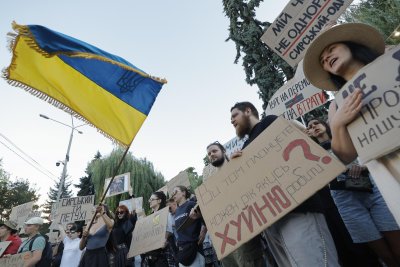
1 of 2 | Demonstrators hold signs Saturday in support of Mykhailo Fedorov, Ukraine’s former defense minister, during a protest in central Kyiv, Ukraine. On Tuesday, President Volodymyr
Zelensky dismissed military commander Oleksandr Syrskyi and said he’s offered Fedorov a new position. Photo by Sergey Dolzhenko/EPA
July 21 (UPI) — Ukrainian President Volodymyr Zelensky dismissed the commander of Ukraine‘s armed forces, Oleksandr Syrskyi, on Tuesday following days of protests.
The protests, which involved thousands of people in Kyiv and other cities, were in response to the dismissal of Mykhailo Fedorov, a popular defense minister, last week.
Fedorov, who has a reputation for innovation and whose policies — including an effective drone program — are seen as reasons for Ukraine’s recent success against Russia, was not popular with senior defense leaders, CNN reported.
Zelensky dismissed Fedorov, leading to protestors demanding Syrskyi’s removal and for the defense minister to be reinstated by Friday. In his address announcing the commander’s dismissal Tuesday, the president said he is appointing Mykhailo Drapati, a well-liked general, to Syrskyi’s role to oversee a reorganization of the army’s command structure.
Drapati is considered an ally of Fedorov, whose attempts to modernize and reform Ukraine’s military led to the clashes with old-school military leaders, such as Syrskyi, The Guardian reported.
Zelensky also said Tuesday that he has offered Fedorov a “prominent position” in the government, as the defense minister role has been filled by Yevhen Khmara. There was no word on if Fedorov accepted.
Zelensky thanked Syrskyi for his service and praised his role in Ukraine’s military operations against Russia.
“Oleksandr Syrskyi ensured Ukraine’s results in the defense of Kyiv, the Kharkiv counteroffensive and the Kursk operation,” he said, The Kyiv Independent reported. “A significant path has been traveled. The defense of Ukraine continues, and every warrior deserves dignified treatment. I am grateful to Oleksandr Syrskyi and to every one of our soldiers for Ukraine’s strong frontline positions.”
Fedorov said Tuesday that he welcomed Drapati’s appointment.
“This brings a breath of fresh air and new hope to the struggle of free people for freedom and justice,” he said. “It is a voice for change that could not be ignored.”
Fedorov continued to say, “The high expectations of the Ukrainian people must be met with a clear vision for ending the war for independence, a strong team and decisive actions aimed at saving the lives ofour soldiers, automating the front line, delivering asymmetric strikes and crippling the Russian economy.”
We are giddy as we reach the summit, breathless with exertionand a guileless, childlike joy. In every direction the jagged peaks of Slovakia’s High Tatras stretch out into the distance, nubs on a colossal spine, glittering lakes embedded like shards of glass far below the rocky, ice-streaked slopes. An eagle wheels above. Somewhere on the lunar landscape a marmot squeaks. Easy laughs ricochet around the group, photos are snapped, backs thumped, words of encouragement offered to the more vertigo-inclined.
The summit of Slovakia’s Kôprovský štít had been playing a Kafkaesque game of mountain mirage with us for several hours, always just over the next ridge which, once conquered, revealed a string of further, seemingly endless ridges. Eight hours and about 23km after we had set off on our hike through the Vysoké Tatry mountain range, an eddy of smiles rippled from person to person (some, granted, of the more clenched-teeth variety). “Yes, team! We did it!” Roman, our high-spirited Slovakian mountain guide, stood atop the tip, clasping each of our hands in congratulation as we crested the peak.
Just 24 hours earlier, we had been a ragtag group of 11 strangers making small talk in London’s Luton airport. But here, on a vertiginous mountain top 2,367 metres (7,765ft) above sea level, friendships were budding, veneers falling away. And this was it: the reason each of us had embarked on an expedition to the remote wilderness of the Tatras with a bunch of people we didn’t know. Connections forged during the shared toil of the climb; the sheer wonder at making it to this place where rock meets sky.
The group take a well-earned break on the rocky slopes of Slovakia’s High Tatras. Photograph: Jessica Rawnsley
Community hiking is experiencing a surge in popularity, with countless groups springing up in the past few years, uniting tens of thousands of people for outdoor adventures. There are women-only groups, LGBTQ+ groups, Black, Indigenous and people of colour (Bipoc) collectives, those catering to slow walkers, “soft girls”, parents, dog owners. Our four-day trip to Slovakia was organised by hiked.up in partnership with Slovakian tour operator Tatra Escapes. Hiked.upbegan during Covid, with childhoodfriends Matt and Adam escaping lockdown stasis on walks around Essex, and has since evolved into a thousands-strong community offering expeditions across the UK and Europe.
“The demographic is so vast,” Matt tells me as we pick our way across a boulder field. “Young people, older people, some super-fit, others new to hiking. Most come alone. People join for mental health reasons, or just to get out and have fun, meet new people. You connect with people you might not expect to talk to day-to-day at our events.”
We are a motley crew in ability, age and disposition, hailing from all corners of the UK. The roll call of professions includes a tennis coach, landscape architect, maths teacher, physiotherapist, art adviser and construction site manager. But the stories I’m told track similar contours: ennui at the digitisation of modern life and city confines; a yearning for nature and the chance to connect with like-minded individuals beyond booze-soaked social settings.
Louis, a 24-year-old physiotherapist, believes community hiking taps into something fundamental. “Humans are designed to connect outdoors,” he says. “This is what we did thousands of years ago.” Emma, a 32-year-old teacher, sees hiking groups as a response to urban loneliness and atomisation. “People want to come together without it being centred on drinking or going out; connecting in a more conscious way.”
I admit to a degree of trepidation on the first evening, sitting outside our wooden lodge in Slovak Paradise national park, the setting sun splashing gold and purple across the sky. A jangle of nerves and travel fatigue had created a somewhat jarring group dynamic; the quieter members practically tongue-tied while the extroverts bellowed across plates of creamy bryndzové halušky (potato dumplings with creamy sheep’s cheese and crispy bacon). Was this collection of strangers going to find a rhythm, let alone a sense of camaraderie?
The High Tatras ‘compress an extraordinary diversity of terrain into a narrow alpine arc’.
The following morning we tumbled out of the minibus on to the Štrba turistika trail. The sun beat down benignly as we followed a winding path along the mountainside, a valley of deep green pine fanning out below. Our other guide, Uri, a gentle giant with a calm demeanour and bottomless supply of small, sweet cherries, suggested we let silence settle among us, better to hear the birds, the wind, the whisper of the pines.
The High Tatras – a string of snow-dusted peaks straddling the Slovak-Polish border – are the highest range in the Carpathians and among the most dramatic in Europe. Singular in their compact yet lofty nature – with peaks cresting 2,600 metres – they compress an extraordinary diversity of terrain into a narrow alpine arc.
Long shrouded in mysticism and lore, for centuries few dared explore their rugged expanses, believed to be the domain of dragons and ogres. But over the past 250 years, mountaineering has become firmly embedded in Slovakian national identity, the Tatras etched on the national coat of arms and eulogised in the national anthem. The establishment of Tatranský národný park in Slovakia in 1949 and Tatrzański park narodowy in Poland in 1954 – one of the world’s first cross-border protected regions – has kept the land pristine and wild. Camping and swimming are not permitted, and while I longed to cool off in the crystalline alpine streams, I was thankful for the foresight.
Before long, we had broken free of pine and earth and were met with a startling expanse of rock and sky. Sun-dappled forest and wildflower-strewn meadows were replaced by clutches of dwarf pine and obstinate patches of ice amid a tumble of granite outcrops that jut from the earth like crooked shark’s teeth. Reality receded imperceptibly into the distance till there was nothing but the placement of each foot on stone, the kiss of cool mountain breeze, the deafening gallop of my heartbeat.
There is something about the combination of physical exertion and shared adventure that peels back the layers in which we shroud ourselves. It was not long before group discussion had turned to bowel movements, disappointing orgasms and dating apps. We spent the second day weaving our way along a fairytale trail of wooden ladders, steep staircases and fallen logs through a valley enclosed by steep earthen banks and caves winking from limestone faces. Emerging into bright sunshine and a mountain refuge set on a sprawling viridescent meadow, we nursed refreshing pints of Zlatý Bažant, a comfortable silence settling among us like that between old friends.
It didn’t all go smoothly. Tensions flared when an organisational miscommunication left the group without lunch on a nine-hour hike. But, ultimately, that unforeseen trial bound us closer together. When water was scarce, tummies grumbling and boots beginning to bite, it was kindness and generosity that ruled the day – last sips meted out equitably, faster walkers hanging back for blister-addled hobblers, emergency tampons and pee-buddies in abundance.
Steeling ourselves for another ascent of about 2,000 metres, one member of the group erupted in a burst of jubilation: “I’ve got fig rolls!” A cheer rose up from our perch on the mountainside.
The climb was gruelling, the views spectacular, but most of us had come in search of something a little harder to find. Listening to the chorus of gleeful voices echo across the valley, I thought we might just have found it.
The four-day trip to Slovakia was provided by hiked.up and Tatra Escapes and cost £650pp (£600 for a shared room). It included Košice airport transfers, three nights at Ranč Podlesok Relaxon a B&B basis, and guides. Follow @hiked.up for details of future expeditions
Chaibasa, India – As the world celebrates Spain winning its second FIFA World Cup and the “GOATS” of football who headlined the month-long tournament, a remote Indian village has also joined in – albeit with an indigenous touch.
To coincide with the FIFA event, residents of Tirilbasa village in Chaibasa, a tribal-dominated district in eastern India’s Jharkhand state, organised a football tournament from July 14 to July 17, featuring teams from 64 nearby villages.
Recommended Stories
list of 4 itemsend of list
But the star attraction at the Rangila Star Tirilbasa tournament (“rangila” means “colourful” in Hindi), besides relatively handsome prize money, was a herd of goats to be handed as trophies to the best-performing teams.
The finals were played on Friday, with NCS Maudi beating Kumbaram 1-0, a dramatic prediction of what happened between Spain and Argentina two days later in New York.
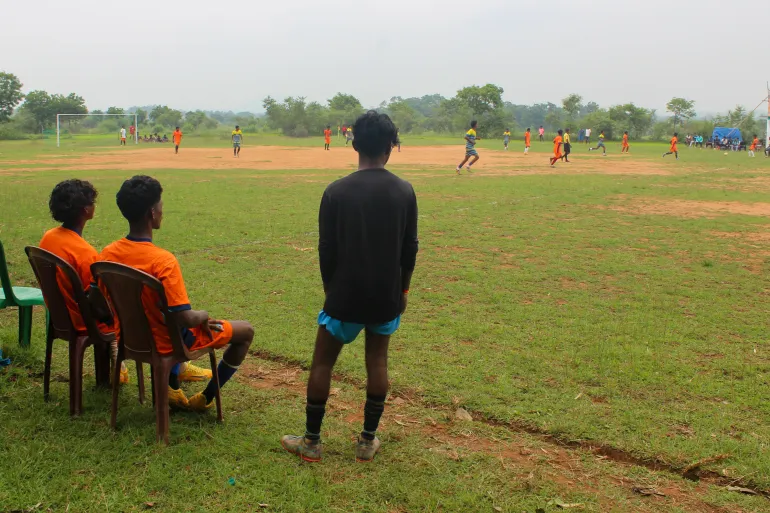
Competing teams play a football match at the Rangila Star Tirilbasa tournament in Chaibasa, Jharkhand, India [Shweta Desai/Al Jazeera]
NCS Maudi carried home prize money of 15,000 rupees ($156) and three male goats (locally known as “khassi” for their castration at a young age). Runners-up Kumbaram won 12,000 rupees ($125) and two khassis, while Kobra FC Nimdhi and Galubasa FC, the third and fourth rankers, won 9,000 rupees ($93) and one khassi each. There are also cash prizes for the man of the match, man of the series and the best goalkeeper, but they don’t get any khassi.
NCS Maudi’s captain Sachin Devam, whose team arrived on two-wheelers to play the game, told Al Jazeera he would have to arrange for an autorickshaw to carry the goats home, 10km (6 miles) away.
“It’s the first win for our team, and we are going to celebrate it with everyone in the village,” he said with a beaming smile. “It’s going to be a khassi picnic.”
‘Khassi important part of our culture’
This year was the fifth edition of the Rangila Star Tirilbasa tournament.
The organisers say they follow the FIFA rulebook and invite popular commentators and referees certified by the state football association to ensure compliance with the guidelines and “avoid fights as players can get aggressive on the field”.
But the rest of the setup is markedly different from the conventional game. Rather, it is adapted to the ancient tribal traditions of the Ho community, which is native to the Chaibasa region.
The Ho people, numbering a little more than a million across India, genetically belong to the Austroasiatic group and identify themselves as tribal (“aadivasi” in Hindi) people inhabiting the forests. The word “ho” in their language means “human” or “people” of the Kolhan region in Jharkhand, one of India’s poorest states despite being home to some of India’s biggest coal and mineral mines.
The Austroasiatic tribes such as Santhals, Ho and Munda organise their traditional, religious and sporting activities like a close-knit community. Football events are an opportunity to invite fellow tribal kin to celebrate their bond.
For the Ho people, no celebration is complete without the khassi. The animals are used for ceremonial sacrifices during religious events and rituals, and their meat is shared among the community members.
“Khassis are part of the prize as they are an important part of our culture. Their meat is tasty, and everyone loves good mutton. Most teams slaughter the goats, but some also keep them as livestock and trophy prize,” Manish Kudada, an 18-year-old player and one of the organisers of the tournament from Tirilbasa, told Al Jazeera.
Manish Kudada with his prized khassi at his home in Tirilbasa, India [Shweta Desai/Al Jazeera]
Kudada has preserved the black khassi he won in another football tournament in February, but his friends joke that the goat is being fattened up for a feast. The khassi goats are prized for their meat quality. In Chaibasa, the goats can be spotted everywhere, especially during the weekly Tuesday markets, where a baby goat costs up to 8,000 rupees ($83).
“Without khassi, our celebrations are half-hearted. At weddings, even if the hosts serve double the amount of chicken and no khassi meat, it will upset the villagers,” Raj Keshri, goalkeeper for the Tirilbasa team and one of the organisers of the tournament, told Al Jazeera.
“We therefore decided to offer cash and goats as the prize. Players get to keep their money, but with the khassis, they also get to celebrate the victory with the entire village.”
Raj Keshri with the goat his team won at the tournament [Shweta Desai/Al Jazeera]
The Ho practice what they call the Munda-Manki governance system, under which the hereditary head of a village upholds all social, legal and customary rights of the people. Their tribal codes and customs take precedence over the Indian government’s panchayat (village administration) and police systems.
The Rangila Star Tirilbasa tournament is conducted at the “ek munda” (“ek” means “one” in Hindi) level, which means that a team’s members must belong to the same village. Instead of 11 players, each team has nine, of which at least six must belong to the same village to qualify for the tournament. Organisers say the rule is strictly followed to reinforce a sense of unity among the players.
The rules of the game have also been modified. There is no offside, and players are free to score from anywhere on the field.
“This kind of match setup provides an opportunity for players like us from small villages who never get a chance to qualify in open tournaments which are dominated by seasoned players,” Sudarshan Tiu, who plays for Galubasa FC, told Al Jazeera.
Suvir Kumar Tanti, the commentator for the tournament, travels widely across the Kolhan region during the monsoon football season, when most male members return home for cultivation and agricultural festivals.
At the finals at Tirilbasa on Friday, his high-pitched, lyrical play-by-play commentary boomed through the loudspeaker, helping the spectators keep track of the fast-paced action on the football field.
“The Rangila Star tournament reflects the culture of the Ho community. And khassi goats as prizes make it even more unique. Very few tournaments in the region follow this and prefer to conduct events in a professional manner, with trophies and medals as rewards,” he told Al Jazeera.
Spectators enjoy a football game at the Rangila Star Tirilbasa tournament in Chaibasa [Shweta Desai/Al Jazeera]
The tournament offers entertainment for the villagers, who pour in and out of the grounds through the day, squatting by the sides of the field or finding a place on the trees.
Nearby, food stalls sell fried dough balls, potato chops, yellow peas, and hooch. Men sit in circles, taking a break in between the matches to drink “madia”, a fermented rice beer that locals say helps them stay cool in the hot and humid weather.
In the evenings after the matches, men also play a rooster-catching game, which spectators can bet their money on.
Keshri, goalkeeper for the Tirilbasa team, explains the spirit behind the tournament’s eccentric name: Rangila Star Tirilbasa.
“The name was chosen because it embodies the identity of our village. ‘Rangila’ [colourful] signifies our enthusiasm to do something unique while ‘Star’ represents talent. Through our football tournament, we hope Tirilbasa will become the ground for local talent.”
The tribal-dominated state of Jharkhand has been a sports powerhouse for decades. It has produced globally-awarded field hockey players and athletes, the most famous being India’s former cricket captain, Mahendra Singh Dhoni.
The state government helps local football and hockey clubs like Rangila Star with financial grants, resulting in the rise of some of football’s next generation of players. Many such clubs, including Rangila, also hold tournaments for female teams.
But until over a decade ago, Chaibasa was not on the sporting map.
Located among remote forests and hills, the district was cut off from mainland India due to the Maoist insurgency – a tribal-led armed revolt against the Indian state over large-scale felling of forests and selling of lands to private corporates for mining and related activities.
The government regained control of Chaibasa from Maoists only in 2011. Still, until last year, private vehicles avoided taking roads crossing the district at night. Commercial buses operated from 4am to 4pm, and the region remained on the government’s list of “sensitive areas”.
In March this year, India’s Home Minister Amit Shah declared the end of the armed Maoist rebellion after a series of top commanders were killed or arrested by the security forces in Jharkhand and the surrounding states, mainly Chhattisgarh.
A football match in progress at the tournament in Chaibasa [Shweta Desai/Al Jazeera]
As violence ebbed, Chaibasa turned into a busy town. Shops selling pizza, burgers and laptops, alongside offices and warehouses of mining companies extracting coal and iron ore, have come up. Christian missionary schools and colleges are dotted across the region, providing educational opportunities to tribal people.
Sporting activities are also thriving, with Chaibasa fast emerging as a football hot spot, producing players like female midfielder and forward Malati Munda.
Munda, who found national fame through local tournaments, ended up playing in league matches in Kolkata, the capital of neighbouring West Bengal state, where football is extremely popular.
“I had no coach to guide me or provide training. No one had even heard about me. After coming to Chaibasa town for higher studies, I met several brothers and sisters who taught me and improved my game,” Munda told Al Jazeera.
The weekly local tournaments gave Munda experience and skills to improve her game. They also brought rewards. “I have played at several such games where we won cash, and yes, khassi as well,” she said with a laugh.
Munda currently plays for the Home Guard paramilitary in Jharkhand’s capital city of Ranchi – a route many players from poorer families take to secure a government job in India.
Harish Hembram from Chaibasa began his career as a football content creator by covering local matches and uploading their videos on social media. His YouTube channel today has more than 211,000 subscribers, and livestreams key matches across Jharkhand.
“Football has always been popular in the villages, and many like me would attend matches at different venues. I started uploading the videos for fun for those fans who couldn’t attend. But soon the videos clocked high viewership, and I started my YouTube channel. Now organisers call me to cover their tournaments,” he told Al Jazeera.
Hembram said he earns about 20,000 rupees ($208) a month through his YouTube channel alone. He has moved to Ranchi, where he has also opened a sports shop selling football, jerseys, shoes and other accessories. Many players from Chaibasa visit his shop.
The grassroots football culture in Chaibasa defies the stereotype that India is not a football country.
Sandeep Menon, author of Sacred Grounds: A Journey Through People’s Football in India, says he has discovered and documented a football subculture across the country. He said while India does not figure prominently on the global football map, the love for the sport in the country is “unparalleled”.
“At the grassroots level, football is played with great interest across the country. And everyone has their own version of the game, to make it palatable and adaptable depending upon the availability of space, local geographical surroundings, weather and social conditions,” Menon told Al Jazeera.
Menon said hyper-local village tournaments like the Rangila Star Tirilbasa attract young players and provide them an opportunity for overnight fame. “There is a high emotional investment in playing for a village and representing it,” he said. “For some players, football becomes their identity and pride.”
Actor Kaylee Hottle, best known for her portrayal of a young deaf orphan who shares a special bond with the giant guardian ape in “Godzilla vs. Kong” and “Godzilla x Kong: The New Empire,” has died. She was 18.
Hottle died Tuesday morning after the car she was a passenger in crashed into a culvert off the side of the road in Ijamsville, Md., the Frederick County Sheriff’s Office said in a news release. Her father, Joshua Hottle, confirmed her death in a video on Facebook.
“I am taking a flight that I never would like to take,” he wrote in the caption of the video post, in which he explained the situation in American Sign Language. He was on his way from Texas to claim her body, according to TMZ.
The Texas School for the Deaf also addressed the actor’s death on social media.
“It is with profound sadness that we share the heartbreaking news that one of our TSD seniors, Kaylee Hottle, tragically passed away yesterday in a car accident in Frederick, Maryland,” read the Instagram post. “Our hearts are with Kaylee’s family, friends, classmates and everyone who knew and loved her during this incredibly difficult time.”
Hottle’s breakout role was in the 2021 MonsterVerse crossover “Godzilla vs. Kong,” which marked her big-screen debut as the young orphan Jia. Jia is the last remaining survivor of the Iwi tribe on Skull Island who shares a connection with Kong, the island’s protector. Her adoptive parent, Dr. Ilene Andrews, is a linguistics expert and Kong researcher, played by Rebecca Hall. Hottle reprised the role in the 2024 follow-up, “Godzilla x Kong: The New Empire.”
“After I watched the movie, I thought, ‘Wow, this is going to make such a big impact,’” Hottle said in a 2024 interview with New York’s WABC. “I was so excited. She’s a young deaf girl, just like many others out there. And this journey that she’s going on is just going to be so amazing.”
The actor, who was born in Atlanta, was from an all-deaf family, which included four generations of deaf relatives on her father’s side, according to IMDb.
Authorities said Hottle was one of two passengers in the 1995 Honda Accord that was involved in the crash. While the incident is still being investigated, the Sheriff’s Office said in its news release that “excessive speed is believed to be a contributing factor in the collision.”
Millie Bobby Brown, who also appeared in “Godzilla vs. Kong,” was among those who shared tributes to Hottle following the news of her death.
“I’m so devastated to hear this,” she wrote in her Instagram story, which included a black-and-white photo of Hottle as Jia. “You will be deeply missed Kaylee.”
“I am absolutely gutted about the passing of sweet Kaylee Hottle,” Oscar winner Marlee Matlin wrote on Instagram. “May her beauty and talent be a memory for eternity. … Such a privilege to have met Kaylee last year. Please be kind to one another. Take the time to listen to your child. Say 🤟🏼 each time you part. 🩵”
The price of resale housing in Spain ended the second quarter of 2026 with a year-on-year increase of 17.2%, according to the Fotocasa Real Estate Index.
ADVERTISEMENT
ADVERTISEMENT
Between April and June, prices also rose by 4%, bringing the average to €3,133 per square metre in June. Spain’s resale home prices have hit new record highs in four of the first six months of the year and are now at their highest level in the past 21 years.
Fotocasa’s head of research and spokesperson, María Matos, attributes this trend to a sharp imbalance between strong demand and limited supply. She explains that the shortage of available properties, financing conditions and demographic pressure in the main markets are driving prices up and making it more difficult to access housing.
According to Matos, “the result is ever faster price growth that makes it harder to access housing and widens the affordability gap for a large proportion of households.”
Fotocasa’s data is in line with the trend shown by statistics from the National Statistics Institute (INE), although the two use different methodologies.
While the property portal analyses the asking prices of advertised listings, the INE measures the prices of homes that are ultimately sold. According to the institute, the overall price of housing rose by 12.9% year-on-year in the first quarter of 2026, while second-hand homes became 13.5% more expensive.
Murcia leads the increases
Prices rose during the second quarter in 16 autonomous communities.
The Region of Murcia recorded the largest rise, at 8.6%, followed by Cantabria (6.3%), the Valencian Community (5.9%), Castile and León (5.6%) and La Rioja (5.1%). The Canary Islands was the only region where prices fell, with a drop of 0.7%.
On an annual basis, Murcia once again came out on top with an increase of 28%, ahead of Cantabria (20%), the Valencian Community (19.8%), Asturias (17%) and Andalusia (16.9%).
The report also highlights that “June 2026 ended with 14 autonomous communities posting double-digit year-on-year increases, compared with 11 in 2025, six in 2024 and seven in 2023”.
The Balearic Islands and Madrid remain the most expensive regions to buy a resale home, at €5,441 and €5,410 per square metre respectively.
They are followed by the Basque Country (€3,925), Catalonia (€3,418) and the Canary Islands (€3,374). At the opposite end of the scale are Extremadura (€1,352), Castile-La Mancha (€1,407) and Castile and León (€1,816).
Provinces, provincial capitals and major cities
Forty-six provinces recorded quarterly increases, with León (10.7%), Palencia (10.2%) and Murcia (8.6%) seeing the sharpest rises, while Cuenca, Huelva, Santa Cruz de Tenerife and Ávila were the only ones where prices fell.
The Balearic Islands remains the most expensive province to buy a resale home, at €5,441 per square metre, followed by Madrid (€5,410), Guipúzcoa (€4,695) and Málaga (€4,690). Jaén continues to be the most affordable, at €1,112 per square metre.
Among provincial capitals, León recorded the largest quarterly increase, while Donostia-San Sebastián maintains the highest average price in Spain, at €7,158 per square metre, ahead of Madrid (€6,630), Barcelona (€5,368), Palma (€5,275), Málaga (€4,320) and Bilbao (€4,157).
At municipal level, Santa Eulària des Riu in Ibiza tops the national ranking with €8,491 per square metre, followed by Sant Antoni de Portmany (€8,284) and Eivissa (€7,441). In Madrid, the Salamanca district reaches €10,786 per square metre, while Sarrià-Sant Gervasi leads the way in Barcelona at €7,540 per square metre.
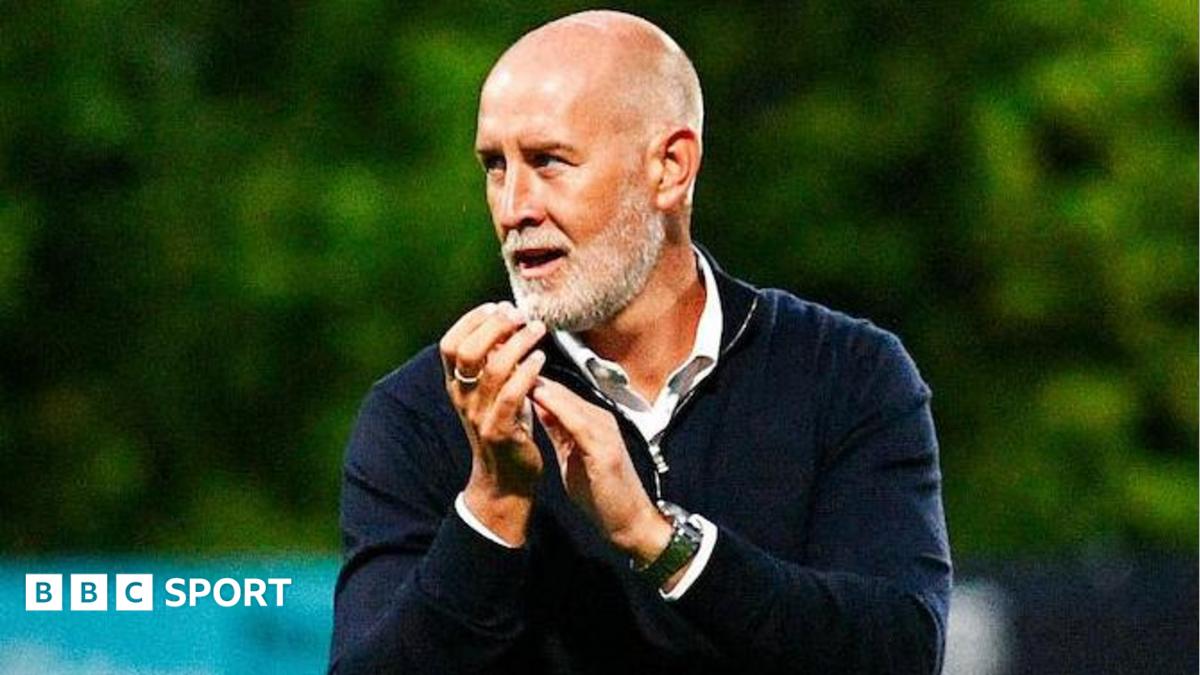
Larne manager Gary Haveron said he was “proud” of his players’ efforts in their 4-0 home defeat by Red Star Belgrade in the Champions League second qualifying round, first leg.
The Inver Reds trailed at the break after Bruno Duarte converted from the spot, but the Serbian club would add another three in the second period as Duarte grabbed a second, while Vasilije Kostov and Muhammed Cham found the net to all but finish the tie off.
Haveron felt his team can take a lot from the experience but accepts they were up against a “different level” of opposition.
“I’m extremely proud,” Haveron told BBC Sport NI.
“For long stages in the first half we frustrated them and were probably a bit disappointed to come in one down given the soft penalty.
“I thought the shape was really good, discipline really good and in the second half we got caught up in the occasion and chased the game a bit too much. When you give a quality team space in behind, they can hurt you and did that in a 10-minute spell when they scored two goals and killed the tie.
“It’s a learning opportunity for us and we can take so much as a club, coaching staff and players. The quality is different level and some of the finishes were ridiculous.”
Larne will travel to Belgrade for the second leg next Wednesday [19:00 BST] and while Haveron accepts the Champions League is “a step too far”, he is hopeful they can push on in the Europa or perhaps Conference League qualifiers.
“Our ceiling wasn’t the Champions League,” he stressed.
“Winning the first game [against Tre Fiori] gave us an opportunity in the Europa League, gave us an opportunity in the Conference League that gives us a level of football we can be competitive in.
“We made group stages previously [2024/25] but you need to get lucky with the draw and it gives us a chance to be competitive.
“When you get to this stage of the Champions League, it’s a step too far, but about the occasion, the experience and performance, so next week will stand to us going into the rest of the season.”
July 21 (UPI) — U.S. Secretary of Defense Pete Hegseth told a Senate committee Tuesday that the financial cost of the Iran war has now reached about $37.5 billion according to Defense Department estimates.
Lawmakers questioned Hegseth and Joint Chiefs of Staff Chair Gen. Dan Caine during a Senate Appropriations Committee meeting as the Pentagon and President Donald Trump are seeking up to $70 billion in emergency military funds.
This is in addition to the $1.5 trillion the Pentagon has requested in the upcoming defense budget. Trump has also asked for about $18 billion more in emergency funds for unrelated programs, including $11 billion for agriculture. Agriculture Secretary Brooke Rollins was also present at the hearing, although the focus remained on military spending.
Some Senate lawmakers, both Democrats and some Republicans, questioned the need for the money on top of the defense request and the roughly $150 billion in additional funding the military received through Trump’s so-called Big Beautiful Bill.
“The problem is not a lack of money, but poor planning,”Murray said. “So I’ll be blunt. The truth is, your request does not make a lotof sense.”
Hegseth, in response, blamed “gross negligence and neglect”by the Biden administration.
Some asked about Iran’s military capabilities and theobjectives of the war, as Hegseth and Trump have both previously said that the war had been won. The defense secretary also said in the early days of the war that Iran’s military had already been “destroyed and made combat-ineffective.”
Hegseth said that he never meant that Iran would be unable to launch any attack. He said he meant Iran “can lob missiles, but it’s not an effective military.”
Sen. Lisa Murkowski, R-Ala., asked Hegseth if the Trump administration believes it does not need authorization from Congress to continue the war. Hegseth replied that the administration believes it already has the authority it needs.
The hearing lasted more than three hours and ended in a shouting match between Hegseth and Sen. Gary Peters, D-Mich., who questioned the war’s objectives, called Hegseth a “failure” and said the Trump administration has created another “forever war.”
Hegseth responded by telling Peters “shame on you” and saying he has “Trump derangement syndrome.”
New York City Mayor Zohran Mamdani releases a video statement calling for Israeli Prime Minister Benjamin Netanyahu to face trial for war crimes, citing the ICC’s arrest warrant. But, after days of speculation, Mamdani says New York does not have the power to arrest Netanyahu.
TEEN Mom alum Nathan Griffith looks like he’s aged quickly during his latest stint in prison.
In his latest mugshot, former MTV star Nathan, 38, has deep wrinkles in his brows and a long beard as he serves time behind bars in Nevada after he was arrested twice for domestic violence in the past few years.
Nathan Griffith is serving a four-year sentence in a Nevada prisonCredit: Nathan Griffith/InstagramNathan was recently granted paroleCredit: Southern Desert Correctional Center
As The U.S. Sun previously reported, he was sentenced to four years in prison in May 2025 after he was charged with domestic battery in 2023 and again two years later.
He was busted for strangling his sister Heather in the first incident, then charged with assaulting his ex-girlfriend Anastasia and violating his probation in the second.
Sign up for the Showbiz newsletter
Thank you!
Nathan had a hearing to request an early release on parole in April, The Ashley’s Reality Roundup first reported.
“I have failed in my decision-making,” Nathan said during the hearing, according to the outlet.
“I have failed in numerous of things I have done in life. And I have failed as a human. Words cannot express how regrettable I am in for my decisions and actions.
“Over the last few years, I became so pathetic that I didn’t care about myself or anything, not even my life.
“I’m sure the parole board has received a few letters describing who I was in my former years, of how great of a person I was.
“We can sit here listening to the many marvelous things I have done and accomplished, or how nice, kind and charitable I am.”
Most read in Entertainment
Nathan is dad to Jenelle Evans’ son KaiserCredit: Nathan Griffith/InstagramNathan was once engaged to Jenelle, but they split soon after Kaiser was bornCredit: Twitter
“But the attributes and accomplishments did not land me here in prison.
“My lack of insight and compassion, and selfishness has put me here. I was hurting so intensely inside that I couldn’t manage my pain nor myself.”
He also admitted he struggles with alcoholism, The Ashley added.
As The U.S. Sun reported, he checked into rehab in 2024, though sobriety did not seem to stick.
Nathan is actively working to change his life in prison, he claimed during the parole hearing, completing 11 education certificates, including a trauma program and anger management course.
His parole was approved in July, though he does not have to legally be released until November.
Nathan is the ex-fiancee and second baby daddy of Teen Mom star Jenelle Evans, with whom he shares son Kaiser, 12.
Nathan is still married to May Oyola after their 2022 wedding, despite separating for a brief time in 2025.
In 2021, he told The U.S. Sun he struggles with PTSD and other mental health issues after serving time in the United States Marine Corps.
Before Devlin had even departed, there was a new head coach in charge. The process to appoint Vrancken was quick and initial signs were promising.
Here was a man who had been named Belgian coach of the year, had taken Racing Genk to within minutes of the title, and had been linked with Anderlecht and Burnley.
As well as a glowing CV, his previous style of play in Belgium was highlighted. It was not quite labelled all-out attack, but it was certainly going to be the style of football fans want to see.
Explaining his tactics in an early supporter forum, the man himself said he wanted “chaos within a structure”.
In his first match in charge it was mostly chaos, not so much structure.
However, the 4-0 scoreline does not feel truly reflective of the game itself. The attacking stats showed Hearts did not lag behind their Austrian hosts by any means.
They created two chances in the first half that should have been buried, but Pierre Landry Kabore shot straight at the keeper and Alexandros Kyziridis nudged his effort wide when one-on-one.
By the time it came to creating any more, they were already 4-0 down. Inefficient in attack, torn apart at the back. It was a nightmare beginning.
“Early impressions are that Hearts have got a really good head coach,” said Hearts Standard editor Joel Sked on a recent Scottish Football Podcast. “At the same time, just with everything that’s happened, there will have to be some patience.”
Patience is in short supply in football these days. For every Ange Postecolgou, there’s a Wilfried Nancy. For every Jens Berthel Askou, a Russell Martin.
It is too soon to tell in which camp Vrancken will fall, but for the most part, Hearts fans remain cautiously optimistic.
They’ve been through it all in the past two months, nothing can surprise them. Not even this.
Proposed rules would have US regulator block the entry of swarm-capable drones, mainly from China.
Published On 22 Jul 202622 Jul 2026
The US Federal Communications Commission (FCC) has moved to prohibit imports of advanced drones, mainly from China, citing mounting national security concerns over military-grade technology.
Under the proposed rules announced on Tuesday, the US regulator will block the entry of drones equipped with swarming capabilities and infrared sensors for high-resolution thermal imaging.
Recommended Stories
list of 3 itemsend of list
Meanwhile, exemptions for components produced outside China, introduced in December, have been extended until January 2028, suggesting a focus on isolating Chinese manufacturers, such as DJI and Autel Robotics.
The move comes days after US President Donald Trump accused China of interfering in the 2020 US elections. It signals a hardening of Washington’s stance against foreign-made surveillance technology, while attempting to mitigate immediate supply chain shocks for domestic users.
FCC officials said the measures were necessary to “secure the drone supply chain” and prevent sensitive data from being accessed by foreign states.
In 2022, the FCC banned telecommunications and video surveillance equipment from prominent Chinese brands, including Huawei and ZTE, citing an “unacceptable risk to national security”.
US security officials have warned that equipment from Chinese brands such as Huawei could be used to interfere with fifth-generation (5G) wireless networks and collect sensitive information.
One of the largest manufacturers of telecommunications equipment in the world, Huawei has had an embattled relationship with the US and its allies, facing some of the heaviest sanctions ever placed on a single company in the US.
In 2019, Trump signed into law the Secure and Trusted Communications Networks Act, which established criteria to identify communications services Washington deemed could pose a risk to national security.
The FCC’s latest move reflects a bipartisan consensus in Washington to treat foreign drone technology as an “unacceptable risk” to national infrastructure.
Weekly insights and analysis on the latest developments in military technology, strategy, and foreign policy.
As the U.S. continues to expend offensive and defensive munitions in the fight against Iran, the Pentagon’s top leaders are testifying before the Senate today about how to pay for the war, including to replace $21 billion in strike weapons and air defense interceptors already used. The appearance of War Secretary Pete Hegseth and Joint Chiefs Chairman Dan Caine comes as resumed hostilities have entered an 11th day and President Donald Trump renewed threats to attack Iran’s deeply buried Pickaxe Mountain facility.
Hegseth and Caine are appearing before the Senate Appropriations Committee to explain why the extra money is needed. It is included in a nearly $90 billion supplemental budget request made by the White House last month. Of that, the administration is seeking $67.1 billion to address “operational costs incurred by the Department of War (DoW) during OEF [Operation Epic Fury], including funding for military personnel and readiness expenses, operational costs to rebuild stocks expended by DOW, classified programs, and other key expenses,” the White House stated.
The Pentagon is seeking $21 billion in emergency funds to make up for the munitions, like Patriot air defense interceptors, expended in the war with Iran. (DoW) Department of Defense
An official told The Washington Post that “the expansion of U.S. operations will be limited by dwindling stockpiles of air defense and long-range munitions and constraints on the ability to surge more troops and aircraft into the area because of battle damage.
Meanwhile, the money being used to fund the conflict is having a cascading downstream effect on the U.S. military.
“The funding crunch is already leading the Pentagon to limit training and maintenance that help maintain military readiness,” The Washington Post reported, citing four current and former officials.
As Hegseth and Caine head to Congress, Iran is continuing to hit targets in Jordan, Kuwait and Bahrain, as well as ships transiting the Strait of Hormuz.
Jordanian air defense systems “intercepted and shot down three Iranian missiles targeting the Kingdom’s territories,” the Jordanian military stated on X. “The interception and downing operation resulted in no human injuries or material damage, and that Royal Engineering Corps teams handled the shrapnel impact sites, securing them in accordance with established procedures. The source indicated that the Jordanian Armed Forces – Arab Army continues to monitor the Kingdom’s airspace and maintains its readiness to address any threat to its security and sovereignty.”
بيان صادر عن القوات المسلحة الأردنية – الجيش العربي
صرّح مصدر عسكري مسؤول في القيادة العامة للقوات المسلحة الأردنية – الجيش العربي، بأن منظومات الدفاع الجوي اعترضت وأسقطت ظهر اليوم الثلاثاء، ثلاثة صواريخ إيرانية استهدفت أراضي المملكة.
— المركز الوطني للأمن وإدارة الأزمات (NCSCM) (@NCSCMJordan) July 21, 2026
Jordan’s Muwaffaq Salti Air Base (MSAB) has been particularly hard hit of late, including an attack that killed three U.S. troops and wounded many others. 1st Lt. Tyler James Feehan, 25, of Ewa Beach, Hawaii, and Pvt. Isabella Gonzales, 19, of Carrollton, Texas, were identified while officials are waiting to identify the remains of a third servicemember.
The Pentagon this morning also announced that Sgt. Michael Emmanuel Swinton, 30, of Fayetteville, North Carolina, was killed in action during a controlled detonation of a downed One-Way Unmanned Aerial System on July 19, 2026, at Erbil Air Base, Iraq. The incident is under investigation.
Speaking to reporters at the White House on Tuesday, Trump seemingly blamed Jordan for the casualties at MSAB.
“They did slip something through in Jordan and if we had other operators, you know, it would have — would not have happened, unfortunately,” Trump said during a press conference with Lebanese President Joseph Aoun. “But we, because we have the best equipment in the world, you know, we’ve stopped almost everything. But when you let other people do your job with the United States, we let other people do the job, and sometimes it doesn’t work out so well.”
JUST IN: President Trump acknowledges that Iranian forces “did slip something through in Jordan” before announcing he will travel to Dover Air Force Base to pay his respects to fallen U.S. service members killed by the regime’s recent attacks.
“Kuwaiti air defenses are currently confronting hostile missile and drone attacks, following the sinful Iranian aggression,” the Kuwaiti Army announced on X. “The General Staff of the Army notes that if explosion sounds are heard, they are the result of the air defense systems intercepting the hostile attacks.”
تتصدى حالياً الدفاعات الجوية الكويتية لهجمات صاروخية وطائرات مسيرة معادية ، إثر العدوان الإيراني الاثم.
تنوه رئاسة الأركان العامة للجيش أن أصوات الانفجارات إن سمعت فهي نتيجة اعتراض منظومات الدفاع الجوي للهجمات المعادية.
— KUWAIT ARMY – الجيش الكويتي (@KuwaitArmyGHQ) July 21, 2026
Kuwaiti officials say Iran had been specifically targeting the country’s water and power infrastructure for days.
“In light of the continued Iranian aggression against the State of Kuwait, several power and water desalination plants were attacked yesterday evening – for the fourth consecutive day – resulting in fires breaking out in a number of their facilities,” the Kuwaiti government announced on X Tuesday. “The Ministry’s emergency teams, in coordination with the General Fire Force and security authorities, immediately responded to the incidents and were able to control and extinguish the fires. The damage caused by the attacks has been assessed, and the teams are working on implementing plans to repair the damage and rehabilitate the facilities.”
As a result, “a number of generating units have been taken out of service in accordance with the precautionary operational procedures followed, and in order to ensure the safety of equipment and the stability of the electrical and water systems,” Kuwaiti officials explained.
Officials in Bahrain said that country also came under attack again on Tuesday.
“The siren has been sounded,” the Bahrain Interior Ministry announced on X. “Citizens and residents are urged to remain calm and head to the nearest safe place.”
The siren has been sounded,Citizens and residents are urged to remain calm and head to the nearest safe place.
The Islamic Revolutionary Guard Corps (IRGC) claimed that it struck an Amazon data center in Bahrain, according to the IRGC-connected Tasnim news agency post on X. TWZ cannot independently verify that claim.
In addition to attacks on land, Iran is continuing operations against vessels transiting the Strait of Hormuz.
July 20-21: Three tankers struck in Hormuz.
In two cases, the crew had to abandon ship.
The U.S. military cannot adequately protect tankers. Iran can continue to harass shipping indefinitely, because it is dirt cheap for them to do so.
Meanwhile, ships are reacting to the Houthis’ declaration of a blockade of the Bab al-Mandeb Strait (BAM). Lloyd’s List reported on X that a Cosco Shipping vehicle carrier heading toward the BAM turned around in the Gulf of Aden to avoid it.
A Cosco Shipping vehicle carrier has become the first vessel tracked making a U-turn in response to the Houthi blockade on Saudi Arabia, signalling that even China-linked ships may not be exempt from the Iran-backed group’s new maritime embargo pic.twitter.com/2Ubwzl19j2
Several other ships already in the Red Sea, including Saudi oil tankers, also opted to avoid crossing the Strait.
First Red Sea diversions emerge
According to #MarineTraffic data, the first operational response to heightened security risks in the Red Sea is now visible. Two laden crude tankers, the Singapore flagged XIN LONG YANG and the Liberia flagged RODOS, have altered their planned… pic.twitter.com/TDAnltqzek
As we reported yesterday, the Houthi blockade of the BAM threatens to add further pressure on oil exports from the Middle East, already drastically affected by the Iranian closure of the Strait of Hormuz and the resumption of the U.S. blockade on Iranian ports. Saudi Arabia has diverted millions of barrels of oil per day through pipelines to its Yanbu port on the Red Sea in an effort to minimize the energy shortages due to the hostilities in the Persian Gulf. This also raised the specter of the U.S. having to get as involved as it did during the previous Houthi campaign against shipping that ended last September, which could pull resources away from Iranian-focused operations.
On Tuesday, Trump addressed the issue of the Houthi blockade.
“I want to see what happens,” he told reporters. “So far, it hasn’t happened. Might happen, but we take care of things. If something like that happens, we take care of it. You know, we’ve done that with the Houthis before, and we haven’t heard from them in a while since we did what we did originally. That was about 45 days of very powerful action we took against the Houthis, and we’ve had no problem with the Houthis. They’ve had no problem with us for a long period of time, including during this conflict. I think that if there is something like that, we’ll just have to take care of it.”
“What is your level of concern of a blockade of the Red Sea by the Houthi rebels…?”@POTUS: “So far, it hasn’t happened—it might happen, but we take care of things. If something like that happens, we take care of it.” pic.twitter.com/bu9RvaiQCQ
— Rapid Response 47 (@RapidResponse47) July 21, 2026
Trump, as we noted earlier in this story, also repeated his threat to strike the very hardened Iranian facility known as Pickaxe Mountain.
“We follow the material,” the president added. “That’s where the action is, and we’ll be hitting that area very probably pretty soon. There’s not a thing they can do about it. You know, normally I wouldn’t say that. If I thought they could do something about it, I would never say that. But we’ll be hitting that area pretty soon, and very heavily.”
Reporter: Do you believe that Iran has moved nuclear centrifuges into Pickaxe Mountain?
Trump: We don’t have it on record. All we do is read the fake news, you know, we see the news is so wrong so many times. So, you know, maybe, maybe this one they have right. We’ll be hitting… pic.twitter.com/upQJkN7qgi
Meanwhile, there are still attempts to find an off-ramp.
An Iranian official “began meetings with mediators in Pakistan as diplomats seek to salvage the collapsed interim deal between Iran and the United States,” the Times of Israel reported on Tuesday. “The visit by Iran’s Interior Minister Eskandar Momeni comes as Pakistan has intensified diplomatic efforts in recent days to resuscitate the deal. However, it remains unclear just what new arrangement could be reached to end the fighting.”
Speaking to reporters at the White House, Hegseth said: “Iran’s been given every opportunity to negotiate, to show that they’re reasonable on the Strait of Hormuz—but if they’re going to shoot at commercial shipping, then we’re going to hit them, as the president said, 10 times harder. Every night, we’re degrading them further and further.”
.@SecWar: “Iran’s been given every opportunity to negotiate, to show that they’re reasonable on the Strait of Hormuz—but if they’re going to shoot at commercial shipping, then we’re going to hit them, as @POTUS said, 10x harder. Every night, we’re degrading them further and… pic.twitter.com/FNpUMnNZOx
— Rapid Response 47 (@RapidResponse47) July 21, 2026
As we have often pointed out, there is tremendous global and domestic pressure on Trump not to expand the war. The shutdown of the Strait of Hormuz, exacerbated now over concerns about the BAM, has increased energy prices around the world. Meanwhile, the U.S. midterm elections are rapidly approaching and this conflict is extremely unpopular among voters. How much these factors will come into play over the next days and weeks remains to be seen.
UPDATE: 4:29 PM EDT –
New British Prime Minister Andy Burnham “has approved the use of British military bases by the U.S. for what the U.K. calls defensive strikes against Iran,” Bloomberg News reported.
Senior ministers decided to continue the existing policy that “bases at Diego Garcia in the Indian Ocean and RAF Fairford in Gloucestershire, England could be used by U.S. planes flying missions aimed at countering the Iranian missile threat and sites used to target the Strait of Hormuz,” the outlet added.
As we noted in the past in a story about a previous debate over the use of these bases, they are important to any American plans to use long-range bombers against Iran.
Newly appointed UK Prime Minister Andy Burnham has approved the use of British military bases for select U.S. strikes against targets in Iran, according to Bloomberg News.
The Department of War announced “the believed to be death of an active-duty Soldier who was supporting overseas operations in Jordan.”
Rampersad was assigned to 1st Battalion, 57th Air Defense Artillery Regiment, 52nd Air Defense Artillery Brigade, 10th Army Air & Missile Defense Command, Ansbach, Germany.
CENTCOM announced on X that its forces “began striking military targets in Iran at 7 p.m. ET today for the 11th consecutive night. The strikes are designed to continue degrading Iran’s ability to threaten commercial shipping in the Strait of Hormuz.”
CENTCOM forces began striking military targets in Iran at 7 p.m. ET today for the 11th consecutive night. The strikes are designed to continue degrading Iran’s ability to threaten commercial shipping in the Strait of Hormuz.
CENTCOM announced that it completed its latest round of attacks on Iran at 8:15 PM ET.
Assets from the command “targeted Iranian military operations centers, maritime capabilities, aircraft hangars, drone storage facilities, and military logistics infrastructure to further degrade Iran’s ability to threaten commercial shipping in the Strait of Hormuz,” CENTCOM stated on X.
“Over the past three months, Iran has attacked more than 30 commercial vessels transiting the international waterway vital for regional and global trade,” the command added. “The unwarranted attacks have endangered hundreds of innocent mariners and undermined freedom of navigation.”
“Despite Iranian aggression, the Strait of Hormuz remains open for commercial vessel transit,” CENTCOM proffered. “Since early May, CENTCOM forces have helped facilitate the transit of approximately 900 commercial vessels and 450 million barrels of crude oil.”
A hit crime series series that delves into unsolved murders is available to binge
Cold Justice has been a hit with viewers(Image: ITV screengrab)
A series that explores real unsolved murders is streaming on ITVX and viewers are “obsessed”.
Cold Justice follows former Texas prosecutor Kelly Siegler and her team of investigators as they look into old cases that nobody ever managed to crack.
Murders they explore include the death of a young journalist and the killing of a family of four on Halloween. Another episode focuses on a young man who discovers his father dead on his front steps.
The show, which first hit screens in 2013, has proved enormously popular with audiences, with many posting messages online saying that while it is “disturbing”, it makes for a “gripping” watch, reports Wales Online.
“Perhaps the best real crime show on TV,” one viewer wrote on IMDb.com. “I enjoy this show best of all the many crime shows I watch.”
Somebody else said they were “obsessed”, as another said: “Love the show… I’ve been hooked since the first episode.”
“Just found this show and I’m so addicted,” one person wrote on X, which was formerly Twitter.
“Kelly and her team plus the officers really care about these cold cases and want to solve them for the families to get their justice. Really feel Kelly has her heart 100% in this show and I’m hooked. Two seasons down in three days!”
“I’m obsessed with Cold Justice,” remarked somebody else. “I am always in absolute awe watching how brilliant @SieglerKelly is. She just seems like a kind, sympathetic, people person who actually wants to bring answers to these poor families.”
One fan said they had “never missed an episode”, adding: “I am beyond obsessed with the closure and hard work @SieglerKelly and her team do to help with these cases. If you haven’t watched Cold Justice you should definitely start.”
“It is the best show out there!” exclaimed another fan.
“It’s the best show on TV and helping so many families,” commented another.
Nine series of Cold Justice have aired since it began 13 years ago, with Kelly and the team helping to secure a number of arrests and convictions as a result of their investigative work.
A trio of Premier League heavyweights all want Marcus Rashford, Arsenal are interested in Aston Villa‘s Ezri Konsa, and Nottingham Forest look set to sign a new defender.
Manchester United remain keen to sign a central midfielder but have cooled their interest in Brighton‘s Cameroon international Carlos Baleba and Bournemouth‘s Guernseyman Alex Scott, both 22, because of their high price tags. (Teamtalk), external






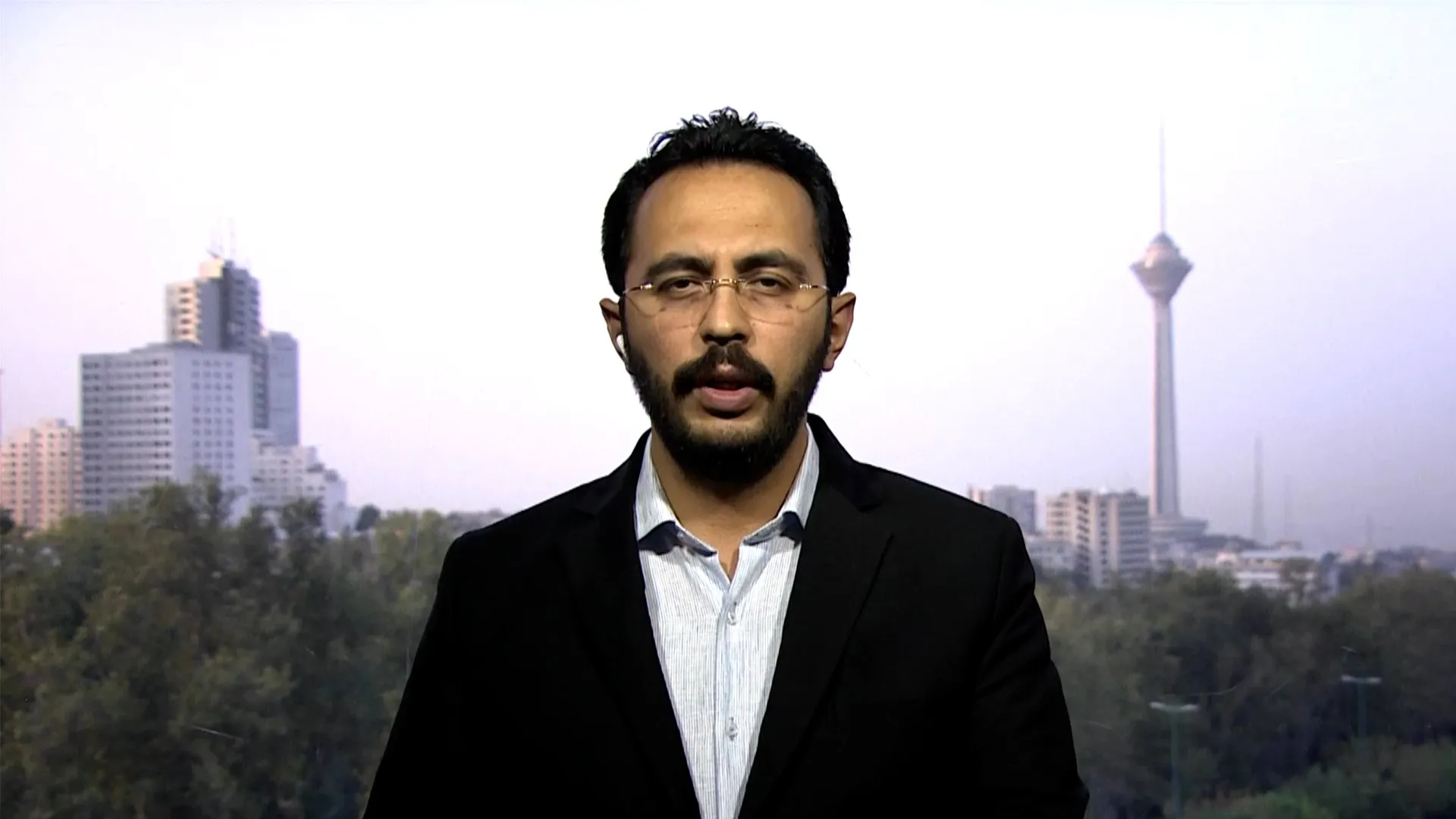
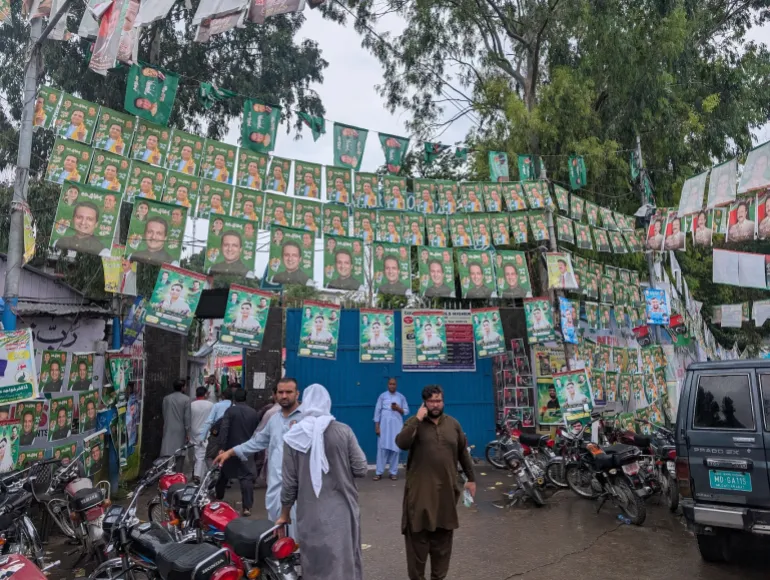

![A large number of supporters present at the sit-in in Rawalakot in Poonch division last week [Courtesy Joint Awaami Action Committee]](https://i0.wp.com/www.aljazeera.com/wp-content/uploads/2026/07/IMG-20260719-WA0032-1784679834.jpg?w=640&ssl=1)