The Senate was also expected to vote on War Powers resolution, in largely symbolic move attempting to reign in Trump.
Four Republicans in the United States House of Representatives have again joined Democrats in voting to constrain President Donald Trump’s power to wage war against Iran.
The resolution passed on Thursday, nearly a week after three US military personnel were killed by an Iranian attack on a base in Jordan, with a 214-208 vote. Senate Minority Leader Chuck Schumer has said Democrats will also force a War Powers vote in the Senate on Thursday.
Recommended Stories
list of 3 itemsend of list
Both the House and Senate had previously passed a resolution in June that called on Trump to seek congressional approval before launching further attacks. However, because the resolution was passed as a so-called “concurrent resolution”, it was not sent to Trump’s desk.
Even if the measure had been passed as a joint resolution, requiring it to be sent to Trump for approval, the president could veto it. Overriding such a veto requires a two-thirds vote in both chambers.
Democrats have said the latest resolution sends an important message that lawmakers oppose Trump’s approach to the war, which has re-escalated after a ceasefire broke down in early July.
Both the US and Iran have traded 12 days of consecutive attacks, with some analysts warning an even greater US escalation may be on the horizon, as Trump has repeatedly threatened attacks on civilian infrastructure and a possible ground invasion.
“This is a vote that requires us to find the strength to do what is right for the American people, and to send the clearest, even stronger message to this president of the United States that the United States Congress, the House of Representatives, is reasserting our authority over war,” Representative Pramila Jayapal said from the House floor on Wednesday.
“This war must end,” she said.
Under the US Constitution, only Congress can declare war, something it has not done since World War II, although presidents can commit forces in instances of pressing self-defence.
Trump has argued that the culmination of Iran’s actions since 1979 represents such an imminent threat, a claim many constitutional law experts have rejected.
Under the 1973 War Powers Act, presidents must receive congressional approval within 60 days of committing troops. While the US-Israel war with Iran began on February 28, the Trump administration claimed that hostilities had “terminated” following a temporary pause in fighting reached in April.
War powers experts and some members of Congress have said the attempted workaround flouts the law. The administration again notified Congress that fighting had resumed before the most recent round of attacks.
In a statement on Thursday, David Janovsky, acting director of The Constitution Project at the Project On Government Oversight (POGO), said the House vote “reaffirmed what people across the country have been saying all along: We want no part in an illegal war”.
“Contrary to the administration’s claims, the latest hostilities are not a new war. We’re now months past the constitutional deadline for the administration to end this unauthorised war,” he said.
He also noted that the House on Tuesday approved a sprawling $1.15 trillion defence bill that includes tens of billions more in funding for the war. The Senate has not yet voted on the package.
“If Congress is serious about bringing an end to this prolonged conflict, it must also refuse the administration’s request to fund it,” he said.
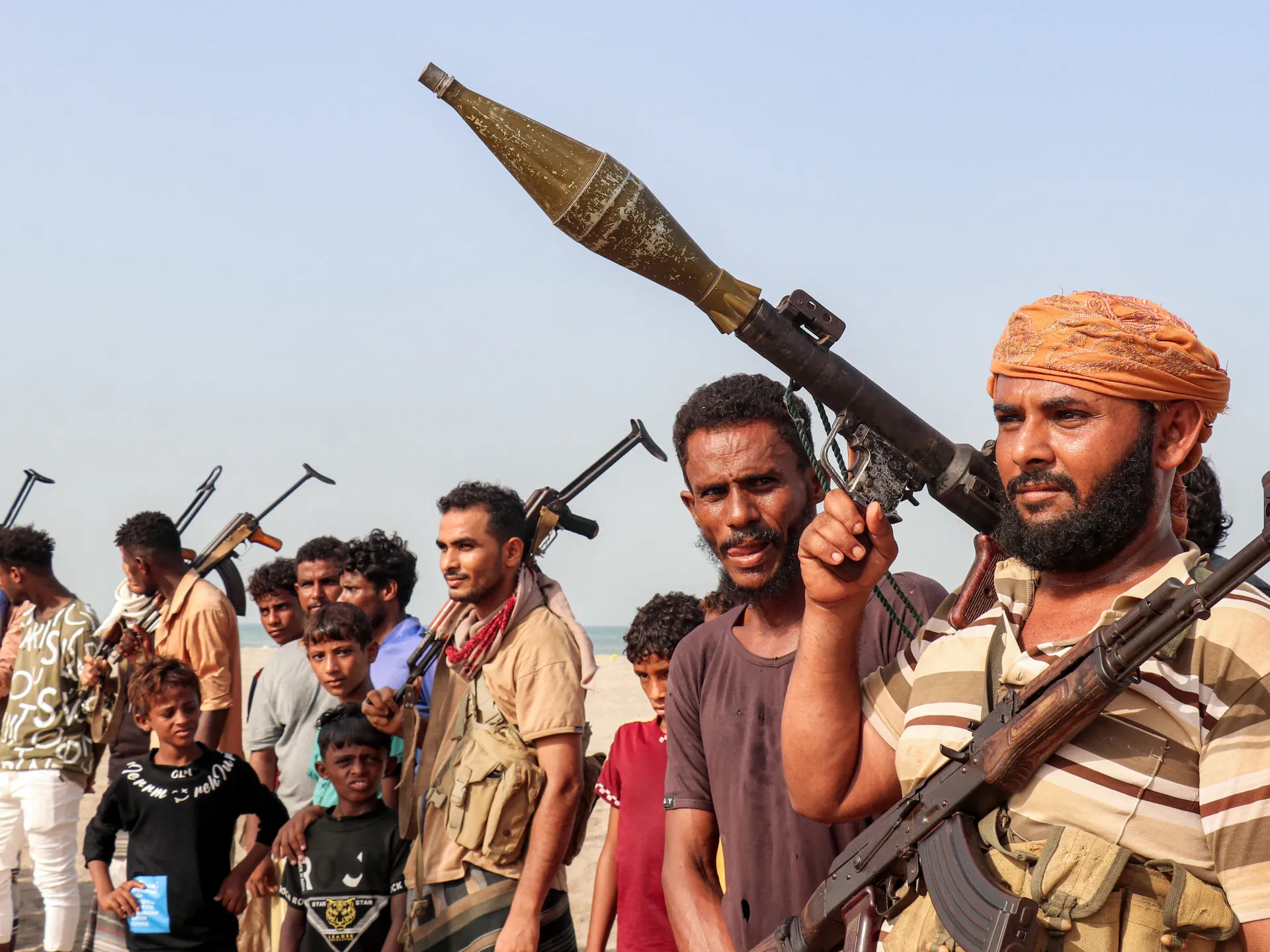
The conflict in Yemen has entered a new chapter with a declaration by the Houthis that they are imposing a maritime siege on all shipping to Saudi Arabia.
This development has placed the Bab al-Mandeb Strait, the strategic waterway that connects the Red Sea to the Gulf of Aden and the wider Indian Ocean, at the heart of the war between the United States and Iran, and amplifies pressure on global trade routes.
The Iranian-backed Houthis, who seized Yemeni capital Sanaa in 2014, have threatened to close the strait, the route through which much of Europe’s energy supplies pass. It is also a key passage for imports to Saudi Arabia.
The Houthis’ decision to announce a maritime blockade cannot be separated from the turmoil created by the ongoing war between Washington and Tehran, which erupted on February 28 when the US and Israel attacked Iran.
Houthis raise stakes for Saudi’s support
On Monday, Yemen’s internationally recognised government claimed responsibility for an air strike on Sanaa airport, saying that it was a measure to prevent an Iranian plane from landing in Yemen’s Houthi-controlled capital. But the Houthis blamed Saudi Arabia for it.
The Houthis responded by firing missiles into Saudi Arabia – a key backer of the Aden-based Yemeni government – and later upped the stakes by announcing a naval blockade on the kingdom.
These developments mark a major escalation in Yemen’s civil war. Saudi Arabia, which has sought in recent years to avoid a new war on its southern borders, is facing a more complex equation with the threat shifting from land to sea, and the targeting of one of the most important alternative routes for its oil exports.
All of this raises the question: will this escalation cause a new confrontation between the Yemeni government and the Houthis? And if so, what does the balance of power look like between the Houthi and government sides after more than a decade of war? Has the balance changed enough to increase the odds of a military resolution to the conflict?
There has been talk of potential escalations in recent years, but this now seems more likely, especially since it intersects with local, regional and international events and the return of the US-Iran war.
The Yemeni government has restructured its military with a single decision-making centre, and regional messages suggest the military option has not been shelved, as was once thought.
So, will retaking Sanaa return to the table as a military objective to be thought of seriously, and what does that mean practically? And how ready are the parties, especially the Yemeni government, for battle?
The structure of government-affiliated forces
The anti-Houthi camp today comprises the National Army as the official framework of the Ministry of Defence, in addition to new formations with independent commands, such as the Giants Brigades, and the Guardians of the Republic forces in al-Makha, or Mocha, in the west.
These different groupings – all on the anti-Houthi side in the conflict – have emerged over the years due to the weakening power of the central government, the growth of independent figures, and the backing of regional countries.
The number of National Army personnel in the field is estimated at about 400,000, according to recent statements by the Defence Ministry. Its organisational structure includes Yemen’s seven military regions, but troop deployment is concentrated in Marib, Taiz and the country’s southern and eastern governorates, as a result of Houthi control over vast parts of the country’s northwest, including Sanaa.
Also backing the army are the Emergency Forces, comprising between 30,000 to 40,000 personnel, and the Homeland Shield Forces, created in 2022 with between 30,000 and 40,000 recruits, and tasked with taking over camps in Hadramout and the southern governorates in December 2025, following the defeat of separatist forces who previously controlled those areas.
Fighting late last year between the Yemeni government and affiliated forces on one side, and United Arab Emirates-backed separatists on the other, has led to changes in Yemen’s south and west.
After the defeat of the 75,000-strong separatist Southern Transitional Council, following a Saudi intervention on the side of the government and the withdrawal of the UAE from Yemen, the group’s organisational cohesion has been impacted. But they have not been disarmed, and remain in many locations in the south, with some elements absorbed – even if nominally – into government structures.
Another formerly-UAE backed force, the Tariq Saleh-led Guardians of the Republic, is estimated to number about 20,000 fighters. They are stationed primarily on the Red Sea coast and are considered among the most heavily armed formations, due to the past Emirati support.
The Giants Brigades are among the most prominent combat formations in the anti-Houthi camp, with an estimated 20,000 fighters and a presence on the Red Sea coast, in Aden, and in some southern areas.
Consequently, the total size of the forces affiliated with the government and the anti-Houthi camp is estimated at more than 500,000 personnel, albeit with a clear disparity in levels of training, discipline and institutional integration.
Quality of armament and military equipment
The types of weapons held by these forces do not differ as significantly as the level of their operation and management. The National Army relies on conventional weapons inherited from the Yemeni army pre-war, including light and medium weapons, armoured vehicles, tanks and field artillery, alongside various communication and transport capabilities.
The Homeland Shield Forces, backed by Saudi Arabia, are considered among the most relatively well-equipped modern formations. They rely on tactical vehicles, light armoured vehicles, and superior communication systems suited for rapid deployment missions and the protection of institutions.
The Emergency Forces rely on light to medium armament focused on urban operations and rapid deployment missions, more akin to a field military force with rapid intervention duties, combining a security character with combat capability.
The Giants Brigades rely on medium and heavy armament, armoured vehicles and fire support units, and they are recognised for their capability to conduct offensive ground operations compared with other forces.
As for the formations affiliated with the Southern Transitional Council, they rely on diverse weaponry, though readiness varies as a result of the organisational changes they have undergone.
In recent years, the majority of government forces have also developed their drone capabilities, both within regular units and some irregular formations. These assets are now used for reconnaissance and surveillance missions, and occasionally for limited tactical support.
Balance of power with the Houthis
Official military records in Sanaa indicate that Houthi-affiliated army units comprise more than 200,000 fighters and can also mobilise tens of thousands of members from their volunteer Popular Committees for rapid intervention and support.
However, these figures, much like the military rosters in the government camp, may not accurately reflect the actual combat strength on the ground due to the inclusion of reserve or inactive names in registries.
Although government-affiliated forces may possess more manpower, the balance of power in Yemen is not determined solely by numbers.
Despite sustaining significant damage to its forces and assets from US and Israeli strikes over the past few years, the Houthi side benefits from a more centralised command structure and possesses experience in managing asymmetric warfare.
This is in addition to possessing missile, drone and maritime threat capabilities that have proven their impact in the Red Sea and the Bab-al-Mandeb Strait. It appears that the military balance in Yemen is more a balance of organisational and war management rather than a balance of weaponry and numbers.
Readiness of government forces for a major battle
Indicators suggest government forces are capable of engaging in defensive battles, holding territory or managing extensive security deployments. However, they face significant challenges should they consider launching a large-scale offensive.
The most prominent of these challenges was the multiplicity of military decision-making centres – before Saudi Arabia assumed control of this decision-making following the UAE’s withdrawal – and the varying levels of training and discipline, compounded by the difficulty of operational coordination.
Geography is also a factor, as the Houthis’ control over the mountainous northwest grants them a defensive advantage, whereas government forces are dispersed across multiple fronts, limiting their ability to mobilise at a decisive point.
The scenario of entering Sanaa
So far, there are no clear public indications that any international power, including the US, has adopted a declared plan to support a large-scale military operation to take Sanaa.
Although Houthi attacks in the Red Sea have elevated the level of international interest in the Yemeni file, the international strategy has been focused on degrading Houthi capabilities related to the sea and smuggling, rather than on a ground offensive. However, reports have emerged from sources within the Yemeni state regarding a possibility of waging a war against the Houthis with US support.
If an operation towards Sanaa is considered, its success would require complex conditions, most notably unifying the government’s military command, providing broad domestic and regional political cover, and ensuring the ability to manage the city after seizing control of it. Some of these conditions may have already been met.
Has Saudi Arabia provided cover to confront the Houthis?
The Yemeni government’s military decision-making is largely tied to Saudi political and military support, and any broad move against the Houthis remains contingent upon Riyadh. But Riyadh has preferred to focus on protecting the kingdom’s southern borders, securing shipping lanes and preventing the expansion of the Houthi threat deep into Saudi territory.
It seems that Saudi strategy has previously leaned towards managing the conflict rather than resolving it, by combining limited military pressure, diplomatic moves and de-escalation tracks to reduce the security and economic costs of the war.
The Saudi position may have shifted recently in light of international and regional events, particularly concerning the security of navigation in the Red Sea. Riyadh may be pushed to re-evaluate its options regarding the Yemeni file, and the one currently on the table may be a military one.
As EastEnders’ king-hearted teen Barney Mitchell lands himself in hot water, let’s take a look inside the life of actor Lewis Bridgeman.
Barney arrived in Walford back in June 2024(Image: BBC/Jack Barnes/Kieron McCarron)
EastEnders has aired shock scenes for the teenagers of Walford this week, and Barney Mitchell could be hiding a very dark secret.
Actor Lewis Bridgeman arrived on the BBC One soap in the summer of 2024, alongside his dad, Teddy (Roland Manookian), and Harry (Elijah Holloway), and drama quickly followed.
It was soon revealed that self-confessed bookworm Barney is the product of an affair between his mum, Nicola (Laura Doddington), and Zack Hudson (James Farrar), leaving both Barney and Teddy devastated by the truth about his paternity.
Sweetheart Barney appears to be an innocent extension of the Mitchell family with a passion for friendship and education, but the schoolboy is now taking center stage, as he may be hiding a sinister side following a violent incident involving Joel Marshall (Max Murray).
In recent episodes of the BBC soap, Joel returned to Walford following a six-month prison sentence for violently attacking his step-mum, Vicki Fowler (Alice Haig), who was determined not to live under the same roof as the tearaway teen.
He soon realised he was not welcome in the Square and planned to leave without saying goodbye to his dad, Ross Marshall (Alex Walkinshaw). However, before Joel left the Square, he was attacked by Walford’s teenagers who tied him to a fence and soaked him in beer while making fun of him.
Lily Slater (Lillia Turner), Avani Nandra-Hart (Aaliyah James), Amy Mitchell (Ellie Dadd), Nugget Gulati (Juhaim Rasul Choudhury), Ricky Branning (Frankie Day), Denzel Danes (Jaden Ladega), and Barney Mitchell (Lewis Bridgeman) later went back to free Joel after Will Mitchell (Freddie Phillips) ordered to let him go.
But when they returned, Joel was found unconscious on the floor with a serious head injury. On Thursday (July 23), the group was sickened by the sight of his body, and the police soon arrived at the scene.
DC Craig Ingram (Matthew James-Bailey) assured the teenagers were not under arrest as their parents gathered at the station, though they were all witnesses to the assault.
The group later gathered in The Arches to get their story straight as Joel received treatment in the hospital, but Barney looked visibly sheepish.
Harry Mitchell (Elijah Holloway) arrived and told them to leave, saying that the garage owner, Phil Mitchell (Steve McFadden), would be furious if he knew they’d used his premises as a meeting point. It then transpired that Barney had taken his spare key.
With everyone gone, Barney asked his brother if he’d found anything. Harry pulled a carrier bag from his coat that contained a hammer and said he needed to know everything. Did Barney attack Joel?
Who plays Barney in EastEnders?
Barney Mitchell is played by actor Lewis Bridgeman. The 19-year-old actor was born in Maldon, Essex, and attended Plume School with aspirations to become a drama teacher or an actor from a young age.
In 2021, Lewis joined the National Youth Theatre, which allowed the soap star to participate in workshops and stage productions and opened up opportunities for professional acting contracts.
The young actor has since appeared in various theatre productions, including The Wind in the Willows and Goodnight, Mister Tom.
Lewis’ talents do not stop at acting, as the soap star is also very intelligent. At the age of 12, he took Mensa International’s acceptance test and passed, indicating an IQ above 132 and placing him in the top 2% of the world’s population.
Lewis has been diagnosed with autism and dyspraxia, and his mother, Jayne Bridgeman, was worried he would struggle at school.
“Lewis has wanted to become an actor since the age of six,” proud mum Jayne told Maldon Standard in 2021.
“He adores everything to do with theatre and film. I’m very proud, I love the theatre, and we geek out together on Star Wars and Marvel things.”
Lewis went on to achieve four grade 9s and studied drama at A-Level whilst attending Chelmsford Drama Centre at weekends.
He landed the role of Barney Mitchell in EastEnders in 2024, with his first scene airing the same summer.
EastEnders airs Monday to Thursday on BBC One and iPlayer
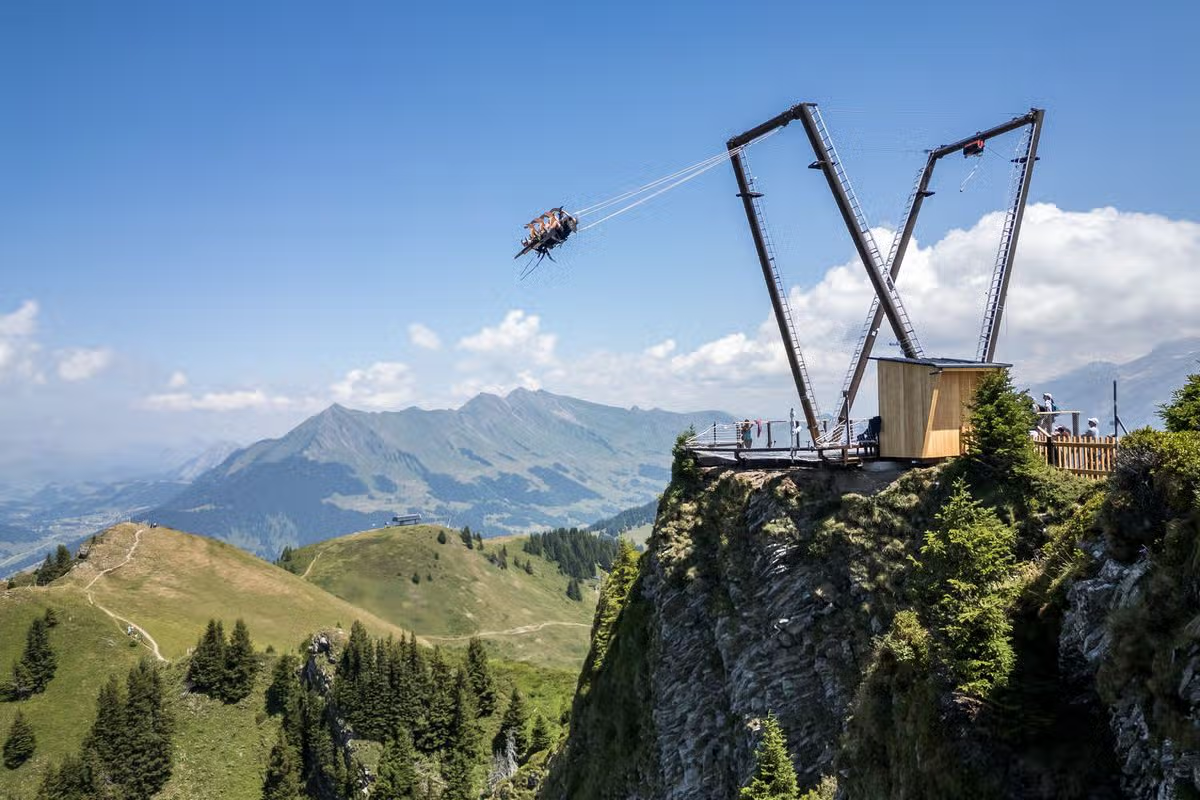
A giant mountain swing is sending visitors soaring more than 2,000 metres above the Swiss Alps as ski resorts look for new ways to attract visitors beyond the winter season
The Balanc’Air swing opened earlier this month(Image: AFP via Getty Images)
Thrill-seekers can now soar over the Swiss Alps on a giant mountain swing that launches riders over the edge of a cliff.
Visitors to the Villars ski resort can now brave the BalancAIR swing, a 12-metre-high attraction perched 2,110 metres above sea level that sends up to three people at a time soaring out above a dramatic Alpine drop. Riders are strapped into saddle-style seats fixed to a structure resembling an Alpine Ibex before being hauled backwards to a 90-degree angle and released high above the valley below.
Alexandra Henchoz, 37, admitted she was nervous before testing the attraction with her husband and 10-year-old daughter. She said she: “I had a bit of a pit in [her] stomach” before she was strapped in to the harness.
“But once it is happening, it is just incredible. You feel like a bird flying,” Alexandra added.
The swing, which opened earlier this month, forms part of the resort’s efforts to attract more visitors outside the traditional ski season as Alpine destinations adapt to the effects of climate change. Martin Deburaux, head of the Villars-Gryons-Diableret ski area, said: “We are really trying to diversify our offering.”
The 12-metre swing “provides us with a source of attraction that can function independently of snow conditions”, he said. Although the resort has enjoyed record winter visitor numbers over the past two seasons, Martin said warmer conditions meant planning for the future was essential.
He added: “But we know we are facing climate change. We are looking for substitutes to conserve jobs, the dynamism and the tourist economy built up around our ski lift facilities.”
The resort currently welcomes more than 700,000 visitors during winter but around 100,000 over the summer, now busses hope the new attraction will help draw more visitors outside the ski season in a bid to boost off-season tourism.
Among those giving it a go was Marc Truffer, 70, who admitted the experience left him both frightened and amazed. He said: “It was so scary… I didn’t even scream.
“It took my breath away going down, but then the view was magnificent.”
The Rams, as is seemingly their custom with a Super Bowl scheduled to be played at SoFi Stadium, made blockbuster trades to improve an already star-studded roster.
Players will report to training camp Saturday at Loyola Marymount as favorites to win Super Bowl LXI in their home stadium in February.
Much, however, can go awry on the way to the NFL’s biggest showcase.
Injuries, subpar performances by Rams players and coaches, and outstanding clutch play by opponents — see the 2025 Super Bowl-champion Seattle Seahawks — could derail the Rams’ presumptive date with destiny.
On Sunday, they will hold the first of 11 training-camp practices before preseason games against the Kansas City Chiefs, New Orleans Saints and the Chargers.
Here are six things to watch in training camp:
Quarterback Matthew Stafford’s workload
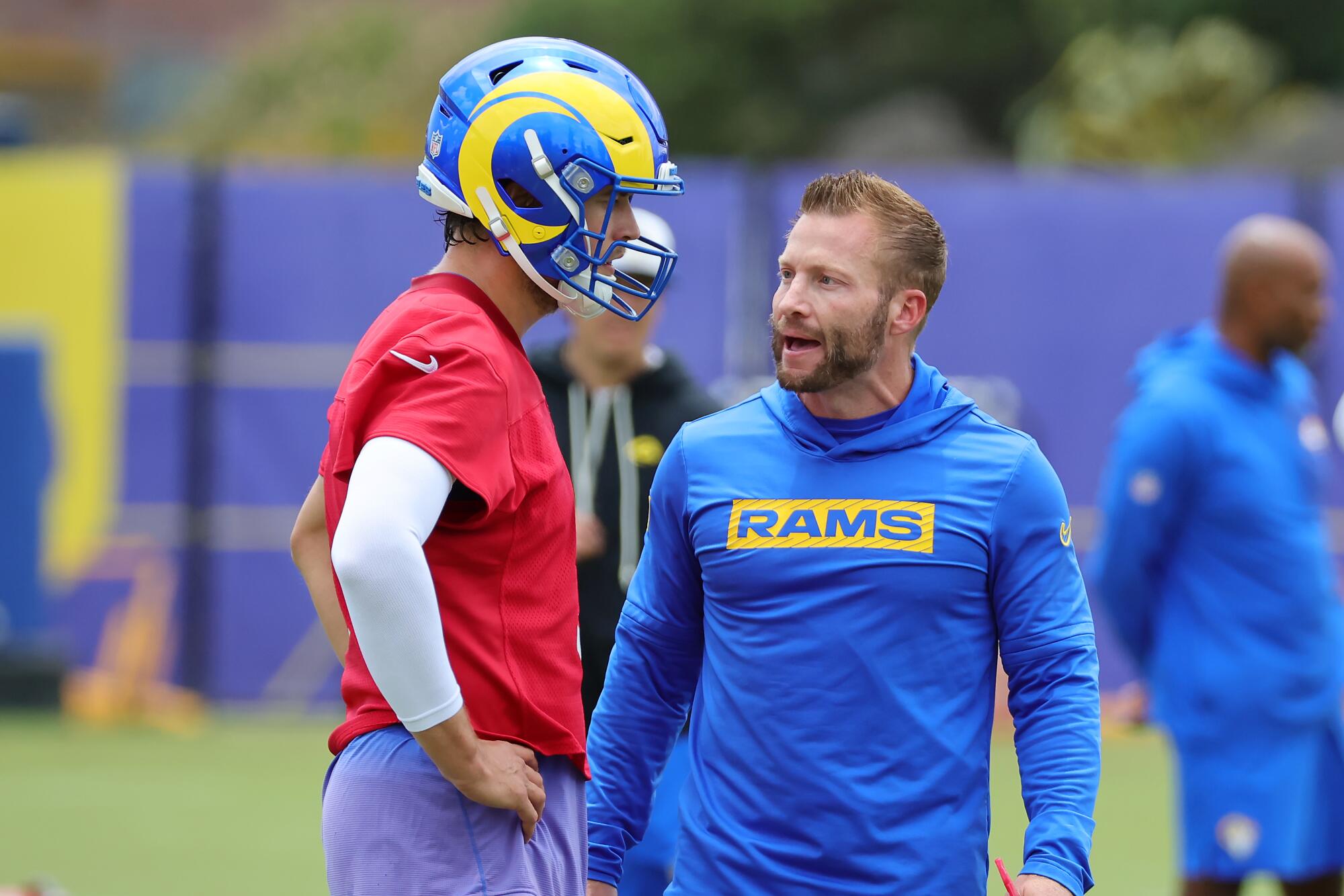
Rams quarterback Matthew Stafford speaks with coach Sean McVay during an organized team activities workout in May.
(Kevin Terrell / Getty Images)
In 2025, because of a back issue, Matthew Stafford did not take a single training-camp snap.
The lack of on-field preparation did not appear to adversely affect him: Stafford eventually tested his fitness after training camp ended — and he went on to win the league’s most valuable player award for the first time.
So the Rams learned from the experience. Preseason inactivity is not necessarily a bad thing for a 17-year veteran who has thrown more than 9,000 passes in regular-season and playoff games and thousands more in practices.
McVay is expected to limit the 38-year-old Stafford’s participation in full-team drills.
Without the luxury of veteran Jimmy Garoppolo running the offense, rookie Ty Simpson, the 13th pick of the NFL draft, and fourth-year pro Stetson Bennett will get plenty of snaps with the starters and with backups during preseason games.
The Myles Garrett effect
Rams defensive end Myles Garrett, left, speaks during a news conference while sitting next to coach Sean McVay on June 2.
(Ric Tapia / For The Times)
The Rams in June made the biggest and boldest move of the offseason when they traded for defensive end Myles Garrett, a two-time NFL defensive player of the year who amassed an NFL record 23 sacks last season for the Cleveland Browns.
Garrett joins a front that includes outside linebacker Byron Young and interior linemen Kobie Turner, Braden Fiske, Poona Ford and ….
Donald?
The Rams, at least publicly, are still waiting on a decision from the three-time NFL defensive player of the year who retired after the 2023 season. If Donald does not make his plans known before report day, it will not stop speculation about a return before or during the season.
Who will be the third receiver?
Rams wide receiver Xavier Smith catches a pass in practice in May.
(Jayne Kamin-Oncea / Associated Press)
Puka Nacua spent part of the offseason in rehab and is the defendant in a civil lawsuit. During organized-team activities, he appeared fit and sounded determined to build on an All-Pro resume that could eventually earn him a record-setting contract.
After discussing trading Davante Adams for A.J. Brown, McVay and general manager Les Snead ultimately chose to stick with the 13th-year pro and future Hall of Famer, who last season led the NFL with 14 touchdown catches.
During the draft, the Rams passed on the opportunity to select former USC receiver Makai Lemon and opted instead to pick Simpson, Stafford’s heir apparent.
With much-loved but seldom-used Tutu Atwell now playing for the Miami Dolphins, Xavier Smith, Jordan Whittington, Konata Mumpfield and rookie CJ Daniels will compete for the opportunity to be a third receiver.
Secondary as primary strength
Rams cornerback Trent McDuffie participates in drills during practice in May.
Both played in three Super Bowls for the Kansas City Chiefs, winning two.
They join safeties Quentin Lake and Kam Curl — both of whom received extensions — to give the Rams one of the strongest units in the league.
Cornerback Emmanuel Forbes Jr. and safeties Kamren Kinchens and Jaylen McCollough provide depth and experience.
Jimmy Lake replaced Aubrey Pleasant as defensive backs coach.
Offensive line depth
Rams guard Steve Avila, right, blocks defensive tackle Poona Ford in practice in May.
(Jayne Kamin-Oncea / Associated Press)
Left tackle Alaric Jackson will not face criminal charges for a domestic incident that resulted in his arrest in June. But the NFL could still suspend Jackson, who in 2024 was forced to sit out two games for violating the league’s personal-conduct policy.
Warren McClendon Jr., the starting right tackle, has experience playing on the left side. Rookie Keagan Trost and veteran David Quessenberry could compete to back up Jackson.
McClendon, guards Kevin Dotson and Steve Avila and center Coleman Shelton are in the final year of their contracts. Jackson is signed through 2027, though his salary is not guaranteed, according to Overthecap.com.
Special teams
Bubba Ventrone will be tasked with helping the Rams turn around their special teams unit in 2026.
(Brevin Townsell / Los Angeles Rams via the Associated Press)
Last season, the Rams lost several games that featured major special teams breakdowns.
An armed student rallies in support of the Houthi-imposed naval embargo against Saudi Arabia in Sanaa, Yemen, Wednesday. Hundreds of students gathered at Sanaa University to support the move. Photo by Yahya Arhab/EPA
July 23 (UPI) — The Houthis in Yemen claimed responsibility for two attacks on Saudi oil tankers in the Red Sea with missiles and drones.
The Iran-backed Houthis, who have been fighting for control of Yemen, claimed on Wednesday that they had hit the Encelia and the Layla oil tankers, which they said were violating their blockade of Saudi ships. They had announced the blockade on Monday.
Saudi Arabia’s transportation authority confirmed the attack on the Encelia in a statement. It said there was a fire on board but the crew were all safe. It didn’t mention the Layla.
Houthi military spokesperson Yahya Saree said the group promised to continue naval operations and would continue “enforcing the ‘siege for a siege’ equation,” the BBC reported.
The Houthis claimed they had also forced “10 ships to retreat and return.” That claim could not be independently verified, The Times said, but at least six vessels reversed course in the Red Sea on Monday and Tuesday after the Houthis warned shipping companies to avoid Saudi ports, according to Kpler, a maritime data company. It was not clear if those ships were part of the Houthis’ claims.
The Saudis and the Houthis have been in an effective cease-fire since 2022. But last week, tensions flared when the Houthis accused the Saudis of striking the airport in Yemen’s capital Sanaa. The spat came from a dispute when an Iranian plane had tried to land at the airport.
The Houthis then attacked the Abha airport in Saudi Arabia.
When the Houthis announced the “maritime embargo,” they didn’t give many details. But a media official said they would close the Bab al-Mandab Strait. That strait is on the other side of the Arabian Peninsula from the Strait of Hormuz. It’s the gateway between the Arabian Sea and the Red Sea, and blockades of both straits would cut off Saudi Arabia ships entirely.
The United States and Iran continued to trade attacks for the 12th consecutive night after the cease-fire between the two countries ended.
Astronaut Buzz Aldrin walks on the surface of the Moon during the Apollo 11 mission on July 20, 1969. Photo by NASA/UPI | License Photo
New data released on Thursday showed that UK petrol prices have risen by 5p a litre since the beginning of July, hitting reaching almost £1.56.
Diesel is at £1.72 a litre, on average, according to the RAC.
Average gasoline prices in the US have surpassed $4 a gallon once more, up from $3.92 a month ago, according to motorist advocacy group AAA.
“More expensive fuel and energy can ripple through the wider economy, increasing costs for businesses and ultimately feeding through into the price of food and other goods,” said Jonathan Raymond, investment manager at Quilter Cheviot.
“This creates another headache for central banks as they continue their battle against inflation.
“If energy prices remain elevated, policymakers may come under pressure to keep interest rates higher for longer or even raise them. This would come as a blow to mortgage holders and borrowers already feeling the strain.”
The Bank of England, which sets UK interest rates, has held them at 3.75% in its last four meetings.
Paul Dales, chief UK economist at Capital Economics, said he believed the Bank will “almost certainly” hold them again. But he said analysts still expected that interest rates could be cut next year if energy price rises ease.
Kevin Warsh, the newly-appointed chair of the US Federal Reserve, last week told Congress that the central bank had “no tolerance to persistently elevated inflation”.
US President Donald Trump had pushed Warsh’s predecessor, Jerome Powell, to cut interest rates.
Trump has made it clear he expects Warsh to fulfil his demand for reductions in borrowing costs for Americans.
But the Fed held US interest rates between 3.5% and 3.75% at Warsh’s first meeting last month. He also told Congress that he was committed to “restoring price stability” in the wake of the Middle East conflict impacting prices.
A NEW 34-mile coastal path linking two pretty English villages has opened today.
It will give hikers access to previously unwalkable routes and forms part of a huge coastal path project.
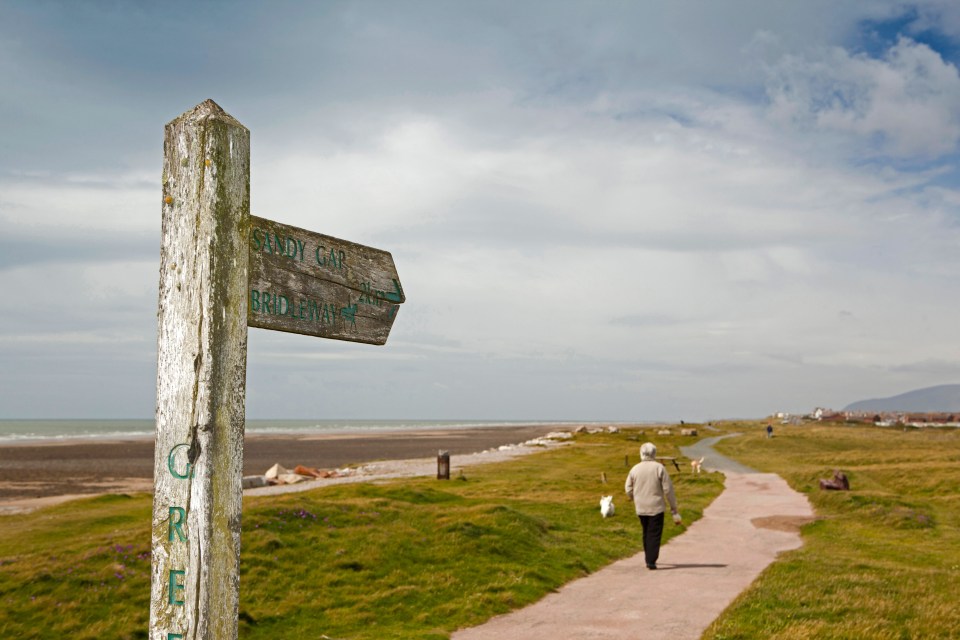
A new section of coastal path has been opened today in Cumbria (stock photo)Credit: Alamy Stock PhotoVisitors will be treated to coastal views around the region and gain access to previously unwalkable areas (stock photo here of St Bees in Cumbria)Credit: Getty Images
A major new 34-mile section of the King Charles III England Coast Path has officially opened today, Thursday July 23.
Running between Foxfield and Greenodd, the opening of the path is the latest milestone in completing the 200-mile coastal stretch from Gretna to Silverdale, on the Lancashire border.
Sign up for the Travel newsletter
Thank you!
The new opening now brings the grand total of walkable Coast Path in the North West to around 208 miles.
Those looking to walk the path will be treated to charming coastal communities, nature reserves and historic industrial landscapes.
When fully complete, the King Charles III England Coast Path will become a 2,700-mile stretch around the entire English coast.
The National Trail route is set to be the longest managed coastal walking route in the world.
From today, walkers can now explore the new section of path located on the eastern edge of the Furness Peninsula.
The new section of path is a key milestone in the delivery of the 70-mile stretch of coastal route from Silecroft to Silverdale.
Winding through a number of coastal communities, visitors will pass by Kirkby-in-Furness, Askam-in-Furness, Barrow-in-Furness, Bardsea and Ulverston, before crossing the Leven Estuary.
The route also offers views of Morecambe Bay and passes the end of the Ulverston Canal.
Walkers can also spot a number of distinctive slag banks, sand dunes and an abundance of wildlife along the path.
The delivery of the new path will move visitors away from previously unavoidable shores, leading to a greater discovery of the area’s coastal landscape.
Natural England deputy director for Cumbria, Claire Argent, said: “The Furness Peninsula is one of those places that genuinely takes your breath away, whether you’re watching the light change across Morecambe Bay, listening for curlews over the estuary, or discovering the layers of history tucked into these coastal communities.
“This new stretch of the King Charles III England Coast Path gives people the chance to experience all of that on foot, safely, sustainably and responsibly, whilst learning about and caring for our wonderful landscapes and nature.
“We’re proud to see this route taking shape and look forward to completing the full 200-mile Cumbrian stretch.”
The path is located on a mix of existing public rights of way, permissive access routes and new access.
Councillor Adrian Waite said the project was a “huge job” which required “securing contracts and permissions, specifying work, getting quotes, managing the contractors and liaising with landowners”.
The cabinet member for Environmental Services and Transport at Westmorland and Furness Council said the teams had put in “more than 300 signs and waymark posts, 10 sets of steps, 23 bridges, around 60 gates” and five kilometres of fencing and surfacing.
Anyone looking to grab their hiking boots and try out the coastal path is reminded to follow the Countryside and Coastal codes when walking the route.
Travellers are also warned to exercise caution around Morecambe Bay, as fast-moving tides and quicksands in the area could be dangerous when venturing onto sands and saltmarshes without an experienced guide.
A wartime science fiction thriller is available on BBC iPlayer and viewers are hooked
The Sentinels is set during the war
A World War I drama hailed as “brilliant” by viewers is available to stream now.
The Sentinels, an eight-part French wartime sci-fi series from STUDIOCANAL, has been snapped up by the BBC and can currently be viewed on BBC iPlayer.
Starring Louis Peres, the series was drawn from the graphic novels Les Sentinelles by Xavier Dorison and Enrique Breccia and is billed as an “adrenaline-drenched steampunk-style thriller”.
It follows a soldier, played by Louis, who who has been injected with a super serum and joins an elite unit on a mission to end the fighting.
“At the outbreak of World War I, Gabriel Ferraud – a gravely wounded soldier – is recruited into a top-secret French military programme designed to create the ultimate weapon: enhanced humans,” said a synopsis.
“After being injected with a mysterious serum, Gabriel gains extraordinary strength, speed, and resilience. He joins an elite unit known as the Sentinels – augmented soldiers forged for the front lines.”
However, as the conflict goes on, Gabriel discovers “a terrifying truth”.
“The Sentinels is a fully immersive war drama, drenched in adrenaline,” said Nick Lee, head of BBC programme acquisition. “Prepare for something totally different and unforgivingly entertaining.”
The series has won over viewers, with one posting on IMDb.com: “If you like superheroes (antiheroes), war movies and aren’t afraid of some action with a touch of grim dark sci-fi in a first world setting… then you’ll love this!”
Another wrote on review site Rotten Tomatoes: “This is absolutely brilliant if you’re into war dramas, thrillers and superheroes. The characters are well developed, both protagonists and antagonists – there’s three main storylines which are all equally compelling, and the action set pieces are entertaining bringing all the gritty brutality of fighting on the Western Front combined with the dirty combat. All in all, something different to the usual.”
“I thought this show absolutely ruled and hope to see more seasons,” another viewer commented on Reddit.
“This was a really great watch,” agreed somebody else. “Loved the costume design, and the action wasn’t cringy and badly done like a lot of shows.”
A CLOSED theme park set to become a new housing development will reopen for one last hurrah.
Camelot Theme Park in Chorley was once a beloved theme park for families but closed back in September 2012.
The abandoned Camelot Theme Park will host a scare eventCredit: AlamyThere will be nine different scare zones across the parkCredit: Scare City
Now, a huge event has been announced for the abandoned park before it disappears for good.
Scare City – who are responsible for some of the best scare events in the UK – are planning to open its “largest, darkest and most psychologically brutal evolution to date” at the park.
Sign up for the Travel newsletter
Thank you!
As part of the experience, visitors will be able to see areas never seen by the public before, including a never-used entrance.
The event will be spread across nine different zones, of which many of the themes are yet to be announced.
One zone confirmed is CarniValley, which will feature outcasts and a carnival-like atmosphere, albeit more creepy.
However, Scare City has confirmed that it will be the “most intense event yet”.
Adding on its website that: “What was once a kingdom of rides and laughter has become a sprawling nightmare of darkness, fear, and chaos.”
There will be towering outdoor sets, different pathways to the scare zones, live actors – and they will all be in the decaying former attractions of Camelot.
Camelot Theme Park closed back in 2012Credit: Not known clear with Picture Desk
Scare City has been running at Camelot for the past five years, but this will be the last year before the abandoned theme park is turned into a large housing estate.
The event will run from September 26 to November 7.
New research shows more Brits have visited the Eiffel Tower than some of Britain’s most iconic landmarks, with cost of living and lack of time cited as the main barriers to exploring closer to home.
Sand sculptures on Blackpool promenade
Britons are more likely to have visited landmarks overseas than those on their own doorstep, according to new research.
A survey of 2,000 adults found that more people have laid eyes on the Eiffel Tower (55%) than some of Britain’s most beloved landmarks, including the Tower of London (54%), Tower Bridge (53%) and Trafalgar Square (52%). The findings also revealed that people were better at identifying foreign landmarks than those closer to home.
More than three quarters (78%) of respondents could identify the Eiffel Tower, while 71% recognised the Leaning Tower of Pisa and 61% could identify Rome’s Colosseum. By contrast, fewer people were able to recognise St Paul’s Cathedral (58%), Westminster Abbey (53%) and Edinburgh Castle (52%).
In honour of these landmarks, Railcard.co.uk, which commissioned the research, collaborated with ‘Sand in Your Eye’ to craft a variety of attractions and famous sights from across Britain in sand. The sculpture was revealed on Blackpool promenade and will stay there for the public to view until the weekend.
Constructed using 12 tonnes of sand and taking three days to complete, the creation showcases the attractions topping Brits’ wish lists: Tower of London (22%), Edinburgh Castle (18%), Stonehenge (18%), Eden Project (18%) and Scotland’s Loch Ness (18%).
Catherine Lyver, from railcard.co.uk, which commissioned the research to encourage Brits to make the most of British landmarks by offering a third off travel for adults and 60% off for children, said: “It’s easy to overlook the iconic landmarks and hidden gems on our doorstep, yet Great Britain is full of incredible places to explore.
“We’re encouraging people to do a third more with their break, making it easier and more affordable to tick off some of the bucket-list-worthy destinations closer to home.”
“Whether you’re still looking to tick off historic favourites like the Tower of London or have added the modern Eden Project to your list, there are plenty of opportunities to make your summer go further when you travel by train.”
The overwhelming majority in the OnePoll.com survey for railcard.co.uk (79%) said they would like to discover more British landmarks – but the cost of living (43%) and lack of time (33%) are the primary obstacles preventing them.
When visiting British landmarks 23% will travel by train, because it’s relaxing (59%), more convenient (46%) and don’t have to worry about parking (43%).
Unity Holidays has three parks across the UK that still have availability over the summer holidays – and they’ve got a food and drink offer on too
This article contains affiliate links, we will receive a commission on any sales we generate from it. Learn more
A rendering of the parks
The summer holidays have officially descended upon us, and with the British weather actually offering up some sunshine and balmy temperatures, it’s no surprise that most of us are dreaming of our next staycation.
If you haven’t got anything locked in yet, the good news is that there are still plenty of tempting deals to be had, including one chain of holiday parks with family breaks under £400 including school holiday dates.
Unity Holidays recently gave its parks a £10million transformation to include new features such as lidos, splash parks, trampoline parks, dog agility parks and an array of activities from axe throwing to archery, so it’s worth having them on your radar. All alongside the likes of bars, restaurants, watersports, playgrounds and even soft play, it’s easy to see why it could be a hit with families on a budget this summer.
The brand has three sites, with prices for a family of four during the holidays from £209. That includes its Unity Beach in Somerset from £396, Skirlington in Yorkshire from £399, and Seven Lakes from £209, all of which can be booked on unityholidays.co.uk.
But that’s not all. For those who want to stretch their budget that little bit further, there’s more good news. For every summer break booked between July 3 and September 28, 2026, Unity Holidays are offering a £100 food and drink voucher that can be used at any of the venues on site (excluding the grocery stores). To claim the voucher, simply use the code UNITY100 when you book on unityholidays.co.uk.
Unity Beach’s brand new lido opened earlier this month, unveiled by former Olympic swimmer Baroness Sharron Davies MBE. The resort’s new lido, water park and festival gardens represented an £11million transformation, with the lido offering a capacity of over 400, with two heated pools including one specially designer for children. The holiday park already boasts an indoor pool, an indoor splash zone for Under-16s, two indoor water slides, and three more slides outside.
Baroness Sharron, who won an Olympics silver medal in the 400m individual medley in 1980 as well as two Commonwealth Games gold medals, said at the opening: “At a time when we are seeing the amount of swimming facilities in the country dwindle – we’ve lost 500 since 2010 – to have Unity Holidays investing millions in pools and lidos across the country, and creating jobs for local people, is tremendous.
“They are enabling children to gain water confidence and learn to swim, while giving families a stunning location to enjoy amazing spaces to play and relax.
“Our seaside towns need this injection of funds, and I was honoured to officially open the lido and water park in Brean while also seeing first-hand how impressive what a modern, 21st-century family holiday park has to offer can be.”
Unity Holidays isn’t the only firm to be offering up some tempting last-minute getaways.
FAMILIES were left disappointed as the main attraction at a seaside town was forced to close significantly sooner than expected.
A lengthy farewell message was issued to the community, thanking locals for their support.
The Sky Club Wheel had only opened in 2025 last yearCredit: Visit Eastbourne
Eastbourne beach has said goodbye to the popular Sky Club Wheel following the announcement it was closing for good.
The attraction was only opened to the public in April 2025 and following the announcement of its closure, it was intended to be operational until September 6.
Sign up for the Travel newsletter
Thank you!
However, the ride’s final day has already passed, July 20, almost seven weeks earlier than intended.
Eastbourne Council has previously confirmed the attraction was closing due to “commercial considerations.”
A spokesperson for Sky Club Wheel said: “It is with a heavy heart that we announce that Sky Club Eastbourne has now closed permanently.
“We’d like to sincerely apologise to everyone that was hoping to visit us again before the end of the season. Unfortunately, we had to close earlier than expected.
“To everyone who has visited us over the years – thank you. Whether you rode with family, friends, or simply came to enjoy the incredible views, you’ve helped create so many special memories, and we’re honoured to have been a part of them.
“The support we’ve received from local residents, visitors, businesses and our amazing team has meant more than words can say.
“We are incredibly grateful for every ticket purchased, every recommendation and every smile shared with us.
“Although this chapter has come to an end, the memories we’ve made in Eastbourne will stay with us forever.
“From the bottom of our hearts, thank you for all your support over the years. We wish the wonderful town of Eastbourne all the very best for the future.”
A MAJOR airport has launched the first in the UK robot car parking.
Travellers are now able to save time and avoid searching for a free parking spot as they leave their cars in the hands of robots.
Gatwick airport has launched first-ever parking robots in the UKCredit: Gatwick AirportThe robots automatically park your vehicle for youCredit: Gatwick Airport
London Gatwick Airport has introduced the new Robotic Parking system, which uses state-of-the-art robots to lift vehicles by their wheels and transport them to a secure parking space.
Instead of searching for a bay, drivers simply leave their vehicle inside a private drop-off garage before heading to the terminal.
Sign up for the Travel newsletter
Thank you!
The robot then takes over, gently lifting the car from underneath its wheels and moving it to an access-restricted parking area.
One of the biggest differences from traditional airport parking is that customers keep hold of their car keys throughout their trip.
When travellers return, their car is brought back ready for collection.
According to Gatwick, the system is compatible with around 95% of vehicle models.
The robotic parking area is located on the airport site and includes 24-hour security patrols, automatic number plate recognition (ANPR) at the entrance and exit, perimeter fencing, floodlighting, no public access and Park Mark Safer Parking accreditation.
The airport says the private garages are fully accessible and compliant with the Equality Act 2010, while the shuttle bus linking the facility with the terminal is also fully accessible.
Passengers using the service are just a short walk or shuttle bus ride from the terminal before beginning their journey.
A year after racking up more miles than any team in the NFL, the Chargers are homebodies.
For the first time in their 10 seasons in Los Angeles, they will open with back-to-back games on their home field — against Arizona and Las Vegas.
What’s more, one of their away games will be at SoFi Stadium, against the host Rams on Nov. 1.
Who knows if less time in an airplane will make a difference, but a franchise that hasn’t won a postseason game since the 2018 season will look for anything to change that trajectory.
It’s worth noting that Jim Harbaugh got his team to the playoffs in each of his first two seasons, and he has a history of turning around franchises in college football and the pros.
And, as they’ll show in training camp, the 2026 Chargers have made some significant changes.
Here are five things to watch in training camp:
Justin time
Chargers offensive coordinator Mike McDaniel speaks at a news conference on June 17.
(Eric Thayer / Los Angeles Times)
It’s the seventh season for Justin Herbert, and the star quarterback is on his fifth offensive coordinator. Will former Miami Dolphins coach Mike McDaniel be the play-designing architect to push him over the top and get him that elusive first playoff victory?
Already, McDaniel has done some tinkering and fine-tuning, tweaking Herbert’s footwork out of the shotgun formation to allow him to get the ball out of his hands a fraction of a second earlier. That should allow his receivers more time to turn up the field and bump up their yards-after-catch numbers.
The ball is coming out even before the receivers have turned their heads for it, and McDaniel has warned them the ball could hit them in the face if they’re not ready. It’s a way to neutralize the pass rush, too.
“If you’re getting the ball out quickly, there’s really nothing they can do about it,” Herbert said of defenders. “You’ve got to find a way to slow them down, and I think that’s just [McDaniel’s] way of taking them out of the game.”
Herbert has absorbed a lot of hits over the years, and he has leaned heavily on his arm strength too.
“In years past, you rely on your arm strength to put the ball exactly where you need to,” he said, “instead of trusting it and just throwing it to a spot and letting them go and get it.”
Next man up
Chargers defensive coordintor Chris O’Leary speaks at a news conference on June 17.
(Eric Thayer / Los Angeles Times)
Jesse Minter did such a solid job as defensive coordinator of the Chargers that he was hired as head coach of the Baltimore Ravens. So in steps his protege, Chris O’Leary, who coached under him at Georgia State and Notre Dame before spending the 2024 season coaching Chargers safeties. Then it was off to Western Michigan for O’Leary last season, where he was defensive coordinator — a year of experience in that job before returning to replace the departing Minter for the Chargers.
If it ain’t broke, don’t fix it. That’s expected to be the philosophy of O’Leary, who tutored his Western Michigan players by showing them tapes of the Chargers.
That said, he’s probably not going to follow Minter to the letter. He likely will have the same coverage schemes and rely just as much on All-Pro safety Derwin James, but his defenses might blitz more than Minter’s (the Chargers were near the bottom of the league in that category in 2026) and will look to turn first-round pick Akheem Mesidor into a pass-rushing star.
Odafe Oweh, acquired during the 2025 season in a trade with Baltimore, will play for the Washington Commanders this season. Mesidor, a linebacker who played collegiately at West Virginia and Miami, was selected 22nd overall.
It’s all on the line
Chargers offensive tackle Joe Alt participates in a drill at minicamp in June.
(Eric Thayer / Los Angeles Times)
The Chargers have huge draft capital invested in their offensive line — including spending first-round picks on bookend tackles Rashawn Slater and Joe Alt — and that was supposed to be a strength of the team last season. That went off the rails early, however, with the team losing Slater to a season-ending injury in training camp and Alt soon after the season started.
The line wound up being a disaster with a reshuffled cast virtually every week. One of the few fixtures was center Bradley Bozeman, who Pro Football Focus rated 40th out of 40 players who qualified at that position. He retired after the season.
The Chargers have a new center in Tyler Biadasz, who was released by the Commanders in a cost-cutting move, and Alt (ankle) and Slater (knee) are cleared and ready to go. If this unit can stay healthy, it will look a lot different — and a lot better — than the 2025 version.
Beginning of the ends
Chargers tight end David Njoku speaks during a news conference on May 19.
(William Liang / Associated Press)
In the not-too-distant past, the Chargers had one of the NFL’s premier tight ends in Antonio Gates, enshrined in the Pro Football Hall of Fame last summer. Since, the team has had more downs than ups at the position, although it saw some flashes last season from rookie Oronde Gadsden II, a talented pass catcher.
The Chargers got another infusion of promising tight ends in the offseason, acquiring free agents David Njoku and Charlie Kolar, both of whom thrived elsewhere.
Njoku was a gifted receiver and blocker in Cleveland, catching 81 balls and scoring six touchdowns in 2023. His numbers dropped off last season, though, as the Browns cycled through five different quarterbacks.
Kolar was more blocker than receiver in his four years with the Ravens, and he did that very well. When he did see passes thrown his way, he did a good job of reeling those in.
Oh my, Omarion
Chargers running back Omarion Hampton speaks at a news conference during minicamp on June 17.
(Eric Thayer / Los Angeles Times)
The rookie grade for running back Omarion Hampton? Incomplete. The 2025 first-round pick from North Carolina got off to a good start, including a 128-yard rushing performance at the New York Giants in Week 4, before sustaining a fractured ankle the following week that sidelined him for two months.
In his sophomore season, he should be running behind a far better line and playing for an offensive coordinator with a history of coaching running backs to breakout seasons. Look what De’Von Achane did under McDaniel in Miami, where he ran for 1,350 yards and caught 67 passes last season.
If Hampton can come close to that, he’ll be a popular fantasy pickup.
July 23 (UPI) — President Donald Trump said on social media Thursday that Saudi Arabia must sign the Abraham Accords as part of its nuclear deal with the United States.
Trump added that the nuclear deal will be approved but Saudi Arabia’s entry into the Abraham Accords is a required condition.
“The Civil Nuclear Deal (There will be no enrichment of material!) being made between the United States Department of Energy and Saudi Arabia, which pertains only to non-military use such as the ones that Iran and UAE (and others) already have, will be approved, but it is totally subject to Saudi Arabia joining the very respected and successful Abraham Accords,” Trump wrote. “The United States is not opposed to Civil (Non-Enriched) Nuclear Facilities.”
Energy Secretary Chris Wright and Saudi Energy Minister Prince Abdulaziz bin Salman signed the agreement on Wednesday. The Department of Energy says U.S. companies will benefit from the deal with involvement in establishing nuclear facilities in Saudi Arabia to the tune of billions of dollars.
The nuclear deal is to last 30 years and will involve the United States supporting Saudi nuclear development.
The Abraham Accords are meant to normalize relations between Israel and Arab nations in the Middle East, including the United Arab Emirates. Saudi Arabia’s entry into the Abraham Accords would be a step toward a diplomatic relationship with Israel.
Saudi Arabia has called for progress toward Palestinian statehood, a sticking point that has drawn Israel’s criticism of the nuclear deal with the United States.
Lawmakers on both sides of the aisle have also voiced skepticism over the nuclear deal, fearing that it may ultimately lead to the enrichment of uranium and plutonium for the development of nuclear weapons.
“This agreement will set off a nuclear race in the region, further disincentivizing Iran from limiting its own program,” Sen. Chris Murphy, D-Conn., posted on social media.
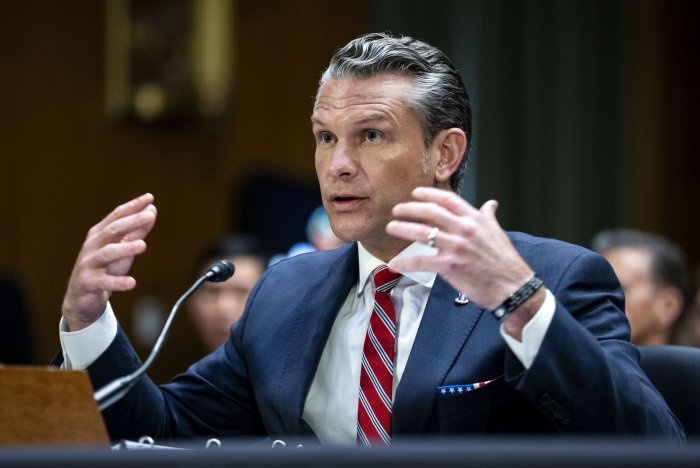
Secretary of Defense Pete Hegseth speaks during a Senate Appropriations Committee hearing on President Donald Trump’s June 24 supplemental funding request at the U.S. Capitol on Tuesday. Photo by Bonnie Cash/UPI | License Photo
Fatima ‘Teema’ Mahmud uploaded a short clip on her Telegram Status that morning; it showed a leaked intimate video involving individuals in northern Nigeria. The time was 8:13 a.m.; minutes later, she uploaded another one and another. By midday, she had uploaded dozens of similar pieces of content. By evening, there were hundreds.
Some of the updates advertised leaked, non-consensual intimate videos that had circulated across social media timelines in the region days earlier. Others promoted sex work services, paid erotic video calls, and private VIP groups featuring explicit videos of women, particularly northern actresses. Among them, and pinned prominently at the top of Fatima’s Telegram profile, were screen records of what she claimed were sexual and nude videos of children, advertised under paid access tiers.
The next morning, the cycle began again.
This reporting was never supposed to become an investigation into child sexual abuse material. It began with a simpler question: where do the leaked intimate videos that circulate on northern Nigerian social media end up?
Every few weeks, another such video appears. The names change, but the outrage follows a familiar script: WhatsApp groups begin asking for links, X users post screenshots before directing followers to Telegram, and Facebook pages recycle the same clips. For a day or two, timelines become courtrooms. Then attention shifts elsewhere, and the people at the centre of those scandals disappear from public conversation, but the links do not.
One such link appeared in May. An X account, now suspended, promoting what it described as a leaked intimate video involving a woman, instructed followers to continue on Telegram. Instead of downloading the material, HumAngle followed the trail, using a pseudonymous account to trace the same path thousands of other users take whenever another intimate video erupts across northern Nigerian social media.
For three months, HumAngle watched what that trail led to: an ecosystem that had evolved to survive platform bans, rebuild audiences almost overnight, and transform some of women’s most private moments into commercial products. Within that ecosystem, children appeared to have become one of its most valuable commodities.
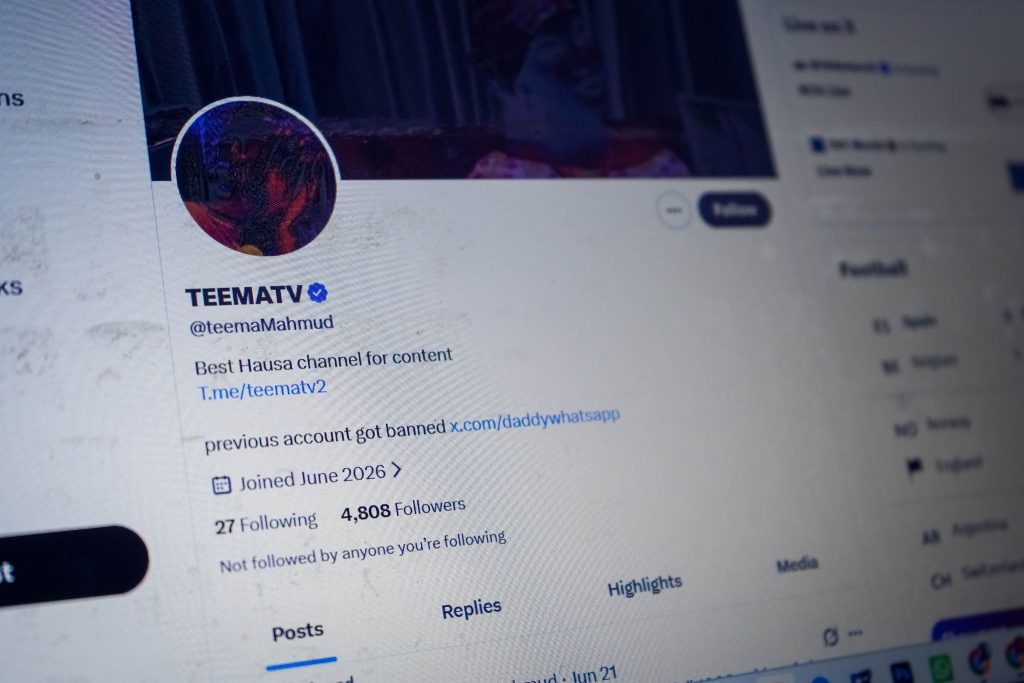
A snapshot of Fatima Mahmud’s X account, “TEEMATV” (@teemaMahmud). As of July 11, the account had over 4,000 followers. Here, she promotes explicit videos, often posting teaser clips and directing followers to continue on Telegram. Her previous account, also called TeemaTV (@teematv), which first drew HumAngle’s attention to this investigation, had more than 11,000 followers before X suspended it in May. Her bio reads “Best Hausa channel for content”, with a follow-up note beneath it explaining that her “previous account got banned.”
Following the trail
It started with “Teematv” on X. HumAngle stumbled on the account promoting a teaser video following a scandal involving a Kaduna-based woman, whom HumAngle will not name to avoid re-victimising her. The X account claimed to have the “full video” and encouraged followers to access it on Telegram.
We created a pseudonymous account and followed the trail.
The first Telegram channel, “Teematv” (@teematv9), which is the main feeder channel and had over 40,000 subscribers before it got suspended in June, looked much as expected: pornography, leaked videos, and VIP subscriptions. But the longer the investigation continued, the less it resembled another anonymous pornography page. The channel did not exist in isolation. Every video and image posted linked to something else, and subscribers were encouraged to save the phone numbers provided by the administrators. “Add my contact,” she often tells subscribers.
Once saved, these numbers unlocked Telegram Status updates, which promoted private VIP groups, which led to new administrators, who promoted replacement channels. When one account disappeared, another had already taken its place.
It felt less like browsing social media and more like walking through a marketplace where every stall owner knew the next. The journey was remarkably consistent, and the pattern held across every operator HumAngle traced; the public channels attracted attention, Telegram Status sustained it, and private conversations completed the sale. Each platform served a different purpose within the same business. X functioned as a storefront, where explicit clips and provocative teasers attracted attention and encouraged users to click through. Telegram became the marketplace itself, while WhatsApp and private Telegram conversations handled the transactions.
Looking closer, the structure reflected an operation built specifically to survive the content moderation it was navigating.
The pattern started with what appeared, and what did not appear, on X. Operators such as Teema used their X accounts to post pornographic clips into X’s video feed, content that the platform’s moderation has grown relatively permissive toward, and whose recommendation algorithm readily surfaces more of it once a user engages with it repeatedly. At no point during our three months of monitoring did HumAngle observe child sexual abuse material posted directly on X.
Whether by experience or deliberate caution, the operators appeared to understand the distinction: ordinary pornography might slip through a platform that has relaxed many of its guardrails around adult content, but material involving children almost certainly would not survive there. The Telegram link attached to those X posts was, in turn, rarely the final destination. It served as an additional layer of security, requiring users to either save a phone number or send a private inquiry before anything further was revealed.
Only after that number was saved did the next stage begin, through Telegram Status. There, too, the same caution applied. Rather than posting material involving children directly, operators uploaded blurred collages or screenshots, with titles and scenes presented as proof that a fuller collection existed, along with a caption advertising group access and a price, directing interested buyers into a private conversation. Nothing that could be mistaken for the material itself appeared in a space Telegram or outside observers could easily flag; the proof of possession and the point of sale were kept one careful step apart. HumAngle observed screenshots of children naked and being abused.
The advertisements rarely remained online for long. Telegram Status updates disappear automatically after 24 hours, and the administrators appeared to exploit that feature deliberately, because the posts remain accessible on the profile itself to anyone who has saved their contact. On some days, one operator uploaded close to 200 Status updates, rotating through advertisements, teaser clips, and promotional graphics before repeating the process the following morning.
The result was a constantly changing catalogue. One day, the focus might be leaked intimate videos. The next, sex work services. Then paid video calls. Then another newly emerging leaked-video scandal that had just begun trending elsewhere on social media. The operators appeared to respond quickly to public attention: whenever an intimate video began circulating widely online, it often appeared inside the network within hours, repackaged as a commercial product, a short preview posted publicly with the full video available, administrators claimed, after payment. The scandals that dominated social media for a day or two became inventory.
Identifying the operators
There was one problem with Telegram usernames: they rarely lasted. By the time HumAngle finished documenting one account, another had often appeared. The usernames, invitations, and even profile photographs changed. But the people behind them did not.
To understand who was operating the network, our investigation moved beyond monitoring channels and focused instead on the digital traces the administrators had left behind, rather than the material they were advertising. The approach was deliberate: HumAngle had already decided it would not purchase access to private VIP groups or attempt to obtain any material advertised as involving children.
Beyond the obvious ethical concerns, doing so could expose journalists to illegal content and compromise the investigation itself. Instead, we focused on the operators’ own mistakes, and the first was surprisingly ordinary: money.
Like any online business, the administrators eventually needed customers to pay. Across multiple Telegram channels and Status updates, Teema repeatedly instructed interested buyers to save a phone number before making enquiries or completing payments. Unlike her usernames, the number rarely changed. It became the first real-world lead.
A search through Truecaller, a popular caller identification service, returned the name “Fatima Mahmud”. One result was not enough, so the same number was cross-checked against Nigerian online banking applications, including OPay and PalmPay, both of which use registered phone numbers as account identifiers and display the associated account name before a transfer is completed. Both returned the same name. For the first time, the investigation had connected one of the network’s most active operators to a real-world name, confirmed through two independent verification methods.
Finding the person behind that name proved harder. Searching “Fatima Mahmud” and “Teema” on social media produced dozens of unrelated results, and many of the accounts connected to the investigation had already been suspended or had disappeared before they could be examined. So HumAngle changed direction, following relationships rather than names: Telegram usernames led to older accounts, older accounts led to replacement accounts, and replacement accounts led to suspended X profiles, each revealing another fragment of the same digital footprint.
The same process and the same dual verification through Truecaller and banking app records identified a second recurring figure in the network who used several online identities: Deejah, Nanadady, and Deharjah. Once again, the payment trail pointed to one name: Khadija Adamu.
Illustrated by Akila Jibrin/HumAngle, edited using AI.
Despite the frequent account suspensions and identity changes, traces of her activity remained visible. As recently as July 17, Khadija remained active. In a Telegram Status update, she told followers her phone had been damaged and appealed for financial support to replace it, posting her Union Bank account details. The account name she provided, Khadija Adamu Abubakar, was confirmed through a mobile banking application search, adding a third independent verification to the identity already established through Truecaller and her OPay and PalmPay records. Fatima’s administrator account was also active at the time of publication.
A collage of screenshots documenting the recent activity of Fatima Mahmud and Khadija Adamu, captured three days before publication. In the first frame, dated July 17, Khadija appeals to her followers for financial support to replace a damaged phone, posting her Union Bank account details beneath the request. The second frame, dated July 13, shows Fatima sharing her WhatsApp number on Telegram and directing followers to save her contact and message her there for access to her WhatsApp Status. The third frame, also dated July 17, shows Fatima advertising a VIP channel containing what HumAngle’s monitoring observed as more than 1,200 videos of child sexual abuse material, captioned “Bonanza 20k,” indicating a discounted access price of ₦20,000.
Khadija’s operation mirrored Teema’s in structure, but she operated across a considerably wider segment of the online sex trade, advertising leaked intimate videos, homosexual pornography, sex work, paid sexual video chats, sex toys, sexual stimulants, and VIP groups promoted as containing child sexual abuse material. Of that range, child sexual abuse material appeared to be one of her primary products, and her pricing across the board was consistently higher than Teema’s, with VIP access advertised at between ₦50,000 and ₦100,000. From what HumAngle observed, she made no attempt to obscure or apologise for any of it.
A further question remained: were the photographs attached to their profiles genuine? At first glance, they appeared convincing: young Hausa women in casual portraits and self-portraits, but reverse-image searches using Google Lens and facial-recognition software found that several did not belong to the account holders at all. Instead, they matched publicly available photographs of Hausa actresses and other individuals whose images had been lifted from elsewhere online. The people running the accounts had carefully concealed their own identities behind someone else’s faces.
Fatima addressed this directly in the description of her main feeder channel, Teematv (@teematv9), which had more than 40,000 subscribers before it was suspended on June 12. “I post pretty Hausa girls on my page. If you see your picture here, then know [that] you are pretty,” she wrote. “Some of you are complaining. I just leave compliments as the caption. I mean no harm. [It] is just for fun.”
A final search, this time relying on Facebook’s “People You May Know” recommendation feature after the administrators’ phone numbers were saved as contacts, surfaced a profile that strongly matched the identity already established for Khadija. Fatima’s case proved less conclusive; several profiles appeared, but none could be verified with sufficient confidence. The search stopped there. We do not possess the legal powers available to law enforcement agencies, but what the reporting established was enough: two operators had been identified through the payment infrastructure they themselves had created, and neither appeared to be working alone.
The product
A collage of screenshots from Fatima Mahmud’s main Telegram feeder channel, “Teematv” (@teematv9), showing advertisements for child sexual abuse material posted on April 15, 23, and 28. In each post, she offered discounted access to interested subscribers and directed them to contact her privately. The channel had more than 40,000 subscribers before Telegram suspended it in June.
The advertisements followed a consistent commercial logic, and the same pricing structure recurred across all operators and channels documented in this investigation.
Individual leaked Hausa intimate videos, after a short teaser had been posted publicly, typically sold for between ₦2,000 and ₦5,000. Buyers seeking larger collections were encouraged to pay for VIP memberships instead, which administrators claimed offered hundreds of additional videos. The advertisements suggested a tiered business: casual customers bought individual videos, regular customers subscribed, and those willing to spend more were offered access to increasingly exclusive groups.
At the top of the pricing structure were advertisements for group access explicitly involving children. Unlike the adult-content advertisements, which typically promoted individual clips, these posts promised something larger: a collection, membership, exclusivity. They were usually brief: a blurred collage or screen record, a short caption, sometimes only a few words, followed by a price. Most commonly, that price was ₦50,000, though some operators, like Khadija, advertised memberships as high as ₦100,000. The wording varied slightly from one administrator to another, but the sales strategy did not, and the same pattern appeared consistently across multiple Status updates, different administrators, and different channels over the three months of monitoring.
At first, HumAngle questioned whether the advertisements were genuine; exaggerated claims to lure paying customers are common online. But the consistency, repeated across unrelated administrators using nearly identical language, made coincidence difficult to sustain as an explanation.
Teema’s advertisements illustrated how the claims were built up over time. In a sequence of Status updates viewed chronologically, she claimed her VIP collection had grown from around 600 videos to more than 800, and eventually to over 1,200. HumAngle could not independently verify those figures, but documented them as part of the marketing strategy: growth itself had become a product, with a larger claimed catalogue used to strengthen the sales pitch.
A collage of screenshots from the Telegram Status updates of Fatima Mahmud and Khadija Adamu, advertising paid access to VIP groups where child sexual abuse material is sold. Both posts offered discounted entry prices. Fatima’s post, dated June 16, shows the advertised VIP channel with one subscriber; Khadija’s, dated June 22, shows four.
The operators appeared to understand a basic principle of online commerce: that people rarely arrive intending to make their largest purchase but are guided towards it. Every stage encouraged the next. The channels resembled a subscription business more than an ordinary social media page. Only the product was different, and its advertisements did not appear hidden in obscure corners of the internet. They appeared alongside the same promotional posts advertising leaked intimate videos, prostitution, and paid video calls. Children were not presented as something separate. They were presented as another product category, another premium tier.
Illustrated by Akila Jibrin/HumAngle, edited using AI.
HumAngle also decided not to attempt to identify the children referenced in the advertisements. INTERPOL’s International Child Sexual Exploitation database, the tool specialist law enforcement units use to identify victims and offenders worldwide, treats abusive images and videos as evidence tied to real children, real locations, and real offenders, material to be handled by trained victim-identification specialists rather than pursued independently. Attempting to trace the children through the material risked compounding the harm the investigation was seeking to expose.
The network
For much of the investigation, Teema and Khadija appeared to be running separate operations: different Telegram channels, different X usernames, different pricing. It was easy to assume they were competitors. Then one Status update changed that.
While reviewing Teema’s Telegram Status one afternoon, HumAngle noticed she was no longer advertising her own channel, but Khadija’s. Only days earlier, one of Khadija’s Telegram accounts had disappeared or been removed before we could complete the documentation of its activity. The replacement account appeared almost immediately, and Teema introduced it to thousands of followers. Over the following days, the same promotion resurfaced repeatedly across dozens of Status updates before disappearing after 24 hours, only to return.
Illustrated by Kingsley Chibueze/HumAngle, edited using AI.
Tracing the followers who interacted with those promotions on X uncovered dozens of accounts exhibiting remarkably similar behaviour. When one profile disappeared, another announced its replacement. When Telegram removed a channel, fresh invitation links circulated through WhatsApp Status updates and newer Telegram accounts. The audience rarely needed to search; the network guided them. Investigators documented several accounts operating under different versions of Teema’s identity, including @teematv2 and @teematv3, with Khadija running parallel replacements under her own aliases.
Around them was a wider ecosystem. Channels such as AREWA GIDAN DADI, Arewagidanharkazallah, and Sadearharka surfaced repeatedly throughout the investigation.
HumAngle found no evidence that these accounts were all controlled by the same individual, nor could we establish that every operator knew every other one personally. What our investigation does establish is narrower but significant: the accounts consistently promoted one another, shared audiences, and directed followers towards replacement channels, forming a distribution network that platform bans repeatedly failed to disrupt.
A collage of screenshots showing the premium subscription badges held by operators and channels within the network. The subscriptions grant access to features including unlimited Status updates and unlimited cloud storage, capabilities that appear to have supported the scale and persistence of their operations.
The blind spot
The most surprising thing about the network was not that it existed, but that it appeared to operate in plain sight. The operators behaved less like people trying to disappear than people confident they would not be noticed. That raises a broader question: why did a network operating so openly prove so resilient?
Part of the answer may lie in language. Almost every account documented in this investigation communicated primarily in Hausa, and the cities referenced in conversations, such as Kano, Kaduna, Maiduguri, Katsina, Sokoto, and Abuja, pointed overwhelmingly to audiences in northern Nigeria. This was not simply a Nigerian online marketplace; it was a Hausa-speaking one.
Researchers have increasingly warned that many widely spoken African languages remain “low-resource” from the perspective of artificial intelligence and automated content moderation. While Hausa is spoken by tens of millions of people across West Africa, there are comparatively fewer linguistic datasets and moderation tools to help technology companies automatically identify harmful content in the language, meaning abusive or exploitative content can be harder to detect at scale than equivalent content in English.
Nothing in HumAngle’s investigation suggests the operators tried to hide the language they used; on the contrary, their marketing relied on local expressions and reflected the culture of Arewa social media. The same characteristics that made the network accessible to its intended audience may also have made it less visible to moderation systems built primarily around better-resourced languages.
This is not a uniquely Nigerian, or even uniquely Hausa-language, problem. Investigations in other parts of the world have documented strikingly similar patterns, in which mainstream platforms funnel users toward Telegram-based child sexual abuse material (CSAM) marketplaces that survive enforcement through rapid replacement.
A BBC Eye investigation published in July found that Instagram’s advertising system in India was itself directing a test account toward paid child sexual abuse material sold through Telegram channels, with material advertised for as little as the naira equivalent of one US dollar; Meta’s own moderation team initially cleared one flagged advertisement as compliant with its policies, and only acted once BBC journalists sought formal comment.
A separate investigation by Sudan’s Ayin Network documented Telegram channels operating an almost identical structure to the one described here: administrators charging roughly $30 for VIP access to material described as exclusive, channels going dark after reports only to be quickly recreated with subscribers migrated across, and content sourced from economically vulnerable communities with little legal recourse.
Malaysiakini’s Kini News Lab has separately described Telegram as functioning as a “dark mall” for this kind of material, in which promotional content on more visible platforms consistently routes interested users toward Telegram, where moderation is comparatively lighter.
Another investigation, conducted by the Brazilian outlet Núcleo with the Pulitzer Centre’s AI Accountability Network, found dozens of Telegram bots capable of generating AI-manipulated child sexual abuse imagery, most operating despite Telegram’s own public commitments on child safety.
These investigations point to a recurring global pattern. Broader research suggests the problem extends far beyond the networks examined in any single investigation. Research conducted by UNICEF Innocenti, ECPAT International, and INTERPOL across 13 countries in Africa and Southeast Asia found that, depending on the country, up to one in five internet-using children aged 12 to 17 had experienced online sexual abuse within a single year. Social media platforms were among the environments where children most frequently encountered the abuse.
Nigeria was not included among the countries studied, leaving no comparable national estimate of how many Nigerian children may be affected. UNICEF and the WeProtect Global Alliance have warned that online child sexual exploitation is becoming increasingly complex as offenders adapt quickly to new technologies, encrypted platforms, and gaps in national responses, arguing that effective responses require cooperation between technology companies, law enforcement, child-protection organisations, and governments, rather than isolated moderation decisions by individual platforms. UNICEF Nigeria has separately noted that violence against children increasingly occurs in both physical and digital spaces, while support for victims remains limited.
As we identified the operators of these accounts, an obvious question emerged: if journalists could trace those digital footprints using publicly available tools, what prevented authorities from doing the same?
Nigeria does not lack the relevant laws. The Cybercrimes (Prohibition, Prevention, etc.) Act criminalises the production, distribution, and possession of child sexual abuse material, alongside offences relating to the use of digital platforms to facilitate unlawful activities, including the non-consensual distribution of intimate images.
The Violence Against Persons (Prohibition) Act recognises image-based sexual abuse, and children receive further protection under the Child Rights Act and the Trafficking in Persons (Prohibition) Enforcement and Administration Act.
The activity documented in this investigation appears to fall squarely within conduct already prohibited under Nigerian law. Over three months of monitoring, HumAngle found no public record of investigations or prosecutions specifically targeting the Hausa-language Telegram ecosystem documented in this reporting, even as channels disappeared, replacement channels emerged, subscribers migrated, and the marketplace continued operating.
The threat was not entirely new to Nigerian authorities. In 2023, the National Agency for the Prohibition of Trafficking in Persons (NAPTIP) said it had observed increasing cases involving child sexual abuse material, sextortion, and revenge pornography, and had established a Cybersecurity Response Team, in partnership with organisations including Meta and the United States National Centre for Missing and Exploited Children (NCMEC). That year, the agency said it was investigating six cyber-tip reports involving online child exploitation and sextortion, drawing on NCMEC’s CyberTipline, the centralised reporting system through which tech companies and the public flag suspected child exploitation to law enforcement worldwide. What remains unclear is whether the Hausa-language network HumAngle documented had ever entered that reporting system.
The network appeared to exploit precisely the jurisdictional and institutional gaps that researchers have long warned about: Telegram channels directed users toward WhatsApp, WhatsApp conversations led back to Telegram, and X attracted new audiences, with each platform seeing only one part of the picture while the operators appeared to see the whole. Platform enforcement removed accounts. Law enforcement, at least publicly, appeared largely absent, aside from the small number of cases NAPTIP said it was already investigating.
What follows
Before publication, HumAngle shared its findings with Telegram and NAPTIP, seeking answers about the network, its operators, and the apparent gaps that allowed it to persist. The advertisements, the Telegram links, the payment instructions, and the phone numbers had all been public. The operators had made no effort to hide them.
In the Mid-City neighborhood where Syd grew up, lots of people now refer to this 34-year-old musician as the mayor.
“During COVID, I’d spend all day on the grass waving at everybody,” she says with a laugh. More recently, a bunch of “unruly teenagers,” as Syd describes them, have been doing doughnuts in the street near her parents’ house.
“I’m out there talking about, ‘Hey! Stop!’ I had one of my trucks parked in front, so I was like, ‘Y’all ain’t finna mess my s— up.’ But also they were hanging out the window — it was really dangerous.” She laughs again.
“I’m an old head when it comes to safety.”
Syd’s new album happily embraces a sense of maturity — of “feeling more sure of myself than I ever have,” she says. Released last week, “Beard” — the title was inspired by Syd’s wife’s request that she maintain the peach fuzz on her upper lip — sets thoughts of romantic commitment and professional achievement against gleaming R&B grooves that occasionally nod toward Afrobeats or bossa nova. It’s Syd’s third solo LP since she emerged nearly two decades ago as a member of the Los Angeles hip-hop collective Odd Future; it also comes eight years after her most recent album with the Internet, the Grammy-nominated soul-music combo she shares with Matt Martians and Steve Lacy (the latter of whom dropped his new “Oh Yeah?” on the same day Syd dropped “Beard”).
Yet for all the growing up she’s done, “ironically, I feel younger than I’ve ever felt,” Syd says. “Beard’s” blurry cover photo, which shows her shaved head and slightly doleful eyes, “captures exactly what I was trying to portray with the music,” she adds. “It’s kind of this nonbinary image, where if you’re looking at it and you don’t know who I am, you might wonder: Is that a 12-year-old boy?”
Syd and I are talking over coffee at a crowded spot on Jefferson Boulevard that she says she visits every day. (So many people say hi to her that I’m inclined to believe it.) The restaurant isn’t far from her house, which itself is just an eight-minute drive from her folks’ place; eventually, she says, her parents plan to swap homes with Syd and her wife, the model Simone Clay, so that the couple can fulfill their dream of becoming foster moms in the larger house.
“With all my privilege and with all the peace I’ve been able to create for myself, I would love to spread that,” says Syd, whose full name is Sydney Bennett and whose younger brother Travis (known as Taco) also came up through Odd Future before finding success as an actor.
Syd recorded “Beard” between a studio she built at her parents’ place and a studio in North Hollywood owned by Raphael Saadiq, the veteran R&B star whom Syd counts as something of a mentor. The singer says she can relate to the way Saadiq moves between making solo records, working in a band (in his case Tony! Toni! Toné!) and writing and producing for other artists, as Syd did on Beyoncé’s 2022 “Renaissance” album.
“Syd is just looking for things in music that are breathing,” says Saadiq, who plays bass and co-produced several cuts on “Beard.” “She keeps developing, and she’s not developing to be relevant — she’s developed because she loves doing it. People like Syd and myself, we’ve been at this since we were kids. We were the ones in the neighborhood who’d walk outside and say, ‘Anybody want to get on this track? Anybody want to play?’”
Songs on “Beard” like “Closet” and “My Love” reflect recent changes in Syd’s life, not least her decision to get hitched last year, which she attributes in part to an uncertainty about how long same-sex marriage will remain legal in the United States.
“You know the Supreme Court,” she says with a shrug.
She also quit drinking after realizing that she was waking up more often than not with a hangover. “People around me weren’t like, ‘She be drinking,’” Syd says. “But it was every day, and it was just at the crib. Everybody has a different relationship to it, and I found that mine was tied to boredom, which I think is probably better than it being tied to sadness. But that’s also what made it a little bit harder to call it a problem, you know what I mean? I had to realize: OK, this might not be a problem for someone else, but it’s not serving me.”
So two and a half years ago, she stopped — and on a holiday some can’t imagine without booze.
Says Syd: “I raw-dogged New Year’s Eve, bro.”
“Ironically, I feel younger than I’ve ever felt,” Syd says.
(Nabil)
“Beard” encompasses shifts in Syd’s business too. After fulfilling her contract with the Columbia label, the singer signed last year to Warner Records, where an old high school pal, Tim Hinshaw, oversees a boutique label called Free Lunch. The new deal inspired her to mix up her creative process and hold a songwriting camp with an assortment of writers and producers, among them the duo Nova Wav, who’ve also worked with Beyoncé; on “Beard,” the duo co-wrote and co-produced the hooky “Callin” and “Jasmin 17,” a lusty boudoir jam titled after the unisex fragrance. (Additional collaborators on the album include James Fauntleroy, Van Hunt, Rodney Jerkins, Big Sean and Jordan Ward.)
Given her high-profile gig writing and producing Beyoncé’s “Plastic Off the Sofa” — a sensual retro-soul number that went on to win a Grammy — I tell Syd that I assume the offers came rolling in immediately afterward to join other A-list acts in the studio.
“To be honest, that opportunity didn’t give me any more producing opportunities,” she answers, to my surprise. “Nobody was reaching out — like, ‘Hey, can I get beats?’” She’s not bothered, though, since what the experience did do was “give me the confidence to produce this album for myself.”
And anyway, she’s got a solo tour coming up, not to mention a long-awaited Internet LP to finish. The band has been recording intermittently at her place, and last month she spent a week working at Martians’ studio in rural Georgia.
“We’re closer than we’ve probably ever been,” Syd says of the band, whose drummer, Christoper Smith, put out yet another solo record on the same day as “Beard” and Lacy. Syd doesn’t want to reveal too much about the Internet’s new music. But she will say that so far the group has avoided using Auto-Tune, the vocal-processing software that she feels has become sadly ubiquitous.
“I want nuance, I want texture, I want the lack of perfection,” she says. “I’d rather mess up naturally than not mess up unnaturally.”
WHEN booking a city break, it can be hard to choose where to go with hundreds of cities to choose from.
Add in the fact that a lot are full of crowds most of the year round, the decision can feel a little like a minefield.
There are a number of alternative European destinations you could head to, such as Coimbra in PortugalCredit: AlamyOr you could visit the capital of Bulgaria – SofiaCredit: Getty
The good news, though, is that there are loads of cities that don’t have the crowds and still have loads to see and do.
Whether you want a history-focused city break or more of a foodie-themed holiday, here are some lesser-known city breaks for under £250 per person:
Sign up for the Travel newsletter
Thank you!
Ditch Lisbon for Coimbra, Portugal
You could head to Hotel D. Luís in Coimbra, Portugal and explore a UNESCO World Heritage UniversityCredit: Love Holidays
Instead of heading to the crowded cities of Lisbon or Porto, venture to Coimbra, which used to actually be the Portuguese capital.
The city is home to one of the oldest universities in Europe, which is even a UNESCO World Heritage University.
To see the university itself, head to the 18th-century Joanina Library which has Baroque architecture.
Plus, the city is only an hour from Porto.
You could stay at Hotel D. Luís, which sits on the banks of the River Mondego in the heart of the city.
The hotel has 100 rooms with TVs, private bathrooms and complimentary toiletries and there’s even a restaurant in the hotel and a buffet-style breakfast too.
A three-night stay for two people between September 15 and 18, flying from London Stansted, costs £159 per person.
Ditch Rome for Bologna, Italy
Instead of heading to Rome, you could visit BolognaCredit: Love Holidays
Instead of heading to Rome, venture to Bologna in Italy.
Known for being a major foodie city, Bologna is loved for its restaurants selling fresh pasta as well as having hundreds of red terracotta rooftops.
Head to Piazza Maggiore, which is the central square in the city, and visit the unfinished Basilica di San Petronio.
In the city, you could stay at Savhotel Fiera, which features chic modern rooms – the hotel also has a restaurant and buffet-style breakfast, as well as outdoor terraces.
A three-night stay for two people between July 29 and August 1, flying to Forli (about a half- hour drive from Bologna) from London Stansted, costs £199 per person.
Ditch Brussels for Ghent, Belgium
In Ghent, you could stay at the ibis budget Ghent Centrum Dampoort, which is right by the stationCredit: Love Holidays
Instead of going to Brussels, head to the city of Ghent, often considered Belgium‘s best kept secret.
In the centre of the city, you’ll find no cars, as well as fascinating architecture.
The city is known for its three towers – the 14th century Belfry of Ghent, St Bavo’s Cathedral and St Nicholas’ Church.
You could stay at the ibis budget Gent Centrum Dampoort, which is conveniently close to the train station with 119 rooms, each with a TV and there is also a bar and buffet breakfast.
A three-night stay for two people between November 8 and 11, flying from London Heathrow to Brussels (a 28 minute train journey away) costs £249 per person.
Ditch Budapest for Sofia, Bulgaria
In the capital of Bulgaria, you can explore Roman ruin and vibrant cafesCredit: Love Holidays
Both Budapest and Sofia have lots of grand architecture with socialist-era buildings.
Yet, despite being the capital of Bulgaria, not many people head to Sofia for a city break.
But this vibrant capital is super cheap and has a lot to see including ancient Roman ruins and a bustling cafe culture.
If you love the outdoors, you can head to Vitosha Mountain as well, which takes under 20 minutes from the city centre.
You could stay at the Lopera Guest House, which is just a short walk from some of the city’ s main sights, such as St Alexander Nevsky Cathedral, which is just five minutes away.
Rooms each have a private bathroom, as well as all the other features you’d expect.
You could stay for three-nights for two people between September 27 and 30, 2027, flying from London Stansted for £159 per person.
Ditch Berlin for Tirana, Albania
Tirana is home to Cold War bunkers that have been transformed into museumsCredit: Love Holidays
Like the German city of Berlin, Tirana has transformed historical spots in the city into creative attractions, with former communist structures now home to art galleries.
Even though Tirana is the capital of Albania, you’ll be hard pressed to find a crowd.
When in the city explore the lively cafe culture and head to Bunk’Art & Bunk’Art 2 to explore declassified Cold War nuclear bunkers that are now home to museums.
You could stay at the four-star Hotel Boka, just a short walk from Skanderbeg Square – the city’s main square.
The hotel boasts 20 rooms, each with a TV and minibar.
There’s also a bar with snacks and then a continental breakfast in the morning.
You could stay for three nights for two people between December 2 and 5, flying from London Luton for £169 per person.
Ditch Prague for Vilnius, Lithuania
Vilnius is known for its UNESCO-listed Old Town where you can head on a walking tourCredit: Love Holidays
Much like Prague, Vilnius has a similar fairytale-like atmosphere with mediaeval churches, towering castles and cobblestone alleys.
The capital of Lithuania is known for its UNESCO-listed Old Town where you can head on a walking tour.
In fact, it is one of the largest surviving medieval old towns in Northern Europe.
You could stay at the Panorama Hotel in the heart of Vilnius Old Town.
The hotel has 224 rooms with views of the Old Town’s rooftops.
There is an onsite restaurant too serving European food and a bar, as well as breakfast in the morning.
You could stay for three nights for two people between October 6 and 10, flying from London Stansted for £129 per person.
ONE couple ditched pricey holidays to Thailand, Costa Rica and the Maldives for staycations – after renovating a carpenter’s van.
Andy and Claire Stocks, who hail from Barnsley, opted for UK road trips after deciding to buy a run-down van to convert.
Andy and Claire travel all over the UK in their motorhomeCredit: Claire & Andy StocksThey’ve fallen in love with exploring UK destinations – like HartlepoolCredit: Alamy
The couple now go away every week and document their travels on their YouTube Channel – and they’ve just published a book It Started with a Van detailing all of their staycation adventures.
When the pair first ditched far-flung destinations for the UK, it’s safe to say their friends were dubious.
Sign up for the Travel newsletter
Thank you!
Andy explained: “People that knew us from before doing this would have never thought we’d be fans of motorhomes.
“We were always going to exotic places rather than staying at campsites.”
But since owning a van, which has since been traded in for a newer motorhome model, the pair have ventured all over the UK.
Claire admitted: “I don’t think we ever appreciated how beautiful the UK is and we go everywhere – one of my favourite places is actually Hartlepool.”
“We went with no real expectations but we saw dolphins in the sea there – it blew our minds.”
Andy added: “We’ve found some great waterfalls in the UK too – which we actually went all the way to Costa Rica to see.
“But actually there are loads in North Yorkshire like Janet’s Foss and Malham Cove.”
Other places they’ve explored are Glastonbury which Andy described as an “amazing spiritual town”.
The pair travelled all the way across to Lake Como in their vanCredit: Claire & Andy StocksIn the UK, the couple discovered the beautiful Janet’s Foss waterfallCredit: Alamy
In the Yorkshire Dales, the couple stopped by The Strid which as Claire explained is one of the most dangerous stretches of water in the world.
When it comes to campsites, Claire and Andy like to mix it up from five-star sites to cheaper options with beautiful sea views.
Talking about one of their most memorable stays, Andy said: “There’s a campsite on the Isle of Mull called Fidden Farm.
“You turn up and can park wherever you like, but as it’s coastal, you stay right on the white beach.
“It has the best sunsets that you could possibly wish for and so wild – you get every season within around 15-minutes.”
Fidden Farm on the Isle of Mull is on a white sandy beachCredit: Fidden Farm
Pitches start from £14 per night per adult, and £7 per night for children.
When it came to five-star stays, the couple said the Concierge Camping in Chichester was one of their favourites.
Claire admitted it’s “one of the best campsites I’ve ever been to”,
The campsite even has ‘award-winning washrooms’ which is perfect for those who don’t enjoy the classic camping toilet situation.
It has granite-topped wash areas, complimentary toiletries and lots of the facilities have underfloor heating.
Sun Travel found pitches from £73 per night.
On occasion, Andy and Claire head over to Europe. At one point they explored seven countries including Liechtenstein, Luxemburg, France, Belgium and Italy in two weeks.
And for anyone driving across to France in a motorhome, they suggest you check into an Aire.
Andy called Glastonbury an ‘amazing spiritual town’Credit: Alamy Claire was amazed when she saw dolphins off the coast of HartlepoolCredit: Alamy Stock Photo
‘Aire’ is short for the French term ‘aire de service’ – which essentially is a free or cheap motorhome camping area.
Andy explained: “We used Aires on a trip to Normandy, they’re really basic campsites but they’re about €10 a night so it’s a really cheap way to get around.”
Claire added: “You don’t have to book either, and they’re spotlessly clean and lots of them have beautiful views as well.”
“There’s a lovely one outside of Honfleur,” said Andy. “And from there you can just walk into the town.”
Talking about whether it’s made travelling any cheaper, Andy confessed it hasn’t as he never saw any return on his original van.
But he added: “I don’t talk about money – but it’s all experience. That’s how the book ends, it’s not about money, it’s about your life.”
The budget airline has confirmed it’ll be cutting the number of aircraft from one of its city bases by five, and its schedule will have two million fewer seats to a popular city break destination as of winter 2026
Two million seats will be cut from Ryanair’s schedule(Image: Jonathan Raa/NurPhoto via Getty Images)
Ryanair has slashed the number of seats from its schedule for a city break destination that’s famous for its Christmas market and historic sites, as well as being a major business hub.
The decision was made in response to the country’s decision to raise aviation taxes, with Ryanair releasing a strongly-worded statement to announce they would be cutting two million seats from two of the capital’s airports.
The Federal Government of Belgium announced plans to raise the country’s aviation tax from €5 (about £4.20) to €7 (about £6) as of January 2027. This was erroneously described by Ryanair in a statement as a “250% increase since 2025.”
As a result, the budget carrier plans to cut five aircraft from its base at Brussels South Charleroi Airport, and reduce capacity by two million seats overall from Belgium’s Charleroi and Zaventem airports. The reductions will be applied to the winter 2026 and summer 2027 schedule.
Brussels is not the first destination to see a cut in the number of Ryanair seats this year. Earlier this year it announced reductions in services to Spain and Portugal, with smaller regional airports the most affected.
Valladolid and Jerez saw cuts to their services, while scrapped routes included Asturias and Vigo. A service to Tenerife North was also scrapped as a result of a dispute over airport fee hikes, leaving the airport with no alternative direct UK routes. Ryanair also closed its two aircraft base at Santiago de Compostela which reduced capacity.
As a result over one million seats were taken from the winter 2025 routes, and 1.2 million cut from the summer 2026 schedule. Another cut was to a Portugal service, with Ryanair cutting six routes to and from the Azores, an emerging tourist destination. It was estimated the cuts affected around 400,000 passengers.
At the time, Ryanair blamed this cutback on growing airport charges set by Portuguese authorities and environmental taxes linked to the EU Emissions Trading System. John Paul II Ponta Delgada Airport, the islands’ main airport, now only has a single seasonal UK route from London Heathrow operated by British Airways.
Speaking about the cuts in Belgium, Ryanair CEO, Eddie Wilson, said in a statement: “It’s absurd that the Federal Govt have decided to increase Belgium’s aviation tax by 250% from Jan ’27, especially when competing EU countries, like Sweden, Hungary, Slovakia, regional Italy, and Albania are abolishing aviation taxes to grow traffic, tourism and jobs.
“We warned Prime Minister De Wever that increasing Belgium’s aviation tax would result in traffic cuts, but he failed to listen. As a result, Ryanair will now remove 5 aircraft from our Charleroi base and 2m seats from our Brussels schedules (Charleroi and Zaventem) for Winter ’26/Summer ’27 and relocate to more competitive economies.”
Have a story you want to share? Email us at webtravel@reachplc.com