British teen Axel Rudakubana, who was convicted of murdering three young girls in a knife rampage at a Taylor Swift-themed dance workshop in Southport in summer 2024, has been charged with new assault and weapons offenses. File photo courtesy Merseyside Police
July 31 (UPI) — The British teen serving a 52-year sentence for the Southport killings of three young girls was charged Friday with additional crimes allegedly committed while in prison, including aggravated assault and weapons offenses.
Axel Rudakubana, 19, is accused of assaulting emergency workers in two separate attacks, one count of aggravated assault and possession of an offensive weapon between May and late October 2025
Police said all the alleged incidents took place at HMP Belmarsh in London.
Rudakubana is scheduled to go before Westminster Magistrates’ Court on September 11 to answer the charges.
He will appear via video-link from Broadmoor Hospital, a high-security psychiatric facility west of London to which he was transferred from prison last week.
Officials determined he was too dangerous for a regular penal institution following an independent clinical assessment, but the Justice Ministry stressed that would be returned to prison to complete his sentence once his mental state had improved and he was assessed as well enough to do so.
A psych evaluation after he carried out the July 2024 knife rampage that killed Bebe King, 6, Elsie Dot Stancombe, 7, and Alice da Silva Aguiar, 9, and seriously injured eight other children and two adults, found him fit to stand trial.
Following a trial in January 2025, Rudakubana was sentenced to a record 52 years in prison, minus time spent on remand.
The judge was unable to impose a so-called whole-life sentence normally applied for crimes of this seriousness, where the offender remains in prison until they die, as Rudakubana was 17 at the time of the attack.
He will become eligible for parole in 2076, just shy of his 70th birthday, but is unlikely to ever be released from prison.
The initial phase of an official inquiry into the killings concluded in April that Rudakubana could have been stopped but for the “catastrophic” and “irresponsible” failures of authorities and his parents.
Former Appeal Court judge Sir Adrian Fulford, said the attack woud likely have been prevented if Rudakubana’s parents had reported what they knew and law enforcement, child and mental health agencies responded appropriately to the risk he was known to present.
A U.S. military aircraft flies over an area struck by earthquakes in La Guaira, Venezuela, on June 28, 2026. (Graphic by Truthdig; images by AP Photo, Adobe Stock)
The country that in 2008 heard then-President Hugo Chávez say, “Go to hell, damn Yankees,” as he expelled the U.S. ambassador, today watches hundreds of U.S. soldiers patrol the streets of La Guaira, which was devastated by the two earthquakes a month ago. The soldiers distribute meager humanitarian aid in small boxes bearing U.S. flag stickers while filming for publicity spots.
The U.S. has promised $386 million to help Venezuela recover, but it and its allies continue to hold more than $22 billion in frozen Venezuelan assets. Washington’s actions demonstrate, once again, that its priority is oil, not the well-being of Venezuelans. Meanwhile, U.S. real estate developers are also visiting La Guaira, treating the devastation as yet another business opportunity.
Whole areas lie in ruins in La Guaira, where 82-year old Erminia Hernández lives. She was born in La Guaira, the coastal gateway to Venezuela that hosts the country’s main airport, and where residents of nearby Caracas go to sunbathe. She says she remembers the many tragedies that have struck this area, having lived through the 1967 earthquake, the Vargas mudslide in 1999, and the COVID-19 pandemic. However, she doesn’t remember anything as devastating as the double earthquakes of June 24.
Erminia Hernández, an earthquake survivor in La Guaira, Venezuela, on July 12, 2026. (Jessica Dos Santos Jardim)
The 1967 quake stopped her as she was making majarete, a typical Caribbean dessert, she says. But last month’s earthquakes knocked her and her sister flat to the ground, face down in the hallway of their house, where she then knelt to pray as everything rocked violently. She says she does not remember who helped her stand up, but she is certain she will never forget the moment she thought she was about to die.
“The 1967 earthquake was nothing compared to this,” Hernández tells Truthdig. “And during the mudslide, I only heard about one neighbor who died. But now, every day I learn about someone I know who has died or is missing. In my immediate family alone, we lost six people, and two more are hospitalized.”
She is right. In 1967, fewer than 300 people died. After the mudslide, some sources put the death toll at 700, with thousands more missing. The coronavirus claimed 5,856 lives across the entire country over several years. But these earthquakes have killed more than 5,270 people, left 16,700 injured and 18,000 displaced. The numbers rise daily. The government puts the number of rescued at 7,000 but does not mention how many are still missing.
Jofram Gallipoli, his wife Oriana and their 4-year-old son Luciano were among those rescued. Seven floors collapsed on top of them in the Tanaguarenas neighborhood of La Guaira. They are alive today because Jofram’s father, José Alberto Gallipoli, owns a hardware store in Caracas, where he gathered crowbars, chisels, picks, a cordless drill, hacksaws and gloves so that relatives, friends, neighbors and police officers — none of them equipped with specialized rescue machinery — could dig a tunnel through the rubble.
During the 27 hours that the rescue took, Jofram Gallipoli tells Truthdig he communicated with the outside by banging an air conditioning grate with a ceramic tile every time he heard his name.
Jofram Gallipoli, who was rescued along with his wife and child after their building in the Tanaguarenas neighborhood of La Guaira collapsed in the June earthquakes, on July 18, 2026. (Jessica Dos Santos Jardim)
“When we were under the rubble, we thought only our building had collapsed. Coming out was a shock. We lost all our material possessions, but we are alive, and I, who have emigrated before, want to stay here this time,” Jofram Gallipoli says.
According to official figures, nearly 200 buildings collapsed entirely and at least 900 were severely damaged. Structural engineers are now conducting inspections on thousands of homes in the seven states affected by the earthquakes. For Jofram’s father, “the physical structures fell, but we, the true architects of life, are ready to rebuild, from scratch, on a stronger foundation.”
José Alberto’s words are hopeful, but how much will this reconstruction actually cost? How will we carry it out? What intentions lie behind much of the “humanitarian aid” that countries like the U.S. are sending?
What is needed now
Preliminary assessments from the U.N. Development Program estimate direct physical damages at $6.7 billion, a figure that focuses on housing and does not include the full extent of infrastructure damage or the cost of long-term reconstruction.
The U.N. Office for Disaster Risk Reduction, meanwhile, puts the full reconstruction cost at $37 billion: $24 billion for lost buildings — homes, schools, stores and hospitals — and $13 billion for damage to critical infrastructure such as roads and power grids. That represents nearly one-third of Venezuela’s current gross domestic product.
For now, however, the country that has promised the most economic “aid” to Venezuela is the United States, with its much-publicized $386 million.
But if the Trump administration released the Venezuelan funds it continues to block via sanctions, the country would not need these handouts: 31 tons of gold — valued at roughly $4.2 billion — remain frozen in London. The international financial system, including private banks and multilateral organizations, has blocked more than $22 billion in Venezuelan assets. At the same time, Venezuelan oil revenue is now deposited into an account at the U.S. Treasury. “We … control the dispersal of the money,” U.S. Secretary of State Marco Rubio said in January.
Washington’s double standards
One day after the double earthquake, the U.S. Treasury Department’s Office of Foreign Assets Control issued General License 60, which authorizes transactions related to humanitarian assistance in Venezuela but does not include the unfreezing of assets subject to sanctions or “any other transactions or activities prohibited by any other Executive Order.”
The United States acts this way because the architecture of punitive sanctions against Venezuela is the “legal foundation” for control over the Venezuelan oil industry, says William Serafino, a political scientist from the Central University of Venezuela. In 2017, the Trump administration imposed sanctions on Venezuela that prohibited access to U.S. financial markets, and in 2018, expanded them to block purchasing of Venezuelan debt.
“With the issuance of licenses, Washington is able to modify certain aspects of its economic and financial coercion policy, always in the interest of U.S. companies, but without altering the overall sanctions framework,” Serafino tells Truthdig. “The sanctions are what guarantees U.S. appropriation of Venezuelan resources at a clear disadvantage to Venezuela.”
People search for survivors and bodies in the Playa Lido neighborhood of La Guaira, Venezuela, on July 12, 2026. (Jessica Dos Santos Jardim)
These licenses are official documents issued by the U.S. Office of Foreign Assets Control that allow American individuals and companies, or those with U.S. ties, to carry out very specific and limited transactions with the Venezuelan state or the state oil company PDVSA.
Serafino says that such exemptions and the small amount of funds provided after the earthquakes are intended to “whitewash this illegal sanctions policy” in order to undermine the broad consensus across Venezuelan society in favor of lifting all measures that hinder the normal development of Venezuela’s economy.
The U.S. has similarly just provided $100 million in aid to Cuba, after sanctioning the country since 1962. United Nations Secretary-General Antonio Guterres says the sanctions violate international law — which U.N. human rights experts say could also be true of the Venezuela sanctions. U.N. human rights experts describe the latest trade tariffs that block oil from getting to Cuba as “an extreme form of unilateral economic coercion” that violates self determination.
Venezuelans aren’t the only ones rejecting the U.S. sanctions against their country. After the earthquakes, 13 prominent economists, including Isabella Weber, Jeffrey Sachs and James K. Galbraith, signed a letter calling for the lifting of sanctions. Likewise, the U.N.’s humanitarian chief, Tom Fletcher, warned that such coercive measures directly affect the delivery of aid and recovery plans.
“Fletcher’s statement shows that temporary exemptions are insufficient,” Serafino says, “Financial institutions, even when they theoretically have ‘permission’ from the Treasury Department to operate, are very cautious about expediting transactions related to supplies, donations and the transfer of aid funds between multilateral institutions and humanitarian organizations, due to fear of penalties and fines.”
Transactions that under normal circumstances “would take a few days,” he says, are subjected to a bureaucratic morass because of the sanctions, because “banks must constantly consult their legal departments and steer clear of red lines.”
At the same time, the United States is also using the tragedy to ramp up its military intervention in Venezuela through a “humanitarian support” operation coordinated by the U.S. Southern Command and the State Department, under the Department of Defense. That has included moving the warships USS Fort Lauderdale and USS Billings toward the coast of La Guaira, flying helicopters over devastated areas and deploying surveillance drones such as the MQ-9 Reaper.
“It is extremely serious that, taking advantage of a tragedy and under the pretext of humanitarian aid, the United States has not only taken over the country’s main airport and seaport but also deployed 900 Marines in La Guaira and 2,000 across the entire operation,” former Vice President Elias Jaua, who also held multiple Cabinet posts during the Chavez government, tells Truthdig.
“Moreover, we have seen the mapping they have done of the entire Venezuelan coastline with drones and helicopters. This is another escalation in the military occupation,” he says, adding that the deployment also imposes strict military monitoring and de facto control over Venezuela’s skies and coastline from U.S. bases in Puerto Rico, Panama and Trinidad and Tobago.
Jaua, who now works as a university professor, says the measures openly violate Article 13 of Venezuela’s Constitution, which bars foreign military bases or installations with military purposes by any country or coalition of countries in Venezuelan maritime, air and land territory.
Asked what will happen to the U.S. military presence in Venezuelan territory once the emergency ends, Jaua only comments that “a civic, political and grassroots movement must be built to defend Venezuela’s right to remain a republic. Otherwise, it will end up as a North American [i.e. U.S.] colony annexed to the United States or a protectorate administered from the north.”
Serafino, on the other hand, questions why Washington would want to flood Venezuela with Marines and other military forces when it has already managed to gain control over the country’s resources without a large and sustained presence since Jan. 3, when it launched airstrikes on the country and seized the president.
“It seems like an unnecessary and politically contentious measure, especially with U.S. midterm elections around the corner and a strong chance [President Donald] Trump could lose them,” Serafino says.
“I think the military presence will be limited to solidifying U.S. influence over oil and other strategic resources, mapping migration flows from the air and conducting permanent flyovers and naval patrols to signal to Russia and China that both Venezuela and the Caribbean Basin fall under Trump’s purview.”
Economic interests
But U.S. interests in Venezuela go beyond the military. Global Empowerment Mission (GEM), a company led by Miami luxury homebuilder Michael Capponi, along with other real estate developers and a network of corporate interests with ties to Trump, are already seeing the earthquakes’ devastation as a business opportunity.
While the State Department has announced that it is working with U.S. corporations including Walmart and Amazon to bolster the “humanitarian” response in Venezuela, Serafino views GEM’s presence as more important and “pervasive.” He does not rule out that Pentagon-affiliated contractors could become involved in projects to refurbish Maiquetia International Airport, the Port of La Guaira and the management of shelters.
A collapsed building in La Guaira, Venezuela, on July 12, 2026. (Jessica Dos Santos Jardim)
Recent precedents such as Iraq after the 2003 U.S. invasion and Haiti after the 2010 earthquake saw Beltway contractors — defense, technology and consulting firms based in Washington, D.C. — securing big business opportunities. In Iraq, they obtained lucrative reconstruction contracts. In Haiti, the pattern repeated through the privatization of security, logistics management and international aid programs.
This aligns with complaints from social activists in La Guaira including José Félix Valera, who tells Truthdig that some contractors, mainly U.S. ones, are already demolishing and clearing land where people are still trying to recover the bodies of their relatives.
“There have been serious confrontations because people want to recover the bodies,” Valera says. “I saw people stop a building from being demolished, and three days later they found a young man alive. Still, the contractors with machinery take advantage of the early morning hours to demolish.”
While a desire to rebuild quickly is understandable, Valera, who apart from his activism is also a leader at community radio station Voces in La Guaira, believes other interests are at play. The demolishing is taking place at “the largest flat plots [of land] facing the Caribbean Sea in the region, and that has a lot of implications from a geopolitical standpoint but also for tourism,” he says. “For example, this is one of the best places for international events like Grand Slam tournaments or deep-sea fishing.”
“But the U.S. is also interested in the real estate possibilities,” he says.
Valera also wonders why there are so many U.S. troops in La Guaira. “Two thousand arrived, of which only 300 are rescue workers — the other 1,700 are soldiers, and at the moment they are guarding these demolition operations.”
The U.S. did not come to Venezuela alone; Israeli officials from the Israel Defense Forces’ Home Front Command are also coordinating the supposed recovery of 14 sectors of La Guaira. In fact, they have already delivered a six-phase plan for the state’s recovery to the Venezuelan government. All of this comes despite Venezuela having broken diplomatic relations with Israel 17 years ago. Over those nearly two decades, Venezuelan officials have frequently issued harsh criticism and accusations against Tel Aviv over its genocidal actions in Palestine and the region.
Yet today, the same army that has killed more than 73,000 Palestinians since 2023 is now in Venezuela, claiming to want to help recover the bodies of our dead and rebuild our homes. Many Venezuelans are deeply distrustful and worried about what such “humanitarian aid” will mean for them in coming months.
“The future of La Guaira and the practical debate over the use of this land must involve the people of La Guaira, because this is our land and our economic livelihood,” Valera says.
The views expressed in this article are the author’s own and do not necessarily reflect those of the Venezuelanalysis editorial staff.
Gardeners’ World’s Adam Frost has opened up about his former mentor, Geoff Hamilton, the iconic BBC presenter who inspired him before his death in 1996
12:29, 31 Jul 2026Updated 12:32, 31 Jul 2026
Adam Frost paid a moving tribute to his mentor(Image: BBC)
Adam Frost said his “world turned upside down” when he discovered his co-star had died.
Adam first met Gardeners’ World legend Geoff Hamilton in 1990 after responding to a job advertisement seeking “a young landscaper required for a television garden in Rutland”. It would prove to be a life-changing moment for the presenter, who would eventually go on to become one of the show’s most recognisable faces on TV.
Adam officially joined Gardeners’ World as a co-presenter in 2016, bringing his warm, down-to-earth approach to the much-loved programme. Over the years, the show has been fronted by a host of experts, including Geoff, who joined in 1979 following a guest appearance that led to a permanent role.
To honour what would have been Geoff’s 90th birthday, BBC Four is celebrating his enduring legacy with a special evening dedicated to the much-loved presenter.
Adam, who went on to follow in Geoff’s footsteps, recalled warmly: “You could just sense Geoff was slightly different. There was a presence, a confidence, I could tell he cared passionately about his work. I was captivated.”
He further told the Radio Times: “My relationship with my old man was never great, and Geoff was someone to look up to. He had a lot of his family working for him, a strong moral compass, and he knew what he was trying to do.”
Reflecting on the moment he learned of Geoff’s passing, Adam confessed: “My world turned upside down.” He also revealed that he recently told his son he “still misses him”.
Tragically, Geoff died in 1996 at just 59 years old, following a heart attack while taking part in a charity cycle run.
Away from the garden, Adam has also shown great courage in speaking publicly about his two-decade health battle with Fibromyalgia, a debilitating condition which triggers widespread pain throughout the body and affects roughly 2.5 million people in the UK.
During an appearance on Morning Live, which aired last year, Adam was visibly emotional as he discussed his long struggle with the illness. “For most of my life, I’ve considered myself pretty fit and healthy, regularly playing sports and, of course, spending lots of time in the garden,” he said.
He went on to explain how his symptoms first began: “But around 20 years ago, I started to experience some unusual symptoms. I started to experience these very odd pains. They started in my neck, back, and shoulders, like this throbbing, and that then just moved through the rest of my body. On top of that, I wasn’t sleeping very well. I’d go to work and come home, exhausted.”
Adam revealed that for almost two years, doctors struggled to identify what was causing him to be so unwell, leaving him feeling like he was being “sent from pillar to post”. Even after finally receiving his diagnosis, he explained it took a further 12 months of “going on this journey of understanding to eventually get some sort of treatment.”
Gardeners’ World is available to watch on BBC iPlayer.
A RECORD-BREAKING ride is set to open at a theme park next year – but some people say it looks too scary to go on.
Six Flags Great Adventure in New Jersey, America, will open Bakunawa in 2027 and it is set to break six world records.
The world’s tallest and fastest spinning rollercoaster will open next yearCredit: Six FlagsBakunawa at Six Flags Great Adventure in New Jersey, America will break six world recordsCredit: Six Flags
The ride will be the world’s fastest spinning coaster, reaching speeds of 100mph.
It will also have the world’s fastest inversion, reaching speeds of 80mph.
Sign up for the Travel newsletter
Thank you!
It will be the first ride in the world to have an upside down launch and also be the first floorless spinning coaster.
In addition it will have the world’s longest stall inversion and will become the world’s tallest spinning coaster at 116.43metres.
There will be two passenger carriages, each able to carry 20 people.
The carriages will travel at high speed along the track with multiple inverted sections as well as twists and turns, before climbing a vertical section of the track and spiralling up.
Once the rollercoaster reaches the top of the spiral, it will move backwards through the entire track.
The ride will last two minutes and 17 seconds in total.
The ride will reach speeds of up to 100mphCredit: Six FlagsAnd many parts of the track are upside downCredit: Six Flags
To go on the rollercoaster, riders must be at least 121.92cm tall.
Many rollercoaster fans have taken to social media regarding the new ride, dubbing it “insane”.
One said: “I’m a coaster fanatic but honestly this one might be a bit much.”
Another added: “This thing looks scary. Those floorless spinning trains hanging off the track that high up.”
Ohtani reported soreness Wednesday night in his left knee, which he treated over the All-Star break with a lubricating orthovisc injection and rest. So the Dodgers’ training staff recommended a day off.
“I expected him to play,” Roberts said before Thursday’s win. “I appreciate him saying that there’s some soreness to then allow me to make a decision of what is in his best interest, and that’s what we’re doing.”
Roberts said he’s “very confident” that Ohtani will be in the lineup Friday when the Dodgers open a three-game series against the Boston Red Sox.
But the Dodgers previously believed only pitching aggravated the injury. Ohtani hasn’t pitched in a game since July 3, and he hasn’t thrown off a mound in a little over a week. He’s been running through weighted plyo ball drills to keep his arm in shape without putting pressure on his knee.
The development raises questions about how to best manage Ohtani’s workload for the rest of the season.
Get the latest on L.A.’s teams in the daily Sports Report newsletter.
By continuing, you agree to our Terms of Service, which include arbitration and a class action waiver. You agree that we and our third-party vendors may collect and use your information, including through cookies, pixels and similar technologies, for the purposes set forth in our Privacy Policy such as personalizing your experience and ads.
They might. Because we all remember how frequently the self-inflicted damages were occurring during that bizarre and jarring stretch starting late last year.
We also had him publicly calling out NFL officials on a stream and in a social media post sent from the locker room, and getting fined $25,000 by the league for that. We had his weird post on X — a laughing emoji and “sam darnold” — after the Seattle Seahawks’ quarterback led his team to the Super Bowl LX championship on Feb. 9, when Nacua also was recorded stumbling and dancing in a San Francisco street after the game.
We had this all within just a couple of months. So we had to replace the image we previously had of Nacua as a jolly, smiling football star with a new one: a picture of teeth marks on a woman’s skin.
Although Chargers coach Jim Harbaugh expected everyone to be full-go for training camp, the fourth-year edge rusher is holding in amid contract negotiations.
Tuipulotu, who was a full participant in minicamp, did individual work off to the side during Wednesday’s practice and was in general workout attire rather than in a helmet, jersey and football pants like his teammates. On Thursday, Tuipulotu suited up normally and participated in drills alongside fellow defensive linemen but didn’t participate in team sessions.
A hold in is one way players can exercise leverage during contract negotiations. Hold-in players fulfill basic requirements outlined in the collective bargaining agreement — such as attending meetings and doing individual work — to avoid mandatory fines from teams for not reporting to training camp.
“We keep it rolling in practice,” Chargers defensive coordinator Chris O’Leary said. “You know, you get into a game, and you spend a little bit more time game planning and figuring out how to fill that void. … So we haven’t felt it as much. Obviously, we miss [Tuipulotu] out there. We miss how vocal he is and plays that he makes. But for us, we’re just keeping it rolling with the guys we got out there.”
From Steve Henson: Billy Ray Smith Jr. became embedded in the San Diego sports community as an exceptional linebacker who lived up to his billing as a first-round draft pick and played all of his 126 NFL games with the Chargers from 1983 to 1992, long before the franchise moved to Los Angeles.
Despite being Texas-raised and Arkansas-educated, Smith Jr. became synonymous with San Diego by spending the rest of his life in the sunny SoCal city as a sportscaster, radio host and big-hearted, larger-than-life personality.
Smith Jr. died Wednesday at age 64, his family saying in a statement that he “faced his long journey with dementia caused by CTE with unmatched bravery, dignity, and strength.”
“It is with profound sadness that we share the loss of our beloved Billy Ray Smith Jr., who passed away peacefully surrounded by family,” the statement said. “Billy Ray brought so much joy, light, and laughter to the world as a devoted father, husband, son, and loyal friend.”
Chronic traumatic encephalopathy (CTE) is a progressive brain disease characterized by mood disturbances and cognitive decline. It is linked to repeated head impacts and traumatic brain injuries, and has been found posthumously in numerous athletes in contact sports.
1932 — France beats the U.S. 3-2 for its sixth consecutive Davis Cup championship.
1934 — Britain, led by Fred Perry and Bunny Austin, defeats the U.S. 4-1 at Wimbledon to win the Davis Cup title.
1942 — Jockey Bill Turnbull wins seven of nine races at Rockingham Park in Salem, N.H.
1973 — Julius Erving, the American Basketball Association’s leading scorer, is traded by the cash-strapped Virginia Squires to the New York Nets for forward George Carter and cash.
1983 — Jan Stephenson beats JoAnne Carner and Patty Sheehan by one stroke to win the U.S. Women’s Open.
1993 — Mike Aulby becomes the third player in PBA history to win a tournament by rolling a 300 game in the title game. Aulby beats David Ozio 300-279 in the Wichita Open.
1994 — Sergei Bubka sets a world pole vault record for the 35th time in his career at a meet in Sestriere, Italy. Bubka soars 20 feet, 1¾ inches, adding a half-inch to his mark set in Tokyo in 1992.
2000 — Dorothy Delasin becomes the LPGA’s youngest winner in 25 years by beating Pat Hurst on the second extra hole to win the Giant Eagle LPGA Classic. The 19-year-old Delasin is the youngest winner on the tour since Amy Alcott took the Orange Blossom Classic at age 19 in 1975.
2005 — Grant Hackett becomes the first swimmer to win four straight world titles in the same event, capturing another 1,500-meter freestyle. The Aussie stretches out his own record for world championship medals to 17.
2007 — All-Star Kevin Garnett is traded from the Minnesota Timberwolves to Boston for five players and two draft picks. The Celtics obtain the former MVP and 10-time All-Star from Minnesota for forwards Al Jefferson, Ryan Gomes and Gerald Green, guard Sebastian Telfair and center Theo Ratliff and two first-round draft picks.
2011 — Yani Tseng wins the Women’s British Open for the second straight year, beating Brittany Lang by four strokes and becoming the youngest woman to capture a fifth major title. The 22-year-old top-ranked Taiwanese shot a 3-under 69 to finish at 16-under 272.
2012 — Michael Phelps breaks the Olympic medals record with his 19th, helping the U.S. romp to a 4×200-meter freestyle relay victory at the London Games. With 19 medals spanning three Olympics, Phelps moves one ahead of Soviet gymnast Larisa Latynina, who got her haul in 1956, 1960 and 1964.
2012 — The team of Gabrielle Douglas, McKayla Maroney, Alexandra Raisman, Kyla Ross and Jordyn Wieber lives up to all the hype, winning the first U.S. Olympic title in women’s gymnastics since 1996.
2021 — Katie Ledecky wins the women’s 800m gold in Tokyo. This is the third consecutive Olympics she has won the race.
Compiled by the Associated Press
This day in baseball history
1930 — Lou Gehrig drove in eight runs with a grand slam and two doubles, and the New York Yankees outlasted the Boston Red Sox 14-13.
1932 — Cleveland’s Municipal Stadium opened and Lefty Grove and the Philadelphia A’s beat the Indians 1-0 before 76,979 fans.
1934 — The St. Louis Cardinals defeated the Cincinnati Reds 8-6 in 18 innings at Cincinnati as Dizzy Dean and Tony Freitas both went the distance.
1954 — Joe Adcock hit four home runs and a double to lead the Milwaukee Braves to a 15-7 victory over the Brooklyn Dodgers at Ebbets Field. Adcock’s 18 total bases set a major league record at the time. Adcock homered in the second inning off Don Newcombe, doubled in the third and homered in the fifth off Erv Palica. He connected off Pete Wojey in the seventh and off Johnny Podres in the ninth. Adcock saw only seven pitches and his double off the left-center field fence just missed going out by inches.
1961 — The All-Star Game ended in a 1-1 tie at Fenway Park because of heavy rain.
1981 — The second baseball strike ended after 42 days.
1990 — Nolan Ryan, 43, won his 300th game, reaching the milestone in his second try, as the Texas Rangers beat the Milwaukee Brewers 11-3.
2002 — Mike Mussina became the second pitcher in major league history to give up six doubles in one inning, during the New York Yankees’ 17-6 loss to Texas. Hall of Famer Lefty Grove allowed that many with Boston in 1934 against Washington.
2003 — John Smoltz broke his own record as the fastest pitcher to record 40 saves by pitching a scoreless ninth in Atlanta’s 7-4 win over Houston. Last year, he got his 40th save on Aug. 8, en route to breaking the NL record with 55.
2007 — The New York Yankees tied a franchise record by hitting eight home runs, including two by Hideki Matsui, in a 16-3 rout of the Chicago White Sox. New York last hit eight homers in a game in a doubleheader opener at the Philadelphia Athletics on June 28, 1939.
2010 — Carlos Gonzalez hit a game-ending home run to complete the cycle, and Colorado rallied to a 6-5 win after blowing a three-run lead in the eighth inning to the Chicago Cubs.
2011 — Ricky Nolasco scattered 12 hits, Emilio Bonifacio homered and Florida handed the Atlanta Braves the 10,000th loss in franchise history. With the 3-1 loss, the Braves become the second big league team with 10,000 losses. The Phillies reached that mark in 2007.
2015 — New York’s Mark Teixeira homered from both sides of the plate in a game for the record 14th time, hitting his 10th grand slam and a two-run homer that led the Yankees past the Chicago White Sox 13-6.
2021 — Seby Zavala becomes the first player in MLB history to record his first three home runs in the same game.
Compiled by the Associated Press
Until next time…
That concludes today’s newsletter. If you have any feedback, ideas for improvement or things you’d like to see, email me at houston.mitchell@latimes.com. To get this newsletter in your inbox, click here.
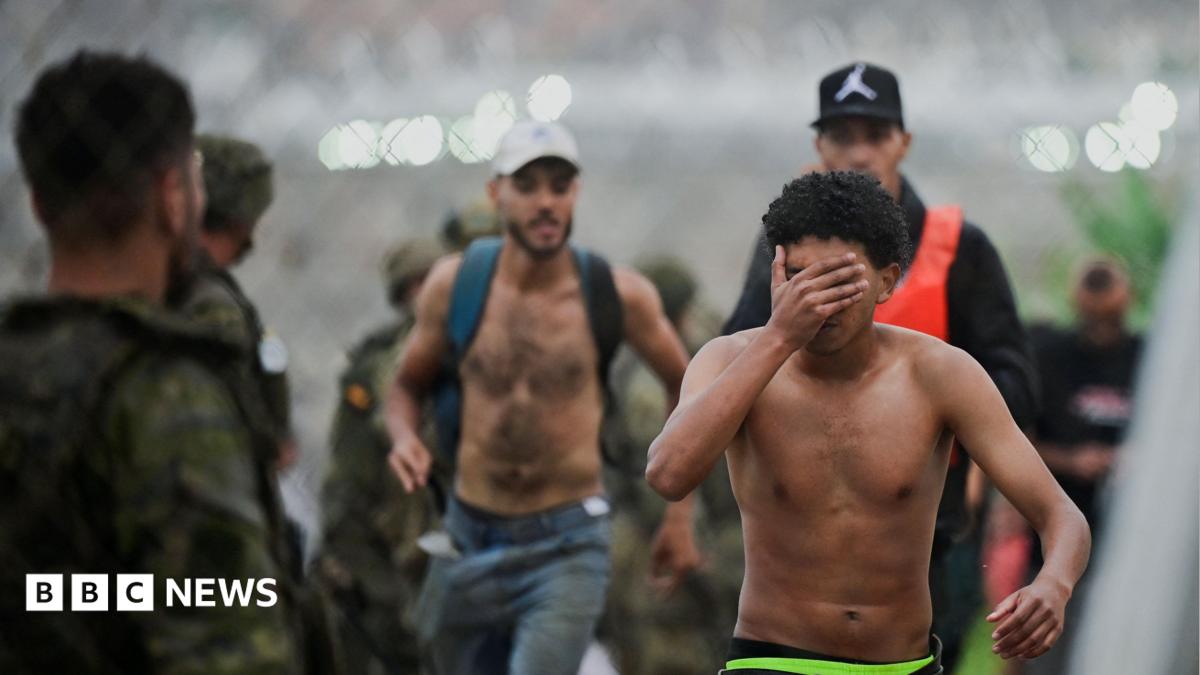
Spain announced Friday that it was deploying troops to Ceuta, a tiny Spanish territory on the coast of North Africa, to deal with an influx of tens of thousands of migrants who entered from Morocco illegally, overwhelming border security by their sheer numbers. File photo by Jalal Morchidi/EPA
July 31 (UPI) — Spain said Friday that it was deploying troops to Ceuta, an autonomous Spanish principality on the coast of North Africa, to deal with an influx of tens of thousands of migrants who illegally crossed from Morocco.
Authorities requested assistance from Madrid after the security situation descended into chaos on Thursday with border integrity completely overwhelmed and at least 15 people drowned after attempting to swim to Ceuta.
“The armed forces will reinforce the Civil Guard in the exercise of its powers and any others that may be necessary to maintain security in the city of Ceuta,” said Spain’s Interior Ministry.
It added that it was coordinating with Morocco to address the flow of migrants and that both governments were committed to coming up with and implementing measures for the swift return “of all people who have entered illegally.“
Spanish Prime Minister Pedro Sanchez was due to hold emergency talks with officials in Ceuta on Friday.
In a post on X, he reassured Ceuta President Juan Jesus Vivas that his administration was deploying all necessary resources and partnering with Moroccan and international authorities to “restore normalcy as soon as possible.”
Separated from the Spanish mainland by the Gibraltar Strait, just 10 miles wide, Ceuta is a key staging post in the journeys of migrants trying to reach Europe, with the influx apparently triggered by a recent Spanish Supreme Court ruling that people intercepted en route to Ceuta cannot be returned to Morocco.
The interior ministry blamed organized human traffickers using the decision to “encourage the flow of undocumented migrants.”
Implications for the other European countries, due to so-called Schengen free travel area that, once on the soil of any member nation, allows people to move around the continent passport-free, prompted France to tighten its border with Spain.
“In response to the situation observed in the Ceuta enclave, I gave instructions as of last night to immediately strengthen the controls at the Spanish border. Furthermore, I am activating the Rapid Intervention Border Force for in-depth checks,” Interior Minister Laurent Nunez announced on X on Friday morning.
Weekly insights and analysis on the latest developments in military technology, strategy, and foreign policy.
Egyptian officials have now confirmed that the port facility of Damietta was hit by a drone strike yesterday, the first public acknowledgment that the country has come under fire during this conflict. Though Cairo did not say who launched the attack, it raises the specter of another part of the region being brought into fighting that is largely centered on the flow of energy supplies.
“Following the successful containment of the fire, the relevant authorities conducted initial investigations into the incident, which indicated that a drone was responsible,” the Egyptian cabinet said in a statement on Thursday, according to state-funded Middle East News Agency. The cabinet added that “no party has claimed responsibility for the attack.”
“The competent authorities are continuing their investigations to determine the full circumstances surrounding the incident and to take the necessary measures to safeguard Egypt’s interests and national security,” the official government outlet added.
💢 The Egyptian government said in an official statement that preliminary investigations found a drone was responsible for the July 29 incident involving two vessels, including the US-owned ENERGOS WINTER floating storage and regasification unit, at Damietta Port.
As we reported yesterday, the Ambrey maritime security firm said two vessels were struck by drones at Damietta. One of the ships was a U.S.-owned and operated, Marshall Islands-flagged liquefied natural gas (LNG) floating storage facility and the other was a Greek-owned and operated, Bermuda-flagged LNG tanker, Ambrey stated.
A maritime security specialist told us that the U.S.-owned and operated, Marshall Islands-flagged floating gas storage facility was the Energos Winter while the other ship was the Gaslog Salem.
#NEW A drone struck a U.S.-owned gas storage tanker at Egypt’s Damietta Port.
It is not yet known if the drone was Iranian, although Trump indicated that it was, and that the U.S. will carry out retaliatory strikes against Iran soon.
Asked during a press conference whether Iran was behind the drone attack on the Egyptian port, Trump said “it’s a little more of the same, but it’s going to be straightening out, it’s going to be straightening out. But in the meantime, we are going to be hitting them very hard, because it is our turn to hit ’em. They know it’s coming, they are asking us not to do it.”
“We’re going to hit them very hard.”
President Trump warns adversaries that the U.S. is prepared to respond forcefully following a drone attack on an LNG tanker off the coast of Egypt.
Trump signaled that retaliation is imminent despite requests from adversaries to hold back.… pic.twitter.com/SMOUuj5qGT
The New York Times later reported that two Iranians, who asked not to be named to discuss security matters, “said the explosion was a drone attack designed to show that global shipping and energy supplies could be more deeply disrupted if Iran chose to escalate. The individuals did not say whether Iran or an Iran-allied militia in the region had launched the attack, or from where.”
The Iranians are not the only ones targeting energy facilities in the region. Several of their proxies have as well. It is part of a larger effort to impose cost on the U.S. and its allies.
The Iranian-backed Houthis, who, as we noted above, are striking Saudi oil infrastructure, on Thursday denied involvement in this incident.
“There is no truth to the rumors about Yemen targeting a ship in the port of Damietta in the Arab Republic of Egypt,” the group stated on Telegram. “The Yemeni position is clear, declared, and explicit, and it only targets the Saudi regime for its unjust blockade and ongoing aggression against the Yemeni people.”
A senior political official from Yemen’s Houthi movement has denied reports that the group plans to impose fees on commercial ships passing through the Bab al-Mandab Strait.
Hizam al-Assad, a member of the political bureau of the Houthi movement (Ansar Allah), said in a… pic.twitter.com/PtSGc5XOPj
— Middle East Monitor (@MiddleEastMnt) July 30, 2026
U.S. Central Command, which oversees American military operations in the Middle East, deferred questions about the incident to Egypt.
Regardless of who attacked Damietta, expanding the conflict to Egypt’s Mediterranean ports marks a significant potential escalation. The region’s two main sea arteries for energy shipments are already being choked off. The Iranians have largely closed down the Strait of Hormuz and there is an ongoing U.S. blockade on Iranian ports. The Houthis, as previously noted, have halted Saudi transits through the BAM, which has had a cascading effect on other nations not wanting to risk attack.
As the Iranian threats to the Strait of Hormuz increased, the kingdom diverted millions of barrels of oil per day through pipelines to its Yanbu port on the Red Sea in an effort to minimize the energy shortages due to the hostilities in the Persian Gulf.
That workaround served its purpose until the Houthi blockade, at which point Saudi Arabia began boosting shipments through the Suez Canal. Exports via that route “rose 106% for the week of the embargo announcement to 1.06 million barrels per day, up from the week starting July 13, according to Kpler data,” The National Newsrecently noted.
The port of Damietta, where yesterday’s attack took place, is 33 miles west of Port Said, which is at the northern entrance to the Suez Canal. Closure of the canal, or even a significant drop in traffic through it, would add to the pressures on the global economy already reeling from what is taking place in the Strait of Hormuz and the BAM.
The Egyptian port of Damietta, struck by drones, is about 33 miles west of the entrance to the Suez Canal. (Google Earth)
In a post on X, the Windward maritime intelligence firm called the attack on Damietta “a third front, separate from the Gulf and Red Sea.”
“The strike is assessed as separate from the Houthi Saudi-blockade campaign. Iranian state television had named Damietta as a retaliation target two days earlier, citing Ukraine’s strike on an Iranian vessel in the Caspian Sea, pointing toward an Iranian-directed operation rather than a Houthi one,” Windward explained in a related analysis.
A drone struck ENERGOS WINTER, a U.S.-managed LNG unit at Damietta, Egypt on July 29, with fire spreading to a second tanker alongside. Iranian state TV had named Damietta as a retaliation target two days earlier. This is a third front, separate from the Gulf and the Red Sea. pic.twitter.com/6bmWtST9XH
“At this moment, there has been no official statement from the Houthis confirming such a measure,” a spokesman told us Thursday morning. “We continue to monitor developments closely and are going to implement our mandate within our means and capabilities.”
On Thursday, Aspides posted an image of one of its member warships, the Italian frigate Bergamini, escorting merchant vessels in the Red Sea region.
The Italian 🇮🇹 Frigate BERGAMINI operating under EUNAVFOR ASPIDES provided support to merchant vessels, crossing the Area of Operations.
ASPIDES plays a crucial role in safeguarding shipping and supporting the safe passage of vessels through critical maritime routes. pic.twitter.com/9FNQL6Y00C
Meanwhile, Iran is continuing to lash out across the region.
Kuwaiti officials said one person was killed in an Iranian barrage today.
“The sinful Iranian aggression targeted a building belonging to one of the Chinese companies in the north of the country, resulting in the death of one worker and causing serious material damage to the building,” the Kuwait Defense Ministry (MoD) stated on X. “The Armed Forces affirm that they will continue carrying out their tasks and duties with high efficiency, and taking all necessary measures to protect national sovereignty and preserve its security and stability, in coordination with the competent authorities, in a way that safeguards the safety of citizens and residents.”
The Islamic Revolutionary Guard Corps (IRGC) claimed missiles made it through and that three F-35 Joint Strike Fighters were destroyed and three more damaged at Muwaffaq Salti Air Base (MSAB) in Jordan. The IRGC said it was in response to deaths caused by yesterday’s attacks by CENTCOM. However, the IRGC frequently fabricates claims or greatly exaggerates them and we cannot independently confirm this one.
Iran’s Revolutionary Guard Corps released a video of what they say were missiles launched by their naval forces targeting US aircraft at Jordan’s Al Azraq air base, in retaliation for US strikes on Qeshm Island that killed three people. pic.twitter.com/HRxGlWC6AN
We reached out to CENTCOM for comment, which a short while later put out a statement on X denying the IRGC claim.
Over the past few hours, Iranian state media have continued to report false claims by the Islamic Revolutionary Guard Corps (IRGC) – three in particular.
🚫 FIRST CLAIM: The IRGC (again) claims free and open routes through the Strait of Hormuz are dangerous for commercial… pic.twitter.com/J34ILmDvyk
Regardless of the claims, the constant Iranian bombardment is beginning to stir unrest in Jordan, where public dissent is banned.
“Hundreds of Jordanian political, legal and other figures signed an open letter last week calling for the withdrawal of U.S. forces from Jordan,” The New York Times reported. “People who signed the letter said they were driven by a sense of national responsibility and concern that the troop presence endangered Jordanian sovereignty.”
“We maintain that their presence exposes Jordan to security, political, and economic risks that serve no national interest and increases the likelihood of our country being dragged into a regional conflict to which it is not a party,” the letter said.
🇺🇸🇯🇴 “Hundreds of Jordanian political, legal and other figures signed an open letter calling for the withdrawal of U.S. forces from Jordan in a rare public challenge to the government, after Iranian attacks on bases”https://t.co/yYYutkRzEU via @NYTimes@MazMHussain@GerardAraud
As this conflict drags on, CENTCOM commander Adm. Brad Cooper, “has prepared an option for a punishing air campaign against Iran that could take up to two weeks,” The Wall Street Journal reported, citing people familiar with the matter.
“Now, as Trump moves to strike back after Iran’s surprise missile attack Tuesday, the president will decide how far to go,” the newspaper noted. “He could greenlight Cooper’s option of 10 to 14 days of intensive airstrikes intended to cripple Iran’s missile capability despite warnings that the U.S. is running low on air-defensive munitions. Or, he could opt for a more limited military strike in the hopes diplomacy could be pursued.”
Cooper has prepared an option for a punishing air campaign against Iran that could take up to two weeks, people familiar with the matter said.
Now, as Trump vows to strike back after Iran’s surprise missile attack Tuesday, the president will decide how far to go. W @mgordonwsj…
Iran, working to rearm as the fighting continues, is expected to receive “a first shipment out of up to 400 Chinese-made shoulder-fired air-defense missile launchers,” Reuters reported, citing three sources familiar with the deal.
“The purchase, valued at $60-70 million, is one of Tehran’s largest-known efforts to strengthen its short-range air defenses since the outbreak of its war with the U.S. and Israel, which exposed gaps in Iran’s ability to protect military sites and strategic infrastructure,” the outlet noted.
China isn’t just buying Iranian oil— it’s re-arming the regime.
That’s it for now. We’ll update this when there is more information to share.
UPDATE: 4:58 PM EDT –
Iranian Foreign Minister Abbas Araghchi addressed the drone strike on Damietta. In a post on X, he hinted at Israeli involvement but did not explicitly deny that Iran carried it out.
“Egypt is considered a friend and important partner in the region, and its security constitutes an utmost priority for us,” Araghchi stated. “We must all remain vigilant toward Israeli schemes and ‘false flag’ operations that aim to undermine regional peace. The threat is clear, shared, and fears Muslim solidarity.”
تُعدُّ مصر صديقًا وشريكًا مهمًا في المنطقة، ويُشكّل أمنُها أهميةً قصوى بالنسبة لنا. يجب علينا جميعًا أن نكون يقظين تجاه المخططات الإسرائيلية وعمليات “العَلَم الزائف” التي تهدف إلى تقويض السلام الإقليمي. إن التهديد واضح، ومشترك، ويخشَى تضامن المسلمين.
The reality TV regular has landed her own show which arrives on Disney Plus in a matter of days
Stassi is back with a new reality show releasing soon to Disney+(Image: Stassi Schroeder/Instagram)
Fans of the Real Housewives and Vanderpump Rules have a new must-see show for their watch lists.
House of Stassi premiered in the US this week with its UK release now just days away. The eight-episode series will be available to stream on Disney Plus from August 12.
It documents former Vanderpump Rules star, Stassi Schroeder, as she returns to the spotlight after her sacking from the show back in 2020. While she previously dipped her toe back in to reality TV with spin-off Vanderpump Villa, her own series will take fans deeper into her life and inner circle.
As per the Disney Plus synopsis: “House of Stassi follows reality TV icon Stassi Schroeder as she steps into her next act. In this meta-docuseries, Stassi navigates her long-awaited return to television – this time with the people she loves most by her side.
“As her ambition pulls her back into the spotlight, those around her level up. But as cameras roll and truths surface, her closest relationships are put to the test.”
Why is Stassi Schroeder famous?
She got her big break on the long-running reality series, Vanderpump Rules. A spin-off of the Real Housewives of Beverly Hills, the show began in 2013 and follows fan favourite housewife Lisa Vanderpump and the lives of the staff working across her restaurants and bars.
Stassi was on the show from the very start as a worker at Lisa’s West Hollywood restaurant, SUR. Her outspoken nature made her a standout personality across the eight seasons she featured in. She has also launched a successful podcast and has written three best-selling books.
Stassi Schroeder controversy explained
Back in 2020, Bravo confirmed it had fired Stassi and her co-star Kristen Doute from Vanderpump Rules. It came after a past incident from 2018 resurfaced in which the pair had called the police on black TV personality, Faith Stowers, for a crime she did not commit, claiming she resembled a suspect.
Stassi later issued a statement addressing the “racially insensitive comments”, writing: “I did not recognise the serious ramifications that could have transpired because of my actions. What I did to Faith was wrong. I apologise and I do not expect forgiveness.”
She added: “I am going to continue to look closer at myself and my actions – to take the time to listen, to learn, and to take accountability for my privilege.”
Meanwhile Kristen did the same, saying: “Although, my actions were not racially driven, I am now completely aware of how my privilege blinded me from the reality of law enforcement’s treatment of the black community, and how dangerous my actions would have been to her,” adding that she would “do better.”
Meghan Markle feud
Stassi claimed on her podcast in 2025 that she was “furious” at Meghan Markle and was boycotting her Netflix show With Love, Meghan. It came after she was allegedly refused freebies from Meghan’s As Ever brand, despite Stassi publicly supporting her in the past.
“The way she moves through social media, I think that she’s stuck in 2017, and she just thinks I’m a lowly reality person,” Stassi told her podcast listeners. “That’s what I think, and I am furious, and this is the last straw. I’m not watching her show anymore.”
Noticing that a PR package had been sent to another podcast host who had been critical of Meghan in the past only added fuel to the fire, and Stassi vowed: “I’m going to unfollow her right now. Literally, I’m unfollowing her. Done!”
Meghan has never commented on the supposed PR package snub nor the remarks made by Stassi.
House of Stassi arrives on Disney+ from August 12.
THE world’s best beaches have been revealed and the top pick has been described as being so beautiful it doesn’t look real.
The coastal spots were ranked from criteria like water-quality, popularity, public opinion, expert input as well as accessibility and climate.
Trunk Bay on the Virgin Islands was declared the best in the worldCredit: AlamyGolden Horn Beach in Croatia has clear waters and is backed by a pine tree forestCredit: Tuul & Bruno Morandi
Beach.com has announced the best beach in the world is Trunk Bay in the US Virgin Islands.
The beach is known for its white sand with clear turquoise water that has been described as looking ‘unreal’ by visitors.
Sign up for the Travel newsletter
Thank you!
It’s named after the Leatherback turtle (known locally as ‘trunks’), where smaller turtles are known to nest in the summer months.
The publication said that Trunk Bay is “truly the best beach in the world” with “top marks for beauty, water quality and an all-around perfect experience.”
Not only is it aesthetically beautiful, but the beach also has a 650ft long underwater snorkelling trail where its easy to spot tropical fish and colourful coral.
The second best beach, Elafonissi Beach in Greece, is no stranger to appearing on these lists.
It’s constantly recognised as being beautiful thanks to its rare pink sand.
The pink shimmer to the sand is essentially down to crushed shells from oyster-like micro-organisms called Benthic foraminifera.
The Sun’s Lizzie Parry who visited the beach a few years ago said: “I won’t lie, wandering down to the water it did just look like any other sandy beach. But the closer we got to the water’s edge it was clear to see what all the fuss was about.
“Dipping my slightly sunburnt toes into the sea, my pink foot blended in perfectly with a stunning stretch of bright pink sand.”
Trunk Bay has ‘unreal’ blue waters according to visitorsCredit: Getty
There are little coves to explore away from the mainland and it’s not far to get to from the UK as it’s just a few hours to Crete.
The third best beach is Grace Bay Beach which is found on Providenciales which is the main island on the Turks and Caicos archipelago.
Thanks to its beautiful clear waters, it’s a renowned snorkelling spot- and came in number one spot when it came to public opinion.
Deputy Travel Editor Kara Godfrey who visited said: “Grace Bay Beach is everything you’d imagine from an exotic beach. Soft white sands stretch for miles, with very few tourists if you get up early enough.
“Lined with hotel resorts, wait until the evening and you’ll get pink sunsets too.
Other top beaches include Golden Horn Beach in the Dalmatia region of Croatia – it got its name from its horn shape.
Grace Bay Beach is found on the largest island in Turks and CaicosCredit: Getty Flamenco Beach in Puerto Rico came in fourth place
The beach has clear waters and is backed by a pine tree forest.
Praia da Falésia has been named one of the best beaches in Portugal, one of the best beaches in Europe and comes in the world’s best at number nine.
Found in the Algarve, it has striking orange-coloured cliffs behind it.
Two beaches on the Canary Islands made the list, the first being Playa de Cofete in Fuerteventura.
Playa de Maspalomas in Gran Canaria came in at number 25 – it’s famous for its sprawling Sahara-like golden sand dunes which lead down to the water.
Sadly, no UK beaches made the cut.
Here is the full list of the world’s best beaches…
WILDFIRES are continuing to sweep across Europe and Turkey is one of the latest countries to battle the blazes.
Here’s everything you need to know right now about travelling to Turkey.
Wildfires have broken out in parts of Turkey including the Antalya ProvinceCredit: AFPAnother wildfire is in Seydikemer in the district of MuğlaCredit: AFP
Where are the wildfires in Turkey?
Fires have broken out in various parts of Turkey.
One location which is popular for holidays is Antalya, and within the province there are multiple wildfires.
Sign up for the Travel newsletter
Thank you!
Currently, these are further inland than the coastal resorts popular with tourists.
The Fethiye–Antalya highway was temporarily closed due to smoke but later reopened under controlled conditions.
Another serious and active fire is in Seydikemer, 20-minutes away from the city of Fethiye, where 600 people have been evacuated from their homes.
It’s in the hills between Fethiye and Marmaris – the fire started on Wednesday morning and spread into woodland.
On the northwestern Aegean coast, three neighborhoods in the Ayvalık district – Hacıveliler, Tıfıllar, and Bağyüzü – have been evacuated.
This is as a precaution due to a wildfire spreading across Turkey’s western Balıkesir province.
Agriculture Minister Ibrahim Yumakli said on X: “We are continuing to fight the wildfires day and night.
He said emergency responders had tackled 169 fires across the country since Wednesday, and 163 of those have “been completely brought under control.”
Antalya is one of the most popular regions for BritsCredit: Alamy
Is it safe to travel to Turkey right now?
Most of Turkey is still considered safe to travel to, excluding the areas of the Syrian-Turkey border.
But officials do heed warning about the natural disaster as there is a “high risk of wildfires during the summer season from April to October”.
It reads: “Wildfires happen frequently in Turkey during summer.
“You could get a fine or prison sentence for lighting a fire of any kind or discarding cigarettes in risk areas such as woodland. Look out for signs that tell you fires, barbeques, and smoking are prohibited.
“If there is a wildfire in your area, local authorities may tell you to leave your accommodation. Follow the directions of local authorities.
“If you see a wildfire, call emergency services on 112.”
GOV.UK adds that “extreme temperatures can affect many areas of Turkey over the summer months.”
Are flights still going to Turkey?
Flights to Turkey remain unaffected.
If you are due to fly in and have concerns, it may be worth contacting your airline to check if they are operating normally.
What if I have a holiday to Turkey booked?
As the Foreign Office has not warned against travel to Greece, there are no special circumstances in place for holidaymakers to cancel their trip and receive a full refund.
Depending on what travel insurance you have, your policy might include natural disaster cover.
If so, your insurance policy should cover you for when you are unable to reach your holiday destination due to natural disasters, like wildfires.
So it is worth checking your travel insurance policy.
Can I cancel my trip?
If you do choose to cancel your trip, it is best to contact your airline or holiday provider.
There is no obligation for companies to refund bookings unless government advice changes.
Javier Ramirez was handcuffed in the back of an unmarked car, bruised and confused, when immigration agents used a word he had never heard before.
It was June 2025, and they were bragging about the raids in the Los Angeles area that swept up hundreds of immigrants — and a few U.S. citizens, like Ramirez. The unfamiliar word caught Ramirez’s ear.
Tonk.
“I wondered what that meant — I thought it was some code,” the 33-year-old tow truck driver told me over a Zoom call this week. “But I didn’t make a big fuss about it then.”
Masked men had thrown him to the ground outside a tow yard in Montebello, for reasons they wouldn’t divulge. He ended up in the car with a man detained in another roundup, headed for the Metropolitan Detention Center in downtown Los Angeles.
The color disappeared from Ramirez’s face when I explained what “tonk” means.
For at least half a century, Border Patrol workers have used the onomatopoeic word, referring to the sound of someone getting hit, as slang for undocumented immigrants. Body camera footage and text chains from last summer’s immigration raids, released this week in a court filing, captures agents throwing around anti-immigrant insults like “wet” and “tonk” with the same ease that the rest of us say “and” or “the.”
The most egregious example, I told Ramirez, was directed at him and his friend, fellow U.S. citizen Brian Gavidia.
A video shows an agent shouting, “One tonk f— got away, dude!” as colleagues manhandle the pair. The same agent, who spoke with a Chicano accent, later sped off in a vehicle while asking in Spanglish, “¿Alguien arresto un tonk, güey?” — Did someone arrest a tonk, man?
“Oh, wow, OK, that’s really bad,” Ramirez finally said, laughing bitterly while gathering his thoughts. “It’s kind of hurtful. They’re just assuming who I am.”
Ramirez asked his attorney, Luis Castillo, if the agents who accosted him “had violence on their mind when they used that word.”
“You’re getting a double whammy,” the longtime civil rights lawyer replied. “They’re hitting you twice, physically and psychologically.”
No, Luis: they’re hitting us all.
Brian Gavidia stands in a parking lot next to East Los Angeles College in Monterey Park in 2025 a day after he and his friend were roughed up by immigration agents outside a tow yard in Montebello. The two are suing the federal government for violating their civil rights.
(Carlin Stiehl / Los Angeles Times)
If you’re still doubting that racist violence fuels President Trump’s deportation deluge, just consider what Gavidia and Ramirez have been through.
La migra roughed them up even as they screamed that they had documents to prove their U.S. citizenship. They took Gavidia’s Real ID and never returned it. Ramirez was detained for five days and charged with trying to assault a federal officer and interfere with their work — a case that went nowhere because he did no such things.
The American Civil Liberties Union and Public Counsel, along with other groups and private attorneys, included the body cam footage in a court filing asking a federal judge to bar immigration agents from making stops based on racial profiling.
Gavidia is part of that lawsuit, while Ramirez has sued separately. Now, the two men are more certain than ever that the Trump administration’s deportation strategy isn’t about getting the worst of the worst.
To la migra, all Latinos are tonks.
“I never even heard the word, but once [lawyers] told me the explanation of what it meant, I was disgusted instantly,” said Gavidia, 30, who fixes up and sells cars. “They already knew what they were coming to do. We told them we were Americans. It didn’t matter. We were brown, and that was enough.”
“I saw [the tonk video] 300 times,” Gavidia added, “and it’s giving me more trauma.”
“Tonk” has been a dirty little secret of the Border Patrol for decades — workplace lingo showing that the banality of evil that’s la migra on its best days has transformed into something far uglier under Trump.
The slur is so vile — predicated on violence by law enforcement, unlike ethnic jabs that insult food or culture — that it has never crossed over into mainstream English. “Tonk” in its anti-immigrant meaning doesn’t appear in the Merriam-Webster dictionary or even the Dictionary of American Regional English, the premier academic collection of American slang.
And that’s exactly how the Border Patrol likes it.
The earliest use of “tonk” to demean immigrants that I’ve been able to find is in a 1976 book by Paul Schuster Taylor, an early pioneer of Mexican American studies best known for documenting the plight of Dust Bowl refugees along with his wife, photographer Dorothea Lange.
Taylor quoted a Border Patrol inspector referring to Mexicans as “tonks” but offered no definition. In a 1978 hearing, Immigration and Naturalization Service Commissioner Leonel Castillo said the slur was “sort of like the new term” for “wets.”
Castillo — no relation to Luis — nevertheless defended his agents’ use of anti-immigrant words.
“I think it’s the way — the tone in which you use it, and then how you treat people,” he said, maintaining that the verbiage was ingrained in the “very fine gentlemen” who worked under him.
“It’s very hard to change them,” he said. “But they’re not necessarily bad people.”
A year later, an anonymous Border Patrol agent writing for the white supremacist publication Instauration debunked Castillo’s apologia. He claimed that “tonk” derived from the thudding noise when agents smashed a flashlight on an immigrant’s head.
“The Anglos of the Border Patrol are not as intimidated by federal guidelines as people might think,” the agent wrote. “We have our own methods of interrogation in the desert.”
San Diego State English professor William Nericcio has spent his career studying anti-Mexican hate. He grew up around Laredo, Texas, in the 1970s and 1980s with “guys and their dads who worked in Border Patrol because it was a good job.”
Yet he hadn’t heard of “tonk,” either.
Immigration agents detain two men at a car wash in Montebello, Calif., in 2025.
(Gregory Bull / Associated Press)
“A drum roll of anti-Mexican violence turns into a soundtrack — wetback, beaner, spic and now, tonk,” Nericcio responded when I asked why the slur has stuck for so long among immigration agents. “Of all these anti-Mexican terms, this is the only one that directly connects to an act of violence. It’s a thing of pride when you say it — ‘Hey boss, I got a tonk today! Where’s my bonus?’ It’s glory days for them.”
The casual use of “tonk” by la migra eventually became a PR embarrassment even for the Trump administration. In 2019, during Trump’s first term, a Customs and Border Protection spokesperson told an Arizona public radio station that the slur “is now considered a derogatory term and CBP does not condone its use.”
This time around, a Department of Homeland Security spokesperson told my Times colleagues that “agents are focused on protecting the American people — not entertaining performative outrage.”
CBP didn’t respond to my multiple requests for comment about whether its internal guidelines continue to discourage “tonk” and whether agents face any discipline for using it.
If you’re not disgusted by this devolution in protocol, I’m not sure what can possibly disgust you.
ACLU lawyer Mayra Joachin said the body cam footage is “clear evidence that these stops were always about individuals’ appearance of being Latino working class” and is proof of the “culture of racism underlying” the Trump administration’s deportation strategy.
How are Gavidia and Ramirez feeling now, after being called a racist slur they hadn’t even known existed and that doesn’t even technically apply to them?
“If you’re a U.S. citizen, you can’t be free in the U.S.,” Ramirez said. What happened to him “can happen to anyone, it can happen to their kids and family, and when it happens to their family, that’s when they’re going to see the truth of what’s happening.”
Gavidia, who voted for Trump in 2024, said that immigration agents think they “are above the Constitution and law.”
“That’s sad and disgusting,” he said. “If we don’t stop this and fight this now, it’s going to get worse and worse.”
Scotland’s Melanie Woods has won the Commonwealth Games women’s 1500m T54 for the second time in under 40 hours after streaking to victory in the restaged final – however England’s Ellis Kottas could not replicate her silver medal.
Woods set a new Games record to triumph in Glasgow on Wednesday evening, but it emerged on Thursday morning that Para-athletics authorities had decided the race should be held again following appeals surrounding a first-lap crash.
However, the Scot kept her composure in her home city to replicate her initial success, break the record again, and reclaim the gold that was already hers – in mind if not around her neck.
Kottas, though, finished fourth, having said she was “low-key traumatised” when the race result was overturned.
Woods led from the start in her home city, although Noemi Alphonse of Mauritius and Australia’s Eliza Ault-Connell kept her honest over the first couple of laps.
The latter had fallen away by the final 200m, though, and the Scot held off the Mauritian as she was roared by down the home straight by the crowd.
“It was in my mind ‘what have I got left?’ and you do question what you’ve got in your arms,” Woods said.
“But I just needed to be confident I could stay out in front and it was nice coming down the home straight and not seeing her wheel moving in front of me.”
Woods – who has used a wheelchair since being hit by a car while riding her bike in 2018 – will also compete in the 400m later on Friday morning.
The heats of that will start a little more than 90 minutes after the replayed final.
FIFA face global mutiny as Asian Football Confederation stand with Europe and North America after their boycott threats.
By Reuters and The Associated Press
Published On 31 Jul 202631 Jul 2026
The Asian Football Confederation has said it “stands in solidarity” with regional bodies UEFA and CONCACAF in opposing plans to sell a stake in the World Cup to private investors but stopped short of threatening to boycott events run by FIFA, global football’s governing body.
The confederation in a statement on Friday expressed “deep concern” over the proposed establishment of a $20bn commercial subsidiary, FIFA Forward Enterprise (FFE), to run the World Cup and FIFA’s other events.
Recommended Stories
list of 4 itemsend of list
“The fact that the situation has reached the point where the real possibility of a FIFA World Cup boycott has entered public discourse should concern everyone who cares about the future of our game,” the statement said.
“Football should never have been placed in such a position.”
UEFA, European football’s governing body, voted unanimously on Thursday to boycott all FIFA events unless the plans were dropped. CONCACAF, the regional federation for North America, Central America and the Caribbean, has also rejected FIFA’s proposal.
On Thursday, AFC President Sheikh Salman bin Ebrahim Al Khalifa had said the way the proposal had been made was “totally unacceptable”, in a letter to member associations.
The AFC said “the proposed FFE cannot realistically achieve the necessary broad consensus and unity required to move forward.
“The FIFA World Cup is the pinnacle of global football and derives its strength from the participation of all confederations and the world’s leading football nations.”
The AFC also made a thinly veiled attack on the governing body’s president, Gianni Infantino, saying the plan “has exposed fundamental weaknesses in FIFA’s consultation and decision-making processes that must now be addressed”.
Even after FIFA issued a new statement on Friday, saying each national association “should be allowed to review the proposal and have a say in shaping their own future”, the AFC said “central concerns surrounding governance, institutional process and meaningful consultation remain unanswered”.
It said the furore must become a catalyst for institutional reform at FIFA, and that “meaningful democracy is not measured solely by the opportunity to vote.
“It begins with transparent governance, timely consultation, informed deliberation and genuine participation throughout the decision-making process.”
Ceuta, on Morocco’s northern coast, is separated from mainland Spain by the Strait of Gibraltar and has long been a focal point for migrants attempting to reach Europe.
Local officials had appealed to Madrid for help after a recent rise in attempted crossings, but there were chaotic scenes on Thursday as border controls apparently broke down.
The astonishing estimation by Spanish officials suggests the number of migrants who entered into Ceuta in the last day or so could be more than half of the population of the city – which sits at around 83,600, according to the latest local figures.
Spain later deployed its armed forces to bolster security in Ceuta and at its sister city of Melilla, where between 300 to 400 crossings were also reported overnight.
Coveted by Morocco, both cities have long been a flashpoint in diplomatic relations with Spain. Madrid asserts that both territories are integral parts of Spain and have the same status as the semi-autonomous regions on its mainland.
They form the European Union’s only land borders with Africa.
However, after overcoming the shock of saying goodbye to their beloved goats, Kelvin and Liz reflected on the farm’s future and where they see themselves.
As the couple gathered around a campfire with their children, Liz shared, “I think this has been our hardest year, our most challenging, but I feel like we’ve learned the most this year on our own, and I feel like we’ve come on so far in the last 12 months.”
Kelvin asked, “Would you consider yourself a farmer now?”
He added, “I think this year I feel confident to say, yeah, we’ve got a farm, we’ve got a family farm, and this is what we do. We started with just a few sheep, and now we’ve got a flock of sheep, loads of pigs, cows, feral kids.”
“The kids are the biggest animals on the farm,” Liz laughed as Kelvin continued, “It’s safe to say we’re certainly on our way to becoming farmers.”
Liz went on to ask her husband whether he was “happy with this life,” to which he said, ” Yes. I’m committed that this is the right thing for us.
“We’re absolutely on the right path. There’s no question that we just got to absolutely embrace it and be in the moment, be present.”
“Cheers to that,” Liz said before Kelvin shared his dreams of moving away from their Cheshire Farm.
He stated, “I would like a ranch in America one day.”
“I mean, I’d like to be in the Bahamas, but one step at a time,” Liz told Kelvin.
This isn’t the first time Kelvin and Liz have spoken about moving to America; during an appearance on James Martin’s Saturday Morning, one thing stopped them from pursuing their dream.
The ITV chef pointed out, “You were originally going to go to America. This was a life-changing thing you decided, and you got the visas and everything, didn’t you?”
“As two actors, we thought, you know, Kelvin had been in Emmerdale for 20 years, and we kind of wanted to try something different, and as two actors, we thought, ‘Well, why not? Let’s go to Hollywood and LA and see what happens’,” Liz explained.
“And we only had two children at the time, but unfortunately, Covid stopped that, and they actually stopped the visas. We never got the visas completed because they said, ‘There’ll be a pause on this for at least two years’.
Fletcher’s Family Farm is available to watch on ITVX.
CHRISTMAS is months away for most of us – in the town of Bridlington, they’re already brushing off their Santa hats.
The seaside town in East Yorkshire will celebrate the festive season four months early with Santa’s Grotto and carol singing on the beach.
Christmas will arrive early in Yorkshire with festive train rides and eventsCredit: East Riding Culture and LeisureThere will be festive carols on the beach and Santa will make an appearanceCredit: East Riding Council
Between 10am and 4pm on August 5, Bridlington will transform into a winter wonderland – kind of.
Called Bridmas, the day is filled with events, lots of which are completely free.
Sign up for the Travel newsletter
Thank you!
On the beach is where it’s at with the local choir performing Christmas carols throughout the day.
There will be a festive face painter, an elf and bubble show and Christmas craft sessions.
If you are over the age of, say, 14, you might not be familiar with daughter-father duo Salish and Jordan Matter. But if you are a parent of a Gen Alpha kid, it can feel like you hear about nothing but Salish and Jordan Matter. Their YouTube videos — a high-octane mix of zany challenges, games and hijinks — are admittedly hard to resist, which may be why they rake in millions of views as soon as they blast into the social media universe.
In Sunday Funday, L.A. people give us a play-by-play of their ideal Sunday around town. Find ideas and inspiration on where to go, what to eat and how to enjoy life on the weekends.
Sixteen-year-old Salish was in elementary school when she started appearing in her father’s YouTube videos and the channel is like a time capsule of her childhood — or, well, the most public, heavily produced version of it. There’s the day Salish turned her house into a waterpark (73 million views) or the night she had a secret sleepover in a mall (31 million views) or the time she survived 100 babysitters in 24 hours (61 million views). “A blessing and a curse for me is that we’ve documented it all,” says Jordan, whose background is in photography. “I have these beautiful videos of her when she was 10. I was just watching them 30 minutes ago and was like, oh wow, it feels like yesterday.”
Now their creator journey is taking a new turn. Salish and Jordan recently signed a deal with Netflix to develop, produce and star in original projects — it’s the largest such creator partnership for the streaming giant. Their show, “Salish & Jordan Matter,” reached Netflix’s Top 10 this month. Beyond the screen, the duo co-founded the popular teen skincare brand Sincerely Yours. (The launch of one glossy lip balm brought 2,000 fans to the Santa Monica Pier earlier this summer.)
It’s been a wild ride for the pair, but despite their snowballing fame, they swear they’re like any other dad and daughter who bicker, joke around and simply enjoy each other’s company.
“I think we’re pretty chill, right?” Jordan says.
“Yeah, we’re pretty chill,” Salish agrees.
Here they share what they’d do together on a Sunday Funday around their South Bay home, noting that a perfect day would involve the whole family, including mom Lauren Matter and Salish’s 20-year-old brother, Hudson Matter.
This interview has been edited for length and clarity.
10 a.m.: Wake up and debate the day’s options
Jordan: Salish, what time would you actually wake up?
Salish: Probably like 10.
Jordan: OK, so we’re sleeping in until 10. Then why don’t we go get breakfast? We’ll go to Ocean Diner in Hermosa Beach. We’ll both get huevos rancheros and fresh orange juice. And then I would love to go get coffee at Boy and the Bear in Redondo Beach.
Jordan: Well, if we go to Two Guns, Salish would get the avocado toast.
Salish: No, the chai! It’s so good!
Jordan: OK, well, if Salish has an opinion, that’s what we’re doing. But later today, one thing I would love is a bike ride on the beach. Are you still down?
Salish: [High-pitched voice] Yeah.
Jordan: Did you hear that voice?! That tone is like, “Yeah, but not for much longer.”
Salish: [Laughs] No, I like doing bike rides with you! It’s just that I don’t know how much of a “biker” I am.
Jordan: You’re not one.
Salish: I’m not.
Jordan: But you have an electric bike! You just have to go like [makes e-bike revving motion] vvrrrrrruurr.
11:15 a.m.: Shopping and soup dumplings
Jordan: The next thing we’re going to do is …
Salish: Go to the mall! I like picking out new outfits for him because every day he just wears a black T-shirt.
Jordan: OK, and if we’re going to go to Del Amo mall, we’ll have lunch at …
Jordan: Which means we’ll have to put our name on the waiting list.
Salish: It’s like a two-hour wait.
Jordan: So we’ll put our name down right after breakfast. And then we’ll shop for clothes before our reservation.
Salish: I’ll go to Aritzia and probably Garage. And then you’ll go to Express and Levi’s. I go to PacSun a lot too but normally I don’t find anything there. I always wear sweats and hoodies — literally just sweats and hoodies.
Jordan: Also tank tops. Salish doesn’t like to repeat outfits on videos, so she does need at least one new outfit a week.
And I’ll just follow her around. I’ll be like, ‘Oh, that looks good.’ And she’ll be like, ‘No, it doesn’t.’ And I’ll be like, ‘No, it looks really good.’ And she’ll be like, ‘You’re just saying that.’ And then she’ll ask, ‘Which color?’ I’ll say the blue, and then she’ll get the pink. And I’m like, ‘I’m glad I could be helpful.’ So that’s how shopping with Salish goes. Then finally, there’s Din Tai Fung.
3 p.m.: An afternoon by the ocean
Jordan: Then we would leave the mall because I’m not gonna be there all day. We’re gonna go paddleboarding in Long Beach, in the Naples Canals area. We love anything with water, right? We love vacationing in Lake Tahoe, swimming and boating.
Then we would probably go for a bike ride along the Strand. I would vote for pulling over and having dinner. There’s a really good taco place right near the Hermosa Beach Pier called Palmilla Cocina Y Tequila.
Salish: [Winces slightly] I’m not gonna lie. I don’t really like tacos.
Jordan: Salish is an absolutely impossible eater. All she eats is Chipotle. She’s a vegetarian but she’s a picky vegetarian, so that combo makes it almost impossible for her to find food anywhere. But she’d get the black beans and rice and tortillas and cheese and mix it all together.
Salish: Yeah.
Jordan: See, I basically know everything about you.
Salish: And you would get the chicken!
Jordan: Yes.
Salish: I knew it. But you have to make sure it’s white meat.
Jordan: White meat chicken, mole, enchiladas — yum!
8 p.m.: Family hang time
Jordan: Now if there’s a good horror or suspense movie out, I might convince Salish to go. But that would be a tough sell. So maybe we’ll go back home. We just got a pool, so that’s exciting. And late nights in the pool has become a thing. We might play ping pong or a board game.
Salish: Then my brother and I would probably just chill and talk in one of our rooms. He doesn’t live here so we try to talk as much as we can while he’s home.
Jordan: Our family isn’t looking for big things to have fun — just time together. We just talk and hang out. With Salish, we talk about work but I’m also super interested in what her everyday life is like. You know, from the time she was young, I feel like I treated her like an adult in a way and we’ve always had real conversations. That’s made it easier as she’s grown up. It feels comfortable having these types of conversations.
Salish: Also, I’m a great kid, so like …
Jordan: Of course, of course. You are such a great kid. But you were a spitfire when you were little, I’ll say!
Salish: [Laughs]
Jordan: It’s a joy. It’s a joy to be with her every day.
There’s both staff or self-check in, as well as a main communal area with tables and chairs, but with a quick beep of a button, I had my key card.
It is a bit disconcerting at first, being surrounded by industrial metal beams and white concrete pillars that appeared to be holding the place up.
Yet my ‘Cocoon’ – one of 206 rooms at this hotel – was exactly what I was looking for.
A huge double bed, cosy yellow lighting, and my own, albeit compact, ensuite bathroom complete with towels and toiletries.
Oh yes, and no window at all.
I was worried at first of my claustrophobia making this a difficult night, but I was surprised by how it didn’t affect me.
The bathrooms are small but fully equipped with everything you needIt was one of the best nights sleep in my life
While there are no TVs (leaning into the great sleep) there was WiFi so after a much-needed shower, I settled into bed to watch a quick bit of Netflix before almost instantly passing out.
The only noise? The occasional comforting rumble of a London Underground train passing by above.
The only downside is that I like to be woken up by natural light, something that obviously wasn’t doable here.
But this might be the most peaceful stay I’ve ever had at a London hotel, especially one so central.
So if you simply want an affordable base in the capital that is near all the sights, and the best nights sleep ever.
I’ll happily head back into my cosy cocoon.
Due to being a no frills hotel, there is no restaurant but there is a vending machine, or you can pay £18.90 extra for breakfast at the nearby 24-hour VQ restaurant.
And of course, every restaurant and fast food chain you can think of is on your doorstep too.
Other additional fees include luggage storage, ranging from £15-£80, or early and late check ins from £40 to £60.
Fifa president Gianni Infantino’s plan to sell stakes in competitions to private investors appears to be in jeopardy, with a third confederation expressing opposition.
In a statement published on Friday, the Asian Football Confederation (AFC) said it “stands in solidarity” with its counterparts in Europe and North, Central America and the Caribbean.
The AFC added Infantino’s plan could not “realistically achieve the necessary broad consensus and unity required to move forward”.
“The Fifa World Cup is the pinnacle of global football and derives its strength from the participation of all Confederations and the world’s leading football nations,” it said.
“Any proposal that risks undermining the unity and universal character of the competition must be reconsidered.”
The AFC’s statement means Infantino’s plans are unlikely to be approved by Fifa members if put to a vote.
Infantino had indicated the proposals would need a straight majority to go through – meaning 106 of its 211 members to vote in favour for the proposal.
Uefa – the body that governs European football – has 55 votes. Concacaf, which oversees football in North, Central America and the Caribbean, has 35 and Asia has 46.
Asian football’s governing body accused Fifa of once again setting the “direction of travel” for a “significant initiative” before consulting stakeholders.
It said Fifa’s failure to consult its member associations on the proposals had “exposed fundamental weaknesses in Fifa’s consultation and decision-making processes that must now be addressed”.
The AFC also criticised Fifa for leaving “confederations, member associations and even Fifa’s own governing bodies, including the Fifa Council, feeling sidelined.
“The Fifa World Cup, and the game itself, belong to the entire global football family,” it added.
Their future must always be shaped collectively, through institutions that reflect the voices of all Confederations and member associations.
“The AFC calls upon Fifa to undertake an urgent review of its governance and decision-making framework to ensure that proposals of global significance are developed through proper consultation, meaningful engagement and appropriate oversight by Fifa’s statutory bodies.”
Kim Ho-cheol, Chairman of the Board of Audit and Inspection, attends a press conference at the state auditor’s headquarters in Seoul, South Korea, 24 June 2026. Photo by YONHAP / EPA
July 30 (Asia Today) — South Korea’s state-run housing guarantor failed to properly investigate debtors and recover claims after paying about 15 trillion won, or $10.3 billion, under defaulted guarantees over the past five years, a government audit found Thursday.
The Housing and Urban Guarantee Corporation, commonly known as HUG, has yet to recover about 12 trillion won, or $8.2 billion, of that amount.
The Board of Audit and Inspection released the findings of its regular audit of the corporation, identifying problems in guarantee issuance, project financing reviews, debt collection and customer refunds.
HUG provides guarantees intended to protect tenants if landlords fail to return jeonse deposits.
Jeonse is a housing rental arrangement widely used in South Korea in which a tenant provides a large refundable deposit instead of paying, or in exchange for paying less, monthly rent.
Corporation undercharged guarantee fees
Auditors found that HUG undercharged a corporate rental business by about 2.77 billion won, or $1.9 million, when issuing guarantees covering 12,752 homes.
HUG’s rules required it to calculate the fee using the company’s credit rating on the date the guarantee was issued. Employees instead used an earlier, more favorable credit rating from the application date.
The audit board called for disciplinary action against the employees involved and instructed HUG to review ways of collecting the unpaid fees.
HUG has reported financial losses since 2022 as rental deposit guarantee defaults increased, including cases involving large-scale jeonse fraud.
Its operating loss grew from 242.9 billion won, or about $166 million, in 2022 to 2.19 trillion won, or about $1.5 billion, in 2024.
Weak reviews led to $261 million in PF guarantees
The audit also found deficiencies in HUG’s reviews of housing project financing guarantees.
Such guarantees rely largely on a developer’s projected income from future home sales, making an accurate assessment of expected cash flow essential.
Auditors found that HUG accepted financial data in which developers had arbitrarily delayed construction payments, improving the projects’ apparent debt-service capacity.
As a result, HUG approved a combined 382 billion won, or about $261 million, in guarantees for three projects that should have been rejected under its own standards.
HUG also incorrectly graded two other projects and collected about 1.64 billion won, or $1.1 million, less in guarantee fees than it should have.
Thousands of debtors were not investigated
The audit board also found major gaps in HUG’s efforts to identify assets belonging to debtors after paying claims on their behalf.
An examination of seven regional management centers found no record of an asset investigation for 2,915 of 9,003 debtors, or 32.3%.
The rate varied widely among regional offices. The Seoul Northern Center investigated the assets of only 21.6% of the debtors assigned to it, compared with 99.8% at the Seoul Western Center.
HUG’s headquarters failed to adequately monitor or address those differences, auditors said.
Tenants missed refunds
HUG also failed to refund fees to some tenants who had been enrolled in both a landlord rental deposit guarantee and a tenant jeonse deposit return guarantee.
The audit identified 1,699 cases involving about 173 million won, or approximately $118,000, in unreturned fees.
It also found 454 guarantee-default cases in which money owed to tenants had not been properly returned.
The audit board instructed HUG to analyze the causes of the problems and develop improvements in its core operations, including guarantee reviews, issuance procedures and debt recovery.
It also called for disciplinary or corrective action against employees responsible for improper decisions.
Hamas has agreed to gradually disarm in Gaza as part of Donald Trump’s 20-point peace plan. The US president called the deal ‘historic’. Here’s what we know.