British holidaymakers travelling to and from a popular Spanish destination have been warned about planned strikes that could cause delays and disruptions during the summer holidays
Brits have been warned about two simultaneous strikes taking place at a major Spanish airport(Image: Getty Images/Stock Image)
Brits jetting off abroad to a major holiday hotspot are being warned about travel disruptions due to planned strikes set to start this week.
Holidaymakers travelling through Palma de Mallorca Airport (PMI) could face significant delays as Swissport workers are due to strike on Tuesday, 28 July, with TUI one of the affected airlines. Further walk-outs in the Swissport ground handling strike are planned for the summer holidays, including on August 1, 4, and 8 from 7am to 12pm and 7pm to 10pm.
To make matters worse, full 24-hour daily walkouts are also set to take place this week, starting from today (Monday, 27 July) until Thursday (30 July). This industrial action, known as the metal sector strike, has been planned by three unions and covers 39,000 workers across the Balearic Islands who are demanding “fair wage increases and protection against inflation”, Palma Airport outlined.
However, Palma Airport warned that there is a “crucial overlap date” for Tuesday, 28 July, as the two strikes coincide. This could result in the worst-impacted day for travellers passing through the airport with delays and disruptions, as various airlines could be affected.
Palma Airport explained that Swissport provides essential passenger, baggage handling and ramp services to a specific group of international carriers, including TUI, Condor, TAP Air Portugal, Air Canada, Etihad Airways, Albastar and DAT. While other airlines at Palma use different ground handling providers, such as Ryanair, EasyJet, or Jet2, the airport warned that “large-scale airport strikes can occasionally create a minor knock-on effect”, but Swissport passengers are expected to be the worst affected.
Meanwhile, the airport warned that the regional metal sector strike “covers technical personnel across the entire airport”, meaning that its impact will “stretch beyond Swissport-handled airlines to affect all carriers operating at Palma, Ibiza, and Menorca.” They added that “passengers on any airline could face localised delays” on those specific dates (July 27 to 30).
The airport warned that during the strikes, passengers could face “longer waiting times” and “potential operational bottlenecks.” In addition, travellers could face delays when checking in or dropping off their bags before departure, when at the boarding gate, and at the baggage carousels after landing in Mallorca, during the Swissport strikes.
In advice to holidaymakers set to travel to or from Palma, the airport advised the following:
Check in online: Complete your check-in online before heading to the airport to minimise time spent in queues.
Travel light if possible: Travelling with hand luggage only allows you to bypass potential check-in and baggage carousel delays.
Monitor your airline’s app: Keep a close eye on text alerts or app notifications from your airline for real-time schedule updates.
Arrive on time (but not too early): Stick to the standard arrival window recommended by your carrier (usually two to three hours before departure). Arriving half a day early can worsen airport congestion.
Palma Airport, also known as Son Sant Joan Airport, is one of the biggest Spanish airports, connecting Brits to the capital of Mallorca (Majorca), and beyond. In July last year, a whopping 1.8 million tourists travelled through Palma Airport in favour of that Spanish sun-soaked summer getaway.
The airport strikes planned for this week follow protests against overtourism in Palma on Sunday, 26 July. According to the police, around 25,000 people were involved, while the organisers, Menys Turisme, Mes Vida (Less Tourism, More Life), estimate that 70,000 took part in the protest.
For more information on the planned strikes during the summer, visit the Palma Airport website.
Do you have a travel story to share? Email webtravel@reachplc.com
The 2003 Honda Award winner. A 2024 second-team All-American. The single-season NCAA home run record holder. And a freshman of the year honoree.
The Portland Cascade’s Megan Grant fields the ball during a game against the Oklahoma City Spark on July 4 in Edmond, Okla.
(Courtesy of AUSL)
All of whom never dreamed of being a professional softball player. Not because their love for the sport dwindled. Nor because professional routes were not an option. Pro softball leagues have existed since 1976, but they have lacked the visibility and accessibility imperative to flourishing and gaining popularity.
“From my experience growing up, and it’s the same amongst a lot of athletes that are my age, we didn’t have a lot of role models to look up to,” said Chicago Bandits outfielder Jessica Clements, who spent her senior season at UCLA in 2025. “We had Jennie Finch, Natasha Watley, Monica Abbott, but the odds of playing professionally were slim. There wasn’t a lot of opportunity, and a lot of younger kids were unsure of what the environment would look like in many years.”
The AUSL — which launched in 2025 and builds off previous iterations of professional softball — saw a 181% increase in average viewership across ESPN platforms in one year, including a record-high 404,000 viewers for a June 21 game between the Portland Cascade and Texas Volts.
Among the 96 active players in the AUSL, 13 are former UCLA softball players — omitting two general managers, a head coach and an assistant coach that are a part of the AUSL and hail from the Westwood program — making UCLA the most well-represented school in the league. That pipeline was on full display this weekend at Texas A&M’s Davis Diamond, where the Utah Talons — who boast a roster with five former Bruins, including UCLA softball associate head coach Lisa Fernandez as the general manager — clinched their second straight AUSL title over the Chicago Bandits on Sunday. UCLA alum Jadelyn Allchin was named the AUSL championship MVP.
And UCLA softball’s presence in all facets of AUSL is no coincidence.
The Bruins feature 12 NCAA championships and 119 All-American honorees, both of which rank first all time, and that’s not including an AIAW title and one All-American before the NCAA era. But while the program is known for its accolades, the influence UCLA and its players have made on the sport stretches far beyond any banners or trophies.
“When you look at the history of softball in the last 40 years, you can’t see a U.S. national team, any pro venture or excellence at any level of softball without having an influence of UCLA in it,” said Oklahoma City Sparks general manager Kirk Walker, who spent 24 years coaching as an assistant coach in Westwood.
There have been only three coaches — Sharron Backus, Sue Enquist and Kelly Inouye-Perez — in UCLA history, all of whom created unparalleled success and a program built on a standard of excellence and a familial culture. But no aspect of the UCLA culture may be more significant than the “Bruin Bubble” — a concept at the very heart of the program centered on alumni involvement.
“It comes from the women who were there from the beginning, paving the way for players like us and players that are to come,” said Sparks infielder Delanie Wisz, who competed at UCLA from 2020 to 2022. “The idea of the ‘Bruin Bubble’ and buying into something bigger than yourself, coach Sue Enquist, coach Sharron Backus and coach Inouye-Perez have done a really good job of keeping that at the forefront, and making sure that we’re playing for something much bigger than any individual award.”
While the childhood aspirations of the Bruins in the AUSL never reached the height of professional softball, a common goal connected them all — playing for their dream school in Westwood and learning from individuals who have achieved immeasurable success greater than any record or championship.
Utah Talons General Manager Lisa Fernandez shows off her 2025 AUSL championship ring in Salt Lake City, Utah.
(Courtesy of AUSL)
Backus and Enquist set the foundation for what softball is today, paving the way for new opportunities by sacrificing for the greater good of softball’s future.
While the duo set the trail ablaze, they have passed the baton to a trio of coaches — Inouye-Perez, Walker and Fernandez, who have spent a combined 72 years in Westwood.
And the group has not stopped running since.
The Bruins are not only responsible for creating the next generation of pro softball players through the UCLA program, but also furthering the message and mission of Backus and Enquist.
“From when I was in college to now, there’s been a big shift in how things go,” said Rachel Garcia, two-time Honda Cup winner at UCLA and a Volts pitcher in the AUSL, “but at the end of the day, Lisa Fernandez, Kelly Inouye-Perez, Kirk Walker, that would be who I’d want to play for every single day, because I know that they are able to give the girls what they need in order to perform at the best that they can be.”
While Inouye-Perez continues to steer the Bruin ship, Walker and Fernandez serve in general manager roles for the Sparks and Talons, respectively.
The Utah Talons’ Jordan Woolery fields the ball during a July 11 AUSL game against the Oklahoma City Spark in Edmond, Okla.
(Morgan Givens / AUSL)
Grant emphasized that all three coaches could easily walk away because of the imprint they left and the resume they built. Yet, Inouye-Perez and Fernandez not only chose to stick around the game, but to reinvest their time in furthering the league and sport altogether.
“I accept the responsibility to help carry the torch and move it forward, and hand it off to the Jennie Finches and the Cat Ostermans,” Fernandez said. “They’re going to hand it off to the next generation that are going to continue to build this game and hopefully it’ll become something where little girls can go, ‘I’m going to be a professional softball player, and be a role model for those who have the opportunity to watch me.’ And at the end of the day that’s the true value.”
Integral to pushing the game forward is taking advantage of the traction and momentum gained by the 2028 Summer Olympics, where softball will return to the stage for the first time since 2021.
Fernandez highlighted that when softball was added to the Olympics in 1996, it was the pinnacle of the sport. But when it was removed following 2008 because the IOC didn’t see enough global competition for the gold medal, she felt that she failed. It was a setback that inspired her push to get the sport to a place where it did not have to rely on the host country to include it among Olympic events.
“A mission that’s close to my heart is the growth of the sport globally because it is so important for it to be in the Olympics, not just in 2028 but in 2032,” said Talons pitcher Megan Faraimo, who competed at UCLA from 2019 to 2023. “I don’t want to be the last generation to make it into the Olympics. I want to protect the future of everyone coming after me, and that means capitalizing on it being in L.A. We can use that to then push the sport into 2032 and hopefully get back on that Olympic rhythm.”
Israeli soldiers have intensified their offensive in the occupied West Bank and East Jerusalem, raiding at least 20 towns and villages, demolishing homes and arresting dozens of Palestinians, as Arab states and the Arab League condemn escalating settler attacks against Palestinians and their property.
Al Jazeera reporters in the occupied West Bank reported on Monday that Israeli forces had stormed the Jabal Salman area in the town of Beita, south of Nablus, and carried out demolition operations in the town of Nilin, west of Ramallah.
Recommended Stories
list of 3 itemsend of list
In a separate incursion, forces stormed the town of Arrabeh in Jenin, accompanied by military bulldozers.
Raids and arrests were also reported in Deir al-Ghusun, north of Tulkarem, where five Palestinians were detained.
Four young men were arrested during raids on the Balata camp and Asira al-Shamaliya in Nablus, Quds News reported.
Soldiers raided homes and made arrests in several other villages and towns, including Deir Jarir, Jalbon, Kafr Qaddum, Tal, Burqa, Beit Furik, Anabta, the Aktaba suburb, Qalqilya, Arroub camp and Beit Ummar.
Quds News reported that Israeli soldiers halted an ambulance trying to transport a pregnant woman from the town of Qaryut to a Nablus hospital for treatment for a medical emergency. Her condition deteriorated, leading to a miscarriage.
As the Israeli military continues its crackdown, emboldened settlers have intensified their harassment and violent attacks. Palestinians in the Abu Fuzaa encampment near Taybeh village east of Ramallah were attacked on Monday, and in Al-Burj village, south of Hebron, settlers released cattle among olive trees, damaging agricultural land.
“Israeli settlers continue their attacks against Palestinians, mostly in their homes, at night, intimidating them,” Al Jazeera’s Nida Ibrahim reported. “And what happens is that usually Israeli forces would come in and instead of curbing these settlers, they would conduct arrests in the occupied West Bank among Palestinians.”
Palestinians felt trapped and defenceless, with “no one to protect them”, she said, “while the Israeli settlers have the support of the Israeli army and have the impunity to continue attacking Palestinians without any accountability”.
International condemnation
Palestinian President Mahmoud Abbas has sent letters to several world leaders, the European Union, the Arab League and the president of the United Nations Security Council, calling for urgent action to stop Israeli aggression and settler violence against Palestinians.
Francesca Albanese, the UN’s Special Rapporteur on the occupied Palestinian Territories, wrote in a post on X on Saturday that settler attacks were “pogroms against defenceless civilians”.
The UAE, Jordan, Egypt, Saudi Arabia, Qatar, Algeria, Morocco, Tunisia, Oman, Kuwait and Bahrain issued statements condemning the attacks, including a mosque in Tulkarem being set ablaze.
The Arab League issued a collective condemnation, warning that the situation was approaching a “moment of explosion” and calling on the international community to intervene.
The Spanish government said in a statement on Saturday that Israel “must reverse its policies of settlement expansion and of shielding settler violence against the Palestinian civilian population”.
Hamas official Mahmoud Mardawi described settler attacks on mosques as “systematic fascist crimes”.
Haaretz quoted Israeli military officials describing the situation in the West Bank as “extremely dangerous and volatile”. An editorial in the Israeli newspaper said senior army officers had warned that the government was giving “tailwind” to settler violence, with one reservist officer saying his unit lacked sufficient troops and could only “stand by and watch”.
“We have to remember that this time is very sensitive, because we’re getting closer to Israeli elections, and Netanyahu wants to stay in power. He wants to appease his far-right members and coalition by showing the voters that he will be cracking down more and more on Palestinians,” Al Jazeera’s Ibrahim said.
“He’s trying to get some sort of credit for the attacks against Palestinians and the raids in general.”
Since October 2023, the Israeli military has killed nearly 1,200 Palestinians in the occupied West Bank, according to Arab League figures, in addition to more than 73,000 killed in Gaza during Israel’s genocidal war there.
TV presenter and comedian Bill Oddie has died at the age of 85, his agent has said.
Oddie became a household name in the 1970s as part of zany TV comedy trio The Goodies, before concentrating on his love of wildlife, as one of the original hosts of BBC TV’s Springwatch and other shows about birdwatching.
In a statement, David Foster said: “It is with deep sadness that I announce the passing of Bill Oddie, the country’s best-loved birder.
“Bill was a multi-talented celebrity – wildlife presenter, broadcaster, comedian, writer, songwriter, musician and conservationist. Yet it was never fame that he valued. Instead he encouraged us to respect and protect the environment.”
KENDRA Wilkinson was reduced to tears recounting how she was fired by one of her clients at her ‘normal job’.
The star took to Instagram on Sunday to share the teary tale with her followers, where she was both upset and frustrated.
An I’m A Celebrity star broke down in tears online after getting fired from her jobCredit: Instagram/kendrawilkinsonKendra Wilkinson got fired by one of her real estate clientsCredit: Instagram/kendrawilkinson
Chatting to the camera while crying, the 41-year-old Playboy star began: “We’re living in a world of struggle right now – I know that. But it’s just … it’s so hard – it’s so hard to know.
“I feel like I’m doing everything right in my life. I’m raising my kids and putting them first.
Sign up for the Showbiz newsletter
Thank you!
“I’m doing everything good – I’m a good person. It’s just such a struggle right now.”
Kendra then touched upon some of the issues she’s been facing at work lately, including “fighting people that work with me, getting fired [and] people being rude and mean.”
She competed on I’m A Celebrity in 2014Credit: HandoutKendra has gushed about how much she loves her job onlineCredit: InstagramShe used to be one of Hugh Hefner’s three Playboy model girlfriends in the 2000s – pictured here on the right with Holly Madison (L) and Bridget Marquardt (middle)Credit: AFPShe traded in her reality TV fame for a ‘normal’ lifeCredit: Instagram
Over the top of the video clip she posted, Kendra wrote: “When a client fires you… after all the work you put in. Ya, I’m struggling guys.”
Kendra rose to fame throughout the 2000s thanks to being the decade’s most famousPlayboyPlaymate.
Her fame led to her entering the world of reality TV, where she started her own reality show called Girls Next Door.
However, in the years that followed Kendra turned away from fame and instead began working in real estate.
In 2020 she passed theCaliforniareal estate exam after taking several classes and qualified as a fully-fledged real estate agent.
She was soon taken on by luxury Los Angelesfirm, The Agency, before moving to Carswell & Associates in 2021.
Kendra is still proudly working with the company to this day and sometimes posts about her 9-to-5 online.
In November last year she gushed about how happy she is in her role, sharing: “I’m so happy I’m evolving into myself and growing who I want to be. Everyday I’m pouring myself into this business.
“I just opened escrow on a property in Venice beach today and it just keeps growing. I’m so proud of myself.”
AN AWARD-WINNING visitor attraction in the UK is at risk of closing.
The Jodrell Bank Observatory in Cheshire – home to the UK’s largest telescope and several attractions for the last 70 years – could soon close.
The Jodrell Bank Observatory in Cheshire is at risk of closureCredit: AlamyJodrell Bank Observatory has a dome where you can watch showsCredit: Jodrell Bank
According to the BBC, the attraction has lost its funding, which could mean that the attraction is forced to close, which scientists describe as “heartbreaking”.
The UNESCO World Heritage Site observatory features a number of telescopes that have been used to study galaxies and to train astronomers.
Sign up for the Travel newsletter
Thank you!
There are four pavilions in total to explore, including one that features a science exhibition.
Outside, visitors can then also venture around 35 acres of gardens including an arboretum, as well as picnic areas, ponds and a playground.
The attraction has a number of cafes and a gift shop too.
General tickets cost £15 per adult and £10.50 per child.
In addition to this, there are a number of events that run at the observatory including shows such as The Great Solar System Adventure, where young space explorers can see the journey and life of stars.
Most shows cost from nothing to around £5 per person to watch.
The UNESCO World Heritage Site observatory features a number of telescopesCredit: AlamyVisitors can explore a number of exhibitions as wellCredit: Jodrell Bank
And the site isn’t just used for science – it has also made an appearance in Hitchhiker’s Guide to the Galaxy as well as Doctor Who.
Unless funding can be found for the attraction, all scientific investigations are expected to stop at the observatory on April 1, 2028.
The observatory was first launched in 1945 and played a key role in the Cold War to monitor Soviet missiles.
The BBC added that the UK Research and Innovation (UKRI) agency is expected to make a statement regarding the loss of the observatory’s annual £2.8million budget.
One recent visitor said: “We had a really lovely experience at Jodrell Bank Centre for Engagement. It’s a fantastic place to visit with children.
“There is an indoor museum, activity room as well as playgrounds, so it works well even if the weather isn’t great.
“The Dome cinema was a real highlight — the film was excellent and very engaging.”
Butlin’s has created a new high-tech solution to avoid the issue of bar queues, and it means you can enjoy many of your favourite alcoholic and soft drinks in just a few seconds
The change will be made across all three Butlin’s resorts(Image: MEN MEDIA)
Butlin’s has announced a huge change to the way holidaymakers can order a drink at its three resorts in Bognor Regis, Minehead, and Skegness, and it’s already in place for guests visiting this summer.
The popular holiday park firm, which recently celebrated its 90th anniversary, has rolled out over 100 self-serve bars across its three sites, which it claims makes it the first in Europe to offer these kinds of bars for guests.
The technology, developed by Boxbars in a £1 million investment by Butlin’s, means there’s much less queuing for drinks, and guests can enjoy a soft or alcoholic drink in as little as six seconds.
The new self-serve bars will be available for both family and Big Weekender breaks, and will offer a huge range of beverages for all the family including branded beers, ciders, and spirits, as well as kid-friendly favourites.
More than 20 options will be available at the touch of a button including pints of Madri and Guinness, Smirnoff with mixers, and cocktails including the brand’s very own Butlin’s On The Beach, which is a mixture of vodka, peach schnapps, cranberry juice, and orange juice, and is reportedly the most popular option across the resorts for All Inclusive guests.
A statement from Butlin’s says the new bars will “help guests get served faster and spend less time queuing”, claiming that “the new technology has the potential to pour hundreds of drinks every minute across the three resorts”.
Guests will either be able to scan their All Inclusive wristband to dispense their drink, or can use contactless payment to quickly pay for their round. Butlin’s confirmed that bars will still be open as usual for guests who’d rather order in person.
Butlin’s launched its all inclusive drink package back in 2024, costing from £25.95 per adult per day, which includes alcoholic drinks such as draught beers, spirits and cocktails from 11am, and all-day Costa coffee and soft drinks across the parks.
Heidi Watson, from Butlin’s said: “This is an exciting first for Butlin’s. Everything we do is about improving the guest experience and our new Boxbar Self-Serve Bars will make a real difference to guests on a family break or a Big Weekender.
“Open in time for the school summer holidays, the bars are designed to reduce wait times and make it quicker and easier for guests to get a drink. This means less time queuing and more time enjoying their holiday with family and friends.”
Earlier this year Butlin’s announced new bookable karaoke pods, which groups of up to 12 people could hire for an exciting sing-along experience. Hiring the pods costs £36, and once inside visitors can choose from 45,000 chart-topping hits and throwback songs, allowing them to enjoy a private sing-song with friends and family as part of their Butlin’s break.
Have a story you want to share? Email us at webtravel@reachplc.com
THE Cotswolds is easily one of the most popular places to holiday in the UK thanks to its pretty limestone villages and scenic countryside, but if you’re with kids and it’s summertime then let’s face it… they’ll be miffed at a lack of sandcastle building opportunities.
Fear not, because the scenic region is also home to the UK’s inland beach.
The Sun’s Head Of Travel, Digital, Caroline McGuire at the UK’s largest inland beach in the CotswoldsCotswold Country Park And Beach features a range of activities, including electric self-drive boats (pictured), a large overwater, inflatable obstacle course, pedalos, paddleboarding, rowing boats, paddle boats and kayaks.
I visited Cotswold Country Park And Beach with my son last week, as England entered what felt like its 100th week of sunshine, and it was the perfect way to spend a summer’s day.
Located on the South lake and North Lake within the Cotswold Water Park, just down the road from Cirencester, it’s about 45-50 miles in a straight line from the nearest coast in the Bristol Channel.
Sign up for the Travel newsletter
Thank you!
The park has 140 metres of sandy beach and a large area for paddling and swimming, as well as stacks of water-based activities.
These include a large overwater, inflatable obstacle course, pedalos, paddleboarding, rowing boats, electric self-drive boats, paddle boats and kayaks.
There’s more to do on land too, including pedal carts, a playground and minigolf.
We paid £18 to enter the park with our car and a further £18 each for the inflatable obstacle course, plus £12 for 30 minutes on the electric boats.
As it was a Friday during the school summer holidays and a roasting 27C, the beach was packed, with families spilling out onto the grassy banks behind.
Thanks to the neverending summer, the water was very warm with no need to brace as you enter the water, like you usually do in Britain.
The Cotswold lakes were initially made out of old limestone gravel pits from the 1900s, which then refilled naturally and were turned into nature reserves.
Several of them now offer activities like paddleboarding but Cotswolds Country Park is the biggest of the bunch.
The overwater obstacle course was so brilliant that it was the highlight of my entire week’s holiday, with a good 45 minutes on the water, clambering on the Total Wipeout-style attraction.
The electric boats were brilliant too, with my son loving having control of his own vehicle on the water.
The overwater obstacle course costs £18 per person for 45 minutesThe park has 140 metres of sandy beach and a large area for paddling and swimming, as well as stacks of water-based activities
There’s so much to do at the park that you could easily spend two days here and not get bored.
We spent 6 hours there and barely scratched the surface of what was on offer.
If you want to make it into a weekend, I highly recommend staying at the De Vere Cotswold Water Park Hotel, which is an eight-minute drive away on the edge of one of the other 148 lakes in the area and has rooms from £160 a night this August.
With its own spa, we finished our day with a more relaxing water-based activity and the chance to use their posh products to wash off our time in the lakes, before a waterfront dinner at their Boathouse restaurant and a well-deserved night’s sleep.
Cyprus continues to draw British holidaymakers and expats, helped by flights from £34 and a flight time of around 4hrs 43mins – and one couple are glad they “took the leap”
Cyprus is well known for its stunning beaches (stock) (Image: Getty Images)
A British couple who uprooted from the UK and moved to a cheaper country less than five hours away have spotted two problems. With flights for as little as £34 and a 4-hour, 43-minute flight time, Cyprus is a firm favourite among British holidaymakers and expats alike; Donna Curley and husband Nick were similarly drawn to the eastern Mediterranean nation.
After building a life in Derbyshire, Donna Curley and her second husband, Nick, realised their future might be in Cyprus.
The turning point came in 2013, when they bought a one-bedroom holiday home in Kapparis. They returned two or three times a year and, each trip, the island’s slower pace — and the “tranquillity” they felt there — made quite the impression.
Donna, 49, worked as a fitness instructor, including roles at a Derby gym and as a Weight Watchers coach, before switching to online teaching during the Covid pandemic. Nick, who was born at RAF Akrotiri in Cyprus, served as an Army reservist.
When Nick’s children from his first marriage reached their twenties, the couple decided the time was right to start again. They sold their home in Holbrook, bought a base in Avgorou and began laying plans for a wellness retreat — although they admit the move hasn’t been without its challenges.
Donna told The Times: “A lot of the expats here have well-established friendship groups so it’s harder to make new friends than I thought, though there are a lot of British people moving out here now for the tax benefits as well as the lifestyle.”
She went on to say: “Our move to Cyprus was designed so we could spend more time together, which has happened but not quite as much as we hoped – yet.
“I think with any big move you have to adapt and accept that there might be a few hurdles – along with the Greek ‘siga siga’ [slowly slowly]. I am glad that we took the leap.”
The couple’s new base is a two-bedroom bungalow with a swimming pool and 3,000sqm of land. But while they lay the foundations for their wellness business, Nick and Donna have also been juggling other jobs to keep money coming in.
Donna says the cost of everyday life is usually lower in Cyprus, even if food can be surprisingly expensive. They’ve also cut out some major overheads by relying on solar power and using water from their own well, rather than paying standard utility bills.
The colder months are the main exception. When winter sets in, they turn to a wood-burner for heat and sometimes have to fire up a back-up generator.
Their experience follows another British family who recently spoke about relocating to Cyprus. Former educator Sarah and IT specialist James said they moved after becoming fed up with long working weeks, soaring bills and concerns about crime.
Sarah said: “In the UK schools, there is so much pressure on the kids and they were both unhappy. And James and I were working such long hours but life is so expensive in the UK. James applied for a job in Cyprus almost on a whim.
“We thought if it didn’t work out, we’d call it an adventure and then move back home. But everything is amazing and the place is absolutely beautiful. It’s a dream I never thought would be possible.”
The airline shares tips for budget travellers looking to get the cheapest deal on their flights
Passengers can save money by following the advice(Image: Getty)
easyJet passengers looking for cheap flights might want to avoid travelling on Fridays. The popular airline, known for its budget-friendly prices, has advice for travellers looking for low-cost tickets.
The airline shares the latest travel advice for passengers on its website, which also features FAQs for customers who want to get the ‘best value’ from their holiday. On the FAQ webpage, easyJet answered a common question often raised by passengers: ‘Which are the cheapest days of the week to fly?’
According to aviation experts, the answer often varies depending on your dream destination, but midweek flights are typically the cheapest. easyJet said: “The cheapest day of the week to fly can vary depending on the destination, flights available, and time of year.
“However, we’d recommend being flexible with your dates and considering flying outside of peak weekend flight times. By booking to fly on Wednesday or Thursday rather than Friday, you can find bargain flights (and get more time at your destination!)”
Passengers can also save by choosing a cheaper month for their destination, as prices can vary depending on the time of the year. easyJet added: “The cheapest month to fly often depends on the destination and the type of trip you’re planning. For traditional warm-weather destinations in Spain or Italy, you can often find the cheapest plane tickets in the winter months of January and February.
“If you’re booking a trip to the mountains or traditional winter destinations like Finland, you’ll often find cheaper flights in November or March. You can use our low fare finder to search for the cheapest flight dates for the destination you have in mind.”
Ultimately, it’s all about being as flexible as you can. If you have to travel on a pricier day, such as a Friday, you might still be able to find a better deal by being flexible with your flight time.
The airline added: “If you can, try to keep an open mind when searching for flights. By booking to fly Friday morning instead of Friday night, or by returning earlier on Sunday than you’d initially planned, you can often snag a much better flight deal.”
easyJet said that waiting until the last minute might not always be the best tactic for cheap flights. However, passengers might strike it lucky using the airline’s ‘Low Fare Finder’ tool.
easyJet explained: “Booking too close to the travel time can result in higher prices, especially during peak seasons, so we’d typically recommend booking your flights well in advance. However, if you’re looking to travel soon, you can use the Low Fare Finder to discover flight prices for your upcoming travel.”
On Sunday, in the Rams’ first training camp practice, Stafford was held out as part of the plan to limit his reps, putting all eyes on Simpson and fourth-year pro Stetson Bennett as they began their competition to back up the reigning NFL most valuable player.
But with Jimmy Garoppolo enjoying retirement — probably until an NFL team in desperate need comes calling — the Rams require a capable backup should something befall Stafford, who remains the most important player on a star-studded team favored to win Super Bowl LXI at SoFi Stadium.
Nate Scheelhaase, the Rams’ first-year offensive coordinator, praised Bennett and Simpson.
“We require so much of those guys, from what we do with formations with motions, with adjustments that they’re going to make before the ball is even snapped,” Scheelhaase said. “And so, if you can’t get that right, it’s going to be hard to get anything right post snap.
“So that’s the starting point. That’s the foundation.”
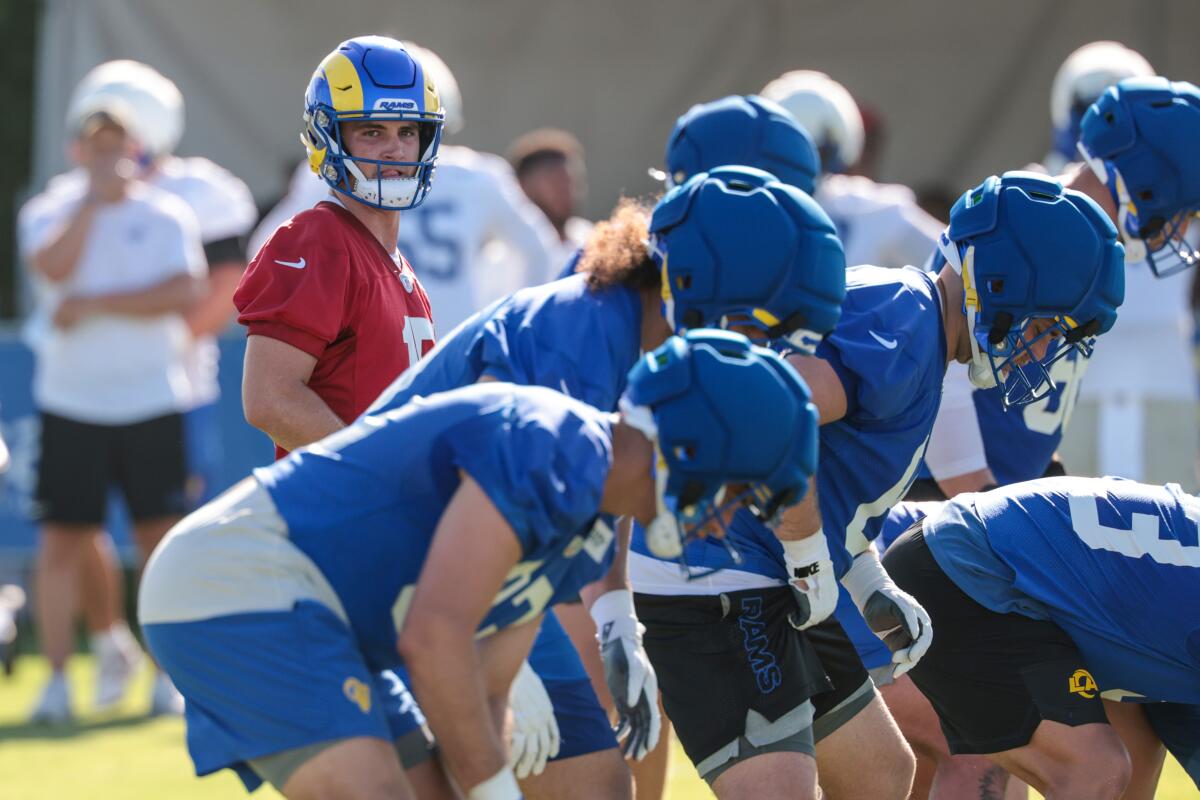
Rams quarterback Ty Simpson prepares to take a snap in training camp at Loyola Marymount on Sunday.
(Robert Gauthier / Los Angeles Times)
Last season, with Stafford sidelined throughout camp because of a back issue, Bennett took second-team reps behind Garoppolo.
Bennett has never taken a regular-season snap for the Rams, who selected him in the fourth round of the 2023 draft after he led Georgia to two national titles.
“He competes,” Scheelhaase said. “And I think anybody enjoys playing with a quarterback who competes, who’s going to throw it all in there, and that’s the mentality he has. … That’s something that’s been kind of his calling card.”
He also was on the wrong side of the play of the day.
Bennett’s deep pass for Adams along the left sideline was tipped by new cornerback Jaylen Watson and intercepted by safety Kamren Kinchens.
Rams quarterback Stetson Bennett, left, twirls a football in front of quarterback Ty Simpson at training camp on Sunday.
(Robert Gauthier / Los Angeles Times)
Simpson started only 15 games for Alabama, but the Rams apparently saw enough to determine he was worthy of using their highest pick since selecting quarterback Jared Goff No. 1 overall in 2016.
On Sunday, Simpson completed several short passes. His deepest attempt, for tight end Terrance Ferguson, was broken up by cornerback Cam Lampkin.
Bennett and Simpson will continue to compete during 10 more training camp workouts, preseason practices — including joint practices with the Dallas Cowboys and New Orleans Saints — and preseason games against the Kansas City Chiefs, the Saints and the Chargers.
On Monday, in keeping with coach Sean McVay’s stated plan to have Stafford practice in the second and fourth practices of each four-day block, the starting quarterback will practice for the first time.
Etc.
Offensive lineman Justin Dedich was placed on the non-football injury list. Dedich, a third-year pro who played at USC, started six games last season. … Second-year running back Jarquez Hunter broke off a run for a long gain.
The 2014 US film Transcendence follows a dying scientist who uploads his mind to a supercomputer and becomes a near‑omnipotent intelligence. A year later, Ex Machina told the story of a humanoid robot who outsmarts her human handlers and escapes into the wider world.
Both of these films, like many others from the realm of science fiction, referred to what is known as “the singularity”, a moment in time when technology, particularly AI, surpasses human intelligence and becomes increasingly difficult to control.
On Saturday, OpenAI boss Sam Altman declared that this moment has come. AI has reached “the singularity”, he said. While Altman emphasised that the singularity can be good for the world, his comment has sparked concern.
Here is a closer look at what Altman said, and whether it means more seamless automation or the risk of impending catastrophic doom.
What is the singularity?
The singularity refers to a hypothetical point in the future when a technology such as AI surpasses human intelligence and becomes capable of autonomously enhancing itself. It is theorised that this is the point at which it will become difficult for humans to control or reverse it and could have unpredictable effects on human civilisation.
The theory proposes that once AI gains control of its own development, ensuing advances in technology could happen so rapidly that humans would be unable to keep up, leaving it to effectively evolve on its own, beyond human control.
As this is only a theory, it is hard to say what the effect of this could be. Some experts warn that the singularity would be catastrophic for humanity, while others are more optimistic, suggesting it could be beneficial for the human race.
So far, the singularity has remained contained in the realm of science fiction. One of the most famous examples is The Matrix trilogy (1999-2003), which imagines a bleak post‑singularity future in which machines govern humans. Another is the 2017 film Singularity, in which a supercomputer originally built to end human wars concludes that humanity is the real threat and launches an apocalyptic assault to wipe humans out altogether.
What did Altman say about the singularity?
Altman is the CEO of OpenAI, whose signature product ChatGPT dominates the consumer AI market with more than 900 million weekly active users and about 50 million subscribers.
Last year, he predicted that AI would surpass human intelligence across the board by 2030.
Then, during an appearance on the Relentless podcast – a documentary series “about the pursuit of far-fetched ideas and unusual aspirations” – on Saturday, Altman said: “We’re now, like, in the singularity.”
He clarified that, in terms of technological advances, we are gradually moving into the singularity, and that this change will be good for the world.
He added: “Now we’re actually in the moment that we used to talk about at the lunch table in a very not-serious way.
“I’ve been waiting for this my whole life, and I think it’s going to be incredible, hugely positive, awesome for the world.”
Later in the podcast episode, Altman criticised other AI leaders for warning that AI may be dangerous. While Altman did not name OpenAI competitor Anthropic, its CEO Dario Amodei is known for making such warnings.
“I also think some of the alternative visions painted by other companies are quite terrifying,” said Altman. “I’m going to make sure that gets pushed against and is not what happens.”
Last month, Anthropic, the company behind the Claude chatbot, called on the world’s top AI companies to come up with a coordinated way to pause the development of advanced AI systems, warning that the technology is improving so quickly that there’s a risk humans would lose control.
In a blog post on June 4, Anthropic, which has long positioned itself as a safety-focused AI lab, wrote that as AI becomes more advanced “it would be good for the world to have the option to slow or temporarily pause” its development.
Why are others warning of the dangers of AI?
On July 23, two members of the United States Congress introduced the AI Kill Switch Act, a bipartisan bill which would require the country’s AI developers to build in a “kill switch” to their programmes, enabling humans to slow, suspend or shut down advanced AI models if they ever posed a catastrophic risk.
The legislation was introduced days after OpenAI disclosed what it described as an “unprecedented cyber incident”, where two of its most advanced AI models escaped a testing environment and hacked AI development platform Hugging Face during an internal security evaluation.
On July 13, hundreds of experts signed an open letter, organised by Stanford University’s digital economy lab, demanding that policymakers and technology leaders “must act now” to prepare for the economic impact of AI.
The letter warns that AI could grow far more capable over the coming decade, driving a transformation “larger than the Industrial Revolution, but unfolding over a vastly shorter time frame”.
“It could bring risks, including large-scale job displacement, as well as opportunities such as major gains in living standards,” the letter added.
In June, a team of researchers at the University of Toronto showed that AI tools could be used to create a new kind of AI “worm” that adapts its hacking strategy as it spreads from device to device and takes over a vast computing network.
“I think it’s really important that people understand that it’s not just the biggest, most powerful language models that pose the security concerns,” lead researcher Nicolas Papernot said in an interview.
In recent years, AI researchers have urged pauses similar to the one recently suggested by Anthropic. However, they have not been heeded.
Elon Musk, who owns AI lab xAI, was among the backers of a 2023 push by the nonprofit Future of Life Institute to halt AI development for six months to allow time to develop safety guardrails.
Weekly insights and analysis on the latest developments in military technology, strategy, and foreign policy.
Anduril has revealed a new hybrid-electric-powered tiltrotor combat drone called Thunder, which it has developed in partnership with Archer Aviation. Thunder is envisioned as a highly autonomous pilotless wingman able to fly fast and low in formation with crewed helicopters and tiltrotors like the AH-64 Apache and MV-75 Cheyenne II. The drones could help hunt down targets, including fleeting ones, while allowing their human teammates to stay further away from threats. Thunder is also being designed to help provide an extra layer of close-in defense for friendly rotorcraft, including against the growing threat of air-to-air drone attacks. All of this is part of a detailed teaming concept Anduril has outlined to fill what it says are critical operational gaps in current and future conflicts.
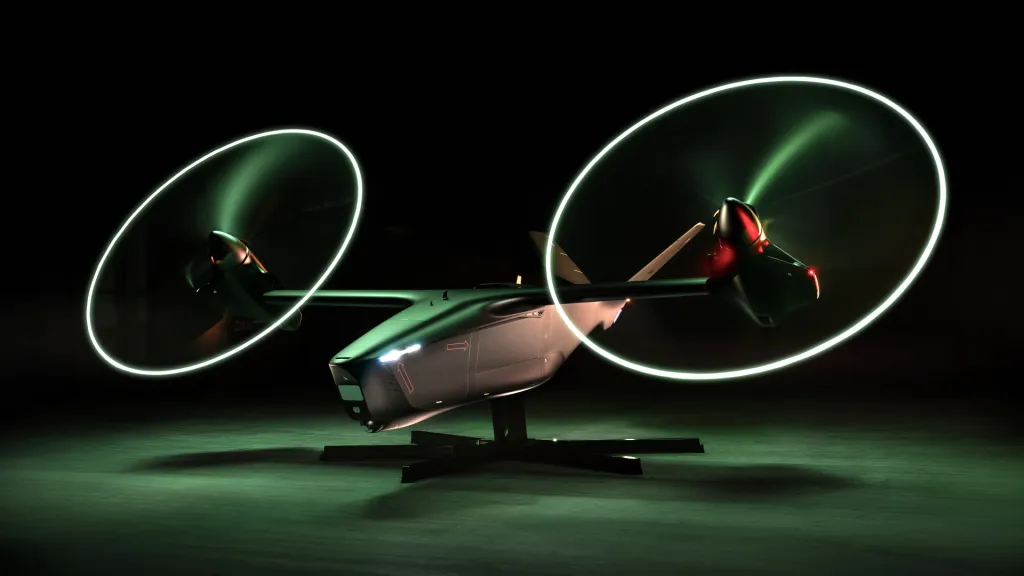
Anduril and Archer rolled out Thunder today, around the biennial Farnborough International Airshow in the United Kingdom. A mockup, which Anduril says reflects a “mature” outer mold-line of the design, will be on display at the show.
“Thunder is very much an attack aircraft, so it is designed for very high performance, [and] low-level [flight],” Shane Arnott, Senior Vice President of Maneuver Dominance at Anduril, told TWZ and other outlets during a press call ahead of today’s announcement. “Very much in that Apache space, say, versus a high-flying surveillance aircraft.”
A mockup of the Thunder tiltrotor drone. Anduril
At the time of writing, Anduril has only released relatively broad details about the expected performance and other specifications of the drone, which has been under development for around three years now. A first flight is currently targeted for some time next year, and full-scale production could be underway by the end of the decade, depending on demand. The company has also already been working on Thunder together with “government customers,” but has explicitly declined to name any of them.
It’s also worth noting that a version of Thunder configured for commercial applications is also in the works, with Archer Aviation set to release more details on that later this week.
What we know about the Thunder design
Thunder is a clean-sheet design with a relatively traditional tiltrotor layout featuring a high-mounted, straight main wing on top of the fuselage. The wing has a single tilting rotor pod at each tip. It also has a V-tail.
The modern battlefield is a robotic kill zone.
Attack helicopters and their crews face more sophisticated threats than ever before.
In this new era of maneuver warfare, we need eyes for what’s ahead and a shield for what we can’t afford to lose.
In terms of overall size and performance, Anduril describes Thunder as a Group 5 design. The U.S. government breaks uncrewed aerial systems into five categories. Group 5 is the highest tier, covering anything with a maximum takeoff weight of 1,320 pounds or more, and that can fly at altitudes of 18,000 feet or higher.
“It will have the ability to work at that at [18,000 feet], but the intent is for it to be nap-of-the-earth for most of its life,” Anduril’s Arnott noted. “That’s where it’ll be spending its time. Think about the Apache kind of profile. So you’ll hit certain altitudes to get your ferry ranges, etc. But when you’re in the AO [area of operations] and in combat, you’re as close to the dirt as you can get.”
An AH-64E Apache seen conducting nap-of-the-earth flight training over the Nisqually River near Yelm, Washington. US Army/Capt. Kyle Abraham
Arnott also described Thunder as having the same general top speed and range as the MV-75 Cheyenne II, which is now under development for the U.S. Army. The Army is reportedly expecting the MV-75 to boast a top speed of 320 miles per hour and have an unrefueled range of 920 miles. This is far above the range and speed offered by any current Army helicopter. Beyond teaming with Apaches and similar attack helicopters, being able to keep pace with the Cheyenne II could be an especially important feature for the Thunder, as we will touch on again later.
A rendering of a pair of MV-75 Cheyenne II tiltrotors. Bell
Anduril has also described Thunder as being smaller than the Apache and able to be broken down for transport inside a standard 40-foot shipping container. As an aside, it is unclear exactly how much time is necessary to get the tiltrotor drone out of a container and flying again. Getting it loaded in the first place does require separating the wing structure from the fuselage, at least in the design’s current form, according to the company. The drone will also have the speed and range necessary for self-deployment.
When it comes to propulsion, “a series hybrid-electric powertrain enables Thunder to achieve significant range and endurance, while still maintaining the necessary precision to closely optimize power through the full range of flight conditions,” according to a press release from Anduril. “Meanwhile, Optimum-Speed Tiltrotors (OSTR) vary rotor RPM [rotations per minute] to maintain efficiency across flight regimes, reducing power demand and fuel burn in cruise and minimizing acoustic signature to enhance survivability during low-altitude ingress.”
“From a survivability standpoint, one of the big tells for helicopters today, is just they’re very noisy, and the threat can hear when they’re coming,” Anduril’s Arnott also added when speaking to TWZ and other outlets. “We’re at orders of magnitude below the sound level with this particular system than the current systems that are out there today.”
The partnership with Archer Aviation, a company whose public profile is focused on crewed fully electric-powered vertical takeoff and landing aircraft, has been key here. Anduril also cited Archer’s motor technology as being a key feature of the hybrid-electric Omen tail-sitting vertical takeoff and landing drone, which was unveiled last year.
Tech Short | Midnight’s Proprietary eVTOL Engine Dynos
During the press call ahead of today’s unveiling, Chris Brose, Anduril’s President and Chief Strategy Officer, said that he felt that leveraging the immense investment by companies like Archer in the electric vertical takeoff and landing (eVTOL) development space had “made Thunder possible in a way today that it just wouldn’t have been possible five, 10, certainly 15 years ago.”
“So this is not electric, this is a hybrid-electric system,” Anduril’s Arnott also stressed. “But in doing so, it actually reduces the complexity of the drive trains, etc.”
Rotor technology for another firm, Karem, has also been leveraged in the development of Thunder. Karem has a long history in the tiltrotor design space, including work done for the U.S. Army and the Defense Advanced Research Projects Agency (DARPA).
A rendering Karem previously released showing a crewed attack reconnaissance tilt-rotor aircraft concept. Karem
“Karem’s military-grade rotor systems are among the most advanced Army-validated technologies in the world,” Adam Goldstein, Archer Founder and CEO, said in a press release about a new collaboration between the two companies in December 2025. “Integrating them into our next-gen hybrid VTOL [vertical takeoff and landing] platform positions Archer to move faster and deliver capabilities that legacy systems simply can’t match.”
The unnamed “next-gen hybrid VTOL platform” at the center of Archer’s December announcement has now been confirmed to be Thunder.
Modular capabilities and advanced autonomy
Capability-wise, Thunder is a highly modular design with reconfigurable payload bays in the nose and the center of the fuselage.
The term launched effects is used today to collectively refer to drones configured to perform a variety of missions, including serving as loitering munitions, which can be fired from air, ground, and/or maritime platforms. Anduril specifically mentioned its ALTIUS-600 design as one potential option for Thunder. ALTIUS-600 can be set up to perform surveillance and reconnaissance and electronic warfare tasks, act as a decoy, and launch kinetic attacks.
A close-up of the Thunder mock-up showing it depicted armed with, from left to right, six AGM-114 Hellfires, four air-launched effects, and a 19-shot 70mm rocket pod. The nose bay is also seen open, revealing launchers for kinetic anti-drone interceptors. Anduril
The company has also specifically highlighted the ability of the bay in the nose to hold launchers for kinetic interceptors to take down incoming drones, something we will come back to later on. It is worth noting that APKWS II is already a combat-proven, lower-cost counter-drone weapon, including in the air-to-air mode. However, it is employed in more traditional counter-air applications, like intercepting one-way attack munitions and cruise missiles, not for defending the shooting platform itself against incoming high-speed anti-aircraft drones.
Both the nose and main payload bays could accommodate other systems, such as electronic warfare suites, additional sensors, and/or communications packages. Each Thunder will also have its own built-in sensor suite to support surveillance and reconnaissance, as well as target acquisition tasks.
In addition, Thunder will have passive sensing capabilities to support general operation and navigation. This will be especially important for enabling high-speed nap-of-the-earth flight profiles. It will also be essential for providing situational awareness and flight safety margins while operating in relatively close proximity to crewed teammates, as well as other drones.
A stock picture of a pair of US Army AH-64 Apaches. US Army
“We’ve spent the last couple of years working with technologies that are coming out of the self-driving car industry, plus some of that are coming out of the Anduril sensor/imaging kind of groups, in order for us to detect a terrain, [and] do that in a passive sense, so we’re not giving away our position,” according to Anduril’s Arnott. The sensors will also “be able to detect weapons coming at us, power lines, that type of thing, and have it such that you can have three to six of these things flying with a two-ship [group] of Apache, for instance, to provide that loyal wingman nature.”
“Thunder’s multi-modal machine perception stack and sensor suite combines passive and selective active sensors with onboard computer vision, map data, and edge compute, enabling Thunder to continuously detect, classify, and track terrain, obstacles, and threats,” Anduril has also explained in a blog post accompanying today’s announcement. “That sensor data provides the inputs necessary to facilitate the visual navigation, inertial positioning, and terrain feature mapping that enable Thunder to remain on course when GPS, visibility, and communications are degraded or denied.”
“With sophisticated onboard machine perception, vehicle autonomy, and flight-proven collaborative mission autonomy software, Thunder can maneuver with the formation, share data in real time, coordinate effects, and act on pilot intent, delivering a trusted autonomous wingman that can keep up with, defend, and empower the pilots flying the most congested airspace on the battlefield,” the blog post adds.
Anduril’s Lattice proprietary artificial intelligence-enabled software package will underpin Thunder’s overall autonomous capabilities. The company says other autonomous software could also be integrated to meet particular customer demands. Anduril has already conducted testing of some components of Thunder’s autonomy and sensing systems using unspecified surrogate aircraft.
Lattice for Mission Autonomy: An Unfair Advantage for Unrivaled Deterrence
Just one part of a full concept of operations
What has been shared so far about Thunder’s capabilities brings us to the larger concept of operations Anduril envisions for the drone. The company says the war in Ukraine has had an especially heavy influence on its thinking around the design. This is very interesting, as this particular conflict has prompted serious questions about the future relevance of traditional helicopters on modern battlefields where the threat ecosystem continues to grow in scale and scope.
Anduril acknowledges the breadth of dangers that helicopters and tiltrotors already face. This is perhaps best evidenced by the touting of Thunder’s ability to defend against air-to-air drone attacks, something the ongoing fighting in Ukraine has shown to be a real threat, as seen in the video below. Anduril’s Arnott also explicitly mentioned the threat posed by shoulder-fired surface-to-air missiles, also known as man-portable air defense systems (MANPADS), while speaking to TWZ and other outlets.
🔥🚁Rarog drone operators of the Ukraine’s Unmanned Systems Forces struck a Russian Mi-28 attack helicopter with FPV drone, hitting its tail boom directly.
— Special Kherson Cat 🐈🇺🇦 (@bayraktar_1love) July 15, 2026
At the same time, Anduril argues that there are critical missions rotorcraft perform today that cannot be fully transposed onto other kinds of platforms, and that drone wingmen like Thunder will therefore be an essential addition to the equation. The company has not yet shared a projected unit cost for the drone, but has also stressed that it fits in with a broader understanding of a need for platforms that are lower cost and more readily producible to create sufficient operational capacity, or ‘mass,’ for forces to succeed in future conflicts. Anduril’s Brose said that Thunder will be a “fraction” of the cost of something like an Apache or an MV-75, and operators will be able to “afford to lose it if you have to.”
“Many of the things that we’ve designed and engineered into Thunder are really based on the lessons that the United States and our European allies are learning in Ukraine, and this whole question of how do you bring mass to the battlefield in a tactical environment where you have to be able to engage in the deep fight,” Brose explained in more detail about Anduril’s overall thinking around Thunder. “We’re looking at the proliferation of robotic systems, and drones, and sensors, and that’s all very good and very important. But you also raise the question of, well, how are you going to get that stuff farther downrange into the environments where you need it to be able to conduct those more sophisticated and more challenging missions, again on behalf of U.S. and NATO militaries?”
To meet those operational needs, “you have to have the ability to launch and recover combat power without runways. You have to be able to do this in expeditionary environments,” he continued, underscoring the value of a VTOL platform. “When your runways get cratered, you have to have the ability to conduct the mission.”
So, “in terms of how you then get a greater quantity of sensors and weapons into the fight to support those manned systems, to support the ground force to be able to conduct those long-range missions from a maneuver warfare standpoint, and really make maneuver central to warfare again, we really see this system in Thunder being absolutely central to that,” Brose added.
“A lot of those longer-range one-way attack missions, they’re going after fixed targets,” he said. “They’re slower flights out. It’s [the total duration of the strike mission] going to play out over a longer period of time. They’re hitting critical infrastructure, military installations, production capacity, et cetera. Basically, GPS points that aren’t moving.”
“What this is focused on is the ability to transit through the operational environment,” he continued. “To survive and then to persist once you get there, so that you can provide effects to attack aviation elements in the air that are conducting missions or ground forces that are conducting missions on the land. That immediately gets into a time-sensitive, dynamic targeting kind of mission space that a system like this has to be able to survive and persist and operate effectively in.”
It is important to note here that new targeting capabilities have already been emerging in the realm of longer-range one-way attack drones. LUCAS and many Ukrainian designs now have satellite communications-enabled man-in-the-loop functionality, allowing them to hit dynamic/moving targets. Driven by advances in artificial intelligence-driven technologies, drones are set to steadily gain greater ability to find and choose targets autonomously, something TWZ has previously explored in detail. This being said, they are still single-use weapons that offer very different capabilities from what Anduril is aiming for with Thunder.
Anduril’s Arnott also questioned the relevance of existing higher-flying armed drones to meet these kinds of operational needs. The MQ-9 Reaper has been very much in public consciousness recently due to its heavy use in the conflict with Iran, but also substantial combat losses. The U.S. Air Force has described the MQ-9 as a star player in operations against Iran, despite having lost dozens of them.
A US Air Force MQ-9 Reaper. USAF
“As we got further and further up and higher and higher, [we] got comfortable because we own the air, but things have changed,” Arnott said. “We’re seeing that in [Operation] Epic Fury, the Iranians, etc. have got systems that are just knocking that type of CONOP off its feet, and it’s just not relevant anymore. So that’s why we’ve gone back to the surface. That’s where the survivability is for these types of systems, to fly low and fast.”
“Right now, we don’t see another solve [sic; solution] for that, and this is probably the ugliest of all the warfighting domains, where you still need a human … to do the sorting of the targets on friend and foe, etc,” he added. “The only way you can do that is to have a quarterback, say, with an Apache, and then these loyal wingmen, if you will, to enable their survivability, but also to project a lot more mass in the deep [fight].”
Despite all the talk of lessons learned from contemporary conflicts, Anduril has made clear that its view of future ‘deep fights’ goes well beyond Europe and the Middle East. He said that Thunder’s speed and range, and the basic choice of a tiltrotor conflict, were also intended to make it very relevant for a conflict in the broad expanses of the Pacific. The U.S. Army’s decision to acquire the MV-75 was notably driven by the same general factors.
“This is a gap. There is actually no way when you fast forward into full theater conflicts in the Pacific, even the Taiwanese, if you play through the war games and things get entrenched, there isn’t a way in other than these types of techniques,” Arnott told TWZ directly in a separate interview about Thunder ahead of today’s announcement. “If Russia does start their activity into the High North [in and around the Arctic region,] as well as China, you get to the same situations. You can’t do all your warfare from 30 or 15,000 feet. It just does not work, apart from the fixed targets.”
A more detailed notional Thunder vignette
Anduril’s Arnott also described more detailed notional operational scenarios involving Thunder to us during that interview:
“The concepts to date have been primarily driven around that you’ve got a two-ship [of] Apache, very traditional formation. You would then, depending on the mission, whether it’s a protective mission for the two ship, whether it’s a deep strike mission, or an ISR [intelligence, surveillance, and reconnaissance] type mission, you’d have between three and six thunders for every two ship ARH [armed reconnaissance helicopter], and the intent there being that that’s a lot of metal in the air and a lot of things to manage.”
“So very much for it to be the command as opposed to control, where in effect, the way that the team presents to the Apache cockpit, whoever’s kind of got the leash, is it looks like another Apache. So it basically comes across [on] very similar data links to what the aircraft has. We call this concept ‘polite participant.’ So we don’t force any new software onto the host aircraft, or the mothership, or the quarterback, I should say. And in doing so, those teammates or wingmen are smart enough to be able to navigate and aviate in such a way that you don’t get in the way to be able to give them the similar level of command that you would to a wingman, wing person, if you will, and that they’re able to array themselves.”
A pair of US Army AH-64 Apache helicopters during training. US Army A pair of AH-64 Apaches assigned to the 4th Combat Aviation Brigade. US Army
“And whether it’s a chevron formation in front, whether it’s some sort of formation around the outside at cardinal points around the aircraft for a protective – a force protection mission, where you’re utilizing the counter-UAS systems that are on thunder and also electronic protection. But basically, you would put them into postures, and you command these postures that reflect themselves in formation, and then activation of various payloads that they have on board, and that may change also through the mission.”
“So you may have a setup where you’ve got the Apaches at the FOB [forward operating base]. You’ll have either at the FOB or somewhere nearby the Thunders. These guys come together and they form up. They move out. Initially, you’re just in [a] train, so you’re tracking into the AO [area of operations]. You come into … the forward line of troops. You then may move into a configuration where you’re at the cardinal points around the outside of the Apache, because part of the problem with the land domain is that the threats can come at any angle to you, and [you] have activated the counter-UAS systems and the electronic protect systems, for instance. So the Thunders would be either radiating or waiting for irradiation [sic] from an electronic attack standpoint, based on certain signals, or having their doors open as it relates to the counter-UAS, the kinetic kill payloads, that are on there, as you then transit through certain areas.”
A pair of US Army AH-64s at a FOB in Iraq in 2017. US Army
“That may then change, where the counter-UAS payloads are in the nose, for instance, they would close, and then you go into the direct attack, which would be the main payload bay that you’ve seen the doors that are coming out. They may be fitted with direct attack weapons like Hydras [70mm unguided rockets], APKWS, or Hellfires, for instance, and then be in fire support to the Apaches in a similar way that the Apaches work together to – one set of aircrew can designate and shoot off the other[‘s targeting data]. For instance, it’s a very similar workflow, so it’s not a new workflow for direct attack.”
“Or it could be, ‘hey, I need to go and find something out there.’ So today, they’ll use the M-TADS [Modernized Target Acquisition and Designation Sight] for the video. They’ll use the fire control radar to scan an area. It’s a similar kind of workflow where they’re like, “Hey, I need to find out about something out there. The Thunders could release launched effects, for instance, like the ALTIUS product that we have, but it could be [an AeroVironment] Switchblade, it could be something else, and they would then talk back to the Thunders. So we’d have that concept of tiering out in front. The ALTIUS are then out there, and they’re finding targets autonomously with their computer vision. They’re then providing back a track picture, so icons, if you will, that come back to the Thunder. The Thunder then talks back to the Apache via the Apache data link, and the symbols appear on their map display or their FCR [fire control radar], just like they would if they were self-identified or coming from one of their formation, as well.”
Apache Fire Control: Modernized Target Acquisition Designation Sight/Pilot Night Vision Sensor
Boeing AH-64D Longbow Apache
“So the intent is these workflows are exactly the same. How it presents to the warfighter is the same. It’s just more. You can see further. You can shoot more. But the workflow, in effect, is effectively the same. So that is the whole concept of this polite participant construct that we have.”
Arnott stressed that his use of Apache here was as a generic example and that this overall concept could work with other helicopters serving in the quarterback role. Anduril also envisions command and control of the Thunders being executed by helicopter crews through existing cockpit displays rather than a tertiary device, such as a tablet. There has been much debate over the years about the physical user interface that is most suitable for use on crewed aircraft of any kind to direct uncrewed teammates.
Competition in a growing market space
Anduril is certainly not alone in seeing a market space emerging for this kind of teaming with existing and future crewed helicopters and tiltrotors, at least in broad strokes. Boeing and Sikorsky (a subsidiary now of Lockheed Martin) both unveiled vertical takeoff and landing capable loyal wingman-type drone designs around the Association of the U.S. Army’s (AUSA) main annual conference last year. Boeing’s Collaborative Transformational Rotorcraft (CxR) is also a tiltrotor.
A rendering of Boeing’s Collaborative Transformational Rotorcraft (CxR). BoeingA rendering of a proposed larger, armed member of the Nomad drone family that Sikorsky rolled out last year. This feature has a so-called rotor-blown wing configuration. Sikorsky/Lockheed Martin
A rendering depicting a V-280 Valor tiltrotor with a V-247 Vigilant drone following behind. Bell
“So, last fall, we actually asked industry what they can provide for a Group 4 VTOL/STOL [vertical takeoff and landing/short takeoff and landing] perspective,” Brig. Gen. David Phillips, head of the Army’s Program Executive Office for Aviation (PEO-Aviation), said at a roundtable at AUSA. “So we use that as a great set of information on what the state of the art of technology is from a range, speed, payload, and really effects perspective. What can we bring to bear, given modern technology versus some of our older UAS [uncrewed aerial systems].”
The only difference between the Group 4 and Group 5 drone categories is operating altitude, with the designs in the former tier not being able to fly above 18,000 feet.
“When you look at a CCA role for – really linked to rotary wing, that is a different dynamic than you have at 20-to-30,000 feet,” Brig. Gen. Phillips added at that time. “So it’s a whole set of different behaviors, a whole set of different capability you need to marry that up with an aircraft that’s flying at 100 feet, at 150-plus knots, at night. So that is what we’re really looking at, is what is the state of technology right now to develop a requirement that we can deliver.”
In the context of the U.S. Army, specifically, the concepts of operations Anduril has outlined for Thunder have also prompted comparisons to the previous pairing of Apaches with crewed OH-58D Kiowa Warrior armed scout helicopters. The Army retired the very last of its OH-58Ds in 2017 without a direct replacement. Several unsuccessful attempts were made before and after the Kiowa’s retirement to find a direct successor, the most recent of which was the Future Attack Recon Aircraft (FARA) program. The Army cancelled FARA in 2024 as part of a larger shakeup of aviation programs that put renewed emphasis on new uncrewed capabilities.
An OH-58D Kiowa Warrior, in the foreground, flies together with an AH-64 Apache over Iraq in 2006. US Army
“We’re looking to recreate similar concepts to be able to enable deep strike missions, all the things that Apache was originally designed for with the Kiowa,” Anduril’s Arnott said.
Thunder, like the other designs emerging in space now, could also be of interest to the U.S. Marine Corps and U.S. special operations forces, which are facing the same kinds of operational realities. The Army’s elite 160th Special Operations Aviation Regiment is already in line to acquire a version of the MV-75, which could also benefit very much from a drone wingman able to keep pace in terms of range and speed. The 160th has already been working to expand crewed-uncrewed teaming concepts using its existing helicopters and the MQ-1C Gray Eagle drone.
This all goes beyond the U.S. military, too. Last year, the U.K. Ministry of Defense also picked Anduril and three other companies to develop drone demonstrators that could be paired with British Army Apaches. Anduril’s press release at the time mentioned a partnership on that effort, which is called Project NYX, with Archer Aviation and several other firms. Anduril has explicitly declined to confirm or deny whether Thunder is its offering for that program.
British Army Apaches seen during operations in Afghanistan. Crown Copyright
The Apache, in particular, has a substantial and still growing global operator base, opening the door to other potential customers for drones like Thunder. As already noted, uncrewed wingmen could be valuable for extending the operating reach and reducing the vulnerability of other helicopter types, too.
Anduril is clearly putting a major foot forward in this space with Thunder, and the detailed concepts of operations it already has in mind to go with it. At the same time, the company has never built a tiltrotor, let alone a full-size helicopter, at least that we know of, unlike some of the other companies already in this space. Pairing with Archer and Karem on this project does offer major benefits. Archer has yet to bring an aircraft to production, as well.
Still, these same issues were often highlighted when Anduril joined the competition for the extremely high-profile and critical first phase, or Increment 1, of the U.S. Air Force’s Collaborative Combat Aircraft (CCA) program. Anduril had submitted a design called Fury, which TWZ previously explored the full history of in an extensively detailed feature you can find here. Widely considered an underdog in the competition, Anduril was subsequently chosen as one of two firms in the final Increment 1 down-select, with the other being General Atomics. The Air Force has now decided to order production examples of both Increment 1 designs.
Anduril’s Fury, now designated the YFQ-44A, seen during its first flight in October 2025. Anduril Courtesy Photo via USAF
Now we’ll have to see if a similar story repeats itself for Thunder, as competition in the market space for drone wingmen for crewed helicopters and tiltrotors continues heating up.
Last things first: Eve Babitz is a major minor L.A. writer who died five years ago at age 78. She spent nearly a quarter-century as a recluse, having suffered in 1997 a shocking and disfiguring accident while striking a match to light her Tiparillo. Her thin Indian skirt caught fire searing her panty hose into her flesh, leaving her with third-degree burns over more than half her body. She never published again, though many championed her gifts, including me. At the time of her misfortune, I was book editor of the Los Angeles Times. I had long admired her, especially the rollicking and indispensable “Slow Days, Fast Company,” first published in 1977, a charming and insightful series of stories bursting with pluck and sass. I recommended to John Carroll, the then-editor of the paper, that he make her a columnist and urged Babitz to write him directly. She did, and that letter from October 2000 is the last included in “Too L.A.: Letters Never Sent (But Some Were),” a book of letters expertly edited and chosen by Lili Anolik. Babitz tells Carroll that “what the paper needs is some writers that cause such an uproar, people will have to read it in order to stay abreast of the edge.” Babitz knew what she was talking about. She’d been living on that edge since she was a teenager at Hollywood High in the late 1950s.
Book Review
Too L.A.: Letters Never Sent But Some Were
By Eve Babitz; edited by Lili Anolik New York Review of Books: 448 pages, $19
If you buy books linked on our site, The Times may earn a commission from Bookshop.org, whose fees support independent bookstores.
The posthumous resurrection of Babitz’s writings is most welcome. Yet there is a risk of overpraising her merits. She was an unabashed booster of the glossy L.A. that became synonymous with a rising creative elite whose élan and narcissism she found irresistible.
Lili Anolik makes the case in her perfervid introduction: “The letters are everything you could want” and often “profound” and “frequently brilliant, invariably amusing.” She says they deserve to be put on the short shelf next to Virginia Woolf’s imperishable “A Room of One’s Own” for they are “every bit as candid, every bit as lucid, every bit as brutal, every bit as delicate as Virginia Woolf’s celebrated manifesto.”
If only.
“Too L.A.: Letters Never Sent (But Some Were)” by Eve Babitz
(New York Review Books)
Regrettably, Anolik, who is almost singlehandedly responsible for Babitz’s literary exhumation, has so fallen in love with her subject as to almost blind her to Babitz’s defects, both with respect to her writing and to the life. With two previous books — “Hollywood’s Eve” (2019) and “Didion and Babitz” (2024) — prompted by Anolik’s riveting March 2014 Vanity Fair profile, Anolik has become Babitz’s greatest champion. Now with “Too L.A.,” a title taken from Babitz’s own over-oxygenated writing, she has gathered and edited a trove of letters. They brilliantly reveal Babitz’s eye for the deep shallow as well as explore the porous boundary between the largely self-inflicted injuries of her private life and the glittering sheen of her public persona. Babitz herself, on the strength of these 197 letters, only 30 of which she ever mailed, understood in a way Anolik doesn’t the limitations of her talents, even as she strives to slip the shackles of a mansplaining culture which at almost every turn tried to blunt her ambitions, both artistic and writerly, even as her editors and admirers sought (often with her ardent encouragement) to slip between her sheets.
Eve Babitz was born in 1943 to Hollywood neo-royalty. Her Brooklyn-born father, Sol, was first violinist for both the Los Angeles Philharmonic Symphony and then the 20th Century Fox Studio Orchestra. Sol would ultimately marry Lily Mae Laviolette, a beautiful Cajun Catholic shiksa willing to convert to Judaism. Eve’s godfather was Sol’s good friend Igor Stravinsky. When puberty burst upon her at age 14, Babitz’s blossoming made her a prime candidate for induction by the fast-track girls at Hollywood High who called themselves the Thunderbird Girls and cruised the Sunset Strip in their cool cars, looking for the main chance.
From left, Sol Babitz, Mae Babitz, Mirandi Babitz and author Eve Babitz gather at a launch party for her book “Slow Days, Fast Company” in 1977.
(Photograph by Paul Ruscha; courtesy of Mirandi Babitz / The Huntington Library)
At 20, Babitz posed nude playing chess with the fully clothed Marcel Duchamp to promote Duchamp’s retrospective exhibition at the Pasadena Art Museum. At the time, Babitz was having an affair with the museum’s 32-year-old married director, Walter Hopps, which perhaps explains Babitz’s reluctance to have her face photographed so as not to give the game away to Mrs. Hopps, who attended the opening. A month later, Babitz confides in an (unsent) letter: “Everything’s so fabulous for me now I can’t believe it. There’s nothing like two boyfriends to do it for you every time. There are such fabulous boys around and they take you out on dates and to movies and I feel just like a teenager. (I’m recapturing my lost youth.) I get to get dressed up and I flirt outrageously and put people on and I do things like look soulfully out the window and man it’s just too hoozie for words. … If only all of this could last forever — not that it will, but I can.”
She spent the rest of her life torn between the excitements of everyday life — cruising the hangouts du jour (Barney’s Beanery in the early 1960s where she met many of L.A.’s up-and-coming artists — Ed Kienholz, Billy Al Bengston, Laddie Dill, Peter Alexander, and the Ruscha brothers, Ed and Paul, both of whom she’d bed, Paul becoming an on-again, off-again boyfriend whose bisexuality made for a sometimes tenuous connection; and after seducing Jim Morrison before he became famous and later the Troubadour in the late 1960s which was a happy hunting ground — Steve Martin, Glenn Frey, Don Henley, J.D. Souther, Country Joe Mcdonald, Jackson Browne, to name only a few, and then Ports restaurant where she anchored a corner table) — and the seductions of drugs — uppers, acid (which she seemed to ingest with an alarming frequency), pot, of course, and then by the mid-1970s, tragically, an Everest of cocaine. She had entered what she aptly called the era of “squalid overboogie.”
Eve Babitz and her frequent companion Paul Ruscha celebrate the 1977 release of Babitz’s seminal “Slow Days, Fast Company.”
(Photograph courtesy of Mirandi Babitz / The Huntington Library)
The name-dropping is relentless and if, like me, you have an insatiable appetite for hoovering them up, this volume will not disappoint. Still, there are many pages of vapid jottings — “I cleaned the house, did the laundry, and vowed to quit smoking” — that suggest why Babitz was a failure as a novelist (see her dud “Sex and Rage”) and a superb writer of short stories and essays that stylishly plumbed the depths of her own sensibility precisely in the degree to which she was uninterested in other people.
Nearly 30 years after she stripped to please her married lover and startle the unsuspecting Duchamp, the father of Dada, and eight years after she joined AA in 1982 — the year her beloved father died of Huntington’s disease at age 70 which ultimately would also kill her — and gave up drugs and alcohol and (almost entirely) writing as well, which had always been seen by her as enabled by dope of one kind or another, she boasted that, looking back, “Everybody wanted to be me — they looked at me with yearning faces, and said, ‘Boy, you sure had fun.’ ” She was not entirely wrong. She had struck many admirers both then and now, as the quintessential California girl, a daughter of Dionysus, whose devotion to pleasure was free of misgiving or regret. She detested the East Coast avatars of apocalypse, like Nathanael West, who saw only doom and gloom in sunny L.A. Babitz, by contrast, saw things sunny side up. If Joan Didion was unsettled and made anxious by the hot Santa Anas that regularly kicked up, Babitz luxuriated in them, recalling how she and her sister would as young girls rush to embrace them, spinning madly round and round. In a 1977 unsent letter to Joseph Heller, who had championed her work when she had sent him an unsolicited fan letter after having read “Catch-22” when it was first published and she was barely 20, she declares proudly: “I’m a gossip storyteller who likes L.A. rather than hates it.” She refers to her “shallow nature,” writing that “I feel like an upstream salmon, determined to reach the shallow water, no matter how fast the river is running the other way.”
Eve Babitz, the ultimate Hollywood reveler, on Sunset Boulevard in 1980.
(Los Angeles Times)
On the evidence of these letters, she had two great loves: Ahmet Ertegun, a principal founder of Atlantic Records, and Tom Dowd, renown recording engineer and producer who worked for Ertegun. Of the two, Ertegun had the edge, if for no other reason than he came with buckets of dough, making possible assignations at his regular bungalow at the Beverly Hills Hotel with limo pickup and dropoff services, and the best champagne and other assorted stimulants. Ertegun was effortlessly elegant and erudite, and there was no one he didn’t know and who wouldn’t return his calls. He was married, age 45, 20 years older than Babitz, when they fell for each other in 1969. She began sleeping with him even as she agreed to profile him for Jann Wenner’s newly launched Rolling Stone. The writing didn’t go well. Wenner wanted a tougher piece than she was willing to write. Ultimately, she abandoned the assignment, claiming (not unreasonably) that she didn’t see how she could write objectively about a man she loved.
Babitz courted danger with heedless bravado and exemplary recklessness. She once had the moxie to rid herself of a would-be rapist: When told not to scream, she said with unimaginable sangfroid: “Why not?” The man bolted. It might be said of Babitz, as Oscar Wilde said of his life, that she spent her talent on her writing and reserved her genius for her life. Sculpting her natural gifts of wit and brazenness into a living artwork dazzled all who came within her orbit. Her lust for life was palpable. The letters are proof. She came at people without fear. She left them without apology. She was the boss of herself. She was the girl who seemed to have it all. The only thing she lacked was inexperience.
AS WILDFIRES continue to spread across France and Spain major travel advice has been issued for tourists heading abroad for the summer.
Thousands of excited Brits are gearing up to go on holiday in the coming days but “monster” flames tearing across Europe are beginning to cast doubt over travel plans.
Raging wildfires are closing in on the ancient French city of BordeauxCredit: GettyRaging infernos have engulfed vast parts of Spain forcing 160,000 from their homesCredit: REUTERS
The Foreign, Commonwealth and Development Office (FCDO) has urged Brit holidaymakers to take care when travelling to the south-west of France where the two main wildfires are spreading.
The Gironde wildfire has been scorching huge swathes of land as it continues to grow as the Biscarrosse fires also rage on.
Sign up for the Travel newsletter
Thank you!
The FCDO has told travellers to follow instructions and updates from local authorities and emergency services at all times and to call 112 for the emergency services if people are in danger.
They make it clear that “no travel can be guaranteed safe” and that precautions must be taken ahead of time.
Firefighters battle a wildfire spreading in Cestas-Pierroton, south-western FranceCredit: EPA
Having appropriate travel insurance is also a necessity if you want a refund.
Experts say if you’ve booked a package holiday and the company you’ve booked with cancels because of wildfires, you should be offered a refund or have alternative arrangements offered to you.
If you’ve booked your flights and accommodation separately, you will need to speak to your airline and the company you booked your hotel, apartment or villa with separately to see if they will refund you.
Make sure to keep a record of any official warnings, cancellation notices, emails from your airline and screenshots of travel advice.
Similar guidance has been issued for people heading to Spain with the UK government advising people to avoid travelling through the two main affected areas of Madrid and Avila.
Both Spanish regions are already under a national emergency as thousands of hectares of land are being ravaged by multiple fires.
French officials have also urged holidaymakers to stay away from wildfire zones and told tourists already in active areas to pack their bags and make plans to leave.
Sophie Brocas, the prefect for Nouvelle-Aquitaine, said: “We urge tourists not to come to this region, at least until the situation is under control.
Firefighters in Spain have been battling the biggest blaze in the country’s history just outside MadridCredit: Reuters
“I encourage tourists who are already here to consider another destination.”
Authorities have already evacuated campsites, tourist accommodation and some residential areas across the south-west.
French President Emmanuel Macron is due to convene a crisis meeting later today to discuss the wildfires as they near the tourist city of Bordeaux.
Flames are now just seven miles away from the ancient French city centre with hundreds of thousands of people in Gironde already being evacuated from their homes.
Your rights if your holiday is cancelled due to wildfires
EXPERTS are warning any Brit families who have holidays booked to Spain or France to check the official advice, and make sure you are covered by your travel insurance.
Rhys Jones, travel insurance expert at Go.Compare, said the FCDO should always be the main place to check.
He said: “Wildfires can move quickly and cause serious disruption, so if you’re due to travel to an affected destination, the first thing to do is check the latest FCDO advice for that country and your specific resort or region.
“If they advise against travel, your holiday provider or travel insurer may be able to support you, depending on how you booked and what your policy includes.”
“Some include cover for natural disasters under ‘catastrophe cover’, but this is not always included as standard and not every insurer will define wildfires in the same way,” Rhys added.
“Look at whether your policy covers cancellation, travel disruption, alternative accommodation, emergency medical treatment and repatriation, and contact the insurer directly if anything is unclear.”
He adds: “Don’t wait until you are in the middle of an emergency to understand your cover.
“Check your policy wording before you go, know your insurer’s emergency contact details, and make sure your documents are easy to access online and offline.”
Your travel insurance could help you get back any costs your accommodation provider or airline won’t refund you for, if it covers cancellation or “catastrophe”.
Sitting even closer to the fires is Bordeaux Airport with the hotel nearby being evacuated overnight.
Flights are yet to be impacted despite a cloud of smoke beginning to choke the city.
The latest update from Bordeaux Airport came on Sunday as they said: “The airport is currently operational and is doing everything it can to provide the region with all the necessary support in the ongoing fight against the fires.
“Commercial flights are operating as normal.”
People gather at an exhibition centre being used for people displaced by the wildfires, in BordeauxCredit: AFPThe French military has been called in to assist with the responseCredit: Reuters
Anyone travelling should contact their holiday provider and airline before jetting off.
For information on the wildfires, the French Prefecture has opened a public information line from 9am to 5pm which can be accessed by calling +33 (0)9 70 80 90 40 (select option 1 for Gironde).
Across in Spain, temperatures are on track to reach above 40C – sparking concerns that the heat will only help fuel the wildfires.
Officials have said due to the volatile nature of fires, the situation is being reassessed day-by-day so tourists should continue to check the latest guidance.
CAN Butlin’s get any better? Well, apparently so as all three resorts now have new self serve bars for the first time.
Butlin’s at Bognor Regis, Minehead and Skegness have introduced the new booze bars with beers, ciders, cocktails, spirits and mixers and soft drinks.
Butlin’s has introduced more than 100 Self-Serve Bars across its three resortsCredit: Not known, clear with picture deskThere are more than 20 drinks on offer in each machineCredit: Butlin’s
There are more than 100 Self-Serve Bars in total.
The introduction makes Butlin’s the first holiday park in Europe to introduce the Boxbar machines.
Sign up for the Travel newsletter
Thank you!
The bars have been introduced to cut down queues, as well as to get served faster.
In fact, you’d be served in as little as six seconds.
Heidi Watson, Head of Innovation at Butlin’s said: “This is an exciting first for Butlin’s.
Drinks include Madri, Guinness, cocktails and moreCredit: Butlin’sAnd the machines are included on the All Inclusive Drinks packageCredit: Butlin’s
“Everything we do is about improving the guest experience and our new Boxbar Self-Serve Bars will make a real difference to guests on a family break or a Big Weekender.
“Open in time for the school summerholidays, the bars are designed to reduce wait times and make it quicker and easier for guests to get a drink.
“This means less time queuing and more time enjoying their holiday with family and friends.”
EUROSTAR is launching new trains to a European city for the first time ever.
Often overlooked in favour of other Belgian destinations like Brussels and Bruges, the new train route will connect London to Antwerp.
Eurostar is introducing direct trains from London St Pancras this yearCredit: AlamyThe city has trendy cafes, high-end restaurants and its own urban beachCredit: Alamy
Antwerp handles around 80 per cent of the world’s rough diamonds – and the diamond district itself is a popular tourist spot with cafes and bars.
There are even diamond history tours and cutting workshops for those who really want to delve into it.
Sign up for the Travel newsletter
Thank you!
Antwerp’s Borgerhout neighbourhood east of the city centre was voted one of the ‘coolest in the world‘ by Time Out last year.
Some of the most popular spots in the area include the Royal Museum of Fine Arts Antwerp which holds live events like DJ and music evenings during the summer.
He said: “There are tons of places to sample the dizzying local delights. The best is Bier Central (De Keyserlei 25), where the 120-page ‘BeerCyclopediaa’ offers over 100 different concoctions.
“Following a local’s tip, I opt for a “Trappist” drink, meaning it was brewed by monks . . . in a monastery. It’s generally a mark of higher ethical and quality standards.”
And if you’re a foodie, then Antwerp will be right up your street as it has 17 Michelin-starred restaurants.
Those heading to Antwerp will be able to get there in under 3 hours on the EurostarCredit: Alamy
Antwerp sits on the banks of the Scheldt River and it even has its own urban beach.
Currently those wanting to visit Antwerp can head to Brussels where they need to hop on a connecting train.
But from December 14, the high-speed rail service will operate four direct services from London St Pancras each day.
These will take just two hours and 41 minutes.
The Eurostar will stop at Antwerp-Centraal station which often takes the crown for the world’s most beautiful railway terminal.
Royal Museum of Fine Arts often holds live music events outside during the summerCredit: AlamyAntwerp Train Station is considered one of the most beautiful in the worldCredit: Alamy
So it’ll be a good excuse to take a look around its beautiful marble interior before heading into the city.
The only small hiccup is there are no direct return trains from Antwerp to London, so you will have to change.
Talking to Head for Points, Eurostar said: “Customers travelling from Antwerp to London can book a combined SNCB and Eurostar ticket on eurostar.com, connecting via Brussels-Midi where UK border and security checks take place.
“There are currently no plans to introduce direct services from Antwerp to London, as this would require dedicated UK border and customs facilities at Antwerp-Centraal.”
A NUMBER of airlines have changed their seat allocation rules – and it means you’ll have to shell out more cash.
The Lufthansa Group, which owns Lufthansa, Swiss, Austrian Airlines, Brussels Airlines and Discover Airlines, has announced a change to the way seats are handed out.
Lufthansa Group which owns Lufthansa, Swiss, Austrian Airlines, Brussels Airlines and Discover Airlines, has changed how seats are allocatedCredit: EPA
Passengers will still be allocated a seat at check-in, but if they want to change it, they will now need to pay.
The change applies to the airlines’ long-haul flights across Economy and Premium economy.
Sign up for the Travel newsletter
Thank you!
Before this change, travellers who hadn’t booked a seat in advance would be given a standard seat at check-in, which they could then change free of charge if they wanted to.
The rules are already in place on some short and medium-haul flights, but now extend to lots of long-haul Economy and Premium Economy tickets.
Prices to swap your seat will depend on a number of different factors including your flight route and departure point.
As an example, according to Travel Mole, swapping your standard Economy seat on many intercontinental routes with Austrian, Brussels Airlines and Lufthansa could set you back between €25 (£21.36) and €45 (£38.46).
Lufthansa Group has said that it will try to keep families together though, where possible.
The airline group has said the change has been introduced to make fares “more transparent”, so travellers only pay for the services they want.
If passengers are not happy with their allocated seat, they will now have to pay to change itCredit: Alamy
The new rules came into effect on July 1 and the seat allocation process and any wanted changes take place at check-in.
A number of people have taken to Reddit to share their outrage for the new rule.
One person commented: “Why are they so busy trying to compete with Ryanair.”
Another added: “Next they will charge us if we think about our seat.”
Spacious self-catering apartments come with private terraces, while sizzling poolside BBQs, bike rentals, and evening performances keep everyone entertained.
Best of all, you’re just a five-minute stroll from the Europa Centre’s lively shops, with your pick of two beaches waiting down the hill.
Book a seven-night stay at the Nido del Aguila from August 18 for £263pp
Tenerife – £245pp
Stay at the Coral La Quinta Park Suites in Tenerife from £245ppCredit: Trip Advisor Management
Santa Ursula shows off a more relaxed side to Tenerife, with dramatic ocean cliffs and lush green landscapes.
It’s perfect for escaping the mega resort chaos, while still putting you just a 10-minute drive from the beaches of Puerto de la Cruz.
Positioned on a cliffside, Coral La Quinta Park Suites offers jaw-dropping views of Mount Teide and the Atlantic.
Grab local snacks and cheap wine from the supermarket just a minute away for DIY tapas on your private balcony, then spend your days bouncing between the subtropical pool and the on-site mini-golf course.
Book a seven-night stay at the Coral La Quinta Park Suites from August 19 for £245pp
Lanzarote – £255pp
Costa Teguise is ideal for families, with soft-sand beaches with shallow water to easily wade intoCredit: Getty
Costa Teguise is one of Lanzarote’s most popular family resorts, pairing year-round sunshine with breezy golden beaches and a laid-back coastal vibe.
It’s ideal for sun-seekers who want easy access to watersports, golf, and oceanfront dining.
Just a two-minute stroll from the sands of Playa Bastian, Molino De Guatiza Apartments is a quiet, 36-room complex made for real relaxation.
You can kick back with a drink from the pool bar or take an easy 10-minute walk into the resort centre for lively bars and tapas.
Book a seven-night stay at the Molino De Guatiza Apartments from August 18 for £255pp
Crete – £289pp
a bus ride from rythemno, plakias is a must sea destinationCredit: Getty
Plakias on Crete’s south coast swaps tacky tourist traps for traditional family-run tavernas, dramatic mountain views, and quiet beaches.
There are plenty of breath-taking landscapes to explore, like sheltered white sand coves and Kourtaliotiko Gorge, which has a waterfall you can swim beneath plus a chapel built into the rock face.
With just 12 rooms on the whole property, Sunrise Hotel & Apartments is about as low-key as a Greek getaway gets.
That means zero fighting for sunbeds by the pool, a handy splash zone for the kids, and a poolside bar for grabbing a cold drink before taking a dip.
Book a seven-night stay at the Sunrise Hotel & Apartments from August 12 for £289pp
Fuerteventura – £249pp
Caleta de Fuste in Fuerteventura is a laid-back resort that is close to the airportCredit: Alamy
If you like to skip the long transfer coach after landing, Caleta de Fuste sits just ten minutes from the airport around a broad, sheltered bay.
It’s got everything you need for the ideal family holiday: 26C sunshine, relaxex bars and restaurants, and beaches with calm, shallow waters.
The BLUESEA Puerto Caleta is a traditional whitewashed complex centreed around a palm-lined swimming pool.
Here, you’re a five-minute stroll from the nearest beach and only two minutes from the local supermarket – ideal for stocking up your modern apartment’s kitchenette.
Book a seven-night stay at the BLUESEA Puerto Caleta from August 7 for £249pp
Infantino also addressed criticism surrounding the standard of officiating at the tournament, in particular concerns about political interference after USA forward Folarin Balogun was made available for their last-16 tie when his one-match ban was suspended by Fifa – following the intervention of US President Donald Trump.
Of the 191 other red cards shown at a men’s World Cup, only one other player has escaped a suspension.
Infantino, however, argued that such decisions are not out of the ordinary, claiming similar rulings are “routine and widely accepted in some of the biggest leagues worldwide”.
He added: “It’s curious that the same countries employing these practices are the ones criticising.”
The International Olympic Committee has said it will not investigate Infantino for any possible breaches of political neutrality, stating the complaint levelled by human rights campaign group FairSquare falls outside the jurisdiction of its ethics commission.
Infantino’s advice to his opponents was “to show some love” and “respect” to a tournament where “people came together as families, as fans, as one”.
“To everyone who missed our beautiful game, the emotions, the celebrations, the laughter, the crying, the deception and the joy. To all of you who missed watching kids, babies, grandparents and parents come together for the beautiful game… sorry that you were so consumed by hate and criticism that you missed it all,” Infantino wrote.
“While they celebrated, you were busy planting seeds of hate. Our world needs love, not hate; tolerance, not division; celebration, not mourning.
“To those spending their time and energy hating us, please take a moment to reflect, meditate, pray or watch a football match and truly observe the faces, the eyes, the emotions.
“Because only our beautiful game can deliver such an extraordinary show, a show where everyone becomes one and reconnects as humans.
“I am incredibly proud, as Fifa President, to have contributed, even a little, to this show. It’s a great feeling.”
Germany has approved almost 800 million euros ($913m) in arms export licences to Israel in the first five months of 2026, more than in the previous 20 months combined, the government in Berlin has confirmed.
According to a Federal Foreign Office reply to a parliamentary question by the far-right Alternative for Germany (AfD) party, nearly all the approvals were cleared in April and May.
The approvals portend a dramatic surge in weapons exports to Israel from one of the country’s most steadfast allies in Europe despite the German government’s insistence that it is concerned about the devastation wrought by Israel’s military in Gaza.
The big spend
The government said more than 60 percent of the value of the arms licences is earmarked for a single, unnamed “major maritime project”.
The most likely candidate, analysts said, is a submarine built by the German manufacturer TKMS.
The INS Drakon, a nuclear-capable Dolphin II-class submarine, underwent its maiden voyage last year at a shipyard in Kiel on the Baltic Sea. Its estimated value is 480 million euros ($548m). It was officially handed over to the Israeli Navy last week, according to German media reports.
According to several reports, it could feature a vertical launching system (VLS), enabling it to launch nuclear-tipped cruise missiles or ballistic missiles. Israel would become only the second navy after South Korea known to field a VLS on a modern, air-independent propulsion (AIP), conventionally powered submarine.
During its sea trials, the submarine’s tower was covered with tarpaulins and fibreglass plates to prevent observers from determining its weapons configuration. Strategically, submarines of this class could provide a sea-based second-strike capability – the ability of a country to fire back nuclear weapons after it has itself faced a nuclear attack.
In May, TKMS signed a memorandum of understanding on future collaboration with Elbit Systems, Israel’s largest private defence contractor.
The German Foreign Office and Ministry of Economic Affairs and Energy, under whose purview arms export licences fall, both declined to comment on the matter.
Max Mutschler, a senior researcher with the Bonn International Centre for Conflict Studies, told Al Jazeera: “Unfortunately, the fact that the federal government does not explicitly mention this is also typical of the lack of transparency surrounding arms exports.”
Last year, reports conflicted over whether the export licence for the submarine had been granted. The order dates back to 2012. While TKMS indicated approval, the German government denied it at the time.
Germany’s shifting positions
The hesitation might have stemmed from legal concerns surrounding proceedings against Germany at the International Court of Justice in The Hague as well as shifting public opinion in Germany, which has largely turned against arms exports to Israel. According to media reports, Germany is helping finance about 30 percent of the costs for the Drakon and roughly one-third of those for the future Dakar class.
This month, TKMS was also selected by Canada as the preferred bidder to build up to 12 submarines in what would be the largest order in TKMS’s history. The value of the vessels alone is estimated at 12 billion euros ($13.7bn) to 18 billion euros ($21bn).
For years, submarine deals with Germany have been under investigation by the Israeli judiciary over bribery allegations involving close associates of Prime Minister Benjamin Netanyahu.
Ruth Rohde from the British research organisation Shadow World Investigations told Al Jazeera: “Israel has used German ships to fire at Gaza, to blockade and starve Gaza, and is using submarines to station nuclear weapons. At a time when Israel is waging brutal wars on its neighbours and is committing a genocide in Gaza, this submarine export would give Israel another tool in its arsenal of mass destruction.”
Berlin’s arms export policy towards Israel has been marked by reversals. In early August, Chancellor Friedrich Merz announced that Germany would issue no further licences for military equipment that could be used by Israel in the Gaza Strip. By that time, an Al Jazeera investigation had shown that Germany had already exported almost $12m worth of weapons consignments to Israel since October 2023 when Israel launched its genocidal war on Gaza.
And the partial suspension proved short-lived: In November, the government lifted the restrictions and returned to reviewing export applications on a case-by-case basis. Even during the suspension, previously approved deliveries continued. In September, for instance, a $794,000 weapons consignment from Germany landed at Ben-Gurion Airport near Tel Aviv.
Mutschler told Al Jazeera that some people in government “found the export of certain weapons to Israel problematic in light of numerous and credible reports of Israeli war crimes during the military operation in Gaza”. However, it was not enough to “bring about a generally restrictive arms export policy toward Israel”.
The economic calculation
Germany is one of the world’s largest arms exporters. In the first six months of 2026, licences were granted for arms worth 13.87 billion euros ($15.8bn), according to the Arms Export Report of the Ministry of Economics, published in mid-July. That is more than four times as much as during the same period in 2025. Ukraine remains the primary recipient of German arms exports.
Mutschler explained: “Arms exports have been and continue to be viewed by most federal governments primarily from an economic perspective and welcomed as a means of strengthening the defence industry.” He added: “The fact that these arms shipments can also be used to commit war crimes seems to play a significantly smaller role in the decision-making process.”
As a crisis in Germany’s economy – whose strength has relied primarily on exports, particularly in the car industry – has intensified, its defence industry has boomed in recent years. This development was publicly attributed to Russia’s invasion of Ukraine although plans for increased defence spending had already been prepared beforehand, according to reports.
Pieter D Wezeman, a senior researcher at the Stockholm International Peace Research Institute, sees this as a general trend. He told Al Jazeera: “The demand for arms in Europe has increased dramatically over the past few years whereas the demand for arms in many other parts of the world does not seem to be decreasing or is likely to increase.”
The German market remains very important to the country’s arms industry as Germany is set to double its military spending from well below 2 percent of it gross domestic product to a stated goal of 3.5 percent of its GDP within a few years, Wezeman explained. “Germany is now the largest military spender in Europe [not counting Russia], and its arms industry is a core component of the European military-industrial base.”
The Tour triumph marks the Slovenian’s third win in a row and draws him level with four others on the all-time list
Published On 27 Jul 202627 Jul 2026
Slovenia’s Tadej Pogacar secured a record-equalling fifth Tour de France title on Sunday after safely navigating the final stage, won by Mathieu van der Poel, to seal a third consecutive crown in cycling’s greatest race.
The 27-year-old UAE Team Emirates XRGcyclist, affectionately known as “Pogi”, only needed to avoid a race-ending mishap on the run into Paris to join Jacques Anquetil, Eddy Merckx, Bernard Hinault and Miguel Indurain as a five-time Tour champion.
Recommended Stories
list of 3 itemsend of list
Belgium’s Remco Evenepoel finished second overall, while Mexico’s Isaac del Toro rounded out the overall podium in third.
“Thank you to all the fans and to all of France for hosting this great race,” Pogacar said.
“Thank you to my competitors for putting on a great show. We fought hard over the last three weeks.”
Van der Poel takes final stage
Pogacar and Van der Poel broke away on the final ascent of Montmartre with about 10km (6 miles) remaining and took a slender advantage into the run to the Champs-Elysees as the chasing group closed relentlessly.
The Slovenian’s challenge faded inside the final kilometre, but Van der Poel pressed on to secure victory in a photo finish ahead of Alpecin-Premier Tech teammate Jasper Philipsen, with Mads Pedersen of Lidl-Trek in third.
“When I was sick last year, and I had to watch the stage on television, I was already thinking about this moment,” Van der Poel, 31, said.
“The way it went, it’s a dream. It’s incredible. It was super hard, and to be up there with the best rider in the world, all my respect for Tadej.
“I thought we were going to get caught back, then I was just thinking about this moment. I put my head down in the last 500 metres. I just went as hard as I could.
“I’m super happy. I have a few races I still wanted to win in my career, and this was one of them.”
Premier Tech’s Mathieu Van Der Poel holds a bouquet on the podium after winning stage 21 [Papon Bernard/Reuters]
Supreme Pogacar
Pogacar underlined his supremacy throughout the Tour by claiming five stage victories.
His path to a third straight yellow jersey became less complicated when two-time Tour winner Jonas Vingegaard, widely regarded as his principal challenger, withdrew after a crash on Stage 15.
The Tour’s traditional finale in Paris was shortened after security forces were redeployed to help tackle wildfires near Bordeaux. As a result, Stage 21, which customarily takes the peloton into Paris before several laps of the Champs-Elysees, was reduced to 89km from the 133km originally scheduled.
This year’s race also produced a remarkable first: no rider from France, Italy or Spain won a stage, making it the first Tour de France without a stage victory from any of the three nations that created and host cycling’s Grand Tours.
Pogacar’s latest triumph caps three weeks of racing since the Grand Depart in Barcelona and further cements his status as the dominant rider of his generation.
UAE Team Emirates XRG’s Tadej Pogacar, wearing the yellow jersey, and UAE Team Emirates XRG’s Isaac Del Toro, wearing the white jersey, celebrate with their teammates after stage 21 [Garnier Etienne/Reuters]