
Month: July 2026

Editorial: The Ransom Paradox Nigeria Refuses to Confront

Nigeria’s position on ransom payments rests on a sound principle: Every ransom paid strengthens criminal organisations by financing the purchase of more weapons, and encouraging more kidnappings. Every naira handed to kidnappers today may finance tomorrow’s abduction.

Yet, another reality is far more uncomfortable. It is a reality experienced daily by families whose loved ones have disappeared into forests, insurgent camps, and criminal enclaves across Nigeria. The state asks them not to pay. The same state often cannot prevent the abduction nor guarantee the rescue of the victim.

For years, successive governments have urged Nigerians to reject ransom payments as a matter of national security. The argument is strategically sound. Kidnapping has evolved into one of Nigeria’s most profitable criminal economies, sustaining terrorist groups, insurgent groups, and organised kidnapping networks across several regions. Every successful payment reinforces that economy and makes future attacks more likely.

But public policy cannot exist only in theory. It must also survive contact with human reality.

For many women and girls held captive, every additional day increases the risk of rape, forced marriage, sexual slavery, and repeated abuse. Men and boys frequently endure forced labour, torture, starvation, beatings, and execution. Children lose months or years of their education while entire families descend into financial ruin attempting to negotiate for survival.

For parents, spouses, and siblings, this is not an abstract debate about national security. They know that every phone call may be the last and that every delay may carry irreversible consequences. It is therefore unsurprising that many families choose life over policy.

Critics often ask why families continue paying ransom despite repeated warnings, but the more humane question is whether society has offered them a credible alternative.

Military rescue operations have succeeded in some high-profile cases, and security forces continue to make sacrifices under extremely dangerous conditions. However, they remain the exception rather than the experience of most victims. Across vast areas of Nigeria, rescue is uncertain, negotiations are prolonged, intelligence is limited, and families are frequently left to navigate kidnappers alone. That gap creates an impossible moral burden.

The law tells a father not to pay, but his daughter remains in captivity and the government cannot tell him when, or whether, she will come home. What should he choose?

Many policymakers evaluate ransom through the lens of national security. Families experience it through the lens of survival. Both perspectives are legitimate, but they collide in painful ways.

The contradiction becomes even sharper where governments contemplate criminalising ransom payments. Such laws may satisfy an important strategic objective, but without dramatically improving prevention, intelligence, rapid response, and hostage rescue capability, they risk punishing victims twice. First, by failing to protect them. Second, by denying them the only option they believe remains.

No family should ever have to choose between financing organised crime and abandoning someone they love. The responsibility for breaking this cycle belongs to the state, not to traumatised families.

A credible anti-ransom policy requires far more than a legal prohibition. It demands professional policing, intelligence-driven operations, rapid hostage recovery capabilities, functioning emergency response systems, stronger border control, disruption of kidnapping finances, and sustained prosecution of those who organise and profit from this industry.

Only then can the government reasonably ask citizens to bear the enormous moral cost of refusing to pay ransom. Until that day arrives, Nigeria’s ransom debate will remain trapped between principle and reality. Ending ransom payments begins with ending the conditions that make ransom appear to be the only path home.

Nigeria’s stance against ransom payments is based on the principle that such payments empower criminal organizations by funding their operations, thus encouraging more kidnappings. Despite this, families of the kidnapped face harsh realities, as they often must decide between policy and the immediate safety of their loved ones, with the state frequently unable to guarantee their rescue.

Kidnapping has become a lucrative criminal economy in Nigeria, fueling insurgent and terrorist groups. While national security concerns drive the governmental push against ransom payments, individuals affected by kidnappings experience immense personal stakes. The law against ransoms may punish victims who lack viable alternatives unless comprehensive prevention and rescue strategies are implemented.

The tension between strategic objectives and personal survival highlights the need for a robust anti-ransom policy, encompassing improved law enforcement, intelligence, and rapid response capabilities. No family should be burdened with the choice between aiding organized crime and abandoning loved ones, making it imperative for the state to assume responsibility for breaking the cycle of dependency on ransom payments.

Source link

Taylor Swift and Travis Kelce make first appearance since marriage as they attend wedding of his ex team-mate

NEWLYWEDS Taylor Swift and Travis Kelce have made their first public appearance since their nuptials.

The loved-up couple got dressed up as they attended a wedding of NFL star Travis’ former teammate.

Taylor Swift and Travis Kelce looked very glamourous as they celebrated the wedding of his former teammate Credit: SWNS
Pop star Taylor could be seen movin’ and groovn’ in her seat Credit: SWNS
The 36-year-old was seen chatting with pals at the lavish event Credit: SWNS
Podcast host Travis was snapped holding a sun umbrella Credit: SWNS

Podcast host Travis and American singer Taylor were spotted at the bash in California just days after returning from their mini-moon in Montana.

They checked into the ultra-exclusive Yellowstone Club in the mountains, following their nuptials in a bid to spend time together away from the watchful eye of the public.

But now, the smitten newlyweds have broken their cover to attend the wedding of JuJu Smith-Schuster, and Laura Kruk.

JuJu and Travis played alongside each other for the Kansas City Chiefs during the 2022, 2024 and 2025 season.

Read more on Taylor Swift

ACTUALLY ROMANTIC

Taylor Swift & Travis spotted on secret honeymoon as location is revealed

Taylor couldn’t help but lean in closer as her pals appeared to gossip Credit: SWNS
Taylor Swift and NFL star Travis Kelce have been together for three years Credit: Getty

The happy couple showed off their wedding rings in the first snaps since their decadent New York nuptials at Madison Square Garden.

Travis’ gold wedding band could be seen gleaming on his left hand as he held a sun umbrella over his head.

The ceremony took place at The Ritz-Carlton in Dana Point on Friday last week.

Taylor and her pals looked as though they were having a good gossip in the snaps as she leaned in, desperate to hear more.

Both Taylor and Travis, 36, were seen laughing and smiling at the reception as they dug into their meals.

In one snap, Love Story singer Taylor danced in her chair as music boomed across the beautiful outdoor seating area.

She wore a stunning strapless pink floral ball gown meanwhile hunky Travis looked sharp in a grey suit.

Onlookers saw the pair holding hands as they strutted into the venue wearing sunglasses.

Travis sipped a beer while mingling with the other guests, while Taylor was spotted with a champagne in hand.

Taylor and Travis married in a decadent ceremony on July 3 in front of 1000 of their closest friends and family.

The star-studded affair was on of the most highly anticipated events of the year, with many of the details being kept firmly under wraps.

At 7:30pm on the Friday, it was revealed the couple had married as the words, “JUST&T MARRIED” flashed up on purple screens around MSG.

The ceremony came just 10 months after the couple announced their engagement in August 2025.

In an unusual move, the pair chose to have actor-comedian Adam Sandler officiate the proceedings while also ditching the traditional bridesmaids and groomsmen.

Source link

‘I visited Italian town with €1 houses but I noticed a catch as soon as I arrived’

Ben Morris visited Sambuca di Sicilia, dubbed “Italy’s little America”, to investigate a seemingly incredible €1 home scheme, but he quickly discovered a catch

A travel vlogger who visited the beautiful Mediterranean island of Sicily to investigate a €1 home scheme quickly came across a major “catch”. A wave of reports advertise small towns in Italy flogging vacant properties for as little as €1 (just 85p in today’s money).

It’s a phenomenon that comes on the back of a reported rural exodus. Young Italians have been increasingly drawn to city life, leaving stunning villages to empty out as their ageing populations dwindle.

Around 25 municipalities are said to be offering the €1 homes, betting that renovated and occupied properties will be more lucrative; second homes come with tax bills.

Ben Morris visited the commune of Sambuca di Sicilia, Sicily, dubbed “Italy’s little America” due to the influx of US property buyers, to investigate. On his self-titled YouTube channel, Ben spoke to a local estate agent about the scheme.

She explained: “So, when they launched the first project, then there has been three: €1 houses, €2 houses, and €3 houses.”

The estate agent went on to say: “The rules are more or less always the same. You have to do an offer of at least €1, €2 or €3, but you know that the higher offer will win the house.”

Returning to Ben’s narration, he stated: “So there’s the catch in Sambuca. Although houses do go on the market for €1, they usually get bid on for up to €5,000 (about £4,200).

“However, the town that we’re going to visit after this actually has houses that you can straight up buy for €1. No catch. And there’s actually places available now.”

Ben then spoke about the home of Meredith Tabbone, who bought hers for €5,000 and later bought the home next door. However, her renovations set her back a whopping $446,000 (about £333,000).

Later, he set off in search of a no-strings-attached €1 home in the town of Mussomeli. Ben met up with a woman named Natalie, who said she’d show him a range of homes, including two that cost just €1.

Once he entered one such property, it was immediately visible that the house needed a lot of work. Ben was advised to only walk on the edges of the floor as he ventured through the property for “safety” reasons.

After he inspected the seemingly dilapidated two-level property, he commented: “And that is exactly why so many of these homes are being sold for so cheap. You’re going to need to do renovations and spend money to make it livable.

“You also have the responsibility to make sure your house doesn’t fall down and like kill your neighbour or something.”

Natalie also explained that, in addition to this, the buyer would have expenses to close the sale. Ben said this was another “little catch”, adding that you’d have to pay for notary fees and certificates.

Speaking previously about the scheme, 1eurohouses.com said in a statement, as reported by the Independent: “We do not need new constructions and new overbuilding.

“The strategy to improve the housing environment and reclaim our cultural identity is to revive the small abandoned centres or to redevelop buildings in a state of abandonment, with a story that is our history.”

Source link

Dodgers are swept by the Diamondbacks

Dodgers swept by Diamondbacks

From Maddie Lee: The Dodgers needed to turn things around Sunday to wrap up the first half on a high note. Manager Dave Roberts said as much the night before.

“When you give teams free bases, extra outs, it’s hard to win a game, regardless of the opponent,” he said. “Emmet [Sheehan] needs to go out there and throw the baseball well tomorrow. We’ve got to find a way to win a game tomorrow to feel somewhat better about going into the break.”

Instead, the Dodgers fell to the Arizona Diamondbacks 5-3, swept for the first time this season. It was Arizona’s first sweep at Dodger Stadium since September 2017.

Perhaps the break is coming at a good time.

“I guess,” Roberts said. “Gives guys a reset. … We’ve got some good teams coming up and we’ve got to play good baseball.”

Sheehan at least did his job, holding the Diamondbacks to three runs in 5⅓ innings. It was clear from the first at-bat that his pitch count could limit how deep he pitched into the game. Sheehan won a 14-pitch battle to strike out Ketel Marte.

The right-hander then struck out the side and was efficient enough to pitch into the sixth. He exited after his pitch count reached 101.

Continue reading here

Dodgers box score

MLB standings

Go beyond the scoreboard

Get the latest on L.A.’s teams in the daily Sports Report newsletter.

World Cup: Seven reasons the U.S team always loses

From Kevin Baxter: Before this summer’s World Cup, FIFA asked the 48 participating teams to provide a list of songs to be played during warmups and goal celebrations and, if appropriate, after victories. On the U.S. list was John Denver’s “Take Me Home, Country Roads,” which quickly became the anthem of the team’s run through the tournament.

A more appropriate choice would have been the Buzzcocks’ “Sixteen Again,” because once again that’s where the Americans’ World Cup ended.

In the round of 16. Again.

This was supposed to be the year the U.S. broke through. With a roster full of players from major European teams and 13 who were World Cup veterans, a lack of quality and experience no longer were valid excuses.

And that should force U.S. Soccer into a major, systemic evaluation of what went wrong and how it can be fixed.

Continue reading here

How VAR, a system designed to correct errors, became this World Cup’s biggest villain

News Analysis: Mexico wins back fans but is still searching for ways to pass familiar World Cup wall

World Cup semifinals schedule

All times Pacific
All games on Fox and Telemundo

Tuesday
France vs. Spain, noon

Wednesday
England vs. Argentina, noon

Third-place match

Saturday, 2 p.m.

Championship match

Sunday, noon

Sparks fire their general manager

From Iliana Limón Romero and Marisa Ingemi: The Sparks’ ownership made a major shift in direction on Sunday, firing general manager Raegan Pebley amid a lackluster season that has the team just below the WNBA playoff cutoff line and far from the title-contending form Pebley promised.

Assistant general managers Zach Knowlton and Nate Nielsen will split interim GM duties, the team announced.

“We are grateful to Raegan for her leadership and commitment to the Los Angeles Sparks and women’s basketball,” Sparks managing partner and governor Eric Holoman said in a statement. “Her work on the Sparks roster and player experience will have a lasting positive impact on our organization. We sincerely thank her for all she has invested in the Sparks and wish her success in her next chapter.”

The Sparks (10-11) sit in ninth place in the WNBA standings, one removed from the last playoff spot. The team is coming off back-to-back wins over the Chicago Sky and Indiana Fever, which followed a three-game losing streak.

Continue reading here

Dearica Hamby’s relentless effort and loyalty helped her retain key role with Sparks

Angels lose to Rangers

Trevor Larnach homered and drove in two runs, Ryan Jeffers added a two-run double, and the Minnesota Twins beat the Angels 4-2 on Sunday and head into the All-Star break with eight wins in their last nine games.

Larnach’s single in the third inning scored Luke Keaschall, tying the score at 1. Jeffers followed with a double that knocked in Ryan Kreidler and Larnach for a 3-1 lead.

Larnach added a 405-foot homer to right in the eighth inning, his seventh of the season, as the Twins (48-49) won their fifth straight series.

Josh Lowe and Denzer Guzman hit solo home runs for the Angels (38-59), who dropped their fourth straight series. Lowe’s eighth of the season came in the second inning, and Guzman added his fourth in the seventh inning.

Continue reading here

Shaikin: Angels could’ve picked any pitcher in America last year. Their pick Tyler Bremner endures

Angels box score

MLB standings

Jannik Sinner wins Wimbledon men’s title

Jannik Sinner is starting to make a habit of responding to adversity in Paris with titles at Wimbledon.

The top-ranked Sinner beat Alexander Zverev 6-7 (7), 7-6 (2), 6-3, 6-4 Sunday for his second consecutive title at the All England Club after his German opponent appeared bothered by a knee injury following a slip to the grass on a key point in the third set.

Sinner’s fifth Grand Slam title came in his first tournament since a second-round meltdown at the French Open, when he wilted in a Paris heat wave.

Continue reading here

This day in sports history

1881 — William Renshaw sets the record for the shortest men’s championship match by time and games by beating John T. Hartley 6-0, 6-1, 6-1 in 37 minutes at Wimbledon.

1941 — The PGA tournament is won by Vic Ghezzi with a 1-up 38-hole victory over Byron Nelson at Cherry Hills CC Denver

1968 — Gary Player wins the British Open by two strokes over Bob Charles and Jack Nicklaus. It’s the second Open championship for Player and his fifth major title.

1972 — Robert Irsay buys the stock of the Rams for $19 million and swaps the franchise for the Baltimore Colts. The players and coaches are not affected.

1980 — Amy Alcott shoots a record score of 280 to win the U.S. Women’s Open by nine strokes over Hollis Stacy.

1994 — Tonya Harding’s ex-husband Jeff Gillooly is sentenced to two years in prison for attack on American Olympic figure skater Nancy Kerrigan.

1996 — Cigar matches Citation’s modern North American record of 16 consecutive wins, pulling away to take the $1.05 million Arlington Citation Challenge by 3½ lengths.

1997 — Alison Nicholas holds off Nancy Lopez for a one-stroke victory in the U.S. Women’s Open. Nicholas shoots a 72-hole total of 10-under 274, the most under par in the 52-year history of the event.

2003 — Beth Daniel becomes the oldest winner in LPGA Tour history, birdying the final two holes to beat Juli Inkster by a stroke in the Canadian Women’s Open. At 46 years, 8 months and 29 days, Daniel breaks the age record set by JoAnne Carner in 1985.

2011 — Abby Wambach breaks a tense tie with a thunderous header in the 79th minute, and the United States earns its first trip to the Women’s World Cup final since winning it in 1999 with a 3-1 victory over France. Japan upsets Sweden 3-1 in the other semifinal.

2014 — Mo Martin hits the best shot of her life to become a major champion in the Women’s British Open. Martin hit a 3-wood that hit the pin on the par-5 closing hole at Royal Birkdale, settling 6 feet for an eagle. Martin closes with an even-par 72 and finishes at 1-under 287 for a one-shot win over Inbee Park and Shanshan Feng.

2014 — Mario Goetze volleys in the winning goal in extra time to give Germany its fourth World Cup title with a 1-0 victory over Argentina.

2017 — Venus Williams reaches her ninth Wimbledon final and first since 2009, turning in her latest display of gutsy serving to beat Johanna Konta 6-4, 6-2. At 37, Williams becomes the oldest finalist at the All England Club since Martina Navratilova was the 1994 runner-up at that age. She also stops Konta’s bid to become the first woman from Britain in 40 years to win Wimbledon. In the opening semifinal, Garbine Muguruza overwhelms Magdalena Rybarikova of Slovakia 6-1, 6-1 in just over an hour.

2019 — Wimbledon Women’s Tennis: Simona Halep beats Serena Williams 6-2, 6-2 in just 55 minutes; first Romanian to win a Wimbledon singles title.

Compiled by the Associated Press

This day in baseball history

1896 — Philadelphia’s Ed Delahanty hit four home runs in a losing effort, a 9-8 loss to Chicago.

1934 — Babe Ruth hit his 700th home run in a 4-2 victory over Tommy Bridges and the Detroit Tigers. Lou Gehrig left in the first with a severe case of lumbago, the most serious threat to his streak. He returned for one at bat the next day.

1943 — The first night game in All-Star history, at Philadelphia’s Shibe Park, went to the AL, 5-3, despite a single, triple and home run by NL center fielder Vince DiMaggio of the Pittsburgh Pirates. The big blow was a three-run homer by Bobby Doerr of the Boston Red Sox, which gave the AL the lead for good.

1945 — Chicago’s Pat Seerey hit three home runs, a triple and drove in eight runs to lead the White Sox in a 16-4 win over New York at Yankee Stadium.

1954 — Pitcher Dean Stone did not retire a batter but received credit for the AL’s 11-9 All-Star victory at Cleveland’s Municipal Stadium. Red Schoendienst tried to steal a run for the NL after Stone was summoned in the eighth inning, but the pitcher’s throw to the plate nailed the runner for the third out.

1963 — Early Wynn, at 43, registered his 300th and last victory, pitching the first five innings of Cleveland’s 7-4 triumph over the Kansas City A’s.

1965 — The NL took the lead over the AL for the first time since the All-Star series began, winning 6-5 at Metropolitan Stadium in Bloomington, Minn.

1971 — Reggie Jackson’s mammoth home run off the power generator on the right-field roof at Tiger Stadium highlighted a barrage of six homers — three by each team — as the AL beat the NL 6-4 in the All-Star game.

1982 — The NL registered its 11th consecutive All-Star victory over the AL with a 4-1 victory at Montreal’s Olympic Stadium, the first All-Star game played outside the United States. Dave Concepcion’s two-run homer off Dennis Eckersley in the second inning was the deciding hit.

1993 — Minnesota’s Kirby Puckett homered and doubled to win the MVP award in the AL’s 9-3 victory in the All-Star game at Camden Yards in Baltimore.

1999 — Boston’s Pedro Martinez pitched himself into the All-Star game record book, becoming the first to strike out the first four hitters in an All-Star game, fanning Barry Larkin, Larry Walker and Sammy Sosa in the first inning, and Mark McGwire to start the second. Martinez struck out five in the first two innings — tying an American League record — to lead the AL to a 4-1 victory over the National League.

2010 — Brian McCann’s three-run double in the seventh inning provided the NL all the offense it needed to capture its first Midsummer Classic since 1996 with a 3-1 victory.

2013 — Tim Lincecum threw the second no-hitter in 11 days, a gem saved by a spectacular diving catch by right fielder Hunter Pence in the San Francisco Giants’ 9-0 win against the last-place San Diego Padres. Lincecum, a two-time Cy Young Award winner, was the loser when Cincinnati’s Homer Bailey no-hit the Giants on July 2.

2014 — Madison Bumgarner became the first pitcher in 48 years to hit two grand slams in a season, and Buster Posey also hit a slam that boosted San Francisco to an 8-4 win over Arizona.

2021 — The American League wins the 91st All-Star game with a 5-2 win over the National League for their eighth straight win.

2022 — The Blue Jays, who had entered the season with sky-high expectations, fire manager Charlie Montoyo after the team has lost eight of its last ten games and is now barely ahead of the fifth-place Orioles. Bench coach John Schneider takes over as manager on an interim basis, and Casey Candaele is promoted from triple-A Buffalo to step into the breach left by Schneider on the coaching staff.

Compiled by the Associated Press

Until next time…

That concludes today’s newsletter. If you have any feedback, ideas for improvement or things you’d like to see, email me at houston.mitchell@latimes.com. To get this newsletter in your inbox, click here.

Source link

Heat waves in England and Wales caused thousands of additional deaths

Exceptionally hot weather in May and June was responsible for the heat-related deaths of at least 2,700 people in England and Wales, according to British research out Monday. File photo by Facundo Arrizabalaga/EPA-EFE

July 13 (UPI) — Exceptionally hot weather in May and June was responsible for the heat-related deaths of at least 2,700 people in England and Wales, according to British research out Monday that found that human-caused climate change was a significant factor.

Temperature records for both months fell during heat waves May 21-29 and June 18-28, with the bulk of the fatalities — 2,200 — in June when the temperature rose to as high as 99.9 degrees Fahrenheit compared with average daytime highs of 68 degrees Fahrenheit, the Met Office said in a news release.

Researchers from Imperial College London, the London School of Hygiene & Tropical Medicine and the Met Office modeled excess deaths — those over and above normal levels — during both heat waves using historical mortality records and established peer-reviewed methods.

Notably, almost 6 in 10 of fatalities during the May heat wave were attributed to additional heat contributed by human-caused climate change, compared with a little less than 4 in 10 during the heat wave in June, which was hotter and lasted longer.

The scientists said daytime maximum temperatures approximately 7 degrees Fahrenheit higher than they would have been without human-induced climate change had fueled temperatures that would have otherwise been far less likely to occur — making the heat waves far more hazardous to human health.

“We all love the sun, but people need to be aware that we are now seeing dangerous climate-change-fueled heat that is claiming lives, disrupting schools and hospitals and shutting down transport and infrastructure,” said Dr. Clair Barnes, Research Associate in Extreme Weather and Climate Change at Imperial College London.

“It’s time we woke up to the fact that we now live in a country with dangerously hot summers. To protect people during future extremes, we must urgently adapt to the reality of the climate we now have, and double down on global efforts to reach net zero emissions to stop this from getting worse,” she said.

Dr. Malcolm Mistry, Assistant Professor in Climate and Geo-spatial Modelling at the London School of Hygiene & Tropical Medicine, expressed concern that only a few weeks into summer England and Wales had already experienced two record-breaking heat waves.

He warned that with spikes of extreme hot weather more frequent and more intense due to human activity, summer heat waves were “rapidly evolving into a major health risk for people in the United Kingdom.”

Mistry said it was critical that changes to homes, workplaces and critical infrastructure to cope with extreme heat kept ahead of rising health risks in order to protect the elderly, children, babies and other vulnerable groups.

The Met Office said 2026 has been exceptional with the two heat waves topping records that had stood since May 1944 and June 1976.

“For the time of year these events were extreme, even in our warmer climate,” said Climate Attribution Manager, Dr. Mark McCarthy.

The climate division of the U.K. Health Security Agency said that with periods of heat likely to become more intense, longer and more frequent as the world continued to warm, the study showed the “scale of risk associated with extreme heat and the growing threat climate change poses to our wellbeing.”

Continental Europe has also been in the grip of a more or less continuous heat wave since May that has placed health systems under huge pressure, triggered deadly wildfires that have burned through tens of thousands of hectares of woodland and scrubland, crippled power grids and forced schools to close.

The World Health Organization said Sunday that 1,300 excess deaths reported across Europe since June 21 were linked to the high temperatures.

Director-General Tedros Adhanom Ghebreyesus said Europe was warming twice as fast as the rest of the world with 150 million people suffering the negative impacts of the extreme heat.

France’s Health Ministry said Sunday that there were 1,000 extra deaths between Wednesday and Saturday alone, compared with previous months.

Source link

Major Spanish airport to get ‘biggest in history’ £980m upgrade

Alicante-Elche Miguel Hernández Airport, with a view of the terminal building, runway, and surrounding landscape.

AN AIRPORT at a major holiday hotspot for Brits just two hours from the UK is about to get a multi-million transformation.

Alicante Airport in Spain is getting a huge £980million overhaul, which will be the airport’s biggest upgrade in history.

Alicante Airport is set to get a massive upgrade over the next decade Credit: Wikipedia
Collage of travel items including a plane, sunscreen, passport, suitcase, and plane tickets, advertising The Sun's travel Instagram account.

The airport itself will be 30 per cent bigger, with a new pier just for non-Schengen departures, which includes Brits.

This means Brits will have their own area to go through, which should help ease queues caused by the introduction of Europe’s new Entry/Exit System.

Security across the airport will be replaced with the latest technology too, which includes Automated Tray Returns Systems (ATRS).

This new technology will allow travellers to keep their laptops and liquids in their hand luggage.

Read more on travel inspo

GO ON

All the little-known websites for cheap or FREE tickets to gigs, theatre & festivals


STAYCAY

Our travel experts’ best-kept-secret UK holiday spots for summer – from £37 a night

There will also be new shops at the airport, as well as a VIP lounge for non-Schengen departures.

Several areas outside the airport will see improvements as well, including car parking and new taxi and bus drop-off zones.

If you don’t plan on driving to and from the airport, then this too will become easier with a new rail link that would have an underground station.

The train will link onto a nearby commuter line and is expected to be built between now and 2030.

There will be a new area dedicated for non-Schengen departures Credit: Getty
Inside, there will also be the latest technology as well as new shops Credit: WERNER WILMES/Wikipedia

The first phase will start in 2027 and is expected to be completed by 2031.

The second phase will then take place in the mid-2030s.

The upgrade was first announced last year.

The project comes as the airport handled nearly 20million passengers last year, with it expected to pass that number this year, with Brits making up one of the largest groups of tourists.


Source link

NATO Picks Saab GlobalEye To Replace Aging E-3 AWACS Fleet

The next NATO airborne early warning and control (AEW&C) platform will be Saab’s GlobalEye, as announced today during the alliance’s summit in Ankara, Turkey. The decision to buy up to 10 GlobalEyes for NATO comes after Sweden, France, and Canada all selected the platform, and amid a flurry of new orders for military equipment as part of a wider alliance defense spending drive.

NATO Secretary General Mark Rutte said today that NATO will begin formal negotiations with Saab regarding the acquisition of the GlobalEye. The system will combine Saab’s Erieye Extended Range radar, other sensors, and a command and control (C2) system on a Canadian-made Bombardier Global 6500 bizjet airframe. At this point, Saab has not signed a contract or received an order.

“We are honored and proud to support NATO in its next-generation AEW&C capability,” said Micael Johansson, president and CEO of Saab. “We are confident that GlobalEye is the right choice for the alliance, delivering proven capability, adaptability and long-term operational advantage. Today’s announcement clearly positions GlobalEye as the world-leading solution for advanced airborne early warning and control. We look forward to the next steps in the negotiations.”

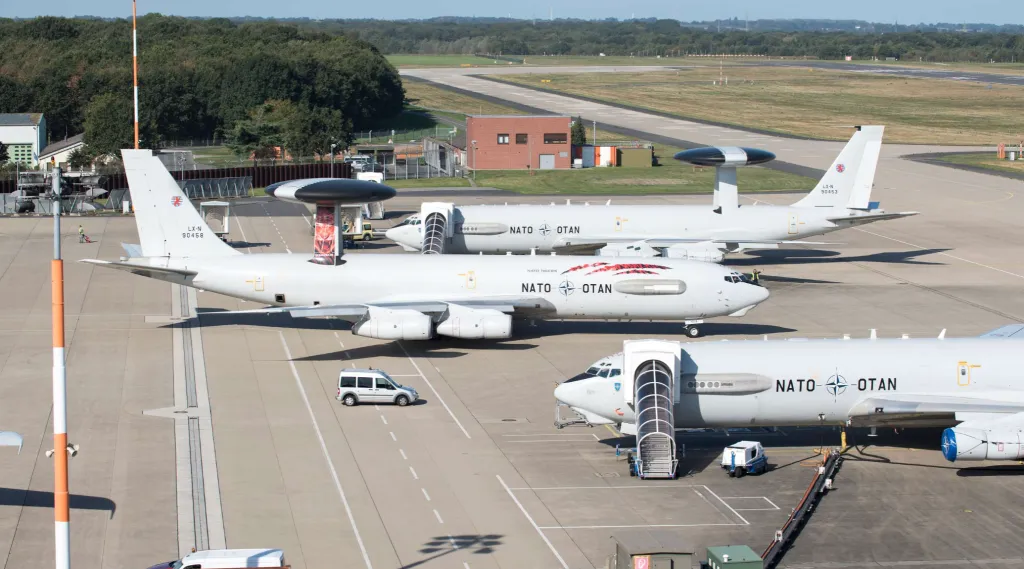
The alliance badly needs a replacement for its fleet of 14 Boeing E-3A Sentry Airborne Warning And Control Systems (AWACS) aircraft that are operated by the NATO Airborne Early Warning & Control Force (NAEW&CF), home-stationed at Geilenkirchen Air Base in Germany.

NATO E-3s on the flight line at Geilenkirchen Air Base. Melanie Becker/Luftwaffe

The GlobalEye’s path to success with NATO has been somewhat circuitous.

Back in 2023, NATO had announced its plan to “take steps toward acquiring” six Boeing E-7A Wedgetail AEW&C aircraft, the first part of an effort known as Initial Alliance Future Surveillance and Control (iAFSC).

NATO’s original choice of the E-7 took into account price and availability, as well as previous E-7 acquisition programs, namely in Australia, South Korea, Turkey, the United Kingdom, and the United States.

At that time, NATO determined that the E-7 was “the only known system currently capable of fulfilling the strategic commands’ essential operational requirements and key performance parameters and available for delivery within the timeframe required.”

But last November, the Dutch Ministry of Defense announced that NATO had dropped its plan to buy E-7s, saying that the program had lost its “strategic and financial basis.” The decision was also driven by confusion about the future of the U.S. Air Force’s Wedgetail plans.

At that point, the State Secretary for Defense of the Netherlands, Gijs Tuinman, said that the goal was to have a new AEW&C aircraft operational by 2035, referencing the date that the E-3s will reach the end of their service life.

A Saab Gripen E flies alongside a GlobalEye. Saab

Last year, Saab said that they would be able to get the GlobalEye into operational service with NATO in 2031.

The Netherlands was one of seven partner members in the AWACS replacement program, alongside Belgium, Germany, Luxembourg, Norway, Romania, and the United States. However, the United States later departed the program.

Dropping the E-7 meant the GlobalEye became the only realistic candidate, as the only other in-production jet-powered Western AEW&C aircraft. The turboprop, carrier-capable Northrop Grumman E-2D Hawkeye is also still being built.

Also in its favor is the fact that the GlobalEye has already been ordered by France to replace its E-3F Sentry fleet, and by Sweden, and has been selected by Canada. Saab has pitched the aircraft to Denmark and Finland, with a view to them potentially jointly operating the type. The company has also confirmed that Germany and Poland have both shown “interest” in the GlobalEye.

GlobalEye AEW&C. For editorial use only.
Saab GlobalEye. Saab

Meanwhile, demand for AEW&C aircraft is growing across Europe as the security environment continues to deteriorate. Russia’s ongoing aggression has reinforced the need for persistent wide-area surveillance and airspace control, while a broader range of operational scenarios is also driving renewed interest in airborne early warning capabilities.

Poland is among the latest countries to invest in the capability, taking delivery of two Saab 340 twin-turboprop AEW&C aircraft fitted with Saab’s earlier Erieye radar. Similar aircraft have also been delivered to Ukraine, reflecting the growing importance of these platforms on NATO’s eastern flank.

Saab presented the first Saab 340 AEW&C aircraft to Poland during a ceremony in Linköping, Sweden, on September 29, 2023, just two months after Poland placed an order for two of these aircraft. Saab

The appearance of Russian drones inside or close to NATO airspace has only added urgency to the requirement. AEW&C aircraft offer a critical look-down capability that makes them well suited to detecting and tracking low-flying threats, including uncrewed aircraft and cruise missiles, that can be difficult for ground-based radars to spot. At the same time, they provide an airborne picture of activity across the battlespace, monitoring Russian military aircraft while also keeping watch over potentially hostile movements on the ground and at sea.

Saab notes that the GlobalEye is particularly capable at identifying low-observable and stealthy threats, as well as drones, ballistic and hypersonic missiles, even in complex environments characterized by heavy clutter and electronic jamming.

GlobalEye walk-around tour with Saab thumbnail

GlobalEye walk-around tour with Saab


Unclear at this stage is what will happen with NATO’s previous plans to field a crewed AEW&C aircraft as part of an integrated network of sensors, also including drones, and other aircraft types that can operate in a surveillance-gathering capacity, and space-based systems.

This reflected U.S. Air Force thinking, in which the E-7 has been viewed more as a solution to bridge the gap between the retirement of its own aging E-3s and a future space-based radar capability and other classified systems. Much of this has been driven by concerns about the survivability of traditional AEW&C platforms in more contested airspace.

A rendering depicting a U.S. Air Force E-7 Wedgetail. U.S. Air Force

For NATO nations in Europe, switching from the E-7 to the GlobalEye also reinforces the importance of investing in the continent’s own defense industry. Increasingly, officials in Europe are looking to local manufacturers to meet their defense needs, part of a wider effort to reduce their traditional reliance on the United States, which is seen as a less reliable strategic partner under the Trump administration.

Meanwhile, and in response to the deteriorating security situation facing Europe, the NATO Summit that kicked off today has seen a flurry of big-ticket acquisition programs announced. Here, however, the U.S. defense industry was well represented.

Denmark, Finland, Germany, and Norway today announced they would acquire up to five Northrop Grumman MQ-4C Triton high-altitude, long-endurance (HALE) drones. These will enhance NATO’s Alliance Ground Surveillance (AGS) fleet that operates from Sigonella Air Base in Italy and currently flies five Q-4-series drones under the name RQ-4D Phoenix. As well as operating in the Mediterranean and Black Sea, NATO noted that these drones will also fly in the increasingly strategic Arctic and the High North regions.

A depiction of an MQ-4C Triton in NATO markings. Northrop Grumman

“Our collaboration with NATO and the U.S. Navy strengthens the alliance’s ground and maritime surveillance capabilities, said Jane Bishop, vice president and GM of Northrop Grumman’s Global Surveillance segment. “Like Phoenix, Triton conducts ISR at higher altitude and with longer endurance than medium-altitude systems, and is poised to provide NATO new levels of capability and operational flexibility to monitor and protect maritime interests from the Mediterranean to the High North.”

Unclear is whether the NATO Triton variant will be significantly different from the U.S. Navy’s, which focuses on broad-area maritime surveillance and can also conduct signals intelligence (SIGINT) work.

Other maritime patrol procurement includes an initial two P-8A Poseidon aircraft for Denmark. These will also be of particular value in the Arctic and the High North, as well as in the context of Greenland, which Trump has repeatedly said should be under U.S. control. Denmark joining the P-8 community also offers the potential for close cooperation in anti-submarine warfare with Canada, Germany, Norway, and the United Kingdom, all of which are Poseidon customers.

“With maritime patrol aircraft, Denmark’s ability to enforce sovereignty and monitor the region is significantly strengthened,” Danish Defense Minister Jeppe Bruus said in a statement.

Meanwhile, the NATO Summit today also saw Belgium, Croatia, France, Poland, Spain, Turkey, and the United Kingdom launch a program to establish a Multinational Fleet operating the Airbus A400M airlifter.

Flare jettison by an Airbus A400M. Airbus RAMADIER Sylvain

The multinational air transport initiative builds on the model of the Multinational MRTT Fleet (MMF), which operates a ‘pooling and sharing’ arrangement with Airbus A330 Multirole Tanker Transport (MRTT) aircraft on behalf of NATO.

The new A400M Multinational Fleet will address strategic airlift capability gaps among European allies, many of which lack a transport aircraft in the A400M class.

Alongside the A400M agreement, NATO announced the incorporation of Finland as a new member of the Multinational MRTT Fleet, which already included the Netherlands, Luxembourg, Norway, Germany, Belgium, the Czech Republic, Sweden, and Denmark. Nine A330 MRTTs are now in service from a total order of 12 for the MMF.

8 augustus 2021, Duitsland, Multinational Role Tanker Transport Unit (MMU) De NAVO heeft een vliegtuigen pool voor tank- en transportvliegtuigen. 6 Europese partners nemen op dit moment deel aan dit internationale samenwerkingsverband.  De Airbus A310-300 en A330 vliegtuigen zijn bedoeld voor militaire luchtvaart als opvolger van oudere tankvliegtuigen zoals KDC-10 en KC-135. Foto: Airbus A330
An Airbus A330 Multirole Tanker Transport (MRTT) of the Multinational MRTT Fleet (MMF). Airbus Arnoud Schoor

In terms of missiles, Europe still remains heavily reliant upon the United States, but efforts are being made to at least shift more production and sustainment capabilities to the continent.

With that in mind, today saw Lockheed Martin announce two initiatives to strengthen NATO’s missile industrial base by addressing both new production capacity (ATACMS) and lifecycle sustainment (PAC-3), two weapons systems that are also fundamental to Ukraine’s warfighting potential, and in constant demand from Kyiv.

For the ATACMS, Lockheed Martin has signed a memorandum of understanding covering local production of the munitions in Europe, leveraging Rheinmetall’s manufacturing capabilities.

Meanwhile, Lockheed Martin will work with Germany, the Netherlands, Poland, and Sweden to explore a dedicated PAC-3 missile maintenance facility in Europe. The proposed facility will support NATO allies operating PAC-3 Missile Segment Enhancement (MSE) and PAC-3 Cost Reduction Initiative (CRI) interceptors.

While the GlobalEye deal still has to be negotiated and finalized, today’s announcement effectively cements the type as NATO’s next airborne early warning platform. It also marks another major victory for Saab in the increasingly competitive AEW&C market, while underscoring a broader shift toward European-developed defense capabilities as the alliance races to modernize in response to the rapidly evolving security environment.

Contact the author: thomas@thewarzone.com

Thomas Newdick is a staff writer at TWZ, where he covers military aviation, defense technology, weapons systems, and international security. Based in Berlin, Germany, he reports on conflicts, military modernization efforts, and emerging aerospace technologies around the world, with a particular interest in airpower and its role in contemporary warfare. His reporting is informed by deep expertise in modern and historical airpower, particularly in Europe, with a focus on military aviation, air campaigns, and aerospace developments across the continent and beyond.


Source link

Dan Snow shares ‘most depressing lie’ he’s told his children in ‘catastrophic’ admission

Dan Snow has revealed the unusual thing he tells his three children when they ask him a difficult question about the future.

Historian and documentary-maker Dan Snow has highlighted the challenges faced by many parents as he revealed the difficulties of raising children in a deeply troubled world. In a new interview, he has revealed how he does his utmost to protect his children from the “grotesque” reality of threats such as climate change and nuclear war.

Dan, whose parents were both television journalists and who has countless family ties to the intertwined worlds of news and politics, has confessed that he routinely “lies” to his three children about what lies ahead.

“The biggest, most depressing lie I’ve told my children,” he tells The Times, “is that the world is well-run and the risk of nuclear war and climate change is being dealt with by experts.”

Yet in reality, the celebrated TV historian says, we are all “on a highway to catastrophic civilisational collapse,” while he does his best to reassure his son and two daughters that the adults have everything firmly in hand.

He admits: “The kids look at me and go, ‘Is everything OK? This is all fine, right?’ and I say, ‘Yes.'”

As Christopher Nolan’s epic retelling of Homer’s Odyssey hits cinemas, Dan is retracing the journey of Odysseus’s return from the siege of Troy in a two-part documentary series streaming on his History Hit platform this month before airing on Channel 5 this Thursday, July 16.

While his journalist parents were always fixated on the latest breaking news, Dan says he was far more drawn to “the substructural factors, the longer history behind those moments.”

This passion led him to produce a string of acclaimed historical documentaries, spanning everything from the Battle of El Alamein to China’s Terracotta Army. His family’s most significant historical legacy is, without doubt, his great-great-grandfather David Lloyd George, the only Welshman ever to serve as Prime Minister.

Lloyd George is renowned both for steering the nation through the First World War and for a private life that was dogged by scandal.

Dan reveals he became captivated by his celebrated relative’s story: “I found it inspiring that he was raised by his uncle, a cobbler, and got into grammar school; then university, then politics. He was the first and only Welsh-speaking prime minister, the first from a working-class background,” he says.

Yet there’s no profound emotional bond, he adds: “He was a serial philanderer and ultimately disappeared off down to Surrey with his second wife, so my side of the family are the ones who got left behind.”

Dan has, naturally, produced a documentary film in which he delves into the turbulent, ambition-fuelled life of his great-great-grandfather.

It charts how the PM built his reputation as a groundbreaking social reformer and the “man who won the war”.

He argues that Lloyd George was “the first man in history to become Prime Minister of the United Kingdom without money, without connections, without royal blood in his veins or whatever else. He was the first of a new kind of politician.

“What’s weird,” Dan adds, “is that it didn’t happen after Britain’s period of imperial rule and dominance. It happened right in the middle of it.

“At the absolute moment of greatest influence and power over the world, you had a man in charge of Britain who had risen from a humble background.”

Source link

TSMC’s June sales drive revenue surge of 68% ahead of earnings report

Published on

TSMC said on Monday that June revenue rose 67.9% year on year to NT$398.27 billion (€10.8bn), bringing the first-half of the year revenue to NT$2.4 trillion (€65.4bn), a 35.6% increase from the same period in 2025.


ADVERTISEMENT


ADVERTISEMENT

Based on the company’s monthly revenue disclosures, second-quarter revenue amounted to roughly NT$1.27 trillion, ahead of the NT$1.264 trillion (€34.4bn) consensus forecast from 20 analysts surveyed by LSEG.

Monday’s release covers June revenue and cumulative first-half sales only.

TSMC will publish its full second-quarter earnings on Thursday, including net profit, gross margin, operating margin and updated financial guidance.

The road ahead

At its April earnings presentation, TSMC said it expects full-year 2026 revenue to grow by more than 30% in US dollar terms and projected capital expenditure of between $52 billion (€45.5bn) and $56 billion (€49bn) as it expands manufacturing capacity to meet AI-driven demand.

New fabrication plants are under construction or in preparation in Arizona, Japan and Germany, reflecting both the scale of customer demand and government efforts to strengthen domestic semiconductor manufacturing.

Shares in TSMC rose about 1% following Monday’s revenue update.

Investors will now turn their attention to Thursday’s full earnings report for updates on profitability, margins, full-year guidance and the rollout of the company’s two-nanometre manufacturing technology, which is already attracting strong customer interest.

The AI engine

The company sits at the centre of one of the largest investment cycles in the semiconductor industry’s history.

Many of the world’s leading AI processors, including Nvidia’s GPUs and much of the custom AI silicon designed by Amazon, Google and Microsoft, are manufactured by TSMC in Taiwan.

At the company’s April earnings presentation, CEO Che-Chia Wei described AI demand as “extremely robust”, driven by the shift from chatbots that answer questions to agentic AI systems capable of taking actions.

That transition requires significantly greater computing power, increasing demand for the advanced chips TSMC manufactures.

Advanced technologies, defined as chips produced using process technologies of seven nanometres or smaller, accounted for 74% of wafer revenue in the first quarter.

TSMC’s three-nanometre technology alone contributed 25% of wafer revenue.

Reports have indicated that Nvidia has reserved roughly 60% of TSMC’s advanced chip-packaging capacity for 2026, highlighting continued supply constraints across the AI semiconductor market.

Source link

California kids still struggle in our schools. Will this change help?

Recent news about literacy, education and general smarts in California and across the country has been somewhat distressing.

Along with claims that Americans are becoming illiterate, here in the Golden State there are worries that even the highest-achieving students aren’t prepared for our universities, and a study shows backsliding in civil rights protections in the vacuum created by federal changes under the Trump administration.

Despite being close to terming out of office, and also otherwise occupied with his ever-emerging presidential run, Gov. Gavin Newsom last week found time to announce a consequential, if controversial, move that has the potential to vastly improve educational outcomes for California kids: switching out an independent, voter-chosen leader for a hired gun.

In legislation signed last week, Newsom basically eviscerated the role of the elected superintendent of public instruction and instead shifted oversight of our K-12 schools to a newly created education commissioner — to be appointed by the governor.

The change, set to happen early next year, has been described as a “power grab” by some, and on its surface could be seen that way. The conservative candidate for state superintendent — Sonja Shaw, who says she is running to stop “political ideologies being shoved down everybody’s throats” — quickly claimed Newsom’s move was all about stopping her.

In reality, power grab or not, it’s the kind of reform we should all support — a long-overdue push to create accountability in a hot-mess system where there are too many people almost-sorta in charge of too many conflicting priorities.

‘A’ for accountability

It’s to Newsom’s credit that he’s setting up his successor to helm a system that at least has a chance at coherence, even if it raises the stakes for the next governor to deliver.

For years — decades, really — streamlining the governing structure of schools “has been proposed by Republicans and Democrats and bipartisan and nonpartisan commissions,” Linda Darling-Hammond told me. She’s a professor emeritus at Stanford University, an advisor to the governor and, by any measure, one of the preeminent education policy experts in the country.

“It’s not at all political. It is really about making the system run well,” she said. “The world is changing, the economy is changing. There’s just a need to be very efficient and effective in making policy and then implementing that policy.”

“Run well” is the key there. California operates the biggest and most diverse school system in the country. We’ve got roughly 10,000 regular schools (depending on how you count), including about 1,200 charter schools, around 1,00 school districts and 58 counties, each with their own slice of local control over those schools, according to the Department of Education.

That’s about 5.7 million students, nearly 300,000 teachers and $150 billion in costs (counting the new funding in the next budget).

To be kind, this system does not always run well. That’s in no small part because oversight and control are fragmented, overlapping and confusing. Currently, the State Board of Education sets policies, but the elected superintendent implements them through the Department of Education. Then control runs downhill to individual school districts, filtering through local school boards and even principals.

The board can’t control how the superintendent does their job, and vice versa. In fact, they don’t always agree, despite (or because of) the shotgun wedding nature of their relationship. At times, it can feel like they are working against each other. Never mind the complexities of local control.

This has been especially true in recent years as Newsom and the Legislature have pushed through big changes, such as the new prekindergarten grade, that have required massive coordination and effort. At the local level, administrators often complain there is little clarity on what is expected of them and, too often, outright conflict.

“The idea of having policy in one place and implementation in the other is really crazy,” Michael Kirst told me. He’s professor emeritus of education at Stanford and the longest-serving president of California’s State Board of Education, serving under both of Jerry Brown’s gubernatorial stints.

Newsom’s proposed system promises “much clearer, cleaner accountability,” Kirst said.

Expertise counts

It also has the benefit of putting an actual education expert in charge of schools. Because the superintendent role is elected, it has too often been coveted by career politicians looking for a landing spot. Its incumbent, Tony Thurmond, had a background in social work before running for various offices, but that kind of experience isn’t always the case. Neither is experience running a major organization with thousands of employees.

While Newsom’s plan leaves many, if not most, of the details to be ironed out later (a frustrating strategy he’s used more than once to keep the ball rolling on policy without having the drag of actual detail), it does promise to put in someone with the kind of high-level educational policy experience that should be required when managing this vast and important endeavor.

Kirst points out that this will be a “powerful position” charged with making sure our schools are indeed run well, and at the end of the day, it gives us one person to blame if they don’t: the governor.

So if schools don’t improve and our kids don’t learn, voters will know exactly who failed.

You’re reading the L.A. Times Politics newsletter

George Skelton and Michael Wilner cover the insights, legislation, players and politics you need to know. In your inbox Monday and Thursday mornings.

What else you should be reading

The must-read: Trump ousts members of bipartisan election commission ahead of midterms
The California edge: The Work of Helping A.I. Destroy Work
The L.A. Times Special: In bed 23 at Adelanto ICE detention center, a terrified teenager missed his mom

Stay Golden,
Anita Chabria


Was this newsletter forwarded to you? Sign up here to get it in your inbox.

Source link

The UK theme parks and attractions with HUGE sales on this summer

YOU don’t need to empty your pockets to visit big-name theme parks and resorts this summer.

Especially not when these major UK attractions are offering free extra return tickets and 89p admission for kids.

Take a trip to Legoland Windsor Resort this summer and claim a FREE ticket to come back again
Collage of travel items including a plane, sunscreen, passport, suitcase, and plane tickets, advertising The Sun's travel Instagram account.

We’ve rounded up the very best offers at popular resorts like Alton Towers, Chessington, Legoland and Butlin’s that you can book this school summer holidays.

From half-price entry offers to kids tickets for less than £1, here are the ultimate theme park bargains for summer 2026.

Legoland Windsor Resort

Legoland are running a summer promotion that lets you unlock an extra day of theme park fun for the price of a single ticket.

There is an absolute mountain of things to do at this resort to keep both little ones thrill-seekers happy all day long.

Read more on family days out

FIT FOR A KING

Medieval UK castle is turned into a ‘flagship’ £15MILLION tourist attraction


TIME TO GO

I went to the new historical live-action theme park in the UK with NO rides

Tackle the park’s 55 rides and live shows, marvel at the Lego models in Miniland, or let the kids’ imaginations run wild in the brick-building zones.

While trying to cram the entire resort into a single day can feel like a mad rush, knowing you can return means you can relax and take in the park at your own pace.

The best part about this offer is that the free ticket you unlock doesn’t have to be used only at Legoland.

You can also redeem your free ticket for a trip to Chessington World of Adventures, Alton Towers or Thorpe Park instead.

Book your tickets to Legoland Windsor Resort from £29.75pp + claim an extra FREE return ticket

Gulliver’s Theme Parks

Wowcher are offering tickets to Gulliver’s Theme Parks this summer for £12.50 Credit: Gulliver’s

Save a massive 48% off a trip to a Gulliver’s Theme Park this summer at any of their four theme parks: Milton Keynes, Rother Valley, Matlock Bath, or Warrington.

With this Wowcher deal families can bag a ticket for £12.50 each, nearly halving the cost of buying a ticket direct for £25.

Whether you want to conquer the dizzying Gyrosaur, board the Rocky Ridge Railway, or meet live animals at the farm park, there’s plenty to do across all locations.

Throw in completely free parking and free entry for toddlers under 90cm, and you’ve got an affordable school holiday treat for the family.

Book your tickets to Gulliver’s Theme Parks for £12.50pp

Alton Towers Resort

Visit Alton Towers then claim a free ticket to return – or use it at Chessington, Legoland and more Credit: Supplied

Alton Towers is slashing the cost of a visit this school summer holidays with two theme park visits for the price of one.

The sprawling theme park is packed with world-class, white-knuckle rollercoasters for adrenaline junkies, alongside family-friendly rides like the new Bluey kids coaster.

There’s also exciting events this summer, such as the Minecraft Meet the Mobs from July 18 – August 28 plus the Bluey live experience with meet and greet, running throughout the summer.

To get the offer, make sure to claim the deal before July 27 and save your ticket and barcode from your first visit. Then you can claim yourself another visit to Alton Towers, or a free trip to Legoland, Chessington or Thorpe Park.

Book your tickets to Alton Towers resort from £29.75 + claim an extra FREE return ticket

Flamingo Land

Head to Flamingo Land in North Yorkshire with discounted tickets from £29 this summer Credit: Alamy

Families heading to North Yorkshire this summer can slash up to 50% off their day out at Flamingo Land Resort thanks to a Wowcher deal.

Here you’ll find hair-raising rollercoasters like the 10-inversion Sik Coaster and the lightning-fast Velocity motorbike ride, which launches from 0-60mph in 2.8 seconds.

Smaller thrill-seekers in tow can explore the Peter Rabbit Adventure, brave the river rapids, or take a quick break from the rides to stroll the zoo.

Tickets can be used on any date until November and start at £29pp, plus there are extra discounts available if you purchase multiple tickets. For example, if you book for a group of six you will save an extra £18 on top of the deal, while groups of four can save an extra £19.

Book your tickets to Flamingo Land from £29pp

Chessington World of Adventures

You could visit World of Paw Patrol on your trip to Chessington World of Adventure Credit: PA

Score two visits for the price of one on your next trip to Chessington World of Adventures.

Visitors can test their nerve by hurtling backwards on the terrifying Mandrill Mayhem in the World of Jumanji, or fly through the treetops on the popular Vampire coaster.

You could even tick off the World of Paw Patrol, a colourful themed land new for 2026 with gentle rides such as Chase’s Mountain Mission.

To claim the deal, buy a ticket online before July 27 to snap up a free return ticket that is valid for visits until September 25. As part of a combined summer promotion, you could also use your tickets at Thorpe Park, Alton Towers, or Legoland Windsor instead.

Book your tickets to Chessington World of Adventures from £29.75 + claim an extra FREE return ticket

Butlin’s

Bag a last-minute kids day ticket to Butlin’s this July for 89p – or enjoy 15% off in the summer hols Credit: butlins

Kids can bag a day visit to Butlin’s for 85p when visiting with a full-paying adult this summer, plus under 2’s go free.

This means that for one adult and one child, your entire family day out would cost a total of £19.85.

A day pass drops you straight into the action with unlimited turns on the traditional fairground rides and access to massive outdoor play areas.

You can also pack your swimsuits and tackle the flumes and wave pools at the subtropical Splash Waterworld, before catching a live daytime stage show starring the kids’ favourite characters.

Available across their Bognor Regis, Minehead, and Skegness resorts, it’s a ridiculously cheap way to enjoy a fun-filled family day out.

Make sure to get in quick, because this offer is only available until July 16. However, from then, day tickets during the school summer holidays will be discounted by 15%.

Book your day tickets to Butlin’s – with kids tickets from 89p

*Prices correct at the time of publication. Terms and conditions apply.


Source link

World Cup 2026 TV and streaming schedule for every match

The 2026 FIFA World Cup semifinals are set to start, with France taking on Spain and defending champion Argentina facing England.

World Cup co-hosts U.S., Canada and Mexico will be watching from the sideline after being eliminated in the round of 16.

Here’s everything you need to know about the two World Cup matches being played Tuesday and Wednesday (all times Pacific).

Tuesday’s semifinal

France vs. Spain

France star Kylian Mbappe controls the ball during a World Cup quarterfinal win over Morocco on July 9.

France star Kylian Mbappe controls the ball during a World Cup quarterfinal win over Morocco on July 9.

(Lars Baron / Getty Images)

Where: AT&T Stadium, Arlington, Texas
Time: Noon
TV: Fox, Telemundo | Streaming: Fox One, Peacock

The buzz: This game would be far better suited as a final than a semifinal. Both are unbeaten — in fact, Spain is unbeaten in its last 36 games, one shy of the all-time record. For France, a win would put it in the final for a third straight World Cup while Spain is hoping to get back for the first time since 2010, when it won its only title. The teams got here in different ways. Spain has walked a razor’s edge, giving up just a single goal in the tournament and winning its last two games on late goals from substitute Mikel Merino. France has bludgeoned the opposition, scoring 16 goals while conceding just two. Kylian Mbappé has scored eight times and has 20 goals in 20 World Cup games, leaving him one back of Lionel Messi’s all-time record. It seems unjust that one of these teams will finish its World Cup in the third-place game.

Wednesday’s semifinal

England vs. Argentina

England's Harry Kane, Jude Bellingham, and Morgan Rogers celebrate against Norway.

England’s (from left to right) Harry Kane, Jude Bellingham, and Morgan Rogers celebrate after defeating Norway in the World Cup quarterfinals on Saturday.

(Julio Cortez / Associated Press)

Where: Mercedes-Benz Stadium, Atlanta
Time: Noon
TV: Fox, Telemundo | Streaming: Fox One, Peacock

The buzz: Both teams are unbeaten and each survived scares in the quarterfinals, with England outlasting Norway in extra time in brutal weather in Miami and Argentina beating Switzerland in extra time in Kansas City. Jude Bellingham had a brace in each of England’s last two games to match teammate Harry Kane’s six goals in the tournament. Bellingham is the first player to score at least two goals in consecutive World Cup knockout matches since Diego Maradona in 1986. Argentina, the reigning champion, is unbeaten in its last 12 World Cup games, but four of its last six knockout-stage games have gone to extra time or penalties. Argentina has gotten eight goals and two assists from Messi in this World Cup.

Source link

Seoul shares nose-dive 9 pct on tech losses amid Middle East tensions

This photo, taken Monday, shows the trading room of Hana Bank in Seoul as South Korean stocks plunged by nine percent on tech stock losses amid Middle East tensions. Photo by Yonhap

Seoul shares plunged 9 percent Monday as investors dumped technology stocks for profit-taking amid renewed tensions in the Middle East. The Korean won fell against the U.S. dollar.

The benchmark Korea Composite Stock Price Index (KOSPI) fell 669.01 points, or 8.95 percent, to close at 6,806.93 after falling as low as 6,783.43.

Trade volume was moderate at 469.86 million shares worth 39.8 trillion won (US$26.5 billion), with decliners far outnumbering gainers 713 to 179.

Institutions and foreigners sold a net 2.22 trillion won and 1.7 trillion won worth of shares, respectively, while individuals bought a net 3.9 trillion won.

After opening 0.85 percent lower, the KOSPI extended its losses, triggering a circuit breaker that temporarily halted trading of KOSPI-listed stocks for 20 minutes. It marked the seventh activation of the measure this year.

On Friday, U.S. stocks advanced, buoyed by South Korean chipmaker SK hynix’s multibillion-dollar U.S. share offering. The Dow Jones Industrial Average gained 0.29 percent, while the tech-heavy Nasdaq Composite also rose 0.29 percent.

SK hynix’s American depositary receipts (ADRs) on the Nasdaq closed at US$168 each, well above the offering price of $149.

Despite the successful U.S. market debut, SK hynix shares tumbled as investors took profits and shifted to the company’s ADRs, analysts said.

Investor sentiment was also dampened by heightened uncertainty in the Middle East after the United States and Iran exchanged fresh strikes over the status of the Strait of Hormuz.

“The country’s newly introduced single-stock leveraged exchange-traded funds linked to Samsung Electronics and SK hynix continued to fuel volatility in the stock market,” Samsung Securities said in a research note.

Tech stocks led the decline.

Market bellwether Samsung Electronics plunged 10.7 percent to 254,500 won, while its chipmaking rival SK hynix plummeted 15.37 percent to 1,845,000 won.

Top carmaker Hyundai Motor fell 2.95 percent to 444,000 won, and defense giant Hanwha Aerospace declined 3.21 percent to 936,000 won.

Among gainers, leading battery maker LG Energy Solution rose 0.77 percent, and leading refiner SK Innovation climbed 7.09 percent to 110,200 won.

The Korean won was quoted at 1,503.4 won against the U.S. dollar at 3:30 p.m., down 2 won from the previous session.

Bond prices, which move inversely to yields, closed lower. The yield on three-year Treasurys rose 4.1 basis points to 3.809 percent, and the return on the benchmark five-year government bonds climbed 3.3 basis points at 4.041 percent.

Copyright (c) Yonhap News Agency prohibits its content from being redistributed or reprinted without consent, and forbids the content from being learned and used by artificial intelligence systems.

Source link

Jet2 passengers told bring item to avoid delays for flights in six weeks holiday

Keeping the item with you until you’ve got off the plane and collected your luggage on the other side is best

Millions of people are expected to go abroad during the six-week holiday, as the peak travel season typically sees masses of British families take advantage of the kids being off. With so many people set to pass through UK airports over the coming weeks, it is important to stay up to date with the latest guidelines and advice to ensure a smooth journey.

Jet2 is one of the most popular budget airlines in the UK, and welcomes around 20 million passengers on board each year. Jet2‘s website is full of information for passengers to read up on and keep in mind when travelling, including steps to take and things to do to minimise disruption and delays as much as possible, especially when bringing luggage to go into the aircraft’s cargo hold.

On its ‘Top Tips Before Travel‘ page online, the airline urges passengers to bring one particular item along with them on their journey, right until they collect their checked luggage at their chosen destination. By doing so, they can reduce the risk of longer delays should the worst happen

The airline explains: “At check-in, each item of checked baggage will be given a destination tag showing your flight number. Do not get rid of your checked baggage receipts (if given) until you pick up all checked baggage at your destination airport. Never carry unidentified items on behalf of other people.”

Why is it important to keep the luggage receipt with you?

It’s important to keep your checked baggage receipt because it helps you track down lost luggage, file for compensation, and prove ownership if security or customs officials need to check your bags. Usually, these are the small adhesive tags that get stuck to your boarding pass or passport after you drop off your luggage at the check-in desk.

When you check-in a bag, the barcode and receipt information are linked to your digital flight booking file. If your suitcase doesn’t show up, the barcode and the 10-digit number on your receipt help airline agents find your specific bag using global systems like WorldTracer.

If I lose my luggage receipt, will I face delays?

If your bag is lost and you have misplaced your checked baggage receipt, the airline can still look up your digital tracking information, but the process will require more manual verification and may face delays. Locating your profile manually can be time-consuming, particularly during busy travel times or when the booking system is experiencing delays.

If your bag is lost for good (missing for over 21 days), the airline or your travel insurance company may ask for more evidence of check-in. Misplacing the receipt can complicate the process of making a formal financial compensation claim, but your digital booking records usually serve as a valid paper trail, according to Citizens Advice.

Jet2 also urges passengers to label each piece of baggage with their name, flight number, and phone number. It adds: “Please ensure your baggage is strong and fit for purpose, to protect the contents and to withstand the normal baggage handling process. Soft sided cases and handles, wheels and locks can be particularly vulnerable.”

The airline also says: “Take care when claiming your baggage at your destination, as many suitcases look the same. It is best to always check the name on the baggage tag.

“You must contact the Jet2.com team at the airport (or our handling agents) immediately if your baggage is damaged or has not arrived. Irregularities must be reported immediately as claims cannot be processed once you leave the airport. Staff will help you to complete a Property Irregularity Report Form.”

Source link

Mysterious Rectangle ‘Silos’ Spotted At Sprawling Chinese Missile Test Base

Satellite imagery shows China has built what looks to be a new pattern of hardened structures with retractable roofs at a key missile test and training base in Inner Mongolia. Since the late 2010s, this base has also played a key role in the Chinese People’s Liberation Army’s (PLA) dramatic expansion of its silo-based intercontinental ballistic missile (ICBM) capabilities. The more recent additions to the facility appear to be too small and shallow for this purpose. A new report posits they could be used to fire smaller ballistic and/or cruise missiles, and might point to plans for a new “conventional quick-strike capability.”

The China Aerospace Studies Institute (CASI), part of the U.S. Air Force’s Air University, first called attention to the two new structures yesterday. Though CASI published the report, it stressed that the “opinions, conclusions, and recommendations expressed or implied within are solely those of the author,” Eli Tirk, and “do not necessarily represent the views of the Air University, the Department of the Air Force, the Department of Defense, or any other U.S. government agency.” Tirk is a member of CASI’s staff.

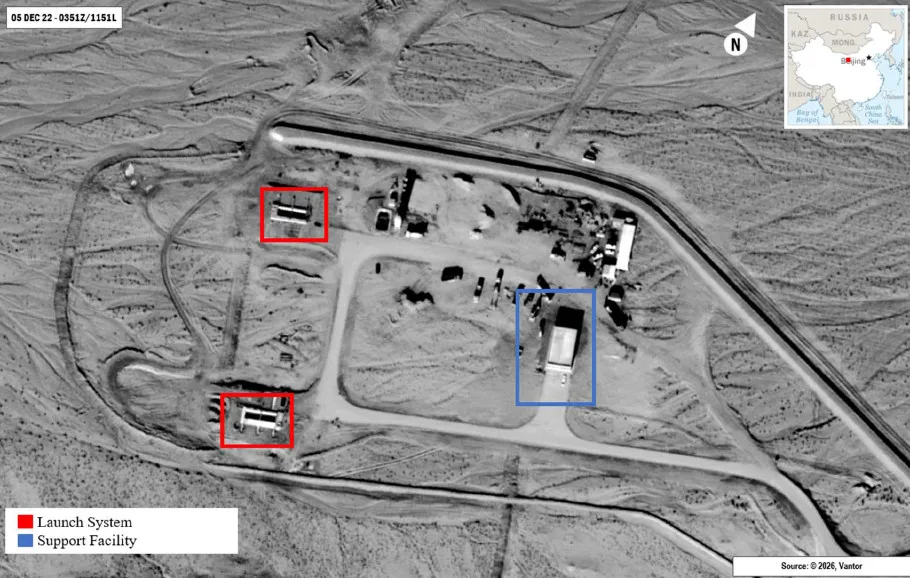
“The People’s Liberation Army Rocket Force (PLARF) has constructed an unknown type of fixed launch system at the 1st Test and Training District in Jilantai that appears capable of launching multiple missiles,” Tirk writes. “Construction began sometime in late 2022, and, at least externally, appeared to be near completion by late 2023.”

A satellite image of the site in question, taken on December 5, 2022. Vantor via the China Aerospace Studies Institute
A close-up look at one of the new hardened structures with a retractable roof, as seen on January 28, 2026. Vantor via the China Aerospace Studies Institute

The report includes satellite images of the site taken in September and December 2022, as well as January of this year, as seen above and below.

“The excavation for the northern launcher … measures roughly 12.5 meters [40 feet] deep when the image was captured [in September 2022]. While it is possible that this foundation was dug deeper, it is not likely that it would have been significantly deeper, given the potential size of the finished interior of the launch system,” according to Tirk. “The limited imagery available of the finished structure prior to the installation of the launcher closure door restricts more accurate measurement, but this structure appears to be somewhere between 6.4 meters and 11.8 meters [21 to 38 feet] in depth.”

Another satellite image of the site while it was under construction, taken on September 10, 2022. Vantor via the China Aerospace Studies Institute

Additional satellite imagery TWZ has reviewed from PlanetLabs shows the rectangular retractable roofs to be approximately 65.5 feet (20 meters) long and just over 21 feet (6.5 meters) wide. The roofs also look to open by sliding sideways along three large rails.

There is at least one other large structure at the site, which could be used for various support functions. There may be additional infrastructure underground. It is also worth noting here that the area with the new hardened structures is connected by road to an earlier facility immediately to the northeast. The tertiary site has several additional large structures contained within a clearly visible perimeter wall.

The roof design, at least, has some broad similarities to the covers on silos associated with older DF-5-series ICBMs, which are also rectangular in shape. For further comparison, the cover on a known ICBM test silo at Wuzhai, some 350 miles to the East of Jilantai, is nearly 74 feet (22.5 meters) long and around 29.5 feet (9 meters) wide. It also slides open to one side along two large rails. Underneath is a tubular silo that would have to be at least around 131 feet (40 meters) deep based on the dimensions of DF-5.

A satellite image of the test silo in Wuzhai taken in October 2025. Google Earth
Another lower-quality satellite image of the silo in Wuzhai, taken in October 2009, which shows the cover retraced and the tubular silo underneath. Google Earth

Silos constructed at Jilantai and other sites in China since the late 2010s, associated with newer DF-31 and DF-41 ICBMs, have completely different lid designs.

The new structures appear “to have a shorter depth than silos intended for intercontinental ballistic missiles (ICBMs), suggesting that it may support short-range ballistic missiles (SRBMs), medium-range ballistic missiles (MRBMs), and cruise missiles,” per Tirk’s assessment. “Assuming the actual depth of the launch system is closer to the maximum range, these measurements suggest that these structures would likely be able to support up to an MRBM-class missile, assuming the roughly 10-meter length [nearly 33 feet] of a DF-21 or 11-meter length [approximately 36 feet] of a DF-17. It is also highly likely that this launch structure could easily accommodate SRBMs and cruise missiles.”

The DF-21 is a traditional MRBM design, and there is an anti-ship variant with a reentry vehicle capable of a certain degree of maneuvering in the terminal phase of flight. Though MRBM-sized, the DF-17 is topped with a hypersonic boost-glide vehicle and functions in a completely different manner from typical ballistic missiles. In general, hypersonic weapons of this type offer benefits when it comes to penetrating past enemy defenses and for prosecuting time-sensitive targets at long ranges, as you can learn more about here.

China's Dong-Feng 21 “carrier killer” Salvo Launch thumbnail

China’s Dong-Feng 21 “carrier killer” Salvo Launch


“While there may be space within this launch structure to store a small number of missiles horizontally that are erected vertically prior to launch, a more efficient configuration appears to be a vertical launch system,” Tirk adds. “A vertical launch system would enable the massing of fires for effect, reduce signatures, and maintain the flexibility to employ a variety of different munitions from a single launcher simultaneously, enabling these units to conduct rapid strikes against numerous target types.”

How missiles would be loaded into the launch system is unclear and would depend on its exact design. A specialized loading vehicle or at least a crane might be necessary. There is no indication that the structures allow for road-mobile transporter-erector-launchers to simply drive inside and fire through the open roof.

Tirk also raises the possibility that the site could be tied to Chinese ballistic missile defense developments. The line between ballistic missiles and mid-course anti-ballistic missile interceptors, as well as ground-launched anti-satellite interceptors, is often blurry. The U.S. Ground-Based Interceptor (GBI) is notably a silo-launched design, as is Russia’s A-135.

However, Tirk also notes that the base at Jilantai primarily serves the PLARF. This branch of the PLA is not known to have a major missile or air defense role. That responsibility largely falls to the PLA Air Force (PLAAF). There are no signs of radars or other features associated with these missions, either. As TWZ has previously reported on in detail, we have seen different types of hardened and unhardened structures with retractable roofs emerge near the border with India and on islands in the South China Sea that do look to be air defense sites.

A satellite image taken on September 29, 2025, showing what appears to have been a new pattern of air defense site, featuring hardened structures with retractable roofs. Satellite image ©2025 Vantor

Other significant additions to the facilities at Jilantai have been observed in recent years. As already noted, this has been especially heavily intertwined with China’s construction of hundreds of new ICBM silos and associated infrastructure spread across three separate fields in the north and western ends of the country.

A US military graphic detailing ICBM silo construction at three new sites China in recent years. US military

Overall, Tirk posits that the new structures at Jilantai might reflect “an intent to field a conventional quick-strike capability for a counter-intervention mission set, or possibly to conduct strikes against Taiwan, both of which would provide the PLA with additional capabilities to influence U.S. strategic decision-making.”

“A conventional quick strike capability, like that provided by a vertical launch system, could make PLA leadership more confident in their ability to compel Taiwan and U.S. behaviors during a crisis by threatening or conducting rapid preparatory strikes or counterintervention fires in the early stages of a conflict,” he adds. “Building out these launch systems in sufficient quantities could allow the PLA to rapidly escalate from a quarantine or blockade of Taiwan to conducting elements of a massive preparatory fires campaign against targets on Taiwan, U.S. bases in the first island chain, or U.S. Navy task groups if positioned along the coast.”

A graphic included in the Pentagon’s 2025 report on Chinese military developments showing the general ranges of various shorter-range ballistic missiles and surface-to-air missiles in relation to Taiwan. US military

“Fixed launching options, however, are difficult to conceal, protect with active defenses and – depending on their location – potentially of limited utility for continued use after their first launch. Expansive investment in this type of system may provide significant “use or lose” incentives to the PLA leadership in the event of an escalating crisis,” he also notes. “It is currently unclear how many of these systems the PLARF intends to construct, which PLARF Base they will be deployed under, and the specific mission set they are intended to support.”

There is still the possibility that these structures could serve another purpose, even just within the PLARF. In particular, if the foundation was dug deeper, this could fundamentally change the assessment. From the outside, the roofs do still look to be too narrow for there to be a traditional silo underneath for any of China’s known ICBMs. That being said, a deeper foundation could accommodate intermediate ballistic missiles (IRBM) or hypersonic types that use larger ballistic missile-type boosters, but that are still smaller than an ICBM. The DF-26 family of IRBMs, at least some variants of which are understood to be capable of carrying conventional or nuclear warheads, is a particularly key component of the PLARF’s arsenal, and might also benefit from a new fixed launch infrastructure. Like the DF-21, there is also an anti-ship version of the DF-26.

China tests DF-26 missile destroying Mock Aircraft Carrier thumbnail

China tests DF-26 missile destroying Mock Aircraft Carrier


The hardened structures with retractable roofs could conceal other assets beyond launchers for any kind of missile. They could have a more specialized testing role, rather than one intended to lead to an operational capability, too. TWZ has previously highlighted other hangar-like structures with retractable roofs, some of which are camouflaged, in an area known as Korla East in the western end of the country. PLAN facilities in this region have been tied to work on missile defense, anti-satellite, directed energy weapon, and electromagnetic pulse technologies, as you can read more about here.

A 2021 satellite image showing hangar-like structures with retractable roofs at Korla East. PHOTO © 2021 PLANET LABS INC. ALL RIGHTS RESERVED. REPRINTED BY PERMISSION

Regardless, the new structures at the base in Jilantai do reflect a broader trend when it comes to hardened military infrastructure in China, as well as elsewhere globally. As we wrote last year, after the emergence of the apparent new pattern of hardened air defense sites near China’s border with India:

“The shelters with retractable roofs at the sites in Gar County and near Pangong Lake also highlight a larger trend when it comes to physical hardening, or at least ‘enclosing,’ that has been observed at Chinese military facilities in recent years. There has been a particularly visible surge in the construction of new hardened aircraft shelters, as well as unhardened, but fully enclosed hangars, at air bases across China, including ones situated on the Tibetan Plateau.”

“Vast fields of new silos for intercontinental ballistic missiles have also been built in the western end of China over the past few years. This is all on top of the PLA’s existing array of hardened infrastructure, which includes deeply buried air and naval bases.”

“Chinese construction of new hardened and unhardened aircraft shelters, in particular, is reflective of larger global trends, including in Russia, North Korea, and Iran, as well. It has also stood in notable contrast to the lack of such developments in the United States, something that has become a topic of heated debate, which TWZ has been tracking very closely.”

Growing threats posed by long-range, one-way attack drones, which offer a relatively low-cost way to launch large volume strikes, especially against fixed targets like air bases and air defense sites, have become a particularly significant factor in the hardening debate. Ukraine’s Operation Spiderweb also underscored the threats that smaller, shorter-range drones can pose to aircraft and other assets out in the open, and in areas far away from active combat zones. Drones could also be layered in with the many other methods of attack that would be used against the same array of targets.”

Though questions remain about their exact purpose, and the concepts of operations behind them, the new hardened structures with retractable roofs in Jilantai might be a sign of things to come.

Contact the author: joe@twz.com

Joseph is TWZ’s Deputy Editor, helping to oversee the site’s highly experienced and dedicated team, while also writing informative and impactful defense and national security content. He lives right in the thick of it in the Washington, D.C. area.


Source link

Overlooked ‘Sunshine City’ with 30C winters to get first direct UK flights in 14 years

A CITY with 3,000 sunshine hours a year that is barely visited by Brits is getting its first UK flights in more than a decade.

Launching later this month, Air Zimbabwe will connect the UK to Harare, the capital of Zimbabwe.

New flights will connect London to Harare this month Credit: Alamy

The first route takes of on July 22 from London Gatwick, with three flights a week.

It will be the first direct flights to the capital in 14 years, amid plans to open up travel between the UK and Africa.

The route was scrapped back in 2011 due to a financial difficulties at the time.

Fights start from £490 each way, or £675 return.

SI YOU THERE

Wizz Air launches three new flights to Spain and tickets are just £17.99


ISLAND HOP

New hovercraft route to sun-drenched UK island takes off – with £12 flights

While Zimbabwe welcomed 1.78million tourists in 2025, 76 per cent of this was from Africa.

Despite this, the UK is the biggest market for the city when it comes to European arrivals.

Harare is known as the City of Sunshine for its sunny weather all year round thanks to it high altitude.

It is also much better to visit in the autumn and winter, as this is where highs of 30C can be found (compared to the cooler summers of 20C).

The new flights come after 14 years, with the last ones in 2011 Credit: Alamy
It is often called the Sunshine City for its great weather Credit: Alamy

The city is also known for its beautiful green spaces, such as Mukuvisi Woodlands where you can everything from zebras and giraffes to wildebeast and impalas.

It also a great jumping off point for going on safari, or visiting Victoria Falls.

Here are some other new flights launching in the UK soon:


Source link

The ‘warning’ that got Sam Neill his biggest role… but bizarre Meryl Streep & Michael Jackson tale made him shun stardom

NO-ONE travelled further to become an international star than Sam Neill, who died today aged 78.

He would leave his home in the South Island of New Zealand to fly thousands of miles to film sets in Britain, Europe and America – but always travel back to his far-flung base the moment they were over to spend time with his family.

Sam Neill has died aged 78 Credit: AP
Sam starred as Dr. Alan Grant in the 1993 blockbuster Jurassic Park Credit: Alamy

They confirmed his death in a statement, writing: “It is with immense sadness that the whānau of Sam Neill share the news of his passing on Monday 13th July, in Sydney, Australia.”

This followed a battle with stage three blood cancer after he was diagnosed in 2022.

After undertaking an experimental treatment announced a month ago he was in remission.

His family said: “The loss was sudden and unexpected but blessed by the fact that Sam remained cancer- free.”

BOOTY QUEENS

No one can believe these celeb bums aren’t FAKE – including ‘best in showbiz’


panic atack

Inside Emily Atack’s toxic family rift after trauma of parents’ painful divorce

The legendary actor starred in the hit British show Peaky Blinders Credit: Alamy
His death comes only months after he confirmed he was cancer-free Credit: instagram / SamNeillTheProp

Sam became famous thanks to his role in Omen III (The Final Conflict) where he played the antichrist who had risen to become a British politician trying to prevent the second coming of Christ.

Before then starring in 1983 British TV series, Reilly, Ace of Spies, in which he played Sidney Reilly, a Russian-born adventurer who became a successful spy during the First World War.

But his entry to the big-time came ten years later in Jurassic Park, directed by Steven Spielberg, which spawned a craze for everything about dinosaurs. 

The film, about a theme park where the public could see cloned dinosaurs, caught the public’s imagination – and broke box office records.

The dinosaurs run riot in the film when all safety fences are broken, killing park workers and each other as there is a battle for supremacy. 

Neill’s lead role of dinosaur expert Dr Alan Grant escaped the carnage and went on to star in sequels, Jurassic Park III (2001) and Jurassic World Dominion (2022), making a personal fortune in the process.

Yet he was a last minute choice after bigger star names like William Hurt, Kurt Russell, Harrison Ford and Tim Robbins all turned it down.

His character in Jurassic Park was a paleontologist with a particular interest in velociraptors Credit: Alamy
Neill in the 1981 horror flick The Omen III Credit: Alamy

“It was a warning never to become too big or too expensive,” he said. 

“You can lose a lot of good parts in that way. I preferred quiet progress.”

Neill did precisely that throughout his career of over 100 movies in nearly 50 years, in which he would turn up in the most unlikely roles.

It included that of Major Chester Campbell in the first two series of the BBC’s hit series Peaky Blinders.

He was born on September 14th, 1947 in Omagh, Northern Ireland to New Zealander father Dermot, an army officer, and mother Priscilla, who was English. 

Although he was christened Nigel, he later thought the name ‘prissy’ and changed it to Sam in childhood. 

His family continued to call him Nigel.  

He is survived by actor son Tim (b 1983) whom he had with actress Lisa Harrow, a fellow New Zealander.  

The Kiwi was nominated for several awards throughout his career Credit: AFP
The actor featured in other films such as Red October (1990) and The Piano (1993) Credit: Getty

Despite reports to the contrary, they never married.

He also has daughter Elena (b 1991) with estranged wife Nariko Watanabe, a Japanese make-up artist whom he met on Dead Calm (1989), which was co-star Nicole Kidman’s breakthrough movie. 

He had a stepdaughter with Watanabe, Maiko Spencer (b 1982).  

Neill spent virtually his entire life travelling, first with his father’s job moves around Ireland and then, when he retired from the army, to New Zealand, aged seven.

His father joined the family brewing wholesale business near far-flung Dunedin, which was Gaelic for Edinburgh and founded in 1848 as a Scottish Free Church settlement.

“I was an outsider from the start there,” he recalled. 

“Bullying at school, mocked for my accent, being called names and beaten up – the lot.

“Cowboy films and TV series were very popular at the time, so I called myself Sam to sound like one. It didn’t do much good.”

Sam Neill appeared on The Graham Norton Show to discuss his upcoming projects Credit: PA
Sam posed with some Jurassic Park merch in a recent Instagram post Credit: instagram / SamNeillTheProp

He was sent away to boarding school in Christchurch, more than 200 miles north along the coast. 

“It was even more lonely,” he said. 

“I developed a stutter, although I could talk perfectly up to that point.”

He used the experiences and memories when he became an actor, always being prepared to take on new projects wherever they were in the world.

“I had an ability to pretend to be other people – probably because I had to at school,” he told me. 

“I never had any great expectations as an actor.”

He started working in television documentaries and in small acting roles.  

He was 30 before he appeared in a movie, Sleeping Dogs (1977), an action thriller made in New Zealand. 

“That film was a calling card,” he said. 

“It was a critical success and that led to some offers, all thousands of miles away. It was a case of either travel or never leave.”

He had arrived in London when we first met in March, 1989, promoting a film called A Cry in the Dark, with Meryl Streep.

It was an alarming real-life Australian story about a baby girl who disappeared from a campsite.

The baby’s mother, Lindy Chamberlain (played by Streep) insisted that a wild dingo dog had taken her baby, but a disbelieving public felt that she was making up a story to cover up murder.

Neill was playing husband Michael Chamberlain. 

“It revealed to me the price of being an international star, like Meryl,” he said.

“She was the most famous actress in the world at that point and the sort of stuff she had to put up every day was incredible. 

“One was a story about her leaving her husband for Michael Jackson!

“I thought to myself ‘if this is what real stardom means, I don’t want it.’   So I had to be careful. I wanted recognition, but also want privacy and sanity.”

Neill went on to achieve exactly that.  

We met several times over the years. He had a calm, down-to-earth manner, unfussy and unflashy, with a dry self-mocking sense of humour.

“I have always been free of ambition – honestly,”  he said.

“I realised, early on, that if I started to desperately want things, then I was going to be disappointed.

“There was always someone whose career was going to better and bigger than mine. There was also someone going to get the parts I wanted.

“So I never had a game plan. If I’d had one, I would have moved to Hollywood and committed to a career in films, going to endless meetings and being a ‘personality.’

“Instead, I have never moved my home from New Zealand. I’ve been fortunate in that enough work has come up – and I’ve travelled to do it.

“I had to get used to the biggest jet-lag, the longest time-changes to the body and being away from home. But that’s been worth it.

“Don’t forget that the first time I went to New Zealand in the early 1950’s it took two months by boat and now it’s only 21 hours by plane.”

He was also cautious about being caught in the trap of other well-known actors. 

“I don’t know what it is about us that leads us in to more temptation,” he laughed.

“I think we are sometimes over-celebrated and can have far more fame than is comfortable. So when trouble comes, it’s all over the public domain.

“I once went to a pub’ with English actor Warren Clarke, drank non-stop to keep up, blacked out and woke up in bed with a woman I didn’t know. 

“The trick is to keep your trousers on and go to bed early. It’s mostly worked for me up to now.”

He seemed to effortlessly glide into some major roles in films like The Hunt for Red October (1990) and The Piano (1993) and TV series The Tudors (2007), Happy Town (2010) and Alcatraz (2012).

There was a certain irony that when playing his unrelentingly tough Northern Ireland police chief in Peaky Blinders, he couldn’t master the accent.

“I was born in Northern Ireland and had the accent as a kid, but had buried it so deep in my mind that I had the greatest difficulty digging it up again.”

He ended up calling his Irish friend Liam Neeson for some tips and delivered the part pitch-perfect.  

“I probably over-did it a bit in the end,” he said.

“I love working in Britain. I feel part British, obviously, and the quality of the acting and the film crews are hard to beat anywhere in the world.”

Between each highly-paid role and movie, he would return home to New Zealand and not work, sometimes for months on end, so would simply slip out of the headlines.

On the last occasion we met, he was more interested in talking about his own wine label in New Zealand. 

He had used the old family connection with wine to grow his own and set up a company to produce it.

He lived, very happily he said, among wine-making and animals on a ranch in Central Otago, surrounded by mountains and lakes.

Neill announced in his 2023 autobiography Did I Ever Tell You This? (Penguin) that he had been undergoing chemotherapy since March, 2022 for a type of blood cancer. 

He had first noticed swollen glands when travelling to promote Jurassic World Dominion.

He had put a hold on his acting work. 

“I have been very fortunate to enjoy the best cities in the world – like London, Paris or Rome – and I have never been too jaded to get a kick out of that,” he said. 

“But the thing that pleases me more than anything is to sit still at my home, have a quiet glass of red wine and contemplate life.”

Source link

UK travellers issued food warning amid ‘explosive’ diarrhoea outbreaks

Certain holiday destinations have seen a rise in cases of a nasty infection

British travellers have been issued a food warning amid an outbreak of a bug that causes “explosive” diarrhoea. Mexico and the US are among some of the holiday destinations that have seen a rise in cyclosporiasis.

Cyclosporiasis is an infection caused by a microscopic parasite called Cyclospora. This is typically spread by eating food or drinking water contaminated with human faeces containing the parasite.

Symptoms can include “watery diarrhoea” and “explosive bowel movements”, and can last several weeks. In an update provided on its website, Travel Health Pro explained that “most” UK cases have been linked to visits to Mexico.

It said: “Cyclospora is a parasite found in some tropical and subtropical countries. In the UK, infections are most commonly linked to summer travel abroad.

“Cyclospora has been found in Central and South America, South and Southeast Asia, and most UK travel-related cases and outbreaks have been associated with visits to Mexico.”

The US Centres for Disease Control and Prevention (CDC) also recently published data showing there had been 843 confirmed cases of cyclosporiasis in the US between May 1 and July 9 this year. No deaths have been reported, and 86 people were admitted to hospital, the CDC said.

As part of its advice, Travel Health Pro provided guidance on eating while abroad. It said: “People usually become infected by eating or drinking food or water contaminated with human faeces. Foods most commonly linked to Cyclospora include fresh produce such as soft or unpeeled fruit, lettuce, green salads and herbs like coriander or basil.”

It continued: “You can reduce your risk of Cyclospora infection by following good food and water hygiene, even if you are staying in a luxury hotel or high-end all-inclusive resort.” To do so it said you should:

  • Wash your hands regularly with soap and clean water; use alcohol hand gel only when handwashing is not possible
  • Where there is no clean water supply, drink only bottled or boiled tap water (this includes brushing your teeth)
  • Avoid ice in drinks
  • Avoid fresh produce that may not have been washed with bottled or boiled water, including berries, salads, vegetables and herbs like basil or coriander
  • Choose fruit that you can peel yourself, such as bananas and oranges
  • Eat food that has been freshly cooked and is served hot
  • Remember that smoothies, juices and other drinks may contain raw fruit, herbs or vegetables

Symptoms

Travel Health Pro said: “Not everyone infected with Cyclospora will become ill. If you do get symptoms, they will usually start about a week after consuming contaminated food or drinks.”

Symptoms of Cyclosporiasis include:

  • Watery diarrhoea
  • Fever
  • Stomach cramps
  • Loss of appetite and weight loss
  • Tiredness and muscle pain
  • Bloating and excess wind
  • Feeling sick

It said: “Cyclospora infections are usually mild and resolve themselves. However, symptoms can sometimes last for several weeks and return even after a person seems to have recovered. People with a weakened immune system, including those living with HIV, may be at greater risk of severe illness.”

The CDC added: “Cyclospora infects the small intestine (bowel) and usually causes watery diarrhoea with frequent and sometimes explosive bowel movements.”

When to seek help

Travel Health Pro says you should do the following if you become ill abroad:

  • Drink plenty of “safe” fluids, such as bottled water, or tap water that has been thoroughly boiled and cooled
  • Use oral rehydration solutions so that you do not become dehydrated
  • Get early medical advice if you have a weakened immune system or are at higher risk of complications
  • Seek medical help if your symptoms are severe or do not improve

If you are back in the UK, you should ask for an urgent GP appointment or get help from NHS 111 if you have diarrhoea and you’ve recently travelled abroad and:

  • The diarrhoea is severe and has lasted for more than three days
  • You have bloody diarrhoea or bleeding from your bottom
  • You have a high temperature (fever)
  • You are dehydrated
  • You have a weakened immune system or other condition

The NHS said: “If you’re still abroad, get medical advice where you are as soon as possible.”

Source link

Hiltzik: So much for Trump’s ‘manufacturing wins’

Based on the words of President Trump, America is well on the way to becoming a “global superpower in manufacturing” — indeed, as he declared in a Father’s Day social media post, we are already experiencing the “BEST ECONOMY EVER.” (Capitalization’s his.)

Here’s what the government’s own statistics tell us: Manufacturing investment has crashed during his watch, with construction spending in the manufacturing sector down 26.4% from Trump’s inauguration through May, to $174.8 billion. That’s the lowest figure since February 2023, when the economy was in the midst of a post-pandemic recovery.

White House spokesman Kush Desai told me by email that “the last two jobs reports” showed manufacturing job growth. The Bureau of Labor Statistics reported a seasonally-adjusted decline of 2,000 manufacturing workers in May and a gain of 3,000 in June. But the June 2026 figure was 38,000 jobs, or about 0.3% below the level in June 2025, and 75,000 or about 0.6% below the level in January 2025, when Trump took office.

Desai said that “thanks to President Trump’s proven agenda of tariffs, deregulation, and tax cuts, American manufacturing will continue to rebound.”

There’s little mystery about what has come between Trump’s ambition and the real world. To a large extent it’s Trump’s economic program, particularly his tariff policies and, more recently, his war with Iran. Those have injected a level of uncertainty for corporate managements pondering whether to spend money on expansion that they haven’t had to confront in years.

From where we’re standing, we are not seeing signs of a manufacturing renaissance in the U.S.

— Didi Caldwell, Global Location Strategies

The tariffs and the war have driven up manufacturers’ costs for raw materials and overseas shipping. The general economic atmosphere doesn’t help. U.S. gross domestic product growth came in at a 2.1% annualized rate in the first quarter of this year, but the Federal Reserve Bank of Atlanta expects it to have fallen to 1.3% in the second quarter ended June 30.

Meanwhile, the University of Michigan consumer confidence index reached 44.8 in May, its lowest level ever (though it improved to 49.5 in June). Wages have been rising modestly, according to the Bureau of Labor Statistics, but those gains have been eaten up by higher prices, especially for gasoline and food.

Get the latest from Michael Hiltzik

Commentary on economics and more from a Pulitzer Prize winner.

To put things another way, the actual figures show the U.S. economy to be sputtering, and the “vibe economy” as measured by consumer confidence is doing even worse.

Now that Trump’s second term is about to reach its 18-month mark, let’s unpack the factors causing the discrepancy between his ambitions and claims, and the reality.

Trump declared economic victory just as his term was starting. On March 20, 2025, he proclaimed a “manufacturing renaissance” in the U.S. That was based on what he said were “trillions of dollars in new investments” he had “already secured in tech-based manufacturing.”

A White House statement said “the list of manufacturing wins is endless.” The provided list was a roster of announcements, not groundbreakings, much less completed ventures.

Business executives quite properly have taken these pledges with mounds of salt. “Announcements are what people say they’re going to do, but dollars spent is what’s actually happening,” Didi Caldwell, chief executive of a firm that helps companies find factory sites, told the Financial Times. “From where we’re standing, we are not seeing signs of a manufacturing renaissance in the U.S.”

Indeed, at least some of these announcements have had the flavor of performative efforts to satisfy Trump’s amour propre and extract government concessions.

For example, Apple Chief Executive Tim Cook appeared with Trump at the White House in August to announce a $600-billion U.S. spending plan to take place over four years. That was a $100-billion increase over its previously-announced program.

More to the point, however, it incorporated spending with suppliers that Apple had been working with for years. Mentioned in the news announcement was a commitment to buy cover glass for iPhones from Corning. But Corning has been supplying that glass since the first iPhone appeared in 2007. In any case, the announcement appeared to secure a commitment from Trump to exempt Apple from tariffs imposed on imported chips.

Apple’s announcement Wednesday that it will spend $30 billion to buy chips from Broadcom was similarly ambiguous. The announcement didn’t provide details about the terms of the commitment or the timing of its expenditures. I asked Apple for details and whether the deal was related to a desire to remain in Trump’s favor, but didn’t hear back.

A similar phenomenon occurred during Trump’s first term; Trump had built much of his 2016 presidential campaign on a promise to increase manufacturing jobs in the United States. He blamed shrinkage in the manufacturing sector on trade agreements such as NAFTA and the policies of the Chinese, and took credit when an American manufacturer agreed to create or save jobs in the United States.

As I reported in 2019, many of those arrangements turned out to be exaggerated or bogus, or predated Trump’s claim. Some disappeared as soon as public attention turned elsewhere, or were outweighed by job cuts made elsewhere by the same companies.

Trump’s tariffs appear to have had a direct effect on manufacturing employment in the U.S. Since Trump’s inauguration, the manufacturing sector has shed about 75,000 jobs, or 0.6%. After April 2, 2025, when he announced global “liberation day” tariffs supposedly as a response to years of unfair treatment of American exports, the decline picked up pace, with a shrinkage of 68,000 manufacturing jobs.

The Supreme Court invalidated those tariffs in February, but others are still in place, including tariffs on imported steel and aluminum and on goods from China. Nor has he ceased threatening partners with trade wars. As recently as Tuesday, he said he would cut off all trade with Spain because of that country’s disagreement with him over its defense spending and its criticism of his Iran war.

As it happens, Spain is one of the few countries with which the U.S. has a trade surplus. That means that any cutoff, which trade experts think will be unlikely, would come at a cost to the U.S.

One might have hoped that Trump had learned a lesson from his first-term trade war with China. That conflict provoked a sharp contraction in the manufacturing economy, with the Institute for Supply Management’s purchasing managers index falling to 49.1 by mid-2019. (A reading below 50 signifies contraction.)

The ISM index began to recover toward the end of Trump’s term but fell again during the pandemic. Lately it has been falling again, to 53.3 in June from 54 in May.

The Iran war is another deadweight on domestic manufacturing. That’s partially the consequence of blockages of the Strait of Hormuz, the crucial thoroughfare not only for middle eastern oil, but also for such industrial inputs as fertilizer and aluminum. Cement, concrete, olive oil and spices are also among commodities produced in the region that use the strait as an outlet to reach the outside world.

Uncertainties in the region, tensions between the U.S. and China, and heightened concerns over the safety of shipping overall have driven up shipping costs between the far east and the U.S. The price of shipping a benchmark 40-foot container from China to the West Coast has nearly quadrupled to $6,687 now from about $1,700 just before the Iran war began, according to an index maintained by the cargo firm Freightos — even though shipping prices typically decline during this time of year.

There can be little doubt that the U.S. would benefit from an industrial policy — if it’s coherent. China supplanted America as the world’s leading exporter of manufactured goods in 2010, and the gap has only widened since then. China’s dominance may be hard to reverse, as it’s built on lower labor costs and transport infrastructure that enjoys focused government investment.

Tariffs could be a component of a new industrial policy, but Trump’s tariffs aren’t rationally geared to protecting domestic industries that need protection. They’re expressions of his whims, and as such they’re totally ineffective. If there are government investment policies targeting industries that need assistance, they’re not apparent to economists or industrialists.

Trump can talk as much as he likes about a golden age for U.S. manufacturing, but from his first term through this one, it’s nothing but talk. And talk, of course, is cheap.

Source link

World Cup semi-final predictions: Chris Sutton predicts France v Spain and England v Argentina

I’d definitely rather be playing Argentina than the Swiss and I reckon Thomas Tuchel and the England players will be absolutely delighted too – they will think they can get at Argentina.

In wide areas, Argentina looked vulnerable. Nahuel Molina, who started at right-back, was given a torrid time by Dan Ndoye, who ended up scoring.

Molina got hooked in the end but, whether it is him or Gonzalo Montiel who starts against England, they will have their hands full with Anthony Gordon.

Similarly, whether it is Noni Madueke or Bukayo Saka on the right, I think they will have the better of Argentina left-back Nicolas Tagliafico in one-on-one duels too.

And, in the centre of their defence, Lisandro Martinez has made mistake after mistake in this tournament. He has got another rick in him, I’m sure of that.

The way Argentina set-up, they overload the middle of the pitch and play really narrow, then try to get Messi on the ball and hope he can produce something.

I know it is easy to say ‘you stop Messi, you stop Argentina’ but watching them, that was literally the case. Apart from Messi they are hoping Julian Alvarez bends one in from 25 yards rather than playing through teams.

Alvarez is usually in midfield but he played slightly differently against Switzerland, and was the one trying to stretch their backline. If he wasn’t doing it, no-one else was.

Messi certainly isn’t going to be making those runs and he was really quiet for long periods against the Swiss, but once they were down to 10 men he was probing and looking more of a threat.

If Declan Rice is fit, then it will be his job to deal with him. The Swiss realised you could not give Messi an inch and Granit Xhaka was brilliant at that.

Messi will still be dangerous but he is 39 now and, as long as Tuchel has a plan to stop him drifting into space, I think England will have enough quality everywhere else to win.

Look, it will be a brilliant tie because of all the history between the two countries at World Cups, with the Diego Maradona handball and the David Beckham red card.

The previous meetings have been pretty feisty, and I am expecting more of the same here.

I would not be surprised to see some antics from the Argentina players because they love that side of it. They will be happy if it turns into that kind of game, where things get a bit wild and England players might lose their heads.

But, if they can keep their cool, I am expecting England to win comfortably – and my other prediction is for Argentina to finish the game with nine men.

Messi has never played against England, and maybe he will make his mark, but England have got their own superstar now in Jude Bellingham.

His first goal against Norway was sensational, with his power, poise and the finish. He is absolutely flying at the moment and if it comes down to one player deciding this game, it is likely to be him.

Sutton’s prediction: 3-1

AI’s prediction: 1-2

Source link

S. Korea ex-President Yoon sentenced to 2 yrs in prison in ‘free opinion poll’ case

A vehicle believed to be carrying former South Korean President Yoon Suk Yeol enters the Seoul court complex in southern Seoul on Monday. Photo by Yonhap

A Seoul district court on Monday sentenced former President Yoon Suk Yeol to two years in prison after finding him partially guilty of accepting illegal political funds in the form of free opinion polls from a self-proclaimed power broker.

The Seoul Central District Court convicted the jailed former president on charges of violating the Political Funds Act in a ruling that marked a departure from a separate trial where his wife was acquitted on the same charges.

Special counsel Min Joong-ki’s team earlier indicted Yoon on charges of colluding with his wife, former first lady Kim Keon Hee, and receiving 58 opinion polls worth about 270 million won (US$180,100) in total for free from the power broker, Myung Tae-kyun, between April 2021 and March 2022.

In its ruling, the court recognized that Yoon had received 14 opinion polls from Myung for free over the period, sentencing him to prison and ordering a forfeiture of 13.96 million won.

It recognized the special counsel team’s argument that Yoon had promised to support former Rep. Kim Young-sun’s nomination as a candidate for the conservative People Power Party in the parliamentary by-elections in June 2022 in exchange for the opinion polls.

“The defendant’s actions sowed distrust in politics and undermined the public trust in the development of democracy,” the court said. “A punishment commensurate with the wrongdoing is inevitable.”

The court also sentenced Myung to 18 months in prison on the charges.

The special counsel team had sought a four-year prison sentence for Yoon and a three-year term for Myung.

The ruling diverged from an appellate court’s acquittal of Yoon’s wife on charges of accepting free opinion polls from Myung in a separate trial.

In Kim’s acquittal in April, the Seoul High Court ruled the couple could not be seen as profiting off the opinion polls as Myung had provided them to other people as well. Min’s team has appealed that ruling.

After the ruling, Yoon’s lawyers vowed to appeal, saying the verdict was “difficult to understand” given the former first lady’s acquittal in her trial.

The special counsel team called the latest ruling “very meaningful,” noting the bench appeared to have closely considered the various evidence and arguments presented in its judgment.

It marked the latest conviction for Yoon, who has been standing multiple trials following his failed 2024 martial law bid. In February, Yoon was sentenced to life imprisonment for leading an insurrection through his short-lived imposition of martial law.

Copyright (c) Yonhap News Agency prohibits its content from being redistributed or reprinted without consent, and forbids the content from being learned and used by artificial intelligence systems.

Source link