Month: July 2026

I visited ancient seaside town loved by royals and celebs with the best donuts ever

From royal romances and golfing greats to medieval ruins and legendary fudge doughnuts, this coastal town is one of the most captivating towns in Britain

There are few places in Britain that carry quite as much history, charm and quiet prestige as St Andrews. Perched on the rugged Fife coastline of Scotland’s east coast, this small seaside town has been drawing in royalty, scholars, golfing legends and curious travellers for centuries – and once you’ve visited, it’s very easy to understand why.

Home to one of Britain’s oldest universities, St Andrews on Scotland’s east coast is genuinely special.

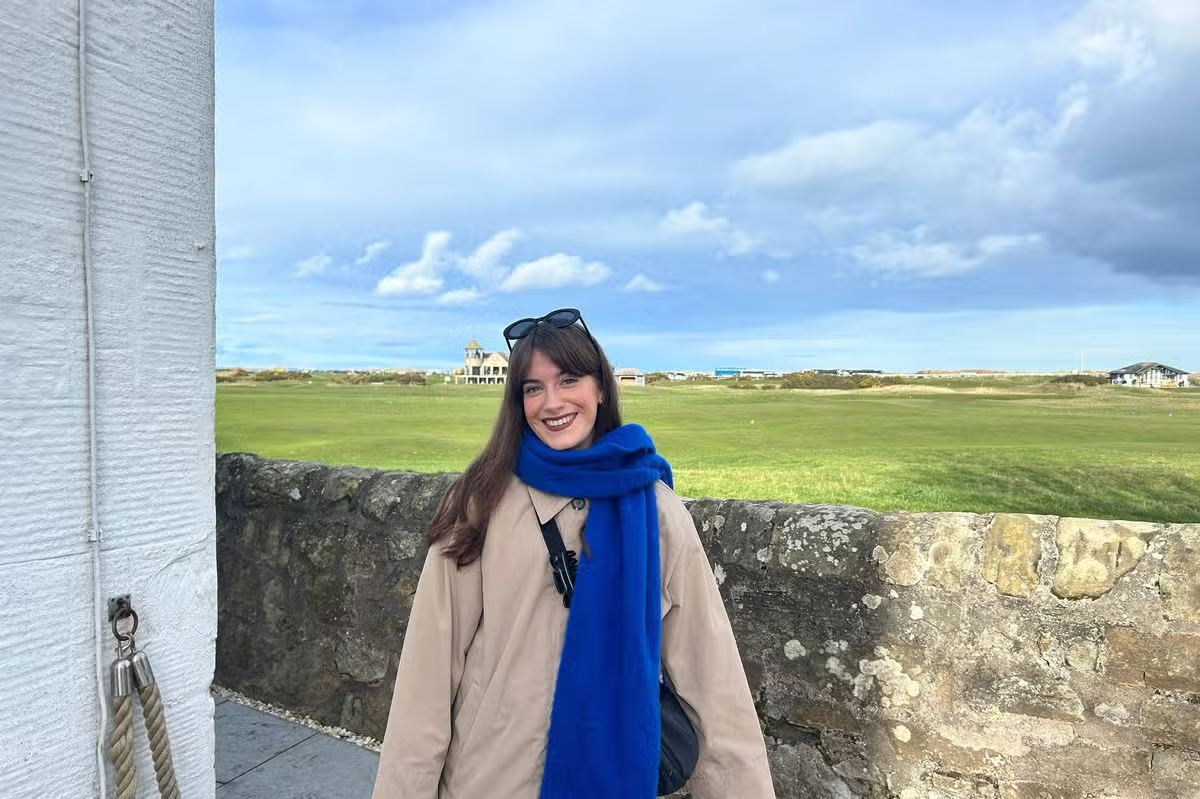
It’s a place I’ve visited countless times, but each trip reveals something fresh to discover. During a weekend escape to Lower Largo, a small village in Fife, we dropped into St Andrews for the afternoon. From Edinburgh it’s around an hour and a half’s drive, while from Glasgow it’s an hour and three quarters.

A town steeped in history

The town’s story stretches back well over a thousand years. St Andrews became a major centre of Christianity in Scotland during the medieval period, largely thanks to the legend that the relics of Saint Andrew – Scotland’s patron saint – were brought here by a monk named St Regulus in the 4th century.

It’s also a town that has never been far from the corridors of power. Mary Queen of Scots was a frequent visitor, and the town played a key role during the Scottish Reformation of the 16th century.

Where William met Catherine

Fast forward a few centuries and the town’s most famous modern love story unfolded here. It’s where King Charles III’s eldest son, now known as Prince William, first crossed paths with Catherine Middleton while both were studying at the University of St Andrews in the early 2000s. The pair went on to marry in 2011.

The university itself, founded in 1413, is the third oldest in the English-speaking world and the oldest in Scotland. Its ancient cobbled streets and honey-stoned buildings give the whole town an air of class.

The home of golf

Whether you’re passionate about it or not, most people are probably aware that St Andrews is also famous for its golfing heritage. The Old Course, one of the world’s most famous, features an iconic landmark that calls for a photograph regardless of how often you’ve visited. Our first stop on this trip was the Swilcan Bridge, built over 700 years ago and situated on the course’s 18th hole.

The list of golfing greats who have walked across that modest stone bridge reads like a who’s who of the sport – Jack Nicklaus, Tiger Woods, Arnold Palmer and Seve Ballesteros among them. Setting foot on the green yourself feels bizarre, and the bridge provides the perfect photo opportunity. You’re bound to encounter other tourists, so you might have to wait a moment for your snap, but it’s well worth it.

It’s also popular with non-golfers, as country superstar Luke Combs was even spotted hitting a few balls there recently.

The Jigger Inn

Just a two-minute stroll away lies the fantastic Jigger Inn pub, which was our next destination for something to eat. Dating back to the 1850s, the Jigger Inn is a warm, inviting pub with crackling fires that looks out over the golf course.

There’s an excellent range of drinks at the bar, or you can settle down and order from the menu, which is precisely what we decided to do. No one will persuade me there’s a finer pairing than a Caesar salad, chips and wine, and the Jigger Inn served up all three superbly.

Exploring the town

Properly fed and watered, it was time to explore the town itself. It’s not the biggest, with most shops and attractions scattered across roughly three main streets, but you could easily wander for hours without getting bored. The medieval history is clearly evident as you walk through its streets – in fact, St Andrews retains much of its original medieval street plan, with the three main thoroughfares of North Street, South Street and Market Street dating back to the 12th century.

One of the town’s standout attractions is the ruins of St Andrews Cathedral, situated near the waterfront. Built in 1158, it was once the largest church in Scotland and a truly awe-inspiring structure.

There’s so much to take in around St Andrews that you could almost forget the sea is right on your doorstep. Just beyond the Old Course lies the renowned West Sands Beach, which famously featured in the iconic opening scene of the 1981 film Chariots of Fire. Had the weather been a bit better, it would have made for a perfect seaside stroll, but with the wind battering us from all sides, we decided to continue exploring the town.

Shopping in St Andrews

St Andrews is packed with fantastic shops, ranging from well-known high street names such as H&M and Jo Malone to independent boutiques and one-of-a-kind retailers you won’t find anywhere else.

As an avid bookworm, I was particularly eager to visit Topping and Company, a beloved family-run bookseller with a small number of stores dotted across the UK.

A whole table of signed first editions greeted visitors at the entrance, while the shelves seemed to stretch endlessly upwards and deep into the shop. It’s the sort of place where you could effortlessly lose hours browsing.

Just one final destination remained, and if you’ve got a sweet tooth, you’ll want to pay attention. No visit to St Andrews would be complete without popping into Fisher and Donaldson.

Founded in Fife in 1919, this beloved family-run bakery is known for one thing above all else: its fudge doughnuts. Widely considered the best in Scotland, these gloriously indulgent treats are packed with fresh custard and finished with an irresistible fudge icing. We picked up a few to enjoy with a coffee later, and predictably, they vanished in no time.

St Andrews is just a wonderful destination for a day trip or even a weekend break if you fancy a more leisurely pace. It’s charming whatever the weather, but on a bright summer’s day, it’s unbeatable.

Source link

To Beat a State-Capitalist Rival, Washington Became One: Inside the New Critical Minerals Race

On July 10, almost exactly a year after the Pentagon announced it was becoming the largest shareholder in MP Materials, the International Energy Agency put a number on what that deal was designed to prevent: $6.5 trillion in global downstream production now sits exposed to China’s rare-earth export curbs — restrictions currently suspended under an October 2025 truce that lapses again around October 2026. In the year between those two dates, Washington did not simply subsidize its way out of dependency on Chinese processing. It bought in: $400 million for 15 percent of MP Materials, a decade-long price floor for neodymium-praseodymium set nearly double the market rate, and a ten-year promise to buy everything a new Texas magnet plant produces. The Pentagon is now, functionally, a mining shareholder. The interesting question is not whether that has worked — MP’s private financing round attracted $1 billion from J.P. Morgan and Goldman Sachs within weeks — but what it costs to win a state-capitalist contest by becoming a state capitalist.

The stakes are structural, not cyclical. China controls roughly 70 percent of the world’s rare-earth and critical-mineral refining capacity, a chokepoint built over three decades while Western producers treated minerals as ordinary commodities rather than strategic assets. Beijing’s October 2025 tariff-war truce with Washington postponed, rather than cancelled, an expanded licensing regime that already cut U.S. yttrium imports from 333 tonnes to 17 tonnes in eight months — a squeeze aerospace manufacturers say could force production pauses. Washington’s answer has three parts: Project Vault, a $12 billion public-private stockpile signed by executive order on February 2, 2026, covering all 60 minerals on the USGS critical list; a fast-growing portfolio of direct government equity stakes in miners and processors; and a parallel push to sign allied-supply agreements with eight partners, including Australia, Japan, the UK and the UAE. Europe, meanwhile, is running a different playbook: a €3 billion RESourceEU plan, a joint-purchasing platform, and a stockpiling pilot — procurement and coordination, not ownership.

The MP Materials deal is the template, and its mechanics matter more than its headline. The Department of Defense’s July 2025 investment made it MP’s largest shareholder, attached a $150 million loan for expanding the Mountain Pass mine, and guaranteed a $110-per-kilogram floor price for NdPr oxide — a level industry analysts put at nearly double the prevailing market price — alongside a ten-year offtake covering the full output of a planned magnet facility in Fort Worth. Private capital followed the government’s signal almost immediately, which is precisely the point: Washington concluded that a guarantee was worth more to investors than a grant. That logic has since scaled. The administration has taken a $670 million stake in magnet producer Vulcan Elements, a 10 percent, $35.6 million position in Trilogy Metals, converted a renegotiated Energy Department loan into equity in Lithium Americas, and expanded the official critical-minerals list to include copper and metallurgical coal. Total direct equity commitments now exceed $1 billion, on top of Project Vault’s $12 billion stockpile.

The backlash has been immediate and specific, and it is worth taking seriously rather than waving off as sour grapes. Rival producers argue the price floor lets MP “undercut commercial bids, using federal subsidies to shield its margins,” while former White House and Pentagon officials warn the arrangement could “distort global NdPr pricing, crowd out innovation, and deter private investment in alternative supply chains” — in effect, recreating the very state-directed monopoly the policy exists to counter. That is the strongest objection, and it does not fully land: a government willing to take equity risk, rather than hand out grants, at least has an incentive to see the investment succeed and can in principle profit from the upside, which is the argument the Treasury and National Energy Dominance Council make for why this is smarter policy than Cold War-style stockpiling alone. But the objection identifies a real cost even if it doesn’t defeat the policy: an above-market, government-guaranteed price for one company makes every unsubsidized competitor in the same commodity harder to finance, which narrows rather than widens the eventual supplier base — the opposite of the diversification the strategy claims to deliver.

Stay ahead of the geopolitical week.

MD Briefing delivers expert analysis across five global fronts — the Indo-Pacific, energy, geoeconomics, European security, and the Middle East — every Monday morning. Free.

There is a second problem the price-floor logic obscures: capital committed is not the same as metal produced. The Center for Strategic and International Studies frames this as the difference between “distance” — how much progress has been announced — and “displacement” — how far supply chains have actually moved from their starting point. Japan’s experience with Lynas Rare Earths is the sobering comparison: fifteen years and $250 million of patient, low-drama investment before Lynas achieved the first commercial dysprosium production outside China, in 2025. Washington’s approach substitutes speed and scale for that patience, which may be the correct trade given the urgency, but it means the MP deal’s real test has not yet arrived — it arrives when the Fort Worth facility is supposed to reach full commercial output, not when Wall Street decides to match the Pentagon’s bet.

None of this is happening in a China-versus-America vacuum, either. The Democratic Republic of Congo has extended its cobalt export suspension specifically to tighten leverage over Chinese refiners, and Indonesia has repeatedly resisted pressure to loosen nickel export quotas, forcing processing onshore on its own terms. Producer states, not only the two superpowers, are now treating minerals as instruments of strategic leverage rather than commodities to be sold at whatever price clears the market. That reframes the whole contest: this is not simply Washington racing to catch Beijing, but a broader shift in which every government that sits on a mineral deposit is deciding whether to sell it or wield it.

Which is where Europe’s exposure becomes concrete. RESourceEU gives Brussels coordination and buying power, but no board seats and no offtake priority — and Chatham House’s own assessment is blunt that the UK and EU “cannot match the scale of what the US is attempting” and risk being “left behind” without equity of their own. That matters because Washington’s price floors do not stay domestic: a guaranteed $110/kg for MP’s output resets the benchmark every other buyer, including European manufacturers, has to price against, while offtake agreements tied to U.S. defense production can put European buyers behind the queue when supply tightens. The diversification Europe wants — away from dependence on Beijing — is real, but the replacement supply chain now runs increasingly through companies Washington part-owns and whose output is pre-committed to American industry first. Substituting one chokepoint for another is not the same as building a market.

What Happens Next

Base case (our estimate: roughly 55 percent probability). Washington’s equity-and-price-floor model extends to more minerals — copper and metallurgical coal are already on the list — and more companies, Project Vault’s stockpile builds through 2026–27, and the October 2025 China truce holds past its lapse date. Europe continues a purchasing-only strategy, remaining a price-taker on a benchmark increasingly set in Washington rather than Shanghai. This depends on Congress and private markets continuing to treat government equity as a credible signal rather than a fiscal liability, and on China preferring managed leverage over an open rupture.

Downside case. China allows the truce to lapse on schedule around October 2026 and resumes full licensing enforcement — already quietly restarting, according to recent customs-audit reports — before Vault-funded and MP-style projects reach meaningful output. Aerospace and defense manufacturers, already forced to ration yttrium and dysprosium at a fraction of pre-2025 volumes, face renewed production pauses in the exact window (2026–2028) when domestic capacity is still years from scale, exposing the gap between announced investment and actual tonnage.

Upside case. Government stakes prove to be a bridge rather than a permanent structure: MP, Vulcan Elements and Lithium Americas hit production targets on schedule, price floors become unnecessary as Japan’s Lynas eventually showed is possible after fifteen years of patient investment, and the eight-nation allied-supply framework matures into a genuinely plural, competitively priced market that Europe can buy into on equal terms rather than through Washington’s balance sheet.

The Pentagon’s bet on MP Materials shows that the fastest way to out-compete a state-directed rival was to become one — and by the only metric available so far, capital raised, that gamble is working. But capital raised is not resilience, and every mineral now being withheld or weaponized elsewhere, from Congolese cobalt to Indonesian nickel, shows the world’s supply chains are being redrawn along political lines everywhere, not simply rerouted away from Beijing.

Watch whether China lets its rare-earth export truce lapse on schedule around October 2026, and whether MP Materials’ Fort Worth magnet plant is producing at commercial scale when it does. If the truce holds and the plant delivers, Washington’s ownership model will keep expanding. If either fails, the U.S. will have discovered it bought a shareholding in a company, not a supply chain immune to the country it was built to out-manoeuvre.

Source link

Kavinsky, French electronic artist and ‘Drive’ composer, dead at 50

Kavinsky, the French electronic musician and DJ whose moody single “Nightcall” scored the hit film “Drive,” has died. He was 50.

French newspaper Le Figaro and TV station BFM reported that Kavinsky, born Vincent ‌Belorgey, died from a suspected stroke. Paris prosecutors investigated and found “no suspicious elements,” they said.

Kavinsky was a defining act of the Paris electronic scene of the 2000s and 2010s, whose neon-smeared synths and noirish atmospheres lent themselves to L.A. freeways and Montmartre nightclubs alike.

Adopting a droll persona — a red-eyed electronic producer who returned from the dead after a Ferrari crash — Kavinsky was a major figure in the second wave of the “French touch” dance scene.

His popular breakthrough came with “Nightcall,” a collaboration with CSS’ Lovefoxxx and Daft Punk’s Guy-Manuel de Homem-Christo. The song was a propulsive theme of Nicolas Winding Refn’s 2011 film “Drive,” a brutal and romantic revenge thriller beloved for its slinky, retro-futuristic soundtrack. Kavinsky performed the song to close out the 2024 Paris Olympics, performing with the French band Phoenix and the Belgian singer Angèle.

While he only released two studio LPs, including the 2013 singles collection “OutRun” and “Reborn” in 2022, he was influential to major acts that came after him. The Weeknd, who sang on an edit of Kavinsky’s “Odd Look,” wrote on X: “So heartbreaking to hear the news. An inspiration to so many, including myself. I will continue to honor your name and your music. Rest easy Kavinsky.”

French President Emmanuel Macron also wrote a tribute on Instagram, calling Kavinsky an artist France could be proud of forever.


Source link

BYD Europe Expansion: Growth Driven By European Banks

Outsourcing credit lets the Chinese EV maker scale fast while leaving asset risks to lenders.

This article appears in the July/August issue of Global Finance Magazine.

Walk the streets of cities like Valencia or Paris, and you don’t need the data to see BYD everywhere, especially in ride-hailing fleets and private transportation. These days, the sleek logo you notice isn’t always Tesla’s or Kia’s; it’s often BYD’s.   

Sales of BYD’s electric vehicles surged across Europe last year, up roughly 270% year over year. In the first quarter of 2026, sales increased by another 156%. 

While most coverage frames this as a product story, the bigger story is financing: BYD’s rise has less to do with design or price than with how the cars are financed.

BYD hasn’t expanded in Europe by building a traditional captive-finance arm. Instead, it has plugged directly into the region’s existing banking and leasing infrastructure, achieving captive-finance reach without the balance-sheet burden. In doing so, it has turned Europe’s financial system into a distribution engine that moves vehicles by turning them into financeable assets.

At first glance, BYD’s success seems straightforward: strong demand, rapid adoption, and a new entrant quickly gaining share. But in a market where vehicles are often financed, leased, and cycled through multiple channels before reaching long-term ownership, the headline numbers don’t always tell the whole story. The surge in European BYD registrations may signal demand and financing strength, or it may reflect window dressing shaped by the way the system works.

Turning Cars Into Collateral 

Stefan Bratzel, founder and executive director of the Center of Automotive Management (CAM)
Stefan Bratzel,
Center of Automotive Management

BYD relies on a familiar but strategically deployed set of financing and leasing arrangements. Vehicles are sold in bulk to leasing companies, fleet operators, and dealer networks, which then finance or lease them to end users, including corporate clients, ride-hailing drivers, and private buyers. European banks and auto-finance platforms provide the underlying credit, while leasing firms structure contracts and manage residual-value assumptions. 

What stands out in BYD’s case is the speed and scale of the operation.

“European OEMs [original equipment manufacturers] built their captive finance arms over 30 to 40 years, and those businesses now function as profit centers,” says Stefan Bratzel, founder and executive director of the Center of Automotive Management (CAM) in Bergisch Gladbach, Germany. “BYD cannot replicate this overnight, nor does it try to.”

Instead, he notes, the company is partnering with established asset finance providers to accelerate market entry. BYD gains “speed to market at the cost of margin while it accumulates the balance sheet and regulatory standing to eventually internalize these functions.”

In effect, BYD is compressing a decades-long buildout of captive finance into a partner-led model, trading margin and control for faster access to Europe’s credit and leasing channels.

It’s easy to see the appeal for lenders: Vehicles placed into leasing or fleet programs become financeable units, bundled into loan or lease portfolios that generate predictable cash flow. In a market where electrification is both a policy priority and an investment theme, high-volume EV programs provide a steady pipeline of assets.

Window Dressing?

The speed of BYD’s expansion raises questions about the numbers.

“BYD’s channel mix is improving,” says Matthias Schmidt, an independent analyst tracking the European auto market. Retail share in Germany rose to 32.5% of volume in the first four months of 2026, compared with 12.4% for all of last year, suggesting a shift toward a more balanced sales mix. But the relationship between registrations and vehicles actually on the road is less straightforward.

“Out of more than 30,472 BYD models registered in Germany since it entered the market in December 2022, only 18,536 are currently on the road,” says Schmidt, suggesting that “after models have been registered, they are then being exported to other European markets as used-car inventory or are going back into used-car inventory in Germany. This could be a strategy to demonstrate to market observers that they are performing better in Europe’s largest market than they actually are. We call it window-dressing the data.”

In a system driven by leasing, fleet placement, and dealer networks, that gap is not necessarily unusual. Vehicles can be registered into the channel before reaching long-term ownership, then repositioned through resale, export, or short-term use across markets. For financial stakeholders, the distinction matters: registrations may signal momentum, but they do not necessarily show sustained demand.

What Banks Are Really Underwriting

For the institutions partnering with BYD and helping fund its expansion, the focus is less on BYD’s near-term concern — speed to market — and more on how those assets perform over time.

Residual value assumptions underpin the economics of leasing. If vehicles retain value, the system works: Monthly payments remain competitive, credit risk remains contained, and lenders and leasing firms can recycle assets efficiently through secondary markets. When they don’t, the economics tighten quickly.

“The EV residual value question is the single biggest structural challenge in automotive finance right now,” Bratzel says. “Whoever solves that problem credibly — either through data, scale, or balance sheet — will have a significant structural advantage.”

Bratzel points to one potential factor that could shape how banks ultimately price that risk: “Vertical integration around the battery — especially battery cells — can have a positive impact on risk assessments, as this is based on a lot of their own data.”

BYD’s advantage stems in part from how much of that data it controls. Unlike many automakers that rely on third-party suppliers for critical components, the company produces its own battery cells and key parts of the EV supply chain. That level of vertical integration gives BYD clearer visibility into battery performance over time, arguably the most important variable in determining how an electric vehicle depreciates.

The geographic distribution of BYD’s growth in Europe adds another layer.

According to Schmidt, roughly 70% of Chinese EV registrations in Western Europe in the first quarter of this year were concentrated in Spain, Italy, and the U.K.: markets that tend to be more price-sensitive and open to new entrants. 

While this doesn’t invalidate BYD’s growth, it suggests that location-dependent finance dynamics are driving expansion as much as consumer demand.

Traditional OEM
Captive Finance
BYD Partner-Led Model
Builds and operates
own finance arm
Uses banks and
leasing partners
Significant capital
commitment
Lower
capital burden
Controls lending
and leasing directly
Outsources
financing functions
Often takes
decades to build
Can scale
immediately
Retains finance profits Trades margin for speed
Higher control Faster market entry
Source: Center of Automotive Management (CAM)

What Happens Next

BYD’s approach is working. It has outsourced the slowest component of automotive expansion — credit formation — while maintaining control of product supply and commercial momentum.

As Bratzel suggests, this is not a permanent structure: It’s transitional. It’s designed to gain scale first, then possibly internalize financing over time. Meanwhile, European banks and leasing platforms are providing balance­-sheet support to enable growth.

Schmidt’s analysis leaves little ambiguity: Not all growth is created equal. Registration data may reflect momentum, but it can also reflect channel dynamics — fleet placements, dealer inventory, cross-border repositioning — that cloud actual on-the-ground demand.

For lenders, the distinction is not academic. They are not underwriting registrations. They are underwriting residual values, which is where the rubber meets the road.

Over the next two to three years, vehicles deployed and financed today will begin to cycle back through the system via lease returns, resale markets, and secondary channels. At that point, the assumptions that anchor today’s financial models will be tested against real-world market conditions.

But the next phase will be less about volume. It will instead focus on testing the model that facilitated BYD’s rapid entry into Europe. If BYD’s vehicles hold their value, the company’s partner-led model will look less like a workaround and more like a fast-track version of what legacy automakers spent decades building. If residual values weaken, or if too much of the growth proves channel-driven rather than demand-driven, the financing engine that built BYD’s presence could become a constraint.

That’s the real question for banks: Can the vehicles BYD has placed in Europe retain their value once they return to the market? Because in a financing-driven system, growth can be engineered, but asset performance determines whether it lasts.

Rocco Pendola is a contributing writer based in Spain.

Source link

US tour highlights Wrexham’s stock is higher than ever

As Wrexham unveiled their new 2026-27 home shirt while ringing the Nasdaq bell in New York’s iconic Times Square, there was little doubt that the club’s stock has never been higher.

Icons from the past such as Mickey Thomas, Steven Fletcher, Ben Tozer and Ben Foster were among those in The Big Apple proudly adorning the club’s red jersey.

It formed part of the launch of their new home kit, complete with their newest sponsor – yet another global brand.

Which is all in keeping with their cross-Atlantic profile, one unlike any other in the Championship or even many in the Premier League.

“Each time Wrexham has come to the U.S., we’ve been blown away by the reception,” co-owners Rob Mac and Ryan Reynolds told Sports Illustrated, external.

“The support has continued to grow, and it felt important to come back and connect with those fans in person.”

The Red Dragons are more than halfway through their pre-season tour of the United States, the third time in four summers they have travelled across the Atlantic.

It is a far cry from the summer of 2021 – Phil Parkinson’s first pre-season in north Wales – when Wrexham faced the likes of Burnley’s Under-23s, Tamworth, a Fleetwood Town XI, Spennymoor Town and Curzon Ashton.

Source link

SpaceX launches classified NRO payload from Florida

A SpaceX Falcon 9 rocket, like the one seen here, launched from Launch Complex 40 at the Cape Canaveral Space Force Station, Fla., early Thursday with a payload for the national Reconnaissance Office. Photo by Joe Marino/UPI | License Photo

July 30 (UPI) — A Falcon 9 rocket topped with a classified payload for the National Reconnaissance Office launched from Florida’s east coast early Thursday.

The rocket launched at 3:10 a.m. EDT from Space Launch Complex 40 at Cape Canaveral Space Force Station in Florida.

Little information about the NROL-95 mission has been made public aside from the fact that the payload was designed, built and will be operated by the NRO. The broadcast of the launch was restricted at the request of the NRO, SpaceX said, with the second stage two and deployment of the payload not shown.

The first-stage booster, on its seventh flight, returned to Earth and successfully landed at Cape Canaveral Space Force Station.

It was the 88th Falcon launch of the year and the 12th this month, according to SpaceX.

There was a 30% chance of weather-related launch constraints, with a backup launch scheduled for Friday.

Source link

Messi returns to MLS training 10 days after World Cup final heartbreak | Football News

Lionel Messi returns to Inter Miami after Argentina’s World Cup final defeat by Spain, which led to retirement rumours.

Football superstar Lionel Messi ‌has returned to practice for Inter Miami, 10 ⁠days after Argentina’s World Cup run ended with a 1-0 extra-time loss to Spain in ⁠the final earlier this month.

The two-time defending MLS MVP missed Miami’s first two matches after ⁠the World Cup break against Chicago and Montreal, both of which the team still won, extending its winning streak to six matches.

Recommended Stories

list of 4 itemsend of list

The 39-year-old also chose not to participate ‌in Wednesday night’s MLS against Liga MX All-Star Game in Charlotte, instead taking some time off to visit his father, Jorge, who the Messi family announced during the World Cup is battling an undisclosed illness.

Messi concluded this year’s World Cup, ⁠his record sixth, with eight ⁠goals and four assists, coming one win away from leading Argentina to be the first team to win consecutive World Cups since ⁠Brazil in 1958 and 1962.

He was the first player to break Miroslav ⁠Klose’s record for career World ⁠Cup goals with his 17th in Argentina’s second match, but French sensation Kylian Mbappe finished the World Cup one goal ahead of ‌Messi, 22 to 21.

Inter Miami (11-2-4, 37 points) is two points behind Nashville SC atop the Eastern Conference ‌standings. ‌It is not yet known if Messi’s return will come in Saturday’s home match against the Columbus Crew.

There had been some speculation that Messi would not only conclude his international career following the World Cup, but that he may also call time on his playing days at club level.

The former Barcelona and Paris Saint-Germain forward has won eight Ballon d’Or titles, the annual award for the player voted the best in the world that year.

Source link

Black Sabbath legend Tony Iommi tells of ‘shock’ at Ozzy Osbourne’s death as he reveals first solo album in 20 years

BLACK Sabbath’s Tony Iommi last released a solo album more than two decades ago.

And now, as he finally announces a new record, From The Dark, he reckons it might take just as long to get presented with his MBE.

Black Sabbath legend Tony Iommi has told of his ‘shock’ at Ozzy Osbourne’s death Credit: Getty
The pair exchanged text messages the night before Ozzy died Credit: Getty

The legendary axeman was in the Actress & Bishop boozer in his native Birmingham to celebrate the album’s release when asked when he’d be going to Buckingham Palace.

Tony was made an MBE in the King’s birthday honours last month, for his services to music and charity. But he joked: “I’d forgotten about that. They have probably changed their minds now.”

From The Dark, out on October 23, is Tony’s first album since 2005’s Fused, when he teamed with former Deep Purple, Sabbath and Trapeze singer and bassist Glenn Hughes.

Queen’s Brian May plays a guest solo on Death Wake, and the blistering lead single, the upbeat but punchy World Alone, confirms why he earned the nickname The Master Of The Riffs.

‘ALARMS GOING OFF’

Jared Leto forced me to touch him after luring me to motel when I was 17


SHEER DELIGHT

Bianca Censori stuns in almost invisible sheer bodysuit to party in Ibiza

That moniker’s all the more impressive when Tony reminds us that he lost the tips of the middle and ring fingers of his fret hand as a teen, while working in a sheet metal factory in the city.

He recalled: “I went to different doctors and they said, ‘You might as well give up and find another profession’.”

So he made replacement fingertips. He said: “I got a Fairy Liquid bottle, melted it down into a ball and then got a soldering iron and made a hole in it, so it fit on my finger.

“I tried to play and it slipped off. I had to find a material that would grip the strings like skin, so I cut one of my old rocker leather jackets up, and it worked.”

Iommi fans are in for a treat with From The Dark — which has eight tracks, with two additional songs, Scent Of Dark and Deified on the deluxe version.

It was two years in the making, with Tony enlisting Jorn Lande on vocals, bassist Becky Baldwin and Robbie Williams’ longtime drummer Karl Brazil.

The process was slowed by the loss of Tony’s Black Sabbath bandmate Ozzy Osbourne last July, with Tony stepping back from recording for a while.

The pair exchanged text messages the night before Ozzy died. He said: “I didn’t expect him to go overnight. It was a hell of a shock.”

Tony Iommi and The Sun’s Ellie Henman Credit: Unknown
Tony has finally announced his new record, From The Dark Credit: Getty

On returning to work on the record, Tony added: “We’ve done it casually really, because there was no pressure.

The album is steeped in his home city’s history. He said: “The whole record is designed around Birmingham. The T-shirts have been made in Birmingham, the merchandise has been made in Birmingham.”

In front of a small group of guests, with Frank Skinner taking on the interviewing duties, Tony unveiled the dystopian video for World Alone, which was filmed in Cornwall.

“I hate doing videos, I’ve never liked them,” he said.

“This one is more like a film and I am in it but not wanting to be.”

Despite his reticence at getting in front of the cameras, it sounds likely Tony will return to the stage.

Asked whether fans will hear him play the record live, he smiled and said: “You may do.

“Anything’s a possibility.”

MARS FINAL AT WEMBLEY

BRUNO MARS brought the curtain down on his six huge Wembley Stadium shows with a low-key bash at a Mayfair private members’ club.

My moles tell me the singer hosted the do at George on Mount Street, arriving with his entourage at 1am.

A source said: “Bruno shut down an area inside George to celebrate his six Wembley gigs.

“He only invited a handful of people to join him and kept it very casual and chic. There was a great atmosphere though, and Bruno was the life and soul of the party.

“He was blown away by the reception to his Romantic Tour from British fans and was grinning from ear to ear.

“It’s been huge for him to play six headline shows there and he’s ready for a break before he heads back out in the US.”

It’s little wonder Bruno is ready for some time off.

He’s been on tour for four months now and, after three weeks away, he’ll get back to it with dates in the US and Asia, eventually finishing in Japan on January 28.

Tate shapes up for comeback

Tate McRae stuns in a workout gear for an Adidas Originals Sport campaign Credit: Adidas

TATE McRAE gets fighting fit for her comeback as she prepares to release new music.

The Canadian pulled on her skintight workout clobber and pumped iron for an Adidas Originals Sport campaign.

It comes ahead of a return to the stage this weekend, almost nine months after her last concert.

Tate will headline the Osheaga Festival in Montreal on Saturday, and Lollapalooza in Chicago the following night, as teasers on social media suggest she might debut new songs.

Previous album So Close To What became her most successful yet when it peaked at No2 in the charts last year.

But with her star power continuing to rise, I’m sure she’s got her sights set on turning the next record into a chart-topper.

BTS SNUB GRAMMYS IN PROTEST

K-POP megastars BTS are boycotting the Grammy Awards after an Asian-only category was introduced.

The group won’t submit any of their music to be considered for any awards at the 2027 ceremony, in protest over the change.

In a statement, they said: “We have decided not to enter the Grammys this year.

“I hope that music can be heard and loved for what it is, rather than being divided by region or language.”

The Grammys last month announced the Best Asian Pop Music Performance award, where songs must contain “meaningful use” of an Asian language.

But many have criticised the move, saying it pigeon-holes artists from that region.

BTS, whose latest album Arirang is largely in English, had been expected to rack up several nominations after it became one of 2025’s best sellers.

It’s Olivia RodLego

Olivia Rodrigo holds her album cover in Lego form Credit: The LEGO Group/Hunter Simmons

OLIVIA RODRIGO has recreated her latest album cover in Lego form – and will hide versions of the record around the world.

She posed in this plaid mini-dress at a pop-up event in Los Angeles, where it was revealed 333 toy-brick vinyl versions of You Seem Pretty Sad For A Girl So In Love will be available.

The album is in the UK Top Three for a sixth week.

Olivia and Lego will drop clues on social media, hinting at record shops where fans might be able to get the special versions.

I expect to see them popping up on eBay for astronomical sums any day now.

SHANIA’S LACK OF VISION

IT doesn’t sound like Shania Twain is very likely to compete at the Eurovision Song Contest in 2027.

Her native Canada will be joining for the first time. But asked if she’d be tempted to give it a go, she said: “It hasn’t entered my mind. It’s a fair question, though. I don’t know what my pull would be for that, but I would certainly be curious to see how that comes together. There is a lot of talent there.”

The contest will take place in Bulgaria.

But Shania has enough on her plate, having released album Little Miss Twain, which looks like entering the Top Five on Friday.

She’s also planning 30th-anniversary celebrations for her album Come On Over.

Ruben’s hol alone

Ruben Dias showed off his incredible physique in some Insta thirst traps Credit: instagram//ruben dias

RUBEN Dias has made sure everyone knows he’s one of football’s most eligible bachelors, following his split from Maya Jama.

The Manchester City defender broke up with the Love Island host at the end of April.

Three months on, and following his appearance at this summer’s World Cup with Portugal, he has jetted off on a lads’ holiday to Ibiza.

Judging by the photos of his rippling six-pack he shared on Instagram, Ruben got his mates to take thirst trap pictures for him while they were there.

But hinting that he’s still not totally over the split with Maya, he captioned the post: “Feelings on silent.”

With pictures like this, there will be plenty of people offering him a shoulder to cry on.

MACCABEES ALBUM

THE Maccabees are working on their first album since 2015, after reuniting last year.

They have been playing fresh tunes during live shows.

Asked if an album was any closer, singer Orlando Weeks told Radio X: “We have some songs, and we have one we’re really confident about and we’re enjoying playing.

“That’s the aim – to try and do it, make it good enough, and then it’ll happen.”


lMILEY CYRUS’ rocker fiancé Maxx Morando popped the question on holiday in Japan last autumn.

He told Wonderland mag it happened in “this little outer garden”.

Maxx added: “She was taking videos, and was turned away. I got on one knee and tapped her on the shoulder.”


Source link

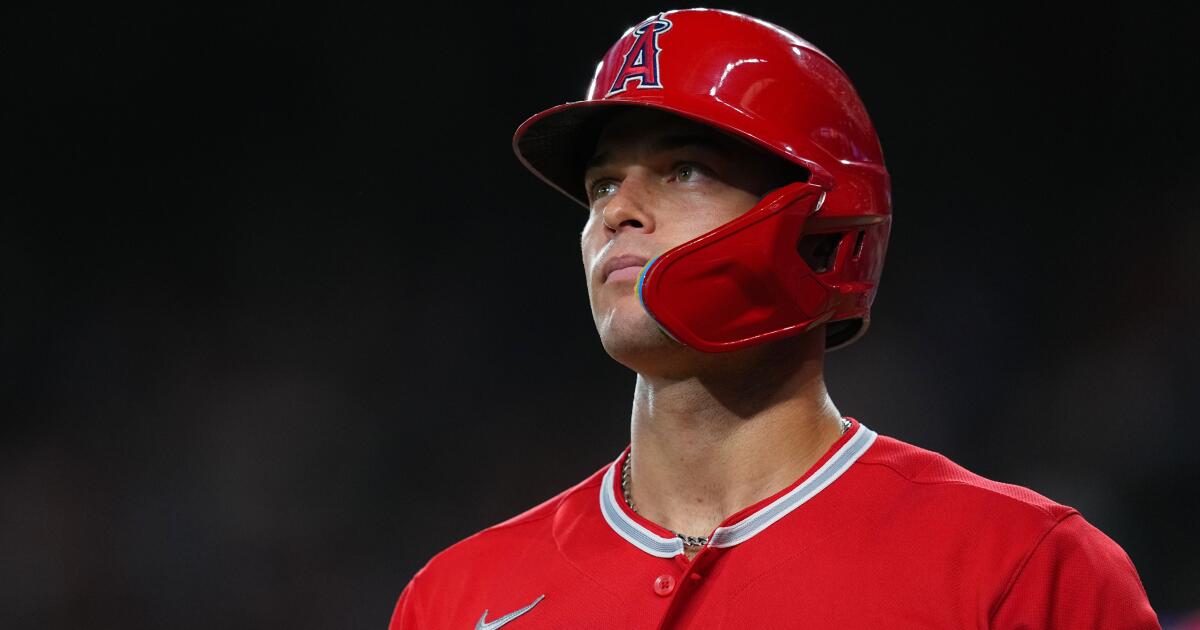
Angels trade Logan O’Hoppe, Chase Silseth to Texas

The Angels traded reliever Chase Silseth and struggling catcher Logan O’Hoppe to the Texas Rangers for minor league third baseman Angel Arredondo on Wednesday night.

The deal, announced a few minutes before the Angels’ series finale against the Houston Astros, could mark the beginning of an extensive rebuilding process for the Angels, who entered play Wednesday with an American League-worst 42-66 record and 13 1/2 games behind the Rangers in the AL West.

“We know we have to start shaking up this roster, and today was day one,” Angels interim general manager John Mozeliak said. “Clearly, where the Angels are at right now, we need to do things differently.”

Silseth, 26, was one of the Angels’ top relievers, going 3-2 with a 2.72 ERA in 47 games this year. O’Hoppe, 26, appeared in 75 games, batting .209 with 23 RBIs.

Arredondo, 19, hit .247 with eight home runs, 15 doubles and 47 RBIs in 86 games for low-A Hickory this season. He signed with the Rangers as an international free agent out of Mexico in 2024.

Source link

Jury convicts Salman Rushdie attacker on terrorism charges

July 30 (UPI) — A federal jury has convicted the New Jersey man who attempted to murder writer Salman Rushdie on additional terrorism-related charges, including attempting to provide material support to the Iran-backed militia Hezbollah.

Hadi Matar of Fairview, N.J., was sentenced to 25 years in prison in a state court in May 2025 for trying to kill Rushdie on Aug. 12, 2022.

Matar rushed the stage and stabbed the India-born writer at New York’s Chautauqua Institution in Mayville, N.Y., before being subdued by audience members and taken into police custody. Rushdie lost vision in his right eye and suffered nerve damage as a result of the attack.

A federal jury in the Western District of New York on Wednesday convicted Matar on charges of attempting to provide material support to a designated foreign terrorist organization, engaging in an act of terrorism transcending national boundaries and providing material support to terrorists. Matar faces a maximum penalty of life in prison on the most serious charge when sentenced on Nov. 3.

“Hadi Matar, who was born and raised in the United States, chose to align his values with the terroristic values of the leaders of Iran, which often promote violence, and in this case, the call for murder,” U.S. Attorney for the Western District of New York Michael DiGiacomo said in a statement.

“The defendant spent months planning and preparing to carry out what he hoped would be the execution of Salman Rushdie and possibly follow in the footsteps of martyrs he admired. Instead, his attempted act of terror failed, and Salman Rushdie survived, thanks to courageous members of the public and law enforcement, who saved Rushdie and captured Matar.”

The trial began July 22, and Rushdie, 79, testified.

DiGiacomo said Rushdie answered every question asked of him by the defense and prosecutors.

“It was very powerful,” DiGiacomo said.

“And at the end, at some point, Mr. Rushdie removed his glasses so the jury could see the extent of the injury to his eye that he no longer has vision it.”

Prosecutors said Matar was attempting to carry out the orders of Iran’s late spiritual leader Ayatollah Ruhollah Khomeini, who in 1989 called for Rushdie’s murder after the publication of his award-winning novel The Satanic Verses on the grounds that it was blasphemous to Islam.

The fatwa was reaffirmed in 2017 by Khomeini’s successor, Ali Khamenei, and endorsed by Hezbollah Secretary-General Hassan Nasrallah. Nasrallah was killed Sept. 27, 2024, in Israeli airstrikes on Beirut, while Khamenei was killed Feb. 28 in joint U.S.-Israeli airstrikes on Iran.

Federal prosecutors said during the trial that Matar had spent more than a year researching the fatwa before deciding to try to kill Rushdie and discussed it with people in Iran, Australia and Canada.

According to the Justice Department, Matar had surrounded himself with Hezbollah symbols ahead of the attack and had traveled to the institution that day with a false driver’s license bearing the name Hassan Mughniyeh, with Hassan being Nasrallah’s first name and Mughniyeh being the surname of Hezbollah’s former external security organization head, Imad Mughniyeh.

DiGiacomo told reporters following the conviction that ahead of the attack, Matar traveled by bus from New Jersey to Buffalo, then traveled toward the Chautauqua Institution.

On the morning of the attack, Matar visited a website run by Hezbollah and took screenshots of Hezbollah operatives who had died that month.

“The evidence presented in the trial showed that this attack was not spontaneous. It was deliberate. It was research. It was planned. It was motivated by violent extremist ideology,” Alan Davis, special agent in charge of the FBI’s Buffalo field office, said during the press conference.

“For more than a year, the defendant researched a decades-old fatwa, communicated with individuals overseas about carrying it out and embraced the propaganda and symbols of Hezbollah before traveling to western New York to commit this violent act.”

Source link

Viral finger-clicker suspended as cricket storm remains in global spotlight | Cricket News

Saltburn’s amateur cricketer at centre of cheating allegations that grabbed global headlines is suspended by club.

An English ‌amateur cricketer at the centre of allegations ⁠of finger-clicking ⁠trickery has been suspended and will not play “for the foreseeable future”, his club has said.

The fielder, dubbed “Clicky Ponting” on social media in a punning nod to former Australia captain ⁠Ricky Ponting, allegedly tricked umpires by clicking his fingers to make the sound of a ball nicking the bat as deliveries were missed and caught by ‌the wicketkeeper.

Recommended Stories

list of 4 itemsend of list

The video footage went viral on social media and made international headlines.

Saltburn Cricket Club, run by volunteers, said on Wednesday in a statement it was treating the allegations “with the utmost seriousness”.

“The player at the centre of the complaint has been suspended ⁠and will not play again ⁠for the club this season or in the foreseeable future, pending the outcome of this investigation.”

It said initial discussions between club ⁠officials and the North Yorkshire and South Durham league had already taken ⁠place.

The league said on Tuesday ⁠it had received a formal complaint “regarding alleged incidents in a Division Two game on Saturday 25th July 2026”.

Saltburn said it had ‌been a distressing and stressful experience for all concerned and asked for “personal boundaries” to be respected.

The club ‌are ‌top of the Division Two table with 10 wins from 15 matches.

Historically, cricketers – even at the highest level of the game – have been accused of trying to trick umpires with noises, including chomping on a biscuit, to fool umpires into believing the ball hit the bat.

Cricket cheating allegations have even extended to dirt being applied to the ball, for which former England captain Michael Atherton was once fined, and the use of bottle tops to scuff the ball.

Both were attempts to create extra swing for the quick bowlers.

Source link

Dawn French and Jason Manford pay tribute after ‘quietly magnificent’ publicist Neil Reading dies aged 56

An image collage containing 2 images, Image 1 shows NINTCHDBPICT001098310467, Image 2 shows NINTCHDBPICT001088808594

DAWN French and Jason Manford have paid a heartbreaking tribute to the “quietly magnificent” publicist Neil Reading.

The entertainment industry heavyweight died aged 56 following a short illness.

Mr Reading, one of Britain’s best-known showbiz publicists, died aged 56 Credit: Family Handout
Dawn French has paid a heartbreaking tribute to the publicist Credit: Dan Kennedy – Commissioned by The Times Saturday Magazine

Mr Reading, one of Britain’s best-known showbiz publicists, represented a glittering roll call of stars including French, John Cleese and the late Victoria Wood.

His sudden death has prompted an outpouring of grief from the celebrities and friends whose careers he helped champion.

The founder of Neil Reading PR was behind a string of West End hits, including High Society, Only Fools And Horses and Fawlty Towers – The Play.

But for French, Mr Reading was far more than the man handling her publicity.

TV LEGEND GONE

British actor who starred in Game of Thrones & Doctor Who dies aged 80


‘LOVED SO MUCH’

Man, 44, ‘stabbed to death’ as family pay tribute & men charged with murder

She said: “Neil Reading was a one-off, such a kind, decent, intelligent man, a proper gentleman in the old-fashioned way, quietly magnificent.

“Our work relationship became a very real and trusting friendship.

“He has been my ally and fierce protector through so much and for so long. I don’t quite know how I’ll manage without him. Sleep tight darlin’ heart.”

Comedian Jason Manford also revealed the devastating depth of their nearly two-decade friendship.

He said: “Describing Neil as my PR manager does not come close to describing what he meant to me.

“He was a trusted friend of almost 20 years, a confidant and one of the most loyal, noble and brilliant men I have ever known.”

Mr Reading’s star-studded client list also included John Bishop, Sir Lenny Henry and Paul McKenna.

Bishop said: “Neil was a true gentleman. He was too humble to realise how much he meant to people and I know he will be greatly missed.”

Mr Reading represented a glittering roll call of stars including John Cleese Credit: Getty
Comedian John Bishop worked closely with the late entertainment heavyweight Credit: Getty

McKenna said: “Neil was one of the finest people I’ve ever known.”

Businessman Nick Candy, who was a close friend of Mr Reading, said the publicist’s impact stretched far beyond the spotlight.

He said: “Neil wasn’t just a brilliant publicist – he was a true friend and one of the kindest, most generous people I have ever known.”

Mr Reading launched his agency in 1992, building it into a formidable entertainment, consumer and lifestyle PR operation.

The company later expanded into business, property and fashion, while forging links with agencies across Europe and the United States.

Through decades at the heart of showbiz, Mr Reading became a trusted figure behind some of Britain’s biggest names and productions.

He is survived by his wife Claire and daughter Rosa.

Mr Reading’s career was built on a knack for turning famous names into headline-makers, long before social media transformed the publicity game.

The late Victoria Wood was also taken under his wing Credit: PA:Press Association
Sir Lenny was one of his clients Credit: Getty

He struck out on his own in 1992 at just 22, quickly building an agency around personal publicity and an increasingly glittering roster of household names.

By 1997, he was representing stars including Jonathan Ross, Michael Flatley, Jack Dee, Lee Evans and Ben Elton, while also working with clients outside showbiz.

His agency went on to become a formidable force behind some of Britain’s biggest entertainment launches.

In his 1997 Independent interview, he described personal PR as his “first love”.

Source link

My slow Swedish summer on the tranquil islands of Östergötland | Sweden holidays

At 5am on Arkösund bay, it is so light it could be midday. I slip out of the pretty clapboard Arkösunds hotell, opened in 1895, as a small boat putters into the Baltic Sea, the sun sparkling on its calm waters. A wooden boardwalk invites me on to a string of tiny islets as geese arrow overhead and a mother swan coaxes her fluffy cygnets into a nook under a bridge.

I’m on Sweden’s east coast to explore the Östergötland archipelago, a sprawl of about 9,000 islands scattered across the Baltic Sea a few hours south of Stockholm. Quieter and less crowded than the better-known isles off Stockholm or Gothenburg, it covers several pockets of coastline and smaller archipelagos: Arkösund, Sankt Anna, Gryt and Tjust. The larger islands are flecked with traditional red timber summer houses, and are home to seals, sea birds, and dense, verdant forests of alder, cedar, oak and pine.

I’d arrived in a suitably slow fashion. My journey to Arkösund – a 45-minute drive from Norrköping station along a road locals call the End of the World – started 24 hours earlier, with an early morning Eurostar from London to Brussels, then on to Hamburg via Cologne, where I boarded the SJ EuroNight Train to Norrköping. I slept while we slipped across the Danish border in the early hours and crossed the Øresund Bridge into Sweden. Dawn unfolded in pink, dusky waves as we shuddered out of Malmö towards Östergötland.

Östergötland is a maze of small islands, fishing harbours and tiny villages. Photograph: Berndt-Joel Gunnarsson/Alamy

Visitors navigate the region’s islands in sailboats, small motorboats or kayaks, spending elongated summer days swimming, fishing and hiking. From Arkösund jetty, I take to the water with Åsa, a local guide, in a motorboat belonging to Kauko Lindstedt, a Finn who has spent 40 years living on the island of Aspöja, a four-mile crossing away. There is an unspoken rule, Åsa says, that if you spot a moored kayak or boat, move on. In the Swedish spirit of allemansrätten – the national law to roam and sleep freely in nature – there are enough islands for everyone.

Aspöja is one of the few inhabited islands and Lindstedt, as with many islanders I meet, is industrious: building, hunting, smoking fish, running boating tours, and eager to share his home, where just 25 people live year-round. We land at his jetty and walk across grassy meadows dotted with lumps of granite and teeming with butterflies. There are no cars, though the jetty has a communal wheelbarrow for groceries and post. We meet Helen, who farms sheep and cattle, knits, tans sheepskins, keeps bees, grows vegetables and runs the only restaurant, Forsmans på Aspöja, with her daughter. Lunch is smoked fish and boiled potatoes heaped with fresh dill, alongside a glass of Baltic seawater, filtered through the island’s small desalination plant.

The island of Aspöja, home to just 25 year-round inhabitants

On the trip back to the mainland, we pass an island stacked with fishing nets, buoys and wooden crates. A pair of craggy-faced men wave – brothers in their 70s, the final vestiges of a once thriving fishing industry, Åsa tells me. They are the last two fishers legally able to catch eels; the licence can only be passed on through family, and with none it ends with them.

The next day, Åsa and I drive further along the coast to the Sankt Anna archipelago, stopping for lunch at Mauritzberg Castle, a 400-year-old manor house rebuilt in pastel rococo splendour after the Russians burned it down in 1719. At the bay of Sankt Anna, I meet a German tourist packing his kayak for a 10-day solo adventure. He tells me he paddles for days from island to island without seeing a single soul and adores it – it’s his third trip here.

From the shore I clamber into a kayak alongside Andreas, my guide, another Finn who works for outfitter Kajakparadiset, and we paddle into the languid, liquid landscape. We stop for fika – hot coffee and something sweet – on one islet, stretching out on sun-scorched granite as a sea eagle soars above.

That night I sleep at Skärgårdsbyn Mon, a hotel on the mainland shore, after a meal of buttered sea bream and potatoes eaten on the wooden balcony of the Boathouse restaurant, overlooking the marina, with the islands spilling out behind. I wonder enviously which one the German kayaker has chosen to sleep on underneath the barely darkened sky.

I wake to rain. But with temperatures averaging around 23C, summer here is comfortable. Driving south with Åsa, I learn that about 70% of the country is forested, and it’s crossed by hiking and biking trails.

At Fyrudden, a hamlet on the south-eastern end of a narrow peninsula in the Gryt archipelago, Magnus Lindkvist, a boat captain, is waiting in his grandfather’s wooden boat to take us across eight miles of open water to the island of Harstena. It’s where his grandparents once lived and he spent every summer of his childhood, and continues to go there today with his family.

The Gryt archipelago. Photograph: Peter Gerdehag/Imagebank Sweden

A cluster of 18th-century cabins still stand. The old schoolhouse is a museum, depicting the history of these wild islands, where herring, eel fishing, seabird eggs and seal blubber were once the means of the islanders’ survival. A 1641 census registers two households, and a family tree traces local names back to their two families – including Magnus, and now his son.

Back on the mainland, we drive north and inland to spend the night in Söderköping, where in 1281 King Magnus Ladulås’ wife, Helvig, was crowned in its medieval church. This tiny town is steeped in history, standing at the eastern end of the Göta Canal, which the Swedes, in a bid to avoid Danish taxes, began building in 1810, connecting Gothenburg to the Baltic Sea. I spend the next morning cycling alongside it, stopping to sample ice-cream from the Smultronstället cafe and handmade chocolates from Jolla.

By evening, I am back in Norrköping, an industrial city once booming with textile and paper mills powered by water. Today, the mills have been restored into a stylish district of bars, apartments and offices. The streets are alive at night as students celebrate the end of term and city revellers gear up for a weekend of national celebrations.

From the train window the following day, as I head back to the UK, I watch the fields and forests unfurl as Norrköping station slides away behind me, the summer light filtering through the trees and across the red weatherboard farmsteads. A skein of geese flies overhead in a V, and I imagine the kayaker searching for his perfect island to camp tonight, and Magnus teaching his son to fish for herring from his great-grandfather’s boat – the delicate balance of nature and visitor continuing in harmony.

The trip was provided by
Visit Sweden. The writer travelled by rail from Eurostar London to Brussels (from £39 one-way), then to Cologne/Köln (from £16.50 one-way), and on to Hamburg (from £16.50 one-way). The SJ EuroNight train from Hamburg to Nörrköping costs from £40 one-way. Elite Grand hotel Norrköping has doubles from £80 B&B; Söderköpings Brunn from £93 B&B; Skärgårdsbyn Mon from £100; and Arkösunds hotell from £170 B&B

Source link

Angels are swept by the Astros

Cam Smith gave Houston the lead with a two-run double in the sixth inning, Yainer Diaz and Jeremy Peña hit solo homers and the Astros beat the Angels 7-4 on Wednesday night for a three-game sweep.

Houston right-hander Hayden Wesneski, making his first start in almost 15 months after undergoing Tommy John surgery in May 2025, gave up three runs and seven hits in 5 2/3 innings, striking out four and walking two, to earn the win. Bryan Abreu got the final four outs for his seventh save.

Wesneski (1-0) survived a three-run, four-hit first to blank the Angels on three hits over the next 4 2/3 innings to help the Astros win for the eighth time in nine games and reach .500 (55-55) for the first time since April 7, when they were 6-6. Houston also pulled within a game of first-place Texas in the American League West.

Right-hander Grayson Rodriguez gave up two runs and five hits in five innings, striking out six and walking two, for the Angels, who lost for the 18th time in 23 games.

Vaughn Grissom’s two-run double and Jo Adell’s RBI single gave the Angels a 3-0 lead in the first. Homers by Diaz in the second and Peña in the third trimmed the deficit to 3-2.

Rodriguez retired the side in order in the fourth and fifth innings, but with his pitch count at 98, he was replaced by left-hander Mitch Farris (0-3) to start the sixth.

Tyler Trammell walked with one out, Diaz singled and Smith lined a two-run double into the left-field corner for a 4-3 Houston lead. Smith took third on a wild pitch and scored on another wild pitch for a 5-3 lead.

Houston pushed the lead to 6-3 in the seventh when Altuve singled and scored from first on Diaz’s bloop single to shallow right field. Adell hit a sacrifice fly in the eighth for the Angels, and Houston scored on an error in the ninth.

Source link

Evo Morales defiant after new Bolivia arrest warrant | News

Bolivia’s former president is being investigated ‘for armed uprising’ against the state, among other things.

A court in Bolivia has issued an arrest warrant for former President Evo Morales.

The Santa Cruz district prosecutor’s office said Morales is being investigated for “armed uprising against the security and sovereignty of the state, terrorism and attacks on the safety of means of transport”.

Morales backed protests in June by farmers and truckers against an economic crisis, rising living costs and conservative President Rodrigo Paz’s austerity plans.

“They will not intimidate us,” he responded to the charges in a post on X.

Morales said the government was going after him “to conceal the true drama Bolivia is experiencing: a deep economic and social crisis…a model that has abandoned the people and protects corruption”.

Demonstrators stand amid tear gas as they protest against President Rodrigo Paz's government amid an ongoing economic and fuel crisis in El Alto, Bolivia, May 16, 2026. [Claudia Morales]
Demonstrators stand amid tear gas as they protest against President Rodrigo Paz’s government amid an ongoing economic and fuel crisis in El Alto, Bolivia, May 16, 2026 [Claudia Morales/Reuters]

Morales, Bolivia’s first Indigenous president, rose from poverty to serve three terms as president, one of Latin America’s longest-serving leaders.

He was in office from 2006 until his fraught 2019 ouster, when he was forced to resign after elections tainted by claims of fraud.

Initially refusing to leave power, he eventually had to go, casting a shadow over nearly 14 years of economic progress and poverty reduction mixed with accusations of political heavy-handedness.

He went into exile in Mexico and later, Argentina, returning a year later after his political ally Luis Arce won the presidency.

In late 2024, allegations surfaced against him of trafficking a minor and statutory rape of a 15-year-old girl who became pregnant.

By early 2025, Morales’s supporters cut off roads and paralysed the country in protest against the charges, which he rejected. He has also refused to appear at court hearings.

As the unrest over Bolivia’s economic crisis was brewing in May, Morales was found in contempt of court, and a renewed warrant for his arrest on the rape charges was issued.

His supporters threatened to “throw the country into turmoil” if he was arrested, at a time when protests had shut down roads and forced the government to airlift food to some areas.

After Paz declared a state of emergency in June and the protests slowed, the latest investigation began, triggered by a criminal complaint over Morales’s involvement with the demonstrations.

The complaint, filed by the civic group Comit pro Santa Cruz and later picked up by the Interior Ministry, alleges that Morales’s supporters “caused a shortage of food, fuel and medicine” by blocking transport in the country for 53 days.

The charges filed on Wednesday were outlined in a document published by local media, according to German wire service DPA.

The order instructs police to detain Morales and bring him to the special anticorruption unit.

“We will continue fighting alongside the people, as we have always done, with the conviction that Bolivia deserves a different path: one of dignity, sovereignty, social justice, and the recovery of hope for all,” said Morales responding to the latest charges.

Source link

US launches ‘powerful’ strikes on Iran after Jordan attack | US-Israel war on Iran

NewsFeed

The US has bombed multiple cities across southern Iran, including Ahvaz and Abadan, in what Central Command described as a ‘heavy wave of strikes’. Earlier, US President Donald Trump said the US would hit Iran ‘very hard’ in retaliation for an attack on US forces in Jordan.

Source link

Casualty 24/7 patient, 92, breaks down in tears as she cries ‘I want this pain to go away’

Channel 5 aired a new episode of Casualty 24/7: Every Second Counts on Wednesday evening

Casualty 24/7: Every Second Counts aired emotional scenes on Wednesday’s episode.

The Channel 5 documentary series was back with a new instalment, following the work of medical emergency teams in the A&E department of Barnsley Hospital.

During the latest episode, hospital volunteer, Jane, was on the other side of the fence as she brought her 92-year-old mother Mary into A&E following a fall in her kitchen the other week.

Jane had been left concerned for her mother, explaining: “Since the fall, everything’s gone downhill a little bit”, adding that her mum hadn’t been eating or drinking as much as usual.

To which Mary, 92, insisted she lives by herself, adding: “I look after myself!” The patient continued: “I’m not senile. It’s my pain.”

It all got a bit too much for Jane seeing her mother in pain as she emotionally admitted to the camera: “It was very difficult seeing my mother in pain.

“You know, you’re used to the stiff upper lip and, come on, get on with your job. But it was very difficult seeing her in pain and knowing that there was nothing I could do about it. It’s very upsetting.”

Things then took a very emotional turn when Mary broke down in tears as the 92-year-old patient admitted: “I’m quite upset. I don’t rely on anybody, only Jane.”

Mary then emotionally added: “I want this pain to go away. This isn’t me, I’ve not wasted your time?” to which the nurse insisted: “No, not at all” as they planned to take Mary for an X-ray of her lower spine to check for no fractures.

The nurse then admitted to cameras: “I’m a bit worried that she’s got an injury to her lower back. If that’s all okay, then we can make sure her pain relief is properly sorted out so that she can sleep properly and actually recover before we get her home.”

Also on the episode, the team dealt with Enid, 71, who was rushed in for a second time after struggling to breathe.

Meanwhile, a three-year-old child was brought in after getting a conker stuck up his nose. Advanced clinical practitioner Gemma and ear nose and throat doctor Hamza Hussain were tasked with retrieving it.

Casualty 24/7: Every Second Counts is available to watch on Channel 5

Source link

Dodgers’ Andrew Friedman addresses Shohei Ohtani’s knee injury and trade deadline approach

Dodgers president of baseball operations Andrew Friedman all but confirmed Wednesday that the team would be in contact with the Tigers to gauge their asking price for reigning AL Cy Young winner Tarik Skubal.

“There just aren’t that many star-level players in the game,” Friedman said Wednesday afternoon when asked how aggressive the Dodgers would be in pursuing big-name players. “Any time one is available, we’re always going to participate in those conversations. We’ve shown to be very aggressive in the past. … We’ve traded a lot of really talented young players.

“But we’re able to be in those conversations because of the incredible work by our scouts and our front office and our player development group that has our farm system in such a strong spot to be able to talk to any team basically about any player.”

All that was expected. Checking in is simply due diligence.

Friedman avoided showing his hand when asked the odds of the Dodgers acquiring a player like that at the deadline.

“I don’t know,” he said. “I’m not in the handicapping business.”

Part of the calculation, with the Tigers on a skid that could push them to sell at the deadline, will be the health of the Dodgers’ pitching staff, which is steadily improving. So, instead of trying to fill specific holes, the Dodgers have the luxury of reading the market and being “a little bit more selective and opportunistic.”

Before the Dodgers’ game against the Mariners on Wednesday, they activated closer Edwin Díaz and designated left-hander Charlie Barnes for assignment. Right-handed starter Tyler Glasnow (back spasms) threw two innings of live batting practice, and right-handed reliever Blake Treinen (right elbow inflammation) threw one simulated inning.

Over in Class-A Ontario, left-hander Blake Snell (arthroscopic elbow surgery) was set to make what could be his last rehab start before being reinstated from the IL, although Friedman said the team was still talking through the next steps.

Two-way star Shohei Ohtani’s timeline back to the mound is the biggest unknown, but Friedman insisted that his lingering knee injury didn’t change the Dodgers’ evaluation of its rotation heading into the deadline.

“I don’t think it puts it in an acute need at all,” Friedman said. “We’re confident he’s going to come back. Again, if there was something structural, then we would be much more concerned with that. But there’s not. And the fact that it does keep improving suggests that we’re on the right path and feel very confident that he will be back.

“And then that’s also where it gets to the depth that we have and the talented arms that have stepped up with some of our injuries, that we feel like deserved an opportunity to keep going. So it just doesn’t fall into acute. That being said, we’re always open-minded to different things.”

Friedman also offered some insight on Ohtani’s right biceps injury, which he first publicly acknowledged on July 3 and that he said Tuesday night was not 100%. Ohtani hasn’t pitched in a game since that July 3 start, when the biceps issue flared in his last at-bat.

“If it weren’t for the knee, he would be pitching right now, he would be making his regular turn [in the rotation],” Friedman said. “We kept the arm going. Does he feel 100% in his arm? No. But neither does any pitcher in late July. But this is around the knee and making sure that we can get it to a place where there’s just no compensation. So exactly when that is, I’m not sure. But I feel confident that relatively soon, he’s going to start getting out and start ramping up for catch play and bullpens and getting him back.”

Ohtani’s timeline, however, hasn’t progressed the way the Dodgers initially expected since receiving an Orthovisc injection to lubricate his knee at the beginning of the All-Star break. They’d hoped he’d return to the rotation in its first turn out of the break. Instead, he threw a bullpen in Philadelphia last week, and then his throwing program stalled.

It’s also unclear what version of Ohtani the Dodgers will get when he returns to the mound.

“There’s no question it got significantly better,” Ohtani said in Japanese of the effects of the injection. “But after talking with the doctors, I don’t think it’s realistic to expect the pain to be zero. That may end up being something that has to wait until the offseason. In the meantime, I’ll keep working through my rehab program and try to get it as close to zero [pain] as possible.”

While playing through the knee injury, and searching for a mechanical adjustment to take some pressure off it, Ohtani’s execution has wavered. He had a 4.38 ERA in his last four starts, compared to 0.74 in his first 10.

“I think it speaks to the knee and the delivery and just the challenge of repeating it over and over and over again,” Friedman said, “and more speaks to why we are doing this and making sure that we get it calmed down and in a good spot so he can repeat. Then I’ll bet on him to execute.”

Source link

‘Like volcanic ash falling’: Inside Aeon mall after Japan’s earthquake | Earthquakes News

Japanese PM Takaichi says it’s a ‘race against time’ to rescue those still trapped in the mall and others affected by the quake.

Thousands of shoppers and store employees, quickly evacuated by staff after a magnitude 7.1 earthquake, watched in horror as an explosion ripped through Kumamoto’s Aeon mall, exposing steel beams and catapulting debris across the parking lot.

Workers in and around one of southern Japan’s largest shopping centres described being thrown to the ground and enveloped in a disorienting cloud of dust by the explosion that followed the massive quake on Tuesday.

“I thought a bomb had gone off,” Takateru Sonoda, 41, who runs a combined hair salon and cafe near the mall, told news agency Jiji Press.

“There were people calling on others to evacuate, and sirens were ringing out. Nearby roads were gridlocked; it was a state of panic.”

First responders, initially fearful of entering the wreckage, hauled eight people from the partially collapsed site early on Wednesday, three dead among them.

The status of three shop workers remains unknown, Aeon said, adding that it was investigating a possible gas leak as a potential cause for the explosion.

Japanese Prime Minister Sanae Takaichi said on Wednesday that it was a “race against time” to rescue those trapped in the mall and others affected by the quake.

About 170 soldiers have been deployed to help with rescue operations at the site.

All 25 cats left behind in a cat cafe during the hasty evacuation were rescued on Wednesday, the cafe owner said in a social media post, thanking rescue workers.

Aeon mall had just reopened last month, a new and improved shopping and entertainment complex, after its recovery from another deadly tremor a decade ago.

After being badly damaged in the magnitude 7.3 Kumamoto earthquake in April 2016, the operator highlighted its seismically reinforced ceilings and overall improvements to safety and resilience.

Across the street, in a pub about 300 metres (330 yards) from the mall, Kazuya Tsurunaga was cleaning up dishes and glasses broken by the quake when he heard the deafening blast.

“A large cloud of smoke was billowing up, and because the wind happened to be blowing, and the wind direction was toward the shop, it was like volcanic ash was falling around us,” he told broadcaster TBS.

Police officers and firefighters were wary of entering the wreckage because of the risk of further collapse amid a series of aftershocks, a police official said. By the end of Tuesday, more than 100 aftershocks had occurred in Kumamoto.

Rescue workers conduct search and rescue operations at the Aeon mall, where an explosion occurred after a magnitude 7.1 earthquake, in Kashima, Kumamoto Prefecture, Japan, July 28, 2026
Rescue workers conduct search and rescue operations at the Aeon mall, where an explosion occurred after a magnitude 7.1 earthquake, in Kashima, Kumamoto Prefecture, Japan, July 28, 2026 [Kyodo/via Reuters]

Aeon President Akio Yoshida told a news conference on Wednesday that staff evacuated 3,000 shoppers within half an hour after the quake hit. But an unlucky few were inside when, 50 minutes later, the explosion occurred.

“We confirmed that all customers had been evacuated. We believed that employees had also evacuated, but it later emerged that some people had remained inside, or returned for whatever reason,” Yoshida said, adding that one survivor was found injured in a toilet.

Video shot by a police officer inside the building early on Wednesday showed large sections of the ceiling collapsed, storefronts blown open and furniture strewn across the floor.

Yoshida said the possibility the explosion was caused by gas was “very high”, but that thorough investigations were needed to understand what went wrong.

“We had not fully anticipated that an explosion of this kind could occur,” he said. “We have never had an accident like this.”

Source link

Children among seven dead in Russian strikes, Ukraine officials say

Seven people, including two children, have died during a Russian missile and drone attack on Ukraine, according to local officials.

President Volodymyr Zelensky warned on Wednesday that Russia had been preparing for a “massive attack”, urging people to heed air raid alerts.

In the early hours of Thursday, the Ukrainian military reported multiple missile and drone strikes around the country.

The attacks come after Zelensky met US President Donald Trump in Washington DC this week to urge the US to grant Ukraine a licence to produce Patriot interceptor missiles.

Two girls, aged 5 and 12, were among the six killed in a village near the central Ukrainian city of Kryvyi Rih when a ballistic missile hit a private house, a local official said.

Eight more people were injured, including two children, the official added, noting that the number of casualties could rise.

In Kyiv, one person died and fires broke out in three non-residential buildings overnight, the capital’s mayor Vitali Klitschko wrote on Telegram.

Explosions were also heard in Lviv, its mayor Andriy Sadovyi said, reporting that residential buildings had been damaged.

Source link

Joyce Carol Oates slams Emily Wilson over viral ‘Odyssey’ takedown

Days after a classicist who translated Homer’s “The Odyssey” in 2017 eviscerated the Christopher Nolan film based on the poem, Joyce Carol Oates has entered the debate.

She’s Team Nolan.

The National Book Award-winning author is known for her (sometimes controversial) hot takes on social media, and on Wednesday, she stepped up to the plate in opposition of translator Emily Wilson’s brutal takedown of Nolan’s big-screen adaptation of “The Odyssey.” Nolan had previously said Wilson’s translation inspired him in making the film. But Wilson wrote that she would be ashamed to have written any part of the script.

“Her tone of dismissal & haughty superiority strike a sour note,” Oates said of Wilson’s review in a post on X. “Rather than disagreeing with interpretations of Homer in a collegial manner, this person, who has benefited enormously from Nolan’s film, speaks in the crude language of MAGA folks attacking someone with ideas that differ from hers.”

Wilson’s biting missive, published in the London Review of Books this week, went so viral that it reportedly crashed the outlet’s website for a few hours Monday. The British American classicist’s take on the film was especially notable because, last fall, Nolan quoted Wilson’s translation when telling Empire magazine why he was drawn to the story. “I think it’s the Emily Wilson translation that begins, ‘Tell me about a complicated man,’” he said.

Wilson’s version of “The Odyssey” subsequently spiked in sales. A representative for Audible told The Times on Wednesday that, year over year, purchases of Wilson’s “Odyssey” translation were up by more than 600% across Audible’s U.S., U.K. and Canadian marketplaces. Daily global title sales rose nearly sixfold during the week the movie premiered. And in the nine days following wide release, daily global sales averaged around 20 times more than the rate before the premiere, showing sustained demand for Wilson’s translation.

Oates, who penned the Pulitzer Prize-nominated “Blonde,” said that, within the world of translators, Wilson’s review “seems all the more surprising since all translations are, presumably, subjective & not equivalent to the original text.”

“One would expect a translator, of all people, beholden to a text, in service to a text, to be just a wee bit more thoughtful & respectful of others who are acting in good faith just as (she would claim) she is,” Oates wrote.

In separate posts on the social platform, Oates said she highly recommended Nolan’s adaption and that she wasn’t a fan of Wilson’s translation. “What I’d read of Emily Wilson’s translation was not for me,” she wrote, adding that she assumes it was “deliberately written to appeal to an audience comfortable with YA (young adult) directness & spareness of vocabulary — that is, with the intention of being marketable, adopted by high school classes.

“With a more poetic, elevated speech, you are naturally limiting your audience,” continued the author, who further noted that there was nothing wrong with a direct, commercial approach. “Why not profit from a classic work not protected by copyright?”

In the viral review by Wilson, who also translated Seneca and Euripides, as well as Homer’s “Iliad,” she likened Nolan’s nearly three-hour epic to Peter Jackson’s “Lord of the Rings” trilogy and “Game of Thrones.”

Her sharpest critiques were aimed at Nolan’s rendering of Homer’s female characters, of which she said there were more than in his other films “thanks to the source material” but that, in contrast to the poem, none of them “had much to say.” Wilson said Nolan’s race-neutral casting was essentially a wash as “[m]ost of the non-white actors — Zendaya, Lupita Nyong’o, Himesh Patel, Corey Antonio Hawkins, Travis Scott — play versions of the Black best friend, whose only role in the drama is to provide aid to the white protagonist.”

And don’t get her started on the whole point of the poem — the cost of war — of which Wilson quipped, “We are not shown that war or killing are bad, only that good men sometimes feel bad about it — a very different point.”

Source link