Airline passengers took to Reddit to complain about some of the most disgusting things they’d seen passengers get up to on a plane, and many agreed their habits were best left in the privacy of their homes
09:37, 18 Jun 2026Updated 09:38, 18 Jun 2026
Bare feet were a common theme in passenger complaints(Image: Getty Images/iStockphoto)
Being trapped in a metal tube at 30,000 feet seems to bring out the worst in people, and despite sharing a small space with dozens of others, some people treat the plane cabin like their personal living space.
A thread on Reddit’s AskUK titled “Worst thing you seen on a plane? What do you think is just not acceptable?” brought in over 200 responses, with holidaymakers keen to call out bad behaviour they’d seen onboard. And there were definitely some common themes among the complaints.
The original poster started the ball rolling, writing: “For me, it was that the lady sitting next to me was picking her toenails!” and many agreed lack of shoes was a huge etiquette breach. “I was sat next someone yesterday who took off their shoes and socks as soon as the opportunity allowed. They even went to the toilet barefoot.”, claimed one poster.
They added: “It wasn’t just the fact they were barefoot it was the general hygiene, e.g.: coughing and sneezing without covering, etc. They had me on edge the whole time thinking “right… I’m catching whatever disease they’ve absorbed through the soles of their gross feet.””
In a similar thread, posters complained about passengers doing tasks more suited to their private bathroom: “I don’t like it when people clip their toenails. I’ve seen it 3 times. Twice a row across from me and other time in my same row.”, said one. While another posted: “My wife and I were sitting in 1C and 1D. The guy in 1B pulled out dental floss after the meal and started going at his mouth like he was giving himself a root canal. Full on two handed flossing right in his seat.”
Another said: “I try to be kind and understanding of the difficulties and lack of facilities on this, but, a woman changed her baby’s ‘filled’ nappy in the middle of the cabin… twice. The stench roamed right through that B777.”
Content cannot be displayed without consent
Instagram account @passengershaming has amassed over 1.3 million followers thanks to its hilarious posts that highlight some of the worst behaviour on planes. In one classic reel, a woman was seen using the overhead air vent to dry the crotch of her knickers. The viral video was captioned: “PRO TRAVEL TIP: Airplane air vents aren’t for drying underwear Kthx!”
Other examples posted to the account over the years include a woman using a foot file to remove hard skin, and a man opening a can of tuna on a plane for a snack, seemingly unperturbed about the smell in a confined space.
While the examples above are mostly harmless, if disgusting, behaviour, recently there have been calls to create a national database for abusive passengers, which would allow airlines to share information on disruptive passengers and restrict their access to flights.
According to the BBC, Department for Transport officials will be meeting later this month to discuss the proposals, and the database would likely be a collaboration between the government and the airline industry.
Have a story you want to share? Email us at webtravel@reachplc.com
The Sparks’ defensive struggles continued on Wednesday during a 99-83 loss to the first-place Minnesota Lynx at Crypto.com Arena.
The Sparks (7-7) had trouble containing Lynx rookie Olivia Miles, who set a WNBA rookie record with 24 first-half points and finished with a career-high 31. Miles helped the Lynx (11-3) make a strong push for a spot in the Commissioner’s Cup championship, but the Las Vegas Aces snatched the final spot against the New York Liberty with a victory over Phoenix on Wednesday night.
Sparks guard Kelsey Plum, the WNBA’s leading scorer, missed the game with a lower leg injury. The team also played without forward Cameron Brink, who sprained her ankle on Monday.
Rae Burrell led the Sparks in scoring with 19 points, while Jihyun Park added 13 off the bench. Dearica Hamby was limited to 12 points and nine rebounds, while Nneka Ogwumike added 10 points and eight boards.
“I thought [Jihyun] was a bright spot. She is really smart out there and knows what she is doing,” Sparks coach Lynne Roberts said. “That’s what you need to do when you get those moments — you take advantage of it, and that’s what she did.”
With Plum and Brink out, Roberts said pregame that it would take a team effort to beat Minnesota, but it was a tough climb for four quarters.
The Sparks were nearly perfect in the first quarter before committing their first turnover with under five minutes to play. The turnover swung the momentum in Minnesota’s favor.
The Lynx erased the Sparks’ 7-3 lead — fueled by quick starts from Burrell and Hamby. Burrell scored 10 points by being aggressive in all areas and Hamby scored 10 of her 12 points in the first half.
Miles took a few minutes to get her feet wet. Once her shots started to fall, the Sparks struggled to contain her.
“She is good,” Roberts said about Miles’ performance. “She is talented. Like I said pregame, she is super skilled, and we were trying to mix things up. We didn’t execute exactly how we’d hoped to all the time, but you just have to tip your cap to her. She is a great player with a lot of skill.”
Lynx took their first lead with a jumper from Natasha Howard with 5:04 left in the first quarter. The lead changed frequently early, but the Lynx opened the second quarter with a 27-21 advantage.
The Sparks’ scoring trouble flared up in the second quarter just as Miles got hot. The Sparks were outscored 29-18 during the quarter and entered halftime down 52-37.
After trailing by as many as 20 points in the third quarter, the Sparks cut the margin to 10. Erica Wheeler sank two free throws to cut the deficit to 61-51 with 4:32 remaining in the third quarter.
The Sparks held Miles to five points during the third quarter, but the Lynx got 20 points from Nia Coffey and 15 points from Howard.
Fouls and turnovers crushed the Sparks’ rally. After Minnesota built a big lead, both teams cleared their benches late in the fourth quarter.
The Sparks haven’t beaten the Lynx at home since Aug. 21, 2018. L.A. is riding a two-game losing streak and will face Eastern Conference leader New York Liberty on Sunday at Crypto.com Arena. The game will feature a celebration of the WNBA’s 30th anniversary.
“We are going through adversity right now,” Roberts said. “We just got to get healthy.”
Russia’s oil refineries have been heavily targeted, damaging its energy facilities and the country’s fuel crisis.
Published On 18 Jun 202618 Jun 2026
Ukrainian drones have hit a Moscow oil refinery for the second time this week while Russia fired missiles at Kyiv, as President Volodymyr Zelenskyy seeks support from the United States and Europe to reach a deal to end the war.
Russia’s Defence Ministry said on Thursday that its air defences shot down 555 Ukrainian drones over several regions overnight, with almost 200 intercepted as they were approaching the Russian capital.
Recommended Stories
list of 4 itemsend of list
Moscow Mayor Sergey Sobyanin said several drones hit an oil refinery.
“Air defence forces continue to repel a massive attack. Several drones managed to reach the Moscow oil refinery,” Sobyanin said, adding that a shopping centre also suffered minor damage.
The attack on the oil facility is the second this week, after a drone attack on Tuesday halted operations at the refinery, according to the Reuters news agency, as widespread damage to Russian energy facilities worsens the country’s fuel crisis.
The regional governor said that in the surrounding Moscow region, a high-rise residential building, an industrial facility and a number of private houses were also damaged in the drone attack. The Sheremetyevo airport, Moscow’s busiest, suspended flights and evacuated people, as several sought shelter in the car park, the airport said in a statement.
Kyiv meanwhile came under a second Russian air attack this week, as ballistic missiles were unleashed on the Ukrainian capital, city officials said. Earlier this week, a major attack on Kyiv by Russia killed 11 people and damaged a UNESCO-listed 1,000-year-old monastery, drawing condemnation from European leaders. Russia denied striking the monastery.
The attacks come as Zelenskyy works to pressure Russia into negotiating an end to its more than four-year-long war. Zelenskyy said he had spoken to US President Donald Trump, French President Emmanuel Macron and other leaders from G7 countries to coordinate ways to end the war.
G7 leaders pledged to strengthen Ukraine’s air defences and increase pressure on Moscow’s war economy, including by tightening sanctions on the Russian oil and gas sectors.
Trump told reporters he was “gonna do whatever I can” to end the war.
Zelenskyy said he received important commitments from the G7, including “more air defence missiles along with licenses to produce them, and a winter support package.”
“Importantly, the US is ready to provide backstop across these lines of effort,” Zelenskyy wrote on X. “It is key that everything discussed be implemented. Russia must come to learn that its war will never be normalised.”
The G7, BRICS and emerging powers are competing for influence in a changing global order.
For half a century, a handful of wealthy Western democracies wrote the rules of the global economy.
But the world order is becoming crowded, and even as the Group of Seven (G7) remains one of the world’s most influential clubs, a challenger has emerged.
BRICS has expanded, and says it wants a bigger voice for the Global South. This bloc of nations speaks for nearly half the world’s population – and accounts for a growing share of global output, energy and raw materials.
In the space between the two, a third force is gathering pace: the so-called middle powers, nations too big to ignore and unwilling to pick a side.
Perrie Edwards shared a behind-the-scenes wedding video of herself dancing with her bridesmaidsCredit: TiktokPerrie looked like she was having a great time with her six bridesmaids in a new TikTok videoCredit: Tiktok
For her big day, Perrie had six bridesmaids which included her sister Caitlin, her cousin Ellie, twins Lucy and Lydia Connell, manager Sam Cox and dancers Claude and Renae.
In a video shared on TikTok, they were first seen all dancing by the pool in their matching white pyjamas to Girls Just Wanna Have Fun, by Cyndi Lauper.
Then in a quick transition, which saw Perrie go towards the camera and flash her HUGE engagement ring, the camera zoomed out to show the star now in her stunning wedding gown.
The singer was then seen dancing on a staircase with her bridesmaids, who are now wearing blue satin gowns.
The airport has won a prestigious architecture award after a huge multi-billion Euro project, and it was the only European location on the list of the world’s most beautiful airports for 2026
08:58, 18 Jun 2026Updated 08:59, 18 Jun 2026
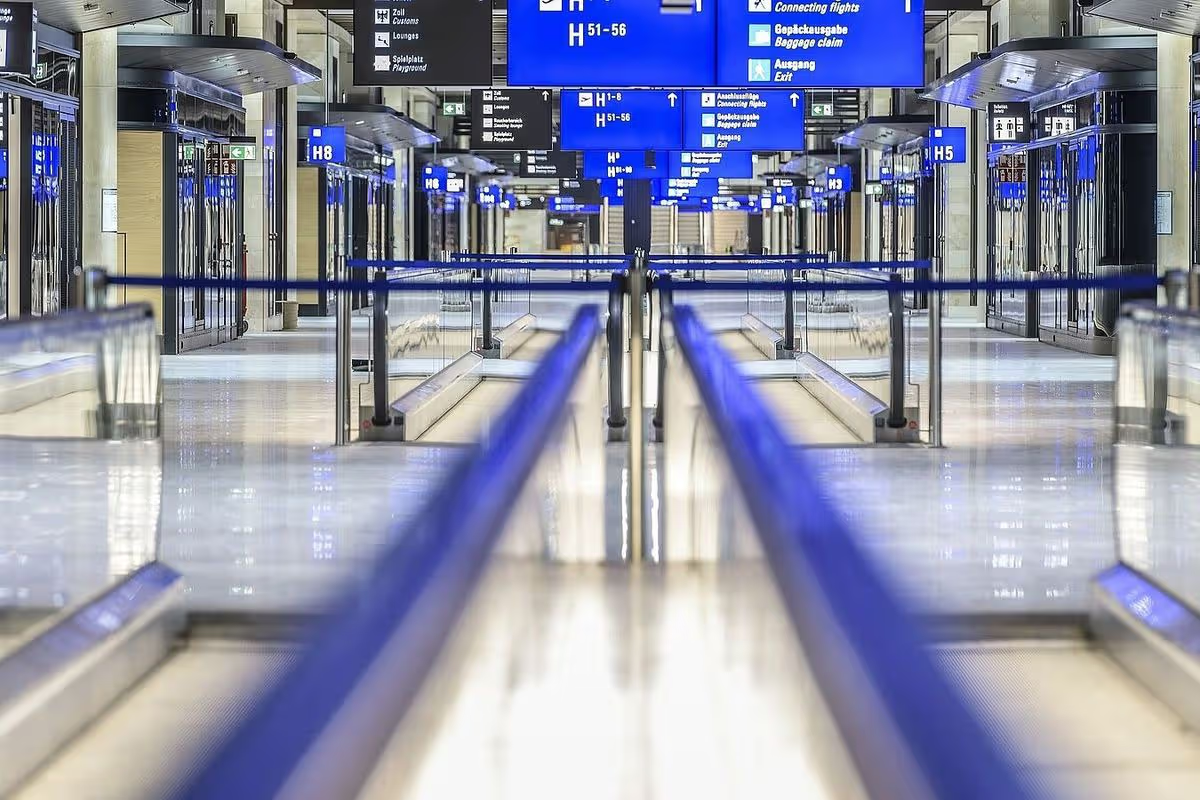
The airport was the only one in Europe to win the award(Image: Fraport AG)
The world’s most beautiful airports for 2026 have been announced, and only one European hub has made the list.
Prix Versailles published its World’s Most Beautiful; Airports List 2026, which included airports from around the world, “each one exhibiting extraordinary, distinctive architecture”, according to its press release. Among the winners on the list were Guangzhou Baiyun International Airport in China, and Pittsburgh International Airport in the US.
The sole European destination to make the cut was Frankfurt Airport, which unveiled its brand-new Terminal 3 in April, mostly for passengers taking long-haul flights. The £3.46 billion expansion took over 11 years, and became one of the continent’s largest infrastructure projects.
Sitting on 1.3 square kilometres of land, it’s around the same size as Frankfurt’s core city centre, and it includes a 2,900-square-metre culinary space, 112 check-in counters, premium lounges, and upmarket boutiques.
Content cannot be displayed without consent
The terminal is connected to the rest of the airport via a 3-mile-long Sky Line people mover, which can carry up to 4,000 passengers, with the journey taking just eight minutes. Terminal 1 has two train stations connecting the airport to passengers’ final destinations: a Regiobahnhof that takes passengers into the city centre and Fernbahnhof where you can take Germany’s high-speed ICE trains across the country.
Terminal 3 was designed by architect Christoph Mäckler, and the awards announcement said it “was contrived to be a lively urban environment”. It added: “To give travellers a smooth, familiar experience, its piers, boarding gates and lounges emulate the streets and squares of a city. Its aesthetics rely on noble materials in warm tones, like Jura limestone and travertine. Vast spaces, bathed in natural light thanks to large plate glass windows, create a soothing atmosphere while minimising the use of artificial light sources.”
Frankfurt is not generally a city break destination chosen by Brits, but it has a colourful old town with medieval houses and historic charm. Römerberg in particular is popular with tourists, and the cosy half-timbered houses make the perfect backdrop for Frankfurt’s famous Christmas market.
The Städel Museum is another must-visit for tourists, and this vast art gallery has works from the Middle Ages to the present day, as well as impressive visiting exhibitions such as a Monet show that’s on until July 5. If you don’t have much time to see the city, head for the Main Tower, which stands at 240 metres, for impressive 360-degree views.
Frankfurt is also known for being the financial capital of continental Europe, and its financial district is sometimes known as ‘Mainhattan’ after the River Main and its skyline’s resemblance to New York. Wander around and you’ll see lots of unique, contemporary architecture such as the glass-panelled Commerzbank Tower and art-deco style Messeturm.
Have a story you want to share? Email us at webtravel@reachplc.com
The abandoned village was once home to 2,000 people who worked at the nearby Quarry – but in 1927, they were all relocated to a brand new village, leaving their old home to be reclaimed by nature
The slate quarry’s decline saw the village crumble(Image: Getty)
An entire village was created after all 2,000 of its residents were forced to up sticks and relocate. All that remains of what was once a bustling community are buildings completely reclaimed by nature, smothered in moss and vegetation.
The deserted village of Talysarn, nestled in the Nantlle Valley of Gwynedd, North Wales, is a former settlement that has been slowly swallowed up by the earth as the years have passed. It was once home to workers and industrial buildings serving the nearby Dorothea Quarry slate mine.
Throughout the 19th century, these mines provided a vital source of income for thousands of people across Wales, but as the quarries expanded, the village was forced to grow alongside them. Eventually, when 1927 arrived, the decision was taken to move thousands of residents to a brand new village built from scratch.
By the 1840s, production at Dorothea had climbed to a remarkable 5,000 tonnes annually, but output would soon soar even higher. By the 1870s, that figure had surged to more than 17,000 tonnes — well over three times what had been produced just 30 years earlier.
Despite the quarry’s seemingly promising future, it was plagued by severe flooding problems. This was tragically highlighted in 1884, when several men lost their lives after the pit was overwhelmed by water while they were working on site.
In response, the river was realigned and deepened to better manage the flow, and while this resolved the issue temporarily, it would go on to cause further problems further down the line. To combat the problem, a Cornish beam engine was constructed on the site to replace the waterwheels, and it still stands there to this day.
Indeed, this is one of the abandoned village’s most impressive sights — a towering structure with its original machinery still intact.
Another focal point of the old village is its 18th-century hall, which has remained untouched since 1946 and now stands as an ivy-covered building, heavily daubed with graffiti, its brickwork slowly crumbling away.
The abandoned village as a whole has become a hugely popular destination for avid explorers and walkers eager to unearth its secrets and snap an eerie photograph of the overgrown ruins. Today, the site sits within the UNESCO Slate Landscape of Northwest Wales and is protected as a piece of history, frozen in time.
Wild Guide Wales author Daniel Start wrote about what remains of the site, likening the ruins to a Welsh Angkor Wat. He said: “Only the baboons are missing. It’s a vast, wild site with many fascinating, overgrown ruins, including a Cornish beam engine and the overgrown remains of the chapel at Plas Talysarn.”
The quarry finally closed in 1970 and has since flooded, creating a lake reportedly exceeding 100m in depth in certain areas. This too forms part of the Slate Landscape of Northwest Wales World Heritage Site.
One visitor left spellbound by the village’s remnants is photographer Tony Harnett, who runs the website Gems of Snowdonia. He previously told WalesOnline: “I’d seen photos of Plas Talysarn and knew it was an interesting place, but I thought that’s all there was.
“When I went there, I did not expect to find so many other old buildings in the area. Some I just stumbled across, others I could see in the distance but didn’t have time to visit.
“I arrived late in the day, for the golden hour for photography, so I only had two hours there. But I could easily have stayed for the whole day, there’s so much to explore.”
The sense of anticipation felt by Ireland supporters about the start of the inaugural Nations Championship ramped up a degree or two on Wednesday when head coach Andy Farrell named his 36-man squad for the three matches his side will play in July.
Farrell’s selection for the games against Australia, Japan and New Zealand in July features three players who have yet to win their first caps, all three of those Connacht forwards.
Props Billy Bohan and Sam Illo, along with back row Sean Jansen, are part of the group which will travel to Sydney on Monday to begin their preparation for the three Test matches in the southern hemisphere.
The call-ups reflect the excellent form shown by Connacht in the latter half of the season particularly, as a run of positive results by Stuart Lancaster’s team’s moved them into eighth in the United Rugby Championship table, and thereby progressing to the end-of-season play-offs and qualify for next season’s Champions Cup.
In total, six Connacht players have been named with Darragh Murray, Cian Prendergast and Bundee Aki also having been chosen.
The inclusion of front-rowers Illo and Bohan owes much to the unavailability of injured Leinster props Andrew Porter, Jack Boyle and Paddy McCarthy, but both will be keen to make the most of the opportunity afforded to them.
With the opening fixture with the Wallabies in Sydney on 4 July, BBC Sport NI takes a closer look at the credentials of the uncapped trio in the Ireland squad.
Israeli Prime Minister Benjamin Netanyahu is facing mounting pressure after he was cut out of the US-Iran agreement. Crucially, the Memorandum of Understanding includes Israel’s war on Lebanon. Al Jazeera’s Nour Odeh explains.
The star winger scores a goal and sets up another, as Colombia make a winning return to the FIFA World Cup.
Published On 18 Jun 202618 Jun 2026
Colombia opened their World Cup Group K campaign with a 3-1 victory over Uzbekistan at the Estadio Azteca on Wednesday, as Daniel Munoz, Luis Diaz and Jaminton Campaz struck to overcome a spirited second-half response from the tournament debutants.
Uzbekistan were disciplined for long periods under their Italian coach Fabio Cannavaro, but Colombia’s greater quality stood out in front of a crowd of over 80,000 on a cool, rain-tinged evening in Mexico City.
Recommended Stories
list of 4 itemsend of list
Colombia, the Copa America runners-up, had early sights of goal through Jhon Arias and James Rodriguez, but Uzbekistan sat deep, scrapped gamely and waited for mistakes. Bekhruz Karimov almost profited when he burst forward, only for Jhon Lucumi to intervene before he could shoot.
Diaz had the clearest chance of the opening half when he struck the post, before Abdukodir Khusanov slid in after the winger had knocked the ball past him, taking out both the Colombian player and a pitchside cameraman who required medical treatment.
Uzbekistan’s resistance finally cracked in the 40th minute. Diaz gathered the ball after an attack had broken down and clipped a fine pass into the path of Munoz, who guided home a neat finish for his third international goal.
The large Colombian contingent erupted, their yellow shirts making the Azteca look and sound almost like home. Chants of “Vamos Colombia”, adapted from a Club America-style chorus, rolled around the ground, while Uzbekistan’s small band of supporters answered with drums of their own.
Colombia’s Luis Diaz celebrates scoring their second goal [Eloisa Sanchez/Reuters]
Fayzullaev scores Uzbekistan’s maiden World Cup goal
Uzbekistan improved after the break and equalised on the hour with the country’s first World Cup goal.
Dostonbek Khamdamov fed Eldor Shomurodov, whose shot from the right side of the box was saved low by Camilo Vargas. The goalkeeper could not hold it, however, and Abbosbek Fayzullaev nodded in the rebound from close range.
Abbosbek Fayzullaev celebrates scoring Uzbekistan’s first World Cup goal [Eloisa Sanchez/Reuters]
However, Uzbekistan’s joy lasted only five minutes.
Gustavo Puerta released Diaz in the 65th minute, and the forward side-footed across goal to restore Colombia’s lead. The crowd responded with chants of “Lucho, Lucho”.
Uzbekistan kept pushing. Akmal Mozgovoy shot narrowly off target in stoppage time, Karimov hit the bar with an effort from distance, and Azizbek Amonov had a shot blocked after Otabek Shukurov’s pass.
But Colombia had the final word, Campaz scoring in the ninth minute of stoppage time to settle a contest in which Nestor Lorenzo’s side had 15 attempts to Uzbekistan’s nine, and extended their strong recent group-stage record to seven wins in eight World Cup matches.
Colombia face DR Congo on Tuesday in Guadalajara, after Uzbekistan play Portugal on the same day in Houston.
Colombia’s Jaminton Campaz celebrates after the match [Eloisa Sanchez/Reuters]
The FIFA World Cup begins on June 11. You can follow the action on Al Jazeera’s dedicated World Cup 2026 page with all the latest news, match build-up and live text commentary, and keep up to date with group standings, real-time match results and schedules.
Actor and racing driver Michael Fassbender is returning this month as CIA Agent Martian in season two of The Agency. He talks sociopaths and obsessive preparation on set.
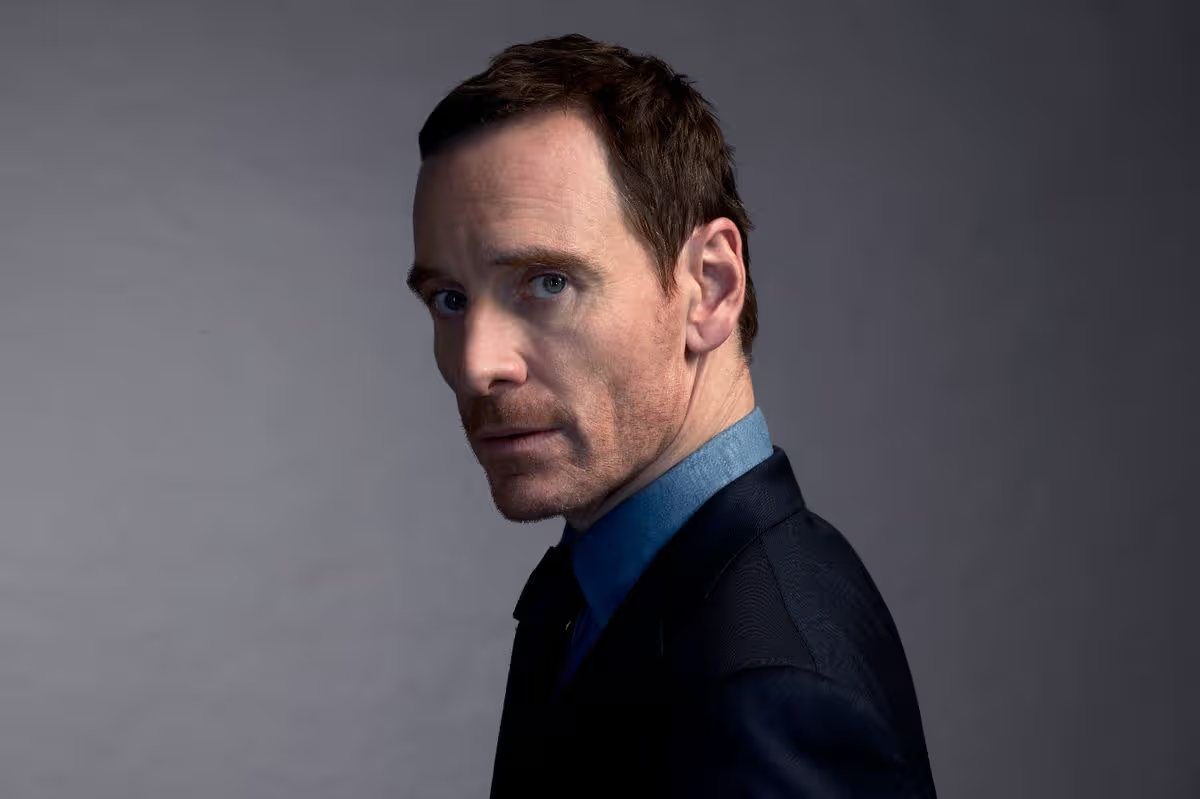
Michael Fassbender, who is returning as CIA agent Martian in season two of spy thriller The Agency(Image: Nadav Kander/Paramount+)
Leading a double life is nothing new for Michael Fassbender, who is returning as CIA agent Martian in season two of spy thriller The Agency. An actor and a professional racing driver, Michael, 49, has reached an optimum level in both careers. Yet, despite this enviable skill set, achieving success and fitting in perfectly in two very different worlds, it would not mean he would make a perfect spy.
For that, according to a real life agent, who he spoke to while researching his role, Michael would need to be a sociopath. He says of this revelation: “That was a real gateway into the character for me.”
The Agency, starring Michael as Brandon Colby, codenamed Martian; Jodie Turner-Smith as his lover Dr Samia Fatima and Richard Gere as CIA chief James Bradley, launches season 2 on Saturday June 21 on streaming service Paramount+. A dramatic trailer for the series hears Martian saying: “I betrayed my country, did I cause harm? Yes. I lied to my friends, my colleagues. I sacrificed people. I deserve my fate. If I had to do it again, I wouldn’t hesitate.”
Season one saw CIA covert operative Martian being suddenly ordered to abandon his long-term undercover assignment in Ethiopia – where he fell in love with Samia – and return to London. In Africa he was working under the false identity – known in the world of espionage as a ‘legend’ – of Paul Lewis.
Michael picks up the story in season two, saying: “Then she [Samia] arrives in London. Then he meets up with her, which he shouldn’t do and then he compromises her. She gets captured and his new objective is to basically get her to safety. But by doing that, he becomes a double agent and betrays his country, becomes a traitor and the walls are closing in on him.”
Born in Heidelberg, Germany, Michael’s mum, Adele, hailed from County Antrim, Northern Ireland, while his dad, Josef, was a chef, who had worked at The Savoy in London. Together with his older sister, Catherine, now a neuropsychologist, the family moved to Kilarney in County Kerry when he was two, where his parents ran a local restaurant, West End House.
A Catholic altar boy when he was young, Michael says this trained him to perform to an audience. And, after initially harbouring ambitions to be a heavy metal guitarist – growing his hair and listening to thrash metal – aged 17, he appeared in a local play and changed direction.
Relocating to London, aged 19, he enrolled at the Drama Centre, but dropped out before completing his third year to start his professional career in a touring production of Three Sisters by Anton Chekhov. Launching his film career in 2001 in Steven Spielberg’s Band of Brothers, his credits since include Hunger (2008) Shame (2011) 12 Years a Slave (2013) – for which he was nominated for a best supporting actor Oscar – and X-Men (2011).
He was also nominated for a best actor Oscar for playing the Apple co-founder in the 2015 movie Steve Jobs. Married to Swedish actress Alicia Vikander, 37, the couple and their two young sons live in Lisbon, Portugal, but retain strong ties with London, where they spent many years.
Known to completely immerse himself in a role – for example, losing 40 lb to play an IRA hunger striker in Hunger – when preparing for the role of Martian, he also met up with two genuine spies. Speaking on The Arts Hour, he says: “The first guy I talked to, I felt like I wasn’t going to need dirt or negative aspects, let’s say. Then I spoke to another guy. We were going through the character and I was like ‘is this guy a sociopath?’ And he was like ‘well let’s go through the characteristics of a sociopath.’”
Clinically diagnosed as antisocial personality disorder, sociopaths have a persistent disregard for the rights, feelings and safety of others – feeling neither empathy, nor remorse. Returning to his conversation with the spy, Michael continues: “We went through the list [of characteristics] and he was like ‘we’re ticking a lot of boxes here.’ I was like ‘yes, ok, so he is.’ And he was like ‘well, it’s a good thing to be in that job.’”
In the new season of The Agency, Martian will be seen desperately trying to claw back some semblance of humanity after being out on his own, as a covert operative, for 7 years. Michael explains: “A lot of spies work in the embassy, so if the heat comes on them, they have a passport and they can get out. But a non-official covert doesn’t have that.”
Describing Martian’s relationship with Samia and with his daughter in London, who he hasn’t seen for many years, he continues: “It’s sort of his fight for humanity. He’s been in the business for about 20 years, so he’s quite jaded. He’s crossed a lot of moral lines he didn’t think he’d do at the beginning of his career.”
As for his own career, for 10 years, Michael has pursued parallel interests in racing driving and acting. Between 2019 and 2023, he stepped away from Hollywood, pursuing a serious career as a professional sports car racer. Joining a development programme with Porsche back in 2018, his greatest racing achievement has been completing the 24 Hours of Le Mans endurance classic in 2022.
The 2023 documentary Road to Le Mans follows his journey. Michael has said of racing: “My first dream has always been to go racing. Even before acting.” Someone who doesn’t do anything by halves, it is unsurprising that Michael would never have been content to keep racing as a hobby. His desire to give everything his personal best applies both to racing and acting.
Reputed to have read the script for Shame around 350 times, so he could get inside the head of a sex addict, he claims to have reined in his obsessive preparation for The Agency. He laughs, saying he read the script “150 times.” He says: “I try and do it 10 times a day.”
Explaining the need for this degree of intensity, he shrugs: “I’m a slow learner! It’s just something I’ve always done. If I keep reading it, I feel like the dialogue is seeping into the bones and I’m thinking about the character as I’m reading.”
Hugely professional, Michael adds: “I just don’t want to turn up on set unprepared. A lot of things can fall through the cracks that are out of my control, but the worst thing is if I leave set and I’m ‘oh I messed up because I didn’t do my homework.’“ An anathema to the average sociopath, this sense of duty and consideration for others would probably make Michael a lousy spy.
*This interview has been adapted from The Arts Hour on the BBC World Service, available on BBC Sounds.
A new report suggests tokenized securities offer a low-cost framework to rebuild the country’s oil sector.
Forced by hyperinflation and sanctions to embrace cryptocurrencies long before the rest of the world, Venezuela consistently ranks among the top countries for crypto adoption globally, according to a Chainalysis report.
But one digital assets firm believes that it lays the foundation for something big in the Latin American country.
“[Venezuela] has significant natural-resource assets, a large diaspora, and a population that is already familiar with digital assets and stablecoins due to years of economic volatility,” Jesse Knutson, head of operations at Bitfinex Securities, told Global Finance. “These factors could support adoption if the appropriate legal and regulatory foundations are established.”
According to a June 11 Bitfinex report, high issuance costs, protracted processes, and layers of intermediation are “hampering the green shoots of a recovery” already taking root in Venezuela. And while oil production surpassed one million barrels per day in 2025, its highest level in seven years, the nation remains far short of the 3.1 bpd it produced in the late 1990s. Bridging that gap will require foreign capital at scale.
Knutson said that tokenized securities infrastructure could dramatically lower the cost of attracting investors.
“Tokenization does not overcome those challenges, but it does allow the country to put in place a more efficient system with less friction, allowing the country to attract foreign capital more cheaply and a wider universe of investors to access Venezuela,” he said.
Fortuitous Timing
Years of hyperinflation and economic turmoil drove Venezuelans to adopt cryptocurrencies for payments, savings, and remittances at a rate unmatched elsewhere in the Western Hemisphere.
A UN report using 2021 data showed that around 10.3% of Venezuelans — roughly one in 10 — owned cryptocurrencies. It also warned that cryptocurrencies pose a threat to financial stability.
The Maduro regime, for example, undermined sanctions by leveraging digital assets to facilitate oil transactions. (It’s worth noting that the U.S. alleged “narco terrorism,” not a crypto-oil entanglement, in its indictment.)
Still, a grassroots familiarity with digital assets gives the country an edge, so long as there are “strong institutions, investor protections, disclosure standards, functioning legal systems, and trusted market participants,” Knutson added.
The El Salvador Comparison
Knutson draws a parallel with El Salvador, which defied the International Monetary Fund when it became the first country in the world to make bitcoin legal tender.
Embracing digital assets helped El Salvador attract much-needed foreign investment. “Venezuela could achieve similar success by embracing blockchain technology in a way that provides regulatory clarity to issuers while offering robust investor protections,” Knutson said.
Bitfinex Securities itself operates regulated platforms in both El Salvador and Kazakhstan, with over half a billion dollars in real-world assets — ranging from tokenized treasury bills to community bank debt — currently trading on its platform.
Still, the firm stresses that tokenization’s success hinges on legal certainty, enforceable property rights and investor confidence.
“Those fundamentals remain critical in any jurisdiction,” Knutson said.
Christie has just signed a new deal with Bournemouth and will remain at the club until 2029. He is, as they say, in a good place. Messi’s exploits at 38 – he will be 39 this month – offers Christie a world of encouragement that this World Cup doesn’t necessarily have to be his last.
In England, he sees players getting better with age, guys in their mid-30s who are still operating well at the top level. “Some are pushing for the high-30s and still churning out unbelievable performances week in, week out,” he said.
Head coach Clarke has spoken often about the dynamic of starters and finishers, the importance of having influential players coming off the bench late on. That was the scenario Christie found himself in against Haiti. Tense moments, those.
Would he rather be a starter or a finisher? “I honestly don’t mind,” he commented. “I’m not too sure, to be honest. The manager’s been very, very big on that, especially since we’ve come into the camp.
“He’s making everybody realise that every single person in our squad is going to be needed at some point, whether some boys play three, four, five minutes, some players might play every minute, but everybody’s got a massive part to play. Everybody’s taking that on and doing their bit so far.”
So to Boston for Morocco on Friday. One point and Scotland are more or less guaranteed a place in the knockouts. One stellar 90-minute performance, however challenging, and they’re history makers.
“It’s a dream come true to even play in a World Cup, but you have to quickly adjust your targets and adjust your mindset,” added Christie. “From being happy to be here you want to go and create more and keep pushing the bar. The manager has kept the foot to the floor.”
Having achieved one dream by making it to America, Christie is now pursuing another. Morocco await – the greatest test of his football life.
Israel may ‘symbolically’ pull back its troops from southern Lebanon after the US and Iran signed a peace deal which included an end to Israel’s war on Lebanon, according to analyst Rami Khouri. But he attests, real policy change will only happen when the US forces Israel’s hand.
Winger Luis Diaz scores a goal and sets up another, as Colombia make a winning return to the FIFA World Cup after missing the last edition.
Published On 18 Jun 202618 Jun 2026
Colombia opened their World Cup Group K campaign with a 3-1 victory over Uzbekistan at the Estadio Azteca on Wednesday, as Daniel Munoz, Luis Diaz and Jaminton Campaz struck to overcome a spirited second-half response from the tournament debutants.
Uzbekistan were disciplined for long periods under their Italian coach Fabio Cannavaro, but Colombia’s greater quality stood out in front of a crowd of over 80,000 on a cool, rain-tinged evening in Mexico City.
Recommended Stories
list of 4 itemsend of list
Colombia, the Copa America runners-up, had early sights of goal through Jhon Arias and James Rodriguez, but Uzbekistan sat deep, scrapped gamely and waited for mistakes. Bekhruz Karimov almost profited when he burst forward, only for Jhon Lucumi to intervene before he could shoot.
Diaz had the clearest chance of the opening half when he struck the post, before Abdukodir Khusanov slid in after the winger had knocked the ball past him, taking out both the Colombian player and a pitchside cameraman who required medical treatment.
Uzbekistan’s resistance finally cracked in the 40th minute. Diaz gathered the ball after an attack had broken down and clipped a fine pass into the path of Munoz, who guided home a neat finish for his third international goal.
The large Colombian contingent erupted, their yellow shirts making the Azteca look and sound almost like home. Chants of “Vamos Colombia”, adapted from a Club America-style chorus, rolled around the ground, while Uzbekistan’s small band of supporters answered with drums of their own.
Colombia’s Luis Diaz celebrates scoring their second goal [Eloisa Sanchez/Reuters]
Fayzullaev scores Uzbekistan’s maiden World Cup goal
Uzbekistan improved after the break and equalised on the hour with the country’s first World Cup goal.
Dostonbek Khamdamov fed Eldor Shomurodov, whose shot from the right side of the box was saved low by Camilo Vargas. The goalkeeper could not hold it, however, and Abbosbek Fayzullaev nodded in the rebound from close range.
Abbosbek Fayzullaev celebrates scoring Uzbekistan’s first World Cup goal [Eloisa Sanchez/Reuters]
However, Uzbekistan’s joy lasted only five minutes.
Gustavo Puerta released Diaz in the 65th minute, and the forward side-footed across goal to restore Colombia’s lead. The crowd responded with chants of “Lucho, Lucho”.
Uzbekistan kept pushing. Akmal Mozgovoy shot narrowly off target in stoppage time, Karimov hit the bar with an effort from distance, and Azizbek Amonov had a shot blocked after Otabek Shukurov’s pass.
But Colombia had the final word, Campaz scoring in the ninth minute of stoppage time to settle a contest in which Nestor Lorenzo’s side had 15 attempts to Uzbekistan’s nine, and extended their strong recent group-stage record to seven wins in eight World Cup matches.
Colombia face DR Congo on Tuesday in Guadalajara, after Uzbekistan play Portugal on the same day in Houston.
Colombia’s Jaminton Campaz celebrates after the match [Eloisa Sanchez/Reuters]
The FIFA World Cup begins on June 11. You can follow the action on Al Jazeera’s dedicated World Cup 2026 page with all the latest news, match build-up and live text commentary, and keep up to date with group standings, real-time match results and schedules.
MUSIC icon Jon Bon Jovi has revealed that he’s “fully recovered” four years after having vocal surgery to fix a damaged cord.
The Livin’ on a Prayer hitmaker, 64, previously said he would quit music if his singing continued to struggle after a vocal injury.
Sign up for the Showbiz newsletter
Thank you!
Jon Bon Jovi has revealed he’s ‘fully recovered’ four years after having vocal surgeryCredit: AP:Associated PressThe musician said he’s spent the last four years having vocal coachingCredit: Getty
But now the singer has shared that after four years of vocal coaching and exercising his voice, he has “fully recovered”.
Bon Jovi said: “It was longer than I’d ever expected, but it had to be right. We never lost faith.”
He told People: “I’d often joked and said the only thing that’s ever been up my nose was my finger. I never did anything to hurt the cords; I didn’t have any excesses. I’m a trained vocalist. I’ve practiced the craft.
“So when a doctor had to explain to me that one of the cords was literally atrophying, it was confusing.”
The singer previously said he would retire from music if his voice never recoveredCredit: AFPBon Jovi praised his band for sticking by him during the difficult timeCredit: Getty
He praised keyboardist David Bryan, percussionist Everett Bradley, bassist Hugh McDonald, guitarist John Shanks, drummer Tico Torres and guitarist Phil X for standing by his side during his recovery.
“They never doubted [me] and never looked for work or decided to retire,” Bon Jovi said.
“The sacrifices that each one of them have made to be there for me is on a whole another level.”
The musician previously said that he would retire from music if his voice never recovered.
In 2024, he shared: “If the singing is not great, if I can’t be the guy I was, I’m done.
“And I’m good with that.”
Bon Jovi added: “There is a big difference between being in a studio and going out on the road.
“We have just recorded a new album. I sing in vocal therapy every day.
“But I want to perform for 2½ hours a night, four nights a week — and put it this way, I don’t ever need to be the fat Elvis.”
JPMorgan Chase (JPM) has reportedly stopped its staff in Hong Kong from accessing Anthropic’s (ANTHRO) AI models.
The wording of Anthropic’s usage terms in its licensing agreement with JPMorgan prompted the bank to remove Claude models from an internal drop-down list of
We rented Il Nido because we thought other people wouldn’t like it. Small and basic, without internet, the property was supposedly beside a beautiful national park famous for its coastline and migratory birds. The online picture suggested it was pressed up against one of those concrete pillars (common around Sicily) supporting a deserted and rotting motorway flyover. I was writing a thriller with mafia connections. My partner wanted to scrape off six months of fumes from her new job in London. Our daughter needed fun.
“This is a bomb,” said the hostess, opening a cupboard under the sink. “You turn it anticlockwise to go off.”
“Not bomb, bombola,” whispered my partner. “It’s the gas canister, for the stove.”
From outside in the driving rain came the sounds of traffic and sodden animals – frogs and a goose, always in that order: frog croak, goose quack; frog croak, goose quack.
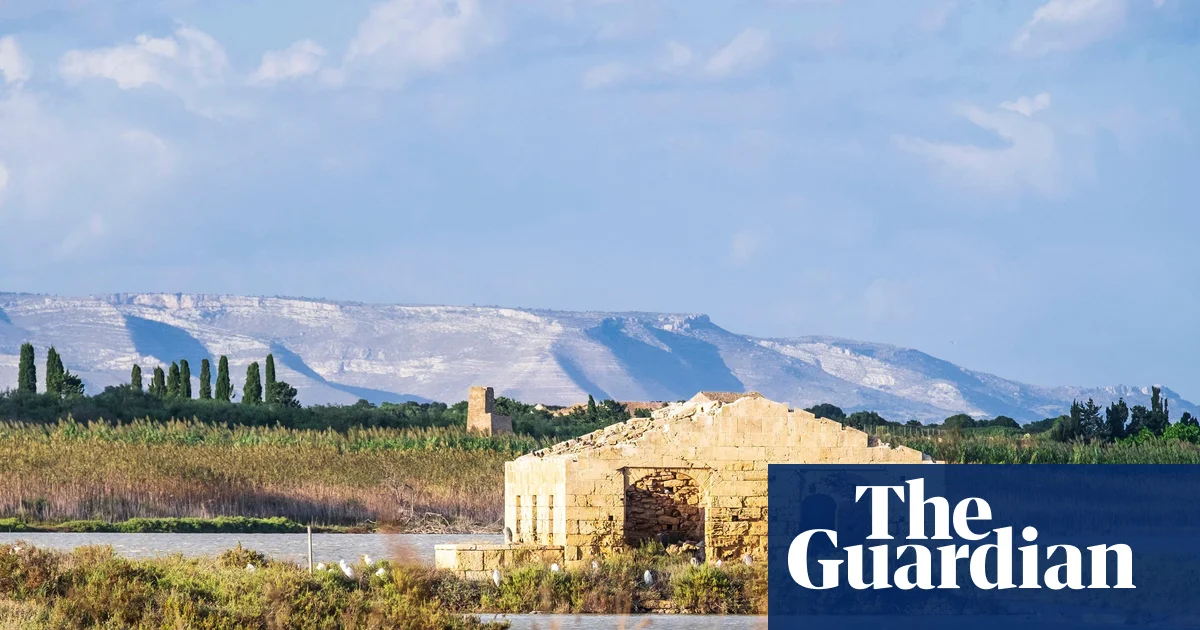
We woke up on the Saturday to the first sunshine in six months. The roar we had thought was traffic was the crash of waves. The sound of a goose eating a lot of frogs in quick succession turned out, in fact, to be the call of wild flamingos. We were, just as our hostess had promised, in a tumbledown farmstead – what Sicilians call a baglio – among the shimmering lemon groves, on the edge of the Vendicari nature reserve; and it was glorious.
A baglio is more specifically a fortified group of buildings around a central courtyard, the stone barn equivalent of “circling the wagons” in America. In the 19th century, armed gangs roamed the fields of south-east Sicily. Isolated farms were attractive targets because they stored a whole year’s crop – grain, olives, wine, tools, animals. The two barns opposite our building were caved in, the stone courtyard was more a sunken boulder. In one corner, a vast cluster of poppies and marigolds billowed in merry defiance. On top of a collapsed roof was a starling with 17 voices, including one that sounded like a falling bombola, tossed over the wall by a bandit, and another that suggested a laughing computer.
Calamosche beach. Photograph: Andrea Izzotti/Getty Images/iStockphoto
Vendicari is small, but it is one of the most important wetland nature reserves in Sicily. In the 1970s, the owners of an asphalt and petroleum company wanted to build an oil refinery here. The local officials, looking across the valley from their glorious baroque buildings in Noto, approved the plan. They hadn’t reckoned on the force of Bruno Ragonese, a local eccentric who kept 20 abandoned dogs as pets, and wasn’t even Sicilian: he was an immigrant from Libya. He strode out to the site, gathered evidence on migratory birds, built local environmental groups into a powerful alliance and, brilliantly, argued that since these birds were migrating (as he had done) from Africa to Europe, this was a much bigger issue than a wallet-stuffer for the Noto politicians – it was an international scandal.
Next came the property developers. Again, the Noto councillors patted their pockets. And again the extraordinary young man swung into action. No, replacing the drained wetlands with fake ponds did not constitute “sympathetic, environmental building”. No, migratory birds wouldn’t be perfectly happy on a smaller patch of land in a cheaper sector – they weren’t social housing tenants. Yes, this is the head of Ramsar (the organisation upholding an international environmental treaty protecting wetlands) on the phone wanting to know why you plan to destroy one of Europe’s essential marshlands.
The nature reserve was established in 1984.
For a piffling €7 a day for a whole family or €3.50 for adults, the entire park is yours. After a breakfast of fresh ricotta, honey and local oranges (all from a Coop: these shops look just as plain as the UK Co-ops, but equal the best London delicatessens for good things), we started our visit on Calamosche beach. With juniper bushes, wild irises, tumbling cacti and the lilting flight of hoopoes, it is a blissful stretch of sand sloping into gentle waves. On the left, the rocks lead up to the Grotta di Calamosche, a cave with a tree growing inside. From there, the exquisite view looks almost solid, as if sealed by light.
It is easy to walk the length of Vendicari in two hours, from the ruins of Eloro, a seventh-century BC Greek colony, past the flamingos, to the eerie modern remains of a tuna-canning factory, where the oil refinery was going to be. For hundreds of years, until 1944, tuna were caught here by a brutal method of netting and trapping called mattazana, literally “the slaughter”. Now roofless, with staring windows and only a crowd of thin pillars remaining, this Colosseum for fish feels as ancient as Rome.
“Did you know flamingos are pink because they eat shrimp?” said my daughter, interrupting my pleasantly gloomy mood thinking about time, loss and tins of fish.
I did not, and I don’t believe it. There’s only so much silliness from nature that I’m prepared to accept. “And what colour are flamingos that don’t eat shrimp?” I said, in a superior tone.
“No colour. The world is full of invisible flamingos.”
Flamingos in Vendicari. Photograph: Lee Dalton/Alamy
The two lakes at the heart of the reserve were thick with these fantastical birds, gabbling and scooping at the water, and coming in to land like badly piloted pink planes.
I retorted with science. “Those tiny buildings?” I pointed towards ancient Syracuse, glimmering in the distance. “Birthplace of Archimedes, one of the greatest mathematicians of all time, inventor of … No, don’t look it up on your phone – phones are banned!”
But it was too late. She had captured another flash of internet. “Hey! There’s an H&M in Syracuse. Let’s go!”
The path around the reserve does not entirely encircle it. You set off left, walk for 5 miles (8km), then half a mile before you get to your ruined farmhouse home, your way is blocked by a private lemon grove. You must not go through it. You are not allowed through it.
We went through it. It was lovely.
In this part of Sicily, lemons are so plentiful and the trees so giving, that you feel the fruit is being forced on you by nature, Breughel fashion; it would be rude not to accept. Of course, you must not add theft to trespass. But I thoroughly recommend you buy some from the farmer: they are delicious. Organic, bloated, dazzling growths of oily yellow, I think they are the famous Femminello Siracusano lemons. Because local regulations forbid the use of wax or pesticides, every part is edible.
After the lemon grove came a path of marigolds, as tall as my shoulder, and wild fennel, above my head. We arrived home at sunset, where we cooked tagliatelle al limone rubato on the bits of the stove that did work, and ate it overlooking Syracuse and its H&M, with three invisible flamingos for company. Here’s the recipe:
Pasta al limone rubato
Lardo or bacon, as much as you want 1 lemon, zest and juice Scrubland herbs thyme, oregano or whatever you can find. Fennel is good Pasta, perhaps tagliatelle Parmesan cheese, lots
Fry the lardo, add the lemon zest, herbs, a little pasta cooking water, and stir. Add pasta. Mix in grated cheese and lemon juice until it tastes nice. Serve under cover of darkness.
A controversial proposal to tax California billionaires to fund healthcare has tenatively qualified for the November ballot, setting the stage for a more intense and expensive battle over whether the state should squeeze the ultra-rich.
Supporters say the proposed tax is crucial to compensate for federal healthcare funding cuts, approved by President Trump and the Republican-controlled Congress, that will harm millions of the state’s most vulnerable residents.
In April, supporters of the billionaire tax submitted nearly 1.6 million signatures, roughly double the number needed to qualify. The California secretary of state’s office on Wednesday declared that enough valid signatures were submitted. The initiative will officially qualify for the Nov. 3 ballot on June 25 unless the proponents withdraw it beforehand.
The initiative would impose a one-time tax of up to 5% on taxpayers and trusts with assets valued at more than $1 billion, with some exceptions, such as property. The levy could be paid over five years. Ninety percent of the revenue would fund healthcare programs, and the remaining funds would be spent on food assistance and education programs. The proposal would cost the state’s richest residents about $100 billion if a majority of voters support it.
Opponents of the measure say the proposal is an ineffective attempt to address the long-term effects of the healthcare cuts and would destroy California’s economy and budget.
The state budget in California is already largely dependent on income taxes paid by its highest earners. Because of that, revenues are prone to volatility, hinging on capital gains from investments, bonuses to executives and windfalls from new stock offerings, and are notoriously difficult for the state to predict.
The proposal already triggered a fierce debate, accentuating the divide between the rich and poor in a state that’s expensive to live in.
The Service Employees International Union-United Healthcare Workers West and other supporters of the billionaire tax say that it would raise $100 billion, offsetting federal funding cuts to healthcare as well as funding education and state food assistance.
But supporters face strong opposition from billionaires with deep pockets. Tech executives and other business leaders oppose the idea and have threatened to move to other states. Opponents say taxing billionaires would harm California’s economy while not addressing underlying financial issues.
The proposal also has divided politicians within the Democratic Party. California Gov. Gavin Newsom spoke out against the billionaire tax, expressing fears that billionaires would move out of the state. But U.S. lawmakers such as California Rep. Ro Khanna and Vermont Sen. Bernie Sanders have backed a billionaire tax, saying the rich should pay their fair share to fund essential services.
Business executives have already poured millions of dollars into groups that oppose the billionaire tax or are promoting alternative solutions to wealth inequality.
Tech executives, venture capitalists and business leaders have donated roughly $118 million to a nonprofit called Building a Better California, according to data on the secretary of state’s website. Most of the funding comes from Google co-founder Sergey Brin, who has given more than $82 million to the group. Executives from DoorDash, Ripple, Stripe and other companies also have contributed.
The group says it supports policies such as expanding access to affordable housing, protecting innovation, requiring government transparency and securing more stable education funding.
PayPal and Palantir co-founder Peter Thiel has contributed $3 million to the California Business Roundtable, which opposes the tax. Former Google Chief Executive Eric Schmidt donated $1 million to that group as well.
California would probably collect tens of billions of dollars from the wealth tax if it passed, but it could also lose other tax revenue, a December letter from the state legislative analyst’s office said. The office also mentioned that it’s tough to predict the exact amount the state would collect because of factors that can affect a billionaire’s wealth such as fluctuating stock prices.
California billionaires who were residents of the state as of Jan. 1 would be affected by the ballot measure if it passes. Some wealthy residents announced plans to moves out of state. On Dec. 31, venture capitalist David Sacks announced that he was opening an office in Austin, Texas, the same day Thiel publicized his firm had opened a new office in Miami.
Palestinian activist Mahmoud Zaiter consoled Algerian fans after their team’s World Cup defeat to Argentina, praising Algeria’s support for Gaza’s orphans. He said the sponsorship of more than one thousand orphans represented a greater victory.
Emotions seesawed across London and Zagreb as England met Croatia in a thrilling World Cup grudge match. The Three Lions came away 4-2 winners in Dallas, Texas.