MOST people go on a cruise to relax, lie on a sun lounger and enjoy some pina coladas as they sail from one destination to the next.
But my cruise has a legend on board who is intent on putting guests through their paces.
Sign up for the Travel newsletter
Thank you!
Strictly legend Shirley Ballas puts guests through their pacesCredit: SuppliedThe Galleria Virtuosa is the vast promenade onboard with the longest LED dome at seaCredit: Ivan Sarfatti
At a diminutive 5ft 2in, Shirley’s stature might be small, but she takes no prisoners as she issues loud, stern instructions: “STEP, TWIST, SWIVEL, KICK, AGAIN!”.
This is day two of a seven-night Norwegian fjords voyage round-trip from Southampton on MSC Cruises’ 19-deck, 6,300- passenger ship, the MSC Virtuosa.
Shirley is scheduled to host several activities during the sailing, but for now the focus is on the jive, which is taking place somewhere in the North Sea.
More than a hundred of us have turned up and it’s proving tricky. As if the shimmies, chasses and spins weren’t enough, the music then speeds up. I’m as coordinated as a two-legged spider.
Think right foot instead of left; arms up instead of down. I’m confident with the kick, but then a fellow passenger whispers in my ear: “If you point your toes it will look more elegant!”
Far more certain is that the jive will leave you out of breath and sweaty. “Forget the gym,” says Shirley. “This is a much better workout.” Agreed!
And it’s also a lot of fun. Who cares if you’re any good — it’s about having a go.
The huge cruise ship accommodates over 6,300 guestsCredit: SuppliedEnjoy the stunning sights from on board the boatCredit: Supplied
And Shirley never lets on — despite being asked endlessly — that Emma Willis, Josh Widdicombe and Johannes Radebe will be the hit BBC dance contest’s new presenters.
Before we finish, Shirley sets a challenge: To practice and film ourselves dancing the jive and she’ll post the best performances on social media.
MSC is an Italian line with an Italian vibe and if you’re looking for La Dolce Vita, you’ll find it on Virtuosa.
Deck 15’s Via Dei Cappellari points guests towards the swimming pools.
Deck 5’s Galleria Virtuosa is a replica Italian shopping arcade. Were it not topped by an LED Dome — which has mesmerising light shows projected onto it nightly — you’d think you were in Italy.
As for the buffet, it offers superb pizzas and pastas, though if you’d prefer a roast, that’s available too. And elsewhere there’s lots of glitter and glitz, from the champagne bar to the three-storey Swarovski crystal staircase in the atrium.
There’s no Deck 17, a number considered unlucky by Italians. There is, however, a Deck 13 and my balcony cabin is on it.
It’s stylish, roomy and, because the ship is sailing from Southampton for the summer, it has welcome British touches, like a kettle and Yorkshire tea bags.
Virtuoso Shirley is scheduled to host several activities during the sailingCredit: SuppliedJo Kessel shows off her unique dance moves on board the MSC VirtuosCredit: Supplied
My fellow passengers are an international bunch, most of whom are European. They’re also younger than normal (the average age is 42) and like to dance.
Wherever you go, whatever the time of day, you’ll find dance classes and much hip-swivelling. The sessions are all free and feature pop, bachata, samba and rock.
I try salsa, hoping it will improve my jive. It doesn’t!
And much of the action happens in the Galleria. You can be walking along, window-shopping, when suddenly you’ll be swept up in a silent disco or flash mob.
That’s how I find myself performing Village People’s YMCA alongside hundreds of others.
It’s all rather joyous, a word used by Shirley multiple times during a Q&A session held later in the week in the ship’s theatre. She uses it to describe the experiences she seeks in life.
Of course, there’s plenty of entertainment that can be watched rather than participated in.
Such as the ship’s ABBA show, in which hits such as Mamma Mia and Waterloo are performed by a cast in flared trousers and tasselled costumes.
Then there’s Ajedrez, a Cirque du Soleil-style show whose acrobatics are so staggering it’s a struggle not to gasp in amazement or cover your eyes.
Even Shirley (who’s sat in the row behind me) thinks its fab!
I get off the ship in Edinburgh and Norway — where the cobbled backstreets of Stavanger are lined by white clapboard houses so cutesy it’s as if they’ve been built for Instagram.
Yet for many guests, the ship itself is the destination and they can’t wait to get back on board.
MSC Virtuosa will be offering another Strictly-themed sailing in August when former pro-dancer Kristina Rihanoff will be on board to host masterclasses and dish up show gossip.
Meanwhile, I try to perfect the jive — and at one point a fellow passenger even praises my leg extension. But I’m not happy enough with it to dare send a clip to Shirley.
I am inspired though, and will keep dancing. As for the cruise, it’s a 10 from me!
GO: STRICTLY CRUISE
SAILING THERE: Strictly dancer Kristina Rihanoff will join the next 12-night Strictly Come Dancing cruise on MSC Virtuosa, departing on August 8.
It sails from Southampton to the Canary Islands and back with calls at Vigo, Funchal, Las Palmas, Santa Cruz de Tenerife, Arrecife and Cadiz.
Price, including full-board and entertainment, is from £1,279pp.
Lleft-wing candidate Roberto Sanchez and right-wing candidate Keiko Fujimori pose during a presidential debate in Lima, Peru, last weekend. This was the only debate between Fujimori and Sanchez before the decisive election scheduled for Sunday. Photo by Paolo Aguilar/EPA
June 6 (UPI) — Peru will choose its next president Sunday in a runoff election between Keiko Fujimori, leader of the right-wing Popular Force party, and Roberto Sánchez, candidate of the leftist coalition Together for Peru.
Nearly 28 million Peruvians are eligible to vote for what will be the country’s ninth president in just 10 years, a figure that reflects Peru’s deep institutional crisis and political fragmentation.
Recent polls show Sánchez and Fujimori in a statistical tie, meaning the final outcome could depend on undecided voters and the share of blank ballots.
For many observers, the central question is not only who will win the presidency, but whether Peru can break the cycle of political instability that has defined the past decade.
Fujimori’s candidacy once again places Fujimorismo at the center of Peruvian politics. The daughter of former President Alberto Fujimori remains one of the country’s most influential and polarizing political figures. Sunday’s vote marks her fourth consecutive attempt to win the presidency in a runoff election.
Sánchez, meanwhile, is a far less familiar figure outside Peru. His campaign has evolved throughout the race and has sought to appeal to supporters of former President Pedro Castillo, who was removed from office in 2022 after attempting to dissolve Congress.
Fujimori maintains a strong advantage in Lima, while Sánchez dominates much of the country’s interior, particularly in the Andean regions.
The election is taking place amid growing public frustration with Peru’s political system.
Beyond the traditional divide between Fujimorismo and anti-Fujimorismo that has shaped much of Peru’s politics over the past two decades, several analysts argue that the country’s deeper problem is a broader crisis of political representation.
Luis Lira, a researcher at the International Affairs Observatory at Finis Terrae University in Chile, said Peru has become one of the clearest examples of a “democracy without parties,” where political organizations have lost their ability to channel voter demands and have been replaced by highly personalized leadership.
“The presence of two candidates viewed as strongmen demonstrates the deterioration of political parties,” Lira told UPI.
Raúl La Torre, a Peruvian academic and professor at the University of the Andes in Chile, offered a similar assessment.
According to La Torre, Peru enters the runoff burdened by a representation crisis that has deepened over the past decade. Political parties remain weak, Congress continues to suffer from low public trust and the gap between citizens and political elites continues to widen.
Carlos Escaffi, founder of consulting firm Relaxiona Internacional, said the Fujimorismo versus anti-Fujimorismo divide remains relevant, but is no longer sufficient to explain voting behavior.
Issues such as public security, informal employment, economic opportunity and growing rejection of the traditional political class now play a larger role in shaping voter preferences, he said.
“The demand for order, security and concrete solutions to everyday problems appears to be playing an increasingly important role in voters’ decisions,” Escaffi told UPI.
Analysts also point to Peru’s political structure as a factor behind its persistent instability.
Juan Jiménez, a former prime minister under President Ollanta Humala, said the country has long experienced a contentious relationship between the executive branch and Congress, marked by frequent confrontations and repeated efforts to remove presidents from office.
“In the last 10 years we have had eight presidents. On Sunday we will have the ninth,” Jiménez told UPI.
He attributed part of the crisis to the repeated use of constitutional mechanisms that allow Congress to remove presidents from office, as well as to the country’s fragmented political landscape.
Questions over whether the eventual winner will be widely accepted have become another source of concern.
Polls released in recent days suggest an extremely close race, increasing the likelihood of legal challenges or accusations from the losing side.
Jiménez said the country’s first challenge after Sunday’s vote will be ensuring that all political actors accept the result.
“It is highly foreseeable that there will be a conflict over the outcome,” he said, noting that narrow margins in previous elections have repeatedly fueled allegations of fraud.
The former prime minister also argued that problems during the first round undermined confidence in electoral authorities and could contribute to renewed disputes once the final results are announced.
Escaffi, however, urged caution regarding claims of fraud. He said there is no evidence to support allegations of a systematic effort to alter the popular vote.
“What we have seen is that the fraud narrative has become a political tool used by different sectors to mobilize their supporters or preemptively challenge the results,” he said.
Political analyst and commentator Jorge “Coco” Salazar expressed a similar view, saying either candidate could challenge the outcome if the margin is extremely narrow.
Salazar told UPI that the climate of mistrust generated during the first round has created conditions for electoral disputes to once again dominate the political debate.
Regardless of who wins, analysts agree the next president will face structural challenges that extend far beyond the campaign.
The most pressing task will be restoring governability in a country where political confrontation has become routine.
According to La Torre, that will require building minimum agreements with a fragmented Congress, strengthening weakened institutions and rebuilding public confidence.
Corruption and public security also rank among voters’ top concerns.
Lira said Peruvians increasingly demand greater transparency and accountability from the political class, while rising crime has become one of the country’s most pressing social issues.
Escaffi warned that Peru’s ability to maintain economic stability despite years of political turmoil should not be taken for granted.
Institutions such as the Central Reserve Bank of Peru and the country’s fiscal discipline have helped cushion the effects of repeated political crises, he said, but prolonged uncertainty could eventually affect investment, economic growth and job creation.
Several analysts also believe the restoration of a bicameral legislature could help counter the institutional drift behind the recent instability.
Jiménez said the return of the Senate may make it more difficult to carry out rapid presidential removals and could create greater opportunities for political deliberation.
Even so, few experts are optimistic about a quick resolution to Peru’s political troubles.
“The election offers an opportunity to begin a more stable period, but by itself it does not guarantee that outcome,” La Torre said.
For many observers, the question that will remain after Sunday’s vote is not simply who wins the presidency but whether Peru’s political system can regain the legitimacy and stability it has steadily lost over the past decade.
At New Delhi’s Jantar Mantar, India’s most famous protest strip, hundreds of mostly young people in cockroach masks and with dog-eared exam guides in hand tried to turn an online joke into a real-world force.
They call themselves the Cockroach Janta Party (CJP) – a satirical “people’s party” born barely three weeks ago after India’s chief justice reportedly likened government critics and unemployed youth to “cockroaches” and “parasites”.
What began as a parody account and meme factory has since exploded into a channel for anger over exams, jobs and a fraying sense of economic promise.
On Saturday, that digital discontent stepped off the screen. Waving India’s national flag and clutching schoolbooks, the protesters demanded the resignation of Education Minister Dharmendra Pradhan after a string of exam paper leaks, technical glitches and cancelled tests.
For many, the fiasco over the NEET medical entrance exam – and reports of student suicides – symbolises a system young Indians say has no credibility left.
The CJP’s founder, 30-year-old political strategist and Boston University graduate Abhijeet Dipke, flew in from the United States to lead the rally, telling supporters that “cockroaches don’t ever fear.”
Police in riot gear and steel barricades underscored the risks of dissent in an era when large protests have often been met with crackdowns and criminal cases.
With more than 20 million followers on Instagram, CJP has already outgrown many mainstream parties online.
Its first street protest now tests whether self-deprecating memes and satire can be converted into a lasting organisation – and whether India’s anxious, hyper-connected youth can find a new political language for their frustration.
A crime drama on BBC iPlayer has been branded a “masterpiece” and a “must-watch” by fans
James Norton’s 2018 crime drama has left viewers hooked(Image: BBC)
Fans of crime dramas have been devouring a “masterpiece” series that’s currently available on BBCiPlayer.
Television viewers are being encouraged to tune into a gripping drama centred on a respectable businessman, who attempts to outrun his family’s sinister past.
McMafia is a series created by Hossein Amini and James Watkins, who also took on directorial duties. It draws inspiration from the non-fiction book McMafia: A Journey Through the Global Criminal Underworld by journalist Misha Glenny – which has been hailed as “riveting” and “chilling”.
The drama features James Norton as Alex Godman, the British-raised son of a Russian mafia boss residing in London, whose father is desperately attempting to break free from the world of organised crime.
The official synopsis reads: “Alex Godman, the English-raised son of Russian mafia exiles, has spent his life trying to escape the shadow of their past, building his own legitimate business and forging a life with his girlfriend, Rebecca,” reports Wales Online.
“But when a murder unearths his family’s past, Alex is drawn into the criminal underworld where he must confront his values to protect those he loves.”
Alongside James Norton, the ensemble cast also includes David Strathairn, Juliet Rylance, Merab Ninidze, Aleksey Serebryakov, Maria Shukshina, David Dencik, Oshri Cohen, Sofia Lebedeva, Caio Blat, Kirill Pirogov, Nawazuddin Siddiqui, and Karel Roden.
McMafia was shot across numerous international locations, with key scenes unfolding in London, Zagreb, Split, Opatija, Mumbai, Prague, Cairo, Belgrade, Istanbul, Moscow, and Tel Aviv.
The drama debuted on BBC One in 2018, running for a single series. Crime drama enthusiasts can now delve into Alex’s perilous world, as all eight compelling episodes are available to stream free on BBC iPlayer.
McMafia currently maintains a 71% critic score on review aggregator Rotten Tomatoes, based on 38 reviews. Audiences have likewise expressed widespread acclaim for the programme on social media, with numerous viewers declaring it superior to James Norton’s other popular crime series Happy Valley.
One IMDb user penned: “One of the best series I have ever seen. Binged in one night. 100 stars.”
Another contributed: “Best show since The Night Manager. A 10+ for intrigue and suspense,” while a third stated: “Thriller of the year! An outstanding and engrossing series that grabs your attention from the start and ramps up the suspense as each episode progresses.”
Someone else remarked: “I loved McMafia. The best TV series yet. Great acting. On par with Breaking Bad,” with another individual posting: “Chilling, thrilling and re-watchable.”
A sixth audience member reinforced the sentiment, declaring: “This series is a masterpiece, and a must-watch for thriller lovers. The plot is obviously complex, but absolutely intriguing and well developed, with a large number of themes connected to the most topical reality. For me, McMafia is one of the most interesting shows I have seen in the last few years.”
Still, 80,000 seats is a lot to shift and in today’s environment, only the top heavyweights, plus a handful of other stars including Saul ‘Canelo’ Alvarez and Naoya Inoue can hit such heights.
For Taylor, 39, and her team to have ambitions to command such an audience is evidence of the reverence in which she is held.
After Friday’s news conference, the Bray native and team set off on a four-day promotional tour around the island of Ireland, beginning in her home town.
It may be a farewell, but a test and not a testimonial is how Taylor wants to sign off.
But she has no designs on getting swept up in the emotion with undefeated Frenchwoman Flora Pili standing in her way.
The Croke Park door appeared shut when an agreement could not be reached between Hearn and stadium authorities three years ago, so what has changed?
With costs to hire the stadium “twice as much as Wembley” according to the Matchroom chairman, it was difficult to see how the impasse would be broken.
For the company there is “not a whole lot financially” to be gained, but just as the rematch between Carl Froch and George Groves at Wembley Stadium in 2014 proved a big night for Matchroom, 80,000 at Croke Park can do likewise according to Hearn.
“That a female is fighting in front of 80,000 people, I think it’s the greatest moment of our [Matchroom’s] boxing history,” he said.
“We’re not going to be making much money on the night, but this is about more than that. My dad [Barry, Matchroom founder and president] might kill me, but what does it really matter what we make on a night like this?
“What we leave with is something we’ll never forget and also it’s important for the brand of our business.”
A YouGov survey has ranked budget airlines by food quality, with results likely to surprise some UK travellers
Airline with the worst food named — and it’s ‘awful’
A recent YouGov survey has revealed the worst airline food on offer, with budget carrier Ryanair topping the list for all the wrong reasons. Travel expert Mr Plane Guy weighed in on the findings, saying: “Unfortunately, not every airline hits the mark when it comes to in-flight dining.
“At the bottom of the list is Ryanair, where only 21% of passengers had good things to say about their snacks and drinks. Worse yet, just 17% found the meals satisfactory, and a staggering 50% labelled them as ‘poor’. Not far behind is Wizz Air, with just a quarter of passengers giving their snacks and drinks a thumbs-up, and 40% rating the meals as bad. easyJet also struggled, with only 35% of travellers enjoying their snacks and 29% happy with the meals.”
He went on to say: “If food is an important part of your flying experience, choosing the right airline can make all the difference! Emirates and Qatar Airways seem to be the safest bet for delicious meals, while budget carriers like Ryanair and Wizz Air might leave your stomach rumbling.”
One Ryanair passenger took to Tripadvisor to share their experience, writing: “Why is the food so bad!? We usually pack a lunch for our flight. In this case, we didn’t, and I ordered the fresh sandwich, which in this case was Turkey and Stuffing. It was truly awful and cost me 5€. I couldn’t finish it. This is not only an issue with Ryanair, but with other low-cost airlines. It must be as easy to source good food as bad. I really don’t understand it.”
Not everyone agrees, however, with some passengers saying Ryanair’s food is acceptable. One traveller recommended the vegan lasagna: “As a vegan, I massively appreciate the vegan lasagna; it’s not bad at all.” Another chimed in with: “The cheese toasties are actually ok, I’ve had it a few times.”
Previous World Cup appearances: 0 Player to watch: Mousa Tamari FIFA world ranking: 63
Jordan are appearing at the World Cup finals for the first time, with their Moroccan coach Jamal Sellami hoping that his players can emulate the heroics of The Atlas Lions four years ago.
Recommended Stories
list of 4 itemsend of list
“In big competitions, many teams can surprise. My country, Morocco, reached the semifinals in the last World Cup,” the Reuters news agency quoted him as saying during a training camp in Antalya, Turkiye, in late March.
“That gives us belief.”
While a run to the semifinals might be a little bit optimistic, Jordan are coming into the tournament on a good run of form.
The Middle East nation reached the final of the 2023 Asian Cup, losing to hosts Qatar, and also played Morocco in the final of the 2025 Arab Cup, agonisingly falling short in a 3-2 defeat after extra time.
Jordan also scored 32 goals in World Cup qualifying, marking their highest tally in a single qualification campaign. But eight of those goals were scored by Yazan Alnemat, who will miss this summer’s tournament due to injury.
Sellami takes Jordan into the big time
The Al-Nashama, or the “noble ones”, have developed into a significant force in Arab football since Sellami took over as coach in June 2024 and built on the work of his predecessor, compatriot Hussein Ammouta.
Sellami believes the team he has built can deliver a shock similar to Algeria beating Germany in 1982, Cameroon stunning reigning champions Argentina in 1990, and Senegal repeating the feat against holders France in 2002.
“These results open horizons of hope and ambition for the fans, so they can dream,” Sellami, who played for Morocco at the 1998 World Cup, told Arabic sports channel TFK.
“And we too have the right to dream and to strive to be a strong team and present ourselves well,” he added.
The 55-year-old former midfielder has built a well-structured, disciplined team that utilises their wealth of creative forward talent to hit opponents on the break with lightning-quick transitions.
Star striker misses out
While Jordan’s qualifying campaign gives them plenty of hope for this summer’s tournament, their team in North America will be missing a big part of what made them such a force in Asian qualifying.
Forward Yazan Alnemat contributed eight goals, but will miss the World Cup finals after suffering an ACL injury in the Arab Cup quarterfinals last December.
“Yazan is a player who cannot be replaced,” conceded Sellami. “But we will find a combination for the team that can still be dangerous to the opponent, and that also gives us balance in our defensive performance.”
Alnemat’s likely replacement, Ali Olwan, has recovered from an Achilles injury sufficiently to take his place in Sellami’s extended squad. He contributed nine goals in qualifying, highlighting Jordan’s depth in attacking options.
Mousa Tamari and Nizar al-Rashdan take part in a training session in preparation for the World Cup [Alaa Al Sukhni/Reuters]
‘Jordan’s Messi’ hopes to shine
Captain Mousa Tamari is one of Jordan’s biggest attacking threats and will be looking to torment defenders on the right wing.
The 28-year-old Rennes midfielder is the only Jordan player who competes in one of Europe’s top five leagues and has enjoyed a strong season in France, scoring seven goals and grabbing 11 assists in 36 appearances for the Ligue 1 outfit.
He’s also been a key player at international level, scoring 23 goals in 76 appearances for the Jordan national team.
If Jordan are to upset the odd’s at this summer’s World Cup, they will need to rely heavily on the man known as “Jordan’s Messi”.
How does Jordan’s group look?
Defending champions Argentina provide formidable opposition in Jordan’s final game in Group J, with the real Messi squaring up against his Jordanian counterpart.
Sellami’s side will face Austria in their opening match in San Francisco, with the European nation making their first appearance at the World Cup since 1998.
Jordan are the lowest-ranked team in their group, but perhaps their best opportunity of success will come against the second-lowest-ranked side, Algeria.
The African side recorded eight wins in World Cup qualifying and will look to Riyad Mahrez to provide goals and assists.
Jordan’s group stage match dates and kickoff times:
⚽ June 16: Austria v Jordan (San Francisco Bay Area, US), 9pm (04:00 GMT on June 17).
⚽ June 22: Jordan v Algeria (San Francisco Bay Area, US), 8pm (03:00 GMT on June 23).
⚽ June 27: Jordan v Argentina (Dallas, Texas, US), 9pm (02:00 GMT on June 28).
Al Jazeera’s prediction:
A fight for third in their group, but ultimately, qualification for the knockouts may be a stretch for Jordan.
Full squad
Goalkeepers: Yazeed Abulaila (Al-Hussein), Abdullah al-Fakhouri (Al-Wehdat), Noor Bani Attiah (Al-Faisaly).
Defenders: Abdallah Nasib (Al-Zawraa), Ehsan Haddad, Saed al-Rosan, Saleem Obaid (Al-Hussein), Yazan al-Arab (FC Seoul), Mohammad Abualnadi (Selangor), Husam Abu Dahab, Anas Banawi (Al-Faisaly), Mohannad Abu Taha (Al-Quwa Al-Jawiya), Mohammad Abu Hasheesh (Al-Karma).
Midfielders: Noor Al-Rawabdeh (Selangor), Nizar al-Rashdan (Qatar), Ibrahim Saadeh (Al-Karma), Rajaei Ayed, Mahmoud Al-Mardi (Al-Hussein), Amer Jamous (Al-Zawraa), Mohammad al-Dawoud (Al-Wehdat).
Forwards: Mousa Tamari (Rennes), Odeh al-Fakhouri (Pyramids), Mohammad Abu Zrayq (Raja Casablanca), Ali Azaizeh (Al-Shabab), Ibrahim Sabra (Lokomotiva Zagreb), Ali Olwan (Al-Sailiya).
Since the public launch of large-language models like ChatGPT and OpenAI in 2020, Artificial Intelligence (AI) is gaining ground across a variety of private and public areas, the prospect of not only facilitating mundane tasks but also revolutionising labor markets, research, medicine and militaries.
The gilded age of AI
But as the presence of AI is becoming an increasingly normalized part of everyday life, from summarizing texts, fact-checking a statement or composing an email, it is easy to overlook the more nefarious purposes of surveillance, discrimination and persecution for which AI can be used at the state level. This is an increasingly pertinent issue, with the surge of state-based AI surveillance—such as ’safe cities,’ facial recognition, and smart policing—since 2018, extending to at least 75 of the 175 countries with available data. While this trend is present on all continents, there are regional disparities in application, with AI surveillance present in almost 70% of the surveyed African states, over 50% of South East Asian states, and just under 40% of European countries use AI for surveillance. Thus, AI surveillance is not limited to authoritarian states; according to one report, 51% of liberal democracies use AI for surveillance purposes. How, then, is AI being used for surveillance in China, the Middle East, US, and Europe?
China—a spearhead for surveillance
China dominates the AI surveillance sector, with companies like ZTE and Huawei present in over 63 countries, vastly outnumbering the US. This presence is especially noticeable in Africa and Asia, where the use of Chinese surveillance technology correlates closely with participation in the cross-continental Chinese Belt and Road Initiative. In particular, China has been exporting its ‘safe city’ model, which has already been domestically implemented in cities like Beijing as part of its social credit system, to Saudi Arabia, Uganda, and Thailand as well as European cities like Valenciennes, which in 2017 was gifted safe city technology by Huawei. This model connects an extensive network of facial recognition cameras and police body cameras into intelligent command centers using algorithms to predict crime.
Individual freedom versus national security
While states are justifying these measures by reference to crime reduction and national security, organisations are warning about the implications of AI surveillance for privacy, systemic discrimination civil rights and democratic freedoms as AI allows for cost efficient surveillance at an unprecedented spatial and temporal scale. For example, China has domestically implemented large scale AI surveillance encompassing over 600 million cameras, coupled with large language models for minority languages to sharpen its surveillance of the communication of its Tibetan, Uyghur, Korean, and Mongolian minorities. In the Xinjiang province, the Chinese state has created an Integrated Joint Operations Platform, which employs an extensive network of CCTV cameras, facial recognition devices, and or WiFi surveillance devices to suppress political dissent among the province’s Uyghur minority. Such Chinese technology has reportedly also been exported to Saudi Arabia and Iran for similar purposes of suppressing political dissent, and to enhance the precision of drone air strikes in Ukraine and the Middle East.
AI surveillance beyond autocracies
However, the West is not immune to these developments. The US government recently found itself in a legal dispute with AI company Anthropic after the company refused to allow the government to use its ground breaking AI model Claude for domestic surveillance without built-in restraints. The US government claimed that this jeopardised national security by preventing the state from identifying espionage. In addition, US President Trump has issued various executive orders to increase the adoption of AI by federal agencies over state regulations. Indeed, the US already uses surveillance technology deployed by Israel on the occupied West Bank, to stem migration on the Mexican border. Moreover, the Federal Bureau of Investigation (FBI) admitted in March 2026 that federal agencies are buying personal data from data brokers, including location data collected by private companies, in order to track citizens.
Europe: between security, migration and regulation
Meanwhile, the European Union (EU) is exploring Automated Border Crossing technologies. The intelligent system iBorderCtrl is currently being piloted in Greece, Hungary and Latvia applies AI lie detectors to immigrants, with immigrants found lying being automatically detained for further questioning. This system has been criticised by human rights activists and academics as a scientifically weak and potentially discriminatory practice. Thus, even though AI is more regulated in Europe than elsewhere in the world, with the EU AI Act of 2024 restricting large scale usage from sensitive areas through, the risk of questionable AI use in the name of national security remains salient.
Indeed,several member states are stretching the AI Act’s limitations on large-scale surveillance. For example,Luxembourg has since 2025 pursued plans of expanding its use of Trojan spyware from state security and terrorist threats to encompass a broader range of crimes, such as child exploitation, currency counterfeiting and human trafficking. Similarly, the government ofIreland is seeking to expand the powers of the police and Defense Forces to intercept conversations on encrypted platforms like WhatsApp, and iMessage, and other social media platforms. Meanwhile,the Czech Republic was forced to end its use of facial recognition at Prague Airport after six months as it was found to violate the EU AI Act. Likewise,Hungary authorized the police to use real-time facial recognition to identify participants in LGBTQ+ parades in April last year, in violation of the AI Act.
Digital emancipation or authoritarianism?
Thus, it appears that national and international regulation has been lagging behind the rapid tech innovation of recent years. As with any innovation, AI is a neutral tool—but it can be used in ways good or bad depending on the decisions of power-holders. Thus, the application of AI calls for increased scrutiny, accountability and implementation to safeguard the benefits and prospects of improvement it holds out from being hijacked by nefarious purposes undermining democracy and human rights.
This is a “natural” part of being a woman, he said
10:35, 06 Jun 2026Updated 11:03, 06 Jun 2026
Dr Amir shared some advice on weight gain that older women might experience(Image: Getty)
A doctor has revealed why women start to put on belly fat as they age, stating it’s a “normal” part of life. According to the expert, women can expect to see their weight fluctuate when they get older.
In a clip from his podcast No Appointment Necessary, shared to his Instagram page, Dr Amir Khan issued some reassurance about weight before and after the menopause. He explained how fat is distributed on the body differently as a result of this hormonal change.
As a consequence of these hormonal shifts, the body can experience a broad range of symptoms that can impact both physical and mental health. These include hot flushes, mood swings, and brain fog.
Content cannot be displayed without consent
However, it can also affect how your body stores fat. On the podcast, his co-host Cheery Healey said: “Lots of women find that when they go through perimenopause and menopause, they gain weight.”
Dr Amir responded: “So, before the menopause, fat distribution in women is usually around the hips, thighs, and buttock area. And that fat distribution is completely normal and healthy and women should have fat there, you don’t want to lose it.”
He explained why. “It’s really good for your fertility,” he said.
“It’s really good for your overall health. It is expected and needed.”
But after menopause, you might notice that you are more prone to weight gain around the tummy. Dr Amir continued: “After the menopause, as the hormones shift, things change.
“And that fat usually deposits around the tummy area and the hips as well and so people can refer to it as a ‘meno belly’. It’s not really a great term but it is just the shift of weight, really.”
He added: “Normal, natural, not the end of the world, part of being a woman, an adult woman.” His advice is supported by the NHS website, which says: “Weight gain during perimenopause and menopause is common.
“It often happens around the stomach and upper body.”
Other symptoms of menopause
The other symptoms of menopause, as listed by the NHS, include:
Changes to your periods
Hot flushes and night sweats
Sleep problems
Mood changes, poor memory and brain fog
Vaginal problems such as dryness, a burning feeling, irritation or itching in and around the vagina
UTIs (urinary tract infections)
A faster, slower or more noticeable heartbeat (palpitations)
Weakening bones (loss of bone density), which can lead to osteoporosis
Feeling the need to pee more or not being able to control when you pee (urinary incontinence)
Headaches and migraines that are worse than usual
Muscle aches and joint pains
Hair thinning or hair loss
Skin changes, including dry and itchy skin
Reduced sex drive (loss of libido)
Sensitive teeth, painful gums or other mouth problems
The health body says you should contact your GP if:
You think you have symptoms of menopause or perimenopause and want to know what your options are
You have symptoms like a fast heartbeat (palpitations)
You still have periods but your bleeding pattern has changed and you’re bleeding more, not less, than before
You have not had a period for 12 months or more, and you have any vaginal bleeding
The most commonly prescribed treatment for menopause symptoms is hormone replacement therapy (HRT).
Mayor Karen Bass ran the table in South Los Angeles, Spencer Pratt found strong support from his Westside base, and Nithya Raman racked up votes in Echo Park and other neighborhoods with a concentration of renters, according to a Times analysis of partial precinct-level results from this week’s primary election.
The Times analysis, based on an estimated 62% of the ballots counted so far, found that Pratt was favored in many of the same neighborhoods that voted for mayoral candidate Rick Caruso in 2022, while Raman made inroads in progressive areas dominated by Bass four years ago.
Bass found support in neighborhoods along much of the Harbor and Santa Monica freeway corridors, along with central San Fernando Valley communities from Van Nuys to Arleta.
With much of the vote left to be counted, a map prepared by The Times showing how neighborhoods voted represents a snapshot of an election still very much underway. Bass garnered enough votes on election night to qualify for a Nov. 3 runoff, the Associated Press determined, but votes are still being tallied and it’s not yet clear if she will face Pratt or Raman.
Early returns show Pratt with a significant lead over Raman, but some analysts expect the remaining ballots to lean Democratic, as many left-of-center voters held onto their mail-in ballots until the last minute as they waited to choose between Democratic gubernatorial candidates.
Not surprisingly, Pratt did well in the Pacific Palisades, where his home burned down in the 2025 fire, garnering 60% in one precinct. The next closest candidate there was Adam Miller at 14%.
A registered Republican, Pratt also led in many of the more conservative neighborhoods that were dominated in the 2022 mayoral primary by Caruso, a former Republican who switched to being a Democrat before running for mayor. Pratt was ahead in much of the Westside and the West Valley, the analysis found, including much of Woodland Hills, Encino, West Hills and Chatsworth — just like Caruso four years ago.
“The Pratt vote mirrors a tremendous amount of the Rick Caruso vote: geographically, demographically and ideologically,” said Dave Jacobson, a Democratic consultant and co-founder of J&Z Strategies.
Certain Valley neighborhoods that supported Caruso didn’t go to Pratt, though, as Bass made inroads in areas including Northridge and North Hills, extending her support farther west into the Valley than she did in her last primary.
At the same time, Pratt appeared poised to win some neighborhoods that Bass carried in 2022. He was leading in Studio City and Hancock Park, according to the preliminary returns in areas where Bass led Caruso after the primary.
Bass’ stronghold in South L.A.
Bass’ support eroded to some extent since 2022, when she secured 43% of the vote in the primary against Caruso, then-Councilmember Kevin de Leon and leftist Gina Viola, the analysis based on partial returns shows. Even so, Bass outperformed her 2022 primary results in many areas south of the Santa Monica Freeway, though the precincts are slightly different than they were four years ago, making direct comparisons difficult.
In one precinct in Gramercy Park, Bass picked up 82% of the vote so far — up from a similar precinct where she won about 75% of the vote in 2022. Part of Bass’ dominance in the area could have to do with the fact that Pratt and Raman didn’t perform as well as Caruso did in many of these South L.A. neighborhoods.
Still, in some parts of the neighborhood, Bass underperformed 2022, though she still won more than half the vote.
In a Baldwin Hills neighborhood precinct where she won 77% of the vote last time, Bass was down to about 64% this year so far, as Raman took 20% of the precinct and Pratt had 9%. In 2022, Caruso won less than 13% of the area.
Bill Carrick, a longtime Democratic consultant, said it was unsurprising to see Bass’ support continue to be strong in South L.A.
“She’s been in the community there, lived there a long time and represented them in various capacities,” he said. “She’s a pretty well-known figure. She’s tied into all the networks.”
The Raman factor
The partial election returns show Raman leading the pack in precincts known for their progressive politics, particularly those with younger people in renter-heavy neighborhoods stretching from Hollywood to Highland Park.
Every neighborhood that Raman won was taken by Bass during the primary in 2022, though Viola, a leftist candidate that year, also did well in these precincts compared with other parts of the city.
On the Westside, Raman found few spots to lead, taking Sawtelle and Palms by fairly narrow margins, although those margins could possibly increase as more votes are counted.
She also dominated the Westwood precinct that includes UCLA, winning 56% of the vote in one precinct, compared with Bass’ 19% and Pratt’s 10%. And in a Los Feliz precinct in her council district, Raman so far has 58% of the vote, far ahead of Bass and Pratt.
Still, as of Wednesday, Raman was trailing in 54 of the 66 precincts in her own council district.
Zachary Donnini, a data expert with the nonpartisan group VoteHub, said he expects to see Raman’s numbers rise as the county continues to count late-arriving mail-in ballots, which he says tend to skew younger and more Democratic — which is Raman’s base.
“All the areas that are good for Pratt are going to become less good for him, and all areas that look less good for Raman are going to look better for her,” Donnini said.
Too close to call
Across the city, certain battleground precincts were so tight that no single candidate had a lead as of Wednesday’s count, on which The Times’ analysis was based.
In two adjacent Koreatown precincts, Bass and Raman were tied, with 117 votes in one and 187 votes in another, with Pratt trailing not far behind in both.
Bass and Raman also split a downtown Los Angeles precinct with 199 votes each, though Raman carried much of the rest of downtown, which Bass won in 2022.
In the Valley, it was Bass and Pratt who split precincts. In one Sun Valley precinct, the two each took 151 votes compared with Raman’s 80. They also tied in an Encino precinct.
Teenage batting sensation Vaibhav Sooryavanshi has received his first international call-up by making the India T20 squad to tour England and Ireland.
If he plays, the 15-year-old would break Sachin Tendulkar’s record as the youngest man to play for India. Tendulkar was 16 years and 205 days when he played a one-day international against Pakistan in 1989.
The call-up comes on the back of Sooryavanshi ‘s stunning Indian Premier League campaign, where he scored 776 runs in 16 innings at a strike rate of 237.30 for the Rajasthan Royals.
The left-hander was named the IPL’s Most Valuable Player and also picked up the emerging player award and the Orange Cap, given to the highest run-scorer.
“We’ve seen what he can do, almost single-handedly carrying Rajasthan Royals towards the play-offs,” said selection panel chairman Ajit Agarkar.
“He had a great start and backed it up in a competition that is as competitive and high-pressure. He’s a game-changer. We’ve got high hopes of him. He has picked himself.”
India play two matches in Ireland later this month, then five T20s in England in July.
Meanwhile, Shreyas Iyer has been named as the new captain, replacing Suryakumar Yadav, who has been dropped from the squad.
Suryakumar led India to victory at the T20 World Cup in March but the 35-year-old struggled with the bat at the tournament and at the recent IPL.
“It’s a tough one, having just won the World Cup, but as happens after most World Cups, you try to reassess what your best way forward is,” Agarkar said explaining Yadav’s omission.
“We thought this was the best way forward.”
Shreyas has not played a T20 international since 2023 but he led the Kolkata Knight Riders to the IPL title in 2024 and captained Punjab Kings to a runners-up finish in 2025.
Fast bowler Jasprit Bumrah and all-rounder Hardik Pandya have been rested, with uncapped fast bowler Prince Yadav called up.
Full squad
Shreyas Iyer (captain), Abhishek Sharma, Sanju Samson, Ishan Kishan, Shivam Dube, Tilak Varma, Nitish Reddy, Axar Patel, Washington Sundar, Varun Chakravarthy, Mohammed Siraj, Arshdeep Singh, Prince Yadav, Vaibhav Sooryavanshi
CJP organisers rally supporters to demand the resignation of Education Minister Dharmendra Pradhan.
Published On 6 Jun 20266 Jun 2026
Hundreds of supporters of the Cockroach Janta Party (Cockroach People’s Party, or CJP), a satirical social media movement in India, have gathered in New Delhi after weeks of grabbing news headlines.
The party, a play on Prime Minister Narendra Modi’s Hindu-nationalist Bharatiya Janata Party (BJP), has attracted millions of online followers and widespread support among young Indians.
Recommended Stories
list of 3 itemsend of list
On Saturday, hundreds gathered in New Delhi’s protest zone near parliament, with some participants wearing cockroach masks.
Last month, India’s Chief Justice Surya Kant likened young people who criticised the government to “cockroaches” and “parasites” during a court hearing.
Kant later said his comments were taken out of context. But Abhijeet Dipke, a political communications strategist and Boston University student, used the insult as inspiration for a parody political party.
Within a week of launching a website and social media accounts, CJP’s Instagram page soared and by Saturday had amassed more than 22.2 million followers, with the slogan: “A political front for the youth, by the youth, for the youth.”
For Saturday’s march, CJP organisers rallied supporters to demand the resignation of Education Minister Dharmendra Pradhan, after an exam irregularity controversy in May that quickly transformed into frustration over India’s education system and limited job opportunities.
CJP supporters chanted slogans including: “Cockroaches are coming, Dharmendra Pradhan is going!”
Organisers of the march encouraged participants to bring India’s national flag and a book, which they said symbolised the right to education and equal opportunity for all. They also urged demonstrators to remain peaceful and avoid any confrontations with police.
Ahead of the protest, Indian police tightened security at the airport and the Jantar Mantar protest site, setting up steel barricades at key points.
Cockroach Janta Party (CJP) founder Abhijeet Dipke, centre, shouts slogans during a protest over alleged irregularities in the country’s major examinations, in New Delhi [AFP]
The group’s rise echoes a similar trend across South Asia, where youth movements born out of social media have been crucial in antigovernment protests, particularly in Sri Lanka, Bangladesh and Nepal.
With the cockroach now a symbol of endurance, CJP supporters have jokingly described themselves as unemployed and perpetually online.
While young people in India make up more than a quarter of the population, they face limited job opportunities, leading to rising unemployment and growing disillusionment with traditional politics.
Some supporters of Modi’s party have dismissed the CJP as nothing more than a social media gimmick. They argue that the parody party’s social media success might not translate into political street mobilisation and that its rapid rise will likely be fleeting.
This location is the perfect day trip from London as you can enjoy the colourful coastline, admire the turquoise waters and hop on board a chairlift with the most breathtaking views
You’ll want to visit this gorgeous pier(Image: Getty Images)
But now if you’re tempted to head down south, there’s the “most breathtaking” ride in England that promises absolutely spectacular scenery. This destination truly has everything – from turquoise waters to a vibrant coastline which feels completely “unreal”. One content creator recently documented his day trip to the Isle of Wight, which is surprisingly straightforward to reach from London.
Samual told his TikTok followers: “I think I’ve found the most breathtaking ride in England.”
In his caption, he continued: “The chair lift at The Needles on the Isle of Wight is honestly one of the most breathtaking rides I’ve experienced.
“Gliding down the cliffs at Alum Bay with views of the famous Needles cliffs, turquoise water and colourful coastline feels unreal. This is the perfect day trip from London.”
Content cannot be displayed without consent
How to get to the Isle of Wight:
If you’re travelling from London, you’ll have to take a South Western Railway train to Portsmouth Harbour, which takes around 2 hours. Next you’ll need to hop on board the ferry to Ryde Pier Head, a journey of roughly 22 minutes.
Any other areas of the UK will require you to drive down to Portsmouth before you can take the ferry. Meanwhile, a journey in the car might take a little longer, in some cases around 3-4 hours depending on what area you’re leaving from.
What to do in the Isle of Wight:
The island boasts a wealth of attractions, including iconic landmarks such as Alum Bay and The Needles. You can also travel back in time at Carlsbrooke Castle, where King Charles I was held prisoner, or hop aboard the Isle of Wight Steam Railway.
For family entertainment, marvel at 300,000 specimens at the Dinosaur Isle Museum in Sandown, or let the kids run wild at the UK’s oldest theme park at Blackgang Chine.
Round off your visit by tackling the breathtaking coastal trails, wandering through the lush surroundings of Ventnor Botanic Garden, or simply soaking up the sun at Compton Beach.
When the European Union issued its latest tranche of sanctions against Israeli settler groups and their leaders, Regavim, founded in part by the country’s Finance Minister Bezalel Smotrich, these groups welcomed the measures as a “badge of honour.”
Another sanctioned figure, Daniella Weiss, whose movement, Nachala, has held conferences on the Gaza border to discuss plans for settlement expansion into the occupied Palestinian territory, likewise dismissed the European penalties as “ridiculous” and “banal”.
Recommended Stories
list of 4 itemsend of list
In total, the EU sanctioned four entities and three individuals associated with the settler movement, which includes high-profile characters such as Weiss, Regavim and its director, Meir Deutsch, and the Amana cooperative association, which offers logistical and financial support to settlements in the occupied West Bank.
Even government figures have been targeted in recent Western actions. Finance Minister Bezalel Smotrich, a son of the settler movement, was sanctioned by the United Kingdom, Canada and several other countries for his alleged role in supporting or enabling violence in the West Bank, highlighting how the settlement project has the support of the highest echelons of the Israeli state.
Overall, the nonchalant response from the targeted figures and entities suggests that none of the EU measures will do anything to stop settlement expansion or make individuals accountable for the growing wave of violence against Palestinians.
Ironically, the largely toothless measures might instead become a source of domestic prestige for their leaders, analysts say, as few would expect these hardline settler figures to spend their summers in Paris or London and thus be affected by the sanctions. Instead, a wave of terror in the occupied West Bank will likely continue, with the tacit support of the government.
Endemic violence
In the eyes of many activists and observers who spoke to Al Jazeera, the EU’s focus on group and individual “violations” falls far short of articulating the scale of the highly coordinated settler attacks or the extent to which the state and society support them.
Following the Hamas-led attack of October 2023, United Nations and human rights monitors have documented systemic lethal settler attacks in places such as the South Hebron Hills, where residents of villages like Susiya and Umm al-Khair have been killed or seriously injured in collective incursions.
In the northern West Bank, Palestinian residents of villages around Nablus and Ramallah have seen their homes, vehicles and olive groves torched during nighttime settler raids. Entire Bedouin herding communities in the Jordan Valley have also been forcibly displaced following sustained campaigns of intimidation and violence.
All of this underscores the depth and breadth of settler activity, which, according to people on the ground, has the direct support of the Israeli government.
“It’s gotten much worse since October 2023. They now have the courage to attack into the heart of densely populated Palestinian villages. I see them, they came into the heart of my village outside Ramallah, they feel safe to do so,” Tahseen Alayan, deputy director of Al-Haq, told Al Jazeera.
“If you buy a sheep, they will steal it. If you build a house, they will destroy it. If you buy a car, they will burn it.”
Daniella Weiss, founder of the Nachalot Association, described the EU sanctions as “ridiculous” and “banal” [Enes Canli/Anadolu Agency]
Examples of Israeli government complicity in these settler raids are not hard to find, and the statistics indicate collective efforts to entrench Israeli control over the West Bank, which has been occupied since 1967.
Israeli forces and settlers are accused of killing an estimated 1,168 people in the occupied West Bank since October 2023 and injuring a further 12,666 Palestinians. Another 33,000 people have been displaced, while Israel has also detained nearly 23,000 Palestinians in the West Bank during this period, many without charge.
“The violence does not happen in a vacuum,” Alayan continued. “This is an extension of the Israeli government; settlement is at the core of their identity. They are protected by the government and by the occupying services, and they freely admit it.”
A tragic incident that comes to mind is settler Yinon Levi, who allegedly shot dead Palestinian activist Awdah Hathaleen in Masafer Yatta last year. Despite the murder being captured on video, Levi nevertheless remains at large.
“Even if they are ever prosecuted, the sentences rarely reflect the severity of the crime,” Alayan said. “These people return to their homes and are seen as heroes.”
‘Entitlement and superiority’
This sense of impunity that settlers appear to be imbued with cannot be detached from the appointment to ministerial positions of leading figures or sympathisers of the settler movement – notably Ben-Gvir and Smotrich, the latter born in an illegal settlement in the occupied Golan Heights.
In a sign of state-settler cooperation to achieve direct control of the West Bank, in contravention of the Oslo Accords, Israel last year announced plans for the establishment of the E1 settlement that would link occupied East Jerusalem with its growing Maale Adumim bloc.
According to plans outlined by Smotrich, when established, this settlement would kill any hopes of the creation of a Palestinian state in the West Bank and Gaza and fulfil a biblical prophecy that many in the movement have been working towards.
Israeli far-right Finance Minister Bezalel Smotrich holds a map of an area near the settlement of Maale Adumim, a land corridor known as E1, outside Jerusalem in the occupied West Bank, on August 14, 2025, after a news conference at the site [Menahem Kahana/AFP]
Daniel Bar-Tal, a professor of social-political psychology from the Department of Education at Tel Aviv University, interpreted the thinking behind the settlers leading this violence across the West Bank.
“It is divine order to settle West Bank. With divine order you do not argue but achieve it in the way Yehoshua carried it 3,000 years ago when he entered the promised land,” he explained. “He achieved it with sword, so we need to do the same.”
Shai Parnes of the Israeli human rights group B’Tselem told Al Jazeera that the absence of international pressure has bolstered the alliance between the state and settler movement.
“The Israeli regime is an apartheid regime based on Jewish supremacy and institutionalised discrimination against Palestinians,” Parnes told Al Jazeera.
“Any Israeli, civilian or soldier, who harms a Palestinian receives full immunity and support from the Israeli systems, and Israel itself receives this from the international community. These facts explain the Israelis’ sense of entitlement and superiority.”
Palestinian Nazem Saleh Shoman stands inside a pen at a sheep farm that was set on fire the previous night by Israeli settlers in the Palestinian village of Khirbet Abu Falah in the central occupied West Bank [AFP]
Yehouda Shenhav-Shahrabani, one of Israel’s leading sociologists, described the channelling of “Jewish supremacy” from the individual to the group, to the state, and back again, as a “closed loop”.
This, he said, fosters a sense of superiority among individuals, and when combined with a militarised society, makes violence against the native Palestinian population, who are in the way of realising this supposed biblical prophecy, almost inevitable.
“Some believe they’re in the West Bank because God said it was theirs. Others are there because they’re too poor to be anywhere else, and have been told they’re superior anyway,” he said.
“Two-thirds of the time, these same people are soldiers. They carry guns all the time. Looking on while they carry out this violence against Palestinians are other soldiers who believe almost exactly the same thing, and behind them politicians. Like I said, it’s a closed loop.”
With his smooth good looks and jetset lifestyle, half the country fell in love with coffee-loving Tony, as he set about seducing his sexy neighbour
Tony and Sharon had everyone rooting for them as a couple… but it took six long years(Image: Gold Blend / Nescafé)
Long before Anthony Head became an international star courtesy of Buffy the Vampire Slayer, he was already a big hit in the UK – thanks to the long-running Gold Blend adverts.
During the 80s, when TV could be a bit patchy to say the least, sometimes the ads were actually better than the programmes.
And Nescafe discovered they were onto a winner in 1987 when they cast dashing 29-year-old Anthony alongside the impossibly glamorous Sharon Maughan, who was married to Trevor Eve and three years his senior.
Their simmering will-they-won’t-they saga – always over a cup of coffee even though they behaved like a couple who’d been drinking something far stronger – had tens of millions of viewers gripped.
And the pair of them managed to keep it up for an impressive six years by which time the nation was looking forward to the next instalment in the same way we would eagerly await Dallas, Dynasty or Moonlighting. We were hooked.
It explains why, when the final ads ran in 1993, they were watched by a staggering 30 million people. Nescafe did pretty well out of it too, with sales of “sophisticated” Gold Blend, the instant coffee for posh people (if there is such a thing) rising by 50%.
Each 45-second advert, developed by McCann Erickson, would last about six months before the next one came along. It wasn’t until the 12th that the pair – called Tony and Sharon just like the actors – actually professed their love for one another.
The storyline kicked off with them as neighbours and her going round to borrow some coffee because she was having a dinner party and had run out. Viewers did not miss Tony’s raised eyebrow of appreciation as he invited her in. Soon she was popping back to tell him that he’d “saved her life” with his Gold Blend, and then came the many false starts which kept stringing us along for years.
At one point he found another man in her flat – and didn’t realise it was her brother. He hoped she’d go and meet him in New York, even telling her which hotel he was in, but she didn’t go, but then he found her Concorde tickets and wondered why she’d stood him up. She turned up one night and kissed him in the doorway but was gutted to find an old flame was already there, stealing her thunder.
Then there was the discovery that he didn’t like opera, while she didn’t like jazz. And she “loathed” modern art – which was his actual job. But they did still both like the coffee. Which eventually led to her ringing him in the middle of the night to declare: “I want to see you. Now.” Surely this was it?
Not quite. The next time he had to literally extract her from a restaurant where she was dining with a suave Italian, before telling her he loved her. Phew! We got there in the end.
It’s fair to say it was the particular chemistry between Sharon and Tony that made the couple so enticing – because twice afterwards the coffee bigwigs tried to replicate their success, and twice they failed. Louise Hunt and Mark Aiken ran for a bit before petering out in 1997 and the next pair, Simon Bendix and Neil Roberts lasted for just one solitary ad.
The magic had gone. It showed that the ad was of its moment and would probably never work again. But back then it was just what we wanted – a handsome, alpha male and a confident woman with swishy hair and earrings big enough to make Pat Butcher wince. Mad Men, eat your heart out.
On Friday, however, his wife Samantha and their two children — son Brexton, 11, and daughter Lennix, 4 — “wanted to take a moment to say thank you” for all the support they have received.
“The prayers, messages, flowers, meals, hugs, and countless acts of kindness have carried us through the most heartbreaking days of our lives,” they said in a note posted Friday on Samantha’s Instagram page. “While our hearts are absolutely shattered, we have felt God’s presence and arms wrapped tightly around us through each and every one of you.”
Busch, a two-time champion of the NASCAR Cup Series and the winningest driver in the association’s history, became unresponsive while in a racing simulator on May 20 in Concord, N.C., and was transported to a Charlotte hospital. He died the next day.
According to his death certificate, Busch died from hemorrhagic shock and disseminated intravascular coagulation after complications from bacterial pneumonia led to sepsis. He had been experiencing symptoms of bacterial pneumonia for “days to weeks” before sepsis set in, the certificate states.
The Busch family released a joint statement with NASCAR and his team, Richard Childress Racing, honoring Busch on the day he died. Friday’s social media post marks the first public comment directly from Samantha and her children since then.
“The love that has surrounded our family during this unimaginable time has brought comfort in the middle of so much pain,” they said in the post.
“Knowing the impact Kyle had on others and seeing how they are honoring him through each unique act of generosity is a true testament to how special Kyle is to so many people. There are moments when the weight of this loss feels impossible to carry, yet time and time again God, through you all, has shown us we are not alone.”
Kyle and Samantha Busch were married on Dec. 31, 2010. She and their children were among those who appeared at the Coca-Cola 600 at Charlotte Motor Speedway on May 24 to honor Busch’s memory.
“From family and friends to fans and complete strangers, thank you for showing up for us. Thank you for loving our family so well,” their post concluded. “Thank you for loving Kyle. Thank you for honoring him. We may never find the words to fully express what your support has meant to us, but please know that we are deeply grateful.
The exact scene in front of me is so famous it even stars on the packet of feta cheese that I bought from the supermarket before sitting down to write this piece.
Yes, Santorini is actually five islands (I didn’t know either).
It was once one larger patch of land, but thousands of years ago a volcano erupted so aggressively that it collapsed in on itself, sinking into the ocean and splitting the area into five fragments.
Known as a caldera, the volcano’s crater sits 400m below the water’s surface — deep enough for giant cruise ships to sail over.
The high perches of Oia, on the main island of Thera, offer a great vantage point for admiring the vastness of this watery pit and the village is also on the right side of the island for catching the most spectacular sunsets.
It gets busy, though, and sadly you can’t just wander to any old bar or viewpoint without booking first or arriving extremely early.
That was the huge perk of my Tui Musement excursion — which also included a visit to local wineries earlier that day.
At the end of my village tour I had a seat waiting for me at one of the most sought-after sunset bars, Sun Spirit, where I drank in clear views of fiery pinks and oranges melting into the horizon.
This same group of seats always remains reserved for customers on this specific Tui tour — as good a reason as any to book.
But before we settled down, tour guide Kim took the experience to new heights, guiding our group to not only the key sights but also the best spots for those all-important pictures, away from the overly busy areas where you’ll have to queue (yes, really) to get your shot.
Crowds are the only downside to Santorini. Its beauty is so widely known that it can attract hordes of tourists, especially on days the cruise ships sail into town.
Lap up the waves at Blue MeltemiThe Sun’s Sophie Swietochowski soaks up the viewCredit: Supplied
That’s why visiting early or late in the season is best — it’s cheaper then, and the heat is more manageable.
Luckily, I had ample opportunity to cool off at my hotel when temperatures soared.
The 5* Tui Blue Meltemi, is set mere yards from the beach in the laidback region of Perissa and is a great spot for lazing.
Even the most basic rooms here come with a whirlpool bath, some inside and others outside.
Plus, there are three outdoor pools, framed by sunloungers and palm trees.
All stays are half-board, meaning you only need to shell out for lunch — but with such plentiful breakfast and dinner buffets, you may not even fancy a midday meal.
Also included in every stay is one dinner at The Culinarium, the hotel’s fancy a la carte restaurant where I opted for a Greek tasting menu that knocked my socks off.
Over several hours, while the sun set, I gorged on creamy orzo, fava bean hummus and a simple salad of cherry tomatoes, an ingredient Santorini produces in abundance.
They are also a staple in Santorini’s must-try tomato fritters.
You can learn to master this traditional recipe, along with other local classics, at a cooking class (£87pp).
Or if you’re more of a sunbathing sort, you won’t regret booking a catamaran cruise that sails through the belly of the caldera to beaches that can’t be reached on foot.
Our talented skippers delivered me cocktails and beer while I soaked up the rays from the wide nets at the front of the boat, admiring the rocky landscape of the islands from a distance.
Forget what I said earlier. It turns out I’ve already found heaven.
GO: SANTORINI
GETTING/STAYING THERE: Seven nights’ half-board at the 5T Tui Blue Meltemi is from £1,091.30pp, including flights from Gatwick on September 30. See tui.co.uk.
OUT & ABOUT: A catamaran cruise is from £131 per adult, including lunch.
A Santorini Wine Lovers’ Tour with sunset is from £96pp.
Tui Musement experiences can be booked via tuimusement.com, at a Tui store or with the Tui rep at your hotel.
Animals at Guadalajara Zoo in Mexico are making their own predictions for the 2026 FIFA World Cup. Elephants, gorillas, a puma and giraffes picked winners from a selection of upcoming matches, continuing a World Cup tradition made famous by Paul the Octopus, who correctly predicted 12 of 14 results at the 2010 tournament.
The man was fishing when he was bitten by a shark, police say.
Published On 6 Jun 20266 Jun 2026
A man has died after he was bitten by a shark off the south coast of Michaelmas Island in Western Australia.
The 35-year-old was attacked while spearfishing with his family close to the town of Albany, police said.
Recommended Stories
list of 3 itemsend of list
The man was treated by paramedics but died of his wounds.
Police said a 4.5metre (15ft) shark of an unknown species was spotted by a witness near Michaelmas Island, which does not receive many visitors.
The state’s Department of Primary Industries and Regional Development urged people to take “additional caution” in the area and to stay abreast of shark sightings.
This is the fourth shark killing this year in Australia.
Last month, a man died after being attacked by a great white off Rottnest Island near the city of Perth, and another man died in a shark attack off the coast of Queensland in northeast Australia.
In January, a 12-year-old boy was killed by a shark in Sydney Harbour.
Australian scientists believe increasingly crowded waters and rising ocean temperatures are shifting sharks’ migratory patterns, which may be contributing to a rise in attacks.
The majority of shark attacks occur along Australia’s east and southeast coasts, with an average of about 20 incidents recorded each year, according to the Institute of Health and Welfare.
The soap star previously opened up about the “breathtakingly hard” final moments of his life, but explained how she was left so inspired looking after him that she has now trained as a carer.
In a new BBC programme, Natalie Cassidy: Caring Together, the actress shines a light on Britain’s struggling care system, and focusing on topics like autism, first aid, dementia, childhood diabetes, and working in placements in a care home and St John Ambulance after returning to school to get a Level 3 BTEC in health and social care.
Viewers were left in tears by the eye-opening programme, with a clip recently shared on social media.
One person wrote: “Fantastic series showing the very important things that all carers and health care professionals have to deal with day in and day out! Good luck to everyone involved. I hope all the students who were in the series get the jobs they want to do! Well done @natcass1.”
Another said: “Just finished watching this. Loved it. Congratulations @natcass1.”
A third wrote: “I cried every day watching this series. It was so beautifully done with amazing respect and understanding for everyone on the show.”
Someone else added: “This has been a most wonderful programme x I can’t wait to hear if you passed x I’m sure you did x the episode about dementia [was] invaluable as my husband was diagnosed with vascular dementia recently x I’ve kept that episode.”
Another wrote: “Loved this series. @natcass1 was so honest about her own life and the job.”
Speaking in the programme, Natalie remarked how much she had loved her training, saying: “This course has been fantastic. The people I’ve met, the placements I’ve been on. I would like to continue this care journey.
“I feel like I’ve scratched the surface. I’ve loved it. I’ve loved every minute of it.”
“Caring for Dad right up until the end of his life, and losing him, was one of the most painful things I’ve ever had to do,” Natalie previously told the BBC.
“But the people I met have changed my life and are so inspirational. That’s what spurred me on to do this.”
“I’ve only ever had one job, but I’ve always wondered what I would have done if I wasn’t an actress,” she added.
Natalie’s father died in April 2021, and she went on to say that filming elements of Caring Together did make her miss him, adding: “Grief never stops – you don’t grieve for someone and then it’s over. It just changes.
“You change as a person – it shapes who you are, it shapes how you look at the world. You just get better at coping with it.”
Natalie left EastEnders last year after 32 years, saying that it was time to move on and adding: “EastEnders is in my bones so I will never forget where I started my career and I will continue to love the show.”
She later explained she was “ready for a change”, telling Bella Magazine: “I adore EastEnders but you can’t do everything. EastEnders is a factory with 60 cast members and 300 staff.
“They can’t cater for someone who says, ‘By the way, I need two months off to do this, I need another three months off to do this’. It’s not fair.”
Executive producer Chris Clenshaw had also said, at the time of Natalie’s announcement: “Over the last 31 years in EastEnders, Natalie has been involved in some of the show’s most iconic and explosive storylines. Her portrayal of Sonia has made her a firm fan favourite amongst the viewers.”
Natalie Cassidy: Caring Together is available to watch on BBC iPlayer.
Nearly 2,000 food and beverage workers at SoFi Stadium voted overwhelmingly Friday to authorize a strike just a week before the venue will stage the first World Cup game on U.S. soil in more than three decades.
Negotiations on a labor contract between Unite Here Local 11, the union representing the cooks, dishwashers, concession workers and bartenders at SoFi and, Legends Global, the stadium’s food-service operator, are expected to continue Monday despite the vote. But Kurt Petersen, the union’s co-president, said if an agreement isn’t reached workers will walk off the job and the 70,000 fans arriving for the June 12 match between the U.S. and Paraguay will be greeted by hundreds of picketers.
Union members have been working without a contract for a year and Petersen said Unite Here is demanding salary increases, protection against subcontracting and job loss through automation, and are protesting the collection of sensitive private information such as nationality and home addresses that FIFA, organizer of the World Cup, said it needs to accreditate workers.
Workers are also demanding the right to walk off the job if federal immigration enforcement enters the stadium and creates a reasonable fear for their safety. Ninety-six percent of the vote was in favor of strike authorization.
Legends Global, the stadium’s food-service operator, responded to the vote with a statement.
“Legends Global has presented progressive wage proposals to Unite Here Local 11 throughout our negotiations and remains confident an agreement is within reach,” it read. “While we expect a contract will be finalized in time, a contingency staffing plan is in place to ensure seamless operations and no disruption to fans. We remain committed to delivering an outstanding hospitality experience at the FIFA World Cup matches.”
That contingency plan would involve hiring replacement workers who would have to undergo the same detailed accreditation procedures demanded by FIFA, plus job training. SoFi Stadium is scheduled to play host to eight World Cup matches, including two of the U.S. team’s three group-stage games. The first of those is on June 12 when the U.S. faces Paraguay in its World Cup opener.
Petersen said the union is looking for “substantial increases” in hourly pay, to more than $30 an hour. Legends’ most recent proposal calls for wage freezes for some workers and a 25-cent hourly increase for cooks and dishwashers, the union said.
But perhaps the biggest sticking point is FIFA’s demand for workers’ sensitive personal information, including Social Security numbers and fingerprints, to process background checks. Under California privacy laws, workers have the right to know exactly what personal information their employer collects, how it will be used, and who it will be shared with. Local 11 said its members fears such information, if collected, could be made available to the Department of Homeland Security and ICE.
According to Petersen, when workers were originally hired by Legends they submitted the documentation necessary for employment, and under the current collective bargaining agreement the company does not have the right to request it again for FIFA.
FIFA has refused to comment on the contract talks, saying they are “between Legends Global and Unite Here Local 11.” But its insistence on collecting personal information is something Legends cannot address during contract talks, which makes a resolution impossible.
FIFA said it was partnering with the governments of the U.S., Canada and Mexico, the three countries in which the 39-day tournament will be played, “to enhance safety and security of all workers, staff, team members, vendors, journalists, volunteers, and spectators by mitigating potential insider threats. … Such name checks do not constitute pre-employment checks.”
All data collected during the name-check process, FIFA said, will be processed “in accordance with applicable data protection and privacy laws, and will be deleted by FIFA as soon as it is no longer needed for purposes of adjudicating requests for credentialed access to FIFA-controlled spaces.
You can stay in a number of disused train carriages in SuffolkCredit: Cottages/Brockford Railway SidingsThere are five different carriages at the siteCredit: Cottages/Brockford Railway Sidings
The first is Railway Carriage One, which has a living room, kitchen area and two bedrooms.
In Railway Carriage Two – which is a little bigger – guests will find two bedrooms as well as a further sofa bed and an open plan living area with an adjoining kitchen.
The third carriage is The Guard’s Van, which has two bedrooms, a living room, dining rooms and kitchen area.
The fourth option is staying in The Italian Carriage, which sleeps up to four people and boasts open plan seating in the centre of the carriage, as well as an outdoor patio.
And last but not least is Wilby Halt, which is described as a “quirky and unusual property is split over two restored railway carriages”.
The carriages are linked by a railway platform, with one carriage being home to the living space and kitchen and the other carriage being home to two bedrooms.
They also have living areas and kitchen spacesCredit: Cottages/Brockford Railway SidingsShared between the five carriages is a small play areaCredit: Cottages/Brockford Railway Sidings
All of the train carriages have views across the surrounding countryside.
Around the carriages, guests will find a children’s play area which is shared with other carriages also at the site.
And if you fancy a dip, there’s an indoor glasshouse with a swimmingpool, sauna and hot tub.
If you have a bigger group, you can even book out all of the carriages for up to 29 people, as well as the Station House, which sleeps up to six people.
Seven nights in one of the carriages costs from £469.
One recent visitor said: “Peaceful location and quirky accommodation with everything you needed.
And guests can also use the pool, as well as sauna and hot tubCredit: Cottages/Brockford Railway Sidings
“Good pubs near by for food, use of swimming pool a bonus.”
Another added: “We were welcomed with tea and cake and found the guards van to be very cosy and comfortable.
“We loved the quirkiness of it and the surrounding carriages.”
Surrounding the carriages, guests can venture down country lanes ideal for walks or cycle rides.
The closest village is Mendlesham, about 1.5miles away, where guests can find the Kings Head Inn Mendlesham, described as a “nice friendly village pub”.
Attached to the pub is also a post office and elsewhere in the village you can find a fish and chip shop.
A seven-night stay costs from £469Credit: Cottages/Brockford Railway Sidings




















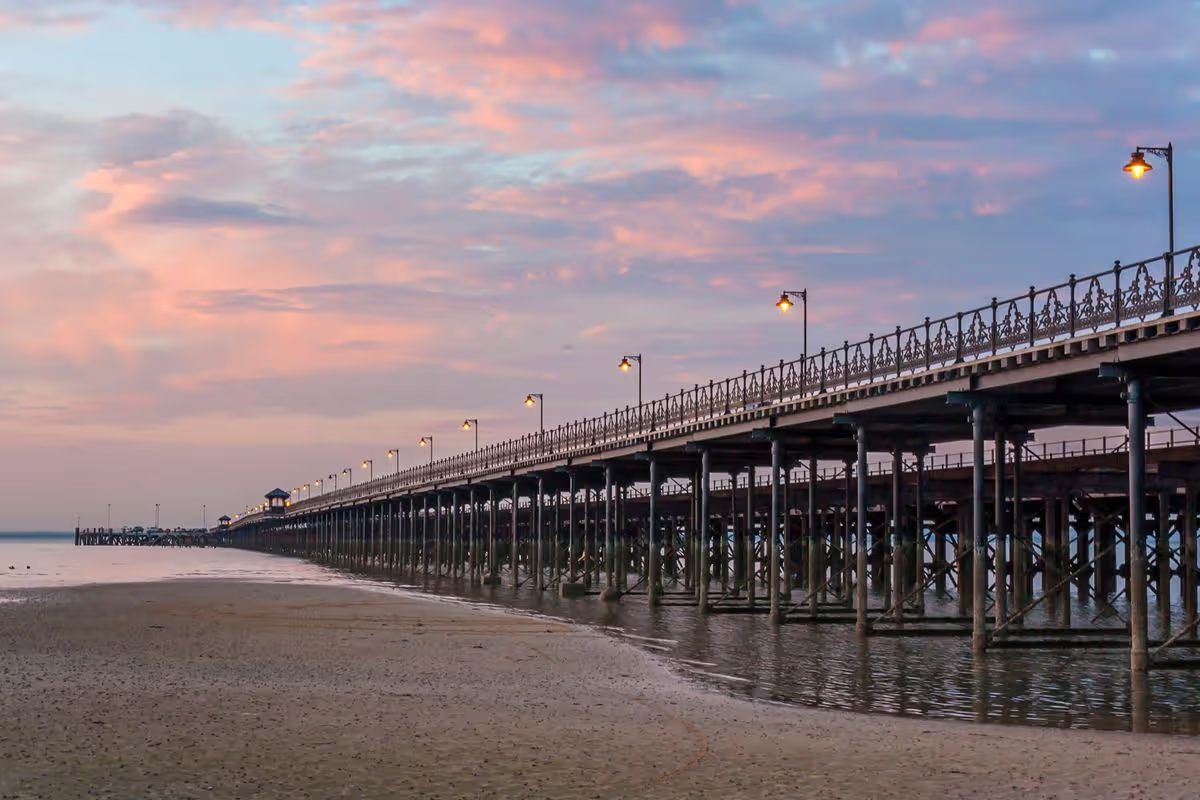



![Israeli far-right Finance Minister Bezalel Smotrich holds a map of an area near the settlement of Maale Adumim, a land corridor known as E1, outside Jerusalem in the occupied West Bank, on August 14, 2025, after a press conference at the site. [Menahem Kahana/AFP]](https://i0.wp.com/www.aljazeera.com/wp-content/uploads/2025/08/AFP__20250814__69HV6DR__v1__HighRes__IsraelPalestinianConflictSettlementPolitics-1755194568.jpg?w=640&ssl=1)