WASHINGTON — Dozens of House Democrats are asking the new director of Immigration and Customs Enforcement to roll back a policy that they say hinders their ability to speak with detainees during oversight visits.
The new policy requires that lawmakers identify detainees by name at least two business days before a visit and provide a signed consent form from each detainee. It’s the latest point of conflict in an ongoing battle over when and how lawmakers can inspect immigration facilities.
In a letter Thursday to acting ICE Director David Venturella, Rep. Mike Levin (D-San Juan Capistrano) and 77 other members of Congress, including two dozen from California, argued that they need to conduct constant oversight of immigration facilities because of historic levels of reports regarding the mistreatment of detainees, deaths in custody and substandard facility conditions.
“This Administration has enabled a revolving door of arbitrary policies, directives, and guidance on member access to facilities or on communication with detainees designed to hinder any productive oversight,” they wrote.
The letter was written in response to the new policy, which was outlined in a memo last month.
In the letter, Levin and the other members wrote that detainees have a hard time accessing the visitation form because it is at times unavailable at a detention center’s law library. They said it limits their ability to speak broadly with detainees, particularly those from vulnerable populations, such as the elderly.
Detainees previously used a sign-up sheet to meet with members of Congress or just started talking to detainees they encountered during facility tours.
In the memo outlining ICE’s new policy, then-acting director Todd Lyons said the increased visits by members of Congress have become a burden and a time suck. Homeland Security didn’t immediately reply to a request for comment, but previously said that the policy doesn’t prevent lawmakers from speaking with detainees.
Levin said the increase in visits was necessary because the agency slashed staffing of its oversight offices. The letter notes that for next fiscal year, the president requested additional cuts to the Homeland Security Office of Inspector General.
“These actions, coupled with the constant changes to policies surrounding member access to facilities, reveal a clear attack on the levers that ensure government transparency at every level,” the members wrote.
Democratic House members sued the Trump administration last July after they were repeatedly denied access to immigrant detention facilities in California and across the country.
Homeland Security officials previously implemented a policy requiring lawmakers to give seven days’ notice before a visit, but that policy was temporarily blocked in federal court.
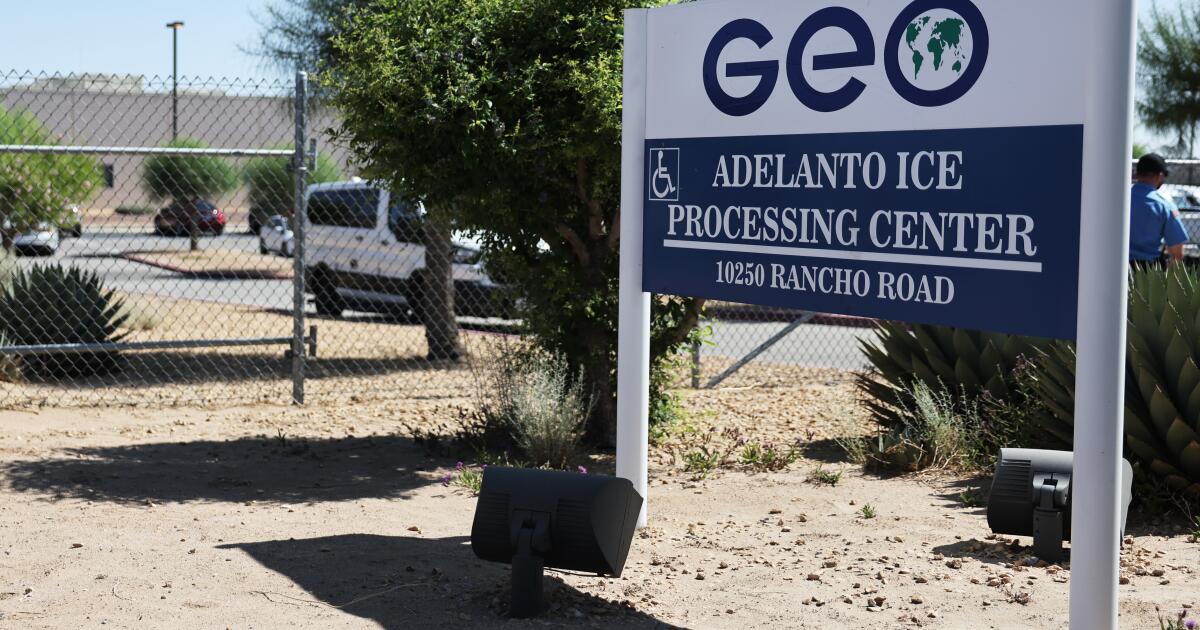
This week, lawyers said a Belizean man who helped organize hunger strikes at the Adelanto ICE Processing Center was moved to facilities out of state and scheduled to be deported after he spoke to three members of Congress about conditions at the detention center in San Bernardino County.
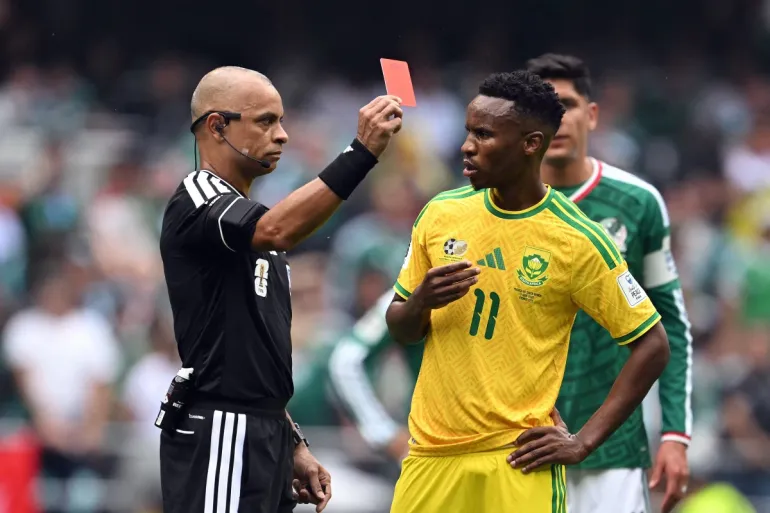
In many ways, the most ambitious World Cup in history — which kicked off Thursday in Mexico City — has inspired more angst than anticipation, more fear than fervor.
The competition, returning to North America for the first time in more than three decades, has expanded to 48 teams and 104 matches, to be played over 39 days in 16 cities in the U.S., Mexico and Canada. The complex planning was eight years in the making.
Yet even before the competition opened with Mexico facing South Africa at the iconic Estadio Azteca, it has been marred by a number of controversies that threaten to overshadow the soccer and cloud the tournament’s legacy.
“I view this World Cup as the most politically combustible World Cup in recent history. And that’s saying something,” said Jules Boykoff, a political science professor at the University of Portland and author of eight books on the politics of international sport.
“We’re in uncharted territory in many ways.”
Relations between the host countries, once strong, have been strained by the Trump administration’s tariff policies and disagreements over border security. Travel bans have barred potential World Cup visitors — and even support staff and match officials — from entering the U.S. and others are fearful of making the trip, worried about ICE raids and immigration roundups.
The U.S. is at war with a tournament qualifier, Iran. And Iran has fired missiles and drones on Jordan, Qatar and Saudi Arabia, nations that also are World Cup participants.
The International Sports Press Assn. said Iranian and African journalists have been denied visas to cover games in the U.S., and Iran protested after more than a dozen members of its support staff had their requests to enter the U.S. rejected. The Iranians, who were forced to move their training base from Tucson to Tijuana, will spend limited time in the U.S. during group-play games that will take place in Inglewood and Seattle.
Players and journalists from Senegal, Uzbekistan and Iraq have been detained at U.S. airports for up to seven hours by immigration officials. Then on Monday, Omar Artan, a decorated referee and the first Somali official selected to work a World Cup, was turned away at Miami International Airport.
In addition, ticket prices have been so high and the lottery process for obtaining them so opaque, the attorneys general of New York and New Jersey have begun formal investigations into FIFA practices. Other states, including California, hosting tournament matches have begun asking questions as well.
All that has conspired to produce a World Cup that is struggling to catch on with the public. According to a recent poll by Yougov.com, a majority of Americans — 54% — say they are not at all interested in the tournament and nearly six in 10 say they will not watch any matches.
“People are just in a bad mood,” Boykoff said. “It’s a tough time.”
FIFA president Gianni Infantino remains optimistic, promising this will be “the biggest, the most inclusive, the greatest FIFA World Cup ever.” He made the same claim about the 2022 World Cup in Qatar and the 2018 tournament in Russia.
FIFA president Gianni Infantino speaks during a news conference on Wednesday before the start of the World Cup.
(Carl Recine / Getty Images)
“The World Cup should be understood as both a global sporting celebration and a major commercial enterprise, with these two dimensions being mutually enforcing rather than contradictory,” said Steve Georgakis, a lecturer on sports studies at the University of Sydney and a frequent author on soccer.
This year’s tournament is projected to swell FIFA’s coffers by nearly $9 billion and the TV ratings, it says, will be massive.
“Its universal appeal combined with the participation of 48 nations ensures that it remains a genuinely global sporting event,” Georgakis said.
Boykoff has his doubts.
“In this particular political moment, with the Trump administration being erratic and impulsive and needing a win from this tournament and the fact there’s so many moving parts geopolitically, I don’t have confidence that it’s just going to end up being a soccer-focused next five weeks,” he said.
This is not the first World Cup to kick off under some kind of black cloud.
The 1974 tournament in West Germany was tarred by the geopolitical fallout of the 1973 Yom Kippur War. Four years later Argentina’s military dictatorship used the World Cup to sportswash a “Dirty War” in which as many as 30,000 people were tortured, murdered and disappeared.
The 2010 and 2014 World Cups were troubled by cost overruns and delays in the construction of stadiums and other infrastructure and the threat of labor unrest while global outrage over human rights violations and discrimination against women and LGBTQ people hung over the last two tournaments.
Those issues never fully disappeared but were overshadowed by the brilliance of the soccer. Jonathan Wilson, a columnist with the Guardian and author of “The Power and the Glory: The History of the World Cup,” expects the same this summer.
“The other stuff will still be there in the background,” he said, “but fundamentally the football will, for the vast majority of people, take over. It’s just sort of a natural cycle.”
Argentina star Lionel Messi controls the ball during an international friendly against Iceland on Tuesday.
(Butch Dill / Associated Press)
And as with every World Cup, there undoubtedly will be unforgettable moments.
Argentina’s Lionel Messi and Portugal’s Cristiano Ronaldo, the top scorers in soccer history, will be playing in their sixth and final World Cups — Messi chasing a second straight title and Ronaldo pursuing the only prize that has eluded him.
Kylian Mbabbe will be trying to take France to a third consecutive final while young superstars like Erling Haaland of Norway and Lamine Yamal of Spain will be looking to put their mark on their first World Cups.
Four teams — Jordan, Curacao, Cape Verde and Uzbekistan — have qualified for the tournament for the first time.
And there will be other storylines no one saw coming, all of which will contribute to the narrative of this World Cup.
“Major sporting events have a way of capturing public attention and shifting the conversation toward what is happening on the field rather than off it,” Georgakis said.
How much the actions of the Trump administration affect that calculation remains to be seen.
There are travel restrictions in place that fully or partially bar citizens from 39 countries — including a number of World Cup participants — from entering the U.S. And the administration has said ICE and Homeland Security personnel will have a visible presence at World Cup venues, including SoFi Stadium in Inglewood, where the American team will begin play Friday.
“There will be federal agents,” confirmed L.A. County Sheriff Robert Luna, who added that he could not guarantee immigration sweeps would not take place. “ They told us that specifically would not be occurring,” he said. “Any of that’s subject to change.”
Mexico fans celebrate during a watch party at Plaza Mexico in Lynwood on Thursday.
(Kayla Bartkowski / Los Angeles Times)
The difficulty in obtaining visas and the fear of being rounded up by immigration agents are being blamed, in part, for less-than-expected tourist traffic. Hotel operators in all 11 World Cup host cities say bookings for the tournament are well below projections. Several countries have issued warnings about travel to the U.S.
Then there are the own goals from FIFA over tickets and parking prices as high as $900 at some stadiums, weather issues and a short-lived ban on water bottles.
FIFA has defended its policies on ticket prices by arguing that premiums are necessary to maximize revenue, which it will invest in global soccer development. Variable, market-based pricing, it said, simply reflects standard entertainment practices in North America. The organization did, however, reverse its ban on fans bringing bottles into games. Spectators are now allowed to enter stadiums with one soft, plastic 20-ounce water bottle.
And despite a warning from climate scientists that one in four World Cup games could be played in dangerously hot conditions, FIFA will start 40 of them at 3 p.m. or earlier local time, the warmest time of day, to accommodate European TV viewers.
Georgakis said the play on the field will have to overcome all those issues if this World Cup is to earn a favorable place in history.
“Ultimately the success of the World Cup will be judged by what happens on the field,” he said. “If the football is compelling, dramatic and memorable, the tournament will likely be remembered as a great World Cup. If the play falls short, then the off-field issues such as ticket prices, extreme heat, ICE enforcement activities, the Trump administration will receive great attention and could shape perceptions of the event.”
June 12 (UPI) — Iran said it had yet to make a final decision on an agreement with the United States to end the war, despite U.S. President Donald Trump saying it was a done deal that could be signed as early as this weekend.
Speaking on Thursday night, Iranian Foreign Ministry spokesman Esmaeil Baqaei said Tehran was reviewing a proposal brokered by Qatar and Pakistan but dismissed reports agreement had been reached as “speculation,” adding that “nothing has been finalized.”
“So far, Iran has not reached a final conclusion on the agreement. Whenever we reach a conclusion that the text of the [memorandum of] understanding is in the interest of the Iranian nation, we will announce it.
“The status of negotiations was clear to us from the beginning and a major part of the text had been finalized, but the Americans kept changing their positions,” said Baqaei who stressed Iran would never retreat from or compromise “on what it defines as its red lines.”
Baqaei’s comments came hours after Trump called off planned large-scale strikes against Iran, including Kharg Island, from which 90% of Iran’s crude oil exports are shipped, saying the Iranian leadership, and other regional powers, had approved “final points” of a deal to end the war.
“Based on the fact that discussions with the Islamic Republic of Iran have been brought to the highest level of Iranian leadership and approved, I have, as President of the United States of America, cancelled the scheduled strikes and bombings against Iran this evening,” Trump said Thursday afternoon.
Trump later said the deal was “subject to finalization of documents, which should get done, over the next few days” and that there would “probably” be a signing ceremony, with Europe the most likely location.
The status of the Strait of Hormuz was also in contention with an announcement by U.S. Central Command that the key shipping route was not controlled by Iran and was “open for transit” to all vessels not in breach of the U.S. blockade of Iran, contradicted by Baqaei.
“The Strait of Hormuz remains closed due to illegal U.S. actions,” he said.
Trump has stated an agreement to end the fighting was imminent on multiple occasions since a cease-fire, originally for two weeks, came into force on April 28.
The deal being negotiated is a memorandum of understanding extending the cease-fire for 60 days to allow larger negotiations on the main issues, including Iran’s stockpile of enriched uranium and its nuclear program.
Oil prices reacted strongly to the developments overnight with both Brent crude, the international benchmark, and West Texas Intermediate, falling sharply in the global market. The Brent contract for August delivery was down $3.83 a barrel at $86.54 in mid-morning trade in London on Friday while American crude for July delivery was changing hands at $83.88 a barrel, down $3.83.
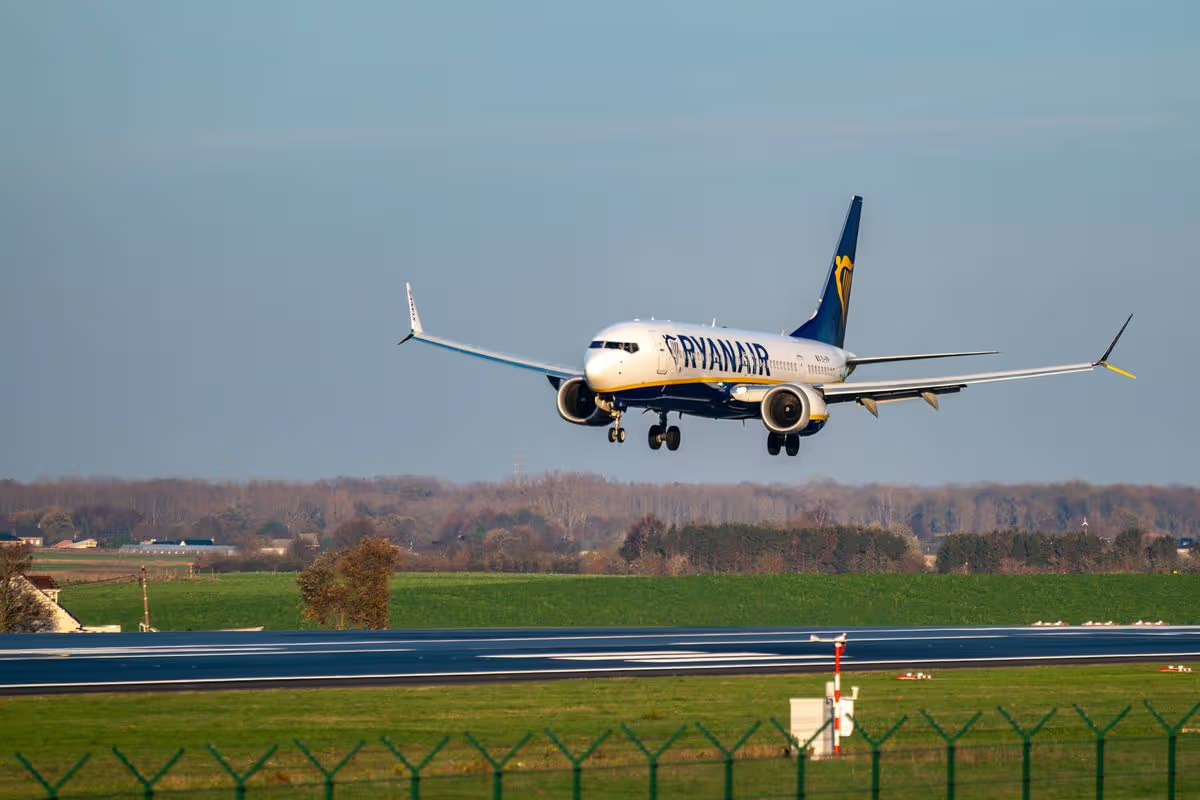
Ryanair is threatening to withdraw five aircraft and cancel 20 routes
The move could happen as early as this winter(Image: Michael Mulkens via Getty Images)
A major Ryanair move could impact millions of passengers, with 20 routes axed and around 150 jobs lost.
The budget airline could withdraw planes from its Charleroi base as soon as this winter if Belgium goes ahead with plans to double its tax on airline tickets. “But we are not going to completely close the Charleroi base,” said Ryanair CEO Michael O’Leary during a press visit to the company’s headquarters in Dublin. The federal government is looking to double the airfare tax on flights exceeding 500 kilometres from next year, pushing it up from 5 to 10 euros.
This would bring the levy in line with that applied to short-haul flights, although the tax on these is also set to rise to 11 euros. Finance Minister Jan Jambon made clear this week that he has no plans to reverse the decision.
As a result, Ryanair would remove five of its 19 aircraft currently operating out of Charleroi from this winter. Twenty routes would be scrapped, 15 at Charleroi and five at Zaventem representing a loss of two million passengers per year, Mr O’Leary confirmed.
Ryanair warns that scaling back its Charleroi operations would also put approximately 150 jobs at risk, though affected pilots and cabin crew, many of whom are foreign nationals, would be offered positions at alternative bases. However, “we want to grow in Belgium,” Mr O’Leary said.
“Ryanair aims to increase passenger numbers from 208 million in 2025 to 300 million in the coming years. We want to achieve some of this growth at Charleroi and Zaventem, but for that to happen, the tax on airline tickets must be eliminated, and airport fees must be reduced.”
According to Ryanair’s chief executive, if the tax on airline tickets is not raised, no aircraft will be withdrawn from Charleroi Airport and the situation will remain unchanged. Should the tax be scrapped entirely, it would open the door to further expansion across Belgium.
Ryanair has put forward a growth strategy projecting almost 50% more passengers in Belgium by 2030, pushing the total to 16 million. The Irish carrier would then reopen its base at Brussels Airport, a hub it continues to operate from but where it no longer stations any aircraft, and would even weigh up flights to and from Liège.
This ambitious expansion plan will only come to fruition, however, if all of Ryanair’s demands are met, most notably a loosening of restrictions on night flights in Brussels. On the flip side, any hike in the airline ticket tax would result in a scaling back of operations.
The closure of the Charleroi base isn’t under consideration, though. “Normally, we would never close Charleroi,” said O’Leary. “We’re not going to threaten to close Charleroi. It’s one of our largest bases, and we’ve invested a lot of time and effort in developing this airport over the last thirty years. But in the long term, we could reduce the base to, say, 10 aircraft.”
O’Leary also touched on the soaring cost of aviation fuel, a result of the conflict in the Middle East. The airline has locked in 80% of its fuel requirements until next March at an average cost of $67 per barrel, while the current rate stands at $100 or above.
“We aren’t hedging for the following period yet, as we anticipate prices falling in the coming months. But we could be wrong. If prices haven’t fallen by September, we’ll start to worry.”
With consumer uncertainty prevailing, O’Leary doesn’t expect any fare rises this summer. “Fares should remain stable. We need to incentivise people to travel by offering slightly lower prices” than the 3% to 5% increase that had been forecast.
One code can mean it takes longer to get through security. Here’s the code many travellers dread seeing on their boarding pass and what it means for their flight if they get it
11:40, 12 Jun 2026Updated 11:42, 12 Jun 2026
Getting through security may take longer(Image: Getty)
Navigating the airport can be an exhausting ordeal. In an ideal world, we’d sail through the security queue to give ourselves time to browse the perfumed duty free outlets or enjoy a relaxed coffee, but there are many bottlenecks where you can find yourself delayed.
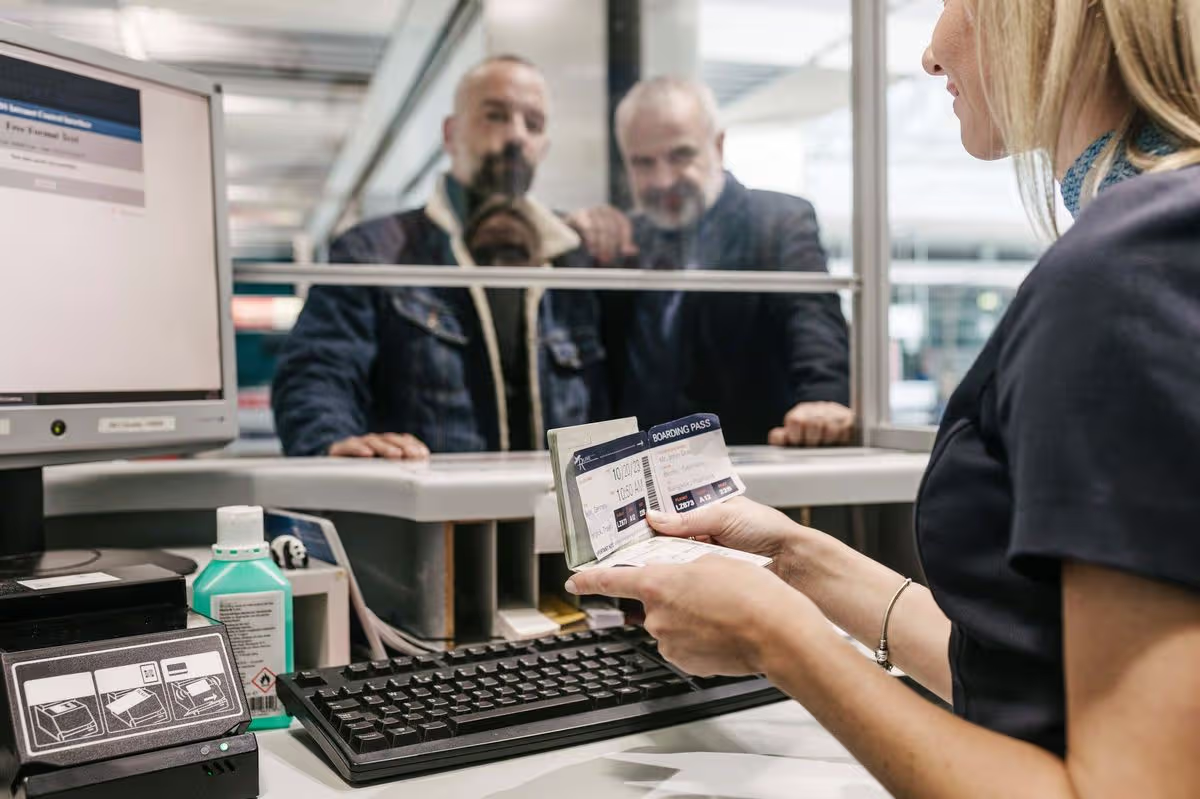
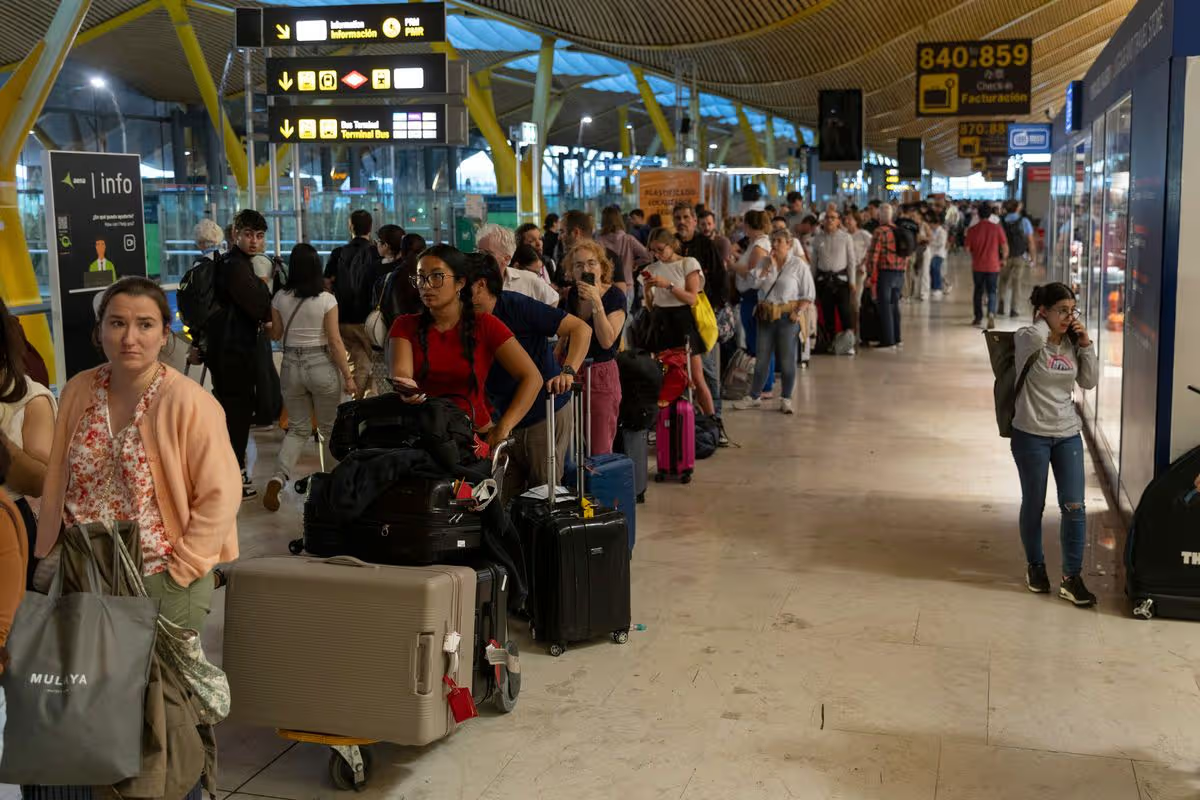
One indication that your journey through the airport might not run as smoothly as you’d hope can be identified once your boarding pass has been printed. Check-in personnel will often add codes to your ticket alerting airport staff to watch for particular things, and there’s one code travellers really won’t want to encounter if they’re jetting off to the World Cup.
Those flying to or from the United States may notice SSSS on their boarding pass, which stands for Secondary Security Screening Selection or Secondary Security Screening Selectee. Essentially, this code indicates you’ve been chosen for extra inspection, and this can be for a wide range of reasons.
Certain airlines won’t print SSSS, but may have their own method of flagging that a passenger requires additional screening. For instance, Southwest Airlines reportedly uses a chequerboard pattern which appears on boarding passes.
Citizens of particular countries, such as those with sanctions or political tensions with the USA, may be more likely to encounter SSSS on their boarding pass. But the Transportation Security Administration (TSA) remains tight-lipped about the precise criteria that could see your name flagged in this manner, reports the Express.
The ACLU (American Civil Liberties Union) has previously claimed that “TSA maintains a “Selectee List” (sometimes called the “Automatic Selectee List”) of people who are automatically and intentionally selected for enhanced screening every time they fly.”
However, there are other factors that could see passengers flagged for additional screening, including making one-way bookings and purchasing tickets with cash. Travellers who have previously passed through high-risk countries, regularly visit ‘unusual’ destinations, or display other flight patterns deemed suspicious may also find themselves subjected to extra screening.
Having a name similar to someone on a Department of Homeland Security watch list could be yet another reason you end up with additional security checks, and could even result in you being denied boarding. Passengers who are repeatedly flagged for extra screening can apply for the DHS Traveler Redress Inquiry Program (DHS TRIP), and if approved they’ll receive a Redress Control Number to use when booking flights, which should make their travels considerably smoother.
If you do spot SSSS or a similar code on your boarding pass, there’s no need to panic. More often than not, it simply means you’ll require some additional time to clear security.
Typically this involves an enhanced pat-down, a manual inspection of carry-on bags, and possibly the use of a handheld metal detector as you pass through the security lane. Travellers should make sure they adhere to their airline’s advice on when to arrive at the airport, as this will guarantee they have sufficient time to clear any additional security checks.
In the USA, the TSA advises arriving a minimum of two hours before domestic flights and three hours ahead of international departures.
Have a story you want to share? Email us at webtravel@reachplc.com
YOU’D expect delays at an airport this summer because of EES checks or bad weather, but what about turtles?
On the island of Zante in Greece, the conservation of its loggerhead turtles has seen passengers ‘stranded’ due to a night-time flight ban .
Sign up for the Travel newsletter
Thank you!
If you’re heading on holiday this summer – it could be disruptedCredit: AlamyThere’s a night-time flight ban to protect local loggerhead turtlesCredit: Alamy
The summer months in Zante are the most important for the island’s loggerhead turtles which are also called ‘Caretta caretta’.
The turtles nest on the beaches between May and August during the night.
But this can be easily disrupted if there are loud noises and lights from aircraft nearby.
So to safeguard the turtles, a night-time flight ban is in place between 10PM and 5AM.
While this is great for nature, it can mean some passengers can find their travel plans disrupted.
The woman found that when her flight was suddenly cancelled late at night, she had to wait until the following morning for it to be rescheduled.
She previously said on TikTok: “Basically, my flight home was meant to be at 10pm, and at five to 10 I knew we’d be delayed as we weren’t boarding the flight.
“But at literally five to 10 they announced on the speaker ‘sorry everyone, flight has been delayed until tomorrow.”
She added: “Basically, pretty much everything at Zante Airport shuts at 10pm. So if you have booked a really late flight and it gets delayed for whatever reason, past 10pm, they will just delay you to the next day.”
Her journey home was delayed all-in-all for 24 hours.
One woman found her flight home from Zante was delayed until the following dayCredit: Alamy
It’s well known by airlines and Skyscanner even has a warning on its website about the restriction.
It says: “Do take note that during the summer, flight operations are purposefully paused between 10 PM and 5 AM to safeguard the sea turtles nesting near Kalamaki beach, ensuring minimal disruption to nature while maintaining an efficient travel experience for you.”
The restriction isn’t new and was first brought in during the early 1990s to safeguard loggerhead sea turtles.
The turtles are strictly protected under EU law and the species is considered ‘vulnerable’ across the world.
Zante is an important place for the animals as 80 per cent of loggerhead sea turtles in the Mediterranean nest on the island.
For visitors who head to Zante, they’ll find that aside from its famous Shipwreck Beach, one of the other most popular attractions is seeing the loggerhead turtles.
Your best chance of seeing them is by heading to the Marine Park and going on a diving excursion.
Laganas Bay is a prime spot for turtle-spotting as many of them nest on its shores.
They’re easily seen in the waters too because it’s so shallow.
Passengers wanting to fly with easyJet could get some pretty cheap deals
11:24, 12 Jun 2026Updated 11:27, 12 Jun 2026
Passengers flying with easyJet can use their helpful tool to secure the best deals(Image: Getty)
Booking flights can be expensive, with many people clicking on random days of the week to find the best deal. But did you know two days of the week are likely to be better than the rest?
Travel experts at easyJet say that while the ‘cheapest day to fly’ often depends on factors like destination and flight availability, there are two days of the week you really want to look out for. The airline says: “The cheapest day of the week to fly can vary depending on the destination, flights available, and time of year.
“However, we’d recommend being flexible with your dates and considering flying outside of peak weekend flight times. By booking to fly on Wednesday or Thursday rather than Friday, you can find bargain flights (and get more time at your destination!).”
What is the cheapest month to fly in?
The low-cost airline also noted that the start and end of the year are key periods to look for if you want a trip that won’t break the bank. It adds: “The cheapest month to fly often depends on the destination and the type of trip you’re planning.
“For traditional warm-weather destinations in Spain or Italy, you can often find the cheapest plane tickets in the winter months of January and February. If you’re booking a trip to the mountains or traditional winter destinations like Finland, you’ll often find cheaper flights in November or March.”
As one of the world’s largest airlines, it operates a fleet of 355 aircraft, connecting 164 airports in 38 countries through 1,207 routes. While booking flights during these specific days and months is not a guarantee of the best deal, it urges people to use its Low Fare Finder when searching for the cheapest flight dates to secure the best deals.
Mum blocked from easyJet flight and left £700 out of pocket
In other easyJet news, a mother was prevented from boarding an easyJet flight with her family and lost £700 after being caught out by a crucial passport rule.
Bolaji Omisade was looking forward to a family trip to Greece and arrived at London Gatwick Airport with her husband and three sons. However, after checking in at the airport, easyJet staff informed her that she was not permitted to board the flight.
Confused by the situation, she was informed at check-in that, although her passport had not yet expired, it was no longer valid for travel due to passport regulations. You can read the full story here to make sure that you don’t fall foul of the same rule.
IF you’re looking for five-star stays on the cheap, check out Zaragoza in northeastern Spain.
The city has rooms in luxury hotels for as little as £79 per night for two people, as well as a thriving tapas scene – and it’s going to be very hot next week.
Sign up for the Travel newsletter
Thank you!
Zaragoza has rooms at five-star hotels for under £80 per nightCredit: AlamyHotel Palafox has a rooftop pool and rooms from £80Credit: booking.com
After a restful night, there’s plenty to do in Zaragoza which sits on the banks of the Ebro River.
And if you fancy a visit soon, the city is set to reach highs of 37C next week.
For tapas, head to El Tubo which has maze-like and narrow streets filled with restaurants.
The small dishes are generally served from 1-4pm and 8pm-midnight.
Hotel Palafox has rooms from singles to grand suitesCredit: Expedia
Some tapas specialities here include Ternasco de Aragón (lamb), migas (fried breadcrumbs), and borraja which is local wild greens.
It’s also a prime bar-hopping spot during the evenings.
If anyone is heading there as a family, there’s lots to keep children entertained like the aquarium and the Emoz origami museum is filled with tiny paper treasures.
The city has some impressive buildings, some of which are Basilica de Nuestra Senora del Pilar and Palacio de la Aljaferia.
Further afield, visitors can take a day trip to the Monasterio de Piedra which is a national park that has lots of pretty waterfalls.
Travel operator has spoken out on its family rules as Ryanair is facing an investigation over allegations it charges parents to sit alongside their children on flights
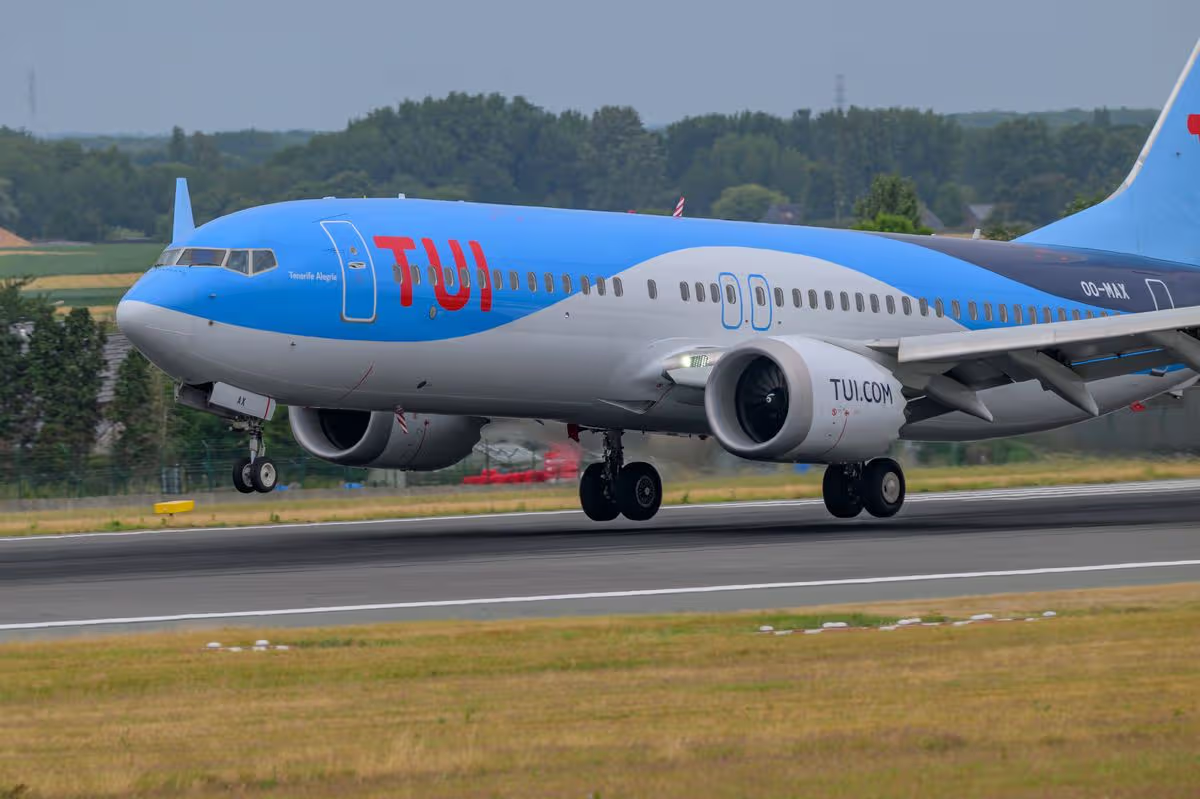
TUI said children will be seated directly next to the parent, across the aisle, or in front / behind(Image: Getty Images)
Holiday firm and airline TUI has outlined a crucial rule surrounding seat bookings – as the Competition and Markets Authority (CMA) opened an investigation into competitor Ryanair. Ryanair is facing scrutiny over its practice of charging parents to sit alongside their children on flights.
The competition watchdog, the Competition and Markets Authority (CMA), confirmed it will assess whether the approach is “in line with consumer law”. The airline branded the investigation as “bogus” and a “failed effort by the Starmer Government to pretend it cares about consumers”.
Ryanair mandates that parents flying with children aged between two and 11 must pay to reserve what it calls a mandatory family seat. Their children are subsequently assigned seats next to or close to them at no additional cost.
The charge for a mandatory family seat typically stands at around £8 each way, according to the CMA. As the story emerged, one TUI customer turned to X to question how it was possible that his wife was being charged to reserve a particular seat – and that their son might end up seated separately from her.
TUI replied: “If your wife needs any assistance with her booking, please ask her to send us a direct message with the booking details so we can take a look for her.”
The individual then stated: “Don’t need assistance as it is booked, just frustrating she felt pressured to pay that when it isn’t the case that a five year old will be sat on his own.”
The TUI operative then clarified that they cannot guarantee the child will be seated directly beside the parent, explaining: “Please be reassured that children under 12 will always be seated with at least one adult from your booking, this may be directly next to them, across the aisle, or directly in front / behind, depending on the aircraft configuration and availability at check-in. Katy”.
The father responded: “So you would leave a 3 year old sat behind their parent?”.
According to TUI’s terms and conditions: “If you’re flying with TUI Airways and there’s a child under the age of 12 on your booking, we’ll make sure they’re seated with at least one adult in your party. If you’d like to make sure everyone sits together, we recommend reserving seats when you book, or adding them later in Manage My Booking.
“If you don’t use our Select Your Seat service, your seats will be automatically allocated when you check in online.”
Booking a TUI seat costs anywhere from £12 to over £90 per passenger, each way, depending on the destination, flight duration, and seat category. Standard seats are priced between £12 and £45, while upgrades such as Extra Legroom or Premium Seating carry higher charges.
Without paying, seats are assigned automatically at no cost during check-in. Following the previous query, TUI clarified: “Hi there, its lovely to hear from you. As katy explained a child can be seated row directly in front, behind, or across the aisle if under 12 years old and hasn’t purchased select your seats but the team on the flight will be on flight to assist fully. Laura.”
Ryanair is facing an investigation over allegations it charges parents to sit alongside their children on flights.
Children under two are required to sit on their parent’s lap on Ryanair flights. For other passengers, paying to reserve a seat remains optional.
The CMA confirmed it is examining whether Ryanair’s policy means “parents are being charged for the airline to meet its child safety and disability-related obligations as set out under aviation rules”.
Ryanair is “the only major airline flying out of the UK to impose this charge”, the watchdog stated.
Other airlines allow children to be seated next to a parent without requiring a paid adult reservation, or automatically assign seats together during the booking process, the CMA noted.
The probe will also look at whether Ryanair’s compulsory family seat charge is dripped during the booking process — when a company fails to show customers all unavoidable costs upfront.
The CMA stressed it is at the early stages of its investigation and has “reached no conclusions about whether Ryanair has broken the law”. Hayley Fletcher, senior director of consumer protection at the CMA, said: “Lots of families save up to afford a summer holiday and we know that extra charges can quickly bump up the price.
“Our investigation will consider Ryanair’s approach to family seat reservations and how the cost is presented to consumers, to determine whether they comply with consumer law.
“For the past year, we’ve told businesses to ensure their customers are shown the total price upfront – those who don’t face the very real possibility of action from the CMA.”
Rory Boland, editor of consumer magazine Which? Travel, said: “Ryanair doesn’t have to wait for the outcome of the CMA’s investigation. It could stop charging these unreasonable fees today and we would encourage them to do that.”
Ryanair issued a statement saying: “Ryanair’s family seating policy fully complies with all relevant laws and regulations, and saves families money when travelling on the UK’s lowest fare airline.”
The airline insisted it “does not charge any fee for children to sit beside their parent”, and “parents travelling with children pay for only one (adult) reserved seat”.
It went on to say: “This bogus CMA investigation is a failed effort by the Starmer Government to pretend it cares about consumers when it has failed to abolish APD (air passenger duty) which would immediately deliver lower fares for all consumers and growth for the UK aviation, tourism and wider economy.
“Ryanair looks forward to disproving these false CMA claims.”
The CMA is an independent non-ministerial Government department, funded by the Treasury.
BUDGET airline Wizz Air has warned that it could be forced to cut UK routes due to rising costs.
It comes after air passenger duty (APD) was raised in April – a tax on airlines that is usually then passed onto passengers by increasing flight fares.
Sign up for the Travel newsletter
Thank you!
Wizz Air is threatening to axe some of its flights from the UKCredit: Shutterstock Editorial
Wizz Air boss József Váradi said that the airline will now look at whether the rise in APD will impact demand for its flights and depending on the results, whether any of the airlines routes should be cancelled.
The APD rise in April hit a record high and further increases are expected in the future.
On economy flight fares, APD rose from £13 to £15 in April, to most destinations across Europe.
For Brits travelling on holiday, this means that a family of four could be spending an extra £60 (£8 more than previously) before even adding luggage to their flight booking.
While Wizz Air has not confirmed which flights are at risk, the airline currently flies to 77 destinations from the UK including holiday hotspots such as Alicante, Tenerife and Majorca in Spain.
The airline boss added that while Wizz Air is mostly happy with its services from the UK, “issues affecting the UK airline industry like APD charge increases” cannot be ignored.
He said: “We have to evaluate how exactly that plays out on our network, our customer base and our financial performance and make decisions accordingly.”
“If the cost of business is going up, that will result in capacity rationalisation if you are unable to pass it on to customers.”
The APD rise comes at a time when many airlines are already feeling the financial pressure of rising air fuel costs.
Váradi added: “I do not think the UK should be overcharging airline customers to raise funds for other activities and commitments, because this is going to undermine airlines and the UK is going to lose out on tourism at the end of the day.”
“It’s my favorite city in the world,” says the comedian, musician and actor best known for the beloved sketch comedy series “Portlandia” and for “Saturday Night Live.” “It has a really strong sense of community for such a giant city,” he adds, noting the recent celebration surrounding the new Los Angeles County Museum of Art and Metro’s D Line extension.
In Sunday Funday, L.A. people give us a play-by-play of their ideal Sunday around town. Find ideas and inspiration on where to go, what to eat and how to enjoy life on the weekends.
Armisen enjoys being behind the wheel, which is how he first noticed Hulu’s “Deli Boys,” where he plays casino boss Max Sugar in the show’s second season.
“Strangely, I was a fan before I was a fan of the show,” he says. “I was a fan of the billboards. I saw ads for it, and I was immediately curious. Like, ‘What is that? Why is it called ‘Deli Boys’? Who are these people?’ There was something about the three leads, a sort of chemistry or charisma, that I wanted to be a part of.”
For him, the perfect Sunday involves traversing the city, checking out record stores and visiting museums like the Museum of Jurassic Technology in Culver City. “I fell in love with it as its own art piece,” he says. He also enjoys going to live shows, sometimes performing and spending time at home with his family. For him, the ideal day in L.A. “is a mix of all of those things.”
The one place you won’t find the sun-averse actor is the beach. “Los Angeles is a great place for people who hate the sun,” he says. “There’s a goth quality to it. So many of the best punk bands came out of Los Angeles.” He appreciates that you can avoid the sun by staying in your car. “It feels like I get to confront my hatred for the sun without being in it,” he says.
This interview has been lightly edited and condensed for length and clarity.
5 a.m.: Early rising
I love Los Angeles so much that sometimes, when I wake up, it’s still dark outside. So it’ll be, like, 5 or 6 o’clock in the morning, and it’s dark, but the palm trees are silhouetted in the sky. Right away, I’ll have granola or Grape Nuts with almond milk and blueberries. And then I just like to sit in silence while it’s still dark out, while sipping two mugs of coffee. If I do go out, the Village Bakery and Cafe on Los Feliz Boulevard is really nice for breakfast or if you have to meet someone. There is a scramble there that I really like. But lately, I’ve also been getting granola with yogurt.
8 a.m.: Make it a work day in Elysian Valley, a.k.a. Frogtown
I like to make every day a work day. So even if I have a day off, I still try to do one work-related task. I have a music-and-writing space in Frogtown where I’ve had an office for a while. I had one there when we wrote “Portlandia.” I’ve got my drums set up, and I usually like to get things ready for touring. I have all these flight cases and drums there and I get all my equipment together. I’ll just clean them up a little bit. Sometimes I practice — not practicing to get my rudiments up for drumming — but just because I enjoy drumming so much.
11 a.m:. Lunch in Frogtown
There are a few places in Frogtown where I like to have lunch. There’s a vegan cafe near me called Just What I Kneaded, which is great, or the Spoke Bicycle Cafe, which is a little down the river. I like the chickpea farro bowl with Brussels sprouts and tempeh. Sometimes I’ll go to Wax Paper and order the Kai Ryssdal sandwich. Their sandwiches are really good and are named for National Public Radio hosts. We have to embrace being pretentious. I think in these cafes, we should talk about the Velvet Underground. It’s almost like cosplaying. Like, let’s really be Silver Lake. Well, you know, with bicycles.
1 p.m.: Run errands at the Americana at Brand
I can’t just stay in Frogtown, so I’d next go to the Americana at Brand outdoor mall because sometimes, when a place is devoid of all those pretensions, it’s actually very relaxing. You can walk around and get a lot of errands done. I love the sushi place the Bar — Hand Rolls by Seabutter.
2 p.m.: Take a drive through Griffith Park
I love driving. That’s one thing that I love about Los Angeles. Everywhere I go, I get to be in my car. I like listening to the radio. It’s just a peaceful place to be. There’s something special about it, especially as day turns into dusk. I like going down Sunset Boulevard or Beverly Boulevard. I also love driving Crystal Springs Drive through Griffith Park. It is the prettiest drive. The speed limit is nice and slow. In the summer, there’s a free Shakespeare festival in that same park. I haven’t made it yet because I’m usually traveling, but I’ve always wanted to go.
3 p.m.: Hit the record stores
I know it’s a cliché for me to say I go to record stores, but I do. I like going to Amoeba Music in Hollywood. I’ll get any reissue, like a new box set. And there’s always something that’s just come out. Sometimes I’ll go to a musical instrument store called Caveman Vintage Music in Lincoln Heights just to pick up a few things that I’ll need, you know, drumsticks or whatever. Or sometimes I’ll get a weird little amp or keyboard.
6 p.m.: Sushi dinner in Glendale
If I go out to dinner, I like going to Sasabune in Glendale. It’s on the third floor of a building near the Americana. In my opinion, Los Angeles has the best sushi in the world. Ventura Boulevard in the Valley is amazing, but this place is my favorite restaurant in the world. Wow. I love it.
8 p.m.: See live music
Once a month, although not usually on Sundays, I play covers at a bar and record store called Permanent Records Roadhouse in Cypress Park. Sometimes I do stand-up at Largo at the Coronet. But I love to see live bands. The Bellwether and the Teragram Ballroom are great venues to see bands. Those two, I’d say, are my two favorites to go to because I like a little bit of space, because I can’t be up at the front. You know, I’m so famous that bands stop playing [laughs] when they see me. No, I’m just a patron. I’m a fan. TheGreek Theatre is a fantastic place to see live music. And the Ford amphitheater! The last time I went, I thought, ‘Why don’t I come to every show here?‘ because it’s the perfect size. It’s outdoors. It’s not gigantic. Every seat is good. It’s really, really great. I saw Neil Young there. I saw Paul McCartney at the Fonda Theatre in March, and he was unbelievable. I love that he played there. I like the Hollywood Bowl, obviously, but everybody knows that.
As a pariah child in search of Islamic knowledge, Goni Abubakar has no clue what it means to hold a gun and pull the trigger. He is just an almajiri who runs errands for his cleric master in Bama, a town in Borno State, northeastern Nigeria. He learns to recite Quran verses by heart; he is one of the brightest pupils under the cleric’s tutelage. In the beginning, the messages are clear: have faith in Allah, the Prophet Muhammad, and the Day of Judgement. Every pupil carries these heavy words around and keenly believes in them. They say the Quranic verses that match those words by heart: “O you who have believed, fear Allah and believe in His Messenger; He will [then] give you a double portion of His mercy and make for you a light by which you will walk and forgive you; and Allah is Forgiving and Merciful.”
The preaching is pious until peril pierces the heart of the preacher.
The teacher sells groceries, and Goni doubles as his shop assistant. Detached from his parents as a child, he was now a teen, tending only to the bidding of his mentor. Dozens of children are on this path to seek knowledge, but Goni is the teacher’s delight: fierce, smart, and completely loyal. Their earliest form of education is the Tsangaya, a traditional Quranic education in northern Nigeria, and most of them have not attended any formal secular school before they are thrown under the control of a man they all call “mallam”. The morning and evening classes are held in the shade of a tree and are led by the teacher, who preaches to them the ways of Islam.
Kids like Goni know what it means to grow up in a local community. A child can sing through the neighbourhood, begging anyone there for food and water. Local farmers prosper in peace after months of tilling and cultivating the land. People sleep at night without fear of being raided by assailants or militants. Fear and terror consumed the town when Boko Haram’s strange ideologies spread like wildfire into the communities. Goni’s teacher is among the first to embrace the ideologies propagated by Boko Haram’s founder, Mohammed Yusuf. As his preaching changed, his way of life changed too, beaming terror and extremism infused into the hearts of children under his mentorship.
In 2009, when Boko Haram went underground before re-emerging in 2010, Goni was already a 12-year-old. Too young and naive to ask questions, he and dozens of children followed their tutor to join the insurgent group that would later destabilise Nigeria. Now, in the northeastern region, the Boko Haram insurgency has uprooted over three million people and killed over 350,000, with government authorities failing to rein in the deadly scourge. Armed violence has spread beyond the region’s borders into parts of the northwestern and north-central regions.
Goni would become a grown man, swallowing the rulings of terrorists until he could no longer bear them. He now seeks redemption and reintegration through the state-backed deradicalisation programme. While it appears he has left a life of violence and attacks for good, it’s not that simple. For him and many other men in his shoes, post-Boko Haram life presents some puzzles that test the true efficacy of the deradicalisation scheme.
Are the terrorist deserters genuinely seeking redemption or only trying to survive? For months – between November 2025 and May 2026 – HumAngle probed the complexities of the former insurgents’ lives, documenting their journeys from the past to the present, their struggles to become civilians again, their secret frontline deals with the military, and the fragile peace their reintegration poses to the civilian population.
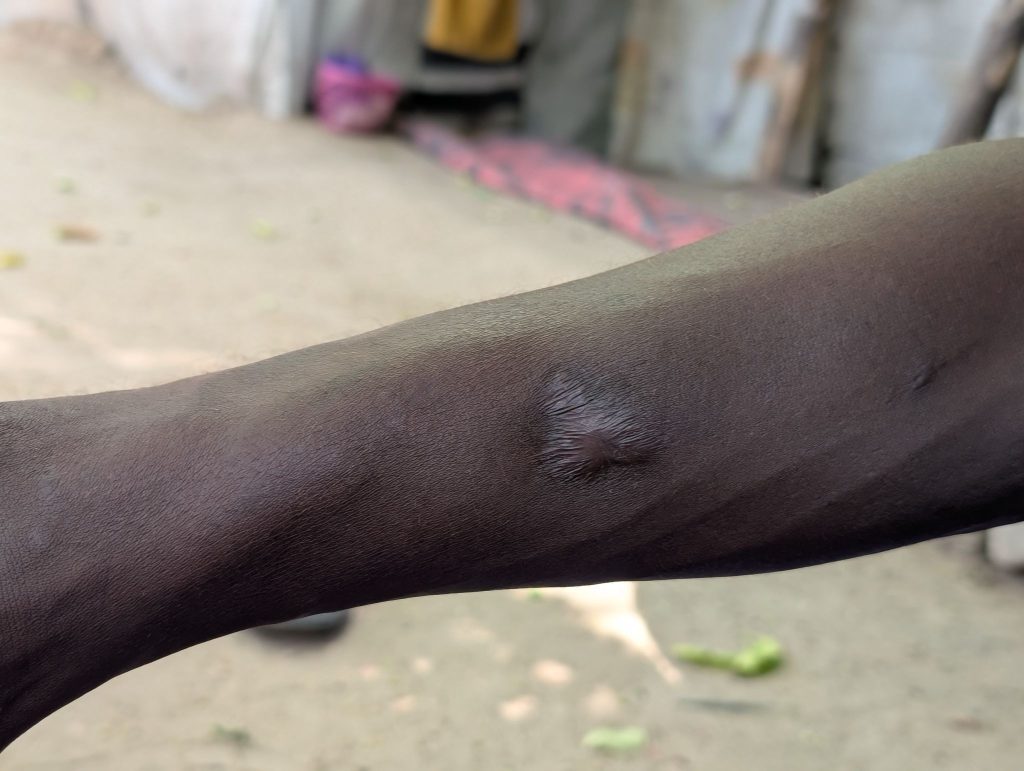
Another defector shows the scars he carries around. Photo: Ibrahim Adeyemi/HumAngle.
Snaring the cat
When Goni joined Boko Haram as a teen, his master’s preachings had switched from admonishing children under his watch to have strong faith in their religion to brainwashing them into a life of violence. They embraced it, truly believing that spilling the blood of people who don’t believe in their ideology was the clearest pathway to paradise. Elsewhere in Borno, in the Malam Fatori area, Ali Bukhar also listened to the sermons of Boko Haram’s jihadists. Those sermons summoned the beast in him and took away the best of his humanity. He joined them convinced that true salvation was immersed in the ideology of killing and maiming.
“In the preachings, they’d emphasise that if you died in the cause, you are a martyr. That you are going to paradise straight,” Ali recalls. He joined as an adult in 2014 during the peak of the Boko Haram emergence. About five months after joining the group, he was asked to attend training. His handlers took him to a riverine area and gave him a gun. “They have a specific instructor whose job is solely to train new intakes. You’d train for about four to five months. After the training, they’d return you to the Markaz [Arabic word for headquarters or centre]. And when it is time to go out for a fight, they’d give you guns.”
Suleiman Mohammad tells a slightly different story. He joined Boko Haram in 2013, during the first Baga attack. The militants and the military had been locked in a fierce battle that cost hundreds of civilians their lives and thousands their homes. A retaliatory raid after a military base was attacked in Baga took a bloody turn for mostly civilians, brewing a trust deficit in the operational methods of Nigerian forces in their fight against terrorism. The insurgent group took advantage of the situation to recruit young people into its unholy ways. Suleiman was among hundreds of people brought into the system after the Baga bloody saga and the uprising that followed. He was a herder in Malam Fatori and had grown up through the local Tsangaya education system.
“So after the Baga attack, I was contacted by the fighters who turned out to be from my village,” Suleiman reminisces. “We studied together when we attended Tsangaya and Islamiyya a long time ago. They told me how the other brothers were with them. They told me stories of how they recite the Quran collectively and also wage ‘holy war’ together. Then they invited me to join them. So, we made an appointment to meet at Mairari.”
A week later, the terrorists came as agreed and met with Suleiman’s father in his home.
“Your son is joining us in the cause of Allah. He’d work for Allah,” the terrorists say.
“Allah’s cause?” the father wonders. “Jihad is mandatory for all muslims. And since he has agreed to go with you, I have no objections.”
The terrorists had come with guns and machetes, Suleiman notes, suggesting that his father was made to agree under duress. “That was how I joined them. We had carried out several attacks ever since. From Mairari, Tungushe, and others. In fact, we held Mairari – under Magumeri – captive for quite some time before it was recaptured by the military.”
People joined the Boko Haram insurgency for different reasons. For Goni and his cohorts, it was a case of misguided faith rooted in brainwashing and psychological manipulation. The story is different for many others. The fire of the burning insurgency started from the charismatic oratory and radical sermons by the founder of Boko Haram, Mohammed Yusuf, between 2002 and 2009. Since at least 2021, HumAngle has interviewed dozens of defectors who revealed why they joined the deadly group before surrendering to a deradicalisation scheme organised by the government. Mohammed took advantage of the dysfunctions within the Nigerian state to campaign against a secular system of governance and, by extension, democracy.
Testimonies from defectors and custodians of Boko Haram’s history reveal that the post-2009 state repression, especially the actual brutality of the Nigerian military and police against civilians, and the uprising that trailed it, were among the factors that drove young people into insurgency. At the time, “Tura Takai Bango”was the mantra for the agitation, literally meaning “they had been pushed to the wall”. The era and the ugly events that unfolded encapsulate the desperation that leads civilians to affiliate with insurgents. When the state’s counter-insurgency tactics involve collective punishment, the civilian population often finds itself caught in a “double jeopardy” where both the state and the insurgents are viewed as existential threats.
Isa Alamndiri, one of the victims of the state repression, told HumAngle how he witnessed the summary execution of young people in 2016, in the Marte Local Government Area (LGA), on the grounds that they were shielding terrorists. “They came and gathered all of us in the village. They then separated the elderly and killed all the youths. They shot over 30 youths that day. Their reason was that we were harbouring Boko Haram in our midst,” Isa says.
Another witness of what many believe pushed youths in the state to the wall, Musa Kurama, recalls that the Nigerian military invaded his village in Meleri, also in Marte, to burn his house, among many others, to the ground, saying that the entire community was a hideout for terrorists. The cycle of violence forced young adults and naive teenagers to take the insurgents’ offer of “protection”, which was a predatory alternative to state-sponsored destruction.
Boko Haram also targeted schools for attacks, deliberately conducting mass kidnappings such as in Chibok and Dapchi to enforce their radical ideology by making secular educational institutions unsafe. This insurgent tactic strategically provides a supply of young captives who were groomed as fighters or forced into “marriages” that facilitate the group’s long-term sustainability. The state’s failure to secure these environments has led to the closure of over 600 schools in the region, creating a lost generation of children who are more susceptible to recruitment because of the absence of alternative futures.
Get our in-depth, creative coverage of conflict and development delivered to you every weekend.
Subscribe now to our newsletter!
Insurgents see children as alternative futures for their groups. Photo: Ibrahim Adeyemi/HumAngle.
Jihad: ‘Pathway to paradise’
Goni has grown up knowing nothing but violence and bloodshed, and now claims he’s out of the messy circle. He smiles as he speaks, but when he remembers how he joined other terrorists to pillage villages, uproot people from their homes, farmlands, and abduct scores, he furrows his brow.
“Before we go out, we would prepare. They’d mobilise 100 to 200 fighters, give them arms, and say, ‘We are going out to wage a holy war’. Then we would charge into military barracks,” he tells HumAngle curtly. “I believe we were deceived by our masters because they don’t practice what they preach and twist religious verses to suit their evil acts and intentions.”
Regardless of how and why they joined, newly recruited insurgents are made to believe that killing and spilling the blood of anyone not following their templates of violence has only one name: jihad. Most defectors we spoke to corroborated this during separate interviews in 2025 and later in 2026.
Experts and scholars in political science, human rights, and peace and conflict studies argue that Boko Haram weaponised the concept of jihad to manipulate its followers into believing keenly in killing and destroying those who disagree with their ideology. In the 2021 issue of the Al-Hikmah Journal on Social Sciences and Education, for example, Issa Muhammad-Jamiu, a researcher at Kogi State University in North Central Nigeria, notes that Boko Haram’s ideology contradicts Islamic injunctions. The most disturbing aspect, he states, is the condemnation of any scholarly verdict that falls short of their view.
“How could they attribute Islam to the prohibition of Western education, which has become a necessity, if not compulsory, to Muslims in the contemporary world? Do they mean that they are more knowledgeable and more committed to Islam than those Companions and Tabi’un who studied foreign cultures and sciences for the interest of Muslim communities?” Issa ponders.
At the Bama IDP camp in Borno State, North East Nigeria. Photo: Ibrahim Adeyemi/HumAngle.
Two sides of the coin
As Goni speaks, his lips look pale and peeling. He’s been battling typhoid and malaria and is still receiving treatment. He carries a gentle demeanour that betrays the terror he had perpetrated, and wears a blank face wrinkled with emotionlessness. For him, peace is a no-brainer when violence is pervasive.
He quips, throwing on a long, tedious smile when asked what he thinks of the concept of peace. “Peace tastes good,” he says. “Living peacefully among loved ones is greater than any other thing. I was in Njimia before leaving. I had worked in several places, including Gazuwa, my birthplace. What made me leave was recent developments. The conflict between the factions and the injustice. So, I took my weapon and left. I arrived at Konduga, where I was received. They then brought us to Bama and then to Hajj Camp.”
Goni believes that embracing peace simply means walking away from a life of pain, violence, and gnashing of teeth. Dwelling in the forest with terrorists means dining with the devil, he says. His moral postulation and spiritual freedom were destroyed in the terrorist camp. He had access to the Quran and understood its teachings, but every verse he read had to be interpreted in accordance with the sect’s teachings. He had no freedom of thought or understanding of whatever he read from the scripture. He had no meaningful life in the forest, he says, apart from destroying people’s lives.
He and many of the terrorist deserters we spoke to said they experienced pain in its most extreme form. Whenever they sustained gunshot wounds during field battles with the military, they returned to the forest almost dead. They were being treated by their locally-trained doctors, whom many of the ex-combatants described as quacks. Most times, they gave them dangerous, addictive opioids such as Tramadol and Refinol. They became addicted to these drugs to escape their daily ordeals, even after healing from the wounds.
“They punished us for taking hard drugs they introduced to us in the first place,” Goni complains. “Sometimes a fighter could be killed just because he takes hard drugs. When they knew it was bad, why did they use it to treat us?”
Many terrorists decided to surrender to the military for different reasons. One major cause of mass defections from the terrorist camps was the sudden demise of Abubakar Shekau, the Boko Haram gang leader who took over the mantle of terror from Mohammed Yusuf. There had been cracks within the insurgent group, leading to the rise of the Islamic State for West African Province (ISWAP), which was formed as a rebel group against Shekau’s camp. Another thing that followed the death of Shekau in 2021 was disease and hunger outbreaks.
The Nigerian military took advantage of Shekau’s death to launch several offensive attacks on the terrorist dens in northeastern Nigeria, destroying their logistics bases. That year, the military said it recorded thousands of defections from terrorists who surrendered to embrace peace. Once they submit themselves to the military after years of committing criminal atrocities, they are subjected to deradicalisation through the Borno Model.
Some terrorist deserters now live in the Bama IDP camp in Borno State. Photo: Ibrahim Adeyemi/HumAngle.
HumAngle interviewed several Boko Haram deserters to examine their understanding of peace after committing grave crimes against the human population in the region. Many of them curiously oversimplified the concept, reducing it to simply switching sides and moving from deadly armed violence to living an average civilian life.
“From my understanding, peace is us leaving the group,” Ali simply says and goes ahead to recount how he joined other fighters to enslave girls for sex after kidnapping them from their homes, schools, and farms. He had been through hell as a former Boko Haram member, and now seeks solace in embracing peace by surrendering to the military. He had been imprisoned by his superiors in the terror camp and asked to surrender his arms, but he refused. “I buried it where they could not see it. I was locked up for three months. When they released me, I went and dug up my gun and left them,” he recalls.
For him and several defectors, returning to the civilian community is an exciting prospect. Despite the horror they inflicted on civilian communities as terrorists, they consider living with ordinary locals again, especially close to their families, as a peaceful reconciliation of their horrible past. “We were ignorant when we did those things in the past. But now we know better,” one of them, Abubakar Saleh, says. He was a Boko Haram commander who led dozens of fighters to dislodge communities, rape women and girls and subjugate civilian communities under terrorist control.
He has now returned to Maiduguri with his family. His wife had just given birth when we spoke to him, and he has settled well into the civilian community. To him, peace is relief from the pain that comes with being a terrorist leader. Although he enjoyed authority as a commanding fighter, his life in the forest was miserable, as he was always on the move to evade military operations and surveillance.
“Life here is better,” he affirms. “It is more comfortable and peaceful. In the forest, there is no rest. You’d hunt daily like a lion. Always changing locations. But here, no attacks.”
For civilian casualties of the terror perpetrated by many of these terrorist deserters, however, peace doesn’t come easily. For years, victims of insurgency in the northeastern region have longed for peace and reparations. Thousands of displaced people not only lost their homes, but also lost hope in ever rebuilding their lives or returning to their settlements. In parts of Borno, especially at the Shuwari displacement site, displaced people feed on the leftovers from former terrorists undergoing the government’s deradicalisation programme, a situation that has created an atmosphere of distrust and inequalities. When the Borno State government began a resettlement scheme for displaced people, they were promised protection and stipends to rebuild their lives. Many of them ended up being re-displaced by terrorists and would not get the opportunity to rebuild their lives.
Ensuring peace and justice in the North East is far more complicated than many terrorist deserters have assumed, says Ndubuisi Ani, a Senior Researcher at the Institute of Security Studies. The transitional justice expert told HumAngle that the defectors’ curious understanding of peace undermines the pains and level of destruction civilians have witnessed at the hands of terrorists. He argues that peace and justice cannot be achieved in tackling violent extremism unless there’s inclusivity, good governance, and stability.
“The state must understand that there are basic needs to be responded to (on the side of victims),” Ndubuisi explains. “A lot of communities need a lot of social contracts on the ground.”
The security expert further explains that any transitional justice scheme by the government must be victim-centred. He advised that the state must go back to its original duty of protecting citizens and ensuring peace and tranquillity in society.
“You’ve not psychologically prepared actors. How do you let the victims understand?” he asked, stating that the government can’t successfully reintegrate terrorist deserters back into society without proper public engagement. “The intent is good, but the approach is the problem.”
Seeking peace and redemption
Like many terrorist deserters, Goni accepts that he has lived a complicated life of violence and horror. This is not the time for regret, he says. It’s a moment to seek forgiveness, to retrace his steps, and perhaps to wash the blood from his own hands. When he arrived at the Hajj Camp in Maiduguri after surrendering to the military and going through the process of deradicalisation, he struggled with the guilt of the atrocities he had committed, and, to prove to the military that he had backed off from a life of bloodshed, he agreed to work in the field with soldiers fighting terrorists. He’s not alone in this. Several former combatants we spoke to said they decided to work as auxiliary operatives to fight alongside the military against Boko Haram, the same sect they once belonged to. Several other defectors noted that when they chose to work with the military – as a way to seek redemption – they were handed rifles, loaded onto the backs of patrol trucks, and sent directly into the marshes and forests they had recently fled.
Asked whether they were coerced into joining the military, Goni laughed before saying the escapade was never mandatory.
“It is a choice,” he replies. “I may decide not to work with them again.”
It is a hard nut to crack, but the terrorist deserters say the military operatives have learned to work and walk with them.
“They arm us and take us with them. If, for instance, a Commanding Officer is going out for an operation, he’d request a certain amount of “repentants” from the Hajj Camp officials. And the officials would assign like 50 or 100 persons to him, depending on the scale of the operation,” Goni says.
By fighting the same people who recruited him into the monolithic Boko Haram camp as a teen, Goni says, he has freed himself from a lifetime of guilt. During his time with the killers, he recalls asking many of the fighters if they loved what they were doing. Those fighters feel trapped, he says; they’re homesick, but even their families have rejected them. Now that he has freed himself from the shackles of terrorism, he says he begs God for forgiveness. But while he seeks forgiveness for the atrocities he has committed, he would use every knowledge he has about the group to fight them back. That’s his way of seeking redemption.
“They give us food and allowances, and we give them intelligence. We show them the hideouts. Because we know the terrain better than they do. We know their fighting styles,” Goni brags, smiling and looking directly at the reporter. “We know their escape routes. Isn’t this helpful enough? Also, we lead the way. They’d follow behind. We charge in.”
Displaced persons at the Bama IDP camp live inside makeshift tents. Photo: Ibrahim Adeyemi/HumAngle.
Redemption through revenge
Ali’s life after Boko Haram is even more thrilling: he seeks redemption through revenge. He had fallen for peer pressure to join one of the most brutal terrorist organisations in existence, and his life had since remained terrifying. For years, he was a cog in the Boko Haram machine, serving with vim and vigour. He learned to repair military vehicles in the forest and became renowned as the sect’s mechanic. He would repair heavy military patrol vehicles seized by the insurgents or those stuck in the mud within the forest during ambushes.
Despite his servitude for Boko Haram’s cause, he says, his entire life with the terror group was a lie. He grew to realise that behind the Boko Haram ideology was a hail of deceit and human manipulation. Bamboozled with distorted interpretations of verses from the Quran, Ali recounts how he had joined hundreds of other fighters to trigger plague, tears, and horror in civilian communities in the name of holy war.
“The practice violates the preachings. My biggest reason was that the practice was not what the Prophet truly teaches,” he claims. “The commanders would usually stay behind, leaving a comfortable life, while the foot soldiers are left starving and fighting day and night.”
For Ali, the deal breaker with Boko Haram was during a chaotic raid in the Tungushe town of Borno. He had come under a heavy burst of military gunfire, which tore through his arm, shattering the bone. He had expected that the sect’s medical team would give him some extra care due to his critical condition, but they treated him like disposable property.
“I was so humiliated by the sect’s medical team, as treatments were handled haphazardly,” he laments. “If it were the commanders, they would treat them swiftly with maximum care. But for fighters, there is usually no medical attention.”
For two straight years, he nursed the pain alone and grew bitter resentment for the sect and its ideologies. He realised he was nothing but a tool for achieving the commanders’ personal hunches and interests. One night, he slipped away, through the scrublands, trudging northward until he found himself around the military garrison in Monguno, where he fell flat on the ground and surrendered.
“After surrendering in Monguno, they took us to Hajj Camp in Maiduguri,” Ali tells HumAngle. “Days later, they brought forward an opportunity where you could help in the fight. You may decide to follow the military during attacks or provide them with intelligence. Whatever you think you can do. So, I said I want to fight. I have a friend who also fights alongside the soldiers. I chose to fight because I have realised that we were deceived by the group.”
Repentance or survival?
Unlike Ali and Goni, repentance has an entirely different meaning for Suleiman: it is an illusion or a political statement made by people in government. Calling him a “repentant Boko Haram” is an insult, he says. To him, that word is a subtle qualifier for a coward. With a cold voice and a sour look, he describes how he worked with ground troops to attack Timbuktu, Sambisa, and other terrorist hideouts.
Four fingers of this anonymous terrorist deserter were chopped off while assisting the military on the battlefield against Boko Haram. Photo: Ibrahim Adeyemi/HumAngle.
His case is more of just switching sides than actual repentance. He dreads the term “repentant Boko Haram” and doesn’t hide it. As a terrorist, he lived for violence, pillaging villages and destroying people’s lives and properties. Following the rise of Abu Mushab al-Barnawi, a factional leader of the Boko Haram sect, Suleiman came under his command, joining over 100 fighters under his control. He had fought fiercely against the Nigerian military on many occasions, and he was feared for his precise brutality amid battles.
His cruelty had no bounds, as he had fought against top Nigerian military leaders, as he states, like Captain Bala, Manga, and Abu Ali, leaving scars on the town that are still visible today. He had also raided beyond Nigeria, maiming locals in the Niger Republic, especially in Diffa, Maine-Soroa, and Chabbal.
When factional infighting turned truly brutal, Suleiman chose to be on the safer side. Exhausted by the tireless internal slaughter, he left and surrendered to the military. Now, he does almost the same thing on the other side. The activity is the same, he notes, only the targets are different.
“I am not comfortable with that name [repentant]. I don’t like it,” Suleiman says. He would frown and then laugh during the interview to convey the complexity of the terror drowning him. “In the forest, I followed someone’s commands. Here too, I am commanded and still branded repentant?”
He wears a worn Civilian Joint Task Force (CJTF) uniform during the interview with HumAngle, bragging about following soldiers to the battlefield against terrorists in Geidam, Marte, Kala-Bridge and Malam Fatori. Despite his defiance, however, he seems to have taken bullets for the military during counterterrorism raids in northeastern Nigeria. His four fingers are chopped off, and there are scars all over his body. It was during a joint offensive with Chadian forces in northern Monguno. An artillery explosion had torn through the military ranks and killed several soldiers and terrorist deserters fighting by their side. He would follow the forces into the fortified hideouts of Timbuktu and Sambisa, giving on-the-ground intel to navigate the terrain.
“I got this arm scar, and my fingers were chopped off while digging out a planted landmine about five months ago,” he says of another military raid he participated in. “The explosion killed two other ex-combatants and nine soldiers. When the engineer scouted and identified a planted bomb, he refused to dig it out. None of the soldiers did. So they asked me to do it. One of the wires sparked. Then it exploded. It also affected my leg.”
The deradicalisation scheme
The term “repentance”, which Suleiman and several other defectors loathe, is one of the modus operandi of the Operation Safe Corridor, a military-led deradicalisation and reintegration programme across northeastern states. Established in 2016, the programme has witnessed both criticism and appraisal from experts and affected citizens. The quest for transitional justice, following the mass atrocities committed by Boko Haram against the people and the government of Nigeria, pushed authorities to come up with peacebuilding efforts.
The federal government had introduced the judicial approach of mass trials of Boko Haram figures captured on the battlefield, but systemic failures of the legal system derailed the processes. With a conviction rate of less than 10 per cent after conducting mass trials of thousands of fighters between 2017 and 2020, public distrust in the judicial system grew rapidly. These efforts also faced hurdles due to limited resources and circumstantial evidence, as well as a massive backlog of approximately 10,000 suspected fighters awaiting trial.
Following deficiencies in the judicial and military mechanisms, the government provided non-judicial options, such as the Operation Safe Corridor (OPSC) and, later, the Borno Model, a scheme designed to handle the mass defections of thousands of insurgents.
File: Some of the OPSC graduands. Photo: Solomon Odeniyi/Punch.
HumAngle reviewed at least two research studies that confirm our on-the-ground reporting on the deficiencies and the public misgivings against the counterinsurgency initiative. The independent studies, one led by Idayat Hassan, then of the Centre for Democracy and Development (CDD), and the other by Hassan-Taiwo Adebayo of the Institute of Security Studies (ISS), noted a systemic imbalance that seemed to favour the rehabilitation of perpetrators over the survival and justice of their victims. The disparity in the attention given to terrorist deserters also fueled widespread community resentment and birthed a narrative that terrorists are being pampered at the expense of their targets. The security and transitional justice experts also assert that a flawed public appeal and information management have sparked outrage and a trust deficit on the government’s side.
One concern Taiwo’s research raised is the persistent challenges in providing sufficient economic support to Boko Haram deserters once they leave the camps. Several defectors HumAngle interviewed raised the same concern. Although they vowed to live civilian lives again, they claimed their lives in the forest were more prosperous, and they’re now facing economic hurdles after defecting. The former insurgents, now working as assets to the military, also complained of constant failed promises. When they’re called upon for operations against the terrorists, the military would pledge mouth-watering financial gains only to offer them an amount far less than what they had promised.
“Then they’d say they’ll pay us each ₦1 million or ₦1.5 million for every crucial piece of information and operation. But after a successful mission, they’d go back on their words and pay ₦100,000 or below. Whereas we have families to cater for. Wives, children, and parents,” Suleiman recounts, a claim substantiated by other former combatants we interviewed.
Wayward ways
As many defectors struggle to settle into communities, civilians also struggle to embrace them. The reason is not far-fetched: the villagers have grown resentful of former Boko Haram members who have raided their settlements, stripping them of their homes and stable lives, only to come and live next door. The moment they leave the rehabilitation camps, they escape the military’s watchful eyes. Many times, this escape means defectors choose what they do with their lives, including displaying violent tendencies against civilians. The villagers call them “repentants”, but insist their ways are wayward.
Locals, including displaced people, say so-called repentant terrorists re-terrorise them, making them relive the terror they had inflicted on them. During separate interviews, civilian villagers accused security agents of shielding defectors when they commit offences against the people. They say this has triggered a climate of silence within the Maiduguri metropolis, where everyone is scared of speaking ill of a former Boko Haram fighter, even when they’re guilty of wrongdoing. When HumAngle visited the Bama displacement camp in 2025, for instance, we saw dozens of defectors moving around aimlessly with guns and other weapons. Camp officials claimed the armed defectors were protecting displaced persons, but when we requested to speak with them, they denied us access. Displaced persons also refrained from discussing their situation, fearing persecution.
In Shuwari, a peri-urban area just outside Maiduguri town in Borno, a few locals agreed to talk to HumAngle on the condition that their identities would be concealed. Villagers say these defectors incite violence, rob civilians, and harass women. When they complain or try to fight back, they brag about having ruled the forest for years and having the power to do whatever they want within the civilian communities. Displaced people also live side by side at the Shuwari IDP camp with men they believe are responsible for their displacement. Living with them at the camp comes with fear and mistrust, IDPs say.
When Salihu Garba briefly returned to Bama, following the Borno state resettlement programme, threats from former Boko Haram fighters forced him back to the Shuwari IDP camp, he says. While some defectors seem to be living without fighting their neighbours, others, especially those working as assets for the military, move around brandishing rifles, spurring terror, and instilling fear among locals. Simple communal disputes often degenerate into violence. Salihu tells HumAngle that, two months ago, a quarrel spiralled into stabbing a villager. A former insurgent had stepped on bricks laid by a villager to build part of his compound, and that escalated into an exchange of blows and domestic weapons. Both the civilian and the defector were arrested, but the latter returned the next day to stab the former, who was later rushed to the hospital to fight for his life.
Civilians say Boko Haram deserters are re-terrorising them. Photo: Al-amin Umar/HumAngle.
Rural criminality also adds to the tension that comes with forcibly reintegrating terrorists into civilian communities, locals say. One repentant terrorist was recently arrested for theft after breaking into shops and stealing six bags of beans. Before being sent to the police cell and later prison, he threatened the shop owner: “I will return and kill you after serving my term.”
For Isah Kamsulum, another resident of Shuwari, the fear is deeply personal. In 2015, he witnessed a man named Ba’ana slaughter fifteen people in Bama. Years later, Ba’ana resurfaced as a repentant, working with soldiers in the community. Isah’s nephew confronted him, enraged that someone who had killed his sibling now lived comfortably among them. Ba’ana killed the nephew. He was arrested, held briefly, then released. Today, he fights alongside the military in Gamboru. Residents say they were never consulted before repentants were resettled among them. “We just saw them,” he complains. “The government brought them out of the forest and kept us here, too. We are all under their control.”
Ibrahim Adam of the Zajeri community in the state says he had an even more concerning experience. Over a year ago, about ten former insurgents got an apartment for themselves within the community. They were at first unarmed, but some of their friends, who worked as auxiliary fighters with the military and were armed, would frequently come visiting them daily. Their presence, especially in large numbers, unsettled the villagers. The former insurgents started asking young women to marry them. One divorcee selling food by the roadside was told she must marry one of them. Scared to the bone, the woman abandoned her trade and fled the area.
Villagers say they have grown alarmed living with the repentants, with Ibrahim recounting that they have witnessed about 30 of them crammed in an apartment, talking recklessly and loudly about their past and bragging about their atrocities before surrendering to the army. The community demanded their eviction, but the landlord refused because he’s afraid. While older repentants in the community maintain some decorum, the younger ones, accompanied by armed companions, remain a source of fear.
For Goni, Ali, and several terrorist deserters HumAngle interviewed, relapsing into terror is not an option. They also said they’re not among the young repentants instilling fears into the civilian community. They say they’ve chosen the path of peace and would never return to a life of violence.
FATBOY Slim has opened up about the ‘awkwardness’ he felt with ex Zoe Ball after their divorce, shortly after they reunited to take some new family snaps.
The couple tied the knot in 1999 but their romance wasn’t all smooth sailing, with Zoe admitting to having an affair with DJ Daniel Peppe.
Sign up for the Showbiz newsletter
Thank you!
Fatboy Slim has admitted that his relationship with ex Zoe Ball was initially ‘awkward’ after their divorceCredit: youtube/@BeginAgainWithDavinaHe spoke about it with Davina McCall on her podcast, Begin AgainCredit: youtube/@BeginAgainWithDavina
After briefly separating the duo got together again three months later up until their divorce in 2016.
Speaking to Davina McCall on her Begin Again podcast about it Fatboy Slim, real name Norman Cook, shared how ‘awkward’ he felt with Zoe initially after the split as they attempted to co-parent their children Woody and Nelly.
Though overall the star praised the dynamic him and Zoe hold today, saying it might even be better now than when they were a couple.
He said: “Our triumph is to remain really good friends and parents, even though we’re not a couple anymore…
The podcast chat comes shortly after Zoe and Norman attended a wedding togetherNorman looked dapper in a grey suitZoe is a TV regular, known for previously hosting Strictly Come DancingCredit: BBCNorman and Zoe went their separate ways in 2016 after tying the knot back in 1999Credit: Shutterstock Editorial
“It was a bit awkward at first, but then we got this rhythm where… we’re probably actually better than we were when we were a couple.
“You sign on to be parents, that’s for life.
“You can sign up for marriage and you can get divorced. But you can never stop being parents.”
Norman also praised Zoe for being really good at keeping him “grounded”, noting: “Going through it together was great because, Zoe is a really good teacher, she was really good, really measured and she’s kept me really grounded to earth…”
The podcast chat comes a week after Norman and Zoe reunited to attend a friends wedding over the weekend.
Their daughter Nelly was a bridesmaid at the stunning event that took place at Parnham Park in Dorset.
Zoe posted a series of sweet clips and snaps from the day to her Instagram account.
She wore a cream dress with a slit covered in ruffles, while Norman opted for a handsome grey suit.
In the post’s caption, Zoe penned: “Congratulations Eva & James & Willow
“We love you so much. The most perfect wedding celebration for our dear magic friends.
“Groomsmen, Bridesmaids & a few close folk to celebrate the Wedding.”
Erling Haaland swapped the football pitch for the ice rink as he and his Norway team-mates took in a Stanley Cup match.
The Norway contingent provided lively support for the Carolina Hurricanes in game five of the NHL play-off series against the Vegas Golden Knights on Thursday.
The Manchester City forward, who will make his long-awaited World Cup debut against Iraq on 16 June (23:00 BST), cut a relaxed figure at the Lenovo Centre in Raleigh, waving to the crowd when the Norway team appeared on the scoreboard screen and swinging a Hurricanes rally towel around his head.
Arriving at the game in a grey polo shirt, he was later filmed beaming in a white and red Hurricanes jersey emblazoned with the number nine – the same number he wears for both club and country.
The Hurricanes, targeting their first Stanley Cup crown for 20 years, lead the Golden Knights 3-2 in the best-of-seven series, completing a 4-2 regulation win in game five.
Norway are playing at their first World Cup since 1998 – and their first major tournament since Euro 2000 – and have already made a mark despite not starting their campaign until next Tuesday.
This photo, taken Friday, shows the trading room of Hana Bank in Seoul as South Korean stocks spiked more than 4 percent amid hopes the war between the United States and Iran could end soon. Photo by Yonhap
Seoul stocks rose by more than 4 percent Friday, as investors snapped up tech heavyweights amid hopes the war between the United States and Iran could end soon.
The benchmark Korea Composite Stock Price Index (KOSPI) closed up 359.67 points, or 4.63 percent, at 8,123.62 after rising as high as 8,434.40.
After opening sharply higher on renewed hopes that the war between the U.S. and Iran is near its end, the index trimmed earlier gains on profit taking ahead of the closing bell.
Trade volume was heavy at 490.3 million shares worth 51.1 trillion won (US$33.6 billion). Winners outnumbered losers 753 to 144.
On Thursday (U.S. time), U.S. President Donald Trump said he has reached a “great settlement” that would resolve the monthslong conflict with Iran and the deal would be signed as early as over the weekend, possibly in Europe.
Media outlet Axios also reported that four U.S. Air Force C-17 planes departed for Europe on Thursday, moving equipment for possible travel by Vice President J.D. Vance, raising the possibility a signing ceremony could take place in Geneva, Switzerland.
“Market sentiment improved as foreign investors shifted to net buying after a 25-session selling streak, on anticipations for peace negotiations,” said Lee Kyoung-min, an analyst from Daishin Securities.
But the rise was limited, amid reports that global banks are curbing hedge funds’ leveraged bets on the country’s two semiconductor heavyweights: Samsung Electronics and SK hynix, Lee added.
Foreigners and institutional investors net purchased a combined 4.4 trillion won. Retail investors net sold 4.3 trillion won.
In Seoul, shares closed higher across the board.
Market top-cap Samsung Electronics rose 7.86 percent, to 322,500 won, while its chipmaking rival SK hynix moved up 2.33 percent to 2,150,000 won.
Semiconductor equipment maker Hanmi Semiconductor vaulted 24.05 percent to 361,000 won, after the company said in a regulatory filling it is seeking to invest in SpaceX, Elon Musk’s space company set to make its Nasdaq debut on Friday (local time).
Shipmakers also gathered ground as investors went bargain hunting. Hanwha Ocean added 7.85 percent to 112,700 won and HD Hyundai Heavy Industries increased 0.62 percent to 650,000 won.
Portal operator Naver jumped 10.27 percent, to 247,000 won, financial firm KB Financial climbed 6.4 percent to 161,200 won, and top car maker Hyundai Motor added 1.68 percent to 607,000 won.
The Korean won was quoted at 1,519.8 won against the U.S. dollar as of 3:30 p.m., up 9.1 won from the previous session’s close.
Bond prices, which move inversely to yields, closed higher. The yield on three-year Treasurys fell 9.6 basis points to 3.808 percent, and the return on the benchmark five-year government bonds declined 10.9 basis points to 3.971 percent.
Copyright (c) Yonhap News Agency prohibits its content from being redistributed or reprinted without consent, and forbids the content from being learned and used by artificial intelligence systems.
A hotel that’s set to open next week will join the list of the largest properties in Europe with a whopping 1,240 rooms, and it’s the perfect base to explore a lesser-visited coastline
The hotel will soon be one of the largest in Europe(Image: Hotel Gołębiewski Facebook)
This month will see the opening of a vast hotel just a couple of hours from the UK, and it’s already making records due to the sheer size of the brand new property.
On Wednesday, June 17, Gołębiewski Pobierowo will open its doors to the public, with 1,240 guest rooms set over 13 floors to choose from. While it won’t be the largest in Europe: narrowly beaten by the Royal National Hotel in London which has 1,630 rooms and the Rin Grand Hotel in Bucharest with 1,459 rooms, the new hotel will come in at third place.
Gołębiewski Pobierowo will be set on the banks of Plaża w Pobierowie, a two-and-a-half mile long beach that offers soft white sands and the clear blue of the Baltic Sea. The shallow waters are ideal for swimming, and it’s a popular spot for families during the summer season.
The beach isn’t the only place to go for water-based fun. The hotel will feature a waterpark with indoor and outdoor pools and slides, as well as plenty of wellness activities including a salt cave. It also promise a range of fun activities and entertainment for kids, and will have an outdoor terrace with live pianist performing on those long summer evenings. Other facilities include four themed restaurants, each serving different types of international cuisine.
A half-hour walk, or short drive away, is the seaside town of Pobierowo. In the summer, it has an outdoor inflatable park and treetop climbing experience, and it’s a popular destination for active breaks.
Down the road you’ll find the charming Park Miniatur i Kolejek, a cute model village, and Bałtycki Park Dinozaurów i Rozrywki, which features lifesize models of dinosaurs alongside rides and animal experiences.
Follow the pretty coastal roads to explore traditional Polish villages such as Trzęsacz, famous for its 15th-century church and its interactive museum, which gives you the chance to feel like you’re stepping back into the past. Trzęsacz also has incredible white sand beaches and steep cliffs offering broad views across the sea.
Niechorze is another popular seaside town near the hotel, offering family-friendly attractions such as the Oceanarium Niechorze aquarium, and the Victorian-era Lighthouse Niechorze where you can see views across the dense forest on one side and the sparkling sea on the other.
It also has the charming, quaint Museum of Sea Fishery which tells the history of the area’s once thriving fishing industry, and gives you the chance to climb onboard some of the small boats.
Pobierowo is about an hour from Solidarity Szczecin–Goleniów Airport, which offers Ryanair services from Liverpool and London-Stansted. With flight times of under two hours from London, this Polish seaside gem could become popular with Brits looking for a short break.
Have a story you want to share? Email us at webtravel@reachplc.com
The new EU Entry/Exit System (ESS) was fully implemented on Friday 10, April, with significant travel disruptions happening as a result. Holidaymakers have found themselves in long queues lasting hours as they try to pass through the digital border system.
It has even left some missing their flights and having their holidays in tatters. The EES has replaced manual passport stamping and requires all Brits travelling to the Schengen area to “create a digital record” and register their biometric details, including fingerprints and a photograph.
As delays continue at European airports, there have been mounting worries about how it will affect travel during the summer holidays, which is famously one of the busiest periods to fly.
Travel expert Simon Calder says there has been “a litany” of people stuck in queues at Dover for hours or even missing their flights home due to delays.
He described the system as a “Euro shambles” before being pressed on where in Europe is the worst impacted by the new process. Simon named Milan Malpensa, Lisbon, Paris Charles de Gaulle, Frankfurt and Copenhagen as the airports with the “worst” delays.
Simon said on The Travel Expert podcast: “From what I have experienced, and certainly one of them is Milan Malpensa. The fingerprint stuff took an hour, and I was the first one off the EasyJet plane from Gatwick.
“Then, I went through the other terminal to check out and it took 45 minutes that time but they wanted those fingerprints again, which is absolutely not in the rules.”
He added: “I have heard terrible stories from Lisbon, other places frequently mentioned, Paris Charles de Gaulle and Frankfurt. Both of them are huge hubs where you have got a lot of people flying from various regional airports across the UK into Paris and Frankfurt to connect.
“That’s okay if you are going intercontinental but if you are trying to connect to somewhere in Europe it is awful.”
Simon explained he had a friend travel to Frankfurt last weekend, who experienced 90 minute queues.
A friend was there last weekend and it took 90 mins, connection could be toast. Simon went on to name Copenhagen as also experiencing bad delays.
Co-host Greg Dickinson said: “This was a rare instance where the Foreign Office said you may encounter long queues in or out of the airport.”
Despite the issues, Simon was optimistic about the future of travel this summer. When asked if he thinks there will be more delays this summer, he said: “I would hope we might see a bit less.”
‘Worst’ European airports for ESS delays
Milan Malpensa
Lisbon Airport, also known as Humberto Delgado Airport
Five goals, four water breaks, three red cards and a glittering opening ceremony.
The World Cup 2026 opening day delivered everything you could ask for.
Recommended Stories
list of 3 itemsend of list
From an early thunder strike to a late winning goal, Thursday was filled with drama, stretching from Mexico City to Zapopan.
Al Jazeera breaks down the key takeaways from the 2026 FIFA World Cup’s day 1:
Is this going to be the World Cup with the most red cards?
The three red cards brandished to Yaya Sithole, Themba Zwame and Cesar Montes during Mexico’s 2-0 win over South Africa were an unusual sight at a World Cup.
In the last two editions, Qatar 2022 and Russia 2018, only four red cards were handed out during the entire tournament. This year’s World Cup opening game nearly matched that singlehandedly.
With officiating at the start of the tournament usually setting the tone for the rest of the campaign, the sequence of sending offs at Estadio Azteca could be repeated several times during the 39-day, 104-match spectacle in North America.
Thursday’s three reds fell just one short of the record of four at a World Cup 2006 game, nicknamed the “Battle of Nuremberg”, between Portugal and the Netherlands.
The record for the most red cards – 28 – was also set at the same tournament in Germany.
Brazilian referee Wilton Sampaio shows a red card to South Africa’s midfielder Themba Zwane [Yuri Cortez/AFP]
Controversial VAR at the centre of debate again
The look of confusion and disbelief among South African players after Zwane was sent off for flinging an arm into Mexico’s Roberto Alvarado’s face prompted the debate: Is Video Assistant Referee (VAR) playing spoilsport again?
Referee Wilton Sampaio did not initially pull out the red card, but after being sent to the pitchside monitor by VAR, Sampaio decided to send Zwane off.
While the replays were unclear, it seemed Zwane was trying to move past Alvarado, but his hand caught the Mexican’s face in the process.
Zwane was ultimately booked for “violent conduct”, a controversial decision, which seemed harsh given it was not an obvious call. South Africa coach Hugo Broos was not convinced by it, either.
“The second red card, I think the Mexican player blocked my player,” Broos said in the post-match media conference.
“It’s the position of the referee, and we have to accept it also, but I don’t think [it was a red], it was too soft to give that as a red card.”
Hydration breaks or momentum killers?
The introduction of fixed hydration breaks – one in each half – came into effect for the first time at the World Cup on Thursday, and attracted early criticism from viewers and coaches alike.
While some broadcasters stuck with the live feed featuring players, others cut to commercials, disrupting the match-viewing experience for fans watching on TV.
Viewers in the United States were frustrated after broadcaster Fox cut away to full-screen commercials and they missed some live action during the second half of the Mexico vs South Africa opening match.
US head coach Mauricio Pochettino had a mixed opinion over the three-minute breaks, which are held regardless of weather conditions and introduced by FIFA to prioritise player welfare.
“I don’t like it. I only like it when the conditions are very extreme, but when the conditions are good, it is not necessary to have water breaks,” he said during a news conference on Thursday.
“For me, it’s 50-50. For coaches and staff, it’s a chance to make some changes or fix problems. But it’s part of the game, and we accept that.
“I don’t agree with it, but it’s not a big issue and won’t have a big effect on the games,” he said, adding that he did not watch the opening game.
Son Heung-min misfires, but South Korea prevail
Son Heung-min has often been the hero of the South Korea national team on the biggest stage, but on Thursday, even though the talisman got the lion’s share of the chances, he failed to score in their 2-1 win over Czechia.
Son worked seamlessly with the impressive Lee Kang-in and Lee Jae-sung to create a host of first-half chances, with the trio combining darting runs through the middle with a succession of dangerous pass-and-go moves that they just could not finish.
But Oh Hyeon-gyu and Hwang In-beom stepped up to the occasion, bagging a goal each to steer the Koreans to a dramatic late comeback win over Czechia.
South Korea’s Son Heung-min reacts after missing a chance to score in their World Cup opener against Czechia [Daniel Becerril/Reuters]
South Korea vs Czechia: A clash of styles
Even though both teams opted for a 3-4-3 formation, there was a stark difference in their systems and approach.
South Korea played a fluid, possession-based style of football, while Czechia were heavily reliant on dead balls, opting for a rugged, route-one tactic.
Although the Czechs broke forward first with direct, physical play, the Koreans – buoyed by a largely Mexican crowd rooting for them – bounced back with their dominance of possession and stylish play, getting the better of their set-piece specialist opponents.
MARGARET Kerry, the actress and dancer who helped bring Disney’s iconic Tinker Bell to life, has died aged 97.
The star, whose movements inspired Disney’s mischievous fairy in the 1953 classic Peter Pan, passed away after a battle with lung cancer.
Sign up for the Showbiz newsletter
Thank you!
Margaret Kerry, the actress who inspired Disney’s Tinker Bell, has passed away at 97Credit: FacebookShe modeled the mischievous fairy’s movements for the 1953 classic Peter PanCredit: Refer to source
Kerry died peacefully on June 11 in North Carolina surrounded by her children, according to her family.
In a statement, they said: “It is with profound sadness that we share news of the passing of Margaret Kerry (Boeke), our beloved Tinker Bell.
“Margaret passed peacefully into the arms of Jesus on June 11, 2026, in Wilmington, North Carolina.
“Her three adoring children, Ellen, Christina and Eric, were with her as she lost her courageous battle with lung cancer at the age of ninety-seven.”
The tribute added: “And remember, on any given night, look up into the night sky and search for that ‘Second Star to the Right’. Upon closer look, you might just notice that star shining a little brighter in Margaret’s honor.”
Kerry became immortalised in Disney history when she was chosen to model the movements of Tinker Bell for Peter Pan.
Standing just 5ft 2in tall, she spent months on a vast Disney soundstage acting out scenes for animators, wearing a swimsuit and imagining interactions with characters who weren’t really there, according to The Hollywood Reporter.
Recalling her unusual audition, she said in a 2003 interview: “They were looking for a young girl who was comfortable with dance movement.”
Most read in Entertainment
After choreographing and performing a mime routine to music, she landed the role and became the inspiration behind one of Disney’s most recognizable characters.
This is a breaking news story. More to follow…
Kerry died peacefully after a battle with lung cancer, surrounded by her childrenCredit: Facebook
MEXICO CITY — FIFA president Gianni Infantino described Mexico City Stadium as a venue “blessed by the gods” and a “true cathedral of soccer.”
Azteca Stadium, as most people know it, is steeped in soccer history and is now the only venue to host three World Cup opening ceremonies. But the Mexican national team had never much World Cup success at the venue.
On Thursday, spurred on by most of the 80,824 fans in attendance and forwards Julián Quiñones and Raúl Jiménez, Mexico managed to defeat South Africa 2-0 and securing its first opening match victory.
Mexico opened the scoring in the ninth minute when Quiñones capitalized on a defensive error by South Africa and fired a shot down the middle, between the legs of goalkeeper Ronwen Williams. The striker, a top scorer in the Saudi Pro League, immediately ran off to celebrate with the bench, marking the first goal of the tournament. The crowd responded by throwing beer into the air.
Mexico continued to press with numerous chances in the first half, including another shot by Quiñones that hit the post and another great save by Williams, who was South Africa’s best player.
“We were far superior in the first half; we could have been up 3-0,” Mexico coach Javier Aguirre said.
South Africa was reduced to 10 men just as the second half began when Sphephelo Sithole brought down Brian Gutiérrez, who was heading toward the goal unmarked. Brazilian referee Wilton Sampaio showed a red card.
“We played well; there were moments when Mexico didn’t know what to do and our organization was very good,” said Hugo Broos, South Africa’s coach.
It seemed the match was going to be easier for the Mexicans with South Africa short-handed, but fans began to boo the Mexican players after they stopped attacking and appeared nervous.
Seeing his players’ lackluster performance on the field, Aguirre responded with substitutions: bringing on 17-year-old Gilberto Mora, a fan favorite, as well as Luis Chávez, to reshape the midfield.
Mexico’s Raúl Jiménez cries while hugging teammate Roberto Alvarado after scoring against South Africa in Mexico City on Thursday to open the World Cup.
(Natacha Pisarenko / Ap Photo/natacha Pisarenko)
“[It was] the start of the World Cup. It’s an intense atmosphere,” Aguirre said.
“In 25 games, we’ve never had players with cramps — today we had three. It was a very intense, emotional state. It shows that the setting weighed on them a little. Not on everyone.”
Shortly after the substitutions, Roberto Álvarado crossed the ball from the right to Raúl Jiménez, who headed it past South Africa’s goalkeeper, Williams, in the 67th minute.
South Africa was reduced to nine men after Themba Zwane struck Álvarado off the ball. After consulting the video assisted referee, the official gave Zwane a red card.
“I think you can accept the first red card,” said Broos. “I think the second one is debatable. It was a bit harsh on the referee’s part. We have two players who won’t be able to play in the next match.”
After the second red card, Mexico took its foot off the gas again and was met with whistles from the crowd, who were hungry for more goals.
Mexico and South Africa faced off in front of 80,824 fans at Mexico City Stadium, more commonly known as Azteca Stadium, on Thursday to open the World Cup.
(David Ramos / Getty Images)
Mexico’s César Montes was sent off in stoppage time for bringing down Khuliso Mudau outside the box as he was heading toward the goal.
With the win, Mexico leads its group with three points and waited to see the result of South Korea versus the Czech Republic in Guadalajara later Thursday. South Africa has zero points. Mexico’s next match is in Guadalajara on June 18 against South Korea, while South Africa faces the Czech Republic in Atlanta.
“We need the next three days to get over the disappointment and fatigue,” Broos said, before addressing his team’s mere two shots on goal. “We have to work on our offense because it wasn’t enough today.”
The match marked the debut of Mora, the youngest player in the World Cup.
“For his first game, he didn’t disappoint,” said Aguirre.
Three people have been killed in the border region between Russia and Ukraine, according to officials, as the two sides launched attacks on each other in the latest exchange of fire.
In Russia, two civilians were killed and two wounded in the region of Bryansk after Kyiv struck the settlement of Suzemka with artillery, Acting Governor Egor Kovalchuk said in a post on Telegram on Friday.
Recommended Stories
list of 4 itemsend of list
A drone also hit an apartment building in Russia’s central region of Tatarstan, injuring three people, while industrial facilities were hit, regional head Rustam Minnikhanov said on the Telegram messaging app.
Production work was not suspended, however, he added, but did not identify any plants. The region is home to key oil processing and petrochemical facilities, among others.
Russia’s city of Togliatti, home to the country’s biggest carmaker Avtovaz, also came under a drone attack overnight, Samara region Governor Vyacheslav Fedorishchev said on Telegram.
“Attention! Drone attack regime for Togliatti,” he wrote. Togliatti is a city on the Volga River some 800 km (500 miles) southeast of Moscow.
These strikes are what Ukraine refers to as a “logistics lockdown”, said Al Jazeera’s Audrey MacAlpine, reported from Kyiv. She explained that they are mid-range strikes anywhere over 30 kilometres (17 miles) from the front line, using long-range drones and sometimes heavy weaponry to target things like oil refineries, bridges, logistics, and roads as a means of halting Russia’s front-line operations.
At the same time, she said, Ukraine also launches what it calls “long-range sanctions” against Russian targets – a “tongue-in-cheek term … that we’ve seen escalating over the past several months, where Ukraine is targeting Russia’s oil refineries and oil industry,” MacAlpine explained.
In Ukraine, a drone attack in the border region of Sumy caused casualties.
A 44-year-old woman working as a rail station operator died on her way to a shelter during the strike, according to the head of Ukrainian Railways, Oleksandr Pertsovkyi.
Another woman, a station attendant, was wounded in the attack, Pertsovkyi added.
Three people were wounded in separate attacks on Ukraine’s southern Mykolaiv region.
“We’ve seen continual threats by Russia before massive attacks, and we have certainly seen the results of those actions here in cities like Kyiv, where ballistics continue to be the Achilles heel for Ukraine”, MacAlpine said.
Russian fuel shortages after Ukrainian attacks
In recent months, Kyiv has carried out an increasing number of attacks on Russia and Russian-occupied territories.
On Thursday, fuel stations on the Russian-held Crimean Peninsula ran out of petrol after a Ukrainian campaign against the peninsula’s supply lines escalated.
A witness in Sevastopol, the peninsula’s largest city, told the Reuters news agency there was no fuel at most local petrol stations, with supplies struggling to keep up with a rationing regime imposed in recent weeks.
Another witness, in the resort town of Yevpatoriya, said there was a long queue outside the only petrol station open there.
Ukraine has been intensifying drone attacks on supply lines to the peninsula, which Russia seized from Kyiv in 2014. Local authorities have imposed fuel rationing regimes, with some foodstuffs also running short.
Besides Russian-held Crimea, only two regions in Siberia have officially confirmed the shortages.
Most other regions have said the situation is under control, and that some disruptions were caused by panic buying. Moscow has denied there were any problems with fuel supplies.
Watch out for blue, red or dark patches on your skin
A doctor has explained the red flag warning signs that should never be ignored after a flight. Millions of people will jet off on their summer holidays in the coming months and a vascular consultant says holidaymakers should be aware of tell-tale signs before they become a medical emergency.
Dr Mark Regi, Consultant Interventional Radiologist at VeinCentre, said: “Air travel, particularly long-haul flights, can put extra strain on your circulatory system as most people will have limited movement for a long period of time. People with poor circulation or varicose veins can be at greater risk of deep vein thrombosis (DVT), a blood clot usually found in the leg.
“For most people, a walk around the cabin and some compression socks will do the trick, but it’s always worth knowing the signs to look out for that something potentially serious could be happening.”
Last year influencer Molly-Mae Hague told how she feared she had suffered a blood clot after experiencing severe pain in her leg following a flight home from Dubai. After rushing to hospital doctors gave the former Love Island star the all clear. She told fans: “It needs to be taken so much more seriously because it can happen to anyone at any age.”
Symptoms of DVT include a throbbing pain in the calf or thigh, swelling in one leg, swollen veins and the skin around the leg becoming red, blue or darkened. Dr Regi said: “If any swelling doesn’t ease after a flight and you experience a dull ache or heavy cramping then it’s always worth speaking to a doctor.
“DVT can be serious so keep a close eye on any changes that don’t settle down. If you experience shortness of breath or chest pain, together with these symptoms, seek medical advice straight away as this could be a sign a clot has travelled to the lung.”
Dr Regi continued: “People who already know they have poor circulation, for example if they have varicose veins, should try and move around as much as is practical during any long-haul flights. That’s because twisted or bulging veins can struggle to circulate blood effectively during extended periods of immobility.
“I always recommend investing in medical-grade compression stockings if you have varicose veins. You should also keep hydrated and keep alcohol and caffeinated drinks to a minimum. Exercises such as calf raises and ankle pumps can also keep blood pumping around your legs when you can’t get up for a wander.”
Dr Regi says varicose veins are often seen as purely a cosmetic issue, but they should be taken seriously and treatment is available. He said: “Varicose veins mean they are not working as they should. Treatments are available which focus on the underlying venous insufficiency to alleviate symptoms and prevent complications. Endovenous Laser Ablation (EVLA) is a minimally invasive procedure that uses laser energy to close off affected veins, treating the root cause of varicose veins.”