COMPLETELY surrounded by Italy, one European country that’s home to the oldest republic in the world makes for a dreamy escape.
With only two million people visiting last year – less than the population of Greater Manchester – San Marino is a great European option if you don’t want the crowds.
Sign up for the Travel newsletter
Thank you!
San Marino is the fifth smallest country in the worldCredit: Alamy
Officially a UNESCO World Heritage microstate, San Marino – which is the fifth smallest country in the world – feels like “walking around in a Disney movie” according to one visitor on Instagram.
The Disney-like feel is most likely due to San Marino‘s three towering medieval castles at the top of Monte Titano.
Guaita Tower – which is the First Tower – was built in the 11th century and is the largest of the three.
Visitors can head to the tower and explore the battlements, as well as old prison cells and the Chapel of Santa Barbara.
Cesta Tower – the Second Tower – is slightly newer, dating back to the 13th century and sits on the highest of Monte Titano’s peaks at around 755 metres above sea level.
The tower is home to the Museum of Ancient Weapons.
It features three towers that make it look like it has been ripped out of a fairy taleCredit: Alamy
And finally, there is the Montale Tower – the Third Tower – which is the smallest and youngest of the three, built in the 14th century.
This tower is not open to the public though.
There’s also Piazza della Libertà, which is the heart of the Old Town.
Here, visitors can explore a number of shops and small museums, as well as stop at the historic parliament building.
And while you don’t get your passport stamped when visiting San Marino, you can head to the tourist centre inside Porta San Francesco, and get a physical stamp in your passport as a souvenir for €5 (£4.33).
To catch an amazing view of San Marino, head up the Cableway which goes from Borgo Maggiore to the city centre and then to the monument of Bartolomeo Borghesi.
You can hop on a cable car to get amazing views of the regionCredit: Alamy
The cities of Florence, Rimini and Bologna are all close by as well, making San Marino the ideal day trip if you’re staying in one of them.
Though if you did want to stay in San Marino, there are a few options including the four-star Grand Hotel San Marino costing from £69 per night in June.
The easiest way to get to the microstate is by hopping on a shuttle bus from Rimini, which costs about €7 (£6.06) and takes around an hour.
When it comes to spending money in San Marino, it is typically cheaper than Italy with the average coffee costing €1.57 (£1.36) and the average beer costing €5 (£4.33).
Hotels cost as little as £69 per nightCredit: Alamy
In comparison, in Florence a beer will set you back at least a euro more and a coffee costs from €2.05 (£1.77).
Flights to Rimini in June cost from £37 return and take between two and two-and-a-half hours from the UK.
Alternatively, if you want to go to Bologna, return flights in June cost from £28 and again, take between two and two-and-a-half hours from the UK.
From Bologna, it then takes about an hour and 20 minutes on the bus to reach San Marino.
And it’s a good job, too, as unlike any other gift experience you’ve ever been to, you will be pushed to your absolute limit.
I’m greeted by a hearty full English, before a safety briefing, and then it’s helmets on and straight to my first track session.
Everyone is placed in small teams, and all the sessions are professionally timed so you have a crack at a fastest-lap trophy.
The cars are staggering.
My favourites were the McLaren Artura GT4 and Ginetta G56 GTA – both full-blown race cars with slicks and roll cage.
But I never felt too intimidated once on track, thanks to the brilliant instructors.
They gave me immediate feedback over the helmet intercom, and there’s dual controls to help get you out of trouble.
You build up steadily and your last lap should always be your fastest, plus the 596bhp McLaren boasts in-car video and telemetry so I could analyse my quickest time.
We were hitting 135mph on the short back straight, with the instructor telling me precisely when to stamp on the brakes before slicing towards the apex.
The Ginetta felt like a touring car race, raucously good fun and forgiving.
But the real “heart in your mouth” stuff comes on the West Circuit.
The Palmer JP-LM is a sports prototype inspired by the 200mph racers at Le Mans.
It will pull 2.5g in the corners and sap tears from your eyes under braking.
Listen to your instructor carefully, though – as next time you’re out, it’s solo.
It’s truly mind-blowing to think that, in a land of health-and-safety trigger warnings these days, they will squeeze you into a Formula 3000 single-seater.
There’s no instructor, just pure driving in your own mini-Ayrton Senna nirvana.
You also get taster laps in a new 650bhp Hyundai IONIQ 5 N – that alone would be a £250 experience day.
And I still haven’t finished yet.
There’s a full off-road course, where I get to pilot a Defender 90 over obstacles I couldn’t walk up in crampons.
The all-inclusive day means breakfast, refreshments, lunch and afternoon tea – plus the driving experiences – are all part of the package.
I also get a photo taken alongside the McLaren, and in-car video of my fastest laps in the GT4 and F3000.
While it might not exactly be cheap, if you tried to replicate it independently it would cost you twice as much – and the driver coaching alone is priceless.
EMILY Atack wowed as she stripped to a white bikini and emerged from a pool during her Hen Do.
The Rivals actress is celebrating with her mates in Spain ahead of her wedding to Alistair Garner – and pulled out all the stops with her bridal-inspired swimwear.
Sign up for the Showbiz newsletter
Thank you!
Emily Atack was in full bridal era in a white bikini on her Hen Do in SpainCredit: InstagramShe opted for a striking halterneck with a scallop-trim edge for her time in the poolCredit: Instagram
Emily, 36, opted for a halterneck with a scallop-trim edge and matching knickers.
The two-piece flashed her toned figure as she fooled around with her pals in the pool, with Instagram images showing her perching on a pals shoulder before she toppled into the pool.
Another video saw her emerging from the waters while the mum of one showed her cheeky side as she flashed her bum in a snap taken from behind.
She later captured an image of drinks perched poolside as she shared snippets of her special getaway.
She was seen fooling around with her mates as she perched on one pal’s shouldersCredit: InstagramThe screen star, 36, then fell backwards into the poolCredit: Instagram
The Inbetweeners star then switched to a LBD with a plunging neckline as the party headed out for the night.
Emily recently revealed that the paid had set a wedding date for September and said she’s very much enjoyed the preparations.
Speaking to Luxury London Magazine, she said: “I think I’ve nailed it. We’re getting married in September. I’ve very much enjoyed the planning process.”
She added: “Choosing napkins and stuff. I’m like, ”My God, my life is here!”
Emily flashed her bum in another cheeky snapCredit: instagram/@emilyatackDrinks were seen perched pool sideCredit: instagram/@emilyatack
Quick question for Pratt: If you’re on record claiming that 9/11 was an inside job and the Sandy Hook massacre was a hoax, and you run for office in a deep blue city with President Trump’s backing but not much of a plan or even a clue as to what a mayor can or can’t do, should you be calling other people morons?
And yet the pouting Pratt pulled more than 200,000 votes. So sore loser or not, he tapped into a lack of faith in elected officials and simmering frustration with City Hall, which happen to be the essence of today’s column.
I have five questions for Bass and Raman. They’re somewhat inter-related and have to do with matters I hear about regularly from readers:
Infrastructure (sidewalks, streets, etc).
Homelessness (billions of dollars spent, and a long way to go).
And focus. (Do the candidates have a clear set of goals and a plan for achieving them?)
We’ve got five months to visit and revisit these topics, and today I’m going to focus on the first, so here we go.
Infrastructure:
A few days ago, I met with Earl Ofari Hutchinson of the Los Angeles Urban Policy Roundtable. Hutchinson is a longtime community activist and commentator, and he had just launched a torpedo in the direction of City Hall.
“There are hundreds of busted, dangerous sidewalks in South L A that have gone unrepaired for years,” he wrote to his network of followers. “They cause hundreds of injuries, and have resulted in massive numbers of claims and payouts in settlements. LA City Officials must act now to jumpstart a crash program to fix these sidewalks.”
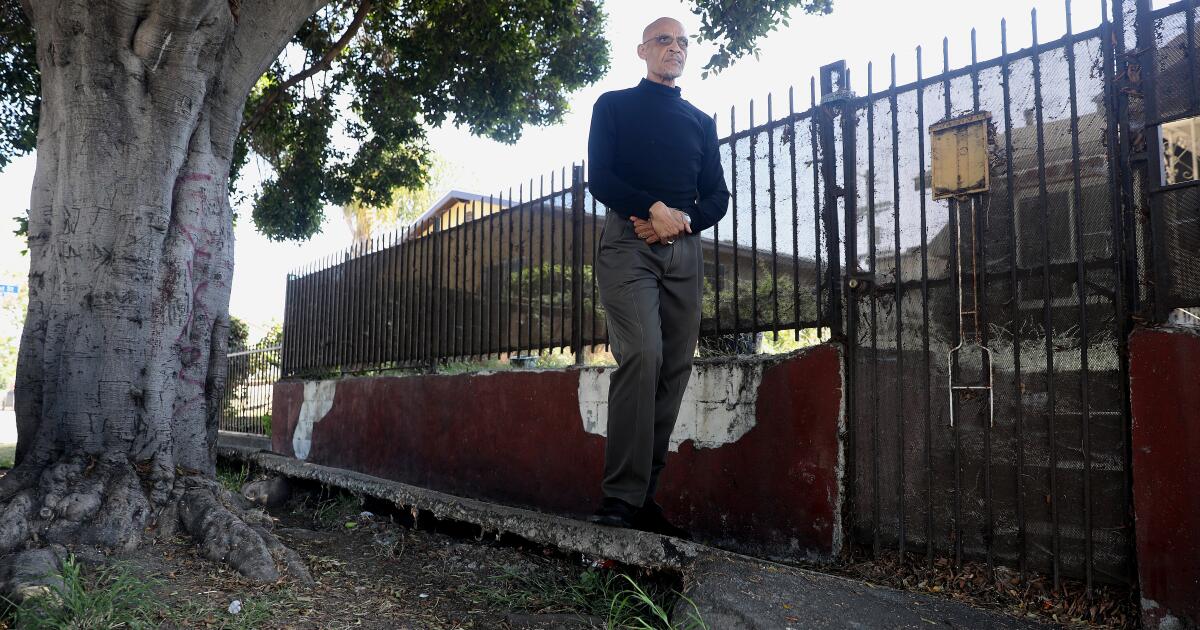
On my way to meet Hutchinson, I traveled west along Florence Avenue and saw dozens of typical rough patches on the street and sidewalks. But if there were a contest to identify the all-time worst sidewalks in Los Angeles, Hutchinson’s discovery of the one at 71st Street and 11th Avenue would be a Hall of Fame contender.
For starters, it’s got the classic uplift, and the villain is the usual suspect — ficus tree roots. A 20-foot slab of sidewalk is pitched sharply, as if designed by trip-and-fall lawsuit lawyers. Way back in 2014, in my early days on sidewalk patrol, I was able to crawl under a similarly ruptured sidewalk in West L.A., and I could’ve done the same at 71st and 11th.
But I thought better of it after Hutchinson peered into the opening and said it looked like a comfy home for rats and other vermin.
The homeowner, Sharon Kelly, can’t use her front gate because of the lopsided sidewalk. She let me borrow her tape measure, which revealed a 16-inch rise in the pavement.
“It keeps rising,” Kelly said. “But it was already lifted when we came here.”
That was in 1997. I asked if she’s called the city for help.
“Several times,” she said, and the only response was a slapdash temporary asphalt patch.
Hutchinson said residents have responded in force to his call for emergency sidewalks repairs, just as they did when he crusaded for a crackdown on widespread illegal dumping.
“Dozens of residents have come out of the woodwork, and here’s what they all say: ‘We have called our city council person and various city departments repeatedly, over and over again.’”
And the response?
“Nothing,” Hutchinson said.
While we were talking, two people with walkers steered clear of the worst spot near Kelly’s property. Charles McQuarn, 77, said traversing the neighborhood means zigzagging around all the hazards.
“I gotta come out into the streets, too,” he said.
When he was a teenager, McQuarn said, he worked for a community group that fixed sidewalks. I mentioned that Councilmember Monica Rodriguez has been using Conservation Corps youths to do the same, but it’s time to scale up that program and come up with other remedies to speed the process.
The city is fixing about 600 sidewalks each year, the backlog of requested repairs stands at about 30,000 and if you get onto the waiting list, you’re looking at about 10 years before help arrives.
When we were done on 71st Street, Hutchinson led me over to a nearby stretch of Florence where, for blocks and blocks, it appears as if there have been volcanic eruptions around the trees. Large chunks of cracked sidewalk form mounds, one after another. The Hutchinson Himalayas are a site to behold — a mile-long museum of municipal neglect.
And it’s been like this, Hutchinson said, “for years.”
The question for Bass and Raman: What will you do to speed the repairs?
Homelessness:
Voters have been generous when it comes to repeatedly taxing themselves more, and more, to address homelessness. There’s been Measure H, Measure A, Measure ULA and Proposition HHH.
Yet although billions of dollars have been spent and tens of thousands of people have been helped and housed, more than 40,000 people are homeless in the city and roughly 70,000 in the county. In her primary victory speech, Bass said families shouldn’t have to step around encampments, and Raman has said greater urgency is needed.
Questions for Bass and Raman: Why haven’t taxpayers gotten more for their money with the two of you at the helm, what are you going to do to speed progress and create more accountability, and what distinguishes you from each other?
The City Council is about to consider a motion to increase park funding through charter reform (with dozens of community groups in support), and progress is ridiculously slow on an agreement to use schools as after-hours playgrounds.
Question for Bass and Raman: Do you support the charter reform, and what else are you going to do to address the sad state of the city’s parks?
Trash and blight:
In downtown L.A., vandalism, shuttered storefronts and post-COVID abandonment have crippled what was a vibrant, revenue-generating economy that benefited the whole city.
In Hollywood, a resident hired her housekeeper to help report illegal dumping of goods that are often used to construct more homeless encampments, leading to all sorts of problems.
On the south lawn of City Hall, a graffiti-tagged monument and fountain have been out of commission for most of the last six decades.
Question for Bass and Raman: At the very least, can you fix the fountain?
Focus:
Like any big city with great assets and unlimited challenges, many residents have a love-hate relationship with L.A. But years ago, someone told me he loves Los Angeles because it’s a messy, multi-cultural work in progress, set on a dramatic landscape between mountain and sea, trying to figure out what it wants to be.
Question for Bass and Raman: Whether in the realm of basic services or grand visions, what three or four primary objectives do you have over the next four years?
After topscoring with the bat for Scotland, Kathryn Bryce makes an impact with the ball, taking a superb one-handed catch to remove Ireland’s Alana Dalzell for six in their opening match of the ICC Women’s T20 World Cup at Old Trafford.
A prosecution flag is seen in South Korea. Photo Asia Today
June 12 (Asia Today) — A joint prosecution-police investigation team searched National Election Commission servers for a second consecutive day Friday as part of an inquiry into ballot shortages during South Korea’s June 3 local elections.
The team was conducting a search and seizure operation involving the commission’s servers, officials said.
Investigators on Thursday raided seven locations, including the National Election Commission headquarters in Gwacheon, south of Seoul, the Seoul election commission and district election offices in Songpa, Seocho, Gangnam, Gwangjin and Dongjak.
The raids were conducted as part of an investigation into suspected violations of the Public Official Election Act and alleged dereliction of duty.
The warrant reportedly listed more than 10 people as suspects, including former National Election Commission Chairman Noh Tae-ak, former Secretary-General Huh Chul-hoon and heads of regional election commissions.
The team has also begun sorting materials seized in the raids, including ballot printing plans, budget documents, voting records and electronic files. The seized materials are believed to include meeting minutes related to the commission’s decision to reduce the number of ballots printed.
Investigators plan to question election commission officials after reviewing the seized materials to determine how the ballot shortage occurred.
The Seoul Metropolitan Police Agency’s major crimes investigation unit notified election commission officials Monday to appear for questioning and is coordinating interview schedules.
The investigation follows widespread criticism over ballot shortages at some polling stations during the June 3 local elections. The incident led to public complaints, calls for accountability and the resignations of senior election officials.
Henry Ensher, a former US ambassador, says the US–Iran agreement is not a final settlement but only the start of a process, with many ways it could still go wrong.
British holidaymakers heading to Greece this summer are being urged to do four things before they set off to help interactions with local people go smoothly…
14:12, 13 Jun 2026Updated 14:12, 13 Jun 2026
You need to do these four things before going to Greece (stock image)(Image: Freeartist via Getty Images)
Planning a getaway to Greece this summer? Brits have been cautioned against travelling if they haven’t done this crucial thing.
With numerous new rules and regulations being introduced, including EES (entry-exit systems) and QR codes that can be scanned to streamline procedures in different countries, it can be tricky to work out what you’re required to do before setting off. We’re all aware it’s vital to stick to baggage weight limits to dodge any additional charges, and that arriving with sufficient time to clear airport security is essential.
However, Dimitri has cautioned that before landing in Greece, it’s also crucial to familiarise yourself with four phrases that will help you get by and feel more at ease, while showing locals you’ve put in some effort. He said: “Don’t come to Greece this summer if you don’t know these four expressions.”
1. Kalimera/Καλημρα: Good morning
This is used to greet someone in the morning or daytime. You should stress the second syllable, pronouncing it “KA-lee-ME-ra”.
2. Kalispera/Καλησπρα: Good evening
This is the correct greeting from the late afternoon into the evening. It is pronounced “KA-lee-SPE-ra”.
3. Efharirsto/Ευχαριστ: Thank you
Used to express gratitude. It is pronounced approximately as “ef-ha-ri-STO”, with a soft guttural ‘h’ sound represented by ‘χ’.
4. Parakalo/Παρακαλ: You’re welcome
This phrase serves as a courteous reply to “thank you,” and is equally handy when offering something to someone. It is pronounced “pa-ra-ka-LO”.
Content cannot be displayed without consent
Master all of the above, and, while fluency in Greek may still be out of reach, you’ll come across as someone who has genuinely made the effort to connect with locals in their native tongue. What’s more, it’ll help put you at ease too.
Dimitri added: “A friendly tone and a smile make these phrases more natural and appreciated.”
In the comments, one user wrote: “Having lived in Greece its great to see this and yes, learning the language is a plus. I’d add to those who may feel nervous in doing so, just do it.”
Another chimed in: “I learned these whilst in Greece! The locals were so friendly and kind and loved that we wanted to speak with them in their language.”
One joker suggested that simply saying the word “gyro,” would suffice – referring to the much-loved Greek street food made from seasoned meat cooked on a vertical rotisserie, then carved and served wrapped in a warm, grilled flatbread such as pitta.
Meanwhile, another enthused: “Greece is my favourite country would love more than anything to learn the language!!”
Will you be learning any Greek before you go this summer? Let us know in the comments…
ONCE it was the next big thing, now you can’t even Freecycle it. Were you one of the visionaries who bought a piece of the future that turned out to be a dusty piece of crap?
VR headsets
We’ve only been hearing how revolutionary these are for 30 years or so. A decade ago you gave in and decided you wanted to venture into virtual realms and experience bold new realities. Okay, porn, you wanted VR porn. What you got instead was a boring rock-climbing simulation and a phenomenally severe migraine.
3D television
You watchedAvatarin the cinema and were seduced by the possibilities. Okay, porn, you wanted 3D porn. But blue extraterrestrials plugging their ponytails into plants were the only 3D content available and it turns outAvatarisn’t as rewatchable asTitanicorTerminator 2.Also you kept losing the glasses.
Nutribullet
A purchase you believed would make you a smoothie-guzzling Adonis which, with hindsight, you should have asked Amazon to deliver direct to the back of your kitchen cupboard. Nothing but a messy ballache which produced unpleasant tasting drinks with disturbing, slimy textures. Also you’re not all that keen on fruit.
Segway
Slow, difficult to ride, dangerous and deeply uncool: the Segway was a compilation of all the ways in which a vehicle can be bad. It didn’t revolutionise getting from A to B. It’s now exclusively associated with obese Americans travelling between urban tourist sites that can be walked around if you haven’t breakfasted on links in syrup.
Peloton
You were never going to get fit when the gym was a 15-minute drive away. Exercise classes in the spare room? Perfect. Then came an astonishingly fast transition from cycling while watching a class, to cycling while watching Netflix, to lying on the sofa while watching Netflix. The subscription’s lapsed. The Peloton remains, silently judging you.
Robot vacuum cleaner
It seemed such a wonderful solution; you go to bed, set the little fellow running and wake up to a lovely clean room. Until you get one and discover waking up means growling ‘Where’s the f**king hoover?’ before retrieving it from whatever corner or sofa it’s stuck under. You’ve gone back to your Henry and you swear he looks smug.
THE World Cup has kicked off and you can watch matches down your local pub or at a fan zone.
You don’t even have to miss your holiday to join in the football fever.
Sign up for the Travel newsletter
Thank you!
The World Cup has kicked off and you can watch matches down your local pub or at a fan zone – or head further afieldCredit: GettyBars in the UK and abroad will be showing games – including at holiday locationsCredit: Getty
Hotels, sports bars and holiday parks across the UK and abroad are showing the games so you can cheer on your team wherever you are.
Trisha Harbord selects ten winning breaks where there is lots to do when you’re not in front of the big screen.
EDINBURGH
SCOTLAND are in their first World Cup for 28 years, so excitement in the country is electric — and watching matches in beautiful Edinburgh will be unforgettable.
Try Irish bar Malones, which was voted “Best venue to watch the match 2026”.
GO: Double rooms at Tynecastle Park Hotel are from £135 a night. See tynecastleparkhotel.com.
BUTLIN’S RESORTS
BUTLIN’S resorts in Minehead, Skegness and Bognor Regis have big-screen venues galore, including Studio 36, which can hold 2,000 people.
The resorts — which just won VisitEngland’s Outstanding Contribution to Tourism award — also have deals including two cocktails for £14 and four pints for £23.
WHEN NOT WATCHING: Cool down in Splash Waterworld with flumes and rapids, hop on fairground rides, enjoy live entertainment and chill in the spa.
You’re also right next to sandy beaches and seaside fun.
GO: The three-night Replay Big Weekender at Bognor Regis from June 26 (England match June 27), including Peter Andre concert, is from £244 per person, based on four sharing a two-bed Comfort room. See butlins.com.
LONDON SOUTH BANK
IT’S always buzzing on London’s South Bank, but the riverside walk is becoming a footie fanbase.
The Big Belly Bar will be screening all matches on ten mega-screens, so there’s no chance of missing any goals or getting a bad view.
Tickets for games cost from £11, including a welcome drink. Book at thebigbellybar.co.uk.
There will also be DJs and live entertainment before and after matches.
WHEN NOT WATCHING: Get breathtaking views of the city from the 442ft London Eye, see sharks at Sealife aquarium and superb art at Tate Modern.
Cross over the river to catch a West End theatre performance.
GO: Double rooms at Travelodge London Central Waterloo are from £55 a night. See travelodge.co.uk.
GREAT YARMOUTH
THERE will be a pop-up series of free screenings for every England fixture at Great Yarmouth’s historic Empire venue in Norfolk.
The Grade II-listed seafront landmark, which has just undergone a huge renovation, will start each match day with a two-hour DJ set, street food and craft beer before kick-off.
Then, the party will continue for an hour after the final whistle.
WHEN NOT WATCHING: Take a stroll along the 15 miles of glorious golden sands and enjoy an 18-hole adventure at the Pirates Cove golf course.
GO: Four nights’ self-catering in a Bronze Caravan at Haven’s Seashore park is from £165 in total. See haven.com.
UK-WIDE AWAY RESORTS
Whitecliff Bay Holiday Park at the Isle of Wight has sea views and hot tubs in lodges and chaletsCredit: Supplied
ALL 25 Away Resorts across the UK are showing matches, with some offering a festival vibe of deckchairs and picnic blankets in front of giant outdoor screens.
Whitecliff Bay Holiday Park on the Isle of Wight has lodges, chalets, caravans and camping pitches, some with sea views and hot tubs.
WHEN NOT WATCHING: The resort has heated outside and indoor pools, a private sandy beach, bike hire and crazy golf.
See Carisbrooke and Yarmouth castles, and big cats at Wildheart Animal Sanctuary. Nearby pub the King Lud is also showing matches.
GO: Four nights’ self-catering in a Comfort caravan, sleeping up to eight people, costs from £359 in total. See awayresorts.co.uk.
MYKONOS
Bars on the popular Platis Gialos beach on the island of Mykonos, Cyclades, Greece are showing games on big screensCredit: Getty
EASYJETHolidays reckons more than a quarter of supporters are planning a fan-cation and are highlighting resorts that are going all-out for the tournament — screens on the beach, extended bar hours, etc.
The 4* Acrogiali Beach Hotel in Platis Gialos, on the Greek island of Mykonos, has luxurious zones with big screens on the sands.
WHEN NOT WATCHING: There are lots of bars and gift shops in the village of Platis Gialos. Get a taxi-boat to more secluded beaches.
Watersports include windsurfing and parasailing.
GO: Seven nights’ B&B, including flights from Gatwick, is from £789 per person. See easyjet.com/en/holidays.
SOUTH OF FRANCE
TAKE a two-hour flight and you can be on the sunny coast of southern France without missing a goal.
The lovely city of Perpignan is home to the friendliest sports bar, Delirium Cafe, showing matches on up to nine screens.
WHEN NOT WATCHING: Learn about the city’s history at the ancient fortification Castillet, see the cathedral and go shopping.
Swim in the Med, you are near the beaches of Canet-en-Roussillon.
GO:Ryanair flies from Stansted, Birmingham and Leeds Bradford to Perpignan with one-way fares from £20. Double room at hotel-bb.com from £54 a night.
TUNISIA
Youngsters in Tunisia can take part in Football Academies, with FA and Uefa-certified coachesCredit: Tui
WATCH the final week of World Cup matches in a stunning resort by the ocean in Tunisia.
The 4* AQI Skanes Resort will be showing all games, including the final on July 19.
And youngsters can even join Football Academies, with FA and Uefa-certified coaches.
WHEN NOT WATCHING: The resort has more than 200 activities including archery, as well as shows, pools, five restaurants and a spa.
Medinas and souks in Sousse and Monastir are just minutes away.
GO: Seven nights’ all-inclusive from Stansted on July 13 is from £942pp, based on two adults and two kids sharing. See tui.co.uk.
GRAN CANARIA
IMPRESS your friends by telling them you’re off to Gran Canaria for the weekend to watch England’s last qualifying game.
The 4* Servatur Puerto Azul, on a cliff overlooking the Atlantic Ocean, will have big screens and there’s a 42in TV in your room, so you could watch matches from your balcony hammock.
WHEN NOT WATCHING: There’s a free shuttle service to Puerto Rico beach.
But you don’t need to leave this resort — there are five pools, sports courts, gym, spa, shows and live music. Restaurants and bars, too.
GO: Four nights’ B&B, including flights from Luton on June 26 (England play on June 27), costs from £395pp. See onthebeach.co.uk.
NORWEGIAN FJORDS
JOIN the wave of fans on the high seas. P&O Cruises has TV rights to show all matches on all its ships.
GO: Seven nights’ full-board in an inside cabin, departing from Southampton on June 26, is from £699 per person. For further details see pocruises.com.
The bitter legal battle between Blake Lively and Justin Baldoni over allegations of misconduct and retaliation tied to the making of “It Ends With Us” moved closer to a conclusion Friday after a federal judge ordered Baldoni and his production company to pay Lively’s attorneys fees related to his unsuccessful defamation lawsuit against her, while rejecting her bid for additional damages.
In a 47-page order, U.S. District Judge Lewis Liman found that Lively was entitled to recover legal fees under a California law intended to protect people who report sexual misconduct from retaliatory defamation claims, ruling that Baldoni’s side had failed to show she acted with malice when making her allegations.
But Liman denied Lively’s request for treble and punitive damages, concluding that the procedural mechanism her lawyers used permitted recovery of attorneys fees and costs but not broader financial penalties.
Lively’s attorneys, Esra Hudson and Michael Gottlieb, called Friday’s ruling a victory for their client and emphasized that the judge found “there was no evidence she acted with malice.”
“The Court is awarding Ms. Lively attorneys’ fees and costs and has explained that a prevailing defendant under Section 47.1 may seek damages using different procedural mechanisms,” the attorneys said in a statement. “The parties’ settlement agreement expressly preserves Ms. Lively’s rights to obtain those damages.”
While the judge rejected Lively’s request for additional damages in this particular motion, her legal team said she could still seek them through other legal avenues permitted under the statute.
Bryan Freedman, Baldoni’s attorney, sharply disputed Lively’s characterization of the ruling, arguing that the court’s prior decisions had substantially undercut many of her original claims.
“There was no sexual harassment. There was no retaliation. There was no smear campaign,” Freedman said in a statement. “The court recognized it, the record reflects it, and we have maintained it from the very beginning.”
The amount Baldoni and Wayfarer Studios ultimately may have to pay has not yet been determined. Lively’s lawyers must still submit billing records and fee calculations for court approval.
The ruling follows last month’s settlement between Lively and Baldoni, which came just before what had been expected to be a closely watched federal trial in Manhattan. Under that settlement, neither side received financial compensation. But the agreement preserved Lively’s ability to seek attorneys fees and damages under California Civil Code Section 47.1, a relatively new statute designed to shield sexual harassment and assault accusers from retaliatory defamation claims.
Lively sued Baldoni, Wayfarer Studios, Wayfarer CEO Jamey Heath and others in December 2024, alleging Baldoni and his associates orchestrated a coordinated effort to damage her reputation after she raised concerns about misconduct during production of the film, which Baldoni directed and co-starred in. Baldoni denied wrongdoing.
Baldoni and Wayfarer later filed a $400 million defamation suit against Lively, her publicist Leslie Sloane and her husband, Ryan Reynolds, that was dismissed last year. Friday’s ruling dealt specifically with whether Lively could recover attorneys’ fees and damages tied to that dismissed suit under California Civil Code Section 47.1.
The latest ruling comes after Liman earlier this year dismissed 10 of the 13 claims in Lively’s lawsuit, including sexual harassment and defamation claims, while allowing retaliation-related claims to proceed.
In Friday’s ruling, Liman wrote that Baldoni’s team had produced no evidence demonstrating Lively acted maliciously when making her allegations.
“Allegations are insufficient on their own to demonstrate that statements were in fact made with malice,” the judge wrote. “That determination requires some evidence.”
Friday’s ruling offered each side new grounds to claim vindication in a legal battle that has played out as much in public statements as in court filings. Lively’s team pointed to the judge’s finding that she acted without malice, while Baldoni’s attorneys emphasized that many of her original claims had been dismissed.
Still, the settlement agreement bars either side from appealing Liman’s ruling, potentially drawing one of Hollywood’s ugliest recent legal fights to a close.
Reporting from Washington — Most of Sen. Bernie Sanders’ supporters in California say they expect that come November, Hillary Clinton will be elected president — and, by and large, they’re OK with that.
While both Democratic camps prepare for a final battle in the state’s June 7 primary, the latest USC Dornsife/Los Angeles Times statewide poll found that just over half of Sanders’ supporters said they expected Clinton to be the next president. About a third of Sanders’ backers said they expected the Vermont senator to emerge the winner, and 12% said they thought Donald Trump would prevail.
Close to 8 in 10 Sanders supporters said in the survey that they would vote for Clinton in a race against Trump, although many said they would do so reluctantly.
Those findings show the reality underlying the still-heated rhetoric of the Democratic primaries: By contrast with the civil war that divides Republicans, Democrats in the country’s largest state have begun to coalesce behind their front-runner.
In the primary race, Clinton holds a modest lead over Sanders, 45% to 37%, among all Democrats and independent voters eligible to vote. Her lead is slightly larger, 47% to 36%, among those most likely to vote. Either way, that’s a significant problem for Sanders.
The poll was conducted before Sanders’ sweep of three Western states — Alaska, Hawaii and Washington — on Saturday, but those victories don’t change the electoral math much. Sanders would need not just a win in California, but something close to a landslide to overcome Clinton’s large lead in delegates before the party’s nominating convention in July.
Something else hasn’t changed: If there’s one blemish in the picture for Clinton, it’s the persistently high percentage of voters who have an unfavorable image of her, 45% in the new poll.
Clinton’s image in heavily Democratic California is more positive than it is in more Republican parts of the country; 52% of the state’s surveyed voters see her favorably. She fares far better than Trump, her most likely opponent in November, who is viewed negatively by almost three-fourths of California voters.
A Democratic voter at a Washington state caucus on Saturday. In the California primary race, Hillary Clinton holds a modest lead over Bernie Sanders, 45% to 37%, among all Democrats and independent voters eligible to vote.
(Elaine Thompson / Associated Press)
But her image with the public lags significantly behind other leading Democrats. That includes President Obama, whose popularity has risen, both statewide and nationally, in recent weeks. He is now seen favorably by 65% of the state’s voters, the highest level since early in his tenure. Gov. Jerry Brown is viewed favorably by 57%. Both men are viewed negatively by about one-third of voters.
The large share of voters who have a negative view of her does not put Clinton in danger of losing California in a general election: She would defeat any of the Republican candidates handily in the state, which has formed the cornerstone of Democratic victories nationally ever since her husband’s win in 1992. Against Trump, in particular, Clinton would win overwhelmingly, the poll indicated, carrying the state 59% to 28%.
But the negative impressions of so many Californians point toward the deeper problem she faces in the country and also to the likely tone of the fall campaign. A Clinton-Trump race, more than any other in recent decades, would feature two candidates who would start the campaign with large parts of the electorate deeply disenchanted with them. Given that, each side is likely to try to focus voters’ attention on the other’s flaws.
“Clinton’s challenge is not one of persuasion, it’s one of motivation,” said Dan Schnur, director of USC’s Jesse M. Unruh Institute of Politics. “She’s not going to get Sanders supporters to fall in love with her,” he added, but “the other way to motivate your base is to frighten them about the alternative. Against Donald Trump, that should be very doable.”
That’s certainly the case for Gretta Whalen, a 32-year-old freelance writer and communications consultant from Los Angeles, who leans toward Sanders. Clinton, she said, “has been around for so long, and we know so much about her, and not all of it is positive.” Sanders, by contrast, seems attractive, and his ideas feel new, even if “some of them are very pie in the sky and would be very difficult to get the rest of the country on board with.”
But, she added, as she paused from feeding her newborn son, the contest is different “now that we’re looking at a likely race against Donald Trump.” She and her friends, most of whom back Sanders, “are all so shocked that we’re in this place where Donald Trump is a serious contender for president,” she said. Compared with past elections, this campaign “feels a little more surreal.”
“I was much more excited about Bernie” earlier in the campaign season, she added. “We love him as a candidate. We also recognize that he’s not the most realistic winner.”
Just under 1 in 4 voters in the state have a negative image of both of the likely contestants. That group would hold its nose and side with Clinton over Trump, 38% to 23%, with a significant share of them saying they would not vote at all, the poll found.
Sercan Ersoy, a 33-year-old substitute teacher in Oakland, has much more negative feelings about Clinton than does Whalen. A former member of the Green Party who changed his registration in order to vote for Sanders in the primary, Ersoy feels Clinton is “too much of a war hawk” in addition to having too many ties to Wall Street. “I don’t want to vote for her,” he said.
But “if you ask me in late October,” he added, “and there’s a real possibility of a President Trump, I might say, ‘OK. I’ll vote for Hillary.’”
This USC/L.A. Times poll was conducted March 16-23 by telephone, both cellphone and landline, among 1,503 registered voters in California, including 832 Democrats and non-party voters eligible to take part in the June primary. The poll has a margin of error of plus or minus 2.8 percentage points for the full sample and 3.7 percentage points for the Democratic primary sample. It was conducted by Greenberg Quinlan Rosner Research, a Democratic polling firm, and the Republican company American Viewpoint.
The poll found the race between Clinton and Sanders dividing along lines that have become familiar during nearly two months of primaries: Sanders overwhelmingly wins voters younger than 30; Clinton does better with older voters. She leads among women by 11 percentage points, among men by 5 points.
Clinton leads narrowly among white voters but has a much larger edge among blacks and Latinos. In a surprise, given her family’s long-standing popularity with Asian voters, Clinton appears to be trailing Sanders with that group, although his edge, 43% to 35%, is within the poll’s margin of error for such a subgroup.
Clinton’s lead among minority voters is “much more muted” than her edge in previous contests in Texas and across the South, said pollster Anna Greenberg. That’s largely a result of a generational divide, with Sanders leading among younger Latinos, much as he does among young white voters. The other minority groups are too small to allow a detailed breakdown by age.
The other significant division in the primary is by party. California’s Democratic primary is open to registered Democrats as well as voters who decline to state a party. Clinton leads Sanders by 14 percentage points among registered Democrats; Sanders leads by 9 percentage points among the nonpartisan voters — again a pattern seen repeatedly in other states.
Among Sanders voters, 80% polled said they would vote for Clinton in November, although the share saying they would do so “reluctantly,” 45%, outnumbers those who would do so “enthusiastically,” 35%.
About 1 in 8 Democratic primary voters surveyed said they would refuse to vote for Clinton if she is the nominee. That’s half the level of rejection that Trump faces among Republican primary voters.
Among the Democratic primary voters most resistant to backing her in the fall are white men 65 and older, according to the poll. By contrast, only 4% of people who identified themselves as students said they would refuse to vote for Clinton — another indication that Sanders’ core supporters are unlikely to reject her candidacy.
By 72% to 21%, Democratic primary voters said in the survey that they are excited about the prospect of voting for the first female president.
Sanders has centered his campaign around the belief that the U.S. economy is unfairly rigged by Wall Street and big corporations. Not surprisingly, a large majority of his voters share that view.
The poll asked people if they thought that in today’s economy “everyone has a fair chance to get ahead in the long run if they work hard” or if “it’s mainly just a few people at the top who have a chance to get ahead.” By more than 2 to 1, Sanders’ voters said that only those at the top could get ahead.
Clinton’s supporters were more evenly divided, with 52% saying that everyone had a fair chance and 42% saying that only those at the top could get ahead. That reflected, in part, the feelings of Latinos, who are more likely than other Americans to say that hard work still pays off in the long run.
Those who backed Clinton were also more likely than Sanders’ backers to say that “when it comes to good jobs for American workers, our best years are ahead of us.” More than 6 in 10 of Clinton’s voters agreed with that statement, compared with just under half of Sanders’.
Neither group of Democratic voters was as pessimistic as Trump’s supporters, however. A majority of them said that when it comes to good jobs, “America’s best years are behind us.”
BBC Sport Scotland called on the knowledge of 1998 World Cup squad members Darren Jackson and Paul Lambert, as well as the last player to captain Scotland at the women’s finals in 2019, Rachel Corsie, to enlighten and excite us.
All three said it was “surreal”.
Lambert and Corsie explained the build-up – the bit where the fans are frantically booking planes, trains and automobiles – as perhaps being the most “stressful” part of the process from qualifying.
“You’re like, I want to be in the best condition of my life,” said Corsie, who skippered Scotland in France seven years ago said.
“I don’t want to get hurt, I want to get selected, I want to be playing for my club, there’s so many things that you’re thinking and you just think, I just want us to get there.”
“It feels like endless build-up,” Lambert added.
“Then, when you’re selected, that’s when it really sinks in that you know the summer could be the greatest tournament for the national team. It’s the best tournament.”
For Jackson, who didn’t make his international debut until he was 28, said it wasn’t until he lined up in the Stade de France for the tournament opener against Brazil that things started to feel real.
“When you’re standing in the tunnel and the guy standing next to you is Ronaldo, reality kicks in,” he explained.
Add Rivaldo, Dunga, Roberto Carlos, Cafu and the rest and you’ve got a point, Darren. Gulp.
The company said it received an export control directive to suspend access to Fable 5 and Mythos 5 for foreign nationals.
By Al Jazeera Staff and Reuters
Published On 13 Jun 202613 Jun 2026
The AI firm Anthropic has blocked access to its newly released cutting-edge software, following an order by the United States government.
In a blog post published Friday, the company behind the Claude chatbot said government agencies had instructed it to prevent all foreign nationals from accessing the AI models Fable 5 and Mythos 5, citing national security concerns.
Recommended Stories
list of 4 itemsend of list
Anthropic said it received the order at 5:21pm (21:21 GMT) on Friday and that the letter did not explain the government’s specific security concern in detail.
The ban also affects foreigners currently in the US – including those working at Anthropic.
As a result of the order, the company had to cut off access for everyone at short notice, it said.
The artificial intelligence behind Anthropic’s Mythos AI model is particularly adept at detecting software vulnerabilities, some of which have remained undiscovered for decades.
This capability has been used by US authorities and selected companies to plug security gaps.
However, a concern from the outset has been that such AI could become a dangerous cyberweapon in the wrong hands.
The Fable 5 model, released just this week, is based on Mythos technology, but its cybersecurity and biotechnology capabilities are blocked.
Mythos 5 is the non-public full version, which should continue to be used only by government agencies and selected corporate partners to harden their systems.
Anthropic emphasised that it had so far received only partial information from the government.
The company said it had reviewed a report which, in its assessment, was likely to have triggered the order.
Anthropic’s experts concluded that this referred to a limited capability to use the AI to review specific programme code and correct errors.
Models from other providers, such as GPT-5.5 from rival OpenAI, also possess this capability, the company stressed.
Anthropic said it disagreed that software used by hundreds of millions of users should be blocked for this reason, and that the safety measures in Fable 5 have been extensively tested.
Earlier this month, Anthropic proposed that the world’s top artificial intelligence companies coordinate to pause development of advanced AI systems, warning that the technology is improving so quickly that there is a risk humans would lose control.
The company said in a blog post in early June that, as cutting-edge AI gets increasingly faster at carrying out tasks, “it would be good for the world to have the option to slow or temporarily pause” its development.
Israel has continued to attack Lebanon, despite Iran saying it was included in a potential memorandum of understanding with the US. Fresh forced displacement orders were issued on Saturday morning, following Israeli bombardment throughout Friday night on towns and villages in the south.
A TUI Boeing 737-800 passenger aircraft on the taxiway with the Aegean Sea in the background
TUI Airways has officially updated its Flight Conditions of Carriage, with the new rules taking effect for bookings starting June 5, 2026. If you booked your getaway before this date, the previous rules (from March 2023) still apply to your trip.
The update streamlines legal language, tightens health policy provisions, and explicitly outlines fees for amendments. The TUI Conditions of Carriage is the official legal contract between you and TUI Airways when you buy a flight. The rules apply to every single passenger flying on a TUI Airways aircraft. This includes people who bought a “Flight Only” ticket and people who booked a TUI package holiday (where the flight is included).
It is a dense legal document split into distinct “Articles” (usually around 15–20 pages if printed). Because nobody reads the full text while packing, it is designed to protect both the airline’s operations and outline your consumer rights. In short, they state: “We promise to fly you and your bags to your destination, provided you show up on time, behave yourself, bring valid legal documents, and don’t pack anything dangerous.”
It covers rules around baggage size and weights, ticket validlty and banning passengers. The key updates and points of focus in the 2026 conditions include:
1. Health Requirements & Mask Policies (Article 1)
While daily travel has largely returned to normal, TUI has modernised its terms to give them a clear mandate for future public health scenarios:
Conditional Mask Requirements: The rules specify that if a local government or health authority mandates them, you must wear an appropriate mask at the airport and on board. Failing to comply can result in a refusal of carriage, and taking it off mid-flight will be treated under TUI’s disruptive passenger policy.
Health Statements : TUI retains the right to require you to fill out a health statement prior to flying out of or returning to a UK airport. Passengers showing symptoms of a major health outbreak, epidemic, or pandemic will be denied boarding.
2. Name Corrections vs. Substitutions
Spelling Mistakes: You can still correct genuine typos or spelling mistakes on your ticket for free, as long as TUI can reasonably verify it is an honest mistake.
Name Substitutions : If the change amounts to transferring the ticket to an entirely different person, it will not be treated as a free correction and will incur standard amendment/transfer fees.
3. Ticket Validity and Amendment Fees
Validity Period: Tickets remain valid for exactly one year from the date of issue.
Compassionate Exceptions: In the tragic event of a passenger passing away en route, or a death in a passenger’s immediate family after travel has started, TUI explicitly permits the tickets of the passenger and their accompanying immediate family to be changed so they can fly at a different time.
Voluntary Amendments: If you decide to change your flight details (date, time, or destination) 29 days or more before departure, you will face a baseline amendment charge of £50 / €50 per passenger per booking, plus any difference in the fare price, taxes, or associated fees.
Though technically part of their package holiday booking terms rather than the Flight Conditions of Carriage, TUI also launched a highly publicized Price-Match Promise. If you book a package holiday and find the exact same TUI-flight-inclusive deal cheaper elsewhere, you can claim a refund for the difference—but you must submit the claim within 72 hours of your original booking.
A gripping mystery drama featuring an EastEnders icon is now available to watch for free.
Little Disasters, previously described as a “complex psychological thriller with a mystery at its heart”, lands on Channel 5 tomorrow (June 14), after initially premiering on Paramount+ last May.
Based on Sarah Vaughan’s bestselling novel of the same title, the series charts the decade-long bond between Jess (Diane Kruger), Liz (Jo Joyner), Charlotte (Shelley Conn) and Mel (Emily Taaffe).
The story follows four expectant mothers who were brought together with little in common beyond their due dates, yet have supported each other throughout the journey of motherhood, reports Wales Online.
As the synopsis reveals: “The world of seemingly perfect stay-at-home mother Jess begins to unravel when she brings her baby daughter Betsy to the hospital with a head injury she can’t explain.
“Her close friend and on-duty AandE doctor, Liz, must make the excruciating decision of whether to call social services.”
This pivotal moment sets off a chain of events that threatens to tear apart both their friendship circle and their individual families.
The Little Disasters cast also features Ben Bailey Smith from The Split, alongside Patrick Baladi (Line of Duty), Stephen Campbell Moore (The Gold), and JJ Feild (The Peripheral).
Discussing the programme, Jo previously revealed that this style of storytelling not only inspired her to accept the role, but is unlike anything she had previously encountered on television.
She said: “I know somebody who suffered with postnatal OCD and I had only recently found out about it myself. So, I thought it was a really great topic to explore actually.
“Any kind of postnatal depression must be horrendous, I was lucky I didn’t suffer from it myself. I can’t imagine having such intrusive thoughts about your own child and I think that was another brilliant thing to bring up but also serves well for a thriller, doesn’t it?”.
The six-part series remains available for streaming on Paramount+, but will also broadcast on Channel 5 from this weekend, with the opening episode debuting in the 9pm slot on Sunday, 14 June.
Predictably, viewers have wasted little time making their feelings known, with one writing: “Worth the binge! #littledisasters.”
Another commented: “#littledisasters is everything I needed…” Meanwhile a third added: “Good show, oh my days, the suspense got me.”
Little Disasters premiered on Paramount+, and will air on Channel 5 on Sunday, 14 June.
First Assistant U.S. Atty. Bill Essayli — President Trump’s loyalist federal prosecutor in Los Angeles — has not been shy in recent days about his intention to ferret out voter fraud in California’s primary election and criminally charge those responsible.
He has announced that his office “has multiple election fraud investigations underway” in coordination with the FBI, urged Californians on social media to submit evidence of “potential election fraud” directly to his office, and said flatly he “will be charging some people” with election fraud — just as soon as California certifies its vote count and his office “can prove some of the allegations.”
Essayli’s public callouts and promises are highly unusual and in direct conflict with Justice Department guidance on ballot fraud investigations at the federal level, which states federal prosecutors should not publicly pursue such claims amid of vote counting.
The Justice Manual — which regulates the actions of federal prosecutors nationwide — says the department “should not engage in overt criminal investigative measures in matters involving alleged ballot fraud until the election in question has been concluded, its results certified, and all recounts and election contests concluded,” in part because doing so “runs the risk of chilling legitimate voting and campaign activities and of interjecting the investigation itself into ongoing campaigns and the adjudication of any ensuing election contest.”
Ciaran McEvoy, a spokesman for Essayli’s office, said neither Essayli nor the office had any comment.
Essayli has repeatedly acknowledged in other interviews that he has no evidence of widespread fraud that could sway the results of races, and he even shot down one prominent online conspiracy that falsely alleged Democratic cheating in the Los Angeles mayoral race.
But he has also pointed to more isolated instances of fraud as potentially indicative of bigger problems. He added that there’s no proof such rampant fraud isn’t occurring, partly because of resistance from California to a federal audit of its voter rolls.
Essayli’s remarks are part of a much wider battle to frame fraud in California as pivotal or not, in which Republicans cite individual instances of alleged fraud as evidence of some grand scheme by Democrats to steal the election from them, and Democrats — along with many elections experts — say there is no evidence that isolated crimes reflect fraud on a scale large enough to impact election outcomes.
His remarks have added fuel to baseless claims from Trump and other influential conservative voices that California’s elections have been poorly compromised by coordinated Democratic “cheating.” They have made Essayli one of the most prominent Trump administration figures in the nationwide debate around election integrity — which election experts expect to intensify ahead of November’s midterms.
A public campaign
Essayli has made his case in recent days on various alternative and right-wing news programs and podcasts, arguing that California’s slow process for counting votes had undermined public trust and needs to be audited.
On One America News Network, Essayli said his office has been “sounding the alarm on California’s election system” because it’s ripe for fraud.
“We believe that it has major vulnerabilities. We believe California does not have sufficient safeguards to make sure only eligible U.S. citizens are voting in elections in California, and that is why we’ve been demanding an audit of the California voter rolls,” he said.
On NewsNation with Chris Cuomo, Essayli said he doesn’t “care what the outcome of the election is,” but wants voters “to have confidence in the systems, and that the laws are being followed.”
“I guarantee you, when we do bring cases, we will have plenty of evidence to prove beyond a reasonable doubt, in a court of law — that is how we work,” he said.
On the podcast of conservative commentator Glenn Beck, Essayli said he was “prohibited from discussing ongoing investigations,” but that “election fraud is not a theory” but “a real thing” — noting his office recently secured a guilty plea from a woman who paid homeless people to register to vote.
He said California is “a fraudster’s paradise,” accused the state Legislature of “going out of their way to make it as easy as possible for people to commit fraud,” and repeated oft-cited complaints about California’s voter ID policies being lax, its universal mail ballot policies sending ballots to the wrong places, its ballot collection policies allowing “harvesting” and its voter rolls being “dirty,” or filled with ineligible voters.
Essayli said all of that makes his job “incredibly difficult,” because “California has removed the paper trail, they’ve removed the chain of custody, they’ve removed any meaningful way for us to basically have a forensic audit of where a ballot came from,” but that he will nonetheless be bringing election fraud charges in the next “one to two months.”
State and local elections officials in California have defended the state’s policies as facilitating voting by as many eligible voters as possible, which they say is more important than a quick count. They’ve said there are robust procedures in place to ensure ballots are cast fairly and counted accurately, and to identify any problems and audit the results.
Elections experts say instances of fraud do exist, both in California and everywhere else in the country, but that robust efforts in past years to investigate and identify widespread fraud that could sway an election — including by Trump and his lawyers but also outside organizations — have always failed.
Essayli’s efforts have drawn sharp criticism from elections experts, leading Democrats and former prosecutors in the office.
Justin Levitt, a Loyola Law School professor who studies elections and was a senior policy adviser on democracy and voting rights in the Biden White House, said what Essayli is doing — throwing out unspecified claims of fraud amid an ongoing election and before he has built a case — is “absolutely nuts” and “not a thing that real prosecutors do.”
Before the current administration, the “mantra” of federal prosecutors, he said, was that “you only hold a press conference about a not-yet-concluded investigation when the public is already aware of a large crime,” such as a mass shooting. “Absent that, you wait for the facts to come in, and you see whether there has been a legal violation, and then and only then do you issue a press release — usually hand in hand with an indictment or a conviction.”
In an election, Levitt said the standard is even higher, and “the ethos of a federal prosecutor should be to never become the story, and to never make the prosecutorial job itself an impact in the election you are investigating.”
In an MS NOW interview, Sen. Adam Schiff (D-Calif.), a former federal prosecutor in the L.A. office, blasted Essayli as wildly searching for fraud to please Trump — despite it and other efforts to please Trump, including on immigration, causing an exodus of experienced career prosecutors from the office.
Schiff said Essayli was “basically making a plea to the public: ‘Please send me evidence. I’m asserting there’s fraud. We don’t have evidence of it, but please send me something. I need to make the boss happy.’”
Another former prosecutor in the office, who requested anonymity to avoid retaliation, said Essayli is pursuing alleged election fraud cases as hard as he is only because “Trump told him to,” and he’s “constantly auditioning for a bigger D.C. job in case he gets kicked out of his current one.”
Essayli is not the U.S. attorney for Los Angeles — only the “first assistant” — because he has been unable to win confirmation from the U.S. Senate and has only remained in charge through a legal loophole.
Investigations in the works
It’s unclear what specific issues or incidents Essayli’s office is investigating.
Essayli has said his investigations so far lean toward individuals rather than networks, and he told the California Post that he would be investigating a report that thousands of people were registered to vote at homeless shelters with far fewer beds.
His office also looked into false claims that an election night ballot update in Los Angeles County include no votes for Spencer Pratt, the Republican candidate. He said his office “reviewed official county records” and determined the claim was false.
“My office will continue monitoring the election counting process and will follow the evidence wherever it leads,” he said.
One person involved in investigating the latter case was Assistant U.S. Atty. Robert Renner, who joined the office in March after previously serving as deputy general counsel for the Center for Individual Rights, a nonprofit Washington, D.C., law firm where he worked on lawsuits focused on conservative free-speech issues, according to his LinkedIn page.
A worker carries ballots at the Los Angeles County Ballot Processing Center.
(Eric Thayer / Los Angeles Times)
Renner, who referred questions to the office spokesperson, visited an L.A. County ballot processing center as part of the investigation, where he questioned election officials about the ballot update, according to a law enforcement source with knowledge of the situation who spoke on the condition of anonymity for fear of retaliation.
Election officials have said their numbers were always correct and that the discrepancy was based on a one-minute lag in vote updates for Pratt by The Associated Press, which also confirmed the lag.
Renner also grilled election officials about whether or not post office officials had backdated postmarks on mail ballots sent after election day so they could still be counted, the source said.
Essayli’s elevation to the top prosecutor position in L.A. was part of a broader push by the Trump administration to fill key Justice Department roles with people loyal to the president and open to his election skepticism. Earlier this year, a Times investigation detailed how disgraced ex-L.A. County prosecutor Eric Neff was named “acting chief” of the Justice Department’s voting section.
Neff led a bungled election integrity case at the L.A. County district attorney’s office that was thrown out after an internal review revealed it hinged on the word of “Stop The Steal” activists who had pushed Trump’s discredited theory that the 2020 presidential election was “rigged.”
It was one of two election integrity cases Neff tried in his entire career before being elevated to the voting chief post by Asst. Atty. Gen. Harmeet Dhillon, another proud Trump loyalist from California.
Michael Sanchez, a spokesperson for Dean Logan, head of the Los Angeles County Registrar-Recorder/County Clerk, said the office has not received any formal document requests or investigation notices from Essayli’s office, only “routine questions about operations.”
What will come of Essayli’s investigations is also unclear. He will have to prove whatever allegations he makes in court — which he has repeatedly appeared to begrudge in recent interviews.
“Instead of putting the burden on the system to reassure the people [that] only legal citizens are voting, one person one vote is the law of the land, and the burden on the system to assure us that there’s integrity and we can believe in it,” he complained to Beck, “they’ve flipped it and now it’s on us to prove every allegation of fraud.”
Wales pairing Jonny Clayton and Nick Kenny continued their impressive start to the World Cup of Darts with a resounding victory over Group C opponents Thailand in Frankfurt, Germany.
Having had to go through group qualifying after Gerwyn Price withdrew, the new Wales pairing opened their campaign by thumping Lithuania 4-1, and then followed that up on Friday by beating Thailand by the same score.
The Welsh duo topped their group to book a Saturday afternoon tie at the Eissporthalle against USA.
Hosts Germany again impressed with a 4-2 win over New Zealand as Martin Schindler and Ricardo Pietreczko secured their place in the second round where they will play the Czech Republic.
Republic of Ireland’s William O’Connor and Mickey Mansell clinched top spot in Group D by beating Gibraltar’s Craig Galliano and Justin Hewitt 4-2, earning a tie against Poland.
The top ranked nations – including England, Netherlands, Northern Ireland and Scotland – enter the tournament in the second round.
England pair Luke Littler and Luke Humphries – the top seeds – face Spain, while defending champions Northern Ireland’s Josh Rock and Daryl Gurney begin their title defence against Belgium.
Scotland duo Gary Anderson and Cameron Menzies face Norway, while Netherlands pairing Michael van Gerwen and Gian van Veen take on Sweden.
France against Latvia completes the round two fixtures.
Nvidia chief executive officer Jensen Huang, left, and Naver Chairman Lee Hae-jin appear at Naver’s Vision Studio at its 1784 headquarters in Seongnam, south of Seoul, on Monday. Photo courtesy of Naver
June 12 (Asia Today) — OpenAI chief executive officer Sam Altman is expected to visit Naver on Monday, a week after Nvidia chief executive officer Jensen Huang met with the South Korean technology company’s leadership.
Industry sources said Altman plans to visit South Korea during a two-day trip beginning Sunday and meet officials from major Korean companies, including Naver, Kakao and Samsung Electronics, to discuss artificial intelligence cooperation.
The expected Naver visit comes shortly after Huang visited Naver’s 1784 headquarters in Seongnam, south of Seoul, on Monday and met with Lee Hae-jin, Naver’s founder and chairman.
The back-to-back visits by two of the most influential figures in the global AI industry are drawing renewed attention to Naver’s role in the sector. Industry officials said OpenAI may be interested in Naver’s data, service ecosystem and experience operating consumer platforms at scale.
Naver has built large user data assets through search, shopping, content, community, mapping and reservation services. As competition in generative AI increasingly depends on access to high-quality data, those assets are viewed as one of Naver’s main strengths.
Naver recently outlined what it calls a “product-native LLM” strategy, saying it will optimize AI for specific services such as search, shopping, maps and reservations rather than rely only on a single general-purpose model.
The company develops its own AI models and also operates a creator ecosystem of about 20 million people, with more than 630 million pieces of content produced annually. It also owns large-scale data center infrastructure and runs the services where AI can be applied directly to users.
A Naver official said competition in AI is changing quickly.
“In the past, the key was developing a better model,” the official said. “Now, the ability to secure high-quality data, service experience and the infrastructure to support them is emerging as a decisive factor.”
Naver is also seeking to expand AI search into agentic AI services, in which AI does not simply answer a user’s question but can help complete tasks such as reservations and purchases.
Global interest in Naver also grew after Huang’s visit this week. During his meeting with Lee, the Nvidia chief described Naver as a “world-class AI company.”
Huang cited possible cooperation with Naver in several areas, including participation in Nvidia’s Nemotron Alliance, the development of AI factories and robotics. He said Naver was selected because it has world-class cloud technology and AI talent.
Industry officials said Nvidia appears to view Naver as an AI infrastructure partner, while OpenAI may see potential in Naver’s data and service ecosystem.
“Naver’s combined strength in AI models, data, services and infrastructure is attracting attention from global AI companies,” one industry official said.
I HAVE just stumbled upon Tenerife’s best-kept secret.
Instead of packed resorts teeming with Brits, I’m strolling across lush, undisturbed landscapes that stretch out for miles and quiet coves where the golden sands remain relatively untrodden.
Sign up for the Travel newsletter
Thank you!
The 4* Precise Resort is located on the edge of the pretty seaside town of Puerto de la CruzCredit: GettyIn the north of Tenerife temperatures are milder all year roundCredit: Supplied
And while some parts of the Canary isle are blisteringly hot in summer, here, temperatures are milder all year round.
That’s why the destination got its nickname the Island of Eternal Spring.
This is the north of Tenerife, a less commercialised area that’s so different from the south, it’ll have you questioning whether you’re even in Tenerife at all.
Instead of heaving crowds and sunbed-hoggers, hotels have more of a boutique feel to them, while the beaches are peaceful.
My family and I were staying at the 4* Precise Resort, perfectly positioned atop a cliff over the Atlantic, on the edge of the pretty seaside town of Puerto de la Cruz.
Unlike some of the mega resorts down south, this place felt relaxed and sophisticated — with an airy lobby designed like an open Spanish courtyard, traditional wood-panelled ceilings and marble floors.
Rooms had a relaxed feel to them, too — pristine, clean and spacious with soft boho decor.
The hotel has the Atlantic on one side and mountain views on the other, but we opted for a balcony room with sea view so we could listen to waves washing against the rocks and soak up glorious sunrises and sunsets.
The hotel has the Atlantic on one side and mountain views on the otherCredit: GettyPuerto de la Cruz offers easy-going bars and restaurants serving up authentic local grubCredit: Getty
Along with all the usuals, such as fancy-smelling toiletries, rooms come with slippers, flip-flops and an eco-friendly jute beach bag which guests can keep afterwards.
The truly fabulous thing about the Precise Resort, though, is that it’s got all the elements of a luxury resort and more.
The palm tree-lined area, overlooking the ocean, is the perfect spot for a little sunbathing, with plenty of comfy loungers for everyone — so no stress about sunbed battles.
Beyond the main swimming pool is a newly built spa, next to a more secluded peaceful outdoor area featuring a hot tub, saunas and wooden cabanas with stunning sea views.
The hotel is also surrounded by 40,000sqm of sub-tropical gardens, with paths that meander past ponds and even a waterfall.
We were instantly hooked after trying padel for the first time, and the following morning were able to stretch our tired muscles with an early yoga session.
Of course, you’ll need fuel if you’re exerting all that energy. And let me tell you, the hotel’s La Bodega restaurant did not disappoint.
Skilled chefs serve up a seasonal blend of delightful Canary Island and Mediterranean dishesCredit: SuppliedThe truly fabulous thing about the Precise Resort is that it’s got all the elements of a luxury resort and moreCredit: Supplied
With skilled chefs serving up a seasonal blend of delightful Canary Island and Mediterranean dishes, the buffet felt like a treat every night.
Dinner highlights included umami sea bass and Iberian pork cheek.
This is also where breakfasts are served each morning, with a plentiful buffet spread that will keep even the fussiest eaters happy.
If you’re after just a drink or a bite for lunch, the outdoor Cocoloco bar by the main and children’s pools operates during both the day and evening — make sure to try the burrata salad and club sandwich.
Or, for a change of scenery, the hotel runs a complimentary shuttle bus to the centre of Puerto de la Cruz, where you’ll find a flurry of easy-going bars and restaurants serving up authentic local grub.
As for entertainment, there’s plenty of that nearby, too. Five minutes from the resort is Loro Parque Zoo, home to a wide variety of animals including killer whales and dolphins.
We couldn’t resist a visit to the beautiful old town of La Orotava either — the bus is cheap and easy or the hotel will call you a taxi.
Here, we wandered among the beautiful colonial buildings, some with ornate wooden balconies, and enjoyed popping in to the independent shops selling everything from clothes and souvenirs to local food.
If you’re a keen rambler, head to the Orotava Valley, which leads from the sea to the mighty Mount Teide — but you’ll need to book the summit-trail treks in advance.
It’s a nature lover’s paradise, although the 12,188ft climb to the mountain’s peak may leave you feeling a little knackered.
Luckily, there’s several pools and an ice-cold pint waiting for you back at the resort.
VISIT: Tenerife
GETTING/STAYING THERE: Seven nights’ B&B at the 4H Precise Resort is from £562pp including return flights from Luton on June 16, 10kg hand luggage, 22kg hold luggage and transfers.