

Month: May 2026

Ebola, hantavirus: Is the world prepared for the next pandemic? | Health News

The World Health Organization (WHO) has declared that an Ebola outbreak in Uganda and the Democratic Republic of the Congo (DRC) is a “public health emergency of international concern”, setting off alarm bells around the world.

The WHO’s announcement on Sunday came as several countries are battling to contain a hantavirus outbreak linked to a cruise ship trip to South America.

Recommended Stories

list of 3 itemsend of list

While the cause and treatment for the two viruses differ, news of their outbreaks has caused world leaders and health agencies to question what this means for international travel and cross-border coordination in containing them. These questions are particularly pertinent following the COVID-19 pandemic, which resulted in global lockdowns due to the lack of preparedness for the spread of the coronavirus.

But as the WHO faces a funding crisis, is the world better prepared now if another pandemic occurs – or could it be even less so?

Here’s what we know:

Why is the WHO facing a funding crisis?

Every time a health emergency occurs anywhere in the world, the first response of the WHO is to determine the danger the disease poses and then implement a plan to respond to it.

But since 2025, the United Nations health agency has been struggling financially due to a lack of funding from donors.

WHO Director-General Tedros Adhanom Ghebreyesus warned in May 2025 that global health would be at serious risk without enough donor support and that the agency was facing “the greatest disruption to global health financing in memory”.

The crisis deepened after the United States, which had previously covered nearly one-fifth of the WHO’s budget, officially withdrew from the organisation in January this year. US President Donald Trump announced the decision in January 2025, alleging the WHO had mishandled the COVID-19 pandemic and other international health crises.

As a result, the programme budget for the agency’s 2026-27 projects has been set at more than $6.2bn, a 9 percent decrease from the previous year.

In response, the WHO revised its financial plans and scaled back spending by cutting back some of its critical programmes, which has significantly curtailed pandemic preparedness, health experts told Al Jazeera.

“Funding cuts to the WHO have directly weakened disease surveillance efforts, which in turn affect the readiness and preparedness to deliver an effective response to epidemics and pandemics,” Kaja Abbas, associate professor of infectious disease epidemiology and dynamics at the London School of Hygiene & Tropical Medicine and Nagasaki University, said.

Following the recent hantavirus outbreak, passengers and crew members from more than 20 countries on the affected cruise ship, MV Hondius, required coordinated monitoring, contact tracing, medical evacuation, and public health guidance across borders.

Under the International Health Regulations (IHR), the WHO helps to facilitate communication and response efforts among countries, deploys experts, supports laboratory testing and organises emergency responses in case of an outbreak.

Following the Ebola outbreak in the DRC and Uganda, the WHO has deployed experts, personal protective equipment (PPE), laboratory support and emergency funding while coordinating regional preparedness efforts.

But these sorts of efforts are at risk with the current funding crisis, Krutika Kuppalli, an infectious diseases physician in Dallas, in the US state of Texas, with expertise in emerging pathogens, global health and outbreak response, told Al Jazeera.

As infectious diseases do not respect borders, rapid international coordination is essential, she added.

“Weakening WHO through funding cuts risks delaying outbreak detection, slowing response times, and reducing the world’s ability to contain emerging threats before they spread globally.”

In a statement to Al Jazeera, the International Pandemic Preparedness Secretariat (IPPS), an independent entity which helps world leaders prepare and respond to pandemics, highlighted that preparedness relies on consistent funding.

“Sustained investment and strong multilateral coordination are essential to maintain the systems, partnerships, and scientific capabilities needed before the next pandemic threat emerges,” IPPS said.

What else is hampering a global response to another pandemic?

Besides funding issues, the WHO has been struggling to get world leaders to agree on a pandemic treaty for 2026 amid a pathogen-sharing dispute.

In May 2025, it adopted a Pandemic Agreement, which sets out what it describes as a “comprehensive approach to pandemic prevention, preparedness and response that improves both global health security and global health equity”.

But UN member nations have not been able to reach a consensus on the Pathogen Access and ⁠Benefit-Sharing (PABS) aspect of the agreement – or “annex” – due to differences over ensuring every country receives equitable access to vaccines and treatment after data on disease samples have been shared.

Talks on PABS mainly focus on setting up a system to ensure countries can quickly share pathogens that could cause pandemics while receiving fair access to vaccines, tests and treatments that result from their use.

Following talks on PABS in May this year, the WHO chief urged countries to keep working with urgency and said the next pandemic was “a matter ⁠of when, not if”.

“The PABS annex is the last piece of the puzzle not only for the Pandemic Agreement,” he added.

Kuppalli told Al Jazeera that getting agreement on this is crucial, as international cooperation is essential during emerging outbreaks.

“Countries must rapidly share pathogen samples, genomic sequencing data, and epidemiologic information so diagnostics, vaccines, and therapeutics can be developed quickly,” she said.

“Delays or political disputes over information sharing can cost valuable time in the early stages of an outbreak, when containment is most possible,” she warned.

Why is antivaccine sentiment growing?

During the COVID-19 pandemic, when the US and a handful of other countries began rolling out coronavirus vaccines, many people resisted the vaccines, fearing adverse reactions as social media was flooded with misinformation about their safety and purpose.

According to a July 2025 report in The BMJ (formerly the British Medical Journal), antivaccine sentiment among the leadership of US health agencies has also been on the rise. Robert F Kennedy Jr, US health secretary, is among those leaders who often promotes unverified claims about the dangers of vaccines and also opposed the COVID vaccine.

In the report for the BMJ, authors Anna Kirkland and Scott Greer argued that if health agencies are led by such people, it will “likely mean that vaccination information campaigns are reduced, vaccine hesitancy increases, insurance coverage for vaccinations is limited, and public sector capacity to vaccinate is reduced”.

“Research money will be wasted on investigating already debunked links between autism and vaccination, while vaccination infrastructure, such as vaccination programmes run by local governments, will be eroded,” they added.

This is a major issue because public trust is critical during outbreaks, Kuppalli said.

“If large portions of the population reject vaccines or public health guidance, it becomes much harder to control transmission, protect healthcare systems, and reduce deaths,” she said.

“Equally concerning are funding cuts to vaccine research and development. Pandemic preparedness depends on investing in vaccines before a crisis occurs, not after,” she added.

Last August, the US Department of Health and Human Services (HHS) cancelled about $500 million in contracts and grants dedicated to mRNA vaccine development. These cuts affected 22 research initiatives and clinical trials focused on emerging pathogens, pandemic flu, respiratory syncytial virus (RSV), and COVID-19 boosters, according to Harvard University’s TH Chan School of Public Health.

Kuppalli said the development of mRNA vaccines targeting H5N1 avian influenza is an important effort in preparing for the possibility of a pandemic.

“Reductions in funding for these types of programmes risk slowing scientific progress, limiting manufacturing readiness, and leaving the world less prepared when the next outbreak emerges,” she said.

Is the world economically prepared for a pandemic?

Amid antivaccine movements and funding cuts, the current state of the world economy is also making it challenging for world leaders to prepare a pandemic response.

The US-Israel war on Iran has resulted in a sharp rise in oil and gas prices, which has in turn upended the world economy. High fuel costs have disrupted supply chains and international travel, resulting in a spike in the cost of medicines. In the United Kingdom, for example, pharmacies are charging 20 to 30 percent more for over-the-counter medicines. In India, chemists are reporting price rises of common painkillers of as much as 96 percent.

“Wars and economic pressures also strain supply chains, divert government resources, displace populations and weaken already fragile health systems. These all increase the risk of outbreaks spreading unchecked,” Kuppalli warned.

“Emerging infectious diseases are becoming more frequent and more complex, yet many countries are reducing investments in preparedness rather than strengthening them. The result is a growing mismatch between the scale of the threat and the resources available to respond,” she said.

IPPS told Al Jazeera that pandemics and disease outbreaks have devastating economic consequences. “In 2020 alone, the global economy contracted by around 3 percent of GDP, representing trillions of dollars in lost output, alongside widespread job losses and trade disruption.”

“Sustained investment in pandemic preparedness and response (PPR) can help prevent such losses by ensuring that vaccines, therapeutics, and diagnostics are ready to deploy rapidly when new threats emerge,” IPPS said.

Investing in research and development during peacetime ensures that when the next pandemic threat arises, the world has products and systems in place to respond quickly, protect lives, and avoid the economic losses experienced during COVID-19, it added.

“Sustained and diversified funding for pandemic preparedness is not just a health priority; it is also an economic safeguard.”

Has there been any progress at all since COVID-19?

“The pandemic taught all of us many lessons, especially that global threats demand a global response,” Ghebreyesus said in February, six years after the COVID-19 pandemic hit. “Solidarity is the best immunity,” he added.

Besides adopting a Pandemic Agreement last May, in 2022, the WHO launched a fund in collaboration with the World Bank. As of February this year, the fund has “provided grant funding” totalling more than $1.2bn, the WHO says. It has “helped catalyse an additional $11bn that has so far supported 67 projects in 98 countries across six regions, to expand surveillance, lab networks, workforce training and multi sectoral coordination”, it adds.

In 2023, the WHO also set up the Global Health Emergency Corps “in response to the gaps and challenges identified during the COVID-19 response”. The Corps mainly supports countries experiencing public health emergencies “by assessing emergency workforce capacities, rapidly deploying surge support, and creating a network of emergency leaders from multiple countries to share best practices and coordinate responses”.

As a result of all this, Kuppalli said, there are reasons to be hopeful.

“One of the clearest lessons from recent outbreaks is that the global scientific and public health community can collaborate remarkably quickly when faced with an urgent threat,” she said.

She noted how during COVID-19, scientists around the world rapidly shared genomic sequences, clinical data and research findings in real time.

“The development of highly effective COVID-19 vaccines in less than a year was a historic scientific achievement and demonstrated what is possible when there is political will, funding, international cooperation, and regulatory flexibility,” she said.

“In addition, advances in vaccine platforms, particularly mRNA technology, mean we now have the capability to design and begin producing candidate vaccines much faster than in the past,” she explained.

“While many challenges remain, including funding, misinformation, and geopolitical tensions, the scientific progress made over the last several years has unquestionably improved our ability to detect emerging threats and develop medical countermeasures more rapidly than ever before,” she added.

Source link

G7 Finance Chiefs Confront Bond Market Turmoil and Global Economic Imbalances

Finance ministers from the Group of Seven met in Paris to address rising global financial instability triggered by a bond market selloff and concerns over inflation linked to the ongoing conflict involving Iran.

The meeting comes at a time when global bond markets from Tokyo to New York are under pressure, as investors anticipate that higher energy prices could force central banks to maintain or increase interest rates.

Officials are also preparing for a broader discussion on structural global imbalances and coordination ahead of an upcoming G7 leaders summit.

Bond Market Pressure and Inflation Concerns

Bond yields have risen sharply across major economies as investors reassess inflation risks. Markets are increasingly focused on whether rising energy costs will translate into sustained price pressures that limit the ability of central banks to ease policy.

French officials have described the current situation as a correction rather than a crisis, though they acknowledge growing sensitivity around sovereign debt levels and fiscal sustainability.

The volatility has raised concerns particularly in highly debt sensitive economies such as Japan, where bond market movements are closely watched for spillover effects.

Diverging Views Within the G7

Despite the shared concerns, divisions remain among G7 members over how to respond to global economic instability.

European officials have emphasized the need for coordinated, temporary, and targeted responses to market shocks, while acknowledging that consensus with the United States may be difficult.

Some members argue that global economic imbalances are becoming structurally entrenched, with consumption and investment patterns increasingly misaligned across major economies.

Global Imbalances and Structural Concerns

A central focus of the discussions is the growing imbalance in global economic activity. European officials argue that long term trends show excessive consumption in some economies, under consumption in others, and insufficient investment in parts of Europe.

These structural disparities are seen as contributing to persistent trade tensions, capital flow imbalances, and financial market instability.

Officials warn that without coordinated policy responses, these imbalances could eventually lead to more severe market corrections.

Critical Minerals and Supply Chain Strategy

Another key agenda item is the global competition over critical minerals and rare earth supply chains, which are essential for electric vehicles, renewable energy systems, and defense technologies.

G7 members are exploring ways to reduce dependence on dominant suppliers, particularly China, through coordinated investment, joint procurement strategies, and diversification of supply chains.

Proposals under discussion include pooled purchasing mechanisms, market monitoring systems, and industrial policy coordination to strengthen supply security.

Analysis

The G7 meeting highlights a convergence of financial instability and geopolitical fragmentation. Rising bond yields and inflation fears are no longer isolated market issues but are now directly linked to geopolitical disruptions in energy supply and global trade routes.

At the same time, disagreements within the G7 reflect deeper structural tensions in the global economy, particularly around debt levels, consumption patterns, and industrial policy priorities.

Efforts to coordinate on critical minerals signal a shift toward more strategic economic alignment among advanced economies, where supply chain security is becoming as important as price stability.

Overall, the meeting underscores a global transition toward a more fragmented and politically driven financial system, where economic coordination is increasingly shaped by geopolitical risk rather than purely market based forces.

With information from Reuters.

Source link

Tell us about your favourite family summer holiday | Travel

What makes the perfect family holiday? Whether you travelled with toddlers, teenagers or as part of a multi-generational group, tell us about the choice of destination and fun activities that made your trip successful, or even special. Where did you go in the UK or Europe, what did you do and what made it work?

The best tip of the week, chosen by Tom Hall of Lonely Planet wins a £200 voucher to stay at a Coolstays property – the company has more than 3,000 worldwide. The best tips will appear in the Guardian Travel section and website.

Keep your tip to about 100 words

If you have a relevant photo, do send it in – but it’s your words we will be judging for the competition.

We’re sorry, but for legal reasons you must be a UK resident to enter this competition.

The competition closes on Monday 25 May at 10am BST

Have a look at our past winners and other tips

Read the terms and conditions here

Share your travel tip using the form below.

Please share your story if you are 18 or over, anonymously if you wish. For more information please see our terms of service and privacy policy.

If you’re having trouble using the form click here. Read terms of service here and privacy policy here.

Source link

I stayed in seaside village so nice my kids fought back tears when we have to leave

A glorious seaside spot with a brilliant cafe, beach, play areas and a fantastic quirky place to stay the night.

British coastal resorts have long been popular hotspots for families but the seaside village of Llanfairfechan is one I have to say I’ve never stopped in over the years, despite it being just off one of the country’s busiest roads. Now that I have two young sons to entertain, it was time to rectify that, and what a treat we had in store at this beautiful little spot.

It feels like a bit of a hidden gem in many ways: lovely and quiet and a place I never hear mentioned when people talk about great seaside towns and villages in Wales. Slipping under the radar has its perks though: it was so peaceful, we found that we had the stretch of beach all to ourselves a lot of the time. We enjoyed long walks splashing in the waves while admiring the glorious views out to Puffin Island and Anglesey, and over to the Great Orme and Llandudno.

Llanfairfechan grew as a resort town in north Wales in Victorian times, and was a favourite spot of Prime Minister William Gladstone. It features a lengthy promenade next to the sea, as well as a beautiful row of pastel-coloured villas, with the spectacular Penmaenmawr mountain as the backdrop giving it a picture postcard feel. When the sun is shining, as it did across our weekend stay, it’s just the most perfect place for a family visit. Ever likely locals jokily call it “Llanfairote” (a playful nod to the Spanish island).

Things to do in Llanfairfechan

There are two free play areas, a skate park, a boating lake and, from May through the summer, an adorable free community paddling pool open daily from 10am to 7pm. And with that vast expanse of beach to explore there’s loads to do without even having to spend a penny.

The beach offers glorious views along the Welsh coast and if you look closely enough you can even see the shape of Beaumaris Castle and as far as Penrhyn.

While we found there was plenty to entertain us in Llanfairfechan itself (and the kids would have happily spent day and night on the beach) it also offers the perfect base for wider explorations in this gorgeous part of Wales.

We headed up for a walk to Aber Falls on one day, while we also made the short journey to the historic town of Conwy to visit the castle there which, again, my kids absolutely loved.

Where we stayed

We were fortunate enough to stay in one of the colourful seafront villas in Llanfairfechan during our visit, at the pretty pink Claremont with glorious views right next to the beach.

The family-owned home has been passed down through several generations, and has recently become a very chic holiday let thanks to the interiors inspiration of owner Kate.

The family spent three years renovating the property with an eclectic mix of stylish furnishings. Kate said: “This house is very special to us and has been in my family for over 80 years.

“It’s been a real labour of love, we have been letting the house out for coming up to 4 years now and it is really rewarding having other families fall in love with the house and area and getting lots of lovely reviews and return visits.”

It’s easy to see why families fall in love with this place. It boasts wonderful airy rooms spread across three floors, with bed accommodation for up to eight people, including one room with bunk beds for children. There’s also a private back garden that gets the sun in the mornings, and the long stretch of garden at the front looking out to the sea.

On the ground floor is the very stylish kitchen and dining room, while upstairs is the main living room – both of these making the most of the spectacular bay front windows with views out across the beach and the sea on to Puffin Island and Anglesey.

I cannot begin to explain how glorious it was to sit in these windows and watch the sun set over the islands each evening during our stay, and then see the bright lights of Llandudno prickle to life on the coast as night fell.

You can feel its warmth as a family home, and the owners have also kindly left some board games available for use during your stay. Monopoly went down a treat with my two boys which we played while gazing out of those windows.

My kids totally fell in love with this place and were fighting back tears when we had to pack up to head home after our sunny weekend. I’m already plotting a return, as it would be a great place to bring other family members with us too next time.

Food and drink

Another joy of this village is the brilliant local cafe and takeaway Seagrass. This was recommended to us by Claremont’s owner Kate, who suggested we book our Friday night takeaway ahead of arriving that day to ensure we had a slot as it gets busy.

We are so glad we did. We had the most epic fish and chips, with a really unusual light batter, and chips in the traditional “like my gran used to make” style. We also ordered some of the weekly specials including a spicy fried chicken with salad, while the kids enjoyed their chicken and chips.

They were also doing pizzas on the night we visited that seemed to be very popular. And with the weather being so good we were able to sit out on the beach to eat our food from the takeaway boxes too. They also cook up some epic brunch dishes, while there’s also an array of freshly-baked cakes and traybakes, as well as a cabinet of ice creams too.

For those wanting something more casual, there’s also a traditonal beachside cafe right on the Promenade where you can get hot and cold food too.

Again, on the recommendation of Kate, we also booked a visit to Johnny Dough’s pizzas in Conwy on our day out there. They serve up giant fresh wood-fired pizzas, and if you head there before 6pm kids can do a “make their own pizza” too.

Staying there

Dianne was a guest at Claremont on The Promenade in Llanfairfechan. It is a full house holiday let which can sleep up to eight people, with four bedrooms and three bathrooms.

Minimum break is three nights, while four-day short breaks start from £645. There is still good availability for bookings in June and September in 2026. All bookings are via the Claremont by the Sea website.

Llanfairfechan is just off the North Wales Expressway (A55) between Llandudno and Bangor. There is also a train station.

Source link

‘One of greatest sitcoms ever’ could return after 21 years off air but there’s a twist

The beloved sitcom premiered on screens over 20 years ago and has amassed a loyal legion of viewers

An iconic ITV show could be making a return, according to one of its stars who has revealed they “have the scripts” and “the actors waiting to do it”.

Back in 2000, the sitcom Fat Friends burst onto our screens and followed a number of beloved characters as they attempted to lose weight at a slimming club in Leeds.

The show boasted a stellar cast too, including Gavin and Stacey legends Ruth Jones, James Corden and Alison Steadman and Emmerdale stars Lisa Riley and Gaynor Faye, Alison Steadman. However, the programme – created and written by the late Kay Mellor – finished in 2005 before later being turned into a musical.

And it’s fair to say the programme – which was recently released on Netflix – was an instant hit and still to this day, receives rave reviews from viewers who are only just discovering it.

On Reddit, one person declared: “I loved it [Fat Friends]! It’s so refreshing to watch. Up there as one of the best shows from the noughties. The emotions and acting are also so believable I was not expecting it!”

A third penned: “I’m literally watching it now! Never watched it first time round, I’m really enjoying it. Great cast and the characters are super likeable. Great for a binge watch.”

But now, 21 years since it was last on screens, star and daughter of Kaye, Gaynor, has teased the programme could be making a comeback.

“I am trying to get it back on and trying to get a remake done. That’s what I am trying for now. I need everyone to get behind it and ask for it,” Gaynor said, on behalf of Zingo Bingo.

The former Emmerdale star added: “We have the scripts, we have the actors waiting to do it and it will be amazing. It’s one of those things where we just need people saying bring back Fat Friends and then we can bring it back.

“What she, my mum, brought to the attention of people, is that this is what used to happen. She did a lot of research into it, so it’s all based on the truth of what was happening at the time.”

Meanwhile talking about Fat Friends making its way into Netflix, Gaynor said she was “absolutely delighted”.

She added: “We’ve got the OG fans who originally watched it and loved it, but we’ve also got a whole new audience of young people, having watched it now too.

“Obviously for me, my mum’s show being on there and people watching, who might not have seen her other stuff, is massive, I’m so chuffed that people have got to see it again.”

Source link

Column: Jack up taxes on California’s rich? Popular liberal mantra, but bad idea

The Democrats’ mantra this election year — especially among wannabe governors — is that the richest Californians should “pay their fair share.” But by any objective measurement, they already do.

I’m referring to state taxes, not federal. It’s a valid argument that the most prosperous Americans should kick in more to the federal government, particularly after President Trump and the Republican Congress lowered taxes for the wealthy, who already had a pretty good deal.

But it’s a different story in California, where state government lives off the well-heeled. Yet, never-satisfied liberal Democrats and public employee unions constantly cry for more.

In fact, an unexpected surge of $16.8 billion in state tax revenue, mostly due to the stock market boom and capital gains earnings, is bailing out Gov. Gavin Newsom and allowing him to claim a balanced budget as he prepares to depart Sacramento and run for president in 2028.

You’re reading the L.A. Times Politics newsletter

George Skelton and Michael Wilner cover the insights, legislation, players and politics you need to know. In your inbox Monday and Thursday mornings.

The state Franchise Tax Board recently reported which income groups pony up the most taxes. The more money you earn, the steeper your income tax burden. Of course, that’s the way it should be. But California pushes its progressive tax system to the extreme.

We’ve got by far the highest state income tax rate in the nation at 13.3%.

In 2024, the latest year for which there’s complete data, the top 1% of California taxpayers accounted for 40% of the total state income tax revenue, the FTB reported. But they earned just 24% of the taxable income. To be in the top 1%, your annual earnings had to be at least $973,000.

The top 0.1% kicked in 21% of the tax, while earning 12% of the income. To be in that megarich class, you needed annual earnings of at least $4.7 million.

By contrast, middle-class families with incomes between $73,000 and $139,000 paid 9% of the state’s income tax take.

This doesn’t mean we should weep for the rich and demand more from the struggling lower middle class.

But the problem with Sacramento living off the wealthiest taxpayers is that they’re unreliable. Their fortunes flourish in boom times and fall when the economy busts. When the stock market sneezes, California state government catches pneumonia.

If the state treasury is overflowing, Democratic lawmakers tend to spend freely, expanding programs and creating new ones. Then when the cache inevitably shrinks in bad times, the policymakers’ usual response is to essentially turn their eyes.

Rather than sharply whack spending and raise taxes, they gimmick up the budget with borrowing, deferred spending and crossed fingers. And they dig the hole deeper.

For decades, under Democratic and Republican governors, we’ve sorely needed to update our archaic tax system to make it less volatile and more dependable.

A reform that makes lots of sense is to extend the sales tax to services primarily used by businesses. They could deduct the cost on their federal tax returns. And California state and local governments would steadily collect several billion dollars annually. Some income and sales tax rates could even be lowered.

California also has the nation’s highest state sales tax rate at 7.25%. Combining state and local sales tax rates, we have the seventh-highest at 8.99%.

Taxing deductible business services makes sense to many politicians — but only privately. They’re too weak-kneed to seriously consider it in public. There’d be winners and losers and high political risks.

When Xavier Becerra, the current Democratic front-runner in the June 2 gubernatorial primary, entered the race a year ago, I asked him about extending the sales tax to services, as all other states do. He wanted nothing to do with it.

“We need to stabilize our tax system in California with a more steady source of revenue,” he told me. “But I’m not a fan of the sales tax to begin with. It lands on working families.”

He was not interested in exploring a possible tax on services that didn’t hit working families.

Becerra, a former California attorney general and U.S. health secretary, added: “Before we start exploring new taxes, we should explore existing budget spending. We have to scrub the budget.”

In revising his new budget proposal last week, Newsom proposed $5.1 billion in modest tax hikes on businesses — even as unanticipated revenue was surging. He asked the Legislature for a limit on corporate tax credits and a tax on digital software.

He also proposed to trim $3.7 billion from Medi-Cal healthcare for the poor.

Newsom proposed spending $349.9 billion in the next fiscal year and asserted that budgets would be balanced for 18 months. But after that, he and practically everyone else in Sacramento foresee deficit spending without extensive fiscal restructuring.

But you don’t hear a peep about that from leading Democratic candidates running to replace Newsom. Most are talking about imposing significantly higher business taxes to pay for new or expanded programs.

Billionaire hedge fund founder Tom Steyer wants to close “the corporate tax loophole.” What he’s talking about is gutting Proposition 13’s property tax breaks for commercial holdings. He’d make it easier to reassess when partners sell their portions of a property — a commonly called “split roll” that would treat commercial property differently than residential.

That was tried in 2020 and rejected by voters.

Steyer also supports the billionaire tax that’s expected to be on the November ballot. It would impose a one-time 5% tax on the net worth of California’s 200-plus billionaires.

To their credit, no other gubernatorial candidate supports this misguided proposal. Practically all the $100-billion windfall would flow solely into healthcare while causing fed-up super wealthy to flee the state.

Former Orange County Rep. Katie Porter would raise taxes on the most profitable corporations to pay for free child care and college tuition. They’re both good causes but of questionable fiscal feasibility right now.

Rather than pushing rich investors and job creators out of state, we should be encouraging them to stick it out in California and continue to pay their fair share.

What else you should be reading

The must-read: Who won and who lost in Thursday night’s California gubernatorial debate? Our columnists weigh in
TikTok dough: The Steyer campaign pays influencers. Their posts don’t always make that clear
The L.A. Times Special: Steyer campaign staffer linked to video of rival Katie Porter berating staff

Until next week,
George Skelton


Was this newsletter forwarded to you? Sign up here to get it in your inbox.

Source link

Prep Rally: Remembering the prep legacy of Harvard-Westlake basketball star Jason Collins

Hi, and welcome to another edition of Prep Rally. I’m Eric Sondheimer. Jason Collins, who combined with his brother, Jarron, to bring San Fernando Valley high school basketball to an unprecedented level during their days at Harvard-Westlake in the 1990s, died at the age of 47 because of brain cancer. Here are some recollections.

Get our high school sports newsletter

Prep Rally is devoted to the SoCal high school sports experience, bringing you scores, stories and a behind-the-scenes look at what makes prep sports so popular.

Legacy of Collins twins

In 1997, Jarron (left) and Jason Colllins.

(Los Angeles Times)

I’ve written so many stories on the Collins twins, Jason and Jarron, that I seriously considered writing a book about the family after their days at Harvard-Westlake in the 1990s. Their mother always told me the secret to their success was “greens and genes.”

With great sadness, when word was released last week that Jason had passed from his brief fight with brain cancer at the age of 47, I needed time to accept the news. I knew it was coming but the outcome remains unacceptable. He and his family sought every possible consultation and treatment. Unfortunately, a cure for glioblastoma remains undiscovered.

Rather than dwell on the tragedy of an illness taking away someone so young, I intend to celebrate his courage and the family’s courage. When Sports Illustrated put him on its cover in 2013 and quoted him, “I’m a 34-year-old NBA center. I’m black. And I’m gay,” the world of sports changed.

Except he and his brother had already changed high school basketball in Southern California forever. Their arrival at Harvard-Westlake as freshmen in 1994 put the Wolverines on the basketball map and eventually led to what the Wolverines are today — one of the best programs in California.

They were the twin towers who grew to 7-feet and 6-11. They won two state titles and had a combined record of 123-10. One of their teammates was backup center Jason Segel, who’d become one of the best comedy actors in the world and received attention for his dunks.

Here’s a story from their freshman season in 1994, turning around a team that had gone 5-20 before their arrival. In 1995, Jason was named to the All-Southern Section super team that included Schea Cotton and Paul Pierce, two legendary high school players. On that same team was Doug Gottlieb, who’d go on to a media and coaching career.

They played at Stanford and in the NBA. They were good people guided by parents who taught them to be respectful and help others. Because of their size, they could never hide from the spotlight or walk around a campus without being noticed. It was tremendous pressure on two teenagers, but they had each other to lean on.

The years went by, and incredibly, Jarron now has two high school age daughters and a seventh-grade son playing basketball at Harvard-Westlake. Jarron has been an NBA assistant but insisted on his family staying in Southern California.

It was a privilege to see them develop before anyone knew their name and watch them mature and make a difference in little ways and big ways. Jason is gone, but Jarron and his children will keep Jason’s memory alive with their own contributions.

Baseball

Sherman Oaks Notre Dame, St. John Bosco, Harvard-Westlake and Orange Lutheran all earned spots in Friday’s Southern Section Division 1 baseball quarterfinals by going 2-0 in the new pool play tournament. The four other spots will be decided Tuesday in elimination games: Sierra Canyon at Cypress, Norco at Ayala, Corona at Corona Santiago and Huntington Beach at La Mirada.

Notre Dame plays winner of Corona-Corona Santiago. St. John Bosco plays winner of Huntington Beach-La Mirada. Harvard-Westlake faces winner of Sierra Canyon-Cypress. Orange Lutheran plays winner of Norco-Ayala.

Among the best individual performances in Division 1, James Tronstein went three for three with his 10th home run, drove in two runs and scored three runs in Harvard-Westlake’s win over Huntington Beach. Brady Murrietta of Orange Lutheran hit three home runs in a win over Corona. Jacob Madrid of Notre Dame hit his 12th home run in a win over top-seeded Norco. Here’s a report.

The City Section will hold an Open Division semifinal doubleheader Wednesday at Cal State Northridge, with El Camino Real playing Granada Hills at 2 p.m., followed by Birmingham taking on Carson at 5:30 p.m. The winners advance to play at Dodger Stadium on Saturday at 1 p.m. Here’s a report.

Two schools in the City Section, Jefferson and King/Drew, were forced to forfeit playoff victories when it was discovered pitchers exceeded the maximum allowed pitches in a game.

Softball

Kelsey Luderer is all smiles after a fourth-inning home run helped propel Sherman Oaks Notre Dame to a 6-3 win.

Kelsey Luderer is all smiles after a fourth-inning home run helped propel Sherman Oaks Notre Dame to a 6-3 win over Anaheim Canyon in a Division 1 playoff opener.

(Craig Weston / For The Times)

Sherman Oaks Notre Dame entered the Southern Section Division 1 playoffs as a 91-1 longshot. At least coach Justin Siegel was having fun about a 91-1 longshot winning the 1913 Kentucky Derby, The Knights won twice last week over Anaheim Canyon and Oaks Christian to advance to a tough Wednesday quarterfinal matchup against defending champion and No. 2-seeded Norco.

The big surprise was La Habra beating top-seeded Murrieta Mesa 6-4. And how about Orange Lutheran defeating Chino Hills 17-14.

Here are Saturday’s scores.

Here are the City Section playoff pairings.

Track

Corona Santiago senior Braelyn Combe won her third straight 1600 meter title at the Southern Section finals on Saturday.

Corona Santiago senior Braelyn Combe won her third straight 1600 meter title at the Southern Section finals on Saturday, May 16, 2026.

(Steve Galluzzo / For The Times)

From Braelyn Combe of Corona Santiago breaking records in the girls’ 1,600 to Servite’s outstanding 4×100 relay team, there were lots of top performances at the Southern Section track and field championship.

JJ Harel of Sherman Oaks Notre Dame set a school and Division 3 record by clearing 7-1 in the high jump. There were top performances in the boys 100, 400 and girls distance races.

Here’s a report on the finals.

The Masters Meet, which involves qualifying for next week’s state championships, will be held Saturday at Moorpark High.

The City Section championships will be held Thursday at Birmingham. There’s been a considerable drop in top talent this season, but hurdler Jayden Rendon of Carson is one to watch in the 110 and 300 hurdles.

Lacrosse

Loyola won its second consecutive Division 1 boys lacrosse championship with a 14-6 win over Santa Margarita.

Here’s the report. Mira Costa upset top-seeded Santa Margarita to win the girls title.

Going on without Dad

Sophomore outfielder JJ Rodriguez of Birmingham is back playing after the death of his father, Anthony, last month.

Sophomore outfielder JJ Rodriguez of Birmingham is back playing after the death of his father, Anthony, last month.

(Eric Sondheimer / Los Angeles Times)

Sophomore JJ Rodriguez of Birmingham lost his father last month and turned to his baseball family for assistance after the death. Here’s a look at how coaches and teammates came to his support.

Volleyball

Mira Costa’s Mateo Fuerbringer spikes the ball over Loyola’s JP Wardy and Xander Tangri.

Mira Costa’s Mateo Fuerbringer spikes the ball over Loyola’s JP Wardy and Xander Tangri in the first set of the Southern Section Division 1 playoffs on May 15, 2026.

(Steve Galluzzo / For The Times)

From start to finish, Mira Costa showed it was the best boys volleyball team in the Southern Section, winning the Division 1 championship over rival Loyola on Friday. Here’s the report.

Chatsworth defeated West Valley League rival Granada Hills to win the City Section Open Division title. Here’s the report.

Tennis

Harvard-Westlake won the Southern Section Division 1 tennis title on Friday.

Harvard-Westlake won the Southern Section Division 1 tennis title on Friday.

(Harvard-Westlake)

Harvard-Westlake ended the four-year reign of Irvine University as Division 1 tennis champions with a 10-8 victory in the final. Here’s the report.

The state playoffs begin this week. Here’s the schedule.

Pride in her son

Kaden Tennyson (right), a Riverside Notre Dame shotputter, with his mother, Janet, who has been battling cancer.

Kaden Tennyson (right), a Riverside Notre Dame shotputter, with his mother, Janet, who has been battling cancer.

(Tennyson family)

The mother of shotputter Kaden Tennyson from Riverside Notre Dame is so proud of her son that she wrote a letter detailing her pride while she dealt with cancer.

Here’s the family story.

Notes…

Santa Margarita’s boys’ swimming team has won the state championship….

Defensive back Gavin Williams of Damien has committed to USC…

Junior Kylee Yeh of Mira Costa has committed to Hawaii for women’s basketball. Senior teammate Jada Martin has committed to UC Merced….

Standout center Braiden McKenna from Los Alamitos has committed to UC Davis for football….

Former Norwalk, San Diego State and NFL running back Rashaad Penny is the new football coach at Long Beach Jordan….

Vince Peralta has resigned as softball coach at La Habra….

Junior water polo standout Liv Taub of Laguna Beach has committed to UC Santa Barbara….

St. John Bosco won its own passing tournament championship over Edison and Bishop Amat won the Charter Oak tournament over Tustin. San Juan Hills won at Dana Hills.

From the archives: Easton Hawk

Easton Hawk during his sophomore season pitching for Granada Hills

Easton Hawk during his sophomore season pitching for Granada Hills

(Eric Sondheimer / Los Angeles Times)

Easton Hawk, a former Granada Hills pitcher, has become one of the key pieces to the rise of UCLA’s top-ranked baseball team this season.

Hawk has 14 saves and a 1.62 ERA in his second season serving as a closer. He did some relief pitching at Granada Hills but was primarily a starter. His ability to throw strikes with good velocity has made him an effective pitcher when a save opportunity is at hand. He hasn’t given up any earned run in his last 22 innings.

Here’s a story from 2023 of Hawk getting into shape for Granada Hills.

Recommendations

From SI.com, a story on a high school football coach in Texas is under investigation for alleged misconduct.

From the Los Angeles Times, a story on how the mother of AB Hernandez is ready for any protests this spring.

From the Boston Globe, a story remembering the life of former Harvard-Westlake star Jason Collins.

Tweets you might have missed

Until next time….

Have a question, comment or something you’d like to see in a future Prep Rally newsletter? Email me at eric.sondheimer@latimes.com, and follow me on Twitter at @latsondheimer.

Did you get this newsletter forwarded to you? To sign up and get it in your inbox, click here.


Source link

Inside the £75,500-a-night hotel suite that comes with personal butler and huge infinity pool

Have you ever wondered what the inside of one of the most expensive hotel penthouses looks like? For a whopping £75,500 a night, it might leave your eyes watering

We all like a bit of luxury every now and then, but for a staggering £75,500 a night for a hotel suite, that’s something else entirely.

For that sum of money, you’d expect your own butler, sprawling swimming pool, private entrance, and some of the best views across Dubai – and that’s exactly what those forking out for a lavish stay at the Royal Mansion at Atlantis The Royal get. The price tag makes a little more sense considering a literal mansion in one of the world’s premier luxury capitals.

Dubai is renowned for its selection of opulent hotels and resorts, but the five-star Atlantis The Royal is one of the city’s most famous and luxurious beach resorts. Frequently named one of the best hotels in the world, it sits on the crescent of Palm Jumeirah, boasting a whopping 795 rooms, 17 restaurants, and 90 swimming pools, with its striking structure of six towers linked by an intricate design.

READ MORE: Small Cotswold town used as film set for Disney’s Rivals with independent shops and railway walkREAD MORE: Pilot hails European city with iconic landmark as the ‘most beautiful place to land’

For those who want to ‘live like royalty’ during a stay at Atlantis The Royal, the Royal Mansion is one of its signature penthouses, priced at around £75,500 (Dhs370,000 or $100,000) per night. Dubbed the ‘crown jewel’ of the resort, it spans 1,128 square metres across two levels, forming a penthouse that connects to both sides of the iconic hotel.

There’s a private foyer, complete with glass olive trees and sky-high ceilings, and four bedrooms that can sleep up to ten adults and one child, with three king beds and two queen beds. One of its most incredible features is the 476-square-metre terrace with an infinity pool, offering panoramic views across the Palm Jumeirah and the Dubai Skyline from a secluded, and very lavish retreat.

In addition, the penthouse features an outdoor kitchen, bar area, entertainment room, a library, a huge dining room table, both indoors and outdoors, a living area, a family room, a steam room and sprawling bedrooms with en-suites that are easily the size of a flat in London. The interiors are just as sumptuous and bespoke as you would imagine, with every corner designed to ooze indulgence.

As Atlantis The Royal states, “Every detail in the Royal Mansion will make you feel like royalty”. And there’s more.

Guests forking out for a stay in the mansion will also be given the five-star treatment. This includes in-room check-in, 24-hour dedicated butler service, 24-hour room service, a private in-suite lift, a private entrance, and privacy glass.

They can also lap up the benefits of an exclusive in-room celebrity chef dining, complimentary return airport transfers, complimentary minibar and complimentary breakfast, with the option of Gastronomy, in-room dining, or a floating breakfast. If that wasn’t enough, they also have daily access to the resorts’ AWAKEN Elements Retreat and exclusive “premium seating” at Aquaventure World, along with daily fast passes.

That’s just some of the additional benefits of booking the sprawling penthouse, which undoubtedly only welcomes the ultra-wealthy who can justify splashing out on what is twice the average annual salary in the UK for a hotel night away.

Do you have a travel story to share? Email webtravel@reachplc.com

Source link

Trump warns Iran ‘clock is ticking’ amid negotiation stalemate

May 18 (UPI) — President Donald Trump has renewed his threats of mass violence against Iran, warning Tehran that “the Clock is Ticking” as the stalemate in talks to end the war shows no signs of ending.

In a statement on his Truth Social platform on Sunday night, Trump wrote: “For Iran, the Clock is Ticking, and they better get moving, FAST, or there won’t be anything left of them.”

“TIME IS OF THE ESSENCE!”

The two-sentence statement echoed the scale of violence he threatened April 7, shortly before the cease-fire was announced, when he warned Iran to make an agreement to end the war or “A whole civilization will die tonight, never to be brought back again.”

Trump has been seeking an agreement with Iran to end the war since the conflict was halted April 8 with a cease-fire to permit negotiations.

Those negotiations have progressed little if at all since talks broke down in Islamabad in mid-April.

An Iranian proposal recently sent to the United States was rejected by Trump, who told reporters aboard Air Force One on Friday en route to Washington from China that he looked at it and found the first sentence unacceptable.

“Well, I looked at it, and if I don’t like the first sentence, I just throw it away,” Trump said.

Asked what the first sentence was, Trump replied, “An unacceptable sentence.”

Trump said he is seeking a lengthy suspension of Iran’s nuclear program, stating that two decades may comply with his demands but “it’s got to be a real 20 years.”

According to Iranian state media Press TV, Iran’s proposal calls for a comprehensive end to the war, full compensation from the United States for damages, the removal of sanctions, the release of frozen Iranian assets and recognition of Iran’s sovereignty over the Strait of Hormuz.

Iran’s semi-official Fars news agency reported the United States responded with five demands: no compensation, no unfreezing of assets, the handover of 881.8 pounds of uranium to the United States, only one nuclear facility remaining active and making a halt to the war on all fronts conditional on negotiations.

In response to Trump’s threat on Sunday, Brig. Gen. Abolfazl Shekarchi, senior spokesman for Iran’s Armed Forces, called Trump “delusional,” the Islamic Republic News Agency reported.

“Repeating any foolishness to compensate for America’s disgrace in the third imposed war against Iran will bring no consequence other than receiving more crushing and severe blows for that country,” Shekarchi said.

He warned Trump if the United States resumed its attacks, “the assets and decayed army of that country will face new, offensive, surprising and stormy scenarios.”

Source link

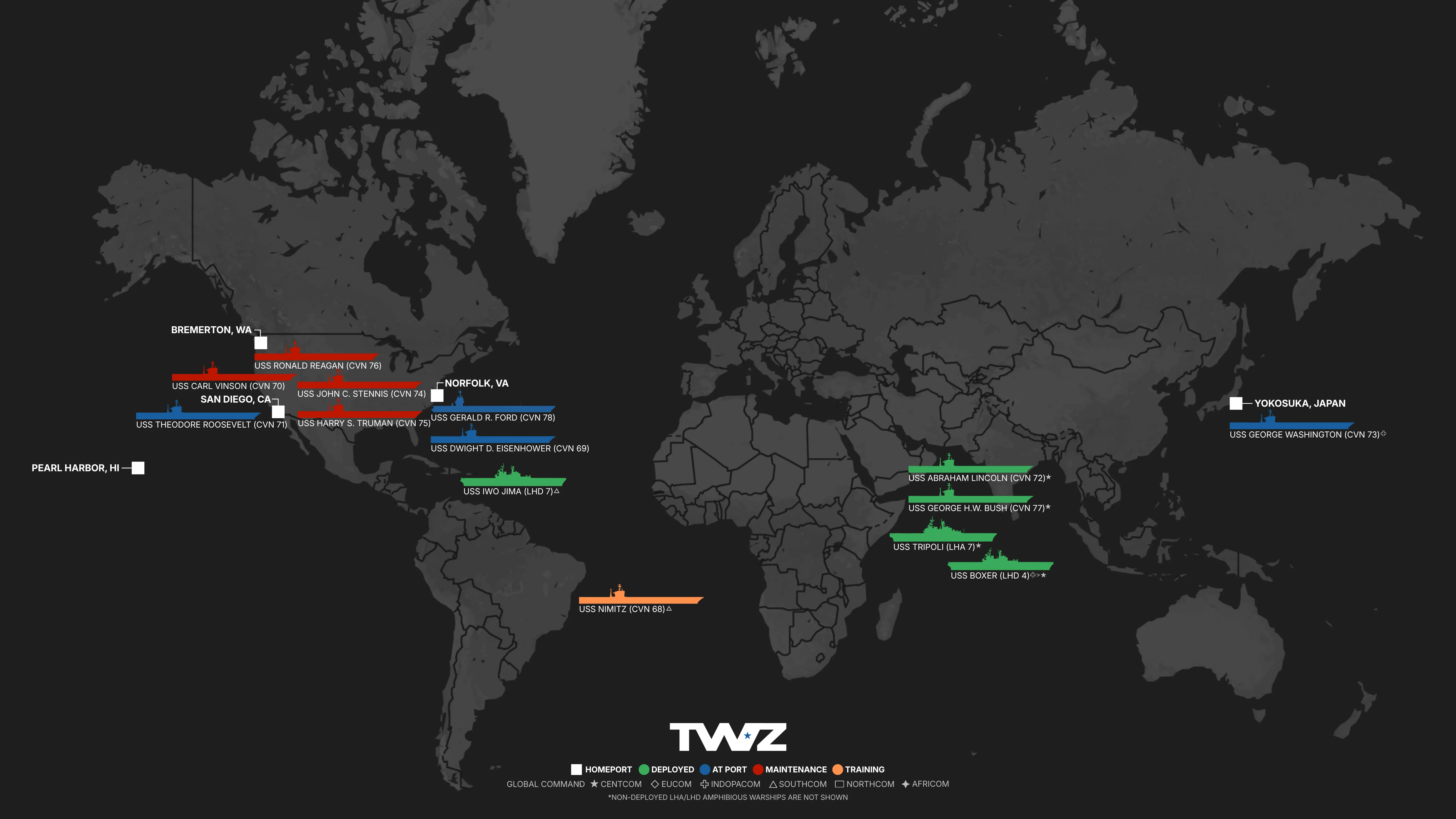
Where Are The Carriers As Of May 17, 2026: Ford Is Finally Home

Here’s TWZ’s weekly carrier tracker monitoring America’s flattop fleet, including deployed Carrier Strike Groups (CSG) and Amphibious Ready Groups (ARG), using publicly available open-source information. Check out last week’s map here.

The Ford is finally home. The supercarrier, with nearly 4,500 Sailors aboard, pulled into Naval Station Norfolk on Saturday, greeted by hundreds of families and friends after completing a grueling 326-day combat deployment. The well-deserved homecoming capped the longest deployment in more than five decades, which was extended multiple times to support operations across two continents and combatant commands.

Ford, the world’s largest and most advanced aircraft carrier, departed Virginia almost a year ago for, what was at the time, a routine deployment to Europe. The deployment turned out to be anything but when Ford was redirected to the Caribbean in November ahead of Operation Absolute Resolve. Following the successful extraction of President Nicolas Maduro out of Venezuela, and despite pushback from top Navy brass to come home, the CSG crossed the Atlantic again to project power and pressure from the eastern Mediterranean and northern Red Sea during Operation Epic Fury against Iran. Overall, Ford sailed over 57,000 nautical miles, logged more than 5,700 flight hours, and conducted 12,000+ aircraft launches. Upon arrival in Norfolk, Carrier Strike Group 12 was presented with the Presidential Unit Citation, the highest honor a military unit can receive.

Meanwhile, three other carriers conducting routine operations and work-ups returned to their respective homeports with much less fanfare. USS George Washington, USS Dwight D. Eisenhower, and USS Theodore Roosevelt, each at various stages of training prior to future deployments, pulled into Yokosuka, Norfolk, and San Diego, respectively, over the past week.

The Navy’s only forward-deployed carrier, USS George Washington, completed a weeklong shakedown cruise after a brief pierside availability. In response to unconfirmed reports the flattop was in maintenance, a George Washington spokesperson told TWZ the “U.S. Navy’s forward-deployed aircraft carrier conducts short maintenance availabilities between patrols to service critical systems and conduct repairs” and was recently “underway conducting routine operations to sharpen our Sailors’ warfighting edge.” Regardless of her past status, Washington is operational today and preparing for an upcoming WESTPAC patrol.

The U.S. maintains a considerable naval fleet in the Middle East enforcing the ongoing blockade of Iran. Two CSGs and one ARG – more than 20 warships in total – continue operations in the U.S. Central Command (CENTCOM) area of responsibility (AOR). Another ARG, led by USS Boxer, is nearby in the Indian Ocean operating under U.S. Indo-Pacific Command (INDOPACOM) as of May 16, but, as we have noted previously, the group could enter CENTCOM at any time. U.S. forces have redirected 81 commercial vessels and disabled four attempting to run the blockade to date, according to the latest press release from CENTCOM.

U.S. Sailors support flight operations aboard aircraft carrier USS Abraham Lincoln (CVN 72) sailing in the Arabian Sea. Every operational success across CENTCOM begins and ends with America’s men and women in uniform. pic.twitter.com/PjmByqI4jC

— U.S. Central Command (@CENTCOM) May 17, 2026

Note: Positions are general approximations. Non-deployed LHA/LHD amphibious warships are not shown.

Contact the author: ian.ellis-jones@teamrecurrent.io


Source link

‘Horrific’ reason you should never inflate your life jacket while still on a plane

A physics teacher has shed light on the hidden dangers of inflating your life jacket inside an aircraft cabin during an emergency – it could have deadly consequences

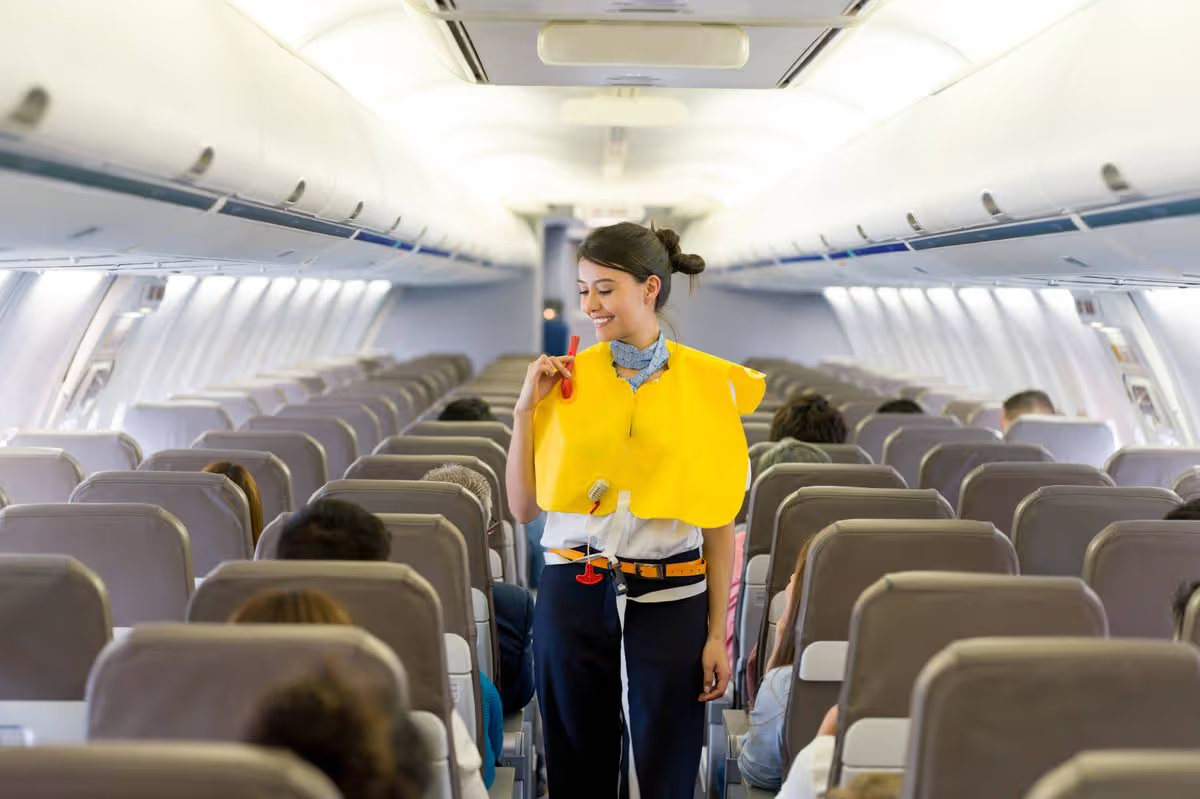
A physics teacher has explained the “horrific” risks that come when a life jacket is inflated by a person who’s still onboard a plane. When boarding any flight, the cabin crew run through a comprehensive safety briefing explaining to passengers where the emergency exits are, how to secure their seat belts, where to locate and how to utilise oxygen masks, how to operate life jackets, and more.

Life jackets are typically kept in a compartment beneath your plane seat. It’s crucial to only ever inflate the vest once you’ve exited – and are away from – the aircraft, by pulling down firmly on the red toggles. But why shouldn’t you inflate it while you’re still inside the plane?

Some people think it’s related to efficiency and movement – wearing an inflated life vest could make it more challenging and awkward to navigate through the aircraft.

There is some validity to that but the real reason is to prevent a far more alarming consequence. A physics teacher took to YouTube to clarify this in depth.

The footage shows a split screen, with the teacher at the bottom and demonstration clips in the upper portion to offer additional insight and understanding.

There was a clip of a plane passenger sitting in his seat who inflated his life jacket. The teacher began: “This passenger inflated his life vest during the safety briefing. But that was the exact death trap of some passengers on the Ethiopian Airlines flight.”

She then discussed the notorious hijacking of Ethiopian Airlines Flight 961, which was seized while travelling from Addis Ababa to Nairobi by three Ethiopians seeking asylum in Australia. The aircraft crash landed in the sea and, of those aboard, 125 out of 175 died – including all three of the hijackers.

The teacher elaborated: “This aircraft was hijacked in 1996 and was forced to crash land in the ocean after running out of fuel. So during the chaos, some passengers panicked and inflated their life jackets inside the cabin.

“But why is that such a big deal? Think about how these vests inflate instantly using compressed carbon dioxide from that tiny cartridge. So the moment it inflates, it makes you buoyant – but isn’t that its job?”

This is where matters take a “horrific” turn. The teacher explained: “It is, but you don’t want it to do that inside of the cabin when the cabin gets flooded because you won’t be able to dive down and swim out of the aircraft.

“Instead, those passengers were pushed upwards by the water and got pinned to the ceiling. They were trapped by the very thing that was designed to save them.”

In the comments section, fellow YouTube users were keen to offer their perspectives. One person said: “No matter how good a tool is, it can be dangerous if not used properly.”

Another said: “What’s worse is that some people can end up preventing others from escaping because they don’t listen to the safety rules”.

A third person said: “It’s also a hindrance when moving through the narrow seat rows and crowded aisle.” While a fourth commented: “Panic really changes how people react in those moments!”

Another shared: “Thanks for the explanation! I was honestly confused why inflating life vests inside the plane was wrong. But this makes sense!”

Someone else added: “I was thinking that the inflated life vest would make it harder to move through the inside, but the actual reason is much more horrific”.

Source link

Jeremy Clarkson ‘rushed to hospital’ and battling heart issues in Clarkson’s Farm trailer

A new trailer for Clarkson’s Farm has shown a moment when Jeremy Clarkson was hospitalised after suffering an issue with his heart where it “wasn’t getting any blood”

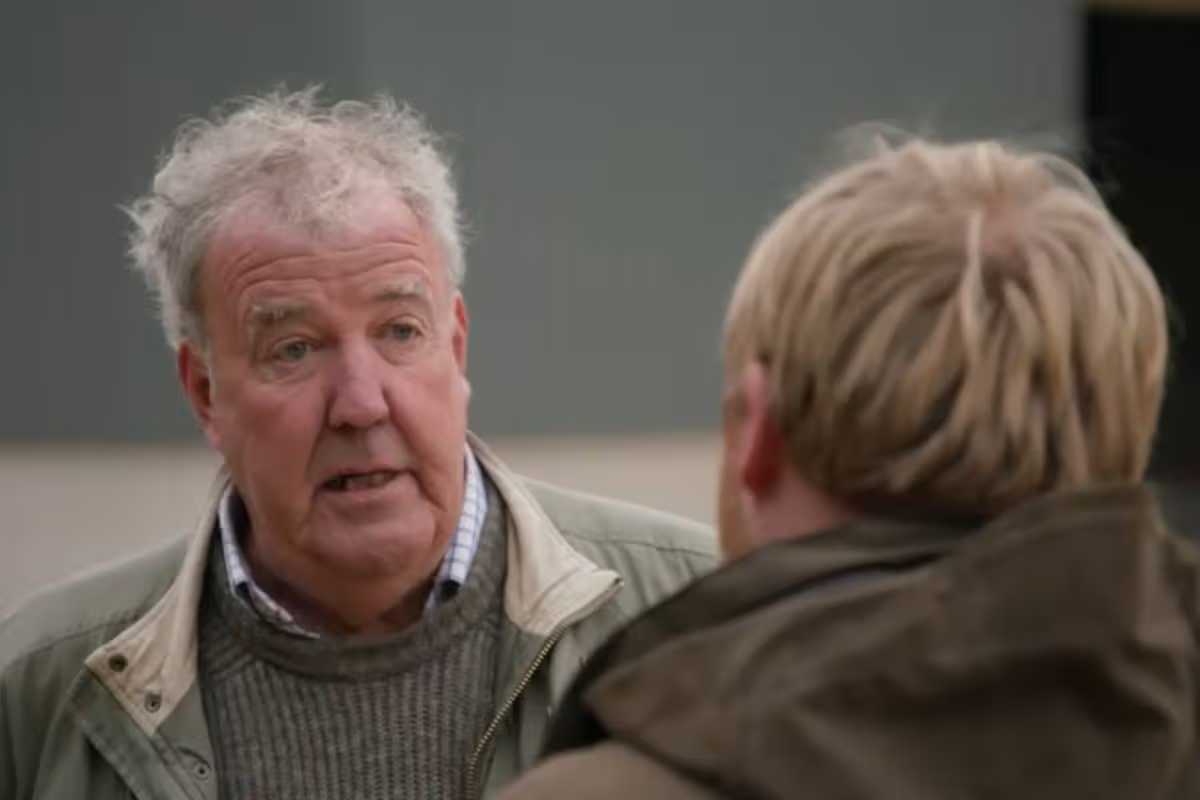
A new trailer for Clarkson’s Farm has shown the horrifying moment when star Jeremy Clarkson had to be hospitalised after a heart scare. In the clip, he told colleague Kaleb Cooper that his heart “wasn’t getting any blood”.

The trailer for season five was released on 18 May. It started with clips about life at Diddly Squat, including Jeremy’s pursuit of a driverless tractor, but the tone suddenly shifted when he opened up about a recent hospitalisation.
Clips of the star in hospital, with wires connected to his chest, just after a clip of an ambulance racing down a country road. Jeremy could be heard telling Kaleb: “You’ve got three arteries that feed your heart to keep it pumping. My heart wasn’t getting any blood.”

READ MORE: Clarkson’s Farm star Kaleb Cooper ‘replaced’ in season 5 trailerREAD MORE: Jeremy Clarkson calls Aberaeron Wales ‘achingly beautiful’ with ‘best hotel in the world’

The camera cut to Kaleb’s shocked face before another Diddly Squat farmer said: “To be fair, my mother dropped dead of heart attack at 67.” Jeremy responded that this was “cheery news”.

Jeremy has faced heart issues before. In 2024, he went through a heart procedure where he has a stent put in to open up a blocked artery after suffering from tightness in the chest. Writing in his column for the Sunday Times, the then 64-year-old said he thought he was having a heart attack because the symptoms were so familiar: “I certainly wasn’t having a heart attack. But if it hadn’t looked that way, I never would have been sent to hospital.”

Though he will discuss his latest hospitalisation in Clarkson’s Farm, Jeremy does not seem to be letting his heart scare slow him down. The rest of the new trailer showed him to be getting stuck into life at the farm as it battled a tuberculosis outbreak among the animals.

It also saw him consider using a driverless tractor. In the trailer, Jeremy is sitting in his office and talking to Charlie Ireland: “I’ve had a brainwave, don’t worry.” Charlie was left shocked when he was handed a piece of paper that had plans for a driverless tractor.

The footage cut to said tractor, which was described as the “Starship Enterprise of farming”, working away on the land and Jeremy declaring to farmhand Kaleb: “Behold my technology at work.” Kaleb responded: “That is basically taking my job.”

But, Kaleb didn’t have to worry about his job as the tractor soon stopped moving in the middle of ploughing a field. “That went well,” Kaleb joked.

The new series was greenlit by Prime Video back on November 5, 2024 and filming took place last year. The first four episodes will be released on 3 June and the remaining will arrive in batches on the 10th and 17th.

Prime Video have not said if the show will continue after the upcoming series, but Jeremy has expressed his desire to have the show come back for at least two more seasons.

“We’ll definitely do six – Amazon want to [do season six] and I want to. I’ve got a good idea for six,” Clarkson told The Sun earlier this year. “I said I’ll stop doing them when there are no more ideas. But I’ve got two quite good ones, so we’ll do six and then we’ll see.”

Like this story? For more of the latest showbiz news and gossip, follow Mirror Celebs on TikTok , Snapchat , Instagram , Twitter , Facebook , YouTube and Threads .


Source link

Brits abroad issued health warning as illness surges across Europe and beyond

Health experts are urging Brits to ensure they are “up-to-date” with their vaccines

Brits planning a summer getaway have been urged to ensure they are “up-to-date” with their vaccinations. The warning follows an “increase” in measles cases globally, including across parts of Europe and Asia.

Measles is a highly infectious viral infection that triggers cold-like symptoms, red eyes, and a characteristic blotchy rash. In severe instances, it can result in serious complications such as meningitis and seizures, and can be fatal.

In guidance published on the Travel Health Pro website, experts highlighted that the disease has risen in numerous countries. They said: “The summer holidays provide opportunity to explore different countries, head off for a city break, have a beach holiday or take the children to visit friends and family overseas.

“Good preparation and planning ahead helps ensure a safe and enjoyable trip. Travellers should be up to date with routine vaccination courses and boosters as recommended in the UK.

“These vaccinations include, for example measles-mumps-rubella (MMR). Measles is a risk in many countries, and there has been an increase in measles cases and outbreaks reported worldwide, including in parts of Africa, Asia, Europe, and the Americas, including Canada and the United States.” Data from the European Centre for Disease Prevention and Control revealed that a total of 3,607 measles cases were reported by 30 EU/EEA member states in the year following 1 April 2025.

Breaking down the figures further, it stated: “Of 3,029 individuals (84.0 per cent of all cases) with a known age and vaccination status, 2 369 (78.2 per cent) were unvaccinated, 320 (10.6 per cent) were vaccinated with one dose of a measles-containing vaccine, 301 (9.9 per cent) were vaccinated with two or more doses, and 32 (1.1 per cent) were vaccinated with an unknown number of doses.

“During the 12-month period, five deaths (case fatality rate (CFR): 0.139 per cent) attributable to measles were reported to ECDC by France (three), Netherlands (one) and Romania (one).”

Meanwhile, a report by the World Health Organisation (WHO) and United Nations Children’s Fund (UNICEF) discovered that measles cases in Europe reached their highest level in 2024 since 1997. A total of 127,350 measles cases were recorded in the European Region in 2024, double the figure reported for 2023 and the highest number since 1997.

Children under five made up more than 40 per cent of reported cases in the Region – covering 53 countries across Europe and Central Asia. Over half of the reported cases necessitated hospitalisation. A total of 38 deaths have been documented, according to preliminary data received as of 6 March 2025. The resurgence has been linked to falling vaccination rates. Dr Hans P Kluge, WHO regional director for Europe, warned: “Measles is back, and it’s a wake-up call. Without high vaccination rates, there is no health security. As we shape our new regional health strategy for Europe and Central Asia, we cannot afford to lose ground.

“Every country must step up efforts to reach under-vaccinated communities. The measles virus never rests-and neither can we.”

Measles cases are also on the rise across the UK. Figures from the UK Health Security Agency (UKHSA) revealed that in 2024, there were 2,911 laboratory-confirmed measles cases in England – the highest annual total recorded since 2012. In 2025, there were a total of 959 laboratory-confirmed measles cases. Data for 2023 to 2025 and historical data are available.

Between 1 January 2026 and 11 May 2026, there have been 542 laboratory-confirmed measles cases reported in England, an increase of 65 cases since the last report on 27 April 2026.

Symptoms

The virus transmits very quickly. Initial symptoms typically resemble those of a common cold, with a distinctive rash emerging several days afterwards.

The first symptoms of measles can include:

  • A high temperature
  • A runny or blocked nose
  • Sneezing
  • A cough
  • Red, sore, watery eyes

The rash initially appears on the face and behind the ears, subsequently spreading across the entire body. Occasionally, the spots associated with the measles rash become raised and merge, creating blotchy patches. These are typically not itchy.

The NHS cautions that measles can trigger severe complications should it migrate to other bodily areas, particularly the lungs or brain. Potential consequences include pneumonia, meningitis, loss of vision, and convulsions. In the most serious instances, the disease can be life-threatening.

How to prevent the spread

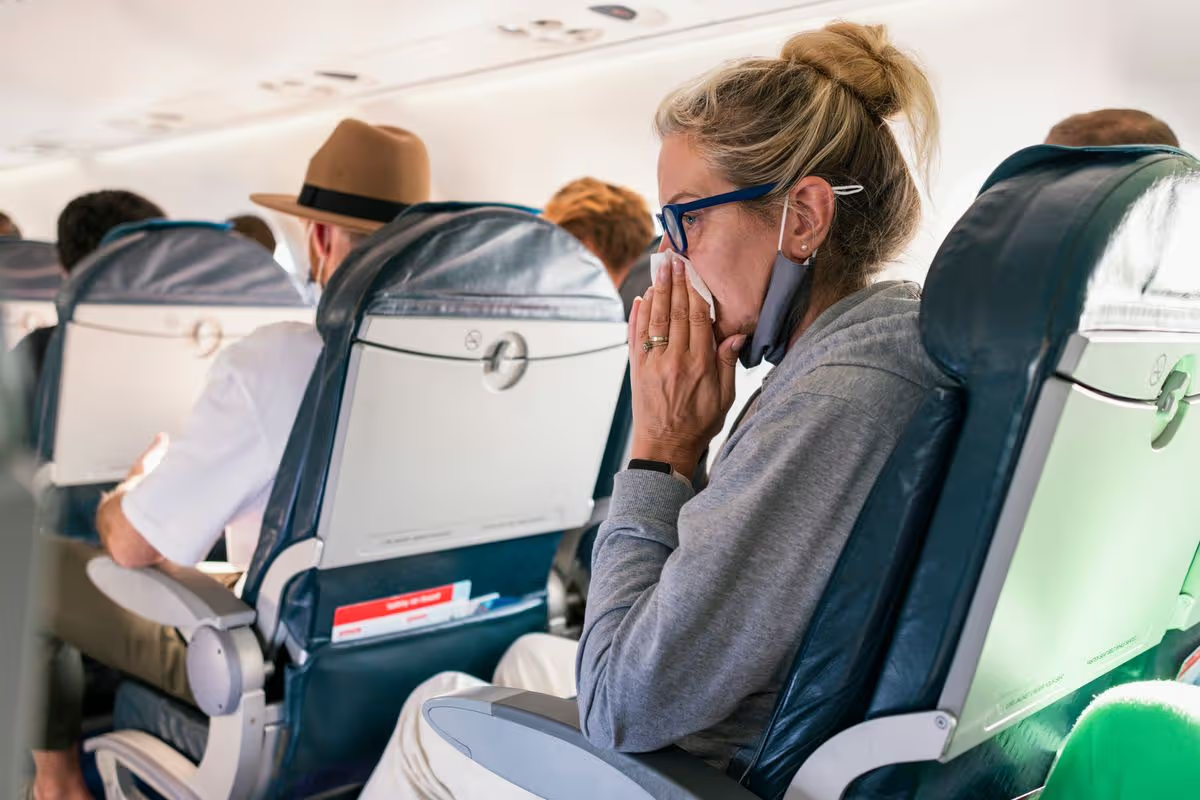
Measles is spread when an infected person breathes, coughs or sneezes. You’re infectious from when you first have symptoms (around four days before the rash appears) until four days after you get the rash.

The NHS advises that to curb the transmission of the infection, individuals must remain absent from educational institutions or workplaces for a minimum of four days following the emergence of the rash. According to its website, the guidance states: “Stay off nursery, school or work for at least four days from when the rash first appears. Also try to avoid close contact with babies and anyone who is pregnant or has a weakened immune system.”

However, the initial step if you or your child develops measles is to arrange an urgent consultation with your GP. The NHS advises: “Measles can spread to others easily. Call your GP surgery before you go in.

“They may suggest talking over the phone or arrange for you to come to a part of the surgery where you’re separated from others. You can also call 111 or get help from 111 online.”

After seeing a GP, there are things you can do to help ease the symptoms and reduce the risk of spreading the infection. It can help to:

  • Rest and drink plenty of fluids, such as water, to avoid dehydration
  • Give your child paracetamol for children or ibuprofen for children if they’re distressed or uncomfortable – check the packaging or leaflet to make sure the medicine is suitable for your child, or speak to a pharmacist or GP if you’re not sure
  • Adults can take paracetamol or ibuprofen for a high temperature
  • Use cotton wool soaked in water that has been boiled and allowed to cool to gently remove any crusts from your or your child’s eyes
  • The NHS also recommends you:
  • Open windows and doors to help reduce the risk of measles spreading – only open the top window or use safety catches if you have young children
  • Wash your hands often with soap and warm water
  • Use tissues when you cough or sneeze and throw them in the bin immediately after using them
  • Do not share cutlery, cups, towels, clothes, or bedding

Vaccination

Having the MMRV or MMR vaccine is the “best way” to prevent measles. The NHS says: “Both vaccines also protect you from mumps and rubella, and the MMRV vaccine also protects you from chickenpox.

“The MMRV vaccine is offered to all young children in the UK. The MMR vaccine is recommended for adults and older children if they were not vaccinated when they were younger.”

Ask at your GP surgery if you’re not sure you or your child has had either of these vaccines. Your GP can vaccinate you for free on the NHS.

Source link

UzNIF debuts on London market in first international Uzbek IPO

Uzbekistan’s National Investment Fund, known as UzNIF, began trading on the London Stock Exchange on Monday, marking the country’s first international equity offering.


ADVERTISEMENT


ADVERTISEMENT

The fund, which is managed by Franklin Templeton, also launched simultaneously on the Tashkent Stock Exchange through a dual listing structure, bringing Uzbek state-linked assets to international equity markets for the first time.

The opening ceremony at the London Stock Exchange brought together executives, investors and Uzbek officials, with speakers presenting the listing as a significant step in the country’s efforts to expand access to international capital markets.

First international equity offering

Speaking during the ceremony, Julia Hoggett, Chief Executive Officer of the London Stock Exchange, described the IPO as “the first ever international IPO out of Uzbekistan” and said the transaction could help “more global investment to flow” into the country’s economy.

Hoggett also said the dual listing marked “a new chapter both in London and in Tashkent”, adding that the offering connected international investors with a portfolio of Uzbek companies through a single fund managed by an international asset manager.

Saida Mirziyoyeva, Head of the Administration of the President of Uzbekistan, said Uzbekistan was preparing “new listings” and expanding private sector participation, while also working on plans linked to the proposed Tashkent International Financial Centre.

Speaking from the London Stock Exchange balcony, Mirziyoyeva said the IPO was “not just about raising capital” but also about “building trust in a new generation of Uzbek institutions”.

Jenny Johnson, President and Chief Executive Officer of Franklin Templeton, described the IPO as “a defining and historic milestone” for both Uzbekistan and Franklin Templeton, saying the transaction had generated more than $2.8 billion in investor demand globally.

Johnson said orders exceeded the initial offering by more than four times during the bookbuilding process, which ran from late April to mid-May. She added that the domestic offering in Tashkent had become the country’s “largest local listing to date”, allowing local investors to participate alongside international institutional funds.

International investors and state assets

Thirty percent of the fund’s shares were offered internationally through global depositary receipts, while part of the allocation was also made available to domestic investors through the Tashkent Stock Exchange.

According to previously released information from the fund and its advisers, international demand reached around $2.9 billion (€2.6bn), with more than 160 institutional investors participating in the offering. Among them were BlackRock, Franklin Templeton and Redwheel.

The IPO raised approximately $603.6 million (€540m), valuing the fund at around $1.95 billion (€1.74bn) at the offer price. The shares were sold by Uzbekistan’s Ministry of Economy and Finance, meaning the proceeds from the transaction will go to the state rather than directly to the fund itself.

The international tranche included more than 23 million global depositary receipts, or GDRs, listed in London under the trading symbols UZNF and UZ20. One GDR represents 64,700 shares in the fund.

Cornerstone investors, including funds and accounts managed by BlackRock, Franklin Resources and Redwheel, as well as treasury companies linked to the Allan & Gill Gray Foundation, committed a combined $300 million (€268m) to the offering.

UzNIF was established in 2024 under a presidential decree and is managed by Franklin Templeton, the US-based investment company that oversees more than $1.4 trillion (€1.25 trn) in assets globally and operates in more than 150 countries.

The fund’s portfolio includes stakes in 13 state-linked companies operating in sectors considered strategic for the Uzbek economy, including electricity distribution, thermal power generation, hydropower, telecommunications, aviation, rail infrastructure, utilities and banking.

Among the companies included in the portfolio are Uzbektelecom, Uzbekistan Airways, Uzbekhydroenergo and several state energy and infrastructure operators.

The listing also reflects broader efforts to develop domestic capital markets in Uzbekistan and increase participation from local investors alongside international institutions.

Source link

UK airport set to reopen after it closed in 2022

The airport is expected to welcome passenger flights again in 2028

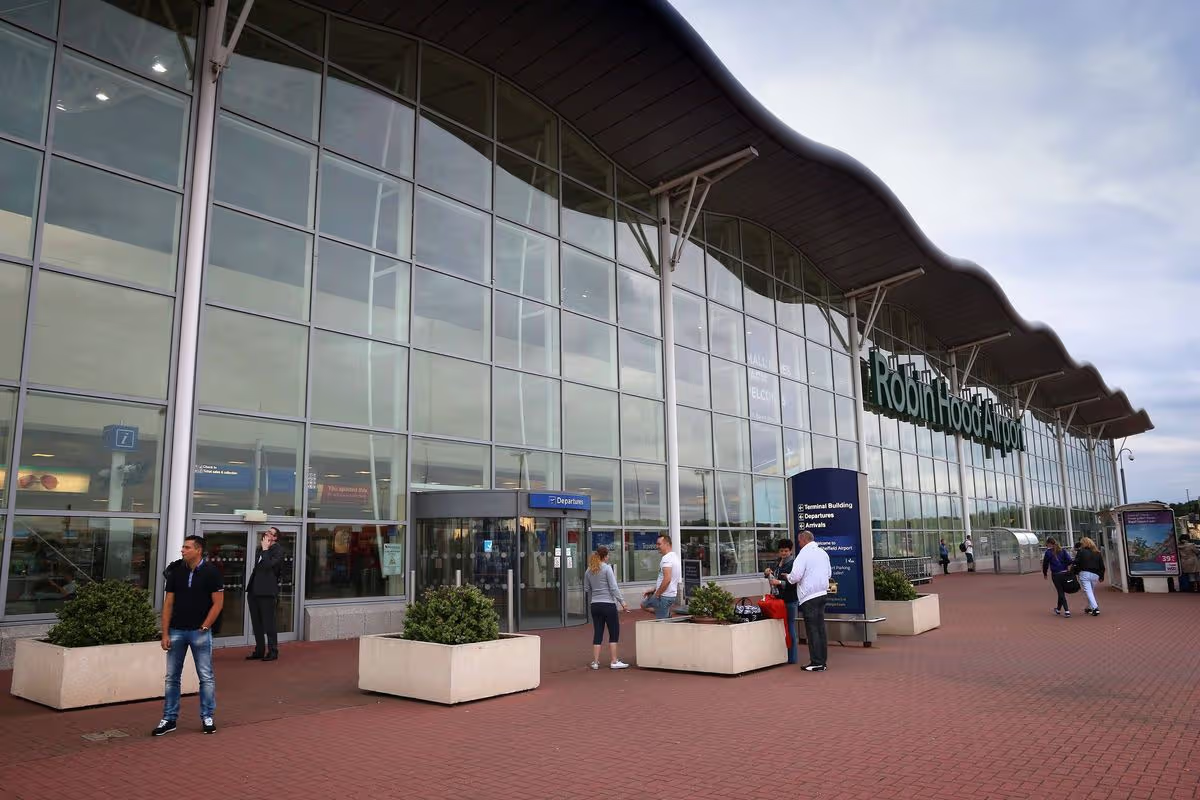
A UK airport that shut down three-and-a-half years ago is set to reopen following the resolution of a funding dispute this week. Doncaster Sheffield Airport (DSA) near Finningley in Doncaster was once a key regional flight hub known as Robin Hood Airport, operating from 2005 with flights to holiday destinations including Alicante, Majorca, Paris, and various other locations.

However, the airport was compelled to close in 2022 after its owners, Peel Group, declared it financially “unviable”. The closure left South Yorkshire without an international airport.

Yet, in September 2025, the South Yorkshire Mayoral Combined Authority (SYMCA) officially approved a £160million funding package based on previous commitments to reopen the airport as DSA in a significant boost for the region. Its resurrection followed campaigning by residents and local politicians, and received backing from the British Government.
Nevertheless, the scheme had been thrown into doubt in recent weeks during a deadlock over a £57million loan from Doncaster City Council to support the reopening plans, after Reform UK councillors expressed concerns about whether taxpayers would receive a return on investment.

The airport scheme was championed by the local authority’s Labour mayor, Ros Jones, who is believed to have been re-elected by a narrow margin largely owing to her commitment to delivering the potentially transformational scheme, despite a surge in support for Reform.

The structure of local Government in Doncaster means she retains executive authority as Mayor despite Reform securing a majority on the council at the last election, and now controlling the budget.

Nigel Farage’s party originally backed the airport scheme, but in April indicated they would contemplate voting to withdraw approval, as they requested additional details about how the funds would be allocated and benefit local people, reports the Express.

At the end of last month, Mr Farage attacked the terms of the lease agreement being negotiated with the current site owners, The Peel Group, arguing the council needed to secure the freehold to prevent it becoming a “massive drain” on taxpayers.

Ms Jones told the BBC News at the time: “Last week Reform said DSA should be privately funded and today they’re saying it should be acquired by the council or government, even if that means through a compulsory purchase order (CPO).

“It is important to remember we offered to buy the freehold back in 2022 and Peel refused, the offer of a lease effectively killed off any chance of a successful CPO.”

She added that a CPO application could take between five to seven years with minimal chance of succeeding. The standoff sparked concerns that the scheme would have to be scrapped, despite significant progress in attempts to prepare it for commercial air traffic once more.

However, at an extraordinary meeting of the council last week, Reform dropped its opposition to the loan on the condition that they are able to review copies of the new lease before it is approved, according to ITV News.

Ms Jones said she was “delighted to see Reform’s done the U-turn”, dismissing the threat from the hard-right party as a “political stunt”.

Freight services at the flight hub could get under way as early as next year, with passenger flights expected to launch in 2028, according to reports.

FlyDoncaster, a council-owned company established to reopen and run the airport, has teamed up with German operator Munich Airport International (MAI) on the venture.

In an update last month regarding preparatory work at the site, Christian Foster, Director of council-owned operator FlyDoncaster, said: “Over recent months we’ve been building the right team to take on this task. That has included individuals with experience at major airports such as Manchester, Gatwick and East Midlands, taking up roles like Head of Security, Head of Airfield Operations and Head of Health & Fire Safety.

“We’re also going through a critical Airspace Change Process, a regulatory hurdle that means we’ll have our own area of airspace around the airport to manage. This is critical to our plans.

“We’re due to hear the result of stages one and two imminently, and we’ll be asking the public for their views in the summer, with a view to being re-certified in spring 2027.”

He says preparations for reopening and welcoming passengers back have been well underway, which has involved acquiring “vital equipment such as a new radar and fire appliances, completely refurbishing the fire station and control tower, and making plans for renovating the terminal building”.

The terminal building is set for a “full makeover, giving passengers somewhere that feels really special at the start of their holidays”, alongside improvements to the site’s infrastructure “to make this one of the most accessible airports in the UK for those with a disability”.

On top of this, talks are ongoing with airlines and partner organisations.

Mr Foster says the airport is already equipped to handle hundreds of thousands of tonnes of freight, and is also in dialogue with firms at the forefront of aviation innovation – including sky taxis, vertiports, and alternative fuel technologies – about how these could be incorporated into the site.

Source link

MJK Smith: Former Warwickshire and England captain dies aged 92

Born in Leicestershire and educated at Stamford School, Smith represented his home county and Oxford University before joining Warwickshire.

He captained the Bears from 1957 to 1967 and scored 39,832 first-class runs in 637 matches during his county career, the 18th-highest total of all time.

Smith still holds the Warwickshire record for most runs in a single season after scoring 2,417 runs in 1959 and was named a Wisden Cricketer of the Year in 1960.

He remained involved with cricket after his retirement as a player, as chairman of Warwickshire and also as an ICC match referee, officiating in four Tests and 17 ODIs.

A dual international, Smith played rugby union for Oxford University and Leicester and won a cap for England against Wales in January 1956.

Source link

UK forest is ‘best place in the world’ with ‘incredible’ hill fort and winding rivers

A striking UK destination used as a movie set, with 27,000 acres of ancient woodland and a meandering river passing through, has been named one of the ‘best places in the world’

Some of the world’s most spectacular places are right on our doorstep, and there’s one in the heart of an enchanting UK woodland.

Nestled between the Rivers Wye and Severn in Gloucestershire, straddling the Welsh border, lies the ancient Forest of Dean, with 27,000 acres of towering, majestic trees. It’s one of England’s largest ancient woodlands and stands as a celebrated haven of outstanding natural beauty.

It attracts visitors from far and wide to admire and explore its otherworldly woodland, rustic bridges, snowdrops, and spiralling rivers. But there’s one particular spot in the Forest of Dean that has been deemed the ‘best place in the world’.

READ MORE: UK’s ‘best day out’ for families revealed and it’s not Alton Towers or Thorpe ParkREAD MORE: Sun-soaked island 4 hours from UK with turquoise waters is ‘cheapest for Brits’

Speaking to the Mirror, forest ranger for Forest Holidays, Gerry O’Brien, said: “I love the Forest of Dean, it’s obviously an area very close to my heart, it’s rich in history, heritage and wildlife. I know it really well, inside out, I guess, now. There are a lot of hidden gems around the forest that I love to go and explore, but Symonds Yat Rock is one of my favourite places in the world. It’s an incredible place to go, and I love it.”

Symonds Yat Rock offers breathtaking views across the winding River Wye, which is towered over by limestone cliffs and sprawling acres of ancient woodland. It’s a haven for birdwatching, with goshawks, buzzards, and sparrowhawks sweeping over the viewpoint, and it has ample walking trails to soak up the picturesque vistas and explore the nearby forest.

Gerry further shared about Symonds Yat Rock: “It’s incredible, it’s an old Iron Age Hill Fort, it’s almost right on the Hertfordshire border, looking out over the countryside. You could imagine, like 2,500 years ago, people were living on that rock, which is hard to believe.

“There are peregrine falcons that nest in the cliff face along the edge, so you can often see them coming up. There’s also a woodland, and if you’re looking down from Symonds Yat Rock, with the River Wye below you, you can look out over Copper Hill and on the other side, it’s the woodland where Harry Potter was filmed.”

Sharing a closer insight into the area and its renowned connections, Gerry added: “If you go to Symonds Yat East, it’s a little hamlet by the river, it’s beautiful and really picturesque. But you walk right past the house that was used in the Netflix series, Sex Education.

“It’s the red house, so all of that was filmed in and along the Wye Valley. There are a lot of hidden gems around the Forest of Dean. They’ve done alot of movies and TV work around the forest.”

Another highlight in the Forest of Dean’s otherworldly scenes is the beautiful Puzzlewood with 14 acres of twisted, moss-draped trees, ancient wooden bridges and snowdrops scattered across the rugged terrain. Alongside Gerry’s favourite place in the world, Puzzlewood is frequently hailed as one of the region’s most picturesque locations.

It even secured a place on Big 7 Travel’s ’50 Most Beautiful Places in the UK’ list for 2025 and again this year. This fantastical atmosphere has also attracted Hollywood attention, serving as a backdrop for productions such as Star Wars: The Force Awakens, The Secret Garden, The Huntsman: Winter’s War, Doctor Who, Merlin, Netflix’s Our Planet and BBC’s Atlantis.

Elsewhere in the Forest of Dean, Gerry recommended King Arthur’s Cave and the nearby Little Doward Hill Fort, an Iron Age fort situated in the Wye Valley. But one lesser-known landmark he applauded is the Darkhill Ironworks.

“It’s an old industrial ruin, and it’s really atmospheric where nature has reclaimed around it”, Gerry shared. “You can do a little walk around the Ironworks, which is a nice nature walk, and you can see the ruins.”

To explore some of Gerry’s recommendations in the Forest of Dean, you can book a stay with Forest Holidays, which offers a collection of lodges, cabins and treehouses, some with outdoor hot tubs to soak under the towering trees. Meanwhile, the likes of Sykes Holiday Cottages and Holidaycottages.co.uk also offer a range of stays in the region.

Do you have a travel story to share? Email webtravel@reachplc.com

Source link

All of the UK’s Blue Flag beaches

IT’S THAT time of year again when, as the weather warms up, the UK’s Blue Flag beaches have been announced.

In total 61 sites, including beaches, a marina and an inland water bathing area have been awarded the Blue Flag for 2026 across the UK.

The Blue Flag award recognises beaches that are clean, safe, and well managed, including whether they haves services like lifeguards, first aid, educational activities and so on.

Several Devon beaches have not been included on the list, after Torbay – where previously five Blue Flag beaches were located – decided to create their own awards system.

North East

Whitley Bay on the north east coast has been awarded a Blue Flag Credit: Getty
And so has Roker Beach in Tyne and Wear Credit: Alamy

Five beaches in the North East were awarded a Blue Flag status, including:

  • Whitley Bay South
  • Tynemouth Longsands South
  • King Edwards Bay
  • Blyth South Beach
  • Roker Beach

Read more on travel inspo

DEEP DIVE

All the lidos in the UK mapped – with FREE entry, water slides and cocktail bars


ON THE UP

I’m a travel editor – the flight, train & ferry upgrades really worth the money

North West

In the North West one spot was given a Blue Flag status – Liverpool’s Albert and Salthouse docks, which is even the only Blue Flag marina in the UK.

Yorkshire and Humber

Assistant Travel Editor Sophie Swietochowski has visited Whitby in Yorkshire and says it has “typical northern charm” Credit: Alamy

In Yorkshire and Humber, three Blue Flag beaches have been named, including one visited by Assistant Travel Editor Sophie Swietochowski:

She said: “If you’re after that typical northern charm, but in a seaside setting, look no further than Whitby.

“From the shoreline, you can admire the lighthouse in the distance, or grab a pew on one of the benches by the marina to watch the boats sailing in and out to sea.

“Don’t leave without swinging by Magpie Cafe for its famous fish and chips (with curry sauce, of course) – it’s widely known for being the best chippy in the area so get there bang on opening time to avoid the queues.”

Hornsea was also awarded a Blue Flag status Credit: Getty

The other two Blue Flag beaches in Yorkshire and Humber are:

East Midlands

Three beaches in the East Midlands were awarded the Blue Flag status and include:

  • Central Beach, Mablethorpe
  • Central Beach, Skegness
  • Central Beach, Sutton on Sea
Three beaches in the East Midlands were awarded the Blue Flag status, including Skegness Credit: Getty

East of England

In the East Of England, a total of 15 beaches were awarded a Blue Flag status.

Having explored the area several times, Travel Reporter Alice Penwill said: “After visiting Cromer back in 2024 – my family and I have been back multiple times to enjoy its cute cafes and beautiful beach.

“When the sun is out, Cromer beach is a great place for laying about in the sun, or going for a dip in the sea.

“And for anyone bringing along a furry friend, dogs aren’t allowed on certain sections of the beach, specifically by the pier, but can frolic on the sand further up, just look for the signs.

Alice Penwill has visited the Blue Flag beach Cromer, which is home to a great ice cream parlour Credit: Getty

“Make sure to step off the sand for a few minutes and head to Windows Ice Cream where you can get an enormous soft serve treat from £2.”

Another Blue Flag beach she has visited in the area is Frinton on Sea.

She said: “Not only is Frinton a very pretty spot on the coast, it’s one of the sunniest.

“Along the Essex coastline, Frinton-on-Sea is known for having no noisy arcades, like its more popular neighbour of Clacton.

“I love it for the fact that it has no frills, on the front is just a sweeping sandy beach, the sea and some pretty beach huts too.

“But if you want a bit more excitement, head back to Connaught Avenue for independent shops and boutiques.”

Southwold in Suffolk has a famous pier, lighthouse and beach huts and was also awarded a Blue Flag status Credit: Getty

She also recommend visiting Southwold in East Suffolk, commenting on how it takes her back to her childhood family holidays where she’d spend hours running about on the sand and in and out of the sea.

She added: “Its pier is 623 feet long and is dotted with shops, cafes and everyone has to head into the arcade.

“As much as I love the beach, you can’t miss a stroll into town either for its great shops and the Adnams brewery.

“At the other end of town by the harbour is my favourite chippy, the Sole Bay Fish Company.”

Other Blue Flag beaches in the East of England include:

  • Albion Walton On The Naze
  • Brightlingsea
  • Dovercourt Bay
  • East Runton
  • Felixstowe
  • Mundesley
  • Sea Palling
  • Sheringham
  • Shoebury Common
  • Thorpe Bay Beach
  • Three Shells Beach
  • West Runton

South East

In the South East, Botany Beach was awarded a Blue Flag status Credit: Getty

A total of 11 beaches were awarded the Blue Flag in the South East this year.

Deputy Travel Editor Kara Godfrey said: “Kent is hardly short of beautiful beaches – and Botany Bay is one of my favourites.

“It can get busy, but being between Margate and Ramsgate means you can easily get to it by a short walk.

“Yet Ramsgate is a great beach to visit as a family due to its size, so you will never be fighting for space.

“It’s also helped by being right in from of the UK’s biggest Wetherspoons (complete with a rooftop beer garden…).”

As was West Wittering beach Credit: Getty

Other Blue Flag beaches in the South East include:

  • Hove Lawns
  • Joss Bay
  • Marina Beach Hastings
  • Minnis Bay
  • Rottingdean
  • Saltdean
  • Sheerness
  • Tankerton
  • West Wittering Beach

South West

Across the South West, a staggering 24 beaches have been awarded the Blue Flag.

Born in the South West, Travel Reporter Cyann Fielding said: “The South West is bursting with beautiful beaches so it is no surprise that many have been awarded a Blue Flag.

“In Dartmouth in Devon, Blackpool Sands has been awarded a Blue Flag for the third year in a row.

“The privately-owned shingle beach stretches across two-thirds of a mile and is often quite wide, making it a great day out even when busy.

“From the beach you can head kayaking or paddleboarding too.”

Also in Devon, one of Cyann’s more local beaches was awarded a Blue Flag for its 27th year.

Cyann Fielding has visited the Blue Flag Blackpool Sands and says it is great for watersports Credit: Alamy
Dawlish Warren Beach is another spot in Devon with a Blue Flag status Credit: Alamy

She said: “Dawlish Warren is the ultimate beach for families.

“Found on Devon’s south coast, the beach is backed by rolling dunes and fascinating wildlife habitats.

“The 1.5-mile stretch is a safer, more sheltered spot for families, compared to a lot of other beaches in the are, a and you’ll even find -go karts, golf and arcades to have fun in too.”

Sophie added: “Stretching for around three kilometres, you’ll never struggle to find a sunbathing patch at Westward Ho!.

“The main beach starts at the busy end of town, where you’ll have no trouble finding a bucket and spade, before blending into the much quieter Northam Burrows Beach, backed by a national park and an excellent links golf course.

“Keep wandering towards the northern tip to find Pebbleridge Kitchen, a tiny cafe that sells fresh crab sandwiches.”

Porthminster Beach in St Ives, Cornwall, was also awarded a Blue Flag Credit: Alamy

Sophie has also been to Porthminster in St Ives, Cornwall.

She said: “On a sunny day, the white sands and gloriously blue seas of Porthminster could be mistaken for the shores of a Caribbean island.

“It’s not the largest of beaches, but it’s at the quieter end of town, away from the main hustle and bustle of St Ives.

“Pedn Olva, an excellent pub with rooms, is just a short walk away.

“Try the local ales and “crabby fries”, smothered in white and brown meat and drenched in a thermidor sauce.”

She added: “I visited Widemouth Bay with my family and the dogs several years back, on a sunny April afternoon, and we had the entire sands to ourselves.

And Widemouth Bay on the north Cornwall coast near Bude gained the status as well Credit: Alamy

“The sunset was absolutely spectacular – take advantage of the tall grassy dunes behind the beach for the best viewpoint.

“There are some lovely walks along here, too.”

And another Blue Flag spot is one of her all-time favourite beaches in Cornwall.

She said: “Polzeath is a glorious stretch of golden sands backed by fuss-free restaurants serving hearty toasties and proper Mr Whippy ice cream.

“Make sure to swing by Surfside Polzeath, a rum bar that spills out onto the beach and serves some punchy cocktails – it stays open until 11pm, with people dancing on the sands once the sun sets.”

Other Blue Flag Beaches in the South West include:

  • Canford Cliffs
  • Croyde Bay
  • Exmouth Beach
  • Sidmouth Town
  • Carbis Bay
  • Challaborough Bay
  • Crooklets
  • Durley Chine
  • Fisherman’s Walk
  • Gyllyngvase
  • Highcliffe
  • Porthmeor
  • Porthtowan
  • Sandbanks
  • Shore Road
  • Summerleaze
  • Swanage Central Beach
  • Trevone Bay

Source link

Thousands of drivers & passengers at major Scots airport face new £8.50 charge from TODAY

SCORES of drivers face a new charge at a major Scottish airport as a price increase begins today.

New drop-off charges have been rolled out at Edinburgh Airport, Scotland‘s busiest air hub which was used by 17 million passengers last year.

The Edinburgh Airport drop-off zone with signs for drop-off and authorized taxis.
Drop off fees at Edinburgh Airport have increased from today Credit: Andrew Barr – The Sun Glasgow
Passengers walking under a covered walkway past a "Departures" sign with a tram on tracks nearby.
The fees were blamed on surging business rates Credit: Andrew Barr – The Sun Glasgow

It will now cost £8.50 for a ten-minute slot to either drop-off or pick someone up near the main terminal.

The fees have been hiked by £2.50 and were rolled out today.

Bosses have also scrapped a 50 per cent discount for people driving electric vehicles to the airport.

Instead, more spaces have been added to the free drop-off area – where motorists can park for free for 30 minutes.

The price hike has been blamed on a surge in business rates.

Airport chiefs claim they have been hit by a hit by a 142 per cent rise – an £8million increase – which was branded “simply unacceptable”.

Edinburgh Airport’s chief executive Gordon Dewar said: “This decision to impose an unplanned and wholly disproportionate £8million rates increase has an immediate and negative impact on our business.

“We made this clear in correspondence with the Lothians Assessor, who set the increase, and in discussions with the Scottish Government, which has endorsed it.

“A 142% increase reduces our ability to invest, grow and compete. In practical terms, it equates to funding around 200 jobs, two aircraft stands, or five new security lanes. It is not a cost that can be absorbed; it must be covered, and trade-offs like this are unfortunately unavoidable.

“Like many across the hospitality and tourism sectors who have seen business rates soar, we have no choice but to pass part of this cost on to passengers.

“We had not planned to raise fees this year, but the absence of a transitional relief scheme – equivalent to that available in England and Wales – leaves us with no alternative.

“We have always accepted that, given our size, we should pay more, but the scale of this increase is simply unacceptable.”

Bosses previously wrote to the Convenor of the Lothian Valuation Joint Board, which sets non-domestic rates, as well as the First Minister and the Public Finance Minister, to outline their concerns.

Mr Dewar added: “We have made clear to both the Assessor and the Scottish Government that a system which produces such markedly different outcomes for comparable assets operating within the same national economy cannot credibly be described as fair, proportionate or fit for a modern Scotland. This systemic inconsistency lies at the heart of our concern.”

It comes just months after Glasgow and Aberdeen airports – both owned by AGS – increased their drop off fees.

It costs £7 for people to park for up to 15 minutes at both of the sites.

A Scottish Government spokesperson said: “The valuation of all non-domestic property is a matter for the Scottish Assessors who are independent of central and local government.
 
“The Scottish Government estimates Edinburgh Airport will, with Transitional Relief,  have a net non-domestic rates bill of around £8.1 million for 2026-27, compared to £5.4 million before revaluation.
 
“The Scottish Government’s Revaluation Transitional Relief protects those most affected at revaluation – including airports – and will cap increases in gross liabilities up to the next revaluation in 2029.”

Source link

Taiwan President William Lai says island’s sovereignty ‘non-negotiable’

Taiwanese President William Lai Ching-te said Sunday that Taiwan would not do anything to trigger conflict with China but vowed the island would never allow itself to be traded away, or give up sovereignty. File Photo by Ritchie B. Tongo/EPA-EPA

May 18 (UPI) — Taiwanese President William Lai Ching-te said Taiwan would not do anything to trigger confrontation with China but vowed the island would never allow itself to be traded away or give up sovereignty.

In an online post Sunday, Lai said that “as a responsible party in the region and across the Taiwan Strait, Taiwan will not provoke or escalate conflict,” but neither would it yield to pressure to relinquish its “national sovereignty and dignity, or its democratic and free way of life.”

Lai’s statement came after Beijing warned U.S. President Donald Trump to be “extra cautious” over Taiwan, which Beijing regards as a breakaway province, saying it could result in clashes and potential conflict that could place the entire Sino-U.S. relationship “in great jeopardy.”

Speaking aboard Air Force One on his way back to Washington from his summit with Chinese President Xi Jinping, Trump said he had “made no commitment” either way on the Taiwan question or an $11 billion deal to sell arms to the island that was sent to Congress for approval in December.

Trump said he and Xi had discussed the arms deal in depth and that he would make a determination on whether it would go through “over the next fairly short period of time.”

“I’m going to say I have to speak to the person that right now is, you know, you know who he is, that’s running Taiwan,” Lai’s name apparently having slipped his mind.

Trump also strictly adhered to Washington’s long-held position of strategic ambiguity by refusing to answer questions over whether the United States would come to Taiwan’s aid militarily, were it attacked.

Beijing wants reunification and has not ruled out retaking Taiwan by force, particularly if it declared independence.

Back in the United States, Trump appeared to urge caution over Taiwan independence, telling Fox News on Friday that while nothing in the United States’ policy on Taiwan had changed, he wasn’t “looking to have somebody go independent.”

“I’m not looking to have somebody go independent. And, you know, we’re supposed to travel 9,500 miles to fight a war. I’m not looking for that. I want them to cool down. I want China to cool down,” he said.

Although the United States switched diplomatic recognition from Taipei in favor of Beijing in 1979 and acknowledged there is only one China of which Taiwan is a part– the so-called “One China” policy it follows to this day — the Taiwan Relations Act requires it to treat any effort to alter Taiwan’s future by force as a threat to peace in the region and U.S. interests.

The legislation requires the United States to provide the island with arms to defend itself and for the United States to maintain its own capacity “to resist any resort to force or other forms of coercion that would jeopardize the security, or social or economic system, of the people of Taiwan.”

However, there is no guarantee of committing U.S. troops to help defend the island.

In his post, Lai expressed gratitude for the United States’ “continued support” for peace in the Taiwan Strait, as well as ongoing military assistance.

“Given China’s unwavering commitment to the use of force to annex Taiwan and its continued military expansion in an attempt to alter the regional and cross-strait status quo, the United States’ continued arms sales to Taiwan and its deepening of U.S.-Taiwan security cooperation, even to the point of necessity, are crucial elements in maintaining regional peace and stability,” wrote Lai.

Wreathes are seen amongst the statues at the Korean War Veterans Memorial during Memorial Day weekend in Washington on May 27, 2023. Memorial Day, which honors U.S. military personnel who died while in service, is held on the last Monday of May. Photo by Bonnie Cash/UPI | License Photo

Source link

UK attraction to reopen American-style land after two years

A POPULAR attraction in the UK is set to reopen it’s US-themed land – after being forced to close two years ago.

Bluestone National Park Resort, a holiday park in Pembrokeshire, is reopening its American-themed Steep Ravine later this week.

Bluestone is reopening its Steep Ravine attraction with new zipline rides Credit: Bluestone
The new Summit Flight is 279metres long Credit: Bluestone

Follow The Sun’s award-winning travel team on Instagram and Tiktok for top holiday tips and inspiration @thesuntravel.

Often said to be ‘better value than Center Parcs‘, Steep Ravine was forced to close in 2024 due to damage caused by a storm.

But on May 23, guests will not only be able to step back into the USA, but also experience two new rides.

Returning to the attraction is Camp Smokey, an open-air ‘dining experience’ at the foot of the ravine.

GO SEA IT

£9.50 holiday spot with shipwrecks, seals offshore & horseshoe-shaped waterfalls


SIGHT SEA

£9.50 holidaymakers’ favourite Skegness activities… away from the beach

Here, kids can have a barbecue feast, roast marshmallows around the campfire and enjoy a brand-new lunch menu in the great outdoors.

The other returning favourite, Smokey Joe’s Shindig, is back with live entertainment, dancing, music and games as well as barbecue food.

New this year at Steep Ravine are two new high-speed ziplines.

Camp Smokey will return with open air dining and marshmallow roasting Credit: Bluestone Resorts

The Summit Flight is an exciting 279metre long zipline suitable for all ages.

But if Summit Flight is a little too daunting then the Double Glide is a good way to ease children in as it has shorter zips designed to build confidence.

Another activity at the Steep Ravine is Wellies in the Wild: Mud Mission where children can dig and take on some mud play.

The guided adventure has hands-on activities, marshmallow toasting, and guests get a tasty Welsh cake to finish.

Inside Smokey Joe’s Shindig is live entertainment and music Credit: Bluestone Resorts

Camp Smokey and Smokey Joe’s Shindig will reopen from May 23, with the new zip line experiences rolling out initially for guests staying before July 16.

Summer breaks start from £400, based on a four-night stay at a Caldey Lodge arriving on June 8.

The Welsh resort had to close Steep Ravine at the end of 2024 following severe storm damage, since then work has been ongoing to restore the site.

James McNamara, Director of Product and Programme Development at Bluestone said: “Steep Ravine has always been about bringing people together outdoors – whether that’s around the campfire at Camp Smokey or experiencing the adventure of the Ravine itself.

“We’re excited to welcome guests back this month and reopen a place that means so much to so many people.”


Source link