Steph recently appeared on Rich House, Poor House and was offered a job but she had no choice but to refuse the offer due to a family issue and unable to take on the long commute.
Alongside her mother Gail and her daughters – 12-year-old Amelia and seven-year-old Darcey, they swapped lives with wealthy Mr Whippy owner Joe Sealey on the Channel 5 series and their worlds couldn’t be more different.
At the time, Joe traded his six-bedroom estate – complete with cinema room, gym and indoor pool – for seven days in Steph’s three bedroom council house with a damaged ground floor and mould spreading through Amelia’s room.
Despite working six days a week from home in telesales, Steph struggles to cover essential costs. Once fundamental household expenses are paid, they’re left with just £98 per week for all other needs.
At the end of the swap, she was given a life-changing opportunity as Joe offered her a position on his sales team with a starting salary of £60,000 a year.
However Steph has revealed that she’s had to make the heartbreaking decision and turn down the job offer after the office moved to a different location.
Giving viewers an update, she took to her TikTok and explained that the relocation means she would have had to do a four hour round commute, which she says wouldn’t work due to being a single mum and her mum’s health deteriorating.
She said: “In relation to the job, I agree with all of you that it’s an amazing opportunity. Sadly due to the main office relocation it would mean a four hour round trip commuting for me, to be able to go there and take that job offer up.”
During the swap, Steph had no choice but to send her mum home after she became too unwell to continue with the programme and it seems her health is still a concern for Steph.
Steph explained: “As you all know I’m a single mum, I’ve got two beautiful girls. My amazing mum, whose health is not great, it’s not massively improved since the show, so it’s not viable for me to be able to travel a four hour round trip.
“I need to be closer to my girls and my mum but again it was an amazing opportunity that was put forward. Sadly the location did change in between and it’s just not viable for me to do that
“But I just again wanted to say a huge thank you to Joe, my production team, Channel 5 and most importantly every single one of you. It’s not easy to put yourself out there.”
Following a successful business meeting on the show, Steth was promised £20,000 from the initial sales proceeds but unfortunately the sale still hasn’t gone thorough.
Steph added: “Since filming last year, Joe has been tirelessly working with Kaspas trying to get the deal across the line, that obviously you would have seen me go and do the sales pitch for. At the moment, that hasn’t been completed but I know Joe is still working in the background trying to get that over the line for us.”
You can stream Rich House, Poor Holiday on Channel 5
The ferry operator issued an important reminder for any passengers with bookings
The port information applies to all passengers (stock photo)(Image: Getty)
DFDS has issued an important reminder to passengers travelling on its ferry services. Ahead of summer, many families are looking forward to their holidays and getting everything ready for their trips. For those making ferry crossings, the operator has issued a message about ‘travel documents’ to help ensure journeys are as smooth as possible.
Posting on social media, DFDS outlined advice for customers in a post on X. In the message, @DFDSLiveUpdates shared port information for passengers. It read: “Please have all travel documents and passports to hand and open at the photo page before arriving at booths.”
In the post, DFDS explained: “Keep your passports, booking confirmations, and any necessary ID easily accessible for check-in and border control.” As such, the guidance could be helpful to any customers with upcoming bookings.
As customers will know, they need to keep a record of their confirmation. They will also want to pack their luggage accordingly, ensuring they can easily access any documents they will need when travelling.
Passengers can find more information about the check-in and boarding process on the ferry operator’s website. The boarding advice states: “All passengers must present relevant documents upon arrival to the terminal for check-in.
Content cannot be displayed without consent
“These may include a valid passport, booking confirmation, documents for vehicle or pet travel, and/or other required documents, depending on the rules and regulations of country you are travelling to. Routine security checks of passengers, luggage and vehicles are carried out in all ports before you board the ship.”
DFDS also shares border control updates, including guidance on the UK eVisa and ETA. The website explains: “Travel requirements to the UK are changing.
“The UK is transitioning from physical immigration documents, such as biometric residence permits (BRPs), passports containing visa vignette stickers and ink stamps, or biometric residence cards (BRCs), to eVisas.
“If you hold a UK visa and use a physical immigration document to prove your rights, take action now by creating a UK Visas and Immigration account to access your eVisa: www.gov.uk/eVisa.
“If you already have an eVisa, ensure your travel information is up to date by notifying the UK Government about the passport you intend to use if it is not already linked to your eVisa account: www.gov.uk/update-uk-visas-immigration-account-details.
“Those who are visa-exempt for short visits to the UK, i.e. visits of up to six months, will still need to obtain an Electronic Travel Authorisation (ETA), which is digital permission to travel.”
New research shows where and when will be most dangerous for motorists this Bank Holiday weekend
12:59, 19 May 2026Updated 13:00, 19 May 2026
Millions of Brits will take to the roads this Bank Holiday weekend
Most motorists reckon the roads are at their most treacherous during rush hour, when traffic is bumper-to-bumper and congestion is at its peak. But with millions of Britons set to hit the road this Bank Holiday weekend, fresh research suggests the greatest danger may lurk when the roads seem at their emptiest.
Fresh analysis by Confused.com appears to reveal the single most hazardous hour to drive in the UK, with motorists being urged to steer clear of this time slot where possible over the bank holiday weekend. Drawing on Department for Transport (DfT) traffic flow and collision data, Confused.com has developed an interactive Safety Index to work out the probability of being caught up in an accident relative to the volume of vehicles on the road.
Rhydian Jones, Confused.com car insurance expert, explains why the emptiest roads can often prove the most perilous, identifies the riskiest and safest times to drive in the UK, and offers guidance on how motorists can use Confused.com’s new Safety Index tool to plan safer journeys during the bank holiday exodus.
Whether you’re heading off for a long weekend away, popping to see relatives or making your way home after a day out, understanding when collision risk peaks could help you sidestep the most dangerous times to be behind the wheel.
Why Quiet Roads Can Be More Dangerous
It appears to defy logic. Fewer vehicles should surely mean fewer crashes. But experts suggest that emptier roads often encourage more reckless driving behaviour. Almost 1 in 3 motorists (29%) acknowledge they break speed limits at least from time to time, while more than 1 in 4 (27%) admit they’re more inclined to speed when traffic is lighter. Factor in poor visibility, driver fatigue and the heightened chance of encountering drink-drivers, and the hazard increases dramatically.
“Road safety relies on more than just how many cars are on the road. It depends on how conditions evolve through the day, and our analysis makes that pattern unmistakably clear. The late afternoon sees the highest number of collisions because the roads are busy. But when we look at the risk per vehicle, it’s the late-night and early-morning hours that are proportionately the most dangerous. That’s when visibility drops, fatigue sets in and roads are quiet enough that drivers may take more risks.
We know journeys become longer, traffic becomes heavier, and weather conditions get tougher. Our research shows many drivers already feel nervous, especially at night or in unfamiliar areas, and nearly a third admit to speeding when the roads look quiet. Our interactive ‘Safety Index’ tool can help drivers make informed decisions about when they travel, reducing risk and helping them stay safer behind the wheel.” Rhydian Jones, Confused.com car insurance expert.
The analysis found that the hours with the highest collision risk relative to traffic volume are:
Sunday: 3am to 4am
Saturday: 2am to 3am
Friday: 11pm to midnight
Monday: 1am to 2am
Tuesday to Thursday: midnight to 1am
These findings suggest that the greatest danger is not necessarily when roads are busiest, but when drivers are most tired and conditions are less forgiving.
The Safest Times to Drive
By contrast, the safest times to drive are generally in the early morning. Weekdays between 5am and 7am were found to carry the lowest risk, with Wednesday 5am to 6am ranking as the safest hour of the entire week.
On weekends, the safest time shifts slightly later, with 9am to 10am emerging as the lowest-risk period. Experts believe these times are safer because traffic tends to be more predictable and speeds are generally lower.
Over Half of Drivers Have Witnessed or Experienced a Crash
The study also found that road accidents are a common experience for UK motorists.
60% of drivers have either been involved in or witnessed a road accident.
33% say the incident happened in the afternoon.
39% say they have become more cautious and aware of other drivers afterwards.
19% say they felt more nervous behind the wheel.
The emotional impact of accidents can have a lasting effect on confidence and driving behaviour.
The Driving Situations That Make People Most Nervous
The research revealed that many drivers feel uneasy in certain conditions:
26% feel most nervous on inner-city roads.
32% worry about encountering drivers under the influence of alcohol or drugs at night or on weekends.
More than 1 in 3 (37%) actively avoid driving at night.
50% avoid driving in poor weather.
41% leave earlier to avoid feeling rushed.
The UK Areas with the Most Collisions
When looking at total collisions rather than risk per vehicle, the busiest crash period is 5pm to 6pm, coinciding with school pick-ups and the evening commute.
During this hour, the councils with the highest number of reported collisions were:
Kent – 265
Surrey – 215
Essex – 205
Nationally, there were 100,927 injury collisions recorded by police and logged by the Department for Transport over the last year.
Why This Hour Is So Dangerous
Several factors combine to make this the most hazardous hour of the week:
Drivers may be returning home after late nights out.
Fatigue is at its peak.
Reduced traffic can encourage speeding.
Visibility is poor.
There is a greater risk of drink-driving.
The result is a period where even a small mistake can have serious consequences.
In a bid to help motorists gain a clearer picture of road risks, Confused.com has unveiled an interactive Safety Index tool that highlights the safest and most dangerous times to drive on each day of the week.
By cross-referencing traffic volumes with collision statistics, the tool enables drivers to pinpoint lower-risk windows and make better-informed choices about when to set off.
For anyone considering a bank holiday road trip or a late-night drive home, the message couldn’t be more straightforward: quiet roads don’t necessarily mean safer roads.
Receiving less frequent finanical information worries investors of all stripes.
Investors do not like the U.S. Securities and Exchange Commission’s (SEC) week-old proposed rule on semiannual financial reporting. They really don’t like it.
A vast majority, 92%, of comment letters received by the SEC regarding the proposed rule opposed it. Only 6% favored the rule’s adoption, while 2% simply wanted additional details regarding how the rule would operate.
The proposed rule, a pet project of the Trump administration, is likely to be implemented, according to experts.
“There is a strong indication it will happen,” David Bartz, partner and co-head of capital markets and securities regulation at law firm K&L Gates, told Global Finance. “The administration has been looking into this. It’s something that SEC Chairman[Paul] Atkins has been a big proponent of. I think that it’s highly unlikely that it will become an official rule.”
Pros and Cons
The current proposal would permit public companies to elect semiannual reporting instead of the standard quarterly reporting. The SEC estimates that companies incur an average of $330,000 in compliance costs for three Form 10-Q quarterly reports. Alternatively, submitting one Form 10-S semiannual filing costs around $198,000. Savings could come from external professional fees, auditor reviews, data tagging costs, and investor engagement costs, according to a K&L Gates blog post.
The most common concern cited by the rule commentators, however, is a decrease in the amount of available financial information investors receive. This would lead to greater reliance on interim guidance, reduce the chance of finding corporate malfeasance, increase market volatility, and require the revamping of investment and trading strategies.
Material Disclosures
In markets that already have semiannual financial reporting, like the EU and Australia, companies must release material information promptly unless there is a specific business case not to, such as entering merger negotiations or procuring a contract that has not been finalized, said Marc Steinberg, the Radford Professor of Law at Southern Methodist University’s Dedman School of Law.
In the U.S. market, there is no duty to disclose unless it is required under Form 8-K, which must be filed within four business days, or if the company has already spoken about the matter, he added. Information that does not rise to the level of an 8-K disclosure, like the loss of a major contract, can be held until the next quarterly report.
“With some companies going to a semiannual report, it means a company could keep the news of a loss of a major contract embargoed for over six months, which is clearly material to investors,” said Steinberg.
The chance that the SEC will change the rule is slim, according to Bartz. “It’s been floated for several months now, so I think it has probably been pretty well vetted. There will probably be minimal changes to the rule once it’s officially approved.”
Next Step
Once the rule’s comment period ends on July 6, the staff of the SEC’s Division of Corporate Finance will review the comments before drafting a proposal, which will work its way up through various offices before it is presented to the Commission for review and a vote, said Steinberg.
IF you don’t fancy the faff of an airport this summer, why not pop over to one incredible coastline that’s mere hours away from the UK?
You can get to the beautiful French region of Normandy by ferry or the Channel Tunnel to explore its beaches and pretty fishing villages – so there’s no need to even set foot on a plane.
Sign up for the Travel newsletter
Thank you!
Normandy is hours from the UK with beautiful coastal spots like Mont Saint-MichelCredit: AlamyThe ‘trending’ destination has pretty fishing villages too – like BarfleurCredit: Getty
Follow The Sun’s award-winning travel team on Instagram and Tiktok for top holiday tips and inspiration @thesuntravel.
Airbnb has revealed the trending destinations this summer and for Brits, one spot that is increasing in popularity is Normandy.
It stated that not only is the French countryside in demand, but so are “rural coastal bookings”.
The Normandy region is generally much quieter than other tourist hubs in France like Paris, the Côte d’Azur, or the Dordogne.
If you’re tempted to visit, here are some places to consider – one Sun Writer discovered “village life” in peaceful Pourville.
She stayed in a beachside boutique hotel called Vue Sur Mer where guests can expect a basket of warm pastries, jams, juice and strong coffee to start the day.
The former fishing village is backed by towering chalk cliffs and has a pebble-sand beach perfect for a picnic, or having a paddle.
Pourville’s scenery even made it into artwork thanks to Claude Monet who painted ‘Cliff Walk at Pourville’ in 1882.
When it comes to sightseeing, a must-see along the Normandy coastline is Mont-Saint-Michel.
For Disney fans, the tidal island is said to have inspired the backdrop for Tangled.
Deauville is less rural but a glitzy town along the coastlineCredit: Alamy
It has a huge abbey at the very top and is surrounded by museums, shops and restaurants.
The island is best explored by foot and when the tide comes in, it’s cut off from the mainland.
Further down the coast, Barfleur is often considered one of the prettiest villages in France.
It’s a traditional Norman fishing port with granite houses and little restaurants that sit around the harbour.
Any fans of seafood will love it as Barfleur is where you can try moules de Barfleur – these are wild mussels which are usually accompanied with crusty bread and a glass of wine.
Or, if you’re after glitz and glamour, then a trip to Deauville could be on the cards.
The seaside town is a classic Norman resort with a huge beach and it even pulls incelebrityvisitors – the likes of Clint Eastwood and George Clooney have all been there.
On the beachfront is a huge casino with 300 slot machines as well as roulette and blackjack tables.
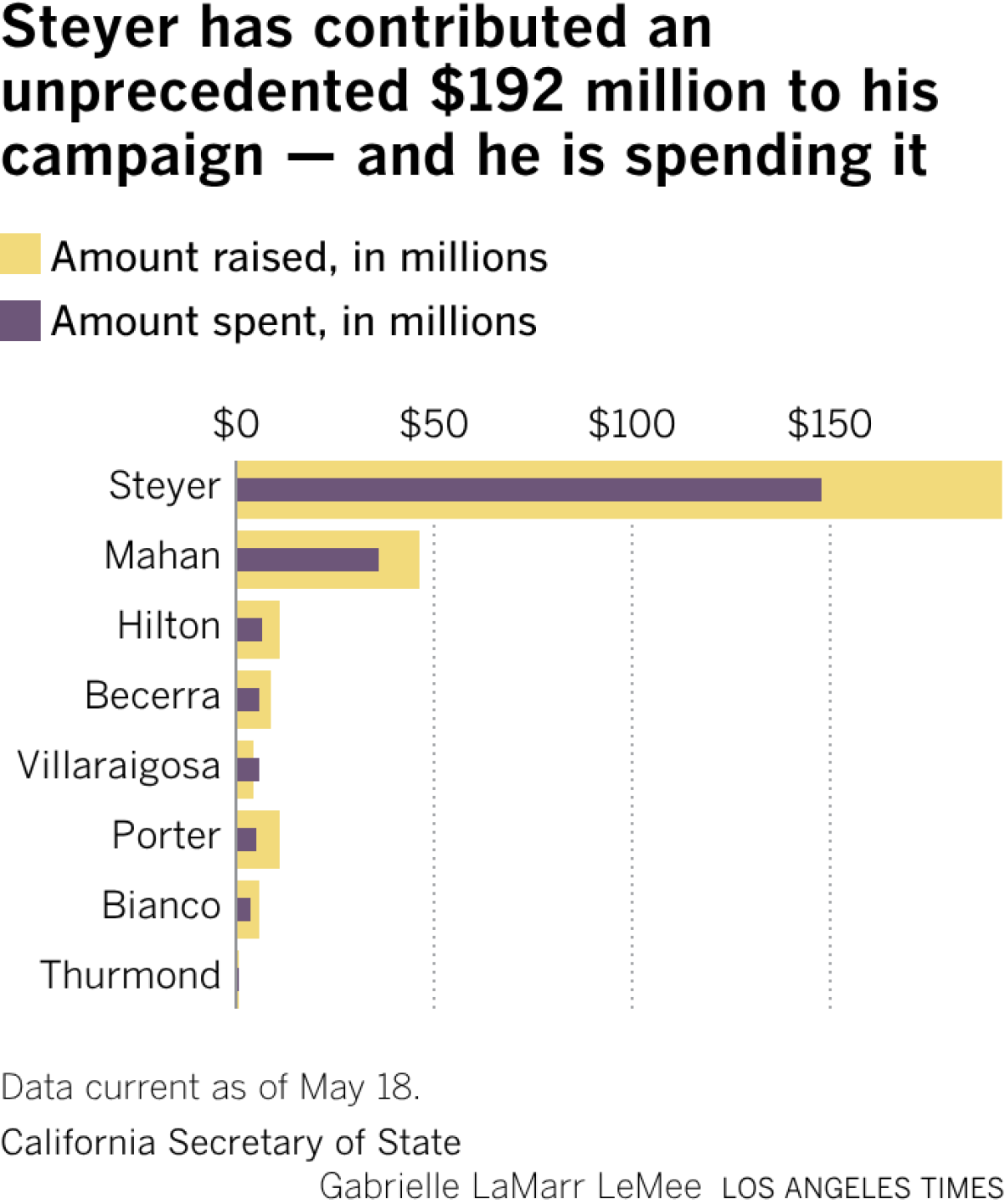
Billionaire Tom Steyer, a leading Democratic candidate for California governor, as of Monday has donated a record-shattering $192.4 million of his personal wealth to his campaign in the lead-up to the June 2 primary.
The cash infusion dwarfs the money raised by all his Democratic and Republican challengers combined, and has fueled a torrent of political ads and a campaign infrastructure that’s kept him near the top of the opinion polls.
But Californians have dismissed rich candidates in the past, especially those who use their own fortunes to appeal to a largely middle- and working-class electorate struggling with day-to-day expenses in the notoriously costly state.
Steyer hopes to avoid the fate of former EBay CEO Meg Whitman, former Hewlett-Packard chief Carly Fiorina, banking and oil heir Michael Huffington and former Northwest Airlines co-chairman Al Checchi, none of whom were able to turn their riches into successful gubernatorial or senate campaigns in California over the last three decades.
Darry Sragow, a veteran Democratic strategist who managed Checchi’s unsuccessful 1998 bid for governor that set a self-funding record, said voters have long been skeptical of the motivation of rich people who run for office.
“Their basic reaction is, this person is incredibly successful, has made obscene amounts of money, could do anything they want to do in the world. Why would they want to run for office? Why would they want to represent me? What’s in it for them?” Sragow said. “And voters just go, ‘You’re just doing this for sport.’ … because they’re bored and they have big egos and they want something to do. That is the fundamental challenge for a self-funding candidate.”
Sragow said Steyer could benefit from his sustained involvement and financial support of climate change policy and other Democratic priorities, in addition to his immense spending in a race that lacks a clear front-runner less than three weeks before the primary.
Steyer said his and his wife’s decades-long work and funding of progressive causes sets him apart from previous wealthy self-funding candidates.
“I’m completely different from those people,” Steyer said in an interview on Friday. “I’ve been working full time on behalf of Californians for 14 years, and I was involved before that. You know, those people … never did anything but the private sector.”
He pointed to his and wife Kat Taylor’s work on ballot measures that took on the tobacco and oil industries, protected environmental laws and taxed out-of-state corporations to fund schools. They also backed successful efforts providing free breakfast and lunch for every California schoolchild, registering 1.2 million voters in the state, and supporting the state’s largest provider of services for immigrants, Steyer said.
“We didn’t just fall off the turnip truck. We didn’t just decide in our boardroom [that] we’re smarter than everybody else, they should listen to us.,” Steyer said. “We have been working within this system as private citizens for really a long time, and that’s the truth.”
Steyer said his background is completely different from the people who thought they would bring a business accounting method to state government, a belief he called “super juvenile.”
The hedge-fund founder turned environmental warrior has spent nearly $1 billion on his political pursuits. In addition to the $192.4 million Steyer has spent to date on his gubernatorial bid, he spent nearly $342 million on his unsuccessful 2020 presidential bid, $325 million on national Democratic candidates and causes, $67.4 million on state efforts and nearly $13.5 million backing a successful California gerrymandering ballot measure last year that was widely viewed as a precursor to his gubernatorial bid, according to state and federal fundraising disclosures and Open Secrets, a nonpartisan group that tracks electoral finances.
Californians watching television cannot escape his ads during local newscasts, sitcoms and niche programming such as the Puppy Bowl (the Animal Planet show that airs on Super Bowl Sunday).
Voters are being inundated with glossy multi-page mailers touting Steyer’s environmental record, his work taking on corporations and President Trump, and his campaign promises to build 1 million new affordable homes in four years, cut electric bills by 25% and enact single-payer healthcare.
Steyer bought advertising time on television stations across the entire state
His television ad buys have totaled nearly $59.5 million. In some areas around San Francisco, his spending at all stations combined totaled more than $22 million. He has also paid nearly $20.7 million to a media company that focuses on digital ad buys.
Amount spent, in millions
Data current as of May 18.
California Secretary of State, Federal Communications Commission
Gabrielle LaMarr LeMeeLOS ANGELES TIMES
Recently placing second in Real Clear Politics’ average of recent polls, Steyer is now third behind Republican Steve Hilton, a former conservative commentator and political strategist, and Democrat Xavier Becerra, a longtime elected official who most recently served as President Biden’s Health and Human Services secretary.
Steyer’s Democratic rivals argue that he is trying to buy the election with money his hedge fund made investing in fossil fuels, private prisons currently housing ICE detainees and other industries that are anathema to liberal voters. Only after making money from those ventures did he come out and oppose them, his challengers say.
Steyer “is a billionaire who got rich off polluters and ICE prisons and is now using that money to fund this election,” former Orange County Rep. Katie Porter said during an April debate.
Steyer responded that corporations such as Chevron and PG&E are spending heavily to defeat him because he is the sole candidate who would not be beholden to them.
“‘I’m the only person in this race that the corporate special interests are spending money against, and they’re spending tens of millions of dollars. And the reason that’s true is because I said I will only put the interest of working Californians first,” he told reporters last month in Sacramento. “They’re worried that I mean it, and I do.”
Steyer said the idea that the money funding his campaign is from controversial investments is “absurd.”
“That is such a bunch of bull, that that’s where my money comes from,” he said in the interview. “My money came from long-term investing over 27 years. It did not come from a couple of investments out of thousands that were there for a very short time and were, in terms of the actual money, irrelevant.”
Additionally, endorsements by influential left-leaning organizations — including actor/climate change activist Jane Fonda’s political action committee, the California Nurses Assn. and the Natural Resources Defense Council’s Action Fund — could assure voters who may be skeptical of his past.
He has donated millions to environmental groups and individuals who have endorsed him. Their goals align with Steyer’s long-term commitment to environmental causes. But he was accused of trying to use his money to win endorsements in Iowa and South Carolina during his 2020 presidential bid. He has also recently come under fire that social media influencers who were touting his gubernatorial candidacy did not disclose that Steyer was paying them.
In the 2010 governor’s race, Whitman spent $144 million of her wealth on an unsuccessful campaign, which set a record for statewide campaign spending in the nation until Democrat J.B. Pritzker broke it in 2018 by donating roughly $171.5 million of his fortune to his successful bid to be elected governor of Illinois.
Adjusted for inflation, Whitman’s spending would be nearly $220 million today. But she spent the money in a lengthy primary and general election, while Steyer is still weeks away from the primary and will almost certainly contribute more money before the June 2 primary and if he advances to the November election. Steyer declined to say how much he plans to spend on his bid.
Steyer’s outsized spending in a state that is home to many of the nation’s most expensive media markets could break the unsuccessful streak of wealthy Californians trying to win the state’s top offices, according to political experts.
“Steyer is outspending his opponents by far more than any other self-funded candidate in California,” said Dan Schnur, a longtime politics professor at USC, UC Berkeley and Pepperdine University. “It’s not a question of his message but rather the magnitude of his spending.”
However, Schnur added that the unsettled nature of the race reflects Democratic voters’ “built-in” resistance to supporting a billionaire who became wealthy because of investments that contradict their morals.
Veteran GOP strategist Rob Stutzman, a top adviser to Whitman during her 2010 campaign, said he didn’t think voters’ primary concern would be Steyer’s self-funding, but the money could make a difference.
“It’s not just that Steyer has self-funded to this amazing number,” Stutzman said. “There’s really nobody [else] that’s even spending enough money, arguably, to be successful.”
Steyer’s net worth is estimated at $2.4 billion by Forbes.
In 1986, Steyer founded Farallon Capital, once one of the largest hedge funds in the world. He sold his stake in it in 2012, saying he didn’t want to be associated with investments that did not align with his values.
“There’s a reason I walked away from that business and walked away from a ton of money, because I felt like that is not the life I want,” Steyer told San Francisco voters in March.
Though Steyer has repeatedly expressed regret about Farallon’s investments, his Democratic rivals argue that this is a convenient stance while Steyer benefits from the largess that Farallon created for him. He is using his money to not only tout his record and build a robust campaign operation, but to slash at competitors who present a threat to his candidacy.
Steyer has unleashed a blistering attack ad campaign against Becerra, who was once mired in the single digits and surged in the polls after former Rep. Eric Swalwell (D-Dublin) dropped out of the race in April after being accused of sexual misconduct and assault.
Ads on television and social media accuse Becerra of being inconsistent about his position on single-payer healthcare and about what he knew about a federal corruption scandal that ensnared a former top campaign strategist for stealing funds from a dormant Becerra campaign account.
Steyer recently sent voters a mailer that castigates Becerra for taking campaign contributions from oil, tobacco and utility companies, and his handling of unaccompanied migrant children when he was HHS secretary.
“Xavier Becerra was supposed to keep immigrant kids safe, but thousands were lost, trafficked, or exploited,” the mailer says. “Becerra failed to protect children and they paid the price. What price will California pay when he fails us?”
On April 27 on the social media platform X, Steyer also called on Becerra to return a $39,200 contribution from Chevron.
Becerra responded with an ad that highlighted California’s natural beauty, from the coastline to the desert to the redwoods, as a respite from the deluge of Steyer ads.
“Take a break from all those Tom Steyer ads. Enjoy,” reads the introduction to the ad.
When Swalwell was still in the race, and topping the field of Democratic candidates, Steyer questioned the then-congressman’s eligibility to run for governor because of residency concerns, as well as his attendance record in Congress. Steyer ran ads saying that Swalwell skipped more than two-thirds of congressional votes while in office.
Rich politicians have won prominent elected offices, including financial executive Jon Corzine, who spent more than $100 million of his money on campaigns for New Jersey senator and governor. In California, self-funders have won lower offices, including Lt. Gov. Eleni Kounalakis, who dropped out of the 2026 gubernatorial race and is now running for state treasurer; Richard Riordan in his 1993 Los Angeles mayoral bid; and Rep. Gil Cisneros, Rep. Sara Jacobs and former Rep. Jane Harman in their congressional races.
Steyer has never been elected to public office. The two times he has jumped into a race, there was a familiar pattern.
In last year’s state campaign about redrawing California’s congressional districts to counter Trump’s efforts to do so in GOP-led states, Steyer spent significantly in support of the effort led by Gov. Gavin Newsom. However, he did not donate to the official campaign backing Proposition 50. Instead, he spent his money featuring himself in ads that were widely viewed as a way to raise his visibility among voters before a gubernatorial bid.
In 2019, Steyer spent $8.5 million airing nearly 19,000 ads calling for Trump’s impeachment, according to the Wesleyan Media Project. That was on top of several million dollars he spent on ads that featured himself, leading Trump to call him “unhinged” and a “wacko” in 2017.
That year, when asked by The Times whether his financial support for Trump’s impeachment was laying the groundwork for a future political bid, Steyer demurred.
“One of the things that is now true in American politics — it is reflected in that question — is there is no sense that people might try and do something for its own purpose,” he said. “Throughout American history, people have chosen to do the right thing ’cause they felt like it was important.”
A year and a half later, Steyer launched his presidential campaign. Facing similar questions about the source of his wealth and poor showings in early Democratic primaries, he dropped out in February of 2020.
Times staff writer Nicole Nixon in Sacramento contributed to this report.
Emma Raducanu suffered a narrow first-round defeat in Strasbourg as she returned to action after more than two months away from the WTA Tour.
The British number one has been recovering from a post-viral illness and had not played since a third-round defeat by Amanda Anisimova at Indian Wells in March.
Granted a wildcard for the WTA 500 event in Strasbourg, her return did not go to plan as she fell to a 6-4 7-6 (7-4) defeat by French home hope Diane Parry.
It means Raducanu will have played just one match on clay before the French Open – the second Grand Slam event of the year – starts on Sunday.
After a 10-week absence from the Tour, Raducanu has slipped from 23rd to 37th in the world rankings and she will not be seeded at Roland Garros.
Playing her first match since reuniting with coach Andrew Richardson – who helped guide her to the US Open title as a teenage qualifier – Raducanu got off to a strong start in France, spraying fierce backhand winners down the line and moving nimbly around the court as she broke for a 4-2 lead.
But double faults started to creep into the her game and Parry reeled Raducanu back in before taking charge to wrap up the opener.
After saving five break points to stop Parry from pulling away early in the second set, Raducanu briefly rediscovered her rhythm to strike first – only to watch the world number 94 break back immediately again.
The Frenchwoman broke again to go 5-4 up, but Raducanu held firm to stop Parry from serving out the victory on two occasions and force a tie-break.
After whacking the ball into the stands in frustration, Parry regained her composure to eventually see out the straight-set victory after two hours and 26 minutes.
While the loss limits Raducanu’s preparation for the French Open, there are positives to take for the Briton as she heads to Paris.
She looked relaxed as Richardson dished out instructions and encouragement from the player’s box, while she showed resilience in fending off 16 break points and making it difficult for Parry until the end.
Parry will face either China’s Shuai Zhang in the second round after she defeated Spain’s Cristina Bucsa 2-6 7-6 (9-7) 7-5.
On Monday morning, a jury in Oakland, California, announced its verdict in one of the most-watched tech feuds between billionaire Elon Musk and OpenAI CEO Sam Altman. The nine-member jury handed a decisive victory to Altman, saying Musk had waited too long to bring his claims against the artificial intelligence company and its top executives.
Musk, who cofounded OpenAI as a nonprofit, had filed a $150bn lawsuit against the organisation, Altman and its president, Greg Brockman, accusing them of turning it into a for-profit entity for personal enrichment.
Recommended Stories
list of 4 itemsend of list
The verdict, however, stopped short of resolving the central question at the heart of the case, whether OpenAI betrayed the nonprofit mission on which it was founded in 2015 as it transformed from a research lab focused on benefitting humanity into one of the world’s most powerful AI companies.
Instead, the case became focused on a procedural issue. After deliberating for less than two hours, the jury unanimously found that the statute of limitations had expired before Musk filed the lawsuit in 2024, meaning jurors concluded he had waited too long to bring his claims under the applicable legal deadline. US District Judge Yvonne Gonzalez Rogers accepted the finding and dismissed the case.
The ruling removes a major legal threat for OpenAI at a pivotal moment for the company, which is deepening its commercial partnerships, expanding its relationship with Microsoft and moving towards what could become one of the largest public offerings in Silicon Valley history; while for Musk, the ruling leaves room to argue that the case was lost on timing rather than substance.
Shortly after the verdict, Musk repeated his accusations on X. “Altman & Brockman did in fact enrich themselves by stealing a charity. The only question is WHEN they did it!” Musk wrote on X. “Creating a precedent to loot charities is incredibly destructive to charitable giving in America.”
Musk has decided to appeal, ensuring that the increasingly bitter feud between two of Silicon Valley’s most powerful figures is unlikely to end any time soon.
How did Musk and Altman fall out?
Musk and Altman cofounded OpenAI in 2015 alongside Brockman and other researchers at a time when concerns were growing over how AI could reshape society.
The idea, according to testimony and internal discussions presented during the trial, was that the company could focus on building safe AI systems that benefitted humanity rather than prioritising shareholder returns.
Musk and Altman also believed the nonprofit structure would help OpenAI compete with technology giants such as Google by attracting top researchers and positioning the organisation as a mission-driven alternative.
Musk claims he contributed roughly $38m to OpenAI during its early years, but relations between the founders later deteriorated sharply. He resigned from OpenAI’s board in February 2018, officially citing potential conflicts of interest as Tesla became more focused on AI.
But the split deepened after OpenAI created a for-profit subsidiary and Microsoft invested heavily in the company. Microsoft has since committed tens of billions of dollars to its partnership with OpenAI, helping transform ChatGPT into one of the defining products of the global AI boom.
Musk became increasingly critical of the company, arguing that OpenAI had moved far beyond the nonprofit vision on which it was founded. In 2023, he launched a rival AI company, xAI, the maker of the Grok chatbot, before filing his lawsuit against OpenAI the following year.
Why did the case collapse?
At the centre of the trial was a relatively technical legal question about when Musk became aware that OpenAI was moving towards a profit-driven structure.
Because the lawsuit was filed in 2024, Musk needed to convince jurors that the alleged wrongdoing occurred within the legal time limit for bringing his claims.
Musk argued that his concerns fully crystallised only in 2023, particularly after Microsoft’s big investments into OpenAI’s for-profit arm.
But OpenAI’s lawyers argued that Musk had known for years that the company planned to pursue a commercial structure and raise huge amounts of outside funding.
Evidence presented during the trial showed that discussions about creating a for-profit arm dated back to at least 2017. Jurors also heard testimony that Altman had sent Musk documents in 2018 outlining plans for OpenAI to raise billions of dollars through a for-profit structure.
Ultimately, the jury sided with OpenAI’s argument that Musk could have filed his lawsuit much earlier – and therefore waited too long.
That meant jurors never had to answer the more explosive question at the centre of the case about whether OpenAI had actually betrayed its founding mission.
What did OpenAI argue?
OpenAI maintained throughout the trial that there was never an agreement to remain a nonprofit indefinitely. Its lawyers argued that Musk understood from the beginning that developing cutting-edge artificial intelligence would require extraordinary levels of funding and computing power.
OpenAI also portrayed Musk’s lawsuit as partly motivated by rivalry. By the time the case reached court, Musk’s xAI had emerged as a direct competitor to OpenAI in the race to develop advanced AI systems.
Meanwhile, OpenAI had become one of the most powerful companies in the technology industry, reportedly valued at more than $800bn and moving towards what could eventually become one of the largest public offerings in history.
Lawyers for OpenAI argued that Musk became hostile only after losing influence within the company and watching Altman turn OpenAI into the dominant force in generative AI.
What questions did the trial leave unanswered?
Although the verdict was a clear legal victory for OpenAI, the trial never became the sweeping test case about the future of artificial intelligence that many had expected.
Because the case was resolved on procedural grounds, the court did not answer some of the biggest questions raised by the AI boom: how these systems should be governed, who should benefit economically from them, and whether companies developing increasingly powerful AI tools can still claim to act in the public interest while pursuing enormous commercial growth.
The trial also touched only briefly on broader concerns surrounding AI development, including transparency, labour and the extraction of data used to train AI systems.
Nicole Turner Lee, director of the Centre for Technology Innovation, told Al Jazeera that one of the central problems surrounding AI is that the technology is deeply “extractive”.
“It does undergo theft where people do not consent as to whether or not their information, their image, their voice, their text are actually being extracted,” she said, raising concerns about compensation and consent in AI training systems.
Those issues remained largely outside the scope of the trial due to it ultimately centring on procedural issues.
The ruling, therefore, also removed the possibility of a far more disruptive outcome that could have threatened OpenAI’s corporate structure, its partnership with Microsoft and the wider wave of investment pouring into the AI industry.
But the broader debate over AI’s future is far from settled. With Musk preparing an appeal, the courtroom battle between the two former allies looks set to continue alongside wider questions about how AI should be governed.
The latest sunset timeline for the Galaxy and details about the near-term plans for NGAL are contained in the Air Force’s 2027 Fiscal Year budget request. The service currently has 52 C-5Ms in its inventory, all of which were upgraded from older B and C variants, the last of which were built in 1989. Service through 2050 means the youngest examples will be 61 years old at the time of their retirement. The Air Force also just recently disclosed that the C-5 fleet’s mission capable rate has slumped to 37 percent. The Air Force also has 222 C-17As, the last of which it acquired in 2013. Neither the C-5 nor the C-17 is still in production today.
A US Air Force C-5M Galaxy, at left, shares the ramp with a C-17A Globemaster III, at right. USAF
The C-5M is the largest airlifter in U.S. military service today, and one of the biggest in operational use anywhere globally. In addition to just being able to accommodate much larger payload mass and volume compared to the C-17A, it has the benefit of being able to load cargo and personnel from the nose and tail ends, and do so simultaneously. The Galaxy offers a unique capability within the U.S. military for moving outsized and unusual payloads by air, including satellites and other space-related items. The services of the C-5 remain in high demand, as highlighted by support provided for ongoing operations against Iran, as well as during the build-up to that conflict, along with other contingencies around the Middle East in the past few years.
“In accordance with [the] Air Force’s strategic direction, C-5 Modernization Efforts funding supports Next-Gen Airlift (NGAL) Analysis of Alternatives (AoA) and Concept Development efforts,” per the service’s Fiscal Year 2027 budget documents. “NGAL is projected to fully replace the C-5M fleet tentatively in FY 2050 and maintain the Strat Air [sic] program floor of 223 C-17 aircraft and 52 C-5 aircraft per the FY 2013 National Defense Authorization Act (NDAA).”
A C-5 somewhere in the Middle East in 2024. USAF
The Air Force is asking for $8.9 million to support the NGAL AoA and related concept development work through the C-5 Modernization Efforts line in Fiscal Year 2027. This is on top of $200,000 in funding received for NGAL in this part of the budget in the 2027 Fiscal Year. The AoA process offers a means to assess potential options and further refine requirements for new weapon systems and other capabilities.
“NGAL efforts will include but [are] not limited to operational analysis, concept development, and acquisition strategy framework to prepare for Milestone A approval and entry into the Technology Maturation and Risk Reduction (TMRR) phase of a major defense acquisition program,” the budget documents further note.
As mentioned, the Air Force released a strategic airlift strategy document last year that envisioned the C-5Ms being replaced by the mid-2040s.
“With an accelerated NGAL Analysis of Alternatives (AoA) in FY27 [Fiscal Year 2027] and an uninterrupted acquisition process with consistent funding, the first NGAL aircraft could be produced as early as FY38,” the Airlift Recapitalization Strategy document, dated November 18, 2025, said. “It is estimated the NGAL program will reach Initial Operational Capability (IOC) in FY41.”
“One NGAL aircraft will replace one C-5M aircraft until the entire C-5M fleet is retired. Then, the C-17A fleet will be replaced by NGAL at a one-for-one swap,” the document added. “Uninterrupted inter-theater airlift capacity is paramount for global operations during fleet recapitalization. Current recapitalization projections require C-5M viability until 2045 and C-17A viability through 2075.”
A trio of Air Force C-5Ms. USAF
“We’re working forward on the NGAL to combine the view of the C-5 and the C-17 fleet, and figure out what the next strategic airlifter needs to be,” Air Force Lt. Gen. Rebecca Sonkiss had also told TWZ and other outlets at a roundtable on the sidelines of the Air & Space Forces Association’s (AFA) annual Warfare Symposium in February. “That conversation in my book can’t happen enough, or can’t happen fast enough, candidly.”
Sonkiss is Deputy Commander of Air Mobility Command (AMC). She has been serving as the interim commander of AMC since her predecessor, Gen. John Lamontagne, became Vice Chief of Staff of the Air Force in January.
As mentioned, the Air Force’s C-5s are key strategic airlift assets, but are also aging and increasingly difficult to sustain. Keeping the Galaxy fleet flying has already presented significant challenges for years now.
A US Army AH-64 Apache attack helicopter is seen tucked away inside a C-5, underscoring the aircraft’s ability to accommodate oversized cargoes and its overall payload capacity. USAF
“I’m a year and a half out of the conversation. The last data point I got was from U.S. Transportation Command (TRANSCOM) commander Gen. [Randall] Reed‘s congressional testimony, where he said that the mission reliability rate, I believe, had fallen to 46%,” retired Air Force Gen. Michael “Mini” Minihan, who last served as commander of AMC, told TWZ in an interview in February. “So, if that’s true, then it’s still an enormous concern. I don’t know any part of your life where you tolerate a critical capability operating less than half the time when you need it. So C-5s are an enormous concern for me.”
At a hearing before the House Appropriations Committee in April, Air Force Chief of Staff Gen. Kenneth S. Wilsbach told members of Congress that the C-5’s mission capable rate had fallen to 37 percent, further underscoring these difficulties.
A C-5 seen stripped of its paint and undergoing heavy maintenance. USAF
“It has to be,” Lt. Gen. Sonkiss had said at the roundtable in February when asked if it was reasonable to expect the C-5 to remain viable even to 2045.
“Define risk. I’m not trying to be pejorative in here, but what risk would you like me to talk about?” she added when asked about the risks this might entail. “There’s a financial risk to having to sustain an older aircraft. And we’ve shown in the Air Force that we’re capable of doing that. The C-5, we’ve invested a lot of money to keep it on board, and it is, and there is no other aircraft that can provide the capacity that the C-5 does.”
“We’ve shown time and time again that when that aircraft [the C-5] is asked to perform, it does. And so we’ll continue to invest,” she continued. “What I would like to see us do, though, is move forward from having to pour that much money into something old to the pathway to a modernized fleet.”
Especially given Sonkiss’ comments here about the C-5’s unique attributes, questions have also already been raised about the viability of a common replacement for that aircraft and the C-17A. The Globemaster III is also an essential and heavily demanded component of the U.S. strategic airlift force today, but is a very different aircraft with its own distinct capabilities. In particular, the C-17 offers significant short and rough field performance that enables it to bring heavy payloads very far forward for an aircraft of its size, even in the absence of improved runways. It was designed from the outset to transport combat-ready ground units, including tanks and other heavy armor, to landing zones at or at least near the front lines, as well as drop paratroopers into those same areas.
Watch This C-17 Making A Gigantic Dust Cloud – Dry Lake Bed Takeoff
There is also the matter of an ever-expanding threat ecosystem, which the Air Force expects to include anti-air missiles with ranges of up to 1,000 miles by 2050. This will pose increasing challenges to advanced aircraft, let alone non-stealthy and slower-flying types. Key supporting assets, like airlifters and aerial refueling tankers, would also be top targets during any conflict, and even more so in a high-end fight, such as one against China in the Pacific.
One company, Radia, is actively pitching a new airlifter that is bigger than the C-17 and the C-5, and is being designed with a high degree of operational flexibility in mind, to meet the Air Force’s NGAL needs. Development of that aircraft, called Windrunner, originally started with a focus on carrying oversized components for wind turbines, and its projected range is shorter than that of either the Galaxy or Globemaster III. Overall, Windrunner is still in a very aspirational stage, as you can read more about here.
The world’s largest plane is being built to carry wind turbines
Lockheed Martin and Boeing, among others, have also been publicly showing various concepts for advanced transports and tankers in recent years. This includes stealthy types and blended wing body designs. A BWB aircraft could also offer a more limited degree of low-observability (stealthiness) together with significant internal payload capacity.
A wind tunnel model of a design concept for an advanced cargo aircraft (or aerial refueling tanker) that the Air Force explored as part of a project called Speed Agile in the late 2000s and early 2010s. USAFA rendering of the blended wing body demonstrator aircraft now in development for the Air Force. USAF
“I think there are options out there when it comes to large-volume aircraft that exist, that are being worked now, that can help us get capability quickly,” former AMC commander Minihan said in his interview with TWZ earlier this year. “And then I think there are concepts out there, like the commercialization of the C-5 fleet, that need to be taken seriously as well and apply commercial standards, commercial supply chain to increase the readiness of it. And between a combination of those two, I think that you can sustain what America needs to project large volume lift.”
There has also been significant overlap in work on future airlift concepts and potential designs for next-generation aerial refueling tankers, something the Air Force has also been hoping to get into service in the 2040s timeframe. The Air Force’s proposed Fiscal Year 2027 budget shifts work on future aerial refueling capabilities from what had been called the Next Generation Air-refueling System (NGAS) to a new effort dubbed Advanced Tanker Systems.
“We are shifting to what’s called Advanced Tanker Systems,” Air Force Maj. Gen. Frank Verdugo, Deputy Assistant Secretary of the Air Force for Budget, had said during a briefing on the rollout of the service’s latest request last month. “It’s looking to offer more options than just NGAS, and to make sure that our future advanced tanker systems are more resilient and can operate in contested environments.”
What this means for when the Air Force might see a next-generation tanker enter service, and how that might factor into NGAL, is unclear. The service’s current aerial refueling plans include more purchases of KC-46s in the coming years, which will increase the total objective fleet size. Older KC-135s are still expected to remain in service for years to come.
The Air Force’s future airlift strategy also clearly has yet to fully solidify, with the C-5s now set to remain in service into Fiscal Year 2050.
Follow The Sun’s award-winning travel team on Instagram and Tiktok for top holiday tips and inspiration @thesuntravel.
Sun Travel spoke to Christian Foster, Director of FlyDoncaster – the company in charge of the reopening of the airport.
He shared his thoughts on new routes for holidaymakers, rail links and what visitors can expect from the shops and restaurants inside the airport.
The regional airport in the north of England provided a gateway to Europe for those living in and around Doncaster up until four years ago, after it was deemed ‘not financially viable’, and closed.
Christian Foster, Director of FlyDoncaster – the company set up to manage the airport – told us: “It would be nice if we could immediately open with the flick of a switch, but it’s not that simple.
“There were around 2,700 people working around the site when it was last open, and we need to recruit again.
“Right now, we’ve been appointing key roles in the leadership team, and we’re also in a number of commercial negotiations with different airlines.”
When it comes to opening up to passengers, Christian says there’s high-ambition for the airport.
He said: “It does feel like the world has changed post-Covid, whereas people were focused two weeks in Spain or Greece, nowadays we’re seeing a lot of people keen to take city breaks.”
New designs show-off a potential new look for the airportCredit: City Of Doncaster / Mayor Ros Jones
He continued: “We’d love to fly to places like Croatia, and other destinations that are a bit more quirky like Azerbaijan.”
The airport has one of the longest runways in Europe at 2,893 meters meaning it could also potentially take bigger jets for long-haul routes.
Christian said: “We’re keen to look at emerging places to visit as well, like India.
“And Pakistan is one of our largest ethnic populations in the UK, so could we ensure greater connections there?
“But of course, we won’t forget about the bucket and spade holidays either.”
There aren’t just big plans for the planes either – plenty of thought is being put into the experience between check in and boarding gate.
Images reveal a lounge area and lots of seating in the main terminalCredit: City Of Doncaster / Mayor Ros Jones
Christian revealed that they are keen to give the airport a sense of the region by having independent vendors on-site.
He told us: “When people go through a terminal, they tend to look for Costa Coffee, Starbucks or World Duty Free.
“What we’ve created is a corridor for the local supply chain – whether that’s actually fixed base or pop-up market stores is yet to be decided.
“But the idea is that individuals will get a sense of some of the great produce to show off the region, for example, rhubarb from Wakefield, then butterscotch from Doncaster.
“We want to have food and beverage outlets, where you can have, not only the national or international feel, but a local one too.”
With the airport being closed to travellers, it gives a chance for it to be redesigned and Christian confirms that there will be a change in its layout.
One alteration is to the layout of security lanes and system which were “not located in the best place”.
These will be moved to make the passenger experience “slicker” and “swifter”.
There are special arrangements being made for those with disabilities too and Christian said that the team is determined to make the airport one of the “UK’s most-friendly” for everyone.
Since its closure four years ago, airports have had a change in rules as well as technology, for example, the scrapping of 100ml liquids.
Christian said: “The easy answer to that one, is yes.
“We recognise that the world has moved on since 2022, and we are investing in brand-new technology.”
Previously, the best way to get to the airport was by car as the parking was right outside and families could walk straight through.
This layout is set to be retained for ease – but there could also be new rail links giving travellers from further afield the chance to hop on a train to the airport.
Christian said: “There’s a railway that runs to the north of the site, but we’re also keen to look at connections on the East Coast Mainline.
“It comes through Doncaster already and is in close proximity to the site, so for the airport, it would be a game-changer.”
Wizz Air previously served the airport – but no airlines have been confirmed for 2028Credit: Getty
Around the airport, developments are happening too – in one case a five-star hotel is being built on the outskirts.
Christian described the Bawtry Park Hotel in nearby Austerfield as a “Dubai-style” resort with a golf course and spa.
The reopening of the airport has been met with positivity by many in the local area who, since its closure, have had to travel to the likes of Manchester and Leeds Bradford.
Christian explained: “130,000 people signed a petition to retain the airport which is rare because most people go the other way.
“But for locals, once they land, they can be in, out and home in 15-20 minutes, it’s a complete game changer, isn’t it?”
Katie Price has begged fans for help after insisting husband Lee is still missingCredit: Katie Price / BackgridThe marriage appears to be crumbling in real timeCredit: mistraesthetics/Instagram
Katie has aired her concerns in a new video statementCredit: GettyLee has mysteriously disappeared over the past week.Credit: wesleeeandrews/instagram
“My anxiety levels are sky high.
“I just don’t know what to say.
“If there is anyone in Dubai or you know anyone in Dubai and you spot him – cause I don’t know where he is.
“Cause the last thing I know his hands are tired. He had a hood over his head, not fully over and he was in the back of a van.
“And that’s all I know.
“The police can’t find him anywhere where he’s been detained.
“No phone calls have been made. So I don’t know where he is.”
Clearly worried, Katie added: “I just want to know someone helped find him.
” I don’t know where he is. I don’t know what’s happened to him. And it’s been five days.
“I’m a survivor, but I’ve never been in a situation like this.
“I don’t think many people have been in a situation like this where all of a sudden the last message you get, FaceTime from your husband in the back of a van, a dirty old van.
“The thoughts in my mind was just his face on that FaceTime and then he’s gone.”
The star concluded her lengthy video statement by saying: “We need to find him.
“And that’s all I can say, just please help find him.
“Then when we find him, I’m sure there’ll be an explanation or something where we know exactly what’s gone on until then – he’s been silent for five days, gone off grid for five days.
“That’s not normal for anyone.
“I know there’s all this stuff online that he’s a con man, he’s a scammer, but I just want to say to everyone, I want to find him.
“So just keep your eyes open. And I’m really upset and distressed that everyone thinks I’m in on this.”
Global Finance: Please describe BSIC Group and why the Sénégal subsidiary is important to its African strategy.
Sami Gargouri: BSIC Group, or the Banque Sahélo-Saharienne pour l’Investissement et le Commerce, is a pan-African public bank established in 1999 as a key institution of the Community of Sahel-Saharan States (CEN-SAD). Headquartered in Tripoli, Libya, it is owned by the governments of 14 African nations, including Libya (majority stakeholder), Senegal, Cóte d’Ivoire, Gambia, Benin, Burkina Faso, Mali, Chad, Guinea Conakry, Togo, Central African Republic (CAR), Niger, Sudan, Ghana, and 2 representative offices in Morocco and Tunisia, with a focus on mobilizing public and private financial resources to drive economic and social development, combat poverty, and boost intra-regional trade across the Sahel-Sahara zone. Operating as both a commercial and investment bank, BSIC offers services ranging from loans and asset management (BSIC Capital) to trade financing, supporting SMEs, agro-industry, and cross-border commerce. Its strategy emphasizes regional integration, financial inclusion, and innovation to foster growth in underserved areas, aligning with CEN-SAD’s goals of poverty alleviation and economic unity.
The Senegal subsidiary, BSIC Sénégal SA, is pivotal to this African strategy due to its location in a stable, dynamic West African economy with strong a entrepreneurial ecosystemand high mobile money penetration. Launched in Dakar, it serves over 50,000 clients through a network of branches in key areas like Thiès, Mbour, Saint Louis, Touba and Kaolack, channeling resources into local sectors such as agriculture, SMEs, and exports directly supporting BSIC’s mission of intra-regional trade. As a bridge between French- and English-speaking Africa, BSIC Sénégal enhances the group’s diversification, gains market share in Senegal’s competitive banking sector (aiming for top rankings), and tests scalable innovations that can be rolled out group-wide, amplifying BSIC’s role as a pan-African development engine.
GF: How has BSIC Sénégal become an innovation hub for the group?
SG: BSIC Sénégal has evolved into an innovation hub for the BSIC Group by leveraging customer insights, a test-and-learn approach, and cross-functional collaboration to pioneer digital solutions tailored to West Africa’s mobile-first economy. Since its establishment, the subsidiary has prioritized digitalization, drawing from direct feedback from SMEs and merchants during meetings to address pain points like payment delays and limited access to diverse transaction channels. This led to the creation of a dedicated project management office involving departments such as Marketing, IT, Risk, Compliance, Legal, and Logistics, alongside fintech partners for seamless API integrations—enabling rapid prototyping and deployment of products like the SMART TPE in November 2023.
BSIC Sénégal has positioned itself as a dynamic player, launching innovative offers that combine digital tools with client-centric design, such as enhanced Visa cards, a dealing room for economic operators, and mobile payment expansions resulting in market share gains and improved client experiences. Its pilot-to-scale model, starting with select merchants before group-wide rollout, has made it a testing ground for group initiatives. This approach fosters financial inclusion, serves as a model for other subsidiaries in digital transformation and SME support, and solidifies Sénégal’s role in BSIC’s pan-African innovation ecosystem.
GF: What is SMART TPE and how is it part of the BSIC Group’s digital transformation?
SG: SMART TPE (Smart Terminal de Paiement Électronique) is an innovative electronic payment terminal launched by BSIC Sénégal in November 2023, designed to enhance financial inclusion and merchant efficiency in mobile money-dominant markets. It transforms traditional card-based POS terminals into versatile devices that offer customers dual payment options: bank card or mobile money via operators like Orange Money or Wave. When a customer selects mobile money, the terminal displays operator choices and generates a QR code for instant scanning and transaction completion – ensuring funds deposit directly into the merchant’s BSIC account within the same day, bypassing multi-day delays from direct operator payouts. This first-of-its-kind integration on existing POS disrupts the status quo by empowering merchants with better cash management, reduced commissions, and diversified payment channels. It leverages fintech APIs for quick, secure development – ultimately boosting sales by 30-50% in pilots and simplifying user experiences for both merchants and non-banked customers.
As a cornerstone of BSIC Group’s digital transformation, SMART TPE exemplifies the group’s shift toward tech-driven inclusion, born from customer needs and deployed via a collaborative pilot involving IT, monetics, and fintech. It supports BSIC’s broader strategy of digitalizing services across subsidiaries – enhancing API ecosystems, combating fraud, and scaling mobile solutions regionally—to make banking more accessible, efficient, and aligned with Africa’s fintech boom, while advancing goals of poverty reduction and economic growth.
If anyone needs the axiom “Tell me who you’re with, and I’ll tell you who you are” whispered to them every morning as a reminder to do better, it’s Spencer Pratt.
Can someone do that ASAP, por favor?
Instead of holding events around Los Angeles to convince skeptics that his mayoral campaign is for everyone, the former reality television bad boy has bunkered himself inside an echo chamber of sycophants, friendly podcasters and milquetoast media outlets.
Instead of offering an on-ramp to join his pissed-off posse, he calls Mayor Karen Bass “Basura” — trash — and her supporters “Bassholes,” insults that his followers share and like on social media by the thousands.
Instead of enlisting surrogates to push an uplifting vision for L.A.’s future, Pratt elevates those who speak of the city as a West Coast Chernobyl.
Now that Pratt has shown his electoral quest isn’t a farce, it’s time he shows all Angelenos that they can rely on a Republican entertainer with no political experience to head a largely progressive, multicultural metropolis.
Instead, he continues to double down on his doomsday message, exciting the type of people who have been whining that L.A. is a “Lost Cause” since the days of the Watts riots.
They’re the ones depicting Pratt in AI-generated videos as a superhero — Batman, Luke Skywalker and a gladiator, among others — battling Bass, cast as a clown, Darth Vader, the Joker or as herself handing out needles to half-crazed homeless people.
They hound anyone who points out that L.A. is nowhere near as apocalyptic as they make it out to be, when homicides are at their lowest since the 1960s, burglaries are down 30% from last year and unsheltered homelessness has dropped two years in a row. They follow Pratt’s example and call unhoused people with drug problems “zombies” and “bums” while depicting the L.A. of the past as a problem-free playground out of “The Wonderful World of Disney” that derailed once Democrats took over.
Not all of Pratt’s supporters are this obnoxious. But he repeatedly platforms the worst of them and shows no signs of stopping. That nihilism might sell books and gain followers — but it’s no way to prove to Angelenos he’s serious about fixing anything other than his reputation.
Mayoral candidate Spencer Pratt, left, poses with a supporter during a campaign event in Sherman Oaks.
(Etienne Laurent / For The Times)
Anyone who truly loves the city complains about it even on its best days. They realize L.A. can never be perfect, and that’s what makes it so wonderful. When people try to better their part of paradise, everyone benefits.
But Pratt needs to realize that Angelenos don’t want the city to be torn down, as dissatisfied as they may be. Criticizing the status quo is necessary — but waging a campaign of humiliation, a la Donald Trump, isn’t how to heal L.A. It won’t get large swaths of the city on your side, and it can’t spark the true change City Hall so desperately needs.
Instead, we get people like former Times contributor Meghan Daum — who now calls herself the “official Liberal Elite for Pratt” — gushing in the Atlantic about how her man is the “factory-reset option” to Make L.A. Great Again.
Or just to the days when the problems that have long racked L.A. didn’t lap up to the denizens of Prattland — until they did?
These are the people who stayed largely silent as Trump unleashed ICE goons across Los Angeles last summer. They said nothing about housing affordability and violent crime in the years when those issues primarily afflicted South L.A. and the Eastside. They didn’t have a fit about homelessness until encampments spread beyond Skid Row.
Pratt’s loudest fans fundamentally loathe modern-day L.A., and that should chill all other Angelenos. These haters would be his primary constituents and populate his brain trust if he does beat Bass — and if he lets them take over, heaven help the City of Angels.
I’m not discounting Pratt’s chances of winning — he’s too savvy a media pro to fully flop. I knew Bass and Raman would misjudge the anger of Angelenos, fail to capitalize on that rage and find themselves on the defensive against Pratt’s populist push. I also figured he would eschew politeness for the demonizing that has tainted past L.A. elections, from Yorty’s mayoral campaigns of the 1960s to the San Fernando Valley secession movement a generation ago to the continued charges of communism thrown at the democratic socialist wing of the City Council.
I don’t blame Pratt for jumping into the race after his life was upended. And I sure don’t underestimate L.A.’s middle-class malaise, long a reactionary force in city politics with a winning track record that spans decades. But I can’t trust the guy and his crew for just now beginning to say they care about reforming L.A., when all he has fought for is his dark idea of the city.
And if you think L.A. needs a complete makeover, then you probably never really loved it in the first place.
On a recent podcast with Adam Carolla — who has long railed against L.A.’s liberal, multicultural ways and is planning to move to Nevada after his children graduate high school — Pratt huffed that he will “be done with trying to live” in the city if he doesn’t become mayor.
“I’ll go find somewhere that my kids will not have to see naked zombies,” he said, in a comment that was cheered on and seconded by his online army.
Do Angelenos really want to entrust their city to someone who might pick up his ball and quit on a place he professes to love, if he doesn’t get his way?
The stations’ decades-old tracks and platforms will be given a revamp.
The closures will take place between Sunday, July 26, and Sunday, August 16, as well as on Sunday, May 31, and Sunday, June 7.
There will also be a full weekend closure from Saturday, August 22, to Sunday, August 23, – and again from Saturday, October 10, to Sunday, October 11.
The closures will allow a £20million revamp project to go aheadCredit: AlamyRepairs will be made to the Hungerford BridgeCredit: Alamy
On these dates, no trains will stop at Charing Cross or Waterloo East, although the Southeastern services will continue throughout the closures.
Trains that usually terminate at Charing Cross will be diverted to London Victoria, London Blackfriars, London Cannon Street or London Bridge. Tickets will be accepted on these alternative routes.
Meanwhile the London Underground service from Charing Cross will run as normal.
The closures will allow a £20million engineering project to be completed, with almost two kilometres of 36-year-old track set to be replaced.
Sections of Charing Cross’s platforms will undergo repairs along with updates to the drainage systems on the tracks.
Structural repairs to the Waterloo East to London Waterloo pedestrian link bridge and the Hungerford Bridge are also required.
Scott Brightwell, train services director at Southeastern Railway, said: “The £20 million investment we are delivering will see 1990s track and platforms upgraded to make journeys safer and more reliable, and Victorian era structures strengthened to remain fit for the future.
“By consolidating the work into 22‑day closure, supported by preparation and follow‑up weekends, we can complete the work more quickly and with less disruption overall than the alternative options of 60 weekend closures or four to five 9-day closures.”
Urging passengers to “plan ahead and check before they travel”, he added: “We have planned the closure for the summer, when passenger numbers are around 20 per cent lower and schools are closed, to help manage the impact on customers.”
Goalkeepers: Craig Gordon (Hearts), Angus Gunn (Nottingham Forest), Liam Kelly (Rangers).
Defenders: Grant Hanley (Hibernian), Jack Hendry (Al-Ettifaq), Aaron Hickey (Brentford), Dominic Hyam (Wrexham), Scott McKenna (Dinamo Zagreb), Nathan Patterson (Everton), Anthony Ralston (Celtic), Andy Robertson (Liverpool), John Souttar (Rangers), Kieran Tierney (Celtic).
Midfielders: Ryan Christie (Bournemouth), Findlay Curtis (Rangers), Lewis Ferguson (Bologna), Ben Gannon-Doak (Bournemouth), Billy Gilmour (Napoli), John McGinn (Aston Villa), Kenny McLean (Norwich City), Scott McTominay (Napoli).
Forwards: Che Adams (Torino), Lyndon Dykes (Birmingham City), George Hirst (Ipswich), Lawrence Shankland (Hearts), Ross Stewart (Southampton).
Former Spanish Prime Minister Jose Luis Rodriguez Zapatero is under investigation in Spain over alleged influence peddling and related crimes in the long-running Plus Ultra airline case.
The High Court said on Tuesday that Zapatero’s office in Madrid was searched along with three other premises, adding that the former premier had been summoned to testify on June 2.
Recommended Stories
list of 3 itemsend of list
The investigation is tied to the 2021 state rescue of Plus Ultra, which received 53 million euros ($62m) through the state holding company SEPI during the COVID-19 pandemic.
The case escalated in late December after several arrests, including businessman Julio Martinez Martinez, known as Julito, who is considered key to understanding the links between Plus Ultra and Zapatero.
Zapatero is alleged to have been the driving force behind the airline’s bailout and is accused of having pressed the Ministry of Transport, then led by Jose Luis Abalos, to approve the rescue.
Suspicion also centres on Analisis Relevante, Julito’s company, which allegedly received the same amount Plus Ultra later paid to Zapatero. Víctor de Aldama, a Spanish businessman involved in other corruption probes, has alleged Zapatero received 10 million euros ($12m) in commissions.
The bailout remained politically controversial because critics questioned both Plus Ultra’s financial viability and the company’s ownership links to Venezuelan businessmen seen as close to the government of then-President Nicolas Maduro, raising concerns about transparency and possible political influence.
The court is examining whether the aid was properly approved and whether any improper lobbying or influence was involved.
Speaking to the newspaper El Pais, the president of the Andalusian regional government, Juanma Moreno, said: “There has never been a serious investigation process, much less an indictment of a former president. This is something unprecedented and will shake up the government.”
The conservative opposition People’s Party has used the case to sharpen its attacks on Prime Minister Pedro Sanchez of the Socialist Workers’ Party, to which Zapatero also belongs. Sanchez’s administration is already facing separate corruption probes involving figures close to the prime minister as well as investigations touching his wife and brother.
Zapatero, who governed Spain from 2004 to 2011, has long been a key ally of Sanchez and has also drawn criticism from the opposition over business and political ties with Venezuela after leaving office. He has denied wrongdoing before a parliamentary committee.
Weekly insights and analysis on the latest developments in military technology, strategy, and foreign policy.
The MQ-9 Reaper has become the latest platform to test-fire laser-guided 70mm Advanced Precision Kill Weapon System (APKWS) rockets. The trials, conducted with the U.S. Air Force, involved an MQ-9 employing the APKWS in its original air-to-ground capacity, as well as against aerial targets. While giving MQ-9’s standard APKWS capability against ground targets seems relatively straight forward, putting the air-to-air optimized variant of the rocket on the MQ-9 would open up another option for the counter-uncrewed air system (C-UAS) mission, which has only gained in importance since the war with Iran.
General Atomics Aeronautical Systems, Inc. (GA-ASI), the manufacturer of the MQ-9, confirmed today that it had conducted recent flight tests of an Air Force MQ-9A armed with APKWS at the Nevada Test and Training Range (NTTR).
An Air Force MQ-9 Reaper flies a training mission over the Nevada Test and Training Range, January 14, 2020. U.S. Air Force photo by Airman 1st Class William Rio Rosado Staff Sgt. William Rosado
According to the company, “the demonstration featured multiple types and variations of shot profiles, including aerial targets. All shots were executed flawlessly by the MQ-9A crews using laser-guided rockets and a specialized launcher.”
The utility of APKWS against ground targets for the MQ-9 family of drones is abundantly clear. It provides an extremely precise, relatively low-collateral option that can also drastically expand the drone’s magazine depth. Standard APKWS can be used against a large number of ground and surface targets, from lightly armored vehicles to troops under shallow cover.
Redefining Precision with the APKWS® Laser-Guided Rocket
Then there is the air-to-air application. In U.S. military service, the laser-guided air-to-air rocket is known as AGR-20F, a variant of the APKWS II, specifically, also known as the Fixed Wing, Air Launched, Counter-Unmanned Aircraft Systems Ordnance (FALCO). In its press release, GA-ASI refers to the rocket simply as APKWS. FALCO includes the modified laser-guidance and control section and a proximity fuze that is ideal for taking down smaller aerial targets. FALCO-equipped rockets can also be used against soft ground targets, like standard vehicles and fast boats.
A U.S. Army soldier loads an Advanced Precision Kill Weapon System (APKWS) training round for a live-fire exercise at the Grafenwoehr Training Area, Germany, on September 23, 2021. U.S. Army photo by Pfc. Jesus Menchaca Cpl. Jesus Menchaca
The test campaign was, in part, a response to “real-time technological adaptation requirements,” GA-ASI explained. The urgent need for C-UAS capabilities saw the trials accelerated, reducing the time between planning, integration, and flight test.
“We recognize the value that a system like APKWS brings to the MQ-9 aircraft as a tool to counter one-way attack drones,” said GA-ASI President David R. Alexander. “APKWS can increase the number of weapons the MQ-9A is able to carry, as well as being able to carry new, lower-cost weapons. More than anything, this integration effort underscores how government and industry can collaborate to rapidly test and make new capabilities available to warfighters.”
Exactly how many APKWS a single MQ-9 can carry is unclear, but the standard pods used for these weapons are loaded with seven rounds, as seen loaded on the MQ-9A involved in the live-fire trials. Nineteen-round rocket pods are also a possibility. The MQ-9 in its standard configuration has seven hardpoints, with six main underwing pylons usually utilized for weapons.
A Mojave STOL drone depicted carrying a load of laser-guided rockets in 19-round pods. General Atomics capture
The potential of the MQ-9, or MQ-9 variants, to carry APKWS for the C-UAS role is something that GA-ASI brought up last month.
“We’ve shown APKWS mounted to Mojave in a static display at some of the recent U.S. Army shows where Mojave STOL was present,” General Atomics spokesperson C. Mark Brinkley told TWZ in April. “Integrating new weapons is a multi-part process. Fit tests, weight considerations, captive carry for airworthiness, software, [and] actual live-fire.”
“For Mojave STOL and other GA-ASI aircraft, we’re inside that process now with APKWS,” he added. “It’s flying and firing soon, [in] weeks, not months.”
Meanwhile, GA-ASI presented a CGI video showing the Mojave STOL undertaking the rocket-armed drone-hunter mission “somewhere in the Western Pacific.” In this scenario, the Mojave STOL used an EagleEye multi-mode radar, as well as its infrared sensor in the turret under its nose, to spot and track a pair of kamikaze drones clearly modeled on the Iranian-designed Shahed-136 pattern.
Mojave STOL: Real. Rugged. Ready Today.
The drone is then depicted warning a forward U.S. outpost about incoming uncrewed aerial threats through a satellite link. From a ruggedized laptop on the ground, an operator directs that the kamikaze drones be neutralized. A Mojave equipped with two 19-shot rocket pods then moves in and destroys them. The aircraft is later shown being rearmed at a very austere jungle airstrip.
The incoming Shahed-136-like kamikaze drones seen in the recent Mojave STOL video. General Atomics capture
It is noteworthy that, prior to APKWS, MQ-9s and related drones have demonstrated, during testing, their ability to destroy airborne targets using various other weapons, including AIM-9X and Hellfire missiles.
The attributes of the Mojave STOL — including its short- and rough-field capabilities — make it especially relevant for a future conflict in the Pacific. Here, it would be able to push its C-UAS and other capabilities far forward, including to island outposts. As for the MQ-9, as used in the live-fire trials, this aircraft is not rough-field-optimized like the Mojave STOL, but can still operate from forward areas with semi-prepared airstrips.
A Mojave STOL drone arrives at a jungle airstrip with cargo in pods under its wings. General Atomics capture
At the same time, the capabilities inherent in the Mojave STOL mean it can also operate from aircraft carriers and big-deck assault ships, opening up the possibility of rocket-armed examples setting up counter-drone screens in maritime scenarios.
When it comes to the air-to-air APKWS, this weapon is well-suited to slower-flying and less dynamic targets. Compared to traditional air-to-air missiles, it comes with a much lower cost-per-engagement and offers greater magazine depth, as you can read about here.
In terms of finding targets, drones like the MQ-9 and Mojave STOL have limited situational awareness compared to traditional air-to-air platforms. They can be fitted with onboard radar with air-to-air modes, which could serve as a primary detection sensor. So, too, could infrared search and track (IRST) sensors, which have been tested extensively on other GA-ASI drones. Thereafter, the MQ-9’s MTS electro-optical/infrared (EO/IR) turret would provide target ID and engagement functions. Taking advantage of tactical networks could also provide the drone with critical initial telemetry to aid in the IR/EO sensor’s lock-up.
A General Atomics Avenger drone carrying a Lockheed Martin Legion IRST pod during a flight test. GA-ASI
It’s also worth noting that drones like the MQ-9 or Mojave STOL are not anywhere near as quick to respond to incoming drone threats, and especially run down multiple incoming hostiles in a short period of time, as fighters. On the other hand, they are able to loiter for far longer at a fraction of the cost, providing resilient combat air patrols. They could also perform strike and intelligence, surveillance, and reconnaissance (ISR) support while on station.
For its part, the MQ-9 offers these capabilities coupled with a higher performance and a more extreme endurance over the Mojave STOL. With hundreds of MQ-9s available, many could be armed with APKWS and tasked to provide anti-drone screening against lower-volume raids across large areas.
The Mojave STOL demonstrator was seen previously with Minigun pods and other stores under its wings. General Atomics
Indeed, it could be well imagined how APKWS-armed MQ-9s could have played a valuable role in this context during the conflict with Iran earlier this year, protecting allied Arab gulf states and U.S. installations from incoming one-way attack munitions. An MQ-9 picket line of sorts could have been set up over the Gulf, for instance, thinning incoming drones waves. Or these aircraft could have been perched to the east of major bases, providing a final airborne layer counter-drone defense.
With the MQ-9 and the related MQ-1C Gray Eagle being widely operated by the U.S. military and a number of export customers, the ability to transform these aircraft into rocket-armed drone hunters could be of high interest indeed.
Ali Bastian played Becca Hayton in Channel 4 soap Hollyoaks for six years before the character was brutally murdered in a heartbreaking storyline
Hollyoaks favourite Ali Bastian has addressed her time on the Channel 4 soap
A Hollyoaks legend has opened up on being killed off unexpectedly by Channel 4 bosses.
Ali Bastian joined the cast of the popular soap opera back in 2001 as Becca Hayton. At the time, the show was attracting millions of viewers and she found herself at the centre of some of its biggest storylines.
After deciding to leave the show in 2007, the actress admits she initially worried she’d made a huge mistake by walking away at the height of its success. However, she was soon rewarded with a regular role in ITV crime drama The Bill.
Opening up about her time on the soap to new online bingo brand Zingo Bingo, Ali recalled: “I was 19 when I started Hollyoaks, and it was a huge break for me. I’d always really wanted to be an actress. It was something that was just kind of in me.
“Becca went through loads of highs and lows in those six years and as an actor, I got to try loads of different things: comedy and heartbreak! My character, in the end, went through a lot of heartache, but it really challenged me as an actor and the speed as well that soap works at is insane.”
Fans will remember Becca was brutally murdered by her prison cellmate, Fran Hathaway in 2007. She had been sentenced to two years imprisonment for sexual activity with a minor, but the claimant, Justin Burton (Chris Fountain), admitted to lying.
Becca was stabbed shortly after being released, and died in hospital. She was officially exonerated posthumously in July 2007. Opening up on a storyline fans didn’t get to see before her emotinal exit, Ali explained: “If I hadn’t left at that point, I think that the plan was for Becca to return [to Hollyoaks village] and end up with Jake.
“This was a plan that was floated by me, but it was never sort of officially down on paper. By that point, I was also just really ready to go home as well. I’d been in Liverpool for six years and I felt that I was ready for a new start. At that point, I made the decision to leave. That is why that storyline ended how it ended [with Becca being killed off].
“I went home and I had about a month of thinking, ‘Oh my God have I made the biggest mistake here? What’s going to happen?’ Then I got an audition for The Bill. I went in as a guest and actually managed to get a regular role. I got a phone call that night saying, ‘You didn’t get the job, but they want you to come back tomorrow because they’re casting for a new regular’.
“I was like, ‘oh my God!’ I went back to that audition and I got the job and then I started as a regular on that and was there for three years. Our industry is so bonkers. You never know what’s around the corner. One door closes, another opens.”
Over the years, Hollyoaks bosses have brought back several iconic characters from the dead and Ali isn’t ruling out a return as Becca, saying: “I was ready [to leave], but I don’t think I would have chosen to die. I remember when I heard that I was like, ‘Oh, great. That is really the end of that. I’m never coming back’. I was a bit gutted, because I had that sense of knowing there was no way back.
“At the same time, it gave such a strong ending to that storyline and to her journey. I am quite glad I didn’t just disappear into a cupboard and never come out again. I did get a cracking final story. You hope for that, of course, but it did make it feel final!
“I mean, If they wanted me to go back as a ghost, I would definitely consider it. I feel like [Becca’s son] Charlie Dean (Charlie Behan) could do with some guidance. I’d be right in there to be like, ‘what’s going on here?’ That phone call never came. In some ways it’s like it kept me moving forward and kept me doing new things and different things and I’m glad for that too.”
Hollyoaks airs Monday to Wednesday on E4 at 7pm and first look episodes can be streamed Channel 4 from 7am
On a Thursday night in West Hollywood, a sleek, multi-level townhome is filled with stylish guests holding fragrance vials the way partygoers cling to cocktails. They raise scents to their noses as they mingle and float through the space.
In one nook, two well-known faces in the fragrance community, Tishni Weerasinghe (@thatbrownperfumegirl) and Chase Chapman (@thescentchase), host stations with their favorite home scents — pre-bedtime spritzes to everyday comforts for working from home — as a small group leans in, asking questions and noting which scents resonate. Inhaling the blend of white musk, floral notes and amber of Rouat Al Musk by Lattafa, a $16 fragrance from Weerasinghe’s collection, attendees oooh and nod in enthusiastic approval.
In another corner, guests try fragrance pairings, scents expertly paired with drinks, letting the aroma and flavors mingle through their senses. Outside on the rooftop, the crowd spills into smaller conversations over refreshments and city views.
Sarah Bowen, co-founder of the Smellers Club, sniffs a fragrance.
This is the Smellers Club. To an outsider, it might seem like a gathering centered around a niche fixation, but within this world, fragrance is much more expansive. Here, it’s a bridge between people, a tool for self-expression, a way to understand your own taste and increasingly, a reason to connect. The night’s gathering is taking place in the home of Daniel Scott and Ronn Richardson, the duo behind the fine home fragrance line Space.
Some guests are simply scent-curious, while others have deep roots in the world of fragrance. One attendee, Jess Blaise, the co-founder of Haitian Spotlight LA, credits her Haitian heritage and the fragrance rituals modeled by her mother for her connection to scent. She recently purchased a bottle of Carnal Flower by Frederic Malle for her personal collection, a luxe tuberose known for its white floral profile and appeal among niche collectors. Of her culture, she explains, “Part of your presentation — of dressing up — is your scent.”
The gathering was hosted in the home of Daniel Scott, left, and Ronn Richardson, co-founders of the home fragrance brand Space. Space offers a range of luxury home fragrances and candles.
Across Los Angeles, fragrance clubs are transforming what was once a solo ritual into something communal. From rooftop gatherings in West Hollywood to casual park meetups further east, these hangouts tap into a growing desire for laid-back, low-stimulation ways to spend time together, offering an alternative to the usual rotation of restaurants, bars and crowded nights out.
Reverie of Scent turns a small nook of Elysian Park into a mini fragrance lounge on Saturday mornings once a month. Founded in November 2025 by Marian Botrous, with support from her husband, Errol, and her sister, Marlene, the club started with just four members at the first meetup. By their sixth gathering this past April, attendance had quintupled, with a mix of regulars and newcomers at every session.
“It’s a huge world,” Botrous says of perfume. “Exploring it together makes it more interesting.”
Fragrance lovers hang out on the rooftop at Smellers Club’s West Hollywood gathering.
At her picnic-like gatherings, attendees show up with blankets, snacks and scents to swap or discuss. With 2-milliliter samples running up to $12, “collecting new scents gets expensive fast,” Bostrous says. “Our meetups make it accessible and fun.”
There’s a mix of casual socializing and structured discussion — conversations have explored the motivations behind wearing fragrance, from seduction to personal comfort, as well as the cultural impact of certain perfumes, like Chanel No. 5 and its connection to Marilyn Monroe and old-school luxury glamour. At one meetup, a member brought in a fragrance called Scentless Apprentice, inspired by the novel “Perfume: The Story of a Murderer” by Patrick Süskind (which Kurt Cobain loved so much that he wrote the Nirvana song “Scentless Apprentice”).
Artist Megan Lindeman, who founded Silverlake Scent Club in August 2025, is also bringing people together to explore scent as a shared social experience. Lindeman says she was inspired by Los Angeles’ broader scent culture and a curiosity about what it would feel like to center smell in a communal setting. The group meets monthly in her Silver Lake backyard, where attendees explore fragrance as both material and memory.
Black Girl Perfume Club was founded in 2023 by Taylyn Washington-Harmon, launching online before expanding into in-person meetups. Across Substack, Instagram and IRL gatherings, it brings together fragrance lovers and newcomers eager to deepen their understanding in an interactive way. “I started the club back when fragrance’s popularity was still pretty niche, and now seeing it move into the mainstream is really exciting,” says Washington-Harmon. As interest grows, she hopes more people will also explore the range of artistry produced by Black-owned fragrance lines.
Back at the house in West Hollywood, people continue to vibe at the event led by Sarah Bowens and Jon Kidd, Los Angeles natives and the duo behind the Smellers Club, launched in January. They’re siblings-in-law who grew up together in the church and are quick to note that their respective partners, Zana and Zion, are unofficial team members and rock-star supporters.
Jess Blaise tests out a scent by Selnu.
Between the both of them, Kidd brings the “fraghead” energy — a name for fragrance devotees who bring a passion and certain fluency of fragrance culture. Bowens, who comes from an events background, heads curation and considers herself more in the beginning stages of her fragrance journey.
When they first started hosting these events, Bowens wasn’t sure how captivating they’d be. “I was like, can people really sit here for hours and talk about fragrance?” she says. She got her answer quickly, watching guests chat, laugh and dive into lively conversations for hours.
Kidd points to wine and book clubs as “event muses” for the Smellers Club. “At a certain point, it stops being about the books or the wine — and for us, even the fragrances,” he says. “It becomes about the people.”
Chase Chapman sets up scents from his personal collection of fragrances for guests to discover at the Smellers Club gathering.
As people navigate adulthood and personal growth cycles, challenging habits and shedding old identities, there are a few underlying questions: Who am I, really? What do I actually like? And what feels good and in alignment with being at ease? Fragrance communities can be a surprisingly grounding place to explore these existential meditations. Bowens, for example, was recently drawn to strawberry-forward Fruits of Love by Dossier, which surprised her since she considered herself someone who didn’t like fruity scents. Such realizations are familiar in the community: You can miss out on something satisfying simply because it doesn’t match your predefined tastes.
Farah Elawamry, a fragrance-focused content creator known as Farah’s Thoughts, has examined fragrance marketing and its ties to rigid gender norms, explaining that “the iris note is always given to women’s fragrances and orris is always given to the masculine fragrance genre, and they’re literally the same note — one is the root, one is the flower.” Once you start diving into the history and psychology of fragrances, she says “you begin to question what you actually like versus what marketing people are telling you to enjoy.”
Compared with the typical nightlife scene in Los Angeles, attendee Shaunt Kludjian says gatherings like these feel more intentional. “This turned out to be better than the clubs in L.A.” he says. “Everyone’s just vibing and connecting over scent.” Kludjian is founder of the Los Angeles candle company Whiff and came to the event to network. Frustrated by traditional candle formats, he launched a line of portable candles packaged in small, tuna-like tins designed to make “home follow you wherever you go.”
As Kidd looks around and watches strangers become friends over a sniff of musk or jasmine, he reflects on part of the magic of the Smellers Club and other fragrance communities.
“Fragrance is a portal to your memory,” he says. “So by coming to something curated that’s a wonderful night, you’re ingraining a memory.”
What started as a question of what smells good has become something else — small moments of recognition between many people who, just hours earlier, had been total strangers. Maybe that’s the point. The bottles will get put away. Everyone will return to their separate corners of the city. But the feeling of being seen, of finding your people — even briefly — sticks with you long after the scents dissipate.
ACROSS the UK this bank holiday weekend, temperatures are set to hit 28C and what better way to enjoy it than heading for a refreshing dip?
Well, the good news for Brits is that there are a ton of lidos reopening this weekend across the country.
Sign up for the Travel newsletter
Thank you!
There are a number of lidos across the UK opening this weekend, including Teignmouth Lido in DevonCredit: Facebook/TeignbridgeLeisureElsewhere in Devon, Salcombe Lido will also be reopening this weekendCredit: Tripadvisor
Follow The Sun’s award-winning travel team on Instagram and Tiktok for top holiday tips and inspiration@thesuntravel.
Saturday May 23
Lots of lidos will be reopening on Saturday May 23, including some with upgrades.
In Devon, Teignmouth Lido will reopen after being saved from closure by the local community.
Travel Reporter Cyann Fielding who grew up in the area and visited the lido each summer, said: “Teignmouth Lido is more than just a gem on the South West coast; for me, it’s the backdrop of my childhood.
Hitchin Lido in Hertfordshire will open on SaturdayCredit: Tripadvisor
“For over a decade, my school summer holidays were defined by afternoons spent there with my family.
“With ample patio and sun-drenched patches of grass surrounding the 25-metre crystal clear pool, it was the rare kind of place where parents could relax while kids felt a bit of freedom.”
Swim sessions cost from £8.40 per adult and £5.40 per child.
Also in Devon, Moretonhampstead Lido has recently been upgraded with a new pool lining.
Sessions at the 25-metre, 27C heated pool cost from £4 per child and £5.50 per adult.
In Cornwall, Mount Wise Lido is also reopening and is free to visit.
The lido claims to be “one of the best outdoor swimming complexes in the country” with a 25- metre main pool, fun pool with fountains, stepping stones and awhirlpoolo, and a separate paddling pool.
Riverside Park and Pools in Wallingford will open this weekend as well and is located directly next to a campsite, making it the ideal weekend escape.
Woodstock Lido in Oxfordshire will also reopen on SaturdayCredit: Facebook
Swim sessions cost £7 per person to swim and you can stay in the neighbouring campsite for £35 a night.
Other lidos reopening on Saturday include:
Letchworth Lido, Hertfordshire
Hitchin Lido, Hertfordshire
Aldershot Lido, Hampshire
Bathurst Pool, Gloucestershire
Bourne Outdoor Swimming Pool, Lincolnshire
Clyst Hydon Lido, Devon
Eversholt Swimming Pool, Bedfordshire
Finchley Outdoor Lido, London
Greystoke Lido, Cumbria
Hayle Lido, Cornwall
Brightlingsea Lido, Essex
Salcombe Lido, Devon
Shap Lido, Cumbria
Tinside Lido, Devon
Woodstock Lido, Oxfordshire
Sunday May 24
Three lidos are set to reopen for the season on Sunday.
The first is Chagford Lido, near Dartmoor in Devon, which will celebrate with a barbeque from 2pm.
Having originally opened back in the 1930s, the lido can be found on the banks of the River Teign and is heated to 27C.
Chagford Lido near Dartmoor National Park will reopen on SundayCredit: Facebook/ChagfordSwimmingPool
There is also a Tea Shed for refreshments and snacks as well as a toddler pool.
You don’t need to book to visit, and sessions cost from £6.50 for an adult swim or £3.50 per child.
Also opening on Sunday in Devon is Dartmouth Lido, which is heated to 28C and stretches 25 metres by 8.5 metres.
There is also a small shop onsite and two-hour sessions cost from £7 per adult and £5 per child.
Over in York, Helmsley Lido – Yorkshire‘s only open air pool – will also open on Sunday.
Sessions cost from £6.25 per adult and £3.95 per child.
Veteran investor George Noble said investors should avoid long-dated bonds and instead focus on energy, commodities, and gold miners as rising deficits, sticky inflation, and higher yields reshape markets.
(George Noble, in collaboration with Seeking Alpha, will hostthe
Several cruise lines have introduced new passenger rules in 2026 – and if these are broken, passengers could be fined, removed or even handed a lifetime ban from the ship
People must stick to the rules onboard a cruise ship (stock)(Image: eucyln via Getty Images)
Several cruise companies have introduced a raft of new rules in 2026 to ensure the safety of passengers travelling on board — but those who break them could find themselves thrown off the ship. As technology continues to advance and people snap up the latest gadgets, cruise operators are keeping their policies up to date to safeguard holidaymakers and protect their privacy while travelling at sea.
There is a comprehensive list of regulations that passengers must adhere to when sailing with cruise operators including Disney, Virgin, P&O and Fred. Olsen. Should any of these rules be breached, travellers could face a formal warning, a financial penalty, or even be removed from the vessel and handed a lifetime ban.
Don and Heidi, a couple who have clocked up 100 cruises between them, regularly share updates and handy tips on TikTok, and have been keeping a close watch on shifting cruise policies over recent months.
Don said: “Cruise lines are instituting new policies and in 2026, these behaviours will get you fined, banned, or removed from the ship entirely.
Content cannot be displayed without consent
“One, recording other passengers without their consent using technology like Meta Glasses is a serious violation of privacy policies and fellow cruisers are reporting it.
“Two, flying a drone from the ship is banned on nearly every cruise line. Get caught launching one and you’ll be escorted off at the next port.
“Three, fights on cruise ships are all over the news and lines are done looking the other way. Passengers involved in physical altercations are now being banned from certain cruise lines for life.”
The couple behind the video also used the chance to explain what happens when passengers break three longstanding cruise ship regulations – smoking violations, missing the muster drill, and attempting to smuggle prohibited items aboard.
Don said: “Four, getting caught with prohibited items in checked luggage and you get escorted to a security meeting. Try to bring something more serious on board and you could be handed over to authorities at the next port.
“Five, this isn’t optional. It’s international maritime law. Skip the muster drill and crew will track you down to complete it. Refuse entirely and you’ll be removed from the ship before a set sail.
“Six, lighting up on your balcony, in your cabin, or anywhere else outside the designated smoking areas can get you fined and repeat violations can get you escorted off the ship.
“This includes vaping. Don’t forget to share this one with your cruise mates for your next sailing.”