IF YOU are looking for somewhere to stay on your next staycation, you can now opt for one of Britain’s most expensive homes.
Built for the former director of Rolls-Royce, the 1920s Beach Manor in West Sussex sits on the Bognor Regis coast.
Sign up for the Travel newsletter
Thank you!
You can stay in one of the UK’s most expensive homes for £100 a nightCredit: Beach Manor/Big House ExperienceThe home belonged to a former director of Rolls-RoyceCredit: Beach Manor/Big House Experience
Having featured on Channel 4‘s ‘Britain’s Most Expensive Homes‘, the house has everything you could possibly want for a great staycation.
Throughout the house you can expect parquet flooring, ornately carved wood panelling and leaded windows.
But modern perks aren’t forgotten about, with super-fast WiFi and air conditioning in the bedrooms.
There are eight bedrooms in total – each has a TV and most have sea views and en-suites.
As for entertainment rooms, in one you’ll find a cinema with a huge 226cm TV screen.
And in another, you can get competitive with your family and friends with a pool table, chess and table football.
Inside it has eight bedrooms and period features throughoutCredit: Beach Manor/Big House ExperienceThere’s a pool, sauna, steam room and two hot tubs as wellCredit: Beach Manor/Big House Experience
If you want to keep your fitness up during your stay, there’s even a gym as well.
The ultimate indulgence though is the indoor spa with a full-size swimming pool, sauna, steam room and hot tub.
Ideal for the summer, the garden boasts a gazebo with a log burner and an outdoor kitchen complete with a barbeque and another hot tub.
In the garden, guests will also find a self-contained cottage, right by the sea.
And from the end of the garden, there is direct beach accessCredit: Beach Manor/Big House ExperienceIf you have a larger group, the accommodation includes a self-contained cottageCredit: Beach Manor/Big House Experience
And if all that wasn’t enough, the house and cottage also have direct beach access onto Aldwick Beach.
Found just west of central Bognor Regis, the beach boasts a mix of shingle and sand and is known for its colourful beach huts.
Compared to the other beaches nearby, it is often quieter and your furry friend won’t be left out as it is dog-friendly year-round.
Heading towards Bognor Regis, you’ll find the Aldwick Beach Cafe, which serves classic seaside meals such as scampi and chips.
In the garden there is a kitchen area with a barbequeCredit: Beach Manor/Big House Experience
And for a pub spot there’s The Waverley, with views across the beach.
Beach Manor costs from £6,050 for three nights and while that might sound a lot, that is based on 20 people sharing.
So the cost per person, per night actually is £101 – you’ll just have to find 19 people to come with you.
Gareth Allen, Founder of Big House Experience, says: “Not only are you right on the beach, but there’s also the option of splashing in the indoor pool or outdoor hot tub, plus there’s so many spaces for entertaining – from the outdoor lawns to the multiple reception rooms.
The house sits on Aldwick Beach, just west of Bognor RegisCredit: AlamyThe beach boasts a mixture of shingle and sand and tends to be quieter than its neighboursCredit: Alamy
“It’s a really special place for friends and family to spend some time together, and the Rolls-Royce history is just the cherry on top.
May 29 (UPI) — Former Attorney General Pam Bondi is set to testify before the House Oversight Committee Friday over her handling of the release of the Epstein files.
The hearing will be behind closed doors and will not be filmed, and Bondi will not be under oath. But it will be transcribed, and that transcription will be released to the public.
The committee subpoenaed Bondi in March after months of releases. Her critics say she released files haphazardly and her team was sloppy in its redactions. The Epstein Files Transparency Act required the Department of Justice to redact only the name and identifiers of victims, but many of the files redacted the names of alleged perpetrators.
Convicted sex offender and billionaire financier Jeffrey Epstein died by suicide in prison in 2019 while awaiting trial for sex trafficking charges.
“We haven’t seen the full release of the files, so that’s already a violation of the law,” Dani Bensky, referencing the Epstein Files Transparency Act, told NPR. Bensky, who alleged that Epstein sexually abused her when she was a young ballet dancer, said Bondi’s release of the files without proper redactions, “sends such a chilling effect to the rest of the survivor community.”
“It should be transcribed, it should be filmed, and it should be publicly released as quickly as possible,” Bensky said. She added that transcription only isn’t good enough because, “context is lost.”
The survivors have repeated “same talking points over and over” to the DOJ, Bensky said. “And it’s just not getting any better.”
Some politicians are continuing to push for more transparency.
“We’re demanding that it be both videotaped under oath and released to the public,” Rep. Robert Garcia, D-Calif., the ranking Democrat on the committee, told NPR.
The committee has questioned several important people about Epstein, including Commerce Secretary Howard Lutnick, and former President Bill Clinton and former Secretary of State Hillary Clinton. The Clintons’ testimonies were recorded on video and the videos were released to the public.
Rep. Nancy Mace, R-S.C., called it “highly disappointing” that Bondi would not appear for an official deposition.
“She deserves the same treatment as the Clintons and as everybody else,” Mace said. “I’ll be there, though, with bells on,” Mace said. “And I’ll be asking her the tough questions.”
Harmeet Dhillon, assistant attorney general for human rights, will be alongside Bondi as her lawyer at the hearing, which has raised some eyebrows.
But legal scholars say it’s not unusual.
Barbara McQuade, former federal prosecutor and professor at the University of Michigan Law School, told NPR that when a government official testifies on issues of that office, “an attorney for the government often appears on behalf of the United States to assert privileges.”
Rep. James Walkinshaw, D-Va., another member of the Oversight Committee, told Politico that “the lack of videotape … contributes to the feeling that Americans have that there’s been a cover-up here.”
“I think she recognizes that she doesn’t have good answers to the questions that we’re going to ask, and a videotape makes it more real and brings more attention to it,” Walkinshaw said.
Rep. Maxwell Frost, D-Fla., told Politico he wanted to ask Bondi what specific directives she received from Trump or others on the handling of the Epstein case.
“I spoke with some of the survivors in Florida,” Rep. Suhas Subramanyam, D-Va., told Politico. “They were curious why [Bondi has] been hiding so much and what she has to hide herself. Why wouldn’t she be more forthcoming about the files? … Who got to her? What do they have on her? Those are the kinds of questions that the survivors are curious about.”
“So am I, and so are the American people,” he added.
Secretary of State Marco Rubio and President Donald Trump participate in a Cabinet meeting in the Cabinet Room of the White House on Wednesday. Photo by Samuel Corum/UPI | License Photo
The eruption of the Middle East war in 2026, which began with strikes led by the US and Israel against Iran under Operation Epic Fury, carries devastating consequences for recovery, development and regional stability. The assassination of senior Iranian figures, most notably Supreme Leader Ayatollah Ali Khamenei, Iran’s closure of the Strait of Hormuz, the involvement of Hezbollah and Houthis in support of Iran, alongside Iranian attacks on neighbouring countries, further escalated the crisis. The war transformed from a military confrontation into a broader regional political, diplomatic and economic crisis.
While global attention focused on military escalation, oil markets and the Strait of Hormuz, far less attention was given to the war’s humanitarian consequences, despite the massive and irreversible impacts. The conflict has triggered new waves of displacement across an already fragile region. However, there were no meaningful strategies to protect or to facilitate aid efforts to sustain the lives of displaced people, further exacerbating the life-threatening risks facing affected populations.
The displaced of the 2026 Middle East war
The Middle East was already carrying one of the world’s largest displacement burdens before this escalation, mainly due to the Syrian, Palestinian, Afghan and Iraqi refugees and internally displaced populations. The recent war has deepened these vulnerabilities by displacing millions more across Iran and Lebanon. The speed and scale of displacement reflect the severity of the humanitarian crisis unfolding in the region, overwhelming already strained humanitarian response efforts.
In Iran, the war intensified existing economic fragility and internal tensions while placing enormous pressure on state institutions not only to govern but also to effectively respond to the displacement crisis, a critical condition to maintain stability and prevent further chaos.
The displacement of over 3.2 million people has posed a serious challenge for the Iranian authorities. It has affected over 20 provinces, while the damage of 82,000 civilian infrastructure sites, disrupted essential services and attacks on healthcare have severely undermined the living conditions of displaced people.
Although figures fail to precisely capture the devastating realities experienced by displaced populations, they reflect the scale of vulnerability facing civilians forced to flee amid insufficient aid efforts and collapse of health, shelter and education systems.
Lebanon presents an even more fragile case, already affected by protracted conflict, sectarianism, the Beirut Port explosion and economic paralysis. While it was already hosting 1.4 million Syrian refugees and around 250,000 Palestinian refugees, the war has now led to the internal displacement of 1.3 million Lebanese civilians—one in five of the total population— with children accounting for a third of those displaced. The large-scale and ongoing displacement in the country has generated enormous needs, detrimentally affecting various areas of civilian life. While over 3,000 have been killed and more than 9,000 injured, around 130,000 people remain displaced in collective shelters, experiencing extremely difficult conditions. The plight of displaced populations in Lebanon is worsened by ongoing attacks on healthcare, lack of services and the destruction of the housing sector, in addition to limited access to education, where hundreds of schools are either closed or used as collective shelters.
Humanitarianism subordinated to hard politics
Efforts have been made to address the needs of displaced communities. These include government-led actions in Iran to, for example, address psychosocial and shelter needs and the work of local organisations and international agencies in Lebanon. Yet such efforts remain far from adequate, mainly due to the absence of serious international political will to prioritise civilian protection and displacement prevention.
Instead, regional and international actors continue to prioritise deterrence, strategic alliances, military positioning and regional influence over humanitarian protection. By the end of April, the Pentagon had reportedly spent $25bn on its war on Iran, with other estimates showing greater costs—ranging between $630bn and $1 trillion—amid US President Donald Trump’s request for an additional $1.5 trillion for defence. This is evident in how the US paused a $14bn arms sale to Taiwan to ensure its military readiness to face Iran. Iran’s resilience against these attacks and the use of drones—costing tens of thousands of euros—have pushed the US to dedicate more resources to the war. The use of financial means from both sides solely for war objectives while overlooking the humanitarian responsibilities exposes the extent to which military objectives have been prioritised over humanitarian response.
Even ongoing diplomatic efforts between Washington and Tehran reveal the extent to which humanitarian concerns remain secondary and completely neglected. The peace negotiations have largely focused on issues related to hard politics. These include Iran’s nuclear programme, the reopening of the Strait of Hormuz and Iran’s frozen assets under US sanctions, with all these elements mainly addressing the security, financial and economic implications of the war.
The absence of the displacement crisis from peace agreements and negotiations reveals the deficiencies posed by the international human rights and humanitarian regimes. They underscore a reality where human lives continue to be shaped not by principles of protection, but by the strategic interests of powerful states.
This transformed the plight of affected populations in Iran and Lebanon from a humanitarian concern into a tolerated byproduct of geopolitical strategy.
Implications for future generations: The way forward
The humanitarian consequences of this war will not end when the war ends. Long-term displacement carries profound risks for future generations in Iran and Lebanon through collapsing health systems, interrupted education, intensifying social fragmentation and deepening poverty and dependency on international aid. Thus, the failure to protect displaced populations today risks producing future instability across the region. Addressing this requires tailored humanitarian interventions, international responsibility—especially from the US and Iran as the primary conflicting states—towards affected populations and the adoption of prevention strategies in future wars.
The international community, conflicting parties and international organisations must take practical yet realistic—acknowledging the centrality of self-interest during wars between states—steps towards addressing this issue. Without international responsibility sharing and collaborative efforts, the already-fragile international humanitarian system fails to continue functioning as the primary response mechanism, especially amid the growing humanitarian funding cuts due to the occurrence of other “national priorities”. Therefore, the US and Iran, alongside the international community, must dedicate resources to lead a comprehensive emergency response to alleviate the impacts of war on affected communities. This has to begin with protection-centred diplomacy, where the plight of displaced populations is prioritised among other key areas in the peace agreements.
Equally important is the stricter implementation of international legal frameworks to protect civilian populations during armed conflicts through accountability measures for violations against civilians. The role of international organisations and UN agencies is decisive in these matters, given their expertise and international positionality—though shrinking—when it comes to humanitarian missions and peacekeeping. Such efforts must revolve around promoting, integrating and imposing the adoption of humanitarian safeguarding standards for civilians in military and political decision-making. If displacement continues to be treated as collateral damage rather than political responsibility, the Middle East will keep producing generations of displaced people, serving the interests of regional and global powers.
The views expressed in this article belong to the author and do not necessarily reflect the editorial policy of Middle East Monitor.
KELLY Brook showed she and husband Jeremy Parisi are as loved up as ever as she packed on the PDA on their French getaway this week.
The couple soaked up the sun during a beach day in Saint-Tropez, with Kelly, 46, showing off her famous curves in a patterned swimsuit while hugging her Italian other half.
Sign up for the Showbiz newsletter
Thank you!
Kelly Brook showed off her curves in stunning swimwear as she hit the beach in Saint-TropezCredit: BackGridThe model and actress appeared smitten with her husband of four years as she hugged him by the shoreCredit: BackGrid
Appearing in high spirits, Kelly pulled her brunette locks into a ponytail while taking a dip in the sea with Jeremy.
The couple were snapped beaming while sharing a hug at the busy shorefront.
Staying at the luxury wellness hotel Lily Of The Valley, Kelly and Jeremy have been enjoying the South Of France sunshine over the last week.
Alongside relaxing beachside, the couple have been hitting the gym and focusing on wellness during the trip.
The couple have been enjoying a French getaway over recent weeks, spending the last few days at a five-star wellness resort in luxe resort town Saint-TropezCredit: BackGridThe couple appeared in high spirits as they enjoyed a dip in the sea during the tripCredit: BackGridKelly looked stunning in a patterned swimsuit for the dipCredit: BackGridThe couple have also been celebrating Jeremy’s birthday during the holiday, with the model turning 41 earlier this monthCredit: Rex
And showing it’s clearly the place to be, Kelly has bumped into fellow celebs Amanda Holden and Piers Morgan during her trip.
The trio, who were all holidaying in the destination separately, bumped into one another by chance at beach hotspot Club 55.
Kelly shared a snap with Amanda and Piers from the beach restaurant to her Instagram as they all caught up.
The posh resort town is hours away from where Jeremy grew up in Paris, despite originally hailing from Italy.
And it seems he and Kelly have been touring around the country, first heading to Cassis, a fishing town east of Marseille, before making their way to Saint-Tropez.
The trip was to mark Jeremy’s birthday, with the male model turning 41 during their stay in Cassis.
President Trump plans to celebrate the nation’s 250th anniversary — and his own 80th birthday — next month by watching bare-chested and bloody UFC fighters kick, punch and choke each other on the storied South Lawn of the White House.
Later, during the administration’s summer-long festival to commemorate the signing of the Declaration of Independence, IndyCars will race in a fossil fuel-burning extravaganza around and around the National Mall — home to the U.S. Capitol and the Washington and Lincoln monuments.
Both venues are National Park Service land and are administered by the agency.
The planned spectacles — UFC Freedom 250 and the Freedom 250 Grand Prix — stray so far from the park service’s traditional mission and ethos that advocates and career employees are crying foul.
“These events are inappropriate and disrespectful to the history and importance of the White House and the National Mall,” said Jonathan Jarvis, who began his career as a park ranger on the Mall in 1976 and was named director of the National Park Service by President Obama in 2009.
White House officials insist that IndyCar and the UFC are extremely popular with everyday Americans: the race and the fights will be exuberant celebrations of patriotism and pride, they say.
The UFC event, in particular, “will be one of the greatest and most historic sports events in history, and President Trump hosting it at the White House is a testament to his vision to celebrate America’s monumental 250th anniversary,” said White House spokesperson Davis Ingle.
President Trump is hosting a UFC match on the White House grounds in honor of the 250th anniversary of the United States.
(Alex Wong / Getty Images)
To organize this summer’s events, the Trump administration asked the National Park Foundation — a congressionally chartered nonprofit that works closely with the park service and collects private donations to help maintain hiking trails and fund programs to get kids outdoors — to lend a hand.
Because of the scale of the planned celebrations, the foundation created a limited liability company, “Freedom 250,” to “execute events, activities, and celebrations in or around national parks,” according to the Freedom 250 website.
Freedom 250 has its own employees, but the foundation provides funds and the park service approves the events and reviews their budgets, according to the website.
Which is why advocates are appalled.
“Essentially, this is a hijacking of one of America’s oldest and most well-respected conservation organizations,” said Aaron Weiss, director of the Center for Western Priorities, an environmental nonprofit based in Denver. “There are so many very good people at the foundation, with so many years doing real work on behalf of America’s national parks, it’s heartbreaking to watch.”
When Jarvis was director of the park service — and therefore an ex-officio board member of the foundation — the two organizations worked hand in hand to ensure that the foundation’s work complemented that of the park service. They organized the annual Easter Egg Roll on the White House South Lawn and lit the Christmas tree on the Ellipse, Jarvis said.
Workers continue to paint the bottom of the Lincoln Memorial Reflecting Pool on the National Mall.
(Alex Wong / Getty Images)
Occasionally, the president made special requests, which were reviewed carefully to ensure they were consistent with park service principles. Michelle Obama’s famous “Kitchen Garden” passed the test, Jarvis said with a chuckle, providing fruits and vegetables for family meals — and the occasional state dinner — for years.
It’s hard to imagine any career parks employee, or the foundation board members he served with, coming up with the current agenda, Jarvis said.
In addition to the IndyCar race and cage fights, the National Park Foundation is sponsoring“Freedom Trucks” — six red, white and blue tractor trailers traveling the country as rolling museums — andRededicate 250, a large Christian revival meeting held on the Mall earlier this month that raised objections about the mixing of church and state.
“I think the foundation is being told what to do,” Jarvis said. “And I think it’s hard to say no to the White House these days.”
Josh deBerge, a spokesperson for the National Park Foundation, insisted that no money from Freedom 250 is being spent on the IndyCar race or the UFC fights.
But the IndyCar race is listed as a “signature” event on the Freedom 250 website, and both IndyCar and the UFC are listed as Freedom 250 sponsors.
Danielle Alvarez, a former Trump campaign senior advisor, is a spokesperson for Freedom 250. She acknowledged that the race and the cage fights are happening on national park land and under the banner of Freedom 250, but said neither is receiving funds or logistical support from her organization.
“Many groups have adopted ‘Freedom 250’ branding as part of their festivities, even though it does not mean it is backed by Freedom 250 funding,” Alvarez said in a text message. “The shared terminology is a natural expression of collective pride in 250 years of American independence.”
Neither IndyCar nor the UFC responded to requests for comment.
All of this comes as the Trump administration has taken an ax to the National Park Service, cutting its staff by 25% through buyouts and layoffs since 2025, and proposing another 25% staff reduction this year.
A worker applies hot wax during the restoration process of the Gen. Nathanael Greene statue in Stanton Park on Capitol Hill.
(Tom Williams / CQ-Roll Call / Getty Images)
Trump has also proposed slashing nearly $800 million from the park system’s roughly $3-billion operating budget — potentially diminishing the ability to keep facilities clean and control crowds. Already this year, Yosemite National Park has ditched a reservation system, leading to enormous crowds in the valley and on nearby trails.
Parks advocates fear it’s part of a broader and deliberate strategy to marginalize an agency that has long been a sanctuary for environmentalists and progressives — most of whom presumably did not vote for Trump.
In addition to the staff and budget cuts, Trump last year instructed the National Park Service toscrub any language he would deem negative, unpatriotic or smacking of “improper partisan ideology” from signs and presentations visitors encounter at parks and historic sites.
Instead, he ordered the agency to ensure that its signs remind Americans of our “extraordinary heritage, consistent progress toward becoming a more perfect Union, and unmatched record of advancing liberty, prosperity and human flourishing.”
Those marching orders left opponents and free speech advocates in disbelief, wondering how park employees were supposed to put a sunny spin on monuments acknowledging slavery, Jim Crow laws and the incarceration of Japanese Americans during World War II.
Trump opponents also question the political wisdom of picking on an agency that’s routinely ranked among the most admired branches of the large and sprawling federal government. Even Americans who pay little attention to politics will probably never forget standing in Yosemite Valley and admiring a towering waterfall.
There were more than 323 million visits to America’s national parks in 2025, dwarfing attendance — 135 million — at professional football, baseball, basketball and hockey games combined.
That has not stopped the assault by the current administration.
Black granite was installed last month as the new walkway for the West Wing Colonnade at the White House.
(Andrew Harnik / Getty Images)
“The ideologues in power now take a very dim view of the federal government in general, and the last thing they want is a highly popular and successful federal agency,” Jarvis said. “So if they can kill it, or diminish it through neglect, they win. They don’t really care about the public’s opinion.”
Chuck Sams, the last director of the National Park Service, stepped down the day Trump was inaugurated. Since then, the agency has not had a Senate-confirmed director.
Sams agreed that the Trump administration seems to have it in for the Park Service and worried that the guardrails that used to prevent the executive branch from doing whatever it wants with park land are disappearing.
Destroying the East Wing of the White House for Trump’s proposed ballroom and paving over portions of the White House Rose Garden lawn are prime examples, Sams said.
During his tenure, any proposed change to the White House or its grounds was approached in a “very concerted and deliberate manner with a lot of educated professionals weighing in,” Sams said. “Was it slow? Absolutely, but that was because everyone understood these places belong to the people.”
Asked what he thought of the IndyCar race and the cage fights, Sams said, “We are in uncharted territory, on uncharted ground.”
Hi, and welcome to another edition of Dodgers Dugout. My name is Houston Mitchell and I sort of wished Chris Taylor had signed a one-day contract to retire as a Dodgers.
Are you a true-blue fan?
Get our Dodgers Dugout newsletter for insights, news and much more.
By continuing, you agree to our Terms of Service, which include arbitration and a class action waiver. You agree that we and our third-party vendors may collect and use your information, including through cookies, pixels and similar technologies, for the purposes set forth in our Privacy Policy such as personalizing your experience and ads.
Taylor is one of those guys who become a fan favorite because they seem to be wringing every ounce of athletic ability out of their body. We could identify with Taylor, because we could imagine us playing the way he did. Play like Shohei Ohtani? No. But play like Taylor? We could fool ourselves into believing that if we just stuck with it, we could have been Chris Taylor. He was us on the field.
This newsletter began a couple of weeks before the 2015 season. And I believe the first group of angry emails I got about something the Dodgers did was June 19, 2016, when the Dodgers traded pitcher Zach Lee to Seattle for some guy named Chris Taylor.
Lee had been touted as one of the best Dodgers pitching prospects in years. In the minors in 2015, he went 13-6 with a 2.63 ERA. Sure, he had a terrible outing in what turned out to be his only start with the Dodgers (4.2 IP, 11 hits, one walk, three strikeouts, 13.50 ERA), but that could happen to anyone. He was the pitcher of the future. Until he wasn’t. And to trade him for this Taylor guy, who in three seasons with the Mariners hit .240/.296/.296? Surely they could have gotten more for him than that! (They couldn’t and don’t call me Shirley.)
So, Taylor had a steep hill to climb. In 34 games with the Dodgers in 2016, he hit .207. And then, well, there’s a reason why Jerry DiPoto, who was GM of the Mariners for the trade, called it the worst deal he ever made.
Before the 2017 season, the Dodgers, or Taylor, or both, unlocked something offensively. He hit .288/.354/.496 with 34 doubles, 21 homers, 72 RBIs and 17 stolen bases in 2017 while playing five different positions and was a key player on the team that reached the World Series before losing to the Houston Astros*. Taylor hit two homers during the NLCS and one during the World Series. He was named co-MVP of the NLCS with Justin Turner. Little-known fact: He didn’t make the team out of spring training. He was brought up from the minors on April 19, 2017, when Logan Forsythe suffered a broken toe when hit by a pitch. How would Dodger, and Taylor’s, fortunes have changed if Forsythe wasn’t hit by that pitch?
In 2018 he hit .254/.331/.444, with 35 doubles and 17 homers, .262/.333/.462 with 29 doubles and 12 homers in 2019 and .270/.366/.476 during the COVID-shortened 2020 season. He made his first and only All-Star team in 2021. And then the wheels started falling off, as he struggled his last couple of seasons with the team.
Here’s a guy who was with the team from 2016-25, and what do we know about him? Not much. He never sought the spotlight, just did his job every day to the best of his abilities.
“He is the consummate pro, the way he did a trust fall when he got here,” Dodgers president of baseball operations Andrew Friedman said when the Dodgers released Taylor last season. “He came in hungry and wanting to get better, and dove in with our hitting guys, with our position coaches. … He was a huge part of so much success that we’ve enjoyed. Can’t say enough about the human, the worker, the teammate, the player.”
If you dig a little deeper into Taylor, you discover he quietly helped families who were hurt by the devastating wildfires in 2025. His CT3 Foundation raised millions of dollars for organizations in L.A. and his hometown Virginia Beach, including Children’s Hospital Los Angeles, Variety Boys and Girls Club, the Friendship Foundation, Los Angeles Fire Department Foundation, Children’s Hospital of the Kings Daughters, and Roc Solid Foundation.
Taylor’s first career home run was a grand slam with the Dodgers. His 100th career home run was a grand slam with the Dodgers, making him the only player in history whose first and 100th home runs were grand slams!
He appeared in 80 postseason games with L.A., hitting .247/.351/.441 with 13 doubles, nine homers and 26 RBIs. The most important homer may have been his walk-off in the 2021 wild-card game against St. Louis. You can watch that here.
He made an incredible catch in Game 7 of the 2018 NLCS against the Brewers. You can watch that here.
He always reminded me of that great quote from the movie “Rudy,” which I am going to alter a bit here:
“You’re 5 foot nothin’, 100 and nothin’, and you have barely a speck of athletic ability … And you’re gonna walk outta here with two World Series rings.”
Thank you, Chris Taylor, for the memories.
*-The Astros cheated during that season and postseason.
Injuries!
Wow, that’s like, three exclamation points in one newsletter. A record. I bought a bunch at the dollar store and need to get rid of them.
Injuries struck the Dodgers this week, and this time not to pitchers.
Kiké Hernández, fresh off the IL, had gone four for four in two games with two doubles and a homer when he came out of Tuesday’s game with what was diagnosed as a torn oblique. He will be out quite a while.
He initially got injured while taking batting practice before his first game back.
“I was pretty embarrassed about it,” Hernández told reporters Wednesday. “I thought it was just weird tightness. Never done an oblique before. So I didn’t really know what I was feeling. Came in today, wasn’t feeling great. I got treatment, but I thought I could play. … Compared to some of the things I’ve played through in the past, it was nothing. And, yeah, it was a little more than nothing.”
On Wednesday. Teoscar Hernández strained his left hamstring while trying to beat out a grounder.
“Don’t know how severe it is; he tested well,” Dave Roberts said after the game. “… There’s just no timeline, but something like that obviously is going to be a few weeks at the minimum. Disappointing. He’s been playing so well and he’s a big part of what we’re doing. So to lose him for any length of time is not great.”
Teoscar had been on a hot streak lately, so it’s doubly infuriating.
Alex Freeland and Ryan Ward were recalled from the minors to replace the injured duo.
Whoops! My bad
Remember that consecutive scoreless innings streak by the bullpen we talked about last time? It ended the night the newsletter came out. Sorry about that.
Up next
Friday: Philadelphia (Zack Wheeler, 4-0, 1.67 ERA) at Dodgers (*Justin Wrobleski, 6-2, 3.07 ERA), 7:15 p.m., Apple TV, AM 570, KTNQ 1020
Saturday: Philadelphia (Andrew Painter, 1-5, 5.40 ERA) at Dodgers (Roki Sasaki, 3-3, 4.93 ERA), 7:10 p.m., Sportsnet LA, AM 570, KTNQ 1020
Sunday: Philadelphia (*Jesús Luzardo, 4-4, 4.38 ERA) at Dodgers (Yoshinobu Yamamoto, 4-4, 3.09 ERA), 1:10 p.m., Sportsnet LA, AM 570, KTNQ 1020
Have a comment or something you’d like to see in a future Dodgers newsletter? Email me at houston.mitchell@latimes.com. To get this newsletter in your inbox, click here.
KISS goodbye to overpriced holidays abroad this summer as we’ve found six gorgeous European beach resorts where you can fly out from UK airports for £15.99 or less.
Our list includes an undercover island paradise with white sands that look like the Caribbean and a cheaper Marbella alternative that offers the same high-end glamour.
You really don’t need to spend a fortune on a coastal city breakCredit: GettyThese European cities have pretty beaches and plenty to do, plus they’re all affordable to visitCredit: Getty
You really don’t need to spend a fortune on a coastal city break either, so grab your sunglasses and pack your bags.
These aren’t your typical, overcrowded tourist traps, either – plus, we’ve hand-picked cheap hotels for each destination, too.
Malaga, Spain
Malaga has golden beaches and all the glitz of Marbella – for a fraction of the costCredit: Alamy
In the heart of the sunny Costa del Sol, Malaga has all the high-end glamour, palm tree-lined boulevards, and buzzy cocktail bars of Marbella -but without the eye-watering price tags.
This sun-drenched hotspot blends a trendy city break with a classic fly-and-flop beach holiday.
History buffs can wander through ancient Moorish fortresses, while art lovers can browse the world-class Picasso Museum.
The bustling seafront promenade is lined with traditional beachside bars where you can feast on seafood such as espetos – fresh sardines barbecued on skewers. Pair that with sipping on some frozen cocktails on La Malagueta beach, and you’ve got the traditional Malaga experience nailed.
Ryanair offers £14.99 flights one-way from UK airports like Liverpool and Bournemouth.
Booking.com offers a 5-night stay for two at the Livensa Living Studios apartments for £242, working out to just £24.20pp per night.
Faro, Portugal
Fly to Faro and soak up the views of the Ria Formosa Natural ParkCredit: Getty
While some touch down in Faro only to sprint for the resorts of the central Algarve, staying put in Faro is well worth it.
This historic city is the gateway to the spectacular Ria Formosa Natural Park – a sprawling network of islands that feels a million miles away from the usual holiday chaos.
Hop on a ferry for a few euros to Ilha Deserta (Deserted Island), a stretch of pristine, white sand and turquoise water so bright that you could easily trick your friends into thinking you’re in the Caribbean.
After a day of sun-soaking on quiet beaches, wander back into Faro‘s beautifully-preserved Old Town.
Its cobblestone streets are lined with authentic pastelarias and traditional seafood taverns, where you can try locally harvested oysters washed down with a bottle of local Portuguese wine.
Ryanair offers £14.99 flights each way from London Luton and East Midlands airports.
Booking.com offers a 3-night stay for two at the Hotel Made Inn in Faro for £310.
Barcelona, Spain
Visit Park Güell in Barcelona, just one of Gaudí’s 12 attractions spread across the cityCredit: Getty
The city was crowned the World Capital of Architecture for 2026, and the Sagrada Familia officially became the tallest church in the world back in February.
There are plenty of famous spots to see here, and even if you’ve already visited, Barcelona is a city many return to time and again.
With 12 attractions to visit designed by famous architect Antoni Gaudí, nine golden sand beaches and thousands of bars and restaurants to try out, this city can never truly be ‘ticked off’ the travel list.
Stroll the famous shopping street La Rambla all the way along to the Port Vell to visit a harbour packed with market stalls selling hand-crafted goods, overlooked by a giant Ferris wheel.
Or visit the famous market La Boqueria to have a taste of anything from authentic Jamón Iberico to chocolate treats shaped like people, dinosaurs, flowers – basically anything you can imagine.
Ryanair offers £14.99 flights each way from London Luton, with £16.99 flights available from Birmingham, Bristol and East Midlands airports.
Expedia offers stays at the easyHotel Barcelona La Sagrera from £132 per night for a double room.
Genoa, Italy
Visit the nearby coastal town of Boccadasse on a trip to Genoa in ItalyCredit: Getty
If you want the romance of the Italian Riviera without the prices of nearby Portofino, Genoa offers those same stunning Ligurian Sea views for a much lower price.
This coastal city is home to the Caruggi: Europe’s largest network of medieval alleyways.
Here you can discover hidden pastel palaces and buy freshly-baked focaccia from local bakeries for pocket change.
For a seaside day out, hop on a quick 15-minute train ride down the coast to Boccadasse, a historic fisherman’s town.
Here, a cluster of pastel-pink, mint, and terracotta-coloured houses frames a pebbled cove where the locals like to sunbathe.
Genoa provides an authentic slice of La Dolce Vita that feels untouched by mass tourism.
Ryanair offers £14.99 flights each way from Manchester and London Stansted airport.
Booking.com offer stays at the Hotel Britannia in Genoa from £68 per night.
Alicante, Spain
Santa Barbara Castle in Alicante looks out over the Playa del PostiguetCredit: Getty
Unlike the sprawling concrete high-rises found further down the coast, Alicante retains authentic Spanish charm.
The must-visit beach is Playa del Postiguet, a sweeping crescent of powder-soft sand and calm waters that sit at the foot of Santa Barbara Castle.
Afternoons are best spent strolling the Explanada de España – a beautiful promenade paved with wavy marble tiles and lined with towering palm trees.
As the sun sets, head into the colourful, winding streets of El Barrio (the old town).
Here you can sample authentic tapas and paella at local prices, before hitting the city’s glamorous marina for a sundowner alongside the yachts.
Ryanair offers £15.99 flights each way from airports including Manchester, Bristol and Exeter.
Booking.com offers a 5-night stay for two at the B&B HOTEL Alicante Aeropuerto for £334 total, working out to £33.40pp per night.
Ancona, Italy
Ancona in Italy is often overlooked by Brits, but home to some seriously stunning beachesCredit: Ancona Tourism
Tucked away on Italy’s Adriatic coast, Ancona is a lesser-known gem that completely bypasses the packed tourist trails of the west coast.
This historic port city has a well-kept secret – its unique, elbow-shaped peninsula, which is one of the only places in Italy where you can watch the sun both rise and set directly over the sea.
The city itself is a treasure trove of Roman ruins, grand cathedrals, and lively piazzas, but the magic lies on the shores of the Conero Riviera.
Here, the rolling green hills of a dramatic national park plunge into the turquoise Adriatic Sea, carving out white-pebble beaches like Portonovo and Sirolo.
You can spend the day sun-soaking beneath dramatic limestone cliffs, swim out to hidden sea caves, and then wander back into the city to feast on fresh mussels with local white wine.
This wildly beautiful slice of Italy is a quiet spot that’s still off the radar for most Brits.
Ryanair offers £14.99 flights each way from London Stansted to Ancona.
Lastminute.com offer stays at the Hotel Fortuna from £72 per night.
A SPAWLING new bowling venue is set to open in a major UK city next week.
The 23,000 sq ft entertainment hub promises a range of late-night activities as well as a bar.
Sign up for the Travel newsletter
Thank you!
The premium bowling brand is set to open a brand new entertainment hub in the city centreCredit: Lane 7The sprawling venue will host bowling alongside darts, pool and other activitiesCredit: Lane 7
Lane7, a boutique bowling brand, will open the doors to its brand new venue in Trinity Leeds on June 2.
The sprawling entertainment hub will feature 12 bowling lanes, alongside a range of late-night gaming options.
This will include darts, pool tables, beer pong, shuffleboard and a retro gaming arcade, as well as a mini-golf area.
An on-site bar will also serve a range of cocktails, craft beers and casual food options.
Open until 1am on Friday and Saturday, and 12am the rest of the week, the games hub can also host late-night outings, corporate events and group celebrations.
Gavin Hughes, managing director at Lane7, said: “There’s been so much excitement about our arrival since we announced we were coming to Trinity Leeds – it feels like the city has already embraced us.
“Leeds is known for its incredible nightlife and we’re sure the arrival of Lane7 will be a big boost for the city’s leisure scene.”
The brand, first launched in 2013, is known as a premium, adult-focused activity bar that aimed to “reinvent” traditional bowling alleys.
Lane7 now has 18 venues across the UK, with another three set to open alongside Leeds, in Belfast, Glasgow and York.
Bowling starts from £10.50 per game, with the option to select a multi-games package from £13.
Firefighters worked to free riders stranded 30.4 metres in the air after a rollercoaster malfunctioned and their car became stuck at Pleasure Pier amusement park in Galveston, Texas. No injuries were immediately reported.
Weekly insights and analysis on the latest developments in military technology, strategy, and foreign policy.
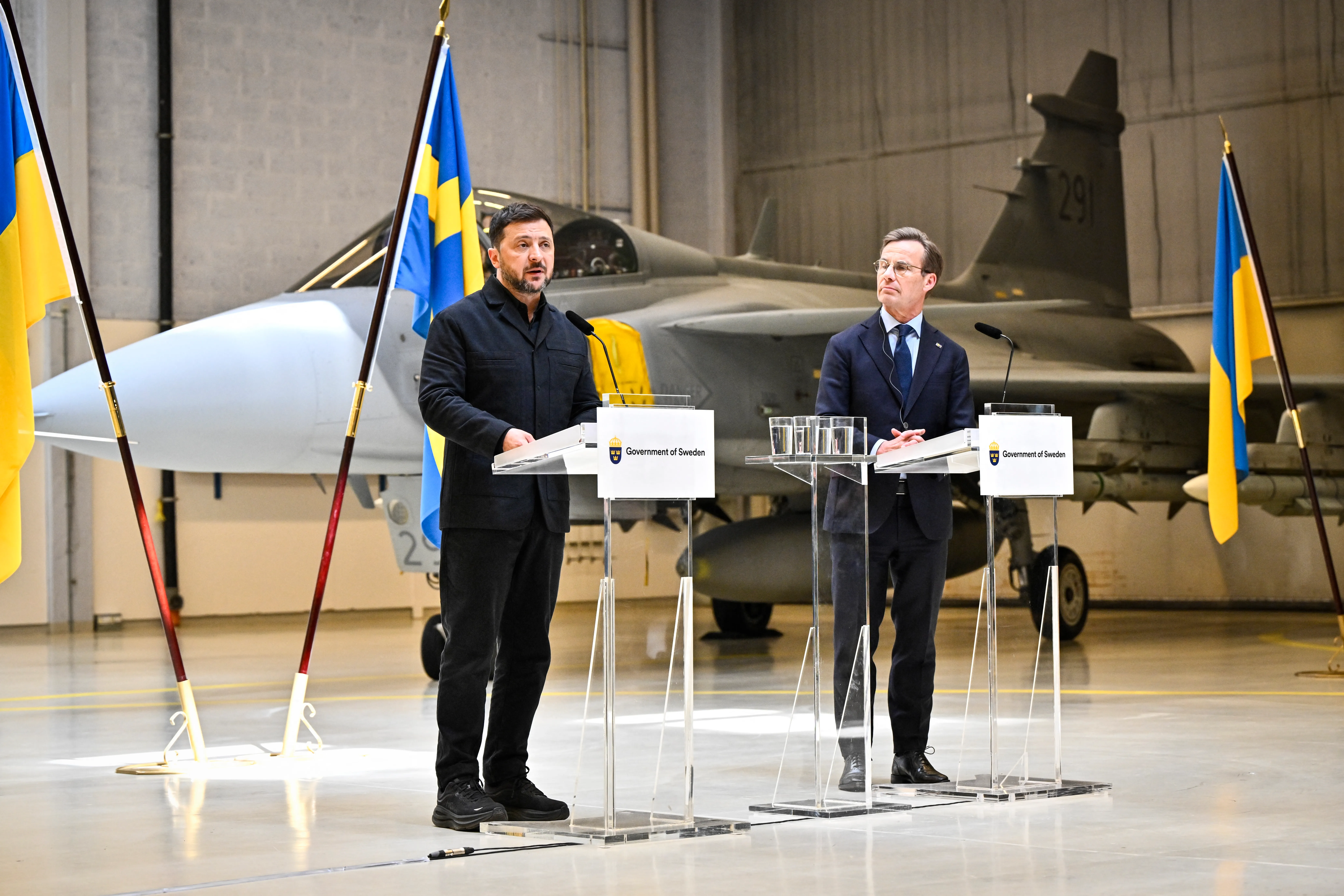
A timeline has been provided for the arrival of Saab Gripen fighters in Ukraine, with the first jets to be delivered early next year. Significantly, as well as getting another modern Western combat jet, Ukraine expects to receive highly capable Meteor beyond-visual-range air-to-air missiles, Ukraine’s President Volodymyr Zelensky has announced.
After meeting Zelensky in the city of Uppsala, Sweden today, Sweden’s Prime Minister Ulf Kristersson announced that his country will donate up to 16 Gripen C/Ds to Ukraine. These will be secondhand jets drawn from Swedish stocks, to expedite delivery. Handover of the jets in Ukraine will take place in early 2027, Kristersson added.
Ukrainian President Volodymyr Zelensky (left) and Swedish Prime Minister Ulf Kristersson address a press conference in Uppsala, Sweden on May 28, 2026. Photo by Christine Olsson/TT / various sources / AFP via Getty Images
According to Swedish officials, the training of Ukrainian pilots and technicians on the Gripen C/D is already underway and will be expanded this fall.
In the longer term, Kristersson confirmed that Ukraine plans to acquire an initial batch of up to 20 of the more advanced Gripen E/F versions. Writing on X today, Swedish Minister for Defense Pål Jonson said that the Gripen E/F would be financed with a $2.9-billion European Union loan. The long-term ambition remains 100-150 Gripen aircraft, he added.
Ukraine intends to purchase 20 Gripen E/F aircraft. In conjunction with the sale, Sweden will donate up to 16 Gripen C/D, including advanced ammunition. To replace the donated aircraft, new modern Gripen E/F will be procured for the Swedish Air Force. https://t.co/kPHjVDXnSbpic.twitter.com/IxEhsy2yvN
— Försvarsdepartementet (@ForsvarsdepSv) May 28, 2026
Despite it having a similar outward appearance to the Gripen C/D, the Gripen E (and the two-seat Gripen F version) is regarded as a completely new aircraft type — as you can read about here.
A two-ship formation of Gripen E (left) and Gripen C (right). Saab
“Ukraine has clearly identified the Gripen aircraft as a priority option for its air force in the long term and intends to purchase the newest version, the Gripen E,” Kristersson said. “Negotiations are ongoing, and we will be able to transfer these aircraft by 2030.”
In a press release, Saab reiterated that it has not yet signed any contract nor received an order relating to the Gripen E/F for Ukraine, meaning this transfer only exists as a statement of intent for now.
This is truly a historic day for cooperation between Ukraine and Sweden.
Today, there is a new support package from Sweden, and this support opens up a new level for us in saving the lives of our people – in protecting our cities and communities. This package, worth $2.7… pic.twitter.com/MANYC96byu
— Volodymyr Zelenskyy / Володимир Зеленський (@ZelenskyyUa) May 28, 2026
— Volodymyr Zelenskyy / Володимир Зеленський (@ZelenskyyUa) May 28, 2026
According to Saab, “The next steps for the Ukrainian and Swedish authorities will be to complete the negotiations regarding Ukraine’s acquisition of Gripen E/F, which is expected to take place in batches, and Saab will support this process.”
In the meantime, the Swedish government has also announced that it will replace the donated Gripen C/D aircraft in the Swedish Air Force inventory. “Dialogue regarding Sweden’s replacement of the donated capability will be initiated soon,” Saab said.
A pair of Swedish Air Force Gripen Cs. Saab
Last October, as we reported, Kristersson and Zelensky signed a letter of intent (LOI) including a potential export deal covering “likely between 100 and 150 fighter jets,” according to Kristersson. The LOI was signed at Linköping, the site of Saab’s manufacturing facility for the Gripen.
As for second-hand Gripens, Ukraine has repeatedly been linked with a possible transfer of secondhand Swedish Air Force Gripen C/Ds, and Zelensky previously said he would like to see the first of these delivered from 2026.
While the Gripen C/Ds are now set to arrive later than hoped, it remains a big deal for the Ukrainian Air Force. Although the service has already received Western-supplied F-16s and a smaller number of Mirage 2000s, the Ukrainian Air Force still relies heavily on its Soviet-era fighters. The MiG-29, in particular, has been continually adapted to carry new weaponry, both Western-supplied and locally developed, but these are aging jets and the fleet has been steadily reduced by attrition.
Perhaps the most important part of the Gripen transfer will involve the armament for the fighter.
Zelensky specifically mentioned that he expects the Gripen C/Ds to be armed with the Meteor missile.
Swedish Minister for Defense Pål Jonson said that the Gripen C/D “can be delivered with weapons such as IRIS-T, AMRAAM, and the long-range Meteor missile. This is about aircraft, weapons, skills and sustainment.”
Training of Ukrainian pilots and technicians is already underway and will expand this autumn.
Gripen C/D can be delivered with weapons such as IRIS-T, AMRAAM and the long-range Meteor missile. This is about aircraft, weapons, skills and sustainment. (2/8)
Earlier this year, the Ukrainian Ministry of Defense confirmed that the Meteor was one of the weapons being lined up for the next Swedish security aid package for Ukraine.
As we have discussed in the past, the Meteor would provide Ukraine with a class of air-to-air weapon that it badly needs to redress the balance against Russian fighter jets.
Undoubtedly, the Meteor is among the most capable air-to-air missiles in operational service anywhere in the world. Thanks to its ramjet propulsion, which can be throttled during different phases of flight, the Meteor is generally considered to be effective against certain types of targets out to around 130 miles.
Meteor
The Meteor also features an active radar seeker for the terminal phase and a two-way datalink that feeds it with in-flight updates as it flies out to its target and provides information to the pilot in the launch aircraft.
The most capable AMRAAM identified as being used by Ukraine is the AIM-120C-8, which is generally assumed to be able to hit targets at a distance of between 75 and 100 miles.
The wreckage of an AIM-120C-8 missile, apparently found in the aftermath of a Russian air attack on Dnipro, last month. via Dnipro Main News/Telegram
Of course, in practical applications, the range of both the Meteor and AMRAAM is affected by a whole range of factors, above all, the energy and altitude state of the launching aircraft and the target.
However, the Meteor could bring a significant shift to the airpower balance over Ukraine.
Russia has repeatedly exploited the long range of its R-37M air-to-air missile, known to NATO as AA-13 Axehead, typically launching them from jets flying outside the range of the missiles carried by Ukrainian fighters, as well as from most ground-based air defense systems.
A Russian Su-35S launches an R-37M air-to-air missile. Russian Ministry of Defense screencap
With a reported range of 124 miles against certain types of targets, the R-37M flies to its target on a lofted trajectory, controlled by an inertial navigation system with mid-course radio correction, and uses an active radar seeker for its terminal phase attack.
As TWZ had previously pointed out, Meteor is the best candidate for Ukraine to try and redress the balance in the air war when faced by the far-reaching R-37M and would finally put Russian aircraft at risk within their own missile ranges.
At the same time, the Meteor would give Ukraine a weapon that can target Russian jets delivering standoff munitions, again from outside the range of Ukrainian air defenses. Zelensky today said the missile “would stop Russian glide bomb attacks,” something that has been a huge problem for Ukrainian air defenses since this class of weapons was introduced.
A Russian UMPK-series glide bomb under the wing of a Su-34 Fullback strike fighter. Russian Ministry of Defense screencap
Designed during the Cold War to meet the Soviet threat, the Gripen was engineered for efficiency, durability, and ease of operation under wartime conditions. It was specifically designed to be serviced and rearmed by small teams — often including conscript personnel — while operating from dispersed locations such as roads and improvised airstrips instead of traditional air bases. The aircraft’s entire concept centers on maintaining combat operations in demanding environments, including prolonged cold-weather conditions.
A Swedish Air Force Gripen C at a remote base. Saab
“Gripen was built for a country that may have to fight outnumbered, under pressure and from dispersed bases,” Swedish Minister for Defense Pål Jonson said. “That makes it highly relevant for Ukraine: high readiness, rapid turnaround, modern weapons and the ability to operate under constant threat,” he added.
Overall, the Gripen is particularly compatible with the decentralized and highly mobile style of warfare Ukraine is currently practicing.
At the same time, it should be noted that even with the F-16, the Ukrainian Air Force has developed tactics and equipment to operate these jets from dispersed locations around the country. Even before the current conflict, Ukrainian fighters were training to make use of highways as alternatives to traditional runways.
A video shows vehicles intended to help with distributed operations of Ukrainian F-16s:
Project 61: an ecosystem for F-16s by Come Back Alive Foundation
Ukraine’s Saab 340 AEW&C can function as an airborne fighter control platform by detecting and tracking Russian targets, prioritizing threats, and directing fighters to intercept them. Through its datalink system, the aircraft can also transmit mid-course guidance updates directly to missiles in flight. As a result, fighter pilots may not even need to activate their own radar when engaging a target. Instead, the missile can be assigned a target before launch, fired, and then continuously guided by updates from the AEW&C aircraft throughout its flight.
The first evidence of the Saab 340 AEW&C being used over Ukraine emerged in March this year, but its activities have remained closely under wraps.
Russians are posting footage they claim shows likely a Swedish Saab 340 AEW&C long-range radar and control aircraft flying over Ukraine. pic.twitter.com/XkFZlok2B3
Taken together, the arrival of the Gripen and Meteor missile would represent one of the most significant upgrades yet for the Ukrainian Air Force. Beyond simply adding another Western fighter type, the package would introduce a highly survivable, dispersed-operating combat jet paired with one of the world’s most capable long-range air-to-air missiles and supported by Swedish AEW&C assets.
Even without the Meteor, the Gripen C/D could help Ukraine challenge Russia’s long-standing advantage in beyond-visual-range air combat while fitting naturally into the more decentralized operating model the Ukrainian Air Force has already been forced to adopt throughout the war. At the same time, it will provide valuable experience for crews and serve as a stepping stone for the future Gripen E/F.
Penny Smith was one of the familiar faces of ITV’s GMTV alongside Lorraine Kelly and Eamonn Holmes, but left the show in 2010
13:54, 29 May 2026Updated 14:17, 29 May 2026
Daytime TV legend Penny Smith on BBC Morning Live(Image: BBC)
TV icon Penny Smith made a triumphant return to daytime telly.
The popular presenter was famous for her role on GMTV and joined as the main newsreader in April 1993 and remained on the show until June 2010.
The star – who worked alongside Eamonn Holmes, Lorraine Kelly and John Stapleton among others – was treated to clips of her best bits on her final day in the studio.
She was also reunited with Curtis Stigers, her former partner from BBC’s singing show Just The Two of Us, who serenaded her with his hit You’re All That Matters To Me.
Now, 67-year-old Penny has made a comeback on another daytime show when she landed a slot as a roving reporter on BBC’s Morning Live on Friday, May 29 – and fans were delighted to see her return.
Penny presented a special segment investigating the chaos faced by tourists caught up in the EU’s new fingerprint scanner during the show which was hosted by Gethin Jones and Michelle Ackerley, reports the Daily Mail.
Penny was out on the ground at Manchester chatting to people travelling through the airport while also meeting up with a young woman who missed her flight due to the chaos.
She then tried a number of different substances on her hands, from water to moisturiser and an alcohol wipe, to see how it impacted the results on the fingerprint scanner. All produced different results.
Penny’s return to daytime television was welcomed by viewers who took to social media to express their delight.
One said: ‘Can we please see more of Penny Smith on Morning Live?’ while another said: ‘Great to see Penny Smith back on TV’.
Penny began her career as a reporter and feature writer on the Peterborough Evening Telegraph in 1977.
Penny later helped launch Sky News in February 1989, and four years later she joined GMTV, where she stayed until 4 June 2010.
She has since hosted several radio shows, including the weekday breakfast show on BBC London, Talk Radio, and Magic Classical.
Elsewhere, she has appeared on Have I Got News for You, Just the Two of Us, and Never Mind the Buzzcocks.
Last year, she reunited with former GMTV co-star Eamonn during a short stint on GB News. At the time, Eamonn said: “I’m delighted to be working with Penny again after all these years.”
Morning Live is on BBC One weekdays at 9.30am and BBC iPlayer
When Compton Unified School Board President Micah Ali checked his mailbox last week, he was in for a shock.
The school district has been making headlines as a state and national leader in student performance gains, and it has been upgrading and replacing its aging campuses to help advance that growth. Next week’s ballot includes a $360-million bond measure called CPT, which would keep that momentum going and replace badly dated Dominguez High School.
So when Ali opened a slate mailer titled “Congresswoman Maxine Waters’ Sample Ballot and Voter Recommendations,” he couldn’t believe her advice on Measure CPT.
Vote “no.”
Given Waters’ stature as a congressional representative for 35 years, Ali said, her slate mailers can swing outcomes.
“Yes, it does carry weight,” Ali said, and the thumbs-down recommendation “can literally cripple our ability to pass this bond.”
Ali was doubly surprised because the mailers went out to voters just a few weeks after Waters attended an unveiling ceremony for the new Compton High School campus. Compton High alums and hip-hop heavyweights Kendrick Lamar and Dr. Dre joined the celebration, and the latter was honored for his $10-million donation to the new performing arts center.
Lunch tables and a temporary cafeteria are set up outdoors at Dominguez High School because of a fire three years ago.
(Eric Thayer / Los Angeles Times)
A second district high school, Centennial, is being replaced with a modern campus, and district officials are hoping Measure CPT passes so Dominguez students aren’t left behind, but also because the district’s other schools would get multiple upgrades and repairs, from infrastructure to classrooms to athletic fields.
I met with Ali on Wednesday afternoon at Dominguez, along with Principal Caleb Oliver. The school turned 70 this year, and it shows. The grounds are scruffy, wiring and plumbing are outdated, the gymnasium air conditioning hasn’t worked in years. To walk the campus is to step back in time — to the Eisenhower administration.
While we were talking, Oliver called out to a senior named Angelina Ramirez, referring to her as a superstar student. I asked Angelina what kind of upgrades the campus could use.
Dominguez High School Principal Caleb Oliver.
(Eric Thayer / Los Angeles Times)
“Well, I like to use the cafeteria as an example,” she said, pointing to where it used to be.
What happened to it?
“It burned down,” she said. An electrical problem was the suspected cause, her principal added.
“I feel like that’s affected students a lot,” Angelina said.
The big question, of course, is why Waters’ campaign committee — Citizens for Waters — recommended a no vote.
I’d like to tell you why it is that a rapper has written a $10-million check in support of Compton’s students while a congresswoman has told them to go fly a kite. But I’ve asked by phone, text and email, and I still don’t have an answer.
After contacting Citizens for Waters, which referred me to the congresswoman, I called her office and emailed her press office, which sent me this response at 7:43 p.m. Thursday:
“Per US House Ethics rules, we are unable to respond to your request.”
I don’t know what rules those are, but the rulebook needs some rewriting if a congresswoman can’t answer a simple question about why her campaign mailer recommends a no vote on a school bond measure.
“We have no idea, and we’re baffled,” Ali said. “Who would oppose the construction of a new school in a community like Compton?”
In the working-class community, the student population is roughly 84% Latino and 14% Black.
I suggested that Ali consider having students march over to Waters’ district office and ask for an explanation.
“We’d rather have these children’s butts in seats and learning,” Ali said, adding that “we need … to continue driving up these test scores.”
Compton school board candidate Tana McCoy talks to school board President Micah Ali about the mailer.
(Eric Thayer / Los Angeles Times)
It’s not as if there is no reasonable opposition to Measure CPT. These kinds of bonds cost taxpayers real money over the course of many years, and CPT would add about $60 per $100,000 of assessed property to annual tax bills.
That would hit working folks and retirees with an added tax burden of between a few hundred and several hundred dollars a year. And taxpayers have been paying off two previous school improvement bond issues, one passed in 2015 and one in 2022.
In addition to the financial burden, according to district parent Anthonia Limon, who wrote the statement against CPT for the L.A. County sample ballot, safety issues have undermined community trust in district leadership.
“Infrastructure alone does not create safe schools,” Limon wrote.
If Waters has similar concerns, that would be one thing. But to my knowledge, and to Ali’s, there has been no public explanation for recommending a no vote. And when you read the fine print on the slate mailer, which advises voters to “take Congresswoman Maxine Waters’ recommendations with you to vote,” it only raises more questions.
“This document was prepared by Citizens for Waters, not an official party organization. Appearance in this mailer does not necessarily imply endorsement of others appearing in this mailer nor does it imply endorsement of, or opposition to, any issues set forth in this mailer,” it says.
Huh?
Are they endorsements or aren’t they?
The Times reported in 2004 that the rep’s daughter, Karen Waters, “has charged candidates for spots on her mother’s ‘slate mailer,’ a sample ballot that many voters in South Los Angeles use to guide their choices.” Last year, the Waters campaign paid a $68,000 fine for campaign finance law violations following a Federal Election Commission investigation that involved Citizens for Waters.
Rep. Maxine Waters’ slate mailer.
(Eric Thayer / Los Angeles Times)
Also in the fine print on the current mailer:
“Appearance is paid for and authorized by each candidate and ballot measure which is designated by” an asterisk.
So are these endorsements or paid advertisements? There’s an asterisk on nearly every endorsement in the mailer, from city council to governor to judgeships to Measure CPT. The way I read this is that various parties paid for endorsements, but the mailer does not reveal who paid, or how much they ponied up. Such mailers, by the way, are not uncommon in California, according to election law experts.
“I think this is misleading for voters,” said Erwin Chemerinsky, dean of the UC Berkeley law school. Although he thinks the endorsements are a form of protected free speech, he said this “reflects a very deep problem in our elections with dark money, when we don’t know where the money is coming from.”
On Thursday, I visited Tana McCoy, a Compton High grad and retired city employee who is running for Compton Unified school board. She showed me the slate mailer delivered to her home, but said she’s going to vote yes on CPT despite Waters’ recommendation.
“Children need to feel good about their environment, because that’s all part of their mental health,” McCoy said.
At Dominguez, where graduates have a 96% college acceptance rate, according to district officials, junior Zaiden Ross gave me a tour that included a stop at a gymnasium fountain that he said hasn’t worked in years. Some fountains are dirty, he added, “and some of the pipes on campus produce water that has, like, extremely high amounts of lead and magnesium.”
Student Zaiden Ross demonstrates a nonworking sink in a bathroom on the campus of Dominguez High School in Compton.
(Eric Thayer / Los Angeles Times)
Zaiden took me to a classroom to show me water samples he’s still testing. Then we visited the robotics classroom, where he turned on a faucet, and the flow was closer to the color of apple juice than water. The air conditioner was rattling, and teacher G.C. Esiobu, who runs the engineering and robotics club, said there had been an “emergency” fix for a busted system. Zaiden gave me a quick rundown of dated computers and other equipment students use to design drones and robots.
And yet despite all that, a display case was filled with trophies. At competitive meets, Esiobu said, “we have been winning with little or nothing.” With equipment upgrades, she added, “just imagine the level we will go.”
There’s still time, before Tuesday’s election, for Waters to visit Dominguez High and maybe get a tour from Zaiden and Esiobu.
Wolves are close to signing former England international Kieran Trippier.
The 35-year-old has verbally agreed to move to Molineux on a free transfer after his departure from Newcastle.
He is expected to sign a two-year deal, with the option of a further 12 months, to become Rob Edwards’ first summer signing.
Trippier is leaving Newcastle at the end of his contract this summer having spent four-and-a-half years at St James’ Park, making 160 appearances and scoring four goals.
He helped them win the Carabao Cup in 2025, the Magpies’ first silverware since 1955.
Right-back Trippier won La Liga with Atletico Madrid in 2020-21 and was a Champions League runner up in 2019 with Tottenham.
Wolves are rebuilding after finishing bottom of the Premier League and have targeted more experience, with homegrown signings the priority.
The club’s hierarchy recognise they did not have enough experience or players who understood the club’s culture.
Wolves, who won just three top flight games to end their eight-year stay in the division, have no room in their squad for any non-homegrown players before further departures.
Goalkeeper Jose Sa and forward Hwang Hee-chan are expected to leave along with midfielder Ladislav Krejci but Mateus Mane is due to stay at Molineux after a breakthrough season.
A FATHER’S ideal activity on a beautiful sunny day is taking his children to a series of industrial site and scrapyards so he can cheaply purchase a fuel pump housing.
Dad-of-two Ant senior, not his real name, woke up, saw the sun streaming in, knew immediately what would be the best use of his and his family’s Saturday and went about making that dream a reality.
He said: “I’ve needed that housing for a month now, but the time just never felt right. But I think today’s the day.
“The kids didn’t have any specific plans – just stuff like ‘play out with my mates’ – so I piled them into the car and we drove 40 minutes to the dodgy bit of town and visited a back-alley warehouse called John’s Spares and Replacements.
“I wanted them to be safe, so I locked the car and turned off the air-con. They’ve got phones, though I found out later they hadn’t brought them. Still, it only took John 35 minutes to find he hadn’t got the one I needed.
“Then a mere two scrapyard visits where they churlishly refused to play with the snarling, chained Rottweilers, then home. At which point they ruined a lovely day by moaning to their mother.”
Son Anthiony said: “I asked if we could go to the park, and he remembered he was low on lawnmower blades, put us back into the car and went to Screwfix where he was gone for almost an hour.
Millions of people face the prospect of having to pay an extra £1,000 if they want to take a holiday abroad in 2026.
One in five people on NHS waiting lists plan to holiday abroad without travel insurance, according to a recent survey, risking falling ill overseas and incurring hefty healthcare fees. There are currently more than 7.1million adults waiting for consultant-led treatment – and a further 1.7million waiting for a diagnosis – with many unable to take out insurance policies due to the high cost.
Of the 95% who are on, or have been on, a waiting list in the last three years and refuse to miss their holiday, 15% have paid up to £1,000 extra to ensure they’re protected. Many insurers keep their premiums low by not covering existing medical conditions, meaning patients on waiting lists with potentially serious conditions will need to take out specialist cover.
Those waiting for a condition to be diagnosed will find it particularly difficult to find appropriate travel insurance – and one in four plan to holiday without the correct cover. One in 20 currently waiting to be seen by the NHS have found accessing specialist travel insurance so difficult, or so expensive, they haven’t holidayed abroad because of it.
The poll of 2,034 adults commissioned by Wellsoon from Practice Plus Group found adults with hernias are the most likely to holiday without the correct cover, followed by those with cancer. The hardest conditions to find insurance for are heart or blood pressure issues followed by musculoskeletal issues including arthritis, hip or knee pain, back pain, neck or shoulder pain.
A spokesperson for Practice Plus Group said: “It’s a story we hear regularly from people who have a health issue they want to be addressed before they go on holiday, but they’re on a waiting list. They’re worried about going away when they’re in limbo, potentially needing to seek medical help a long way from home and not knowing how much it might cost.
In April 2021, the Financial Conduct Authority introduced new requirements to help consumers with more serious pre-existing medical conditions (PEMCs) better navigate the travel insurance market. Firms that sell travel insurance are required to signpost consumers to one of two directories of specialist firms that provide this type of insurance – one of which is the MoneyHelper directory, provided by the Money and Pensions Service.
A spokesperson from the Money and Pensions Service, which provides a directory of specialist firms that offer travel insurance for pre-existing conditions, said: “If you have a pre-existing health condition you must disclose this to your insurer. Otherwise, when you come to make a claim, it could be rejected.
“Depending on your circumstances, you may be asked to complete a medical exam. This will allow insurance providers to tailor your travel insurance policy to cover your needs. Taking specialist medical travel insurance will give you peace of mind that your medical condition is covered in the event of a claim.
“Our MoneyHelper service provides contact details of companies which specialise in this.”
Belgian defender Thomas Meunier caused debate recently after saying that France has the footballing talent to put out three teams capable of winning the World Cup.
Could Les Bleus, who are co-favourites with Spain in this summer’s World Cup, really lift the title with their second- or third-string team? Maybe not, but their talent is certainly Mariana Trench-deep.
Recommended Stories
list of 4 itemsend of list
Consider this: According to transfermarkt.com, a lineup of French players that didn’t make the 26-man cut would rank in value among the top five teams – ahead of Portugal, Brazil, the Netherlands and reigning champions Argentina.
Lucas Chevalier 30 million euros ($35m); Pierre Kalulu 32 million, Jeremy Jacquet 55 million, Leny Yoro 50 million, Adrien Truffert 25 million; Boubacar Kamara 40 million, Eduardo Camavinga 50 million; Dilani Bakwa 28 million, Senny Mayulu 40 million or Khephren Thuram 40 million, Mousa Diaby 28 million; Junior Kroupi 40 million. = 418 million [38 million average]
So, how did Les Bleus get to this point?
It started with frustration after French teams consistently fell short on the biggest stage from the 1930s to the 1970s. The solution, national team manager Georges Boulogne said in the early 1970s, would be for the French Football Federation to create training academies known as Centres de Formation.
“France had not won any trophies, and it was decided they needed to create a new structure,” INF (Institut National du Football) Clairefontaine administrator Franck Bentolila told Al Jazeera.
The government backed the programme, viewing it as promoting French ideals through sports, as well as a recipe for winning trophies.
A total of 16 centres were set up, the first opening in 1974 with the main site in Vichy. It recruited widely, drawing young players from the entire country, plus overseas departments. The centres laid a foundation, preparing players for professional careers and the national team.
The record was initially mixed. In the 1980s, France won the European Championship and Olympic Games titles (both in 1984) and reached two World Cup semifinals, but then failed to qualify for the 1990 and 1994 World Cups.
But by 1998, everything fell into place, with the so-called “Black-Blanc-Beur” squad winning the World Cup at home. The multiethnic group represented the changing nature of French society, as well as validating the federation’s development programme. Bentolila said coach Aime Jacquet dedicated the victory to “all the amateur clubs and academies – it’s also your trophy”.
“The [1980s] period with [Michel] Platini, [Alain] Giresse, [Jean] Tigana, had a lot of talent, but we don’t win a World Cup,” Bernard Lama, a goalkeeper who captained the national team in the 1990s, told Al Jazeera.
“The difference with our generation, all the guys were from academies. And we were hungry to win a title. And, also, we had one exceptional talent with Zinedine Zidane.”
France went on to lift the 2018 World Cup and were runners-up in 2006 and 2022.
Zinedine Zidane lifts the trophy after France’s victory over Brazil in the 1998 World Cup Final [Ben Radford/Allsport via Getty]
“You have people coming from overseas – Africa, French Guyana, Martinique – they give us two things, music and sports,” Lama said.
“And, now, there is a sub-generation coming from overseas, and they are French. [Ousmane] Dembele, [Desire] Doue, they are French, they are not naturalised, they grew up in France, the majority around Paris.
“And they are hungry, you understand, for a lot of reasons. But, also, it’s not only a question of work; the first thing is they have talent.”
Lama sees a danger in football, more broadly, of players becoming overly drilled and “robotic”, but France has many exceptions who can give them an edge.
“We are lucky to still have these players who are capable of making the difference,” Lama said. “Maybe that is why we are so good, we have players like [Kylian] Mbappe, Dembele, Doue. They hate to lose and, physically and technically, they can make the difference, individually.
“And that is the force of the national team, and also PSG, our capacity to score. Today, we have maybe four or five guys – [Maghnes] Akliouche, [Rayan] Cherki, a different kind of talent. When you have that explosion of talent, it gives the coach more solutions, offensive solutions.”
Most national team members, no matter their background, have gone through the academies, but their development starts long before that.
“It’s cultural,” Bentolila said. “In America, when you are young, you have a basketball in your hands, or a football in your hands. In France, you have a football at your feet when you are a baby – and free access to facilities.”
That part of the formula sounds similar to many countries. Is there a secret to French development, or are they just doing it better than most?
“The secrets,” said longtime coach and scout Stephane Nado, “are a combination of hard work, structure and organisation.”
Nado said: “The player is the centre, the heart, of the project. The player will receive education. And we will not take them away from their family. It is important for them to keep their roots, important psychologically. This is why France is one of the best in the world at developing players for export.”
Training at Clairefontaine blends street game skills with organisation, including “lots of 1 vs 1, 2 vs 2”, Bentolila said. “You have to fight. You’re good at dribbling and first touch, now you organise possession, 5 vs 2. As soon as you get the ball, you have to have good control. We do that a lot.”
Clairefontaine is now focusing on younger age groups, ceding responsibility for older players to clubs. And development is expanding beyond the centres and established club academies, Bentolila said.
“Paris and Sao Paulo are the best areas in the world for talent,” Bentolila said. “Why? Private academies. It is an amazing situation. Kids, eight- and nine-year-olds, playing every day. Amateur coaches offer not a meal, but a snack at 4 o’clock. Then, they do homework and training sessions. When they are 12 years old, they play like Mbappe.
“In Paris, you have amateur clubs nobody knows, and they can beat [the youth teams of] Barcelona and professional clubs. They are better than PSG, Paris FC. So many players – they play anywhere, any time, eight years old against 10 years old. They are like soldiers, they fight every day, and they are good because they play under pressure.”
In the 1980s, Les Bleus were dubbed “The Brazilians of Europe”. It’s taken a while, but France appears to have lived up to the moniker. And they’ve gone about it their own way.
“Brazilian coaches [used to] tell me, ‘In our country, we are poor, but we can succeed in football or music. So, we start the day with football,’” Bentolila said.
“In France, we go to school, first, and, after, practise football. We do it every day and, like Brazil, we play a lot, and play well.”
Hungarian Prime Minister Peter Magyar said he expects to finalize a political agreement with Ursula von der Leyen over the release of billions of euros in frozen European Union funds during talks in Brussels.
The negotiations focus on unlocking financial support that had been suspended under the previous government led by former Prime Minister Viktor Orban due to long standing EU concerns regarding corruption, rule of law standards, and judicial independence.
Hungary is seeking access to approximately 6.5 billion euros in EU recovery grants and 3.9 billion euros in low interest loans before a critical August deadline. Additional structural funds worth around 7 billion euros also remain frozen.
The talks come at a crucial moment for Hungary’s economy, which has struggled with weak growth, fiscal pressure, and budgetary strain over the past three years.
Why It Matters
The potential agreement carries major economic and political significance for both Hungary and the European Union.
For Hungary, securing the release of EU funds is essential to stabilizing public finances, supporting economic growth, and restoring investor confidence. The country’s economy has experienced prolonged stagnation, while high spending pressures and limited fiscal flexibility have increased urgency around external financing.
For the European Union, the negotiations represent an important test of how Brussels balances financial support with enforcement of democratic and governance standards among member states.
The dispute over frozen funds has become one of the most prominent examples of tensions between the EU and governments accused of weakening judicial independence or failing to address corruption concerns.
A successful agreement could signal improving relations between Brussels and Hungary after years of political friction under Orban’s leadership.
Key Stakeholders
Hungary’s Government
Prime Minister Peter Magyar is under pressure to secure financial relief while also demonstrating willingness to meet EU governance expectations.
European Commission
The European Commission must balance political compromise with maintaining credibility on rule of law enforcement and anti corruption standards across the bloc.
Hungarian Economy
Businesses, investors, and public institutions in Hungary are closely watching the outcome because EU funding plays a major role in infrastructure, development, and economic stability.
European Union Member States
Other EU governments are monitoring the negotiations as they could shape future disputes involving rule of law conditions and access to EU financial support.
Analysis
The negotiations reflect a broader shift in Hungary’s relationship with the European Union following the political transition away from Viktor Orban’s administration.
Under Orban, disputes with Brussels became increasingly confrontational, particularly over democratic governance, judicial reforms, media freedoms, and corruption allegations. Peter Magyar appears to be pursuing a more pragmatic approach focused on rebuilding trust with EU institutions while securing urgently needed economic support.
However, the remaining disagreements over anti corruption measures suggest Brussels still wants stronger guarantees before fully releasing funds. This highlights the EU’s growing willingness to use financial leverage as a tool for enforcing governance standards within member states.
For Hungary, the pressure is primarily economic. Frozen EU funds have limited the government’s financial flexibility at a time when growth remains weak and fiscal conditions are strained. Unlocking the money would provide both immediate economic relief and an important political victory for Magyar’s government.
At the same time, the negotiations also carry symbolic importance for the EU itself. Brussels will want to demonstrate that compromise does not come at the expense of accountability, especially after years of criticism over democratic backsliding within the bloc.
Future Outlook
If a political agreement is finalized, Hungary could begin unlocking critical EU funding in the coming months, easing fiscal pressure and improving economic confidence.
However, implementation will remain important. Brussels is likely to continue closely monitoring Hungary’s anti corruption reforms and governance commitments before fully releasing all frozen funds.
A successful deal may also help normalize Hungary’s relationship with the European Union after years of tension, potentially opening the door for broader cooperation on economic and political issues.
At the same time, the outcome could influence future EU disputes involving rule of law conditions and financial oversight, particularly as Brussels increasingly links access to funding with governance standards.
For Hungary, the immediate priority remains economic stabilization. But politically, the negotiations may also determine whether Peter Magyar can establish a more cooperative and sustainable relationship with Europe while distancing his administration from the confrontational legacy of the Orban era.
Coronation Street fans think they have figured out why Idris Nazir is keen on a romance with Leanne Battersby, and it could be linked to a past villain on the ITV soap
13:00, 29 May 2026Updated 13:01, 29 May 2026
Fans of Coronation Street think newcomer Idris Nazir is targeting Leanne Battersby(Image: ITV)
Fans of Coronation Street think newcomer Idris Nazir is targeting Leanne Battersby in a new twist.
Leanne met Idris this week, while it soon emerged they had actually met years earlier. Idris is related to Leanne’s late ex Kal Nazir, but that hasn’t stopped the pair pursuing a romance.
Corrie had revealed Idris would be Leanne’s new love interest before he debuted, and then this week we saw them kiss. Amid Idris’ cousin Alya Nazir being unimpressed by their blossoming romance, some fans think Idris has a motive.
Viewers are theorising that Idris is targeting Leanne on behalf of someone else, and perhaps he knows a past Corrie villain. A new theory has predicted that Idris is “in cahoots with” Harvey Gaskell, who was sent to prison after Leanne helped the police put him behind bars.
Harvey escaped and tried to kill Leanne, actually murdering Sam Blakeman’s mother Natasha in a case of mistaken identity. Harvey then went back to prison.
But fans are wondering if there is more to Idris’ sudden arrival and his interest in Leanne. With it heavily teased he is involved in some dodgy dealings, a theory being shared online is that Idris could be working for Harvey, and targeting Leanne for him.
Taking to social media, one viewer posted: “I know that Idris is a wrongun but, does anyone else think that he might be in cahoots with Harvey and that’s why he’s coming onto Leanne?” A fan replied: “Never thought of that!!!”
Another said: “Oooooh never thought of that it’s not gonna be good news whatever.” A further post read: “Good theory and Leanne said she knew him from somewhere – could have been one of Harvey’s henchmen.”
A further fan confessed: “I really hope not! Couldn’t stand Harvey, hated when they kept bringing him back!” A final fan said: “I’ve just seen someone saying on Facebook they think Idris could be connected to Harvey and that’s why he’s wanting to be with Leanne.
“Might be a bit of a stretch but it could explain why after about 3 hours they’re pursuing a romance, so fast when they barely know each other, AND he’s related to her late partner, all a bit weird.”
For thieves looking to strip Los Angeles for parts, copper has become a fast-moving currency.
The problem has become so persistent that the Los Angeles Department of Water and Power is now asking for its own armed police force to protect vulnerable utility equipment, street lighting and critical infrastructure, insisting that the department’s contracted and unarmed security guards aren’t cutting it.
“They lack the authority to detain or arrest suspects, intervene in crimes in progress, conduct searches, or carry firearms for enforcement purposes,” according to a May 21 report from the city agency. “Delays hinder timely intervention, reduce investigative effectiveness, and contribute to repeat victimization of LADWP facilities.”
Under DWP’s current “observe and report” security model, an officer who sees someone cutting a fence or stripping copper from a transformer has little authority apart from yelling a warning or making a 911 call, according to the department report.
The proposal asks for 20 to 50 sworn officers to start, hired over a five-year period, along with support staff. If approved, the force would give the agency’s officers the authority to carry a firearm, make arrests and investigate thefts. The plan was scheduled to be discussed Thursday by the City Council.
The push comes as citywide service requests for streetlight repairs have surged over the last several years.
L.A.’s historic streetlights outside the Bureau of Street Lighting near Virgil Avenue and Santa Monica Boulevard.
(Jason Armond/Los Angeles Times)
The city logged 14,328 electronic streetlight service requests in 2018, according to data from the Bureau of Street Lighting. Requests have tripled since then, reaching an all-time high of 46,079 in 2024, the last full year of available data.
Mayor Karen Bass’ office said in March that copper thefts are a leading cause of streetlight outages. Repairs have been backlogged for months.
Prices for the metal are at an all-time high, driven by major supply disruptions in Indonesia and Chile, and soaring demand from artificial intelligence data centers and electric grid infrastructure. Thieves typically exchange the metal for cash at recycling centers, where it can fetch up to $5.30 per pound. The City Council last year approved a program offering up to $5,000 for information in metal and wire theft cases.
Theft losses alone exceed $1 million annually, according to DWP.
Establishing a new police force would require changing the city charter, meaning voters will have a say come the November midterm elections. Authorities will also need to obtain state legislative approval for the plan.
Officials said rolling out the police department would cost $9.7 million over three years, plus up to $6 million annually to pay for staffing. They maintain those costs are less than the $46 million combined DWP spends each year on private security contractors and unarmed staff security.
On Hill Street in downtown L.A., streetlights have been targeted by thieves and vandals.
(Jason Armond/Los Angeles Times)
Any cost overflows would be paid for by DWP customers.
Timothy O’Connor, executive director for the Los Angeles Office of Public Accountability, a spending watchdog, said his office is not convinced that the agency could minimize long-term cost creep, or that the new force would offset enough costs to justify the program. The proposed force of a few dozen officers, he said, would be too small to get the job done.
“Theft losses at DWP are real and are increasing. However, eliminating these losses is not enough to offset the proposed costs,” he said. “Furthermore, DWP will be unable to fully eliminate theft given the diffuse nature of the DWP system.”
But O’Connor also said the department is faced with real security risks like those posed by drone attacks or terrorism threats, which he said “appear to justify the proposal at some level.”
In February, a man shot himself after he drove his car through the perimeter fence of a power substation while carrying explosives and several firearms. Dubbing the incident an attempted terrorist attack, officials said the episode could have caused catastrophic infrastructure damage.
David Levitus, executive director of the advocacy group LA Forward, said he was surprised to learn of the proposal so late in Los Angeles’ ongoing charter reform process, which his organization has monitored closely.
“The fact that this is being dumped in late May — what’s the rush?” Levitus said. “I think we really need to be wary of creating new police departments in general, but especially without a clear case and clear constraints and accountability mechanisms.”
Bristol City are close to appointing Lincoln boss Michael Skubala as their new manager.
The Robins have moved quickly for the 43-year-old after failing to convince Bournemouth assistant Tommy Elphick to join.
Nothing has been signed yet but it is now expected Skubala will move to the Championship side.
It will cost Bristol City over £1m in compensation with Skubala understood to have signed a new contract at Sincil Bank after initially missing out on the job to Elphick.
Skubala won the League Managers’ Association League One manager of the season after taking the club to the second tier for the first time in 65 years by winning the title.
He is close with Bristol City sporting director James Ellis, only formally appointed at the Robins this month, with the pair having worked together in the Great Britain Universities setup.
The former Leeds Under-21 boss was one of the leading contenders before the Robins initially chose Elphick, 38.
The former Brighton and Aston Villa defender had positive talks and was impressed with the club and its personnel but decided against making the move on Wednesday.
Bristol City, who finished 12th in the Championship, are looking for a permanent manager after appointing former England boss Roy Hodgson as an interim replacement following Gerhard Struber’s sacking in March.
SITTING on the beach pier with a chippy tea, washed down by a pint of something cold, is what I believe to be the best-of-a-British-day-out.
If that’s what you’re after, there’s a seaside spot that boasts the world’s biggest chippy and smallest boozer within a half-hour walk.
Sign up for the Travel newsletter
Thank you!
Cleethorpes is home to a huge fish and chip shop on the pierCredit: AlamyCleethorpes has everything to for a great British breakCredit: Alamy
I headed to Cleethorpes on the Lincolnshire coast to check out the UK’s biggest fish and chip shop, which takes up the whole of the pier.
The 150-year-old boardwalk itself -won Pier of the Year after its refurb a decade ago and Papa’s Fish and Chips opened in its historic pavilion the same year.
It’s so big the restaurant can feed 500 at a time and now attracts two million diners annually – but was still heaving in the hot weather .
It’s definitely not your average chippy, with mood lighting, plush fixtures and fittings and a bank of windows looking out over the sand and sea.
We decided to use the takeaway and eat alfresco, but even that took an hour before we were tucking into our tasty treats – a testament to Papa’s popularity.
The staff were wonderful, serving everyone with good grace despite the fact that it must have been sweltering behind the counter.
My top tip would be to sign up online for a loyalty card, which not only saves you cash, but also gives you the option to order online to pick up at your chosen timeslot to beat the queues.
I got a £5 off birthday voucher, so feeding my family of four only came to £18.50 – we split an £8.50 Papa’s Combo (a small haddock, sausage, portion of chips and a side of peas, beans, curry or gravy), a £10.50 Papa’s Classic (medium haddock, chips and a side).
That also included a £4.10 portion of cheesy chips and a couple of 20p sauce sachets.
It was well worth the wait, but next time I’ll order in advance or book a table to eat in if it’s cooler weather.
The Signal Box claims to be the ‘smallest pub on the planet’Credit: Catherine Lofthouse
Outside of the chippy, there’s a seal sanctuary down the coast at Donna Nook so if the sands aren’t full of holidaymakers and daytrippers, you might even spot a bit of local wildlife bobbing past or basking on the beach.
And just around the corner from the pier is the Coliseum Picture Theatre, now a Wetherspoons, boasting a gorgeous 1920s frontage, chandeliers inside and even a rooftop terrace.
Downstairs is very much a typical Spoons, but upstairs feels light and airy with a Roman-style fresco as a nod to the building’s past, so if you like a bit of whimsy with your Wetherspoons, I would take a seat up there if you can.
We opted to visit the smallest pub on the planet to wash down our takeaway, with space for just three punters inside the Signal Box Inn at the town’s heritage railway.
Luckily there’s a big beer garden to make up for the small inside space.
We ordered two pints and two soft drinks for less than £15, so it’s not too pricey, and it’s a lovely spot to enjoy the comings and goings at Cleethorpes Coast Light Railway.
Trains run down to Humberston, where you’ll find England‘s biggest Haven holiday park Cleethorpes Beach.
Home to 1827 caravans and lodges, it is also home to one of the first Wetherspoons on a Haven site, The Humber Stone, which opened last year.
There are plenty of seals to see at Donna Nook Nature ReserveCredit: Alamy
If you ask me, Cleethorpes’ secret weapon is the location of its mainline railway station, a few steps away from the pier and right by the beach.
I can’t think of many other towns where you hop off the train and straight onto the sand.
At only two hours’ train ride from Nottingham, this could be a brilliant bet if you want a day at the beach but don’t drive.
I loved the look of the original railway waiting room, now the Mermaid fish and chip shop – it’s had extensive work done recently to its ironmongery, roof, wood and stonework, with a striking paint job in heritage colours ahead of its centenary next year.
It feels like the whole town is undergoing a bit of a makeover, with the Pier Gardens currently closed while they are dug over and new planting put in.
The market place is also being pedestrianised so I look forward to returning to see what these redesigns bring to the town.
Near the smallest pub is the historic boating lake, which celebrates 100 years in 2028, with a project to clean up the waters on the cards.
We can get fish and chips for £18.50 – and that was for the whole familyCredit: Catherine Lofthouse
Hopefully the 2020s will end up being as successful for attracting visitors as the 1920s obviously were.
As a Midlander who grew up visiting Skegness and Mablethorpe just down the coast, I’m not sure why a trip to Cleethorpes hasn’t been on my radar before.
But one thing that I think has made a huge difference is the two holiday parks in Humberston being reinvented in recent years.
Away Resorts, where we stayed, took over the Beachcomber caravan park and renamed it Cleethorpes Pearl, while Haven’s site was previously called Thorpe Park, which caused some confusion with the theme park of the same name down near London.
Families of up to six can stay in a Luxury Caravan for as little as £6pppn for a five-night stay in September.
I’m a little bit in love with this Lincolnshire location – it’s the Costa del Clee for me if you love a chippy tea and a pint by the sea.
A digital register of land ownership in the West Bank is seen as an escalation of Israel’s occupation.
Published On 29 May 202629 May 2026
Occupied East Jerusalem, Palestine – A controversial Israeli plan to digitally register property ownership in the occupied West Bank is a “dangerous colonial occupation step that represents a direct assault on the historical and legal rights of the Palestinian people to their land and property”, the Palestinian Land Authority has said.
The Palestinian Jerusalem Governorate and the Colonization and Wall Resistance Commission (CRRC) have urged Palestinians in the West Bank not to engage with any Israeli “entities, committees, platforms, or procedures” of lands and property.
Recommended Stories
list of 4 itemsend of list
Israel reportedly launched the online “Land Registry and Settlement of Rights” platform on which it plans to “update” property ownership in the occupied West Bank on Wednesday this week.
The Jerusalem Governorate and the CRRC have called on the international community, the United Nations, the International Criminal Court and all international human rights and legal institutions to “take their urgent responsibilities to stop these illegal procedures and hold the occupying state accountable for its continuous violations against the Palestinian people, their land, and their resources”, they said.
Moayad Shaaban, head of the CRRC, which is part of the Palestine Liberation Organization, said the move reveals “the occupation’s transition from traditional policies of field control to digital and administrative colonial engineering aimed at imposing permanent legal realities on the occupied Palestinian territory”.
‘Annexation’ by land registry
In May 2025, the Israeli Security Cabinet launched a new, aggressive land settlement process throughout the West Bank, with the aim of “completing the legal and administrative annexation of the occupied territories through fully registering the lands under Israeli authority”, the Jerusalem Governorate said.
Then, in July 2025, Israel’s parliament approved a symbolic measure calling for the annexation of the occupied West Bank. The move was first tabled in 2024 by Israel’s far-right Finance Minister Bezalel Smotrich, who himself lives in an illegal Israeli settlement.
On February 15, 2026, the permanent acquisition and registration of approximately 58 percent of Area C – the part of the West Bank over which Israel exerts total control – began.
(Al Jazeera)
Under that decision, Palestinian land registration in the Israeli “Tabu” – the land registry extract – began for the first time since the occupation of the West Bank in 1967. It is a final measure that will be difficult to challenge in Israeli courts, the Israel Hayom newspaper reported in February.
With the onset of land settlement, the Israeli Land Registry unit will take over the regulation and registration of land ownership in Area C. It also has the power to issue sales permits and to collect fees. Israel aims to complete the full settlement of 15 percent of the West Bank by the end of 2030.
Some 700,000 Israeli settlers already live in the West Bank and East Jerusalem, as illegal settlement has expanded under the government of Prime Minister Benjamin Netanyahu.
Rights groups say settlement approvals, along with rising settler violence against Palestinian communities, have accelerated since Israel launched its genocidal war on Gaza on October 7, 2023.