BATON ROUGE, La. — Louisiana lawmakers passed a new congressional map Friday designed to pick up a Republican seat while leaving the state with just one of its two majority-Black House districts represented by Democrats.
Approval of the new House map came a month after the U.S. Supreme Court struck down the state’s current map as an illegal racial gerrymander, weakening the landmark 1965 federal Voting Rights Act. That decision intensified a national redistricting battle fueled by President Trump’s efforts to protect the Republicans’ slim House majority in the midterm elections.
Louisiana Republicans had considered drawing a map giving the party a shot at winning all six of the state’s U.S. House seats. But that would have required adding more Black voters to Republican-held districts, potentially backfiring with losses. Some Republicans said a 5-1 map better protects U.S. House Speaker Mike Johnson from facing a difficult reelection.
Republican Gov. Jeff Landry is expected to sign the new map into law.
In the weeks following the Supreme Court’s decision, several other Republican-controlled Southern states have seized upon a weakened federal Voting Rights Act to try to redraw their own congressional districts. It’s the latest flare-up in a heated national redistricting battle heading into the November elections, spurred along by Trump.
So far, Republicans are winning the redistricting contest. But that doesn’t necessarily mean they will win a narrowly divided U.S. House in November. So far, Republicans think they could gain as many as 14 seats from their redistricting efforts, while Democrats think they could gain six seats from new districts in California and Utah.
In Louisiana, Republicans currently hold four of six congressional seats on a court-ordered map drawn in 2024 to comply with the Voting Rights Act by including a second district with a majority-Black population.
That map, however, was challenged in court, and the Supreme Court responded on April 30 by striking it down as an illegal racial gerrymander.
Landry postponed the state’s U.S. House primary, scheduled for May 16, until later this summer to allow time for Republican lawmakers to draw and pass a new map.
The proposed map redraws Democratic U.S. Rep. Cleo Fields’ district, clustering it around predominantly white communities in the Baton Rouge area and southern Louisiana. It also adds part of Baton Rouge to a heavily Democratic, majority-Black district based in New Orleans currently represented by Democratic U.S. Rep. Troy Carter.
More lawsuits were expected over the new map.
Democrats say the proposed map could still constitute a racial gerrymander because it packs Black voters into a single congressional district. Meanwhile, the plaintiffs in the U.S. Supreme Court’s decision criticized the Legislature’s map for leaving a majority-Black district in place.
Several other Southern states also have acted on redistricting since the Supreme Court’s decision.
Florida’s Legislature passed new congressional districts just hours after the ruling, completing a redrawing that was in the works in anticipation of the decision. It could yield Republicans as many as four additional seats in the midterm elections.
Tennessee adopted new U.S. House districts a week after the ruling, carving up a majority-Black district based in Memphis in a Republican attempt to win an additional seat.
In Alabama, Republicans are attempting to pick up another seat by redrawing two districts where Black residents compose a majority or close to it. Democrats hold both seats, and the proposal is mired in a court battle.
South Carolina’s Senate, meanwhile, decided against redistricting, despite pressure from Trump.
Megan Grant hit her 41st home run of the season to tie a UCLA career record Thursday night, but top-seeded Alabama rallied behind a five-run surge to beat the eighth-seeded Bruins 6-3 on opening day at the Women’s College World Series.
UCLA starter Taylor Tinsley took a 3-1 lead into the fifth inning but walked leadoff batter Jena Young then surrendered a 249-foot home run to Alexis Pupillo two batters later to tie the score.
In the sixth, Alabama’s Kristen White beat out a grounder to third and Young dropped a bloop single to left, setting the stage for Brooke Wells, who drove a pitch from Tinsley 239 feet to center field to give the Crimson Tide the lead.
The Bruins (52-9) will have to beat the winner of the game between Arkansas and Nebraska on Friday night to avoid elimination.
Get the latest on L.A.’s teams in the daily Sports Report newsletter.
By continuing, you agree to our Terms of Service, which include arbitration and a class action waiver. You agree that we and our third-party vendors may collect and use your information, including through cookies, pixels and similar technologies, for the purposes set forth in our Privacy Policy such as personalizing your experience and ads.
Angels rout the Tigers
Grayson Rodriguez pitched five strong innings as the Angels beat the Detroit Tigers 7-1 on Thursday for their fifth victory in six games.
The Angels won back-to-back series for the first time this season, sweeping Texas at home before winning two of three in Detroit.
Detroit has gone 4-18 since May 4, losing seven straight series.
Rodriguez (2-1) allowed one run on two hits and two walks in five innings. He struck out five.
From Bill Shaikin: They had balloons, baseball caps and a splashy video. They even had Dusty Baker, because any day with Dusty Baker is a good day.
And, as a campaign called “The Sacramento Pitch” unveiled its plan to lure a Major League Baseball expansion team to the state capital, the mayor made his pitch a blunt one.
“This region has earned its place in the majors,” Sacramento Mayor Kevin McCarty said Thursday. “And, frankly, MLB could use Sacramento.”
We’ll see. But, as McCarty and other dignitaries rallied in Sacramento, a more important gathering was happening in New York, at which MLB owners formally proposed the salary cap players have vowed to resist.
Whether owners can get a cap — either by persuasion through the fall and winter, or more likely by canceling games next spring so players go unpaid — remains to be seen. For Sacramento and the other American and Canadian cities pursuing two expansion teams, the outcome of collective bargaining could determine the fee MLB would charge for each one.
USC’s ace takes the mound like a boxer enters the ring, eager to land blow after blow. And as the Trojans (43-15) open the NCAA tournament in College Station, Texas, at 6 p.m. PDT Friday (ESPNU), the southpaw packs a serious punch. He carries a nation-leading 160 strikeouts and the second-best 1.43 ERA.
“They’re getting a competitor,” Edwards said of what people can expect when he pitches. “There have been a lot of situations where I’ve had to battle and fight adversity. So, I think you’ll see a good fight when I toe the rubber. I’m not going to shy away from any type of competition.”
If anything, the competition probably shies away from Edwards.
Named the Big Ten 2026 Pitcher of the Year after stacking a record 113 strikeouts in conference play, Edwards is integral to what has been USC’s best team since the early 2000s.
From Joaquin Ruiz: No. 1 UCLA’s quest for the second baseall national title in school history starts Friday.
The Bruins (51-6, 28-2 Big Ten) enter the NCAA tournament as the top overall seed and host against Saint Mary’s (34-25, 15-12 West Coast) to begin the Los Angeles Regional at Jackie Robinson Stadium.
After winning its first Big Ten tournament championship in program history on Sunday, UCLA is focused on continuing its dominance and embracing the target on its back as a College World Series favorite.
“We’ll see what happens, but I think just staying with us and not trying to do too much and just stay present,” UCLA junior outfielder Payton Brennan said. “That’s the main thing — and staying with each other.”
Their record and conference dominance aside, the Bruins sit atop several statistical categories and are intimidating across the diamond.
But UCLA coach John Savage said UCLA isn’t looking past its regional foes — Saint Mary’s, Cal Poly San Luis Obispo and Virginia Tech.
1946 — Two-year-old fillies Chakoora and Uleta become the first thoroughbreds to complete a transcontinental flight. They’re flown from New York to Inglewood by the American Air Express Corp., a 2,446-mile trip that lasts 20 hours due to bad weather.
1968 — European Cup Final, Wembley Stadium, London: Bobby Charlton scores twice as Manchester United beats Benfica, 4-1; first English club to win the trophy.
1971 — Al Unser wins his second straight Indianapolis 500 with a record mark of 157.735 mph and finishes 22 seconds ahead of Peter Revson. The pace car, ridden by Eldon Palmer, crashes into the portable bleachers and injures 20 people.
1977 — A.J. Foyt becomes the first driver to win four Indianapolis 500s and Janet Guthrie becomes the first woman in the race. Guthrie is forced to drop out after 27 laps with mechanical problems.
1977 — Australian Sue Prell first female golfer to hit consecutive holes-in one; 13th and 14th holes at Chatswood Golf Club, Sydney.
1980 — Larry Bird beats out Magic Johnson for NBA rookie of year.
1983 — After three second-place finishes, Tom Sneva wins the Indianapolis 500 by 11 seconds over three-time champion Al Unser.
1985 — 29th European Cup: Juventus beats Liverpool 1-0 at Brussels.
1988 — Rick Mears overcomes an early one-lap deficit, then overpowers the rest of the field on the way to his third Indianapolis 500 victory. Mears gives team-owner Roger Penske an unprecedented seventh victory and fourth in five years.
1990 — Stefan Edberg and Boris Becker, the top two seeds, are bounced in the first round of the French Open by two European teenagers, the first time the top two men’s seeds are eliminated in the first round of a Grand Slam tournament. Edberg is swept easily in straight sets by 19-year-old Sergi Bruguera of Spain, and Becker loses to 18-year-old Yugoslav Goran Ivanisevic.
1991 — 35th European Cup: Red Star Belgrade beats Marseille (0-0, 5-3 on penalties) at Bari.
1993 — Wayne Gretzky’s overtime goal gives the Kings a 5-4 win over the Toronto Maple Leafs in the Western Conference finals. The Kings become the first NHL team to play the full 21 games in the first three rounds.
1998 — Eighteen-year-old Marat Safin, ranked 116th in the world and playing in his first Grand Slam tournament, beats defending champion Gustavo Kuerten, 3-6, 7-6 (7-5), 3-6, 6-1, 6-4 in the second round of the French Open.
2005 — Dan Wheldon wins the Indianapolis 500 when Danica Patrick’s electrifying run falls short. Patrick is the first woman to lead at Indy, getting out front three separate times for a total of 19 laps. But Wheldon passes her with seven of the 200 laps to go and easily holds on.
2006 — Rafael Nadal passes Guillermo Vilas as the King of the clay courts and begins his pursuit of a second successive French Open trophy. Nadal earns his 54th consecutive win on clay, breaking the Open era record he shared with Vilas by beating Robin Soderling in straight sets in the first round at Roland Garros.
2011 — JR Hildebrand, one turn from winning the Indianapolis 500, skids high into the wall on the final turn and Dan Wheldon drives past to claim an improbable second Indy 500 win in his first race of the year.
2011 — Roger Federer sets another record by reaching the French Open quarterfinals, and Novak Djokovic closes in on a pair of his own. Federer extends his quarterfinal streak at major tournaments to 28 with a 6-3, 6-2, 7-5 victory over Stanislas Wawrinka. Djokovic maintains his perfect season to 41-0 and stretches his overall winning streak to 43 matches by beating Richard Gasquet of France 6-4, 6-4, 6-2.
2012 — Serena Williams loses in the first round of a major tournament for the first time, falling to Virginie Razzano of France 4-6, 7-6 (5), 6-3 at the French Open. Williams enters the day with a 46-0 record in first-round matches at Grand Slam tournaments.
2016 — Alexander Rossi wins the 100th running of the Indianapolis 500.
2017 — Tiger Woods is arrested and charged with driving under the influence in Jupiter, Fla.
2021 — UEFA Champions League Final, Porto: Kai Havertz scores just before halftime to give Chelsea a 1-0 win over Manchester City in an all-English final; Blues’ second CL title.
Compiled by the Associated Press
This day in baseball history
1916 — Christy Mathewson defeated the Boston Braves 3-0 for the New York Giants’ 17th consecutive road win.
1922 — The U.S. Supreme Court ruled organized baseball was primarily a sport and not a business, and therefore not subject to antitrust laws and interstate commerce regulations. The suit had been brought by the Federal League’s Baltimore franchise.
1928 — Bill Terry hit for the cycle to lead the New York Giants to a 12-5 win over Brooklyn at Ebbets Field. Terry became the first player in major league history to include a grand slam as part of the cycle.
1942 — New York’s Lefty Gomez, self-described as the worst-hitting pitcher in baseball, banged out four hits while pitching a 16-1 four-hitter against Washington.
1956 — Dale Long went hitless for the Pirates, ending his major league record streak of home runs in eight consecutive games. The Brooklyn Dodgers beat Pittsburgh, 10-1.
1965 — Philadelphia’s Richie Allen hit a 529-foot home run over the roof of Connie Mack Stadium off Chicago’s Larry Jackson in the Phillies’ 4-2 victory.
1976 — Houston’s Joe Niekro was the winning pitcher and hit a home run off his brother, Phil Niekro. The Astros beat the Atlanta Braves 4-1. It was the only home run hit by Joe in his 22-year major league career.
1990 — Oakland’s Rickey Henderson broke Ty Cobb’s 62-year-old American League stolen base record, but the Toronto Blue Jays still beat the Athletics 2-1. Henderson’s 893rd steal came in the sixth inning.
2000 — Oakland second baseman Randy Velarde turned the 10th unassisted triple play in regular-season history during a 4-1 loss to the New York Yankees. With runners on first and second in motion, Shane Spencer hit a line drive to Velarde who caught the ball, tagged out Jorge Posada (running from first) and stepped on second to beat Tino Martinez.
2002 — Roger Clemens recorded the 100th double-digit strikeout game of his career, fanning 11 in seven innings against Chicago. Nolan Ryan (215) and Randy Johnson (175) were the others to have 100 double-digit strikeout games.
2002 — In an article in Sports Illustrated former NL MVP Ken Caminiti stated that about 50% of current major league players used some form of steroids.
2003 — Colorado, behind Todd Helton’s three home runs and Ron Belliard’s five hits beat the visiting Dodgers 12-5. Helton added a single and drove in six runs.
2010 — Philadelphia’s Roy Halladay threw the 20th perfect game in major league history, beating the Florida Marlins 1-0. It was the first time in the modern era that there were a pair of perfect games in the same season. Halladay faced three Marlins pinch-hitters in the ninth. Mike Lamb led off with a long fly ball, Wes Helms struck out, and Ronny Paulino to hit a grounder to third for the 27th out. Halladay struck out 11 and went to either 3-1 or 3-2 counts seven times, twice in the game’s first three batters.
2013 — Chris Davis went 4 for 4 with two home runs, and the Baltimore Orioles overcame three homers by Ryan Zimmerman to beat the Washington Nationals 9-6.
2013 — Dioner Navarro had the first three-homer game of his career, connecting from both sides of the plate at Wrigley Field to lead the Chicago Cubs to a 9-3 win over the Chicago White Sox. Navarro drove in a career-high six runs and scored four times.
2014 — Diamondbacks pitcher Josh Collmenter faces the minimum 27 batters in spite of giving up three hits in a complete game shutout defeat of the Cincinnati Reds. The three Reds baserunners were erased on double plays.
2015 — Lewis-Clark State wins their 17th NAIA baseball title.
2021 — The Twins’ Josh Donaldson scored the two-millionth run in major league history.
2025 — Chris Sale becomes the fastest pitcher to reach 2,500 strikeouts, doing so in 2,026 innings, fewer than the 39 men who have preceded him to the mark.
Compiled by the Associated Press
Until next time…
That concludes today’s newsletter. If you have any feedback, ideas for improvement or things you’d like to see, email me at houston.mitchell@latimes.com. To get this newsletter in your inbox, click here.
US Vice President JD Vance says Washington and Tehran have made “a lot of progress” towards a ceasefire extension agreement, including talks on reopening the Strait of Hormuz. However, he says disagreements remain over Tehran’s enriched uranium stockpile.
Deep mistrust remains between Washington and Tehran as Iran’s top negotiator urges action, not words.
Published On 29 May 202629 May 2026
United States President Donald Trump says he is meeting in the Situation Room to make a “final determination” on a possible deal with Iran that could extend the ceasefire and reopen the Strait of Hormuz.
However, deep mistrust remains between the two sides. Iran’s top negotiator, Mohammad Bagher Ghalibaf, said earlier on Friday that Tehran would judge any agreement by actions rather than promises as talks continue.
Recommended Stories
list of 3 itemsend of list
In his latest post on the Truth Social platform, Trump on Friday set out numerous conditions for Tehran to accept, including: never having a nuclear weapon or bomb, the Strait of Hormuz being open in both directions and without tolls, the removal of any remaining mines left in the Strait, and the US unearthing and destroying Iran’s enriched uranium that is buried.
“Ships caught in the Strait due to our amazing and unprecedented Naval Blockade, which will now be lifted, may start the process of ‘heading home!’” Trump wrote.
“No money will be exchanged until further notice. Other items, of far less importance, have been agreed to. I will be meeting now, in the Situation Room, to make a final determination,” he added.
Reporting from the White House, Al Jazeera’s Patty Culhane said that in the past, the Trump administration has indicated that a deal has been reached, only to find out it has not.
“If this was in fact a deal, it would be the entire wishlist of what the US was demanding and none of the concessions that Iranian were asking for,” she explained.
Uncertainty about the details of a memorandum of understanding (MOU) has grown over the past week amid ongoing distrust between the two sides as they seek to end the three-month-long war.
On Thursday, White House sources told Al Jazeera that the US and Iran had reached a tentative agreement to extend the ceasefire by 60 days to allow for formal negotiations, but Trump has yet to sign off.
Moreover, earlier on Friday, Iran’s top negotiator Ghalibaf said that Tehran did not trust “guarantees and words, only actions are the criterion”.
“No action will be taken before the other side acts,” he said in a social media post, without elaborating.
“The winner of any agreement is the one who is better prepared for war the day after,” the Iranian official added.
Still, Iranian state news outlet Fars, citing sources, reported on Friday that the agreement with the US was in its final stages of ratification, but no final decision has been made yet.
The sources stressed that there were no provisions about destroying Iran’s nuclear materials in the MOU and added that arrangements for the reopening of the Strait of Hormuz could include the monitoring and inspection of ships.
IN just three days, Katie Price’s husband Lee Andrews is due to be released from Dubai’s hell-hole Al Awir prison.
But the news of his imminent return to freedom has emboldened the women who have been caught up in his web of lies and deceit – and now they’re determined to see him locked up for good.
Lee Andrews has been at the centre of numerous fraud claimsCredit: InstagramKatie Price revealed this week that her husband had been found after disappearingCredit: mistraesthetics/Instagram
Over the past five months, I have spoken to the women who have survived Andrews, and their extraordinary stories are chilling.
From financial fraud on a life-changing scale to even more shocking allegations, the women painted a terrifying picture of the man Katie chose to marry just weeks after meeting him earlier this year.
Together they stood firm as he desperately tried to smear their reputations, telling me in a long and rambling voice note that one of the women was disturbed and had spent time inside a “mental institution”.
He claimed they were fantasists, liars and angrily declared: “I know you’re a lady and everything, but women can be very harsh.”
I didn’t believe a word he said to me then, and I still don’t now.
But the patience of the women involved is understandably wearing thin.
His arrest in Dubai on a civil matter has, they tell me, been for Andrews just a brief taste of what they hope is to come.
Justice for these women, however, will be a war that will not be easily won.
“Lee is a dangerous man, and the authorities need to act,” one of the women tells me from their home in the US.
“All of the women Lee has conned in the past have come together in a group, and we are determined to fight to get justice.
“It does feel incredibly hopeless at times. No one in power seems to be properly acting. But we’re standing together, and we will do everything we can to make the police act.”
Another of his victims, businesswoman Crystal Janke, reported an alleged theft of £123,000 to cops in America.
The uphill battle they face is the fact that Andrews resides in Dubai and is unable to leave due to a travel ban.
Andrews, ultimately, is able to dodge culpability because of where he is.
Hertfordshire Police confirmed to me they had handed the complaints filed to them to cops in Dubai because the alleged incidents happened in the UAE.
These allegations, to add, are incredibly serious.
They need to see him hauled in for questioning.
But so far, the police there have seemingly failed to act in any way to investigate Andrews, let alone arrest him.
The financial fraud complaint made to cops against Andrews in the US by Crystal is also dangling in the ether.
The police confirmed they can only act against Andrews if he lands on US soil.
He’s currently in Dubai’s hell-hole Al Awir prison after being arrestedCredit: AFPMany women have come forward to reveal they’ve been duped by LeeCredit: Instagram/wesleeeandrews
And let’s be honest, Andrews isn’t going to be leaving Dubai anytime soon.
From the number of phone calls I had in the days leading up to Andrews’ arrest, the women who have joined forces to try and bring the con-artist to justice are not alone in their plight.
Andrews is alleged to owe vast sums of money to several people in Dubai.
Each individual wants him taken to task, and no one more so than the women whose lives he has irrevocably damaged in one way or another.
“We see ourselves as survivors of Lee, not victims,” one woman tells me.
“But to say the slow progress by the police in Dubai is frustrating is an understatement.
“The complaints are racking up, and nothing is being done.
“Some of us have even gone to the lengths of contacting the police when we know where Lee is and pleading with them to arrest him.
Crystal Janke reported Lee to cops in America and claimed Lee took £123,000 from herCredit: InstagramShe dated him back in 2024Credit: Instagram
“Repeatedly, we have said, he is at this location, he is wanted for this, please act. And nothing ever seems to happen.
“We have no idea what else to do, but once he is out, we are going to carry on alerting the police, and we won’t stop until they act.”
It proved once again that Andrews is a devious liar – after he told Katie he had been arrested for espionage.
“Lee saying he was arrested for spying is nothing new,” one of the women explained to me.
“It’s a claim directly out of his conman playbook.
“He’s said to everyone in this group at some point that he worked for the secret services. He bragged about being in MI5 in the UK.
“Lee would just tell so many lies. He told Katie he was an international arms dealer, too.
“By this point, we don’t think Lee would know what the truth is – even if he slapped him around the face.”
Previously, Andrews denied every claim made against him by the women who spoke out against him.
In the face of the weight of evidence they provided me with, including their bank statements and correspondence with their relevant police forces, Andrews stood firm and tried to paint them as scorned fantasists.
These women are nothing of the sort.
And I, along with my colleagues, will keep banging this drum until Andrews is locked up.
NEW YORK — The proportion of Americans without health insurance held steady at around 8% of the population in 2025, according to new findings from the U.S. Centers for Disease Control and Prevention.
The national survey results, released Thursday, show the all-ages uninsured rate has stayed significantly down from where it was several years ago, but the ranks of the uninsured could soon expand as the Trump administration’s sweeping changes to the health landscape begin to take hold.
Massive changes to Medicaid, the government’s safety-net health program for low-income Americans, passed into law last year could result in 10 million more uninsured individuals over a decade, according to Congressional Budget Office estimates.
And the expiration this year of certain Affordable Care Act subsidies — which had offset premium costs — is also contributing to reduced participation in marketplace health programs. Around 5 million fewer people are expected to enroll in those plans in 2026 compared with 2025, according to the healthcare research nonprofit KFF.
The government has multiple programs for tracking Americans’ insurance status, which can give different numbers depending on factors like timing and question wording. Many researchers consider the U.S. Census Bureau to be “the official scorekeeper,” said David Howard, an Emory University health policy and management professor.
But the CDC survey results tracks closely with that, and they offer the first complete data for all of 2025 — the first year of President Trump’s second term in office.
The Trump administration has sought to expand access to low-premium catastrophic health insurance plans and lower drug prices for Americans who don’t have health insurance. It has also suggested that projected insurance enrollment declines indicate a drop-off of fraudulent and ineligible enrollees, rather than eligible Americans.
Although the share of insured and uninsured stayed roughly the same in 2025 as the year before, the number of uninsured grew by about 800,000 — 300,000 of them children. The growth of the overall U.S. population helps explain that.
The survey results also suggest a possible increased insured rate among Hispanic Americans. But that may in part reflect the effects of the Trump administration’s immigration crackdown, if uninsured members of that group left the country, Howard said.
Most Americans 65 and older have health insurance through the federal Medicare program. It’s different for younger Americans, many of whom are covered through a patchwork of public and private insurance programs.
The percentage of Americans under 65 who were uninsured rose in the 1980s, 1990s and early 2000s — from 12% in 1980 to more than 18% in 2010. It fell following passage of the Affordable Care Act in 2010, which expanded Medicaid programs and enacted measures to make affordable health insurance available to more people.
By 2016 it dropped nearly to 10%, before rising to 11 to 12% during Trump’s first administration, according to historical survey data from the CDC’s National Center for Health Statistics.
The COVID-19 pandemic saw the rate of uninsured fall again, as a result of government policies put in place to preserve coverage as people faced disruptions related to the pandemic. The rate hit an all-time low in 2023, falling below 9%.
It’s not clear yet how big the increase in uninsured Americans will be this year, but experts agree it will likely rise in the coming years as a result of changes to the Affordable Care Act and Medicaid.
“The decisions being made now — in Congress, state legislatures and state Medicaid agencies — will determine what happens next,” Nancy Brown, chief executive officer of the American Heart Association, said in a statement Thursday.
“Policymakers should act immediately to protect and expand access to affordable coverage, strengthen Medicaid and maintain pathways that make coverage and care accessible,” she said. “Without deliberate action, including reversing dramatic cuts to coverage, uninsured rates will continue to rise, putting quality health care further out of reach.”
Stobbe and Swenson write for the Associated Press.
Toone says she would not have got through the past couple of years without her fiance Joe Bunney, who was a “rock” to her family while also dealing with his own grief for a man Toone describes as his “bestie”.
The pair were so close that Bunney took on Nick’s dream of creating a girls’ football academy when the former Rochdale player’s own career came to an end in 2025.
Bunney, who played at various lower league clubs after his career at Bolton Wanderers was derailed in 2019 when he suffered injuries in a car crash just a week after signing for them, says: “Ella and her dad said, ‘let’s do an academy’.
“I was coming towards the end of my career, I had a little bit more time so I said, ’I’ll put all my eggs in this basket and try and build something’.”
They set up the ET7 Academy, where he says “standards tend to go through the roof” when Toone comes to watch.
“Nick absolutely loved it, seeing these young girls come through and playing football. It was almost like he was reliving Ella’s life again,” adds Bunney. “That’s where my passion came from.”
Toone is “really proud” of her fiance and says he “sacrifices a lot”.
“The academy bought us together even though it is very stressful,” she adds. ”I think his hard work goes unnoticed but definitely not by me.
“Setting up the academy is part of dad’s legacy. He loved being part of something that he knew would help young girls have opportunities.”
Thai rescuers pulled a man from a cave in central Laos after he and six others had been trapped for nine days. Photo by Metta Tham Kalasin Rescue/EPA
May 29 (UPI) — One Laotian miner has been pulled from a cave in central Laos after being trapped for nine days underground, a Laotian rescue organization said.
Rescue Volunteer for the People said on social media that a person was removed at 8:37 p.m. local time Friday. The organization did not name the person, and it wasn’t clear how they brought him to safety.
Social media video showed a man looking disheveled and weak being propped up as he was brought up through a narrow crevice, NBC News reported. He was then taken to medical teams for evaluation and treatment.
Kengkard Bongkawong, president of the Thailand-based Metta Tham Association Rescue Unit, confirmed to NBC that one person had been rescued. He said there were four still inside and “are awaiting further assessment.”
Seven gold miners have been trapped in the cave since May 19 in the Xaysomboun province of central Laos. Five of them have been found alive, but this is the first person to have been reported rescued.
Bongkawong said Friday that the search for the two missing men “will continue tomorrow.”
The local men were on a hunting and gold prospecting trip when they were trapped in the cave by rising water after heavy rain, which also caused landslides that blocked the entrance.
Bongkawong said earlier this week that rescuers were challenged by a partly submerged 1,115-foot-long tunnel that is as narrow as 23 inches in some parts.
On Monday and Tuesday, the rescue teams pumped out as much water as possible and placed ropes inside for rescuers to follow after being forced back by rising water from Sunday’s torrential rains.
Monsoon season creates a “ticking clock,” lead diver Mikko Paasi told CBS. A trained team of divers takes about five hours to travel to the trapped men and back.
The Thai volunteers leading the search include a diver who participated in the 2018 rescue of 12 boys and their soccer coach from a cave in northern Thailand.
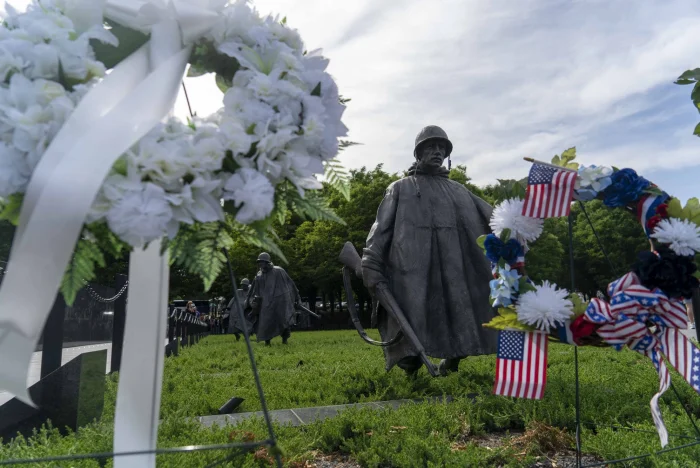
Wreathes are seen amongst the statues at the Korean War Veterans Memorial during Memorial Day weekend in Washington on May 27, 2023. Memorial Day, which honors U.S. military personnel who died while in service, is held on the last Monday of May. Photo by Bonnie Cash/UPI | License Photo
China’s decision to send a largely academic delegation instead of senior defence leadership to the Shangri La Dialogue in Singapore has been described by Australia as a missed opportunity for strategic engagement at a time of rising regional tensions.
Australian Defence Minister Richard Marles said the Asia Pacific region needs greater strategic reassurance from Beijing, particularly given China’s ongoing military expansion and its growing influence across the Indo Pacific.
The Shangri La Dialogue is the region’s most prominent defence and security forum, bringing together senior ministers, military leaders, and policymakers from across the world to discuss security challenges and regional stability.
For the second consecutive year, China’s Defence Minister Dong Jun did not attend the meeting, with Beijing instead sending a delegation made up mainly of academics and military experts.
Why It Matters
The absence of senior Chinese defence officials comes at a sensitive moment for regional security dynamics.
Australia and its allies have repeatedly raised concerns about China’s rapid military buildup, which is widely regarded as the largest conventional expansion since the Second World War. Regional governments argue that this military growth has not been matched by sufficient transparency or reassurance about China’s long term intentions.
The lack of direct high level engagement at forums such as the Shangri La Dialogue limits opportunities to reduce misunderstandings, build trust, and manage rising tensions through dialogue.
For countries in the Indo Pacific, especially smaller states, the absence of senior Chinese representation can increase uncertainty about regional security and long term strategic balance.
Key Stakeholders
China
China’s approach reflects a more controlled engagement strategy in defence diplomacy, relying on lower profile participation while continuing to expand military capabilities and regional influence.
Australia
Australia views sustained dialogue as essential for regional stability, while simultaneously strengthening its alliance with the United States and deepening defence cooperation across the Indo Pacific.
United States
The United States remains a central security partner in the region and continues to position itself as a counterbalance to China’s military rise through alliances and defence agreements.
Regional Partners
Countries such as Japan, the Philippines, Malaysia, and others attending the forum are closely watching China’s engagement level as they navigate their own security concerns in a shifting regional order.
Future Outlook
If China continues limiting senior level participation in regional defence forums, diplomatic channels for managing tensions in the Indo Pacific may become more constrained. This could increase reliance on bilateral alliances and military deterrence rather than multilateral dialogue.
At the same time, ongoing military expansion by China will likely keep regional security concerns elevated, particularly among Southeast Asian and Pacific nations.
However, if future editions of the Shangri La Dialogue see higher level Chinese participation, it could open pathways for improved communication and reduced strategic mistrust.
For now, the gap between China’s military rise and its diplomatic engagement remains a key concern for regional powers seeking stability in an increasingly competitive Indo Pacific environment.
Jamie Vardy had left Cremonese after one season with them relegated from Serie A and his time in Italy a struggle for the family in terms of finding schools and home comfort foods.
The Vardys Italian adventure did not go as planned.(Image: ITV)
Pensive Rebekah Vardy admits the future for her family is up in the air after their return from Italy – as her husband weighs up where to play football next.
The Mirror told yesterday how Jamie Vardy had left Cremonese after one season with them relegated from Serie A and his time in Italy a struggle for the family in terms of finding schools and home comfort foods.
On their future she joked: “Is there ever a f**king plan?” Before she went on to say she did not see Jamie returning to Leicester City. Other reports suggest he could join Sheffield Wednesday or go to play in the Netherlands or even return to the Premier League.
In an interview with the Times to promote their new ITV reality series about their time in Italy, Rebekah spoke of her public persona after losing the Agatha Christie trial against Coleen Rooney.
She said: “I accept that I am very Marmite. I’ve been portrayed as a villain since I met Jamie — they called me a gold-digger and said I’d leave when his football career ended — and to an extent I’ve played up to being that villain.
“I don’t do emotions; that’s genuine. Someone once said I have a ‘resting bitch face’ and I ran with it. It gets me into trouble because my face doesn’t portray the feelings I have inside. I am not a bitch. I find it hard to show vulnerability because of my childhood [Vardy’s family were Jehovah’s Witnesses], and the church forces you to suppress how you feel.
“That cycle is hard to break. So yes, I do come across as cold, but when you look at the bigger picture there’s a reason. At the same time, I am not a victim. I will not play the victim card.”
She also says abuse from trolls and losing the court case against Coleen, leaving her with legal bills of millions of pounds, have taken their toll in the past.
Rebekah added: “There were times when I questioned the point of existing. I didn’t want to be here any more. It was a horrendous time. What got me through was the life we have together and our children. Always the kids. They are our world.”
ITV will next week profile the family’s time in Italy in three-part series The Vardys. The new ITV documentary was supposed to celebrate a great new chapter in their life.
But instead the cameras show Rebecca struggling to find accommodation and schools for their children; Olivia, six, Finley, nine, Sofia 12, Taylor 16.
It was not the Italian dream they hoped for and lasted less time than expected. Once positive is Rebekah will get Jamie at home this Summer as at 39 he is too old to make it into the England squad.
And she insists she won’t miss not being at the World Cup. She said: “It’s actually quite lonely. You go to support your husband or boyfriend but you don’t get to be near them very much. And Russia was terrifying. It was not an easy place to be.”
* The Vardys airs at 9pm on Tuesday June 2nd on ITV1 & ITVX. All three episodes will be immediately available to stream as a boxset online.
Tensions between China and the EU have intensified in recent months, prompting the European Commission to convene most of its commissioners for a strategic rethink during an “orientation debate” on Friday.
ADVERTISEMENT
ADVERTISEMENT
“China is a critical partner, and engagement and dialogue will continue,” the commission said in a readout following the debate. “At the same time the current state of the trade and investment relationship is not sustainable.”
Calling the relationship “not sustainable” may understate the depth of the rupture.
Relations have steadily deteriorated since European Commission President Ursula von der Leyen branded Beijing a “systemic rival” in a landmark 2023 speech. But tensions surged to a new level once EU policymakers finally settled their differences over the EU-US trade deal that had consumed Brussels for months, freeing the bloc to sharpen its focus on China.
Last year, according to the commission, the bloc registered a record-high €359.9 billion trade deficit with Beijing, fuelling growing calls in Brussels to better protect the EU market from cheap Chinese imports that threaten entire sectors — metals, chemicals and the car industry among them.
“We are seeing a panic attack in the last few weeks on China,” an EU official told Euronews, speaking on condition of anonymity to speak candidly. The official added that the China issue had been “overlooked for too long.”
A total of 200,000 European jobs were lost in EU industry — particularly in the energy-intensive and automotive sectors — since 2024, with a further 600,000 job losses projected this decade in carmaking alone.
On Friday, the commission readout specified that its “overarching approach remains de-risking, not decoupling,” signalling that the bloc is still pursuing targeted efforts to reduce its dependence on China rather than sever economic ties altogether. Yet the risk of a full-scale trade war has never felt so real.
Here are five key points on how the situation has escalated to this point — and where it may be headed next :
1. Fines and regulatory pressure
During the previous legislative term, the EU passed legislation that drew Beijing’s anger — notably measures to screen foreign direct investment. And it has stepped up its fight against so-called dumping, whereby public subsidies are used to undercut competitors through exports sold below market prices in China.
The European Commission has grown increasingly assertive in countering China’s subsidy-driven approach, including by imposing duties on imports of battery electric vehicles. Several product-specific investigations are also ongoing.
Earlier this week, the Commission fined Chinese e-commerce giant Temu €200 million for selling unsafe products and opened a full-scale investigation into JD.com’s acquisition of e-commerce retailer MediaMarkt.
EU lawmakers and governments are also discussing the Industrial Accelerator Act, a legislative proposal that would impose strict conditions on investments in batteries, electric vehicles, solar panels and critical raw materials from countries controlling 40% of the global market share in a given sector.
A separate proposal — a revamped Cybersecurity Act — could push out Chinese equipment suppliers such as Huawei and ZTE from critical infrastructure.
2. A more systemic approach
To counter Chinese overcapacities, the EU agreed in April to double tariffs on steel imports that exceed EU quotas. The measure is a so-called “safeguard” — a tool backed by some of the EU’s largest economies, including France, Italy, Spain, the Netherlands and Lithuania, which called for it to be extended to sectors beyond metals.
In a non-paper, those countries argued that safeguards were more “agile” than other EU instruments targeting cheap export products. The paper also calls for economic security to be factored into assessments of the EU’s interests when deciding on trade defence measures.
The European industry is also ramping up pressure to crack down on Chinese cheap imports calling on the Commission to use trade defence measures “more flexibly, faster, and preventively.”
A major wake-up call for EU policymakers has been the recent case of Nexperia, a Dutch-based chipmaker acquired by Chinese giant Wingtech, which was caught in the crossfire of US-China trade tensions, causing significant disruption in the automotive sector.
The Commission is now set to require sectors such as the car industry to diversify chip suppliers in certain cases, taking supply-chain risks into account in procurement decisions.
Despite these various initiatives, EU policymakers have grown wary that the current rules are too slow-moving for a fast-moving adversary. After duties were imposed on electric vehicle batteries, China’s focus simply shifted to hybrid vehicles.
Brussels is now moving towards a more systemic approach, treating trade defence as a toolbox to rebalance relations with China. One potential addition is a so-called overcapacity instrument to cap imports in specific sectors.
3. China’s threats of retaliation
In recent weeks, China has repeatedly threatened retaliation if the EU presses ahead with closing its market to Chinese goods.
Both the “Made in Europe” legislation and the Cybersecurity Act have drawn Beijing’s ire, prompting intensified lobbying of Brussels and EU member states, with warnings that implementation will trigger a response.
The Europeans are walking a tightrope, acutely aware that their decisions could spark a trade war. After the EU imposed tariffs on Chinese electric vehicles in 2024, Beijing imposed tariffs on EU pork, brandy and dairy products.
“International trade is a two-way street. There’s no forced trade. The China-EU trade relations are win-win in nature. China does not aim for trade surplus,” Chinese Foreign Ministry spokesperson Mao Ning said at a press briefing on Thursday.
“The EU needs to put trade ties with China in perspective and honour its commitment to free trade. China will closely follow the EU’s moves and take all measures necessary to safeguard legitimate rights and interests,” Ning added.
Some argue it is already too late for the Europeans, who depend on China for key components of their supply chains — components Beijing can weaponize at will.
In 2025, China blocked exports of rare earths, which are vital for EU green technology and defence, as well as chips essential to the European car industry. Beijing can also leverage operating licences for EU companies and restrict access to its market at any time.
4. European divisions
Europe is far from united on China.
Germany, despite a troubling trade deficit with Beijing, has been slow to shift away from its cooperative approach, which prioritises securing market access for German companies in China.
Berlin did not endorse last weekend’s non-paper backed by other major EU economies. Instead, German Economy Minister Katherina Reiche repeated this week that Germany’s overriding priority is to avoid jeopardising exports to China.
Yet the economic cost of dependence on Beijing might be forcing Berlin to reconsider its stance. The German government is reportedly weighing a tougher line that would mark a significant shift in its China policy.
For years, the German industry had a relationship with the Chinese market that critics described as toxic — one that blocked any meaningful attempt to rebalance the trade deficit out of fear of losing commercial access to the vast Asian market.
Spain has emerged as the other major EU country reluctant to act against China. With relatively cheap energy costs, Spain has become attractive to foreign investors, of which Beijing accounts for a growing share.
Its position caused embarrassment for Madrid this week, after it initially appeared to support the France-led non-paper before retreating and claiming it had merely participated in discussions.
“There has been no specific political support for any ‘non-paper’,” Spanish trade minister Carlos Cuerpo said, adding that the EU should “engage” with Chinese authorities through “dialogue.”
5. What happens now?
Brussels’ reassessment of its China stance has been long in the making, rooted in decades of deepening economic dependence. But the latest acceleration was also prompted by a shift in US posture, most visibly the recent visit to Beijing by President Donald Trump.
The Commission’s orientation debate on Friday was just a first step in what could become a broader repositioning. Where that leads — given internal divisions and the threat of retaliation — remains deeply uncertain.
The conclusions of that exercise are expected to feed into a discussion on economic security at the next European Council meeting on 18-19 June. China has appeared on EU leaders’ agenda several times in recent years, only to be pushed aside by more pressing crises.
While Brussels considers adding new instruments to its policy toolbox, political will remains the key determining factor. Nowhere is that gap more stark than in the EU’s handling of the anti-coercion instrument, also known as the “trade bazooka,” which was designed to push back against economic pressure and unfair trade restrictions.
“The anti-coercive instrument was never used, even though we have been coerced quite a lot,” the EU official said. “We need tools that we are actually willing to use.”
WASHINGTON — A framework agreement to end the U.S. war with Iran is all but settled, pending sign-off from the presidents of the two warring sides, President Trump said Friday, projecting optimism that a deal could finally be at hand.
Yet doubt cast a shadow over the diplomatic process entering the weekend as Trump faced a politically fraught decision to enter an agreement that would invariably require significant concessions to Tehran.
The negotiations have faced severe headwinds in recent days, with both sides accusing the other of violating a fragile ceasefire that has largely stopped the fighting since April.
On his Truth Social site, Trump said he had summoned his top aides to the White House Situation Room to decide on the deal.
The agreement would see an end to the U.S. naval blockade on Iranian ports and the removal of Iranian mines from the Strait of Hormuz, an international waterway through which 20% of the world’s energy supply passes each day. The strait, Trump wrote, will reopen with “no tolls” for “unrestricted shipping traffic, in both directions.”
And “Iran must agree that they will never have a Nuclear Weapon or Bomb,” Trump wrote, noting that Iran’s stockpile of highly enriched uranium, the key ingredient for nuclear weapons, “will be unearthed by the United States (which, it is agreed, is the only Country, along with China, with the mechanical capability of doing so!), in close coordination and conjunction with the Islamic Republic of Iran, plus the International Atomic Energy Agency, and DESTROYED.”
“No money will be exchanged, until further notice,” he added.
Treasury Secretary Scott Bessent also said the deal would require Iran to disavow the continuation of its domestic nuclear program — a diplomatic feat never before achieved throughout a quarter century of international negotiations over Iran’s nuclear work.
It is unclear whether Tehran would go that far. And Iran’s negotiators expressed defiance on Friday, stating that there was “no trust in guarantees or words” from the American side.
“No step will be taken before the other side acts first,” said Mohammad Bagher Ghalibaf, the speaker of Iran’s Parliament. “We do not gain concessions through dialogue, but through missiles.”
It remains unclear when the Trump administration would ease sanctions on Iran, how extensive that relief would be, or what form it would take — questions that fueled Republican criticism of the Obama-era nuclear deal more than a decade ago.
The working diplomatic document would formally extend the existing ceasefire for 60 days, allowing for a more detailed negotiation to take place over Iran’s nuclear program. But the truce as it currently stands is on perilous ground. Iran launched a ballistic missile on Thursday at Kuwait, a close U.S. ally, after American forces took “defensive” actions against Iranian missile launchers and mine laying boats it had launched in the strait.
The war has proven historically unpopular with the American public, and has seen oil prices soar since the U.S. military, in partnership with Israel, launched its first strikes against Iran in February.
Bessent said he is hopeful that oil prices would drop quickly once an agreement is signed. But industry analysts say the effects of the war on the oil market could last for months, if not years, with the stability of traffic through the Strait of Hormuz now in question for commercial shippers.
While oil has dropped to under $100 a barrel, markets appeared skittish on Friday over the prospects for a deal, with mixed messages appearing to emerge out of the region.
It is also unclear whether a U.S. agreement with Iran would in any way bind Israel’s hands in its military operations, either in Iran or in Lebanon, where an Iranian proxy militia, Hezbollah, has vowed to keep up the fight.
Israel has ramped up strikes against Hezbollah targets in recent days, jeopardizing a delicate ceasefire negotiated with the Lebanese government, a deal encouraged by the Trump administration in order to grease the wheels for its talks with Tehran.
Trump has been uncharacteristically silent on the prospects of an agreement in recent days, expressing cautious optimism in limited exchanges with reporters.
“It’s hard to say exactly when or if the president’s going to sign,” Vice President JD Vance, who has led the U.S. diplomatic team, told reporters, noting that “the nuclear stuff” is still subject to negotiation. “We’re going back and forth on a couple of language points.”
“I do think that we’ve made a lot of progress here,” Vance added. “Hopefully we’ll continue to make progress, and the president will be in a position where he can endorse the agreement. But obviously, that’s still TBD.”
Will Smith crouched, his left knee on the ground and his mitt grazing the dirt as his Team USA teammate Mason Miller strode towards the plate.
From there, the only way for his glove to go was up and through the slider that fell out of the strike zone as the Dominican Republic’s Geraldo Perdomo stopped his swing. But, in a full count, home plate umpire Cory Blaser called it strike three.
“That’s the work we do in the cage, and off the machine, and drills, and all that coming to fruition, and being applied to in-game,” Smith said in a recent conversation with The Times.
He has a slim chance of replicating that moment during the season, with the ABS challenge system implemented in MLB. If it had been in play during the WBC — as long as the Dominican Republic had challenges left — Perdomo surely would have used one on the final pitch of that 2-1 game.
And yet, as counterintuitive as it may sound, Smith dedicated time and effort during spring training to improving his framing.
“It’s important because you only get two challenges a game, offensively and defensively,” Smith said. “The whole team only gets those two. So the harder I can make it on the other team to challenge pitches, the better. The more strikes I can get and not have to challenge, the better. I think overall, it almost makes it more important, in a way.”
United States pitcher Mason Miller and catcher Will Smith celebrate a WBC semifinal win over the Dominican Republic.
(Rebecca Blackwell / Associated Press)
Framing had been a weakness in Smith’s game in recent seasons, according to Statcast’s catching metrics. His best season was 2023, when he recorded four runs saved via pitch framing. But he slipped to minus-eight and minus-10 the next two seasons. Entering the Dodgers’ series against the Phillies this weekend, he was at an even zero after 43 games at catcher this season, including 39 starts.
And now, when Smith doesn’t get a call, he has ABS to fall back on. Entering Friday, he’s challenged 41 calls through the ABS system from behind the plate, the 10th-most of any catcher. And he had a 71% success rate, the ninth-best mark among catchers with at least 20 challenges.
Because the catcher has the best vantage point, teams across the majors have made their catchers, not their pitchers, the point men for ABS challenges on defense.
ABS as a skill, however, isn’t just about getting the challenges right. Knowing the right times to take a risk is also key.
“There’s so many games within the game,” Smith said, “and that’s just another one of them.”
As Smith alluded to, under the challenge system — as opposed to fulltime ABS, which MLB also tested in the minors — it’s still possible to steal strikes.
“I like the challenge system because you still have the human error element to the game,” Smith said. “…Everyone always talks about how it’s a game of life, dealing with failure and dealing with ups and downs — the umpire screwing you or catching a break, that’s part of the game.”
Dodgers catcher Will Smith walks to the dugout after the fifth inning of a Dodgers-Marlins game at Dodger Stadium on April 27.
(Ronaldo Bolanos/Los Angeles Times)
Now, the players have recourse for the egregious calls and the biggest moments of the game.
The margins are so slim, however, that if a hitter isn’t convinced enough on a borderline strike call, and the situation dictates caution, he may not challenge.
The same goes for a catcher on a borderline ball call.
That’s where Smith’s work on framing comes in. He describes it as a change in philosophy.
“For me, it’s more just understanding the move,” Smith said. “I had to drill it in a little bit obviously, but more understanding the move of going farther out to get it, working through the ball, more like towards the pitcher, as opposed to letting the ball kind of come back to you. That was just not how I’d ever done it.”
That’s what he did on that last pitch of the WBC semifinals. Moving through the ball creates a more seamless motion, compared to pulling it into the strike zone, making the frame job more convincing. And catching it out in front also stops the ball’s own movement before it gets too far out of the zone.
That’s how Smith made a pitch that appeared to cross the plate below Perdomo’s knees look like a strike from Blaser’s vantage point.
The effect Smith’s spring training work behind the plate will have on the Dodgers’ season will be subtler. Instead of a singular game-defining moment, it’ll be an edge here and there.
But over the course of a long season, that adds up.
I expected a no-frills Caribbean cruise – but instead found white-sand beaches, all-inclusive perks and surprisingly luxurious touches that felt far beyond the price tag
This article contains affiliate links, we will receive a commission on any sales we generate from it. Learn more
Marella Cruises with TUI(Image: TUI)
Stretched out on the top deck of a catamaran, after a dip in impossibly clear water, I looked back at the white sands of an uninhabited Caribbean island that was ours for the day. This felt a long way from the so-called “budget” cruise I had imagined. For my first trip to the Caribbean, I boarded Marella Discovery, one of five ships in TUI’s all-inclusive fleet. Flights, transfers, food, drinks, and tips are included in the price. On paper, it promised value for money but in reality, it felt like far more. The Tropical Isles itinerary offers something different, even for seasoned Caribbean travellers. Instead of the usual tourist trail, we stopped at newer ports including Puerto Rico’s second city, Ponce, and the tiny island of Isla Catalina. After a short tender ride to shore we were welcomed with a live band and dancers before being waved to rows of neatly lined sunbeds, an all-inclusive beach bar and grills preparing a complimentary barbecue. Best known for its snorkelling, Isla Catalina’s crystal-clear waters looked too good to miss. I headed out on a catamaran excursion along the milky-white coast, swimming among shoals of tropical fish before drying off in the sun with fresh fruit as merengue music played.
By the time we returned, the smell of grilled seafood was drifting across the sand. Passengers helped themselves before retreating to shaded loungers – where there was little left to do but switch off and listen to the waves. Back on board, The Marella Discovery doesn’t try to compete with the Caribbean’s mega- cruise liners brimming with waterslides, waterfalls and ziplines. Instead, it offers something more relaxed – and for many, far more appealing. With nine restaurants, seven bars, two pools and a packed entertainment programme, there’s more to do than most passengers will manage in a week. Entertainment leans towards easy-going fun appealing to all ages with an outdoor cinema, mini golf and in the evening, West End-style shows to fill your day. Before my trip I’d been warned it was easy to get lost on a huge cruise ship, but the Discovery layout is very manageable and centred around a five storey atrium. Within a day, I had my bearings – starting with my cabin. For the week, I stayed in a recently refurbished balcony room. It was spacious, comfortable and thoughtfully designed, with plenty of storage. From summer 2026, Marella customers can upgrade further with premium Elemis products as part of the new “Suite Service Max” package – one of several add-ons available to elevate the experience.
Food is a big part of any cruise – and here it’s a major selling point. There are nine dining options included and three specialty restaurants for those wanting to really push the boat out. On the first night, I opted for one of the all inclusive options, Piccadilly’s, a British-style gastropub menu where the show-stopper was a rich, slow-cooked steak and ale pie. Over the week I worked my way through nearly every restaurant on board. Gallery 47, the Italian venue, was a favourite thanks to its varied and regular changing menu. While The Glass House, a casual poolside spot, was ideal for lunches, offering everything from pasta and roast chicken to salads and freshly baked cakes. One evening, I tried Kora La, the ship’s pan-Asian restaurant (at a cost of £18.95 for three courses). With fragrant curries and beautifully presented Vietnamese-style dishes, it was worth the extra cost and a popular choice among diners wishing to celebrate a special occasion.
Marella’s fun-filled and friendly vibes continued ashore with each stop on this relatively new itinerary. In Puerto Rico, I joined an excursion to El Yunque National Forest, swapping blue seas for lush rainforest, waterfalls and birdsong. Our helpful guide offered insight that brought the island to life, something you don’t always get when travelling independently. Back in capital city San Juan, I wandered the cobbled streets where pastel-coloured buildings led the way to lively squares.
I followed our guide’s recommendation for lunch at Café Manolín, a must for authentic food, the place was packed with locals and dock workers. I ordered the Mofongo, a Puerto Rican comfort dish made from mashed green plantains, garlic and steak. It was every bit as good as the queue suggested.
Later it was time to try another Puerto Rican export. At the Ron del Barrilito rum distillery, we swapped the city for something slower-paced. Set within the historic Hacienda Santa Ana, we were served up a welcome cocktail of choice in the stunning gardens listening to the blissful sounds of the birds. The experience included a tour of the ageing warehouses and a guided tasting of several rums, including one from a £700 bottle. Another standout was a visit to the stunning Magens Bay on the island of St Thomas. This horseshoe shaped beach delivered exactly what you’d hope for from the Caribbean – powdery sand, sparkling waters and turtles swimming just offshore. With the help of our local guide Derek, we were able to swim with the stunning creatures as they glided through the shallows.
The final stop, Ponce, offered a glimpse of a more authentic Puerto Rico on our return to another side of the island. With cruise ships only arriving in January 2026 it felt refreshingly un-touristy. I found colourful buildings, a relaxed square and latin music drifting from every bar. Throughout the trip, what stood out most was how easy everything felt – from the relaxed feel of the ship, the organised excursions to the stress-free all-inclusive drinks and dining. The atmosphere among fellow passengers was sociable and lively. The ship came alive in the evening with live shows and packed dancefloors – even into the small hours at Bar 11.
At the Broadway Show Lounge, live performances became my nightly post-dinner treat. Being a massive fan of the Fab Four, I could not miss Marella’s newest show Life Story: The Beatles, a theatrical retelling of their rise to fame. While the West-End to Broadway show, a celebration of a number of hit musicals, led to a roaring standing ovation after a finale of Les Miserables classics brought the house down. After feeling inspired, on our final day at sea I indulged in the Great Musicals Afternoon tea – a must for any theatre fan. The weekly event brings the West End to Marella cruises with dishes inspired by famous musicals, served alongside a live pianist and special performances – the perfect end to the holiday.
Marella Cruises has built a reputation on affordable and straightforward holidays – but this trip proved it delivers far more than the price tag suggests in comparison to its competitors.
If the aim is a stress-free, fun-filled Caribbean escape with fantastic food, easy island-hopping and a sociable atmosphere, Marella’s Tropical Isles itinerary is hard to beat. It’s ideal for first-time cruisers, and will also impress seasoned explorers thanks to its brand new port destinations that have something special to offer beyond a well-trodden tourist trail. And while it may be sold as a ‘budget’ cruise, it delivers an experience that feels far more premium – proving you don’t have to spend a fortune to experience the Caribbean in style.
Book the holiday
Marella Cruises offers a seven-night Tropical Islesround trip from La Romana, Dominican Republic on Marella Discovery from £1573 per person. Price based on two adults sharing a Deck 2/3 inside cabin on an all-inclusive basis. Includes flights from London Gatwick, 20kg of luggage per person, transfers, tips, and service charges. Find out more at tui.co.uk/cruise.
BRITS will be able to skip long Entry/Exit System queues in one European country this summer – and it isn’t Greece.
Brits can now use e-gates at borders when entering France, despite the new Entry/Exit System (EES).
Sign up for the Travel newsletter
Thank you!
France is allowing Brits to use e-gates at some of its airportsCredit: Alamy
Previously, British holidaymakers have been unable to use e-gates due to the implementation of EES, which requires Brits to register upon their first border crossing into Europe after April 12.
However, according to The Connexion, the UAF French airports group has revealed that visitors can enter through e-gates at French airports if they first use an EES pre-registration kiosk.
The change should help Brits to avoid long queues and wait times at French borders.
Nice is one airport letting all Brits through e-gates without manual passport stamping and face-to-face border guard checks.
The airport is even opening extra e-gates and changing signs to ‘All Passports‘ when British flights arrive to help people move more quickly through the airport, according to Riviera Radio.
Currently, the self-registration EES kiosks at Nice Airport are not being used as there have been technical delays in opening them.
Bordeaux Airport, along with some other French airports, is now also looking into allowing non-EU travellers – which includes Brits – to access e-gates.
It comes as airport delays have been experienced across Europe due to queues at EES kiosks.
For example, travellers recently spent five hours queueing at Faro Airport in Portugal.
In fact, queues became so bad that Greece announced it was going to suspend EES, before backtracking.
EES – which has been in place since April 12 – is meant to speed up processing at borders, but due to many Brits still needing to register, many popular destinations have been experiencing lengthy queues.
EES applies to all Schengen countries, which include:
May 29 (UPI) — Reports that the U.S. Attorney’s Office in Chicago is investigating President Donald Trump accuser E. Jean Carroll are denied by that office, one day after widespread reporting by multiple news outlets.
“In light of wide-spread reporting and intense media and public interest into the E. Jean Carroll matter in New York, the Chicago U.S. Attorney’s Office can confirm that it has not opened — and has never opened — a criminal investigation into E. Jean Carroll. Any claim to the contrary is categorically false,” U.S. Attorney for the Northern District of Illinois Andrew S. Boutros posted a statement on X.
CNN broke the news Thursday, citing multiple sources familiar with the matter, and other news outlets confirmed with their sources. They reported that Acting Attorney General Todd Blanche had recused himself from the investigation because he had represented President Donald Trump in one of his appeals of a civil case brought by Carroll.
Carroll won two civil suits against Trump. One alleged that he sexually assaulted her in a New York department store in the 1990s and another one was for defamation in 2019, after he denied the assault and said she made up the attack to boost book sales. In the assault case, Carroll was awarded $5 million, and in the defamation case, she was awarded $83 million.
The reported investigation was allegedly into a 2022 deposition in which Carroll said she received no outside funding for the suit. Later, it came to light that billionaire Reid Hoffman, co-founder of LinkedIn, paid some of her legal fees and expenses.
The BBC reported Friday that CBS News had initially reported the investigation but later reported that its source had clarified that Carroll’s testimony about funding for her lawsuits against Trump was being looked at as part of an investigation into a nonprofit run by Hoffman. CBS published an editor’s note Thursday to clarify.
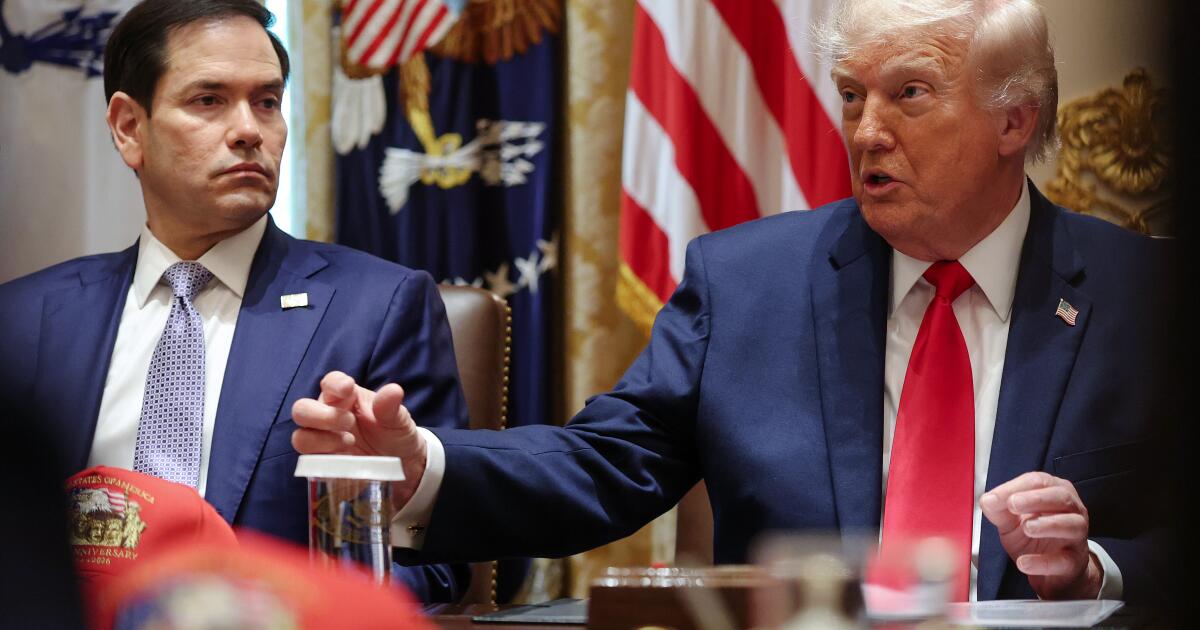
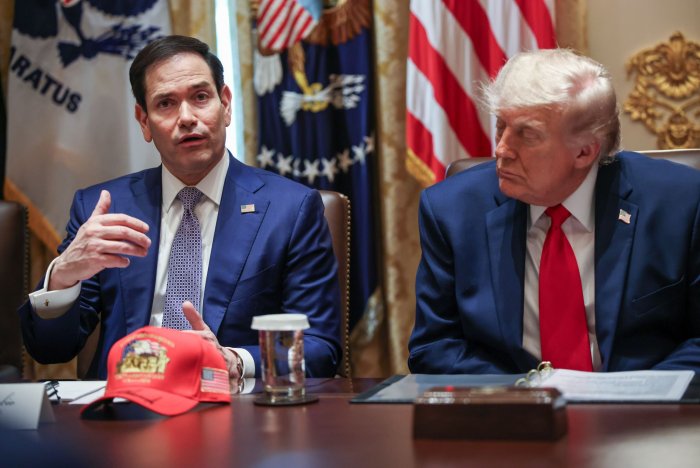
Secretary of State Marco Rubio and President Donald Trump participate in a Cabinet meeting in the Cabinet Room of the White House on Wednesday. Photo by Samuel Corum/UPI | License Photo
After two years of relentless bombardment and ground invasions, Israel’s future in Gaza had appeared to be settled with the signing of United States President Donald Trump’s 20-point peace plan on October 9, 2025.
Under the terms of that agreement, Israeli forces were meant to withdraw behind what planners called the “Yellow Line”, maintaining control of 58 percent of the territory, with their full withdrawal to be set at a date to be determined.
Recommended Stories
list of 4 itemsend of list
That withdrawal hasn’t happened. In fact, in the months since, as well as killing at least 922 people in near-daily strikes on the enclave during the “ceasefire”, Israel has expanded its territory by about 11 percent.
According to satellite data gathered in March, it has also established at least 32 military outposts, a ground barrier and infrastructure along what was supposed to be a temporary line.
Since October last year, numerous humanitarian agencies, including Oxfam, have accused Israel of compounding the humanitarian crisis in Gaza by restricting deliveries of aid and other essential goods.
Then, on Thursday, Israeli Prime Minister Benjamin Netanyahu announced that Israel will take over yet more territory in Gaza, telling a conference: “We are currently squeezing Hamas; we now control 60 percent of the territory of the Strip – you know this. We were at 50. My directive is to move to …,” he said, pausing briefly as someone in the crowd yelled, “100!”
“Let’s go step by step,” he responded, “First of all, 70. Let’s start with that. We’re pressing them from all sides, we’ll deal with the remnants.”
Al Jazeera contacted the Israeli prime minister’s office for clarification of this, but received no response by the time of publishing.
Can Israel just grab more land in Gaza?
“If Israel’s ultimate plan is to exercise permanent effective control over the entirety of the Gaza Strip, we are talking about unlawful annexation,” Michael Becker, a professor of international human rights law at Trinity College in Dublin, told Al Jazeera.
“As the International Court of Justice reaffirmed in a 2024 advisory opinion, annexation constitutes a violation of the bedrock prohibition of the acquisition of territory by force.”
Nevertheless, to date, since the onset of its war on Gaza in October 2023, Israeli forces have killed at least 72,819 men, women and children in Gaza, with many thousands more missing and presumed dead under the rubble.
By 2025, Israel had caused a confirmed famine in the enclave and has now decimated nearly all infrastructure needed to support life. It has done all this without experiencing any meaningful international sanctions and still takes part in numerous international sporting and entertainment competitions – despite protests.
Hopes that the US might enforce its own conditions on Israel also appear ill-founded. Since announcing a ceasefire in the enclave in October last year, the US has failed to react as Israel has expanded and entrenched its presence in Gaza, choking off access to about two-thirds of the enclave for its inhabitants by April 2026.
Al Jazeera also contacted the US State Department for comment about this, but received no response by the time of publishing.
Can Gaza’s population survive in such a reduced territory?
It’s very hard to tell. Several agencies, including the UN’s Office for the Coordination of Humanitarian Affairs (OCHA), have expressed deep concern about how Gaza’s remaining population can continue to subsist in an ever-shrinking space.
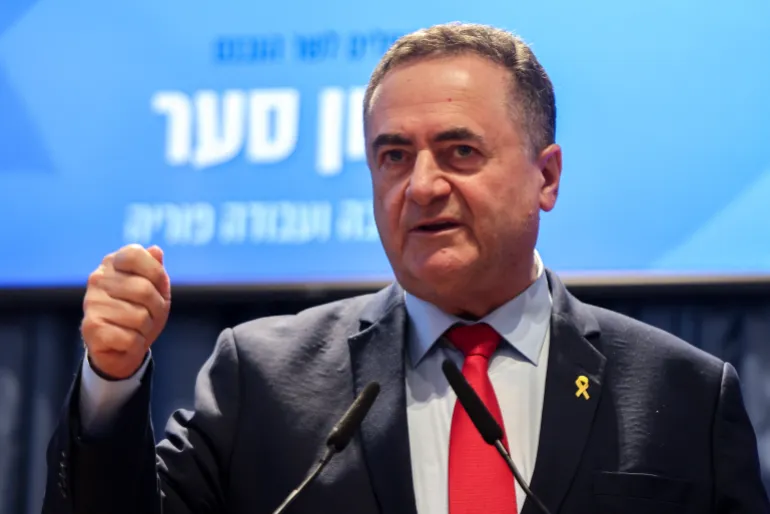
Israel’s answer to this is simple. “The plan for voluntary emigration from Gaza will also be implemented, all at the proper time and in the proper manner,” Defence Minister Israel Katz wrote in a statement marking the killing of Hamas leader Mohammed Odeh on Wednesday this week.
“Voluntary emigration” is a term used by a number of Israel’s government ministers, including National Security Minister Itamar Ben-Gvir and Finance Minister Bezalel Smotrich. Observers typically acknowledge that this means the ethnic cleansing of the enclave.
Israel’s Ministry of Defence did not respond to questions about this from Al Jazeera.
Israel’s Defence Minister Israel Katz has referred to the ‘voluntary emigration’ of Gaza’s population, a term generally regarded as referring to its ethnic cleansing [File: Menahem Kahana/ AFP]
Is any of this legal?
No.
“The idea of permanently removing Palestinians from Gaza smacks of forced displacement and would also violate the fundamental right to self-determination of the Palestinian people,” Becker said. The principle of self-determination serves as a “cornerstone” of the UN Charter, he said.
However, Becker said, the spotlight of international attention has now shifted from the crisis in Gaza to the US and Israel’s war on Iran, as well as Israel’s actions in Lebanon, where it has occupied large swaths of the south of the country.
“While the Trump administration may be willing to diverge from Israel’s interests in seeking a resolution to the disastrous and illegal war that the United States started against Iran, the United States seems to have lost interest in Gaza or pushing for restraint on the part of Netanyahu’s government. It is unclear what role the so-called Board of Peace is willing to play in terms of maintaining a future for the Palestinians of Gaza,” he said.
UNIVERSAL is opening a brand-new ‘kids resort’ theme park dedicated to families with younger children.
It will open seven different worlds around popular TV and film characters like Shrek, Spongebob Squarepants and the Minions.
Sign up for the Travel newsletter
Thank you!
The new Universal Kid Resort will open in JulyCredit: APThe worlds will be themed around popular TV and film characters, like ShrekCredit: Universal Parks & Resorts
Universal announced yesterday that it will open its Universal Kids Resort in Frisco, Texas, on July 1.
Sharon Parker, Director of Marketing and Sales for Universal Kids Resort, told NBC 5: “This is a theme park built with kids in mind.
“At the end of the day, we think that the inner child in all of us is going to brought to life once those families come to the park.”
Inside will be seven-themed lands inspired by Shrek, SpongeBob SquarePants, Jurassic World, Minions, Trolls, Puss in Boots, and Gabby’s Dollhouse.
As it’s designed for children between 3-8, the experiences will be ‘kid-sized’ and will include immersive attractions.
Activities include a Trolls dance party, Puss in Boots-themed puppet show, sensory gardens, character meet-and-greets and water play.
In its social media post about the grand-opening – other rides include rollercoasters, swing rides, a playground, lazy river ride and splash park.
Along with the park, a new Universal Kids Resort Hotel will open just a few steps away from the entrance.
It will have a colourful exterior and inside will be 300 rooms and family suites, three restaurants and a swimmingpool.
The hotel will accept stays that start on June 30 – the day before the park officially opens.
The new resort will be in Texas and entry starts $54.99 (just under £41)Credit: Getty
Rooms include Standard Queen, Deluxe Queen, and Signature Queen rooms, which can sleep up to five guests, and the Family Suites, which can sleep up to six guests.
Staying at the hotel means guests get early bird admission one hour before the park opens, and access through a dedicated entrance.
When it comes to shopping, whatever hotel guests buy will be delivered the room so they won’t have to carry it around during the day.
Tickets to the park are now on sale – there are one and two-day admissions.
The hotel will have 300 colourful rooms, three restaurants and a swimming poolCredit:
One-day tickets start from $54.99 (£40.98) and two-day admissions start from $73.99 (£55.15) – this pass must be used in two consecutive days.
There’s also an annual pass option too for entry all year costing $129.99 (£96.88).
The resort is launching packages too – for example, a package would include a two-night hotel stay, early park admission and a ‘1.5-Day’ admission ticket.
What’s 2,030-feet long-by-167-feet wide and blue all over? If you guessed the Lincoln Memorial Reflecting Pool, you’re right!
Bonus points for triggering someone in your immediate orbit, because ever since President Trump announced his intention to apply blue paint to the basin of architect Henry Bacon’s 1923 pool, the mere mention of the project can make certain people’s heads explode. To wit, a lawsuit filed this month in district court by the Cultural Landscape Foundation and a former Park Service landscape architect, Charles Birnbaum, claims Trump’s actions have caused Birnbaum to suffer “aesthetic injury.”
The phrase might sound humorous at first read, but anyone who cares about art, architecture and the experience of shared public space knows there’s nothing funny about it. We’ve all felt the empty sorrow of staring into the abyss of a boxy Walmart superstore, and experienced a deep malaise of the soul when driving past an endless crush of fast food chains on the outskirts of a major metropolitan area.
It’s doubtful this sadness is shared by Trump, for whom an “aesthetic injury” might best be represented by a McDonald’s without its golden arches. Plus, our president clearly thinks a great deal of good will come from painting the reflecting pool at the center of the National Mall American Flag Blue.
Only a few days ago Trump posted what I can only assume was an AI-generated image of the final product on Truth Social. The blue in question is shockingly bright — like the sky over the Aegean Sea at noon on a cloudless day. That kind of blue can be breathtakingly beautiful, but in this case it swallows up everything around it, including the Lincoln Memorial and the Washington Monument, which it was built to reflect.
The blue pool, in other words, is the main event — and that is not what was intended by its creators. Indeed, Birnbaum’s lawsuit notes the value of various design choices including, “the grey, achromatic basin of the Reflecting Pool as the source of the pool’s profound reflective depth.”
The lawsuit continues, “The ongoing resurfacing of the basin in vivid blue has materially degraded Mr. Birnbaum’s aesthetic experience. Mr. Birnbaum’s aesthetic enjoyment of the Reflecting Pool — as a historic designed landscape whose character he has documented, championed, and personally appreciated over many years — is being concretely harmed by Defendants’ ongoing alteration of its character defining features.”
Many other critics and vocal members of the public have claimed similar harm resulting from the numerous renovations Trump is making in the nation’s Capitol — mostly without court approval or congressional oversight — including his demolition of the White House’s East Wing, his construction of a massive ballroom to replace it, the building of a towering triumphal arch, and the creation of a Hero’s Garden in a public park space along the Potomac river.
Painting the Reflecting Pool American Flag Blue may not be the most intrusive of these impulsive, self-aggrandizing acts, but it was the pigment that broke the camel’s back.
I’m Arts editor Jessica Gelt, in blue. This is your arts and culture news for the week.
You’re reading Essential Arts
Our critics and reporters guide you through events and happenings of L.A.
By continuing, you agree to our Terms of Service, which include arbitration and a class action waiver. You agree that we and our third-party vendors may collect and use your information, including through cookies, pixels and similar technologies, for the purposes set forth in our Privacy Policy such as personalizing your experience and ads.
The week ahead: A curated calendar
FRIDAY
Gustavo Dudamel conducting the 2025-26 season opener at Walt Disney Concert Hall on September 25.
(Timothy Norris/Los Angeles Philharmonic)
Gustavo Dudamel and the Los Angeles Philharmonic The departing maestro and his colleagues are in the homestretch and it’s a busy one. This weekend, there are performances of world premieres of Roberto Sierra’s “Estudios Sinfónicos” (Friday and Sunday) and Angélica Negrón’s “Mundillo (Little World)” (Saturday, featuring YoYo Ma). Both new works are paired with Richard Strauss’ “Ein Heldenleben, Op. 40.” On Thursday, Dudamel celebrates the musicians of the L.A. Phil with an eclectic program including compositions by Rossini, Paganini, Mozart, Mendelssohn, Tchaikovsky and Philip Glass, plus the world premieres of “Bravo Gustavo!” by John Williams and Gabriela Ortiz’s “Mujer Arena.” Strauss, 11 a.m. Friday; 2 p.m. Sunday; Yo-Yo Ma, 8 p.m. Saturday; Celebrating the Musicians of the L.A. Phil, 8 p.m. Thursday. Walt Disney Concert Hall, 111 S. Grand Ave., downtown L.A. laphil.com
Grangeville A 2025 drama by the bard of Idaho, Samuel D. Hunter, the play considers the complex relationship of two half-brothers connecting virtually to discuss the care of their ailing mother. Tim Cummings and Jeff LeBeau star. Directed by John Perrin Flynn. Through July 12. Ruskin Group Theatre, 2800 Airport Ave., Santa Monica. ruskingrouptheatre.com
How to Have Sex Again The Rebel & the Warrior, a new theater producing collective, present their first L.A. production, the world premiere of a romantic comedy by Louis Reyes McWilliams. 8 p.m. Friday, Saturday, Sunday ; 7:30 p.m. Thursday; 8 p.m. June 5; 3 and 8 p.m. June 6; and 7:30 p.m. June 7. June Odyssey Theatre, 2055 S. Sepulveda Blvd. sanguinenyc.com
Jodie Landau The composer-performer presents the West Coast premiere of “Performance of Self,” combining memoir, concert, cabaret with original chamber rock compositions, backed by a six-piece ensemble. Directed by Diana Wyenn. Part of OperaFest LA. 8 p.m. Friday and Saturday. REDCAT, 631 W. 2nd St., downtown L.A. redcat.org
Let’s Get It On: The Wearable Art of Betye Saar The exhibition highlights the role of costume design in the artist’s life and work, including more than 200 objects, including photographs, drawings, garments, jewelry, artworks and historical materials from the 1950s-1970s. Opening reception, 5-7 p.m. Friday; exhibition continues through Aug. 22. Roberts Projects, 442 S. La Brea Ave. robertsprojectsla.com
Shelley Conducts America @ 250 Pacific Symphony concludes its season with incoming new music director Alexander Shelley conducting the premiere of Peter Boyer’s “American Mosaic,” with accompanying video imagery by award-winning photographer Joe Sohm. 8 p.m. Friday and Saturday. Renée and Henry Segerstrom Concert Hall, 615 Town Center Drive, Costa Mesa. pacificsymphony.org
Leslie Uggams in 1972’s ‘Black Girl.’
(UCLA Film & Television Archive)
UCLA Festival of Preservation “Don’t miss your chance to see these rarely screened films on the big screen where they belong,” writes former Times movie critic Kenneth Turan in his preview of the event. The 22nd festival, which opens with Ossie Davis’ 1972 drama “Black Girl,” presents 11 feature films, four television programs and 30 short works, cartoons and newsreels, all newly preserved and restored by the UCLA Film & Television Archive and its partners and funders. Through Sunday. Billy Wilder Theater, UCLA Hammer Museum, 10899 Wilshire Blvd., Westwood. cinema.ucla.edu
SATURDAY
Actor Alec Baldwin will narrate “Lincoln’s Portrait,” part of Pasadena Symphony’s America @ 250 concert.
(Pasadena Symphony)
America @ 250 The Pasadena Symphony’s season ending concert, celebrating the nation’s sesquicentennial, includes John Williams’ “Liberty Fanfare,” George Gershwin’s “Concerto in F for Piano and Orchestra,” and Aaron Copland‘s “Appalachian Spring” Suite and “Lincoln Portrait,” the latter narrated by actor Alec Baldwin. 2 and 8 p.m. Ambassador Auditorium, 131 S. St. John Ave., Pasadena. pasadenasymphony-pops.org
Baroque in Bloom Soprano Amanda Forsythe joins the Los Angeles Chamber Orchestra for arias from Handel’s “Giulio Cesare” and Bach’s “Wedding Cantata.” The program also includes LACO’s principal bassoon Andrew Brady performing “Vivaldi’s Concerto for Bassoon in A minor, RV 497,” Telemann’s “Don Quixote Suite” and Biber’s “Battalia.” 7:30 p.m. Saturday. Rothenberg Hall, the Huntington, 1151 Oxford Road, San Marino; 4 p.m. Sunday. The Wallis, 9390 N. Santa Monica Blvd., Beverly Hills. laco.org
From Hell to Hollywood: Films Music’s First Golden Age and the Émigré Community The Scott Dunn Orchestra performs the music of Arnold Schoenberg, Max Steiner, Erich Wolfgang Korngold, Franz Waxman, Dimitri Tiomkin, Bronisław Kaper, Kurt Weill, Ernest Gold and Miklós Rózsa. 7:30 p.m. Saturday. The Wallis, 9390 N. Santa Monica Blvd., Beverly Hills. thewallis.org
Life, Liberty, and Los Angeles Through historical and contemporary objects, media, art and community collaborations, the exhibition brings together stories of diverse Angelenos and demonstrates the ways their hopes and dreams built the city while reflecting the values of a burgeoning nation. Opening May 30-Jan. 31. Autry Museum of the American West, 4700 Western Heritage Way, Griffith Park. theautry.org
Sydney Mancasola as Pamina in LA Opera’s 2026 presentation of “The Magic Flute.”
(Cory Weaver)
The Magic Flute LA Opera music director James Conlon’s final production will be Wolfgang Amadeus Mozart’s fan favorite about a prince, a princess and an enchanted instrument. Starring Miles Mykkanen in his LA Opera debut as Prince Tamino, Sydney Mancasola as Princess Pamina, Kyle Miller as the sidekick Papageno, Aigul Khismatullina as Queen of the Night and Kwangchul Youn and Sarastro. Through June 21 Dorothy Chandler Pavilion, 135 N. Grand Ave., downtown L.A. laopera.org
The Satie Project The artists of Piano Spheres perform the complete four-hand works of French composer and pianist Erik Satie, plus seven newly-commissioned response pieces, alongside the experimental puppetry David Gordezky in what promises to be a truly zany show. 8 p.m. Saturday; 2 p.m. Sunday. Boston Court Pasadena. 70 N. Mentor Ave., Pasadena. bostoncourtpasadena.org
SUNDAY
Bleak Week: The Cinema of Despair Isabelle Huppert, Ari Aster, Denis Villeneuve, Werner Herzog and many others are the scheduled guests for the fifth edition of the global festival. The L.A. festivities, featuring 48 films from 18 countries, start with Béla Tarr’s 1994 film “Sátántangó” (2 p.m. Sunday at the Aero). Through June 7. Aero Theatre, 1328 Montana Ave., Santa Monica; Egyptian Theatre, 6712 Hollywood Blvd.; Los Feliz Theatre, 1822 N Vermont Ave. americancinematheque.com
Exhibition photography for “Marilyn Monroe: Hollywood Icon” at the the Academy Museum of Motion Pictures in Los Angeles.
(Emily Shur / Academy Museum Foundation)
Marilyn Monroe: Hollywood Icon A reevaluation of the actor’s artistry and image-making, the exhibition presents hundreds of original objects, including posters, portraits, photographs, production documents, letters, and rarely seen personal materials. A companion screening series also kicks off this week. Times culture critic Mary McNamara attended the opening and wrote about the enduring mystery that still surrounds the life and legacy of the film star 100 years after her birth. “Gentleman Prefer Blondes,” 6:30 p.m. Sunday; “The Asphalt Jungle,” 7:30 p.m. Monday, with guests author and filmmaker Mark A. Fortin, actor Jack Huston, author, filmmaker and actor Joshua John Miller, and journalist Nancy Jo Sales; “Niagara,” 8 p.m. Wednesday; and “All About Eve,” 7:30 p.m. Thursday, with guest Vanity Fair contributing editor Lorraine Nicholson. Screening series runs through July 3; exhibition continues through Feb. 28. Academy Museum, 6067 Wilshire Blvd. academymuseum.org
Museums of the Arroyo Day The theme is “Life in the Past Lane” as five local institutions celebrate Arroyo Culture with a day of free admission. Noon-4 p.m. The Gamble House, 4 Westmoreland Place, Pasadena; Heritage Square, 3510 Pasadena Ave., L.A.; Los Angeles Police Museum, 6045 York Blvd., L.A.; Lummis Home, 200 E. Avenue 43, L.A.; Pasadena Museum of History, 470 W. Walnut St., Pasadena. museumsofthearroyo.com
Now Be Here’s first photograph in Los Angeles, 2016, Hauser & Wirth DTLA.
(Isabel Avila & Carrie Yury, courtesy of Kim Schoenstadt, Now Be Here)
Now Be Here: 2026 Los Angeles Anniversary A decade ago, the organization launched as a means to “give visibility to women and non-binary artists, bringing equity to the art world,” and was commemorated by the above group photo. To mark the moment, Now Be Here and OXY ARTS present a free day of events (including a new community photo) open to all on the Occidental College campus. 9 a.m.-3 p.m. Occidental College, 1600 Campus Road. oxyarts.oxy.edu/events
Tierra Craft Contemporary’s 4th Clay Biennial focuses on the work of Latinx, Indigenous and Black artists, emphasizing their deep connections to the geographies that yield the materials they work with. Also opening this week is “Earthen Comforts: Airing Earth,” a courtyard installation led by architect Liz Gálvez, the latest partnership in the ongoing experimental architectural project curated by M&A (Materials & Applications). Sunday-Oct. 25. Craft Contemporary, 5814 Wilshire Blvd. craftcontemporary.org
TUESDAY
The Sun Rises in Harlem: Black Brilliance and the Harlem Renaissance The performing arts collaborative MUSE/IQUE, led by artistic and music director Rachael Worby, pays tribute to this transformative era in American arts featuring the music of jazz greats such as Duke Ellington, Cab Calloway and Bessie Smith. With Kecia Lewis, Sy Smith, Leo Manzari, DC6 Singers Collective and the MUSE/IQUE Orchestra. 7:30 p.m. Tuesday-Wednesday. The Huntington, 1151 Oxford Road, San Marino; 3 and 7:30 p.m. June 7. Skirball Cultural Center, 2701 N. Sepulveda Blvd., Los Angeles. muse-ique.com
WEDNESDAY
Colburn Celebrity Recital: Joshua Bell/Jeremy Denk Frequent collaborators, the acclaimed violinist and pianist perform works by Schubert, Grieg, Ives, Ysaÿe and Ravel in their first joint appearance at Disney Hall since 2010. 8 p.m. Walt Disney Concert Hall, 111 S. Grand Ave., downtown L.A. laphil.com
THURSDAY
Bodytraffic The contemporary dance troupe closes out a 20-year run with its final three hometown shows, including works by choreographers Fernando Magadan, Cayetano Soto, Joan Rodriguez, Richard Siegal and Trey McIntyre. 7:30 p.m. Thursday and June 4; 2 p.m. June 6; the Wallis, 9390 N. Santa Monica Blvd., Beverly Hills. thewallis.org
Arturo Sandoval The legendary trumpeter and bandleader, a protégé of jazz great Dizzy Gillespie, performs an eight-show residency at the Blue Note. 7 and 9:30 p.m., Thursday-June 7. Blue Note LA, 6372 W. Sunset Blvd. bluenotejazz.com
Spectacular Balanchine! American Contemporary Ballet continues its deep dive into the master choreographer’s work with dances from “Who Cares?,” “Stars and Stripes,” “Western Symphony” and “Union Jack” to music by George Gershwin, John Philip Sousa and Hershey Kay. 8 p.m. Thursday-Saturday, through June 20. Bank of America Plaza, 333 S. Hope St., downtown L.A. acbdances.com
Arts anywhere
New and recent releases of arts-related media.
The book jacket for “Miles: The Autobiography.”
(Simon & Schuster)
Miles: The Autobiography May 26 would have been jazz legend Miles Davis’ 100th birthday and Simon & Schuster has released a centennial edition of his award-winning 1989 memoir, in which he reflects on his career, relationships and battles with racism and addiction. Also check out filmmaker Stanley Nelson’s 2020 documentary, “Miles Davis: The Birth of Cool,” featuring studio outtakes from Davis’ recording sessions, rare photos and interviews with Quincy Jones, Carlos Santana, Clive Davis, Wayne Shorter, Ron Carter, Davis’s family and other notables. Simon & Schuster: 448 pages, $23; “Miles Davis: Birth of the Cool,” streaming on PBS platform.
— Kevin Crust
Culture news and the SoCal scene
Daniel Harding, Los Angeles Philharmonic’s new music director, visited In-N-Out among other iconic L.A. locations upon his arrival Tuesday.
(Kayla Bartkowski / Los Angeles Times)
The big news of the week was the long-awaited, much-speculated-upon announcement of who will become the next music director of the Los Angeles Philharmonic when Gustavo Dudamel departs later this summer to take his new role at the New York Philharmonic. Surprise (or rather not too much of a surprise depending on who you are and how closely you were watching), the L.A. Phil’s 12th music director will be Daniel Harding, a 50-year-old, Oxford-born conductor and part-time Air France pilot who made his U.S. debut as a young prodigy conducting the L.A. Phil at the 1997 Ojai Festival, writes Times classical music critic Mark Swed.
Gustavo Dudamel, the current Los Angeles Philharmonic music director, left, hugs newly announced L.A. Phil music director Daniel Harding, right, at Dodger Stadium.
(Kayla Bartkowski / Los Angeles Times)
The Times scored an exclusive ride-along with Harding the day after the L.A. Phil’s big announcement. His day included stops at In-N-Out Burger, the Beckmen YOLA Center and the Hollywood Bowl. The evening was spent at a Dodgers game with Dudamel where the two sported matching jerseys emblazoned with their names.
Artist Diana Thater’s new video projection at LACMA’s David Geffen Galleries will debut in the fall.
(Carlin Stiehl / For The Times)
We also got a first look at a new video installation scheduled to light up the underside of LACMA’s new David Geffen Galleries where it forms a bridge over Wilshire Boulevard. Designed by artist Diana Thater, the installation was filmed in Claude Monet’s garden in Giverny, France, and will officially debut in the fall, after which it will run from dusk to dawn, 365 days per year.
Times contributor Jane Horowitz sat down with photographer Catherine Opie to chronicle a moment in time that finds Opie experiencing “one of the most visible stretches of her career, with work appearing simultaneously across Europe and Los Angeles. This includes a career-spanning survey at London’s National Portrait Gallery that will travel to Edinburgh’s Royal Scottish Academy, as well as exhibitions in Kassel, Germany, and Trondheim, Norway. Closer to home, a new exhibit, ‘Holding Blue,’ opens May 28 at Regen Projects.”
Alicia Keys’ musical “Hell’s Kitchen” staged its L.A. premiere at the Hollywood Pantages Theatre.
A GRAND new multi-million hotel is opening in Cornwall right by the beach and it will transport you straight to Italy.
Officially opening on June 15, The Nici in Newquay is “inspired by the sun-soaked glamour of the Amalfi Coast” and has the “indulgence of a Mediterranean escape”.
Sign up for the Travel newsletter
Thank you!
The Nici Newquay will open on June 15Credit: NiciThe hotel has an Amalfi feel, with indoor and outdoor poolsCredit: Nici
The clifftop heated pool is the star of the show, with amazing views over the ocean as well as a poolside bar.
But the hotel will also have a spa described as a “coastal cocoon” with a heated indoor pool, hot tub, an aromatherapy sauna, a steam room and a hydrotherapy suite.
A cinema room and kids club will also be on-site to both adults and kids occupied.
In the restaurant – aptly named Amalfi’s – guests will be able to enjoy Italian-inspired such as handmade pizzas and salads.
A second restaurant is planned for 2027, called Tucker Rocks – a more casual dining spot meant to resemble a “clifftop Italian cafe” with live music and even a gelato counter.
And a unique feature at the hotel is the rare Victorian bathing lift that has been restored, so guests can get to Great Western Beach directly from the clifftop hotel.
Inside the hotel there will be 82 refurbished bedrooms and suites, some of which will have sea views.
Otherwise they will all be kitted out with the extras from Nespresso machines, Bluetooth speakers and fancy toiletries in the bathroom.
For those who like to keep fit, the hotel has a fully-equipped gym and fitness studios and juice bar for post-workout refreshments.
Guests can sign up to The Nici Club and get unlimited access to the spa, as well as exclusive events, too.
Inside there is also a spa with an aromatherapy sauna and steam roomCredit: NiciThe hotel also has a restaurant and cafe as wellCredit: Nici
Rooms at The Nici Newquay cost from £155 per night.
The destination used to be called Hotel Victoria before The Nici took it over and spent £20 million on transforming it.
The hotel is just a five-minute walk from Newquay train station, as well as a five minute walk from Great Western Beach.
If you want to head to one of the most popular beaches in the area – Fistral Beach – then it is just a six minute walk away.
There’s plenty to do in the surrounding area as well, with the hotel just steps away from Great Western Beach – a golden cove which is great for both surfing and rock pooling.
And if you fancy a cheap £1.99 pint, right by the hotel is The Towan Blystra, a Wetherspoons pub.
There’s direct access from the hotel to Great Western Beach tooCredit: Alamy
The Nici Newquay isn’t the only one to open in June, as The Nici New Forest will also open on June 15.
Sitting at the edge of the New Forest in the historic town of Lymington, the hotel is “inspired by the laidback sophistication of the Hamptons”.
Around the hotel, guests can explore woodland trails as well as heading down to the beach.
Another Nici hotel will also be opening in the New Forest on June 15Credit: Nici
She said: “Its chic-as interiors are super-Instagrammable – rooms are fresh white with bold, palm-print textiles and brass lighting, while ice-cream pastels, glitterballs and eye-catching artwork adorn the communal areas.
“As well as the beautiful pool, there’s a dinky cinema showing four films each day and a petite playroom with table football, giant Jenga and board games.
“Some rooms come with hot tubs, while others have freestanding baths – bag one with a sea view and you’ll wake up thinking you’re in the South of France!”
WASHINGTON — A federal judge on Friday temporarily blocked President Trump’s administration from paying any claims through a new $1.776 billion settlement fund for the Republican president’s allies who believe they were victims of a weaponized government.
U.S. District Judge Leonie Brinkema in Alexandria, Va., also barred the government from moving forward with the fund’s creation while litigation is pending to challenge it.
The judge, who was nominated to the bench by President Clinton, a Democrat, scheduled a June 12 hearing for arguments on whether to extend the order blocking payouts from an “Anti-Weaponization Fund.” The government created the fund to resolve Trump’s lawsuit against the Internal Revenue Service over the leak of his tax returns.
The White House declined to comment on the judge’s ruling and referred all questions to the Justice Department, which didn’t immediately respond to a request for comment.
The fund has generated a fierce backlash since it was announced last week, with even Republicans pressing acting Atty. Gen. Todd Blanche over the eligibility considerations and the possibility that even violent rioters at the U.S. Capitol on Jan. 6, 2021, would be free to seek compensation.
The Justice Department hasn’t formed the five-member commission that will decide on payout criteria, so there has been no money paid out yet or claims accepted.
Plaintiffs’ attorneys from the legal advocacy group Democracy Forward are seeking a court order halting the fund’s implementation and preventing the Trump administration from disbursing any payouts from it. The federal suit claims there is no legal basis or accountability behind the fund.
The Virginia lawsuit’s plaintiffs include a fired prosecutor and a college professor acquitted of assaulting federal agents at a protest.
“The unlawfulness that has imbued the Anti-Weaponization Fund from its inception requires that it be wholly dismantled,” the suit says.
At least two other lawsuits, both filed separately in Washington, also are challenging the fund’s creation. A lawsuit filed by the advocacy group Citizens for Responsibility and Ethics in Washington refers to the fund as “a jaw-dropping act of presidential corruption.” Two police officers who helped defend the Capitol from a mob of Trump supporters sued last week.
During a congressional hearing, Blanche wouldn’t rule out the possibility that rioters who assaulted police on Jan. 6 could be eligible for fund payouts.
Nearly 1,600 people were charged with Capitol riot-related federal crimes. Over 1,200 were convicted and sentenced before Trump handed out mass pardons, commuted prison sentences and ordered the dismissal of every pending Jan. 6 criminal case last year.
Kunzelman writes for the Associated Press. AP writers Darlene Superville, Alanna Durkin Richer and Eric Tucker contributed to this report.
Six years ago, the government rejected a House of Lords select committee proposal to add the Champions League final to the list of “crown jewels” events, which would have ensured it would always be free-to-air.
Highlights of the Champions League final will be available on the BBC Sport website and across social media channels 15 minutes after the trophy lift, and on BBC iPlayer and television later in the evening.
Live commentary will also be on BBC Radio 5 Live.
The Champions League final had been free on ITV each year from 1993 – with the exception of the 1994 final, which the BBC showed live – until BT Sport won the rights, starting from 2015-16.
BT Sport continued to make it available without a subscription through to 2023, simultaneously broadcasting the game on its YouTube channel.
This changed after BT Sport was bought by Warner Bros Discovery and rebranded as TNT Sports.
While the finals remained available without cost, fans needed to sign up for a discovery+ account to get access.
Discovery+ has been replaced by Warner Bros Discovery’s new streaming service, HBO Max, which has no free option.
Fans will not need a full TNT Sports subscription, and can instead sign up for HBO Max for one month.
The cheapest subscription starts at £4.99, which would include all three matches, though most Sky customers already get HBO Max at no extra cost.
From 2027-28, TNT Sports will lose its European rights.