ST. PETERSBURG, Fla. — Yandy Díaz hit two home runs, including back-to-back shots with Jonathan Aranda in a seven-run seventh inning, and the Tampa Bay Rays beat the Angels 8-5 on Friday night to end a four-game losing streak.
Bryan Baker walked Mike Trout on a 3-2 pitch to load the bases with two outs in the ninth before retiring Vaughn Grissom on an infield pop-up for his 15th save in 18 opportunities.
Nick Martinez (5-1) allowed two runs and eight hits in seven innings to earn the win. The right-hander has allowed two runs or less in all 11 starts this season.
Díaz hit his ninth home run on the second pitch from Walbert Ureña for a 1-0 lead. Díaz gave the Rays a 3-2 lead in the seventh with a two-run shot off Ryan Zeferjahn (2-3) after Cedric Mullins drew a leadoff walk.
Aranda followed with his 10th homer, but the Rays (35-19) were just getting started.
Junior Caminero singled and Zeferjahn left in favor of Brent Suter after a groundout. Chandler reached on an error at first by Grissom and Oliver Dunn made it 5-2 with an RBI bunt single.
Richie Palacios added a two-run triple before scoring on a sacrifice bunt by Nick Fortes for an 8-2 lead.
Hunter Bigge walked Zach Neto and Trout to start the eighth and left without retiring a batter after Grissom doubled in a run to make it 8-3. Kevin Kelly entered and surrendered RBI groundouts to Jo Adell and Wade Meckler to cap the scoring.
Ureña allowed one run on five hits in six innings for the Angels (22-36). Zeferjahn and Suter were tagged for seven runs — five earned — in the final two innings.
The Rays’ Ben Williamson went one for two after missing eight games on the injured list with lower back issues before he was hit on the forearm by a pitch from Ureña in the sixth inning and forced to exit.
Divers in Laos have rescued the first of five villagers trapped in a flooded cave for more than a week. The men entered the cave to look for gold before flash floods blocked their escape. Two other villagers are still missing.
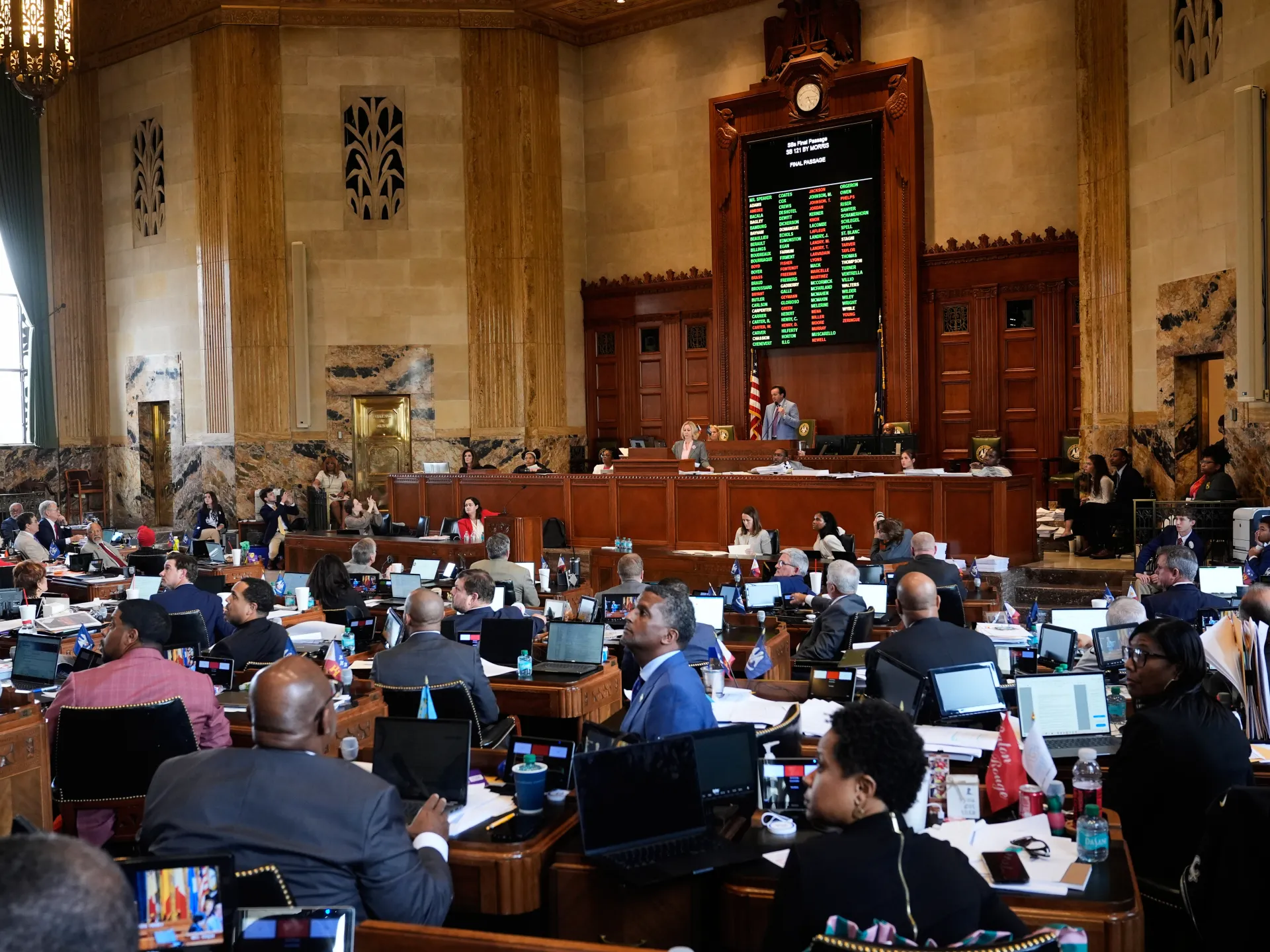
Louisiana lawmakers have passed a new map of congressional districts designed to help Republicans pick up a seat in the United States House of Representatives.
But to do so, the map eliminates one of the state’s two majority-Black districts, both of which are represented by Democrats.
Recommended Stories
list of 3 itemsend of list
Approval in Louisiana’s legislature came on Friday. It follows an April decision from the US Supreme Court striking down Louisiana’s current map as an illegal racial gerrymander because it was drawn to include two majority-Black districts.
That ruling, in the case Louisiana v Callais, weakened the landmark 1965 federal Voting Rights Act, meant to prevent discrimination against minorities at the ballot box.
It also intensified a national redistricting battle fuelled by President Donald Trump’s efforts to protect the Republicans’ slim House majority in the midterm elections. Louisiana is one of several Southern states now redrawing their maps to help Republicans.
Louisiana Republicans had considered drawing a map giving the party a shot at winning all six of the state’s US House seats. But that would have required adding more registered Democrats to Republican-held districts, which could have potentially backfired with Republican losses.
Republicans currently hold four of Louisiana’s six congressional seats, and they are slated to pick up a fifth with the newly passed map.
It was approved on Friday by the Louisiana state Senate in a 28-to-10 vote.
‘Vicious race to the bottom’
Republican Governor Jeff Landry is expected to sign the new map into law, even as threats of more litigation emerged Friday.
A half-hour Senate floor debate revolved around Democrats contending that the proposed map is racially gerrymandered to squeeze more Black voters, who tend to be registered Democrats, into a single district.
Democratic state Senator Royce Duplessis pointed out that some fellow Southern states, such as South Carolina, had refused to redraw their maps in the middle of an election year.
He warned that Louisiana is participating in a “vicious, vicious race to the bottom” by participating in the redistricting push.
The bill’s sponsor, Republican state Senator Jay Morris, repeatedly insisted that party affiliation, not race, drove the new district boundaries.
“I purposely put more Democrats into District 2 to make the remaining districts better performing for Republicans,” Morris said at one point.
Morris said he instructed the map demographers to avoid including any data on race or including those statistics in information shared with lawmakers before the vote.
Democratic state Senator Sam Jenkins told Morris, “I think it’s a racially gerrymandered district that’s going to get us into a lot of trouble here.”
“Agree to disagree,” Morris told Jenkins.
More litigation expected in Louisiana
Louisiana is currently using a map ordered by a lower court in 2024 to comply with the Voting Rights Act. It includes a second district with a majority-Black population.
That map, however, was challenged in court, and the Supreme Court responded on April 30 by striking it down as an illegal racial gerrymander.
Landry has postponed the state’s closed US House primary slated for May 16 to allow for the new congressional map to be implemented.
He later signed a law making the US primary open and shifted the date to November 3 to allow time for Republican lawmakers to draw and pass a new map. All candidates, regardless of party affiliation, will be on the ballot for voters in their district.
The proposed map redraws a district currently represented by Democratic Representative Cleo Fields, clustering it around predominantly white communities in the Baton Rouge area and southern Louisiana.
It also adds part of Baton Rouge to a heavily Democratic, majority-Black district based in New Orleans, represented by Democratic Representative Troy Carter.
More lawsuits are expected over the new map.
Democrats say the proposed map could draw a legal challenge over racial gerrymandering, and the American Civil Liberties Union (ACLU) of Louisiana suggested Friday that it could sue, calling the map a “racial gerrymander hiding behind the thin veneer of partisanship”.
“This fight is just beginning,” the ACLU branch added.
Meanwhile, the victorious plaintiffs in the US Supreme Court’s decision criticised the legislature’s map for leaving a majority-Black district in place.
Nationwide battle over district lines
In the weeks following the Supreme Court’s decision, other Republican-controlled Southern states have seized upon the weakened federal Voting Rights Act to redraw their own congressional districts.
So far, Republicans are winning the nationwide redistricting contest, passing more partisan maps to gain House seats than Democrats.
But that doesn’t necessarily mean they will win in the narrowly divided US House in November.
Republicans think they could gain as many as 15 seats from their redistricting efforts so far, while Democrats think they could gain six seats from new districts in California and Utah.
Meanwhile, a court decision in Wisconsin on Friday could give Democrats a new avenue to pick up seats in 2028.
The liberal-controlled Wisconsin Supreme Court said it would hear an appeal of a case filed by a bipartisan coalition of business executives that seeks to redraw the state’s Republican-friendly congressional districts. Republicans hold six of the state’s eight House seats, but only two are considered competitive.
A three-judge panel dismissed the case in April. Those who filed the lawsuit weren’t seeking a ruling in time for the 2026 election. Instead, they asked the state Supreme Court to send the case back to the lower court for a trial on their claims, which would likely not take place until 2027.
Coronation Street scenes that aired on Friday night’s episode have suggested that Jodie Ramsey may not be the person behind the anonymous trolling about Daniel Osbourne
22:18, 29 May 2026Updated 22:19, 29 May 2026
Jodie was running a trolling account called Truthteller but it disappeared and then another popped up
Coronation Street has seemingly confirmed that Jodie Ramsey is not behind the anonymous trolling that is ruining Daniel Osbourne’s life on the ITV soap.
The teacher has been played by Rob Mallard for over a decade and his latest drama has seen him trying to come to terms with the fact his ex-girlfriend Megan turned out to be a paedophile who had been abusing teenager Will Driscoll.
To make matters worse, an anonymous social media known only as Truthteller has been spreading malicious lies online about him, claiming that he is as bad as Megan. What he doesn’t know is that Shona Platt’s long-list sister Jodie , who broke into his flat and now looks set to become his girlfriend, was the one behind it all. But there was another twist in store as, with the abusive messages having suddenly stopped and the account wiped, Daniel, Jodie and the family went for a meal at the Bistro.
But almost as soon as they sat down, a new account, creatively named Truthteller2, popped up. Exasperated, Jodie said: “What?! How has that happened? and then said: “It must be someone else. Why would the Truthteller become their own sequel?” but Tracy suggested: “Well, maybe to hide their own identity…”
The latest nasty message was claiming Daniel should have Bertie taken off him, and it had come through just moments before, so he suggested it could be someone who was sitting in the restaurant with them all at that very moment. With Jodie having ruled herself out of being beind the new account, this means that, by Daniel’s way of thinking, it could’ve been Tracy, or Adam Barlow, Alya Nazir or Leanne Battersby.
Viewers of the ITV soap will also know that Sam Blakeman, who was the first to suspect Megan’s relationship with Will, has been experiencing hallucinations as he deals with the trauma caused by his threatening teacher. But following the scenes that aired on Friday night, fans think that it could be someone else entirely.
Taking to X, one fan said: “Jodie is definitely going to pay someone else to play Truthteller to ensure the heat is off her?” whilst another said: “Well, it can’t be our Jodie trolling Daniel. She’s sitting next to him.”
But others are still convinced that Jodie is still the one pulling the strings. One fan said: “Jodie using the name truth teller is pretty funny since I don’t think she’d tell the truth about anything unless there was something in it for her & living under Daniel’s roof doesn’t stop her,”
Taking to Reddit, another said: “I assume that Jodie is a psychopath. I actually knew (past tense) a woman with psychopathic traits who tore up 2 family/friend groups, and caused permanent damage to some friendships. She was outed in the end, but not before the damage was done. I assume this is where they’re going with Jodie.”
Another said: “I am genuinely just impatiently waiting for Jodie to be exposed. It’s driving me nuts. Can’t wait for the “the IP address is coming from INSIDE your house!?” moment.
They have to go down psychopath route surely because most of her behaviour is totally nonsensical but always manipulative and self interested. She seems to want to keep Daniel weak so he needs her? Idk. Can’t wait for David to have his “told you so” moment too.”
Coronation Streetairs Monday to Friday at 8:30pm on ITV1 and is available to stream from 7am on ITVX.
Democratic and Republican candidates vying to replace Democratic Gov. Gavin Newsom have been sparring on televised debates and exchanging campaign attacks since April to garner the attention of voters statewide.
The candidates include a Riverside County sheriff, a former senior advisor to British Prime Minister David Cameron, a former Los Angeles mayor, a billionaire hedge fund founder and two former members of the U.S. House of Representatives.
Recent polls showed that the leading Democratic candidate is Xavier Becerra, a former U.S. Secretary of Health and Human Services whose campaign is focusing on affordability and housing for what he calls “working Californians.” Vying for one of the top two spots in the June 2 primary are Republican contender Steve Hilton, a former Fox News commentator who was endorsed by President Trump, and Democratic billionaire Tom Steyer, a hedge fund founder turned environmental warrior.
Here is what the top candidates have said on important topics such as immigration, housing and homelessness, affordability and the entertainment industry.
Immigration and ICE
The U.S. Immigration and Customs Enforcement raids that began in California last summer have been hotly debated by Democratic and Republican candidates.
Here is what the candidates said during a debate in May or stated on their websites, as well as some criticism they have faced during the campaign.
Xavier Becerra vowed to protect and lead the state against the Trump administration’s attacks on immigrants and marginalized communities. Becerra’s rivals have accused him of failing to protect migrant children when he served as Health and Human Services secretary under the Biden administration.
Riverside County Sheriff Chad Bianco opposes “sanctuary city” laws that block local law enforcement from assisting federal immigration agents, calls for the deportation of criminal illegal immigrants and says the border must be secured. But he has also faced criticism from fellow Republicans for supporting a pathway to citizenship for lawful, working undocumented people and telling his constituents that his deputies were not taking part in Immigration and Customs Enforcement raids.
Former Fox News host Steve Hilton, who legally immigrated to the United States from the United Kingdom, opposes California’s state and local sanctuary policies, and said the state must cooperate with the federal government because the governor’s job is to enforce laws, whether the governor agrees with immigration enforcement activity or not.
San José Mayor Matt Mahan plans to demand ICE officers be unmasked, vows to go after agents and immigration agency leadership when they violate the constitution and shield communities from unwarranted harassment.
Former Congresswoman Katie Porter said California should enforce its sanctuary laws statewide, “so we don’t have crazy cowboys taking the law into their own hands.”
Billionaire hedge fund founder Tom Steyer wants to strengthen California’s laws to ensure law enforcement agents can’t profile Californians based on their race, ethnicity, language, occupation or location. He also wants legislation that will grant the state attorney general the authority to hold ICE agents accountable for violent and illegal acts on the job. He supports abolishing ICE. But he has faced heat on the campaign trail for his former hedge fund’s investment in the Corrections Corp. of America, now known as CoreCivic, which operates private prisons around the nation that are housing people picked up by federal immigration agents. Steyer has repeatedly expressed remorse about his former firm’s ties with the company and said he personally ordered the divestment from private prisons before he sold his stake in the hedge fund.
State Supt. of Public Instruction Tony Thurmond says he plans to levy a new tax on companies that operate ICE detention centers, fight to abolish ICE, protect California’s sanctuary laws and work with Congress to establish a pathway to citizenship.
Former L.A. Mayor Antonio Villaraigosa supports helping law-abiding immigrants and said violent criminals have been deported under the state’s sanctuary laws, despite claims to the contrary by Republican candidates.
Housing and homelessness
Here’s what each candidate said about the need to address the state’s housing shortage and its stubborn homeless problem:
Becerra said he plans to cut “unnecessary red tape” and speed up “approvals for projects that meet affordability and environmental standards.” On homelessness, Becerra said he wants to establish a $150-million annual homelessness prevention fund to pay rents and fight eviction or foreclosure.
Bianco said he wants to end “overregulation of our building industry” and eliminate the California Environmental Quality Act, the California Coastal Commission and the California Air Resources Board. On homelessness, he wants cities to clear encampments and prioritize mental health and substance abuse treatment. He wants to force people to accept drug treatment “when necessary.”
Hilton proposes to reform the California Environmental Quality Act so that only government prosecutors can sue, preventing private individuals and organizations from stopping or delaying new housing projects. He also said he believes rent control measures reduce the incentive to build housing and wants to restructure or eliminate them. On homelessness, Hilton wants to build more low-cost group shelters instead of permanent housing.
Mahan said he wants to lower developer fees and taxes for infill housing. Mahan also said more homes should be built off-site in California-based factories, making them cheaper than building them on site. On homelessness, Mahan wants to make the state’s Homeless Housing, Assistance and Prevention grant permanent and fund it at $1 billion a year.
Porter said she would “greenlight innovative building strategies, shred unnecessary red tape and create incentives” to build needed housing. On homelessness, Porter wants more interim housing, emergency rental assistance and rapid rehousing programs.
Steyer is pledging to make it harder for large corporations to buy up the state’s housing stock and wants to encourage cheaper methods of home construction. On homelessness, Steyer wants to expand interim housing options and homeless services.
Thurmond said he wants to build 2 million new homes for “working Californians,” on 75,000 acres of surplus land that local school districts own. On homelessness, Thurmond wants to increase the number of housing units that include mental health and substance abuse services.
Villaraigosa said he wants to cut development fees and reform CEQA to speed housing development, particularly for infill housing. On homelessness, Villaraigosa wants to double the state’s investment in Newsom’s Homekey program to build an additional 10,000 units of permanent supportive housing over five years.
A comprehensive guide on the candidate’s full views on housing and homelessness is here.
What the candidates have said about affordability
The candidates offered their ideas for making California more affordable during debates in April and May as well as on their websites.
Becerra said he will stand up to price gouging and unjustified rate hikes and use the power of the state to lower prices “where the market has failed.”
Bianco says he wants to cut taxes for working families and businesses, stop the “over-regulation on California’s economy,” support job growth and unleash the state’s energy resources to lower the price of gas and utilities.
Hilton said he wants to eliminate income taxes on people who earn less than $100,000 and on the first $100,000 for Californians who earn more than that. He also wants to end California’s current tax on tips to ensure tipped workers keep more of their earnings.
Mahan said he wants to enact a “Gas Tax Holiday” that ends or reduces the tax on gas. He also wants to remove barriers to building affordable housing by putting a cap on fees charged for new housing construction.
Portersupports single-payer healthcare, providing free child care and college tuition and making wealthy corporations pay their “fair share” in taxes. To pay for it, Porter would impose a progressive corporate tax, meaning more profitable businesses and corporations would pay a higher rate. She also supports ending income taxes for those who earn less than $100,000.
Steyer called himself the only candidate who is “willing to take on the corporate special interests” that drive up the cost of living in the state. He said he would like to lower gas prices as well as streamline permitting, reform zoning and enforce laws to build affordable homes faster. He also supports single-payer healthcare.
Thurmond wants to provide a tax credit to make it easier for Californians to pay for the rising cost of gas, groceries and housing. He plans to establish a universal childcare program and provide low-cost loans to help small businesses make improvements at their firms.
Villaraigosa plans to support a California Fuel Affordability Guarantee to cap gas prices for working families.
The entertainment industry
Here’s what some candidates have listed on their campaign websites about their ideas to support California’s entertainment industry.
Becerrasupports state requirements that mandate productions disclose how AI is being used, cutting the “bureaucratic friction” of getting a filming location permit and vows to uphold the state requirement that ensures digital platforms share meaningful performance data with the cast, writers and directors.
Hilton wants to restore California’s competitive edge as a place for productions by creating financial incentives for film productions, cover the initial and technical costs associated with the development of a film or television project and reserve funding for independent and mid-budget projects.
Mahan said he plans to expand and modernize production incentives, make them more competitive and ensure the protections are for everyone who works on a film or television project from the technical crew to writers, directors and actors.
Steyer said he would like to block corporate mergers in entertainment, defend and expand film tax credits and eliminate the regulations and hurdles for permitting and logistics that “slow down productions.”
Times staff writers Seema Mehta, Nicole Nixon and Andrew Khouri contributed to this report.
Instead, he must now reset and recharge to go again at Wimbledon next month.
Given he is a seven-time champion on a grass surface which younger players have struggled to master, Djokovic will always fancy his chances at the All England Club.
Djokovic can never be ruled out of becoming the oldest major men’s singles champion in the Open Era, but Father Time has been sat waiting on his shoulder for a good while.
By rights, he should probably be basking in a post-retirement glow by now.
Coaching a young compatriot away from the public glare like Andy Murray, perhaps. Doing a promotional tour for a new Netflix documentary like Rafael Nadal, maybe.
While his long-time rivals move into the next phase of their lives, Djokovic was retching at the side of a court in an attempt to summon the energy to beat a teenager.
It is a testament to his superpower that he still wants to push himself to such limits against much younger opponents.
As we have seen time and time again, Djokovic’s insatiable appetite for the sport’s biggest prizes will never diminish.
But, having reached at least the semi-finals at the past five Grand Slams, this was the clearest sign yet that the ageing process was finally catching up with him.
Djokovic looked in complete control as he moved two sets ahead, but could not maintain his level as Fonseca proved he is the real deal.
“It would be nice if it was best-of-three,” Djokovic smiled.
“I just ran out of gas, to be honest. I didn’t feel good at all on the court in the next couple of sets.”
Djokovic has always thrived in the best-of-five format of the majors, beating almost anybody who has stood in his way for the best part of two years.
The only exceptions have been Sinner, Alcaraz and the muscle injury which forced him to quit against Zverev at last year’s Australian Open.
Everyone else has not been good enough, or not had the mentality, to see veteran Djokovic off.
At only 16 miles (26km) long, Anguilla is the smallest of the five British Overseas Territories in the Caribbean. It was first colonized by English settlers from nearby St. Kitts in 1650. Despite some half-hearted attempts by the French to take control in the 17th and 18th centuries, the island was finally recognised as a colony by the British in 1825.
The 1830s saw a union of St. Kitts, Nevis and Anguilla on Britain’s recommendation, a move that was unpopular with the majority of Anguillans as it was thought that representation of the island was neglected.
In 1958, St. Kitts, Nevis and Anguilla became part of the Federation of the West Indies. The Federation collapsed in 1962, and St. Kitts -Nevis-Anguilla was made an associated statehood.
Resentment against this political decision grew, and on May 30th 1967, the people of Anguilla marched on the Police Headquarters and evicted the Royal St. Kitts Police Force from the island.
Britain intervened and a peacekeeping committee was established, with British authority being fully restored in July 1971. Although it took until December 19th 1980 before Anguilla fully seceded from the association, the events of May 30th are celebrated today as the most important step towards Anguilla’s autonomy.
Anguilla Day is celebrated by a colourful parade and a round-the-island boat race.
May 29 (UPI) — A federal judge declared a New Hampshire law that would have required new voters to provide documentary proof of citizenship because it is unconstitutional.
U.S. District Court Judge Samantha Elliott wrote in the ruling, issued on Thursday, that New Hampshire House Bill 1569 would have made it harder for people to register to vote and cast ballots by removing methods for them to do so.
The law would have required all new voters to provide a document proving citizenship, rather than attesting to their citizenship under penalty of perjury on an affidavit.
New Hampshire state law already states that the form filled out and signed when registering qualifies as an affidavit, whether it is filed 30 days before an election or on election day, per state law, Elliott wrote.
“For many years, New Hampshire voters have been required to prove their citizenship,” Elliott wrote in the ruling.
“After this order goes into effect, New Hampshire voters will still be required to prove their citizenship,” she wrote. “Instead, this case questions, in part, whether it is constitutional to remove one of the methods previously available for proving citizenship — an affidavit swearing to the voter’s citizenship under penalties of voter fraud.”
HB 1569, which was passed and signed into law in 2004, was challenged by the ACLU of New Hampshire, the American Civil Liberties Union, the Coalition for Open Democracy, the League of Women Voters of New Hampshire, the Forward Foundation, New Hampshire Youth Movement and several individual voters.
“New Hampshire’s elections have always been safe, secure and accurate — and this law could have unconstitutionally and needlessly prevented thousands of eligible voters from casting a ballot,” Henry Klementowicz, deputy legal director of the ACLU of New Hampshire, said in a press release.
“Making it harder to vote is a clear attack on one of our most fundamental of rights and this law is consigned to the dustbin of history where it belongs,” Klementowicz said.
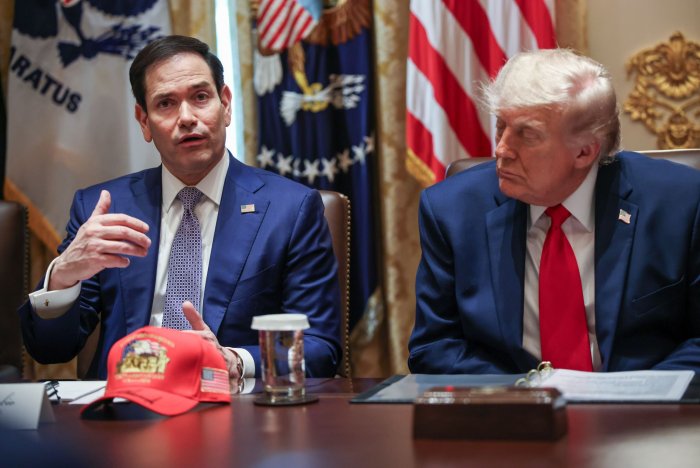
Secretary of State Marco Rubio and President Donald Trump participate in a Cabinet meeting in the Cabinet Room of the White House on Wednesday. Photo by Samuel Corum/UPI | License Photo
After eating a lot of fast food, some of it on roller coasters, YouTuber Allen Ferrell has been banned by Six Flags from all of its amusement parks nationwide. For life.
McDonald’s chicken nuggets were apparently an ultra-processed food item too far for the folks at Six Flags’ Cedar Point in Sandusky, Ohio.
“This guest has been banned from all Six Flags parks for life,” a Cedar Point spokesman explained in an email Thursday to Cleveland TV station WKYC. “Safety is a cornerstone of our business and we have zero tolerance for inappropriate and unsafe behavior.”
Zero tolerance for inappropriate behavior? Zero? Where’s the fun in that?
“Our ride safety policy strictly prohibits all loose articles on rides, including food which can become a choking hazard,” the spokesperson continued.
“I had no idea that eating a 10-piece chicken nugget on a roller coaster would be a national headline, but here we are,” Ferrell told Fox 8 News in Cleveland.
He said he gets the park’s point with the ban, even though he’s been going there since he was a kid and is a huge fan of the operation.
“I understand. And we kind of worked it out,” he told Fox 8 News. “They just don’t want other people getting hurt on the ride. But me personally, it was a really fun challenge.”
Ferrell’s shtick on social media is accepting challenges from his followers and then taping himself attempting to do what they propose. Eat a McDonald’s Big Mac inside a Burger King. Throw a plunger at a Target sign. Bowl blindfolded until he gets a strike.
“If anyone asks,” Ferrell tells one apparently bored ride operator in the video that documented this particular coaster crime, “I do not have chicken nuggets in my underwear.”
Ferrell decided to try the challenge on the park’s Millennium Force ride, a “looming giant amongst a park full of them,” a coaster that was “designed for the purpose of proving bigger is better.” A roller coaster that when it was created in 2000 “demanded an all-new category just to classify its one of a kind nature,” giving rise to the “giga-coaster.” According to Cedar Point, as all of this verbiage is, Millennium Force “shoots riders over hills, past lagoons and through tunnels, all at unthinkable speeds.”
The ride actually tops out at 93 mph, a speed often thought about on freeways in the Los Angeles area when traffic is going 8 mph. It’s quite thinkable to eat fast food in a car in L.A. But it turns out what was really unthinkable was Ferrell getting all 10 nuggets down the hatch before the Six Flags ride was over.
In the video, which had almost 800,000 views on YouTube as of Friday afternoon, he morphs from happy snacking dude to dude moaning in discomfort, struggling to shove nuggets in his mouth while unintentionally applying dipping sauce to his face via G-force.
“Oh, I failed,” Ferrell says, wiping off the face-sauce as the coaster pulls up to the platform and someone in line blurts, “Are those chicken nuggets?”
Turns out he snarfed seven of them, he confesses to the two guys in front of him in the coaster car. Ferrell said later that he was glad to be in the back row because it meant nobody behind him got sauced.
The top candidates for California governor crisscrossed the state Friday, all venturing to friendly political territory to woo voters and undermine their rivals as the June 2 primary election fast approaches.
The top Republican in the race, former Fox News host Steve Hilton, spent the day railing against transgender athletes before a high school track event in the Central Valley, an event sure to appeal to his base of President Trump supporters.
The front-running Democrats, former Biden administration Cabinet member Xavier Becerra and billionaire environmentalist Tom Steyer, rallied one of their party’s most influential constituencies: union members.
While both stuck with mostly an upbeat message and reiterated promises to lift up Californians struggling to make ends meet, Steyer afterward accused Becerra of being “a corporate Democrat who’s taking money from all these big corporations” who “doesn’t want to change things.”
Steyer’s had good reason to go after Becerra.
A new poll from the UC Berkeley Institute of Governmental Studies and co-sponsored by the Los Angeles Times showed Becerra leading the race with 25% support from likely voters, followed by Hilton at 21% and Steyer within striking distance at 19%. The two candidates who finish in first and second place in the primary will advance to the November general election, leaving the third-place finisher on the sideline.
Though he told reporters Friday morning that “I don’t pay attention to polls,” Steyer was energetic at a Northern California campaign event, where he held a private meeting with leaders of a union representing long-term caregivers. In brief remarks at the offices of SEIU Local 2015, Steyer described the race as a choice between a billionaire champion of working people and the corporate-backed Becerra.
“Does California work for Californians or does California work for corporations? The corporations think it works for them. They want it to continue to work for them and they’re putting up tens of millions of dollars to make sure they continue to make record profits,” he told dozens of home-care workers, teachers, construction workers and nurses at the West Sacramento gathering.
Groups including PG&E, the California Assn. of Realtors and the California Chamber of Commerce have spent more than $34 million opposing Steyer’s candidacy. The former hedge fund manager has pledged to lower energy bills by breaking up large electric utility monopolies.
As a billionaire who has so far poured $216 million of his own money into his gubernatorial campaign, Steyer has faced skepticism from some left-wing and working-class voters. But he is endorsed by progressives, including Rep. Ro Khanna (D-San Jose), and unions including the California Nurses Assn. and both major teachers unions.
“I voted for Tom. I was looking for a change,” said Alvenia Scott, a union board member who works as an in-home caregiver to her disabled sister.
“He really has some good ideas,” she said, adding that she had more qualms about Steyer’s lack of government experience than his wealth. “He made his way in life, more power to him.”
Hundreds of miles south in the Inland Empire, Becerra pledged to be on the side of unions if he is elected governor and urged voters to turn in their ballots in what has so far been a remarkably low-turnout election.
“I am with you. When I become governor and I sit behind that desk, you’ll have a union man sitting at that desk,” Becerra told about 500 people at the United Food and Commercial Workers hall in Bloomington.
He asked the crowd if they had cast their ballots and noted that not everyone raised their hand.
“Less than one in five Californians have actually cast their vote so far. We got to get that number way, way up,” he said, arguing that the election is about “sending a message all across the country that California will be counted, that California cannot be neglected, and that California will not take a knee to anyone in Washington, D.C.”
Only 12% of the state’s registered voters have cast ballots as of Thursday evening, according to the election tracking firm Political Data Inc.
Community college counselor Diego Rodriguez, 32, said he decided to vote for Becerra in recent weeks after seeing the former U.S. Health and Human Services secretary’s momentum in the race and researching his record.
“Also just his story. As someone who works in higher education, and seeing how Xavier, being first-generation, has benefited from higher education, and how he advocates for higher education,” the Rialto resident said. “Additionally, today, him being here at a labor union and advocating for the working class and labor, I think, is very important.”
“I think that people became aware of him more because of that,” Rodriguez said. “There was a lot of conversation online regarding that, but I think it allowed the spotlight to be brought onto him and it made people aware of his record.”
At a campaign stop in Clovis in the central part of the state, Hilton marveled that his campaign had spent only about $2 million in campaign advertising but was still polling above Steyer, according to the latest Berkeley IGS survey.
“We’re feeling confident,” said Hilton, standing in a suburban stretch of the city. Still, he warned that voters need to get out to support him and avoid a “complete disaster for California” of two Democrats advancing to the November election.
Hilton, who was endorsed by Trump in April, joined other politicians and leaders in Clovis in opposing trans athletes from competing at the 2026 CIF State Track & Field Championships.
The group met near where the championship events were scheduled to take place this weekend.
Asked why he was focusing on sports and gender in the final days of the race, Hilton said it’s “one of the main issues” that come up at town halls. If elected, he said he would seek to overturn the state’s 13-year-old law that allows students to participate in school activities and use facilities such as bathrooms based on their gender identity.
Hilton argues the law violates the state Constitution and will “suspend” it while he initiates legal proceedings to overturn it.
He also praised Spencer Pratt, a Republican and former reality TV star who is running for Los Angeles mayor, saying his candidacy has brought “excitement and energy” to the state’s primary election.
“For a long time in California, there’s been this sense that it’s all inevitable — there’s nothing you can do, Democrats run this place, just the way it is,” Hilton said. “I think that that’s changing. I think there’s this sense that something’s happening.”
There’s been speculation for years when club sports, travel ball and showcases might make education-based high school sports obsolete or irrelevant.
The showdown is finally happening.
Ganesha High’s baseball team qualified to play in the Southern Section Division 2 championship game on Saturday against Loyola in Rancho Cucamonga, but the San Gabriel Valley Tribune reported that several players and possibly their head coach, Jared Sandler, might not show up if they participate in a baseball camp in Mississippi.
Bring it on. No more playing around. Let everyone know the expectations of being part of the California Interscholastic Federation. When you agree to play in the playoffs, you can’t just decide to leave without notice. Teams and players have dreamed of playing in a championship game. Then one team wants to make a mockery of the final, Ganesha, by using backups.
School districts are allowed to establish independent online study programs, and there’s nothing the Southern Section can do about it. But local parents whose kids are losing out to players who don’t live near the school can do something by complaining to district officials of…
The YULA and Shalhavet baseball teams were banned from participating in this year’s Southern Section playoffs and placed on probation for pulling out in the middle of the 2025 playoffs to participate in a Jewish baseball tournament in Ohio.
The Southern Section has many options on how to proceed if Ganesha goes through with its decision to violate its commitment to the playoffs, from a postseason ban to removing the school from CIF membership.
In Northern California when a tennis team decided to send its JV team for the regional playoffs, sanctions were imposed. The same penalties might be applied by the Southern Section if it happens in the section championship game.
Ron Nocetti, the executive director of the CIF, said Friday, “We were made aware of this and any decision the Southern Section makes in this matter we support.”
Let’s have this showdown. Let’s see if the Pomona Unified School District, which pays thousands of dollars to support its schools’ athletic program, is going to act and stop this nonsense. Ganesha previously was in the news because many of its players live outside the district and participate through online classes, making the baseball team as close to a travel-ball team as you can get.
As of late Friday afternoon, a Ganesha representative said that most of the players and coach were expected to participate in the championship game.
Ronald Gonzales-Lawrence, director, governmental relations for the Pomona Unified School District, released the following statement:
“At this time, circumstances surrounding Saturday’s CIF Southern Section championship game have been resolved, and Ganesha High School will participate in the championship game as scheduled.
“Questions regarding CIF bylaws, eligibility requirements, championship scheduling decisions are best directed to the CIF Southern Section.
“We are aware of questions regarding travel-related expenses associated with this matter. The district is providing transportation and support for student participation in the CIF Southern Section championship game consistent with its normal practices for student activities and athletic competition. The district is not funding flights, hotel accommodations, or any other expenses associated with the separate out-of-state event.
“The district remains committed to supporting our student-athletes and ensuring compliance with all applicable CIF, district, and school requirements.”
The charges stem from the January 14 shooting of Julio Cesar Sosa-Celis in Minneapolis during Operation Metro Surge.
An Immigration and Customs Enforcement (ICE) agent charged with shooting a Venezuelan man during a controversial immigration raid in Minnesota has been arrested in Texas, according to United States authorities.
Agent Christian Castro, 52, was taken into custody on Friday after investigators from Minnesota tracked him down in the southern state, where he was arrested with assistance from the Texas Rangers and the Department of Homeland Security’s (DHS) inspector general’s office. He faces four counts of second-degree assault and one count of falsely reporting a crime.
Recommended Stories
list of 3 itemsend of list
The charges stem from the non-fatal shooting on January 14 of Julio Cesar Sosa-Celis in Minneapolis during Operation Metro Surge, a large-scale immigration enforcement campaign that drew widespread criticism for its aggressive tactics.
Prosecutors allege Castro fired through the front door of a residence, striking Sosa-Celis in the leg.
“Mr Castro was charged earlier this month with four counts of second-degree assault and one count of falsely reporting a crime for an incident on January 14, 2026, when he discharged his weapon through the front door of a home knowing there were people who had just run inside,” the Hennepin County Attorney’s Office said in a statement.
“The bullet travelled through the door and struck one victim in the leg before making its final impact in the wall of a child’s room.”
Minnesota officials welcomed Castro’s arrest, saying federal agents should be held to the same legal standards as everyone else.
“In Minnesota, we believe in equal justice under the law. That means nobody is above the law, including agents of the federal government,” said Minnesota Attorney General Keith Ellison. “I am pleased to hear Christian Castro has been taken into custody and will stand trial for the crimes he allegedly committed in Minnesota.”
Operation Metro Surge faces increasing legal scrutiny
The case became a flashpoint after federal authorities initially claimed Sosa-Celis and another man had assaulted ICE officers.
Those allegations later unravelled when video and other evidence emerged that contradicted agents’ accounts, prompting prosecutors to drop charges against Sosa-Celis and his housemate, Alfredo Aljorna.
The DHS later acknowledged that officers involved in the incident had provided false information about the shooting.
The outgoing director of ICE, Todd Lyons, also indicated a federal investigation was under way. “Lying under oath is a serious federal offense,” he said.
But through a spokesperson, ICE rejected Minnesota’s effort to prosecute the agent involved, calling the case “unlawful” and “a political stunt”.
Castro is the second federal officer charged this year in connection with Operation Metro Surge, an unusual step that reflects growing scrutiny of federal agents’ conduct during the immigration crackdown.
Hennepin County Attorney Mary Moriarty is also pursuing investigations into other incidents linked to the operation.
Operation Metro Surge began in Minnesota in December 2025. By the time Sosa-Celis was shot on January 14, hundreds of federal agents had been deployed across the Minneapolis-St Paul area in what officials described as the largest DHS operation in US history.
The crackdown ultimately prompted intense controversy, particularly after the fatal shootings of two US citizens: Renee Good on January 7 and Alex Pretti on January 24.
Against that backdrop, the investigation into the Sosa-Celis shooting further intensified scrutiny of federal agents’ tactics and conduct during the operation.
Weekly insights and analysis on the latest developments in military technology, strategy, and foreign policy.
Welcome to Bunker Talk. This is a weekend open discussion post for the best commenting crew on the net, in which we can chat about all the stuff that went on this week that we didn’t cover. We can also talk about the stuff we did or whatever else grabs your interest. In other words, it’s an off-topic thread.
This week’s caption reads:
U.S. Air Force Maj. Gen. Tom Wilcox II, center, Air Force Installation and Mission Support Center commander, talks with Airmen at the 423rd Security Forces Squadron bunker shoot house training location at Royal Air Force Molesworth, England, Sept. 29, 2021. The AFIMSC leadership visited the 501st Combat Support Wing and its mission partners at the U.S. European Command Joint Intelligence Operations Center Europe Analytic Center at RAF Molesworth, England. The AFIMSC provides base communications, civil engineering, security forces and logistics support that assist the 501st CSW in fulfilling its mission. (U.S. Air Force photos by Senior Airman Jennifer Zima)
Prime Directives:
If you want to talk politics, do so respectfully and know that there’s always somebody that isn’t going to agree with you.
If you have political differences, hash it out respectfully, stick to the facts, and no childish name-calling or personal attacks of any kind. If you can’t handle yourself in that manner, then please, discuss virtually anything else.
No drive-by garbage political memes. No conspiracy theory rants. Links to crackpot sites will be axed, too. Trolling and shitposting will not be tolerated. No obsessive behavior about other users. Just don’t interact with folks you don’t like.
Do not be a sucker and feed trolls! That’s as much on you as on them. Use the mute button if you don’t like what you see.
So unless you have something of quality to say, know how to treat people with respect, understand that everyone isn’t going to subscribe to your exact same worldview, and have come to terms with the reality that there is no perfect solution when it comes to moderation of a community like this, it’s probably best to just move on.
Finally, as always, report offenders, please. This doesn’t mean reporting people who don’t share your political views, but we really need your help in this regard.
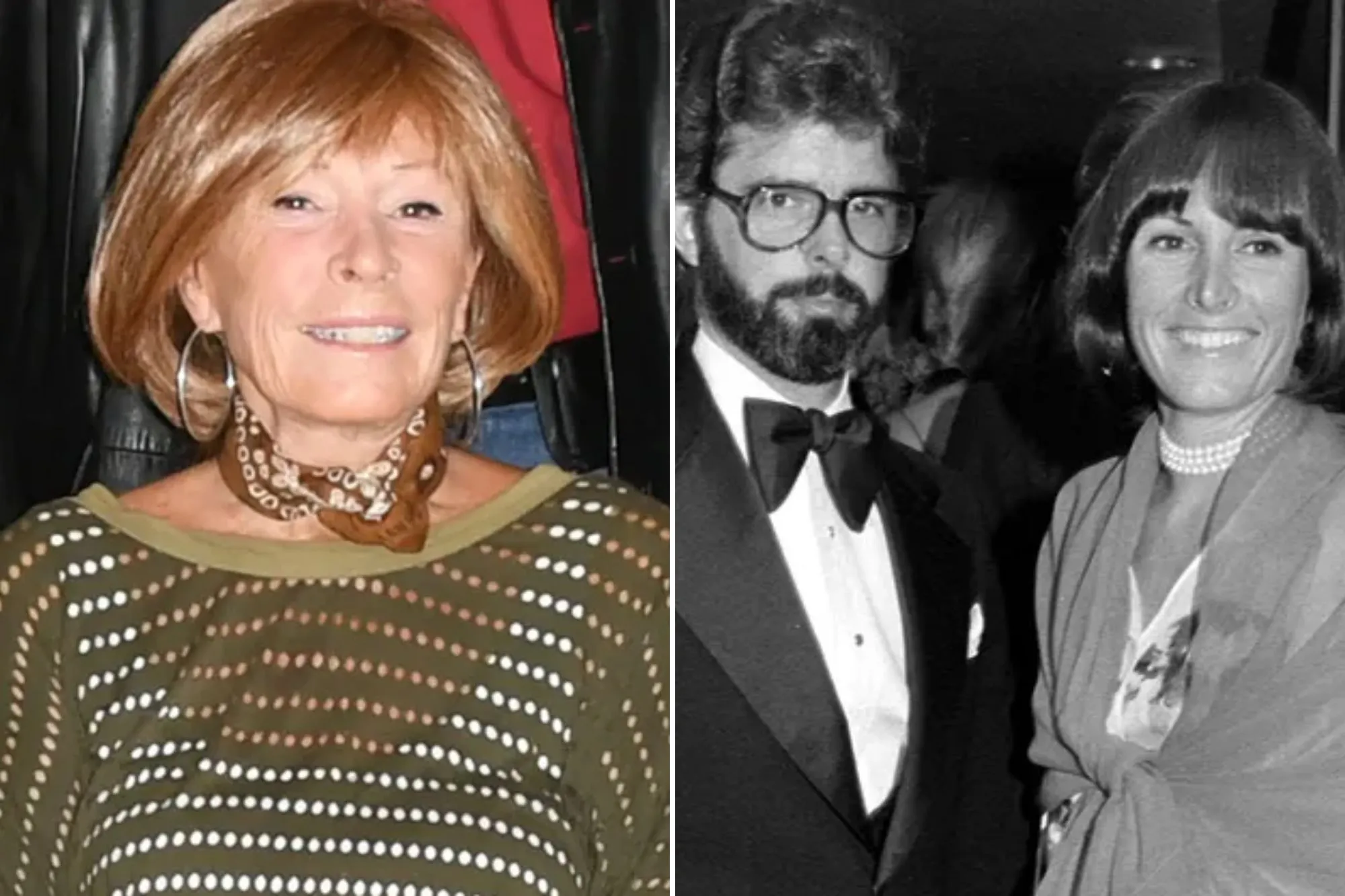
OSCAR winner Marcia Lucas has died from cancer aged 80.
Known as the secret weapon and unsung hero of Star Wars, Marcia died at her holiday home in Rancho Mirage, California.
Sign up for the Showbiz newsletter
Thank you!
Marcia Lucas, the secret weapon of Star wars, has died aged 80Marcia married George Lucas in 1969
The ex-wife of George Lucas, Marcia was best known for editing Star Wars and Return of the Jedi.
Marcia died on Wednesday evening, her family said.
In an emotional statement, they called the filmmaker a “trailblazer”.
A family member said: “Marcia was a force.”
“A true trailblazer for women in film and one of the most influential editors in cinematic history; she helped redefine what film editing could be and paved the way for generations of women who followed.”
She won an Academy Award in 1977 for Best Film Editing.
In 1969 she married George Lucas, who she had met while working on the documentary Journey to the Pacific.
Raised in North Hollywood, Marcia met her future husband while they were working as assistants for editor Verna Fields.
Marcia won an Academy Award in 1977 for Best Film EditingCredit: Kobal Collection – Shutterstock
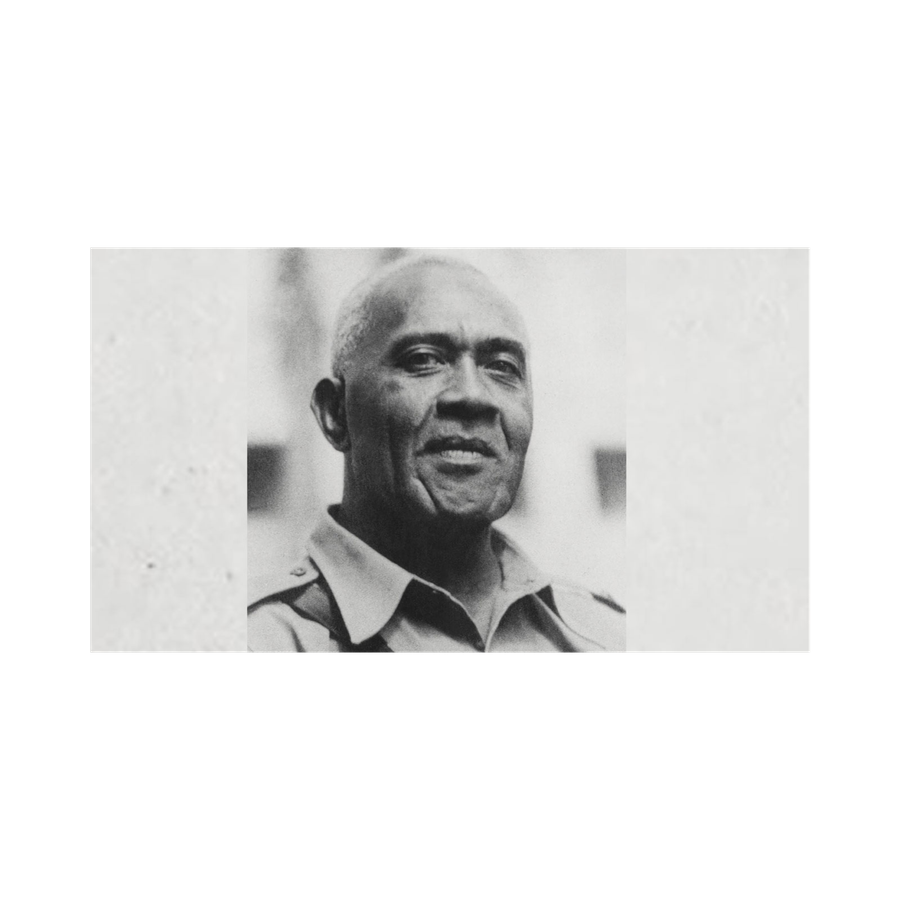
This article discusses the restoration of Ratu Sukuna Day as a significant national holiday in Fiji. It honors the legacy of Ratu Sir Josefa Lalabalavu Vana’ali’ali Sukuna, an esteemed statesman and chief credited with foundational land reforms that shaped the country’s modern economy. Although the holiday was previously abolished in 2010, the current prime minister has officially reinstated it to recognize Sukuna’s contributions to agriculture and business. The text highlights the leader’s historical importance as a unifying figure and the “father of modern Fiji.” Additionally, the source provides a glimpse into other global news stories …
DES MOINES, Iowa — The former superintendent of Iowa’s largest school district who was arrested last year in the Trump administration’s immigration crackdown was sentenced Friday to two years in prison.
Ian Roberts is likely to be deported to his native Guyana in South America once he serves the sentence. He pleaded guilty in January to falsely claiming to be a U.S. citizen and illegally possessing firearms, which together carry a maximum sentence of 20 years in prison. His lawyers had proposed that he be put on probation “to facilitate his removal from the United States,” but prosecutors had argued that his likely deportation should not be a factor.
Prosecutors alleged Roberts knowingly lacked employment authorization for nearly all of his two-decade career in urban education and submitted a counterfeit Social Security card when he was hired as superintendent of the Des Moines public school district, which serves 30,000 students.
Roberts’ stunning case bookended the school year. His September arrest occurred as President Trump’s administration was sending increased numbers of federal immigration officers into American cities to round up immigrants.
Des Moines Public Schools said last month that it revised its conflict-of-interest policy after an audit found Roberts awarded district business to a consulting firm he worked for, affirming findings first reported by the Associated Press in the weeks after federal immigration officers detained him.
Roberts was in his school-issued vehicle when officers stopped him on Sept. 26 in a targeted U.S. Immigration and Customs Enforcement operation. He allegedly fled before he was located with the help of state troopers. Authorities said a loaded handgun was wrapped in a towel under the seat and $3,000 in cash was in the car. Three other weapons were recovered during a search of his home.
In a court filing, attorneys for Roberts said he has dedicated his life in the U.S. to public service and has not been a threat to public safety. After Roberts married a U.S. citizen, his attorneys said, he was denied lawful permanent residency because he failed to disclose that he had been arrested. He said he did not think he needed to because the charges against him were dropped.
“While Dr. Roberts tried to adjust his status three more times, this initial mistake by Dr. Roberts sealed his fate,” his attorneys wrote. “In the background of his career for the next 24 years, this denial of his adjustment of status haunted Dr. Roberts like a ghost, eventually derailing his life and career.”
Dozens of people submitted letters on Roberts’ behalf to dispute how he has been portrayed and provide details of his positive impact. His lawyers wrote that he likely faces deportation to Guyana, where he will “be left without his career, without his wife, without his children, in a country where he has not lived for thirty years.”
In recommending a three-year sentence, prosecutors described a yearslong and deliberate misrepresentation of his legal status. Prosecutors said a reduced sentence is not appropriate just because Roberts is likely to be deported.
They said they do not know what documents Roberts presented to show eligibility for work dating back to 2008, years before he was approved for temporary status in 2018, but he “deliberately obtained employment without work authorization at school after school, within state after state.”
Designated hitter Jacob Johnson hit a go-ahead homer in the ninth inning off Easton Hawk to lift Saint Mary’s to a stunning 3-2 win over top-seeded UCLA in the Los Angeles Regional opener Friday afternoon at Jackie Robinson Stadium.
Johnson’s second solo home run of the game initially only appeared to be a pop-up near the warning track. But as the stadium fell silent, the ball kept sailing — and it eventually cleared the wall over leaping Bruins right fielder Jarrod Hocking.
Saint Mary’s reliever Cam Staton earned the win after getting UCLA shortstop Roch Cholowsky, the expected No. 1 pick in the 2026 MLB draft, to pop out with a runner on first. The right-handed Hawk took the loss.
Wow.
St. Mary’s stuns UCLA, the nation’s No. 1 seed, with a 3-2 win to open the LA Regional.
Gales fans who made the trip are going nuts in Westwood. “Beat LA” chants loud at Jackie Robinson Stadium. pic.twitter.com/sGFGChYRWS
Hawk previously had given up just three homers on the season and hadn’t surrendered one since March 1 against Mississippi State. Johnson, who went deep to start the day’s scoring in the fourth, recorded his second two-homer game of the season.
UCLA’s Jarrod Hocking strikes out to end eighth inning during a 3-2 loss to Saint Mary’s in the NCAA regionals on Friday.
(Scott Strazzante / For The Times)
Saint Mary’s (35-25) will face the winner of Virginia Tech (2) vs. Cal Poly (3) — who play Friday night — in the winner’s bracket on Saturday at 6 p.m. PDT; UCLA (51-7) will face the loser in the elimination bracket Saturday at 1 p.m.
Friday’s starters, UCLA’s Wylan Moss and Saint Mary’s John Damozonio, dueled. Moss surrendered three hits and one run through five innings, and Damozonio gave up five hits and two runs through seven.
But it was Johnson and the Gaels who survived in the end.
Election-related information is displayed on an electronic board at the National Election Commission’s situation room in Gwacheon, south of Seoul, South Korea, 26 May 2026, eight days ahead of the 03 June local elections. Photo by YONHAP / EPA
May 29 (Asia Today) — Leaders of South Korea’s rival political parties urged voters to cast ballots Friday, the first day of early voting for the June 3 local elections, but their strategies showed different approaches.
Chung Chung-rae, leader of the Democratic Party, and Han Byung-do, the party’s floor leader, both voted on the first day of early voting. People Power Party leader Chang Dong-hyeok and floor leader Song Eon-seok divided their roles, with Chang choosing to vote on Election Day and Song planning to vote early.
Chung began his schedule Friday by casting an early ballot at the Seongsan 2-dong Community Service Center in Mapo District, Seoul. After voting, he attended a meeting of the party’s central election committee in Seoul and urged voters to participate.
“Voting is stronger than bullets,” Chung said. “Power does not come from the barrel of a gun. It comes from the polling place.”
Han also visited an early voting station before heading to campaign events in Namwon, North Jeolla Province.
“Early voting will be held for two days starting today,” Han said. “Please exercise your precious vote for the future of South Korea.”
The major opposition People Power Party took a different approach. Chang plans to vote on Election Day, while Song is scheduled to cast an early ballot Saturday.
The move is seen as a strategy to appeal both to the party’s hard-line conservative base and more moderate conservative voters. Chang and Song have also divided campaign duties during the election period, focusing on separate schedules.
Chang campaigned Friday in Sejong and western Gyeonggi Province.
“The atmosphere is changing as we lead this election, but if we lose by even one vote, there is no future for South Korea,” Chang said. “Everything depends on your one vote. Please do not leave yourself with regret by failing to go to the polling place.”
Song said he plans to vote early Saturday in Gimcheon, North Gyeongsang Province, his electoral district.
At a news conference at the National Assembly earlier Friday, Song acknowledged that some political figures have argued against early voting.
“It is true that there are some movements in political circles saying people should not vote early, but I will not say that is our party,” Song said. “There is a big difference between holding voting over three days and holding it for only one day.”
“In reality, the number of votes cast during the two days of early voting and on Election Day is close to half and half,” he said. “I think voters should vote over the three days, including early voting, according to their circumstances and schedules.”
Park Sung-hoon, chief spokesperson for the People Power Party, said both early voting and Election Day voting are important exercises of political rights.
“To strategically encourage both early voting and Election Day voting, we decided that the floor leader would vote early and the party leader would participate in Election Day voting, taking his schedule into account,” Park said.
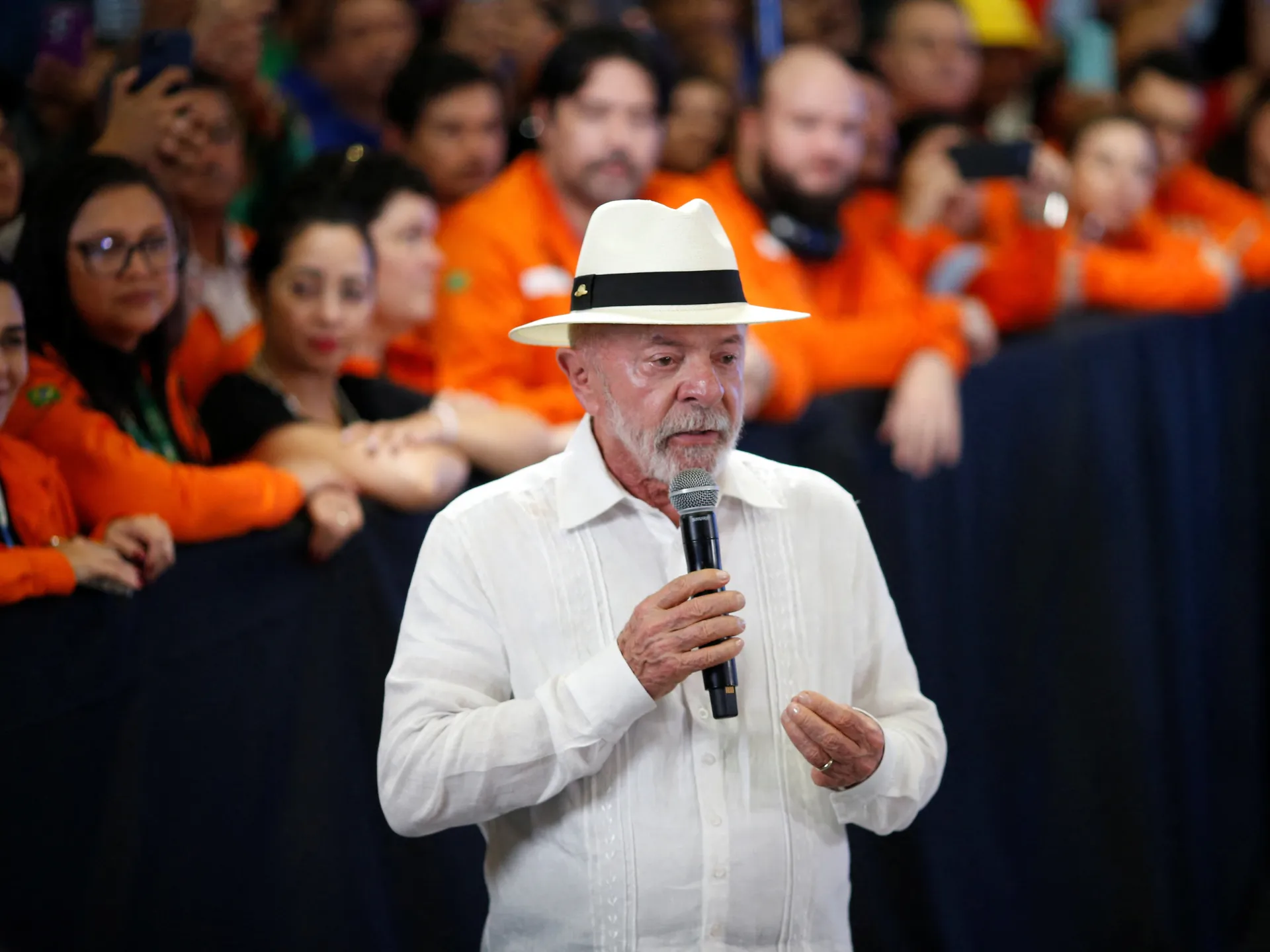
The president of Brazil, left-wing leader Luiz Inacio Lula da Silva, has denounced a decision by the United States to designate two of the South American country’s criminal networks as “terrorists”, warning that the label could be a “setback” for local law enforcement efforts.
The condemnation came in a 435-word message posted to Lula’s social media platforms on Friday.
Recommended Stories
list of 3 itemsend of list
In it, Lula drew a line between criminal activities and international terrorism, which is often understood to use violence for political or social aims.
“The terror inflicted by these organisations upon communities seeks to generate profit through crime — specifically through drug and arms trafficking,” Lula wrote.
Those activities, however violent, “must not be conflated with the ideologically, politically, or religiously motivated actions characteristic of international terrorism”, he added.
Lula’s statements came in response to an announcement a day earlier from the administration of US President Donald Trump.
Pushback against ‘terrorist’ label
On Thursday, US Secretary of State Marco Rubio revealed that he had designated Brazil’s two largest criminal groups — the Primeiro Comando da Capital (PCC) and the Comando Vermelho (CV) — “specially designated global terrorists”.
He also outlined plans to add the two groups to the list of “foreign terrorist organisations”, effective June 5.
Rumours had swirled for months that the Trump administration would apply the “terrorist” label to the two groups. But Lula and his ministers had pushed back, calling on Trump to hold off.
“Terrorist” designations freeze all US-based assets connected to the targeted groups, but they can also be used to penalise anyone who offers “material support or resources” to them.
Experts warn that such restrictions could potentially affect financial institutions and even the victims of such groups, including businesses and individuals who might be forced to pay extortion.
Lula has also expressed concern that the “terrorist” label could pave the way for US military intervention, a fear he reiterated in Friday’s statement, though he never named Trump outright.
“We remain fully prepared to develop joint solutions that yield mutual benefits for all nations involved,” Lula wrote.
“However, we will not tolerate the imposition of arbitrary measures from abroad, nor will we accept their use as a pretext to undermine our sovereignty or our economy. Unilateral, non-negotiated measures can undermine the fight against criminals and trigger actions that endanger the lives of people who have absolutely no connection to crime.”
A tight election in Brazil
A prominent left-wing leader in Latin America, Lula is in the midst of a heated election season, as he seeks a fourth nonconsecutive term as Brazil’s president.
Previously, he served as president from 2003 to 2011, before being re-elected to a third term in 2022.
In that race, he defeated the right-wing incumbent, Jair Bolsonaro, who would later be convicted of attempting to overturn the results of the race. Bolsonaro is currently serving a 27-year prison sentence.
His eldest son, Senator Flavio Bolsonaro, is thought to have been instrumental in Trump’s decision to issue the “terrorist” designations. The senator is currently running against Lula in the 2026 presidential election, and the two have been locked in a tight race.
This week, as he visited the White House, Senator Bolsonaro confirmed to reporters that he intended to seek “terrorist” designations for both the Primeiro Comando da Capital and the Comando Vermelho.
Trump has close ties to the Bolsonaro family, and he has previously intervened in elections around the world on behalf of right-wing candidates.
In Friday’s post, Lula accused Senator Bolsonaro of leveraging his family connections to “petition foreign authorities” for favour.
“It is deplorable that, once again, members of the Bolsonaro family have travelled to the United States to advocate for foreign intervention in Brazil,” Lula wrote.
He pointed to alleged efforts to stop the criminal prosecution of Jair Bolsonaro. Currently, one of the ex-president’s sons, Eduardo Bolsonaro, is facing obstruction charges related to efforts to lobby Trump to intervene in the case.
Trump ultimately did impose steep sanctions against Brazilian products in August 2025, citing the Bolsonaro trial as a reason.
Concerns about sovereignty
Under Trump, the US has taken an increasingly expansionist view towards the Western Hemisphere, reviving the 19th-century Monroe Doctrine, which described the Americas as Washington’s sphere of influence.
Trump himself has used crime as justification for taking unilateral military action in the region. Since September, his administration has conducted 59 strikes against alleged drug-trafficking boats in the Caribbean Sea and eastern Pacific Ocean, killing at least 196 people.
And on January 3, he launched an early-morning military operation against Venezuela, culminating in the abduction and imprisonment of then-President Nicolas Maduro on drug-trafficking charges.
While the Bolsonaro family has courted Trump in recent months, Lula has criticised those military-led actions as unjustified.
But security is expected to be a dominant issue in October’s presidential race. This week’s “terrorist” designations are likely to put Lula in an awkward position, forcing him to condemn the label without downplaying the extent of the violence.
Lula has attempted to brush off right-wing criticism that he has been lax on crime, pointing to his government’s recent $11bn investment in the “Brazil Against Organized Crime” programme.
That follows a separate $2bn programme in March to bolster the country’s prisons, improve homicide investigations and disrupt arms trafficking and other financial transactions carried out by criminal groups.
Still, Lula and Bolsonaro remain neck and neck in the lead-up to October’s election.
On May 16, the polling firm Datafolha found that both candidates would receive 45 percent of voter support in a one-on-one race, with 9 percent of voters indicating they would cast a null vote.
The success of D-day, a pivotal moment in World War II, partially hinged on the weather forecast. The Allied invasion of Normandy, France, on June 6, 1944, was planned for months as the American and British forces held practice operations in England.
Enormous efforts were made to mislead the Germans about what was coming. The operation was originally scheduled for June 5 but the day before, James Stagg, a meteorologist and group captain in the Royal Air Force, advised the American commander, Dwight D. Eisenhower, to wait for better conditions.
This lesser-known decision is the premise of “Pressure,” a new movie from filmmaker Anthony Maras. It’s an adaptation of David Haig’s play of the same name, in which the playwright himself portrayed Stagg. Haig, who co-wrote the “Pressure” screenplay with Maras, compares it to “The Imitation Game.”
“Some of these heroes who affect history from the sidelines just stay in the sidelines until somebody does research, discovers them lurking and finds they are so quietly heroic that it’s irresistible as a story,” Haig says, speaking via Zoom from London.
Haig began writing a version of the script shortly after the play debuted at the Royal Lyceum Theatre in Edinburgh in May 2014. It moved to the West End in 2018, and opened in North America at Toronto’s Royal Alexandra Theatre in 2023. Maras came onboard after making his 2018 film “Hotel Mumbai,” also based on a true story.
“When I first read the play and the script, I was bowled over by how, with this one decision, so many lives were changed,” Maras says, on a video call from Los Angeles. “Not just the lives of the men on the beach but throughout the Allied world. When you think of a war story, you think of men and now women on the field, but there is so much more to it behind the scenes.”
The film expands Haig’s play and includes additional characters and sequences, including the actual D-day invasion. It stars Andrew Scott as Stagg, Brendan Fraser as Eisenhower, Kerry Condon as Eisenhower’s secretary Kay Summersby, Chris Messina as U.S. Air Force meteorologist Irving P. Krick and Damian Lewis as senior British army officer Bernard Montgomery.
Both Haig and Maras strove to be as historically accurate as possible, even including archival footage from the war. “It is inevitably heightened, as any stage play or film is,” Haig says. “But it is very true.”
“It is absolutely as true as we could get it within the confines of a two-hour runtime,” Maras adds. “We took great lengths to try and be as accurate to the history but also to the deeper story as possible.”
Here’s what is true and what is dramatized in “Pressure.”
The importance of the weather
Brendan Fraser, left, and Andrew Scott in the movie “Pressure.”
(Alex Bailey / Focus Features / StudioCanal)
D-day, secretly known as Operation Overlord, was timed based on several factors, including the weather, the tides and the moonlight. Because the assault was multipronged, with Allied forces coming by sea, land and air, they required good visibility at night and a high tide to ensure less distances between the boats and the defending Germans.
“There were hundreds of meters between low tide and high tide,” Maras says. “So depending on where the boats landed, you either had 50 meters until you made it to the dunes and then the bunkers, or you had to make it 300 meters if it was low tide.”
A clear forecast with low winds and no rain was essential.
“The landing craft were antiquated and flat-bottomed,” Haig says, “and if they had gone on May 5 with the storms that Stagg anticipated coming in with the jet stream, those landing craft would have capsized. The war wouldn’t have been lost, although we do posit that it might have been in the film. In reality, failure would have elongated [the war] and caused countless extra deaths.”
To shoot “Pressure,” the filmmakers used real charts and meteorological instruments. The production design team re-created the famous D-day map from the Allied headquarters in Southwark House. The real one was made in two pieces by separate manufacturers to ensure secrecy.
“When you see that map, it’s a little bit mismatched and our team re-created that,” Maras says. “We got the paper they used to draw the maps from the same mill they used for those maps 80 years ago. A lot of effort was put into the minutiae that adds to the accuracy.”
Exercise Tiger
The film opens with a depiction of an Allied training operation called Exercise Tiger, which took place over several months on England’s Slapton Sands. Because many of the soldiers were young and untested, the Allied leaders wanted to prepare them for the sights and sounds of battle.
“They did a whole series of exercises to try and get together a full-scale dress rehearsal of what D-day would be,” Maras says.
These rehearsals, still widely unknown and spanning from late 1943 through April 1944, involved dangerous friendly fire and suffered from serious coordination errors, resulting in the real-life deaths of at least 700 American and British soldiers.
“That was an absolute disaster and yet we remember D-day as one of the great military triumphs in history,” Haig says.
Maras wanted the film to begin with this moment to emphasize the headspace of the Allied leaders.
“How do you establish what the true consequences of failure are for a story like this?” Maras says. “When we’re in the war room with all of those commanders and officers, they know what the implications of their words mean because they’ve seen it. They’ve lived it. The image of the blood in the water and the young men in that water was to tattoo in the audience’s brain that if these commanders mess up, this could happen again.”
Eisenhower, in particular, felt the magnitude of D-day. “He wrote two letters on the eve of D-day: what happens in success and what happens in failure,” Maras says. “He was sleeping two hours a night. He was a nervous wreck.”
Stagg vs. Krick
In the film, Scott’s Stagg arrives at Southwark House from Dunstable four days before D-day is planned. He is confronted by the American meteorologist Krick, who disagrees with him about the potentially disastrous forecast. Krick believes sun and calm seas are on the horizon thanks to historical analogue charts, but Stagg, using more comprehensive prediction methods, thinks a major storm is coming.
“In actuality, Stagg came onboard in about November 1943 and got to Southwark House a few months earlier,” Maras says. “His transfer came a few months earlier, not a few days earlier. The contours of the relationships between Stagg and Krick and the others are accurate, but they took place in a more compressed timeline.”
Both Stagg and Krick have recounted their version of events in various books, both claiming they were right about the weather. Although Haig and Maras imagine their dialogue and how these conflicts may have played out, the conflicts were real.
“They both adhered to their own meteorological vision,” Haig says, explaining the differences in prediction models from continent to continent. “In the United States, Krick’s system of weather forecasting was viable. If you come to the U.K., you can’t rely on the weather for more than five minutes, so that method doesn’t apply.”
Adds Maras, “They thought, ‘The weather is going to be good. We should hold our nerve and go.’ There was a rhetorically violent disagreement between him and the others.”
In the film, Krick claims that he has never inaccurately predicted the weather ahead of a battle, using his successes in North Africa as evidence. This was technically true.
“He was very good at his job within the context of certain geographical landscapes,” Haig says. “He didn’t make a mistake in North Africa. When Eisenhower challenges Stagg, he says, ‘This man never got it wrong.’ And he didn’t. In the whole of the North African campaign, Krick was spot on.”
After Stagg convinces the leaders to postpone D-day, he is vindicated by a deluge of rain that arrives while everyone is attending church at Southwark House on June 5. There was a church on site, although this moment in the film was dramatized.
“Whether it began raining precisely at that moment I have my doubts,” Haig says. “But it has the framework of truth.”
Ike and Kay
Andrew Scott and Kerry Condon in the movie “Pressure.”
(Alex Bailey / Focus Features / StudioCanal)
Kay Summersby had been an ambulance driver during the Blitz. The film hints at a less-than-professional relationship between Eisenhower and his personal secretary. She was certainly with Eisenhower at Southwark House, although there is less evidence that she had any kind of association with Stagg.
“The biggest fictional thing I did with both the play and the film was to join the third point of the triangle so you’ve got Stagg, Eisenhower and Kay,” Haig says. “The link between Stagg and Kay historically would be tenuous.”
There are differing opinions about Eisenhower and Kay’s relationship. “We know that they were extremely close and they shared a trustful bond,” Maras says. “There are many photos of them together. She was definitely a big force in Ike’s life at that time, and we wanted to pay respect to that.”
“Whatever one’s interpretation of the relationships that she inhabits within the story, her influence was substantial,” Haig adds.
After seeing Peter Jackson’s 2018 World War I documentary “They Shall Not Grow Old,” Maras had the idea to use colorized archival footage in “Pressure.”
“In the D-day sequence at the end, there are various real-life shots of the soldiers landing on the beaches,” Maras says. “We were able to cut between the archival [material] and our footage to increase the scope. And it wasn’t just to get the scale. Yes, we have shots of massive flotillas and ships and trucks, but sometimes it was just for a glance of a soldier where you can see death in his eyes.”
The team ultimately acquired more than 50 hours of archival footage. They hired research editors to go through it and, after a few days, Maras asked if any of the editors could recommend additional crew to help.
Then a man named James Stagg showed up to work. “Stagg’s grandson, 80 years later, walked into our offices and helped edit the archival movie footage that we put in his grandfather’s film,” Maras says.
Stagg’s wife
Andrew Scott in the movie “Pressure.”
(Alex Bailey / Focus Features / StudioCanal)
The play doesn’t include scenes with Stagg’s wife, Elizabeth, but Haig purposefully bookends the film with the couple together. “When he arrives at Southwark House as a terse, brusque, tricky man, you’ve already experienced his level of affection with his wife and that’s really important contextually,” Haig says. “You’re waiting for the end when he goes back to see her and the baby.”
At the time when Stagg went to Southwark House, his wife was pregnant. Stagg was not allowed to make phone calls to her because of the secrecy surrounding D-day. In reality, the hospital where she gave birth was not bombed, as it is in the movie.
“The bombing of the hospital was more reflective of the times that Stagg and his wife had gone through in the lead up to D-day,” Maras says. “That element is to encapsulate that Stagg was fearing for his wife. As he walks down this corridor, he is faced with: Is she alive? Is she dead?”
Truth to power
Ultimately, Stagg tells a room full of military leaders that they have to pause on D-day because of the weather — a truthful inclusion. It was important to Maras to emphasize how he stood up to power.
“Here’s a protagonist who’s not afraid to speak his mind and has the courage to get up in front of a room full of the most powerful military on Earth at that point and tell them something they don’t want to hear,” Maras says.
“When Eisenhower was passing on the baton of leadership at the inauguration for JFK, JFK asked, ‘What gave you the edge on D-day?’ Eisenhower said, ‘We had better meteorologists than the Germans.’ He had the wisdom to trust in the experts. It’s worth heeding that lesson from history.”
WASHINGTON — Democrats on Friday called former Atty. Gen. Pam Bondi’s interview with the House Oversight Committee about her handling of the Epstein files a “sham” and a “coverup,” and said she refused to answer numerous questions about President Trump in the closed-door session with lawmakers.
“It’s a sham in there. They’re not answering any questions,” Rep. Dave Min (D-Irvine) told reporters during a break from the interview.
Bondi was joined in her interview by attorneys from the Department of Justice, including Assistant Atty. Gen. Harmeet Dhillon, who intervened to prevent answers to some questions about Trump, Democrats said.
“The DOJ is in there right now stopping questions about President Trump and about what happened in the release of these files,” said Rep. Robert Garcia (D-Long Beach), the ranking Democrat on the committee.
He said Bondi, who was not under oath, declined to answer five questions he posed about the president.
The committee said it will release a transcript of the interview, which was not recorded on video.
The committee subpoenaed Bondi in March to appear for a deposition when she was still in office, but she didn’t initially comply, agreeing to the voluntary interview only after Democrats filed a resolution last month seeking to hold her in contempt.
Dhillon, a San Francisco attorney and longtime Republican activist who has been floated as a potential future attorney general, wouldn’t say whether she expressly prevented Bondi from answering questions about Bondi’s interactions with the president.
“There were ground rules laid with the committee before we walked in there and we simply wanted to stick to those,” Dhillon said.
Garcia said that Bondi blamed Acting Atty. Gen. Todd Blanche, then her deputy, for problems with the release of the files.
Bondi, who didn’t meet with reporters after her interview, disputed Garcia’s characterization.
“NOT TRUE. I praised Acting AG Blanche’s management of this Herculean task. I said his ethics are beyond reproach and that he is an incredible Attorney General,” Bondi wrote on X.
The department was criticized for not releasing the files as quickly as required under a law passed last year mandating release of all records from the department’s investigations into sex trafficker Jeffrey Epstein, who died in federal custody in 2019.
The department also came under fire for failing to redact the names of some of Epstein’s victims, while redacting the names of some of Epstein’s alleged co-conspirators, as well as for its removal of some of the files it initially posted.
A group of Epstein victims who spoke with reporters in front of the closed doors of the Bondi interview criticized the department’s rollout of the files and the department’s lack of communication with victims.
“Pam Bondi and Todd Blanche have derailed the lives of so many survivors,” said Dani Bensky, who said she was abused by Epstein when she was a 17-year-old high school student in New York City.
Rep. Melanie Stansbury (D-N.M) said that in the interview, Bondi acknowledged she had never met with any of Epstein’s victims.
In Bondi’s opening statement, reviewed by The Times, she acknowledged issues with the rollout of the files, but defended the administration’s handling of the release.
“There were redaction errors,” Bondi’s opening statement said. “But since day one of this process, this Department has been committed to accountability and transparency.”
Bondi was fired by Trump on April 2 and faced questions throughout her tenure about the department’s investigations into Epstein.
In February 2025, she claimed on Fox News that she had a copy of Epstein’s supposed client list, showing the names of the financier’s high-powered friends that he had directed girls to have sex with.
But in July 2025, as Trump faced questions about his relationship with Epstein, whom he knew socially, the Justice Department closed its investigation into Epstein’s alleged crimes and said no such client list existed.
Rep. Ro Khanna (D-Fremont) and Rep. Thomas Massie (R-Ky.) introduced the bipartisan Epstein Files Transparency Act soon after, requiring the Justice Department to release all of the records from its investigation into Epstein. Despite initially opposing it, Trump signed it into law on Nov. 19, 2025.
When asked about what Trump might have known about Epstein’s crimes, Bondi said she did not know, according to Rep. James Walkinshaw (D-Va.)
“I’m not certain of the extent of his knowledge,” Bondi said, according to Walkinshaw.
Bondi responded to Walkinshaw’s claims, writing on X: “MISREPRESENTATION by Walkinshaw. What the world knows to be true is President Trump banned Epstein from Mar a Lago decades ago bc Epstein was a despicable creep!!”
Garcia, the top Democrat on the committee, said Democrats would seek to speak with Blanche and FBI Director Kash Patel next about the handling of the Epstein files and the department’s investigations into Epstein and his alleged co-conspirators.
Rep. James Comer (R-Ky.) was the only Republican member of Congress to attend the interview and Democrats called out their Republican colleagues for not joining.
“I have an election in four days, a very important one,” said Min, the Democrat from Irvine. “But I’m here, rather than in my district, because this is important.”