Escape to an island for the day that offers stretches of golden sand shores, lined with colourful beach huts, seafood restaurants, a charming harbour and a delightful town to explore
14:45, 27 May 2026Updated 07:38, 30 May 2026
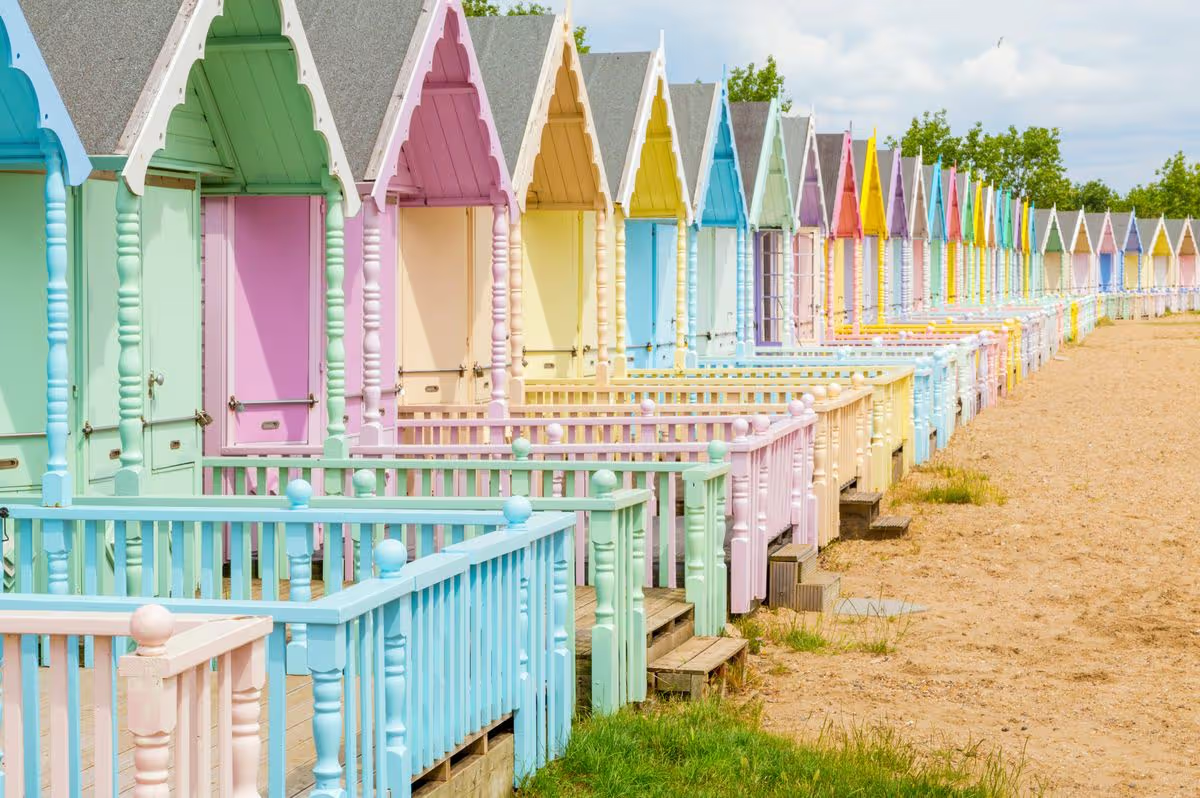
The UK island is characterised by its collection of pastel colored beach huts(Image: Getty Images)
The UK is brimming with coastal vistas, but the beaches nestled on an island just a few hours from London are perhaps some of the most beautiful.
Just off the coast of Essex, around nine miles southeast of Colchester and two hours from London, is the idyllic Mersea Island. The tidal island is renowned for its colourful beach huts, world-famous oysters, and its rich maritime heritage, offering a unique day out with a laid-back seaside charm.
It’s the UK’s most easterly inhabited island, with a population of around 7,000 residents spread across two areas: West Mersea and East Mersea. The island is also steeped in history, spanning more than a millennium, with its parish church, St Peter and St Paul, believed to date from the 7th century, while numerous Roman artefacts have been discovered in the vicinity.
Amy Jones
On the West of the island is where you’ll find its small fishing town, the most populated area of the island. While the east offers stretches of rural landscapes and is home to the island’s only country park, Cudmore Grove.
But the West is what draws visitors in, offering stretches of golden sand, stone and shell shores, lined with traditional pastel-coloured beach huts, a standout feature of this coast. It’s a haven for those looking to spend time on the beach against the picture-postcard backdrop, or to soak up the views during coastal walks along West Mersea beach.
While the island might not be blessed with the azure waters of Scotland or Cornwall, the shallow, typically calm waters are just as enticing and ideal for those looking to take part in fun water activities, like kayaking or paddleboarding. Yet there’s more to the waters that surround the island.
At least once a month, the island gets completely cut off from the mainland due to high tide. While it’s an island in its own right, there’s a road called ‘The Strood’ that connects Mersea to the mainland, but as the water completely submerges the road, the island is left to its own devices.
Thankfully, residents of the island aren’t cut off for long; it typically lasts only about an hour and a half. So, for residents and visitors, it’s vital to check the tide times to avoid brief periods of isolation.
But planning a trip is well worth it, with the addition of its quaint harbour to explore, which is dotted with fishing and sailing boats. This is the ideal spot where children can enjoy crabbing off the jetty and for adults to savour those acclaimed oysters.
Some of its most notable places to enjoy the island’s selection of seafood are at The Company Shed, The Coast Inn and Victory at Mersea. And of course, a visit to the beach wouldn’t be complete without a classic dish of fish and chips, which is available from a range of eateries on the island.
In the town, there are shops to wander around, along with tearooms, bakeries and coffee houses for a respite from the British weather. While the island is small, there’s a selection of pubs on the West Mersea for that refreshing pint by the coast and picturesque views out to the harbour.
It’s a little slice of paradise for those looking for a laid-back escape, or a day out at the beach on one of England’s islands. It even has its own vineyard and brewery to really savour the flavours of Essex.
Do you have a travel story to share? Email webtravel@reachplc.com
A once-thriving seaside town on the east coast was home to a huge Butlin’s holiday resort, but has since been ranked one of the UK’s worst seaside towns — and there’s barely a trace left of the famous camp
A once-bustling seaside town that has tumbled down the rankings used to be home to a massive Billy Butlin’s resort — though you’d never know it today.
Celebrated for its award-winning pier, sweeping sandy beaches and classic fairground rides, Clacton-On-Sea was once a glorious coastal destination that drew holidaymakers in their droves from across Britain. However, last year, Clacton, in Essex, came third-from-last in Which?’s annual ranking of the UK’s finest seaside towns.
The town scraped a paltry 42 per cent — a stark contrast to Bamburgh, which topped the charts with an impressive 84 per cent destination score.
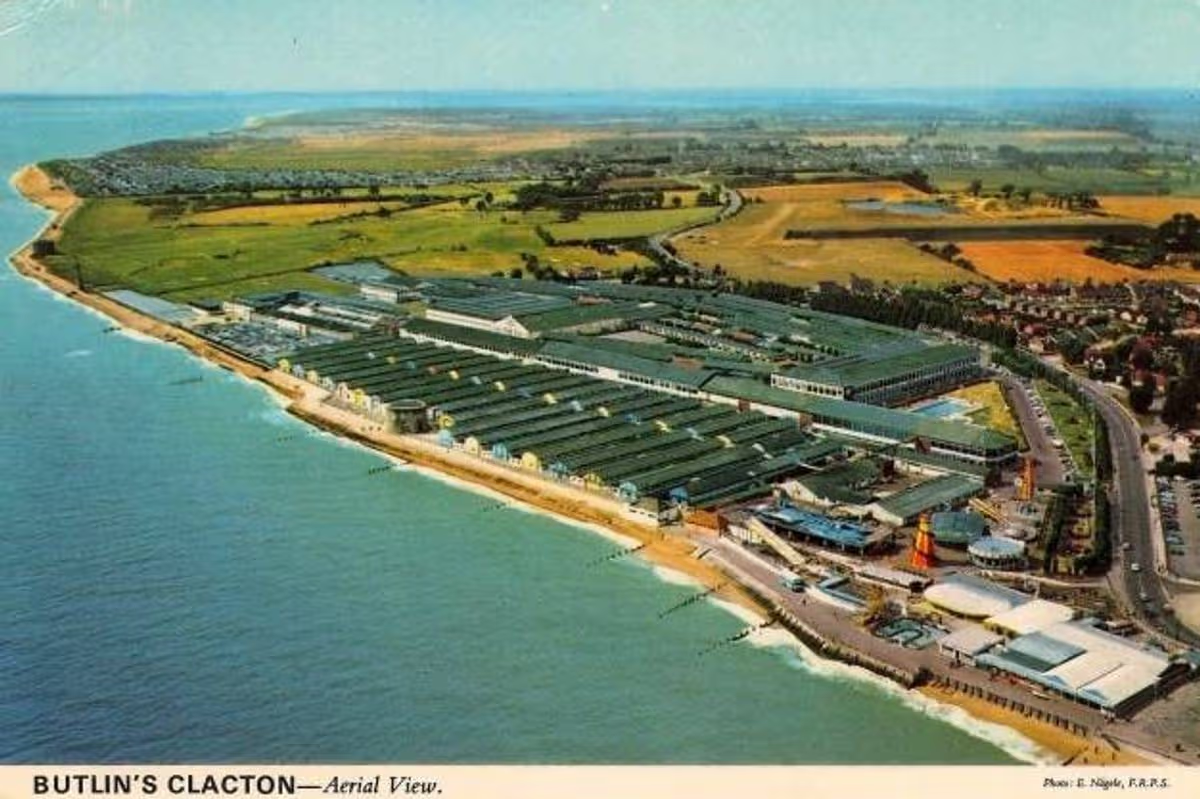
Yet in its heyday, before the Benidorm boom tempted Brits away from British shores in favour of budget package holidays to Spain, Clacton was a very different place. In 1936, Billy Butlin purchased the West Clacton Estate — which already boasted a miniature golf course and boating lake — and transformed it into the iconic Red Coat resort that became a beloved British institution.
The resort shut down when war broke out, with the Army temporarily commandeering the site. However, in 1946, it was relaunched as a holiday camp — and subsequently acquired neighbouring land for expansion.
“By the late 1950s, Butlin’s had become a national institution and to some extent, Clacton was able to bask in its reflected glory,” Clacton History explained. “The combination of Butlin’s and Clacton had become firmly established and for both their futures as family holiday venues seemed unshakeable.”
As with other Butlin’s locations, visitors flocked to enjoy the extensive amenities available, including comfortable chalets, an enormous outdoor swimming pool, fairground attractions, a ballroom for dancing, a bowling green, retail outlets, a miniature railway, and top-notch entertainment. Stars such as the Beverley Sisters, Michael Holliday, and Jack Douglas are said to have graced the camp’s stages during their early careers.
However, unable to match the appeal of affordable flights to sunny Spain, and damaged by rowdy teenagers treating the venue as a drinking destination, Butlin’s tragically shut its gates in 1983 — the same year the Filey resort was also closed down.
According to Butlin’s Memories, the site was snapped up for approximately £2 million by Amusement Enterprises Ltd — who revealed bold proposals to transform the complex into a ‘Disneyland’ style theme park. With a fresh identity, Atlas Park, the site reopened in 1984 but stayed largely as it was during the Butlin’s years. The project lasted just four months before encountering financial troubles, and the land changed hands once more. By 1987, everything had been torn down.
The location now functions as a housing estate for local residents, perfectly positioned close to the seafront. It feels a far cry from Butlin’s heyday — which is still fondly remembered by many locals.
Despite sitting just 60 miles from London – one of the richest cities in Europe – Clacton and Jaywick suffer from low wages and poor public perception, with dark tourists and American influencers venturing there to report on their struggles.
Happily, there is a lot of hope on the horizon for the area. The District Council is working on a raft of regeneration projects across Clacton, Jaywick Sands and Dovercourt after successfully applying for millions of pounds in Government funding.
The Council entered into a Community Regeneration Partnership (formerly the Levelling Up Partnership) in late 2024 and was awarded £20million in funding from the Ministry of Housing, Communities and Local Government to regenerate Clacton and Jaywick Sands.
In Clacton, these include proposals to repurpose the 200-year-old Martello Tower on Clacton seafront and bring it into regular use, in a project TDC says will convert “a disused public convenience close to Clacton Pier into a vibrant cultural venue and providing a free-to-use BMX pump track, learn-to-cycle and climbing facility at Clacton Leisure Centre.”
A further £20million was also secured from the Local Regeneration Fund (formerly Levelling Up Fund) for Clacton Town Centre which was granted to create the new ‘Clacton Civic Quarter’.
Clacton Library is also being redeveloped into a new multi-story building that will be built on the current library site, to include a centre for Adult Community Learning and local registration services.
The first swallows are swooping round the headland as I follow the coast path along the western side of the Holy Island of Lindisfarne. There are ringed plovers on the beach and a couple of grey seals bobbing out at sea. A barefoot guy is splashing along the tidal Pilgrim’s Way, an ancient post-marked path across shining sands. Lindisfarne is only accessible when receding tides uncover this path and the curving causeway road nearby.
The original 62 miles of Northumberland coast path, which opened 20 years ago, bypassed the island, so I’ve been looking forward to walking this stretch of the England coast path, which opened two years ago.
Very few of us will walk the full 2,700 miles of the King Charles III England coast path, which was inaugurated in March, but a four-mile stroll around Holy Island is an adventure in itself, a shifting landscape of wader-foraged mudflats, dunes, beaches, whinstone cliffs and a reedy blue-and-gold lough.
Waymarked posts lead through grassy sand dunes, freckled with cowslips. Skylarks and stonechats clack and chirrup, while courting lapwings tumble over the fields. Gertrude Jekyll’s little walled garden, on the hillside facing the clifftop castle, is bright with marigolds and purple rock cress.
Edward Hudson, founder of Country Life magazine, bought Lindisfarne Castle in 1901 and hired architect Edwin Lutyens to turn it into a home. Inside the craggy fortress, there are four-postered bedrooms and an elegant drawing room in the old gunpowder store. From the ramparts, a telescope shows the seal colony near two obelisks guiding boats into Holy Island harbour.
Just over the fields are the red sandstone arches of Lindisfarne Priory; these ruins date from the 12th century but a monastery was founded here by Saint Aidan in Northumbria’s seventh-century heyday. I walk past stacks of lobster pots to visit the museum with its carved stone crosses and fossil rosaries. Nearby Pilgrims Coffee offers fancy brews and fresh focaccia.
Lindisfarne Castle, looking west from Beblowe Crag. Photograph: Alamy
A stream of cars crosses Lindisfarne causeway, but you can arrive instead on bus 477 from Berwick-upon-Tweed (Mon-Sat in school holidays; otherwise Wed-Sat). A bus ticket gets you 10% off at the castle and 20% off at the priory. With good transport links, Berwick makes an excellent base for exploring this end of the coast path.
Getting off bus X18 at Budle Bay campsite the next day, I continue walking south towards Bamburgh. The original coast path runs inland from Lindisfarne, but there are now 10 miles of seasonally sensitive coastal access, open in June and July, plus this short new year-round path on the south-eastern edge of Budle Bay.
Wading birds forage in the mudflats and miles of moss-green salt marsh. Past ruined lime kilns and coconut-scented gorse, I cross cliffs into dunes, where a grasshopper warbler whirrs among roses and honeysuckle.The Walled Garden cafe, opposite St Aidan’s church, serves huge crab sandwiches with lemon and herbs. Nearby, the Norman keep of Bamburgh Castle has towered for nearly 900 years over the wide yellow sands.
Transport for this trip was provided by LNER. The nearest mainline station to Lindisfarne is Berwick-upon-Tweed. The Walls B&B (doubles from £130B&B) overlooks the Tweed, or there is a YHA hostel next door (private rooms from £57) Phoebe Taplin
Around the Wash,Norfolk and Lincolnshire
Sir Peter Scott Lighthouse, also known as the East Lighthouse, on the River Nene, at Sutton Bridge, Lincolnshire. Photograph: Alan Barr/Alamy
From King’s Lynn To Sutton Bridge Distance 15 miles
Isolation is claimed to be one of the latest trends in luxury travel. If true, then the stretch of the King Charles path around the Wash must be the most extravagant pleasure you can enjoy in England.
For hours I traversed a landscape of no people. No walkers, no workers, no houses, no cars, no noise except the shrill cry of redshank and the babble of skylarks drifting on the wind. If you’re weary of chatter and conflict, this undeniably desolate walk is for you. Every view of vast horizontals of green, brown and blue could be the cover for an album entitled Nowhere.
I set out from King’s Lynn, one of England’s most vibrant ports in the 13th century, which retains a wealth of medieval buildings. The coast path around the Wash, England’s biggest natural bay, requires excursions inland to cross the rivers that feed the largest multiple estuary system in Britain. Several miles can be sliced from the King’s Lynn section by taking the ferry across the Great Ouse from the old port to West Lynn.
I find no sign of life at the bottom of Ferry Lane, only a mysterious notice: “If you require the ferry please make yourself seen BEFORE the time NOT AFTER”. After 15 minutes pondering its meaning, I spot a small boat crossing the turbulent brown water.
I’m ferryman Ben’s only passenger and he’s convinced I’ll be cold in my shorts. “No shelter out there,” he warns. It’s a blustery May day, and I head up the western bank of the river.
The King’s Lynn foot ferry on its way to West Lynn, across the Ouse. Photograph: Adrian Chandler/Alamy
The Ouse sparkles silver and blue, but there is only a distant line of bronze representing the retreating North Sea. The sea views are underwhelming yet the effect is rather like being at sea, the seabank a kind of ship, ushering us between the vast prairie fields of the reclaimed Fens on one side and epic salt marshes on the other.
Most of this 15-mile stretch between King’s Lynn and Sutton Bridge borders the Wash. The south-eastern corner of this national nature reserve was first recognised as a precious home for stupendous flocks of wintering wildfowl and breeding waders by Sir Peter Scott, the 20th-century conservationist and artist who helped found the World Wide Fund for Nature.
He would be delighted by the wealth of little and great white egrets along the seabank, and it is only birds I have for company (I encounter just three walkers all day). I eat my packed lunch in the shelter of a stunted hawthorn – notices warn walkers there are no toilets, cafes or public transport on this section.
The grand liminal arena of the Wash, where land and sea blur into one, plays tricks on distances and perspectives. Faraway trees pop up like a mirage above the blue horizon. For a while I entertain myself with “ship or tractor?” when spying a distant machine. I see both.
I pass a mysterious island, identified on the map as the Outer Trial Bank, a test to see if more land might be wrenched from the sea. When I follow the path inland again alongside the River Nene, and pass the old lighthouse where Scott once lived, it is like returning to land after a sea voyage.
Other stretches of the coast path are unquestionably more scenic, but there’s something glorious and trance-like about walking for so long in such space and solitude. On the bus back to King’s Lynn, I glow from this unique experience.
Accommodation is limited around the Wash, but King’s Lynn is a good option, with day walks either side (Hunstanton to King’s Lynn is 17 miles with buses to get you out/back).The Bank House (doubles from £165 B&B) is in the historic old town Patrick Barkham
The west Somerset coast
The view from Kilve Beach and coast path towards St Audries Bay, Blue Anchor Bay and Minehead, Somerset. Photograph: Alan Gardiner/Alamy
From Minehead To St Audries Bay Distance 11 miles
Minehead may be the birthplace of the science fiction writer Arthur C Clarke, but it’s a coastal, rather than cosmic, odyssey I’m beginning here, walking 11 miles east to St Audries Bay.
Despite this being one of Somerset’s most well-trodden stretches of coast, few tackle it in one go; tides dictate when beach paths are passable, and return journeys rely on a public transport system that doesn’t yet stretch to moonbuses, so many visitors opt for circular hikes instead. Until now I’ve done the same, but the opening of the England coast path has inspired me to pull on my walking boots and lace together the sections I’ve skipped.
It’s not a propitious start. Coastal erosion has forced a 1½-mile diversion leaving Minehead. Instead of clamouring gannets and the rush of waves, I’m trailed by the rumble of engines as the route follows the A39. It’s not far to Dunster, however, where the soundtrack switches to lawnmowers and willow warblers, and I’m soon at the beach.
Clattering shingle underfoot, I’m buffeted along to the village of Blue Anchor, with its huddle of beach chalets. Along the promenade, I meet angler Steve, who’s hoping for dogfish or conger.
“Will you eat them,” I ask?
“I’m soft,” he smiles. “I throw them back. If I want fish, I go to the chippy.”
From here on, the path gets steeper and prettier, detouring around the headland through woods trimmed with blossom and birdsong. Midweek, the trail is quiet, despite the herds of caravans corralled in adjacent fields.
Approaching Watchet, the path spills on to the grassy earthworks of Daw’s Castle, a clifftop fortress founded by King Alfred to stave off Viking raiders. Fossil hunting is another long tradition along this coast, and when I stop at the town’s Market House Museum, I’m transfixed by a huge ammonite, found on a nearby beach a century and a half ago.
It’s market day in Watchet, and the trail leads past a rainbow of striped awnings to East Quay, the town’s social enterprise arts hub. In its cafe I order a charred sweetcorn and courgette salad and a cheese scone almost as gargantuan as that ammonite.
Rhiannon Batten on the path between Doniford and St Audries Bay. Photograph: Rhiannon Batten
I’d like to visit East Quay’s art gallery and Watchet’s boat museum, but time and tide wait for no woman along this shoreline. Two hours before low tide, the route across neighbouring Helwell Bay is passable, but I’m cautious as I step over rocks and slippery kelp, mesmerised by the swirling mud and serrated shoreline below my boots as I play seaweedy hopscotch.
Leaving the beach near Doniford Farm Park, the trail winds through a maze of caravans then out into fields before dropping into St Audries Bay. I feel the waterfall here before I see it, its icy spray a reminder not to linger.
Retracing my steps to Doniford Halt, a request stop on the West Somerset Railway, I arrive just in time to flag down a steam train to take me back to Minehead. As we puff along, the landscape I have walked is rewound through the window. There are better coastlines in England for swimming than these estuarine bays, but as a tidal immersion on foot this walk has been stellar.
Train from Doniford Halt to Minehead is £17.50 one-way (west-somerset-railway.co.uk). Doubles at the Foxes hotel in Minehead from £120 B&B Rhiannon Batten
Chichester harbour, Hampshire and West Sussex
West Wittering beach, West Sussex. Photograph: Stephen Tattersall/Alamy
From Prinsted To West Wittering Distance 16½ miles
Wild, windswept wetlands stretch to the horizon. Human figures are outnumbered by birds. Church spires and thatched roofs signpost scattered settlements. Can this really be the crowded south coast of England?
My boyfriend and I are walking part of a 35-mile stretch of the King Charles III England coast path, linking South Hayling in Hampshire to East Head in West Sussex, which opened in February. This section includes Chichester harbour, a protected estuary with open water and sheltered inlets, reedbeds, salt marshes, mudflats, shingle banks, sand dunes and a wooded shoreline.
We join the path at pretty Prinsted, after coffee (and directions) from the Southbourne farm shop. We set off east around Chidham peninsula, trying to spot the birds pictured on the information boards. Tens of thousands of wading birds and waterfowl spend the winter here, and in summer it’s a breeding ground for threatened species of seabirds and waders. Early April may not be peak time for birdwatching, but we still see a plethora of gulls and ducks, plus oystercatchers, curlews and a kestrel.
After rounding the peninsula and making our way up the other side, the day’s destination comes into sight across the water. Bosham, a cluster of buildings crowding up to the quayside, looks close enough to touch, but the winding coastal path is deceptive, and we still have a way to go (8½ miles in total).
We are glad to reach the Millstream, a 31-room hotel made from converted cottages, set in a lovely garden. Our room is in a tiny thatched cottage, reached by a little bridge over the stream.
Bosham (pronounced “Bozzum”) is ancient – believed to predate the Romans. Some think this is where King Canute tried to turn back the tide. King Harold II is depicted in the Bayeux tapestry praying at Bosham church, and the manor is recorded in the Domesday Book as one of the wealthiest in England. We visit the Saxon church and see the plaque to Canute’s eight-year-old daughter, who is said to have drowned and been buried here.
Rachel Dixon on the trip from Ferry Hard to Itchenor jetty in Chichester Harbour. Photograph: Neil Clive Fowler
More cheerfully, we stop for a pint at the ivy-clad Berkeley Arms before dinner at the harbourside Anchor Bleu. The latter, family-run inn has been welcoming weary travellers since 1741 and has a daily changing, seafood-heavy chalkboard menu. The inspired kelp, samphire and seaweed “seacakes” mean that vegetarians don’t miss out, either.
The next morning, we walk across the harbour (a walkway appears at low tide) and continue south for a couple of miles. The wind is howling and it’s hard going – thankfully the route is flat and the formerly muddy tracks are now smooth paths. Areas along the trail that previously flooded at high tide have boardwalks above the water level, made from recycled bottles, and the paths are designed to be easily “rolled back” in the event of coastal erosion.
We battle the wind to the water’s edge and wave down the ferryman on the far shore. For hundreds of years, travellers have taken the Itchenor Ferry (AKA the Itchy Bosom) across the Chichester Channel to save them a 13-mile detour by foot. Today, the ferry also operates as a taxi service for people going to and from their boats, and on our crossing a bonus spin up the channel to pick up a couple of sailors is included in our £3.50 fare.
We disembark at West Itchenor and stop for coffee and cake at the Quarterdeck Cafe in the bustling boatyard. From here, it’s a six-mile shoreline stroll to the dunes at East Head spit, and the adjacent sandy beach at West Wittering. We are no longer alone – the car park is packed – but the beach is so vast, we don’t mind sharing.
Southbourne station is within walking distance of the start of the walk and Chichester station is a bus ride from the end. Accommodation was provided by the Millstream hotel (doubles from £200B&B) Rachel Dixon
The Fylde coast, Lancashire
Huge flocks of shimmering lapwings and other migratory birds have arrived to feed on the Ribble Marsh nature reserve. Photograph: Media World Images/Alamy
From St Annes-on-the-Sea To Freckleton Distance 11½ miles
Two avocets dip their scimitar beaks into the lagoon. An egret hops on to the bank. A herd of cattle wade knee-deep. In the hazy light it might be a remote outpost on the Pampas. But it is Lancashire, and Preston is just around the corner.
Some walks exhilarate partly because your expectations are quite low. I imagined the coast from St Annes-on-the-Sea to Freckleton to be suburban seaside, with the occasional moment of peace, beauty or wildness perhaps. But it is all of this and more.
I have a few childhood memories of St Annes from visiting my grandad. It still has a 1970s atmosphere: quietish, residential, conservative. Local businesses are sprucing up frontages and gardens for the coming season. A litter-picking campaign has set up shop near the pier.
We walk on the sandy beach until it segues into a greener area, with dunes on the left and salt marsh on the right. The path between is busy with dog walkers and families enjoying the morning sun. Groups of nordic walkers speed past. Two detectorists bleep below the prom. On Fairhaven Lake the pedalos and boats are out.
The pier at St Annes-on-the-Sea. Photograph: Kevin Walsh/Alamy
Soon we come to Lytham, smart and gentrified. We buy coffees from a kiosk on the front before strolling along the Mussel Tank Memorial to visit the free museum inside the windmill. The birdlife is already good – oystercatchers, curlews, herons – and it only gets better as we leave built-up areas behind and stride out on to the edges of the Ribble Estuary national nature reserve – also designated a site of special scientific interest, a European special protection area and international Ramsar wetland site.
Why all the titles? Because this estuarial Eden happens to be the most important site in the UK for wintering wildfowl, supporting more than a quarter of a million ducks, geese, swans and wading birds; it’s internationally important for 16 species of wintering visitors. Spring isn’t bad, either. I’ve remembered my binoculars. As well as the wondrous avocets, we see and/or hear redshanks, skylarks, linnets, sedge warblers, shelducks, goldfinches, swallows, peewits, kestrels – and hares.
I have brought a hat, too, which is lucky. Coast walks are great – you can proceed without navigating or having to look down – but there’s not much cover. As we approach Warton airbase, the path follows a causeway. We have passed lots of benches (and loos), but here we sit on the grass to enjoy a picnic and birdsong.
The Lancashire coast is known for resorts rather than beaches, nature, cliffs or birdlife. The towns are famous; the bits in between overlooked. The King Charles III England coast path could alter this, which would be a good thing; it will spread visitors out, perhaps explode a few cliches. The Lancs littoral turns out to be as generous with fresh air, flora and fauna as it is with fun and frolics.
The Lancashire section isn’t fully open or waymarked, but work is afoot and Cicerone has published a guide and map. The 68bus runs between Blackpool and Preston, stopping at St Annes, Lytham and Freckleton. The stretch between Freckleton and Preston is best done by bus as the path is forced on to a main road. Trains connect Blackpool, St Annes-on-the-Sea, Lytham and Preston. The Rooms Lytham has doubles from £110
An exterior view of the Samsung Electronics headquarters in Seoul, South Korea. File. Photo by YONHAP / EPA
May 29 (Asia Today) — Samsung Electronics said Friday it shipped samples of its seventh-generation high-bandwidth memory chip, HBM4E, for the first time, demonstrating its competitiveness in advanced semiconductor technology.
The shipment came three months after Samsung began mass shipments of HBM4 in February, raising expectations that the company could expand its share of the HBM market.
Samsung said it supplied 12-layer HBM4E samples to global customers. The company did not identify the customers, but industry officials said the samples were likely supplied to Nvidia, a major buyer of AI chips.
Samsung said the HBM4E shipment goes beyond an expansion of its product lineup and could strengthen the company’s supply capacity and technological edge in the global AI infrastructure market, which is expected to grow rapidly for years.
Samsung said HBM4E operates at 14 gigabits per second to 16 gigabits per second per pin, more than 20% faster than the previous generation. It provides bandwidth of 3.6 terabytes per second in a single stack, improving computing speed for large language models and next-generation AI systems.
The 12-layer HBM4E offers 48 gigabytes of capacity, more than 30% higher than the previous generation. Samsung said it plans to expand the lineup to 32 gigabytes, or eight layers, and 64 gigabytes, or 16 layers, to meet different customer service environments.
The new HBM4E uses Samsung’s 1c DRAM, a sixth-generation 10-nanometer-class DRAM process, and its own 4-nanometer foundry logic die. Samsung said the combination improves process stability, yield and mass production capability.
The company also said low-power design and packaging optimization improved energy efficiency by 16% and thermal resistance characteristics by more than 14% compared with the previous generation.
Samsung’s position in the HBM market is expected to strengthen because the company appears to have moved ahead of competitors in shipping samples. Earlier sample shipments could help Samsung secure customer volume in the next-generation AI memory market.
Samsung ranked second in the global HBM market with a 22% share in the fourth quarter of last year, behind SK hynix, which held 57%, according to Counterpoint Research. Samsung’s share was down sharply from 40% a year earlier, but analysts say its HBM4 mass shipment this year could help it recover.
Global customers have given positive reviews of Samsung’s HBM4 in speed, power efficiency and overall performance, industry officials said. Samsung’s HBM4 received the highest rating in a system-in-package test in December after demonstrating an industry-leading speed of 11.7 gigabits per second.
Analysts say HBM4E could move into mass production quickly because Samsung is already mass-producing HBM4 using the same combination of 1c DRAM and a 4-nanometer base die.
Market watchers also remain optimistic about Samsung’s HBM business.
“The memory market in 2027 is expected to face a deeper supply shortage, and price increases are also likely to gain momentum,” said Kim Dong-won, an analyst at KB Securities. “HBM prices are expected to rise more than 50% from a year earlier as negotiations reflect the narrowing margin gap with general-purpose DRAM.”
Hwang Sang-joon, executive vice president and head of memory development at Samsung Electronics, said the company completed the HBM4E sample supply without disruption after successfully starting HBM4 mass shipments.
“This has clearly imprinted Samsung Electronics’ unmatched technology leadership in the market,” Hwang said. “We will continue to strongly lead growth in the global AI memory market based on overwhelming technology leadership and preemptive investment in production infrastructure.”
Russian-made T-72B1V tanks in a Venezuelan military parade in 2011. (Archive)
Caracas, May 29, 2026 (venezuelanalysis.com) – The Russian government has urged Venezuelan authorities to “reject approaches” from the US and allies to transfer military equipment to Ukraine.
Russian Security Council Secretary Sergei Shoigu raised the concerns during a meeting with Venezuelan Major General José Ornelas Ferreira, secretary general of the Caribbean nation’s National Defense Council, on Wednesday in Moscow.
The Venezuelan official was a guest at the First International Security Forum, held from May 26-29 at the Russian capital with the presence of 140 top officials from over 120 countries worldwide.
“We are aware of the activity of Western emissaries who are attempting to involve Latin American countries in various arms supply schemes for the benefit of the Kyiv regime,” Shoigu said in a bilateral meeting with Ornelas. “We expect you to reject such approaches and inform us of any such Western attempts.”
Moscow and Caracas have maintained a longstanding military alliance through which Russia has provided Venezuela with a broad supply of weapons, equipment, and technical assistance for decades, forming the backbone of the Venezuelan arsenal. The cooperation dates back to the 2000s as Hugo Chávez sought to reverse the US dependence of the armed forces.
Though neither US nor Venezuelan officials have commented on weapons transfer proposals, Shoigu’s warning follows publicized efforts by Washington and allies to bolster the beleaguered Ukrainian forces in the war against Russia. Kiev’s backers procure Soviet-era equipment that could be easily integrated into the battlefield.
Apart from securing supplies from Eastern European NATO members, Washington has also turned to Latin America, offering to exchange Russian and Soviet-made hardware for newer US equipment. Brazilian and Colombian leaders rejected the proposal.
In February 2024, Ecuador canceled plans to send or exchange Soviet/Russian-origin weaponry with the US, which intended to reroute them Ukraine. Ecuadorian President Daniel Noboa backtracked following Russian threats to suspend banana imports from the Andean country.
According to military analysts, Venezuela’s battlefield equipment — including T-72B1V tanks, BMP-3 infantry vehicles, Mi-17 helicopters, and 152 mm artillery systems — would be valuable on the Ukrainian battlefield and help address chronic ammunition shortages.
The recent Moscow security summit also saw Shoigu condemn the US’ “brutal armed invasion” of Venezuela on January 3 that led to the kidnapping of President Nicolás Maduro and First Lady Cilia Flores.
“We strongly condemn Washington’s actions on January 3, during which the legitimate head of state, Nicolás Maduro, and his wife were captured, and dozens of Venezuelan and Cuban citizens were killed,” the former Russian defense minister stated.
Shoigu criticized the Trump administration for “violating all fundamental norms of international law” and breaking “the principles governing coexistence among nations and respect for state sovereignty.”
The Russian official went on to reaffirm the Vladimir Putin government’s “unwavering support” for Caracas and the desire to “strengthen cooperation” in order to avoid future acts of aggression.
Shoigu likewise commented on the Venezuelan government, led by Acting President Delcy Rodríguez, pursuing a “new modality of relations” with the US and expressed hope that it would protect the Caribbean country’s “sovereignty and national interests.”
Following the January 3 attacks, the Trump White House has exacted major concessions from the acting Rodríguez administration, including seizing control of Venezuelan oil revenues, auditing its Central Bank, pushing pro-business legislative reforms, and securing the handover of former government envoy Alex Saab to face money laundering charges in Florida.
The growing US influence in Venezuela saw the Southern Command hold “rapid response” military exercises on May 23, with Osprey MV-22B aircraft flying over Caracas and landing near the US embassy compound.
US officials have acknowledged a growing “collaboration” with Caracas. During a press conference on Wednesday, Secretary of War Pete Hegseth highlighted Washington’s self-declared anti-narcotics operations in the Western hemisphere and the joint work with local governments.
“Just think about the fact that our Southern Command commander landed by helicopter at the US Embassy in Caracas peacefully,” Hegseth said alongside Trump. “He was welcomed by the Venezuelans because we are now partnering with them, hopefully even in our counter-cartel missions.”
The Trump official referred to Venezuela as “fundamental to securing our energy future and defending the homeland.”
Emmerdale fans were left divided when the identity of the arsonist was finally revealed on the latest episode of the long-running ITV soap, especially as a potential production blunder confirmed it weeks ago
Emmerdale finally confirmed the identity of the arsonist on Friday night’s episode(Image: ITV)
It was all revealed in the final Emmerdale of the week, but even then, viewers had to wait until just before the credits rolled. Joe Tate (Ned Porteous), Robert, and Aaron Dingle (Danny Miller) had spent the day trying to figure out who was the culprit, along with Graham.
At the end of the day, Aaron explained to Robert: “Graham reckons he nearly caught someone today – the arsonist. Well, not nearly caught them, actually. He’s been keeping an eye on the place since Joe thought it was me and Robert starting the fires. Just someone in a dark hoodie, which is pretty much everyone we know.”
As he was talking, the final scene of the episode saw teenager Kyle Winchester (Huey Quinn) walking up to the scene of the crime with a can of petrol and starting the fire.
Fans were quick to react to the revelation, with one writing: “Kyle Dingle needs some serious psychological help first murder then arsonist, what’s next serial killer?!” and another said: “Surely Kyle needs some punishment now. Him offending and the Dingles covering for him is not going to end well.”
Taking to X, another said: “OMG IT WAS KYLE ALL ALONG,” and another wrote: “Omg it’s Kyle,” as they emblazoned their comment with a shocked-face emoji. However, others claimed that the twist was “predictable”, especially given a potential mishap that happened in production.
As with fellow ITV soap Coronation Street, the credits roll with the cast listed in order of appearance and Kyle Winchester was the character noted at the top, and therefore suggested to be the person in the opening scene way back when the mystery was first teased. This opening scene was the hooded fire starter, therefore suggesting even then that it was Kyle.
One said: “#Emmerdale it was so obvious it was Kyle [eye roll emoji] It was as obvious as living in No1 Obvious St, Obvious Cresent in Obvious Town in the country of Fucking Obvious OB3 1OS,” whilst another said: “Oh really… would never have guessed him to be the fire starter.”
A third wrote: “So not only is Kyle a killer for murdering Al – he’s now an arsonist, As much as I’m loving another big story for Kyle and Huey Quinn is brilliant – this almost felt too predictable especially with the early spoiler last week in the end credits. #Emmerdale”
A fourth said: “I really wasn’t expecting Kyle to be the fire starter, it was so unexpected even when a lot of viewers called it weeks ago and #Emmerdale were so excited to tell us they totally didn’t credit Kyle in an episode where we only saw his figure.”
COLLEGE STATION, Texas — USC couldn’t hold on to the lead Adrian Lopez provided with a home run in the bottom of the eighth Friday night.
Texas State’s Chase Mora greeted reliever Adam Troy with a monstrous two-run home run to left field in the top of ninth inning, propelling the Bobcats to a 5-4 upset before a crowd of 6,956 at Blue Bell Park.
The Trojans had plenty of chances, and they wasted most of them in the opening round of the NCAA tournament’s College Station Regional.
Even though the Bobcats’ shaky defense spotted USC two unearned runs, the Trojans will surely lament stranding runners in scoring position in each of the first seven innings.
The Trojans will face Lamar University, which blew a five-run lead in a 7-5 loss against host Texas A&M, on Saturday at 1 p.m. PT.
If coach Andy Stankiewicz’s Trojans return to the Men’s College World Series for the first time since 2001, the 12-time national champions must do it out of the losers bracket.
USC right-hander Grant Govel, an All-Big Ten First Team selection, settled for a no-decision after giving up three runs on four hits with two walks and six strikeouts over 5⅔ innings.
He was relieved by freshman left-hander Sax Matson with one on and two outs in the top of the sixth. Matson escaped unscathed in the sixth, but he was relieved by right-hander Andrew Johnson with one on and two outs in the seventh.
The Trojans (43-16), who reached the Big Ten Tournament semifinals, have lost four of their last five games.
Mora’s sacrifice fly to right field gave the Bobcats a 1-0 lead in the second inning. The Trojans countered to tie the score with a run in the bottom of the second.
With runners on first and second and two outs, Abbrie Covarrubias hit a grounder to first. Texas State first baseman Jaquae Stewart booted the grounder for an error, allowing Isaac Cadena to score. Stewart almost made the situation worse with a wild throw to second, but Dean Carpentier was thrown out trying to reach third on the poor throw to second.
The Trojans benefited from more poor defense in the third. With one out in the inning, Augie Lopez reached on an error by Mora at third. Kevin Takeuchi followed with a double off the center-field wall. Jack Basseer broke the tie with an RBI single through the left side.
Covarrubias hit a solo home run to left in the fourth to put USC ahead 3-1. Texas State sophomore shortstop Brady Boles, who entered the regional with only one home run this season and two in his college career, tied the score 3-3 with a two-run home run to left field in the top of the fifth.
We visited Houston in Texas where a rodeo, baseball, space and delicious food were on the jam-packed agenda. Here’s why you need to get planning your trip to the Lone Star State…
We visited Houston during rodeo season
I’ve always wanted to visit Texas and what better time than rodeo season? Rodeo is a year-round pastime for Texans, but Houston holds the largest event in the US in March, with even more cowboy boots and hats descending upon the city than usual, a buzz of excitement and yee-haw in the air. Add in a Space Center visit and a baseball game and this trip to the Lone Star State isn’t one that I’ll forget in a hurry.
RIP-ROARING RODEO
The Houston Livestock Show and Rodeo runs across 21 days, with a carnival atmosphere, shows, music, energy and excitement. Inside the NRG Stadium, rodeo competitions – bull riding, barrel racing, saddle-bronc riding and roping – take place, while outside there’s livestock shows, exhibitions and loads more fun.
The fried food creations on offer are endless – think funnel cakes, jumbo corn dogs and deep-fried Oreos. “When in Texas,” we thought, as we ordered (and surprisingly enjoyed) a deep-fried cheesecake.
The rodeo is a jam-packed day and each night a musical superstar takes to the stage in the stadium. We got to see Texas native Kelly Clarkson putting on an impressive show as she bounced energetically around the rotating stage and reminding the 70,000-strong crowd just how many hits she has – naturally she finished her set with Since U Been Gone.
COWBOY COOL
To take in the atmosphere like a local, we wanted to be properly kitted out, so we visited the Republic Boot Co. I’ve never seen so many tempting rows of cowboy boots – and it’s not just a tourist trap, either. Drake is among the clientele of this cool spot.
As well as footwear, there’s a dedicated Hat Bar, where you can choose from a range of styles and colours, customising your hat however you like. My plan for a simple, understated look quickly changed when I saw the leather trims, feathers, charms and badges on offer. I walked out with my initials branded on and a playing card tucked behind a giant feather.
BASEBALL & BEERS
Go Astros! We headed to Daikin Park, the baseball stadium which is home to the Houston Astros, to watch a quarter-final of the World Baseball Classic where the US took on – and beat – Canada. It was my first time at a game, but you don’t need to be an expert to be caught up in the thrill – it’s relentless. Soon
I was willing a home run so I could see the Home Run Train chuff round the track in celebration. We didn’t need to be told twice to order the stadium’s signature Crawford Dog and settled happily into our seats with giant beers, feeling like we were at the movies.
OUT OF THIS WORLD
Houston is known as Space City, so I couldn’t miss a visit to Space Center Houston, the official visitor centre of NASA, where astronauts train and Mission Control keeps everything on track. So soon after Artemis II’s moon mission, the place is still feeling the thrill of the historic exploration, and this is where you can really immerse yourself in all things astronautical.
The highlight was the tram tour to see the Astronaut Training Facility and Rocket Park, packed with actual rocket parts so you can see the incredible scale. It’s impossible not to get caught up in the excitement.
TASTE OF TEXAS
Texas is foodie heaven. Battling jet lag on our first night, we grabbed dinner at Agnes and Sherman, a short walk from our hotel, kicking things off on a real high. The cheeseburger fried rice has to be tasted to be believed.
For a great breakfast or brunch, head to Dandelion Cafe, where the generous-sized chicken waffles have been voted “best breakfast in the US” by Good Morning America. We were also told that Viet-Cajun crawfish was a must try, so we pulled on our bibs and gloves with enthusiasm at Crawfish & Noodles in Chinatown.
A little out of town in the seaside resort of Galveston, we discovered Gaido’s Seafood Restaurant, which has served seafood to hungry locals since 1911. We dined on delicious stuffed shrimp and gumbo, followed by the famous pecan pie, before a stroll on the waterfront.
But the most magical meal of our trip was at intimate indigenous restaurant Ishtia. Choctaw chef David Skinner is inspired by his heritage and ancestors and tells the story of each dish and its ingredients as they are served.
WHERE TO STAY
We stayed in Hotel Daphne, a stylish luxury boutique hotel in historic Houston Heights. The relaxed atmosphere was just our vibe, as was the bright, quirky decor and striped purple and blue bathrobes. Around this pretty neighbourhood we discovered cool shops and grand houses on tree-lined streets, but you don’t have to venture far for a cocktail. The hotel’s restaurant and bar, Hypsi, with a sun-filled courtyard that’s perfect for catching rays, is always there to welcome you at the end of a day of adventures.
HOW TO BOOK
BA and United Airlines offer direct flights to Houston from London Heathrow. Rooms at Hotel Daphne cost from £272 per night, see hyatt.com. Plan your trip with visithouston.com
1 of 2 | The Donald J. Trump and John F. Kennedy Center for the Performing Arts appears in Washington, D.C., on Friday. A federal judge ruled that President Trump overstepped his authority by renaming the Kennedy Center after himself, ordering Trump’s name to be removed and reversing a decision to close the performing arts center for renovations. Photo by Aaron Schwartz/UPI | License Photo
May 29 (UPI) — A federal judge on Friday said President Donald Trump‘s name must be removed from the John F. Kennedy Memorial Center for the Performing Arts in a ruling that also blocked plans to shutter the facility for two years for renovations.
U.S. District Judge Christopher Cooper for the District of Columbia handed down the decisions halting Trump’s plans to impose sweeping changes at the historic venue.
The Kennedy Center’s board of trustees voted in December to add Trump’s name to the building. The decision came less than a year after Trump dismissed the entire board and named new board members, who in turn elected him chairman.
“Congress gave the Kennedy Center its name, and only Congress can change it,” Cooper wrote.
Rep. Joyce Beatty, D-Ohio, sued in response to the name change. Meanwhile, a coalition launched a separate lawsuit in March asking the court to stop the administration from shuttering the facility for two years and carrying out its quarter-billion-dollar reconstruction project.
Trump said the decision to close the facility came after a yearlong review in consultation with contractors, musical experts, arts institutions, and advisers and consultants. He had initially considered a partial project that would permit shows to continue, but decided the best option for the venue was a temporary closure.
Rep. Joyce Beatty, D-Ohio, an ex officio member of the board who sued to have access about the details of renovations, said she believes Trump wants to shutter the Kennedy Center in response to dozens of individuals and cultural organizations who have canceled appearances there in response to Trump trying to rename the center after himself. Beatty said the documents she received about the renovations were “inadequate.”
She said “the documents prove that there is absolutely no basis to shutter this precious living memorial and beloved institution,” she said in a statement. “It certainly looks like President Trump is shutting down the center because he is embarrassed that ticket sales are down and artists are fleeing since his illegal renaming.”
Beatty’s lawyers said she was concerned Trump might use his hand-selected board to push through wholesale changes at the Kennedy Center to design a facility more to his liking. In October, Trump had the East Wing of the White House demolished to make room for a $250 million ballroom.
In a post on Truth Social in March, Trump shared renderings of what he expected the center to look like after the renovations. He said he’s not planning to rip out the facade.
A Washington Post analysis of the renderings show very few changes to the exterior of the building, including altered cornices, updated roof and some windows, painted columns, new signage and landscaping changes.
Secretary of State Marco Rubio and President Donald Trump participate in a Cabinet meeting in the Cabinet Room of the White House on Wednesday. Photo by Samuel Corum/UPI | License Photo
Iran is ready to reassure the international community that it is not pursuing nuclear weapons or instability in the region, President Masoud Pezeshkian said on Sunday, Anadolu reports.
“Prior to the martyrdom of Ayatollah (Ali) Khamenei, Iran’s late Leader, we declared — and we reiterate now — that we are ready to assure the world we do not seek nuclear weapons,” Pezeshkian said in remarks carried by state-run news agency IRNA.
“It is rather Tel Aviv that is driving regional instability,” he said, accusing Israel of pursuing a vision of “Greater Israel.”
Iranian negotiators will never compromise on the country’s “honor and dignity,” added Pezeshkian.
His remarks came a day after US President Donald Trump on Saturday said an agreement with Iran to end the war was “largely negotiated” and awaited finalization.
Regional tensions have escalated since the US and Israel launched strikes against Iran in February. Tehran retaliated with strikes targeting Israel as well as US allies in the Gulf, along with the closure of the Strait of Hormuz.
A ceasefire took effect on April 8 through Pakistani mediation and was later extended by Trump indefinitely.
ANGELINA Jolie’s ex Jonny Lee Miller has found love once more.
The 53-year-old is romancing a 27-year-old Pilates teacher with the couple having enjoyed a sun-soaked holiday together.
Sign up for the Showbiz newsletter
Thank you!
Angelina’s ex-husband Jonny has bagged himself a new girlfriendCredit: GettyJonny was seen with his glam new girlfriend earlier this yearCredit: Instagram/@manueladiago
Actor Jonny was married to Angelina in the late 90s for three years before the pair’s split.
But now, according to the Mail, he has been secretly loved-up once again for almost a year.
The publication reports that Jonny and glam Manuela Diago have been dating since June 2025.
Earlier this month, he shared a loved-up snap of them on Instagram as they attended a pal’s wedding.
Angelina and Jonny had a famous romance in the 90sCredit: GettyHe is now happily loved-up with his new girlfriendCredit: Instagram/@manueladiagoAngelina is understood to have always remained on good terms with JonnyCredit: GettyJonny is understood to be settled with his new partnerCredit: AFP
Angelina’s ex has had his eye on his new flame for some time – liking her social media content as far back as October 2024.
In addition, several of her snaps seem to be taken in Jonny’s New York abode.
The couple also holidayed in Malta in March – two months before news of their romance became public.
The Sun has reached out to Jonny for comment.
Jonny’s best-known romance was with Angelina.
They married in 1996 but split 18 months later and went on to formally divorce.
Despite splitting, they have remained relatively close and even sparked romantic reunion rumours in 2021.
That year, they were spotted on several outings together.
Around the time, there were reports he had also begun to bond with two of her sons – Pax and Knox.
Meanwhile, between 2008 and 2018, Jonny was married to Michele Hicks and the pair have a 17-year-old son, Buster.
With California facing increasingly destructive wildfires, experts and officials have long urged the strategic removal of dense, flammable vegetation that can erupt into particularly destructive flames from a lightning bolt or the spark of a power line.
But after years of record investment by the state in such wildfire risk mitigation, two key money sources are drying up, potentially reducing the state’s annual budget for vegetation removal by hundreds of millions of dollars.
Wildfire resiliency advocates are warning that the loss of these funds will leave the state vulnerable to devastation, and are calling on California’s next governor to take that threat seriously.
Late Friday, however, state officials adopted a new structure for the emissions program, called cap-and-invest, that analysts say will likely reduce wildfire mitigation funding by $200 million per year. At the same time, the governor’s latest budget proposal puts the state on track to allocate the majority of the climate bond’s $1.5 billion in wildfire prevention money within just three years.
As a result, California could go from routinely pulling more than $600 million a year from these sources, to just $150 million, according to an estimate from the Wildfire Solutions Coalition — a group of more than 80 organizations representing conservationists, business owners, fire officials and tribal leaders.
The coalition is urging the state to find new sources of funding for the work.
“We have the scientists, we have the technicians, we have the advocates,” said Michelle Decker, who is on the coalition’s executive committee and serves as president and CEO of the Inland Empire Community Foundation. “We see this problem. We can get ahead of this problem. It is a revenue issue.”
California wildfires have become increasingly costly. The 2025 L.A. fires alone caused an estimated $250 billion in damage and economic loss. Insurance companies have already paid out $22.4 billion.
In attempt to reduce the risk of damage to communities and ecosystems, the state has employed a wide range of tactics. These includes fortifying homes against wildfires, replanting fire-ravaged forests and thinning out vegetation with prescribed burns, goat grazing and manual thinning with heavy machinery to reduce the intensity of potential fires.
Research suggests wildfire mitigation work pays off. A recent analysis of 285 fires in the western U.S. found that every dollar spent on landscape projects saved about $3.75 in wildfire damage.
But as funding from cap-and-invest and the climate bond dwindle, the state must increasingly turn to Cal Fire, which devotes only a small portion of its budget to mitigation work.
“This is not an issue that can be pushed off to a timeline based solely on politics,” said Steve Frisch, a founding member of the coalition and president of the Sierra Business Council. “Fire happens whether we want it to or not.”
After a series of destructive wildfires in Northern California and the 2017 Thomas fire in Southern California, the state legislature began to explicitly focus on funding wildfire mitigation.
In 2018, lawmakers directed $200 million per year of cap-and-invest funds to wildfire mitigation projects.
As the Woolsey fire in Southern California and the Camp fire in Paradise raged later that fall, Trump accused the state of “gross mismanagement” of forest lands and threatened to cut off federal funds unless it was corrected.
Gov. Gavin Newsom and the legislature, with a significant budget surplus, began earmarking even more funds, leading to a peak of $1.1 billion in wildfire mitigation investments during the 2021-2022 fiscal year.
After the surplus dwindled, the legislature opted in 2024 to put a $10-billion climate bond in front of voters — $1.5 billion of which was dedicated specifically for wildfire mitigation work.
Newsom has since pointed to this high state funding to call on the federal government to step up its own investments into forest management work.
The federal government manages 57% of all forests in the state. While the U.S. Forest Service spent $3.1 billion mitigating wildfire conditions in the state over the last few years, California spent $4.3 billion, according to the California Forest Resilience and Wildfire Task Force.
However, the state has already allocated about $600 million of the climate bond’s wildfire mitigation pot for the 2024-2025 and current fiscal years. The latest budget proposal would allocate more than $300 million for this upcoming fiscal year. While many advocates support allocating the money quickly, it leaves little for future years.
Once that money is spent, California has to pay off the $10 billion bond with interest. The result is an estimated price tag of $16 billion, paid in roughly $400 million increments every year, for 40 years, according to the state’s Legislative Analyst’s Office.
As for the cap-and-invest funds, a fraught months-long debate at the California Air Resources Board on how to extend the program beyond 2030 resulted in a compromise that will cut the revenue it generates in half, the Legislative Analyst’s Office estimates.
Since other projects get priority — including $1 billion every year for California’s high-speed rail project — the new proposal would “likely leave no funding” for the wildfire and forest resilience line item, the Legislative Analyst’s Office found.
Cal Fire still holds a modest annual budget for wildfire mitigation work. In the 2024-2025 fiscal year, the agency had $500 million for forest management and fire prevention that was not directly tied to cap-and-invest or the bond — up from about $65 million two decades prior.
As for the federal government, independent analyses by Grassroots Wildland Firefighters and NPR found that Forest Service wildfire mitigation work is on the decline amid federal staffing cuts. The Forest Service claims the decrease in work was primarily due to poor weather conditions for activities like prescribed burns and staff being occupied with firefighting.
Both the state and federal government’s investments pale in comparison to the spending of California’s investor-owned utilities. In 2025 alone, the utilities planned to spend more than $9.2 billion on preventing their equipment from sparking the next devastating wildfire, primarily funded by Californians’ electricity bills.
Record heat. Raging fires. What are the solutions?
Get Boiling Point, our newsletter about climate change, the environment and building a more sustainable California.
By continuing, you agree to our Terms of Service, which include arbitration and a class action waiver. You agree that we and our third-party vendors may collect and use your information, including through cookies, pixels and similar technologies, for the purposes set forth in our Privacy Policy such as personalizing your experience and ads.
Times staff writer Hayley Smith contributed to this report.
OKLAHOMA CITY — UCLA, facing elimination in the Women’s College World Series on Friday night, erupted for nine runs in the second inning against Arkansas and rolled to an 11-0 win in five innings that ended the Razorbacks’ first appearance on college softball’s biggest stage.
The Bruins (53-9) got home runs in the inning from Aleena Garcia, Soo-Jin Berry and Megan Grant — her 42nd of the season and the 91st of her career, a program record. Kaniya Bragg homered to right field in the top of the fifth to make it 11-0.
The Razorbacks (47-13) were limited to three hits in five innings by UCLA starter Taylor Tinsley.
UCLA will play another elimination game at 4 p.m. PT Sunday when the Bruins face either Texas Tech, the defending national runner-up, or Tennessee.
Arkansas starter Payton Burnham didn’t last long against UCLA’s powerful lineup.
Garcia homered to lead off the second. Burnham hit Bragg with a pitch, Alexis Ramirez singled, and Berry launched a homer to left field to make it 4-0.
Saylor Timmerman replaced Burnham and walked Jolyna Lamar and Rylee Slimp before Grant crushed a 260-foot no-doubter that hit a metal fence beyond the wall in left-center field.
Ukrainian President Volodymyr Zelensky warned citizens of his country that Russia is planning an attack, based on their intelligence reports, and to hunker down on Friday night. File Photo by Aaron Schwartz/UPI | License Photo
May 29 (UPI) —Ukraine on Friday evening said that it expects Russia to launch ‘big attacks’ against it sometime on Friday or Saturday, and warned its citizens to take cover.
Ukrainian President Volodymir Zelynsky told CBS News on Friday evening that it expects Russia to launch new attacks at the country in the next 24 to 48 hours, and advised his citizens to take cover.
“Our people have to be very, very careful, cautious and children – they have to use bomb shelters,” he told the news organization.
“Today, at night or tomorrow night, high percent – of course, nobody knows 100% – but there is high percent,” he said.
Russia on Friday evening already launched missiles toward Ukraine, with explosions reported in Kyiv and nearby regions, among other parts of the country, The Kyiv Post reported.
“We have intel that Russia is preparing a new massive attack,” Zelensky said in the post.
“Please pay attention to air raid alerts and stay safe,” he said.
The warnings follow an alleged drone hitting the roof of an apartment building in Romania, which was reportedly aimed at nearby location in Ukraine, which is neighbors the country.
Secretary of State Marco Rubio and President Donald Trump participate in a Cabinet meeting in the Cabinet Room of the White House on Wednesday. Photo by Samuel Corum/UPI | License Photo
Workers in eastern DR Congo are rebuilding an Ebola treatment centre that was burned by protesters earlier this month, as health officials warn misinformation is driving families to hide sick relatives. The Congolese government confirmed over 1,000 suspected cases and at least 220 deaths since the outbreak was declared.
Madonna has revealed the celebrity who was the “best sex of her life” – and he’s very famousCredit: GettyThe Vogue singer, 67, teamed up with LGBTQ+ dating app Grindr for a new video promoting her upcoming album, Confessions IICredit: Instagram
In a sneak peek obtained by Page Six, fashion designer Raul Lopez asked the Queen of Pop to name the “best d*** down” she has ever experienced.
“I’m only going to name dead people,” replied Madonna.
Madonna revealed she would only name people that had already diedCredit: GettyMadonna covered her mouth and whispered: “John Kennedy Jr”Credit: GTRESMadonna dated Kennedy in the late 1980s while her marriage was coming to an endCredit: GettyKennedy’s competition amongst late lovers include Jean-Michel Basquiat, Luke Perry and Tupac ShakurCredit: Instagram
Raul continued: “You’re the third person I’ve heard say that.”
Madonna dated Kennedy in the late 1980s as her infamously turbulent marriage to Sean Penn was coming to an end.
Kennedy’s competition amongst late lovers include Jean-Michel Basquiat, Luke Perry and Tupac Shakur.
According to JFK Jr.: An Intimate Oral Biography, published in 2024 by RoseMarie Terenzio and Liz McNeil, the romance was short-lived and never developed into anything serious.
“Madonna was totally a fling. Nothing more. Barely a fling at that,” one of Kennedy’s close friends says in the book.
According to the biography, Kennedy was dating actress Christina Haag when he met Madonna, while the pop star was married to Sean Penn.
Meanwhile, the Queen of Pop has royal standards when it comes to travel as we revealed that the hitmaker brought her own private chef on a British Airways flight last month.
Fonseca has long been touted as the next big thing, first garnering attention when he followed in the footsteps of Sinner and Alcaraz to win the 2024 ATP Next Gen finals – the end-of-season showpiece for players under the age of 21 – before bursting into the spotlight with his victory over Rublev in Melbourne barely a month later.
He clinched his maiden ATP title on the clay courts of Buenos Aires in February 2025 before reaching the third round on his French Open debut, where he lost to Britain’s Jack Draper. And wherever he went, a carnival of Brazilian flags followed.
Twelve months after making his bow in Paris as the world number 65, he returned as the 28th seed but, while there have been flashes of promise in that period – reaching the third round at Wimbledon, a second career title at last October’s Swiss Indoors, and a quarter-final at the Monte-Carlo Masters – there was a sense he hadn’t quite lived up to his precocious talent.
No more. At the sixth time of asking, Fonseca is through to the second week of a major.
He’s gone where no teenager has gone before in beating Djokovic at a Grand Slam, and is only the sixth to do so at any ATP Tour-level event.
He is the first player since Philipp Kohlschreiber, in 2009, to knock Djokovic out before the quarter-finals at the French Open and the first to do so at any Slam since the 2024 US Open.
“Joao Fonseca has definitely announced himself now,” Annabel Croft said on BBC Radio 5 Live. “He can proudly say he has lived up to the hype, because everyone was saying he hadn’t done much since the hype.
“When all the Brazilians and South Americans were running to the courts to watch him play a couple of years ago, now we know why.”
“It took time for him to find his feet, and the crowd was going to play such an important part if he could get them going, and it literally ended in fireworks,” added former French Open semi-finalist Jo Konta on TNT Sports.
“It was exactly the situation Joao needed to bring out that level of tennis.
“He just played one of the biggest matches we’ve seen for some time.”
US President Donald Trump has announced he plans to withdraw his leadership from the John F Kennedy Center for the Performing Arts, after a federal judge ruled he could no longer have his name on the building.
On Friday, in a 580-word post, Trump blasted Judge Christopher Cooper as reckless. He also painted the performing arts centre as a dilapidated structure only he could restore.
Recommended Stories
list of 3 itemsend of list
“Unfortunately, Judge Cooper and the Radical Left would rather see it DIE than have President Trump transform it into something that everyone could be proud of,” Trump wrote, referring to himself in third person.
But Trump’s interventions at the Kennedy Center, a national performing arts centre in Washington, DC, have been controversial from the start.
Construction on the building began in 1964, shortly after President John F Kennedy was assassinated.
That year, his successor, Lyndon B Johnson, signed into law an act of Congress that established the site as a “living memorial” to the slain leader.
But since starting his second term, Trump has sought to reshape Washington, DC, in his own image, undertaking construction projects and erecting banners with his photograph.
Within weeks of his inauguration, in February 2025, he fired Democratic members of the Kennedy Center’s bipartisan board and replaced them with his picks.
He also terminated the leadership of the centre’s longtime president, Deborah Rutter. The board quickly elected Trump as chair instead.
But some of the biggest backlash came in December, when the board went a step further and voted to rename the building “The Donald J Trump and the John F Kennedy Memorial Center for the Performing Arts”.
Within a day, construction crews were seen outside the arts centre, adding Trump’s name to the outside of the edifice.
Critics immediately denounced the effort as a violation of the 1964 law, not to mention a sign of disrespect towards the late Kennedy.
Amid public pressure and a string of cancellations from performers, Trump announced in February he would shutter the arts centre for two years, starting in July. He cited renovations as his rationale for the sudden closure.
US Representative Joyce Beatty, a Kennedy Center trustee, sued to stop the closure from happening. She also sought the removal of Trump’s name.
Friday’s court ruling requires Trump to remove his name from all Kennedy Center signage and materials within 14 days [File: AFP]
Inside the court’s ruling
In Friday’s ruling, Judge Cooper — an appointee of former President Barack Obama — sided with Beatty’s requests.
He ordered that Trump’s name must be removed from the theatre’s facade, as well as any other signage or official materials, within 14 days, citing the 1964 law.
“The Kennedy Center’s organic statute makes crystal clear that the Center is to be named for President Kennedy, and it cannot bear any other formal name or public memorial based on the Board’s unilateral say-so,” Cooper wrote.
“Congress gave the Kennedy Center its name, and only Congress can change it.”
Cooper also overturned the Trump-led board’s decision to strip trustees like Beatty of the right to vote on Kennedy Center matters. Beatty is one of several bipartisan trustees who have a seat on the board by virtue of an act of Congress.
“If trustees presumptively possess the right to vote, what, if anything, authorizes the Board to unilaterally strip certain trustees of voting rights?” Cooper asked in his decision, striking down the Trump-era policy.
“Absent Congressional authorization, the Board may not deprive a duly-appointed Kennedy Center trustee of her right to vote on Board matters on which all other trustees are entitled to vote.”
In the last part of his 94-page decision, Cooper turned his attention to the Kennedy Center’s imminent closure.
He pointed to statements and plans from Trump administration officials touting the use of the performing arts facility before the July closure date, saying they undermined the assertion that the building was somehow hazardous.
“Former Kennedy Center President [Richard] Grenell emphasized that the Center would be one of the ‘premiere spots’ for America’s 250th celebration — quite a concerning idea if the Center is as dangerous as the Defendants now represent,” Cooper wrote, alluding to events scheduled for the coming weeks.
He later added, “Up until February 1, the Center was planning to proceed apace with some form of phased construction and cited no safety concerns about that plan.”
While closing the Kennedy Center is within the board’s powers, Cooper concluded that the board had likely violated its duty to administer the centre “as a prudent person would” under the law.
He therefore issued a temporary injunction against the centre’s closure. “The trustees might have assessed the propriety of closure in a number of prudent ways. This was not one,” he wrote.
Representative Joyce Beatty sued the Trump administration over its planned closure of the arts facility [File: Paul Sancya/AP Photo]
Reactions to the ruling
The ruling prompted an incensed rebuttal from Trump on his Truth Social platform. The president pledged to transfer oversight of the facility to Congress, under whose mandate the centre already operates.
“We are going to be working with Congress to transfer this failing Institution back to them so they can make a determination as to what to do with it,” Trump wrote.
He also blasted Cooper as a partisan actor who had treated him “unfairly”, echoing similar criticisms he had levied against other judges.
“Judge Cooper should be ashamed of himself! I cannot be involved with a situation where danger to the Public is allowed to flourish in plain and open sight,” Trump said.
“Unless I am free to do what I do better than anyone else, bring this Institution back, physically, financially, and artistically, I have no interest in continuing what could only be a hopeless journey into ‘NEVER NEVER LAND.’”
Beatty, meanwhile, applauded the ruling as a victory against unchecked power, unfettered by the law.
“The Kennedy Center is an institution that belongs to the American people, not to Donald Trump,” she wrote.
“He has desecrated this sacred memorial for his own vanity. I am proud to have fought for the rule of law and to protect this sacred institution.”
It was announced Wednesday that Young MC, the Commodores and Martina McBride were among the music artists slated to play the upcoming Great American State Fair. They swiftly dropped out after discovering the event is part of a larger Trump White House initiative. On Wednesday, Bruce Springsteen also announced an upcoming music event, the Power to the People festival, featuring the Foo Fighters and more. To date, no one has dropped off its roster.
It was a busy week in music.
The announcement Wednesday of a concert series honoring the country’s 250th anniversary prompted a swift reaction, and it wasn’t from zealous fans. Within hours of the lineup reveal, multiple music acts slated to play the Great American State Fair declared they were dropping out of the 16-day event after discovering it was part of an initiative out of the Trump White House.
Young MC, Morris Day and Martina McBride were among those who said they would not perform at the concert series scheduled for June and July on the National Mall.
“I have informed my agents that I will not be performing at the Freedom 250 event,” “Bust a Move” rapper Young MC, a.k.a. Marvin Young, posted Wednesday. “The artists were never told about any political involvement with the event.”
Day, frontman of the Prince-affiliated funk/soul group Time, also bowed out. He simply wrote, “It’s a No for Me.”
And country singer McBride described the opportunity as “misleading” in a post on Thursday.
Acts who announced they would not take part in the event were still listed as part of the lineup on Freedom 250’s website as of Friday morning. Described on the website as a “World Fair-style celebration of America’’s [sic] 250th birthday…,” the organization positions itself as “non-partisan” but “working together with the White House Task Force 250.”
The organization also says that it acts as “the official public-private partnership that connects, aligns, and amplifies national and local efforts to deliver the defining presidential moments of this anniversary year.”
I’ll give you a minute to parse that jumble of words …
Meanwhile, another major music concert with more transparent political leanings was announced on Wednesday. Trump critics Bruce Springsteen and Rage Against the Machine guitarist Tom Morello revealed they’re launching a Power to the People festival set for Oct. 3 at Merriweather Post Pavilion in Columbia, Md. And as of Friday, no one had dropped off its roster.
Springsteen and Morello are slated to headline, as are the Foo Fighters, Brittany Howard, Joan Baez and Dave Matthews.
Morello, who is currently on tour with Springsteen, announced the festival on-stage at Nationals Park on Wednesday night. “The Power to the People festival is about freedom, justice, equality and rock and roll,” he said. “It’s about the power everyday human beings have when they come together through music, art, community and action. We’re honored to bring this incredible lineup to the D.C. area for a day that celebrates the spirit of activism, creativity and hope.”
Springsteen was more direct in his indictment of the White House and the fight to preserve democracy. “This American tragedy can only be stopped by the American people: you. There is no one coming to save us. We’ve got to do it ourselves,” said Springsteen on Wednesday during the sold-out tour stop in Washington, D.C. “So join us and let’s fight for the America that we love. Do you hear me, Washington?”
Power to the People is scheduled a month before the November midterms, and includes Dropkick Murphys, Jack Black, Serj Tankian, Cypress Hill, Killer Mike, Taylor Momsen and the Linda Lindas. A portion of the proceeds from ticket sales will benefit the organizations VoteRiders, whose mission is to eliminate ID barriers to the ballot box so eligible voters can cast a ballot, and HeadCount, who help register voters at concerts, festivals, sports and community events.
Artists who had committed to playing the Freedom 250, Great American State Fair — or just pick a name already — and who swiftly dropped out when they saw it was touched by Trump, were busy this week distancing themselves from the event.
“Our music has always been our voice and we choose not to publicly affiliate with any single political party,” the Commodores said in a statement on social media.
Poison frontman Bret Michaels and ‘80s sensation Milli Vanilli were also among the acts who announced they would not be playing the event. (New incarnation of) Milli Vanilli singer Jodie Rocco said the group had not been asked to perform, despite being announced in the lineup.
Artists who still appear to be part of the lineup for the curiously titled national state fair are rapper Flo-Rida and 1980s MTV staples C+C Music Factory and Vanilla Ice. The last appeared at Trump’s New Year’s Eve party at Mar-a-Lago.
Freedom 250 was reminded this week that artists have freedom too. To do or not.
It’s home to a 170-year-old pub, world-famous golf, medieval cathedral ruins and a legendary bakery that all visitors have to try.
The town is the perfect place for a weekend trip(Image: Nicola Roy)
Summer is almost here, making it an ideal opportunity to escape for a short break. If you fancy visiting somewhere with outstanding cuisine, stunning scenery, a fascinating past and a calming atmosphere, there’s one spot that deserves a place on your travel list – and once you visit, you’ll want to come back again and again.
Home to one of Britain’s most ancient universities, St Andrews on Scotland’s east coast is truly unique. Where else might you find a 170-year-old pub a stone’s throw away from an Oliver Bonas? It’s a location I’ve visited so many times, yet every trip uncovers something new to experience.
On a weekend getaway to Lower Largo, a tiny village in Fife, we popped into St Andrews for the afternoon. From Edinburgh it’s approximately an hour and a half’s drive, while from Glasgow it’s an hour and three quarters.
Whether you’re enthusiastic about it or not, most people probably know that St Andrews is primarily known for its golfing legacy.
The Old Course, one of the world’s most famous courses, boasts an iconic landmark that demands a picture, no matter how frequently you’ve been.
The Swilcan Bridge, constructed over 700 years ago, was our initial stop on this outing. Located on the course’s 18th hole, stepping onto the green feels extraordinary, yet it offers the ideal photo opportunity. You’ll inevitably come across fellow tourists, so you may need to queue briefly for your photo opportunity, but it’s absolutely worth the wait. Just a two-minute walk away sits the fantastic Jigger Inn pub, which was our next port of call for a bite to eat.
Dating back to the 1850s, the Jigger Inn is a cosy, welcoming pub with roaring fires that gazes out over the golf course. There’s a brilliant selection of drinks at the bar, or you can sit down and order from the menu, which is exactly what we chose to do.
Nobody will convince me there’s a better combination than a caesar salad, chips and wine, and the Jigger Inn delivered all three brilliantly.
Suitably fed and watered, it was time to explore the town itself. It’s not the largest, with most shops and attractions spread across roughly three main streets, yet you could happily wander around for hours without getting bored.
St Andrews is a truly remarkable place, with its medieval heritage plainly visible as you stroll through its streets. The university began teaching in 1413, which is extraordinary to think about, particularly given that it remains a thriving academic institution to this day.
There’s no denying it’s an exceptionally wealthy area. Students from all corners of the world move here to study, and its multiculturalism only adds to its charm. It’s also famously where William and Catherine first met and sparked their romance.
One of the main attractions is the ruins of St Andrews Cathedral, located close to the waterfront. It was built back in 1158, and was previously the largest church in Scotland. Little remains of it today, and it has since been transformed into a graveyard.
Sadly, there was ring fencing surrounding numerous graves due to possible structural concerns, but it’s still a haunting yet captivating place to explore.
There’s so much going on in St Andrews that you nearly overlook the sea being right there. Just past the Old Course sits the celebrated West Sands Beach, which actually appeared in that memorable scene at the start of Chariots of Fire.
Had it been a bit warmer, this would have been the perfect location for a walk, but the wind was battering us from side to side so we opted to retreat into the shelter of the town centre.
St Andrews is brimming with superb shops, from high street names such as H&M and Jo Malone to independent boutiques and retailers that you won’t discover elsewhere. As a passionate reader, I was keen to visit Topping and Company, a popular family-owned booksellers with a handful of stores across the UK.
The staff were friendly and helpful, and the range of books available were outstanding. There was an entire table of signed first editions at the front of the shop, and the shelves appeared to extend upwards and deeper into the shop for miles.
It’s the kind of spot where you could easily spend hours browsing – and potentially spend a lot of money. Thankfully, I succeeded in restricting myself to just one book, which proved quite the test of willpower.
There was only one more destination to visit on our trip, and if you’ve got a sweet tooth, you’ll definitely want to know about it.
A trip to St. Andrews wouldn’t be complete without stopping by Fisher and Donaldson. Founded in Fife in 1919, this family-run bakery is renowned for one thing above all else: its fudge doughnuts.
Hailed as the best in Scotland, these indulgent delights are filled with fresh custard and topped with a mouth-watering fudge icing.
While other cakes and biscuits are on offer, the fudge doughnut really steals the show. We grabbed a few to have with a coffee later, and unsurprisingly, they disappeared quickly.
St Andrews is just a lovely place to spend the day or even the weekend if you want to take it slower. It’s pleasant whatever the weather, but in the summer when the sun is shining, it’s truly unbeatable.