WASHINGTON — David Venturella, a former executive at a private prison operator, will serve as the acting head of U.S. Immigration and Customs Enforcement, the Trump administration says, after the agency’s current leader steps down at the end of the month.
A spokesperson for the Department of Homeland Security said late Tuesday that Venturella would succeed Todd Lyons, who led the agency through much of the administration’s tumultuous crackdown on immigration. ICE did not immediately respond to an email seeking additional information Wednesday.
Venturella left the Geo Group in early 2023 and has been working at ICE leading the division that oversees detention contracts, members of Congress wrote in a public letter earlier this year.
At the Geo Group, which houses around one-third of ICE detainees, Venturella served in a number of posts, including executive vice president overseeing corporate development, according to a Securities and Exchange Commission filing. He also oversaw removal operations for ICE in 2011 and 2012 after working for federal contractors, including one that specializes in security clearances and background checks.
Geo has benefited from President Trump’s mass deportation push, garnering big contracts to open three shuttered facilities. Among them was a $1-billion, 15-year deal for a detention center in New Jersey’s largest city.
“Last year was the most successful period for new business wins in our company’s history,” Geo’s CEO George Zoley said during an earnings call last week.
Geo owns and operates 23 ICE detention facilities, with about 26,000 available beds. Zoley also said that ICE’s air transportation subcontract had continued to steadily increase and that it secured a new contract last year for electronic monitoring.
Venturella will lead ICE at a time when the public mood has soured on Trump’s immigration crackdown, which sent surges of federal immigration officers into American cities to round up immigrants. Those raids sent tensions soaring and prompted clashes between protesters and law enforcement, leading to the fatal shootings of two U.S. citizens in Minneapolis earlier this year.
Trump returned to the White House on a promise of mass deportations, and ICE has been a central executor of that vision. Under Lyons’ leadership, the agency used a massive infusion of cash to expand hiring and detention capabilities, and it ramped up arrests to meet demand from the Republican administration.
Federal officials announced Lyons’ departure last month from ICE, which had gotten $75 billion from Congress to fulfill Trump’s mass deportation campaign.
Venturella’s appointment comes as Homeland Security Secretary Markwayne Mullin settles into his role atop the Cabinet agency overseeing ICE. Mullin has promised to keep his department out of the headlines and has indicated a softer tone on immigration, although he is expected to align with the president’s priorities on mass deportations.
One contentious issue confronting Homeland Security now is a plan for converting warehouses into immigrant detention centers. Conceived while Kristi Noem led the department, the effort has encountered multiple lawsuits and intense community blowback, including in Republican-led states.
The $38.3-billion plan would increase detention capacity to 92,000 beds and mean acquiring eight large-scale facilities, capable of housing 7,000 to 10,000 detainees each, and 16 smaller regional processing centers.
Those, and other sites, were supposed to be running by the end of November. But after Noem’s departure, the department paused the purchase of new warehouses as it scrutinizes all contracts signed during her tenure.
Last month a judge extended a pause on transforming a massive Maryland warehouse into a processing facility for immigrants, and there are signs that federal officials are scaling back the plans.
This could be good news for Geo. The Florida-based company has about 6,000 idle beds at six company-owned facilities, Zoley said last week.
Zoley had offered a note of skepticism about the warehouse plan during an earlier earnings call in February, noting that renovating a warehouse is “more complicated than you may think.” At that point, he said the company was “cautiously” looking at whether to bid to help operate some of them.
How often do you look down and wonder who created the path your feet are following? Or ask the cause of its curves and dips? Formed over thousands of years, paths form an “internet of feet” – a web of bridleways and hollow ways, drove roads and ridgeways, coffin tracks, pilgrimage trails and city pavements. Whether you’re hiking a National Trail or pottering along a National Trust footpath, there’s a good chance you’re following ancestral steps.
It’s thoughts like these that led me on a journey to track the evolution of British paths for my book, The Path More Travelled. Eleven thousand years ago ice age hunter-gatherers arrived from Europe’s heartlands, moving through the wilderness along broad “routeways”, that later widened to tracks when horses and then wheels were adopted in the bronze age. For more than 2,000 years, traffic moved no faster than the speed of a horse, until the internal combustion engine drove pedestrians off the road just over a century ago.
In search of the capillaries that gave life to every community in Britain, I revisited coast paths, tramped shepherds’ trails and followed the serpentine curls of rivers. Here are a few of my favourite paths that bring history to life.
Sweet Track, Somerset Levels
A replica of the neolithic Sweet Track though wetland at Shapwick Heath national nature reserve. Photograph: Craig Joiner Photography/Alamy
The hunt for prehistoric paths took me deep into the wetlands of the Somerset Levels, where the Sweet Track was discovered in 1970. Built nearly 6,000 years ago (3806BC) by early farmers who needed access to an island, the collapsed boardwalk was preserved in peat. But a short walk from the Avalon Marshes centre (with an excellent cafe and open-air museum), woodland paths explore Shapwick Heath nature reserve, where a replica section of the Sweet Track teeters through the reeds. Visitors can walk in single file along this narrow, timber causeway and imagine the world of the Neolithic pioneers who colonised Somerset’s reflective waterways long before they were drained and converted to farmland. For modern versions of the Sweet Track, visit the Norfolk Broads and Norfolk coast path, where stilted, planked boardwalks wend their way through reedbeds, salt marshes and swamp woodland known locally as alder carr.
Street of the Dead, Iona
The coffin road leading to Iona Abbey. Photograph: Charles Hutchison/Alamy
Writing this book led me to the far west of Scotland and the tiny island of Iona, where, after decades of tramping Britain’s paths, I walked for the first time along Sràid nam Marbh, the Street of the Dead. Across Britain, coffin roads, or corpse ways, were used by remote communities to convey their dead to cemeteries. Iona’s is no more than a few hundred metres in length, and most of it takes the form of a narrow, kinking lane leading from the ancient landing beach of Port nam Mairtear (Martyr’s Bay) to the site of a monastery founded in 563. Along this ancient road came the bodies of great Gaelic lords, bound for burial close to the monastery. For many, it’s a “thin place”, where the space between this world and the next narrows. You pass the ruins of an Augustinian nunnery established in around 1200, and the MacLean’s Cross, whose intricately carved floral and animal motifs and outstretched Christ captivated pilgrims. Then the abbey appears and the Street of the Dead, angling across the grass, the final section a short avenue of red granite slabs, sunken by the weight of time into the turf of the abbey precinct. There are very few roads in Britain where you can place your feet on to slabs that have been trodden by so many generations.
Bure Valley Path, Norfolk
The Bure Valley Path runs next to a vintage steam train line. Photograph: David Chapman/Alamy
One of my favourite walks traces the banks of the River Bure between the market town of Aylsham and the railway village of Hoveton. It’s a typical, gentle Norfolk valley of slow meanders, cascading willows, kingfishers and herons. It was like this 100 years ago, when huge timber sailing barges, wherries, used to glide silently upriver to Aylsham’s mills. Close to the river ran a steam railway line linking Hoveton and Aylsham. Today, the nine-mile Bure Valley Path is a shared walking and cycling route that follows the course of the old railway, now relaid as a narrow-gauge steam line, the Bure Valley Railway. Cycling the path is fun, but a superb walk awaits those who take the steam train from Hoveton to Aylsham then walk back towards Hoveton on the Bure Valley Path for about two miles, where a footpath on the left drops down to the waterside church of St Mary’s in Burgh-next-Aylsham. From here, riverside footpaths head downstream past white-painted watermills and old navigation locks while occasional steam locomotives contribute to the sylvan backdrop. At Coltishall, you can rehydrate at The Rising Sun, stroll along Anchor Street where wherries were built, and then return to the Bure Valley Path for the final two miles back to Hoveton. I know of no other walk so closely related to the eras of wind and steam.
The Ridgeway, Hertfordshire to Wiltshire
The Uffington White Horse. Photograph: John Henshall/Alamy
The Ridgeway runs for 87 miles from Ivinghoe Beacon high in the Chiltern Hills to the prehistoric stone circle at Avebury in deepest Wiltshire. On its rolling heights, you can walk back to the iron age, when formidable hill forts commanded the vales. The ghosts of warrior-farmers can be sensed most powerfully on the western end of the Ridgeway, where the chalky trail climbs past the ramparts of Uffington, whose banks and ditches – once braced with timber and chalk rubble – enclose an area twice the size of a football pitch. Right beside the fort, a 110-metre long white horse gallops across the down, cut deep into the turf during the late bronze age or early iron age. One mile to the west, the Ridgeway passes the chambered long barrow known as Wayland’s Smithy, which once contained the remains of 14 people dated to between 3590 and 3550BC. The Ridgeway’s knack of time travel has long appealed to writers and photographers, from Thomas Hardy and Richard Jefferies, to Richard Mabey and Fay Godwin, whose book The Oldest Road: The Ridgeway(1975), unravelled the path connecting deep history with a modern national trail.
Holloways, Surrey Hills
A holloway path at Holmbury St Mary in the Surrey Hills, near Leith Hill. Photograph: Matt Mawson/Getty Images
A holloway is a sunken path, an old way worn into the land by centuries of feet and hooves. Holloway walls can be almost vertical, cut back to raw rock and roots. Some are like ravines. Others are virtual tunnels, roofed with living trees. Some appear unexpectedly as gentle troughs in the landscape. They occur most dramatically in softer geologies like chalk, sandstone and greensand. Most are just a few minutes’ walk in length, but there are parts of the country where exploration will produce some very enjoyable clusters. There are three modest holloways right beside the White Horse of Uffington on the Ridgeway, cut perhaps in prehistoric times by cattle being moved from their winter quarters in the vale to the summer grasses of the high downs. In Holloway (2012), Robert Macfarlane wrote so poetically of a buried path in the Chideock valley of south Dorset that it’s become a cause of pilgrimage for those of us who look for these places. The Surrey Hills are laced with secretive holloways. Among my favourites are the sunken tracks on the greensand of Leith Hill and farther west, the old holloways of Hascombe Hill and Hydon’s Ball. It’s along these semi-subterranean trackways that you’re most likely to detect the steady plod of Saxon cattle. Or Hobbits.
The Mass Trespass Walk, Derbyshire
The path up William Clough on the Kinder Scout Mass Trespass walk. Photograph: Acorn 1/Alamy
The story of countryside access is written in the grit of Kinder Scout, whose frowning sandstone forms the highest point in the Peak District. In April, 1932, an excited gaggle of hikers climbed the footpath from the Derbyshire village of Hayfield up towards the brow of Kinder Scout, where they clashed with squads of gamekeepers intent on preventing public access to the moorland. Legislation followed and today the path up William Cloughis described on the National Trust website as the Kinder Scout Mass Trespass Walk. A vigorous eight-mile loop along the crags and back down to Hayfield, it offers the full Pennine repertoire in a single outing, from glittering reservoir to whispering moorland and monumental rocks. It includes Kinder Downfall cascade and a section of the Pennine Way, the earliest of Britain’s national trails. I walked the trail one blustery December day, ambushed by snow flurries and sunshine that spotlit Manchester like spilt crystals on the dark plain. I’ve climbed Kinder from many directions, but this is the route that tells the best story.
Nicholas Crane’s new book, The Path More Travelled, The Secret History of Britain’s Footpaths, is published by Weidenfeld & Nicolson (£25). To support the Guardian, order your copy at guardianbookshop.com. Delivery charges may apply.
KANSAS CITY, Mo. — Calvin Harris had a goal and two assists and Dejan Joveljić scored against his former team, leading Sporting Kansas City to a 3-1 victory over the visiting Galaxy on Wednesday night.
Sporting KC (2-8-2) snapped an eight-match winless streak under first-year manager Raphaël Wicky and an eight-match winless skid at home dating to last year. The club’s only other victory came against the Galaxy (4-5-4) — a 2-1 road win on March 14 in which Joveljić also scored.
Sporting KC grabbed a 1-0 lead in the 32nd minute on Capita Capemba’s first career goal in his sixth appearance. Harris and Lasse Berg Johnsen had assists.
Joveljić made it 2-0 at halftime when he scored in the fourth minute of stoppage time with assists from Harris and defender Zorhan Bassong. It was his sixth goal this season and his 24th in 44 appearances with his new club. Joveljić scored 34 goals for the Galaxy from 2021-24. He scored the winner in the final against the New York Red Bulls in 2024 for L.A.’s sixth MLS Cup before being traded in the offseason.
Harris found the net in the 70th minute for a 3-0 lead with helpers from Manu García and Jacob Bartlett, who entered in the 61st. It was Harris’ first goal this season and his 12th in 113 career matches.
Stefan Cleveland totaled six saves for Sporting KC in his third start this season and the 15th of his career.
J.T. Marcinkowski saved six shots for Los Angeles.
The Galaxy extended their current scoring streak to a league-best 22 straight matches when Gabriel Pec scored in the 89th minute for his 10th goal of the season. Justin Haak and former Sporting KC member Erik Thommy had assists.
Pec scored two late goals in a 2-1 road win over Atlanta United last time out. It was his 10th goal of the campaign.
Sporting KC ties the all-time series at 29-29-18 while improving to 20-10-9 at home against the Galaxy.
Joveljić has scored in three straight matches against his former teammates.
The Justice Department on Wednesday filed a lawsuit seeking to nullify D.C. disbarment proceedings against Jeffrey Clark, seen here in October 2020 as acting assistant U.S. attorney general. File Photo by Yuri Gripas/EPA-EFE
May 13 (UPI) — The Justice Department filed a lawsuit Wednesday evening against D.C. disciplinary officials who recommended Jeffrey Clark be disbarred over his efforts to overturn 2020 election results, the latest move by the Trump administration to defend allies accused of helping President Donald Trump remain in power after that election loss.
The lawsuit in a federal court in D.C. alleges the disciplinary officials used their powers to punish lawyers over what federal prosecutors describe as “internal Executive Branch deliberations” in order to regulate federal government actions.
“Weaponizing state bar discipline against Executive Branch attorneys in this way chills them from giving candid legal advice to others in the Executive Branch, including the president and attorney general,” the lawsuit states.
“To permit these proceedings is to allow state bar authorities to control the Executive Branch. That is not the law.”
Clark was an assistant attorney general at the Justice Department following Trump’s 2020 election loss to Joe Biden, and urged Justice Department officials to issue a letter he wrote casting doubt on election results, according to congressional investigators and D.C. disciplinary officials.
The letter specifically targeted the results in Georgia, a swing state Trump lost to Biden by 11,779 votes, alleging a Justice Department investigation had uncovered election “irregularities” despite Attorney General William Barr having already announced there was no evidence of outcome-determinative fraud in the election prior to his resignation.
Clark had prepared the letter to be signed by Barr’s replacement, then-acting Attorney General Jeffrey Rosen, and Principal Associate Deputy Attorney General Richard Donoghue, the second highest-ranking Justice Department lawyer, both of whom refused because they knew its contents were untrue.
Clark continued to push for the Justice Department to issue the letter, which he intended to be used as a template to be sent to other states. Amid the political turmoil, Trump considered appointing Clark as attorney general — a move Clark encouraged so he could launch nationwide investigations to uncover unfounded claims of election issues.
Trump abandoned the idea of appointing Clark only after being informed doing so would cause mass resignations among Justice Department leadership.
The D.C. Office of Disciplinary Counsel opened its investigation into Clark’s actions after Sen. Dick Durbin, as then-chairman of the committee, asked it to probe his “serious violations of professional conduct.”
The D.C. Court of Appeals Board on Professional Responsibility in July recommended that Clark be disbarred in D.C., stating that “when a lawyer attempts to make intentional false statements on an issue that the lawyer understands to be a ‘pressing matter of overriding national importance,’ or knowing that the false statement would have serious and far-ranging consequences, they deserve the ultimate sanction.”
A final judgment has not yet been issued in the case.
The Justice Department on Wednesday asked the court to quash the D.C. disciplinary proceedings against Clark, and alleged they violate the Supremacy Clause and Article II of the Constitution by arguing that Clark was acting as a federal government employee who cannot be punished for performing Executive Branch duties.
Federal prosecutors also frame the issue as involving internal discussions. They said Clark attempted to persuade his superiors to issue a draft letter “that he felt reflected the actual law and facts about the 2020 election.”
“D.C. disciplinary authorities may not punish a United States official for disagreeing with a superior or coworker or for sharing an opinion just because those disciplinary authorities disagree with it,” the filing states.
Acting Attorney General Todd Blanche also accused the D.C. Bar of being “a blatantly partisan arm of leftist causes,” accusing it of being weaponized.
“The D.C. Bar will no longer be permitted to probe sensitive Executive Branch deliberations and target Executive Branch officials with whom they happen to politically disagree, and federal attorneys will once again be free to share their candid legal advice with their bosses and colleagues,” he said in a statement.
Clark was never charged in federal court in connection with his role in the alleged scheme, but he, Trump and 17 others were indicted in Georgia on racketeering charges. The case was dismissed after the prosecutor appointed following Fulton County District Attorney Fani Willis’ removal declined to pursue the charges.
Other Trump allies accused of aiding his efforts to overturn the 2020 election have also been sanctioned in D.C., including Rudy Giuliani, who was disbarred in D.C. and New York, and John Eastman, whose D.C. law license was suspended on an interim basis after he was disbarred in California.
Wednesday’s lawsuit is the latest action by the federal government aiding those who supported Trump’s false election claims.
On Trump’s first day in office, he issued clemency to the roughly 1,500 people charged or convicted in the Jan. 6, 2021, insurrection.
He also issued pardons to Giuliani, Eastman, Clark, Sidney Powell and many others accused of aiding his efforts.
Chinese President Xi Jinping is welcoming US President Donald Trump to Beijing for high-level talks. Tariffs, competition over tech, the US-Israeli war on Iran, and Taiwan are all on the agenda for the two-day visit.
HOLLYWOOD star Demi Moore showcases her chic side at the Cannes Film Festival.
The US actress, 63, wore a strapless, violet gown for a screening of French romantic comedy La Vie D’Une Femme.
Sign up for the Showbiz newsletter
Thank you!
Demi Moore, 63, looked sensational at the Cannes Film FestivalCredit: GettyDemi dazzled in a strapless, violet gownCredit: Getty
She was joined on the red carpet by stars including Gillian Anderson and Ruth Negga.
Demi was last at Cannes in 2024, promoting her film The Substance, which won her a Golden Globe for Best Actress.
Just months ago, Demi capped off a stellar career comeback by being named Glamour’s Woman of the Year.
She was interviewed by her Substance co-star Margaret Qualley for the mag and said: “With everything I’ve been through, which has been a lot, I wouldn’t trade where I am today.”
Actress Demi beamed as she showed off her sweeping dress on the red carpetCredit: GettyDemi was attending a screening of French romantic comedy La Vie D’Une FemmeCredit: Getty
She added a difference with her younger self is the “freedom to know I don’t have to have the answer, and life is not going to be completely stolen from me if I somehow don’t know”.
The actress has battled countless traumas and rejections during her life – including her biological dad leaving before she was born, saving her drug addicted mum from suicide, two spells in rehab and being raped aged 15.
The star of Ghost, Indecent Proposal and A Few Good Men’s return to form in the satirical horror movie The Substance is one of the greatest Hollywood comebacks of all time.
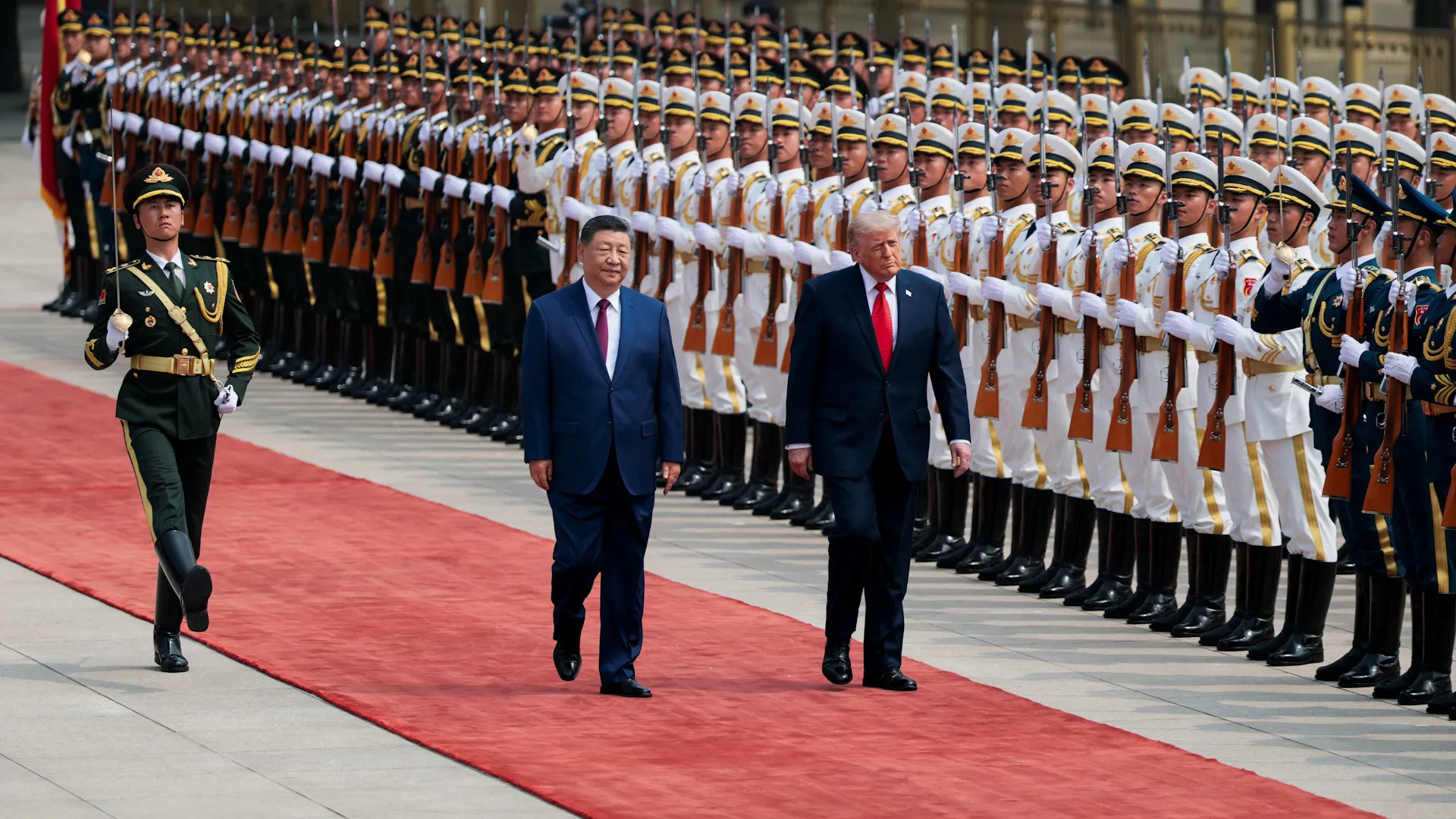
BEIJING — An extraordinary display of power and precision along Tiananmen Square greeted President Trump in Beijing on Thursday, kicking off a two-day summit with particularly high stakes for the Americans.
Trump’s meetings with his Chinese counterpart, Xi Jinping, began at the Great Hall of the People moments after a welcome ceremony that seemed to impress the president, featuring a Chinese military honor guard and a greeting from excited school children. American flags waved as “The Star Spangled Banner” rang out on a smoggy day in the heart of the capital.
Children holding Chinese and U.S. flags rehearse before the welcome ceremony for President Trump.
(Maxim Shemetov / Associated Press)
Trump reflected on the stakes of his visit at the top of the meeting, telling Xi that the ceremony was an honor “like few I’ve seen before.”
“There are those who say it may be the biggest summit ever,” he said. “I have such respect for China, the job you’ve done.”
Both men struck a conciliatory tone, despite the agenda for the summit featuring some of the thorniest issues facing the two superpowers today, from the U.S. war in Iran to trade relations and the future of Taiwan.
“We’ve gotten along — when there have been difficulties, we’ve worked it out,” Trump added. “We’re going to have a fantastic future together.”
Trump is expected to ask Xi for help reopening the Strait of Hormuz, a vital commercial waterway disrupted by Iran since the start of the war, and for the extension of a truce in the trade war he started at the beginning of his second term.
China, in turn, will ask the Trump administration not to proceed with arms sales to Taiwan, despite their approval by Congress, and for a declaration of opposition to Taiwanese independence. Beijing also seeks access to top-end chips made by American manufacturers.
Chinese President Xi Jinping and President Trump shake hands at the Great Hall of the People.
(Kenny Holston / Associated Press)
The agenda exposes the mutual dependence of the two rival superpowers, marked by distrust but driven by a quest for cooperation and stability.
The welcome ceremony outside of the Great Hall kicked off with Xi shaking the hands of Trump’s delegation, including figures such as his political advisor, James Blair, his communications director, Steven Cheung, and his daughter-in-law, Lara Trump.
They were just a few members of a U.S. delegation accompanying Trump filled with curiosities.
Chinese officials were surprised to learn that Pete Hegseth was joining Trump in Beijing this week, marking the first time a president has brought his secretary of defense on an official state visit. It wasn’t immediately clear to the Chinese what his inclusion was meant to convey.
Eric Trump, the president’s son, is here, seeking to leverage the family name for lucrative business deals as Beijing aggressively campaigns against government corruption at home. And First Lady Melania Trump decided to stay at home, an unusual snub of such a high-level event.
A contingent of U.S. business leaders was given little notice to prepare for the trip, including the CEO of Nvidia, who raced to join Trump aboard Air Force One at a refueling stop in Alaksa.
The diplomatic faux pas follow weeks of Chinese frustration over what they see as the Trump administration’s lack of preparation — a perceived display of incompetence that boosts their confidence heading into the negotiations.
Over the course of the visit, Trump is expected to visit the Temple of Heaven, a monument to imperial China and Confucian thought in the center of Beijing. Ahead of Trump’s arrival, an area roughly the size of 400 American football fields was closed in preparation for a stop here.
On Thursday night, local time, Trump will return to the Great Hall of the People for a banquet dinner. Additional meetings are scheduled for Friday morning before Trump departs midday for home.
Watch the highlights as Hearts beat Falkirk 3-0 to set up a final-day meeting with Celtic in which they only need to avoid defeat to win the Scottish Premiership.
May 13 (UPI) — The remains of a second U.S. soldier who went missing during exercises in Morocco earlier this month have been recovered, the U.S. military said Wednesday evening, ending a joint U.S.-Morocco search.
The remains of Spc. Mariyah Symone Collington, 19, of Tavares, Fla., were located and retrieved Tuesday from a coastal cave roughly 1,640 feet from where she and 27-year-old 1st Lt. Kendrick Lamont Key Jr. are believed to have fallen into the ocean, U.S. Army Europe and Africa said.
“The loss of Spc. Collington is a profound loss for the 10th Army Air and Missile Defense Command,” Brig. Gen. Curtis King, commanding general of the 10th Army Air and Missile Defense Command, said in a statement.
“Her recovery closes the search for our two missing soldiers, but our commitment to caring for their families, friends and teammates continues. We are grateful to the U.S. and Moroccan forces for their professionalism and support throughout the search.”
Key and Collington went missing May 2 near the Cap Draa Training Area, a coastal military training site near Tan-Tan, located in southwestern Morocco about 342 miles southwest of Marrakech, where they were participating in African Lion 26, this year’s iteration of the U.S. military’s largest Africa-based exercise.
Their disappearance was not related to active training. Military officials believe they fell into the Atlantic Ocean near cliffs during a recreational hike. They were reported missing the night of May 2 after a base-wide head count, prompting a joint U.S.-Moroccan search.
U.S. military officials said Collington’s remains were transported via helicopter by the Royal Moroccan Armed Forces to the morgue of Moulay El Hassan Military Hospital in Guelmim, about 80 miles northeast of Tan-Tan.
Moroccan and U.S. forces conducted a “dignified carry” at the military airport in Guelmim on Tuesday, and the remains of Key and Collington have departed Morocco for the United States, USAREUR-AF said.
“Spc. Collington was a bright light in this battalion,” said Lt. Col. Chris Couch, the 5-4 ADAR battalion commander.
“To the soldiers who knew her best and served alongside her each day, she was a treasured friend whose loss leaves a deep and profound void on our team.”
Students from Venezuela’s leading universities blocked the main highway in Caracas to demand the immediate release of political prisoners. Demonstrators said more than 450 people remain imprisoned despite government promises of amnesty and reconciliation.
Considering the amount of comedy that was dropped on L.A. last week for the third Netflix is a Joke Festival, the idea that anyone can see it all is laughable. Yet of course, like fools, once again we tried. Between big outdoor shows, theaters and intimate club gigs, the seven day smorgasboard of stand-up, improv, variety shows, marathons and more was a wild ride we won’t soon forget. Here is our list of the funniest shows we saw at Netflix is a Joke 2026.
Monday, May 4
Ron White, from left, Jim Jefferies, Sam Jay, Shane Gillis, James McCann and Dan Soder at the Hollywood Bowl.
(Adam Rose / Netflix)
Shane Gillis and Friends Hollywood Bowl As a sea of comedy fans filled up the Hollywood Bowl to kick off the first outdoor event at Netflix is a Joke, Shane Gillis brought the energy of a season-opening football game to L.A.’s biggest bandshell. Commanding a solid roster of veteran comics including James McCann, Sam Jay, Ron White, Dan Soder, and Jim Jeffries, Gillis took on the role of a grizzled and playfully perverse football coach hosting the night and telling funny stories about his days as a very average high school football player on crappy all-white teams before he blew up in comedy.
“Whoever the home team was in high school football you got to pick the intro song that you would run onto the field to to get hyped. So when me and the white guys were the home team, our music would be like ‘Cut my life into pieces…’ [singing Papa Roach’s “Last Resort”] something scary, something suicidal. That’s as intimidating as white dudes get…sad. Those are the most dangerous whites. If this game doesn’t go well I might shoot this whole thing up on Monday,” Gillis joked.
Fortunately it did go pretty well throughout the night as Gillis brought up each comic that used their different styles to score plenty of laughs throughout the night. (Nate Jackson)
Mike Ward Dynasty Typewriter
Comedy transcends lines and borders, so when we heard that comedian Mike Ward hopped his own border in Canada to be at Dynasty Typewriter, we were all in. Rachel Bonnetta opened the show with a mix of playful confidence and high-energy hilarity, perfectly warming up the crowd before introducing the main attraction to fans. Record breaker and a master of storytelling in French, he didn’t disappoint with his all-English crossover, covering everything from his legendary Supreme Court of Canada case to teenage lust, dating after marriage, attempting generosity, and “trunk love.” Ward mentioned jokes translating from French to English and how they’d hit, but he was definitely in his element, and it all translated to perfect laughs. (Ali Lerman)
Tuesday, May 5
Theo Von and Mike Tyson record a live podcast at the Wiltern.
(Matthew Salacuse/Netflix )
Theo Von: ‘This Past Weekend’ Live- Guest: Mike Tyson- The Wiltern
Stand-up might own the Netflix Is a Joke Festival, but the podcasts they delivered are absolutely worth talking about. For Theo Von’s first-ever live taping of his hit podcast “This Past Weekend,” he landed the ultimate guest: Iron Mike Tyson. The sold-out crowd at the Wiltern erupted the second Von hit the stage, but that was nothing compared to the deafening roar of screams and “We love you, Mike!” when Tyson walked out.
Tyson admitted he wasn’t familiar with Von, but thankfully stated he did indeed like him, because that would have really messed up the rest of the episode! The two share an inquisitive and child-like energy, turning heavy conversations about growing up broke, the solitude of incarceration, and desperate cries for attention, into something remarkably light. Tyson’s vulnerable side was also on display while speaking about his daughter dying tragically, God’s plan for him, and speaking about his mentor Cus D’Amato, which quite literally brought him to tears. Can a show be heartfelt and insane at the same time? Definitely interested to see how they edit a few things, but when this knockout episode comes out, you’re truly in for a beautiful treat packed with plenty of wild moments. (A.L.)
Seinfeld featuring Leanne Morgan The Greek Theatre
Blending the big-city humor with hilarious Southern comfort might sound like an odd pairing when talking about comedy, but something about the combo of Jerry Seinfeld and Leanne Morgan just works. Yes, we love a good rant about the terrors of technology from a comedy legend like Seinfeld, who got famous long before the advent of artificial intelligence and smartphones. But his crotchety comedy on a cold night at the Greek Theatre was complimented by Morgan’s ability to add warmth and sweetness to her smack talk about being a small town cheermom in the world of competitive cheerleading which she described as “the Olympics meets Honey Boo Boo.”
Most big comedy shows at the fest had a strict no cellphones policy, Seinfeld was content with just reminding us that our friends are all sick of our stupid cellphone videos. “They don’t care what you’re doing, your life, your experiences, any more than you care about what your friends are doing…everyone is sick of everything. That’s where we’re starting tonight.”
Both are recognized around the world for being on popular TV shows bearing their names. One star seemed genuinely enthralled that people recognized her and clapped when she came out, the other one seemed like he couldn’t get out of the show fast enough and get back to bed. But the mix of both energies of these authentic polar opposites worked well together to keep the crowd laughing. (N.J.)
Wednesday, May 6
David Spade, Dana Carvey and Chris Rock at the Orpheum Theatre.
(Kit Karzen / Netflix)
‘Fly on the Wall’ podcast with Dana Carvey, David Spade and Chris Rock The Orpheum Theatre
The best way to get amazing stories out of a famous comedian is to be one yourself. It’s the reason a podcast like “Fly on the Wall” with David Spade and Dana Carvey succeed at squeezing the best out of their guests who are often on somebody’s Mt. Rushmore of Comedy. For the festival, the two “Saturday Night Live” alumni brought out the big guns by inviting their buddy Chris Rock downtown — ”way downtown” by his estimation — at 6 p.m. last Wednesday to the Orpheum for a live taping of the podcast. The three stars began by diving ever-so-casually into stories about their interactions with Michael Jackson, Tupac, Kanye and Dave Chappelle. Rock also got to expound on the classic period where he released some of the best comedy specials ever made.
He talked about his groundbreaking hour “Bring the Pain” being the result of doing as many shows as possible to pay for a divorce and as a result, “I got way better” he told Carvey and Spade. “Then I went on a Rocky run where he was knocking motherf— out.” He took that momentum into his next classic special, 1999’s “Bigger & Blacker,” that helped reshape the face of stand-up. “There’s a time in your life when you’re just a vessel and I was in that point of my life,” Rock said. (N.J.)
Nate Jackson at Laugh Factory Hollywood
It’s a skill for a comedian to be able to sit in the pocket of a crowd’s energy and keep a room full of people laughing and on their toes at the same time. Try doing it for six shows back to back. While it’s not the most consecutive sold-out shows he’s ever done at a venue (last year he delivered nine in a row at Zanies in Nashville), Nate Jackson’s ability to leave a mark on the fest at his week-long residency at Laugh Factory Hollywood was akin to watching an executive chef doing a week of cooking in his restaurant. In Jackson’s case that meant delivering some third-degree burns in the front several rows of the crowd known as the “roast zone.” When it comes to killing his customers Jackson prefaces every show the same way. “Rule number one, if I look at you and you don’t want no smoke, look away,” he told the Laugh Factory crowd.
“That is the rule and the standard, I do not get people unless they lock eyes and give me consent. As a matter of fact, this is called the Roast Zone. If anybody is accidentally down there, it’s time to get the f— out. Because rule number two is, if I look at you and you look at me and I start and you don’t like what I decided to talk about, looking away will no longer save you.” To the people that got a little too charred during his show, don’t say he didn’t warn you. (N.J.)
Thursday, May 7
Noah Wyle and Jon Stewart at the Hollywood Bowl.
(Adam Rose / Netflix)
Night of Too Many Stars Hollywood Bowl
It was a starry, starry night at Thursday’s sold-out Hollywood Bowl Netflix is a Joke Presents: Night of Too Many Stars epic comic bonanza fundraiser benefitting autism programs nationwide, including Autism Speaks. Founded in New York by writer-producer Robert Smigel and his wife Michelle in 2003 following their son Daniel’s autism spectrum disorder diagnosis, the Los Angeles gala was hosted by longtime supporter Jon Stewart and featured a roster of top–tier stand-up talent including Niki Glaser, Ali Wong, Conan O’Brien, Tiffany Haddish, Sarah Silverman, John Mulaney and Adam Sandler, who closed the show with a trio of upbeat tunes. Cast members of reality shows such as “Love on the Spectrum” were also on deck to introduce comics, and auction items throughout the event raised crucially needed funds for individuals on the spectrum: a mock “physical examination” by Noah Wyle, star of HBO’s juggernaut medical series “The Pitt” fetched $18,000; a woman paid $50,000 to be animated into an episode of “The Simpsons.” One man stood up and donated $100,000 with no prize attached. The most special part of the night: I attended along with my son, 19, who is on the autism spectrum and laughed and smiled for three hours straight. (Malina Saval)
Wanda Sykes Dolby Theatre
Politics, family, inflation, racism, weight gain and greed were among the multiple topics lampooned by Wanda Sykes during a dynamic and often wickedly funny tour stop at the Dolby Theatre last Thursday. Despite the large venue and packed-in audience, Sykes created an intimate club vibe, walking onstage in a utilitarian jumpsuit and instantly bonding with the audience over just how weird things have become in present-day America.
She likened 2026 to the Upside Down in “Stranger Things,” but populated with pedophiles, grifters and racists instead of demogorgons. Turn it upside down “and a billionaire falls through the ceiling,” she said. Her impersonation of Trump dancing and chatting with Epstein in the now infamous video clip was pure brilliance. How a 5-foot-2 Black woman looked more Trump than Trump was a feat unto itself.
Sykes also bemoaned the greed behind things marketed as conveniences, like supermarket self-checkout (“We’re working for free!”), food delivery bots and airport wheelchairs that get passengers to their gate without attendants. “That was someone’s job!” she said. Then added, “What if walking fast and [pushing heavy things] was the only thing they were good at?” Opening for Sykes was her former sidekick on “The Wanda Sykes Show,” Keith Robinson. (Lorraine Ali)
“Kill Tony” Intuit Dome
The number one live podcast in the world, “Kill Tony,” returned to its roots in our beloved city on Thursday, and this time for the local masses at Intuit Dome. Co-hosted by Tony Hinchcliffe and Brian Redban, when there’s a show of this caliber during a festival, you just know the guests are going to be jaw droppers. Fighting the L.A. traffic to kick off the Dome show were Jelly Roll and Teddy Swims backed up by the Kill Tony Band, maybe? You know, it was hard to hear through all the women screaming. Kidding, we were all scream-singing, and it was such a fun way to start a show. Sitting on panel were beloved KT guests Harland Williams and Gabriel Iglesias, and the “legends bucket” made its way to its first arena in L.A., and the pulls were indeed clutch. Ron White, Joe DeRosa, and Tony’s number one favorite comic, Tony Hinchcliffe (played by Adam Ray), showed the crowd exactly what effortless and absolutely merciless veteran comedy looks like. Between bucket pull madness, a ton of Golden Ticket winners dazzled throughout, treating L.A. to a little slice of what we see in Austin on Mondays. (AL)
Friday, May 8
“Stamptown” at the Montalbán Theatre.
(Aaron Epstein / Netflix)
‘Stamptown’ Montalban Theater
Comedy variety show “Stamptown” begins with master of ceremonies Jack Tucker (the clown persona of Zach Zucker) descending from the ceiling covered in sweat as pyrotechnic flares explode on stage and electric guitars summon him before he falls flat on his face. But don’t worry, it only gets more insane from there. Part musical revue, part comedy showcase, and part circus — “Stamptown,” which filmed its shows for an upcoming Netflix special, is what happens when the lunatics get control of the asylum and decide to put on a Las Vegas show from hell. Tucker’s rapid-fire delivery is punctuated with sound effects, music cues, and the use of a variety of props dangling from his person at all times (including handcuffs, a wad of cash, and two guns). Featuring celebrity cameos, acrobatic stunts, full-frontal nudity, and the show’s stagecrew and audience members getting in on the chaos — “Stamptown” is a true homage to the theatrical possibilities of performance that toes the line ofwhat you think is possible to be done under the label “comedy show.” “Stamptown” at the Montalbán was filmed as part of a Netflix special that will air later this year, which any lover of brain rot and pageantry should be sure to check out. (Leila Jordan)
Dave Chappelle The Palladium We’re not allowed to say anything about went on at the Dave Chappelle three-show residency at the Palladium other than the fact that it was an evening of music and comedy. Per usual they locked up the crowd’s phones to see his show but fortunately there were plenty of actual cameras capturing what went on so hopefully you get to see what we saw very soon. (NJ)
Hasan Minhaj versus Ronnie Chieng Dolby Theatre Known for their spirited debates on “The Daily Show,” political satirists Hasan Minhaj and Ronny Chieng faced off in a comedy showdown where they challenged one another to prove who is better suited to fix a broken America, Asians (Chieng is from Malaysia) or Indians (Minhaj’s parents are from India)?
Never mind that Indians are South Asians, the two comedians got plenty of laughs backing up their absurd arguments with flow charts, graphs, curated news clips, a faux AI bot called “Niri,” and plenty of racist rhetoric. They broke down the debate into categories: Who’s better at academics? Business and the economy? Cuisine? Chieng argued that Asians are better at sports with a list of Olympic gold medal wins over the past three Summer Games. He won’t use all of Asia, he said, just China. Result? The country had over 100 gold medals. India had just one. Minhaj wondered aloud: For people who love gold so much, why is it so hard for us to win one?
Their choreographed debate exploited and skewered stereotypes via expert timing and pointed wit, hitting home with the predominantly Asian and South Asian audience. (L.A.)
Saturday, May 9
Atsuko Okatsuka with Margaret Cho and Trevor Noah at the Orpheum.
(Andrew Max Levy / Netflix)
Atsuko Okatsuka The Orpheum Theatre
An Atsuko Okatsuka show is typically full of surprises as a result of her offbeat humor and twerk-master physicality. Her show at the Orpheum is the result of a brand-new hour she’s been performing on her Big Bowl Tour and includes plenty of jokes about dinosaurs and love of Jamaican dancehall choreography. But before she even took the stage with new material, fans got gleefully blindsided by the appearance of two comedy titans, Margaret Cho and Trevor Noah, who came out to deliver punchy opening sets that got loads of laughter to set the tone for Okatsuka’s evening of examining reality through her absurdist lens as an artistic performer who often feels like she’s from another planet. At the end of the show she announced that after releasing her first two specials on HBO (“The Intruder” in 2022) and Hulu (“Father,” which came out in 2025) her next special will be released (surprise!) on Netflix in 2027. (N.J.)
‘My Crazy Ex-Girlfriend’ Reunion
“Crazy Ex-Girlfriend” premiered on the CW Network in 2015 and managed to tell a complete four season story about mental illness in a musical comedy series that featured parody songs on everything from “Cats” to modern pop music to Jewish folk songs. Seven years after it ended, the cast and creatives behind the show reunited to perform a stripped-down selection of the series’ beloved songs. But this concert is not meant to serve as an introduction for those unfamiliar with the original show. The reunion performance is a tribute both to the miraculous existence of “Crazy Ex-Girlfriend” and to the devoted fans who still know all the words to songs like “Let’s Generalize About Men” and “Don’t Be a Lawyer.” (L.J.)
James McCann Hollywood Improv (Main Room)
Australian-born comedian James McCann topped the bill Saturday night at the Hollywood Improv, and the eclectic crowd packed the place ready to celebrate his arrival in L.A. Host Benton Harshaw and openers Ruby Setnik and Sam Campbell absolutely connected and killed. And if my word count were double, they’d get individual praise for setting the room up perfectly. High energy was the vibe when McCann got on stage to wild roars from the 9:30pm early show crowd and his energy match, noting he was excited to be at the historic club himself. Mullet looking flawless, poems in tow, and dark humor dialed to an 11, he questioned L.A.’s homeless crisis, may have questioned the audience a bit too much, and tore through his thoughts on a census overhaul, the insanity of the TV show “Survivor” (yes, it’s still on), the glory days of drinking, and having visions of finally being successful enough to hire his dream team. (A.L.)
Tom Segura, left, and Bert Kreischer speak during the Two Bears 5k event at the Rose Bowl.
(Jerod Harris / Getty Images for Netflix)
2 Bears 5K Rose Bowl
Can’t. Type. Too. Sore. And that’s not even from the run-walking, it’s from the afterparty inside Rose Bowl Stadium in Pasadena. Whether you kicked off this magical day of athleticism in downward dog with Ari Shaffir, or if you went straight for the starting line with Bert Kreischer, Tom Segura, and a svelte-looking Jelly Roll (bravo!), there was stretching, pacing, sweating and rejoicing to be had. The hang was so casual it allowed participants to rub elbows with a surplus of comics on hand like H. Foley, Kevin Ryan, Steph Tolev, Jefferson McDonald, Joe DeRosa, Jessimae Peluso, Greg Fitzsimmons, Daphnique Springs, Brittany Ross, Ian Fidance, Kim Congdon, and Dave Williamson. The finish line led runners directly into the Rose Bowl where there was plenty of Por Osos flowing, snacks, interactive games and recovery stations, and a live taping of 2 Bears 1 Cave with our favorite boys and celeb participants.
Sunday, May 10
Marcello Hernandez performed with Feid at the Hollywood Bowl on Sunday.
(Koury Angelo / Netflix)
Marcello Hernandez and Feid Hollywood Bowl
On “Saturday Night Live,” he plays a Latin Lover named Domingo. But at the Hollywood Bowl on Mother’s Day Sunday, headliner Marcello Hernández riffed on his real life as a mama’s boy growing up in Miami — expanding on material from his 2026 Netflix special, “American Boy” — and duly invited out his mom, Isabel, who was met with a standing ovation. “God gave me a mother who worked her entire life for me,” said Hernández, who eased on his elastic goofball schtick to exalt immigrant mothers. “Today, I give thanks to her — and to all the mothers who are here, as well as those you left back home.”
Attended by nearly 17,000 people, the Bowl’s biggest Spanish-language comedy event also featured a special (and sensual) musical performance by Colombian reggaeton heartthrob Feid, as well as Mexican comedian Sofia Niño de Rivera, who opened the show with her own riotous act. At some point she asked the audience if beating piñatas had been canceled by the woke mob; you’ll just have to trust me when I say it’s even funnier in Spanish. (Suzy Exposito)
Roast of Kevin Hart Kia Forum Los Angeles showed up to the Forum in Inglewood for the roast of Kevin Hart, the comedian we love to hate but also love to laugh with. It was a brutal takedown of Hart that could only be accomplished by the utmost respect and love from his peers. A surprise appearance by his longtime rival Katt Williams brought the entire house to their feet. Sheryl Underwood expertly executed the punchlines and made the culture the star of her set. Chelsea Handler could have been the star of her own show. The Rock’s WWE entrance brought the heat of the pyrotechnics to the stage with his explicit propositioning of Hart’s wife, Eniko, and an attempt to breastfeed Hart. Some controversial jokes by lesser, edgy comedians fell flat but Jeff Ross, the master of roasts, held the tempo together and kept the roast moving forward. There was something for everyone in this, as Hart, the hardest working person in comedy, has become famous for. (Janelle Webster)
Flight of the Conchords The Greek Theatre
Experiencing Flight of the Conchords at the Greek is something many fans of their lusty, yet-bone-dry musical comedy haven’t gotten to experience in a while. It’s been eight years since Jemaine Clement and Bret McKenzie have put us on “Business Time” with their stripped down odes to sexy R&B mixed with a hint of yacht rock, hip-hop power pop and whatever else they decided to throw together from their bag of classic jams that earned them fans in the early aughts. Following a killer opening set from comedian Arj Barker, Flight of the Conchords took the stage looking a bit more like silver foxes than young birds, which made the timeless chuckle-inducing tunes like “Robots,” “The Most Beautiful Girl (In the Room),” “Hurt Feelings” and “Business Time” land with even more impact as the crowd enjoyed some long-awaited nostalgia. Did they forget a few lyrics? Miss some solos? Mess up entire songs? Sure! But with a dose of Kiwi banter and the ability to laugh at themselves, the mistakes only made the show funnier and a reminder of why we’ve missed them. (N.J.)
“I’m very pleased to report that 2026 is off to a strong start” and the company “deliver[ed] first quarter net revenue of $16.7 million, an increase of 65% year-over-year and 16% sequentially,” with “first quarter gross margin” at “77.7%,” according to (Executive chairman, CEO & president
Seeking Alpha’s Disclaimer:This article was automatically generated by an AI tool based on content available on the Seeking Alpha website, and has not been curated or reviewed by humans. Due to inherent limitations in using AI-based tools, the accuracy, completeness, or timeliness of such articles cannot be guaranteed. This article is intended for informational purposes only. Seeking Alpha does not take account of your objectives or your financial situation and does not offer any personalized investment advice. Seeking Alpha is not a licensed securities dealer, broker or US investment adviser or investment bank.
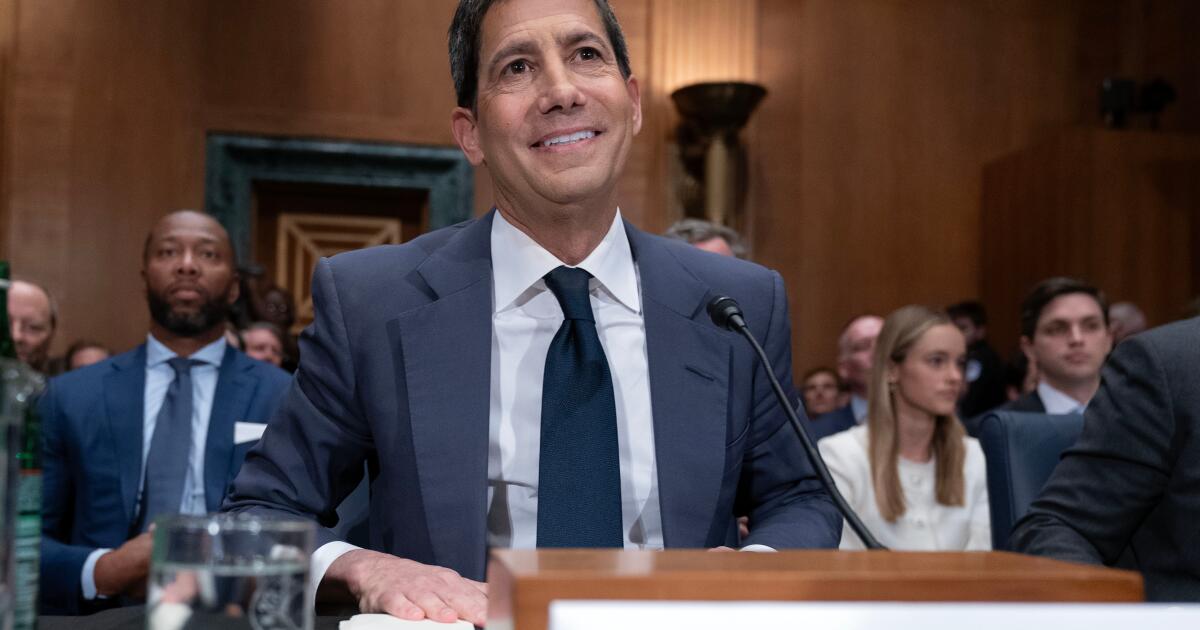
WASHINGTON — The Senate confirmed President Trump’s nominee to lead the Federal Reserve, Kevin Warsh, bringing new leadership to the world’s most powerful central bank at a fraught moment for the global economy.
Warsh was confirmed Wednesday in a largely party-line vote. His nomination had been thrown into doubt in recent months after Republican Sen. Thom Tillis of North Carolina said he would block the nomination while the Justice Department investigated Fed Chair Jerome H. Powell. The Powell inquiry was dropped in April, clearing the way for the Senate to confirm Warsh.
Senate Majority Leader John Thune (R-S.D.) urged colleagues to support Warsh during a floor speech Wednesday morning, saying it’s crucial that a Fed chair “understand not only the macro” but also “appreciate the microeconomy: and that’s the hardworking Americans, their jobs and their livelihoods.”
“Kevin Warsh is just such a person,” Thune said.
Warsh, 56, a former top Fed official, will become chair at an unusually difficult time for the independent agency.
Inflation has topped the Fed’s 2% target for five years and is now rising faster because of surging gas prices. The Fed’s interest rate-setting committee is divided and saw the most dissenting votes in more than three decades last month. And Powell, after years of personal attacks from the Republican president and an unprecedented legal investigation by the Justice Department, plans to stay on the Fed’s board even after his term as chair ends, potentially creating a competing power center.
Trump has demanded change at the Federal Reserve
The Fed has faced numerous threats to its independence from Trump, who has repeatedly attacked Powell for not cutting interest rates. Trump also sought to fire Fed Gov. Lisa Cook and launched an investigation into brief Senate testimony by Powell on a building renovation.
Kevin Hassett, director of the White House’s National Economic Council, said in a Fox News interview on Sunday that he believes the markets are relieved that Warsh “is going to help lower interest rates over time.”
“Obviously, data driven,” said Hassett. “I’m not putting any pressure on Kevin Warsh.”
In December, Trump said on his social media platform that he wanted a Fed chair who would cut interest rates when the stock market rose — the opposite of what traditional economics would prescribe — and added, “Anyone that disagrees with me will never be the Fed chairman!”
Trump’s comments have fueled concerns over whether Warsh will set rates based on economic conditions or seek to cut rates to appease Trump, even if doing so could worsen inflation. At Warsh’s confirmation hearing last month, Sen. Elizabeth Warren, a Democrat from Massachusetts, derided him as a “sock puppet” for Trump. Warsh declined to say that Democrat Joe Biden had won the 2020 election against Trump, who has falsely claimed that voter fraud cost him reelection.
Still, Warsh denied at the hearing that Trump had pressured him to reduce the Fed’s key rate.
“The president never once asked me to commit to any particular interest rate decision, period,” Warsh said then. “Nor would I ever agree to do so if he had. … I will be an independent actor if confirmed as chair of the Federal Reserve.”
A critic of the Fed’s leadership in the past
Warsh has been highly critical of the Fed’s recent track record, particularly the inflation spike in 2021-22, the worst in four decades, and has called for “regime change.” Yet he has provided only broad outlines of what that change would involve.
He has called for limiting the Fed’s communications, which would be a sharp shift after decades of increasing transparency. He has argued that some of its communications tools, such as quarterly forecasts of where its key rate may head, have made it harder for officials to switch gears.
Senate Democrats also have condemned Warsh for not fully divulging the details of his extensive wealth, which disclosures show amounts to at least $100 million. His investments include stakes in Polymarket and SpaceX, but he hasn’t revealed how large those holdings are. He promised to sell all such assets within 90 days of being sworn in.
“He will be the wealthiest Fed chair in history, but he refuses to provide transparency to the American people about who he is entangled with,” Warren said.
Warsh faces difficult economic conditions
The Fed is still grappling with how to respond to the 50% jump in gas prices from the Iran war. The increase has boosted inflation, which reached 3.8% in April.
The Fed is tasked by Congress with keeping prices stable, which it seeks to do by raising its short-term rate to make borrowing and spending more expensive, cooling growth and inflation.
The Fed typically looks past temporary price increases that stem from supply disruptions, such as the war’s cutoff of oil through the Strait of Hormuz, because those prices typically level off — or even fall back down — once the supply is restored.
But the Fed also followed that approach after the COVID-19 pandemic snarled global supply chains for goods, lifting prices for things such as cars, furniture and electronics. Inflation turned out to last longer than expected, and Powell and other Fed officials have acknowledged they waited too long to raise rates. Inflation surged to 9.1% by June 2022.
The Fed’s rate-setting committee has kept rates unchanged for three straight meetings as it evaluates the effect of the gas price spike. At its most recent meeting last month, three members of the committee objected to language that suggested its next move would be a rate cut. They preferred more neutral language that would allow for a hike. Many Fed watchers saw those dissents as a warning shot to Warsh that he won’t be able to easily engineer rate reductions.
A fourth member of the 12-member committee, Stephen Miran, dissented in favor of a rate cut, as he has at every meeting since Trump appointed him to the Fed’s board last September. Miran is serving until a replacement is named, and Warsh will take his spot.
Powell, meanwhile, said at a news conference April 29 that he would remain as a Fed governor until the Justice Department closes its investigation into the Fed’s building project, the first time a chair may stay on the board for an extended period since 1948. His term as a governor lasts until January 2028.
U.S. Atty. Jeanine Pirro has dropped the government’s investigation, but she has said it could be reopened if the Fed’s inspector general office, which has looked into the renovation project since last July, finds evidence of criminal activity.
Rugaber and Cappelletti write for the Associated Press.
Watch the highlights as Celtic score a controversial late penalty to win at Motherwell and take the Scottish Premiership title race to a final-day decider against Hearts.
Families of 10 Pakistani crew members taken hostage by Somali pirates have rallied in Karachi to demand their release. The crew of the Honour 25 have been held for more than three weeks. Hijackings off the coast of Somalia are on the rise in the wake of the US-Israeli war on Iran.
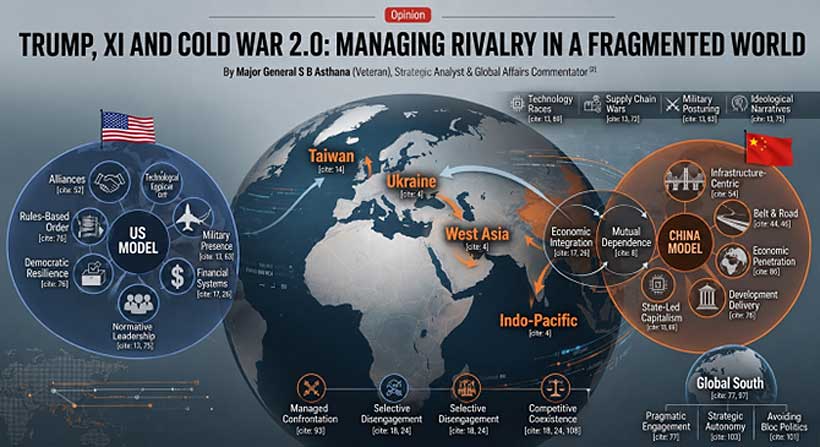
The world today is no longer witnessing isolated geopolitical crises. From Ukraine and West Asia to Taiwan and the Indo-Pacific, almost every major flashpoint bears the imprint of an expanding strategic contest between the United States and China. The emerging order increasingly resembles a “Cold War 2.0” — though very different in structure, methods and consequences from the US-Soviet rivalry of the 20th century.
Unlike the earlier Cold War1.0, the present contest is not defined by ideological blocs alone. The US and China remain deeply intertwined economically, technologically and financially even as they posture against each other militarily, diplomatically and strategically. It is therefore a paradoxical competition: adversarial coexistence under conditions of mutual dependence.
The forthcoming summit between US President Donald Trump and Chinese President Xi Jinping in Beijing assumes significance far beyond bilateral optics. It is not merely about tariffs or trade balances. It is about whether the world’s two largest powers can manage competition without pushing the international system into prolonged instability.
Cold War 2.0: Similarities and Differences
There are unmistakable similarities between the old Cold War and the current strategic rivalry. Technology races, military posturing, proxy theatres, sanctions, espionage, supply-chain wars and ideological narratives are again shaping global politics. Taiwan today resembles what Berlin once symbolised during the original Cold War — a potential trigger point with global implications.
Yet the differences are even more important.
The US and Soviet Union operated largely in separate economic ecosystems. In contrast, America and China remain deeply integrated through trade, manufacturing, investment flows and technological supply chains. As a result, Cold War 2.0 is less about total decoupling and more about selective disengagement, strategic denial, and competitive coexistence. China’s rise has also changed the nature of power transition; unlike the Soviet Union, China is economically embedded within the global capitalist system while simultaneously challenging Western strategic dominance. Beijing does not seek immediate overthrow of the international order; rather, it seeks gradual restructuring of global institutions and norms to reflect Chinese power and preferences.
Because of this interdependence, direct conflict is expensive for both parties. As a result, selective disengagement, strategic denial, and competitive coexistence are more important in Cold War 2.0 than total decoupling.
The nature of power transitions has also changed as a result of China’s growth. China, in contrast to the Soviet Union, both challenges Western geopolitical dominance and is economically integrated into the global capitalist system. Beijing aims to gradually restructure international institutions and norms to reflect Chinese strength and preferences rather than topple the current international order.
Trump’s Return: Strategic Pressure with Transactional Flexibility
President Trump’s return has introduced a more personalised and transactional dimension to US-China relations. His approach combines aggressive economic nationalism with pragmatic deal-making. Trump views geopolitics substantially through the prism of economic leverage, tariffs, industrial revival and negotiated advantage.
During his earlier tenure, Trump launched the trade war against China, challenged Chinese technological expansion and questioned assumptions of unlimited globalisation. In his second term his tariff rhetoric and coercive stance seems tampering down by Beijing’s stiff retaliation and domestic vows through courts; hence appears focused on “managed competition” rather than ideological confrontation.
Current indications suggest that Trump seeks three broad objectives from Beijing:
Reduction of trade imbalances and greater market access for American companies.
Chinese restraint regarding Iran, fentanyl precursors and strategic technology transfers.
Taiwan and Indo-Pacific tensions should be relatively stable to prevent unchecked escalation. At the same time, Trump appears willing to negotiate tactical understandings with Beijing if they produce visible economic or political gains domestically.
This reflects an important distinction between traditional American strategic establishments and Trump’s worldview. Washington’s institutional security establishment and deep state often sees China as a long-term systemic challenger. Trump, however, also sees Beijing through the lens of bargaining opportunity. This creates unpredictability both for allies and adversaries.
Xi Jinping’s China: Strategic Patience and Controlled Assertiveness
If Trump represents transactional nationalism, Xi Jinping represents centralised strategic continuity with greater diplomatic maturity.
Beijing’s military modernisation, naval expansion, technological aspirations, and Belt and Road outreach reflect a long-term strategy aimed at reducing dependence on the West while enhancing China’s centrality in global affairs. Under Xi’s leadership, China has evolved from a cautious economic power into an increasingly assertive geopolitical actor. Beijing’s long-term objective to lessen reliance on the West and increase China’s influence in world affairs is reflected in its military modernisation, navy expansion, technological aspirations, and Belt and Road outreach.
Xi’s leadership style is marked by centralised authority, ideological discipline and strategic patience. Unlike the short electoral cycles of Western democracies, China’s leadership can pursue long-duration geopolitical objectives with consistency.
Beijing today appears more confident than during Trump’s first presidency. Despite economic headwinds, demographic pressures and property-sector challenges, China has strengthened domestic technological capabilities and diversified export networks.
China’s approach to global dominance differs fundamentally from America’s traditional model.
The United States historically exercised leadership through alliances, military presence, financial systems and institutional influence. Its dominance relied substantially on coalition-building and normative legitimacy, an approach, which seems to be eroding under President Trump, America First/America only agenda.
China’s model is more infrastructure-centric, economically transactional and state-driven. Beijing prefers influence through trade dependency, technology ecosystems, strategic investments and manufacturing centrality. It avoids formal alliances but expands leverage through economic penetration and calibrated coercion.
In essence, Washington exports political influence backed by military power to dislodge all potential competitors; Beijing exports economic dependency backed by state capacity aims at not dislodging potential markets to include U.S., EU and India.
The Taiwan Factor and Indo-Pacific Competition
No issue captures Cold War 2.0 more sharply than Taiwan.
For China, Taiwan remains a core sovereignty issue tied to national rejuvenation. For the United States, Taiwan represents strategic credibility, Island chain dominance in the Indo-Pacific and the larger balance of power against China.
Neither side currently appears to seek direct military confrontation. Yet both are steadily preparing for prolonged strategic competition around Taiwan. China continues military signalling and grey-zone pressure, while the US strengthens Indo-Pacific partnerships and defence arrangements.
Trump’s Beijing visit is therefore expected to prioritise “stability management” rather than dispute resolution. Beijing seeks assurances against perceived American encouragement of Taiwanese independence and military capacity building, while Washington seeks deterrence against coercive reunification efforts.
With recent claims of President Trump on Greenland, Canada, and Panama and actions in Venezuela, he doesn’t have any moral leverage to lecture China on Taiwan, because his security concerns over these areas are woefully short of Chinese security concerns of Island chains. Thus the reality of Cold War 2.0 is more of escalation management more than genuine reconciliation, as competition remains.
The Real Issue: Supply Chains and Technology Agendas
Artificial intelligence, semiconductors, rare earths, cyber systems, quantum technologies and critical supply chains have become strategic weapons. Economic security is increasingly inseparable from national security.
America still leads in advanced innovation ecosystems, financial influence and military alliances. China dominates large parts of manufacturing, industrial supply chains and infrastructure scalability.
The contest is therefore asymmetric. Washington seeks to slow China’s technological ascent through export controls and alliance-based restrictions. Beijing seeks self-reliance through indigenous innovation and strategic diversification.
Simultaneously, both nations are competing to shape global narratives.
The US projects democratic resilience and rules-based order. China projects efficiency, development delivery and non-interference. Many countries in the Global South increasingly engage both sides pragmatically rather than ideologically.
US-Israel War on Iran: Uneasy Calm Amid Strategic Contestation
China and the United States both need regional stability in Middle East to avoid economic shockwaves and disruption of global energy flows, but their strategic intentions are quite apart. Trump led America’s action plan, duly influenced by Israeli lobby includes military action, coercive deterrence, and the retaining American strategic dominance in West Asia, especially Petro-dollar domination. China, on the other hand, is attempting calibrated balance, openly supporting de-escalation while covertly defending its long-term geopolitical, economic, and energy links with Tehran.
Beijing will refrain from any overt alignment that could lead to direct conflict with Washington, but it is unlikely to desert Iran. China seems confident that it can endure supply chain crisis in Strait of Hormuz longer than Trump and Iran. In any case a over-engaged US with depleted reserves works towards Chinese strategic advantage.
The larger strategic picture shows for Beijing, the crisis offers an opportunity to project itself as a responsible stabilising power while gradually expanding influence through economic leverage and diplomatic positioning; as a result, the likely outcome is not cooperation in the classical sense, but competitive crisis management—limited convergence to avoid uncontrolled escalation, while China advances through strategic patience, economic penetration, and calibrated diplomacy. Demonstrating credibility and deterrence to adversaries, such as China, is another goal for Washington in the Iran theatre.
Thus, Iran becomes yet another arena in which China gains through strategic patience, economic penetration, and calibrated diplomacy, while the US primarily depends on military power and a weakening alliance structures.
Likely Outcomes of the Trump–Xi Engagement: Competitive Coexistence, Not Resolution
Expectations from the Trump–Xi engagement must remain realistic and free from rhetorical overstatement. The structural contradictions driving US–China rivalry — Taiwan, technological dominance, supply chain control, military competition, sanctions regimes and competing visions of global order — are too deep to be resolved through summit diplomacy alone. At best, both sides may seek temporary stabilisation of tensions to avoid simultaneous economic disruption and strategic overstretch. Therefore, the likely outcome is not reconciliation, but managed confrontation under conditions of deep interdependence.
Trump’s pressure tactics may slow certain aspects of China’s technological rise and compel tactical adjustments, but they are unlikely to reverse Beijing’s long-term strategic trajectory or ambition for greater influence in global governance structures.
Equally, China is not positioned to replace the United States as a singular global hegemon, as yet. Internal economic pressures, demographic decline, debt vulnerabilities, trust deficits and the absence of robust alliance structures remain important constraints on Chinese power projection.
Consequently, the more plausible scenario is a prolonged strategic contest marked by partial economic bifurcation in critical technologies, competing digital and AI ecosystems, intensified military signalling in the Indo-Pacific, and expanded geopolitical competition across the Global South through infrastructure financing, trade dependency, arms transfers and narrative warfare.
Emerging World Order: What should remaining World Do?
Cold War 2.0 will not produce a neat bipolar world nor purely multipolar. Unlike the 20th century, today’s international system is multipolar, economically interconnected and technologically diffused. Middle powers such as India, regional blocs and strategic swing states will play increasingly important roles in shaping outcomes through strategic balancing avoiding bloc politics. The aim remains to avoid collateral damage in a competition, which neither U.S. nor China can decisively win in the foreseeable future.
The prudent course lies in strategic autonomy backed by economic resilience, technological self-reliance, diversified partnerships and flexible diplomacy. Nations will increasingly pursue sector-specific alignments while resisting pressure to become instruments of either camp’s maximalist strategic narratives.
In this evolving landscape, Trump’s coercive unilateralism and “America First” orientation may paradoxically accelerate the very multipolarity Washington seeks to resist. Many nations, including close American partners, increasingly seek strategic hedging against unpredictability in US policy, even while remaining cautious of China’s expanding influence and coercive economic practices
Cold War 2.0 is unlikely to end through a dramatic collapse or military victory. It will instead remain a long geopolitical test of endurance, adaptability, economic resilience and strategic patience in an era of competitive coexistence, issue based cooperation and crisis management below the threshold of military confrontation.
Trump’s leadership may make the contest louder, sharper and more transactional, while Xi’s China may continue pursuing calibrated expansion with long-term strategic discipline. Yet the underlying structural reality remains unchanged: the US–China rivalry is here to stay, and the rest of the world must learn to navigate carefully between pressure and prudence, rhetoric and reality, competition and coexistence.
BARBIE actress Margot Robbie stands and delivers in a dandy highwayman outfit.
The Aussie, 35, wore a black tailcoat jacket with gold embroidery — like 1980s singer Adam Ant.
Sign up for the Showbiz newsletter
Thank you!
Margot Robbie stands and delivers in a dandy highwayman outfitCredit: GettyAussie Margot wore a black tailcoat jacket with gold embroideryCredit: Splash
She was attending the London West End premiere of the play 1536 — a drama about three Essex women set in Tudor England during Anne Boleyn’s downfall.
Margot, a producer on the play, said at The Ambassadors Theatre: “The conversations these women have are the same ones that women now are having.”
Earlier this year we revealed how Margot was named the world’s most beautiful woman.
The Aussie beat fellow actressScarlett Johannsonto the honour in the poll organised by website Ranker.
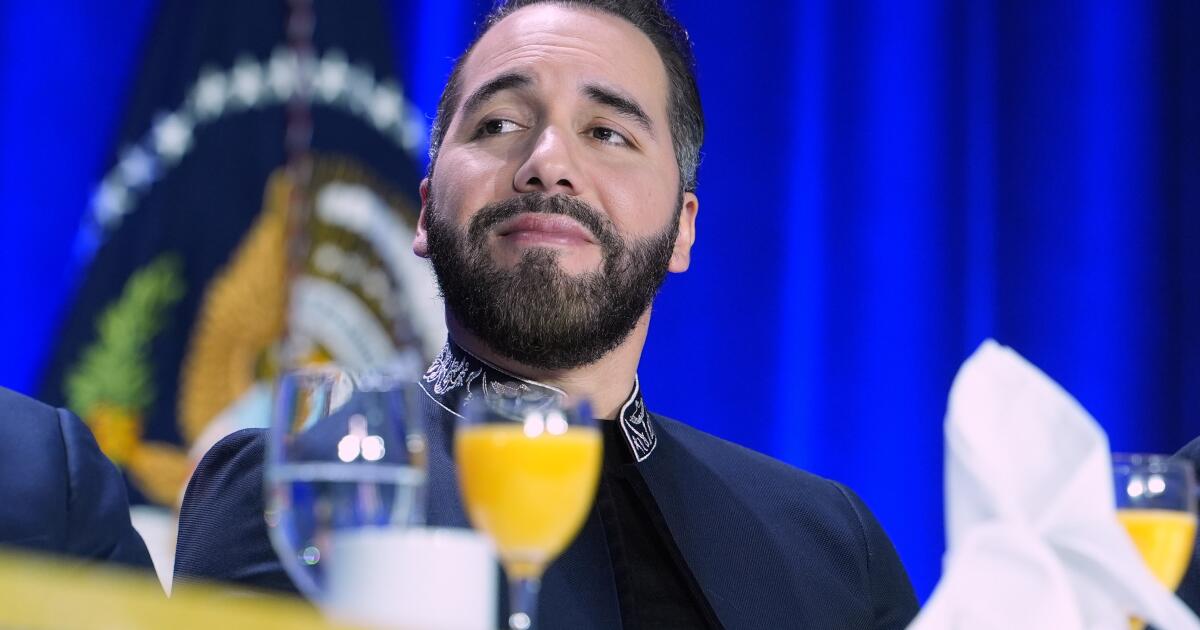
SAN SALVADOR — The number of people deported to El Salvador from the U.S. nearly doubled in the first months of 2026, according to official figures, coming as Salvadoran President Nayib Bukele has positioned himself as an ally willing to help the Trump administration accelerate deportations, a central priority.
The U.S. deported 5,033 Salvadorans back to their country in the first three months of 2026 compared with 2,547 deportees in the same period in 2025, according to El Salvador migration authority figures obtained by the Associated Press on Tuesday.
That marks nearly a 98% increase at the same time that the Trump administration has boosted deportation flights across the world. Globally, deportation flights from the U.S. rose an estimated 61% between 2024 and 2025, according to data compiled by the Asociación Agenda Migrante El Salvador, or AAMES, and other organizations.
The U.S. has stopped regularly releasing deportation data, so experts instead are relying on other information from countries such as El Salvador, deportation flights and other numbers.
The sharp increase in deportations “confirms a real hardening of the U.S. immigration system toward the region,” said César Ríos of AAMES.
The jump comes as Bukele, a tough-on-crime politician, has sought to align himself with President Trump, and the U.S. government has lined up allies across Latin America to help the Republican carry out his agenda. While Mexico and other Central American nations have quietly accepted deportees from third countries, Bukele has boldly embraced Trump’s efforts in Latin America.
In March 2025, Bukele most notably accepted 238 Venezuelan deportees accused of being members of the Venezuelan gang Tren de Aragua and locked them up in a mega-prison built for accused gang members in the Salvadoran leader’s ongoing offensive on domestic gangs. The incident fueled widespread accusations of human rights abuses.
The geopolitical firestorm came after Trump’s government struck a deal with Bukele to accept what they described as transfer and imprisonment of foreign criminals to El Salvador. Under the agreement, El Salvador would receive $6 million from the U.S.
In March 2025, the Trump administration mistakenly deported Kilmar Abrego García, a Maryland resident and Salvadoran citizen with protected status in the U.S., setting off yet another legal and political controversy. Bukele originally refused to return Abrego García and denied accusations of beating and torture — which have been widely documented by human rights groups in Salvadoran prisons.
He was returned to the U.S. in June to face charges that he helped bring immigrants to the U.S. illegally, something his lawyers call “baseless.” Abrego García has pleaded not guilty and asked a judge to dismiss his case as the U.S. Department of Homeland Security announced that it hoped to deport Abrego García to Liberia.
Even more recently, Bukele joined a coalition of other right-leaning Trump allies in a group of countries that the Republican president dubbed the Shield of the Americas, purportedly aimed at cracking down on criminal groups in Latin America, even though the two most essential countries in that effort — Mexico and Colombia — refused to attend.
Meanwhile, many migrants in the U.S. are turning their eyes on U.S. Supreme Court arguments as Trump seeks to stop shielding hundreds of thousands of migrants from Haiti and Syria, a decision many of the more than 200,000 Salvadoran migrants with temporary protections worry might eventually affect them.
Bukele has helped the U.S. with its immigration agenda even before Trump entered office.
In 2023, El Salvador’s government began to slap a $1,130 fee on travelers from dozens of countries connecting through the nation’s main airport, amid pressure from the Biden administration to help control the number of migrants moving toward the United States’ southern border. At the same time, migration from El Salvador, fueled by gang violence and poverty, dipped after Bukele’s contentious war on the gangs.
Analysts said that Bukele’s government used dips in migration as a bargaining chip to offset human rights criticisms by the U.S.
Alemán and Janetsky write for the Associated Press. Janetsky reported from Mexico City.
WASHINGTON — The Trump administration is suspending a requirement that foreign visitors from countries that have qualified for the World Cup and have bought tickets for the soccer tournament pay as much as $15,000 in bonds to enter the United States, the State Department said Wednesday.
The department imposed the bond requirement last year for countries that it said had high rates of people overstaying their visas and other security issues as part of the Republican administration’s broader crackdown on immigration.
Citizens from those five countries who have purchased tickets from FIFA are now exempt from the visa bond requirement. World Cup team players, coaches and some staff already had been exempt from the bond requirement as part of the administration’s orders to prioritize the processing of visas for the tournament.
“The United States is excited to organize the biggest and best FIFA World Cup in history,” Assistant Secretary of State for Consular Affairs Mora Namdar said. “We are waiving visa bonds for qualified fans who bought World Cup tickets” and opted in to the “FIFA Pass” system that allows expedited visa appointments as of April 15.
The waiver is a rare loosening of immigration requirements under the administration and will ease travel burdens for at least some visitors to the U.S. for the World Cup, which begins June 11 and is co-hosted by the United States, Canada and Mexico.
The administration has taken dramatic steps to restrict immigration in ways that critics say are incongruous with the type of unifying message that a global sporting event such as the World Cup is supposed to project.
For instance, the administration has barred travelers from Iran and Haiti, though World Cup players, coaches and other support personnel are exempt. Travelers from Ivory Coast and Senegal face partial restrictions under an expanded version of that travel ban, even without the visa bond exemption.
Foreign travelers also are facing new requirements to submit their social media histories, while the administration had deployed U.S. Immigration and Customs Enforcement agents at airports recently when Transportation Security Administration personnel were not being paid.
Those measures prompted Amnesty International and dozens of U.S. civil and human rights groups to issue a “World Cup travel advisory” that warns travelers about the climate in the U.S.
In a report this month, the main advocacy group for U.S. hotels blamed visa barriers and other geopolitical issues for “significantly suppressing international demand,” leading to hotel bookings for the soccer tournament that are far below what had initially been anticipated.
The American Hotel & Lodging Assn. said travelers are concerned about potentially lengthy visa wait times and increased fees, along with uncertainty about how they’re being processed to enter the U.S.
The bond requirements are part of the administration’s larger effort to clamp down on migrants who travel to the U.S. on temporary visas but then overstay them. Visa applicants from the affected countries are required to pay $5,000, $10,000 or $15,000 in bonds, which will be refunded if the traveler complies with the terms of the visa or if the visa application is denied.
As of early April, the number of World Cup fans affected by the bond requirement was believed to be relatively small, perhaps only about 250 people, according to U.S. officials who were not authorized to comment publicly and spoke on condition of anonymity. But they said that number was changing rapidly as more people buy tickets and some with tickets opt against traveling.
FIFA had requested the waiver, which had to be approved by the State Department and Department of Homeland Security, and was the topic of discussion at multiple meetings at the White House and elsewhere in Washington for several months, the officials said.
Iran’s First Vice President Mohammad Reza Aref said Tehran’s ‘right’ to the Strait of Hormuz is ‘established and the matter is closed’, state media reports.
Weekly insights and analysis on the latest developments in military technology, strategy, and foreign policy.
The U.S. Air Force has confirmed it has come up with a new set of requirements as it continues to look for a successor to its hard-working MQ-9 Reaper fleet. In contrast to the Reaper, the replacement aircraft is likely to be more flexible in terms of mission spectrum. At the same time, the service wants to use new manufacturing technologies to ensure that it can be built at scale and at a lower price point than the MQ-9. This would allow it to be bought in larger numbers and risked more freely in contested environments.
All this reflects the continued high utility placed on the MQ-9 fleet, as well as its considerable loss rates sustained against mid-tier and lower-tier adversaries. It also points away from filling the MQ-9’s role with a far more exquisite, costly, but more survivable asset, which seemed to have been the direction the Air Force was heading, at least in part, for many years now. With this in mind, this new direction appears to accept that many losses will occur in future combat scenarios and embraces that reality to leverage quantity over quality for whatever eventually takes over from the MQ-9.
Testifying before a Senate Armed Services Committee hearing yesterday, Maj. Gen. Christopher Niemi, the acting head of Air Force Futures, said that a new requirements document for an MQ-9 replacement had been approved. Aviation Weekwas first to report the development.
U.S. Air Force Maj. Gen. Christopher J. Niemi, seen in June 2025, when he was the U.S. Air Force Warfare Center commander. U.S. Air Force photo by Airman 1st Class Jennifer Nesbitt Airman 1st Class Jennifer Nesbitt
The approval clears the path for the Air Force to begin a new acquisition process for an uncrewed aircraft system (UAS) that will assume the MQ-9’s role. A medium-altitude, long-endurance (MALE) system, the Reaper is primarily used for intelligence, surveillance, and reconnaissance (ISR) and strike missions.
Niemi told the Senate Armed Services Committee that improvements in technology since the MQ-9 was developed mean the service now considers it possible for a new drone to be “more flexible,” leaning upon open architectures.
At the same time, modern production methods mean the new drone will be easier and cheaper to produce “in mass numbers,” Niemi said. The result should be a drone that the Air Force can “use in a more attritable way.”
A U.S. Air Force MQ-9 Reaper, assigned to the 432nd Wing, sits on the flightline while being prepared for takeoff at Creech Air Force Base, Nevada, June 2, 2025. U.S. Air Force photo by Senior Airman Renee Blundon
Interestingly, within the Air Force, there has in recent years been a shift away from the term attritable — meaning inexpensive enough to be willing to lose on high-risk missions while being capable enough to be relevant for those missions — to “affordable mass.” This is something TWZpreviously highlighted was already happening back in 2021.
This change came about as a way of helping define the kinds of advanced drones that the Air Force is planning to acquire in the coming years, reflecting that their capabilities will necessarily come at a cost that will make them less than “attritable.”
Last month, the Air Force published a market survey notice, requesting information from industry on a new attritable ISR drone.
This notice included some key performance parameters for the drone, including a range of up to 932 miles and a 20-hour endurance. The attritable nature of the drone was reflected in a requirement for it to fly 100 missions with a “low-to-medium acquisition” cost.
The basic Reaper can fly for more than 20 hours unarmed, or more than 12 hours with weapons. In the case of the MQ-9B version, with an extended wingspan, flight endurance can be increased to more than 40 hours.
An aerospace ground equipment specialist assigned to the 174th Attack Wing, New York Air National Guard, checks data on an MQ-9 Reaper, armed with Hellfire missiles, during Exercise Sentry South 26-2 in Gulfport, Mississippi, March 3, 2026. U.S. Air National Guard photo by Staff Sgt. Dylan McCrink
“Operators desire low-cost, fast-to-field, fast-to-deploy airborne ISR mass to increase mission flexibility and mission surging,” the market survey notice added.
The process of figuring out what to replace the Reaper with has been ongoing for many years now. However, the latest effort is noteworthy for its emphasis on a lower-cost, more attritable platform.
Back in 2020, the Air Force published a request for information for a program dubbed MQ-Next, also seeking an MQ-9 successor. This was focused on ISR and strike capabilities, but also stated a desire for reduced operating costs and greater persistence, survivability, and range.
By 2021, the Air Force was concentrating more on a family of systems — the so-called Next-Generation Multi-Role Unmanned Aerial System Family of Systems (Next-Gen Multi-Role UAS FoS) — including a growing emphasis on low-observable (stealth) technologies. The same year, the service said it was seeking a replacement for the MQ-9 that could possibly include defensive counter-air capabilities to protect high-value manned aircraft, such as tankers, as well as potentially fly red air aggressor missions. Fast forward to today, and it’s clear that these higher-performance air-to-air focused missions could be taken over, at least in part, by the current Collaborative Combat Aircraft program. As a result, whatever replaces the MQ-9 is unlikely to have such broad requirements.
The Next-Gen Multi-Role UAS FoS included scope for platforms that could be survivable and reusable, or ones that would be attritable or expendable. This was not a single platform solution, either. It would likely need to include a mix of systems.
A Northrop Grumman concept for a possible stealthy MQ-Next. Northrop Grumman
The 2021 document also stipulated that the MQ-9’s successor should be tailored for Great Power Competition, pointing to a drone ecosystem suitable for the kinds of highly contested environments that would be encountered during a conflict with a peer rival such as China or Russia. At the same time, the solution was also intended to fly missions in more permissive environments, like the MQ-9.
Around this same time, the Air Force also said it wanted to leverage advances in development and manufacturing, meaning that smaller numbers of manned aircraft could be produced quickly to meet dynamically evolving threats. This reflected the Air Force’s “Digital Century Series” that was in vogue at that time, and which led to talk about “throwaway” technology and essentially “disposable” aircraft. Some of this appears to have made it into these new requirements, which stipulate that the aircraft needs to be able to fly just 100 missions.
Meanwhile, the latest statements from the service describe a drone with increased flexibility achieved through open architecture, rather than building bespoke batches of drones for particular requirements. Previous statements from the service outlined an aspiration to have its new drone capable of accommodating rapidly reconfigurable payloads, something that open architecture would expedite.
An MQ-9 Reaper assigned to the 174th Attack Wing flies over Hancock Field Air National Guard Base, Syracuse, New York, following a routine training flight, October 31, 2024. U.S. Air National Guard photo by Senior Airman Dylan McCrink Staff Sgt. Dylan McCrink
Above all else, the MQ-9 successor will still have to operate in contested environments.
In his testimony yesterday, Niemi presented a vision of a new drone, the design of which would stress being attritable, rather than survivable.
The Pentagon has long worked on the basis that a future conflict with a peer rival, and especially with China in the Pacific, would see it facing highly robust anti-access/area-denial (A2/AD) scenarios. With that in mind, previous Reaper replacement studies had suggested that low observability would need to be incorporated into the design.
An MQ-9 armed with an AIM-9X Sidewinder air-to-air missile. U.S. Navy
The latest thinking seems to reject that, or at least reorient the program toward a lower-cost platform of the kind that the Air Force would be able to field in mass, as well as to absorb the anticipated attrition in a high-end conflict. This does not preclude this airframe from featuring low-observable elements. In fact, it most likely will. But those would be more aggressively balanced against cost.
Concerns over the MQ-9’s vulnerability to air defenses have been ongoing for years now, although usually the nuances of this issue are not portrayed accurately in the media. Regardless, many MQ-9s were lost over Yemen, against a bottom-tier force. The war with Iran earlier this year underlined both the great utility and vulnerabilities of the platform. At least 24 Air Force Reapers were destroyed during the war, but these aircraft were pushed deep into Iran, loitered there for hours on end, and did some of the most important air-to-ground strike and surveillance work during the air campaign. While the Air Force says it plans to “buy back” some of the losses from that conflict, that will come with a hefty price tag, something that the service will want to avoid with its next ISR/strike drone. Furthermore, production of the MQ-9A model has now ended in favor of the MQ-9B.
The assumption that the MQ-9 replacement will be acquired in significant numbers is also noteworthy in terms of the current Air Force Reaper fleet, which includes more than 130 MQ-9As, according to Aviation Week.
MQ-9 Reapers assigned to the 49th Aircraft Maintenance Squadron parked on the flightline for display during the Legacy of Liberty Air Show at Holloman Air Force Base, New Mexico, April 18, 2026. U.S. Air Force photo by Airman Jose Veras
What appears to be missing at this stage, or at least obscured, is an acquisition strategy for the new drones. As well as the aerial platforms, the MQ-9 successor will require suitable new ground control systems, sensors, and data exploitation technologies, all of which are compatible with open-architecture standards. These systems will also have to leverage the latest technologies to allow the drones to be more effective and more survivable over the battlefield.
Since MQ-Next, the U.S. drone landscape has changed considerably in terms of manufacturers. A few years ago, Northrop Grumman, Lockheed Martin, and General Atomics would have been seen as the front-runners for the MQ-9 replacement. Now, there are more contenders, often with a founding focus on rapidly scaling up production at low cost. Still, these firms have much to prove, especially considering the risk in replacing an aircraft as important as the MQ-9. At the same time, in the more advanced drone space, the legacy defense “prime” contractors are also making major progress in leveraging new technologies to reduce production costs and migrating away from exquisite, very expensive drones as their default offerings.
A rendering General Atomics released in 2021 of a concept for MQ-Next. General Atomics
Back in 2021, the Air Force was promoting a “Speed to Ramp” initiative for its MQ-Next, which would see the first iterations of this capability fielded before “the 2026/2027 timeframe.” Other solutions under the same effort would begin to be fielded “in the 2030 timeframe,” the Air Force said.
While the latter timeline might still be somewhat achievable, it will require a considerable effort and investment and, not least, the firming up of the requirements for exactly what the Air Force wants its MQ-9 replacement to look like.
What we do know is that, while the Reaper’s replacement might not be as survivable as once envisioned, it will certainly be tailored to the increasingly harsh realities of a conflict against an advanced peer-state adversary.
After watching his mother perform in a production of “A Raisin in the Sun” at Compton Community College when he was 9 years old, Anthony Anderson knew appearing on stage would be his life’s work. Over the next handful of years, he enrolled in programs across Los Angeles to achieve that dream. Then, one morning after finishing a class at the Southern California Regional Occupational Center in Torrance, Anderson saw a Post-It note on a bulletin board that caught his attention. The note informed aspiring artists about a newly formed arts school. To be admitted, they had to submit an audition tape.
“I ripped it off the board, and I brought it home to my mother, and I said, ‘Mom, if I can get into this school, can I go here?’” Anderson says. “She said, ‘If you can get into that, yes.’”
Months later, Anderson received a letter informing him that he had been accepted into the inaugural class at the Los Angeles County High School for the Arts.
Founded in 1984 and opening its doors to students in 1985, Los Angeles County High School for the Arts is located on the campus of Cal State L.A. It was established to provide students (currently 550) with conservatory-level arts training and college-prep academics within the public education system. LACHSA isn’t associated with LAUSD; instead, it partners with the Los Angeles County Office of Education, which provides funding to support it.
“I felt it to be very important that I was in an environment where other students had the same passion as I did for the arts, in particular, theater,” Anderson says. “Being around other students who had the same passion and drive that I had as an artist was very influential.”
Over the years, LACHSA has featured a who’s who of alumni across various disciplines, including musicians Phoebe Bridgers and Haim, actors Jenna Elfman and Belissa Escobedo, and visual artists Robert Vargas, Tomashi Jackson and Kehinde Wiley. For the past seven years, the school has been ranked as the top public high school for the arts.
Drew McClelland (second from right) with students from LACHSA’s Cinematic Arts Program and actor William H. Macy (far right).
(Courtesy of LACHSA)
While the school’s accolades focus on the arts, LACHSA also aims to give its students experiences that extend beyond the program. Days are structured so that students take academic classes in the morning and arts in the afternoon. With this format, they meet and get to know classmates from other disciplines.
Former “SNL” cast member Taran Killam points out that this also promotes the school’s social and economic diversity, acting as a mini-college experience.
“It’s such a melting pot, but you have this beautiful, focused bonding,” he says. “It’s a rare thing for kids to know, but LACHSA students are ambitious. It’s very unifying when your background is so disparate and so diverse. It’s what makes it special, and you can’t get this experience in a traditional school.”
Lara Raj attended several arts-focused high schools as she moved during her childhood. With that in mind, the member of the girl group Katseye cites LACHSA as having a major influence on her artistic development. During her time at LACHSA, Raj took music, fashion and acting classes, and says its music tech class was her favorite. There, she learned how to create beats and write songs.
“I developed my songwriting and fell in love with it through those classes,” Raj says. “I was excited to go to school every day. And I hate school.”
Before attending LACHSA, singer-actor Josh Groban didn’t know a school specializing in the arts was an option. After bouncing around schools and realizing he needed a different education to express himself equally academically and artistically, he ended up at LACHSA. There, he found like-minded, artistically inclined outsiders.
Josh Groban, a former student of LACHSA, credits the institution with helping him find his voice.
(Christina House / Los Angeles Times)
“I was a kid who didn’t quite know how to fit in,” Groban says. “Then at [LACHSA], I was surrounded by other students who, I think, didn’t know how to fit in either. We were there for the same reasons, which is that we felt like we needed the nourishment of the arts and being able to express ourselves on a daily basis.”
Half of LACHSA’s funding is provided by the state, with the rest provided by the LACHSA Foundation, a registered 501(c) (3). According to its executive director, Trena Pitchford, the foundation has invested $1 million each school year.
“People always ask me when I tell them I went to LaGuardia and to LACHSA if they were private schools,” Raj says. “I tell them it was created by people who are passionate about the arts and want to inspire kids.”
“There’s a part of LACHSA that I think is a discovery point for a lot of Los Angeles County, and even the nation,” Pitchford says. “There’s so much opportunity for the school, and they’re doing it on a limited budget. What would happen if they were fully funded? What would happen if the foundation had a $40 million endowment? That would fully sustain what they’re doing right now.”
LACHSA students posing in front of the entrance to the Greek Theatre
(Courtesy of LACHSA)
LACHSAPalooza, the culmination of the foundation’s two-year fundraising campaign to celebrate the first 40 years of LACHSA, will take place at the Greek Theatre on May 30. There, student artists will perform alongside Ozomatli, Jon B., April Showers and more. From a fundraising standpoint, the foundation has high hopes of raising $2.5 million.
“We have both annual goals in terms of investment as well as sort of big visions, big dreams of where we think LACHSA could go for the next 40 years,” Pitchford says. “We also hope to put LACHSA on the national stage.’
The honorees for the night are the late Pat Bass, LACHSA’s gospel choir director, retiring LACHSA theater department chair Lois Hunter, and Jerry Freedman, a longtime social studies teacher at the school.
For Anderson, who is serving as the night’s host, seeing Freedman recognized is very meaningful.
“He was there from the school’s beginning,” Anderson says. “He was there when I started, and he’s still there and is still beloved by the students 40-plus years later. I’m looking forward to honoring him.”
As an arts-based school in the long-standing entertainment capital of the U.S., LACHSA can educate and enable the next generation of artists to discover their voices in the backyards of production companies, studios and record labels.
“The freedom that a LACHSA student gets on the campus to discover who they are is exciting,” Pritchard says. “It’s very innovative, very creative, and it’s forward thinking, future forward. It’s an exciting and thrilling place to be.”
Alumni agree. Without LACHSA and, in turn, a focused public arts education, pursuing a career in the arts would have been more difficult and more costly.
“It helps develop souls to be fully fledged human beings who feel like they can go off into the world and be the best versions of themselves,” Groban says. “We all felt like we were free to be who we wanted to be.”
“Specialty-focused high schools like LACHSA, be it arts or any other topic deserving of protection, because it is a gathering place for exceptionally talented, ambitious, driven kids,” Killam says. “And aren’t those the kind of people we want to be cultivating in society?”