What do babies, profanity and a lawsuit saga have in common?
If it’s 2016, the answer is the Republican presidential nominee.
I’m Christina Bellantoni, and this is Essential Politics, a guide to the newsy — and sometimes wacky — happenings in the political world.
The biggest thing that happened to Donald Trump came late Tuesday when the San Diego judge who has been the target of the politician’s repeated criticism blocked the release of Trump’s testimony videos in the Trump University legal battle.
U.S. District Judge Gonzalo Curieldenied the request from news organizations for transcripts and video of Trump’s depositions. He said there might be legitimate public interest, but the likely media frenzy that would come had a greater potential for harm.
Also making headlines Tuesday were a cursing child at a Trump rally, and a crying baby that the billionaire real estate mogul at first called “beautiful” and then added when it didn’t stop, “Actually … You can get the baby out of here.”
DEFECTING REPUBLICANS
President Obama suggested Tuesday that Republicans should pull their endorsements of Trump, calling him “unfit to serve” in the White House.
That’s probably not the reason a top aide to Gov. Chris Christie said Tuesday that she’ll be voting for Hillary Clinton. “I’m voting for her because I don’t believe it’s enough to say you aren’t for Donald Trump,” said Maria Comella.
Also opting out was retiring New York Rep. Richard Hanna.
But the biggest defection of the day was Meg Whitman, the Hewlett-Packard chief executive who ran unsuccessfully for governor of California in 2010. “As a proud Republican, casting my vote for president has usually been a simple matter. This year is different,” she wrote on Facebook. “Donald Trump’s demagoguery has undermined the fabric of our national character.”
Meanwhile, Trump declined to endorseSen. John McCain or Speaker Paul Ryan for re-election.
BACK TO THE BANK
Clinton returns to California to raise money for the campaign later this month.
The marquee event is a star-studded $33,400-per person luncheon at the Los Angeles home of Oscar winning actor Leonardo DiCaprio on Aug. 23. According to an invitation obtained by The Times, DiCaprio’s other hosts include Jennifer and Tobey Maguire, Jennifer Aniston, Scooter and Yael Braun, Shonda Rhimes and Chris Silbermann.
There is an Aug. 22 evening fundraiser in Beverly Hills chaired by Megan and Peter Chernin, Willow Bay and Bob Iger, Marilyn and Jeffrey Katzenberg, Cheryl and Haim Saban, Alba and Thomas Tull, Ellen and Jon Vein and Laura and Casey Wasserman. Minimum contribution levels are $2,700. Co-hosts get a reception with the candidate and must give or raise $27,000. Hosts must give $100,000 per couple, and they get a photo and dinner with Clinton.
There are two Aug. 23 fundraisers in Laguna Beach. One is hosted by Frank Barbaro, Mike Levin and Melahat Rafiei and has similar contribution levels to the Beverly Hills event. Proceeds first go the campaign, then a Democratic National Committee fund, then state parties.
The other Laguna Beach fundraiser that day is a lunch hosted by Janet Keller and Chantal and Stephen Cloobeck. It costs $33,400 or $100,000 per couple.
The fallout from leaked emails that cost Debbie Wasserman Schultz her job as chairwoman of the Democratic National Committee continued Tuesday, with the departures of three other high-profile party officials. Chief Executive Amy Dacey, Chief Financial Officer Brad Marshall and Communications Director Luis Miranda all left their posts at the DNC, departures tied to the emails, a source told The Times.
Billionaire Democratic political activist and potential gubernatorial candidate Tom Steyertoured skid row Tuesday with Los Angeles County Supervisor Mark Ridley-Thomas, who said afterward that he is courting Steyer’s support for a potential March sales tax initiative for homeless services.
And Los Angeles County voters will be asked in November to approve a half-cent sales tax increase that would continue indefinitely to fund a major expansion of Southern California’s transit network.
TODAY’S ESSENTIALS
— Trump said Tuesday he has no regrets for taking on the Khan family.
— Continuing the national trend, South Bay GOP assemblyman David Hadley (R-Manhattan Beach) says says he won’t vote for Clinton or Trump in November, calling his own party’s nominee a “recurring litany of insults, provocation and polarization.”
— Democratic congressional challenger Bryan Caforio called on Republican Rep. Steve Knight to disavow Trump after the Khan dust-up. Knight’s campaign would only say the congressman has not endorsed anyone in the presidential contest. He may not endorse before November, the campaign said.
— The Supreme Court has its first chance this week to weigh in on the legal controversy over transgender students, as a Virginia school board seeks an emergency order exempting it from the Obama administration’s policy to allow students to use bathrooms “consistent with their gender identity.”
TORONTO — Fans lined up before the game, waiting patiently for the chance to take a selfie with trophies that commemorated the back-to-back World Series championships.
Dodger Stadium is not the only place you can do this. The trophies were from 1992 and 1993, and they honored the Toronto Blue Jays.
The Dodgers matched that back-to-back feat over the past two years, including a classic Game 7 victory in Toronto in last year’s World Series, and returned here Monday to a noise pit packed with fans primed to boo, and to urge their team to exact vengeance on the evil mercenaries from America.
On this night, the mercenaries prevailed, in a pummeling so relentless and a silencing so rapid that a three-peat appeared all but inevitable: Dodgers 14, Blue Jays 2.
Dalton Rushing celebrates with teammates in the dugout after hitting his second home run of the game in the eighth inning of a 14-2 win over Toronto on Monday.
(Mark Blinch / Getty Images)
“These fans, sadly, didn’t want to see us come to town,” Dodgers catcher Dalton Rushing said, “and rightfully so, after what we did tonight.”
Those fans did want to see the Dodgers, but they did not want to see this. On a night the Dodgers fielded a lineup without Mookie Betts and Will Smith, the team hit five home runs — two by Rushing — and scored in every inning but the second and ninth. Of the six Toronto pitchers, the only one to hold the Dodgers scoreless was catcher Tyler Heineman.
To the Dodgers, well, it was another day on the job, if a bit louder than usual at the start. They had a game to win on the long road toward October and, as they often do, they won.
In Toronto, however, pitcher Kevin Gausman said, “It feels like we’re getting ready for Game 8.” The fans mercilessly booed Shohei Ohtani, who turned down $700 million from the Blue Jays to take $700 million from the Dodgers, and outfielder Kyle Tucker, who turned down $350 million (over 10 years) from the Blue Jays to take $240 million (over four years) from the Dodgers.
They even booed Justin Wrobleski, the Dodgers’ starting pitcher, and Miguel Rojas, usually an infielder but on Monday the Dodgers’ final pitcher. Wrobleski, who won his seventh major league game Monday, said he expected the boos.
“It was fun,” he said. “They care about baseball here. It’s a fun environment. If people weren’t a little upset and a little, I’d say, passionate about what happened last year in the World Series, maybe they’re not real fans.”
The boos could have been a sign of respect, or of a long memory: about the ninth most-memorable part of Game 7 was Wrobleski hitting Toronto infielder Andrés Gimenez, then shouting language so profane Wrobleski later said he apologized to his mother for using it. You cannot be a nobody if you can get the benches to clear in Game 7.
“They wouldn’t boo me,” Wrobleski said, “if they didn’t know who I was.”
Dodgers pitcher Justin Wrobleski delivers during the first inning against the Blue Jays on Monday.
(Mark Blinch / Getty Images)
The Dodgers led 4-1, then 5-1, then 6-1, then 9-1, and that was before the sixth inning was done.
“When you score a lot of runs, you’re going to take the crowd out of it,” Dodgers first baseman Freddie Freeman said.
“I think the media and everyone else was more hyped up. It’s a new team, new year. We’ve got different guys on our team too. But we obviously understand it’s a World Series matchup.”
The Blue Jays were different: infielder Bo Bichette is in New York, catcher Alejandro Kirk is on the injured list, infielder-outfielder Addison Barger is hurt, and Toronto is borrowing a page from the Dodgers’ playbook with a rotation full of hurting pitchers: Shane Bieber, José Berrios, Cody Ponce and phenom Trey Yesavage all are on the injured list, and Max Scherzer left after two innings Monday because of tendinitis in his throwing arm.
The Dodgers are 8-2. The only defending World Series champion to get off to a better 10-game start in the last 100 years: last year’s Dodgers, at 9-1.
Last year worked out just fine. This is April, and no one is facing elimination any time soon. That explains how Roberts rated his anxiety level on Monday.
“It was probably a 10 in October and probably a one tonight,” he said.
Monday’s game offered yet another example of how the team that supposedly is ruining baseball is fattening the wallets of the league’s other 29 teams. The Dodgers have led the league in road attendance in each of Ohtani’s two previous seasons and almost certainly will do so again this season — and a fair number of those ticket buyers are Dodgers fans following their team here, there and everywhere.
In a 10-minute pregame walk around the main concourse, I saw plenty of fans in Dodgers jerseys: not only with the names of Ohtani, Betts and Freeman but with the names of Rojas, Kiké Hernández and Roki Sasaki.
As soon as the third inning, a “Let’s Go Dodgers” chant echoed through the stadium.
The Blue Jays are off to a 4-6 start, including series losses to the Colorado Rockies and Chicago White Sox. The Jays should be good again, and soon. In the meantime, they are offering 77-cent hot dogs Tuesday.
For all the Dodgers fans here, that’s quite the trip: a rout that silenced a hostile crowd one day, hot dogs valued at 55 cents in U.S. currency the next. The fruits of victory, as Tommy Lasorda might have said, rarely are so cheap and filling.
A POPULAR seaside attraction park with links to a much-loved TV series is launching new rides.
Barry Island Pleasure Park in Wales has already launched one new ride and has plans to add more this year.
Sign up for the Travel newsletter
Thank you!
Barry Island Pleasure Park in Wales will be getting new rides this yearCredit: AlamyThe theme park already has one new ride which is a Caterpillar Coaster
Visitors with small children can now head on an apple-themed Caterpillar Coaster, which was introduced during February half-term and is ideal for introducing kids to rides.
And the free-to-visit attraction park is planning on adding several more attractions, according to Theme Parks UK.
While the new additions are yet to be announced, the park has teased that its biggest improvement is yet to come and will be introduced before the end of this year, reports Barry and District News.
The park previously revealed that it was adding bumper cars, but this has been delayed by the war in Ukraine with steel prices rising.
Other rides at the park include Aerospace, which is a huge 65metres-tall and reaches speeds of 75miles-per-hour and remains the tallest and fastest ride of its kind in the UK.
There is also a ghost train, carousel, waltzers and even a crazy fun house.
To go on the different attractions, visitors must purchase tokens, which cost around £1 each.
Rides then usually cost between three and four tokens per person.
A recent visitor said: “Barry Island Pleasure Park is a fantastic place for everyone, especially families looking for a fun day out.
“It offers a great mix of excitement, entertainment, and seaside charm.
“The park is filled with colourful rides and attractions that suit all ages, from small children to adults.
“Whether you’re into classic fairground rides, or enjoy the thrill of rollercoasters and other high-energy rides, there’s something for everyone here.”
The owner of the park, Harry Danter, also has plans to create a “Disneyland of Britain”.
The owner of the attraction park has said there are plans for several other ridesCredit: AlamyIncluding the park’s biggest improvement, which is yet to comeCredit: Alamy
Our favourite UK seaside towns
*If you click on a link in this box, we will earn affiliate revenue.
Sidmouth, Devon Take a trip to Sidmouth on the Jurassic Coast and wander down Jacob’s Ladder to its pretty shingle beach. Make sure to walk along the promenade and check out the independent shops and boutiques. Stay at the four-star Harbour Hotel for sea views and traditional afternoon tea from £135 per room.
Whitby, North Yorkshire With a history of sailors and vampires, a dramatic coastal path, and the very best in pints and scampi, it takes a lot to beat Whitby. Pop in the amusements, eat award-winning fish and chips, and board the all-singing Captain Cook boat tour on the harbour. The Royal Hotel overlooks the harbour with stays from just £68 per room.
Old Hunstanton, Norfolk This town has some of the best beach walks beside striped limestone cliffs, a Victorian lighthouse and 13th century ruins. The beach has golden sands with rolling dunes and colourful beach huts, backed by a pretty pinewood forest. Stay at a beachfront hotel from £100 per room.
Seahouses, Northumberland This is an authentic British seaside break, with fishing boats bobbing on its pretty harbour and fresh catches of the day to enjoy in local restaurants. There’s no flashing arcades here, but there’s a great beach with rockpools, boat trips, and you may even spot a grey seal, too. Treat yourself to a stay at the Bamburgh Castle Inn from £129 per room.
April 7 (UPI) — Florida Gov. Ron DeSantis has signed legislation authorizing state officials to designate certain groups as domestic or foreign terrorist organizations, creating a mechanism to punish those blacklisted in the Sunshine State.
The legislation creates a mechanism for Florida to sever funding, contracting and other ties to blacklisted groups. If a corporation is named, the state may pursue proceedings to dissolve it.
“We must defend our institutions from those who would harm us — especially terrorist organizations that seek to infiltrate and subvert our education system,” DeSantis said in a statement.
The bill specifically authorizes Florida’s chief of domestic security to designate groups as domestic or foreign terrorist organizations, subject to approval from the governor and Cabinet, if certain conditions are met.
Once designated, state agencies, political subdivisions and public school districts are barred from working with, supporting or taking money from them.
If the designated entity is a corporation, then the state may begin proceedings to dissolve it. It also creates criminal consequences for actions involving designated domestic terrorist organizations, including receiving military-type training from them, providing them with material support or resources and willfully becoming a member.
It also imposes consequences for schools, including secondary education, for promoting designated organizations and requires the immediate expulsion of students determined to have promoted them.
The bill also prohibits Florida courts or other adjudicatory bodies from enforcing any provision of what it calls “religious or foreign law” if it is inconsistent with federal or state law. The legislation specifically states Sharia law, the religious legal system of Islam.
“This legislation reinforces that the U.S. Constitution and Florida law remain the supreme authority in our court systems, preventing any foreign or religious legal code from overriding fundamental rights,” State Rep. Hillary Cassel, the bill’s sponsor, said in a statement after her legislation was signed into law.
The Florida chapter of the Council on American-Islamic Relations issued a statement of concern on Monday over the potential misuse of the designation power, highlighting DeSantis’ previous attempt to designate it as a terrorist organization via executive order. before a judge blocked the blacklisting.
“This is not just about CAIR. This expanded and deeply flawed framework can attack any organization that dares to dissent,” CAIR-Florida Executive Director Hiba Rahim said in a statement.
“As Floridians, together, we’ll watch how this unprecedented law is enforced, and whether it is used or abused.”
Abas Aslani of the Center for Middle East Strategic Studies argues that the US and Israel are playing “Russian roulette” with the Gulf’s environmental security following strikes near Iran’s Bushehr nuclear plant.
When Tina LaMonica and Warren Wellen purchased their South Pasadena Craftsman home in 2001, the one-car garage dated back to 1917, a time when people parked their narrow Ford Model T cars inside garages like this one.
“We bought it for $650,000,” LaMonica says of the house. “Of course, we could never afford to buy it now.”
The couple moved in when their daughters, Sophie and Ruby Wellen, were little, and their tree-lined street was full of families with young kids who rode their scooters throughout the neighborhood.
“We all grew up together and had block parties,” says Sophie, 30. Now, she adds, “There are no new families moving in. No one left. Why would they?”
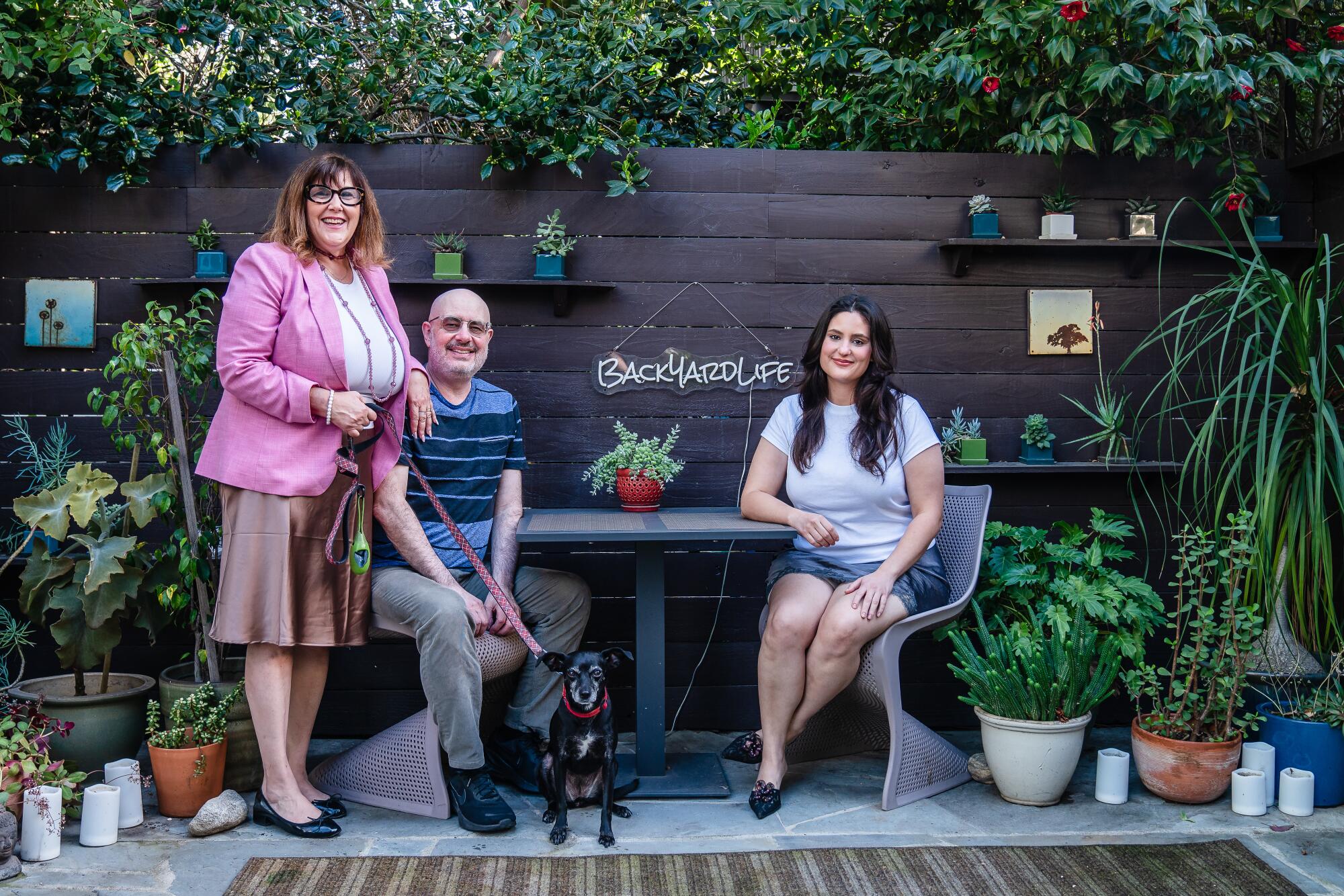
Tina LaMonica and Warren Wellen sit on the patio with their daughter, Sophie Wellen, and their dog, Hazelnut, next to the 230-square-foot ADU where Sophie lived for two years. Her younger sister is now living in the ADU.
Music was always a part of their home, Sophie says, thanks to her father, Warren, 65, who is both an attorney and a musician in the alternative rock band Brahms’ Third Racket.
“He plays everything,” Sophie says. “Throughout my entire childhood, he was always making music.”
LaMonica adds, “It can be disruptive.”
So in 2021, the couple pulled together money from different sources, including a line of credit, and turned the garage into a tiny 230-square-foot accessory dwelling unit, or ADU, for Warren to use as a music studio.
“It was intended to be a creative space, not a home,” says LaMonica, 64, who is a commercial real estate broker. “The total cost was around $125,000, including permits, construction and all systems — a significant investment, but one that ended up serving our family in unexpected ways.”
The garage before, left, during, right, and after, below, construction. (Tina LaMonica)
A few months after using his new music studio, Sophie, who had been in law school at the University of Michigan, moved back to Los Angeles after being away for 10 years.
“She wasn’t working right away, and like many new grads, she had student debt and credit card debt from getting through school,” says LaMonica. “Market rent in the Los Angeles area wasn’t realistic, even with a job offer lined up. So, the studio became her first home. It gave her stability and independence during a major transition.”
Sophie, who describes her relationship with her parents as close, says the ADU was always meant to be temporary and she’s grateful for it.
“At 28, I didn’t know where I wanted to live in L.A.,” she says. “I had only grown up in Pasadena, which is a small community. I felt lucky to be able to live in this little house in the back and explore the city to find the right place for me, instead of rushing to grab the first place I could, like so many of my associates had to do. It was right after the bar exam, and I was really stressed.”
The ADU features a Murphy bed and and a nice-sized kitchenette.
The kitchenette has a compact air fryer-toaster oven from Our Place, and a slim, Classic retro-style refrigerator.
After clerking for a judge in Washington, D.C., Sophie’s boyfriend William Lang moved to Los Angeles and joined her and her dog in the ADU, bringing his two cats with him.
“It was a full house,” Sophie says, laughing. “And yes, they were indoor cats! But we made it work. Finding a rental was hard. I couldn’t really afford a nice apartment in L.A. I had to save up and wait until my boyfriend got here so we had two incomes.”
It’s no surprise they felt at home. Although it’s small, the unit is sunny and bright, with a pitched roof and a big picture window overlooking the lush backyard and swimming pool. (The blinds can be closed for privacy.)
There’s a Murphy bed that turns into a love seat when pulled down, which saves space, and classic black-and-white checkerboard porcelain tile from Mission Tile in South Pasadena that gives the living spaces a surprising sense of fun. The unit also has a bathroom with a shower, a closet and a storage nook above the bathroom.
The ADU has room for a desk, flat-screen TV and comfy chair.
There’s also room for a desk, a flat-screen TV on the wall and a comfortable chair. Not having a dining room isn’t a problem because there’s a welcoming patio just outside the French doors, with two chairs, a couch and a coffee table.
“The backyard was our saving grace,” says Sophie. “Most of the time, William sat at the little table. It was cozy and nice. I got to be near my parents, and they got to know my partner better.”
The ADU has a roomy kitchenette with white cabinets and countertops, a compact air fryer-toaster oven from Our Place, and a slim retro-style refrigerator from Unique. “You can bake, broil and fry with the small Wonder Oven,” LaMonica says. “Ruby uses it all the time.” There’s also a mini-split system for heating and cooling, and if needed, a stackable washer and dryer can be added later.
A patio area provides another living space steps outside the ADU.
Soon after Sophie moved out, having lived in the back house for two years, her 27-year-old sister Ruby moved in. “She works in Torrance and can’t afford to rent an apartment close to her job,” her mother says. “The ADU gives her a chance to live affordably, stay safe and be near family, while building financial footing on her own terms.”
LaMonica is happy with the ADU, though she wishes they could have added a second floor, which the city of South Pasadena didn’t allow at the time.
She imagines a future in which one of her daughters lives in the main house, and she and her husband live in the ADU. “I think an ADU is a great long-term solution,” she says. “It keeps people from moving out of California. With an ADU, at least you can keep your family on site.”
In some ways, the small ADU is more than just a solution for young people who can’t afford to live in Los Angeles. A 2025 study found that Los Angeles ranked second among the 50 largest U.S. metros for its share of working adults (ages 25 to 40) living with parents.
Backyard homes can also help people connect with their community.
“The nice thing about the ADU is that it can give you a sense of community that’s hard to find right now because people are so isolated,” says Sophie, who now rents a two-bedroom duplex in Hancock Park with Lang for $4,500 a month. “We’re both lawyers at private law firms and doing well, but I still don’t feel like I could have a child right now and give them the life I want. It’s hard to make big life decisions in L.A., especially if you have student debt. It was really nice to have dinner with my parents every once in a while. They didn’t want William and I to leave.”
The bathroom inside the ADU.
As Southern California gets more crowded and housing costs rise, young people have to look for options different from those their parents had when they were growing up.
LaMonica says she and her husband never thought they would house both daughters in a converted garage. “But in a place like Los Angeles,” she says, “the tiny ADU turned into a flexible and essential lifeline for our family, not just once but twice.”
And maybe one day, Warren will finally get his music studio.
GROWING up in Hertfordshire might make me biased, but I believe it has some of the most beautiful hidden gems in the country.
And one of the quaintest of spots has made its way onto Condé Nast Traveller’s list of the 15 prettiest villages near London.
Sign up for the Travel newsletter
Thank you!
Ashwell Springs is a beautiful spot where families go during the summer monthsCredit: AlamyThe village in the Hertfordshire countryside is less than one hour away from LondonCredit: Alamy
Ashwell is a beautiful and what I’d say is a classic countryside village tucked in-between the bigger towns of Royston and Baldock.
It’s not too easily found and others who have visited described it as being “off the beaten track”.
As a Hertfordshire local, Ashwell happens to be where I have spent many weekends.
It’s the perfect spot for a family day trip, thanks to the springs, old-school bakery, pretty pastel cottages, half-timbered houses and enormous church in the middle of town.
The springs are one of the most popular spots in the summer months where you’ll see kids in their wellies hopping in and out of the freshwater.
There are stepping stones across the banks if you don’t want to get your feet wet, but lots fall victim to slipping on the algae and tumbling in (including me).
When you’ve worked up a thirst, pop into one of Ashwell’s many pubs, like The Three Tuns, or The Rose & Crown.
And make sure to pay a visit to the bakery in the high street called the Days of Ashwell.
Any Hertfordshire local will know Days, as the bakery has since opened other branches in spots like Ware, Hitchin and Buntingford.
But the bakery started in Ashwell, it was founded there in 1741, making it one of the oldest family bakeries in the UK.
On a sunny day, make sure to head into the bakery first as on busier days and weekends, it will run out of goodies.
You can get pastries, cakes, sausages rolls and freshly made sandwiches.
My order of choice would always be a tuna and sweetcorn roll followed by a pink stripy donut.
Days of Ashwell first opened in the 1700s – and is still on the high street todayCredit: Alamy
For more beautiful places in the UK – here are some of the prettiest seaside towns…
*If you click on a link in this box, we will earn affiliate revenue
Sidmouth, Devon Take a trip to Sidmouth on the Jurassic Coast and wander down Jacob’s Ladder to its pretty shingle beach. Make sure to walk along the promenade and check out the independent shops and boutiques. Stay at the four-star Harbour Hotel for sea views and traditional afternoon tea from £135 per room.
Whitby, North Yorkshire With a history of sailors and vampires, a dramatic coastal path, and the very best in pints and scampi, it takes a lot to beat Whitby. Pop in the amusements, eat award-winning fish and chips, and board the all-singing Captain Cook boat tour on the harbour. The Royal Hotel overlooks the harbour with stays from just £68 per room.
Old Hunstanton, Norfolk This town has some of the best beach walks beside striped limestone cliffs, a Victorian lighthouse, and 13th-century ruins. The beach has golden sands with rolling dunes and colourful beach huts, backed by a pretty pinewood forest. Stay at a beachfront hotel from £100 per room.
Seahouses, Northumberland This is an authentic British seaside break, with fishing boats bobbing on its pretty harbour and fresh catches of the day to enjoy in local restaurants. There’s no flashing arcades here, but there’s a great beach with rockpools, boat trips, and you may even spot a grey seal, too. Treat yourself to a stay at the Bamburgh Castle Inn from £129 per room.
Newer spots include Rhubarb & Mustard which is known by locals as the Ashwell Coffee House.
It’s also on the high street, and if you fancy enjoying your cake outside – it has a pretty courtyard out the back.
Ashwell even has its own gallery and museum if you fancy learning more about its history.
Ashwell holds events throughout the year, with one of the biggest coming up next month
On May 10, there’s Ashwell at Home which is a day of live music, dance performances, lots of locals even open up their own gardens so public can have a look around at the pretty flower beds.
There are street food stalls with plenty of drinks – and of course, tea and cake.
On August 31, there’s the Ashwell Show at Elbrook Meadow, where there are horse and dog shows, lots of stalls, and plenty of vintage tractors and cars will be on display too.
As for how to get there from London, it’s easily doable.
Take the direct train from London St Pancras which will get you into Ashwell & Morden station in 47minutes.
From there, you’ll need to hop in a taxi, which takes just 5 minutes to get into the village of Ashwell.
Here are the other 15 prettiest villages near London, according to Conde Nast Traveller
The White House has reportedly proposed cutting more than 9,400 jobs and over $1.5B from the roughly 60,000-employee Transportation Security Administration (TSA), which oversees airport security operations, according to budget documents.
The details were outlined in the Department of Homeland
A SMALL UK airport will close in a matter of weeks with its final flights scheduled for May.
Coventry Airport first opened in 1936 and even took holidaymakers abroad for a number of years – but will close permanently in 2026.
Sign up for the Travel newsletter
Thank you!
Coventry Airport will close in two months after operating for 90 yearsCredit: AlamyFor four years Thomsonfly flew Brits to Europe from Coventry AirportCredit: Alamy Stock Photo
It was announced in early December 2025 that Coventry would close its airport on June 11, 2026.
The last flights from are set to depart on May 9, 2026.
The site won’t stay vacant though as it will be replaced by Greenpower Park which first received planning permission in 2022.
It will be a £2.5billion battery gigafactory designed for electric vehicle production.
Later, in the 1950s and 60s, the airport began passenger flights across to the Channel Islands.
Then in the 1980s, Hards Travel began operating flights to Spain, France, Italy and Austria as part of package holidays.
Later on in 2004, Thomsonfly operated jet passenger flights to the likes of Palma, Valencia, Rome, Nice, Marseilles, Naples, Pisa, Venice, and Jersey.
During this time Wizz Air flew passengers to Gdańsk and Katowice.
However, after just four years, these stopped.
Following financial issues, the airport closed briefly in 2009, then re-opened in 2010 after being bought by the Rigby Group.
From 2010, the airport focussed on freight flights, training and even a base for the Air Ambulance rather than scheduled passenger services.
But after 90 years, Coventry Airport will close its doors in less than two months.
Last year, a UK Civil Aviation Authority (CAA) spokesperson confirmed: “Coventry Aerodrome has given formal notice to us of its plan to close the airport permanently with effect from 11 June 2026.”
ANOTHER airline has confirmed that luggage fees will be increasing due to the ongoing fuel crisis.
The conflict in the Middle East has resulted in the cost of jet fuel soaring due to the closure of the Strait of Hormuz, meaning airlines are looking at ways to offset costs.
Sign up for the Travel newsletter
Thank you!
United Airlines is the latest to increase luggage costs due to rising fuel pricesCredit: Reuters
And United Airlines has since increased its baggage fees, the second airline to do so.
The new rules mean checked bags now cost $10 (£7.50) extra, working out to $45 (£33) for domestic flights, or $50 (£37) if it it booked 24 hours before a flight.
A second checked bag will now cost up to $60 (£45) if booked last minute.
The airline said: “United is raising first and second checked bag fees by $10 for customers traveling in the US, Mexico and Canada and Latin America beginning with tickets purchased Friday, April 3.”
Last month, JetBlue was the first airline to confirm that they would be increasing luggage costs in response to fuel prices going up.
Checked bags have gone up by $4 (£3) for off peak, economy travellers – who will pay $39 (£30).
Peak economy travellers will have to pay $9 (£6.80) extra, so to $49 (£37).
Passengers paying for luggage less than 24 hours before the flight will pay an extra $10 (£7.50).
A JetBlue spokesperson told local media: “Adjusting fees for optional services used by select customers, such as checked baggage, allows us to continue offering more competitive fares.”
Some airlines are already cancelling flights.
UK-owned Skybus has cancelled its daily flights between London Gatwick and Newquay earlier than planned.
Due to finish by end of May, it has since cancelled all of the routes and cited lack of passengers as well as rising costs.
A California state senator alleges that police officers fabricated evidence to falsely accuse her of driving under the influence after she was T-boned at an intersection near the state Capitol.
Their motive, she claims, was discriminatory bias and a piece of legislation she wrote that law enforcement agencies did not like.
Now, she is suing the city of Sacramento alleging “a deliberate and unlawful campaign to falsely accuse, arrest, and discredit her.”
On Monday, state Sen. Sabrina Cervantes (D-Riverside) filed a federal lawsuit against the city as well as the police officers who cited her for driving under the influence in May. The Sacramento district attorney’s office declined to file charges after a blood test showed there were no traces of drugs or alcohol in her system.
Cervantes accuses officers of pushing forward with an arrest despite lacking probable cause and building a case against her based on false statements. She said officers submitted false information to the DMV, forcing her to retain a lawyer to stop her license from being suspended or revoked, according to the complaint.
The Riverside County legislator alleges that this conduct was in retaliation for a bill she authored seeking to restrict how law enforcement agencies store and use data from automatic license plate readers. She claims that officers discriminated against her as an LGBTQ Latina woman and provided more respectful treatment to the white woman who was at fault in the crash.
Cervantes further alleges that unknown parties within the Sacramento Police Department leaked news of her arrest to the press in a deliberate attempt to tarnish her reputation. Representatives for both the city and the Police Department said Monday that they were unable to comment on pending litigation.
“This case is about the abuse of power,” Cervantes’ attorney James Quadra said in a statement Monday. “Officers ignored the facts, fabricated evidence, and tried to turn a victim into a criminal.”
In September, Cervantes filed a government claim against the city, a necessary precursor to taking further legal action. Her lawsuit, filed in the District Court for the Eastern District of California, seeks damages for violations of federal civil rights and state law, including false arrest, unlawful search and seizure, and defamation.
The crash took place at 12:55 p.m. on May 19, 2025, when Cervantes’ car was hit by a driver who failed to yield to the right of way at an intersection in downtown Sacramento. The state senator was transported to a nearby hospital for treatment where officers met and interviewed her for hours, according to the complaint.
The complaint alleges that “despite clear damage to the vehicles showing that the other driver, a young white woman, had t-boned Senator Cervantes’ vehicle” the responding officer “treated the at-fault driver with a deference and respect which was not accorded to Senator Cervantes.”
At the hospital, one of the officers requested that Cervantes submit to a “subjective sobriety test” that included measuring her eye’s response to stimuli, according to the complaint. Cervantes said she was troubled by this request given that she broke no traffic laws and was the victim of a dangerous driver.
In order to obtain a warrant to obtain a blood draw, the officer “falsely claimed that Senator Cervantes had an unsteady gait, slurred speech, and an appearance of drowsiness,” the complaint alleges.
After news of the crash became public, a spokesperson for the Sacramento Police Department told reporters that “based on the objective signs, officers believed that Cervantes was under the influence of a central nervous system depressant.” Redacted test results Cervantes chose to share with the media showed she had a near-zero blood alcohol level, and the district attorney declined to file charges later that month.
Her lawsuit accuses parties within the Police Department of falsely telling the media she was driving under the influence “with the intent to harm Senator Cervantes because of her sponsorship of SB Bill 274 and her status as a Latina member of the LGBTQ+ community.”
The bill sought to restrict law enforcement’s use of automatic license plate readers, following concerns that the technology was being used to violate driver’s privacy and that data was being unlawfully shared with agencies outside of the state.
Civil liberty groups such as the ACLU have demanded that California police stop sharing automatic license plate reader data with out-of-state agencies that could use it to prosecute women traveling to seek abortion care.
In June, an investigation by Calmatters found that law enforcement agencies across Southern California, including the Los Angeles Police Department, violated state law by sharing information from automated license plate readers with Border Patrol and Immigration and Customs Enforcement agents.
Senate Bill 274 passed the state Senate and Assembly but was vetoed in October by Gov. Gavin Newsom, who sided with law enforcement agencies that expressed concerns over how the bill could hinder their ability to solve crimes.
The bill would have limited the lists agencies could use to monitor for certain cars, required enhanced data security and privacy training for officers and mandated that certain data be deleted after 60 days.
In a letter explaining his veto, Newsom wrote that the bill “failed to strike the delicate balance between protecting individual privacy and ensuring public safety.” He noted that, in instances such as cold cases, license plate data are needed to solve crimes beyond a 60-day window.
Neto launched a leadoff shot on Chris Sale’s first pitch, and Soriano (3-0) struck out 10 as the Angels won their third consecutive game. The right-hander gave up one run and three hits without issuing a walk, throwing 69 of his 96 pitches for strikes.
Soriano gave up a solo homer to Drake Baldwin and a single to Matt Olson in the first, then retired 19 straight batters before Mike Yastrzemski led off the eighth with a single.
Mauricio Dubón homered off Angels reliever Chase Silseth in the ninth. Atlanta put two on with two outs before Jordan Romano replaced Silseth and got Yastrzemski to fly out for his fourth save.
The Angels played without star center fielder Mike Trout, who exited Sunday’s game against Seattle after getting hit on the left hand by a 94-mph fastball in the eighth. Trout’s hand swelled so quickly he struggled to remove his batting glove, but X-rays were negative and he is listed as day to day.
Sale (2-1) entered 8-0 with a 1.24 ERA in 11 career games against the Angels, but Neto slammed the left-hander’s first pitch, a 95-mph fastball, for a homer to left field.
Angels star Zach Neto celebrates in the dugout after hitting a home run in the first inning against the Braves on Monday.
(Joe Scarnici / Getty Images)
Sale retired his next nine batters but fell apart during a three-run fourth in which the Angels drew two walks, were twice hit by pitches, had two runners forced out at the plate and hit one ball out of the infield.
Logan O’Hoppe walked and Yoán Moncada was hit by a pitch, both with the bases loaded, to account for two runs. Bryce Teodosio drove in a run with an infield single for a 4-1 lead.
Jorge Soler opened the fifth with a single, and Adell drove a first-pitch fastball 411 feet to left for a two-run homer — his first of the season — and a 6-1 advantage.
Up next: Braves RHP Reynaldo López (1-0, 1.64 ERA) opposes Angels LHP Yusei Kikuchi (0-1, 6.52) on Tuesday night.
In early spring, the California mountain town of Julian sits suspended between seasons. At more than 4,000 feet, up in the Cuyamaca Mountains, it rests among coastal live oak woodlands and Coulter pine forests. Snow sometimes dusts the surrounding slopes, melting by afternoon into damp earth as manzanita and mountain lilac begin to flower. Along Main Street, the mingled scents of woodsmoke and apple pie drift from storefronts.
It is here that my journey along State Route 78 begins, following its long eastward descent from the mountain forest into the stark badlands of Anza-Borrego Desert State Park, then skirting the southern edge of the Salton Sea, crossing the Algodones Dunes and continuing toward the Colorado River — a 140-mile corridor spanning one of the most dramatic ecological transitions across public lands in the American Southwest.
This road trip continues a series exploring California’s overlooked scenic highways, inspired in part by artist Earl Thollander’s “Back Roads of California,” whose sketches and travel notes celebrated a slower way of seeing. After tracing Highway 127 along the edge of Death Valley, the journey now shifts south.
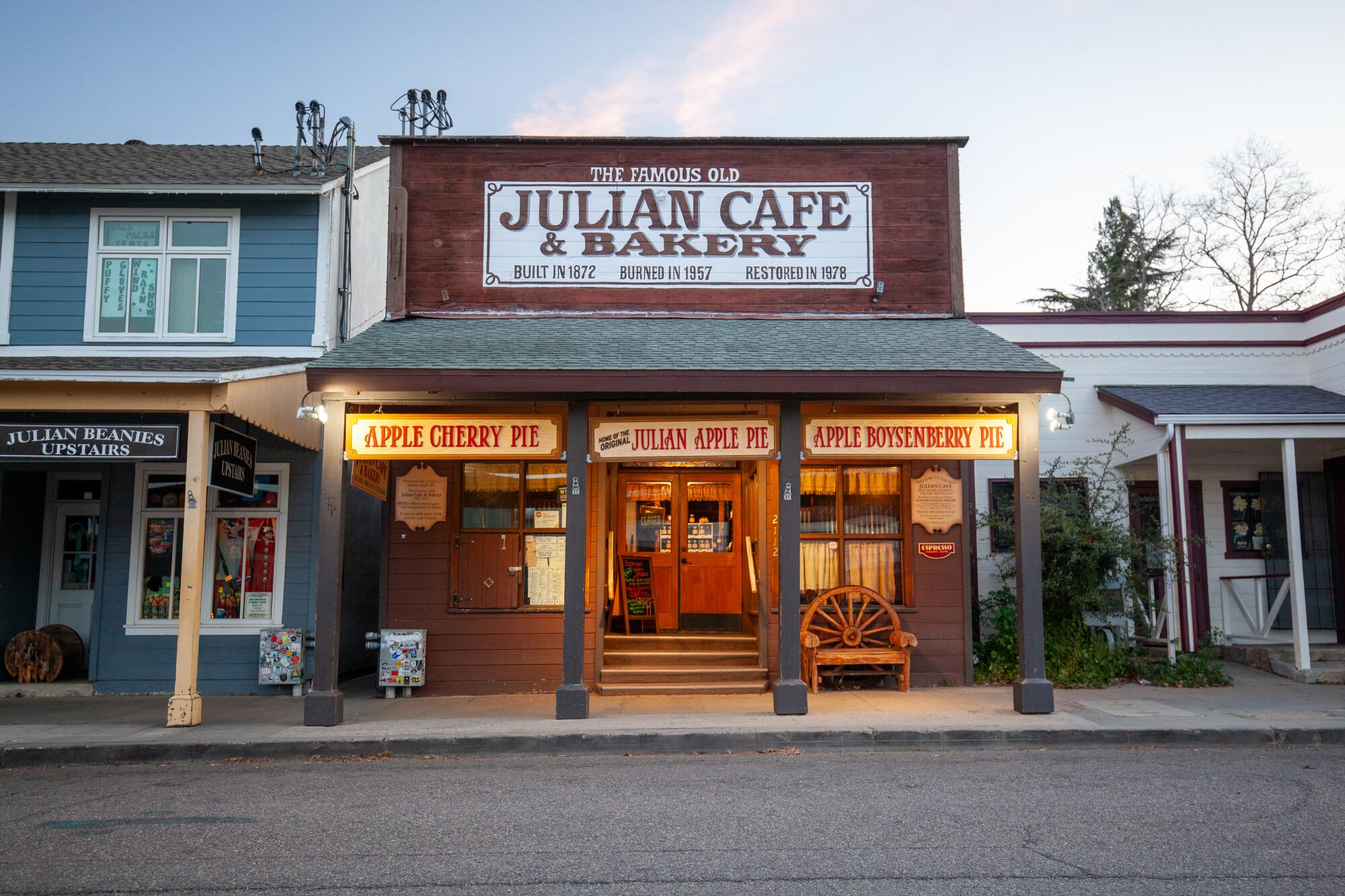
Julian Cafe and Bakery, the start of the trip off Route 78.
(Josh Jackson)
Within minutes of leaving town, the pavement twists downward through tight turns and steep grades as the mountain air begins to warm, the vegetation giving way to chaparral and scattered juniper, then to the stark silhouettes of ocotillo and Mojave yucca. By the time it reaches the Pacific Crest Trail crossing 12 miles east of Julian, travelers have already descended nearly 2,000 feet.
Here, the highway passes quietly into Anza-Borrego, homeland of the Kumeyaay, Cahuilla and Cupeño peoples. At nearly 650,000 acres — just smaller than Yosemite — the park unfolds as a vast mosaic of mountains, badlands and open desert valleys extending far beyond the reach of the pavement.
Wildflowers along the route.
(Josh Jackson)
Bri Fordem, executive director of theAnza-Borrego Foundation, said the landscape reveals itself slowly to first-time visitors. “I think a lot of people drive right by it and go, ‘Oh yeah, there’s a desert there,’” she said. “But when you stop and you go a little slower and take a closer look, a whole world opens up.”
That invitation begins at mile 18, where the Yaqui Pass Road turnoff leads northeast toward the desert basin and the gateway community of Borrego Springs. The 2.8-mile Borrego Palm Canyon Trail offers one of the park’s most accessible routes into the desert’s interior. Cholla gardens and brittlebush rise from pale alluvial slopes, and a seasonal stream leads to one of California’s few native fan palm oases.
In wet winters, the valleys beyond town awaken in color as sand verbena, desert sunflower, evening primrose and pincushion gather in brief, luminous blooms across the desert floor. The Anza-Borrego Foundation tracks these seasonal displays and offers guidance on how to witness them responsibly.
The short detour returns to Highway 78 along Borrego Springs Road, where the pavement drops abruptly through the Texas Dip near mile 27 — a stark, cinematic wash where scenes from the closing sequence of “One Battle After Another” were filmed. Wandering through the wash, the mind drifts not to the film but to the flash floods that move through this channel after heavy rains, sudden torrents cutting and reshaping the valley floor in a matter of hours.
Ocotillo plants rise up from the desert floor in Anza-Borrego Desert State Park.
(Josh Jackson)
The sun hangs in the middle of the sky as I drive toward one of the most rapidly changing shorelines in California. From almost any vantage point, the Salton Sea appears lifeless — a gray expanse rimmed with salt and windblown dust. But at its southern terminus, that impression begins to shift. The basin gathers into shallow wetlands where movement returns to the landscape.
Sixty miles from Julian, I turn onto Bannister Road and bump north along a gravel track for three miles into the basin, to a parking lot 164 feet below sea level. The lot sits within Unit 1 of the Sonny Bono Salton Sea National Wildlife Refuge. A short walk along an irrigation canal leads to a weathered observation deck rising two stories above a patchwork of saturated flats where saltgrass, iodine bush and cattail take root. Here, the Pacific Flyway compresses into a living mosaic of wings, water and soil. Each spring, hundreds of thousands of birds gather here to feed and rest before lifting north again, following migratory paths far older than the farms and highways that now define the valley.
The wetlands near the Salton Sea provide a vital habitat for birds.
(Josh Jackson)
The place overwhelms the senses: a wash of emerald against open sky, thousands of snow geese honking in chorus, orange-crowned warblers and Abert’s towhees singing in the trees, and the persistent tang of salt in the air.
I meet three birders standing quietly on the platform, scanning the horizon through binoculars and recounting the 73 avian species they had tallied over the last two days — burrowing owls, American avocets, sandhill cranes and black-necked stilts among them. For 30 minutes we watch a northern harrier on the hunt, dive-bombing blue-winged and cinnamon teal, though he always comes up empty. Between scans of the horizon, we bond over “Listers,” the 2025 documentary that turns obsessive birdwatching into both comedy and a tale of devotion.
A burrowing owl stands in the Sonny Bono Salton Sea National Wildlife Refuge.
(Josh Jackson)
Leaving the refuge, the vibrant color palette and moisture give way to muted browns and the returning austerity of desert air. By mile 97, the road rises to the Hugh T. Osborne Overlook, where the landscape shifts once again, opening into a vast ocean of sand.
The Algodones Dunes stretch toward the horizon in pale, wind-sculpted ridges, a narrow ribbon of shifting terrain running south into Mexico. The highway passes directly through their center.
From the overlook, the road reads as a line dividing two expressions of the same dune system. To the south lie the Bureau of Land Management’s Imperial Sand Dunes, where dune buggies and motorcycles trace arcs across bare slopes. North of the pavement, the North Algodones Dunes Wilderness holds a quieter terrain, where sunflower, ephedra and honey mesquite anchor the sand in subtle defiance of the wind.
A person walks along the Algodones Dunes.
(Josh Jackson)
Here the road becomes a boundary between different ways of moving through — and loving — the same landscape: speed and stillness, noise and silence, crowds and solitude.
By late afternoon, the final miles carry me east toward the Colorado River, where it meanders past willow and cottonwood. The light softened toward sunset, an evening echo of the same violet sky that hovered over Julian at the start of the day. After 140 miles, my road trip had come to an end. Yet as I pitched my tent that night, the motion of the landscapes lingered in mind.
The Colorado continued its long course south. Snow geese lifted north from refuge marshes. Wind reshaped the dunes, erasing the day’s tracks. Wildflowers that had briefly lit the desert floor would soon fade as heat gathered strength. The road ended, but the living systems it crossed moved steadily onward, already turning toward the next season.
Road trip planner: State Route 78
Highway 78 illustrated map.
(Illustrated map by Noah Smith)
The route: Julian to Palo Verde.
Distance: 140 miles (one way).
Drive time: 3 hours straight through; allow a full day for stops.
Best time to go: October through April. Summer temperatures frequently exceed 110 degrees.
Fuel and essentials:
Julian (Mile 0): Gas station, Julian Market and Deli, lots of restaurants.
Borrego Springs (Mile 18): Gas station, groceries, cafes.
Brawley (Mile 74): Gas station, restaurants.
Eat and drink:
Camping:
Lodging:
Hike and explore:
Safety notes:
Water: Carry at least 1 gallon per person per day.
Connectivity: Cell service is dependable along the route.
Wildlife: Watch for bighorn sheep and coyotes on the road, especially at dawn and dusk.
A fuel tank truck enters a tunnel in the city of Goyang, northwest of Seoul, in this file photo taken March 5, 2026. Photo by Yonhap
South Korea has secured an additional 60 million barrels of alternative oil supplies for May that will replace supplies from the Middle East that have been blocked due to the effective closure of the Strait of Hormuz, the government said Tuesday.
The country has secured a total of 110 million barrels of oil — 50 million for April and 60 million for May — so far from 17 countries, including Saudi Arabia, the United States, the United Arab Emirates, Brazil and Canada, Yang Ghi-wuk, deputy minister for trade, industry and resource security, said in a regular press briefing.
The amount secured for this month and May each represents about 60 percent and 70 percent, respectively, of monthly oil supplies to South Korea when things run as usual, he added.
Regarding the oil swap system introduced last week, Yang said the country’s major four refiners have submitted plans to borrow more than 30 million barrels under the program, with around 8 million barrels to be delivered this week.
Under the oil swap system, South Korean refiners can borrow crude oil from the national reserve and return the same volume once shipments of their crude supplies secured abroad arrive.
“Refiners have expressed interest in the oil swap system and are willing to utilize it,” he said.
Touching on naphtha, a crucial raw material in petrochemical manufacturing, Yang said he expects imports for the raw material to reach 770,000 tons this month, which will be equivalent to some 70 percent of the amount imported during the same month last year.
Also, the aggregate naphtha supply is projected to reach around 80 to 90 percent of the amount needed for the month on a normal basis when adding around 1.1 million tons of the material produced within the country, Yang added.
“We plan to work with companies to make efforts in securing naphtha supplies once the supplementary budget passes and the extra budget is allocated,” he said.
Copyright (c) Yonhap News Agency prohibits its content from being redistributed or reprinted without consent, and forbids the content from being learned and used by artificial intelligence systems.
A workers’ union at the World Cup venue has asked FIFA to keep ICE agents away from the venue to alleviate their fears.
Published On 7 Apr 20267 Apr 2026
A union representing about 2,000 food service workers at the Los Angeles Stadium has asked FIFA to keep United States Immigration and Customs Enforcement (ICE) away from World Cup operations in the city and warned workers could strike if their concerns are not addressed.
Unite Here Local 11, which represents cooks, servers and bartenders at the Inglewood venue, said on Monday that the workers remain without a labour contract as the World Cup approaches.
Recommended Stories
list of 4 itemsend of list
The union laid out three main demands to FIFA and stadium owner Kroenke Sports & Entertainment: A public commitment that ICE and Border Patrol will play no role in the tournament, protections for union jobs and working conditions, and support for affordable housing for hospitality workers.
Acting director of ICE, Todd Lyons, has said ICE would play a “key part” in the World Cup, a prospect the union said threatened worker and guest safety in Los Angeles.
Local 11 said it also wanted assurances that artificial intelligence and automation would not be used during the tournament to eliminate union jobs.
The union linked its labour demands to broader concerns over housing costs in the Los Angeles area, particularly in Inglewood, and called for support for a workforce housing fund, restrictions on short-term rentals and tax measures aimed at funding affordable housing and immigrant family protections.
“FIFA and its corporate sponsors will pocket billions from Los Angeles while refusing to even acknowledge the cooks, servers, and stand attendants who make this event possible,” Kurt Petersen, co-president of Local 11, said in a statement.
The union said it had repeatedly sought meetings with FIFA since Los Angeles was chosen as a host city, but had been ignored.
The venue is known as the SoFi Stadium, but has been rebranded to the Los Angeles Stadium for the World Cup due to sponsor clashes.
Los Angeles is set to host eight World Cup matches at the stadium, the first being the US against Paraguay on June 12.
In recent months Ant & Dec have spoken more about their televisual adventures both in front of the cameras and behind them as I’m A Celebrity South Africa kicks off
Ant McPartlin Declan Donnelly(Image: ITV)
Declan Donnelly, one half of the Ant & Dec presenting duo, has said they were stunned by an intruder at their lodge on I’m A Celebrity South Africa.
The pair are out in the region presenting the latest series of the ITV programme, which features 12 celebrities, including Gemma Collins, Sinitta, Seann Walsh and Sir Mo Farah, competing for victory.
Anthony McPartlin, 50, said to Declan on their podcast Hanging Out with Ant & Dec: “Didn’t you have a bush baby in your room?” The bush babies Anthony was asking about are a type of nocturnal primate.
In response, Declan, 50, said: “In my lodge was a thatched roof, and I came back from work and my fruit bowl — there was an orange on the side — and it had been half peeled, and there was wee on the worktop.
“Somebody came round — one of the guys who come to pick us up. I said, ‘Have you seen this? Looks like wee on the side and my fruit’s had a go at.’
“He went, ‘Oh, you’ve got bush babies. They live in the thatched roof and they come down and they come at your fruit, have a wee and then they go again.’”
This isn’t the only time Ant & Dec have spoken about their lives behind the television screens, with their podcast seeing the pair speak a little more about the famous people they’ve talked to and the hilarious incidents along the way.
Notably, the pair spoke earlier this year about what it was like when they met King Charles when he was the Prince of Wales in the early 2000s, and how Declan got distracted whilst meeting the then heir to the throne.
The interview, to mark the 25th anniversary of the Prince’s Trust — now the King’s Trust — with the future monarch took place at Highgrove House. Declan recalled how Charles said that he wanted to chat with Ant & Dec off camera before the interview began so they could get to know each other.
As a result, he invited them in for tea. However, Declan said he got a bit distracted by not knowing who was going to pour the tea.
He said: “So, we went in, sat in this room, and he came in and shook our hands and we sat down and they brought in this massive tray with a big teapot, teacups on it, biscuits and stuff, and we sat there and he’s talking to us.
“I’m sitting there going, ‘Who’s going to pour the tea? He’s not going to do it. Do we do it? Are we supposed to do this? Should one of us just dive in?’ I was really distracted.
“‘Has this been left for us to do because he’s not going to do it? So have we got to do this?’ I was really distracted through the whole thing. I kind of wasn’t listening to what he was saying because I was too worried.”
Declan’s comments came ahead of the pair’s travels to South Africa to film the I’m A Celebrity spin-off, which returns to screens at 9pm tonight on ITV.
Both European and Asian markets opened slightly lower on Tuesday as investors brace for US President Donald Trump’s deadline for Iran to either agree to a deal, or have their energy infrastructure targeted by air strikes.
ADVERTISEMENT
ADVERTISEMENT
The deadline falls at 8 pm Eastern Time (2 am CET), giving Iran until then to accept a deal that would keep the Strait of Hormuz open to all shipping or face what Trump has called the “complete demolition” of its civilian infrastructure, including every power plant and bridge in the country.
At the time of writing, Benchmark US crude is trading at $113.5 a barrel while Brent crude, the international standard, is around $111. Both prices are up around 1%.
The Euro Stoxx 50 and the broader pan-European Stoxx 600 are both up 0.5% as well.
The UK’s FTSE 100 is flat while Germany’s DAX 30 is around 0.2% higher, and France’s CAC 40 and Italy’s FTSE MIB have risen close to 1% each.
Over in Asia, there is a mixed reaction from markets in anticipation of the deadline.
South Korea’s Kospi has jumped 0.8% while Tokyo’s Nikkei 225 is effectively trading flat.
Hong Kong’s Hang Seng is down 0.8% while the Shanghai Composite is slightly higher by 0.3%. Additionally, Australia’s ASX 200 and Taiwan’s Taiex both rose 2%.
On Easter Sunday, President Trump renewed the threat publicly for the last time before the deadline stating that “Tuesday will be Power Plant Day, and Bridge Day, all wrapped up in one, in Iran. There will be nothing like it!!!”
US futures and precious metals
On Tuesday morning, US futures are all trading between 0.1% and 0.3% lower.
The moves follow a strong close on Monday as the S&P 500 rose 0.4%, coming off its first winning week in the last six. The Dow Jones Industrial Average added 165 points, or 0.4%, and the Nasdaq composite climbed 0.5%.
Monday also offered the first chance for US markets to react to a report from Friday that stated American employers hired more workers last month than economists expected.
These were encouraging signals for an economy that’s had to absorb painful leaps in costs for gasoline since the Iran war started.
The average price for a gallon of regular gasoline is nearly $4.12 across the country, according to AAA. It was below $3 a couple days before the US and Israel launched attacks to begin the war in late February.
In other trading, gold is up 0.77% at around $4,685 while silver is rose roughly 0.2% to $72.95 an ounce.
Adrian Kempe scored the only goal of the shootout in the second round, and the Kings tightened the Western Conference playoff race with a 3-2 win over the Nashville Predators on Monday night.
The Kings have played in overtime in seven of its last 10 games — and 32 this season.
Joel Armia opened the scoring for the Kings and Scott Laughton made it a 2-1 lead in the second period. Jared Wright has an assist in a career-best three straight games for L.A.
Steven Stamkos tied it 1-1 for the Predators and Roman Josi knotted it 2-2 early in the third.
Anton Forsberg made 29 saves in the win for the Kings. Saros made 26 saves for the Predators.
The Kings won 58.3% of the faceoffs in the game.
All three series matchups this season went to a shootout, including a 5-4 victory for the Predators in Los Angeles last Thursday.
Up next for Kings: vs. Vancouver Canucks at Crypto.com Arena on Thursday.
When booking holidays, you might forget to check when your passport expires. Different countries have their own rules on passport validity, with some requiring it to be valid for your entire trip while others for even longer.
To travel to Europe and Schengen countries, passports must be less than 10 years old before your departure date and valid for at least three months after your planned return date.
If your passport doesn’t meet these requirements, you’ll need to renew it. However, on Wednesday, April 8, the prices are set to increase.
A new passport application online currently costs £94.50 for an adult standard 34-page passport and a standard child passport costs £61.50.
The fee for a standard online application will then be £102 for adults and £66.50 for children.
Applications made by post are currently £107 for an adult and £74 for a child. Yet, as of tomorrow, these will go up to £115.50 and £80 respectively.
Other passport fees are set to increase this week. If you need a passport quickly, the fee for a premium one day service made within the UK will rise from £222 to £239.50.
If you apply for a UK passport overseas, this will increase from £108 to £116.50 for adults and £70 to £75.50 for children. Overseas standard paper applications will increase from £120.50 to £130 for adults and £82.50 to £89 for children.
The Home Office said of the increase: “The new fees will help the Home Office to continue to move towards a system that meets its costs through those who use it, reducing reliance on funding from general taxation.
“The government does not make any profit from the cost of passport applications.
“The fees contribute to the cost of processing passport applications, consular support overseas, including for lost or stolen passports, and the cost of processing British citizens at UK borders.”
It said that in 2025, 99.7% of standard passport applications from the UK were processed within three weeks when no further information was required.
If you are requiring a new passport and don’t want to pay the additional fees, it has been recommended to submit your application before the increase on Wednesday.
New passport prices
Adult standard online application from within the UK – £102
Child standard online application from within the UK – £66.50
Adult standard postal application from within the UK – £115.50
Child standard postal application from within the UK – £80
Premium one day application from within the UK – £239.50
Adult standard online application from outside the UK – £116.50
Child standard online application from outside the UK – £75.50
Adult standard paper application from outside the UK – £130
Child standard paper application from outside the UK – £89
During the first month of the US-Israel war on Iran, the Houthis adopted a cautious approach, even though many expected them to move faster based on the nature of their close relationship with Tehran. This assessment is not wrong — the relationship is indeed strong — but what this view misses is that decision-making within the Yemeni group has increasingly become the product of an extended internal debate.
This debate goes back to the Houthis’ decision to launch military action in support of Gaza after Operation Al-Aqsa Flood on October 7, 2023. After the United States and Israel launched retaliatory strikes in March 2025, which lasted for two months, an agreement was brokered by Oman in May, bringing the fighting to a halt. This experience had a deep impact on the group.
Some Houthi leaders believe that the cost of that involvement over the past two years was high, not only in terms of military and leadership losses and civilian casualties, but also in terms of draining resources, damaging infrastructure and complicating the political track, especially with Saudi Arabia, which had put forward a roadmap for peace in Yemen in 2022.
This assessment did not remain at the level of abstract analysis; it became the basis for an internal discussion that produced two clear currents.
The first current leans towards caution. It seems that the previous experience proved that direct involvement does not yield strategic gains, but it does open costly fronts. This camp pushes for avoiding open confrontation, preserving existing understandings — especially with Saudi Arabia — and limiting action to political support or small, contained operations that do not drag the group into a large-scale escalation.
In contrast, there is another current that believes the present moment is crucial for the so-called “axis of resistance” created by Iran, and that absence or hesitation could cost the group its place in the post-war equation. For this current, this is a decisive moment to assert the Houthis’ presence, especially amid an expanding conflict and the likelihood of a reshuffling of the regional balance of power.
Two currents have shaped the Houthis’ decision-making over recent weeks. As a result, today the group has embraced neither full-scale engagement nor total absence. This was evident first in the escalation of political rhetoric during the first month of the war, then in the execution of limited, carefully calculated operations that began on March 27. There was a clear declaration of gradual intervention, close monitoring of developments, and a deliberate effort not to cross the red lines identified by the group’s military spokesperson, particularly those related to the Bab al-Mandeb Strait.
However, the balance between the two currents may become unstable at some point as the war escalates and widens regionally, and as Iranian and Houthi talk of a “unity of fronts” intensifies. The longer the conflict lasts, the less able the group will be to remain in this grey zone, and the stronger the pressure will be for deeper involvement.
With each new development on the ground, this internal debate may edge closer to a moment of decision: either entrenching caution as a long-term strategic choice, or shifting to broader involvement that may not be as gradual as was declared in Houthi statements.
What remains constant, however, is that the group has entered this phase with the accumulated experience of past years — a record that has taught it the cost of involvement and made it aware that entering a war is not merely a military decision, but an open-ended political, security, and economic trajectory. It has already paid that price in its previous confrontations with the US and Israel.
Thus, the question is no longer whether the Houthis will enter the war, but how they will enter and at what cost. Will they be able to set and maintain limits on their involvement? Will their calibrated entry avoid paying the full price? The answers to these questions will be made clear in the weeks to come.
The views expressed in this article are the author’s own and do not necessarily reflect Al Jazeera’s editorial stance.
The first tranche of these – 1,000 of them – were meant to be created this summer. But the government has now withdrawn those after the BMA announced it was taking strike action. It comes after 30,000 applicants applied for 10,000 jobs last summer, although some of these were foreign doctors.