The announcement on Friday is expected to clear the path for the confirmation of his successor, Kevin Warsh.
Published On 24 Apr 202624 Apr 2026
The United States Department of Justice has ended its probe into US Federal Reserve chair Jerome Powell, clearing a major roadblock to the confirmation of his successor, Kevin Warsh.
US Attorney for the District of Columbia Jeannine Pirro said on X on Friday that her office was ending its probe into the Fed’s extensive building renovations because the Fed’s inspector general would scrutinise them instead.
Recommended Stories
list of 4 itemsend of list
Pirro, a Trump ally and the top federal prosecutor in Washington, DC, said she had instead asked the Fed’s internal watchdog, the Office of Inspector General, to examine cost overruns in renovations of the central bank’s Washington headquarters.
“The IG has the authority to hold the Federal Reserve accountable to American taxpayers,” Pirro said in a social media post. “I expect a comprehensive report in short order and am confident the outcome will assist in resolving, once and for all, the questions that led this office to issue subpoenas.”
The move could lead to a swift confirmation vote by the Senate for Warsh, a former top Fed official whom US President Donald Trump, a Republican, nominated in January to replace Powell. Powell’s term as chair ends May 15.
Senator Thom Tillis, a North Carolina Republican, had said he would oppose Warsh until the investigation was resolved, effectively blocking his confirmation.
The leadership transition at the world’s leading central bank could now proceed quickly.
Republicans praised Warsh during a Tuesday hearing even as Democrats questioned his independence from Trump, the lack of transparency around some of his financial holdings, and what they said was his flip-flopping on interest rates. Senator Elizabeth Warren of Massachusetts, the ranking Democrat on the committee, questioned if Warsh will be a “sock puppet“.
Still, Trump’s previous appointment to the Fed’s board of governors, Stephen Miran, was approved by the full Senate just 13 days after his nomination.
No evidence
The investigation was among several undertaken by the Department of Justice into Trump’s perceived adversaries. For months, it had failed to gain traction as prosecutors struggled to articulate a basis to suspect criminal conduct.
A prosecutor handling the case conceded at a closed-door court hearing in March that the government had not yet found any evidence of a crime, and a judge subsequently quashed subpoenas issued to the Federal Reserve.
The judge, James Boasberg, said prosecutors had produced “essentially zero evidence” to suspect Powell of a crime. Boasberg branded prosecutors’ justification for the subpoenas as “thin and unsubstantiated”.
More recently, prosecutors made an unannounced visit to a construction site at the Fed’s headquarters but were turned away, drawing a rebuke from a defence lawyer in the case who called the manoeuvre “not appropriate”.
Warsh said during the Senate hearing on Tuesday that he never promised the White House that he would cut interest rates, even as the president renewed his calls for the central bank to do so.
“The president never once asked me to commit to any particular interest rate decision, period,” Warsh said during the hearing. “Nor would I ever agree to do so if he had … I will be an independent actor if confirmed as chair of the Federal Reserve.”
Warsh’s comments came just hours after Trump, in an interview on CNBC, was asked if he would be disappointed if Warsh did not immediately cut rates and responded, “I would.”
The decision to abandon the investigation represents a rare pullback for a Department of Justice that over the last year has moved aggressively, albeit unsuccessfully, to prosecute public figures the president does not like.
Robert Hur, an lawyer for the Federal Reserve Board of Governors, did not immediately respond on Friday to an email seeking comment.
Kylie Jenner flaunts her curves in a sultry swimsuit as she cuddles her catCredit: InstagramKylie Jenner has flaunted her curves in a sultry swimsuit as she cuddles her catCredit: InstagramThe swimsuit was gray, strapless and had cutout detailsCredit: InstagramShe cuddled her adorable kitty in a sweet videoCredit: Instagram
And is seems that the stunning beauty mogul is enjoying the company of her new four-legged friend.
Taking to Instagram, Kylie posed up a storm in a seriously skimpy outfit, writing a caption which read: “me + my lip liner + and my kitty.”
She shared four photos to the platform, with each of the snaps being selfies of the star as she rocked a gray bathing suit.
The swimsuit was strapless and had cutout details, displaying her toned physique.
The first image saw Kylie pulling her cut-out bikini down a little while applying lip gloss in a huge mirror.
Her cleavage was on full display as she pouted up a storm and applied the lip product with her long raven locks framing her face.
The second snap saw her standing up straight while holding her adorable fluffy friend.
Posing with her kitty, Kylie pouted while lifting the kitten up to her cheek.
Most read in Entertainment
The third photo was of Kylie posing with her hair all over her face, and the fourth was a video of her cradling the kitty and kissing it.
“Absolutely beautiful,” swooned one fan in the comments section.
“You’re perfect” swooned another.
“That cat makes me smile,” said someone else.
Meanwhile, on Reddit, one penned: “Her body is amazing. Go Kylie go. Love what she’s wearing. The kitten is adorable.”
“Why is she pulling on her bottoms in 1?” asked someone else.
A third Reddit fan then speculated: “Hmmm she’s looking extra toned lately in the abdominal area.I think she got sum fat removed or something?”
While a fourth said: “I honestly wonder how often these girls go under the knife? They always look different.”
This comes after The U.S. Sun revealedKylie‘s former housekeeper, claimed she was forced to clean Timothee Chalamet’s mansion without being properly paid in an explosive new lawsuit.
Angelica Vasquez also said she was belittled over her race, religion and immigration status by fellow domestic staffers.
Also in the video, which was slide four of her post, Kylie applied some lip linerCredit: InstagramShe cuddled her kitty tightlyCredit: Instagram
Not only will those who move there be paid €500 (£433.49) a month for three years, they will also be given a newly built house to live in.
Of course, there are a couple of catches including that you must be a family with four children and you must have a skill or work in trade, such as fishing.
This is because the scheme is aiming to grow the island’s population as well as its economy.
To apply, you will need to contact the local council.
As for life on the island, it couldn’t be further from other tourist hotspots in Greece.
The entire island remains untouched and boasts natural, rugged beaches and to get to it, you’ll have to hop on a two-hour ferry from Kythera.
Once you reach the island’s port, you’ll see white houses and chapels, as well as a statue dedicated to a diver who discovered a bronze man, underwater, just off of the island.
The statue is believed to date back to between the first and second centuries and one of the divers mistook it for a heap of rotten corpses.
Today, you can see the statue in the National Archaeological Museum in Athens, Greece.
While there isn’t much to do on the island, as you’d expect with Greece it does boast beautiful beaches.
The island is offering to pay people to live thereCredit: AlamyAs you reach the port, you will see a statue of a diver who found a bronze statue off of the island which is now in a museum in AthensCredit: Alamy
One beach found near the port is Paralia Potamos Beach, which according to local reports, is about 80metres long, with pebbles and clear water.
A recent visitor commented: “Peaceful beach on a peaceful, charming little island.”
Another beach you can head to on the island is Xiropotamos, which is about a 20-minute walk from the port and is bigger than Paralia Potamos.
Across the rest of the island you’ll find ancient ruins, with the Greek Ministry of Culture often carrying out excavations on the island.
There’s also a number of small chapels and ruined windmills and just off its coast there’s a shipwreck that dates to around 82BC where parts of a mechanism thought to be the world’s first computer were found.
If you get hungry, there’s only one place to eat on the island – Strato’s Corner – which is run by one of the locals and sells typical Greek dishes as well as local goat and fish caught off of the island.
When it comes to shopping, the island has only one food store which doubles as a coffee shop, where you’ll often find the locals hanging out.
If you don’t fancy living on the island but do want to visit, there is a small hostel as well with 15 rooms.
The island also has a few beaches to exploreCredit: Getty
Our favourite Greece holidays
*If you click on a link in this box, we will earn affiliate revenue.
Blue Bay Beach Resort, Rhodes
The four-star Blue Bay Beach Resort sits a stone’s throw away from this beach, and has its own pools, splash park and water slides. Here you’re only a 15-minute drive away from Rhodes Old Town, where UNESCO-listed medieval streets wind through castle-like architecture. Make sure to check out the Street of the Knights, one of the best-preserved medieval streets in Europe.
Gouves Bay Hotel keeps things simple on a sunny Greek island location right by the sea. This hotel has a relaxed, family-friendly feel with two pools, a kids’ club and easy all-inclusive dining. And if you fancy a change of atmosphere, Gouves’ bars and tavernas are just a short walk away for your choice of evening drinks with a view.
The picturesque hotel is perched up high and surrounded by lush greenery in the historic harbour town of Kos. Here you’ll find a huge swimming pool and a waterpark, as well as activities like darts, tennis, football and more. There’s evening entertainment six days a week, and an on-site spa with a hot tub and sauna to unwind.
This mega resort with six pools and its own waterpark is rated five stars by TUI. In the main restaurant, you’ll see show cooking displays as you take your pick from an extensive international buffet. Plus, Kalives beach is on the doorstep of this hotel, with its strikingly blue water and soft golden sands.
NICOSIA, Cyprus — Spanish Prime Minister Pedro Sánchez on Friday refused to be drawn into a dispute with the United States over reports that the Pentagon is weighing whether to punish members of NATO that fail to support American operations in the Iran war.
Among those in the firing line is Spain, which has refused to allow U.S. forces involved in the war to use bases on its territory or airspace. Spain says that U.S.-Israeli actions in the Iran war contravenes international law.
France and the U.K. also refuse to give U.S. forces free rein to use their territory for the bombing campaign.
The Pentagon is reported to be mulling whether to suspend Spain from NATO, according to an unidentified U.S. official referring to a U.S. Defense Department email, and quoted by the Reuters news agency. The Associated Press hasn’t seen the email or had confirmation of its content. It has asked the Pentagon for comment, but received no immediate response.
“Well, we do not work with emails,” Sánchez told reporters at a European Union summit in Cyprus. “We work with official documents and positions taken, in this case, by the government of the United States.”
“The position of the government of Spain is clear: absolute collaboration with the allies, but always within the framework of international legality,” he said.
The Trump administration has routinely floated plans or ideas that are neither acted upon nor become policy.
The email also suggested reassessing U.S. support for the United Kingdom’s claim to the Falkland Islands, near Argentina, which are also known as Islas Malvinas.
Dave Pares, a spokesman for Prime Minister Keir Starmer, said the U.K. position on the islands is “longstanding and it’s unchanged: Sovereignty rests with the U.K., and the islanders’ right to self-determination is paramount.”
Pares noted “the Falkland Islands have previously voted overwhelmingly in favor of remaining a U.K. overseas territory.”
NATO staying out of the war
NATO operates by consensus, and all 32 member countries must agree for it to act.
The trans-Atlantic alliance’s founding treaty has no mechanism for suspending or ejecting any of the members, although nations may leave of their own accord one year after notifying the other allies. As an organization, NATO has no direct role in the Iran war except to defend its own territory.
Asked for comment, NATO headquarters said: “NATO’s Founding Treaty does not foresee any provision for suspension of NATO membership, or expulsion.”
President Trump has been angered by what he sees as the failure of some NATO members to back American actions in the Iran war and to help police the Strait of Hormuz, a major trade route. He has questioned the purpose of U.S. membership in the military organization.
EU foreign policy chief Kaja Kallas appeared perplexed by the U.S. criticism, given that the United Kingdom and France are leading an effort to help secure trade in the strait once the war is over.
“When we have had contacts with the American counterparts, then actually their asks for us have been exactly what we are able to offer after the cessation of hostilities,” she said. “Demining, escorting of ships, all of this that we have been discussing.”
But the United States has “long-standing arrangements and agreements with European allies on overflight, on basing” that should be respected, NATO Secretary-General Mark Rutte has said, in implicit criticism of some allies like Spain, but also France.
While Spain restricted U.S. military activity related to the Iran war, U.S. warplanes have flown over other NATO allies’ airspace and used U.S. bases in other NATO countries for war-related operations.
Trump has even threatened to cut trade with Spain over its refusal to allow the use of its bases and airspace. More broadly, Spain has also disappointed its allies by failing to commit to spend as much as they plan to do on defense.
Security without the U.S.
As the reality sinks in that the U.S. commitment to NATO and Europe’s security under Trump has waned, the EU leaders debated how best to use European laws to come to each other’s aid should one of them come under attack.
Cypriot President Nikos Christodoulides, whose country holds the bloc’s presidency until July, said that the leaders had tasked the European Commission to “prepare a blueprint on how we respond” should a member seek help under Article 42.7 of the EU treaties.
It’s only ever been used once, by France after the Paris terror attacks in 2015.
EU envoys and ministers are set next month to conduct “table-top exercises” to game out how the treaty article might be used, drawing on the bloc’s military capacities, but also other assets not available to NATO, like trade, border and visa policies.
Hadjicostis and Cook write for the Associated Press. Cook reported from Brussels. Jill Lawless in London contributed to this report.
Hughton then moved into management, where he guided both Newcastle and Brighton to promotion to the Premier League.
He also had spells in charge of Birmingham, Norwich and Nottingham Forest, and was most recently manager of Ghana.
“I had very good advice and all the treatment options were given to me, and I decided to have my prostate removed. The recovery has gone really well,” he added.
“I’m one year post-operation and I feel good. It’s all gone very well. I’ve got a lot of energy.”
Prostate Cancer UK chief executive Laura Kerby said: “Chris’ story is ultimately a positive one. But it’s also a timely reminder of the dangers of prostate cancer and we thank him for sharing his story in the football community, and helping men.
“Prostate cancer is now the most common cancer in the UK, and it’s still the only major cancer without a screening programme. It doesn’t give you signs or symptoms in its earlier stages when it’s more treatable, so awareness is everything.”
More than 130 public figures express support for the proscribed group as the UK prepares for another legal fight.
Published On 24 Apr 202624 Apr 2026
More than 130 public figures have written to the UK’s Court of Appeal expressing support for Palestine Action, days before a hearing to decide on the lawfulness of the government’s ban on the direct action group.
A letter released Friday, bearing 132 signatures and addressed to the UK’s Court of Appeal, read: “We oppose genocide, we support Palestine Action.”
Recommended Stories
list of 4 itemsend of list
The declaration came in advance of hearings scheduled for April 28 and 29, during which the court is slated to hear the government’s appeal to uphold its proscription of Palestine Action.
Internationally known figures, including the writer Sally Rooney, climate campaigner Greta Thunberg and American scholar Judith Butler are among those who signed the declaration.
Others include British musicians Nadine Shah and Brian Eno, writers China Mieville, Lina Meruane and Tariq Ali, along with dozens of professors at leading universities such as Cambridge, Oxford, Yale, Columbia and the London School of Economics.
The letter’s singular sentence has become a well-known slogan used to express support for Palestine Action, which the UK government proscribed as a “terrorist organisation” in July 2025.
That designation – which placed Palestine Action in the same category as Hezbollah and al-Qaeda – makes it illegal to be a member of or express support for the group, offences punishable by up to 14 years in prison.
In February, the UK’s High Court ruled that the government’s ban was unlawful and disproportionate, prompting London’s Metropolitan Police to say it would refrain from arresting demonstrators rallying in support of the group.
But with the government appeal pending, the Met reversed course, and officers arrested more than 500 people at a protest earlier this month.
Defend Our Juries, an activist group that has organised rallies and called for the government to drop its proscription, said in a statement accompanying Friday’s letter that the signatories were vulnerable to “terrorism charges”.
“If the police proceed to arrest these scholars on terrorism charges, the authoritarian nature of the ban will be further exposed,” the group wrote. “But if they don’t, the more than 3,000 previous arrests of people for saying precisely the same thing will be shown to be not just unlawful but arbitrary and discriminatory.”
In their own statements, several signatories expressed solidarity with Palestine Action and called on the government to halt its appeal.
The UK government is “silencing the messenger”, said Neve Gordon, an international law professor at Queen Mary University of London.
“The decision to appeal the ruling rendering the proscription unlawful is yet another sign of the government’s moral bankruptcy,” he added.
On April 20, the United States fired at and then seized an Iranian-flagged container ship close to the Strait of Hormuz in the northern Arabian Sea, amid its blockade of Iranian ports.
It was similar to a scene which played out in the 1980s during the so-called Tanker War between Iran and Iraq, during which both countries fired on each other’s tankers in the Strait of Hormuz, seeking to cripple each other’s economies.
Recommended Stories
list of 3 itemsend of list
As naval tensions rise again in the Strait of Hormuz – this time between Iran and the US – we break down what happened in the 1980s and examine the parallels and differences between the situations then and now:
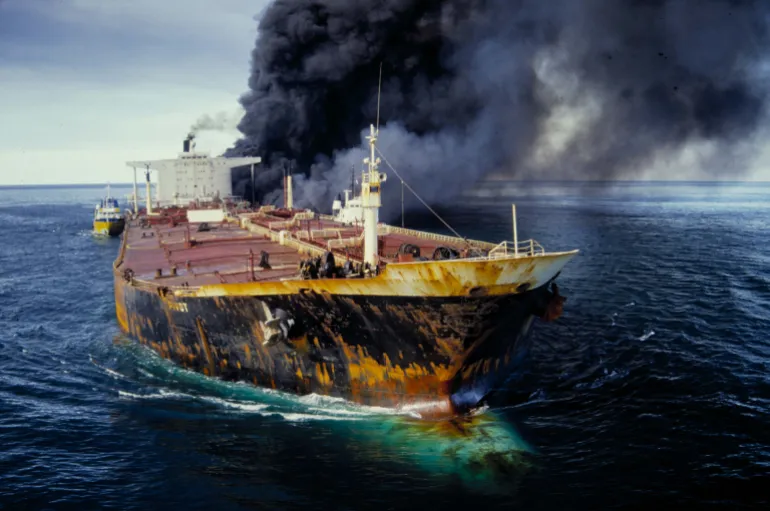
The ‘Pivot’ tanker in flames in the Strait of Hormuz in 1987 during the Iran-Iraq war [File: Francoise De Mulder/Roger Viollet via Getty Images]
How the 1980s Tanker War played out – a timeline
The war between Iran and Iraq began in 1980 when then-Iraqi President Saddam Hussein launched a full-scale invasion of Iran following Iran’s 1979 Islamic revolution.
In 1984, this war reached the Gulf when Iraq attacked Iranian oil tankers, seeking to cripple its oil-revenue-dependent economy. Iran retaliated by firing at oil tankers belonging to Iraq and its allies in the Gulf.
According to a report by the University of Texas’s Robert Strauss Center for International Security and Law, Iran also threatened to close the Strait of Hormuz then, but did not do so since its own economy, already crippled by the war, was dependent on exporting oil to the rest of the world through it.
In November 1986, when Iran struck Kuwait’s ships, Kuwait asked for foreign help. The former Soviet Union was the first to respond and helped escort the nation’s ships in the Gulf.
The US, led by then-president Ronald Reagan, launched Operation Earnest Will in July 1987, also seeking to protect tankers in the Gulf and render more assistance than Moscow. The operation involved reflagging Kuwaiti tankers with the US flag so they could legally sail under US protection.
According to an article by the Veterans Breakfast Club, a US-based website which shares experiences of former US military veterans, during Washington’s very first escort mission in July 1987, a reflagged tanker hit an Iranian mine in the Gulf.
“The convoy continued, but the incident made clear that the United States had entered a shadow war with Iran at sea,” the article said.
“Over the next fourteen months, dozens of US warships rotated through the region escorting tankers and protecting shipping lanes. US forces also conducted special operations to hunt Iranian mine-layers at night and conducted strikes against Iranian military positions and ships. The mission wasn’t a small one, consuming 30 US Navy ships at one time,” the article added.
Then in April 1988, the US frigate USS Samuel B Roberts was damaged by an Iranian mine in the Strait of Hormuz. Historian Samuel Cox, writing for the US Naval History and Heritage Command (NHHC), noted in 2018 that by the end of 1987 that vessel was so badly damaged, that “the only thing actually holding the ship together was the main deck”.
So, the US launched Operation Praying Mantis, seeking to destroy Iranian vessels.
The tanker war eventually ended in August 1988, following a United Nations-brokered ceasefire agreement between Iran and Iraq.
Cox noted that by the end of 1987, “Iraq had conducted 283 attacks on shipping, while Iran attacked 168 times. Combined, the attacks had killed 116 merchant sailors, with 37 missing and 167 wounded, from a wide variety of nationalities.”
“Initially, there was great concern that the attacks would cut off the vital flow of oil from the Arabian Gulf, but all they really did was drive up insurance rates. The world’s need for oil was so great, that over 100 dead merchant seamen was apparently an acceptable price,” he wrote.
A tanker in flames in the Strait of Hormuz in December 1987 during the Iran-Iraq war [File: Francoise De Mulder/Roger Viollet via Getty Images]
What is happening in the Strait of Hormuz now?
The current hostilities between the US and Iran in the Strait of Hormuz began when Tehran, whose territorial waters extend into the strait, closed passage to all vessels after the US and Israel began bombing the country. On March 4, the Islamic Revolutionary Guard Corps (IRGC) declared that it was in full control of the strait, and ships would need to get clearance from them to pass through it.
Shipping through the strait collapsed by 95 percent, sending the price of oil – 20 percent of global supplies of which are shipped this way – soaring above $100 a barrel.
Iran, through its imposition of control over who passes through Hormuz, has for almost eight weeks now, determined which vessels can exit the strait from the Gulf into the Gulf of Oman.
At first, Iran indicated that it would allow “friendly” ships to pass if they paid a toll. On March 26, Iran’s Foreign Minister Abbas Araghchi told Iran’s state TV: “The Strait of Hormuz, from our perspective, is not completely closed. It is closed only to enemies. There is no reason to allow the ships of our enemies and their allies to pass.”
Vessels from Malaysia, China, Egypt, South Korea, India and Pakistan passed through the strait through most of March and early April.
Iran’s Islamic Revolutionary Guard Corps (IRGC) provided these vessels with an alternative route through the Strait of Hormuz to avoid potential sea mines. US officials, including Donald Trump, have said mines have been placed there by Iran, although it has not officially confirmed or denied this.
(Al Jazeera)
But on April 13, alarmed that Iran was continuing to ship its own oil out of the strait, the US imposed a naval blockade of all Iranian ports. Since then, US Central Command has said US forces have directed 33 Iran-linked vessels to turn around or return to an Iranian port.
On Monday, the US military fired on and then captured the Iranian-flagged container ship Touska close to the Strait of Hormuz in the northern Arabian Sea, and, a day later, detained another oil tanker sanctioned for transporting Iranian crude oil as it sailed in the Bay of Bengal, which links India and Southeast Asia.
In a post on social media after detaining the Touska, the Pentagon wrote: “As we have made clear, we will pursue global maritime enforcement efforts to disrupt illicit networks and interdict sanctioned vessels providing material support to Iran – anywhere they operate. International waters are not a refuge for sanctioned vessels.”
Since the US naval blockade of Iranian ports began, Tehran, which was earlier allowing vessels from “friendly” nations to pass through the Strait of Hormuz, has further tightened its grip on the strait.
Justifying the decision not to allow any foreign ships to pass until the US ends its naval blockade on April 19, Iran’s First Vice President Mohammad Reza Aref said the “security of the Strait of Hormuz is not free”.
“One cannot restrict Iran’s oil exports while expecting free security for others,” he wrote in a post on X.
Last Saturday, Iran reportedly fired at two Indian-flagged merchant vessels in the strait. The IRGC said the two ships were attacked because they were “operating without authorisation”, according to state media reports.
Then, on April 22, Iran captured two container ships seeking to exit the Gulf via the Strait of Hormuz after firing on them and another vessel.
What are the parallels between the two wars?
Just like during the Tanker War of the 1980s, shipping has been severely disrupted by the US-Israel war on Iran, upending global oil and gas prices.
According to an April 17 article by the World Economic Forum, from the mid-1980s when the Tanker War took place, to the start of the new millennium, a barrel of crude oil averaged $20.
On Friday, while a ceasefire between the US and Iran was in effect, a naval battle was still playing out in the Strait of Hormuz, and Brent crude, the international benchmark, topped $106 per barrel. During open warfare between the US, Israel and Iran in March and early April, oil rose as high as $119 per barrel.
Mines in the sea are another problem common to both time periods.
While vessels were damaged by mines during the 1980s Tanker War, there has so far been no report of vessels being damaged by mines in the current war. However, the risk is the same.
US President Donald Trump has said the US will ramp up efforts to remove mines from the Strait of Hormuz. This has not begun yet, however.
According to CNN, there are only a few US minesweeping ships in the Gulf. The US Navy also told the broadcaster that four dedicated minesweepers stationed in the Gulf region were decommissioned last year.
John Phillips, a British safety, security and risk adviser and former military instructor, told Al Jazeera: “There are some clear parallels between the current situation in Hormuz and the Tanker War of the 1980s. In both cases, the basic idea is the same: pressure at sea can have effects far beyond the water itself.
“A relatively small amount of naval disruption, whether that means mining, harassment of shipping, missile threats, or attacks on tankers, can create real strategic and economic consequences, especially in a chokepoint like the Strait of Hormuz. So in that sense, the original Tanker War is a useful reminder of how vulnerable global trade can be when the maritime domain becomes part of a wider political or military confrontation.”
What are the differences between the two wars?
During the Tanker War, the US escorted ships to protect them from Iranian attacks and also deployed vessels to remove mines. NATO countries like the United Kingdom, Belgium, the Netherlands, France and Italy also joined.
But in the current standoff in the Strait of Hormuz, US allies like the UK and other NATO nations have refused to join Washington in reopening the Strait of Hormuz, or begin minesweeping operations, fearing they will be dragged into the war.
In a post on Truth Social in early April, the US president took aim at allies, “like the United Kingdom”, which, he said, have “refused to get involved in the decapitation of Iran”, telling them to either buy US fuel or get involved in the rapidly escalating war.
“You’ll have to start learning how to fight for yourself, the U.S.A. won’t be there to help you anymore, just like you weren’t there for us. Iran has been, essentially, decimated. The hard part is done. Go get your own oil!” Trump wrote.
The framework of the US-Israel war on Iran is different from that of the war between Iraq and Iran in the 1980s, experts say.
“In the 1980s, the Tanker War was part of the broader Iran-Iraq War, so the shipping attacks were tied to a much larger land conflict between two regional armies. Today, the situation is more about Iran’s standoff with the United States and its allies, and the maritime activity is less about asymmetrical war at sea and more about deterrence, signalling and the threat of escalation,” said Phillips.
“The military lesson, really, is that Hormuz is still one of those places where limited actions can have outsized effects, but the modern setting is more fast-moving, more technologically advanced and potentially more volatile than the original Tanker War,” he added.
Analysts have also pointed out that, unlike in the 1980s, Iran is currently stronger when it comes to withstanding attacks and naval blockades by the US.
In the Tanker War, Iraq was militarily supported by Western allies, while Iran was under a US arms embargo imposed in 1979 after the Iranian revolution. While this gave Iraq a military advantage, Iran’s IRGC used asymmetric warfare tactics by striking Iraq’s allies’ ships and oil tankers.
Experts also say that since the 12-day war between Iran and Israel last year, Tehran has shifted its military doctrine from one that is primarily about defensive containment to an explicitly offensive asymmetric posture.
“Iran today appears more structurally aggressive in doctrine where it is formally embracing earlier and more extensive use of regional missiles, drones, cyberattacks and energy coercion [when energy resources and infrastructure are targeted or cut off], but is operationally constrained by battle damage, sanctions and internal instability,” Phillips, the risk adviser and a former military chief instructor, told Al Jazeera in an interview on March 2.
A former US ambassador to Bahrain, Adam Ereli, also told Al Jazeera that Iran and the IRGC have “revolutionary fervour”, which means they can “survive”.
“They can tolerate pain for a lot longer than I think most American decision-makers and planners calculate,” he said.
Writing obituaries is a sacred, tricky task. Major news organizations compose advance obits on major figures, a just-in-case endeavor that feels both hugely important and somewhat macabre.
Several years ago, it fell to me to compose an advance death notice for the legendary conductor Michael Tilson Thomas, who was confronting a terminal brain cancer diagnosis by doubling down on his performance schedule and delivering — by all accounts — spectacular performances.
The piece lay blessedly dormant for longer than anyone thought possible as Tilson Thomas persevered in the face of his illness — an inspiration to all who knew and loved him. And then, yesterday morning, it became necessary to publish. There was a rush to update the writing, to fact-check the timeline, to be sure that all salient points were included. Here was the final story of a remarkable human’s life. The sense of responsibility cannot be overstated.
I was surprised to learn that a former colleague at the paper had also written an advance obit on Tilson Thomas, so my editor worked to meld the two together. The other writer included information that I had missed and vice versa, so in many ways it turned out to be a good thing that we had mistakenly doubled up on the weighty task.
One detail that the other writer included that was formerly unknown to me: A Times story from 1985 reported Tilson Thomas walking off the stage at the Hollywood Bowl nearly 15 minutes into the hourlong second movement of Part II of Gustav Mahler’s Symphony No. 8. Tilson Thomas did this, according to the archived news clip, because a noisy police helicopter simply would not go away.
A reader wrote in after the obituary went live to say that he had been there when it happened, and offered up this fresh insight:
“I was at the concert. The helicopter was hovering long, low and loud(!) with a bright searchlight scanning the trees behind the shell. It was an impossible situation which [Tilson Thomas] handled with quiet dignity. And when he returned to the stage he opted to re-start the Second Movement of Mahler VIII from the top! It was a long and memorable night at the Bowl.”
Our obituary described Tilson Thomas as storming off the stage. Not so, said the reader.
“More determination than storm,” he wrote.
And suddenly I could picture it, that moment from more than 40 years ago, with Tilson Thomas displaying the singular determination and love for his craft that would sustain him much later in life when he faced down death with the same quiet grace, the same unwavering resolve. And the music … I can hear it over the chop-chop-chop of the helicopter, until Tilson Thomas is all that remains.
I’m Arts editor Jessica Gelt feeling grateful for stories past. This is your arts and culture news for the week.
You’re reading Essential Arts
Our critics and reporters guide you through events and happenings of L.A.
By continuing, you agree to our Terms of Service, which include arbitration and a class action waiver. You agree that we and our third-party vendors may collect and use your information, including through cookies, pixels and similar technologies, for the purposes set forth in our Privacy Policy such as personalizing your experience and ads.
The week ahead: A curated calendar
FRIDAY
Craft Contemporary hosts CLAY LA this weekend.
(Allen J. Schaben/Los Angeles Times)
CLAY LA Emerging and established ceramic artists gather their wares for Craft Contemporary’s ninth annual fundraiser, a vibrant marketplace with complimentary refreshments, music and hands-on air-dry clay activities. Fun fact: The museum was founded by Edith R. Wyle, grandmother of “The Pitt’s” Noah Wyle. Market Preview Night, 6-9 p.m. Friday, $20 general admission, $15 members; weekend market, 11 a.m.-5 p.m. Saturday (free with $9 museum admission) and Sunday (pay-what-you-wish admission); regular museum hours, 11 a.m.-5 p.m. Wednesday-Sunday; noon-8 p.m., the first Thursday of the month. Craft Contemporary, 5814 Wilshire Blvd. craftcontemporary.org
Music director James Conlon of at L.A. Opera will conduct his farewell concert Friday at the Dorothy Chandler Pavilion.
(Ariana Drehsler/For The Times)
James Conlon Farewell Concert The maestro, who is stepping down after 20 years as LA Opera’s music director, leads the organization’s full orchestra and chorus for an evening of Mozart, Verdi and Wagner as his grand finale. The event is followed by a celebratory gala on the stage of the Dorothy Chandler Pavilion. 7 p.m. Dorothy Chandler Pavilion, 135 N. Grand Ave., downtown L.A. laopera.org
SATURDAY John Adams & Conrad Tao The LA Phil’s John and Samantha Williams Creative Chair conducts the orchestra in a program that includes Piazzolla’s “Two Tangos,” Stravinsky’s “Song of the Nightingale” and Prokofiev’s “Lieutenant Kijé Suite,” plus pianist Conrad Tao performing Adams’ composition “Century Rolls,” inspired by 1920s self-playing pianos. 8 p.m. Saturday; 2 p.m. Sunday. Walt Disney Concert Hall, 111 S. Grand Ave., downtown L.A. laphil.com
Brewery Artwalk & Open Studios This free semi-annual event at the former Pabst Blue Ribbon Brewery north of downtown features more than 100 artists sharing, discussing and (ideally) selling their work in the very spaces that much of it is created. 11 a.m.-6 p.m Saturday and Sunday. Brewery Arts Complex, 2100 N. Main St., L.A. breweryartwalk.com
Jerrika Hinton and Bradley Gibson in “Fremont Ave.” runs April 25-May 23 at South Coast Repertory.
(Marc J. Franklin)
Fremont Ave. The world premiere of Reggie D. White’s multi-generational drama about three Black men in L.A. and the woman who is the glue in their lives. Directed by Lili-Anne Brown. Part of the Pacific Playwrights Festival. Previews, 8 p.m. Saturday; 7 p.m. Sunday and Tuesday-Thursday; opening night, May 1; regular performances, May 2-23. South Coast Repertory, Segerstrom Stage, 655 Town Center Drive, Costa Mesa. scr.org
The Liminary It’s 2042 in Last Call Theatre’s latest immersive experience and the U.S. is run by a nationalistic, isolationist government. Do you dare join the resistance? With interactive exhibits on immigration, community and hope, plus multiple endings and narratives inspired by the saga of immigrants. 8 p.m Saturday; 8 p.m. May 1-2, May 7-9 and May 14-16. 1919 3rd Ave. L.A. lastcalltheatre.com
Liz Larner, “smile (abiding),” 1996-2005; Rachel Harrison, “The Prepper,” 2024; and Rebecca Morris, “Untitled (#15-25), 2025” from the exhibition “planchette” at Regen Projects.
(Regen Projects)
planchette A group exhibition featuring contemporary abstract sculptures and paintings by influential artists Rachel Harrison, Liz Larner and Rebecca Morris. Opening reception, 6-8 p.m.; exhibit runs through May 23. Regen Projects, 6750 Santa Monica Blvd. L.A. regenprojects.com
SUNDAY Gabriel Kahane & Roomful of Teeth The eclectic singer-songwriter-composer teams up with the multi-Grammy-winning vocal group to perform music from their recently-released collaborative album, “Elevator Songs.” 7 p.m. Sid The Cat Auditorium, 1022 El Centro St., South Pasadena. sidthecat.com
WEDNESDAY
The Australian Chamber Orchestra comes to the Segerstrom Center for the Arts on Wednesday, April 29.
(Nic Walker)
Australian Chamber Orchestra The ensemble from down under performs Purcell’s “Fantasia on One Note,” Handel’s “Concerto Grosso in A Major, Op. 6 No. 11,” a new work by John Luther Adams titled “Horizon,” Vaughan Williams’ “The Lark Ascending” (arranged by Adam Johnson), and Schubert’s ”Death and the Maiden” in the candlelit intimacy of the Samueli Theater. 7 p.m. Segerstrom Center for the Arts, 600 Town Center Drive, Costa Mesa. scfta.org
Jason Delane, left. and Chuma Gault in “Hymn” at the Odyssey Theatre.
(Cooper Bates)
Hymn In this drama by British playwright Lolita Chakrabarti, best known for her stage adaptations of the novels “Life of Pi” and “Hamnet,” two Black men meet at a funeral and discover a life-changing connection. Gregg T. Daniel directs this co-production between the Odyssey Theatre and the Lower Depth Theatre. Previews 8, p.m. Wednesday, Thursday and May 1; 8 p.m. Fridays and Saturdays (an Wednesday, May 27); 3 p.m. Sundays (except May 31), through June 14. Odyssey Theatre, 2055 S. Sepulveda Blvd. odysseytheatre.com
THURSDAY
Los Angeles Ballet presents “Giselle” with Kate Inoue at the Ahmanson Theatre, April 30-May 3.
(Alex Lopez)
‘Giselle’ The Los Angeles Ballet’s staging of this classic supernatural romance features the original 1841 choreography by Jean Coralli and Jules Perrot (updated by Marius Petipa) and score by composer Adolphe Adam. 7:30 p.m. Thursday-May 2 and 2 p.m. May 3. Ahmanson Theatre, 135 N. Grand Ave., downtown L.A. losangelesballet.org
The 1967 romantic comedy “Barefoot in the Park,” starring Jane Fonda and Robert Redford, opens the TCM Classic Film Festival on Thursday.
(Paramount Pictures)
TCM Classic Film Festival Hollywood Boulevard comes alive with four days of movie magic beginning with the opening night presentation of the 1967 romantic comedy “Barefoot in the Park,” starring Robert Redford and Jane Fonda. Other screenings include “Alice In Wonderland” (1951), “A Place In The Sun” (1951), “Gaslight” (1944), “Out Of The Past (1947) , “Modern Times” (1936), “The Day The Earth Stood Still (1951) and “The Magnificent Seven” (1960), with appearances by Fonda, Barbara Hershey, Carol Burnett, John Turturro and many more. Thursday-May 3. TCL Chinese Theatre IMAX, 6925 Hollywood Blvd.; Hollywood Roosevelt Hotel; TCL Chinese 6 Theatres multiplex, 6801 Hollywood Blvd.; El Capitan Theatre, 6838 Hollywood Blvd.; Egyptian Theatre, 6712 Hollywood Blvd. filmfestival.tcm.com
Arts anywhere
New and recent releases of arts-related media.
French Violinist Renaud Capucon, seen performing during the 2024 Paris Olympics, has a new live album featuring the works of composer Ernest Chausson.
(Kristy Sparow / Getty Images)
Chausson This concert album pairs two pieces by French Romantic composer Ernest Chausson: “Concerto for Violin, Piano and String Quartet, Op. 21.,” performed by violinist Renaud Capuçon, the late pianist Nicholas Angelich and the Ébène Quartet, and “Poème” for violin and orchestra, featuring Capuçon and the Brussels Philharmonic led by conductor Stéphane Denève. The show was recorded live in 2020. Warner Classics/Erato: Digital ($10) and CD ($17).
The City Unseen Emmy-winning producer-director Daniel Sackheim, whose credits include “Law & Order,” “The X-Files” and “The Americans,” is also a serious photographer. His new book of black-and-white images casts Los Angeles as the protagonist in a noir landscape of nocturnal beauty where its darkest secrets lurk in the deepest shadows. Hat & Beard Press: 108 pages, $60.
International Jazz Day The 15th annual event is Thursday in Chicago, but you can celebrate early with PBS’ broadcast of last year’s International Jazz Day All-Star Concert from Abu Dabai. Hosted by Jeremy Irons, the lineup includes Herbie Hancock, Dee Dee Bridgewater, Kurt Elling, Jose James, John McLaughlin, Helene Mercier, Danilo Perez, Arturo Sandoval and more. 10 p.m. Friday. PBS SoCal and streaming at pbssocal.org
— Kevin Crust
Culture news and the SoCal scene
Attendees walk around the Los Angeles County Museum of Art’s new David Geffen Galleries in Los Angeles on Sunday, April 19, 2025.
(Ariana Drehsler/For The Times)
The Los Angeles County Museum of Art news did not stop last week as it threw a glitzy opening gala for the new David Geffen Galleries, and — a few days later — welcomed members for previews prior to opening its doors to the general public on May 4. I attended the gala and checked in with a number of wonderful artists, including Mark Bradford, Ed Ruscha and Jeff Koons, about their thoughts on the new building. Then, on Sunday, we sent a team to get member reactions to the new space. Later in the week we published critic Leah Ollman’s review of the inaugural installation. Spoiler alert: Nope, not gonna give you one. You’ll have to read it.
We also ran a lovely profile by contributor Tara Anne Dalbow about Eileen Harris Norton whose jaw-dropping art collection is currently on display at Hauser & Wirth in downtown L.A. “Few people have done more to shape Los Angeles’ art scene than Eileen Harris Norton,” writes Dalbow. “The third-generation Californian, born and raised near Watts Towers in South Los Angeles, bought her first artwork at the Baldwin Hills Crenshaw Plaza, co-founded Art + Practice in Leimert Park, and has spent 50 years collecting artists who were, in many cases, her friends and neighbors.”
Joey Stromberg and Jenny Soo in “For Want of a Horse” at the Echo Theater Company.
(Cooper Bates)
Times theater critic Charles McNulty was — as always — incredibly busy, publishing two reviews and a feature in the past week. First up, his take on “For Want of a Horse” by Olivia Dufault, currently receiving its world premiere in an Echo Theater Company production at Atwater Village Theatre. “The subject is zoophilia, not to be confused with bestiality, though for many of us it will be a distinction without much of a difference,” McNulty writes. Curious? Read on.
McNulty also delivered a thoughtful profile Nicholas Christopher, who he dined with on a recent trip to New York. “A new Broadway star emerges each season, and this year the spotlight has alighted on Nicholas Christopher, who has been dazzling audiences and insiders alike as part of the awe-inspiring triumvirate powering the thrilling new revival of the musical ‘Chess,’” McNulty writes.
Finally, McNulty reviewed “Eat Me,” by Talene Monahon, having its world premiere at South Coast Repertory. A fan of Monahon‘s previous work, McNulty was not as impressed at he would have liked. The play, he writes, “is a relentlessly quirky work that gorges on its own dark whimsy.”
In other news, I got the scoop that new media artist Refik Anadol’s museum of AI arts, Dataland has set its opening date for June 20.
Enjoying this newsletter? Consider subscribing to the Los Angeles Times
Elinor Gunn in “Joan” at South Coast Repertory. SCR has announced its 2026-27 season.
(Scott Smeltzer)
South Coast Repertory announced an expanded 2026-27 season, featuring nine productions, including “Hamlet,” starring Raymond Lee; Stephen Sondheim and James Lapine’s “Into the Woods;” Lauren Yee’s “Mother Russia;” and Oscar Wilde’s classic, “The Importance of Being Earnest.” “The 2026-27 season reflects programming changes established in SCR’s recently adopted strategic plan, which includes more classics, modern masterpieces and the continuation of an annual musical on the Segerstrom Stage,” a news release notes.
The following day, services to Krakow will begin with departures on Mondays and Fridays every week.
On October 25 and 26, travellers can go from Belfast International Airport to Sharm El Sheikh, Egypt, on Wednesdays and Sundays, as well as to Rome on Mondays and Fridays.
Anyone wanting to visit Reykjavik, Iceland, can travel from Newcastle from October 27 twice a week, on Tuesdays and Saturdays.
You can fly to Iceland’s beautiful capital city from Newcastle with Easyjet later this yearCredit: Getty Images/Cavan Images RF
Easyjet’s Luton-Ljubljana flights start on October 26 three times a week on Mondays, Wednesdays and Fridays.
The same day, the Southend-Budapest route also starts twice a week on Mondays and Fridays.
In an exciting update for Birmingham, the route to coastal city Agadir, in Morocco, will start on October 27. They will depart twice a week on Tuesdays and Saturdays.
The new flights, which include fares of £23.99, have significantly expanded the airline’s network from the north of England, and enabled more direct services to popular leisure and city destinations.
The airline’s UK country manager, Kevin Doyle, said: “Whether they’re looking for winter sun, or a weekend away in some of Europe’s most iconic capitals, this new batch of routes further expands the range of exciting destinations available for our customers to choose from at affordable prices.”
MOVE over London, there’s a new ‘it’ city on the UK scene and it has cheap travel, cowboy dancing and a super cute mascot.
This year, Glasgow is being talked about a lot and it isn’t without good reason…
Sign up for the Travel newsletter
Thank you!
Glasgow was recently named one of the must-visit European cities for this yearCredit: Cyann FieldingAnd one top spot in the city is Barras MarketCredit: Cyann FieldingYou’ll find unique and locally crafted items including clothes, bags and even cowboy bootsCredit: Cyann Fielding
The city was recently named one of Time Out’s best cities to visit in Europe this year, ranking fourth.
And the Scottish city is currently undergoing a massive £20million revamp of its city centre square – George Square.
Dating back to 1781, the square was named after George III and will reopen to the public this September with a completely new look.
Though, the famous statues of poet Robert Burns and novelist Sir Walter Scott will remain.
Overall, the square will become more walkable and green, with Norwegian maple trees and cherry trees, rain gardens, event spaces, and new seating areas.
The square’s renovation is set to be completed by late August and will then open to the public in September.
Having recently visited the city, it isn’t the only exciting thing going on…
Often overshadowed by the capital Edinburgh, Glasgow has a lot to see and do.
Close to George Square, you can stay at the AC Marriott Hotel from £80 a night, which is a super modern hotel with sleek interiors and a chilled vibe.
The best thing about the hotel though is that it looks out at the incredible architecture of the City Chambers.
If you love a bit of retail therapy, make sure to head to Barras Market on a Saturday or Sunday.
The giant sprawling market has all sorts of antique and second-hand gems including minimalistic chairs and ornate teapots – I highly recommend EARTH.er, a travel bag maker that began in Tai O, Hong Kong but is now based in Glasgow.
And if you are a lover of all things western, head to Cowpeople for authentic cowboy boots and fringed leather jackets.
In between the different market buildings, you will find a number of different food and drink vans.
Make sure to stop by the Cowpeople for authentic cowboy boots and fringed jacketsCredit: Cyann Fielding
The one with the super-long queue is the viral Eight Coffee Co, which serves some of the most unusual blends I’ve ever seen.
Think cereal milk matcha, complete with cream and lucky charms.
The queue might appear long but goes quickly, and trust me, it is worth waiting the 20 minutes for.
Just outside the market, drop by Ho Lee Fook – another viral spot but this time for a pork tonkatsu sandwich that takes three days to make (and it is huge!).
The Hong Kong food spot is in a former newsagent’s hatch and translates to “good, wealth and luck”.
At The Clydeside Distillery you can go on a whisky tour with a tastingCredit: Cyann FieldingIt costs £39 per personCredit: Cyann Fielding
Of course, Scotland is well-known for its whisky so make sure to head to a local distillery.
Down on the River Clyde, you’ll find The Clydeside Distillery where you can go on a tour led by a guide and try a flight of five different whiskies accompanied by five chocolates that magically change the taste of each drink.
It costs £39 per person and lasts around an hour and 20 minutes.
Rather uniquely, Glasgow’s night scene transports you to deep south America.
Buck’s Bar is great for famished visitors, with giant chicken burgers and a true Texan vibe inside.
A couple of doors down, you’ll find Maggie’s Rock n’ Rodeo – and it is as fun as it sounds.
A small crowd shuffled around the dancefloor, performing a number of different line dances to a live country singer – what could be more fun?
“Who doesn’t love a hoedown?” shouts Garry King, the vibrant drag host who brings the confidence and dancing skills out of everyone.
For an evening out, head to Maggie’s Rock n RodeoCredit: Cyann FieldingYou can enjoy live country music plus line dancingCredit: Cyann Fielding
And if you are feeling brave (unlike me who was still feeling the weight of my giant Buck’s Bar burger in my stomach), you can hop on the mechanical bull and try lasting longer than just a few seconds…
If you want to head out of the city centre for the day, hop on a train to Pollokshaws West Station costing only £3 return for adults and £1 for kids.
In fact, all day, every day, kids can travel on ScotRail for £1 when travelling with an adult.
Outside the station you can then catch a free shuttle bus to Pollok Country Park where you’ll find a herd of Highland Cows (often referred to as Scotland‘s mascot) and visit the Burrell Collection, home to a Cézanne painting and one of Auguste Rodin’s The Thinker statues.
But if you don’t feel like venturing outside the city, go to the Botanic Gardens to get your dose of green space.
If you want to see a bit of nature in the city, head to the Botanic GardensCredit: Cyann FieldingThe gardens are free to visitCredit: Cyann Fielding
Home to several glasshouses and Kibble Palace, the free attraction is a great spot for enjoying a bit of nature (and a tropical rainforest) in the heart of the city.
Down from the Botanic Gardens, you will also find Glasgow’s West End, which is often named one of the ‘coolest neighbourhoods’ in the UK.
Make sure to drop by Ashton Lane – a cobbled street with cosy restaurants and bars.
If you are not done with quaint lanes, make sure to head to the Finnieston area as well, where you will find Hidden Lane, which is full of local artists, designers, and even a tarot reader.
Nearby, also check out Ashton Lane where you will find a number of cosy cafes and restaurantsCredit: Cyann Fielding
A short walk from Hidden Lane and you will find Civerinos – a fantastic pizza restaurant.
Opt for the sweet potato and truffle pizza for under £20 – it is huge, and you won’t be disappointed.
For dessert, drop by Fat Sal’s – an Italian ice cream parlour with a Scottish twist.
A scoop costs a few quid and flavours are constantly rotating, though if they have the Scottish tablet one available, it is a creamy, heavenly dream.
Continue the night at The Park Bar, for a traditional and historic Scottish pub dating back to 1895 with live traditional music often including an accordion player.
For dinner, visit Civerinos for amazing (and giant) pizzasCredit: Cyann FieldingThen for dessert, stop by Fat Sal’s which has plenty flavours of ice cream to choose fromCredit: Cyann Fielding
Our favourite UK hotels
*If you click on a link in this box, we will earn affiliate revenue.
Margate House, Kent
This stylish boutique hotel is in a seaside townhouse, a short walk from Margate’s coolest bars and restaurants. Decked out with plush velvet sofas, candles flickering, and striking independent art, inside feels like a warm welcome home. Rooms are stunning, especially the ones that give you a glimpse of the sea.
The Alan looks extremely grand, being built into a beautiful Grade II listed building. Spread across six floors, with 137 rooms, each one looks like a fancy design magazine. From the concrete coffee tables to the pink plastered walls, the industrial-inspired designs perfectly replicate the history of the city.
This historic hotel has welcomed the likes of Charles Dickens and Lillie Langtry through its doors. Rooms have richly-patterned carpets with super soft bed linen and premium toiletries in the bathroom. Go for a superior room for extra goodies including bathrobes and snack boxes.
This Cambridge hotel is in the ideal spot, within walking distance to bars, shops, and hotspots like the university colleges and Parker’s Piece. The inside couldn’t be prettier, with huge stained glass windows, grand chandeliers, and rooms with enormous clawfoot bath tubs.
Government spoke out to passengers booked with carriers like Ryanair, easyJet, Jet2 and Wizz Airs amid fears of fuel supply disruption and potential flight cancellations
Amidst fears of holiday meltdown the UK Government this afternoon issued statement and check sheet(Image: Getty Images)
The Government this afternoon issued a statement to passengers across the UK amid growing concerns over jet fuel shortages and the prospect of flight cancellations. The Department for Transport stepped in to respond following warnings from the European Union.
EU energy commissioner Dan Jorgensen said this week: “Unfortunately, it’s very likely that many people’s holidays will be affected, either by flight cancellations or very, very expensive tickets.”
He added: “Even if we do everything we can do, if the jet fuel is not there, then it’s not there. [Currently] it is primarily a crisis of prices and not yet a crisis of supply, but unfortunately we cannot be sure to prevent a crisis of supply, especially on jet fuel in the future, if the crisis continues.”
Earlier today, President Trump suggested the Iran situation could drag on for weeks, stating he ‘wouldn’t rush’ a deal. The DfT then issued direct guidance to passengers booked with carriers including Jet2, Ryanair, Wizz, easyJet and British Airways.
It said: “There is no current need for passengers to change their travel plans. UK airlines buy jet fuel in advance, and airports maintain stocks to support their resilience. The government is working closely with the aviation industry to monitor risks and minimise disruption to passengers.”
“If your flight is cancelled, you have clear legal rights, including the right to a full refund or re-routing. Read this factsheet for the full picture on the current situation and what it means for you.”
Is there a shortage of jet fuel in the UK?
DtT said: “UK airlines are clear that they are not currently seeing a shortage of jet fuel. It is typically bought in advance, with airports and their suppliers keeping stocks of bunkered fuel to support their resilience.”
Do you need to change your travel plans?
Officials explained: “There is no current need to change upcoming travel plans. Government regularly meets with industry to monitor risks, understand pressures and ensure clear communication with passengers, should circumstances change.
“We recognise that families may be concerned, and that aviation and tourism businesses are operating in challenging global conditions. We are working hand‑in‑hand with industry to help flights keep operating.
“We advise passengers to continue checking with their airlines before they travel, and to check the FCDO travel advice for the latest updates. You should also ensure you have appropriate travel insurance.”
How is the government protecting passengers?
Under UK law, if your flight is cancelled, you are entitled to either a full refund or to be booked onto an alternative flight if you:
depart from an airport in the UK on any airline
arrive at an airport in the UK on an EU or UK airline
arrive at an airport in the EU on a UK airline
For more information about your rights, you can:
What is government doing?
The UK Government said: “Since the closure of the Strait of Hormuz, we have been closely monitoring UK jet fuel stocks and working with airlines, airports and fuel suppliers to ensure passengers keep moving and businesses are supported.
“We continue to plan for a range of contingencies, while focusing on securing a long lasting and workable solution to get shipping flowing freely again through the Strait of Hormuz.”
How are airlines being supported?
In terms of carriers the DfT said: “At some UK airports, airlines are given scheduled times known as ‘slots’ in which to take off or land.
“Under normal rules, airlines must use at least 80% of their allocated slots during a season to keep them for the following year. If they fall below this threshold, those slots can be reassigned to another airline. This is known as the ‘use it or lose it’ rule.
“Airport Coordination Limited, the independent body that manages slot allocation at UK airports, has updated its guidance so that airlines will not lose their slots if fuel shortages prevent them from flying. Airlines can now apply for an exemption from the ‘use it or lose it’ rule in these circumstances.
“This means airlines can focus on minimising disruption for passengers, rather than feeling pressure to operate flights purely to protect their slots.”
Travel expert Simon Calder has explored the latest challenges facing UK airlines and passengers amid jet fuel shortages caused by the Iran war
Robert Rowlands Deputy editor, money and lifestyle, content hub
15:53, 24 Apr 2026Updated 15:53, 24 Apr 2026
A Ryanair plane on final approach to Edinburgh airport, on January 28, 2026 – the airport was one of those discussed by Simon Calder in his podcast(Image: Getty)
Travel expert Simon Calder has released an update on his podcast about what to do should your flight be suddenly cancelled amid worldwide jet fuel shortages. The highly regarded travel journalist – well known for his frequent TV appearances and contributions to the Independent – has spoken with a prominent industry figure after seeing ‘so many people getting in touch feeling anxious about their holidays.’
He noted that many people were even contemplating whether to stay in England for their holidays. His remarks come as the Iran war continues to rumble on. The conflict, which began on February 28, has restricted the flow of oil and gas across the globe, placing pressure on markets and driving up the cost of jet fuel for airlines, reports the Liverpool Echo.
This week, jet fuel shortages have emerged as a significant concern, as statements from senior industry figures have sparked worry amongst ordinary travellers about the potential impact on their holidays this year. Dan Jorgensen, the EU energy commissioner, this week said: “Unfortunately, it’s very likely that many people’s holidays will be affected, either by flight cancellations or very, very expensive tickets. Even if we do everything we can do, if the jet fuel is not there, then it’s not there.”
Speaking on his podcast on Thursday, April 23, Simon began by saying: “You might be more inclined to stay in England because of all the headlines we’ve been seeing over the past couple of days. For example, Lufthansa of Germany said they were cancelling 20,000 flights.
“I’ve had so many people getting in touch feeling anxious about their holidays when I would hope they would be looking forward to them with great anticipation.” To tackle this, he spoke with Ted Wake, managing director of Kirker Holidays.
Simon put the question to him: “So just suppose I have booked a Kirker holiday. I’m maybe going to some of the great cities in Germany. Amazing cultural treasures to be found. And I’m flying maybe from Birmingham, from Edinburgh, from Glasgow, and suddenly Lufthansa cancels my flight. What do you do then as a tour operator?”
Ted responded: “We would find the nearest flight which would provide a sensible, practical alternative. We would liaise with the client about whether or not it was convenient for them and, if they’re in agreement, Kirker would pick up the tab for any logistical costs that have been incurred.
“There are occasions where tour operators like us might extend the client’s stay by an additional night and we might pick up the tab for that. But if you have booked through an ATOL-protected tour operator and the tour operator is mindful to nurture long-term relationships, it is in our interest to iron out the creases in that way.
“And you have mentioned some regional services there and it may be the case that Lufthansa cancel 1 or 2 of those but there will often be alternative flights, perhaps with a different carrier, and Kirker would pick up the tab for that as well as manage the logistical research in terms of what alternative flight could be suitable to ensure that people have a fabulous holiday.”
Ted’s remarks come just days after EU official Mr Jorgensen cautioned: “[Currently] it is primarily a crisis of prices and not yet a crisis of supply, but unfortunately we cannot be sure to prevent a crisis of supply, especially on jet fuel in the future, if the crisis continues.”
The International Energy Agency has similarly advised that severe supply disruptions could materialise within the next five or six weeks. It was against this backdrop that Simon addressed passenger concerns here in the UK.
Jet fuel flight cancellations and the EES
Ted highlighted that airlines are currently grappling with two distinct challenges – the jet fuel shortage and the new EES system. This system – the Entry/Exit System (EES) – is a new digital border arrangement that introduces additional checks for British travellers heading to numerous European destinations.
It launched this month. On your first visit following the change to a country within the so-called Schengen area (which encompasses many EU nations), you may be required to create a digital record upon arrival at an airport. You may be required to submit your fingerprints and have your photograph taken. The system has resulted in significant delays for some UK travellers since its introduction.
Ted discussed the jet fuel challenges confronting airlines and what this means for everyday passengers across the UK. He said: “I think Lufthansa has got a very comprehensive schedule. Twenty thousand flights isn’t a drop in the ocean but it’s a relatively small number if you look at the overall picture.
“I think other airlines within the UK market will be doing something similar. You might argue that it is a sensible logistical profit management exercise as well as a jet fuel situation, but I don’t see it having a major impact on consumers and if you book through a tour operator – of course, Simon, you tell your readers all the time and indeed your listeners for that matter – if you book through a tour operator, it’s a tour operator’s responsility to iron out all the creases so the consumer is not adversely impacted by the change.”
A pilot who has flown more than 750 times has revealed there’s one European city which is a ‘tremendous destination’ that’s well worth visiting – and flights start from £26.99
A beautiful European city has been hailed as a lesser-known gem by a pilot(Image: Getty Images)
A pilot who has flown more than 750 times and visited more than 50 countries in just four years has revealed the European city that holidaymakers miss.
When it comes to booking a sun-soaked getaway, many of us are on the lookout for those destinations that go a little under the radar. Whether it’s to escape the onslaught of tourist crowds, packed attractions and lengthy queues, or to simply wander around a quieter location and explore somewhere new.
There’s a catalogue of beautiful European cities, brimming with charm and character, that are well worth venturing beyond the typical holiday hotspots. Yet, it’s not always easy to know where to go. But luckily for us, Wizz Air pilot Tom Copestake knows exactly what destination he’d recommend to holidaymakers.
Speaking exclusively to the Mirror, Tom said: “I flew into Bilbao about two weeks ago – it’s a tremendous destination on the north coast. It was surrounded by what looked like amazing mountains or hills for hiking. I think there’s a lot of good walking in northern Spain.”
He continued: “I spoke to the ground handling agent in Bilbao, and he said how beautiful the area was and how we needed to stay and go exploring. There’s a place called San Sebastiá just down the road from Bilbao, which is apparently an amazing place to go and have a look at.”
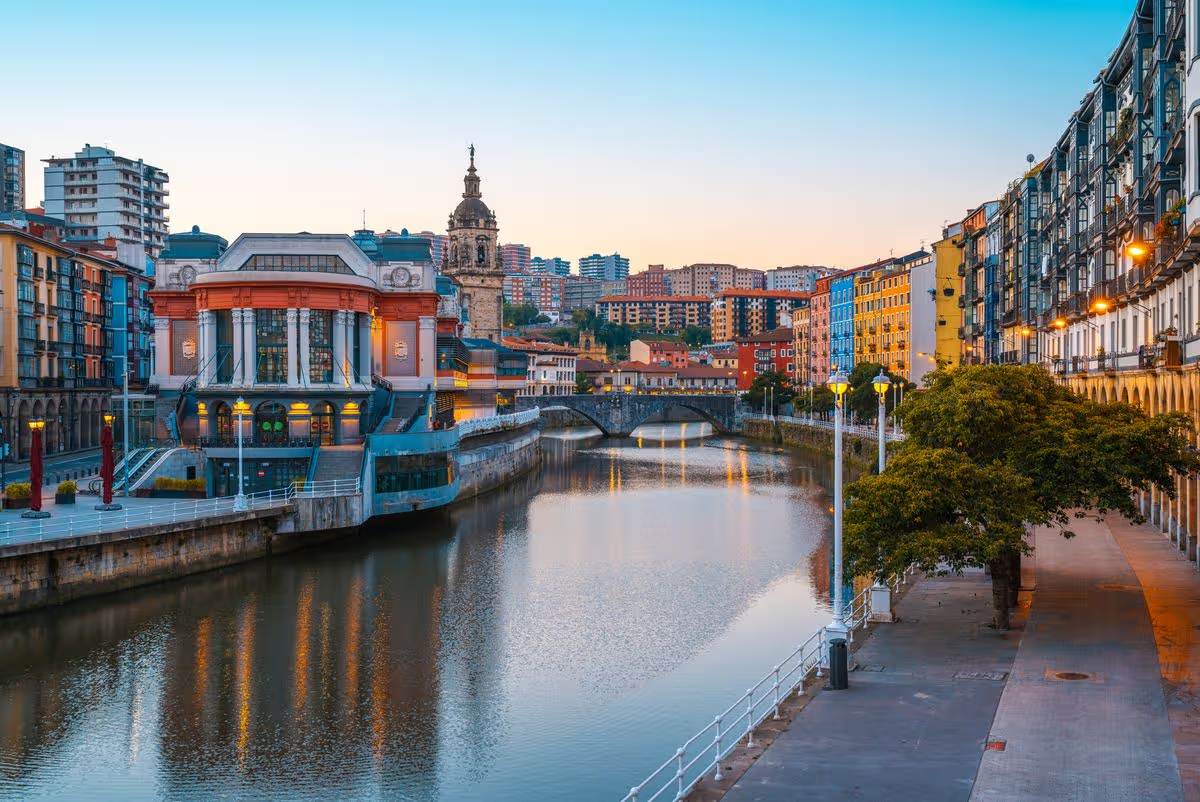
Bilbao is a vibrant and colourful port city in northern Spain, with towering green mountains and a winding river valley running through its core. It’s known for its Basque heritage, innovative architecture, and world-class art.
Its most famous landmark is the curved Guggenheim Museum, designed by Frank Gehry, known for its contemporary art exhibitions and the ‘Puppy’ statue that towers over the city. Yet, against its ultramodern architecture, there’s the historic old town of Casco Viejo, which is made up of ancient medieval streets, the grand Santiago Cathedral, and Mercado de la Ribera – one of Europe’s largest covered food markets.
The city has a renowned food scene, with its local tapas, known as pintxos, being a notable highlight, alongside its selection of fresh seafood. Bilbao is also packed with lively bars, buzzing restaurants and cafés, so visitors can savour the flavours of its incredible cuisine, and soak up its vibrant atmosphere.
Aside from visiting the Guggenheim Museum, notable attractions include the Museum of Fine Arts of Bilbao, Zubizuri Bridge, also known as the ‘White Bridge’, and Artxanda Funicular, a mountain cable car offering breathtaking views. Nearby is also the Bizkaia Bridge, the world’s first to carry people and traffic on a high suspended gondola, and it’s also a UNESCO World Heritage site.
And it might just be the perfect time to visit, as Wizz Air launched new routes from London Luton to Bilbao this year, with flights starting from £26.99. They also welcomed a flurry of new Spanish routes, including to Barcelona, Madrid, Valencia, Alicante and Seville.
Sharing a closer insight into his job as a pilot, after recommending Bilbao, Tom acknowledged: “This is a customer service job that happens to be in the aviation industry, and I love the fact that each of the thousands of passengers I’ve flown has a story and a reason to travel.
“It might be for fun, to see family, or we have people who might be working in different countries. It’s really cool, and I love that so much.” He humbly added: “This job is a privilege”.
For more information on Wizz Air flights, or to book your next getaway, visit their website.
Do you have a travel story to share? Email webtravel@reachplc.com
WASHINGTON — The Justice Department has ended its probe into Federal Reserve chair Jerome Powell, clearing a major roadblock to the confirmation of his successor, Kevin Warsh.
U.S. Attorney for the District of Columbia Jeannine Pirro said on X that her office was ending its probe into the Fed’s extensive building renovations because the Fed’s Inspector General would scrutinize them instead.
The decision ends an investigation, one of several undertaken by the Justice Department into President Trump’s perceived adversaries, that for months had failed to gain traction as prosecutors struggled to articulate a basis to suspect criminal conduct.
A prosecutor handling the case conceded at a closed-door court hearing in March that the government hadn’t yet found any evidence of a crime, and a judge subsequently quashed subpoenas issued to the Federal Reserve. The judge, James Boasberg, said prosecutors had produced “essentially zero evidence” to suspect Powell of a crime. Boasberg prosecutors’ justification for the subpoenas as “thin and unsubstantiated.”
More recently, prosecutors made an unannounced visit to a construction site at the Fed’s headquarters but were turned away, drawing a rebuke from a defense attorney in the case who called the maneuver “not appropriate.”
The move could lead to a swift confirmation vote by the Senate for Warsh, a former top Fed official whom Trump, a Republican, nominated in January to replace Powell, whose term as chair ends May 15. Sen. Thom Tillis, a North Carolina Republican, has said he would oppose Warsh until the investigation was resolved, effectively blocking his confirmation.
Warsh said Tuesday that he never promised the White House that he would cut interest rates, even as the president renewed his calls for the central bank to do so.
“The president never once asked me to commit to any particular interest rate decision, period,” Kevin Warsh, a former top Fed official, said under questioning by the Senate Banking Committee. “Nor would I ever agree to do so if he had. … I will be an independent actor if confirmed as chair of the Federal Reserve.”
Warsh’s comments came just hours after Trump, in an interview on CNBC, was asked if he would be disappointed if Warsh didn’t immediately cut rates and responded, “I would.”
Kobe Bryant rookie trading cards aren’t particularly rare. And because rarity equates to value, standard issue 1997 cards featuring the late Lakers great retail for a pedestrian $100 to $300.
Then there are 1997 Kobe Bryant Metal Universe Precious Metal Gems Green cards, which just by typing that highfalutin name can give even the most savvy collector goose bumps.
The key word is green. Most Bryant rookie Metal Universe Precious Metal Gems cards have a red background and fetch around $300,000. Only 10 were made with a metallic green background and only three have been graded by respected grading firm Professional Sports Authenticator (PSA).
So green translates to greenbacks. Alt, a company that enables users to sell, buy and securely store collectible cards, announced Thursday it purchased one of those — take a breath first — 1997 Kobe Bryant Metal Universe Precious Metal Gems Green cards in a private transaction for $3.15 million.
The company said on Instagram that the purchase makes it the most expensive Bryant card ever sold, eclipsing the previous record of $2.4 million set in September. Another copy of the same card sold for $2 million in 2022.
“It was on every collector’s wall, in every price guide, at the top of every wish list,” Alt CEO Leore Avidar Avidar said on Alt’s Instagram page. “Acquiring it for our fund is personal, but it’s also a reflection of where this market has gone.”
The image of Bryant in midair passing — not shooting! — highlights the card, which earned a PSA 5 grade.
The card adds to Alt’s impressive collection. The fund set price records at time of purchase for LeBron James, Stephen Curry and Giannis Antetokounmpo cards in addition to the one of Bryant.
The most paid for a sports trading card was $12.932 million for a 2007-08 Upper Deck Exquisite Collection Dual Logoman Autographs signed card featuring Bryant and Michael Jordan last fall. The purchase was made by investor and “Shark Tank” personality Kevin O’Leary along with veteran collectors Matt Allen and Paul Warshaw and surpassed the previous record of $12.6 million held by a 1952 Topps Mickey Mantle card.
The Bryant/Jordan card is the second-most expensive sports collectible of all time behind Babe Ruth’s 1932 World Series “called shot” jersey, which sold for $24.12 million in 2024.
High-end Bryant cards remain coveted by collectors. Allen, well known in the industry as Shyne150, privately spent $4 million on two Bryant 1-of-1 signed Panini Flawless Logoman cards.
April 24 (UPI) — Spanish Prime Minister Pedro Sanchez on Friday dismissed an alleged leak from the U.S. Department of Defense suggesting that Spain could face being suspended from NATO in retaliation for not supporting the United States in its war with Iran.
Arriving in Cyprus for a meeting of European Union leaders, Sanchez said he was not worried and that Spain was fully compliant with its treaty commitments to the collective defense pact.
“No worries. The Spanish government’s position is clear: absolute cooperation with our allies, but always within the framework of international law,” was his response to questions regarding a leaked Pentagon email setting out potential actions that could be taken against NATO allies who failed to adequately support the war or were otherwise seen as uncooperative.
However, Sanchez refused to be drawn directly on the alleged contents of the internal U.S. government communication leaked by a U.S. official to Reuters, which broke the story on Friday.
He said the Spanish government could talk about relevant official U.S. documents and policy positions but “does not comment on emails.”
An outspoken critic of the U.S. military offensive against Iran, Spain was highlighted as the prime candidate for being ejected from NATO, but the United Kingdom was also earmarked for retribution with a proposal pitching a rethink of Washington’s support for British sovereignty over the Falkland Islands.
In 1982, Britain fought and won a 74-day war with Argentina over the South Atlantic territory after its forces overran and seized islands.
President Donald Trump was incensed by Sanchez’s refusal to permit U.S. military aircraft to use U.S.-Spanish airbases or Spain’s airspace to launch strikes on Iran, culminating in him threatening to sever bilateral trade.
Britain initially denied permission for U.S. warplanes to use its airbases but relented two days or so after the start of the war on Feb. 28, allowing aircraft engaged in “defensive” missions to fly out of RAF bases in Britain and Diego Garcia in the Indian Ocean.
The Pentagon, which the Trump administration moved to rename to the Department of War,appeared to justify taking some type of punitive action.
Pentagon Press Secretary Kingsley Wilson said NATO allies “were not there for us” regardless of “everything” the United States had done for them.
“The War Department will ensure that the president has credible options to ensure that our allies are no longer a paper tiger and instead do their part. We have no further comment on any internal deliberations to that effect,” she added.
Calling NATO “a source of strength,” Italian Prime Minister Giorgia Meloni, who was also attending the EU summit, called for unity.
“We must work to strengthen Nato’s European pillar… which must clearly complement the American one,” she said.
Berlin dismissed the idea Spain’s position within NATO was under any threat.
“Spain is a member of NATO. And I see no reason why that should change,” a German government spokesman said at a regular news briefing on Friday.
The 1949 treaty under which NATO was formed by the United States, Britain, France, Canada, Italy, the Netherlands, Belgium, Portugal, Luxembourg, Denmark, Norway and Iceland as a response to the Cold War contains no process or means for the expulsion or suspension of a member country.
Former NATO spokesperson and senior fellow at the Royal United Services Institute, Oana Lungescu, also dismissed the idea Spain could be suspended.
“It’s hard to know how seriously we should take such emails beyond ideological trolling,” she said.
Secretary of Health and Human Services Robert F. Kennedy, Jr. speaks during a Senate Committee on Health, Education, Labor, and Pensions hearing on the Department of Health and Human Services proposed fiscal year budget for 2027 in the Dirksen Senate Office Building near the U.S. Capitol on Wednesday. Photo by Bonnie Cash/UPI | License Photo
THERE’S no better feeling than sipping a glass of sangria under the blazing sun, while relaxing on the Spanish coastline.
Except this time, I was paying in pounds in and I’d taken a train instead of a plane to get there.
Sign up for the Travel newsletter
Thank you!
The Sunshine Coast of Essex is often compared to the Costa Del Sol in Spain, being one of the sunniest, driest spots in the countryCredit: GettyTravel writer Catherine Lofthouse took her kids to the Essex seaside, and they loved it just as much as a trip abroadCredit: Catherine Lofthouse
Because I was on the Sunshine Coast of Essex, which is often compared to Spain thanks to it being one of the sunniest, driest spots in the country.
According to the annual Which? seaside towns survey, August average highs are 21C, while water temperatures are 18C.
Even rainfall is low, with just 45mm in Frinton-on-Sea.
So I headed to the Essex Sunshine Coast for an Easter getaway to see how this unsung seaside staycay compares to its continental cousin.
I’ll be honest, I had no idea that England had its own version of the Costa del Sol until recently, although has been dubbed this for at least a quarter of a century.
Other than the Jurassic Coast in Dorset and East Devon, we don’t seem to have many named coastlines in this country, unlike places like Portugal, where every bit of seafront has an exotic name.
And if I’d taken a guess at where in the country the Sunshine Coast might be, I’d probably have gone for a much-touted tourist hotspot like Cornwall or Norfolk rather than this coastal corner not far from the capital.
But with new staycay stats showing that foreign trips are off the cards for many of us this year, holidaymakers looking to swap sangria for sticks of rock might actually be wowed by just what is on offer.
We visited on the warmest week of the year so far and temperatures here hit 22C, with blazing sunshine for most of our stay, so the area really did live up to its name for us.
But what I really loved about exploring the Essex seaside is the sheer variety of experiences on one relatively small stretch of coast, bookended by Brightlingsea in the south and Harwich in the north.
If you drove direct between the two, it would only take half an hour, although following the meandering coastline obviously increases the distance.
So it’s pretty impressive that you can find something for all staycay styles here, whether you prefer caravan parks with full-on family fun, charming cottages set by quiet beaches in calm countryside or hotels and a bit of history and heritage.
Some stretches feel like going back in time to seaside holidays of the past.
My husband spent his childhood summers staying in a caravan at Walton-on-the-Naze, renowned for its rows of colourful beach huts that have been here for more than a century.
Watching our boys exploring the shallow slope of Eastcliff Beach, not much seems to have changed over the years, with visitors still combing the sand for the prehistoric shark teeth that have always been found in abundance here.
Frinton, just a few miles away, is another timeless coastal classic, with its sleepy air of seaside chic.
A couple of years ago, we stayed at Haven Orchards on Point Clear, where you can catch a ferry for the three-minute trip across the harbour to Brightlingsea.
Costa Del Sol or Only Way Is Essex? This is Benalmadena beach in Andalusia, SpainCredit: GettyThe Sunshine Coast of Essex is often compared to Spain thanks to it being one of the sunniest, driest spots in the country (pictured: Clapton-On-Sea)Credit: Getty
Some other UK seaside town holidays…
*If you click on a link in this box, we will earn affiliate revenue.
Sidmouth, Devon Take a trip to Sidmouth on the Jurassic Coast and wander down Jacob’s Ladder to its pretty shingle beach. Make sure to walk along the promenade and check out the independent shops and boutiques. Stay at the four-star Harbour Hotel for sea views and traditional afternoon tea from £135 per room.
Whitby, North Yorkshire With a history of sailors and vampires, a dramatic coastal path, and the very best in pints and scampi, it takes a lot to beat Whitby. Pop in the amusements, eat award-winning fish and chips, and board the all-singing Captain Cook boat tour on the harbour. The Royal Hotel overlooks the harbour with stays from just £68 per room.
Old Hunstanton, Norfolk This town has some of the best beach walks beside striped limestone cliffs, a Victorian lighthouse and 13th century ruins. The beach has golden sands with rolling dunes and colourful beach huts, backed by a pretty pinewood forest. Stay at a beachfront hotel from £100 per room.
Seahouses, Northumberland This is an authentic British seaside break, with fishing boats bobbing on its pretty harbour and fresh catches of the day to enjoy in local restaurants. There’s no flashing arcades here, but there’s a great beach with rockpools, boat trips, and you may even spot a grey seal, too. Treat yourself to a stay at the Bamburgh Castle Inn from £129 per room.
Even though we were surrounded by caravans and chalets, walking on the shingly shoreline felt like we were miles away from the madding crowds.
We even stumbled across the hidden gem that is the East Essex Aviation Museum, chock-a-block with airplane artefacts, inside one of the Napoleonic martello towers, a circular coastal defence that is a feature of this area.
Of course, you’ve always got the hustle and bustle of Clacton if you want a bit more of a kiss-me-quick vibe with its pier packed with rides and attractions.
Plus it’s incredibly easy to get to – trains from London’s Liverpool Street station to Clacton-on-Seatake from 1 hour 26 minutes, with one-way advance tickets available from £12.60
But there’s so much more to the Sunshine Coast than the Costa del Clacton.
We’ve still got the two towns that mark either end of this coastline to explore on our next visit – Brightlingsea has a lovely lido run by volunteers, while Harwich offers seal-spotting trips from its charming Ha’penny Pier.
Ironically, for a county made famous in The Only Way is Essex for being a bit brash and loud, I found the best bits of the Sunshine Coast are a little bit understated, like the Naze tower and nature reserve near Walton.
If you’re after an unsung spot for your summer staycay, you really can’t go wrong with catching the rays at the Naze and making the most of our very own Sunshine Coast.
Ice cream figures at the seaside promenade in Clacton-on-SeaCredit: GettyA beach restaurant menu in Andalusia, SpainCredit: Getty
Prestianni suspended for homophobic discriminatory conduct in Champions League match against Real Madrid in February.
Published On 24 Apr 202624 Apr 2026
Benfica’s Gianluca Prestianni has been handed a six-match suspension for discriminatory conduct that was deemed homophobic in a Champions League match against Real Madrid, UEFA announced.
Prestianni will be banned for two more matches after UEFA said on Friday that a further three-match suspension would be “subject to a probationary period of two years, starting from the date of the present decision”. He has already served a one-match provisional suspension.
Recommended Stories
list of 4 itemsend of list
The Argentinian winger was accused of directing a racist slur at Real Madrid forward Vinicius Jr during the Spanish side’s 1-0 Champions League playoff first-leg win in February.
The first leg was suspended for 11 minutes shortly after Vinicius gave Real the lead early in the second half.
Television footage showed Prestianni covering his mouth with his shirt repeatedly before making comments that Vinicius and nearby teammates interpreted as a racial slur against the 25-year-old.
Prestianni had denied the accusation that he had made a racist comment, saying Vinicius had misheard him. Real’s Aurelien Tchouameni said the Argentinian told him he did not call Vinicius a “monkey” but directed a homophobic comment at him.
UEFA also said they would request FIFA to extend the suspension worldwide.
The suspension includes the one-match provisional suspension Prestianni served during the second leg of their knockout playoff on February 25, which Real Madrid won 2-1 to advance.
Benfica said they had been notified about the sanction imposed on Prestianni.
“Of the three-match effective ban, one has already been served and the remaining two must be served in UEFA matches or Argentina national team matches in a FIFA context,” Benfica said.
Prestianni has played for Argentina only once, making his debut as a late substitute in a friendly game against Angola in November.
Choosin’ to stay home instead of trekking out to Indio for this weekend’s Stagecoach festival? Don’t worry, you’ll be able to listen to all the country music your heart desires. You can get your country heartbreak on with Ella Langley, Bailey Zimmerman and Cody Johnson, and then rock out with Counting Crows. If you prefer EDM, you can catch Diplo and Dillstradamus (Dillon Francis and Flosstradamus) as Friday’s closing acts.
The festival will be livestreamed on Amazon Music, Amazon Prime Video and Twitch beginning at 3 p.m. On Sirius XM’s The Highway (channel 56), you can listen to exclusive interviews and live performances along with a special edition of the Music Row Happy Hour. The station Y’Allternative will also be covering the festival on Friday evening.
Here are updated set times for the Stagecoach livestream Friday performances (times presented are PDT):
Budget airline Ryanair has suggested a controversial new fee targeting one type of passengers on early morning flights – and the idea has divided opinion among travellers
15:17, 24 Apr 2026Updated 15:18, 24 Apr 2026
Ryanair has threatened to add a new fee for a certain type of passengers (stock image)(Image: trevorbenbrook via Getty Images)
Budget airlines such as Ryanair are often an excellent choice if you need to travel across the UK and Europe without emptying your bank account for the ticket fee. However, they frequently impose a range of ‘hidden’ charges should you wish to add special extras to your standard ticket.
From airport check-in charges for travellers who don’t check in online, to amending the name on your booking, or missing your flight, it all carries an additional cost that can add up quickly. And Ryanair is no stranger to threatening to bring in further fees, as they regularly turn to social media to float ‘ideas’ for new passenger charges – though these seldom become reality.
Potential new charges that have been shared on their social media channels include a denim fee for travellers who choose to wear jeans while on the aircraft, to a ‘toilet use’ charge. The possibilities, it appears, are genuinely limitless – and frequently prompt mixed reactions from passengers who are swift to devise ‘hacks’ to dodge the various fees.
Now, the carrier has unveiled what could be one of its most controversial proposals yet – charging talkative passengers on early morning flights. The company turned to Facebook to float the concept in a tongue-in-cheek message.
“We’ll be charging yappers on our 6am flights very soon,” they posted. Despite how absurd it may appear, some travellers seemed entirely supportive, as they were keen for a peaceful and quiet flight when having to board early. One user wrote: “A charge we can all stand by.”
Another chimed in: “Here’s a deal, if we get on board and say we don’t want a scratch card, then we are left in peace for the rest of the flight by your in-air street traders who do most of the yapping.”
Ryanair is well known for selling scratch cards on its flights, with a portion of the proceeds going to charity.
However, others were quick to turn on the airline, questioning whether this fee would also apply to the cabin crew themselves. One user hit back, asking: “Does that include the ones yapping on the PA system about scratch cards and duty free?”
“That would be your crew selling us perfumes first thing in the morning,” another user added.
Ryanair fees to be aware of
While Ryanair frequently pokes fun at its own extra charges, there are some very real fees that passengers ought to familiarise themselves with – as being caught off guard could land you with a steep bill at the departure gate.
Failing to check in online means you can expect to be charged £55/€55 to ‘cover the extra cost’ of checking in at the Ryanair desk. If your flight is departing from Spain, however, this drops to £30/€30. Instead, travellers are urged to check in for their flights via the Ryanair app or website prior to arriving at the airport. Those who have pre-booked a seat can check in up to 60 days before a scheduled departure, while others may check in 24 hours before a flight. Generally, check-in closes two hours before departure.
You’ll also need to ensure your luggage meets the size requirements for cabin bags, as this is where numerous passengers come unstuck, finding themselves hit with a £60 fee per bag. Previously, bags had to be 40x25x20cm, but as of last year, passengers can bring a bag of up to 40x30x20cm. This small item can be a laptop bag, handbag, rucksack, or any item that fits within the dimensions to fit under the seat in front of you.
For an additional charge, which differs depending on route and availability, passengers can bring a second cabin bag of up to 10kg in weight. This bag can be up to 55x40x20cm in size and passengers will need to be able to load this into the overhead locker themselves without any assistance from the cabin crew.
For those who love to travel and want to tick off as many destinations as possible, there is one remarkable spot that serves as the ultimate shortcut
This remarkable spot is one of a kind(Image: Anadolu, Anadolu via Getty Images)
This extraordinary location lets you set eyes on four countries simultaneously – without moving a single step. The Kazungula Quadripoint sits along the Zambezi River, a rare geographical marvel where four nations lie within just a few hundred metres of one another.
Those four countries are Botswana, Namibia, Zambia and Zimbabwe. While it may not be a perfectly precise four-corners crossing, the nations are close enough that visitors can stand in one country and stride into another, while gazing across the river at two more.
At the heart of this unique experience is the Kazungula Bridge, a 923-metre structure connecting Zambia and Botswana across the Zambezi River.
The bridge was meticulously designed to honour complex border boundaries, meaning it directly links only two countries – yet crucially, it sits within touching distance of both Namibia and Zimbabwe, reports the Express.
The remarkable result is that you can stand on the bridge joining the two nations.
Zimbabwe is just metres away on one side and Namibia clearly visible across the river – a truly breathtaking experience.
Prior to the bridge’s construction, travellers crossing between Zambia and Botswana were reliant on a ferry service notorious for its delays, which severely restricted movement between the neighbouring countries.
Nearer to home, there is another spectacular chance to take in multiple countries from a single vantage point – though you won’t be quite as close as the Kazungula Bridge allows.
Nestled in the Swiss Alps lies a mountain known as Hoher Kasten, which on a clear day boasts breathtaking panoramic views across the alps of Germany, Austria, Italy and France.
The best part is that you don’t even need to trek to the summit to soak up this stunning vista. Instead, a cable car whisks you up from the town of Brülisau, scaling the mountainside in just eight minutes.