Month: March 2026

‘Israel has been given a licence to torture Palestinians’ | United Nations

NewsFeed

UN Special Rapporteur Francesca Albanese has said the world gave Israel a ‘licence to torture Palestinians’ as she presented her latest report to the Human Rights Council in Geneva. She criticised governments for allowing violations to continue with impunity.

Source link

Joseph Duggar’s wife Kendra Duggar arrested for child endangerment

Two days after reality TV personality Joseph Duggar was arrested on suspicion of molesting a minor, Arkansas police arrested his wife, Kendra Duggar, on misdemeanor child abuse charges.

Kendra Duggar, 27, as well as Joseph Duggar, 31, face four counts each of endangering the welfare of a minor and second-degree false imprisonment.

According to KNWA, the Tontitown Police Department confirmed that the Duggars’ charges in Arkansas were unrelated to Joseph Duggar’s case in Florida. The news outlet reported that Tontitown police said this separate investigation was “launched on the heels of the alleged incident in Florida.”

People Magazine reported that a source close to the family told the outlet that the arrest was “the result of a home inspection, and the door locks being on the exterior of the doors. “

A spokesperson for the family told People that the charges filed against Kendra Duggar were “totally unrelated” to Joseph Duggar’s case in Florida. “She’s not suspected or accused of participating in his alleged crime.”

Last week, Joseph Duggar, known for the TLC series “19 Kids and Counting,” was arrested in Arkansas by local law enforcement on suspicion of molesting a minor in Florida, the Bay County Sheriff’s Office announced in a statement.

The Sheriff’s Office said it received a report on Wednesday of past sexual abuse involving Duggar and a 14-year-old girl. The girl alleged several incidents of abuse including one when she was 9 years old, police said.

The teenager, according to law enforcement, accused Duggar of molesting her in 2020 while she was vacationing with family and staying at a residence in Panama City Beach.

According to the statement, the victim said Duggar “eventually apologized” for the abuse. Duggar also “admitted his actions to the girl’s father and to Tontitown detectives” in Arkansas, Duggar’s home state, law officials said. The city’s Police Department confirmed Duggar’s arrest in a separate statement, noting it acted on a warrant issued by the Bay County Sheriff’s Office.

The former reality star was charged with molestation of a victim younger than 12 and “lewd and lascivious behavior conducted” by an adult. Duggar, who is currently jailed at the Washington County Detention Center, awaits extradition to Florida. He could not immediately be reached for comment.

Joseph Duggar, his parents, Jim Bob and Michelle Duggar, and his siblings garnered reality TV fame in 2008 with the launch of TLC’s “19 Kids and Counting.” The series followed the Christian fundamentalist clan who used their television platform to preach purity, modesty and religious devotion. The family’s facade shattered in 2015 when Josh, the firstborn Duggar child, was accused of molesting five younger girls — four of whom were his sisters — when he was 15. The series was canceled that year.

In a separate case, Josh was convicted on two counts of possessing and receiving child pornography in December 2021. He was sentenced to 12½ years in prison in 2022. The Supreme Court rejected his efforts to appeal his case last June.

Amy Duggar Kind, a cousin of Joseph and Josh Duggar and series regular on “19 Kids and Counting,” released a statement prior to the arrest of Kendra Duggar “praying for Joseph’s wife, Kendra, as she begins to process this, and for the protection of their children,” and then a follow-up statement once news of Kendra’s arrest went public.

“My statement released on Friday, March 20th was written and submitted before I had any knowledge of Kendra Duggar’s arrest,” she wrote.

“When I wrote that I was praying for Kendra ‘as she begins to process this,’ I was speaking to what I believed at the time — that she was a wife and mother blindsided by devastating news about her husband. I want that context to be unambiguous. Those words were written in a different moment, with different information. The world changed a few hours later.

“I have now learned that Kendra Duggar was arrested on Friday on four counts of second-degree endangering the welfare of a minor and four counts of second-degree false imprisonment. These are serious charges. They are not the same as Joseph’s charges, but they are not small, and I will not treat them as small.

“I am not going to rush to conclusions about what Kendra knew, when she knew it, or what her role was in any of this. That is the job of law enforcement and the courts, and I trust that process to unfold. What I will say is this: the moment a person faces criminal charges for the endangerment of children, my prayers shift. They shift entirely and without apology to the children.

“To the four children in that home — I see you. I pray for you. None of this is your fault, and none of this is your burden to carry.

“To the original victim, who is now fourteen years old and has watched this story explode across every screen in the country: I am so deeply sorry. You did an incredibly brave thing by coming forward. You deserve to have every institution around you work on your behalf — not to protect the people who hurt you, and not to protect the image of a family. You. I am still praying for you and your family above all else.”

Kendra Duggar was booked into the Washington County Detention Center on March 20 and released on a $1,470 bond the same day.

Times staff writer Alexandra Del Rosario contributed to this report.

Source link

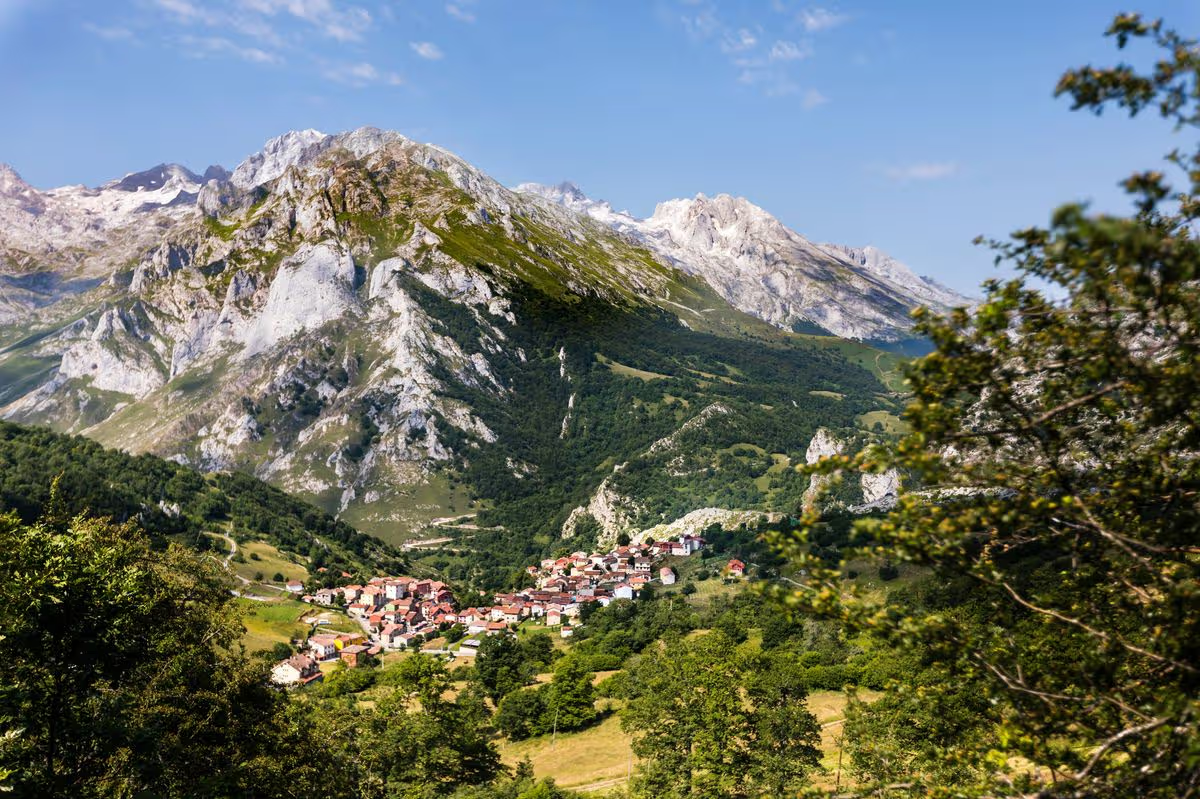
World’s most beautiful place has £15 flights from UK and 13-mile trail

Time Out has ranked the 51 most beautiful places in the world, and the top spot goes to Spain’s Picos de Europa mountain range that’s just a two-hour flight from the UK with Ryanair

The world is brimming with extraordinary destinations to discover, and pinpointing the most stunning is no easy feat, but Time Out has tackled the task.

The publication recently unveiled a list of the 51 most beautiful places in the world, featuring everything from lakes to beaches, National Parks, libraries, vineyards, and historic towns. Yet, claiming the number one position is a breathtaking mountain range that provides remarkable hiking opportunities, and it’s merely a two-hour flight from the UK.

The Picos de Europa in Spain is a striking, rugged limestone mountain range that soars to a height of 2,650 metres. Located just over 12 miles from the coastline, the mountains ascend steeply, forming deep gorges to discover, reports Express.

READ MORE: Corridor for Brits’ holidays is shrinking and is now just 50 miles wideREAD MORE: Woman finds ‘secret compartment’ in plane toilet and contents are brilliant

One route, the Cares Trail, ranks among the most sought-after walks in Spain, tracing a canyon and passing through craggy peaks and cascading waterfalls.

Spanning 13 miles in total, it’s not suitable for novices, though its gentle inclines make it achievable for walkers who can manage the distance. A straightforward choice is to board the Fuente Dé cable car, whisking you up the mountainside in moments and letting you relax and admire the verdant landscape below.

Upon reaching the summit, you can also explore additional hiking trails, including some demanding, steep climbs that provide spectacular vistas.

The mountains form part of the broader Picos de Europa National Park, and this region features the Lakes of Covadonga. These glistening blue waters are encircled by peaks and vegetation and resemble landscapes you’d encounter in Scotland or the Lake District, making it difficult to believe you’re in Spain.

This protected national park is abundant with wildlife, including brown bears, wolves, vultures, and eagles, and you’ll probably encounter mountain goats and vibrant butterflies amongst the limestone surroundings.

At the foot of the mountains, you can discover towns like the medieval Potes, brimming with centuries-old stone and half-timbered buildings and cobbled streets that lend it a rustic allure.

The town’s centrepiece is the Torre del Infantado, a 15th-century tower once the residence of medieval royalty, now a museum with a rooftop terrace providing sweeping views of the town.

Arenas de Cabrales on the park’s periphery is another favoured spot to stay. It’s renowned for producing Cabrales cheese, and has evolved into a gastronomic hotspot due to its plethora of acclaimed restaurants serving Northern Spanish cuisine.

Don’t expect to find paella on the menu. In this region, the dishes are hearty and rustic, such as bean stews and grilled meat, with ingredients sourced locally from the mountains.

The Picos de Europa is just under two hours from Santander Airport, and is serviced by airlines including Ryanair. Routes from the UK to Santander operate year-round from Edinburgh and London-Stansted, and seasonal flights operate from Birmingham and Manchester. Flights start from just £15 one-way and take 2 hours from the UK.

Got a story you’d like to share? Drop us an email at webtravel@reachplc.com

Source link

Corona Santiago hands Corona its first baseball defeat behind Troy Randall

Corona baseball is receiving some competition in Big VIII League play this season. Norco is supposed to be the Panthers’ primary competition, but it was Corona Santiago handing the Panthers their first defeat Monday.

Troy Randall had three hits and threw three innings of scoreless relief in a 6-2 home victory. The teams play again Wednesday at Corona, with ace Striker Pence on the mound for Santiago.

Santiago (10-2) took advantage of rare wildness by Corona starting pitcher Mason Sims, who walked four in two innings. Randall and starting pitcher Ben Lewis held Corona’s top four batters hitless with eight strikeouts.

Cleveland 6, Chatsworth 2: The Cavaliers continued their march toward third place in the West Valley League. Max Salazar had three hits. Joshua Pearlstein threw a complete game with five strikeouts.

Taft 9, Granada Hills 7: The Toreadors scored three runs in the ninth inning for a West Valley League win. Nathan Swinson had a home run and Julian Antolin recorded three hits and three RBIs. Max Szczech had four hits, including a home run, for Granada Hills.

Garfield 10, Huntington Park 0: Omar Martinez had two hits and two RBIs and Michael Agredano struck out six in 3⅔ innings for Garfield.

South Hills 4, San Dimas 1: Marc Morales threw three scoreless innings of relief for South Hills.

Loyola 12, Paramount 2: Jack Murray contributed three hits for the Cubs.

Etiwanda 19, Los Osos 5: Angel Mejia finished with three hits and seven RBIs, including a grand slam.

Source link

Opposition leader criticizes probe, economic policy, Iran response

People Power Party leader Jang Dong-hyuk, front row center, and other participants take part in a ceremony launching the party’s Central Next-Generation Women’s Committee at the National Assembly Museum in Seoul on Sunday. Photo by Asia Today

March 23 (Asia Today) — People Power Party leader Jang Dong-hyuk on Sunday criticized a parliamentary probe plan led by the ruling party, along with the government’s real estate policy and its response to the Iran crisis.

Speaking at a party leadership meeting at the National Assembly, Jang questioned the need for an investigation into alleged prosecutorial misconduct during the previous administration.

“If a fabricated indictment can be proven through a parliamentary probe, it would be much faster to obtain an acquittal in court,” he said. “The investigation will ultimately only confirm that the prosecution and trial were justified.”

Jang also invoked remarks previously made by President Lee Jae-myung, saying, “If a president commits a crime, he should go to prison,” adding that he was “returning those words as they are.”

The conservative party boycotted the National Assembly plenary session a day earlier and held a protest rally outside the chamber. A brief confrontation occurred with ruling party lawmakers after the probe plan passed.

Jang criticized the government’s real estate policy, accusing the president of centralizing decision-making while excluding public officials from the process.

“By that logic, the president, who is facing multiple trials, should step away from judicial policy,” he said.

He also warned against expanding fiscal spending in response to the Iran crisis, citing concerns over inflation, exchange rates and rising oil prices.

“With a triple shock of high exchange rates, inflation and oil prices, releasing an additional 25 trillion won, about $18.7 billion, would push prices and the currency higher,” he said. “This is not the time for cash handouts but for stabilizing the economy.”

Floor leader Song Eon-seok echoed the criticism, accusing the administration of attempting to consolidate power and warning against what he described as excessive control over parliamentary committees.

— Reported by Asia Today; translated by UPI

© Asia Today. Unauthorized reproduction or redistribution prohibited.

Original Korean report: https://www.asiatoday.co.kr/kn/view.php?key=20260323010006783

Source link

Valerie Perrine dead: ‘Lenny’ and ‘Superman’ actor was 82

Valerie Perrine, the Las Vegas showgirl turned Oscar-nominated actor best known for playing Lenny Bruce’s wayward wife Honey Harlow in “Lenny” and Lex Luthor’s secretary Eve Teschmacher in the 1978 and 1980 “Superman” films, died Monday morning. She was 82.

Perrine’s death was confirmed by Stacey Souther, her close friend and the director of the 2019 documentary “Valerie,” which followed the star’s debilitating battle with Parkinson’s disease.

“It is with deep sadness that I share the heartbreaking news that Valerie has passed away,” Souther announced on social media. “She faced Parkinson’s disease with incredible courage and compassion, never once complaining. She was a true inspiration who lived life to the fullest — and what a magnificent life it was. The world feels less beautiful without her in it.

“I love you, Valerie. I’ll see you on the other side.”

Souther also shared a GoFundMe link and a note that Perrine’s final wish was to be laid to rest at the Hollywood Hills Forest Lawn Cemetery. “After more than 15 years of fighting Parkinson’s, her finances are exhausted.”

Perrine was born Sept. 3, 1943, in Galveston, Texas, to parents Renee and Kenneth, a dancer and a U.S. Army lieutenant colonel. A military brat growing up, Perrine moved frequently and spent time in Japan, Paris and Scottsdale, Ariz.

She attended the University of Arizona, but her academic aspirations were short-lived. She skipped town, trading her textbooks for a feather headdress and G-string in Las Vegas. Soon she was a lead dancer in the star-spangled Lido de Paris show at the Stardust Hotel. She told the New York Times in 1974 that she spent some of her $800 weekly paycheck on experimenting with drugs: acid, mescaline, peyote, cocaine — you name it, she tried it.

Eight years after her foray into Vegas showbiz, her movie career kicked off unexpectedly during a visit to Hollywood. An agent at a friend’s dinner party took a liking to her, she told the Los Angeles Times in 2013. He asked if she had any publicity photos. The only one she had was in her topless Lido costume.

The sexy picture made its way to the desk of Monique James, the head of new talent at Universal. “She called me in and asked if I had ever acted before and I said ‘no,’” Perrine said. “She arranged a screen test.”

Paul Monash, the producer of “Slaughterhouse-Five,” which was based on Kurt Vonnegut’s acclaimed novel about World War II and time travel, directed the screen test. “They told me to wear a bikini because they wanted to see what my body looked like. I didn’t have a bikini. I wore my G-string and that was it.”

“I had been working in Vegas all the time and had been on the beach in St. Tropez, so being [naked] didn’t mean anything to me,” she told The Times. “It was my attitude that sparked his interest and the way I read the line, ‘Oh, you’re a moon child.’ He hired me.”

Dustin Hoffman as Lenny Bruce and Valerie Perrine as Honey Harlow star in a scene from the 1974 movie, "Lenny."

Dustin Hoffman as Lenny Bruce, left, and Valerie Perrine as Honey Harlow in a scene from the 1974 movie, “Lenny.”

(United Archives via Getty Images)

Soon after, she portrayed the love interest of NASCAR driver Junior Johnson opposite Jeff Bridges in the 1973 sports drama “The Last American Hero.” Perrine and Bridges dated briefly while working on the film. The same year she became the first woman to bare her breasts on television in the PBS telefilm “Steambath.”

Bridges described Perrine in the 2019 documentary “Valerie” as having a “real sense of fun and play.”

“She was excited about life and excited where she was and it’s a contagious feeling,” he said. “Growing up in a military family and traveling all over the world made her a really interesting person and as an actress, she had the ability to bring all of that into her performances.”

In 1974, she tapped into her showgirl background to portray the drug-addled stripper Honey Harlow opposite Dustin Hoffman as Lenny Bruce in the biopic “Lenny.” Her performance garnered rave reviews. She nabbed the lead actress award at the Cannes Film Festival, BAFTA named her most promising newcomer and she was nominated for an Oscar.

Perrine was perhaps best known for her portrayal of Eve Teschmacher, Lex Luthor’s secretary and love interest in the 1978 “Superman” starring Christopher Reeve, Gene Hackman and Marlon Brando. She played the role again in 1980’s “Superman II.”

She also starred in the 1980 disco flick “Can’t Stop the Music” alongside the Village People and Caitlyn Jenner. The movie flopped and Perrine was so mortified by the film’s poor reception that she moved to Europe. She didn’t officially retire from acting until around 2010, and by 2015 she had gone public with her Parkinson’s disease diagnosis.

The 2019 documentary short “Valerie,” directed by Souther, dropped the veil on Perrine’s battle with the illness, with her loss of bodily autonomy captured in the film. She said “the shakes” caused her to struggle and the level of care she required made her feel like a baby.

Still intact, though, were her sharp wit and self-deprecating sense of humor. In the film a doctor explains that there are times when physicians aren’t able to pin down a diagnosis or there are multiple diagnoses.

“The doctors don’t know what’s going on with me,” Perrine says. “They can’t figure it out.”

“What do you think it is?” the doctor asks Perrine.

“Karma,” she quips.


Source link

Von der Leyen clinches Australia trade deal

Published on

European Commission President Ursula von der Leyen on Tuesday sealed a free-trade agreement with Australian Prime Minister Anthony Albanese, slashing tariffs on most EU goods and farm exports.


ADVERTISEMENT


ADVERTISEMENT

The deal marks another win for Brussels as it races to diversify trade ties and lock in strategic partners amid rising global tensions.

The pact will save the EU €1 billion a year in duties, the Commission said, with exports projected to climb as much as 33% over the next decade.

Agriculture proved a flashpoint, with EU farmers already pushing back against the Mercosur trade agreement and a legal challenge from MEPs threatening ratification.

Tariffs will eventually fall to zero on products including cheese (over three years), wine, some fruit and vegetables, chocolate and processed foods.

On the toughest issues — beef and sheep, which sank talks in 2023 — Australia agreed to quotas of 30,600 and 25,000 tonnes a year, respectively.

A safeguard mechanism will allow the EU to shield sensitive sectors if a surge in Australian imports harms the bloc’s market.

Beyond agriculture, the agreement opens access to Australia’s critical raw materials, including aluminium, lithium and manganese.

Brussels also failed to scrap Australia’s luxury car tax. Instead, 75% of EU electric vehicles will be exempt.

The deal is a geostrategic push

The Commission expects strong export gains in key sectors, including dairy (up to 48%), motor vehicles (52%) and chemicals (20%).

Brussels has prioritized the deal as it builds partnerships in the Indo-Pacific, where China’s influence has become central. A security and defence partnership with Canberra was also announced Tuesday.

“The EU and Australia may be geographically far apart but we couldn’t be closer in terms of how we see the world,” von der Leyen said, adding: “With these dynamic new partnerships on security and defence, as well as trade, we are moving even closer together.”

Since Donald Trump returned to power in 2025, trade agreements have taken on sharper geostrategic weight for the EU as it seeks new markets.

In 2025, Brussels struck deals with Mexico, Switzerland and Indonesia. The Mercosur pact was also signed earlier this year and will be provisionally applied from 1 May despite a European Parliament legal challenge.

More could follow. Talks are ongoing with the Philippines, Thailand, Malaysia, the United Arab Emirates, and countries in Eastern and Southern Africa, von der Leyen told EU ambassadors on 9 March.

Source link

Tuesday 24 March Truth and Justice Memorial Day in Argentina

This Argentinian public holiday is held on March 24th, the anniversary of the coup d’état of 1976 that overthrew President Isabel Peron and brought the National Reorganization Process to power. The coup installed the bloodiest dictatorship in the history of the country, led by General Jorge Rafael Videla, Admiral Emilio Eduardo Massera and Brigadier-General Orlando Ramón Agosti.

It was this that started a period of state terrorism aimed at left-wing guerrillas, political groups, and socialists.

During over seven years of dictatorship, Argentine security forces, along with right-wing death squads such as Triple A, hunted down anyone believed to be associated with socialism, left-wing Peronism, or the Montoneros movement. While nearly 10,000 people are known to have ‘disappeared’ under the junta, the true number may have been much higher as so many documents and records were destroyed by the military. The actual figure may have been over 30,000 students, activists, trade unionists, writers, journalists, artists and any citizens suspected of being left-wing activists were kidnapped, tortured and disappeared. The military junta silenced any political or ideological dissidents, even those seen as antithetical to its neoliberal economic policies.

The period lasted until December 1983 when democratic elections were held to install a new president.

The commemoration was sanctioned as Law 25633 by the Argentine National Congress on August 1st 2002, and promulgated by the Executive Branch on August 22nd of the same year. However, it was not implemented as a public national holiday until 2006.

The day is marked by peaceful rallies and marches by those who lost loved ones during the period. Hundreds of thousands of citizens, relatives of the disappeared people, members of social movements, human rights organizations and left-wing political parties march to the Plaza de Mayo in the capital Buenos Aires to commemorate the victims of the last dictatorship and demand justice for the crimes against humanity committed by the State during that period.

UCLA tries to enjoy rare opportunity for Lauren and Sienna Betts

With just over five minutes left in UCLA’s first-round win over California Baptist on Saturday, freshman Sienna Betts took a shot. She missed. She grabbed the rebound. She missed again. Then, she put it in the basket.

On the bench, her older sister, Lauren Betts, was laughing. No. 1 seed UCLA was up big late, the Bruins were going to advance and Lauren was getting joy from seeing her sister succeed — and fail.

“I’m like, Sienna, just make the shot, and she’s laughing; she’s not serious,” Lauren said.

The sisters recorded double-doubles during the 96-43 win that secured the Bruins a second-round date with Oklahoma State. Sienna had 10 points and 12 rebounds, six of them offensive, and Lauren had 22 points and 10 rebounds.

UCLA freshman forward Sienna Betts plays tight defense on California Baptist guard Sofia Alonso.

UCLA freshman forward Sienna Betts plays tight defense on California Baptist guard Sofia Alonso during the Bruins’ first round NCAA tournament win Sunday at Pauley Pavilion.

(Gina Ferazzi/Los Angeles Times)

“She is so hard on herself and she’s so driven, I think her humor is actually a saving grace for her,” UCLA coach Cori Close said of Sienna. “It’s sort of a light moment. It’s laughter. Because when she’s not smiling and bringing joy, she’s usually beating herself up for a mistake. As she continues to grow in that, I hope it doesn’t have to be her escape, but I just have absolutely enjoyed Sienna so much.”

The sisters have only this season to play together before Lauren, a senior, graduates. They played just one season together in high school in Colorado, and this season might be the last time they are ever on the same team.

“It’s this weird thing, on the one hand, I want them to enjoy this connection they have,” Close said. “I want them to enjoy this year. They will look back on this year and just really treasure it.

“Simultaneously, I want to especially treat Sienna on her own journey, and to not make her feel like she’s in the shadows of anything that Lauren is doing.”

Sisters have posted double-doubles in the NCAA tournament before. At Stanford, Nneka and Chiney Ogwumike did it multiple times in the early 2010s. In the 1980s, USC twins Pamela and Paula McGee averaged double-double their senior years.

But it’s a rarity, and one that could only happen this season for the UCLA sisters.

Sienna, though, didn’t want to make a big deal of it. Sitting to the side in the locker room after the win over California Baptist, she was critical of her own game, just the way Close expected.

“I’m trying to focus more on just that game and just taking what we can learn from our mistakes in the first half, especially, and trying to move on,” Sienna said. “But, I mean, I think in an hour, I’ll take that in and be more excited about that.”

Lauren said she thought Sienna played one of her better games of the season.

“Honestly, besides her scoring, I thought her defense was a lot better today and I know that’s something she wanted to get better at,” Lauren said Saturday. “She was just really proud of her slides. Like she didn’t say anything about her points. She was like, I’m so glad that I can guard them. I worked so hard on that.”

Sienna has had back-to-back strong efforts, with 14 points against Iowa in the Big Ten tournament championship game two weeks ago. She has done so without being hounded by her big sister.

“I think [Lauren] respects my boundary to figure it out on my own,” she said.

Lauren, meanwhile, has averaged 16.5 points and 8.7 rebounds per contest this season. The projected WNBA lottery pick is considered one of the best centers in the nation.

UCLA center Lauren Betts drives to the basket under pressure from California Baptist forward Grace Schmidt.

UCLA center Lauren Betts drives to the basket under pressure from California Baptist forward Grace Schmidt during the NCAA tournament on Saturday at Pauley Pavilion.

(Gina Ferazzi/Los Angeles Times)

“I love the moments you catch when they have a connection and an eye contact or a smile that is different than everybody else because they are sharing it as sisters and I just think how special that is,” Close said. “That’s so wonderful.”

Charlisse Leger-Walker played with her sister, Krystal Leger-Walker, at Washington State for two seasons. There, the duo shared time in the backcourt for an up-and-coming Cougars squad.

“It’s just a different connection,” Charlisse Leger-Walker said. “Out there, you have someone who is your blood and unconditional love and support. And it’s just awesome to be able to see [Lauren and Sienna] in their journey, and have so much success early.”

Sienna will carry the torch for the Bruins beyond this season when the majority of the veteran roster graduates and many go pro.

That’s when she could be the face of the program on her own. But first, she is working to extend an NCAA tournament run alongside her sister.

“I want Sienna to feel like she’s Sienna,” Close said. “She’s not Lauren’s sister. She can enjoy that, but for our team, she’s Sienna Betts.”

Source link

Israeli settlers vandalise school, raise Israeli flag in occupied West Bank | Israel-Palestine conflict

NewsFeed

Israeli settlers have been filmed vandalising a boys’ school in Huwara, spray-painting racist graffiti and raising an Israeli flag on the roof. The attack comes as settler violence intensifies across the occupied West Bank with homes and cars set on fire, leaving at least nine Palestinians injured.

Source link

Jurgen Klopp says Real Madrid talk is ‘nonsense’ but he may coach again

Former Liverpool manager Jurgen Klopp says speculation that he will return to management with Real Madrid this summer is “nonsense”.

The 58-year-old has been linked, external with a move to replace Alvaro Arbeloa at the end of the season.

Klopp left Anfield at the end of the 2023-24 season and has not coached since – taking up a role as head of global football with Red Bull.

He denied any talks with Real but says he might coach again.

The German told reporters at the Magenta TV World Cup team presentation in Munich: “If Real Madrid had phoned, we would have heard about it by now.

“But that’s all nonsense. They haven’t called even once, not once. My agent is there, you can ask him. They haven’t called him either.

“Right now I’m not thinking about that, luckily there’s no reason to.

“For my age I’m quite advanced in life, but as a coach I’m not completely finished. I haven’t reached retirement age.

“Who knows what will happen in the coming years? But there’s nothing planned.”

Source link

Disney’s $70-million bet on ‘Bachelorette’ star Taylor Frankie Paul

In the summer of 2025, Walt Disney Co. executives placed a big bet on a reality TV star prone to high drama: messy personal relationships and allegations of domestic violence.

Now, Disney’s ABC network could lose at least $70 million with a nearly finished season of “The Bachelorette” sitting on the shelf.

Last week, ABC yanked this season of “The Bachelorette,” which features 31-year-old Taylor Frankie Paul, just three days before the premiere episode was set to air Sunday night. Disney pulled the plug after the emergence of a three-year-old video that showed Paul — the protagonist of Hulu’s massive hit series, “The Secret Lives of Mormon Wives” — physically attacking her ex-partner.

Paul can be seen screaming and throwing metal chairs, one of which apparently struck one of her children who witnessed the altercation. Her onetime partner, Dakota Mortensen, recorded the video of the attack on his cellphone.

Trouble has been brewing around “The Bachelorette” for weeks as Paul was doing publicity for the show.

Draper City, Utah, police have separately confirmed an investigation into a subsequent domestic violence incident in February between Mortensen and Paul. As part of that inquiry, Paul, 31, has temporarily lost custody of the couple’s son, Ever, who turned 2 last week — the day the troubling video came out.

“Taylor is very grateful for ABC’s support as she prioritizes her family’s safety and security. After years of silently suffering extensive mental and physical abuse as well as threats of retaliation, Taylor is finally gaining the strength to face her accuser and taking steps to ensure that she and her children are protected from any further harm,” said a spokesperson.

Representatives of Mortensen could not immediately be reached for comment. In a statement to People magazine, a representative for Mortensen said that “his number one priority here is protecting” his son, Ever.

Last month, Disney requested an investigation to sort out Paul’s and Mortensen’s differing accounts of the February incident, according to people close to the situation who were not authorized to speak publicly about the sensitive situation.

The scandal has become the first big test for Dana Walden, who last week was installed as Disney’s president and chief creative officer — the day before the video showing a violent Paul was leaked to TMZ.

The episode has raised uncomfortable questions about why Disney made Paul the face of one of ABC’s marquee franchises.

It also has shined a light on the decision-making of Walden’s newly anointed ABC team: Debra OConnell, the chair of Disney Entertainment Television; Disney Television Group President Craig Erwich; and Rob Mills, Disney TV’s executive vice president of unscripted and alternative entertainment.

Disney declined to comment.

The network has not said whether it plans to eventually air Paul’s season of “The Bachelorette.”

But the network made a huge investment, paying a license fee of about $5 million an episode for the season to Warner Bros., said sources familiar with the matter. The season includes nine episodes and other programming elements, including a special that ran immediately after ABC’s Oscar telecast this month, which attracted 5.5 million viewers, according to Nielsen.

A man in a plaid shirt and a pregnant woman in a brown jumpsuit sit on a couch smiling and leaning their heads together.

Dakota Mortensen, left, and Taylor Frankie Paul are stars of “The Secret Lives of Mormon Wives.”

(Fred Hayes / Disney)

ABC also orchestrated a huge marketing blitz — billboards for the show had sprouted around the country, social media channels were crackling and Paul appeared on ABC’s stalwart “Good Morning America,” where she discussed her role on “The Bachelorette,” where she dated nearly two dozen men in search of her soulmate.

She also acknowledged simultaneously facing domestic abuse allegations, which she called a “heavy time.”

“For me, dating as a mom of three is extremely difficult,” Paul told ABC anchor Lara Spencer. “I was like, I get to go out, get away from my toxic cycle here in Utah, go date, and also have my kids come out and visit me. That to me seemed like, why not?”

Advertisers, including Cinnabon, have also pulled back in light of the controversy.

Viewers have long been fascinated by Paul, who earned notoriety on TikTok and formed a community there called MomTok. Her combative relationships added to the intrigue.

Hulu’s “The Secret Lives of Mormon Wives” has been a massive hit, developing a loyal following and an alternative to the “Real Housewives” franchise on the rival network, Bravo. A clip from the show was included in a Disney video montage of movies, TV shows and other headlining attractions shown to investors last week.

Mills and other Disney executives who oversee ABC and Hulu programming had been looking for ways to reinvigorate “The Bachelor” franchise, and they had taken notice after fans latched on to a playful video that Paul had posted on TikTok, expressing her desire to join the long-running ABC show, which is produced by Warner Horizon.

Comments posted about Paul’s video were intriguing, particularly for viewers who said that they would return to watch “The Bachelorette,” if it featured her.

“I flew out to Utah and met with her and she was serious [about joining],” Mills told The Times two weeks before the controversy. “Then I sent her roses the next day and said, “Would you be ‘The Bachelorette’ and the rest is history.”

Disney recognized that Paul’s relationship with Mortensen was messy.

Disney executives were aware of the altercation in 2023 and briefly debated internally whether to move forward with Paul in a prominent role in “Mormon Wives,” according to a source close to the situation but not authorized to comment. Paul is an executive producer on that show.

The first episode of the first season of “Mormon Wives,” which debuted in September 2024, featured Utah police bodycam footage from the February 2023 fight that was the subject of the just-released video.

The final moments of the most recent season ended with Paul and Mortensen sleeping together again, the night before she was scheduled to fly to L.A. to begin filming “The Bachelorette.” She missed her initial flight, but took a later flight.

Disney also has paused filming on “Mormon Wives” during production of its fifth season.

Over the show’s four-season run, there have been tensions among the castmates, which accelerated as Paul and the other wives pursued fame in other venues, including on ABC’s “Dancing with the Stars.”

When the recent allegations of domestic violence surfaced, castmates expressed concerns about working with her, which contributed to the decision to hire an outside law firm to investigate.

The firm was hired, at Disney’s request, by the show’s production firm, Jeff Jenkins Productions, based in Sherman Oaks.

Times Staff Writer Yvonne Villarreal contributed to this report.

Source link

Another court backs Bush on secrets

In rejecting a key element of a legal challenge to the government’s warrantless wiretapping program, federal appellate judges on Friday demonstrated once again the willingness of U.S. courts to give the Bush administration considerable latitude in handling the war on terror.

The U.S. 9th Circuit Court of Appeals in San Francisco, by a 3-0 vote, barred an Islamic charity from using a confidential government document to prove that it had been illegally spied upon, agreeing with the administration that disclosure would reveal “state secrets.”

The lawsuit, filed by Al-Haramain Islamic Foundation and two of its attorneys, challenged the National Security Agency’s spying endeavor, the Terrorist Surveillance Program, launched after the Sept. 11, 2001, terrorist attacks. The U.N. Security Council has declared that Al-Haramain, which operates in more than 50 countries, belongs to or is associated with Al Qaeda.

The suit was one of 50 legal challenges brought across the country after the program’s existence was revealed in the New York Times.

Other courts have shown similar deference to the Bush administration on the state secrets privilege, which permits the government to bar disclosure in court of information if “there is a reasonable danger” it would affect national security.

But the ruling in this case was particularly striking because it came from a panel of three liberal jurists, all appointed by Democratic presidents.

Moreover, the charity, unlike other plaintiffs, says it has evidence of surveillance — a call log from the National Security Agency that the government inadvertently turned over in another proceeding.

In the ruling, Judge M. Margaret McKeown wrote that the judges accepted “the need to defer to the executive on matters of foreign and national security and surely cannot legitimately find ourselves second-guessing the executive in this arena.”

Erwin Chemerinsky, a liberal constitutional law professor at Duke University law school, said the court showed “how much deference even a liberal panel of judges is willing to give the executive branch in situations like this, and I find that very troubling.”

Doug Kmiec, a conservative constitutional law professor at Pepperdine law school, said “the opinion is consistent with” a ruling by the federal appeals court in Cincinnati earlier this year striking down a challenge to the surveillance filed by the American Civil Liberties Union.

He said the dual rulings indicated that “federal courts recognize that the essential aspects of the Terrorist Surveillance Program both remain secret and are important to preserve as such.”

The court’s ruling was not an absolute victory for the government. McKeown rejected the Justice Department’s argument that “the very subject matter of the litigation is a state secret.”

That finding could prove important in numerous other cases in which the government contends that even considering legal challenges to warrantless wiretapping would endanger national security.

In addition, the 9th Circuit panel sent the case back to a lower court to consider another issue: whether the Foreign Intelligence Surveillance Act, which requires approval by a special court for domestic surveillance, preempts the state secrets privilege. McKeown said that issue “remains central to Al-Haramain’s ability to proceed with this lawsuit.”

Georgetown University constitutional law professor David Cole said he thought Friday’s ruling showed partial victories for both sides.

Indeed, lawyers for the government and for the charity said they were happy with the outcome.

“The 9th Circuit upheld the government’s position that release of this information would undermine the government’s intelligence capabilities and compromise national security,” the Justice Department said.

Oakland attorney Jon Eisenberg, who argued for Al-Haramain before the 9th Circuit, said: “The government wants this case dead and gone. It is not. We are alive and kicking.”

Eisenberg expressed optimism that his client would prevail under the Foreign Intelligence Surveillance Act, a statute enacted in the aftermath of revelations of illegal spying on civil rights and antiwar activists in the 1960s and ‘70s.

“That provision would be meaningless if the government could evade any such lawsuit merely by evoking the state secrets privilege,” Eisenberg said.

In support of her opinion, McKeown detailed statements by government officials — including President Bush, then-Atty. Gen. Alberto Gonzales and Gen. General Michael V. Hayden, principal deputy director for national intelligence — acknowledging the existence of the Terrorist Surveillance Program and extolling its importance.

“In light of extensive government disclosures about the TSP, the government is hard-pressed to sustain its claim that the very subject matter of this litigation is a state secret,” wrote McKeown, an appointee of President Clinton. “Unlike a truly secret or ‘black box’ program that remains in the shadows of public knowledge, the government has moved affirmatively to engage in public discourse about the TSP.”

Nonetheless, after privately reviewing the secret document, McKeown said she and her colleagues Michael Daly Hawkins, another Clinton appointee, and Harry Pregerson, a Carter appointee, agreed it was protected by the state secrets privilege.

“Detailed statements underscore that disclosure of information concerning the Sealed Document and the means, sources and methods of intelligence gathering in this context of this case would undermine the government’s intelligence capabilities and compromise national security,” she said.

The state secrets privilege was first utilized successfully by the government in a case shortly after the Civil War.

The leading case in the area, U.S. vs. Reynolds, was issued by the Supreme Court in 1953 to block a lawsuit after the crash of a B-29 bomber.

Three widows of crewmen sued and sought the official accident reports. The Air Force said the reports could not be revealed because the bomber was on a secret test mission.

(When the reports were declassified in 2000, they revealed that the aircraft was in poor condition, evidence that might have helped the widows’ suit.)

The Bush administration has evoked the state secrets privilege numerous times in recent years. In most instances, courts have accepted the word of government lawyers, often with a fairly cursory review, according to George Washington University law professor Jonathan Turley, who, like Cole, has challenged the privilege in court.

McKeown took pains to say that the 9th Circuit had carefully scrutinized the government’s assertions.

She said the judges had taken “very seriously our obligation to review the documents with a very careful, indeed a skeptical eye, and not to accept at face value the government’s claim or justification of privilege.”

But she said the panel could go no further than what already has been publicly disclosed that “the Sealed Document has something to do with intelligence activities.”

When the court heard the Al-Haramain case in August, it also entertained arguments in a related case, Hepting vs. AT&T; Corp. In that case, lawyers representing millions of AT&T; customers are seeking damages from the telecommunications giant for allegedly sharing their private records with the National Security Agency as part of the surveillance program.

On Friday, the 9th Circuit panel issued a brief order saying that the AT&T; case had been severed from the Al-Haramain matter. A decision is expected in the next several months, although there is no deadline.

henry.weinstein@latimes.com

Source link

NASCAR owner Michael Jordan falls out of NBA top 5 in all-time scoring

Michael Jordan didn’t seem too upset.

Hours after Kevin Durant knocked him out of the top five on the NBA’s all-time scoring list , Jordan was all smiles as he walked to Victory Lane to greet Tyler Reddick after the driver’s win Sunday at Darlington Raceway.

Reddick — who drives for 23XI Racing, which is co-owned by Jordan and veteran driver Denny Hamlin — joined NASCAR Hall of Famers Dale Earnhardt and Bill Elliott as the only Cup Series drivers to win four of the first six races in a season.

To do so, Reddick had to overcome a malfunctioning battery and a large deficit in the final 50 laps. Afterward, Jordan jumped the track’s safety barrier to greet Reddick and his team with some hard high fives and enthusiastic cheers.

“I think the key to him winning was just keeping his head,” Jordan said after the race. “We just had to get the car right, and I think he did an unbelievable job. I just wanted everything to be good, because once he gets back out there, then I feel like his competitive juices are going to carry him all the way to the end. He earned it all week, and I’m real proud of the team.”

Earlier this year, Reddick became the first NASCAR driver to start the season with three consecutive wins. He stands atop Cup Series standings, leading second-place Ryan Blaney of Team Penske by 95 points. Reddick’s 23XI teammate Bubba Wallace is currently in third place.

One night earlier, Durant scored 27 points in the Houston Rockets’ 123-122 victory over the Miami Heat to overtake Jordan for fifth place on the NBA’s all-time leading scorer list. In his 18th season, Durant has 32,294 points — two more than Jordan, who played 13 seasons for the Chicago Bulls and two for the Washington Wizards. Durant and the Rockets play the Bulls in Chicago on Monday.

Jordan has yet to comment publicly on the matter, but Durant had plenty of praise for the man considered by many to be basketball’s GOAT on Saturday during his postgame news conference.

“It’s kind of crazy passing him up because he’s meant so much to the game,” said Durant, who passed Wilt Chamberlain and Dirk Nowitzki on the scoring list earlier this season and now trails only Kobe Bryant, Karl Malone, Kareem Abdul-Jabbar and all-time leader LeBron James.

“I’ve been inspired by all of these players that I’m either coming close to or passing up, and MJ is in a world of his own,” Durant added. “He’s in a galaxy of his own as somebody that I look up to, respect and who basically shaped the game for me.”

Durant also pointed out that Jordan would have scored many more points had he not taken multiple seasons off during the span of his playing career.

“He left a few, I want to say, thousand or so points on the table, too, with the amount of games he missed,” Durant said. “… He scored points quickly, man. So he set the bar high, and it’s pretty cool to reach that bar.”

The Associated Press contributed to this report.

Source link

Macron says Lebanon’s fight is ‘just’ amid escalating attacks by Israel | Israel attacks Lebanon

NewsFeed

France’s president Emmanuel Macron said Lebanon’s fight against threats to its security is ‘just’, while stressing that no violation of sovereignty can be justified. His comments come as fighting escalates between Israel and Hezbollah, with more than 1,000 people killed and 1.1 million displaced in Lebanon.

Source link

Controversial ‘poshfluencer’ Lydia Millen buys 200-year-old home after six year search

INFLUENCER Lydia Millen has revealed she’s finally snapped up her dream home after a six-year search just as her “fake accent” was exposed.

The controversial ‘poshfluencer’, who was recently accused of putting on a more well-spoken voice, shared the exciting news with her millions of followers.

Lydia Millen has unveiled her new home after a six year searchCredit: Instagram
Lydia and her husband set their hearts on the Norfolk coastCredit: Instagram
Lydia recently admitted to polishing her accent for her contentCredit: Instagram

Lydia posted a series of coastal snaps from her new property in Norfolk.

The 36-year-old opened up about the long journey in a heartfelt caption as she prepares to add another property to her portfolio.

Writing rather than speaking to her followers, she penned: “We bought a new home.

“Six years ago we began our search, first in the Cotswolds, and then after a trip to Cley-next-the-Sea where we completely fell in love with the Norfolk coast, our search moved there.

LAVISH LIFE

Truth behind ‘poshfluencer’ Lydia Millen as she ditches council estate past


green fingers

YouTube star Lydia Millen shows off huge garden but fans have same complaint

“We looked for something special but never quite found it.

“Until October, when I stumbled across a 200-year-old fisherman’s cottage. And last week, we finally completed.”

Even modest cottages on the Norfolk coast can fetch £300,000, while prime properties soar past £1million.

The new coastal bolthole marks a lifestyle shift for Lydia and Ali, who have long documented their countryside life online.

The crumbling cottage is expected to undergo a full-scale transformation, with fans already anticipating a series of renovation updates across her social platforms.

Lydia explained: “It needs everything. Heating, rewiring, kitchen, bathroom, windows. A full renovation.

“But one day hollyhocks will grow in the front garden again, and Paul’s Himalayan musk roses will ramble their way back across the flint and brick facade.”

Lydia has bought a cottage on the Norfolk coastCredit: Instagram
Properties on the Norfolk coast can fetch well over £1 millionCredit: Instagram

Lydia has previously revealed she owns multiple properties, all mortgage-free, explaining she “doesn’t like having debt”.

The influencer has faced backlash in recent months, with some fans accusing her of not being entirely truthful about her roots.

Born in Watford, Hertfordshire, Lydia has spoken openly about growing up in a council house with her mum after her parents split.

She has previously said she “flunked” her GCSEs before training as a beauty therapist.

Before finding fame online, Lydia also spent seasons working in Ibiza.

Her social media career took off after moving to the countryside, where she spotted a gap in the market for aspirational British lifestyle content.

However, critics have claimed she has “reinvented” herself including adopting a more polished speaking voice.

Responding to one follower who asked why she had changed the way she speaks, Lydia said: “Because I just don’t see why I shouldn’t?

“I value being well spoken, and I know it also helps my international audience.”

Now a social media powerhouse, Lydia shares her idyllic country lifestyle with 1.6million Instagram followers, 1.4million on TikTok and more than one million YouTube subscribers.

The TikTok star is married to Ali Gordon, whom she met on Instagram in 2012.

The pair tied the knot in December 2017 at Aynhoe Park in Oxfordshire and are now thought to be worth around £10million.

Watford girl Lydia has undergone quite the transformationCredit: Lydia Millen
Lydia is married to fellow influencer Ali GordonCredit: Getty

Source link

In the Matter of Justice Thomas : Silent, Aloof and Frequently Dogmatic, Clarence Thomas’ Judicial Persona Emerges

David G. Savage, a Times staff writer, covers the Supreme Court

Exactly at 10 o’clock on a Monday morning, the strike of a gavel echoes through the courtroom, and the nine black-robed justices of the Supreme Court emerge from behind a red velvet curtain. As those assembled in the ornate hall take their seats, the lead lawyer rises, and the arguments begin.

Soon, most of the justices are up on their elbows, hurling questions at the attorneys. Justices Sandra Day O’Connor and Ruth Bader Ginsburg take turns poking holes in the advocate’s argument. Justice Antonin Scalia, sympathetic to his case, leaps in to prop up his contention. “Aren’t you really arguing that . . . ,” Scalia offers helpfully.

For the record:

12:00 a.m. Oct. 30, 1994 For the Record
Los Angeles Times Sunday October 30, 1994 Home Edition Los Angeles Times Magazine Page 6 Times Magazine Desk 2 inches; 43 words Type of Material: Correction
Because of an editing error, Lani Guinier was incorrectly identified in “Lone Justice” (Oct. 9), about Supreme Court Justice Clarence Thomas, as a Clinton nominee for attorney general. She had been nominated for assistant attorney general to head the civil-rights division of the Justice Department.

Anthony M. Kennedy, looking pensive, asks a philosophical question. Troubled by the answer, Justices David Souter and John Paul Stevens want to know how far the advocate seeks to push his claim. All the while, Chief Justice William H. Rehnquist leafs through the briefs, trying to find a disputed passage of the law in question.

But one justice looks out of place. At the far end of the bench, Justice Clarence Thomas rocks back in his leather chair and gazes at the ceiling. He rubs his eyes and stares off into the distance. Sometimes, Thomas has a brooding look, as if he is pondering deeply. More often, he just looks bored.

“I don’t understand it. He is engaged,” says a former Thomas clerk, who like most of those who have worked for him, expresses great admiration for the justice. “He likes to argue out the issues in chambers” and displays a special interest in bankruptcy law and state tax disputes, he says. But Thomas’ interest is not apparent in the courtroom. While Scalia and Ginsburg may ask five or six questions during a one-hour argument, Thomas asked not a single question during the last term of the court.

Lawyers in Washington and visitors to the courtroom never fail to comment on how removed he seems. “What’s wrong with Clarence Thomas?” one lawyer new to the high court commented. “He just sits there.”

That’s a marked contrast from his 18 months on the U.S. Court of Appeals in Washington, says a judge who observed him then. “He’s like two different people,” says the judge. “He was talkative, gregarious on our court, a real participant. Now he seems to be in a shell.”

This eerie courtroom silence has marked Thomas’ career for all of the three years since he inadvertently became the best-known member of the Supreme Court. At first it seemed that he was simply trying to retreat, somehow, from the stinging visibility of the “he said, she said” confrontation with Prof. Anita Hill that made him the ostensible villain in a TV drama about sexual harassment. It was, perhaps, the worst imaginable fate for a fiercely proud and intensely dignified man.

For a time he was the most carefully watched, most reviled man in town. On the November day he took the oath of office at the court, his ceremonial walk down the marble steps was cut short when a small group of protesters began to boo and shout, “Down with the Male Supremacist Court.” Not surprisingly, rather than beam for assembled photographers, Thomas turned away and walked back into the basement of the court. A few months later, the new justice accepted an invitation to judge a moot court competition at Seton Hall University Law School but canceled when word came that a women’s student group was planning a candlelight vigil.

Wounded, Thomas retreated into the silence that protects a judge who is even more rigid and dogmatic than his opponents feared. As the hoopla over the man has died down, his judicial record has become clearer. He has compiled the most conservative voting record on a conservative court and lambasted his colleagues for refusing to go further in changing the law. He has voted to revoke the right to abortion and return some prayer to the public schools. He cast a key vote to cut off further hearings in a death penalty case, even when newly revealed evidence might have proven the defendant’s innocence. He cast the deciding votes to make it harder for minorities to prove they were victims of job discrimination, harder for victims of stock fraud to sue lawyers and harder for environmentalists to be heard in court.

“He has shown himself to be exactly what his opponents said he would be: a knee-jerk right-winger,” says University of Virginia law professor Pamela Karlan. “He was always going to be tainted somewhat for how he got to the court, but I think he is going to be more tainted by how he is acting now. He’s shown no capacity for growth.”

Georgetown University Law Center Associate Dean Mark Tushnet concurs. “So far, it’s been the least impressive performance of any justice since Whittaker,” he says, referring to justly forgotten Charles Whittaker, who resigned from the court in 1962 after having a nervous breakdown in his fifth year.

But friends and admirers say Thomas is unfairly treated because he is a conservative. “He is not the justice that the NAACP would like,” says Stephen McAllister, a former Thomas clerk who teaches law at the University of Kansas. “He brings his own perspective to the law, but he certainly knows what it was like to grow up poor and black.”

Fueling the debate are Thomas’ activities outside the court. The confirmation fight separated Thomas’ allies from his enemies, and it deepened an already strong commitment to conservative values. While other justices avoid any appearance of partisanship, he boasts of his friendship with conservative commentator Rush Limbaugh, speaks mostly to gatherings of conservatives, brags about not reading the papers and indulges a “not politically correct” fondness for smoking cigars and driving a black Corvette.

Both his demeanor and his record have renewed questions about his qualifications for the high court. No one, not even Thomas himself, had rushed to defend President George Bush’s assessment that he was “the best man for the job.” After all, he had had no significant legal experience as a prosecutor, defense attorney, trial lawyer, law professor or judge and had spent only a year as Bush’s appointee to the influential U.S. Court of Appeals in Washington when he was nominated to the Supreme Court. But at the very least, Thomas promised, he would be impartial. “My personal views have no place in adjudication,” he said. “I can assure you, I have no agenda.”

Many of those who believed him, such as Sen. Arlen Specter, a moderate Pennsylvania Republican who cast a key vote for him, now admit they are dismayed by Thomas’ record. “Frankly, I have been very disappointed with his first three years,” Specter says. “I had thought his roots would show. But he came out of those hearings a changed man, an embittered man.”

*

Each day when the court is in session, Thomas and his wife, Virginia, leave their new home in suburban Virginia and drive into town before most Washingtonians have hit the road. “We travel everywhere together, like a pair of nuns,” Thomas tells friends. His wife, a senior policy coordinator for the House Republican Conference, was said by friends to have been deeply hurt by her husband’s confirmation ordeal. She said they survived by praying together. It “was not a normal political battle. It was spiritual warfare. Good versus evil,” she told a People magazine interviewer a few days after his confirmation.

Theirs is a strange sort of celebrity: They are instantly recognized but seldom seen outside carefully chosen venues. While none of the justices sits for TV interviews on Sunday morning, most make the rounds of bar groups, civic organizations and law schools, giving speeches and answering questions about the work of the court. As members of the nation’s highest court, they can count on a warm reception and instant respect.

Not so with the youngest justice. “It’s like he’s in the federal witness protection program,” says one prominent Washington lawyer.

Thomas has told friends he quit watching most television–for a time, he was a regular punch line on some sitcoms–and stopped reading most newspapers and magazines, with the exception of reliably conservative publications such the Washington Times. (He also refused requests to be interviewed for this story.) “They can say absolutely anything they want about me. I will never read them again to see it,” he told one friendly interviewer last year.

But the confirmation struggle sealed his loyalty to those who stood with him. Each morning as he lifts weights in the Supreme Court’s gym before his workday begins, he says he likes to listen to tapes of Rush Limbaugh poking fun at feminists, environmentalists and all manner of liberal crusaders.

The men are more than passing acquaintances. On May 27, when the rotund entertainer married for the third time in a ceremony at the home of Virginia and Clarence Thomas, the justice performed the official duties. After a sit-down dinner, the assembled guests gathered for “cigars and adult beverages on the deck,” according to Limbaugh’s office.

Among friends, Thomas hardly appears to be a bitter man hidden in his shell. “He is not brooding or angry at all,” says McAllister, his former clerk. “I found him to be warm, supportive and friendly. He has a positive outlook.” He has a big handshake and a hearty laugh, although his eyes have a wary look. As a speaker, he has an endearingly personal style. Far from being the polished high official whose comments drift above the audience, Thomas speaks slowly, emotionally, as if measuring each word to describe his joys and pain. Almost invariably he speaks of his childhood and recounts stories about his grandfather. Even if the tales are a bit familiar now, he comes across as warm, genuine and personal.

From the start, conservatives pointed to Thomas life story as his main qualification for the high office. Here was a man, the vaunted story went, who was born to a teen-age mother in a dirt-floor shanty near the marshes of Pinpoint, Ga., and grew up poor in the segregated South. When his mother could no longer care for him, young Thomas was rescued first by his grandparents and then by the Catholic schools, working his way through Holy Cross College and then Yale Law School, where he graduated a year behind Bill Clinton. “I was drunk with anger,” he told students at Holy Cross, describing himself in the late 1960s, “out of control with hostility toward what I saw as the oppression around me.”

But his up-from-poverty experience brought him to far different conclusions than did the middle-class upbringing of Thurgood Marshall, his black liberal predecessor on the court. Success depends on hard work and individual effort, says Thomas, espousing the lessons that conservatives champion, and government welfare checks or official “affirmative action” preferences serve only to hurt blacks by dampening their drive and cheapening their accomplishments.

Thomas was denouncing his sister back home in Pinpoint for being dependent on her monthly welfare check when he came to the attention of leaders of the incoming Ronald Reagan Administration at a 1980 conference of young conservatives in San Francisco. (The sister, Emma Mae Martin, was receiving welfare assistance while raising her children and caring for an aunt but soon after worked her way off welfare.)

Offers of government positions followed, and despite Thomas’ having announced that he would not work on “black issues,” he became assistant secretary for civil rights in the Education Department in 1981. A year later, he was named chairman of the U.S. Equal Employment Opportunity Commission, the agency charged with enforcing the laws against job discrimination, though he often seemed skeptical of its mandate. He had no patience with the civil rights activists who urged him to enforce the law more vigorously. All they do, he said, is “bitch, bitch, bitch, moan and whine and whine.”

In a steady round of provocative speeches, he denounced the conventionally liberal positions on race and civil rights, criticized environmentalists, called for strengthening property rights and praised as “splendid” an article calling for the reversal of the Roe vs. Wade ruling that legalized abortion.

His star rose quickly in the Reagan Administration, and Bush’s Court of Appeals appointment signaled what came next: He’d be the designated Republican successor to the aging Justice Thurgood Marshall.

In five days of Senate testimony–largely obscured by Anita Hill’s later accusations–Thomas publicly backed away from many of his earlier statements. “A judge must be fair and impartial,” Thomas said in his opening statement to the committee. “A judge must not bring to his job, to the court, the baggage of preconceived notions, of ideology, and certainly not an agenda.”

When asked about his previous comments on affirmative action or the right to abortion, about his criticisms of liberal decisions and his long track record of deriding the civil rights establishment, Thomas reverted to the same theme. He denied he had any such strong views, and regardless, none of it would affect his judicial role. A justice has a nearly sacred duty “to strip down like a runner, to eliminate agendas, to eliminate ideologies,” he said. When interpreting the law, “it is the will of the legislature that counts,” he added reassuringly.

Thomas raised eyebrows when he testified that he had never discussed or debated Roe vs. Wade, even during his law school days when the case was decided. Asked about the separation of church and state and the so-called “Lemon test” often criticized by conservatives, Thomas replied that he had “no quarrel” with it. (The term refers to the court’s 1971 ruling in Lemon vs. Kurtzman that it will strike down any law or government program that has religious purpose, advances religion or creates “an entanglement” between church and state.) “I think the wall of separation is an appropriate metaphor,” Thomas commented, sounding more like a Jeffersonian liberal than a Reagan-era conservative.

He also praised the doctrine of stare decisis , Latin for letting the matter stay as decided. Many senators were skeptical, but the nominee sought to reassure them. “I understand your concern that people come here and they might tell you A and then do B,” he told one senator who had pressed him on the abortion issue. “But I can assure you . . . I have no agenda.”

This was not the Clarence Thomas whose provocatively conservative speeches, articles and statements the committee Democrats had reviewed for weeks prior to the hearing. And it was not the Clarence Thomas whose true views became clear soon after he took his seat.

*

Thomas’ first opportunity to weigh in on abortion came in January of 1992, two months into his tenure, when the court agreed to hear a case from Pennsylvania challenging that state’s new abortion regulations. The law didn’t prohibit abortion but required pregnant teen-agers to obtain parental consent, wait 24 hours before undergoing the procedure and, if they were married, to inform their husbands in advance.

Though the case of Planned Parenthood vs. Casey did not require the court to decide the fate of Roe vs. Wade and the right to abortion, and Pennsylvania’s lawyers urged the court to uphold the regulations as consistent with Roe, it looked like a suitable vehicle for the court’s conservatives, who were determined to overturn the abortion right. Three years earlier, in Webster vs. Reproductive Health Services, four members of the court–Rehnquist, Scalia, Kennedy and Byron White–had indicated a willingness to reverse Roe vs. Wade. Clarence Thomas could provide the fifth vote.

But that majority didn’t coalesce in the Casey case. Kennedy, citing the importance of precedent and stare decisis , joined an opinion affirming women’s basic right to choose abortion, and Roe was upheld. As expected, however, Thomas took the other side, signing on to one dissent by Rehnquist that called for Roe to be overturned and to a second, more fiery one from Scalia that compared the abortion ruling to the Dred Scott decision, the pre-Civil War era ruling that sanctioned slavery. Pretty strong stuff for someone who had had no views on the matter just a few months earlier. Since neither side in the case had argued that Roe vs. Wade should be flatly overturned, Thomas could have filed an opinion upholding the Pennsylvania regulations, but deferring a ruling on the broader question of Roe vs. Wade. According to the scuttlebutt from the court’s clerks that year, however, no such half-step was even considered in Thomas’ chambers. The justice’s mind was made up.

“He clearly lied to them (his confirmation committee) about legal issues, “ says Karlan, the University of Virginia professor. “I think he perjured himself about Roe.”

That same term, the issue of prayer in the public schools returned to the docket. For a decade, lawyers for the Reagan and Bush administrations had pressed the court to permit more religion in the schools and to stop insisting on such a strict separation of church and state. They had made little progress, but pressed ahead in a case from Rhode Island that arose when a middle-school principal invited a cleric to deliver a prayer at a graduation ceremony. After a Jewish parent complained, a federal judge ruled that the graduation prayer was unconstitutional and could not be repeated.

The case of Lee vs. Weisman was appealed to the high court when again there was a surprising setback for the conservatives. Thomas did join them once again, but Kennedy switched to the liberal side, and a 5-4 majority upheld the judge’s ruling, saying that officially sponsored religious invocations have no place in the public schools. An angry Scalia slammed the decision as as “jurisprudential disaster” and demanded the scrapping of the Lemon test for judging religion cases. Thomas, who had said he had “no quarrel” with the standard a few months before, signed Scalia’s dissent.

In his first three years on the court, Justice Thomas has rarely had a chance to write a major opinion. Having staked out a position on the far right, he rarely affects the outcome in key cases, except to supply the fifth vote for a conservative majority. He seems less interested in being an influential coalition builder than in forcefully stating his position. So far, his voice has been heard more loudly in political circles than within the confines of the court. So repeatedly, the chief justice has assigned him to write mundane decisions involving federal jurisdiction or bankruptcy disputes. However, Thomas has strongly asserted himself in two areas of law: prisoners’ rights and voting rights. Parting company even from conservatives such as Chief Justice Rehnquist, Thomas has called for reversing precedents that have benefited inmates and Southern blacks.

Thomas had been on the bench just two weeks when the court heard a case involving Keith Hudson, an inmate in a Louisiana prison. Late one night, Hudson, locked in his cell, got into an argument with a nearby guard, Jack McMillian. Assisted by two other guards, McMillian handcuffed and shackled the prisoner and took him into a hallway. As the others held Hudson, McMillian punched him in the face and jaw and kicked him in the stomach. A supervisor on duty watched but merely told the guards “not to have too much fun.” Hudson emerged with a badly swollen face, loosened teeth and a cracked dental plate.

Hudson sued the officers in federal court, alleging he had suffered cruel and unusual punishment in violation of the Eighth Amendment. A magistrate concluded that the beating was unrelated to any disciplinary purpose and awarded Hudson $800 in damages.

On a 7-2 vote, the court upheld the magistrate’s decision in Hudson vs. McMillian. Justice O’Connor said prison guards have broad authority to use all necessary force to enforce discipline or put down disturbances, but “the unnecessary and wanton infliction of pain” violates the Eighth Amendment. Thomas, however, argued that the prisoner’s injuries were at most “minor” and accused his colleagues of creating “a National Code of Prison Regulation.”

His written dissent attracted attention, and not just for its strident conclusion. During his confirmation hearings, Thomas had displayed a minimal knowledge of constitutional law. He drew a blank, for example, when Sen. Patrick Leahy (D-Vt.) asked him to name some of the most important high-court rulings of the past 20 years. But his dissent in the Hudson case delved into early English law and quoted a series of precedents from the 19th Century.

Around the court, that was seen as a sign that Thomas had turned over his writing duties to his young clerks. Most justices employ their clerks to do research or write preliminary drafts, but their final opinions tend to reflect their own personal styles. Not so with Thomas. “I don’t see any distinctive touches, what you might call ‘Thomasisms’ in his opinions,” says a veteran attorney who appears regularly before the high court.

The dissent in the prisoner’s case argued that in the 18th Century, “cruel and unusual punishments” referred to the punishment imposed by a judge. Therefore, the court should limit the Eighth Amendment only to officially imposed punishments and not to “a deprivation suffered in prison.” Of course, if Thomas’ view became the law, prison guards could use electric shocks, cattle prods and other means of torture without violating the ban on cruel and unusual punishments.

More than a few observers remembered how Thomas had, during his confirmation hearings, told the senators that he could identify with the plight of prisoners. From his courthouse window, he said, he saw “busload after busload” of young men going into the jailhouse. Leaning forward intently, he’d concluded, “I say to myself almost every day, but for the grace of God, there go I.”

Scalia, the court’s liveliest intellect, its most energetic questioner and its best writer, signed Thomas’ dissent, but he later confided to a friend that he did not fully agree with it. Rather, he wanted to protect his embattled new colleague from being “out there all alone.”

Twice since then, the court has revisited the issue of prisoners’ rights, and in both instances, Thomas has slammed the majority for adhering to the view that the Constitution forbids cruel and unusual punishment in prison. “Judges or juries, but not jailers, impose punishment,” he wrote in a dissent issued in June. This time, however, Thomas spoke only for himself. Scalia had joined with the majority.

*

Thomas has stepped boldly into the mine field of voting-rights law, the controversial area that was the undoing of C. Lani Guinier in her bid to become Clinton’s attorney general. Unquestionably, the Voting Rights Act of 1965 has had an enormous impact in the South. Under penalty of that law, Southern officials could no longer use techniques “subtle as well as obvious” to nullify the votes of blacks, and finally, a century after the Civil War, black citizens have gained a voice in government. The reach of the law, however, is uncertain, and Thomas has taken an active role in trying to define it. Some had expected him to show a special sensitivity because of his background, but instead he urged the court to overturn past rulings favoring blacks.

One case testing the act’s limits came before the court in his first month on the bench. In 1986, Lawrence Presley became the first black man in this century to be elected a county commissioner in Etowah County, Ala., after a judge ordered the county to select its commissioners by district, rather than county-wide. Presley won a seat in a new black-majority district, and the post was a powerful one, since each commissioner also controlled the budget for road maintenance in his section of the county. Soon after Presley was elected, however, the new county council voted to put all road decisions in the hands of the whole commission. With one stroke, the white majority had regained all power.

Presley sued, contending that this move to strip him of power violated the Voting Rights Act. But on a 6-3 vote, the Supreme Court rejected the claim in Presley vs. Etowah County. “This is a case where a few pages of history are far more illuminating than volumes of logic,” John Paul Stevens wrote for the three dissenters. Congress wanted to end schemes used to deprive blacks of political power, so the court should enforce the will of Congress, not thwart it, he said.

But writing for a conservative majority, Justice Kennedy said the 1965 law applies only “with respect to voting,” not to “routine actions of state and local governments.” Thomas joined his opinion.

Alice Presley told Emerge magazine that her husband had, in the tumultuous days of Thomas’ confirmation, believed that because of his background, “we ought to give the guy a chance.” But after the 1992 ruling, Presley, who died in January, 1993, realized he had made a mistake. “That really hurt him more than the decision. He would walk around saying, ‘I can’t believe Thomas voted against me,’ ” Alice Presley said.

Last year, Thomas cast the deciding fifth vote to rule that drawing congressional boundaries solely to create black-majority districts violated the constitutional rights of whites. And this year, Thomas went even further and disputed the entire 25-year history of using the Voting Rights Act to help elect more blacks in the South.

The issue arose in an unusual case from rural Bleckley County, Ga., where all power is exercised by a single county commissioner who acts as both executive and legislature. Blacks, who make up 20% of the population, said they were excluded from power and filed a suit under the Voting Rights Act. The U.S. Court of Appeals, relying on Congress’ 1982 amendments to the voting rights law, agreed with the black voters and ordered the county to switch to a five-member commission.

Those amendments underlined that any “standard, practice or procedure” used in the electoral process would violate the law if it denied racial and ethnic minorities the right “to elect representatives of their choice.” If a large black or Latino population is denied representation because of the way district boundaries are drawn, those lines are illegal, even if they were not intended to discriminate. Minorities are not guaranteed proportional representation, but the law tells judges they must examine “the extent to which members of a protected class have been elected to office in the state or political subdivision.”

On the high court, the justices voted 5 to 4 to overturn the appeals court and uphold Bleckley County’s single commissioner system. Why? Three members of the majority–Kennedy, Rehnquist and O’Connor–said the courts can’t decide the size of a governing body because there is no “benchmark” for deciding what is fair. If Bleckley would need five commissioners to give blacks a voice, should the next county have 20 commissioners so it could serve a group with 5% of the population? they asked.

But Thomas, in a 59-page separate opinion, took the view that the Voting Rights Act does not cover the make-up of governing boards and the drawing of electoral boundaries, no matter what their effect on minorities. He said he would reject 25 years of court precedent on the issue and ignore what Congress has said on the subject.

His broad arguments, though familiar, have a certain power. The law as currently interpreted “encourages federal courts to segregate voters into racially designated districts . . . . In doing so, we have collaborated in what may aptly be termed the racial Balkanization of the nation,” he wrote.

Wall Street Journal columnist Paul Gigot called his opinion, which Scalia joined, an “intellectual bombshell” and a “tour de force.” This is Thomas at his best, arguing that there is a price to pay for elevating race as the all-important factor in politics and the law.

But Thomas’ view of the law has one obvious drawback: Congress does not agree with him. As Justice Stevens pointed out in an opinion joined by Souter, Ginsburg and Blackmun, it is “crystal clear” that Congress wrote the law to apply to voting districts that denied minorities the right “to elect representatives of their choice.”

Sen. Specter, who had closely questioned Thomas to seek assurance that the nominee would abide by long-standing interpretations of federal civil rights law, heard Thomas give the desired assurances. “If there is a longstanding interpretation and Congress does not act . . . that certainly would be, at least from my way of looking at a statute, evidence that cannot be ignored in revisiting that particular statute,” he told Specter. But that was just the kind of longstanding interpretation of the voting-rights law that Thomas ignored in June.

*

While no one has proved whether Thomas told the truth when he “categorically denied” all of Anita Hill’s accusations, there is ample reason to believe that he did not honestly describe his legal views in his testimony before the Judiciary Committee.

That’s not a problem in the eyes of those who strongly supported Thomas from the beginning. “I think he is proving to be an excellent justice,” says Charles Cooper, the former Reagan Administration lawyer. C. Boyden Gray, White House counsel under George Bush, praises Thomas’ opinions on voting rights and the prisoners’ cases as “gutsy, not politically correct. I think he’s doing a great job. He’s been just what I had hoped for,” Gray says. Danforth says he has paid little attention to his performance on the court. “I stood by him as a friend,” he replies. “I’m not a critic.”

But disappointment and anger are strong in other circles. Ralph Neas, the executive director of the Leadership Conference on Civil Rights, concludes that Thomas has been exactly what he feared. “We opposed him because we thought he would be a right-wing ideologue, and that’s what he’s been,” Neas says. Before, Scalia had been generally seen as the court’s most conservative justice, and Thomas has voted with him in 86% of the cases. It is the closest pairing of justices since the liberal tandem of William J. Brennan and Thurgood Marshall retired.

Harsh criticism has come from blacks. Last November, Emerge magazine, which appeals to black professionals, published a scathing attack on Thomas titled “Betrayed” in which several black Republicans who supported Thomas three years ago said they now regret having done so. Film director Spike Lee commented that “Malcolm X, if he were alive today, would call Thomas a handkerchief head, a chicken-and-biscuit-eating Uncle Tom.” The magazine’s cover featured a photo of Thomas with his head wrapped in a handkerchief.

Reactions to Thomas differ so sharply in part because his friends indeed see a different person. Consider these two stories:

Sen. Danforth calls Thomas “warm, pleasant, funny, inspiring, just a delightful person to be with.” To illustrate, he cites his summer interns, who expressed an interest in seeing the Supreme Court. “I called Clarence, and he had them come over the next day. He took time with every one of them. The personal warmth just comes through. That’s the real Clarence Thomas,” the senator says.

William L. Robinson, dean of the District of Columbia School of Law, also wanted to bring some young students by the Supreme Court. A black civil rights lawyer who knew Thomas from his EEOC days, Robinson considered the justice a friend, even if they disagreed on the law.

“It would really mean a lot to these kids if they could see someone like him (Thomas) who made it. I just hoped he would duck his head in the room and maybe say ‘hello’ while we were there,” Robinson says. He called Thomas’s chambers repeatedly, explained why he was calling and left messages. “He wouldn’t even call me back. And I guess I’m pissed about it now,” Robinson says. That’s the real Clarence Thomas, too.

A more confident Thomas was on display this spring as the justice showed a new willingness to get outside the court. He gave talks at his high school and college alma maters, discussed crime before the Federalist Society, spoke to judges in New York and Baltimore, dropped by uninvited to chat with the disc jockeys at a local “oldies” radio station and even donned a football jersey and visited the practice field of his favorite team, the Dallas Cowboys. Why the Cowboys? Because the local Redskins are hugely popular in Washington and their arch-rival, the Cowboys, are generally hated, he explains. He also says he likes the Los Angeles Raiders “because everybody hates them.”

His Federalist Society speech on crime was powerful and provocative, sounding like the Thomas of old. He blamed the “rights revolution,” promoted by 1960s-era liberals, for much of the crime and mayhem that besets America’s cities today. It’s a view gaining increasing currency in Republican circles.

One thing seems certain. Justice Thomas and the controversy that follows him figure to be with us for many years to come. This fall, two new books on his confirmation fight are due to be published. Jane Mayer and Jill Abramson of the Wall Street Journal take a critical look in “Strange Justice: The Selling of Clarence Thomas.” The authors are not promising a “smoking gun” about sexual harassment, but they do say that the Bush White House deliberately painted a misleading picture of Thomas.

Meanwhile, Danforth gives an insider’s account of the 10-day fight to save his friend’s nomination in a book entitled, “Resurrection: The Confirmation of Clarence Thomas.” Danforth, according to an account in Washingtonian magazine, describes how Thomas’ nomination was saved by a quick prayer session in the moments before Thomas presented his final defense. Thomas, his wife, Virginia, and Danforth, along with Danforth’s wife, Sally, met in the restroom of Danforth’s office, the story goes, praying and listening to a recording of “Onward Christian Soldiers.” “We reached out to each other and held hands as we listened: ‘Onward Christian soldiers, marching as to war.’ I looked at Clarence. His eyes were closed, his head bowed; his foot beat time to the music.”

“An effective criminal justice system–one that holds people accountable for harmful conduct–simply cannot be sustained under conditions where there are boundless excuses for violent behavior and no moral authority for the state to punish,” Thomas said. He ticked off the modern-day explanations for crime–”poverty, substandard education, faltering families, unemployment, systemic racism”–but none of them can excuse an individual’s wrongdoing, he said. While he offered no precise recommendations for what can be done, his message about crime and personal responsibility seems sure to win broad approval.

As for the 46-year-old Thomas, he tells almost every audience that he is “getting comfortable” being a justice and is settling in for a long stay. “It’s a joy to work at the court,” he told a meeting of federal judges in New York. “And in good health, I hope to be there for another four decades or more.”


Source link

‘Sled head’: Lawsuits against USA Bobsled/Skeleton allege brain injury

Comic and television host Stephen Colbert knows the feeling William Person recounts in his new lawsuit alleging that USA Bobsled/Skeleton was negligent by concealing knowledge that the repeated sub-concussive blows sledders endure could cause permanent brain damage.

Shortly after taking a bobsled run with Team USA in Lake Placid, N.Y., in 2009, Colbert described the experience.

“It felt like I was being hit in the head with ice hammers,” he said . “It was like losing the worst snowball fight of your life.”

Person can relate, according to his attorneys, who wrote in the suit filed Tuesday in Los Angeles County Superior Court that the symptoms of brain injury have a name among bobsled and skeleton athletes : “Sled Head.”

“This action seeks justice for a decorated American athlete who, in his pursuit of Olympic glory, was knowingly sacrificed to a silent epidemic of brain injury,” the court filing said.

Person says he experienced chronic headaches, migraines, fogginess, vertigo and blackouts during his career.

“[He] currently suffers from traumatic brain injury and latent neurodegenerative disease,” the filing said. “Memory loss, cognitive decline, emotional instability, and chronic pain. These injuries have required, and will continue to require, extensive medical care.”

The action is the second brought on behalf of Person, who competed internationally for the United States from 1999 to 2007. He filed a lawsuit in December 2021 that asked USA Bobsled/Skeleton to implement a medical monitoring system to identify and treat sledders with sled head symptoms.

That lawsuit, which languished in court for five years, included a class-action component and accumulated several hundred plaintiffs. Person’s new lawyers, Kamau Edwards and Christopher Perry, are taking a different approach. They plan to file separate lawsuits and seek monetary damages for each plaintiff based on their circumstances and diagnosis.

Edwards and Perry also added new defendants. In addition to USA Bobsled/Skeleton, the United States Olympic and Paralympic Committee, Anschutz Southern California Sports Complex and former bobsledding supervisor Tracy Lamb are named.

Anschutz owns the Home Depot Center, where the U.S. bobsled and skeleton teams train. The lawsuit says the venue is responsible for premises liability and Lamb for negligent hiring and supervision.

The defendants have yet to be served with the lawsuit and declined to comment. Once served, they will have 30 days to respond through the court.

Edwards and Perry also filed personal injury lawsuits last week on behalf of two other former USA sledders — Joe Sisson and Rick Baird. Through their court filings, both recount head injuries sustained while sledding and lingering symptoms.

The New York Times published stories several years ago about former bobsled and skeleton athletes who struggled with symptoms similar to what Person, Sisson and Baird describe. A handful were posthumously diagnosed with chronic traumatic encephalopathy, the progressive, degenerative brain disease found in people with a history of repetitive head impacts.

Dr. Ann McKee, director of Boston University’s CTE Center, studied the brain of former Olympic bobsledder Pavle Jovanovic, who killed himself in 2020 at 43, and determined he had CTE.

Jovanovic wasn’t the first elite bobsledder to commit suicide. Steven Holcomb, who piloted the American bobsled known as the “Night Train” to the Olympic gold medal in 2010, was found dead in Lake Placid, N.Y., in 2017 from an apparent overdose of alcohol and sleeping pills.

Also, Sisson’s sledding mentor Travis Bell killed himself in 2012 at 27 after experiencing years of debilitating symptoms that Sisson believes stemmed from his career as a driver on the U.S. bobsled team.

“I’ve got survivor’s guilt big time,” Sisson told the New York Times in 2022.

Person’s lawsuit alleges that Lamb and USABS coaches witnessed his symptoms during training sessions but failed to intervene.

“They did not pull [Person] from the sled. They did not refer him for a neurological evaluation. They did not institute a concussion protocol,” the lawyers wrote. “Instead, fostering a culture of silence, they encouraged [him] to continue training through the injury, exacerbating the damage to his brain.”

The lawsuit asserts that the link between sledding and brain injury has been known since the 1980s and that officials intentionally concealed the information because “a full disclosure of the risks of CTE and permanent brain damage would deter top-tier athletes like [Person} from competing,” the suit said. “By suppressing this information, they robbed [him] of his ability to make an informed choice about his own life and health.”

Person was a track and field athlete at Weber State in Utah when he was recruited by USA Bobsled/Skeleton. He represented the United States in the America’s Cup, World Cup, Olympic Trials and World Championships from 1999 through 2007.

The dangers of sliding sports took center stage at the 2010 Vancouver Winter Olympics when 11 crashes occurred in two days of bobsled training ahead of the Games. Gold medal bobsled favorite Beat Hefti of Switzerland suffered a concussion and luger Nodar Kumaritashvili died after being ejected from the track at nearly 90 mph during the final training run.

Source link

California sheriff seizes ballots from 2025 special election

March 23 (UPI) — A sheriff in Riverside, Calif., has seized more than 650,000 ballots from a 2025 state election that allowed the state to redistrict to gain five congressional seats.

Sheriff Chad Bianco, who is running for California governor, said Friday that he is investigating allegations by an activist group that alleged the reported tallies don’t match the ballots.

“This investigation is simple,” he said at a press conference. “Physically count the ballots and compare that result with the total votes reported.”

The election Bianco is investigating is the special election for Proposition 50, asking voters for endorsement to redraw the congressional districts in response to other Republican-led states, like Texas, redrawing their districts to pick up seats.

Californians voted to redistrict, and it was not a close election: 7.4 million in favor to 4.1 million.

A group called Riverside Election Integrity Team called for the investigation saying its examination of records shows about 45,000 more ballots were counted than received, Bianco said.

Local election officials said those allegations were based on a misunderstanding of how ballots are officially counted, the Palm Springs Desert Sun reported.

“County election staff follow detailed procedures established by state and federal law to protect the integrity of the vote and to ensure that every eligible ballot is processed and counted in accordance with those legal requirements,” Riverside County Executive Officer Jeff Van Wagenen said in a statement.

Bianco seized the ballots with two warrants signed by a judge. California Attorney General Rob Bonta sent Bianco a letter March 6 alleging, “my office has serious concerns as to whether probable cause existed to support the issuance of the warrants and whether your office presented the magistrate with all material evidence as required by law.”

Bonta also alleged that Bianco’s office is not qualified to count ballots and the investigation “sets a dangerous precedent and will only sow distrust in our elections.”

Bianco replied: “A judge approved the warrant, so Bonta’s opinion means absolutely nothing.”

Bianco also said Friday that he would give the investigation to a judge-appointed special master.

Democrats and Republicans in the state have said the investigation is baseless.

“It looks to me like it’s a politically motivated effort,” Jon Fleischman, former executive director of the California Republican Party, told The New York Times. “It’s awfully coincidental that he would be taking this high-profile and extreme of an action literally two months before he’s facing a statewide election.”

California Secretary of State Shirley Weber, a Democrat, said Bianco’s claims are not supported by the evidence.

“The Riverside County Sheriff’s Office has taken actions based on allegations that lack credible evidence and risk undermining public confidence in our elections,” Weber said in a statement on Friday.

“Investigations into election processes must be conducted by those with the appropriate legal authority and subject matter expertise. Similar claims raised in other states by individuals without election administration experience have been thoroughly reviewed and debunked.”

Antonio Villaraigosa, a Democrat running for governor, said Bianco is trying to gain national exposure.

“What we’re seeing from Chad Bianco is a dangerous abuse of power and no different from what we’re seeing from Donald Trump and the extreme Republican efforts to disenfranchise voters nationally,” Villaraigosa said in a statement.

“Seizing hundreds of thousands of ballots without credible evidence is an attack on the very foundation of our democracy. If you’re willing to undermine free and fair elections for MAGA stardom, you have no business holding public office.”

Source link