Kyiv, Ukraine – Posters advertising “The Azov school of landscape design” can be seen inside subway cars and on billboards in Kyiv.
But instead of a smiling gardener surrounded by blossoming trees and flowers, the poster depicts a bearded, smiling soldier with the Azov Corps walking away from a howitzer that spews out a shell to “design” the landscape on the Russian side.
Recommended Stories
list of 4 itemsend of list
As Ukrainian soldiers keep getting killed and wounded along the crescent-shaped, 1,250-kilometre (777-mile) long front line, Kyiv faces a dire shortage of servicemen.
Individual military units compete for potential recruits and lure them with catchy slogans, witty campaigns, text messages and social media posts that promise thorough training that reduces the risk of getting killed or jobs behind the front line.
Many Ukrainian men of fighting age – 25 to 60 – who cannot refuse the draft choose to join them. Otherwise, they could be rounded up by “conscription patrols” and undergo perfunctory training to end up as storm-troopers – a role which comes with a high risk of death.
“There’s zero training. They don’t care that I won’t survive the very first attack,” Tymofey, a 36-year-old office worker who was forcibly conscripted last year but broke out of two training centres, told Al Jazeera.
Hundreds of thousands of men dodge the draft, pay bribes to flee abroad or illegally cross into European nations amid corruption and coercion on the part of conscription officers, as documented by government officials, media and rights groups.
In the first year after Russia’s 2022 full-scale invasion, men of all ages volunteered in droves, standing for hours outside conscription offices and even travelling to other parts of Ukraine to find a less crowded conscription office that would enlist them.
“The first wave very massive, they were motivated,” a senior serviceman told Al Jazeera on condition of anonymity.
But volunteers are rare these days. The average age of conscripts has risen to above 40, and their fitness levels have dropped.
“We get what is left of what is left,” he said of the new recruits in his military unit – adding that infantrymen are “hardest to recruit”.
“They can and will be trained, but there’s a matter of condition. A man in his 50s with a white-collar job and several chronic diseases is not exactly fit,” he said.
Azov’s hiring spree
While recruitment campaigns are very visible, the hiring process is largely non-transparent.
Most of the applications should be filled online, and only prospective candidates are invited to recruitment offices whose locations are not disclosed because Russia targets them with drones, missiles or attacks by people recruited via messaging apps or the dark web.
And when it comes to picking the cream of the crop, Azov, now known as the First National Guard Corps, and its offshoot, The Third Storm Brigade, reign supreme.
Apart from the “school of landscape design,” Azov has billboards and online advertisements offering sarcastically named “courses” in “content making,” “event management” and “cross-fit”.
A billboard with the slogan ‘Forged In Combat’ advertises the 225 Special Brigade in central Kyiv [Mansur Mirovalev/Al Jazeera]
Azov has, for years, been one of Ukraine’s most outspoken military units, and its servicemen were dubbed “300 Spartans” for their months-long defence of the southern Ukrainian city of Mariupol in early 2022 that ended only when top brass ordered them to surrender.
Some 700 of Azov fighters are still behind bars in Russia, facing torture and starvation, according to swapped servicemen and Ukrainian officials.
They have become the bogeymen of the Kremlin propaganda machine that calls them “neo-Nazis” and claims they “terrorise” civilians and stage their killings to blame Russian “liberators”.
Azov had far-right origins, but the current leadership claims to have cleaned up the brigade, denying any links with “extremist” groups. Al Jazeera is unable to independently verify these claims.
The publicity and halo of martyrdom have raised Azov’s domestic profile.
And what its recruiters offer is a “soldier-centred” approach that takes into account each potential serviceman’s background, shape, medical history and military experience – or lack thereof.
“We are building a system centred around a soldier, because a soldier is not a resource, it’s the basis of the whole system,” a senior Azov recruiter who identified himself by his call sign, Tara, told Al Jazeera in one of Azov’s open spaces in central Kyiv.
The open space is a far cry from average Ukrainian conscription centres usually located in gloom, claustrophobic Soviet-era buildings with drafty corridors and creaky floors.
It has a cafeteria with a menu most hipsters would find palatable, and a shop with trendy T-shirts, hoodies and souvenirs.
“A nation that doesn’t stand up for its heroes kneels before the enemy,” a handwritten sign on a wall reads.
Tara said that aspiring Azov servicemen undergo tests and interviews – and choose a job “with the highest efficiency
“We, for our part, guarantee that [the recruits] will serve in the exact position for which they have been approved.”
All of Azov’s recruiters are battle-tested servicemen, said Tara, who volunteered to join nascent Azov in 2014.
With a tidy moustache and at the towering height of six feet, five inches (1.95 metres) tall, he took part in Azov’s transformation from ragtag volunteer crews of football fans and nationalists who were instrumental in repelling the onslaught of Russia-backed separatists in southeastern Ukraine, into a primary military unit.
Meanwhile, smaller, less outspoken units can barely find enough recruits to replenish their losses.
“We ask around, we tell friends, we say that we can make sure they get trained properly, but it’s never enough,” Oleh, a senior officer with a military unit stationed in eastern Ukraine, told Al Jazeera.
And some are adamant that Ukraine should introduce a system of compulsory and universal military service.
“All privileges must be cancelled, all men of fighting age should undergo training and be ready for service. Otherwise, we’ll keep on losing ground,” retired Lieutenant-General Ihor Romanenko, former deputy head of Ukraine’s general staff of armed forces, told Al Jazeera.
For the trendiest tenants in Hollywood office buildings, it’s the latest fad that goes way beyond designer furniture and art: mini studios
To capitalize on the never-ending flow of stars and influencers who come through Los Angeles, a growing number of companies are building bright little corners for content creators to try products and shoot short videos. Athletic apparel maker Puma, Kim Kardashian’s Skims and cheeky cosmetics retailer e.l.f. have spaces specifically designed to give people a place to experience and broadcast about their brands.
Hollywood, which hasn’t historically been home to apparel companies, is now attracting the offices of fashion retailers, says CIM Group, one of the neighborhood’s largest commercial property landlords.
“When we’re touring a space, one of the first items they bring up is, ‘Where can I build a studio?’” said Blake Eckert, who leases CIM offices in L.A.
Their studio offices also serve as marketing centers, with showrooms and meeting spaces where brands can host proprietary events not open to the public.
“For companies where brand visibility is really important, there is a trend of creating spaces that don’t just function as offices,” said real estate broker Nicole Mahalka of CBRE, who puts together entertainment property leases and sales.
Puma’s global entertainment marketing team is based in its new Hollywood offices, which works with such musical celebrity partners as Rihanna, ASAP Rocky, Dua Lipa, Skepta and Rosé, said Allyssa Rapp, head of Puma Studio L.A.
Allyssa Rapp, director of entertainment marketing at Puma, is shown in the Puma Studio L.A. The company keeps a closet full of Puma products on hand to give VIP guests. Visits to the studio sanctum are by invitation only, though.
(Kayla Bartkowski / Los Angeles Times)
Hollywood is a central location, she said, for meeting with celebrities, stylists and outside designers, most of whom are based in Los Angeles.
The office is a “creation hub,” she said, where influencers can record Puma’s design prototyping lab supported by libraries of materials and equipment used to create Puma apparel. The company, founded in 1948, is known for its emblematic sneakers such as the Speedcat and its lunging feline logo, and makes athletic wear, accessories and equipment.
Puma’s entertainment marketing team also occupies the office and sometimes uses it for exclusive events.
“We use the space as a showroom, as a social space that transforms from a traditional workplace into more of an experiential space,” Rapp said.
Nontraditional uses include content creation, sit-down dinners, product launches, album listening parties and workshops.
“Inviting people into our space and being able to give them high-touch brand experiences is something tangible and important for them,” she said. “The cultural layer is really important for us.”
The company keeps a closet full of Puma products on hand to give VIP guests. Visits to the studio sanctum are by invitation only, though. There’s no retail portal to the exclusive Hollywood offices.
Puma shoes are on display in the Puma Studio L.A.
(Kayla Bartkowski / Los Angeles Times)
Puma is also positioning its L.A studio as a connection point for major upcoming sporting events coming to Los Angeles, including the World Cup this summer, the 2027 Super Bowl and 2028 Olympics.
In-office studios don’t need to be big to be impactful, Mahalka said. “These are smaller stages, closer to green screen than a massive soundstage.”
Social media is the key driver of content created by most businesses, which may set up small booth-like stages where influencers can hawk hot products while offering discounts to people watching them perform.
Bigger, elevated stages can accommodate multiple performers for extended discussions in front of small audiences, with towering screens behind them to set the mood or illustrate products.
Among the tricked-out offices, she said, is Skims. The company, which is valued at $5 billion, is based in a glass-and-steel office building near the fabled intersection of Hollywood Boulevard and Vine Street.
The fashion retailer declined to comment on the studio uses in its headquarters, but according to architecture firm Odaa, it has open and private offices, meeting rooms, collaboration zones, photo studios, sample libraries, prototype showrooms, an executive lounge and a commissary for 400 people.
Pieces of a shoe sit on a workbench in the Puma Studio L.A.
(Kayla Bartkowski / Los Angeles Times)
The brands building studios typically want to find the darkest spot on the premises to put their content creation or podcast spaces, Eckert said, where they can limit outside light and sound. That’s commonly near the center of the office floor, far from windows and close to permanent shear walls that limit sound intrusion.
They also need space for green rooms and restrooms dedicated to the talent.
Spotify recently built a fancy podcast studio in a CIM office building on trendy Sycamore Avenue that is open by invitation-only to video creators in Spotify’s partner program.
“Ambitious shows need spaces that support big ideas,” Bill Simmons, head of talk strategy at Spotify, said in a statement. “These studios give teams room to experiment and keep pushing what’s possible.”
The digital euro is facing fresh delays in the European Parliament after the file’s lead rapporteur, Spanish lawmaker Fernando Navarrete Rojas of the European People’s Party (EPP), formed a minority bloc with far-right groups — leaving shadow rapporteurs unable to secure a workable majority around the draft.
ADVERTISEMENT
ADVERTISEMENT
The latest compromise text seen by Euronews would also narrow the project’s scope in a way that goes to the heart of the Commission’s plan.
Brussels proposed a digital form of cash that could be used both online and offline. Navarrete, by contrast, is pushing for an offline-only model.
As rapporteur, Navarrete is responsible for steering the legislative text and building agreement across political groups through negotiations with shadow rapporteurs — a process designed to produce a majority-backed position in Parliament.
The Parliament has already signalled broad support for a digital euro.
On 10 February, lawmakers adopted the European Central Bank’s annual report and backed two pro–digital euro amendments, with opposition mainly coming from some centrist and far-right MEPs.
The EPP itself is split on the file. The German delegation is strongly in favour, amid pressure from Berlin. In mid-February, Vice-Chancellor Lars Klingbeil told journalists that those opposing the digital euro were harming Europe.
Two sources familiar with the talks told Euronews that amendments tabled by Navarrete in the latest compromise text are a non-starter for groups backing the Commission’s plan, pushing the file into a legislative deadlock.
Euronews contacted lead rapporteur Navarrete for comment but had not received a response at the time of publication.
The impasse surfaced again at a meeting on Thursday, when lawmakers attempted to bridge differences after a heated discussion, claiming “the text is going nowhere”.
Another meeting is scheduled for 10 March, but sources expect a vote currently pencilled in for May to slip.
EU countries have already agreed their position in the Council. Without a Parliament mandate, the legislation cannot move to the next stage.
What is digital euro?
The digital euro has taken on new political weight as economic tensions between the EU and the US sharpen the debate over Europe’s reliance on American payment giants.
Visa and Mastercard, both US-based, underpin much of day-to-day card spending in Europe. ECB data for 2025 shows the two networks account for 61% of card payments in the EU and nearly all cross-border card payments.
The project would create an electronic form of cash issued by the European Central Bank, designed to sit alongside banknotes and the payments services offered by commercial banks.
Supporters argue it would give citizens direct access to digital “public” money — something that, for now, largely exists only in the form of cash.
Under the Commission’s proposal, users would have a digital wallet for both online and offline payments, with transactions designed so they are not trackable.
Critics say the latest compromise text in Parliament risks stripping out key parts of that vision.
“This first taste of a compromise from Mr. Navarrete sadly shines little light on any actual shift in his direction for the digital euro,” Laura Casonato, head of policy at Positive Money Europe, told Euronews.
Casonato said the draft does contain some welcome elements, including language recognising that the digital euro “should be a sovereign and secure digital means of payment that safeguard public access to central bank money” alongside clearer provisions on privacy and data security.
Here’s what I think about the so-called Hillary Clinton cleavage controversy: She looked fabulous. Unfortunately, thanks to the vigilance and stridency of Clinton’s legions of feminist supporters in the media, who rose to collectively denounce a Washington Post fashion writer who dared to notice that Clinton had displayed an inch of cleavage while speaking on the Senate floor, we are unlikely ever again to see her looking so forthrightly feminine, so classily sexy, so zaftigly maternal — so downright attractive.
Even the most Clinton-smitten of political liberals admit that the New York senator is often fashion-challenged. During her husband’s presidency, she was known for her garish-hued suits featuring doorknob-size buttons and less-than-flattering hemlines.
Now running for the nation’s highest office, she’s switched to garish-hued boxy jackets over sleek but essentially shapeless black pants. For example, check out the salmon-orange jacket with stiff mandarin collar that she wore for the July 23 Democratic presidential debate. “I don’t know about that jacket,” said the Democratic presidential field’s style maven, John Edwards, he of the $400 haircut.
So, it was a refreshing break to see Clinton attired in clothes that actually looked good on her when she was captured by C-SPAN2 on the Senate floor July 18. She has, ahem, put on a few pounds since she ran for the Senate in 2000, and as all gorgeous women of a certain weight know, from Cecilia Bartoli to Mo’Nique, the name of the game is to concentrate the viewer’s attention on your above-the-waist assets, which, thanks to that nourishing layer of subcutaneous you-know-what, typically include lustrous skin and luxuriant hair. Clinton has both, and she also has a bust line that larger women don’t have to pay a plastic surgeon to possess.
Everything that Clinton wore that day on the Senate floor — the soft rose-pink jacket, simple and tasteful, that highlighted her pearlescent complexion; the matching pink necklace; and the black shirt with a slight V-neck that revealed a “small acknowledgment of sexuality and femininity peeking out of the conservative” (to quote Post writer Robin Givhan) — brought out her female best.
My own theory is that Clinton was indulging in a visual retort to Elizabeth Edwards (those Edwardses!), who was quoted in a July 17 article in Salon magazine saying that Clinton, obliged to prove her toughness as a potential world leader, wouldn’t be as effective as her husband on women’s issues. Bill Clinton’s response to Edwards — “I don’t think [Hillary’s] trying to be a man” — was captured on a now-famous YouTube video.
Givhan’s comparison of Hillary Clinton’s decolletage to “catching a man with his fly unzipped” wasn’t an analogy I would have used, but Givhan incurred the wrath of political feminists because her article violated this basic double standard of the women’s movement: It’s fine to aver, a la feminist psychologist Carol Gilligan,that women are the kinder, gentler, softer sex — and also to advertise one’s softer sexuality by declining to dress in the covered-up uniform of men. But if you dare call people’s attention to that fact, as Givhan did, you’re a sexist pig.
The reliably neurasthenic New York Times columnist Judith Warner got the ball of outrage rolling: “I always thought that middle age afforded some kind of protection from prying eyes and personal remarks.”
Syndicated columnist Ellen Goodman divulged more details than one would care to know about her own sartorial peculiarities: “And what to make of my lime-colored Crocs with their peek-a-boo holes? Do they express a certain post-feminist funkiness? Or do they expose a feminine (if chipped) pedicure?”
An irate woman left a voice-mail message with Post ombudsman Deborah Howell demanding that the newspaper “do more stories on the private parts of male candidates.”
And the over-the-top finale came from Clinton advisor Ann Lewis’ use of Givhan’s article in a fundraising letter designed to stir up the wrath and dollars of Clinton’s supporters: “Frankly, focusing on women’s bodies instead of their ideas is insulting. It’s insulting to every woman who has ever tried to be taken seriously in a business meeting. It’s insulting to our daughters — and our sons — who are constantly pressured by the media to grow up too fast.”
So, I guess it’s back to mandarin collars for Clinton. That’s too bad, because she would do better to take a leaf from the book of the powerful women in history who boldly used every weapon in their arsenals to hold their own in a world dominated by men: not only their brilliant minds but also their looks and their sexuality. They include Elizabeth I, who decked herself with every pearl that could be fished out of the Indian Ocean, and Cleopatra, who seduced two Roman rulers.
As for cleavage, Catherine the Great displayed five times as much bon point as did Clinton. Empress Maria Theresa of Austria wore dresses cut so low that it’s hard to figure out how they stayed up — even after bearing her 16 children. Her husband, Francis I, was originally the emperor, but after a while, Maria Theresa just took over and ran the Habsburg domains herself. Sounds like a good role model for Hillary Clinton.
Charlotte Allen is an editor at Beliefnet and the author of “The Human Christ: The Search for the Historical Jesus.”
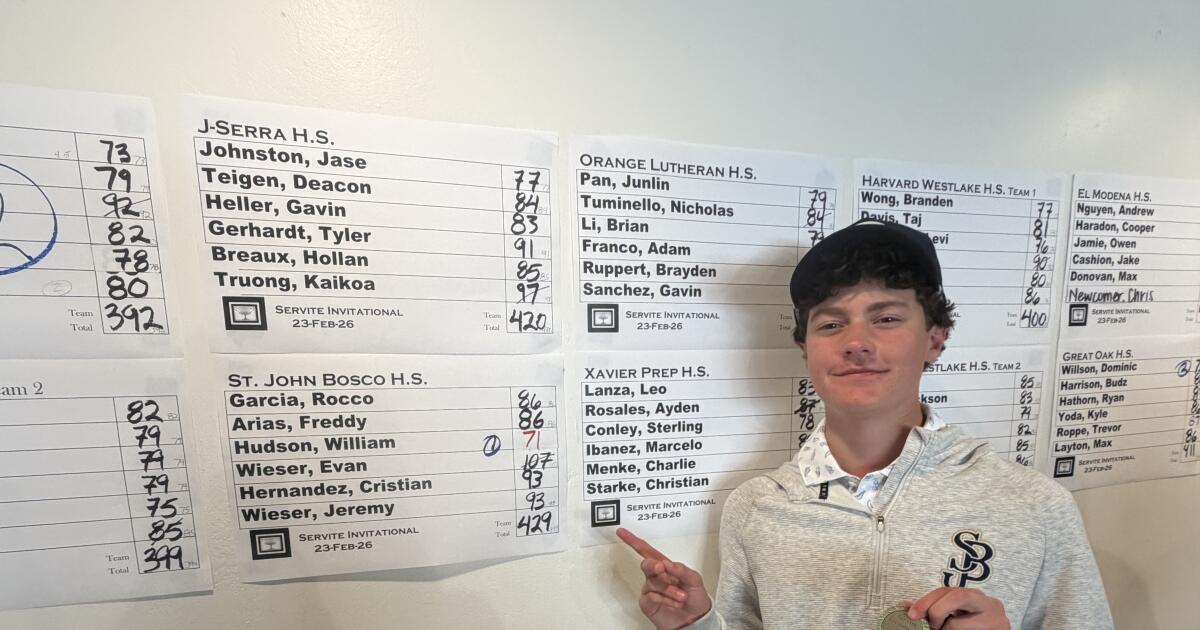
William Hudson, a 14-year-old freshman golfer, shot 71 on Monday at Western Hills Country Club in Chino Hills to win the Servite Invitational.
“It was very important to me and my school,” Hudson said.
Some think it’s the first time a St. John Bosco student won an invitational title.
Hudson is a straight-A student who picked up his first golf club when he was 3. He has a daily routine involving practicing at 6 a.m. before heading to school. He’s also enrolled in a school entrepreneur program that involves taking classes at a junior college that will qualify for college credits.
“They are long days, but I get through it,” Hudson said.
He comes from a family that enjoys golf. His great-grandfather played until his death at 98 last year.
“I love how it can take me to interesting places and meet interesting people,” Hudson said. “I can play for the rest of my life. It’s a lifelong sport.”
It’s looking like another strong year for golfers in Southern California, with several individual champions returning, including Jaden Soong of St. Francis and Grant Leary of Crespi.
Now Hudson has thrust himself into the conversation.
This is a daily look at the positive happenings in high school sports. To submit any news, please email eric.sondheimer@latimes.com.
Green Party candidate Hannah Spencer give a victory speech to supporters in Manchester early Friday after being declared the winner of the Gorton and Denton byelection to choose a new Member of Parliament. Photo by Adam Vaughan/EPA
Feb. 27 (UPI) — Britain’s Green Party won the Gorton and Denton byelection in southeast Manchester with a more than 4,000-seat majority, beating the ruling Labour Party into third place, and 12 points clear of Reform UK.
The Greens’ new Member of Parliament, Hannah Spencer, a plumber from a neighboring suburb of Manchester, produced a convincing win in Thursday’s poll, overturning the 13,000-seat majority won in the 2024 general election by the previous Labour holder of the seat who is standing down due to ill-health.
Spencer won 14,980 seats, or 40.7% of the vote, Reform’s Matt Goodwin, 10,578 and Labour’s Angeliki Stogia trailing in third place with 9,364. The Conservative Party’s candidate came in a distant fourth with just 706 votes. Turnout was 47.6%.
The win, a first for the Green Party in a byelection, takes the party’s contingent in the House of Commons to five.
Speaking in the early hours of Friday after the results were announced, 34-year-old Spencer vowed to “fight” for the people of Gorton and Denton “who feel left behind and isolated.”
“There is an appetite here for change, and there are people across this constituency and much further beyond who are rejecting the old political parties and who are coming together to fight for something better, but who are doing it positively and in a really hopeful way.”
Spencer said her victory proved there was “no longer any such thing as a safe seat” and that there was “no part of the country where the Green Party cannot win.”
Asked if the Greens’ intention was to “eviscerate” Labour, Party leader Zack Polanski said that taking a seat Labour had held for more than 100 years showed it was “beginning already.”
“If we see a swing like this at the next general election, there will be a tidal wave of new Green MPs. This is an existential crisis for the Labour Party,” he said.
Labour’s second-straight loss of a byelection with Prime Minister Keir Starmer at the helm, and with local elections just around the corner in May, could prove highly consequential for his future.
Speaking to reporters Friday, a defiant Starmer rejected any suggestion he might be considering his position, saying he would never quit.
“I came into politics late in life to fight for change for those people who need it. I will keep on fighting for those people for as long as I’ve got breath in my body,” he said.
Starmer played down the loss saying that while it was “very disappointing,” voters often took out frustrations on sitting administrations in mid way through their terms.
However, Strathclyde University Politics Professor John Curtice said the Green Party was now challenging Labour’s stranglehold on the left of British politics in a way that would cause the parliamentary wing of the party to seriously question whether Starmer was still the right person to lead the country.
Reform UK chairman David Bull, telling the BBC he was “absolutely thrilled” with his party’s performance,” echoed that analysis.
“Keir Starmer is in big trouble now — it is not a matter of if he leaves office, it’s when he leaves.”
Party leader, MP Nigel Farage, warned the Greens’ win would embolden the radical left and said opposition Conservative Party leader Kemi Badenoch should apologize for leading the party to the worst result in its history.
“Roll on the elections on May 7. It will be goodbye Starmer and goodbye to the Tory [Conservative] party,” he wrote on X.
Badenoch, who is Black, called on Starmer to quit immediately.
“Our country is not broken, but this byelection showed that Labour, Reform and the Greens are trying very hard to break it. Labour trying to buy people off with more and more benefits spending, Reform telling people you can’t be British if you’re not white. The Greens running a nasty, sectarian campaign while simultaneously wanting to legalize crack-cocaine,” she wrote in a statement.
“The result shows Keir Starmer’s premiership is finished. He lost authority a long time ago, a mere hostage at the mercy of a divided Labour Party that cannot decide who to replace him with. He has lost the support of his MPs and the country. He is in office but not in power. If had any integrity he would go,” said Badenoch.
Former South African president Nelson Mandela speaks to reporters outside of the White House in Washington on October 21, 1999. Mandela was famously released from prison in South Africa on February 11, 1990. Photo by Joel Rennich/UPI | License Photo
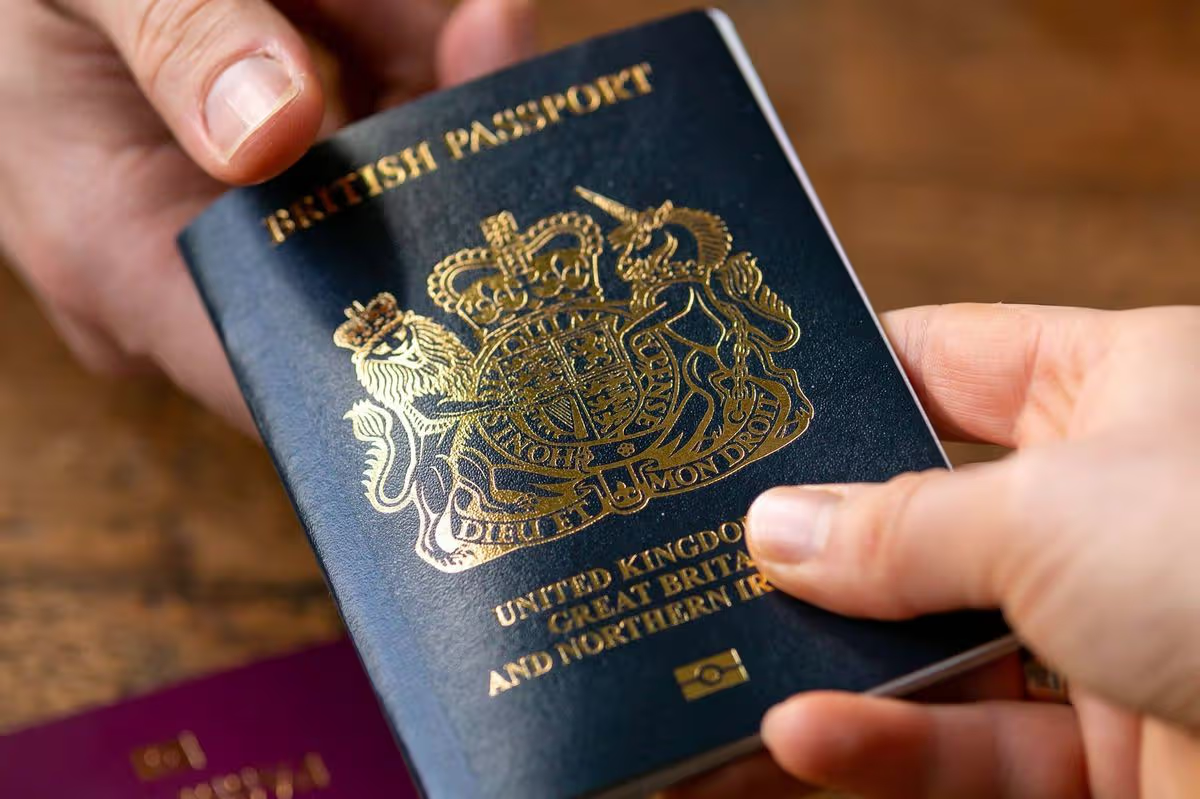
A number of changes have been made to passport rules since Brexit, and while most of us have got to grips with the basics, there are still things that catch holidaymakers out year after year
Check your passport before you book your holiday(Image: Getty)
Since Brexit, a raft of changes have been implemented to passport regulations, and whilst the majority of us have got our heads around the basics, there are still elements that trip up holidaymakers each year.
From ensuring your passport was issued within the last ten years, to verifying you have at least three months validity on your passport when entering the EU, there are several passport checks you should carry out before booking your getaway. Now is the prime time to scrutinise your passport, as renewing it at this point in the year helps you dodge the summer rush.
Whilst you may have double-checked details such as the dates and confirmed there’s no physical damage to your passport, one aspect many people overlook is the number of blank pages they have left, particularly given today’s digital age.
A standard UK passport contains 34 pages, and typically, you receive an entry and exit stamp when you go through passport control. This practice is likely to be phased out soon for holidaymakers visiting Europe due to the introduction of the EU’s Entry/Exit System (EES), but for the time being, you can assume most countries will continue adding their stamps.
Numerous countries have precise requirements regarding the number of blank pages needed for passport stamps. For EU nations, one to two pages is typically adequate, whilst destinations such as South Africa demand two, reports the Express.
Certain countries will also insist that the two blank pages are consecutive, as one page is used for the entry stamp, followed by one for departure.
Some nations that require visas for entry still utilise stickers, which are attached to blank pages, though these are generally being replaced by e-visas.
There are places that demand four pages, but the record belongs to Namibia, with reports that travellers can be required to present six blank pages upon arrival. Brits ought to verify requirements for their destination when organising their travels.
It’s important to note that not all pages can receive stamps. British passports contain an ‘observation page’ at the back reserved for official notes.
This may feature information about the holder’s dual nationalities or alternative names, but most often it remains empty. However, it doesn’t qualify as a blank page as it cannot be stamped.
So, what should holidaymakers do if they lack sufficient pages?
You’ll need to renew your current passport prior to your journey, as extra pages cannot be added. This means paying the standard passport renewal fee, which for an adult passport is £94.50 according to the UK government website.
If you’re a regular globetrotter, it’s worth considering a 54-page frequent traveller passport when you next apply. Whilst it costs slightly more at £107.50, it can prove more economical than renewing your passport in a couple of years simply because you’ve exhausted all the pages.
Children under 16 can also obtain a frequent traveller passport for the reduced price of £74.50. Frequent traveller passports for adults are additionally available through the one-day premium or one-week fast track services, though these cost £235 or £191 respectively.
Ensure our latest lifestyle and travel headlines always appear at the top of your Google Search by making us a Preferred Source. Click here to activate or add us as Preferred Source in your Google search settings
MAJOR airports in Spain are introducing Brit-only border control to avoid travel chaos this summer.
New EES requirements have resulted in large queues at airports for British holidaymakers.
Sign up for the Travel newsletter
Thank you!
Spanish airports are set to add areas for Brits-only and non-EU residents at border controlCredit: GettyAena has revealed that four airports will adapt their security and border control for BritsCredit: Alamy
According to local media, the Spanish operator Aena has revealed that four airports will adapt their security and border control for Brits.
These airports are in Ibiza, Menorca, Malaga and Palma, Majorca.
It’s set to be put in place to ease the queues caused by new EES rules.
These will have a single access point to non-Schengen boarding zones to be used only by UK and non-EU passengers.
The changes form part of Aena’s huge investment plan to its airports set to take place between 2027-2031.
These airports will use the investment ‘redesign control areas to improve passenger flow’.
They will allocate 29 per cent more space for passengers to ‘ensure smoother processing and better service quality’.
Malaga Airport could receive €1.5billion (£1.3billion) which could see it double the size of the terminal and increase capacity to handle 36million passengers each year.
Palma Airport (called Son Sant Joan) could receive €621.6million (just over £544million) for upgrades.
The investment is set to go towards the airport’s platforms, runway and taxiway pavements, taxiways, and renovation of boarding bridges.
In the case of Ibiza, the investment is set to be €229.7million (£201million), and in Menorca, the investment will reach €170.7million (£149million).
It will also include the adaptation toborder controlregulations to improve its efficiency.
At all four of the upgrade plans at these airports include allocated areas for Brits and non-EU passengers.
In order to fund the investment, Aena has proposed an average annual increasing its fees for airlines.
President Donald Trump has repeatedly touted the U.S. economy as “roaring” and declared inflation “defeated” since returning to office in January 2025. In his recent State of the Union address, he called it “the golden age of America,” claiming unprecedented economic prosperity.
However, a new Reuters/Ipsos poll suggests that most Americans across party lines do not share that view. The poll, conducted online with 4,638 adults and a two-point margin of error, finds that 68% of respondents disagree with the statement that “the U.S. economy is booming.” Even among Republicans, who form Trump’s political base, opinion is sharply divided: 56% agree the economy is booming, while 43% disagree.
Cost of Living Remains Top Concern
Americans interviewed cited rising costs as their primary worry. In Tennessee, manufacturing worker Marcus Tripp said: “Even as a two-income household, we are struggling… I am worried more about how much my rent and everything is going up than I am about whether the guy down the street has citizenship documents or not.”
Poll respondents overwhelmingly rejected Trump’s claim that inflation has been defeated. Only 16% agreed with the statement that “there is hardly any inflation in the U.S.,” while 82% of independents and 72% of Republicans disagreed. Democrats were even more skeptical, with a strong majority rejecting the notion of a booming economy.
Awareness of Trump’s Economic Policies
The poll also revealed limited public knowledge of Trump’s specific proposals:
44% had never heard of the plan to restrict large investors from buying single-family homes.
48% were unaware of the proposed cap on credit card interest rates at 10%.
By contrast, 78% were aware of tariff increases on imported goods, with many expecting the tariffs to raise the cost of living 54% overall, including 69% of Democrats and 42% of Republicans.
Some voters expressed frustration that policies emphasizing tariffs may not address the issues they feel most acutely. Independent voter Tiffany Ritchie of Corpus Christi said, “We’re not going to tariff our way out of this.”
Political Implications Ahead of Midterms
The poll’s results are a warning for Trump and the Republican Party as they head into the November 3 midterms, defending majorities in both the House and Senate. Cost-of-living concerns are emerging as a decisive factor for voters, potentially outweighing immigration and other campaign issues that Trump has emphasized.
Primaries are already underway in states such as Texas, North Carolina, and Arkansas, with both parties beginning to select candidates for the midterms. Economists predict modest growth this year, but few expect the kind of “booming” economy Trump describes.
Analysis
From my perspective, the poll highlights a growing disconnect between Trump’s rhetoric and the lived experience of many Americans. While the administration touts economic successes, households are still struggling with rising rents, groceries, and energy costs.
The division among Republicans is also notable. While Trump’s base remains partially supportive of his economic claims, nearly half of the party’s voters see little evidence of a boom. This split could weaken the Republican message in key battleground districts, especially where cost-of-living pressures are most acute.
Moreover, the limited public awareness of some Trump policies suggests that policy communication is lagging. Tariffs are well-known, but policies targeting housing and credit remain obscure, potentially limiting their political impact.
In short, while Trump frames the U.S. economy as a “golden age,” the reality for many voters is very different. Rising living costs, skepticism among independents, and division within his own party suggest that economic messaging alone may not be enough to secure midterm victories.
GORDON Ramsay has splashed out on a £9.65million home in Cornwall.
The celebrity chef, 59, has purchased the most expensive property in the coastal village of Rock, where he previously clashed with neighbours.
Sign up for the Showbiz newsletter
Thank you!
Gordon Ramsay has splashed out on another Cornwall propertyCredit: GettyThe celebrity chef purchased a £9.65million house in costal village RockCredit: Alamy
In fact, Gordon’s new four-bedroom home is on the same road, and just a few doors down, from the house he built in March 2021.
At the time, more than 20 neighbours objected to his plans and branded it a “monstrosity”.
This prompted Gordon to respond in an interview not long after, saying: “‘I absolutely love Cornwall. It’s just the Cornish I can’t stand.”
The Mail has now reported that Gordon and wife Tana Ramsay purchased the 19th century house via Rocky Bay Estates and that Land Registry documents show that bought it with a mortgage from bank Coutts.
At the time, that was the most expensive house ever sold in Cornwall.
Gordon was blasted by locals for spending time at the pad during the very first lockdown.
The superstar telly chef had previously been at the centre of a storm with his neighbours in Rock – after a series of huge renovation works.
He was accused of bringing “Legoland to Cornwall” after he called in builders to create a mega-home with incredible views of the sea.
Gordon’s plans included knocking down a 1920’s property to build a new, modern pad – complete with a second smaller property which was known as “The Garden House”.
Gordon previously clashed with neighbours over renovation works on his home in 2021Credit: Getty
One of his neighbours moaned at the time: “I urge you to insist that this house is not bulldozed and its façade be maintained or at least some of its character be retained rather than the short-sighted house which is currently proposed.
“The council will come to regret having allowed such traditional houses to be destroyed with impunity.”
Gordon, who has five children with his wife Tana, previously hit back at his Cornish critics and made light of their dislike of him.
Speaking about their claims he was endangering Cornish people after going there at the start of the pandemic, Gordon said: “God knows why we took so much s**t from the Cornish.
“We lived down there; we just hadn’t been down there for a long time. We didn’t sneak down there at all.
“We got there at an appropriate time and had an absolutely amazing time. And a time like that – we’ll never get back again.”
And earlier that year he told Vernon Kay on BBC Radio 2 that he could not abide the locals who live around him in Cornwall.
Laughing, Gordon said: “Trust me I absolutely love Cornwall, it’s just the Cornish I can’t stand.”
The TV star previously said ‘I absolutely love Cornwall. It’s just the Cornish I can’t stand’Credit: Getty
The NYSE is building a blockchain-powered platform for 24/7 trading and instant settlement of tokenized securities, aiming to modernize global capital markets and challenge traditional trading hubs.
The New York Stock Exchange (NYSE) is developing a platform for continuous trading and on-chain settlement of tokenized securities, a development some analysts are hailing as a revolution in global capital markets.
In a January announcement, the Big Board said that, subject to regulatory approval, the digital platform will enable 24/7 operations including “instant settlement, orders sized in dollars, and stablecoin-based funding.”
According to the NYSE, the proposed trading site will blend its proprietary Pillar matching engine with blockchain post-trade systems, “including the capability to support multiple chains for settlement and custody.” The announcement describes the initiative as “a new NYSE venue that supports trading of tokenized shares fungible with traditionally issued securities as well as tokens natively issued as digital securities.”
The announcement signals that the world’s largest traditional exchange is committing to blockchain-native market infrastructure, says Aditya Singh, head of product and strategy for brokerage firm INFINOX. A 24/7, on-chain settlement model removes many of the frictions that have defined capital markets for decades, including delayed settlement, operational risk, and restricted trading hours.
A Wake-Up Call To Competition
“From a global perspective, this puts immediate pressure on financial centers like London, Singapore, Hong Kong, and Dubai to accelerate their own digital asset strategies or risk falling behind as liquidity and institutional participation migrate towards more-efficient, always-on markets,” says Singh.
NYSE parent company Intercontinental Exchange (ICE) is advancing a broader digital strategy that includes preparing the clearing infrastructure to support round-the-clock trading and integration of tokenized collateral. ICE is currently working with BNY Mellon and Citi to facilitate tokenized deposits.
“We are leading the industry toward fully on-chain solutions, grounded in the unmatched protections and high regulatory standards that position us to marry trust with state-of-the-art technology,” Lynn Martin, president, NYSE Group said in a statement.
In December, NYSE competitor Nasdaq said it was seeking approval from the US Securities and Exchange Commission to allow close to 24-hour trading, five days a week. If approved, the new schedule would roll out in the second half of this year. But the development was criticized at the time by some traders as being unnecessary.
California’s landmark single-use plastic law is slowly being eroded by pressures within the state. Now legal attacks from outside threaten to kneecap it entirely.
Earlier this month, a federal district court judge in Oregon put parts of its single-use plastic law, which is similar to California’s, on hold while he decides whether it violates antitrust and consumer protection laws.
At the same time, 10 Republican attorneys general sent letters directly to companies that are taking part in plastic reduction campaigns, telling them to stop.
They threatened legal action against Costco, Unilever, Coca-Cola and 75 other companies for participating in the Plastic Pact, the Consumer Goods Forum and the Sustainable Packaging Coalition. These efforts all include industry as an active partner in reducing plastics, but the letters say the companies are colluding against consumers “to remove products from the market without considering consumer demand, product effectiveness, or the cost and impact on consumers of a replacement product.”
Charges of corporate collusion and conspiracy are central to both cases.
Anti-waste advocates and attorneys well versed in packaging say the lawsuit and the letters to Costco and the other companies highlight vulnerabilities in several of California’s waste laws, including the seminal Senate Bill 54 — the Plastic Pollution Prevention and Packaging Producer Responsibility Act. At issue are what are known as Extended Producer Responsibility laws.
These put the cost of cleanup and waste disposal on the companies that make materials — plastic, paint or carpet — rather than on consumers, cities and municipalities.
In 2024, a report from California Atty. Gen. Rob Bonta estimated that collectively, the state’s cities spend more than $1 billion each year on litter management. In 2023, 2.9 million tons of single-use plastic (or 171.4 billion pieces) were sold or distributed, according to one state analysis.
These producer responsibility laws emphasize the idea of “circular economy”: that the producer of a material must consider its fate — making sure it can be reused or recycled, or at least reduced.
The laws organize companies into entities, called Producer Responsibility Organizations (PROs), that generally oversee the management of the laws, set fees and collect them from members.
In the Oregon lawsuit, the National Assn. of Wholesaler-Distributors alleges a state-sanctioned product responsibility organization levied fees on trade group members that were onerous and opaque.
“Their fee structure was designed in secret by board members of the PRO,” said Eric Hoplin, president and chief executive of the group.
“Oregon is attempting to build a statewide recycling system by granting vast authority to a private entity to impose what amount to hidden taxes on businesses and consumers,” said Brian Wild, chief government relations officer for the wholesalers. “This law raises prices, shields decision-making from scrutiny, and advantages large, vertically integrated companies at the expense of smaller competitors.”
The group he references, the Circular Action Alliance, is the same one that oversees California’s single-use plastic law. Amazon, Colgate-Palmolive, General Mills and Procter & Gamble are part of it.
Others, however, say California’s laws are strong.
People shop at Costco in Glendale, Calif., on April 10.
(Damian Dovarganes / Associated Press)
“Extended Producer Responsibility laws are public policies passed by legislatures and implemented with government oversight,” said Heidi Sanborn, the executive director and CEO of the National Stewardship Action Council, which advocates for the laws and a more circular economy.
She helped craft many of California’s waste laws, including SB 54 and was also involved in Oregon’s law. “They create clear, consistent rules so all producers contribute fairly to the cost of recycling and waste management,” she said.
Sen. Benjamin Allen (D-Santa Monica), who wrote SB 54, said California’s plastic bill was designed to avoid violating antitrust laws.
CalRecycle declined to comment.
Some advocates actually hope the California laws fall. They include Jan Dell, of Last Beach Cleanup, an anti-plastic group based in Laguna Beach.
Extended Producer Responsibility “programs are based on the false premise that plastic is recyclable and are counterproductive because they green wash plastics and preempt proven solutions like strategic bans on the worst forms of plastic pollution (e.g. single use bags, six pack rings),” Dell wrote in an email.
Even those, however, can be problematic if they’re not enforced. Dell pointed to SB 54’s de facto ban on polystyrene, which went into effect on Jan. 1, 2025.
“There is still Styrofoam stuff sold in 250 Smart and Final stores across the state!” she said. “It is totally noncredible and outrageous to claim that CalRecycle will ever enforce regulations on thousands of types of packaging when they can’t enforce the regulations on JUST ONE!”
From Broderick Turner: The losses are mounting for the Lakers in the most excruciating of ways. They’ve lost their last two games in the final second, and it’s eating at them because they used to be so good in late, critical moments.
The Lakers fell to the Phoenix Suns 113-110 on Thursday after Austin Reaves missed a three-point shot as time expired. The injury-depleted Suns earned the win on a three-pointer by Royce O’Neale with ninth-tenths of a second left.
The Lakers have lost three consecutive games for the third time this season. They were blown out by the Boston Celtics on Sunday before losing by one at home to the Orlando Magic on Tuesday when Luka Doncic passed up a three and threw the ball to LeBron James, who missed a hurried, last-second three.
Against the Suns, the Lakers rallied from 12 points down in the fourth quarter after Doncic went to work. He hit back-to-back threes during the comeback and finished with 41 points, eight rebounds and eight assists.
The Lakers made it a clutch game, the kind in which they’ve been an NBA-best 16-5. Still, they lost.
“Our losses are louder than other teams’ because we’re the Lakers and because of the way we lose,” coach JJ Redick said. “Tonight was a one-possession clutch game, which, now we’ve lost a few of those. But we’ve been great for the most part in the clutch all year.”
The Lakers (34-24) tied the score twice in the final minute, first on a three by Reaves and then on a tip-in by James, who had 15 points, six rebounds and five assists, with 22.7 seconds left.
Dodgers pitcher Tyler Glasnow made his first start of spring training a good one, pitching two perfect innings and striking out four against the Chicago White Sox on Thursday at Camelback Ranch.
(Norm Hall / Getty Images)
From Jack Vita:Dodgers right-hander Tyler Glasnow is an admitted overthinker. But you wouldn’t know it based on his efficient first spring training start Thursday against the Chicago White Sox at Camelback Ranch.
Glasnow pitched two-plus innings, retiring the first six batters before coming out after giving up a single to start the third inning. Using a pitch mix that included a fastball that sat at 97 mph, Glasnow struck out the side in the first inning before recording another strikeout to close out the second. Having thrown just 28 pitches, Glasnow started the third inning and threw three more pitches before coming out of the Dodgers’ 7-6 win.
“Very in rhythm,” manager Dave Roberts said after the game. “Very efficient, used his entire pitch mix, it was really good. Good to see him get into the third inning. Positive day.”
The 32-year-old entering his third season with the Dodgers credits his coaches for keeping his mechanics on point.
“It allows me to just go out and pitch and be athletic,” Glasnow said after his outing. “I’m able to just go out and play baseball as opposed to trying to tinker and fix certain stuff.”
UCLA gymnast Sydney Barros performs her floor exercise routine at Pauley Pavilion on Jan. 17.
(Gina Ferazzi / Los Angeles Times)
From Anthony Solorzano: With the Big Ten title on the line during the Big Four Meet on Friday at Pauley Pavilion, the UCLA gymnastics team is focused on what it can control.
“Our goal is to go out there and just do what we’ve been doing all season long,” coach Janelle McDonald said. “Hitting great gymnastics and continuing to just build the confidence on the competition floor before we head into [the] postseason.”
Entering the season, the Bruins had a few elite veterans and an otherwise young team. The steady growth of underclassmen has helped UCLA earn its No. 5 national ranking and move a victory away from claiming its second consecutive Big Ten title.
“Last year, when we came into the Big Ten, we really wanted to make a statement and I think we did just that,” McDonald said. “Coming in this year with a younger team, hungry to just continue that, has just been really special.”
Artist Gustavo Zermeño Jr. paints a mural dedicated to Olympic gold medalist skater Alysa Liu on Wednesday at the corner of W. 156th and Crenshaw Boulevard in Gardena. “I like that it’s a little rough around the edges, but beautiful at the same time,” he said of the portrait.
(Ronaldo Bolanos / Los Angeles Times)
From Chuck Schilken: U.S. figure skater Alysa Liu made quite an impression at the Milan-Cortina Olympics with her unique style, her compelling backstory and, of course, her gold medals in the women’s singles competition — the first for an American woman since 2002 — and in the team event.
Her feats captured the attention of local artist Gustavo Zermeño Jr. He wanted to be sure to capture all of it in his new mural paying tribute to the 20-year-old athlete in Gardena.
“Obviously her winning gold was the main factor” in his choosing to paint Liu, Zermeño said.
But once the Mexican American artist learned more about the Chinese American skater, he found inspiration in other aspects of her life as well. That includes the Oakland native’s two-year retirement from the sport starting at age 16, her enrollment at UCLA and her decision to express herself in her own way.
United States’ Hilary Knight (21) celebrates after scoring during the women’s ice hockey gold medal game between the United States and Canada at the Milan-Cortina Winter Olympics on Feb. 19.
“I thought it was sort of a distasteful joke, and unfortunately, that is overshadowing a lot of the success of just women at the Olympics carrying for Team USA and having amazing gold medal feats,” Knight said Wednesday during an appearance on ESPN’s “SportsCenter.”
On Feb. 19, the U.S. defeated Canada 2-1 in overtime for a third gold medal in women’s hockey; the team won gold in 1998 and 2018. Three days later, the U.S. men’s hockey team also won gold by defeating Canada 2-1 in overtime.
Edmonton Oiles captain Connor McDavid, center, battles Kings forward Trevor Moore, left, and defenseman Mikey Anderson for the puck during the first period of the Kings’ 8-1 loss Thursday at Crypto.com Arena.
McDavid scored his 35th goal and Draisaitl got his 30th during his fourth four-point game of the season as the Oilers again routed the opponent they’ve knocked out of the first round of the Stanley Cup playoffs in each of the past four seasons.
The game marked the biggest margin of defeat against the Kings this season.
Clippers guard Kris Dunn drives to the basket in front of Minnesota’s Donte DiVincenzo during the Clippers’ 94-88 loss Thursday at Intuit Dome.
(Kyusung Gong / Associated Press)
From the Associated Press: Anthony Edwards scored 31 points, Donte DiVincenzo added 18 and the surging Minnesota Timberwolves beat the Clippers 94-88 on Thursday night.
Jaden McDaniels and Ayo Dosunmu each scored 12 points and Rudy Gobert had 13 rebounds to help the Timberwolves improve to 5-1 since Feb. 9 and 3-1 since the All-Star break.
Edwards, returning to the site of the All-Star Game, where he was the MVP, was 12 for 24 from the floor and sealed the victory with a step-back three-pointer over two defenders for a 92-88 lead with 42.9 seconds left.
After all, the “Fight of the Century” at the MGM Grand Garden Arena in Las Vegas — won by Mayweather — set records with 4.6 million pay-per-view buys and $72 million in ticket sales.
So it’s no surprise that long after both boxers slipped comfortably into (temporary) retirement, legal fights endured over even slim slices of that cash-stuffed pie.
For 10 years — and counting — lawyers and judges have attempted to determine what claimants are due and whether Pacquiao in particular suffered reputational damage along the way.
From John Cherwa: The hopes of Northern California racing and breeding interests were once again dashed when the California Horse Racing Board refused to license short racing dates to the Tehama District Fair and the Humboldt County Fair on Thursday.
Rather than a discussion about how to grow the sport, the 2-hour 45-minute meeting was mostly about how bad the state of racing is in the state and a determination that the future of Southern California racing is in jeopardy if it isn’t given every advantage available.
That advantage is the amount of money that goes to the host track from advance deposit wagering (ADW) and computer assisted wagering (CAW). If Tehama and Humboldt were racing, then money bet by any means in Northern California would stay there, the way it was since the start of ADW until shortly after the closing of Golden Gate Fields in Berkeley.
1918 — The first neutral site game in NHL history is held in Quebec City. Frank Nighbor scores twice in the first period to lead the Ottawa Senators to a 3-1 win over the Montreal Canadiens.
1955 — Boston beats Milwaukee 62-57 at Providence, R.I. in a game which set records for fewest points scored by one team, and by both teams, since the introduction of the 24-second clock.
1959 — The Boston Celtics beat the Minneapolis Lakers 173-139 as seven NBA records fall. The Celtics set records for most points (179), most points in a half (90), most points in a quarter (52) and most field goals (72). Boston’s Tom Heinsohn leads all scorers with 43 points and Bob Cousy adds 31 while setting an NBA record with 28 assists.
1966 — Richard Petty wins the rain-shortened Daytona 500 by more than a lap at a speed of 160.927 mph. Petty holds the lead for the last 212 miles of the scheduled 500-mile event, which is called five miles from the finish. Cale Yarborough finishes second.
1977 — Stan Mikita of the Chicago Black Hawks scores his 500th goal in a 4-3 loss to the Vancouver Canucks.
1982 — Florida apprentice Mary Russ becomes the first female jockey to win a Grade I stakes in North America when she captures the Widener Handicap aboard Lord Darnley at Hialeah (Fla.) Park.
1992 — Prairie View sets an NCAA Division I record for most defeats in a season with a 112-79 loss to Mississippi Valley State in the first round of the Southwestern Athletic Conference tournament. Prairie View’s 0-28 mark breaks the record of 27 losses shared by four teams.
1994 — Sweden wins its first hockey gold medal, defeating Canada 3-2 in the first shootout for a championship at the Winter Olympics in Lillehammer, Norway. Canada is 1:49 away from its first championship in 42 years when Magnus Svensson’s power-play goal ties it at 2. Paul Kariya’s shot is stopped by Sweden’s Tommy Salo after Peter Forsberg puts Sweden ahead on his team’s seventh shot.
1998 — Indiana’s 124-59 victory over Portland marks the first time in the NBA’s 51-year history that one team scores more than twice as many points as the other.
2005 — David Toms delivers the most dominant performance in the seven-year history of the Match Play Championship, winning eight out of nine holes to put away Chris DiMarco with the largest margin of victory in the 36-hole final. The score 6 and 5, could have been much worse as Toms was 9 up at one point.
2006 — Effa Manley is the first woman elected to the baseball Hall of Fame. The former Newark Eagles co-owner is among 17 people from the Negro Leagues and pre-Negro Leagues chosen by a special committee.
2010 — Steven Holcomb drives USA-1 to the Olympic gold medal in four-man bobsledding, ending a 62-year drought for the Americans in the event. Holcomb’s four-run time was 3:24.46, with Justin Olsen, Steve Mesler and Curt Tomasevicz pushing for him.
2015 — Travis Kvapil’s NASCAR Sprint Cup car is stolen early in the day from a hotel parking lot, forcing him to withdraw from a race at Atlanta Motor Speedway. The team didn’t have a backup car in Atlanta, so it’s forced to drop out when the stolen machine couldn’t be located in time for NASCAR’s mandatory inspection.
Compiled by the Associated Press
Until next time…
That concludes today’s newsletter. If you have any feedback, ideas for improvement or things you’d like to see, email me at houston.mitchell@latimes.com. To get this newsletter in your inbox, click here.
PERPETUALLY paranoid about ‘wasting the day’ staying in bed? Chill the f**k out by following this guide to enjoying it and not being knackered by 9pm:
Do not plan every second
Being a slave to your diary won’t help you lie in bed scratching your arse. Don’t make any arrangements before midday, turn off notifications, close the curtains properly and ignore your bladder. It can hold on a bit longer if it really tries, and in return you won’t attempt a wank.
Stay up late the night before
There is life afterNewsnight.Stay up and see some of it, and then perhaps you’ll be tired enough to luxuriate in no alarm going off. Still finding yourself drowsy? Follow the wisdom of teenagers and stay up scrolling social media bullshit for far, far longer than you’re able to find it interesting. Then another hour after that.
Prepare your body
Usually exercise in the morning? Do it the night before instead. Shower in the morning? Wash in the evening. Usually have an evening Horlicks or soporific tea? Instead, knock back espresso martinis and vodka Red Bull until you keel over in a twitching, semi-conscious stupor. Lie-in guaranteed.
Ignore your mind
If you wake in the night for a 3am piss, perform the action without thought. If a man, sit on the toilet in darkness. Resist all thought, and especially long-nursed grudges about twat neighbours, arseholes online or how you’d have that argument with your partner better this time and win. These are not restful thoughts.
Ignore your partner
Often the reason you can’t lie in is due to your partner snoring, farting or poking you with an erection. Feign sleep anyway or lie: claim a parcel has arrived, or you heard the dog vomit, or simply ask them to leave the house forever and never come back. The means will justify the end when you’re curling up with the whole duvet.
Masturbate if necessary
If your own sexual thoughts are nudging you awake and you’re alone, crack one out. A morning glory or handy dildo will help but needn’t be a prerequisite for strumming off and wallowing in post-nut, warm bed, sleepy bliss.
Don’t fool yourself you’re important
The world won’t collapse if you roll over and grab an extra hour. Calm your frantic nervous system and racing heart with the understanding you’re a replaceable, insignificant cog in a the machine of capitalism and society will function fine without you. Like the Buddha, realise you are nothing. Then break wind and go back to sleep.
Elsewhere, Barcelona will face Newcastle, Tottenham will play Atletico Madrid, and Arsenal will take on Bayer Leverkusen.
Published On 27 Feb 202627 Feb 2026
Share
Real Madrid will play Manchester City while defending champions Paris Saint-Germain will face Chelsea in the pick of the 2025/26 Champions League last 16 games after the draw was made by UEFA in Nyon, Switzerland.
The draw for European football’s biggest club competition on Friday determined that City will face Madrid for the fourth consecutive season in a knockout Champions League clash.
Recommended Stories
list of 4 itemsend of list
Meanwhile, PSG and Chelsea will repeat their FIFA 2025 Club World Cup final, which the Premier League side won 3-0.
Elsewhere, Barcelona will face Newcastle United, Tottenham Hotspur will play Atletico Madrid, and Arsenal will take on Bayer Leverkusen.
Liverpool will renew hostilities with Galatasaray in a rematch of their league phase game, which the Turkish giants won 1-0 in Istanbul.
Norwegian minnows will face Portugal’s Sporting Lisbon, while the only Italian side left in the competition face a daunting encounter with German champions Bayern Munich.
The first legs will be played on March 10-11 and the second legs will be played on March 17-18.
The eight seeded teams – who finished in the top eight spots in the league phase – will be at home for the second legs against the eight teams who qualified through the playoff round.
The last 16 draw in full:
Paris Saint-Germain vs Chelsea
Galatasaray vs Liverpool
Real Madrid vs Manchester City
Atalanta vs Bayern Munich
Newcastle vs Barcelona
Atletico Madrid vs Tottenham Hotspur
Bodo/Glimt vs Sporting
Bayer Leverkusen vs Arsenal
Familiar foes
Real Madrid knocked City out in the last 16 last season, as they did in the 2024 quarterfinals and 2022 semifinals.
City beat Madrid in the 2023 semifinal en route to lifting the Champions League trophy for the first time.
The two clubs have played each other on 15 occasions, with each team winning five games and the rest ending as draws.
City and Madrid have already faced each other in the league stage this season, with City coming from behind to win 2-1 in December.
PSG will be eager to take revenge on Chelsea after the Blues stunned the French champions to win the inaugural the Club World Cup title in a bad-tempered game last year.
The clubs have previously faced each other in the Champions League, with Chelsea triumphing in a 2014 quarterfinal and PSG eliminating the Blues in the last 16 in 2015 and 2016.
Chelsea’s Cole Palmer celebrates scoring against PSG in the Club World Cup final with Joao Pedro [Hannah Mckay/Reuters]
The draw on Friday also mapped out the potential route to the final, to be held in Budapest on May 30, as every team now knows their possible quarterfinal and semifinal opponents.
In the quarterfinals, City or Madrid will face the winner of Bayern Munich vs Atalanta, while PSG or Chelsea will take on either Liverpool or Galatasaray.
Quarterfinal draw
Paris Saint-Germain or Chelsea vs Liverpool or Galatasaray
Real Madrid or Manchester City vs Bayern Munich of Atalanta
Newcastle or Barcelona vs Tottenham or Atletico Madrid
Sporting Lisbon or Bodo/Glimt vs Arsenal or Bayer Leverkusen
Semifinal draw
Paris Saint-Germain, Chelsea, Liverpool or Galatasaray vs Real Madrid, Manchester City, Bayern Munich of Atalanta
Newcastle,Barcelona, Tottenham or Atletico Madrid vs Sporting Lisbon, Bodo/Glimt, Arsenal or Bayer Leverkusen
Britain once ruled over the largest empire in history. For many Britons, it remains a source of pride. Others argue its power was built on a legacy of brutality, colonial conquest and the enslavement of millions.
Can Britain reckon with that past and make amends? Some say it shouldn’t have to.
Mehdi Hasan goes head-to-head with author and Oxford professor emeritus Nigel Biggar on Britain’s colonial history, its slavery and the question of reparations.
Joining the discussion: Kojo Koram – Professor of law and history at Loughborough University Lawrence Goldman – Fellow and tutor in modern history, St Peter’s College, Oxford Gurminder Bhambra – Professor of historical sociology at the Department of International Relations, University of Sussex
BRITISH Airways have launched another sale and it could see you land some mega cheap business class flights.
British Airways and British Airways Holidays’ are launching a business class sale today.
Sign up for the Travel newsletter
Thank you!
British Airways has launched a business class saleCredit: GettyIncluded in the sale are business class flights in Europe and further afieldCredit: AlamyAnd there are also holiday packages with business class flights in, in the saleCredit: Alamy
Running until March 17, travellers can get savings on a number of business class flights and holiday packages.
For example, travellers can save up to £500 on Club World return flights.
Club World is British Airways’ long-haul business class and Club Europe is the airline’s short-haul business class.
If you fancy a European getaway, then in Club Europe you could get return flights to Berlin, Germany from £270 and Dublin, Ireland from £199.
Other cheap business class flight offers include to Amsterdam in the Netherlands, from £124 each way.
And there are lots of offers on Spain flights including to Barcelona from £132 each way, Ibiza from £119 each way, Madrid from £133 each way, Palma from £156 each way and Valencia from £138 per way.
When it comes to further afield, you could head to Barbados from £1,899 and Sao Paulo from £2,899 with Club World.
Don’t want to spend that much? Then you could opt for return flights in Club World to Agadir in Morocco for £457 return.
Or you could venture off to Cairo in Egypt for £723 return.
Well, you could head off to Berlin in Germany for three nights, staying at INNSiDE Berlin Mitte hotel from £399 per person.
If you would rather head to Spain, you can holiday to Valencia for three nights staying at the Senator Parque Central Hotel from £399 per person.
If you want your holiday to last longer, then you could spend seven nights in Tuscany, Italy at the four-star Ilaria & Residenza Dell’Alba, costing from £589 per person, including breakfast.
For a holiday further afield, you could go to Marrakech in Morocco, staying at the Kasbah Africa Hotel for seven nights, with breakfast, costing from £808 per person.
To get any of these offers, you must book by March 17.
A rare weather phenomenon known as calima is set to sweep across parts of Europe, hitting major holiday hotspots with ‘blood rain’ possible, leaving dramatic orange-coated scenes
12:16, 27 Feb 2026Updated 12:17, 27 Feb 2026
Dust from the Sahara could cause ‘blood rain’ at popular Spanish hotspots(Image: Getty Images)
Brits could be battered by ‘blood rain’ during a rare weather phenomenon set to engulf parts of Europe.
A Saharan dust cloud is set to sweep across parts of Spain and the Balearic Islands, hitting major holiday hotspots such as Tenerife, Lanzarote, Gran Canaria, Majorca, Menorca and Ibiza. The phenomenon, known as Calima, is being driven by a high-altitude, isolated depression (DANA) that is transporting large amounts of sand from Morocco and Mauritania into southern Europe.
Instead of basking in the Spanish heat, tourists face the prospect of orange-tinted dust, hazy skies and reduced visibility. The Spanish weather agency, AEMET, also warned that calima “worsens air quality due to microscopic particles, which can reach the respiratory tract”.
Holidaymakers and locals should also brace themselves for “blood rain,” which occurs when the orange dust is mixed with rain. Heavy rain has been predicted for parts of Spain, which could result in thick layers of dust engulfing the Spanish hotspots, dramatically changing the scene, leaving cars scattered with dust and murky swimming pools.
The weather is forecast to be worse in the southeast parts of Spain, along the Mediterranean coast and the Balearic Islands. The AEMET issued a weather warning on X, formerly Twitter, and said: “Very adverse weather in the Canary Islands: showers that could be very heavy, today accompanied by storms in the eastern islands; very strong wind gusts; rough seas.”
The agency noted on Sunday that the “weather is expected to improve.” The phenomenon has also brought an unusually warm air mass, with soaring temperatures up to 25C in southeastern regions and the Canary Islands, and Bilbao hitting a blistering 27C in February.
This isn’t the first time the Canary Islands have experienced a calima, including Lanzarote, which typically occurs during the winter months. The calima is a hot, oppressive wind that arises when high pressure builds over the Sahara, subsequently driving winds that carry Saharan temperatures and sand.
Explaining further, Lanzarote Information said: “During a calima, the air turns a white or even a yellow colour and you can literally smell the sand in the air from the Desert.
“Visibility is reduced, and there’s a kind of otherworldly quality to the light. Often strange insects accompany the winds – in recent years we have had locusts, ladybirds and dragonflies that arrive on the island.
“They rarely last for very long here, as there is so little for them to eat due to the desert nature of Lanzarote. Sometimes unusual birds are blown over on the wind as well, so look out for them.”
Ensure our latest lifestyle and travel stories always appear at the top of your Google Search by making us a Preferred Source. Click here to activate or add us as your Preferred Source in your Google search settings.
Do you have a travel story to share? Email webtravel@reachplc.com
RUTH Langsford helped herself to a £585,000 pay day last year, new figures have revealed
The telly star runs a firm called Hey Ho Limited to take in cash from her TV work and endorsements from firms like Tesco.
Sign up for the Showbiz newsletter
Thank you!
Ruth has cashed in with a six-figure pay day – despite taking a £185,000 pay cutCredit: Ken McKay/ITV/REX/ShutterstockAnd she’s on course for another big payout because her new book is already a best-seller just hours after it was publishedCredit: PA WireThe popular presenter split from husband Eamonn Holmes in May 2024Credit: David M. Benett
Accounts for the 12 months to the end of May 2025 show Ruth, 65, paid herself a dividend of £585,000. In 2024, she took £770,000.
The figures show the firm retained £741,000 in cash.
The Sun has contacted Ruth’s representative for comment.
And she’s on course for another big payout because her new book is already a best-seller just hours after it was published.
The memoir – called Feeling Fabulous – shot to number 11 in the Amazon book charts and was number 1 in the Beauty and Fashion category.
Publishers said of the £11 work: “Up and down the country, people love Ruth Langsford’s zest for life and ability to find the humour in any situation. Every day through her work at Loose Women, she meets people who have been through the most astonishing highs and lows. Her warm and open interviewing style has made her one of the UK’s favourite broadcasters.
“Now, in her first-ever book, she’s opening up about her own ups and downs like never before.
“From her rebellious school days to starting out in telly, Strictly Come Dancing and her close bond with her family, she’s sharing the experiences that have shaped her and the lessons that she’s learned along the way.
“Throughout everything, Ruth has retained her trademark humour and sense of fun, and now she wants to share how she’s found her way back to feeling fabulous, no matter what.”
The popular presenter split from husband Eamonn Holmes in May 2024.
She said the breakup was “devastating”, admitting it felt “impossible to survive” in the initial period.
In her book, she revealed she would often cry in the shower before work following the separation.
She expressed a “deep loss” and found it “incredibly hard to come to terms with” the end of their 26-year relationship, having expected to be with Holmes “forever”.
Ruth stated she has accepted the end of her marriage, despite not being happy about it, finding that fighting against the inevitable was “exhausting and pointless”.
The Loose Women presenter, who is not ready for a new relationship, also acknowledged that the public nature of their divorce was the “hardest” aspect.
At a time when so many forces seem to be dividing us as a nation, it is tragic that President Trump seeks to co-opt or destroy whatever remaining threads unite us.
I refer, of course, to the U.S. men’s Olympic hockey team winning gold: the kind of victory that normally causes Americans to forget their differences and instead focus on something wholesome, like chanting “USA” while mispronouncing the names of the European players we defeated before taking on Canada.
This should have been pure civic oxygen. Instead, we got video of Kash Patel pounding beers with the players — which is not illegal, but does make you wonder whether the head of the Federal Bureau of Investigation has a desk somewhere with neglected paperwork that might hold the answers to the D.B. Cooper mystery.
Then came the presidential phone call to the men’s team, during which Trump joked about having to invite the women’s team to the State of the Union, too, or risk impeachment — the sort of sexist humor that lands best if you’re a 79-year-old billionaire and not a 23-year-old athlete wondering whether C-SPAN is recording. (The U.S. women’s hockey team also brought home the gold this year, also after beating Canada. The White House invited the women to the State of the Union, and they declined.)
It’s hard to blame the players on the men’s team who were subjected to Trump’s joke. They didn’t invite this. They’re not Muhammad Ali taking a principled stand against Vietnam, or Tommie Smith and John Carlos raising fists for Black power at the Olympics in 1968, or even Colin Kaepernick protesting police brutality by kneeling during the national anthem. They’re just hockey bros who survived a brutal game and were suddenly confronted with two of the most powerful figures in the federal government — and a cooler full of beer.
When the FBI director wants to hang, you don’t say, “Sorry, sir, we have a team curfew.” And when the president calls, you definitely don’t say, “Can you hold? We’re trying to remain serious, bipartisan and chivalrous.” Under those circumstances, most agreeable young men would salute, smile and try to skate past it.
But symbolism matters. If the team becomes perceived as a partisan mascot, then the victory stops belonging to the country and starts belonging to a faction. That would be bad for everyone, including the team, because politics is the fastest way to turn something fun into something divisive.
And Trump’s meddling with the medal winners didn’t end after his call. It continued during Tuesday night’s State of the Union address, when Trump spent six minutes honoring the team, going so far as to announce that he would award the Presidential Medal of Freedom to goalie Connor Hellebuyck.
To be sure, presidents have always tried to bask in reflected glory. The main difference with Trump, as always, is scale. He doesn’t just associate himself with popular institutions; he absorbs them in the popular mind.
We’ve seen this dynamic play out with evangelical Christianity, law enforcement, the nation of Israel and various cultural symbols. Once something gets labeled as “Trump-adjacent,” millions of Americans are drawn to it. However, millions of other Americans recoil from it, which is not healthy for institutions that are supposed to serve everyone. (And what happens to those institutions when Trump is replaced by someone from the opposing party?)
Meanwhile, our culture keeps splitting into niche markets. Heck, this year’s Super Bowl necessitated two separate halftime shows to accommodate our divided political and cultural worldviews. In the past, this would have been deemed both unnecessary and logistically impossible.
But today, absent a common culture, entertainment companies micro-target via demographics. Many shows code either right or left — rural or urban. The success of the western drama “Yellowstone,” which spawned imitators such as “Ransom Canyon” on Netflix, demonstrates the success of appealing to MAGA-leaning viewers. Meanwhile, most “prestige” TV shows skew leftward. The same cultural divides now exist among comedians and musicians and in almost every aspect of American life.
None of this was caused by Trump — technology (cable news, the internet, the iPhone) made narrowcasting possible — but he weaponized it for politics. And whereas most modern politicians tried to build broad majorities the way broadcast TV once chased ratings — by offending as few people as possible — Trump came not to bring peace but division.
Now, unity isn’t automatically virtuous. North Korea is unified. So is a cult. Americans are supposed to disagree — it’s practically written into the Constitution. Disagreement is baked into our national identity like free speech and complaining about taxes.
But a functioning republic needs a few shared experiences that aren’t immediately sorted into red and blue bins. And when Olympic gold medals get drafted into the culture wars, that’s when you know we’re running out of common ground.
You might think conservatives — traditionally worried about social cohesion and anomie — would lament this erosion of a mainstream national identity. Instead, they keep supporting the political equivalent of a lawn mower aimed at the delicate fabric of our nation.
So here we are. The state of the union is divided. But how long can a house divided against itself stand?
While seven league defeats have curtailed Celtic’s defence of the title, 11 draws have left Rangers frustrated in their pursuit of Hearts.
The most recent was a 2-2 draw from two down at Livingston last week while Celtic lost at home to Hibernian. The weekend before, Rangers recovered from 1-0 and 2-1 down to defeat Hearts 4-2 at Ibrox.
“My team showed character, big personality in the last couple of weeks,” Rohl added.
“Also to come back away in Celtic, in the stadium there after 1-0 down, showed that even if the game goes in one direction, what we don’t want, we always have a chance to come back.
“Yeah, we dropped two points [at Livingston]. We missed two points. But let’s turn it in a positive way. At the end, we won one point after 2-0 down.
“When you are a manager and you have the chance to play at home this kind of game, then you are also on fire. We are on fire. It was a good training week so far.
“I feel the confidence, I feel the belief. It’s not just about the shape and the tactic, but it’s also about how we go in duels, how we win the balls, how we play forward.”
The German said: “It’s a crucial game, but no team will be out after this game because there are still 27 points you can take. It’s two matchdays and you are in the title race again.
“It’s a crucial one because when you come closer and closer to the end of the season and there is more and more in, then you know every game is important.”
This source provides a historical overview of the Dominican Republic’s Independence Day, celebrated annually on February 27th. The text traces the island’s colonial beginnings from the arrival of Christopher Columbusthrough centuries of Spanish governance and a subsequent era of Haitian unification. It highlights the pivotal role of the secret organization known as La Trinitaria, led by foundational figures like Juan Pablo Duarte. The narrative culminates in the 1844 revolution, marking the moment the national flag was first raised to signal sovereignty. Additionally, the document functions as a digital news digest, briefly referencing various global current events alongside this central historical commemorative …