MILAN — Many of the officials supporting the nearly 250 U.S. athletes competing in this month’s Winter Olympics arrived in Italy last weekend to a greeting they may not have expected: Hundreds of demonstrators packed a square in central Milan to protest the reported plan to deploy U.S. Immigration and Customs Enforcement agents during the Games.
The first events in the 18-day competition, which will be shared by Milan and Cortina d’Ampezzo in the Italian Alps, begin Thursday and the opening ceremony is scheduled for Friday. Against that background, International Olympic Committee President Kirsty Coventry called the agents’ involvement “distracting” and “sad.”
“This is a militia that kills. They are not welcome in Milan,” Mayor Giuseppe Sala said on local radio ahead of the protests, which took place beneath the neoclassical Porta Garibaldi arch in the Piazza XXV Aprile, named for the date of Italy’s liberation from Nazi fascism in World War II.
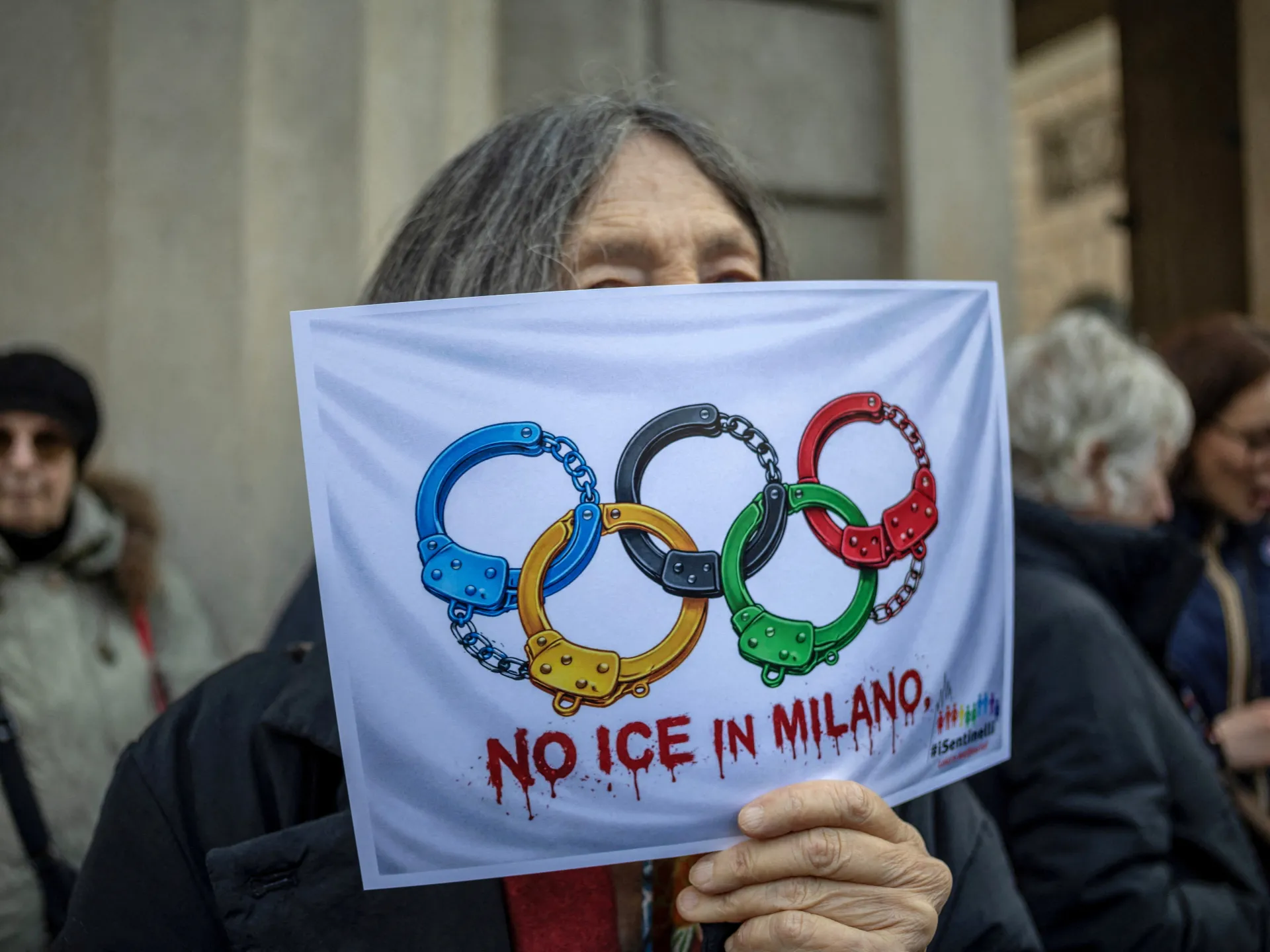
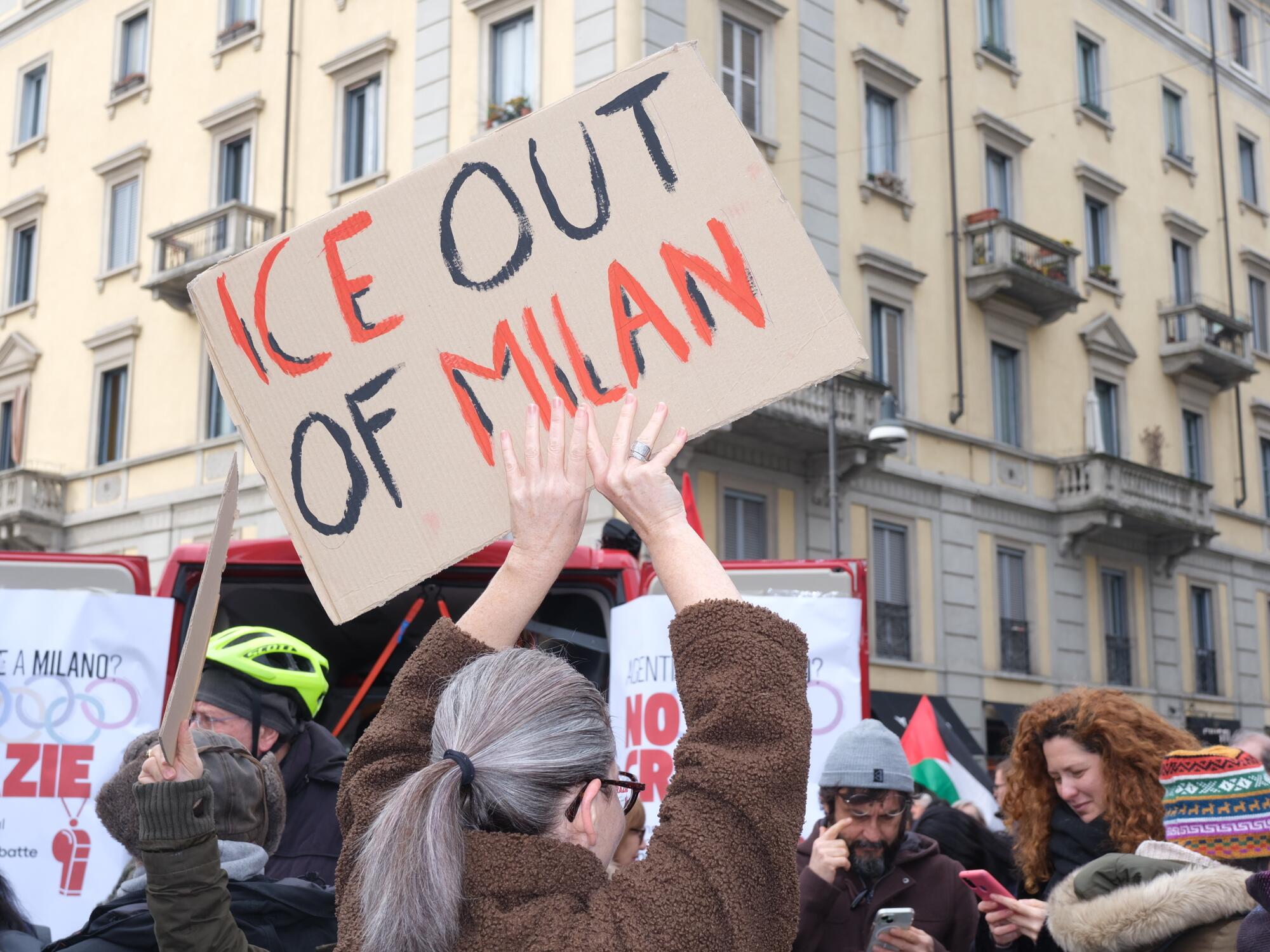
Many demonstrators blew whistles and carried signs of the five Olympic rings rendered as handcuffs above the words “No ICE in Milan.” One woman held a handmade poster featuring photos of Renee Good and Alex Pretti, the two Minnesotans killed by federal agents last month, alongside Liam Conejo Ramos, the 5-year-old boy in the blue bunny hat who was taken from his home in Minneapolis to a detention facility in Texas.
Anti-ICE protests take place in Piazza XXV Aprile ahead of the Olympics in Milan.
(Lucia Buricelli / Associated Press)
“All the videos are public and everyone can see what’s happening,” Bruna Scanziani, an 18-year-old demonstrator told reporters. “The perception of America has changed.”
Tricia McLaughlin, an assistant secretary for the Department of Homeland Security, confirmed the presence of ICE agents in Italy to the Athletic, leaving her department, the U.S. Consulate and the U.S. Olympic and Paralympic Committee to try to cool the controversy.
DHS said the agents dispatched to Milan are not immigration agents but come from a unit known as Homeland Security Investigations, which specializes in cross-border crime. They commonly provide intelligence and security at large sporting events, both in the U.S. and overseas, but in Milan their role will be strictly advisory and intelligence-based, Ambassador Tilman J. Fertitta said.
Travelers pass through the lobby of Milan Linate Airport M4 Metroline train station Tuesday.
(Robert Gauthier/Los Angeles Times)
The U.S. Olympic and Paralympic Committee, meanwhile, said it is working with the Diplomatic Security Service, which is under the umbrella of the State Department, unlike ICE, which is part of Homeland Security. The Diplomatic Security Service has been providing security for U.S. delegations at every Olympics since 1992.
“The USOPC does not work with U.S. domestic law enforcement or immigration agencies in the planning or execution of the Games, including agencies within the Department of Homeland Security often referred to as ICE,” the committee said in a statement. “Italian authorities are solely responsible for all security operations at the Games.”
Despite the tensions, in the days before the Games there were few signs of the kind of heavy security presence that marked the Paris Olympics 17 months ago. At Linate Airport, the closest of Milan’s three airports to the city center, two camouflage-clad Italian soldiers with long guns milled outside the arrival gates Monday evening. They were gone by Tuesday afternoon.
Five miles away at the Piazza del Duomo, the cultural and social heart of Milan, two pairs of soldiers stood on either side of the massive square, huddling under white awnings on either side of a pop-up Olympic souvenir tent and ignoring the hundreds of international tourists raising their phones to take photos of the ancient Gothic cathedral that gives the square its name.
A building located in the heart of Piazza del Doumo is lit up with animated Olympic competitors Tuesday.
(Robert Gauthier/Los Angeles Times)
Up the street, where the trolley tracks curve before the trendy shops and restaurants that line the busy Via Orefici, groups of city police and Carabinieri, the national police known by their black Giorgio Armani-designed uniforms, joked among themselves. They were far less menacing than the roving patrols of soldiers and police officers that were ubiquitous in France.
A local woman shrugged at the officers’ presence.
“Being the iconic and most touristy place of Milan,” she said “there are always lots of police and soldiers.”
It’s unclear how American athletes will be received during Friday’s opening ceremony, which Vice President JD Vance and Secretary of State Marco Rubio are expected to attend.
“When they have the flag and when they have the tracksuit and they’re announced as the U.S., that’s obviously an opportunity for the spectators to make known their feelings about the U.S.,” said Kristian Coates Ulrichsen, a fellow for Middle East studies at Rice University’s Baker Institute and an expert on sports and international relations.
Europeans have strong feelings about the U.S. right now, feelings spurred by more than the images of ICE agents that have led TV newscasts and have filled social media feeds for months in Italy and beyond. In the last few months, President Trump has sent forces into Venezuela to removes its president, threatened military action against Iran, fired on alleged drug boats in the Caribbean and Pacific, and disparaged Europe as “decaying” and its leaders as “weak.”
Demonstrators in Milan hold signs protesting ICE in solidarity with the people of Minneapolis on Saturday.
(Alessandro Bremec / Associated Press)
“Without us,” he said in a combative speech before the World Economic Forum in Davos, Switzerland, “you’d all be speaking German.”
What has upset the continent most amid the chaos, however, is Trump’s insistence that the U.S. take control of Greenland from Denmark, a loyal North Atlantic Treaty Organization ally, warning the Danes and seven other countries that they would be hit with 25% tariffs if they didn’t relent. Many in Europe’s far-right parties, whose members are often supportive of Trump, now consider the U.S. president an “enemy of Europe,” according to a poll published by the Paris-based platform Le Grand Continent.
As a result of the blowback, Trump has backed away from the tariff threat and said he wouldn’t take control of Greenland by force, but the fallout from tensions remains.
“Greenland, especially, has really touched a nerve. That’s unfortunate coming right in the run-up to the Olympics,” said Coates Ulrichsen, who was born in Greece to English and Norwegian parents.
And that makes the U.S. team and its 232 athletes, the largest contingent at the Milan-Cortina Olympics, a convenient foil for European wrath.
“The national team is symbolic of the nation. That just makes it such a target for any potential political frustration,” Coates Ulrichsen said. “It wouldn’t be the first time.”
During the 2004 Summer Games in Athens, for example, which opened 17 months after the American-led invasion of Iraq, the U.S. team was roundly booed.
“The Olympics have been no stranger to politics,” Coates Ulrichsen said. “And obviously the key element [of athletes] walking out behind a flag is a very easy target in a way.”
Some Italians aren’t so sure.
“My personal view is that U.S. athletes will not be targeted by the protests,” said one woman who asked that her name not be used because she works with many international clients, including some in the United States. “It is more of a political subject.”
She also said the attitude of Italian Prime Minister Giorgia Meloni, among the European leaders most supportive of President Trump, has blunted public opposition to the U.S.
The Olympic Rings ahead of the Milano Cortina 2026 Winter Olympics on Tuesday.
(Mattia Ozbot / Getty Images)
Because this month’s Games, the first Winter Olympics to officially have co-host cities, will be spread across four clusters covering about 8,500 square miles in northern Italy, there will be four opening ceremonies Friday, with the main one at San Siro Olympic Stadium in Milan beginning at 11 a.m. Pacific time. Smaller events will take place simultaneously in the mountain venues of Cortina d’Ampezzo, Valtellina and Val di Fiemme.
Bobsledder Azaria Hill, a first-time Olympian whose mother, father and aunt all competed in the Summer Games, said marching in the opening ceremony has long been a dream of hers. And she doesn’t think politics will spoil that Friday.
“Olympics brings all the nations together,” she said. “That’s one of the special things about the Olympics, and you really see that in the unity. I think everything will be fine.”
In an effort to separate athletes from politicians, the U.S. governing bodies for three winter sports — figure skating, speedskating and hockey — changed the name of their Milan hospitality space to the Winter House.
Armed men burned homes and shops in Woro, a remote village in north-central Kwara State bordering Niger State, authorities say.
Published On 4 Feb 20264 Feb 2026
Share
Armed men have killed at least 35 people and burned homes and shops in Woro, a remote village in Nigeria’s north-central Kwara State, authorities said.
“This morning, I was told that 35 to 40 dead bodies were counted,” Sa’idu Baba Ahmed, a local lawmaker in the Kaiama region, told the AFP news agency on Wednesday.
Recommended Stories
list of 1 itemend of list
“Many others escaped into the bush with gunshots,” Ahmed said, adding that more bodies could be found.
It was the deadliest assault this year in the district bordering Niger State, which armed gangs have attacked increasingly.
Villagers fled into the surrounding bushland as the armed men attacked Woro, Ahmed told the Reuters news agency by phone. Several people were still missing, he said.
The attack was confirmed by police, who did not provide casualty figures. The state government blamed the attack on “terrorist cells”.
Banditry and armed attacks on rural communities have surged across northwest and north-central Nigeria in recent years as gangs raid villages, kidnap residents and loot livestock.
How much you’ll pay for a new or replacement passport can vary
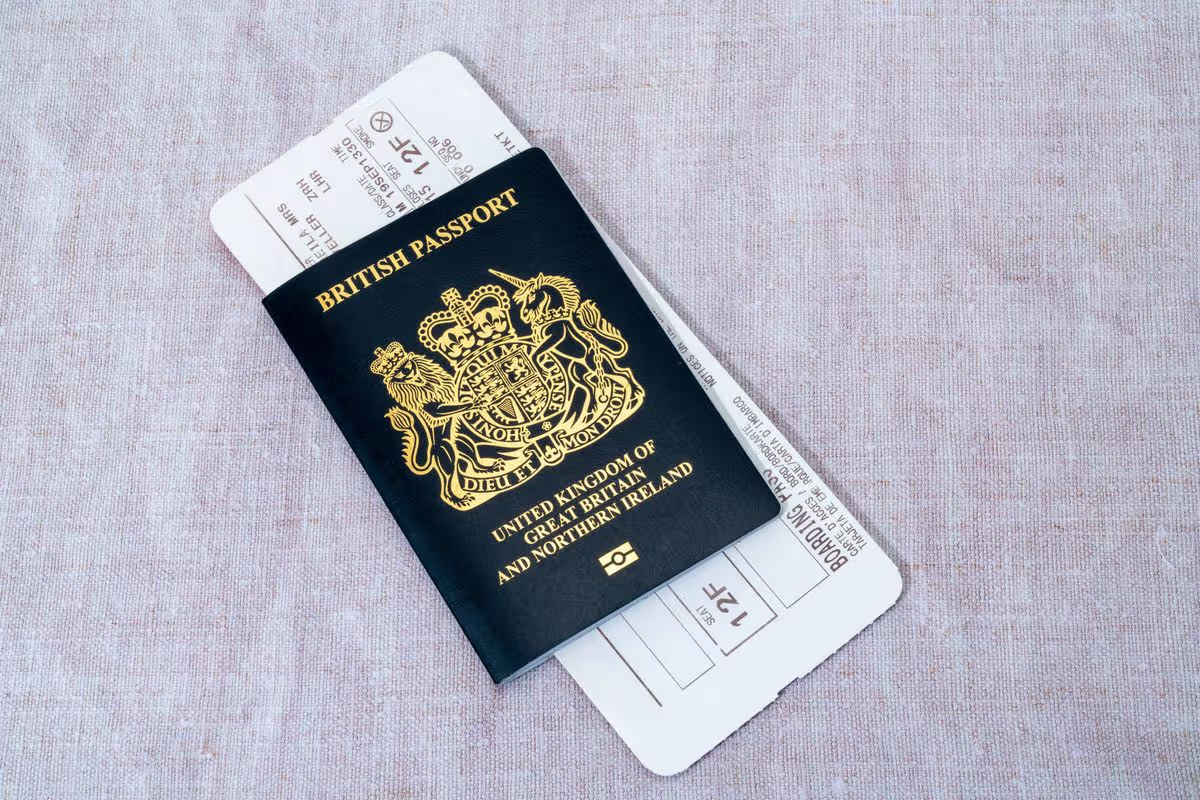
Passports can cost quite a bit(Image: clubfoto via Getty Images)
The price of a new or replacement passport rose in 2025, with some people having to shell out as much as £222 for the important travel document. Everyone in the UK needs a passport for international travel.
As per Gov.uk, you can apply for a British passport if you’re a British citizen, a British overseas territories citizen, a British overseas citizen, a British subject, a British national (overseas), or a British protected person. These documents are issued by HM Passport Office and currently take roughly three weeks or less to arrive.
Most people will have to pay a fee to renew an existing passport or to apply for a new one, including those for children. As of April 2025, a standard adult passport, for those aged 16 and over, costs £94.50 when applying online, or £107 when applying using the paper form.
A standard child’s passport now costs £69, or £74 for a postal application. If you need the document urgently, you can expect so pay significantly more for a passport. The fee for a Premium Service (one day) application is £222 for adults, or £189 for a child’s passport.
Those applying for a UK passport from overseas will have to pay £108, or £70 for a child’s passport. If applying internationally via the paper form, the cost is £120.50 for adults and £77 to £82.50 for children, as reported by the Liverpool Echo.
While the majority of applicants will need to pay for their passports, some people can get theirs for free. If you were born on or before September 2, 1929, you can apply for a new British passport or renew your existing one without any cost.
You can also use the Post Office Check and Send service at no charge and benefit from complimentary secure delivery. However, the government has confirmed that charges must be paid if you require a passport urgently or if you wish to obtain a frequent traveller passport (one containing more pages than the standard version).
FANCY a mini-break but don’t want to spend too much money? Well, how about a short cruise to Europe for the same price as a meal at Pizza Express for a family of four.
Travellers can head off on a two-night cruise between Hull and the Netherlands.
Sign up for the Travel newsletter
Thank you!
A P&O Ferries Mini Cruise costs from just £65 per person from the UK to the NetherlandsCredit: AlamyIncluded in the price you get a two bunk cabin with an ensuiteCredit: P&O
The P&O Ferries mini cruise allows you to travel overnight, usually leaving Hull at around 8:30pm and arriving in the Netherlands around 8:45am.
You can opt between heading to Rotterdam or Amsterdam on a return sailing from Hull to Europoort, with two nights in an en suite cabin, return coach transfers into the city centres and the live entertainment on board.
In between you will also get to explore either Rotterdam or Amsterdam – all for just £65 per person.
For example, one £65pp sailing heads off on March 3 and returns on March 5.
Included in the price you pay is a two-bunk cabin with an en suite shower room with a WC.
Towels and bed linen are included too.
There are of course add-ons, if you wish to include them – such as the kitchen dinner for £25 per person, which is a buffet of international dishes.
If you fancy breakfast on board, that will set you back £13.50 each too.
Or you could get a package for both dinner and breakfast for £35.95 per person.
Though it is worth baring in mind, these prices are all per way.
Coach transfers from the port to either Rotterdam or Amsterdam are listed as £12 per person, per way – though they are included in the £65 per person price.
The cities of Amsterdam and Rotterdam in the Netherlands are both great to explore for a day.
In Rotterdam, you can head to one of the maritime museums to learn about its history as a port city.
Then, you could swing by the Cube Houses, known for their unusual architecture.
In Rotterdam you can visit Markthal, which has around 96 food vendorsCredit: Alamy
Opposite the Cube Houses you will find Markthal, which is a large market hall home to around 96 food stalls.
Alternatively, if you choose to head to Amsterdam you can explore the intricate network of canals that sprawl across the city.
One of the most popular tourist spots in the city is the Anne Frank House, which is a museum inside the actual house where Anne Frank hid during World War II.
To explore the canals further, you can also hop on a canal tour via boat.
If you fancy an even more memorable sailing you can head on a Mini Cruise Live.
These cruises have different entertainment onboard, often including celebrities.
For example, you could head on a Noughties Takeover cruise from February 27 to March 1.
With the family? Then head on the Family Cruise from April 8 to 10, with K-Pop Live and Cirque: The Greatest Show – a circus-musical experience with songs from The Greatest Showman, La La Land, Rocketman and Moulin Rouge.
There will also be face painters on board, and tickets to this sailing also cost from £139 per person.
Fancy something a little different? Head on the Murder Mystery Mini Cruise from March 4 to 6.
On board, passengers will get to enjoy two murder mystery experiences with Cheeky Blinders on night one and 1925-based mystery The Maiden Voyage on night two.
Last week, a prominent Saudi Sheikh, Mohammed Al-Issa, visited the Auschwitz concentration camp in Poland to commemorate the 75th anniversary of its liberation, which signalled the end of the Nazi Holocaust. Although dozens of Muslim scholars have visited the site, where about one million Jews were killed during World War Two, according to the Auschwitz Memorial Centre’s press office, Al-Issa is the most senior Muslim religious leader to do so.
Visiting Auschwitz is not a problem for a Muslim; Islam orders Muslims to reject unjustified killing of any human being, no matter what their faith is. Al-Issa is a senior ally of Saudi Crown Prince Mohammad bin Salman (MBS), who apparently cares little for the sanctity of human life, though, and the visit to Auschwitz has very definite political connotations beyond any Islamic context.
By sending Al-Issa to the camp, Bin Salman wanted to show his support for Israel, which exploits the Holocaust for geopolitical colonial purposes. “The Israeli government decided that it alone was permitted to mark the 75th anniversary of the Allied liberation of Auschwitz [in modern day Poland] in 1945,” wrote journalist Richard Silverstein recently when he commented on the gathering of world leaders in Jerusalem for Benjamin Netanyahu’s Holocaust event.
Bin Salman uses Al Issa for such purposes, as if to demonstrate his own Zionist credentials. For example, the head of the Makkah-based Muslim World League is leading rapprochement efforts with Evangelical Christians who are, in the US at least, firm Zionists in their backing for the state of Israel. Al-Issa has called for a Muslim-Christian-Jewish interfaith delegation to travel to Jerusalem in what would, in effect, be a Zionist troika.
Zionism is not a religion, and there are many non-Jewish Zionists who desire or support the establishment of a Jewish state in occupied Palestine. The definition of Zionism does not mention the religion of its supporters, and Israeli writer Sheri Oz, is just one author who insists that non-Jews can be Zionists.
Mohammad Bin Salman and Netanyahu – Cartoon [Tasnimnews.com/Wikipedia]
We should not be shocked, therefore, to see a Zionist Muslim leader in these trying times. It is reasonable to say that Bin Salman’s grandfather and father were Zionists, as close friends of Zionist leaders. Logic suggests that Bin Salman comes from a Zionist dynasty.
This has been evident from his close relationship with Zionists and positive approaches to the Israeli occupation and establishment of a Jewish state in Palestine, calling it “[the Jews’] ancestral homeland”. This means that he has no issue with the ethnic cleansing of almost 800,000 Palestinians in 1948, during which thousands were killed and their homes demolished in order to establish the Zionist state of Israel.
“The ‘Jewish state’ claim is how Zionism has tried to mask its intrinsic Apartheid, under the veil of a supposed ‘self-determination of the Jewish people’,” wrote Israeli blogger Jonathan Ofir in Mondoweiss in 2018, “and for the Palestinians it has meant their dispossession.”
As the de facto ruler of Saudi Arabia, Crown Prince Bin Salman has imprisoned dozens of Palestinians, including representatives of Hamas. In doing so he is serving Israel’s interests. Moreover, he has blamed the Palestinians for not making peace with the occupation state. Bin Salman “excoriated the Palestinians for missing key opportunities,” wrote Danial Benjamin in Moment magazine. He pointed out that the prince’s father, King Salman, has played the role of counterweight by saying that Saudi Arabia “permanently stands by Palestine and its people’s right to an independent state with occupied East Jerusalem as its capital.”
Israeli journalist Barak Ravid of Israel’s Channel 13News reported Bin Salman as saying: “In the last several decades the Palestinian leadership has missed one opportunity after the other and rejected all the peace proposals it was given. It is about time the Palestinians take the proposals and agree to come to the negotiations table or shut up and stop complaining.” This is reminiscent of the words of the late Israeli Foreign Minister Abba Eban, one of the Zionist founders of Israel, that the Palestinians “never miss an opportunity to miss an opportunity.”
Bin Salman’s Zionism is also very clear in his bold support for US President Donald Trump’s deal of the century, which achieves Zionist goals in Palestine at the expense of Palestinian rights. He participated in the Bahrain conference, the forum where the economic side of the US deal was announced, where he gave “cover to several other Arab countries to attend the event and infuriated the Palestinians.”
US President Donald Trump looks over at Crown Prince of Saudi Arabia Mohammad bin Salman al-Saud as they line up for the family photo during the opening day of Argentina G20 Leaders’ Summit 2018 at Costa Salguero on 30 November 2018 in Buenos Aires, Argentina [Daniel Jayo/Getty Images]
While discussing the issue of the current Saudi support for Israeli policies and practices in Palestine with a credible Palestinian official last week, he told me that the Palestinians had contacted the Brazilian President Jair Bolsonaro to ask him not to relocate his country’s embassy to Jerusalem. “The Saudis have been putting pressure on us in order to relocate our embassy to Jerusalem,” replied the Brazilian leader. What more evidence of Mohammad Bin Salman’s Zionism do we need?
The founder of Friends of Zion Museum is American Evangelical Christian Mike Evans. He said, after visiting a number of the Gulf States, that, “The leaders [there] are more pro-Israel than a lot of Jews.” This was a specific reference to Saudi Arabia’s Crown Prince, and his counterpart in the UAE, Mohammed Bin Zayed.
“All versions of Zionism lead to the same reactionary end of unbridled expansionism and continued settler colonial genocide of [the] Palestinian people,” Israeli-American writer and photographer Yoav Litvin wrote for Al Jazeera. We may well see an Israeli Embassy opened in Riyadh in the near future, and a Saudi Embassy in Tel Aviv or, more likely, Jerusalem. Is Mohammad Bin Salman a Zionist? There’s no doubt about it.
The views expressed in this article belong to the author and do not necessarily reflect the editorial policy of Middle East Monitor.
Parents who are looking to get away during the six week summer holidays could potentially save hundreds by booking during a certain week instead of planning their holidays at the start of the break
Parents travelling with school age kids face expensive holidays over the summer(Image: Getty Images/PhotoAlto)
The six-week summer holidays are still a long way off, but many families will be booking their annual holiday in the coming weeks, and no doubt looking for ways to bring the price down a little.
Travelling during the school holidays is never going to be the cheapest option. Last year, research showed that a family of four will pay an additional £716 on average if they travel during a school holiday, and the big six-week holidays in July and August are when prices are hiked the highest.
But according to travel specialists, being a little flexible with your departure dates can make a big difference. Dawn Morwood, co-director of Cheap Deals Away UK, previously shared her insider knowledge: “Most people assume all summer flights are expensive, but there are specific days that offer much better value.”
She added: “The summer flight market follows predictable patterns. Prices peak during school holidays in late July and early August, but there are pockets of opportunity both earlier and later in the season.”
The priciest days in the summer fall on July 22, 23, and 29, when flights can cost up to 40% more on average. Therefore, if you can avoid these peak dates, you may find your holiday costs less overall. Dawn said: “If your travel dates are flexible, shifting even a day or two could save you a significant amount.”
Parents should double-check the term dates for their child’s school on GOV.UK. Some schools will place inset days in the days leading up to the school holidays, meaning it may be possible to get away a couple of days before the rush when prices rise.
Many parents are keen to get away in the first couple of weeks of the school holidays, but if you have patience, you can often get cheaper deals by booking in the last week of August. Around August 28, flight and package holiday prices tend to take a dive, but if your child isn’t back until September 4 or 5, you may be able to sneak in a few days of sunshine before the autumn term.
If you live close to the Scottish border or are willing to travel to a Scottish airport, you could potentially save money by travelling outside of the country’s summer holidays. Scottish schools break up around June 24-29 and return around mid-August in 2026. Therefore, if you are looking for a break mid to late August, departing from a Scottish airport could be a lot cheaper.
As an example of how much prices can fluctuate, we looked at prices for a TUI package holiday at Zante Plaza Hotel & Apartments on an all-inclusive basis for a family of four. If they departed London Stansted on July 24, the cost would be £1156pp, but a free child place brings the total down to £3466.
However, if the same party travelled on August 28, returning September 4, the total would be £3076, saving just under £400 on the holiday cost.
For parents who are willing to risk term-time fines, Dawn says: “Early June hits that sweet spot between good weather and good prices.” However, you’d have to take into account the cost of fines, which are applied per parent per child, meaning a family of four can face four lots of penalties.
Have a story you want to share? Email us at webtravel@reachplc.com
Over 1,000 Love Island viewers have complained to Ofcom after Sean Stone and Scott van der Suis went head-to-head round the firepit in one episode, with Sean calling him a ‘bully’
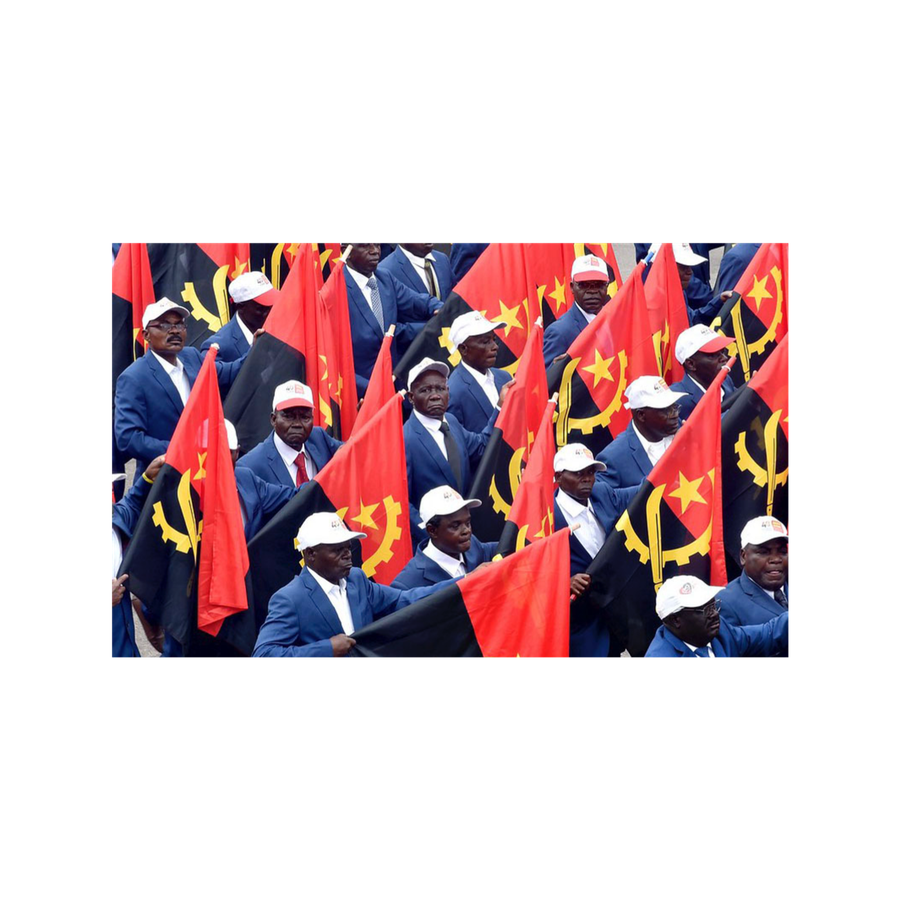
Portuguese colonisation of this west African country began with coastal settlements and trading posts founded in the 16th century., though it wasn’t until the 1920s when Portugal could claim control of the whole region now known as Angola.
By the start of the 1960s, several African nations had gained independence from colonial control, such as Ghana and Angola’s neighbour, Congo. While the movement for African nationalism seemed unstoppable, one European nation instead tightened its grip on its overseas colonies – Portugal.
With the demand for Angolan nationalism increasing, tensions over the forced cultivation of cotton erupted into violence in February 1961.
In Luanda, On the morning of February 4th, black militants ambushed a police patrol-car and stormed the Civil Jail of São Paulo, the Military Detection House and police ba …
Before we see elephants at Elephant Valley in the San Diego Zoo Safari Park, we come face to face with destruction, only the wreckage is beautiful. A long, winding path takes guests around and under felled trees. Aged gray tree hunks form arches, for instance, over bridges that tower over clay-colored paths with hoof prints.
The design is meant to reorient us, to take us on a trail walked not by humans but traversed and carved by elephants, a creature still misunderstood, vilified and hunted for its cataclysmic-like ability to reshape land, and sometimes communities.
Share via
“It starts,” says Kristi Burtis, vice president of wildlife care for the Safari Park, “by telling the story that elephants are ecosystem engineers.”
Elephant Valley will open March 5 as the newest experience at the Escondido park, its aim to bring guests closer than ever to the zoo’s eight elephants, which range in age from 7 to 36, while more heavily focusing on conservation. The centerpiece of the 13-acre-plus parkland is a curved bridge overlooking a savanna, allowing elephants to walk under guests. But there are also nooks such as a cave that, while not previewed at a recent media event, will allow visitors to view elephants on their level.
In a shift from, say, the Safari Park’s popular tram tour, there are no fences and visible enclosures. Captive elephants remain a sometimes controversial topic, and the zoo’s herd is a mix of rescues and births, but the goal was to create a space where humans are at once removed and don’t impede on the relative free-roaming ability of the animals by keeping guests largely elevated. As an example of just how close people can get to the herd, there was a moment of levity at the event when one of the elephants began flinging what was believed to be a mixture of dirt and feces up onto the bridge.
An aerial view of Elephant Valley at the San Diego Zoo Safari Park, home to eight elephants.
(Allen J. Schaben / Los Angeles Times)
“Our guests are going to be able to see the hairs on an elephant,” says Kristi Burtis, vice president of wildlife care for the Safari Park.
(Allen J. Schaben / Los Angeles Times)
“Our guests are going to be able to see the hairs on an elephant,” Burtis says. “They can see their eyes. They can see the eyelashes. They can see how muscular their trunks are. It’s really going to be a different experience.”
Elephant Valley, complete with a multistory lodge with open-air restaurants and bars, boasts a natural design that isn’t influenced by the elephant’s African home so much as it is in conversation with it. The goal isn’t to displace us, but to import communal artistry — Kenyan wood and beadwork can be found in the pathways, resting spaces and more — as a show of admiration rather than imitation.
“We’re not going to pretend that we’re taking people to Africa,” says Fri Forjindam, now a creative executive with Universal’s theme parks but previously a lead designer on Elephant Valley via her role as a chief development officer at Mycotoo, a Pasadena-based experiential design firm.
“That is a slippery slope of theming that can go wrong really fast,” she adds. “How do we recognize where we are right now, which is near San Diego? How do we populate this plane with plants that are indigenous to the region? The story of coexistence is important. We’re not extracting from Africa, we’re learning. We’re not extracting from elephants, we’re sharing information.”
But designing a space that is elephant-first yet also built for humans presented multiple challenges, especially when the collaborating teams were aiming to construct multiple narratives around the animals. Since meetings about Elephant Valley began around 2019, the staff worked to touch on themes related to migration and conservation. And there was also a desire to personalize the elephants.
“Where can we also highlight each of the elephants by name, so they aren’t just this huge herd of random gray creatures?” Forjindam says. “You see that in the lodge.”
Two of eight elephants eat during an Elephant Valley preview.
(Allen J. Schaben / Los Angeles Times)
That lodge, the Mkutano House — a phrase that means “gathering” in Swahili — should provide opportunities for guests to linger, although zoo representatives say reservations are recommended for those who wish to dine in the space (there will also be a walk-up, to-go window). Menus have yet to be released, but the ground floor of the structure, boasting hut-like roofing designed to blend into the environment, features close views of the elephant grazing pool as well as an indoor space with a centerpiece tree beneath constellation-like lighting to mimic sunrises and sunsets.
Throughout there are animal wood carvings and beadwork, the latter often hung from sculptures made of tree branches. The ceiling, outfitted with colorful, cloth tapestries designed to move with the wind, aims to create less friction between indoor and outdoor environments.
There are, of course, research and educational goals of the space as well. The Safari Park works, for instance, with the Northern Rangelands Trust and Loisaba Conservancy in Kenya, with an emphasis on studying human-elephant conflict and finding no-kill resolutions. Nonprofits and conservation groups estimate that there are today around 415,000 elephants in Africa, and the African savanna elephant is listed as endangered by the International Union for Conservation of Nature.
Water areas in Elephant Valley have been redesigned with ramps and steps to make it easier for the elephants to navigate. The hope is to inspire play.
(Allen J. Schaben / Los Angeles Times)
Studies of the zoo’s young elephants is shared with the Reteti Elephant Sanctuary in the hopes of delivering care to elephant youth to prevent orphanage. Additionally, the Safari Park has done extensive examination into the endotheliotropic herpes virus. “The data that we collect from elephants here, you can’t simply get from elephants in the wild,” Burtis says.
One of the two entrances to Elephant Valley is outfitted with bee boxes; bees are known to be a natural elephant deterrent and can help in preventing the animals from disrupting crops or communities. To encourage more natural behavior, the plane is outfitted with timed feeders in an attempt to encourage movement throughout the acreage and establish a level of real-life unpredictability in hunting for resources. Water areas have been redesigned with ramps and steps to make it easier for the elephants to navigate.
The view from Elephant Valley’s Mkutano House, a two-story dining destination in the new space at the San Diego Zoo Safari Park.
(Allen J. Schaben / Los Angeles Times)
With Elephant Valley, Forjindam says the goal was to allow visitors to “observe safely in luxury — whatever that is — but not from a position of power, more as a cohabitor of the Earth, with as much natural elements as possible. It’s not to impose dominance. Ultimately, it needed to feel natural. It couldn’t feel like a man-made structure, which is an antiquated approach to any sort of safari experience where animals are the product, a prize. In this experience, this is the elephant’s home.”
And the resulting feel of Elephant Valley is that we, the paying customers, are simply their house guests.
We are inching towards a sliding doors moment in the life of Gregor Brown.
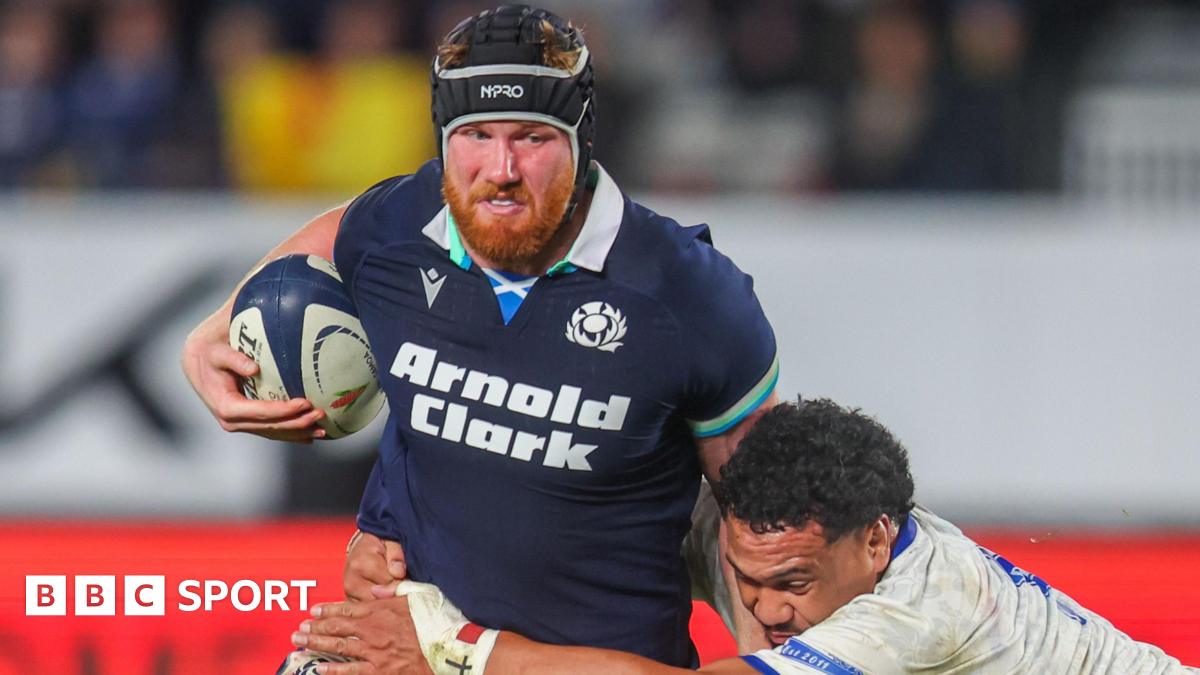
The day is surely fast approaching when Brown is no longer quizzed about being Blair Kinghorn’s cousin and when the Scotland full-back is instead asked what it is like being related to the Glasgow forward.
It is not exactly clear which position Brown is going to play for Scotland in the Six Nations, or indeed, if he starts or is on the bench, but there is one certainty – he is going to be pivotal to the team’s hopes.
The 24-year-old is only really 18 months into his time as a top-level player – a whirlwind of progress that he calls “insane” – but his impact has been enormous.
He has played Test matches with four, five, six and seven on his back. He has started against France at lock and against New Zealand and Argentina at blindside flanker.
He was Jonny Gray’s understudy in the Six Nations last season and by the summer had played some minutes for the British and Irish Lions in Australia.
“If I went back 18 months and you told me that I would have done all this, I would have laughed at you. Like, no way. It’s just been absolutely mental,” he says.
True, but Brown is a pivotal figure now for Townsend, a guy who gives the coach some questions to answer.
Townsend’s natural inclination for Rome on Saturday might be a second row of Grant Gilchrist and Scott Cummings. That would leave Brown either starting at six or, more likely, on the bench covering lock and blindside.
The tenth edition of the ICC Men’s T20 World Cup will take place in India and Sri Lanka from February 7 to March 8, 2026.
Twenty teams will be competing in 55 matches for the chance to win cricket’s most prestigious T20 trophy.
But cricket is a game with a list of commonly used terms and phrases that might confuse those new to it.
In this illustrated guide, Al Jazeera breaks down cricket lingo and helps you understand the game beloved by nearly two billion people.
What is the aim of the game?
Cricket is a bat-and-ball sport played between two teams consisting of 11 players each.
The game is divided into two parts, known as innings.
In the first innings, following a coin toss, the first team bats while the other team bowls and fields.
The batting team should try to score the highest number of runs in the allotted time, while the bowling team has to try to prevent them from scoring.
The bowling team has dedicated bowlers, while the remaining players, spread across the ground, try to prevent the batters from scoring runs as well as catch the ball to get the batters out.
In the second innings, the bowling team now gets a turn to bat and try to score more runs than their opposition.
The team with the highest number of runs at the end of the day wins the game.
What does T20 mean?
There are three different formats in cricket, each with its own duration and rules.
Each format has its own defined set of “overs”.
An “over” consists of six deliveries by the bowler.
In a T20 match, which usually lasts three to four hours, each team is given 20 overs (120 balls) to score the most number of runs. This format of the game is designed to be shorter and faster-paced, which provides more excitement for spectators.
A One Day International (ODI) match typically lasts about seven to eight hours. Each team is given a total of 300 deliveries, which are divided into 50 overs, to score the most number of runs.
A Test match is the longest and oldest format of the game, played over a maximum of five days. It is considered a test of endurance and skill. Each day has a minimum of 90 overs. Both teams have two innings each.
The cricket field and pitch
Cricket is played in a large, oval-shaped field, typically about 150 metres (164 yards) in diameter at its widest point and surrounded by a boundary rope.
In the centre of the field is the pitch, a rectangular area about 20 metres long (22 yards) and 3 metres (3.3 yards) wide, where most of the action takes place.
At each end of the pitch are three wooden sticks known as wickets or stumps, with two bails atop them.
The batter stands in front of these wickets inside a specified area known as the batting crease. It is from there that he or she will strike the incoming ball from the bowler.
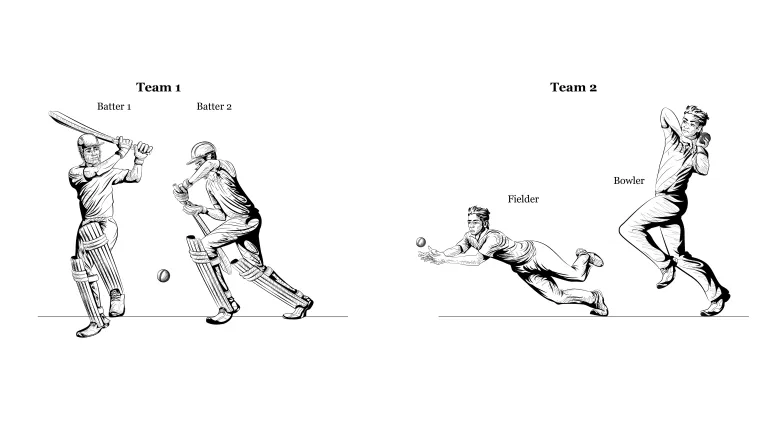
During the match, the batting team will actually have two players on the field, one on either end of the pitch, to take turns in hitting the ball.
The bowling team, meanwhile, will have all 11 players scattered throughout the field to minimise the number of runs their opponents can score.
Some of the most common positions are shown below:
How are runs scored?
The aim for the batters is to score as many runs as possible by hitting the ball in the gaps between the fielders or over the boundary rope.
To score a run, the batter needs to hit the ball and then, together with their batting partner, run to the opposite side of the pitch before the fielder returns the ball; otherwise, they can be run out.
A single run is scored when both batters safely complete one run, a two-run when they complete two runs, and so on.
If a batter hits the ball along the ground and it reaches the boundary rope, then four runs are awarded.
To signal that four runs have been scored, the umpire moves his right hand from one side to the other, repeatedly waving it back and forth horizontally.
Umpire Paul Reiffel (R) signals four runs during a Test match between West Indies and India [Randy Brooks/AFP]
The maximum, six runs, is scored when the batter hits the ball directly over the boundary before it bounces. This shot is the most rewarding but also among the riskiest, due to the chances of getting bowled or caught.
To signal a six, the umpire will raise both hands above his head, which the fans will often imitate.
Umpire Michael Gough (R) signals for six runs during a One Day International cricket match between Zimbabwe and Ireland [Jekesai Njikizana/AFP]
How does a player get ‘out’?
There are several ways to get a batter out, with each out referred to as “losing a wicket”.
Since cricket is played with pairs of batsmen, when 10 players from the batting team are dismissed, their innings concludes, and the sum of the runs they scored sets the target score for the bowling team.
The most common ways of getting a player out include:
Bowled: This happens if the batter misses the ball, and it goes on to hit the wicket.
Caught: A batter is caught out when they hit the ball and a fielder catches it before it touches the ground.
Run-Out: A run-out happens when the fielding team throws the ball at the wicket while the batter is trying to score a run and before they can reach the opposite side of the pitch.
LBW (Leg Before Wicket): This decision depends on various factors, but in a nutshell, a batter can be given out LBW if the ball hits their legs while they are standing in front of the wicket, thus preventing the wicket from being hit.
To signal an “out”, the umpire who is standing in the middle of the field will raise his index finger to signify that a batter has been dismissed.
This gesture is often referred to as the umpire having “raised the finger” or “given the finger”.
The on-field umpire signals an out for Australia’s Pat Cummins before the decision is overturned following a review [Andrew Boyers/Reuters]
How do you read the score?
To follow the score in cricket, you need to look at three numbers.
The first is the number of runs a team has scored – the higher the number, the better.
The second indicates the number of “outs” or “wickets”. Once 10 players are out, their batting innings come to an end.
The third is the number of overs that have been bowled.
Combined, a score may look like this: 109-5 (10 overs)
This means that 109 runs have been scored, 5 players are out, and 10 overs have been completed.
(Al Jazeera)
Typically, teams make anywhere from 100 to 250 runs during a T20 match. A score of 100 is considered low to defend, while 250 runs is usually very strong.
The highest score in international T20 cricket was between Zimbabwe and The Gambia in 2024.
Zimbabwe batted first and scored a huge 344-4 in their 20 overs. In response, The Gambia only managed 54 runs before losing all 10 of their wickets.
‘We won’t see anything on national territory that resembles what’s been seen in the US,’ Italy’s interior minister says.
Published On 4 Feb 20264 Feb 2026
Share
Agents from the divisive United States Immigration and Customs Enforcement (ICE) agency will have no operational role in the Winter Olympics, Italy’s interior minister has said days before the Milan-Cortina Games open.
ICE’s Homeland Security Investigations (HSI), which is a separate investigative arm of the Department of Homeland Security (DHS) from the department carrying out the US immigration crackdown, will operate within US diplomatic missions only and “are not operational agents” and “have no executive function”, Matteo Piantedosi told the Italian Parliament on Wednesday.
Recommended Stories
list of 3 itemsend of list
He said the outrage over the HSI presence, including the Milan mayor’s warning that they were not welcome in the city during the February 6-22 Winter Games, was “completely unfounded”.
“ICE does not and will never be able to carry out operational police activities on our national territory,” Piantedosi said.
The minister aimed to clarify the news of the contentious deployment of ICE agents, which prompted protests in the Italian metropolis.
“Security and public order are ensured exclusively by our police forces,” he said.
“During the Milan-Cortina Games, the members of this agency will be engaged solely in analysis and information exchange with the Italian authorities,” he added.
“The presence of personnel linked to the ICE agency is certainly not a sudden and unilateral initiative to undermine our national sovereignty, as some have portrayed, but rather compliance with a legally binding international agreement entered into by Italy.”
Last week, the US agency said it will support the “Department of State’s Diplomatic Security Service and host nation to vet and mitigate risks from transnational criminal organisations”.
Following the announcement, Milan Mayor Giuseppe Sala said ICE would not be welcome in his city.
“This is a militia that kills … It’s clear that they are not welcome in Milan. There’s no doubt about it. Can’t we just say no to [US President Donald] Trump for once?” he said in an interview with RTL 102.5 radio.
ICE said its operations in Italy are separate from the immigration crackdown ordered by Trump in the US.
The Italian interior minister confirmed that the agency’s role would be limited.
“We will not see anything on national territory that resembles what has been seen in the media in the United States,” Piantedosi said.
“The concerns that have inspired the controversy of the last few days are therefore completely unfounded, and this information allows me to definitively dispel them.”
You may have read recently how minions of the Trump administration removed an exhibit about slavery from the President’s House in Philadelphia (where George Washington lived, with slaves) as part of its ongoing sop to MAGA sensitivities and campaign to erase history in favor of a fairy tale in which the worst thing Washington ever did was chop down a cherry tree.
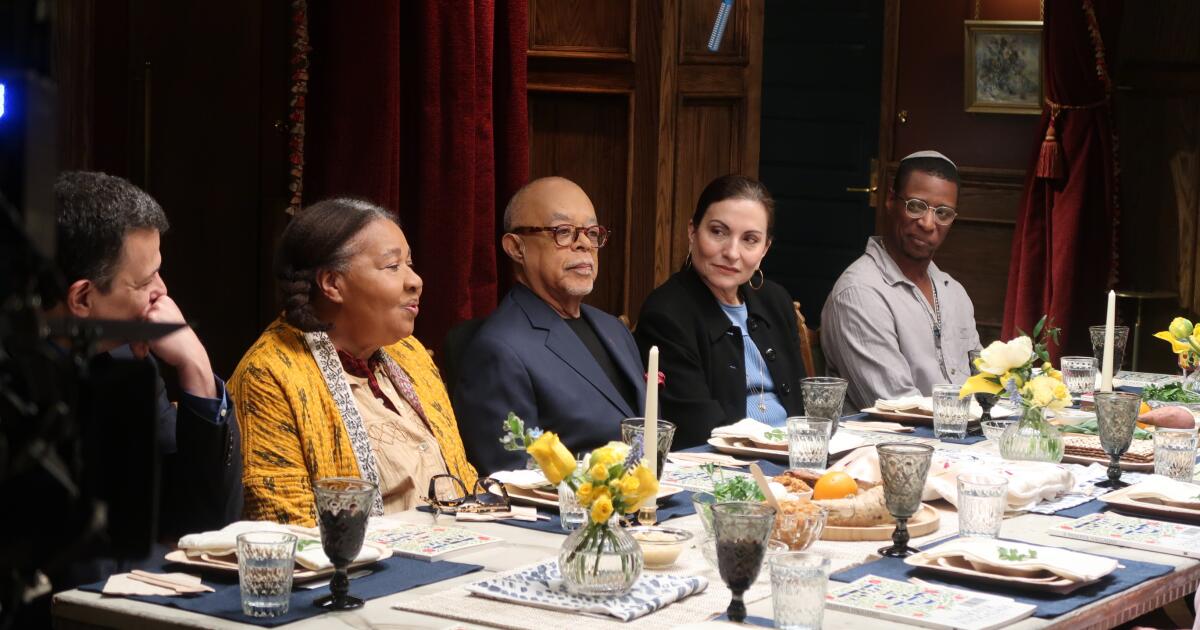
The study of history is by nature messy, replete with conflicting interpretations and incomplete puzzles, but it’s what you need to know in order not to repeat it. PBS, lately defunded by conservatives but not disassembled, is among the institutions working to bring it to the people — indeed, the only television outlet seriously devoted to it. (History Channel is just a name.) Premiering Tuesday and continuing weekly is the four-part series “Black and Jewish America: An Interwoven History,” presented by Henry Louis Gates Jr., at the start of what happens to be Black History Month.
Gates, who also hosts the PBS genealogy series “Finding Your Roots,” has presented such documentaries as “Africa’s Great Civilizations” and “Great Migrations: A People on the Move,” has made cameo appearances in HBO’s “Watchmen” series and “The Simpsons.” He teaches at Harvard and is a well-known public figure — a history communicator, scholar and storyteller and a minor TV star the world also knows as “Skip.” Even-tempered and even-handed, he’s a good guide through the minefields of racial history — he keeps you from blowing up. You might find yourself angry at the material, but not with Gates.
“Under the floorboards of Western culture run two streams, continuously,” he says. “One is antisemitism, one is anti-Black racism,” whose purpose here is to explore “the areas of overlap.” They aren’t the only victims of bigotry in American history and modern America; Italians and Irish immigrants had their turn, too. White supremacy, which is very much alive in the land — turn on the news — disdains every people of color. But as people who shared the experience of being “mocked and feared, blamed and banished, envied and imitated,” often allied, sometimes antagonists, theirs is a special case.
Gates has assembled a stimulating, illuminating, maddening, saddening, but often inspiring, story of their relations with the world and one another. (Here and there he reaches a little outside his theme.) At 75, he’s lived through a good slice of the history illuminated here, including “our brief golden age” of the 1960s Civil Rights Movement, and though he structures his series as a pendulum swinging between worse and better news, he scrupulously bookends it in a hopeful mood, with a Seder to start and a discussion with students to end. His insistence that no one is safe until everyone is safe, can seem to portend a future in which no one will ever be safe, though as a teacher I assume he’s more sanguine. His manner, at least, is encouraging.
The Seder, which begins with a singing of “Go Down Moses (Let My People Go),” gathers a tableful of Black, white and biracial Jews — each distinguished enough to have their own Wikipedia pages — in a roundtable discussion. Participants include New Yorker editor David Remnick, author Jamaica Kincaid, journalist Esther Fein, rabbi Shais Rishon, Angela Buchdahl (the first East Asian American to be ordained as a rabbi); and culinary historian Michael Twitty, who provides the doubly meal — kosher salt collard greens, West African brisket and potato kugel with sweet and white potatoes and Creole spice.
Though both Jews and Black people faced (and face) discrimination, their American journeys were launched, says Gates, “on different trajectories,” one group chased from nominally Christian countries, the subject of durable medieval superstitions, the other dragged from their homes. Though the mass of Jewish migration, escaping Russian pogroms and Nazi Germany in succeeding waves, occurred in the late 19th and early 20th centuries, some arrived before the revolution; but the Constitution, which enshrined religious freedom, granted them legal rights. (This presumably did not help the Jews of African descent Gates says were present here early on.) Black people, kidnapped and enslaved, had none, and as freedom was gained, new laws were written to hold them in place.
Gates posits a sympathy between immigrant and first- and second-generation Jewish Americans in the 20th century and disadvantaged Black people, based on a common experience of oppression; Jewish newspapers used the word “pogrom” to describe violence against Black people in the South. And Jews, many raised with a sense of social justice, were disproportionately represented among white activists in the Civil Rights Movement. This would change: Where Martin Luther King declared “I’m more convinced than ever before that our destiny is tied up with the destiny of our Jewish brothers and vice versa, and we must work together,” later Black activists, like Stokely Carmichael preferred to go it alone, promoting self-determination and even separation.
Still, many of the stories here are based on Black and Jewish friendships. We learn of W. E. B. Du Bois and Joel Spingarn, who sat together on the board of the NAACP and to whom Du Bois dedicated his 1940 autobiography “Dusk of Dawn.” Of Tuskegee Institute founder Booker T. Washington and philanthropist Julius Rosenwald, a president of Sears, Roebuck and Co., who built schools — more than 5,000 nationally, eventually — for systemically disadvantaged Black students. (Graduates included Maya Angelou and John Lewis.) Of Chicago rabbi Abraham Heschel, bringing 15 other white rabbis down to Selma, Ala., in 1964 at the request of King, where their arrest made headlines — which translated to political pressure.
In music, we meet Louis Armstrong, who as a boy worked and stayed with a Jewish family, and wore a Star of David, and his manager Joe Glaser. We’re told the story of Billie Holiday‘s lynching ballad “Strange Fruit,” written by Abel Meeropol (under his pseudonym Lewis Allan), recorded by Milt Gabler for his Commodore label and performed regularly by Holiday at Barney Josephson’s Cafe Society, New York’s first truly integrated nightclub. And we hear Paul Robeson, daring to sing in Yiddish in a concert in Moscow, in support of Itzik Feffer, a Jewish poet imprisoned (and later murdered) by the Soviets.
As a social and political history covering two intersecting storylines for more than the length of the nation, it’s packed with incident and facts — the Klan resurgent after World War I (six million members, it says here); the 1936 Berlin Olympics, where Jesse Owens triumphed and the U.S. committee pulled two Jewish sprinters from competition; racist Nazi policies, borrowed from American Jim Crow, and the Holocaust. Also the domestic destabilizing effects of wars in the Middle East. Jews and Black people will find themselves on the opposite sides of some questions.
Even at four hours, it’s a survey course, streamlined but not simplistic, and as such it will fly through some points and elide others; there are whole volumes dedicated elsewhere to what constitutes a single sentence here, and libraries dedicated to some of these figures. (Why not read some?) The view is not singular, and as such, there’ll be something for everyone to question, especially as Jews and Black people are often described as a community, when neither is heterogeneous. (Jews don’t even agree on what makes a Jew.)
But whatever goes back and forth between then, the world has its own ideas. “People who hate Jews,” says Gates, “uncannily hate Black people too. Because when the stuff hits the fan, they’re coming after both of us.”
Renae Wąsik was fed up with the UK’s grey skies and spiralling cost of living
10:26, 04 Feb 2026Updated 10:29, 04 Feb 2026
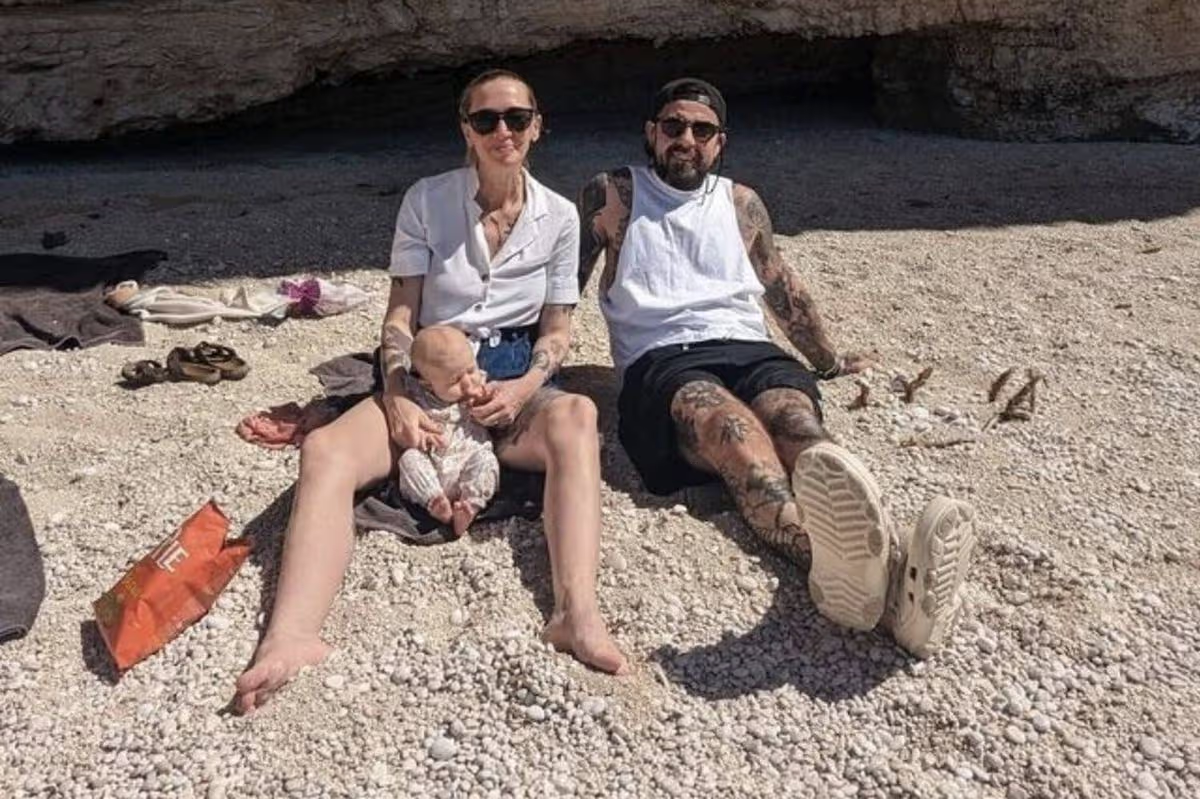
Renae Wąsik with Pawel and Rocca(Image: renaesmithmc/Cover Images)
When the sodden winters, soaring costs and relentless gloom of British existence finally overwhelmed her, Renae Wąsik realised she’d reached breaking point. “I felt like I was going crazy,” reveals the 43-year-old PR executive.
“Grey skies make me feel sad, bleak and trapped. I didn’t want my baby growing up in that.”
Therefore, in November 2025, Renae and her partner Pawel decided jointly to abandon their existence in Welwyn Garden City, Hertfordshire, relocating with their two-year-old daughter, Rocca, to an obscure village unknown to most Britons: Vasiliki, situated on the Greek island of Lefkada, nestled between Corfu and Kefalonia. Within months, she claims the transformation has been revolutionary.
“In the UK, we were paying close to £3,000 a month just to live, that covered rent, council tax and utilities, for a suburban home with a tiny garden,” she explains. “It was wet, miserable and exhausting. Now we’re renting an off-season Airbnb for €800 (£690) a month, I can walk to the sea, and I wake up feeling free.”
Renae, who established The Atticism PR and Brand Development, has cultivated a thriving career spanning more than 20 years and frequently documents her fresh lifestyle on TikTok, where her content has accumulated more than half a million likes, though not everyone has celebrated her relocation. Whilst certain followers fantasise about emulating her journey, others have branded her ‘privileged’, ‘out of touch’, or even accused her of ‘stealing housing from locals’.
Renae refuses to accept such criticism. “People say it’s ‘not that easy’ to live and work overseas, and they’re right,” she explains.
“It’s not easy. But it’s also not impossible. If it’s truly your goal, you’ll work for it. Nothing falls in your lap.”
She also rejects the notion that she’s taking more than she contributes. “We’ve been really conscious about contributing,” she insists.
“I work in PR and I help get the island press exposure for free. Pawel is a painter and decorator and has been helping locals who are desperate for skilled labour. We’re living in an off-season Airbnb that sits empty all winter, and when we build our house, we’ll hire local trades. This isn’t a ‘take, take, take’ situation.”
The emotional transformation, she reveals, was instantaneous. “The moment we arrived, my husband and I looked at each other and said, ‘Oh my God, we escaped’,” she recalled.
“The UK feels like a rat wheel. You work to live, and by the weekend you’re so exhausted you just want to order Deliveroo, which is so expensive you have to work even more. Here, the pressure just lifted.”
She portrays Britain as suffocating. “The sky feels low. Everything feels heavy. Here, I see the sea and sky every single day. There’s space. I feel calm. I can breathe again,” she adds.
Renae is keen to emphasise that Greek island living isn’t some picture-perfect postcard fantasy. “If you’ve done Santorini or Mykonos and think that’s real life, you’re in for a shock,” she warns.
“It rains, a lot. There’s no food convenience. I’ve lost three kilos because I can’t just snack whenever I want. Sometimes I honestly can’t look at another courgette.”
But she shrugs. “I sacrifice convenience for peace.”
One surprising element that also swayed her choice to quit Britain was a series of utterly exasperating encounters with the NHS, which eventually drove her to pursue treatment overseas. “I’ve had some useless experiences,” she says bluntly.
“I was once told I might have breast cancer and then had to wait six weeks for a scan. Later, they said one of my breast implants had capsulated and they’d remove just one.”
When she requested both to be taken out, even offering to pay, she was turned down. “They said they’d take one out, sew me up, and I’d have to sort the other privately later,” she says. “It was insane.”
Instead, she travelled to Turkey, where a consultant found both implants were faulty. “I was lucky I went,” she says.
“The NHS has potential, but the system is chaotic. I’ve had blood tests lost, appointments messed up, they even accidentally deleted my daughter from the surgery system while she had a 40-degree fever and refused to see us. It’s just been a mess.”
For Rocca, the relocation has been life-changing. “The outdoors!” Renae beams.
“Sunshine, even in December. She’s not stuck inside watching TV, she’s climbing rocks, playing with water, exploring. And she’s seen here.”
In Greece, she explains, youngsters are genuinely welcomed. “In restaurants, staff greet her, make a fuss, talk to her. It took months for her to get used to it. In the UK, she was mostly ignored.”
Their routine now moves at a completely different rhythm. “We wake up without alarms. Coffee in bed. We work until lunchtime while Rocca plays outside painting or in her sandpit,” she explains.
“Lunch is simple, most days are spinach pies or salad. Then we explore: beaches, neighbouring towns, counting cats.”
The evenings are leisurely and sociable. “We cook early, eat around 5pm, maybe take a walk or read. It’s relaxed and peaceful.”
And this isn’t just a short-term experiment. “Oh yes, this is forever,” Renae confirms.
“We’ve bought a 4,600-square-metre plot of land overlooking the sea for less than the price of a one-bedroom flat in Bedfordshire. We’ll build our home here.”
From late March onwards, the family will settle into a two-bedroom property for €500 (£430) monthly, within easy reach of ferries, beaches, a marina and freshly caught seafood, complete with a balcony laden with orange, lemon and mandarin trees.
“Our neighbour gives us all the olive oil we need, and we’ll help him with the harvest,” she beams. “Everyone helps everyone. It’s a real community.”
Renae continues to return to Britain for work commitments and visits with her two older daughters, aged 22 and 23, but the UK is no longer where she calls home. “I’ll always come back,” she says. “But this, this is where we’re building our life.”
And for those observing from a dreary British settee, questioning whether it’s achievable? “I’m not saying everyone should do it,” she says. “I’m saying I did, and I’m finally happy.”
The Daily Telegraph have reported that Brook, Jacob Bethell and Josh Tongue could be subject to an investigation from the cricket regulator with regard to the incident in Wellington, which occurred the night before a one-day international which England lost.
The incident, which happened in November, did not come to light in the media until January, and followed a mid-Ashes break in Noosa which also drew criticism for some excessive drinking by players.
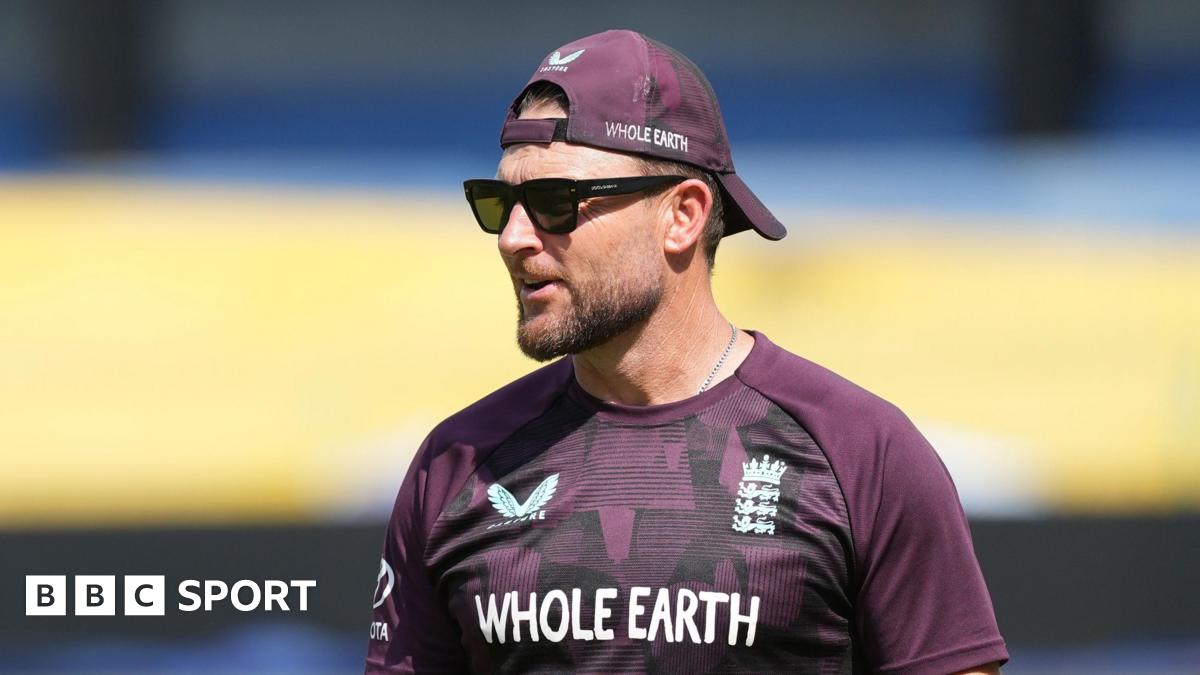
“Cricket is 12 months a year, you have to be able to enjoy yourselves. I don’t think the boys went overboard at all,” McCullum said of the Noosa trip.
“A lot of the pile-on for it was completely out of line. Noosa is where people go and retire, there’s a reason why we chose Noosa.
“It’s being made [out] as this big stag do place, it couldn’t be further from that. If we wanted a stag do and we wanted a tear up, we’d have gone to the Gold Coast.”
McCullum’s leadership style has drawn criticism from outsiders, with some feeling the players are given too much freedom on and off the pitch.
However, McCullum bristled at such sentiments and believes his message has been misinterpreted by those outside the dressing room.
“I think you guys [journalists] have got to work me out a little bit better to be honest,” he said.
“If you go back to the day I walked into the job, the first thing I said to these boys is don’t do anything that lands you on the front page of the paper and nothing good happens after midnight, but we’re going to have a good time.
“[I said] we’re going to grow, we’re going to enjoy ourselves, cricket is a tough game, it has its challenges mentally, which we’ve seen with many people that have played cricket in the past, but we’re going to try and play a style of cricket that allows us to succeed.
“I’m not against making sure these boys are controlled in a manner. It’s [about] looking after them to ensure they don’t make mistakes. The curfew is a different interpretation of the words I mentioned three and a half years ago.”
McCullum said he thought there was a “misconception” that he ran a “loose ship” and wanted everyone out drinking, and that he didn’t care about cricket.
“It couldn’t be further from the truth,” he said.
“I’m fiercely determined, I’m fiercely competitive and I want the best for these guys, and I want the best for English cricket.”
England start their World Cup campaign against Nepal on Sunday, 8 February (09:30 GMT).
Brook will lead the team in India and Sri Lanka and McCullum says he is impressed by the Yorkshireman’s captaincy so far.
“I think Harry Brook is an outstanding leader on the field,” he added. “His tactical acumen is as good as I’ve seen in a short period of time from a young man.
“He has work to do off the field without a doubt, as do some of the other young lads we have in our side – and that’s what happens when you come in at 20 and you’re growing up on a world stage with spotlight, fame, fortune and the pressure that comes with it.
“He’s a strong leader, he’s a young man but he’s got a very good head on his shoulders. People will say he’s not that clever, I couldn’t disagree with that more, he wears his intelligence lightly and he’s a very strong leader.
“He’s a player they play for in that dressing room and our job is to keep looking after him because he is young and he’s got his best days in front of him.”
US President Donald Trump lashed out at a journalist, calling her the ‘worst reporter’, after she questioned him about survivors of the late financier and sex offender Jeffrey Epstein. Trump’s name appears in the Epstein files. He has not been accused of any crimes by Epstein’s victims and has denied any wrongdoing.
The official Super Bowl halftime show on Sunday will feature Bad Bunny, the Grammy winner for album of the year, at the height of his powers and influence. Those upset by his onstage comments about the dignity of Latinos and immigrants, however, can turn to a competing bill featuring Kid Rock and Gabby Barrett.
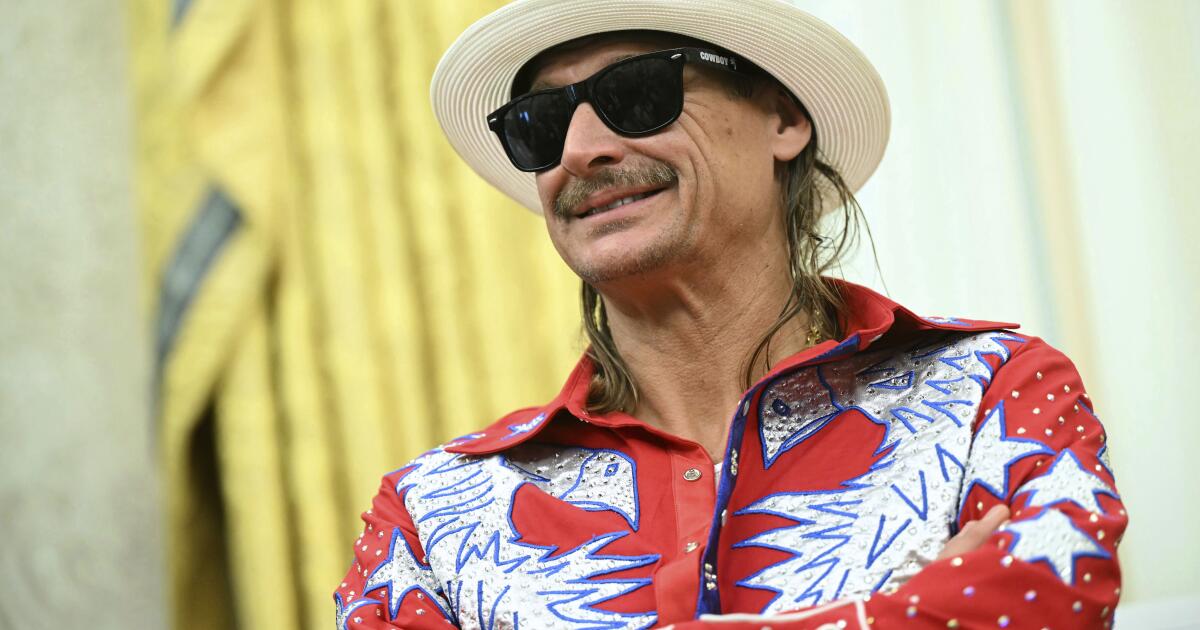
Rock, the perennial MAGA raconteur and country-rock singer, will perform for the far-right activist group Turning Point USA’s counterprogramming event streaming across the conservative mediasphere. Turning Point USA is the activist group founded by the late Charlie Kirk, who was killed last year at a speaking event in Utah.
“We plan to play great songs for folks who love America,” Rock said in a statement announcing the bill. “We’re approaching this show like David and Goliath. Competing with the pro football machine and a global pop superstar is almost impossible … or is it?”
“He’s said he’s having a dance party, wearing a dress and singing in Spanish? Cool. We plan to play great songs for folks who love America,” Rock said, in an overt jab at the actual Super Bowl halftime show headliner.
Veteran country acts Lee Brice and Brantley Gilbert and Barrett, an “American Idol” alum with a 2019 Hot 100 hit in “I Hope,” will also perform.
While Rock’s right-wing politics have largely eclipsed his musical relevance in 2026, he’s recently tried to position himself as a power broker for MAGA-friendly concerts with just enough plausible appeal for more neutral country and rock fans. His planned 2026 touring festival, Rock the Country, is set to feature Blake Shelton, recent Grammy winner Jelly Roll, Creed and Miranda Lambert, but lost Ludacris and Morgan Wade following blowback from fans.
When Bad Bunny was booked for the Super Bowl in October, House Speaker Mike Johnson (R-La.) said, “I didn’t even know who Bad Bunny was. But it sounds like a terrible decision, in my view, from what I’m hearing. It sounds like he’s not someone who appeals to a broader audience.”
“There are so many eyes on the Super Bowl — a lot of young, impressionable children. And, in my view, you would have Lee Greenwood, or role models, doing that. Not somebody like this, ” he added.
President Trump said a bill featuring the Grammy-winning Puerto Rican superstar — and the famously anti-Trump punk band Green Day — was part of the reason he would not attend the game this year. “I’m anti-them. I think it’s a terrible choice,” he said. “All it does is sow hatred. Terrible.”
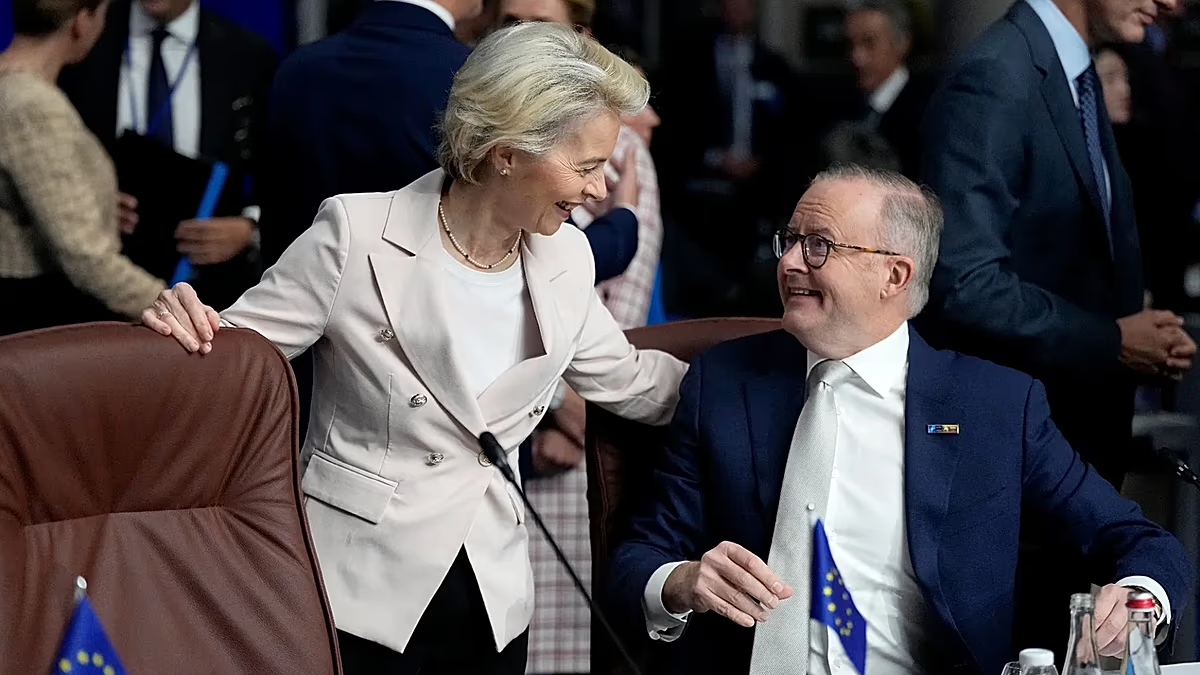
European Commission President Ursula von der Leyen will fly to Australia later this month in a bid to seal a long-delayed trade agreement, sources familiar with the matter told Euronews.
Concluding the deal would mark another trade win for the Commission, following recent deals with Latin America’s Mercosur bloc and India, as geopolitical tensions intensify with the US and China.
One source said von der Leyen could head to Canberra shortly after the Munich Security Conference concludes on 15 February.
Whether the trip goes ahead will depend on progress in negotiations led by EU Trade Commissioner Maroš Šefčovič, who is due to meet Australian Trade Minister Don Farrell in Brussels next week.
“As always, progress in the sensitive phase of negotiations will depend on substance,” Commission deputy chief spokesperson Olof Gill told Euronews.
Talks on an EU-Australia free-trade agreement collapsed in 2023 after Canberra accused Brussels of failing to offer sufficient market access for beef, sheep, dairy and sugar.
Agriculture remains a perennial flashpoint in EU trade negotiations. The Mercosur agreement has already met furious opposition from European farmers, who fear unfair competition from increased imports coming from Latin America.
Australia, however, is viewed in Brussels as a strategic and like-minded partner as the EU seeks to diversify its trade relationships, expand access to global markets and reduce exposure to a closing US market and China’s increasingly aggressive trade policy.
BBC Sport visits the San Siro in Milan, the venue for the Winter Olympics opening ceremony, to find out why this could be the last global event held at the iconic stadium, and what comes next.
Harden, an 11-time All-Star, was traded for the fifth time in his career after two and a half seasons at the LA Clippers.
Published On 4 Feb 20264 Feb 2026
Share
The Cavaliers and Clippers have finalised a trade that sends 11-time All-Star James Harden to Cleveland, with Darius Garland and a second-round pick going to Los Angeles, ESPN and The Athletic both reported late on Tuesday.
Harden, 36, was held out of the Clippers’ lineup the last two games for what the team labelled personal reasons.
Recommended Stories
list of 4 itemsend of list
The former NBA MVP and three-time scoring champ is averaging 25.4 points, 8.1 assists and 4.8 rebounds in 44 games this season, his 17th in the NBA.
Harden could block any trade because he is technically under contract for just this season, which requires his approval for the swap. The second year of his two-year, $81.5m deal is a player option, which is not fully guaranteed.
Garland, 26, has been sidelined since January 14 with a Grade 1 right toe sprain.
The two-time All-Star is averaging 18.0 points and 6.9 assists over 26 games this season. He is in the third year of a five-year, $197.2m contract.
The Cavaliers (30-21) are in contention in the Eastern Conference, one of four teams with either 30 or 31 wins behind first-place Detroit (36-12), which explains the desire to make a big move by acquiring Harden.
The Clippers, 23-26, remain in play-in contention in the West, currently in ninth place.
The NBA trade deadline is Thursday at 3pm ET (20:00 GMT).
Harden, centre, is averaging 25.4 points per game this season, his highest scoring clip since 2020-21 [Bart Young/Getty Images via AFP]
Seven months after the Washington peace accord between the Democratic Republic of Congo (DRC) and Rwanda, the implementation of its terms stands at 23.3 per cent. The accord was signed in June 2025 under the watch of the President Donald Trump administration.
In January 2026, the Barometer of Peace Agreements in Africa reported that, while diplomatic initiatives have advanced, essential security obligations remain unmet, making the core implementation of the peace deal unfulfilled. Released on Feb. 1, the BPAA report reveals that progress remains limited and unequal, and is losing its dynamism.
The report highlights several positive developments observed between Jan. 1 and Jan. 31, particularly in the institutional and diplomatic context. The African Union adopted a new mediation framework in Lome, and facilitators conducted tours in Kinshasa, Kigali, and Bujumbura. However, these efforts have not resulted in tangible progress.
The Doha process, designed to complement Washington’s framework, has stalled since November 2025, leaving six protocols unresolved and further complicating coordination between parallel peace efforts, according to the BPAA.
Another key observation of the report is that the AU’s new mediation structure, though innovative, suffers from unclear coordination and lacks a standard methodology, raising concerns about its ability to harmonise Washington and Doha processes effectively.
Angolan President João Lourenço engaged Congolese authorities, opposition, and civil society in consultations to revive dialogue. Meanwhile, the U.S. Congress held hearings on the state of the peace process, underscoring Washington’s sponsorship of the accord.
On the ground, however, the BPAA revealed that clashes between the Congolese army and the M23 rebels continued across North and South Kivu, undermining ceasefire commitments despite the group’s withdrawal from Uvira in line with international demands.
The think tank further observed that monitoring structures have weakened, with the Joint Security Coordination Mechanism and Joint Oversight Committee failing to meet in December and January, leaving violations and delays unaddressed.
Humanitarian access remains restricted, with displaced populations and civilians caught in escalating violence, underscoring the urgent need for both governments to prioritise civilian protection and relief.
“The global execution rates remain unchanged at 23.3% without evolution as compared to the level recorded in November and December 2025, and the intensification of fighting continues, exacerbating the already precarious conditions of the civilian population,” the report stated.
Despite the expedited Washington process, the situation on the ground remains troubling, with tensions between the two countries persisting. As the accord enters its eighth month, the gap between diplomatic promises and realities on the ground raises pressing questions about whether regional and international actors can salvage momentum before the agreement slips into irrelevance.
Seven months post the Washington peace accord between the DRC and Rwanda, implementation remains at 23.3%.
Although diplomatic efforts have advanced, security measures lag behind, leaving the peace process unfulfilled. The January 2026 BPAA report indicates that progress is uneven and lacks momentum.
There have been institutional advancements, like a new AU mediation framework and diplomatic outreach, but no significant progress. The Doha process has also stalled, complicating coordination between peace efforts. The AU’s new structure suffers from unclear coordination, impeding effective harmonization of peace efforts.
Efforts by Angola for dialogue revival and U.S. Congressional hearings emphasize the accord’s importance. However, fighting persists between the Congolese army and M23 rebels, violating ceasefire commitments. Monitoring structures have weakened, and humanitarian access is restricted, worsening the civilian situation.
Despite these diplomatic efforts, the unresolved issues and intensified conflicts emphasize the need for urgent action to prevent the peace accord from losing relevance. The situation remains tense, with questions about the efficacy of regional and international intervention to reinvigorate the peace process.







![Mohammad Bin Salman and Netanyahu - Cartoon [Tasnimnews.com/Wikipedia]](https://i0.wp.com/www.middleeastmonitor.com/wp-content/uploads/2018/01/2017_11-29-Mohammad-Bin-Salman-and-NetanyahuCaricature_of_Mohammad_Bin_Salman_03.jpg?w=1200&ssl=1)
![U.S. President Donald Trump looks over at Crown Prince of Saudi Arabia Mohammad bin Salman al-Saud as they line up for the family photo during the opening day of Argentina G20 Leaders' Summit 2018 at Costa Salguero on 30 November 2018 in Buenos Aires, Argentina. [Daniel Jayo/Getty Images]](https://i0.wp.com/www.middleeastmonitor.com/wp-content/uploads/2018/12/2018-12-3_trump-and-bin-salmanbin-salman-g20-trump.jpg?w=1200&ssl=1)