A spokesman for the Co-op told the BBC: “Our culture, as a co-operative, ensured decision-making throughout has listened to views from leaders and colleagues across our food and wider business, whilst simultaneously acknowledging when a wide range of views are expressed, not everybody will always agree with the final decisions and actions taken.”
At the time of her diagnosis, Sally’s on-screen persona, Sally Metcalfe, was also grappling with a breast cancer diagnosis, mirroring her real-life ordeal.
Sally confessed that her diagnosis “completely changed her life.”, reports the Daily Star.
She reminisced: “My character had breast cancer and I had to tell Carla Connor (played by Alison King) that Sally had breast cancer. That was a very, very difficult scene because I knew I was leaving at that point.”
The actress revealed: “I wanted to carry on working. I didn’t want to stop, but the moment that I was told I needed chemo that’s the moment that I realised that actually this is serious.
“But hopefully for Bev, she’s caught this early so she will be hopefully back at work and carrying on doing what she’s doing.
“It’s very hard for women because if you’re a working mum and the breadwinner, then you want to carry on. You need to be working.”
In an emotional revelation, Sally confessed that her character’s storyline proved instrumental in prompting her to seek medical examination.
She said: “I’ve still not come to terms that it happened and maybe if I hadn’t had the storyline, maybe I wouldn’t have checked because I was only 46.”
She went on: “I thought it was, you know, much older women but it’s not. I mean thank goodness there’s much more information out there now than there was 15 years ago when I got it. But now we’re talking about it, which is very important.”
She recalled: “I remember my first day back on the street after having eight months off or six months off and walking down the cobbles and going.
“I am so grateful for this because once you have something taken away from you. You think that’s it, and then to get it back is just, wow, I mean, you don’t take it for granted.”
Coronation Street airs Monday to Friday at 8:30pm on ITV1 and ITVX and Loose Women airs weekdays from 12:30pm on ITV1 and ITVX
**For the latest showbiz, TV, movie and streaming news, go to the new **Everything Gossip** website**
Ukrainian skeleton racer Vladyslav Heraskevych says he will wear his helmet of remembrance on race days “because these athletes deserve to be on the track” – despite the International Olympic Committee banning him from doing so.
Heraskevych wore the helmet, which features images of athletes killed during Russia’s invasion of his home country, during a training session on Thursday after being told it was not allowed.
The IOC says the helmet breaks the rules laid down in the Olympic Charter and suggests he could instead wear a black armband to pay tribute.
Heraskevych says he does not believe the IOC will impose sanctions on him for continuing to wear it, adding: “I believe we have all the rights to wear this helmet in competition because it is fully compliant with the rules.
“I believe the IOC doesn’t have enough black bands to honour all of the athletes.”
The IOC has not confirmed whether it would disqualify Heraskevych for continuing to wear the helmet, saying it is “not helpful to look at hypotheticals”.
Rule 50.2 of the Olympic Charter states “no kind of demonstration or political, religious or racial propaganda is permitted in any Olympic sites, venues or other areas”.
Mark Adams, a spokesperson for the IOC, said they will contact Heraskevych on Thursday to “reiterate his many opportunities to express his grief”.
The men’s skeleton heats begin on Thursday with the final runs on Friday and Adams says he can show the helmet in mixed zones and on social media but “the field of play is sacrosanct”.
“We really want him to compete, we want all athletes to have their moment,” Adams said.
“[It’s] not helpful to look at hypotheticals. It’s not helpful to speculate now, but there are rules and regulations the athletes want us to enforce. In the end it would be an IOC matter.
“We don’t want to prosecute this issue in public – the way we hope we can deal with this is on a human level. It is in everyone’s interest for him to compete.”
Heraskevych said that many of those pictured on his helmet were athletes, including teenage weightlifter Alina Peregudova, boxer Pavlo Ishchenko and ice hockey player Oleksiy Loginov, and some of them were his friends.
“With this helmet we keep memories about these athletes,” he said.
“Some of them were part of the Olympic movement – they were part of the Olympic family. I believe they deserve to be here.”
The IOC has previously disqualified athletes for displaying political messages.
Afghan breakdancer Manizha Talash, who represented the Refugee Olympic Team at the 2024 Paris Games, was disqualified for displaying a ‘Free Afghan Women’ slogan on her cape during a pre-qualifier dance battle.
Feb. 11 (UPI) — About 90,000 undocumented students reach the end of high school each year and researchers say their opportunities to pursue higher education are rapidly shrinking.
The President’s Alliance on Higher Education and Immigration and the Migration Policy Institute found that about 75,000 students without legal status graduate annually. It is a milestone that has been encouraged by state and federal policy for decades as migrants seek citizenship in the United States, but rollbacks on tuition equity and other policies are making it harder for many of them to continue their education.
The study is based on U.S. Census Bureau and National Center for Education Statistics data from 2023, prior to President Donald Trump‘s return to the White House.
However, his more aggressive immigration enforcement tactics and pressure to end birthright citizenship and temporary protected status have made the future of these students one with even more challenges, Corinne Kentor, senior manager of research and policy with the President’s Alliance on Higher Education and Immigration, told UPI.
“We’re seeing a lot of institutions who are trying very hard to retain services for students and also comply with a bunch of very confusing directives coming at the federal level,” Kentor said. “There’s a fear about keeping programs and services that are particularly geared toward the immigrant-origin students available because the institution wants to make sure that they’re in compliance with federal directives.”
Prior to 2024, 25 states and the District of Columbia had policies guaranteeing undocumented immigrant students access to in-state tuition. This granted a path for those students to receive financial aid services and made enrollment in local colleges and universities possible for many.
Kentor said these policies helped these students not just enroll in their degree programs but also finish them.
In the past year, that has begun to change.
Florida’s legislature repealed its in-state tuition policy that had been in place for 10 years. The Department of Justice followed with a lawsuit to repeal the Texas Dream Act after its state legislature shot down numerous similar attempts. A permanent injunction blocking in-state tuition access for an estimated 12,000 students each year was granted.
The Justice Department was also successful in a lawsuit against Oklahoma.
The Trump administration has filed similar lawsuits against California, Virginia, Illinois and Minnesota. Kentucky officials settled such a lawsuit by agreeing to end their tuition policy in September.
Texas, Florida, California and New York account for nearly half of all undocumented immigrants graduating each year. California has about 11,000 who graduate annually, Florida has about 8,000 and New York, about 4,000.
The lawsuits by U.S. Attorney General Pam Bondi claim that offering in-state tuition to non-citizen students is “illegally discriminating against American students.”
Kentor said this is a common misconception that leads people to oppose opportunities for immigrants in education as well as other places in society like the workplace.
“There’s this sense that if one person gets a spot, then another person doesn’t,” she said. “The reality is that welcoming immigrant students into higher education, into workplaces, into the communities that they’re already a part of, creates more opportunities for U.S. citizens. There’s this scarcity mindset that moves into a competition mindset when actually providing opportunities just opens up more spots.”
As legal battles and policy decisions play out in courtrooms, statehouses and government offices, the effects are being felt in classrooms, at bus stops and in homes.
The population of undocumented students reaching the end of high school has continued at similar levels each year but this year’s class is in a particularly precarious position. Immigration raids across the country have not just seniors but all immigrant students, regardless of legal status, facing fears of losing family members to detention and physical harm.
Jeanne Batalova, senior policy analyst and data manager for the Migration Policy Institute and its Data Hub, authored the organization’s report “Graduating into Uncertainty: Unauthorized Immigrant Students in U.S. High Schools.” She told UPI that current immigration crackdowns are also affecting the education students are receiving in K-12 schools.
Batalova said California reported a 22% increase in absences in January and February 2025 over 2024.
This was as Trump returned to office and issued a slate of executive orders directing ramped up immigration enforcement. Among his executive orders was a day one order to end the sensitive locations policy that barred immigration officials from doing enforcement activities at schools, hospitals, churches and community event sites.
“This fear that anyone knocking on the door could be an [Immigration and Customs Enforcement] team busting through the door, I can only imagine the impact it is having on the entire family,” Batalova said. “When immigration enforcement ramped up at work sites during the first Trump administration, the impact on mental health was very noticeable. There was difficulty focusing on studying for children whose parents or family members were affected. At that time, kids themselves were not in the line of fire, so to speak.”
Ending policies like the sensitive locations policy and reversing course on pathways to higher education mark a change in direction from more than two decades of bipartisan support for paths to citizenship.
“For this particular population, education, both secondary and post-secondary education, has always been closely tied to their opportunity to legalize their status,” Batalova said. “A status that they themselves had no control over when they were first brought here as young children, and second, by policymakers in the United States.”
Batalova said education has been a “major engine for social and economic mobility” because it opens doors to new career opportunities and self-improvement. At a time when the president is offering a “gold card” for wealthy migrants to buy their way into U.S. citizenship, closing doors to undocumented children is a stark contrast.
“At a time of anti-immigrant rhetoric and stepped-up enforcement on the part of this administration, the future for the students is uncertain,” Batalova said. “Not only in terms of if they can go on to pursue a college degree because of state tuition. It’s if they can go outside to the library, to the university, as well as the mental impact of studying.”
Attorney General Pam Bondi speaks during a press conference at the Department of Justice Headquarters on Friday. Justice Department officials have announced that the FBI has arrested Zubayr al-Bakoush, a suspect in the 2012 attack on the U.S. Embassy in Benghazi, Libya, that killed four Americans. Photo by Bonnie Cash/UPI | License Photo
The historic venue was paved over to provide beach parking, but a bold plan could see the lido revitalised for year-round swimming could “bring new life to the town” according to a local organisation
Images have been released showing how the site could look if redeveloped(Image: Heritage Lab Ramsgate)
In 1935, the Marina Bathing Pool opened in a stunning seafront location, offering locals and tourists the chance to take a dip in fresh seawater. Over the years, it brought in huge crowds, especially at weekends when families would flock to the area to cool off, take a dive, or even learn to sail in the boating pool. Its was part of a complex that even had a space for dancing and a roller rink.
But despite its beautiful Art Deco architecture, the lido, like so many others eventually closed down and the site was abandoned. In the 1970s, it was paved over to create a car park, in a twist worthy of a Joni Mitchell song.
However, the council owned car park is now being considered by Thanet District Council for disposal, and an enthusiastic non-profit organisation is hoping to take it over, potentially bringing back the lido for year-round outdoor swimming.
Non-profit organisation Heritage Lab Ramsgate said its in “early discussions” with a developer to create an outdoor swimming complex at the site, which it hopes would “help re-establish Ramsgate as a distinctive coastal destination”.
A spokesperson for Heritage Lab Ramsgate said: “Thanet has a thriving sea and open-water swimming culture, with people of all ages swimming year-round for wellbeing, connection and community. Outdoor swimming is no longer niche – it’s part of a wider shift in how people travel and spend time at the coast.
“When combined with elements such as saunas, cafés and social spaces, an outdoor pool can become something more than a place to swim — it can be a year-round destination that locals and visitors return to again and again.
“The former Marina Bathing Pool site offers a rare opportunity to reinstate a high-quality outdoor swimming facility in a location that has been associated with leisure and seaside holidays since the mid-1930s.”
A Facebook post showing potential plans for the site received a number of positive comments, with one saying: “Brilliant idea- kudos to the person/persons who conceived this project. It makes perfect sense to restore what once was a vital part of the town.” Others shared fond memories of the original lido, and one commenter said: “Used to spend all day in the old marina pool when it was there. Mum never saw us from 0900 until about 1730.”
However, one comment questioned the feasibility of the project, asking: “But would people use it? Did it originally close for lack of use? Like when people try to reopen village pubs and it struggles and struggles, many different landlords come and go eventually they close again. Not all but most. Personally I’d like to see this happen but I doubt I’d actually use it. Good luck I say.”
A report is due to be submitted to Thanet District Council ahead of a February 26 meeting recommending a marketing exercise which will invite proposals from a range of parties who may be interested in the site. The council previously explored transforming the site for leisure use.
A spokesperson for Heritage Lab Ramsgate added: “If a scheme were to progress, it would need to be developed responsibly and in close consultation with local residents, with careful attention paid to affordability, accessibility and ensuring the benefits are widely shared.”
The non-profit has also nominated the site to be designated an Asset of Community Value (ACV), which prevents the asset owner from selling it for up to five years, unless the nominating group has a chance to bid for it. Giving the car park ACV status will also give locals more of an opportunity to formally have their say over what happens to the site.
Have a story you want to share? Email us at webtravel@reachplc.com
EMMERDALE actress Lisa Riley said Robin Windsor’s “glow had gone” after he was dropped from Strictly, an inquest heard.
The professional dancer, 44, was found dead in a hotel room in Shepherd’s Bush, West London, in February 2024.
Sign up for the Showbiz newsletter
Thank you!
Robin Windsor was found dead in a hotel roomCredit: GettyHis dance partner Lisa Riley told how he ‘lost his glow’Credit: PA
An inquest heard Windsor left a suicide note saying the way he was treated by the BBC “destroyed me”.
The pro added: “It started me on the road I’m still on.
“All I wanted from life was to be happy.
“I loved my job more than anyone else.”
Riley was Windsor’s dance partner in the penultimate series he appeared on in 2012.
After being paired with Windsor, Riley said they were “joined at the hip”.
“To say we hit it off was an understatement,” the actress said in a written witness statement read to West London Coroner’s Court on Wednesday.
“I had only just lost my mum in the July. I, myself, was in a very difficult place.
“Robin was my rock.”
The Latin and ballroom dancer joined Strictly in 2010 and danced with actresses Patsy Kensit, Anita Dobson and Riley, and Dragon’s Den’s Deborah Meaden in four series until 2013.
Robin said the decision to axe him from Strictly ‘destroyed me’Credit: PA
He could not perform in the 2014 series because of a back injury and was dropped in 2015, but still appeared in the Christmas special that year, dancing alongside TV presenter Alison Hammond.
“It was from this moment, on to the time of his death, he kept slipping deeper and deeper into depression,” Riley said.
“His glow had gone.”
The actress recalled how she and Windsor had built up an “incredible trust” and remained friends.
“He literally told me everything,” she said.
“I trusted him and he trusted me.
“There were many, many happy times to begin with and together we did have so much fun.”
Riley said Windsor told her of times of “never feeling good enough” and “imposter syndrome”.
“Robin was and always has been very influenced by other men,” she added.
“It became a standing joke that he fell in love after three days.”
Riley said Windsor was insecure about his body and took steroids which, combined with alcohol, would put him in a bad place, jurors heard.
The court was also told how he was “drowning in debts” and “frantically” spent on designer items he could not afford.
Riley added: “Money problems also played a part of his darker days.”
She said her last contact with Windsor was around Christmas 2023, when they texted after Riley saw him share a “really dark” post on Facebook.
Riley continued: “I of course text him straight away and he replied saying he was ‘fine, just usual ups and downs of life’.”
The inquest also heard Robin was “obsessed” with watching Strictly prior to his death.
His panto co-star Terry Gleed said Robin spent his free time during rehearsals watching the show.
How to get help
EVERY 90 minutes in the UK a life is lost to suicide
It doesn’t discriminate, touching the lives of people in every corner of society – from the homeless and unemployed to builders and doctors, reality stars and footballers.
It’s the biggest killer of people under the age of 35, more deadly than cancer and car crashes.
And men are three times more likely to take their own life than women.
Yet it’s rarely spoken of, a taboo that threatens to continue its deadly rampage unless we all stop and take notice, now.
If you, or anyone you know, needs help dealing with mental health problems, the following organisations provide support:
The star added: “I could feel that he really wanted to be there more than where we were. He missed it dearly.”
The court heard Robin had suffered a back injury in late 2013 which resulted in him needing surgery to remove a disc.
He missed the 2014 series while he recovered.
Next year telly bosses chose not to renew his contract.
Pal Kristina Rihanoff, 48, told the hearing yesterday she was “extremely upset” after learning Robin had not been asked back for the 13th series.
She added “the psychological impact was very severe” because he “couldn’t do what he loved” due to his back pain.
Kristina described it as “heartbreaking” to see him “deeply sad, subdued and burdened”.
The inquest continues.
If you are affected by any of the issues raised in this article, please call the Samaritans for free on 116123.
Kristina Rihanoff revealed how Robin ‘changed significantly’ following his injuryCredit: Alamy
The five-term Louisiana congressman earned a law degree and maneuvered his way to become speaker of the House. That requires a certain mental aptitude.
But maybe Johnson isn’t stupid. Maybe he’s just willfully ignorant, or uninformed. Perhaps he simply doesn’t know any better.
How else to explain his persistent claim there’s something sinister and nefarious about the way California casts and counts its election ballots?
Just last week, Johnson once again repeated one of the sophistries the president uses to dump all over the country’s elections system and explain away his oft-verified loss in the 2020 presidential campaign.
With an apparent eye toward rigging the 2026 midterm election, Trump suggested Republicans should “take over the voting” in at least “15 places,” which, presumably, would all be Democratic strongholds. Johnson — bowing, scraping — echoed Trump’s phony claims of corruption to justify the president’s latest treachery.
“In some of the states, like in California, for example. I mean, they hold the elections open for weeks after election day,” Johnson told reporters. “We had three House Republican candidates who were ahead on election day in the last election cycle, and every time a new tranche of ballots came in, they just magically whittled away until their leads were lost. … It looks on its face to be fraudulent.”
Fact check: There was no hocus-pocus. No “holding open” of elections to allow for manipulation of the result. No voting or any other kind of fraud.
California does take awhile to count its ballots and finalize its elections. If people want a quicker count, then push lawmakers in Sacramento to spend more on the consistently underfunded election offices that tally the results in California’s 58 counties.
That said, there are plenty of reasons — none involving any kind of partisan chicanery — that explain why California elections seems to drag on and vote totals shift as ballots are steadily counted.
For starters, there are a lot of ballots to count. Over the last several decades, California has worked to encourage as many eligible citizens as possible to invest in the state and its future by engaging at election time and voting.
That’s a good thing. Participatory democracy, and all that.
Once votes are cast, California takes great care to make sure they’re legitimate and counted properly. (Which is exactly what Trump and Johnson want, right? Right?)
That diligence takes time. It may require looking up an individual’s address or verifying his or her signature. Or routing a ballot dropped off at the wrong polling location to its appropriate county for processing.
In recent years, California has shifted to conducting its elections predominantly by mail. That’s further extended the counting process. The state allows those ballots to arrive and be counted up to seven days after the election, so long as they are postmarked on or before election day. Once received, each mail ballot has to be verified and processed before it can be counted. That prolongs the process.
County elections officials have 30 days to tally each valid ballot and conduct a required postelection audit. That’s been the time frame under state law for quite some time.
“For that reason, we get an outsized amount of criticism for our long vote count, because everyone’s impatient,” said Kim Alexander, president of the nonpartisan California Voter Foundation.
As for why the vote in congressional races has tended to shift in Democrats’ favor, there’s a simple, non-diabolical explanation.
Republican voters have generally preferred to cast their ballots in person, on election day. Democrats are more likely to mail their ballots, meaning they arrive — and get counted — later. As those votes were tallied, several close contests in 2024 moved in Democrats’ direction.
There are plenty of reasons to bash California, if one is so inclined.
The exorbitant cost of housing. Nightmarish traffic. High rates of poverty and homelessness.
But on the plus side, a comprehensive study — the 2024 Cost of Voting Index, published in the Election Law Journal — ranked California seventh in the nation in the ease of casting a ballot. That’s something to be proud of.
As for Johnson, the evidence suggests the speaker is neither dumb nor uninformed when it comes to California and its elections. Rather, he’s scheming and cynical, sowing unwarranted and corrosive doubts about election integrity to mollify Trump and thwart a free and fair election in November.
Tuesday’s KDM Evolution Trophy quarter-final between St Johnstone and Championship rivals Ayr United has been postponed because of a waterlogged pitch.
However the League 1 match between Montrose and Peterhead will go ahead after a pitch inspection.
Aberdeen’s cup tie against Motherwell at Pittodrie on Saturday evening was also called off, as was their home game against Celtic last Wednesday.
“The weather across north-east Scotland has seen unprecedented levels of rainfall throughout the recent winter months,” said United on Tuesday.
“This, combined with a congested home fixture schedule and the club’s commitment to doing everything possible to fulfil fixtures, has placed significant strain on the pitch.
“A range of pitch-protection measures have taken place during this period. These actions have been crucial in enabling fixtures to proceed during prolonged periods of heavy rainfall.
“However, they have had an unavoidable impact on the visual appearance of the playing surface.
“This has been the necessary compromise in ensuring continuity across an exceptionally demanding run of home fixtures during extraordinary weather conditions.”
A view of the logo of the leading South Korean cryptocurrency exchange Bithumb in Seoul, South Korea, 21 June 2018. File. Photo by JEON HEON-KYUN / EPA
Feb. 10 (Asia Today) — South Korea’s financial watchdog has launched a formal inspection of cryptocurrency exchange Bithumb following a major accounting error known as the “ghost coin” incident, as authorities scrutinize potential violations of the country’s Virtual Asset User Protection Act.
The Financial Supervisory Service said Tuesday it began deploying inspection staff after notifying Bithumb in advance, upgrading an initial on-site review conducted Friday to a full inspection within three days.
FSS Governor Lee Chan-jin had previously warned that any indication of legal violations during the preliminary review would trigger an immediate inspection.
Inspections by the FSS typically last five to 10 business days, but officials and industry observers said the probe could be extended due to the complexity of the case.
The incident occurred Feb. 6, when Bithumb mistakenly credited 620,000 bitcoin to 249 event winners, an amount valued at about 62 trillion won ($46.6 billion). The error was caused by an employee entering “bitcoin” instead of “won” during the prize payment process.
During the on-site review that began the following day, regulators examined how Bithumb generated and distributed ledger entries amounting to more than 13 times its actual bitcoin holdings, estimated at about 46,000 bitcoin. Authorities are assessing whether this violated provisions of the Virtual Asset User Protection Act requiring virtual asset service providers to hold the same type and quantity of digital assets entrusted by users.
The FSS is expected to focus its inspection on Bithumb’s ledger transaction systems and its bitcoin withdrawal structure.
If violations are confirmed, the watchdog said it will impose strict measures in accordance with relevant laws. It also plans to review other cryptocurrency exchanges to prevent similar incidents, including checks on digital asset reserves and internal control systems, and to order prompt corrective action where deficiencies are found.
Separately, the FSS said it will pursue broader institutional reforms in connection with the second phase of virtual asset legislation. These include introducing strict liability for virtual asset service providers in cases of damage caused by system failures or other technical incidents.
IF you want incredible coastal views head to this spaceship-looking retreat – it’s one of the best in the UK.
Called The Observatory, the holiday home is perched high above the beach in Tyne and Wear – it even has an indoor sauna and outdoor bath.
Sign up for the Travel newsletter
Thank you!
Inside The Observatory a cosy living area with wrap around windows made from windscreensCredit: Holiday CottagesUpstairs is the kitchen with a balcony overlooking the beachCredit: Holiday Cottages
The Observatory was picked as one of the ‘most-loved cottages for 2026’ by holidaycottages.co.uk – and for good reason.
Near Whitley Bay in North Tyneside, The Observatory sits up on the third and fourth floor with views across the North Sea.
You can see the coast from anywhere thanks to the holiday cottages’ wrap around windows which are made from car windscreens.
And if you’re lucky, you might be able to spot dolphins and seals – which one lucky visitor did.
They wrote in their review: “Absolutely fantastic accommodation, a perfect location for exploring the area, lots of great restaurants especially for fish lovers!!
“Spectacular views, we were lucky enough to see a pod of dolphins very close within the bay.”
Another added: “Absolutely incredible views, all day and night, you don’t need to move from the windows! I did have a little run down to the water and a walk into the high street but other than that the sauna and views were enough.”
On the first floor of The Observatory is a cosy sofa and a hanging egg chair – it’s also where you’ll find the bedroom with a super king-size bed.
Most read in Best of British
There’s also a shower room, alfresco bathtub, and an indoor sauna with a sea view.
On the very top floor is an airy kitchen, another lounge area with a woodburner, and an outside balcony with thirty-mile all-round sea views.
If you fancy a sweet treat, head down to the cafe on the ground floor which serves up coffee and ice cream.
Also on the ground floor is a private, enclosed patio garden with a table and chairs.
It sleeps two and is pet-friendly too.
A seven-night stay at The Observatory in March costs £1,143 – or £81.65pppn.
Inside the holiday home is a comfy king size bed tooCredit: Holiday CottagesOne visitor was lucky enough to see a pod of dolphinsCredit: Alamy
Tehran, Iran – Iran’s authorities have ratcheted up the messaging and reciprocal threats against the United States during state-organised rallies and celebrations commemorating the Islamic revolution across the country, one month after deadly nationwide protests.
Chants of “Death to America” and “Death to Israel” rang out on Wednesday in the state-run annual demonstrations, on a day of immense symbolic significance for the Islamic republic that consolidated its power during the 1979 revolution.
Recommended Stories
list of 3 itemsend of list
Near Enghelab (Islamic revolution) Square in downtown Tehran, authorities propped up five coffins for some of the top commanders in the US military.
The coffins had the US flag painted on them, and included the names and images of Central Command chief Brad Cooper, Chief of Staff Randy Alan George and others.
This year’s festivities are especially important to the theocratic establishment as they follow the 12-day war with Israel and the US in June, the nationwide protests starting in late December, and in defiance of a potentially looming war with the US.
Threatened with assassination by the US and Israel, Iran’s Supreme Leader Ayatollah Ali Khamenei did not make an appearance in the events. He also missed a highly symbolic annual meeting with army and air force commanders for the first time in his 36-year rule.
The 86-year-old supreme leader released a video message calling on Iranians to “disappoint the enemy” by participating in the revolution anniversary. All other senior political, military and judicial authorities also released similar messages urging supporters to mobilise.
An 81-year-old private businessman who was arrested and had his assets confiscated for observing a strike during the nationwide protests also wrote in a confession letter released by state media this week that he would participate in the rallies.
The Fars news agency, affiliated with the Islamic Revolutionary Guard Corps (IRGC), released a video of a “symbol of the devil” being burned during a state-organised event in the capital. The burned effigy appeared to depict a man with horns sitting on a pedestal marked with the US and Israeli flags.
People also burned and trampled on US and Israeli flags, while ballistic and cruise missiles capable of reaching Israel and the wreckage of Israeli drones shot down during last year’s war were displayed.
These are the types of missiles that Tehran has called its own red line, as Israeli Prime Minister Benjamin Netanyahu tries to corral US President Donald Trump into following the Israeli narrative that Iran’s missile programme, as well as its nuclear one, should be on the negotiating table.
State television flew helicopters over designated areas in Tehran and other cities where demonstrations were being held and described another “epic saga”, using a term favoured by Iranian authorities to talk about the annual demonstrations.
Those attending the rallies were hailed as “the dear people of Islamic Iran” who were marching to bolster the security of the country.
Iranian President Masoud Pezeshkian called for national unity in the face of external threats while insisting that his government is willing to negotiate over its nuclear programme.
Addressing the crowds in Tehran’s Azadi Square, Pezeshkian called for solidarity among Iranians in the face of “conspiracies from imperial powers”.
Competing chants
Huge fireworks exploding around the iconic Milad Tower on Tuesday night to celebrate the revolution anniversary were so loud that they alarmed some residents and hearkened back to the bombing runs of Israeli fighter jets during the 12-day war.
Translation: I was driving when suddenly there was the sound of an explosion and the sky lit up, I thought only that it was war and that I had to be beside my parents. I lifted my head again and saw that it was fireworks – as if they were shooting into people’s hearts to prove it wasn’t war. It was worse, because the elites were celebrating while we’re in mourning for those fallen [during the protests]. In Tehran and across the country, the authorities called on supporters of the establishment to shout “Allahu Akbar” in the streets and from their homes at 9pm local time on Tuesday night. Numerous videos circulating online show some people shouting those words, only to be met by competing shouts of “Death to the dictator” or cursing from their neighbours.
The authorities also discussed the nationwide protests during Wednesday’s events, and celebrated what they described as a triumph over “enemies”.
Ahmad Vahidi, the deputy head of the IRGC, told a state-organised event in Shiraz that Wednesday’s rallies marked a third “great defeat” for the US and Israel over recent months.
He said the 12-day war was the first one, and the second was the state-organised counterdemonstrations held on January 12, days after most of the protest killings were carried out on the nights of January 8 and 9.
Like Vahidi, police chief Ahmad-Reza Radan called the protests another “sedition” and said they were “a great project by the global arrogance” that was quashed.
The Iranian government claims that 3,117 people lost their lives during the unprecedented protest killings, all of them at the hands of “terrorists” and “rioters” armed and funded from abroad.
The US-based Human Rights Activists News Agency says it has confirmed about 7,000 deaths so far and is investigating nearly 12,000 other cases. United Nations Special Rapporteur on Iran Mai Sato said more than 20,000 civilians may have been killed but information remains limited amid heavy internet filtering by the state.
The UN and international human rights organisations have accused state security forces of being behind the killings. The UN Human Rights Council last month issued a resolution condemning the killings and calling on the Islamic republic to “prevent extrajudicial killing, other forms of arbitrary deprivation of life, enforced disappearance, sexual and gender-based violence” and other actions violating its human rights obligations.
A MAN who has no time to himself due to his three children is jealous of victims of the male loneliness epidemic.
Despite media concern about the growing number of men who are socially isolated, solitude-starved Julian, not his real name, feels endless loneliness would be a massive lifestyle improvement.
He said: “Quietly drifting through the years without having to watchMoana hundreds of times? Where do I sign up?
“When I read about these neckbeards starved of human contact and intimacy, I can’t help but wish I were in their position. Imagine how incredible it must feel to get a full night’s sleep and then do f**k all. It’s like some crazy dream.
“I used to be like those guys, desperate to get laid and thinking a girlfriend would solve all my problems. Nope. Now I have to drag myself to kids’ football practice every Sunday and watch my bank balance nosedive.
“I get that it’s a serious social problem, but so is paying £60 just to go to the cinema. And it’s not like I’ve got time to make friends, either. Those sad bastards don’t realise how good they’ve got it.”
Julian’s son James said: “With that attitude, dad might get what he wants soon. At least that’s what mum says.”
Six months and 16 Oscar nominations ago, Delroy Lindo hopped on a Zoom call with the awards consultants running the campaign for Ryan Coogler’s genre-defying American horror story, “Sinners.” Actors don’t often participate in these meetings. But Lindo had received so much love for his turn as bluesman Delta Slim since “Sinners” premiered in April, he figured, “Why not sit in?” Mostly, he just wanted to ask one simple question: How can we make the most of this moment?
“I don’t know what their answer was, but it seems to have worked,” I tell him over lunch recently.
Lindo starts rapping on the wood table separating us and doesn’t stop until I ask if he’s a man given to superstition.
“Can I tell you where I think it comes from?” he asks. “I’m acutely aware absolutely nothing is promised. There’s no such thing as a sure thing. Anything can happen. So in knocking wood, one is trying to increase one’s chances that the outcome will be what one wants.”
So you’ve been knocking on wood for the last six months?
Now I’m the one who’s laughing, which Lindo appreciates. But he has more to say on the subject.
“You have to understand something,” he continues. “When an actor does a piece of work and it really touches people and has an impact like it did with Delta Slim and ‘Sinners,’ you can’t help but think how it might be broadened. I try to maintain an emotional distance because I have no control over much of it. Awards season.” He shakes his head. “So …” Lindo pounds on the table again. “Knock … on … wood.”
You want an illustration of the unpredictable nature of the acting profession? Lindo and I wouldn’t be at this table talking and rapping and toasting the first Oscar nomination of his long career if one particular cut of “Sinners,” the version Coogler showed him at the Imax headquarters in Playa Vista more than a year ago, had gone out into the world.
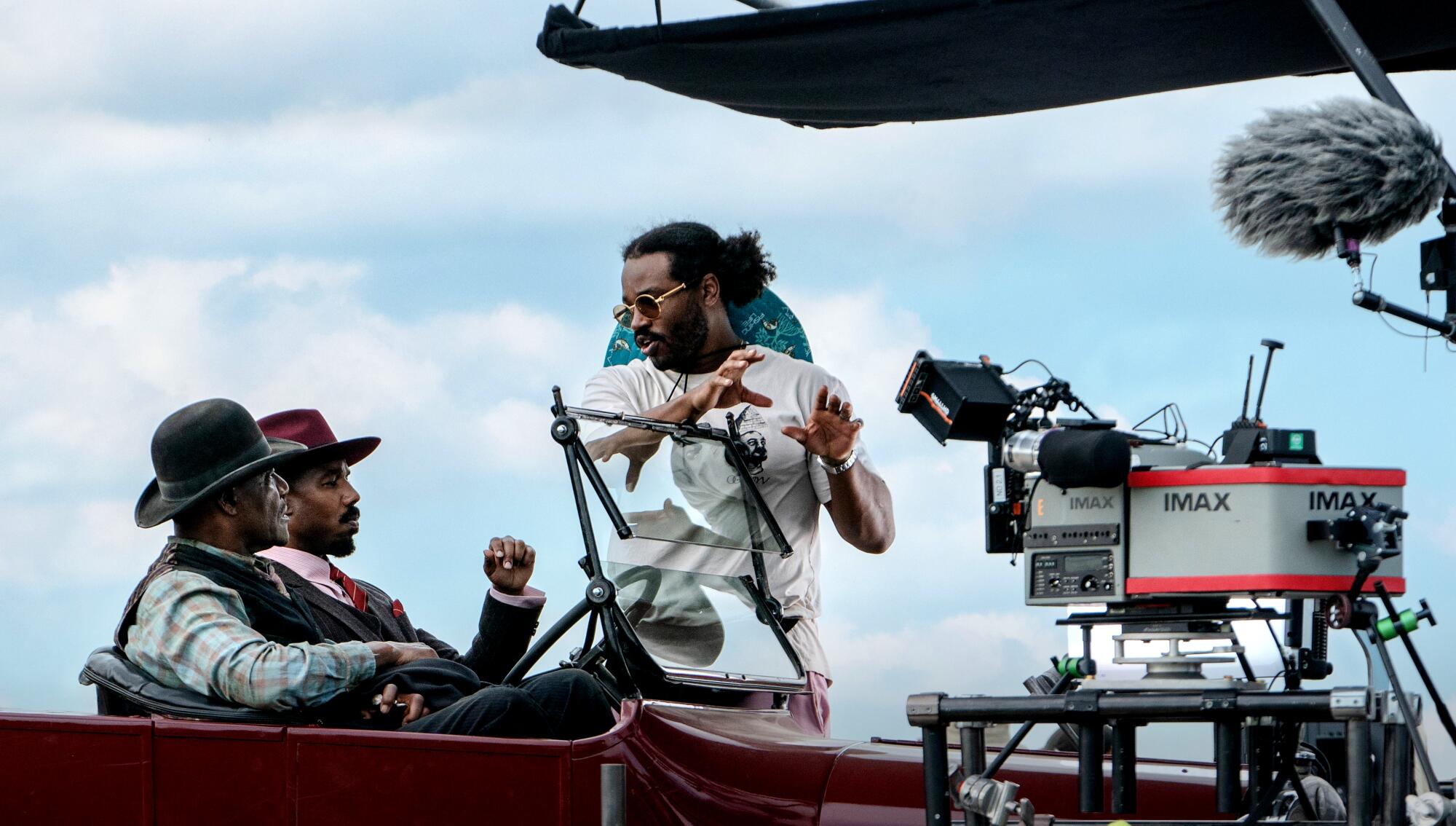
Lindo, left, on the set of “Sinners” with co-star Michael B. Jordan and writer-director Ryan Coogler.
(Eli Ade / Warner Bros. Pictures)
If you’ve seen the film, you’ll no doubt remember Delta Slim delivering a monologue in the car riding to the juke joint with Stack (Michael B. Jordan) and Preacher Boy (Miles Caton) where he recalls the lynching of a fellow musician. The scene ends with Lindo breaking into a guttural humming and drumming, expressing pain that transcends words.
When Lindo saw the movie that first time, the monologue had been truncated, and the scene preceding it, where their car passes a chain gang and Delta Slim stands and exhorts the prisoners to “hold your heads,” was gone too.
After the credits finished rolling and the lights came up, Coogler asked Lindo what he thought of the film. Lindo looked at him. “Can we talk, man?” They went outside, and Lindo laid out in his steady, resonant baritone why he thought Coogler needed to reinstate the chain-gang scene, which reveals Delta Slim’s origin story — and surely, since the chain-gang scene is intertwined with the monologue in the car, that should go back into the movie too.
“What Ryan did so brilliantly is he took the time to introduce all of the main characters in their native environments so the audience gets invested in them and what they mean to the community,” Lindo says. “For Delta Slim, those scenes were the fundamental building blocks.”
“The Delta Slim monologue had a lot of ‘Is it in, is it out?’ debate,” “Sinners” film editor Michael P. Shawver says. “But I knew in my heart and soul I was never going let the movie out without that being in it.”
Coogler, it turns out, saw it that way too.
Delroy Lindo.
(Bexx Francois / For The Times)
“I couldn’t imagine making a movie about the blues without giving some deeper context on what that music really signifies,” Coogler writes in an email. “It’s easy to get lost in the rhythm and the artistry of it all, but the blues was born from a lot of pain and adversity in a particular time and place. When I wrote the script, I felt like I needed a living, breathing embodiment of that, and Delroy nailed it.”
“We could have filmed that monologue a thousand different times and it would have taken on new life with each take,” Coogler continues. “The gut-punch way he ends it, going from telling the story of a lynching to drumming along and humming … it’s macabre, sorrowful and beautiful all at the same time. It shows you exactly why Delroy’s such a masterful actor. If you ever needed to give someone the world’s fastest lesson in what the blues is about, he gives it to you right there.”
“God bless him,” Lindo says.
“Working for the camera, we’re at the mercy of the editing process,” Lindo notes. He speaks slowly, deliberately, always choosing his words carefully because language is important to him. It’s his currency.
How does he feel about that loss of control?
“It’s scary,” Lindo says. “One had better make one’s peace with that very quickly. If you don’t, you will get your feelings hurt. It’ll be a problem.”
Asked to pinpoint when he came to terms with that, Lindo remembers “Clockers,” the 1995 Spike Lee crime drama in which he played the intimidating drug kingpin Rodney Little. It was his third collaboration with Lee, following “Malcolm X” and “Crooklyn,” and the two enjoyed a mutual respect and rapport. But Lee still cut three of Lindo’s scenes, which Lindo understood — “kind of, sort of.” Lee was looking at the larger story. Those scenes weren’t essential.
“Making one’s peace with it is not the same as accepting it and being happy with it,” Lindo says, raising an index finger, a gesture he often makes when telling you something he considers important. “It’s just the way it is. It’s a fact of life.”
When talking about his career, Lindo, 73, tells me more than once that “it’s not where you start, it’s where you finish.”
The first time he tells me this we are talking about one of his early lead acting turns, starring in the 1983 Yale Repertory Theatre production of “A Raisin in the Sun,” the story of a struggling Black family dealing with discrimination in 1950s South Chicago. Lindo played the frustrated patriarch, Walter Lee, and won some strong reviews. But he felt like he was the “weak link” in the production. In a GQ profile, it was written that Lindo, born in London, couldn’t convince himself that the African American experience was his to interpret.
“Nope,” Lindo says. “I did not say that.” Again, the index finger. “You’re giving me the opportunity to set the record straight.” He pauses and closes his eyes. “Doing that play, I had an inner monologue playing in my head that cast doubt on my ability to play the part successfully. And it continued and it grew. It became a tape and then an album and then a series of albums. It eroded my confidence.”
“You know what it was?” he continues. “It was a self-esteem issue. It was an issue of me saying to myself, ‘You’re not good enough. You want to do one of the great parts in the theater? No. You don’t have it.’ Now, what’s the root of all that?” Lindo laughs, clasps his hands together and raises them. “The roots of that are food for myself and a therapist.”
But there is a happy ending to the story. Lindo was cast once more as Walter Lee, for a production of “A Raisin in the Sun” mounted at the Kennedy Center in 1986. Lloyd Richards again was directing, indicating to Lindo that maybe he wasn’t as bad as he thought he had been. Richards did tell Lindo that he needed to jettison some of the neurotic choices he was making as an actor.
“Those are the words he used, ‘neurotic choices,’” Lindo says, shaking his head. He pauses. “Man, I’m giving you a lot here. But it’s OK. You know why it’s OK?”
Because you’re enjoying our conversation? I venture.
Delroy Lindo.
(Bexx Francois / For The Times)
“No,” Lindo says. “I’m not particularly enjoying telling you about my failures. But this was an absolute period of growth for me as an actor all because I learned the most important thing: preparation, preparation, preparation.”
For his reprise of “A Raisin in the Sun,” Lindo called musical multihyphenate Oscar Brown Jr. and asked if he could fly to Chicago and pick his brain about life on the city’s South Side in the 1950s. Lindo walked the streets where “Raisin” playwright Lorraine Hansberry lived, steeping himself in what it meant to exist in that place and time. After that, the tape was no longer playing in his head, even when co-star Esther Rolle’s face fell after she realized that Lindo had been cast as Walter Lee. She thought she’d be headlining with Glynn Turman, but Turman had dropped out.
“Eight days, maybe nine into rehearsals, Esther turned to me — and this is when I knew it was going to be all right — and she said, ‘You’re a nice actor,’” Lindo remembers, smiling.
Preparation, preparation, preparation. For Delta Slim, Lindo read books on the blues, listened to Son House, Muddy Waters and Howlin’ Wolf and immersed himself in the culture of the Mississippi Delta. When it came time to shoot that monologue in the car, he was ready. On the next-to-last take, Lindo improvised, letting music take the place of words. Jordan went with it, turning to Caton in character, saying, “You got that guitar in your hand, don’t you, boy?” Caton begins playing.
“Man, we were all in the work,” Lindo says.
Where did that improvisation come from? I ask.
“It’s the musical manifestation of the pain I’m feeling,” Lindo says. “It’s the only thing I know how to do in that moment.”
It’s the blues.
“It’s the blues, man,” Lindo says. “I’ve heard it said numerous times: That’s where the blues comes from. And as an actor who participated in that moment, communicating that is extraordinary and profoundly gratifying.”
Two competing visions for the EU’s economic future are set to collide on Thursday, when the bloc’s leaders gather for an informal retreat to discuss reviving the bloc’s competitiveness.
On one side stands France; on the other, a newly aligned Germany and Italy.
Paris made a last-minute move to join an informal pre-summit scheduled by Berlin and Rome ahead of the retreat on Thursday morning in an unusual bid to coordinate their positions before leaders convene.
The French intervention followed remarks on Tuesday from President Emmanuel Macron to several European media outlets, and amounts to an effort to assert Paris’ agenda in response to a document circulated in recent days by Germany and Italy that lays out a sharply different vision for the EU economy.
In doing so, the French president has flipped the script and introduced firmly on the table one of the most divisive matters for EU leaders: pooling debt to prop up the bloc.
The timing is no coincidence either.
Earlier this month, Mario Draghi, called on the EU to work as a true union and urged leaders to implement a “pragmatic” federalist approach to survive in a new, more brutal world.
The retreat in Alden Biesen, Belgium comes a year and a half after a landmark report by Draghiwarned of a bleak outlook for Europe’s economy unless decisive steps were taken to boost competitiveness.
Since the report’s publication in 2024, the global geo-economic landscape has shifted dramatically, with the US and China’s aggressive agendas adding pressure on the EU’s 27 countries.
Macron is the most loyal to Draghi’s ambitions but also the weakest leader at home compared to Meloni and Merz.
Divisions expected on eurobonds
During the retreat, leaders will focus “on strengthening the Single Market, reducing barriers to growth and enhancing Europe’s strategic autonomy,” according to the agenda presented by the Cypriot EU presidency.
Draghi, along with another former Italian prime minister, Enrico Letta – who published his own landmark report on the Single Market the same year – will attend parts of the discussions.
Still, a senior EU official said the time for diagnosis was over, and that leaders now need to take “concrete measures” to move the EU’s economic agenda forward.
Reaching consensus, however, will be difficult. The EU’s Franco-German engine appears to be sputtering, with Paris now facing a fresh Berlin-Rome alliance. On 23 January, Germany and Italy agreed to coordinate their push to deregulate industry.
The first flashpoint is expected to be Macron’s call, made Tuesday, for issuing common EU debt – eurobonds – to finance the massive investments needed to lift competitiveness. Draghi’s report in 2024 put those needs at between €750 billion and €800 billion a year.
“We have three battles to fight: in security and defence, in green transition technologies, and in artificial intelligence and quantum technologies. In all of these areas, we invest far less than China and the United States,” Macron said, adding: “If the EU does nothing in the next three to five years, it will be swept out of these sectors.”
Berlin, however, has long resisted repeating the joint borrowing used to fund the €750 billion post-Covid recovery plan.
Instead, Germany and Italy are expected on Thursday to call for expanded venture-capital financing and stronger exit options for investors. The document circulated by Rome and Berlin suggests “the creation of a pan-European stock exchange, a pan European secondary market, and a review of capital requirements for lending without impeding financial stability”.
On eurobonds, Nordic countries have traditionally sided with Germany.
Still, the same senior EU official noted that “when the European Union needs to take those decisions, it has taken so,” adding that joint borrowing remains an option after the bloc again turned to it at the end of 2025 to support Ukraine. “There is no dream of European debt. There is European debt out in the markets and we’ve just increased by 90 billion last December.”
In a letter sent to leaders on Monday, Commission chief Ursula von der Leyen did not mention joint borrowing, doubling down on cutting excessive regulation and integrating the 27-nation single market.
In the run-up to a meeting with European industry leaders, she also appealed to establish the so-called 28th regime to harmonise rules for companies operating across Europe.
Germany’s strict conditions
France is also pressing for a long-standing priority: a European preference, or “Made in Europe,” policy that would favour EU-content products in public procurement.
“It’s defensive, but it’s essential, because we are facing unfair competitors who no longer respect the rules of the World Trade Organization,” Macron said on Tuesday.
While the idea has gained traction in EU capitals and at the European Commission, Nordic and Baltic countries as well as the Netherlands warned in a non-paper circulated ahead of the summit that the European preference “risks wiping out our simplification efforts, hindering companies’ access to world-leading technology, hampering exchange with other markets and pushing investments away from the EU.”
Germany, meanwhile circulated a document seen by Euronews in December as part of discussions among the 27 laying out strict conditions. Berlin wants the European preference to be time-limited, broadly defined, and applied only to a narrow list of products. It also favours a “Made with Europe” approach, open to countries with EU free-trade agreements and other “like-minded” partners.
Italy, the EU’s third-largest economy, has sided with Germany. Both countries say their priority is not only to support European businesses but also “to attract new business from outside the EU,” according to their document to other capitals.
Macron appeared to partially align with that view on Tuesday, saying the European preference should focus on limited sectors such as clean tech, chemicals, steel, automotive or defence. “Otherwise Europeans will be swept away,” he said.
Berlin and Rome want more deregulation
At the retreat, Berlin and Rome are also set to push a deregulatory agenda. As the European Commission rolled out several simplification packages in 2025, the two countries are calling “for further withdrawals and simplifications of EU initiatives across the board”.
They also propose an “emergency brake” allowing intervention if legislation raises “serious concerns regarding additional administrative burden both on enterprises and on national authorities”.
Last but not least, the Mercosur trade agreement looms large. During the retreat, the Commission plans to consult EU countries on its provisional implementation after a judicial review triggered by the European Parliament suspended ratification of the deal, signed with Brazil, Argentina, Paraguay and Uruguay.
France remains firmly opposed to the Mercosur agreement, citing farmers’ fears of unfair competition from Latin American imports. But the deal nonetheless won backing from a majority of member states in January after Italy gave its support.
Berlin and Rome leave little room for doubt in their document: “We call for an ambitious EU trade policy taking full account of the potentials and needs of all economic sectors, including agriculture. The finalisation of the EU-Mercosur Agreement was an important step in that direction.”
Voting is fundamental to democracy, but here in the U.S. people don’t vote very much. In December, Miami held a runoff election for mayor, and all of 37,000 voters turned out. This was 2,000 fewer people than voted in comparable off-cycle elections in Apizaco, a small city in the mountains of central Mexico. It was no blip: The median turnout in U.S. city elections is 26% of the voting age population. In Mexico, by contrast, turnout rarely dips below 50%, and unglamorous small-town elections attract higher numbers, often more than 70% of the citizenry.
Nevertheless, the United States disdains Mexico as a pale shadow of its own democracy. Mexican elections are written off as corrupt, violent and unrepresentative. This was part-true for much of the last century, when versions of the Partido Revolucionario Institucional ruled without interruption for 71 years. Mexicans were “oriented” to vote by party managers, fined if they didn’t, violently dissuaded from voting for dissidents, disenfranchised with stuffed ballot boxes. Impressive turnouts were coerced. Even today, decades after the arrival of a competitive democracy, the violence persists. Thirty-four candidates were murdered in the 2024 elections.
Yet Mexicans also vote in impressive numbers because they have always cared profoundly about representative politics, and particularly at a local level. Many of those large turnouts in authoritarian Mexico were crowds of everyday people struggling to elect legitimate authorities in the teeth of a rigged system. Those struggles meant that sometimes they won.
Historical outcomes are revealing. More than 200 years of elections in Mexico have given results significantly more diverse and representative than those of the United States. In 2024 Mexicans elected the first female president in North American history, climate scientist Claudia Sheinbaum. In 1829 Mexicans elected the first Black president in North American history, mule driver Vicente Guerrero. In 1856 they elected lawyer Benito Juárez as the only Indigenous president in North American history.
The United States was born committed to rule by freely elected representatives. “We the people” is a good start to a piece of political writing and a good start to a country. When the French sociologist Aléxis de Tocqueville visited New England in the 1820s he was struck by how the citizens of small towns argued out their differences and came up with solutions together. The federal republic was a scaling up of those habits. The sum of those people’s beliefs, institutions and bloody-mindedness, Tocqueville wrote, was democracy in America.
The peoples of the United Mexican States, founded in 1824 after gaining independence from Spain, shared those ambitions. Mexico was likewise a federal republic, its rulers elected, its powers divided among executive, legislature and judiciary. As in the U.S., the female half of the population was excluded. But Mexico’s founders were ahead of ours in one sine qua non of genuine democracy: racial equality. In the Federalist Papers, Alexander Hamilton claimed that “to all general purposes we have uniformly been one people; each individual citizen everywhere enjoying the same national rights, privileges, and protection.” That was a self-evident untruth, because Black and Indigenous peoples were not included.
In Mexico, people of color had some standing from the founding onward. Mexican history has its own wrenching tragedies of race: the slavery of West Africans, the ethnocides of the North, the systematic impoverishment of peoples like the Maya of Chiapas, a eugenic hunger for white migration. But from the colonial outset Black people were acknowledged to be fully human, their enslavers’ abuses punished, their lynching unknown. Many Indigenous peoples preserved their language, lands and governments over centuries. Asians joined them; the first Japanese ambassador arrived in 1614. Mexico was the world’s first great melting pot.
So the founders of the United Mexican States made no formal distinction among the multitudes they contained. Their leaders in the War of Independence abolished slavery. Their post-independence congress mandated “the equality of civil rights to all free inhabitants of the empire, whatever their origin.” The 1824 Constitution extended the vote to every adult male. All would be free, all equal under law and all voters with a stake in the outcome.
In 1917 Mexicans passed the most progressive constitution in the world following their own revolution. It mandated an eight-hour working day, a minimum wage, equal salaries for men and women, and paid maternity leave. While women didn’t get the vote until the 1950s, they exercised notable power behind the scenes; even the most conservative parties had female organizers and supporters. Progressive social policies inspired leaders across the hemisphere, including Franklin D. Roosevelt.
Three core beliefs inspire Mexicans to vote. They believe that face-to-face freedom, embedded in the power and autonomy of the municipio libre, the free county, is sacrosanct. And they believe that to preserve communal freedom, whether from federal abuse or oligarchs, requires two things, sufragio efectivo y no reelección; in historian John Womack’s translation, “a real vote and no boss rule.”
Historically enough Mexicans — of all political stripes, from conservatives to anarchists — cared about those three beliefs to fight in elections tooth and nail.
Alongside the belief that voting is a duty comes clear-eyed rejection of boss rule. While Mexican Mayor Daleys are historically ubiquitous — they sparked the Mexican Revolution — there are none of the national dynasties that beset U.S. politics. The great dictator Porfirio Díaz left his ambitious nephew struggling to make army captain for eighteen years. Dynastic power befits monarchies, not democracies, and Mexicans know it.
Neither do Mexican politicians enjoy the unfettered power of their American counterparts to buy elections. Parties are publicly funded, under a system designed to promote fairness. Each party gets a certain amount from the state: 30% of that amount is the same for all, the remaining 70% proportional to their success in the previous elections. Private donations are transparent, regulated and capped at a very low level, on paper at least. The system unduly favors incumbents, and illegal, off-books funding is rife. Yet the need for sizable contributions to be covert keeps election results out of the hands of the likes of Elon Musk. A national watchdog and a diverse and competent press ensure it.
Sheinbaum spent $18 million winning her presidential election. In losing New York City’s mayoral election, Andrew Cuomo spent three times as much. A single oligarch, Michael Bloomberg, chipped in $13 million. Mexican elections are sometimes bought and sold, but never with the obscene unconcern prevalent in the U.S. since the Supreme Court’s Citizens United ruling.
Republics that endure rely on egalitarian beliefs, hard-nosed pragmatism, unwritten rules of decency and written rules of institutions — and unrelenting struggle against all who break those rules. Democracy relies on people of all races being recognized as fully human and guaranteed access to the ballot. It then relies on those people turning up to vote whenever given the chance. Mexicans have repeatedly demonstrated how deeply they know that across their history, against sometimes heavy odds. Their government documents come stamped with the revolutionary slogan sufragio efectivo y no reelección, a real vote and no boss rule, as a reminder. We could use one ourselves.
Paul Gillingham, a professor of history at Northwestern University, is the author of “Mexico: A 500-Year History.”
Tottenham manager Thomas Frank has been sacked by Spurs after just under eight months in charge.
While the higher ups at Spurs focus on finding Frank’s replacement, we thought we’d test your knowledge by looking at those head coaches who have come before.
Can you name the past 10 permanent Tottenham managers? Good luck!
North Korea’s Rodong Sinmun newspaper on Wednesday condemned Japan’s recent defense equipment agreement with Canada, accusing Tokyo of accelerating a drive toward militarization. Japan’s Prime Minister Sanae Takaichi, seen here Monday after her Liberal Democratic Party’s landslide election victory, has pledged to bolster the country’s military capabilities. Pool Photo by Franck Robichon/EPA
SEOUL, Feb. 11 (UPI) — North Korea on Wednesday denounced Japan’s new defense equipment agreement with Canada, accusing Prime Minister Sanae Takaichi’s government of accelerating what it called a drive toward militarization and overseas aggression.
An article in Rodong Sinmun, the ruling Workers’ Party newspaper, described Japan as a “war criminal nation” and warned that Tokyo’s expanding military partnerships amount to the formation of a “de facto military alliance” with NATO members and regional countries.
The criticism comes days after Takaichi’s ruling Liberal Democratic Party secured a landslide election victory, strengthening her hand as she pushes to revise Japan’s pacifist constitution and formally recognize the Self-Defense Forces as a military.
Signed in late January, the agreement allows Japan and Canada to jointly develop military systems and share technology, and permits Tokyo to export defense hardware to Ottawa.
Rodong Sinmun argued that such arrangements violate the spirit of Japan’s post-World War II constitution, which renounces war and states that “land, sea, and air forces, as well as other war potential, will never be maintained.”
“As a war criminal nation, Japan is prohibited from possessing a military,” the newspaper wrote. “Therefore, even the very formation of a military alliance is a red line that must not be crossed.”
By strengthening its military agreements with other countries, Japan “aims to create an environment favorable to the realization of its ambitions for overseas aggression,” the paper added.
Japan maintains well-equipped Self-Defense Forces despite Article 9 of its constitution, drafted under U.S. supervision after World War II. In recent years, Tokyo has gradually expanded its security role and eased restrictions on defense exports.
Takaichi, a conservative defense hawk, has pledged to further bolster Japan’s military capabilities. During a Feb. 2 stump speech, she called for amending the constitution to formally recognize the Self-Defense Forces and “position them as a combat-capable organization.”
Her agenda unfolds against a backdrop of heightened tensions with China, including concerns over Taiwan, and pressure from Washington for allies to shoulder a greater share of defense burdens.
North Korea has routinely portrayed Japan’s security initiatives and its trilateral defense cooperation with the United States and South Korea as steps toward remilitarization and a threat to regional stability.
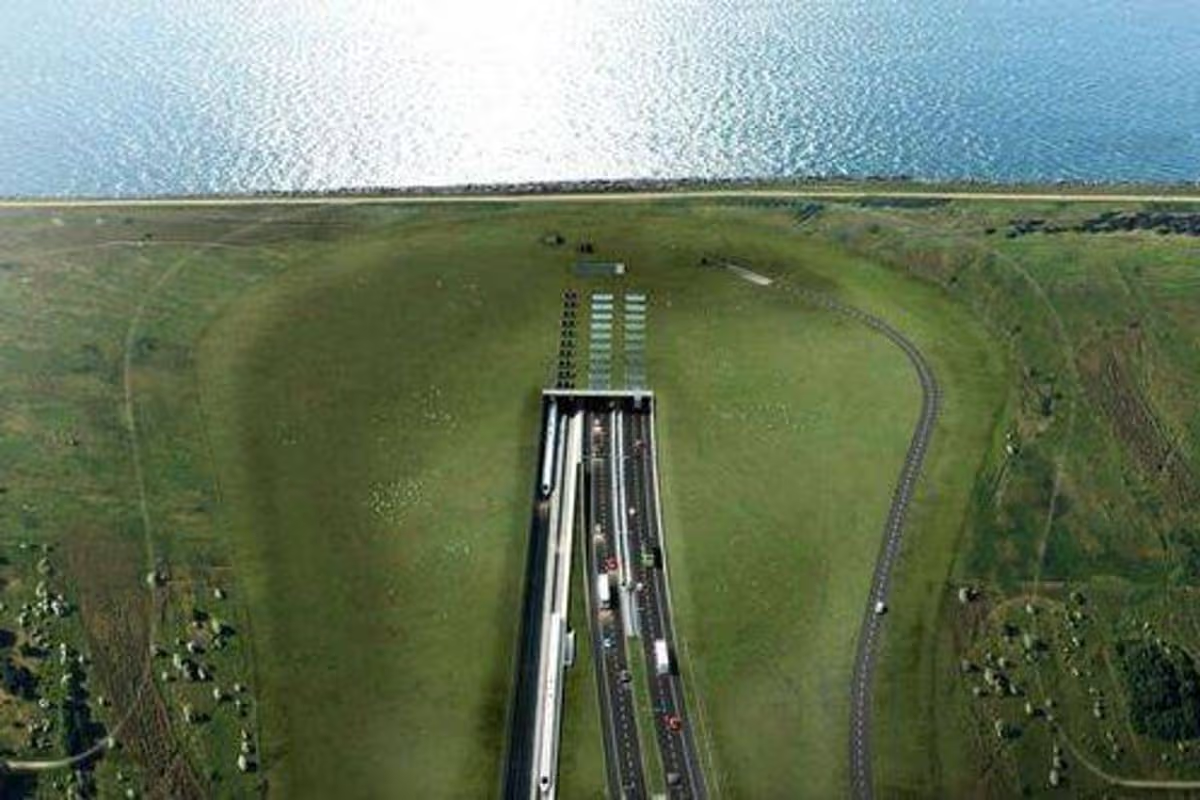
The Fehmarn Belt Fixed Link is expected to be the world’s longest immersed tunnel and rail link by 2029
The EU granted the tunnel project around 1.3 billion euros (£1.1 billion).(Image: femern)
The Fehmarn Belt Fixed Link, an underwater tunnel poised to link the Danish island of Lolland with Germany’s Fehmarn island, represents a remarkable feat of engineering. This remarkable tunnel beneath the Baltic Sea, set to become one of the planet’s longest submerged structures, is due for completion by 2029.
Spanning more than 18 kilometres (11 miles), the Fehmarnbelt tunnel will dramatically reduce journey times between Scandinavia and mainland Europe. Danish planning firm Femern has described the tunnel as “Denmark’s largest infrastructure project and the world’s longest immersed tunnel and rail link”.
The scheme carries a substantial estimated price tag of DKK 55.1billion (£6.4billion), with the European Union providing roughly 1.3billion euros (£1.1billion) in funding.
Femern has stressed that an immersed tunnel represents a “safe, tested and efficient way of building an underwater tunnel”, reports the Express.
“The technology is Danish-developed and builds on experiences from, among others, the Øresund Tunnel. Once completed, the tunnel will not pose any obstacle to vessel traffic in the Fehmarnbelt. Marine safety is also a top priority during the construction phase.”
“The Fehmarnbelt tunnel will be just as safe as a corresponding section of motorway above ground. The tunnel is equipped with continuous hard shoulders and emergency exits along its entire length.”
The Institution of Civil Engineers highlighted the Fehmarnbelt Tunnel’s unique positioning atop the seabed, dubbing it “a remarkable engineering feat”.
“Weighing in at 73,500 tonnes apiece, these colossal structures are a testament to modern engineering,” they explained.
“Once a tunnel element is ready to be shipped, waterproof bulkheads (barriers) are installed at both ends, and the segment is carefully towed into position by tugboats.”
“In total, 89 elements will be connected sequentially – much like assembling giant Lego pieces – to form the complete tunnel.”
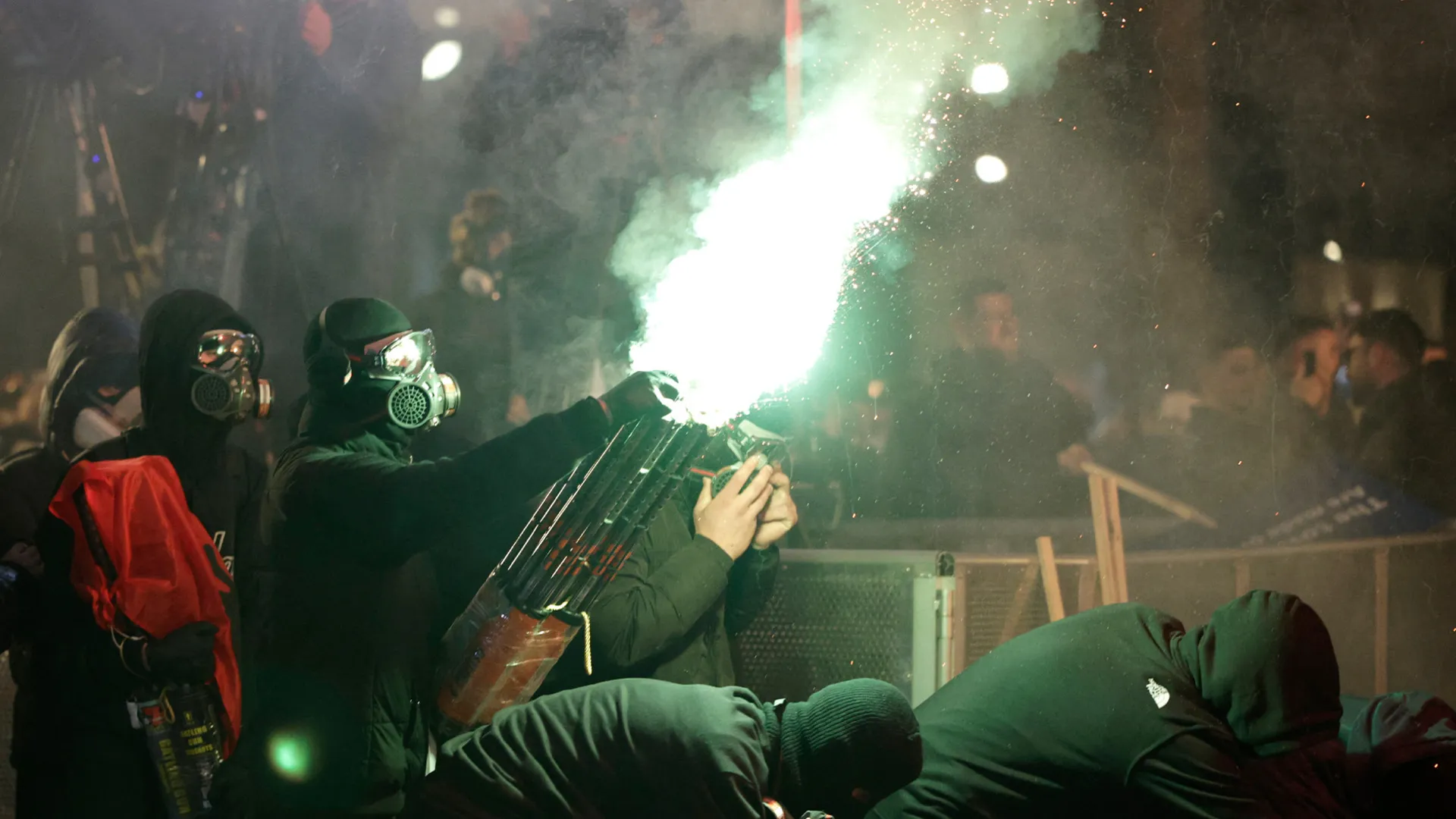
Anti-government protesters in Albania hurled petrol bombs and fireworks at police, who responded with tear gas and water cannons during demonstrations in the capital Tirana.
Visitors to the sunny island of Tenerife have shared their experiences of the airport amid claims of three-hour queues, and while some have breezed through, others have found themselves facing long delays to the start of their holidays
12:04, 11 Feb 2026Updated 12:11, 11 Feb 2026
Tourists have shared their experiences with queues at Tenerife South Airport(Image: Larry Hicken)
Brits visiting the popular holiday island of Tenerife have reported ‘horrendous’ and long queues and issues getting through the airport, both when arriving and departing.
Unhappy holidaymakers have told the Mirror that they’ve been stuck in the automatic doors and made to queue outside on the tarmac, with elderly passengers kept waiting for two hours.
The issues partly stem from the newly introduced Entry/Exit System (EES), which Brits have had to use when travelling into EU countries since October 12, 2025. It seems to have led to long waits for passengers on the Spanish island. Local news outlet Canarian Weekly reports that only five of the 36 new eGates are in use in Tenerife South Airport.
When contacted about the issue, airport operator AENA stated that border control is the responsibility of Policía Nacional. The spokesperson said: “The European Commission determined that the Entry Exit System starts on October 12. Its implementation will be gradual over a period of 180 days, until April 10, when its deployment will be fully completed.”
Recent holidaymakers to Tenerife have had mixed experiences using the airport. Anne Ramsey, a frequent visitor to the island, said that when her party arrived on December 19 on an early morning flight from Glasgow Prestwick Airport, “we went straight through”.
However, a few weeks later on January 23, Anne arrived on a plane from Manchester and described the queues as ‘horrendous’. “They had to keep us on the transfer bus as the queue into the terminal was queuing outside, and there was nowhere for anyone else to go.”, she said.
Annie revealed the chaos outside the airport, saying: “People were getting stuck in the glass doors entering the terminal as they kept opening and shutting them in an attempt to control the passenger numbers.”
During this trip, Annie was accompanied by her 90-year-old mother, and said they “queued for nearly two hours.” At this point, it was term time, so the family lanes designed for groups with children under 12 were less busy, but Annie claims there was “no attempt to move people from the longer queue to the shorter one.”
She also faced technical difficulties, with eGates crashing, meaning passengers needed to wait until they were up and running again. However, her sister, who had arrived on the same date just two hours later, faced no queues.
Larry Hicken, a member of the popular Facebook group Tenerife Holiday Forum, shared two images showing long queues upon arrival at the airport. He said he landed at 4pm on January 26, but it wasn’t until 6.10pm he made it through border control.
However, a few people said they’d had positive experiences at the airport. Pip Jane Tolliss said she flew out on December 10, 2025, and had a smooth experience on arrival. Her fingerprints weren’t taken, but a photo was, and she got through in 10 minutes.
On the way back on January 3, she said it was busier, but “security moved quickly. Went through gate C and no machines just a small queue moving very quickly as just stamping passport.”
Pip admits that experiences at the airport can vary. “Having spoken to many people during our stay, it seems the experience can be very different from day to day. We were lucky, I guess!”
Representatives of the Policía Nacional España have been contacted for comment.
Have a story you want to share? Email us at webtravel@reachplc.com
Emerald Fennell’s adaptation of “Wuthering Heights” could only have been created by a true fan. The British filmmaker wanted to evoke her youthful experience reading Emily Brontë’s 1847 novel when she was 14, which she describes as “the most physical emotional connection I’ve ever had to anything.” Her bodice-ripping, visually sumptuous version, in theaters Friday, incorporates some essential literary elements, but also imagines what’s in between the lines of Brontë’s writing, including sultry moments between the protagonists.
“I’m fanatical about the book,” Fennell says. She’s speaking over Zoom alongside Margot Robbie, who stars as Catherine Earnshaw (and who also produced the film), and Jacob Elordi, who plays Heathcliff. “I’m as obsessive about Emily Brontë as everyone else. She gets inside you.”
The director, 40, recalls going to the Brontë Festival of Women’s Writing in West Yorkshire, England, in 2025 and feeling completely at home. “I was like, ‘These are my chicks,’” Fennell says. “We all want to sleep in a coffin.” Robbie laughs, despite likely having heard the story before.
“We are, all of us, breathless, up against a rock,” Fennell continues, referencing a particularly evocative scene she imagined for her film. “I care so deeply about this that I couldn’t hope to ever make a perfect adaptation because I know my own limits.”
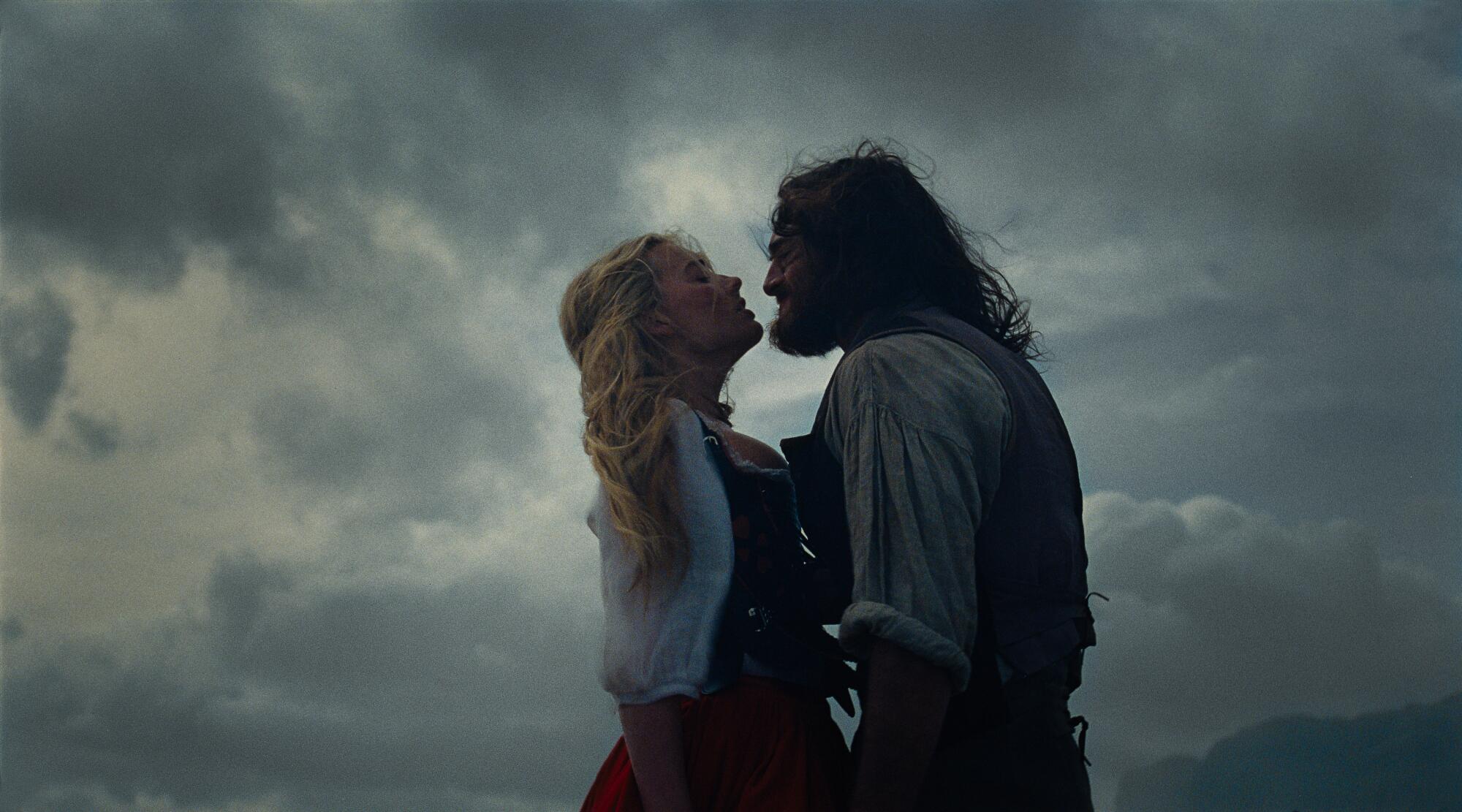
Margot Robbie and Jacob Elordi in the movie “Wuthering Heights.”
(Warner Bros. Pictures)
What she could do is make a film that recalled the visceral feeling of reading the novel as a teen. “That would mean it had a certain amount of wish fulfillment,” she admits. The novel is famously austere, with mere glimmers of physical intimacy. “The Gothic, to me, is emotional and it’s about the world reflecting everyone’s interior landscape. This is my personal fan tribute to this work.”
“Wuthering Heights” marks the third collaboration between Robbie’s production company, LuckyChap Entertainment, and Fennell. Robbie, 35, produced Fennell’s 2020 feature debut “Promising Young Woman,” which earned Fennell the Oscar for original screenplay, and 2023’s class-envy thriller “Saltburn.” Her style is confrontational and seemingly fearless, often provoking hugely divergent reactions from critics and fans. She’s a filmmaker who goes full-on.
Despite their history, however, Robbie had never acted in one of Fennell’s films.
“When I read this script, I did find I was putting myself in Cathy’s shoes and reading the lines and thinking, ‘How would I play it?’” Robbie says. “I do that often when reading scripts, but my heart sank when thinking about the casting. So I threw my hat in the ring.”
Margot Robbie in the movie “Wuthering Heights.”
(Warner Bros. Pictures)
“It’s a bit like asking your friend to date you,” Fennell chimes in. “It’s taking something a step in a different direction. You don’t want to be the person who blows up the thing that you have that works so well. But I was desperate for Margot to play Cathy. I was so relieved that it was her who made the first move.”
Fennell did make the first move with Elordi, 28, recently Oscar-nominated for his monster in Guillermo del Toro’s “Frankenstein.”
“Emerald texted me and said, ‘Do you want to be Heathcliff?’” Elordi recalls. “That was it. I said, ‘Yeah.’ And then when she gave the screenplay, I read it and wept. That’s how you dream of making movies.”
Not only did Elordi look like the version of Heathcliff on the cover of Fennell’s edition of the novel, but she had witnessed his potential for the role while making “Saltburn.”
Jacob Elordi in the movie “Wuthering Heights.”
(Warner Bros. Pictures)
“Felix is a character who does something awful in every scene,” Fennell explains of Elordi’s charismatic rich boy in “Saltburn.” “But it needed somebody who could make everyone in the audience forget that. And Jacob was the only person who came in and did that. Heathcliff is an extreme antihero. He’s cruel and he’s violent and he’s relentless and he’s vengeful and he’s spiteful. Jacob has a sensitivity and tenderness and groundedness that makes us forgive all that.”
Fennell knew the film hinged on the casting of Cathy and Heathcliff, two iconic literary characters who have been portrayed by a multitude of actors over the years, including Laurence Olivier, Juliette Binoche and Ralph Fiennes. It’s been broadly debated whether the novel actually is a love story between the snobbish Cathy and the glowering Heathcliff. For some, it’s a tale of toxic fixation, for others a revenge plot or a tragedy. But Fennell’s version is undeniably a big-screen romance.
“We were looking for outsized charisma and outsized talent, people like Burton and Taylor,” director Emerald Fennell says. “A combination of actors who are explosively brilliant. And it’s these two.”
(Shayan Asgharnia / For The Times)
“We were looking for outsized charisma and outsized talent, people like Burton and Taylor,” Fennell says of the classic onscreen pairing of Richard Burton and Elizabeth Taylor, famously tumultuous. “A combination of actors who are explosively brilliant. And it’s these two.”
“That’s the coolest thing to say,” Elordi says, covering his face with his hands. “This after years of hearing nothing,” he quips. (Fennell says she is sparing with praise.)
“Wuthering Heights” reunites several of Fennell’s repeat collaborators. Actor Alison Oliver, who appeared in “Saltburn,” plays Isabella Linton, Edgar’s ward who becomes a problematic fixation for Heathcliff, and the filmmaker reteamed with cinematographer Linus Sandgren, production designer Suzie Davies and editor Victoria Boydell. Fennell also brought in new faces, including Hong Chau as Nelly Dean, Cathy’s companion, and Shazad Latif as wealthy businessman Edgar Linton. She and Robbie aimed to create a creatively safe set.
“It’s very exposing, especially for the actors,” Fennell says of making an audacious film like this. “You need to be able to forget that and feel that you have the ability to make mistakes and try something different.”
Fennell’s direction was often unexpected.
“I remember she prepped us for the long table scene and said, ‘It needs to come to life,’” Elordi says. “Heathcliff was brooding but she said, ‘What if he wasn’t brooding?’ All of a sudden there was this electricity at the table. As an actor, that pushes me out of my comfort zone. And every time it works.”
“What I like about working with Emerald is: I like going too far,” Robbie agrees. “My instinct is to go really hard and then have someone tell me to pull it back. She rarely tells me to pull it back. She wants the maximalist version and I relish that. She would say, ‘Now you’re in a sensible period film.’ And then she’d say ‘Now do it like you’re Ursula the sea witch.’”
That was the take that made the final cut. “Part of it is there,” Fennell confirms. “Usually I use only a little moment of something but that’s the crucial one. Because we’re all so crazy in life, aren’t we?”
“And Cathy so is Ursula the sea witch,” Robbie says.
“She’s such a little sea witch,” Fennell agrees.
Fennell’s reimagining of “Wuthering Heights” amps up the existing emotions in the novel. She abridges its plot, removing the second-generation narrative that bookends Brontë’s writing. The torment of Cathy’s abusive brother shifts to the hands of her father, played by Martin Clunes.
Meanwhile, the longing between Cathy and Heathcliff, who can’t be together due to his lowly station and her spiteful decision to marry the wealthy Linton, accelerates dramatically into fervid sex scenes. The doomed couple erotically embrace on the Yorkshire Moors, in the back of a carriage and even inside her bedroom at Thrushcross Grange — all moments that are not part of the book.
Margot Robbie in the movie “Wuthering Heights.”
(Warner Bros. Pictures)
“They’re part of the book of my head,” Fennell says, adamantly. “I think they’re part of the book of all of our heads. With all the love and respect and adoration I have for the book, I also wanted to make my own version that I needed to see.”
“It is totally that wish fulfillment,” Robbie says. “And if you can’t have the wish fulfillment in movies, where are you going to get it?”
Fennell imbued the film with tactile visuals that evoke the sexual tension between Cathy and Heathcliff. There are close-ups of hands kneading dough, a snail sliming its way up a window and Cathy prodding a jellied fish with her finger. The director tested numerous fish before selecting the one that is seen onscreen.
“Why I love working with these guys so much is we’re all detail perverts,” Fennell says. “I am obsessed with every single thing. That fish that Margot fingered — I fingered about 50 different fish before then. Tiny fish, big fish, fake fish, jelly that was wet, jelly that was soft, jelly that was firm.”
“You think she’s joking but she’s not,” Robbie says.
“My finger smelled so bad the whole time that we were making this movie,” Fennell adds.
Ultimately, though, it was the best possible fish. “We did the takes with a couple of fish, but we all knew the right one when it happened,” Robbie says of the scene, which mirrors the sexual disappointment in Cathy’s marriage. “We all felt it in the same moment. Everyone went, ‘That’s it.’”
Jacob Elordi and Margot Robbie in the movie “Wuthering Heights.”
(Warner Bros. Pictures)
The film’s aesthetic is bold and brash, featuring brilliantly hued red floors and walls designed to look like Cathy’s freckled skin. It lands somewhere between Disney fairy tale, ’80s romance paperback art and old Hollywood glamour. Atmospheric mist pours across every scene. The estate of Wuthering Heights is foreboding and dark, with rocks splintering through the walls, while Linton’s Thrushcross Grange bears a Victorian aesthetic, containing the outside world. “It’s nature coming in and nature being kept out,” Fennell says. “And it’s about what that means emotionally and metaphorically for the story and for these characters.”
There is purposefully no adherence to historical accuracy, particularly in the costumes. Designed by Jacqueline Durran, the wardrobe was elaborately wild to underscore emotional truths rather than period relevancy.
“You couldn’t not scream,” Robbie says about trying on each piece. “And then Emerald would come up with a platter of jewels and start decorating me like a Christmas tree.”
“There was so much screaming every day,” Fennell says. “I always want people to have permission to go too far, to do something that’s in bad taste, that’s not subtle. I’m really interested in pushing until that squeaking point where you’re like, ‘OK, that’s too far.’ It takes a lot of bravery to do that.”
Even Elordi joined in the excitement. “I was screaming at all the dresses,” he says. “Margot and Alison’s dressing rooms flanked me so I’d often get caught in the hallway.”
Although the world of the movie is heightened and beautifully garish, the romance is more grounded. You can feel how desperate Cathy and Heathcliff are for each other in their own twisted way, and despite their horrible machinations you want them to be together. The film ends differently from the novel, but it shares with it a sad inevitability.
Fennell inherently understood what makes these characters so desirable.
“I was led by my own feelings,” she says. “On set, we were all trying to find that thing that made us get goosebumps. One of the earliest scenes we shot was where Heathcliff breaks the chair to build Cathy a fire.”
To help a shivering Cathy, Heathcliff rises from his wooden seat, smashes it on the floor and tosses the pieces into the fireplace. It’s a moment of devotion from Heathcliff, but triggers a lustful response in Cathy.
“I looked around and all of these professionals, women and men, were agape. Everyone felt the same way as Cathy. That’s what I was looking for every day.”
“He actually broke the chair,” Robbie says. “Cathy’s reaction is my genuine reaction.”
Elordi understood the challenge of embodying such an iconic character, who has existed both on the page and on the screen for generations. He also didn’t want to let Fennell down.
“I knew how personal the story was to Emerald and I knew the screenplay that she had written was extremely good, but I was like ‘What makes you think I can do this?’” Elordi remembers. “I had a lot of nerves but I jumped into it. This is a director you’re really able to give everything to. The images that come from her head are so unique and singular. The first time I watched ‘Saltburn’ with her, I sat back and I realized I was in the presence of something truly great and original. To be able to investigate with her two times is a gift.”
Says Robbie, “My hope is always: There’s got to be one person that watches this movie and thinks ‘That’s my favorite of all time.’ I want to make a movie that is someone’s favorite movie of all time and I’ll know how much that means to them. That it might save them in whatever ways movies can save you.”
Fennell’s “Wuthering Heights” shudders with feeling. And however audiences perceive it, its maker has done exactly what she intended.