Princess Andre has revealed that neither her mum, Katie Price, or dad, Peter Andre, have watched her ITV series The Princess DiariesCredit: ITVPeter, who Princess has a close bond with, appeared on the first season of the ITV showCredit: GettyWhile Katie claimed she was shunned from the production and didn’t feature in itCredit: PA
And despite the show being a massive hit, Princess says her famous parents weren’t sitting down on the couch to give it a watch.
She told The Sun: “I actually don’t think either of my parents have watched the show.”
“I don’t think it’s my dad’s thing, it’s more, it’s a show for people my age to watch, I think,” explained Princess, who was speaking at the launch of 3D Refirm x Facebible in Windsor.
Exes Katie and Peter share Princess and her older brother Junior, 20. While Peter is also a dad to Theo, Amelia and Arabella, and Katie to Harvey, Jett and Bunny.
“I’ve finished for season two and then I’ve got season three to film. So, I’m really excited. I think people are going to love it,” she said.
A date for the show’s release has not yet been confirmed, with Princess simply telling fans last year: “See you in 2026”.
In a break from filming, Princess was speaking at The Fairmont in Windsor, where Dr Raj Arora was launching 3D refirm – non-surgical skin tightening procedures – at her clinic, Facebible.
The doctor is a close friend of Princess’s dad and stepmum, Emily Macdonagh, who were also in attendance at the event.
She is the first doctor to offer 3D refirm at a medical-grade in the UK, with the treatment now available to book at http://www.thefacebible.com.
Princess is currently filming for the second two seasons of her reality showCredit: SplashHer brother, Junior, also features in the show as the pair’s close relationship is displayedCredit: Getty
Artificial intelligence is transforming the banking industry, streamlining operations, improving risk management, and enhancing the customer experience.
Banks are leveraging this burgeoning tech to automate routine tasks, analyze complex data, detect fraud, and deliver personalized financial advice—all with greater speed and accuracy. For consumers, this translates to more efficient services, faster responses, and smarter financial solutions.
The winners below set the standard in AI-driven innovation by using AI to automate back-office operations, accelerate credit assessments, detect fraud in real time, and deliver personalized financial recommendations.
Others leverage AI to monitor customer journeys, identify pain points, and provide seamless virtual assistance. These innovations not only streamline operations but also give consumers faster, smarter, and more tailored banking services, setting a new standard for the industry.
Best Payments
AkBank
Best Chatbots & Virtual Assistants
CaixaBank
Best Enhanced Customer Experience
DBS Bank
Best Personalized Financial Advice
QIB
Best Private Banking
Bank of Georgia
Best Fraud Detection and Prevention
Banamex
Best Credit Assessment
Banamex
Best Risk Management
BBVA
Best Fintech
CTBC
Best Payments
Akbank
Aiming to enhance back-office efficiency and reduce friction, Akbank implemented an AI-driven solution in 2024, training an open-source LLM on over 100,000 banking documents. The custom-tailored LLM tool reinforces secure and compliant operations within the bank’s own data centers and is accelerating back-office automation, significantly improving accuracy, security, and overall efficiency, and underscoring the bank’s dedication to AI innovation and regulatory compliance.
Akbank is utilizing this AI-driven model primarily to automate payment order processing for both customers and regulatory institutions; it also plays an important role in automating back-office transaction orders, significantly reducing the need for manual intervention.
Best Chatbots & Virtual Assistants
CaixaBank
CaixaBank’s employees now have access to NOA, a GenAI-powered assistant designed to provide accurate answers to internal questions using NLP. The tool is a first for CaixaBank, setting a new standard for AI-driven operational efficiency at CaixaBank. Unlike traditional knowledge management systems, it eliminates the need for manual searching by directly retrieving precise information from the bank’s extensive internal documentation. In so doing, NOA has fundamentally altered the process by which 45,000 CaixaBank personnel access information, reducting the necessity for escalating issues and enhancing query resolution efficiency. The system currently handles more than 8 million queries a year, reducing response times and elevating the overall employee experience. User adoption has been swift, attributed to NOA’s intuitive interface and seamless integration within workflows.
Best Enhanced Customer Experience
DBS Bank
DBS Bank pioneered an industry-first Negative Customer Impact (NCI) Control Tower in 2024 that enhances service management by identifying customer pain points and “silent sufferers” in real time. It focuses on key customer journeys to detect performance anomalies early, enabling an effective and timely response while minimizing customer impact.
The NCI Control Tower provides crucial transparency on customer behavior and client performance data to platform and business owners, facilitating ongoing improvement of the customer journey. This comprehensive approach, covering a broad spectrum of service performance dimensions, significantly enhances DBS’s resilience and response capabilities. Since its launch, NCI teams have scaled across more than 15 customer-facing channels, encompassing the delivery of more than 300 customer journeys.
Best Personalized Financial Advice
QIB
QIB’s upgraded AI-driven Next Best Offer (NBO) 2.0 recommendation engine uses deep learning on customer behavior, transactions, and financial patterns to deliver personalized, real-time financial product recommendations. Its key feature is non-intrusive, seamless integration into QIB’s mobile app, providing tailored product information without disrupting core banking.
The AI algorithms evolve, improving accuracy and engagement over time. NBO 2.0 analyzes over 1,600 customer attributes—including demographics, holdings, transactions, and interaction data over five years—to pinpoint the customer’s financial journey stage and suggest the most appropriate products. It also provides valuable data for product portfolio refinement.
Best Private Banking
Bank of Georgia
Bank of Georgia (BoG) is setting a new standard in client acquisition with a dual strategy for identifying and converting high-potential, affluent clients who primarily bank elsewhere. By leveraging these external sources, BoG can detect “invisible” high-income individuals who have minimal engagement with the bank’s current ecosystem: a significant improvement over traditional identification methods that rely on publicly available external data. This fusion of AI and strategic intelligence provides a tailored approach to building the client base, making BOG a leader in data-driven banking innovation.
Best Fraud Detection And Prevention
Banamex
Banamex is employing AI and machine learning, specifically including neural networks, for real-time fraud detection and prevention. The bank reports a 70% reduction in attempted fraud since it integrated AI throughout its operations in March 2024. Banamex combines rules-based systems, data mining, and neural networks to activate a unified system capable of instantaneous analysis and response to potentially fraudulent activities.
A critical element involves implementing the FICO Falcon Fraud Manager solution. The real-time processing capabilities of the tool’s neural network models mitigate fraud-related losses and enhance detection accuracy by identifying fraud at the point of sale, prior to transaction completion. Its AI infrastructure processes voluminous amounts of transaction data in real time to discern patterns, anomalies, and deviations from behavioral norms, enabling it to promptly flag and potentially inhibit suspicious transactions.
Best Credit Assessment
Banamex
Banamex is leveraging AI to revolutionize its credit assessment process, shifting from slow, traditional methods to real-time evaluations. AI algorithms analyze vast datasets, incorporating up to 200 variables—including traditional financial metrics and potential alternative sources like geolocation—to create a comprehensive, multidimensional, and more accurate view of the applicant’s creditworthiness. This dynamic model significantly improves decision-making speed, the bank reports, particularly for high-volume tasks, and enhances overall operational efficiency by automating data processing and analysis.
AI and data analytics deliver tangible customer benefits as well. Faster credit approvals and personalized services, driven by AI insights, elevate the overall customer experience and thereby help Banamex maintain a competitive advantage in Mexico’s rapidly evolving financial sector.
Crucially, AI-powered credit assessment contributes to the goal of financial inclusion by providing the opportunity to enter the formal banking system to prospects with limited or no established financial history. Typically, the options available to low-income individuals or those operating only in the informal economy are limited in capacity, come with substantially higher annual percentage rates, and may involve tough collection practices. Access to financing from a formal player like Banamex can be a life-changing event for these applicants.
Best Risk Management
BBVA
BBVA utilizes Mexico’s extensive transfer network, analyzing both direct and indirect data including recurring client-to-nonclient transactions, to accurately estimate client income. This enables effective assessment of those with limited banking activity, optimizing the credit offer based on true financial stability.
Transfer analysis is the foundation of a sophisticated relationship model that identifies financial links and inherited assets and detects irregular activities like triangular movements and simulated income, enhancing accuracy and mitigating fraud. This enables BBVA to offer better-tailored financial products, promoting responsible and secure credit access.
The model is applied across BBVA’s entire client portfolio—those holding existing credit products and those not—providing a valuable tool for business units needing insights into clients’ economic standing and repayment capacity. Integrating multiple data sources—including credit bureau reports, investments, transactions, relationship graphs, and payroll—ensures thorough evaluation, reducing risk and optimizing credit allocation. This multisource approach yields precise opportunity identification, ensuring BBVA’s marketing campaigns align with its risk appetite while minimizing exposure to clients who lack financial capacity.
A critical component is assigning a predicted income range, refining the bank’s marketing campaigns to align with a predetermined risk level. This leads to enhanced prediction stability and optimized credit offers, ultimately maximizing profitability and reducing default risk.
Best Fintech
CTBC
CTBC Bank’s AI Cheque Check is notable as Taiwan’s first AI-based check recognition system, achieving over 90% accuracy in interpreting traditional Chinese handwriting, the bank reports, by integrating advanced handwriting recognition and centralized processing.
Initially developed for internal use, it has significantly boosted check processing efficiency and accuracy across CTBC Bank’s branch network, eliminating the manual verification bottlenecks inherent in traditional processing, thereby accelerating check clearance and minimizing human error.
AI Cheque Check uniquely combines optical character recognition, structured transaction data, and AI-driven compliance checks to ensure smooth automation while maintaining crucial regulatory accuracy. It benefits the Taiwanese bank’s customers as well by speeding up transaction times and improving service quality.
With his White House aspirations riding in no small part on the kind of Ohio voter who favors Budweiser over Pouilly-Fuissé, Mitt Romney -– like John F. Kerry before him -– has been struggling mightily to shed his image as a man of the Massachusetts elite.
This weekend, he gave it a break.
Romney took a jaunt to the most rarefied precincts of Martha’s Vineyard, Cape Cod and Nantucket on Saturday, after a Friday evening of mingling with millionaires in the Hamptons on Long Island.
It was all part of a chase, by private plane of course, for campaign money.
The former governor of Massachusetts left most of his traveling press behind. (“Bad optics,” campaign consultants call it.) Instead, he let just a small pool of reporters tag along to catch glimpses of Romney mostly from afar as he and his entourage made their way along such streets as Lily Pond Lane in East Hampton, N.Y.
“An 8-foot hedge blocked your pooler’s view of Romney exiting the house and getting into his SUV,” a journalist in the pool reported from outside the Southampton estate of hedge fund mogul Martin Gruss, where the Republican candidate stayed overnight on Friday.
Around the time of Romney’s “clambake luncheon” on Martha’s Vineyard, which included a $50,000-a-ticket VIP reception, President Obama was telling a less well-to-do crowd in New Hampshire that his rival was pushing tax cuts for the rich on the premise that “somehow prosperity’s going to rain down on all of you.”
Not that Obama, whose fundraising dinners with the likes of George Clooney have made headlines, hasn’t had optics problems of his own. Republicans trashed Obama when his campaign put out a video of Vogue editor Anna Wintour telling donors “don’t be late” to a soiree at Sarah Jessica Parker’s house on the same day that the unemployment rate notched up to 8.2%.
Romney’s weekend opened at Sebonack Golf Club in Southampton, where his motorcade rolled through the stately brick gates and up a long, winding driveway. Guests included NFL football team owners Steve Ross (Miami Dolphins) and Woody Johnson (New York Jets).
“I guess if all golf courses were like this, I can understand why the president plays so much golf,” Romney told donors at the club. “If I had a course like this near me, I think I’d probably play a lot of rounds as well. This is just gorgeous.”
On Martha’s Vineyard, Romney joined donors at a private home near the Farm Neck Golf Club, where Obama and former President Bill Clinton have played during family vacations.
Before taking off for Cape Cod, where billionaire businessman Bill Koch and his wife, Bridget, threw a reception for Romney, the candidate lamented his time spent hunting for money.
“You appreciate all the help you get,” he said. “But you wish you could spend more time on the campaign trail.”
From Cape Cod, Romney flew on to Nantucket, where Kerry’s windsurfing during his 2004 campaign for president was captured on videotape that was used in advertising by PresidentGeorge W. Bush’s reelection campaign to portray the Massachusetts senator as a flip-flopping elitist.
“USC and Notre Dame recognize how special our rivalry is to our fans, our teams, and college football, and our institutions will continue working towards bringing back The Battle for the Jeweled Shillelagh,” the schools said in a joint statement Monday. “The rivalry between our two schools is one of the best in all of sport, and we look forward to meeting again in the future.”
Discussions between the rivals broke down in recent weeks, shortly after the College Football Playoff field was announced, a person familiar with negotiations not authorized to speak publicly told The Times.
In the wake of Notre Dame being left out of the 12-team field, Yahoo reported that College Football Playoff officials came to an agreement with the school in March 2024 that assured the Irish of a playoff berth if they were ranked among the top 12 at season’s end starting in 2026. That agreement, if applied this year, would have meant slotting Notre Dame in the field over Miami, which defeated the Irish to open the season.
The two schools nearly announced a continuation of the series around the time of their October matchup in South Bend, Ind. A person familiar with the negotiations told The Times that USC was ready then to compromise and stick with the rivalry’s usual cadence over the next two seasons, with Notre Dame coming to the Coliseum in 2026.
But at the time USC officials were not aware Notre Dame reached an agreement with CFP officials that guaranteed the Irish a playoff spot if they finish in the top 12 of the final rankings starting in 2026, the person said. To USC officials the agreement felt like “a material advantage” to the Irish, whose place as an independent and scheduling flexibility already afforded them a considerable edge in positioning for the playoff over other programs, like USC, that are tethered to a conference.
From columnist Bill Plaschke: The world of college football may be awash in uncertainty, but the last several weeks have proven one thing beyond a shadow of a doubt.
Nobody runs like Notre Dame.
When the Irish got jobbed by the College Football Playoff committee and insanely were left out of the CFP, they refused to play another game this season.
Notre Dame ran from the Pop Tarts Bowl.
Then came Monday’s announcement that Notre Dame no longer will regularly play USC, essentially ending a 100-year-old rivalry because the Irish didn’t want to change the dates of the game.
Notre Dame ran from the Trojans.
Call them the Fightin’ Chickens, a once-proud Irish program that demands acquiescence or it will take its ball and go home.
Nico Iamaleava has agreed to return to UCLA for next season, giving the Bruins a top-level quarterback as part of their new coach’s bid for a quick turnaround from a 3-9 season under his predecessor and an interim coach.
Iamaleava announced his intentions on Instagram, posting a highlight video alongside a caption reading, “NO PLACE LIKE HOME. Back with my brothers. Same vision. Same goals. Same grind. Locked in. Time to work!”
The possible benefits go beyond improving Iamaleava’s NFL draft stock with a strong season. Another important plus could be the reputational boost associated with staying put after Iamaleava left Tennessee during spring practice in 2025 as part of an emotionally charged falling out with the Volunteers that sparked widespread criticism.
Chargers quarterback Justin Herbert warms up before a win over the Eagles on Dec. 8.
(Robert Gauthier / Los Angeles Times)
From Sam Farmer: The Chargers got an early Christmas present Monday night courtesy of San Francisco, and they’re still hoping for more under the tree.
With the 49ers beating the Indianapolis Colts, 48-27, the Chargers secured a postseason wild-card berth. The AFC West title is still in play too, and even the top seed in the AFC.
The NFL on Monday suspended Perryman without pay for two games for repeated violations of rules designed to protect player health and safety, including an incident during Sunday’s win over the Dallas Cowboys.
In the second quarter Perryman was penalized for unnecessary roughness after delivering a blow to the helmet of Ryan Flournoy while the Cowboys receiver was on the ground following a catch. The play violated a rule prohibiting the use of any part of the helmet or face mask to initiate forcible contact to an opponent’s head or neck area.
Why the Rams fired their special teams coordinator
Rams special teams coordinator Chase Blackburn interacts with coach Sean McVay during a game against the Seattle Seahawks in November 2024. Blackburn was fired by the Rams following the team’s loss to the Seahawks on Thursday night.
(Steph Chambers / Getty Images)
From Gary Klein:Rams coach Sean McVay worked with Ben Kotwica for three NFL seasons in Washington when McVay was the team’s offensive coordinator and Kotwica was the special teams coordinator.
“I know his capacity, I know the accountability, I know the core belief that he has,” McVay said of Kotwica, who has been a Rams assistant this season after working as the Denver Broncos defensive coordinator the previous two. “This late in the year, you’re not naive to, you’re going to keep a lot of the foundational things.
“But I think there’s some things that we want to have reflected in our style of play, and the way we go about our overall approach that I think will be improved.”
From Broderick Turner: As Lakers coach JJ Redick talked after practice Monday about the long list of players who would be listed as day-to-day for Tuesday night’s game at Phoenix, he at least knew that center Deandre Ayton will be back after missing two games because of left elbow soreness.
Redick said Luka Doncic (left leg contusion), Austin Reaves (mild left calf strain) and Rui Hachimura (right groin soreness) were day-to-day. Gabe Vincent (lower back tightness), however, is expected to be out longer.
A few hours later, Reaves was upgraded to questionable, while Doncic, Hachimura and Vincent were officially ruled out for the Suns game.
Redick said Doncic was injured when he was kneed by Clippers guard Bagdan Bogdanovic during Saturday night’s loss at Intuit Dome.
LA28 track to meet revenue goals for 2028 Olympics
From Thuc Nhi Nguyen: John Slusher shouldn’t admit this. When the former Nike executive signed on to oversee LA28’s commercial operations last year, he looked at the private organizing committee’s lofty financial goals with some concern. Sales were “incredibly slow.” There was momentum around the first Olympics in L.A. in more than 40 years, but not many results.
Yet.
Weeks after celebrating his one-year anniversary with the group responsible for organizing and delivering the 2028 Games, Slusher and his team delivered a $2-billion present.
After announcing 15 partnerships in 2025, LA28 met its goal of reaching $2 billion in corporate sponsorship by this year, which Slusher said puts the group well on track to meet or exceed its $2.52-billion goal for domestic partnerships that serves as the largest line item funding the 2028 Games.
Kings struggle to stop Blue Jackets on power play in loss
From the Associated Press: Mason Marchment scored two power-play goals, Kirill Marchenko had one, and the Columbus Blue Jackets beat the Kings 3-1 on Monday night.
Jet Greaves made 23 saves and Damon Severson had two assists as Columbus snapped a four-game road losing streak.
Columbus was without defenseman Zach Werenski, who is day to day with a lower body injury sustained blocking a shot against the Ducks on Saturday. Werenski leads the Blue Jackets in goals, assists and points, and his 14 goals are tied with Washington’s Jakob Chychrun for most in the NHL by a defenseman.
From the Associated Press: Jordan Eberle scored the tiebreaking goal midway through the third period and added an empty-netter in the final minute, and the Seattle Kraken beat the Ducks 3-1 on Monday night.
Frederick Gaudreau also scored and Kaapo Kakko had two assists for the Kraken. Philipp Grubauer stopped 39 shots.
Matty Beniers set up the go-ahead goal when he slid the puck past defender Radko Gudas and onto the stick of a wide-open Eberle, who snapped a shot from the left circle into the upper-right corner of the net for a 2-1 Kraken lead with 9:56 left.
Montreal’s Howie Morenz scores his 251st goal to become the NHL’s career goal-scoring leader. Morenz’s goal caps the Canadiens’ 3-0 victory over the Detroit Red Wings.
1951 — Norm Van Brocklin’s 73-yard touchdown pass to Tom Fears in the fourth quarter gives the Los Angeles Rams a 24-17 victory over the Cleveland Browns for the NFL title.
1962 — Tommy Brooker kicks a 25-yard field goal 17:54 into overtime, giving the Dallas Texans a 20-17 victory over Houston for the AFL title.
1972 — The Pittsburgh Steelers beat the Oakland Raiders 13-7 on Franco Harris’ “Immaculate Reception,” in an AFC Divisional playoff game. On 4th-and-10 on their own 40-yard line with 22 seconds remaining and no time outs. Terry Bradshaw, under pressure, throws a pass over the middle to Oakland’s 35-yard line which is deflected by Oakland’s Jack Tatum. Running back Franco Harris catches the deflection at the Raiders’ 43-yard line and runs down the left sideline for a touchdown.
1978 — Bryan Trottier has five goals and three assists to lead the New York Islanders to a 9-4 victory over the Rangers. Trottier sets an NHL record with three goals and three assists in the second period.
1982 — Chaminade, an NAIA school, beats top-ranked Virginia and 7-foot-4 center Ralph Sampson, 77-72, for one of the biggest upsets in college basketball history. The game is played at Honolulu’s International Center in front of 3,383 fans.
1996 — Barry Sanders of the Detroit Lions rushes for 175 yards in a 24-14 loss to San Francisco to finish with 1,553 yards for the season. It’s Sanders’ third straight season with at least 1,500 yards rushing, a first in the NFL.
2007 — The New England Patriots set an NFL record with their 15th win, the best start in league history, with a 28-7 victory over the Miami Dolphins 28-7.
2007 — Chris Johnson sets an NCAA bowl record with 408 all-purpose yards, and Ben Hartman kicks a 34-yard field goal as time expires to give East Carolina a 41-38 victory over No. 24 Boise State in the Hawaii Bowl.
2008 — The Boston Celtics set a franchise record with their 19th consecutive victory, beating the Philadelphia 76ers 110-91. The Celtics improve to 27-2 — the best start for a two-loss team in NBA history. The 19-game winning streak breaks the Celtics record set in 1981-82.
2012 — New Orleans quarterback Drew Brees passes for 446 yards and three touchdowns in the Saints’ 34-31 overtime win at Dallas. Brees, with 4,781 passing yards, becomes the first player in NFL history to record at least 4,500 yards in three consecutive seasons.
2013 — Andrew Luck throws for 205 yards to break a single-season rookie record, and his touchdown pass to Reggie Wayne late in the fourth quarter puts Indianapolis in the playoffs with a 20-13 win over Kansas City. Luck, with 4,183 yards, surpasses Cam Newton’s year-old record of 4,051 yards passing by a rookie in the second quarter.
2022 — Washington Capitals center Alex Ovechkin scores two goals to move past Gordie Howe on most NHL career goals list in 4-1 win over visiting Winnipeg Jets.
Compiled by the Associated Press
Until next time…
That concludes today’s newsletter. If you have any feedback, ideas for improvement or things you’d like to see, email me at houston.mitchell@latimes.com. To get this newsletter in your inbox, click here.
A mother and her teenage son died in fighting between the Syrian military and Kurdish-led SDF forces in Aleppo. The violence began shortly after talks in Damascus on integrating SDF forces into the army. Al Jazeera’s Ayman Oghanna is in Aleppo, where a truce has been called.
CHRISTMAS is but days away, and around the country families are getting together to do dizzyingly weird shit they think is normal. What’s your bizarre tradition?
Bill McKay, subsea welder:“We have a roast penguin instead of a turkey. Christ, the awful, greasy, fish-stinking meat of it, the taste curdling on the tongue. We have it every year.”
Donna Sheridan, receptionist:“Each year, we force my sister’s husband to dress up and act in character as a celebrity we’ve lost that year. This year it’s Ozzy. In 2016 we made him change from Muhammad Ali to George Michael after lunch.”
Julian Cook, actuary:“Go to church. I know, f**king freaky right?”
Susan Traherne, confectioner:“Post-lunch we go for a 16-hour hike in the Cairngorms, ending the following morning. Only then do we open our presents. And we do so one at a time, agonisingly slowly.”
Wayne Hayes, haulier:“Instead of a sixpence in the pudding, one of the crackers has Grandad’s dick pic in. You don’t want that one! Rest in peace, old fella.”
The underrated ‘Capital of Christmas’ has everything you could want for a festive break but there’s also plenty more than just Christmas – including Stranger Things locations
12:44, 23 Dec 2025Updated 13:43, 23 Dec 2025
Niamh takes a selfie in front of the main Christmas tree(Image: Niamh Kirk)
Nestled in the south of Lithuania, Vilnius, the second largest city in the Baltic states, is a place where Christmas is celebrated with gusto.
Every nook and cranny of the city sparkles with festive lights, baubles, gifts, and all sorts of decorations you can imagine. The streets are festooned with Christmas trees, buskers strumming carols on their guitars, and everyone indulging in warm wine, soaking up the holiday cheer.
The city has earned the title ‘Capital of Christmas’, and it’s not hard to see why – they pull out all the stops when it comes to decking the halls.
I had the pleasure of visiting this enchanting city and was swept away by the festive euphoria. There’s a magical aura that permeates the city, making the spirit of Christmas palpable.
As I wandered around, snowflakes gently falling, fairy lights twinkling, and shop fronts adorned with such stunning decorations that you can’t help but stop for a closer look.
A short flight from London City airport (with return fares starting at £33) transported me within hours to this vibrant and mystical Baltic city, steeped in rich history and home to over 50 churches, subterranean spas, numerous museums, and an arts quarter. It’s also gained fame as a filming location for Netflix’s hit series Stranger Things, with parts of season four shot here, including scenes in a now-defunct 100 year old prison.
Vilnius is famed for the architectural splendour of its Old Town, one of Europe’s largest and best-preserved historical centres, earning it a UNESCO World Heritage Site status in 1994. This heritage-rich area also hosts the city’s iconic Christmas market.
The European Parliament’s Christmas Cities Network crowned Vilnius as the Capital of Christmas, largely due to its internationally acclaimed Christmas trees. The Vilnius Christmas tree has topped the European Best Destinations list two years running.
For me, it was the picture-perfect Christmas markets that drew me to this city. The main Christmas market is nestled in the enchanting Cathedral Square, within the old town, and is renowned for its stunning, award-winning Christmas tree – a genuine 205-square-metre installation standing 20 metres tall.
The market is brimming with quaint wooden stalls offering sweet delicacies, mulled wine, and festive crafts.
You can enjoy a warming mulled wine or a hot chocolate for €7 each, but if you return your mug, you’ll receive a €2 refund, making these festive beverages a bargain at just €5 (roughly £4.60).
If all that wandering about works up an appetite for some authentic Lithuanian fare, you can sample regional specialities from the vendors, including traditional “kaladinis” chimney cakes, sweet curd doughnuts and plenty of pudding-style treats such as confectionery, gingerbread, doughnuts, hot chocolate and naturally mulled wine. The vendors also offer numerous handcrafted goods and locally-made products created specially for Christmas.
Adorned with fairy lights scattered throughout the market and featuring an enormous sparkling tree, the principal Christmas market is genuinely spectacular, but in typical Vilnius fashion, one market simply won’t suffice and the city plays host to ten different ones across the area. Once you’ve finished browsing the stalls, be sure to explore the stunning Jewish quarter within the Old Town district.
Alternatively, if you’re seeking somewhere for supper, you might venture to Lokys, the city’s most established family-operated restaurant, which serves vibrant pink chilled beetroot soup with potatoes, alongside beaver casserole – genuine regional specialities of the area.
The Christmas market launched on 29th November and will remain in the square until 6th January, whilst you can discover the additional markets at the railway station, Hale Market and a rather unconventional market in Lukiški prison (yes, genuinely!).
The city adores Christmas so thoroughly that the national bank even introduced Vilnius’ own Christmas currency, enabling you to purchase goods from the Christmas markets using the festive tender which was revealed as red pine cones. Another yuletide attraction in the square is the two-storey Christmas carousel.
Standing at a towering 10 metres high, it’s been crafted by Italian artisans in a traditional style. Other jolly features to keep an eye out for in Vilnius include the ice rink in Town Hall Square and the Christmas train that whisks visitors on a 20-minute journey through the twinkling streets of Old Town Vilnius for a mere €1.80.
Book the trip
LOT Polish Airlines provides direct flights to Vilnius from London City airport. Ryanair and Wizz Air also offer non-stop flights from the UK.
Rooms at the Hotel Pacai start from €176 a night (approximately £153).
For more information about Vilnius, visit govilnius.lt.
Weekly insights and analysis on the latest developments in military technology, strategy, and foreign policy.
President Donald Trump has rolled out plans for new Trump class large surface combatants for the U.S. Navy. These are to be armed with a wide array of missiles, including nuclear-armed and hypersonic types, as well as electromagnetic railguns, laser directed energy weapons, and more. Trump says the goal now is to build at least two of these vessels, the first of which will be named USS Defiant, but that the fleet size could grow to 10 hulls or more. The 30,000-to-40,000-ton displacement ships are the centerpiece of a larger naval shipbuilding initiative called the Golden Fleet.
Trump, flanked by Secretary of War Pete Hegseth, Secretary of State and acting National Security Advisor Marco Rubio, and Secretary of the Navy John Phelan, unveiled the Trump class at his Mar-a-Lago estate in Palm Beach, Florida. The vessels are currently being referred to as “battleships,” a term historically applied to large warships with gun-centric armament and heavily armored hulls. The Navy decommissioned its last true battleships, the World War II-era Iowa class USS Missouri and USS Wisconsin, between 1990 and 1992. By which time they had been heavily upgraded. TWZhad highlighted the possibility of the Navy pursuing a warship in the general vein of the design shown today after the president had first teased this plan back in September.
President Donald Trump at Mar-a-Lago just before unveiling the Trump class warship plan. Tasos Katopodis/Getty Images
“From [President] Theodore Roosevelt, [and] the Great White Fleet … to the legendary [Iowa class] USS Missouri, whose massive guns helped win World War II, America’s battleships have always been unmistakable symbols of national power,” Trump said. The Trump class “will be the flagships of the American naval fleet, and there has never been anything built like them.”
All four of the Iowa class battleships that were built seen sailing together. USN
“American strength is back on the world stage, and the announcement of the Golden Fleet, anchored by new battleships, the biggest and most lethal ever, … marks a generational commitment to American sea power across the entire department,” Secretary Hegseth said. “New and better ships will provide that deterrent today and for generations to come.”
“We’re going to make battle groups great again,” Secretary Phelan added. “The USS Defiant battleship will inspire awe and reverence for the American flag whenever it pulls into a foreign port. It will be a source of pride for every American.”
“As we forge the future of our Navy’s Fleet, we need a larger surface combatant and the Trump class Battleships meet that requirement,” Chief of Naval Operations Adm. Daryl Caudle also said in a separate Navy press release. “We will ensure continuous improvement, intellectually honest assessments about the requirement to effectively deter and win in the 2030s and beyond, and disciplined execution resulting in a Fleet unparalleled in lethality, adaptability and strength.”
If all goes to plan, “when a conflict arises, you [the president] are going to ask not one, but two questions, where are the carriers and where are the battleships,” Phelan said today.
A rendering of a Trump class warship as seen from the side. White House/USN
Otherwise, the salient details about the Trump class shared today at Mar-a-Lago, as well as in the Navy’s release, are as follows:
30,000 to 40,000 displacement (the Iowa class battleships had displacements of around 57,540 tons with a full load).
Renderings displayed at the event at Mar-a-Lago show a design with three large Vertical Launch System (VLS) arrays, two at the bow end and one at the stern.
One of the renderings, seen below, depicts the ship firing what looks to be an IRCPS missile, a Tomahawk cruise missile, and a member of the Standard Missile family.
This appears to be the first time a class of Navy ships has been named after a sitting U.S. president. The Navy has often drawn criticism in the past for naming ships after living individuals, in general. It is unusual for the lead ship in a class of U.S. Navy vessels not to bear the name of that class (USS Defiant here instead of something like USS Trump or USS Donald J. Trump), as well.
Major questions about the plans for the Trump class do remain, including when the USS Defiant might be launched, let alone enter service. What these ships might cost to produce, as well as operate and maintain, is another important open question.
Despite the comments at Mar-a-Lago today, the unveiling of the Trump class is still likely to prompt much new analysis and general discussion about the expected utility of these ships, including from TWZ. We already did a deep dive into the feasibility, as well as the operational relevance, of Trump’s “battleship” proposal after his remarks in September. As we noted at the time, a concept along the lines of what was shown today offers a compromise of sorts that could help justify its complexity and cost. Similar ‘arsenal ship’ concepts for the Navy have been put forward on several occasions over the past few decades. This includes a proposal from Huntington Ingalls Industries in the early 2010s for a derivative of the San Antonio class amphibious warfare ship with 288 VLS cells and otherwise optimized for the ballistic missile defense mission.
Artwork from the Defense Advanced Research Projects Agency showing a notional arsenal ship dating back all the way to the 1990s. DARPAA rendering of the proposed San Antonio class-derived ballistic missile defense ship. HII/MDA
At the same time, what capabilities the Trump class might truly be able to bring to bear will be dependent on a host of factors, especially if they are only ever fielded in relatively smaller numbers. And regardless of how capable any warship is, it can only ever be in one place at one time, which is more often than not in port.
On the other hand, there are concerning VLS cell gaps that are fast approaching on the horizon. The service is set to retire the last of its Ticonderoga class cruisers, each one of which has 122 VLS cells, at the end of the decade. The Navy will also need to make up for the impending loss of the huge missile launch capacity offered by its four Ohio class nuclear guided missile submarines, which are also set to be decommissioned before 2030. The Trump class will clearly feature a massive set of VLS arrays that could help offset some of this deficit.
The general length of time it takes to design and produce large warships creates additional uncertainty for any naval shipbuilding endeavor, as well. Since the end of the Cold War, the Navy has seen a number of major warship programs be severely truncated, or outright cancelled, for a variety of reasons. As one prime example, the service originally planned to acquire 32 Zumwalt class stealth destroyers before slashing that number to just three and drastically watering-down their capabilities. The Trump administration also just recently axed the Constellation class frigate program, which had turned into a major boondoggle, as you can read more about here.
The Trump class “battleship” announcement notably comes on the same day the Navy confirmed to TWZ that the first of its future FF(X) frigates will be delivered with the glaring omission of a VLS and are clearly meant to be produced as cheaply and quickly as possible. At least the first ships will have the same armament of the much-derided Littoral Combat Ship.
All this will prompt major debate about how the Navy is using its pool of resources that it constantly says is too small to meet its future obligations. Investing so much in a small number of hulls while stripping out capabilities of those ships that will be built in larger numbers will surely be a hot topic on Capitol Hill in the months to come.
BBC One’s new Christmas drama Stuffed has been branded “iconic” by fans
A hidden treasure of a comedy on the BBC, hailed as “brilliant” by viewers, is set to air tonight.
Stuffed, starring Guz Khan and Morgana Robinson, is a comedy-drama that follows a family embarking on a once-in-a-lifetime trip to Lapland.
Khan portrays Arslan Farooqi, who, after receiving an unexpected £8,000 Christmas bonus at work, decides to take his multi-faith family on this festive adventure.
Joined by his wife Hannah (played by Robinson), his two daughters, and brother-in-law Jamie, they trade Coventry for the enchantment of Christmas in Lapland.
However, their holiday soon descends into chaos when Arslan discovers that his bonus was given in error and needs to be returned, reports Wales Online.
The BBC’s synopsis teases: “Things go downhill fast when Arslan finds out the bonus was a mistake, and to make matters worse, they have already spent every penny of it.
“What ensues is one man’s quest to salvage a Christmas he doesn’t believe in, while ideally not losing his job, his family, and everything he has ever worked for. And surprise, surprise, it doesn’t go too smoothly.”
For the latest showbiz, TV, movie and streaming news, go to the new **Everything Gossip** website
The film can be streamed on BBC iPlayer and will also be broadcast on BBC One tonight at 9pm.
One enthusiastic fan recommended: “If you’ve not watched it yet, try Stuffed on the iPlayer. Brilliant new addition to the Christmas film list. Guz Khan is brilliant.”
Another viewer gushed: “Absolutely loved Stuffed on BBC iPlayer with my fav man @GuzKhanOfficial, him and Morgana are a dream team working together.”
Another viewer chimed in: “Loved it, hope some more will follow!” while a fourth echoed: “We need a regular series for this! Loved it made me laugh throughout.”
One enthusiastic fan declared: “This is iconic on tv I didn’t know what to watch during the Christmas holidays, same old home alone and polar express but this… is perhaps the best drama I’ve seen.”
Guz had previously shared his apprehensions about Stuffed’s release with The Guardian, saying: “You never know when you make something. I never thought we’d ever be in this kind of slot. There’s lots of things that come along with doing a Christmas special.”
He continued: “A lot of the work I get asked to do is like: ‘Come in and do your thing.’ I just did season two of The Gentlemen, and it was such a fun week. There’s no rules. You can go absolutely crazy.
“But this was a little bit different. You have to follow some guidelines. And so it was a really good challenge for me. Where I’d usually express myself with dialogue, I had to try and get the same feeling with an expression.”
Stuffed airs on BBC One tonight at 9pm and is available to watch on iPlayer.
Gökhan Gökçay, executive VP of Technology at Akbank, explains how his bank—named the World’s Best Consumer AI Bank—uses AI and partnerships to tailor service and secure data.
Global Finance: What impact has Akbank’s AI-powered digital assistant had on customer loyalty, and how does it contribute to your 96% digital migration rate for sales?
Gökhan Gökçay: Akbank Assistant has become a cornerstone of our customer engagement strategy by delivering fast, personalized, and seamless banking experiences across all channels. By enabling customers to complete more than 200 types of transactions autonomously and resolving 250,000 monthly support sessions through the “Help Me” module, it has significantly enhanced convenience and satisfaction.
The Assistant’s proactive and context-aware guidance, combined with human-like voice interaction, has fostered stronger emotional connections and loyalty. This trust and ease of use have been key drivers in Akbank’s remarkable 96% migration rate of transactions, including sales and inquiries, to digital channels.
Moreover, the Assistant’s recommendation engine, powered by advanced analytics and large language models, has increased product conversion rates from 2% to 18%, demonstrating that intelligent personalization directly translates into customer engagement and business growth. Customers now engage with our digital platforms over 700 million times daily, reflecting a deep behavioral shift toward mobile-first, AI-supported banking.
GF: Akbank uses AI to provide “Banking IQ” insights to customers, such as cash flow analysis and spending patterns. How do these insights directly translate into better financial habits for your customers, and what is your approach to turning these insights into proactive, personalized product recommendations?
Gökçay: Through AI-powered “Banking IQ” insights, Akbank analyzes customer cash flow, spending patterns, and savings behavior to provide meaningful, actionable financial guidance. These insights empower customers to make smarter financial decisions, such as optimizing savings, avoiding overdrafts, or rebalancing investments, based on real-time data.
The same infrastructure supports our agentic recommendation engine, enabling customers to better understand their financial habits, stay in control of their goals, and develop long-term financial wellness, turning data into trusted everyday advice that drives healthier financial behavior.
GF: Given your use of AI to create hyper-personalized customer experiences, how do you balance the drive for personalization with customer data privacy concerns, and what specific measures are in place to ensure compliance and maintain customer trust?
Gökçay: At Akbank, personalization is built on trust, transparency, and ethical responsibility. All AI systems are designed in full compliance with Turkey’s banking and data protection regulations. In 2025, we introduced the Akbank Responsible AI Manifesto, publicly affirming our commitment to ethical and responsible AI. The manifesto defines a set of nonnegotiable principles—fairness, transparency, accountability, inclusiveness, and data privacy—that guide every stage of our AI lifecycle, from model design to deployment.
Our dedicated AI governance framework continuously monitors model behavior, bias, and data use, while regular audits ensure compliance with both regulatory and ethical standards. By embedding these principles into our technology, we ensure that personalization always empowers customers, strengthens trust, and reinforces our long-term human-centered AI vision.
GF: Can you describe how Akbank LAB collaborations with fintechs and tech companies accelerate AI innovation, and what role these external partnerships play in Akbank’s overall long-term AI strategy?
Gökçay: Akbank LAB acts as the innovation bridge connecting our bank’s internal R&D ecosystem with fintechs, startups and global technology pioneers. Established in 2016, Akbank LAB has become one of the world’s leading financial innovation centers, recognized as part of Global Finance’s Innovators 2025 list.
Collaborations with companies like Personetics and Jasper accelerate the development of advanced personalization, conversational intelligence, and generative AI capabilities. However, Akbank’s open innovation approach goes beyond specific partnerships. We value every collaboration that enhances or personalizes our customers’ experience. We believe in the power of the ecosystem where shared innovation drives transformation and progress across the financial landscape.
In 2013, before the Affordable Care Act helped millions get health insurance, California’s Placer County provided limited healthcare to some 3,400 uninsured residents who couldn’t afford to see a doctor.
For several years, that number has been zero in the predominantly white, largely rural county stretching from Sacramento’s eastern suburbs to the shores of Lake Tahoe.
The trend could be short-lived.
County health officials there and across the country are bracing for an estimated 10 million newly uninsured patients over the next decade in the wake of Republicans’ One Big Beautiful Bill Act. The act, which President Trump signed into law this summer, is expected to reduce Medicaid spending by more than $900 billion over that period.
“This is the moment where a lot of hard decisions have to be made about who gets care and who doesn’t,” said Nadereh Pourat, director of the Health Economics and Evaluation Research Program at UCLA. “The number of people who are going to lose coverage is large, and a lot of the systems that were in place to provide care to those individuals have either gone away or diminished.”
It’s an especially thorny challenge for states such as California and New Mexico where counties are legally required to help their poorest residents through what are known as indigent care programs. Under Obamacare, both states were able to expand Medicaid to include more low-income residents, alleviating counties of patient loads and redirecting much of their funding for the patchwork of local programs that provided bare-bones services.
Placer County, which estimates that 16,000 residents could lose healthcare coverage by 2028, quit operating its own clinics nearly a decade ago.
“Most of the infrastructure that we had to meet those needs is gone,” said Rob Oldham, Placer County’s director of health and human services. “This is a much bigger problem than it was a decade ago and much more costly.”
In December, county officials asked to join a statewide association that provides care to mostly small, rural counties, citing an expected rise in the number of uninsured residents.
New Mexico’s second-most populous county, Doña Ana, added dental care for seniors and behavioral health benefits after many of its poorest residents qualified for Medicaid. Now, federal cuts could force the county to reconsider, said Jamie Michael, Doña Ana’s health and human services director.
“At some point we’re going to have to look at either allocating more money or reducing the benefits,” Michael said.
Straining state budgets
Some states, such as Idaho and Colorado, abandoned laws that required counties to be providers of last resort for their residents. In other states, uninsured patients often delay care or receive it at hospital emergency rooms or community clinics. Those clinics are often supported by a mix of federal, state and local funds, according to the National Assn. of Community Health Centers.
Even in states like Texas, which opted not to expand its Medicaid program and continued to rely on counties to care for many of its uninsured, rising healthcare costs are straining local budgets.
“As we have more growth, more people coming in, it’s harder and harder to fund things that are required by the state Legislature, and this isn’t one we can decrease,” said Windy Johnson, program manager with the Texas Indigent Health Care Assn. “It is a fiscal issue.”
California lawmakers face a nearly $18-billion budget deficit in the 2026-27 fiscal year, according to the latest estimates by the state’s nonpartisan Legislative Analyst’s Office. Gov. Gavin Newsom, who recently acknowledged he’s mulling over a White House run, has rebuffed several efforts to significantly raise taxes on the ultrawealthy. Despite blasting the bill passed by Republicans in Congress as a “complete moral failure” that guts healthcare programs, the Democrat this year rolled back state Medi-Cal benefits for seniors and for immigrants without legal status after rising costs forced the program to borrow $4.4 billion from the state’s general fund.
H.D. Palmer, a spokesperson for the state’s Department of Finance, said that the Newsom administration is still refining its fiscal projections and that it would be premature to discuss potential budget solutions.
Newsom will unveil his initial budget proposal in January. State officials have said California could lose $30 billion a year in federal funding for Medi-Cal under the new law, as much as 15% of the state program’s entire budget.
“Local governments don’t really have much capacity to raise revenue,” said Scott Graves, a director at the independent California Budget & Policy Center with a focus on state budgets. “State leaders, if they choose to prioritize it, need to decide where they’re going to find the funding that would be needed to help those who are going to lose healthcare as a result of these federal funding and policy cuts.”
Reviving county-based programs in the near term would require “considerable fiscal restructuring” through the state budget, the Legislative Analyst’s Office said in an October report.
No easy fixes
It’s unclear how many people are enrolled in California’s county indigent programs, because the state doesn’t track enrollment and utilization. But enrollment in county health safety net programs dropped dramatically in the first full year of Affordable Care Act implementation, going from about 858,000 people statewide in 2013 to roughly 176,000 by the end of 2014, according to a survey at the time by Health Access California.
“We’re going to need state investment,” said Michelle Gibbons, executive director of the County Health Executives Assn. of California. “After the Affordable Care Act and as folks got coverage, we didn’t imagine a moment like this where potentially that progress would be unwound and folks would be falling back into indigent care.”
In November, voters in affluent Santa Clara County approved a sales tax increase, in part to backfill the loss of federal funds. But even in the home of Silicon Valley, where the median household income is about 1.7 times the statewide average, that is expected to cover only a third of the $1 billion a year the county stands to lose.
Health advocates fear that, absent major state investments, Californians could see a return to the previous patchwork of county-run programs, with local governments choosing whom and what they cover and for how long.
In many cases, indigent programs didn’t include specialty care, behavioral health or regular access to primary care. Counties can also exclude people based on immigration status or income. Before the ACA, many uninsured people who needed care didn’t get it, which could lead to them winding up in emergency rooms with untreated health conditions or even dying, said Kiran Savage-Sangwan, executive director of the California Pan-Ethnic Health Network.
Rachel Linn Gish, interim deputy director of Health Access California, a consumer advocacy group, said that “it created a very unequal, maldistributed program throughout the state.”
“Many of us,” she said. “including counties, are reeling trying to figure out: What are those downstream impacts?”
KFF Health News is a national newsroom that produces in-depth journalism about health issues and is one of the core operating programs at KFF, the independent source for health policy research, polling and journalism.
Next summer’s World Cup will be the largest, most complex and most lucrative sporting event in history, with 48 teams playing 104 games in three countries. The tournament is expected to draw a global TV audience of nearly 5 billion and FIFA, the event’s organizer, is hoping for revenues of between $10 billion-$14 billion — which is why lower-bowl tickets for Iran-New Zealand at SoFi Stadium cost nearly $700.
All that seemed unlikely after the first tournament in 1930, when the idea of a soccer World Cup was nearly killed in the cradle, the victim from lack of planning, lack of money and lack of interest. That the competition survived, much less thrived, is nothing short of a miracle, says English writer and podcaster Jonathan Wilson, author of the deeply researched “The Power and Glory: The History of the World Cup.”
“1930, it’s incredibly amateurish in many ways,” Wilson said. “It’s got that sort of almost like a school sports day feel to it.”
Only 13 countries took part in the first tournament; it was supposed to be 16 but the Egyptian team missed its boat to Uruguay while Japan and Siam (now Thailand) couldn’t afford the travel costs and pulled out. England, meanwhile, not only refused to play, but the British press ignored the event, as did much of Europe.
That seemed like a wise decision at the time since the first two matches of the inaugural tournament were affected by snow, with one of the opening games drawing just 4,444 fans. The smallest crowd in World Cup history, estimated at about 300, showed up for another first-round game between Romania and Peru and the TV audience … well, there was none since TV had yet to be invented.
The officiating was beyond suspect — Romania’s manager, Constantin Radulescu, also worked two games as a linesman — and the U.S. trainer, Jack Coll, had to be stretchered off the field during his team’s semifinal — yes, the U.S. made the semifinals! — with Argentina when he lost consciousness after inhaling the fumes from a bottle of chloroform that shattered in his pocket.
In another game, the penalty spots were mistakenly marked 16 yards from goal instead of the regulation 12 — and nobody noticed.
“Some of the details don’t make sense,” Wilson said. “The whole thing is so sort of low grade compared to today.”
When Argentine captain Nolo Ferreira left the tournament and returned home to take his law exams his replacement, Guillermo Stábile, scored a tournament-high eight goals in four games — then never played for the national team again (although he did coach it, leading the La Albiceleste to six South American titles and the 1958 World Cup).
Given the farcical nature of the 1930 World Cup, the tournament probably should have ended right there. Instead, 1930 has become the foundation on which next year’s competition was built.
The origins of the tournament, however, actually make sense. Before 1930, FIFA recognized the winner of the Olympic competition as the world champion. But that event was for amateurs, a point on which the International Olympic Committee would not budge.
With professional soccer growing in popularity, FIFA decided to stage its own breakaway event and play it in Uruguay, the country that had won the last two Olympic titles.
Argentina’s goalkeeper can’t stop a shot by Uruguay during the 1930 World Cup final against Argentina in Montevideo, Uruguay.
(Associated Press)
That quickly proved to be a big mistake. The growing effects of the Great Depression left many countries unable to afford the long, slow steamship trip to South America. The first tournament was open to any country that wanted to play, yet two months before the first game no European teams had agreed to come.
“It was taken very seriously by Uruguay and Argentina,” Wilson said, but not by many others.
That changed shortly after Romania’s King Carol II, who ascended to the throne in a coup that deposed his son, personally selected his country’s World Cup roster and sent it on its way. France quickly agreed to go too, entering a makeshift team under pressure from FIFA president Jules Rimet, a Frenchman. Belgium also buckled under FIFA pressure and all three teams boarded the same ship for the trip to Uruguay, working out together on the 15-day voyage aboard the SS Conte Verde, an Italian ocean liner.
“Even the four European nations who go it’s not entirely clear how seriously they took it,” Wilson said. “The French and Romanians, they kept diaries. They seem to have regarded this as a laugh. We’ll try to win but it doesn’t really matter.”
Things didn’t really get loony until the tournament began. The Bolivian team, for example, played in berets, as did an Argentine midfielder, while the 15 referees who worked the games, some of whom had traveled and socialized with the players on the long boat ride from Europe, dressed formally in knickers, long-sleeve shirts, blazers and ties.
The well-dressed officials spent much of the tournament working with police to break up fights; play was so violent at least two players sustained broken legs and the U.S.-Argentina semifinal descended into a full-out brawl, with one American having four teeth knocked out and another hospitalized with injuries to his stomach.
The tournament finally finished with the hosts beating Argentina 4-2, after which the Argentines broke off diplomatic relations with their neighbor and an angry mob in Buenos Aires stoned the Uruguayan embassy.
Uraguay’s team before the 1930 World Cup final against Argentina.
(Keystone / Getty Images)
Argentina’s soccer team before preparing for the 1930 World Cup final.
(Associated Press)
“It ended,” Wilson said of the tournament, “with everybody sort of fighting each other.”
Few disagreed with the Argentine magazine El Gráfico, which seemed to predict there was little future for the fledgling event. “The World Cup is over,” it wrote. “The development of this competition brought not only an unpleasant atmosphere, but also an ungrateful one.”
Yet nearly a century later, the World Cup is still here. And that, too, was foretold in 1930 in the story of Romanian midfielder Alfred Eisenbeisser (who was also known as Fredi Fieraru because, why not?).
On the journey home from the first World Cup, Eisenbeisser contracted pneumonia and a priest was called to administer the last rites. The ship eventually docked in Genoa and he was taken to a sanatorium while the rest of the team continued on to Romania.
Assuming her son had perished in Italy, Eisenbeisser’s mother arranged a wake — only to have her son stroll into the ceremony very much alive, causing the woman to faint. Eisenbeisser would play 12 more years of professional soccer and compete in figure skating in the 1936 Winter Olympics, where he finished 13th in the pairs competition.
Turns out the reports of Eisenbeisser’s demise, like those of the World Cup, were greatly exaggerated.
⚽ You have read the latest installment of On Soccer with Kevin Baxter. The weekly column takes you behind the scenes and shines a spotlight on unique stories. Listen to Baxter on this week’s episode of the “Corner of the Galaxy” podcast.
The Africa Cup of Nations is more than a football tournament.
Hosted this year in Morocco, it brings together a global African audience. AFCON offers a rare glimpse of how nations connect with each other and the diaspora through football.
THE Holiday is one of the UK’s favourite Christmas watches – and who hasn’t wanted to step into the magic of the film?
From the Cotswolds to Yorkshire, here are five of the best villages that will make you feel like you’re Cameron Diaz exploring England for the very first time.
Sign up for the Travel newsletter
Thank you!
To feel like you’re in The Holiday – check out these beautiful English villagesCredit: AlamyIn Shere, Surrey, you can pop into one of the real-life filming locations – The White HorseCredit: Alamy
Shere, Surrey
Of course first up is Shere in Surrey which fans of The Holiday will know that it was actually used as a filming location.
Found in the Guildford district, the pretty village is considered to be most photographed of all Surrey towns.
You can actually have a pint in the pub where Amanda (played by Cameron Diaz) and Graham (Jude Law) have their first date.
The couple visit The White Horse, a cosy pub that serves up hearty breakfasts, Sunday Roasts and lunches.
You can also pop into The Dabbling Duck cafe, or take a hike around the nearby Surrey Hills.
The Holiday isn’t the only film to have set scenes in Shere – it’s also been the backdrop of Four Weddings and a Funeral, Bridget Jones: The Edge of Reason, and The Wedding Date.
Kettlewell, Yorkshire Dales
The Yorkshire village of Kettlewell is filled with classic stone cottages – just like Iris’.
But there’s also traditional tea rooms, and a quaint High Street and incredible views of the countryside – perfect for a weekend walk.
Most read in Best of British
The village has three pubs, The Blue Bell Inn – a homely spot which serves up tasty home-cooked food by its crackling fire.
Or check out The King’s Head and The Falcon Inn.
Elterwater is a tiny village in The Lake DistrictCredit: Alamy
Elterwater
Elterwater is a village in the Lake District, Cumbria.
The village lies half a mile north-west of the lake of Elter Water – where it gets its name.
It’s tiny with around 100 residents, some of whom live in its charming slate or stone cottages along the narrow roads.
The local pub is The Britannia Inn which serves seasonal food by its log fire – and during the summer has a pretty beer garden.
The village has incredible views of the Langdale Pikes which are famous mountains in the Great Langdale Valley.
You can also go for a stroll along the River Brathay or go further afield and you might even spot a waterfall or two.
Burford in the Cotswolds has beautiful stone cottagesCredit: Alamy
Burford, Oxfordshire
The Cotswolds is an obvious choice when it comes to pretty English villages – and Burford is a very charming spot.
It has the classic pretty stone cottages and a very traditional feel to it.
Along the High Street are antique shops, tea rooms and pubs like The Angel at Burford, The Prince Of Burford and The Lamb Inn.
The oldest pharmacy in England can be found here, and there’s a medieval bridge that crosses over the River Windrush as well as a Grade I listed church.
And for even more magic from The Holiday, actress Kate Winslet used to live very nearby.
The other Cotswolds village, Stanton, has a traditional English feelCredit: Alamy
Stanton, Gloucestershire
Another very English-looking Cotswolds village is Stanton.
40 minutes up the road from Burford is Stanton, which looks very ‘The Holiday’ with its limestone and half-timbered cottages.
The village is on the smaller side so there isn’t too much to do, but it makes for a charming trip – and there will be great photo opportunities.
Nearby you can hike the Cotswold Way or visit Snowshill Manor, and if you fancy it, you can even book to go horse-riding through Stanton.
The Mount Inn pub is the only pub in the village and has incredible views of the Malvern Hills.
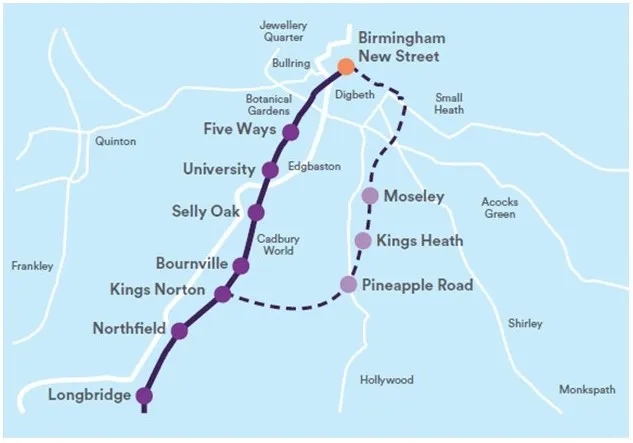
Each station will have two platforms for six-carriage trains, bike parking, ticket machines, information screens and lifts.
There will also be pick up and drop off zones at Moseley Village and Pineapple Road stations.
This also means that the stations will gain services for the first time since World War II.
The services will call at each of the stations every 30 minutes, with destinations including Birmingham New Street and Kings Norton.
It is estimated that the reopened stations will cut journey times to Birmingham New Street by between nine and 31 minutes.
As for the two stations between Wolverhampton and Walsall – Darlaston and Willenhall – there will be train services for the first time since 1965 when the stations were both closed.
To begin with, there will be two services an hour between Wolverhampton and Birmingham.
A direct service to Walsall town centre, known as the ‘leather capital of the world’ due to its leatherworking history, is also being discussed with the Department for Transport and Walsall Council.
In total, the two stations have cost £85million to reopen.
Walsall Council hopes that the stations will better connect local residents to the wider region, as well as create more opportunities for people to travel, whether that be for holidays or for work.
Richard Parker, Mayor of the West Midlands, said: “For some communities, this is the first time in more than 80 years they’ve had their own train service.
“That changes everyday life. Getting to work, college or seeing family becomes simpler and quicker.
“It also means more people coming into town centres. More footfall for shops and cafés. More confidence for local businesses to invest and grow.
“This is what delivery looks like – backing places that have waited far too long for decent connections.”
“This [killing in Moscow] is a mode of warfare which would be referred to as, quote-unquote, irregular.”
The killing of a top Russian general is a “direct message” to senior Russian military leaders from Ukraine, says Marina Miron, of King’s College London.
Fans are convinced that The Pussycat Dolls have “confirmed” they are reunitin (Jessica Sutta, Kimberly Wyatt, Nicole Scherzinger, Melody Thornton and Ashley Roberts pictured in 2008)Credit: GettyIt wouldn’t be the first time the band got back together, with an attempted reunion in 2019Credit: PA:Press AssociationNicole has had her fair share of trouble since leaving the band, including a highly-public feud and legal battleCredit: Getty
CAA music division head Rob Light and Paul Franklin – a specialist in reunion tours – are now set to manage the band in a telling move.
While Nicole teased the reunion this week by talking about “what’s to come” for the band.
Sharing a clip from their hit song Buttons, Nicole wrote: “From then to now… seeing this video hit 1 billion views on YouTube fills my heart with so much gratitude.
“For the PCD fans. For the memories. For what’s to come.”
At the time, a source said: “Kimberly has been open about the fact the girls have sorted out their issues.
“She also told pals they’ve been discussing a tour.
“The Pussycat Dolls certainly had their differences over the years, but a comeback would send fans wild.”
The Dolls started off as a burlesque troupe but in 2003 Nicole , Melody and Kaya joined Carmit, Ashley , Jessica and Kimberly to form the group.
They split in 2010.
This is not the first time a reunion has been on the cards, with multiple members of the band reuniting in 2019 before planning a 2020 tour, which was halted due to Covid-19.
It was later cancelled due to the pandemic and legal issues.
Robin claimed that Nicole was refusing to take part in the tour unless she received a larger share of the group’s joint firm.
She allegedly demanded her 49 per cent holding in the firm is increased to 75 per cent, giving her creative control of the group and “final decision-making authority”.
According to the lawsuit filed by Robin, Nicole said the “growth of her personal brand” and the “opportunities she would have to forego to engage in the partnership” was why she deserved an increased share.
However, in a fiery retaliation, former X Factor judge Nicole issued a statement through her lawyer, Howard King, in which she branded Robin’s claims as “ludicrous and false”.
Melody wasn’t involved in the last planned reunion after clashing with Nicole over singing the band’s lead vocals.
Robin Antin sued Nicole following the band’s 2019 reunion in what became a bitter legal battleCredit: GettyThe band originally rose to fame in 2003Credit: Getty
For decades, American families have gathered to watch “It’s a Wonderful Life” on Christmas Eve.
The 1946 Frank Capra movie, about a man who on one of the worst days of his life discovers how he has positively impacted his hometown of Bedford Falls, is beloved for extolling selflessness, community and the little guy taking on rapacious capitalists. Take those values, add in powerful acting and the promise of light in the darkest of hours, and it’s the only movie that makes me cry.
No less a figure of goodwill than Pope Leo XIV revealed last month that it’s one of his favorite movies. But as with anything holy in this nation, President Trump and his followers are trying to hijack the holiday classic.
Last weekend, the Department of Homeland Security posted two videos celebrating its mass deportation campaign. One, titled “It’s a Wonderful Flight,” re-creates the scene where George Bailey (Jimmy Stewart in one of his best performances) contemplates taking his own life by jumping off a snowy bridge. But the protagonist is a Latino man crying over the film’s despairing score that he’ll “do anything” to return to his wife and kids and “live again.”
Cut to the same man now mugging for the camera on a plane ride out of the United States. The scene ends with a plug for an app that allows undocumented immigrants to take up Homeland Security’s offer of a free self-deportation flight and a $1,000 bonus — $3,000 if they take the one-way trip during the holidays.
The other DHS clip is a montage of Yuletide cheer — Santa, elves, stockings, dancing — over a sped-up electro-trash remake of Mariah Carey’s “All I Want for Christmas is You.” In one split-second image, Bedford Falls residents sing “Auld Lang Syne,” just after they’ve saved George Bailey from financial ruin and an arrest warrant.
“This Christmas,” the caption reads, “our hearts grow as our illegal population shrinks.”
“It’s a Wonderful Life” has long served as a political Rorschach test. Conservatives once thought Capra’s masterpiece was so anti-American for its vilification of big-time bankers that they accused him of sneaking in pro-Communist propaganda. In fact, the director was a Republican who paused his career during World War II to make short documentaries for the Department of War. Progressives tend to loathe the film’s patriotism, its sappiness, its relegation of Black people to the background and its depiction of urban life as downright demonic.
Then came Trump’s rise to power. His similarity to the film’s villain, Mr. Potter — a wealthy, nasty slumlord who names everything he takes control of after himself — was easier to point out than spots on a cheetah. Left-leaning essayists quickly made the facile comparison, and a 2018 “Saturday Night Live” parody imagining a country without Trump as president so infuriated him that he threatened to sue.
But in recent years, Trumpworld has claimed that the film is actually a parable about their dear leader.
Trump is a modern day George Bailey, the argument goes, a secular saint walking away from sure riches to try to save the “rabble” that Mr. Potter — who in their minds somehow represents the liberal elite — sneers at. A speaker at the 2020 Republican National Convention explicitly made the comparison, and the recent Homeland Security videos warping “It’s a Wonderful Life” imply it too — except now, it’s unchecked immigration that threatens Bedford Falls.
The Trump administration’s take on “It’s a Wonderful Life” is that it reflects a simpler, better, whiter time. But that’s a conscious misinterpretation of this most American of movies, whose foundation is strengthened by immigrant dreams.
Director Frank Capra
(Handout)
In his 1971 autobiography “The Name Above the Title,” Capra revealed that his “dirty, hollowed-out immigrant family” left Sicily for Los Angeles in the 1900s to reunite with an older brother who “jumped the ship” to enter the U.S. years before. Young Frank grew up in the “sleazy Sicilian ghetto” of Lincoln Heights, finding kinship at Manual Arts High with the “riff-raff” of immigrant and working-class white kids “other schools discarded” and earning U.S. citizenship only after serving in the first World War. Hard times wouldn’t stop Capra and his peers from achieving success.
The director captured that sentiment in “It’s a Wonderful Life” through the character of Giuseppe Martini, an Italian immigrant who runs a bar. His heavily accented English is heard early in the film as one of many Bedford Falls residents praying for Bailey. In a flashback, Martini is seen leaving his shabby Potter-owned apartment with a goat and a troop of kids for a suburban tract home that Bailey developed and sold to him.
Today, Trumpworld would cast the Martinis as swarthy invaders destroying the American way of life. In “It’s a Wonderful Life,” they’re America itself.
When an angry husband punches Bailey at Martini’s bar for insulting his wife, the immigrant kicks out the man for assaulting his “best friend.” And when Bedford Falls gathers at the end of the film to raise funds and save Bailey, it’s Martini who arrives with the night’s profits from his business, as well as wine for everyone to celebrate.
Immigrants are so key to the good life in this country, the film argues, that in the alternate reality if George Bailey had never lived, Martini is nowhere to be heard.
Capra long stated that “It’s a Wonderful Life” was his favorite of his own movies, adding in his memoir that it was a love letter “for the Magdalenes stoned by hypocrites and the afflicted Lazaruses with only dogs to lick their sores.”
I’ve tried to catch at least the ending every Christmas Eve to warm my spirits, no matter how bad things may be. But after Homeland Security’s hijacking of Capra’s message, I made time to watch the entire film, which I’ve seen at least 10 times, before its customary airing on NBC.
I shook my head, feeling the deja vu, as Bailey’s father sighed, “In this town, there’s no place for any man unless they crawl to Potter.”
I cheered as Bailey told Potter years later, “You think the whole world revolves around you and your money. Well, it doesn’t.” I wondered why more people haven’t said that to Trump.
When Potter ridiculed Bailey as someone “trapped into frittering his life away playing nursemaid to a lot of garlic eaters,” I was reminded of the right-wingers who portray those of us who stand up to Trump’s cruelty as stupid and even treasonous.
And as the famous conclusion came, all I thought about was immigrants.
People giving Bailey whatever money they could spare reminded me of how regular folks have done a far better job standing up to Trump’s deportation Leviathan than the rich and mighty have.
As the film ends, with Bailey and his family looking on in awe at how many people came to help out, I remembered my own immigrant elders, who also forsook dreams and careers so their children could achieve their own — the only reward to a lifetime of silent sacrifice.
The tears flowed as always, this time prompted by a new takeaway that was always there — “Solo el pueblo salva el pueblo,” or “Only we can save ourselves,” a phrase adopted by pro-immigrant activists in Southern California this year as a mantra of comfort and resistance.
It’s the heart of “It’s a Wonderful Life” and the opposite of Trump’s push to make us all dependent on his mercy. He and his fellow Potters can’t do anything to change that truth.
The PGMOL, the body responsible for refereeing all Premier League matches, has been approached for comment.
Newcastle were 2-1 up at the time, but Chelsea forward Joao Pedro equalised midway through the second half after a slip by Malick Thiaw.
No team have thrown away more points – 13 – from winning positions in the Premier League this season than Newcastle.
They are 11th in the table, have won only once away from home and travel to Manchester United on 26 December.
“My glass is very much half full,” said Howe. “I know everyone else might have a different opinion, but I feel we’re improving.
“We have been moving in the right direction, but we have got lots of work to do to be the team that we ultimately want to be and that’s consistently winning.
“That’s what’s eluded us this season – the ability to put winning runs together, which is the defining thing we need to do.”
The line at Holbox during the midweek lunch hour has become a cultural sensation, a queue of locals and visitors trailing past the automatic doors and around the parking lot like devotees angling for the latest iPhone series or limited-release sneakers. Believe the lauds, including ours when we named Holbox as The Times’ 2023 Restaurant of the Year. Gilberto Cetina’s command of mariscos is unmatched in Southern California – his ceviches, aguachiles and tostadas revolutionary in their freshness and jigsaw-intricate flavors. The smoked kanpachi taco alone — clinched with queso Chihuahua and finished with salsa cruda, avocado and drizzles of peanut salsa macha — is one of the most sophisticated things to eat in Los Angeles.
Holbox could be considered for the top ranking on its own strength. But in a year when disasters tore at our city, honoring the power of community feels more urgent than ever. Cetina’s seafood counter doesn’t thrive in a vacuum. Holbox resides inside the Mercado La Paloma in South L.A. The mercado is the economic-development arm of the Esperanza Community Housing Corp., a nonprofit organization founded in 1989 that counts affordable housing and equitable healthcare among its core missions. When the mercado was in the incubation stage, Esperanza’s executive director Nancy Ibrahim interviewed would-be restaurateurs about their challenges and hopes in starting a business. Among the candidates was Cetina’s father, Gilberto Sr., who proposed a stall serving his family’s regionally specific dishes from the Yucatán. Their venture, Chichén Itzá, was among the eight startups when the mercado opened in a former garment factory nearly 25 years ago, in February 2001.
Step into the 35,000-square-foot market today, and the smell of corn warms the senses. Fátima Juárez chose masa as her medium when she began working with Cetina at Holbox in 2017. Komal, the venue she opened last year with her husband, Conrado Rivera, is the only molino in L.A. grinding and nixtamalizing heirloom corn varieties daily. Among her deceptively spare menu of mostly quesadillas and tacos, start with the extraordinary quesadilla de flor de calabaza, a creased blue corn tortilla, bound by melted quesillo, arrayed with squash blossoms radiating like sunbeams.
Wander farther, past the communal sea of tiled tables between Holbox and Komal, to find jewels that first-timers or even regular visitors might overlook.
Taqueria Vista Hermosa, run by Raul Morales and his family, is the other remaining original tenant. Order an al pastor taco, or Morales’ specialty of Michoacan-style fish empapelado smothered in vegetables and wrapped in banana leaf. The lush, orange-scented cochinita pibil is the obvious choice next door at still-flourishing Chichén Itzá, but don’t overlook crackling kibi and the brunchy huevos motuleños over ham and black bean puree. The weekends-only tacos de barbacoa de chivo are our favorites at the stand called Oaxacalifornia, though we swing through any time for the piloncillo-sweetened café de olla and a scoop of smoked milk ice cream from its sibling juice and snack bar in the market’s center. Looking for the comfort of noodles? Try the pad see ew at Thai Corner Food Express in the far back.
The everyday and the exquisite; the fast and the formal (just try to score a reservation for Holbox’s twice-a-week tasting menu); a food hall and sanctuary for us all. Mercado La Paloma embodies the Los Angeles we love.
Under the glow of fluorescent lights at Seafood City market in North Hills, packages of pre-made adobo, salted shrimp fry and and dried anchovies glisten in meat coolers.
A DJ, dressed in a traditional barong, blasts a dance remix of Whitney Houston’s “I Wanna Dance with Somebody” as a crowd gathers to take a shot of fish sauce together.
“That was disgusting!” a man shouts into the mic, flashing a grimacing expression.
At Seafood City, DJs 1OAK, left, EVER ED-E and AYMO spin in barongs, the Philippines’ national formal shirt.
The smells of lechon and lumpia float through the air. Smiling children munch on halo-halo (a Philippine dessert made with ube ice cream, leche flan and shaved ice). Flags of the Philippines wave in the air as a man in UCLA Health scrubs hops into the center of an energetic dance circle. Employees shoot store coupons out of a money gun and toss bags of Leslie’s Clover Chips into the crowd. Fathers hold their children on their shoulders as a group of college students perform a Tinikling routine, a traditional Philippine dance in which performers step and hop over and between bamboo poles.
“This is so Filipino,” a woman says, in awe of the scene.
Sabria Joaquin, 26, of Los Angeles, left, and Kayla Covington, 19, of Rancho Cucamonga hit the dance floor at “Late Night Madness” in North Hills.
“I came here for groceries,” explains an elderly man, adding that he decided to stay for the party.
Seafood City, the largest Philippine grocery store chain in North America, typically closes at 9 p.m. But on certain Friday and Saturday nights, its produce or seafood aisle turns into a lively dance floor for “Late Night Madness.” On social media, where the gathering has exploded, it looks like a multigenerational nightclub that could use dimmer lighting. But for attendees who frequent the store, it’s more than that. It’s a space for them to celebrate their Filipino heritage through food, music and dance in a familiar setting.
“This is something that you would never expect to happen — it’s a grocery store,” says Renson Blanco, one of five DJs spinning that night. He grew up going to the store with his family. “My mom would [put] us all in the minivan and come here, and she’d let us run free,” he adds. “It’s comfortable here. It’s safe here.”
1
2
3
1.Rhianne Alimboyoguen, 23, of Los Angeles follows an employee through the produce section.2.Allison Dove, 29, left, and Andrea Edoria, 33, both of Pasadena, enjoy Philippine street food. 3.Katie Nacino, 20, left, Daniel Adrayan, 21, and Sean Espiritu, 21, of the Filipino American Student Assn. at Cal State Northridge, practice tinikling, a traditional Philippine folk dance, in an aisle.
The first Seafood City location opened in 1989 in National City, a suburb of San Diego, which has a nearly 20% Asian population including a rich Filipino community. For its founders, the Go family, the mission was simple: to provide a market where Filipinos and people within the diaspora could comfortably speak their native language and buy familiar products. It’s since become a community anchor. Of the nearly 40 locations in Northern America, at least half of them are based in California, which has the highest population of Asian Americans in the United States.
Share via
The first “Late Night Madness” event happened in September in Daly City, Seafood City’s newest location. The company wanted to launch a street food program at the store’s food hall in a fun and creative way.
The DJ played a selection of hip-hop, pop, soul and classic Pinoy records like VST & Company’s “Awitin Mo, Isasayaw Ko.” Hundreds of people showed up, and videos of people of all ages turning up in the popular supermarket spread like wildfire. So the company decided to continue hosting the event in October during Filipino American History Month and for the rest of the year. It’s since expanded to more locations around the country and in L.A., including Eagle Rock.
By 10 p.m. at the Seafood City in North Hills, at least 500 people are dancing in the produce section, next to rows of saba bananas, fresh taro leaves and bok choy. The lively crowd forms dance circles throughout the night, taking turns jumping in the center to show off their moves to songs like Earth, Wind & Fire’s “Let’s Groove,” “Nokia” by Drake and Justin Bieber’s “I Just Need Somebody to Love.” At one point, TikToker and artist Adamn Killa hops on the mic and says “If you a Filipino baddie, this is for you,” before doing his viral dance.
Among the Philippine street food offerings were pandesal sliders, lumpia-style nachos, lobster balls and various skewers.
(Christina House/Los Angeles Times)
(Christina House/Los Angeles Times)
(Christina House/Los Angeles Times)
A group of employees dance behind the counter as they serve hungry patrons who fill their trays with various Filipino street food including pandesal sliders (soft Philippine bread filled with adobo, lechon or longganisa) and Lumpia Overload (think nachos, but a bed of lumpia instead of tortilla chips), lobster balls and barbecue chicken skewers. (No alcohol is served.) Meanwhile, a few lone shoppers sprinkle into the store to get their weekly groceries as music blasts through the speakers.
First-generation Filipino American Andrea Edoria of Pasadena says “Late Night Madness” reminded her of the family parties she attended as a child in L.A. and in Manila, where her parents are from.
“Growing up as a child of immigrants, I was kind of self conscious about displaying too much of my culture,” she says between bites of spiral fried potato. She went to the Eagle Rock event with her mother last month as well. “So it kind of fed my inner child to see so many people celebrating this shared culture and experience that we each grew up [with].”
A multi-generational crowd is drawn to the dance floor. At center is Jade Cavan, 44, of Chatsworth.
Members of the Filipino American Student Assn. at Cal State Northridge perform a tinikling performance.
She adds, “I think it’s so important especially now at a time where our country is so divisive and culture is kind of being weaponized, I think it’s a beautiful reminder that we can come together and find something that unites us.”
About 10 minutes before midnight, the grocery store is still bustling with activity. A dance battle breaks out and people begin hyping up the young women. The DJ transitions into slower tracks like Beyoncé’s “Love on Top” and Mariah Carey’s “All I Want for Christmas is You.” The remaining folks sing along loudly as they walk toward the exit, smiles imprinted on their faces. Staff rush to clean up, then huddle together for group photos to memorialize the evening.
After the final song is played, employees rush to clean up the supermarket.
Patrick Bernardo, 34, of Van Nuys looks at the counter, where a man had been chopping lechon, before stepping outside.
“There’s barely anything left on that pig,” he says, pointing to it as proof that the night was a success.
Chef Zachary Pollack is ringing in the New Year right with a variety of dinner options at his new Santa Monica spot, Cosetta. Choose from three seatings, including an early, all-ages a la carte option; a low-key, four-course menu from 6 to 7:30 p.m. for $75; and a five-course Capodanno feast with Champagne and caviar from 8-11 p.m. for $120 per person. On New Year’s Day, the restaurant will transform into “Aloha, Cosetta,” an all-day Hawaiian BBQ celebration from 12 to 7 p.m., featuring dishes such as coconut shrimp, risotto Spam musubi, macadamia-chile pork ribs and tiki-style cocktails. With three price tiers, the top CHIEFTAIN tickets ($100) include tomahawk steaks, lobsters and a 24-ounce mai tai in a keepsake mug. Book New Year’s Eve on the website, and New Year’s Day via Resy.