The main ingredient in lomo saltado, the juicy, stir-fried comfort dish of my childhood, only takes a minute to cook. It can go by in such a flash that you can miss it if you’re not paying attention, so I always made sure to watch for that moment when the flames go up.
I remember standing in rapt attention at the edge of the stovetop as my mom tossed fresh, thinly sliced beef into an oiled pan set on maximum heat. The steak hissed and leaped in a dramatic dance as flames licked the pan from underneath. My mom turned to me and said, “This is why it’s called lomo saltado: the lomo is the steak, and watch how it’s saltando — jumping.”
“The secret is in the smoke,” says Miriam Ramirez, owner of Lonzo’s Restaurant in Culver City. “When you cook lomo saltado, the room should be filled with the smell of smoke. I remember getting it for lunch in Peru and thinking, ‘Oh no, my hair smells like smoke!’ But that’s how I knew it would be good.”
Lomo saltado consists of tomato, onion and bell pepper, seared with steak, traditionally in a wok, and served with sides of rice and potato fries. Peruvians call soy sauce, which is used generously in the dish, “sillao” (pronounced see-yow).
Newcomers to Peruvian cuisine might be surprised to find that soy sauce has a major place in recipes. My Peruvian family always says that in any good meat dish, sillao is the secret ingredient.
“When the dish is already so simple, every ingredient matters,” Ramirez says.
“See-yow” is also the pronunciation for soy sauce in Cantonese. Understanding how a Cantonese word entered Peru’s lingo is a long historical lesson that can be best explained by another Chinese-Peruvian word: chifa. Chifa, which comes from the Mandarin word “chīfàn,” meaning to eat, describes the thriving Chinese-Peruvian fusion cuisine and indirectly, the immigrant history of Peru.
According to researcher Patricia Palma, Chinese immigrants arrived in Peru in the mid-19th century, as laborers after the abolishment of slavery created a demand for cheap labor. As this population grew over the years, Chinese-Peruvian descendants carved out a niche in chifa that reflected their heritage alongside centuries-old Peruvian staples.
“L.A. is so diverse and that’s why I think Peruvian food draws people in. It has a multicultural identity too,” says Benny Gomez, owner of Rosty Peruvian Food in Highland Park. “There’s Chinese and Japanese communities who identify with the Asian influence but also Mexican people who are seeing a different type of Latino food.”
Peru’s lomo saltado is not only a beautiful marriage of the two cultures, but a perfectly balanced ode to each culture’s culinary traditions: Peru is reflected in the potatoes, aji amarillo and bell pepper, and China in the stir-fry technique and of course, the sillao.
“Peruvian food has 14,000 years of history,” says Ignacio Barrios Jacobs, lead chef of Merka Saltao in Culver City. “I think [lomo saltado] holds the story of Chinese immigrants who were cooking their food for people who said, ‘this needs my potato and chile peppers.’”
In Culver City, East Hollywood, and the San Fernando Valley, Peruvian restaurants are combining traditional flavors with distinctly Angeleno flair, like saltado burritos or California oak wood-fired rotisserie chicken.
“When my dad opened his Peruvian restaurant 30 years ago, Peruvian was not popular at all in L.A.,” says Dennis Tamashiro, owner of Mario’s Peruvian and Seafood. “Now, people are paying attention, because it proves that it’s unique.”
Here are eight takes on lomo saltado to try in Los Angeles, from classic versions that remind me of home, to creative takes that make the dishes distinctly L.A.
L.A. has a long, storied history of hotels with deep musical connections. From the Hyatt House (now the Andaz) on Sunset Boulevard, known as the infamous “Riot House” as remembered in Cameron Crowe’s Oscar-winning “Almost Famous,” to Chateau Marmont and the iconic Sunset Marquis, both famed homes to touring rock stars for decades. But few, if any, have ever been as ambitious musically as West Hollywood’s Sun Rose Hotel.
Opening as the Pendry Hotel in 2021 on the location of the former House of Blues, the Sunset Boulevard property established its music credentials immediately by including Live at the Sun Rose, a state-of-the-art music venue inside the hotel. Four years later, last August, the Pendry was rebranded as the Sun Rose Hotel and the entire hotel became a sort of musical destination according to Grammy-winning musician/creative director Adam Blackstone.
Inside the lobby at the Sun Rose West Hollywood
(The Sun Rose West Hollywood)
“We have the atrium, the downstairs foyer, we have a bowling alley. There are so many things we can offer to the music space that other venues can’t. We’re going to use the entire rooftop, sometimes maybe play on top of the pool. Things like that are going to be an attraction to people that allow us to do some very incredible things,” Blackstone says. As Grammy season approaches, Blackstone says the hotel/venue will be offering full shows and events that you don’t have to leave the property for and will include more one-of-a-kind performances. “People can come play a 90-minute set that is not what they did the night before. Whoever is in that room gets a once-in-a-lifetime experience.”
Blackstone, who has played with everyone from Rihanna, Janet Jackson and Demi Lovato to Eminem, Dr. Dre and Al Green, prides himself on bringing the same diversity and surprise to the Sun Rose. “That’s how my legacy shows have been going — you never know who’s going to pop up, but you don’t want to miss it.”
To back up his claim, he cites bringing in surprise guests like John Legend, multiple times, Stevie Wonder, Justin Timberlake and more, as well as Dre for a live Q&A. That is only the beginning of his ambitious plans to make the Sun Rose a treasure trove of unexpected musical moments. “I am so excited about this partnership with Sun Rose. I think we have the power to be expansive in a way bigger role than anything in L.A. It’s not a jazz spot, a country spot or a gospel spot — we can do whatever there. We could have a DJ with a salsa band; I’ve had a Q&A with Dr. Dre and Marsha Ambrosius. That’s one of the highlights, and attractions the Sun Rose brings to L.A. for me, any time you walk in there, if you don’t know what you’re going for, you’re going to be in for an experience,” he says.
As for what some of those experiences might be, Blackstone references his wide range of gigs, like a recent one working with Andrea Bocelli at the Vatican, as an example of how creative he can get. “All of these things that are in my mind I’m going to do for other people, I’m going to be able to do at my spot,” he says. “And it won’t be weird coming from me because that is who I am, that is who I embody in music, that is who I’ve been able to work with. I’m thankful the Sun Rose is welcoming that with the mindset I have to be as creative and expansive as possible.”
Bowie’s Piano Man, Mike Garson, at Live at The Sun Rose
(Michelle Shiers/The Sun Rose West Hollywood)
To their credit, the Sun Rose is embracing that kind of artistic expression. It starts with Sharyn Goldyn, who books the music at the venue. She set the tone early by making pianist Mike Garson, best known for his work with David Bowie, but well versed in jazz and classical, the first artist she spoke to. She says he is exactly the type of artist she wanted to build the venue on.
“I knew I wanted to have a backbone of the best musicians in the world, and of legacy artists. So, Mike was the first person I met with, and he was just so open to ideas and building something,” she says.
Garson, the venue’s artist in residence, loves the core of him, Blackstone and Goldyn, as well as not being on the road all year.
“Adam is a wonderful musical director, and we bring what we bring. I was flattered that I was the original person Sharyn came to. But I had done so much touring with Bowie alumni after he passed, I somewhat got burnt out on it. I’m 80, so it’s nice to be home in 20 minutes. I do 30 or 40 shows a year and I do 10 at the Sun Rose and there’s nothing being compromised about my music,” he says. “I do whatever I want at the Sun Rose because I open up most of the sets with a jazz piece because that is my roots, then we move into the vocals. The vocals become duets like I did with David and not just me accompanying some song. I look for, ‘What can I add to “Space Oddity’” today?’ I stretch the limits, which is what David would have wanted me to do. He never believed in the comfort zone.”
Bowie will be celebrated in a special three-night residency this Thursday, which is his birthday, Friday and Saturday, the 10-year anniversary of his passing. Just as Blackstone does, Garson will be bringing in a number of friends. “This club’s really special because we work it with great singers. I’ve had Judith Hill there, I’ve had Luke Spiller, Evan Rachel Wood and now of course for David’s birthday and the 10-year celebration, we have a lot of great people,” he says. “We’ll have Billy Corgan [on] Saturday night and Andra Day on Friday and Judith Hill and Luke Spiller’s coming again, and a lovely singer named Debby Holiday. I’ll have Chad Smith stop in on Saturday night to play some drums from the Red Hot Chili Peppers. And I’m going to do a lot of the Bowie hits and a few obscure ones.”
Garson will be traveling to Dublin in February and celebrating his near 50-year friendship and musical relationship with Bowie. But he is choosing to spend Bowie’s birthday at the Sun Rose. It is not only the proximity to his home that appeals to Garson. “I’ve been the resident artist there for three years and I’ve done 46 shows there. I like the intimacy, I like the piano in the center stage of the room and I love working with Sharyn. After playing the Hollywood Bowl and Madison Square Garden with Bowie and Duran Duran, whatever, Nine Inch Nails, Smashing Pumpkins, I like the small clubs now,” he says.
Similar to Vegas hotels that book the biggest music superstars, like Adele or Rod Stewart, for extended residencies, the Sun Rose will make the Bowie experience a weekend retreat in the whole hotel.
“We’re able to bring the Bowie experience to other things, such as Bowie cocktails named after different songs and maybe changing our menu and maybe changing the suite names of the hotels. This celebration, particularly, we’re doing a hotel package. Because Mike only plays these particular shows at the Sun Rose, a lot of people fly in for it,” Goldyn says.
Rooftop pool at the Sun Rose in West Hollywood
(The Sun Rose West Hollywood)
Fans can expect that more as the hotel takes on the identity of the club. “Now that the hotel has taken on the name of the music venue, they really want the music venue to be a focus and something that the hotel is really proud of and highlighting. We’re going to really try and push a full property experience so you can get tickets to the show, stay at the hotel and never really leave the property,” she says.
Blackstone believes the success of the music club, under his artistic guidance, is what ultimately inspired the hotel’s name change. “I think what prompted the name change of the hotel was just seeing how the music space has impacted the hotel space in a great way. So, if we can continue the music experience going throughout the whole hotel, what better way to do that than have me curate not just the music room, but curate the entire hotel space?” he says.
After so many years on the road with other artists, Blackstone is thrilled to have what he calls his “playground.” “It feels so incredible; I’m able to try out some new ideas. One of the first things I want to do is to use the rooftop or bowling alley to do an all-day showcase of new music, new styles and new genres in different areas of the hotel. We’re going to start that, I’m going to curate that, get some incredible artists that always end up being your new favorite artist once you hear them,” he says. “I think that’s the other component I failed to mention: My reach has been able to permeate the entire globe. Now I can bring that reach directly to the Sun Rose.”
Singer-songwriters Lisa Simmons-Santa Cruz and her husband Francisco Carroll Santa Cruz were going through a challenging time last March when they worked on Snoop Dogg’s 2025 gospel album, “Altar Call.”
“We were actually writing all those songs in a hotel, displaced,” Carroll Santa Cruz said.
The couple, who have worked in the entertainment industry for more than 29 years writing and producing music for artists like Kelly Rowland and television shows such as “Desperate Housewives,” had lost their Altadena home in the Eaton fire a few months earlier.
Still, the platinum singer-songwriters didn’t want to pass up the opportunity, which came up during the final week of their hotel stay when Simmons-Santa Cruz and Carroll Santa Cruz were introduced to Snoop Dogg through artists Charlie Bereal and Point 5ve. Although Snoop Dogg had also set up a donation center for fire victims, the couple chose not to share their own displacement with him or anyone else in the music industry.
“We needed something the fire couldn’t burn and that was our music,” Simmons-Santa Cruz said. “At that time, we needed something separate from the fire — something that the fire couldn’t touch, it was too traumatic to keep revisiting what we’d lost, so our work became our peace and our escape.”
Despite the loss of their home studio and the limitations of working from a hotel room, they successfully completed the project in a short amount of time. Simmons-Santa Cruz later described the experience as “divine intervention in the midst of tragedy,” saying the music gave them space to heal through faith while doing what they loved most.
“It was comforting, we didn’t have to focus on the fire or what was lost, the music gave us a moment to reflect on life, and it became a saving grace,” she said.
The couple had originally resided in the Altadena home with Simmons-Santa Cruz’s 77-year-old mother, who first bought the house in 1974. In the aftermath of the fires, the couple was forced to figure out where they were going to live as they also grappled with the immense paperwork, bills and insurance claims that came with the loss of their home.
MusiCares, a health and welfare charity for musicians founded by the Recording Academy in 1989, offered them assistance.
“They were like, the FEMA of the music industry,” Simmons-Santa Cruz said.
According to Theresa Wolters, executive director of MusiCares, the organization supports the music community through direct financial assistance for basic living, medical, mental health and substance use needs, as well as free preventive healthcare. One year after the Los Angeles wildfires, MusiCares has directed more than $15 million toward relief and recovery, reaching over 3,200 music professionals affected by the disaster.
When MusiCares stepped in to provide emergency funds for Simmons-Santa Cruz and her husband, it also offered to replace an important instrument for her. Her father, who died seven years ago, helped her pick her first guitar, but the guitar was left behind when the fire broke out.
“That guitar was very sentimental for me,” she said.
Nothing can ever replace the personal memory tied to the guitar, but Simmons-Santa Cruz says that MusiCares offered her hope through this deed, and the new guitar represents that.
“I just broke down, I just started crying, because I’m like, who replaces a guitar? … The last thing that was on my mind was replacing our equipment because we’re still in survival mode,” she said.
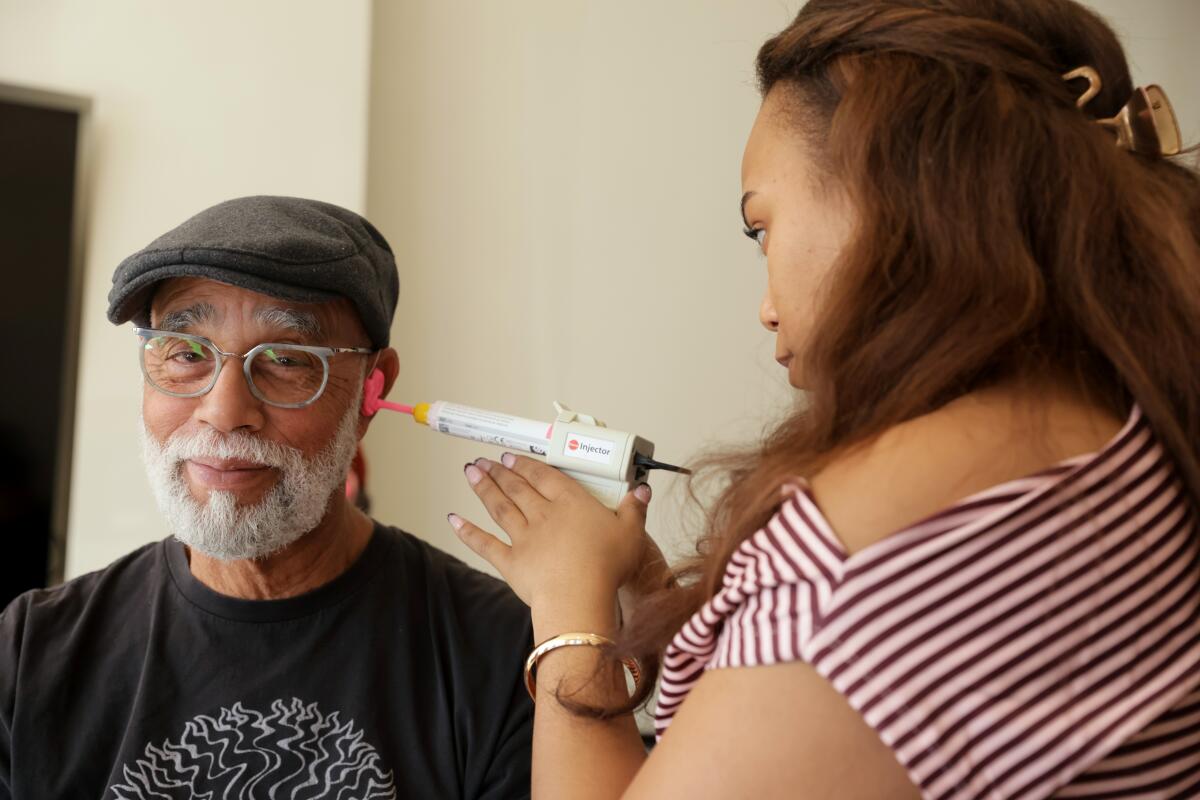
Drummer Darryl “JMD” Moore” getting fitted for custom ear molds for his live performances at MusiCares Altadena Health and Wellness Clinic at Grammy Museum L.A. Live
(Rebecca Sapp/Getty Images for The Recording Academy)
The couple is living in a rental and continuing to deal with the fallout of the fires, still unable to rebuild their house because of the financial costs. Since the fires, many other music professionals have faced similar hardships, like music producer and drummer Darryl “JMD” Moore, who still has to pay the mortgage on the home he lost while rebuilding another one “like for like” as mandated by the mortgage bank.
“I wanted to build a home for my children, and my grandchildren, my descendants, that would serve them financially and in every other way it could, because I know this property is valuable, my house doubled in value, it was worth twice what I paid for,” Moore said. “But our insurance is not paying us enough money to build the same house, it’s like hundreds of thousands of dollars short, so everybody like us, we’re in a scramble to get the money to fill in the gaps.”
After years of renting in Altadena, Moore finally bought his first home there in 2011, a purchase made possible thanks to his success in the music industry. Moore is known in both the jazz and hip-hop music scenes, having produced acts like the Pharcyde and Freestyle Fellowship while also drumming for jazz greats like Horace Tapscott. Moore originally grew up in South L.A., where he started playing drums at 13, focusing on R&B and funk before eventually being mentored by the renowned jazz saxophonist and singer Elvira “Vi” Redd.
When the Eaton fire began to crawl toward Moore’s house, he said he quickly packed his most important possessions. He took an archival hard drive which contained his music from 2004 to the present, but everything else burned: his recording studio, archival tapes and reels, and his favorite drum set, a vintage 1965 Rogers Holiday kit he bought in the ‘80s.
“I played on albums and records with that Rogers kit, when I moved to New York in ’89, I took that Rogers kit with me, and I pushed that kit down the street every night from the East Village to the West Village to work,” Moore said. “I can get one that looks just like it if I was willing to spend the $4,000, but was it in the back of the subway, did I play it on Bleecker Street?” the jazz drummer said.
Immediately after the fire took his home, Moore needed to work, but he no longer possessed the peripherals and equipment he required to record. MusiCares donated thousands of dollars’ worth of equipment he needed, including a drum set, and it also provided grants to help him pay both his mortgage and the rent where he’s currently staying. Moore has a long way to go before he completely recovers financially, but he says the organization made a significant impact in his life this past year, and he’s grateful.
“My studio’s back online, I’m able to practice, I’m able to work and do some gigs … it gave me my voice back, really, that was the beginning of everything,” the hip-hop producer said.
For Gwendolyn Sanford and Brandon Jay, a married couple raising a 16-year-old and a 9-year-old, the emotional weight has been just as significant as the financial burden that followed. The couple said they’ve been proactive in prioritizing the mental well-being and happiness of their children since losing their Altadena home.
“It was harder for them early on, when we were moving so frequently, we didn’t have any control over it, we were just trying to get somewhere stable to be, and I think they were processing the loss when they were sad that we didn’t have our home,” Sanford said.
Sanford and her husband are singer-songwriters and have scored music for television shows like “Weeds” and “Orange Is the New Black.” The couple is also in a children’s music band called Gwendolyn and the Good Time Gang, and they recently composed music for the off-Broadway show “Romy and Michele the Musical.”
Like many others, the couple lost their personal recording studio, making work difficult. The stress has been immense for the couple, but they said MusiCares was able to ease some of the financial burden when the organization offered them grants to cover their mortgage, which they are still on the hook for.
Darryl “JMD” Moore in front of his home that burned down in the wildfires, taken in 2023.
(Darryl “JMD” Moore)
“There’s all the red tape and hurdles and things we have to do just to rebuild our home, so that in itself is like a full-time job that we never wanted, on top of just our regular lives raising our kids and doing work,” Jay said. “So, to have the support of someone like that and have them say you don’t have to worry about this one aspect for a while, is invaluable.”
Recently, Sanford was asked to perform at a groundbreaking ceremony her former Altadena neighbor was having for a new house being built there. Sanford’s daughter had not wanted to go back to the neighborhood, but she decided to accompany her mother anyway. The return was cathartic.
“She was able to walk around our lot and have a private moment, and I asked her how she felt, and she said, ‘I feel safe here, this is my home,’” Sanford said.
At the event, Sanford sang a song she penned in 2011 called, “Acorn,” which was inspired by the grandeur of oak trees and what they symbolize in nature. The song has taken on a different meaning for her in the wake of the fires.
“The acorn is a metaphor, and I think that’s kind of where we all are right now, we have to start over, we have to start small, and eventually we’ll get back to where we were,” Sanford said.
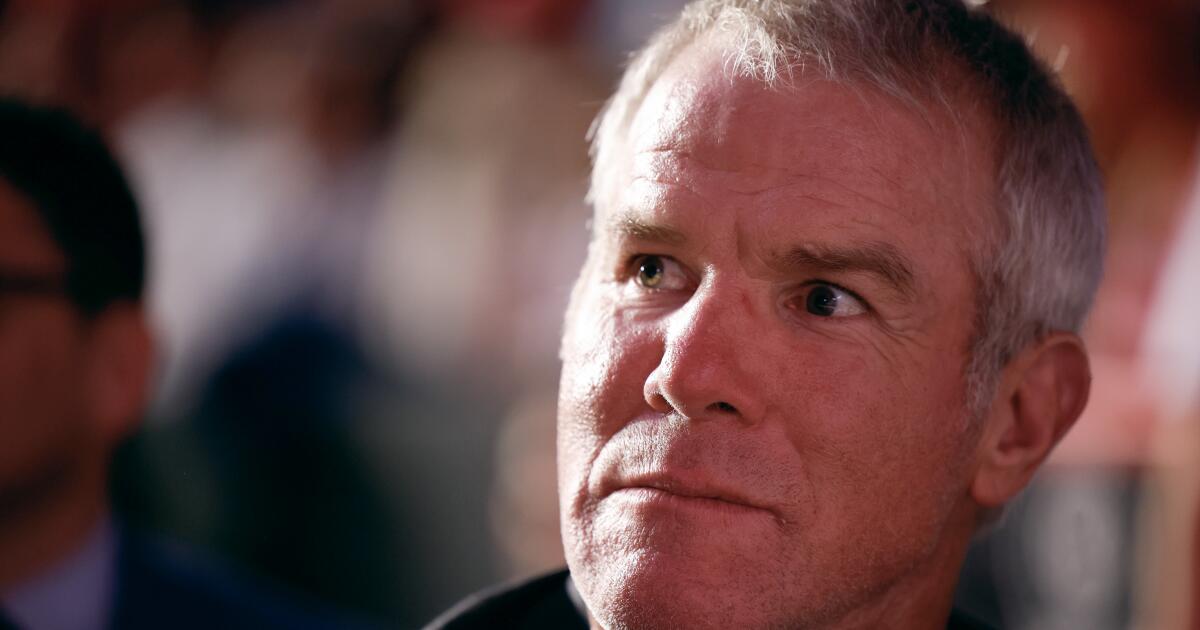
Hall of Fame quarterback Brett Favre said Wednesday that anyone who says he has thrown in the towel on his battle with Parkinson’s disease is spreading fake news.
“Thank you everyone for your prayers and concerns, but contrary to reports, I have not given up hope in my battle with Parkinson’s!” the 56-year-old Super Bowl champion wrote on X. “Not sure where this came from — but just like I never gave up on the gridiron — not going to start now. I pray there will be a cure one day and I appreciate you all.”
Favre also told TMZ on Wednesday: “I have absolutely not given up and I am fighting till the end. Yes I have progressed a little faster than I would have hoped at this point but I’m extremely thankful and blessed!!!”
On the podcast, Favre sounds like he’s trying to be realistic about his condition while also remaining hopeful.
“As you well know, there’s no cure,” Favre said. “I hear from time to time, ‘Well, they’re five years away from a cure.’ You know, I hope that that’s the case. I really do. But I’m not holding my breath.”
He mentioned Michael J. Fox and Muhammad Ali as people who “have really set the bar high on Parkinson’s and treatments and things of that nature.”
“And I’m sure that when they were diagnosed, they thought, ‘Well, they’ll have a cure in five years. I’ll be fine,’” Favre said. “Well, that’s not the case. So, I’m optimistic, but again, I’m not holding my breath.”
Favre’s comments on Wednesday may have been in response to a recent online article that seemed to interpret his podcast remarks in a different way than he intended.
Also on the podcast, Favre said he’s in the early stages of idiopathic Parkinson’s disease, which is the most common type of the disorder. He said his major symptoms are “rigidity and stiffness,” which is worst in the morning before he takes his medication and has particularly affected his right side.
Favre added that he occasionally experiences shaking but has not had any memory loss issues.
“All in all, I’m pretty good,” he said. “I would say I’ve progressed maybe a little. … If you dropped a dime on the floor in front of me and I reached down with my right hand, I may for five minutes try to pick up that dime and eventually just grab it with my left hand. Initially when I would take the medicine, my dexterity in my right hand was pretty smooth. But that’s not the case anymore.
“So that’s one of the reasons I think I may have progressed a little bit. Hopefully not. Maybe it’s I’m looking into something more than it really is, but all in all, again I’m very blessed and thankful.”
There are some things that make a person happy they’re not a millennial mom. Ashley Tisdale’s mommy group drama is one of those things.
Because Tisdale — now Ashley Tisdale French — sounds like she might be stuck in her own “High School Musical,” and it looks as if Hilary Duff’s husband just threw a stink bomb under the bleachers.
Adding to the drama: Duff and Mandy Moore are rumored to be part of the group, though Tisdale French has annoyingly refused to name names.
“Since becoming a public figure as a teenager, it’s often the thing I least expect that people most want to talk about,” the former child star wrote in an essay for New York Magazine that echoes what she wrote a while back on her own blog. “Sometimes, I’ll say something offhandedly, only to see it turn into a headline or start a conversation on TikTok.”
Bottom line, per the essay, is that Tisdale French — who married composer Christopher French in 2014 — was pregnant during the pandemic. She missed out on baby showers and prenatal yoga classes and handing her newborn baby off to acquaintances. Then a friend brought together a group of new moms.
“[F]inally, we were able to be together, and our kids were able to be together, and it all felt right,” she wrote.
The founder of the Being Frenshe line of personal care products thought she had joined a group of cool kids who did cool things.
“I felt energized by being around women who understood the challenge of feeding a baby while taking a Zoom call.”
She literally called them cool.
“[I]t made me hopeful about finding the balance between fulfilling work and family life, since all these cool women were able to do it. Maybe we’d be able to share our secrets to success.”
Then social media burst her bubble.
“I remember being left out of a couple of group hangs, and I knew about them because Instagram made sure it fed me every single photo and Instagram Story.”
She wrote that she realized her mommy group was just like high school.
“Even though it had been decades since tenth grade, the experience of being left out felt so similar.”
But now she was a grown-up, so she took a stand.
“So that’s exactly what I texted to the group after being left out from yet another group hang: ‘This is too high school for me and I don’t want to take part in it anymore.’”
People didn’t react well, she said. One mommy sent flowers, then didn’t acknowledge her thank-you. Another was like, “You weren’t invited? I thought you were.”
Then again, it also includes a Kathy Griffin essay about post-divorce dating at age 65 that includes some serious name-dropping — “It wasn’t my idea; it was all Sia and our friend Nia Vardalos’s fault. We were at Sia’s house, just being silly girls, when they dared me to do it.” — and a detailed discussion of condoms.
But back to Tisdale French.
“Why me? The truth is, I don’t know and I probably never will. What I do know is that it took me back to an unpleasant but familiar feeling I thought I’d left behind years ago.”
She was more specific about what happened in her older blog post, by the way.
“I realized that there were group text chains that didn’t include everyone, which led to cliques forming within the larger group. And after the third or fourth time of seeing social media photos of everyone else at a hangout that I didn’t get invited to, it felt like I wasn’t really part of the group after all.”
She also shared a revelation with her blog readers.
“If a mom group consistently leaves you feeling hurt, drained, or left out, it’s not the mom group for you. (Even if it used to be!) It’s no longer serving you in a way that lifts you up, and you don’t have to stay out of obligation or anything else.”
We will never know how far into either essay Hilary Duff’s husband got. We do know that Matthew Koma didn’t hesitate to pull out the Burn Book.
Koma got riled up enough over it that on Instagram, he mimicked Tisdale French’s repost of New York Magazine’s promotional post about the essay, slapping a picture of his own face over hers and changing the headline from “Breaking Up With My Toxic Mom Group” to his own: “When You’re The Most Self Obsessed Tone Deaf Person On Earth, Other Moms Tend To Shift Focus To Their Actual Toddlers,” with “A Mom Group Tell All Through A Father’s Eyes” as a sub-headline.
Alas, he posted it as an Instagram story, now expired, so we can imagine it only with the help of outlets such as People, which for the longest while has been writing about Reddit AITAH posts and the subsequent comments telling the original poster whether they are indeed the jerk in a particular situation. (Not that any jerks are being discussed here.)
Tisdale French doesn’t name names in her essay, but Koma’s reaction seems to indicate that former child star Duff, 38, might have been one of the allegedly mean moms who was definitely not being named. And Duff and Koma hosted former child star Moore, 41, and her family after last year’s Eaton fire in Altadena, when Moore’s home burned down, so some might bet on Moore also being among the mothers of small children in former child star Tisdale French’s group.
Tisdale French, meanwhile, apparently anticipated this kind of speculation in reaction to the New York essay because she had experienced it after blogging about the same topic. And apparently it’s all wrong, wrong, wrong.
“It’s a subject that has made women DM me to say ‘I feel seen’ and to share their most emotional stories with me,” she wrote for the magazine.
“It has also made wannabe online sleuths try to do some investigating like they’re on ‘CSI’ (please, don’t even try — whatever you think is true isn’t even close).”
Cool? Uncool? Christopher French, Ashley’s husband, may have made his own decision on that already.
“Underrated life skill,” French wrote on Wednesday morning in an Instagram story, quoting author and mindfulness coach Cory Allen. “Pausing to decide if it’s worth your energy.”
MIAMI — In 2017, as political outsider Donald Trump headed to Washington, Delcy Rodríguez spotted an opening.
Then Venezuela’s foreign minister, Rodríguez directed Citgo — a subsidiary of the state oil company — to make a $500,000 donation to the president’s inauguration. With the socialist administration of Nicolas Maduro struggling to feed Venezuela, Rodríguez gambled on a deal that would have opened the door to American investment. Around the same time, she saw that Trump’s ex-campaign manager was hired as a lobbyist for Citgo, courted Republicans in Congress and tried to secure a meeting with the head of Exxon.
The charm offensive flopped. Within weeks of taking office, Trump, urged by then-Sen. Marco Rubio, made restoring Venezuela’s democracy his driving focus in response to Maduro’s crackdown on opponents. But the outreach did bear fruit for Rodríguez, making her a prominent face in U.S. business and political circles and paving the way for her own rise.
“She’s an ideologue, but a practical one,” said Lee McClenny, a retired foreign service officer who was the top U.S. diplomat in Caracas during the period of Rodríguez’s outreach. “She knew that Venezuela needed to find a way to resuscitate a moribund oil economy and seemed willing to work with the Trump administration to do that.”
Nearly a decade later, as Venezuela’s interim president, Rodríguez’s message — that Venezuela is open for business — seems to have persuaded Trump. In the days since Maduro’s stunning capture Saturday, he’s alternately praised Rodríguez as a “gracious” American partner while threatening a similar fate as her former boss if she doesn’t keep the ruling party in check and provide the U.S. with “total access” to the country’s vast oil reserves. One thing neither has mentioned is elections, something the constitution mandates must take place within 30 days of the presidency being permanently vacated.
This account of Rodríguez’s political rise is drawn from interviews with 10 former U.S. and Venezuelan officials as well as businessmen from both countries who’ve had extensive dealings with Rodríguez and in some cases have known her since childhood. Most spoke on the condition of anonymity for fear of retaliation from someone who they almost universally described as bookishly smart, sometimes charming but above all a cutthroat operator who doesn’t tolerate dissent. Rodríguez didn’t respond to AP requests for an interview.
Father’s murder hardens leftist outlook
Rodríguez entered the leftist movement started by Hugo Chávez late — and on the coattails of her older brother, Jorge Rodríguez, who as head of the National Assembly swore her in as interim president Monday.
Tragedy during their childhood fed a hardened leftist outlook that would stick with the siblings throughout their lives. In 1976 — when, amid the Cold War, U.S. oil companies, American political spin doctors and Pentagon advisers exerted great influence in Venezuela — a little-known urban guerrilla group kidnapped a Midwestern businessman. Rodriguez’s father, a socialist leader, was picked up for questioning and died in custody.
McClenny remembers Rodríguez bringing up the murder in their meetings and bitterly blaming the U.S. for being left fatherless at the age of 7. The crime would radicalize another leftist of the era: Maduro.
Years later, while Jorge Rodríguez was a top electoral official under Chávez, he secured for his sister a position in the president’s office.
But she advanced slowly at first and clashed with colleagues who viewed her as a haughty know-it-all.
In 2006, on a whirlwind international tour, Chávez booted her from the presidential plane and ordered her to fly home from Moscow on her own, according to two former officials who were on the trip. Chávez was upset because the delegation’s schedule of meetings had fallen apart and that triggered a feud with Rodriguez, who was responsible for the agenda.
“It was painful to watch how Chávez talked about her,” said one of the former officials. “He would never say a bad thing about women but the whole flight home he kept saying she was conceited, arrogant, incompetent.”
Days later, she was fired and never occupied another high-profile role with Chávez.
Political revival and soaring power under Maduro
Years later, in 2013, Maduro revived Rodríguez’s career after Chávez died of cancer and he took over.
A lawyer educated in Britain and France, Rodríguez speaks English and spent large amounts of time in the United States. That gave her an edge in the internal power struggles among Chavismo — the movement started by Chávez, whose many factions include democratic socialists, military hardliners who Chávez led in a 1992 coup attempt and corrupt actors, some with ties to drug trafficking.
Her more worldly outlook, and refined tastes, also made Rodríguez a favorite of the so-called “boligarchs” — a new elite that made fortunes during Chávez’s Bolivarian revolution. One of those insiders, media tycoon Raul Gorrín, worked hand-in-glove with Rodríguez’s back-channel efforts to mend relations with the first Trump administration and helped organize a secret visit by Rep. Pete Sessions, a Texas Republican, to Caracas in April 2018 for a meeting with Maduro. A few months later, U.S. federal prosecutors unsealed the first of two money laundering indictments against Gorrin.
After Maduro promoted Rodríguez to vice president in 2018, she gained control over large swaths of Venezuela’s oil economy. To help manage the petro-state, she brought in foreign advisers with experience in global markets. Among them were two former finance ministers in Ecuador who helped run a dollarized, export-driven economy under fellow leftist Rafael Correa. Another key associate is French lawyer David Syed, who for years has been trying to renegotiate Venezuela’s foreign debt in the face of crippling U.S. sanctions that make it impossible for Wall Street investors to get repaid.
“She sacrificed her personal life for her political career,” said one former friend.
As she amassed more power, she crushed internal rivals. Among them: once powerful Oil Minister Tareck El Aissami, who was jailed in 2024 as part of an anti-corruption crackdown spearheaded by Rodríguez.
In her de-facto role as Venezuela’s chief operating officer, Rodríguez proved a more flexible, trustworthy partner than Maduro. Some have likened her to a sort of Venezuelan Deng Xiaoping — the architect of modern China.
Hans Humes, chief executive of Greylock Capital Management, said that experience will serve her well as she tries to jump-start the economy, unite Chavismo and shield Venezuela from stricter terms dictated by Trump. Imposing an opposition-led government right now, he said, could trigger bloodshed of the sort that ripped apart Iraq after U.S. forces toppled Saddam Hussein and formed a provisional government including many leaders who had been exiled for years.
“We’ve seen how expats who have been outside of the country for too long think things should be the way it was before they left,” said Humes, who has met with Maduro as well as Rodríguez on several occasions. “You need people who know how to work with how things are not how they were.”
Democracy deferred?
Where Rodríguez’s more pragmatic leadership style leaves Venezuela’s democracy is uncertain.
Trump, in remarks after Maduro’s capture, said Nobel Peace Prize winner Maria Corina Machado lacks the “respect” to govern Venezuela despite her handpicked candidate winning what the U.S. and other governments consider a landslide victory in 2024 presidential elections stolen by Maduro.
Elliott Abrams, who served as special envoy to Venezuela during the first Trump administration, said it is impossible for the president to fulfill his goal of banishing criminal gangs, drug traffickers and Middle Eastern terrorists from the Western Hemisphere with the various factions of Chavismo sharing power.
“Nothing that Trump has said suggests his administration is contemplating a quick transition away from Delcy. No one is talking about elections,” said Abrams. “If they think Delcy is running things, they are completely wrong.”
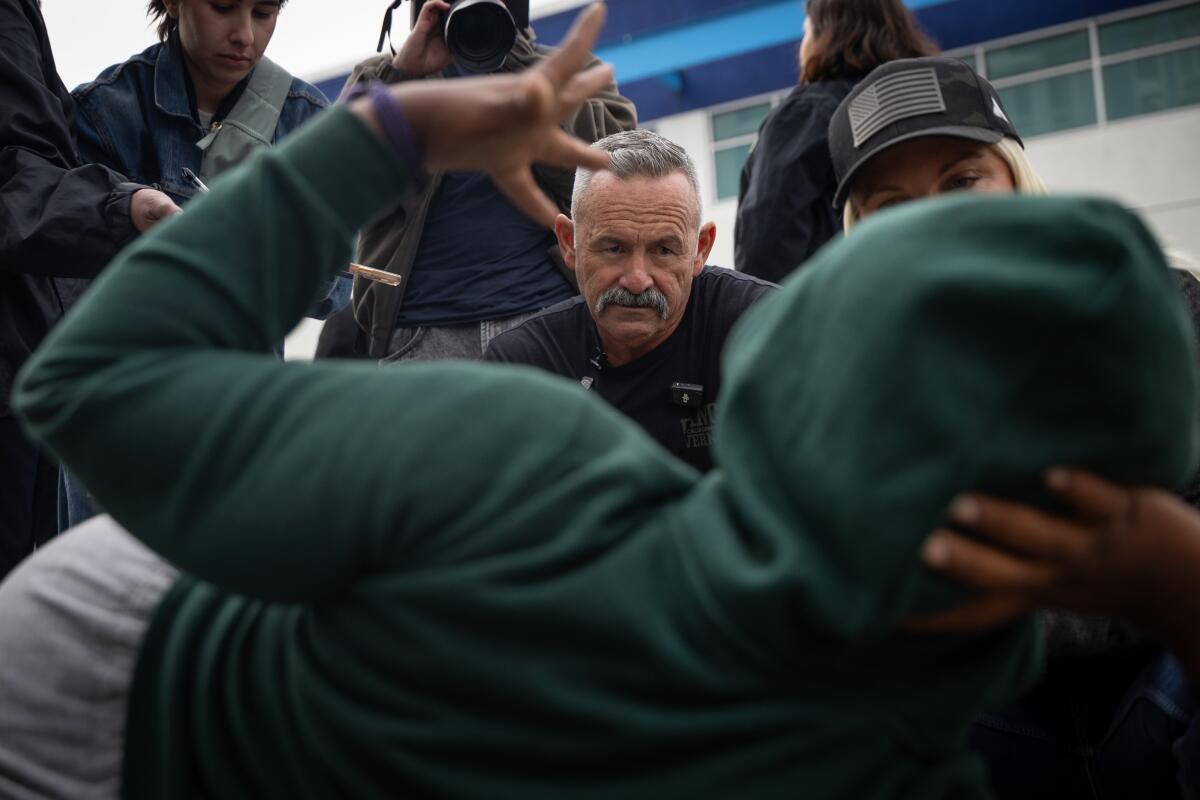
Riverside County Sheriff Chad Bianco, one of the top Republican candidates running for California governor, met a woman sprawled on the sidewalk as he walked around Skid Row in downtown Los Angeles.
“I’m waiting for the sun to come out from the clouds. I’m sunbathing,” the woman said Tuesday morning, lying on her jacket on the cold concrete, denying that any drug use was taking place in the roughly 50-block swath of downtown Los Angeles. “This is what we do here in California.”
Bianco and Kate Monroe, chief executive of VetComm, talks with a woman on the sidewalk as they walk around of Skid Row.
(Jason Armond/Los Angeles Times)
Bianco shook his head, and as he walked away said there was zero chance the woman was not high on methamphetamines or something else. He said it was immoral for the state’s leaders to allow people to live in such conditions, and pledged to clean up Skid Row within four years if he is elected governor in November.
“Why on God’s green earth, why would we allow this to happen?” Bianco later said. “And why would you have something that you call Skid Row, that you just accept, instead of doing something to fix … these people’s lives.”
Bianco squarely blamed the problem on waste, fraud and mismanagement under Gov. Gavin Newsom, Los Angeles Mayor Karen Bass and prior elected leaders, who he argued failed to effectively tackle the issue. He is among the critics who points to a 2024 state audit that found the state had spent $24 billion to combat homelessness over the prior five years without tracking the results.
A spokesman for Newsom disputed such characterizations of the spending.
“There is no ‘lost’ $24 billion for homelessness. All the money is accounted for,” Newsom spokesman Izzy Gardon said. “What the report found was that not all state programs required locals to report, at the time, how those dollars improved homelessness outcomes. Gov. Newsom has since changed the law to fix this longstanding issue.”
Bianco also pledged to use existing laws against drug dealing, human trafficking, prostitution and other crimes to clean up these blocks, while offering addicts and the mentally ill who are breaking the law the option of going to jail or being placed in treatment programs.
Democrats shot back that Bianco was not offering realistic approaches to an intractable problem.
Bianco talks with Antonio Fuller, left, and John Shepar.
(Jason Armond/Los Angeles Times)
“Chad Bianco is the best example of an all-hat, no-cattle politician with tough talk and no solutions,” state Democratic Party Chair Rusty Hicks said. “That is not what California voters want in our next governor.”
Throughout his campaign, Bianco has leaned into his role as a law enforcement leader. On Tuesday, as his allies shot video after his visit to Skid Row, he pulled up the edge of his T-shirt to reveal his Riverside County sheriff badge.
Amid scenes of desperation, chaos and squalor, Bianco was surrounded by a gaggle of invited media.
Los Angeles Police Department patrol cars were frequently seen nearby as the group sidestepped feces, used condoms, sidewalk fires, open-air drug use and drug dealing, barely clothed women, and people screaming and cursing.
People make their way around Skid Row on Tuesday.
(Jason Armond/Los Angeles Times)
Monroe talks with Emilio Marroquin.
(Jason Armond/Los Angeles Times)
Bianco was accompanied by veteran and homeless advocate Kate Monroe, who handed the homeless envelopes containing $5 bills and cigarettes as encouragement to talk. Some did not take kindly to the offer.
“Get out of my face. Get out of my face. You’re offering me cigarettes,” the woman said. Monroe replied, ‘I’ll give you five bucks.” The woman repeated, “Get out of my face.”
But others were more receptive, including Emilio Marroquin.
The 42-year-old said he had started drinking as a teenager as he struggled with being gay in a Christian home. He didn’t come out until his father, a pastor, passed away. His drinking spiraled out of control, he said, leading friends and family to abandon him. After Marroquin ended up on the streets eight years ago, he said, he started using crystal meth and crack, and explained the splotchy wounds on his hand were the result of being beaten up for failing to pay drug debts.
After learning that Marroquin briefly lived in sober housing, Bianco asked him about the difficulties of transitioning from living on the streets to structured housing, and then spoke with a passing community service provider who identified herself as S.R.
“We need a new change. We need something other than what we’ve been hearing for the past, I don’t know, 20 years or longer,” she said, to which Bianco replied that she had “more courage, passion and commitment and a big heart than probably anyone to be able to come down here and do this over.”
Bianco greets a man who goes by Cigaretteman.
(Jason Armond/Los Angeles Times)
The Riverside County sheriff’s appearance on Skid Row comes as the 2026 governor’s race is finally starting to see some energy.
A crowded field of prominent though little-known Democrats is competing to finish in the top two spots in the June primary. If they all remain in the race, the Democrats could splinter the vote and allow one of the far smaller number of top Republican candidates to win one of the spots.
Saying that Newsom has turned the state into “Califraudia,” Hilton and GOP controller candidate Herb Morgan called on the U.S. Department of Justice and other federal officials to investigate waste and fraud in state spending.
“This gets to that question that every Californian is asking: How is it that we have the highest taxes in the country? They’ve doubled the budget of the state of California nearly in the last five years, and everything is worse,” Hilton said. “We have the worst outcomes in America. How is that possible, that they spend so much and we get so little? … We are going to get to the bottom of this when we are elected.”
The park will remain focused on younger families, especially with children under 12 years old, but will also create new experiences that appeal to all ages.
The Group has said that the new attractions will be revealed in due course.
James Mellors, managing director of Mellors Group, said: “Lightwater Valley is a park with real heart, history, personality, and potential, and it’s a place our own family has loved since childhood.
“Our goal is simple: to put the park back ‘on the map’ as a major theme park, by introducing new rides, injecting new energy, and creating something truly special for families for many years to come.”
He added: “We’re very excited about this acquisition and looking forward to planning a wide range of new attractions for 2026; fresh, fun, and full of excitement.
“While Lightwater Valley will continue to be a haven for younger families, we’re also widening the experience so that guests of all ages can enjoy the thrills, charm, and adventure together.
“The team here have done a brilliant job, and we’re looking forward to working closely with them as we begin this new journey.”
The Mellors Group bought the park after it was put up for sale in October for £3million.
The theme park first opened back in 1969 and today is home to more than 35 rides and attractions.
WASHINGTON — CIA turncoat Aldrich Ames, who betrayed Western intelligence assets to the Soviet Union and Russia in one of the most damaging intelligence breaches in U.S. history, has died in a Maryland prison. He was 84.
A spokesperson for the Bureau of Prisons confirmed Ames died Monday.
Ames, a 31-year CIA veteran, admitted being paid $2.5 million by Moscow for U.S. secrets from 1985 until his arrest in 1994. His disclosures included the identities of 10 Russian officials and one Eastern European who were spying for the United States or Great Britain, along with spy satellite operations, eavesdropping and general spy procedures. His betrayals are blamed for the executions of Western agents working behind the Iron Curtain and were a major setback to the CIA during the Cold War.
He pleaded guilty without a trial to espionage and tax evasion and was sentenced to life in prison without parole. Prosecutors said he deprived the United States of valuable intelligence material for years.
He professed “profound shame and guilt” for “this betrayal of trust, done for the basest motives,” money to pay debts. But he downplayed the damage he caused, telling the court he did not believe he had “noticeably damaged” the United States or “noticeably aided” Moscow.
“These spy wars are a sideshow which have had no real impact on our significant security interests over the years,” he told the court, questioning the value that leaders of any country derived from vast networks of human spies around the globe.
In a jailhouse interview with the Washington Post the day before he was sentenced, Ames said he was motivated to spy by “financial troubles, immediate and continuing.”
Ames was working in the Soviet/Eastern European division at the CIA’s headquarters in Langley, Va., when he first approached the KGB, according to an FBI history of the case. He continued passing secrets to the Soviets while stationed in Rome for the CIA and after returning to Washington. Meanwhile, the U.S. intelligence community was frantically trying to figure out why so many agents were being discovered by Moscow.
Ames’ spying coincided with that of FBI agent Robert Hanssen, who was caught in 2001 and charged with taking $1.4 million in cash and diamonds to sell secrets to Moscow. He died in prison in 2023.
Ames’ wife, Rosario, pleaded guilty to lesser espionage charges of assisting his spying and was sentenced to 63 months in prison.
Sometimes an album cover could be worth a thousand words. And the Grammys finally agree.
The 2026 ceremony will be the first time in 53 years that the award for best album cover will be presented. Previously, the award for a recording package included the album’s visuals and physical materials. Last year, Charli XCX earned the accolade for the virality of “brat” and its distinct mucus-y green.
However, this year, the categories for boxed/special limited-edition packages will be combined into a single recording package category, with album covers receiving their own trophy.
This category isn’t exactly new. At the first Grammys in 1959, Frank Sinatra’s “Only the Lonely” received the award for album cover. It was presented every year until 1973, when the Siegel-Schwall Band won for its self-titled album. After that, the category was renamed album package and then changed again in 1994 to recording package.
The nominated albums for art cover include Tyler the Creator’s “Chromakopia,” Djo’s “The Crux,” Bad Bunny’s “Debí Tirar Más Fotos,” Perfume Genius’ “Glory” and Wet Leg’s “Moisturizer.” From the nostalgic white plastic chairs that grace Bad Bunny’s sixth studio album to Tyler the Creator’s masked longing gaze on his cover, an album’s artwork is often essential to the listening experience.
“When a cover in a campaign hits right,” said nominated photographer Neil Krug to the Associated Press, “it’s part of the language and the fabric of what makes a great record a great record.”
Krug has a history of photographing covers for artists like Lana Del Rey and Tame Impala. He’s nominated for shooting the cover of “The Crux, ” by Joe Keery (“Stranger Things”), who goes by the musical moniker Djo. The image includes a chaotic menagerie of an old hotel and a crowded street, including everything from Djo himself hanging from a window, a kissing couple and a parking ticket dispute.
“Anything that we could come up with, we were just like throwing it at the canvas,” Krug told the Associated Press.
This split of categories is meant to better recognize music in the digital age. Grammy rules state that albums do not need to exist physically to be considered for this category, unlike in the recording package category. (Though this year every album nominated for the award is available on vinyl and CD).
“In today’s digital world, album covers are arguably more impactful than ever. Chances are, there’s an iconic cover that’s instantly recognizable to you, even if you never owned the physical album. Their cultural significance is undeniable,” said Recording Academy CEO Harvey Mason Jr., in an interview with Grammy.com.
Recording Academy voters are tasked with judging the cover’s creativity and design elements. Once the winner is determined, trophies will go to the album’s art director and the designers, photographers and illustrators will receive a certificate.
In addition to the album cover category, the country album category has also been split into two groups: traditional country and contemporary country. (Last year, Beyoncé won country album for “Cowboy Carter.”) The new artist category has also been expanded to include performers who were featured on previous album of the year nominees, if they are featured on less than 20% of the album.
The Grammys kick off on Feb. 1 at Crypto.com Arena.
Donnie McClurkin, the Grammy-winning gospel singer and minister who has publicly denounced homosexuality, has been sued for sexually abusing his former male personal assistant.
McClurkin, 66, faces allegations of sexual assault, sexual battery and more in the civil lawsuit filed Friday in New York County Supreme Court. The singer’s accuser, identified in court documents as Giuseppe Corletto, accuses McClurkin of sexually assaulting him numerous times from the start of his employment in 2004 to 2015. The complaint also includes an alleged email from the singer, in which he apologizes for his actions and writes, “I am the actual epitome of a desperate dirty ‘old man.’”
A legal representative for McClurkin denied the allegations as “categorically false.”
“At no time did Pastor McClurkin engage in any form of sexual abuse, assault, or sexual coercion of Mr. Corletto,” McClurkin attorney Gregory S. Lisi said in a statement shared Tuesday. “The claims set forth in the lawsuit grossly mischaracterize their interactions, which occurred over a decade, and some accusations over 2 decades, ago. All these allegations are contradicted by the real facts.”
Lisi added: “Pastor McClurkin denies each and every allegation of wrongdoing and intends to vigorously defend against this lawsuit through the appropriate legal process. As this is now active litigation, Pastor McClurkin will not be commenting further at this time.”
The lawsuit claims Corletto was 21 years old and struggling with his sexuality when he met McClurkin, known for songs “I Call You Faithful” and “Wait on the Lord,” in August 2003. Corletto attended a reading for McClurkin’s 2001 book “Eternal Victim, Eternal Victor,” centered on the singer’s experience of “being delivered on homosexuality,” and met the singer, according to court documents. Corletto sought guidance from the Grammy winner, who hired him as a personal assistant.
The two men developed a mentor-mentee relationship and engaged in “pray the gay away” spiritual sessions “during which Defendant McClurkin groped Plaintiff’s genitals” without consent, according to the lawsuit. McClurkin had also allegedly “set up scenarios” between Corletto and other men and framed them as “tests from God.”
In 2007, Corletto and his girlfriend traveled with McClurkin and the singer’s family to California, where the artist allegedly sexually assaulted Corletto in a hotel room. The lawsuit alleges that McClurkin exposed himself to Corletto before pulling him onto a bed, forcefully kissing and grabbing his body and forcing Corletto to engage in anal sex. When Corletto confronted his boss about the alleged assault, McClurkin allegedly said he had no recollection and blamed Corletto’s behavior on medication. The singer “further manipulated Plaintiff, blaming him for the incident and convincing him that he was the sole culpable party,” confusing Corletto, the lawsuit said.
The lawsuit alleges that McClurkin “exploited this tactic repeatedly, coercing Plaintiff into further unwanted sexual acts over the next six years,” including numerous alleged incidents while he was working at McClurkin’s church. The complaint details additional accounts of alleged sexual assault from 2007 to 2008.
Corletto had attempted to stop working for McClurkin multiple times, the lawsuit said, but the singer refused, telling his assistant “that his ‘deliverance’ and ‘purpose’ were tied” to him. The complaint adds that Corletto told several church staff members of the alleged sexual assault, but that “no action was taken.” Corletto stopped working for McClurkin in 2008, but continued running into the singer in the following years, the lawsuit said.
The “Again” artist allegedly sexually assaulted Corletto in 2012 in Orlando, where the latter was training for an airline job. McClurkin learned of his former employee’s location through one of Corletto’s friends and appeared at his hotel room. The lawsuit alleged McClurkin said he needed to talk to Corletto, who “reluctantly agreed to let” the singer into his room. Inside the hotel room, McClurkin allegedly “begged Plaintiff to have sex with him ‘one last time,’” but Corletto refused. Corletto alleges he woke up to find McClurkin masturbating and touching his body before the singer “forced himself again onto Corletto” and raped his former employee, the lawsuit says.
Corletto returned to McClurkin’s church in the summer of 2013 and joined the singer during a trip to Niagara Falls. McClurkin allegedly sexually assaulted Corletto again and days later sent an email apologizing for his actions, a screenshot included in the lawsuit shows. In addition to likening himself to a “desperate dirty ‘old man,’” per the lawsuit, McClurkin allegedly wrote to Corletto, “I forced myself on you … groping you … and when I think about it … you never touched me like that at all.” McClurkin also allegedly promised to be a friend and pastor to Corletto.
Two years after McClurkin sent the alleged email, Corletto returned to the singer’s church amid his struggles with mental health. The lawsuit claims McClurkin engaged in further sexual misconduct, “taking advantage of Plaintiff’s vulnerability and current fragile mental state.”
Corletto “sustained injury, emotional distress, physical pain, emotional pain and suffering, and loss of enjoyment of life” as a result of the sexual assault, the complaint said. He seeks a jury trial, an unspecified amount in compensatory damages, legal fees and additional damages.
Times editorial library director Cary Schneider contributed to this report.
WASHINGTON — President Trump on Tuesday defended his actions during the Capitol riot five years ago, joked about being liberal-minded to win the votes of transgender people and mocked a predecessor’s use of a wheelchair while delivering a meandering speech to House Republicans as the party enters a critical election year facing a razor-thin majority in the House.
The remarks were intended to ensure both the GOP’s executive and legislative wings are aligned on their agenda heading into the November midterms that will determine party control of Congress. But Trump spent more time rehashing past grievances during the lengthy appearance than he did talking about the capture of Venezuela’s Nicolás Maduro or specific steps he’s taking to bring down prices as polls say inflation is the public’s top concern.
He also did not discuss new policy initiatives or legislation on his agenda for the year.
“We won every swing state. We won the popular vote by millions. We won everything,” Trump said, recounting his performance in the 2024 presidential election while seeming to acknowledge that history will side with the Democratic Party in November.
“But they say that when you win the presidency, you lose the midterm,” he said.
Political trends show that the party that wins the White House usually loses seats in Congress during the midterm elections two years later.
But Trump did try to rally the caucus at times, asserting that his first year back in office was so successful that Republicans should win in November on that basis alone. He briefly touched on Venezuela and talked about money coming into the U.S. through tariffs and direct investment and negotiations to bring down drug prices.
“You have so many good nuggets. You have to use them. If you can sell them, we’re going to win,” Trump said. He claimed that “we’ve had the most successful first year of any president in history and it should be a positive.”
The House GOP is facing a sudden narrowing of their already thin majority with the death of California Rep. Doug LaMalfa, announced Tuesday, and the resignation of former Rep. Marjorie Taylor Greene, which took effect at midnight.
“You can’t be tough when you have a majority of three, and now, sadly, a little bit less than that,” Trump said after paying tribute to LaMalfa, noting the challenges House Speaker Mike Johnson faces in keeping their ranks unified.
The president also noted that Rep. Jim Baird (R-Wis.) was recovering after a “bad” car accident, further slimming Johnson’s vote margins.
House Republicans convened as they launch their new year agenda, with healthcare issues in particular dogging the GOP heading into the midterm elections. Votes on extending expired health insurance subsidies are expected as soon as this week, and it’s unclear whether the president and the party will try to block its passage.
Trump said he would be meeting soon with 14 companies to discuss health insurance.
In remarks that approached 90 minutes, Trump also mused about unconstitutionally seeking a third term as president. He claimed it was never reported that he urged his supporters to walk “peacefully and patriotically” on Jan. 6, 2021, to the Capitol, where they rioted to try to overturn his election loss. He used his wife, First Lady Melania Trump, to poke at President Franklin D. Roosevelt, a Democrat who used a wheelchair.
According to the president, she thinks the dancing he does at his rallies is not presidential.
“She actually said, ‘Could you imagine FDR dancing?’ She actually said that to me,” Trump said. “And I said there’s a long history that perhaps she doesn’t know.”
GOP lawmakers were hosting a daylong policy forum at the Kennedy Center, where the board, stocked by Trump with loyalists, recently voted to rename it the Trump Kennedy Center. The move is being challenged in court.
Trump and Johnson are trying to corral Republicans at a time when rank-and-file lawmakers have felt increasingly emboldened to buck Trump and the leadership’s wishes, on issues such as the release of the Jeffrey Epstein files.
The meeting also comes days after the Trump administration’s dramatic capture of Nicolás Maduro in Venezuela, which occurred after a months-long U.S. campaign to pressure the now-deposed leader by building up American forces in the waters off South America and bombing boats alleged to have been carrying drugs.
The Maduro capture is reigniting the debate about Trump’s powers over Congress to authorize the campaign against Venezuela, though House Republican lawmakers have largely been supportive of the administration’s efforts there.
Kim and Superville write for the Associated Press. AP writers Lisa Mascaro and Will Weissert contributed to this report.
The Galaxy will begin the new season the same way they finished the old one — with Riqui Puig on the sideline after knee surgery. That’s a big problem because Puig is about the closest thing MLS has to an irreplaceable player. And with training camp starting in a couple of weeks, the team has precious little time to try to replace him.
In 2024, the last time Puig was on the field, he led the league in touches and passes and set career highs for goals (13) and assists (15). With him directing the attack, the Galaxy set a record with four players scoring 10 or more times en route a sixth MLS title. It was one of the best seasons in franchise history.
In 2025, without Puig, the only records the Galaxy set were for futility, starting the season winless in their first 16 league matches and finishing with just seven wins, a franchise low for a full season. No reigning MLS Cup champion has fared so poorly.
The contrast is so stark because Puig doesn’t just define the way the team plays; he is the way the team plays. He’s the quarterback and the point guard. His speed, dribbling and passing ability make the Galaxy go, opening up space for opportunity for his teammates. He’s the rare player who truly makes everyone around him better.
Even Lionel Messi isn’t as important to his team as Puig is to the Galaxy.
“The game changes when Riqui’s on the field,” coach Greg Vanney said.
Puig first tore the ACL in his left knee in the Western Conference final in 2024, assisting on the game’s only goal after sustaining the injury. The Galaxy originally thought they’d have him back by late summer, in time for a playoff push. So last winter they felt comfortable trading Mark Delgado and Gastón Brugman, the two most likely fill-ins for Puig, largely to fit their payroll under the MLS salary cap.
In the interim, the plan was to make Marco Reus the team’s midfield maestro. But Reus had his own injury problems and didn’t start consecutive MLS games until early May. By then the Galaxy had gone winless through their first 10 matches.
Reus went on to play well at times, but the season was effectively over by then. There would be no playoff push, so the Galaxy felt no need to rush Puig back.
This winter the team’s entire offseason preparation was based on Puig’s return — both on and off the field.
Off the field, the Galaxy filmed a multi-part documentary called “Riqui Puig’s Road To Recovery” and used his return to hype ticket sales. On the field, believing the midfield to be set, general manager Will Kuntz added two top-tier defenders in Jakob Glesnes and Justin Haak, committing more than $2 million in salary to the pair.
But then, one day into the new year, Puig and the team learned he needed another operation and would have to miss a second season, throwing all of the Galaxy’s plans into the dumpster.
The Galaxy never blamed their troubles last season on Puig’s absence, but they didn’t have to. It was obvious. And if they couldn’t replace the irreplaceable last season, what confidence should anyone have that they can do it this season?
The team’s biggest mistake last year was not planning for Puig’s absence. The team entered the winter knowing he’d miss most of the season and didn’t act accordingly. They even kept Puig’s $5.8-million salary and designated-player roster spot on the books in the hopes he’d play at some point.
Don’t expect them to make the same mistakes this time. Instead, the Galaxy are all but certain to place him on the season-ending injury list, opening up a DP slot and erasing the hit his salary takes on the budget cap.
The good news, if there is any, is that Vanney believes the Galaxy eventually figured out how to play without Puig last year. After going winless in their first 16 MLS games, the Galaxy went 7-6-5 in league play and finished third in the Leagues Cup, earning a spot in the CONCACAF Champions Cup.
“By the end of the year, we were beating MLS playoff teams and we beat the top teams in Mexico,” Vanney said. “We found how this group could be successful without the pieces that were missing.”
Now they’ll have to do that again.
What exactly happened with Puig hasn’t been made clear. He was more than a year into his rehab when he returned home to Barcelona for the holidays. Puig had trained alongside the team last fall and he continued training in Spain. The recovery seemed to be going well.
But something — a quick move or an uncertain cut — sent Puig back to the doctor and a day later he underwent a second operation.
ACL revision surgeries (multiple procedures) are not rare, with some studies suggesting they are needed between 10% to 20% of the time, especially for athletes who play so-called pivoting sports such as soccer. Most commonly, a second surgery is needed because the first graft has re-torn.
Christen Press, a two-time World Cup champion, torn the ligament in her right knee eight games into her first season with Angel City and needed four operations to repair the damage. She started just three more matches over the next 3 ½ seasons before retiring.
But Press was 33 when she was injured. Puig is 26. And though that suggests the odds for a full recovery are high, Puig’s age also adds to the poignancy of the situation since the injury will now take two years off his career when he was at his prime.
Another season like 2024 could have had Puig, who played 42 games over four seasons for Barcelona, planning for a return to Europe or at least another big payday in MLS. Now he won’t play another game until he’s 27 and in the final year of his contract, when the pressure to prove he’s healthy and still a dynamic game-changing player will be immense.
In the meantime, the Galaxy find themselves once again trying to replace the irreplaceable.
⚽ You have read the latest installment of On Soccer with Kevin Baxter. The weekly column takes you behind the scenes and shines a spotlight on unique stories. Listen to Baxter on this week’s episode of the “Corner of the Galaxy” podcast.
WASHINGTON — President Trump has made broad but vague assertions that the United States is going to “run” Venezuela after the ouster of Nicolás Maduro but has offered almost no details about how it will do so, raising questions among some lawmakers and former officials about the administration’s level of planning for the country after Maduro was gone.
Seemingly contradictory statements from Trump and Secretary of State Marco Rubio have suggested at once that the U.S. now controls the levers of Venezuelan power or that the U.S. has no intention of assuming day-to-day governance and will allow Maduro’s subordinates to remain in leadership positions for now.
Rubio said the U.S. would rely on existing sanctions on Venezuela’s oil sector and criminal gangs to wield leverage with Maduro’s successors.
The uncertainty on definitive next steps in Venezuela contrasts with the years of discussions and planning that went into U.S. military interventions that deposed other autocratic leaders, notably in Iraq in 2003, which still did not often lead to the hoped-for outcomes.
‘Disagreement about how to proceed’
The discrepancy between what Trump and Rubio have said publicly has not sat well with some former diplomats.
“It strikes me that we have no idea whatsoever as to what’s next,” said Dan Fried, a retired career diplomat, former assistant secretary of state and sanctions coordinator who served under both Democratic and Republican administrations.
“For good operational reasons, there were very few people who knew about the raid, but Trump’s remarks about running the country and Rubio’s uncomfortable walk back suggests that even within that small group of people, there is disagreement about how to proceed,” said Fried who is now with the Atlantic Council think tank.
Supporters of the operation, meanwhile, believe there is little confusion over the U.S. goal.
“The president speaks in big headlines and euphemisms,” said Rich Goldberg, a sanctions proponent who worked in the National Energy Dominance Council at the White House until last year and is now a senior adviser to the Foundation for Defense of Democracies, a hawkish think tank.
Goldberg does not see Rubio becoming “the superintendent of schools” but “effectively, the U.S. will be calling the shots.”
“There are people at the top who can make what we want happen or not, and we right now control their purse strings and their lives,” he said. “The president thinks it’s enough and the secretary thinks it’s enough, and if it’s not enough, we’ll know very soon and we’ll deal with it.”
If planning for the U.S. “to run” Venezuela existed prior to Maduro’s arrest and extradition to face federal drug charges, it was confined to a small group of Trump political allies, according to current U.S. officials, who note that Trump relies on a very small circle of advisers and has tossed aside much of the traditional decision-making apparatus.
These officials, who spoke on condition of anonymity to discuss their understanding of internal deliberations, said they were not aware of any preparations for either a military occupation or an interim civilian governing authority, which has been a priority for previous administrations when they contemplated going to war to oust a specific leader or government. The White House and the State Department’s press office did not return messages seeking comment.
Long discussion among agencies in previous interventions
Previous military actions that deposed autocratic leaders, notably in Panama in 1989 and Iraq in 2003, were preceded by months, if not years, of interagency discussion and debate over how best to deal with power vacuums caused by the ousters of their leaders. The State Department, White House National Security Council, the Pentagon and the intelligence community all participated in that planning.
In Panama, the George H.W. Bush administration had nearly a full year of preparations to launch the invasion that ousted Panama’s leader Manuel Noriega. Panama, however, is exponentially smaller than Venezuela, it had long experience as a de facto American territory, and the U.S. occupation was never intended to retake territory or natural resources.
By contrast, Venezuela is vastly larger in size and population and has a decadeslong history of animosity toward the United States.
“Panama was not successful because it was supported internationally because it wasn’t,” Fried said. “It was a success because it led to a quick, smooth transfer to a democratic government. That would be a success here, but on the first day out, we trashed someone who had those credentials, and that strikes me as daft.”
He was referring to Trump’s apparent dismissal of opposition leader Maria Corina Machado, whose party is widely believed to have won elections in 2024, results that Maduro refused to accept. Trump said Saturday that Machado “doesn’t have the support within or the respect within the country” to be a credible leader and suggested he would be OK with Maduro’s No. 2, Delcy Rodríguez, remaining in power as long as she works with the U.S.
Hoped-for outcomes didn’t happen in Iraq and Afghanistan
Meanwhile, best-case scenarios like those predicted by the George W. Bush administration for a post-Saddam Hussein Iraq that it would be a beacon of democracy in the Middle East and hopes for a democratic and stable Afghanistan following the ouster of the Taliban died painfully slow deaths at the tremendous expense of American money and lives after initial euphoria over military victories.
“Venezuela looks nothing like Libya, it looks nothing like Iraq, it looks nothing like Afghanistan. It looks nothing like the Middle East,” Rubio said this weekend of Venezuela and its neighbors. “These are Western countries with long traditions at a people-to-people and cultural level, and ties to the United States, so it’s nothing like that.”
The lack of clarity on Venezuela has been even more pronounced because Trump campaigned on a platform of extricating the U.S. from foreign wars and entanglements, a position backed by his “Make America Great Again” supporters, many of whom are seeking explanations about what the president has in mind for Venezuela.
“Wake up MAGA,” Republican Rep. Thomas Massie of Kentucky, who has bucked much of his party’s lockstep agreement with Trump, posted on X after the operation. “VENEZUELA is not about drugs; it’s about OIL and REGIME CHANGE. This is not what we voted for.”
Sen. Rand Paul, also a Kentucky Republican, who often criticizes military interventions, said “time will tell if regime change in Venezuela is successful without significant monetary or human cost.”
“Easy enough to argue such policy when the action is short, swift and effective but glaringly less so when that unitary power drains of us trillions of dollars and thousands of lives, such as occurred in Afghanistan, Iraq, and Vietnam,” he wrote on social media.
In addition to the Venezuela operation, Trump is preparing to take the helm of an as-yet unformed Board of Peace to run postwar Gaza, involving the United States in yet another Mideast engagement for possibly decades to come.
And yet, as both the Iraq and Afghanistan experiences ultimately proved, no amount of planning guarantees success.
There were no stars in the October sky. No moon that 64-year-old Masuma Khan could see from the narrow window of the California City Immigration Processing Center.
“No planes,” she said, recalling her confinement.
Once a prison, the facility in the Mojave Desert, located 67 miles east of Bakersfield, reopened in April to hold people in removal proceedings, including Khan.
It was not the kind of place where she imagined ending up — not after living in the country for 28 years, caring for her daughter and surviving one of California’s deadliest wildfires, the Eaton fire.
Khan was fortunate not to have lost her west Altadena home to the Jan. 7 fire, which destroyed more than 9,000 structures and killed 19 people.
But in the months that followed, Khan faced another threat — deportation.
As fire recovery efforts were underway in Los Angeles, the Trump administration launched immigration raids in the city, hampering recovery efforts and creating more distress for immigrants after the fires.
Khan worried. She was in the process of adjusting her immigration status and was required to check in every year with U.S. Immigration and Customs Enforcement.
An immigration attorney reassured her that there was no cause for concern: Her husband and daughter were citizens, she had no criminal record, and her case was still under review.
And so, on Oct. 6, Khan drove to downtown Los Angeles for her routine immigration check-in and found herself caught up in Trump’s deportation surge.
Eaton fire survivor Masuma Khan, 64, right, with her daughter Riya Khan and husband Isteak Khan after bring released in December.
(Gina Ferazzi/Los Angeles Times)
Khan was taken into custody by ICE agents and kept in a cold room for almost an entire day. She said agents denied her access to a lawyer and a phone until she signed deportation papers. Khan resisted but later signed.
She was placed in a van with other detainees and driven three hours north to the detention center in California City. She said there was no air conditioning in the van and she became nauseous and started to experience hypertension symptoms.
At the facility she was denied access to medications for high blood pressure, asthma, peripheral arterial disease, general anxiety and hypothyroidism, she said.
Khan, who is also prediabetic, said she struggled to maintain her health at the facility. Her blood pressure spiked and she began to experience stroke-like symptoms. Her legs swelled up and she became weak.
She said the facility was so cold that people often became ill, including staff. She and other women used socks as scarves, sleeves and mittens but were threatened with fines if they continued to misuse the garments.
She said she became sick and her vision got blurry without her prescribed eye drops. Her Halal meals shifted to a medical diet that included pork, which she cannot eat because she is Muslim.
Khan’s experience at the facility was similar to that of other detainees who filed a federal class-action lawsuit against the Department of Homeland Security and ICE. They alleged inhumane conditions at the facility that included inadequate food, water and medical care, frigid cells and lack of access to medications and lawyers.
The California City Immigration Processing Center in Kern County, where Masuma Khan was held.
(Patrick T. Fallon/AFP/Getty Images)
In an email response, Tricia McLaughlin, a DHS spokesperson, said any claims about “subprime conditions at ICE detention facilities are false.”
“All detainees are provided with proper meals, certified by dietitians, medical treatment and have the opportunities to communicate with lawyers and family members.”
Khan said she spent most days in her cell crying.
“I missed my family, I missed everything,” she said “I was frustrated.”
She often thought of home: her husband and daughter, her small garden and the birds she fed daily with seeds and oranges from her balcony.
It would be weeks before she could see her family again, before she could gaze at the mountains and hear the symphony of wildlife.
‘Like an inferno’
The Eaton fire had been raging for hours in west Altadena when Khan and her husband were awakened by evacuation alerts on their phones at 3:30 a.m.
Khan got out of bed and from her bedroom window could see flames raging in the mountains.
Khan hadn’t seen anything like it. Four years before she arrived, the Kinneloa fire, sparked by a campfire, erupted in the same mountains. It fed on dry and flammable vegetation and was driven by Santa Ana winds. It was a destructive fire.
But the Eaton fire was different. Hurricane-force winds helped spread the embers and flames deep into the town’s heart — destroying homes, schools and countless structures.
A business and vehicle are a total loss as the Eaton fire rages along Lake Avenue in Altadena on January 8, 2025.
(Gina Ferazzi/Los Angeles Times)
Khan and her husband, Isteak, didn’t have time to grab much before fleeing in their car that evening.
“It was like an inferno,” Isteak Khan, 66, recalled. “You could see the embers flying everywhere. It was very chaotic.”
The couple drove about three miles south to a supermarket in Pasadena. For a month they lived at a hotel until they were allowed to return home.
When they got back the surrounding neighborhoods were in ruins: Trees were charred, cars were stripped down to metal frames and homes were gutted or left in ash.
The couple’s apartment still was standing but had suffered smoke damage and there was no electricity, no safe water to use. The couple depended on water bottles and showered at the homes of relatives.
Khan never thought she would experience such a disaster in the U.S. Then again, she didn’t journey here for her own reasons. She came to save her daughter.
‘Incredibly traumatized’
In August 1997, Khan was living in Bangladesh with her husband and their 9-year-old daughter, Riya. That month Riya had traveled with her grandparents to the U.S. to see relatives when she fell seriously ill. Doctors determined she was suffering from kidney failure and needed ongoing treatment including chemotherapy and peritoneal dialysis.
Khan traveled to the U.S. on a visitor’s visa to be with Riya. For more than a decade her daughter received treatment at the Children’s Hospital in Los Angeles.
Khan became her daughter’s primary caretaker and did not return to Bangladesh as her visa was expiring. Her husband joined her in 1999 after obtaining a visa. He and Riya eventually received green cards and became citizens.
The following year, as Khan looked for legal ways to adjust her immigration status, she met a man at a Bangladeshi grocery store who befriended her and offered to help her obtain a green card, according to court records. Little did Khan know that this man — who spoke her language and was well known in the Bangladeshi community — was a scammer, one of many who prey on South Asians migrating to the U.S.
At the time Khan did not speak, read or write English well, and this man told her he could file an asylum application on her behalf, for a fee amounting to several thousand dollars.
But Khan was unaware this man had filed the application for her using a false name and listed his own address for future correspondence from immigration authorities, according to court documents.
All this came to light when she showed up for an asylum hearing in Anaheim in 1999 and responded to the questions of an asylum officer who noticed the information did not match what was in the application.
The officer denied the application, and later she was unaware of a notice to appear before an immigration court, since it had been sent to the scammer’s address.
Her absence at the hearing prompted an immigration judge to order her to be deported. Khan did not find out about the court’s action until 2015, when her husband petitioned to adjust her status so she could obtain a green card.
After the petition was denied and her case was closed because of the deportation order, Khan hired an immigration attorney who sought to reopen the case. But a judge denied it, and her appeal also was rejected by the 9th Circuit Court of Appeals.
In February 2020, Khan was detained by ICE but released and required to check in with immigration officials. That year she hired an immigration attorney who submitted paperwork to let her stay in the U.S. The application was pending when ICE took her into custody on Oct. 6.
McLaughlin, the DHS spokesperson, said there was no reason for the government to reconsider her case, since Khan had a final removal order since 1999 and had exhausted all appeals.
“She has no legal right to be in our country,” McLaughlin said. “DHS law enforcement lawfully arrested her on Oct. 6.”
Yet Khan caught a break in early November when a federal judge ordered her released. The judge ruled the government cannot detain Khan without giving her a hearing and explaining why it needs to detain her.
It was a victory for her legal team, made up of a law firm and two nonprofit groups — the South Asian Network and Public Counsel and Hoq Law APC.
Laboni Hoq, a chief attorney on the case, said the goal is to keep Khan out of detention while the team seeks to adjust her status.
“We’re feeling like she has a shot to pursue that process … given her long history in the country and that she is law-abiding and has met all the requirements to deal with her case through the court system and immigration system,” Hoq said.
Khan’s predicament has drawn the attention of numerous Southern California politicians, including U.S. Rep. Judy Chu and U.S. Sen. Adam Schiff. Much of it had to do with Khan’s 38-year-old daughter, Riya, who reached out to the lawmakers and also took to social media to bring her mother’s case to the public’s attention.
Still, it is unclear what will happen next.
As Khan’s legal fight proceeds, she must check in regularly with immigration authorities, as she did in downtown L.A. on Dec. 19, accompanied by Sen. Sasha Renée Pérez (D-Alhambra), who also became aware of her case from Riya’s efforts.
“She’s incredibly traumatized by what’s happened to her,” Pérez said of Khan. “She’s scared to even participate in the community events that we have during the holidays … it’s painful, it makes me angry, it makes me sad and I just wanted to be here with her.”
At their Altadena home one recent evening, the Khans sat in their living room. Riya said the hope was that the case will be reopened so her mother can obtain a green card.
“We’re going to stay together,” Isteak said.
Not far from Masuma, old “welcome home” balloons hovered. As she sat next to her daughter, she could express only two things: “I cannot leave this country. This is my home.”
Evangeline Lilly says she has brain damage after fainting and falling on a boulder at a beach in Hawaii last year.
The “Ant-Man and the Wasp” star kicked off 2026 by sharing an update about her concussion on Instagram. In a video posted Friday, Lilly said that “almost every area in [her] brain is functioning at a decreased capacity” since she “smashed [her] face open.”
“I’m entering into this new year, the Year of the Horse, with some bad news about my concussion,” the “Lost” alum said. “A lot of you asked how I’m doing. A lot of you have inquired about the brain scans that you heard I got. And the results came back from the scans and [showed] I do have brain damage from the [traumatic brain injury] and possibly other factors going on.”
Lilly, who played second-gen superhero Hope van Dyne in multiple installments of the Marvel Cinematic Universe, shared in a Substack post in May saying that she had “fainted at the beach” and “fell face first into a boulder.” She also said she has a history of blacking out and that doctors have been unable to determine why.
In the caption of the video update, the 46-year-old wrote that it is “comforting to know [her] cognitive decline isn’t just peri-menopause” but that it’s “discomforting to know what an uphill battle it will be to try to reverse the deficiencies.”
“Now my job is to get to the bottom of that with the doctors and then embark on the hard work of fixing it, which I don’t look forward to, because I feel like hard work is all I do,” Lilly said in the video. “I’m feeling extraordinarily grateful and blessed to be able to play one more day, one more year, on this beautiful living planet … Thank you all for caring.”
Lilly’s onscreen mom and “Ant-Man and the Wasp: Quantumania” co-star Michelle Pfeiffer sent her support in the Instagram post’s comments.
“You are a warrior. Nothing-not even this will defeat you my friend,” Pfeiffer wrote. Actors David Dastmalchian and Alyssa Milano were also among the Instagram well-wishers.
Lilly, who portrayed resourceful plane crash survivor Kate Austen for all six seasons of “Lost” as well as Elven archer Tauriel in twoinstallments of Peter Jackson’s “Hobbit” trilogy, announced in 2024 that she was taking an “indefinite hiatus” from acting.
Ousted Venezuelan leader Nicolás Maduro stood in a Manhattan courthouse Monday a captive criminal defendant: surrounded by heavy security, deprived of his power as a head of state and facing drug, weapon and conspiracy charges likely to keep him behind bars for years.
“I was captured,” he said in Spanish, before pleading not guilty during a brief arraignment. “I am a decent man, the president of my country.”
Just two days prior, more than 2,000 miles away in Caracas, Maduro was seated “atop a corrupt, illegitimate government that, for decades, has leveraged government power to protect and promote illegal activity, including drug trafficking,” according to a sweeping indictment unsealed Saturday.
What preceded Maduro’s swift downfall was not just his weekend capture in what President Trump called “one of the most stunning, effective and powerful displays of American military might” in U.S. history, but decades of partnership with “narco-terrorists” from Venezuela, Colombia and Mexico to enrich himself and his family through “massive-scale” cocaine trafficking, the indictment claims.
The allegations, built off a 2020 indictment, stretch back a quarter-century and implicate other Venezuelan leaders and Maduro’s wife and son. They suggest extensive coordination with notorious drug trafficking organizations and cartels from across the region, and paint a world Trump himself has long worked to instill in the minds of Americans — one in which the nation’s southern neighbors are intentionally flooding the U.S. with lethal drugs and violent criminals, to the devastation of local communities.
It is a portrait of drugs, money and violence every bit as dramatic as the nighttime raid that sent jets and helicopters into Venezuelan airspace, U.S. special forces into Maduro’s bedroom and Maduro and his wife into U.S. custody and ultimately to their arraignment in court Monday.
It appears to rely on clandestine intelligence and other witness testimony gathered over the course of decades, which Maduro’s defense team will undoubtedly seek to discredit by impugning the cast of characters — some drug traffickers themselves — whom prosecutors relied on.
Legal experts said it could take years for the case to reach trial, slowed not only by the normal nuance of litigating a multi-defendant conspiracy case but the added complexity of a prosecution that is almost certainly predicated in part on classified intelligence.
“That’s very different than a typical drug case, even a very high-level drug case, [where] you’re not going to have classified State Department cables the way you’re going to have them when you’re actually prosecuting a head of state or a former head of state,” said Renato Stabile, an attorney for former Honduran president Juan Orlando Hernández, who was convicted in a similar cocaine trafficking case in 2024 before being pardoned by Trump last month.
Joe McNally, the former acting U.S. attorney for the Central District of California, which includes Los Angeles, said he expects the case will take at least a year to get to trial, after prosecutors “show their cards” and Maduro’s attorneys review that evidence and seek out their own witnesses.
He said he expects a strong case from prosecutors — despite it being “not easy to prove a case that involves high level cartel activity that’s happening thousands of miles away” — that will appropriately play out entirely in public view.
“He’ll have his day in court. It’s not a military tribunal,” McNally said. “His guilt or innocence will be decided by 12 people from the district [in New York where he’s been indicted], and ultimately the burden will be on the prosecutor.”
The case against Maduro
According to the indictment, Maduro and his fellow indicted Venezuelan leaders have since about 1999 “partnered with some of the most violent and prolific drug traffickers and narco-terrorists in the world” — including the FARC and ELN groups in Colombia, the Sinaloa and Los Zetas cartels in Mexico and the Tren de Aragua gang in Venezuela.
Trump has accused Tren de Aragua of committing violence in the U.S. and used alleged ties between it and Maduro to justify using a wartime statute to deport Venezuelans accused of being in the gang to a notorious Salvadoran prison. However, Maduro’s links to the group have been heavily questioned in the past — including by U.S. intelligence agencies — and the indictment doesn’t spell out any specific links between Maduro and Guerrero Flores.
The indictment alleges Maduro and his co-conspirators “facilitated the empowerment and growth of violent narco-terrorist groups fueling their organizations with cocaine profits,” including by providing “law enforcement cover and logistical support for the transport of cocaine through Venezuela, with knowledge that their drug trafficking partners would move the cocaine north to the United States.”
It specifically alleges that between 2006 and 2008, when he was foreign affairs minister, Maduro sold diplomatic passports to people he knew were drug traffickers, specifically so they could move drug proceeds from Mexico back to Venezuela “under diplomatic cover” and without military or law enforcement scrutinizing their flights.
It also alleges that between 2004 and 2015, Maduro and his wife, Cilia Flores, “worked together to traffic cocaine, much of which had been previously seized by Venezuelan law enforcement, with the assistance of armed military escorts.”
It alleges the couple “maintained their own groups of state-sponsored gangs known as colectivos to facilitate and protect their drug trafficking operation,” and “ordered kidnappings, beatings, and murders against those who owed them drug money or otherwise undermined their drug trafficking operation, including ordering the murder of a local drug boss in Caracas.”
The indictment references a half-dozen other criminal cases already brought in the U.S. against others with alleged ties to Maduro and his alleged co-conspirators, several of whom have been convicted.
What’s ahead
Stabile said the legally questionable nature of Maduro’s capture will no doubt be a factor in the criminal proceedings ahead, with his defense team likely to argue that his detention is unlawful. “That’s going to be front and center, and I assume it’s going to be the subject of a motion to dismiss,” he said.
Whether anything will come of that argument, however, is less clear, as courts in the U.S. have in the past allowed criminal proceedings to continue against individuals captured abroad, including former Panama dictator Manuel Noriega. Part of the U.S. argument for why Noriega could be prosecuted was that he was not the legitimate leader of Panama, an argument that is likely to be made in Maduro’s case, too.
Beyond that, Stabile said how the case plays out will depend on what evidence the government has against Maduro.
“Is his case just gonna be based on the testimony of sources and cooperators, which is pretty much what it was in President Hernandez’s case?” Stabile said. “Or are there recordings? Are there videos? Are there bank records? Are there text messages? Are there emails?”
McNally said he will be watching to see whom prosecutors have lined up to testify against Maduro.
“In most of the high-level narcotics trafficking cases, international narcotics trafficking cases that have been brought and go to trial, the common thread is that you end up with cooperators — individuals who were part of the conspiracy, they were the criminal partners of the defendant, and they ultimately decide, hey, it’s in my self-interest to come forward and testify,” McNally said.
“They obviously are cross-examined, and they’ll frequently be accused of … lying for their own self-interest,” he said. “But in my experience, cooperators in these types of cases are especially valuable, and the key is to then corroborate them with other witnesses who tell the same story or documentary evidence.”
Comcast has officially spun off its cable channels, including CNBC and MS NOW, into a separate company, Versant Media Group.
The transaction was completed late Friday. On Monday, Versant took a major tumble in its stock market debut — providing a key test of investors’ willingness to hold onto legacy cable channels.
The initial outlook wasn’t pretty, providing awkward moments for CNBC anchors reporting the story.
Versant shares fell about 14% to about $40 a share around mid-day. The stock opened Monday on the Nasdaq at $45.17 per share.
Comcast opted to cast off the still-profitable cable channels, except for the perennially popular Bravo!, as Wall Street has soured on the business, which has been contracting amid a consumer shift to streaming.
Versant’s market performance will be closely watched as Warner Bros. Discovery attempts to separate its cable channels, including CNN, TBS and Food Network, from the Warner Bros. studios and HBO later this year. Warner Chief Executive David Zaslav’s plan, which is scheduled to occur this summer, is being contested by the Ellison family’s Paramount, which has launched a hostile bid for all of Warner Bros. Discovery.
The market’s distaste for cable channels has been playing out in recent years. Paramount found itself on the auction block two years ago, in part, because of the weight of its struggling cable channels, including Nickelodeon, Comedy Central and MTV.
Management of the New York-based Versant, including longtime NBCUniversal sports and television executive Mark Lazarus, has been bullish on the company’s balance sheet and its prospects for growth. Versant also includes USA Network, Golf Channel, Oxygen, E!, SYFY, Fandango, Rotten Tomatoes, GolfNow, GolfPass, and SportsEngine.
“As a standalone company, we enter the market with the scale, strategy and leadership to grow and evolve our business model,” Lazarus, who is Versant’s Chief Executive, said Monday in a statement.
Through the spinoff, Comcast shareholders received one share of Versant Class A common stock or Versant Class B common stock for every 25 shares of Comcast Class A common stock or Comcast Class B common stock, respectively. The Versant shares were distributed after the close of Comcast trading on Friday.
Comcast gained about 3% on Monday, trading at about $28.50.
Comcast Chairman Brian Roberts maintains Versant’s controlling shares.
Those who snub Father Time like to say that 50 is the new 30. A different Father — Benedictine priest Maximilian Maxwell— sprinkled holy water in the end zone before his beloved Pittsburgh Steelers took on the Baltimore Ravens on Sunday with the AFC North title on the line.
Fifty is the new 30 also applies to field goals. More than 70% of kicks over 50 yards are successful these days, a dramatic increase in accuracy from only five years ago. Excuse Maxwell for thinking divine intervention might be necessary should a last-second missed kick determine the outcome.
A 44-yarder is a chip shot for most NFL kickers, including Ravens rookie Tyler Loop, who had made 90% of his attempts — including eight of eight from 40-49 yards — when the ball was snapped with three seconds to play and Baltimore trailing 26-24.
Two words coined when Scott Norwood missed a 47-yard attempt that cost the Buffalo Bills Super Bowl XXV in 1991 once again were screamed on a television broadcast: “Wide right!”
Another memorable miss came from a kicker regarded as the best in the NFL 20-some years ago. Brash, outspoken Mike Vanderjagt of the Indianapolis Colts led the league in scoring in 1999 and four years later became the first kicker in history to make every kick in a full season: 83 of 83 on field goals and extra points.
Yet he botched a boot with 21 seconds to play during a playoff game in 2006, enabling the Steelers to upset the Colts. Pittsburgh went on to win the Super Bowl and Vanderjagt was replaced by Adam Vinatieri. He never regained his form.
Here’s hoping Loop rebounds better than Vanderjagt or Norwood, who was released a year after the historic miss and never played again. Loop was All Pac-12 in 2023 at Arizona, where he holds records for longest field goal (62 yards) and success rate (83.75%). He was the Wildcats’ G.O.A.T. before becoming the Ravens’ goat.
Loop, 24, didn’t duck the media, leaving the impression that he won’t let this failure define him.
“Just want to say I’m super grateful to Baltimore, the organization and the city, just how they embraced me this year has been incredible,” he said. “Just for it to end like that, sucks, and I want to do better.
“Unfortunately, the nature of the job is you have makes, and those are awesome, and unfortunately, you have misses, and for that to happen tonight sucks.”
The specialized nature of kickers can place them on the periphery of team bonding, but Loop’s teammates and coaches were supportive in the aftermath of the season-ending loss.
Coach John Harbaugh walked alongside Loop from the field to the locker room, with his arm around his back comforting him. Quarterback Lamar Jackson downplayed the impact, telling reporters, “He’s a rookie, you know. It’s all good. Just leave it in the past.”
Only time will tell whether Loop can do just that.
Firestorm: The Great Los Angeles Fires and America’s New Age of Disaster
By Jacob Soboroff Mariner Books: 272 pages, $30
If you buy books linked on our site, The Times may earn a commission from Bookshop.org, whose fees support independent bookstores.
If journalism is the first draft of history, TV news is a rough, improbable sketch. As last year’s wildfires multiplied, still 0% contained, field reporters — tasked with articulating the unintelligible on camera — grieved alongside Los Angeles in real time.
“What are you supposed to say when the entire community you were born and raised in is wiped off the map, literally burning to the ground before your eyes?” Jacob Soboroff writes in “Firestorm,” out in early January ahead of the Palisades and Eaton fires’ first anniversary. “I couldn’t come up with much.”
Viewers saw that struggle Jan. 8, 2025. Soboroff, then an NBC News national correspondent, briefly broke the fourth wall while trying to describe the destruction of his former hometown, the Pacific Palisades.
“Firestorm,” the first book about the Great Los Angeles Fires of 2025, pulls readers inside Soboroff’s reporter’s notebook and the nearly two relentless weeks he spent covering the Palisades and subsequent Eaton wildfire. “Fire, it turns out, can be a remarkable time machine,” he writes, “a curious form of teleportation into the past and future all at once.”
The book argues the future long predicted arrived the morning of Jan. 7. The costliest wildfire event in American history, so far, was compounded by cascading failures and real-time disinformation, ushering in what Soboroff calls America’s New Age of Disaster: “Every aspect of my childhood flashed before my eyes, and, while I’m not sure I understood it as I stared into the camera…I saw my children’s future, too, or at least some version of it.”
In late December, Soboroff returned to the Palisades Recreation Center for the first time since it burned. Tennis balls popped from the courts down the bluff. Kids shrieked around the playground’s ersatz police cars, ambulance and fire trucks — part of a $30-million public-private rebuild backed by City Hall, billionaire real estate developer Rick Caruso and Lakers coach JJ Redick, among others.
The sun peeks through the morning marine layer as Soboroff stops at a plaque on the sole standing structure, a New Deal-era basketball gym. His parents’ names are etched at the top; below them, family, friends, neighbors. It’s practically a family tree in metal, commemorating the one-man fundraising efforts of his father, the business developer Steve Soboroff, to repair the local play area. It was also the elder Soboroff’s entry point into civic life, the start of a career that later included 10 years as an LAPD police commissioner, a mayoral bid and a 90-day stint as L.A.’s’ fire recovery czar.
“All because my dad hit his head at this park,” Soboroff says with a smirk, recalling the incident that set off his father’s community safety efforts.
He checks the old office where he borrowed basketballs as a kid. “What’s happening? Are people still coming to the park?” he asks a Recreation and Parks employee, slipping into man-on-the-street mode.
On a drive down memory lane (Sunset Boulevard), Soboroff jokes he could close his eyes and trace the street by feel alone. Past rows of yard signs — “KAREN BASS RESIGN NOW” — and tattered American flags, grass and rose bushes push through the wreckage. Pompeii by the Pacific.
Jacob Soboroff.
(Eric Thayer / Los Angeles Times)
At the corner where he once ran a lemonade stand, Soboroff FaceTimed his mother on national television to show her what remained of the home he was born in. Before the fires, he had never quite turned the microphone on himself.
During the worst of it, with no one else around but the roar of the firestorm, “I had to hold it up to myself,” he says. “That was a different assignment than I’ve ever had to do.”
Soboroff is a boyish 42, with a mop of dark curls and round specs, equally comfortable in the field and at the anchor desk. J-school was never the plan. But he got a taste for scoops as an advance man to New York City Mayor Michael Bloomberg. MTV News once seemed like the dream, but he always much preferred the loose, happy talk of public television’s Huell Howser. MSNBC took notice of his post-grad YouTube and HuffPost spots and hired him in 2015.
Ten years later, he was tiring of breaking news assignments and stashed away his “TV News cosplay gear” to ring in 2025. But when he saw the winds fanning the flames in the Palisades from NBC’s bureau at Universal Studios, he fished out a yellow Nomex fire jacket and hopped in a three-ton white Jeep with his camera crew.
The opening chapters of “Firestorm” read like a sci-fi thriller. All-caps warnings ricochet between agencies. Smoke columns appear. High-wind advisories escalate. Soboroff slingshots the reader from the Palisades fire station to the National Weather Service office, a presidential hotel room, toppled power lines in Altadena, helitankers above leveled streets and Governor Newsom’s emergency operations center.
Between live shots with producer Bianca Seward and cameramen Jean Bernard Rutagarama and Alan Rice, Soboroff fields frantic calls from both loved ones and the unexpected contacts, desperate for eyes on the ground. One is from Katie Miller, a former White House aide who cut contact after the reporter published “Separated,” his 2020 book on the Trump family separation policy. Miller, wife of Trump advisor Stephen Miller, asks him to check on her in-laws’ home. “You’re the only one I can see who is there,” she writes. Soboroff confirms the house is gone. “Palisades is stronger than politics in my book,” he replies. For a moment, old divisions vanish. It doesn’t last.
Jacob Soboroff at McNally Avenue and East Mariposa Street in Altadena.
(Eric Thayer / Los Angeles Times)
He returns home to Frogtown, changes out of smoke-soaked clothes and grabs a few hours’ sleep before heading back out. “Yet another body blow from the pounding relentlessness of the back-to-back-to-back-to-back fires,” he writes. Fellow native Palisadian and MS Now colleague Katy Tur flies in to tour the “neighborhood of our youth incinerated.”
After the fires, Soboroff moved straight into covering the immigration enforcement raids across Los Angeles. He struggled to connect with others, though. Maybe a little depressed. The book didn’t crystallize until April, after a conversation with Jonathan White, a captain in the U.S. Public Health Service Commissioned Corps, who is now running for congress.
Fire, White tells him, has become the fastest-growing threat in America and, for many communities, the most immediate. Soboroff began tracking down people he’d met during the blaze — firefighters, scientists, residents, federal officials — and churned out pages on weekends. He kept the book tightly scoped, Jan. 7–24, ending with President Trump’s visit to the Palisades with Gov. Newsom. He saved the investigative journalism and political finger-pointing for other writers.
“For me, it’s a much more personal book,” Soboroff says. “It’s about experiencing what I came to understand as the fire of the future. It’s about people as much as politics.”
Looking back — and learning from the fire — became a form of release, he said, as much for him as for the city. “What happened here is a lesson for everybody all across the country.”
Rudi, an L.A. native, is a freelance art and culture writer. She’s at work on her debut novel about a stuttering student journalist.
WASHINGTON — The Trump administration has added seven countries, including five in Africa, to the list of nations whose passport holders are required to post bonds of up to $15,000 to apply to enter the United States.
Thirteen countries, all but two of them in Africa, are now on the list, which makes the process of obtaining a U.S. visa unaffordable for many.
The State Department last week quietly added Bhutan, Botswana, the Central African Republic, Guinea, Guinea-Bissau, Namibia and Turkmenistan to the list. Those designations took effect on Jan. 1, according to a notice posted on the travel.state.gov website.
It’s the latest effort by the Trump administration to tighten requirements for entry to the U.S., including requiring citizens from all countries that require visas to sit for in-person interviews and disclose years of social media histories as well as detailed accounts of their and their families’ previous travel and living arrangements.
U.S. officials have defended the bonds, which can range from $5,000 up to $15,000, maintaining they are effective in ensuring that citizens of targeted countries do not overstay their visas.
Payment of the bond does not guarantee a visa will be granted, but the amount will be refunded if the visa is denied or when a visa holder demonstrates they have complied with the terms of visa.
The new countries covered by the requirement join Mauritania, Sao Tome and Principe, Tanzania, Gambia, Malawi and Zambia, which were all placed on the list in August and October of last year.
WHETHER you fancy a 2026 staycation or holiday across to Europe or further afield, we’ve got some incredible experience for you to consider.
We’ve been all over the world and have taken note of our favourite things to do, from guided tours to free hikes, getting our hands dirty at cooking classes or doing some daredevil stunts.
Sign up for the Travel newsletter
Thank you!
First up, you really can’t go wrong with a food tour – and you can do these anywhereCredit: Unknown
Secret Food Tour, UK
Assistant Travel Editor Sophie Swietochowski said: “Exploring a city for the first time? Getting a flavour of the food scene is a priority for me whenever and wherever I travel. And a Secret Food Tour is just the way to do that.
“The several-hour experiences are bookable in over 70 major cities globally, and thanks to a knowledgeable local guide you’ll get a strong idea of where’s good to eat and which joints are tourist traps.
“I’ve been on several of these tours, but was most blown away by the Soho one in London, naively assuming I’d learn nothing new. How wrong I was.
“Did you know that Berwick Street market was the first place in London to sell tomatoes on the street? Or that Ronnie Scott’s jazz club is where Jimi Hendrix played his last ever gig in 1970?
You can enjoy six to seven food stops, including one ‘secret stopfrom £79pp in the UK. Seesecretfoodtours.com.
You’ll see a different side to Sardinia with the underground walking tourCredit: Alamy Stock Photo
Walking Tour, Italy
Travel Reporter Cyann Fielding added: “Sardinia has been named several times as a top destination to visit this year and with that in mind one great thing to do on the Italian island is head on the Underground Cagliari Walking Tour.
“The tour takes between two and four hours and across that time you will explore three different underground sites. The sites include a limestone tunnel used by priests, a crypt and even underground Roman ruins.”
You can take vineyard tours around England if you head to KentCredit: Alamy Stock Photo
Wine Tour, UK
Deputy Travel Editor Kara Godfrey said: “The UK wine is having a moment, even beating those in France – so why not go on a tour of some of the best vineyards in the country?
“Wine Tours of Kent takes you around two vineyards in the ‘Garden of England‘ and it includes vineyard tours, wine tastings, as well as lunch, with prices starting from
“I recommend pacing yourself, as I ended up buying perhaps too many bottles of the stuff, easily tempted after a glass of wine or two.
“Don’t worry about having to drive yourself home – you are even dropped at the train station at the end.”
For the best views across Fethiye, Kara says take to the skiesCredit: Kara Godfrey
Paragliding, Turkey
Deputy Travel Editor Kara Godfrey revealed: “What’s one of the best ways to see the beach resort of Fethiye? By the air.
“There are a number of paragliding experiences in Turkey, but the best ones are in Oludeniz.
“It’s certainly nerve-wracking to start – once attached to your guide, you have to throw yourself off the cliff edge like a lemming.
“But it’s worth it for the views alone, floating suspended in the sky with the gold sand beaches below… and even a few turtles swimming in the bright blue waters.”
If seeing Montmorency Falls wasn’t enough – you can Zip Line across it tooCredit: Alamy
Montmorency Falls Park Zip Line, Canada
Travel Reporter Cyann Fielding suggested something more thrilling, she said: “If you are a dare devil or adrenaline junkie then you must head to Montmorency Falls Park in Quebec, Canada.
“Here you will find a waterfall that is higher than Niagara Falls and you can zip line across it.
“The experience is both thrilling and mesmerising as you get to fly past the cascading water and see it from a different angle.
“Afterwards, you even get a video of your zip across the waterfall.”
Tickets cost £17.25 per person see sépaq.com for more.
Can you really visit Northern Ireland without tasting the whiskey
Whiskey Tour, Ireland
Travel Writer Jenna Stevens recommends a whiskey tour when you head to this specific destination. She said: “Any trip to Northern Ireland is incomplete without a whiskey tour and tasting.
“Located in the old Victorian Crumlin Road Gaol, McConnell’s blends history, culture and deliciously distilled drinks all in one place.
“The tour starts with a history lesson on Irish whiskey and learning all about ‘Mother McConnell’, the widow who took over the McConnell business and made the drink what it is today.
“Next comes a true insight into the world of whiskey making, as you walk through the entire process – from grain to glass.
“After learning everything there is to know about Irish whiskey, you’ll be ready to taste some. Luckily with this experience, you get treated to three drams to enjoy in a group tasting.
The McConnell’s distillery experience, including a guided tour and three tastings, is £23pp. See mcconnellsirishwhisky.com.
Take to the waters in Tenerife to see lots of marine lifeCredit: Alamy
Dolphin and Whale-Watching Boat Trip, Tenerife
Deputy Travel Editor Kara Godfrey said: “The Spanish island of Tenerife is known for its dolphin and whale-watching tours, thanks to its huge conservation drive.
“During my trip, I was lucky to see huge pods of dolphins swim right alongside the boat, playing with the sides.
“While shyer, we also spotted whales in the distance, with it being one of the few locations outside of the US and Japan where they can be seen.
“The trip even includes time for a dip in the water, as well as drinks and snacks.
If history is your thing, head underground on a Victorian Tunnel TourCredit: Unknown
Victoria Tunnel Tour, UK
Travel Reporter Cyann Fielding says head underground: “Here in the UK, head on the Victoria Tunnel tour in Newcastle.
“The former Victorian wagonway was used to carry coal for the Tyne before it was later used as a shelter during bombings in World War II.
“There are two different tour types, either an hour and 15 minutes or two hours – opt for the latter for the full experience with an informative guide.
The tour costs from £7 per child and £14 per adult. See ouseburntrust.org.uk for more.
When in Rome, you’ve got to have a go at making your own pastaCredit: Jenna Stevens
Pasta Making, Italy
Travel Writer Jenna Stevens explained: “If there’s anywhere to learn to make some great pasta, it’s in Italy’s capital.
“I came across this cooking class when browsing GetYourGuide for activities in Rome, and decided to try my hand at making some fettuccine.
“The class takes place in the main square of Piazza Navona, right in the heart of the city – perfect to drop into after a day of wandering the city centre.
“Here, you’ll meet strangers from all over the world, and together you’ll get stuck into mixing dough, sprinkling flour and rolling out sheets of fresh pasta.
“After you’ve made something that resembles fettuccine, pick between a range of Italian sauces, sit down with an (included) glass of wine, and let the chefs take care of the rest.
“Soon enough you’ll be served a plate of hot fresh pasta, with your nametag neatly stuck to the plate, so you know you’ve got the real deal.
“Eating something you’ve made yourself is a super rewarding feeling, and those fresh Italian ingredients make the dish taste extra special.”
Book a pasta cooking class in Rome on GetYourGuide for £35 per person.
You can’t go to New York City without seeing the impressive skylineCredit: Alamy
“Though, the Empire State Building is an iconic part of the skyline itself and if you are inside it, you can’t see it.
“That’s what makes going to the top of the Rockefeller Center better – you see the entire skyline and can also enjoy access to The Beam Experience which feels like having lunch above the skyscraper.
Tickets cost £31.27 per adult and £26.80 per child see rockefellercenter.com for more.
Hit the roads the next time you’re in SingaporeCredit: Unknown
Sidecar City Tour, Singapore
Deputy Travel Editor Kara Godfrey advises you to take to the roads, she said: “If you love a city tour and a vintage car, then a Side Car Tour of Singapore is the best.
“Book one for the middle of the week and enjoy much emptier roads as you whizz though the financial and art districts.
“Clad in a stylish helmet, my driver was both speedy and hilarious as we explored the street art and building history along the way.
“There are different themes, from night tour to Crazy Rich Asian tours, but I highly recommend the Singapore in a Nutshell.”
Singapore Sidecar Tours from £119pp. See sidecar.sg
Take your friends for an epic race across London or Manchester
Race Across the World, UK
Travel Reporter Alice Penwill recommended getting competitive with a game, she said: “You don’t need to literally Race Across the World for thrills as there’s an experience right here in the UK.
“With the interactive game you can run across the city of London, the West End or Manchester solving puzzles and hunting for clues, and it is competitive as you’re up against the clock.
“It’s a great day out with friends or family, and you get to take little breaks for refuelling along the way too.”
You can hike to get a view of the Hollywood signCredit: Ekaterina Chizhevskaya
Hike to the Hollywood Sign and Griffith Observatory, Los Angeles
Travel Reporter Cyann Fielding can’t get enough to the US – and luckily, you don’t have to pay for everything. She suggested: “Los Angeles is expensive enough as it is, but there is an incredible, bucket list activity you can do for completely free – hiking to the Griffith Observatory and seeing the Hollywood Sign.
“The Ferndell to Observatory Loop isn’t for the fainthearted stretching 2.6 miles but you get to head through woodland before reaching the observatory.
“On the way down from the observatory, make sure to head via Glendower Avenue to see Frank Lloyd Wright’s Ennis House and into Feliz, where there is a number of independent shops and restaurants including Skylight Books.”
Take a tour around the beautiful Sistine ChapelCredit: Alamy Stock Photo
Vatican and Sistine Chapel Tour, Italy
Assistant Travel Editor Sophie Swietochowski suggested taking a tour of one well-known site, she said: “The famous Vatican City, sat within the Italian capital, is one of the most historically significant sites in not just Rome, but the entire world, and it’s still considered the heart and headquarters of Catholicism today.
“It’s also now one of the most overcrowded sites you could visit. That’s why a guided tour with queue jump, that lets you avoid those daily snaking lines, is the only way to do it.
“Even with queue-jump you’ll still have to wait a short while, but once you’re in your very knowledgeable guide will whisk you off to all the must-see places, pointing out the top photo spots as you go.
“Plus, you’ll learn things that the standard visitor won’t.”
A two-hour Vatican Museums and Sistine Chapel tour costs from £53pp. See getyourguide.co.uk.
You can hike up to this famous spot in Edinburgh for absolutely nothing
Hike to Arthur’s Seat, Scotland
Travel Reporter Cyann Fielding has top tips for anyone doing a staycation, she said: “Edinburgh is a fantastic city to visit, especially if you want a holiday but don’t want to leave the UK.
“And for those who like to keep active, head for hike up Arthur’s Seat – a dormant volcano with breathtaking views across the Scottish capital and the sea.
“What is even better is that it is free to hike – just note it isn’t for the fainthearted.”
A cooking class is an essential activity when you head to ThailandCredit: Unknown
Cooking Class, Thailand
Travel Reporter Alice Penwill cooked up a storm on a recent trip to Koh Samui, she said: “What’s one of the best things about going to Thailand? It has to be the food. From delicious curries to stir fry and of course, mango sticky rice.
“While I’m not a natural in the kitchen, Chef Lat made it very easy and soon had me chopping lemongrass and frying prawns.
“My new favourite, though is a massaman chicken curry. You eat everything you make, too.“
Book the Thai Cooking Class Farm to Table with Expedia for $82pp (£60.89). See expedia.com for more.
Whether you’re a Faithful or a Traitor, this experience is great fun for all
Traitors: The Live Experience, UK
Travel Reporter Cyann Fielding loved her experience as a Faithful, she said: “The new series of Traitors graced our screens last week and what could be a more perfect excuse to try out the live experience?
“Located in London, the Traitors live experience allows fans to actually play the game – albeit in a very shortened version.
“You get a host as well as gain an insight into what it actually feels like to be a Faithful… or perhaps, a Traitor.”
For anyone heading to Egypt, Kara says to head across the dunesCredit: Kara Godfrey
Dune Hiking Sunset Tour, Egypt
Deputy Travel Editor Kara Godfrey added: “If you want to feel like you’re on Mars without the 10-month journey, then desert hiking in Egypt is the next best thing.
“Just outside El Gouna, the drive into Wadi Bileh makes you feel like you are the only person on the planet.
“The sandy walk is best done barefoot, and head to the top to see towering dunes of red sand.
“It ends with a Bedouin bonfire and coffee when the sun goes down, making it a true, other-worldly experience.”
You can’t go wrong with Go Ape when you need to entertain your kids
Go Ape, UK
Head of Sun Travel (Digital) Caroline McGuire said: “Go Ape has taken over the UK with treetop rope courses in more than 30 inner-city and countryside locations.
“It also happens to be at some of the country’s top tourist attractions, like Leeds Castle, Bedgebury Pinetum and in Battersea Park, a stone’s throw from Battersea Power Station.
“The latter is where I took my five year old, during a day out at the power station, which has its own cinema, Lego store and holds special family events during school holidays.
“It was a brilliant experience as a bolt-on to a city day out, where my son was able to blow off steam and get plenty of fresh air, among the more cultural activities of the day.
“Yes, it’s not cheap, but the infrastructure, thought and care that has gone into these courses is not cheap. And there wasn’t a miserable child or adult among those I encountered on our afternoon in the trees.
“Go Ape has inspired several copycats, both here and abroad, but few work so cleverly with nature, which is what makes this experience, particularly in central London’s Battersea, so unique.”
Tickets start from £20.95pp. For more see goape.co.uk.
Jenna wants to zip down this steep mountain coasterCredit: Alamy
Mountain Coaster, Switzerland
Travel Writer Jenna Stevens has one of these activities on her own 2026 bucket list: “Switzerland is home to some of the world’s most beautiful landscapes. And what better way to see them than whizzing down a 1350m-long toboggan ride?
“The Fräkigaudi toboggan run in Hergiswil is the longest alpine coaster in Switzerland, and bends around vivid green mountain valleys.
“It’s a thrilling ride full of surprise twists, turns, and drops into “dragon holes”.
“You’re able to control the speed at which you ride, so whether you’re visiting for full-on adrenaline or a leisurely sightseeing slide, the choice is entirely up to you.
“At the top station there’s seating and a snack bar, and at the bottom a lift to transport you back up to the top to do it all over again. The toboggan run operates in the summer months from 10-4pm.”
Tickets cost 9 CHF (£8.41) for adults, 7 CHF (£6.54) for ages 8-16 and 5 CHF (£4.67) for ages 6-7. See rodelbahn.ch for more.
You get to see the peninsula in all its glory from a boatCredit: Alamy Stock Photo
Boat Tour around the Sirmione Peninsula, Italy
Travel Reporter Cyann Fielding added: “If you’re visiting Lake Garda in Italy this year, make sure to head to Sirmione – a picturesque town located on a narrow peninsula.
“The town is famous for its Roman ruins, medieval Scaligero Castle and thermal baths. But to catch the most spectacular experience of the town and Lake Garda, head on a boat tour.
“There are several from the town, but make sure to head off on one that explores Villa Maria Callas, Aquaria Thermal Baths, Catullus Grottoes, Giamaica Beach, Boiola Sulphur Spring and the partially-submerged Sirmione Castle.”
A boat tour that includes the above locations costs from £26.60 per person, but shorter 25-minute tours cost from £8.68 per person.
Get incredible views across the Atlas Mountains from a hot air balloon in MoroccoCredit: Alamy
Hot Air Ballooning, Morocco
For incredible views, Deputy Travel Editor Kara Godfrey says head up to the skies, she said: “One of Morocco’s most beautiful landscapes is the Atlas Mountains, and hot air balloon rides are one of the best ways to see them.
“Arriving in pitch black, I waited in darkness apart from the flame of the balloon, before piling into the basket and floating up to wait.
“There are few things as magical as seeing the sun peek over the mountains, with hues of red and pink.
“Most experiences come with a Berber breakfast afterwards too, so make the most of the breads and mint tea.”
Hot Air Balloon Flight over Marrakech from £74. See viator.com
The Musée d’Orsay has lots of beautiful artwork and sculpturesCredit: Alice Penwill
Musée d’Orsay, France
Travel Reporter Alice Penwill said: “If you’re in Paris and looking for something to do, head inside the Musée d’Orsay and for a very informative experience, take a guided tour.
“Inside are lots of huge sculptures like ‘The Gates of Hell’ and beautiful pieces of art by the likes of Renoir and Monet.
“It also houses Van Gogh pieces like Starry Night Over the Rhône, and his Self-Portrait.
“The building itself is incredible too as it used to be a train station, it has a giant golden clock and beautiful views of Paris from the fifth floor.
“The gallery sits on the bank of the River Seine too so afterwards, you can take a stroll along the water all the way down to Notre Dame.”
Guided tours are €26 (£22.56) which include the tour, admission and activity. See musee-orsay.fr/en.
You can rent a paddleboard and head out onto the water in Norfolk
Paddleboarding, UK
When it comes to summertime, Travel Writer Jenna Stevens said to head to her home county: “It’s hard to pick between the beautiful beaches to explore in North Norfolk.
“Whilst Cromer is popular for crabbing and cool cafes, Wells-next-the-Sea is famous for its postcard-perfect beach huts. But the best way by far to explore any of these beaches is by paddleboard.
“Whether you pick up a cheap blow-up paddleboard from Lidl, or borrow one from the many rental shops along the coast, you should make paddleboarding your new best friend in 2026.
“I recommend heading to the marshes of Brancaster or Burnham Overy Staithe for gorgeous golden sunsets and still, quiet waters.
“These grassy areas are way quieter than their nearby sandy beaches, and if you time your visit just right you might even be able to pick some fresh samphire from the marshland to take home for dinner.
“And whether you choose to paddle out to the horizon, try out SUP yoga, or simply lay down and soak in the views – it’s an activity everyone falls in love with.
“You can grab a cheap paddleboard from Amazon for £89.99, or rent one for just £20 per hour at Brancaster Boards.”
You can see Miami in style from a speedboatCredit: Unknown
Thriller Speedboat Adventures, Miami
Travel Report Cyann Fielding said: “The glamorous city of Miami is always in the headlines for the amount of celebs who live there or visit – but on dry land you can’t get a taste of what exactly their lifestyles look like.
“The Thriller Speedboat Adventure ride takes you directly past the houses of the rich including Oprah Winfrey and Will Smith.
“The boat itself is open-topped so you get to enjoy the heat and breeze of Miami too.
“The host is equally funny as they are informative, giving you a real glimpse into some of the luxury and scandal of the lives of the city’s residents.”
You will get drenched up on Hurricane Deck at Niagara Falls in BuffaloCredit: Unknown
Niagara Falls, New York
Travel Reporter Alice Penwill added: “If you’re heading to the US this year, there’s no way you can miss a trip to Niagara Falls in Upstate New York.
“Take the trails through the park, wander at your leisure at no cost as entering Niagara Falls State Park is completely free too so there are no fees necessary to see the impressive falls.
“If you want to get up close to the falls, either take a Maid of the Mist Boat across the waters, or walk The Cave of the Winds which takes you as close to the water as possible – and make sure to bring your waterproof for Hurricane Deck.”
Head straight to the go-karts in Sigulda, LatviaCredit: Unknown
Sigulda, Latvia
If you’re seeking adventure, head to this town recommended by Deputy Travel Editor, Kara Godfrey: “While most people head to Riga on a trip to Latvia, the town of Sigulda is the one for adventure lovers.
“I spent the idea day exploring, trying out every activity on offer for a day of adrenaline.
“There is the indoor go-karting rink Klikk, where I bounded off the tyre walls at speed, to hoping on the cable car before a zipline through the forest.
“Yachting, skydiving and bungee jumping are all on offer too, if you want ore of a thrill.”
Kids and adults alike can enjoy this activity on UK beaches
Fossil Hunting, UK
Travel Reporter Cyann Fielding added: “Kid’s love dinosaurs and right here in the UK we have some great spots to go hunting for millions-of-years old fossils.
“The best spot? Definitely Dorset’s Jurassic Coast. Head to Charmouth Beach and Lyme Regis both of which are known as great fossil-finding spots with species including ammonites (which are the popular spiral shell-shaped fossils) and belemnites (the ones that look like bullets).
“Just check rules of the specific place you plan to head to beforehand, as some spots don’t allow you to chisel into the rocks.”