These are the key developments from day 1,399 of Russia’s war on Ukraine.
Published On 24 Dec 202524 Dec 2025
Share
Here is where things stand on Wednesday, December 24:
Fighting
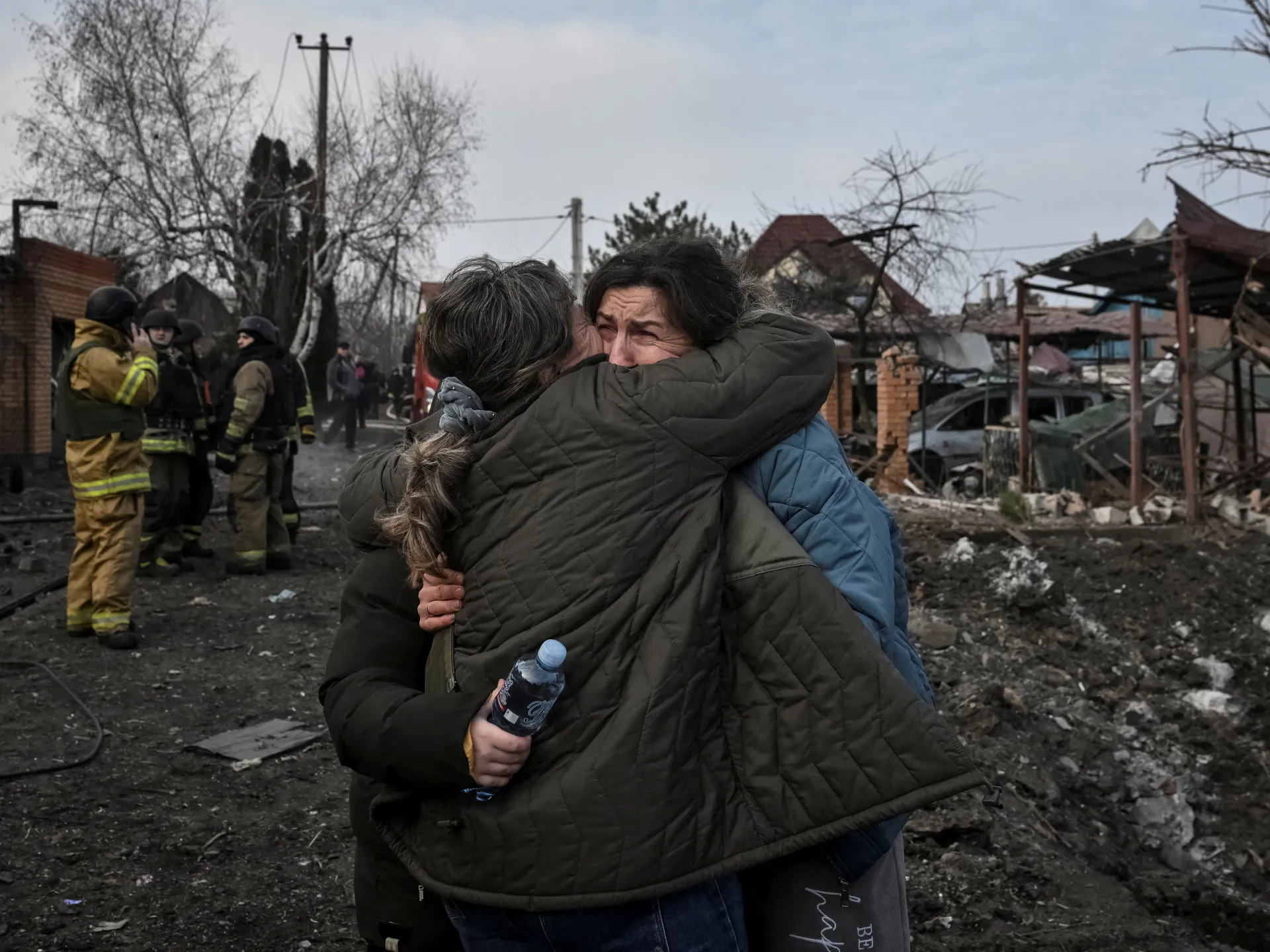
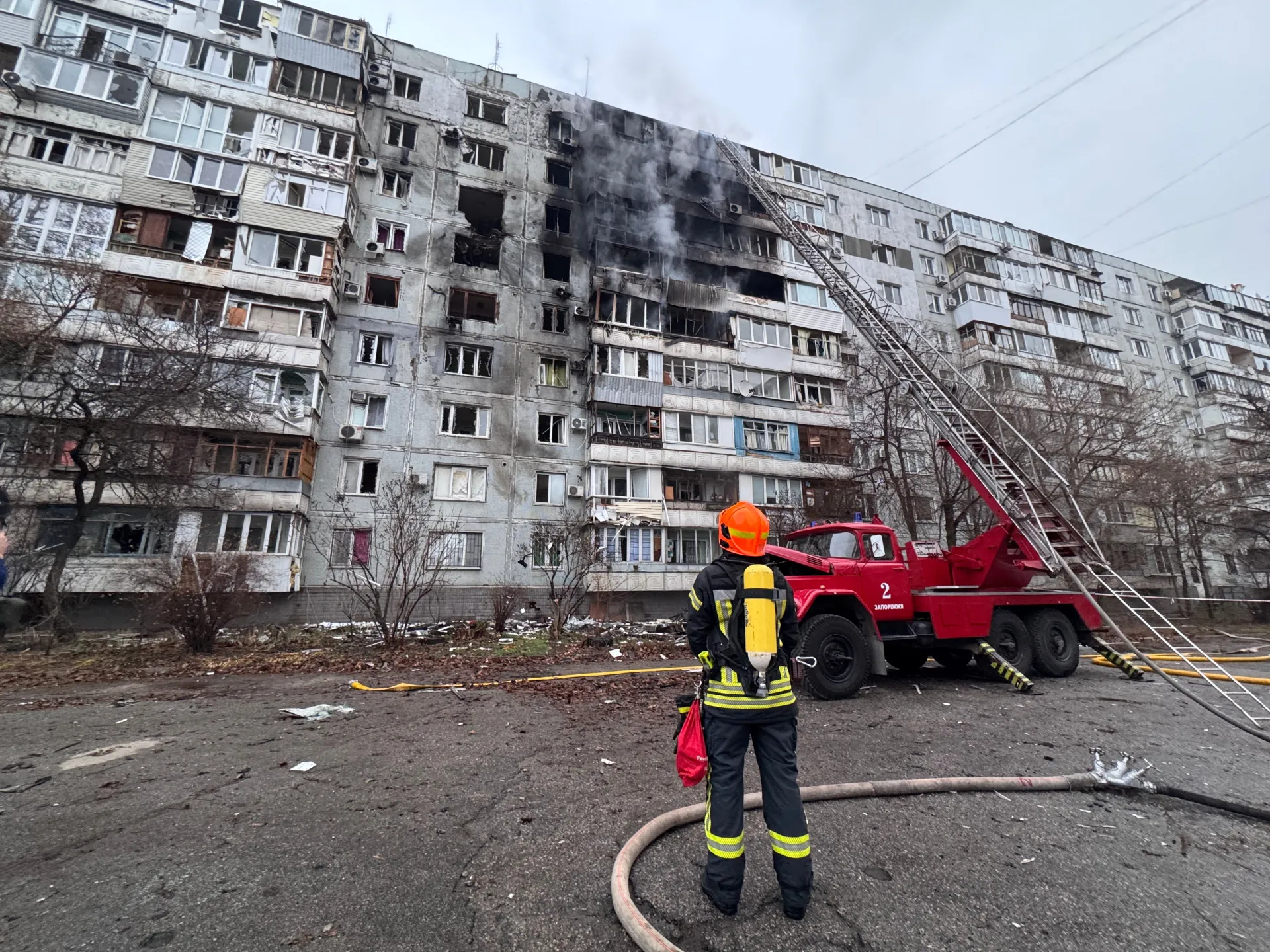
Russian forces began a “massive attack” on Ukraine on Monday night, killing three people and targeting 13 regions with 650 drones and 30 missiles, Ukrainian President Volodymyr Zelenskyy said in a post on X.
Those killed in the overnight attack included a four-year-old girl in the central Zhytomyr region, Governor Vitalii Bunechko said on Telegram. “Doctors struggled to save the child’s life, but in the end, they were unable to save her,” Bunechko said, adding that five people were also injured in the attack.
Russian forces also launched drones and missiles at the Vyshhorod district of Ukraine’s Kyiv region, killing a woman and injuring three people, Governor Mykola Kalashnyk said.
In Ukraine’s western Khmelnytskyi region, one person was killed by Russian shelling, Governor Serhii Tiurin said.
Russian drone attacks on Kyiv’s Sviatoshynskyi district left five people injured, said Tymur Tkachenko, the head of the Kyiv City Military Administration.
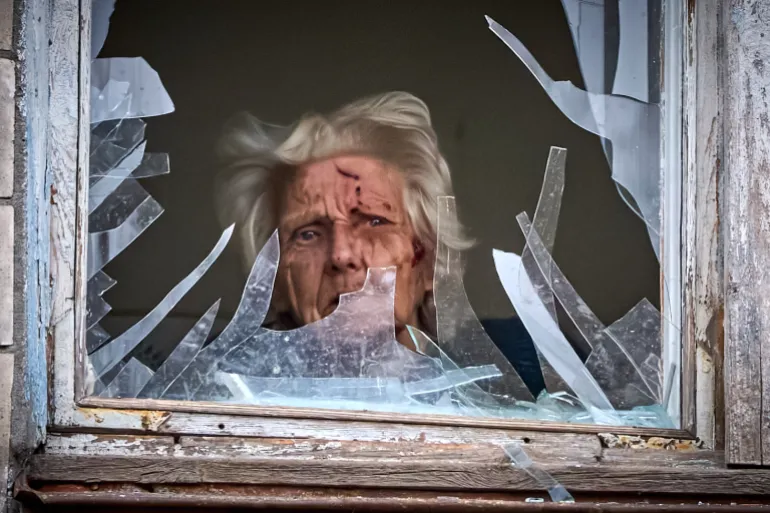
An injured elderly woman looks out of her broken window after an apartment building was hit by a Russian drone during an aerial attack in Kyiv, Ukraine, on Tuesday [Efrem Lukatsky/AP Photo]
Ukraine’s Ministry of Energy said that “emergency power outages” were introduced in several regions across the country due to Russian forces targeting energy infrastructure. The ministry said that it was working to restore electricity to the Rivne, Ternopil and Odesa regions. The ministry said that the situation was “most difficult” in the border regions, “as restoring electricity is complicated by continuous fighting”.
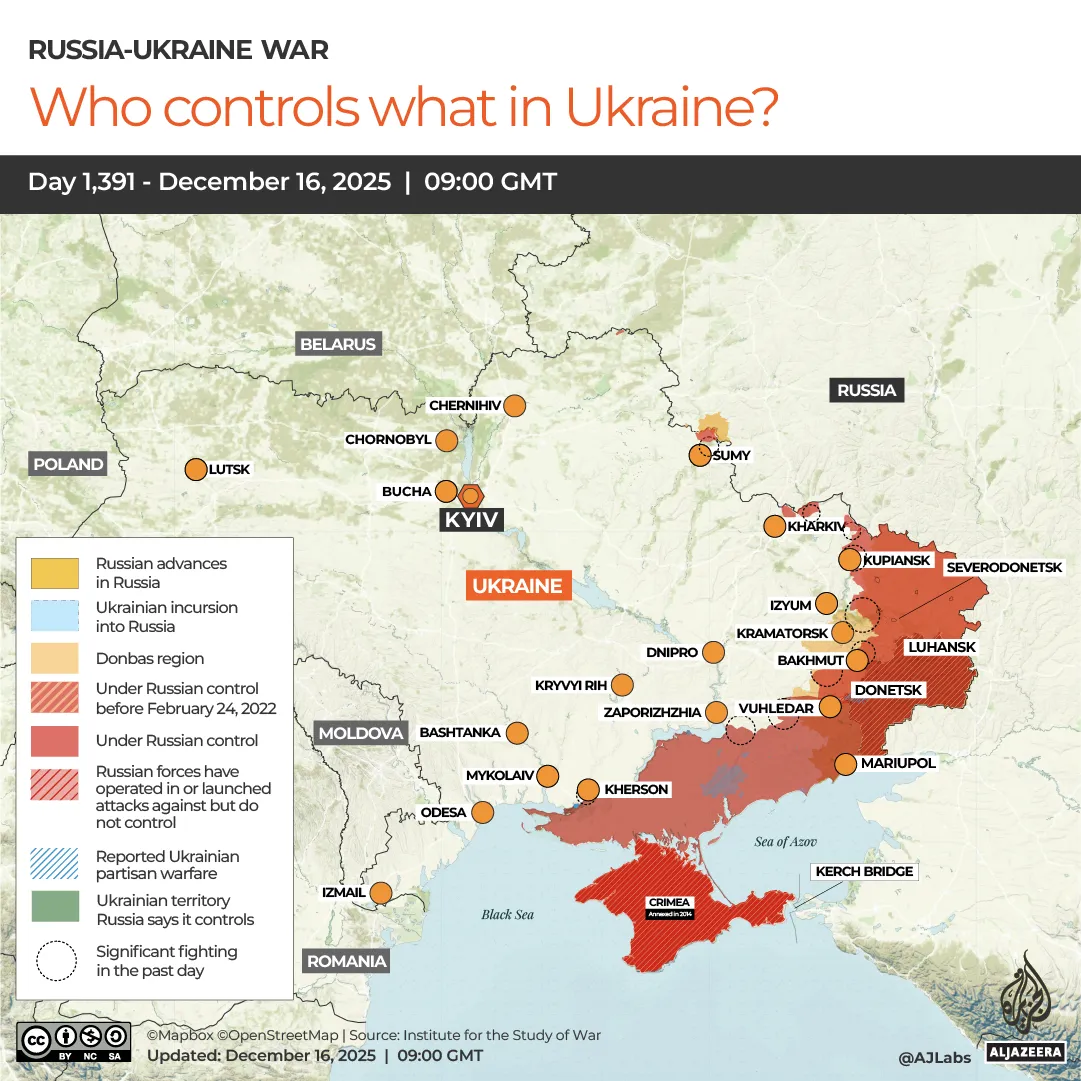
Ukraine’s General Staff said Ukrainian troops have withdrawn from the Donetsk region’s Siversk area after heavy fighting, noting that Moscow’s forces had a “significant advantage” there.
Ukraine’s Ministry of Foreign Affairs said that Ukrainian F-16 fighter pilots shot down 621 of 673 Russian “aerial targets” on Tuesday night, including 34 of 35 cruise missiles.
In Russia, a Ukrainian drone strike on a car killed three men in the Belgorod region on Monday, the region’s emergency response team reported.
Another Ukrainian drone attack in Belgorod on Tuesday killed one person and injured three, the region’s operational headquarters said on Telegram.
Russian forces shot down 56 Ukrainian drones in a day, as well as a guided bomb, Russia’s Ministry of Defence said, according to the state news agency TASS.
Ceasefire
Zelenskyy said in his nightly address, “We sense that America wants to reach a final agreement” to end the war in Ukraine, and that “there is full cooperation” from the Ukrainian side.
In an earlier post on X, Zelenskyy said that “several draft documents have now been prepared”, following talks in Miami. “In particular, these include documents on security guarantees for Ukraine, on recovery, and on a basic framework for ending this war,” he said.
Pope Leo said that Russia’s apparent refusal to agree to a ceasefire on December 25 is “among the things that cause me much sadness”.
“I will make an appeal one more time to people of goodwill to respect at least Christmas Day as a day of peace,” Leo told reporters outside his residence in Castel Gandolfo, Italy.
Renewed fighting between army and SDF highlights volatility.
As the year comes to an end, a deal between the Syrian government and the Kurdish-led Syrian Democratic Forces was expected to come into force.
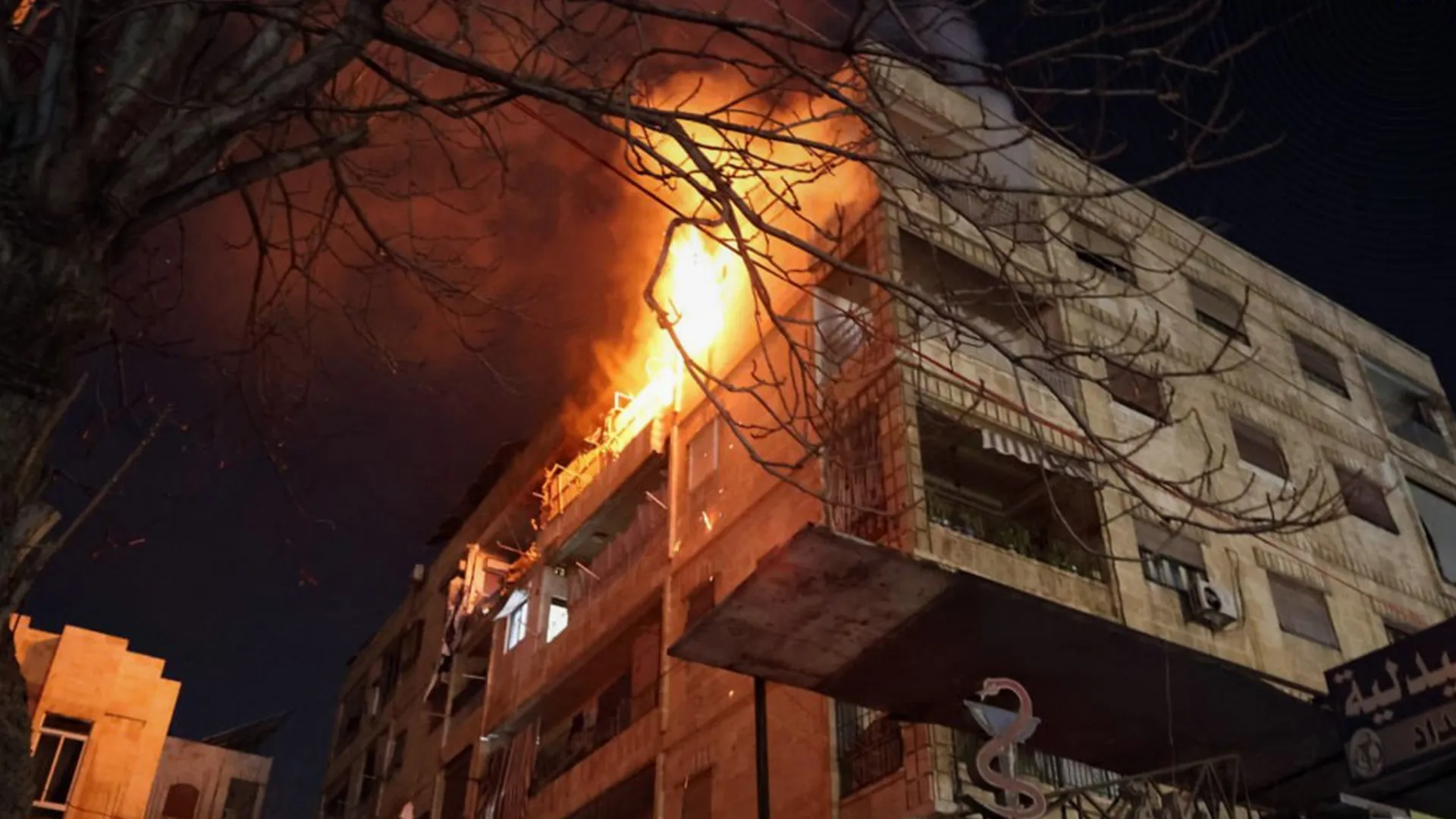
Instead, fighting has erupted between the two sides in the northern city of Aleppo.
They later agreed to stop the fighting, while blaming each other for the violence.
That deal was supposed to lead to the SDF integrating with the army, but it is stalling on how that should be implemented.
This renewed tension comes as Damascus faces other threats, ranging from ISIL (ISIS) to recurrent conflicts with the Druze community and continuing attacks by Israel.
So what does this complex security situation mean for Syria, a year after the fall of Bashar al-Assad?
Presenter: Dareen Abughaida
Guests
Haid Haid – Researcher at Chatham House
Steven Heydemann – Professor and Middle East Studies programme director at Smith College
Omer Ozkizilcik – Nonresident fellow for the Syria project in the Atlantic Council’s Middle East programme
The Israeli government is cracking down on critical media outlets, giving it unprecedented control over how its actions are presented to its citizens.
Among the moves is the so-called Al Jazeera Law, which allows the government to shut down foreign media outlets on national security grounds. On Tuesday, the Israeli parliament approved the extension of the law for two years after it was introduced during Israel’s genocidal war on Gaza to essentially stop Al Jazeera’s operations in Israel.
Recommended Stories
list of 4 itemsend of list
Separately, the government is also moving to shut down the popular Army Radio network, one of two publicly funded Israeli news outlets. The radio station is often criticised by the Israeli right wing, which views Army Radio as being biased against it.
Israelis are still reliant on receiving their news from traditional outlets with about half relying on broadcast news for information on current affairs and about a third similarly relying upon radio stations.
The tone of the media that is allowed to publish and broadcast is important. According to analysts inside Israel, the selective broadcasting of Palestinian suffering during Israel’s war on Gaza has helped sustain the carnage and reinforced a sense of grievance that allows for Israel’s continued assaults on Gaza as well as regional countries, such as Syria, Yemen and Lebanon.
Despite what observers characterise as a media environment firmly rigged in its favour, the far-right government of Prime Minister Benjamin Netanyahu, which contains ministers convicted of “terrorism” offences and others who have repeatedly called for the illegal annexation of the occupied West Bank, is looking nevertheless to bypass legal checks on its control of the media and bring more of Israel’s information feed under its control.
Let’s take a closer look.
Because the government believes it is too critical.
Israeli politicians have long complained about how the war in Gaza has been covered in both the international and domestic media.
But the government added a new accusation in November, partly blaming the media for the Hamas-led attacks on southern Israel on October 7, 2023.
“If there hadn’t been a media entirely mobilised to encourage refusal [to volunteer to reserve duty] and reckless opposition to the judicial reform, there wouldn’t have been such a rift in the nation that led the enemy to seize the opportunity,” Communications Minister Shlomo Karhi said as he introduced a bill to increase government control of the news environment, referring to attempts by the Israeli government to reduce the independence of the judiciary.
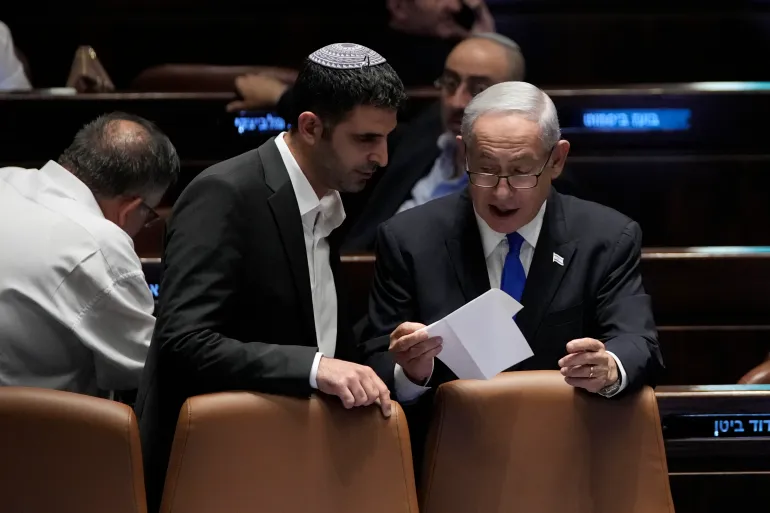
Israeli Prime Minister Benjamin Netanyahu, right, speaks to Minister of Communications Shlomo Karhi in the Knesset in West Jerusalem [File: Maya Alleruzzo/AP Photo]
In addition to the ‘Al Jazeera Law’, there are three items of legislation under way: a plan to privatise Israel’s public broadcaster, Kan, the move to abolish Army Radio, and an initiative to bring the media regulator under government control.
Both Army Radio and Kan, the other state-funded outlet with editorial independence, have carried numerous reports critical of the government.
This week, Kan aired an interview with Netanyahu’s former spokesperson Eli Feldstein, who told the broadcaster that the prime minister had instructed him to develop a strategy to help evade responsibility for the October 7 attacks.
Meanwhile, Israeli Defence Minister Israel Katz, justifying the move to shut down Army Radio, said on Monday that the outlet had become a platform to attack the Israeli military and its soldiers.
Israel is also potentially changing the way it regulates its media. In November, the Israeli parliament pressed ahead with a bill that would abolish existing media regulators and replace them with a new authority appointed by the government, potentially allowing for even greater state interference.
Israeli Attorney General Gali Baharav-Miara attends a cabinet meeting at the Bible Lands Museum in Jerusalem [Gil Cohen-Magen/Pool via Reuters]
Lastly, Israel has also codified into law the emergency legislation banning foreign media outlets whose output it disagrees with. It was first enacted as emergency legislation in May 2024 when Israel used it to ban Al Jazeera from its territory, and it was then used in the same month to halt the activity of The Associated Press after the government accused the United States-based news agency of sharing footage with Al Jazeera.
Under the new law, the communications minister – with the prime minister’s sign-off and the backing of a ministerial committee – may halt a foreign broadcaster’s transmissions if the prime minister accepts a professional assessment that the outlet poses a security threat. The minister can also shut the broadcaster’s offices, confiscate equipment used to produce its content and block access to its website.
Have the moves been criticised?
The International Federation of Journalists (IFJ) and the United Kingdom’s National Union of Journalists have criticised Israel’s decision to legislate against foreign media platforms it deems a security threat.
In a statement, IFJ General Secretary Anthony Bellanger said: “Israel is openly waging a battle against media outlets, both local and foreign, that criticise the government’s narrative: that is typical behavior of authoritarian regimes. We are deeply concerned about the Israeli parliament passing this controversial bill, as it would be a serious blow to free speech and media freedom, and a direct attack on the public’s right to know.”
The attempt to shutter Army Radio has also been heavily criticised with Israeli Attorney General Gali Baharav-Miara declaring the move unlawful and accusing Netanyahu’s coalition of making public broadcasting “weakened, threatened and institutionally silenced and its future shrouded in mist”.
Baharav-Miara has also criticised the move to place media regulation under government control, saying the bill “endangers the very principle of press freedom”.
Not very.
The Israeli media have overwhelmingly been a consistent cheerleader of the Israeli government’s actions in Gaza, where more than 70,000 Palestinians have been killed by Israel, and in the occupied West Bank.
The suffering of Palestinians is rarely shown, and when it is, it is often justified.
That means Israelis often don’t recogise the hypocrisy of their government’s statements.
An example came in June after Iran struck an evacuated hospital during the 12-day war between Israel and Iran. The Israeli government called the incident a war crime, and the Israeli media reflected that outrage.
But the attack came after Israel had been accused by a variety of organisations, including the United Nations, of systematically destroying Gaza’s healthcare system with medical workers targeted for arrest and frequently tortured despite their protection under international law.
“The Israeli media … sees its job as not to educate – it’s to shape and mould a public that is ready to support war and aggression,” journalist Orly Noy told Al Jazeera from West Jerusalem in the wake of the strike on the Israeli medical centre. “It genuinely sees itself as having a special role in this.”
KYIV, Ukraine — Before the war, Ukraine’s own “Dancing with the Stars” was a cherished and popular television show, dazzling the audiences with performances by celebrities and professional dancers. The show is now back on for one special episode — this time with Ukrainian wartime heroes as the stars, underscoring the nation’s resilience in difficult times.
Many still remember how President Volodymyr Zelensky — then an actor — won the dance competition in 2006, the year that “Tantsi z zirkamy” as the show is known in Ukrainian, first debuted.
In the new, special episode, the dancers perform with prosthetic limbs, showcasing their strength in overcoming adversity. The lineup of participants includes public figures who rose to prominence since Russia’s full-out war on Ukraine was launched in February 2022.
But like all of present-day Ukraine, the show — which is part of an international franchise — has had to deal with a multitude of wartime challenges, including frequent power outages.
All the proceeds will go to the Superhumans Center, a specialist clinic for the treatment and rehabilitation of war-wounded victims.
A new reality
During a prerecording last week, dancers spun, leapt and glided under the sparkle of lights, some seamlessly integrating their prosthetic limbs into the choreography.
For creative producer Volodymyr Zavadiuk, every segment of the show is precious, creating something special during tough times.
“It’s about our resilience and it’s about our future,” said Zavadiuk, who also heads Big Brave Events and the Big Entertainment Shows department at 1+1 Media.
Among the performers was Ruslana Danilkina, a war veteran who lost her leg in combat in 2022 and is now renowned in Ukraine for dedicating herself to helping injured troops adapt to life with prosthetics.
She delivered a passionate performance centered on reclaiming her womanhood following the traumatic injury.
Also back in the show is beloved dancer Dmytro Dikusar, this time as a competition judge. He juggled filming and serving with his platoon on the front lines.
Ukrainian rock musician Yevhen Halych sat in the makeup chair ahead of his number, reflecting on his own determination to bring back the show.
“We are filming this project in a country where there is a war. … We have power cuts, we may have an air alert, it could be bombing,” he said. “What do I feel? I feel a genuine desire to live a full life, no matter what happens.”
Wartime challenges
Producing the show’s special episode has been no easy feat in time of war. A live broadcast was impossible — a Russian attack can happen at any time. Then there were the technical obstacles: during last week’s recording, a key generator malfunctioned.
When the show airs on Sunday, audiences will vote for their favorite.
Danilkina, who was only 18 years old when she lost her leg and who today works at the Superhumans Center, enthralled everyone with her passionate performance, her prosthetic limb artfully integrated into her routine.
“Our dance number is about life. It’s about accepting love,” she told The Associated Press after her performance. “Because in reality, when your body is wounded, it’s very difficult to love yourself. And allowing someone else to love you is even harder.”
Her injury was not the end of her life, she said, and now she wants to show “thousands of wounded boys and girls who are starting their lives over again” that it’s not the end of theirs.
For veteran Ivan Voinov and his wife of three months, Solomiia, the show was more than just a dance performance: it was the second time they had danced together since his injury, the first time was at their wedding.
Solomiia Voinov smiled shyly, recounting how she had long tried to persuade Ivan that they should dance until he gave in.
“We don’t take our eyes off each other while dancing, and it’s a great connection,” she said. “I’m happy.”
Voinov said he was already planning their next dance — a bachata, a fast-paced, hip-swaying style of dance that originated in the Dominican Republic.
“We will be able to continue dancing,” he said. “It means that there is a future.”
Kullab and Stepanenko write for the Associated Press. AP videographer Alex Babenko in Kyiv, Ukraine, contributed to this report.
Russian forces have struck Ukraine’s southern Black Sea port of Odesa, damaging port facilities and a ship, the region’s governor says.
The attack late on Monday followed another at the weekend when Moscow carried out a sustained barrage of drones and missile attacks on the wider area around Odesa, which is home to ports crucial to Ukraine’s overseas trade and fuel imports. They followed Russian threats to cut “Ukraine off from the sea”.
Recommended Stories
list of 4 itemsend of list
The escalation in Russia’s assault on Odesa, Ukraine’s biggest port city, has unfolded as Washington steps up diplomatic efforts to bring an end to the war. Ukrainian officials met members of a US delegation on Friday in Florida while US envoys held talks with Russian representatives on Saturday.
“The situation in the Odesa region is harsh due to Russian strikes on port infrastructure and logistics,” Ukrainian President Volodymyr Zelenskyy told reporters in Kyiv on Monday. “Russia is once again trying to restrict Ukraine’s access to the sea and block our coastal regions.”
What happened in the latest Russian attack on Odesa?
On Tuesday, the head of the Odesa Regional Military Administration, Oleh Kiper, said Russian strikes overnight had damaged a civilian cargo vessel and a warehouse in a district of Odesa while the roof of a two-storey residential building had caught fire.
Meanwhile, strikes on Saturday on the port of Pivdennyi near Odesa damaged storage reservoirs, Ukrainian Deputy Prime Minister Oleksii Kuleba said. Those came just one day after a ballistic missile strike, also in Pivdennyi, had killed eight people and wounded at least 30.
These are just the latest strikes in an escalation of hostilities in the area over the past few weeks.
Last week, Russia launched one of its largest aerial assaults of the war on the Black Sea region, damaging energy infrastructure and causing a power outage in Odesa, leaving hundreds of thousands of residents without electricity for several days.
Russia’s Ministry of Defence did not immediately comment on the strikes, but the Kremlin has previously described Ukraine’s economic infrastructure as a “legitimate military objective” during the nearly four-year war.
On the Telegram messaging app, Kuleba said on Friday that Russian forces were targeting power infrastructure and a bridge over the Dniester River near the village of Mayaky, southwest of Pivdennyi, which was struck five times in 24 hours.
That bridge links parts of the region separated by waterways and serves as the primary westbound route to border crossings with Moldova. It is currently out of operation. Kuleba said the route normally carries about 40 percent of Ukraine’s fuel supplies.
(Al Jazeera)
Why is Russia targeting Odesa?
“The focus of the war may have shifted towards Odesa,” Kuleba said, warning that the “crazy” attacks could intensify as Russia tries to weaken Ukraine’s economy.
Russian President Vladimir Putin has previously said Moscow wants to restrict Ukraine’s Black Sea access in retaliation for Kyiv’s recent drone attacks on Russia’s sanctions-evading “shadow fleet” of vessels, which carry a variety of commodities.
Ukraine said those vessels are used to illegally export sanctioned oil, which provides Russia with its main source of revenue for financing its full-scale invasion of its neighbour.
How important is the port of Odesa to Ukraine?
Odesa’s port has long been central to Ukraine’s economy. Called a “pearl by the sea”, Odesa is Ukraine’s third most populous city after Kyiv and Kharkiv.
Black Sea ports – including Odesa and two others close by, Pivdennyi and Chornomorsk – and Mykolaiv to the east handled more than 70 percent of Ukraine’s exports before the war.
But Odesa’s role as a trading hub has grown in recent years as ports in the Zaporizhia, Kherson and Mykolaiv regions have been occupied by Russia.
Since the war began in February 2022, Ukraine has continued to rank among the world’s top five exporters of wheat and corn – largely through Odesa.
By targeting Odesa’s shipping facilities with missiles and drones, Ukrainian officials said, Putin aims to destroy Ukrainian trade and business infrastructure.
Zelenskyy, who has previously accused Russia of “sowing chaos” on the people of Odesa, said: “Everyone must see that without pressure on Russia, they have no intention of genuinely ending their aggression.”
What would it mean for Ukraine if Odesa were destroyed?
If the port of Odesa were badly damaged, the economic impact for Ukraine would be severe. The city and its surrounding areas would suffer major job losses in the shipping and logistics industries, seriously squeezing local incomes. Meanwhile, port-dependent businesses would falter and investment would fall away.
Nationally, Ukraine’s export capacity would be hit hard. As a key gateway for grain and other commodities, disruptions there would raise transport costs, slow shipments and reduce export volumes, choking foreign currency earnings and piling pressure on the hryvnia, Ukraine’s currency.
Elsewhere, farmers would suffer from lower prices for their produce as well as storage bottlenecks with knock-on effects across rural economies. The government would also lose customs revenue just as reconstruction costs would rise, weakening the country’s overall economic resilience.
What other acts of maritime warfare have Ukraine and Russia engaged in during the war?
Over the past six months, maritime warfare between Ukraine and Russia has intensified. Both sides have targeted naval and commercial assets across the Black Sea and beyond.
Ukrainian forces have increasingly used underwater drones and unmanned surface vessels to strike ships tied to Russia’s shadow fleet.
Kyiv has expanded its reach elsewhere, claiming drone strikes in the Mediterranean on December 19 on the Qendil, a Russian-linked tanker, marking an expansion in Kyiv’s maritime operations.
At the same time, Russian forces have ramped up attacks on commercial targets, including a Turkish-flagged ship carrying trucks and other freight near Odesa with drone attacks on December 13.
These actions reflect a shift towards what is referred to as “asymmetric naval warfare”, in which drones and improvised systems play a growing role in disrupting each side’s economic and military support networks at sea, experts said.
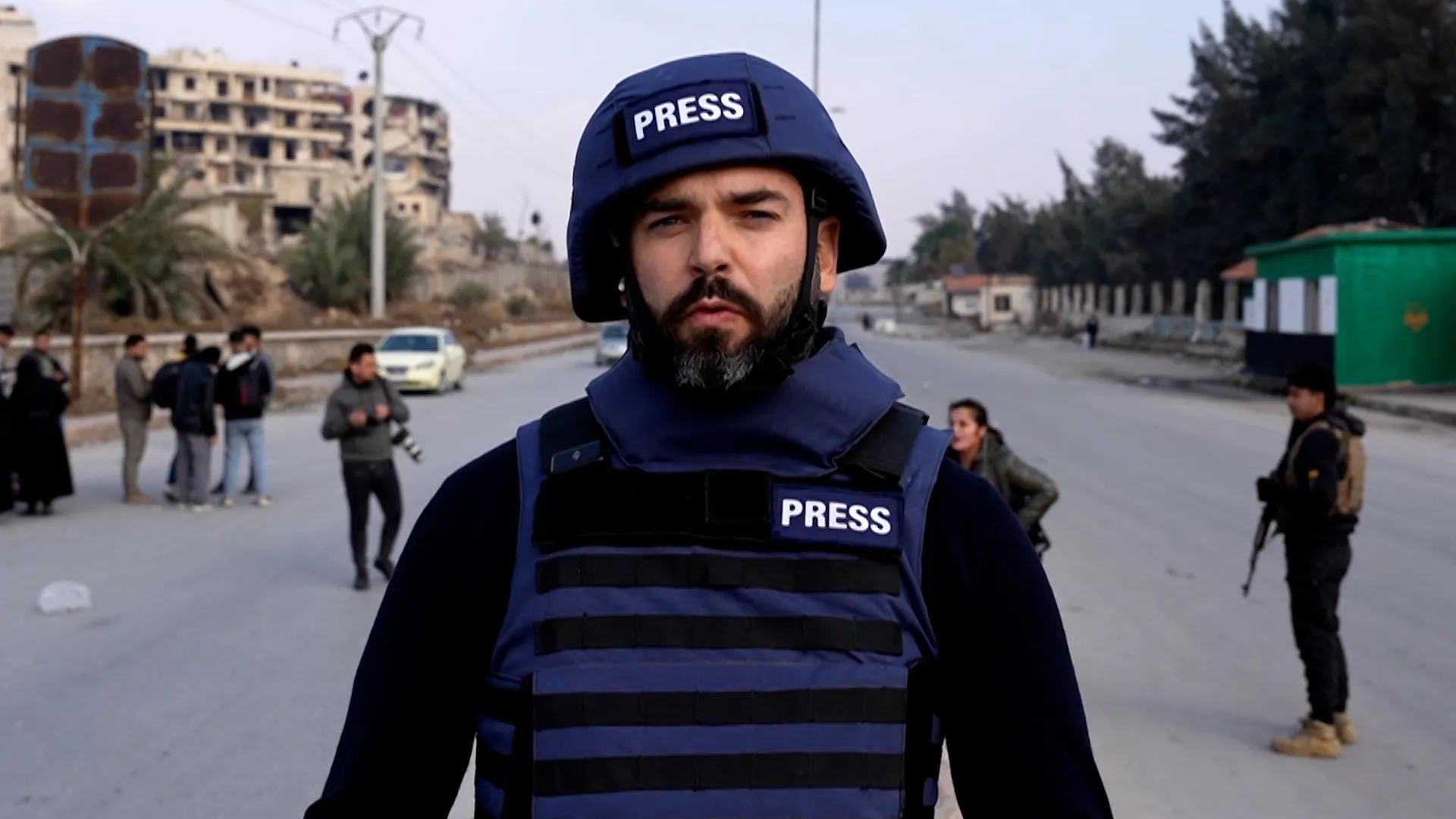
A mother and her teenage son died in fighting between the Syrian military and Kurdish-led SDF forces in Aleppo. The violence began shortly after talks in Damascus on integrating SDF forces into the army. Al Jazeera’s Ayman Oghanna is in Aleppo, where a truce has been called.
“This [killing in Moscow] is a mode of warfare which would be referred to as, quote-unquote, irregular.”
The killing of a top Russian general is a “direct message” to senior Russian military leaders from Ukraine, says Marina Miron, of King’s College London.
Kyiv, Ukraine – Have you been on a plane during severe turbulence, fearing that the shaking aircraft is about to fall apart and tumble down? Brief moments of weightlessness stop your breath, perhaps you whisper prayers and remember everyone you love.
That’s the feeling you get during a Russian air raid in Kyiv, Ukraine, and there have been more than 1,800 of them since Russia’s full-scale invasion began in 2022.
Recommended Stories
list of 4 itemsend of list
These days, they are bigger, scarier and longer than ever, because each one involves hundreds of drones and dozens of missiles.
They begin after dark and sometimes last in waves until dawn. Whooshing missiles tear up the night sky in two. Drones buzz like horror movie chainsaws or giant mosquitoes out of childhood flu nightmares.
What’s really harrowing is to hear two or three drones at once – I sardonically call it “stereo” and “Dolby surround” – while the arrhythmia of bass drum-like air defence explosions coincides with your heartbeat.
Each boom and thud chokes your body with adrenaline, and some shake your house, but after a couple of hours, your brain gives up, and you fall asleep processing the booms into nightmares.
And in the morning, you fall awake – feeling hungover and disoriented – and read about the consequences. You’re glad when no one is killed, and still sad because several people are usually wounded, and several apartment buildings are damaged.
People walk near a petrol-run generator, used to generate electricity for a medical clinic during a power blackout, after critical civil infrastructure was hit by Russian missile and drone attacks in Kyiv, Ukraine, October 10, 2025 [Gleb Garanich/Reuters]
Sometimes, I think about the people who operate the drones and launch the missiles. How they come back to their families after the night shift, what they tell their children and, most importantly, themselves.
But I prefer the memory of a crowd of high school graduates who walked past my house in June, at dawn, after their prom night that coincided with an especially long and loud air raid.
Their laughter and happiness about the sunrise, the clouds of blossoming trees around them, the rugs of flowers and grass under their feet, and the future ahead of them made them sound immortal. It was a sound that defied Russian President Vladimir Putin.
In recent months, blackouts have been the most inevitable part of each air raid. It feels as though keeping millions awake and horrified during the raids is only part of Moscow’s strategy of terrorising Ukraine.
Moscow’s logic appears simple: if you do not want to surrender, you will freeze. It methodically destroys power stations, transmission and central heating lines to keep millions without electricity, light and heat.
And then there are “planned outages”. There are usually three a day, lasting between two and eight hours.
You can hear an outage because even the sounds in your ears barely register, such as the fridge’s purring or the flow of hot water in the heating system, are gone. You can see an outage because the neighbourhood lights go out, making the stars in the night sky closer and brighter.
How to survive darkness
What saves you from darkness and disconnection is gadgets.
Apart from smartphones with energy-saving modes, wi-fi hotspots and flashlights, there are laptops, tablets, wireless speakers and vacuum cleaners running on batteries.
There are also inexpensive rechargeable lamps – I have 10 of them. Three are pint-sized and bright enough for my mother to read. Three more are motion-activated, which means she can safely use the bathroom any time, and the cat is perpetually amazed.
There is a cap lamp that makes me look like a miner and helps me cook or find something in the basement, and two tiny lamps that can be stuck into a power bank and just glow in a corner.
And there is a Christmas garland in the kitchen that makes each outage feel festive.
But the most important device, the symbolic hearth of my powerless house, is a $1,200, 20kg (40lbs) battery that can keep us warm and energised for up to 12 hours.
I live on the outskirts of Kyiv in a remodelled summer house that has its own pump and a natural gas-powered heating system. Both need electricity, along with the two 50-litre (13-gallon) water heaters.
But boiling water and microwaving meals is too energy-consuming, so we stick to frying pans and an old-fashioned whistling kettle that scares the cat.
And when the power is back on, there is no room for procrastination.
You need to recharge all the lamps and devices, start a washing machine, wash dishes, and go out for groceries without risking your life while crossing the road with the traffic lights off.
The electricity’s comeback may be deceptive – sometimes, it’s too weak. I recently tried to microwave a bowl of soup, twice, but it remained cold.
And for extreme emergencies, I have a gasoline-fuelled generator. It’s loud, shaky and stinky, and you need an entire canister of gas worth $30 for it to keep it going all night.
But such generators keep Ukraine running.
You can see them next to shops, offices and apartment buildings. Some are chained to trees or walls to prevent theft, and some are too huge and heavy to be carried away.
During a recent music festival celebrating Ukrainian composers, a giant diesel generator powered the concert hall.
My internet provider turns them on seconds after an outage begins, so I am online no matter what.
You also need to be prepared when you go out.
After covering the 2008 Russian war in Georgia, I used to drive everyone around me mad with my I-have-to-be-ready-for-any-emergency obsession.
Now, all of Ukraine feels the same obsession.
The phone has to be fully charged. There has to be a power bank in my backpack – along with a basic first aid kit, a lighter (I don’t smoke), extra batteries for the Dictaphone, pens and a pencil to take notes in subzero temperatures, when ballpen ink freezes.
A couple of months ago, I used the lighter at Kyiv’s Independence Square, dotted with hundreds of tiny Ukrainian flags next to photos of fallen soldiers.
I helped a man with a toddler light a tiny candle that he wanted to place next to the photo of his younger brother.
“He’s the toddler’s father,” the man said, and all I could utter was “God rest his soul” as I walked away, hiding tears and putting the lighter back.
People escaping fighting, lack of essential supplies in Heglig area faced with tough humanitarian conditions in search for shelter and safety.
Published On 23 Dec 202523 Dec 2025
Share
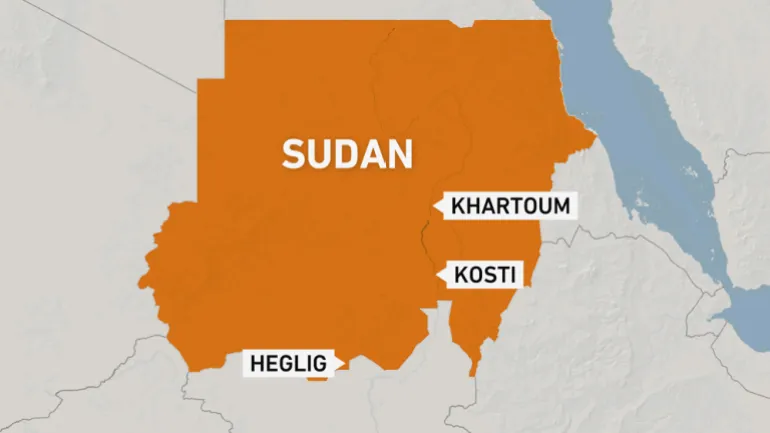
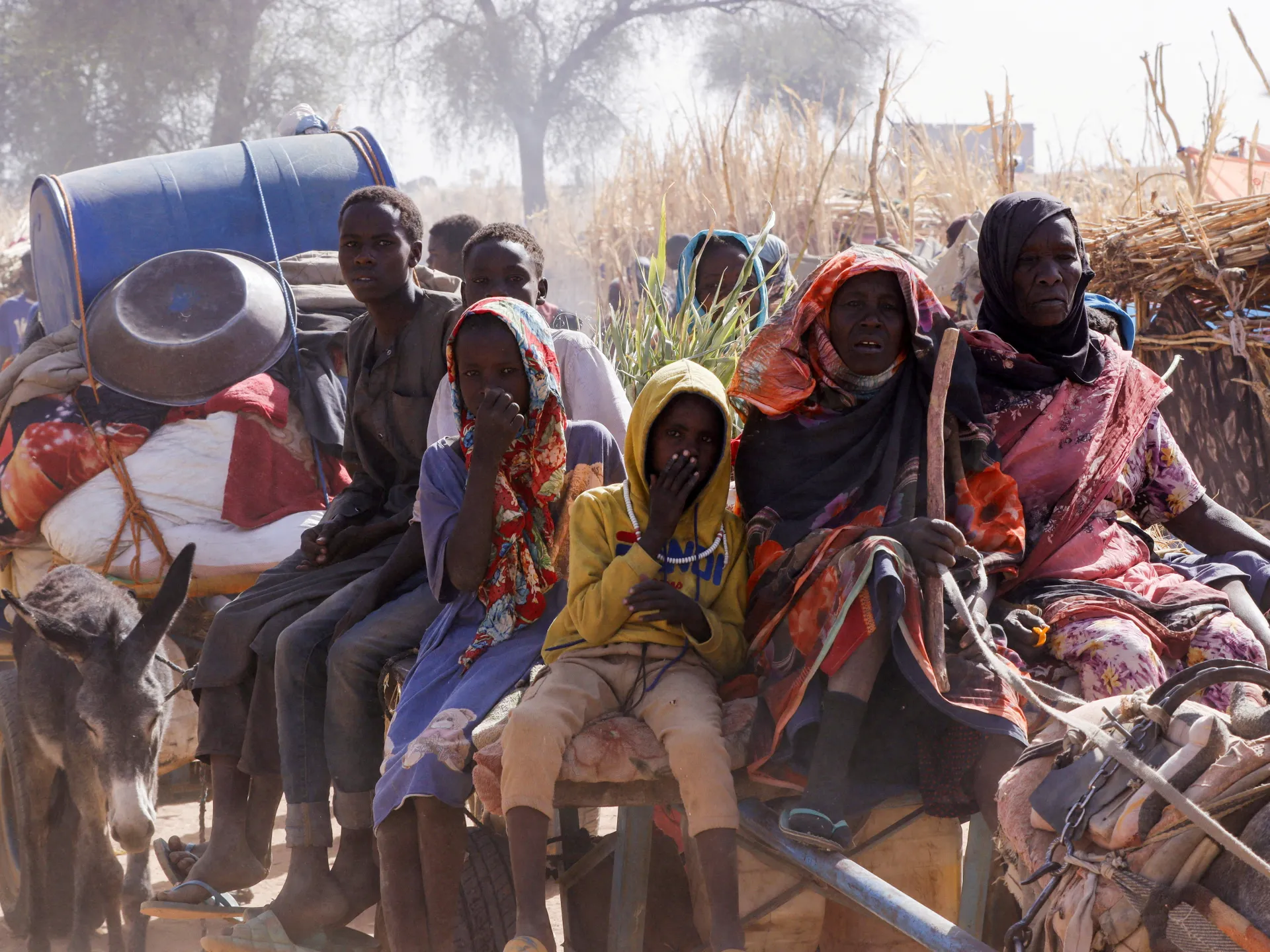
Kosti, Sudan – The flow of displaced people fleeing the fighting in Sudan shows no sign of slowing – the latest hailing from Heglig.
In early December, the paramilitary Rapid Support Forces (RSF) seized the strategic Heglig oilfield in West Kordofan province after its rival, the Sudanese Armed Forces (SAF), withdrew from the area.
Nearly 1,700 displaced people, most of them children and women, escaped the fighting in the southern region and the lack of basic necessities.
Some of them were fortunate enough to board trucks as they fled from their towns and villages in the area. After an arduous journey, the displaced people arrived at their new home – the Gos Alsalam displacement camp in Kosti, a city in the White Nile province.
“We left without anything … we just took some clothes,” said an elderly woman who appeared exhausted and frail.
Inside the camp, the people arriving are faced with extremely harsh humanitarian conditions. Tents are being pitched in haste, but as the number of displaced people grows, so do the immense humanitarian needs. Yet, humanitarian support remains insufficient to cover even the bare minimum.
“We have no blankets or any sheets, nothing. We are old people,” said a displaced elderly woman.
‘I gave birth in the street’
Nearly three years of war between the RSF and SAF have forced 14 million people to flee their homes in a desperate attempt to find shelter and safety away from the heavy fighting that has killed tens of thousands.
Some 21 million across the country are facing acute hunger, in what the United Nations calls the world’s largest humanitarian crisis.
In a small corner of the Gos Alsalam camp, Umm Azmi sits next to her newborn baby. She recalled how she was overtaken by labour on the road and delivered her baby in the open air without any medical assistance.
“I was trying for nine months … but I gave birth in the street – the condition is very difficult,” the mother said.
“I had just given birth, and I had nothing to eat. Sometimes we eat anything we find in the streets,” she added.
At least two people killed in clashes in northern city of Aleppo during Turkish FM Fidan’s visit to Syria.
By News Agencies and Reuters
Published On 23 Dec 202523 Dec 2025
Share
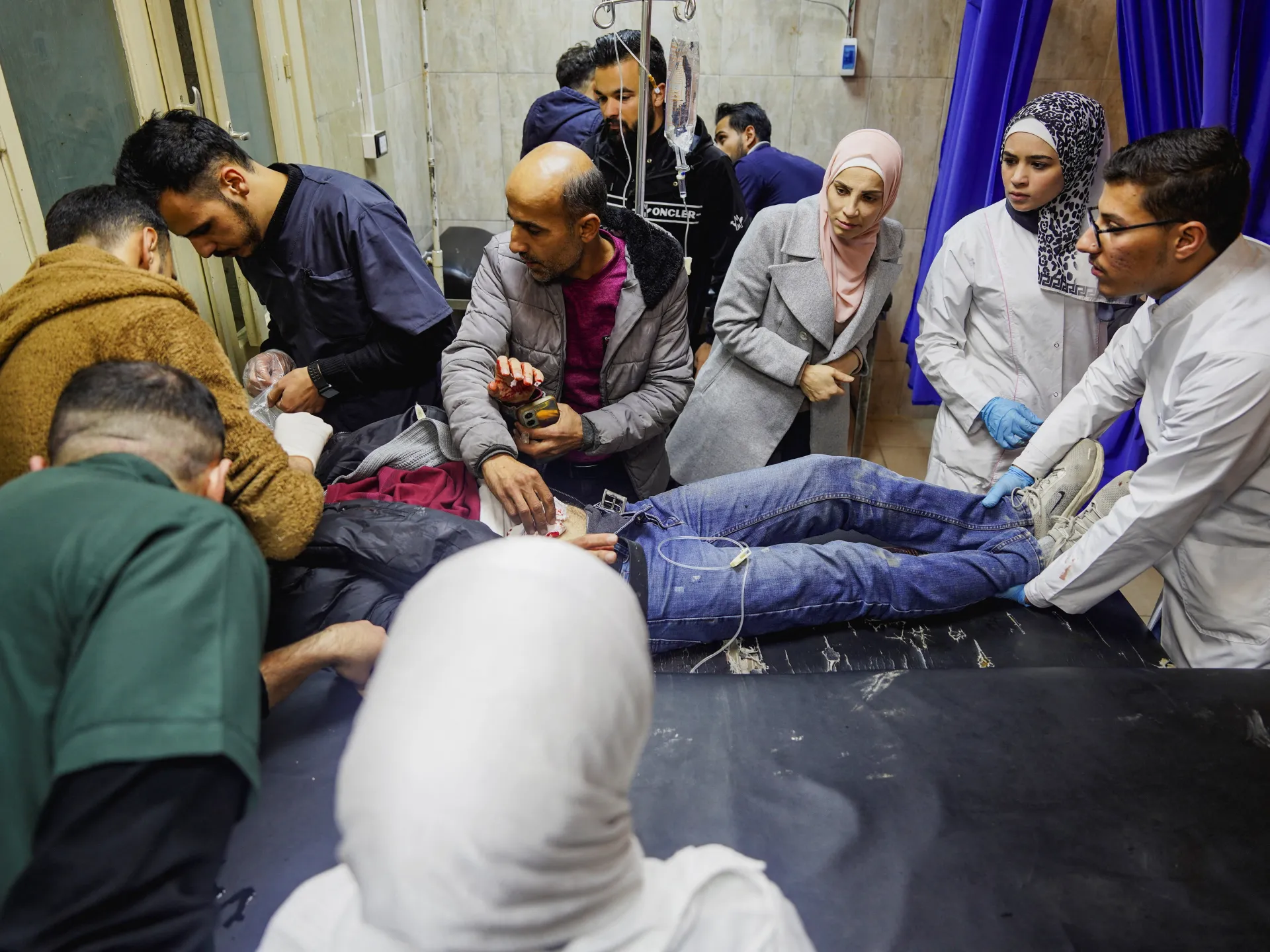
Syrian government forces and the Kurdish-led Syrian Democratic Forces agreed to stop fighting in the northern city of Aleppo, after a wave of attacks left at least two civilians dead.
Syria’s state news agency SANA cited the defence ministry as saying that the army’s general command issued an order to stop targeting the SDF’s fighters after the deadly clashes erupted during a visit by Turkish Foreign Minister Hakan Fidan.
Recommended Stories
list of 3 itemsend of list
Fidan, whose country views the SDF, which controls swathes of northeastern Syria, as a ‘terrorist’ organisation, said on Monday that the SDF appeared to have no intention of honouring its pledge to integrate into the state’s armed forces by an agreed year-end deadline.
Following the SANA report on Monday evening, the SDF said in a later statement that it had issued instructions to stop responding to attacks by Syrian government forces following de-escalation contacts.
These are the key developments from day 1,398 of Russia’s war on Ukraine.
Published On 23 Dec 202523 Dec 2025
Share
Here is where things stand on Tuesday, December 23:
Fighting
A car bomb killed Russian Lieutenant General Fanil Sarvarov in southern Moscow, the third such killing of a senior Russian military officer in just more than a year. Russian investors pointed the finger at Ukraine. Kyiv has not commented on the incident.
Russian forces struck Ukraine’s Black Sea port of Odesa late on Monday, damaging port facilities and a ship in the second such attack on the region in less than 24 hours, according to Ukrainian officials.
Ukrainian Deputy Prime Minister Oleksii Kuleba said on the Telegram app that the latest attack on Odesa is part of Russia’s attempt “to disrupt maritime logistics by launching systematic attacks on port and energy infrastructure”.
Kuleba said the attack also caused damage to energy infrastructure, disrupting electricity supply to more than 120,000 customers in the Odesa region. One person was hurt in the attack, the Ministry of Internal Affairs said.
Ukrainian President Volodymyr Zelenskyy confirmed media reports that residents of Hrabovske village, straddling the border with Russia in Ukraine’s Sumy region and home to 52 people, were taken by Russian troops. Zelenskyy said that 13 Ukrainian servicemen were among those taken.
Ukraine’s military said it hit a Tamanneftegaz oil terminal in Russia’s Krasnodar region in an overnight attack, causing explosions and a fire. The Ukrainian General Staff said the oil terminal was part of Russia’s energy infrastructure that supported the financing and logistics of Russian troops fighting in Ukraine.
A Ukrainian drone attack also damaged two vessels in the same region. All crew on the ships at the Volna terminal have been safely evacuated, according to regional authorities.
Russia’s Ministry of Defence said it had captured Vilcha village in Ukraine’s eastern Kharkiv region. The claim could not be immediately verified.
Politics and diplomacy
US President Donald Trump said that talks to end the war in Ukraine are going “OK”, amid questions about their progress, with Moscow and Kyiv still far apart on some key matters.
Zelenskyy, meanwhile, described the negotiations in Miami as “very close to a real result”. He also told a gathering of Ukrainian diplomats that the peace process “all looks quite worthy”, even as he conceded that “not everything is ideal with this, but the plan is there”.
Separately, in his nightly video address to the nation, Zelenskyy said the key issue in the talks was to determine whether the US was able to “get a response from Russia; real readiness on the part of that country to focus on something other than aggression”. He said that continued pressure on the Kremlin was vital to reduce Moscow’s capacity to wage war.
The Kremlin said talks between Russia and the US in Miami on ways to resolve the conflict in Ukraine should not be seen as a breakthrough. Kremlin spokesman Dmitry Peskov told the Izvestia news outlet that the discussions were expected to continue in a “meticulous” expert-level format.
Peskov also questioned the reliability of the sources cited in a Reuters news agency report, which said that the US intelligence community believes Putin wants to seize all of Ukraine and reclaim parts of Europe that belonged to the former Soviet bloc. Peskov told reporters in Moscow that if the report was accurate, then the US’s intelligence conclusions were wrong.
Russian Deputy Foreign Minister Sergey Ryabkov declared that Moscow is ready to confirm in a legal agreement that it has no intention of attacking either the European Union or the US-led NATO military alliance, the state RIA news agency reported.
Military aid
The Czech Republic’s National Security Council will debate the future of a Czech-led, Western-financed scheme organising artillery ammunition supplies for Ukraine on January 7, Prime Minister Andrej Babis said. The scheme also brings together foreign donors, including Germany, Denmark and the Netherlands.
Regional security
Swedish customs released the Russian ship Adler, which it boarded over the weekend to perform an inspection, with marine tracking data showing the vessel was on the move again. Swedish customs declined to say what cargo the Adler had been carrying. The Adler is under EU sanctions, while the vessel and its owners, M Leasing LLC, are both subject to US sanctions, suspected of involvement in weapons transport.
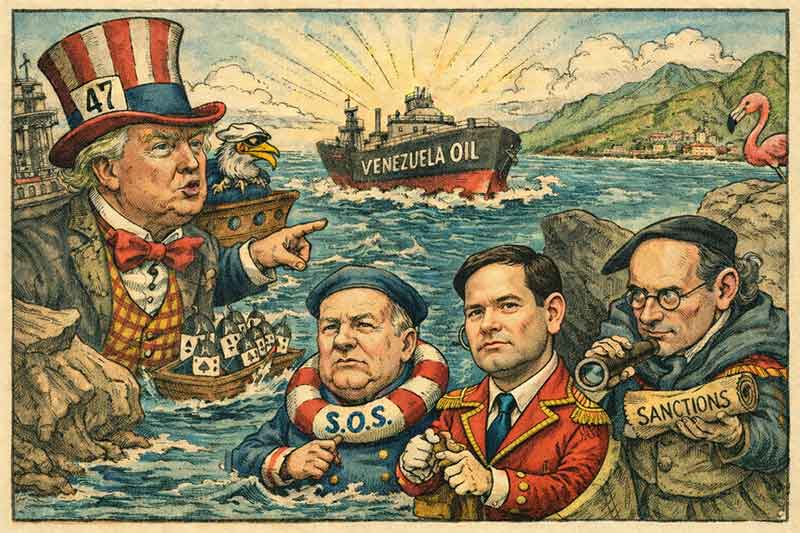
The Trump administration has shifted from a “narcoterrorism” campaign to economic coercive measures. (Countercurrents)
In our Donald-in-Wonderland world, the US is at war with Venezuela while still grasping for a public rationale. The horrific human toll is real – over a 100,000 fatalities from illegal sanctions and over a hundred from more recent “kinetic strikes.” Yet the officially stated justification for the US empire’s escalating offensive remains elusive.
The empire once spun its domination as “democracy promotion.” Accordingly, State Department stenographers such as The Washington Post framed the US-backed coup in Venezuela – which temporarily overthrew President Hugo Chávez – as an attempt to “restore a legitimate democracy.” The ink had barely dried on The New York Timeseditorial of April 13, 2002 – which legitimized that imperial “democratic” restoration – before the Venezuelan people spontaneously rose up and reinstated their elected president.
When the America Firsters captured the White House, Washington’s worn-out excuse of the “responsibility to protect,” so beloved by the Democrats, was banished from the realm along with any pretense of altruism. Not that the hegemon’s actions were ever driven by anything other than self-interest. The differences between the two wings of the imperial bird have always been more rhetorical than substantive.
Confronted by Venezuela’s continued resistance, the new Trump administration retained the policy of regime change but switched the pretext to narcotics interdiction. The Caribbean was cast as a battlefield in a renewed “war on drugs.” Yet with Trump’s pardon of convicted narco-trafficker and former Honduran President Juan Orlando Hernández – among many other contradictions – the alibi was wearing thin.
Venezuelan oil tankers blockaded
The ever-mercurial US president flipped the narrative on December 16, announcing on Truth Social that the US would blockade Venezuelan oil tankers. He justified this straight-up act of war with the striking claim that Venezuela had stolen “our oil, our land, and other assets.”
For the record, Venezuela had nationalized its petroleum industry half a century ago. Foreign companies were compensated.
This presidential social media post followed an earlier one, issued two weeks prior, ordering the airspace above and surrounding Venezuela “closed in its entirety.” The US had also seized an oil tanker departing Venezuela, struck several alleged drug boats, and continued to build up naval forces in the region.
In response to the maritime threat, President Nicolás Maduro ordered the Venezuelan Navy to escort the tankers. The Pentagon was reportedly caught by surprise. China, Mexico, Brazil, BRICS, Turkey, along with international civil society, condemned the escalation. Russia warned the US not to make a “fatal mistake.”
The New York Times reported a “backfire” of nationalist resistance to US aggression among the opposition in Venezuela. Popular demonstrations in support of Venezuela erupted throughout the Americas in Argentina, Panama, Ecuador, Peru, Mexico, Brazil, Colombia, Honduras, and the US.
Trump’s phrasing about Venezuela’s resources is not incidental. It reveals an assumption that precedes and structures the policy itself: that Venezuelan sovereignty is conditional, subordinate to US claims, and revocable whenever it conflicts with Yankee economic or strategic interests. This marks a shift in emphasis, not in substance; drugs have receded from center stage, replaced by oil as the explicit casus belli.
The change is revealing. When Trump speaks of “our” oil and land, he collapses the distinction between corporate access, geopolitical leverage, and national entitlement. Venezuelan resources are no longer considered merely mismanaged or criminally exploited; they are portrayed as property wrongfully withheld from its rightful owner.
The day after his Truth Social post, Trump’s “most pointless prime-time presidential address ever delivered in American history” (in the words of rightwing blogger Matt Walsh) did not even mention the war on Venezuela. Earlier that same day, however, two House resolutions narrowly failed that would have restrained Trump from continuing strikes on small boats and from exercising war powers without congressional approval.
Speaking against the restraining resolutions, Rep. María Elvira Salazar – the equivalent of Lewis Carroll’s Red Queen and one of the far-right self-described “Crazy Cubans” in Congress – hailed the 1983 Grenada and 1989 Panama invasions as models. She approvingly noted both were perpetrated without congressional authorization and suggested Venezuela should be treated in the same way.
The votes showed that nearly half of Congress is critical – compared to 70% of the general public – but their failure also allows Trump to claim that Congress reviewed his warlike actions and effectively granted him a mandate to continue.
Non-international armed conflict
In this Trumpian Wonderland, a naval blockade with combat troops rappelling from helicopters to seize ships becomes merely a “non-international armed conflict” not involving an actual country. The enemy is not even an actual flesh and blood entity but a tactic – narco-terrorism.
Trump posted: “Venezuelan Regime has been designated a FOREIGN TERRORIST ORGANIZATION.” Yet FTOs are non-state actors lacking sovereign immunities conferred by either treaties or UN membership. Such terrorist labels are not descriptive instruments but strategic ones, designed to foreclose alternatives short of war.
In a feat of rhetorical alchemy, the White House designated fentanyl a “weapon of mass destruction.” Trump accused Venezuela of flooding the US with the deadly synthetic narcotic, when his own Drug Enforcement Administration says the source is Mexico. This recalls a previous disastrous regime-change operation in Iraq, also predicated on lies about WMDs.
Like the Cheshire Cat, presidential chief of staff Susie Wiles emerges as the closest to a reliable narrator in a “we’re all mad here” regime. She reportedly said Trump “wants to keep on blowing boats up until Maduro cries uncle,” openly acknowledging that US policy has always been about imperial domination.
The oil is a bonus for the hegemon. But even if Venezuela were resource-poor like Cuba and Nicaragua, it still would be targeted for exercising independent sovereignty.
Seen in that light, Trump’s claim that Venezuela stole “our” oil and land is less an error than a confession. It articulates a worldview in which US power defines legitimacy and resources located elsewhere are treated as imperial property by default. The blockade is not an aberration; it is the logical extension of a twisted belief that sovereignty belongs to whoever is strong enough to seize it. Trump is, in effect, demanding reparations for imperialists for the hardship of living in a world where other countries insist their resources belong to them.
At least two people have been killed in clashes in Aleppo between Syrian government forces and the Kurdish-led Syrian Democratic Forces (SDF) that control the country’s northeast. Syrian President Ahmed al-Sharaa signed a deal in March with the SDF to integrate the group into the country’s state institutions by the end of this year.
New York City, United States – Since the recent termination of the nearly decade-old trade rule called “de minimis,” United States consumers and businesses have been exposed to slower shipping, destroyed packages and steep tariff fees on international goods – foreshadowing what could make for a chaotic holiday shopping season.
For major international carrier UPS, navigating the latest regulatory changes has proved more fraught than for its competitors FedEx and DHL.
Recommended Stories
list of 4 itemsend of list
Matthew Wasserbach, brokerage manager for Express Customs Clearance in New York, a firm that assists importers with documentation, tariff classifications, valuation, and other federal requirements, has witnessed the fallout as UPS customers seek his firm’s assistance to clear packages entering the US.
“Over the last few months, we’ve been seeing a lot of UPS shipments, in particular, becoming stuck and being lost or disposed of … This all stems from the ending of the de minimis,” said Wasserbach. “Their [UPS’s] whole business model changed once the de minimis was ended. And they just didn’t have the capacity to do the clearance … a lot of people are expecting to receive international packages, and they’re just never gonna get them.”
UPS did not respond to Al Jazeera’s request for comment.
Suspending tariff exemptions
Since 2016, the de minimis trade exemption determined that packages worth $800 or less were not subject to taxes and tariffs. According to US Customs and Border Protection (CBP), the number of shipments entering the US claiming the exemption increased by more than 600 percent from 139 million shipments in 2015 to more than one billion in 2023.
In August, this all changed. President Donald Trump signed an executive order suspending de minimis treatment for all countries, spiralling US imports into a new landscape of paperwork and processes, subject to duties and tariffs based on their place of origin.
Parcels slide down a ramp after being scanned at a US Customs and Border Protection overseas mail inspection facility [File: Charles Rex Arbogast/AP Photo]
Just a month after de minimis ended, while shipping products with UPS, Tezumi Tea, an online Japanese tea and teaware company that sells its products online and through meetups in New York City, fell victim to the tariff backlog at US customs. Tezumi lost roughly 150kg (330lbs) of matcha, totalling about $13,000.
“We responded by increasing buffers in our supply planning across the dozen farms that we partner with,” said Ryan Snowden, a cofounder of Tezumi. “Even with those adjustments, the loss had a severe effect on a number of our cafe customers who suddenly needed to switch to another matcha blend.”
Now, UPS is no longer accepting shipments from Japan, and Tezumi has switched to shipping supplies through alternate carriers such as DHL and FedEx.
Disposing shipments
Wasserbach has witnessed similar instances of UPS losing imports.
“When a UPS package goes uncleared, it’s just basically sitting in a UPS facility, uncleared for a certain period of time,” said Wasserbach. “Then UPS indicates in their tracking that they’re disposing of the shipments without making, really, any effort, from what I’ve seen, to contact either the sender or the receiver, to get information they need to do to get the clearance.”
Wasserbach shared email chains with Al Jazeera from UPS customers who looped in his firm to their customs clearance UPS debacles.
In one exchange, UPS customer Stephan Niznik responded to a notice from the UPS Alternate Broker Team that their packages had been “destroyed”.
“The tracking says on multiple instances that UPS attempted to contact the sender (me), but this is false; aside from a request for more information on September 5 (which I responded to immediately), UPS never attempted to contact me,” wrote Niznik. “It is absolutely disgraceful that my package was mishandled – clothes and children’s toys were destroyed at the hands of UPS.”
In another email chain, UPS told customer Chenying Li that their package was released following an email from Express Customs Clearance stating that the shipment was cleared.
A week later, Li’s package was still showing as “Pending Release”, and when they asked for an update on the shipment, UPS responded, “At this time we are unable to provide an ETA, as volume is currently backed up and awaiting delivery due to the De Minimis impact.”
‘Impose additional pressure’
In addition to the customs backlog, Virginia Tech associate professor David Bieri says cost prevention may provide one explanation for UPS choosing to dispose of packages rejected by US customs rather than return the shipments to senders.
“All these additional rules and regulations impose additional pressure on already relatively tight margins for these companies – UPS, FedEx, DHL and so forth,” said Bieri. “They need to make money, and sometimes it’s easier not to fulfil a service than to take on the additional cost of customs clearance and making sure that it gets to its final destination.”
Bieri added that UPS resorting to package disposal may indicate that they believe themselves to be in “a sufficiently strong monopolistic position that they can do such horrible practice – unilateral nonfulfillment of contract”.
Wasserbach told Al Jazeera that “with FedEx and DHL shipments, we aren’t seeing these problems”.
When asked whether FedEx has disposed of packages stuck in customs, a spokesperson wrote, “If paperwork is not complete and/or rejected by US Customs and Border Protection, FedEx actively works with senders to update paperwork to resubmit to CBP or return shipments to senders. In some cases, shippers can request that packages be disposed of if they would prefer not to pay to return to sender. In those rare cases, recipients are notified at the direction of the shipper. This is not a common practice. We remain business as usual.”
Final cost of delivery at your doorstep
But FedEx and DHL are encountering some of the same challenges as UPS. Since August, when de minimis ended and small packages were suddenly subject to taxes and tariffs, anyone who ordered from abroad was susceptible to unexpected fees on imported goods.
Import fees on items can be the same or more than the item ordered, boosting costs [File: Jeff Chiu/AP Photo]
Without de minimis protecting packages worth $800 and less from import fees, the consumer essentially becomes the importer.
“You might order something you find a bargain abroad, and you don’t pay attention to where things are shipped from … and it might be shipped from China, and you might be in for a rude awakening once that thing arrives at your door,” said Beiri. “You paid the price and thought that this was it. But your deliverer is saying, no, actually, we’re passing that cost on to you. Because you’re acting as the importer.”
These fees could cost equal to or more than the item you ordered itself. “You’ve got to pay extra attention to small prints,” said Beiri.
With looming costs and lost packages on the horizon, Beiri says shoppers will likely make “substitution questions” – are you renovating or are you going on vacation? Are you splashing on Christmas gifts, or are you treating yourself to dining out?
“I think these are interesting times of having to make choices and asking yourself what can we do given that we have an affordability crisis, rent, insurance, making ends meet,” said Beiri. “That’s what’s currently going on.”
In order to better handle evolving trade policy, Wasserbach says that UPS will likely aim to hire a massive number of entry writers to assist with necessary documentation for legal transportation of goods across international borders. However, now that it is the busiest time of year in terms of delivering people their Christmas shopping, Wasserbach doubts an influx of hiring could make much of a difference, given the amount of training required.
The company’s revenue has already taken a hit on account of Trump’s policies. Tariffs on China and the elimination of the de minimis rule saw imports from China, UPS’s most profitable route, drop reportedly 35 percent earlier this year.
“I would assume it’s gonna get better next year,” said Wasserbach. “But as for solving this problem before Christmas, I don’t think that that’s gonna happen.”
MSF official tells Al Jazeera South Darfur hospital ‘overwhelmed’ by rapid increase in measles cases.
Displaced Sudanese families in the war-torn Darfur region are grappling with a dangerous measles outbreak that is spreading rapidly, a Doctors Without Borders (MSF) official warns.
Dr Ali Almohammed, an MSF emergency health manager, told Al Jazeera on Monday that the group has been “overwhelmed” by measles cases arriving each day at the Nyala Teaching Hospital in South Darfur, where MSF provides paediatric and maternal healthcare.
Recommended Stories
list of 4 itemsend of list
“We have 25 beds [in] isolation for measles, but every day the number of cases is increasing,” Almohammed said in an interview from Amsterdam.
“The capacity of MSF to respond to all the needs of the people in Darfur is really limited. We cannot cover everything. Yes, we are trying to focus on the most lifesaving medical care, but still, our capacity is also limited,” he said.
The outbreak of measles, a vaccine-preventable virus, comes as violence between the Sudanese military and the paramilitary Rapid Support Forces (RSF) in the western region of Darfur and neighbouring areas has surged in recent weeks.
More than 100,000 people have fled their homes in el-Fasher, the capital of North Darfur State, after the RSF seized control of the city in late October after an 18-month siege.
The United Nations recently warned that Darfur has become “the epicentre of human suffering in the world” and UN and other humanitarian agencies have stressed that trapped civilians lack medicines, food and other critical supplies.
More than 1,300 new cases
According to MSF, more than 1,300 new measles cases have been reported in Darfur since September.
An extremely contagious virus, measles causes high fevers, coughing and rashes.
It is particularly dangerous for children under age five because it can cause serious health complications, according to a fact sheet from the United States Centers for Disease Control and Prevention.
This week, MSF said that while nearly 179,000 Sudanese children had been vaccinated against the disease over six months last year, they are only a fraction of the 5 million who are at risk.
The organisation said it is not able to operate in most of North Darfur, including el-Fasher, or in East Darfur as a result of the ongoing conflict.
Almohammed also warned that other preventable diseases, such as diphtheria and whooping cough, are now appearing in Darfur with the number of vaccines arriving just a “drop in the ocean” of what’s needed.
According to MSF, shipping vaccines has been difficult due to ongoing violence as well as “significant administrative and bureaucratic hurdles”.
“We urge authorities to immediately eliminate all bureaucratic and administrative barriers to transporting vaccines throughout Darfur,” the organisation said in a statement.
“At the same time, there must be greater urgency from UNICEF to coordinate efforts to increase the transport and delivery of vaccines, syringes and the necessary supplies.”
Attacks on healthcare
Meanwhile, attacks on healthcare facilities in Sudan have worsened the situation for civilians and medical personnel.
On Saturday, the Sudan Doctors Network said the RSF released nine medical workers from detention in Nyala in South Darfur out of a total of 73 health workers who had been detained by the paramilitary group.
The network welcomed the move as a “positive” step but called for the release of all detained medical workers and civilians without exception.
On Friday, the World Health Organization said attacks on healthcare facilities in Sudan have killed 1,858 people and wounded 490 since the conflict began in mid-April 2023.
At least 70 health workers and about 5,000 civilians have been detained in Nyala in recent months, it added.
A day earlier, the Sudan Doctors Network said 234 medical workers have been killed, 507 injured and 59 reported missing since the war began.
Prosecutors accuse the official, named as Fahad A, of torturing dozens of prisoners in jail run by Syrian intelligence.
Published On 22 Dec 202522 Dec 2025
Share
German prosecutors have charged a former Syrian security official with crimes against humanity, accusing him of torturing dozens of prisoners at a Damascus jail while ex-President Bashar al-Assad was in power.
Germany’s Federal Public Prosecutor General’s office announced the indictment on Monday, alleging the ex-prison guard, named only as Fahad A, took part in more than 100 interrogations between 2011 and 2012 in which prisoners were “subjected to severe physical abuse”.
Recommended Stories
list of 3 itemsend of list
The abuse included electric shocks, cable beatings, forced stress positions and suspensions from the ceiling, according to a statement by the prosecutor’s office.
“As a result of such mistreatment and the catastrophic prison conditions, at least 70 prisoners died,” said the statement, noting the former guard is also charged with murder.
The official was arrested on May 27 and formally indicted on December 10.
He is being held in pre-trial detention, the German prosecutor’s office added.
Syrians have demanded justice for crimes committed under the decades-long rule of al-Assad, who was removed from power in December 2024 after a rapid rebel offensive.
The Assad regime, which was accused of mass human rights abuses, including the torture of detainees and enforced disappearances, fell after nearly 14 years of civil war.
Universal jurisdiction
In Germany, prosecutors have used universal jurisdiction laws to seek trials for suspects in crimes against humanity committed anywhere in the world.
Based on these laws, several people suspected of war crimes during the Syrian conflict have been arrested in the last few years in Germany, which is home to about one million Syrians.
In June, a court in Frankfurt handed a life sentence to a Syrian doctor convicted of carrying out acts of torture as part of al-Assad’s crackdown on dissent.
The doctor, Alaa Mousa, was accused of torturing patients at military hospitals in Damascus and Homs, where political prisoners were regularly brought for supposed treatment.
Witnesses described Mousa pouring flammable liquid on a prisoner’s wounds before setting them alight and kicking the man in the face, shattering his teeth. In another incident, the doctor was accused of injecting a detainee with a fatal substance for refusing to be beaten.
One former prisoner described the Damascus hospital where he was held as a “slaughterhouse”.
Presiding judge, Christoph Koller, said the verdict underscored the “brutality of Assad’s dictatorial, unjust regime”.
On December 16, Sudanese political parties, armed movements, civil society organisations, and prominent political figures signed a nine-point political roadmap in Nairobi, presenting it as a civilian-led initiative aimed at ending Sudan’s war and restoring a democratic transition.
Framed as an antiwar, pro-peace platform, it seeks to position civilians as a “third pole” against the two military actors in Sudan’s conflict: the Sudanese Armed Forces (SAF) and the paramilitary Rapid Support Forces (RSF).
Its authors say it represents an attempt to reclaim political agency for civilians after months of marginalisation by armed actors and foreign mediators, even though the declaration does not outline any concrete steps towards military reform.
The roadmap reignited longstanding debates within Sudanese political and civic circles about representation, legitimacy, and the persistent dominance of elite-driven civilian politics.
The roadmap
The Nairobi declaration emerged after a statement released by the Quad – Egypt, Saudi Arabia, the United Arab Emirates (UAE), and the United States – in September.
The Quad statement called for an immediate three-month truce to lead to a permanent ceasefire, humanitarian access to help civilians, and the creation of a political process for a civilian transition.
It also emphasised excluding remnants of former President Omar al-Bashir’s regime and reforming Sudan’s security forces under civilian oversight, all points that the Nairobi declaration echoed.
The Nairobi signatories included the National Umma Party, the Sudanese Congress Party, civil society organisations – including the Darfur Lawyers Association and the Coordination of Internally Displaced Persons and Refugees – and the Sudan Liberation Movement (SLM-AW) led by Abdelwahid al-Nur.
Former Prime Minister Abdalla Hamdok, who led Sudan’s transitional civilian government from al-Bashir’s overthrow in 2019 until the October 2021 military coup by the SAF and the RSF working in concert, also signed the declaration.
It was likewise endorsed by al-Nur, longtime leader of the SLM-AW armed group that controls Jebel Marra in Darfur and has historically rejected what he describes as “elite-driven” political settlements.
Falling short
Sudanese researcher Hamid Khalafallah told Al Jazeera that despite the intent to present a civilian leadership, the declaration falls short of reflecting Sudan’s broader civic movement.
The Nairobi coalition, he argued, mirrors earlier civilian formations that failed to connect with Sudanese citizens, particularly those most affected by the war.
“It’s in many ways a reproduction of former groups that have … struggled to represent the Sudanese people,” he said. “It’s still very much an elite group that does politics in the same way they always have.”
Although resistance committees – neighbourhood groups that emerged from Sudan’s protest movement and helped topple al-Bashir in 2019 – were referenced in the declaration, no committees formally endorsed or signed it.
Former Prime Minister Abdalla Hamdok, left, and Abdelwahid al-Nur met in 2019 in Khartoum [File: Embassy of France in Sudan/Facebook]
Drafts were reportedly shared with some grassroots groups, but the process advanced without waiting for collective deliberation – reinforcing concerns that civilians on the ground remain politically instrumentalised rather than empowered.
While al-Nur’s participation was hailed by some as a breakthrough, Khalafallah questioned the underlying motivation, arguing that his inclusion was intended to counterbalance rival military-aligned forces rather than transform civilian politics.
Before the Nairobi declaration, there were three main civilian coalitions in Sudan, each aligned with a warring party or accused of such an alliance.
Tasis is the coalition of political parties and armed movements that was founded in February 2025, before forming the RSF’s parallel government in July 2025, while the Democratic Bloc is a grouping of parties and armed groups aligned with the SAF.
Finally comes Hamdok’s Sumoud, comprising political parties and civil society organisations and accused by SAF of supporting the RSF.
Europe’s one-track civilian strategy
European officials have distanced themselves from the Nairobi initiative.
A senior European Union diplomat, speaking on condition of anonymity, told Al Jazeera that Brussels does not see the Nairobi roadmap as the foundation for a unified civilian process.
“We would like to see only one civilian process, that’s why we are helping the African Union [AU],” the source said. “Everything else is a distraction, like this Nairobi one.”
According to the EU official, the priority is not multiplying civilian platforms but consolidating them under a single credible framework, led by the AU and broadly accepted by Sudanese society.
“Our aim is to create a credible third pole – versus RSF and SAF,” the source said. “An inclusive one, supported by most Sudanese citizens.”
The EU plans to build a broad coalition that can take the lead after the Quad’s humanitarian truce and ceasefire proposals are accepted by the SAF and the RSF, including reforms placing security forces under civilian-led oversight.
The EU’s language reflects growing frustration among international actors with Sudan’s fragmented civilian landscape, while insisting that abandoning it would legitimise military rule by default.
“Of course, we are not naive that civilians will take over tomorrow,” the source said. “But we have to stand for our values.”
The EU official was blunt in assessing the conduct of Sudan’s warring parties, rejecting narratives that frame either side as a governing authority.
“I would not call what RSF does in Darfur ‘governing’, SAF is a bit better – but not much,” the source said.
“Look at the oil deal they did,” the official added. “Money is important; people are not.”
They referred to the latest agreement between the SAF and the RSF – under South Sudanese mediation – that both would withdraw from the Heglig oil facility, with South Sudanese troops deployed to secure the refinery following SAF’s pullout and the RSF’s capture of the site.
Warring parties as spoilers?
US-Africa policy expert Cameron Hudson told Al Jazeera that the Nairobi declaration appears to mimic the Quad’s recent statement, effectively presenting to the international community a roadmap that aligns with pre-existing objectives to gain Quad support.
“My sense is that the Nairobi declaration reverse engineers what the Quad has said,” Hudson said, suggesting that the initiative is designed more to attract international endorsement than to build genuine domestic consensus.
Hudson warned that this approach mishandles the sequencing of Sudan’s political transition, “prematurely” linking ceasefire efforts with reforms of the army or other political changes, arguing that these should remain on separate tracks until violence subsides.
“If what the Quad wants is an unconditional ceasefire, then it needs to pursue that, not create opportunities to trade a ceasefire for political assurances during a transition,” he said.
“For that reason, it is premature to be talking about reforming the army or other political reforms. These should remain in separate tracks for now.”
The tension is stark. The Quad and the European Union increasingly state that neither the SAF nor the RSF should have a political future and that remnants of the Bashir regime must be excluded entirely.
Yet both armed forces remain indispensable to any cessation of hostilities, creating an unresolved contradiction at the heart of international strategy.
US Special Envoy Steve Witkoff has hailed talks on ending Moscow’s war in Ukraine as “productive and constructive”, after holding separate meetings with Ukrainian, European and Russian negotiators in the state of Florida.
The talks in Miami on Sunday were the latest in a series of meetings between the US, Russia and Ukraine on a 20-point plan touted by US President Donald Trump to end the nearly four-year-old war.
Recommended Stories
list of 4 itemsend of list
Despite the optimism from the US, there have been no clear signals of imminent resolutions to key hurdles, including on the issue of the territory Russia has seized during the conflict.
Witkoff, who met with Russian President Vladimir Putin’s special envoy Kirill Dmitriev on Saturday, held talks on Sunday with officials from Ukraine and Europe. He then held separate talks with the Ukrainian delegation, led by senior official Rustem Umerov.
Trump’s son-in-law, Jared Kushner, also joined the meetings.
Witkoff, in a joint statement with Umerov, called Sunday’s talks “productive and constructive”, saying they focused on a “shared strategic approach between Ukraine, the United States and Europe”.
“Particular attention was given to discussing timelines and the sequencing of next steps,” they said.
Witkoff and Umerov said that bilateral discussions between Ukrainian and US officials on Sunday focused on developing and aligning positions on four key documents: the 20-point plan, a “multilateral security guarantee framework,” a “US Security guarantee framework for Ukraine”, and an “economic & prosperity plan”.
In a separate X post that used some of the same language, Witkoff said his talks with Dmitriev were also “productive and constructive”.
“Russia remains fully committed to achieving peace in Ukraine,” Witkoff said in the post. “Russia highly values the efforts and support of the United States to resolve the Ukrainian conflict and re-establish global security.”
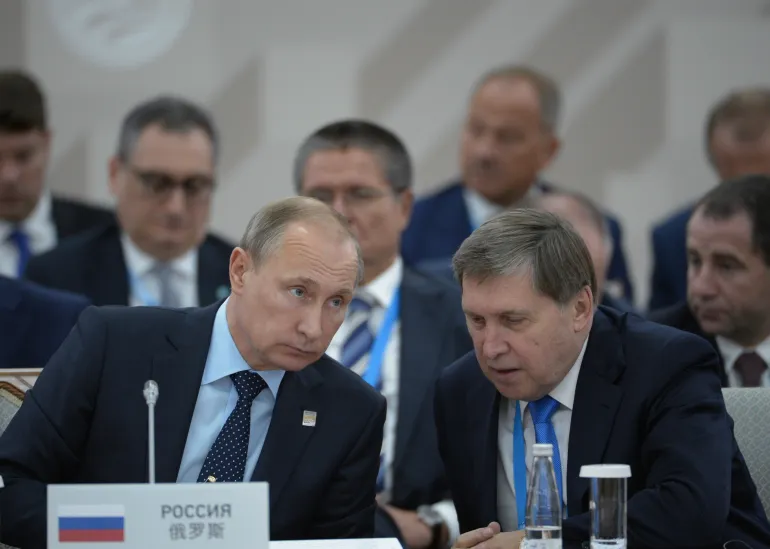
Russian President Vladimir Putin with presidential aide Yury Ushakov [File/Handout: RIA Novosti via Getty Images]
Earlier on Sunday, Putin’s top foreign policy aide, Yury Ushakov, said that the changes requested by Ukraine and its European allies to the framework put forth by the US were not improving prospects for peace.
Ushakov said that Dmitriev was due to return to Moscow on Monday and would report to Putin on the outcome of his talks.
“After that, we will formulate the position with which we will proceed, including in our contacts with the Americans,” he said.
Russia, which launched a full-scale invasion of Ukraine in February 2022, sees Europe as “pro-war” and argues that its participation in the talks only hinders them.
Separately on Sunday, Kremlin spokesman Dmitry Peskov said that Putin was ready to talk with his French counterpart, Emmanuel Macron, after the latter said Europe should reach out to the Russian president to end the war.
Putin has “expressed readiness to engage in dialogue with Macron”, Peskov told Russian state news agency RIA Novosti. “Therefore, if there is mutual political will, then this can only be assessed positively.”
Macron’s office welcomed the Russian statement.
“It is welcome that the Kremlin has publicly agreed to this approach. We will decide in the coming days on the best way to proceed,” it said.
Trump first shared his plan consisting of 28 points to end the war in Ukraine last month, triggering immediate criticism from European leaders who said it echoed the Kremlin’s demands.
Zelenskyy has since said that Ukraine and its European allies have shared their own version of a 20-point plan, which was based on the initial plan put forward by the White House.
One of the key sticking points between Russia and Ukraine remains Russia’s demand to retain some of the land it has captured in Ukraine since launching its full-scale invasion after years of fighting in Ukraine’s east.
Zelenskyy has described the talks as “constructive” and said they were “moving at a fairly rapid pace”. He nevertheless cautioned that “much depends on whether Russia feels the need to end the war for real”.
He also hailed this week as “historic” for Ukraine, thanking Europe for pledging $100bn of funding over the next two years.
These are the key developments from day 1,397 of Russia’s war on Ukraine.
Published On 22 Dec 202522 Dec 2025
Share
Here is where things stand on Monday, December 22:
Fighting
A Russian attack on Ukraine’s Kharkiv region killed a 49-year-old man and a 42-year-old woman, according to Governor Oleh Syniehubov. The killings took place in the village of Izyum.
Russian attacks also killed one person in Ukraine’s Donetsk region, and one person in the southeastern Zaporizhia region, local officials reported.
Russian forces have shelled the Zaporizhia region nearly 5,000 times over the past week, wounding 60 people and damaging hundreds of buildings, according to Governor Ivan Fedorov.
Overall, Russian forces have launched about 1,300 drones, nearly 1,200 guided aerial bombs, and nine missiles towards Ukraine over the past week, according to Ukrainian President Volodymyr Zelenskyy.
Ukraine’s ombudsman, Dmytro Lubinets, accused Russian forces of “illegally” detaining about 50 residents of the village of Hrabovske in the Sumy region and “forcibly deporting” them to Russian territory.
The Kyiv Independent, citing Ukrainian authorities, reported that wreckage from a Ukrainian drone attack on Russia damaged a pipeline in the Krasnodar Krai region.
Russia’s Ministry of Defence said its forces shot down 29 Ukrainian drones in the past 24-hour period.
The Russian Federal Security Service (FSB) claimed that Russian forces shot down 252 drones over the Russian-occupied Donbas region, using the “Donbas Dome electronic warfare system” over the past week, the TASS news agency reported.
Politics and diplomacy
US envoys Steve Witkoff and Jared Kushner met with a Ukrainian delegation, led by senior official Rustem Umerov and European officials, as the US continued to host talks in Miami, Florida, on a prospective peace deal for Russia’s war on Ukraine for a third day on Sunday.
Witkoff said in a post on X late on Sunday that the talks with the Ukrainians and Europeans had been “productive and constructive” and focused on a “shared strategic approach between Ukraine, the United States and Europe”.
In a second post about two hours later, Witkoff said that the US had also had “productive and constructive meetings” with Russian envoy Kirill Dmitriev over the past two days.
“Russia remains fully committed to achieving peace in Ukraine [and] highly values the efforts and support of the United States to resolve the Ukrainian conflict and re-establish global security,” Witkoff said.
Earlier, Russian President Vladimir Putin’s top foreign policy aide, Yury Ushakov, said that changes made by European countries and Ukraine to the US’s proposals for an end to Russia’s war did not improve prospects for peace.
“I am sure that the proposals that the Europeans and Ukrainians have made or are trying to make definitely do not improve the document and do not improve the possibility of achieving long-term peace,” Ushakov was quoted as saying by Russian news agencies.
Kremlin spokesman Dmitry Peskov said the Russian president was ready to talk with his French counterpart, Emmanuel Macron, after the latter said Europe should reach out to Moscow to end the war.
Macron’s office welcomed the Russian statement, saying: “It is welcome that the Kremlin has publicly agreed to this approach. We will decide in the coming days on the best way to proceed.”
India’s Ministry of External Affairs said that “202 Indian nationals are believed to have been recruited into the Russian armed forces” during Russia’s war on Ukraine. It said Russian authorities had reported that 26 had been killed and seven were missing.
Sweden’s customs service said on Sunday that Swedish authorities boarded a Russian freighter that anchored in Swedish waters on Friday after developing engine problems, to inspect the cargo. The owners of the vessel, the Adler, are on the European Union’s sanctions list, Martin Hoglund, spokesman at the customs authority, said.
“Shortly after 0100 last night [00:00 GMT] we boarded the ship with support from the Swedish Coast Guard and the police service in order to make a customs inspection,” Hoglund said. “The inspection is still ongoing.”
Yury Ushakov’s remarks come a day after US and Russian officials held talks on the US proposal in Florida.
Published On 21 Dec 202521 Dec 2025
Share
Russian President Vladimir Putin’s top foreign policy aide says that changes made by European countries and Ukraine to the United States’ proposals for an end to Russia’s war on Ukraine did not improve prospects for peace.
“I am sure that the proposals that the Europeans and Ukrainians have made or are trying to make definitely do not improve the document and do not improve the possibility of achieving long-term peace,” Yury Ushakov was quoted as saying by Russian news agencies on Sunday.
Recommended Stories
list of 4 itemsend of list
The US-drafted proposals for an end to the nearly four-year war, leaked to the media last month, raised European and Ukrainian concerns that they favour more of Russia’s wartime demands and that US President Donald Trump’s administration could push Kyiv into conceding too much.
Since then, European and Ukrainian negotiators have met with Trump envoys in an attempt to add their own proposals to the US drafts, though the exact contents of the current proposal have not been disclosed.
The remarks from Ushakov came after Putin’s special envoy, Kirill Dmitriev, met in Florida on Saturday with US special envoy Steve Witkoff and Trump’s son-in-law Jared Kushner. Dmitriev said the talks would continue on Sunday.
The Miami meeting followed US talks on Friday with European and Ukrainian officials.
In the wake of those talks, Ukrainian President Volodymyr Zelenskyy said his team should hold more talks with European allies.
“There is a shared sense that after the work by our diplomatic team in the United States, we should now hold consultations with European partners in a broader circle,” Zelenskyy said in a post on X on Sunday.
Three-way talks?
Zelenskyy had said on Saturday that Ukraine would back a US proposal for three-way talks with the US and Russia if it facilitated more exchanges of prisoners and paved the way for meetings of national leaders.
Ushakov said that a proposal for three-way talks had not been seriously discussed by anyone and that it was not being worked on.
Russia says that European leaders are intent on scuttling the talks by introducing conditions that they know will be unacceptable to Russia, which took 12-17 square kilometres (4.6 to 6.6 square miles) of Ukrainian territory per day in 2025.
Ukraine and European leaders say that Russia cannot be allowed to achieve its aims in what they call its imperial-style land grab.
Ukraine battles attempted Russian breakthrough
In Ukraine, fighting continues with the Ukrainian army battling an attempted Russian breakthrough in the Sumy region, it said on Sunday, following reports that Moscow forcibly moved 50 people from a border village there.
This marks a renewed Russian advance in the part of the region previously largely spared from intense ground fighting since Ukraine regained land there in a swift 2022 counter-offensive.
“Fighting is currently ongoing in the village of Grabovske,” Ukraine’s joint task force said, adding the troops were “making efforts to drive the occupiers back into Russian territory”.
Zelenskyy said that over the week, “Russia has launched approximately 1,300 attack drones, nearly 1,200 guided aerial bombs, and nine missiles of various types” against Ukraine.
Russia launched its full-scale invasion of Ukraine in February 2022 after eight years of fighting in the country’s east.
Some European leaders feel sidelined as US mediation takes Russian priorities into consideration.
After years of support from the United States for the Ukraine war to continue “as long as it takes”, the Trump administration is now pushing to end Europe’s war – quickly and imperfectly.
While details are still under negotiation, they include issues such as ensuring Ukraine never joins NATO and Russia’s control over about 20 percent of Ukraine.
To understand the implications for Europe, the US and their relations, host Steve Clemons speaks with Kurt Volker, Trump’s former special representative for Ukraine negotiations, and retired Colonel Heino Klinck, former director of US Army international affairs.