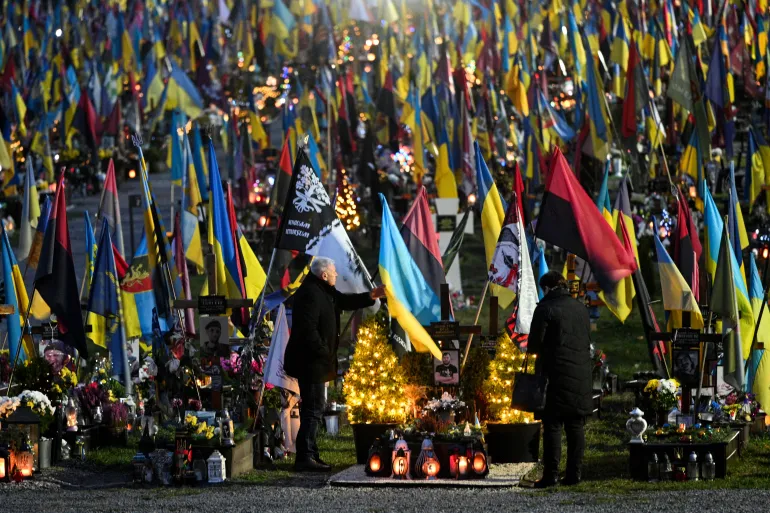
war

UN’s Amina Mohammed: Why women pay the highest price in war | United Nations

From Sudan to Gaza, impunity for violence against women is fuelling conflict worldwide, the UN’s deputy chief warns.

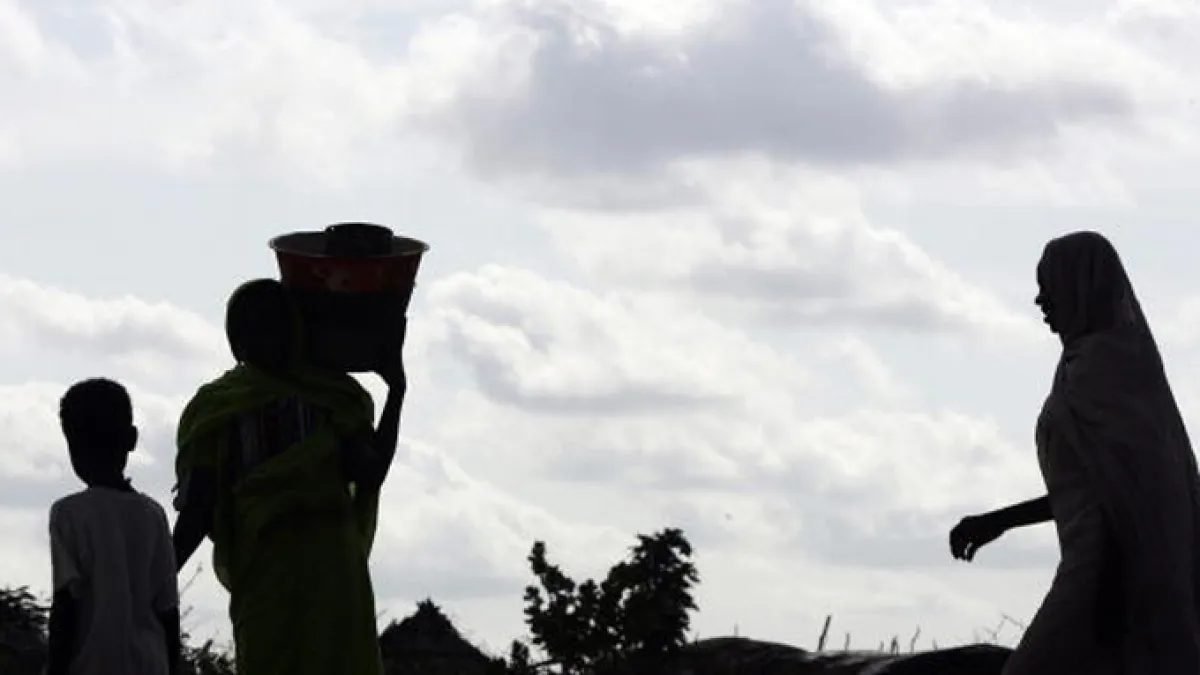
In today’s conflicts, women and girls are facing escalating violence with near-total impunity. From mass rapes in Sudan to attacks on schools and shelters in Gaza and Syria, and the segregation of women in Afghanistan, protection is collapsing as wars intensify. Speaking to Talk to Al Jazeera, UN Deputy Secretary-General Amina Mohammed warns that violence against women is not a side issue but a front-line threat to peace and development. With funding shrinking and the political will faltering, she confronts hard questions about the world’s failure to protect those most at risk.

Source link

Thailand, Cambodia agree to 72-hour cease-fire amid border war

Cambodian Defense Minister Tea Seiha, left, and Thai Defense Minister Natthaphon Narkphanit exchange cease-fire agreement documents after three days of negotiations to end a weeks-long battle along the two countries border. Photo by Defense Ministry of Thailand/EPA

Dec. 27 (UPI) — Weeks into a vicious border war that has killed dozens of people and displaced roughly half a million, Thailand and Cambodia agreed to a 72-hour cease-fire on Saturday.

The countries announced in a joint statement that they would not conduct any military activities along the border, although their troops can stay there, in an effort to have a prolonged period of peace to see if the cease-fire will hold, The New York Times and Financial Times reported.

The agreement comes after several days of negotiations to end renewed fighting that has plagued the border region for weeks, including Thai air strikes on Cambodia’s Banteay Meanchey Province early Friday morning.

“The signing is not the end, but the beginning of proving sincerity through action,” Thailand’s Air Chief Marshal Prapas Sornchaidee said in a statement posted to X.

“Thailand will proceed based on the same principles it has consistently communicated to the international community,” said Sornchaidee, who is acting as director of the joint press center and principle spokesperson on the border negotiations.

The cease-fire was due to start at 12:00 p.m. local time, with all fighting and military activity halted and both sides avoiding “unprovoked firing or advancement or movement of troops toward the other side’s positions,” according to the agreement.

The agreement requires both sides to refrain from any type of provocative actions, to avoid disseminating “false information or fake news” and to commit to efforts for both countries to better work together.

Additionally, if the cease-fire holds for the full 72 hours, Thailand agreed to return 18 Cambodian soldiers — something it initially agreed to do in October — and both sides will start to allow civilians to return to their homes along the 500-mile border between the countries.

The soldiers were captured in July after weeks of fighting, which also had resulted in a cease-fire and an eventual peace accord signed in October in Kuala Lumpur.

That cease-fire and peace agreement rumbled in November when Thailand accused Cambodia of laying new landmines along its border — weapons that both countries have employed — Financial Times reported.

The new agreement, which was signed at 10:30 a.m. local time on Saturday morning, follows recent overtures from the United States and China to increase diplomatic efforts and end the conflict, the New York Times reported.

“The United States welcomes this announcement from Cambodia and Thailand on reaching a cease-fire that halts hostilities along their border,” U.S. Secretary of State Marco Rubio said in a statement. “We urge Cambodia and Thailand to immediately honor this commitment and fully implement the terms of the Kuala Lumpur Peace Accords.”

With a cease-fire agreed to after three days of negotiations, a trilateral meeting between the foreign ministers of Cambodia, Thailand and China will be held on Sunday and Monday to continue working toward a more lasting peace, Cambodian officials said.

President Donald Trump holds a signed executive order reclassifying marijuana from a schedule I to a schedule III controlled substance in the Oval Office of the White House on Thursday. Photo by Aaron Schwartz/UPI | License Photo

Source link

Two killed as Russia hammers Ukraine before Trump-Zelenskyy meeting | Russia-Ukraine war News

Russia has carried out drone and missile attacks on Ukraine’s capital, Kyiv, on the eve of a key meeting between the United States and Ukrainian leaders, killing at least two people and leaving a third of the city without heat, according to authorities.

Russian ballistic missiles and drones rocked Kyiv from the early hours of Saturday morning, when an air alert was in place for nearly 10 hours.

Recommended Stories

list of 4 itemsend of list

The attacks killed a 71-year-old man in Kyiv’s Dniprovskyi district and another person in the nearby town of Bila Tserka, according to officials. At least 32 others were wounded in Kyiv, including two children, police in Kyiv said.

Ukrainian President Volodymyr Zelenskyy said that during the attack, some 500 drones and 40 missiles targeted “energy facilities and civilian infrastructure”.

The Russian strikes cut power to more than a million homes in and around Kyiv, energy company DTEK said in a social media post late on Saturday.

Ukrainian Foreign Minister Andrii Sybiha said there was no heat in one-third of the capital, where temperatures hovered around freezing (0 ​degrees Celsius or 32 degrees Fahrenheit).

Russian forces are “trying to cut off all Ukrainians from our critical resources just to freeze us”, Kyiv-based journalist Kristina Zelenyuk told Al Jazeera.

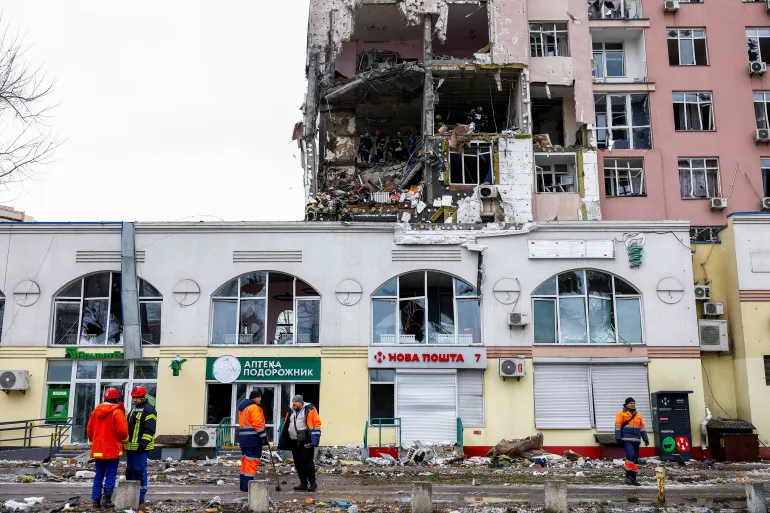
Municipal employees and firefighters work at the site of an apartment building hit during Russian missile and drone strikes, amid Russia’s attack on Ukraine in Kyiv, Ukraine December 27, 2025. REUTERS/Valentyn Ogirenko
City employees and firefighters work at the site of an apartment building hit during Russian missile and drone attacks in Kyiv, Ukraine [Valentyn Ogirenko/Reuters]

Upcoming peace talks

The Russian attack came as Zelenskyy prepares to meet with US President Donald Trump in Florida on Sunday for further talks on how to end Moscow’s nearly four-year war.

Zelenskyy said they planned to discuss security guarantees and questions over future territorial control, the main sticking points in the negotiations.

Analysts say the Russian strikes on Kyiv were aimed at sending a clear message ahead of the Trump-Zelenskyy meeting.

“It’s kind of traditional in the negotiations, since before the invasion, since 2014, whenever we have these kind of meetings, there is an escalated attack. And the point is to put pressure on the meeting,” said Ben Aris, the founder and editor-in-chief of BNE Intelli-News.

“And Putin here is underlining the fact that he has the ability to take out power stations just as temperatures fall below zero,” said Aris. The message Putin aimed to send is that if Zelenskyy “doesn’t succumb to my demands, then I have the ability to black out all of the large cities in Ukraine with these high precision and powerful missiles,” said Aris.

Before the talks with Trump, Zelenskyy met Canadian Prime Minister Mark Carney in Halifax on Saturday. The two held a bilateral meeting before attending a joint telephone conversation with European leaders.

Speaking beside⁠ the Ukrainian leader, Carney announced ​an additional 2.5 billion Canadian dollars ‍($1.82bn) of economic aid for Ukraine, and said that peace depends on a “willing Russia”.

Later, German Chancellor Friedrich Merz issued a statement saying that Zelenskyy had “the full support” of European leaders and of Canada, before his talks with Trump. They and the leaders of NATO and the European Union said they would work “in close coordination with the US for a just and lasting peace in Ukraine”, Merz added.

EU chiefs Ursula von der Leyen and Antonio Costa also reaffirmed the bloc’s support for Ukraine.

“We welcome all efforts leading to our shared objective – a just and lasting peace that preserves Ukraine’s sovereignty and territorial integrity,” European Commission President von der Leyen said on X after the call with Zelenskyy and Carney.

Costa, the president of the European Council, which represents the EU’s 27 member states, echoed her promise to continue backing Ukraine, saying on X: “The EU’s support for Ukraine will not falter. In war, in peace, in reconstruction.”

Ukraine ‘suffering’

Moscow demands that Ukraine withdraw from the parts of the eastern Donetsk region that Russian troops have failed to occupy during almost four years of war, as it seeks full control of the Donbas, comprising the Donetsk and Luhansk regions.

Kyiv wants the fighting to be halted at the current lines.

The US, seeking a compromise, has proposed a free economic zone if Ukraine leaves parts of the Donetsk region. Zelenskyy told US news site Axios on Friday that he would seek a stronger position for Ukraine, but could put the US-backed plan to a referendum if necessary.

Both Zelenskyy and Trump have expressed optimism about the meeting, with the Ukrainian leader saying that most components of a US-Ukraine agreement had been ironed out and that he hopes to finalise a framework on Sunday.

“A lot can be decided before the New Year,” Zelenskyy posted on social media on Friday.

But the attack on Saturday appeared to alter Zelenskyy’s tone. In a post following the aerial barrage, he said that Russia’s leadership “does not want to end the war”, and that their drones and missiles speak louder than any “lengthy talks” they engaged in.

Russia’s leadership aims “to use every opportunity to cause Ukraine even greater suffering and increase their pressure on others around the world”, said Zelenskyy.

The Russian president levied similar criticism.

According to the Interfax and TASS news agencies, Putin said Russia could see Kyiv was in no hurry to end the conflict by peaceful means. He also threatened Russia would accomplish all goals of its “special military operation” in Ukraine by force.

Separately on Saturday, Russian forces ‌reported that they had captured the ‌town of Myrnohrad ⁠in Ukraine’s Donetsk region, as well as Huliaipole ‌in Ukraine’s Zaporizhia region, the Kremlin said on ‍its Telegram channel.

Ukraine’s military, however, said in its daily battlefield update that its forces had beaten back Russian attempts to advance in the vicinity of Myrnohrad and Huliaipole

Source link

Analysis: ISIL attacks could undermine US-Syria security collaboration | Syria’s War News

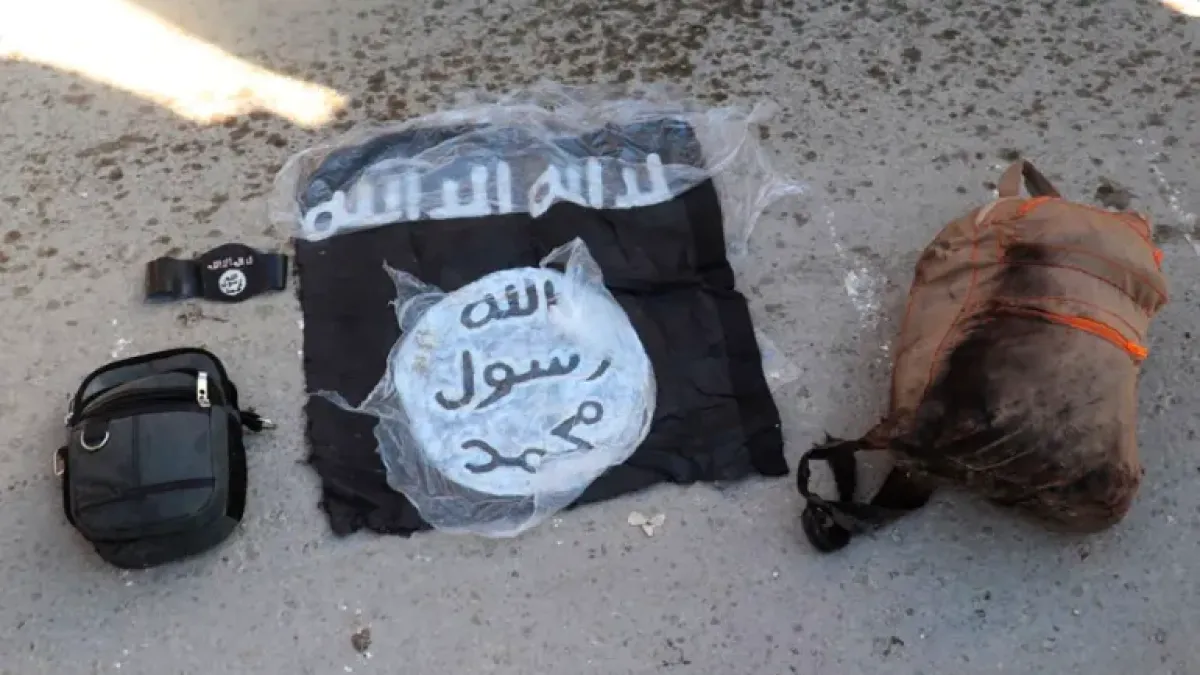
On December 13, a joint US-Syrian patrol was ambushed by a member of Syria’s own security forces near Palmyra, a city in central Syria once controlled by the ISIL (ISIS) group.

Two US soldiers and an interpreter were shot dead, and four people were wounded, before Syrian forces killed the gunman.

Recommended Stories

list of 3 itemsend of list

In the aftermath of the attack, US and Syrian officials linked the attacker to ISIL, which once controlled vast swaths of Syria and Iraq, and promised to retaliate.

The incident highlights the growing cooperation between the United States and Syria against ISIL, particularly after Damascus joined the US-backed coalition against the group in November.

While it is still unclear if the attacker was a member of ISIL or another group opposed to US-Syrian relations, analysts say that cooperation between the two countries is strong and growing stronger.

“The Syrian government is responding very robustly to fighting ISIL following US requests to do so, and it is worth noting that HTS [Hayat Tahrir al-Sham], before it was in government, had a long-term policy of fighting ISIL,” Rob Geist Pinfold, a scholar of international security at King’s College London, told Al Jazeera, referring to Syrian President Ahmed al-Sharaa’s former group.

“It [HTS] did it in Idlib, and cracked down on insurgents and cells, and this is more a continuation of that policy.”

Syria’s Minister of Interior spokesman, Noureddine al-Baba, told Syria’s Al-Ikhbariah TV that there was no direct chain of command to the gunman within Syria’s internal security forces, and that he was not part of the force tasked with escorting the US forces. Investigations are under way, he added, to determine whether he had direct ties to ISIL or adopted violent ideology.

ISIL attacks down

In May 2015, ISIL took over the city of Palmyra from the former Syrian government.

Famous for its Greco-Roman ruins, the city bounced back and forth between regime forces and ISIL until the group was expelled in 2017.

In May 2017, the US-led coalition also forced the group out of Raqqa, which ISIL had declared the capital of its so-called caliphate three years earlier.

Many surviving ISIL fighters were imprisoned in the al-Hol and Roj camps in northeast Syria, controlled by the US-backed Syrian Democratic Forces (SDF). Others escaped into the Syrian desert around Palmyra, from where they have occasionally launched attacks.

When the regime of former Syrian President Bashar al-Assad fell on December 8, 2024, analysts said ISIL fighters used the ensuing chaos to go into various cities across the country. In June, the group launched an attack on a church in Damascus that killed at least 25 people.

Samy Akil, a fellow at the Tahrir Institute, said recent estimates put ISIL’s manpower in Iraq and Syria at between 3,000 and 5,000 fighters.

But experts told Al Jazeera that the coordination between Damascus and Washington has improved over the last year, and pointed to the fact that Syria’s security forces have thwarted several ISIL attacks due to US-provided intelligence.

“Ahmed al-Sharaa’s new government is committed to fighting the group and, in contrast to the Assad era, al-Sharaa’s government gets regular tip-offs from US intelligence, and probably other forms of US support as well. That’s a pretty powerful combination,” Aron Lund, a research fellow at Century International, focusing on Syria, told Al Jazeera.

This collaboration has seen a decrease in ISIL attacks in Syria, according to a report by consulting firm Karam Shaar Advisory. ISIL launched an average of 63 attacks a month in 2024, while in 2025, that number dropped to 10, according to the report.

“Since HTS arrived in Damascus, collaboration [with the US] has become much easier,” Jerome Drevon, a senior analyst with the International Crisis Group, told Al Jazeera.

Structural flaws

After the fall of the Assad regime, there were questions over how security would be enforced. The few thousand HTS members who had previously only controlled Idlib in northwest Syria would not be enough to enforce security across the country.

Syria’s security forces undertook a serious recruitment drive, bringing in tens of thousands of new recruits to add to many of the existing former opposition battalions that were incorporated under the state’s new security apparatus.

With such a huge recruitment campaign, analysts said, vetting was a difficult task.

“The Palmyra attack points to structural flaws rather than a mere one-off event. Integration of former faction fighters and rapid new recruitment have produced uneven vetting and oversight, compounded by a permissive environment for radical views, allowing infiltration to persist,” Nanar Hawash, International Crisis Group’s senior Syria analyst, told Al Jazeera.

“Together, these factors blur early warning signs and create space for hidden threats, raising the risk of repeat attacks.”

Analysts said they expect Syrian security forces to improve the vetting process with time. Meanwhile, another attack like December 13’s was possible and could dent the US’s faith that al-Sharaa’s government can provide security in Syria.

“It could happen again due to the sheer numbers [of new recruits], but over time, the government will improve its game and be more thorough to prevent that from happening again, because it will have consequences,” Drevon said.

“We should be careful over generalising based on one attack, which can be a one-off. But if it happens again, it might change the perception of the Syrian government.”

What does ISIL want?

As for ISIL, analysts said the group’s priorities have changed since the fall of al-Assad.

“What we’re seeing now is ISIL is trying to test boundaries and conduct attacks knowing it cannot gain territorial control,” Akil said.

“It aims at destabilising and staying relevant.”

“ISIS cannot hold cities or topple governments. But it doesn’t need to. Its strength lies in destabilisation,” Hawach said. “The Palmyra attack showed that one operative with the right access can kill three US personnel and shake a bilateral relationship.”

Analysts said ISIL could destabilise Syria by targeting state security forces, religious minorities – like it did in the Damascus church attack in June – or any foreigner on Syrian soil, from US soldiers to humanitarian or United Nations workers. The group could also look to capitalise on tensions between the SDF and Damascus over disagreements on how to integrate the former into the state’s security apparatus.

The SDF also manages the al-Hol and Roj prison camps in northeast Syria, where many of ISIL’s most battle-hardened fighters and commanders are held. This could prove to be a key target for ISIL in Syria.

“ISIL thrives in those vacuums,” Hawach said.

“It’s a guerrilla insurgency, not a caliphate, but in a fragile state, that’s enough to cause serious damage.”

Source link

Iran president says US, Israel, Europe waging ‘full-fledged war’ on country | Israel-Iran conflict News

If Israel and the US were to attack Iran again, they would ‘face a more decisive response’, Pezeshkian warns.

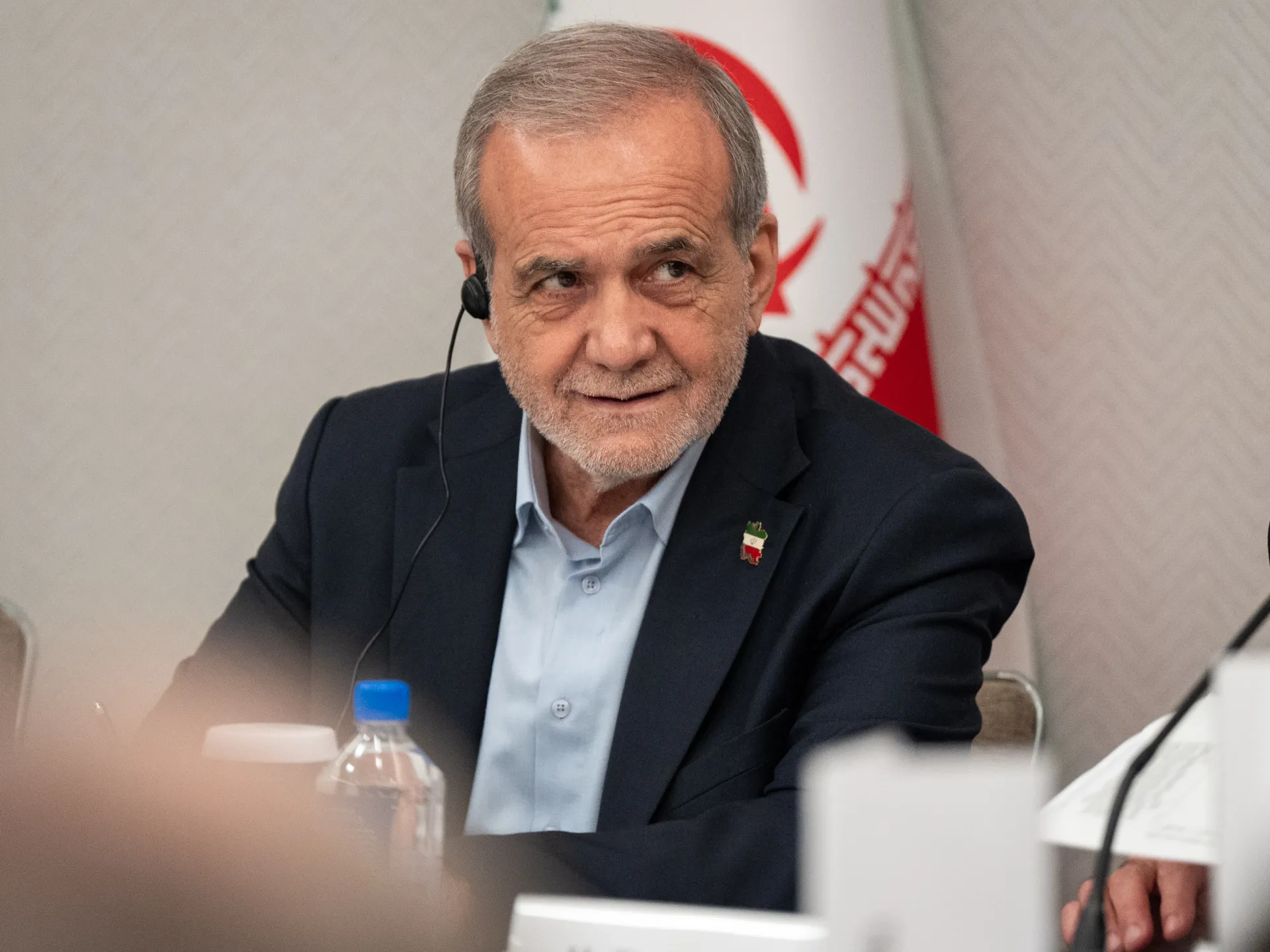
Iranian President Masoud Pezeshkian says that the United States, Israel and Europe are waging a “full-fledged war” against his country.

“In my opinion, we are in a full-fledged war with America, Israel and Europe. They do not want our country to stand on its feet,” Pezeshkian told the official site of Supreme Leader Ayatollah Ali Khamenei in an interview on Saturday.

Recommended Stories

list of 3 itemsend of list

The president’s remarks come ahead of Israeli Prime Minister Benjamin Netanyahu’s meeting on Monday with US President Donald Trump. They also come six months after Israel and the US launched strikes on Iran, and after France, Germany and the United Kingdom reimposed United Nations sanctions on Iran in September over its nuclear programme.

“Our dear military forces are doing their jobs with strength, and now, in terms of equipment and manpower, despite all the problems we have, they are stronger than when they [Israel and the US] attacked,” Pezeshkian said.

“So, if they want to attack, they will naturally face a more decisive response.”

The president said that “this war” is unlike past ones.

“This war is worse than Iraq’s war against us. If one understands it well, this war is far more complex and difficult than that war,” Pezeshkian said, referring to the 1980-1988 conflict between the neighbouring countries in which thousands were killed.

The US and its allies accuse Iran of seeking to acquire nuclear weapons, a claim Tehran has repeatedly denied.

Israel and Iran engaged in a 12-day war in June, triggered by an unprecedented Israeli attack on Iranian military and nuclear sites, as well as civilian areas.

The strikes caused more than 1,000 casualties, according to Iranian authorities.

The US later joined the Israeli operation, bombing three Iranian nuclear sites.

Washington’s involvement brought a halt to negotiations with Tehran, which began in April, over its nuclear programme.

Since returning to the White House in January, US President Donald Trump has revived his so-called “maximum pressure” policy against Iran, initiated during his first term.

That has included additional sanctions designed to economically cripple the country and dry up its oil revenues from sales on the global market.

According to recent reports, when Netanyahu visits Trump at his Mar-a-Lago resort in Florida this weekend, he will be pushing for more military actions against Iran, this time focusing on Tehran’s missile programme.

Source link

Russia-Ukraine war: List of key events, day 1,403 | Russia-Ukraine war News

These are the key developments from day 1,403 of Russia’s war on Ukraine.

Here is where things stand on Sunday, December 28:

Fighting

  • At least two people were killed in Ukraine’s capital, Kyiv, and the surrounding region, after Russian forces launched a massive attack with hundreds of missiles and drones, ahead of Ukrainian President Volodymyr Zelenskyy’s meeting with United States President Donald Trump to work out a plan to end nearly four years of war.
  • The attack also wounded at least 46 people, including two children, according to Ukrainian officials.
  • Zelenskyy, who was on his way to meet Trump in Florida, said that Russia had launched nearly 500 drones and 40 missiles, targeting energy and civilian infrastructure.
  • Ukraine’s state grid operator, Ukrenergo, said that energy facilities across Ukraine were struck, and emergency power cuts had been implemented across the capital. DTEK, Ukraine’s largest private energy company, said the attack had left more than a million households in and around Kyiv without power.
  • Ukrainian Deputy Prime Minister Oleksii Kuleba said that more than 40 percent of residential buildings in Kyiv were left without heat, as temperatures hovered around 0 degrees Celsius (32 degrees Fahrenheit) following the attack.
  • Poland’s Air Navigation Services Agency said in a statement on X that the Rzeszow and Lublin airports in the country’s southeastern region were temporarily shut following Russia’s strikes on Ukraine. The Operational Command of the Polish Armed Forces said that Polish and allied jets were deployed during the attack, but no violations of Polish airspace were reported.
  • In Russia, air defence forces shot down 11 drones headed for the capital, Moscow, according to the city’s mayor, Sergei Sobyanin.
  • Russia’s aviation watchdog, Rosaviatsia, said that Moscow’s Vnukovo and Sheremetyevo airports imposed temporary restrictions on airspace due to security reasons.
  • Russia’s Ministry of Defence also said that its air defence systems had intercepted and destroyed more than 100 Ukrainian drones in three hours over six other Russian regions.
  • Russian commanders told President Vladimir Putin that Moscow’s forces had captured the Ukrainian towns of Myrnohrad, Rodynske and Artemivka in Ukraine’s Donetsk region, as well as Huliaipole and Stepnohirsk in the Zaporizhia region, the Kremlin and Russian news agencies said on Telegram.
  • But Ukraine’s military said in its daily battlefield update that its forces had beaten back Russian attempts to advance in the vicinity of Myrnohrad and Huliaipole.

Politics and diplomacy

  • Zelenskyy announced in a Telegram message that he would hold talks with European leaders after his meeting with Trump on Sunday, as Kyiv pushes for a stronger position in the ongoing ceasefire negotiations to prevent Russia from prolonging the war in Ukraine.
  • Zelenskyy said he wants to discuss with Trump territorial issues, the main stumbling block in talks to end the war, as a 20-point peace framework and a security guarantee deal near completion.
  • On the way to the meeting in Florida, Zelenskyy stopped in Canada’s Halifax to meet Mark Carney, the Canadian prime minister said in a statement after the meeting.
  • Carney denounced the latest Russian attack as “barbarism”, stressing that it is important for allies to “stand with Ukraine in this difficult time”. He also announced $1.83bn in additional economic aid to Ukraine.
  • Zelenskyy spoke to European leaders following the meeting with Carney. In a statement posted on X, European Commission President Ursula von der Leyen said: “We welcome all efforts leading to our shared objective – a just and lasting peace that preserves Ukraine’s sovereignty and territorial integrity. And that strengthens the country’s security and defence capabilities.”
  • Antonio Costa, the president of the European Council, which represents the bloc’s 27 member states, echoed von der Leyen’s promise to continue backing Ukraine, saying on X: “The EU’s support for Ukraine will not falter. In war, in peace, in reconstruction.”
  • German Chancellor Friedrich Merz said that Zelenskyy had “the full support” of European leaders ahead of his talks with Trump. The leaders of NATO and the European Union said they would work “in close coordination” with the US “for a just and lasting peace in Ukraine”, Merz added in a statement.
  • French President Emmanuel Macron said in a call with Zelenskyy that the latest Russian strikes on Kyiv showed that Moscow was not interested in ending the war, the AFP news agency reported, citing officials from Macron’s office. During the call, Macron highlighted what he called the “contrast” between “the willingness of Ukraine to build a lasting peace and Russia’s determination to prolong the war that it started”, the report said.
  • Russian President Vladimir Putin said that Russia could see Kyiv was in no hurry to end the war by peaceful means, according to the Interfax news agency. Putin said that if Ukraine did not want to resolve the conflict peacefully, then Russia would accomplish all goals of its “special military operation” by force, Russian state news agency TASS reported.
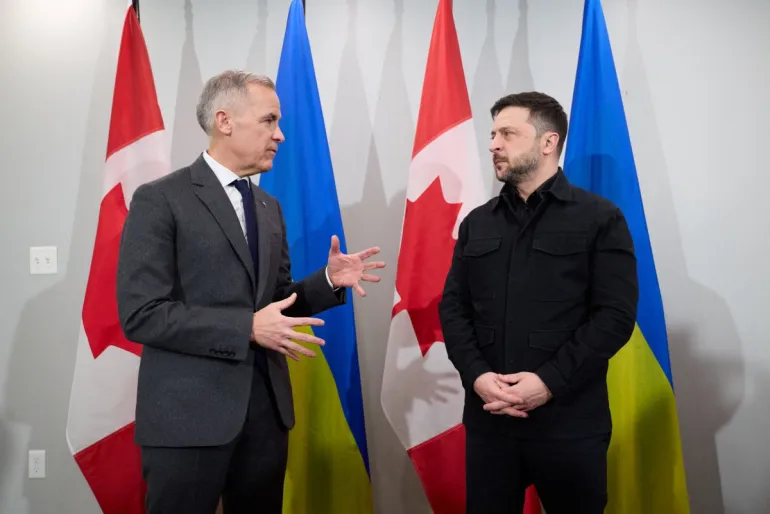
HANDOUT / UKRAINIAN PRESIDENTIAL OFFICE / AFPCopy Photo by HANDOUT / UKRAINIAN PRESIDENTIAL OFFICE / AFP This handout photograph taken on December 27, 2025 and released by the Ukrainian Presidential Office shows Ukraine's President Volodymyr Zelensky (R) and Canadian Prime Minister Mark Carney speaking to the press as they meet in Halifax, Nova Scotia, Canada. Establishing a lasting peace in Ukraine requires "a willing Russia," Carney said Saturday, denouncing the "barbarism" of Moscow's latest bombardment of Kyiv as he met with Zelensky.
Ukrainian President Volodymyr Zelenskyy (right) and Canadian Prime Minister Mark Carney (left) speak to the media as they meet in Halifax, Nova Scotia, Canada, ahead of the former’s meeting with US President Donald Trump on Sunday [Ukrainian Presidential Office/Handout Photo via AFP]

Source link

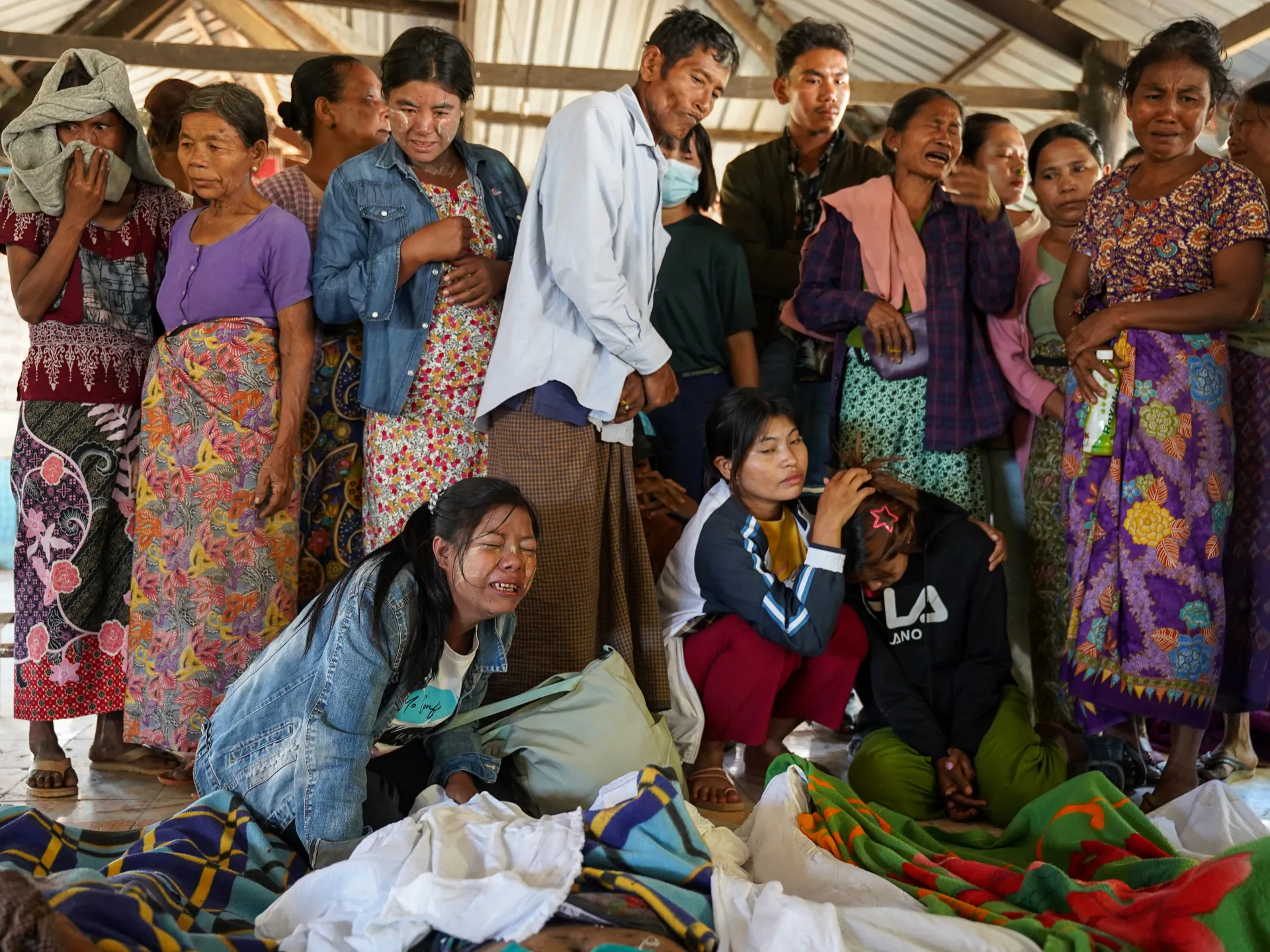
What’s happening in Myanmar’s civil war as military holds elections? | Military News

Yangon, Myanmar – Voters in parts of Myanmar are heading to the polls on Sunday for an election that critics view as a bid by the country’s generals to legitimise military rule, nearly five years after they overthrew the government of Nobel Laureate Aung San Suu Kyi.

The multi-phased election is unfolding amid a raging civil war, with ethnic armed groups and opposition militias fighting the military for control of vast stretches of territory, stretching from the borderlands with Bangladesh and India in the west, across the central plains, to the frontiers with China and Thailand in the north and east.

Recommended Stories

list of 4 itemsend of list

In central Sagaing, voting will take place in only a third of the region’s townships on Sunday. Another third will be covered during a second and third phase in January, while voting has been cancelled altogether in the remainder.

Fighting, including air raids and arson, has intensified in several areas.

“The military is deploying troops and burning villages under the guise of ‘territorial dominance’,” said Esther J, a journalist based there. “People here are saying this is being done for the election.”

In most of the region, “we haven’t seen a single activity related to the election,” she said. “No one is campaigning, organising or telling people to vote.”

Across Myanmar, voting has been cancelled in 56 of the country’s 330 townships, with more cancellations expected. The conflict, triggered by the 2021 coup, has killed an estimated 90,000 people and displaced more than 3.5 million, according to monitoring groups and the United Nations. It has left nearly half of the country’s population of 55 million in need of humanitarian assistance.

“People [in Sagaing] say they have no interest in the election,” said Esther J. “They do not want the military. They want the revolutionary forces to win.”

Shifting battlefield

For much of last year, the Myanmar military appeared to be losing ground.

A coordinated offensive launched in late 2023 by the Three Brotherhood Alliance – a coalition of ethnic armed groups and opposition militias – seized vast areas, nearly pushing the military out of western Rakhine state and capturing a major regional military headquarters in the northeastern city of Lashio, about 120km (75 miles) from the Chinese border. Armed with commercial drones modified to carry bombs, the rebels were soon threatening the country’s second-largest city of Mandalay.

The operation – dubbed 1027 – marked the most significant threat to the military since the 2021 coup.

But the momentum has stalled this year, largely because of China’s intervention.

In April, Beijing brokered a deal in which the Myanmar National Democratic Alliance Army agreed to surrender the city of Lashio, without a single shot being fired. The military subsequently reclaimed key towns in north and central Myanmar, including Nawnghkio, Thabeikkyin, Kyaukme and Hsipaw. In late October, China brokered another agreement for the Ta’ang National Liberation Army to withdraw from the gold mining towns of Mogok and Momeik.

“The Myanmar military is definitely resurgent,” said Morgan Michaels, a research fellow at the International Institute for Strategic Studies (IISS). “If this current trend continues, the Myanmar military could be back in a relatively dominant position in a year or so, maybe two.”

The military turned the tide by launching a conscription drive, expanding its drone fleet and putting more combat credible soldiers in charge. Since announcing mandatory military service in February 2024, it has recruited between 70,000 to 80,000 people, researchers say.

“The conscription drive has been unexpectedly effective,” said Min Zaw Oo, executive director at the Myanmar Institute for Peace and Security. “Economic hardship and political polarisation pushed many young men into the ranks,” he said, with many of the recruits technically adept and serving as snipers and drone operators. “The military’s drone units now outmatch those of the opposition,” he added.

According to the Armed Conflict Location & Event Data Project (ACLED), a monitoring group, air and drone attacks by the military have increased by roughly 30 percent this year. The group recorded 2,602 air attacks that it said killed 1,971 people – the highest toll since the coup. It said Myanmar now ranks third in the world for drone operations, behind only Ukraine and Russia.

China, meanwhile, has applied pressure beyond brokering ceasefires.

According to analysts, Beijing pressed one of the strongest armed ethnic groups, the United Wa State Army, to cut off weapons supplies to other rebels, resulting in ammunition shortages across the country. The opposition forces have also suffered from disunity. “They are as fragmented as ever,” said Michaels of the IISS. “Relationships between these groups are deteriorating, and the ethnic armed organisations are abandoning the People’s Defence Forces,” he said, referring to the opposition militias that mobilised after the coup.

China’s calculations

China, observers say, acted for fear of a state collapse in Myanmar.

“The situation in Myanmar is a ‘hot mess’, and it’s on China’s border,” said Einar Tangen, a Beijing-based analyst at the Centre for International Governance Innovation. Beijing, he said, wants to see peace in Myanmar to protect key trade routes, including the China-Myanmar Economic Corridor that, when completed, will link its landlocked Yunnan province to the Indian Ocean and a deep seaport there.

Tangen said Beijing harbours no love for the military, but sees few alternatives.

Indeed, after the coup, Beijing refrained from normalising relations with Myanmar or recognising coup leader Min Aung Hlaing. But in a sign of shifting policy, Chinese President Xi Jinping met Min Aung Hlaing twice this year. During talks in China’s Tianjin in August, Xi told Min Aung Hlaing that Beijing supports Myanmar in safeguarding its sovereignty, as well as “in unifying all domestic political forces” and “restoring stability and development”.

Tangen said China sees the election as a path to more predictable governance. Russia and India, too, have backed the process, though the UN and several Western nations have called it a “sham”. But Tangen noted that while Western nations denounce the military, they have done little to engage with the rebels. The United States has dealt further blows by cutting off foreign aid and ending visa protections for Myanmar citizens.

“The West is paying lip service to the humanitarian crisis. China’s trying to do something but doesn’t know how to solve it,” Tangen said.

Limited gains, lasting war

The military’s territorial gains, meanwhile, remain modest.

In northern Shan state, Myanmar’s largest, the military has recaptured only 11.3 percent of the territory it had lost, according to the Institute for Strategy and Policy – Myanmar, a think tank. But it is western Rakhine State that remains the “larger and more intense theatre of war”, said Khin Zaw Win, a Yangon-based analyst.

There, the Arakan Army is pushing beyond the borders of the state, overrunning multiple bases, and pushing east in a move that threatens the military’s defence industries. In northern Kachin state, the battle for Bhamo, a gateway to the north, is approaching its first anniversary, while in the southeast, armed groups have taken a “number of important positions along the border with Thailand”, he said.

So the military’s recent gains in other parts were “not that significant”, he added.

ACLED, the war monitor, also described the military’s successes as “limited in the context of the overall conflict”. In a briefing this month, Su Mon, a senior analyst at ACLED, wrote that the military remains in a “weakened position compared to before the 2021 coup and Operation 1027 and is unable to assert effective control over the areas it has recently retaken”.

Still, the gains give the military “more confidence to proceed with the elections”, said Khin Zaw Win.

The military-backed Union Solidarity and Development Party, which has fielded the most candidates, is expected to form the next government. Aung San Suu Kyi’s National League for Democracy has been dissolved, and she remains held incommunicado, while other smaller opposition parties have been barred from participating.

Khin Zaw Win said he does not expect the election to “affect the war to any appreciable extent” and that the military might even be “deluded to go for a complete military victory”.

But on the other hand, China could help de-escalate, he said.

“China’s mediation efforts are geared toward a negotiated settlement,” he noted. “It expects a ‘payoff’ and does not want a protracted war that will harm its larger interests.”

Zaheena Rasheed wrote and reported from Kuala Lumpur, Malaysia, and Cape Diamond reported from Yangon, Myanmar.
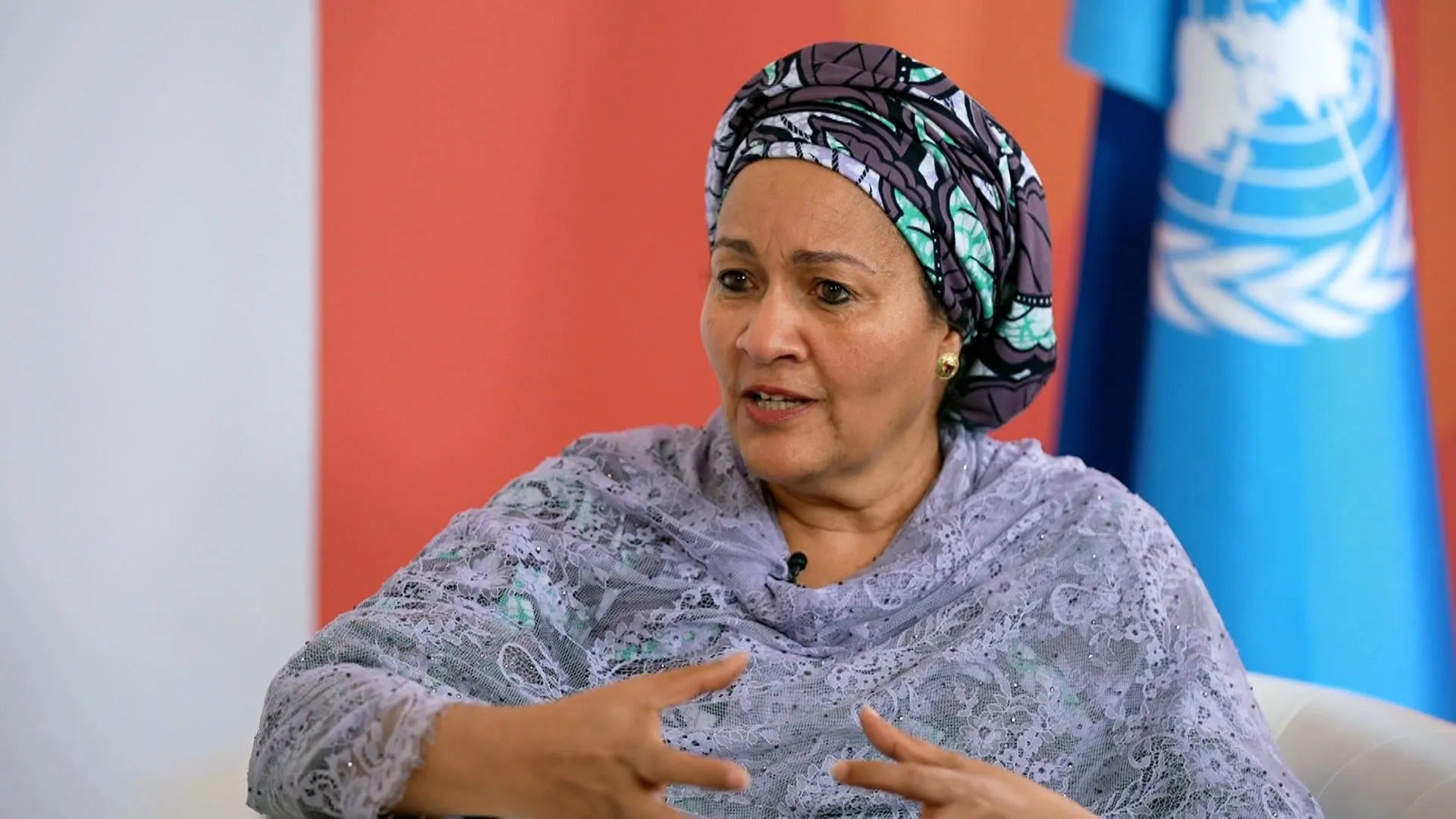
Source link

Russia using Belarus territory to bypass Ukraine’s defences, says Zelenskyy | Russia-Ukraine war News

Ukrainian President Volodymyr Zelenskyy has accused Russia of using ordinary apartment blocks on the territory of its ally Belarus to attack Ukrainian targets and circumvent Kyiv’s defences.

Zelenskyy made the allegations on Friday amid revelations by intelligence experts that Moscow has likely stationed its new nuclear-capable hypersonic ballistic missiles at a former airbase in eastern Belarus – a move seen as bolstering Russia’s ability to strike targets in Europe.

Recommended Stories

list of 3 itemsend of list

“We note that the Russians are trying to bypass our defensive interceptor positions through the territory of neighbouring Belarus. This is risky for Belarus,” Zelenskyy wrote on the Telegram messaging app on Friday after a military staff meeting.

“It is unfortunate that Belarus is surrendering its sovereignty in favour of Russia’s aggressive ambitions,” the Ukrainian leader said.

Zelenskyy said Ukrainian intelligence had observed that Belarus was deploying equipment “in Belarusian settlements near the border, including on residential buildings” to assist Russian forces in carrying out their attacks.

“Antennae and other equipment are located on the roofs of ordinary five-storey apartment buildings, which help guide ‘Shaheds’ [Russian drones] to targets in our western regions,” he said.

“This is an absolute disregard for human lives, and it is important that Minsk stops playing with this,” he added.

The Russian and Belarusian defence ministries did not immediately respond to requests for comment.

Russia had previously used Belarusian territory to launch its February 2022 invasion of Ukraine, and Belarus remains a steadfast ally, though President Alexander Lukashenko has pledged to commit no troops to the conflict.

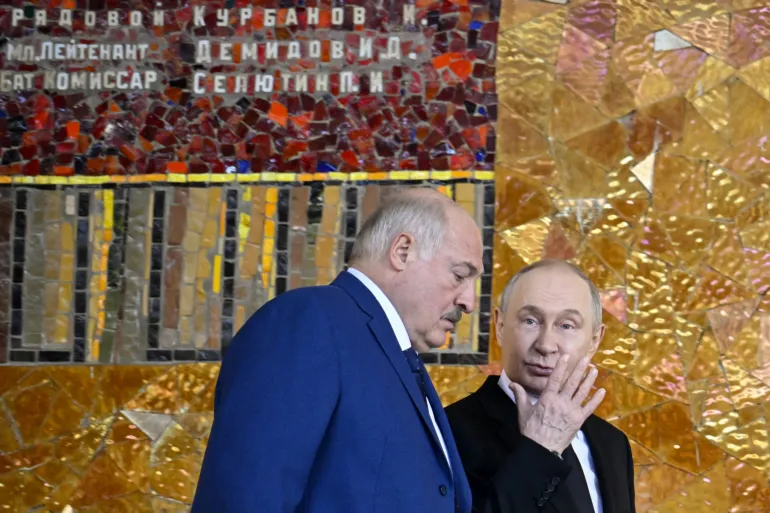
Russian President Vladimir Putin and Belarus' President Alexander Lukashenko attend a wreath-laying ceremony at the Eternal Flame in the Hall of Military Glory at the Mamayev Kurgan World War Two (WWII) Memorial complex in Russia's southern city of Volgograd on April 29, 2025, as part of commemorative events for the upcoming 80th anniversary of the Soviet Union's victory over Nazi Germany during WWII, which will be celebrated on May 9. (Photo by Alexander NEMENOV / AFP)
Russian President Vladimir Putin and Belarusian President Alexander Lukashenko attend a wreath-laying ceremony at the Eternal Flame in the Hall of Military Glory at the Mamayev Kurgan World War II memorial complex in Russia’s southern city of Volgograd in April 2025 [File: Alexander Nemenov/AFP]

Belarus defence minister: ‘Our response’ to the West’s ‘aggressive actions’

Amid reports of closer Russian and Belarusian coordination in the war on Ukraine, satellite imagery analysed by two US researchers appears to show that Moscow is stationing Oreshnik hypersonic ballistic missiles in eastern Belarus, according to an exclusive Reuters news agency report.

Oreshnik had been described by Russian President Vladimir Putin as impossible to intercept, and he previously made clear his intention to deploy the missiles – which have an estimated range of up to 5,500km (3,400 miles) – in Belarus.

Researchers Jeffrey Lewis of the Middlebury Institute of International Studies, in California, and Decker Eveleth of the CNA research and analysis organisation in Virginia, said they were 90 percent certain that mobile Oreshnik launchers would be stationed at the former Russian airbase near Krichev, some 307km (190 miles) east of the Belarus capital of Minsk.

The United States researchers said reviews of satellite imagery revealed a hurried construction project in Belarus that began between August 4 and 12, and contained features consistent with those of a Russian strategic missile base.

One “dead giveaway” in a November 19 satellite image was a “military-grade rail transfer point” enclosed by a security fence to which missiles, their mobile launchers and other components could be delivered by train to the site, Eveleth told Reuters.

Another feature, said Lewis, was the construction of a concrete pad that was then covered with earth, and which he called “consistent” with a camouflaged missile launch point.

The researchers’ assessment broadly aligns with US intelligence findings, according to the report.

Russia and Belarus have yet to comment on the Reuters report.

But, earlier this month, President Lukashenko acknowledged the deployment of such weapons in his country, although he did not say to which part of the country the Russian missiles have been deployed. He added that up to 10 Oreshniks would be deployed within the country.

State-run BelTA news agency quoted Belarusian Defence Minister Viktor Khrenin as saying this week that the Oreshnik’s deployment would not alter the balance of power in Europe and was “our response” to the West’s “aggressive actions”.

The White House did not immediately respond to a request for comment on the reported Russian missile deployment to Belarus.

Ukraine’s capital came under a new “massive” Russian attack early on Saturday, with explosions reported in the city, air defences in operation and the Ukrainian military saying cruise and ballistic missiles were being deployed.

On Sunday, President Zelenskyy is scheduled to meet with US President Donald Trump to finalise a possible ceasefire deal between Moscow and Kyiv.

In advance of the meeting, Zelenskyy told the Axios news site that he was open to putting the Washington-led “20-point” peace plan to a referendum – as long as Russia agreed to a 60-day ceasefire to allow Ukraine to prepare for and hold such a vote.

Source link

UN renews Sudan ceasefire appeal over ‘unimaginable suffering’ of civilians | Sudan war News

UN Secretary-General Antonio Guterres appeals for immediate truce as fighting intensifies in Darfur and Kordofan regions.

United Nations Secretary-General Antonio Guterres has called for an immediate ceasefire in Sudan’s brutal civil war, which the UN says has created the world’s worst humanitarian crisis.

Guterres’s appeal, made late on Friday, follows a peace initiative presented by Sudan’s Prime Minister Kamil Idris to the UN Security Council on Monday, which called for the paramilitary Rapid Support Forces (RSF) to disarm.

Recommended Stories

list of 4 itemsend of list

The plan was rejected by the RSF as “wishful thinking”.

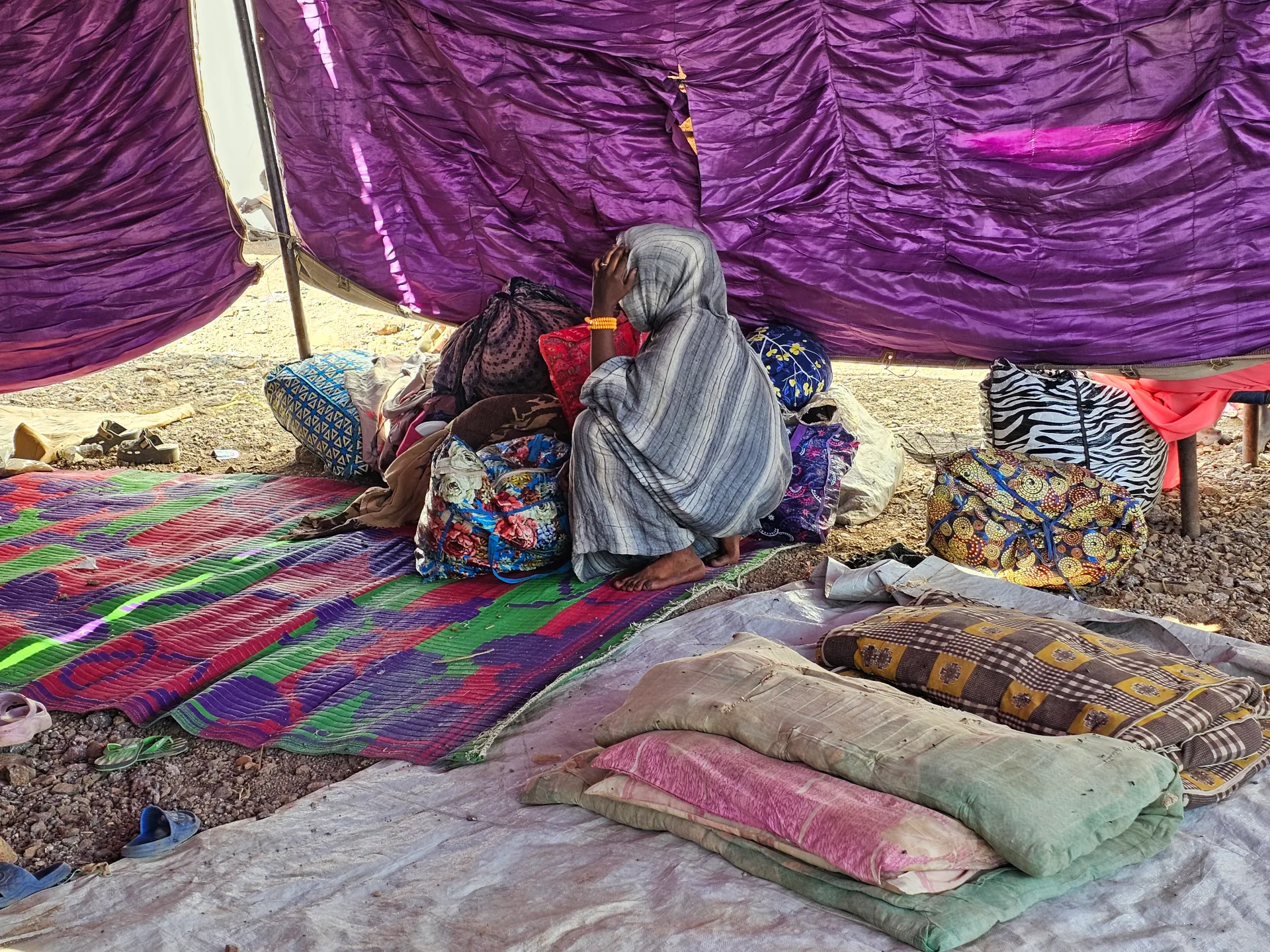
The war erupted in April 2023 when a power struggle broke out between the Sudanese army and the RSF paramilitary group. Since then, the conflict has displaced 9.6 million people internally and forced 4.3 million to flee to neighbouring countries, while 30.4 million Sudanese now need humanitarian assistance, according to UN figures.

UN Assistant Secretary-General Mohamed Khaled Khiari told the UNSC this week that fears of intensified fighting during the dry season had been confirmed.

“Each passing day brings staggering levels of violence and destruction,” he said. “Civilians are enduring immense, unimaginable suffering, with no end in sight.”

The conflict has shifted in recent weeks to Sudan’s central Kordofan region, where the RSF captured the strategic Heglig oilfield on December 8. The seizure prompted South Sudanese forces to cross into Sudan to protect the infrastructure, which Khiari warned reflects “the increasingly complex nature of the conflict and its expanding regional dimensions”.

The RSF has also launched a final push to consolidate full control over North Darfur state, attacking towns in the Dar Zaghawa region near the Chad border since December 24. The offensive threatens to close the last escape corridor for civilians fleeing the country to Chad.

The violence spilled across Sudan’s borders on Friday when a drone attack killed two Chadian soldiers at a military camp in the border town of Tine.

A Chadian military intelligence officer told Reuters news agency the drone came from Sudan, though it remained unclear whether it was launched by the army or the RSF. Chad has placed its air force on high alert and warned it would “exercise our right to retaliate” if the strike is confirmed as deliberate.

Despite the intensifying conflict, the UN achieved a rare breakthrough, saying on Friday that it conducted its first assessment mission to el-Fasher since the city fell to the RSF.

UN Humanitarian Coordinator Denise Brown said the mission followed “months of intense fighting, siege, and widespread violations against civilians and humanitarian workers,” adding that “hundreds of thousands of civilians have had to flee el-Fasher and surrounding areas”.

Earlier this month, Yale University released a report documenting systematic mass killings by the RSF in el-Fasher, with satellite imagery showing evidence of burning and the burial of human remains on a mass scale.

US Secretary of State Marco Rubio warned last week that the fighting was “horrifying” and “atrocious”, telling a news conference that “one day the story of what’s actually happened there is going to be known, and everyone involved is going to look bad”.

Rubio said he wanted the war to end before the New Year, but there is no strong indication that progress has been made.

Prime Minister Idris’s peace plan proposed an immediate UN-monitored ceasefire and complete RSF withdrawal from the roughly 40 percent of Sudan it controls. But an adviser to RSF leader Mohamed Hamdan “Hemedti” Dagalo dismissed the proposal as “closer to fantasy than to politics”.

Upon returning to Port Sudan on Friday, Idris laid down a red line, saying the government would reject international peacekeeping forces because Sudan had been “burned” by them in the past.

Source link

Zelenskyy to meet Trump in Florida amid diplomatic push to end war | Russia-Ukraine war News

Ukrainian president highlights ‘significant progress’ in talks, but Moscow says Kyiv is working to ‘torpedo’ deal.

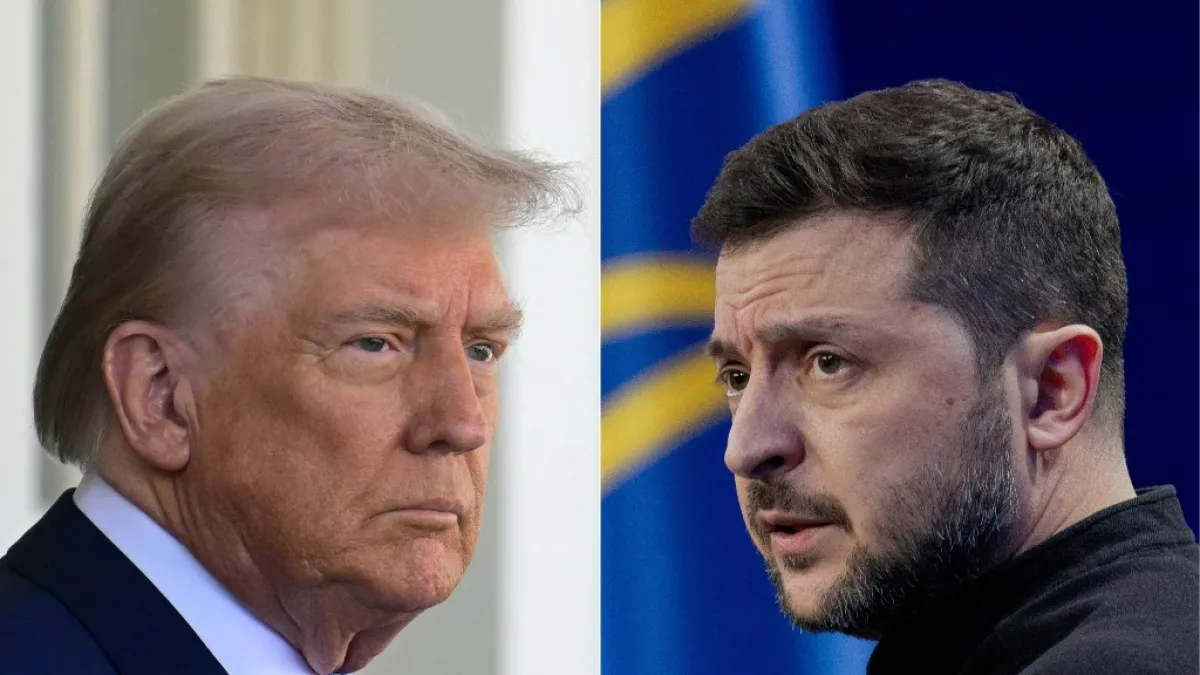
Ukrainian President Volodymyr Zelenskyy is to meet with his United States counterpart, Donald Trump, in Florida on Sunday to discuss territorial disputes that continue to block progress towards ending Russia’s war on Ukraine.

Announcing the meeting on Friday, Zelenskyy said the talks could be decisive as Washington intensifies its efforts to broker an end to Europe’s deadliest conflict since World War II. “A lot can be decided before the New Year,” Zelenskyy said.

Recommended Stories

list of 3 itemsend of list

Territory remains the most contentious issue in the negotiations. Zelenskyy confirmed he would raise the status of eastern Ukraine and the Zaporizhzhia Nuclear Power Plant, which has been under Russian control since the early months of Russia’s invasion.

“As for the sensitive issues, we will discuss both Donbas and the Zaporizhzhia Nuclear Power Plant. We will certainly discuss other issues as well,” he told reporters in a WhatsApp chat.

Moscow has demanded that Kyiv withdraw from parts of the Donetsk region still under Ukrainian control as it pushes for full authority over the wider Donbas area, which includes Donetsk and Luhansk. Ukraine has rejected that demand, instead calling for an immediate halt to hostilities along the existing front lines.

Territorial concessions

In an attempt to bridge the divide, the US has floated the idea of establishing a free economic zone should Ukraine relinquish control of the contested area although details of how such a plan would operate remain unclear.

Zelenskyy reiterated that any territorial concessions would require public approval. He said decisions on land must be made by Ukrainians themselves, potentially through a referendum.

Beyond territory, Zelenskyy said his meeting with Trump would focus on refining draft agreements, including economic arrangements and security guarantees. He said a security pact with Washington was nearly finalised while a 20-point peace framework was close to completion.

Ukraine has sought binding guarantees after previous international commitments failed to prevent Russia’s invasion, which began in February 2022.

Trump has previously voiced impatience with the pace of negotiations, but he has indicated he would engage directly if talks reached a meaningful stage.

Last week, US Secretary of State Marco Rubio said his country is the only mediator that can speak to both sides to secure a peace agreement. At the same time, he downplayed the importance of the conflict for Washington.

“It’s not our war. It’s a war on another continent,” he said.

Zelenskyy said European leaders could join Sunday’s discussions remotely and confirmed he had already briefed Finnish President Alexander Stubb on what he described as “significant progress”.

Despite Zelenskyy’s assertion, Russian Deputy Foreign Minister Sergey Ryabkov accused Ukraine of working to “torpedo” the peace talks, saying a revised version of the US peace plan promoted by Kyiv was “radically different” from an earlier version negotiated with Washington.

“Our ability to make the final push and reach an agreement will depend on our own work and the political will of the other party,” he said during a television interview on Friday.

Ryabkov said any agreement must remain within the parameters set out between Trump and Russian President Vladimir Putin during a summit in August, which Ukraine and European partners have criticised as overly conciliatory towards Russia’s war aims.

On the ground, Moscow has intensified strikes on Ukraine’s energy infrastructure and the southern port city of Odesa while an attack on Kharkiv on Friday killed two people.

Source link

RSF says Sudan’s army launches air strikes on paramilitary stronghold Nyala | Sudan war News

Drone attacks hit fuel market in city that serves as headquarters for RSF’s alternative government.

Sudan’s Rapid Support Forces (RSF) paramilitary group says the country’s army struck a fuel market in the city of Nyala, the RSF’s administrative capital, as part of an intensified aerial campaign against its positions in South Darfur.

For three consecutive days ending Thursday, military drones and warplanes pounded strategic RSF sites across Nyala, including the international airport, military positions and training facilities.

Recommended Stories

list of 2 itemsend of list

The strike on the fuel market triggered a huge blaze as barrels of fuel exploded, according to footage circulated on social media, sending thick plumes of black smoke into the air.

Youssef Idris Youssef, who heads the RSF’s civil administration in South Darfur, accused the army of deliberately targeting civilians. He described the attack as part of “a systematic policy” to punish Darfur residents for not resisting the RSF presence in their communities.

The Sudanese military has not issued any statement regarding the strikes.

Casualties were reported among both civilians and RSF members involved in the fuel trade.

In the aftermath, RSF intelligence services conducted mass arrests near the targeted site and Nyala’s main market, detaining civilians and military personnel on accusations of providing coordinates to the army, according to local sources.

Nyala holds particular strategic importance as the seat of the RSF’s parallel government, known as TASIS, which the group declared in July. Led by RSF commander Mohamed Hamdan “Hemedti” Dagalo, the alternative administration has been widely condemned as possibly fracturing Sudan, but controls significant territory across Darfur.

The city was struck by the army in October when it targeted the RSF and Nyala airport, which has been reportedly used by the RSF as a logistics hub for its forces.

Fighting continues across Darfur

Fighting has raged across Darfur since the RSF captured el-Fasher in October, an offensive marked by atrocities documented by rights groups.

The United States has said the RSF has committed genocide in Darfur.

This week, the RSF announced it had seized the Abu Qumra region in North Darfur and claimed advances towards Um Buru, though joint forces allied with the army disputed RSF assertions that they had also taken the town of Karnoi.

The attack on Nyala came just two days after Sudan’s prime minister, Kamil Idris, presented a peace proposal to the United Nations Security Council calling for RSF withdrawal from captured areas, disarmament in camps, and eventual elections.

The RSF rejected the plan, with spokesman Alaa el-Din Naqd telling Sudanese outlet Radio Dabanga it amounted to “wishful thinking”.

Sudan’s de facto leader, Abdel Fattah al-Burhan, was in Ankara for talks on Thursday with Turkish President Recep Tayyip Erdogan, at which Erdogan expressed his support for peace efforts and his opposition to dividing Sudan.

Hours earlier, a senior official in Sudan’s Transitional Sovereignty Council ruled out any negotiations, declaring there could be “no truce and no negotiation with an occupier”.

The war, which erupted in April 2023, has killed more than 100,000 people and displaced nearly 14 million, in what the UN describes as one of the world’s worst humanitarian crises.

Since the RSF seized el-Fasher – the last major army stronghold in Darfur – the conflict has shifted to Central Kordofan, splitting Sudan between territories controlled by the military and the RSF.

Source link

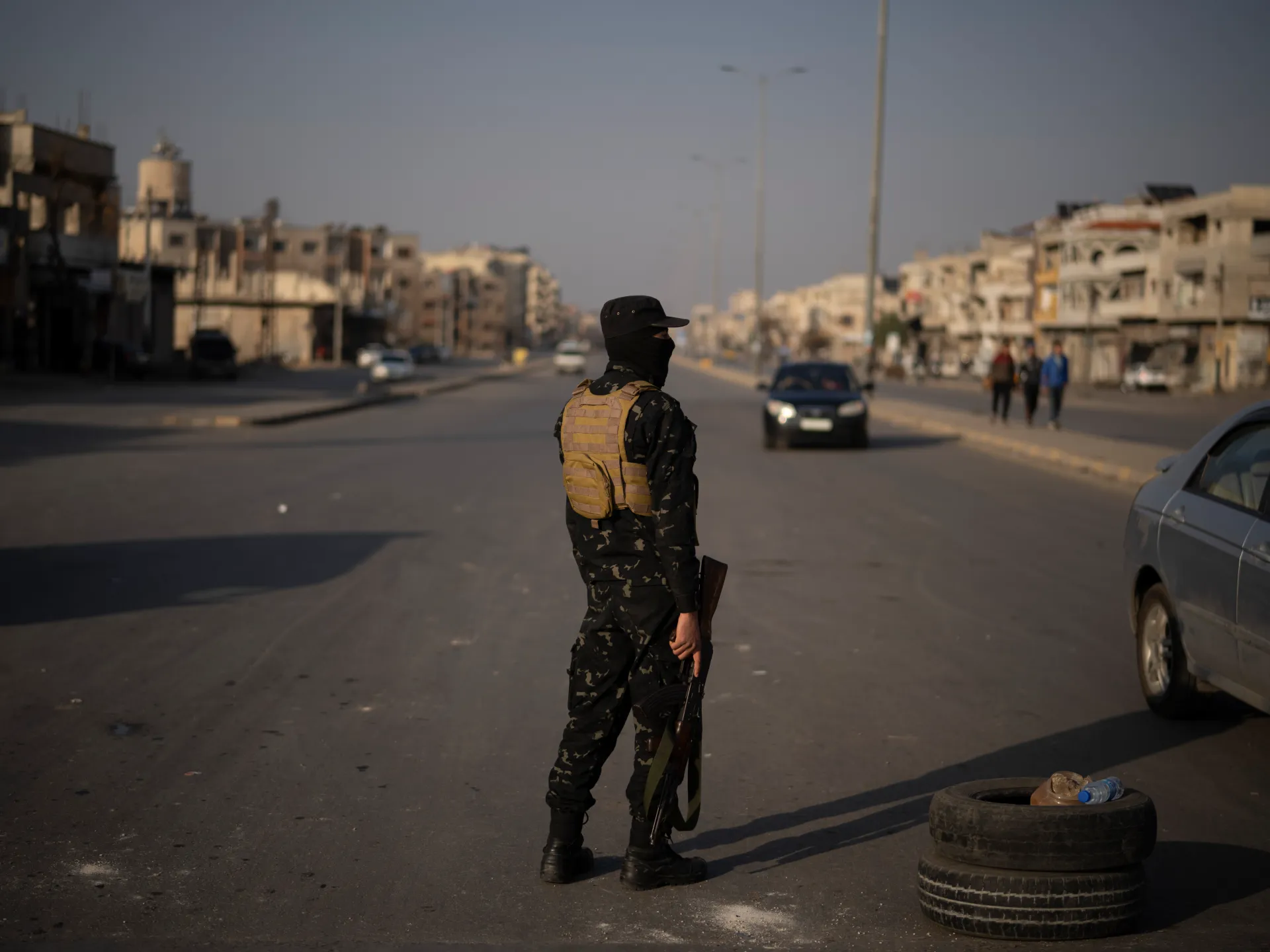
Explosion at mosque in Syria’s Homs kills at least six | Syria’s War News

DEVELOPING STORY,

Syrian state media says security forces have imposed a ​cordon around ‌the area and are investigating.

At least six ‍people ‍have been killed and more than 20 were injured when an explosion ⁠struck a mosque ​in Syria’s Homs province.

The attack targeted the Imam Ali bin Abi Talib Mosque in the Wadi al-Dahab neighbourhood of Homs shortly after Friday prayers, the Syrian Arab News Agency (SANA) reported.

Recommended Stories

list of 3 itemsend of list

Footage verified by Al Jazeera showed people fleeing the mosque in panic, placing some victims on stretchers and carrying others, wrapped in cloaks, to ambulances.

The blast appeared to have taken place in the corner of the mosque’s main prayer hall, leaving a small crater in the wall and scorching the surrounding area, with prayer carpets ripped and strewn with debris, and books and fragments scattered across the floor.

Local officials told the Reuters news agency the blast ‌may have been ‌caused by ⁠a suicide bomber or explosives placed there.

State media said security forces had imposed a ​cordon around ‌the area and were investigating.

Ayman Oghanna, Al Jazeera’s correspondent in Aleppo, noted that Homs is home to a diverse population of Alawites, Christians and Sunni Muslims. He said the attack targeted an Alawite mosque, warning it could “inflame sectarian tensions” across the country.

He said no group had claimed responsibility for the strike, but noted a recent surge in ISIL (ISIS) activity in Syria. He added that government forces had carried out an operation near Aleppo, arresting three alleged ISIL members.

Last week, the United States bombed ISIL positions in Syria in retaliation for the killings of two US soldiers and a civilian interpreter. Damascus also joined a global anti-ISIL alliance in November, pledging to crush the remaining elements of the group.

Friday’s attack underscores the country’s fragile security situation, as the new authorities in Damascus struggle to assert control.

Source link

Russia-Ukraine war: List of key events, day 1,401 | Russia-Ukraine war News

These are the key developments from day 1,401 of Russia’s war on Ukraine.

Here is where things stand on Friday, December 26:

Fighting

  • Officials in Russia’s Krasnodar region reported a huge fire following a Ukrainian drone strike on two storage tanks holding oil products in the southern Russian port of Temryuk. The blaze spread across roughly 2,000 square metres (some 21,500 square feet).
  • Long-range Ukrainian drones targeted oil storage facilities at Temryuk port, as well as a gas processing plant in Russia’s Orenburg region, Ukraine’s SBU security service said.
  • Ukraine’s General Staff said its military also struck the Novoshakhtinsk oil refinery in Russia’s Rostov region using Storm Shadow missiles, triggering several explosions.
  • The General Staff described the Russian refinery as a major supplier of oil products in southern Russia that supports Moscow’s military operations in Ukraine.
  • Russia’s Ministry of Defence announced that its forces had taken control of the settlement of Sviato-Pokrovske in eastern Ukraine’s Donetsk region, according to reports from Russian state news agencies.

Regional security

  • Poland sent fighter jets to intercept a Russian reconnaissance aircraft flying near its airspace over the Baltic Sea and said dozens of objects entered Polish airspace from Belarus overnight, warning the incidents during the holiday season may signal a provocation.
  • Russia’s Ministry of Foreign Affairs accused the United States of encouraging what it called “piracy” in the Caribbean and Pacific Ocean by blockading Venezuela, while expressing hope that US President Donald Trump’s pragmatism could prevent further escalation.
  • Moscow also reiterated its support for Venezuelan President Nicolas Maduro’s government and its efforts to safeguard national sovereignty amid threats by the US to remove Maduro from power.

Peace talks

  • Ukrainian President Volodymyr Zelenskyy said he spoke with Donald Trump’s special envoy Steve Witkoff and son-in-law, Jared Kushner, for about an hour on how to end the war with Russia and “how to bring the real peace closer”.

  • “Of course, there is still work to be done on sensitive issues,” the Ukrainian leader said. “But together with the American team, we understand how to put all of this in place. The weeks ahead may also be intensive. Thank you, America!”
  • Russia believes negotiations with the US to end the war in Ukraine are making gradual progress, Russian Foreign Ministry spokeswoman Maria Zakharova said. She described the talks as slow-moving but advancing steadily.

Politics and diplomacy

  • Kremlin spokesman Dmitry Peskov said President Vladimir Putin had sent the US president a Christmas greeting along with a congratulatory message.
  •  Russia said it had put forward a proposal to France concerning Laurent Vinatier, a French researcher imprisoned under Russia’s foreign agent laws, adding that the next steps in the Frenchman’s case now rest with Paris.

Sanctions

  • Russia’s target of producing 100 million tonnes of liquefied natural gas annually has been pushed back by several years due to international sanctions, the country’s Deputy Prime Minister Alexander Novak said in comments aired on state television.

Source link

‘No negotiation, no truce’ with RSF, says senior Sudan official | Sudan war News

Comments come days after PM Kamil Idris presented a plan to end the country’s nearly three-year war.

A senior official in Sudan’s Transitional Sovereignty Council (TSC) has ruled out any negotiations with the paramilitary Rapid Support Forces (RSF) as fighting continues to devastate the country.

“There is no truce and no negotiation with an occupier, and that the just peace that Sudan desires will be achieved through the roadmap and vision of its people and government,” Malik Agar Ayyir, deputy chairman of TSC, said in a statement on Thursday posted by the Ministry of Culture, Media and Tourism.

Recommended Stories

list of 3 itemsend of list

Speaking to ministers and state officials in Port Sudan, the eastern city where the government is based, he dismissed the narrative that the war is aimed at achieving “democracy”. Instead, he described the war as a “conflict over resources and a desire to change Sudan’s demographics” and emphasised an opportunity to strengthen national unity.

This comes days after Sudan’s Prime Minister Kamil Idris presented a plan to end the country’s nearly three-year war before the United Nations Security Council.

Consistent with the Sudanese army and the government’s position, the plan stipulates that RSF fighters must withdraw from vast areas of land that they have taken by force in the western and central parts of Sudan.

They would then have to be placed in camps and disarmed, before those who are not implicated in war crimes can be reintegrated into society.

The RSF has repeatedly rejected the idea of giving up territory, with Al-Basha Tibiq, a top adviser to commander Mohamed Hamdan “Hemedti” Dagalo, describing it as “closer to fantasy than to politics”.

RSF reports gains

The war, which has forcibly displaced about 14 million people, shows no signs of stopping as the RSF consolidates its hold over captured territory and expands attacks.

RSF fighters have continued to commit mass killings, systematic sexual violence, and the burying and burning of bodies in Darfur to cover up the evidence of war crimes over the past several months, according to international aid agencies working on the ground.

The humanitarian situation on the ground has only turned more disastrous after the capture of el-Fasher, capital of North Darfur state, in October.

The RSF announced on Thursday that its forces established control over the Abu Qumra region in North Darfur.

They “have continued their successful advancement to the Um Buru area, where they have completely liberated these areas”, the group claimed in a statement.

Despite the mounting evidence of widespread atrocities committed in western Sudan, the RSF claimed that the primary duty of its fighters is to “protect civilians and end the presence of remnants of armed pockets and mercenary movements”.

The group also released footage of its armed fighters, who claimed they were making advances towards el-Obeid, a strategic city in North Kordofan state.

Source link

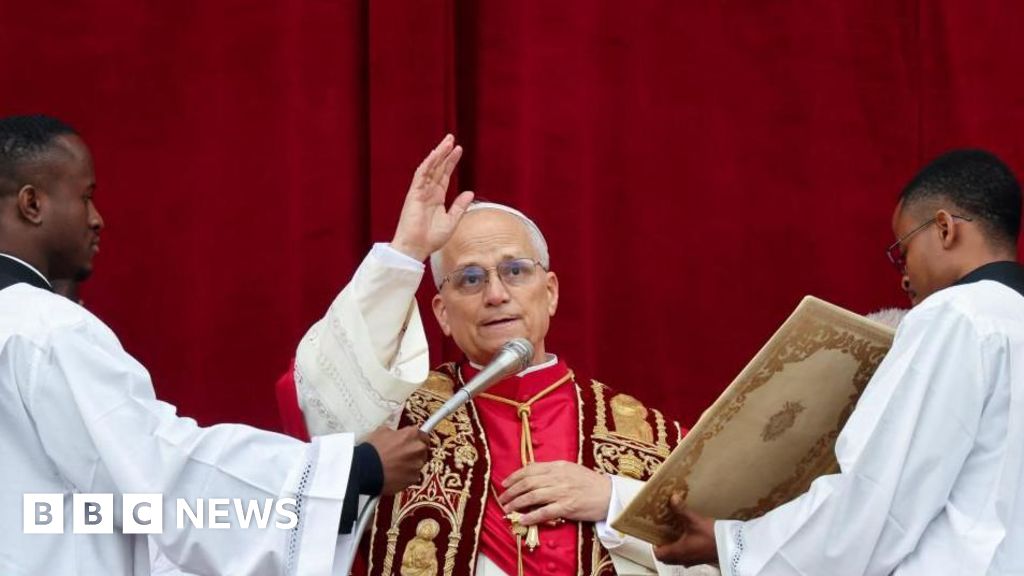
Pope Leo urges ‘courage’ to end Ukraine war in first Christmas address

Pope Leo has urged Ukraine and Russia to find the “courage” to hold direct talks to end the war during his first Christmas remarks to crowds in St Peter’s square.

He called for an end to conflicts around the world during his Urbi et Orbi address, which is traditionally delivered by the pontiff on Christmas Day to worshippers gathered in Vatican City.

Speaking about Ukraine, the Pope said: “May the clamour of weapons cease, and may the parties involved, with the support and commitment of the international community, find the courage to engage in sincere, direct and respectful dialogue.”

His plea comes as US-led negotiations on a deal to end the fighting continues.

The US has sought to put together an agreement acceptable to both sides, but direct talks between Russian and Ukraine have not taken place during this latest round of diplomatic efforts.

Pope Leo also decried turmoil and conflict plaguing other parts of the world, including Thailand and Cambodia where deadly border clashes have flared up despite a ceasefire in July.

He asked that the South East Asian nations’ “ancient friendship” be restored and “to work towards reconciliation and peace”.

During an earlier Christmas Day sermon in St Peter’s Basilica, Pope Leo lamented conditions for homeless people the world over, and the damage caused by conflicts.

“Fragile is the flesh of defenceless populations, tried by so many wars, ongoing or concluded, leaving behind rubble and open wounds,” he said.

He said the story of the birth of Jesus showed that God had “pitched his fragile tent” among the people of the world. “How, then,” he asked, turning his attention to the conditions of Palestinians, “can we not think of the tents in Gaza, exposed for weeks to rain, wind and cold?”

Gaza has been devastated by Israeli bombardment in a two-year war, triggered by Hamas’s attack on Israel on 7 October 2023.

Winter storms have compounded the plight of the territory’s 2.1m population, nearly all of whom have been displaced and their homes damaged or destroyed.

Aid agencies have called for Israel to allow more tents and urgently needed supplies into Gaza.

Cogat, the Israeli military body which controls Gaza’s border crossings, has dismissed claims of deliberate aid restrictions, saying almost 310,000 tents and tarpaulins had been delivered since the start of the ceasefire in October.

Source link

A subdued Christmas comes to Gaza and Bethlehem after years of war

Dec. 24 (UPI) — Christians in Israel and Palestine are celebrating Christmas for the first time in two years now that Israel and Hamas have entered a cease-fire.

In Bethlehem, in the West Bank, tourism normally boosts the economy this time of year as Christians come from around the world to see the city where Jesus was born. But due to the fighting, tourists have avoided the region.

This year, the cease-fire emboldened Bethlehem Mayor Maher Canawati to bring back the annual Christmas tree-lighting ceremony, which drew visitors from around the region, but very few from international locations.

“[In] Bethlehem, you know, we are living from tourists, from tourism and from pilgrims who come to stay in our hotels, to eat in our restaurants, to buy our souvenirs that we’re producing here,” Canawati told CBS News. “And there was a complete halt on tourism for the past two years.”

The lack of tourists has driven Bethlehem unemployment to 70%.

Muhammad Abu Jurah’s Bethlehem souvenir shop has been in his family for generations, but he’s had to lay off all his staff.

“We don’t have a lot of tourists because, you know, the war,” he told CBS. “So, this is why they have a big problem in Bethlehem without tourists.”

Bethlehem tour guide Matthew Qasis said he wants the tourists to return.

“Come back, because Bethlehem belongs to everyone, and Bethlehem is a message of love and peace, a message needed now more than ever, and a prayer of hope that the faithful return to the place where it’s believed Christmas began,” he told CBS.

Cardinal Pierbattista Pizzaballa, the Catholic Church’s top leader in the Holy Land and the Latin patriarch of Jerusalem, led a procession Wednesday from Jerusalem to Bethlehem.

One day earlier, he led a Christmas Eve Mass at Holy Family Church in Gaza City, at which he baptized a new member: Marco Nader Habshi, The Washington Post reported.

Gaza Christians have been unable to celebrate their holidays openly for years. The Christian population in Gaza, mostly Catholic and Greek Orthodox, has dropped from 1,000 to 500.

“The celebrations of Christian and Muslim festivals were shared,” said Yousef AlKhouri, a Gaza native and dean at Bethlehem Bible College in the West Bank, about when he was young. He told The Post that there was always a sense of solidarity among “Palestinian Christians and Muslims in Gaza: going to school together, playing together, going to the YMCA.”

But since Hamas took control of the enclave, Christians have mostly celebrated privately.

“There is an assumption that Gaza has no Christian population, or no Christian history,” AlKhouri said. “And that’s not true.”

Holy Family Church served as a sanctuary for many Christians during the war. Elias al-Jilda, an Orthodox Christian in Gaza, had to shelter at the Catholic church after his home was destroyed one month into the war, he told The Post. He and his family now have a rented home but are still working to furnish it.

The holiday celebration “will not be full of joy, but it is an attempt to renew life,” Jilda, 59, who serves on the council of the Arab Orthodox Church in Gaza, said of this season’s holiday celebration. He told The Post he remembers Christmas in Gaza when Muslims and Christians came together to celebrate city-wide. “It was a special occasion; an opportunity for us to breathe.”

At the Sunday Mass at Holy Family, Pizzaballa told the Christians in Gaza to hold on to hope.

“We are called not only to survive, but to rebuild life,” he said. “We must bring the spirit of Christmas — the spirit of light, tenderness and love. It may seem impossible, but after two years of terrible war, we are still here.”

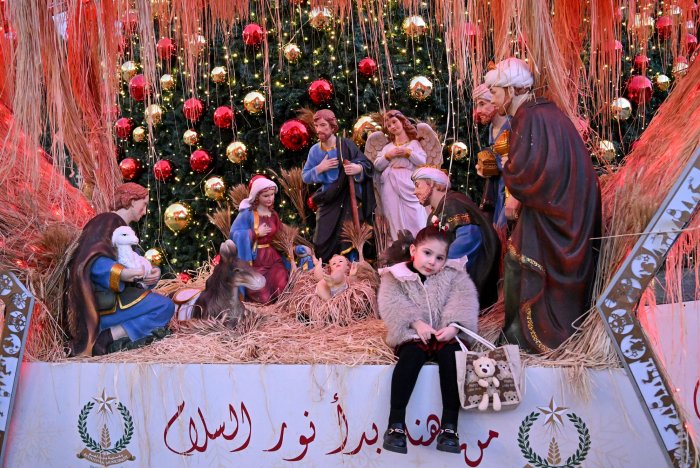
A young girl sits in front of a nativity scene in Manger Square, outside the Church of Nativity, in the biblical town of Bethlehem, West Bank, on December 23, 2025. Photo by Debbie Hill/UPI | License Photo

Source link

Majority of Russians expect Ukraine war to end in 2026, state survey finds | Russia-Ukraine war News

‘Main reason for optimism’ is a belief that war in Ukraine will end in 2026 with Moscow’s ‘objectives’ achieved,’ pollster says.

A majority of Russians expect the war in Ukraine to end in 2026, a state-owned research centre said, as Russian forces make advances on the battlefield and efforts intensify to reach a ceasefire deal between Kyiv and Moscow.

VTsIOM, Russia’s leading public opinion research centre, said on Wednesday that its annual survey of sentiment around the outgoing year and expectations for the coming year found Russians are viewing 2026 with “growing optimism”.

Recommended Stories

list of 4 itemsend of list

“Expectations for next year traditionally look much more optimistic … In other words, while the negative perception of the current situation persists, Russians have become more likely to accept (or believe, hope?) future improvements this year, but they still do so with caution,” the organisation said in a review of its survey findings released online.

In a year-end presentation, VTsIOM deputy head Mikhail Mamonov said 70 percent of 1,600 people surveyed ​viewed 2026 as being a more “successful” year for Russia than this year, with 55 percent of respondents linking hope for a better year ‍to a possible end to what Russia officially calls its “special military operation” in Ukraine.

“The main reason for optimism is the possible completion of the special military operation and the achievement of the stated objectives, in line with the national interests outlined by the president,” Mamonov ‍said at the ⁠presentation.

Mamonov pointed to the Russian military’s ongoing offensive in Ukraine, Washington’s reluctance to finance the Ukraine war and the European Union’s inability to fully replace the ‌United States’ role in Ukraine – financially and militarily – as key factors behind the prospects for an eventual deal to end the fighting.

At the conclusion of the conflict, reintegration of Russian military veterans into society and the reconstruction of Russian-controlled regions of Ukraine, as well as Russian border areas, will be the main priorities, Mamonov added.

While the actual level of Russian public fatigue with the war is difficult to measure due to strict state controls on the media, expressions of public dissent as well as the prosecution of those who criticise Moscow’s war on its neighbour, approximately two-thirds of Russians support peace talks, according to independent pollster Levada, the highest number since the start of the war in 2022.

Ukrainian President Volodymyr Zelenskyy said in comments released on Wednesday that he would be willing to withdraw troops from Ukraine’s eastern industrial heartland as part of a plan to end the war, if Moscow reciprocated by also pulling back its forces and allowed the area to become a demilitarised zone monitored by international forces.

In comments to reporters about an overarching 20-point plan that negotiators from Ukraine and the US had hammered out in Florida in recent days, Zelenskyy also said that a similar arrangement could be possible for the area around the Zaporizhzhia nuclear power plant, which is currently under Russian control.

Russia has given no indication that it will agree to any kind of withdrawal from land it has seized in Ukraine and has long insisted that Kyiv must give up the remaining territory it still holds in the Donbas industrial area before any discussions on the cessation of fighting.

Russia has captured most of Luhansk and about 70 percent of Donetsk – the two regions that make up the Donbas.

Zelenskyy also said that figuring out the future control of the Donbas as part of the plan was “the most difficult point”, and creating a demilitarised economic zone in the region would require difficult discussions on how far troops would be required to move back and where international forces would be stationed.

Such discussions should be held at the leaders’ level, he said.

Source link

Russia-Ukraine war: List of key events, day 1,400 | Russia-Ukraine war News

These are the key developments from day 1,400 of Russia’s war on Ukraine.

Here is where things stand on Thursday, December 25:

Fighting

  • An explosion in Moscow killed three people, including two police officers, just days after a car bomb killed a high-ranking Russian general in the same area of the capital.
  • An official from Ukraine’s military intelligence, known as GUR, told The Associated Press news agency that the attack had been carried out as part of a Ukrainian operation and the two police officers were targeted for taking part in Russia’s war in Ukraine.
  • ‍Russian air ‍defence units downed 16 Ukrainian drones en route to Moscow throughout Wednesday, the capital’s Mayor Sergei Sobyanin said.
  • Sobyanin said the drones were repelled ​over a period of about 17 hours, and emergency ‍crews were examining fragments where the drones hit the ground, but no damage was reported.
  • Two of four major airports ‍servicing Moscow were forced to limit operations for a time due to the drone attacks, Russia’s civil aviation authority said on Telegram.
  • Russia’s Ministry of Defence said its aerial defence units destroyed 172 Ukrainian drones overnight, nearly half of them over regions bordering Ukraine.
  • Ukraine said its drones ​had struck the Yefremov synthetic rubber plant ‌in Russia’s Tula region, south of Moscow, and a storage facility for marine drones in Russian-occupied Crimea.
  • Tula regional governor, Dmitry Milyaev, said ‌debris from a downed Ukrainian drone ignited a fire at an industrial ‌site, and Russian air defence units destroyed 12 Ukrainian drones over the region.
  • A sunflower oil spill, caused by Russian aerial bombardments, has contaminated the shoreline around the southern Ukrainian city of Odesa, killing wildlife and triggering warnings from conservationists, the AFP news agency reports.
  • “The cause was damage to sunflower oil tanks as a result of massive enemy attacks on port infrastructure, causing some of the oil to spill,” Odesa Governor Oleh Kiper said in a statement. The Pivdenny port in the region was temporarily closed on Wednesday to help with the cleanup.
  • A Russian-backed court in occupied Ukraine sentenced a Colombian man to 19 years in prison for fighting for Kyiv’s army.
  • Russia’s Prosecutor General said the Supreme Court in the Russian-controlled area of Ukraine’s Donetsk region sentenced Oscar Mauricio Blanco Lopez, 42, to 19 years in jail. The Colombian arrived in Ukraine in May 2024 to sign up with the Ukrainian army and had been “taken prisoner by Russian servicemen” in December 2025.

Ceasefire talks

  • Ukrainian President Volodymyr Zelenskyy revealed for the first time details of an agreement between the United States and Ukrainian negotiators on ending the war with Russia. The 20-point plan, agreed on by US and Ukrainian negotiators after marathon talks, is now being reviewed by Moscow.
  • As part of the plan, President Zelenskyy said Ukraine would be willing to withdraw troops from the country’s eastern industrial heartland if Moscow also pulled back and the area becomes a demilitarised zone monitored by international forces.
  • A similar arrangement could be possible for the area around the Zaporizhzhia nuclear power plant, which is currently under Russian control, Zelenskyy said. The Ukrainian leader said that any peace plan would need to be put to a referendum in Ukraine.
  • Asked about the latest development in ceasefire talks, Kremlin spokesperson Dmitry Peskov said Moscow would decide its position based on information received by Russian presidential envoy Kirill Dmitriev, who met with US envoys in Florida over the weekend.
  • Russia has given no indication that it will agree to any kind of withdrawal from land it has seized in Ukraine. Moscow has also insisted that Ukraine relinquish the remaining territory it still holds in the Donbas. Russia has captured most of Luhansk and about 70 percent of Donetsk – the two areas that make up the Donbas.


Politics and diplomacy

  • A majority of Russians expect the war in Ukraine to end in 2026, Russia’s state pollster VTsIOM said, in a sign that the Kremlin could be testing public reaction to a possible peace settlement as diplomatic efforts ⁠to end the conflict intensify.
  • During the pollster’s year-end presentation, VTsIOM Deputy Head Mikhail Mamonov said 70 percent of the 1,600 respondents ​saw 2026 as a more “successful” year for Russia than 2025, while for 55 percent that hope ‍was linked to a possible end to Russia’s war in Ukraine.
  • A Russian court has scheduled the first public hearing in a criminal case against German sculptor Jacques Tilly, who is accused of discrediting the Russian military through his satirical Carnival floats depicting Russia’s President Vladimir Putin.
  • The court in Moscow said the trial will begin on December 30 and proceedings will be held in absentia, as Tilly – who faces up to 10 years in jail or a fine – is not in Russia.
  • Zelenskyy said in his Christmas address on Wednesday that despite marking the holiday at a “difficult” time, the nation’s unity remains intact. “Ukrainians are together tonight,” Zelenskyy said, adding the country had “without a doubt” been changed by the war. “It hardly matters what dishes are on the table – what matters is who is at the table,” he said.
Artillerymen of the 44th Separate Artillery Brigade in Ukraine's Dnipropetrovsk region
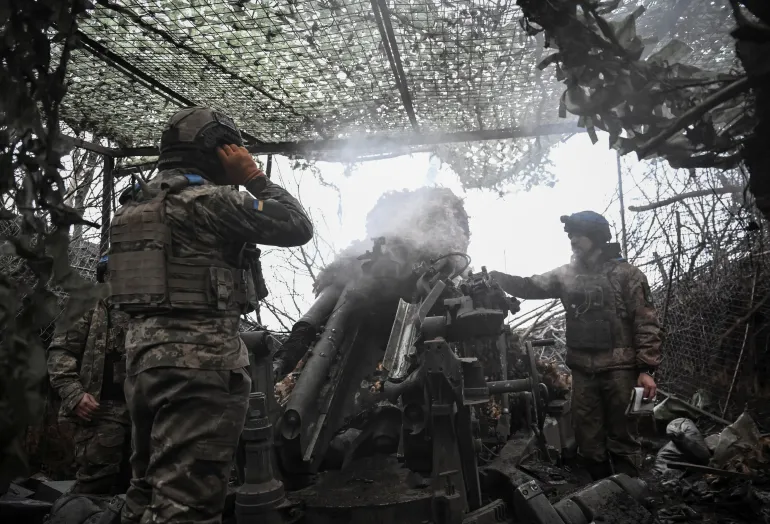
Artillerymen of the 44th Separate Artillery Brigade fire a M777 Howitzer towards Russian troops, amid Russia’s attack on Ukraine, in Dnipropetrovsk region, Ukraine, on December 24, 2025 [Reuters]

Regional security

  • France’s ‍President Emmanuel Macron said he spoke ⁠with NATO ​chief Mark Rutte to ‍discuss the situation in Ukraine and ‍the work undertaken ⁠by the “coalition of the willing”. “Starting in January in Paris, we ​will ‌continue the work begun within this framework to provide ‌Ukraine with solid security ‌guarantees, a ⁠prerequisite for a robust and lasting peace,” Macron ‌said on social media.
  • Democratic senators in the US have urged President ‍Donald Trump to ‍reverse a recall of nearly 30 career ambassadors, warning the move leaves a dangerous leadership vacuum that allows adversaries like Russia and China to expand their influence. The Trump administration in recent days has ordered career diplomats serving across Europe, Asia, Africa and Latin America back to Washington to ensure US missions abroad reflect its “America First” priorities.

Economics

  • Kazakhstan’s exports of its flagship CPC Blend of oil will be their lowest in 14 months in December, as bad weather delays efforts to repair Russian loading infrastructure after Ukrainian drone strikes last month, two sources told the Reuters news agency.
  • On November 29, Ukrainian drones hit the Caspian Pipeline Consortium terminal located near ‍Russia’s Black Sea port ⁠of Novorossiysk, leaving just one out of three jetties operational and prolonging export delays. Poor weather has added to the difficulty of carrying out maintenance work necessary to allow exports to recover.
  • Ukraine’s Ministry of Finance said ‍it ‍completed the settlement of a deal to restructure $2.6bn of growth-linked debt.


Source link

Russian forces seize embattled Siversk town as Ukrainian troops withdraw | Russia-Ukraine war News

The Ukrainian military says its forces have withdrawn from ​​the battle-scarred town of Siversk in the eastern Donetsk region after heavy fighting with Russian forces.

In a statement on Telegram on Tuesday, Ukraine’s General Staff said that Russian troops had a “significant advantage” in manpower and equipment and had exerted constant pressure on the defending Ukrainian troops by staging small-unit assaults in difficult weather conditions.

Recommended Stories

list of 4 itemsend of list

Ukraine’s decision to withdraw its forces was made to “preserve the lives of our soldiers and the combat capability of the units”, the General Staff said.

Heavy losses were inflicted on Russian forces before the order to retreat was given, and Siversk remains “under the fire control of our troops”, and “enemy units are being blocked to prevent their further advance,” the General Staff added.

Ukraine’s DeepState military monitoring site reported late on Tuesday that Russian forces had occupied Siversk as well as Hrabovske, a village in Ukraine’s Sumy region close to the border with Russia.

Russian Lieutenant General Sergei Medvedev had told Russian President Vladimir Putin on December 11 that troops had taken Siversk, where fighting has been fierce in recent months, but Ukrainian officials denied the Russian reports at the time.

Ukraine’s military said at the time that Russian troops were “taking advantage of unfavourable weather conditions” to launch attacks, but were mostly being “destroyed on the approaches”.

The Kyiv Independent news site said that, despite Siversk’s modest size – it had a pre-war population of 10,000, and now, just a few hundred civilians remain – the town was key to the defence of northern Donetsk.

The town had helped shield the larger Sloviansk and Kramatorsk areas, “the main bastions of Ukraine’s so-called ‘fortress belt’”, which Russia has been unable to conquer since the start of fighting, the Kyiv Independent said.

Donetsk is one of three Ukrainian regions at the centre of Russia’s territorial demands, which are the stumbling blocks to reaching an agreement on a ceasefire. Ukraine’s leaders have said they will not concede their country’s territory taken during Moscow’s invasion.

Russian forces had already seized an estimated 19 percent of Ukrainian territory as of early December, including Crimea, which Moscow annexed in 2014, all of the Luhansk region, and more than 80 percent of Donetsk, according to the Reuters news agency.

Russian forces also control about 75 percent of the Kherson and Zaporizhia regions, and small parts of the Kharkiv, Sumy, Mykolaiv and Dnipropetrovsk regions, according to Reuters.

A 28-point peace plan first put forward by the administration of US President Donald Trump last month says that a negotiated settlement would see Crimea, Luhansk and Donetsk “recognised as de facto Russian, including by the US”.

Ukrainian President Volodymyr Zelenskyy recently said that the United States is pushing for Ukraine to withdraw its forces from the Donetsk region to establish a “free economic zone” in the area, which he said the Russian side is referring to as a “demilitarised zone”.

People visit the graves of fallen Ukrainian soldiers decorated with Christmas trees and New Year's decorations at the Lychakiv Military Cemetery, on the day before Christmas Eve, in Lviv on December 23, 2025, amid the Russian invasion of Ukraine. (Photo by YURIY DYACHYSHYN / AFP)
People visit the graves of fallen Ukrainian soldiers, decorated with Christmas trees and New Year’s decorations, at the Lychakiv Military Cemetery, in Lviv, Ukraine on Tuesday [Yuriy Dyachyshyn/AFP]

Pope saddened as fighting continues over Christmas

The latest setback for Kyiv on the battlefield came as Zelenskyy said on Tuesday that Russian forces had launched another “massive attack” on Ukraine on Monday night, killing at least three people, including a four-year-old girl, across 13 regions targeted with drones and missiles.

In Russia, Ukrainian drone attacks killed four people in the Belgorod region over the past two days, local officials said.

Pope ‍Leo ‍expressed disappointment on Tuesday that Russia had apparently refused to agree to a ceasefire on December 25, the date many Christians celebrate Christmas.

“I will make ​an appeal one ‌more time to people of goodwill to respect at least Christmas ‌Day as a day of ‌peace,” Leo said, speaking to reporters outside his residence in Castel Gandolfo, Italy.

“Maybe they will listen to us, and there ‌will be at least 24 hours, a day of peace, ‍across the world,” he said.

While most people in Ukraine and Russia are Christians, many are Orthodox, meaning they observe Christmas on January 7.

Russian President Vladimir Putin announced an unexpected 30-hour unilateral truce a day before Easter this year, a rare pause in Russia’s war on Ukraine, which has now continued for close to three years, after Russia’s full-scale invasion in February 2022.

Source link