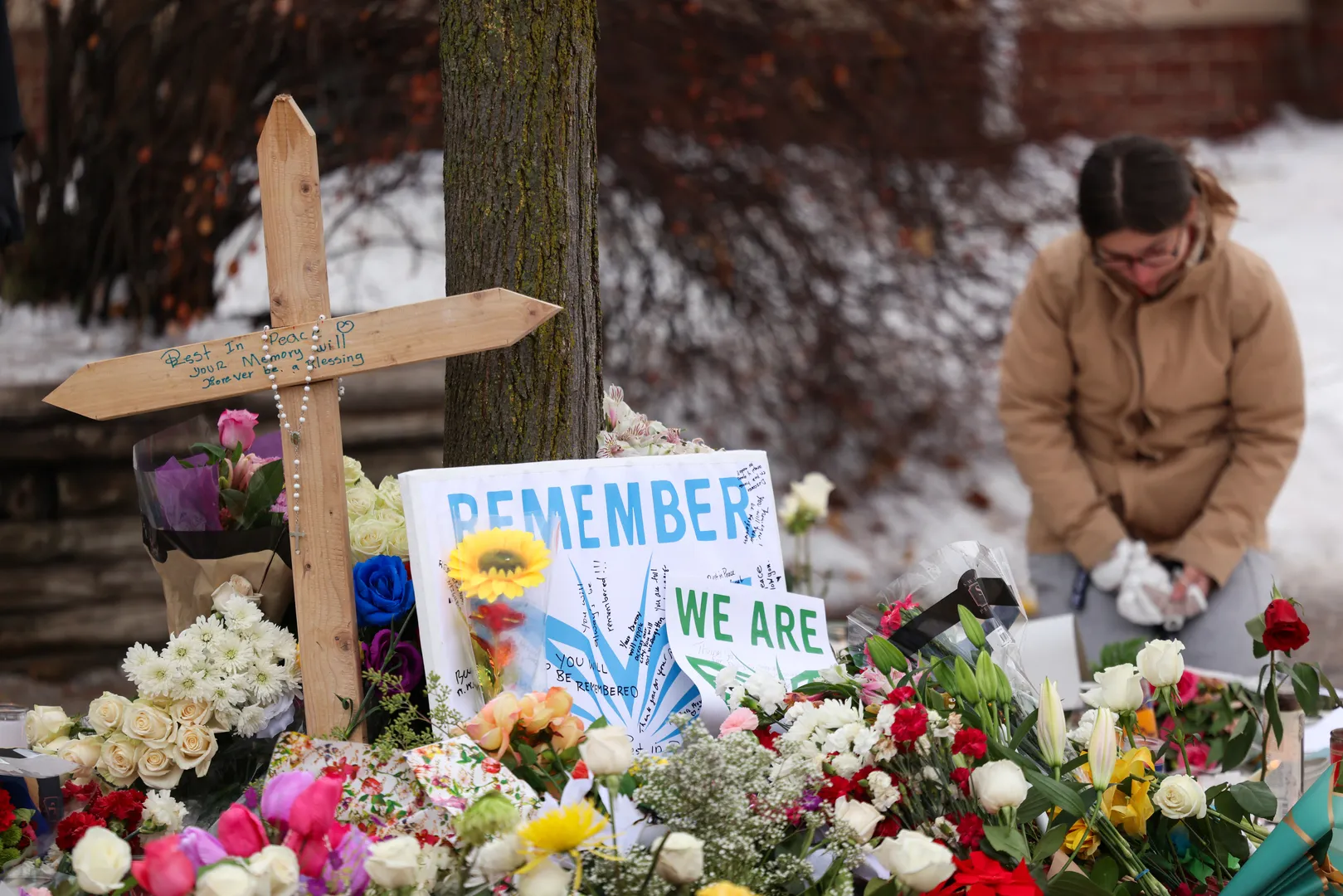
Some officials for Yemen’s separatist Southern Transitional Council on Friday said the council has been dissolved, but others deny the claim and say the STC is still active in southern Yemen. Photo by Najeeb Mohamed/EPA
Jan. 9 (UPI) — Some leaders of the Southern Transitional Council in Yemen announced the dissolution of the group that controlled southern Yemen territory, but others in the separatist group say it is still active amid peace talks Friday.
STC Secretary-General Abdulrahman Jalal al-Sebaihi announced the STC’s pending dissolution on Yemeni TV while attending peace talks in Riyadh, Saudi Arabia. His counterparts in Yemen said his declaration was made under duress and was not true.
“The decisions relating to the Southern Transitional Council cannot be taken except by the Council in its entirety, with all its institutions, and under the chairmanship of the president,” STC spokesman Anwar al-Tamimi said in a social media post.
“This will happen as soon as the STC delegation present in Riyadh is released,” he said.
“The STC will continue positive and constructive engagement with all political initiatives, which give the southern people the opportunity to determine their future.”
A coalition backed by Saudi Arabia has taken control of the territory in southern Yemen that formerly was held by the STC, which is supported by the United Arab Emirates.
The conflicting statements regarding the STC were made after STC leader Aidarous al-Zubaidi secretly left Yemen on Tuesday night with the help of the UAE instead of traveling to Riyadh to negotiate matters in Yemen.
Instead, he was taken to Abu Dhabi on Wednesday, which raised tensions between Saudi and UAE officials.
In addition to leading the STC, al-Zubaidi was a member of Yemen’s Presidential Leadership Council, which expelled him on Wednesday when he did not show up in Riyadh to discuss matters in Yemen.
The UAE and Saudi Arabia recently worked together to oppose Iran-backed Houthis in Yemen, and the STC wants to have an independent state recognized in South Yemen.
The STC’s dissolution could imperil efforts to re-establish a former north-south divide in Yemen, which existed prior to the nation’s unification in 1990.
Saudi Arabia supports the PLC, which is the internationally recognized government in Yemen, while the UAE backs the STC.
In some ways, it was just another campaign coffee: Los Angeles mayoral candidate Austin Beutner in a roomful of voters talking about his career and life accomplishments.
But this was no ordinary meet-and-greet. Beutner was standing inside a partially rebuilt house — with no doors, no windows and no drywall — in an area leveled by the Palisades fire. In the living room, about a dozen people spoke about what they had been through, from the frantic evacuation to the sight of smoldering ruins to the battle to get rebuilding permits.
Allison Holdorff Polhill, who owns the home, introduced Beutner — a former L.A. school superintendent — as the civic leader she would turn to first in a crisis.
“We were in the worst disaster that L.A. has ever experienced,” she told the group. “And we needed a leader that has experience with disasters and emergencies.”
The catastrophic Palisades fire, which destroyed thousands of homes and left 12 people dead, has redefined the L.A. mayor’s race, expanding the field of candidates and creating a political minefield for Karen Bass as she seeks a second four-year term.
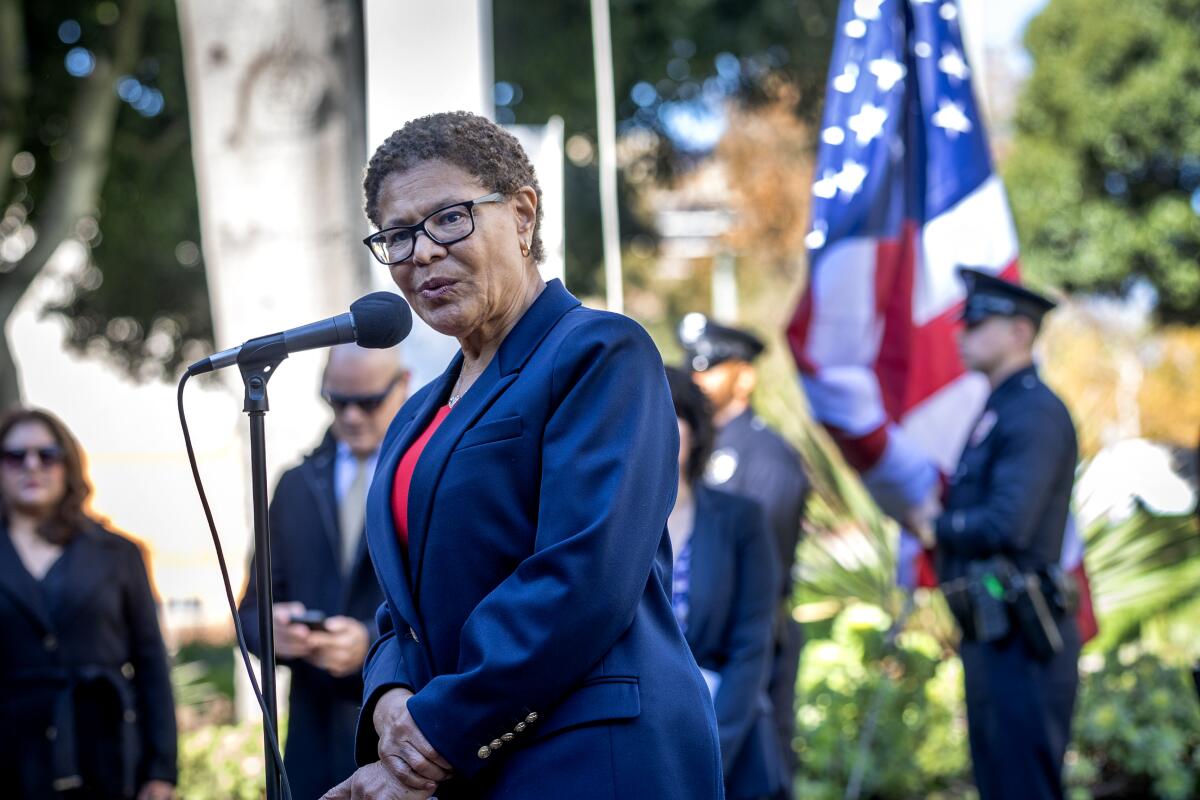
Los Angeles Mayor Karen Bass speaks at a City Hall ceremony where flags are lowered to half-staff to commemorate the one-year anniversary of the Palisades and Eaton fires.
(Allen J. Schaben / Los Angeles Times)
When the fire broke out on Jan. 7, 2025, Bass drew criticism for being in Ghana on a diplomatic mission. Once she returned, she was at odds with her fire chief and unsteady in her public appearances.
More recently, she has faced scrutiny over her handling of the recovery, as well as fire officials’ watering down of an after-action report that was supposed to identify mistakes in the firefighting effort.
The Times found that LAFD officials failed to fully pre-deploy engines to the Palisades amid forecasts of dangerously high winds and that a battalion chief ordered firefighters to leave the scene of a Jan. 1 blaze, even though it wasn’t fully extinguished. That fire rekindled a week later to become the Palisades fire.
Fernando Guerra, a political science professor at Loyola Marymount University, said he expects the disaster will be the No. 1 issue in the June 2 mayoral primary, resonating with voters well beyond Pacific Palisades.
To wage a competitive campaign, each of Bass’ challengers will need to make the fire and its aftermath “a reflection of what’s wrong with city government,” he said.
“It really does reflect on the readiness of the city, the responsiveness of the city, how is government working at the most basic level,” said Guerra, who also runs the Center for the Study of Los Angeles.
So far, Bass’ major challengers are embracing that strategy.
Beutner, who ran the L.A. Unified School District early in the pandemic, has accused Bass of failing to take responsibility for the city’s failures before and after the fire. On Monday, appearing with fire victims in Pacific Palisades, he called on the mayor to form a citizens commission to examine what went wrong.
Rae Huang, a community organizer who is challenging the mayor from the left, has expressed disappointment in what she called Bass’ “finger-pointing” — a reference to the mayor’s criticism, and ouster, of Fire Chief Kristin Crowley last year.
Then there’s reality TV star Spencer Pratt, an outspoken Bass critic, who launched a campaign rooted in his fury over the city’s handling of the fire — and the loss of his family’s home in the flames.
“I’ve waited a whole year for someone to step up and challenge Karen Bass, but I saw no fighters,” Pratt said in a social media post Wednesday. “Guess I’m gonna have to do this myself.”
Reality TV star Spencer Pratt, second from right, announced on Wedneday that he is running for mayor. He is suing the city over its handling of the Palisades fire, which destroyed his home in Pacific Palisades.
(Genaro Molina / Los Angeles Times)
Still unclear is whether two formidable public figures will jump in — L.A. County Supervisor Lindsey Horvath and real estate developer Rick Caruso, who lost to Bass in 2022. On Wednesday, Caruso said he will decide in the next couple of weeks whether he will run for mayor or governor.
Asked whether he might stay out of both races, Caruso responded: “I think that option is pretty much off the table now.”
As the city marked the one-year anniversary of the fires this week, Bass mostly kept a low profile, addressing the Pacific Palisades Democratic Club over the weekend and joining a private vigil at the Self-Realization Fellowship Lake Shrine.
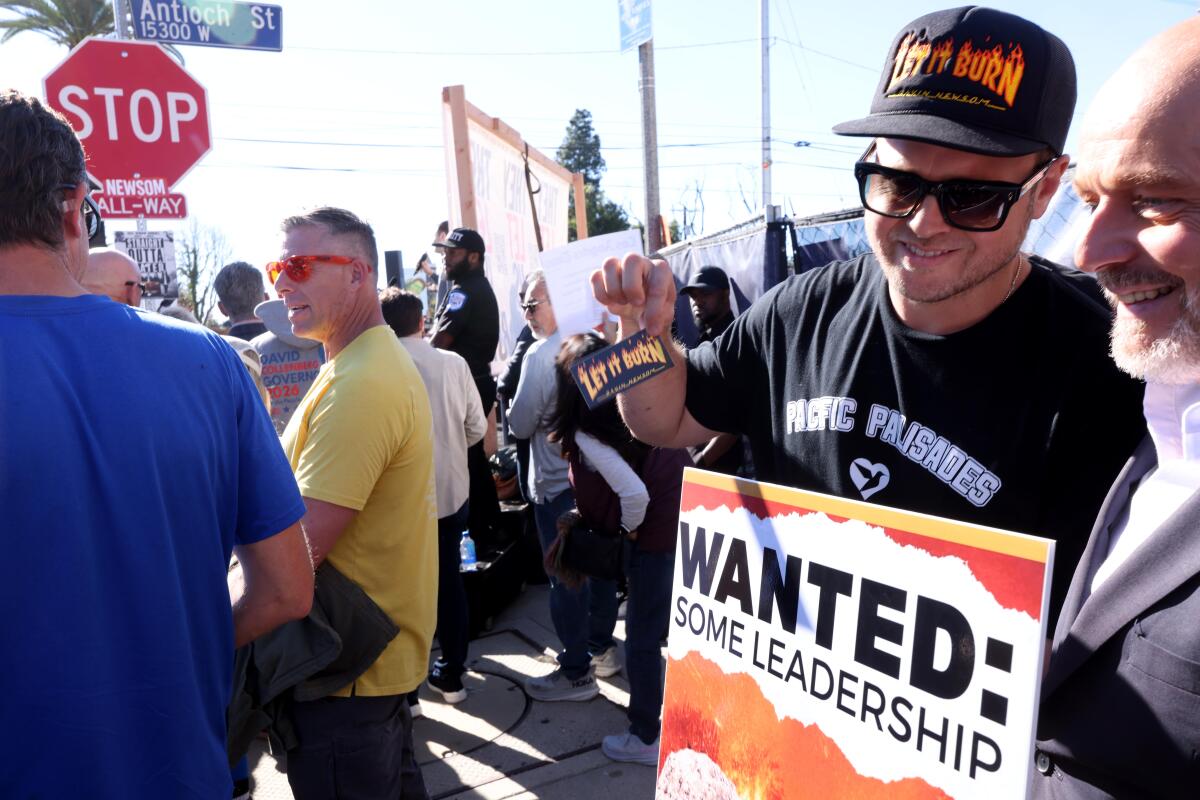
While Pratt and hundreds of demonstrators were staging a “They Let Us Burn” rally in the Palisades, Bass stood solemnly outside City Hall as police officers lowered flags to half-staff. Bass spoke about grief and loss, but also the fact that more than 400 homes are being rebuilt.
“You see signs of hope everywhere,” she told the crowd.
Bass’ political team has taken a tougher approach, accusing her most outspoken critics — including Pratt, who is releasing a book later this month — of exploiting the disaster for political or even financial gain.
“For the first time ever we saw a major wildfire politicized by MAGA leaders and monetized by social influencers making tens of thousands of dollars per month and hawking books on the backs of a devastated community,” Bass campaign strategist Doug Herman said in a statement.
For much of the past year, Bass has faced criticism over the Fire Department’s deployment decisions and its failure to put out the Jan. 1 fire. She also has taken hits over the recovery, with residents saying she has not delivered on promises to waive permit fees for rebuilding homes lost in the fire.
Now, the focus has turned to a new and unsettling question: Did the city undermine its own effort to assess the Fire Department’s mistakes?
The Times reported last month that LAFD officials made changes to the after-action report that were so significant that its author, Battalion Chief Kenneth Cook, declined to endorse it.
“The fact that [Cook] is not willing to sponsor, or support, or endorse the report says a hell of a lot about the fact that there is no trust and clear leadership,” Huang said.
Bass told The Times on Wednesday that she did not work with the Fire Department on changes to the report, nor did the agency consult her about any changes.
L.A. County Supervisor Lindsey Horvath speaks at a rally in support of the county’s emergency rent relief program to help households who have lost income because of federal immigration enforcement.
(Al Seib / For The Times)
Horvath, who is running for a second four-year term as county supervisor, has also ripped the city over the report, saying wildfire victims feel “gaslit” — and deserve answers.
The supervisor, whose sprawling district includes the Palisades burn area, said she has been hearing from people asking her to run for mayor. She said she would prefer to continue in county office. But she voiced concern about the city’s future — not just its handling of the wildfire, but also the budget, the homelessness crisis and the delivery of basic services.
“I think people are hungry for a different kind of leadership,” she told The Times.
Pacific Palisades has not been a political stronghold for Bass. Although she won her 2022 race against Caruso by a 10-point margin, she trailed him by double digits in the Palisades.
Like many people across the region, the major mayoral candidates were directly impacted by the January fires or have family who lost homes — or both.
Beutner’s home was severely damaged in the Palisades fire, forcing him to live elsewhere for the past year. His mother-in-law’s home, also in the Palisades, was completely destroyed.
Bass has spoken repeatedly about her brother, whose Malibu home was destroyed in the Palisades fire. Huang’s 53-year-old cousin lost her Altadena home in the Eaton fire. Pratt, who is suing the city over the Palisades fire, said on social media that the flames consumed not just his home but also one owned by his parents.
Caruso, still a candidate-in-waiting, managed to save Palisades Village, the shopping center he opened in 2018, in part by securing his own private firefighting crew. But the inferno nevertheless destroyed the homes of his son and daughter, who are 26 and 29.
Real estate developer Rick Caruso on Wednesday unveils an installation in Pacific Palisades with three beams of light to mark the one-year anniversary of the fires.
(Jason Armond / Los Angeles Times)
On the night the fire broke out, Caruso voiced his fury on live television about empty fire hydrants and the overall lack of water to douse the flames. Since then, he has offered a steady stream of criticism about the rebuilding process, including the mayor’s decision not to select a replacement for Steve Soboroff, who served 90 days as her recovery czar.
Caruso has spoken favorably in recent weeks about a few aspects of the recovery, including the reopening of classrooms and the quick removal of fire debris. He credited L.A. Unified and the U.S. Army Corps of Engineers, respectively, for those accomplishments — not the city.
“Frankly, the bright spots are under the leadership of other people,” he told The Times.
Beutner has been equally blunt. At last month’s campaign coffee, he said the city needs to convene a citizen panel similar to the Christopher Commission, which was formed weeks after the 1991 police beating of Rodney King. The panel assessed the LAPD’s handling of discipline, misconduct complaints, excessive force by officers and other issues.
“If you have a tragedy, you have public hearings, you have leaders who are empaneled with the money they need to ask tough questions of everybody — the mayor, her staff, the acting mayor, police, fire” and the Department of Water and Power, Beutner told the group. “What did you do, and what would you have done differently?”
Clara Karger, a spokesperson for Bass, said the city is already participating in a state investigation, which is being overseen by the Fire Safety Research Institute, into the Palisades and Eaton fires.
On top of that, she said, the fire department is commissioning an independent investigation into its response to the Jan. 1 fire that reignited into the Palisades fire. That blaze, known as the Lachman fire, was mentioned only briefly in the department’s after-action report.
“Mayor Bass wants all the information to ensure accountability and to continue implementing needed reforms, many of which are already underway from LAFD,” Karger said.
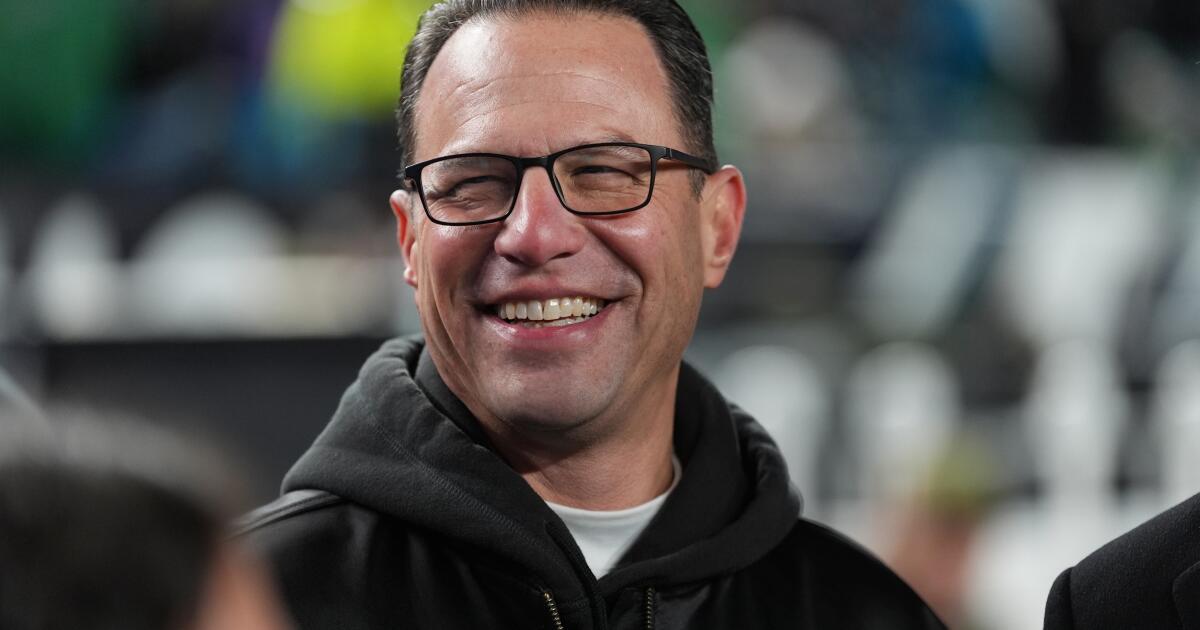
HARRISBURG, Pa. — Pennsylvania Gov. Josh Shapiro is running for a second term in the pivotal battleground state after a first term that put him on the Democratic Party’s radar as a potential presidential contender in 2028.
He made the formal announcement Thursday at an event at a carpenters’ union hall in Pittsburgh and, later, at a similar event in Philadelphia. Shapiro’s announcement demonstrated a unified party behind him — including introductions by the state party chair, labor leaders and top local Democratic officials — as he ticked off his accomplishments during a nearly 30-minute speech.
Shapiro warned that his opponents promise “darkness and division and extremism,” and — without mentioning President Trump by name — he slammed the “chaos and toxicity” emanating from Washington, D.C., that he said threatened livelihoods, rights and freedoms.
“Every step of the way, I’ve stood up for my fellow Pennsylvanians, sometimes in a court of law and other times simply refusing to back down, refusing to cast certain Pennsylvanians aside and always by speaking truth to power,” Shapiro said.
He added, “I will not let anyone mess with Pennsylvania and I will always have your backs.”
Although Shapiro hasn’t disclosed any ambitions for higher office, his reelection effort will be closely watched as another test of whether he’s White House material.
Ever since he won the governor’s office in a near-landslide victory in 2022, Shapiro has been mentioned alongside Democratic contemporaries like California Gov. Gavin Newsom, Illinois Gov. JB Pritzker, Maryland Gov. Wes Moore and others as someone who could lead a national ticket.
Shapiro, 52, has already made rounds outside Pennsylvania. Last year, he campaigned for Democrats running for governor in New Jersey and Virginia, and he’s a frequent guest on Sunday talk shows that can shape the country’s political conversation.
He was also considered as a potential running mate for Kamala Harris in 2024. She chose Minnesota Gov. Tim Walz instead.
A pivotal first term as governor
Shapiro’s first term repeatedly put him in the spotlight.
He was governor when Pennsylvania was the site of the first attempted assassination of Trump; the capture of Luigi Mangione in the killing of United Healthcare Chief Executive Brian Thompson; and the murder of three police officers in the state’s deadliest day for law enforcement since 2009.
Last year, an arsonist tried to kill Shapiro by setting the governor’s official residence on fire in the middle of the night. Shapiro had to flee with his wife, children and members of his extended family, and the attack made him a sought-out voice on the nation’s recent spate of political violence.
As Shapiro settled into the governor’s office, he shed his buttoned-down public demeanor and became more plain-spoken.
He pushed to quickly reopen a collapsed section of Interstate 95 in Philadelphia, debuting his new and profane governing slogan — “get s— done” — at a ceremony for the completed project.
He crossed the partisan divide over school choice to support a Republican-backed voucher program, causing friction with Democratic lawmakers and allies in the state.
Shapiro regularly plays up the need for bipartisanship in a state with a politically divided Legislature, and positions himself as a moderate on energy issues in a state that produces the most natural gas after Texas.
He’s rubbed elbows with corporate executives who are interested in Pennsylvania as a data center destination and thrust Pennsylvania into competition for billions of dollars being spent on energy, manufacturing and artificial intelligence.
A repeat winner in competitive territory
Shapiro has enjoyed robust public approval ratings and carries a reputation as a disciplined messenger and powerhouse fundraiser. For 2026, Pennsylvania’s Republican Party endorsed Stacy Garrity, the twice-elected state treasurer, to challenge Shapiro.
Garrity has campaigned around Pennsylvania and spoken at numerous Trump rallies in the battleground state, but she is untested as a fundraiser and will have to contend with her relatively low profile as compared with Shapiro.
Shapiro, meanwhile, keeps a busy public schedule and has gone out of his way to appear at high-profile, nonpolitical events like football games, a NASCAR race and onstage at a Roots concert in Philadelphia.
He is a regular on TV political shows, podcasts and local sports radio shows, and became a leading pro-Israel voice among Democrats and Jewish politicians amid the Israel-Hamas war, confronting divisions within the Democratic Party over the war.
He has tempered it with calls for more aid for Gaza’s residents and criticism of Prime Minister Benjamin Netanyahu’s handling of the war, but some activists argued against him being the party’s nominee for vice president in 2024.
Harris, in her recent book, wrote that she passed on Shapiro after determining that he wouldn’t be a good fit for the role.
Shapiro, she wrote, “mused that he would want to be in the room for every decision,” and she “had a nagging concern that he would be unable to settle for a role as number two and that it would wear on our partnership.” Shapiro disputed the characterization.
An audition on the 2026 campaign trail
In a September appearance on NBC News’ “Meet the Press,” the host, Kristen Welker, asked him whether he’d commit to serving a full second term as governor and whether he’d rule out running for president in 2028.
“I’m focused on doing my work here,” he said, sidestepping the questions.
His supposed White House aspirations — which he’s never actually admitted to in public — are also mentioned frequently by Garrity.
“We need somebody that is more interested in Pennsylvania and not on Pennsylvania Avenue,” Garrity said recently on a radio show in Philadelphia. On Thursday, the Republican Governors Assocn. accused Shapiro of being “more focused on his political ambitions” than leading Pennsylvania.
For his part, Shapiro criticizes Garrity as too eager to get Trump’s endorsement to be an effective advocate for Pennsylvania.
In any case, the campaign trail could afford Shapiro an opportunity to audition for a White House run.
For one thing, Shapiro has been unafraid to criticize Trump, even in a swing state won by Trump in 2024. As governor, Shapiro has joined or filed more than a dozen lawsuits against Trump’s administration, primarily for holding up funding to states.
He has lambasted Trump’s tariffs as “reckless” and “dangerous,” Trump’s threats to revoke TV broadcast licenses as an “attempt to stifle dissent” and Trump’s equivocation on political violence as failing the “leadership test” and “making everyone less safe.”
Many of Shapiro’s would-be competitors in a Democratic primary won’t have to run for office before then.
Newsom is term-limited, for instance. Others — like ex-Transportation Secretary Pete Buttigieg — aren’t in public office. A couple of other governors in the 2028 conversation — Moore and Pritzker — are running for reelection this year.
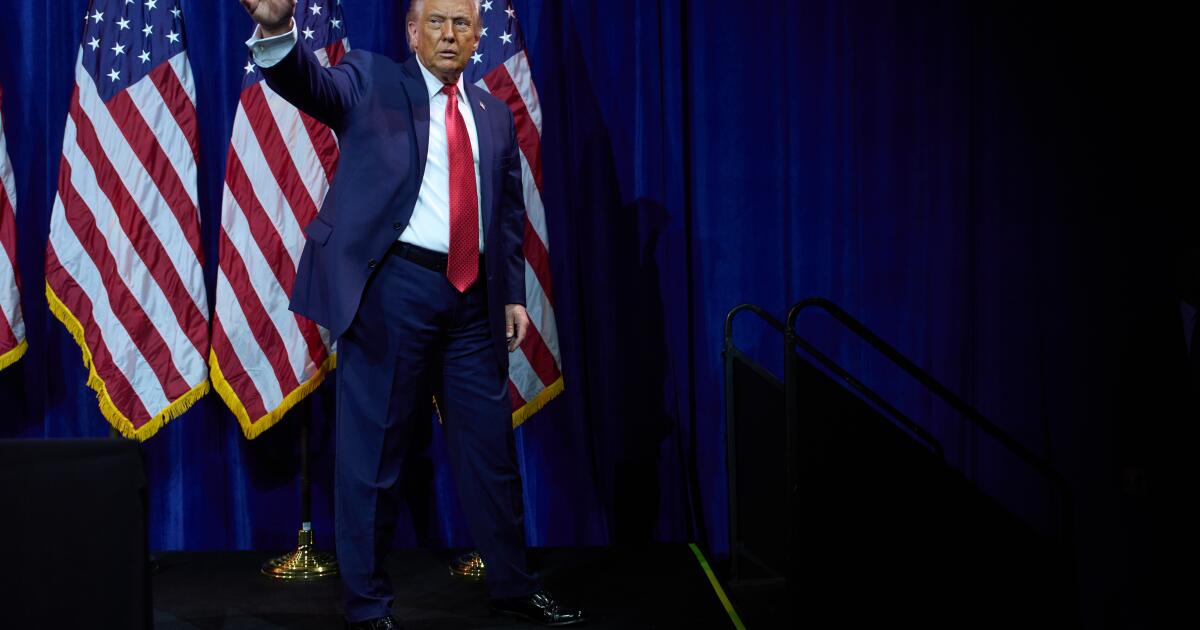
WASHINGTON — President Trump is meeting with oil executives at the White House Friday in hopes of securing $100 billion in investments to revive Venezuela’s ability to fully tap into its expansive reserves of petroleum — a plan that rides on their comfort in making commitments in a country plagued by instability, inflation and uncertainty.
Since the U.S. military raid to capture former Venezuelan leader Nicolás Maduro on Saturday, Trump has quickly pivoted to portraying the move as a newfound economic opportunity for the U.S., seizing tankers carrying Venezuelan oil, saying the U.S. is taking over the sales of 30 million to 50 million barrels of previously sanctioned Venezuelan oil and will be controlling sales worldwide indefinitely.
On Friday, U.S. forces seized their fifth tanker over the past month that has been linked to Venezuelan oil. The action reflected the determination of the U.S. to fully control the exporting, refining and production of Venezuelan petroleum, a sign of the Trump administration’s plans for ongoing involvement in the sector as it seeks commitments from private companies.
It’s all part of a broader push by Trump to keep gasoline prices low. At a time when many Americans are concerned about affordability, the incursion in Venezuela melds Trump’s assertive use of presidential powers with an optical spectacle meant to convince Americans that he can bring down energy prices.
The meeting, set for 2:30 p.m. EST, is currently set to occur behind closed doors, according to the president’s daily schedule. “At least 100 Billion Dollars will be invested by BIG OIL, all of whom I will be meeting with today at The White House,” Trump said Friday in a pre-dawn social media post.
Trump is set to meet with executives from 17 oil companies, according to the White House. Among the companies attending are Chevron, which still operates in Venezuela, and ExxonMobil and ConocoPhillips, which both had oil projects in the country that were lost as part of a 2007 nationalization of private businesses under Maduro’s predecessor, Hugo Chávez.
The president is meeting with a wide swath of domestic and international companies with interests ranging from construction to the commodity markets. Other companies slated to be at the meeting include Halliburton, Valero, Marathon, Shell, Singapore-based Trafigura, Italy-based Eni and Spain-based Repsol.
Large U.S. oil companies have so far largely refrained from affirming investments in Venezuela as contracts and guarantees need to be in place. Trump has suggested on social media that America would help to backstop any investments.
Venezuela’s oil production has slumped below one million barrels a day. Part of Trump’s challenge to turn that around will be to convince oil companies that his administration has a stable relationship with Venezuela’s interim President Delcy Rodríguez, as well as protections for companies entering the market.
Secretary of State Marco Rubio, Energy Secretary Chris Wright and Interior Secretary Doug Burgum are slated to attend the oil executives meeting, according to the White House.
CARACAS, Venezuela — At the White House, President Trump vows American intervention in Venezuela will pour billions of dollars into the country’s infrastructure, revive its once-thriving oil industry and eventually deliver a new age of prosperity to the Latin American nation.
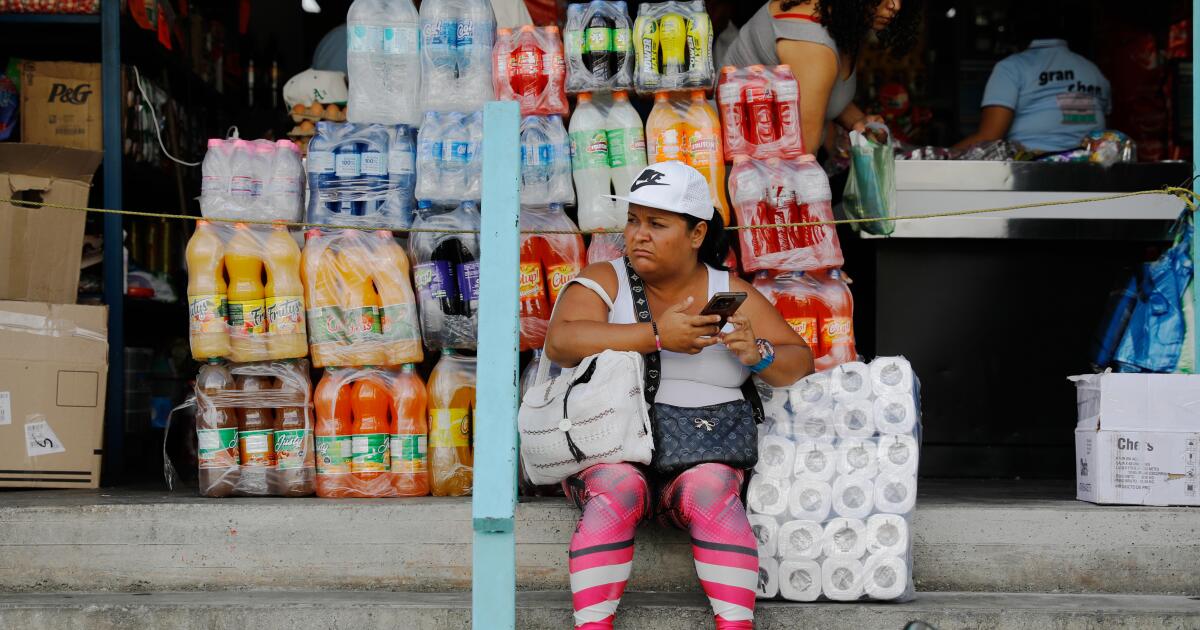
Here at a sprawling street market in the capital, though, utility worker Ana Calderón simply wishes she could afford the ingredients to make a pot of soup.
“Food is incredibly expensive,” says Calderón, noting rapidly rising prices that have celery selling for twice as much as just a few weeks ago and two pounds of meat going for more than $10, or 25 times the country’s monthly minimum wage. “Everything is so expensive.”
Venezuelans digesting news of the United States’ brazen capture of former President Nicolás Maduro are hearing grandiose promises of future economic prowess even as they live through the crippling economic realities of today.
“They know that the outlook has significantly changed but they don’t see it yet on the ground. What they’re seeing is repression. They’re seeing a lot of confusion,” says Luisa Palacios, a Venezuelan-born economist and former oil executive who is a research scholar at the Center on Global Energy Policy at Columbia University. “People are hopeful and expecting that things are going to change but that doesn’t mean that things are going to change right now.”
Whatever hope exists over the possibility of U.S. involvement improving Venezuela’s economy is paired with the crushing daily truths most here live. People typically work two, three or more jobs just to survive, and still cupboards and refrigerators are nearly bare. Children go to bed early to avoid the pang of hunger; parents choose between filling a prescription and buying groceries. An estimated eight in 10 people live in poverty.
It has led millions to flee the country for elsewhere.
Those who remain are concentrated in Venezuela’s cities, including its capital, Caracas, where the street market in the Catia neighborhood once was so busy that shoppers bumped into one another and dodged oncoming traffic. But as prices have climbed in recent days, locals have increasingly stayed away from the market stalls, reducing the chaos to a relative hush.
Neila Roa, carrying her 5-month-old baby, sells packs of cigarettes to passersby, having to monitor daily fluctuations in currency to adjust the price.
“Inflation and more inflation and devaluation,” Roa says. “It’s out of control.”
Roa could not believe the news of Maduro’s capture. Now, she wonders what will come of it. She thinks it would take “a miracle” to fix Venezuela’s economy.
“What we don’t know is whether the change is for better or for worse,” she says. “We’re in a state of uncertainty. We have to see how good it can be, and how much it can contribute to our lives.”
Trump has said the U.S. will distribute some of the proceeds from the sale of Venezuelan oil back to its population. But that commitment so far largely appears to be focused on America’s interests in extracting more oil from Venezuela, selling more U.S.-made goods to the country and repairing the electricity grid.
The White House is hosting a meeting Friday with U.S. oil company executives to discuss Venezuela, which the Trump administration has been pressuring to open its vast-but-struggling oil industry more widely to American investment and know-how. In an interview with the New York Times, Trump acknowledged that reviving the country’s oil industry would take years.
“The oil will take a while,” he said.
Venezuela has the world’s largest proven oil reserves. The country’s economy depends on them.
Maduro’s predecessor, the fiery Hugo Chávez, elected in 1998, expanded social services, including housing and education, thanks to the country’s oil bonanza, which generated revenues estimated at some $981 billion between 1999 and 2011 as crude prices soared. But corruption, a decline in oil production and economic policies led to a crisis that became evident in 2012.
Chávez appointed Maduro as his successor before dying of cancer in 2013. The country’s political, social and economic crisis, entangled with plummeting oil production and prices, marked the entirety of Maduro’s presidency. Millions were pushed into poverty. The middle class virtually disappeared. And more than 7.7 million people left their homeland.
Albert Williams, an economist at Nova Southeastern University, says returning the energy sector to its heyday would have a dramatic spillover effect in a country in which oil is the dominant industry, sparking the opening of restaurants, stores and other businesses. What’s unknown, he says, is whether such a revitalization happens, how long it would take and how a government built by Maduro will adjust to the change in power.
“That’s the billion-dollar question,” Williams says. “But if you improve the oil industry, you improve the country.”
The International Monetary Fund estimates Venezuela’s inflation rate is a staggering 682%, the highest of any country for which it has data. That has sent the cost of food beyond what many can afford.
Many public sector workers survive on roughly $160 per month, while the average private sector employee earned about $237 last year. Venezuela’s monthly minimum wage of 130 bolivars, or $0.40, has not increased since 2022, putting it well below the United Nations’ measure of extreme poverty of $2.15 a day.
The currency crisis led Maduro to declare an “economic emergency” in April.
Usha Haley, a Wichita State University economist who studies emerging markets, says for those hurting the most, there is no immediate sign of change.
“Short-term, most Venezuelans will probably not feel any economic relief,” she says. “A single oil sale will not fix the country’s rampant inflation and currency collapse. Jobs, prices and exchange rates will probably not shift quickly.”
In a country that has seen as much strife as Venezuela has in recent years, locals are accustomed to doing what they have to in order to get through the day, so much so that many utter the same expression
“Resolver,” they say in Spanish, or “figure it out,” shorthand for the jury-rigged nature of life here, in which every transaction, from boarding a bus to buying a child’s medicine, involves a delicate calculation.
Here at the market, the smell of fish, fresh onions and car exhaust combine. Calderon, making her way through, faces freshly skyrocketing prices, saying “the difference is huge,” as the country’s official currency has rapidly declined against its unofficial one, the U.S. dollar.
Unable to afford all the ingredients for her soup, she left with a bunch of celery but no meat.
Cano and Sedensky write for the Associated Press. Sedensky reported from New York. AP writer Josh Boak in Washington contributed to this report.
MINNEAPOLIS — Another round of protests were planned for Friday in Minneapolis over the killing of a local woman by an Immigration and Customs Enforcement officer during the Trump administration’s latest immigration crackdown on a major city, a day after federal immigration officers shot and wounded two people in Portland, Ore.
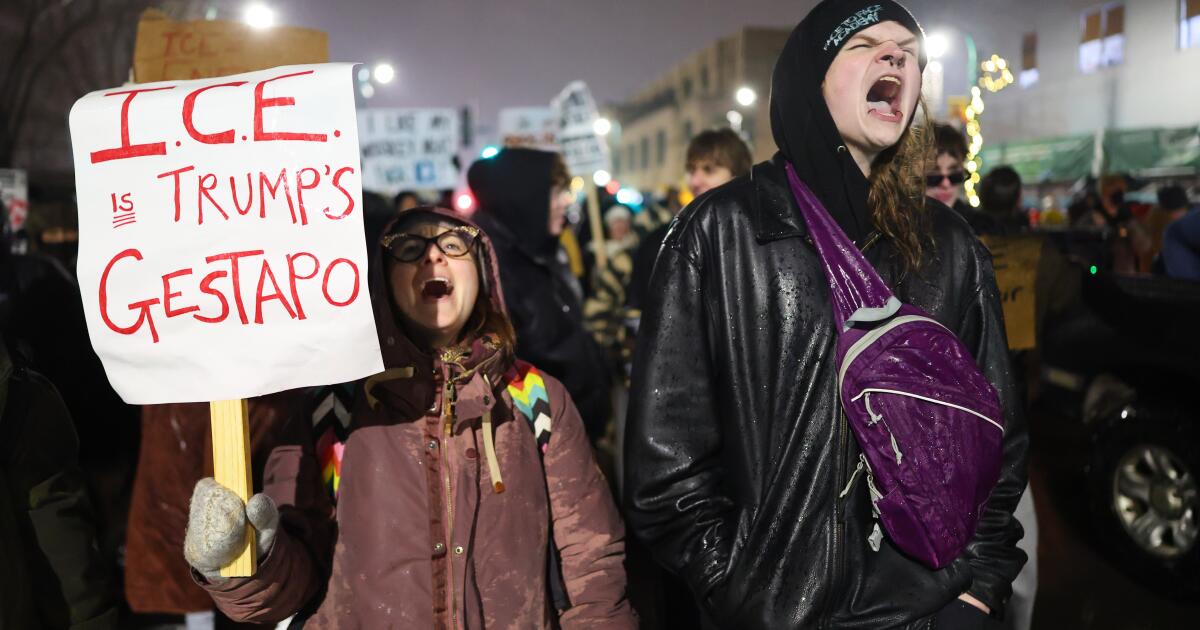
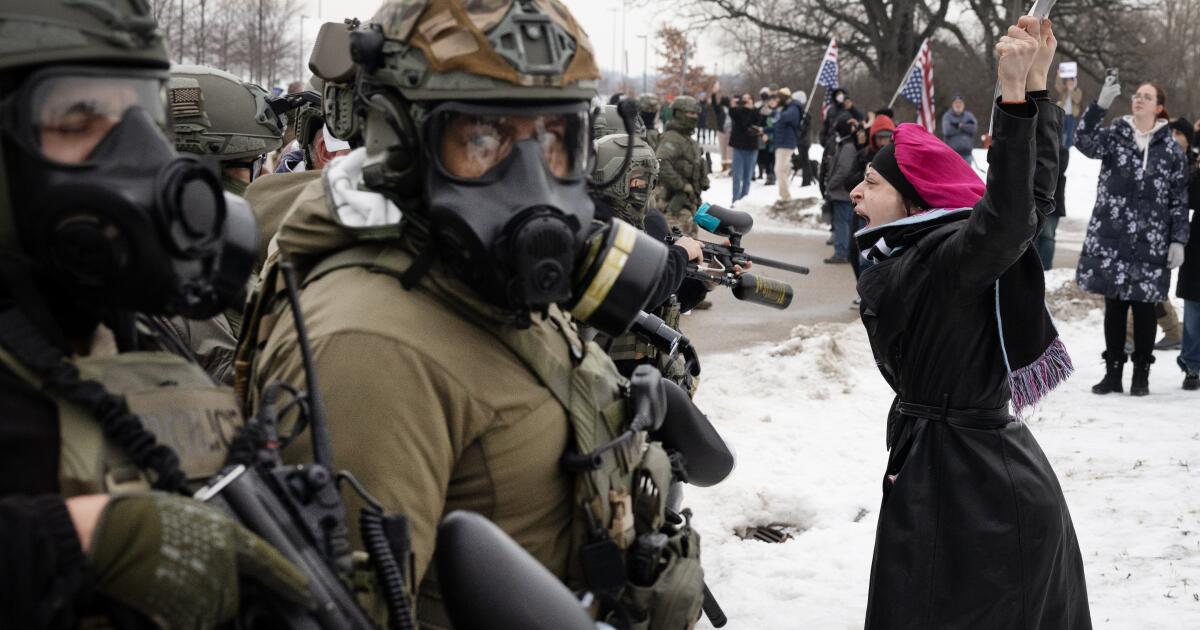
Hundreds of people protesting the Wednesday shooting of Renee Good marched in freezing rain Thursday night down one of Minneapolis’ major thoroughfares, chanting “ICE out now!” and holding signs saying, “Killer ice off our streets.” The day began with a charged protest outside of a federal facility that is serving as a hub for the immigration crackdown in the Twin Cities of Minneapolis and St. Paul.
On Friday, city workers removed makeshift barricades of old Christmas trees and other debris that had been blocking the streets around the scene where the ICE officer shot Good as she tried to drive away. City officials said they would allow a makeshift shrine to the 37-year-old mother of three to remain.
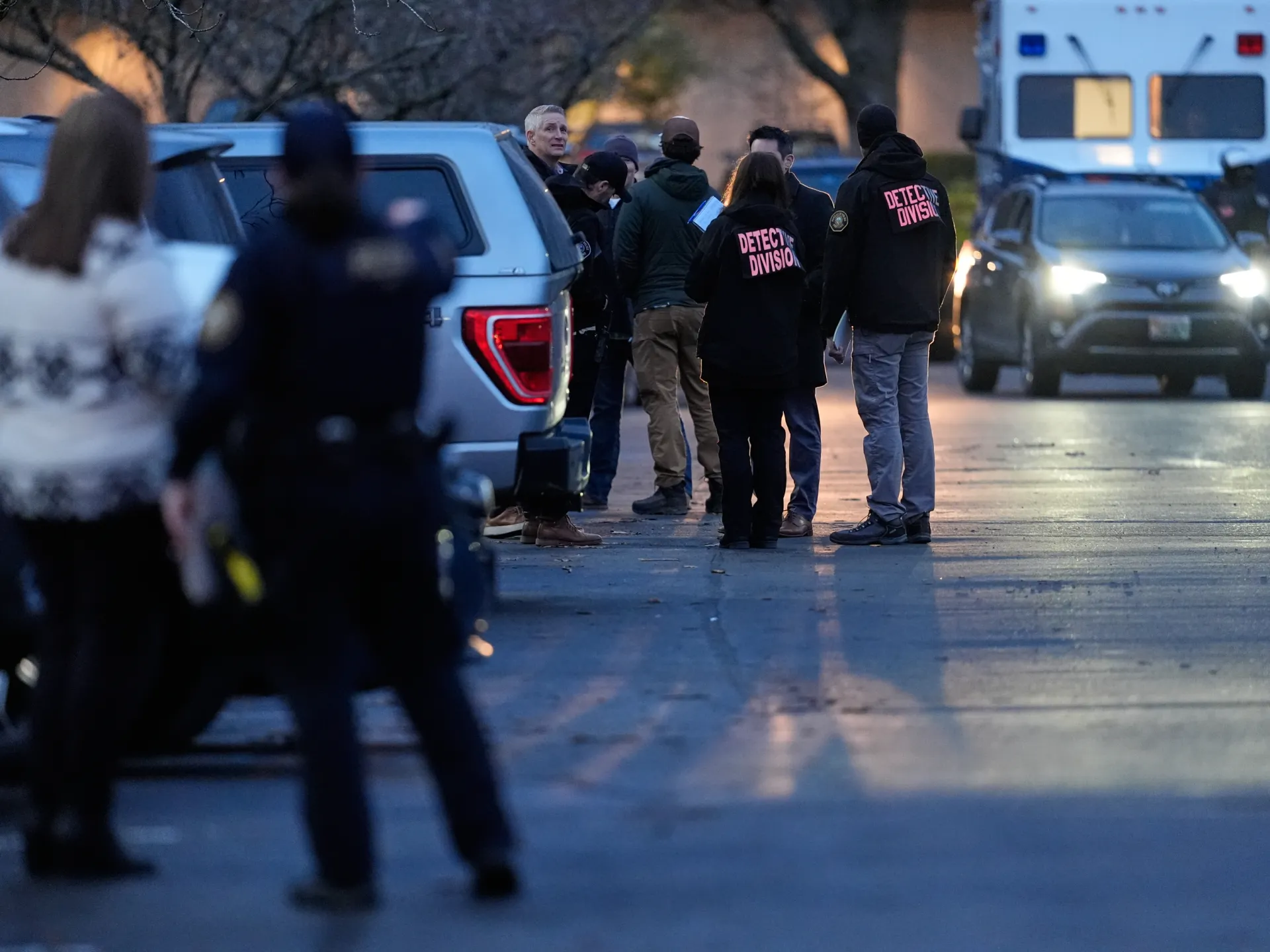
The shooting in Portland, Ore., took place outside a hospital Thursday afternoon. A man and woman were shot inside a vehicle, and their conditions were not immediately known. The FBI and the Oregon Department of Justice were investigating.
Portland Mayor Keith Wilson and the city council called on ICE to end all operations in the city until a full investigation is completed. Hundreds protested Thursday night at a local ICE building. Early Friday, Portland police reported that officers had arrested several protesters after asking the to move from the street to the sidewalk, to allow traffic to flow.
Just as it did following Good’s shooting, the Department of Homeland Security defended the actions of the officers in Portland, saying it occurred after a Venezuelan man with alleged gang ties and who was involved in a recent shooting tried to “weaponize” his vehicle to hit the officers. It wasn’t immediately clear if the shootings were captured on video, as Good’s was.
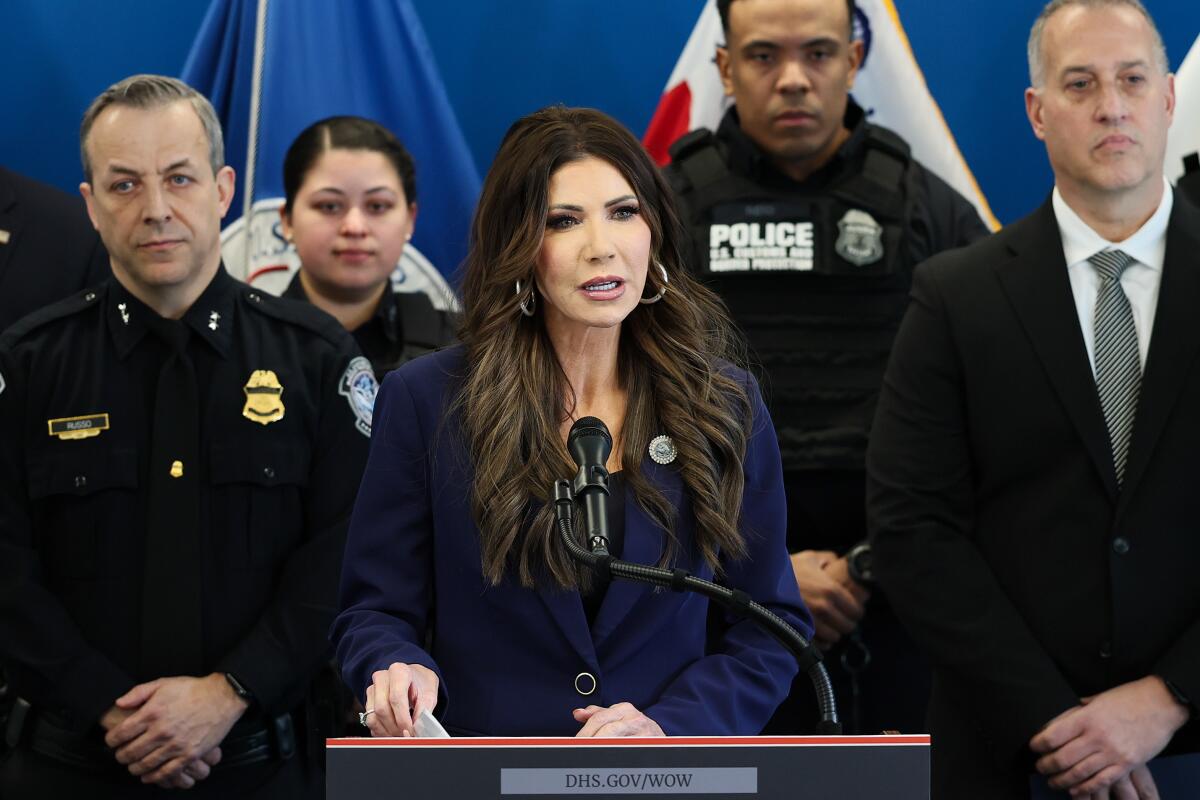
Homeland Security Secretary Kristi Noem, President Donald Trump and others in his administration have repeatedly characterized the Minneapolis shooting as an act of self-defense and cast Good as a villain, suggesting she used her vehicle as a weapon to attack the officer who shot her.
Vice President JD Vance said the shooting was justified and Good, a 37-year-old mother of three, was a “victim of left-wing ideology.”
“I can believe that her death is a tragedy while also recognizing that it is a tragedy of her own making,” Vance said, noting that the officer who killed her was injured while making an arrest last June.
But state and local officials and protesters rejected that characterization, with Minneapolis Mayor Jacob Frey saying video recordings show the self-defense argument is “garbage.”
An immigration crackdown quickly turns deadly
The Minneapolis shooting happened on the second day of the Twin Cities immigration crackdown, which Homeland Security said is the biggest immigration enforcement operation ever. More than 2,000 officers are taking part and Noem said they have made more than 1,500 arrests.
It provoked an immediate response in the city where police killed George Floyd in 2020, with hundreds of people turning up to the scene to vent their outrage at the ICE officers and the school district canceling classes for the rest of the week as a precaution.
Good’s death — at least the fifth tied to immigration sweeps since Trump took office — has resonated far beyond Minneapolis, as protests took place or were expected this week in many large U.S. cities.
Who will investigate?
The Minnesota agency that investigates officer-involved shootings said Thursday that it was informed that the FBI and U.S. Justice Department would not work with the it, effectively ending any role for the state to determine if crimes were committed. Noem said the state has no jurisdiction.
“Without complete access to the evidence, witnesses and information collected, we cannot meet the investigative standards that Minnesota law and the public demands,” said Drew Evans, head of the Minnesota Bureau of Criminal Apprehension.
Minnesota Gov. Tim Walz demanded that the state be allowed to take part, repeatedly emphasizing that it would be “very difficult for Minnesotans” to accept that an investigation excluding the state could be fair.
Deadly encounter seen from multiple angles
Several bystanders captured video of Good’s killing, which happened in a neighborhood south of downtown.
The recordings show an officer approaching an SUV stopped across the middle of the road, demanding the driver open the door and grabbing the handle. The Honda Pilot begins to pull forward and a different ICE officer standing in front of it pulls his weapon and immediately fires at least two shots at close range, jumping back as the vehicle moves toward him.
It is not clear from the videos if the vehicle makes contact with the officer, and there is no indication of whether the woman had interactions with agents earlier. After the shooting, the SUV speeds into two cars parked on a curb before crashing to a stop.
Officer identified in records
The federal agent who fatally shot Good is an Iraq War veteran who has served for nearly two decades in the Border Patrol and ICE, according to records obtained by AP.
Noem has not publicly named him, but a Homeland Security spokesperson said her description of his injuries last summer refers to an incident in Bloomington, Minnesota, in which court documents identify him as Jonathan Ross.
Ross got his arm stuck in the window of a vehicle whose driver was fleeing arrest on an immigration violation. Ross was dragged and fired his Taser. A jury found the driver guilty of assaulting a federal officer with a dangerous weapon.
Attempts to reach Ross, 43, at phone numbers and email addresses associated with him were not successful.
Santana, Sullivan and Dell’Orto write for the Associated Press. AP reporters Steve Karnowski and Mark Vancleave in Minneapolis; Ed White in Detroit; Valerie Gonzalez in Brownsville, Texas; Graham Lee Brewer in Norman, Okla.; Michael Biesecker in Washington; Jim Mustian in New York; Ryan Foley in Iowa City, Iowa; and Hallie Golden in Seattle contributed to this report.
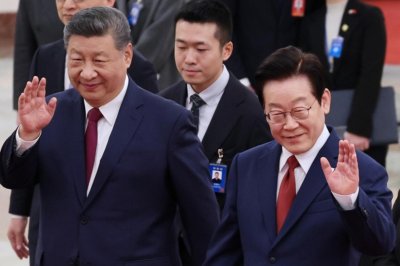
South Korean President Lee Jae Myung (R) and Chinese President Xi Jinping wave to children as they attend a welcome ceremony for the South Korean leader before their summit talks at the Great Hall of the People in Beijing on Monday. Photo by YONHAP/ EPA
SEOUL, Jan. 9 (UPI) — South Korean President Lee Jae Myung flew to China this week for a summit with his Chinese counterpart, Xi Jinping, for the second time in two months. Lee is the first president of the country to visit Beijing since 2019.
Lee said that the two leaders should meet at least once a year, stressing the significance of shoring up the bilateral relationship between the two neighbors, whose ties at times have been strained.
Observers point out that Lee’s meetings with Xi showcases Seoul’s delicate position amid the intensifying rivalry between the United States and China.
“Despite its security alignment with Washington, South Korea relies heavily on China for trade, although the dependence has declined somewhat in recent years. As a result, Seoul is in a delicate position,” Myungji University political science professor Shin Yul told UPI.
“In the past, there was a simple formula — the U.S. for security and China for trade. But at a time when the world’s two most powerful countries are at odds and conditions are changing so fast, such an approach may no longer work,” he said.
Relations between Seoul and Beijing became worse in 2016 and 2017, when South Korea cooperated with the United States to deploy the Terminal High Altitude Area Defense, or THAAD, missile defense system to tackle North Korea’s threats.
However, the decision provoked China, which feared the advanced radar system would provide a window into the communist country’s internal airspace.
Beijing eventually initiated with what Seoul described as unofficial economic retaliation, including restrictions on Korean cultural content, group tourism bans and regulatory pressure on Korean businesses operating in China.
Officially, however, Beijing has consistently denied taking retaliatory measures over the past decade. Against this backdrop, Lee expressed hope to deal with them during a meeting Tuesday with Chen Jining, Communist Party secretary of Shanghai.
“Korea-China relations will advance to an entirely new stage through this visit to China,” Lee said. “I believe this trip will serve as a valuable opportunity to resolve the minor frictions that existed in the past.”
Strategic ambiguity
Improved ties with China would offer short-term economic benefits for South Korea, as China is South Korea’s largest trading partner. Last year, South Korea’s exports to China totaled $130.81 billion, compared with $122.87 billion to the United States.
However, analysts caution that Seoul cannot prioritize relations with Beijing in isolation, as Beijing’s rivalry with the United States directly affects its core security alliance.
“We cannot closely collaborate with China in such sensitive industries as semiconductors and nuclear reactors,” economic commentator Kim Kyeong-joon, formerly vice chairman at Deloitte Consulting Korea, said in a phone interview.
“In addition, China is our competitor in many industries, including steel, automobiles, rechargeable batteries and petrochemicals. There have also been recurring conflicts over intellectual property issues between the two,” he added.
Concerns have grown among Korean corporations over technology leakage and imitation by their Chinese competitors, particularly in such high-tech sectors as semiconductors and displays.
In this climate, South Korea has little choice but to carefully balance its approach, said political commentator Choi Soo-young, who worked at the presidential house in the 2010s.
“We should shun a situation in which we are forced to single-handedly side with one of the two superpowers, the United States and China. That would be the worst-case scenario,” Choi said.
“In other words, we are required to maintain the so-called ‘strategic ambiguity.’ However, it is a tall task to achieve, as amply demonstrated by Japan’s case,” he said.
From the perspective of Seoul, strategic ambiguity refers to avoiding explicit alignment choices at a time when Washington and China have competing strategic interests, according to Choi.
China’s relationship with Japan has frayed in recent months amid geopolitical tensions, leading to economic standoffs with direct trade impacts.
For example, China imposed export restrictions on dual-use goods this month, targeting Japan. It also curbed exports of rare earth elements, which are vital to Japan’s electronics and automotive supply chains.
Meanwhile, the Seoul administration announced Friday that Lee is scheduled to visit Japan early next week for a summit with Japanese Prime Minister Sanae Takaichi.
In Springfield, Ill., in 1838, a young Abraham Lincoln delivered a powerful speech decrying the “ravages of mob law” throughout the land. Lincoln warned, in eerily prescient fashion, that the spread of a then-ascendant “mobocratic spirit” threatened to sever the “attachment of the People” to their fellow countrymen and their nation. Lincoln’s opposition to anarchy of any kind was absolute and clarion: “There is no grievance that is a fit object of redress by mob law.”
Unfortunately, it seems that every few years, Americans must be reminded anew of Lincoln’s wisdom. This week’s lethal Immigration and Customs Enforcement standoff in the Twin Cities is but the latest instance of a years-long baleful trend.
On Wednesday, a 37-year-old stay-at-home mom, Renee Nicole Good, was fatally shot by an ICE agent in Minneapolis. Her ex-husband said she and her partner encountered ICE agents after dropping off Good’s 6-year-old at school. The federal government has called Good’s encounter “an act of domestic terrorism” and said the agent shot in self-defense.
Suffice it to say Minnesota’s Democratic establishment does not see it this way.
Minneapolis Mayor Jacob Frey responded to the deployment of 2,000 immigration agents in the area and the deadly encounter by telling ICE to “get the f— out” of Minnesota, while Gov. Tim Walz called the shooting “totally predictable” and “totally avoidable.” Frey, who was also mayor during the mayhem after George Floyd’s murder by city police in 2020, has lent succor to the anti-ICE provocateurs, seemingly encouraging them to make Good a Floyd-like martyr. As for Walz, he’s right that this tragedy was eminently “avoidable” — but not only for the reasons he thinks. If the Biden-Harris administration hadn’t allowed unvetted immigrants to remain in the country without legal status and if Walz’s administration hadn’t moved too slowly in its investigations of hundreds of Minnesotans — of mixed immigration status — defrauding taxpayers to the tune of billions of dollars, ICE never would have embarked on this particular operation.
National Democrats took the rage even further. Following the fateful shooting, the Democratic Party’s official X feed promptly tweeted, without any morsel of nuance, that “ICE shot and killed a woman on camera.” This sort of irresponsible fear-mongering already may have prompted a crazed activist to shoot three detainees at an ICE facility in Dallas last September while targeting officers; similar dehumanizing rhetoric about the National Guard perhaps also played a role in November’s lethal shooting of a soldier in Washington, D.C.
Liberals and open-border activists play with fire when they so casually compare ICE, as Walz previously has, to a “modern-day Gestapo.” The fact is, ICE is not the Gestapo, Donald Trump is not Hitler, and Charlie Kirk was not a goose-stepping brownshirt. To pretend otherwise is to deprive words of meaning and to live in the theater of the absurd.
But as dangerous as this rhetoric is for officers and agents, it is the moral blackmail and “mobocratic spirit” of it all that is even more harmful to the rule of law.
The implicit threat of all “sanctuary” jurisdictions, whose resistance to aiding federal law enforcement smacks of John C. Calhoun-style antebellum “nullification,” is to tell the feds not to operate and enforce federal law in a certain area — or else. The result is crass lawlessness, Mafia-esque shakedown artistry and a fetid neo-confederate stench combined in one dystopian package.
The truth is that swaths of the activist left now engage in these sorts of threats as a matter of course. In 2020, the left’s months-long rioting following the death of Floyd led to upward of $2 billion in insurance claims. In 2021, they threatened the same rioting unless Derek Chauvin, the officer who infamously kneeled on Floyd’s neck, was found guilty of murder (which he was, twice). In 2022, following the unprecedented (and still unsolved) leak of the draft majority opinion in the Dobbs vs. Jackson Women’s Health Organization Supreme Court case, abortion-rights activists protested outside many of the right-leaning justices’ homes, perhaps hoping to induce them to change their minds and flip their votes. And now, ICE agents throughout the country face threats of violence — egged on by local Democratic leaders — simply for enforcing federal law.
In “The Godfather,” Luca Brasi referred to this sort of thuggery as making someone an offer that he can’t refuse. We might also think of it as Lincoln’s dreaded “ravages of mob law.”
Regardless, a free republic cannot long endure like this. The rule of law cannot be held hostage to the histrionic temper tantrums of a radical ideological flank. The law must be enforced solemnly, without fear or favor. There can be no overarching blackmail lurking in the background — no Sword of Damocles hovering over the heads of a free people, ready to crash down on us all if a certain select few do not get their way.
The proper recourse for changing immigration law — or any federal law — is to lobby Congress to do so, or to make a case in federal court. The ginned-up martyrdom complex that leads some to take matters into their own hands is a recipe for personal and national ruination. There is nothing good down that road — only death, despair and mobocracy.
Josh Hammer’s latest book is “Israel and Civilization: The Fate of the Jewish Nation and the Destiny of the West.” This article was produced in collaboration with Creators Syndicate. X: @josh_hammer
Insights
L.A. Times Insights delivers AI-generated analysis on Voices content to offer all points of view. Insights does not appear on any news articles.
The following AI-generated content is powered by Perplexity. The Los Angeles Times editorial staff does not create or edit the content.
Ideas expressed in the piece
Democrats and activist left are perpetuating a dangerous “mobocratic spirit” similar to the mob law that Lincoln warned against in 1838, which threatens the rule of law and national unity[1]
The federal government’s characterization of the incident as self-defense by an ICE agent is appropriate, while local Democratic leaders are irresponsibly encouraging anti-ICE protesters to view Good as a martyr figure like George Floyd[1]
Dehumanizing rhetoric comparing ICE to the Gestapo is reckless fear-mongering that has inspired actual violence, including a shooting at an ICE facility in Dallas and the fatal shooting of a National Guard soldier[1]
The shooting was “avoidable” not because of ICE’s presence, but because the Biden-Harris administration allowed undocumented immigrants to remain in the country without legal status and state authorities moved too slowly investigating immigrant fraud[1]
Sanctuary jurisdictions that resist federal law enforcement represent neo-confederate “nullification” and constitute crass lawlessness and Mafia-style extortion, effectively telling federal agents they cannot enforce the law or face consequences[1]
The activist left employs threats of violence as systematic blackmail, evidenced by 2020 riots following Floyd’s death, threats surrounding the Chauvin trial, protests at justices’ homes during the abortion debate, and now threats against ICE agents[1]
Changing immigration policy must occur through Congress or federal courts, not through mob rule and “ginned-up martyrdom complexes” that lead to personal and national ruination[1]
Different views on the topic
Community members who knew Good rejected characterizations of her as a domestic terrorist, with her mother describing her as “one of the kindest people I’ve ever known,” “extremely compassionate,” and someone “who has taken care of people all her life”[1]
Vigil speakers and attendees portrayed Good as peacefully present to watch the situation and protect her neighbors, with an organizer stating “She was peaceful; she did the right thing” and “She died because she loved her neighbors”[1]
A speaker identified only as Noah explicitly rejected the federal government’s domestic terrorism characterization, saying Good was present “to watch the terrorists,” not participate in terrorism[1]
Neighbors described Good as a loving mother and warm family member who was an award-winning poet and positive community presence, suggesting her presence during the incident reflected civic concern rather than radicalism[1]
BEDFORD, N.H. — Five Democratic presidential candidates, meeting Sunday to debate environmental issues for the first time in the 1988 campaign, blasted Reagan Administration policies and called for a variety of new laws and international summit meetings to control acid rain, nuclear waste, ocean dumping and other problems.
The five Democrats offered little disagreement or sharp criticism of one another in the two-hour televised forum. They joked, politely complimented one another on policies and achievements, and generally avoided the personal and political jabs that marked last week’s feisty Republican candidates’ debate in Houston.
Water Pollution Law
Former Arizona Gov. Bruce Babbitt appeared to speak the most forcefully and with the most detail, particularly about his experiences in Arizona cleaning up an asbestos dump, negotiating with Mexico on air pollution, and establishing what is considered the nation’s toughest groundwater pollution law.
Babbitt pledged to fight for the same strict groundwater standards on a national level if elected. “No contamination, no discharges, no degradation of the water,” he said.
Gov. Michael S. Dukakis of Massachusetts argued that his state was more successful getting polluters to pay for the cleanup of several hundred hazardous waste dumps than the federal Environmental Protection Agency. He chided both President Reagan and the Democratic Congress for lack of leadership.
“We haven’t been able to get the President’s attention, and frankly, there’s been paralysis in the Congress,” Dukakis said.
But several in the audience of about 300 campaign supporters and environmental activists hissed when, in response to a question, Dukakis refused to commit to a five-year ban on municipal incinerators. A political fight over locating such a facility is raging in Boston, and several dozen protesters showed up at the Sheraton Wayfarer Inn, the site of the forum, to demonstrate against incinerators.
Recycling Held Not Enough
“We’re running out of landfill space,” Dukakis argued. He said recycling was one answer, but not enough. “There’s no way we can deal with this without some sort of resource recovery.”
Sen. Albert Gore Jr. of Tennessee aimed several barbs at the “Reagan-Bush Administration.” He particularly targeted Vice President George Bush, whose campaign apparently gained after an impressive performance in the Houston debate.
“George Bush has been the principal figure in undermining environmental regulations,” by using the budget restraints “to shackle the EPA and the Department of the Interior,” Gore said.
Sen. Paul Simon of Illinois argued that states should share the burden of trying to reduce acid rain. Illinois’ smoke-stack industries produce some of the pollutants in the acid rain and snow that has devastated broad forest areas in the Northeast.
“We have to move in such a way so as not to penalize one region or state,” Simon said.
Asks Acid Rain Summit
“Paul, I don’t understand all this equivocating on acid rain,” Babbitt quickly responded, in perhaps the sharpest moment. Babbitt said the federal government should set and enforce strict air pollution standards, including shutting down factories, and called for a summit of North American leaders on acid rain.
“We’re downwind from Mexico, Canada is downwind from us,” he said. “It’s our continent, it’s our destiny, and it’s time for a treaty.”
Dukakis reiterated his pledge to stop the opening of the fully constructed nuclear power plant at Seabrook, N.H. The Nuclear Regulatory Commission voted Thursday to change a rule that Dukakis had used to block the plant. The new ruling allows local utilities to present adequate emergency community evacuation plans even if state and local officials don’t approve the plans.
“We’re going to do everything we can to stop Seabrook,” Dukakis said to loud applause. He did not elaborate.
The Rev. Jesse Jackson said a statewide referendum in Maine this Tuesday to close the 15-year-old Maine Yankee nuclear power plant would “send a message as profound” as the civil rights marchers sent in Selma, Ala. in the early 1960s. But Jackson offered few specifics about environmental programs.
‘Have Run for Hills’
“The most important thing is Democrats are here and the Republicans have run for the hills,” he said.
The sponsors, a public-interest group called Vote Environment, had invited all six Democrats and all six Republicans in the race to participate. Republican Alexander M. Haig Jr. spoke briefly in the conference center’s lobby, but quickly departed. None of the other Republican candidates attended.
The sixth Democrat, Rep. Richard A. Gephardt of Missouri, also did not participate. Campaign aides said Gephardt had a longstanding commitment to attend his 9-year-old daughter’s horse show at home in Virginia.
The round-table forum was the first time the Democrats have appeared together in New Hampshire, which holds the nation’s first primary Feb. 16. The Democrats will meet again today in New Orleans to debate social policy, and then again Saturday in Des Moines, for another environmental debate.
“It was the broadest based and most important discussion of these issues of any presidential campaign,” Jan Hartke, one of the organizers, said afterward. He applauded the candidates’ mastery of technical issues, and said the call for international summits “puts the environment on the same footing as arms control.”
Environmentalist groups so far have not focused support on any one Democratic candidate. That was unlikely to change after the forum, several activists said.
“There really isn’t that great a difference among the candidates,” said Jerry Schoen, a Sierra Club activist and computer programmer. “But this is a gift-wrapped issue for the Democrats.”
In explaining the U.S. incursion into Venezuela to capture President Nicolás Maduro, President Trump accused Maduro and his wife of conducting a “campaign of deadly narco-terrorism against the United States and its citizens,” and Maduro of being “the kingpin of a vast criminal network responsible for trafficking colossal amounts of deadly and illicit drugs into the United States.”
“Hundreds of thousands — over the years — of Americans died because of him,” Trump said hours after U.S. special forces dragged Maduro from his bedroom during a raid that killed more than 50 Venezuelan and Cuban military and security forces.
Experts in regional narcotics trafficking said Trump was clearly trying to justify the U.S. deposing a sitting head of state by arguing that Maduro was not just a corrupt foreign leader harming his own country but also a major player in the sweeping epidemic of overdoses that has devastated American communities.
They also said they are highly suspicious of those claims, which were offered up with little evidence and run counter to years of independent research into regional drug trafficking patterns. Countries such as Mexico and Colombia play much larger roles, and fentanyl — not the cocaine Maduro is charged with trafficking — causes the vast majority of American deaths, the research shows.
Maduro’s indictment spells out some overt criminal acts allegedly committed by him, including selling diplomatic passwords to known drug traffickers so they could avoid military and law enforcement scrutiny in Venezuela.
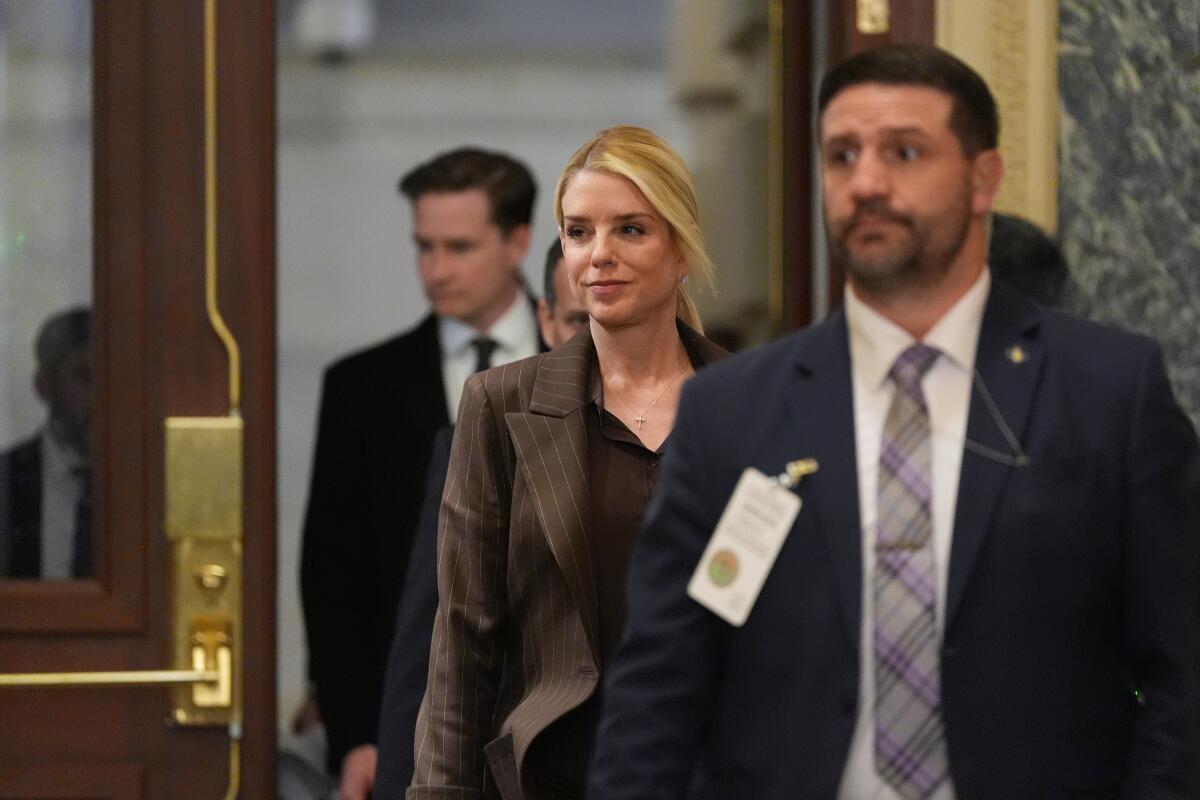
Attorney General Pam Bondi arrives at the U.S. Capitol on Monday to brief top lawmakers after President Trump directed U.S. forces to capture Venezuelan President Nicolás Maduro.
(Jacquelyn Martin / Associated Press)
It alleges other crimes in broad strokes, such as Maduro and his wife allegedly ordering “kidnappings, beatings, and murders” against people who “undermined their drug trafficking operation.”
However, Trump’s claims about the scope and impact of Maduro’s alleged actions go far beyond what the indictment details, experts said.
“It’s very hard to respond to the level of bulls— that is being promoted by this administration, because there’s no evidence given whatsoever, and it goes against what we think we know as specialists,” said Paul Gootenberg, a professor emeritus of history and sociology at Stony Brook University who has long studied the cocaine trade. “All of it goes against what we think we know.”
“President Trump’s claim that hundreds of thousands of Americans have died due to drug trafficking linked to Maduro is inaccurate,” said Philip Berry, a former United Kingdom counter-narcotics official and a visiting senior lecturer at the Centre for Defence Studies at King’s College London.
“[F]entanyl, not cocaine, has been responsible for most drug-related deaths in the U.S. over the past decade,” he said.
Jorja Leap, a social welfare professor and executive director of the UCLA Social Justice Research Partnership who has spent years interviewing gang members and drug dealers in the L.A. region, said Trump’s hyper-focus on Maduro, Venezuela and the Venezuelan gang Tren de Aragua as driving forces within the U.S. drug trade not only belies reality but also belittles the work of researchers who know better.
“Aside from making it a political issue, this is disrespecting the work of researchers, social activists, community organizers and law enforcement who have worked on this problem on the ground and understand every aspect of it,” Leap said. “This is political theater.”
Venezuela’s role
The U.S. State Department’s 2024 International Narcotics Strategy Report called Venezuela “a major transit country for cocaine shipments via aerial, terrestrial, and maritime routes,” with most of the drugs originating in Colombia and passing through other Central American countries or Caribbean islands on their way to the U.S.
Federal officers stand guard outside the Metropolitan Detention Center.
(Leonardo Munoz / AFP via Getty Images)
However, the same report said recent estimates put the volume of cocaine trafficked through Venezuela at about 200 to 250 metric tons per year, or “roughly 10 to 13 percent of estimated global production.” According to the United Nations 2025 World Drug Report, most cocaine from Colombia is instead trafficked “along the Pacific Coast northward,” including through Ecuador.
The same report and others make clear Venezuela does not play a substantial role in fentanyl production or trafficking.
The State Department’s 2024 report said Mexico was “the sole significant source of illicit fentanyl … significantly affecting” the U.S., and the U.S. Drug Enforcement Administration’s 2025 National Drug Threat Assessment said Mexican organizations “dominate fentanyl transportation into and through the United States.”
The Trump administration suggested Venezuela has played a larger role in cocaine production and transport in recent years under Maduro, who they allege has partnered with major trafficking organizations in Venezuela, Colombia and Mexico.
Maduro pleaded not guilty at an arraignment in Manhattan federal court this week, saying he was “kidnapped” by the U.S.
While many experts and other political observers acknowledge Maduro’s corruption and believe he has profited from drug trafficking, they question the Trump administration’s characterization of his actions as a “narco-terrorist” assault on the U.S.
Former Rep. Marjorie Taylor Greene (R-Ga.), the Trump ally turned foe who this week stepped down from her House seat, condemned the raid as more about controlling Venezuela’s oil than dismantling the drug trade, in part by noting that far greater volumes of much deadlier drugs arrive to the U.S. from Mexico.
“If it was about drugs killing Americans, they would be bombing Mexican cartels,” Greene posted.
The Trump administration pushed back against such arguments, even as Trump has threatened other nations in the region.
U.S. Drug Enforcement Administrator Terry Cole said on Fox News that “at a low estimate,” 100 tons of cocaine have been produced and shipped to the U.S. by groups working with Maduro.
Expert input
Gootenberg said there’s no doubt that some Colombian cocaine crosses the border into Venezuela, but that much of it goes onward to Europe and growing markets in Brazil and Asia, and there’s no evidence large amounts reach the U.S.
“The whole thing is a fiction, and I do believe they know that,” he said of the Trump administration.
Berry said Venezuela is “a transit country for cocaine” but “a relatively minor player in the international drug trade” overall, with only a “small portion” of the cocaine that passes through it reaching the U.S.
Both also questioned the Trump administration labeling Maduro’s government a “narco-terrorism” regime. Gootenberg said the term arose decades ago to describe governments whose national revenues were substantially connected to drug proceeds, such as Bolivia in the 1980s, but it was always a “propagandistic idea” and had gone “defunct” as modern governments, including Venezuela’s, diversified their economies.
The Trump administration’s move to revive the term comes as no surprise given “the way they pick up atavistic labels that they think will be useful, like ‘Make America Great Again,’” Gootenberg said. But “there’s no there there.”
Berry said use of the term “narco-terrorism” has oversimplified the “diverse and context-specific connections” between the drug industry and global terrorism, and as a result “led to the conflation of counter-narcotics and counter-terrorism efforts, frequently resulting in hyper-militarised and ineffective policy responses.”
Gootenberg said Maduro was a corrupt authoritarian who stole an election and certainly had knowledge of drug trafficking through his country, but the notion he’d somehow become a “mastermind” with leverage over transnational drug organizations is far-fetched.
Several experts said they doubted his capture would have a sizable effect on the U.S. drug trade.
“Negligible. Marginal. Whatever word you want to use to indicate the most minor of impacts,” said Leap, of UCLA.
The Sinaloa Cartel — one of Maduro’s alleged partners, according to his indictment — is a major player in Southern California’s drug trade, with the Mexican Mafia serving as middleman between the cartel and local drug gangs, Leap said. But “if anyone tries to connect this to what is happening now in Venezuela, they do not understand the nature of drug distribution, street gangs, the Mexican Mafia, everything that goes on in Southern California. There is no connection.”
Berry said in the wake of Maduro’s capture, “numerous state and nonstate actors involved in the illegal narcotics trade remain unaffected.”
WASHINGTON — After weeks of meandering through snowy fields of the North and Midwest, the campaign for the presidency now turns South, to a vast region that paradoxically mixes relatively low unemployment with high dissatisfaction.
In Blanco County, Tex., for example, the unemployment rate of 3.5%–down one-third over the last three years–compares favorably with the days when local favorite son Lyndon B. Johnson reigned in Washington in the ‘60s. But that fact does not console Ava Johnson Cox, the late President’s 87-year-old cousin.
“At one time, America contained the inspiration and the purifying principles of the world,” Miss Ava told a visiting reporter recently. “But no more.”
Clear across Dixie, in Atlanta, Jackie Rogers, owner of a downtown ladies’ boutique, struck a similar note.
“I’m very upset about this economy,” she said. “This is the first time America is not rewarding their well-educated people.
“They are the ones who went to school and studied so hard to make America No. 1,” she added. Now, “they are the ones on the unemployment lines.”
But while Southerners may agree with citizens of, for example, New Hampshire, about the problems the country faces, they have had much less exposure to politicians’ proposed solutions.
Unlike New Hampshirites, who lived for two months under a steady barrage of campaigning before they voted last week, citizens of the South have only just begun to hear from the candidates. When they vote–March 3 in Georgia and Maryland, March 7 in South Carolina and March 10 in Florida, Texas and several other Southern and border states–they will do so after an intense, but short, campaign.
As a result, for many potential Southern voters, the sense of discontent they share with the rest of the nation remains somewhat separated from the political process, and their feelings about candidates remain largely unformed.
“It’s strange to be so far into the process and not feel more committed to someone,” said Margaret Yoder, a 44-year-old real estate broker in Miami. “I’m feeling confused.”
Southern voters know President Bush, and many in the South still like him despite disapproval of his handling of the economy.
“I’m going to vote Republican,” said Henry Dryer Jr. of Carollton, Ga. “I think, personally, and most of the people in my circle feel, like Bush has done as good a job as any President in his circumstances could have done.
“The poor man can’t do it by himself,” Dryer said. On the other hand, he added: “People in this part of the country are just very disappointed that Bush hasn’t done something to pull us out of the recession.”
On the Democratic side, the name of Arkansas Gov. Bill Clinton registers with many, but primarily for the controversies surrounding him–unsubstantiated allegations of marital infidelity and questions about his Vietnam-era draft status.
And as for former Massachusetts Sen. Paul E. Tsongas, some voters say they like what they have heard of him. Tsongas is “not a showman,” said James Smith, a retiree in Atlanta. But more typically, Southerners interviewed for this story said that despite his victory in New Hampshire, they simply remain unsure who Tsongas is.
“People still have trouble pronouncing his name,” said Beth Carper, a graduate student at the University of Tennessee in Knoxville, who said she supports Tsongas but doubts he can win when her state votes March 10.
In Johnson City, Tex., the Blanco County seat in the hill country west of Austin, Ralph Moss, 48, said he has made only one decision about the election. He voted for Bush once and will not do it again. Beyond that, Moss said, he cannot decide what to do.
“There’s not a real good choice to make,” said Moss, who is the mayor, a nonpartisan position. “I may not vote in the primary.”
DeeDee McKennis, a cashier at Johnson City’s Dixie Fried Chicken and Quick Stop, would like to see the country make a change.
Even though she and her husband have had “the best year we’ve had in years” economically, she remains worried. McKennis, 46, and her husband both hold two jobs, she said, but they cannot afford to send any of their four children to college. Nor can they afford health insurance.
Still, McKennis has not found a candidate she feels confident would bring about the changes she would like to see.
Down the street, Duke Rumpf, 68, the manager of the Charles’ Motel, gave Clinton a tepid endorsement and, in the process, summed up what many Southern voters seem to feel.
Clinton, he said, had “got the state of Arkansas in pretty good shape.” But, he added: “I ain’t seen anybody I’m real enthused about. I know I ain’t enthused about the one (President) we got.”
Special correspondents Edith Stanley in Atlanta, Karen Brandon in Johnson City, Tex., Michael Clary in Miami and Patrick Thomas in Nashville contributed to this story.
SACRAMENTO — Gov. Gavin Newsom on Thursday unveiled a sweeping proposal to overhaul how California’s education system is governed, calling for structural changes that he said would shift oversight of the Department of Education and redefine the role of the state’s elected schools chief.
The proposal, which is part of Newsom’s state budget plan that will be released Friday, would unify the policymaking State Board of Education with the department, which is responsible for carrying out those policies. The governor said the change would better align education efforts from early childhood through college.
“California can no longer postpone reforms that have been recommended regularly for a century,” Newsom said in a statement. “These critical reforms will bring greater accountability, clarity, and coherence to how we serve our students and schools.”
Few details were provided about how the role of the state superintendent of public instruction would change, beyond a greater focus on fostering coordination and aligning education policy.
The changes would require approval from state lawmakers, who will be in the state Capitol on Thursday for Newsom’s last State of the State speech in his final year as governor.
The proposal would implement recommendations from a 2002 report by the state Legislature, titled “California’s Master Plan for Education,” which described the state’s K-12 governance as fragmented and “with overlapping roles that sometimes operate in conflict with one another, to the detriment of the educational services offered to students.” Newsom’s office said similar concerns have been raised repeatedly since 1920 and were echoed again in a December 2025 report by research center Policy Analysis for California Education.
“The sobering reality of California’s education system is that too few schools can now provide the conditions in which the State can fairly ask students to learn to the highest standards, let alone prepare themselves to meet their future learning needs,” the Legislature’s 2002 report stated. Those most harmed are often low-income students and students of color, the report added.
“California’s education governance system is complex and too often creates challenges for school leaders,” Edgar Zazueta, executive director of the Assn. of California School Administrators, said in a statement provided by Newsom’s office. “As responsibilities and demands on schools continue to increase, educators need governance systems that are designed to better support positive student outcomes.”
The current budget allocated $137.6 billion for education from transitional kindergarten through the 12th grade — the highest per-pupil funding level in state history — and Newsom’s office said his proposal is intended to ensure those investments translate into more consistent support and improved outcomes statewide.
“For decades the fragmented and inefficient structure overseeing our public education system has hindered our students’ ability to succeed and thrive,” Ted Lempert, president of advocacy group Children Now, said in a statement provided by the governor’s office. “Major reform is essential, and we’re thrilled that the Governor is tackling this issue to improve our kids’ education.”
Exactly one year ago, I drove up Pacific Coast Highway just before dawn.
Toppled utility poles and downed wires littered the street. In a tunnel of thick black smoke, flurries of glowing red embers raced across the road, out to sea. Hours passed, but the sun never rose. Everything was gone.
In the face of all this horror, everyday people responded not with fear or hate, but with courage and love. It’s human nature — a reflex to disaster more certain than the sunrise.
You’re reading Boiling Point
The L.A. Times climate team gets you up to speed on climate change, energy and the environment. Sign up to get it in your inbox every week.
Amid a chaotic evacuation in the Palisades, I watched residents use their minivans to pick up their neighbors who had been traveling on foot and shuttle them to safety. A volunteer community brigade marched door to door ensuring others got the evacuation orders.
In the year that’s followed, the same locals have stepped up to hold their governments accountable and fill in where leadership was vacant — even when some people, including some of their peers — considered that work controversial. They’ve all nonetheless helped their neighbors in tangible, meaningful, ways.
Here are their reflections (edited for length and clarity) on the year and the futures they imagine.
Keegan Gibbs leads the Community Brigade program with the Los Angeles County Fire Department. During the Palisades fire, the group’s roughly 50 volunteers went door to door ensuring residents had evacuated, fought spot fires and transported animals to safety. The group also routinely helps homeowners understand how to harden their homes against wildfire. This fall, the brigade doubled its size, with new recruits going through basic firefighter training.
Gibbs: Across Malibu and the Santa Monica Mountains, the Community Brigade envisions a critical mass of residents who have taken responsibility for their home “ignition zone,” creating neighborhoods where wildfire can move through the landscape without becoming a community-level disaster.
In this future, the Brigade is a trusted local institution and a proven model — demonstrating that shared responsibility and disciplined preparation can fundamentally change wildfire outcomes and be adapted across the West.
Kari Nadeau, a professor at the Harvard T.H. Chan School of Public Health, helps lead the LA Fire HEALTH Study, a first-of-its-kind research effort by universities and hospitals to understand the fires’ contamination and the subsequent health impacts over a 10-year period. The researchers have found that firefighters who fought the L.A. blazes had elevated levels of mercury and lead in their blood compared with other wildland firefighters and that the fires corresponded with increased emergency room visits for heart attacks and respiratory illnesses.
Nadeau: I think,10 years from now, we’re going to look back and say, we really tested for as many exposures as we could in the air, water and soil, and then we looked at whether or not they affected short-term and long-term health outcomes. That will not only help L.A. and policymakers, but it’ll also be scalable to the rest of the world — because the human body is the human body.
Jane Lawton Potelle founded Eaton Fire Residents United, a grassroots organization of residents with still-standing homes contaminated by the Eaton fire. The group — led mostly by women — assembled the first comprehensive evidence of widespread contamination within homes. Now, they’re pushing public health agencies to adopt best practices to remediate homes and keep residents safe, and they’re calling on insurance regulators to ensure survivors have the financial means to follow them.
Potelle: If the government doesn’t intervene, then five to 10 years from now our communities will still be living with contamination in homes and soil, driving preventable health harms while shifting massive long-term costs onto families.
EFRU hopes to see the “clearance before occupancy” approach communitywide so that all surviving homes, schools, businesses and public spaces affected by fallout from the L.A. fires have been restored to verifiably safe and healthy living conditions.
Spencer Pratt, second from right, who lost his home in the Palisades fire, at an anniversary event where he announced he was running for mayor.
Pratt:The most important lesson I learned this past year is that you cannot rely on our state and local government. … I remain hopeful that we can rebuild our family town. If the state and local government won’t give us the opportunity to start, I will continue asking the federal government to step in and help. There has to be a way to cut through the red tape and get people back to their hometown.
Pablo Alvarado is the co-executive director of the National Day Laborer Organizing Network, which not only cleared Pasadena’s streets but also trained hundreds of workers on how to safely operate in the burn areas, distributed more than a thousand personal protective equipment kits, and provided assistance to more than 13,000 families affected by the fires and ICE raids.
Alvarado:We don’t know what this political year will bring, or what the next five or 10 years will look like. But we do know this truth: Rebuilding will happen, and it is impossible to do it without migrant labor. Our work makes reconstruction possible. Yet while our labor is welcomed, our rights are not respected.
From Katrina to these fires, we have learned the same lesson again and again: No one is coming to save workers — not FEMA, not local governments, not corporations. That is why our message has always been clear: Solo el pueblo salva al pueblo. Only the people save the people.
Hundreds of Palisades fire survivors gather in Palisades Village to commemorate the one year anniversary of the Palisades fire on Wednesday. Residents and others were demanding that the government help accountable for its missteps, demand relief for those trying to rebuild and demand for more comprehensive emergency planning.
(Genaro Molina/Los Angeles Times)
More recent wildfire news
On Wednesday’s one-year anniversary of the fires, survivors of the Eaton and Palisades fires returned to their communities to mourn the loss of their neighborhoods and neighbors, and to demand accountability and action from their governments. You can read our coverage here.
At a fire anniversary protest in the Palisades, Spencer Pratt announced his candidacy for Los Angeles mayor. “Business as usual is a death sentence for Los Angeles, and I’m done waiting for someone to take real action,” he said.
The city of Los Angeles routinely ignored state fire safety regulations dictating the width and slope of roads for evacuation and firefighter access as it permitted development in areas with very high fire hazard, a new lawsuit alleges.
A few last things in climate news
Federal tax credits for residential solar, batteries and heat pumps expired at the end of 2025, reports Bloomberg’s Todd Woody. Tariffs probably will also push up prices for solar panels and batteries, which are primarily imported from China and Vietnam and other countries.
One company with deep ties to California stands to benefit from President Trump’s military intervention in Venezuela: Chevron. It is the only foreign oil company to maintain continued operations in Venezuela through decades of tumultuous politics, The Times’ Jack Dolan reports.
As Congress works to avert an end-of-January government shutdown, its latest spending package would largely keep the Environmental Protection Agency’s budget intact, reports Liza Gross for Inside Climate News. The Trump administration had initially proposed a 55% cut to the agency’s budget; the latest proposal cuts it by only 5%.
This is the latest edition of Boiling Point, a newsletter about climate change and the environment in the American West. Sign up here to get it in your inbox. And listen to our Boiling Point podcast here.
WASHINGTON — When a 37-year-old mother of three was fatally shot by an immigration agent Wednesday morning, driving in her Minneapolis neighborhood after dropping her son off at school, the Trump administration’s response was swift. The victim was to blame for her own death — acting as a “professional agitator,” a “domestic terrorist,” possibly trained to use her car against law enforcement, officials said.
It was an uncompromising response without any pretense the administration would rely on independent investigations of the event, video of which quickly circulated online, gripping the nation.
“You can accept that this woman’s death is a tragedy,” Vice President JD Vance wrote on social media, defending the shooting by an Immigration and Customs Enforcement agent within hours of her death, “while acknowledging it’s a tragedy of her own making.”
The shooting of Renee Nicole Good, an American citizen, put the administration on defense over one of President Trump’s signature policy initiatives, exponentially expanding the ranks of ICE to outnumber most armies, and deploying its agents across unassuming communities throughout the United States.
ICE had just announced the deployment of “the largest immigration operation ever” in the Minnesota city, allegedly targeting Somali residents involved in fraud schemes. But Good’s death could prove a turning point. The shooting has highlighted souring public opinion on Trump’s immigration enforcement, with a majority of Americans now disapproving of the administration’s tactics, according to Pew Research.
Despite the outcry, Trump’s team doubled down on Thursday, vowing to send even more agents to the Midwestern state.
It was not immediately clear whether Good had positioned her car intentionally to thwart law enforcement agents, or in protest of their activities in her neighborhood.
Eyewitnesses to the shooting said that ICE agents were telling her to move her vehicle. Initial footage that emerged of the incident showed that, as she was doing so, Good briefly drove her car in reverse before turning her front wheels away to leave the scene.
She was shot three times by an officer who stood by her front left headlight, who the Department of Homeland Security said was hit by Good and fired in self-defense.
Only Tom Homan, the president’s border czar, urged caution from lawmakers and the public in responding to the incident, telling people to “take a deep breath” and “hold their judgment” for additional footage and evidence.
He distanced himself from the Department of Homeland Security and its secretary, Kristi Noem, who took mere hours to accuse the deceased of domestic terrorism. “The investigation’s just started,” Homan told CBS in an interview.
“I’m not going to make a judgment call on one video,” he said. “It would be unprofessional to comment.”
Homeland Security Secretary Kristi Noem said Renee Nicole Good was engaged in “domestic terrorism” when she was fatally shot by a federal immigration agent.
(Michael M. Santiago / Getty Images)
Yet, asked why DHS had felt compelled to comment, Homan replied, “that’s a question for Homeland Security.”
It was not just the department. Trump, too, wrote on X that the victim was “obviously, a professional agitator.”
“The woman driving the car was very disorderly, obstructing and resisting, who then violently, willfully, and viciously ran over the ICE Officer,” Trump wrote, “who seems to have shot her in self defense.”
Noem was unequivocal in her assessment of the incident during engagements with the media on Wednesday and Thursday.
“It was an act of domestic terrorism,” Noem said. “A woman attacked them, and those surrounding them, and attempted to run them over.”
But local officials and law enforcement expressed concern over the incident, warning federal officials that the deployment had unnecessarily increased tensions within the community, and expressing support for the rights of residents to peacefully protest.
“What I think everybody knows that’s been happening here over the last several weeks is that there have been groups of people exercising their 1st Amendment rights,” Minneapolis Chief of Police Brian O’Hara said in an interview with MS NOW. “They have the right to observe, to livestream and record police activity, and they have the right to protest and object to it.”
“The line is, people must be able to exercise those 1st Amendment rights lawfully,” O’Hara said, adding, “and to do it safely.”
On Thursday, Trump administration officials told local law enforcement that the investigation of the matter would be within federal hands.
Vance told reporters at the White House on Thursday that the Justice Department and the Department of Homeland Security would both investigate the case, and said without evidence that Good had “aimed her car at a law enforcement officer and pressed on the accelerator.”
“I can believe that her death is a tragedy while also recognizing that it’s a tragedy of her own making and a tragedy of the far left who has marshaled an entire movement, a lunatic fringe, against our law enforcement officers,” Vance said.
WASHINGTON — Five Senate Republicans broke with party leaders on Thursday to advance legislation that would rein in President Trump’s use of the U.S. military in Venezuela, a move that comes as a growing number of GOP lawmakers have expressed unease about the White House’s threats to use force to acquire Greenland.
The procedural vote, which came over the objections of Republican leaders, now sets the stage for a full Senate vote next week on a measure that would block Trump from using military force “within or against Venezuela” without approval from Congress. Even with the Senate’s approval, the legislation is unlikely to become law as it is unlikely to pass the House, and President Trump — who has veto power over legislation — has publicly condemned the measure and the Republicans who supported it.
“This vote greatly hampers American Self Defense and National Security, impeding the President’s Authority as Commander in Chief,” Trump wrote in a social media post shortly after the 52-47 vote in the Senate.
The Republican defection on the issue underscores the growing concern among GOP lawmakers over the Trump administration’s foreign policy ambitions and highlights the bipartisan concern that the president is testing the limits of executive war powers — not only in Venezuela but also in Greenland, a semiautonomous territory of Denmark, a U.S. ally.
Sen. Susan Collins (R-Me.), one of the Republicans who voted for the resolution, said that while she supported the operation that led to the capture and extradition of Nicolás Maduro, she did not “support committing additional U.S. forces or entering into any long-term military involvement in Venezuela or Greenland without specific congressional authorization.”
The resolution is co-sponsored by Sens. Adam Schiff (D-Calif.), Tim Kaine (D-Va.) and Rand Paul (R-Ky.) and Senate Minority Leader Chuck Schumer (D-N.Y.). The Republicans who supported it were Sens. Collins, Paul, Lisa Murkowski of Alaska, Todd Young of Indiana and Josh Hawley of Missouri.
“Finally, the Senate is exercising its constitutional power over the authorization of the use of force to prevent America from being dragged into a new war over oil,” Schiff said in a social media post after the vote.
Vice President JD Vance told reporters at the White House on Thursday that he was not concerned about Trump losing support among Republican lawmakers in Washington, adding that passage of the resolution in the Senate would not “change anything about how we conduct foreign policy over the next couple of weeks or the next couple of months.”
But Republican support for the resolution reflects a deepening concern within the GOP over Trump’s foreign policy plans, particularly his threats to acquire Greenland — a move that prompted European leaders earlier this week to call on the United States to respect the Arctic territory’s sovereignty
House Speaker Mike Johnson (R-La.) told reporters on Wednesday that he does not believe “anybody’s seriously considering” using the military to take control of Greenland.
“In Congress, we’re certainly not,” Johnson said.
Senate Majority Leader John Thune (R-S.D.) struck a similar tone the same day, telling reporters that he does not “see military action being an option” in Greenland.
Other Republican lawmakers have been more openly critical, warning that even floating the idea of using force against a member of the North Atlantic Treaty Organization, a defense alliance that includes the United States, risks weakening America’s position on the world stage.
“Threats and intimidation by U.S. officials over American ownership of Greenland are as unseemly as they are counterproductive,” Sen. Mitch McConnell (R-Ky.) said in a statement. “And the use of force to seize the sovereign democratic territory of one of America’s most loyal and capable allies would be an especially catastrophic act of strategic self-harm to America and its global influence.”
In a statement Tuesday, the White House said acquiring Greenland was a “national security priority” and that using the military to achieve that goal was “always an option.” A day earlier, Stephen Miller, Trump’s deputy chief of staff for policy, told CNN that “Greenland should be part of the United States.”
“Nobody is going to fight the United States militarily over the future of Greenland,” Miller said.
Miller’s remarks angered Republican senators, including Sen. John Kennedy (R-La.) who in an interview with CNN on Wednesday called the idea of invading Greenland “weapons-grade stupid.”
Sen. Thom Tillis (R-N.C), who has served as the top Republicans on the Senate NATO Observer Group since 2018, criticized the idea as well in a searing Senate floor speech.
“I’m sick of stupid,” Tillis said. “I want good advice for this president, because I want this president to have a good legacy. And this nonsense on what’s going on with Greenland is a distraction from the good work he’s doing, and the amateurs who said it was a good idea should lose their jobs.”
Tillis, who is not seeking reelection this year, later told CNN that Miller needs to “get into a lane where he knows what he’s talking about or get out of this job.”
Brazilian President Luiz Inacio Lula da Silva has vetoed a bill that would have reduced the prison sentence of his right-wing rival and predecessor, Jair Bolsonaro, who was convicted of plotting a coup.
On Thursday, Lula followed through with his promise to block the legislation, which had passed Brazil’s opposition-controlled Congress last year.
Recommended Stories
list of 3 itemsend of list
“In the name of the future, we do not have the right to forget the past,” Lula wrote in a series of social media posts, saying that it would have benefitted “those who attacked Brazilian democracy”.
The veto came on the third anniversary of the 2023 attack on the Three Powers Plaza in the capital of Brasilia, where government buildings representing the presidency, Congress and the Supreme Court stand.
On January 8 of that year, thousands of Bolsonaro supporters stormed the buildings in an apparent attempt to provoke a military response that would remove Lula from power.
In marking the anniversary of the attack, Lula called on Brazilians to stand up for their young democracy, which began after a period of violent dictatorship in the late 20th century.
“January 8th is marked in history as the day of democracy’s victory. A victory over those who tried to seize power by force, disregarding the popular will expressed at the ballot box. Over those who have always defended dictatorship, torture, and the extermination of opponents,” Lula wrote online.
“The attempted coup on January 8, 2023, reminded us that democracy is not an unshakeable achievement.”
Brazilian President Luiz Inacio Lula da Silva, centre, and his wife, First Lady Rosangela da Silva, attend a ceremony marking the three-year anniversary of Brazil’s capital riot, on January 8, 2026 [Eraldo Peres/AP Photo]
Bolsonaro’s sentence
The January 8 attack caused millions of dollars in property damage and dozens of injuries, as police and protesters clashed in the government plaza.
The incident evoked comparisons to the violent riot at the United States Capitol on January 6, 2021, where supporters of President Donald Trump attempted to disrupt the certification of his 2020 election defeat.
Likewise, Bolsonaro, a former army captain, had refused to concede his defeat to Lula after a narrow loss in the 2022 elections.
Rather, he and his allies had argued that Brazil’s electronic voting machines were susceptible to fraud, and they challenged the election results in court. Their petition, however, was thrown out for its “total absence of any evidence”.
Still, many of Bolsonaro’s supporters backed his claims and took to the streets to protest the election results. The weeks surrounding Lula’s inauguration in January 2023 were fraught, with reports of a bomb threat and an attack on police headquarters in Brasilia.
Prosecutors later accused Bolsonaro and his allies of leading a criminal conspiracy to overturn the election results.
One of the options the defendants allegedly weighed was to declare a “state of siege” in Brazil, which would allow the military to take control and new elections be held. Another option was reportedly to assassinate Lula and his running mate, Geraldo Alckmin.
Bolsonaro has pleaded not guilty to the charges and denied any wrongdoing, framing the accusations instead as a political hit job.
Still, in September, he was sentenced to 27 years in prison after being found guilty on counts including attempting a coup, causing damage to public property, attempting the violent abolition of the democratic rule of law, participation in a criminal enterprise, and the deterioration of a listed national heritage site.
He began his prison term in November, after he was found to have damaged the ankle monitor used to ensure he was not a flight risk.
Weighing October’s election
Conservative politicians, however, have decried the prison sentence as excessive and called for its reduction.
Bolsonaro’s son Eduardo has petitioned the Trump administration in the US to intervene on behalf of the imprisoned ex-president, and his eldest child, Flavio Bolsonaro, even hinted he might suspend his 2026 presidential bid if his father were released.
On December 10, Brazil’s Chamber of Deputies passed legislation that would reduce the sentences of nearly 1,000 people linked to the January 8 attack, including Bolsonaro.
A week later, on December 17, the Senate followed suit, sending the leniency bill to the president for his signature.
But Lula had repeatedly pledged to reject the bill, risking the possibility that Brazil’s Congress could override his veto.
“ This is a bill that really is a litmus test in Brazilian politics,” Gustavo Ribeiro, a journalist and founder of The Brazil Report, told Al Jazeera. “Conservatives overwhelmingly supported it, while liberals are adamantly against it.”
Still, Ribeiro described the bill as a compromise between Brazil’s centre-right and far-right forces.
“The centre-right tried to work a sort of a middle-of-the-road solution that is not full amnesty but would allow Bolsonaro to leave incarceration after two years, in what we call in Brazil a semi-open prison sentence,” he explained.
He sees Brazil’s general election in October as a significant factor in Congress’s passage of the bill, noting that Bolsonaro remains a popular figure on the right.
“Because Bolsonaro has such a big clout with conservatives, many in Congress – many right-of-centre lawmakers – fear that if they do not lend their full support to any cause that Bolsonaro espouses, they will lose support,” Ribeiro said.
Lula is seeking a fourth term as president in October’s election, and he is expected to face Bolsonaro’s son Flavio at the ballot box.
California is suing the Trump administration over its “baseless and cruel” decision to freeze $10 billion in federal funding for child care and family assistance allocated to California and four other Democratic-led states, Atty. Gen. Rob Bonta announced Thursday.
The lawsuit was filed jointly by the five states targeted by the freeze — California, New York, Minnesota, Illinois and Colorado — over the Trump administration’s allegations of widespread fraud within their welfare systems. California alone is facing a loss of about $5 billion in funding, including $1.4 billion for child-care programs.
The lawsuit alleges that the freeze is based on unfounded claims of fraud and infringes on Congress’ spending power as enshrined in the U.S. Constitution. The White House did not immediately respond to a request for comment.
“This is just the latest example of Trump’s willingness to throw vulnerable children, vulnerable families and seniors under the bus if he thinks it will advance his vendetta against California and Democratic-led states,” Bonta said at a Thursday evening news conference.
The $10-billion funding freeze follows the administration’s decision to freeze $185 million in child-care funds to Minnesota, where federal officials allege that as much as half of the roughly $18 billion paid to 14 state-run programs since 2018 may have been fraudulent. Amid the fallout, Gov. Tim Walz has ordered a third-party audit and announced that he will not seek a third term.
Bonta said that letters sent by the U.S. Department of Health and Human Services announcing the freeze Tuesday provided no evidence to back up claims of widespread fraud and misuse of taxpayer dollars in California. The freeze applies to the Temporary Assistance for Needy Families program, the Social Services Block Grant program and the Child Care and Development Fund.
“This is funding that California parents count on to get the safe and reliable child care they need so that they can go to work and provide for their families,” he said. “It’s funding that helps families on the brink of homelessness keep roofs over their heads.”
Bonta also raised concerns regarding Health and Human Services’ request that California turn over all documents associated with the state’s implementation of the three programs. This requires the state to share personally identifiable information about program participants, a move Bonta called “deeply concerning and also deeply questionable.”
“The administration doesn’t have the authority to override the established, lawful process our states have already gone through to submit plans and receive approval for these funds,” Bonta said. “It doesn’t have the authority to override the U.S. Constitution and trample Congress’ power of the purse.”
The lawsuit was filed in federal court in Manhattan and marked the 53rd suit California had filed against the Trump administration since the president’s inauguration last January. It asks the court to block the funding freeze and the administration’s sweeping demands for documents and data.
US president signals he is not ready to back the Israel-aligned opposition figure to lead Iran in case of regime change.
United States President Donald Trump has ruled out meeting with Iran’s self-proclaimed Crown Prince Reza Pahlavi, suggesting that Washington is not ready to back a successor to the Iranian government, should it collapse.
On Thursday, Trump called Pahlavi, the son of Iran’s last shah who was toppled by the Islamic revolution of 1979, a “nice person”. But Trump added that, as president, it would not be appropriate to meet with him.
Recommended Stories
list of 3 itemsend of list
“I think that we should let everybody go out there and see who emerges,” Trump told The Hugh Hewitt Show podcast. “I’m not sure necessarily that it would be an appropriate thing to do.”
The US-based Pahlavi, who has close ties to Israel, leads the monarchist faction of the fragmented Iranian opposition.
Trump’s comments signal that the US has not backed Pahlavi’s offer to “lead [a] transition” in governance in Iran, should the current system collapse.
The Iranian government is grappling with protests across several parts of the country.
Iranian authorities cut off access to the internet on Thursday in an apparent move to suppress the protest movement as Pahlavi called for more demonstrations.
The US president had previously warned that he would intervene if the Iranian government targets protesters. He renewed that threat on Thursday.
“They’re doing very poorly. And I have let them know that if they start killing people – which they tend to do during their riots, they have lots of riots – if they do it, we’re going to hit them very hard,” Trump said.
Iranian protests started last month in response to a deepening economic crisis as the value of the local currency, the rial, plunged amid suffocating US sanctions.
The economy-focused demonstrations started sporadically across the country, but they quickly morphed into broader antigovernment protests and appear to be gaining momentum, leading to the internet blackout.
Pahlavi expressed gratitude to Trump and claimed that “millions of Iranians” protested on Thursday night.
“I want to thank the leader of the free world, President Trump, for reiterating his promise to hold the regime to account,” he wrote in a social media post.
“It is time for others, including European leaders, to follow his lead, break their silence, and act more decisively in support of the people of Iran.”
Last month, Trump also threatened to attack Iran again if it rebuilds its nuclear or missile programmes.
The US bombed Iran’s three main nuclear facilities in June as part of a war that Israel launched against the country without provocation.
On top of its economic and political crises, Iran has faced environmental hurdles, including severe water shortages, deepening its domestic unrest.
Iran has also been dealt major blows to its foreign policy as its network of allies has shrunk over the past two years.
Syrian President Bashar al-Assad was toppled by armed opposition forces in December 2024; Hezbollah was weakened by Israeli attacks; and Venezuelan President Nicolas Maduro has been abducted by the US.
But Iran’s leaders have continued to dismiss US threats. Iranian Supreme Leader Ali Khamenei doubled down on his defiant rhetoric after the US raid in Caracas on Saturday.
“We will not give in to the enemy,” Khamenei wrote in a social media post. “We will bring the enemy to its knees.”
WASHINGTON — Denmark and Greenland’s envoys to Washington have begun a vigorous effort to urge U.S. lawmakers as well as key Trump administration officials to step back from President Trump’s call for a takeover of the strategic Arctic island.
Denmark’s ambassador, Jesper Møller Sørensen, and Jacob Isbosethsen, Greenland’s chief representative to Washington, met on Thursday with White House National Security Council officials to discuss a renewed push by Trump to acquire Greenland, perhaps by military force, according to Danish government officials who were not authorized to comment publicly and spoke on the condition of anonymity.
The White House did not respond to a request for comment about the meeting.
The envoys have also held a series of meetings this week with American lawmakers as they look to enlist help in persuading Trump to back off his threat.
Secretary of State Marco Rubio is expected to meet next week with Danish officials.
Trump, in a New York Times interview published Thursday, said he has to possess the entirety of Greenland instead of just exercising a long-standing treaty that gives the United States wide latitude to use Greenland for military posts.
“I think that ownership gives you a thing that you can’t do with, you’re talking about a lease or a treaty. Ownership gives you things and elements that you can’t get from just signing a document,” Trump told the newspaper.
The U.S. is party to a 1951 treaty that gives it broad rights to set up military bases there with the consent of Denmark and Greenland.
Meanwhile, Trump’s vice president, JD Vance, told reporters that European leaders should “take the president of the United States seriously” as he framed the issue as one of defense.
“What we’re asking our European friends to do is take the security of that landmass more seriously, because if they’re not, the United States is going to have to do something about it,” Vance said.
But the administration is starting to hear pushback from lawmakers, including some Republicans, about Trump’s designs on the territory.
In a floor speech Thursday, Sen. Lisa Murkowski (R-Alaska) warned that the rhetoric from some in the Trump administration is “profoundly troubling.”
“We’ve got a lot ahead of us in 2026,” Murkowski said. “Greenland — or taking Greenland, or buying Greenland — should not be on that list. It should not be an obsession at the highest levels of this administration.”
Danish officials are hopeful about the upcoming talks with Rubio in Washington.
“This is the dialogue that is needed, as requested by the government together with the Greenlandic government,” Danish Defense Minister Troels Lund Poulsen told Danish broadcaster DR.
The island of Greenland, 80% of which lies above the Arctic Circle, is home to about 56,000 mostly Inuit people.
Vance criticizes Denmark
Vance said on Wednesday that Denmark “obviously” had not done a proper job in securing Greenland and that Trump “is willing to go as far as he has to” to defend American interests in the Arctic.
In an interview with Fox News, Vance repeated Trump’s claim that Greenland is crucial to both the U.S. and the world’s national security because “the entire missile defense infrastructure is partially dependent on Greenland.”
He said the fact that Denmark has been a faithful military ally of the U.S. during World War II and the more recent “war on terrorism” did not necessarily mean they were doing enough to secure Greenland today.
“Just because you did something smart 25 years ago doesn’t mean you can’t do something dumb now,” Vance said, adding that Trump “is saying very clearly, ‘you are not doing a good job with respect to Greenland.’”
Right to self-determination
Earlier, Rubio told a select group of U.S. lawmakers that it was the Republican administration’s intention to eventually purchase Greenland, as opposed to using military force.
“Many Greenlanders feel that the remarks made are disrespectful,” Aaja Chemnitz, one of the two Greenlandic politicians in the Danish parliament, told the Associated Press. “Many also experience that these conversations are being discussed over their heads. We have a firm saying in Greenland, ‘Nothing about Greenland, without Greenland.’”
She said most Greenlanders “wish for more self-determination, including independence” but also want to “strengthen cooperation with our partners” in security and business development as long as it is based on “mutual respect and recognition of our right to self-determination.”
Chemnitz denied a claim by Trump that Greenland is “covered with Russian and Chinese ships all over the place.”
Greenland is “a long-standing ally and partner to the U.S. and we have a shared interest in stability, security, and responsible cooperation in the Arctic,” she said. “There is an agreement with the U.S. that gives them access to have bases in Greenland if needed.”
France’s President Emmanuel Macron has denounced the “law of the strongest” that is making people “wonder if Greenland will be invaded.”
In a speech to French ambassadors at the Elysee presidential palace on Thursday, Macron said: “It’s the greatest disorder, the law of the strongest, and everyday people wonder whether Greenland will be invaded, whether Canada will be under the threat of becoming the 51st state [of the United States] or whether Taiwan is to be further circled.”
He pointed to an “increasingly dysfunctional” world where great powers, including the U.S and China, have “a real temptation to divide the world amongst themselves.”
The United States is “gradually turning away from some of its allies and freeing itself from the international rules,” Macron said.
Surveillance operations for the U.S.
The leaders of Canada, France, Germany, Italy, Poland, Spain and the U.K. joined Denmark’s Prime Minister Mette Frederiksen on Tuesday in defending Greenland’s sovereignty in the wake of Trump’s comments about Greenland, which is part of the NATO military alliance.
After Vance’s visit to Greenland last year, Danish Foreign Minister Lars Løkke Rasmussen published a video detailing the 1951 defense agreement between Denmark and the U.S.. Since 1945, the American military presence in Greenland has decreased from thousands of soldiers over 17 bases and installations on the island, Rasmussen said, to the remote Pituffik Space Base in the northwest with some 200 soldiers today. The base supports missile warning, missile defense and space surveillance operations for the U.S. and NATO.
The 1951 agreement “offers ample opportunity for the United States to have a much stronger military presence in Greenland,” Rasmussen said. “If that is what you wish, then let us discuss it.”
‘Military defense of Greenland’
Last year, Denmark’s parliament approved a bill to allow U.S. military bases on Danish soil. The legislation widens a previous military agreement, made in 2023 with the Biden administration, where U.S. troops had broad access to Danish air bases in the Scandinavian country.
Denmark is also moving to strengthen its military presence around Greenland and in the wider North Atlantic.
Last year, the government announced a 14.6 billion-kroner ($2.3 billion) agreement with parties including the governments of Greenland and the Faroe Islands, another self-governing territory of Denmark, to “improve capabilities for surveillance and maintaining sovereignty in the region.”
Madhani and Ciobanu write for the Associated Press. AP writers Seung Min Kim, Konstantin Toropin in Washington and Sylvie Corbet in Paris contributed to this report.
Federal agents in the United States have shot and injured two people in the city of Portland, Oregon, a city where the administration of President Donald Trump has led an immigration enforcement crackdown.
The shooting was the second time in less than a day that federal immigration authorities claimed to have fired upon a vehicle in self-defence, following a deadly shooting in Minneapolis, Minnesota.
Recommended Stories
list of 3 itemsend of list
On Thursday, the Portland Police Department announced they had responded to reports of gunfire on southeast Main Street at about 2:18pm local time (22:18 GMT).
“Officers confirmed that federal agents had been involved in a shooting,” the city said in a statement.
Emergency responders then received a call for assistance from one of the shooting victims, a man, at about 2:24pm (22:24 GMT) near Northeast 146th Avenue and East Burnside in Portland’s Hazelwood neighbourhood.
“Officers responded and found a male and female with apparent gunshot wounds,” the statement said. “Officers applied a tourniquet and summoned emergency medical personnel.”
The two shooting victims were transported to hospital. Their conditions remain unknown, according to the police, who were not involved in the shooting.
The local bureau of the Federal Bureau of Investigation (FBI) confirmed the shooting in a now-deleted post on social media, saying that the incident involved Customs and Border Patrol (CBP) agents.
“This remains an active and ongoing investigation led by the FBI,” Portland’s FBI bureau said in the post.
Later, the Department of Homeland Security (DHS) offered its own account of what happened, describing the shooting as self-defence during a “targeted vehicle stop”.
In a social media post, DHS said its target was a passenger travelling inside a vehicle, who was affiliated with a “transnational Tren de Aragua prostitution ring and involved in a recent shooting”. The driver, DHS claimed, was a member of Tren de Aragua, a Venezuelan gang.
“When agents identified themselves to the vehicle occupants, the driver weaponized his vehicle and attempted to run over the law enforcement agents,” DHS said in the post.
“Fearing for his life and safety, an agent fired a defensive shot. The driver drove off with the passenger, fleeing the scene.”
Second agent-involved shooting
Details about Thursday’s shooting remain unknown. But the administration of President Donald Trump has faced criticism for misrepresenting incidents where federal agents deployed violence as part of its nationwide immigration crackdown.
The Portland shooting comes one day after an agent with Immigration and Customs Enforcement (ICE) shot and killed Renee Nicole Good, a 37-year-old mother of three, in her car in Minneapolis, Minnesota.
“Just one day after the horrific violence in Minnesota at the hands of federal agents, our community here in Portland is now grappling with another deeply troubling incident,” Portland Mayor Keith Wilson said in a statement.
“We cannot sit by while constitutional protections erode and bloodshed mounts.”
Good’s death has triggered widespread outrage, as well as criticism that the Trump administration rushed to disseminate a misleading narrative about the Minneapolis shooting.
Video of Good’s shooting showed the 37-year-old stopped in her SUV on a snowy Minneapolis road, appearing to wave other drivers by.
A vehicle carrying ICE officers stopped next to her vehicle, and agents approached her, reaching for the handle of her car door. One approached the front of her vehicle. As her car appeared to turn and manoeuvre away, that agent fired multiple times into the vehicle, killing Good.
In that case, too, Trump administration officials claim the ICE agent acted in self-defence, despite the fact that the vehicle did not seem to make contact with his body.
Trump asserted – without evidence – that Good was a “professional agitator” who “violently, willfully, and viciously ran over the ICE Officer”. Homeland Security Secretary Kristi Noem also accused Good of a “domestic act of terrorism”, despite there being no evidence Good sought to harm the ICE agent.
Democratic officials have accused the Trump administration of spreading false narratives to distract from its own abuses during the immigration crackdown.
Still, officials in Portland repeatedly called for calm in the aftermath of Thursday’s shooting, while acknowledging the parallels between the incidents.
“We are still in the early stages of this incident,” Portland Police Chief Bob Day said in a statement.
“We understand the heightened emotion and tension many are feeling in the wake of the shooting in Minneapolis, but I am asking the community to remain calm as we work to learn more.”
Mayor Wilson, meanwhile, called for federal immigration agents to leave the city, arguing that they had endangered local citizens with their heavy-handed actions.
“Portland is not a ‘training ground’ for militarized agents, and the ‘full force’ threatened by the administration has deadly consequences,” Wilson said.
“As Mayor, I call on ICE to end all operations in Portland until a full investigation can be completed. Federal militarization undermines effective, community‑based public safety, and it runs counter to the values that define our region.”
Oregon Senator Jeff Merkley, meanwhile, expressed “huge concern” over the incident and suggested that responding with anger would only fuel the Trump administration’s fixation with Portland.
“Trump wants to generate riots,” he wrote. “Don’t take the bait.”
Portland under a microscope
Portland has long been a focal point of Trump’s immigration enforcement actions, and the increased federal presence has ignited largely nonviolent protests in response.
Long seen as a Democratic stronghold, Portland was identified in May as one of the “sanctuary jurisdictions” that the Trump administration identified as resisting its immigration crackdown.
The Republican president hinted he could surge federal agents to the area in response.
In September, those threats appeared to materialise when Trump wrote on his Truth Social platform that he would be sending the US military to support immigration operations in the city.
The announcement came five days after Trump declared antifa – the loose-knit antifascist movement – a “domestic terrorist organisation”.
“I am directing Secretary of War, Pete Hegseth, to provide all necessary Troops to protect War ravaged Portland, and any of our ICE Facilities under siege from attack by Antifa, and other domestic terrorists,” Trump wrote. “I am also authorizing Full Force, if necessary.”
It was the latest in the string of instances where Trump attempted to send federal troops to largely Democratic urban areas, including Los Angeles and Chicago, Illinois.
Local officials denounced the deployment as a violation of the law and a misuse of executive authority. But the Trump administration doubled down, describing Portland as overrun by criminal behaviour.
“ In Portland, Oregon, antifa thugs have repeatedly attacked our officers and laid siege to federal property in an attempt to violently stop the execution of federal law,” Trump said at an October roundtable.
In response, some protesters in Portland began arriving in inflatable frog costumes, in an effort to cast Trump’s warnings about violent extremists as absurd. The Portland Frog Brigade, as the protesters were called, inspired similar demonstrations nationwide.
State and local leaders fought Trump’s troop deployment in court, and on November 7, US District Judge Karin Immergut permanently blocked the deployment.
The US Supreme Court in December declined the Trump administration’s appeal to allow National Guard troops in areas where lower courts had barred them.
On Thursday, Mayor Wilson called for accountability in the recent shootings, saying he would protect local residents’ civil liberties.
“ICE agents and their Homeland Security leadership must be fully investigated and held responsible for their violence against the American people, in Minnesota, in Portland, and across the nation,” he said.
He repeated the message that Portland residents should not seek retribution in the aftermath of the gunfire.
“Portland does not respond to violence with violence. We respond with clarity, unity, and a commitment to justice. We must stand together to protect Portland,” he said.