SACRAMENTO — President Trump was handed a golden opportunity to upstage Gov. Gavin Newsom in Newsom’s own state on an issue of critical importance to Americans everywhere. But Trump naturally blew it.
Trump was victimized by his own self-centered obstinance and inhumanity. And Republican congressional leaders were left looking embarrassed and wimpy.
The issue was housing affordability — the lack of it that is stifling the American dream of homeownership everywhere, not just in California.
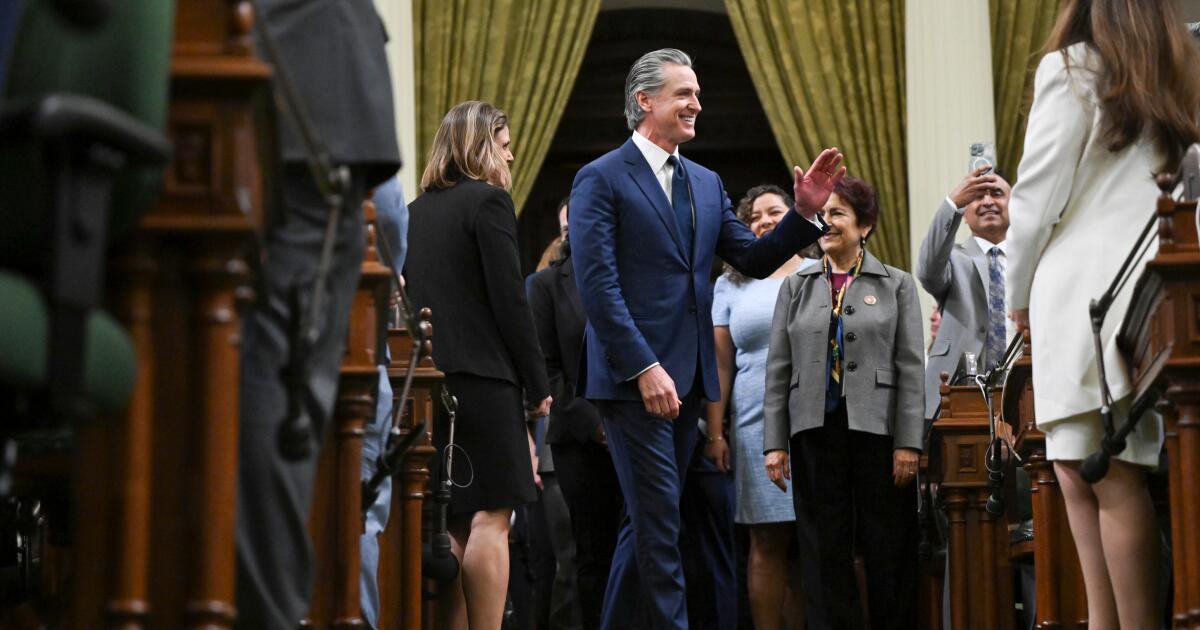
In Sacramento, the Legislature lopsidedly passed an $11.25-billion bond proposal aimed primarily at providing government subsidies for building affordable housing. Newsom immediately signed the measure last week, just beating the deadline for getting it on the Nov. 3 election ballot.
“In California, we don’t turn away from the needs of our people,” Newsom boasted in a prepared statement, taking a veiled shot at Trump, his favorite political target.
This came just after both houses of Congress, with members working collaboratively in a rare bipartisan manner, overwhelmingly passed a landmark bill aimed at boosting housing supply. The measure removed regulatory barriers, upgraded federal programs and incentivized new home building.
A Trump “promise kept,” the White House proclaimed.
Whoops! The president then suddenly flip-flopped. He canceled a planned bill-signing ceremony, torpedoing the legislation, an opportunity to gain sorely-needed points for the GOP heading into the fall elections and a chance to outboast Newsom, arguably his most annoying political antagonist.
Trump said he wouldn’t sign the housing bill unless Congress approved his unrelated voter ID legislation, which has practically no chance of passage. The least of his concerns seemed to be struggling homebuyers and renters.
As of this writing, it wasn’t clear what Trump would ultimately do. Nothing ever is certain with him. Shocked and confused GOP congressional leaders even held back sending the president the bill, then ducked out on holiday recess.
At the California state Capitol, by contrast, the governor and legislative leaders were united, working off the same page and successfully negotiating a final agreement on housing help.
You’re reading the L.A. Times Politics newsletter
George Skelton and Michael Wilner cover the insights, legislation, players and politics you need to know. In your inbox Monday and Thursday mornings.
By continuing, you agree to our Terms of Service, which include arbitration and a class action waiver. You agree that we and our third-party vendors may collect and use your information, including through cookies, pixels and similar technologies, for the purposes set forth in our Privacy Policy such as personalizing your experience and ads.
But the remaining $10 billion would need to be paid off by taxpayers over 30 years — at an estimated $580 million annually, bringing the total bond cost to about $17.4 billion, including interest.
Putting this in perspective, the Legislature just passed a $352-billion state budget for the fiscal year starting July 1. Of that, $7.5 billion will go for retiring debt on $73 billion in bonds. And the state has voter authorization to sell $38 billion more in bonds.
During legislative floor debates, some Republicans objected to the additional borrowing.
“We’ve got record revenue, why do we need to borrow money?” asked Assemblyman David Tangipa (R-Fresno).
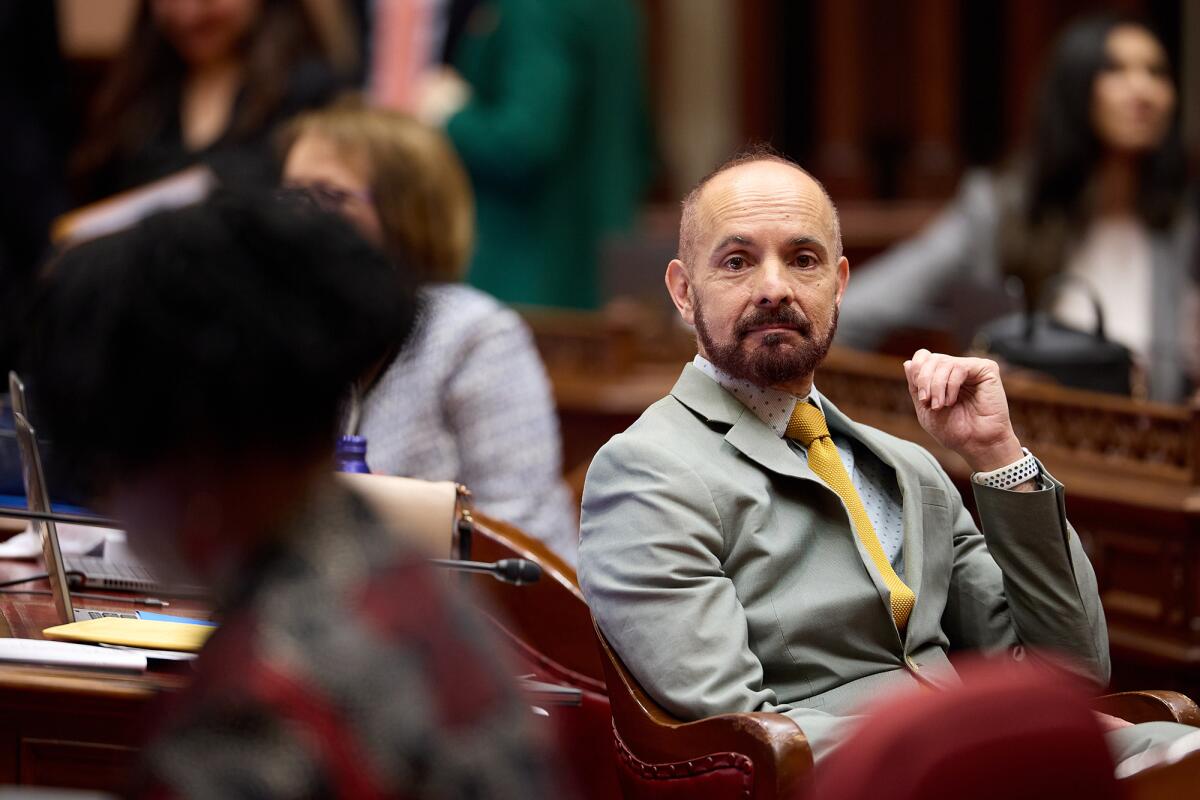
That was answered during the Senate debate by Sen. Christopher Cabaldon (D-West Sacramento), one of the measure’s principal jockeys.
Building affordable housing “simply is impossible, it can’t be done without this bond” to finance government subsidies, Cabaldon told colleagues.
Developers are subsidized so they can build at a cost that will result in affordable consumer prices, mainly rents in this case.
Some Republicans also objected to inserting the CalVet money for voter appeal. Assemblyman Carl DeMaio called it “window dressing.”
CalVet funds normally are acquired through very small, separate bond measures.
But in the end, only a few Republicans voted against the big bond, which was officially authored by the Assembly Speaker and the Senate leader to display political muscle.
To their credit, the Legislature and governor in recent years have been whittling away at regulatory obstacles to home building. But many cities still balk at rezoning residential neighborhoods to make room for new multifamily dwellings.
The bond proposal is mainly designed to generate affordable rentals for poor people. More money was added at the end for affordable student and farmworker housing.
There’ll be a separate bond proposal on the November ballot that goes in a different direction but doesn’t conflict. It would help middle class homebuyers. And that measure wouldn’t cost taxpayers a cent.
“Housing supply is not just about poor people. It’s not just about homelessness,” says the middle class initiative’s originator, former legislative leader Bob Hertzberg, a Los Angeles County Democrat.
Under the plan, a homebuyer could borrow most of the money needed for a down payment on a newly constructed single-family home or condo. Typically, a 20% down payment is required. Under Hertzberg’s proposal, 17% could be borrowed. Regular lending institutions would arrange the second mortgage.
To be eligible, a homebuyer’s income could not exceed 200% of the area’s median income. In L.A. County, that would be around $213,000 for a family of four, Hertzberg figures. The home would need to be the owner’s primary residence.
The November ballot will be bursting with state propositions — 14 in all, mostly very complex, running the gamut. Besides housing, there’ll be proposals for a billionaires tax, voter ID requirement, local tax limitations and fast-tracking of public works.
Voters could just throw up their hands and reject everything.
“At some point, voters are just gonna say, ‘I don’t know about all this stuff. There’s a lot of stuff,’” says Dan Dunmoyer, who heads the California Building Industry Assn.
California’s housing affordability crunch won’t be solved by just two bond packages. But they’d help.
We and all of America could also use some help from our seemingly unconcerned president, who enjoys free public housing.
Kevin Starr, professor of planning and development and faculty master of Embassy Residential College at USC, is the author of “The Dream Endures: California Through the Great Depression,” to be published by Oxford University Press.
The California dream, according to the latest Times’ poll: National Guardsmen patrol the border with Mexico, bayonets at the ready. Every resident, citizen and non-citizen alike, carries a tamper-proof identi ty card (You can’t leave home without it). Countless times a day, the card is shown to bureaucrat or police officer to prove citizenship. The 14th Amendment, guaranteeing citizenship to the U.S.-born, is abrogated. Truant officers, lists in hand, enter classrooms and pull undocumented children from behind their desks, trundling them into vans for shipment to relocation centers. At hospitals nearby, emergency-room doctorsturn away the sick or injured who do not possess the identity card.
Every now and then, the people of California surrender themselves to a recurrent paranoid delusion that is virtually a badge of Californian identity. Now is such a time. And the combination of a paranoid-delusional populace and demagogic politicians has engendered among Californians a mean-spiritedness, a detachment from reality–and worse, a fear of freedom itself.
It happened in Los Angeles on Oct. 24, 1871, when a mob, which included some of the city’s best citizens, tortured and hanged 17 Chinese men from downtown lampposts, among them a teen-age boy, then looted the Chinese quarter.
It happened in the 1930s, in the midst of the mother of all Depressions, to Dust Bowl migrants. In February, 1936, the city of Los Angeles declared both the federal and state constitutions null and void, dispatched 126 police officers to seal off all California’s land borders from entry by migrants–all American citizens–who could not prove their net worth.
It happened most sweepingly in 1942, when American citizens of Japanese descent were shipped off to what were euphemistically called relocation centers.
It happened in June, 1943, when thousands of young servicemen wandered the streets of Los Angeles, beating up young Mexican males, stripping them of their zoot suits, blaming them, implicitly and explicitly, for the fact that they, the Anglos, had to go off to war while the Mexican youths were able to stay home and jitterbug.
As Yogi Berra would say, “It’s deja vu all over again.” Just as Californians once believed that the Chinese, the Japanese, the Dust Bowlers, or Mexican youths in zoot suits were the cause of their ills, they now believe, with the full force of mass psychosis, that illegal immigrants–read: illegal Mexicans–constitute the gravest threat to our way of life, in a close third to the economy and crime, to which illegal immigration is intimately linked.
Think of it! Mexican illegals responsible for bloated bureaucracy. Mexican illegals responsible for special-interest-dominated politicians. Mexican illegals responsible for a soaring divorce rate, the breakdown of the family, AIDS, venereal disease, declining standards in culture and education, anti-female violence in rap music, drugs, child abuse, spousal batterings, the loss of religion and personal morality, deferred maintenance of the infrastructure, teen-aged pregnancies, the Inquisition of political correctness, slovenliness in personal dress–or whatever other symptom one might choose to signify the decline of California as a culture.
To say all this is not to deny that California faces a terrible array of problems, including illegal immigrants. As Delmore Schwartz once pointed out, even paranoids have enemies. Illegal immigrants are a drain on the public sector. The underground economy–with its exploitative wages, lack of benefits, forged and perjured documents–corrupts employer and employee alike.
Furthermore, in an economy partly dependent upon illegal immigration, citizenship is devalued. What previous generations struggled for across a lifetime–the chance to live and work in America–is stolen by means of false papers. The ghetto existence of illegal immigrants reinforces an unfortunate tendency in the legal immigrant community not to learn English, not to assimilate, on some level, the language, legal and institutional structures, heritage and historical identities of the United States of America.
As bad as these problems are, however, they are not the whole picture. The state’s current malaise cannot be blamed on the young busboy, far from home, washing dishes late into the night in an upscale restaurant on the Westside. Indeed, in the vast majority of instances, Mexican illegals are doing the work that others–even those on welfare–will not do, yet needs to be done.
How did we lose faith in the premise of America and California, which is freedom and an open society, personal liberty, courage, fairness and, whenever possible, generosity to others who also wish something better for themselves? Why are we talking about bayonets on the border when, every day, there are tens of thousands of legal crossings between Mexico and California crucial to the survival of our economy? Why are we scapegoating obliquely, perhaps, yet with loathsome effectiveness, the fact of Mexican immigration to America, an immigration that was absolutely necessary for the creation of modern California?
Mexican labor built the interurban electrics that made possible modern Los Angeles and its hinterlands. Mexican labor played the major role in the creation of the agricultural economy that still remains the leading component of California’s domestic product.
Californians had it easy in that long arc of prosperity extending from World War II through the ‘80s? When it was taken away–when California began to suffer like the Rust Belt or rural New England or Appalachia–they turned around and blamed the weakest, especially an underclass approaching non-personhood.
Paranoia is intrinsically self-destructive. Paranoids not only blame others; they do damage to themselves. And so it is not surprising that the current paranoid-delusional mind-set, not content with soldiers on the border and identity cards, with kids yanked from classrooms and the sick denied treatment, now seeks to sink the North American Free Trade Agreement. True, the treaty requires some amending, but to kill the entire idea of economic cooperation with Mexico on the ground that Mexico will hijack our economy is to betray in an instant how far our self-esteem has sunk, how far we have devolved into paranoia. We want it both ways: to see the Mexicans as, on the one hand, illegals enervating our social system; and, on the other, to see them back on their own turf, capable of stealing our industrial base.
What a horrible hypocrisy for California to simultaneously exploit and berate those who come only for a better life.
WASHINGTON — Holiday gatherings and major life events have come with an empty seat. Certain dates on the calendar meant time at a cemetery, standing before granite stones.
They are a relatively small group of people, scattered across different states, but they share a common bond that stretches decades: Each had a family member die violently in the struggle for voting and civil rights, victims on a long and difficult path marked by blood that ended when the country seemed to mature into the nation of its creed.
But 61 years later, and as the country approaches its 250th anniversary this weekend, those sacrifices are in question. In a series of decisions over the last dozen years, including one in April, the Supreme Court has essentially dismantled the law that their family members died to see enacted, the Voting Rights Act of 1965.
“My mother’s blood is on that bill. We were always proud of that, and now it’s gone,” said Anthony Liuzzo, whose mother, Viola Liuzzo, died on an Alabama highway between Selma and Montgomery while driving marchers in 1965.
Critics of the law contend that times have changed, an argument Chief Justice John G. Roberts Jr. made in a 2013 decision that was the first major step in rolling back the law.
Survivors of lost loved ones disagree, pointing to the speed with which Republican-led state legislatures eliminated majority-Black congressional districts after the court’s April ruling, which severely weakened a section of the law that had protected voting rights for minority communities. They feel anger and sadness that a milestone political victory decades ago has been reversed, but they are committed to keep fighting.
A church bombing and a chunk of concrete
Lisa McNair was born Sept. 19, 1964. Her older sister, Denise, died in the Sept 15, 1963, bombing of the 16th Street Baptist Church in Birmingham, Ala. The church had been a central organizing point for civil rights protest.
The explosion killed Denise McNair, 11, and 14-year-olds Addie Mae Collins, Carole Robertson and Cynthia Morris Wesley. Nearly two dozen others were injured. Three Ku Klux Klansmen were convicted years later.
One of Lisa McNair’s early memories of her sister was of the box that their grandmother kept from the funeral home. It included Denise McNair’s shoes, a purse and a rock-sized piece of concrete that had been embedded in her skull.
The crime brought the civil rights struggle onto the national stage and outraged President Kennedy.
The times were tumultuous, McNair said, but it seemed the nation was heading in the right direction. Most of her life, “I’ve seen advances” on television, in commercials, with interracial marriages, civil rights and voting rights, “a plethora of rights that we got over the greater part of my lifetime.” But that has changed, she said.
McNair, 61, said she is “physically sick” about the Supreme Court decision and subsequent actions by lower courts and legislatures.
“I am constantly working to pray my way through it, so I can get up and go to work in the morning and do what I need to do. But I just want to ask every white person I see, ‘What more do you want?;” she said. “‘Why do you hate us so?’”
They left for Freedom Summer and never came home
Michael Schwerner, known as Mickey, came from a family in which human rights activism and challenging social norms were expected. He was in Mississippi in 1964 as part of Freedom Summer when he, Andrew Goodman and James Chaney vanished one day in June while investigating a bombing at a Black church.
Their bodies were found weeks later, buried in an earthen dam in a rural area of Neshoba County. Schwerner, 24, and Goodman, 20, were white; Chaney, 21, was Black.
Stephen Schwerner, who died earlier this year and was a social activist in his own right, told the Associated Press in a 2023 interview that as soon as the family heard his younger brother and the other men were missing, they knew they were dead.
“Our family was very out front in the media that the only reason there was international attention was two of the young men were white,” said Stephen’s daughter, Cassie Schwerner. “Had all three of those young men been Black, they would have ended up absent from our history and our narrative.”
The executive director of Morningside Center for Teaching Social Responsibility, Cassie Schwerner, said her family has followed voting rights through their ups and downs. That includes the 2013 Supreme Court decision that allowed states and counties with a history of discriminatory voting rules to make changes without prior approval from the Department of Justice.
The court’s April decision, she said, brought rage “and a good deal of sadness — not for me and my family, but for this country.” There is, she said, work to be done on multiple fronts.
Rights paid for in blood turned out to be fragile
Tamara Orange said among her many thoughts when she heard of the Supreme Court decision in this year’s Voting Rights Act case, there was relief — “relief that my dad is not here to see that; that Jimmie Lee Jackson is not here to see it; that Viola Liuzzo is not here to see it,” she said. “I’m relieved for them because to me, it’s as though the sacrifices that were made were done in vain.”
Her father, James Orange, was working with the Southern Christian Leadership Conference to organize voting rights protests in Marion and Perry County, Ala., in 1965. When juveniles joined the effort, he was arrested for contributing to the delinquency of minors. Concern arose that Orange was going to be taken out of the jail and lynched.
A protest to intervene ended with Jackson, a 26-year-old Black church deacon, being shot in the stomach by a state trooper while Jackson tried to shield his mother and grandfather.
His death was the catalyst for what became the Selma-to-Montgomery march and “Bloody Sunday.”
Orange stayed in the movement all his life and died in 2008, Tamara Orange said. But even after the Voting Rights Act passed, “he would say, ‘Be careful or we’re going to lose it.’”
‘We got bad news for you’
Anthony Liuzzo had just turned 10 when his mother, 39, left their middle-class neighborhood in Michigan and headed for Selma. She had cried as she watched scenes from “Bloody Sunday” on television.
Viola Liuzzo participated in a portion of the second march and then helped drive other civil rights protesters around the Black Belt region of the state. On March 25, 1965, she was driving one protester between Selma and Montgomery when a vehicle pulled alongside and fired into the car.
The phone call came around midnight. Anthony Liuzzo remembers the caller asking his dad, “Is your wife Viola? We got bad news for you. She’s been shot.” When his father asked whether she was all right, the caller said, “No, she’s dead,” and then hung up.
An informant for the FBI quickly identified members of the Ku Klux Klan as her killers. The three men charged would escape conviction on state charges but be convicted in federal court.
Anthony Liuzzo and his siblings lived with the lost birthdays and other missed milestones. His comfort was that the voting rights she had died for had become a reality. But the April ruling by the Supreme Court and the subsequent rush by Republican-led legislatures in several Southern states to eliminate congressional districts represented by Black lawmakers left him angry and distraught.
Even so, he said he is still proud his mother had the courage to go to Selma “when others sat in their pretty little houses.”
One morning, the Klan returned
The inscription at the bottom of Vernon Dahmer Sr.’s tombstone reads simply: “If you don’t vote, you don’t count.”
It is a message that embodies his life’s work and the story behind his death.
Even after President Johnson signed the Voting Rights Act, not every state was eager to implement the new law. In Mississippi, it came with a poll tax. The amount was $2, but in a world where a farmworker’s wages might only be $5 a day, that was substantial, said Dahmer’s son, Dennis Dahmer Sr.
The elder Dahmer, 57 at the time of his death, was a successful businessman who owned a store, sawmill and farm near Hattiesburg. He also was a civil rights leader and NAACP president in Ford County. He offered to pay the $2 for Black residents who wanted to register to vote.
He had already been under scrutiny by the local Ku Klux Klan. There was harassment and there were threatening phone calls. The windows were shot out of his store, but no one challenged him directly because his sons were always present and armed.
That seemed to tail off after Johnson signed the law.
“The Klan quit calling,” Dennis Dahmer said. “They quit shooting out the windows, so my family thought that all of this was behind us.”
That changed in the early hours of Jan. 10, 1966, when two carloads of Klansmen showed up. They firebombed the house and adjacent grocery store and began shooting at the house. The elder Dahmer shot back, using his ample arsenal to fight off the attack.
His wife and the three children who were home survived, but he suffered severe injuries from inhaling the smoke and fumes from the flames. He died later that day.
Dennis Dahmer was 12 as he stood next to his dad’s hospital bed. He wondered why some people wanted his father dead just for trying to help Black people vote.
A former Imperial Wizard of the Ku Klux Klan, Sam Bowers, was convicted in 1998 for the attack and sentenced to life in prison.
Like the families of other survivors, Dennis Dahmer’s family has witnessed the methodical dismantling of the Voting Rights Act.
“Finally, they basically turned it into a relic,” he said.
His plan now is activism, to speak out and promote the need for a massive voter turnout. He also wants to remind people of the price that certain families paid for everyone to have the right to vote and be represented by someone of their choosing.
“We’re living in a time when America has a lot of the same characteristics of the 1960s that I grew up in,” he said. “People say, ‘Are we going back?’ Hell, we’re already there.”
New Delhi, India – Brajesh Kumar climbs three floors every evening to sit in solitude on the rooftop terrace of his house overlooking the Ram Temple in Ayodhya in northern India’s Uttar Pradesh.
Over decades, the 65-year-old has seen the once-sleepy town metamorphose into the biggest flashpoint of the Hindu majoritarian movement, championed by Prime Minister Narendra Modi’s Bharatiya Janata Party (BJP). Where the temple stands used to be the site of the 16th-century Babri Mosque, but in 1992 a Hindu mob tore it down, sparking religious riots that killed nearly 2,000 people across the country, mostly Muslims.
Two and a half years ago, Modi presided over the consecration ceremony of the new temple, devoted to the Hindu god Ram. Many Hindus believe Ram, the god worshipped as an epitome of righteousness, was born there.
To Hindu devotees like Kumar, the temple – despite the controversy and deaths that defined its birth – brought a sense of serenity.
Until recently.
For the past month, the temple has been embroiled in allegations that those entrusted with its management have instead embezzled donations worth potentially millions of dollars that the site attracted from devotees.
“We have been betrayed [by the management], who have looted our faith, nothing less,” Kumar told Al Jazeera. “Left to them, they will sell us all one day in the name of religion and stuff their own pockets.”
The allegations have led to police investigations, arrests and political fallout that could shape elections in India’s most populous state that are only months away.
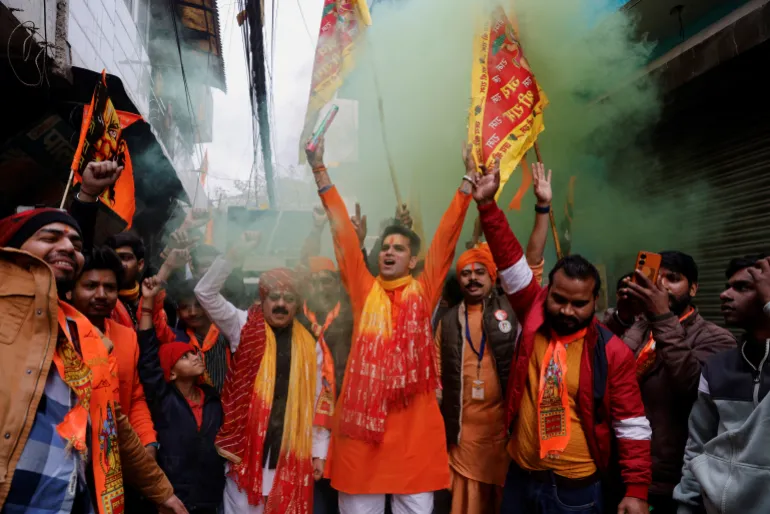
People celebrate the opening of the temple of the Hindu god Ram in the northern town of Ayodhya in a street in New Delhi, India, on January 22, 2024 [Anushree Fadnavis/Reuters]
Ayodhya’s can of worms
Since its inauguration, the Ram Temple has been among the top religious sites in India, attracting millions of Hindu devotees.
An independent trust, the Shri Ram Janmabhoomi Teerth Kshetra Trust, manages the shrine. Although it is outside the purview of the government, its executive members wield political influence, and some of them come from the Rashtriya Swayamsevak Sangh, the ideological wellspring of the BJP.
The corruption allegations first surfaced this month after Mahipal Singh, a former supervisor of the trust’s accounting team, publicly called out irregularities. Al Jazeera could not reach him for comment.
After a public uproar, Akhilesh Yadav, a former chief minister of Uttar Pradesh from the opposition Samajwadi Party, picked up the issue, alleging that millions of rupees in donations had gone missing.
The mounting pressure pushed the state government, ruled by the BJP, to form a three-member investigation team, which has submitted a report on the alleged misappropriation of donations.
Although the content of the report has not been made public, the state police registered a criminal case and have arrested at least eight people, including those involved in counting cash and valuable offerings at the temple.
More devotees have come forward since, seeking the whereabouts of their valuables, including silver bricks and gold jewellery and artefacts, that they had handed over to the trust’s executives.
On Friday, the trust’s longstanding general secretary, Champat Rai, stepped down with other high-profile trustees. The allegations have been particularly damning for Rai, who has been a central figure in the movement for the Ram Temple.
But it has done little to cool down the tensions in the state, where thousands of devotees, including some BJP supporters, feel cheated.
The Ram Temple is illuminated after its inauguration in Ayodhya on January 22, 2024. [Adnan Abidi/Reuters]
‘Cunning thieves running Ram Temple’
Santosh Dubey was among those tried for tearing down the Babri Mosque in 1992. He has never shied away from his role and instead has flaunted it.
After the mosque’s demolition, Dubey waited for a final verdict about what was to happen to the site from the courts, where both sides fought bitterly for decades. In 2019, the Supreme Court awarded the site to Hindus – even though it deemed the destruction of the mosque illegal. The top court gave a piece of land to Muslims outside Ayodhya to build a new mosque. In 2020, Dubey and others accused of roles in demolishing the mosque were acquitted — the court cited a lack of adequate evidence.
If those verdicts felt like vindication to Dubey, the alleged embezzlement at the temple has enraged him.
“This corruption causes me deep anguish, a pain that words cannot express,” Dubey told Al Jazeera, speaking from Ayodhya. “All I can say is that nothing less than the death penalty would suffice for them.”
“Cunning, dishonest and ruthless thieves are running the Ram Temple, and they have created such an atmosphere of fear that no one is willing to speak out against them,” he said.
Dubey said the government will struggle to ignore the anger among devotees because the episode batters the BJP’s narrative that it is a saviour of the Hindu faith.
This is not the first time that the temple trust has been the subject of controversy. In 2021, the trust allegedly bought land at highly inflated prices using public donations.
BJP spokespeople refused to comment on the recent allegations when Al Jazeera reached them.
Indian Prime Minister Narendra Modi (with his arms outstretched) and Uttar Pradesh Chief Minister Yogi Adityanath (just to the left of Modi) show the BJP symbol during a roadshow as part of an election campaign in Varanasi, India, on May 13, 2024 [Adnan Abidi/Reuters]
‘Impact on upcoming election’
Devotees of the temple and critics of the government are accusing authorities of attempting a cover-up.
Opposition leader Yadav described the state government’s initial handling of the case as “suspicious”. “The government is arresting the counting staff while shielding the big fish who orchestrated the structural rot,” Yadav said while demanding transparency in the investigation.
Karpatri Maharaj, a prominent Hindu seer associated with the Ram Temple movement, told Al Jazeera that the government is using junior employees as scapegoats and arresting them.
Uttar Pradesh, India’s most populous state, is led by the firebrand Hindu monk-turned-politician Yogi Adityanath, who is often seen as a potential successor to Modi within the RSS-led Hindu majoritarian movement known as Hindutva.
Modi’s party lost a significant base in the state in the 2024 national elections when the BJP fell short of a majority, forcing it to rely on allies’ support to stay in power.
For the BJP, which has long used the campaign for the Ram Temple as a central political plank, the new controversy could prove a challenge before elections in Uttar Pradesh scheduled for early next year, political analyst Rasheed Kidwai said.
“It would have a massive negative impact on the BJP if more religious leaders came forward to speak on this,” Kidwai told Al Jazeera. “This is not something that would be forgotten because it is a matter of faith, and the state chief comes from a religious order himself.”
The episode carries broader lessons, he said: Pandering to religious emotions and fanning divisions can bite back. “What has been benefitting the BJP in these years can also cause immense damage,” Kidwai said.
Hindus shout and wave banners as they celebrate the destruction of the 16th century Babri Mosque in Ayodhya on December 6, 1992 [Douglas E. Curran/AFP]
Khadijah Farrakhan, longtime wife of Nation of Islam leader Louis Farrakhan, died Saturday, the Nation of Islam has announced. She was 90.
“Mother Khadijah” worked alongside her provocative and charismatic husband for decades, helping lead their religious and sociopolitical movement, which espouses Black self-reliance. Its home base was Mosque Maryam on the South Side of Chicago, where the couple lived.
“The Honorable Minister @LouisFarrakhan with deep sadness yet with profound gratitude to Allah informs you that his beloved wife of 72 years, the first lady of the Nation of Islam, Mother Khadijah has returned to Allah (may Allah be pleased),” a statement by the Shura Executive Council said.
Her death came seven months after devotees had marked Khadijah’s 90th birthday. The statement said funeral services are to be announced.
Mosque Maryam remembered her as “a devoted follower” with “a precious soul, a sweet heart.”
In a post on Facebook, R&B artist ZaRio Son Rise recalled her as “a true queen, a righteous woman, and one of the greatest examples of dignity, faith, loyalty, and grace our generation has ever witnessed.”
Born Betsy Ross, Khadijah Farrakhan married her husband, then named Louis Walcott, in Boston on Sept. 12, 1953. The two had nine children. Their eldest son, Louis Farrakhan Jr., died in 2018, and another son, Joshua Farrakhan, died in 2023.
Khadijah Farrakhan converted to Islam in 1955, the same year that her husband joined the Chicago-based movement after being heavily influenced by Malcolm X, his friend from Boston. The pair changed their names around that time.
Louis Farrakhan, who is now 93, stepped into the organization’s leadership vacuum shortly after Malcolm X was assassinated in 1965. Among his most significant accomplishments was the Million Man March on Washington in 1995.
Two years later, Khadijah Farrakhan spoke before a gathering of America’s Black women in Philadelphia dubbed the Million Woman March.
“A nation can rise no higher than its women,” she told the crowd. “We focus on women, but cannot lose sight that we must rise as a family — men, women and children.”
1 of 2 | Speaker of the House Mike Johnson speaks during the Faith and Freedom Coalition 2026 Road to Majority Policy Conference at the Washington Hilton in Washington, D.C., on Friday. He said Sunday he plans to send a housing affordability to President Donald Trump on Monday for a signature. Photo by Bonnie Cash/UPI | License Photo
June 28 (UPI) — Speaker of the House Mike Johnson said Sunday he plans to send housing affordability legislation to President Donald Trump for a signature Monday despite his refusal to sign the package last week.
In an appearance on Fox News’ Sunday Morning Futures, Johnson said he believes Trump will sign the legislation.
“I’m going to send the bill over to him Monday, and it will become law,” Johnson said.
“I certainly want him to take the biggest, boldest marker that he has and do that big Trump signature proudly on that legislation because we’re delivering for the people, and that’s what he wants to do.”
Both chambers of Congress overwhelmingly voted in favor of the 21st Century ROAD to Housing Act last week. The legislation seeks to lower housing costs, expand homeownership access, and limit corporate and institutional ownership for rental purposes.
The bill includes 60 pieces of legislation that would also seek to ease bureaucracy to hasten housing development, modernize federal housing programs and banking regulations, and incentivize local governments to prioritize housing.
The non-profit National Low Income Housing Coalition said the United States is facing a shortage of 7.2 million affordable units for low-income renters, resulting in a housing crisis in every state.
The House voted 358-32 and the Senate voted 85-5 in favor of the bill.
Trump was originally scheduled to sign the legislation Wednesday, but he canceled those plans, saying he won’t sign housing legislation until lawmakers approve the SAVE America voting bill.
There haven’t been enough votes to pass the legislation, which would require people to prove their citizenship before they can register to vote. Opponents to the law say it would disenfranchise millions of legitimate voters.
In an appearance Sunday on NewsNation‘s The Hill Sunday, Rep. Suhas Subramanyam, D-Va., said he wouldn’t be surprised if Trump doesn’t sign the housing legislation.
“I don’t know with this president, because he’s said that he doesn’t care about rising costs,” Subramanyam said.
“He said … if he doesn’t have a housing problem and his friends don’t have [a] problem with housing, then it doesn’t matter to him. So I actually wouldn’t be surprised if he doesn’t sign it.”
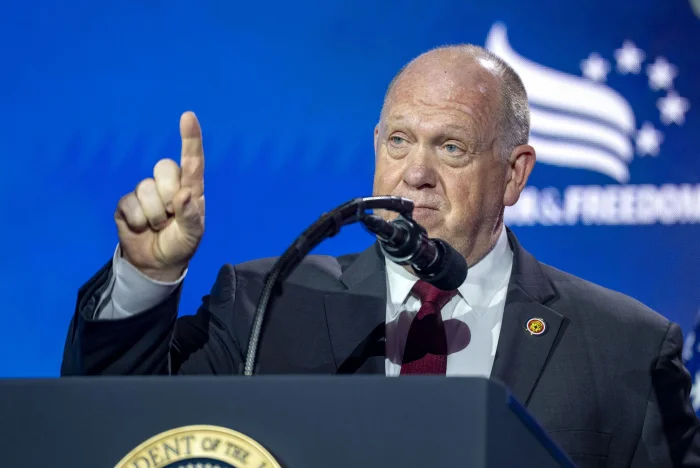
White House Border Czar Tom Homan speaks during the Faith and Freedom Coalition 2026 Road to Majority Policy Conference at the Washington Hilton on Friday. Photo by Bonnie Cash/UPI | License Photo
NEW YORK — President Trump said he is nominating Lance Schroyer, a former Oklahoma state trooper, as the next director of Immigration and Customs and Enforcement.
On his social media platform Saturday, Trump described Schroyer, a former Marine, as “a proven leader” with “real operational experience.”
Schroyer hails from the same state as the new Department of Homeland Security Secretary Markwayne Mullin, a former congressman. Earlier this month, Mullin brought Schroyer on stage at a National Sheriffs’ Assn. event, calling him a “good friend of mine” and noting the department had recently hired him.
Mullin quickly praised Schroyer in a statement highlighting the former trooper’s 29-year career and his work with federal and state partners on a U.S. immigration enforcement program.
“President Trump made a great pick, and I’m confident Lance’s strong leadership and firsthand experience will empower the men and women of ICE to deport criminal illegal aliens, secure the homeland, and protect the American people,” Mullin said Saturday.
If confirmed, Schroyer will lead ICE at a time when the public mood has soured on Trump’s immigration crackdown, which sent surges of federal immigration officers into many U.S. cities. Those raids sent tensions soaring and prompted clashes between protesters and federal agents, including the fatal shootings of two U.S. citizens in Minneapolis this year.
Trump returned to the White House on a promise of mass deportations, and ICE has been a central executor of that vision. The agency is undergoing massive growth from a onetime injection of $75 billion last year, which has allowed for the hiring of 12,000 officers and increased detention capacity.
Mullin, who started in his role in March, has promised to keep his department out of the headlines and has indicated a softer tone on immigration, although he aligns with the president’s priorities on mass deportations.
Claire Trickler-McNulty, a former senior ICE official, said prior confirmed ICE directors have often been attorneys, though some state and local law enforcement officials have also been nominated. She said his background in Oklahoma suggests Mullin probably influenced the pick.
“I think probably given the attention on ICE, he wants to feel like he has somebody he can trust in there,” she said in an interview.
John Torres, another senior ICE official, said Schroyer faces an uphill climb toward Senate confirmation, but his experience being at the state and local level instead of the federal level might help.
“He won’t have any of that baggage, where they’re going to turn around and say, ‘Oh, well, he worked for this administration or that,’” Torres said.
Schroyer’s nomination comes after former ICE Director Todd Lyons resigned at the end of May. David Venturella, a former executive at a private prison operator, has been serving as the acting head of the agency. Venturella is expected to stay on as the acting director until Schroyer is confirmed, according to a Homeland Security official speaking on condition of anonymity.
ICE has not had a Senate-confirmed director since the Obama administration, a result of polarizing politics around the agency and immigration policy.
Swenson writes for the Associated Press. AP writers Elliot Spagat and Rebecca Santana contributed to this report.
The 250th anniversary of America’s liberation from a king kicked off with a campaign-style rally on the National Mall by President Trump, whose face already stares down from banners fluttering from federal buildings across the nation’s capital.
The images illustrate how the president has dominated daily life since returning to power, evoking more the style of a monarch than the leader of the world’s oldest democracy. But more than anything, it is how he has wielded that power that has led to comparisons of an imperial reign.
Since returning to office in January 2025, Trump has nominated one of his personal lawyers to serve as attorney general, ordered the Department of Justice to pursue his political enemies, deployed the U.S. Marines to the nation’s second largest city and leveraged the presidency to enrich himself and his family.
He has demanded that comedians who mock him be fired, has slapped his name on the Kennedy Center, has pushed to seize control of elections, has filed lawsuits against news organizations whose coverage he disliked and has sued his own government seeking $10 billion in taxpayer money.
Trump also is the only convicted felon to hold the presidency, and a separate felony indictment over his attempts to keep himself in power after losing the 2020 election was dismissed only after he was reelected four years later despite those facts.
With the 250th anniversary of the nation’s founding approaching, Trump’s own celebrations have overshadowed the bipartisan, congressionally authorized commission that was supposed to coordinate events commemorating the moment. He plans to return to the National Mall on July Fourth for what he calls a “Trump rally.”
The president’s actions have led to comparisons with King George III, the British monarch whose rule inspired the American Revolution. It is a parallel Trump rejects.
“I’m not a king,” he told CBS’ “60 Minutes” earlier this year. “If I was a king, I wouldn’t be dealing with you.”
A different view of the presidency
There is a long American political traditional of opponents reviling presidents as kings. But Julian Zelizer, a Princeton University historian, said the label fits differently on Trump.
“It’s more about how he imagines who is he and what the presidency is,” Zelizer said. “We’re celebrating founding principles, and that was a driving issue — fears of how a centralized power can be corrupted. And here we are again.”
When King Charles III visited Trump this year, the official White House X account posted an image of the two men with the caption “Two Kings.” At the start of his second term, Trump declared he had ended a New York City transportation program and posted: “LONG LIVE THE KING.” The posts also seemed to indicate a willingness to leverage the label and the reaction it provokes in his critics.
The main resistance movement in Trump’s second term has adopted the slogan “No Kings.” Ezra Levin of the group Indivisible said activists were thinking ahead to 2026 and the America 250 celebration when they chose the label.
“It looks like the same kind of tyranny we were rebelling against 250 years ago, the type of domination of Americans by a secret police force that’s murdering people in the streets like in Minneapolis this year and in Boston in 1770,” Levin said, referring to demonstrations against the administration’s immigration crackdown that led to the fatal shootings of two protesters this year by federal officers.
When asked for comment, the White House referred to Trump’s statements about his use of executive power. The president has weighed in multiple times defending his maximalist approach.
During his first term, he referred to Article II of the Constitution when he told participants in a youth summit, “I have the right to do whatever I want as president,” while declaring that it “gives me all of these rights at a level nobody has ever seen before.” He told the New York Times in an interview this year that the only check on his global power was “my own morality. My own mind. It’s the only thing that can stop me.”
Yet he also has said that portrayals of his approach as authoritarian were wrong: “I’m not a dictator,” he told reporters last year. In response to a question about whether he was concentrating power in the presidency, Trump told Time in an interview last year, “I don’t think so. I think I’m using it properly, and I’m also using it as per my election.”
Supreme Court has sided with him
With a deferential, Republican-controlled Congress, courts have become the last check on Trump. The president has harshly criticized judges who have ruled against him, and his administration has sometimes defied their orders.
Yet his quest to expand presidential power has been aided by the conservative majority — including three of his appointees — on the U.S. Supreme Court, which has sided with Trump numerous times after lower court rulings hampered him.
In the middle of his 2024 campaign, the high court ruled that presidents have broad immunity from prosecution. The decision derailed multiple investigations stemming from Trump’s first term, including the one focused on his attempts to overturn his loss to Joe Biden in the 2020 election.
Trump has argued the courts cannot constrain the president on key issues, including his claims that he has the ability to fire members of independent agencies. The most notorious example was in 2024, when a judge asked during the immunity case whether a president could be prosecuted for ordering the assassination of a political rival. Trump’s lawyer, D. John Sauer, answered with a “qualified yes.”
Sauer is now solicitor general, the administration official who oversees arguments before the high court. He has continued to insist that courts cannot review presidential acts.
“Once the president has made a determination … at that point, there’s no work for the reviewing court to do,” Sauer said during Supreme Court arguments in a case over whether Trump could fire Lisa Cook, a Federal Reserve governor.
But the Supreme Court has allowed Cook to remain on the board while it considers the case. The majority also slapped down his global tariffs, finding that only Congress had the authority to impose them.
Such rulings demonstrate that presidential power does have its limits, according to John Yoo, a conservative law professor at UC Berkeley who served in the George W. Bush administration.
“The presidency today, even when colored by President Trump’s worst excesses, is not a monarchy,” he said.
Direct financial enrichment
Trump was the richest man to ever become president. During his first term, he was criticized for owning properties where foreign dignitaries and others hoping to curry his favor spent lavishly. The conflicts of interest have escalated in his second term.
Trump launched cryptocurrencies before and after returning to office. By conservative estimates, one has pulled in $320 million this year alone, while another sold $550 million worth of tokens. A third received a $2-billion investment from a foreign wealth fund.
Trump took a new step earlier this year, filing a private $10-billion lawsuit against the IRS for the leak of his tax returns during his first term. His Department of Justice directed the IRS to settle the litigation to create a $1.776-billion fund to pay damages to people who claimed the federal government unfairly prosecuted them.
The administration pulled back the settlement amid an outcry from congressional Democrats and some Republicans. But Todd Blanche, a former personal lawyer for Trump who is now acting attorney general, said at least one provision remains — a ban on the IRS auditing Trump.
Zelizer said Trump’s financial entanglements might be the most monarchical part of his administration.
“We have not seen a person who has a business operation of this scale and scope benefiting directly from the decisions he makes,” Zelizer said.
Targeting political rivals
The Justice Department’s role in the IRS lawsuit is one example of how Trump has decreed that executive branch employees should act as agents of his will.
In breaching what is supposed to be a firewall between the White House and Justice Department, Trump has demanded that federal prosecutors target his foes. In one social media post last year, he called out by name Pam Bondi, who was attorney general at the time, in pushing her to prosecute several of his political opponents: “JUSTICE MUST BE SERVED, NOW!!!” Trump wrote.
Indictments followed shortly after, including against former FBI Director James B. Comey and New York Atty. Gen. Letitia James. The charges against both eventually were dismissed, but the department under Blanche filed new charges against Comey.
The pursuit is not limited to Trump enemies of the past.
For his 80th birthday this month, the president hosted a fight held by UFC — a company he invested in — on the White House lawn. The event was broadcast on a network owned by the son of one of the president’s major donors. The spectacle drew a rebuke from California Gov. Gavin Newsom, a persistent critic and potential 2028 Democratic presidential contender.
“The White House was built to serve the American people. Tonight it was used to promote a company the President owns stock in, sell subscriptions, promote corporate sponsors, push Trump crypto, and enrich the President and his family,” Newsom wrote on X. “The founders warned us about kings enriching themselves from public office.”
Days later, Newsom disclosed that Trump’s Department of Justice was investigating him and his wife.
Riccardi writes for the Associated Press. AP writers Lindsay Whitehurst and Fatima Hussein contributed to this report.
An analyst’s missed remarks and U.S. intelligence systems that weren’t connected to one another are among the missteps that investigators have surfaced while probing the cause of a missile strike on an Iranian school that killed an estimated 120 children, people familiar with the matter said.
Years before the U.S. attacked Iran at the end of February, an intelligence analyst examining information about potential future strike targets in Iran noticed changes at a site the U.S. had previously characterized as a naval facility belonging to the elite wing of the Iranian military in Minab city in the southeast of the country. It was, in fact, now an elementary school.
The analyst remarked on changes at the site in a digital intelligence tool, but that tool wasn’t linked up to the official intelligence database that the U.S. uses to develop strike targets and the information was never conveyed to military commanders, according to people familiar with the matter who declined to be named discussing sensitive topics.
On Feb. 28, when President Trump announced the start of major combat operations against Iran, a missile struck the school. The attack killed an estimated 120 children, and nearly 200 people in all, representing the worst incident of civilian harm resulting from U.S. operations in decades.
The analyst’s remarks, which one of the people familiar with the matter said were submitted in 2019, were never heeded, and the same building was reviewed several more times over the following years without anyone updating the targeting database. These discoveries are among the issues explored in a Pentagon investigation into the school strike, the people said. The results of the probe have not been publicly released.
A Pentagon official said the incident remains under investigation and that the agency has no updates to provide. On Wednesday, Trump said it may not ever be possible to determine fault and that he doesn’t think the U.S. was to blame.
The details unearthed as part of the Pentagon investigation underscore long-standing weaknesses in the U.S. military’s targeting system, one that was supposed to be improved years ago. Upgrades have instead been beset by delays, and yet they’ve grown all the more urgent with the spread of AI. Some tout the technology as a possible solution to targeting woes while others worry it could scale and accelerate the harms of war.
The investigation into the school strike was submitted in April but remains under review at U.S. Central Command, the military theater and combatant command known as Centcom that is responsible for carrying out combat operations against Iran, according to one of the people familiar with the matter.
Centcom commander Brad Cooper, a four-star Navy admiral, ordered the investigation and appointed an Air Force general from outside the command with the intention of ensuring a thorough, independent review, the person said.
The analyst’s written remarks about the school, the fact that they were entered into a digital system in 2019 that wasn’t connected to the official intelligence database and the current status of the investigation into the strike have not been previously reported. The New York Times had previously reported that an analyst noticed the building appeared to be a school several years ago and informed one other person. Targeting officials were using imagery that hadn’t been updated in seven years, according to the Times.
There are significant and long-standing gaps in how the Pentagon analyzes potential strike targets, according to former senior intelligence officials and others familiar with the matter. They declined to be named to discuss sensitive matters.
At least two intelligence database systems used for inputting remarks based on imagery, for example, have historically not been connected to the official and authoritative targeting database, people familiar with the platforms said, creating a coordination challenge that continues today.
In some cases during the mid-2010s, targeting data for historically low-priority locations where the U.S. had little historical battle experience, such as Syria, proved to be 10 or 20 years old, according to one of the former senior intelligence officials. Some intelligence staff worked double shifts and weekends at that time to manually update the system.
Starting in 2017, the intelligence enterprise undertook a similar effort to update several thousands of outdated targets in North Korea after relations between Washington and Pyongyang rapidly deteriorated, people familiar with the matter said, calling in satellites and other efforts to capture new, clear imagery as well as other types of intelligence. It took more than a year to update critical targeting information.
A legacy database known as MIDB was created in the 1980s and often relies on manual input. The Pentagon plans to replace MIDB with a machine-assisted version known as MARS that will introduce more automation.
A recently revised Pentagon doctrine outlined the challenges of integrating the many systems used to identify military targets: “The process of targeting occurs on many levels and in many locations simultaneously, yet no single interoperable solution has emerged or been established,” according to the non-public targeting document revised in April and reviewed by Bloomberg. “The entire joint targeting enterprise should seamlessly share well-understood, standardized representations of target intelligence and data and not rely on local databases.”
The MIDB and MARS systems are now both in use, but the effort to shift entirely to MARS is years behind schedule, and authoritative targeting data still relies on MIDB, according to the targeting doctrine.
The U.S. Government Accountability Office in 2020, during Trump’s first term, described MIDB as having “long-standing deficiencies” and said it’s “unable to meet current needs.” And yet six years later, the Pentagon’s targeting doctrine still describes the system as the authoritative, all-source repository of worldwide general military and target intelligence, serving as the national database for all target lists and no-strike lists and a baseline source of intelligence on installations, facilities, military forces and population concentrations.
The characterizations of MIDB in the Pentagon’s latest targeting doctrine haven’t been previously reported.
The hope of some targeting experts is that linking digital systems and more AI will bring down targeting errors in future. An automated check against public sites such as Google Maps, for example, may help flag an anomaly for human review. The Pentagon introduced an agentic AI effort along these lines Thursday.
The Defense Intelligence Agency, an agency responsible for both MIDB and MARS didn’t directly address a request from Bloomberg for comment on MIDB’s deficiencies, delays in the MARS transition or the mislabeled school site. An agency spokesperson said its foundational military intelligence analysts conduct comprehensive analysis of infrastructure and the operational environment, drawing on all intelligence sources to produce expert intelligence analysis and produce and maintain foundational military intelligence.
Such sources can span not only satellite pictures and other imagery analysis, but also signals intelligence, human intelligence and more, the spokesperson said. Combatant commands rely on expert analytic support from these all-source analysts for operational planning and execution, including intelligence for targeting, the spokesperson said.
“DIA works in close coordination with combatant commands and Intelligence Community partners to ensure decisionmakers have the best available intelligence for our national security,” the spokesperson said in a written comment.
Under the latest U.S. targeting doctrine, military commanders are responsible for the decision to prioritize and strike a target. Along with planners, commanders are also required to distinguish between military objectives and civilian ones that are not lawful military objectives for lethal targeting.
A combatant command should establish guidance to mitigate civilian injuries and consider criteria for positive identification of a target, according to an updated section of the Pentagon’s targeting doctrine. A spokesperson for the Joint Staff, the Pentagon’s senior military staff, described that section as a “key update.”
Once a combatant command such as Centcom has assembled a target list, the joint-force commander may also initiate an additional “optional process” called target vetting to assess the accuracy of the intelligence behind the targeting, according to joint targeting doctrine reviewed by Bloomberg. As part of this process, officials would review any potential disagreements about the characterization of a target and any new imagery, the former senior intelligence officials familiar with the process said.
It would be “unthinkable” for a commander not to undertake this target vetting process for attacks planned on the opening day of a new military campaign, one of the former senior intelligence officials said. Centcom vetted targets leading up to the operations against Iran, according to the person familiar with the matter. It wasn’t clear, however, whether Centcom initiated the optional vetting process that would’ve required coordination across intelligence community agencies and a recheck of the underlying information and possibly any new imagery.
Centcom didn’t respond to Bloomberg’s request for comment on the target vetting. A spokesperson for the Joint Staff declined to comment, citing the ongoing investigation.
Jack Shanahan, a former Pentagon director for defense intelligence and retired three-star Air Force general, said there is no excuse for a combatant command to not review and validate the accuracy of information provided for every targeting package. Combatant commanders have the ultimate responsibility for validating the accuracy of targets, he said.
Shanahan described targeting in an interview as a “moribund career field” that had atrophied over two decades while the U.S. military focused on counterterrorism and counterinsurgency in the wake of the Sept. 11, 2001, attacks instead of traditional combat operations. In 2017, he said, he struggled to recruit and fill targeting roles. “We knew there was a dangerous shortage in the number of trained and experienced targeting personnel and weapons effects experts,” he said. “We also knew this would become a major problem in future conventional operations.”
In the days following the Iran school strike, Trump accused Iran of conducting the attack, though he has offered no evidence. Last week, Trump said “mistakes are made and war is nasty” when asked about the strike, committed to releasing the findings of the investigation and added that he’ll accept the results.
Defense Secretary Pete Hegseth said in mid-March that the investigation “will take as long as necessary to address all the matters surrounding the incident” and that his department would “share it when we have it, absolutely.”
Dozens of members of Congress have since demanded answers about what happened. The group Human Rights Activists in Iran said it’s documented the killings of more than 1,700 civilians in the first month of the war.
Emily Tripp, director of the nonprofit group Airwars, a watchdog that logs civilian harm in conflict zones, said that her group had tracked 300 incidents of civilian harm in Iran but that it was difficult to untangle whether the U.S. or Israel was responsible for them. Trump’s own claims on social media about the U.S. being behind some attacks has made it easier for Airwars to pursue accountability, she said.
Tripp said her group refers each incident to Centcom for review. The Defense Department is behind on “every single one of their commitments when it comes to civilian protection,” she said. The Pentagon did not respond to a request for comment on this specific allegation.
Bob Ashley, former director of the Defense Intelligence Agency during the first Trump administration, is among those calling on the Pentagon to publish the results of the investigation.
“Americans know that over 100 children were killed in this strike. We need to talk to them about what happened, because their trust and confidence in us, as the Department of Defense, and as an intelligence community, matters,” Ashley said in an interview.
In a military career spanning 36 years, Ashley helped train generals, was a former commander and senior intelligence officer at the Joint Special Operations Command and Central Command and currently sits on several advisory boards for companies focused on national security.
“We have an obligation to explain the targeting process, how we apply the criteria of the laws of armed conflict and review targets to be transparent to sustain that level of trust and understanding with the American people,” Ashley said.
He said the intelligence community needs to look at what happened, scrutinize their process and ask itself: “What can we do better? What did we miss?”
Iran’s foreign minister has urged ‘all parties not to interfere’ in the management of the Strait of Hormuz, after the US bombed Iran for a second day following a drone attack on a vessel. Abbas Araghchi says the MoU gives Tehran control of the waterway, during a press conference with his Iraqi counterpart in Baghdad.
WASHINGTON — A spectacular economic upturn is on its way, President Trump promised Americans last week, galvanized in part by a deal brokered this month to end his war with Iran.
“Very soon you’ll be at $2.50 a gallon for gasoline,” Trump told a crowd Wednesday night on the National Mall. The next year, he said, “is set for an economic boom the likes of which no nation has ever seen before.”
Economists are skeptical. The effects of the war and other factors driving inflation are likely to stick around for months, experts say, presenting an ongoing challenge to American households — and to Trump’s party as it seeks to retain control of Congress in November’s midterm elections.
Yesenia De La Torre, 24, from Culver City pumps gas at the Chevron gas station on Sawtelle Boulevard and Culver Boulevard on June 15. Despite an agreement announced Sunday to end the Iran war and open the Strait of Hormuz, high oil, gasoline prices and energy supply problems won’t be solved overnight.
(Kayla Bartkowski / Los Angeles Times)
The war’s end will not create “a complete snap-back,” said Patrick Harker, professor at the University of Pennsylvania Wharton School and former president of the Federal Reserve Bank of Philadelphia.
“Markets are still cautious, and the infrastructure that’s been destroyed [in the Middle East] is going to take a while to re-create,” Harker said. “Inflation’s going to stay elevated for a while.”
Oil prices were dropping last week — falling to their prewar level Friday — and average gas prices fell by 7 cents per gallon over a week ago. But it will take significant time for oil shipping to ramp up through the Strait of Hormuz, infrastructure to be rebuilt and gas prices to drop, said Michael Negron, senior fellow for economic opportunity at the Center for American Progress.
“I would expect there to be a continued inching downward,” Negron said, but “we’re not going to just go back within weeks to $2.90 per gallon.”
That means the prices of gas and of other essentials aren’t likely to improve dramatically before the midterms, in which affordability has become a driving issue. It could heighten challenges for Republicans, who are defending their majorities in the U.S. House and Senate, as Democrats seek to leverage the issue to gain ground.
Positive messaging about the economy from Trump and other officials “doesn’t really resonate” with Americans who are struggling to make ends meet, said Gina Plata-Nino of the Food Research and Action Center, a national anti-hunger advocacy organization.
“When you’re still making the same amount of money but there’s less for you to be able to pay [for] your basic needs — gas is more expensive, food is more expensive — it doesn’t really add up,” she said.
A fruit stand on West 7th Street sells bananas for $2 per bunch.
(Carlin Stiehl / For The Times)
Americans question the costs
The Iran war has cost the average American household between $775 and $1,300 so far in fuel and taxpayer costs, according to an analysis by Roger Pielke, a senior fellow at the American Enterprise Institute.
The national average gas price sat at $3.90 on Friday, according to AAA, and California’s average was $5.48 per gallon, down 13 cents from a week earlier.
The increase in oil prices has also affected diesel and fertilizer prices, creating a ripple effect through several sectors, including agriculture. Consumer prices rose 4.1% in May from a year earlier, putting the inflation gauge at a three-year high.
Trump has leaned on a bullish message about the economy, but he has largely dismissed Americans’ worries about affordability, calling it a “fake word” and a “hoax.” Last week, he undermined the first major progress by Congress on the issue, refusing to sign a bipartisan housing affordability bill after both chambers passed it.
President Donald Trump closes his eyes as Dr. Ben Carson, left, speaks during an event with the White House Religious Liberty Commission in the Oval Office on Friday.
(Anna Moneymaker / Getty Images)
Meanwhile, the president’s approval rating on the economy dropped to 33% last week in an NPR/PBS News/Marist Poll — his lowest ever for that poll and 3 points below former President Biden’s worst reading on the question during his term.
Nearly four-fifths of respondents said that gas prices present some sort of strain, with 34% categorizing it as a major strain and 44% calling it a minor strain. Half of respondents who said they were not vacationing this summer said cost was the reason.
And only 23% of Americans say the war was worth the costs, according to a Reuters/Ipsos poll conducted days after the Trump administration announced the framework agreement to end the conflict earlier this month.
“People [are] just feeling like they’re getting left behind,” Harker said. “That’s a very real, palpable feeling when you go out and talk to people. They’re worried.”
The president and his party need a midterms message that “real economic change” is coming, said Brian Reisinger, a rural policy analyst in Wisconsin and a former GOP strategist.
“It has to be substance behind the sell,” Reisinger said.
Senate Majority Leader John Thune (R-S.D.) speaks to reporters after the weekly Senate policy luncheons at the U.S. Capitol on Tuesday in Washington, D.C. Thune spoke on a meeting with President Trump on the Iran deal.
(Kevin Dietsch / Getty Images)
U.S.-Iran talks on shaky ground
Trump’s boosters have hailed the Iran deal as a victory for the president. And Trump has justified the shock to gas prices as “worth it not to have a nuclear weapon” in Iran, though the war has not achieved the president’s stated aims, which included the elimination of its nuclear program.
“President Trump was clear all along that there would be short-term, temporary disruptions to energy markets, and that oil and gas prices will quickly fall as soon as the Iran situation is resolved,” White House spokesperson Taylor Rogers said Friday.
How rapidly the conflict will be resolved is not yet clear. The U.S.-Iran negotiations were on shaky ground by week’s end, with each country offering diametrically opposed messaging on the status of key points of negotiation.
Analysts say much of the increase in traffic through the strait has been driven by the return of Iranian oil to global markets. Trump agreed in the controversial deal with Iran to lift sanctions on Iranian oil, allowing Tehran to resume trading its most valuable export and breaking with decades of U.S. policy.
The unpredictability of the talks is another factor keeping energy companies, shippers and insurers cautious for now, Negron said.
“Everything is to be negotiated in the next nearly two months,” he said. “It is natural to expect there to be additional risk priced into each barrel of oil, into the insurance people are paying, just because of the volatility and uncertainty of where we are.”
Elite security personnel carry out a large-scale operation at dawn in the Green Zone and several neighbourhoods in Baghdad, security source says.
Published On 28 Jun 202628 Jun 2026
Several Iraqi politicians, lawmakers and officials have been arrested on corruption charges, Iraqi state-run media report.
Several people, including members of parliament “whose immunity had been lifted and officials whose names appeared in … confessions”, were arrested early on Sunday in the capital, Baghdad, the Iraqi News Agency reported, quoting a security source.
Recommended Stories
list of 3 itemsend of list
It was not immediately clear who had been arrested. There was no immediate official statement on the arrests from the Iraqi government or security forces.
A security source told Al Jazeera that elite Iraqi security forces carried out a large-scale arrest operation at dawn in the fortified International Zone (Green Zone) and several neighbourhoods in Baghdad.
The source said the arrests were carried out by the Counter Terrorism Service and were based on statements provided by Adnan al-Jumaili, deputy oil minister, after his arrest last month on corruption charges.
Iraq’s new prime minister, Ali al-Zaidi, has pledged to fight corruption and mismanagement that have plagued Iraq for decades.
Authorities seized about $86m in cash this month that was allegedly part of the corruption case against al-Jumaili.
The Associated Press news agency reported that seven people were arrested on Sunday, including five members of parliament. It cited a security agency report it obtained. The AP said some of those arrested were from the political bloc of former Prime Minister Mohammed Shia al-Sudani.
During November’s parliamentary elections, al-Sudani’s bloc won the largest share of seats, but he did not return as prime minister. He stepped aside amid a deadlock in the Coordination Framework, a group of Shia parties allied with Iran that brought al-Sudani to power. They disagreed for months over their preferred candidate for the post.
Vucic is under pressure after months of antigovernment protests.
Published On 27 Jun 202627 Jun 2026
Serbia’s President Aleksandar Vucic says he will step down within “weeks”.
Vucic announced his plan to resign on Saturday, paving the way for early presidential and parliamentary elections.
Recommended Stories
list of 3 itemsend of list
This follows months of youth-led protests that shook his term as president.
“I will be president for only a couple of weeks, and then I will resign,” Vucic told his supporters at a pro-government rally in the capital, Belgrade.
“We will win more convincingly than ever before,” he said, telling the crowd he will help his right-wing Serbian Progressive Party at the upcoming elections and that this was probably the last time he would address them as Serbia’s president.
Vucic did not specify exactly when he would resign or when an election – for Parliament or for a new president – would be held.
The president’s second and last mandate was set to expire in mid-2027.
Vucic has gradually tightened his grip on power since his populist party took over the Serbian government 14 years ago.
The news of his resignation comes against the backdrop of months of student-led mass antigovernment protests that have rattled the country.
Tens of thousands of people have been rallying across Serbia since November 2024, when the Novi Sad rail station disaster killed 16 people and sparked mass anger at the government.
Hundreds of people were detained and Serbia’s police were accused of excessive force and arbitrary arrests by the European Union. The protests eventually led to the resignation of then-Prime Minister Milos Vucevic in January 2025.
Vucic, who has dominated Serbian politics for over a decade, has repeatedly called protesters “foreign agents”, accusing them of “fuelling divisions” and seeking to overthrow the government.
In response to Vucic’s rally, students are set to hold their own gathering on Sunday in Kraljevo, central Serbia, also promoting national unity while renewing calls for early elections.
President Donald Trump released an image of the new, limited-edition design for U.S. passports to mark the 250th anniversary of the United States in a post on social media, which includes an image of him posing behind the Resolute Desk. Photo by Donald Trump/Truth Social
June 27 (UPI) — President Donald Trump released the new design for the cover of U.S. passports, which features an image of him on one side and the signing of the Declaration of Independence on the other side.
The updated design follows a State Department announcement in April that a “limited-edition” passport with Trump’s image on it would be available this summer to commemorate the 250th anniversary of the United States of America.
The “specially designed” passport is expected to be available only at the Washington Passport Agency in Washington, D.C., with no extra cost, although design options online or in other locations will retain the current design, the department said at the time.
Trump shared the image in a post on Truth Social on Friday, as did the official White House account on X, with that account referring to it as the “Patriot Passport.”
“The U.S.A.’s New passport, which says, “Welcome, but be good!” Trump said in the post, which included an image of the front and back of the new design.
The limited-edition passport will be available at the D.C. passport office starting on July 6, and people who would like to get one must schedule an in-person appointment at the agency, the State Department said on Friday.
The department also has scheduled two special passport acceptance events specifically for the limited edition version, the first on Aug. 22 and the second on Sept. 26, both of which will be held at the Washington Passport Agency.
JUNEAU, Alaska — A man with the same name and party affiliation as Alaska Republican U.S. Sen. Dan Sullivan is eligible to challenge the senator in the August primary, a judge ruled Friday.
Superior Court Judge Thomas Matthews’ ruling overturns a June 15 decision by Division of Elections Director Carol Beecher to disqualify the challenger and keep him off the primary ballot. Matthews’ ruling can be appealed to the state Supreme Court.
Attorneys for the state have said Tuesday is the deadline for a final ruling so that ballots for the Aug. 18 primary can be printed.
The judge ruled that the Division of Elections decision to exclude Dan J. Sullivan because his candidacy was not “in good faith” was not based on the Constitution, Alaska law or the division’s own regulations. The retired teacher from the small fishing community of Petersburg filed to challenge the incumbent.
“Instead, the decision was based upon a new, previously unstated, ‘good faith’ criteria,” the judge wrote.
Attorneys for the state did not immediately respond to requests for comment on Friday’s ruling. Jeffrey Robinson, Dan J. Sullivan’s attorney, said in an email he expects the division to appeal the ruling and couldn’t comment until the Alaska Supreme Court rules on the case.
The controversy over the two Dan Sullivans has underscored the stakes involved in the incumbent’s reelection campaign. The Alaska race is one of about half a dozen U.S. Senate races expected to be highly competitive in the fall, and the seat is one Democrats are trying to flip in their efforts to regain the majority.
The senator and allies, including the National Republican Senatorial Committee, have condemned the challenger’s efforts to join the race, arguing his presence could confuse voters. Under Alaska’s election system, the top four candidates from the primary, regardless of party, move on to the ranked-choice November general election.
The senator has accused the challenger Sullivan of working with Democrats and the campaign of Democratic former U.S. Rep. Mary Peltola — who is considered the senator’s main opponent — to cause confusion and boost Peltola’s chances. Peltola’s campaign and state Democrats have denied the allegation, as has the challenger.
Sen. Sullivan and Peltola are the highest-profile candidates in the crowded race and the only ones to report raising any money.
Beecher has said she determined the challenger Sullivan is not eligible to run because his candidacy was not filed in good faith and instead was done with an intent to confuse voters. She said he had registered to vote as Daniel J. Sullivan Jr. and, in conjunction with his candidacy, changed his party affiliation to Republican.
She also cited similarities between his campaign website and the senator’s, and his work with a consultant whose clients have included some Democrats. She did not mention finding any evidence of alleged coordination.
In arguing to keep the challenger disqualified, attorneys for the state disputed suggestions that the ballot could be designed in a way to reduce voter confusion over two candidates with the same name and party running for the same office.
“The Constitution does not require States to place a sham candidate on the ballot and then attempt to mitigate the damage through design choices,” Rachel Witty, an attorney with the Alaska Department of Law, and outside attorneys Christopher Murray and Michael Francisco wrote in court filings.
Attorneys for the challenger Sullivan argued that the Constitution lays out three exclusive qualifications for the Senate — age, citizenship and residency. They said Beecher lacked the legal authority to boot their client off the ballot.
The challenger Sullivan has said that sharing a name and party affiliation with the incumbent gave him “an instant megaphone.” But the 69-year-old retired teacher and former U.S. Forest Service employee said he had considered a run for some time and had grown frustrated with the senator.
He initially was certified on the state’s candidate list as Dan J. Sullivan, with the senator listed as Dan S. Sullivan and identified as the incumbent.
Good morning, and welcome to L.A. on the Record — our City Hall newsletter. It’s Noah Goldberg and David Zahniser, with an assist from Melissa Gomez and Connor Sheets, giving you the latest on city and county government.
The city of Los Angeles will shell out $120,000 for outside lawyers to fight a lawsuit filed by a councilmember challenging an ethics fine.
On Wednesday, the City Council voted unanimously to hire the law firm Hecker Fink LLP to represent the city’s Ethics Commission as it defends its decision to fine Councilmember John Lee $138,000 for allegedly violating city gift laws during a notorious 2017 trip to Las Vegas. Lee recused himself from the vote.
The city attorney’s office has said it can’t represent the Ethics Commission in Lee’s lawsuit because of a conflict of interest.
Lee was chief of staff to then-Councilmember Mitchell Englander when the two were plied with meals and alcohol, as well as hotel stays and gambling chips, by people seeking business with the city.
Lee, who represents the northwest San Fernando Valley, has claimed that he made a good faith effort to pay his own way. At a nearly $2,500 dinner that included Kobe beef, Maine lobster, Peking duck and sea bass, the only thing he ate was a spoonful of bird’s nest soup, he said at a hearing in his ethics case.
In 2020, Englander pleaded guilty to a single count of providing false information to the FBI and was sentenced to 14 months in prison. Three years later, he agreed to pay $79,830 to settle an Ethics Commission case focused on his own gift law violations.
The commission levied the fine against Lee in December, finding that he committed two counts of violating the city’s law against accepting gifts above a certain value, three counts of violating a law requiring that such gifts be disclosed to the public and five counts of misusing his city position.
You’re reading the L.A. on the Record newsletter
Sign up to make sense of the often unexplained world of L.A. politics.
By continuing, you agree to our Terms of Service, which include arbitration and a class action waiver. You agree that we and our third-party vendors may collect and use your information, including through cookies, pixels and similar technologies, for the purposes set forth in our Privacy Policy such as personalizing your experience and ads.
David Tristan, the Ethics Commission’s executive director, had asked the council to provide at least $120,000 to defend against Lee’s lawsuit.
Lee declined to comment on the vote. In his lawsuit, he claimed that the statute of limitations had expired on the matters that were investigated by the Ethics Commission. He also accused the commission of overvaluing the share of gifts he partook in.
Lee is seeking to get the fine overturned.
More churn in the Karen Bass campaign
Turns out the shakeup in Mayor Karen Bass’ campaign did not end with the departure of Douglas Herman, her top strategist.
Herman told The Times on Wednesday that he stepped down due to “strategic differences” over the Nov. 3 runoff campaign against City Councilmember Nithya Raman. Bass’ team said on the same day that they had replaced him with Julie Chávez Rodriguez, who was campaign manager for the Joe Biden and Kamala Harris presidential campaigns in 2024.
A day later, political consultant Larry Grisolano confirmed that he too is no longer with the Bass reelection effort. His company, Thematic Campaigns, had been providing media and digital strategy.
On Friday, Berkeley-based research consultant Mike Rice told The Times that his firm, VR Research, had also left the Bass campaign, effective Wednesday. He declined to comment further.
Bass campaign spokesperson Alex Stack declined to discuss the departures. Asked if the campaign is in disarray, he said no, adding that Chávez Rodriguez’s hiring “is a really big get for us.”
“We’re getting a lot of positive feedback,” Stack said.
Still waiting on eviction defense contracts
In March, it appeared that a battle between City Atty. Hydee Feldstein Soto and the nonprofit running L.A.’s eviction defense program was over.
At the time, Feldstein Soto said she had concerns over awarding funds to the Legal Aid Foundation of Los Angeles, which has sued the city successfully over homelessness issues on multiple occasions. Feldstein Soto argued that contracts should not be awarded without rigorous reports and invoice review from Legal Aid and other nonprofits.
The City Council awarded the contracts anyway, funding the initial portion of a three-year, $177-million deal for Legal Aid and three other nonprofits to provide eviction defense, short-term rental assistance, tenant outreach and more as part of the city’s Stay Housed L.A. program.
But months later, Feldstein Soto’s office still hasn’t executed the contracts, frustrating tenants rights advocates and the nonprofits, which are struggling to pay their staff without the funds from the city.
“We’ve been really in a state of purgatory for over a year,” said Mike Dennis, senior director of housing justice at the Liberty Hill Foundation, which does tenant outreach as part of the city’s program.
Dennis said the failure to execute the contracts has created planning and operational uncertainty for the community-based organizations that Liberty Hill works with. Soon, some of them may face serious issues.
“We’re quickly approaching a point where the organizations are not going to keep being able to pay staff and absorb those costs,” he said. “The longer this goes on, the more likely we are to see contractions in the work.”
Earlier this month, Councilmember Ysabel Jurado put forward a motion asking the city attorney to explain why the contracts have not been executed. Jurado said the delay has left $17 million in funds unused.
“At the same time, the selected contractors struggle to maintain staffing without this funding, placing services for those at risk of homelessness in jeopardy,” she wrote in the June 2 motion.
Feldstein Soto argued in a June 15 response that Legal Aid has failed to agree to the “accountability and reporting requirements” needed to execute the contracts. She said those requirements were designed to make sure that taxpayer funds are spent properly.
“This office will continue to work with proposed contractors until the concerns are sufficiently addressed,” she said in a statement.
State of play
— UNHAPPY MEMORIES: Bass was out of town when the Boyle Heights warehouse fire erupted, which is giving voters a fresh reminder of her absence at the start of the Palisades fire. The situation could have an impact on her reelection campaign against Raman.
— HEADING TO THE BALLOT: A half-cent sales tax hike that would generate $345 million annually for the Los Angeles Fire Department will go before voters in the Nov. 3 election. The measure has been spearheaded by the city’s firefighter union, which gathered the signatures to qualify it for the ballot.
— D.A. DENIED: A judge has rejected Dist. Atty. Nathan Hochman’s request to freeze payments in the $4-billion sex abuse settlement approved by the Los Angeles County Board of Supervisors. The ruling boots Hochman from his brief stint in a civil courtroom as he moves forward with his criminal investigation into lawyers, recruiters and medical practitioners who may have submitted fraudulent claims.
— SOCIALIST SURGE: L.A.’s democratic socialists are looking to expand their power at City Hall yet again, setting their sights on the races for mayor and city attorney. Raman and city attorney hopeful Marissa Roy, both members of the L.A. chapter of the Democratic Socialists of America, are heading into the runoff after strong showings in the June 2 primary. (DSA-LA endorsed Roy but not Raman in the primary.)
— A BLOWOUT ELECTION: Property owners across the city voted overwhelmingly against increasing the assessment they pay to maintain streetlights. City leaders had hoped to use the funds — an additional $80 million a year — to speed up repairs and upgrade the city’s 225,000 streetlights.
— CLEARING THE LAND: Overgrown lots razed by the Eaton and Palisades fires pose an increasing wildfire threat to surrounding properties. The county Board of Supervisors recently passed a motion calling on county departments to develop a plan to clear vegetation in Altadena and Sunset Mesa.
QUICK HITS
Where is Inside Safe? The mayor’s signature program to combat homelessness went to the area around the Wiltern Theatre in Koreatown this week. The area is represented by Councilmember Heather Hutt.
On the docket next week: On Tuesday, the council takes up a package of ballot measures that would rewrite the City Charter. The changes cover topics such as voting rights for noncitizens, expanded park funding and City Council oversight of policies at the Los Angeles Police Department.
Stay in touch
That’s it for this week! Send your questions, comments and gossip to LAontheRecord@latimes.com. Did a friend forward you this email? Sign up here to get it in your inbox every Saturday morning.
California Forever, the tech billionaire-backed group that hopes to build a city from scratch on farmland in the outer San Francisco Bay Area, is lobbying state leaders to fast-track a massive shipbuilding deal that would kick-start its development after years of local opposition.
The billionaires behind the project are seeking a deal to expedite environmental reviews of the development and, if necessary, bypass county restrictions on building by being absorbed into Suisun City boundaries. They’ve hired former Senate President Pro Tem Darrell Steinberg and former Senate Majority Leader Bob Hertzberg — Democratic architects of landmark environmental laws — to make their case, and are using the prospect of luring a major shipbuilder to California to accelerate the dealmaking.
California Forever has pursued its project for nearly a decade, though the vision has shifted: At first pitched as a walkable city with cottages, bike lanes and even a water park, the plan then added a major shipbuilding operation and, last summer, a significant manufacturing hub. California Forever’s proponents, led by the state’s powerful building trades union along with Realtors, peace officers and pro-housing groups, argue the latest proposal would boost the state’s economy and bring an estimated half a million jobs to California. And now, a prospective tenant has emerged: Defense company Saronic Technologies Inc., which builds autonomous vessels for use in national security, is deciding between California and Texas for its next factory. The state must fast-track the development or lose the deal, supporters argue.
The developers are seeking the state’s permission to use an 18-year-old environmental impact report for the shipyard development, limit any legal challenges to the project to 270 days, and allow Suisun City to annex their land if needed, according to Steinberg and Hertzberg.
“In short, if legislation is not approved, California will lose billions of dollars in investments and tens of thousands of jobs this summer to Texas and other states,” proponents wrote in a joint letter to Gov. Gavin Newsom and legislative leaders this week.
But some locals and lawmakers are skeptical, arguing that details about the project remain scarce. The proposed development would convert vast farmlands into factories and risk harming the surrounding ecosystem, they said, which deserves rigorous environmental review under the landmark California Environmental Quality Act that proponents are seeking to expedite.
State Sen. Christopher Cabaldon (D-West Sacramento) is shown during a Senate floor session at the state Capitol in Sacramento on Feb. 20, 2025.
(Fred Greaves / CalMatters)
“For a project this scale in this location, it is what the [law] was designed for,” said Sen. Christopher Cabaldon (D-West Sacramento), who represents the area. “A central question for the people of Solano County is: Is this going to be for the community or is this a conversion project that leaves them behind?”
Opponents also slammed California Forever for pursuing relief behind closed doors with state leaders and circumventing local opposition. Since 2018, the group has secretly bought up agricultural land, shelled out hundreds of millions of dollars to court local residents and spent at least $330,000 lobbying the governor and legislative leaders for favorable legislation.
“I think they know that the only way this actually happens is under cover of darkness, by trying to essentially get the governor to work this plan for them,” said Jordan Grimes, legislative director at Greenbelt Alliance, which has advocated for streamlined environmental reviews for housing projects.
Secretive beginnings foment distrust
For residents of Solano County, an agricultural community on the outskirts of the Bay Area that includes coastal areas next to a deep-water shipping lane, the suspicion around California Forever has been hard to shake.
The group’s subsidiary, Flannery Associates, started buying up farmland in 2018, eventually acquiring 62,000 acres while routinely refusing to answer questions about its backers. Some farmers later alleged the company used strong-arm tactics to get them to sell.
In 2023, Flannery’s backers were unmasked as a group of wealthy venture capitalists, including the founders of LinkedIn and Netscape, all led by former Goldman Sachs trader and real estate developer Jan Sramek. Marc Andreessen, co-founder of venture capital firm Andreessen Horowitz, holds investments in both California Forever and Saronic, the defense company eyeing California. Andreessen’s firm did not immediately return a CalMatters inquiry for comment.
Despite rocky beginnings, California Forever needed the majority of Solano County voters on its side due to a 1984 “orderly growth” law that requires voters to approve development on unincorporated land.
In 2024, the company debuted the East Solano Plan to rezone 17,500 acres of agricultural land for a dense, 400,000-person city. The proposal was set to go before voters that year, but its backers pulled it following powerful grassroots opposition, poor polling and a county assessment that found holes in the plan. Sramek acknowledged the group likely moved too fast and said the initiative would go back before voters in 2026.
Instead, the group has pivoted. The East Solano Plan has become the Suisun Expansion Plan and the Solano Shipyard. In January 2025, Suisun City’s city council directed its manager to explore expanding the city’s limits through annexation, which is now underway, although it could take years.
State Route 113 runs through land where California Forever plans to put its new city in Solano County.
(Loren Elliott / CalMatters)
“The annexation and the shipbuilding have been a clear way to work around the need for voter support in Solano County,” said Nate Huntington, a member of the grassroots group Solano Together, which formed in response to the secretive land purchases. Huntington pointed out that California Forever hasn’t even submitted a proposal for a shipbuilding facility to the county.
“All of this has been happening in backrooms of Sacramento, and it’s not been publicly available.”
Seeking state environmental relief
California Forever is now selling the development to the state as a major incentive to lure manufacturers and shipbuilders to California — and the subsequent need for housing to accommodate the promised jobs.
The company wants the governor and state lawmakers to cut red tape for the development and require enough housing for the new jobs. Steinberg and Hertzberg told CalMatters they are contemplating legislation to that end, but only after California Forever signs a lease with a manufacturer or shipbuilder.
Their plan would allow the governor to designate construction on company land as “environmental leadership development projects,” which would effectively require any litigation to be resolved within 270 days. Steinberg authored the state law streamlining that process in 2013.
State law requires government agencies to prepare a report for any project that might have a significant impact on the environment. Instead of assessing the impact of the proposed shipyard, Steinberg and Hertzberg’s proposal would use a 2008 report, which designated the area where the shipyard would go as “water-dependent industrial usage.” Most of California Forever’s 7,500-acre planned footprint does not have that designation.
Steinberg told CalMatters the report is sufficient since the site has changed little.
“The state and county need the ability to say yes now to these numerous opportunities,” he said in a text. A new report, he said, “would require years of additional delay and lost opportunities.”
But the report is outdated, Cabaldon argues.
“This is completely different,” he said. “Just the notion that you would just say, ‘We are not going to do any assessments at all and we’ll just rely on this old one’ — that is not consistent with what the public interest is.”
Steinberg and Hertzberg also want the state to require enough housing in the area, but to allow surrounding cities and Solano County to permit local housing developers to build first.
But if local governments aren’t willing to or cannot build enough housing within the timeline the manufacturer or the shipbuilder wants, Steinberg and Hertzberg’s proposal would allow Suisun City to annex adjacent California Forever-owned county land into its city boundaries — a controversial idea that has drawn fierce local opposition. The move would be a “last resort,” Steinberg and Hertzberg stressed repeatedly.
The annexation would effectively bypass the county’s orderly growth initiative, which requires voters to have a say in development.
“The shipbuilders and manufacturers need certainty on a much faster timeline,” Steinberg said.
Cabaldon said the pitch to build new housing to accommodate theoretical jobs is “fantastical,” noting that Saronic, the proposed shipbuilder, is a leader in automation.
“There’s no indication that this is going to generate on an ongoing basis that many jobs, and certainly not more jobs than we have housing for even today without building a single additional unit,” he said.
Historic union agreement prompts support
In January, California Forever announced it had signed a 40-year deal with the Napa/Solano Building Trades Council and Northern California Carpenters Union to use union labor to build its development. The agreement was an important political alliance for Chief Executive Sramek, bringing more influential advocates to the table.
According to Digital Democracy, both the Building Trades Council and the Carpenters Union have given roughly $10 million in direct donations to legislative candidates since 2000.
Those advocates made themselves heard over the last few weeks, following a Texas county court approving significant tax incentives to lure Saronic to Brownsville. In a statement, Saronic said its nationwide search is still “active and ongoing.”
The California Alliance for Jobs, an alliance of influential construction companies and workers, drafted two letters in quick succession calling for legislative leaders to streamline the California Forever expansion and shipyard.
“We champed at the bit to go all in to get this project moving, and to get legislation through Sacramento this session,” said Joshua Arce, executive director of the alliance.
Suisun City Councilmember Princess Washington, who has consistently been the sole vote on the council against the annexation plan, said she feels organized labor is being used as “political pressure” to win approval.
“Processes are slow, but they’re done that way through government to ensure that it’s being done correctly, that all parties of interest are being treated fairly, and there’s checks and balances,” Washington said.
“It’s unheard of for a project to be done as quickly as they want it to be done.”
In a statement, California Forever spokesperson Jim Wunderman said any shipyard project will comply with all California environmental and land-use laws. He said county supervisors already approved using the 2008 impact report, and that legislation would allow the group to “meet prospective employers’ timelines.”
He said by pursuing expansion within Suisun City, California Forever is following the community’s preferences by channeling new growth into existing cities.
An ongoing presence in the Capitol
Since 2024, California Forever has spent at least $330,000 lobbying the Legislature and governor’s office on bills and other actions, according to campaign finance records.
Steinberg and Hertzberg told CalMatters they were hired in April as “special counsel,” not lobbyists, meaning they are spending less than a third of their time talking with public officials.
Grimes, who said he respects Steinberg for leading landmark environmental land-use reforms in the Legislature, said he’s disappointed in his advocacy for California Forever, “a project that is antithetical to all of this.”
Sheep graze on land where California Forever plans to build its new city in Solano County.
(Loren Elliott / CalMatters)
California Forever reported spending $90,000 lobbying the governor’s office and the Governor’s Office of Business and Economic Development, called GO-Biz, last year on “federal shipbuilding activities and California business attraction and retention activities.”
“GO-Biz has discussed relevant state incentive programs with Saronic and explained how they operate,” said GO-Biz spokesperson Willie Rudman. He said the agency does not offer incentive packages to specific companies.
Last fall though, GO-Biz helped organize a bid for Saronic to settle in Solano County. County staff reported during a board meeting that GO-Biz supported a legislative effort to override the county’s “orderly growth” law.
County supervisors rushed through a proposal to change the boundaries of the Solano Shipyard to comply, but with just days remaining before the end of the legislative session, Assemblymember Lori D. Wilson, a Democrat from Suisun City, said there wasn’t time to introduce legislation.
Since then, Wilson said, the proposal has been on the table, but “nothing’s been requested” of her office by California Forever.
The company also urged lawmakers to act fast or risk losing the shipbuilder to Texas last year — a negotiating tactic common in economic development, Cabaldon said.
But Cabaldon argued that Saronic will decide where to place its shipyard based on “defense needs of the United States of America” instead of state incentives.
“We have to negotiate with our eyes open,” he said.
June 26 (UPI) — The District of Columbia and the American Civil Liberties Union on Friday settled a lawsuit over the wrongful arrest of a man for protesting the National Guard’s presence in the capital.
Sam O’Hara, who was arrested last year for repeatedly playing the “Imperial March” — Darth Vader‘s theme music in the Star Wars movie franchise — behind members of the Guard who were on patrol in the District, will be paid an undisclosed amount of money in exchange for dropping his lawsuit.
The ACLU filed the finalized settlement on behalf of O’Hara on Friday, ending a months-long negotiation with officials in Washington, D.C., and its Metropolitan Police Department, but a suit against the Ohio National Guard sergeant who had him cuffed and detained was still in litigation, USA Today reported.
“Our right to free speech grants us the freedom to criticize the government,” Scott Michelman, legal director for the ACLU’s Washington, D.C., chapter, told The New York Times.
“Government officials don’t have to like it, but they can’t punish someone for their speech,” Michelman said, noting that O’Hara’s settlement was “not a significant amount” and that the number will not be disclosed.
O’Hara had for months been protesting President Donald Trump‘s deployment of the National Guard in Washington, D.C., by playing Vader’s theme music toward members of the Guard and recording the interactions.
On Sept. 11, however, an Ohio National Guard sergeant told O’Hara that if he continued his protest the MPD would be called to “handle” the situation.
When O’Hara ignored the command, MPD officers were called to the scene and handcuffed him in an effort to end the protest and accused him of harassing members of the Guard, but later released him without charges.
In a statement, O’Hara said the law enforcement effort to end his protest “ultimately backfired and brought more attention to the unjust deployment of the National Guard in Washington, D.C.”
“This settlement serves as a reminder that constitutional freedoms are worth defending, especially when those in power would prefer we stay quiet,” O’Hara said.
The MPD said in a statement after the settlement was announced that its internal affairs bureau is investigating the incident, but also noted that its department policies would not change.
“MPD recognizes the importance of upholding First Amendment rights of individuals to peacefully express their views and is dedicated to facilitating lawful demonstrations while maintaining public safety and order,” the department said in its statement.
Residents keep with their normal routine and run past National Guard troops on the National Mall near the Washington Monument on August 12, 2025. Photo by Pat Benic/UPI | License Photo
Los Angeles officials have reached a tentative agreement with organizers of the 2028 Olympic Games laying out the process for reimbursing the city for potentially hundreds of millions of dollars in public services.
The agreement, which still needs approval from Mayor Karen Bass and the City Council, would require the privately run Olympic organizing committee LA28 to provide the city with funding in advance to cover services that are ineligible for reimbursement from the federal government, such as traffic control and trash pickup.
The two parties would take a somewhat different approach for police protection at high-security venues. Under the proposed arrangement, the city would seek reimbursement from the federal government for security costs at those locations, said City Administrative Officer Matt Szabo, the city’s top negotiator.
If the federal government does not provide full reimbursement for those security costs, the city would seek to tap LA28’s contingency funds to cover the difference, Szabo said.
“This deal ensures the 2028 Games will have the City services needed to be safe and successful, while protecting the taxpayers from footing the bill,” he said in a statement.
Paul Krekorian, executive director for Bass’ Office of Major Events, praised the agreement.
“Mayor Bass’ priority is that the 2028 Olympic and Paralympic Games be fiscally responsible, protect taxpayers, and benefit Angelenos for decades to come,” he said. “This agreement helps deliver that commitment.”
Negotiations between the city and LA28 have played out behind closed doors over the last year, even as critics have grown increasingly vocal about the potential for taxpayers to be saddled with huge payouts if the Games fail to generate a profit. If organizers experience significant losses, the city would be on the hook for the first $270 million and possibly more after that.
Szabo acknowledged that under that scenario, the city would be far less likely to recoup all of its security costs if the federal government failed to provide full reimbursement.
Under an agreement finalized in 2021, the organizing committee must reimburse the city for any services that go beyond what would be provided on a normal day at a variety of locations, including parts of downtown L.A., Exposition Park, Venice and elsewhere.
President Trump’s “One Big Beautiful Bill” included $1 billion for security, planning and other costs associated with the Olympics. Nevertheless, some elected officials have voiced fears that money might not materialize once the Games are over, or that the city’s security expenses could exceed that amount.
The tentative deal, known as an Enhanced City Resources Master Agreement, goes before the council’s ad hoc committee on the Olympic Games on Tuesday, then to the full council.
Even with the agreement, many of the details surrounding taxpayer services during the Olympics and Paralympics will remain unresolved for at least a year.
The two sides still have to finalize agreements spelling out the services that will be provided at each venue by July 2027. They also must agree on the cost of those services by Oct. 31 of the same year.
According to a summary of the agreement released by the city Friday, Los Angeles World Airports, the Port of Los Angeles and the Department of Water and Power would need to enter into their own service agreements with LA28.
LA28 and the city were supposed to have a tentative agreement in place last fall. The negotiations dragged out for an additional nine months, in large part because of the “inherent complexity of the 2028 Games,” Szabo said in a memo he co-wrote with Sharon Tso, the city’s chief legislative analyst.
Under the terms of the 2021 agreement, LA28 must create a $270-million contingency fund that can be distributed as a surplus if the Games make money, or be used to cover any losses in the event of a shortfall.
The proposal unveiled Friday calls for the five-year-old agreement to be amended to ensure that those contingency funds can be used to cover the city’s costs in the event that other revenue is not enough to pay for certain city services provided during the Games.
The money from that contingency fund would be distributed to the city only after LA28 covers its own costs, according to the city’s summary.
If LA28 does make money, it would not be allowed to distribute its surplus funds to any other organization until after it has covered its financial obligations to the city, according to the tentative agreement.
Jacie Prieto Lopez, LA28’s vice president of communications and public affairs, said in a statement that her organization is pleased to forward the agreement to the council for consideration.
“We proudly stand behind this agreement which delivers on our commitment to execute a safe, secure, and fiscally responsible Games that benefits Los Angeles for decades to come,” she said.
Twenty-four days after the polls closed on election day, Los Angeles County officials have certified the results from the 2,227,461 ballots cast. Despite questions raised about the pace of the vote count, a Times analysis found ballots this June were tallied faster than in previous cycles.
California is known to have a slow vote count, partially because of the state’s grace period for mail-in ballots. This year, counties were required to report most of the ballots by June 15, with some exceptions, including for mail-in ballots received within seven days of election day and ballots requiring additional verification such as signature curing. The process has spurred baseless claims of fraud from President Trump and others, leading the U.S. Supreme Court to take up a case on whether mail-in ballots must be received by election day to count.
The state has reported 9.4 million processed ballots. Officials estimate about 5 ballots remain to be counted and 17,650 are waiting to cure a missing or mismatched signature.
Compared with the last time both governor and Los Angeles mayor were on the ballot, county election officials counted more ballots, and tallied them faster than in 2022, The Times found.
In Los Angeles County, turnout jumped from 28% of eligible voters in the 2022 primary to 38% this June, according to the county registrar. Meanwhile, the share of vote-by-mail ballots dropped about 3 percentage points to 82%, indicating a rise in in-person voting.
Statewide, early results show 41% of registered voters turned up for the June election, up from 33% in 2022, according to the secretary of state. County elections officials must report their final results by July 3, giving state officials a week to certify all election results.
The Los Angeles Times reports election results from the county clerk as well as from the Associated Press. The AP provides ballot counts, a calculation of the expected vote and race calls for statewide and national races.
The expected vote percentage, or EEVP, is an estimate of the total number of votes that will eventually be certified. That number can be adjusted based on new information over time.
“Before counting begins in California, our estimates are primarily informed by turnout in past similar elections plus pre-election data on ballot returns, with projections based on what percentage of ballots had already been received at the same point in past elections,” AP director of election analytics Emily Swanson said in an email.
In the gubernatorial and mayoral races, more than half of the votes were counted by the end of election day, EEVP data show.
Swanson’s team also observed a faster vote count this year than in the 2022 and 2024 primaries.
In January 2024, L.A. County consolidated its election operations into a new ballot processing center in the City of Industry. Dean Logan, head of the L.A. County registrar-recorder/county clerk’s office, told The Times earlier this month that the facility, which is open to observers, is designed for transparency, security and efficiency.
“It doesn’t take long to count. The counting process is very fast,” Logan said ahead of election day. “What extends the time period is those options that are provided under California law for voters — to allow everyone the opportunity to vote up until election day, and then allowing us the time to process those with the same level of security and integrity that we did the ballots that were received two weeks before the election.”
Despite the faster count, the Associated Press took longer to call winners, suggesting these races were more competitive. The AP makes such declarations by determining whether there is an opportunity for a trailing candidate to catch up to the race leader. It has been calling races for nearly 180 years.
Both the gubernatorial and Los Angeles mayoral race saw a 30% increase in votes from 2022. The governor’s race received more than 9.2 million votes compared with 7 million in 2022. The Los Angeles mayor’s race received more than 850,000 votes, an increase from nearly 650,000 in 2022.
The vote counting process for California, Washington, Oregon, Nevada and Alaska may change for the November midterm election, depending on which way the U.S. Supreme Court rules.
Data and graphics assistant editor Sean Greene contributed to this report.
SACRAMENTO — Gov. Gavin Newsom reached an agreement Friday with legislative leaders on a $351.7-billion state budget in his final year as governor, a spending plan that uses a tax windfall to avoid major cuts and lessen California’s chronic deficit in the years ahead.
The deal provides nearly $2 billion in state revenue next year through tax hikes on corporations, new levies on software sales and a revamped tax on managed healthcare organizations. Lawmakers and the governor continue major investments in education, healthcare and agreed to increase spending on subsidized childcare and affordable housing.
“We want to leave the next governor not only a balanced budget, but a budget that is substantially structurally sound, and we’re going to accomplish that,” Newsom said in an interview Friday. “We were very cautious in terms of new spending,”
The agreement ends weeks of lobbying by outside interests and negotiations among lawmakers and the governor at the state Capitol about how to handle a surge of income tax collected on stock market gains related to artificial intelligence.
Early forecasts last June projected a $12.6-billion deficit in 2026-27, according to the California Department of Finance. Updated predictions now suggest the state will end the year with a surplus of $4.5 billion.
Democrats, following Newsom’s lead, are tucking away $6.4 billion for future years, which allows the governor to knock down a deficit previously projected through 2027-28 and assuage criticism about his spending habits.
But economists say the fix and revenue increase is likely only temporary.
Spending in California has generally exceeded revenue growth during Newsom’s tenure in the governor’s office, creating a chronic shortfall. Despite the extra funding, the budget continues a trend of relying on reserves, shifting funds, borrowing and suspending debt payments to balance state spending.
The Legislative Analyst’s Office, the nonpartisan fiscal advisor for lawmakers, has warned of a roughly $10-billion gap between the amount of money the state brings in and spends, which could grow dramatically worse if the stock market turns downward. The LAO has said the existence of any operating deficit during a revenue boom is a red flag and that the state is “ill-prepared” for even a modest decline.
Christopher Thornberg, an economist and founder of the consulting firm Beacon Economics, said it’s business as usual in Sacramento.
“They love increasing spending. But it seems politically impossible to go the other way,” Thornberg said. “We’ve seen this play out over and over again.”
Lawmakers and the governor offered a different take and asserted that their decision to put the $6.4 billion into a short-term reserve, called the Projected Surplus Temporary Holding Account, and ask voters to allow them to store more money in the rainy day fund are examples of prudent budgeting.
“You see us save more and you see try to address the immediate needs of our community, but also the structural budget that potentially awaits us,” said Senate President Pro Tem Monique Limón (D-Goleta) in an interview. “We are forecasting a moment where we will need to address these issues and we want to start now to think about the future as well.”
Under a progressive tax structure, the state budget is dependent on income taxes paid by the ultra-rich on earnings largely from capital gains. The set up leaves California vulnerable to the unpredictable nature of the stock market, dramatic swings in revenue and, in recent years, reliant on poor projections.
Negotiations at the state Capitol included an agreement on a constitutional amendment that seeks to offset the revenue highs and lows.
If approved by voters on the statewide ballot in November, the amendment would raise a cap on mandatory deposits into the rainy day fund from 10% to 20% of general fund revenue. The measure would also allow lawmakers to exempt money they put into the rainy day fund and the temporary holding account from state spending limits.
Under an existing state appropriations restraint, also known as the Gann Limit, lawmakers cannot spend more than an amount determined by a formula that takes annual tax proceeds, changes to the population and cost of living into consideration. Tax revenue above the limit must be divided between schools and refunds to taxpayers.
With few exceptions, the limit applies to most appropriations of tax revenue, including when lawmakers put money away in the rainy day fund and other reserves.
Newsom said the change will leave the state in a much better position to weather the volatility. Though calls for tax reform remain in California, the governor said being able to place more money into the reserves could ultimately solve the state’s budget challenges.
“The one thing missing is the one thing that I think we finally landed, which is the change in the reserves,” Newsom said. “It changes the political dynamic, where now you’re not exchanging general fund priorities.”
Republicans criticized the proposed constitutional amendment, which passed in a budget trailer bill this week, for failing to require that excess revenue pays down the state’s $22 billion in unemployment insurance debt.
State Sen. Tony Strickland (R-Huntington Beach) called it a missed opportunity.
“It does not require debt payment to go to the UI debt,” Strickland said. “It facilitates more spending, exempting reserve deposits from the state spending limit.”
As part of the negotiations, lawmakers agreed to delay some healthcare cuts that would have required monthly premiums for immigrants and eliminated dental care. The deal adopts a Medi-Cal asset test of $21,000 on July 1, 2027, instead of a $2,000.
The budget agreement includes a provision requiring California’s next governor to develop options to reduce taxpayer subsidies for corporations whose employees receive state-sponsored healthcare through Medi-Cal instead of the company’s health plan. The plan is aimed at raising revenue to offset federal cuts that are expected to leave millions of Californians without access to healthcare.
The California Department of Finance said state reserves are expected to total $28.8 billion under the 2026-27 budget.
June 26 (UPI) — President Donald Trump on Friday threatened to impose a 100% tariff on any country that enacts a digital services tax against a U.S. company.
The new tariff would be applied to all goods shipped into the United States and be levied on top of any other tariff already in effect for that country, Trump said in a post on Truth Social.
At least a dozen nations have digital services taxes, which are meant to limit the influence of large technology companies — especially large U.S. companies such as Apple, Amazon and Meta — and are being considered by several European countries, CNBC and Politico reported.
Canada last year rescinded a digital services tax hours before it was set to go into effect in order to restart trade negotiations with the United States, which Trump held back on until the tax was canceled.
“Please let this statement serve to represent that any Country that imposes such a Tax will immediately be met with a 100% TARIFF on any and all Goods sent to the United States of America,” Trump said in the post.
“This TARIFF will supersede Trade Deals made with the Country, whether implemented, signed, or not,” Trump said. “Additionally, the 100% TARIFF will be immediately imposed, if they proceed.”
Canada’s tax was to be levied against online marketplace and advertising services companies, as well as social media companies, but Trump called it a “direct and blatant attack” on the United States and canceled talks on the tax was rescinded.
White House Border Czar Tom Homan speaks during the Faith and Freedom Coalition 2026 Road to Majority Policy Conference at the Washington Hilton on Friday. Photo by Bonnie Cash/UPI | License Photo