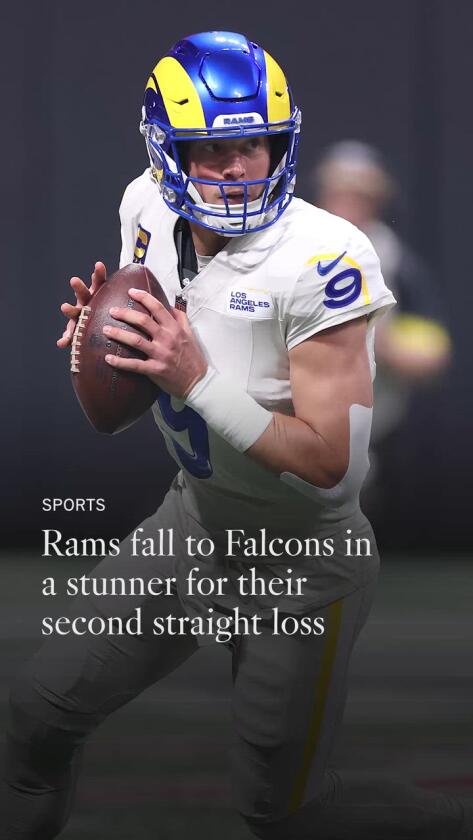
Kicker Harrison Mevis aims to get back on track when the Rams play the Atlanta Falcons on Monday night at Mercedes-Benz Stadium in Atlanta.
Mevis, signed by the Rams in November, made all eight of his field-goal attempts before missing from 48 yards late in the fourth quarter of the Rams’ 38-37 overtime defeat by the Seattle Seahawks on Dec. 18 in Seattle.
“Just continuing to keep firing away,” Mevis said. “I’m not going to be perfect in my career — nobody is. And it’s all about how you respond and bounce back and make the next kick.”
Share via
Gary Klein breaks down everything you need to know heading into Monday night’s matchup between the Rams and the Atlanta Falcons.
Three of the Rams’ four losses have resulted from major kicking-game miscues, and Blackburn’s firing was just the latest change made to solve the issues.
When the Rams signed Mevis to replace Joshua Karty — who last week was signed by the Arizona Cardinals off the Rams practice squad — they also brought in veteran snapper Jake McQuaide to replace Alex Ward.
The game against the Falcons will serve as Ben Kotwica’s debut as interim special teams coordinator.
Kotwica has worked in the NFL for most of the last 18 years, and he coached with McVay on Washington’s staff. Kotwica was the Denver Broncos special teams coordinator in 2023 and 2024 before joining the Rams staff as a special teams assistant.
“We’ve had a couple of plays that have cost us during the course of the year, but I love the way that our guys are going about the business,” Kotwica said. “They understand the urgency. We’re part of a championship football team and we’re just ready to contribute to holding up that Lombardi [Trophy] early next year.”
Key injuries
Rams: OL Kevin Dotson (ankle, out); DB Josh Wallace (ankle, out); WR Davante Adams (hamstring, doubtful); OL Alaric Jackson (knee, questionable); DL Braden Fiske (ankle, questionable but expected to play); CB Roger McCreary (hip, expected to be activated to roster from injured reserve).
Falcons: CB Mike Hughes (ankle, out); CB Clark Phillips III (triceps/illness, out); DL Sam Roberts (knee/ankle, out); WR Drake London (knee, questionable).
How to watch and listen to Rams vs. Falcons
The Rams (11-4) and the Atlanta Falcons (6-9) will play at 5:15 p.m. PST Monday. The game will be shown on ABC in the Los Angeles area and nationally on ESPN and ESPN Deportes. In Southern California, fans can listen to the game on 710 AM, 93.1 FM and 1330 AM (Español).
Betting odds and lines for Rams vs. Falcons
Who will win Rams vs. Falcons?
Gary Klein’s pick: A few weeks ago, this looked like a potential easy victory for the Rams. Now it could be more difficult. Still, Rams quarterback Matthew Stafford will outduel Kirk Cousins. Rams 30, Falcons 24
SAN ANTONIO — For a nine-win team such as USC, once again on the outside looking in at the College Football Playoff, the bowl season can feel a bit like purgatory. One foot in the past season, the other in the future, your team trapped somewhere in-between.
There were glimpses of each Tuesday night for USC in a brutal 30-27 overtime defeat to Texas Christian in the Alamo Bowl. There were equal reminders all night both of what could have been this season, had USC ever played at its best for long, and also flashes of why it never managed to be.
In one moment, there was freshman Tanook Hines, sprinting to catch a deep ball in stride, announcing himself as a rising star. In another, a TCU running back was busting his way through tackles on third-and-long, rumbling improbably into the end zone, deflating any such delusions of grandeur.
But after oscillating between those opposing poles, the final minutes against TCU took the Trojans on a tour of all their most glaring concerns from the 2025 season, from the leaky defense to the missed opportunities on offense.
Highlights from Texas Christian’s 30-27 overtime win over USC in the Alamo Bowl.
The Trojans saw a two-score lead evaporate in the final minutes of regulation. They got all the way to the five-yard line in overtime, only for the offense to stall and settle for a field goal. They even sacked TCU quarterback Ken Seals on second and 10, pushing the Horned Frogs out of field-goal range and forcing a third and 20.
All signs in that moment pointed toward the Trojans securing their 10th win, a feat they achieved only once over the past eight years. But then, against a three-man USC rush and with eight defenders in coverage, Seals checked down to running back Jeremy Payne in the flat.
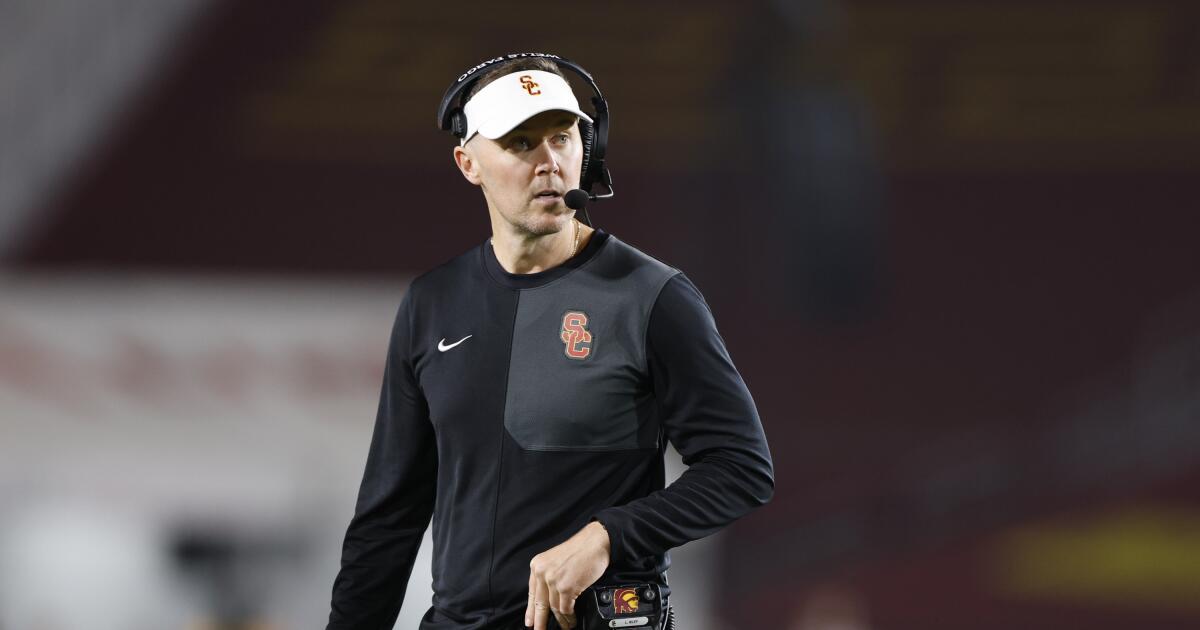
“We did everything right defensively to put them in that position,” USC coach Lincoln Riley said.
Nothing, though, went right for USC after that. Payne broke through a tackle from cornerback Marcelles Williams. Two defenders, linebacker Jadyn Walker and safety Kennedy Urlacher, collided as they reached Payne next, missing him entirely. Then, he slipped through safety Christian Pierce’s hands and was suddenly sprinting free 35 yards for the win.
“Wasn’t a lot of time this year that we missed multiple tackles on a play,” Riley said. “It just happened in the worst time possible.”
That’s how most of the fourth quarter and overtime felt for USC, as TCU racked up 159 yards and 17 points over its final three drives.
Of course, there had been multiple chances before then for USC to put the game away, just like there were multiple chances for USC to make more of its 9-4 finish this season. The Trojans averaged nearly a full yard per play more than TCU. They racked up eight plays of 20 yards or more — a reminder of how explosive they could be.
In the red zone, though, the offense unraveled. Quarterback Jayden Maiava, who was inconsistent most of the night, threw a third-quarter interception in the end zone, just as USC looked primed to go on a roll.
Four other times, the Trojans stalled inside of TCU’s 25-yard line and settled for field goals as kicker Ryon Sayeri set the USC record for field goals in a season at 21.
“We just did not execute good enough in the red zone on either side of the ball,” Riley said. “If we did that, it’s probably a different feeling.”
Instead, the Trojans will have to carry this bitter taste into the offseason, with questions already looming about what comes next. Not the least of which being what direction USC will take its defense, after coordinator D’Anton Lynn departed for Penn State just before the game.
USC running back King Miller is stopped short by the Texas Christian defense in the first half during the Alamo Bowl on Tuesday night.
(Eric Gay / Associated Press)
Riley wouldn’t comment on why Lynn was replaced as playcaller the day of the bowl game. But when asked how he felt about the future of his defense, Riley projected a particularly sunny outlook.
“I feel fantastic,” he said. “But those who really study the game and watch how we’ve played and the way we’ve been able to improve, the arrow is just pointing straight up.”
Of all the questions raised Tuesday, how USC might replace its No. 1 wideout next season was not one of them. Hines had already done his part to earn that role, but declared it to the world anyway in a six-catch, 163-yard performance.
King Miller also continued to solidify his place in a tandem with Waymond Jordan in 2026, as he rushed for 99 yards and a touchdown, coming up just short of the 1,000-yard mark in a season he started as a walk-on.
USC coach Lincoln Riley, right, greets TCU coach Sonny Dykes after the Trojans’ overtime loss in the Alamo Bowl on Tuesday night.
(Kenneth Richmond / Getty Images)
But the silver linings largely stopped there, even if the circumstances made for an unusually uphill climb with USC’s roster. Over a dozen starters or would-be starters sat out. Three of the Trojans’ starting offensive linemen didn’t dress. Both of their top receivers and top tight end were in street clothes, having declared for the NFL draft. Twenty-five players listed in USC’s two-deep Tuesday were either freshmen or redshirt freshmen.
Without Lynn calling plays, which a source described as “a mutual agreement”, defensive line coach Eric Henderson stepped into the role.
It went quite smoothly at first. USC held TCU to two straight three-and-outs — and just 11 total yards in two drives — to open the game.
But on the ensuing possession, Maiava threw into heavy coverage and was intercepted, his first of two on the night. The momentum USC had built up early dissolved almost instantly.
The defense’s strong start faded into disarray. And while it came roaring back after halftime, forcing an interception and limiting TCU to just 35 yards in the third quarter, USC’s offense couldn’t fully capitalize. A one-handed touchdown pass to Jaden Richardson nearly did the trick, giving the Trojans a 21-14 lead that seemed primed to balloon from there.
But it never did. And in the final, stunned moments of its season, Riley was left offering the same assurances that USC will soon be out of purgatory.
“When you’ve been in those programs and been a part of those teams that have done those things, you feel what it’s like,” Riley said. “And this place is doing all the things that you need to do to put yourself in position to go bust that door down and do it.”
TCU players celebrate after beating USC in the Alamo Bowl on Tuesday night.
Tired from hosting family for the holidays and planning on rising early for a workout, the 2004 Heisman Trophy winner and star USC quarterback did not stay up to catch the end of his alma mater’s game against Texas Christian in the Alamo Bowl on Tuesday night.
He likely does not regret that decision.
After allowing a 10-point lead to slip away in the final minutes of regulation, the Trojans eventually lost 30-27 in overtime after TCU running back Jeremy Payne caught a check-down pass on third-and-20 and broke multiple tackles on his way to the end zone for a 35-yard, game-winning touchdown.
It was a exasperating finish to a 9-4 season already considered a disappointment by many Trojan fans after the team failed to make the College Football Playoff for the fourth time in as many seasons under coach Lincoln Riley.
A number of former USC players took to social media during and after the game to express their frustrations. Leinart initially wasn’t one of them, even though some people thought he was commenting on the Alamo Bowl when he wrote, “Nobody cares…. I promise!” Tuesday night on X.
Later, the verified TCU Football account reposted Leinart’s post and wrote “cry on,” a play on the USC rallying cry, “Fight on!”
USC coach Lincoln Riley, right, shakes hands with Texas Christian coach Sonny Dykes after the Alamo Bowl
(Kenneth Richmond / Getty Images)
On Wednesday morning, Leinart wrote that his comment actually “had nothing to with USC game lol.” In a video posted about an hour later, the two-time NCAA national champion said he missed the last three drives because of his early bedtime. He did, however, offer brief thoughts on the previous night’s result and the state of Trojan football.
“Not a good way to end the season,” the Fox Sports analyst said. “It is what it is at this point. Big offseason.”
Su’a Cravens, a USC standout at safety/linebacker from 2013-15, also pointed to the next year as make-or-break for the Riley-coached Trojans.
“Another year goes by and yet we’re marching in the same ole place of above avg football!” Cravens wrote on X. “I pray to God this recruiting class and offseason squeezes every ounce of talent and work ethic out of this team next year. Because in my book, you either make the playoff next year or this was a failed experiment. Plain & simple!”
Cravens, who hosts Rams coverage on ESPN LA, added some constructive advice in a separate, and lengthy, post.
“Get more former players in the building coaching and showing these guys what it really means to be a Trojan!!!!” he wrote. “Let practices be open again and allow every single media camera on the sideline and create that Pete Carol [sic] environment of competition! Pressure makes diamonds !!! …
“ACTUALLY HOLD PLAYERS ACCOUNTABLE IN THE FILM ROOM AND BENCH THEM WHEN THEY REPEAT THE SAME MISTAKES!!!! Let’s get down the core of the issues.”
LenDale White, who won two national titles with the Trojans during the Carroll years, offered to be one of those former players to return as a coach.
“@uscfb i’m ready to be on the staff it’s time,” the former running back wrote on X. “What are we gonna do???”
White also vented about the Trojans’ Alamo Bowl performance — writing “Do y’all ever practice tackling ever or is it always about offense?” — and having to endure more than two decades without a national title.
“I truly don’t even know why I’m mad. I knew better lol. My fault!!!” White wrote. “Maybe one day I can see them in the playoffs maybe one day don’t look like no time soon!! and I hope I can eat my words.”
Former USC longsnapper Jake Olson was asked on X for his thoughts on Riley and the Trojans after Tuesday night’s collapse.
“I’ve made my thoughts on [Riley] pretty clear over the course of the season. Tonight’s game, although reminiscent of the season, probably isn’t the best measuring stick in all fairness,” Olson wrote. “But clearly there’s problems—problems that are still here from 4 years ago. Simply put, hes not it.”
Olson continued in the comments: “Except I will add this. It’s alarming to see how clueless Riley looks at times. He has regressed so much, especially in play calling. For 11 mil a year, and for offense to be his ‘forte,’ it’s become very sad.”
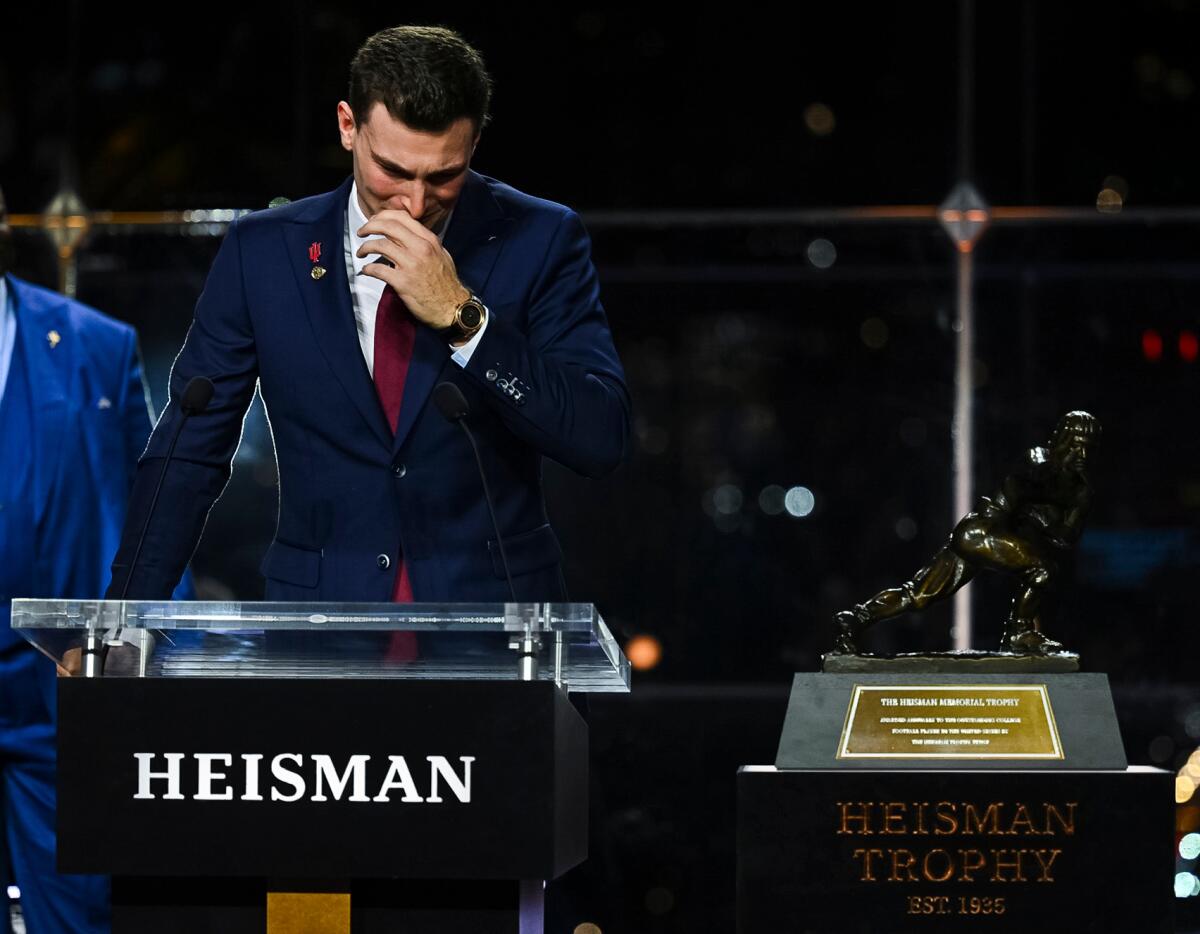
Through tears, Indiana quarterback Fernando Mendoza thanked every member of his family after becoming the first Hoosier to ever win the Heisman Trophy. The Cuban American quarterback recognized his family for believing in him throughout his career.
He was a two-star high school recruit who drew little attention before finally landing an opportunity to play at California. After three years with the Golden Bears, including a redshirt year, he transferred to Indiana. On Thursday, the No. 1 Hoosiers will take the field at the Rose Bowl, where they will face college football traditional power Alabama in the College Football Playoff quarterfinals.
Pressure is familiar for Mendoza. He’s faced challenges throughout his career — from proving himself as an overlooked high school athlete to earning his starting role at Cal.
Anytime Mendoza has met a hurdle, he considers how to help those around him shine.
Indiana quarterback Fernando Mendoza holds back tears while accepting the Heisman Trophy on Dec. 13 in New York.
(Todd Van Emst / Associated Press)
“I know that’s my responsibility to my coaches, to my teammates and to the entire team, to be able to be sharp mentally and not have outside influences, pressures and noise able to impact my game,” Mendoza said. “I think one thing is just keeping the process on how I got here, how the entire team got to this place, which is keeping the process that I’ve kept for every single game.”
The Hoosiers finished the season undefeated. They will play for their first Rose Bowl victory in 57 years and it’ll be the second year in a row Indiana has reached the College Football Playoff.
“His leadership has increased in those crucial moments and I think that’s what makes him such a special player — because when the stakes are the highest, he steps up and gets the team going,” Indiana linebacker Isaiah Jones said. “He’s a guy that people want to get behind and run a play for.”
Mendoza became the third player with Latino heritage to win the Heisman Trophy. His grandparents on both sides of the family were born in Cuba and during his acceptance speech, he made sure to thank them in Spanish.
In the NFL, Latino players have become a growing demographic. From 2021-25, representation jumped from 12 to 47 players who identify as Latino, with 32 on 53-man rosters at the start of the season. Mendoza is not in the league, but his elevated presence in the college football world has come with extra pressure of representing a culture and proving Latinos can succeed in football.
“To be able to play in this atmosphere in the Rose Bowl, it’s a special moment for myself, for my family, and I would say just being able to play in front of a Hispanic and Latino crowd, it’s what I do,” Mendoza said. “I want to inspire young Latino kids and I want to always represent my culture to the highest.”
On Thursday, Mendoza will take the field for the first time as a Heisman winner, adding another layer of intensity to his game. The award winner is expected to do many national media interviews and Mendoza recently was a prominent voice during a “60 Minutes” segment about Indiana.
“What you see on camera is who he is,” Jones said. “Whether it’s in the locker room or out to eat with some of my teammates, he is one of the more genuine people on the team.”
Indiana coach Curt Cignetti hopes the expectations that come with the Heisman Trophy don’t change the quarterback’s style.
“It’s really critical now that he develops a sharp edge in his preparation and doesn’t play like, ‘Oh, I’m the Heisman Trophy winner and I’ve got to do this or do that,’ because we’ve all been following this game long enough to know we’ve seen some of those performances,” he said.
Cignetti understands the difficulty of the opponent standing in front of Mendoza. The Alabama defense works to throw the quarterback off balance. The Tide have great players who play hard and fast. In order to win, Mendoza and his teammates need to play the way they have all season.
“At the end of the day, it’s all about execution, left tackle doing his job, running back, receiver, and Fernando being on point,” Cignetti said.
Mendoza said he is up to the challenge. When he takes the first snap in Pasadena, he won’t be thinking of personal statistics or awards, he’ll be thinking about the national championship.
“Now we have to get the ultimate team award,” he said.
The scouting report was clear. The Pistons (25-8) were second in the league in points in the paint. They were third in points off turnovers and third in turnovers forced.
The Lakers played directly into Detroit’s hands.
Detroit scored 74 points in the paint, the most allowed by the Lakers all season, and capitalized on 21 Lakers turnovers for 30 points. Entering the game, the Pistons’ 58.1 points in the paint per game were only narrowly behind Oklahoma City’s league-leading 58.2.
“We’ve got to definitely match their physicality,” said Luka Doncic, who led the Lakers with 30 points and 11 assists, but had eight turnovers, which is tied for his second-most in a game this season. “That’s the whole point. We got to match how they play.”
Last week, the Lakers faced Phoenix and Houston, two teams with similar styles to Detroit. The Suns averaged 59 paint points in their two wins over the Lakers in December compared to 44 in the Lakers’ Dec. 14 win. The Rockets poured in 68 paint points on Christmas Day.
The Pistons made more shots in the paint (37) than the Lakers attempted (34) and kept their shooting percentage sky-high when three-pointers started to fall. Detroit, which had been shooting 34.7% from three this season, made 11 of 24 (45.8%) from beyond the arc Tuesday.
“We had a game plan,” James said as the Lakers allowed a season-high 63.2% shooting from the field. “We understand that they’re probably No. 1 in points in the paint in the NBA. They get a lot of their points off fast breaks and in the paint. So we knew we’d try to make them miss from the outside and they made some tonight and that’s OK.”
Marcus Sasser hit four of six from three, all in the second half, to finish with 19 points off the bench. Cade Cunningham starred for the Pistons with 27 points and 11 assists.
The Lakers are still searching for an identity after 31 games, a task complicated by injuries that have depleted their rotation for much of the season.
They’re lacking a defensive personality. They haven’t been a physical team, an overly athletic team or a fast team.
The Lakers got a close look at a team that embodies all of those characteristics in a 128-106 loss to the Detroit Pistons on Tuesday night at Crypto.com Arena.
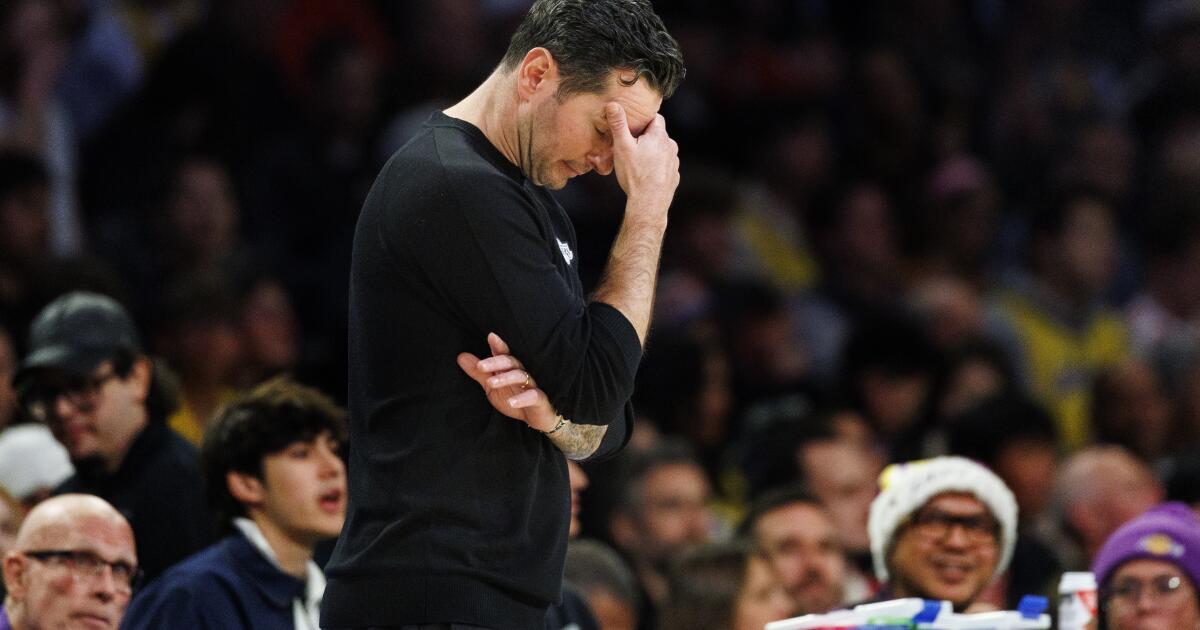
Coach JJ Redick acknowledged the Lakers are still trying to figure out who they are and how they can fix their issues after losing for the fourth time in five games.
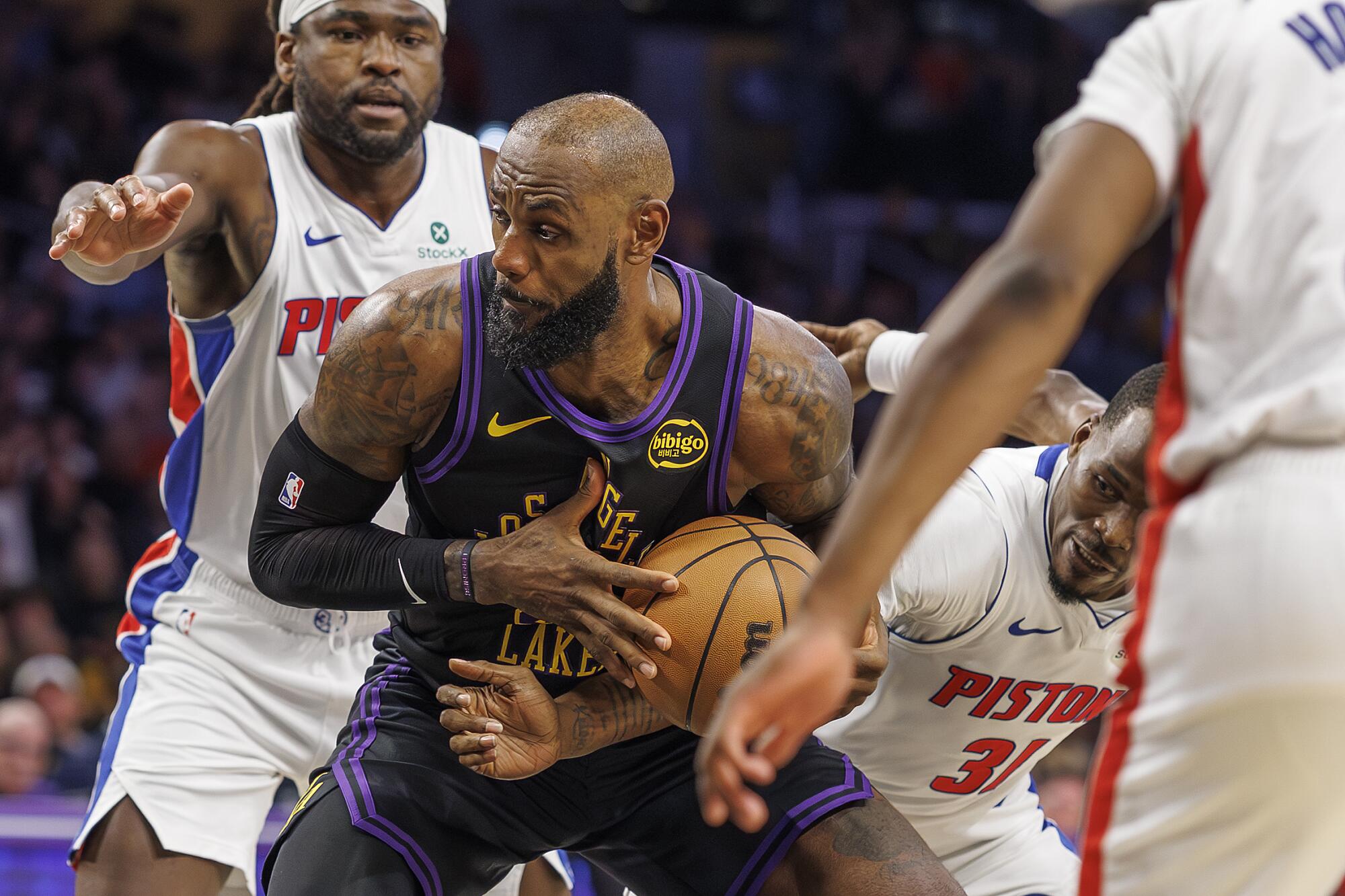
Lakers star LeBron James is fouled by Detroit Pistons guard Javonte Green (31) in the first half Tuesday.
(Gina Ferazzi / Los Angeles Times)
“The players, staff, everybody, we’ve really tried to play the right way every night and have the right intent,” Redick said. “The flow of lineups and rotations and all that has been challenging for everybody, not just the coaches. It’s a challenge for the players. And building an identity is difficult.”
“I think that’s hard to figure out with this team right now.”
It’s been hard because starters Austin Reaves (calf) and Rui Hachimura (calf) are out. Key rotation player Gabe Vincent (back) is also out. In addition, LeBron James missed the first 14 games with sciatica.
The Lakers’ roster has been completely healthy for just two games this season.
“We got some very important guys out right now,” said James, who scored 17 points on his 41st birthday. “So that’s very hard to get a rhythm of chemistry on the floor with guys that you know you’re gonna play with every night. Guys you know are going to come in with the subs and patterns and things like that.
“But still no excuse. We still got to go out and execute and I think we did that tonight. I thought, like I said, the turnovers were too many pick-sixes, but we came in, we played hard, we executed. The better team tonight won.”
What the Lakers (20-11) haven’t done much all season is play defense at a high level.
That was the case against the Pistons (25-8), who shot 63% from the field and 46% from three-point range. They had 74 points in the paint, getting inside with ease. They also had 31 fast-break points. The Lakers had 21 turnovers, eight coming from Luka Doncic, who finished with 30 points and 11 assists.
“We’ve got to definitely match their physicality,” Doncic said. “That’s the whole point. We got to match how they play.”
The Lakers’ 11 losses have been by an average of 20.3 points per game.
The Lakers got better on defense in the third quarter. After giving up 36 points in the first quarter and 34 in the second, the Lakers gave up 26 in the third and were down 96-88.
But they fell apart in the fourth, giving up an 18-6 run that put them in a 20-point hole midway through the quarter. The Lakers turned the ball over six times during that stretch, leading Redick to call a timeout with six minutes remaining.
That still didn’t stop the Pistons from building a 26-point lead and coasting to victory.
“Yeah, I think we just let off of the rope a little bit,” Doncic said. “Like I said, I think we played good basketball for three quarters, physical basketball. We just kind of let go of the rope.”
Lakers guard Luka Doncic, right, inadvertently hits Detroit Pistons forward Ronald Holland II (5) in the face after Holland steals the ball in the second half Tuesday night.
Ethan Hill and Shalen Sheppard were the twin towers for Brentwood’s boys basketball team last winter. Now, without one of his best buddies, Hill is learning to cope just fine — and his teammates are following his lead.
The 6-foot-7 sophomore forward had 32 points and 18 rebounds while earning all-tournament honors as the Eagles held off Millikan 75-68 to win the Silver Division championship Tuesday afternoon in the Classic at Damien.
To the surprise of his coaches and teammates, Sheppard decided at the end of September to transfer to Crossroads in Santa Monica. He is one of the highest-rated players in his graduating class.
Shalen Sheppard scores 22 points for Crossroads in a Gold Division consolation game against San Joaquin Memorial during the Classic at Damien on Dec. 30, 2025.
(Steve Galluzzo / For The Times)
“Honestly, I was just shocked,” Hill said upon learning of Sheppard’s departure. “We’ve been playing together since eighth grade. We just had the craziest chemistry. It’s a bigger challenge without him, but I believe we’re up to it. Our coaching staff pushed us hard every day.”
Led by their two fantastic freshmen, the Eagles went 25-5 last season. Sheppard averaged 16.6 points and 8.0 rebounds per game while Hill averaged 8.4 points and 5.5 rebounds.
“Leaving Ethan was one of the hardest parts about transferring,” said Sheppard, who scored 22 points in the Roadrunners’ 57-48 loss to San Joaquin Memorial in a Gold Division consolation game earlier in the day at Ramona Middle School. “I play AAU with him and he’s one of the first people I called the night I decided.”
The sit-out period for transfers ended right before the Damien tournament. With four games under his belt, Sheppard is adjusting to being without his frontcourt mate.
“I was getting double-teamed a lot so I got a little tired but as a squad we’re playing real tough teams right now,” he said. “It’s hard without Ethan. Him being a big body and taking up the middle cleared a lot of space for me. I might go over and watch his game later.”
Crossroads (9-8) faces a huge test Saturday against Crean Lutheran, ranked fifth in the Southland by The Times. On Tuesday, Crean Lutheran fell to No. 10 Crespi 57-54 for third in the Platinum Division.
“I have more gym time because Crossroads is not as academically rigid,” Sheppard said. “Traffic was a factor also. I live in the same place, but I can take the Metro or the bus to school. Sunset [Boulevard] at rush hour wasn’t fun.”
Brentwood guard AJ Okoh drives for a layup on his way to MVP honors in the Silver Division championship game of the Classic at Damien on Tuesday.
(Steve Galluzzo / For The Times)
Meanwhile, Hill and junior guard AJ Okoh are building chemistry, and it showed against Millikan. Okoh dished out four assists and scored 23 points, including a three-pointer which gave the Eagles a five-point cushion with 1:30 remaining. He was named most valuable player. Fellow guard Auggie Sugarman netted 14 points and named to the all-tournament team.
“AJ and I complement each other well,” said Hill, whose scoring was as balanced as can be — 11 points in the first quarter, six in the second, eight in the third and seven in the fourth. “He gets downhill quick and his passing ability is amazing.”
Senior Jeremiah Hunt made seven three-pointers to keep the Rams (11-6) in striking distance and finished with a game-high 34 points. Freshman guard Quali Giran, who entered the contest averaging 24.5 points per game, finished with 18 points and eight assists and joined Hunt on the all-tournament team.
Crespi’s Rodney Mukendi tries to block a jump shot by Crean Lutheran’s Chadrack Mpoyi in the third-place game of the Platinum Division in The Classic at Damien on Dec. 30, 2025.
(Steve Galluzzo / For The Times)
Brentwood, ranked 19th in The Times’ Top 25 poll, has won seven in a row since its lone loss to Goodyear (Ariz.) Millennium on Dec. 17 and improved to 17-1. The Eagles beat Woodland Hills Taft, Newport Beach Pacifica Christian and Dublin on their way to the finals.
“Not having Shalen puts a lot more attention on me and that frees up my teammates,” Hill said. “We have the same goal, to go all the way and I have all the confidence and belief in us.”
Hill and Sheppard look forward to reuniting Jan. 9 in the first of two Gold Coast League matchups between their schools.
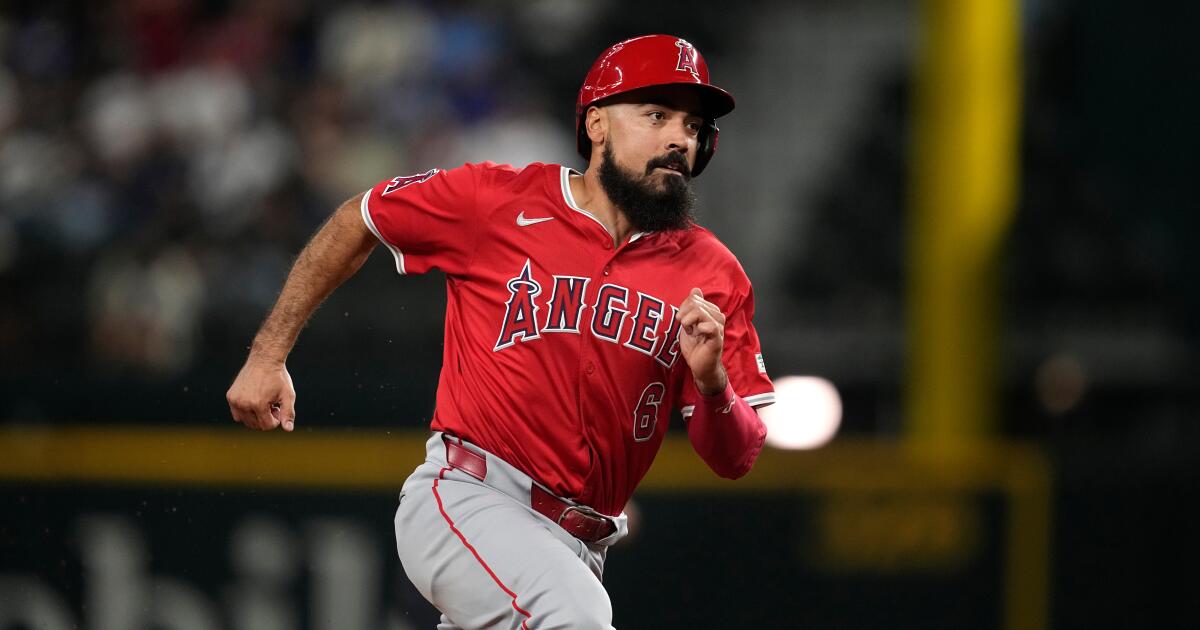
Anthony Rendon has agreed to restructure the final year of his $245-million, seven-year contract with the Angels, a person with knowledge of the decision told the Associated Press on Tuesday night.
The person spoke on condition of anonymity because the Angels hadn’t announced any developments with Rendon, who didn’t play last season following hip surgery.
The team and Rendon have amended the deal to restructure the remaining $38 million owed to the third baseman in 2026, presumably spreading the money over time.
Rendon is still on the roster and continuing to rehab at home in Houston, but his horrendous tenure with the Angels could be over.
Rendon’s massive free-agent contract has paid almost no dividends for the Angels. The former Washington Nationals standout has been injured for the majority of the past five seasons and has played just 257 games in an Angels uniform, batting .242 with 22 homers, 125 RBIs and a .717 OPS.
If Rendon doesn’t play in 2026, he will have appeared in only about a quarter of the Angels’ total games during his seven seasons with the team.
Rendon led the majors in RBIs, earned an All-Star selection and won a World Series ring in 2019 to cap an outstanding four-year stretch for Washington. After playing fairly well for the Angels during the pandemic-shortened 2020 season, he was nowhere close to that player in the ensuing four years with the Angels, who haven’t made the playoffs or had a winning record during his tenure.
Rendon dealt with injuries to his groin, his left knee, his left hamstring, his left shin, his oblique muscles, his lower back, both wrists and both hips during the past five years.
Rendon also alienated Angels fans with public comments in which he appeared to say he doesn’t like baseball, although he attempted to clarify his connection to the game as a business relationship that isn’t as important as his family or his religion. Rendon had previously criticized the length of games and excitement level of baseball, saying he doesn’t watch the sport.
Luis Rengifo and Yoán Moncada largely played third base last season for the Angels. Both are currently free agents.
Rendon’s deal might top the long list of high-priced player acquisitions that have worked out terribly for the Angels during owner Arte Moreno’s tenure, including the signings of Gary Matthews Jr., Josh Hamilton and Zack Cozart and unsuccessful trades for Vernon Wells and Justin Upton.
ATLANTA — The Rams wanted to make the playoffs in the worst way.
Mission accomplished. They’re headed to the playoffs in the worst way imaginable.
Monday night’s 27-24 loss to the Atlanta Falcons was an abomination — you could feel that vibe in the postgame locker room — but the Rams need to study it, even if it requires contraptions to pry open their eyes.
Share via
Gary Klein breaks down what went wrong for the Rams in their 27-24 loss to the Atlanta Falcons on Monday night.
“I think if we play the way that we did in the first half … we’re going to be at home watching everything go down in two weeks,” defensive tackle Kobie Turner said. “We’ve got to get our stuff together.”
This was one of only three times in Sean McVay’s nine seasons that his team was held scoreless in the first half, which is bad enough. But that the going-nowhere Falcons built a three-touchdown halftime lead is absurd. Not so long ago, Atlanta lost seven of eight.
The Rams looked nothing like the team that just about everyone had at the top of their power rankings for most of the season. Matthew Stafford had three interceptions. Fill-in left tackle D.J. Humphries had a pair of penalties that wiped out two huge receptions. And Atlanta’s Bijan Robinson would still be running now but decided to stop once he reached the end zone (after a 93-yard touchdown, mind you.)
Those Rams who started 9-2 (and should have won those games against Philadelphia and San Francisco) are a fading memory. Since, they have lost three of five.
Now, all the other NFC contenders are getting hot — Seattle, San Francisco, Philadelphia, Chicago — and the Rams are shuddering in an emotional ice bath.
Suddenly, their erstwhile insignificant finale against Arizona on Sunday is vitally important. They need to rediscover their rhythm rather than hoping to do so in the first round of the playoffs. They can’t change their swing in the middle of this golf tournament. They need to work out the kinks on the practice range.
Getting receiver Davante Adams back is key, and he looked good in warmups, running as if his hamstring problems are behind him. But he’s desperately needed in the red zone, and that will lift some weight off the shoulders of Puka Nacua.
Just as important, the team needs left tackle Alaric Jackson and right guard Kevin Dotson back from injuries. The Rams are getting a taste of what the Chargers have been through all season, their offensive line going through a reshuffle every week.
And the defense should benefit greatly from the return of Quentin Lake, a quarterback on that side of the ball.
Regardless, good teams overcome the loss of key players and find ways to win with backups. Every team would love to be at full strength.
Rams wide receiver Puka Nacua pulls in a long pass over Atlanta Falcons cornerback C.J. Henderson in the first half Monday.
(Brynn Anderson / Associated Press)
And while the Rams should have been in position to kick the tying field goal down the stretch — there was an unflagged pass interference against Tutu Atwell, who made a good attempt to catch a deep ball with his hand that wasn’t being grabbed — they shouldn’t have been in that predicament in the first place.
As they watched their lead evaporate, the Falcons had to be having flashbacks to their catastrophic 25-point collapse to New England in the Super Bowl. After all, the Rams outscored them in the second half, 21-6.
But all of that was cold consolation to the visitors, who couldn’t close the deal.
The Rams have lost back-to-back games, and were looking for a boost after blowing a 16-point fourth-quarter lead in Seattle. Instead, they got a slap in the face.
Rams quarterback Matthew Stafford speaks to reporters after a 27-24 loss to the Atlanta Falcons on Monday.
(Brynn Anderson / Associated Press)
It’s ultra-rare for a team to head into the playoffs on a down note yet still reach the mountaintop. The last franchise to do that was Baltimore in 2012, a club that lost four of its last five games — albeit missing a slew of injured stars — then beat in succession teams quarterbacked by Andrew Luck, Peyton Manning, Tom Brady and an in-his-prime Colin Kaepernick.
So it can be done. A bumbling team can find its way. And it looked for a moment Monday night as if the Rams had turned a corner.
Jared Verse blocked a Falcons field-goal attempt, recovered the bouncing ball and returned it for a 76-yard touchdown. As he tore past the Atlanta sideline, he glanced over and playfully raised his hand to form a G-rated gesture.
Unless a dramatic change is coming, it’s a message the rest of the playoff teams could be saying to the Rams.
First clue that someone is serious about pingpong: They call it table tennis.
Second clue: They bring their own paddle.
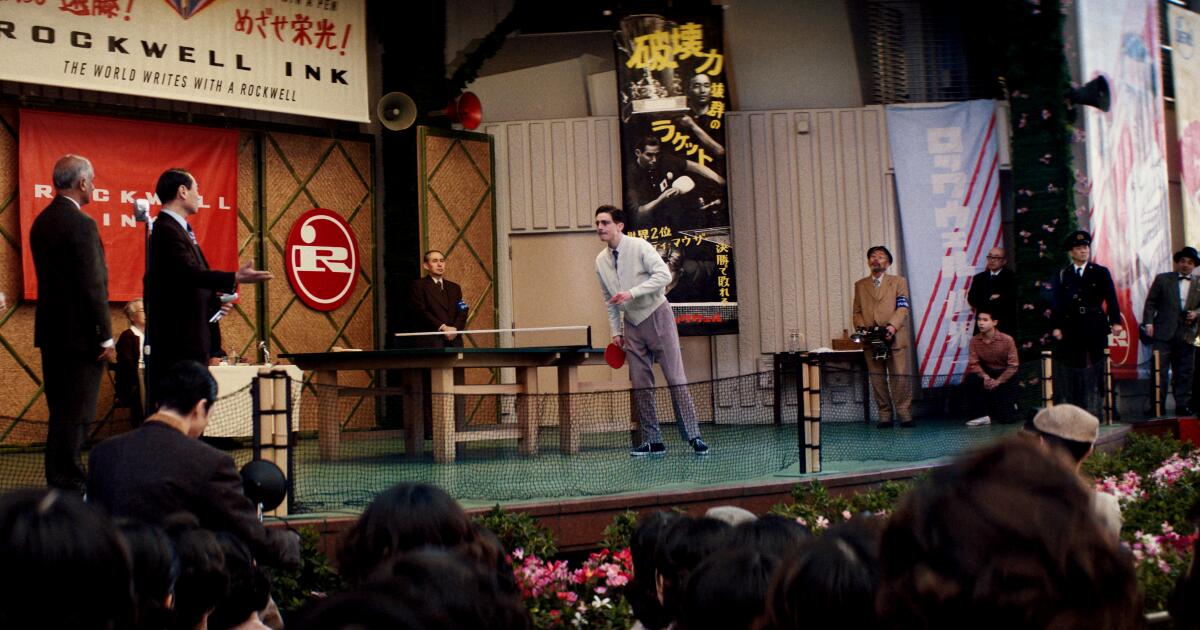
Timothée Chalamet dropped a third clue on movie sets all over the globe. To prepare for his role in the delightfully frenetic “Marty Supreme,” the two-time Oscar nominee traveled for years with a table in tow, training and presumably enjoying the sport at the center of the current holiday season hit.
Director Josh Safdie enlisted the husband-and-wife table-tennis teaching tandem of Diego Schaaf and Wei Wang — a former U.S. Olympian — to elevate Chalamet’s game as well as serve as technical advisors on set.
But Chalamet was already playing nearly well enough to emulate a world champion on screen. He’d taken lessons and done his homework — setting up a table in the living room of his New York apartment and playing throughout the pandemic.
“Everything I was working on, it was this secret,” Chalamet told the Hollywood Reporter. “I had a table in London while I was making ‘Wonka.’ On ‘Dune: Part Two,’ I had a table in Budapest [and] Jordan. I had a table in Abu Dhabi. I had a table at the Cannes Film Festival for ‘The French Dispatch.’”
It seems implausible that Chalamet was immersed in table tennis while also learning to sing and play guitar for the role of Bob Dylan in “A Complete Unknown.”
“If anyone thinks this is cap, as the kids say — if anyone thinks this is made up — this is all documented, and it’ll be put out,” he said. “These were the two spoiled projects where I got years to work on them. This is the truth. I was working on both these things concurrently.”
Wherever Chalamet found the time, Schaaf was impressed by the result.
“He was singularly dedicated to getting this to be the same quality as the rest of the movie,” Schaaf told the Hollywood Reporter.
Eschewing a stunt double for the table tennis scenes was a point of pride for Chalamet. The only concession to modern moviemaking was that several of the longer sequences during games were choreographed without a ball, which was added later via computer-generated imagery (CGI).
“We realized it had to be scripted to be able to film it,” Schaaf told the Washington Post. “And because it was scripted, we had to practice it first with a real ball. He had to understand the physical layout of the point: Where does he have to go? When does he have to go there? When you later on do [visual effects] and put the ball in there, it’s critical that the player goes to the right place.”
Schaaf said about 60 points were scripted.
“We needed a lot of rehearsal, and I was amazed,” he said. “Timothée wound up getting a better feel for it than most professional players because professional players take the cue from the ball. You take the ball away, they all were like ‘What is the timing?’
“Of course, they have a good sense of timing and then they learned it quickly. But Timothée was right there on top of it.”
The on-screen rival of Chalamet’s character, Marty Mauser, is Koto Endo, portrayed by real-life Japanese table tennis champion Koto Kawaguchi. Their dynamic approximated the real-life rivalry between 1950s U.S. champion Marty Reisman and Japan’s Hiroji Satoh.
In her review of “Marty Supreme,” Times film critic Amy Nicholson noted that well-struck pingpong balls travel up to 70 mph.
“Set in 1952 New York, this deranged caper races after a money-grubbing table tennis hustler (he prefers ‘professional athlete’) who argues like he plays, swatting away protests and annoying his adversaries to exhaustion,” she wrote.
Nicholson offers that Reisman would be pleased by the movie, “which time-travels audiences back seven decades to when American table tennis players were certain bright days were ahead.
“As an athlete, Chalamet seems to have lost muscle for the role. Yet as funny as it is to see a guy this scrawny carry himself like Hercules, he leaps and strikes with conviction.”
Nothing gives an actor — or an athlete — self-assurance like practice, repetitions and rehearsals. Chalamet’s paddle performance is proof.
The century-old rivalry series between USC and Notre Dame is taking a few years off, and as far as Lincoln Riley is concerned, that’s the fault of the Irish.
In his first public comments since the series was officially put on hiatus, the USC coach put the blame squarely on Notre Dame for not accepting USC’s most recent offer to continue the rivalry, which would have moved the 2026 game, usually scheduled in November, to the very beginning of the season.
“It’s pretty simple,” Riley said Monday, ahead of USC’s bowl matchup with Texas Christian. “We both worked for months to try to find a solution. Notre Dame was very vocal about the fact that they would play us anytime, anywhere.
“Jen Cohen, our AD, went back to Notre Dame roughly a couple of weeks ago with a scenario and a proposal that would extend the series for the next two years. We took Notre Dame at their word that they would play us anytime, anywhere. That proposal was rejected.
“Not only was it rejected, but five minutes after we got the call, it was announced they scheduled another opponent, which I’ll give them credit, that might be the fastest scheduling act in college football history.”
The Times reported last week that the Playoff selection earlier this month proved to be a turning point for USC’s administration in talks with Notre Dame. The realization that the Irish — by virtue of a side agreement with the College Football Playoff committee that hands them a bid if ranked in the top 12 — would have gotten into the field over Miami especially gave USC pause.
That’s when Cohen returned to Notre Dame athletic director Pete Bevacqua with an offer for the rivals to face off in the season opener. Notre Dame instead scheduled Brigham Young to fill that vacancy over the next two seasons.
Riley has been roundly criticized for his part in the rivalry’s potential demise after he suggested in August 2024 that the annual series could be in danger, if USC proved too much of a hurdle in the Trojans’ path to the College Football Playoff.
In the spring, as negotiations between the two schools stalled and the public pointed fingers at Riley and USC, Notre Dame coach Marcus Freeman said that continuing the rivalry was “pretty black and white for me.”
“I want to play them every single year,” Freeman said. “You want my opinion? I want to play them every single year. When? I don’t care. I don’t care when we play them: Start of the season, middle of the season, end of the season. I don’t care. I want to play USC every year because I think it’s great for college football.”
After initially holding firm on its intent to renegotiate terms of the rivalry year-to-year, so as to wait on changes to the College Football Playoff format, USC sent an amended offer to Notre Dame before the season that would have extended the series for two seasons. But Notre Dame wanted a longer deal.
The two schools nearly came to an agreement in October, around their final meeting in South Bend. USC had made clear that it wanted to play the game earlier in the season, but was warming up to the idea of continuing the series as is through 2027.
USC decided to dig its heels in after Selection Sunday, returning to USC with a final offer to play early in the 2026 season. Notre Dame declined.
“The fact is very, very clear, this can all be settled very quickly,” Riley said. “Had Notre Dame lived up to their word and played us anytime, anywhere, we would be playing in the next two years, and looking ahead after that, hopefully continuing the series.
“They did not follow through on it, thus we are not playing them the next couple years. We’re hopeful something can be worked out in the future. That would be fantastic. We at SC would love for the game to continue. We have no problem following through on our promises in the future.”
It’ll be a while before those negotiations start up again. The next window in which USC could play Notre Dame is during the 2030 season.
Kawhi Leonard scored a career-high 55 points, James Harden added 28, and the Clippers extended their winning streak to a season-high four games with a 112-99 victory over the Detroit Pistons on Sunday night at Intuit Dome.
Leonard went 17 for 26 from the floor, including five for 10 from three-point range, and made 16 of 17 free throws, his miss in the third quarter ending a streak of 64 straight from the line this month. He scored 26 points in the third quarter.
Leonard tied the team record for points in a game, set by Harden on Nov. 22 at Charlotte, and became the second in franchise history to score at least 40 points in consecutive games at home, joining Bob McAdoo.
Nicolas Batum scored 12 points, while Leonard added 11 rebounds and five steals for the Clippers (10-21), who lost 10 of 11 before this four-game run.
The Clippers, the oldest team in the NBA, took things to the extreme with three starters in Harden, Batum and Brook Lopez age 36 or older. All five starters were in their 30s, with Leonard (34) and Kris Dunn (31) the other two.
Cade Cunningham finished with 27 points for the Eastern Conference-leading Pistons after being held scoreless in the first half while in foul trouble. Jalen Duren had 18 points and 14 rebounds, and Jaden Ivey added 11 points for Detroit, which lost back-to-back games for just the second time.
Playing without injured center Ivica Zubac for the third consecutive game, the Clippers were all business from the start. Their first double-digit lead came four minutes into the game at 16-6 on a three-pointer from Harden.
The Clippers led by as many as 20 points in the first half when Leonard scored 25 points. The Pistons pulled within nine points twice in the third quarter before a 16-5 run gave the Clippers another 20-point lead at 81-61 on a Leonard three-pointer.
Up next for the Clippers: vs. the Sacramento Kings at Intuit Dome on Tuesday.
It’s impossible to sum up the full impact that Gabriel has had on generations of Mexicans and Mexican Americans. It’s more than the songs or the stage persona or the me vale attitude to what you thought about his sexuality. It’s the fact that for many of us he’s a connection to our families (raise your hand if your mom made you clean the house while blasting his music), to our homeland and to our culture. He gave us a shared language that affords us the opportunity to rejoice or grieve as a community.
There are profiles written about the man that are worth your time — I recommend this one published in The Times in 1999 — but for this newsletter we turned it over to our community to tell us how El Divo de Juárez forever changed their lives.
Juan Gabriel and the LGBTQ community
Juan Gabriel when asked if he was gay: “Lo que se ve no se pregunta”
(Julio Salgado / For The Times)
Luis Octavio remembers the first time he saw Gabriel. He was sitting with his family and the singer was about to perform on the weekly Mexican variety show “Siempre en Domingo.”
But all he could focus on was the sequins Gabriel was wearing.
“It gave me a little bit of hope that maybe my jotería would be accepted just the way my abuela, my abuelo, the tíos and everybody else who saw him on that screen accepted his and saw past his flamboyance,” said Octavio, co-founder of the drag bar El Place and one of the organizers of Boyle Heights’ first pride event.
Gabriel’s sexual orientation has always been an open secret. It has always been assumed that he was gay, but it was rarely discussed, with one glaring exception.
During a 2002 interview with news program “Primer Impacto,” reporter Fernando del Rincón asked Juanga point-blank if he was gay. With daggers in his eyes, Gabriel responded with “Lo que se ve, no se pregunta.” What is seen is not asked.
Octavio told me this interview always stood out for him — he described it as iconic, which, yeah, it is — because it told Mexican queer people that being who they were was more than enough and that you didn’t owe anything to anyone.
It’s a sentiment that Nomi B, a drag queen who hosts “Noche de Gringaderas” at El Place, certainly relates to.
“We all knew he was a sister,” she said.
“I admire that he kept his life private and he was like, ‘I don’t care what you think or say about me. I’m going to keep my life private and you’re going to enjoy my music no matter what.’”
Our daily news podcast
If you’re a fan of this newsletter, you’ll probably love our new daily podcast, “The Times,” hosted by columnist Gustavo Arellano, along with reporters from across our newsroom. Every weekday, it takes you beyond the headlines. Subscribe on Apple Podcasts and follow on Spotify.
‘Abrázame que el tiempo es malo y muy cruel amigo’
In 2000, Juan Gabriel released “Abrazame Muy Fuerte,” an operatic banger that makes the case that time is cruel, unforgiving and finite for humans. Because of this, he begs his subject to pend much of that time embraced in each other’s arms. The song was a huge hit and was used as the theme song for a telenovela that shared the same name.
A few years later, it also became my parents’ song.
Around that time, my mom developed a brain tumor. The doctors didn’t know yet if it was malignant, but my family assumed the worst. The prospect of losing our anchor became very real. My dad took it the hardest, and because he is the embodiment of the closed-off macho who tries very hard not to emote, he didn’t have an outlet to let out what he was going through.
So he did what any Mexican would do: He turned to Juan Gabriel.
I was away at college when this happened, but my sister would tell me that he’d play the song nonstop, sometimes sitting next to my mom on the couch with his eyes closed in prayer. It must’ve worked because the tumor ended up benign. Decades later, my mom is the healthiest she’s ever been.
During the pandemic, that song took on an added meaning for me. It was late last year and my parents and I decided to take a road trip. “Abrazame Muy Fuerte” came on. All three of us started singing along, and it wasn’t long before we started bawling. The painful memory came back, but with it came the realization that we still had time and we were spending it together.
That’s the thing about Juan Gabriel’s music. These aren’t just songs. They’re memories. They’re feelings we can’t express, and even if we could, why would we when Juanga’s already done it better?
When I decided to write about Gabriel, I knew that I wanted others to share some of their favorite songs. I asked friends and colleagues to contribute a song for this Spotify playlist and to write a few lines about why they picked that tune.
Artist Julio Salgado: “I wanted to illustrate a mom teaching her son to clean while listening to Juan Gabriel. I totally took this from my own experience as my mom had no tolerance for boys just sitting around and not cleaning when we were growing up.”
(Julio Salgado / For The Times)
“Querida”— He’s just so dramatic! Like, “Yes, b—!” (Nomi B, drag queen)
“Amor Eterno” — If there’s a song that defines who Juan Gabriel is, it’s “Amor Eterno.” Since he wrote the song for Rocio Durcal, it’s Juan Gabriel as a song writer. As a singer, his emotion has made it the quintessential Mexican song about heartbreak, regret, and ultimately, trying to make sense out those emotions. With the song’s lyrics and emotions — along with Juan Gabriel being from the Juárez-El Paso borderland — it’s little wonder why “Amor Eterno” was played and sang everywhere in the days following the El Paso massacre. (Roberto José Andrade Franco, writer-at-large at Texas Highways)
“La Frontera” — When I first moved to the U.S. I felt like I didn’t belong here because I didn’t speak perfect English and nobody could pronounce my name. Listening to that song and how he talked about how everybody’s happy at the border and how everyone’s different, it made me feel safe. (Luis Octavio, co-founder of Boyle Heights drag bar “El Place”)
“Inocente Pobre Amigo” — Juan Gabriel was the first poet in my life, a staple at my parents’ home in South Gate, California. My mother owned all of his albums. And when I went away to study literature at the University of Chicago, I took them with me.
I was back in California, walking around in Boyle Heights, when he passed. I got the news alert. Then, all along César E. Chávez Avenue, shop owners blasted his songs. Juan Gabriel wrote hundreds. I know all of them.
For beginners, I recommend “Inocente Pobre Amigo,” which recounts a heartbreaking disillusion but, above all, is a song about valuing yourself. Go on YouTube. Find the version that was recorded during Juan Gabriel’s first concert in Mexico City’s Palace of Fine Arts. Watch him perform with his hands on his hips, glistening in black and gold sequins. Hear him crack jokes with the audience and watch the mariachis on stage try to muffle their laugh. Recall that some elitists thought his work was too lowbrow for the venue.
When Juan Gabriel passed in 2016, his ashes were taken to that same place. For hours on end, hundreds of thousands of people poured in to pay their last respects. I wish I’d been one of them. (Julia Barajas, Los Angeles Times staff writer)
“El Noa Noa”— It’s a song about a place where you can go and be who you are. The ambience of the bar might be different than what people are used to, but it’s about everyone being welcomed and letting them feel like they can be happy. (Melissa Befierce, Mother of Haus of Befierce and events coordinator at El Place)
“No Tengo Dinero”— For me, Juan Gabriel’s songs are tied to memories of me riding on my grandfather’s truck with my aunt and my grandmother on the roads of Campeche where we lived for a few years. Juan Gabriel’s “No Tengo Dinero” is one of his iconic songs because for many it’s always a struggle to have money, but if at least we have love, we know we’ll be alright. (Denise Florez, Los Angeles Times multiplatform editor)
“Have You Ever Seen the Rain? (Gracias al Sol)” — My mom and tías have always been huge Juan Gabriel fans. I grew up in El Paso and he of course has immensely close ties to Juárez, where his career took off. His music is the soundtrack of my childhood. There was a brief time when it was around so much, it annoyed me. But when I moved away from home, that soundtrack became so powerful and comforting. It instantly connected me with my family. My sister, mom and I have sung (poorly) along to “Querida” hundreds of times at this point. But that’s going to be almost everyone’s favorite song. It’s just kind of perfect JuanGa. But the one I’ll choose for this playlist is what I believe is the only cover he ever did: “Have You Ever Seen the Rain? (Gracias al Sol).” In the video, he’s wearing amazing rainbow-colored pants and having so much fun. He brings joy to his work and it’s infectious. He’s also a great singer, so it stays on my playlist along with the much older hits. (Iliana Limón Romero, Los Angeles Times deputy sports editor)
“Hasta Que Te Conocí” — Later brilliantly covered by Ana Gabriel, it is the perfect song about love gone sour, heightened by lyrics that are pure melodrama. (Carolina Miranda, Los Angeles Times columnist)
“Así Fue” — He was never more brilliant, more heartbreaking, more JuanGa than in that song. (Gustavo Arellano, Los Angeles Times columnist)
“Costumbres” — Here’s an extremely on brand story: During one of my family’s chaotic Christmas parties, we were all doing what we usually do—drinking tequila and singing along to a playlist of Juan Gabriel, Rocío Durcal, Alejandro Fernández and, well, you know the vibes. As always, “Costumbres” comes on, the Rocío version, and my trash-talking sister starts to sing loudly, drunkenly, and off-key: No cabe duda que es verdad que la costumbre es más grande que el amor. She looks at me and says, “That’s f— real, dude. La costumbre really is más grande que el amor.” She then scowls at her husband across the room and screams over the music, “F— you, [name redacted]!”
That is the power of “Costumbres.” That’s actually the power of 99.9% of songs written by Juan Gabriel. However, “Costumbres” is god-tier in his canon of songs that have an unbelievable ability to drag your soul. We dance to “Noa Noa,” weep to “Amor Eterno,” raise our arms up to “Querida,” and strongly consider divorce to “Costumbres.”
“Costumbres” is sung from the perspective of a person telling their partner their love has been replaced by resentment, but habit and the comfort of a warm, familiar body keeps them together no matter how many times they try to walk away. Juan Gabriel’s love songs have an uncanny ability to swim in the thick nuances of romance, its brutal pains and exhilarating joys, and as is the case with “Costumbres” the harsh realities of committing your life to someone. He seemingly had a direct line to our deepest fears about love, and expressed poetically something even as mundane as being over it but staying anyway. To quote my sister, that’s f— real, dude. And it’s why “Costumbres” along with so many other songs he penned are elevated to a place of cultural veneration and soundtrack of the most affecting moments of our lives. (Alex Zaragoza, senior culture writer at Vice)
Fernandomania @ 40: El Campeón.
The latest installment of our multi-part documentary series “Fernandomania @ 40” is out today. You can watch here.
When Fernando Valenzuela took the mound in Game 3 of the 1981 World Series, the New York Yankees had a commanding 2-0 lead over the Dodgers and Tommy Lasorda’s crew was facing the real possibility of a third World Series loss in five years to their East Coast rivals. In the end, the Dodgers won the game, 5-4, largely due to the gritty performance of their rookie left-hander. Valenzuela gave up nine hits and seven walks in a 146-pitch complete-game, spurring the team to a World Series victory and cementing his pitching legacy in Los Angeles.
Your support helps us deliver the news that matters most. Become a subscriber.
Yesterday was the MLS vs. Liga MX All Star Game at the Banc of California Stadium near downtown Los Angeles, but the most important soccer match that took place that day happened hours earlier at a park in Pasadena. That’s where members of the #LigaMXEng community got together to celebrate the beautiful game (and come to terms with how out of shape many of us actually are).
What’s #LigaMXEng? It’s a Twitter hashtag where podcasters, reporters, and fans from around the country congregate to talk about Liga MX, the most popular soccer league in the United States. More importantly, it’s entirely in English, the primary language for many of us. It’s that last part that does it for me.
Match of the Day pundit Joe Hart says Richarlison stood out for Tottenham Hotspur in a match where they were ‘absolutely battered’ by Crystal Palace, despite winning 1-0.
Alabama understands that stopping Indiana’s powerful offense in the Rose Bowl on New Year’s Day starts with containing Heisman Trophy-winning quarterback Fernando Mendoza.
“[Mendoza] is operating at a really high level,” Alabama defensive coordinator Kane Wommack said. “When you watch the tape and the challenge, really the cry for our guys [is] to have to operate at a really consistent level, and you’re going to have to take away those windows that he’s wanting to get the ball through.”
During top-seeded Indiana’s undefeated season, Mendoza threw for 2,980 yards and 33 touchdowns for a team that ranked eighth in total offense (472.8 yards per game). Despite his impressive numbers, ninth-seeded Alabama isn’t showing signs of being intimidated by Mendoza heading into the College Football Playoff quarterfinal showdown.
“He’s a man, just like me,” Alabama defensive lineman Tim Keenan III said. “He put himself in a position to achieve the accolades, so we need to make sure we do what we need to, to play our game.”
Added Alabama safety Keon Sabb: “Congrats to him for winning [the Heisman], but we’ll play our game.”
Alabama is planning to put pressure on Mendoza in an effort to force potential turnovers and limit Indiana’s attack, cornerback Zabien Brown said.
“I want to stop quarterbacks whether they’ve won the Heisman Trophy or not,” Wommack added.
Elsewhere in the Africa Cup of Nations 2025, Cameroon and Ivory coast draw 1-1, while Sudan see off Equatorial Guinea.
Published On 28 Dec 202528 Dec 2025
Share
Mozambique have claimed a historic first victory in the Africa Cup of Nations, breathing new life into their campaign after overcoming Gabon 3-2 in Agadir, while Algeria have booked their place in the last 16 of AFCON with a narrow win over Burkina Faso.
Beaten in their tournament curtain-raiser by Ivory Coast, Mozambique scored twice before half-time in their Group F game on Sunday as Faizal Bangal headed home and Geny Catamo netted from the penalty spot.
Recommended Stories
list of 4 itemsend of list
Former Arsenal and Chelsea forward Pierre-Emerick Aubameyang pulled one back for Gabon before the break, but Diogo Calila restored Mozambique’s two-goal cushion. It was ultimately enough to seal a maiden win for Mozambique in this tournament at the 17th attempt, despite Gabon’s Alex Moucketou-Moussounda pulling one back.
Elsewhere in the group, defending champions Ivory Coast took a lead that lasted only five minutes before Cameroon equalised to secure a 1-1 draw in their heavyweight clash on Sunday.
Amad Diallo scored for a second successive game to open the scoring for the Ivorians in the 51st minute, but full-back Junior Tchamadeu levelled for Cameroon with the help of a deflection in the 56th minute at Marrakesh Stadium.
Cameroon and the Ivory Coast, who have eight AFCON titles between them, now share the lead in Group F with four points apiece, followed by Mozambique on three.
Gabon need to win their final group game to have any chance of reaching the knockout stages as one of the best third-placed teams.
Algeria have secured their place in the last 16, after a Riyad Mahrez penalty gave them a 1-0 victory over Burkina Faso.
Captain Mahrez converted from the spot midway through the first half at the Moulay El Hassan Stadium in Rabat on Sunday, and Algeria then held on to win a bruising contest against a determined Burkina outfit.
The penalty that decided the game was awarded when Manchester City’s Rayan Ait-Nouri was bundled over.
Mahrez made no mistake with his 23rd-minute kick as he followed his brace in the opening 3-0 defeat of Sudan to take his tally at this Cup of Nations to three goals. The former Leicester City and Manchester City winger, appearing at his sixth AFCON, now has nine goals at the tournament, an Algerian record.
Pierre Landry Kabore, the Hearts’ striker, came close to equalising for Burkina Faso with a header from a corner, before Mahrez teed up Mohamed Amoura for a shot that was saved by goalkeeper Herve Koffi at the end of an Algerian breakaway in the first half of stoppage time.
Bayer Leverkusen’s Ibrahim Maza twice failed to convert good opportunities in the second half, while substitute Georgi Minoungou fired just over as Burkina Faso pushed unsuccessfully for an equaliser.
Algeria, African champions in 1990 and in 2019, have the maximum six points after two games in Group E and are yet to concede a goal, with Vladimir Petkovic’s side living up to their billing as one of the pre-tournament favourites.
Burkina Faso and Sudan come next on three points each, but they play each other in the final round of group games on Wednesday. This means Algeria are guaranteed a top-two finish even if they lose their final outing against the currently pointless Equatorial Guinea.
Sudan boosted their chances of qualifying for the knockout stage of the Africa Cup of Nations on Sunday after a Saul Coco own goal gave them a 1-0 win over Equatorial Guinea.
Unlucky Torino centre-back Coco saw the ball come off him and ricochet into the net in the 74th minute in Casablanca when his teammate Luis Asue attempted to clear a Sudan free kick.
Sudan won the Africa Cup of Nations in 1970, but this is just their second victory in 18 matches across six appearances at the tournament since then.
R.J. Prewitt has been a Ducks fan since the first puck dropped in Anaheim, so he’s known good times and bad.
He was there when the team won the Stanley Cup in 2007, for example, and when it took another final to a seventh game four seasons earlier. But he was also there through each of the last seven seasons, when the Ducks never placed higher than sixth in the Pacific Division and finished a combined 74 games under .500.
“It’s my team,” said Prewitt, wearing a white-and-orange Ducks’ sweater as he waited to enter the Crypto.com Arena for Saturday night’s game with the Kings. “I’m going to have faith no matter what.”
That faith is getting another stern test this month. Because after entering December atop the division standings for the first time in more than a decade, the Ducks have lost six of their last eight, with the most ignominious loss coming Saturday in a 6-1 thrashing by their neighborhood rivals and winger Alex Laferriere, who got his first career hat trick.
Ducks left wing Alex Killorn skates with the puck during a loss to Kings Saturday at Crypto.com Arena.
(Katie Chin / Associated Press)
For the Kings, the season-high six goals comes at the end of a slide that had seen them lose six of their last seven, averaging less than two goals a game over that stretch.
Laferriere scored more than that by himself Saturday.
The Kings’ first two goals, from Drew Doughty and Trevor Moore, came in the first four minutes. Laferriere got his first midway through the first period and when Quinton Byfield scored on a power play just before the intermission, the Kings took a 4-0 lead into the locker room at the break.
For the Ducks, who have been plagued by slow starts — 11 of their 21 wins came in games in which they trailed; only the Philadelphia Flyers have more — that deficit was too much to overcome.
“That’s unacceptable,” coach Joel Quenneville said. “You’re not going to make the playoffs being at that level. So we’ve got to make sure that we recapture that feeling of what it takes to be consistent.”
Ducks coach Joel Quenneville yells instructions to his players during a game against the Chicago Blackhawks on Oct. 19.
(Paul Beaty / Associated Press)
Yet despite Saturday’s loss, the Ducks and their fans still have a lot of positives to celebrate — especially given the team’s recent history.
The Ducks’ 21 wins are still most in the division; they didn’t get their 21st win until Jan. 28th last season. And their 130 goals through 38 games — an average of nearly 3 ½ a night — rank fourth in the NHL. They were in the bottom three in scoring in each of the last three seasons.
But what had been the most remarkable turnaround in the league through the first three months has suddenly hit a rough patch, challenging the narrative that new coach Quenneville had finally taken the team from pretenders to contenders.
“Well, we’ve got to prove it,” Quenneville said after Saturday’s humiliation, the Ducks’ most lopsided loss of the season. “We can talk about [how] we want to be a harder-working team this season. But the game tonight didn’t indicate that at all.
“The tenaciousness and the relentless has to go be part of our identity. But we can’t talk about it. We’ve got to prove that.”
Quenneville has been here before. In 2008, he took over a young Chicago Blackhawks team that hadn’t been to the playoffs in five seasons and guided it to the conference finals. A year later, it won the Stanley Cup.
Then in 2019, he took over a young Florida Panthers’ team and led it to the franchise’s first playoff appearance in three seasons.
Both teams had to learn to win, had to believe they could win, before they actually did so. Now Quenneville’s young Ducklings are having their beliefs tested by their worst eight-game stretch of the season.
“I’ve never been on a winning-record team in the NHL. And I’m not the only guy,” said 22-year-old center Mason McTavish, one of six Ducks younger than 23. “It’s a learning curve for sure.
“But at the same time we know how good we are. And this last six, eight games, it’s not been up to our standard. We’ve taken a huge step this year. But that’s not our end goal. We want to make the playoffs. We want to win the Stanley Cup.”
The Ducks will have to become a lot more consistent to have a chance to make that happen. Because while they’re one of the league’s top scoring teams, only the St. Louis Blues have allowed more goals than the Ducks, who have a minus-2 goal differential. And they’ve been outscored 34-19 in their last eight games.
The slump, then, is looming as a test of character and resolve. At a similar point in Quenneville’s first season in Chicago, the Blackhawks lost five times in an eight-game stretch. But they rebounded by winning nine of their next 12 and never looked back.
McTavish, who had his team’s only goal Saturday, said the Ducks have to do the same thing if they hope to show the playoffs are now a realistic goal for a franchise that hasn’t had a winning record in seven seasons.
Ducks goaltender Lukas Dostal is congratulated by Nikita Nesterenko and Mason McTavish after blocking a shot by Panthers center Evan Rodrigues to win during a shootout on Oct. 28 in Sunrise, Fla.
(Lynne Sladky / Associated Press)
“We have to come out the next game and really prove to ourselves that we can play with the top teams in the league,” he said. “And beat them.”
The Ducks long-suffering supporters are also ready for the pain of the last seven seasons to ease.
“Yes, yes, yes. I believe,” said Daniel Núñez of Bakersfield who, like Prewitt, has been a fan from the first season. “We have a good shot, I think, to win the Pacific Division. We have a really good team.”
“Whatever they’re doing,” Prewitt agreed “I’m there with them.”
Justin Herbert could glimpse at the Chargers’ “See the lighting, Feel the thunder” branding above the field-level suites as his offensive linemen pulled him up on the SoFi Stadium turf.
Herbert certainly felt the thunder against the Texans. The NFL’s top defense recorded 26 pressures as it swarmed through the Chargers’ offensive line en route to a 20-16 win Saturday.
And Herbert saw the lightning, best represented by second-string defensive end Derek Barnett’s back-to-back sacks to halt the Chargers’ first drive of the second half.
The latter of Barnett’s takedowns — part of the Texans’ five sacks and eight tackles for loss — came when he spun past Bobby Hart and brought down Herbert for a seven-yard loss.
Share via
Sam Farmer breaks down what went wrong for the Chargers in their 20-16 loss to the Houston Texans on Saturday.
“I mean, it’s just football,” Hart said when asked if he was dwelling on Barnett’s pair of sacks or losing a one-on-one against Texans defensive end Danielle Hunter in the first quarter that left Herbert grimacing and favoring his surgically repaired left hand.
Hart added: “People make plays — defenders, guys, catch the ball. Quarterbacks might have some throws that you want back. It’s just a part of the football game.”
Coach Jim Harbaugh said he pulled Hart in the third quarter because the 31-year-old was “having trouble getting in the rhythm.”
Austin Deculus replaced Hart and Trevor Penning temporarily replaced Mekhi Becton Jr. at right guard for a drive, creating the Chargers’ 24th offensive line combination of the season. But in a game previewing the quality of defenses the Chargers could face in the postseason, the offensive line — hit hard by the losses of Rashawn Slater and Joe Alt to injury — struggled to adequately protect Herbert.
“Just too many mistakes,” right tackle Trey Pipkins III said. “Whatever it was — sacks and untimely situations — we started really slow.”
Chargers quarterback Justin Herbert walks on the field during the second half of a 20-16 loss to the Houston Texans at SoFi Stadium on Sunday.
(Eric Thayer / Los Angeles Times)
The Chargers trailed 14-3 at halftime, punting in each of its first four drives. Herbert, who had 236 passing yards along with a touchdown and an interception, capitalized on Houston penalties and standout plays to extend drives.
Late in the third quarter, Texans defensive lineman Sheldon Rankins burst past left guard Zion Johnson, and then swiftly ran by center Bradley Bozeman in help protection and grabbed Herbert by the waist. Instead of falling to the ground for the sack — a potential sixth overall — Herbert connected with wide receiver Quentin Johnston for the first down.
Moments later, rookie running back Omarion Hampton scored on a five-yard run to make it a four-point game. Outside of the touchdown run, the Chargers’ run game was close to non-existent. Herbert had a team-leading 37 rushing yards, 28 coming on a single run.
Hampton had just 29 yards on 14 carries for a career-low 2.1 yards per carry. The Texans’ downhill attack gave up just 74 rushing yards, the second fewest Houston has given up this season.
“We just shot ourselves in the foot,” said Johnson, who along with Bozeman has appeared in all of the Chargers’ line combinations. “It starts with us up front. We’ve got to protect [Herbert] better. We got to execute better in the run game. There’s too many missed opportunities.”
The Texans revealed the extent of the Chargers’ offensive line weaknesses. With the wild-card playoffs two weeks away, will they be able to figure out their protection issues?
“Learn from it,” Harbaugh said. “Some of the things that happened today, clean up, and use those to be better tomorrow.”
EDMONTON, Canada — Jason Hills grew up in a rural hamlet in southern Alberta so small there were no traffic lights. Which wasn’t a problem because there wasn’t any traffic either.
But there was a curling rink.
“There was nothing else really to do,” Hills said. “So if you weren’t curling you’d go hang out at the curling rink. It’s a community thing. It’s like everyone gets together.”
In much of the world curling is a curiosity, a sport which, like luge or the biathlon, surfaces every four years at the Winter Olympics — as it will do in February in Cortina D’Ampezzo, Italy — then quickly fades from view.
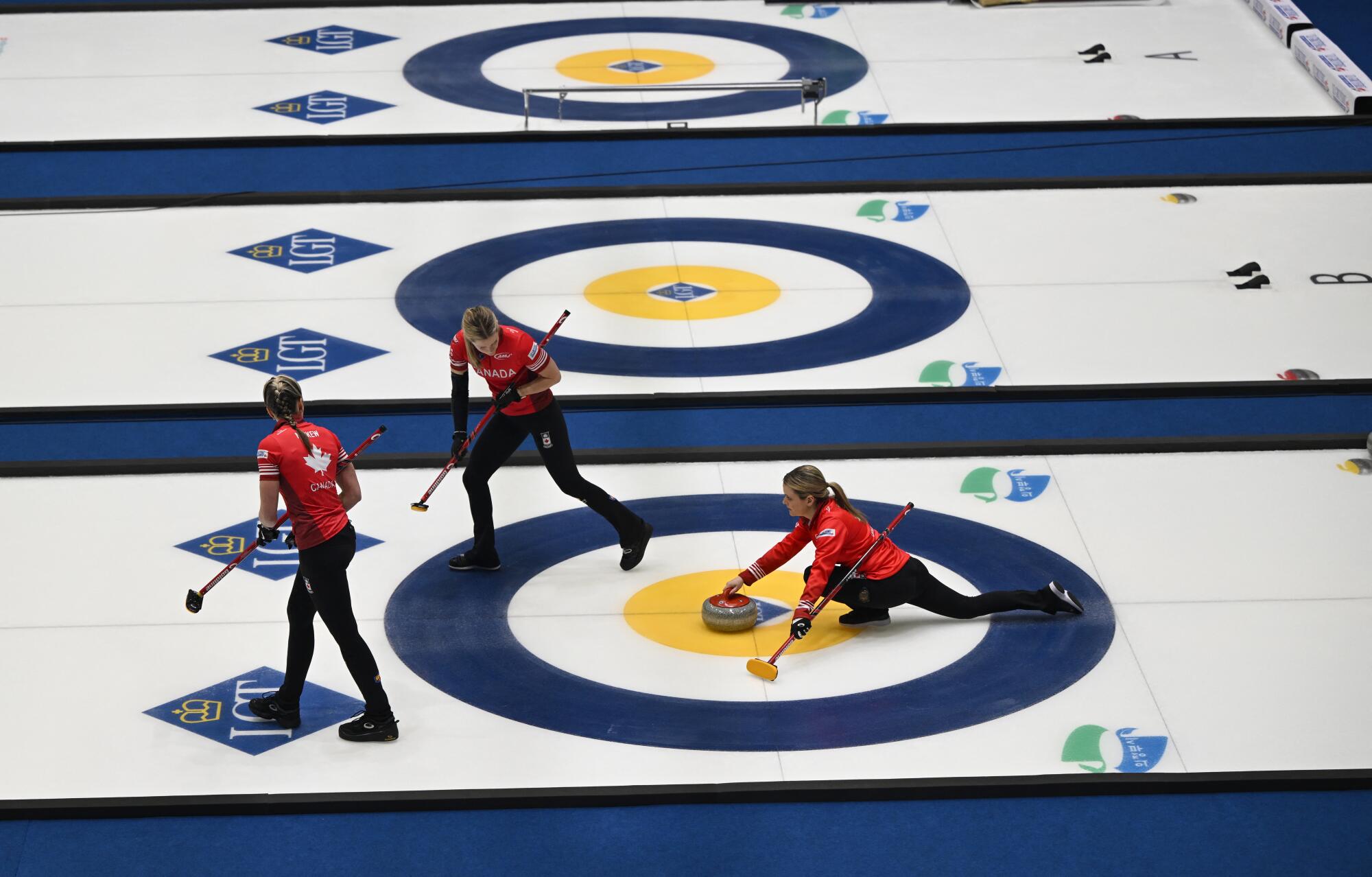
Canada’s Tracy Fleury (R) releases the stone during a gold medal match against Switzerland at the World Women’s Curling Championship in Uijeongbu on March 23.
(JUNG YEON-JE/AFP via Getty Images)
In Canada, however, it’s as much a part of the culture as poutine and maple syrup.
More than 2.3 million people — or one of every 18 Canadians — participate in the sport annually. That’s about 100 times the level of participation in the U.S. And more than 11 million Canadians watched the sport on TV in 2024, according to estimates from Curling Canada, the national governing body for the sport.
“It’s just embedded in the fabric of Canada,” said Elaine Dagg-Jackson, an Olympic bronze medalist and now one of Canada’s top curling coaches. “Canadians have a real identity with what curling is and what it stands for. It’s a gracious sport where people are being polite. They shake hands before and after the game.
“The curling rink was just a really good place to be in Canada. And still is. It just really suits the culture.”
The objectives of the sport are simple: Teams of two to four players slide 44-pound granite stones, also known as rocks, down a narrow 150-foot-long sheet of ice toward a target area called the house, aiming to get their stone closest to the center of the house. One or two players from the throwing team use carbon-fiber brooms to sweep the ice in front of the moving stone, influencing its path and speed.
A round of play ends when each team has thrown eight stones; in Olympic curling, a match consists of 10 ends, eight in mixed curling, with games typically lasting two to three hours.
The simplicity of the sport is both its charm and its curse. Because there is no running, jumping or lifting of heavy objects, everyone from young children to octogenarians can, and do, compete in amateur curling in Canada.
“It’s relatively inexpensive and it’s relatively accessible,” said Heather Mair, an associate professor at the University of Waterloo. “It’s not a hard sport to play and have fun at. It’s hugely entertaining. And you can really play your whole life.
“I don’t know too many sports you could go out with your grandfather and participate. It can be really family-oriented as a sport.”
But while it looks easy, to excel at the highest levels, where millimeters separate winners from losers in competitions that can stretch for as long as seven hours over multiple days, the sport requires surprising strength, stamina, precision and agility.
Canada’s Brett Gallant curls the stone during the 2022 Winter Olympics in Beijing on Feb. 17, 2022.
(LILLIAN SUWANRUMPHA/AFP via Getty Images)
“It definitely takes a toll on your body,” Rachel Homan, a three-time Canadian Olympian and three-time world champion, said during a break in training on a bright Edmonton morning. “That part of the game is maybe overlooked; the physical toll it takes. It’s definitely demanding.”
The curling events at February’s Winter Olympics will be held at the Cortina Olympic Stadium in Cortina D’Ampezzo, one of four event clusters in and around Milan. Canada, which has medaled in curling in every Olympics in the modern era, winning a record six golds, will send a dozen athletes — including Homan, the reigning world champion — to Italy to compete in the men’s, women’s and mixed doubles.
The U.S., which has won two Olympic curling medals, both in the men’s competition, will also have a dozen curlers in Italy competing in all three events. But if the sport is a national pastime in Canada, one that competes with hockey for fans and media attention, it remains something of an oddity in the U.S., where it draws huge TV audiences every four years during the Olympics, then fades from view until the next Winter Games.
“It’s so frustrating to see curling become the next best thing to sliced bread for a month and then it comes off the radar for four years,” said Korey Dropkin, a five-time U.S. champion and a 2023 world champion in mixed doubles. “I want to see something that’s on national television in the U.S. every week. I want to be able to expose our amazing sport to the U.S. audience day in, day out.
“I hope that in the near future we’ll be able to create more opportunities for exposure for curling.”
Curling was born in Scotland in the early 16th century but grew up centuries later on the Canadian prairies, where the severe weather, rural landscape and boredom provided fertile ground.
“In many parts of the country there’s long, long winters,” Dagg-Jackson said. “The farmers would be busy all summer, but in the winter they were looking for something to do. So the old adage in Canada is you could go to any town in rural Canada and find a grain elevator and a curling rink.”
Members of the Highland Curling Club, formed in 1898, play on flooded sheets of ice on Jan. 11 in Inverness, Scotland.
(Jeff J Mitchell / Getty Images)
The sport, which predates hockey by several decades, was brought to Montreal by Scottish emigrants during the colonial period, more than a half-century before Canada became a country. It then moved west as settlers pushed into what would become the central provinces, where the game was played on ponds and lakes before coming indoors.
In many ways the sport and the harsh conditions in which it thrived embodied the traditional values and traits — resilience, community, politeness, resourcefulness — that have come to define Canada’s unique “northern character.”
Mair, the Waterloo professor, has studied the role curling played in creating social and inter-generational connections and found the sport may have been more important from a mental perspective than from a physical one.
“I don’t know if you can appreciate what a Canadian winter is like, but anything that gets us out of our homes and talking to one another is really, really important,” she said. “We know how necessary it is that we spend time socializing with one another, especially in the dark winter days.”
As a result, it quickly became hugely popular, but for reasons that went beyond sport. Most curling rinks, Mair said, provide social spaces where players can visit with the people they’re competing against.
“So you’re sitting there for half an hour with people that you might never run into in any other part of your life and you start to build social relationships,” she said. “In really small rural communities, those are pretty essential. That’s kind of how it started.”
Aksarban Curling Club president Steve Taylor demonstrates how to push off the hack to deliver a stone in front of an all-ages group learning about the sport in Omaha, Neb., in 2018.
(Nati Harnik / Associated Press)
It’s also why the flat lands of Saskatchewan, Manitoba and Alberta became the earliest hotbeds of curling, which aligned well with the farming season. But the sport didn’t stay there. Curling clubs soon sprung up on Army bases and in fishing communities, in big cities and small towns, where it was taught in schools and played in retirement homes. (Curling has taken a different path in the U.S., where it has become popular in nontraditional winter-sports areas such as North Carolina, Florida, Texas and the San Francisco Bay area.)
“There were entire generations, for the most part, who really had a sense of the game,” Mair said. “The[re] were plumbers and carpenters and teachers, they had regular day jobs and yet they were these really talented athletes who would take the sport to these elite levels.
“So you could come from a teeny, tiny club and you might know someone who’s playing in the national championship.”
That romanticism inspired a radio play and novella by W.O. Mitchell, a writer and broadcaster who chronicled life on the Canadian prairies in the mid 20th century. In “The Black Bonspiel of Willie MacCrimmon,” which was also adapted for television, a cobbler from a small town in rural Alberta strikes a deal with the devil to trade his soul for curling success.
American John Shuster watches Matt Hamilton, center, and Colin Hufman, left, sweep his throw during a match against Canada at the Beijing Winter Olympics in 2022.
(Brynn Anderson / Associated Press)
But as curling moved from the prairies to the cities, the object lessons the sport taught changed as well. If Mitchell’s tale is a decades-old take on the timeless tug of war between good and evil, “The New Canadian Curling Club,” a 2018 comedy by playwright Mark Crawford in which four immigrants show up for a learn-to-curl class, is a modern exploration of multiculturalism and acceptance.
What the immigrants share, however, is a belief that understanding Canada starts with understanding curling.
“It’s weird and wonderful. And like all good things, it takes a little time to appreciate,” Mair, who teaches in the department of recreation and leisure studies at Waterloo, said of the sport. “At first glance you’re not totally sure what’s going on. And then as the layers start to kind of unfold, you realize just how interesting and complicated and engaging it can be.
“It’s fun. It really is. It’s quirky and fun. And I think we need more of that.”
But, she added, much of that has changed since curling entered the Olympics.
“We’re at a bit of a crossroads,” she said. “Elite sport is doing just fine in a lot of ways. [But] we need to have a different conversation about community sport. It’s not about a pathway to Olympic gold. It’s about rebuilding our communities and providing safe and accessible sports for everything. And curling is just so special in that way.”
Curling debuted in the Winter Games in 1924 with just three countries taking part; Great Britain, which fielded a team of Scottish curlers, won the gold medal. But the sport didn’t return to the official Olympic program for another 74 years and when it did, the exposure fueled interest in winter sports powerhouses such as China, Japan and South Korea, but also in Afghanistan, Andorra, Bolivia, the Virgin Islands, Kuwait and Mexico, which are all among the 67 members of the World Curling Assn.
“There’s a little bit of perception from America that curling is small potatoes. And it probably is compared to the big four sports,” said Marc Kennedy, a world and Olympic champion from Canada who will be competing in his fourth Olympics in Italy. “But it’s a big deal. Arguably one of the fastest-growing sports internationally. It’s massive in Asia. Some of our most popular athletes are from Japan.”
That added competitiveness — 30 countries attempted to qualify for this year’s Olympic tournament — has not only raised the stakes and professionalized the sport, it also threatens to crush curling’s gracious and polite traditions in a stampede for the top of the medal podium. In last spring’s world championship in Canada, for example, Chinese athletes were accused of touching a stone with a broom, kicking a stone and illegal sweeping — all forbidden acts.
In most other sports, that would have been considered gamesmanship. In curling, the accusations alone were an affront to the sport’s tradition and dignity.
Team Shuster’s Chris Plys throws the rock during the U.S. Olympic curling team trials in Omaha, Neb., on Nov. 20, 2021.
(Rebecca S. Gratz / Associated Press)
“In curling you always divulge that you broke a rule … and apologize,” said Dagg-Jackson, the former Olympian turned coach.
“It’s supposed to be a gentleman’s game. You’re supposed to call your own fouls,” added Chris Plys, a three-time U.S. Olympian. “Now we’re starting to see people doing questionable things.
“It’s sad because the best part of the game is just how honest everything is. And there’s people out there 1766928496 that are willing to do whatever it takes to win.”
Those athletes certainly aren’t cheating for the money since curlers, even at the highest level, have often had to work regular jobs to pay the bills. That could change this spring with the launch of the Rock League, the sport’s first professional competition, which will begin play shortly after the Milan-Cortina Olympics.
“The Rock League is going to be a huge new chapter to the sport,” said Dropkin, the Olympian who will captain the U.S. Rock League team. “That is going to present a whole lot of opportunities to curlers. Curlers now, curlers [in] the pipeline. They can actually make a living.”
The five-week circuit will feature six teams of five men and five women — one from the Asian-Pacific, two from Canada, two from Europe and one representing the U.S. — playing a variety of formats during stops in the U.S. and Canada. Competitors will not just earn money based on performance, but will receive salaries as well.
Historically the sport has relied heavily on prize money, which doesn’t go far. Kennedy’s winning five-man team at the 2025 Brier, the annual Canadian men’s championships, split $108,000 of the tournament’s $300,000 purse last March, which didn’t leave much after paying for travel and housing at the 10-day event.
The Dodgers will pay Shohei Ohtani more than that every time he comes to the plate over the next 10 seasons.
“I don’t think any of us get into curling with the idea of making millions of dollars,” said Kennedy, 43, a father of two who sold his frozen-food franchise 14 years ago to support his curling career. “You’ve got a lot of curlers out there that still play for the love of the game and for the opportunity to represent Canada at the Olympics or World Championships.
“If money was your motivation, then you’re probably in the wrong sport.”
Rachel Homan throws a rock during Canadian Olympic curling trials in Halifax, Nova Scotia, Canada, on Nov. 25.
(Darren Calabrese / Associated Press)
For Homan, 36, a mother of three young children who has traditionally relied on sponsorships, stipends from the national federation and winnings from underfunded tours such as the Grand Slam of Curling to make ends meet, the Rock League has the potential to change not only her life, but her legacy as well.
“In this league, being a part of it, might not mean anything for me financially right now. But it’s more about what you’re leaving behind and what you’re helping create,” said Homan, who will captain one of the league’s two Canadian teams.
Financing a professional league isn’t the only challenge curling will face coming out of the Milan-Cortina Games, though. Because while the Olympics may help the sport gather viewers, it has done little to reverse a steady decline in participation at the grassroots level, which is robbing the sport of its future athletes.
“It’s just hard to get young kids introduced to it and have access to it,” Kennedy said. “Back in the ‘50s, ‘60s, ‘70s and ‘80s it was the community center. Everybody kind of learned curling, especially out west. That’s what was driving a huge part of our sport for a long time.”
Not any more. Canada, like the U.S., has seen millions of people flee rural areas for big cities over the last several decades and as a result the local curling rink is no longer the civic hub it was when Jason Hills was growing up on the frigid plains of central Alberta. And what investment there is in the sport is now being directed to events such as the Olympics, the Grand Slam of Curling or the fledgling Rock League, not to building more community rinks.
“Curling had to pivot a bit,” said Dagg-Jackson, who takes her five grandchildren curling. “It used to be all about membership, about the thousands and thousands of curlers across the country. Now those few competitive curlers that shine in the spotlight are known to all Canadians because they’re on television all the time and they draw attention to the sport.
“Fifty years ago you just waited at the rink and people showed up because it was the place to be. Big events, Olympics, pro leagues, that’s the future of curling. But the culture and the lore, the history of curling, it’ll always be there.”
No. 1 Indiana booked its ticket to the College Football Playoff quarterfinals on Dec. 6 after defeating Ohio State 13-10 in the Big Ten championship game. With such a long gap before its New Year’s Day matchup against No. 9 Alabama in the Rose Bowl, Indiana offensive lineman Carter Smith said the Hoosiers are seeking a balance in preparing while still practicing with intensity.
“It’s all about keeping the speed of the game,” Smith said Saturday. “The biggest thing for us in the offensive line room has been going like it’s a game, every single breath, because we know that being away from the game for so long can affect that.”
The first two weeks of preparation were lighter workouts as the Hoosiers recovered from the season, tight end Riley Nowakowski said. Without knowing their opponent, the Hoosiers didn’t want to overwork older players. Instead the coaching staff gave younger players opportunities to get reps during practice.
But after Alabama punched its ticket to the Rose Bowl, the mentality changed.
“We really got into game prep and I think that’s kind of how you do it. … You start to really lock in and get back into normal game-speed stuff and game type of practices,” Nowakowski said. “I think it’s important to stay locked in mentally.”
Even with the bright lights of the Rose Bowl, Indiana offensive coordinator Mike Shanahan said the pressure will not be overwhelming.
“There might be a slight adjustment early in the game, but I feel like our guys will be ready to go and the experience within our group will help us there as well,” he said.
After the Lakers’ third straight loss Thursday, JJ Redick promised things would get “uncomfortable.” The second-year coach, frustrated after the team delivered a lump of coal in a Christmas Day blowout by the Houston Rockets, said he couldn’t stand to rewatch the same tired story. Leaning his elbow on the table at his postgame news conference, Redick called out players who don’t give enough effort on defense or play hard.
Two days later he stood in front of reporters with a different tone.
“Recalibration,” Redick said calmly of the message he delivered during Saturday’s team meeting. “Reconnection.”
Redick has cooled, but the Lakers still are under fire. Not only are they trying to snap a season-high three-game losing streak at home Sunday against the Sacramento Kings (6:30 p.m.), but also the Lakers (19-10) still are looking for their first home win in December and must navigate this defining moment without guard Austin Reaves.
Reaves was diagnosed with a grade 2 strain in his left calf Friday and will be reevaluated in four weeks. The latest setback comes less than two weeks after he was sidelined because of a “mild” strain in the same calf that kept him out for three games.
Reaves is averaging career highs in points (26.6), assists (6.3) and rebounds (5.2) and his ascent from undrafted rookie to potential first-time All-Star was one of the team’s feel-good stories of the season. Reaves scored a career-high 51 points against Sacramento in October, rescuing the Lakers in a game without LeBron James or Luka Doncic and showing Reaves’ potential in a starring role.
Now without their second-leading scorer, the Lakers are looking for their supporting cast to step up.
“We just need our guys to be stars in their roles,” Redick said. “Certainly from a top-end talent standpoint, it diminishes that. But it doesn’t change the non-negotiables or how we’re trying to play.”
After losing the last three games by an average of 20.7 points per game, the Lakers needed to get reacquainted with their non-negotiables during Saturday’s meeting. The session was uncomfortable in the way confronting truth can be uncomfortable, Redick said. It wasn’t just coaches lecturing, but also players speaking up.
The top priority was creating more clarity, Redick said. The team needed to get back to building its defensive fundamentals after so many lineup changes because of injuries. The Lakers have used 16 different starting lineups in 29 games and have to readjust their rotation again in Reaves’ absence.
“Togetherness is going to have to be emphasized to where it looks like an exaggeration,” center Deandre Ayton said, “where it becomes a habit. And that’s what winners do. And it’s pretty easy for this team. It’s just that there’s always a different group out there and we’re going to get it for sure.”
Forward Rui Hachimura said coaches reminded players of the team’s three pillars that again were displayed on a screen in the practice gym Saturday — championship habits, championship communication, championship shape.
“We just talk about everybody, players, coaches, we just gotta kind of tighten up,” Hachimura said. “We had a good stretch in the beginning and now we kind of, I don’t know, we relaxed or we kind of got tired of winning, you know, but we just stopped doing what we’re supposed to do.”
The Lakers are 29th in the NBA in defensive rating in the last 15 games, giving up 122.2 points per 100 possessions. It’s a significant drop from their rating of 113.7 in the first 14 games in which they went 10-4.
Since James returned from, the Lakers’ preferred starting lineup — Doncic, Reaves, James, Ayton and Hachimura — has a net rating of minus-19.9 in seven games.
Offensively the Lakers have lacked organization since James came back, Redick acknowledged. James declined to speak to reporters after practice.
“Too many random possessions,” Redick said. “That’s on me.”
Jared Verse was on the field running at the Rams’ Woodland Hills training facility. Byron Young was nearby working out in the weight room.
When Rams coach Sean McVay informed the two edge rushers that they had both been voted to the Pro Bowl, Young ran to meet Verse, and a celebration ensued.
“It was kind of weird the way we, like, hype up each other,” Verse said, laughing heartily.
The two players hugged and jumped in a circle. They tackled each other to the ground. Then they got to their feet and hugged again.
“It was something you can’t fake,” McVay said. “It was one of those moments. … You step back and you say, ‘these are the moments of why you do this.’”
Verse and Young have become a celebrated duo for a Rams team that is 11-4 heading into Monday night’s game against the Atlanta Falcons (6-9) at Mercedes-Benz Stadium in Atlanta.
Verse, the 19th pick in the 2024 draft, is accustomed to receiving postseason honors.
Last season, he had 4½ sacks and was voted to the Pro Bowl. He also was named the NFL defensive rookie of the year.
This season, he has become the focus of opponents’ protection schemes, regularly drawing double teams. He earned Pro Bowl recognition despite having only 6½ sacks, well behind the statistical leaders.
“Honestly, not getting the stats can be frustrating at times,” he said, adding, “So to know that my impact’s still being felt, it’s a good feeling.”
Young, a third-round pick in 2023, steadily improved his first two seasons before this season’s breakout.
He has 11 sacks, tied for ninth most in the NFL.
“It means a lot,” he said of making the Pro Bowl. “All the hard work the past few years, learning from my mistakes … and just taking a better approach to this offseason — I feel like it paid off.”
The 6-foot, 4-inch, 265-pound Verse and the 6-2, 260-pound Young are a violent combination on the field, and a comical one off of it.
“I’ll get on ‘BY’ for anything,” Verse said. “I saw him trip the other day and I clowned him for like two days.”
But it isn’t always fun and games.
While coaches playfully refer to them as stepbrothers, Verse said the relationship goes deeper.
“‘B.Y. is somebody that I genuinely talk to outside of here,” Verse said. “If I have any problems in my personal life, me and him will be talking to each other. … That’s somebody I genuinely count on.
“If I’m going through a tough time, I come to him and vice versa.”
Said Young: “We push each other to be better, hold each other accountable and I feel like that’s why we’ve been successful.”
Verse and Young both have improved from last season, when the Rams advanced to the NFC divisional round before losing to the eventual Super Bowl-champion Philadelphia Eagles.
During training camp, Verse said that he spent the offseason studying the positive plays he made as a rookie, but also the ones he missed.
With veteran outside linebacker Michael Hoecht moving on, Young focused during the offseason on improving his flexibility with Pilates workouts. He also vowed to assume more of a leadership role.
“Seeing it all pay off is really amazing,” Young said.
Verse and Young are part of an outside linebacker group coached by Joe Coniglio that also includes rookie Josaiah Stewart, Desjuan Johnson and Nick Hampton.
Verse and Young, along with defensive linemen Kobie Turner, Braden Fiske and Poona Ford, make up a formidable starting front.
Verse’s and Young’s contributions go beyond sacks and quarterback pressures, defensive coordinator Chris Shula said.
“It’s the down-in, down-out play,” Shula said, “how they’re affecting the game.”
Turner, like Young a third-year pro, has come on in the second half of the season to amass seven sacks. He said Verse and Young complement each other, aiding the entire line to work in tandem.
“They’re relentless,” Turner said. “Their mentality helps us all.”
Stewart, a third-round pick from Michigan, playfully described Verse and Young as “two knuckleheads” who set an example with their work ethic and results.
“I’ve seen them put in the work since I got here and they have helped me along the way,” he said.
While honored to be voted to the Pro Bowl, Verse and Young would much prefer to be preparing with the Rams for Super Bowl LX in Santa Clara when the Pro Bowl Games are held that week in San Francisco.
The Rams have clinched a playoff spot and they are currently seeded sixth in the NFC, with games against the Falcons and the Arizona Cardinals remaining.
Verse and Young will continue to play off each other as the Rams make their postseason push.
Verse is proud to share Pro Bowl recognition with Young.
“People hype him up because of how many sacks he gets, the pressure and everything that he does,” Verse said, “but to see the amount of work he puts in, to see it finally pay off.”
And Young is proud to share it with Verse.
“Since he got in the league, I feel like we’ve been competing with each other,” Young said. “He brings an energy to the team, and just making me be a better player.”