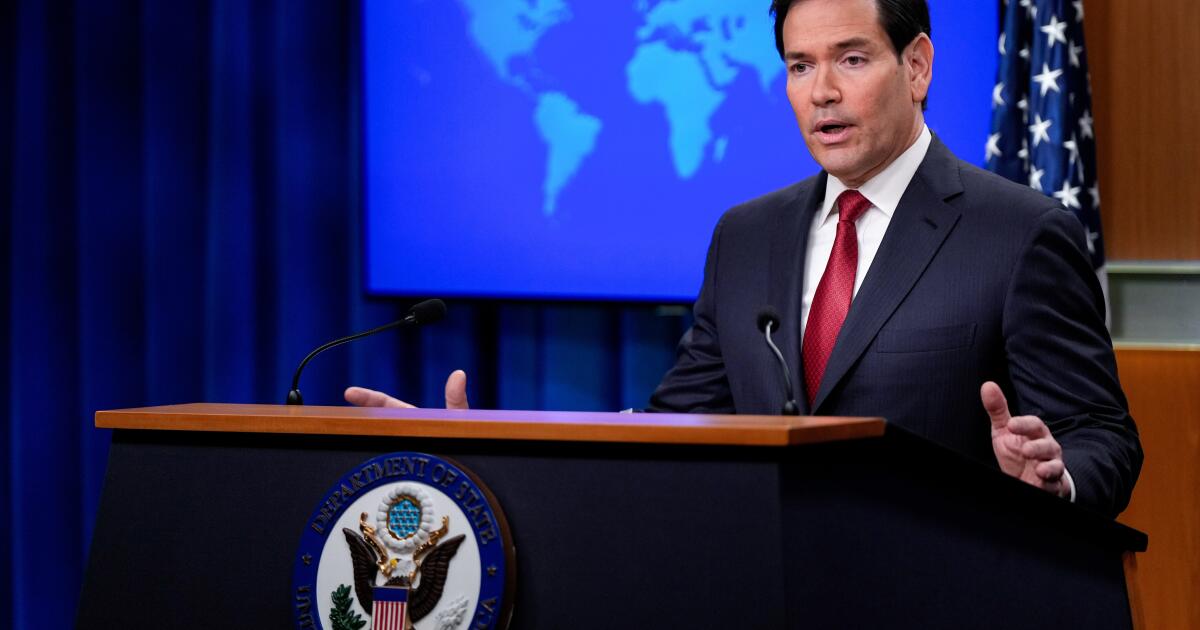
The Balkan nation votes again as PM Albin Kurti seeks majority to break the stalemate and form a government.
Published On 28 Dec 202528 Dec 2025
Share
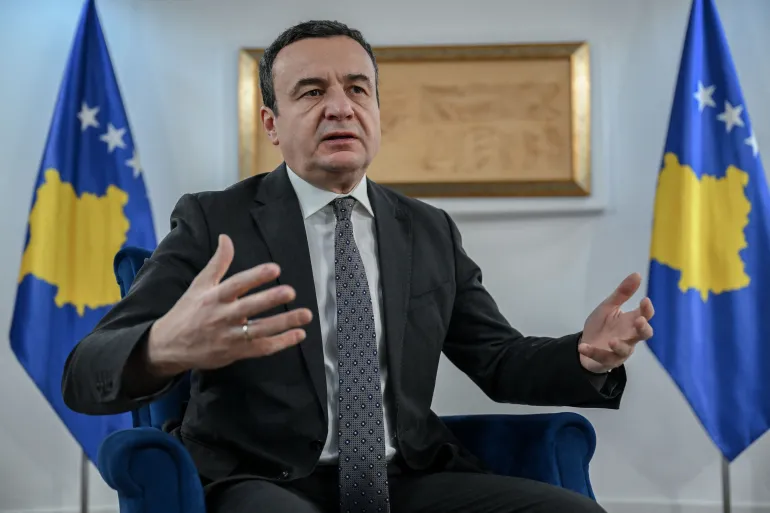
Kosovo is voting to elect a new parliament for the second time in 11 months, as nationalist Prime Minister Albin Kurti’s party seeks a majority to end a yearlong political deadlock.
Polls opened at 7am local time (06:00 GMT) and will close at 7pm (18:00 GMT) on Sunday, with exit polls expected soon after voting ends.
Recommended Stories
list of 3 itemsend of list
The snap parliamentary vote was called after Prime Minister Albin Kurti’s Self-Determination Movement (LVV) party failed to form a government despite winning the most votes at a February 9 ballot.
Failure to form a government and reopen parliament would prolong the crisis at a critical time. Lawmakers must elect a new president in April and ratify 1 billion euros ($1.2bn) in loan agreements from the European Union and World Bank that expire in the coming months.
The Balkan country’s opposition parties have refused to govern with Kurti, criticising his handling of ties with Western allies and his approach to Kosovo’s ethnically divided north, where a Serb minority lives.
Kosovo’s acting PM and leader of the LVV party, Albin Kurti [File: Armend Nimani/AFP]
Despite international support, the country of 1.6 million has struggled with poverty, instability and organised crime. Kurti’s tenure, which began in 2021, was the first time a Pristina government completed a full term.
To woo voters, Kurti has pledged an additional month of salary per year for public sector workers, 1 billion euros per year in capital investment and a new prosecution unit to fight organised crime. Opposition parties have also promised to focus on improving living standards.
Opinion polls are not published in Kosovo, leaving the outcome uncertain. Many voters say they are disillusioned.
“There wouldn’t be great joy if Kurti wins, nor would there be if the opposition wins. This country needs drastic changes, and I don’t see that change coming,” Edi Krasiqi, a doctor, told Reuters news agency.
Tensions with Serbia
Formerly a province of Serbia, Kosovo, whose population is almost exclusively Albanian, declared independence from Serbia in 2008 following an uprising and NATO intervention in 1999.
It has been recognised by more than 100 countries, but not by Russia, Serbia, Greece or Spain. It is seen as a potential candidate for accession to the EU.
Tensions with Serbia flared in 2023, prompting the EU to impose sanctions on Kosovo.
The bloc said this month it would lift them after ethnic Serb mayors were elected in northern municipalities, but the measures likely cost Kosovo hundreds of millions of euros.
Kosovo remains one of the poorest countries in Europe. It is one of the six Western Balkan countries striving to eventually join the EU, but both Belgrade and Pristina have been told they must first normalise relations.
The United Kingdom has imposed visa restrictions on the Democratic Republic of the Congo, accusing its government of failing to cooperate with its new policy on the return of undocumented migrants and those who commit criminal offences.
The UK Home Office announced the measures in a statement late on Saturday. It also said that Angola and Namibia have agreed to step up efforts to take back their citizens.
Recommended Stories
list of 3 itemsend of list
The agreements mark the first major change under sweeping reforms unveiled by Secretary of State for the Home Department Shabana Mahmood last month to make refugee status temporary and speed up the deportation of those who arrive without documents in the UK.
There was no immediate comment from the DRC, Angola or Namibia.
The Home Office said the DRC failed to meet the UK’s requirements for cooperation and has now been stripped of fast-track visa services and preferential treatment for VIPs and decision makers.
Mahmood said the UK could escalate measures to a complete halt of visas for the DRC unless cooperation rapidly improves.
“We expect countries to play by the rules. If one of their citizens has no right to be here, they must take them back,” she said.
“I thank Angola and Namibia and welcome their co-operation. Now is the time for the Democratic Republic of Congo to do the right thing. Take your citizens back or lose the privilege of entering our country.
“This is just the start of the measures I am taking to secure our border and ramp up the removal of those with no right to be here,” she added.
Prime Minister Keir Streamer’s centre-left government unveiled sweeping changes to the UK’s asylum system last month, including drastically cutting protections for refugees and their children, as part of a bid to stem the arrivals of irregular migrants that have fuelled rising anger on the far-right.
More than 39,000 people, many fleeing conflict, have arrived in the UK on small boats this year, more than for the whole of 2024 but lower than the record set in 2022, when the Conservatives were in power.
Mahmood told lawmakers that the reforms, modelled on Denmark’s strict asylum system, would discourage refugees and asylum seekers from crossing the English Channel from France on small boats.
She described the current system as “out of control and unfair”, adding that it was an “uncomfortable truth” that the government must face.
Under the reforms, refugee status will become temporary and will be reviewed every 30 months. Refugees will be forced to return to their home countries once those are deemed safe.
They will also need to wait for 20 years, instead of the current five, before they can apply for permanent residency.
The government has also said it will legislate to make it harder for irregular migrants and foreign criminals to use the European Convention on Human Rights (ECHR) to stop deportation.
Since July last year, the UK has “removed more than 50,000 people with no right to remain”, a 23 percent increase on the previous period, and instructed diplomats to make returns a top priority, Secretary of State for Foreign and Commonwealth Affairs Yvette Cooper said.
The policy has been facing criticism, however, with Mark Davies, a former adviser to the Foreign Office, calling it “shameful” and a departure from “Britain’s historic commitment to support refugees”.
Former Labour leader Jeremy Corbyn also described the policy as “draconian”, adding that it tries to “appease the most ghastly, racist right-wing forces all across Europe”, while undermining the UN Convention on Human Rights.
Enver Solomon, chief executive of the Refugee Council, urged the government to reconsider, warning the plans “will not deter” crossings, and that refugees who work hard should be able to build “secure, settled lives”.
Official figures cited by the AFP news agency showed that asylum claims in the UK are at a record high, with about 111,000 applications made in the year to June 2025.
But the number of initial positive decisions the UK authorities granted fell from 2023 to 2024.
Most asylum seekers and refugees arrive in the UK legally. Net migration reached a record high of 906,000 in the year to June 2023, before it fell to 431,000 in 2024, partly reflecting the tighter rules.
Russia has carried out drone and missile attacks on Ukraine’s capital, Kyiv, on the eve of a key meeting between the United States and Ukrainian leaders, killing at least two people and leaving a third of the city without heat, according to authorities.
Russian ballistic missiles and drones rocked Kyiv from the early hours of Saturday morning, when an air alert was in place for nearly 10 hours.
Recommended Stories
list of 4 itemsend of list
The attacks killed a 71-year-old man in Kyiv’s Dniprovskyi district and another person in the nearby town of Bila Tserka, according to officials. At least 32 others were wounded in Kyiv, including two children, police in Kyiv said.
Ukrainian President Volodymyr Zelenskyy said that during the attack, some 500 drones and 40 missiles targeted “energy facilities and civilian infrastructure”.
The Russian strikes cut power to more than a million homes in and around Kyiv, energy company DTEK said in a social media post late on Saturday.
Ukrainian Foreign Minister Andrii Sybiha said there was no heat in one-third of the capital, where temperatures hovered around freezing (0 degrees Celsius or 32 degrees Fahrenheit).
Russian forces are “trying to cut off all Ukrainians from our critical resources just to freeze us”, Kyiv-based journalist Kristina Zelenyuk told Al Jazeera.
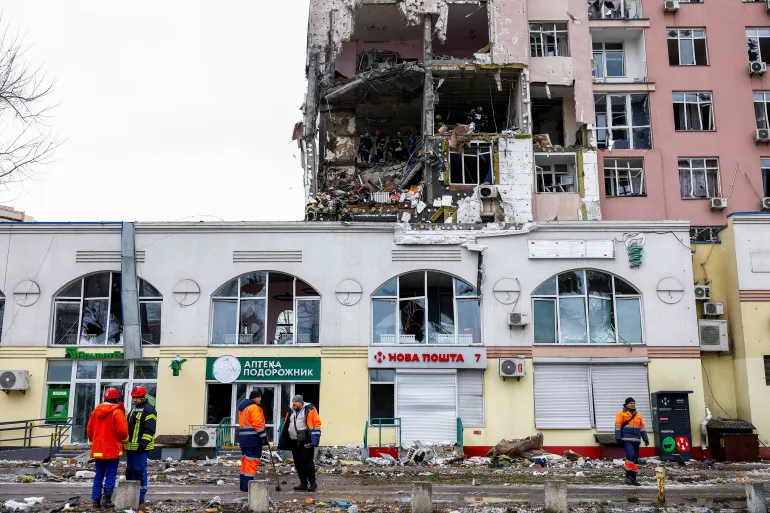
City employees and firefighters work at the site of an apartment building hit during Russian missile and drone attacks in Kyiv, Ukraine [Valentyn Ogirenko/Reuters]
Upcoming peace talks
The Russian attack came as Zelenskyy prepares to meet with US President Donald Trump in Florida on Sunday for further talks on how to end Moscow’s nearly four-year war.
Zelenskyy said they planned to discuss security guarantees and questions over future territorial control, the main sticking points in the negotiations.
Analysts say the Russian strikes on Kyiv were aimed at sending a clear message ahead of the Trump-Zelenskyy meeting.
“It’s kind of traditional in the negotiations, since before the invasion, since 2014, whenever we have these kind of meetings, there is an escalated attack. And the point is to put pressure on the meeting,” said Ben Aris, the founder and editor-in-chief of BNE Intelli-News.
“And Putin here is underlining the fact that he has the ability to take out power stations just as temperatures fall below zero,” said Aris. The message Putin aimed to send is that if Zelenskyy “doesn’t succumb to my demands, then I have the ability to black out all of the large cities in Ukraine with these high precision and powerful missiles,” said Aris.
Before the talks with Trump, Zelenskyy met Canadian Prime Minister Mark Carney in Halifax on Saturday. The two held a bilateral meeting before attending a joint telephone conversation with European leaders.
Speaking beside the Ukrainian leader, Carney announced an additional 2.5 billion Canadian dollars ($1.82bn) of economic aid for Ukraine, and said that peace depends on a “willing Russia”.
Later, German Chancellor Friedrich Merz issued a statement saying that Zelenskyy had “the full support” of European leaders and of Canada, before his talks with Trump. They and the leaders of NATO and the European Union said they would work “in close coordination with the US for a just and lasting peace in Ukraine”, Merz added.
EU chiefs Ursula von der Leyen and Antonio Costa also reaffirmed the bloc’s support for Ukraine.
“We welcome all efforts leading to our shared objective – a just and lasting peace that preserves Ukraine’s sovereignty and territorial integrity,” European Commission President von der Leyen said on X after the call with Zelenskyy and Carney.
Costa, the president of the European Council, which represents the EU’s 27 member states, echoed her promise to continue backing Ukraine, saying on X: “The EU’s support for Ukraine will not falter. In war, in peace, in reconstruction.”
Ukraine ‘suffering’
Moscow demands that Ukraine withdraw from the parts of the eastern Donetsk region that Russian troops have failed to occupy during almost four years of war, as it seeks full control of the Donbas, comprising the Donetsk and Luhansk regions.
Kyiv wants the fighting to be halted at the current lines.
The US, seeking a compromise, has proposed a free economic zone if Ukraine leaves parts of the Donetsk region. Zelenskyy told US news site Axios on Friday that he would seek a stronger position for Ukraine, but could put the US-backed plan to a referendum if necessary.
Both Zelenskyy and Trump have expressed optimism about the meeting, with the Ukrainian leader saying that most components of a US-Ukraine agreement had been ironed out and that he hopes to finalise a framework on Sunday.
“A lot can be decided before the New Year,” Zelenskyy posted on social media on Friday.
But the attack on Saturday appeared to alter Zelenskyy’s tone. In a post following the aerial barrage, he said that Russia’s leadership “does not want to end the war”, and that their drones and missiles speak louder than any “lengthy talks” they engaged in.
Russia’s leadership aims “to use every opportunity to cause Ukraine even greater suffering and increase their pressure on others around the world”, said Zelenskyy.
The Russian president levied similar criticism.
According to the Interfax and TASS news agencies, Putin said Russia could see Kyiv was in no hurry to end the conflict by peaceful means. He also threatened Russia would accomplish all goals of its “special military operation” in Ukraine by force.
Separately on Saturday, Russian forces reported that they had captured the town of Myrnohrad in Ukraine’s Donetsk region, as well as Huliaipole in Ukraine’s Zaporizhia region, the Kremlin said on its Telegram channel.
Ukraine’s military, however, said in its daily battlefield update that its forces had beaten back Russian attempts to advance in the vicinity of Myrnohrad and Huliaipole
If Israel and the US were to attack Iran again, they would ‘face a more decisive response’, Pezeshkian warns.
Published On 27 Dec 202527 Dec 2025
Share
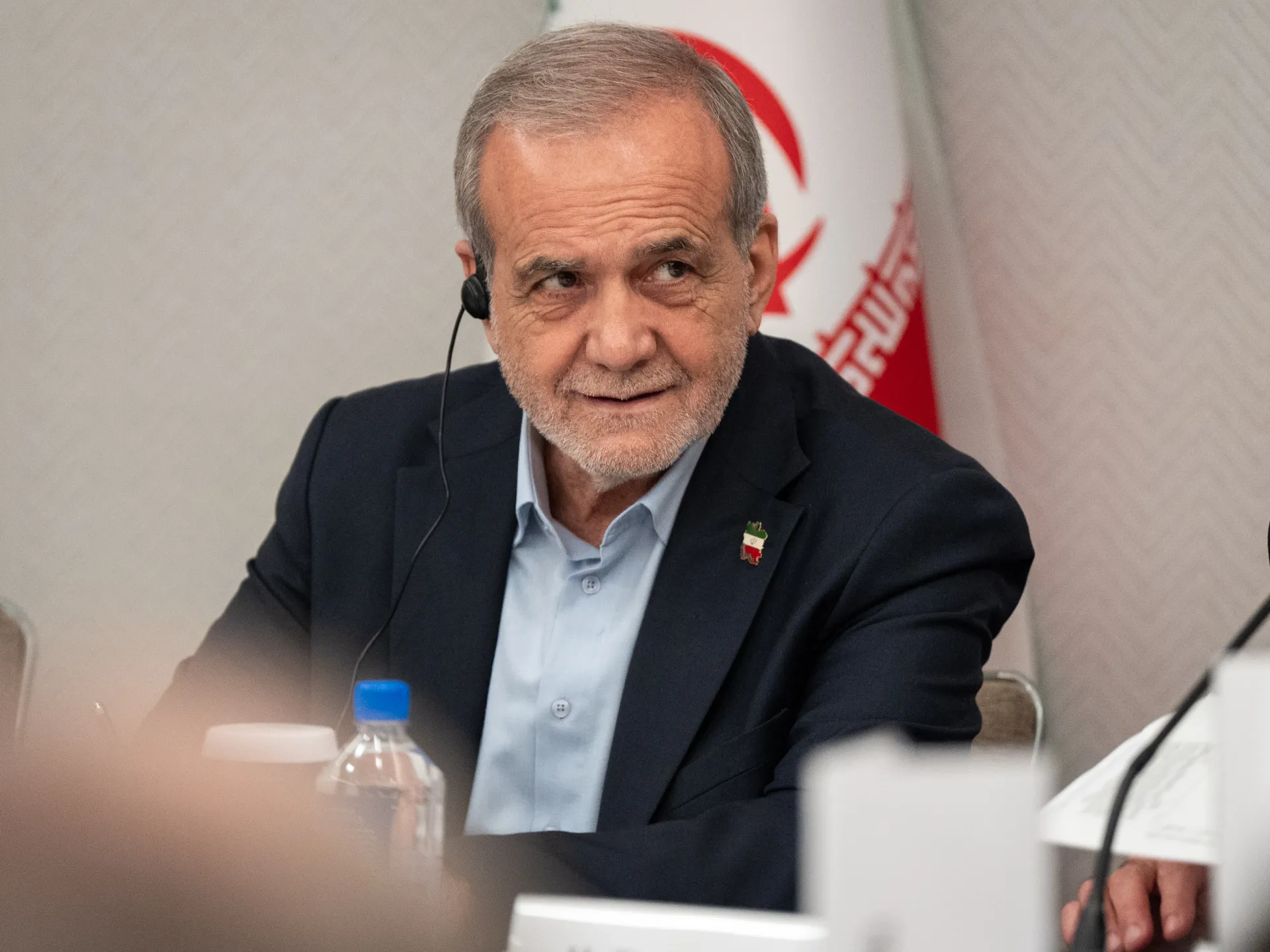
Iranian President Masoud Pezeshkian says that the United States, Israel and Europe are waging a “full-fledged war” against his country.
“In my opinion, we are in a full-fledged war with America, Israel and Europe. They do not want our country to stand on its feet,” Pezeshkian told the official site of Supreme Leader Ayatollah Ali Khamenei in an interview on Saturday.
Recommended Stories
list of 3 itemsend of list
The president’s remarks come ahead of Israeli Prime Minister Benjamin Netanyahu’s meeting on Monday with US President Donald Trump. They also come six months after Israel and the US launched strikes on Iran, and after France, Germany and the United Kingdom reimposed United Nations sanctions on Iran in September over its nuclear programme.
“Our dear military forces are doing their jobs with strength, and now, in terms of equipment and manpower, despite all the problems we have, they are stronger than when they [Israel and the US] attacked,” Pezeshkian said.
“So, if they want to attack, they will naturally face a more decisive response.”
The president said that “this war” is unlike past ones.
“This war is worse than Iraq’s war against us. If one understands it well, this war is far more complex and difficult than that war,” Pezeshkian said, referring to the 1980-1988 conflict between the neighbouring countries in which thousands were killed.
The US and its allies accuse Iran of seeking to acquire nuclear weapons, a claim Tehran has repeatedly denied.
Israel and Iran engaged in a 12-day war in June, triggered by an unprecedented Israeli attack on Iranian military and nuclear sites, as well as civilian areas.
The strikes caused more than 1,000 casualties, according to Iranian authorities.
The US later joined the Israeli operation, bombing three Iranian nuclear sites.
Washington’s involvement brought a halt to negotiations with Tehran, which began in April, over its nuclear programme.
Since returning to the White House in January, US President Donald Trump has revived his so-called “maximum pressure” policy against Iran, initiated during his first term.
That has included additional sanctions designed to economically cripple the country and dry up its oil revenues from sales on the global market.
According to recent reports, when Netanyahu visits Trump at his Mar-a-Lago resort in Florida this weekend, he will be pushing for more military actions against Iran, this time focusing on Tehran’s missile programme.
These are the key developments from day 1,403 of Russia’s war on Ukraine.
Published On 28 Dec 202528 Dec 2025
Share
Here is where things stand on Sunday, December 28:
Fighting
At least two people were killed in Ukraine’s capital, Kyiv, and the surrounding region, after Russian forces launched a massive attack with hundreds of missiles and drones, ahead of Ukrainian President Volodymyr Zelenskyy’s meeting with United States President Donald Trump to work out a plan to end nearly four years of war.
The attack also wounded at least 46 people, including two children, according to Ukrainian officials.
Zelenskyy, who was on his way to meet Trump in Florida, said that Russia had launched nearly 500 drones and 40 missiles, targeting energy and civilian infrastructure.
Ukraine’s state grid operator, Ukrenergo, said that energy facilities across Ukraine were struck, and emergency power cuts had been implemented across the capital. DTEK, Ukraine’s largest private energy company, said the attack had left more than a million households in and around Kyiv without power.
Ukrainian Deputy Prime Minister Oleksii Kuleba said that more than 40 percent of residential buildings in Kyiv were left without heat, as temperatures hovered around 0 degrees Celsius (32 degrees Fahrenheit) following the attack.
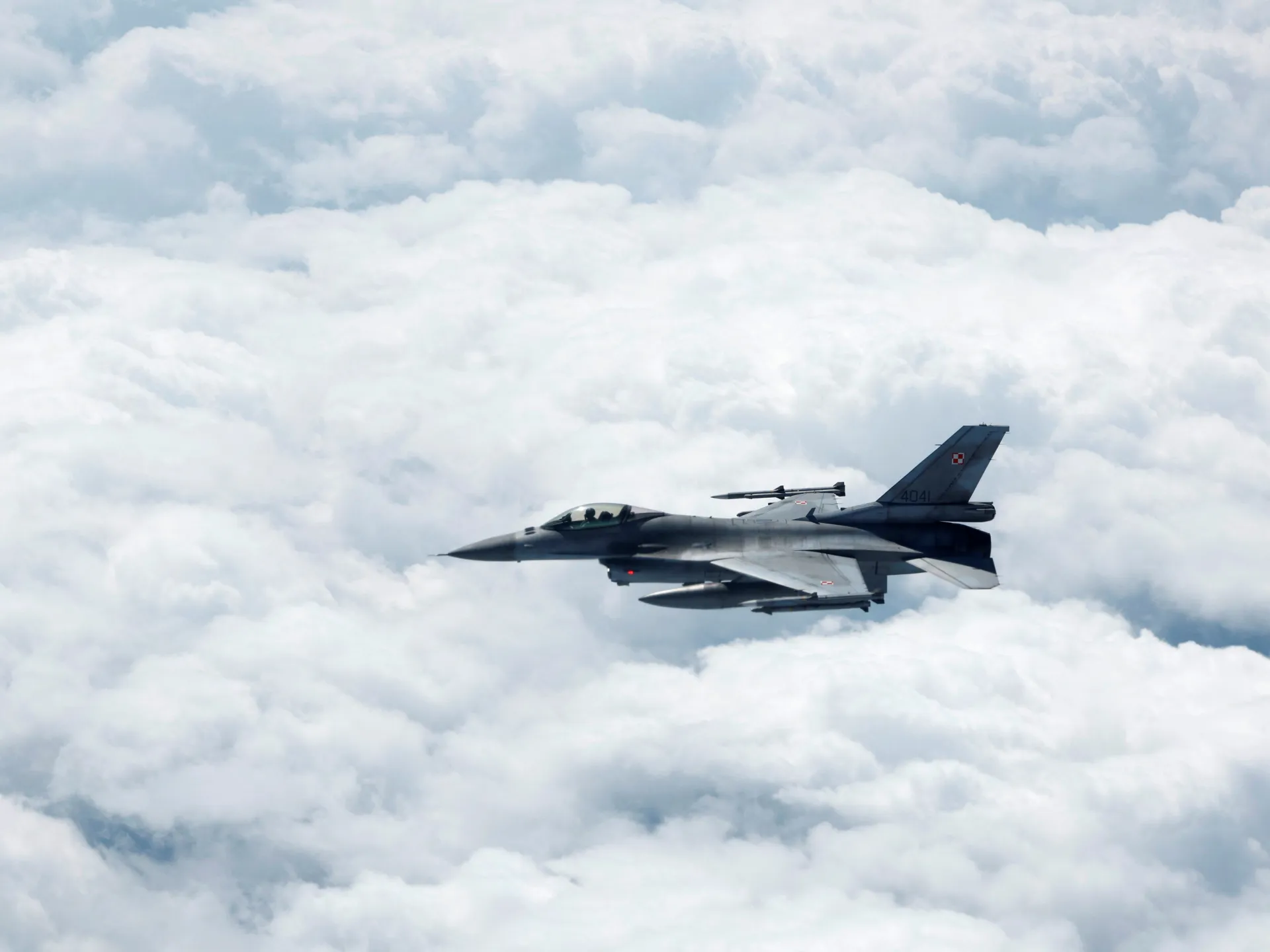
Poland’s Air Navigation Services Agency said in a statement on X that the Rzeszow and Lublin airports in the country’s southeastern region were temporarily shut following Russia’s strikes on Ukraine. The Operational Command of the Polish Armed Forces said that Polish and allied jets were deployed during the attack, but no violations of Polish airspace were reported.
In Russia, air defence forces shot down 11 drones headed for the capital, Moscow, according to the city’s mayor, Sergei Sobyanin.
Russia’s aviation watchdog, Rosaviatsia, said that Moscow’s Vnukovo and Sheremetyevo airports imposed temporary restrictions on airspace due to security reasons.
Russia’s Ministry of Defence also said that its air defence systems had intercepted and destroyed more than 100 Ukrainian drones in three hours over six other Russian regions.
Russian commanders told President Vladimir Putin that Moscow’s forces had captured the Ukrainian towns of Myrnohrad, Rodynske and Artemivka in Ukraine’s Donetsk region, as well as Huliaipole and Stepnohirsk in the Zaporizhia region, the Kremlin and Russian news agencies said on Telegram.
But Ukraine’s military said in its daily battlefield update that its forces had beaten back Russian attempts to advance in the vicinity of Myrnohrad and Huliaipole.
Politics and diplomacy
Zelenskyy announced in a Telegram message that he would hold talks with European leaders after his meeting with Trump on Sunday, as Kyiv pushes for a stronger position in the ongoing ceasefire negotiations to prevent Russia from prolonging the war in Ukraine.
Zelenskyy said he wants to discuss with Trump territorial issues, the main stumbling block in talks to end the war, as a 20-point peace framework and a security guarantee deal near completion.
On the way to the meeting in Florida, Zelenskyy stopped in Canada’s Halifax to meet Mark Carney, the Canadian prime minister said in a statement after the meeting.
Carney denounced the latest Russian attack as “barbarism”, stressing that it is important for allies to “stand with Ukraine in this difficult time”. He also announced $1.83bn in additional economic aid to Ukraine.
Zelenskyy spoke to European leaders following the meeting with Carney. In a statement posted on X, European Commission President Ursula von der Leyen said: “We welcome all efforts leading to our shared objective – a just and lasting peace that preserves Ukraine’s sovereignty and territorial integrity. And that strengthens the country’s security and defence capabilities.”
Antonio Costa, the president of the European Council, which represents the bloc’s 27 member states, echoed von der Leyen’s promise to continue backing Ukraine, saying on X: “The EU’s support for Ukraine will not falter. In war, in peace, in reconstruction.”
German Chancellor Friedrich Merz said that Zelenskyy had “the full support” of European leaders ahead of his talks with Trump. The leaders of NATO and the European Union said they would work “in close coordination” with the US “for a just and lasting peace in Ukraine”, Merz added in a statement.
French President Emmanuel Macron said in a call with Zelenskyy that the latest Russian strikes on Kyiv showed that Moscow was not interested in ending the war, the AFP news agency reported, citing officials from Macron’s office. During the call, Macron highlighted what he called the “contrast” between “the willingness of Ukraine to build a lasting peace and Russia’s determination to prolong the war that it started”, the report said.
Russian President Vladimir Putin said that Russia could see Kyiv was in no hurry to end the war by peaceful means, according to the Interfax news agency. Putin said that if Ukraine did not want to resolve the conflict peacefully, then Russia would accomplish all goals of its “special military operation” by force, Russian state news agency TASS reported.
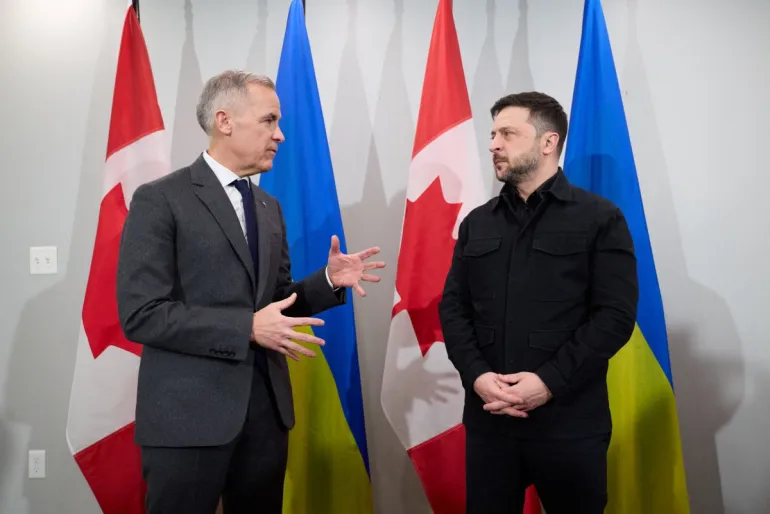
Ukrainian President Volodymyr Zelenskyy (right) and Canadian Prime Minister Mark Carney (left) speak to the media as they meet in Halifax, Nova Scotia, Canada, ahead of the former’s meeting with US President Donald Trump on Sunday [Ukrainian Presidential Office/Handout Photo via AFP]
Aston Villa’s latest comeback win has highlighted coach Unai Emery’s remarkable record of turning around games, which has put his side firmly in the Premier League title race.
After Saturday’s 2-1 win at Chelsea – their 12th in 13th league matches – Villa have claimed 18 points from losing positions so far this season, more than any other team.
Recommended Stories
list of 4 itemsend of list
And it is not just this year that the Spaniard has been affecting games with his decision-making. Across the last three seasons, Villa have won more points from matches in which they were losing than any other Premier League team, according to data firm Opta.
In the 58th minute on Saturday, with Chelsea 1-0 up and looking in control, Emery gambled on a triple substitution, bringing on Ollie Watkins and more attacking firepower in the form of winger Jadon Sancho, along with midfielder Amadou Onana.
Five minutes later, Watkins pounced on a through ball by Morgan Rogers to beat Robert Sanchez in the Chelsea goal.
Buoyed by their equaliser and their change of personnel, Villa looked transformed from the side that was pinned back by their hosts for most of the first hour.
In the 84th minute, Watkins – hoping for a place in the England World Cup squad next summer – met a Youri Tielemans corner with an angled header that left Sanchez with no chance.
“He’s a tactical genius,” Watkins said when asked by Sky Sports about Emery’s ability to change the momentum of matches.
The coach himself tried to sound a bit less effusive. “It’s something, of course, that makes us proud of everything we are doing,” Emery said when asked about Villa’s ability to turn losing situations into victories.
He sought to play down his side’s chances of winning the title, despite their blistering form.
“I am not feeling it,” Emery said. “I am feeling we competing very well, and we are now the third in the league with two teams, Manchester City and Arsenal, wow.”
But with the season only halfway through, Villa, who struggled badly at the start of the campaign, need to show more consistency, he said.
Villa face league leaders Arsenal in London on Tuesday.
Chelsea manager Enzo Maresca had to face questions about much less impressive statistics for his young side, who have dropped 11 points from winning positions in home Premier League matches this season – four more than any other side.
“We need to understand why when we concede a goal, we struggle a bit to manage the game,” the Italian told reporters.
He was left to rue Chelsea’s failure to build a bigger lead before Villa’s fightback.
“By the time they scored the goal, I think we should have scored two to three goals,” Maresca said.
Arsenal, Man City and Liverpool maintain form
Manchester City threw down the gauntlet for the second successive weekend, and Arsenal proved undaunted as they kicked off their festive fixtures with a narrow 2-1 defeat of Brighton & Hove Albion to stay as Premier League leaders on Saturday.
City won 2-1 at Nottingham Forest, with Rayan Cherki grabbing a goal and an assist to briefly move to the top of the pile.
But Arsenal, just as they had done last week by beating Everton after City’s earlier win over West Ham United, were unwavering as captain Martin Odegaard scored his first goal of the season for Mikel Arteta’s side.
Arsenal also needed an own goal and a spectacular save by keeper David Raya to preserve their lead, as the halfway point in the Premier League season looms.
The London side have 42 points from 18 games, with City on 40.
When Odegaard drilled in a 14th-minute opener for the Gunners, and Georginio Rutter’s own goal from a Declan Rice corner made it 2-0 shortly after the break, it should have been a routine three points for the hosts.
But Diego Gomez’s reply for Brighton changed the complexion of the contest, and there was relief at the final whistle as Arsenal cleared another obstacle in the title chase.
“The knock-on effect of winning is incredibly powerful,” Arteta said of a victory that should have been easier.
“It should never be 2-1, but that’s the Premier League. What I like is that we have a lot of issues [but] we’re dealing with it in an incredible way. Yesterday, we lost Jurrien [Timber]; today, we lost [Riccardo] Calafiori in the warm-up; Declan [Rice] has to play as a full-back, and you see the performance that he put in. So, that’s the spirit and that’s how much our players want it.”
Florian Wirtz scored his first Liverpool goal as they beat Wolverhampton Wanderers 2-1 on an emotional Anfield afternoon, when both sets of fans remembered the late Diogo Jota, who died in a car crash in July.
Wirtz doubled Liverpool’s lead shortly after Ryan Gravenberch had put them in front, although Wolves rallied in the second half and Santiago Bueno pulled a goal back.
Reigning champions Liverpool moved fourth on 32 points, while the misery for the bottom club Wolves continues.
They have now broken the Premier League record for winless starts to a season and have two points from 18 games, and are 16 points behind the fourth-from-bottom Nottingham Forest.
Ukrainian President Volodymyr Zelenskyy has accused Russia of using ordinary apartment blocks on the territory of its ally Belarus to attack Ukrainian targets and circumvent Kyiv’s defences.
Zelenskyy made the allegations on Friday amid revelations by intelligence experts that Moscow has likely stationed its new nuclear-capable hypersonic ballistic missiles at a former airbase in eastern Belarus – a move seen as bolstering Russia’s ability to strike targets in Europe.
Recommended Stories
list of 3 itemsend of list
“We note that the Russians are trying to bypass our defensive interceptor positions through the territory of neighbouring Belarus. This is risky for Belarus,” Zelenskyy wrote on the Telegram messaging app on Friday after a military staff meeting.
“It is unfortunate that Belarus is surrendering its sovereignty in favour of Russia’s aggressive ambitions,” the Ukrainian leader said.
Zelenskyy said Ukrainian intelligence had observed that Belarus was deploying equipment “in Belarusian settlements near the border, including on residential buildings” to assist Russian forces in carrying out their attacks.
“Antennae and other equipment are located on the roofs of ordinary five-storey apartment buildings, which help guide ‘Shaheds’ [Russian drones] to targets in our western regions,” he said.
“This is an absolute disregard for human lives, and it is important that Minsk stops playing with this,” he added.
The Russian and Belarusian defence ministries did not immediately respond to requests for comment.
Russia had previously used Belarusian territory to launch its February 2022 invasion of Ukraine, and Belarus remains a steadfast ally, though President Alexander Lukashenko has pledged to commit no troops to the conflict.
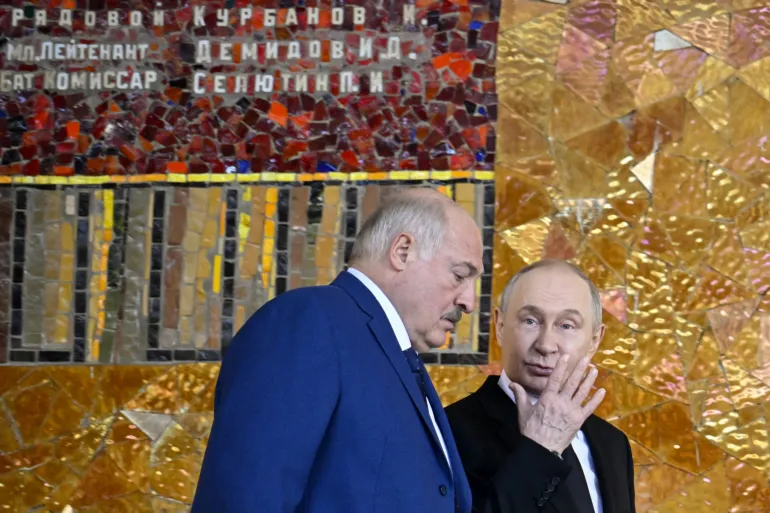
Russian President Vladimir Putin and Belarusian President Alexander Lukashenko attend a wreath-laying ceremony at the Eternal Flame in the Hall of Military Glory at the Mamayev Kurgan World War II memorial complex in Russia’s southern city of Volgograd in April 2025 [File: Alexander Nemenov/AFP]
Belarus defence minister: ‘Our response’ to the West’s ‘aggressive actions’
Amid reports of closer Russian and Belarusian coordination in the war on Ukraine, satellite imagery analysed by two US researchers appears to show that Moscow is stationing Oreshnik hypersonic ballistic missiles in eastern Belarus, according to an exclusive Reuters news agency report.
Oreshnik had been described by Russian President Vladimir Putin as impossible to intercept, and he previously made clear his intention to deploy the missiles – which have an estimated range of up to 5,500km (3,400 miles) – in Belarus.
Researchers Jeffrey Lewis of the Middlebury Institute of International Studies, in California, and Decker Eveleth of the CNA research and analysis organisation in Virginia, said they were 90 percent certain that mobile Oreshnik launchers would be stationed at the former Russian airbase near Krichev, some 307km (190 miles) east of the Belarus capital of Minsk.
The United States researchers said reviews of satellite imagery revealed a hurried construction project in Belarus that began between August 4 and 12, and contained features consistent with those of a Russian strategic missile base.
One “dead giveaway” in a November 19 satellite image was a “military-grade rail transfer point” enclosed by a security fence to which missiles, their mobile launchers and other components could be delivered by train to the site, Eveleth told Reuters.
Another feature, said Lewis, was the construction of a concrete pad that was then covered with earth, and which he called “consistent” with a camouflaged missile launch point.
The researchers’ assessment broadly aligns with US intelligence findings, according to the report.
Russia and Belarus have yet to comment on the Reuters report.
But, earlier this month, President Lukashenko acknowledged the deployment of such weapons in his country, although he did not say to which part of the country the Russian missiles have been deployed. He added that up to 10 Oreshniks would be deployed within the country.
State-run BelTA news agency quoted Belarusian Defence Minister Viktor Khrenin as saying this week that the Oreshnik’s deployment would not alter the balance of power in Europe and was “our response” to the West’s “aggressive actions”.
The White House did not immediately respond to a request for comment on the reported Russian missile deployment to Belarus.
Ukraine’s capital came under a new “massive” Russian attack early on Saturday, with explosions reported in the city, air defences in operation and the Ukrainian military saying cruise and ballistic missiles were being deployed.
On Sunday, President Zelenskyy is scheduled to meet with US President Donald Trump to finalise a possible ceasefire deal between Moscow and Kyiv.
In advance of the meeting, Zelenskyy told the Axios news site that he was open to putting the Washington-led “20-point” peace plan to a referendum – as long as Russia agreed to a 60-day ceasefire to allow Ukraine to prepare for and hold such a vote.
UK plans to boost ranks of armed forces by offering young people paid military experience amid growing Russian threats.
Published On 27 Dec 202527 Dec 2025
Share
Teenagers in the United Kingdom will be offered paid “gap years” with the armed forces under a new “whole of society” approach to national defence that aims to increase recruitment among young people, according to reports.
The London-based i Paper reported on Friday that the UK’s Ministry of Defence hopes the scheme will broaden the appeal of military careers for British youth as tensions with Russia rise across Europe.
Recommended Stories
list of 4 itemsend of list
The scheme will initially be open to about 150 applicants aged 18 to 25 in early 2026, with ministers aiming to eventually expand the programme to more than 1,000 young people annually, depending on demand, according to British radio LBC.
With fears of threats from Russia growing amid Moscow’s war on Ukraine, European countries have looked to national service for young people as a means to boost their ranks, with France, Germany and Belgium announcing schemes this year.
Recruits to the UK scheme will not be deployed on active military operations and while pay has not been confirmed, the UK’s LBC news organisation reported that it is expected to match basic recruit salaries, typically about 26,000 pounds, or $35,000.
Under the programme, army recruits would complete 13 weeks of basic training as part of a two-year placement. The navy scheme would last one year while the Royal Air Force (RAF) is still considering options, according to reports.
UK Defence Secretary John Healey told the i Paper: “This is a new era for Defence, and that means opening up new opportunities for young people.”
News of the programme follows remarks earlier this month from the UK’s Chief of the Defence Staff, Air Chief Marshal Richard Knighton, who said Britain’s “sons and daughters” should be “ready to fight” and defend the country amid Russian aggression, the Press Association reports.
Knighton said that while a direct Russian attack on the UK is unlikely, hybrid threats are intensifying.
He referenced a recent incident involving a Russian spy ship suspected of mapping undersea cables near UK waters.
“Every day the UK is subject to an onslaught of cyber-attacks from Russia and we know that Russian agents are seeking to conduct sabotage and have killed on our shores”, Knighton said, warning that Russia’s military had become a “hard power [which] is growing quickly”.
The UK government announced earlier this year that defence and security spending will rise to 5 percent of gross domestic product (GDP) by 2035.
The 5-star resort has won Europe’s Leading All-Inclusive Resort at the World Travel Awards for the second year running, and lucky guests can enjoy a wide range of facilities that include a whopping 10 pools
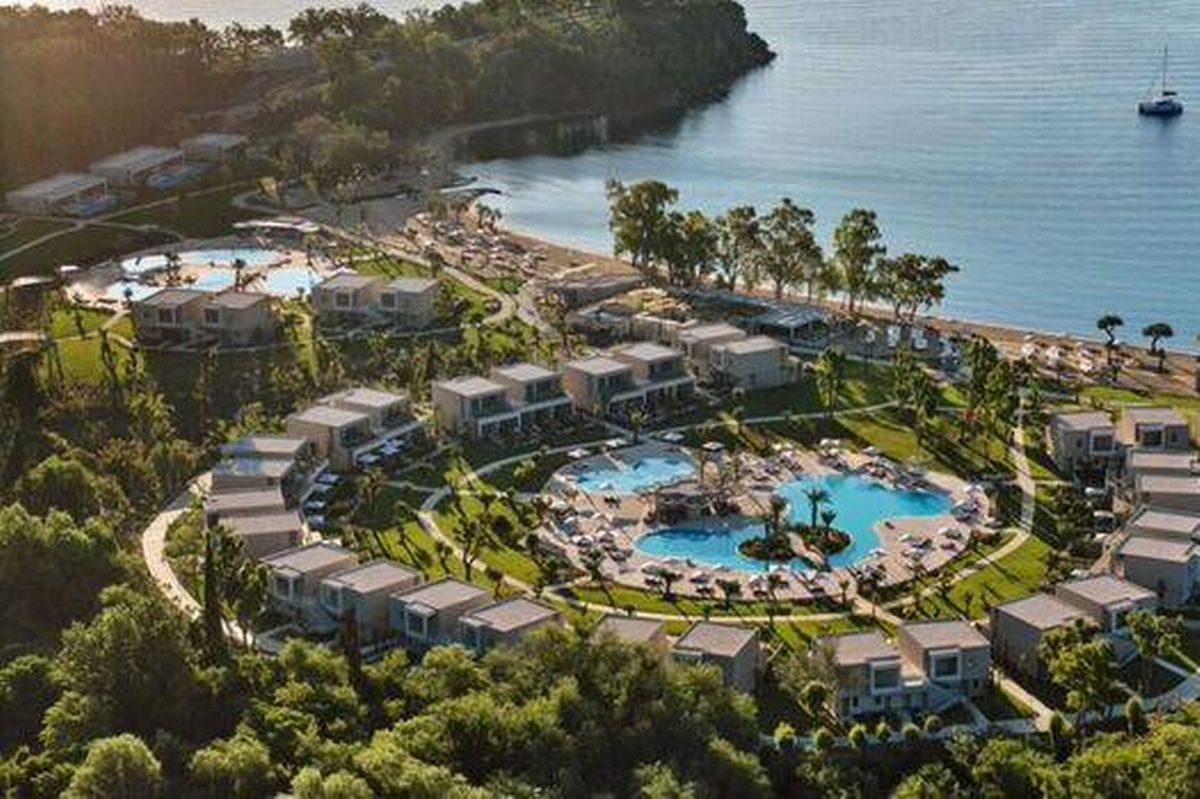
The resort has direct beach access and plenty to do(Image: Ikos Resorts)
A luxury hotel nestled on a peninsula in Corfu has grabbed the title of Europe’s Leading All-Inclusive Resort at the World Travel Awards for the second year running.
Ikos Odisia bagged the prestigious award in 2024 and has won again in 2025 for its resort situated on the tranquil eastern coast of the island, within the serene Dassia Bay area. Considering this modern resort only welcomed its first guests in 2023, it’s quite an achievement. So, what sets this all-inclusive holiday apart from the rest?
When you’re holidaying at an all-inclusive resort, a top-notch pool is a must-have, and Ikos Odisia doesn’t disappoint with a staggering 10 heated outdoor pools to pick from. There’s also a splash pool for the little ones and an indoor pool in the spa area.
And if you prefer your own space, rooms with private pools are on offer, including brand new three and four-bedroom villas set to launch in summer 2026, reports the Express.
Once you’ve claimed your sunlounger, you can simply sit back and bask in the sunshine, with towel service and waiting staff on hand to deliver your chosen cocktail. The same high standard of service extends to the hotel’s sandy beach, decked out with cushioned loungers and parasols, ensuring you can settle in comfortably after a refreshing dip in the azure sea.
Another spot to relax is the resort’s opulent spa, which boasts a thermal suite featuring a sauna and steam bath, a spa pool with stunning sea views, and an array of high-end treatments. If you’re holidaying with little ones and fancy some peace, kids’ clubs are on hand for children aged six months and up, offering both morning and afternoon sessions.
For those under four, there’s an additional charge for the creche. However, for 4-12-year-olds, the kids’ club is part of the package and provides a vast selection of activities to keep them entertained all day.
Guests can also book activities like paddleboarding, yoga classes, tennis, or a round of golf. Complimentary bike hire is available if you fancy exploring the peninsula, and the resort can organise electric car hire should you wish to venture further afield.
Dassia boasts numerous stunning beaches, offering popular activities from sailing to water skiing, so it’s well worth taking some time to explore.
When it comes to all-inclusive dining, many might envision chaotic buffets, but at Ikos Odisia, you’re spoilt for choice. While a Mediterranean buffet is available for all-day dining, there are also seven à la carte restaurants serving a diverse range of cuisine, including Greek, Spanish, Peruvian, and Asian options, complemented by an impressive premium wine list.
Naturally, it’s always nice to venture out from the resort in the evenings to sample some local cuisine. As part of your all-inclusive package, you can take advantage of the Dine Out option at three local restaurants. This allows you to experience the local cuisine and soak up the town’s atmosphere without any additional cost.
As dusk falls, why not pop into one of the resort’s cocktail bars for a pre-dinner drink?
The hotel also offers a variety of entertainment options, ranging from live music to fireworks displays, as well as beach parties to fully embrace those balmy summer nights. For more information about Ikos Odisia and to make a booking, visit their official website.
Have a story you want to share? Email us at webtravel@reachplc.com
Ukrainian president highlights ‘significant progress’ in talks, but Moscow says Kyiv is working to ‘torpedo’ deal.
Published On 26 Dec 202526 Dec 2025
Share
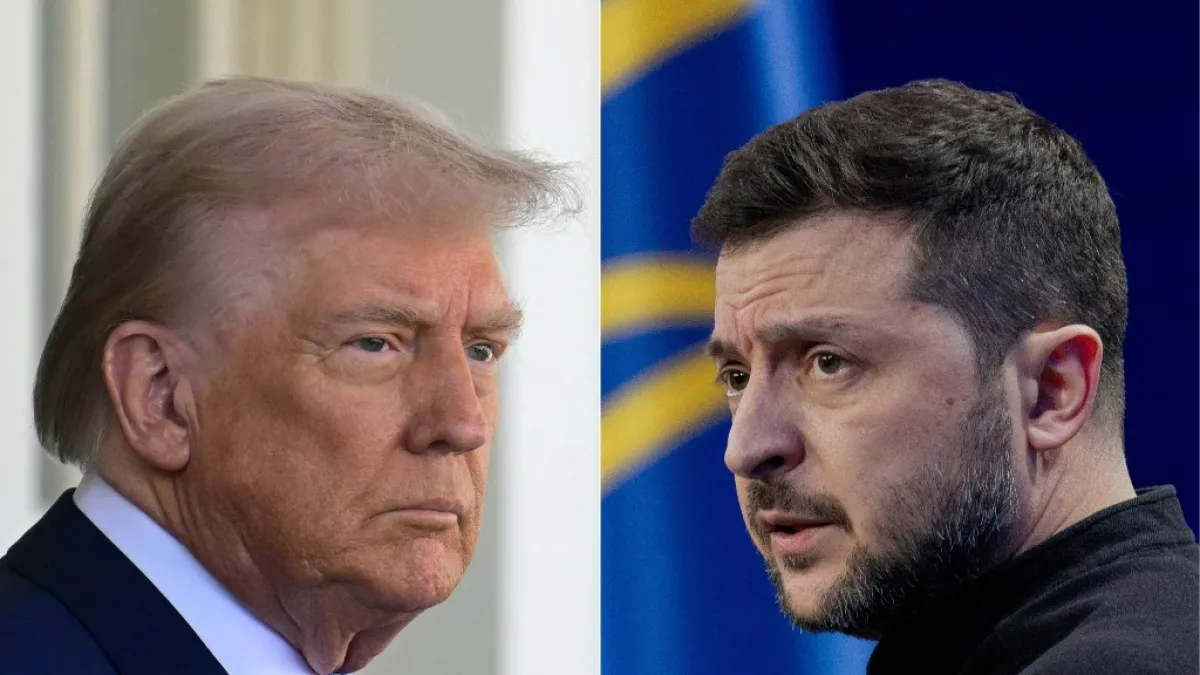
Ukrainian President Volodymyr Zelenskyy is to meet with his United States counterpart, Donald Trump, in Florida on Sunday to discuss territorial disputes that continue to block progress towards ending Russia’s war on Ukraine.
Announcing the meeting on Friday, Zelenskyy said the talks could be decisive as Washington intensifies its efforts to broker an end to Europe’s deadliest conflict since World War II. “A lot can be decided before the New Year,” Zelenskyy said.
Recommended Stories
list of 3 itemsend of list
Territory remains the most contentious issue in the negotiations. Zelenskyy confirmed he would raise the status of eastern Ukraine and the Zaporizhzhia Nuclear Power Plant, which has been under Russian control since the early months of Russia’s invasion.
“As for the sensitive issues, we will discuss both Donbas and the Zaporizhzhia Nuclear Power Plant. We will certainly discuss other issues as well,” he told reporters in a WhatsApp chat.
Moscow has demanded that Kyiv withdraw from parts of the Donetsk region still under Ukrainian control as it pushes for full authority over the wider Donbas area, which includes Donetsk and Luhansk. Ukraine has rejected that demand, instead calling for an immediate halt to hostilities along the existing front lines.
Territorial concessions
In an attempt to bridge the divide, the US has floated the idea of establishing a free economic zone should Ukraine relinquish control of the contested area although details of how such a plan would operate remain unclear.
Zelenskyy reiterated that any territorial concessions would require public approval. He said decisions on land must be made by Ukrainians themselves, potentially through a referendum.
Beyond territory, Zelenskyy said his meeting with Trump would focus on refining draft agreements, including economic arrangements and security guarantees. He said a security pact with Washington was nearly finalised while a 20-point peace framework was close to completion.
Ukraine has sought binding guarantees after previous international commitments failed to prevent Russia’s invasion, which began in February 2022.
Trump has previously voiced impatience with the pace of negotiations, but he has indicated he would engage directly if talks reached a meaningful stage.
Last week, US Secretary of State Marco Rubio said his country is the only mediator that can speak to both sides to secure a peace agreement. At the same time, he downplayed the importance of the conflict for Washington.
“It’s not our war. It’s a war on another continent,” he said.
Zelenskyy said European leaders could join Sunday’s discussions remotely and confirmed he had already briefed Finnish President Alexander Stubb on what he described as “significant progress”.
Despite Zelenskyy’s assertion, Russian Deputy Foreign Minister Sergey Ryabkov accused Ukraine of working to “torpedo” the peace talks, saying a revised version of the US peace plan promoted by Kyiv was “radically different” from an earlier version negotiated with Washington.
“Our ability to make the final push and reach an agreement will depend on our own work and the political will of the other party,” he said during a television interview on Friday.
Ryabkov said any agreement must remain within the parameters set out between Trump and Russian President Vladimir Putin during a summit in August, which Ukraine and European partners have criticised as overly conciliatory towards Russia’s war aims.
On the ground, Moscow has intensified strikes on Ukraine’s energy infrastructure and the southern port city of Odesa while an attack on Kharkiv on Friday killed two people.
Last week, Republican Ohio gubernatorial hopeful Vivek Ramaswamy challenged other Republicans over their idea that ancestry or heritage is what makes someone truly American.
“The idea that a ‘heritage American’ is more American than another American is un-American at its core,” Ramaswamy, who was born to Indian immigrant parents, said during Turning Point USA’s annual conference.
Remigration — once a fringe far-right notion advocating the deportation of ethnic minorities — is now gaining traction in United States Republican circles as President Donald Trump’s second term enters the final weeks of its first year.
Earlier this year, reports said that the US State Department was considering creating a department of remigration. A few months later, the Department of Homeland Security posted in favour of remigration online.
But it is not just American far-right figures evoking the idea of remigration; European far-right leaders are also joining in.
Here is a closer look at what remigration means and what its origins are.
What is remigration?
Broadly, remigration refers to when an immigrant voluntarily returns to their country of origin.
However, in the context of far-right movements, remigration is a method of ethnic cleansing.
For white ethnonationalists, remigration is a process through which all non-white people are forcibly removed from traditionally white countries.
What are the origins of remigration?
Ideas of remigration trace back to Nazi Germany in the late 1930s. The Nazis attempted to “remigrate” the Jews in Germany to Madagascar.
But the concept got wind through the work of Renaud Camus, a French novelist who devised the Great Replacement conspiracy theory in his 2011 book, Le Grand Remplacement.
His widely debunked white nationalist theory suggests that elites are replacing white Christians in the West with non-white, primarily Muslim, people through mass migration and demographic changes. Camus calls this “genocide by substitution”.
Far-right nationalists in Europe and beyond have borrowed ideas from this theory.
Heidi Beirich, an expert on the American and European far-right movements, told Al Jazeera that the term remigration is “relatively new” in far-right circles.
Beirich said that the concept was popularised by Martin Sellner.
Sellner, 36, is the leader of Austria’s ultranationalist Identitarian Movement, a far‑right group known for anti-immigration activism and promoting ethnonationalist ideology. Ethnonationalists define the nation primarily by shared ethnicity, ancestry, culture and heritage.
“Remigration advocates the forced removal of non-white people from what Sellner and others with his beliefs view as historically white countries, basically Europe, Canada, the US, Australia and New Zealand,” Beirich explained.
Beirich said remigration in essence, is a “policy solution to the white supremacist ‘Great Replacement’ conspiracy theory”.
Do different groups have different ideas?
There are strands of nationalists beyond ethnonationalism.
Civic nationalists, who also called liberal nationalists or constitutional nationalists, define the nation by shared political values, laws and institutions, regardless of ethnicity. They believe that a person belongs to a country if they hold legal citizenship and are committed to the state’s principles.
While civic nationalists are less enthusiastic about remigration than ethnonationalists, to them, remigration means voluntary return migration. This could mean policies or incentives for immigrants to return to their country of origin if they choose, often for economic, family or cultural reasons.
Why is the idea of remigration becoming mainstream?
Beirich said that Sellner has been pushing this idea with far-right parties in Europe for the past two years.
“The astounding thing is not that a xenophobic political party like AfD in Germany would be open to this, but rather that a white supremacist policy position is now being pushed by the US government.”
In May 2025, Axios reported, quoting an unnamed State Department official, that the department is planning to create an “Office of Remigration”.
Then, in an X post on October 14, the Department of Homeland Security wrote “remigrate,” adding a link to its mobile application, which allows US immigrants to self-deport.
Where is the remigration movement picking up?
The idea of remigration has been revived by far-right leaders in Europe as well.
This includes Herbert Kickl, the leader of Austria’s far-right anti-immigration Freedom Party (FPO).
“As People’s Chancellor, I will initiate the remigration of all those who trample on our right to hospitality,” Kickl said in the FPO manifesto ahead of the election in September 2024.
While FPO won most seats in the election, other parties — the conservative People’s Party (OVP), the Social Democrats (SPO) and the liberal NEOS — came together to form a ruling coalition under an early 2025 deal which sidelined the FPO.
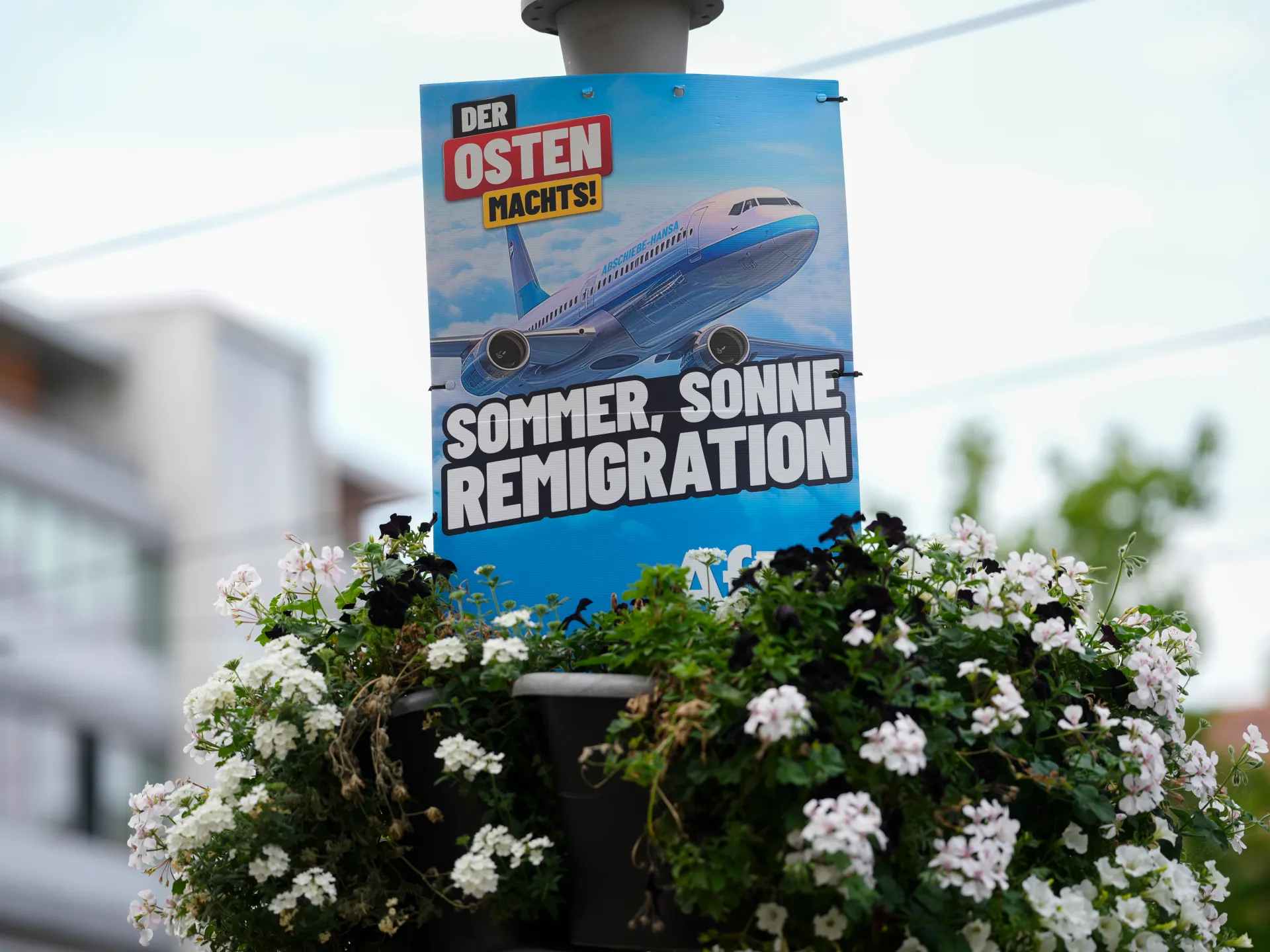
Across the border in Germany, Alice Weidel, the leader of the AfD, referred to “remigration” while supporting the closure of the country’s borders to new immigrants at a party conference in January.
In May 2025, a conference called the Remigration Summit was held in Italy. It was attended by far-right activists from across Europe. InfoMigrants, a website which covers migration issues in Europe, estimated that 400 right-wing activists attended the summit.
But Beirich said that remigration, if implemented as a policy, would in effect be an “attempt to create all-white countries through ethnic cleansing”.
Four members of the advocacy group Palestine Action have pledged this week to continue their hunger strike amid grave medical warnings and the hospitalisations of their fellow protesters.
The group’s members are being held in five prisons in the United Kingdom over alleged involvement in break-ins at a facility of the UK’s subsidiary of the Israeli defence firm Elbit Systems in Bristol and a Royal Air Force base in Oxfordshire. They are protesting for better conditions in prison, rights to a fair trial, and for the UK to change a July policy listing the movement as a “terror” group.
Recommended Stories
list of 4 itemsend of list
Palestine Action denies charges of “violent disorder” and others against the eight detainees. Relatives and loved ones told Al Jazeera of the members’ deteriorating health amid the hunger strikes, which have led to repeated hospital admissions. Lawyers representing the detainees have revealed plans to sue the government.
The case has brought international attention to the UK’s treatment of groups standing in solidarity with Palestinians amid Israel’s genocidal war in Gaza. Thousands of people have rallied in support of Palestine Action every week.
Hunger strikes have been used throughout history as an extreme, non-violent way of seeking justice. Their effectiveness often lies in the moral weight they place upon those in power.
Historical records trace hunger strikes back to ancient India and Ireland, where people would fast at the doorstep of an offender to publicly shame them. However, they have also proved powerful as political statements in the present day.
Here are some of the most famous hunger strikes in recent world history:
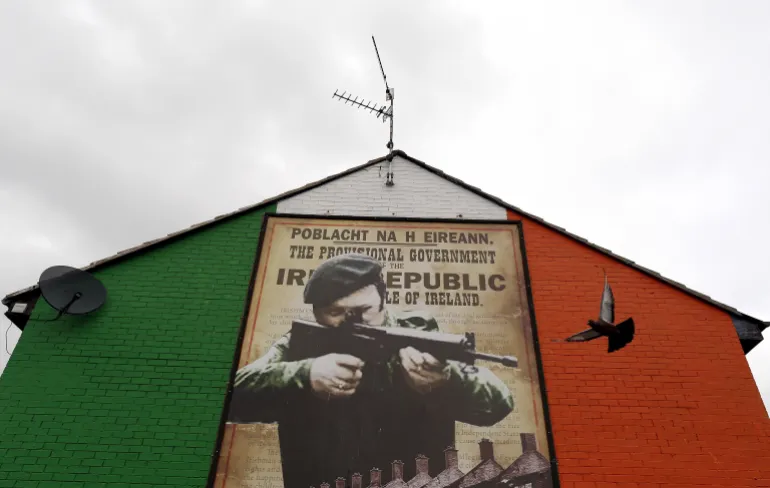
A pigeon flies past a mural supporting the Irish Republican Army in the Ardoyne area of north Belfast, September 9, 2015 [Cathal McNaughton/Reuters]
Irish Republican Movement hunger strikes
Some of the most significant hunger strikes in the 20th century occurred during the Irish revolutionary period, or the Troubles. The first wave was the 1920 Cork hunger strike, during the Irish War of Independence. Some 65 people suspected of being Republicans had been held without proper trial proceedings at the Cork County Gaol.
They began a hunger strike, demanding their release and asking to be treated as political prisoners rather than criminals. They were joined by Terence MacSwiney, the lord mayor of Cork, whose profile brought significant international attention to the independence cause. The British government attempted to break up the movement by transferring the prisoners to other locations, but their fasts continued. At least three prisoners died, including MacSwiney, after 74 days.
Later on, towards the end of the conflict and the signing of the Good Friday Agreement, imprisoned Irish Republicans protested against their internment and the withdrawal of political prisoner status that stripped them of certain rights: the right to wear civilian clothes, or to not be forced into labour.
They began the “dirty protest” in 1980, refusing to have a bath and covering walls in excrement. In 1981, scores of people refused to eat. The most prominent among them was Bobby Sands, an IRA member who was elected as a representative to the British Parliament while he was still in jail. Sands eventually starved to death, along with nine others, during that period, leading to widespread criticism of the Margaret Thatcher administration.
India’s Mohandas Karamchand Gandhi, who was later popularly known as Mahatma Gandhi, used hunger strikes as a tool of protest against the British colonial rulers several times. His fasts, referred to as Satyagraha, meaning holding on to truth in Hindi, were considered by the politician and activist not only as a political act but also a spiritual one.
Gandhi’s strikes sometimes lasted for days or weeks, during which he largely sipped water, sometimes with some lime juice. They achieved mixed results – sometimes, the British policy changed, but at other times, there were no improvements. Gandhi, however, philosophised in his many writings that the act was not a coercive one for him, but rather an attempt at personal atonement and to educate the public.
One of Gandhi’s most significant hunger strikes was in February 1943, after British authorities placed him under house arrest in Pune for starting the Quit India Movement back in August 1942. Gandhi protested against the mass arrests of Congress leaders and demanded the release of prisoners by refusing food for 21 days. It intensified public support for independence and prompted unrest around the country, as workers stayed away from work and people poured out into the streets in protest.
Another popular figure who used hunger strikes to protest against British rule in colonial India was Jatindra Nath Das, better known as Jatin Das. A member of the Hindustan Socialist Republican Association, Das refused food while in detention for 63 days starting from August 1929, in protest against the poor treatment of political prisoners. He died at the age of 24, and his funeral attracted more than 500,000 mourners.
Palestinian kids wave their national flag and hold posters showing Khader Adnan following his death on May 2, 2023 [Majdi Mohammed/AP Photo]
Palestinian prisoners in Israeli prisons
Palestinians held, often without trial, in Israeli jails have long used hunger strikes as a form of protest. One of the most well-known figures is Khader Adnan, whose shocking death in May 2023 after an 86-day hunger strike drew global attention to the appalling treatment of Palestinians by the Israeli government.
Adnan, who was 45 when he starved to death at the Ayalon Prison, leaving behind nine children, had repeatedly been targeted by Israeli authorities since the early 2000s. The baker from the occupied West Bank had once been part of the Palestinian Islamic Jihad group as a spokesperson, although his wife later stated publicly that he had left the group and that he had never been involved in armed operations.
However, Adnan was arrested and held without trial multiple times, with some estimates stating that he spent a cumulative eight years in Israeli prisons. Adnan would often go on hunger strike during those detentions, protesting against what he said was usually a humiliating arrest and a detention without basis. In 2012, thousands in Gaza and the West Bank rallied in a non-partisan show of support after he went 66 days without food, the longest such strike in Palestinian history at the time. He was released days after the mass protests.
In February 2023, Adnan was once again arrested. He immediately began a hunger strike, refusing to eat, drink, or receive medical care. He was held for months, even as medical experts warned the Israeli government that he had lost significant muscle mass and had reached a point where eating would cause more damage than good. On the morning of May 2, Adnan was found dead in his cell, making him the first Palestinian prisoner to die in a hunger strike in three decades. Former Palestinian Information Minister Mustafa Barghouti described his death as an “assassination” by the Israeli government.
Hunger strikes at Guantanamo
Following the 2002 opening of the Guantanamo Bay detention camp of the United States in Cuba, where hundreds of “terror” suspects were held prisoners, often with no formal charges, they used hunger strikes in waves to protest against their detention. The camp is notorious for its inhumane conditions and prisoner torture. There were 15 detainees left by January 2025.
The secret nature of the prison prevented news of earlier hunger strikes from emerging. However, in 2005, US media reported mass hunger strikes by scores of detainees – at least 200 prisoners, or a third of the camp’s population.
Officials forcefully fed those whose health had severely deteriorated through nasal tubes. Others were cuffed daily, restrained, and force-fed. One detainee, Lakhdar Boumediene, later wrote that he went without a real meal for two years, but that he was forcefully fed twice a day: he was strapped down in a restraining chair that inmates called the “torture chair”, and a tube was inserted in his nose and another in his stomach. His lawyer also told reporters that his face was usually masked, and that when one side of his nose was broken one time, they stuck the tube in the other side, his lawyer said. Sometimes, the food got into his lungs.
Hunger strikes would continue intermittently through the years at Guantanamo. In 2013, another big wave of strikes began, with at least 106 of the remaining 166 detainees participating by July. Authorities force-fed 45 people at the time. One striker, Jihad Ahmed Mustafa Dhiab, filed for an injunction against the government to stop officials from force-feeding him, but a court in Washington, DC rejected his lawsuit.
Protests against apartheid South Africa
Black and Indian political prisoners held for years on Robben Island protested against their brutal conditions by going on a collective hunger strike in July 1966. The detainees, including Nelson Mandela, had been facing reduced food rations and were forced to work in a lime quarry, despite not being criminals. They were also angry at attempts to separate them along racial lines.
In his 1994 biography, Long Walk to Freedom, Mandela wrote that prison authorities began serving bigger rations, even accompanying the food with more vegetables and hunks of meat to try to break the strike. Prison wardens smiled as the prisoners rejected the food, he wrote, and the men were driven especially hard at the quarry. Many would collapse under the intensity of the work and the hunger, but the strikes continued.
A crucial plot twist began when prison wardens, whom Mandela and other political prisoners had taken extra care to befriend, began hunger strikes of their own, demanding better living conditions and food for themselves. Authorities were forced to immediately settle with the prison guards and, a day later, negotiate with the prisoners. The strike lasted about seven days.
Later, in May 2017, South Africans, including the then Deputy President Cyril Ramaphosa, who was imprisoned in a different facility during apartheid, supported hunger-striking Palestinian prisoners by participating in a collective one-day fast. At the time, late Robben Island veteran Sunny “King” Singh wrote in the South African paper Sunday Tribune that hunger strikes in the prison never lasted more than a week before things changed, and compared it with the protracted situation of Palestinian strikers.
“We were beaten by our captors but never experienced the type of abuse and torture that some of the Palestinian prisoners complain of,” he wrote. “It was rare that we were put in solitary confinement, but this seems commonplace in Israeli jails.”
Poland’s defence minister said Russian aircraft was ‘escorted’ from area and did not pose immediate security threat.
Published On 26 Dec 202526 Dec 2025
Share
Poland said its air force intercepted a “Russian reconnaissance aircraft” flying near the border of its airspace just hours after tracking suspected smuggling balloons coming from the direction of neighbouring Belarus.
“This morning, over the international waters of the Baltic Sea, Polish fighter jets intercepted, visually identified, and escorted a Russian reconnaissance aircraft flying near the border of Polish airspace from their area of responsibility,” the Operational Command of the Polish Armed Forces said in a post on X on Thursday.
Recommended Stories
list of 4 itemsend of list
Polish forces also tracked unknown “objects” flying in the direction of Poland from Belarus during the previous night, prompting Warsaw to temporarily close civilian airspace in the northeast of the country.
“After detailed analysis, it was determined that these were most likely smuggling balloons, moving in the direction and at the speed of the wind. Their flight was continuously monitored by our radar systems,” Operational Command said.
The post did not disclose any further details about the number or size of the balloons.
Polish Defence Minister Wladyslaw Kosiniak-Kamysz said on X that the incidents did not pose an immediate threat to Poland’s security, and he thanked the “nearly 20,000 of our soldiers who, during the Holidays, watch over our safety”.
“All provocations over the Baltic Sea and near the border with Belarus were under the full control of the Polish Army,” he said.
Translation: Another busy night for the operational services of the Polish Army. All provocations, both over the Baltic Sea and over the border with Belarus, were under full control. I thank nearly 20,000 of our soldiers who, during the Holidays, watch over our safety – and as can be seen – do so extremely effectively.
The Belarusian and Russian embassies in Warsaw did not immediately respond to the Reuters news agency’s requests for comment.
Smuggler balloons from Belarus have repeatedly disrupted air traffic in neighbouring Lithuania, forcing airport closures. Lithuania says the balloons are sent by smugglers transporting cigarettes and constitute a “hybrid attack” by Belarus, a close ally of Russia. Belarus has denied responsibility for the balloons.
The latest air alerts in Poland came three months after Poland and NATO forces shot down more than a dozen Russian drones as they flew over Polish airspace between September 9 and 10.
The event was the largest incursion of its kind on Polish airspace since Russia invaded Ukraine in February 2022.
Following the incident, NATO-member Poland called an emergency session of the United Nations Security Council to discuss the “blatant violation of the UN Charter principles and the customary law”.
Polish Foreign Minister Radoslaw Sikorski said at the time that Russia was testing how quickly NATO countries could respond to threats.
These are the key developments from day 1,401 of Russia’s war on Ukraine.
Published On 26 Dec 202526 Dec 2025
Share
Here is where things stand on Friday, December 26:
Fighting
Officials in Russia’s Krasnodar region reported a huge fire following a Ukrainian drone strike on two storage tanks holding oil products in the southern Russian port of Temryuk. The blaze spread across roughly 2,000 square metres (some 21,500 square feet).
Long-range Ukrainian drones targeted oil storage facilities at Temryuk port, as well as a gas processing plant in Russia’s Orenburg region, Ukraine’s SBU security service said.
Ukraine’s General Staff said its military also struck the Novoshakhtinsk oil refinery in Russia’s Rostov region using Storm Shadow missiles, triggering several explosions.
The General Staff described the Russian refinery as a major supplier of oil products in southern Russia that supports Moscow’s military operations in Ukraine.
Russia’s Ministry of Defence announced that its forces had taken control of the settlement of Sviato-Pokrovske in eastern Ukraine’s Donetsk region, according to reports from Russian state news agencies.
Regional security
Poland sent fighter jets to intercept a Russian reconnaissance aircraft flying near its airspace over the Baltic Sea and said dozens of objects entered Polish airspace from Belarus overnight, warning the incidents during the holiday season may signal a provocation.
Russia’s Ministry of Foreign Affairs accused the United States of encouraging what it called “piracy” in the Caribbean and Pacific Ocean by blockading Venezuela, while expressing hope that US President Donald Trump’s pragmatism could prevent further escalation.
Moscow also reiterated its support for Venezuelan President Nicolas Maduro’s government and its efforts to safeguard national sovereignty amid threats by the US to remove Maduro from power.
Peace talks
Ukrainian President Volodymyr Zelenskyy said he spoke with Donald Trump’s special envoy Steve Witkoff and son-in-law, Jared Kushner, for about an hour on how to end the war with Russia and “how to bring the real peace closer”.
“Of course, there is still work to be done on sensitive issues,” the Ukrainian leader said. “But together with the American team, we understand how to put all of this in place. The weeks ahead may also be intensive. Thank you, America!”
Russia believes negotiations with the US to end the war in Ukraine are making gradual progress, Russian Foreign Ministry spokeswoman Maria Zakharova said. She described the talks as slow-moving but advancing steadily.
Politics and diplomacy
Kremlin spokesman Dmitry Peskov said President Vladimir Putin had sent the US president a Christmas greeting along with a congratulatory message.
Russia said it had put forward a proposal to France concerning Laurent Vinatier, a French researcher imprisoned under Russia’s foreign agent laws, adding that the next steps in the Frenchman’s case now rest with Paris.
Sanctions
Russia’s target of producing 100 million tonnes of liquefied natural gas annually has been pushed back by several years due to international sanctions, the country’s Deputy Prime Minister Alexander Novak said in comments aired on state television.
Pope Leo has decried conditions for Palestinians in Gaza in his first Christmas sermon as pontiff, in an unusually direct appeal during what is normally a solemn, spiritual service on the day Christians across the globe celebrate the birth of Jesus Christ.
Leo, the first American pope, said on Thursday that the story of Jesus being born in a stable showed that God had “pitched his fragile tent” among the people of the world.
Recommended Stories
list of 3 itemsend of list
“How, then, can we not think of the tents in Gaza, exposed for weeks to rain, wind and cold?” he asked.
Leo, celebrating his first Christmas after being elected in May by the world’s cardinals to succeed the late Pope Francis, has a quieter, more diplomatic style than his predecessor and usually refrains from making political references in his sermons.
But the new pope has also lamented the conditions for Palestinians in Gaza several times recently and told journalists last month that the only solution in the decades-long conflict between Israel and Palestine must include a Palestinian state.
Israel and Hamas agreed to a ceasefire in October after two years of intense bombardment and military operations in Gaza, but humanitarian agencies say there is still too little aid getting into the largely destroyed Strip, where nearly the entire population is homeless after being displaced by Israeli attacks.
In Thursday’s service with thousands in St Peter’s Basilica, Leo also lamented conditions for the homeless across the globe and the destruction caused by the wars roiling the world.
“Fragile is the flesh of defenceless populations, tried by so many wars, ongoing or concluded, leaving behind rubble and open wounds,” said the pope.
“Fragile are the minds and lives of young people forced to take up arms, who on the front lines feel the senselessness of what is asked of them and the falsehoods that fill the pompous speeches of those who send them to their deaths,” he added.
In a later appeal during the “Urbi et Orbi” (to the city and the world) message and blessing given by the pope at Christmas and Easter, Leo called for an end to all global wars, lamenting conflicts, political, social or military, in Ukraine, Sudan, Mali, Myanmar, and Thailand and Cambodia, among others.
Pope Leo XIV holds a figurine of baby Jesus during Christmas Eve Mass in St Peter’s Basilica at the Vatican, December 24 [Guglielmo Mangiapane/Reuters]
‘The wounds are deep’
Ahead of the pope’s mass, in Bethlehem in the occupied West Bank, the Christian community began celebrating its first festive Christmas in more than two years, as the Palestinian city and biblical birthplace of Jesus emerges from the shadow of Israel’s genocidal war on Gaza.
Throughout the war, a sombre tone had marked Christmases in Bethlehem. But celebrations returned on Wednesday with parades and music. Hundreds of worshippers also gathered for mass at the Church of the Nativity on Wednesday night.
With pews filled long before midnight, many stood or sat on the floor for the traditional mass to usher in Christmas Day.
At 11:15 pm (21:15 GMT), organ music rang out as a procession of dozens of clergymen entered, followed by Jerusalem’s Latin Patriarch Pierbattista Pizzaballa, who blessed the crowd with signs of the cross.
In his homily, Pizzaballa urged peace, hope and rebirth, saying the Nativity story still held relevance in the turbulence of modern times.
He also spoke of his visit to Gaza over the weekend, where he said “suffering is still present” despite the ceasefire. In the Strip, hundreds of thousands of people face a bleak winter in makeshift tents.
“The wounds are deep, yet I have to say, here too, there too, their proclamation of Christmas resounds,” Pizzaballa said. “When I met them, I was struck by their strength and desire to start over.”
In Bethlehem, hundreds also took part in the parade down the narrow Star Street on Wednesday, while a dense crowd massed in the square. As darkness fell, multi-coloured lights shone over Manger Square and a towering Christmas tree glittered next to the Church of the Nativity.
The basilica dates back to the fourth century and was built on top of a grotto where Christians believe Jesus was born more than 2,000 years ago.
Bethlehem residents hoped the return of Christmas festivities would breathe life back into the city.
From Israel’s genocide in Gaza and the Russia-Ukraine war to devastating global weather events – including floods, storms and earthquakes – this year was defined by turmoil and humanitarian crises.
Prolonged violence in Sudan, marked by attacks by the Rapid Support Forces (RSF), added to the mounting civilian toll and displacement across the country.
The year also saw heightened tensions between India and Pakistan, a deadly blaze in Hong Kong, United States and Israeli attacks on Iran, revelations from the Epstein files, and waves of “Gen Z” protest movements across multiple regions.
Together, these developments dominated international headlines, reflecting deepening political instability, social unrest and growing humanitarian needs worldwide.
View the gallery below for powerful photographs that documented and encapsulated these pivotal 12 months.
Algeria’s parliament unanimously passed a law declaring France’s colonisation a crime. Lawmakers celebrated in the chamber as they demanded an apology, reparations and assigned France legal responsibility for the harms caused during colonial rule.
‘Main reason for optimism’ is a belief that war in Ukraine will end in 2026 with Moscow’s ‘objectives’ achieved,’ pollster says.
Published On 25 Dec 202525 Dec 2025
Share
A majority of Russians expect the war in Ukraine to end in 2026, a state-owned research centre said, as Russian forces make advances on the battlefield and efforts intensify to reach a ceasefire deal between Kyiv and Moscow.
VTsIOM, Russia’s leading public opinion research centre, said on Wednesday that its annual survey of sentiment around the outgoing year and expectations for the coming year found Russians are viewing 2026 with “growing optimism”.
Recommended Stories
list of 4 itemsend of list
“Expectations for next year traditionally look much more optimistic … In other words, while the negative perception of the current situation persists, Russians have become more likely to accept (or believe, hope?) future improvements this year, but they still do so with caution,” the organisation said in a review of its survey findings released online.
In a year-end presentation, VTsIOM deputy head Mikhail Mamonov said 70 percent of 1,600 people surveyed viewed 2026 as being a more “successful” year for Russia than this year, with 55 percent of respondents linking hope for a better year to a possible end to what Russia officially calls its “special military operation” in Ukraine.
“The main reason for optimism is the possible completion of the special military operation and the achievement of the stated objectives, in line with the national interests outlined by the president,” Mamonov said at the presentation.
Mamonov pointed to the Russian military’s ongoing offensive in Ukraine, Washington’s reluctance to finance the Ukraine war and the European Union’s inability to fully replace the United States’ role in Ukraine – financially and militarily – as key factors behind the prospects for an eventual deal to end the fighting.
At the conclusion of the conflict, reintegration of Russian military veterans into society and the reconstruction of Russian-controlled regions of Ukraine, as well as Russian border areas, will be the main priorities, Mamonov added.
While the actual level of Russian public fatigue with the war is difficult to measure due to strict state controls on the media, expressions of public dissent as well as the prosecution of those who criticise Moscow’s war on its neighbour, approximately two-thirds of Russians support peace talks, according to independent pollster Levada, the highest number since the start of the war in 2022.
Ukrainian President Volodymyr Zelenskyy said in comments released on Wednesday that he would be willing to withdraw troops from Ukraine’s eastern industrial heartland as part of a plan to end the war, if Moscow reciprocated by also pulling back its forces and allowed the area to become a demilitarised zone monitored by international forces.
In comments to reporters about an overarching 20-point plan that negotiators from Ukraine and the US had hammered out in Florida in recent days, Zelenskyy also said that a similar arrangement could be possible for the area around the Zaporizhzhia nuclear power plant, which is currently under Russian control.
Russia has given no indication that it will agree to any kind of withdrawal from land it has seized in Ukraine and has long insisted that Kyiv must give up the remaining territory it still holds in the Donbas industrial area before any discussions on the cessation of fighting.
Russia has captured most of Luhansk and about 70 percent of Donetsk – the two regions that make up the Donbas.
Zelenskyy also said that figuring out the future control of the Donbas as part of the plan was “the most difficult point”, and creating a demilitarised economic zone in the region would require difficult discussions on how far troops would be required to move back and where international forces would be stationed.
Such discussions should be held at the leaders’ level, he said.
These are the key developments from day 1,400 of Russia’s war on Ukraine.
Published On 25 Dec 202525 Dec 2025
Share
Here is where things stand on Thursday, December 25:
Fighting
An explosion in Moscow killed three people, including two police officers, just days after a car bomb killed a high-ranking Russian general in the same area of the capital.
An official from Ukraine’s military intelligence, known as GUR, told The Associated Press news agency that the attack had been carried out as part of a Ukrainian operation and the two police officers were targeted for taking part in Russia’s war in Ukraine.
Russian air defence units downed 16 Ukrainian drones en route to Moscow throughout Wednesday, the capital’s Mayor Sergei Sobyanin said.
Sobyanin said the drones were repelled over a period of about 17 hours, and emergency crews were examining fragments where the drones hit the ground, but no damage was reported.
Two of four major airports servicing Moscow were forced to limit operations for a time due to the drone attacks, Russia’s civil aviation authority said on Telegram.
Russia’s Ministry of Defence said its aerial defence units destroyed 172 Ukrainian drones overnight, nearly half of them over regions bordering Ukraine.
Ukraine said its drones had struck the Yefremov synthetic rubber plant in Russia’s Tula region, south of Moscow, and a storage facility for marine drones in Russian-occupied Crimea.
Tula regional governor, Dmitry Milyaev, said debris from a downed Ukrainian drone ignited a fire at an industrial site, and Russian air defence units destroyed 12 Ukrainian drones over the region.
A sunflower oil spill, caused by Russian aerial bombardments, has contaminated the shoreline around the southern Ukrainian city of Odesa, killing wildlife and triggering warnings from conservationists, the AFP news agency reports.
“The cause was damage to sunflower oil tanks as a result of massive enemy attacks on port infrastructure, causing some of the oil to spill,” Odesa Governor Oleh Kiper said in a statement. The Pivdenny port in the region was temporarily closed on Wednesday to help with the cleanup.
A Russian-backed court in occupied Ukraine sentenced a Colombian man to 19 years in prison for fighting for Kyiv’s army.
Russia’s Prosecutor General said the Supreme Court in the Russian-controlled area of Ukraine’s Donetsk region sentenced Oscar Mauricio Blanco Lopez, 42, to 19 years in jail. The Colombian arrived in Ukraine in May 2024 to sign up with the Ukrainian army and had been “taken prisoner by Russian servicemen” in December 2025.
Ceasefire talks
Ukrainian President Volodymyr Zelenskyy revealed for the first time details of an agreement between the United States and Ukrainian negotiators on ending the war with Russia. The 20-point plan, agreed on by US and Ukrainian negotiators after marathon talks, is now being reviewed by Moscow.
As part of the plan, President Zelenskyy said Ukraine would be willing to withdraw troops from the country’s eastern industrial heartland if Moscow also pulled back and the area becomes a demilitarised zone monitored by international forces.
A similar arrangement could be possible for the area around the Zaporizhzhia nuclear power plant, which is currently under Russian control, Zelenskyy said. The Ukrainian leader said that any peace plan would need to be put to a referendum in Ukraine.
Asked about the latest development in ceasefire talks, Kremlin spokesperson Dmitry Peskov said Moscow would decide its position based on information received by Russian presidential envoy Kirill Dmitriev, who met with US envoys in Florida over the weekend.
Russia has given no indication that it will agree to any kind of withdrawal from land it has seized in Ukraine. Moscow has also insisted that Ukraine relinquish the remaining territory it still holds in the Donbas. Russia has captured most of Luhansk and about 70 percent of Donetsk – the two areas that make up the Donbas.
Politics and diplomacy
A majority of Russians expect the war in Ukraine to end in 2026, Russia’s state pollster VTsIOM said, in a sign that the Kremlin could be testing public reaction to a possible peace settlement as diplomatic efforts to end the conflict intensify.
During the pollster’s year-end presentation, VTsIOM Deputy Head Mikhail Mamonov said 70 percent of the 1,600 respondents saw 2026 as a more “successful” year for Russia than 2025, while for 55 percent that hope was linked to a possible end to Russia’s war in Ukraine.
A Russian court has scheduled the first public hearing in a criminal case against German sculptor Jacques Tilly, who is accused of discrediting the Russian military through his satirical Carnival floats depicting Russia’s President Vladimir Putin.
The court in Moscow said the trial will begin on December 30 and proceedings will be held in absentia, as Tilly – who faces up to 10 years in jail or a fine – is not in Russia.
Zelenskyy said in his Christmas address on Wednesday that despite marking the holiday at a “difficult” time, the nation’s unity remains intact. “Ukrainians are together tonight,” Zelenskyy said, adding the country had “without a doubt” been changed by the war. “It hardly matters what dishes are on the table – what matters is who is at the table,” he said.
Artillerymen of the 44th Separate Artillery Brigade fire a M777 Howitzer towards Russian troops, amid Russia’s attack on Ukraine, in Dnipropetrovsk region, Ukraine, on December 24, 2025 [Reuters]
Regional security
France’s President Emmanuel Macron said he spoke with NATO chief Mark Rutte to discuss the situation in Ukraine and the work undertaken by the “coalition of the willing”. “Starting in January in Paris, we will continue the work begun within this framework to provide Ukraine with solid security guarantees, a prerequisite for a robust and lasting peace,” Macron said on social media.
Democratic senators in the US have urged President Donald Trump to reverse a recall of nearly 30 career ambassadors, warning the move leaves a dangerous leadership vacuum that allows adversaries like Russia and China to expand their influence. The Trump administration in recent days has ordered career diplomats serving across Europe, Asia, Africa and Latin America back to Washington to ensure US missions abroad reflect its “America First” priorities.
Economics
Kazakhstan’s exports of its flagship CPC Blend of oil will be their lowest in 14 months in December, as bad weather delays efforts to repair Russian loading infrastructure after Ukrainian drone strikes last month, two sources told the Reuters news agency.
On November 29, Ukrainian drones hit the Caspian Pipeline Consortium terminal located near Russia’s Black Sea port of Novorossiysk, leaving just one out of three jetties operational and prolonging export delays. Poor weather has added to the difficulty of carrying out maintenance work necessary to allow exports to recover.
Ukraine’s Ministry of Finance said it completed the settlement of a deal to restructure $2.6bn of growth-linked debt.
How the French Empire built power through language, schooling and cultural assimilation and what it means today.
Beyond armies and violence, France built its empire through language, schooling and cultural influence. This film explores how assimilation became a method of rule and a source of resistance.
At the heart of French colonial rule was the mission “civilisatrice”, a doctrine that claimed to lift up colonised societies through education, administration and the French language. In practice, this system sought to reshape colonised people’s identities, loyalties and cultures, replacing local traditions with French norms while maintaining strict political and economic control. Schools, legal systems and bureaucracies became tools of empire as powerful as armies.
Through case studies in Algeria, Indochina and West Africa, the documentary shows how colonial administrations operated on the ground. In Algeria, settler colonialism and mass repression led to war. In Indochina, education and bureaucracy coexisted with exploitation and nationalist resistance. In West Africa, language policy and indirect rule reshaped social hierarchies and governance.
This episode examines how resistance movements challenged the promise of civilisation, forcing France to confront the contradictions at the heart of its empire. Anticolonial struggles, intellectual movements and armed uprisings not only weakened imperial rule but reshaped French politics, culture and identity itself.
The documentary also places French colonial strategies in a broader modern context. In the contemporary world, the United States projects influence less through formal empire and more through soft power. Hollywood cinema, television and digital platforms circulate American values, lifestyles and narratives globally, shaping cultural imagination in ways that echo earlier imperial projects. At the same time, US dominance in higher education, academic publishing and institutional standards helps define what knowledge is valued, taught and legitimised worldwide.
It also draws direct connections between French colonialism and the modern world. Contemporary debates over language, immigration, secularism and inequality are deeply rooted in colonial systems designed to classify, discipline and extract. Many modern state institutions, education models and economic relationships reflect structures first imposed under empire.
By tracing how cultural control, education and administration functioned as instruments of power, the documentary reveals how the legacy of French colonialism continues to shape modern capitalism, global inequality and postcolonial relations today.
BRUSSELS — The European Union’s executive arm on Wednesday warned that it would take action against any “unjustified measures” after the U.S. State Department barred five Europeans it accuses of pressuring U.S. technology firms to censor or suppress American viewpoints.
The Europeans were characterized by U.S. Secretary of State Marco Rubio as “radical” activists and “weaponized” nongovernmental organizations. They include the former EU commissioner responsible for supervising social media rules, Thierry Breton.
Breton, a businessman and former French finance minister, clashed last year on social media with tech billionaire Elon Musk over broadcasting an online interview with Donald Trump in the months leading up to the U.S. election.
The European Commission, the EU’s powerful executive branch and which supervises tech regulation in Europe, said that it “strongly condemns the U.S. decision to impose travel restrictions” and that it has requested clarification about the move. French President Emmanuel Macron also condemned it.
“If needed, we will respond swiftly and decisively to defend our regulatory autonomy against unjustified measures,” the commission said in a statement, without elaborating.
Rubio wrote in an X post on Tuesday that “for far too long, ideologues in Europe have led organized efforts to coerce American platforms to punish American viewpoints they oppose.”
“The Trump Administration will no longer tolerate these egregious acts of extraterritorial censorship,” he posted.
The European Commission countered that “the EU is an open, rules-based single market, with the sovereign right to regulate economic activity in line with our democratic values and international commitments.”
“Our digital rules ensure a safe, fair, and level playing field for all companies, applied fairly and without discrimination,” it said.
Macron said that the visa restrictions “amount to intimidation and coercion aimed at undermining European digital sovereignty,” he posted on X.
Macron said that the EU’s digital rules were adopted by “a democratic and sovereign process” involving all member countries and the European Parliament. He said that the rules “ensure fair competition among platforms, without targeting any third country.”
He underlined that “the rules governing the European Union’s digital space are not meant to be determined outside Europe.”
Breton and the group of Europeans fell afoul of a new visa policy announced in May to restrict the entry of foreigners deemed responsible for censorship of protected speech in the United States.
The four others are: Imran Ahmed, chief executive of the Centre for Countering Digital Hate; Josephine Ballon and Anna-Lena von Hodenberg, leaders of HateAid, a German organization; and Clare Melford, who runs the Global Disinformation Index.
Rubio said the five had advanced foreign government censorship campaigns against Americans and U.S. companies, which he said created “potentially serious adverse foreign policy consequences” for the United States.
The action to bar them from the U.S. is part of a Trump administration campaign against foreign influence over online speech, using immigration law rather than platform regulations or penalties.
In a post on X on Tuesday, Sarah Rogers, the U.S. under secretary of state for public diplomacy, called Breton the “mastermind” behind the EU’s Digital Services Act, which imposes a set of strict requirements designed to keep internet users safe online. This includes flagging harmful or illegal content like hate speech.
Breton responded on X by noting that all 27 EU member countries voted for the Digital Services Act in 2022. “To our American friends: ‘Censorship isn’t where you think it is,’” he wrote.
Cook writes for the Associated Press. AP journalist Angela Charlton contributed to this report from Paris.
Captain Ben Stokes said protecting England players’ welfare was his top concern amid claims of excessive drinking on a mid-Ashes beach break, without directly addressing the allegations.
Stokes was peppered with questions on Wednesday ahead of the Boxing Day Test in Melbourne about the team’s behaviour at Noosa between the second and third Tests after British media reports compared it with a “stag-do”.
Recommended Stories
list of 4 itemsend of list
Unverified social media footage appeared to show opener Ben Duckett drunk and disoriented.
Their disastrous five-Test tour, which has seen Australia take an unassailable 3-0 lead, took another hit on Wednesday when pace spearhead Jofra Archer was ruled out of the rest of the series with a side strain.
England cricket chief Rob Key on Tuesday pledged to investigate the drinking claims, while the England and Wales Cricket Board said in a statement it was intent on establishing the facts.
Stokes, whose team have already lost the Ashes, said his main concern was the players’ mental welfare and to ensure they were ready for the Melbourne Test starting Friday.
“I’m obviously aware of the reports and everything circulating around right now,” Stokes said.
“My main concern is my players, and how I handle this moment is the most important thing to me.
“The welfare of everyone in there, and probably some certain individuals as well, is the most important thing to me right now as England captain.
“It’s never a nice place to be in when not only the media world, but also the social media world, is piling on top of you,” he added.
“It’s a very tough place to be in as an individual. As an individual, when you know you’ve got the support of the people who are sort of leaders, in a sense, it’s very good to know that you’ve got that support.”
Asked directly whether his teammates had “done anything wrong in Noosa”, Stokes replied: “I’ve just answered everything there.”
Stokes calls for focus as spotlight increases on England
England went to Queensland tourist resort Noosa after losing the first two Tests in Perth and Brisbane heavily.
They spent several days on the sand and around restaurants and bars before travelling to Adelaide, where they lost the third Test as Australia retained the Ashes.
Britain’s Daily Telegraph reported that “after drowning their sorrows after the Brisbane Test, it is no exaggeration to say some, certainly not all, players drank for five or six days”.
It added that players “did nothing outrageous in Noosa” but there was concern over the level of drinking, with England’s professionalism already under the microscope after their limited preparations.
England captain Ben Stokes, right, and coach Brendon McCullum are both under pressure following the side’s failures in Australia [Gareth Copley/Getty Images]
Stokes conceded that when a side was losing, there would be scrutiny, and “rightly so”.
“When you are 3-0 down you don’t really have a leg to stand on but we’ve got two games of cricket to play. That’s what we have to focus on,” he said.
“We haven’t won a game in Australia for a long, long time.”
England have gone 18 Tests since winning a match in Australia, dating back to their last series victory there in 2010-11.
Their capitulation in this series in 11 days of play is the joint second quickest in more than a century, since the 1921 Ashes was completed in eight days.
Making matters worse, Archer will take no further part in the tour, with Gus Atkinson replacing him in Melbourne.
The under-performing Ollie Pope paid for his poor form at number three, with Jacob Bethell taking over in the only other change.
England’s Test woes in contrast to Australia’s Ashes high
Bowling with the wicketkeeper standing up to the stumps can bruise a fast bowler’s ego, but Australia paceman Scott Boland said Alex Carey’s stellar glovework in the ongoing Ashes series has helped him grow comfortable with it.
Carey’s wicketkeeping masterclass has been a key factor in Australia’s unassailable lead in the five-match series, and the 34-year-old was particularly impressive in the second Test at the Gabba, where he stood up to Boland and Michael Neser.
With the wicketkeeper breathing down their necks, English batters were pretty much confined to the crease, which meant the home bowlers did not really need to vary their length.
“I’ve just never really bowled to the keeper up to the stumps before,” Boland told reporters ahead of the fourth Test.
“Everyone wants to be a fast bowler, and you don’t really like the keeper up to the stumps.
“But I’ve seen over the last month how effective it is and how still I can keep their batters by Alex being up to the stumps.”
Wicketkeepers typically stand farther back from the stumps when facing fast bowlers to give themselves more time to react to the high speed and bounce of the ball, reducing the risk of missed catches.
Even from close range, Carey showed tremendous reflexes to pouch a thick edge from Ben Stokes after the England captain had nicked a Neser delivery in the second innings.
Dismissals like that gave confidence to Boland that he could continue bowling his edge-inducing length balls regardless of where Carey stood.
“I just need to trust that the length balls I bowl to try and nick guys off is the same length I bowl when he’s up to the stumps or back,” the 36-year-old said.
“The Gabba was pretty bouncy and he was up to the stumps for a bit of it and catching balls above waist-high and I bowled a bouncer and he caught that, so I have full trust in him up there.”
Former Australia wicketkeeper Ian Healy called Carey “clearly the best in the world”, while teammate Steve Smith termed him a “freak”.