Discover the latest happenings and stay in the know with our up-to-date today news coverage. From breaking stories and current events to trending topics and insightful analysis, we bring you the most relevant and captivating news of the day.
Syrian state television denounces the Israeli incursion as another violation of the nation’s sovereignty.
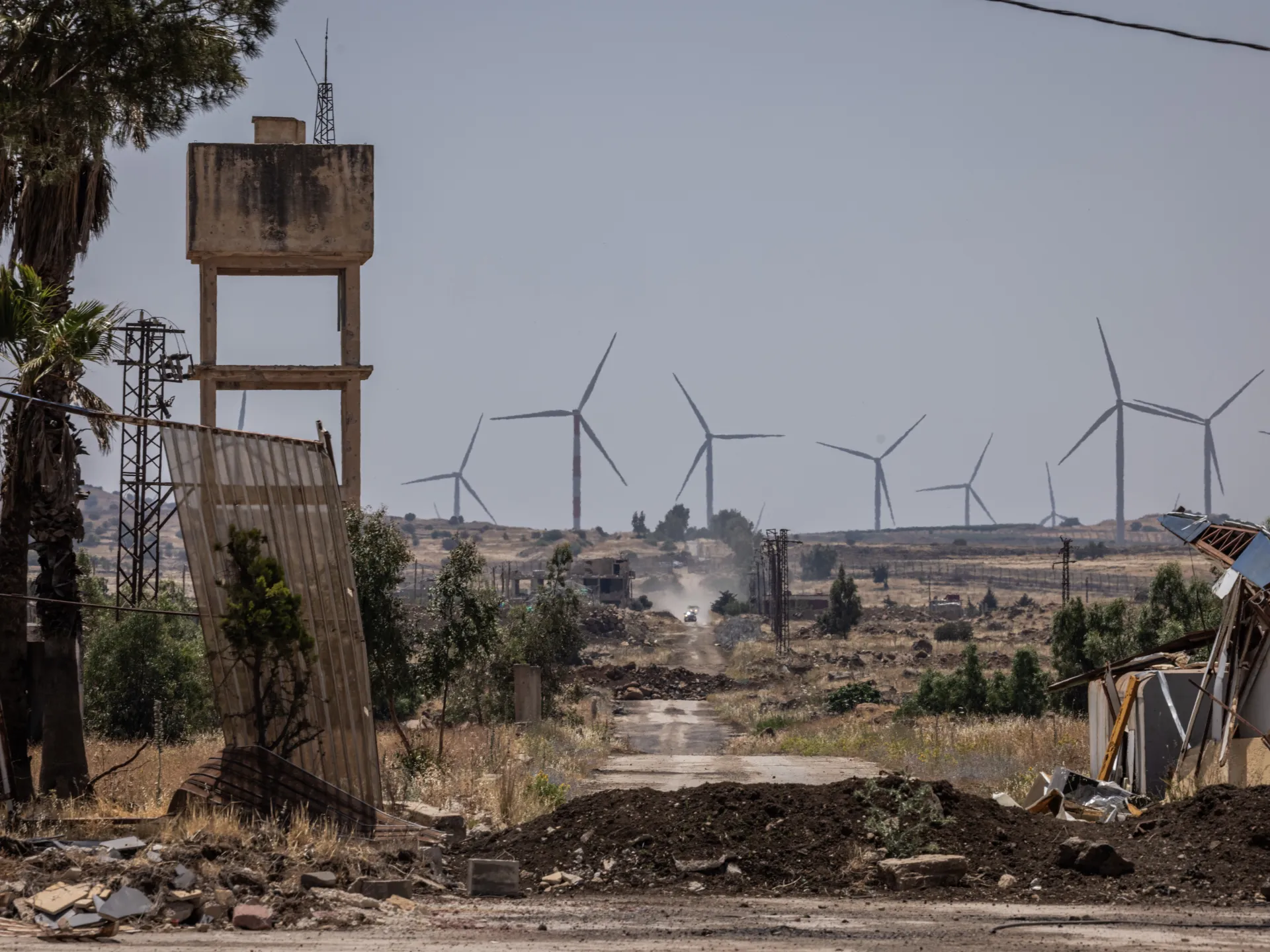
Israeli forces have advanced into the Quneitra area of Syria’s occupied Golan Heights and set up two military checkpoints, an Al Jazeera correspondent on the ground reports.
The Israeli military operation on Saturday took place in the villages of Ain Ziwan and al-Ajraf in the southern part of the country.
Recommended Stories
list of 4 itemsend of list
For months, Israeli forces have conducted near-daily incursions into southern Syria, particularly in the Quneitra governorate, carrying out arrests, erecting checkpoints, and bulldozing land, all of which have prompted growing public anger and unrest.
Syrian state television said the Israeli incursion was a violation of Syrian sovereignty, noting that the army used five military vehicles to set up the checkpoint in Ain Ziwan.
The latest raid comes one day after Israeli forces advanced towards the towns of al-Asha, Bir Ajam, Bariqa, Umm al-Azam and Ruwayhina in the southern Quneitra countryside, according to the Syrian News Agency (SANA).
Dozens of Syrians on Friday protested the Israeli incursion in the city of al-Salam in the Quneitra Governorate, condemning the ongoing Israeli attacks against citizens and their properties.
The demonstrators, part of a group called “Syrians with Palestine”, held banners denouncing what they stated were repeated Israeli violations of Syrian lands.
Despite a reduction in direct military threats, the Israeli army continues to carry out air raids that have caused civilian casualties and destroyed Syrian army sites and facilities.
Over the past year, Israel has launched more than 600 air, drone or artillery attacks across Syria, averaging nearly two attacks a day, according to a tally by the Armed Conflict Location and Event Data (ACLED).
Israeli military incursions have become more brazen, more frequent and more violent since Israel expanded its occupation of southern Syria following the ousting of President Bashar al-Assad in December 2024.
Disengagement accord
After al-Assad’s fall, Israel declared the 1974 Disengagement Agreement – brokered after the 1973 war, in which Syria failed to regain the occupied Golan Heights – void.
The agreement had established a UN-patrolled buffer zone, which Israel has since violated, advancing deeper into Syrian territory.
Citing al-Assad’s flight, Israel says the accord no longer applies, while carrying out air raids, ground incursions, reconnaissance flights; setting up checkpoints; and arresting or disappearing Syrians. Syria has not responded with attacks.
In September, Syrian President Ahmed al-Sharaa stated that Israel had conducted more than 1,000 air attacks and more than 400 ground incursions in Syria since al-Assad was overthrown, describing the actions as “very dangerous”.
Syrians believe that the continuation of these violations hinders efforts to restore stability in the region and undermines attempts to improve the economic situation in southern Syria.
Al Jazeera visited Quneitra in recent weeks and spoke to Syrians about Israeli incursions and abductions there, which have stoked fears.
Syria and Israel are currently in talks to reach an agreement that Damascus hopes will secure a halt to Israel’s air raids on its territory and the withdrawal of Israeli troops who have pushed into southern Syria.
In the background, the United States has been pushing diplomatic efforts to restore the 1974 deal.
Queues of up to an hour formed at the entrance to the Port of Dover
Long queues of travellers formed earlier at the Port of Dover, which have been blamed on IT issues at French border controls.
The delays, which lasted into the afternoon, were described as “absolute chaos” by one traveller, and images of the port showed a long line of vehicles queuing at a standstill.
Eurotunnel was also experiencing lengthy delays at its Folkestone terminal on Saturday – at the start of a weekend which is expected to see the Christmas getaway reach its peak.
The Port of Dover reported that traffic was free-flowing just before 15:00 GMT, after several hours of delays.
The port is expected to see about 30,000 cars pass through it until Sunday.
One traveller had posted earlier on X: “Horrible experience at Port of Dover this morning. Absolute chaos.
“Traffic at a standstill for an hour. Worst start to holiday imaginable. Just missed our boat. Still stuck. Kids in car.”
One local resident told the BBC the town was “proper rammed”.
Gareth Fuller/PA Media
Holiday and freight traffic queue on M20 to use the Channel Tunnel
The port advised passengers not to arrive more than two hours before their sailing.
It said if customers do miss their scheduled sailing due to the wait times, their ferry operator will place them on the next available crossing.
Long queues were also seen on the roads leading into Dover.
A port spokesperson asked all port-bound traffic to remain on main roads “to allow the Dover community to travel to festive events and finish their Christmas shopping in the town”.
Eurotunnel said it had a waiting time of two and a half hours for cars and 60 minutes for freight at its Folkestone terminal due to “high demand”.
Meanwhile, public transport operators had experienced problems reaching the port.
Bus company Stagecoach said in a statement: “Due to heavy traffic at the docks the service will be unable to serve Eastern Docks at the moment.”
The Central Economic Conference in Beijing in December 2025 identified eight key tasks for China’s economic work in 2026. Several of these areas particularly interest me as a China expert. Among the most important tasks for China’s economic work in 2026 is promoting a policy of supporting service exports through various measures to boost household income, raise basic pensions, and remove restrictions in the consumer sector. What struck me most during the Central Economic Conference meetings in Beijing in December 2025 was its emphasis on China’s continued opening up. This will provide tremendous global growth opportunities by expanding trade and investment, especially in the technology and renewable energy sectors, deepening integration into global value chains, and increasing demand for resources. This will drive the global economy in conjunction with China and create new partnerships, focusing on “high-quality development” and “high-level opening up” as fundamental pillars for mutual benefit and to stimulate innovation within the Chinese economy.
– Main Tasks of the Beijing Economic Conference in December 2025
1) Providing a huge market and investment opportunities: By increasingly encouraging the opening of its doors to foreign companies, China will create diverse opportunities in various sectors such as technology, innovation, and services.
2) Making the Chinese economy an engine of global growth: The recovery and growth of the global economy depend heavily on China’s contribution, which accounts for a large share of the global economy.
3) Expanding free trade: China strongly supports free trade and the signing of regional agreements, reducing barriers and promoting trade exchanges.
4) Expanding the wheel of Chinese overseas investment: By significantly deepening the contribution of Chinese direct investment abroad to the economic development of other countries.
5) Promoting innovation-led development in China to accelerate the development of new growth engines in 2026: This will bring significant benefits to foreign consumers and investors. The meeting approved a package of policies aimed at strengthening the role of companies in innovation and implementing a new round of measures to develop high-quality key industrial chains, deepening and expanding fields such as artificial intelligence, which will bring more innovation opportunities to the world.
– Sectors in which China will expand in the future:
A) Innovation and Technology: China is a leader in fields such as artificial intelligence, renewable energy, and agricultural technology, driving global innovation.
B) Advanced Manufacturing: China’s rapid transition to high-quality development focuses on industrial upgrading and technological innovation, creating new products and services.
C) Promoting Globalization: China opposes protectionism and supports inclusive economic globalization, creating a more interconnected and integrated global economy.
D) Building a Community with a Shared Future for Mankind: The ultimate goal of China’s economic growth is to achieve common development and improve livelihoods for all, promoting win-win international cooperation.
– Areas of China’s contribution to global development and the global economy in 2026, through:
1) Product supply: As the “world’s factory,” with a focus on advanced technology.
2) Demand stimulation: China’s enormous demand for commodities, energy, and raw materials supports other economies.
3) Knowledge and technology transfer: Through investments and joint ventures.
4) Support for sustainable development: By focusing on clean energy and green sectors.
Accordingly, we understand that the main tasks for 2026, identified during the Central Economic Conference in Beijing in December 2026, are comprehensive and diverse. Chief among them is building a strong domestic market in China, reflecting a future strategic direction for the Chinese economy. This will promote sustainable development, support high-quality growth, foster innovation-led development, and uphold openness to the outside world. This means providing broader development opportunities for foreign investment and achieving growth that is synchronized with the development of the Chinese economy.
Khan and his wife have denied accusations that they misrepresented the value of state gifts, including jewellery, and profited from them.
Published On 20 Dec 202520 Dec 2025
Share
Pakistan’s former Prime Minister Imran Khan and his wife Bushra Bibi have been sentenced to 17 years in prison after a Pakistani court found them guilty of illegally retaining and selling valuable state gifts.
The sentence, handed down on Saturday, capped a years-long saga that saw the duo accused of selling various gifts – including jewellery from the Saudi Arabian government – at far below market value. They have denied all charges.
In order to keep gifts from foreign dignitaries, Pakistani law requires officials to purchase them at market value and to declare profits from any sales.
But prosecutors claimed that the couple profited from the items after purchasing them at an artificially low price of $10,000, compared with their market rate of $285,521.
Khan’s supporters were quick to denounce the ruling, with his spokesperson Zulfikar Bukhari saying that “criminal liability was imposed without proof of intent, gain, or loss, relying instead on a retrospective reinterpretation of rules”.
His party, Pakistan Tehreek-e-Insaf, wrote on social media that the proceedings were a “sham” and criticised international media coverage of the case.
The 73-year-old former leader served as Pakistan’s prime minister from 2018 until April 2022, when he was ousted in a no-confidence vote.
He was imprisoned starting in August 2023 on various charges of corruption and revealing state secrets, all of which he has denied and claimed to be politically motivated. He has been acquitted of some charges.
An internationally famous cricket player in the heyday of his sporting career, Khan remains popular in Pakistan, with his imprisonment leading to protests throughout the last two years.
The former leader is now confined to a prison in the city of Rawalpindi and “kept inside all the time”, his sister, Uzma Khanum, told journalists earlier this month.
Khanum, a doctor who was the first family member allowed to visit Khan in weeks, described him as “very angry” about the isolation, saying that he considered the “mental torture” of imprisonment to be “worse than physical abuse”.
A HIRSUTE man is losing his battle against the endless encroachment of his arse crack hair, it has emerged.
Despite having repeatedly shaved, waxed and plucked the deepest crevices of his behind, Anthony, not his real name, has admitted he is powerless to stop the relentless growth of hair in his bumcrack.
He said: “It was slow to begin with. A few thin wisps started sprouting when I was a teen. Nothing to worry about, or so I thought.
“Over time though, my worst fears came true. What were once odd strands thickened into a matted strip of shaggy bristles. Reaching round for a quick scratch felt more like stroking a dog than touching human flesh.
“I’ve tried epilating my anal cleft, and even gave herbal remedies a go out of desperation, but nothing seems to work. Each morning I wake up with an itchy tress rustling between my butt cheeks, and in a cruel twist of fate the hair on my head keeps thinning.
“Doctors say I’ve got six months until my bum thatch spreads up my back and connects with my shoulder pubes. I’m thinking of using the little time I have left to run a marathon to raise awareness for this debilitating condition.”
Ant’s wife Jess, not her real name, said: “I’m so proud of Tom for bravely fighting his arse locks. Although if he doesn’t stop leaving hair all over the toilet seat soon I’ll happily have him put down.”
Aghil Keshavarz is the tenth person put to death for espionage since June conflict with Israel.
Published On 20 Dec 202520 Dec 2025
Share
Iran has executed a man convicted of spying for Israel’s Mossad intelligence agency, judicial authorities announced, as Tehran continues a widening crackdown on alleged collaborators following the 12-day Israel-United States-Iran war earlier this year.
Aghil Keshavarz was put to death on Saturday morning after the Supreme Court upheld his conviction on espionage charges, according to Mizan, the judiciary’s official news agency.
Recommended Stories
list of 2 itemsend of list
The 27-year-old architecture student was arrested earlier this year in the northwestern city of Urmia after military patrols caught him photographing an army headquarters building.
The execution adds to a growing number of people put to death for espionage since the June conflict, with at least 10 executed by September alone.
In September, Iran executed a man it said was “one of the most important spies for Israel in Iran”.
In October, Tehran toughened legislation against alleged spies for Israel and the US, making espionage automatically punishable by death and asset confiscation.
According to the Mizan report, Keshavarz was accused of conducting more than 200 missions for Israeli intelligence services across Tehran, Isfahan, Urmia and Shahroud.
The missions allegedly included photographing target sites, conducting opinion polling, and monitoring traffic patterns at specific locations.
Authorities said he communicated with both Israel’s Mossad and military officials through encrypted messaging platforms, receiving payment in cryptocurrency after completing assignments.
The judiciary said Keshavarz had “knowingly cooperated” with Israeli services with the intention of harming Iran’s Islamic Republic.
The Oslo-based Iran Human Rights group has previously disputed similar espionage convictions, saying suspects are often tortured into false confessions.
Israel’s offensive in June involved 12 days of air attacks, including several against Iran’s top generals and nuclear scientists, as well as civilians in residential areas, for which Iran retaliated with barrages of missiles and drones. The US also carried out extensive strikes, on Israel’s behalf, on Iranian nuclear sites during the conflict. According to Amnesty International, Israeli attacks on Iran killed at least 1,100 people.
In response to the June war and protests in recent years over the state of the economy and women’s rights, as well as calls for regime change, Iran has sentenced more people to death.
Doctors Without Borders, known by its French initials MSF, has warned that babies and children in the Gaza Strip are dying from harsh winter weather, calling on Israel to ease its aid blockade as the military continues to violate the ceasefire and press on with its genocidal war.
Citing the death of a 29-day-old premature baby, Said Asad Abedin, from severe hypothermia in southern Gaza’s Khan Younis, MSF said on Friday that winter storms “combined with the already dire living conditions [are] increasing health risks”.
Recommended Stories
list of 4 itemsend of list
The death toll from extreme weather stood at 13 as of Thursday, according to Gaza’s Ministry of Health. Another two-week-old baby, Mohammed Khalil Abu al-Khair, froze to death without access to proper shelter or clothing earlier this week.
Ahmed al-Farra, head of the maternity paediatric department at Nasser Medical Complex, said in a video update that “hypothermia is very dangerous” for babies. “If nothing is offered for these families in the tents, for warming, for mobile homes, for caravans, unfortunately, we will see more and more” deaths, al-Farra said.
Children are “losing their lives because they lack the most basic items for survival,” Bilal Abu Saada, a nursing team supervisor at Nasser Hospital, told MSF. “Babies are arriving to the hospital cold, with near-death vital signs.”
In addition to the growing number of deaths, MSF said its staff has recorded high rates of respiratory infections that it expects to increase throughout the winter, posing a particular danger to children under five.
“As Gaza is battered by heavy rains and storms, hundreds of thousands of Palestinians continue to struggle in flooded and broken makeshift tents,” the organisation added. “MSF calls on Israeli authorities to urgently allow a massive scale up of aid into the Strip.”
No letup in Israeli attacks
Palestinian news agency Wafa, meanwhile, reported that Israeli forces demolished buildings, carried out artillery shelling and shot guns in areas east of Gaza City on Saturday morning, with more gunfire reported east of Khan Younis.
On Friday, an Israeli strike on a shelter for displaced Palestinians killed at least six people. The Israeli military claimed to be firing on “suspects”.
Graphic videos from the scene showed body parts and terrified civilians trying to carry wounded people out of danger.
Military vehicles also descended upon the town of az-Zawiya, located west of Salfit in the occupied West Bank, where forces severely beat and injured a number of citizens and stormed homes, the agency said.
‘I can still hear his tiny cries’
Heavy rain, high winds and freezing temperatures have battered Gaza in recent weeks, flooding or blowing away more than 53,000 tents that have served as makeshift shelters for displaced Palestinians.
With huge swaths of buildings and infrastructure destroyed, streets are quick to flood and sewage overflows. Displaced families have sought refuge in the shells of partially fallen-down buildings despite the risk of collapse, with 13 buildings caving in across Gaza last week.
The winter weather and Israel’s blocking of vital aid and mobile homes for shelter have proven deadly for children and babies.
Late in the evening of December 13, Eman Abu al-Khair, a 34-year-old displaced Palestinian living in al-Mawasi west of Khan Younis, found her sleeping baby Mohammed “cold as ice”, his hands and feet frozen and “his face stiff and yellowish”, she told Al Jazeera.
She and her husband couldn’t find transportation to get to hospital, and intense rain made it impossible to make the trek by foot.
After rushing Mohammed by animal-drawn cart to Red Crescent Hospital in Khan Younis at dawn, he was admitted to intensive care with a blue face and convulsions. He died two days later.
“I can still hear his tiny cries in my ears,” Eman said. “I sleep and drift off, unable to believe that his crying and waking me at night will never happen again.”
Mohammed “had no medical problems,” she added. “His tiny body simply couldn’t withstand the extreme cold inside the tents.”
Since the October 10 ceasefire took effect, Israel has continued to block the entry of humanitarian aid into the Gaza Strip despite calls from a host of United Nations agencies, international organisations and other states for it to stop.
The UN has said that Israel has prevented tents and blankets from reaching Palestinians, even as an estimated 55,000 families have seen their belongings and shelters damaged or destroyed in the storm.
Dozens of child-friendly spaces have also been damaged, affecting 30,000 children, according to the UN.
Natasha Hall, a senior advocate for Refugees International, told Al Jazeera that aid is entering Gaza in a “trickle” in part due to its opaque list of “controlled dual-use items” that has included nappies, bandages, tools, tents and other essentials.
“It’s unclear how those could be used as weapons or any kind of dual use,” Hall said.
Opener Zak Crawley suggested he was not aware of comments made by Ben Stokes when the England captain said his dressing room is “not a place for weak men”.
Stokes made the statement in multiple interviews following England’s defeat in the second Ashes Test against Australia earlier this month.
In the run-up to the third Test, in which England are set to be beaten to lose the series at the earliest opportunity, Stokes said he had let his message “drift around” his players.
“I’ve done all the talking over the past two days that I needed to have done,” said the all-rounder.
But after Crawley made 85 on the fourth day of the third Test in Adelaide, he said: “I didn’t see that.
“I didn’t see and wasn’t really looking out for it. We take everything that is said in the media with a pinch of salt.”
Stokes made the “weak men” comment after England were beaten in Brisbane to go 2-0 down.
The England squad subsequently went on holiday to Noosa between the second and third Tests.
Before this match in Adelaide, Stokes said his team had held “raw” conversations. The captain also asked his players to “show a bit of dog” in their battle to remain in the series.
But Kent’s Crawley stated the messaging from Stokes and head coach Brendon McCullum had remained consistent with their previous three years in charge.
“It’s been very positive, the same as always,” said Crawley. “[It’s] just trying to be optimistic, play our way, with lots of freedom. It felt like we could do something special going into this game.”
Weekly insights and analysis on the latest developments in military technology, strategy, and foreign policy.
A 737 Boeing Business Jet (BBJ) with a luxurious VVIP interior has re-emerged unexpectedly tied to the Department of Homeland Security (DHS), as evidenced by a large departmental seal in the main cabin. The aircraft’s appearance follows news that DHS recently signed a contract to buy six 737s, ostensibly to support U.S. Immigration and Customs Enforcement’s (ICE) deportation efforts. However, the BBJ, which also wears a paint scheme that is very similar to one President Donald Trump had previously selected for the U.S. Air Force’s two future VC-25B presidential aircraft, looks to have a very different role.
The 737 BBJ in question, a 737-8 model, currently has the U.S. civil registration number N471US. The Federal Aviation Administration’s (FAA) public database shows the jet has been registered with that number to a company called Valkyrie Aviation Holding Group, LLC, since October. The address given for Valkyrie in the database is an office in Arlington, Virginia, just across the Potomac River from Washington, D.C.
As seen in pictures at the top of this story and below, which were taken this past weekend at Washington’s Ronald Reagan Washington National Airport, N471US currently has a red, white, and blue livery. “United States of America” is written prominently in large lettering on either side of the forward fuselage. “Independence” is also written in much smaller font on both sides of the fuselage, right under the cockpit, a spot where aircraft nicknames are often printed. A large American flag, depicted blowing in the wind, is featured on both sides of the tail.
As noted already, a relatively large DHS seal fitted to a bulkhead inside the cabin is visible through an open door in one picture. The jet’s exact internal configuration at present is unknown, something we will come back to later on.
As mentioned, N471US’s general external look is very much in line with what President Donald Trump had picked for the pair of forthcoming Boeing 747-8i-based VC-25B Air Force One aircraft during his first term. President Joe Biden subsequently reversed that decision, bringing back plans to paint those jets in the same iconic, Kennedy-era livery as the current VC-25A Air Force Ones. In August, the Air Force told Inside Defense it was “implementing a new livery requirement for VC-25B,” but did not elaborate.
A rendering of a VC-25B with the livery President Trump had selected. BoeingA rendering of a VC-25B wearing the same paint scheme as the current VC-25A Air Force One aircraft. USAF
Almost as quickly as it emerged at National Airport in D.C., N471US departed for points overseas, according to online flight tracking data. The jet arrived in Jordan’s capital Amman yesterday, having made at least one stop at Chania International Airport on the Greek island of Crete along the way. Chania International Airport also serves as an important hub for U.S. military forces operating in Europe and the Middle East, with facilities there under the oversight of the U.S. Navy’s Naval Support Activity Souda Bay.
The U.S. Coast Guard’s lone C-37B, a version of the Gulfstream G550 business jet, also departed from National Airport in D.C. on December 14 and arrived in Amman yesterday after stopping in Chania. That aircraft had arrived in both locations just ahead of N471US, lending credence to a direct connection between the two flights, and underscoring the 737 BBJ’s links to DHS.
Interesting flights to Jordan: a Dept of Homeland Security 737 landing Amman from DC (n471us), shortly after a CoastGuard glf5 (c102) from DC as well pic.twitter.com/yCpgICUjlM
The Coast Guard currently falls under the purview of DHS. The service’s C-37B, also known as a Long Range Command and Control Aircraft (LRCCA), is regularly used as a VIP transport for the Secretary of Homeland Security and other senior departmental leaders, as well as top Coast Guard leadership. The LRCCA is based at Coast Guard Air Station Washington, which is collocated with National Airport.
A stock picture of the US Coast Guard’s C-37B LRCCA jet. Missy Mimlitsch/USCG
Flight tracking data shows N471US left Amman today and flew to Zayed International Airport in Abu Dhabi in the United Arab Emirates (UAE). The Coast Guard’s C-37B also made the same trip. Who has been flying on either aircraft since they left D.C. on Sunday, and why, is unknown. TWZ reached out to DHS yesterday morning for more information about N471US, but we have not yet received a response. We have also reached out to the White House.
A screen capture from ADS-B exchange showing N471US’s flight from Amman to Abu Dhabi today. ADS-B Exchange capture
N471US itself, which has the Boeing manufacturer serial number 61329, is a known quantity. The jet, which has been flying since July 2021, is curiously still listed for sale on Avjet Global’s website at the time of writing. Avjet’s site and an accompanying brochure show the plane in a previous taupe-over-brown paint scheme. It is also described as having “low hours with 672 TT [hours total time]” and “154 landings.”
Avjet’s brochure says the jet has a “5 zone VVIP cabin configuration” designed to accommodate 17 passengers. Accompanying pictures show an extremely luxurious interior layout that includes two suites with full-size beds and a master bathroom with a shower stall, among many other amenities. Whether any changes have since been made to the aircraft’s internal configuration is unknown, but there are no indications that it has. It would be expensive and time-consuming to make major changes to the core internal layout. Doing so would also call into question the basic rationale for any buyer to select this particular low-time VIP aircraft rather than a 737 in a more basic configuration, to begin with.
A picture of the 737 BBJ in its previous paint scheme. Avjet GlobalA quartet of pictures offering a sense of the luxurious interior of the 737 BBJ, at least as it was being offered for sale. Avjet GlobalA full breakdown of the jet’s VVIP interior layout. Avjet Global
The jet was not tracked again until October 31, when it flew with the N471US registration number from Ardmore to Chennault International Airport in Lake Charles, Louisiana. This airport has also been tied to the maintenance and repainting of U.S. government aircraft.
N471US returned to Ardmore on November 21. The aircraft conducted multiple local flights to and from the airport on December 10, according to Flightradar24. Observers have already noted this could have been for flight testing and/or crew training purposes.
On December 12, N471US then made a circuitous trip to the Grissom Aeroplex in Peru, Indiana, by way of the St. Louis, Missouri, area, much further to the west, where it did not land. The Grissom Aeroplex is collocated with Grissom Air Reserve Base, a major hub for Air Force Reserve aerial refueling tankers. It then returned to the Washington, D.C. area on December 13, where it was spotted at National Airport.
A screen capture from ADS-B exchange showing a portion of N471US’s flight on December 12. ADS-B Exchange capture
Altgoether, there are clear signs that N471US is now flying as a VIP transport for one or more entities under the DHS umbrella, possibly as part of a contractor-owned and/or operated arrangement. The U.S. federal government as a whole has historically operated a mix of government and contractor-owned and operated aircraft to support the travel demands of senior officials.
It had emerged earlier in the year that the U.S. Coast Guard was looking to replace its older Gulfstream V-based C-37A jet, which the service has been flying since 2002. Like its C-37B, the Coast Guard also refers to its C-37A as a Long Range Command and Control Aircraft (LRCCA), and performs the same general slate of missions. The service received the C-37B second-hand from the Air Force in 2022 after a deep refurbishment.
A stock picture of the Coast Guard’s C-37A LRCCA jet. USCG
DHS subsequently confirmed plans to supplant both of the Coast Guard’s C-37s with newer Gulfstream 700-series jets modified with the requisite secure communications suite and other systems needed for their VIP mission. The total price tag for both of those aircraft has been pegged at between $170 and $200 million. DHS, and particularly Secretary Kristi Noem, has faced criticism for these plans for various reasons, including disputes over funding and for entering into the contract to buy the jets during the recent government shutdown. DHS has pushed back on that criticism, saying that acquiring newer jets is critical to meeting current and future mission requirements, and doing so safely and reliably. DHS’s top leadership does have particular demands to travel with access to specialized and secure communications, given the role the department has in larger continuity of government plans. The U.S. government has various measures in place to ensure it can continue to function in the event of any number of severe contingency scenarios, including major hostile attacks or severe natural disasters.
A stock picture of a Gulfstream 700 (G700) business jet. Gulfstream
There have been no reports previously of DHS plans to acquire a 737 to further expand its VIP transport capacity. However, DHS confirmed toThe Washington Post just last week that it had recently entered into a $140 million contract with a company called Daedalus Aviation for the purchase of six 737s to support ICE deportation activities. This followed a report from The Wall Street Journal in November that ICE attempted to buy 10 737s via Spirit Airlines for this purpose earlier in the year. That plan is said to have fallen through when it became apparent that Spirit did not actually own the aircraft in question, which also had no engines.
What connection Daedalus Aviation may or may not have to Valkyrie Aviation is unknown, but the latter company did reserve seven other N numbers (N473US, N474US, N475US, N476US, N477US, N478US, and N479US) on October 27, according to the FAA’s database. A search of entries tied to Valkyrie in the database also turns up N472US, a Gulfstream G650 business jet, which is now said to be registered to a company called Vigilant Aviation Holdings LLC with an address in Lewes, Delaware. Valkyrie also interestingly reserved N702F, the registration number previously applied to N471US, on November 13.
A screen capture of the entries in the FAA’s online database for Valkyrie Aviation Holdings Group at the time this piece was written. FAA capture
Overall, observers have already pointed out that N471US looks to have a configuration ill-suited to conducting deportation flights, just from a practical perspective, and a VIP role for that jet still seems far more likely. At the same time, rolling it in with the acquisition of a fleet of less luxurious 737s intended primarily to serve in the deportation role would not necessarily be surprising. Whatever deal DHS may have with Valkyrie could also be an entirely separate arrangement from the one it has with Daedalus. Regardless, all of this could easily fuel new criticism around DHS’s recent aviation acquisition efforts.
In the meantime, N471US is continuing its trip overseas on what looks to be its first major flight in its present role, and more details about the plane and how it is being utilized may now start to emerge. From what we’re seeing now, it certainly looks like DHS’s new 737 fleet includes at least one aircraft fully equipped as a luxurious VIP transport.
Special thanks to David Lee for sharing pictures he took of N471US at Ronald Reagan Washington National Airport this past weekend with us.
Editor’s Note: The feature image originally at the top of this story was swapped with another at the request of the source.
NEWS BRIEF The United States has denied a visa to one senior Honduran electoral official and revoked the visa of another, accusing them of undermining democracy amid prolonged post-election chaos. The move adds direct diplomatic pressure as Honduras conducts a manual recount that could overturn a razor-thin preliminary result in a vote already clouded by […]
How do we talk about antisemitism after the Bondi shooting?
Na’amod co-founder Em Hilton, raised in Bondi, says Jews must resist retreat, find moral courage, and build bonds with Muslims, Palestinians, and other threatened communities.
Former heavyweight champion beats social-media-star-turned fighter with a sixth-round knockout in Miami.
Published On 20 Dec 202520 Dec 2025
Share
Former world heavyweight champion Anthony Joshua knocked out YouTuber-turned-boxer Jake Paul in their controversial Netflix-backed bout in Miami.
Two-time world champion Joshua made hard work of defeating his vastly less experienced opponent on Friday night, but finally made his superior size and power count in the later stages of the eight-round fight.
Recommended Stories
list of 4 itemsend of list
A mediocre contest at the Kaseya Center – with the two men reportedly splitting a mammoth purse of $184m – descended into farce at times, with Paul repeatedly dropping to the canvas and grappling at Joshua’s legs.
At one stage even referee Christopher Young appeared to be losing patience, warning the fighters in the fourth round: “The fans did not pay to see this crap.”
As Paul tired, Joshua finally began to land punches with more regularity and after knocking down the American twice in the fifth round the end came swiftly in the sixth.
Joshua backed the 28-year-old into a corner and after teeing up Paul with a crunching left, delivered the knockout blow with a right to the chin that sent his opponent crashing to the canvas.
“It wasn’t the best performance,” Joshua, 36, admitted afterwards. “But the end goal was to get Jake Paul, pin him down and hurt him.
“That was the request leading up, and that was on my mind. It took a bit longer than expected but the right hand finally found its destination.”
Joshua meanwhile praised Paul for lasting into the later rounds.
“I want to give him his props – he got up time and time again,” Joshua said. “It was difficult in there for him, but he kept on trying to find a way. It takes a real man to do that.”
Paul, meanwhile, his mouth bloodied from Joshua’s final assault, said he believed his jaw had been broken – but was satisfied with his performance.
“That was fun. I gave it my all,” Paul said. “I had a blast. I think my jaw is broken by the way. But Anthony’s one of the best to ever do it so. I’m gonna come back and get a world championship.
“I just got tired to be honest – like it was so much handling his weight. I think with better cardio I could have kept it up and kept on fighting. But he hits really hard.”
The bout was carried live to Netflix’s approximately 300 million subscribers.
Friday’s made-for-streaming contest, which came just over a year after Paul had fought a 58-year-old Mike Tyson in a much-derided Netflix fight, had triggered alarm across boxing given the disparity in size and experience between the two men.
Yet the devastating first or second round knockout by Joshua that most had predicted failed to materialise as Paul scrambled desperately to stay outside of the 2012 Olympic champion’s range.
Joshua, fighting for the first time in 15 months, always looked the more threatening fighter though, landing 48 of 146 punches thrown compared to Paul’s meagre total of 16 punches landed.
Watch: Former US President Bill Clinton featured in new Epstein photos
The US justice department has released an initial tranche of documents related to Jeffrey Epstein.
The documents, which include photos, videos and investigative documents, were highly anticipated after Congress passed a law mandating the files be released in their entirety by Friday. The Department of Justice (DOJ), however, acknowledged it would not be able to release all of the documents by the deadline.
A number of famous faces are included in the first batch of files – including former US President Bill Clinton, Andrew Mountbatten-Windsor, and musicians Mick Jagger and Michael Jackson.
Being named or pictured in the files is not an indication of wrongdoing. Many of those identified in the files or in previous releases related to Epstein have denied any wrongdoing.
Several hundred thousand pages still have not been released
Among the documents released on Friday are many that are redacted, including police statements, investigative reports and photos.
More than 100 pages in one file related to a grand jury investigation are entirely blacked out.
Officials, as outlined in the law, were allowed to redact materials to protect the identity of victims, or anything related to an active criminal investigation, but they were required by law to explain such redactions, which has not yet been done.
The thousands of pages released on Friday are only a share of what is to come, according to the justice department.
Deputy Attorney General Todd Blanche said the department was releasing “several hundred thousand pages” on Friday and that he expected “several hundred thousand more” to be released over the coming weeks.
He told Fox & Friends that the department was heavily vetting each page of material to ensure “every victim – their name, their identity, their story, to the extent that it needs to be protected – is completely protected”. That is a process, he argued, that takes time.
The timing of when additional materials will be released is unclear, and lawmakers on both sides of the aisle have expressed frustration.
Democrats including Congressman Ro Khanna have threatened action against members of the justice department, including impeachment or possible prosecution over the delay.
Khanna led with Republican Congressman Thomas Massie to force a vote on the Epstein Files Transparency Act, defying US President Donald Trump who at first urged his party to vote against the measure.
“The DOJ’s document dump of hundreds of thousands of pages failed to comply with the law,” he said on social media, saying in a video that all options were on the table and being mulled over by him and Massie.
Bill Clinton pictured in pool and hot tub
US Department of Justice
Several of the images released include former US President Bill Clinton.
One picture shows him swimming in a pool, and another shows him lying on his back with his hands behind his head in what appears to be a hot tub.
Clinton was photographed with Epstein several times over the 1990s and early 2000s, before the disgraced financier was first arrested. He has never been accused of wrongdoing by survivors of Epstein’s abuse, and has denied knowledge of his sex offending.
A spokesperson for Clinton commented on the new photos, saying they were decades old.
“They can release as many grainy 20-plus-year-old photos as they want, but this isn’t about Bill Clinton. Never has, never will be,” Angel Ureña wrote on social media.
“There are two types of people here. The first group knew nothing and cut Epstein off before his crimes came to light. The second group continued relationships with him after. We’re in the first. No amount of stalling by people in the second group will change that,” he continued.
“Everyone, especially MAGA, expects answers, not scapegoats.”
US Department of Justice
Epstein allegedly introduced Trump to 14-year-old girl
In the tranche of files released by the justice department are court documents that mention the US president.
The court documents detail that Epstein allegedly introduced a 14-year-old girl to Trump at his Mar-a-Lago resort in Florida.
During the alleged encounter in the 1990s, Epstein elbowed Trump and “playfully asked him”, in reference to the girl, “This is a good one, right?”, the document says.
Trump smiled and nodded in agreement, according to the lawsuit filed against Epstein’s estate and Ghislaine Maxwell in 2020.
The document says that “they both chuckled” and she felt uncomfortable, but “at the time, was too young to understand why”.
The victim alleges she was groomed and abused by Epstein over many years.
In the court filing she makes no accusations against Trump, and Epstein’s victims have not made any allegations against him.
The BBC has contacted the White House for comment.
The alleged episode is one of very few mentions of the president in the thousands of files released on Friday. He can be seen in several photos but his inclusion is minimal at best.
The Trump War Room, the official X account for the president’s political operation, instead was posting photographs of Clinton. Trump’s press secretary, too, re-posted images of Clinton, saying “Oh my!”
However, there are still pages to be released.
Deputy Attorney General Todd Blanche has said that “several hundred thousand” pages of documents are still being reviewed and have yet to be made public.
The US president has previously said he was a friend of Epstein’s for years, but said they fell out in about 2004, years before Epstein was first arrested. Trump has consistently denied any wrongdoing in relation to Epstein.
Photo appears to show Andrew laying across laps
US Department of Justice
A photo in the released files appears to show Andrew Mountbatten-Windsor laying across five people, whose faces are redacted. Epstein’s convicted co-conspirator Ghislaine Maxwell is seen in the image standing behind them.
Andrew has faced years of scrutiny over his past friendship with Epstein, who does not appear in the photo.
He has repeatedly denied all wrongdoing in relation to Epstein, and said he did not “see, witness or suspect any behaviour of the sort that subsequently led to his arrest and conviction”.
Michael Jackson, Diana Ross, Chris Tucker and Mick Jagger
US Department of Justice
Epstein poses with Michael Jackson
The newly released documents include the widest assortment of celebrities we’ve seen in an Epstein file release so far.
The former financer was known for having connections across entertainment, politics and business. Some images released by the DOJ show him with stars that include Michael Jackson, Mick Jagger and Diana Ross.
It’s unclear where or when any of the photos were taken or in what context. It’s also unclear if Epstein was associated with all of these figures or whether he attended these events. Previously released photos from Epstein’s estate have included photos that he did not take from events where he was not in attendence.
In one of the newly released photos, Epstein is photographed with Michael Jackson. The pop idol is wearing a suit and Epstein is seen in a zip-up hoodie.
US Department of Justice
Rolling Stones legend Mick Jagger is seen here posing with Clinton
Another image of Jackson shows him with former US President Bill Clinton and Diana Ross. They are posing together in a small area and multiple other faces are redacted from the image.
Another photo in the thousands of files shows Rolling Stones legend Jagger posing for a photo with Clinton and a woman whose face is redacted. They are all in cocktail attire.
Several photos include the actor Chris Tucker. One shows him posing and seated next to Clinton at a dining table. Another shows him on an airplane tarmac with Ghislaine Maxwell, the convicted associate of Epstein.
The BBC has contacted Jagger, Tucker and Ross for comment. Clinton has previously denied knowledge of Epstein’s sex offending and a spokesperson on Friday said they were decades-old photos.
“This isn’t about Bill Clinton. Never has, never will be,” the spokesperson said.
US Department of Justice
Michael Jackson and Diana Ross are photographed with Clinton
US Department of Justice
Actor Chris Tucker seen posing with convicted Epstein associate Ghislaine Maxwell
Epstein threatened to burn down house, accuser says
One of the first people to report Epstein is included in the files. Maria Farmer, an artist who had been working for Epstein, told the FBI in a 1996 report that he had stolen personal photos she took of her 12-year-old and 16-year-old sisters.
She said in a complaint that she believed he sold the photos to potential buyers, and said he threatened to burn her house down if she told anyone about it. Her name is redacted in the files but Farmer confirmed the account was hers.
She notes in the report that Epstein had allegedly asked her to take pictures for him of young girls at swimming pools.
“Epstein is now threatening [redacted] that if she tells anyone about the photos he will burn her house down”, the report states.
Farmer said she feels vindicated after nearly 30 years.
The Navy had previously announced its intention to acquire a new class of frigates, but had only said they would be based on an unspecified American design. Breaking Defensehad reported last week that the Legend class National Security Cutter, developed by Huntington Ingalls Industries (HII), was the design in question, citing anonymous sources.
The USGCS Hamilton, one of the US Coast Guard’s Legend class National Security Cutters. USCG
Secretary of the Navy John Phelan announced the decision to cancel the Constellation class program at the end of November. The Navy had awarded the first contract for what had been expected to be a fleet of at least 10 of those frigates, based on the existing Franco-Italian FREMM design, in 2020. With the idea that only relatively minor changes would be necessary in the Americanized version, and that this would help keep the program on track, the original goal was to see the future USS Constellation delivered in 2026. However, extensive Navy-directed design changes resulted in an almost completely different vessel with only 15 percent commonality with its European ‘parent,’ and the delivery schedule had slipped to 2029 at the earliest.
A previously released rendering of a Constellation class frigate. USN
Now, “to deliver at speed and scale, I have directed the acquisition of a new frigate class based on HII’s Legend class National Security Cutter design, a proven American-built ship that has been protecting U.S. interests at home and abroad,” Secretary Phelan said in a video announcement today. “The President [Donald Trump] and SECWAR [Secretary of War Pete Hegseth] have signed off on this as part of the Golden fleet. Our goal is clear: launch the first hull in the water in 2028.”
I have directed a new Frigate class as part of @POTUS Golden Fleet. Built on a proven American design, in American shipyards, with an American supply chain, this effort is focused on one outcome: delivering combat power to the Fleet fast. pic.twitter.com/ovnASiHYaF
“We look forward to supporting the Navy on this critical program,” Chris Kastner, President and CEO of HII, also said in a statement in a company press release. “Speed matters, and the NSC ship design is stable and producible and will lead to predictable schedules. I have great confidence in the Ingalls team to execute this program, and in our ongoing efforts with our partners to successfully expand the U.S. shipbuilding industrial base to meet the Navy’s needs.”
In terms of the future frigates themselves, “the FF(X) is a highly adaptable vessel. While its primary mission will be surface warfare, its ability to carry modular payloads and command unmanned systems enables it to execute a broad spectrum of operations, making it ready for the challenges of the modern maritime environment,” according to a Navy release. “Small surface combatants have always been essential to the fleet, handling a wide range of missions where a large warship isn’t required. The FF(X) will continue this vital role, and will take on more routine operations, enhancing the fleet’s operational flexibility, adaptability, and mission readiness.”
The Navy has not yet released more specific details about FF(X)’s expected capabilities, but has shown renders of the design. USNI News has also published an additional Navy rendering of the design, seen at the top of this story. What is seen is notably distinct in various ways from Patrol Frigate concepts derived from the National Security Cutter that HII has previously proposed to the Navy, including in the FFG(X) competition that led to the Constellation class. In particular, a very prominent ‘shelf’ has been added to the bottom of the front end of the main superstructure.
A rendering of the FF(X) design as seen from the side. The shelf in front of the main superstructure is clearly visible. USN captureA comparative rendering of a previous Patrol Frigate concept, called the FF4923, that HII has presented in the past. HII capture
Where a Vertical Launch System (VLS) array might be found is an immediate question. This is something that one would expect to be a key feature on any future Navy frigate. Past HII Patrol Frigate concepts have included VLS arrays of varying sizes between the main superstructure and the turreted gun on the bow, as can be seen in the video below.
Patrol Frigate Variants – Information Video
However, the FF(X) design, as it has been shown so far, does not have a VLS clearly installed in its bow, and the new shelf cuts into the space used in previous Patrol Frigate concepts for this purpose. With this in mind, it is possible that a VLS array will be, or at least could be, installed directly in the expanded forward superstructure. This design change would presumably make it easier to fit a larger VLS array into the existing Legend class hull configuration, as below deck alterations to accommodate it would be reduced, especially if longer strike-length cells are not planned.
A rendering of the FF(X) design as seen from the top down, which underscores how much the new shelf extends past the rest of the forward superstructure. USN capture
The VLS requirement was a particularly hot topic of discussion around the FFG(X) effort that led to the Constellation class. After work began on those ships, there continued to be questions about whether their 32-cell VLSs were sufficient for meeting their expected mission requirements, as you can read more about in this past TWZ feature.
The FF(X) renderings do clearly show angled deck launchers for missiles at the stern end of the ship, but what they are intended to be filled with is unknown. What is depicted does align with launchers for 16 Naval Strike Missiles (NSM), an anti-ship cruise missile with secondary land-attack capability that the Navy has already been integrating onto some of LCSs, and has been exploring as an option for arming other ships. The U.S. Marine Corps is also fielding a ground-based NSM system.
The ship’s only other clearly visible weapon systems are a Mk 49 launcher for RIM-116 Rolling Airframe Missile (RAM), for close-in defense, and what appears to be the same 57mm gun in a turret on the bow that is found on the Coast Guard’s Legend class configuration. Whether this has anything to do with the FF(X) nomenclature for the new frigate effort, which notably lacks the “G” reflecting naval vessel designs explicitly intended to carry guided missiles, is unknown.
A wider look at the stern end of the FF(X) rendering showing the Mk 49 RAM launcher, at right, and additional angled missile launchers, at left. USN via USNI News
The FF(X)’s main mast configuration, as depicted in the rendering, also looks largely unchanged from the existing Legend class design. It does appear to feature a Saab AN/SPS-77 Sea Giraffe medium-range multi-mode surveillance radar that is not found on the Coast Guard’s cutters. A much larger AN/SPY-6(V)3 Enterprise Air Surveillance Radar (EASR), coupled with a derivative of the Aegis combat system, had been set to be a key feature on the Constellation class frigates. More significantly expanded sensor suites were also a feature in past HII Patrol Frigate concepts.
The explicit mention of modular payloads in the Navy’s release raises additional questions. One of the most significant areas where the LCS program has failed to deliver has been in the promise of its modular mission modules. These were supposed to allow the ships to rapidly shift from one mission set to another. As it stands now, the Navy’s Independence and Freedom class LCSs are deployed with largely fixed configurations. It is also worth noting that modular payloads for the FF(X) could refer to containerized systems, such as the Mk 70 Payload Delivery System, which contained a four-cell missile launcher derived from the Mk 41 VLS. There is space on the fantail of the FF(X) design, behind the box launchers, that could be used for a containerized payload.
An SM-6 missile seen being fired from a Mk 70 containerized launcher mounted on the stern flight deck of a US Navy Independence class LCS. USN
The Navy has otherwise made clear that it expects the new frigate design to allow for the integration of new and improved capabilities and functionality down the line.
“The frigate will follow the same proven approach we’ve used with the Arleigh Burke destroyers, building it smart from the start, then upgrading it in steps over time, as the threat and technology evolve,” Chief of Naval Operations Adm. Daryl Caudle also said in today’s video announcement.
Arleigh Burke class destroyers, also sometimes referred to as DDG-51 class ships, are the primary workhorse of the Navy’s current surface fleets, something that looks unlikely to change for decades to come. The service has now begun fielding the Flight III subvariant, which features significantly improved capabilities. There are a number of major upgrade programs underway for existing versions, as well. At the same time, it is worth noting that Navy officials have been warning for years that the underlying design is ‘maxed out’ from a structural perspective, as well as when it comes to meeting the needs of increasingly power-hungry mission systems.
The USS Jack H. Lucas, the US Navy’s first Flight III Arleigh Burke class destroyer. USN
Any major physical modifications to the initial FF(X) design, such as the installation of a larger VLS or a new mast for a larger and/or more capable radar array, could be complex and costly. The Navy has its own history with large-scale upgrade programs becoming expensive boondoggles, with previous work on its Ticonderoga class cruisers having become a particular case study in what not to do.
The Navy has shared details about its acquisition strategy for the new frigates, which it clearly hopes will help avoid some of the issues that befell the Constellation program. The service also plans to eventually competitively award contracts for additional hulls to multiple shipyards. This is in line with broader trends across the Navy and the rest of the U.S. military to be better about obtaining and retaining key intellectual property rights for major weapon system programs to prevent being locked into a particular vendor.
“We will acquire these ships using a lead yard and competitive follow-on strategy for multi-yard construction,” according to Secretary Phelan in today’s video. “Shipyards will be measured against one outcome, delivering combat power to the fleet as fast as possible.”
A 2023 Navy briefing slide showing work on the future USS Constellation. USN
“Leveraging a complete design and production baseline approach will allow the Navy and shipbuilders to reduce costs, schedule, and technical risk,” Adm. Caudle added. “We know this frigate design works. We know it operates with the fleet, and most importantly, we know how to build it now.”
The new frigate program is also being presented as a way to help bolster domestic U.S. shipbuilding capacity. America’s shipbuilding industry has contracted to a very worrying degree over the past few decades, especially in contrast to China’s heavy investment in the opposite direction, as you can read more about here.
“We will deliver on a wartime footing, and we will unleash the American industrial base to do it, competition, accountability, and real output, steel in the water,” per Secretary Phelan.
Comments from Navy officials today also seem clearly intended to head off questions about why the service is not considering any of the wide array of capable frigate designs that allies and partners have in active production now. This is something TWZ explicitly touched on in our recent piece on the Navy’s future frigate outlook.
“We’ve also been clear-eyed about what happens in conflict. Other countries will always prioritize their own fleets, not us, ships that depend on foreign industry,” Adm. Caudle said in the video released today. “That’s why this is an American design backed by American workers, American suppliers, and an established logistics and maintenance network. So wherever the ship sails, when the American flag goes into port, it does so with American industry firmly behind it.”
National Security Cutter – Ingalls Shipbuilding
What is not in question is the Navy’s need for more capable small surface combatants, and more of them overall, especially given the underperformance of the LCS program. In particular, the new frigates will offer a way to free up Arleigh Burke destroyers for more pressing taskings, as well as reduce operational strain on the destroyers overall.
“Recent operations from the Red Sea to the Caribbean make the requirement undeniable,” Adm. Caudle stressed in the video today. “Our small surface combatant inventory is a third of what we need. We need more capable blue water, small combatants to close the gap and keep our DDGs focused on the high-end fight.”
With what happened to the Constellation class program, one can expect the new FF(X) effort to be subjected to a particular significant degree of scrutiny, including from Congress. With the official plan now declared to be to leverage the Legend class National Security Cutter design already in Coast Guard service, more specific details may begin to emerge.
The recent decision by the United States Navy (USN) to cancel the Constellation-class frigate program after eight years of development and billions of dollars in investment represents a significant setback in US naval modernization drive. The Constellation-class was meant to become a modern, multi-mission combat vessel capable of relieving operational pressure from Arleigh Burke-class destroyers and narrowing the growing numerical advantage of the China’s People’s Liberation Army Navy (PLAN). Instead, continuous design changes, and subsequent delays changed what was supposed to be an easy-to-construct warship platform into a costly and significantly delayed project. After failure of several major projects like Zumwalt destroyer and Littoral Combat Ships (LCS), the cancellation of the Constellation-class frigate project has degraded Washington’s efforts to sustain the naval balance of power against rapidly expanding naval fleet of PLAN.
The Constellation-class project was a product of USN’s urgent need to fill the gap left behind Oliver Hazard Perry-class (OHP) frigates which were phased out from USN services in 2015. The OHPs, despite lack of built-in vertical launch system (VLS), were regarded for their reliability, and versatility in missions ranging from open-ocean escorting to anti-submarine warfare (ASW) and anti-surface warfare (ASuW). The retired hulls of OHPs were purchased by navies of several US allies including Australia, Bahrain, Chile, Egypt, Pakistan, Spain, Taiwan, and Turkiye. Their withdrawal from USN created a capability void that the Littoral LCS program – comprising of Freedom class and Independent class vessels – was expected to fill. However the LCS encountered numerous mechanical failures in hulls and propulsion system, cost overruns, and capability gaps that rendered it unsuitable for missions in contested naval environments.
As USN halted further procurement and early retirement of LCS, it attempted to follow a new approach, i.e., opt for a proven design tailored to meet USN requirements. Franco-Italian FREMM frigate design was chosen as the baseline for a modern, affordable American Constellation-class frigate. At initial stage, it appeared a sound idea. The FREMM platform had already proven itself in European naval forces, and the USN specific variant was modified to carry 32 Mk-41 VLS cells capable of firing SM-series interceptors and even Tomahawk cruise missiles, alongside Naval Strike Missiles. This program committed to be a potent yet affordable and rapid addition in USN fleet while retaining 85 percent commonality with original design. But as USN continued to impose new requirements, complications in construction, and alteration in designing began to inhibit the efficiency of the program. Constellation-class frigate undertook major size increment than parent FREMM design, stretching from 466 feet to nearly 500 and increasing to over 7,200 tons. Instead of leveraging a proven design, USN trapped itself with a pseudo-original design which now shared mere 15 percent commonality with the original design. By 2024, the first frigate was already three years behind schedule, and the program’s cost enlarged well beyond initial estimations. Faced with increasing costs, long delays, and design complications, the USN eventually axed the Constellation-class frigate program too, leaving behind a significant gap in USN surface fleet which this frigate was supposed to fill.
USN now wants a new frigate class structured on proven American design by 2028. Reportedly, the design of US Coast Guard (USCG) Legend Class cutter will be used as baseline to develop a USN specific variant. These 4,600 tons class ships are capable of conducting blue water operations and support 57mm deck gun, Phalanx CIWS, and flight deck with hanger to support rotary wing operations. Its USN specific frigate version can accommodate a 16-cell Mk-41 VLS module, 8x Harpoon/NSM cruise missiles in canisters, RIM-116 Sea RAM, and torpedo tubes. Using an American proven design for mass producing USN specific frigate of relatively smaller size and low tonnage will allow USN to produce and commission larger number of hulls in relatively less time. But on flip side, this new frigate class will be far less capable than recently cancelled Constellation-class as they are unlikely to carry Aegis CMS, and will have significantly less range, endurance, and weapon load-out.
Nowhere is this challenge more evident than in the rapid growth of China’s naval power. PLAN is now commissioning highly capable naval combatants including flat-deck aircraft carrier (Fujian), next generation destroyers (Type-055 and Type-52DL) and frigates (Type-54B), and new class of conventional as well as nuclear submarines. Chinese coast guard, and maritime militia collectively operate more than 750 vessels – more than twice the number of hulls under US control. While the US Navy still retains qualitative advantages, especially in nuclear submarines and carrier aviation, trends in shipbuilding capacity significantly favor Beijing. China commands more than half of global commercial ship production, while the US share barely registers at a tenth of a percent. This allows China to mass produce modern warships for PLAN at a pace the United States cannot simply match.
Although USN plans to expand its fleet from 296 manned warships to 381 manned warships and 134 unmanned vessels by 2045, but so far trends of decline hull strengths have been observed. Ticonderoga class cruisers are gradually retiring, next-generation DDG(X) destroyers are still in far future, Ford class nuclear aircraft-carriers and Columbia-class ballistic missile submarines (SSBNs) are facing delays, and Arleigh Burke Flight-III destroyers are not producing at rate faster enough to accommodate these growing gaps. Unmanned vessels are sometimes perceived as a viable solution to fill-up the gaps but these vessels cannot replace manned warships on one-on-one basis. In sum, aforementioned projects expose the persistent limitations of ship production capacity of US shipyards. The Congressional Budget Office estimates that reviving the shipbuilding sector to meet the USN long-term needs would require annual investments of more than $40 billion for three consecutive decades—a staggering commitment that would require political consensus and sustained strategic vision.
The cancellation of the Constellation-class frigate, just like past projects of Zumwalt and LCS- thus represents a persistent crisis in US naval build-up. As China accelerates its naval production and expands power projection into the Indo-Pacific, the United States finds itself struggling to revive its own shipbuilding capacity. Whether Washington can reverse this trajectory will depend on its ability to reform procurement processes, invest in industrial capacity, and adopt realistic designs aligned with strategic needs. Without such changes USN risks entering the next decade with too few ships to meet global demands.
Who: Villareal vs Barcelona What: Spain’s La Liga Where: Estadio de la Ceramica in Villareal, Spain When: Sunday, December 21, at 4:15pm (15:15 GMT) How to follow: We’ll have all the build-up on Al Jazeera Sport from 1215 GMT in advance of our text commentary stream. Click here to follow our live coverage.
Villarreal has quietly mounted a potential dark horse title campaign through most of the first half of La Liga.
Recommended Stories
list of 4 itemsend of list
Now it has a chance to make it official when the “Yellow Submarine” host Barcelona on Sunday.
Al Jazeera Sport takes a look at a game that could blow the Spanish top flight wide open.
How have Villareal fared in La Liga this season?
The team coached by Marcelino Garcia Toral is in third place, eight points behind leader Barcelona and four behind second-placed Real Madrid. But it has played two fewer games than the powerhouses, so it could easily be in an even stronger position.
Villarreal has disappointed in the Champions League and was eliminated from the Copa del Rey by a lower-division side this week. But La Liga is a different story. Villarreal is on a six-game winning run, and its only two losses have come at Madrid and Atletico Madrid.
Marcelino’s men have also turned their La Ceramica stadium into a fortress, conceding a miserly four goals in eight home matches while remaining unbeaten and winning all but one of those league encounters.
How have Barcelona fared in La Liga this season?
The game will pit the league’s top defence in Villarreal, with 13 goals allowed in 17 games, against the league’s top attack. Barcelona has poured in 49 goals in that time – 15 more than closest challengers Real – and more than made up for a sometimes shaky defence by outscoring its opponents.
Barcelona will look to both quash thoughts of a challenge by Villarreal and close 2025 on a high note this weekend.
An eighth consecutive league victory for Lamine Yamal and company would also keep the pressure on a Madrid side which is struggling.
Madrid hosts Sevilla on Saturday, with coach Xabi Alonso in need of a convincing victory before they have the two-week winter break to ponder the team’s future.
What happened in Villareal’s last match?
Adding insult to the injury of Villareal’s difficulties outside of La Liga this season, they suffered a shock 2-1 Copa del Rey defeat to second-tier Racing de Santander on Wednesday.
Their last La Liga match was on December 6, and was a 2-0 home win against Girona. In between those two matches, Villareal also suffered a 3-2 home defeat at the hands of Copenhagen in the Champions League.
What happened in Barcelona’s last match?
Andreas Christensen and Marcus Rashford struck late in the game to hand Barcelona a hard-fought 2-0 victory against third-tier side Guadalajara in the Copa del Rey on Tuesday.
Their last La Liga match also saw the Catalans pushed to the limit by Osasuna with Raphinha netting twice late in the game to secure a 2-0 win.
What is the secret of Villareal’s La Liga form?
Villarreal has based its success on a team effort with several goal-scorers and playmakers. But left winger Alberto Moleiro stands out. He is having a breakout first season with the team and leads Villarreal with six league goals. Tajon Buchanan has added five goals, and midfielder Santi Comesana helps a solid midfield.
What are Barcelona’s challenges in their La Liga defence?
Barcelona coach Hansi Flick has so far succeeded in making a left-side centre-back of Gerard Martin, who struggled to fill in at left back when Alejandro Balde was injured late last season.
Martin has five consecutive starts in the centre of the defensive line as Flick tries to find a replacement for Inigo Martínez, who left earlier in the year for Saudi Arabia. Martin may be tested by Villarreal’s attack.
What happened to La Liga’s plan to play Villareal-Barcelona in Miami?
The Sunday showdown was originally earmarked for Miami until La Liga’s international expansion plans collapsed under heavy criticism, forcing the cancellation of what would have been the first European league match played abroad.
What happened the last time Villareal played Barcelona?
Villareal were 3-2 winners in the La Liga clash in May at Barcelona in the side’s last encounter, although the home side had already secured the league title five days previous to the match.
The away side took the lead through Ayoze Perez after only four minutes, but Yamal and Fermin Lopez turned the game in Barca’s favour before the break. Villareal were not done, however, with Santi Comesana levelling in the 50th minute before Tajon Buchanan scored the winner 10 minutes from time.
What happened in the corresponding fixture between Villareal and Barcelona last season?
The first meeting between the sides last season resulted in a 5-1 drubbing as Barcelona ran amok at in Villareal.
Robert Lewandowski and Raphinha both netted braces either side of Pedro Torre’s strike. Perez was also on the scoresheet in this match for the home side, but it proved only to be a consolation.
Head-to-head
This is the 55th meeting between the sides, with Barcelona winning 33 of the matches and Villarreal emerging victorious on 11 occasions.
Villareal have won their last two trips to Barcelona, but the Catalan club have the same record from their last two games at La Ceramica.
Villareal team news
Villarreal received a timely boost as veterans Gerard Moreno and Dani Parejo returned to training on Tuesday and should be available to face Barcelona.
Pape Gueye and Ilias Akhomach, however, are away with Senegal at the Africa Cup of Nations.
Pau Cabanes is a definite injury absentee, while Thomas Partey, Gerard Moreno, Willy Kambwala and Santiago Mourino must prove their fitness before the match.
Barcelona team news
Dani Olmo and Gavi are both absent due to injuries, while Ronald Araujo is set to miss the game due to personal reasons.
Pedri missed training on Friday due to a calf strain, making him a major doubt for the match.
The United States invaded Panama on December 20th 1989, in an operation codenamed Operation Just Cause. The U.S. stated the operation was “necessary to safeguard the lives of U.S. citizens in Panama, defend democracy and human rights, combat drug trafficking, and secure the neutrality of the Panama Canal as required by the Torrijos–Carter Treaties”.
It represented the largest United States military operation since the Vietnam War.
On December 29th 1989, the United Nations General Assembly approved a resolution calling the intervention in Panama a “flagrant violation of international law and of the independence, sovereignty and territorial integrity of the States”. A similar resolution was vetoed in the Security Council by the United States, the United Kingdom, and France.
Noriega was captured and flown to Miami to be tried. The conflict ended on January 31st 1990.
About 300 Panamanian soldiers and 214 civilians were killed during the invasion, according to official estimates, while the U.S. military reported 23 deaths among its troops. Human rights groups believe the number of Panamanian dead could be higher.
“It took us a long time to achieve this demand, and finally, the day has arrived,” said Trinidad Ayola, president of the Association of Friends and Relatives of Victims of December 20th.
In March 2022, President Laurentino Cortizo, the president of Panama declared an annual national holiday to commemorate Panamanians who died during the 1989 U.S. invasion of the country.
The decree signed by the President establishes December 20th, the date of the invasion, as a national day of mourning. “By enacting this law, we settle a debt with the nation, with those who died in that tragic event, who we remember with respect,” Cortizo said
The administration of President Donald Trump has announced it will halt the visa lottery programme that allowed the suspect in the Brown University shooting to enter the United States.
The lottery awards approximately 50,000 immigrant visas each year, according to the US government.
Recommended Stories
list of 3 itemsend of list
But Trump has long opposed the Diversity Immigrant Visa Programme, sometimes known as the DV Programme. On Friday, his Secretary of Homeland Security Kristi Noem revealed that he had directed her to end the lottery immediately.
She also identified the suspect as Portuguese national Claudio Manuel Neves Valente, who received his green card — a certificate for permanent residency — through the lottery in 2017.
“This heinous individual should never have been allowed in our country,” Noem wrote in her social media statement.
“At President Trump’s direction, I am immediately directing USCIS [US Citizenship and Immigration Services] to pause the DV1 program to ensure no more Americans are harmed by this disastrous program.”
Campaign to end visa lottery
Friday’s announcement is not the first time Trump has sought to wind down the diversity visa lottery.
Trump has long sought to narrow the country’s pathways to legal immigration, and he has used crime as a pretext for doing so.
Noem herself pointed out that, in 2017, Trump “fought” to shut down the diversity visa lottery in the wake of an attack in New York City that saw a truck ram into a crowd of people, killing eight.
Speaking at a graduation ceremony for the Federal Bureau of Investigation (FBI) in December 2017, Trump — then in his first term as president — called on Congress to “end the visa lottery system”.
“They have a lottery. You pick people. Do you think the country is giving us their best people? No,” Trump said.
“What kind of a system is that? They come in by lottery. They give us their worst people.”
The Diversity Immigrant Visa Programme was established in 1990 to ensure applicants from underrepresented countries had access to the US immigration system.
Immigration rights advocates have long argued that pathways to permanent residency are narrow for those who do not already have a spouse, relatives or some other kind of sponsor in the country.
The visa lottery helps to answer that need, by creating an alternative route to residency.
The lottery system selects visa recipients randomly, but critics argue it remains a long-shot avenue to gain US residency, and even successful applicants must still pass a rigorous screening process after the lottery.
While the Diversity Immigrant Visa Programme used to accept 55,000 applicants each year, in 2000 that number was lowered to its current level, according to the American Immigration Council.
Surveillance images released by police show Claudio Neves Valente, the suspect in the mass shooting at Brown University [Providence Police Dept via AP Photo]
A suspect identified
Friday’s decision to immediately suspend the lottery comes as new details emerge about Neves Valente, a physics scholar found dead in a storage unit in New Hampshire after a nationwide manhunt.
The search began on December 13, when gunfire erupted on the campus of Brown University, a prestigious Ivy League school in Providence, Rhode Island.
The school’s fall semester was at its conclusion, and the exam period had begun. Students in the Barus and Holley physics laboratory were taking their end-of-course exams when a suspect, clad in black, entered the building and opened fire, killing two students and injuring nine others.
The physics lab was close to the edge of campus, and the suspect was able to escape on foot undetected.
The manhunt included several false starts, as authorities said they quickly detained a person of interest, only to release the individual without charges.
Then, on November 15, law enforcement officials announced that a plasma physics scholar named Nuno Loureiro had been found dead at his home, after suffering multiple gunshot wounds.
Loureiro was also a Portuguese immigrant, and he served as a professor at the Massachusetts Institute of Technology (MIT), a highly regarded science institution.
It was not immediately clear that the two shooting incidents were related, and authorities faced pressure to bring the Brown University shooter to justice, as the manhunt dragged on.
But on Thursday night, officials announced they had discovered Neves Valente dead from a self-inflicted gunshot wound, and that they believed him to be responsible for both attacks.
Neves Valente had previously studied in a PhD programme at Brown, though he did not complete his degree, and he had been Loureiro’s classmate in Portugal.
Visa revocations
The administration of President Trump has a track record of revoking visas and terminating immigration programmes after high-profile attacks.
On November 26, for example, two National Guard members from West Virginia were shot while on patrol in Washington, DC, as part of Trump’s crime crackdown in the capital.
The suspect in that case was identified as Rahmanullah Lakanwal, an Afghan national who had previously worked with allied forces during the US-led war in Afghanistan.
One of the National Guard soldiers, 20-year-old Sarah Beckstrom, ultimately died from her wounds.
Trump responded to the incident by announcing he was halting all visa applications and asylum requests from Afghan nationals, despite outcry from human rights and veterans groups.
The Republican leader also said he would pursue a “permanent pause” on entry for immigrants from “all third-world countries”.
In the aftermath of the shooting, the Trump White House tightened entry for 19 countries it had identified in June as “high risk” and expanded the list of restrictions to include 20 more countries.
Trump has also taken targeted actions to strip individuals of their immigration status following shootings.
After the assassination of conservative commentator Charlie Kirk in September, the Trump administration announced it was yanking visas from six foreign nationals who posted disrespectful comments or memes online about the attack. They hailed from countries ranging from Argentina to Brazil, Germany to Paraguay.
Free-speech advocates said the decision was a clear violation of the First Amendment of the US Constitution, which protects the freedom of expression.
But the Trump administration has repeatedly threatened to boot foreign nationals that do not align with its policy priorities.
“Aliens who take advantage of America’s hospitality while celebrating the assassination of our citizens will be removed,” the US State Department wrote in response.
The suspect in the Kirk shooting is a 22-year-old US citizen named Tyler James Robinson from Utah.
Studies have repeatedly shown that US-born citizens are more likely to commit violent crimes than immigrants.
A shell company with Israeli ties exploited Palestinians desperate to flee the ongoing war in Gaza, charging them large sums of money to covertly exit the country in what may be an official plan to ethnically cleanse the territory.
In an exclusive digital investigation, Al Jazeera probed last month’s mystery flight that spirited 153 passengers from Gaza to South Africa, unearthing figures working for Al-Majd Europe, an unregistered front organisation that falsely claimed to be working for humanitarian aims.
Recommended Stories
list of 3 itemsend of list
The Palestinians arrived at OR Tambo International Airport, which serves the cities of Johannesburg and Pretoria, on November 13. Refused entry by border police as they did not have departure stamps from Israel on their passports, they were stuck on the aircraft for 12 hours before being allowed to disembark.
South African President Cyril Ramaphosa admitted the passengers “out of compassion”, but said at the time that his government, which has long been a strong supporter of the Palestinian cause, would investigate as it seemed that they had been “flushed out” of the Gaza Strip.
Forced evacuations
Israeli officials have previously openly stated that they support what they have termed the “voluntary emigration” of Palestinians from Gaza, in what effectively would be their forced evacuation.
In March 2025, Israel’s security cabinet set up a controversial bureau to get Palestinians to leave Gaza voluntarily, which was headed by former deputy director of the Ministry of Defence, Yaakov Blitstein. Israeli Defence Minister Israel Katz said at the time that 40 percent of Gaza residents were “interested in emigrating”.
The previous month, Al-Majd Europe set up its online presence with a new website stating that it focused on relief efforts in Muslim countries, specifically “for Gazans wishing to exit Gaza”, with claims that it had organised mobile health clinics in the enclave and trips for Palestinian doctors abroad that Al Jazeera later discovered to be false.
A passenger from the November flight to South Africa, whose identity was kept hidden for his own protection, said he contacted the organisation after finding the link online, which promised not only a way out of Gaza, but safety and medical treatment for injuries. “Initially, it said it was free. Then they asked for $1,400 [per person]. Then the price went up to $2,500,” he said.
Testimonies gathered by Al Jazeera showed that payments requested varied from $1,000-2,000 per person, with strict criteria for signing up. Only families would be accepted on condition that they kept their departure secret, with details on flight departures only released a few hours before takeoff.
Passengers say they were told to arrive at the Karem Abu Salem crossing (called Kerem Shalom in Israel) in southern Gaza. When they arrived, their personal belongings were confiscated, and they were put on buses to Ramon Airport, near the Israeli city of Eilat, apparently by Israeli authorities.
Nigel Branken, a South African social worker who helped tho Palestinians on the plane, previously told Al Jazeera that there were “very clearly … marks of Israel involved in this operation to take people … to displace them”.
Evacuees told Al Jazeera they were not informed of their final destination until moments before boarding. They were then escorted onto a flight registered to a brand new airline called FLYYO without exit stamps in their travel documents.
Al Jazeera discovered that FLYYO has organised a number of similar flights, all taking off from Israeli airports, headed to Romania, Indonesia, South Africa, Kenya and other destinations.
False identity
Further scrutiny of Al-Majd Europe, which said it was a “humanitarian foundation established in 2010 in Germany”, with a head office located in Sheikh Jarrah, a neighbourhood in occupied East Jerusalem, later revealed its identity to be a sham.
Al Jazeera found no company registered by that name on any German or European database. The supposed address does not appear in official Jerusalem records, with the location on Google Maps corresponding to a hospital and a cafe.
While digging into the flights, Al Jazeera found two faces linked to the organisation – both Palestinians. The first was Muayad Hisham Saidam, which the organisation lists as its humanitarian projects manager in Gaza.
A search of Saidam’s name reveals that in May 2024, his wife created a public page to ask for donations to help her family leave Gaza. A year later, Saidam posted an image of himself boarding a plane chartered by Fly Lili, another Romanian airline, announcing that he was departing Gaza.
Using the angle of his shadow, time of the flight and the location of the plane on the Ramon Airport runway, Al Jazeera discovered Saidam was likely on a flight on May 27, 2025, which left Israel for Budapest, with 57 Palestinian passengers from Gaza.
It appears that Saidam’s identity is real, and that his family was likely evacuated to Indonesia. But his connection to Al-Majd Europe is unclear.
The second public face of the organisation belongs to a man named only as Adnan, though he appears to have no digital footprint.
On November 13, the day of the Johannesburg flight, a page containing a number of partner companies was deleted from Al-Majd’s website. Using open-source intelligence techniques, Al Jazeera recovered the page, which showed a number of well-known groups that Al-Majd claimed to have been working with, including the International Red Cross.
One name stood out: Talent Globus – a recruitment company established in Estonia in 2024, with a fund containing only $350. Its website lists four employees, including Director Tom Lind, a businessman with Israeli and Estonian citizenship.
Lind’s name has been linked to a number of other companies where he’s listed either as a founder or director – all without official registration or physical addresses.
Lind’s name appeared in reports by Israeli newspaper Haaretz as one of the coordinators of the flights of Palestinians leaving Ramon Airport.
In May 2025, Lind posted on his LinkedIn page that he had left Talent Globus, and was instead focused on “humanitarian efforts to support Palestinians”. He said that, alongside a network of individuals and groups, he had assisted with the evacuation of a “substantial number” of people from Gaza.
Photos of the other three employees of Talent Globus from its website – James Thompson, Maria Rodriguez, David Chen – all turned out to be stock images.
And much like those employees, it appears as though Al-Majd itself is a fake humanitarian group, leading to the question of what those behind the organisation are trying to hide.
Publicly, Israel has seemed to back down from its plan to encourage “voluntary emigration”. But Al Jazeera’s investigation poses more questions – is Al-Majd part of a bigger plan, a way to quietly empty Gaza of its inhabitants, one secret flight at a time?
Weekly insights and analysis on the latest developments in military technology, strategy, and foreign policy.
Welcome to Bunker Talk. This is a weekend open discussion post for the best commenting crew on the net, in which we can chat about all the stuff that went on this week that we didn’t cover. We can also talk about the stuff we did or whatever else grabs your interest. In other words, it’s an off-topic thread.
This week’s second caption reads:
Camp Shelby, Mississippi (February 3, 2023) Seabees, assigned to Naval Mobile Construction Battalion 133 (NMCB 133), go to bunkers during a simulated missile strike on Camp Shelby, Mississippi, February 3, 2023. NMCB 133 is at Camp Shelby, Mississippi conducting a field training exercise operating as part of Navy Expeditionary Combat Command conducting the advanced phase of the force readiness training plan (FRTP). (U.S. Navy photo by Mass Communication Specialist 2nd Class Andrew Waters/Released)
Also, a reminder:
Prime Directives!
If you want to talk politics, do so respectfully and know that there’s always somebody that isn’t going to agree with you.
If you have political differences, hash it out respectfully, stick to the facts, and no childish name-calling or personal attacks of any kind. If you can’t handle yourself in that manner, then please, discuss virtually anything else.
No drive-by garbage political memes. No conspiracy theory rants. Links to crackpot sites will be axed, too. Trolling and shitposting will not be tolerated. No obsessive behavior about other users. Just don’t interact with folks you don’t like.
Do not be a sucker and feed trolls! That’s as much on you as on them. Use the mute button if you don’t like what you see.
So unless you have something of quality to say, know how to treat people with respect, understand that everyone isn’t going to subscribe to your exact same worldview, and have come to terms with the reality that there is no perfect solution when it comes to moderation of a community like this, it’s probably best to just move on.
Finally, as always, report offenders, please. This doesn’t mean reporting people who don’t share your political views, but we really need your help in this regard.
European Union leaders have agreed to borrow 90 billion euros ($105 billion) to help fund Ukraine’s defense against Russia over the next two years. This decision marks a shift from an earlier plan to finance Ukraine using frozen Russian assets.
The EU will provide interest-free loans for 2026-2027, supported by EU borrowing in capital markets and backed by the EU budget’s excess capacity. This amount is expected to cover about two-thirds of Ukraine’s needs during this period. Initially, Britain was to contribute to filling the funding gap with its frozen Russian assets.
Despite initial resistance to the EU borrowing plan, particularly from Hungary, a compromise was reached. Hungary, Slovakia, and the Czech Republic allowed the scheme to proceed after being reassured it would not financially impact them.
The proposal to use frozen Russian assets faced challenges, especially from Belgium, which holds a significant portion of these assets. Other countries like Italy, Malta, and Bulgaria also expressed concerns. The plan would have involved investing the frozen funds in zero-interest bonds, helping meet Ukraine’s needs without outright confiscation, which is against international law. However, the need for Belgium to have guarantees against potential risks stalled this approach.
As for repayment, EU leaders stated that the Russian assets will remain frozen until Russia pays reparations to Ukraine. If this occurs, Ukraine could use those funds to repay the loan, though this scenario seems unlikely. Borrowing 90 billion euros is considered manageable to support Ukraine and maintain investor interest, with expectations of sufficient appetite for this new loan.
A spokesperson for Antonio Guterres calls for UN staffers’ immediate release, as 69 now detained in the country.
United Nations Secretary-General Antonio Guterres has condemned the detention of 10 more UN staff members by the Houthis in Yemen.
Stephane Dujarric, a spokesperson for Guterres, confirmed on Friday that the previous day’s arrests had brought the total of detained local staffers to 69, calling for their immediate release.
Recommended Stories
list of 3 itemsend of list
“These detentions render the delivery of UN humanitarian assistance in Houthi-controlled areas untenable. This directly affects millions of people in need and limits their access to life-saving assistance,” Dujarric said.
The Houthis, who control most of northwestern Yemen, including the capital Sanaa, have stepped up their arrests of UN staff since the start of Israel’s genocidal war on Gaza in October 2023, accusing them of spying for the United States and Israel.
The UN has repeatedly rejected Houthi accusations that its staff or operations in Yemen are involved in spying, a charge that carries the death penalty in the country.
On Thursday, the organisation confirmed that the detainees were all Yemeni nationals.
The latest arrests came days after Guterres discussed detained UN, diplomatic and NGO staff with Sultan Haitham bin Tariq of Oman, which has served as a mediator in the conflict in Yemen.
Guterres also commented this week on the Houthis’ recent referral of three detained UN staffers to a criminal court, saying they had been charged in relation to “their performance of United Nations official duties” and calling for charges to be dropped.
Shift in balance of power
A decade of civil war has plunged Yemen into one of the world’s worst humanitarian crises, according to the UN.
Guterres said this week that 19.5 million people in the country – nearly two-thirds of the population – need humanitarian assistance.
The conflict has recently entered a new phase, as separatists with the Southern Transitional Council (STC) extended their presence in southeastern Yemen – marking one of the largest shifts in power since the war began.
They now claim to control areas including the eastern governorates of oil-rich Hadramout and al-Mahra and the port city of Aden.
The STC, which wants to establish an independent state in the south of Yemen, has fought in the past alongside the internationally recognised, Saudi-backed government, which is based in Aden, against the Houthis.
However, the STC’s advance in the south brings it into direct confrontation with the government in Aden, known as the Presidential Leadership Council (PLC), which condemned the seizure of territory as “unilateral and a blatant violation”.
The STC’s leader, Aidarous al-Zubaidi, has a seat on the PLC, officially as one of its vice chairmen.
But relations have often been shaky between the group and the internationally recognised government, which came under major pressure in areas under its control over power outages and a currency crisis this year.
The two entities have previously fought, most notably in 2018 and 2019, in Aden and its surrounding governorates.
This week, Guterres urged all parties to exercise “maximum restraint, de-escalate tensions, and resolve differences through dialogue”.