TODAY

Discover the latest happenings and stay in the know with our up-to-date today news coverage. From breaking stories and current events to trending topics and insightful analysis, we bring you the most relevant and captivating news of the day.

Europe’s efforts to undermine Trump’s plan on Ukraine may backfire | Russia-Ukraine war

This week is shaping up to be crucial for the European Union’s policy on Ukraine. EU foreign ministers met in Brussels on Monday; EU heads of state will gather on Thursday. Ukrainian President Volodymyr Zelenskyy is meeting United States envoy Steve Witkoff. At the top of the agenda is the peace plan put forward by US President Donald Trump and continuing funding for Ukraine’s war effort.

The European strategy so far has been to alter the US-proposed peace plan in such a way that it becomes completely unacceptable to Russia. This, as European leaders hope, will reinforce the core narrative emanating from their capitals over the past two months – that Russian President Vladimir Putin is just playing games and doesn’t really want peace.

The idea behind it is to try to sway Trump to their side and have him apply additional military and economic pressure on the Kremlin rather than pressing Ukraine into signing an unsavoury peace deal right away. But this effort could easily backfire.

The main practical issue with regards to Ukraine’s capacity to withstand Russian aggression during 2026 is who is going to fund its army as well as its state and social welfare system. Trump proudly states that the US is no longer financing Ukraine’s war effort because, in his parlance, it is “Biden’s war” – ie, his predecessor Joe Biden is to blame.

The burden of funding is now squarely on Europe – the EU and rich non-EU countries, such as the United Kingdom and Norway. The US keeps providing weapons to Ukraine, but these are being paid for with money from European coffers. US intelligence support, crucial in Ukraine’s war planning, is currently available to Kyiv for free.

European leaders have been vocal and aggressive throughout the year in rejecting any realistic compromise that could end the war. But even as 2025 is ending, there is no clarity as to how they are going to back up their jingoistic rhetoric with sufficient funding that would allow Ukraine not just to stay afloat but tip the balance in the conflict in its favour.

Their plan A is what they call the reparations loan. It envisages using the assets of the Russian Central Bank frozen by European banks to fund the Ukrainian defence. This means that rather than spending the money on actual reparations – as in Ukraine’s post-war restoration – it would be spent on the war itself.

The thinking behind this plan is that once Russia suffers a strategic defeat, it would retroactively agree to the confiscation rather than demand its money back, so European governments would not have to reach into their coffers to return the money to the Russians.

The obvious problem here is that exactly nobody – except war cheerleaders who have been promising Russia’s defeat for the past four years – believes this outcome is even remotely realistic. Belgium, which holds the bulk of these assets, is equally sceptical, which is why it opposes this plan. It has been joined by a growing number of EU states, including the Czech Republic and Italy.

The other big problem is that Trump’s peace plan has radically different designs for the assets in question. It envisages using them as actual reparations, as in spending them on restoring Ukraine’s economy. Most crucially, Moscow has on numerous occasions signalled that it agrees with this part of the plan. It considers the money lost and wants to make sure neighbouring Ukraine does not turn into a failed state.

This means that if the reparations loan plan goes ahead, it would undermine the most attractive provision of Trump’s plan. If this happens, the US and the EU may find themselves more at odds with each other than they already are, and that would hardly sway Trump.

His administration has indicated on a number of occasions that it could walk out of the peace process if it is derailed, which means ending any help to Ukraine, be it with weapons or intelligence.

The reparations loan plan also comes with an enormous risk for the European economy. The confiscation of Russian assets would discourage any central bank in the world from keeping its money in Europe, meaning the European banking system stands to lose.

More importantly, this move cannot guarantee that Ukraine would be able to stop Russia’s slow but steady advancement. Securing funding for another year under the current circumstances basically means that more Ukrainian lives and territory will be lost in 2026.

This money cannot in effect counter the biggest threat to Ukraine and its neighbours right now: that of Russia precipitating a humanitarian catastrophe that could spill over into the region by devastating Ukraine’s energy infrastructure this winter. The latest blackout in Odesa when the whole city was left without water and heating in the middle of winter is a dark prelude of things to come.

All this warrants the question of why European leaders are acting the way they are now. Could their irrational radicalism be explained by their extensive political investment in delusional outcomes of this war that they have been selling to voters for the past four years? Or are they engaging in incessant moral posturing so as to avoid being scapegoated for the real outcome of the war?

There is probably a bit of both. But there is perhaps also an even more sinister motive, recently expressed by Wolfgang Ischinger, chairman of the Munich Security Conference: the idea that “as long as this war is being fought, … Europe is safe because the Ukrainians have successfully tied down this mighty Russian army.” In other words, there are some within the European political elite who perceive ending the war as being against European interests.

But regardless of what those on top think or are motivated by, the war fatigue in Europe is real. The rise of pro-Russia far-right groups in Germany and elsewhere, capitalising on the ruling elites’ shining ineptitude in handling the conflict with Russia, is a clear sign of that.

If the reparations loan scheme does not pass this week, the EU would have to go to plan B, which envisages loaning money from the EU budget. That, of course, would be met with fierce opposition from the European public.

The failure to secure funding for Ukraine may be seen as an embarrassing failure in Europe, but it would make things easier for Zelenskyy. With his administration losing popularity amid continuing military upsets and a major corruption scandal, Ukraine’s president is well on his way to becoming the chief scapegoat in this debacle.

But no more funding from Europe would allow him to declare that the West has betrayed Ukraine and proceed with the inevitable: accepting an unsavoury peace largely on Russia’s terms.

The views expressed in this article are the author’s own and do not necessarily reflect Al Jazeera’s editorial stance.


Source link

England’s resident doctors to strike for five days | Health News

Physicians are seeking a return of salaries to their 2008-2009 levels before they were eroded by inflation.

Resident doctors in England will go ahead with a five-day strike this week after rejecting the government’s latest offer aimed at ending a long-running dispute over pay and working conditions.

Formerly known as junior doctors, the physicians, who make up nearly half of England’s medical workforce, will walk out from 07:00 GMT on Wednesday until 07:00 GMT next Monday.

Recommended Stories

list of 4 itemsend of list

The action follows an online survey by the British Medical Association (BMA) in which members voted to reject the proposal.

“Tens of thousands of frontline doctors have come together to say ‘no’ to what is clearly too little, too late,” BMA resident doctors committee chairman Jack Fletcher said in a statement, adding that members had rejected the government’s latest offer on working conditions.

Fletcher said the union remained willing to work towards a resolution.

Health Secretary Wes Streeting appealed to doctors to call off the strike.

“There is no need for these strikes to go ahead this week, and it reveals the BMA’s shocking disregard for patient safety,” he said, describing the action as “self-indulgent, irresponsible and dangerous”.

Speaking to Sky News, Streeting said the government was open to the BMA rescheduling the strike to reduce risks to patients during a surge in flu cases.

Flu-related hospitalisations in England rose by more than 50 percent in early December, reaching an average of 2,660 patients a day, the highest level for this time of year. Health leaders have warned there is still no clear peak in sight.

Across Europe, health authorities are grappling with an unusually early and severe flu season, warning of rising cases across the continent.

The BMA said 83 percent of resident doctors voted to reject the government’s offer with a turnout of 65 percent among its more than 50,000 members.

The offer, made on Wednesday, did not include new pay terms. The BMA has been campaigning for improved pay even before the Labour Party won last year’s general election.

Shortly after taking office, Streeting agreed a deal offering doctors a 22 percent pay rise, short of the 29 percent sought by the union.

The BMA has also called for improvements beyond the 5.4 percent pay increase announced earlier this year, arguing resident doctors continue to suffer from years of pay erosion.

Doctors are seeking “full pay restoration”, meaning a return of salaries to their 2008-2009 levels in real terms before they were eroded by inflation.

Source link

Thomas Frank: What fans, insiders and stats say about embattled Spurs manager

There is unlikely to be a knee-jerk reaction at Tottenham to Sunday’s disappointing loss at Nottingham Forest.

Thomas Frank’s future has been thrust back into the spotlight once again following the 3-0 loss at the City Ground that, not for the first time this season, sparked anger from Spurs supporters towards their head coach.

But for the time being, there is no sense that the Dane’s future is under any immediate threat despite the lacklustre level of performance against Forest.

For context, Tottenham were on the back of a three-match unbeaten run ahead of Sunday’s loss – a credible 2-2 draw at Newcastle was followed by two straight victories over Brentford and Slavia Prague.

Prior to the loss to Sean Dyche’s side there had been shoots of improvement, so with that said Sunday’s loss is unlikely to prompt an immediate change of tact.

That’s not to say that the backing for Frank is entirely universal behind the scenes at the north London club.

Following the home loss to Fulham on November 29, which extended a worrying run of just one victory in eight matches, well-placed sources told BBC Sport at the time that Frank’s performance had come increasing internal scrutiny.

The apparent disdain from sections of supporters towards Frank during the opening half of the season is also an unsavoury dynamic that has not gone unnoticed.

Spurs, though, are yet to reach a point so far this season whereby they have given serious consideration to dispensing with Frank.

There is an acknowledgement that there will be bumps in the road, though you can imagine Frank can ill-afford many days like Sunday if those aforementioned doubts aren’t to resurface more prominently in the coming weeks.

It is also key to point out that chief executive Vinai Venkatesham was integral to Arsenal‘s decision to stick with Mikel Arteta during some of the lowest depths of the Spaniard’s stewardship at the Emirates.

Arsenal are now widely viewed as one of the strongest teams in European football.

Frank has some way to go emulate Arteta – but there is currently a willingness to give him an opportunity to lay foundations towards a similar path to success.

Results, though, will be key towards that continued support. Further disappointments like the one suffered on Sunday and Frank’s backing will wane.

Source link

Tesla Board Reaped Over $3 Billion in Stock Awards, Far Exceeding Tech Peers

Tesla’s board of directors has earned more than $3 billion through stock awards since 2004, an amount that dwarfs compensation at other major U.S. technology firms. CEO Elon Musk’s brother Kimbal has earned nearly $1 billion, while director Ira Ehrenpreis collected $869 million and board chair Robyn Denholm $650 million. Most of these windfalls came from stock options that appreciated dramatically as Tesla’s share price soared.

Why It Matters
The outsized compensation raises questions about corporate governance and board independence. Experts argue that such high pay could compromise directors’ ability to objectively oversee Tesla and Musk, as a large portion of their wealth is tied to stock performance rather than cash. Critics also note that Tesla is one of the few major firms where directors are paid predominantly in options rather than shares, magnifying upside potential with limited downside risk.

Stock Option Controversy
Tesla directors have received compensation primarily through stock options, rather than shares. This practice allows them to profit if Tesla’s stock rises without incurring losses if it falls, unlike restricted stock which better aligns interests with shareholders. Between 2018 and 2024, Tesla directors averaged $1.7 million annually despite suspending pay for four years, more than double the average of Meta directors, the next highest-paid among the “Magnificent Seven” tech companies.

Legal and Governance Issues
Tesla’s board suspended new stock grants in 2021 following a shareholder lawsuit alleging excessive pay. The board has also faced scrutiny in a Delaware court over Musk’s 2018 compensation package, with the judge ruling that excessive pay and personal ties compromised CEO-pay negotiations. The board proposed a new pay package for Musk in 2024 potentially worth $1 trillion in Tesla stock over the next decade.

Stakeholders include Tesla’s board members, CEO Elon Musk, shareholders, corporate-governance experts, and the wider investment community. Oversight and accountability are central concerns, as compensation structures can influence board decisions and shareholder trust.

Comparison With Tech Peers
Other major tech firms like Alphabet, Meta, Apple, Microsoft, Amazon, and Nvidia (“Magnificent Seven”) have also seen stock-based wealth increases for directors, but none have granted awards as concentrated or directly tied to board service as Tesla. Lifetime earnings for Tesla directors far exceed peers when factoring in appreciated stock value.

What’s Next
Governance experts suggest reforms such as paying directors in restricted stock rather than options, and greater shareholder oversight of compensation plans. Tesla’s board must navigate the delicate balance of incentivising directors while maintaining independence in overseeing Musk and the company. Legal proceedings and shareholder scrutiny over Musk’s latest pay package are ongoing and may influence future board compensation practices.

Additional Considerations
The analysis raises broader questions about tech-sector governance, the risks of incentive structures tied to stock performance, and the potential misalignment between directors’ personal wealth and long-term shareholder interests. Tesla’s board, given its outsized compensation, will remain a focus for regulators and investors alike.

With information from an exclusive Reuters report.

Source link

Mum wants to know what your Christmas argument plans are

YOUR mother would like to know what you want to have a row about this Christmas so she can plan accordingly.

With Christmas just weeks away, your organised mum needs to find out if you are planning to get annoyed at your dad’s political views over dinner, or if you are more in the mood for getting pissed off with probing questions about your personal life.

Your mum said: “You threw a childish tantrum over what we got you for your big present last year, remember? The shirt and tie set? So I’m guessing you don’t want to do that again so soon.

“Unresolved traumas are always popular. Would you like me to dredge up some repressed memories I can drop into conversation at the worst possible moment? Coming last at sports day maybe? I’d be happy to do that if you give me some notice.

“Arguments about money are a bit predictable, and I expect everyone will be doing them this year. But if you’ve got your heart set on that then send me some recent bank statements and I’ll start finding criticisms of your income and spending.

“If you’re not fussed either way we’ll keep it simple with a squabble about when we’re opening presents or what to watch on TV. You know, the traditional disagreements.”

Your dad said: “I’ve already sorted out an argument about your mum’s cooking for Boxing Day, so try to avoid that topic.”

The real reason Israel wants to open the Rafah crossing | Israel-Palestine conflict

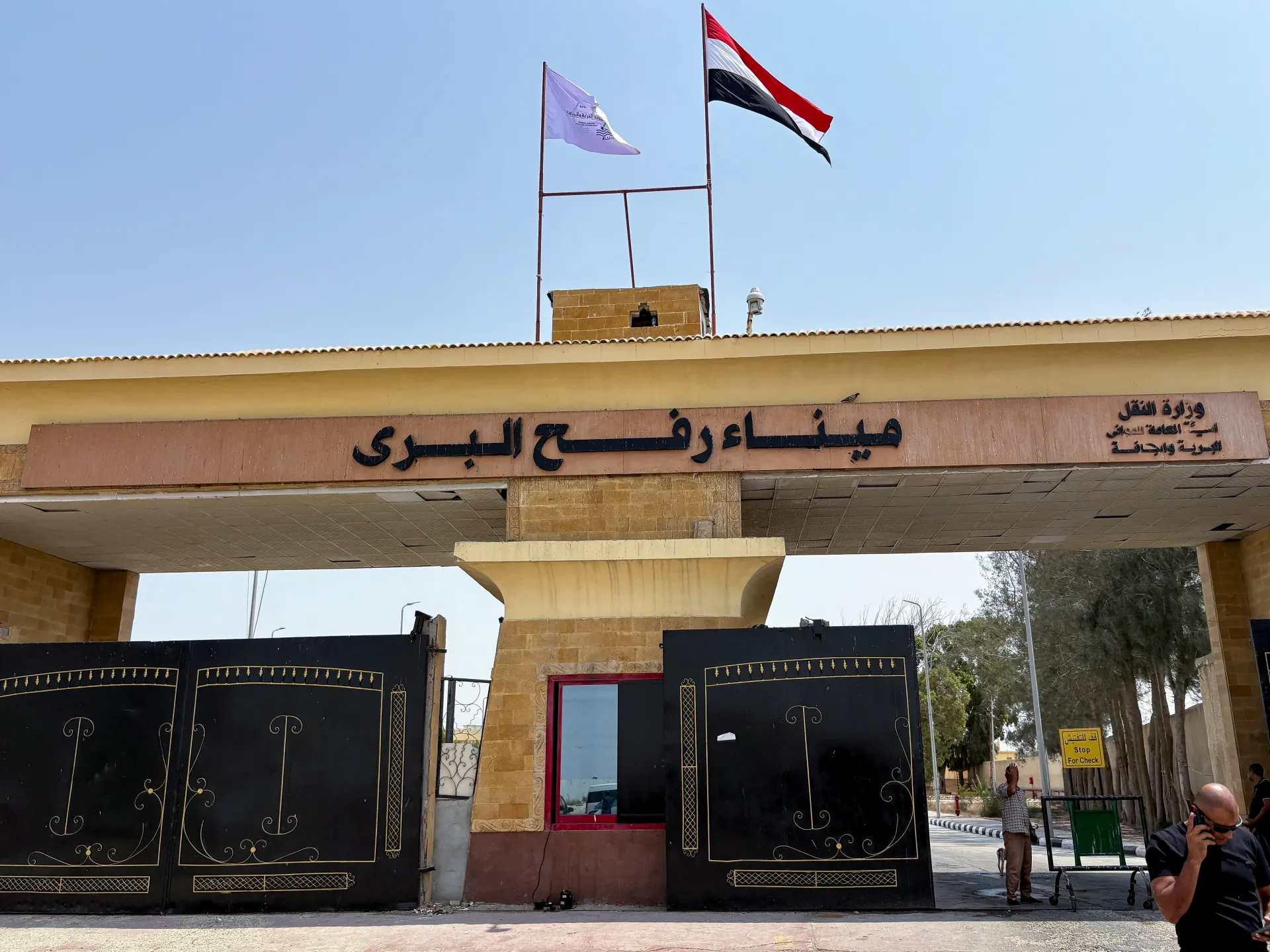
On December 3, Israel announced that the Rafah border crossing with Egypt would reopen “in the coming days”, allowing Palestinians to leave Gaza for the first time in months. The statement was, of course, framed as a humanitarian gesture that would allow those in urgent need to travel for medical care, education or family reunification to leave.

However, Israel’s announcement was met almost immediately with Egypt’s denial, followed by a firm rejection from several Arab and Muslim states.

To the rest of the world, this response may seem cruel. It may seem like Arab states want to forcibly keep in Gaza Palestinians desperate to evacuate to safety. This fits right into the Israeli narrative that neighbouring Arab countries are responsible for Palestinian suffering because they would not “let them in”.

This is a falsehood that has unfortunately made its way into Western media, even though it is easily disproved.

Let us be clear: No, Arab states are not keeping us against our will in Gaza, and neither is Hamas.

They want to make sure that when and if some of us evacuate temporarily, we are able to come back. We want the same – a guarantee of return. Yet, Israel refuses to grant it; it made clear in its December 3 announcement that the Rafah crossing would be open only one way – for Palestinians to leave.

So this was clearly a move meant to jump-start forced displacement of the Palestinian population from their homeland.

For Palestinians, this is not a new reality but part of a long and deliberate pattern. Since its inception, the Israeli state has focused on the dispossession, erasure, and forced displacement of the Palestinians. In 1948, 750,000 Palestinians were expelled from their homes and were not allowed to return. My 88-year-old grandfather was among them. He still keeps the Tabu (land registry document) for the dunams of land he owns in his village of Barqa, 37km (23 miles) north of Gaza, where we are still not allowed to return.

In 1967, when Israel occupied Gaza, it forbade Palestinians who were studying or working abroad from returning to their homes. In the occupied West Bank, where colonisation has not stopped for the past 58 years, Palestinians are regularly expelled from their homes and lands.

In the past two years alone, Israel has seized approximately 55,000 dunams of Palestinian land, displacing more than 2,800 Palestinians. In Jerusalem, Palestinians whose families had lived in the holy city for centuries risk losing their residency there if they cannot prove it is their “centre of life”. In the past 25 years, more than 10,000 Palestinian residencies have been revoked.

Since October 2023, Israel has repeatedly attempted to engineer forced mass displacement in Gaza – dividing the Strip into isolated zones separated by military corridors and “safe” axes and launching successive operations to push residents of the north towards the south. Each wave of mass bombing carried the same underlying objective: to uproot the people of Gaza from their homes and push them towards the border with Egypt. The most recent push occurred just before the latest ceasefire took effect.

According to Diaa Rashwan, chairman of the Egyptian State Information Service, Cairo rejected Israel’s proposal because it was an attempt to shun its commitments outlined in the second phase of the ceasefire. That phase requires Israel to withdraw from Gaza, support the reconstruction process, allow the Strip to be administered by a Palestinian committee, and facilitate the deployment of a security force to stabilise the situation. By announcing Rafah’s reopening, Israel sought to bypass these obligations and redirect the political conversation towards depopulation rather than reconstruction and recovery.

That Israel wants to create the conditions to make our expulsion inevitable is clear from other policies as well. It continues to bombard the Strip, killing hundreds of civilians and terrorising hundreds of thousands.

It continues to prevent adequate amounts of food and medicines from getting in. It is allowing no reconstruction materials or temporary housing. It is doing everything to maximise the suffering of the Palestinian people.

This reality is made even more brutal by the harsh winter. Cold winds tear through overcrowded camps filled with exhausted people who have endured every form of trauma imaginable. Yet despite hunger, exhaustion, and despair, we continue to cling to our land and reject any Israeli efforts to displace and erase us.

We also reject any form of external guardianship or control over our fate. We demand full Palestinian sovereignty over our land, our resources, and our crossings. Our position is clear: the Rafah crossing must be opened in both directions; not as a tool of displacement, but as a right to free movement.

Rafah must be accessible for those who wish to return, and for those who need to leave temporarily: students seeking to continue their education abroad, patients in urgent need of medical treatment unavailable in Gaza, and families who have been separated and long to be reunited. Thousands of critically ill Palestinians have been denied life-saving care due to the siege, while hundreds of students holding offers and scholarships from prestigious universities around the world have been unable to travel to pursue their education.

Rafah should also be open to those who simply need rest after years of trauma – to step outside Gaza briefly and return with dignity. Mobility is not a privilege; it is a basic human right.

What we demand is simple: the right to determine our future, without coercion, without bargaining over our existence, and without being pushed into forced displacement disguised as a humanitarian project.

The views expressed in this article are the author’s own and do not necessarily reflect Al Jazeera’s editorial stance.

Source link

‘We were sacked from Rockstar North for trying to unionise’

Hope WebbBBC Scotland reporter

BBC Four people, three men and a woman, hold signs outside a building. Their signs read "unions ain't busted" and "union busted?" and "unions protect workers" and "grand theft wages solidarity"BBC

The workers have been protesting outside the firm’s headquarters in Edinburgh and London

Former staff at the firm behind Grand Theft Auto have told the BBC that a “devastating” mass sacking took place allegedly because they tried to unionise.

Some 31 employees were dismissed in October for what Rockstar North called “gross misconduct”.

The majority were based at the gaming giant’s Edinburgh headquarters, with former workers claiming they were penalised for discussing working conditions in a private online forum.

Rockstar North said it was incorrect to suggest the dismissals were linked to union membership or activities. It said it took action after staff discussed confidential information, including specific game features from upcoming titles, in a public forum.

The Independent Workers’ Union of Great Britain (IWGB) called it a “ruthless act of union-busting”.

Rockstar North is one of the UK’s largest game developers.

Its upcoming GTA 6 game is expected to be one of the best-selling games of all time when it is released in November 2026.

Information about game development is tightly controlled across the gaming industry, with employees often signing legally binding agreements not to share confidential information.

A group of workers have been routinely protesting outside Rockstar North’s Edinburgh and London offices.

BBC Scotland News has now spoken to three of the dismissed Edinburgh workers accused of disclosing company information.

Jordan Garland has short, brown hair and a moustache and is sitting in front of a distorted glass window. He is wearing a gold chain and a grey jumper with blue and black geometric prints

Jordan Garland said staff wanted to unionise to improve the workplace

Jordan Garland, a former senior production co-ordinator, said many staff members wanted to unionise because “we were so passionate about the industry and that workplace in particular”.

“We just saw it as something we could do to make it better for everyone,” he added.

“So it’s a little bit devastating because it’s an industry that I love, and I think we all love. We couldn’t really see ourselves anywhere else.”

‘Sleepless nights’

He said members of staff were discussing working conditions at the firm in a private digital forum.

Jordan added: “We were talking about working conditions, policy – not talking about projects or anything like that, just talking about conditions.

“That to me that feels like an essential, necessary part of organising. How can you organise a workplace if you can’t talk about the conditions there?”

Jordan has worked at the company for 11 years and believes he was the first employee to be dismissed on the morning of 30 October.

“The first week was definitely difficult,” he said. “It was a lot of sleepless nights, a lot of tossing and turning about this.

“But in a kind of macabre way, it’s good they fired so many people because there is this really strong community element now.”

Jamie Trimmer has short, dark hair and a long, dark beard with grey through it. He is wearing a grey jumper. He is sitting in what looks like an office space

Jamie Trimmer worked at Rockstar North for about 18 years before he was sacked

Designer Jamie Trimmer worked in the gaming industry for most of his adult life before being sacked from Rockstar North.

“I’ve worked there, like, 18 years now,” he said. “I think I’m the longest serving person that was fired.

“It’s all I know really, and then it’s just sort of ripped away. I’m left not knowing what to do next really.

“I never would have expected they would hit the nuclear option of firing so many of us in one go. It does highlight the need for unions.”

‘Deeply concerning’

The group, along with fellow dismissed colleagues, are now hoping to take Rockstar North to an employment tribunal.

However, they may have to wait up to a year for their case to be heard.

In the meantime, they are waiting to learn if they qualify for an intermediate relief hearing, which could see them reinstated in their roles or kept on Rockstar North’s payroll.

The issue was also raised at Prime Minister’s Questions in Westminster last week by MP Chris Murray.

Sir Keir Starmer said it was “deeply concerning” and promised to look into the issue.

He added: “Every worker has the right to join a trade union, and we’re determined to strengthen workers’ rights and ensure they don’t face unfair consequences for being part of a union.”

Sarah Blackburn has shoulder-length pink and orange hair. She is smiling at the camera and wearing a black top and a silver necklace

Sarah Blackburn said she appreciated the support after she lost her job at Rockstar North

Sacked production co-ordinator Sarah Blackburn said the public and political support has helped her deal with the situation.

“It’s massively heartening to hear actually and in a way, I’d say validating,” she said.

“We’ve had a lot of support coming from places that I genuinely didn’t expect.

“We’ve had people who were in unions who previously fought fights in different industries basically just expressing solidarity and support. It’s a flex of power and it’s been painful to be on this side of it, but I think the support has been great.”

In a statement, Rockstar North told BBC Scotland News: “Rockstar Games took action against a small group of individuals, across the UK and internationally, who distributed and discussed confidential information (including specific game features from upcoming and unannounced titles) in a public forum, in breach of company policy and their legal obligations.

“Claims that these dismissals were linked to union membership or activities are entirely false and misleading.”

Source link

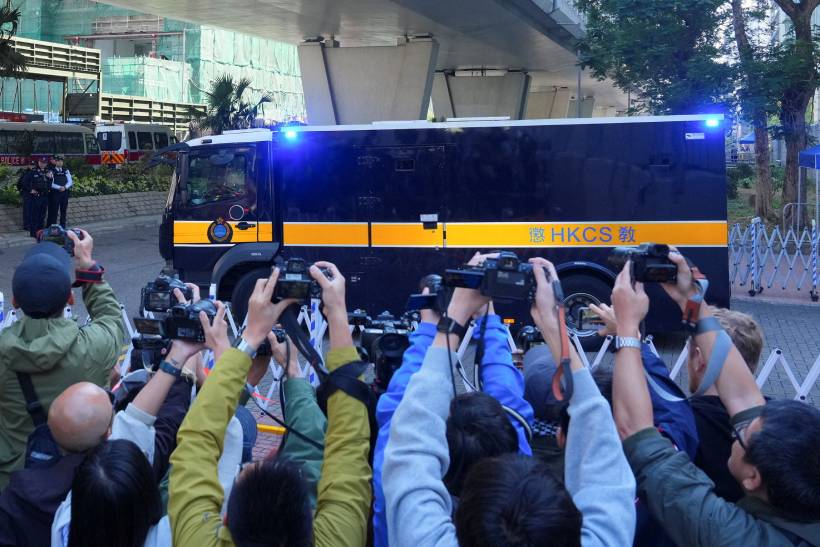
UK Denounces Jimmy Lai Conviction, Urges Immediate Release

Britain has condemned the conviction of Hong Kong media tycoon and pro-democracy activist Jimmy Lai, calling his prosecution politically motivated. The 78-year-old was found guilty of conspiracy to collude with foreign forces under Hong Kong’s China-imposed national security law, a charge that carries a possible life sentence. Lai, founder of the now-defunct Apple Daily newspaper, has been a prominent critic of Beijing and a symbol of Hong Kong’s pro-democracy movement.

Why It Matters
The case has become a powerful symbol of the erosion of civil liberties in Hong Kong since the introduction of the national security law in 2020. Britain’s condemnation highlights growing international concern over the use of the law to silence dissent and restrict freedom of expression. The verdict also deepens tensions between China and Western governments over human rights and the rule of law in Hong Kong.

Key stakeholders include Jimmy Lai and other pro-democracy activists facing prosecution, the Hong Kong and Chinese governments enforcing the national security law, and the United Kingdom, which has repeatedly criticised Beijing’s actions in Hong Kong. The wider international community and human rights organisations are also closely watching the case.

What’s Next
Lai still faces further legal proceedings, while Britain and other allies are expected to continue pressing for his release through diplomatic channels. The case is likely to intensify scrutiny of Hong Kong’s legal system and fuel renewed calls for international action in response to China’s handling of political dissent.

With information from Reuters.

Source link

LeBron James rallies Lakers to comeback victory over Suns in NBA | Basketball News

James steered the Los Angeles Lakers to a narrow victory over the Phoenix Suns after blowing a 20-point lead.

LeBron James gave Los Angeles the lead on two free throws with three seconds left, then blocked Grayson Allen’s potential game-winning three-pointer at the other end, and the Lakers survived a wild finish to defeat the hosts Phoenix Suns 116-114 on Sunday night.

Luka Doncic finished with 29 points, James 26 and Deandre Ayton 20 as part of a double-double with a game-high 13 rebounds for the Lakers, who trailed 77-71 before holding Phoenix scoreless for 8:05 bridging the third and fourth periods, using a 24-0 flurry to vault into a 95-77 lead.

Recommended Stories

list of 3 itemsend of list

The Suns regained the lead at 114-113 when Dillon Brooks buried the third of his fourth-quarter three-pointers with 12.2 seconds left. But Brooks, who had drawn an earlier technical foul for jawing with James, was nailed with a second “T” while celebrating his success and was ejected.

James missed the subsequent free throw, but then pulled up from beyond the arc with three seconds left and drew a three-shot foul on Devin Booker. He made the last two of the attempts to retake the lead.

Down one, the Suns got one final shot, but James blocked Allen’s potential game-winning three-point attempt and Marcus Smart, fouled after snatching the rebound, added a free throw to make it a two-point margin of victory.

The Suns led 77-71 after two free throws by Booker with 5:28 remaining in the third period before not scoring again until the third minute of the final period, falling behind 95-77 in the process. Phoenix missed 14 straight shots and mixed in seven turnovers during its scoreless spell.

Doncic was the game’s leading scorer despite missing 12 of his 14 attempts from behind the three-point line. The Lakers shot just 7 for 37 from deep.

Jaxson Hayes added 12 points for Los Angeles, which avenged an earlier 125-108 home loss to the Suns.

Booker had 27 points, Mark Williams 20 and Brooks 18 for Phoenix, which lost despite outshooting the Lakers 48.8 percent to 43.2 percent overall and 35.1 percent to 18.9 percent on three-pointers.

Allen, who shared game-high assist honours with Booker with seven, chipped in with 13 points for the Suns, while Royce O’Neale went for 12 and Collin Gillespie 10.

LeBron James and Dillon Brooks react.
Phoenix Suns forward Dillon Brooks, right, fouls Los Angeles Lakers forward LeBron James in the final moments of the game. Brooks was ejected from the game after the foul [Rick Scuteri/AP Photo]

Source link

‘No work’: India’s Alang, the world’s largest graveyard of ships, is dying | Shipping News

Alang, India – Standing on the windswept coastline of the Arabian Sea in the western Indian state of Gujarat, Ramakant Singh looks towards the empty, endless horizon.

“In the olden days, ships lined up at this yard like buffaloes before a storm,” says the 47-year-old. “Now, we count the arrivals on our fingers.”

Recommended Stories

list of 4 itemsend of list

Ramakant works at Alang — the world’s largest ship-breaking yard, located in Bhavnagar district of Gujarat, Prime Minister Narendra Modi’s home state. For two decades, Ramakant has cut apart vessels as large as oil tankers and cargo carriers that sailed in from Europe and other Asian countries for his livelihood.

With its unique tidal pattern and gently sloping beach, Alang in the 1980s became the backbone of India’s ship recycling industry, where ships could be beached and dismantled at a minimal cost.

Over the decades, more than 8,600 vessels — collectively weighing roughly 68 million tonnes of light displacement tonnage (LDT), which is the actual weight of a ship without fuel, crew and cargo — have been taken apart here, accounting for nearly 98 percent of India’s total and about a third of the global ship recycling volume.

Alang Gujarat India
Rows of rescue boats wait to be resold, alongside chains, lifejackets and other salvaged remnants at Alang yard [Anuj Behal/Al Jazeera]

Across the world’s oceans, an ageing fleet of cargo ships, cruise liners, and oil tankers is nearing the end of its life. Of the roughly 109,000 vessels still in service, nearly half are more than 15 years old — rusting giants that will soon be retired.

Each year, close to 1,800 ships are declared unfit to sail and sold for recycling. Their owners pass them on to international middlemen, known as cash buyers — operating out of global shipping hubs such as Dubai, Singapore, and Hong Kong. These brokers, in turn, resell the vessels to dismantling yards in South Asia, where the final act of a ship’s life unfolds.

In Alang, ships are driven ashore at high tide — a process called beaching. Once grounded, hundreds of workers cut them apart piece by piece, salvaging steel, pipes, and machinery. Almost everything — from cables to cupboards — is resold for use by construction and manufacturing industries.

However, over the past decade, the number of ships arriving on Alang’s coast has dwindled. Once a skyline of giant hulls that looked like high-rise buildings against the town’s asbestos roofs, only a few cruise ships and cargo carriers dot the horizon today.

“Earlier, there was plenty of work for everyone,” Chintan Kalthia, who runs one of the few yards still open, tells Al Jazeera. “Now, most of the workers have left. Only when a new ship beaches do a few come back to Alang. My own business is down to barely 30-40 percent of what it used to be.”

According to data from India’s Ship Recycling Industries Association, 2011-12 marked Alang’s busiest financial year since it began operations in 1983, with a record 415 ships dismantled. Since then, the yard has faced a steep decline — of the 153 plots developed along the 10km (6-mile) coastline, only about 20 remain functional, and even they are operating at barely 25 percent capacity.

“But what’s going wrong in Alang has multiple reasons,” says Haresh Parmar, secretary of the Ship Recycling Industries Association (India). “The biggest is that globally, shipowners are not retiring their old vessels. Post-COVID, a surge in demand led to record profits in shipping. With freight rates soaring, owners are pushing ships beyond their usual operational life instead of sending them for dismantling.”

Alang Gujarat India
From cables to cupboards, almost all materials are reclaimed and repurposed for construction and manufacturing markets [Anuj Behal/Al Jazeera]

A key factor behind the surge in freight rates is global disruptions. Israel’s genocidal war in Gaza has had a ripple effect on global trade routes, with Yemen’s Houthi rebels repeatedly attacking commercial vessels in the Red Sea in solidarity with the Palestinians. The resulting security crisis has forced ships to bypass the Suez Canal and instead take the longer Cape of Good Hope route, sending freight rates soaring and delaying cargo worldwide.

Similarly, an analysis by the United Nations Conference on Trade and Development (UNCTAD) conducted in June 2022 found that the Russia-Ukraine war and other Middle East tensions had pushed up marine fuel costs by more than 60 percent, adding to operational expenses and shipping delays.

Together, these factors have sharply reduced the supply of end-of-life ships heading to Alang. “When owners are earning well, they don’t scrap their vessels,” says Parmar. “That’s why our yards are standing empty.”

Compliance raising costs

But that is not the only reason why Alang is struggling.

India’s ship recycling industry has undergone a significant transformation since the country acceded to the Hong Kong International Convention for the Safe and Environmentally Sound Recycling of Ships (HKC) in November 2019, becoming one of the first top ship-breaking nations to do so. Under the HKC and the 2019 Recycling of Ships Act, yards at Alang upgraded their infrastructure, installed pollution control systems, lined hazardous waste storage pits, trained workers, and maintained detailed inventories of toxic materials used in vessels.

These measures made Alang-Sosiya Ship Recycling Yards (ASSRY) one of the most compliant ship-recycling clusters in the developing world, with 106 of ASSRY yards having received HKC Statements of Compliance (SoC). Sosiya is a village located right next to Alang on the Gulf of Khambhat coast in Gujarat. Together, Alang and Sosiya form the entire stretch of beach where ship-breaking plots operate.

But achieving these standards came at a high cost: each yard had to invest between $0.56m and $1.2m to meet compliance norms, raising operational costs at a time when competition from neighbouring countries remains fierce.

“Think of it like a roadside eatery versus a global burger chain — the chain has shinier rules, cleaner kitchens, and safer gear, but you pay extra for the sparkle. The Hong Kong Convention works the same way,” said Kalthia, whose company, RL Kalthia Ship Breaking Private Limited, became the first ship recycling facility in India to receive HKC compliance certification from ClassNK in 2015, as their website shows. ClassNK is a leading Japanese ship classification society that audits and certifies international maritime safety and environmental standards.

“Compliance makes things safer and brings us up to international standards — it gives us an edge only on paper,” says Chetan Patel, a yard owner at Alang. “But it has also raised costs significantly.”

That, in turn, has made it hard for Alang’s ship-breakers to offer prices comparable to those of competitors.

“When neighbouring markets can pay more, shipowners go there,” Patel said.

Alang Gujarat India
Unused ships quickly become a financial drain, forcing owners to offload them, even if that means dismantling them long before their intended lifespan [Anuj Behal/Al Jazeera]

Competing ship-recycling yards are thriving. In Bangladesh’s Chattogram port and Pakistan’s Gadani yard, shipowners are being offered $540-550 per LDT and $525-530 per LDT, respectively, compared with $500-510 per LDT at Alang.

“We can’t match the rates offered by Bangladesh and Pakistan,” says Parmar. “If we tried, we’d be running at a loss.”

This is reflected clearly in the data: the number of ships decommissioned in India dropped from 166 in 2023 to 124 in 2024. In contrast, Turkiye’s figures nearly doubled to 94 from 50, and Pakistan’s rose from 15 to 24 during the same period.

Supporting industries struggle

Alang is not just a ship-breaking yard, but a vast recycling ecosystem that sustains the surrounding region’s economy.

From the coastal town of Trapaj — the last big settlement before Alang — an 11km (7-mile) stretch of road is lined with sprawling, makeshift shops selling remnants of decommissioned ships. Everything that used to be part of life at sea eventually finds its way here: rusted chains, rescue boats, refrigerators, ceramic crockery, martini glasses, treadmills from shipboard gyms, air conditioners from cabins, and chandeliers from officers’ quarters.

“Whatever is there on the ship, we own it,” says Parmar. “Before the cutting begins, all valuable items are auctioned and reach these stores.”

Alang Gujarat India
All remnants of life on the ocean wind up here – corroded chains, rescue boats, ceramic crockery, martini glasses, and treadmills from ship gyms [Anuj Behal/Al Jazeera]

Ram Vilas, who runs a ceramic shop selling salvaged crockery by the kilo, says most of his customers used to come from commercial establishments across Gujarat. “Now, business has gone dead,” he tells Al Jazeera. “This stretch you see doesn’t even have one-tenth of the crowd it used to. With fewer ships coming in, we don’t have enough stock to fill our shops.”

The ripple effects of Alang’s decline extend to other industries as well. Waste is handled by specialised facilities, while reusable steel is supplied to more than 60 induction furnaces and 80 rerolling mills, some 50km (30 miles) away in Bhavnagar, converting it into TMT bars – reinforced steel rods – and other construction materials.

But with fewer ships arriving, the supply of scrap steel has dropped sharply, disrupting operations of furnaces, mills, and hundreds of small businesses that depend on ship-derived goods. More than 200 retail and wholesale shops that once bustled with activity now face dwindling sales.

“Gas plants, rolling mills, furnace units, transporters, drivers — everyone connected to this chain has lost their livelihood,” says Parmar.

Alang Gujarat India
Most shops are stacked with whatever the ship-breaking yards have yielded that day [Anuj Behal/Al Jazeera]

In Bhavnagar, 29-year-old Jigar Patel, who runs a flange manufacturing unit, says his business has suffered.

“I opened my unit in 2017, seeing the opportunity with steel sheets easily available from Alang,” he says. “But in the past two years, the slowdown has hit hard. Now, I have to buy sheets from Jharkhand. It’s not just expensive, but the raw steel is harder to cut and process. The Alang sheets were more malleable and ductile — they were made for work and of international standard.”

Workers at Alang, most of them migrants from poorer Indian states in the north and east, including Jharkhand, Bihar, Odisha and Uttar Pradesh, have also begun to leave. “They only show up when ships arrive at the docks,” Vidyadhar Rane, president of the Alang-Sosiya Ship Recycling and General Workers’ Association, tells Al Jazeera.

“Yard owners call them when there is work. The rest of the time, they find other jobs in nearby towns,” he says.

At its peak, Alang employed more than 60,000 workers. Today, that number has shrunk to fewer than 15,000, according to the union.

Ramakant, who first arrived in Alang at the age of 35, recalls working for seven straight years before the slowdown began. “Now, I only return when my employer calls,” he says, adding that he spends the rest of his time working in the industrial town of Surat.

The work at the yard, he admits, has become far safer than it once was. “This was once the deadliest job — we would see workers dying every other day. Now there’s training, safety gear, and order,” Ramakant says, looking towards the silent coast.

“But what’s the point of safety when there’s no work? Everything now depends on whether the next [ship] arrives at the yard or not.”

Source link

New Dark Eagle Hypersonic Weapon Details Emerge

We are getting some new information about America’s long-range Dark Eagle hypersonic boost-glide vehicle weapon system from Secretary Hegseth’s recent tour of Redstone Arsenal in Alabama. During his visit, Hegseth designated the installation as U.S. Space Command’s (SPACECOM) new headquarters.

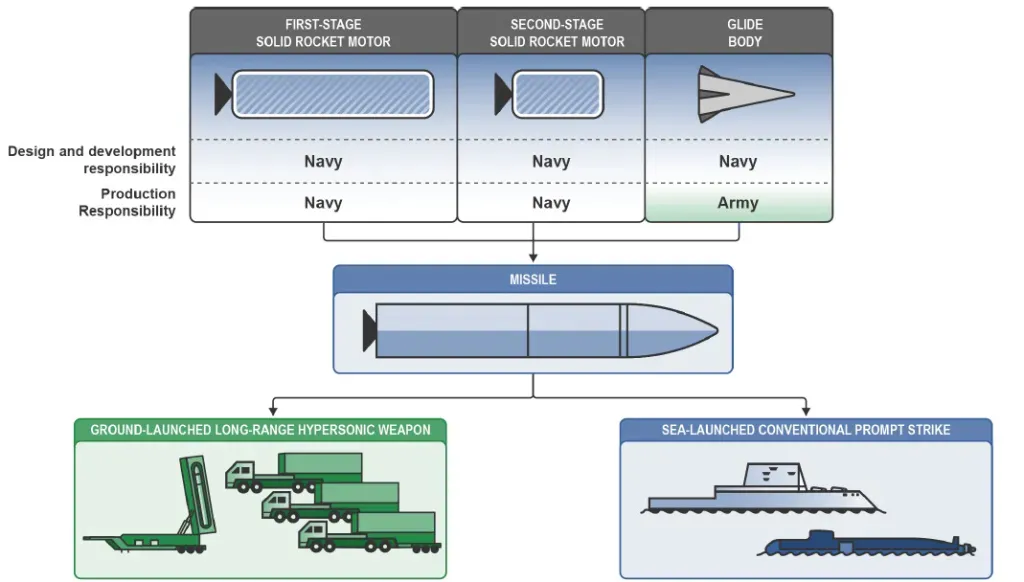
The Army’s Dark Eagle, also known as the Long Range Hypersonic Weapon (LRHW), is a trailer-launched hypersonic boost-glide vehicle system that can travel long distances at hypersonic speeds (velocities in excess of Mach 5) while maneuvering erratically through Earth’s atmosphere. This makes it an ideal weapon for striking high-priority and time-sensitive targets that are extremely well defended. This includes critical air defenses, command and control nodes, and enemy sensor systems, among other targets. It is the first true hypersonic weapon slated for frontline U.S. service. The same missile architecture is being adopted by the Navy for sea-launch under the Intermediate Range Conventional Prompt Strike (IRCPS) weapon system.

A graphic giving a general breakdown of the common missile for the Dark Eagle/LRHW and IRCPS systems, as well as the division of labor between the Army and the Navy. GAO
A graphic showing, in a very rudimentary way, the difference in trajectories between a traditional ballistic missile and a hypersonic boost-glide vehicle, as well as those of pseudo or aeroballistic missiles and air-breathing hypersonic cruise missiles. GAO

During a show-and-tell of Army missile systems, Lt. Gen. Francisco Lozano, Director of Hypersonic, Directed Energy, Space and Rapid Acquisition, told Hegseth that Dark Eagle has a 3,500-kilometer range. Members of the media were also present at the event, which was captured on video by C-SPAN and other outlets.

Lt. Gen. Francisco Lozano further noted that he can hit “mainland China from Guam” with Dark Eagle. He also said it could hit Moscow from London and Tehran from Qatar. This isn’t the first official statement of range for Dark Eagle from the Pentagon. The weapon was previously said to have at least a 1,725-mile (2,775-kilometer) range. Based on Lozano’s comments today, its actual range is at least 2,175 miles. It isn’t clear if the Army’s own figures have changed based on the evolution of the weapon and its testing, or if the previous figure was ‘watered down’ intentionally, which is common when it comes to official metrics for missile systems.

A Dark Eagle launcher seen at a previous training exercise. US Army

Another Army officer at the event, who is not immediately identifiable, told Hegseth that Dark Eagle has a warhead “under 30 pounds,” which is relatively tiny for a long-range weapon — smaller in size than what’s found on an AIM-120 air-to-air missile, for instance. The officer stated the warhead is just to get its “projectiles out” and that it can deliver effects over an area about the same size as the parking lot they were standing on.

As we have repeatedly said, the kinetic punch this weapon provides would contribute more to its destructive power than a conventional warhead mounted in the tight confines of the conical boost-glide vehicle. Still, a blast fragmentation warhead, which was alluded to by the officer, would help with putting softer targets out of commission, like air defense batteries and radar arrays.

The officer also said Dark Eagle can cover its range in less than 20 minutes.

War Sec. Pete Hegseth Visits The New Site For U.S. Space Command Headquarters In Huntsville, Alabama


“We scare the hell out of the Chinese with this (MRC) because we keep it over in the Philippines and Japan. Keeping them moving around the indoor paycom. And then I’ve got long range hypersonic weapon. This has got a 3500 kilometer range which means I can range mainland China… pic.twitter.com/F9fHtlnx6U

— 笑脸男人 (@lfx160219) December 15, 2025

The mention of the warhead is of special interest as there had been concerns by Pentagon testers of Dark Eagle’s lethality as recently as last year.

We wrote about the Pentagon’s test assessment back in February, stating:

“In the meantime, the Navy has tested the warhead for the AUR, but independent of the missile. An arena test for the warhead was carried out in the first quarter of FY24, followed by a sled test in the second quarter of FY24. The Pentagon says that this sled test “included some threat-representative targets,” but also notes that results are still being processed.

Earlier sled and flight tests “did not include operationally representative targets and consequently provided no direct validation of the weapon’s lethal effects,” the Pentagon adds.

Ultimately, the Army “needs to incorporate representative targets and environments into flight tests and other live lethality and survivability tests,” this portion of the report concludes.”

Dark Eagle has had more than its share of development delays, but as of June of this year, the Army intended the weapon system to become operational by the end of Fiscal Year 2025. Where that schedule stands now isn’t clear. There is one battery already stationed at Fort Lewis, and another is supposed to arrive this year.

A year ago, the U.S. Army finally test-fired its Dark Eagle hypersonic missile from its trailer-based launcher, something it has been attempting to do for some two years prior. U.S. Army

The importance of getting Dark Eagle up and running goes beyond tactical and strategic considerations, as the U.S. has lagged behind its peers in areas of hypersonic development, most notably when it comes to China.

It’s also worth mentioning that Hegseth asked about how many they are producing and how fast. The Army officer said one per month, but the goal is to increase that number to two per month, or 24 a year. Clearly, the ability to produce weapons in large quantities quickly is top of the mind for Hegseth as the U.S. struggles with its supply of combat mass. Some have argued Dark Eagle is a class of ‘silver bullet’ weapon that will be built in too few numbers and at too high a cost to have a major impact in a sustained conflict.

Regardless, now that we know more about the technical specifications of the weapon system, the Pentagon could be on the cusp of finally declaring it operational.

Author’s note: A big thanks to @lfx160219 on X for bringing this to our attention.

Contact the author: tyler@twz.com

Tyler’s passion is the study of military technology, strategy, and foreign policy and he has fostered a dominant voice on those topics in the defense media space. He was the creator of the hugely popular defense site Foxtrot Alpha before developing The War Zone.


Source link

From Sinai to Seoul: What the Six-Day War Teaches About a Future North Korean Blitzkrieg

In June 1967, when the sun was rising over the Eastern Mediterranean Sea, Israeli fighter squadrons skimming through the coastlines at low altitude struck Egyptian airbases with a devastating blow. Within barely a couple of hours, most of the Egyptian air forces were destroyed. Operation Focus was not a mere initiation of the Six-Day War, but it determined the final outcome of the war. When the ground offensives advanced across the Sinai, Gaza, the West Bank, and the Golan Heights, Israel had already established its critical military superiority, namely, air supremacy. The Six-Day War remains a typical case of how a short, incisive, and highly compressed conflict could overturn the premise of regional deterrence and restructure the long-term strategic reality.

Almost 60 years later, a very different state is studying similar lessons. Based on its nuclear and missile capabilities and deepened defense cooperation with the Russians, nuclear-armed North Korea is refining tools that could enable its own version of a swift and high-impact attack. North Korea’s KN-23 and KN-24 series—quasi-ballistic missiles modeled upon the Russian Iskander-M—have irregular, low-altitude trajectories that are designed to complicate missile defense. Through their recent use by Russia against Ukraine, North Korea has gained invaluable live-fire battlefield data, accelerating improvements in precision, reliability, and mobility during flight. In addition, thanks to Russian assistance—advanced technology, training assistance, and potential space-oriented targeting support—North Korea is securing capabilities that were unattainable in the past.

The strategic risk lies not in whether Pyongyang could literally replicate Operation Focus. Instead, the genuine risk lies in Kim Jong-un drawing wrongful lessons from the Six-Day War and the Russia-Ukraine War: that surprise, speed, and concentrated firepower could overwhelm the opponent before activating an effective response. If Pyongyang is convinced that a blitzkrieg is achievable or judges that nuclear blackmail could suppress the US and Japan’s intervention for a certain timeframe, the incentives for war could increase.

Ways That North Korea Could Attempt a Six-Day War-Style Blitzkrieg

Such perception—that momentum has changed—endangers the nowadays Korean Peninsula. North Korea’s nuclear capabilities are expanding both in terms of magnitude and precision. Meanwhile, North Korea’s SRBM and MLRS systems could strike almost all major airbases and C2 nodes located within South Korea. North Korean SOF, who have long trained themselves with penetration operations via tunnels, submarines, and UAV drops, are carefully analyzing Russian tactics used in the Russia-Ukraine War, ranging from loitering munition to precision targeting of critical infrastructures. Pyongyang may imagine that by combining missile salvos, swarm drones, electronic jamming, SOF penetration, and nuclear escalation, it could paralyze South Korea’s initial response in the first few hours of the war and create a meaningful fissure in alliance coherence.
Here the Six-Day War offers a second powerful lesson. The opening phase of the war has greater importance than other phases. In 1967, Israel’s preemptive strike wiped out Arab air forces on the ground, granting unlimited air dominance to the IDF. Although North Korea could not attain air superiority, it could attempt something functionally similar—denying the US, Japan, and South Korea’s ability to conduct operations normally in the initial hours of the war. This could include simultaneous missile saturation on air defense batteries, fuel depots, hardened aircraft shelters, runways, and long-range sensors. Meanwhile, missiles with irregular trajectories might avoid radar detection and try to penetrate interception layers comprised of PAC-3, L-SAM, THAAD, and Aegis destroyers. Swarm drones could overwhelm short-range air defense or neutralize petroleum, oil, and lubricant (POL) depots and movable C2 vehicles. Cyber operations and GPS jamming would complement such a kinetic assault, creating friction and delays in the alliance response cycle.

Eventually, Pyongyang could conduct its own version of Operation Focus ‘in reverse,’ not to secure air dominance but to prevent opponents from achieving air supremacy. This is to enable North Korea to conduct SOF penetration, a limited armored push in and around the DMZ, and nuclear blackmailing to prevent reinforcement. Such an operation would be based on the similar logic—the ideal mixture of shock, speed, and confusion—that Israel showcased in Sinai and the Golan Heights.

Deterring Blitzkrieg: Lessons for the US, Japan, and South Korea

By using the Six-Day War as a reference, the US, Japan, and South Korea could figure out ways to deter North Korea’s aforementioned provocations. Israel’s victory in 1967 was not achieved solely by air supremacy but also through resilience in its mobilization system and the adaptability of its reserve forces. Once securing air dominance, the IDF swiftly mobilized its reserve forces, stabilized major frontlines, and executed critical maneuvers before Arab countries coordinated with one another. Meanwhile, North Korea might use an intensive SOF operation in the initial phase of the war to wreak havoc on South Korea—recreating the chaos that Israel’s opponents had to experience in 1967—by attacking leadership, transportation centers, and communication nodes.

The solution is clear. If South Korea could prevent internal paralysis in the first 24 to 48 hours of the war, North Korea’s ambitious surprise attack would be largely unsuccessful. Therefore, Seoul should treat protection against SOF, city defense, and civil-military resilience at a level equivalent to ‘air superiority.’ This means diffusion of C2, reinforcement of police and reserve forces, hardening communication, and ensuring that local governments could fully function even under missile strikes and SOF infiltration. Irrespective of the high intensity of an opening barrage, state function should be able to survive, maintain consistency, and prepare for countermeasures.

The political aftermath of the 1967 war is also an important lesson. Israel’s swift victory engendered long-term strategic burdens: the occupation problem, regional backlash, and disputes on legitimacy. It well demonstrates that a short and decisive war could create unpredictable, long-term spillover effects. Applying it to the Korean Peninsula, the US and its allies should have a clear picture regarding North Korea’s failed surprise attack or a regime change. Issues like securing WMD, China’s intervention, refugee flow, humanitarian stabilization, and restructuring North Korea’s political order cannot be managed in an impromptu manner.

The strategic task for Washington, Tokyo, and Seoul is to deny Pyongyang any illusion of a short war. Deterrence should be based on the confidence that North Korea cannot achieve within 6 hours what Israel achieved in 6 days. To make that happen, integration of missile defense systems, real-time intelligence sharing, enhancing the survivability of air bases, diffusion of key assets, and rapid counter-strike capabilities are necessary. Moreover, the US and its allies should establish a political foundation that could withstand a war of attrition—a type of conflict that North Korea cannot tolerate.

Source link

Australia look to seal Ashes series in third Test against England | Cricket News

Al Jazeera takes a look at the third Ashes Test between Australia and England, which is being played in Adelaide.

England face a series-defining third Ashes Test in Australia, knowing defeat will see their hosts retain the famous urn, but also have the chance of whitewashing their old enemy.

The match begins in Adelaide on Tuesday, where an unassailable 3-0 lead is in sight for the Aussies.

Australia won the first Test inside two days in Perth as Travis Head’s century made short work of his side’s target, while the Aussies needed only four days in Brisbane to secure the second match of the series.

Source link

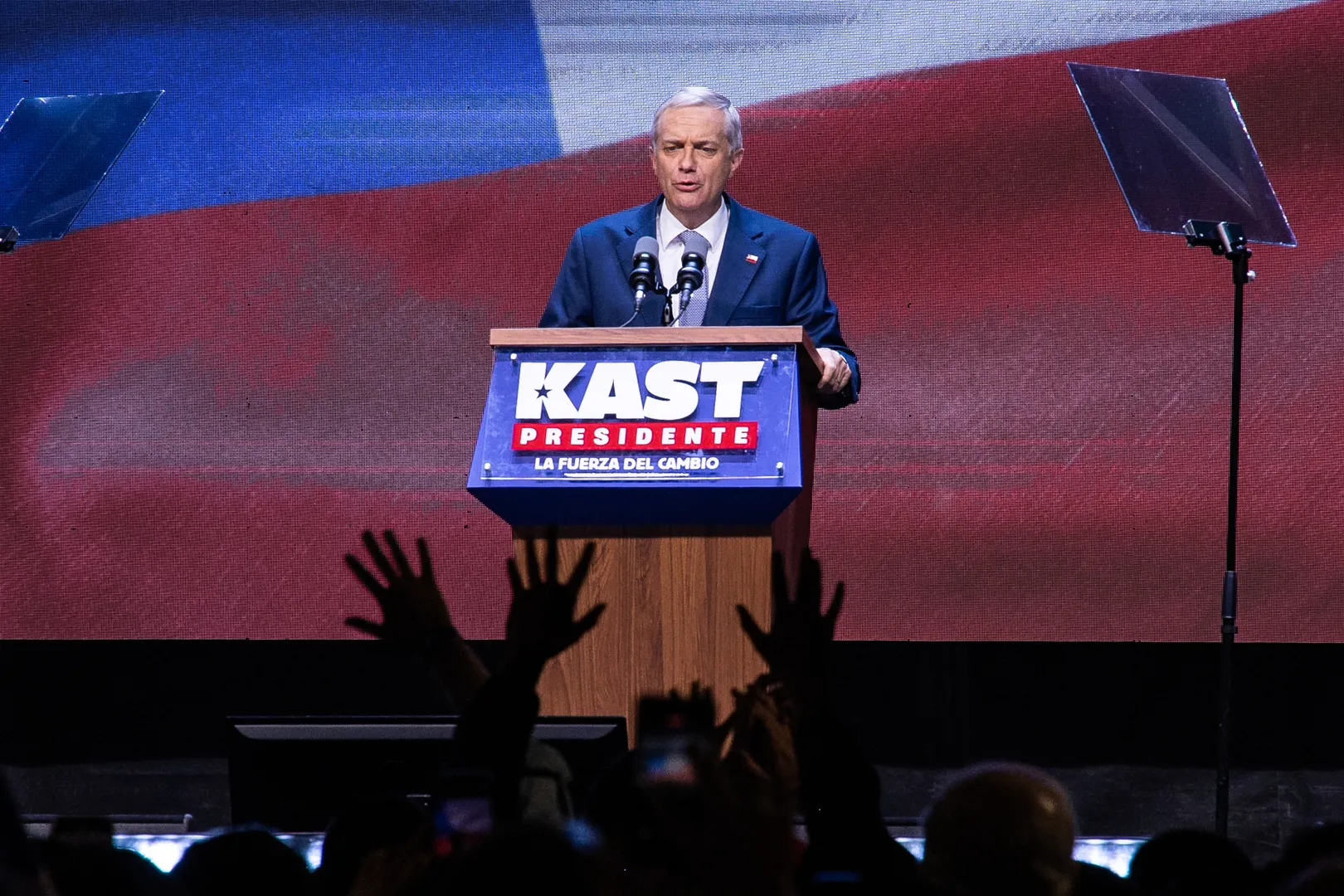
Far-right candidate Jose Antonio Kast wins Chile’s presidential election | Elections News

Far-right candidate Jose Antonio Kast has won a run-off election to become Chile’s 38th president, ousting the centre-left government currently in power.

On Sunday, with nearly all the ballots counted, Kast prevailed with nearly 58 percent of the vote, defeating former Labour Minister Jeannette Jara, a Communist Party politician who represented the governing centre-left coalition.

Recommended Stories

list of 3 itemsend of list

Jara and her coalition, Unity for Chile, conceded defeat shortly after the polls closed in the South American country.

“Democracy has spoken loud and clear. I have just spoken with President-elect [Kast] to wish him success for the good of Chile,” Jara wrote on social media.

“To those who supported us and were inspired by our candidacy, rest assured that we will continue working to build a better life in our country. Together and standing strong, as we always have.”

The result marks the latest victory for the far right in Latin America, which has seen a streak of right-wing leaders once considered political outsiders rise to power in countries like Argentina and Ecuador.

The tally also marks a significant comeback for Kast himself, the 59-year-old leader of the Republican Party. The 2025 election marks his third attempt to win the presidency — and his first successful bid.

During the last election, in 2021, he was trounced by outgoing President Gabriel Boric, who won by nearly a 10-point margin.

But Boric, a former student leader who became Chile’s youngest president, had seen his popularity slump to about 30 percent by the end of his four-year term. He was also ineligible to run for a second term under Chilean law.

In public opinion polls, voters also expressed frustration with recent spikes in crime and immigration, as well as a softening of Chile’s economy.

Kast, meanwhile, campaigned on the promise of change. He said he would address voter concerns by carrying out crackdowns on crime and immigration, including through a campaign of mass deportation, similar to what United States President Donald Trump has done in North America.

His security platform — dubbed the “Implacable Plan” — also proposes stiffer mandatory minimum sentencing, incarcerating more criminals in maximum security facilities, and putting cartel leaders in “total isolation” to cut them off from any communication with the outside world.

“Today, while criminals and drug traffickers walk freely through the streets, committing crimes and intimidating people, honest Chileans are locked in their homes, paralyzed by fear,” Kast writes in his security plan.

Kast has also taken a hard right stance towards social and health issues, including abortion, which he opposes even in cases of rape.

But those hardline policies earned Kast criticism on the campaign trail. Critics have also seized upon his own sympathetic comments about Chile’s former dictator, military leader Augusto Pinochet.

In 1973, Pinochet oversaw a right-wing military coup that ousted the democratically elected leader, Salvador Allende. He proceeded to rule the country until 1990. His government became known for its widespread human rights abuses and brutal oppression of political dissent, with thousands executed and tens of thousands tortured.

While Kast has rejected the label “far right”, he has repeatedly defended Pinochet’s government. Of Pinochet, Kast famously quipped, “If he were alive, he would vote for me.”

Opponents also sought to draw attention to Kast’s family ties: His father, Michael Martin Kast, was born in Germany and had been a member of the Nazi Party. The elder Kast immigrated to Chile in 1950.

Reporting from a polling site in the capital of Santiago, Al Jazeera correspondent Lucia Newman noted that Sunday’s victory was a historic one for Chile’s far right. But, she noted, Kast has sought to moderate his platform to better appeal to voters in the current election cycle.

“This is the first time since 1990 — since the military dictatorship before 1990, when Chile returned to democracy — that such a conservative government will be in power,” Newman explained.

“It’s really not certain just how conservative it will be. Jose Antonio Kast was a supporter of former dictator General Augusto Pinochet. He has shirked away from that in recent years, and certainly in this campaign.”

In the wake of Kast’s election victory, right-wing leaders from across the Americas offered their congratulations in statements on social media.

“Congratulations to Chilean President-Elect [Jose Antonio Kast] on his victory,” Trump’s Secretary of State Marco Rubio wrote. “The United States looks forward to partnering with his administration to strengthen regional security and revitalize our trade relationship.”

Argentina’s libertarian leader Javier Milei likewise chimed in, hailing it as a major win for his conservative political movement.

“FREEDOM IS ADVANCING,” Milei wrote, echoing his own campaign rallying cry.

“Enormous joy at the overwhelming victory of my friend [Jose Antonio Kast] in the Chilean presidential elections! One more step for our region in defense of life, liberty, and private property. I am sure that we will work together so that America embraces the ideas of freedom and we can free ourselves from the oppressive yoke of 21st-century socialism…!!!”

Ecuador’s right-wing President Daniel Noboa, meanwhile, said that “a new era is beginning for Chile and for the region”.

This year’s presidential race was the first time since 2012 that voting had been compulsory in the country. There are approximately 15.7 million eligible voters in the South American country.

Kast originally came in second place during the first round of voting on November 16. He scored about 23.9 percent of the vote, compared with Jara’s 26.8 percent.

But polls had widely favoured him to win in the run-off. While Chile’s left wing held a primary in June and coalesced around its victor, Jara, right-wing parties did not hold a primary to choose a coalition nominee.

The result was a fractured right in the first round of voting. But in the final contest, Kast was able to sweep up votes that had previously gone to his right-leaning adversaries, earning him a comfortable win.

Still, Kast faces a divided National Congress, which is expected to blunt some of his more hardline proposals. Kast will be sworn in on March 11.

Source link

Monday 15 December Kingdom Day in Bonaire

The Charter for the Kingdom of the Netherlands is a legal instrument that sets out the political relationship between the four countries that constitute the Kingdom of the Netherlands: Aruba, Curaçao, and Sint Maarten in the Caribbean and the Netherlands. It is the leading legal document of the Kingdom. The Constitution of the Netherlands and the Basic Laws of the three other countries are legally subordinate to the Charter.

The first version of the Charter, which described the relationship between the Netherlands, Suriname, and the Netherlands Antilles, was signed by Queen Juliana on December 15th 1954. This version lasted for a couple of decades until November 25th 1975, when Suriname became an independent republic.

Bonaire was part of the Netherlands Antilles until the country’s dissolution in 2010 when the island became a special municipality (officially, a “Caribbean public body”) within the country of the Netherlands. It is one of three special municipalities in the Caribbean; the others are Sint Eustatius and Saba, and all three are known as the Caribbean Netherlands.

Kingdom Day became a new public holiday in the Netherlands Antilles in 2008, replacing Antilles’ Day (October 21st).

After the split of the Netherlands Antilles, Curaçao announced that KIngdom Day would no longer be a public holiday in Curaçao.

How Bondi Beach shooting unfolded minute by minute

At around 18:47 local time (07:47 GMT) on Sunday, New South Wales Police received reports that shots had been fired at a park in Bondi Beach, Sydney.

In the minutes that followed, footage filmed by bystanders shows two gunman appearing to fire a volley of shots towards a park from a bridge.

Police say 15 people, including 10-year-old girl, were killed in the shooting. One of the gunman is also dead.

World news correspondent Joe Inwood pieces together verified footage of the incident to show how Australia’s worst mass shooting in nearly three decades unfolded.

Source link

Thai F-16s Bomb Targets Along Disputed Cambodian Border

A new escalation in the clashes between Thailand and Cambodia has seen Royal Thai Air Force (RTAF) F-16 fighters deliver airstrikes along the disputed border between the two countries. The nations are now blaming each other for breaching a ceasefire deal that was brokered by U.S. President Donald Trump.

In a statement, the RTAF said it had struck Cambodian “military targets” in several areas along the roughly 500-mile border. At the same time, it accused Cambodia of mobilizing heavy weaponry and repositioning combat units. A Thai military official told Reuters that the targets included long-range artillery positions. The Thai military also released imagery that it said showed airstrikes against a Cambodian military position, as seen below.

#Thailand / #Cambodia 🇹🇭🇰🇭: “Thai Air Forces” reportedly bombed a casino building which was being used by the “Cambodian Army” on the border.

Thai Army possibly used F-16(A/B) fighter aircraft with Mark 82 (MK-82) aerial bomb with Precision-Guided Glide Bomb system. pic.twitter.com/8uYfWaC5Yw

— War Noir (@war_noir) December 8, 2025

The RTAF has a relevant fleet of F-16s, comprising 36 single-seat F-16As and 14 two-seat F-16Bs. These are the survivors from a total of 52 F-16A/Bs that were delivered by the United States under four separate orders plus seven more F-16A/Bs that were donated by Singapore.

Massive explosion on the Cambodian side of the Cambodia Thailand border from an F-16 airstrike from Thailand

🇹🇭🇰🇭‼️‼️‼️‼️‼️‼️‼️‼️‼️‼️‼️‼️‼️ pic.twitter.com/R8W7KtQtjv

— WW3 Monitor (@WW3_Monitor) December 8, 2025

Local reporters say Thai forces have struck again around Ta Krabei temple, sending Cambodian families fleeing into air raid shelters in the O’Smach area of Oddar Meanchey. This comes on top of this morning’s shelling and air strikes along the border, including reported F-16… pic.twitter.com/qNXgrjfhQj

— Jacob in Cambodia 🇺🇸 🇰🇭 (@jacobincambodia) December 8, 2025

TWZ has approached the U.S. government for clarity on whether Washington approved the use of the F-16s against Cambodia. Thailand is a major U.S. ally in the region.

In terms of Cambodian heavy weaponry, Thailand has highlighted the presence of what it says are Chinese-made PHL-03 multiple rocket launchers, only six of which are understood to be in use. These systems are within range of a provincial airport and a state-run district hospital, according to Thai Ministry of Defense spokesman Rear Admiral Surasant Kongsiri. He added that Cambodia had also deployed Soviet-era BM-21 multiple rocket launchers.

“Based on our intelligence as well, there have been attempts … to lock on the coordinates of these facilities,” the spokesman added, without providing evidence of how this was determined.

Thailand’s military said the latest airstrikes were launched after one of its soldiers was killed and another four were wounded in fighting along the tense border this morning.

Earlier today, there were unconfirmed reports that a Thai Army unit had taken control of the village of Pairachan/Prey Chan in the disputed zone. Security-camera imagery purportedly from the area showed the Royal Thai Army moving in M113 series armored personnel carriers.

BREAKING: Thailand Army soldiers crossed into Cambodia and seized the disputed Pairachan (Prey Chan) village in Banteay Meanchey after two days of border clashes.

Thailand says it acted in self-defense after Cambodian attacks.

Cambodia calls it an unprovoked invasion. pic.twitter.com/TWmVPWUUrD

— Clash Report (@clashreport) December 8, 2025

Other footage showed a Royal Thai Army Scorpion light tank opening fire on Cambodian positions.

For its part, the Cambodian Ministry of Defense blames Thailand for the escalation, accusing Thai forces of launching attacks on its troops on Monday. The ministry said that Cambodia had not retaliated, despite “provocative actions for many days.”

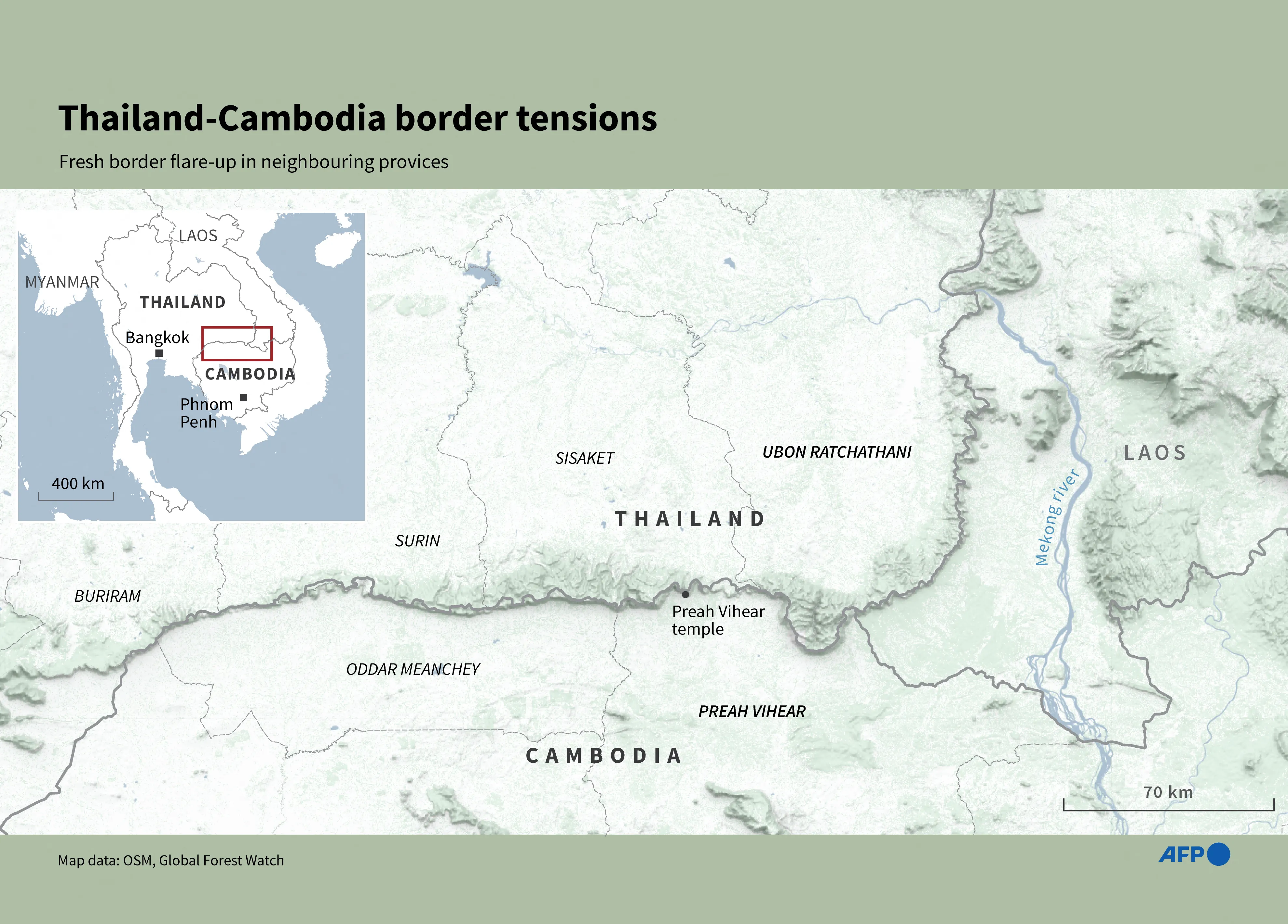
Infographic map showing the area on the Thailand-Cambodia border where fresh violence flared on December 8. (Graphic by John SAEKI and Nicholas SHEARMAN / AFP via Getty Images)
Infographic map showing the area on the Thailand-Cambodia border where fresh violence flared on December 8, 2025. Graphic by John SAEKI and Nicholas SHEARMAN/AFP JOHN SAEKI; NICHOLAS SHEARMAN

The latest clashes have also seen the deaths of four Cambodian civilians. They were killed in Oddar Meanchey and Preah Vihear provinces, according to Cambodia’s information minister, Neth Pheaktra.

Meanwhile, tens of thousands of people have been forced to flee their homes in the border region.

Based on statements from Thai authorities, more than 385,000 civilians have been ordered to evacuate from border areas across four provinces. Of those, around 35,000 people were registered at shelters as of Monday morning, they added.

Cambodian soldiers (C) ride their motorbike as local residents evacuate following clashes along the Cambodia-Thailand border in Preah Vihear province on December 8, 2025. A Thai soldier was killed and several others were wounded in fresh border clashes with Cambodia, Thailand's army said on December 8, 2025, with both sides trading blame for the latest eruption in fighting along their frontier. (Photo by AFP via Getty Images)
Cambodian soldiers ride their motorbike as local residents evacuate following clashes along the Cambodia-Thailand border in Preah Vihear province on December 8, 2025. Photo by AFP STR

People have also fled villages on the Cambodian side of the border. The Cambodian Ministry of Information says that 1,157 families have been evacuated to safe areas.

There is now an escalating war of words on the political side.

In a statement, Thai Prime Minister Anutin Charnvirakul said the country did not want violence and refuted claims that his country had initiated the conflict. “However, Thailand will not tolerate violations of its sovereignty and will proceed rationally and with due regard for the principles of peace, security, and humanity,” he said.

#Thailand | #Cambodia

Footage showing a RCA fortification along the Thai-Cambodian Border.

This position features a 75 mm Type 56 RCL (PRC copy of the M20), whose trigger is wired to a cord.

The video also shows the ammunition crates used to supply this fighting position.

/1 pic.twitter.com/6hn5IwqQtL

— T-55AM1 (@T_55AM1_) December 8, 2025

The former prime minister of Cambodia, Hun Sen, who remains a very influential figure, called upon his country’s forces to exercise restraint, but blamed Thailand for trying to “pull us into retaliation.”

“The red line for responding has already been set. I urge commanders at all levels to educate all officers and soldiers accordingly,” Hun Sen said in a Facebook post.

THAILAND - DECEMBER 08: (----EDITORIAL USE ONLY - MANDATORY CREDIT - ' THE ROYAL THAI ARMY / HANDOUT' - NO MARKETING NO ADVERTISING CAMPAIGNS - DISTRIBUTED AS A SERVICE TO CLIENTS----) A Thai soldier wounded by gunfire from Cambodian soldiers is taken to hospital by helicopter for medical treatment in Thailand on December 08, 2025. The Thai Royal Family criticized Cambodia's claim that no shots were fired, and provided conclusive evidence that Cambodian soldiers opened fire inside Thai territory, wounding two soldiers. (Photo by Royal Thai Army / Handout/Anadolu via Getty Images)
A Thai soldier wounded by gunfire from Cambodian soldiers is taken to a hospital by helicopter for medical treatment in Thailand on December 8, 2025. Photo by Royal Thai Army / Handout/Anadolu via Getty Images Anadolu

The fighting between Thailand and Cambodia was one of the “eight raging conflicts” that were “settled” by the Trump administration, according to the newly released National Security Strategy.

The ceasefire came after a previous spike in tensions in May, including an exchange of fire between troops in a contested area, which left one Cambodian soldier dead. Then came a series of tit-for-tat actions by both governments, including airstrikes, leading to a full-blown conflict over five days in July. This killed at least 48 people and forced another 300,000 to flee their homes.

Tensions have remained high despite the ceasefire agreement, with both sides accusing each other of violations, and Thailand announcing in November that it was suspending the deal.

Trump then intervened, and a ceasefire was agreed around six weeks ago. Washington applied pressure by threatening to suspend trade talks unless a peace deal was brokered. Malaysia and China also both pushed for a settlement.

The U.S. president said he’d “stopped a war” through the use of tariffs and said, “I think they’re gonna be fine.”

However, the ceasefire never looked particularly strong, and last month Thailand said it was suspending the deal. In stepping away from the settlement, Thailand accused Cambodia of laying more landmines along the border. One of these wounded a Thai soldier, Bangkok said.

The border dispute has a long history, dating back to the period of French colonial rule, at the beginning of the 20th century, when a boundary was drawn up to separate Cambodia, which it ruled until 1953, from Thailand. Since then, there have been periodic tensions between the two countries, resulting from disagreements over where the border should lie.

A pair of F-16s from the Royal Thai Air Force, fly in formation during Exercise Thai Boomerang 2019. *** Local Caption *** No. 1 Squadron (1SQN) is participating in Exercise Thai Boomerang 2019, a bi-lateral fighter exercise between the Royal Thai Air Force and the Royal Australian Air Force at Korat Air Base, Thailand. The exercise will expose 1SQN to Dissimilar Air Combat Training and Large Force Employment operations in the South East area of operations, and further enhance the relationship between Australia and Thailand.
A pair of F-16s from the Royal Thai Air Force fly in formation during Exercise Thai Boomerang 2019. Australian Department of Defense Unknown

Anwar Ibrahim, the prime minister of Malaysia, who helped broker the original ceasefire, called upon Thailand and Cambodia to avoid further escalation. He said the latest violence risked “unravelling the careful work that has gone into stabilizing relations between the two neighbors.”

“We urge both sides to exercise maximum restraint, maintain open channels of communication, and make full use of the mechanisms in place,” Anwar said.

So far, Trump has not responded to the renewed fighting.

For now, however, both sides show little interest in appeasement.

Contact the author: thomas@thewarzone.com

Thomas is a defense writer and editor with over 20 years of experience covering military aerospace topics and conflicts. He’s written a number of books, edited many more, and has contributed to many of the world’s leading aviation publications. Before joining The War Zone in 2020, he was the editor of AirForces Monthly.


Source link

The Tanker Takeover: How Trump Is Weaponizing the Caribbean

The United States has fully commited to its enforcement of sanctions on Venezuela by seizing a large oil tanker off its coast. President Donald Trump publicly announced the operation on December 10th and authorities said a joint FBI/Homeland Security/Coast Guard team executed a court-ordered seizure of the vessel, which was transporting Iranian and Venezuelan crude in violation of U.S imposed sanctions.

This is reportedly the first U.S. seizure of a Venezuelan oil shipment since sanctions began way back in 2019. “We’ve just seized a tanker on the coast of Venezuela, a large tanker, very large, largest one ever seized, actually,” says Donald Trump.

Trying to maintain the credibility of U.S. sanctions at a time when their enforcement have increasingly been challenged by other international actors such as Russia or Iran. Now, The U.S. is willing to take direct action beyond economic wars, even at the risk of diplomatic and military escalation.

Reactions from Caracas

Venezuela publicly denounced the action and accused Washington of blatant theft describing the seizure as “an act of international piracy”. Venezuelan President Nicolás Maduro has long cast himself as the victim of a U.S. led campaign to oust him from the country in order to seize the vast oil wealth on the country’s shores. He reiterated that the U.S. military buildup, which started this summer, including carrier strike groups and bases is directly aimed at overthrowing him.

Maduro’s supporters rallied in the streets against foreign aggression even as officials prepared diplomatic protests to international bodies. For the time being, he faces limited other practical options for retaliation as Venezuela’s navy is in no position to challenge U.S. maritime dominance, and legal recourse through international courts would likely take years.

Russia’s Offers Full Support

Moscow reaffirmed its backing for Maduro, emphasising the legitimacy of Venezuela’s government and condemning what it described as unilateral U.S. actions. An ally in South America provides Russia opportunities for energy investment, and a way to challenge U.S. influence.

The tanker seizure allows Moscow to frame Washington as overreaching and destabilising, a narrative it also applies to recent U.S. actions in Eastern Europe and the Middle East. While Russia is unlikely to escalate militarily, its political backing is significant.

China’s Strategic Role, A Potential Mediator?

Avoiding direct confrontation with Washington over the seizure, Beijing has reiterated its general opposition to unilateral sanctions and calling for international dialogue. However, China remains Venezuela’s most important economic partner and oil consumer, giving it substantial influence over any talks in the region.

Chinese companies have adapted to sanctions by purchasing Venezuelan crude oil at discounted prices, often through intermediaries. For Beijing, Venezuela is also part of a broader strategy to diversify energy supplies and expand its economic reach to the Americas.

Impact on Oil Markets

The announcement caused a modest spike in oil prices around the globe; for example: Brent crude briefly rose about 0.4% to around $62 a barrel, before returning to normal levels in the following few days.

The incident also highlighted Venezuela’s export challenges: under sanctions, its oil trades at a deep discount for its main trade partners, China and Russia. American oil companies with Venezuelan ties reported no immediate trouble. Chevron the U.S. firm that co-owns Venezuela’s largest oil project said its operations there continue normally, and U.S. imports of Venezuelan crude have even ticked up slightly in recent months.

Broader Consequences

Neighbouring countries such as Cuba and other Caribbean states depend on Venezuelan oil and could feel its effects. Sanctioning Venezuela was intended to pressure the regime into political concessions, yet Maduro remains firmly in power.

Enforcement actions like this tanker seizure may increase short-term pressure, but they also come with great risk for the stability of the Caribbean. Venezuela’s experience mirrors that of Iran and Russia, suggesting that sanctions alone may be insufficient to produce regime change, particularly when the targeted government is provided external backing.

Possible Future Scenarios and Implications

One scenario is a continuation of this low-level rise in tensions, with the U.S. stepping up enforcement and Venezuela responding through diplomatic protests while relying on Russian support.

Another is a negotiated de-escalation, potentially linked to limited sanctions relief in exchange for political concessions, though past efforts suggest this would be difficult to achieve with the current White House administration.

A more destabilising scenario would involve a potential confrontation at sea and broader disruption to energy markets. However, this scenario remains unlikely for the time being.

With information from Reuters and BBC News.

Source link