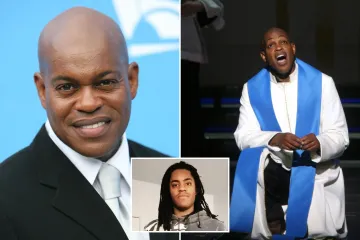
As David Walliams looks ahead to a lonely Christmas, a PR expert has shed light on the transitional period he faces, against a backdrop of lost friendships and shifting tastes in comedy
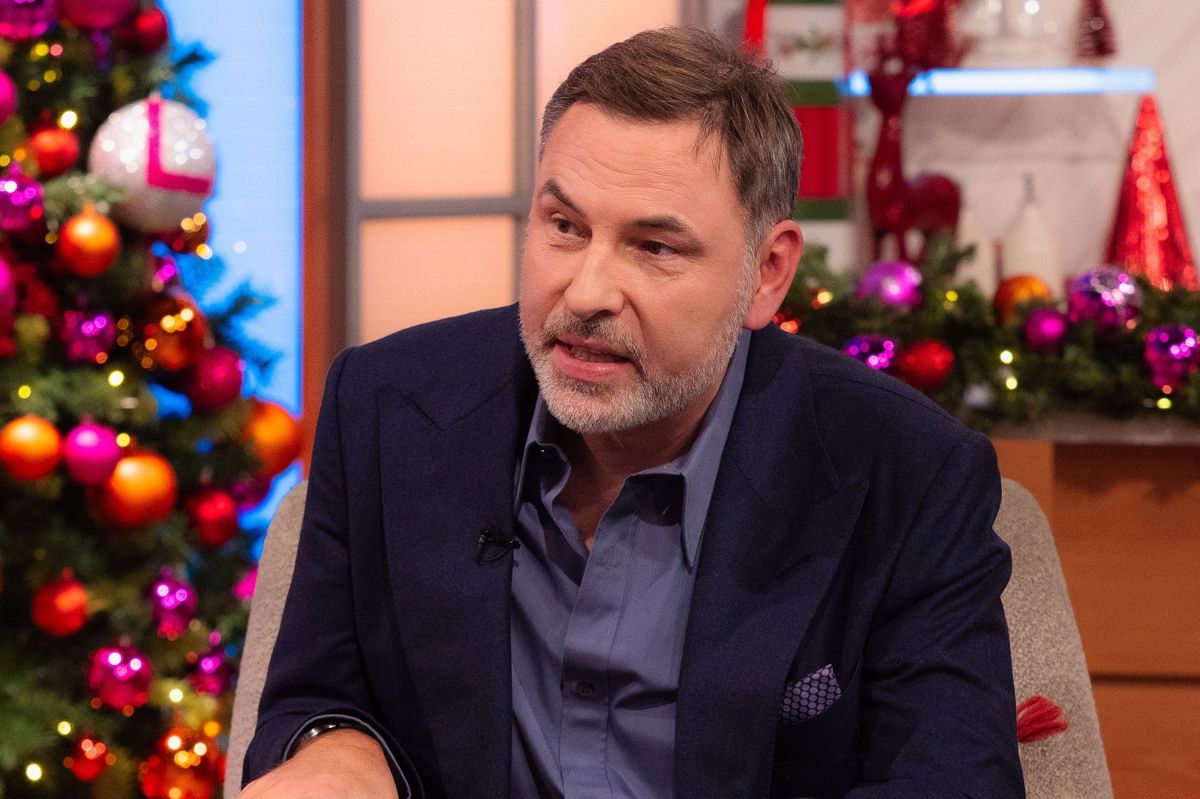
Could a ‘redemption arc’ be on the cards for David Walliams?(Image: Ken McKay/ITV/Shutterstock)
Once the toast of talent show television, David Walliams is now looking ahead to a lonely Christmas, and a PR expert warns he could be in for a “brutal reset”.
While discussing his new children’s book, Santa & Son, the former Little Britain star spoke about spending Christmas Day away from his 12-year-old son, Alfred, whom he co-parents with ex-wife Lara Stone.
David, 58, shared: “I don’t have him for Christmas. I was thinking a bit about sometimes the pain you feel as a parent when you don’t have your child at Christmas.”
This comes at a transitional time for David, three years on after disparaging off-camera comments he made about Britain’s Got Talent contestants were leaked. This included one incident where he referred to a pensioner as a ‘c***’ while filming the 2020 series.
Comedian and writer David apologised for the “disrespectful comments”, which were made during filming breaks, and subsequently announced his departure from the long-running ITV show, where he’d been a fixture for ten years.
Remarking upon this relatively quiet new chapter in David’s career, PR to the stars Mayah Riaz told the Mirror: “When it comes to David Walliams, this is a classic case of a public figure going through a period of reset. Fame can be incredibly loud, then suddenly very quiet, and that shift can feel brutal.”
With the dust from the initial controversy somewhat settled, David is reportedly still rather distant from his old showbiz pals, including his once-close friend, Simon Cowell, whom a source claims he no longer speaks to “at all”. But what effect will this distancing have on his future prospects in the limelight?
On this note, personal branding expert Mayah reflected: “The distance from Simon Cowell is interesting because that relationship once acted as a powerful engine for David and his visibility.
“When a star steps away from a partnership like that, it is not just a personal shift. It has a ripple effect on their public momentum, too. Losing that sort of alliance will have the industry wondering what the next chapter for him will look like.”
Of course, audience tastes have changed dramatically since the first episode of Little Britain first aired back in 2003, and jokes, particularly those which feel as though they might be punching down or otherwise insensitive, are viewed through a much different lens.
Indeed, back in 2020, the BBC removed Little Britain from iPlayer altogether after citing that “times have changed” since it was first broadcast. Both David and his co-star Matt Lucas expressed regret at the time for portraying people from other races, including sketches which saw them using Blackface.
According to Mayah: “The comedy world has changed so fast, and I’m not sure many performers were ready for that. What audiences once brushed off as cheeky or edgy now lands very differently. I think David was hit hard by that shift.
“He came from an era where the boundaries were looser, but now the cultural temperature is very different. Comedy has moved towards compassion and awareness, and he was caught in the middle of that evolution.”
However, Mayah believes there is still an opportunity for David to “write a new chapter for himself”, highlighting his talent for storytelling which audiences have long since admired.
Predicting a potential “redemption arc” ahead, Mayah considered: “I think there is always room for a comeback. The public can and do forgive, but they will want to see growth first. If David shows that he understands why the landscape has changed, he could easily write a new chapter for himself. People love a redemption arc.
“There is something very British about rooting for someone to get back up after a fall. Right now, though, he feels like a man in transition. It is a lonely place when the spotlight moves on, especially for someone who has lived inside it for so long. But isolation can also refocus a career.”
She continued: “Plenty of big names have stepped back, rebuilt quietly and then we see them return stronger. David is still a talented storyteller, and audiences have not forgotten that.
“If he uses this quieter period to reintroduce himself in a more grounded and contemporary way, then a comeback is absolutely on the table. The door is never truly closed in this industry. It just depends on how he chooses to walk back through it.”
An illustration picture shows the introduction page of ChatGPT, an interactive AI chatbot model trained and developed by OpenAI. Time magazine named the creators of artificial intelligence as the Time Person of the Year. File Photo by Wu Hao/EPA-EFE
Dec. 11 (UPI) — Time magazine on Thursday named the architects of artificial intelligence as the 2025 Person of the Year.
While no one specific person was singled out by the magazine for the annual honor, the cover story for the edition featured interviews with Nvidia CEO Jensen Huang, Softbank CEO Masayoshi Son, U.S. Energy Secretary Chris Wright and Baidu CEO Robin Li.
Time editor in chief Sam Jacobs, in a letter to readers about the selection, said no one had a greater impact on individuals than those who created AI.
“This was the year when artificial intelligence’s full potential roared into view, and when it became clear that there will be no turning back or opting out,” he wrote.
“For these reasons, we recognize a force that has dominated the year’s headlines, for better or worse. For delivering the age of thinking machines, for wowing and worrying humanity, for transforming the present and transcending the possible, the architects of AI are Time’s 2025 Person of the Year.”
The Person of the Year edition of the magazine features two covers this year — one depicting builders on scaffolding constructing the letters “AI” and another showing several tech leaders sitting on a steel beam above a cityscape, reminiscent of an iconic 1932 photo of construction workers eating lunch on a steel beam. The edition goes on sale beginning Dec. 19.
Time also named YouTube CEO Neal Mohan as CEO of the Year; Leonardo DiCaprio as Entertainer of the Year; A’ja Wilson as Athlete of the Year; and KPop Demon Hunters as Breakthrough of the Year.
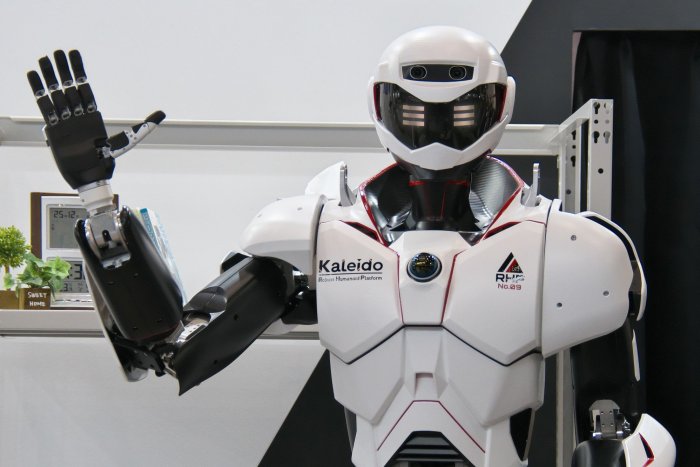
Company Kawasaki Heavy Industries presents its latest humanoid robot, “RHP Kaleido 9,” during the 2025 International Robot Exhibition in Tokyo on December 3, 2025. Photo by Keizo Mori/UPI | License Photo
To provide the best experiences, we use technologies like cookies to store and/or access device information. Consenting to these technologies will allow us to process data such as browsing behavior or unique IDs on this site. Not consenting or withdrawing consent, may adversely affect certain features and functions.
The technical storage or access is strictly necessary for the legitimate purpose of enabling the use of a specific service explicitly requested by the subscriber or user, or for the sole purpose of carrying out the transmission of a communication over an electronic communications network.
The technical storage or access is necessary for the legitimate purpose of storing preferences that are not requested by the subscriber or user.
The technical storage or access that is used exclusively for statistical purposes. The technical storage or access that is used exclusively for anonymous statistical purposes. Without a subpoena, voluntary compliance on the part of your Internet Service Provider, or additional records from a third party, information stored or retrieved for this purpose alone cannot usually be used to identify you.
The technical storage or access is required to create user profiles to send advertising, or to track the user on a website or across several websites for similar marketing purposes.
CHARLOTTE Church has confessed she ‘stinks’ after shunning deodorant and even admitted she no longer shaves.
The frank confession from Charlotte, 39, came during an appearance on the Walking The Dog podcast.
Sign up for the Showbiz newsletter
Thank you!
Charlotte says she ‘stinks’ after shunning deodorant and shavingCredit: InstagramShe made the confession on the Walking The Dog podcastCredit: UnknownIt’s the latest of Charlotte’s shocking admissionsCredit: CREDIT LINE:BBC/Studio Lambert/Euan Cherry
When host Emily Dean commented on how “lovely” she smelt, Celebrity Traitors star Charlotte was caught off guard.
She candidly said: “Do I? That’s surprising. I never smell nice.
“I don’t wear any deodorant or anything, so I generally stink. I don’t shave anymore. I don’t shave anything.”
The former classical music singer went on to explain her reasons for shunning the product and revealed she loves showing off her hairy legs.
She said: “I stopped shaving probably about 18 months ago, maybe even longer than that, maybe two years.
“And I stopped wearing deodorant… I just started thinking, do you know what? This underarm area, there’s so many receptors there, lymph and all sorts of stuff going on there.
“I’m just not sure about sticking all of this chemical stuff in these pores, because your skin is so… you know, it’s the largest organ in the body.
On the subject of shaving, Charlotte continued: “Each to their own.
“Do you know what I mean? Crack on and have a lovely time and do whatever feels good – dye it, shave it, whatever – but for me I’m just like ‘Nah!’
“I sort of love it, I love the contradiction of it. So I love wearing dresses, beautiful dresses, with my really hairy legs and heels and nails. It’s so confusing for people.”
She spoke about the moment on Elizabeth Day’s podcast after clips from her appearance went viral on social media.
During the segment, Charlotte was invited on to This Morning to lead a five-minute sound bath session.
However, unfortunately for Charlotte, Alison found it all a bit too much and found herself laughing and cringing through the entire segment as Charlotte did her best to carry on.
When asked by Elizabeth if she was left “bothered” by Alison’s reaction to her doing a sound bath, Charlotte said: “Oh, that p****d me right off.
“That p****d me right off.”
Elizabeth then added: “Yeah. I felt for you.”
Charlotte continued: “I’ve met Alison Hammond a number of times and she’s a wonderful woman.”
In a further candid confession, Charlotte added: “That really did actually touch quite a deep wound for me.
“I was like, ‘ugh I really like you, Alison, but f*** you’.”
PM Zhelyazkov says cabinet stepping down before parliament had been due to hold no-confidence vote.
Published On 11 Dec 202511 Dec 2025
Share
Bulgaria’s government has resigned following weeks of street protests against its economic policies and its perceived failure to tackle corruption.
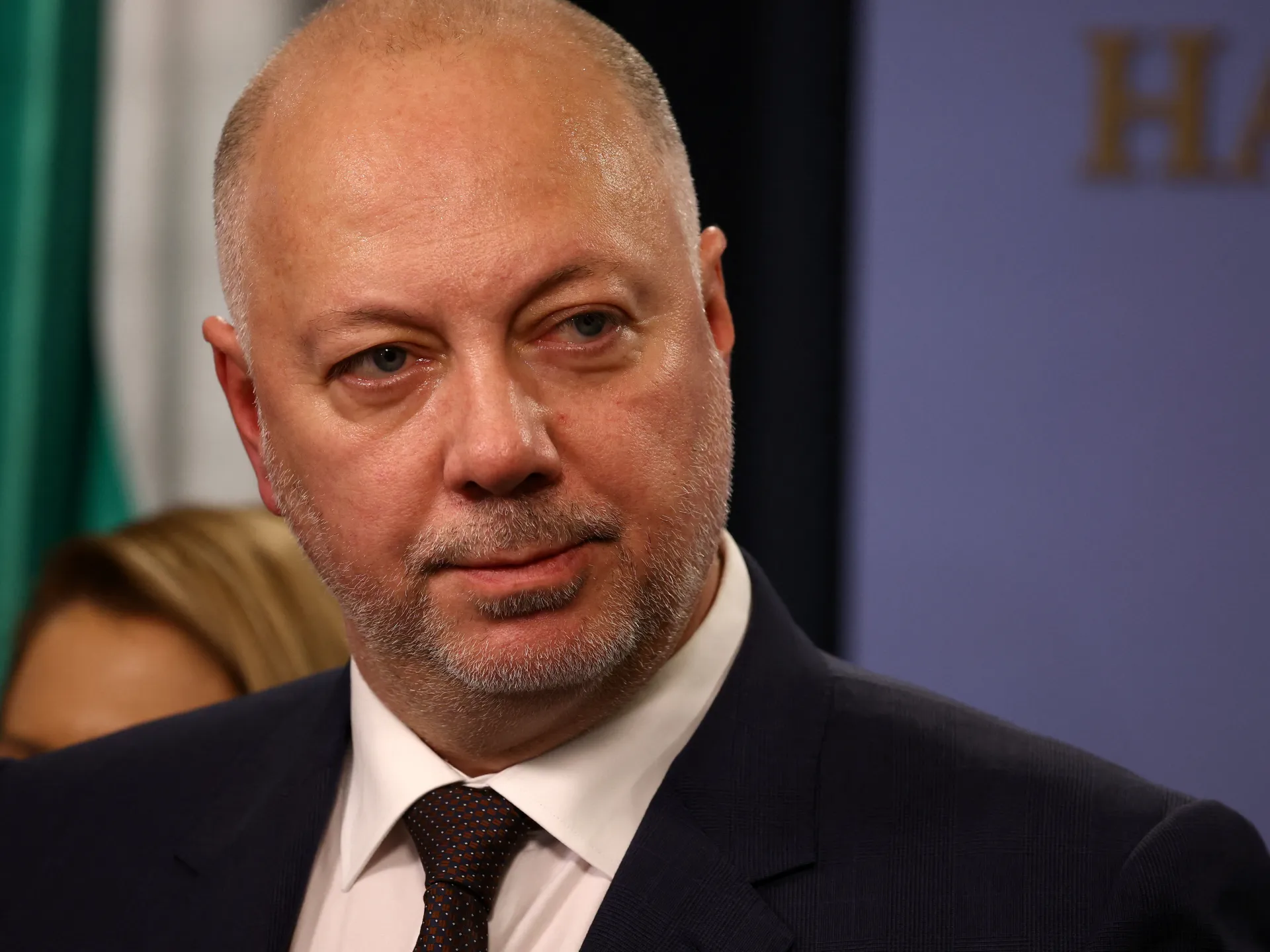
Prime Minister Rosen Zhelyazkov announced the resignation of his cabinet in a televised statement on Thursday, minutes before parliament had been due to vote on a no-confidence motion.
Recommended Stories
list of 4 itemsend of list
The resignation comes weeks before Bulgaria is due to join the eurozone on January 1.
“Our coalition met, we discussed the current situation, the challenges we face and the decisions we must responsibly make,” Zhelyazkov said, announcing the government’s decision to step down.
“Our desire is to be at the level that society expects,” he said. “Power stems from the voice of the people.”
Mass protests
Thousands of Bulgarians rallied on Wednesday evening in Sofia and dozens of other towns and cities across the Black Sea nation, the latest in a series of rolling demonstrations that have underlined public frustration with corruption and the failure of successive governments to root it out.
Last week, Zhelyazkov’s government withdrew its 2026 budget plan, the first drafted in euros, due to the protests.
Opposition parties and other organisations said they were protesting plans to hike social security contributions and taxes on dividends to finance higher state spending.
Despite the government’s retreat over the budget plan, the protests have continued unabated in a country that has held seven national elections in the past four years – most recently in October 2024 – amid deep political and social divisions.
President Rumen Radev also called on the government earlier this week to resign. In a message to lawmakers on his Facebook page on Thursday, Radev said: “Between the voice of the people and the fear of the mafia. Listen to the public squares!”
Radev, who has limited powers under the Bulgarian constitution, will now ask the parties in parliament to try to form a new government. If they are unable to do so, as seems likely, he will put together an interim administration to run the country until new elections can be held.
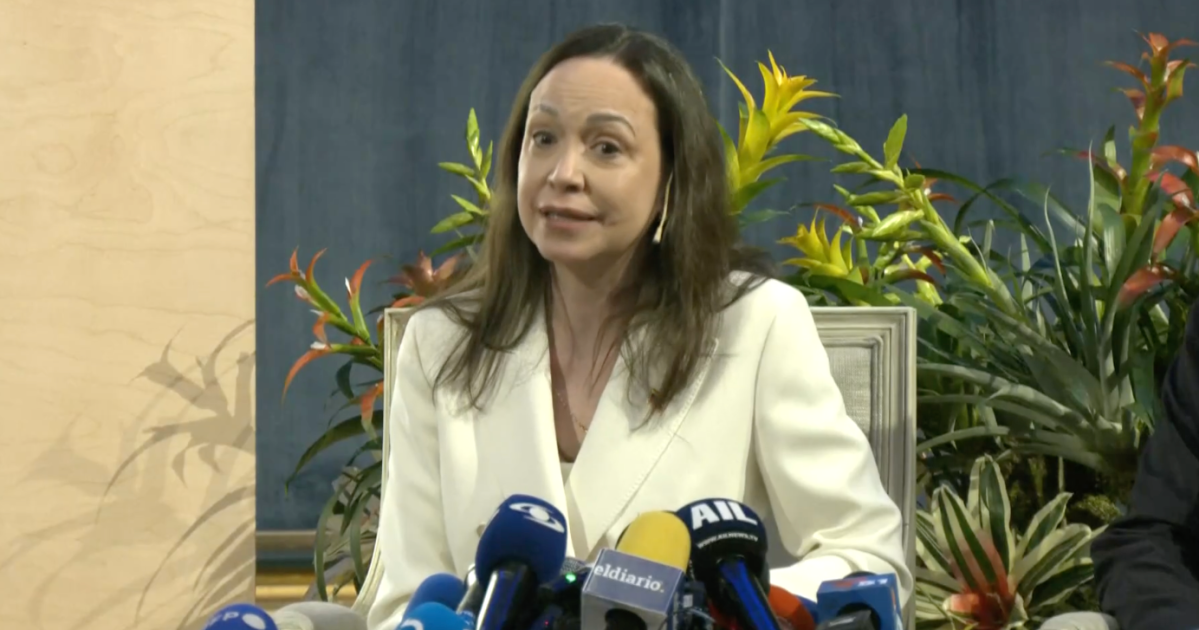
Venezuelan opposition leader and Nobel Peace laureate Maria Corina Machado has declared that authorities in her home country would have attempted everything possible to prevent her journey to Norway, after she emerged publicly for the first time in nearly a year.
Machado greeted supporters from an Oslo hotel balcony in the early hours of Thursday following a high-risk exit from Venezuela, where she had been in hiding since January.
Recommended Stories
list of 2 itemsend of list
The journey, which purportedly included navigating 10 military checkpoints and crossing the Caribbean by fishing vessel, brought her to the Norwegian capital to collect her Nobel Peace Prize.
During a news conference at Norway’s parliament, the 58-year-old right-wing opposition figure delivered sharp criticism of President Nicolas Maduro’s administration, asserting that the government deploys national resources to suppress its population.
When questioned about an oil tanker seized by Washington on Wednesday, she argued this demonstrated how the regime operates. Asked whether she would support a United States invasion, Machado claimed Venezuela had already been invaded by Russian and Iranian agents alongside drug cartels.
“This has turned Venezuela into the criminal hub of the Americas,” she said, standing alongside Norwegian Prime Minister Jonas Gahr Stoere.
“What sustains the regime is a very powerful and strongly funded repression system. Where do those funds come from? Well, from drug trafficking, from the black market of oil, from arms trafficking and from human trafficking. We need to cut those flows.”
The trip reunited her with family members she had not seen in almost two years, including her daughter, who accepted the Nobel Peace Prize on her behalf at Wednesday’s ceremony.
Aligned with Trump
The political leader has welcomed international sanctions and US military intervention in Venezuela, a move her critics say harkens back to a dark past.
The US has a long history of interference in the region, particularly in the 1980s, when it propped up repressive right-wing governments through coups, and funded paramilitary groups across Latin America that were responsible for mass killings, forced disappearances and other grave human rights abuses.
Venezuelan authorities cited Machado’s support for sanctions and US intervention when they barred her from running for office in last year’s presidential election, where she had intended to challenge Maduro. Machado has accused Venezuela’s president of stealing the July 2024 election, which was criticised by international observers.
Praising the Trump administration’s approach, Machado said the president’s actions had been “decisive to reach the point where we are right now, in which the regime is weaker than ever.”
She insisted she would return home but did not say when. “I’m going back to Venezuela regardless of when Maduro goes out. He’s going out, but the moment will be determined by when I’m finished doing the things that I came out to do,” she told reporters.
Her escape comes as tensions between Washington and Caracas have intensified sharply. The Trump administration has positioned major naval forces in the Caribbean and conducted strikes against alleged drug vessels since September. The US seized what Trump called a “very large” oil tanker off the coast of Venezuela, on Wednesday.
Machado has aligned herself with right-wing hawks close to Trump who argue that Maduro has links to criminal gangs that pose a direct threat to US national security, despite doubts raised by the US intelligence community.
The Trump administration has ordered more than 20 military strikes in recent months against alleged drug-trafficking vessels in the Caribbean and off Latin America’s Pacific coast, killing more than 80 people.
Human rights groups, some US Democrats, and several Latin American countries have condemned the attacks as unlawful extrajudicial killings of civilians.
The Wall Street Journal (WSJ) reported that Machado’s two-month escape operation involved wearing a disguise and departing from a coastal fishing village on a wooden boat bound for Curacao before boarding a private aircraft to Norway.
US forces were alerted to avoid striking the vessel, the WSJ reported, as they had one with similar boats in recent months. Machado confirmed receiving assistance from Washington during her escape.
Maduro, in power since 2013 following the death of Hugo Chavez, says Trump is pushing for regime change in the country to access Venezuela’s vast oil reserves. He has pledged to resist such attempts.
A United Nations report released on Thursday accused Venezuela’s security forces of crimes against humanity over more than a decade.
Venezuelan Minister of the Interior Diosdado Cabello said Machado left the country “without drama” but provided no details.
Walt Disney Co. agreed to invest $1 billion in OpenAI and license iconic characters like Mickey Mouse and Cinderella to Sora, OpenAI’s short-form, artificial intelligence video platform.
As part of the three-year licensing pact, Sora will be able to generate short, user-prompted social videos that can be viewed and shared by fans, drawing from a library of more than 200 animated and creature characters from Disney, Marvel, Pixar and Star Wars, according to a statement from Disney on Thursday. The deal doesn’t cover any talent likenesses or voices.
At the same time, Disney will become a major customer of OpenAI, using its tools to build new products and experiences and deploying ChatGPT for its employees.
“The rapid advancement of artificial intelligence marks an important moment for our industry, and through this collaboration with OpenAI we will thoughtfully and responsibly extend the reach of our storytelling through generative AI, while respecting and protecting creators and their works,” Disney Chief Executive Officer Bob Iger said in the statement.
Hollywood studios have been reluctant to get into business with an AI company, wary of how it might use their data and of angering the labor unions with which they work every day. But OpenAI has been talking to the industry’s largest studios, including Disney, Comcast Corp.’s Universal Pictures and Warner Bros. Discovery Inc., about the creative and commercial potential of Sora, Bloomberg News has previously reported.
The AI developer unveiled a new version of Sora in September as a standalone social app, available by invitation. As with the original Sora, released last December, users can generate short clips in response to text prompts, but the new app allows people to see videos created by others. Beyond that, users can create a realistic-looking AI avatar and voice of themselves, which can be inserted into videos made with the app by the user or their friends, with the avatar owner’s permission.
Dec. 11 (UPI) — Mexico’s congress has approved charging up to 50% tariffs on Chinese imports Wednesday.
Mexican President Claudia Sheinbaum proposed the tariffs in September and said they are a way to boost domestic production. But others, like China, have said it’s a way to align with President Donald Trump, who has been pressuring other countries to distance themselves from China.
Mexico’s congress approved the tariffs Wednesday, and Sheinbaum is expected to sign the bill. The law would create up to 50% tariffs on China and any other country with which Mexico doesn’t have a trade agreement, including Thailand, India and Indonesia. The tariffs would take effect Jan. 1 and will include more than 1,400 products, like cars, metals, appliances and clothing.
After the United States, China is Mexico’s second-largest exporter. The United States sold $334 billion to Mexico last year, and China sold $130 billion in goods, The New York Times reported. China buys little from Mexico, which is another reason for the tariffs, Sheinbaum has said.
The Chinese government has warned Mexico to “think twice” about imposing the levies, saying it would harm China and other countries. It said the move was made “under coercion to constrain China,” alluding to Trump’s pressure.
The Chinese Ministry of Commerce said in a statement Thursday that the tariffs would “substantially harm” the country and others. It said for Mexico to “correct its erroneous practices of unilateralism and protectionism as soon as possible,” The Times reported.
Mexico is in talks with Trump, trying to reduce tariffs. The United States imposes 50% tariffs on Mexican steel and aluminum. Trump has threatened to add more to the tariffs for several reasons, including synthetic fentanyl and water rights from the Rio Grande.
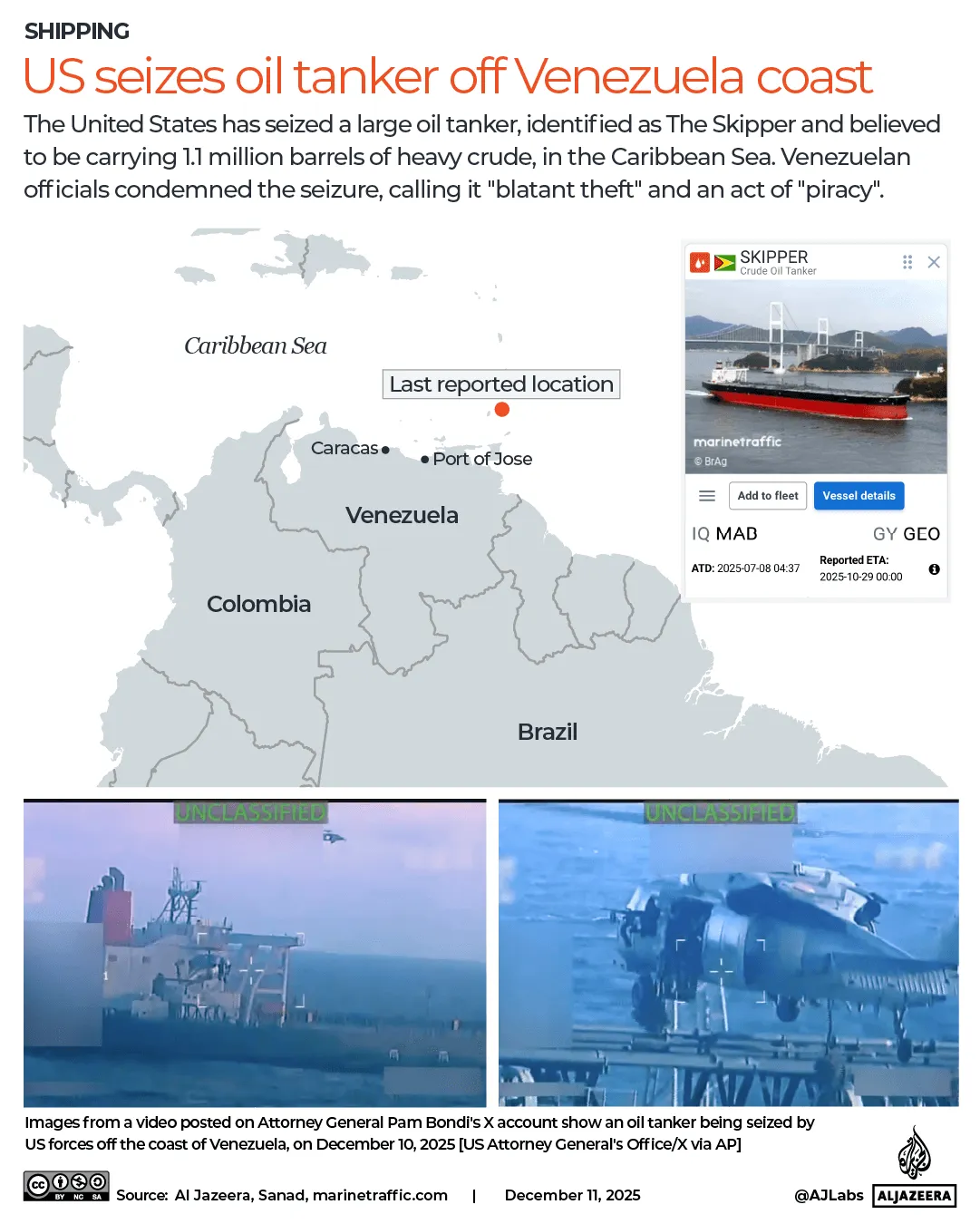
United States President Donald Trump has said that the US has seized a sanctioned oil tanker close to the coast of Venezuela, in a move that has caused oil prices to spike and further escalates tensions with Caracas.
“We’ve just seized a tanker on the coast of Venezuela, large tanker, very large, largest one ever, actually, and other things are happening,” Trump said on Wednesday.
Recommended Stories
list of 1 itemend of list
The Venezuelan government called the move an act of “international piracy”, and “blatant theft”.
This comes as the US expands its military operations in the region, where it has been carrying out air strikes on at least 21 suspected drug-trafficking vessels since September. The Trump administration has provided no evidence that these boats were carrying drugs, however.
Here is what we know about the seizure of the Venezuelan tanker:
What happened?
The US said it intercepted and seized a large oil tanker off the coast of Venezuela, marking the first operation of its kind in years.
The last comparable US military seizure of a foreign tanker occurred in 2014, when US Navy SEALs boarded the Morning Glory off Cyprus as Libyan rebels attempted to sell stolen crude oil.
The Trump administration did not identify the vessel or disclose the precise location of the operation.
However, Bloomberg reported that officials had described the ship as a “stateless vessel” and said it had been docked in Venezuela.
Soon after announcing the latest operation on Wednesday, US Attorney General Pam Bondi released a video showing two helicopters approaching a vessel and armed personnel in camouflage rappelling onto its deck.
“Today, the Federal Bureau of Investigation, Homeland Security Investigations and the United States Coast Guard, with support from the Department of War, executed a seizure warrant for a crude oil tanker used to transport sanctioned oil from Venezuela and Iran,” Bondi said.
She added that “for multiple years, the oil tanker has been sanctioned by the United States due to its involvement in an illicit oil-shipping network supporting foreign terrorist organisations”.
Today, the Federal Bureau of Investigation, Homeland Security Investigations, and the United States Coast Guard, with support from the Department of War, executed a seizure warrant for a crude oil tanker used to transport sanctioned oil from Venezuela and Iran. For multiple… pic.twitter.com/dNr0oAGl5x
Experts said the method of boarding demonstrated in the video is standard practice for US forces.
“The Navy, Coast Guard and special forces all have special training for this kind of mission, called visit, board, search, and seizure – or VBSS,” Mark Cancian, a retired Marine Corps colonel and senior adviser at the Center for Strategic and International Studies, told Al Jazeera.
“It is routine, especially for the Coast Guard. The government said it was a Coast Guard force doing the seizure, though the helicopter looks like a Navy SH-60S.”
Which vessel was seized?
According to a Reuters report, British maritime risk firm Vanguard identified the crude carrier Skipper as the vessel seized early Wednesday off Venezuela’s coast.
MarineTraffic lists the Skipper as a very large crude carrier measuring 333m (1,093 feet) in length and 60m (197 feet) in width.
The tanker was sanctioned in 2022 for allegedly helping to transport oil for the Lebanese armed group, Hezbollah, which is backed by Iran, and Iran’s Quds Force.
The Skipper departed Venezuela’s main oil terminal at Jose between December 4 and 5 after loading about 1.8 million barrels of Merey crude, a heavy, high-sulphur blend produced in Venezuela.
“I assume we’re going to keep the oil,” President Trump said on Wednesday.
Before the seizure, the tanker had transferred roughly 200,000 barrels near Curacao to the Panama-flagged Neptune 6, which was headed for Cuba, according to satellite data analysed by TankerTrackers.com.
According to shipping data from Venezuela’s state-owned oil and gas company Petroleos de Venezuela (PDVSA), the vessel also transported Venezuelan crude to Asia in 2021 and 2022.
Where did the seizure take place?
The US said it seized the oil tanker in the Caribbean Sea.
US officials have said the action occurred near Venezuelan territorial waters, though they have not provided precise coordinates.
MarineTraffic data shows the vessel’s tracker still located in the Caribbean.
Is the US action legal?
Cancian noted that “seizing sanctioned items is common inside a country’s own territory. It is unusual in international waters”.
He added: “Russia has hundreds of sanctioned tankers sailing today, but they have not been boarded.”
Experts say it is unclear whether the seizure was legal, partly because many details about it have not been made public.
Still, the US could make use of various arguments to justify the seizure if needs be.
One is that the boat is regarded as stateless. Under the UN Convention on the Law of the Sea (UNCLOS), ships need “a nationality”.
The government of Guyana, Venezuela’s neighbour, said the Skipper was “falsely flying the Guyana flag”, adding that it is not registered in the country.
If a vessel flies a flag it is not registered under, or refuses to show any flag at all, states have the “right of visit”, allowing their officials to stop and inspect the ship on the high seas – essentially meaning international waters.
If doubts about a ship’s nationality remain after checking its documents, a more extensive search can follow.
In previous enforcement actions against sanctioned ships, the US has seized not the ship itself but the oil on board. In 2020, it confiscated fuel from four tankers allegedly carrying Iranian oil to Venezuela.
US law also allows the Coast Guard, which carried out this operation, to conduct searches and seizures on the high seas in order to enforce US laws, stating that it “may make inquiries, examinations, inspections, searches, seizures, and arrests upon the high seas” to prevent and suppress violations.
But some legal experts argue that the US has overstepped, as it “has no jurisdiction to enforce unilateral sanctions on non-US persons outside its territory”, according to Francisco Rodriguez, a senior research fellow at the Center for Economic and Policy Research (CEPR).
Rodriguez said the US is relying on maritime rules for stateless vessels “as an entryway to justify enforcing US sanctions outside of US territory”.
“To the extent that the US is able to continue to do so, it could significantly increase the cost of doing business with Venezuela and precipitate a deepening of the country’s economic recession,” he warned in a CEPR article.
The US has no jurisdiction to enforce unilateral sanctions on non-US persons outside its territory. The seizure of ships in international waters to extraterritorially enforce US sanctions is a dangerous precedent and a violation of international law.
Venezuela’s Foreign Ministry stated that “the true reasons for the prolonged aggression against Venezuela have finally been exposed”.
“It is not migration, it is not drug trafficking, it is not democracy, it is not human rights – it was always about our natural resources, our oil, our energy, the resources that belong exclusively to the Venezuelan people,” the statement said.
The ministry described the incident as an “act of piracy.”
The government added that it will appeal to “all” international bodies to denounce the incident and vowed to defend its sovereignty, natural resources, and national dignity with “absolute determination”.
“Venezuela will not allow any foreign power to attempt to take from the Venezuelan people what belongs to them by historical and constitutional right,” it said.
Venezuela’s President Nicolas Maduro gestures towards supporters, during a march to commemorate the 1859 Battle of Santa Ines in Caracas, Venezuela, on December 10, 2025 [Gaby Oraa/ Reuters]
What are the potential consequences for Venezuela’s oil exports?
Experts say the seizure could produce short-term uncertainty for Venezuelan oil exports, largely because “this has been the first time [the United States has]… seized a shipment of Venezuelan oil”, Carlos Eduardo Pina, a Venezuelan political scientist, told Al Jazeera.
That may make shippers hesitate, though the broader impact is limited, Pina said, since “the US allows the Chevron company to continue extracting Venezuelan oil”, and US group Chevron holds a special waiver permitting it to produce and export crude despite wider sanctions.
Chevron, which operates joint ventures with PDVSA, said its operations in Venezuela remain normal and continue without disruption.
The US oil major, which is currently responsible for all Venezuelan crude exports to the US, increased shipments last month to 150,000 barrels per day (bopd), up from 128,000 bpd in October.
Inside Venezuela, Pina warned the move could spark financial panic, however: “It could instil fear, trigger a currency run… and worsen the humanitarian crisis.”
How will this affect US-Venezuela relations?
Diplomatically, Pina said he views the action as a political message to Venezuelan President Nicolas Maduro, noting its timing – “the same day that [opposition leader] Maria Corina Machado was awarded the Nobel Prize” – and calling it “a gesture of strength… to remind that [the US is present in the Latin American region].”
Maduro has long argued that the Trump administration’s strikes on boats in the Caribbean and eastern Pacific are not, in fact, aimed at preventing drug running, but are part of a plan to effect regime change in Venezuela. Trump has authorised CIA operations in Venezuela and has given conflicting messages about whether he would consider a land invasion.
Analysts see this latest action as part of a broader strategy to pressure the Maduro government.
“This is certainly an escalation designed to put additional pressure on the Maduro regime, causing it to fracture internally or convincing Maduro to leave,” said Cancian.
“It is part of a series of US actions such as sending the Ford to the Caribbean, authorising the CIA to move against the Maduro regime, and conducting flybys with bombers and, recently, F-18s.”
Cancian added that the broader meaning of the operation depends on what comes next.
“The purpose also depends on whether the US seizes additional tankers,” he said. “In that case, this looks like a blockade of Venezuela. Because Venezuela depends so heavily on oil revenue, it could not withstand such a blockade for long.”
Outgoing Celebrity MasterChef presenter John Torode and his wife Lisa Faulkner have issued a career update
John Torode and wife Lisa Faulkner have career news(Image: Getty Images for the NTA’s)
Celebrity chefs John Torode and Lisa Faulkner have revealed exciting news for their devoted followers, announcing the launch of their very own YouTube channel straight from their home kitchen.
In an introduction filmed at their residence, John – who can currently be seen in his final-ever series of Celebrity MasterChef – welcomed viewers: “Welcome to our new YouTube channel, and to our home kitchen.”
Lisa added: “This is in our home, we are cooking all our recipes from home, in our kitchen – which is great, because we know where everything is – and we really hope you’re going to join us to see our family favourites.”
He teased a diverse menu, promising “celebratory food, food from all round the world, whether it be spaghetti with a tomato sauce, Korean fried chicken and a sticky sauce to go with it, all the way through to scones and jam and cream.”
His ITV presenter wife continued: “Yes, lovely puddings. You will get proper family favourites, old-fashioned things that just remind us of our childhood, and new and exciting food.”
Offering reassurance to aspiring home cooks, the couple guaranteed: “We promise you that every single recipe we make, if you follow it, it will work every single time.”
John clarified: “You know that because we test them, we try them and we cook them at home. If they don’t work, they don’t make the channel,” reports the Express.
Lisa confirmed their commitment, revealing: “We’ll be dropping new recipes every single week and we’ll be cooking them here so you can see that they work.”
In a heartwarming moment between the couple, John celebrated Lisa’s contribution to their culinary venture “as a mum cook”, whilst she returned the compliment with equal enthusiasm.
Lisa beamed: “We’ve got the old monsieur chef here who’s so brilliant at what he does.
“You’ve been a chef for years and years, you’ve had restaurants, there is nothing you don’t know about food and nothing you don’t like about food. All of your knowledge is coming to this channel.”
The duo wrapped up their message with an appeal to viewers, urging them: “Please subscribe and don’t forget to hit the bell icon – that’s it!”
Celebrity MasterChef is on BBC One and BBC iPlayer
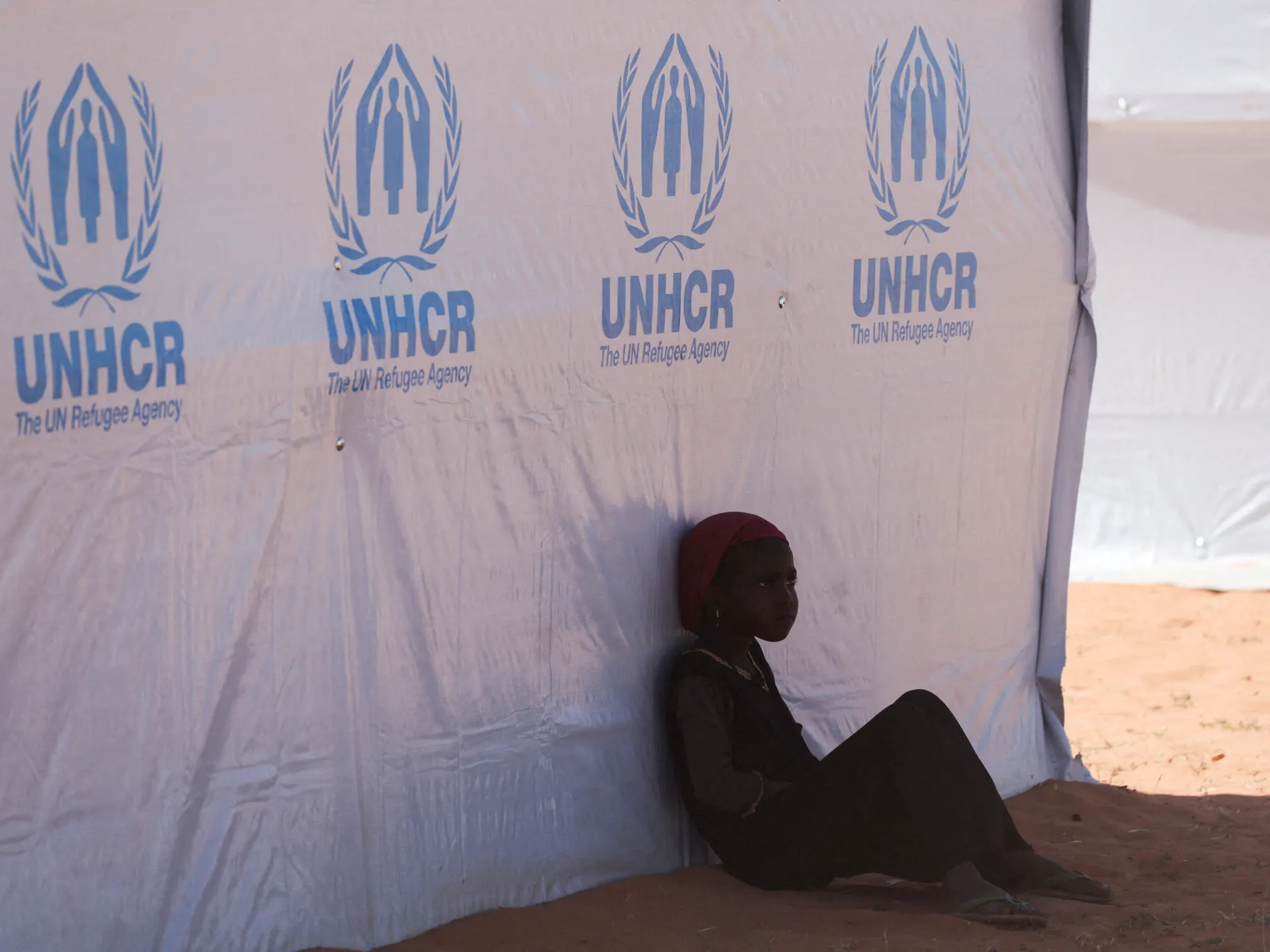
On October 14, the Swedish government announced it was nominating the CEO of IKEA, Jesper Brodin, as its candidate for United Nations High Commissioner for Refugees (UNHCR). Less than a month later, as the current high commissioner, Filippo Grandi, approached the end of his mandate, Brodin resigned from his position at the Swedish furniture giant, which he had led for eight years. In January 2026, the office of the UN secretary-general is expected to present a preferred candidate to the General Assembly for what former UNHCR head of research Jeff Crisp has called a “pro forma election”. Can the former chief of an iconic multinational company become the world’s highest authority on refugees — and what will it mean if he does?
In interviews, Jesper Brodin often refers to a small pamphlet by IKEA founder Ingvar Kamprad, titled The Testament of a Furniture Dealer, as outlining the values that inspire his way of doing business: innovation, sustainability and collective effort over individualism. Does the UNHCR need to learn lessons from a “furniture dealer”? The question matters because Brodin’s appeal is often framed in terms of corporate values, yet it remains unclear how — or whether — these translate into the protection of refugees. Whether Brodin has any chance of making it to the Geneva post or not, the question is worth asking, for the role of IKEA as a donor and operational partner of the UNHCR is significant and is likely to grow.
While humanitarianism and business have historically been companions, particularly since the end of the Cold War, this is the first time a business leader has been proposed to head the UN refugee agency. The nomination comes at a time when the UNHCR faces a dramatic cash crunch, and when political pressures and anti-refugee sentiment are increasing globally. Many scholars and practitioners believe the future of the global refugee regime itself may be at stake. Understanding the implications of Sweden’s choice, then, requires examining how corporate humanitarianism now shapes refugee protection.
Many were taken aback by the nomination. Yet the move by Sweden is anything but surprising. Over the past three decades, corporations have taken on increased responsibility for responding to humanitarian crises, while traditional organisations compete for a rapidly diminishing pool of resources. Research on the commodification of compassion has shown how, increasingly, “doing good” and “doing well” have become one and the same. This kind of “brand aid” involved both promoting commercial brands (from Toms shoes to Starbucks) through their involvement in humanitarian causes, and turning aid itself into a branded activity — something most effectively done through corporate partnerships. It began around two decades ago but has now become the dominant model of humanitarian engagement. As one major humanitarian donor in Kinshasa told us, “It’s now all about collaborations between the private sector, businesses and philanthropists.” Indeed, when the desire to help becomes something you can sell, corporations such as IKEA can profit from involvement in global helping that builds their ethical branding. But can the UNHCR profit from being led by IKEA’s CEO? The question goes to the heart of a growing unease about the direction of the refugee regime.
We see three main problems here. First, UNHCR is caught between contradictory demands from donor states in the Global North and hosting states in the South. Brodin and IKEA’s brand of feel-good capitalism cannot reconcile these fundamental tensions over sovereignty. Jesper Brodin has been lauded as a businessman and touts his credibility as a leader and negotiator. “Trump likes people in the business world,” we are told. However, the challenges to the agency’s protection mandate require a vision that goes well beyond the smiling face of compassionate capitalism. While formally remaining the guardian of the 1951 Refugee Convention, UNHCR has been operating in what scholars such as Bhupinder Chimni have described as an “erosion” of the international refugee regime — a long-term weakening of asylum norms and burden-sharing commitments. Donor governments in the Global North have used their limited support for UNHCR’s humanitarian activities in the Global South as a way to deflect attention from the disregard for refugee rights within their own borders. How will Brodin fare in navigating these competing pressures — from containment agendas in the Global North to protection obligations that lie at the heart of UNHCR’s mandate?
Second, Brodin often mentions his experience as a supply chain manager in a company that has put logistical innovation at the core of its business strategy as an important asset for the job. Indeed, this aligns with UNHCR’s current focus on renewing its own supply chain strategy. He also talks about “bringing the values and the assets of refugees to the business community,” a phrase he uses to refer to refugees’ skills and labour potential. However, this endeavour has proved far more complex than he makes it sound. Almost 10 years after IKEA’s first attempt to integrate refugees into its own supply chains in Jordan, the number of people the programme involves remains small, and refugees in the country still face significant barriers to work and social security.
A study we published in 2021 highlighted that a focus on refugee logistics actually meant working towards integrating displaced people into global supply chains rather than providing them with material support or infrastructure. Whether for business or for disaster relief, logistics depend on networks of infrastructure and rules that only function through ongoing negotiation with governments.
Finally, the contradictions of IKEA’s corporate and foundation ownership structure — what makes it work well as a business — embody the paradox of mixing public needs for refugee protection with private objectives for profit. The IKEA Foundation, the company’s philanthropic arm, has been working with UNHCR since 2010, supporting its operations in 16 countries. The UN agency defines the collaboration as “transformative”, highlighting how it has become a model for all its partnerships with the private sector. Moreover, the nomination comes at a time when major donor states, including the US, the United Kingdom and Germany, are slashing their budgets. In this geopolitical context, Sweden, while facing its own economic challenges, may well be seeking to stake its position as one of the last remaining humanitarian powers in the Western world. Brodin’s bid draws on Sweden’s perceived reputation for frugality and sustainability.
However, there is an unspoken yet fundamental contradiction between Brodin’s promise to address UNHCR’s crisis by “holding the purse strings” and the position of IKEA within global economic structures that have contributed to the humanitarian funding crisis in the first place. In 2017, following calls from EU parliamentary groups, the European Commission opened an in-depth investigation into the Netherlands — where the company is headquartered — for its tax treatment of Inter IKEA, one of the two groups operating the IKEA business. The company’s ownership structure, which benefits its commercial operations, may also reduce its tax burden, thereby reducing contributions to public finances. Here, as in many other cases, big business promises to fix global inequality it has helped create.
In the present global climate of hostility to migrants and refugees, Brodin and IKEA’s brand of feel-good capitalism risks further hollowing out UNHCR’s protection mandate, reducing humanitarianism to a matter of well-managed supply chains. The stakes are high: when humanitarian priorities are shaped by corporate logic, core protections — from asylum access to basic assistance — risk being eroded. What benefits a business organisation does not necessarily serve the rights or needs of refugees.
The views expressed in this article are the authors’ own and do not necessarily reflect Al Jazeera’s editorial stance.
Swiss suffer third crash in a month by an Olympic champion in training ahead of World Cup and 2026 Milan Cortina Games.
Published On 11 Dec 202511 Dec 2025
Share
Two-time Olympic champion Michelle Gisin has been airlifted from the course after crashing hard in a practice run for a World Cup downhill.
The 32-year-old Swiss skier hit the safety fences racing at more than 110km/h (69mph) on a cloudy morning on Thursday at St Moritz in practice for the downhills scheduled for Friday and Saturday, followed by a super-G on Sunday.
Recommended Stories
list of 4 itemsend of list
One of Gisin’s skis seemed to catch an edge approaching a fast left-hand turn, and she lost control, going straight on and hitting through the first layer of safety nets until being stopped by the second.
There was no immediate report of any injury. Television pictures showed Gisin conscious, lying by the course with scratches and cuts on her face as medics assessed her.
Gisin is the third current Olympic champion in the Swiss women’s Alpine ski team to crash in training in the past month, after Lara Gut-Behrami and Corinne Suter.
Gisin, who won gold in Alpine combined at the past two Winter Games, is currently the veteran leader of the Swiss women’s speed team because of injuries to her fellow 2022 Beijing Olympic champions.
Michelle Gisin celebrates after winning the gold medal in the women’s Alpine skiing combined event during the Beijing 2022 Olympic Winter Games [File: Harrison Hill/Reuters]
Gut-Behrami’s Olympic season was ended after she tore the anterior cruciate ligament (ACL) in her left knee while crashing in practice last month at Copper Mountain, Colorado, in the United States.
Suter is off skis for about a month with calf, knee and foot injuries from a crash while training at St Moritz last month.
At the last Winter Games in China, Suter won the downhill, Gut-Behrami won the super-G — where Gisin took bronze — and Gisin took the final title in individual combined. The Swiss skiers have seven career Olympic medals.
Gisin crashed on Thursday when American star Lindsey Vonn was already on the course, having started her practice run. Vonn was stopped while Gisin received medical help and resumed her run later.
Vonn was fastest in the opening practice on Wednesday.
The Milan Cortina Olympics open on February 6 with a women’s Alpine skiing race at the storied Cortina d’Ampezzo hill.
Concerns had been raised in advance of the World Cup in September, primarily about how to limit risks in the high-speed sport, following the death of Italian skier Matteo Franzoso in a training accident in Chile.
The debate continued into the start of the Olympic ski season a month later, with prominent American skier Mikaela Shiffrin stating: “We are often training in conditions where the variables are just too many to control, and you have to decide sometimes: is this unreasonably dangerous?”
KATIE Price has vowed to give up vaping, despite previously admitting she was addicted to the handheld smoking devices.
The former glamour model, 47, promised to make it her New Year’s resolution after the health scare.
Sign up for the Showbiz newsletter
Thank you!
Katie Price says she will give up vaping in the New YearCredit: InstagramKatie previously said she was addicted to vapingCredit: Katie Price/InstagramKatie said seeing an image of diseased lungs led her to make the decisionCredit: Tiktok
Katie made the revelation on her eponymous podcast after she had shared an x-ray image of damaged lungs to her Instagram stories and the caption, “I have to stop.”
The x-ray of the diseased lungs was accompanied by research findings that showed, “vaping has officially been linked to rare and irreversible lung disease.”
“I saw it [the x-ray]. It’s so bad the vaping, it’s so bad for people,” Katie said on Thursday’s edition of her podcast.
She also revealed she’d made the promise to her mum, Amy, 73, who has terminal Idiopathic Pulmonary Fibrosis (IPF) and underwent a lung transplant in 2022.
Commander-in-Chief of Myanmar’s armed forces, Senior General Min Aung Hlaing. The military government has been engaged in an increasingly bloody civil war with ragtag resistance forces, mainly in the center and north of the country, since seizing power in February 2021, three months after a general election in November 2020. File photo Alexander Zemlianichenko/EPA
Dec. 11 (UPI) — Airstrikes by Myanmar’s military government killed at least 33 patients and staff and injured 76, many of them critically, at a public hospital in Rakhine State in the west of the country, ahead of elections on Dec. 28.
Two 500-pound bombs were dropped in the attack on Wednesday night on the town of Mrauk-U in a region controlled by ethnic Rakhine rebels of the Arakan Army, one of a number of minorities fighting the repressive regime in Naypyidaw.
Images and footage circulating online of the aftermath and on Thursday morning show dozens of bodies, fierce fires, a large crater, one building completely destroyed and a second gutted and trees uprooted by the blast.
The CRPH government-in-exile, representing lawmakers of Aung San Suu Kyi’s National League for Democracy and other lawmakers ousted when the military seized power in a coup in 2021, said the attack was a criminal act by an illegitimate military dictatorship.
“We strongly condemn the inhumane actions of the murderous military junta that is trying to gain legitimacy through a sham election. This action only serves to further highlight the long-standing crimes committed by the military coup,” CRPH said in a post on X.
“We deeply regret the loss of loved ones and the loss of lives in this brutal attack. We pray for the speedy recovery of the injured Rakhine people. We reiterate our commitment to continue working with all stakeholders to end the unjust military dictatorship and its violence as well as to bring peace in Myanmar.”
In the run-up to elections that the military junta is heralding as an “off-ramp” to fighting that has raged since 2021, airstrikes by its forces on rebel-held areas vowing to block the ballot have escalated sharply, hitting civilian targets, including schools, medical facilities, monasteries and displacement camps.
More than 100,000 homes have been razed in arson attacks, 3.6 million people displaced, with almost 22 million in need of humanitarian assistance, according to the United Nations, which said the junta had created “a humanitarian catastrophe,” exploiting an earthquake that hit the country in March to attack victims and gain a military advantage.
The U.N. said the elections would not be free or fair, accusing the regime of a cynical bid to create a veneer of legitimacy.
“Having driven Myanmar into a devastating humanitarian and human rights crisis and failed to consolidate control over the country, the junta is making a desperate bid to manufacture a facade of legitimacy by holding sham elections,” Tom Andrews, Special Rapporteur on human rights in Myanmar, said in a report in October.
“The polls will be neither free nor fair. A free and fair election is not possible when opposition leaders are arrested, detained, tortured or executed; when it is illegal to criticize the junta or the election; when journalists are in prison for having reported the truth.”
U.N. Human Rights Chief Volker Turk pleaded with the Trump administration not to go through with plans to end Temporary Protected Status, shielding people from Myanmar from being deported.
Speaking at the Nov. 28 press briefing in Geneva, Turk said the idea that any state would forcibly return Myanmar nationals who had fled the country in fear against the backdrop of “very serious human rights violations” was appalling.
In October, at least 24 anti-government protesters were killed and 47 were injured in Chaung-U, 200 miles northwest of Naypyidaw, after they were bombed by paragliders as they held a candle-lit vigil demanding the release of arbitrarily detained prisoners, opposing military conscription and this month’s election.
Sagaing, a quasi self-governing region in the center of the country, was targeted because it is a resistance hub, with People’s Defense Force volunteer militias running the local administration.
Police want to speak to these four men after more than 600 artefacts were stolen
More than 600 artefacts “of significant cultural value” have been stolen from Bristol Museum’s archive in a “high-value” raid, police say.
Four men gained entry to a building in the Cumberland Basin area of the city in the early hours of 25 September, Avon and Somerset Police said.
Items from the museum’s British Empire and Commonwealth collection were stolen and detectives are now trying to trace four males captured in the area on CCTV.
“The theft of many items which carry a significant cultural value is a significant loss for the city,” Det Con Dan Burgan said.
Avon and Somerset Police
The men are described as being white and were all wearing jackets and baseball caps
“These items, many of which were donations, form part of a collection that provides insight into a multi-layered part of British history, and we are hoping that members of the public can help us to bring those responsible to justice,” he added.
“So far, our enquiries have included significant CCTV enquiries as well as forensic investigations and speaking liaising with the victims.”
Police are keen to speak to anyone who recognises the men captured on CCTV, or who may have seen possible stolen items being sold online.
All of the men are thought to be white. The first was described as of medium to stocky build and was wearing a white cap, black jacket, light-coloured trousers and black trainers.
The second was described as being of slim build and was wearing a grey, hooded jacket, black trousers and black trainers.
The third was wearing a green cap, black jacket, light-coloured shorts and white trainers. Police said he appeared to walk with a slight limp in his right leg.
The fourth was described as being of large build and was wearing a two-toned orange and navy or black puffy jacket, black trousers and black and white trainers.
If you buy books linked on our site, The Times may earn a commission from Bookshop.org, whose fees support independent bookstores.
W. David Marx’s doomscroll through 21st century pop culture, “Blank Space,” is largely a catalog of cringe.
Kardashians keep barging in, joined by Paris Hilton, Milo Yiannopoulos, MAGA-hatted trolls, latter-day Hitler enthusiast Kanye West and more. The collection of Z-listers in the book runs so deep that there’s no room for even some of the most infamous Kevin Federline-level hacks to fit into its pages. In Marx’s reckoning, we’ve lived with 25 years of mediocrity, with no end in sight. Couture is now fast fashion. Art is IP, AI, the MCU and NFTs. Patronage has become grift.
“Where society once encouraged and provided an abundance of cultural invention, there is now a blank space,” Marx writes. Yes, he’s side-eyeing Taylor Swift, or at least her savvy-bordering-on-cynical approach to fandom. The title of the book, after all, is a nod to one of her hits. This might seem like get-off-my-lawn grousing from a critic who misses the good old days. But Marx’s critique isn’t rooted in pop culture preferences so much as concern with the ruthless ways that capitalism and the internet have manipulated the way we consume, discuss and make use of the arts. Algorithms engineered for sameness and profit have effectively sidelined provocation. Revanchist conservatism, he suggests, has rushed to fill the vacuum.
Weren’t we doing OK not so long ago? The Obama era might have been a high point of inclusivity on the surface, but the past decade has demonstrated just how thin that cultural veneer was. As Marx writes, in a brutal deadpan: “Trump won the election. Not even Lena Dunham’s pro Hillary rap video as MC Pantsuit for Funny or Die could convince America to elect its first female president.” MAGA, Marx argues, wasn’t simply a product of Donald Trump’s cult of personality; it was the culmination of years of ever-intensifying hotspots for macho preening like Vice magazine (cofounded by Gavin McInnes, who’d later found the Proud Boys) and manosphere podcasters like Joe Rogan. Trump — regressive, abusive, reactionary — wasn’t special, just electable.
“Blank Space: A Cultural History of the Twenty-First Century” by W. David Marx
(Viking)
Marx’s background is in fashion journalism, and “Blank Space” can feel unduly cantilevered toward that world, detailing the history of hip lines like A Bathing Ape and luxury brands’ uncomfortable embrace of streetwear. But fashion writing is good training to make the point that the cultural flattening, across all disciplines, is rooted in matters of class and money. A certain degree of exclusivity matters when it comes to culture, especially for high-end brands, and it starts with street-level changes. But the street, now, is built on ideas of instant fame — “selling out,” once a pejorative, is now an ambition.
That shift, combined with the algorithm’s demand for attention, has made culture more beige and craven. Memes, #fyp, and Hawk Tuah Girl are our common currency now. Artists from Beyonce on down are dragged “into unambiguous business roles, and pushing fans to spend their money, not just on media, but across a wide range of premium, mediocre commodities,” Marx writes. “In this new paradigm, the ‘culture industry’ could no longer sustain itself on culture alone. Personal fame was a loss leader to sell stuff.”
There’s plenty of room to disagree with all this: You and I can reel off any number of novels, art films and TV shows that demonstrate the kind of boundary-pushing Marx says he seeks. (It makes a certain sense that highbrow books and movies would get short shrift in “Blank Space,” being relatively niche pursuits, but his relative neglect of prestige TV feels like a curious lapse.) Still, for every “Children of Men” there are a dozen “Minions” knockoffs, for every “To Pimp a Butterfly” a tidal wave of brain rot. The early-aughts “poptimism” that judged the judgey for demonstrating judgment opened the door to an everything-is pretty-OK lack of discernment.
Whether that’s what put us on a slippery slope to Kanye West peddling T-shirts with swastikas on them is open to debate. But there’s no question that artists are fighting uphill like never before. “How did advocating for timeless artistry at the expense of shallow commercial reality become an ‘elitist’ position?” Marx asks toward the end, pressing creators and consumers alike to sidestep poptimism’s guilt-tripping and operate outside the boundaries of the algorithm.
What would that look like? It may help to set the time machine to a century ago. In “A Danger to the Minds of Young Girls,” critic Adam Morgan considers the case of Margaret C. Anderson, who founded the literary magazine the Little Review in 1914. Though its circulation was as minuscule as its name suggests, it wielded outsize influence on Modernist writing. Recruiting firebrand poet Ezra Pound as her European talent scout, Anderson began publishing works by T.S. Eliot, Gertrude Stein and others, most famously serializing James Joyce’s “Ulysses,” a decision that made her a target of censors and conservatives.
“A Danger to the Minds of Young Girls: Margaret C. Anderson, Book Bans, and the Fight to Modernize Literature” by Adam Morgan
(Atria/One Signal Publishers)
The woman at the center of what Morgan calls “America’s first modern culture war” was a poor fit for her times. Headstrong, queer and disinterested in Victorian pieties, she escaped her smothering Indianapolis family and headed to Chicago, where she hustled work as a bookseller and book reviewer. But her approval of then-risque fare like Theodore Dreiser’s “Sister Carrie” got her tut-tutted by editors. “What they wanted of me was moral rather than literary judgments,” she said.
She struck out on her own, launching the Little Review with her lover, Jane Heap. Anderson was enchanted by outsiders — not just avant-garde writers but radicals like Emma Goldman. She fired back at haters in the letters section. When money was tight, she relocated to a tent north of Chicago to keep the magazine afloat. And when moral scolds seized on excerpts of “Ulysses” — citing the Comstock Act’s ban on sending “obscene” material via U.S. mail — she protested. Copies of the magazine were seized and burned, and her lawyer’s argument that Joyce’s language was too complex to serve as pornography fell on deaf ears.
Even that lawyer, John Quinn, knew the effort was likely futile: “You’re damned fools trying to get away with publishing ‘Ulysses’ in this puritan-ridden country,” he wrote to Anderson and Heap. (The two were sentenced to pay a fine of $50 each, around $900 today.) Through the sepia filter of today, it can be easy to romanticize this tale — a lesbian champion of the arts making the world safe for Modernism. But one valuable thing Morgan’s history does is scrub the sheen off of Anderson’s accomplishment. Anderson had to play a long game, with no guarantee of success. She was forever pleading with patrons for support from month to month. She had to cloak her sexuality, make frustrating compromises in what she published, and absorb attacks and mockery from masses that treated her like a curiosity piece.
Yet it wasn’t wasted effort: Her advocacy for “Ulysses” paved the way for its eventual U.S. publication, with the controversy helping its cause. (James Joyce, like Kim Kardashian, understood a sex scandal could be good for business.) In her later years she lived largely as she pleased, collecting lovers and becoming a follower of weirdo mystic G.I. Gurdjieff. Anderson didn’t have an algorithm to battle, but she did have a censorious moral atmosphere to navigate around, and her story is an object lesson in the one virtue the algorithm has little tolerance for — patience. If we want more works like “Ulysses” in our world (and far less cringe), the financial and critical path is no easier now than it was then. But it will demand a stubbornness from creators and dedication from consumers that the current moment is designed to strip from us.
Athitakis is a writer in Phoenix and author of “The New Midwest.”
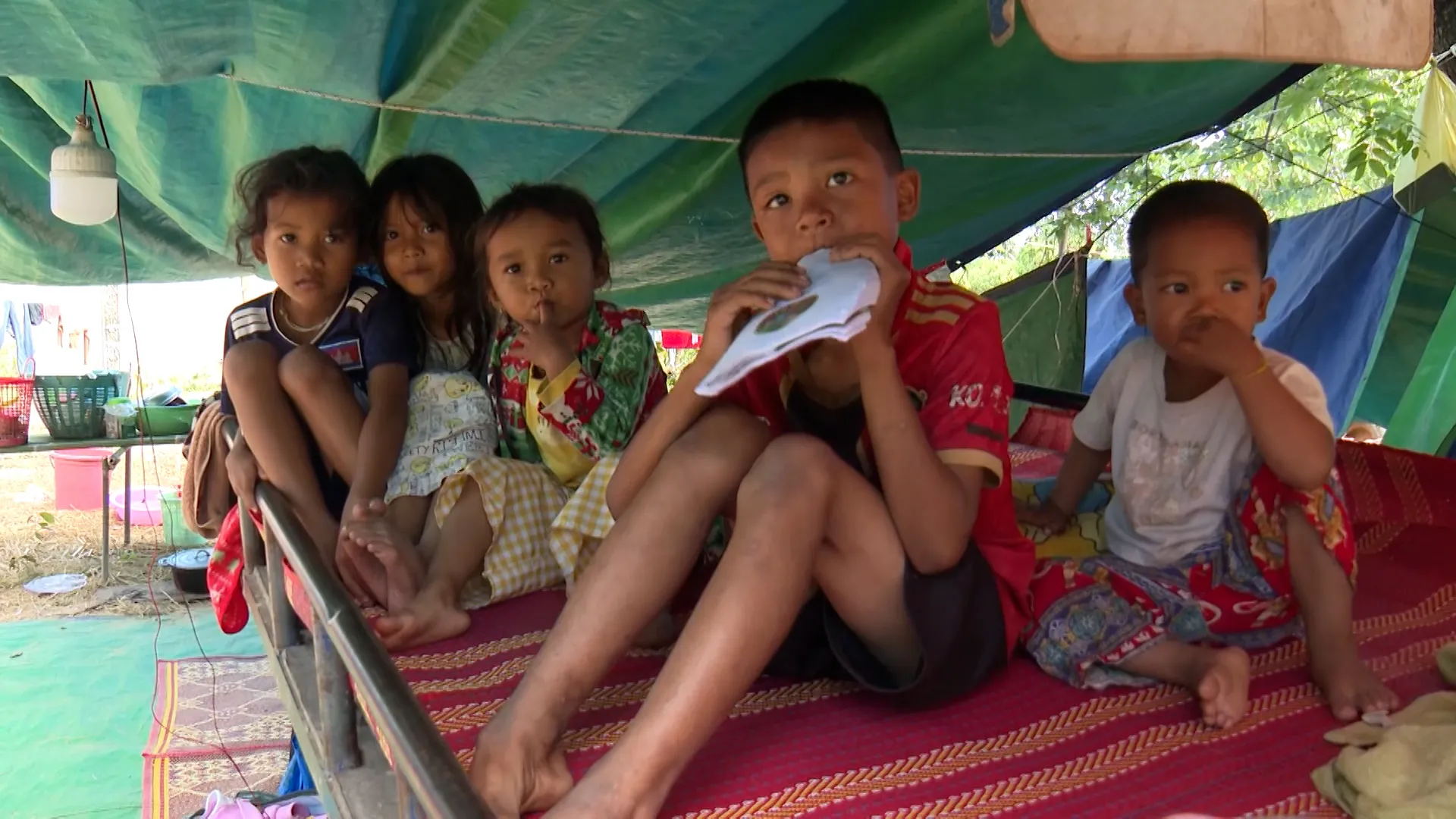
Al Jazeera’s Barnaby Lo has been to a displacement camp in Cambodia where people have taken refuge from cross-border fighting with Thailand. Half a million people have been displaced by the fighting.
Bilkisu Haruna’s* voice carried over 25 years of frustration, rising through the phone. Her life, which she expected to change when she got a job at Ahmadu Bello University (ABU), Zaria, Kaduna State, in northwestern Nigeria, in the early 2000s, after years of menial labour, was swallowed into an endless pit of suffering and bitterness.
Being a casual worker in Nigeria is to drown in a cycle of hopelessness, a feeling she knows too well.
“When I got hired, I was paid ₦3000, which was ₦100 per day. It was a fair offer because that money did more for me than what I earn now,” Bilkisu told HumAngle.
At that time, a 50kg bag of rice cost about ₦2500, but the cost-of-living crisis has increased it to an amount that she and many other Nigerians can no longer afford. Her current salary of ₦11,000 can buy only an estimated three bowls of rice, without enough condiments or other necessities to feed her family.
Design: Akila Jibrin/HumAngle.
However, most of her salary goes towards paying transport fares to work. She pays an average of ₦500 for a tricycle ride or ₦300 for a motorcycle ride to get to work daily.
“I usually take a bike to go to work, then I walk back home, despite how far it is,” Bilkisu explained, adding that the journey takes her around 50 minutes. “And if you go late, they sometimes send you back without payment. I rarely miss work for any reason, but I am still in the same place after almost 25 years.”
Workforce casualisation in Nigeria
A study by the International Journal of Business and Social Science describes casualisation as a form of temporary employment that has become a permanent job, yet lacks statutory benefits, such as adequate pay, medical insurance, and a pension. The system also prevents casual workers from the right to unionise. According to a 2018 Nigerian Labour Congress report, an estimated 45 per cent of Nigerians are casual workers, with a high prevalence at both the federal and state levels across all sectors.
Recently, the Minister of Labour and Employment, Muhammad Dingyadi, warned against the growing normalisation of casual and precarious work arrangements in Nigeria’s labour market, describing the trend as a threat to workers’ welfare and national productivity. Dingyadi noted that many organisations now rely on casual and contract staffing to cut costs, often at the expense of workers’ security and rights.
Bilkisu is a mother of nine; she lost her husband not long ago. Before his passing, he worked as a security guard and often catered for the family, but that entire responsibility now lies on her shoulders. It is even difficult now, as she is observing ‘iddah’, an Islamic practice that mandates widows to mourn their spouses for four months and ten days, and that restricts their movement and activities.
“Some of my coworkers helped me work for free when I was taking care of my husband while he was sick, but the work is tiring, so I just made an arrangement with someone I could pay for the duration of my mourning period,” she said.
There is no provision for casual workers, such as Bilkisu, to receive paid leave during such situations. The few instances she has received grace were when she was very sick. Sometimes, they would ask her to get checked in the hospital, but they don’t give her drugs. Health insurance is not something she can afford on her own.
“Sometime back, they used to let us see a doctor for free, including admissions. But, I think for the past 10 years, we have to pay ₦1,000 to see a doctor, and no drugs are given; they will only write you the prescription,” she recalled.
For Bilkisu, she harbours no big dreams; she just wants a better salary so that she can take care of her children and grandchildren. The university has no provision for casual workers to enrol their children in the staff school, leaving them without benefits for all the years they have worked there.
Illustration: Akila Jibrin/HumAngle.
Over the years, the cost of hostel accommodation has changed, but the salaries of casual workers have remained the same. A former student, who asked not to be named, told HumAngle that she paid around ₦7,000 when she first got into the university in 2018. However, she paid ₦14,000 before graduating, which is still the current price for a hostel bed space at the university.
Bilkisu supplements her income by fetching water, washing dishes, doing the laundry, and running errands for students. However, the pay is low. Sometimes students can pay ₦50 or ₦100 to wash plates, unless it is a monthly arrangement, in which case it can be up to ₦1500. The side jobs are also highly competitive, as everyone is scrambling to get what they can.
“Sometimes, you also have to find something to buy and eat at school to get through the day. If not for that extra work, I would not even go to work because I am constantly in debt,” she complained.
These menial jobs have sustained Bilya Nafiu* for over 30 years. At over 50, Bilya finds himself running errands for students young enough to be his children. He shares Bilkisu’s experience, living from hand to mouth as a casual worker.
“When I started, I was being paid ₦1500. I currently earn ₦13,500. Even when other job opportunities come up in the university, such as security jobs, they hardly give them to us, even if we are qualified, ” he lamented. This makes it impossible to become a permanent worker. Sometimes, they make it to the interview stage, but nothing comes of it.
What does the law say?
Hikmat’llah Oni, a Nigerian lawyer, noted that there is no explicit definition of “casual worker” in the Nigerian Labour Act. She, however, cited Section 73 of the Employees’ Compensation Act 2010. The Act defines what it means to be an employee: a person employed by an employer under an oral or written contract of employment whether on a continuous, part-time, temporary, apprenticeship, or casual basis and includes a domestic servant who is not a member of the family of the employer including any person employed in the Federal, State and Local Governments, and any of the government agencies and in the formal and informal sectors of the economy.
The legal practitioner stressed that under the Minimum Wage Act, three categories of people are exempted: part-time workers, seasonal workers, and piece-rate workers.
“What most establishments do is lump casual workers with these three categories of workers in an attempt not to pay the minimum wage, which is unfair because they sometimes do the hardest work; their bargaining power is also not the same as that of one in full-time employment,” she explained.
The casual workers in the university said they’ve spent decades in the job, but they struggle to pay their bills.
“We have tried to seek help; some of the previous students we know have become professors, but they don’t listen to us. We also tried to seek help from the Student Representative Council (SRC), especially regarding the late payment of salaries, but they don’t even listen to us anymore,” Bilya said.
In the past, the university provided loans to casual workers, but it eventually stopped. They fear the workers may refuse to repay the loan, leaving them without an outlet for other financial assistance in emergencies. The repayment system was also a problem they encountered, as almost half their salaries were taken off every month to pay back the debt. Another issue was the lack of privacy, where news would spread around the school about who was benefiting from that system, making them feel exposed.
With a daily transport fee of ₦300 to ₦500, it is almost impossible for Bilya to even handle his family affairs. When he is sick, he has to find an outsider to do his task, as all his older children are women, and he doesn’t feel safe enough to send them to do his work at the male hostels.
The horrible hostel conditions make it harder for them to do their jobs. Immediately after they clean, toilets can get dirty again, and that can get them in trouble with their supervisors. Even when they manage to save water for the next day, students can sometimes sneak in and use it all up before the next morning, Bilya explained.
Washing the bathrooms also requires them to carry buckets of water up the stairs, and sometimes they have to buy brooms to clean them, because the school rarely provides them with the right tools anymore, taking much more from the little they earn.
“With all I have poured into the school over the years, even the role of a director is not adequate to compensate me,” he claimed.
He works part-time as an electrician because the school has its own official workers. He gets side gigs from students to handle minor tasks, such as fixing faulty sockets and light bulbs, which can pay ₦100 or ₦200 per task. Despite these obstacles, he has managed to educate his children.
As coworkers save from the little they earn for rainy days by contributing ₦1,000 monthly, he sometimes benefits from the kindness of friends and family.
“When we started working, people kept telling us to be patient, that it would pass, and one day we would be leaders of tomorrow. But many years have passed, and nothing has changed. I can go three years without buying a simple shirt for myself because of outstanding debts. We are suffering, but we are also trying to practice contentment,” he explained.
Sometimes, the management deducts from their salaries without explanation, even if they didn’t turn up late or miss work, and almost nothing is done when they complain.
In one particular month, Bilya received only ₦8,000 without an explanation. He tried to follow up, explaining that he had not failed to do his duty that month, but he still didn’t receive the outstanding payment. These days, he doesn’t bother to complain even when his salary falls short of the expected amount. He understands that life as a casual worker also means he can be fired if he steps outside the lines.
This exploitation is common across different sectors in the country. In 2011, for instance, the Nigerian Labour Congress shut down 15 Airtel Communication showrooms across the country to protest the alleged casualisation and dismissal of 3,000 workers. In 2024, HumAngle published an investigation into the maltreatment and exploitation of some casual workers at the Dangote Refinery in Lagos.
“Casual workers, in most cases, do not have a formal contract, which is the prerequisite for becoming an employee under Labour Law. So, in reality, they don’t get the full ‘package’ of employment benefits, leaving room for cutting their salaries without explanation, because they don’t have a work contract protecting them. Keeping casual workers for years without a contract is exploitative,” the legal practitioner explained.
Different strokes
The cleaners at ABU are categorised into student affairs and health services, with those in health receiving higher pay due to hazardous conditions. The casual workers earning ₦13,500 are those who wash bathrooms and clean gutters, but people who just sweep the compound earn ₦11,500. HumAngle’s findings show that the casual workers are not given any payslip or physical evidence of their salaries. Every month, they queue up at the school bank to collect their cash payments.
Hikmat’llah explained that the labour law does not require the provision of payslips. However, it requires employers to maintain records of wages and conditions of employment, which can lead to further exploitation of casual workers.
As a casual worker under health in ABU, Nabila Bello* earns ₦22,000 or ₦22,500, depending on the number of days in a month. Before she got her job 10 years ago, she dabbled in business in her home, which still helps supplement her income. Even with a degree, there is no pension, gratuity, or hope of promotion. Her transport to and from work costs ₦700, which is almost what she earns per day.
Further research shows that casual workers are more likely to experience more disadvantages compared to permanent employees, such as inadequate statutory protection, social security, and union membership, and are least likely to receive compensation for injuries.
“Sometimes, I can spend ₦500 if I leave home early and trek to reduce transport fare,” she recounted. Being in a supervisory role means she doesn’t do the cleaning herself, but missing a day’s work also means losing her pay for that day. Unlike the cleaners, she cannot delegate her task. Nabila hopes to get a bigger opportunity with her degree someday.
This experience is common for other casual workers around the country. In a Federal College of Education in Adamawa, northeastern Nigeria, Maimunah Ado* pays ₦400 daily to get to work from her ₦18,000 monthly salary. Her most significant challenges are the workload, especially on Mondays, which requires extra work, such as cleaning offices. But she has no choice but to keep showing up to work every day.
It is almost impossible to survive without side jobs.
After a long day at work, 45-year-old Ilya Adamu* sets his sewing machine to work to supplement the ₦13,500 he earns as a casual cleaner at ABU. Every day, he spends about ₦1,000 on transport to and from work. With four small children still in school, he is barely scraping by to make things work.
“There are no promotions, and the pay is very little. It makes us feel very stuck and hopeless. Even though payment comes in every month without fail despite the delay,” he said.
HumAngle learnt that the school had months of unpaid wages owed to the cleaners for work completed in 2020. However, the school only paid part of the money after the workers went on a five-day strike in 2024. Some have given up on getting the rest of their money back. Some workers in the ABU Kongo campus claimed that they still have a month’s salary pending from that time, but the sources from the Samaru campus said they have been paid in full.
Bilya, one of the few who ensured the strike’s success, explained that during the strike, they ensured no cleaner violated it and went to work. Some were delegated to go through the school and stop any staff from working. This strike worsened the already horrible living conditions of the students in the school, making the environment unlivable.
Despite multiple attempts to reach out to Ahmadu Bello University for a response to these allegations, all emails, including follow-ups, have remained unanswered.
A health challenge
As an asthmatic patient, 50-year-old Halimah Ashiru’s* work as a nanny in Kaduna State poses a lot of risk and triggers for her condition.
“Even when you say you are sick, you are expected to show up at work, unless the sickness is so severe that you can’t get up. There was a time I had a terrible attack in school, and they had to return me home. After that time, my work got reduced, but I had to go back to work the next day, even though I had a smaller attack that day too,” she told HumAngle.
This is the reason why she doesn’t sweep anymore, unless it is a less dusty place. The Islamic school she works at has two segments: it runs the Western education segment on weekdays and the Islamic school segment on weekends. When she began her job ten years ago, earning ₦3,000, the Islamic segment was from Saturdays to Wednesdays.
“I can’t afford an inhaler, they said I have to keep using it, and I know it’s not sustainable for me. I just asked them to write me other drugs that can help manage my symptoms, and it helps a bit. I also ensure they are always available. Sometimes, I can go months without an attack,” she explained.
Her condition usually worsens during harmattan, and sometimes even during the rainy season. Still, she tries to avoid her triggers as much as she can, while working overtime to sustain her family.
Hikmat’llah explained that the Employee Compensation Act provides for claims for health or work-related injuries, entitling casual workers to compensation and similar benefits. According to the Labour Act, employees are expected to be formally hired after three months. Some organisations exploit this loophole to fire and rehire casual workers every three months, or hire new people, to avoid violating the law. This further contributes to the lack of job security for casual workers. But many workers like Halimah are not aware of these provisions.
Apart from Halimah’s salary, the school sometimes provides food items, especially during Ramadan, and free sacks of rice can arrive at random times. However, her salary has not changed much, even amid the cost-of-living crisis. She currently earns ₦8,000 monthly.
Her main task is cleaning, but she also serves as a nanny for the children of teachers and other older students at the school during classes.
“My workload has reduced. I used to sweep the classes and environment, clean toilets, and take care of the younger students, especially when they needed to use the toilet. I used to be the only nanny, but they hired another one recently.” Before then, she had worked in residential houses as a cleaner.
Once, a massive fight with the proprietress led her to quit for a while, but the woman reached out, apologised, and asked her to resume. “If I go late, she removes a small part of my salary, usually ₦500 or ₦700, so I try to make it on time.”
The cost-of-living crisis has changed so much for her. The good thing is she lives close to the school and doesn’t need to pay for transport.
“My salary can only buy things like soap, detergents, and similar items. I keep working because I can’t afford not working,” she said. Halimah takes on part-time cleaning work in residential homes, and she also holds another side job that brings in an extra ₦10,000 per month. On days she has work in the morning, she shows up at the other job in the evening.
This combined salary is really not enough to take care of her family, but immediately the salary comes in, she tries to stock up on some food items- sometimes the food can last for 10 to 12 days and on other days, she looks for other part-time jobs.
“My family members also try to help in their own ways,” she added.
A positive experience?
Grace Amos* started working as a cleaner at a private hostel at Kaduna State University in 2023. Before then, she ran a small business at home, selling pap and firewood. Her salary is currently ₦40,000, which is still below the current minimum wage of ₦70,000.
“I am satisfied with my job. The biggest challenge for me is dealing with students. We work hard to keep the environment clean, and they will make it untidy by the next morning, which makes our work harder,” she said.
Grace sweeps the hostels, washes the toilets, and cleans the hostel’s surrounding area. Her work starts by 7 a.m. and ends by 2 p.m.
Illustration: Akila Jibrin/HumAngle.
“I also supplement my income by taking small jobs from the students, such as laundry,” she said, noting that this makes it easier for her to help herself and her family.
This experience is shared by thirty-five-year-old Margaret Joseph*, who started working in the same hostel in 2021.
With a secondary school certificate, she doesn’t see much hope for a bigger opportunity. “There is no chance for career growth when you work as casual staff, but we can only hope for more salary increases. I never expected that I could be paid this much as a cleaner,” she said.
Even without other work benefits such as pensions, insurance, or promotion, they feel content because their working conditions are much better than those of many others.
However, investigations show that the working conditions differ from hostel to hostel. The university has regular and private hostels, run by different companies, which vary in cost. Maimunah*, a student at the university, said she paid ₦207,000 for accommodation at a private hostel on campus this year, up from ₦140,000 in 2024.
Inadequate working tools
Zaliha Ahmad* started working at Kaduna Polytechnic in northwestern Nigeria in 2020. Her biggest challenge is the inadequate provision of cleaning supplies, which makes them dig into their pockets to cover the gap.
“Students are always complaining about the conditions of the bathrooms, but we usually have to use our own money to buy detergents and bleach. We can go three months without receiving cleaning supplies,” she explained. She is ideally supposed to clean twenty toilets from her assigned two floors daily, but due to inadequate cleaning supplies, she sometimes cleans an average of three to four a day.
There is also a limited number of cleaners, putting the burden of washing the bathrooms, halls, and even clearing overgrown weeds around the hostel on the casual staff. Sometimes the work gets too overwhelming, and they have to outsource the task to someone else and pay them for their services.
“We don’t complain because that’s how it has always been; we just find our way around it. But it’s better than staying at home without a job. I try to run small businesses on the side to supplement my income,” she told HumAngle.
With a monthly salary of ₦20,000, Zaliha spends an average of ₦600 to get to work every day. Sometimes she walks back home, which takes her almost an hour.
The only other benefit she receives is during Ramadan, when the school provides a form with basic items such as spaghetti, sugar, and other items they may need, and, based on the choices they make, a particular amount is deducted from their salaries every month until they finish paying back. This helps them immensely.
In 2020, the Nigerian Senate considered passing the ‘Prohibition of Casualisation Bill 2020,’ which aims to criminalise casualisation. The bill also recommended a bail of ₦2 million or two years’ imprisonment for violators. Although it has passed the second reading, it has yet to be signed into law, leaving Nigerian casual workers at the mercy of their employers.
*Pseudonyms were used to protect the identities of the sources.
Stranger Things season 5 showed the return of Kali after she was last in the series back in the second outing
WARNING: This article contains major spoilers from Stranger Things season 5, volume 1
Stranger Things recently returned for its fifth and final outing. The season has been split into three volumes to make the story last a little bit longer as fans are eagerly champing at the bit for episode five and volume two to land with fans promised feature-length episodes, reports the Express.
Season five, volume one of Stranger Things featured a big reveal with Eight/Kali Prasad (Linnea Berthelsen) being held captive by the USA military and the nefarious Doctor Kay (Linda Hamilton), who was exploiting her powers. Eleven (Millie Bobby Brown) was left shocked and fans will have to see what happens with Kali.
However, some fans have been wondering about one big plot point from season four, which showed the origins of One/Vecna/Henry Creel/Mr Whatsit (Jamie Campbell Bower) and Dr Martin Brenner’s (Matthew Modine) experiments. During the fourth series, One finally broke free of Brenner’s Soteria chip with the help of an unwitting Eleven and went on the rampage, killing almost everyone at Hawkins Lab in the process.
How did Kali survive the Hawkins Lab massacre?
During the massacre scene, it seemed that all of Dr Brenner’s child experiments fell victim to Vecna.
Graphic scenes depicted lifeless bodies left in Vecna’s aftermath, with the villain then turning his focus to Eleven for a showdown.
Eleven astonishingly overpowered Vecna and banished him to the Upside Down after inadvertently tearing a hole in time and space.
Interestingly, Eight/Kali wasn’t seen among the casualties of the Hawkins Massacre, but how could she have evaded Vecna’s onslaught?
This appears to create a bit of a plot hole, as the implication from the massacre was that Eleven was the sole survivor.
Sky is giving away a free Netflix subscription with its new Sky Stream TV bundles, including the £15 Essential TV plan.
This lets members watch live and on-demand TV content without a satellite dish or aerial and includes hit shows like Stranger Things.
If that’s the case, this could explain her absence during his murderous rampage.
Numerous Stranger Things fans at the time flocked to X (formerly Twitter) to discuss this apparent continuity error, with user @_yoboistan writing: “I could not be the only one who expected Kali/Eight, the sister of Eleven from previous season, to appear on Season 4. It seems a major plot hole to me. #StrangerThings.”
While @ayoodole penned: “Expecting to see more of Kali in season 4 of stranger things. She can’t just go like that.”
Viewer @itsaaudraw tweeted: “Where is Kali, Netflix? Where are you hiding her? ? ! ? ! ? ! #strangerthings.”
Another audience member, @jespertalent, quipped: “remember Kali from stranger things season 2? neither do the writers.”
An irate fan, @calmheedattea_, posted: “stranger things s4 spoiler. WHY IS KALI NOT SEEN IN THESE SUPPOSED MEMORIES OF EL THIS IS P***ING ME OFF LIKE ARE WE JUST FORGETTING KALI EVER HAPPENED WHAT [sic].”
Another viewer, @legocereal, added: “#StrangerThings spoiler why was kali the only one with different abilities tho :/ the concept of all of the kids powers developing differently was so cool whyd they just completely ignore it this season [sic].”
Given that Kali featured in the crucial flashback scene when Terry Ives (Aimee Mullins) infiltrated the rainbow room in the lab and attempted to rescue her daughter, it seems a significant oversight if she has now been forgotten.
The writers are now likely to address this plot hole either in the second volume of season four or even in the fifth and final season when the story will be wrapping up.
Stranger Things season 5 volume 2 is released on Netflix UK & Ireland on December 26
Nobel Peace Prize laureate Maria Corina Machado reacts from the balcony at the Grand Hotel in Oslo, Norway, on Thursday, December 11, 2025. She received the Nobel Peace Prize 2025 for her work promoting democratic rights for the people of Venezuela and for her struggle to achieve a just and peaceful transition from dictatorship to democracy. Due to the situation in Venezuela, she was unable to attend the award ceremony. Photo by Lise Aserud/EPA
Dec. 11 (UPI) — Venezuelan opposition leader Maria Corina Machado has made her first public appearance in over a year early Thursday, just hours after winning the Nobel Peace Prize.
Machado was greeted by cheering supporters in the streets of Oslo.
A video of the scene was posted to her X account, showing a smiling Machado from the balcony of the Grand Hotel waving to a group of hundreds outside.
Pictures of her greeting and embracing supporters on the street were also published on her X account.
“The hug that all of Venezuela needs,” she wrote in a caption accompanying the photos.
Machado, 58, made the appearance at around 2:30 a.m. local time, The New York Times reported.
Her appearance in the Scandinavian country follows more than a year of her hiding from the regime of Venezuela’s authoritarian president, Nicolas Maduro.
Machado led an opposition movement that many Venezuelans and international observers believe outpolled Maduro in last year’s elections. She won the opposition primary but was barred from appearing on the general election ballot by the Maduro regime, a move widely condemned.
She then backed presidential candidate Edmundo Gonzalez in the race who is believed by the opposition and many observers to have won the election. Maduro, however, responded by intensifying repression and human rights abuses against political opponents and public dissent, while his government-controlled National Electoral Council declared him the winner.
Her appearance came as she traveled to Oslo to participate in the Nobel Prize Ceremony as she was this year’s recipient of the Nobel Peace Prize.
In a phone call released by the organization, Machado said she was on her way to Oslo, stating she was grateful for all those who risked their lives to make it happen.
“This is a measure of what this recognition means to the Venezuelan people,” she said, before boarding a plane.
She was unable to reach Oslo in time to receive the award, with her daughter, Ana Corina Sosa, taking the diploma and medal on her mother’s behalf at Oslo’s City Hall.
And she read her mother’s acceptance speech.
“My dear Venezuelans, the world has marveled at what we have achieved. And soon, it will witness one of the most moving sights of our time: our loved ones coming home — and I will stand again on the Simon Bolivar bridge, where I once cried among the thousands who were leaving, and welcome them back into the luminous life that awaits us,” Sosa said on her mother’s behalf.
“Because in the end, our journey towards freedom has always lived inside us. We are returning to ourselves. We are returning home.”
Weekly insights and analysis on the latest developments in military technology, strategy, and foreign policy.
The U.S. Marine Corps is testing the Low-Cost Uncrewed Combat Attack System (LUCAS) as a long-range one-way strike drone. Based on a design reverse-engineered from the Iranian-designed Shahed-136, these drones have already been deployed by U.S. Central Command (CENTCOM) to the Middle East, which you can read more about in our deep dive here.
“Harkening back to the Liberty Ship production model that rapidly produced thousands of cargo ships during World War II, testers hope that the LUCAS will eventually serve a similar function in the new era of warfare,” Col. Nicholas Law, Director of Experimentation in the Office of the Under Secretary of War for Research & Engineering, said in a release. “It’s not a single manufacturer: it’s designed to go to multiple manufacturers to be built in mass quantities.”
We laid out this exact concept months ago, along with our in-depth case for rushing mass production of American Shahed-136 copies, that you can read in full here.
Law envisions these drones as ultimately able to be used on dynamic targets, such as vehicles on the move or targets of interest that the drones find themselves with a degree of autonomy.
Some LUCAS drone deployed in the Middle East have gimballed cameras and satellite communications. (Courtesy Photo)
“Once we start weaponization and automated target recognition, we can have a target that is a representation of a real target,” he explained. Law didn’t provide any specifics, and we have reached out to the Army and Marines for more information.
You can read our deep dive on how artificial intelligence will revolutionize lower-end drones like LUCAS in exactly this way in our special feature linked here. But the fact that LUCAS can be equipped with a satellite datalink means that it could hunt for and find targets of interest over great distances all on its own, while still allowing a human operator to approve a strike.
In addition to strikes, LUCAS drones equipped with nose-mounted gimbal cameras can also be deployed to provide intelligence, surveillance and reconnaissance (ISR). With an estimated price tag for the platform itself of about $35,000, these LUCAS variants could provide an affordable, attritable platform for ISR. The LUCAS drones we have seen also have swarming capabilities — the ability to work cooperatively as a team — which can make them especially effective at attack operations and acting as decoys to confuse enemy air defenses.
The one detail Law provided about the drones being tested at YPG is that they are not yet equipped with warheads.
“The warhead that will eventually be integrated into LUCAS isn’t constructed yet, but it will also be low-cost and mass produced by multiple manufacturers,” Law posited. “Evaluators are currently testing LUCAS with inert payloads.”
CENTCOM declined comment on whether its LUCAS drones currently deployed have kinetic payloads and referred us to statements previously made that they have been deployed as one-way attack drones. It’s possible that they feature more improvised, less powerful warheads at this time. They can also just fly into their targets to damage them — especially fragile ones like radar arrays.
As we noted in our original piece on the topic, CENTCOM stood up Task Force Scorpion Strike (TFSS), the military’s first one-way attack drone squadron, to operate the LUCAS drones. Roughly 10 feet long with a wingspan of eight feet, was developed by Arizona-based SpektreWorks in cooperation with the U.S. military primarily as a target drone to emulate a Shahed-136-like threat, but also as a weapon in its own right.
Low-cost Unmanned Combat Attack System (LUCAS) drones are positioned on the tarmac at a base in the U.S. Central Command (CENTCOM) operating area, Nov. 23. (Courtesy Photo) U.S. Central Command Public Affa
There are, however, other companies involved in providing LUCAS variants. For instance, Griffon Aerospace has been pitching a Shahed-like drone called the MQM-172 Arrowhead to America’s armed forces.
The company, which is building the air frames, has already provided them to the Pentagon for use as both strike weapons and targets, Griffon spokesman Dan Beck told us Wednesday. However, it is unclear whether they have been fitted with kinetic payloads or how widespread their testing and use is across the military. We have reached out to the Pentagon to learn more.
Beck said Kraken Kinetics is providing the payload for these LUCAS variants. We’ve reached out to them as well.
While Beck declined to provide many details of his company’s work with the Pentagon, he did offer us some insights about the Arrowhead’s specifications.
Considered a long-range LUCAS version, the Arrowhead can carry a payload of up to 100 pounds as far as 1,500 nautical miles, Beck told us. That’s akin to the Shahed-136 drones produced by Iran and modified by Russia for its use against Ukraine. The current LUCAS models deployed to the Middle East are smaller and have significantly less endurance and about half the payload capacity.
American Shahed 2? You bet! Meet the MQM-172 “Arrowhead”, an enhanced US copy of the Iranian Shahed-136 kamikaze drone. This is apparently the second Shahed clone; the first, called LUCAS (Low-Cost Uncrewed Combat Attack System), was developed by Arizona-based SpektreWorks and… pic.twitter.com/ptI5iq9vk9
Beck also told us that Griffon has been “flying these airplanes very frequently” and have been launched pneumatically and from trucks. There are plans to use rocket-assisted takeoff (RATO), but that hasn’t been tested yet, he added. Asked about whether these have been tested with kinetic payloads, Beck declined comment.
Though these types of weapons have a long development history, Iranian officials mocked the U.S. for copying their design.
“There is no greater source of pride and honor than seeing the self-proclaimed technological superpowers kneel before the Iranian drone and clone it,” Brig. Gen. Abolfazl Shekarchi boasted to reporters on Tuesday.
An Iranian-made Shahed-136 ‘Kamikaze’ drone flies over the sky of Kermanshah, Iran on March 7, 2024. (Photo by Anonymous / Middle East Images via AFP) ANONYMOUS
The reality is that Iran didn’t really come up with this configuration, it dates back decades to a western design and Israel largely pioneered the operational use of the long-range one-way attack munition.
IAI’s MBT HARPY System
With LUCAS’s sudden deployment to the Middle East as a kinetic weapon and now the Marines testing the concept to see if it fits their needs, the future of America’s Shahed-136 knock-off looks remarkably bright. And we could be seeing just the budding of what will become a mass produced staple weapon that will be deployed en-masse across Europe and the Pacific.
CAMRYN Magness, the singer who toured with One Direction, has died aged 26 after being struck while riding an electric scooter.
Her death was confirmed this week in a statement on her official social media pages, describing her as a “radiant force”.
Sign up for the Showbiz newsletter
Thank you!
Camryn Magness has died aged 26 after an electric scooter accidentCredit: instagram./@camrynrocksCamryn was known for touring as a support act for One DirectionCredit: instagram./@camrynrocksShe is survived by her parents, her siblings and her fiancéeCredit: instagram./@camrynrocks
It read: “Our hearts are heavy as we mourn the loss of our beloved Camryn, a radiant force whose voice, coy, and bright spirit touched so many.
“Whether beneath the waves or on stage, she met life with fearless energy and boundless kindness.
“In the quiet between waves, her memory will surface—bright, bold, unforgotten.
“Rest in endless blue, our sweet girl. You are deeply loved and forever cherished.
“Please keep her family and friends in prayer as they navigate this difficult time. Camryn will live on in our hearts forever.”
Camryn died last Friday after being struck in Fort Myers, Florida, according to multiple reports.
Born in Denver, Colorado, in 1999, she began her career at eight, posting YouTube videos that led to a record deal and a move to Los Angeles.
Her debut single Wait and See featured in the 2011 film Judy Moody and the Not Bummer Summer.
She toured with Cody Simpson and Greyson Chance in 2011 before joining One Direction as a support act for seven US dates on their 2012 Up All Night Tour.
The band then brought her back for 63 shows on their 2013 Take Me Home Tour.
Reflecting on that breakthrough, she previously told Teen Vogue: “Going into the tour, I was an unknown artist.
“It’s a great feeling to be walking around and someone coming up to me and saying, ‘Hey, you did so well!’. It was really exciting for me when that happened for the first time.”
Camryn later supported Fifth Harmony and released a run of singles, along with her 2017 album Glow.
Her official obituary described her as “beloved” as a “daughter, sister, fiancée, granddaughter, and friend” who died “far too young, and long before her light was ever meant to leave this world”.
It remembered her as a “vibrant, fearless, and deeply loved young woman whose compassion, humour, and bright spirit touched every person blessed to know her.”
It added: “A gifted performer, Camryn’s voice and music were extensions of her soul.
“Whether she was on a stage, at a family gathering, or sharing a song with someone who needed it, Camryn’s music was a reflection of her heart, her courage, and her endless creativity.”
Camryn Magness is survived by her parents, Sarah and Gary; siblings Chelsea and Cable; and her fiancée, Christian.
More to follow… For the latest news on this story keep checking back at The Sun Online
Thesun.co.uk is your go-to destination for the best celebrity news, real-life stories, jaw-dropping pictures and must-see video.