Until January 3, Maduro & Co. managed to construct a form of “normalcy” that was business-friendly enough to attract foreign capital, drawn in by the Special Economic Zones and by the marriage between the bolibourgeoisie and national capital that survived economic collapse in the 2010s. Chevron and other major international companies accepted doing business in Venezuela because Maduro’s illegitimacy did not prevent them from projecting returns in the short, medium, and long term. Maduro could offer this normalcy at the cost of violence and a “gentleman’s agreement”. Still, only the companies that feel sufficiently secure in what remains a high-risk bet under these conditions ultimately enter the country.
Part of this arrangement involved negotiating a degree of sanctions relief with the United States, expressed most clearly through the license granted to Chevron. Now, with Maduro effectively sidelined and Delcy Rodríguez—architect of Maduro’s economic reform—holding power, the US seeks to open and deepen its investments. On January 9, Trump met with executives from major oil companies and urged them to make large-scale investments in Venezuelan projects. Several executives replied that, under current conditions, Venezuela could not be considered a safe destination for their firms. They see no real guarantees of stability or long-term predictability in the existing economic rules of the game, because this normalcy continues to rest on the arbitrariness of the National Executive, the use of violence, and political whims. Today, power may align itself with Washington. Tomorrow, it could attempt an anti-imperialist rupture.
The supposedly “moderate” Delcy is still far from consolidated vis-à-vis anti-imperialist power brokers, such as those embodied by Diosdado Cabello or senior FANB officers. The US openly acknowledges this, signaling that it continues to keep an eye on these actors—hinting at the possibility of a second attack or leaking to the press its intention to have the CIA permanently stationed in Venezuela. Delcy, for her part, appears to be trying to neutralize the most hardline anti-imperialist sectors. She strives to maintain a hostile rhetoric—that Trump and Rubio don’t seem to care about—that does not match her actions.
However, no new law can erase the reality that, at the core of all policy, lies the arbitrary decision-making power of whoever holds authority.
Trump understands the reasons behind the reluctance of large-scale capital, which is indispensable to consolidating Washington’s new role as the steward of Venezuela’s future. He seeks to reassure investors that they are not negotiating with the Venezuelan State, but with the US government itself, and that it is his word (not Delcy’s) that underwrites these agreements. Yet Trump’s own arbitrariness, his erratic and unpredictable governing style, also adds another layer of risk to the level of investment he is demanding from these companies.
The reform of the Organic Hydrocarbons Law signals that the new regime is willing to accept whatever demands are necessary to make investments feel safe and profitable, stabilizing a legal framework meant to introduce a degree of predictability into the new normalcy Delcy is attempting to rebuild. However, no new law can erase the reality that, at the core of all policy, lies the arbitrary decision-making power of whoever holds authority. As a result, the risk never truly disappears: what is law today may cease to be so tomorrow.
What the new economy could look like
Most likely, securing terms acceptable to US capital is requiring Delcy to offer increased profit margins accompanied by special legal guarantees. It will also require a shift in how the subordination of workers to this new national economic agreement is managed. If Delcy’s trend toward rehabilitating the image of the National State includes releasing political prisoners, it may also reflect an acknowledgment that sustaining normalcy through the exploitation and repression of Venezuelan workers is no longer viable.
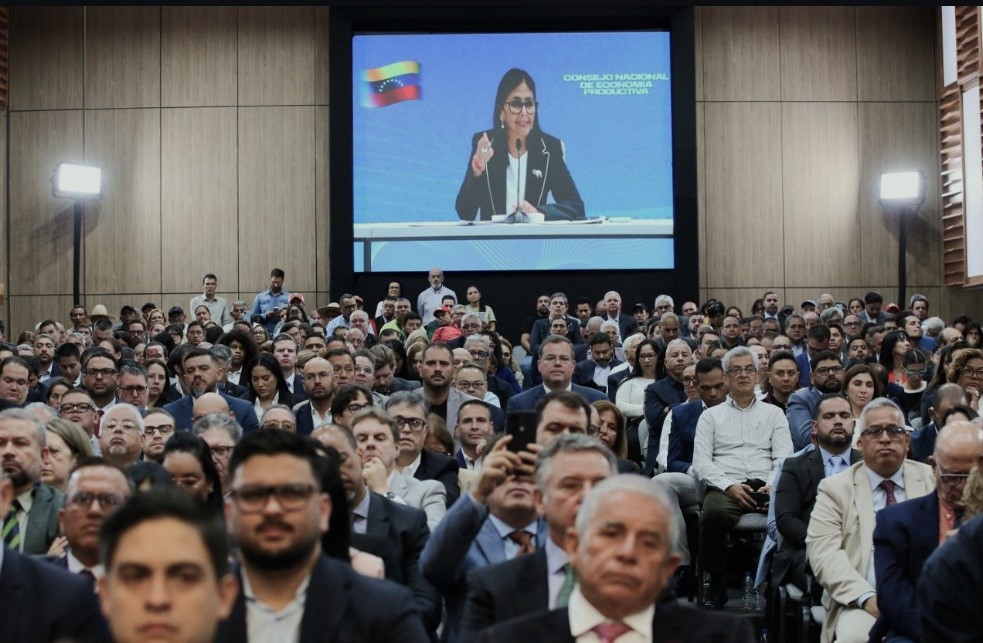
This possibility surfaced in her January 15 address to the National Assembly, when she proposed creating two sovereign funds financed by the foreign currency generated by the new oil arrangement. One fund would be devoted to “social protection,” aimed at improving workers’ incomes through unspecified mechanisms (salary increases or bonuses?) and strengthening health, education, food provision, and housing. The other would focus on rebuilding infrastructure and public services. This latter proposal aligns closely with Trump’s vision, which presented US capital with an arrangement centered on restoring national infrastructure to support oil operations.
Major international oil companies can extract profits without living in the country, but Venezuelan companies cannot. For them, the transition to democracy must also become a necessity.
If these plans materialize under US supervision, we could anticipate an increase in economic activity. More consumption and a greater supply of US imports, particularly since Trump (and hinted by Rubio on Wednesday) has already conditioned payment for Venezuelan oil on the exclusive purchase of American products in equivalent amounts.
It is difficult to predict how the population would react. After the Guaidó interim presidency failed to oust Maduro, Venezuelans increasingly abandoned aspirations for political change, retreating instead into private life or into their economic activities as workers or small entrepreneurs, seeking some form of long-term personal and family stability, along with sufficient margins of consumption to make life in Venezuela bearable. If the economic scenario were to change radically, would the population accept the continuation of chavismo without demanding guarantees of democratic processes in the medium or long term, so long as a new era of prosperity and consumption is secured?
Challenges for democratic politics
María Corina Machado and the opposition face a stark problem: the transition could unfold without them. A transition negotiated exclusively between the US and the ruling Rodríguez faction risks sidelining essential demands for building a healthy democracy—such as the unconditional release of all political prisoners, transitional justice processes, the dismantling of repressive forces, environmental protection in southern Venezuela, the reconstruction of democratic participation mechanisms, and the achievement of genuinely free and effective elections.
Democratic forces risk seeing citizens accept the abandonment of these demands in exchange for renewed economic prosperity, without recognizing that, in the medium and long term, these very demands are the only ones capable of guaranteeing that economic recovery and social liberalization can endure beyond the whims of the National Executive.
Rather than immediately confronting the National State, democratic demands for freedom, memory, truth, and justice should be brought into the very circuits of consumption that the PSUV has built.
Democratic actors could prevent a transition from moving forward without them by restoring, through the comanditos, a strategy of regular and sustained mobilization around an initial demand that doesn’t represent an existential threat for PSUV. The demand for the release of political prisoners is crucial here. As seen in the exchange between student leaders from the Universidad Central (UCV) and Delcy Rodríguez, this demand unexpectedly opened space for a form of dialogue, however imperfect it was.
For Delcy’s new normalcy to function, it requires forgetting and a citizenry able to consume freely without the guilt that comes from acknowledging that this new enjoyment is built upon the acceptance of impunity. A democratic political strategy must therefore aim to generate discomfort and prevent oblivion.
Following this logic, protests should innovate. Rather than immediately confronting the National State, democratic demands for freedom, memory, truth, and justice should be brought into the very circuits of consumption that the PSUV has built to benefit national capital, the bolibourgeoisie, small business owners, and resigned or apathetic workers. This means unsettling not only the political actors at the helm of this transition process, but also their economic counterparts. Major international oil companies can extract profits without living in the country, but Venezuelan companies cannot. For them, the transition to democracy must also become a necessity.
If not out of fear of the costs of authoritarianism, then their necessity should be driven by the high social price of failing to promote the national democratic reconstruction.