New Zealand trail India 2-1 and can no longer win the five-match series, but they can level it in Sunday’s final game.
Published On 13 Nov 202613 Nov 2026
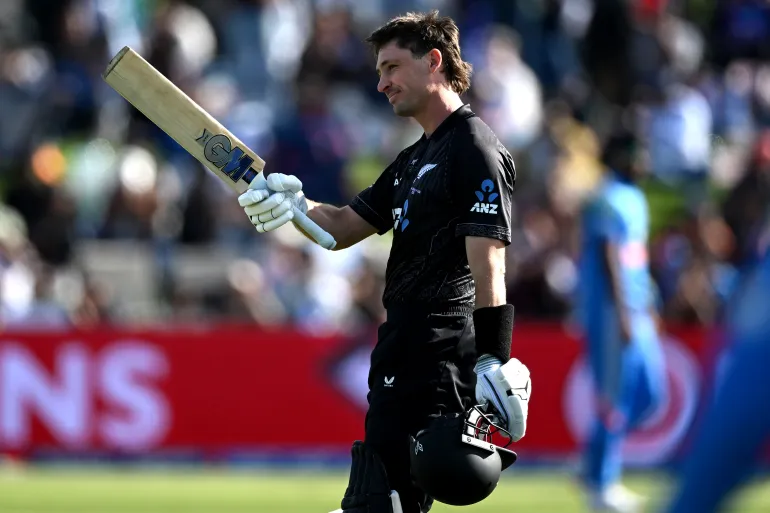
Matt Henry took six wickets and Will Young struck a century as New Zealand thrashed a ragged India by 244 runs in the fourth ODI at Mount Maunganui on Friday.
Henry removed Rohit Sharma, Virat Kohli and Shreyas Iyer, all without scoring, in the first over of India’s chase to tear the top order apart. The visitors needed a massive 334 for victory.
Recommended Stories
list of 3 itemsend of list
New Zealand made 333 all out in the last over after being asked to bat, with Young punishing two simple drops by Indian fielders to bring up his fifth ODI hundred.
India never stood a chance of chasing the total after Henry’s heavenly opening over.
Rohit edged his first ball to slip, Kohli was bowled facing his fourth ball, and then Iyer was pegged on his back leg to fall lbw.
India’s rebuild never happened, with Ishan Kishan top-scoring with just 27 as India were rolled for 89.
Henry ended with 6-27 and Matthew Fisher took 3-31.
New Zealand’s imposing total came off the back of Young’s 125 from 108 balls, including 14 fours and four sixes.
Young and Tim Seifert combined for an 85-run opening partnership.
While Young rode his early luck – dropped twice in two balls when on five in the second over, first by slip Rohit and then by wicketkeeper Kishan – Seifert played the aggressor with a brisk 39-ball 50.
Will Young celebrates his century [Hannah Peters/Getty Images]
When Seifert fell for 58, Nick Kelly and Dean Foxcroft soon followed, playing reckless shots.
Young found better support in Finn Allen, the pair putting on 90 runs in just 65 balls as they seized on wayward Indian bowling.
Young’s first 50 came from 49 balls, and his second from just 39 balls as he hit regular boundaries through the middle overs.
Allen made 41 from 30 deliveries, including five fours and two sixes.
Axar Patel took 2-39 from 10 overs as India pulled the innings back late, while Auqib Nabi had 2-59 and Gurnoor Brar 2-69.
New Zealand trail India 2-1 and can no longer win the five-match series, but they can avoid defeat if they win the final match at the same venue on Sunday. The third match was abandoned due to rain.
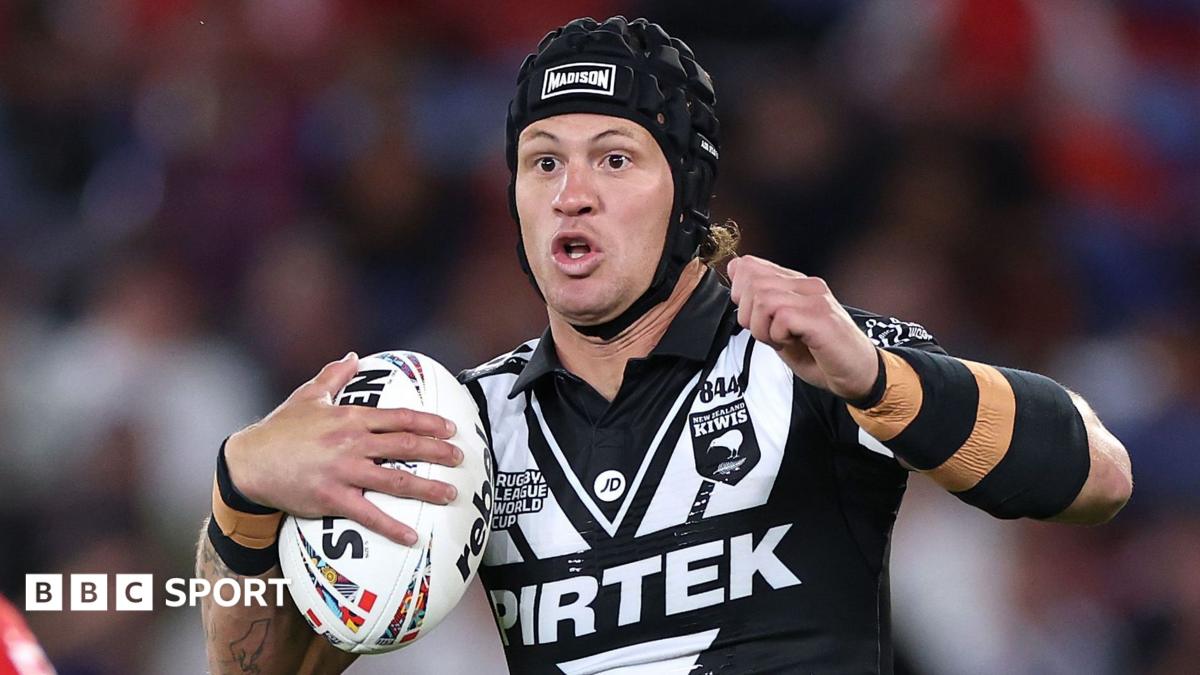
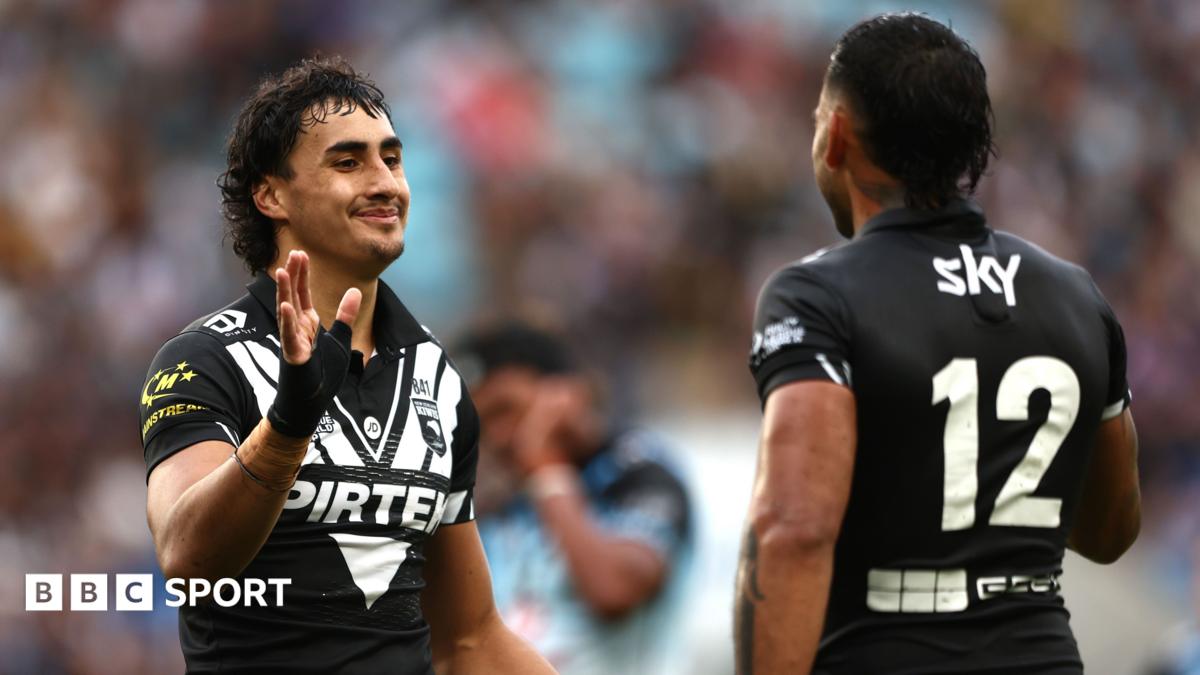
Playing with black protective bandaging taped to his left forearm, Ponga was directly involved in four of New Zealand’s six tries. His fancy footwork and slick handling setting up scores for Briton Nikora, Casey McLean and Xavier Willison.
He largely dominated the contest with opposite number Lehi Hopoate, notably clearing out the full-back as he fumbled a grubber kick in Tonga’s in-goal area for New Zealand’s second try, scored by Dane Gagai.
In defence, a bruising try-saving block on Demitric Vaimauga indicated no cause for concern about his wounded wing.
“Obviously a freak of a player,” said Kiwis captain James Fisher-Harris. “The defensive mindset he had tonight, he saved a couple of tries. That’s what I love about KP.
“He’s a freak of nature. His leadership skills are underrated. He’s really good for us, our spine especially.”
But while it was undoubtedly the Ponga show at the home of his NRL side Newcastle Knights, New Zealand are not just a one-man band.
Gagai sparked the counter-attack for McLean’s try by forcing a knock-on around halfway. Jahrome Hughes added directness with his carries and when putting boot to ball. Dead-eye kicker Jamayne Isaako mastered fierce winds to kick five out of six conversions, curling two over from the left touchline, to take his tally for the tournament to 36 from 38 attempts.
Asked if this was New Zealand’s best shot at adding a second title to their 2008 triumph, Fisher-Harris paused before replying: “Yes.”
“We’re just trying to chase history,” he added. “We’ve only done it once but we’ve been building with this squad, this generation, for the past six or seven years.”
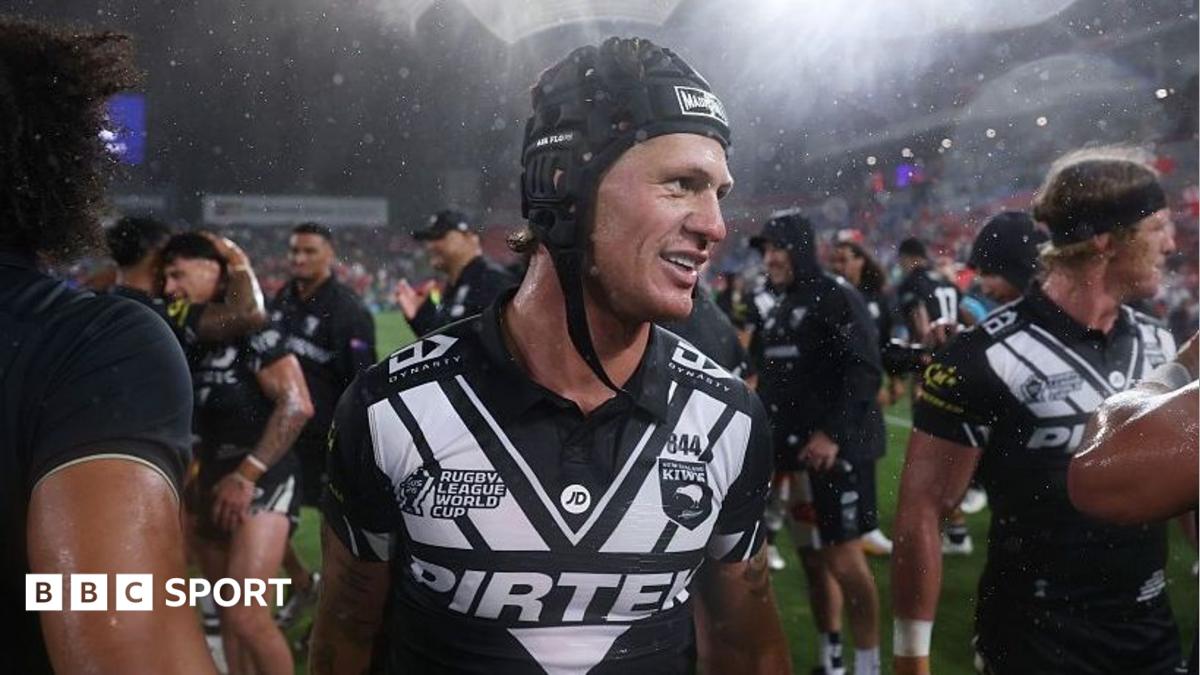
Just 23 days after breaking his arm, Kalyn Ponga returned to inspire New Zealand to a 34-10 victory in a pulsating encounter with Tonga as they reached their first World Cup final since 2013.
Ponga had been named initially in reserve and then as one of the interchange players in the build-up to this contest – and the expectation was that he would be eased back into action and play a limited role.
Instead, head coach Stacey Jones stunned many with his decision to include Ponga in New Zealand’s starting 13 but was repaid in full as the Newcastle Knights talisman starred on home turf at the McDonald Jones Stadium, in New South Wales,
Ponga’s impact from full-back was almost immediate as he sent Briton Nikora over in the right corner inside four minutes.
He was also involved in the Kiwis’ second try of the game – as his contest with his opposite number Lehi Hopoate was crucial to Dane Gagai grounding the ball.
And while the swirling wind made conditions almost unplayable at times, he repeatedly gathered high kicks and made several telling defensive contributions.
One of those included throwing himself in the way of Tonga’s juggernaut second row Demitric Vaimauga to prevent a certain try, while his ability to stall Hopoate’s run and prevent him from offloading to Isaiya Katoa stopped another at a key stage with New Zealand only 12-10 ahead.
The prelude to this fixture was almost every bit as gripping as the main event.
Tonga’s traditional war dance, the Sipi Tau, was met by New Zealand’s Haka and a long stand-off between the players provided the perfect backdrop to a contest brimming with athleticism, power and superb ball-handling skills.
For the second week running, Tonga fans turned out in force with the stands a sea of red.
And they witnessed their side’s participation in a wonderful advert for rugby league with Jojo Fifita scoring two excellent tries.
However, the match ultimately swung away from them in a five-minute period after the break when New Zealand’s outstanding centre Casey McLean surged over in the left corner and the wily Jahrome Hughes darted in to score.
On this occasion, Kristian Woolf’s team, who effectively torpedoed England’s hopes of reaching the last four with a 30-12 in their opening match on 17 October, were unable to stage the same sort of fightback that helped them defeat their Pacific Island rivals Samoa last weekend.
With the scoreboard, time and a gale-force wind against Tonga, Xavier Willison punished them further when they failed to gather a short drop out.
And when Charnze Nicoll-Klokstad superbly grounded Erin Clark’s kick, it put the gloss on a fine New Zealand performance.
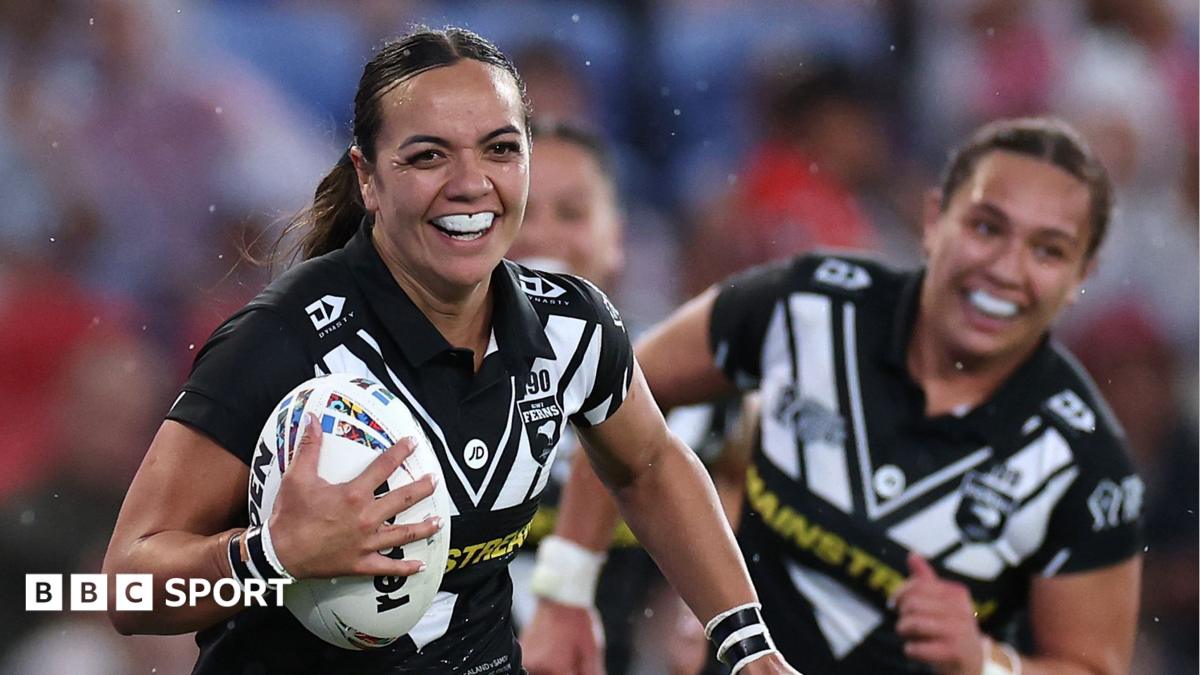
New Zealand’s women will hope it is fourth time lucky after defeating Samoa 32-0 to reach next Sunday’s Rugby League World Cup final.
It will be the Kiwi Ferns’ seventh successive appearance in the showpiece match, but having won the first three between 2000-2008, three trips to the final since then have all ended in heartache.
Three consecutive losses to Australia included a blowout 54-4 scoreline four years ago at Old Trafford and unless debutants Fiji spring one of the greatest upsets in the tournament’s history in the other semi-final, the Jillaroos are likely to again provide the substantial obstacle to New Zealand becoming four-time champions.
However, on Saturday, New Zealand made light of the blustery and difficult conditions inside Newcastle’s McDonald Jones Stadium, in New South Wales, to make their case as potential winners.
Mackenzie Wiki’s try – less than two minutes into proceedings, off the back of a Samoa error – set the tone for the Kiwi Ferns.
As the storm clouds began to gather overhead, New Zealand’s dual-code international Stacey Waaka capitalised on some indecision from Samoa winger Mercedez Taulelei-Siala to collect and ground Raecene McGregor’s kick.
It was efficient and highly professional from New Zealand, who conceded just 24 points across their three group games and once again exhibited their defensive parsimony during a hard-fought first period.
A combination of that and Samoa’s inability to make the most of field position, with a smattering of handling errors thrown in as well, laid the platform for New Zealand’s triumph.
There were notable bright spots for the Samoa fans to enjoy.
Fanua Rimoni was a powerful and dominant presence at lock forward, while teenage winger Anastasia Leatupue produced a nerveless showing on her international bow.
Samoa’s biggest disappointment was that they could not get the ball into the hands of the 18-year-old in good attacking positions – with Pauline Piliae-Rasabale twice pulled up for forward passes on the right edge in an error-strewn display.
But just like in the first 35 minutes, they had no answer to New Zealand’s more potent attacking threat.
Waaka was again the beneficiary of a pinpoint McGregor kick as she crossed for her second try and Mele Hufanga held off the attentions of three Samoa defenders tfor her score.
It was a feat that was matched by Kaiyah Atai just over two minutes later as New Zealand went through the gears.
With Samoa’s resistance gradually waning, Waaka capped a fine individual display with her hat-trick and McGregor scored the try her performance richly deserved to round off a fine New Zealand display.
Days ahead of New Zealand’s election, polls show the governing centre-right National Party and the opposition centre-left Labour Party neck and neck, with neither on course to win enough seats to govern alone.
The outcome of the November 7 election could be decided by smaller parties under the country’s unique electoral system.
Recommended Stories
list of 2 itemsend of list
Here is what you need to know:
How does the election work?
New Zealand holds a general election every three years under a mixed-member proportional (MMP) system.
Voters cast two ballots: one for a candidate in their local electorate and one for a party.
Winning candidates in each of the country’s 71 electorates take their seats automatically. There are seven electorates reserved for Maori, New Zealand’s Indigenous people. Maori voters can choose to enrol on either the Maori electoral roll or the general roll.
The party vote decides how many seats each party gets overall. About 49 more seats are filled from party lists so that each party’s share of parliament matches its proportional share of the vote.
A party needs either 5 percent of the party vote, or one electorate win, to get a seat. In New Zealand’s 120-seat parliament, a majority usually means 61.
If a party wins more electorates than its share of the party vote entitles it to, it keeps them and extra seats are added to parliament. That happened in 2023, when Te Pati Maori won six of the seven Maori electorates, but had only 3.1 percent of the overall party vote.
Because seats in parliament closely track with the party vote, one party rarely wins a majority.
Every government since the MMP system was instituted in 1996 has been a coalition headed by Labour or National, except in 2020, when Labour under then-Prime Minister Jacinda Ardern won big and governed alone.
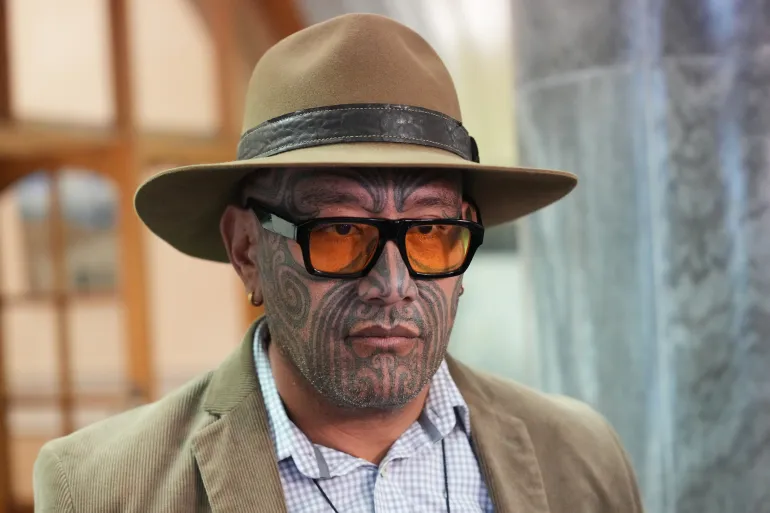
New Zealand Te Pati Maori co-leader Rawiri Waititi [File: Charlotte Graham-McLay]
Who are the two main candidates?
Incumbent Prime Minister Christopher Luxon is seeking a second term.
A former Air New Zealand chief executive, he entered parliament in 2020 as the MP for the Auckland seat of Botany and became leader of the National Party a year later.
He led National back to power in 2023, promising better economic management and ending six years of Labour-led government. He now governs in a three-party coalition with New Zealand First and ACT.
But his leadership has come under pressure. He survived two attempted no-confidence votes by National MPs in April and August, the second orchestrated by his own defence minister at the time.
The challenges came as his popularity declined, with rising economic pressure and political tensions within the governing coalition.
Labour leader Chris Hipkins, 48, is bidding to return to the top job.
First elected to parliament in 2008, he became prime minister in January 2023 after his predecessor, Ardern, resigned.
Labour Party leader Chris Hipkins poses at his desk in Parliament in Wellington, New Zealand, September 9, 2026 [Hagen Hopkins/Reuters]
What are the key issues?
Most parties are campaigning on the economy, but their suggested remedies differ widely.
National is pledging to return the budget to surplus through fiscal discipline while expanding the national pension scheme.
Labour is focusing on the cost of living, promising cheaper healthcare and transport. It also plans to invest in jobs, housing and infrastructure, and to strengthen public services.
Smaller parties on both sides are taking aim at power companies and supermarkets. The right-wing populist New Zealand First party wants to break up major electricity companies and split one of the largest supermarket operators in two.
The Greens want a state-owned power company, a publicly owned supermarket chain and tougher rules against excessive grocery prices. They are also calling for a wealth tax and higher taxes on big companies and banks, while cutting income tax for most people.
Opportunity, a centrist party, wants a land value tax.
Immigration and voting rights are on the agenda too. ACT wants to deport serious offenders regardless of how long they have lived in New Zealand. New Zealand First is seeking to restrict voting to citizens. Currently, the right to vote also extends to legal residents who have lived in New Zealand for more than 12 months continuously.
New Zealand Green Party co-leader Chloe Swarbrick [File: Charlotte Graham-McLay/AP]
Why is there no clear winner?
The real contest is between two rival blocs. National would need both its current coalition partners again, while Labour would depend on the Greens and possibly Opportunity.
Recent polls show no clear winner. A handful of seats either way could decide who governs.
That makes the 5 percent threshold for party participation in parliament crucial. If a smaller party narrowly misses it and also wins no electorate, its votes produce no seats, which could cost its bloc the majority.
Opportunity, for example, must either clear the 5 percent threshold of party votes or win an electorate for its votes to help Labour secure a majority coalition.
The final size of parliament is another unknown. Polls suggest Te Pati Maori may again win more electorates than its share of the party vote entitles it to, adding extra seats.
Each extra seat raises the bar for a majority. If parliament grows to 122 seats, a bloc would need 62 to govern instead of 61.
Opportunity Party leader Qiulae Wong speaks to a member of the public during a campaign event in Auckland, New Zealand, October 17, 2026 [Fiona Goodall/Reuters]
Who are the smaller parties?
New Zealand First is led by Winston Peters, who has said he wants the country to leave the Paris climate agreement and the central bank to target employment and inflation.
ACT, led by David Seymour, describes itself as a classical liberal, right-libertarian party. It holds 11 of parliament’s 123 seats.
The Greens, a left-leaning environmental party led jointly by Chloe Swarbrick and Marama Davidson, have made social justice, living costs, nature and political funding reform their central themes.
They also want to expand home insulation and offer zero-interest loans for household solar panels and batteries.
Te Pati Maori is co-led by Rawiri Waititi and Debbie Ngarewa-Packer. Its campaign has centred on enrolling more voters on the Maori electoral roll, housing, health, education, environmental protection and constitutional transformation.
Opportunity, founded by economist Gareth Morgan in 2016, has never won a seat in parliament, peaking at 2.6 percent of the vote in 2017.
Its leader, Auckland businesswoman Qiulae Wong, says the party is neither left nor right and is focused on boosting economic growth.
Who will be the kingmakers?
Smaller parties often end up deciding which of the two main parties governs.
In 2017, although National won 56 seats to Labour’s 46, it could not form a majority. Labour took power instead by forming a coalition with New Zealand First, supported by the Greens.
New Zealand First has played kingmaker for both sides, having also backed National after the 1996 election, the first held under MMP.
Te Pati Maori, now in opposition, has helped the two main parties govern too, supporting National-led governments after the 2008, 2011 and 2014 elections.
The role can secure senior posts in government for the junior parties. Winston Peters secured the role of deputy prime minister in Luxon’s government until May 2025, and ACT’s David Seymour has held the job since mid-2025.
This time, the newest potential kingmaker is Opportunity. If Labour needs its seats to govern, the party would play the role for the first time, a decade after it was founded.
New Zealand delivered a statement victory as they thrashed Fiji 78-0 to book their place in the Rugby League World Cup semi-finals.
The Kiwis established a 24-0 lead with four converted tries in the opening 13 minutes as Fiji – who pushed reigning world champions Australia close just under a week ago – had no response on Australia’s Gold Coast.
Fiji conceded eight tries in the first half and five in a fiery second period, during which half-back Brandon Wakeham was sent off along with New Zealand winger Ronaldo Mulitalo.
Centre Casey McLean claimed four tries, Keano Kini scored two and Jahrome Hughes, Dane Gagai, James Fisher-Harris, Mulitalo, Xavier Willison, Briton Nikora and Erin Clark also crossed for Stacey Jones’ team.
“Pretty special and pleased about how we went about our business,” said New Zealand captain Fisher-Harris.
“Fiji are a good team but I thought we played really well. It was a battle of the forwards.”
Fiji’s woes were not confined to the scoreline, with captain Apisai Koroisau suffering a suspected broken jaw and he clashed heads with Joseph Tapine in the eighth minute
Semi Valemei, who impressed with a hat-trick of tries against the Kangaroos, also left the field with a head injury during the first half.
Meanwhile, New Zealand will now face an anxious wait to discover if Mulitalo faces a tournament-ending ban for a high shot on Ronald Philitoga, which prompted a fracas involving Wakeham.
However, in his post-match news conference Kiwis head coach Jones confirmed that star full-back Kalyn Ponga, who broke his arm in the tournament opener against Australia on 15 October, has trained this week and could be involved in their last-four match against either Samoa, Tonga or England.
Samoa and Tonga meet on Sunday and both look set to advance from Pool B & C.
England’s slim hopes rest on the unlikely scenario of Tonga defeating Samoa by more than 46 points.
The losers of the contest between the Pacific Island rivals will take on Australia next.
Kevin Walters’ side maintained their 100% record in their final group match with a comfortable 66-6 success over the Cook Islands in Townsville.
Jack Bostock and Tom Trbojevic both scored three tries each in a game the Cook Islands briefly led 6-4 when Rua Ngatikaura went over and Valentine Holmes added the extras.
The opening pair put on 133-run partnership as India chased down 199 to wrap up the five-match T20I series.
Published On 27 Oct 202627 Oct 2026
An aggressive partnership between Abhishek Sharma and Vaibhav Sooryavanshi propelled India to a six-wicket win and a series victory over New Zealand in Wellington.
India sewed up the five-match Twenty20 International (T20I) series on Tuesday with two games to spare, chasing down New Zealand’s total of 198 in just 13.2 overs, with Abhishek blasting 113 and Sooryavanshi 45.
The opening pair’s 133-run partnership in just 7.1 overs obliterated the New Zealand bowling attack with one of the most destructive partnerships in T20I history.
Jacob Duffy’s first over went for 26 runs, and the openers never let up.
Abhishek hit nine fours and 11 sixes in his 38-ball knock, receiving a standing ovation when he eventually fell to the bowling of Kyle Jamieson.
By that stage, India had reached 178-2 in just 10 overs.
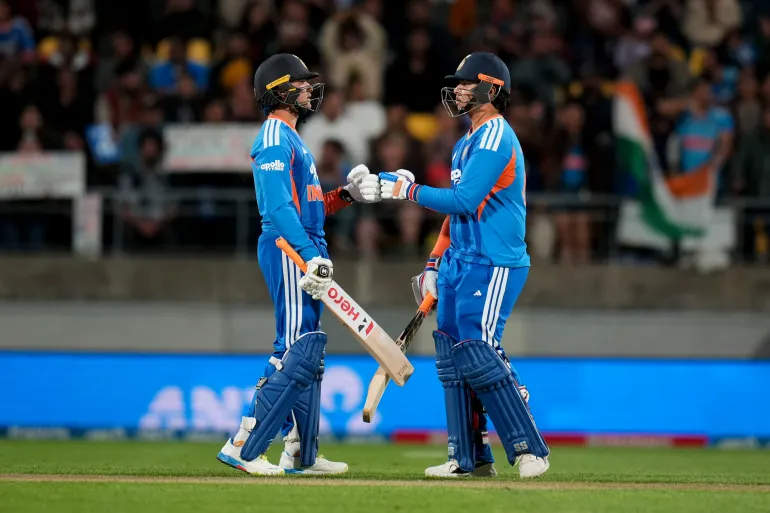
Abhishek Sharma and Vaibhav Sooryavanshi shared a stunning opening partnership [Marty Melville/AFP]
“The key was pretty simple: Vaibhav and I enjoyed our time,” Abhishek said of their partnership.
“When we were fielding, we saw there was some extra bounce. Vaibhav started off well, and we took the momentum from there.”
Sooryavanshi was promoted to open alongside Abhishek after batting at number three in the second T20I, hitting four fours and four sixes in his 19-ball innings.
“Getting 100 in five overs – I have not seen that before at the international level,” India captain Shreyas Iyer said.
“Credit where it is due, the way they played was exceptional.”
India won the toss for the third time in three matches and again elected to bowl.
Bhuvneshwar Kumar and Arshdeep Singh extracted prodigious seam from the pitch, beating the outside edge of New Zealand openers Tim Seifert and Finn Allen.
Seifert was removed top-edging Singh for two, before Daryl Mitchell joined Allen and combined for an 86-run partnership.
Mitchell was quick to assess the conditions and moved around the crease to counteract the seam movement.
He seized on any short deliveries with powerful strikes to the short square boundaries, hitting five fours and five sixes on his way to 89 from 52 balls.
Allen made 40 from 25 balls before departing, and Mitchell found another powerful partner in Bevon Jacobs, who hit an unbeaten 39 from 23 deliveries.
The fourth T20I is at Auckland’s Eden Park on Friday.
New Zealand captain Mitchell Santner congratulates India’s Naman Dhir [Marty Melville/AFP]
On Saturday week at Murrayfield, Scotland will face the All Blacks for the 34th time, the overall picture skewed ever-so-slightly in New Zealand’s favour. They’ve won 31 and the Scots have won zero.
Draws in 1964 and 1983 – halcyon days, kind of – is as good as it has got for the underdogs since these nations first met 111 years ago.
Speaking on the BBC’s Scotland Rugby Podcast on the day he announced his squad for the Nations Championship, Gregor Townsend goes through his own story with the Kiwis, about the dog days he experienced as a player – two of them ending 62-31 and 69-20 – and how the inferiority complex his generation might have felt is not the same anymore.
“It’s almost like two different lifetimes,” he says. “As a player, I don’t think we ever felt we could win the game.
“There were moments within games over in Auckland in 1996 when we had opportunities, but they were always going to pull away from us. I’ve not felt that as a coach.”
As coach, he has gone up against the All Blacks three times, all in Edinburgh. A 25-17 defeat in 2025, a 31-23 loss in 2023 and a 22-17 reverse in 2017.
“I felt every time we’ve played against them, we’ve had opportunities to win and the belief has been there,” he said.
“We might have lacked the composure. Certainly last time, a year ago (Scotland fell 17-0 behind but then came roaring back to level at 17-17). We were just playing so much accurate, physical rugby. But we didn’t take the chances.
“So there is a difference. I feel it in the players. But I didn’t feel that in the 90s when we went up against them.”
The coming months are seismic for Scotland with the culmination of the Nations Championship, then Townsend’s final Six Nations, a World Cup warm-up against New Zealand in Dunedin, followed by the coach’s last act, the World Cup itself.
Scotland have not played an away Test against the All Blacks since 2000, a two-Test deal, one in Auckland and the other at Carisbrook in Dunedin. New Zealand won the first 62-31 and the second 48-14. Townsend played in both.
Regular summer games against higher calibre southern hemisphere opposition has been crucial in Ireland’s improvement in recent years, but Scotland have been denied that exposure. The global calendar has now changed and the Scots will be one of the main beneficiaries.
In Townsend’s time as coach, he has had one game against the Wallabies in Australia, one against the Springboks in South Africa and none against the All Blacks in New Zealand. In the same period of time, Wales have played seven away Tests against the big three from the south, England have played nine and Ireland have had 10. Ireland have had four Tests in New Zealand in just nine years compared to Scotland’s zero in 26 years.
“That’s great for Scottish Rugby, great for our players to get that opportunity to play New Zealand in New Zealand,” he said. “It’s a really good preparation for us for the World Cup as a stand-alone game. It’s one we’ve missed for so many years.”
Australia edged to a 36-22 victory in a pulsating match against Fiji to book their place in the Rugby League World Cup semi-finals.
Having lost their previous five meetings against Australia by an aggregate score of 246-16, a stunned Brisbane crowd watched Fiji enjoy territorial advantage in the first half and take a 16-12 lead after the break.
However, the momentum switched back to Kevin Walters’ side in a crucial 60-second spell.
Solomone Saukuru raced in to seemingly put Fiji 20-12 ahead – but when it was ruled out for obstruction, Australia immediately went up the other end and Tom Trbojevic scored to bring the teams level.
Trbojevic, who looked vulnerable in defence, crossed twice more for Australia and Jacob Preston added a further try after Semi Valemei had completed his hat-trick for Fiji.
“There are definitely some areas to improve on,” Trbojevic told Premier Sports. “We didn’t start as we wanted to and couldn’t get a flow. We just needed to play our style of footy.
“We weren’t at our best but we came away with two points. We need to improve. We’ve got to enjoy a win but we’ve got to be our harshest critics too.”
Brisbane Broncos centre Kotoni Staggs had opened the scoring for Australia on his home ground, while Sam Walker capped his debut with a try and 12 points with the boot.
But the manner in which their pack were outmuscled – and in which they allowed Taane Milne and Valemei to score – will be a concern for Walters, whose team head into the last four despite delivering two unconvincing performances in beating New Zealand and Fiji.
New Zealand will take on Fiji in a make-or-break final pool game on Saturday, 31 October (04:30 GMT), having overcome an early scare themselves in their 82-16 victory over the Cook Islands in Christchurch.