young son

‘Rheology’ review: Theoretical physics meet experimental art at REDCAT

In “Rheology,” Shayok Misha Chowdhury, an experimental theater artist, and his mother, Bulbul Chakraborty, a theoretical physicist, bridge the language of their different disciplines to explore a subject dear to both of them: loss.

Chowdhury, author of the play “Public Obscenities,” a 2024 finalist for the Pulitzer Prize, and the director of the sensational off-Broadway production of Jordan Tannahill’s “Prince Faggot,” is as tenderly devoted to his mother as the young Marcel was to his own in Proust’s “In Search of Lost Time.” The idea of his mother dying is insupportable to Chowdhury, but given that she’s in her 70s and he’s in his 40s, certain terrifying realities must be faced.

“Rheology,” which is receiving its West Coast premiere at REDCAT (in a brief run ending Saturday), is the piece they’ve created to prepare Chowdhury for that fateful day. This strikingly staged Bushwick Starr, HERE Arts Center and Ma-Yi Theater Company production is an interdisciplinary experiment that is as playful in its methodology as it is serious in its research aims.

Chakraborty, a professor at Brandeis University, starts off with a physics lesson. Her subject is sand, and she poses a simple question: Is the sand pouring through the hourglass sitting on the counter before her a liquid or a solid?

A charismatic teacher, she knows how to Socratically engage a room. Her welcoming manner draws out from the audience the different ways sand behaves both like a solid and like a liquid.

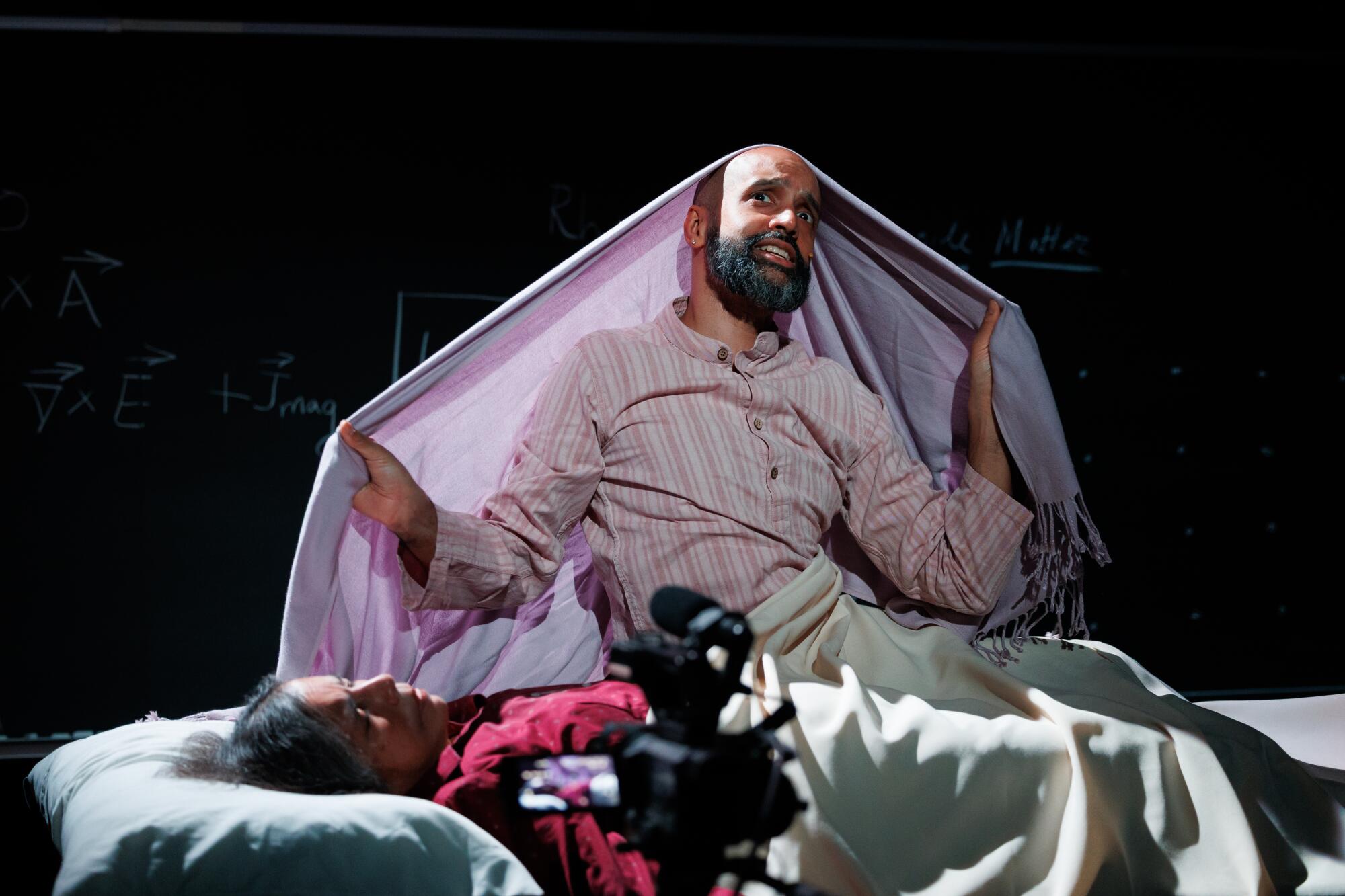
Shayok Misha Chowdhury, in rear, and Bulbul Chakraborty in "Rheology" at REDCAT.

Shayok Misha Chowdhury, in rear, and Bulbul Chakraborty in “Rheology” at REDCAT.

(Roy and Edna Disney CalArts Theater [REDCAT])

Rheology, or the science of how a substance responds to external stress, is her chief interest. Her research, focused on soft condensed matter, has been seeking a comprehensive theory to explain the curious elasticity of such material. A photo of a sand dune, in which she’s seated alongside Chowdhury as a toddler, helps illustrate her point that sand can flow like a liquid yet retain its shape like a solid.

An onstage sandbox is more than just another visual accompaniment to her talk. It’s a source of both elemental mystery and childlike wonder. But elucidation is her motive. She enters the box with her bare feet, noting the way the sand flows around her toes yet supports her weight in observation of the rule that “every grain has to be in force balance.”

She writes equations on the board to explain these findings, equations that begin to glow as the production moves from the realm of pure science to the more slippery domain of art. The transition, like all aspects of this piece, is frolicsomely conducted.

While pouring sand from one container to another, Chakraborty appears to be overcome with dust. For a moment, it’s not clear if this is part of the show or a medical incident until Chowdhury, discreetly occupying a seat in the audience, asserts himself as the director. He asks his mother to run through the death scene with a different sequence of movements and introduces the accompaniment of George Crotty on cello to liberate her performance.

They are rehearsing not so much Chakraborty’s end but Chowdhury’s reaction. He assumes he will fall apart and vows to die himself out of heartbreak. Chakraborty wants him to carry on his work, just as she carried on her research as a mother with a young son who would wail uncontrollably when she would drop him off at daycare.

She recounts that his emotional outbursts were so extreme that it was painful leaving him behind. But she was assured that he was handling the separation. For proof, she was taken into a private teacher’s room, where through a one-way mirror she saw him compose himself shortly after her departure and start to play with the other children.

Mother and son enact a similar situation where, after a more permanent leave-taking, she can catch a glimpse of her son recovering himself sufficiently to survive her loss. Chowdhury, a queer artist who enjoys sampling performance modes, adopts the figure of the grieving Bollywood widow. The effect isn’t to lampoon but to confront his raw emotion and to test his capacity for resilience.

The experiment might sound sentimental, but Chakraborty, the production’s secret weapon, maintains a scientific restraint, albeit one suffused with maternal anguish. The way she listens to her son, takes in his feelings, gently suggests other possibilities of response and treats his experimental theater piece with the same dignity as her own research is incredibly moving to witness. Her performance won an Obie Award, and though she insists that she’s not an actor she demonstrates a sincerity and collaborative grace that many veteran performers would envy.

As it unfolds, “Rheology” can seem piecemeal, even haphazard. There’s an informality built into the production, but it’s somewhat deceptive because the mercurial staging is extremely precise. Chowdhury’s direction has visual panache. Kameron Neal’s video design transforms Krit Robinson’s part lab, part lecture hall set into something kaleidoscopic.

When mother and son sing songs from the famous cycle by Bengali writer-composer and Nobel laureate Rabindranath Tagore or hold a deathbed conversation in Bangla, the piece spins further across time and space. Empiricism gives way to surrealism. But the world, as any scientist probing into the atomic level can attest, contains more secrets than meets the eye.

Fragile matter is Chakraborty’s specialty, and her expertise is put to novel use in shoring up her son’s tender heart.

‘Rheology’

Where: REDCAT, 631 W. 2nd St., downtown L.A.

When: 8 p.m. Friday, Saturday. Ends Saturdays. Tickets: $27

Contact: redcat.org

Running time: 1 hour, 15 minutes

Source link

How to have the best Sunday in L.A., according to Paul W. Downs

Paul W. Downs can’t help it that even on the weekends, his life intersects with “Hacks,” the HBO comedy he co-created and co-showruns with his wife, Lucia Aniello, and their friend Jen Statsky. (He also appears on the show as Jimmy LuSaque Jr., the besieged manager of its two stars, played by Emmy winners Jean Smart and Hannah Einbinder.) The fifth and final season of “Hacks” premiered last week, but on Downs’ days off, he often finds himself at its previous filming locations or hanging out with cast members who have become like family.

In Sunday Funday, L.A. people give us a play-by-play of their ideal Sunday around town. Find ideas and inspiration on where to go, what to eat and how to enjoy life on the weekends.

Downs moved to Los Angeles in 2011, but soon after, he and Aniello were hired to write (and for him to act) on the über-New York show “Broad City,” keeping them away from the West Coast for years. Now the couple live in Los Feliz, which they enjoy with their young son.

“I love Los Feliz because it’s a real neighborhood with restaurants and bars, but also feels close to nature with Griffith Park,” Downs says. “Also it’s very central to my Eastside friends and Westside agents.”

And if he had to live at a local mall, like the character Ava Daniels did in the third season of “Hacks,” which would he choose?

“It would be the Americana, obviously.”

Here’s how he’d spend a perfect day in L.A.

10 a.m.: A late rise and a li’l barista

I’m sleeping in if I can, which I can’t because I have a toddler, but let’s say I can sleep ’til 10. That would be insane.

Then I’m making coffee at home. I’m making it with my 4-year-old because he likes to make my coffee now. He always wanted to help, now he really wants to do it on his own. I’m still there to supervise, but he does do a lot of it.

I do batch brew. I’m doing Verve Coffee that I’m grinding there, and then I’m brewing four cups because I need my coffee. I had a Moccamaster for a long time, but I recently got a Simply Good Coffee. There’s no plastic — it’s all glass and metal.

11 a.m.: Chocolate croissants for everyone

We’re driving to Pasadena and we’re going to [Artisanal Goods by] CAR, which is the place to get the best chocolate croissant, I think, in the world. I don’t just think in L.A., I think they’re better than Paris. I’m going there with my wife and my kid and I’m having another coffee and some pastry. We’re ordering three [chocolate croissants]. We’re not doubling up.

11:45 a.m.: The family business

We’re driving to Fair Oaks in Pasadena. There’s a place called T.L. Gurley. We shot “Hacks” there, actually. Not only in Season 1, but also full circle in Season 5. We’re going to shmay around and look at antiques. My kid is going to want to play a vintage pinball machine. We’re going to find a little piece of art for the house or what have you. It’s not necessarily that I’m on the hunt. It’s to pass the time and to have some fun. If I could do anything and have a leisurely day and take my mind off work, that’s what I’m doing.

People love to interact with my kid when he’s there. We’re really training him to appraise things at a young age. My parents are part-time dealers of antiques. My grandmother bought and sold antiques. It’s kind of a family business.

1:30 pm.: Baguettes and books

We’re driving to Larchmont and we’re getting a sandwich at Larchmont Village Wine, Spirits & Cheese. I’m doing prosciutto-mozzarella-basil on a baguette.

Then we’re going to Chevalier’s Books. What’s sad is that I’m often not looking for leisure material. I’m looking for something that I’m interested in learning more about or writing about, or that they’re turning into a show I want to audition for. But we’re also doing Little Golden Books for my son. He’s obsessed. We’re not huge on screen time, so we really encourage the book-buying.

2:30 p.m.: Cast pool party

We’re having some family fun in the pool and we’re doing that until evening. We invite people over all the time. My sister-in-law is a New Yorker, but she actually wrote last season on “The Rooster” and she’s often writing on shows in L.A., so she’s often here and she’ll have a couple friends come over. I know this sounds like a piece of PR or something, but we’ll really literally have Hannah [Einbinder] and maybe Mark Indelicato from “Hacks” come over to swim. Jen, our co-creator of “Hacks,” will come over.

6:00 p.m.: Family dinner

Sometimes we’ll order Grá to the house, which is a pizza place in Echo Park — excellent sourdough crust pizza. But if we don’t do that, an ideal evening is an early dinner at All Time on Hillhurst in Los Feliz. We’re ordering the ceviche and my son is having all of it and not sharing with anybody at the table.

8:45 p.m.: A thrilling ending to the day

After putting my kid to bed, my wife and I, in an ideal world (full disclosure: we haven’t done this in two years), we’ll watch something together that we’ve been meaning to watch. We have a long list of movies and we either want to revisit or that we haven’t seen that we need to watch.

We don’t watch a lot of comedies. It’s a dream to watch a “Black Bag” or a little espionage thriller. We really like that because it’s so different than the stuff that we’re working on in the day.

Often the things we watch are things that we admire. We like deconstructing it as fans of film and television. We do like talking about the making of it, but it’s less of a critique and more of a listing of the things we appreciated about it.

10:30 p.m.: No work tomorrow

And then it’s lovemaking ’til morning on a perfect Sunday. If it’s a perfect Sunday, there’s also a Monday that’s off.

Source link