When you’re already an All-American in high school and several new players show up perhaps as talented as you, the challenge is developing chemistry and seeing who’s going to remain humble and unselfish for the good of the team.
Maxi Adams, Sierra Canyon’s 6-foot-8 senior, was the big man on campus until another All-American, Brandon McCoy, showed up this season, along with Brannon Martinsen, a former Trinity League player of the year. Not only did Adams welcome them, he adjusted his game and changed his role.
“Anything for the win,” he said. “Trust the coach’s game plan.”
Maxi Adams of Sierra Canyon rises to deliver a dunk against Harvard-Westlake in Open Division championship game.
(Steve Galluzzo)
Adams continued to contribute as a scorer, rebounder and defender, and when the games got much more important in the playoffs, he asserted himself and delivered, such as a 26-point performance in the Southern Section Open Division final.
The North Carolina-bound Adams has been selected The Times’ boys basketball player of the year for the 2025-26 season.
Sierra Canyon went 30-1 and won the Southern Section Open Division championship and state Open Division title even though Adams was injured in the first quarter of the state final. He averaged 16 points and 7.2 rebounds with 10 double doubles.
“He’s a great player,” said Harvard-Westlake coach David Rebibo, whose team lost three times to Sierra Canyon.
Adams’ development of his skills and maturity over his four years of high school, first at Narbonne, then Gardena Serra and his final two seasons at Sierra Canyon, have been impressive. He went from being uncomfortable as a freshman to being versatile, confident and a leader as a senior.
His willingness to embrace the changes at Sierra Canyon this season were key.
“It wasn’t hard,” he said. “We played well together and spent a lot of time together. At the next level, you’re going to have to be able to play with great players. I just carry that forward.”
His older brother, Marcus, was a standout at Narbonne and played this past season at Arizona State after previously being at Cal State Northridge. For Maxi to handle things this season with his brother far away showed he’s ready to embark on his own journey in college basketball.
As for his mentality, Adams said, “We come to work every single time. We put in the time.”
Back in 2022 when the Adams brothers played together at Narbonne. Marcus and Maxi. They’ve become pretty good basketball players, Marcus at Arizona State, Maxi at Sierra Canyon then on to North Carolina. pic.twitter.com/l6NhXwKIPL
Jordan Chiles captured the Big Ten all-around crown with her seventh perfect score of the season, leading UCLA to its second straight Big Ten championship gymnastics title on Saturday.
“Our team is just going up from here,” Chiles told Big Ten Network after the meet. “We haven’t hit our peak yet.
“Obviously, there are still things that we can work on as individuals, but I think the team environment is definitely there. I couldn’t be more proud of each and every single athlete that went up today and stepped in as well.”
UCLA opened with Chiles scoring a 9.925 on beam. Tiana Sumanasekera scored a 9.925, and Katelyn Rosen, Sydney Barros and Mika Webster-Longin each scored a 9.850. Rosen managed to achieve the feat after missing the last few weeks with a foot injury.
UCLA closed the first rotation in second place, 0.125 behind Michigan.
With Chiles leading the way on floor, Webster-Longin posted a 9.925, tying her career high. Sumanasekera had the same score and Ashlee Sullivan had a 9.950.
Riley Jenkins led UCLA in the vault with a 9.950. Webster-Longin celebrated her 9.875 routine with splits. Sumanasekera had a 9.850 in the event and Sullivan received a 9.850 on her Yurchenko. Chiles closed out the vault with a 9.925, keeping the Bruins in first place ahead of Michigan State by 0.325.
Chiles and Barros each had scores of 9.950 in the uneven bars — the best mark of the season in the discipline for Barros. Webster-Longin performed some celebratory splits again when she tied her season high with a 9.900 on the uneven bars. Sumanasekera and Nola Matthews each had a 9.875 in the event.
“We are coming for y’all,” Chiles said. “This is our year and I’m very proud to say that we are the Bruins.”
Good morning, and welcome to L.A. on the Record — our City Hall newsletter. It’s David Zahniser, with an assist from Libor Jany and Howard Blume, giving you the latest on city and county government.
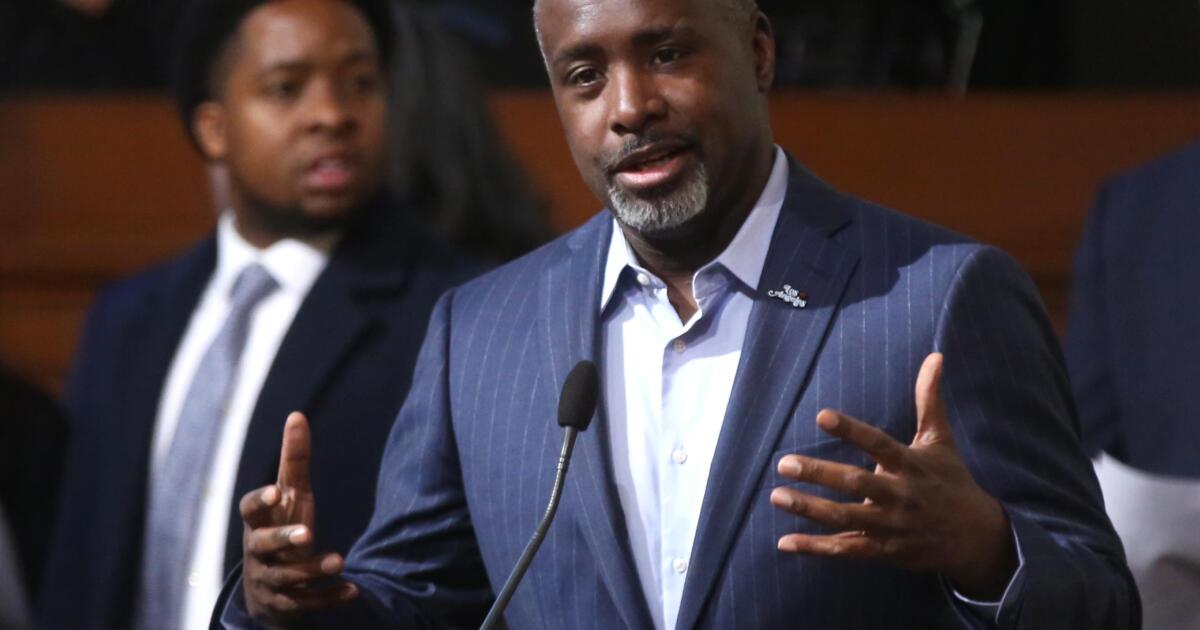
It was a dramatic moment for City Hall: Council President Marqueece Harris-Dawson, appearing at a meeting about reining in certain traffic stops by police, revealed that he had been pulled over only two days earlier.
Harris-Dawson, who is Black, told his colleagues that police have stopped him four times since he took office in 2015. During the most recent incident, he said, an officer asked him a number of questions, including, “How do you have this vehicle?”
“It was as traumatic on Wednesday as it was when I was 16,” Harris-Dawson said at the March 6 committee meeting.
It wasn’t the Los Angeles Police Department that pulled over Harris-Dawson’s car, a Tesla Model Y with a government license plate. Instead, it was an officer from the L.A. Unified School District police, who began trailing him while he was heading to work on the freeway, Harris-Dawson said recently.
The district has provided minimal details, and its police union has not commented. But the union that represents nearly 8,700 LAPD officers, known for its bare knuckle politics, is now deeply involved.
Ricky Mendoza, president of the Los Angeles Police Protective League, urged Dist. Atty. Nathan Hochman on Thursday to investigate whether Harris-Dawson attempted to resist, delay or obstruct the officer who carried out the traffic stop, in violation of state law.
Mendoza pointed to a California Post story that accused Harris-Dawson of contacting an unnamed school board member during the incident “in an apparent effort to get out of the citation.”
You’re reading the L.A. on the Record newsletter
Sign up to make sense of the often unexplained world of L.A. politics.
By continuing, you agree to our Terms of Service, which include arbitration and a class action waiver. You agree that we and our third-party vendors may collect and use your information, including through cookies, pixels and similar technologies, for the purposes set forth in our Privacy Policy such as personalizing your experience and ads.
Tom Saggau, a police union spokesperson, said Harris-Dawson was caught driving “recklessly” in a school zone — and should have disclosed it during his remarks about the incident.
“Mr. Harris-Dawson’s testimony implied LAPD pulled him over because of his race, not his driving behavior,” Saggau said in an email. “That implication painted our minority-majority membership as racist, and we will always stand up for our membership and correct falsehoods and other tall tales.”
Harris-Dawson, for his part, told The Times he received the citation for attempting to enter a left turn lane too early — before it was actually marked as a turn lane. That maneuver did not pose a threat to anyone, he said.
Harris-Dawson said he did contact other people during the traffic stop, to ensure he had real-time witnesses. He would not provide their names.
“I called several people during that encounter so that there was a record of it besides myself,” he said.
The Times reached out to the school board about the police union’s claims. Four of the seven, either in person or through a representative, said they did not talk to Harris-Dawson about the stop.
The dispute comes as the council is weighing new limits on “pretextual stops,” where officers use a minor violation as justification to pull someone over and then investigate whether a more serious crime has occurred. The stops have disproportionately affected Black and Latino drivers, and the LAPD has scaled back their use over the past decade.
At the meeting where Harris-Dawson revealed he had been pulled over, two council committees were discussing next steps on the issue.
On Thursday, a Harris-Dawson aide hit back at the union, accusing the group of trying to divert the public’s attention away from that work.
“Just like pretextual traffic stops, the call for these pointless investigations violates the public trust, is wholly ineffective, and wastes precious resources that could be used to keep us safe,” said Harris-Dawson spokesperson Cerrina Tayag-Rivera in a statement this week.
Asked about his recent experience with the school police, Harris-Dawson said: “It’s not up to the driver to determine if a stop is pretextual, but it felt pretextual.”
School district officials have offered only minimal information about the incident.
“During our morning school drop-off, a Los Angeles School Police Department officer conducted a traffic stop based on an observed moving traffic violation in the vicinity of one of our high schools and issued the driver a citation,” the statement said.
Harris-Dawson told The Times that the encounter began the morning of March 4, during his drive from his South L.A. home to City Hall, when he noticed a white, unmarked car following him on the northbound 110 Freeway.
He took the Adams Boulevard offramp, turned right on Adams and headed toward Main Street, with the unmarked car following him through multiple intersections. When he turned left on Main, the officer turned on his lights and pulled him over, he said.
The officer walked up to the car with his hand on his gun and told him to roll down the windows, Harris-Dawson said.
“Because it was an unmarked car … I thought I was dealing with Immigration and Customs Enforcement,” he said.
Harris-Dawson said the officer told him that he had illegally crossed the double-yellow line in the center of the street, preparing to turn left before his car was actually in the marked left-turn lane.
The intersection is four blocks from Santee High School.
Harris-Dawson said the officer asked him how he came to possess the car. He informed the officer that it was a city vehicle and that he sits on the council. He handed the officer his driver’s license and, at a certain point, demanded it back.
The officer refused twice, Harris-Dawson said.
“He said, ‘Are you accusing me of taking your property?’” Harris-Dawson said. “I said, ‘That’s absolutely what I’m accusing you of.’”
Harris-Dawson said he was cited for violating the state vehicle code that prohibits motorists from driving the double-yellow lines.
“That stop was not about traffic safety,” he said, adding: “It was an investigative stop where the officer decided to give a citation, frankly, because I failed the attitude test.”
Harris-Dawson said through his spokesperson that he has paid the $238 citation. Asked if he is considering any legal action, he responded: “I’m weighing all my options.”
Meanwhile, Mendoza said he wants not just the D.A. but also City Atty. Hydee Feldstein Soto to investigate Harris-Dawson’s behavior during the stop, determining who he called, what he said, and whether the officer was contacted by a school board member.
The police union president said it’s “unethical and potentially illegal for a city leader to use their position of power to attempt to avoid accountability for their reckless driving in a school zone.”
The Police Protective League is well known for its heavy involvement in city politics, especially during election season. On the Westside, the union has already put nearly $500,000 into efforts to reelect Councilmember Traci Park.
The union has endorsed Mayor Karen Bass, a close ally of Harris-Dawson, but hasn’t been spending on her behalf.
Councilmember Hugo Soto-Martínez, who sits on the council’s public safety committee, said he believes the union is trying to “bully” Harris-Dawson, to ensure that others remain silent about pretextual stops.
“I think the council president is very courageously bringing up a reform on one of the most racist practices” in the LAPD, he said.
State of play
— DROPPING CHAVEZ: The bombshell New York Times report that found that labor organizer Cesar Chavez sexually abused minors left the state’s elected officials scrambling to rename streets, buildings and of course, the holiday itself. In L.A., Bass and several council members said they would rename the March 31 holiday “Farm Workers Day,” a move also backed at the county level by Supervisor Janice Hahn. Meanwhile, Raul Claros, running for an Eastside council seat, said Cesar Chavez Avenue should be renamed Dolores Huerta Avenue.
— DEMS WEIGH IN: The L.A. County Democratic Party threw its endorsement behind Bass and Councilmembers Eunisses Hernandez, Katy Yaroslavsky, Monica Rodriguez, Hugo Soto-Martínez and Tim McOsker. The group also backed several newcomers: Marissa Roy for city attorney, Zach Sokoloff for city controller and council candidates Barri Worth Girvan and Jose Ugarte.
— PLUS THE COUNTY: The Dems also threw their support behind four countywide candidates: Sheriff Robert Luna, Assessor Jeffrey Prang, Supervisor Lindsey Horvath and State Sen. Maria Elena Durazo, who is running to replace termed-out Supervisor Hilda Solis.
— SPEAKING OF WHICH: It’s been pretty clear from the past year that Horvath is not a fan of Bass, offering bracing critiques of the city’s approach to homelessness and other issues. But her four colleagues — Hahn, Solis, Kathryn Barger and Holly Mitchell — have all lined up behind the mayor’s reelection, according to a campaign announcement issued Friday.
— POLICE PAYOUT: A jury awarded $5.9 million to a former LAPD commander who claimed she was wrongfully fired over an alcohol-fueled incident in 2018. The commander, Nicole Mehringer, said she was held to a different standard than her male colleagues, losing her job after being arrested on a charge of public intoxication.
— MINDING MEASURE ULA: Councilmember Ysabel Jurado was named the chair of a new three-member ad hoc committee formed to take a fresh look at the impacts of Measure ULA, the 2022 tax on high-end property sales. She will be joined by Councilmembers John Lee and Imelda Padilla in examining the measure, which has been criticized by real estate leaders.
— HOLLYWOOD’S HOMELESS: Bass and Soto-Martínez celebrated the opening of a new homeless services hub on Hollywood Boulevard to help unhoused residents shower, find new clothes, obtain meals and receive help finding an apartment or a bed in an interim housing facility.
QUICK HITS
Where is Inside Safe? The mayor’s signature program to address homelessness went to South Los Angeles, focusing on the area around Broadway and 23rd Street, according to the mayor’s team.
On the docket next week: The council meets Tuesday to discuss its strategy for complying with Senate Bill 79, which seeks to add taller, denser apartments within a half mile of rail and dedicated bus stops.
Stay in touch
That’s it for this week! Send your questions, comments and gossip to LAontheRecord@latimes.com. Did a friend forward you this email? Sign up here to get it in your inbox every Saturday morning.
Meta, YouTube and Snapchat are already under scrutiny for risks they pose for young people. Now they are facing another hurdle in their home state.
California lawmakers are considering legislation to restrict social media use for teens and children under 16 years old. Assemblymember Josh Lowenthal (D-Long Beach) and others introduced a bipartisan bill that would bar social media platforms from allowing users under 16 years old from creating or maintaining accounts.
The legislation comes amid mounting concerns about how social networks impact the mental health of young people. Anxiety among parents and lawmakers has heightened as platforms and AI chatbots become more intertwined with people’s daily life.
Last month, tech executives, including Meta’s chief executive and co-founder Mark Zuckerberg, testified in a landmark trial in Los Angeles over a lawsuit that alleges social media is addictive and harms children.
The trial centers on whether tech companies such as Instagram, which is owned by Meta, and YouTube can be held liable for allegedly promoting a harmful product and addicting users to their platforms.
California has passed legislation before aimed at making social media platforms and chatbots safer but faced pushback from tech industry groups that have sued to stop new laws from taking effect. Tech companies are have responded by releasing more parental controls and restrictions for young users.
Other countries have been moving forward with restrictions on social media. Last year, Australia barred children under 16 years old from having social media accounts.
TechNet, whose members include Meta and Google, said in a statement that it hasn’t taken a position on the California bill but doesn’t believe a ban will effectively achieve the Legislature’s goal’s.
“We support balanced, evidence-based solutions that strengthen protections for young people, equip parents with meaningful tools, and ensure accountability across platforms. Our companies have made significant investments in teen safety and parental controls, and we remain committed to building on that progress,” said Robert Boykin, TechNet Executive Director for California and the Southwest in a statement.
The use of social media by young people has divided tech executives.
Pinterest Chief Executive Bill Ready wrote in an op-ed in TIME published on Friday that governments should follow Australia’s lead and ban social media for kids under 16 years old if tech companies don’t prioritize safety.
“Social media, as it’s configured today, is not safe for young people under 16,” he said.”Instead, it’s been designed to maximize view time, keeping kids glued to a screen with little regard for their well-being.”
Lowenthal’s bill cited social media’s dangers such as “exposure to harmful content, compulsive use patterns, exploitation, and adverse impacts on mental health and well-being.”
“Existing age-based restrictions that rely primarily on user self-attestation have proven ineffective and place an unreasonable burden on children and families rather than on the entities that design, operate, and profit from social media platforms,” the bill states.
A spokesman for Lowenthal didn’t immediately respond to a request for comment.
Should Paramount Skydance prevail in its $111-billion takeover of Warner Bros. Discovery, the Larry Ellison family would control two historic Hollywood film studios, dozens of cable channels, HBO and two legendary newsrooms, CBS News and CNN.
Concerns about the potential loss of more Hollywood jobs, and questions about newsroom independence dominated a hearing Friday to address Los Angeles’ crisis of shrinking film and TV production jobs.
Paramount wants to wrap up its Warner merger by September — a rapid timetable. The takeover deal, which was struck last month after Netflix bowed out, would put HBO and CNN under the control of Larry Ellison and his son David, the chairman of Paramount, which includes CBS.
Both Ellisons maintain friendly relations with President Trump. Those bonds, along with challenges to legacy media and changes at CBS News in recent months, sparked handwringing during the hearing called by Sen. Adam Schiff (D-Burbank) and Rep. Laura Friedman (D-Glendale).
“The questions surrounding this merger go beyond jobs, contracts and consumers,” Schiff said. “They also go to editorial independence of two of America’s most significant news organizations, CNN and CBS News.”
Trump has long agitated for changes at CNN, and members of his cabinet, including War Secretary Pete Hegseth, have openly cheered for an Ellison takeover of CNN.
To pave the way for the Ellisons’ purchase of Paramount, the company paid $16 million to Trump last summer to settle his lawsuit over edits to a “60 Minutes” interview with Kamala Harris in October 2024. Most 1st Amendment experts had deemed Trump’s suit “frivolous.”
Since the Ellisons took the helm, there has been a change in direction at CBS News and a reduction in its size and scope. Staff members at CNN are bracing for similar changes, including to the tone of its newscasts.
In addition to the long-term health of Los Angeles’ film economy, the merger’s fate could determine “whether we have state sponsored media … or whether we have journalists who can truly follow the story,” Friedman said.
Paramount Chairman David Ellison has vowed to “build a stronger Hollywood,” by increasing the creative output of the two legendary movie studios — Paramount and Warner Bros. — to 30 theatrical releases a year. Warner Bros., which owns such prominent franchises as “The Matrix,” Batman, Harry Potter, “The Big Bang Theory,” and “Friends,” has long been one of Hollywood’s most prolific studios.
But Paramount has suffered from years of under-investment and Ellison and his team have been working to boost the film pipeline.
“HBO will continue to operate independently under our ownership, enabling it to create more of the world-class content it is renowened for,” Ellison wrote in the Feb. 28 letter to Schiff and Friedman, responding to their concerns about consolidation.
During Friday’s hearing, the lawmakers turned to former CNN anchor Jim Acosta, who famously jousted with Trump during his first term, for his reflections. He was asked whether any “guardrails” could protect against potential merger harms.
“If this merger goes through, the guard-rails are gone,” Acosta said bluntly. “If we continue to go down this road it will be lights-out for the news industry… We need media options that are not controlled by the wealthiest and most powerful people in the country.”
The hearing occurred the same day that CBS News imposed another sweeping round of layoffs and disbanded its CBS News radio network. It also came the same week as Trump’s Federal Communications Commission approved a massive television station merger, which will allow Texas-based Nexstar Media Group to control more than 250 stations, despite a legal challenge from state attorneys general.
The proposed Paramount-Warner merger would prompt at least $6 billion in cost savings, according to Paramount. Industry veterans warn that billions more in cuts may be necessary to make the deal math work.
A combined Paramount-Warner would carry nearly $80 billion in debt, a legacy of the proposed leveraged buyout and the mergers that came before it.
The hearing at Burbank City Hall —“Lights, Camera, Competition”: Promoting American Film Production,” — was wide-ranging. Award-winning actor Noah Wyle, the star and a producer of Warner Bros.’ “The Pitt,” discussed the need to bring more productions back to Los Angeles where thousands of out-of-work film professionals have been suffering. “The Pitt” is filmed in Burbank.
“Over the last six years, the aggregate effect of projects leaving the state in search of tax credits, the pandemic and last year’s fires has been a near cratering of our once thriving industry,” Wyle said. “We lost 42,000 film and TV jobs between 2022 and 2024.”
The hearing unfolded down the road from the massive Warner Bros. studio complex, and was held to explore ways to boost the Hollywood economy, including the potential for a national tax credit under consideration in Congress. The campaign is intended to keep film jobs in the U.S. amid an increased migration to Britain, where Warner Bros. maintains an expansive studio complex in London, and other countries that offer generous subsidies.
“Work in the entertainment industry is precarious,” said Matthew D. Loeb, International President of the International Alliance of Theatrical Stage Employees (IATSE). “Past studio mergers have meant fewer jobs.”
The WNBA will likely get an injection of UCLA talent. One of the players most equipped to make an impact right away, it turns out, might be Kiki Rice.
Some mock drafts have the senior guard as high as being picked No. 5 overall after concerns she might fall out of the first round entirely before this season.
After a career-best season, though, Rice is one of the top prospects in a loaded class. That wasn’t a given after taking a step back in all statistics other than shooting last season.
The No. 1 seed Bruins are hoping to ride that to a national title, with the next step coming Saturday against No. 16 seed California Baptist in the first round of the NCAA tournament. Tipoff is at 7 p.m. at Pauley Pavilion.
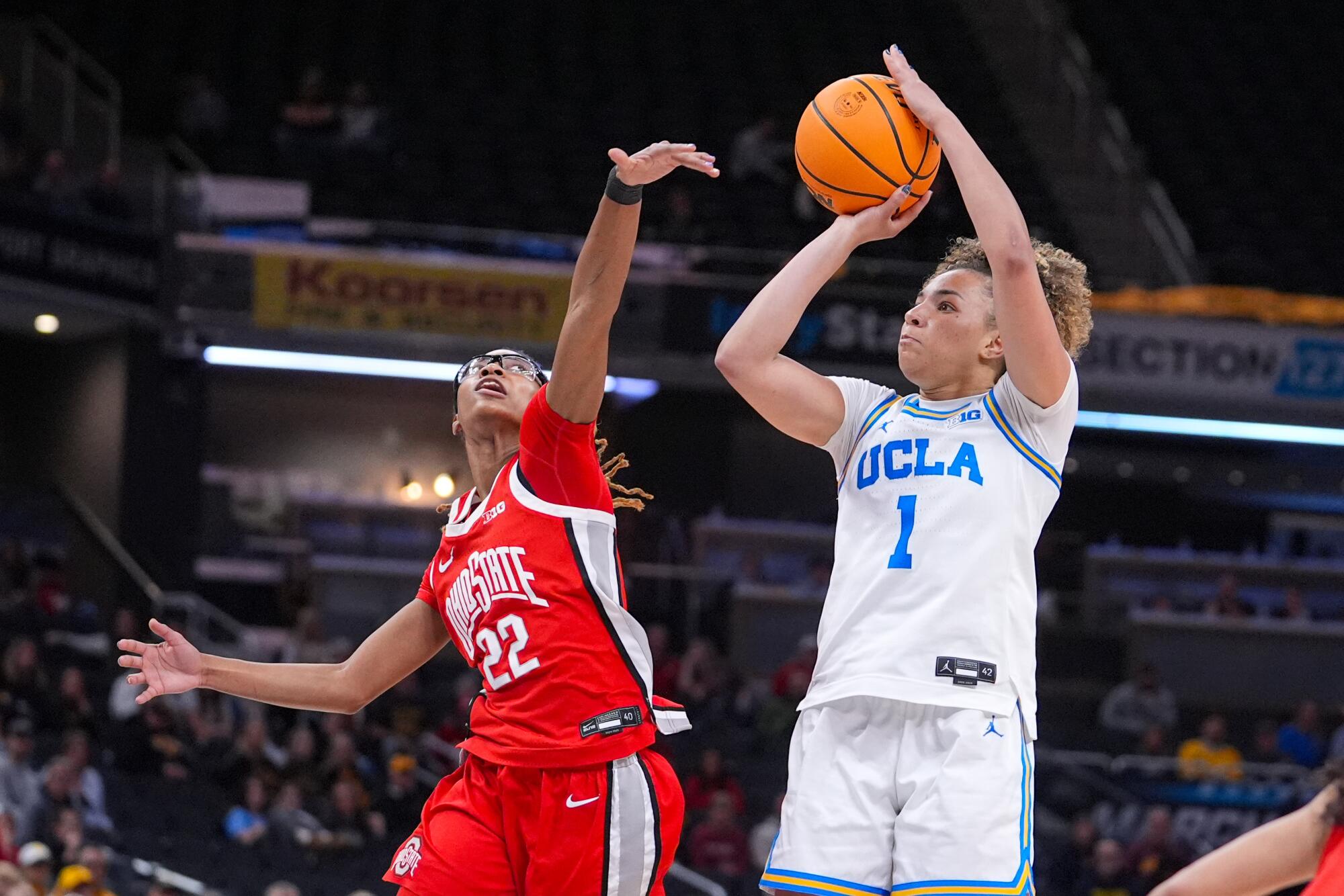
UCLA guard Kiki Rice shoots over Ohio State guard Jaloni Cambridge during the semifinals of the Big Ten tournament on March 7 in Indianapolis.
(Michael Conroy / Associated Press)
WNBA scouts are hoping Rice proves she can be one of the best early first-round investments in the league.
“The work she did on her mentality, film study, with leadership, using her voice, working on her handles, I just think it’s her commitment to the details,” UCLA coach Cori Close said. “I’m not surprised that she’s playing this way because of the intentional work that she puts in.”
A Big Ten All-Defensive Team and unanimous All-Big Ten First Team selection this season, Rice is averaging career highs in points (15.3), rebounds (6.0) and shooting percentage (50.4%). Her assist numbers have dropped since the addition of Charlisse Leger-Walker, but that’s allowed Rice to create her own offense.
“I think one of the things that Kiki’s been able to do is have different kinds of scoring catches this year because of Charlisse’s presence on our team,” Close said. “But I do think the biggest thing has probably been her passing, her facilitation, as well as her ability to shoot.”
WNBA scouts have taken notice, too. One evaluator said her ability to play with a “group of weapons” has set herself up to be taken seriously for a larger role even as a rookie. For a long time, among those scouting in the league, she was viewed as a potential backup point guard, but her shooting ability and defensive consistency has made her a more complete prospect.
Her 2.2 defensive win shares are third in the Big Ten and her 83.0 defensive rating is seventh.
“I worked a ton of [defense] in the offseason and really stepped up to the challenge of guarding the other team’s best perimeter player,” Rice said. “I think me being challenged in that way, it’s been a really great area of growth, and that’s probably the area that I’m most proud of.”
Rice’s improvement from the three-point line is a big one for WNBA scouts. She improved her deep shot from 21.7% to 38.1% across four seasons.
UCLA guard Kiki Rice steals the ball from Washington guard Chloe Briggs at Pauley Pavilion on Feb. 19.
(Gina Ferazzi/Los Angeles Times)
That, plus her defensive prowess and ability to play point guard and more of a loose guard role, have helped her WNBA stock rise tremendously.
“Defensively has been probably the most impactful growth thing that she’s had,” Close said. “But Kiki — people don’t realize she was out for six months. She had surgery on April 15th last year and was out for six months.”
Rice was injured at the start of last season and then underwent right shoulder surgery right after the Final Four. Despite the injury, she played in 34 games last season, averaging 12.8 points and 5.0 assists per game.
Rice won the Big Ten tournament’s most outstanding player award after UCLA thrashed Iowa by 51 points in the championship. She averaged 16.6 points and 5.3 assists during three Big Ten tournament games.
Her numbers might be even better if she were the team’s top offensive option, like Hannah Hidalgo with Notre Dame. Instead, she is sharing time with other top WNBA prospects such as Lauren Betts, Gianna Kneepkens and Leger-Walker.
“What I love most is she’s one of the most selfless people I’ve ever played with,” Betts said of Rice. “She really could [not] care less about all of the attention. She just wants to win games. She’s always there for her teammates. I’m so grateful I get to be her teammate and her friend. She’s amazing.”
In addition to her three-point shot improvement, around 60% of her points still come in the paint from driving to the basket, making her a threat all over the floor.
“There were lots of times in previous years where Kiki could get downhill, but we didn’t have the court spacing because we didn’t have the quality of shooting that allowed those driving lanes to take place,” Close said.
UCLA guard Kiki Rice shoots over USC guard Malia Samuels at Pauley Pavilion on Jan. 3.
(Eric Thayer/Los Angeles Times)
The biggest question with Rice is whether her three-point shooting can scale to a higher volume in the WNBA, where guards are more likely to shoot from deep than be relied on in the post. She has never taken more than 2.7 attempts per game.
Part of that is because there are so many options from three-point range that Rice doesn’t have to be the primary shooter. Kneepkens is making 44.2% of her three-pointers and Gabriela Jaquez has hit 41.1% while Leger-Walker is shooting 36.4% from range.
That hasn’t affected Rice’s efficiency, though.
“I think this year the way that we moved the ball and everyone gets touches is so important for everyone and allows me to be successful,” Rice said.
UCLA guard Kiki Rice celebrates with teammates as she’s handed the Big Ten tournament most outstanding player trophy on March 8 in Indianapolis.
(Michael Conroy / Associated Press)
With the way the draft order falls, Rice is likely to end up with either an expansion team or a team that struggled last season, such as Washington or Chicago. That might mean she’ll need to step in and produce in her first season as a pro.
That is why her stock has risen so much this season — she’s shown she has the versatility to do what is needed.
“Kiki has been playing the best basketball of her career,” Close said. “I think she has put in the work. She knows what she’s earned, and she’s sort of ‘that girl’ for us.”
PHOENIX — Dodgers president of baseball operations Andrew Friedman went into the offseason expecting outfielder Kyle Tucker to sign elsewhere.
Sure, Friedman was confident in what the Dodgers could provide on and off the field to the 29-year-old four-time All-Star. And Tucker was a rare hitter who could actually elevate an already star-powered Dodgers lineup. But with the team unwilling to offer a super long-term deal, their chances at landing the best free-agent hitter available this past offseason felt “incredibly low.”
“I can’t remember a time where a player has taken a shorter-term, higher-AAV deal when they’ve had an actual long-term contract on the table,” Friedman said Wednesday.
The Dodgers, however, had already pulled off a bigger surprise when closer Edwin Díaz chose them over returning to the Mets this past December.
The team’s pitch, which included a conversation with the Dodgers’ director of family programs Patricia Romero, discussions about preparation and player resources, and a championship track record, helped land both top-tier free agents.
Of course it didn’t hurt that though Tucker’s contract was only four years, it was worth $240 million. Taking deferrals into account, the net-present day value set an MLB record at about $57 million per year.
The Dodgers’ aggressive offseason, coming off consecutive World Series titles, once again makes them the favorite entering the 2026 season.
They wrap up their Cactus League schedule this week, as World Baseball Classic participants trickle back into camp, and baseball operations leadership make final opening day roster decisions.
Before Friedman headed back to Los Angeles, he spoke with The Times on a range of topics. Here’s part of that conversion, edited for length and clarity.
Q: When it comes to the WBC, there’s variance on how supportive teams are. You have Shohei Ohtani participating as a position player, Yoshinobu Yamamoto pitching after an extra-short offseason, Kiké Hernández supporting Puerto Rico in person while rehabbing. How have you landed in being highly flexible?
Friedman: Obviously everything is case by case. But in a vacuum, we are incredibly supportive of the World Baseball Classic and what it does for our game worldwide. We saw it in ‘23, we saw it this past year, with just how important this is to the players, the staff, the fans — and just how exciting it is for baseball.
So that part’s easy. Now you layer on our situation, us trying to win a World Series. For position players, it’s easier to justify. For pitchers, it’s way harder. Throwing at that intensity in March is really, really challenging. And so we feel like our role is to work with each of our players and have conversations and share our thoughts, listen to their thoughts, and then answers kind of fall out of that.
Q: It’s such a cliche to say you can never have too much pitching, but with this group, are you close?
Friedman: I’ve learned my lesson to never say that we have enough pitching. But I do feel like we are breaking camp with the most talented one through 20 arms — which gets at, obviously, who we’ll break with, and then depth behind it — that we’ve ever had.
Q: Between Díaz, who’s part of that equation, and Tucker, you signed two players this offseason who you didn’t necessarily expect to land. What does that say about this organization and what you’ve done the last few years?
Friedman: Our biggest, most overarching goal is to be a destination spot, where our own players don’t want to leave, where players on other teams are looking longingly, because we feel like championships fall out of that. By having the right environment, having the right culture, that helps your star players want to stay, it helps in the recruitment of others. So we’re way better at it today than we were five years ago. But it’s like a living organism that we have to continue to foster and nurture and develop. And we hope we’re way better at it five years from now.
Q: On that note, the Dodgers are very much caught in the middle of CBA posturing with the current agreement expiring this year. You hear a lot of players saying the Dodgers are doing it the right way and other teams could be doing something similar. On the other hand, the league appears to be floating a salary cap, and plenty of fans are accusing the Dodgers of “ruining baseball.” What’s it been like to see those conflicting narratives?
Friedman: Obviously see it, come across it, hear it quite a bit. But we’re just not that focused on it. We’re a really healthy organization, and the partnership we have with our fans is our guiding light. And we’re doing everything we can to put a team out there that our fans really connect with, and that they feel that partnership with all that they pour into us, and don’t really think about it in any other terms.
And so obviously, there’s a lot of narratives that get extrapolated from that. But our sole focus is on ourselves and the partnership we have with our fans and the rest of it to us, it’s kind of just noise.
Q: You guys raised the bar years ago to, “We’re going to be in the postseason every year.” But there were clear frustrations from the fan base when that wasn’t consistently leading to championships. Is it fair to say that this continued push is almost a response to that frustration?
Friedman: Each year we’ve poured everything we have into winning. And in October, you need a really talented roster, and you need some good fortune. And there’s years where we haven’t been as talented as we wanted to be, whether it’s injuries or lack of performance. There’s years we’ve had really bad fortune, there’s years we’ve had good fortune. And a lot of that is the game, and it’s what I both love and hate about it.
I wouldn’t say our mindset is all that different. But obviously, when you’re in a moment in time with an incredibly talented roster, I think the mindset is, ‘Don’t sit back on your heels, be aggressive, and don’t be nonchalant about the opportunity that we have in front of us.’ And so it’s more the idea of pressing an advantage and being aggressive on that front.
Q: I’m sure when you were pursuing Ohtani, you looked into the revenue ramifications of signing him. Has this been about what you expected? Has it exceeded your expectations?
Friedman: Oh, it’s far exceeded. I don’t think the human brain could have comprehended it correctly. It’s been a perfect storm on a lot of levels, and something that has definitely far exceeded our expectations.”
Q: A three-peat seems to be the goal. Is there such a thing as a successful season without winning a championship, or has this team gotten to a point where you really have to win a World Series in order to claim success?
Friedman: Everything for us, all of our energy and focus, is on doing everything we can to win a championship this year. And our first goal is to win the division and be in position to have a bye. Last year, we added to the degree of difficulty [by winning the division but having to play in the wild-card round] in a way that I’d like to avoid this year.
So that’s the first goal. And then obviously that puts you in the best position to accomplish our ultimate goal, which is winning a World Series. So that’s what all of our energy and focus is on.
And, obviously, if we win the World Series this year, it will be a three-peat. But it’s not how my brain processes it. We’ve won back-to-back, and those are in the bank. And now it’s, do everything we can to win this year, and it’s its own unique, disparate year.
In a stunning move, CBS News is shutting down its radio division, getting out of the medium where its storied history began nearly 100 years ago.
CBS News Radio will stop offering its service to its 700 affiliate stations on May 22.
“While this was a necessary decision, it was not an easy one,” the company said in a memo obtained by The Times. “A shift in radio station programming strategies, coupled with challenging economic realities, has made it impossible to continue the service.”
CBS sold its own radio stations in 2017, but continued to offer hourly network newscasts to affiliate stations, including “World News Roundup,” which has been on the air since 1938. Legendary CBS News journalist Edward R. Murrow delivered his first report on the program.
The news of the shutdown comes as dozens of CBS News employees are learning Friday if they have a future at the struggling news division.
A morning email from CBS News President Tom Cibrowski and editor-in-chief Bari Weiss that was obtained by The Times said staff affected by a new round of job reductions will be notified by the end of the day. About 6% of the 1,000 CBS News employees will be affected.
The cuts had been hinted at earlier this year by Weiss, when she said her business goal for the division is to expand its reach on digital platforms. Weiss and Cibrowski raised the same issue in their note informing employees of the cuts.
“It’s no secret that the news business is changing radically, and that we need to change along with it,” they wrote. “New audiences are burgeoning in new places and we are pressing forward with ambitious plans to grow and invest so that we can be there for them.”
CBS News has been dealing with a decline in revenue for its TV programs, as viewers have gravitated toward streaming platforms and social media.
The network’s daily programs “CBS Evening News with Tony Dokoupil” and “CBS Mornings,” both run well behind their competition in the ratings. It does have two strong weekend franchises in “60 Minutes” and “CBS Sunday Morning.”
CBS News is expected to be under the same corporate ownership as CNN once parent company Paramount closes its $111 billion deal to acquire Warner Bros. Discovery. The two divisions are likely to share news gathering costs, which could lead to the closure of bureaus and a reduction of personnel.
Weiss had joined CBS News earlier that month and was not directly involved in the staff reductions. She is said to be more personally involved in the cuts occurring Friday.
WASHINGTON — A federal arts commission on Thursday approved the final design for a 24-karat gold commemorative coin bearing President Trump’s image to help celebrate America’s 250th birthday on July 4.
The vote by the U.S. Commission of Fine Arts, whose members are supporters of the Republican president and were appointed by him earlier this year, was without objection. It clears the way for the U.S. Mint to begin production on the coin, whose size and denomination are still under discussion.
“As we approach our 250th birthday, we are thrilled to prepare coins that represent the enduring spirit of our country and democracy, and there is no profile more emblematic for the front of such coins than that of our serving President, Donald J. Trump,” U.S. Treasurer Brandon Beach said in a statement.
The unprecedented move marks yet another example of Trump and his allies circumventing conventional past presidential practices — and even the law — to get what he wants. It’s the latest instance of Trump putting his name and likeness in the historical archive, following his renaming of the U.S. Institute of Peace, the Kennedy Center performing arts venue and a new class of battleships, among other tributes.
Federal law says no living president can appear on U.S. currency. But Megan Sullivan, the acting chief of the Office of Design Management at the Mint, said the Treasury secretary has authority to authorize the minting and issuance of new 24-karat gold coins, which Scott Bessent has used to get around that prohibition and put Trump on a coin.
She presented the coin’s final design at the commission’s March meeting on Thursday and said Trump had approved it.
“It is my understanding that the secretary of the Treasury presented this design, as well as others, to the president and these were his selection,” Sullivan said.
The White House and the Mint did not immediately respond to electronic and telephone requests for comment.
The front of the coin features an image of Trump in a suit and tie and with a stern look on his face. His fists rest on top of what is supposed to be a desk as he leans forward. Lettering on the top half of the coin spells “LIBERTY” in a slight arc. Directly underneath that are the dates 1776-2026. The words “IN GOD WE TRUST” are at the bottom, with seven stars on one side of the coin and six stars on the other side.
The reverse side depicts a bald eagle midflight with “UNITED STATES OF AMERICA” on the right side and “E PLURIBUS UNUM” on the left side.
“I know it’s a very strong and a very tough image of him, and I think it’s fitting to have a current sitting president who’s presiding over the country over the 250th year on a commemorative coin for said year,” said Commissioner Chamberlain Harris, a top White House aide to Trump.
The coin will be part of a “very limited production run,” Sullivan said, but the number has not been determined. The size and denomination of the coin also have not yet been decided, she said. Some commissioners noted Trump’s fondness for big things as they advocated for the largest size coin.
The Mint, which is part of the Treasury Department, has looked at a size for the Trump coin that is larger than its 1-ounce gold coin, which is about 1.3 inches in diameter, Sullivan said.
Its largest coin is 3 inches, “so we’re looking somewhere in there,” she said.
“I think the president likes big things,” said Commissioner James McCrery II, who was the architect on Trump’s design proposal for a 90,000-square-foot ballroom addition to the White House. The fine arts commission approved that proposal at its February meeting.
Harris told McCrery she agreed with him. She works in the White House as a special assistant to the president and deputy director of the Oval Office.
“I think the larger the better. The largest of that circulation, I think, would be his preference,” Harris said, speaking of Trump.
THE Sun’s travel team are sharing the holiday destinations they’ll be heading to this summer to help you find the best deals to get away for less.
To do this, we have rounded up our absolute favourite spots for summer 2026, including family-friendly holiday parks, sunny Spanish resorts and the very best in cruises.
Bodrum in Turkey offers luxury-feel beach holidays for affordable pricesCredit: Getty
Whether you’re hunting for a cheap UK break or a dreamy island retreat, we’ve got your travel inspiration for 2026 sorted.
From Skegness to Seoul, here’s where the Sun Travel team recommend – and are actually heading to – as the weather hots up.
Caroline McGuire, Head of Travel – Digital
UK holiday – Butlin’s, Skegness
I am ashamed to say that in my nine years as a travel editor at The Sun, I’ve not yet made it to Butlin’s.
Well, not after this summer. I’m heading to their Skegness resort with a school mum and our kids, in the seaside holiday park’s 90th birthday year.
I’m not sure who is more excited – the adults or the kids.
My parents were camping-in-France-type people, so I never did any of the UK holiday parks growing up.
But now I have a kid of my own, the idea of free fairground rides, water slides and TV-quality evening entertainment is deeply appealing.
I’m particularly looking forward to the Masked Singer Live, and my son is very excited about the Maximum Pro Wrestling.
Plus, we’ve got the all-inclusive drinks package, which means we can sip on a cold wine and natter while the children tire themselves out with all the activities.
Given we’ve got the dining package too, it’ll be interesting to see quite how much we can see, do and eat in a 3-night break, without spending any extra money.
They’ve got 3-night breaks in May half term from £188 and the school summer holidays from £207.
Butlin’s in Skegness is an affordable option for the summer holidays, with breaks from £207Credit: Butlins SkegnessUK holiday park Butlin’s will be celebrating its 75th birthday in 2026Credit: Butlins Skegness
Medium haul break – Bodrum, Turkey
I’ve managed to visit a new part of Turkey each year since Covid ended, ranging from Istanbul and Izmir to the Turquoise Coast, and this year I’m ticking Bodrum off the list.
Turkey is one of my favourite countries to visit with my seven-year-old.
For a start, the food is so kid-friendly that eating out is a dream. Halloumi, olives, flatbreads, hummus, baklava… what’s not to love?
Plus, they’ve really nailed the all-inclusive hotel experience.
This year, we’re staying at the Titanic Luxury Collection Bodrum – a five-star property on the Pina Peninsula with 11 restaurants and its own white-sand beach.
Week-long, all-inclusive stays at this five-star resort start from £910pp with On the Beach.
Short haul break – Eurocamp: Les Prairies De La Mer Resort, France
Kate Moss, Elton John, Beyonce and Leonardo DiCaprio all love St Tropez, and it’s about to become even better-known soon, as the next White Lotus TV show is being filmed there.
But just 15 minutes down the road is Les Prairies De La Mer Resort – one of Eurocamp’s top holiday parks that they rate as five stars.
But when we fancy a bit of the A-List lifestyle, it’s super easy and cheap to get to either St Tropez or St Maxime
Forget Club 55 and superyachts, here it’s all about the park’s own beachfront cafe, mini golf and the two pools.
Oh, and an early morning walk to the on-site supermarket for freshly baked croissants.
But when we fancy a bit of the A-List lifestyle, it’s super easy and cheap to get to either St Tropez or St Maxime.
They’ve got 7-night breaks in May half term from £1,707 and school summer holidays from £2,349.
Alice Penwill, Travel Reporter
British seaside – Suffolk, UK
As much as I love going abroad, sometimes you can’t beat a British summer.
I’ll be visiting Suffolk later this year to explore its seaside towns and hopefully enjoy some sunshine along the way too.
I’ll head to Aldeburgh first to see its colourful homes and stretching shingle beach.
I’ll try a Noon Tart too – it’s a local delicacy, essentially it’s a savoury pastry made from smoked haddock, smoked cheddar cheese, cream, eggs, and mustard in a flaky pastry.
Half an hour away from Aldeburgh is Framlingham Castle, which was Ed Sheeran’s inspiration for his song ‘Castle on the Hill’.
Neighbouring seaside towns include Thopeness and I might even stop by my favourite place along the Suffolk coast, Southwold.
I’ve been going to Southwold for years, playing games at the arcades, crabbing off the pier and popping into its independent shops along the high street.
I’ll be staying at The Brudenell Hotel, which sits on the seafront of Aldeburgh, and offers rooms from £137 per night.
Aldeburgh in Suffolk is home to grand pastel houses and a stretch of pebbled beachCredit: Alamy
Short haul sunshine – Menorca, Spain
Lots of Brits head to the Spanish islands during the summer – and I hope to be one of them, although I’m going to one that has fewer crowds.
The island of Menorca, next to the well-known Majorca, welcomes much fewer tourists each year, making it an ideal place to relax – it’s even been called “Ibiza’s chilled-out sister”.
It’s easy to navigate too, as it’s much smaller, so it has short airport transfers, and is generally cheaper.
I’ve got my eye on Cala Macarella, a beach on the south of the island with white cliffs and turquoise waters.
Another spot that I’ve been told about is Cova d’en Xoroi, which is a bar that’s built into caves on the cliffs.
During the day, it’s a chilled bar, and in the evening, it holds sunset sessions with live music.
To make it easier, the likes of TUI and Jet2 organise package holidays.
You can book a 7-night room-only break at Menorca’s Colina Village from £262.26pp with TUI.
The Spanish island of Menorca has been dubbed “Ibiza’s chilled-out sister”Credit: Alamy
English adventure – Jurassic Coast, UK
In my 28 years of living in the UK, I’ve never taken a stroll along the Jurassic Coast, which is why I intend to head there this summer for a weekend away (at least).
Chesil Beach near Weymouth is the longest in the UK, stretching for 18 miles from West Bay to the Isle of Portland.
And I hope to walk the beach and stop by The Cove House Inn on the north of the Isle of Portland, which was named as one of the best beachside boozers last year by Big 7 Travel.
Lots of visitors compliment the views from the pub, which sits on the promenade, and some have even spotted dolphins and whales in the water there too.
Of course, the famous Durdle Door is another stop high up on my list, as is Kimmeridge Bay.
Premier Inn’s Weymouth hotel offers spacious, comfy rooms from just £57 per night.
Chesil Beach is the UK’s longest, stretching for over 18 miles along the Jurassic CoastCredit: Alamy
Lisa Minot – Head of Travel
Short haul success – Malaga, Spain
I’m heading to the southern Spanish gem of Malaga in early June for a long weekend.
The city ticks all the boxes when it comes to an easy-to-reach, reliably sunny destination that can combine a quick cultural hit with fabulous food and a captivating coastline.
And travelling in early June, hopefully, will mean fewer crowds while still benefiting from warm sunshine.
I’ll be ticking off big hitters like the Picasso Museum and the 11th-century Alcazaba palace, but also on the agenda will be some serious relaxation.
I’m staying 20 minutes from the city centre at the Higueron Hotel, Curio Collection by Hilton, set between the Mediterranean and the Mijas mountains.
Its rooftop pool and terraces will be perfect for sunbathing and cocktail sipping, and there’s a spa and superb sports facilities for some proper me-time too.
The glamorous hotel offers breaks from £184 per night, but its budget-friendly little sister, the Hilton Garden Inn Malaga, also makes for a fantastic stay from £95 per night.
The Sun’s Head of Travel Lisa Minot is choosing to spend a long weekend in sunny MalagaCredit: Alamy
French fancy – Bormes Les Mimosas, Cote d’Azur
It will come as no surprise to those who know me that, yet again, my priority this summer will be spending time with family and friends at my own caravan in the South of France.
I’ve visited Camp du Domaine in Bormes les Mimosas almost every year for the last 50 years, and this summer will be no different.
The site tumbles down pine-clad hills to its own gorgeous sandy beach, and days will be spent relaxing on those soft sands, swimming in the warm waters and cooking up a storm with the purchases bought in local markets, from fresh fish to ripe Provencale tomatoes and of course, the odd rose!
Set between Toulon and St Tropez, it’s a great site for those who have their own van or camper, but there are bungalows for rent too.
Another good bet nearby is the Eurocamp sites in Grimaldi and Frejus.
A basic pitch at Camp du Domaine starts from £28.50 per night, with options for one-bedroom bungalows starting from £60 per night. See campdudomaine.com.
The Sun’s Head of Travel Lisa Minot visits Bormes Les Mimosas every single yearCredit: Alamy
Long haul leave – Seoul, South Korea
I’m making my first trip to the current global capital of cool, Seoul, as Virgin Atlantic launch new direct services.
With all things K-culture from the massive success of K-pop to the likes of Squid Game and BTS, the city promises an irresistible blend of ancient palaces, surprising green spaces and intoxicating 24/7 high-tech culture.
Of course, top of the list will be visiting Olive Young, Korea’s biggest beauty store for skincare essentials.
But I’ll also find time to wander and window-shop in the wealthy neighbourhood of Gangnam, famously mocked in original K-pop star PSY’s signature tune.
And then there’s the exciting food scene – from spicy street food to Korean barbecue, I can’t wait to indulge!
Virgin Atlantic flights to Seoul start from £757 return.
Once you’re in Seoul, there are plenty of budget-friendly accommodation options.
A night at the glitzy Moxy Seoul Insadong starts from £100 per room, whilst backpackers love the H HOSTEL Itaewon (from £23) with its social rooftop bar.
Long-haul airline Virgin Atlantic are launching flights to Seoul, South Korea in 2026Credit: AlamyLes Prairies De La Mer Resort is in Grimaud, France – close to celeb hotspot St TropezCredit: Eurocamp
Jenna Stevens – Travel Reporter
British break – Cley next the Sea, Norfolk
I’m lucky enough to say that heading back home for me is like going on holiday.
North Norfolk is brimming with picturesque seaside towns and quaint fishing villages, so many that I’m yet to set foot in them all, despite growing up there.
This summer I’ll be heading east along the coastline to Cley next the Sea, a charming coastal village known for its seal trips, pretty marshland and its Grade II-listed windmill facing the sea.
Overnight stays are best taken in cosy pubs with rooms, which are abundant in the area
I’m looking forward to getting stuck into harvesting fresh samphire from the shores, then washing off my wellies and heading out to local restaurants to sample the seafood.
Cley is also home to quaint pottery shops and art galleries with work from local artists. Plus, the coastal walking routes are perfect for twitchers who want to spot species like marsh harriers and bitterns.
Overnight stays are best taken in cosy pubs with rooms, which are abundant in the area.
This makes evenings effortlessly easy, as you only have to head upstairs to retire after spending the night sipping Norfolk ales and chatting with locals.
Although if you want something truly special, you can choose to stay inside Cley Windmill itself.
Inside the mill, there’s a unique circular sitting room, decorated with antique furniture and an open fire, plus a dining room dating back to 1713.
Pair this with upper-floor bedrooms looking over the marshes, and you’ve got yourself a truly unforgettable staycation.
B&B stays at Cley Windmill start from £184 per night.
Or if you prefer a more rustic stay, you can go lakeside glamping close to Cley Marshes Visitor Centre from just £40 per night.
Cley next the Sea in Norfolk is ideal for a peaceful UK countryside retreatCredit: Getty
Euro city-break – Barcelona, Spain
Despite being one of Spain’s number one fans, I’ve somehow never made it to buzzy Barcelona.
I’m looking forward to heading there this summer to soak up the coastal city’s high-energy feel, whether its by boat trip, bicycle or bar-hopping.
This year marks Gaudi’s centenary: the anniversary of 100 years since the death of the famous architect.
To celebrate, the streets of Barcelona will be alive with various street celebrations, concerts and exhibitions taking place throughout the year.
Plus, the construction on the Sagrada Familia is set to wrap up in 2026, and with the completion of a spire back in February, the church building officially became the tallest in the world.
To add to the celebrations, Barcelona has been named the World Capital of Architecture this year.
Not only is there the impressive Sagrada Familia to admire, but I’m looking forward to ticking off Casa Milà and Casa Batlló, too.
Throw in some Spanish wine tasting and plans to eat my body weight in jamon and patatas bravas, and it’s fair to say I’m excited to finally experience Barcelona this summer.
City breaks to Barcelona are a very affordable option if you’re looking for a weekend away in Europe. TUI offer a 2-night stay in June at Hotel Acta Voraport hotel from just £266pp, and that’s with return flights included!
Barcelona has been crowned the World Capital of Architecture for 2026Credit: Alamy
Southern Europe scorcher – Quinta do Lago, The Algarve, Portugal
The Algarve has long been a popular destination for Brits seeking sunshine, and I’m excited to head to the sporty resort of Quinta do Lago to catch some rays myself.
If you’re a fan of golfing with gorgeous coastal views, it doesn’t get much better than Quinta do Lago.
The North, South and Laranjal golf courses are renowned for their manicured, championship-grade greens.
In fact, the South golf course at Quinta do Lago has hosted the Portuguese Open no fewer than eight times.
Plus, the sporty adults’ playground offers more than just golf, too.
Whether you’re into pilates, padel or Portuguese cuisine, there’s something for everyone.
I’m very much looking forward to rewarding myself for the workouts with a frozen cocktail and lazing out on the golden sands of Quinta do Lago beach.
A top hotel on the resort that balances stylishness and affordability is The Magnolia Hotel, which offers rooms from £138 per night.
Jenna Stevens, Travel Reporter
Quinta do Lago in the Algarve is a top destination for sports fans and fitness tourismCredit: Quinta do Lago
Cyann Fielding, Travel Reporter
Train trip – Disneyland Paris
A theme park is a great option for a weekend away, and that is exactly what I am planning with Disneyland Paris.
By the end of March, Disneyland Paris will have opened its newest land: World of Frozen.
Now, I may be 25, but nothing excites me more than seeing Olaf come to life, waddling around and making his cute chuckles.
The new land is meant to look just like the Arendelle Kingdom as well, so I am excited to feel as if I am stepping into the movie itself.
One of Disneyland Paris’ biggest appeals is its proximity to the UK and the ease of travel there.
I will take the Eurostar from London St Pancras, which alleviates the stress often felt when travelling through an airport.
By making this trip a weekend break, I don’t have to take any annual leave, so it is a win-win.
You can book a 3-night stay at the Staycity Aparthotels Marne La Vallee from just £229pp on Loveholidays – it’s only seven minutes from the attraction, and it has its own outdoor pool to cool off in, too.
Travel reporter Cyann Fielding is excited to meet Olaf at Disneyland Paris’ World of FrozenCredit: AFP
Atlantic adventure – The Bay Area, California, USA
I’m no newbie when it comes to California, having visited San Francisco twice, Yosemite and Los Angeles.
But I stand by the fact that the American state is one of the most exciting and diverse places to explore.
This summer, I will focus on the Bay Area, which comprises regions bordering San Francisco Bay, San Pablo Bay and Suisun Bay.
The different regions include Alameda, Contra Costa, Marin, Napa, San Mateo, Santa Clara, Solano, Sonoma, and San Francisco.
For this trip, I will focus on Marin — home to one of America’s 10 National Seashores — and Santa Clara, where you will find Silicon Valley and San Jose.
When people think of California, they often imagine LA and San Francisco, perhaps with chic surfer dudes.
However, this trip will focus on exploring the hidden parts of the Bay Area, including the location where George Lucas created Star Wars and Indiana Jones.
You can bag return flights to San Francisco from just £444 on Skyscanner, the cheapest deals are often found flying with SWISS airline.
California’s Bay Area is made of multiple regions including San Francisco and SonomaCredit: Alamy
Scottish summer – Glasgow, Scotland
Over the past few years, I have visited several destinations in Scotland and have to admit, they are to date some of the best places I have travelled to across the entire globe.
Scotland’s landscape is like nowhere else, and its cities are full of fascinating history and architecture.
That’s why this summer I will be heading to Glasgow. I haven’t visited before, so I am super excited to see how it compares to Edinburgh.
Glasgow Cathedral and Botanic Gardens are definitely at the top of my list of places to check out.
What is even better about this trip is that train operator Lumo has just launched a route from London to Glasgow – so no extra luggage costs for me!
Glasgow is full of affordable accommodation options, such as the ever-reliable easyHotel Glasgow City Centre from just £43 per night.
Travel Reporter Cyann Fielding is looking forward to visiting Glasgow this yearCredit: Alamy
Kara Godfrey, Deputy Travel Editor
Medium haul trip – Marrakech, Morocco
Despite being known for its affordable flights, easyJet has recently launched its new Luxury Collection holiday offerings.
So I’ll be trying it out for myself on a trip to Morocco, spending a few days in Marrakech.
I haven’t been to the city since 2018, and even then, it was on a budget, so I am excited to see the fancier side of it with a stay at the famous La Mamounia.
However, that won’t stop me from trying to hunt out a bargain in the souks, in the form of pretty kitchen bowls and candle holders.
And with 3 hr 40-minute flights and 25C weather in April? Sign me up!
You can fly to Marrakech from London from just £19.99 each way with easyJet.
Marrakech is under four hours’ flight from the UK and full of vibrant streets to exploreCredit: Alamy
Long haul adventure – East coast of Thailand
Twenty-one-year-old Kara’s biggest adventure was travelling to Asia, her first stop being a month exploring the popular Thai islands.
I’m as surprised as you are that, 12 years later, I have yet to return to the beautiful country.
So this summer, I have made it my mission to explore the parts that I forgot about as a budget traveller.
This time, I will be heading to the east coast, forgoing Bangkok and Chiang Mai for the nightlife of Pattaya.
Not only that, but my trip will also take me to Koh Chang, right by the Cambodia border.
Said to be less crowded and like going back to Thailand decades ago – I’ll be gorging on £1 Pad Thai and cheap Singha beers.
There’s plenty of luxurious hotels for affordable prices in Thailand, especially in Pattaya. Easy Planet Pattaya offers rooms from just £15 per night!
Deputy Travel Editor Kara Godfrey will explore Thailand’s less-crowded east coastCredit: Getty
Eurotrip – Bilbao, Spain
My love of a Spanish city was only further proven last year, after falling for both Seville and Madrid after spending a long weekend in each.
So this year I’m taking myself to Bilbao for a long weekend.
It is one of the closest Spanish cities to the UK – flights are just 1hr45 – and TUI has recently launched new city break packages too.
Great tapas will be on the menu, with some of the finest in Spain, as well as soaking up some culture at the famous Guggenheim Museum.
You can visit Bilbao with TUI for a 3-night city break staying at the Occidental Bilbao from just £280pp, including return flights.
Kara Godfrey, Deputy Travel Editor
Sophie Swietochowski, Assistant Travel Editor
Holiday at sea – Oceania Allura Cruise
I experienced Oceania’s glamorous Allura when she first debuted in the Med last year.
I loved her sleek cocktail bars and quality restaurants so much that I’m considering returning for a voyage in the coming months – only this time it’ll be for longer.
This summer, the 1,200-passenger vessel will be cruising between the Greek isles, sun-drenched shores of Croatia and bustling port cities in Turkey.
And with the temperatures likely to sizzle in the low 30s, there’ll be plenty of opportunity to take advantage of its sun decks.
Either flopped on one of the huge daybeds with an icy margarita, by the main pool or – my personal favourite spot – in the mellow spa at the back of the ship where you can watch the engines carve a foamy path in the sea.
In the evening, I’ll be making a beeline for Jacques, Oceania’s famous French restaurant that dishes up classics of beef tartare and wobbly cheese souffles.
I’ll be washing it down with a good bottle of red, obviously – just as the French would – before following it up with a dirty martini in Martinis.
I’ll take mine with Grey Goose, please.
A Greek island tour on Oceania’s Allura starts from £1,979 per guest for a 7-day voyage.
The most affordable Oceania cruise currently is a 7-day voyage from Rome to Barcelona, from £942 per guest.
Assistant Travel Editor Sophie Swietochowski was impressed by Oceania’s Allura cruise shipCredit: Oceana Cruises
American adventure – New York, USA
I could never tire of New York City. The Big Apple is a destination that will welcome you with open arms, whatever the weather – and one that feels endlessly full of possibilities.
I’ve returned almost every year for the past five years, and each time, I’ve experienced something new.
Things move at a fast pace, and museums, restaurants and attractions are opening on a weekly basis, making this city a revolving door of fun.
Sadly, many experiences here will burn a hole in your wallet, but there are ways of cutting back on spending.
Oyster happy hours are top on my list for summer, where participating restaurants serve up the fishy, and normally rather pricey, snack for around $1 a pop.
I’ll be scouring discount site Today Tix (todaytix.com) for bargain, last-minute tickets to Broadway shows.
And as for exploring? Some of the best activities in NYC are free.
Who can resist a stroll around Central Park? This lush, green space is so vast that it took me an hour to find my way out and back onto the urban streets on my first visit.
There are also free museum days, while trips to famous department stores like Macy’s needn’t cost you a penny.
That is, unless you fall in love with a stylish handbag or pair of shoes…
On the Beach offer week-long trips to New York, including return flights and a stay at a hotel in in Times Square, from £1,085pp.
New York has plenty of free activities and outdoor areas to be enjoyed in the summertimeCredit: Alamy
British break – Salcombe, Devon, UK
I’m already counting down the days until I return to the South West coast of England.
Cornwall is my usual haunt, and I know its windswept coastlines, sandy bays and rugged walking trails like the back of my hand.
So, I’m mixing things up a little this summer and moving a fraction to the east, where a gorgeous holiday home in Devon’s Salcombe is awaiting my arrival.
The scenery will be familiar, but – note to self – it’s cream first, then jam, on this side of the border.
On top of jaw-dropping views, Salcombe promises scenic adventures on the water.
The destination is a renowned sailing hotspot, hosting various dinghy races throughout the summer.
Boats can be hired for private excursions with or without a skipper, depending on your experience and knowledge.
The harbour town is also home to a rather charming gin distillery, which hosts tours and tasting sessions from £50pp.
Don’t fancy gin? There’s rum, too.
You can book a stay at The Sloop Inn, a charming 14th-century seaside pub with rooms, from just £88 per night.
Assistant Travel Editor Sophie Swietochowski’s choice of staycation is Devon’s SalcombeCredit: Getty
I’ve seen enough. It’s time to revise our expectations about the midterms.
For more than a year now, conventional wisdom has been that Democrats would take back the House — but not the Senate — in the November midterms.
That’s because this year’s Senate map would require Democrats to win numerous seats in red states.
In fact, if you had asked me a couple of months ago, I would have told you that, yes, Democrats have a shot at the Senate, but in the same way my teenage son has a shot at someday dating Sydney Sweeney. Which is to say, technically possible but cosmically unlikely.
I’m not alone. Independent journalist Chris Cillizza recently observed that for the first time ever, prediction markets like Polymarket and Kalshi showed Democrats with a narrow edge.
Now, prediction markets are not scientific. Neither, for that matter, is licking your finger and holding it up to the wind — but both have outperformed political polling at various times in the last couple of years.
The difference is that in prediction markets, people are wagering actual money, which tends to sharpen the mind in ways that answering a pollster’s call during dinner does not.
Of course, you probably haven’t heard much about this revised political outlook. That’s because nobody has any incentive to shout it from the rooftops.
Democrats don’t want to inflate expectations and risk turning a solid win into a perceived disappointment. Republicans, meanwhile, are not eager to advertise that their Senate majority is wobbling like a shopping cart with a bad wheel. And we pundits, chastened by having been burned, are reluctant to get too far out over our skis.
Even Cillizza still leans Republican on balance. But if I had to bet today — and I tend to define bet as “regret later” — I’d put my chips on the Democrats. Not because it’s a sure thing, but because almost every political and economic development seems to be trending in their direction.
History helps. The “out” party in the midterms usually does well. Current events help. Policies, including the war in Iran and rising gas prices, tend to sour voters on whoever’s in charge. And candidate quality helps. Voters do occasionally notice who’s actually on the ballot, and Democrats are serving up a semi-respectable offering.
Let’s pause to appreciate what’s at stake. Control of the Senate isn’t just about who gets the nicer office furniture. It determines judicial confirmations, including the possibility that Trump could fill a fourth Supreme Court vacancy (if one opens up in 2027 or 2028).
Now, it would be irresponsible of me to just drop this idea without delving into some logistical details.
For Democrats to flip the Senate, they need to net four seats. That means defending everything they already have while winning four more. The encouraging news (if you’re rooting for the Democrats) is that there are at least eight plausible opportunities for that to happen.
In North Carolina, incumbent Gov. Roy Cooper, a Democrat, is widely expected to win. In Maine, Republican Sen. Susan Collins once again finds herself in a political knife fight — her natural habitat, though perhaps not her preferred one. She will face Maine’s current governor or a flamboyant and controversial oysterman. I’m not sure who’d be the tougher opponent.
Out in Ohio, former Sen. Sherrod Brown benefits from the rare political skill of being a Democrat who still seems at home in Ohio.
The Democrat running in Alaska is a former member of Congress (and the first Alaska Native elected to Congress). And for the open seat in Iowa, Democrats seem likely to nominate a two-time Paralympic gold medalist who represents the reddest state house seat held by a Democrat.
Then there’s Texas, the perennial Democratic mirage — always shimmering on the horizon. But this year, it might come into clear view. James Talarico has emerged for Democrats, while Republicans are stuck choosing between scandal-plagued Atty. Gen. Ken Paxton and incumbent Sen. John Cornyn — a process that currently resembles a family feud conducted with vicious attack ads.
Meanwhile, in Nebraska and Montana, Democrats aren’t even pretending to compete. Instead, they’re relying on independents who — like Sens. Bernie Sanders and Angus King — would likely caucus with them.
In Nebraska, independent Dan Osborn already proved he can make it close: He lost in 2024 — a bad year to run against a Republican. And in Montana, the sudden announced retirement of Sen. Steve Daines has created an opening that didn’t exist five minutes ago (in political time).
Let’s not get carried away. The idea that Democrats could sweep all these races is still the kind of thing you say after your third drink. But winning half of them? That’s no longer fantasy. That’s … plausible. Maybe even more likely than not.
This isn’t a safe bet. It’s not even a comfortable one. But for the first time, it’s starting to look like smart money isn’t laughing at the idea anymore — it’s quietly sliding chips across the table.
PHILADELPHIA — Besides carrying on the UCLA legacy, which Mick Cronin says is an honor in itself, he’s got an extra incentive here this weekend that has nothing to do with finding the best cheesesteak in town.
“We’ve got to win two games,” said Cronin, whose Bruins will start off going against Central Florida, whose coach, Johnny Dawkins, knows all too well from the years they squared off when he was at Cincinnati in the American Athletic Conference. “My daughter goes to American [University.]
“I’ll see her Monday. But I would like to spend a week with her.”
That’s because the East Region will be held in Washington, where AU is located. But for the Bruins to advance to past a Sunday showdown most likely against powerful Connecticut, Cronin says they’ll first need to contain Central Florida’s potent attack.
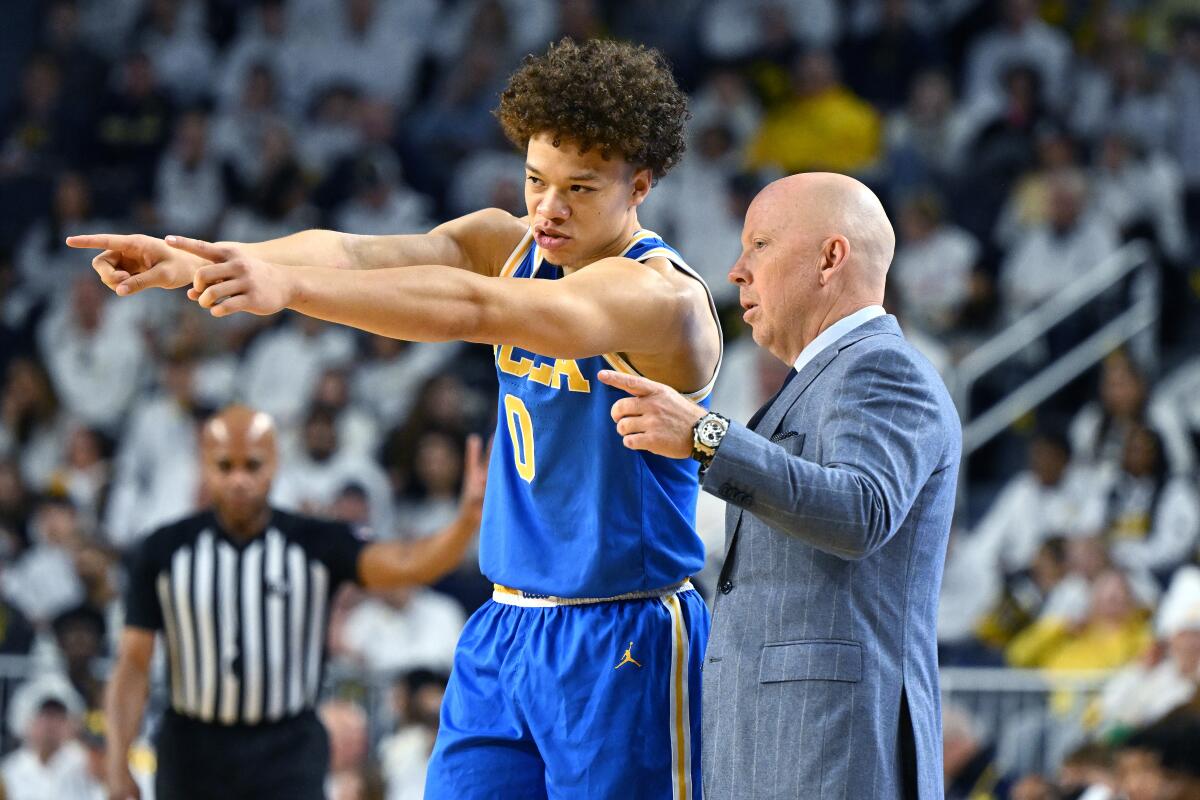
UCLA coach Mick Cronin talks with guard Trent Perry during the Bruins’ game at Michigan on Feb. 14.
(Lon Horwedel / Associated Press)
“Central Florida can score,” he explained of the 21-11 Knights, who’ve successfully made the transition from the AAC to the Big 12. “They’re athletic.
“[Themus] Fulks [averaging 14.1 points and 6.7 assists] keeps me up at night because he can get in the lane whenever he wants. He’s great off the pick and roll. He makes good reads and he’s a problem.
“I’ve seen Riley Kugel [14.4 points] since high school. He played for a friend of mine, so I know he’s a very good player and has gotten better as he’s gotten older.
“They can shoot it. They’ve struggled of late which means law of averages, that’s going to flip. They’re an athletic, aggressive team.”
On the other hand Dawkins, back in the city where he played for five years and won an NBA Eastern Conference title while playing alongside Charles Barkley, knows what he’s up against.
“Mick does a great job with his team,” said Dawkins, who before coming to Central Florida went 156-115 coaching eight years at Stanford, following a decade serving as Mike Krzyzewski’s assistant at his alma mater, Duke. “Of course. UCLA is a storied program of all college basketball.
“What an amazing history they’ve had there. and, of course, Coach Cronin is a coach I have known from the American as well. I know his team is going to be really, really talented.
“They’re very skilled and they’re tough.”
Speaking of that legacy, which includes a 1976 Final Four appearance here under John Wooden’s replacement, Gene Bartow, Cronin’s players knew what they were signing up for when they decided to come to Westwood.
“It’s definitely a blessing just to be part of this, to be part of the history, part of the tradition,” said senior guard Skyy Clark, averaging 11.7 points per game. “It’s a lot to carry for sure, but it motivates us to go out there and just do what we can.”
UCLA forward Tyler Bilodeau is congratulated by fans after beating USC at the Galen Center on March 7.
(Allen J. Schaben/Los Angeles Times)
“Yeah, a lot comes with these four letters we wear on our chest,” added second-leading scorer and top playmaker Donovan Dent (13.5, 7.6 assists). “We just want to make our names and the history of it.
“I wouldn’t say there’s extra pressure, but we know there’s definitely a standard that needs to be held.”
UCLA forward Tyler Bilodeau and Dent were injured during the Bruins’ Big Ten tournament run, but Cronin said Thursday “they looked good today [during practice,] so knock on wood.”
Maintaining the standard first set by Wooden is what lured Cronin from Cincinnati, where he won 296 games in 13 years and took them to the NCAA tournament nine times.
“I had a great job and was close to being the winningest coach ever at Cincinnati,” said Cronin, who’ll be making his fourth tourney appearance with the Bruins, including dropping a 2022 Sweet Sixteen game to North Carolina in this building. “But I left to sit in Coach Wooden’s chair and coach at the best university in the country, arguably the world, and everything that goes with it.
“It’s tremendous. I’ve been very fortunate. To coach at my alma mater, Cincinnati, and to be the head basketball coach at UCLA following so many.”
On Friday night, Cronin and the Bruins will take on the challenge of Central Florida and his longtime adversary Dawkins, mindful there are no gimmes once you get this far. No. 5 seed Wisconsin learned that during a loss to No. 12 High Point on Thursday and top-ranked Duke nearly did, having to rally from 13 points down to survive No. 16 Siena.
“You got to have players,” he said. “If you can’t coach, you’re not going to be in those tournaments. “The better players you have, the further you go.
That’s the whole key to getting in these things and advancing in them. Perseverance.”
Another member of the Duggar family, famous for the TLC series “19 Kids and Counting,” faces allegations of child sex abuse.
Joseph Duggar, the 31-year-old son of Jim Bob and Michelle Duggar and the younger brother of convicted sex offender Josh Duggar, was arrested Wednesday afternoon in Arkansas by local law enforcement on suspicion of molesting a minor in Florida, the Bay County Sheriff’s Office announced in a statement. The sheriff’s office said it received a report on Wednesday of past sexual abuse allegedly involving Duggar and a 14-year-old girl. The girl alleged she was 9 years old during one of several alleged incidents, police said.
The teenager, according to law enforcement, accused Duggar of molesting her in 2020 while she was vacationing with family and staying at a residence in Panama City Beach. He is accused of touching the girl’s genitals and rubbing her thighs.
Resources for survivors of sexual assault
If you or someone you know is the victim of sexual violence, you can find support using RAINN’s National Sexual Assault Hotline. Call (800) 656-HOPE or visit online.rainn.org to speak with a trained support specialist.
According to the statement, the victim said Duggar “eventually apologized” for the abuse, and he stopped touching her. Duggar had also “admitted his action’s to the girl’s father and to Tontitown detectives in Arkansas, Duggar’s home state, law officials said. The Tontitown Police Department confirmed Duggar’s arrest in a separate statement, noting it acted on a warrant issued by the Bay County Sheriff’s Office.
The former reality star was charged with molestation of a victim younger than 12 and “lewd and lascivious behavior conducted” by an adult. Duggar, who is currently jailed at the Washington County Detention Center, awaits extradition to Florida. He could not immediately be reached for comment.
Joseph Duggar, his parents and his siblings — whose first names also begin with the letter J — became unexpected reality TV stars with the premiere of TLC’s “19 Kids and Counting” in 2008. The series followed the giant family, highlighting their Christian fundamentalist lifestyle. The family’s once-charming facade of purity and religious devotion quickly faded in 2015 when Josh, the firstborn Duggar child, was accused of molesting five younger girls — four of whom were his sisters — when he was 15. The series was canceled that year.
In a separate case, Josh was convicted on two counts of possessing and receiving child pornography in December 2021. He was sentenced to 12 ½ years in prison in 2022. The Supreme Court rejected his efforts to appeal his case last June.
Fifteen years after the premiere of “19 Kids and Counting,” the series, the Duggar family and their devotion to the Institute in Basic Life Principles were subject to close scrutiny in the Prime Video docuseries “Shiny Happy People: Duggar Family Secrets.”
Jill Diillard, the second-eldest Duggar daughter and one of Josh’s victims, spoke out for the 2023 docuseries.
“I believe strongly that victims should always be protected. Victims should always be cared for,” she said. “You’re out there, your story’s out there. … I’d rather have some say in what that looks like.”
The Trump administration said Thursday that it has launched investigations into 13 states that require state-regulated health insurance plans to cover abortion.
The inquiries are the latest in a long-running dispute between the political parties on how to interpret a provision, known as the Weldon Amendment, that’s included in federal spending laws each year. It bars states from discriminating against health entities that don’t provide, cover or refer for abortion.
When Democrat Joe Biden was president, the U.S. Department of Health and Human Services’ civil rights office said the provision didn’t pertain to employers or other healthcare sponsors. The Trump administration said this year that it does.
The administration says that potentially puts states with abortion coverage requirements in violation of the law, because they may not allow employers or other healthcare issuers to opt out. It said it was sending out letters to gather more information from those states.
The Health and Human Services civil rights office launched the investigations “to address certain states’ alleged disregard of, or confusion about, compliance with the Weldon Amendment,” office Director Paula M. Stannard said in a statement.
“Under the Weldon Amendment, health care entities, such as health insurance issuers and health plans, are protected from state discrimination for not paying for, or providing coverage of, abortion contrary to conscience. Period,” Stannard said.
The states with the coverage requirements are California, Colorado, Delaware, Illinois, Maine, Maryland, Massachusetts, Minnesota, New Jersey, New York, Oregon, Vermont and Washington. All except Vermont have Democratic governors.
New Jersey Gov. Mikie Sherrill said in a statement Thursday that she’ll defend her state’s policies.
“New Jersey requires health insurance plans to follow all applicable laws, including protecting women’s reproductive freedom. So Donald Trump’s latest ‘investigation’ is nothing but a fishing expedition wasting taxpayers’ money,” she said.
The Weldon Amendment is one of a series of provisions known as conscience laws, which provide legal protections for individuals and healthcare entities that choose to not provide abortions or other types of care because of religious or moral objections.
In the years since it was enacted in 2005, there’s been a “partisan swing” in how broadly or narrowly it is interpreted depending on which party is in office, according to Mary Ziegler, a law professor at UC Davis.
Ziegler said the fact that employers and plan sponsors are not mentioned among healthcare entities in the text of the Weldon Amendment could give Democrats an edge with their interpretation, but the question has yet to be resolved in court.
Elizabeth Sepper, a law professor at the University of Texas at Austin, said the Heritage Foundation’s massive policy proposal known as Project 2025 called for an incoming Trump administration to withhold Medicaid funding for states found to violate the Weldon Amendment.
“What we’re seeing here is the fulfillment of a promise to the religious right,” she said.
President Trump’s first administration in 2020 moved to withhold federal healthcare funding from California over what it interpreted as a Weldon Amendment violation, but the Biden administration entered office the next year and reversed the decision.
Mulvihill and Swenson write for the Associated Press.
DISNEY is launching another cruise ship next year – with some first time princess appearances.
In 2027, Disney Cruise Line will be launching its ninth ship called the Disney Believe.
Sign up for the Travel newsletter
Thank you!
Disney Cruise Line is launching a new ship next year called Disney BelieveCredit: Disney Cruise Line
The ship will be the fourth ship in the Wish class, joining Disney Wish, Disney Treasure and Disney Destiny.
It will be themed on “dreamers and doers who dare to pursue their own happily ever after”.
On board, stories that will be featured will be from Disney, Pixar, Marvel, and Star Wars.
Each Wish class ship features its own theme, for example Disney Wish is enchantment-themed, Disney Treasure is adventure-themed and the Disney Destiny is heroes and villains-themed.
Disney Believe will be ‘promise and possibilities-themed’.
Disney Cruise Line stated: “Onboard the Disney Believe, powerful tales of characters who believe in themselves and their dreams will come to life in exciting new ways.
“From the mystical worlds of Encanto and Frozen, to the wishing wells of Snow White, to the depths of the sea with Moana and The Little Mermaid, there are endless stories waiting to be discovered and new chapters ready to unfold onboard.”
These characters already feature onboard some of the Wish class ships, with an Arendelle dining experience onboard the Disney Wish.
However, Snow White currently does not feature prominently on any of the current Wish class ships.
The Disney Believe is expected to launch in late 2027.
Disney also announced last month that the Disney Wish ship will be coming to the UK next year.
The ship will sail from Southampton on three to seven-night European sailings.
Entering through the Grand Hall, passengers will meet famous Disney princes and princesses.
Inside each stateroom, passengers will find spacious wardrobes, sprawling beds and a theme specific to a Disney character.
Disney Believe will be promise and possibilities-themedCredit: Disney Cruise
When it comes to food on board the ship, guests won’t be short for choice, with market-style buffet options and immersive dining adventures, such as Arendelle: A Frozen Dining Adventure.
As for other entertainment, passengers can head to West-End style shows including Disney Seas the Adventure, where passengers follow Goofy on a journey sailing the ship.
For a thrilling adventure, head on the Disney AquaMouse ride, which features lighting, special effects and scenes of Mickey and Minnie on different adventures.
And the ultimate night for the whole family is Pirates’ Night, where Captain Jack Sparrow takes a fateful leap from the ship’s funnel.
Parents wanting some time to themselves can check their kids into either the full-service nursery or kids and teens clubs before exploring the ship’s adult-only spaces such as the Senses Spa & Salon.
The cheapest sailing is a three-night Belgium cruise from Southampton, sailing to Zeebrugge (Bruges) in Belgium costing from £1,633 for two people.
In other cruise news, here’s the ultimate family cruise – it has a water roller coaster, a private island and an onboard beach club.
Walt Disney Co. installed Josh D’Amaro as chief executive Wednesday, beginning a new chapter for the storied Burbank entertainment giant.
Bob Iger passed the reins during Disney’s virtual annual meeting of shareholders, completing the company’s high-stakes and tightly choreographed changing of the guard. After spending two decades molding Disney into a media colossus, Iger segued into a senior advisory role, which will run through December when he officially retires.
The leadership shift comes amid an upheaval in Hollywood as traditional companies wage a desperate battle for survival.
D’Amaro, in his first address to shareholders, pointed to Disney’s signature storytelling as its competitive edge.
“While others in our industry are consolidating just to compete, or struggling to be relevant in a fragmented and disrupted world, Disney is in a category of one,” D’Amaro said during a video segment at the meeting. “This next chapter will be driven by staying focused on world-class creativity, enhanced by technology, bringing unforgettable stories to audiences wherever they are.”
D’Amaro, 55, becomes the ninth leader in Disney’s 102-year history. He was selected last month by Disney board members after a two-year internal bake-off among high-ranking division leaders. Board members were impressed with his business acumen, charisma and his deep love for Disney and its fabled history.
D’Amaro inherits a company that is beloved by millions. It generates $94 billion a year in revenue and employs 230,000 people.
He faces enormous challenges as he steers the ship through a turbulent media environment and tense geopolitics. The war in Iran prompted a sharp increase in fuel costs, which could become a drag on Disney’s critically important tourism business. Executives already have signaled “headwinds” in international visitation at its U.S. theme parks this year.
Lingering Middle East tensions also could weigh on Disney’s plans for a new Persian Gulf waterfront theme park and resort near Abu Dhabi.
D’Amaro, who served as parks and experiences chief until Wednesday, got his corporate start at Disneyland 28 years ago.
“Like so many of you, my connection to Disney goes back to my childhood, long before I began my career here,” D’Amaro told shareholders. “I grew up in a Disney family. We watched ‘The Wonderful World of Disney’ on Sunday nights. I was 10 years old when my family visited Disneyland for the first time. … Disney has always been a place of imagination, innovation and infinite potential.”
Disney previously announced a $60-billion, 10-year expansion program, which D’Amaro has led. But executives must strike a balance by keeping attractions true to their nostalgic core. In Anaheim, the expansion could result in at least $1.9 billion of development.
Disney also must continue to grow its animation business and manage revenue declines from its traditional linear television channels, including ESPN and ABC. It needs to turbocharge its streaming services with compelling movies and TV shows to remain competitive with Netflix and other leaders in the field.
Disney teased upcoming fan favorites, including the May release of Lucasfilm’s “Star Wars: The Mandalorian & Grogu,” a “Bluey” feature film (the kids show featuring an animated puppy, a blue heeler) and a sequel to a “Lilo & Stitch” film for 2028.
Streaming is key to Disney’s future, D’Amaro said.
“Disney+ will continue to evolve beyond a traditional streaming service to become the digital centerpiece of our company,” D’Amaro said, calling the service “a portal that connects our stories, experiences, games, films, and more in entirely new ways.”
The company plans to unify Disney+ and Hulu later this year.
Disney also must continue to incorporate technology while safeguarding its characters and franchises.
“We will continue to develop and embrace new technologies to empower our storytellers — but never at the expense of our characters and worlds, our creative partners, or the trust people place in us,” D’Amaro said. “Because Disney at its core is a company that celebrates human creativity.”
Wednesday also marked a reorganization of the company, configured by Iger, D’Amaro and Disney’s board.
Board members recognized that D’Amaro, who has spent most of his career in the parks division, lacks deep connections among Hollywood’s writers and producers. They elevated longtime television executive Dana Walden, who had been vying for the top job, to the newly formed role of chief creative officer and the company’s first woman president.
ESPN will continue to be managed by Jimmy Pitaro and Disney Entertainment, Studios chairman Alan Bergman will remain in his influential role overseeing film studios including production, marketing and distribution, and sharing oversight for streaming programming with Walden.
D’Amaro’s total compensation package is valued at about $40 million a year, including a $2-million annual base salary, $26.2 million in annual long-term stock incentives, a cash bonus and a one-time promotion award of $9.7 million.
“Josh is a wonderful choice to lead the Walt Disney Co.,” Iger said in a pre-recorded video. “He has passion for our businesses and brands, respect for our people, and he appreciates what makes this company so unique.”
Iger is wrapping up an unprecedented 52-year career at ABC and Disney.
He first stepped into the CEO role in 2005; his first 15 years were almost magical.
Iger led acquisitions of Pixar Animation, Marvel Entertainment and Lucasfilm, the studio behind “Star Wars,” that turned Disney into a blockbuster machine. Sports king ESPN spawned staggering profits, and Disney’s theme parks set industry standards.
Disney’s former Chief Executive Bob Iger will stay on through the end of the year as a senior advisor.
(Jay L. Clendenin / Los Angeles Times)
His decision to buy much of Rupert Murdoch’s 21st Century Fox, a $71-billion deal that closed in 2019, boosted Disney’s television production, refreshed its TV executive bench, and provided a controlling stake in general entertainment streaming service Hulu. The acquisition also gave Disney access to fan-favorite franchises, including “Deadpool,” “The Simpsons,” and James Cameron’s “Avatar.”
But the purchase left Disney saddled with debt just as the COVID-19 pandemic prompted production shutdowns and closures at theme parks and sports venues. It would take several years for Disney to recover.
Iger initially passed the CEO baton to Bob Chapek in February 2020. Iger, then chairman, retired the following year but came back in November 2022 to a mess. At the time, the company was losing billions of dollars on its shift to streaming but that unit is now profitable.
Iger spent the next three years focusing on four business pillars, including improving the quality and profitability of its film studios.
During the last two years, Disney has produced five franchise films that racked up more than $1 billion in worldwide ticket sales, including “Inside Out 2,” “Zootopia 2,” and “Avatar: Fire and Ash.”
The company is banking this year on several other films with blockbuster potential, including Disney and Pixar’s “Toy Story 5,” “Star Wars: The Mandalorian & Grogu” and Marvel Studios’ “Avengers: Doomsday.”
“I would want to be known as someone who was given the keys to this kingdom and brought it to a place that even Walt would be proud of — more storytelling, more innovation, more risk‑taking, and more creation of happiness,” Iger said during a “The Rest is History” podcast last year.
During the meeting, Iger appeared in a prerecorded video that celebrated his numerous career highlights. Shown were clips from his cub years when Iger was a newscaster with bushy black hair. His journey was depicted, including his orchestration of multi-billion-dollar acquisitions that strengthened Disney with more characters and franchises.
Iger, 75 and now gray, ended by thanking shareholders “for the trust you placed in me, for the memories we created together, and for allowing me the honor of serving,” he said. “It has meant more to me than I can say.”
Animated pixie dust twinkled on the screen, courtesy of the fairy, Tinker Bell.
“Bob, on behalf of our employees, cast members, shareholders, and fans around the world, thank you so much for your tremendous leadership, your steadfast support, and your countless contributions to The Walt Disney Co.,” D’Amaro said, as the hand-off was complete.
“You’ve set an incredible example for all of us. … You will be missed,” D’Amaro said.
There was little fanfare during the business portion of the investor meeting.
The company’s slate of board directors were elected with 93% of the vote. Shareholders also approved executive compensation packages with about 85% of votes.
Shareholder-led proposals to compel reports on charities eligible for Disney’s gift-matching program, a review of the company’s accessibility practices in its theme parks for disabled guests, and a push for cumulative voting at future meetings all failed to muster support.
Disney shares closed at $99.41, down roughly 1% on the day.
The Grammy-nominated “Call Me Maybe” pop star and her husband, music producer Cole M.G.N., welcomed their first child together months after tying the knot last fall. Jepsen, 40, revealed the arrival of her little one on Instagram.
“Last 2 weeks have been the best of my life,” the Canadian singer-songwriter captioned a photo shared to her Instagram story on Tuesday. The photo, a mirror selfie, shows Jepsen all smiles in a leopard-print bucket hat, white shirt and black shorts as she cradles her child, who wears a green-striped onesie.
“Welcome to the world little one,” Jepsen wrote.
“Run Away With Me” singer Jepsen and music producer Cole M.G.N. — whose full name is Cole Marsden Greif-Neil — exchanged their vows in late October at the Chelsea Hotel in New York, three years after striking up a romance in 2022. A month later, Jepsen announced she and her husband were expecting.
“Oh hi baby,” she captioned a set of baby-bump-baring photos shared to Instagram in November. In the tender maternity shoot, Jepsen cradles her bump in bed alongside Marsden Greif-Neil. Jepsen continued posting on Instagram about her maternity journey with fans, in January posting photos from the beach, from home and from fitting rooms as she spoke about finding a lullaby for her child-to-be.
On Tuesday, she channeled a Frankie Valli classic to express her “Emotion” about being a mother: “Can’t Take My Eyes Off You.”
Last year, Jepsen celebrated 10 years of her cult-favorite album “Emotion,” the follow-up to her 2012 smash hit “Call Me Maybe.” She celebrated the milestone with a lively anniversary concert in August at the Troubadour in West Hollywood, featuring celebrity guests and moments of reflection.
“I had brought a little suitcase, and I kept calling my parents and saying, ‘Send more clothes!’” Jepsen said, recalling her move to Los Angeles from her native Canada when she was 26. “Five years later, I was like, I think I live here now. I’m very happy to say L.A. has become my home.”
Pop music critic Mikael Wood contributed to this report.
As word evidently reached activists in the last few weeks that disturbing allegations of sexual abuse against Chicano civil rights icon Cesar Chavez were forthcoming, things started to happen without much explanation.
Groups began to cancel long-planned parades, dinners, lectures and fundraisers scheduled for Chavez’s birthday on March 31. People who I’ve known for years suddenly weren’t returning calls or texts about what was going on. Longtime defenders of Chavez — who stood by their hero even as revelations in this paper and in biographies over the past generation showed there was a dark side to the man — suddenly became hard to reach.
When the United Farm Workers and the Cesar Chavez Foundation put out statements Tuesday morning that “troubling allegations” against their patriarch were considered credible enough for them to offer help to his victims, the silence transformed into dread. There was a discomfort similar to waiting for a tsunami — that whatever was coming would change lives, shake institutions and make people question values and principles that they had long held dear.
And like a natural disaster, what emerged about Chavez was far worse than anyone could’ve expected.
Wednesday morning, the New York Times published a story where two women whose families marched alongside Chavez in the fields of California during the 1960s and 1970s disclosed that he sexually abused them for years when they were girls. Just as shocking was the revelation by Dolores Huerta, Chavez’s longtime compatriot and a civil rights legend, that he had once raped her at a time when their leadership in the fight to bring dignity to grape pickers earned national acclaim and amounted to a modern-day Via Dolorosa.
The silence has transformed into screams. Politicians and organizations that long commemorated Chavez and urged others to follow his ways are releasing statements by the minute. My social media feed is now a torrent of friends and strangers expressing empathy for Chavez’s victims and outrage, disgust and — above all — disappointment that someone considered a secular saint by many for decades turned out to be a human more terrible than anyone could’ve imagined.
There will be questions and soul-searching about these horrifying disclosures in the weeks, months and years to come. We will see a push for the renaming of the dozens of schools, parks and streets that bear Chavez’s name across the country and even the rebranding of Cesar Chavez Day, a California state holiday since 2000 devoted to urging people to give back to their communities and the least among us.
The reckoning is only right. Much of the Latino civil rights, political and educational ecosystem will have to grapple with why they held up Chavez as a paragon of virtue for too long above others just as deserving and, as it turns out, nowhere near as compromised.
In any event, the myth has been punctured.
A portrait of Cesar Chavez on a mural on Farmacia Ramirez, 2403 Cesar E Chavez Ave. in East Los Angeles.
(James Carbone / Los Angeles Times)
Chavez’s biography always reads like an entry in the “Lives of the Saints” genre of books that Catholics used to read about the holy men of their faith. The son of farmworkers who became a Mexican American Moses trying to lead his people to the promised land of equity and political power. An internationally famous leader who lived a mendicant’s life. Who devoted decades to some of the most exploited people in the American economy. Honored with awards, plays, posters. Murals, movies and monuments. President Biden even kept a bust of Chavez at his Oval Office desk.
It was a beatific reputation that largely persisted even as the union he helped to create lost its influence in the fields of California and a new generation of activists looked down on Chavez for his long-standing opposition to immigrants who came to this country to work without legal status. Admirers kept him on a pedestal even as former UFW members alleged over the last two decades that the boss they once idolized purged too many good people in the name of absolute control. The hagiography continued even as a new generation of Latinos came of age not knowing anything about him other than an occasional school lesson or television segment.
I was one of those neophytes. I first heard his name at Anaheim High School in the mid-1990s and thought my teacher was talking about Julio Cesar Chavez, the famous Mexican boxer. I was thrilled to discover that someone had bravely fought for the rights of campesinos like my mom and her sisters, who toiled in the garlic fields of Gilroy and strawberry patches of Orange County as teenage girls in the 1960s, the same time that Chavez and the UFW were enjoying their historic wins.
“Who’s Cesar Chavez?” my Mami responded when I asked if his efforts ever made her work easier.
My admiration for Chavez continued even as I learned about some of his faults. I was able to separate Chavez the man from the movement for which he was a figurehead. Long-maligned communities seek heroes to emulate, to draw hope from, to hang on their walls and share their quotes on social media. We create them even as we ignore that they’re flesh and blood just like us.
Chavez seemed like the right man at the right moment as Mexican Americans rose up like never before to battle discrimination and segregation. Now, Latinos and others who admired Chavez have to grapple with his moral failings of the worst possible magnitude at the worst possible time: when there’s an administration doing everything possible to crush Latinos and we’re looking for people to look up to like never before.
He remains one of the few Latino civil rights leaders known nationwide — and Chavez is nowhere near as known as acolytes make him out to be. Some people will argue that it’s unfair he will likely get wiped away from the public sphere while other predatory men from the past and present largely maintain their riches and reputations.
But that’s looking at the abuse revelations the wrong way. For now, I will follow what those most directly affected by Chavez’s actions are telling us to do.
The UFW and Cesar Chavez Foundation were wise to not try to defend the indefensible in their statements and instead consider any victims first before deciding how to decide what’s next for them.
The Chavez family put out a news release that states “we honor the voices of those who feel unheard and who report sexual abuse.”
Huerta wrote in an online essay: “Cesar’s actions do not reflect the values of our community and our movement. The farmworker movement has always been bigger and far more important than any one individual.”
Another of his victims told the New York Times of Chavez’s legacy: “It makes you rethink in history all those heroes. The movement — that’s the hero.”
The fountain in the Memorial Garden surrounds the gravesite of Cesar Chavez and his wife Helen Chavez at Cesar E. Chavez National Monument in Keene, Calif.
(Francine Orr)
The face of that movimiento brought inspiration to millions and improved the lives of hundreds of thousands. That’s why we shouldn’t cancel the good that Chavez fought for alongside so many; we should direct the adulation he once attracted and the anger he’ll now rightfully receive toward the work that still needs to be done.
To quote an old UFW slogan that Chavez transformed into a mantra, la lucha sigue — the fight continues. It’s a statement that’s more pertinent than ever, damn its imperfect messenger.
Disney has a new captain, and his eyes are on the stars.
Taking over the reins from Bob Iger on Wednesday, new chief executive Josh D’Amaro signaled a bold shift for the entertainment giant: a future where emotional storytelling remains the “North Star,” but cutting-edge technology provides the fuel.
From ESPN to the Magic Kingdom, D’Amaro said in his first letter to employees as the top boss that his mission is to turn a century of nostalgia into a more personal, high-tech reality for fans worldwide.
“Used thoughtfully, it can empower our storytellers, strengthen our capabilities, and help us create more immersive, interactive and personal ways for people to experience Disney,” he wrote in the Wednesday morning note.
D’Amaro also said he wants the sprawling company, which includes film and TV studios, a tourism division, streaming services and live sports programming, to operate as “one Disney,” saying the global businesses all play a role in deepening consumers’ relationship with the Mouse House.
That connection people have with Disney’s brand is key to the company’s future. Consumers have more film, TV and experiences to choose from than ever, meaning Disney needs to distinguish itself among competitors.
To do that, D’Amaro plans to focus on the emotions consumers feel when they encounter Disney. As an example, he reminisced about his own first visit to Disneyland more than 40 years ago.
He recalled the joy on his father’s face as the two rode Peter Pan’s Flight together. And when they soared over the miniature version of London on the ride, he remembered his father leaning in and saying, “See, I told you. It feels like we’re flying!”
“That feeling of flying I had on Peter Pan all those years ago is still real to me,” he wrote in the Wednesday morning note. “And today, I am honored to move forward with all of you — with ambition, optimism, and absolute confidence in what we can build together.”
That new era also included a goodbye to Bob Iger, who handed over the reins Wednesday and now moves into a senior advisory role for the rest of the year before his planned retirement.
The company paid tribute to Iger in a video during Disney’s annual shareholders meeting Wednesday morning.
With clips from his earliest public appearances as Disney’s CEO, a highlight reel of the acquisitions the company made under his tenure and even a nod to his previous career behind the anchor desk, the video highlighted Iger’s legacy at the company and the role he played in bulking up Disney’s franchises, global theme parks, sports and streaming platforms.
When asked in the video about where he’ll go from here, Iger laughed and replied, “To Disneyland.”
In a pre-recorded speech, Iger said his time at Disney has spanned much of his life and that he never expected to become CEO of the company — much less twice.
“Over the years, we experienced extraordinary change and faced real challenges that were particularly profound in the last three years,” Iger said. “It was daunting at times, but through it all, what sustained me was the passion I saw every day from great storytellers, innovators, leaders and people around the world.”
In his parting remarks during that speech, he expressed confidence in the new leadership team of D’Amaro and Dana Walden, who is now president and chief creative officer of the company.
“I will be cheering on Josh, Dana and all of you as I sail off into the sunset,” he said. “So thank you for the trust you placed in me, for the memories we created together, and for allowing me the honor of serving. It has meant more to me than I can say.”
Your friendly neighborhood Spider-Man is finally back.
It’s been nearly five years since audiences last saw Tom Holland’s Peter Parker suit up as the webslinger in “Spider-Man: No Way Home,” and a lothas happenedin theMarvel Cinematic Universesince. (10 movies’ worth, for those keeping track.) But Sony Pictures released the first trailer for “Spider-Man: Brand New Day” on Wednesday, and it appears our hero has been dutifully continuing as a full-time masked crimefighter while remaining an anonymous entity to those he loves most.
“Sometimes Spider-Man has to do the hard thing, even if it breaks Peter Parker’s heart,” Peter says in a voiceover on the new footage. According to the film’s logline, it has been four years since the events of “No Way Home,” which saw Peter have to make everyone forget who he is to save the world. “Brand New Day” will see Spider-Man take on “one of the most powerful threats he has ever faced.”
The trailer shows Peter cross paths with former besties MJ (Zendaya) and Ned (Jacob Batalon), who still don’t know who he is. But like everyone else in New York, it does appear they are at least familiar with Spider-Man.
Among those Spidey crosses paths with in the teaser are Frank Castle (Jon Bernthal), also known as the Punisher. It doesn’t seem like Spider-Man and the “Daredevil: Born Again” anti-hero are on very friendly terms, though. The trailer also features glimpses of Spider-Man battling Scorpion (Michael Mando), Boomerang (whose casting has yet to be announced) and the Hand — as well as a seemingly invisible foe.
Peter is also shown seeking out Bruce Banner (Mark Ruffalo) in his non-Hulk form to try to figure out what is going on with his own body. It appears Spider-Man’s DNA could be mutating, as he has gained the ability to produce organic webs, which could be alarming. The trailer concludes with a mysterious voiceover (which sounds like Keith David) teasing what it could mean.
“Spiders have three life cycles,” the unnamed voice says. “When between cycles, it can leave the spider vulnerable to threats. … And for those spiders who make it through, it amounts to a kind of rebirth.”
Directed by Destin Daniel Cretton, “Spider-Man: Brand New Day” opens in theaters July 31.
Spider-Man battling the Hand in “Spider-Man: Brand New Day.”
A crowd celebrating Chaharshanbe Suri in Tehran were forced to flee after gunshots disrupted their event. Iranian security forces have reportedly been breaking up gatherings marking the Persian festival this week.